WO2024157807A1 - 酸化カップリング触媒、酸化カップリング触媒の製造方法及び炭化水素の製造方法 - Google Patents
酸化カップリング触媒、酸化カップリング触媒の製造方法及び炭化水素の製造方法 Download PDFInfo
- Publication number
- WO2024157807A1 WO2024157807A1 PCT/JP2024/000668 JP2024000668W WO2024157807A1 WO 2024157807 A1 WO2024157807 A1 WO 2024157807A1 JP 2024000668 W JP2024000668 W JP 2024000668W WO 2024157807 A1 WO2024157807 A1 WO 2024157807A1
- Authority
- WO
- WIPO (PCT)
- Prior art keywords
- oxidative coupling
- silica
- coupling catalyst
- producing
- methane
- Prior art date
- Legal status (The legal status is an assumption and is not a legal conclusion. Google has not performed a legal analysis and makes no representation as to the accuracy of the status listed.)
- Ceased
Links
Images







Classifications
-
- B—PERFORMING OPERATIONS; TRANSPORTING
- B01—PHYSICAL OR CHEMICAL PROCESSES OR APPARATUS IN GENERAL
- B01J—CHEMICAL OR PHYSICAL PROCESSES, e.g. CATALYSIS OR COLLOID CHEMISTRY; THEIR RELEVANT APPARATUS
- B01J23/00—Catalysts comprising metals or metal oxides or hydroxides, not provided for in group B01J21/00
- B01J23/16—Catalysts comprising metals or metal oxides or hydroxides, not provided for in group B01J21/00 of arsenic, antimony, bismuth, vanadium, niobium, tantalum, polonium, chromium, molybdenum, tungsten, manganese, technetium or rhenium
- B01J23/32—Manganese, technetium or rhenium
- B01J23/34—Manganese
-
- B—PERFORMING OPERATIONS; TRANSPORTING
- B01—PHYSICAL OR CHEMICAL PROCESSES OR APPARATUS IN GENERAL
- B01J—CHEMICAL OR PHYSICAL PROCESSES, e.g. CATALYSIS OR COLLOID CHEMISTRY; THEIR RELEVANT APPARATUS
- B01J35/00—Catalysts, in general, characterised by their form or physical properties
- B01J35/30—Catalysts, in general, characterised by their form or physical properties characterised by their physical properties
- B01J35/34—Mechanical properties
- B01J35/37—Crush or impact strength
-
- B—PERFORMING OPERATIONS; TRANSPORTING
- B01—PHYSICAL OR CHEMICAL PROCESSES OR APPARATUS IN GENERAL
- B01J—CHEMICAL OR PHYSICAL PROCESSES, e.g. CATALYSIS OR COLLOID CHEMISTRY; THEIR RELEVANT APPARATUS
- B01J37/00—Processes, in general, for preparing catalysts; Processes, in general, for activation of catalysts
-
- B—PERFORMING OPERATIONS; TRANSPORTING
- B01—PHYSICAL OR CHEMICAL PROCESSES OR APPARATUS IN GENERAL
- B01J—CHEMICAL OR PHYSICAL PROCESSES, e.g. CATALYSIS OR COLLOID CHEMISTRY; THEIR RELEVANT APPARATUS
- B01J37/00—Processes, in general, for preparing catalysts; Processes, in general, for activation of catalysts
- B01J37/02—Impregnation, coating or precipitation
-
- B—PERFORMING OPERATIONS; TRANSPORTING
- B01—PHYSICAL OR CHEMICAL PROCESSES OR APPARATUS IN GENERAL
- B01J—CHEMICAL OR PHYSICAL PROCESSES, e.g. CATALYSIS OR COLLOID CHEMISTRY; THEIR RELEVANT APPARATUS
- B01J37/00—Processes, in general, for preparing catalysts; Processes, in general, for activation of catalysts
- B01J37/08—Heat treatment
-
- C—CHEMISTRY; METALLURGY
- C07—ORGANIC CHEMISTRY
- C07B—GENERAL METHODS OF ORGANIC CHEMISTRY; APPARATUS THEREFOR
- C07B61/00—Other general methods
-
- C—CHEMISTRY; METALLURGY
- C07—ORGANIC CHEMISTRY
- C07C—ACYCLIC OR CARBOCYCLIC COMPOUNDS
- C07C11/00—Aliphatic unsaturated hydrocarbons
- C07C11/02—Alkenes
- C07C11/04—Ethene
-
- C—CHEMISTRY; METALLURGY
- C07—ORGANIC CHEMISTRY
- C07C—ACYCLIC OR CARBOCYCLIC COMPOUNDS
- C07C2/00—Preparation of hydrocarbons from hydrocarbons containing a smaller number of carbon atoms
- C07C2/76—Preparation of hydrocarbons from hydrocarbons containing a smaller number of carbon atoms by condensation of hydrocarbons with partial elimination of hydrogen
- C07C2/82—Preparation of hydrocarbons from hydrocarbons containing a smaller number of carbon atoms by condensation of hydrocarbons with partial elimination of hydrogen oxidative coupling
- C07C2/84—Preparation of hydrocarbons from hydrocarbons containing a smaller number of carbon atoms by condensation of hydrocarbons with partial elimination of hydrogen oxidative coupling catalytic
-
- C—CHEMISTRY; METALLURGY
- C07—ORGANIC CHEMISTRY
- C07C—ACYCLIC OR CARBOCYCLIC COMPOUNDS
- C07C9/00—Aliphatic saturated hydrocarbons
- C07C9/02—Aliphatic saturated hydrocarbons with one to four carbon atoms
- C07C9/06—Ethane
Definitions
- the present disclosure relates to an oxidative coupling catalyst, a method for producing an oxidative coupling catalyst, and a method for producing hydrocarbons.
- a technology is known for producing hydrocarbons such as olefins by an oxidative coupling reaction (hereinafter referred to as the "OCM reaction") using methane-containing gases such as natural gas.
- OCM reaction oxidative coupling reaction
- Patent Document 1 proposes a method for producing hydrocarbons in which an inorganic oxide is supported with oxides of sodium, manganese, and tungsten, or a composite oxide thereof (oxidation coupling catalyst), and hydrocarbons having two or more carbon atoms are produced from methane through an OCM reaction.
- the invention of Patent Document 1 aims to produce hydrocarbons having two or more carbon atoms in high yield by carrying out an OCM reaction with high efficiency.
- Patent Document 1 is directed to an OCM reaction at atmospheric pressure, and the reactor in which the OCM reaction is performed becomes enlarged, which may result in increased power for compressors and the like that supply the fuel to purification and separation processes downstream of the reactor.
- it has been considered to carry out the OCM reaction at high temperatures and under pressure (for example, 750° C. and 0.9 MPa).
- the active components of the oxidative coupling catalyst melt, volatilize, and are reduced, which may result in a decrease in the yield of the resulting hydrocarbons.
- Another problem is that in the case of a catalyst that uses inactive silica as a carrier, if silica gel with a large particle size is used, the catalyst may crack during calcination.
- the present disclosure has been made to solve the above problems, and aims to provide an oxidative coupling catalyst that can produce hydrocarbons with two or more carbon atoms in high yield even under high temperature and pressure, and that can reduce the size of the equipment used to perform the OCM reaction, a method for producing an oxidative coupling catalyst, and a method for producing hydrocarbons.
- the oxidative coupling catalyst disclosed herein is an oxidative coupling catalyst that produces hydrocarbons having two or more carbon atoms from methane through an oxidative coupling reaction of methane, and is a calcined product of silica carrying an alkali metal salt.
- the method for producing an oxidative coupling catalyst according to the present disclosure is a method for producing an oxidative coupling catalyst that produces hydrocarbons having two or more carbon atoms from methane through an oxidative coupling reaction of methane, and includes the steps of: contacting silica or a calcined product of silica with an aqueous solution containing an alkali metal salt to obtain a precursor in which the silica or the calcined product of silica is impregnated with the aqueous solution; and calcining the precursor at 800°C or higher to obtain the oxidative coupling catalyst.
- the method for producing hydrocarbons according to the present disclosure uses the above-mentioned oxidative coupling catalyst to produce hydrocarbons having two or more carbon atoms from methane through an oxidative coupling reaction of methane.
- 1 is a flow chart illustrating a method for producing an oxidative coupling catalyst according to one embodiment of the present disclosure.
- 1 is a flow chart illustrating a method for producing hydrocarbons according to an embodiment of the present disclosure.
- 1 is a photograph showing silica gel particles after calcination.
- 1 is a photograph showing extruded silica after calcination.
- 2 is a graph showing X-ray diffraction (XRD) results of extruded silica after calcination.
- 1 is a graph showing X-ray diffraction (XRD) results for an oxidative coupling catalyst according to an embodiment of the present disclosure.
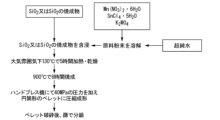
- 1 is a flowchart showing a method for producing an oxidative coupling catalyst according to Example 1.
- FIG. 1 is a flowchart showing a method for producing an oxidative coupling catalyst according to Example 2.
- 1 is a flowchart showing a method for producing an oxidative coupling catalyst according to Example 3.
- 1 is a photograph showing the oxidative coupling catalyst obtained in Example 3.
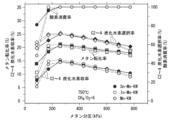
- FIG. 1 is a graph showing the yield of olefins having 2 to 4 carbon atoms in the product gas, the methane conversion, the selectivity for hydrocarbons having 2 to 4 carbon atoms, and the oxygen consumption rate versus the partial pressure of methane in the feed gas when an oxidative coupling reaction was carried out using the oxidative coupling catalysts obtained in Examples 2, 4, and 5.
- 1 is a graph showing the conversion rate of methane when an oxidative coupling reaction of methane is carried out using an oxidative coupling catalyst according to an embodiment of the present disclosure. 1 is a graph showing the oxygen consumption rate when an oxidative coupling reaction of methane is carried out using an oxidative coupling catalyst according to an embodiment of the present disclosure.
- the oxidative coupling catalyst according to one embodiment of the present disclosure is a calcined product of silica on which an alkali metal salt is supported.
- fired product refers to a porous body obtained by kneading silica powder with a binder, molding the resulting silica by a method such as extrusion molding, and then heat treating the molded silica at 700°C or higher.
- the particle diameter of the oxidative coupling catalyst of this embodiment is preferably 1 to 5 mm, more preferably 2 to 4 mm. If the particle diameter of the oxidative coupling catalyst is large, the pressure loss of the catalyst layer when the OCM reaction is performed under pressurized conditions can be further reduced, but the catalyst surface area per unit volume of the catalyst layer is small, and a large amount of catalyst is required to achieve a predetermined performance. Conversely, if the particle diameter of the oxidative coupling catalyst is small, the catalyst surface area per unit volume of the catalyst layer is large, and a small amount of catalyst can achieve a predetermined performance, but the pressure loss of the catalyst layer increases.
- the process gas is pressurized by a compressor or the like in the downstream of the OCM reactor, and the reduction in gas pressure due to the pressure loss of the catalyst layer greatly affects the power of the compressor or the like.
- the particle diameter can be measured, for example, by a sieving method using several types of sieves with different mesh sizes.
- the average particle size of the oxidation coupling catalyst of this embodiment is preferably 1 to 5 mm, more preferably 2 to 4 mm.
- the average particle size is given by the median size (d50) of a plurality of particle size measurements obtained by a method such as image analysis.
- the oxidative coupling catalyst of the present embodiment preferably exhibits crystallinity from the viewpoint of further enhancing catalytic activity. Whether or not the oxidative coupling catalyst exhibits crystallinity can be confirmed by X-ray diffraction (XRD). When a peak is observed at a specific diffraction angle in XRD, that is, when a diffraction phenomenon is observed, the oxidative coupling catalyst is judged to exhibit crystallinity.
- XRD X-ray diffraction
- alkali metal salts that is the active component of the oxidative coupling catalyst of this embodiment include alkali metal salts of oxides (hereinafter simply referred to as "oxides") that contain at least tungsten or zirconium.
- oxides containing at least tungsten or zirconium include tungsten (VI) oxide, tungstic acid, zirconia (ZrO 2 ), zircon (ZrSiO 4 ), etc.
- the oxides containing at least tungsten or zirconium may be composite oxides of tungsten or zirconium with a metal element other than tungsten and zirconium.
- Metal elements other than tungsten and zirconium are not particularly limited, and examples thereof include aluminum, magnesium, calcium, titanium, chromium, manganese, iron, cobalt, nickel, copper, zinc, palladium, silver, indium, tin, iridium, platinum, and gold. These metal elements may or may not form a composite oxide with tungsten or zirconium.
- manganese, indium, and tin are preferred because they can further increase the yield of hydrocarbons having 2 to 4 carbon atoms in the OCM reaction, and tin is more preferred because it can further increase the selectivity of hydrocarbons having 2 to 4 carbon atoms even under pressurized conditions.
- alkali metal in the alkali metal salt examples include sodium, potassium, rubidium, and cesium.
- potassium is preferred because it has high catalytic activity and excellent heat resistance. This is because sodium tungstate (Na 2 WO 4 , melting point 698° C.) melts and may have poor durability when the operating temperature of the reactor is too high, whereas potassium tungstate (K 2 WO 4 , melting point 921° C.) does not melt and has excellent durability when the operating temperature of the reactor is less than 900° C.
- the mass ratio of manganese:potassium salt of an oxide:silica is preferably (0.01-5):(0.05-10):(85-99.9), more preferably (0.5-4):(1-8):(88-98.5), and even more preferably (1-3):(2-7):(90-97), where the total mass of manganese, potassium salt of an oxide, and silica is taken as 100.
- the mass ratio of manganese:potassium salt of an oxide:silica is within the above numerical range, the selectivity of hydrocarbons having 2 to 4 carbon atoms can be further increased in the OCM reaction even under pressurized conditions.
- the mass ratio (mass concentration) of manganese and potassium is determined by analyzing the oxidative coupling catalyst by inductively coupled plasma atomic emission spectrometry (ICP-AES).
- the mass ratio (mass concentration) of silica can be calculated by subtracting the mass ratio (mass concentration) of each active component (manganese and potassium) from the total mass of the oxidative coupling catalyst.
- the mass ratio of manganese:potassium oxide salt:silica can be adjusted by the concentration, amount, and combination of these of the aqueous solution of each raw material.
- the mass ratio represented by tin:manganese:potassium salt of an oxide:silica is preferably (0.01-50):(0.01-5):(0.05-10):(35-99.9), more preferably (2-50):(0.5-4):(1-8):(38-96.5), and even more preferably (10-20):(1-3):(2-7):(70-87).
- the total mass of tin, manganese, potassium salt of an oxide, and silica is taken as 100.
- the mass ratio represented by tin:manganese:potassium salt of an oxide:silica is within the above numerical range, the selectivity of hydrocarbons having 2 to 4 carbon atoms can be further increased in the OCM reaction even under pressurized conditions.
- the mass ratio represented by tin:manganese:potassium oxide salt:silica the mass ratios (mass concentrations) of tin, manganese, and potassium are determined by analyzing the oxidative coupling catalyst by inductively coupled plasma atomic emission spectrometry (ICP-AES).
- the mass ratio (mass concentration) of silica can be calculated by subtracting the mass ratios (mass concentrations) of each active component (tin, manganese, and potassium) from the total mass of the oxidative coupling catalyst.
- the mass ratio of tin:manganese:potassium oxide salt:silica can be adjusted by the concentration and amount of each raw material in the aqueous solution, and a combination thereof.
- the silica that is the carrier of the oxidation coupling catalyst of this embodiment is not particularly limited, and examples thereof include granular silica gel, silica powder, silica obtained by extruding a composition in which silica powder is dispersed in a binder to form a pellet (hereinafter also referred to as "extruded silica"), and extruded calcined silica obtained by calcining extruded silica at 700°C or higher for 5 hours or more.
- extruded silica and extruded calcined silica are preferred, and extruded calcined silica is more preferred, since the particle size can be easily adjusted by selecting a die, and even if the particle size is large, the silica does not break during high-temperature calcination.
- the specific surface area of the silica is preferably from 200 to 500 m 2 /g, more preferably from 250 to 450 m 2 /g, and even more preferably from 300 to 400 m 2 /g.
- the pore volume of the silica is preferably from 0.25 to 0.60 cm 3 /g, more preferably from 0.30 to 0.55 cm 3 /g, and even more preferably from 0.40 to 0.50 cm 3 /g.
- the specific surface area of the extruded pyrogenic silica is preferably from 80 to 140 m 2 /g, more preferably from 90 to 130 m 2 /g, and even more preferably from 100 to 120 m 2 /g.
- the pore volume of the extruded pyrogenic silica is preferably from 0.12 to 0.18 cm 3 /g, more preferably from 0.13 to 0.17 cm 3 /g, and even more preferably from 0.14 to 0.16 cm 3 /g.
- the specific surface area of the oxidative coupling catalyst of the present disclosure is preferably from 1.0 to 7.5 m 2 /g, more preferably from 1.3 to 7.0 m 2 /g, and even more preferably from 1.5 to 5.5 m 2 /g.
- the pore volume of the oxidative coupling catalyst of the present disclosure is preferably from 0.0010 to 0.0100 cm 3 /g, more preferably from 0.0020 to 0.0080 cm 3 /g, and even more preferably from 0.0030 to 0.0070 cm 3 /g.
- the specific surface area and pore volume can be measured by a gas adsorption method.
- Binders used in extruded silica include those containing methylcellulose derivatives, polyacrylic acid copolymers, polyurethane copolymers, etc., and among these, those containing methylcellulose derivatives are preferred.
- Examples of the binder include, but are not limited to, the Celandar (registered trademark) YB series from HighChem Co., Ltd.
- the silica which is the raw material of the oxidation coupling catalyst of this embodiment, is preferably amorphous.
- Amorphous silica is impregnated with an active component such as tin, manganese, potassium, indium, etc., and calcined to exhibit crystallinity, thereby exhibiting catalytic function.
- the raw material silica may be crystalline. Whether silica is amorphous or not can be confirmed by X-ray diffraction (XRD). When no peak is observed at a specific diffraction angle in XRD, that is, when no diffraction phenomenon is observed, the silica is determined to be amorphous.
- the methane conversion rate (%) of the oxidative coupling catalyst of this embodiment is preferably from 13.0 to 25.0%, more preferably from 15.0 to 23.0%, and even more preferably from 17.9 to 20.0%.
- the selectivity (%) of the oxidative coupling catalyst of this embodiment for hydrocarbons having 2 to 4 carbon atoms, as defined by the following formula (2), is preferably from 50 to 80%, more preferably from 54 to 70%, and even more preferably from 55 to 65%.
- the yield (%) of hydrocarbons having 2 to 4 carbon atoms, as defined by the following formula (3), of the oxidative coupling catalyst of this embodiment is preferably 7 to 30%, more preferably 9 to 20%, and still more preferably 10 to 15%.
- the method for producing an oxidation coupling catalyst according to the present disclosure includes the steps of: bringing silica or a calcined product of silica into contact with an aqueous solution containing an alkali metal salt to obtain a precursor in which the silica or the calcined product of silica is impregnated with the aqueous solution; and calcining the precursor at 800° C. or higher to obtain an oxidation coupling catalyst.
- aqueous solution containing an alkali metal salt to obtain a precursor in which the silica or the calcined product of silica is impregnated with the aqueous solution.
- the aqueous solution containing an alkali metal salt to be impregnated into silica or a calcined product of silica can be obtained by dissolving an alkali metal salt of an oxide containing at least tungsten or zirconium in water.
- the aqueous solution containing a metal element other than tungsten and zirconium can be obtained by dissolving an inorganic compound such as a chloride, nitrate, sulfate, carbonate, hydrogencarbonate, or ammonium salt of a metal element other than tungsten or zirconium, or an organic compound such as an acetate or oxalate, in water.
- a composite oxide such as potassium tungstate can be dissolved in water to obtain an aqueous solution.
- the molar concentration of the metal in the aqueous solution can be appropriately determined depending on the performance required of the oxidative coupling catalyst.
- an aqueous solution containing a plurality of types of metals When an aqueous solution containing a plurality of types of metals is used in the step of obtaining a precursor, an aqueous solution in which each type of metal is dissolved may be prepared, and each aqueous solution may be successively impregnated into silica (successive impregnation method), or aqueous solutions in which a plurality of types of metals are dissolved may be co-impregnated into silica (co-impregnation method). When an aqueous solution containing a plurality of kinds of metals is used, the co-impregnation method is preferred because it has excellent catalyst production efficiency.
- the content of water in the aqueous solution in which each type of metal is dissolved is preferably 100 to 500 parts by mass per 100 parts by mass of the compound containing the metal.
- the content of water in the aqueous solution in which a plurality of types of metals are dissolved is preferably 100 to 500 parts by mass per 100 parts by mass of the total of the compounds containing the metals.
- the mass ratio expressed as manganese:potassium salt of an oxide:silica is preferably (0.01-5):(0.05-10):(85-99.9), more preferably (0.5-4):(1-8):(88-98.5), and even more preferably (1-3):(2-7):(90-97), where the total mass of manganese, potassium salt of an oxide, and silica is taken as 100.
- the mass ratio expressed as tin:manganese:potassium salt of an oxide:silica is preferably (0.01-50):(0.01-5):(0.05-10):(35-99.9), more preferably (2-50):(0.5-4):(1-8):(38-96.5), and even more preferably (10-20):(1-3):(2-7):(70-87), where the total mass of tin, manganese, potassium salt of an oxide, and silica is taken as 100.
- the temperature (calcination temperature) when calcining the precursor is, for example, 800°C or higher, preferably 850°C or higher, and more preferably 850°C or higher and lower than 900°C.
- the calcination temperature is equal to or higher than the lower limit
- the alkali metal salt is converted into an oxide containing an alkali metal or a composite oxide thereof, and is supported on the calcined product of silica as a stable active component.
- the amorphous silica exhibits crystallinity, thereby further enhancing the catalytic activity.
- the calcination temperature is lower than the upper limit, the melting and volatilization of the active component of the catalyst can be suppressed, and the decrease of the active component of the catalyst can be suppressed.
- the "baking temperature” is represented by the set temperature of an oven or the like when baking a precursor.
- a calcined product of the precursor can be obtained by impregnating with an aqueous solution having a first metal dissolved therein, calcining the resulting impregnated product, subsequently impregnating with an aqueous solution having a second metal dissolved therein, calcining the resulting impregnated product, and further subsequently impregnating with an aqueous solution having a third metal dissolved therein, and calcining the resulting impregnated product.
- the first metal and the second metal are preferably metal elements other than tungsten and zirconium
- the third metal is preferably a metal element containing tungsten and zirconium.
- the time for calcining the precursor is, for example, preferably 1 to 24 hours, more preferably 2 to 18 hours, and even more preferably 3 to 12 hours.
- the calcination time is preferably equal to or less than the upper limit.
- the "baking time” is expressed as the time during which heating in an oven or the like is maintained after the baking temperature is reached.
- the method for producing an oxidation coupling catalyst according to the present disclosure may further include a step of extruding a composition in which silica powder is dispersed in a binder to obtain silica.
- extruded silica as a support for the oxidation coupling catalyst, it becomes easy to adjust the particle size of the oxidation coupling catalyst, and even if the particle size is large, the occurrence of cracks during high-temperature firing can be suppressed.
- the shape of the extruded silica is not particularly limited, and examples of the shape include cylindrical, ring-shaped, spherical, blocky, fibrous, etc.
- the shape of the extruded silica can be adjusted by cutting or pulverizing the extruded noodle-shaped body into any shape.
- the method for producing an oxidation coupling catalyst of the present disclosure preferably further includes a step of calcining the molded body obtained by extruding the composition at 700°C or higher to obtain the calcined product of the silica.
- a calcined body obtained by calcining the extruded silica hereinafter also referred to as "extruded calcined silica"
- the occurrence of cracks in the silica carrier can be further suppressed in the subsequent calcination step to obtain the oxidation coupling catalyst.
- the specific surface area and pore volume are rapidly reduced (sintered), which generates thermal stress inside the silica.
- Silica with low toughness may not be able to withstand the thermal stress and may cause cracks.
- Extruded calcined silica has the toughness to withstand thermal stress, which further suppresses the occurrence of cracks in the silica carrier.
- Indicators of mechanical properties of materials related to cracking include, for example, strength, which indicates static robustness, and toughness, which indicates dynamic tenacity.
- strength which indicates static robustness
- toughness which indicates dynamic tenacity.
- the toughness is high, that is, the strength is low. The strength can be evaluated, for example, by measuring the strength (crushing strength) when the silica carrier is crushed.
- the crushing strength of the extruded pyrogenic silica is, for example, preferably 10 N/mm2 or less, more preferably 8 N/ mm2 or less, and even more preferably 6 N/ mm2 or less.
- the lower limit of the crushing strength of the extruded pyrogenic silica is not particularly limited, but is, for example, 2 N/ mm2 .
- the crushing strength of the extruded pyrogenic silica is given as the average value of the crushing strengths of, for example, five randomly selected silica carriers, measured with a Kiya hardness tester.
- the crushing strength of the extruded and calcined silica can be adjusted by the size, shape, calcination conditions, etc. of the extruded and calcined silica.
- the calcination temperature (hereinafter also referred to as "pre-calcination temperature") when obtaining the extrusion-molded calcined silica is preferably, for example, 400°C or higher. If the pre-calcination temperature is equal to or higher than the above lower limit, sufficient strength can be imparted to the silica carrier.
- the upper limit of the pre-calcination temperature is not particularly limited, and is, for example, 1000°C.
- the "pre-firing temperature” refers to the set temperature of an oven or the like when firing the extruded silica.
- the calcination time when obtaining the extruded calcined silica (hereinafter also referred to as "pre-calcination time") is, for example, preferably 1 to 24 hours, more preferably 5 to 10 hours.
- pre-calcination time is equal to or more than the above lower limit, sufficient strength and toughness can be imparted to the silica carrier, and the occurrence of cracks in the silica carrier can be further suppressed in the subsequent calcination step for obtaining the oxidation coupling catalyst.
- the pre-calcination time is equal to or less than the above upper limit, the time required to obtain the extruded calcined silica can be reduced, and the production efficiency of the oxidation coupling catalyst can be further improved.
- the "pre-baking time” is expressed as the time during which the heating of the oven or the like is maintained after the pre-baking temperature is reached.
- the silica obtained in the step is amorphous.
- Amorphous silica is impregnated with an active component such as tin, manganese, potassium, indium, etc., and calcined to exhibit crystallinity, thereby exhibiting catalytic function.
- the raw material silica may be crystalline.
- Examples of amorphous silica include the above-mentioned granular silica gel, silica powder, extruded silica, and extruded calcined silica.
- the method for producing hydrocarbons according to the present disclosure is a method for producing hydrocarbons having two or more carbon atoms from methane by an oxidative coupling reaction of methane using the oxidative coupling catalyst according to the present disclosure.
- the hydrocarbon production method of the present disclosure uses the oxidative coupling catalyst of the present disclosure, and is therefore capable of producing hydrocarbons having a carbon number of 2 or more in high yield.
- the hydrocarbon production method of the present disclosure uses the oxidative coupling catalyst of the present disclosure, it is possible to produce hydrocarbons having a carbon number of 2 or more in high yield even under high temperature and pressure, and it is possible to reduce the size of the equipment for performing the OCM reaction. As shown in FIG.
- the method for producing hydrocarbons according to this embodiment is a method for producing hydrocarbons having two or more carbon atoms from methane by an oxidative coupling reaction of methane.
- the method for producing hydrocarbons according to this embodiment will be described in more detail below.
- the methane used as the reaction raw material may be pure methane, or may be a methane-containing gas containing other components to the extent that it does not inhibit the OCM reaction.
- Such methane or methane-containing gas can be obtained from natural gas, methane-containing gas obtained in high-temperature coal coke ovens, methane-containing gas obtained by hydrogenation reaction of carbon monoxide and carbon dioxide produced from coal decomposition gas, or by decomposition of hydrocarbons derived from petroleum fractions, etc.
- methane-containing gas obtained by fermentation or methane isolation or purification process from the above methane-containing gas can be obtained to be used as the reaction raw material.
- the OCM reaction can be carried out in an atmosphere in the presence of oxygen, carbon dioxide, nitrous oxide, or the like, but is preferably carried out in an atmosphere in the presence of oxygen.
- oxygen source for the OCM reaction oxygen-containing gases such as oxygen, air, and oxygen-enriched air can be used.
- the OH radicals react with methane to generate methyl radicals ( CH3 radicals).
- the reaction mechanism is considered to be such that ethane and ethylene are produced from CH3 radicals.
- water may be evaporated in a boiler or the like, or steam in the exhaust gases of boilers or various chemical plants may be used after being isolated or purified as necessary.
- steam is also produced by the OCM reaction, so that steam may also be used.
- the ratio of methane, oxygen, and steam to be subjected to the OCM reaction is preferably in the range of 0.05 to 0.2 moles of oxygen and 0 to 0.1 moles of steam per mole of methane.
- an inert gas such as nitrogen, helium, or argon may be present in the reaction atmosphere.
- reaction temperature is, for example, preferably 500 to 1100°C, more preferably 600 to 1000°C, and even more preferably 700 to 900°C.
- reaction temperature is equal to or higher than the above lower limit, a practical reaction rate can be obtained.
- reaction temperature is equal to or lower than the above upper limit, side reactions such as steam reforming reactions, combustion reactions, and polymerization reactions can be suppressed, and the yield of hydrocarbons having two or more carbon atoms can be further increased.
- the "reaction temperature” refers to the temperature inside a catalyst layer such as a reactor during the OCM reaction.
- the OCM reaction is preferably carried out under pressurized conditions.
- the gas volume can be reduced, and the reactor in which the OCM reaction is carried out can be made smaller.
- the power of compressors and the like that supply process gas to the purification and separation processes downstream of the reactor can be reduced.
- the pressure in the OCM reaction (reaction pressure) is, for example, preferably 0.4 to 1.2 MPa, more preferably 0.5 to 1.1 MPa, and even more preferably 0.6 to 1.0 MPa. When the reaction pressure is equal to or higher than the above lower limit, the reactor in which the OCM reaction is performed can be made smaller.
- reaction pressure is expressed as the total pressure of the raw material gas used in the reaction. In this specification, the pressure is measured by a pressure gauge equipped in the reaction vessel.
- Equipment for carrying out the OCM reaction may be, for example, a fixed-bed reactor in which a mixture of the raw material methane or methane-containing gas and oxygen or oxygen-containing gas, preferably an atmospheric gas containing steam, is circulated through a reactor filled with a catalyst.
- the equipment for carrying out the OCM reaction may be a fluidized-bed reactor or a moving-bed reactor.
- a membrane reactor may be used to suppress combustion of the raw material methane by using a high oxygen concentration at the inlet of the catalyst layer, or a reactor that enables a split-feed method in which oxygen is split and injected into each catalyst layer may be used.
- the space velocity in the OCM reaction is, for example, preferably 1,000 to 5,000,000/h, and more preferably 10,000 to 500,000/h.
- space velocity is also referred to as GHSV, and means the total volumetric flow rate of the raw material gas per unit volume of the catalyst layer per hour (at 0° C. and 1 atm).
- the catalyst layer volume means the volume including the catalyst packed in the reaction tube and the voids therein.
- the reactor may be filled with one type of catalyst, or with multiple types of catalysts with different activities, either mixed or layered. If desired, it is also possible to fill the reactor with multiple types of catalysts with different activities, or with one type of catalyst and an inert inorganic material used as a diluent, so that the activity changes from the inlet to the outlet of the reactor.
- the reactor outlet gas i.e., the gas containing hydrocarbons with two or more carbon atoms produced by the OCM reaction, has a different composition depending on the reaction raw materials.
- the target products in the outlet gas, hydrocarbons with two or more carbon atoms, can be introduced into a known separation and purification facility and recovered, purified, recycled, and discharged according to the respective components to obtain the desired target products, such as ethylene, ethane, propane, propylene, butane, etc.
- Extruded silica Silica gel particles, which are selected as a material for catalyst carriers in conventional technology, undergo a significant decrease in specific surface area (pore volume) when fired at 900°C or higher, which places stress on the particles and causes them to break if their average particle diameter is 3 mm or more (see Figure 3). Therefore, an experiment was carried out in which silica that had been extruded into pellets and then crushed to a uniform particle size (hereinafter also referred to as "extruded silica”) was fired at 900° C. for 8 hours. The results are shown in FIG.
- extruded silica did not crack even when the average particle size was 3 mm. This is thought to be because extruded silica has high resistance (toughness) to stress.
- Example 1 ⁇ Production of oxidation coupling catalyst> [Example 1] 2.09g of Mn( NO3 ) 2.6H2O raw powder was added with 6.27mL of ultrapure water , which was three times the amount, and stirred to prepare an Mn raw material aqueous solution. 54.6mL of ultrapure water, which was three times the amount, was added to 18.2g of SiO2 powder, and the Mn raw material aqueous solution was added, and the SiO2 powder was impregnated with the Mn raw material aqueous solution to obtain impregnated material I. Impregnated material I was heated at 130°C in an air atmosphere for 5 hours, dried, and the moisture was evaporated.
- the temperature of the dried impregnated material I was raised at a heating rate of 2°C/min, fired at 900°C for 8 hours, and then cooled at a cooling rate of 20°C/min to obtain a fired product of impregnated material I (fired product I).
- 3.54 mL of ultrapure water, three times the weight of SnCl4.5H2O raw powder, was added to 1.18 g of the raw powder, and stirred to prepare an aqueous Sn raw solution.
- Ultrapure water was added to the calcined product I in an amount three times its weight, and the aqueous Sn raw solution was added and impregnated to obtain an impregnated product II.
- the impregnated product II was heated at 130°C in an air atmosphere for 5 hours, dried, and the moisture was evaporated.
- the impregnated product II after drying was heated at a heating rate of 2°C/min, calcined at 900°C for 8 hours, and then cooled at a cooling rate of 20°C/min to obtain a calcined product of the impregnated product II (calcined product II).
- 3 mL of ultrapure water was added to 1.00 g of K2WO4 raw powder, and the mixture was stirred to prepare a K raw material aqueous solution.
- Ultrapure water was added to the fired product II in an amount three times its weight, and the K raw material aqueous solution was added and impregnated to obtain an impregnated product III (precursor).
- the impregnated product III was heated at 130 ° C. in an air atmosphere for 5 hours, dried, and the moisture was evaporated.
- the impregnated product III after drying was heated at a heating rate of 2 ° C. / min, fired at 900 ° C. for 8 hours, and then cooled at a cooling rate of 20 ° C. / min to obtain a fired product (fired product III) of the impregnated product III.
- the obtained fired product III was filled into a hand press machine with a diameter of 20 mm, and compressed into a cylindrical pellet by applying a pressure of 40 MPa.
- the obtained pellets were pulverized in a pulverizer and classified using sieves with openings of 250 ⁇ m and 500 ⁇ m to obtain an oxidation coupling catalyst having a particle size of 250 to 500 ⁇ m (sequential impregnation method, see FIG. 7).
- Example 2 2.09g of raw powder of Mn( NO3 ) 2.6H2O , 1.18g of raw powder of SnCl4.5H2O , and 1.00g of raw powder of K2WO4 were added with 12.8mL of ultrapure water, which was three times the amount of the raw powder, and stirred to prepare a raw aqueous solution.
- the raw aqueous solution was added to 14.6g of SiO2 powder , 54.6mL of ultrapure water was added, and the raw aqueous solution was contacted with the SiO2 powder to obtain a precursor in which the raw aqueous solution was impregnated into the SiO2 powder.
- the obtained precursor was heated at 130°C for 5 hours in an air atmosphere, dried, and the moisture was evaporated.
- the dried precursor was heated at a heating rate of 2°C/min, fired at 900°C for 8 hours, and then cooled at a cooling rate of 20°C/min to obtain a fired product of the precursor (fired product IV).
- the obtained calcined product IV was filled into a hand press having a diameter of 20 mm, and compressed into cylindrical pellets by applying a pressure of 40 MPa.
- the obtained pellets were crushed in a crusher and classified using sieves with openings of 250 ⁇ m and 500 ⁇ m to obtain an oxidation coupling catalyst having a particle size of 250 to 500 ⁇ m (co-impregnation method, see FIG. 8).
- Example 3 Granular silica or extrusion-molded calcined silica was prepared and classified with sieves with 2 mm and 2.36 mm openings to obtain a silica carrier with a particle size of 2 to 2.36 mm.
- the raw material aqueous solution prepared in the same manner as in Example 2 was added to 14.6 g of the obtained silica carrier, and 54.6 mL of ultrapure water was added to contact the raw material aqueous solution with the silica carrier to obtain a precursor in which the raw material aqueous solution was impregnated into the silica carrier.
- the obtained precursor was heated at 130°C for 5 hours in an air atmosphere, dried, and the water was evaporated.
- the dried precursor was heated at a heating rate of 2°C/min, calcined at 900°C for 8 hours, and then cooled at a cooling rate of 20°C/min to obtain a granular oxidation coupling catalyst as shown in Figure 10 (co-impregnation method, see Figure 9).
- Example 4 An oxidation coupling catalyst having a particle size of 250 to 500 ⁇ m was obtained in the same manner as in Example 2, except that 1.237 g of raw material powder of In(NO 3 ) 2 .3H 2 O was used instead of 1.18 g of raw material powder of SnCl 4 .5H 2 O.
- Example 5 An oxidative coupling catalyst having a particle size of 250 to 500 ⁇ m was obtained in the same manner as in Example 2, except that the raw material powder of SnCl 4 .5H 2 O was not added.
- wt % represents the mass ratio of the metal element to the total mass of the oxidation coupling catalyst.
- Sn-Mn-KW Sn (2wt%) Mn (2wt%) K 2 WO 4 (5wt%)/SiO 2 .
- In-Mn-KW In (2wt%) Mn (2wt%) K 2 WO 4 (5wt%)/SiO 2 .
- -Mn-KW Mn (2wt%) K 2 WO 4 (5wt%)/SiO 2 .
- the above three types of oxidative coupling catalysts were packed into a pressurizable reactor, and hydrocarbons were produced by the methane oxidative coupling reaction using methane-containing natural gas as the raw material.
- An inactive quartz tube with no catalytic activity was used as the reactor.
- the yield of hydrocarbons having 2 to 4 carbon atoms in the produced gas, the methane conversion, the selectivity for hydrocarbons having 2 to 4 carbon atoms, and the oxygen consumption rate were measured relative to the partial pressure of methane in the feed gas. The results are shown in FIG.
- the methane conversion rate is defined by the following formula (1).
- Methane conversion rate (%) (methane flow rate at reactor inlet ⁇ methane flow rate at reactor outlet)/methane flow rate at reactor inlet ⁇ 100
- the selectivity of hydrocarbons having 2 to 4 carbon atoms (C2-4 hydrocarbon selectivity) is defined by the following formula (2).
- C2-4 hydrocarbon selectivity (%) (methane-converted C2-4 hydrocarbon flow rate)/(reactor inlet methane flow rate ⁇ reactor outlet methane flow rate) ⁇ 100
- the yield of hydrocarbons having 2 to 4 carbon atoms (C2-4 hydrocarbon yield) is defined by the following formula (3).
- C2-4 hydrocarbon yield (%) (methane conversion) ⁇ (C2-4 hydrocarbon selectivity) ⁇ 100 (3)
- each flow rate in the above formula is molar flow rates (e.g., kgmol/h)
- the "methane-equivalent C2-4 hydrocarbon flow rate" in formula (2) refers to the flow rate converted into methane by multiplying the flow rate of each compound of hydrocarbons with carbon numbers of 2 to 4, such as ethane, ethylene, propane, and propylene, by the number of carbon atoms of each compound.
- the methane conversion rate and oxygen consumption rate were measured when an oxidative coupling reaction of methane was performed using an oxidative coupling catalyst (Sn (20 wt%) Mn (2 wt%) K 2 WO 4 (5 wt%)/SiO 2 ) carrying "Sn-Mn-KW" prepared by changing the concentration of the active component by the method shown in Example 3, and when an oxidative coupling reaction of methane was performed using silica gel particles carrying "Mn-KW".
- Sn (20 wt%) Mn (2 wt%) K 2 WO 4 (5 wt%)/SiO 2 oxidative coupling catalyst carrying "Sn-Mn-KW" prepared by changing the concentration of the active component by the method shown in Example 3, and when an oxidative coupling reaction of methane was performed using silica gel particles carrying "Mn-KW".
- the performance was evaluated under the conditions of a total pressure of 0.9 MPa, a gas supply temperature to the catalyst layer of 600-700°C, a molar ratio of methane to oxygen (CH 4 /O 2 ) of 10 (mol/mol), a flow rate of the raw material gas of 4000 Ncc/min, and a catalyst amount of 2.3 g.
- the results are shown in Figures 12 and 13.
- oxidative coupling catalysts with different active component compositions were prepared (Composition Examples 1 to 10).
- the BET specific surface areas of the obtained oxidative coupling catalysts were measured.
- the above nine types of oxidative coupling catalysts (Composition Examples 1 and 2, Composition Examples 4 to 10) were packed into a pressurizable reactor, and hydrocarbons were produced by the methane oxidative coupling reaction using methane-containing natural gas as the raw material. In this case, an inert quartz tube was used as the reactor.
- the yield of hydrocarbons with carbon numbers of 2 to 4 in the produced gas, the methane conversion rate, and the selectivity for hydrocarbons with carbon numbers of 2 to 4 were measured relative to the partial pressure of methane in the feed gas.
- the performance was evaluated under the conditions of a total pressure of 0.9 MPa, a gas supply temperature to the catalyst layer of 750° C., a molar ratio of methane to oxygen (CH 4 /O 2 ) of 6 (mol/mol), a feed gas flow rate of 240 Ncc/min, and a catalyst amount of 200 mg.
- the results are shown in Table 3.
- the oxidative coupling catalyst, the production method of the oxidative coupling catalyst, and the production method of hydrocarbons described in the above-mentioned embodiments can be understood, for example, as follows.
- the oxidative coupling catalyst according to the first aspect is an oxidative coupling catalyst that produces hydrocarbons having two or more carbon atoms from methane through an oxidative coupling reaction of methane, and is a calcined product of silica carrying an alkali metal salt.
- the above configuration makes it possible to prevent the support of the oxidative coupling catalyst from cracking even when the OCM reaction is carried out under high temperature and pressure. As a result, hydrocarbons with a carbon number of 2 or more can be produced with a high yield even under high temperature and pressure, and the equipment for carrying out the OCM reaction can be made smaller.
- the oxidation coupling catalyst according to the second aspect is the oxidation coupling catalyst according to (1), in which the calcined silica carrying the alkali metal salt exhibits crystallinity.
- the oxidation coupling catalyst according to the third aspect is the oxidation coupling catalyst according to (1) or (2), in which the alkali metal salt is an alkali metal salt of an oxide containing at least one of tungsten and zirconium.
- the above configuration can further increase the yield of hydrocarbons with 2 to 4 carbon atoms in the OCM reaction.
- the oxidative coupling catalyst according to the fourth aspect is the oxidative coupling catalyst according to (3), in which the alkali metal salt is a potassium salt of the oxide.
- the above configuration provides high catalytic activity and excellent heat resistance.
- the oxidative coupling catalyst according to the fifth aspect is the oxidative coupling catalyst according to (4), which further supports manganese.
- the above configuration can further increase the yield of hydrocarbons with 2 to 4 carbon atoms in the OCM reaction.
- the sixth aspect of the oxidative coupling catalyst is the oxidative coupling catalyst of (5), in which the mass ratio of the manganese:potassium salt of the oxide:silica is (0.01-5):(0.05-10):(85-99.9).
- the seventh aspect of the oxidative coupling catalyst is the oxidative coupling catalyst of (5), which further supports tin.
- the above configuration can further increase the selectivity of hydrocarbons with carbon numbers of 2 to 4 even under pressurized conditions.
- the oxidative coupling catalyst according to the eighth aspect is the oxidative coupling catalyst according to (7), in which the mass ratio of the tin: the manganese: the potassium salt of the oxide: the silica is (0.01-50):(0.01-5):(0.05-10):(35-99.9).
- the oxidative coupling catalyst according to the ninth aspect is any one of the oxidative coupling catalysts (1) to (8) and has an average particle size of 1 to 5 mm.
- the above configuration can further increase the yield of hydrocarbons with carbon numbers of 2 to 4 in the OCM reaction.
- it can further reduce pressure loss when the OCM reaction is carried out under pressurized conditions, making it possible to miniaturize the equipment used to carry out the OCM reaction.
- the method for producing an oxidative coupling catalyst according to the tenth aspect is a method for producing an oxidative coupling catalyst that produces hydrocarbons having two or more carbon atoms from methane through an oxidative coupling reaction of methane, and includes the steps of: contacting silica or a calcined product of silica with an aqueous solution containing an alkali metal salt to obtain a precursor in which the aqueous solution is impregnated into the silica or the calcined product of silica; and calcining the precursor at 800°C or higher to obtain the oxidative coupling catalyst.
- the above configuration produces a fired silica carrying an alkali metal salt. Therefore, even if the OCM reaction is carried out under high temperature and pressure, the support of the oxidative coupling catalyst can be prevented from cracking. As a result, even under high temperature and pressure, hydrocarbons with a carbon number of 2 or more can be produced with a high yield, and the equipment for carrying out the OCM reaction can be made smaller.
- the method for producing an oxidation coupling catalyst according to the eleventh aspect is the method for producing an oxidation coupling catalyst according to (10), further comprising a step of extruding a composition in which silica powder is dispersed in a binder to obtain the silica.
- the above configuration makes it easier to adjust the particle size of the oxidation coupling catalyst, and provides better heat resistance.
- the method for producing an oxidation coupling catalyst according to the twelfth aspect is the method for producing an oxidation coupling catalyst according to (11), further comprising a step of calcining a molded body obtained by extruding the composition at 700°C or higher to obtain the calcined silica.
- the above configuration can further prevent cracks from occurring in the fired product during the subsequent process of obtaining the fired product of the precursor.
- a thirteenth aspect of the present invention relates to a method for producing an oxidation coupling catalyst according to (12), further comprising a step of obtaining a calcined product of silica, and the calcined product of silica has a crushing strength of 10 N/mm2 or less .
- the above configuration can further prevent cracks from occurring in the fired product during the subsequent process of obtaining the fired product of the precursor.
- the method for producing an oxidation coupling catalyst according to the fourteenth aspect is any one of the methods for producing an oxidation coupling catalyst according to (10) to (13), in which the silica is amorphous.
- the above configuration can further prevent cracks from occurring in the fired product during the subsequent process of obtaining the fired product of the precursor.
- the fifteenth aspect of the method for producing hydrocarbons uses any one of the oxidative coupling catalysts (1) to (9) to produce hydrocarbons having two or more carbon atoms from methane through an oxidative coupling reaction of methane.
- the above configuration allows for the production of hydrocarbons with two or more carbon atoms at a high yield.
- the sixteenth aspect of the method for producing hydrocarbons is the method for producing hydrocarbons according to (15), in which the oxidative coupling reaction is carried out under pressurized conditions.
- the above configuration allows the size of the equipment that performs the OCM reaction to be reduced. As a result, the power required for the equipment that performs the OCM reaction can be reduced.
- the seventeenth aspect of the method for producing hydrocarbons is the method for producing hydrocarbons according to (15) or (16), in which the pressure under the pressurized conditions is 0.9 MPa or more.
- the 18th aspect of the method for producing hydrocarbons is any one of the methods for producing hydrocarbons (15) to (17), in which the oxidative coupling reaction is carried out at 500°C or higher.
- the above configuration makes it possible to prevent a decrease in catalytic activity.
- the oxidative coupling catalyst is an oxidative coupling catalyst that produces hydrocarbons having two or more carbon atoms from methane through an oxidative coupling reaction of methane.
- the above configuration allows for the production of hydrocarbons with two or more carbon atoms at a high yield.
- the oxidative coupling catalyst is an oxidative coupling catalyst that produces hydrocarbons having two or more carbon atoms from methane through an oxidative coupling reaction of methane.
- the above configuration allows for the production of hydrocarbons with two or more carbon atoms at a high yield.
Landscapes
- Chemical & Material Sciences (AREA)
- Organic Chemistry (AREA)
- Engineering & Computer Science (AREA)
- Chemical Kinetics & Catalysis (AREA)
- Materials Engineering (AREA)
- Oil, Petroleum & Natural Gas (AREA)
- Physics & Mathematics (AREA)
- Thermal Sciences (AREA)
- Catalysts (AREA)
Priority Applications (1)
| Application Number | Priority Date | Filing Date | Title |
|---|---|---|---|
| JP2024572970A JPWO2024157807A1 (https=) | 2023-01-27 | 2024-01-12 |
Applications Claiming Priority (2)
| Application Number | Priority Date | Filing Date | Title |
|---|---|---|---|
| JP2023-010932 | 2023-01-27 | ||
| JP2023010932 | 2023-01-27 |
Publications (1)
| Publication Number | Publication Date |
|---|---|
| WO2024157807A1 true WO2024157807A1 (ja) | 2024-08-02 |
Family
ID=91970480
Family Applications (1)
| Application Number | Title | Priority Date | Filing Date |
|---|---|---|---|
| PCT/JP2024/000668 Ceased WO2024157807A1 (ja) | 2023-01-27 | 2024-01-12 | 酸化カップリング触媒、酸化カップリング触媒の製造方法及び炭化水素の製造方法 |
Country Status (2)
| Country | Link |
|---|---|
| JP (1) | JPWO2024157807A1 (https=) |
| WO (1) | WO2024157807A1 (https=) |
Citations (7)
| Publication number | Priority date | Publication date | Assignee | Title |
|---|---|---|---|---|
| JPH01254250A (ja) * | 1988-04-01 | 1989-10-11 | Mitsubishi Heavy Ind Ltd | ガス平行流型亜硫酸ガス酸化触媒の製造方法 |
| CN1389293A (zh) * | 2002-05-25 | 2003-01-08 | 中国科学院兰州化学物理研究所 | 加压甲烷氧化偶联制乙烯催化剂及制备方法 |
| US20180208525A1 (en) * | 2015-07-16 | 2018-07-26 | Shell Oil Company | Process for the oxidative coupling of methane |
| JP2019202945A (ja) * | 2018-05-22 | 2019-11-28 | 三菱重工業株式会社 | 反応器及びオレフィンの製造方法 |
| JP2020511303A (ja) * | 2017-03-13 | 2020-04-16 | イースト チャイナ ノーマル ユニバーシティ | メタン酸化カップリング触媒、その製造方法及び応用 |
| CN112439400A (zh) * | 2019-08-28 | 2021-03-05 | 中国石油化工股份有限公司 | 条形具有网格结构的二氧化硅载体及其制备方法和催化剂以及应用 |
| CN113769733A (zh) * | 2020-06-09 | 2021-12-10 | 中国石油化工股份有限公司 | 甲烷氧化偶联制备碳二烃的催化剂体系及应用 |
-
2024
- 2024-01-12 JP JP2024572970A patent/JPWO2024157807A1/ja active Pending
- 2024-01-12 WO PCT/JP2024/000668 patent/WO2024157807A1/ja not_active Ceased
Patent Citations (7)
| Publication number | Priority date | Publication date | Assignee | Title |
|---|---|---|---|---|
| JPH01254250A (ja) * | 1988-04-01 | 1989-10-11 | Mitsubishi Heavy Ind Ltd | ガス平行流型亜硫酸ガス酸化触媒の製造方法 |
| CN1389293A (zh) * | 2002-05-25 | 2003-01-08 | 中国科学院兰州化学物理研究所 | 加压甲烷氧化偶联制乙烯催化剂及制备方法 |
| US20180208525A1 (en) * | 2015-07-16 | 2018-07-26 | Shell Oil Company | Process for the oxidative coupling of methane |
| JP2020511303A (ja) * | 2017-03-13 | 2020-04-16 | イースト チャイナ ノーマル ユニバーシティ | メタン酸化カップリング触媒、その製造方法及び応用 |
| JP2019202945A (ja) * | 2018-05-22 | 2019-11-28 | 三菱重工業株式会社 | 反応器及びオレフィンの製造方法 |
| CN112439400A (zh) * | 2019-08-28 | 2021-03-05 | 中国石油化工股份有限公司 | 条形具有网格结构的二氧化硅载体及其制备方法和催化剂以及应用 |
| CN113769733A (zh) * | 2020-06-09 | 2021-12-10 | 中国石油化工股份有限公司 | 甲烷氧化偶联制备碳二烃的催化剂体系及应用 |
Non-Patent Citations (2)
| Title |
|---|
| CATALYSIS SOCIETY OF JAPAN: "Catalyst Handbook", 10 December 2008, KODANSHA, JP, ISBN: 978-4-06-154351-5, article CATALYSIS SOCIETY OF JAPAN: "11.5 Catalyst molding method", pages: 290 - 301, XP009558491 * |
| LI DUANXING, YOSHIDA SHINTARO, SIRITANARATKUL BHAVIN, GARCIA-ESPARZA ANGEL T., SOKARAS DIMOSTHENIS, OGASAWARA HIROHITO, TAKANABE K: "Transient Potassium Peroxide Species in Highly Selective Oxidative Coupling of Methane over an Unmolten K 2 WO 4 /SiO 2 Catalyst Revealed by In Situ Characterization", ACS CATALYSIS, AMERICAN CHEMICAL SOCIETY, US, vol. 11, no. 22, 19 November 2021 (2021-11-19), US , pages 14237 - 14248, XP093195799, ISSN: 2155-5435, DOI: 10.1021/acscatal.1c04206 * |
Also Published As
| Publication number | Publication date |
|---|---|
| JPWO2024157807A1 (https=) | 2024-08-02 |
Similar Documents
| Publication | Publication Date | Title |
|---|---|---|
| AU2020201017B2 (en) | Catalysts for oxidative coupling of methane and oxidative dehydrogenation of ethane | |
| JP5493928B2 (ja) | 炭化水素の製造方法 | |
| KR100483574B1 (ko) | 산화 에틸렌 제조용 촉매의 담체, 산화 에틸렌 제조용촉매 및 산화 에틸렌의 제조방법 | |
| CN101631612B (zh) | 经物理强度改良的烷基芳香族化合物脱氢催化剂及其制造方法以及脱氢方法 | |
| KR102573127B1 (ko) | 메탄의 수증기 개질용 니켈계 촉매 및 이를 이용한 메탄의 수증기 개질 반응 | |
| WO2022070597A1 (ja) | アンモニア分解触媒 | |
| JP2004508190A (ja) | 炭化水素の酸化脱水素用触媒 | |
| JP2025138864A (ja) | 還元剤およびガスの製造方法 | |
| KR20210057926A (ko) | 액상화합물 기반 수소저장용 탈수소화 반응 촉매 및 그 제조방법 | |
| KR102267408B1 (ko) | 금속이 첨가된 페로브스카이트 구조의 스트론튬 티타네이트를 기반으로 하는 메탄의 산화이량화 반응용 촉매 및 이의 제조방법 및 이용 | |
| JP2026509488A (ja) | 酸化的脱水素化用触媒 | |
| JP2017029970A (ja) | 炭化水素の改質用触媒の製造方法及び軽質炭化水素の改質方法 | |
| JP2025025023A (ja) | 二酸化炭素をメタン化するメタン化触媒及びその製造方法、並びに二酸化炭素をメタン化する方法 | |
| JP2017178885A (ja) | 炭化水素の製造方法 | |
| EA024848B1 (ru) | Катализатор окислительной конверсии углеводородных газов с получением оксида углерода и водорода | |
| JP2010058043A (ja) | 水蒸気改質用触媒および水素の製造方法 | |
| WO2024157807A1 (ja) | 酸化カップリング触媒、酸化カップリング触媒の製造方法及び炭化水素の製造方法 | |
| JP6933144B2 (ja) | 不均一系触媒構造体及びその製造方法 | |
| EP4484002A1 (en) | Method of producing a catalyst structure comprising molybdenum carbide, and catalyst structure comprising molybdenum carbide | |
| KR101467169B1 (ko) | 메탄의 혼합 개질 반응용 니켈-함유 촉매성형체의 제조방법 및 수득된 촉매성형체 | |
| US10220368B2 (en) | Oxygen storage material and method of producing the same | |
| CN113797913B (zh) | 镁镧复合氧化物及其制备方法和应用 | |
| WO2022128597A1 (en) | Process of producing alkenylaromatic compound using dehydrogenation catalyst | |
| JPH1024235A (ja) | 高カロリーガス製造用触媒およびその製造方法 | |
| JP2008302276A (ja) | 水蒸気改質用触媒および水素の製造方法 |
Legal Events
| Date | Code | Title | Description |
|---|---|---|---|
| 121 | Ep: the epo has been informed by wipo that ep was designated in this application |
Ref document number: 24747138 Country of ref document: EP Kind code of ref document: A1 |
|
| WWE | Wipo information: entry into national phase |
Ref document number: 2024572970 Country of ref document: JP |
|
| NENP | Non-entry into the national phase |
Ref country code: DE |
|
| 122 | Ep: pct application non-entry in european phase |
Ref document number: 24747138 Country of ref document: EP Kind code of ref document: A1 |