WO2024154602A1 - 効率的な接続の確立のための基地局装置、端末装置、制御方法、及び、プログラム - Google Patents
効率的な接続の確立のための基地局装置、端末装置、制御方法、及び、プログラム Download PDFInfo
- Publication number
- WO2024154602A1 WO2024154602A1 PCT/JP2024/000103 JP2024000103W WO2024154602A1 WO 2024154602 A1 WO2024154602 A1 WO 2024154602A1 JP 2024000103 W JP2024000103 W JP 2024000103W WO 2024154602 A1 WO2024154602 A1 WO 2024154602A1
- Authority
- WO
- WIPO (PCT)
- Prior art keywords
- random access
- access preamble
- beams
- terminal device
- base station
- Prior art date
- Legal status (The legal status is an assumption and is not a legal conclusion. Google has not performed a legal analysis and makes no representation as to the accuracy of the status listed.)
- Ceased
Links
Images



Classifications
-
- H—ELECTRICITY
- H04—ELECTRIC COMMUNICATION TECHNIQUE
- H04W—WIRELESS COMMUNICATION NETWORKS
- H04W16/00—Network planning, e.g. coverage or traffic planning tools; Network deployment, e.g. resource partitioning or cells structures
- H04W16/24—Cell structures
- H04W16/28—Cell structures using beam steering
-
- H—ELECTRICITY
- H04—ELECTRIC COMMUNICATION TECHNIQUE
- H04W—WIRELESS COMMUNICATION NETWORKS
- H04W48/00—Access restriction; Network selection; Access point selection
- H04W48/16—Discovering, processing access restriction or access information
-
- H—ELECTRICITY
- H04—ELECTRIC COMMUNICATION TECHNIQUE
- H04W—WIRELESS COMMUNICATION NETWORKS
- H04W74/00—Wireless channel access
- H04W74/002—Transmission of channel access control information
- H04W74/006—Transmission of channel access control information in the downlink, i.e. towards the terminal
-
- H—ELECTRICITY
- H04—ELECTRIC COMMUNICATION TECHNIQUE
- H04W—WIRELESS COMMUNICATION NETWORKS
- H04W74/00—Wireless channel access
- H04W74/08—Non-scheduled access, e.g. ALOHA
- H04W74/0833—Random access procedures, e.g. with 4-step access
Definitions
- the present invention relates to technology for speeding up the connection of terminal devices to a network.
- the 5th generation (5G) cellular communication standard of the 3rd Generation Partnership Project (3GPP (registered trademark)) specifies the use of beamforming, in which multiple beams are formed in a base station device so that the gain is high in a certain direction, and communication is performed for each beam, in order to expand coverage in high frequency bands.
- the narrower the beam width the higher the gain in a specific direction, so that terminal devices farther away from the base station device can communicate with that base station device. Note that narrowing the beam width expands the communication area in the radial direction centered on the base station device, but narrows the communication area in the circumferential direction. For this reason, it is necessary to set up a large number of beams to provide surface coverage.
- the terminal device observes the synchronization signal/physical broadcast channel block (SS/PBCH block, hereafter referred to as "SSB") transmitted within a certain period of time on each beam, and selects a beam suitable for communication (see Non-Patent Document 1). Then, when the terminal device is notified by the base station device that there is data addressed to the terminal device, for example, or when data to be transmitted occurs within the terminal device, the terminal device connects to the network via the selected beam and communicates. When connecting to the network, the terminal device transmits a random access channel (RACH) in a specified radio resource (time and frequency resource). On the other hand, if the number of beams increases, the period in which a specified radio resource capable of transmitting a RACH arrives becomes longer, and the time it takes for the terminal device to connect to that beam may become longer.
- RACH random access channel
- the present invention provides technology that shortens the time it takes for a terminal device to connect to a network.
- a base station device has a forming means for forming a plurality of beams, a notification means for notifying the terminal device of setting information indicating, for each of the plurality of beams, a combination of a radio resource to be used by the terminal device to transmit a random access preamble and a sequence of the random access preamble to be transmitted on the radio resource, a specifying means for, when a random access preamble is detected in a radio resource corresponding to two or more beams among the plurality of beams, specifying a beam corresponding to the sequence of the detected random access preamble from among the two or more beams, and an establishment means for establishing a connection with the terminal device that transmitted the detected random access preamble.
- a terminal device has a receiving means for receiving from a base station device setting information indicating a combination of a radio resource to be used by the terminal device to transmit a random access preamble and a sequence of the random access preamble to be transmitted on the radio resource for each of a plurality of beams formed by the base station device, a determining means for measuring radio quality for at least a portion of the plurality of beams and determining a beam for transmitting a random access preamble, and a transmitting means for transmitting a random access preamble generated using the sequence corresponding to the determined beam in the radio resource corresponding to the determined beam, and when the radio resource to be used to transmit the random access preamble is common for two or more beams among the plurality of beams, the setting information is configured so that the sequence of the random access preamble corresponding to each of the two or more beams is different.
- the present invention can reduce the time it takes for a terminal device to connect to a network.
- FIG. 1 is a diagram illustrating an example of the configuration of a wireless communication system.
- FIG. 2 illustrates an example of a hardware configuration of the apparatus.
- FIG. 2 is a diagram illustrating an example of a functional configuration of a base station device.
- FIG. 2 is a diagram illustrating an example of a functional configuration of a terminal device.
- FIG. 1 is a diagram illustrating an example of a flow of processing executed in a wireless communication system.
- FIG. 1 shows an example of the configuration of a wireless communication system according to this embodiment.
- the wireless communication system is a cellular communication system that is configured in compliance with a cellular communication standard such as the fifth generation (5G) standard of the Third Generation Partnership Project (3GPP (registered trademark)).
- the wireless communication system includes a base station device 101 and a terminal device 121. Note that in FIG. 1, only one base station device and one terminal device are shown for simplicity of explanation, but naturally, many base station devices and many terminal devices may exist.
- the base station device 101 has, for example, many antennas and is configured to be able to form a plurality of beams 111 with improved gains in different directions by adjusting the antenna weight.
- the terminal device 121 can connect to the network (base station device 101) via any one of the plurality of beams 111.
- the terminal device 121 When connecting to the base station device 101, the terminal device 121 receives a synchronization signal/physical broadcast channel (SS/PBCH) block (SSB) broadcast for each beam from the base station device 101.
- SS/PBCH synchronization signal/physical broadcast channel
- up to two SSBs can be placed in one time slot. In other words, when multiple beams are formed, SSBs for up to two beams are transmitted in one time slot.
- the terminal device 121 can observe the SSBs and decode the SSBs for beams with good wireless quality to obtain system information. Then, the terminal device 121 receives the system information and executes a random access procedure. In the random access procedure, the terminal device 121 transmits a random access preamble in a specified wireless resource (frequency and time resource) identified by the system information.
- the terminal device 121 transmits the random access preamble in the wireless resource set by the base station device 101 so that the random access preamble reaches the base station device 101.
- the radio resources used for transmitting and receiving this random access preamble are set for each beam.
- radio resources corresponding to multiple beams are set so as not to overlap with each other.
- the time period during which radio resources corresponding to each beam are generated may become longer, even if different radio resources are set, for example, in the frequency direction, in order to set the radio resources so as not to overlap with each other.
- the terminal device 121 attempts to connect to a beam with good radio quality, the time until the arrival of radio resources capable of transmitting a random access preamble in that beam becomes longer, resulting in inefficiency.
- this embodiment provides a method that allows multiple beams to use the same radio resources.
- a set of sequences for generating a different random access preamble is assigned to multiple beams that use a common radio resource. Examples of such assignments are shown in Figures 2A and 2B.
- the SSB index is an index that identifies the beam. Multiple beams are uniquely identified by this index.
- the RACH slot indicates the time slot in which the random access preamble should be transmitted and received. Note that the frequency resources are assumed to be common.
- Figure 2A shows an example in which a common RACH slot is set in beams with an SSB index of 0 and 1.
- a common RACH slot is set in beams with an SSB index of X to X+2.
- common radio resources frequency and time resources for transmitting or receiving a random access preamble are set for two or more beams among the multiple beams formed by the base station device 101.
- a different group of sequences for generating a random access preamble is assigned to each of two or more beams in which radio resources for random access preambles are set in common.
- the sequences of group A and group B are assigned to beams with SSB index 0 and 1 in which common radio resources are set.
- the group of sequences can be set, for example, in the range of seed values (zero correlation zone coding (zczc) values) for sequence generation.
- zczc values in the range of 0 to 9 are assigned to beams with SSB index
- zczc values in the range of 10 to 19 are assigned to beams with SSB index 1.
- Two sequences generated by different seed values have low cross-correlation, and even if they are transmitted from different terminal devices using the same radio resources, they can be separated and extracted by correlation detection in the base station device. Therefore, by using a seed value for each group that does not overlap with other groups, when the base station device 101 detects a random access preamble, it becomes possible to identify which group the random access preamble belongs to. For example, when the base station device 101 detects a random access preamble generated with a sequence with a zczc value of 14, it can identify that the random access preamble belongs to group B.
- the base station device 101 detects a random access preamble using the sequence of group B in a radio resource corresponding to an SSB index of 0 or 1, it can identify that the terminal device 121 has transmitted a random access preamble toward a beam with an SSB index of 1.
- the base station device 101 may establish a connection with the terminal device 121 using a beam with an SSB index of 1.
- the base station device 101 may decide to establish a connection using another beam, for example, when there are many terminal devices connected to a beam with an SSB index of 1 or when the amount of radio resources available for data communication in that beam is small.
- the base station device 101 may establish a connection with the terminal device 121 using, for example, another beam adjacent to that beam.
- the base station device 101 identifies which beam the random access preamble was transmitted toward and establishes a connection with the terminal device 121 based on the identification result, but may also establish a connection without using the identified beam.
- the base station device 101 notifies the terminal device 121 of the combination of the sequence and radio resource for generating the random access preamble for each of the multiple beams 111.
- the base station device 101 can perform this notification using system information such as the Master Information Block (MIB) or System Information Block Type 1 (SIB1).
- MIB Master Information Block
- SIB1 System Information Block Type 1
- the terminal device 121 can decode the system information for each of the multiple beams formed by the base station device 101 and receive information indicating the combination of the radio resource and sequence to be used for transmitting the random access preamble in that beam.
- the terminal device 121 may not acquire information for beams in which, for example, the radio quality is insufficient and the radio signal cannot be decoded.
- the terminal device 121 may then measure the wireless quality of at least a portion of the beams and determine, for example, a beam with sufficiently good (e.g., the best) wireless quality as the beam to which the random access preamble is to be transmitted. The terminal device 121 may then transmit the random access preamble using a combination of wireless resources and sequences corresponding to the beam to which the random access preamble is to be transmitted. Note that the terminal device 121 may determine the beam to which the random access preamble is to be transmitted and then obtain information about the beam.
- a beam with sufficiently good e.g., the best
- the terminal device 121 may then transmit the random access preamble using a combination of wireless resources and sequences corresponding to the beam to which the random access preamble is to be transmitted. Note that the terminal device 121 may determine the beam to which the random access preamble is to be transmitted and then obtain information about the beam.
- the base station device 101 does not establish a connection with the terminal device that transmitted the random access preamble. This is because it is assumed that the base station device 101 has detected a random access preamble intended for another base station device.
- FIG. 3 shows an example of the hardware configuration of the base station device and the terminal device of this embodiment.
- the base station device and the terminal device are configured to include a processor 301, a ROM 302, a RAM 303, a storage device 304, and a communication circuit 305.
- the processor 301 is a computer configured to include one or more processing circuits such as a general-purpose CPU (Central Processing Unit) or an ASIC (Application Specific Integrated Circuit), and executes the overall processing of the device and each of the above-mentioned processes by reading and executing a program stored in the ROM 302 or the storage device 304.
- a general-purpose CPU Central Processing Unit
- ASIC Application Specific Integrated Circuit
- the ROM 302 is a read-only memory that stores information such as programs and various parameters related to the processing executed by the base station device and the terminal device.
- the RAM 303 functions as a workspace when the processor 301 executes a program, and is a random access memory that stores temporary information.
- the storage device 304 is configured, for example, by a removable external storage device.
- the communication circuit 305 is configured, for example, by a circuit for wireless communication of LTE or 5G. Although one communication circuit 305 is illustrated in FIG. 3, the base station device and the terminal device may have multiple communication circuits.
- the base station device and the terminal device may have wireless communication circuits for LTE, 5G, and their successor standards, and a common antenna for these circuits.
- the base station device and the terminal device may have separate antennas suitable for each standard.
- the base station device may further have a wired communication circuit used when communicating with other base station devices and nodes of the core network.
- the terminal device may further have a communication circuit conforming to a wireless communication standard other than the cellular communication standard, such as a wireless local area network (LAN) or Bluetooth (registered trademark).
- the base station device and the terminal device may have separate communication circuits 305 for each of the multiple available frequency bands, or may have a common communication circuit 305 for at least a part of the frequency bands.
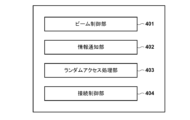
- FIG. 4 shows an example of the functional configuration of a base station device.
- the base station device has, for example, a beam control unit 401, an information notification unit 402, a random access processing unit 403, and a connection control unit 404.
- FIG. 4 shows only functions that are particularly related to this embodiment, and various other functions that the base station device may have are omitted from the illustration.
- the base station device naturally has other functions that base station devices such as LTE and 5G generally have.
- the functional blocks in FIG. 4 are shown in schematic form, and each functional block may be integrated and realized, or may be further subdivided. Also, each function in FIG.
- the processor 301 may be realized, for example, by the processor 301 executing a program stored in the ROM 302 or the storage device 304, or may be realized, for example, by a processor present inside the communication circuit 305 executing a predetermined software. Note that the details of the processing performed by each functional unit will not be described here in detail, and only the rough functions will be outlined.
- the beam control unit 401 forms a plurality of beams that the base station device can form.
- the information notification unit 402 sets a combination of radio resources for transmitting and receiving random access preambles and sequences for transmitting and receiving random access preambles for each of the plurality of beams formed by the beam control unit 401.
- the information notification unit 402 then notifies the terminal device of the setting information.
- the information notification unit 402 may notify, for each beam, setting information indicating only the combination of radio resources and sequences corresponding to that beam, or may additionally notify setting information for beams other than that beam.
- the information notification unit 402 may notify, for each of the plurality of beams, setting information for two or more of the plurality of beams (in some cases, all of the plurality of beams).
- the terminal device can identify the setting information corresponding to that beam by identifying the SSB index based on the SSB arriving from each beam.
- the random access processing unit 403 detects a random access preamble transmitted from a terminal device. Then, the connection control unit 404 executes a random access procedure with the terminal device that is the source of the random access preamble, and establishes a connection with the terminal device. The random access processing unit 403 identifies which beam the random access preamble corresponds to based on a combination of the radio resource on which the random access preamble is received and the sequence of the random access preamble. For example, the random access processing unit 403 performs correlation detection using the sequence set for the random access preamble transmitted on the radio resource set in the own device. Then, when two or more beams correspond to a common radio resource, the random access processing unit 403 can determine which beam the sequence of the random access preamble detected on that radio resource corresponds to. This can identify which beam the random access preamble was transmitted to.
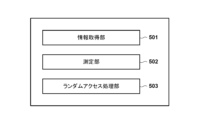
- FIG. 5 shows an example of the functional configuration of a terminal device.
- the terminal device has, for example, an information acquisition unit 501, a measurement unit 502, and a random access processing unit 503. Note that in FIG. 5, only functions particularly related to this embodiment are shown, and various other functions that the terminal device may have are omitted from the illustration. For example, the terminal device naturally has other functions that terminal devices generally have, such as LTE and 5G. Also, the functional blocks in FIG. 5 are shown in schematic form, and each functional block may be integrated and realized, or may be further subdivided. Also, each function in FIG.
- the processor 301 may be realized, for example, by the processor 301 executing a program stored in the ROM 302 or the storage device 304, or may be realized, for example, by a processor present inside the communication circuit 305 executing a predetermined software. Note that the details of the processing performed by each functional unit will not be described here in detail, and only the rough functions will be outlined.
- the information acquisition unit 501 receives the setting information transmitted from the base station device as described above from at least one of the multiple beams formed by the base station device.
- the measurement unit 502 observes the radio signals for at least some of the multiple beams formed by the base station device and measures their radio quality.
- the random access processing unit 503 selects a beam to which the random access preamble is to be transmitted based on the measurement result by the measurement unit 502, and transmits the random access preamble to the selected beam to execute the random access procedure.
- the random access processing unit 503 identifies the combination of radio resources and sequences corresponding to the selected beam from the setting information acquired by the information acquisition unit 501. Then, the random access processing unit 503 generates a random access preamble using the identified combination of radio resources and sequences and transmits it to the base station device.
- the base station device sets a combination of radio resources and sequences for a random access preamble corresponding to each of the multiple beams formed by the base station device, and notifies the terminal device of the setting information (S601).
- the terminal device holds the setting information.
- the terminal device observes radio signals such as SSB transmitted in each of the multiple beams formed by the base station device, and measures the radio quality (S602).
- the terminal device determines the beam to which the random access preamble is to be transmitted based on the measurement results (S603).
- the terminal device identifies the combination of radio resources and sequences corresponding to the determined beam based on the setting information received in S601 (S604), and transmits the random access preamble using the combination of radio resources and sequences (S605).
- the base station device detects a random access preamble in a radio resource common to two or more beams, it identifies which of the two or more beams the random access preamble is transmitted to based on the sequence of the random access preamble (S606).
- the base station device then establishes a connection with the terminal device based on the identification result (S607).
Landscapes
- Engineering & Computer Science (AREA)
- Computer Networks & Wireless Communication (AREA)
- Signal Processing (AREA)
- Computer Security & Cryptography (AREA)
- Mobile Radio Communication Systems (AREA)
Abstract
複数のビームを形成する基地局装置は、その複数のビームのそれぞれについて、端末装置がランダムアクセスプリアンブルの送信に使用すべき無線リソースとその無線リソースで送信されるべきランダムアクセスプリアンブルの系列との組み合わせを示す設定情報を端末装置へ通知し、複数のビームのうちの2つ以上のビームに対応する無線リソースにおいてランダムアクセスプリアンブルを検出した場合に、その2つ以上のビームの中から、検出されたランダムアクセスプリアンブルの系列と対応するビームを特定し、検出されたランダムアクセスプリアンブルを送信した端末装置と接続を確立する。
Description
本発明は、端末装置のネットワークへの接続の高速化技術に関する。
第3世代パートナーシッププロジェクト(3GPP(登録商標))の第5世代(5G)のセルラ通信規格において、高周波数帯でのエリア拡張のため、基地局装置において一定の方向に対して利得が高くなるように複数のビームを形成して、ビームごとに通信を行うビームフォーミングを使用することが規定されている。ビーム幅を狭くするほど、特定の方向に対する利得が高くなるため、基地局装置からより遠方の端末装置が、その基地局装置と通信することが可能となる。なお、ビーム幅を狭くすると、基地局装置を中心とした半径方向に通信可能エリアが拡張する一方で、円周方向の通信可能エリアが狭まる。このため、面的なカバレッジを提供するために、多数のビームを設定することが必要となる。
3GPP TS38.213、V17.0.0、2021年12月
端末装置は、各ビームにおいて一定期間内に送信される同期信号/物理ブロードキャストチャネルブロック(SS/PBCH block、以下では「SSB」と呼ぶ。)を観測し、通信に適したビームを選択する(非特許文献1参照)。そして、端末装置は、例えば自装置宛てのデータが存在することを基地局装置から通知された場合や、自装置内に送信すべきデータが発生した場合に、選択したビームを介してネットワークに接続して通信を行う。端末装置は、ネットワークへの接続の際に、所定の無線リソース(時間及び周波数リソース)において、ランダムアクセスチャネル(RACH)を送信する。一方で、ビーム数が増加すると、RACHを送信することができる所定の無線リソースが到来する周期が長期化し、端末装置がそのビームに接続するまでの時間が長期化してしまいうる。
本発明は、端末装置がネットワークに接続するまでの時間を短縮する技術を提供する。
本発明の一態様による基地局装置は、複数のビームを形成する形成手段と、前記複数のビームのそれぞれについて、端末装置がランダムアクセスプリアンブルの送信に使用すべき無線リソースと当該無線リソースで送信されるべきランダムアクセスプリアンブルの系列との組み合わせを示す設定情報を前記端末装置へ通知する通知手段と、前記複数のビームのうちの2つ以上のビームに対応する無線リソースにおいてランダムアクセスプリアンブルを検出した場合に、当該2つ以上のビームの中から、当該検出されたランダムアクセスプリアンブルの系列と対応するビームを特定する特定手段と、検出されたランダムアクセスプリアンブルを送信した前記端末装置と接続を確立する確立手段と、を有する。
本発明の一態様による端末装置は、基地局装置から、当該基地局装置が形成する複数のビームのそれぞれにおいて、前記端末装置がランダムアクセスプリアンブルの送信に使用すべき無線リソースと当該無線リソースで送信されるべきランダムアクセスプリアンブルの系列との組み合わせを示す設定情報を受信する受信手段と、前記複数のビームの少なくとも一部について無線品質の測定を行い、ランダムアクセスプリアンブルを送信するビームを決定する決定手段と、前記決定されたビームに対応する無線リソースにおいて、当該決定されたビームに対応する系列を用いて生成したランダムアクセスプリアンブルを送信する送信手段と、を有し、前記複数のビームのうちの2つ以上のビームについて、ランダムアクセスプリアンブルの送信に使用すべき無線リソースが共通する場合、当該2つ以上のビームのそれぞれに対応するランダムアクセスプリアンブルの系列が異なるように前記設定情報が構成される。
本発明によれば、端末装置がネットワークに接続するまでの時間を短縮することができる。
本発明のその他の特徴及び利点は、添付図面を参照とした以下の説明により明らかになるであろう。なお、添付図面においては、同じ若しくは同様の構成には、同じ参照番号を付す。
添付図面は明細書に含まれ、その一部を構成し、本発明の実施の形態を示し、その記述と共に本発明の原理を説明するために用いられる。
無線通信システムの構成例を示す図である。
ビームごとのランダムアクセスプリアンブルの設定の例を示す図である。
ビームごとのランダムアクセスプリアンブルの設定の例を示す図である。
装置のハードウェア構成例を示す図である。
基地局装置の機能構成例を示す図である。
端末装置の機能構成例を示す図である。
無線通信システムで実行される処理の流れの例を示す図である。
以下、添付図面を参照して実施形態を詳しく説明する。なお、以下の実施形態は特許請求の範囲に係る発明を限定するものではなく、また実施形態で説明されている特徴の組み合わせの全てが発明に必須のものとは限らない。実施形態で説明されている複数の特徴のうち二つ以上の特徴は任意に組み合わされてもよい。また、同一若しくは同様の構成には同一の参照番号を付し、重複した説明は省略する。
(無線通信システムの構成)
図1に、本実施形態に係る無線通信システムの構成例を示す。本無線通信システムは、例えば、第3世代パートナーシッププロジェクト(3GPP(登録商標))の第5世代(5G)規格などのセルラ通信規格に準拠して構成された、セルラ通信システムである。無線通信システムは、基地局装置101と端末装置121とを含んで構成される。なお、図1では、説明を簡単にするために、1つの基地局装置と1つの端末装置のみを示しているが、当然に多数の基地局装置及び多数の端末装置が存在しうる。基地局装置101は、例えば多数のアンテナを有し、アンテナウェイトを調整することにより、それぞれ異なる方向に対して利得を向上させた複数のビーム111を形成可能に構成される。端末装置121は、その複数のビーム111のうちのいずれかのビームを介してネットワーク(基地局装置101)に接続することができる。
図1に、本実施形態に係る無線通信システムの構成例を示す。本無線通信システムは、例えば、第3世代パートナーシッププロジェクト(3GPP(登録商標))の第5世代(5G)規格などのセルラ通信規格に準拠して構成された、セルラ通信システムである。無線通信システムは、基地局装置101と端末装置121とを含んで構成される。なお、図1では、説明を簡単にするために、1つの基地局装置と1つの端末装置のみを示しているが、当然に多数の基地局装置及び多数の端末装置が存在しうる。基地局装置101は、例えば多数のアンテナを有し、アンテナウェイトを調整することにより、それぞれ異なる方向に対して利得を向上させた複数のビーム111を形成可能に構成される。端末装置121は、その複数のビーム111のうちのいずれかのビームを介してネットワーク(基地局装置101)に接続することができる。
端末装置121は、基地局装置101に接続する際に、基地局装置101からビームごとにブロードキャストされる同期信号/物理ブロードキャストチャネル(SS/PBCH)ブロック(SSB)を受信する。なお、SSBは、1タイムスロットに対して最大で2つ配置されうる。すなわち、多数のビームが形成された場合、1タイムスロットに対して最大2つのビームについてのSSBが送信されることとなる。端末装置121は、このSSBを観測して、無線品質の良好なビームについてのSSBを復号して、システム情報を取得することができる。そして、端末装置121は、そのシステム情報を受信して、ランダムアクセス手順を実行する。ランダムアクセス手順では、端末装置121が、システム情報によって特定した所定の無線リソース(周波数および時間リソース)において、ランダムアクセスプリアンブルを送信する。より具体的には、端末装置121は、基地局装置101が設定した無線リソースにおいて、ランダムアクセスプリアンブルが基地局装置101に届くように、ランダムアクセスプリアンブルの送信を行う。このランダムアクセスプリアンブルの送受信に使用される無線リソースは、ビームごとに設定される。ここで、従来は、複数のビームに対応する無線リソースが互いに重ならないように設定される。しかしながら、ビームの数が多くなると、互いに重ならないように無線リソースを設定するために、例えば周波数方向において異なる無線リソースが設定されるとしても、各ビームに対応する無線リソースが発生する時間周期が長期化してしまいうる。この結果、端末装置121が、無線品質の良好なビームに接続しようとしても、そのビームにおいてランダムアクセスプリアンブルを送信可能な無線リソースが到来するまでの時間が長期化し、非効率的になってしまう。
本実施形態では、このような事情に鑑み、複数のビームが同じ無線リソースを使用することを可能とするような手法を提供する。本実施形態では、共通の無線リソースを使用する複数のビームに対して、それぞれ異なるランダムアクセスプリアンブルの生成用の系列の集合を割り当てる。そのような割り当ての例を図2A及び図2Bに示す。図2Aにおいて、SSB indexは、ビームを識別するインデクスである。複数のビームが、このインデクスによって一意に特定される。RACH slotは、ランダムアクセスプリアンブルが送受信されるべきタイムスロットを示している。なお、周波数リソースについては共通であるものとする。図2Aでは、例えば、SSB indexが0及び1のビームにおいて、共通のRACH slotが設定されている例を示している。また、同様に、SSB indexがX~X+2のビームにおいて、共通のRACH slotが設定されている。このように、本実施形態では、基地局装置101が形成する複数のビームのうちの、2つ以上のビームについて、ランダムアクセスプリアンブルの送信または受信のための共通の無線リソース(周波数および時間リソース)が設定される。
そして、ランダムアクセスプリアンブル用の無線リソースが共通に設定された2つ以上のビームのそれぞれに対して、ランダムアクセスプリアンブルを生成するための異なる系列群が割り当てられる。例えば、共通の無線リソースが設定されているSSB indexが0及び1のビームに対して、それぞれ、グループA及びグループBの系列が割り当てられる。ここで、系列のグループは、例えば、系列生成のためのシード値(zero correlation zone coding(zczc)値)の範囲で設定されうる。図2Bの例では、SSB indexが0のビームに対して、0から9の範囲のzczc値が割り当てられ、SSB indexが1のビームに対して、10から19の範囲のzczc値が割り当てられている。異なるシード値によって生成される2つの系列は相互相関が低く、同じ無線リソースにおいて別個の端末装置から送信されたとしても、基地局装置において相関検出によって分離抽出することができる。このため、グループごとに他のグループと重複しないシード値を用いることにより、基地局装置101がランダムアクセスプリアンブルを検出した際に、そのランダムアクセスプリアンブルがどのグループに属するものであるかを特定することが可能となる。例えば、基地局装置101は、zczc値が14の系列で生成されたランダムアクセスプリアンブルを検出した場合、そのランダムアクセスプリアンブルがグループBのものであることを特定することができる。そして、基地局装置101は、そのグループBの系列を用いたランダムアクセスプリアンブルをSSB indexが0又は1に対応する無線リソースにおいて検出すると、端末装置121が、SSB indexが1のビームに向けてランダムアクセスプリアンブルを送信したことを特定することができる。
基地局装置101は、この場合に、SSB indexが1のビームを用いて、端末装置121と接続を確立しうる。なお、基地局装置101は、例えば、SSB indexが1のビームに接続中の端末装置が多い場合やそのビームにおいてデータ通信に利用可能な無線リソースの量が少ない場合などに、他のビームで接続を確立すると決定してもよい。この場合、基地局装置101は、例えばそのビームに隣接する他のビームを用いて、端末装置121と接続を確立してもよい。すなわち、基地局装置101は、ランダムアクセスプリアンブルがどのビームに向けて送信されたかを特定し、その特定結果に基づいて端末装置121との接続を確立するが、特定されたビームを用いずに接続を確立してもよい。
基地局装置101は、上述のようにして、複数のビーム111のそれぞれに対して、ランダムアクセスプリアンブルの生成用の系列と無線リソースの組み合わせを、端末装置121へ通知する。例えば、基地局装置101は、Master Information Block(MIB)やSystem Information Block Type1(SIB1)などのシステム情報を用いて、この通知を行いうる。端末装置121は、基地局装置101が形成した複数のビームのそれぞれにおいてシステム情報を復号して、そのビームにおいて、ランダムアクセスプリアンブルの送信に使用すべき無線リソースと系列の組み合わせを示す情報を受信しうる。なお、端末装置121は、例えば、無線品質が不十分であり、無線信号の復号を行うことができないビームについては情報を取得しないでもよい。そして、端末装置121は、少なくとも一部についての無線品質を測定して、例えば、無線品質が十分に良好な(例えば最良な)ビームを、ランダムアクセスプリアンブルの送信先のビームとして決定しうる。そして、端末装置121は、その送信先のビームに対応する無線リソースと系列の組み合わせを用いて、ランダムアクセスプリアンブルを送信しうる。なお、端末装置121は、ランダムアクセスプリアンブルを送信するビームを決定してから、そのビームについての情報を取得してもよい。
なお、基地局装置101は、ランダムアクセスプリアンブルを検出した無線リソースとそのランダムアクセスプリアンブルの系列との組み合わせが、自装置が端末装置121へ通知した情報に含まれる組み合わせのいずれにも対応しない場合、そのランダムアクセスプリアンブルを送信した端末装置とは接続を確立しない。これは、他の基地局装置へ向けたランダムアクセスプリアンブルを基地局装置101が検出したことが想定されるからである。
(装置構成)
続いて、装置構成について説明する。図3は、本実施形態の基地局装置および端末装置のハードウェア構成例を示している。基地局装置および端末装置は、一例において、プロセッサ301、ROM302、RAM303、記憶装置304、及び通信回路305を含んで構成される。プロセッサ301は、汎用のCPU(中央演算装置)や、ASIC(特定用途向け集積回路)等の、1つ以上の処理回路を含んで構成されるコンピュータであり、ROM302や記憶装置304に記憶されているプログラムを読み出して実行することにより、装置の全体の処理や、上述の各処理を実行する。ROM302は、基地局装置および端末装置が実行する処理に関するプログラムや各種パラメータ等の情報を記憶する読み出し専用メモリである。RAM303は、プロセッサ301がプログラムを実行する際のワークスペースとして機能し、また、一時的な情報を記憶するランダムアクセスメモリである。記憶装置304は、例えば着脱可能な外部記憶装置等によって構成される。通信回路305は、例えば、LTEや5Gの無線通信用の回路によって構成される。なお、図3では、1つの通信回路305が図示されているが、基地局装置および端末装置は、複数の通信回路を有しうる。例えば、基地局装置および端末装置は、LTE用、5G用、およびその後継規格用のそれぞれのための無線通信回路と、それらの回路に共通のアンテナを有しうる。なお、基地局装置および端末装置は、各規格に適したアンテナを別個に有してもよい。また、基地局装置は、さらに、他の基地局装置やコアネットワークのノードと通信する際に使用される有線通信回路を有しうる。また、端末装置は、さらに、無線ローカルエリアネットワーク(LAN)やBluetooth(登録商標)などのセルラ通信規格以外の無線通信規格に準拠した通信回路などを有してもよい。なお、基地局装置および端末装置は、使用可能な複数の周波数帯域のそれぞれについて別個の通信回路305を有してもよいし、それらの周波数帯域の少なくとも一部に対して共通の通信回路305を有してもよい。
続いて、装置構成について説明する。図3は、本実施形態の基地局装置および端末装置のハードウェア構成例を示している。基地局装置および端末装置は、一例において、プロセッサ301、ROM302、RAM303、記憶装置304、及び通信回路305を含んで構成される。プロセッサ301は、汎用のCPU(中央演算装置)や、ASIC(特定用途向け集積回路)等の、1つ以上の処理回路を含んで構成されるコンピュータであり、ROM302や記憶装置304に記憶されているプログラムを読み出して実行することにより、装置の全体の処理や、上述の各処理を実行する。ROM302は、基地局装置および端末装置が実行する処理に関するプログラムや各種パラメータ等の情報を記憶する読み出し専用メモリである。RAM303は、プロセッサ301がプログラムを実行する際のワークスペースとして機能し、また、一時的な情報を記憶するランダムアクセスメモリである。記憶装置304は、例えば着脱可能な外部記憶装置等によって構成される。通信回路305は、例えば、LTEや5Gの無線通信用の回路によって構成される。なお、図3では、1つの通信回路305が図示されているが、基地局装置および端末装置は、複数の通信回路を有しうる。例えば、基地局装置および端末装置は、LTE用、5G用、およびその後継規格用のそれぞれのための無線通信回路と、それらの回路に共通のアンテナを有しうる。なお、基地局装置および端末装置は、各規格に適したアンテナを別個に有してもよい。また、基地局装置は、さらに、他の基地局装置やコアネットワークのノードと通信する際に使用される有線通信回路を有しうる。また、端末装置は、さらに、無線ローカルエリアネットワーク(LAN)やBluetooth(登録商標)などのセルラ通信規格以外の無線通信規格に準拠した通信回路などを有してもよい。なお、基地局装置および端末装置は、使用可能な複数の周波数帯域のそれぞれについて別個の通信回路305を有してもよいし、それらの周波数帯域の少なくとも一部に対して共通の通信回路305を有してもよい。
図4は、基地局装置の機能構成例を示す。基地局装置は、例えば、ビーム制御部401、情報通知部402、ランダムアクセス処理部403、及び、接続制御部404を有する。なお、図4では、本実施形態に特に関係する機能のみを示しており、基地局装置が有しうる他の各種機能については図示を省略している。例えば、基地局装置は、LTEや5Gなどの基地局装置が一般的に有する他の機能を当然に有する。また、図4の機能ブロックは概略的に示したものであり、それぞれの機能ブロックが一体化されて実現されてもよいし、さらに細分化されてもよい。また、図4の各機能は、例えば、プロセッサ301がROM302や記憶装置304に記憶されているプログラムを実行することにより実現されてもよいし、例えば通信回路305の内部に存在するプロセッサが所定のソフトウェアを実行することによって実現されてもよい。なお、各機能部が実行する処理の詳細について、上述の詳細についてはここでは説明せず、その大まかな機能のみを概説する。
ビーム制御部401は、基地局装置が形成可能な複数のビームを形成する。情報通知部402は、ビーム制御部401において形成した複数のビームのそれぞれについて、ランダムアクセスプリアンブルの送受信用の無線リソースと、ランダムアクセスプリアンブルの送受信用の系列との組み合わせを設定する。そして、情報通知部402は、その設定情報を端末装置へ通知する。なお、情報通知部402は、各ビームにおいて、そのビームに対応する無線リソース及び系列の組み合わせのみを示す設定情報を通知してもよいし、そのビーム以外のビームについての設定情報を追加で通知してもよい。すなわち、情報通知部402は、複数のビームのそれぞれにおいて、その複数のビームのうちの2つ以上(場合によっては全て)についての設定情報を通知しうる。このとき、端末装置は、各ビームから到来したSSBに基づいてSSB indexを特定することにより、そのビームに対応する設定情報を特定することができる。
ランダムアクセス処理部403は、端末装置から送信されたランダムアクセスプリアンブルを検出する。そして、接続制御部404は、ランダムアクセスプリアンブルの送信元の端末装置との間でランダムアクセス手順を実行し、端末装置と接続を確立する。ランダムアクセス処理部403は、ランダムアクセスプリアンブルが受信された無線リソースと、そのランダムアクセスプリアンブルの系列との組み合わせに基づいて、どのビームに対するランダムアクセスプリアンブルであるかを特定する。例えば、ランダムアクセス処理部403は、自装置において設定した無線リソースにおいて、その無線リソースで送信されるランダムアクセスプリアンブルのために設定した系列を用いて相関検出を行う。そして、ランダムアクセス処理部403は、2つ以上のビームが共通の無線リソースに対応する場合、その無線リソースで検出されたランダムアクセスプリアンブルの系列がいずれのビームに対応するかを判定しうる。これにより、いずれのビームに対してランダムアクセスプリアンブルが送信されたかが特定されうる。
図5は、端末装置の機能構成例を示す。端末装置は、例えば、情報取得部501、測定部502、及び、ランダムアクセス処理部503を有する。なお、図5では、本実施形態に特に関係する機能のみを示しており、端末装置が有しうる他の各種機能については図示を省略している。例えば、端末装置は、LTEや5Gなどの端末装置が一般的に有する他の機能を当然に有する。また、図5の機能ブロックは概略的に示したものであり、それぞれの機能ブロックが一体化されて実現されてもよいし、さらに細分化されてもよい。また、図5の各機能は、例えば、プロセッサ301がROM302や記憶装置304に記憶されているプログラムを実行することにより実現されてもよいし、例えば通信回路305の内部に存在するプロセッサが所定のソフトウェアを実行することによって実現されてもよい。なお、各機能部が実行する処理の詳細について、上述の詳細についてはここでは説明せず、その大まかな機能のみを概説する。
情報取得部501は、上述のようにして基地局装置から送信された設定情報を、その基地局装置が形成した複数のビームのうちの少なくとも1つから受信する。測定部502は、基地局装置が形成した複数のビームのうちの少なくとも一部についての無線信号を観測し、その無線品質を測定する。ランダムアクセス処理部503は、測定部502による測定の結果に基づいて、ランダムアクセスプリアンブルの送信先のビームを選択し、そのビームに対してランダムアクセスプリアンブルを送信してランダムアクセス手順を実行する。ランダムアクセス処理部503は、選択したビームに対応する無線リソース及び系列の組み合わせを、情報取得部501において取得した設定情報から特定する。そして、ランダムアクセス処理部503は、その特定した無線リソース及び系列の組み合わせを用いて、ランダムアクセスプリアンブルを生成して基地局装置へ送信する。
(処理の流れ)
続いて、本実施形態に係る無線通信システムにおいて実行される処理の流れの例について、図6を用いて概説する。
続いて、本実施形態に係る無線通信システムにおいて実行される処理の流れの例について、図6を用いて概説する。
本処理では、基地局装置が、自装置が形成する複数のビームのそれぞれに対応する、ランダムアクセスプリアンブル用の無線リソース及び系列の組み合わせを設定し、その設定情報を端末装置へ通知する(S601)。端末装置は、その設定情報を保持する。その後、端末装置は、基地局装置によって形成されている複数のビームのそれぞれにおいて送出されたSSBなどの無線信号を観測し、無線品質の測定を行う(S602)。そして、端末装置は、その測定の結果に基づいて、ランダムアクセスプリアンブルの送信先のビームを決定する(S603)。端末装置は、決定したビームに対応する無線リソース及び系列の組み合わせを、S601で受信した設定情報に基づいて特定し(S604)、その無線リソース及び系列の組み合わせを用いて、ランダムアクセスプリアンブルを送信する(S605)。基地局装置は、2つ以上のビームに対して共通の無線リソースにおいてランダムアクセスプリアンブルを検出すると、そのランダムアクセスプリアンブルの系列に基づいて、その2つ以上のビームのうちのいずれのビームに向けてランダムアクセスプリアンブルが送信されたかを特定する(S606)。そして、基地局装置は、その特定結果に基づいて、端末装置との間で接続を確立する(S607)。
このようにして、2つ以上のビームにおいて、それぞれ異なる系列を用いてランダムアクセスプリアンブルが送受信されるようにすることで、同じ無線リソースをランダムアクセスプリアンブルの送受信用に使用することが可能となる。この結果、ビームごとに、ランダムアクセスプリアンブルの送受信用の無線リソースが到来する周期を短縮することができ、端末装置の接続を効率的に確立することが可能となる。よって、国連が主導する持続可能な開発目標(SDGs)の目標9「レジリエントなインフラを整備し、持続可能な産業化を推進するとともに、イノベーションの拡大を図る」に貢献することが可能となる。
発明は上記の実施形態に制限されるものではなく、発明の要旨の範囲内で、種々の変形・変更が可能である。
本願は、2023年1月16日提出の日本国特許出願特願2023-004651を基礎として優先権を主張するものであり、その記載内容の全てを、ここに援用する。
Claims (8)
- 複数のビームを形成する形成手段と、
前記複数のビームのそれぞれについて、端末装置がランダムアクセスプリアンブルの送信に使用すべき無線リソースと当該無線リソースで送信されるべきランダムアクセスプリアンブルの系列との組み合わせを示す設定情報を前記端末装置へ通知する通知手段と、
前記複数のビームのうちの2つ以上のビームに対応する無線リソースにおいてランダムアクセスプリアンブルを検出した場合に、当該2つ以上のビームの中から、当該検出されたランダムアクセスプリアンブルの系列と対応するビームを特定する特定手段と、
検出されたランダムアクセスプリアンブルを送信した前記端末装置と接続を確立する確立手段と、
を有することを特徴とする基地局装置。 - 前記確立手段は、特定されたビームを用いて前記端末装置と接続を確立する、ことを特徴とする請求項1に記載の基地局装置。
- 前記確立手段は、前記端末装置からのランダムアクセスプリアンブルが検出された無線リソースと当該ランダムアクセスプリアンブルの系列との組み合わせが、前記複数のビームのそれぞれについて前記通知手段によって通知された無線リソースとランダムアクセスプリアンブルの系列との組み合わせのいずれにも対応しない場合、当該端末装置との接続を確立しない、ことを特徴とする請求項1又は2に記載の基地局装置。
- 端末装置であって、
基地局装置から、当該基地局装置が形成する複数のビームのそれぞれにおいて、前記端末装置がランダムアクセスプリアンブルの送信に使用すべき無線リソースと当該無線リソースで送信されるべきランダムアクセスプリアンブルの系列との組み合わせを示す設定情報を受信する受信手段と、
前記複数のビームの少なくとも一部について無線品質の測定を行い、ランダムアクセスプリアンブルを送信するビームを決定する決定手段と、
前記決定されたビームに対応する無線リソースにおいて、当該決定されたビームに対応する系列を用いて生成したランダムアクセスプリアンブルを送信する送信手段と、
を有し、
前記複数のビームのうちの2つ以上のビームについて、ランダムアクセスプリアンブルの送信に使用すべき無線リソースが共通する場合、当該2つ以上のビームのそれぞれに対応するランダムアクセスプリアンブルの系列が異なるように前記設定情報が構成される、
ことを特徴とする端末装置。 - 複数のビームを形成する基地局装置によって実行される制御方法であって、
前記複数のビームのそれぞれについて、端末装置がランダムアクセスプリアンブルの送信に使用すべき無線リソースと当該無線リソースで送信されるべきランダムアクセスプリアンブルの系列との組み合わせを示す設定情報を前記端末装置へ通知することと、
前記複数のビームのうちの2つ以上のビームに対応する無線リソースにおいてランダムアクセスプリアンブルを検出した場合に、当該2つ以上のビームの中から、当該検出されたランダムアクセスプリアンブルの系列と対応するビームを特定することと、
検出されたランダムアクセスプリアンブルを送信した前記端末装置と接続を確立することと、
を含むことを特徴とする制御方法。 - 端末装置によって実行される制御方法であって、
基地局装置から、当該基地局装置が形成する複数のビームのそれぞれにおいて、前記端末装置がランダムアクセスプリアンブルの送信に使用すべき無線リソースと当該無線リソースで送信されるべきランダムアクセスプリアンブルの系列との組み合わせを示す設定情報を受信することと、
前記複数のビームの少なくとも一部について無線品質の測定を行い、ランダムアクセスプリアンブルを送信するビームを決定することと、
前記決定されたビームに対応する無線リソースにおいて、当該決定されたビームに対応する系列を用いて生成したランダムアクセスプリアンブルを送信することと、
を含み、
前記複数のビームのうちの2つ以上のビームについて、ランダムアクセスプリアンブルの送信に使用すべき無線リソースが共通する場合、当該2つ以上のビームのそれぞれに対応するランダムアクセスプリアンブルの系列が異なるように前記設定情報が構成される、
ことを特徴とする制御方法。 - コンピュータを、請求項1から3のいずれか1項に記載の基地局装置が有する各手段として機能させるためのプログラム。
- コンピュータを、請求項4に記載の端末装置が有する各手段として機能させるためのプログラム。
Priority Applications (1)
| Application Number | Priority Date | Filing Date | Title |
|---|---|---|---|
| US19/259,405 US20250330835A1 (en) | 2023-01-16 | 2025-07-03 | Base station apparatus for establishing efficient connection, terminal apparatus, control method, and storage medium |
Applications Claiming Priority (2)
| Application Number | Priority Date | Filing Date | Title |
|---|---|---|---|
| JP2023-004651 | 2023-01-16 | ||
| JP2023004651A JP2024100559A (ja) | 2023-01-16 | 2023-01-16 | 効率的な接続の確立のための基地局装置、端末装置、制御方法、及び、プログラム |
Related Child Applications (1)
| Application Number | Title | Priority Date | Filing Date |
|---|---|---|---|
| US19/259,405 Continuation US20250330835A1 (en) | 2023-01-16 | 2025-07-03 | Base station apparatus for establishing efficient connection, terminal apparatus, control method, and storage medium |
Publications (1)
| Publication Number | Publication Date |
|---|---|
| WO2024154602A1 true WO2024154602A1 (ja) | 2024-07-25 |
Family
ID=91955912
Family Applications (1)
| Application Number | Title | Priority Date | Filing Date |
|---|---|---|---|
| PCT/JP2024/000103 Ceased WO2024154602A1 (ja) | 2023-01-16 | 2024-01-09 | 効率的な接続の確立のための基地局装置、端末装置、制御方法、及び、プログラム |
Country Status (3)
| Country | Link |
|---|---|
| US (1) | US20250330835A1 (ja) |
| JP (1) | JP2024100559A (ja) |
| WO (1) | WO2024154602A1 (ja) |
Citations (3)
| Publication number | Priority date | Publication date | Assignee | Title |
|---|---|---|---|---|
| JP2017507574A (ja) * | 2014-01-31 | 2017-03-16 | 富士通株式会社 | 無線通信ネットワークのアクセス方法 |
| WO2017135455A1 (ja) * | 2016-02-04 | 2017-08-10 | 株式会社Nttドコモ | ユーザ装置、及びランダムアクセス方法 |
| US20200275479A1 (en) * | 2017-10-27 | 2020-08-27 | Telefonaktiebolaget Lm Ericsson (Publ) | Contention-Free Random Access with Multiple SSB |
-
2023
- 2023-01-16 JP JP2023004651A patent/JP2024100559A/ja active Pending
-
2024
- 2024-01-09 WO PCT/JP2024/000103 patent/WO2024154602A1/ja not_active Ceased
-
2025
- 2025-07-03 US US19/259,405 patent/US20250330835A1/en active Pending
Patent Citations (3)
| Publication number | Priority date | Publication date | Assignee | Title |
|---|---|---|---|---|
| JP2017507574A (ja) * | 2014-01-31 | 2017-03-16 | 富士通株式会社 | 無線通信ネットワークのアクセス方法 |
| WO2017135455A1 (ja) * | 2016-02-04 | 2017-08-10 | 株式会社Nttドコモ | ユーザ装置、及びランダムアクセス方法 |
| US20200275479A1 (en) * | 2017-10-27 | 2020-08-27 | Telefonaktiebolaget Lm Ericsson (Publ) | Contention-Free Random Access with Multiple SSB |
Also Published As
| Publication number | Publication date |
|---|---|
| JP2024100559A (ja) | 2024-07-26 |
| US20250330835A1 (en) | 2025-10-23 |
Similar Documents
| Publication | Publication Date | Title |
|---|---|---|
| JP2020511863A (ja) | ネットワークスライスのための無線通信方法およびシステム | |
| AU2021436488B2 (en) | Methods, apparatuses, and computer readable media for configuring measurement gap patterns | |
| US20180368096A1 (en) | Positioning apparatus and method | |
| WO2024154602A1 (ja) | 効率的な接続の確立のための基地局装置、端末装置、制御方法、及び、プログラム | |
| US20240204860A1 (en) | Base station apparatus, repeater apparatus, wireless communication system, and control methods and non-transitory computer-readable storage medium | |
| EP4398622A1 (en) | Base station device, repeater device and wireless communication system, control method for same, and program | |
| WO2024190156A1 (ja) | 効率的な接続の確立のための基地局装置、端末装置、制御方法、及び、プログラム | |
| US12295039B2 (en) | Control apparatus selectively using plurality of antennas, control method, and computer-readable storage medium | |
| JP7761542B2 (ja) | チャネル推定を高精度化するネットワークノード、端末装置、制御方法、及び、プログラム | |
| JP6562818B2 (ja) | 制御装置、端末装置、制御方法及びプログラム | |
| KR20240057683A (ko) | 통신 시스템에서 허위 기지국 검출 방법 및 장치 | |
| JP7431361B2 (ja) | 多数のアンテナを選択的に使用する制御装置、制御方法、及びプログラム | |
| KR20190026869A (ko) | 시스템 정보 영역 또는 네트워크 영역의 액세스 방법 및 장치 | |
| JP7233580B2 (ja) | 多数のアンテナを選択的に使用する制御装置、制御方法、及びプログラム | |
| JP7785047B2 (ja) | 効率が改善されたハンドオーバを実行する端末装置、基地局装置、及び制御方法 | |
| JP7709992B2 (ja) | 基地局装置、制御方法、及びプログラム | |
| EP4503689A1 (en) | Terminal device, network node, control method, and program, for communication control considering antenna placement | |
| JP2026059348A (ja) | 高速ビーム選択を行う基地局、端末装置、制御方法及びプログラム | |
| WO2024042841A1 (ja) | 効率的な通信を行う基地局装置、端末装置、制御方法、及びプログラム | |
| JP2025095478A (ja) | Xnインタフェースの自動確立を確実に実行するためのネットワークノード、基地局装置、制御方法、及びプログラム | |
| TW201826734A (zh) | 無線通訊方法及無線通訊裝置 | |
| WO2025028446A1 (ja) | 効率が改善されたハンドオーバを実行する端末装置、制御方法、及びプログラム | |
| JP2020017976A (ja) | 端末装置、無線通信システム、制御方法及びプログラム | |
| CN121400058A (zh) | 基站、通信设备、通信方法和控制程序 | |
| CN117560738A (zh) | 一种通信方法、装置及设备 |
Legal Events
| Date | Code | Title | Description |
|---|---|---|---|
| 121 | Ep: the epo has been informed by wipo that ep was designated in this application |
Ref document number: 24744525 Country of ref document: EP Kind code of ref document: A1 |
|
| NENP | Non-entry into the national phase |
Ref country code: DE |
|
| 122 | Ep: pct application non-entry in european phase |
Ref document number: 24744525 Country of ref document: EP Kind code of ref document: A1 |