WO2024154169A1 - 空気調和機 - Google Patents
空気調和機 Download PDFInfo
- Publication number
- WO2024154169A1 WO2024154169A1 PCT/JP2023/000901 JP2023000901W WO2024154169A1 WO 2024154169 A1 WO2024154169 A1 WO 2024154169A1 JP 2023000901 W JP2023000901 W JP 2023000901W WO 2024154169 A1 WO2024154169 A1 WO 2024154169A1
- Authority
- WO
- WIPO (PCT)
- Prior art keywords
- region
- ventilation
- heat exchanger
- air
- indoor unit
- Prior art date
- Legal status (The legal status is an assumption and is not a legal conclusion. Google has not performed a legal analysis and makes no representation as to the accuracy of the status listed.)
- Ceased
Links
Images






Classifications
-
- F—MECHANICAL ENGINEERING; LIGHTING; HEATING; WEAPONS; BLASTING
- F24—HEATING; RANGES; VENTILATING
- F24F—AIR-CONDITIONING; AIR-HUMIDIFICATION; VENTILATION; USE OF AIR CURRENTS FOR SCREENING
- F24F1/00—Room units for air-conditioning, e.g. separate or self-contained units or units receiving primary air from a central station
- F24F1/0007—Indoor units, e.g. fan coil units
- F24F1/0041—Indoor units, e.g. fan coil units characterised by exhaustion of inside air from the room
-
- F—MECHANICAL ENGINEERING; LIGHTING; HEATING; WEAPONS; BLASTING
- F24—HEATING; RANGES; VENTILATING
- F24F—AIR-CONDITIONING; AIR-HUMIDIFICATION; VENTILATION; USE OF AIR CURRENTS FOR SCREENING
- F24F11/00—Control or safety arrangements
- F24F11/88—Electrical aspects, e.g. circuits
Definitions
- This disclosure relates to air conditioners.
- the ventilation fan of the ventilation device is placed outside.
- the ventilation device is required to have a structure that prevents condensation water from entering the ventilation fan.
- the present disclosure aims to provide an air conditioner that can prevent condensation water from entering the ventilation fan.
- One aspect of the air conditioner according to the present disclosure comprises an indoor unit installed indoors and having a first heat exchanger, an outdoor unit installed outdoors and having a second heat exchanger, a refrigerant pipe passing through a through hole in a wall separating the indoor space from the outdoors and connecting the first heat exchanger and the second heat exchanger, and a ventilation device that exhausts air from inside the room to the outside through an exhaust port, the ventilation device comprising a ventilation pipe drawn from inside the room to the outside through the through hole, and a ventilation device main body fixed to the wall surface of the outdoor space, the ventilation device main body comprising a ventilation fan, an intake air duct connecting the ventilation pipe and the ventilation fan, and an exhaust air duct connecting the ventilation fan and the exhaust port.
- the ventilation fan has a fan intake port connected to the intake air duct and a fan exhaust port connected to the exhaust air duct, and two directions perpendicular to the vertical direction and perpendicular to each other are defined as a first direction and a second direction
- the intake air duct has an inlet that opens upward and is connected to the ventilation pipe, a first region that extends downward from the inlet, a chamber region that is connected to the first region and extends in the first direction, a second region that is located on one side of the first region in the first direction and extends upward from the chamber region, and an outlet that is located at the upper end of the second region and connects to the fan intake port, and the exhaust air duct extends downward from the fan exhaust port.
- This disclosure provides an air conditioner that can prevent condensation water from entering the ventilation fan.
- FIG. 1 is a schematic diagram showing a schematic configuration of an air conditioner according to an embodiment.
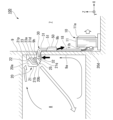
- FIG. 1 is a schematic side view of an installation state of an air conditioner according to an embodiment; 1 is a schematic perspective view of an installation state of an air conditioner according to an embodiment.
- FIG. FIG. 2 is a perspective view of the ventilation device main body according to the embodiment.
- FIG. 2 is an exploded view of the ventilation device main body according to the embodiment.
- FIG. 2 is an exploded view of the air passage unit according to the embodiment.
- FIG. 2 is a front view of the ventilation fan according to the embodiment.
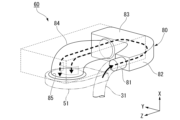
- FIG. 2 is a perspective view of an intake airflow path member according to the embodiment.
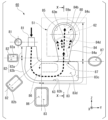
- FIG. 2 is a front view of the intake airflow path member according to the embodiment.
- FIG. 10 is a cross-sectional view of the intake airflow path member taken along line XX in FIG. 9 .
- FIG. 11 is a schematic diagram showing a wiring configuration of an air conditioner according to a first modified example.
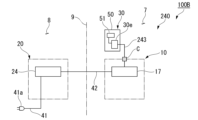
- FIG. 11 is a schematic diagram showing a wiring configuration of an air conditioner according to a second modified example.
- FIG. 11 is a schematic diagram showing a wiring configuration of an air conditioner according to a third modified example.
- FIG. 13 is a schematic diagram showing a wiring configuration of an air conditioner according to a fourth modified example.
- the drawings also show the X-axis, Y-axis, and Z-axis as appropriate.
- the X-axis shows one of the horizontal directions.
- the Y-axis shows the other of the horizontal directions.
- the Z-axis shows the vertical direction.
- the horizontal direction along the X-axis is called the "front-rear direction X”
- the horizontal direction along the Y-axis is called the "left-right direction Y”
- the vertical direction is called the "vertical direction Z”.
- the front-rear direction X, the left-right direction Y, and the vertical direction Z are mutually perpendicular directions.
- the side of the vertical direction Z toward which the Z-axis arrow points (+Z direction) is defined as the upper side
- the opposite side of the vertical direction Z to the side toward which the Z-axis arrow points (-Z direction) is defined as the lower side
- the side of the front-rear direction X toward which the X-axis arrow points (+X direction) is defined as the front
- the opposite side of the front-rear direction X to the side toward which the X-axis arrow points (-X direction) is defined as the rear.
- the side in the left-right direction Y toward which the Y-axis arrow points (+Y direction) is defined as the left
- the side opposite to the side in the left-right direction Y toward which the Y-axis arrow points (-Y direction) is defined as the right.
- Fig. 1 is a schematic diagram showing a schematic configuration of an air conditioner 100 in this embodiment.
- the air conditioner 100 includes an outdoor unit 10, an indoor unit 20, a circulation path section (refrigerant piping) 18, and a ventilation device 30.
- the outdoor unit 10 is disposed outside 7.
- the indoor unit 20 is disposed inside 8.
- the outdoor unit 10 and the indoor unit 20 are connected to each other by a circulation path section 18 through which a refrigerant 19 circulates.
- a part of the ventilation device 30 is disposed inside 8, and the other part is disposed outside 7.
- the ventilation device 30 exhausts air from the room 8 in which the indoor unit 20 is disposed to the outside 7.
- the air conditioner 100 is capable of adjusting the temperature of the air in the room 8 in which the indoor unit 20 is disposed by exchanging heat between the refrigerant 19 flowing in the circulation path section 18 and the air in the room 8 in which the indoor unit 20 is disposed.
- the refrigerant 19 include fluorine-based refrigerants or hydrocarbon-based refrigerants that have a low Global Warming Potential (GWP).
- GWP Global Warming Potential
- the outdoor unit 10 comprises an outdoor unit housing 11, a compressor 12, a heat exchanger 13, a flow control valve 14, a blower 15, a four-way valve 16, and a control unit 17.
- the outdoor unit housing 11 houses the compressor 12, the heat exchanger 13, the flow control valve 14, the blower 15, the four-way valve 16, and the control unit 17.
- the compressor 12, heat exchanger 13, flow rate control valve 14, and four-way valve 16 are provided in a portion of the circulation path 18 that is located inside the outdoor unit housing 11.
- the compressor 12, heat exchanger 13, flow rate control valve 14, and four-way valve 16 are connected by a portion of the circulation path 18 that is located inside the outdoor unit housing 11.
- the four-way valve 16 is provided in a portion of the circulation path section 18 that is connected to the discharge side of the compressor 12.
- the four-way valve 16 can reverse the direction of the refrigerant 19 flowing through the circulation path section 18 by switching a portion of the path of the circulation path section 18.
- the path connected by the four-way valve 16 is the path shown by the solid line on the four-way valve 16 in FIG. 1
- the refrigerant 19 flows through the circulation path section 18 in the direction shown by the solid arrow in FIG. 1.
- the path connected by the four-way valve 16 is the path shown by the dashed line on the four-way valve 16 in FIG. 1, the refrigerant 19 flows through the circulation path section 18 in the direction shown by the dashed arrow in FIG. 1.
- the indoor unit 20 comprises an indoor unit housing 21, a heat exchanger 22, a blower 23 as a fan, and a control unit 24.
- the indoor unit housing 21 houses the heat exchanger 22, the blower 23, and the control unit 24 inside.
- the indoor unit 20 is capable of cooling operation to cool the air in the room 8 in which the indoor unit 20 is located, and heating operation to warm the air in the room 8 in which the indoor unit 20 is located.
- the blower 23 is illustrated diagrammatically in FIG. 1.
- the refrigerant 19 flowing in the circulation path 18 flows in the direction shown by the solid arrow in Figure 1.
- the refrigerant 19 flowing in the circulation path 18 circulates through the compressor 12, the heat exchanger 13 of the outdoor unit 10, the flow control valve 14, and the heat exchanger 22 of the indoor unit 20, in that order, before returning to the compressor 12.
- the heat exchanger 13 in the outdoor unit 10 functions as a condenser
- the heat exchanger 22 in the indoor unit 20 functions as an evaporator.
- the refrigerant 19 flowing in the circulation path portion 18 flows in the direction shown by the dashed line in Figure 1.
- the refrigerant 19 flowing in the circulation path portion 18 circulates through the compressor 12, the heat exchanger 22 of the indoor unit 20, the flow control valve 14, and the heat exchanger 13 of the outdoor unit 10, in that order, before returning to the compressor 12.
- the heat exchanger 13 in the outdoor unit 10 functions as an evaporator
- the heat exchanger 22 in the indoor unit 20 functions as a condenser.
- ⁇ Indoor unit> 2 and 3 are schematic diagrams showing an installation state of the air conditioner 100 according to the embodiment.
- the indoor unit 20 is a wall-mounted indoor unit that is fixed to an upper region of a wall surface 9a of the room 8.
- the indoor unit 20 has a generally rectangular parallelepiped shape that is long in the left-right direction Y.
- the blower 23 is housed in the indoor unit housing 21.
- the blower 23 extends in the left-right direction Y.
- the blower 23 rotates around its axis of rotation by a fan motor 23a.
- the heat exchanger 22 is disposed inside the indoor unit housing 21, between the blower 23 and the indoor unit intake port 20a.
- the heat exchanger 22 extends in the left-right direction Y.
- the indoor unit housing 21 has an outer shell member 21b and an air passage member 21d.
- the outer shell member 21b is a member that constitutes part of the outer shell of the indoor unit housing 21.
- the outer shell member 21b improves the design of the appearance of the indoor unit 20.
- the outer shell member 21b is a roughly rectangular box shape that opens on the wall surface 9a side. The opening of the outer shell member 21b on the wall surface 9a side is blocked by the air passage member 21d.
- the air passage member 21d is a member that constitutes part of the air passage through which the air sucked into the indoor unit housing 21 by the blower 23 passes.
- the air passage member 21d is hooked onto an installation plate (not shown) that is fixed to the wall surface 9a on the room 8 side. This fixes the indoor unit 20 to the wall surface 9a.
- the indoor unit housing 21 has an indoor unit inlet 20a and an indoor unit outlet 20b.
- the indoor unit inlet 20a and the indoor unit outlet 20b are formed in the outer shell member 21b.
- the indoor unit inlet 20a opens upward and extends in the axial direction.
- a filter (not shown) is disposed in the indoor unit inlet 20a.
- the indoor unit outlet 20b opens toward the room 8 and extends in the axial direction.
- a wind direction control vane 25 is disposed in the indoor unit outlet 20b.
- Air from the room 8 is drawn into the indoor unit housing 21 through the indoor unit suction port 20a by the drive of the blower 23.
- the air drawn into the indoor unit housing 21 through the indoor unit suction port 20a passes through the heat exchanger 22 and is blown out into the room 8 from the indoor unit outlet 20b.
- the air passing through the indoor unit outlet 20b is blown by the air direction control vane 25 in the vertical direction Z and the left and right direction Y of the room 8.
- a control unit 24 is provided inside the indoor unit housing 21.
- the control unit 24 is disposed inside the indoor unit housing 21 at one end in the left-right direction Y.
- the control unit 24 controls the fan motor 23a, the air direction control vane 25, the heat exchanger 22, etc.
- the external shape of the indoor unit housing 21 is a rectangular column extending in the left-right direction Y.
- the indoor unit housing 21 has an upper surface 21p facing upward and a lower surface 21q facing downward.
- the indoor unit intake port 20a is provided on the upper surface 21p.
- the indoor unit exhaust port 20b is provided on the lower surface 21q.
- the indoor unit 20 is provided with a drain hose 20d.
- the tip of the drain hose 20d extends to the outside 7.
- the drain hose 20d discharges drain water that condenses on the heat exchanger 22 during cooling to the outside 7.
- the outdoor unit 10 is disposed outdoors 7.
- the outdoor unit housing 11 has an outdoor unit inlet 11b and an outdoor unit outlet 11a.
- a blower 15 sends air from the outdoor unit inlet 11b side through a heat exchanger 13 (see FIG. 1) toward the outdoor unit outlet 11a, promoting heat exchange in the heat exchanger 13.
- the outdoor unit 10 and the indoor unit 20 are connected by the circulation path section 18 and the second electric wire 42.
- the circulation path section 18 is configured in a loop shape between the outdoor unit 10 and the indoor unit 20. Therefore, the circulation path section 18 connects the outdoor unit 10 and the indoor unit 20 with a pair of pipes.
- the second electric wire 42 includes a power supply line that supplies power to the outdoor unit 10 via the indoor unit 20, and a signal line for controlling the outdoor unit 10 and the indoor unit 20 in cooperation with each other.
- the circulation path section 18 and the second electric wire 42 pass through a through hole 9h provided in the wall 9 that separates the indoor space 8 from the outdoor space 7. As a result, the circulation path section 18 and the second electric wire 42 are drawn from the indoor space 8 to the outdoor space 7.
- the ventilation device 30 is a device that ventilates the room 8 by discharging the air inside the room 8 to the outside 7, and keeps the air inside the room 8 clean.
- the ventilation device 30 may be driven in conjunction with the indoor unit 20 and the outdoor unit 10, or may be driven independently of these.
- the ventilation device 30 has a ventilation intake section 32, a ventilation pipe 31, and a ventilation device main body 50.
- the ventilation intake section 32 is attached to the indoor unit 20 in the room 8.
- the ventilation device main body 50 is installed on the wall surface 9b of the outdoor room 7.
- the ventilation pipe 31 extends across the room 8 and the outdoor room 7.
- the ventilation intake section 32 draws in air from the room 8.
- the ventilation intake section 32 is provided on the surface of the indoor unit housing 21.
- the ventilation intake section 32 is disposed on the underside 21q of the indoor unit housing 21, away from the wall surface of the room 8. This prevents the airflow of the air flowing into the ventilation intake section 32 from flowing along the wall surface, and prevents dirt from adhering to the wall surface of the room 8.
- the surface on which the ventilation intake section 32 is provided and the surface on which the indoor unit intake port 20a is provided face in different directions. This makes it possible to prevent the negative pressures at the time of intake from affecting each other. This makes it possible to ensure a sufficient flow rate of air flowing into the indoor unit 20 and the flow rate of air flowing into the ventilation device 30, respectively, and allows the cooling or heating function of the indoor unit 20 and the ventilation function of the ventilation device 30 to be fully utilized.
- the ventilation pipe 31 is a tubular pipe.
- the ventilation pipe 31 connects the ventilation device main body 50 and the ventilation intake section 32. Therefore, one end of the ventilation pipe 31 is located inside the room 8, and the other end is located outside the room 7.
- the ventilation pipe 31 passes through the inside of the indoor unit housing 21 and the through hole 9h in the wall 9 and is drawn out to the outside the room 7.
- Fig. 4 is a perspective view of the ventilation device main body 50.
- Fig. 5 is an exploded view of the ventilation device main body 50. As shown in FIG. 5 , the ventilation device main body 50 has a mounting plate 70 , an air passage unit 50 a , and a case 40 .
- the direction perpendicular to the wall surface 9b to which the ventilation device main body 50 is attached is the front-rear direction X or the second direction
- the direction perpendicular to the vertical direction Z and the front-rear direction is the left-right direction Y or the first direction.
- the direction perpendicular to the wall surface 9b that moves away from the wall surface 9b is called the front (+X direction) or one side of the second direction
- the direction approaching the wall surface 9b is called the rear (-X direction) or the other side of the second direction.
- the left and right are defined based on the posture of the observer facing forward (+X direction).
- the left hand side of the observer facing the opposite side (+X direction) of the wall surface 9b is called the left side (+Y direction) or the other side of the first direction
- the right hand side is called the right side (-Y direction) or one side of the first direction.
- the left-right direction Y of the ventilation device main body 50 and the left-right direction of the outdoor unit 10 coincide with each other, but these left-right directions Y do not necessarily have to coincide with each other.
- the mounting plate 70 is a plate-shaped member made of sheet metal.
- the mounting plate 70 is placed along the wall surface 9b of the exterior 7.
- the mounting plate 70 is screwed to the wall surface 9b.
- the air duct unit 50a and the case 40 are fixed to the mounting plate 70.
- the case 40 is box-shaped and opens to the rear.
- the rear opening of the case 40 is covered by the mounting plate 70.
- the air duct unit 50a is placed in the space enclosed by the case 40 and the mounting plate 70.
- the case 40 protects the air duct unit 50a from wind and rain.
- An exhaust port 46a is provided in the case 40.
- the exhaust port 46a faces the lower end of the air duct unit 50a in the vertical direction Z, and blows out the air inside the air duct unit 50a downward.
- the exhaust port 46a opens to the lower surface 46b of the case 40. Therefore, the exhaust port 46a faces downward, and can prevent rainwater from entering the inside of the ventilation device main body 50 through the exhaust port 46a.
- the exhaust port 46a is positioned on the underside 46b of the case 40, biased away from the wall surface 9b. This prevents the exhaust air blown out from the exhaust port 46a from contaminating the wall surface 9b or causing deterioration of the wall surface 9b.
- the exhaust port 46a is covered by a mesh-like grill G.
- the grill G is, for example, a metal wire mesh.
- the grill G prevents living organisms or foreign objects from entering the inside of the ventilation device main body 50 through the exhaust port 46a.
- FIG. 6 is an exploded view of the air passage unit 50a.
- the air passage unit 50 a has an intake air passage member 60 , a separator 69 , a ventilation fan 51 , and an exhaust air passage member 65 .
- the intake air passage 80 is provided inside the intake air passage member 60.
- the exhaust air passage member 65 has an inlet 81 and an outlet 85.
- the inlet 81 is connected to the ventilation pipe 31 (see FIG. 3).
- the outlet 85 opens forward (in the +X direction).
- the outlet 85 faces the ventilation fan 51.
- the intake air passage 80 extends from the inlet 81 to the outlet 85.
- the separator 69 is a plate-like member arranged perpendicular to the front-rear direction X.
- the intake airflow path member 60 is arranged behind the separator 69 (-X direction).
- the ventilation fan 51 and the exhaust airflow path member 65 are arranged in front of the separator 69 (+X direction).
- the separator 69 is provided with a through hole 69h that penetrates the separator 69 in the thickness direction. The through hole 69h overlaps with the opening of the outlet 85 of the intake airflow path member 60.
- FIG. 7 is a front view of the ventilation fan 51.
- the ventilation fan 51 has a cylindrical impeller 51a centered on a central axis O extending in the front-rear direction X, a fan motor 51b that rotates the impeller 51a, and a fan box 59 that houses the impeller 51a and the fan motor 51b.
- the ventilation fan 51 in this embodiment is a centrifugal blower.
- the impeller 51a has a main plate 51c and multiple blades 51w.
- the main plate 51c is a circular plate with the central axis O as its central axis.
- the main plate 51c has a boss 51d whose center protrudes to one axial side of the central axis O.
- the fan motor 51b is disposed inside a recess located on the other axial side of the boss 51d.
- the multiple blades 51w extend to one axial side from the surface on one axial side of the main plate 51c.
- the multiple blades 51w are arranged at equal intervals in the circumferential direction of the central axis O along the outer edge of the main plate 51c.
- the impeller 51a sends air from the inner diameter side to the outer diameter side of the impeller 51a by rotating around the central axis O.
- the fan box 59 has a spiral casing 59c in which the impeller 51a and the fan motor 51b are arranged.
- the spiral casing 59c has a spiral shape whose radial dimension increases from one side to the other side in the circumferential direction of the central axis O.
- the spiral casing 59c is provided with a fan intake port 59a connected to the intake air duct 80, and a fan exhaust port 59b connected to the exhaust air duct 90.
- the fan intake port 59a is circular about the central axis O and opens to the rear (-X direction).
- the fan intake port 59a is connected to the outlet 85 of the intake air duct member 60 via a through hole 69h in the separator 69.
- the fan exhaust port 59b opens downward (-Z direction).
- the ventilation fan 51 draws air in from the rear (-X direction) through the fan intake 59a and blows the air downward (-Z direction) through the fan exhaust 59b.
- the exhaust air passage member 65 is provided with an exhaust air passage 90.
- the exhaust air passage member 65 has a pair of side walls 65a located on both sides of the exhaust air passage 90 in the left-right direction Y and extending in the vertical direction Z, and a front wall 65b located forward of the exhaust air passage 90.
- the front wall 65b connects the front (+X direction) edges of the pair of side walls 65a.
- the front wall 65b faces the separator 69 in the front-rear direction X.
- the exhaust air passage 90 is formed in a space surrounded by the pair of side walls 65a, the front wall 65b, and the separator 69.
- the exhaust air passage 90 extends in the front-rear direction X.
- the expression "extending in a specific direction” means that the direction in which the object (or space) extends has a component in that specific direction over its entire length, and is not to be interpreted in a restrictive sense as being parallel to that specific direction over its entire length.
- FIG. 8 is a perspective view of the intake air passage member 60.
- Fig. 9 is a front view of the intake air passage member 60.
- Fig. 10 is a cross-sectional view of the intake air passage member 60 along line X-X in Fig. 9.
- Fig. 9 also shows how the cross sections of each region in the intake air passage 80 (the inlet 81, the first straight portion 82a, the first bend portion 82b, the chamber region 83, and the connection portion 87) change.
- the intake air duct 80 is formed in a U-shape when viewed from the front-to-rear direction X.
- the intake air duct 80 has an inlet 81, a first region 82, a chamber region 83, a second region 84, and an outlet 85. Air flowing into the intake air duct 80 flows through the intake air duct 80 in the order of the inlet 81, the first region 82, the chamber region 83, and the second region 84. Below, the position of each part of each region may be described using the terms "upstream” or "downstream” based on the flow of air flowing through the intake air duct 80.
- the inlet 81 has a cylindrical shape extending in the vertical direction Z.
- the inlet 81 opens upward.
- the ventilation pipe 31 is connected to the inlet 81. Air flows into the inlet 81 from the ventilation pipe 31.
- the flow path cross section of the inlet 81 is circular.
- cross section of the air passage refers to a cross section perpendicular to the air flow in the air passage.
- circular shape is interpreted to include not only a circle in the strict sense but also an ellipse.
- the first region 82 extends downward from the inlet 81.
- the first region 82 has a first straight portion 82a and a first bent portion 82b.
- the first straight portion 82a extends linearly in the vertical direction Z. That is, the first straight portion 82a extends linearly downward from the lower end of the inlet 81.
- the shape of the flow passage cross section of the first straight portion 82a is a rectangle with the short side in the front-rear direction X.
- the shape of the flow passage cross section of the first straight portion 82a may be one that changes continuously from a circle, which is the shape of the flow passage cross section of the inlet 81, to a rectangular shape.
- the first straight portion 82a increases the flow passage cross section area continuously as it goes downward.
- the flow passage cross section area of the first straight portion 82a is smallest at the upper end and largest at the lower end.
- a rectangular shape is interpreted not only to include a square whose four sides are the same length, but also to include a shape whose corners at the intersection of the long and short sides are rounded.
- the first bent portion 82b bends to the right (-Y direction) as it moves downward from the bottom end of the first straight portion 82a.
- the first bent portion 82b connects to the left (+Y direction) end of the chamber region 83.
- the shape of the flow path cross section of the first bent portion 82b is a rectangle with its short side in the front-to-rear direction X.
- the flow path cross section of the first bent portion 82b increases continuously as it moves downward.
- the flow path cross section of the first bent portion 82b is smallest at the upper end and largest at the connection portion 86 with the chamber region 83, which is the downstream end.
- the chamber area 83 connects the downstream end of the first area 82 and the upstream end of the second area 84.
- the chamber area 83 is an area that reverses the flow direction of air in the intake air duct 80.
- the chamber area 83 also has the function of temporarily storing air in the intake air duct 80 to stabilize the pressure.
- the chamber region 83 has a rectangular cross-sectional shape with its short side in the front-rear direction X and extends in the left-right direction Y. That is, in this embodiment, the cross-sectional area of the chamber region 83 in a section perpendicular to the left-right direction Y is approximately uniform over its entire length in the left-right direction Y. However, the cross-sectional area of the chamber region 83 may vary in part of the left-right direction Y as long as a sufficient volume is secured to store air.
- the air passage resistance can be reduced most when the air passage is circular in shape.
- the chamber region 83 of this embodiment has the function of stabilizing pressure by storing air inside while functioning as an air passage.
- the chamber region 83 makes the air flow gentle inside, so even if the cross-sectional shape of the flow passage of the chamber region 83 is rectangular, no significant energy loss occurs.
- the chamber region 83 can store more air in a limited space in the front-rear direction X. This makes it possible to further stabilize the pressure in the chamber region 83.
- the first region 82 connected to the upstream side of the chamber region 83 also plays a part of the function of stabilizing pressure because it is continuously connected to the chamber region 83. Therefore, by making the cross-sectional shape of the flow passage of the first region 82 rectangular, more air can be stored in the first region 82.
- connection 86 between the chamber region 83 and the first region 82 is located at the left end (+Y direction) of the chamber region 83.
- connection 87 between the chamber region 83 and the second region 84 is located to the left (+Y direction) of the right end 83c (-Y direction) of the chamber region 83.
- the chamber region 83 has a retention portion 83d that extends to the right of the connection portion 87 with the second region 84.
- the retention portion 83d extends to the right (-Y direction) of the connection portion 87 with the second region 84.
- the air that flows from the first region 82 into the chamber region 83 and flows along the outer wall surface is retained in the retention section 83d and does not flow directly into the second region 84. This makes it possible to slow down the flow of air in the chamber region 83 and stabilize the pressure in the chamber region 83.
- a drain hole 63h is provided in the bottom 63 of the intake air passage member 60, which is located below the chamber region 83.
- the drain hole 63h is located below the intake air passage 80.
- the drain hole 63h extends in the vertical direction Z.
- the drain hole 63h extends downward from the chamber region 83 to connect the intake air passage 80 to the external space.
- a drain valve (not shown) is disposed below the drain hole 63h.
- the ventilation piping 31 and ventilation device main body 50 of this embodiment are disposed outside the room 7.
- heated air from the room 8 passes through the ventilation piping 31 and ventilation device main body 50.
- This air is cooled by the outside air, causing condensation to form in the ventilation piping 31 and ventilation device main body 50.
- the condensed water accumulates at the lower end of the chamber region 83 of the intake air duct 80.
- the condensed water in the intake air duct 80 is drained to the outside through the drain hole 63h.
- the second region 84 extends upward from the chamber region 83.
- the first region 82 and the second region 84 extend approximately parallel when viewed from the front-rear direction X.
- the second region 84 is located to the right (-Y direction) of the first region 82.
- the second region 84 has a second straight portion 84a and a second bent portion 84b.
- the second straight portion 84a extends linearly upward from a connection portion 87 with the chamber region 83.
- the shape of the flow path cross section of the second straight portion 84a is circular.
- the shape of the flow path cross section at the lower end of the second straight portion 84a i.e., the connection portion 87 with the chamber region 83
- the shape of the flow path cross section of the second straight portion 84a changes from an ellipse to a perfect circle as it moves upward from the connection portion 87.
- the flow path cross section of the second straight portion 84a increases continuously as it moves upward from the connection portion 87.
- the flow path cross section of the second straight portion 84a is smallest at the lower end and largest at the upper end.
- the flow path cross-sectional area of the connection part 87 at the lower end (connection part 87) of the second region 84 is smaller than the flow path cross-sectional area of the chamber region 83 (cross-sectional area in a cross section perpendicular to the left-right direction Y).
- the flow path cross-sectional area of the lower end of the second region 84 sufficiently small, the distribution of wind speed within the flow path cross-section can be reduced. This allows the air to be rectified within the second region 84, and the efficiency of air suction by the ventilation fan 51 can be improved.
- the shape of the flow path cross-section of the second region 84 circular, the air path resistance in the second region 84 can be reduced. This allows the efficiency of air suction by the ventilation fan 51 from the intake air path 80 to be improved.
- the shape of the flow passage cross section of the second straight portion 84a at the connection portion 87 is an ellipse with the short axis in the front-to-rear direction X. This allows the dimension of the second region 84 at the connection portion 87 in the front-to-rear direction X to be reduced, and as a result, the size of the ventilation device main body 50 in the front-to-rear direction X can be reduced. Note that if there is sufficient room in the dimension in the front-to-rear direction X, it is more preferable from the standpoint of airway resistance that the shape of the flow passage cross section of the second straight portion 84a be a perfect circle over its entire length.
- the flow path cross-sectional area of the second straight section 84a increases continuously in the upward direction. Therefore, the wind speed of the air gradually decreases as it approaches the fan intake port 59a of the ventilation fan 51. According to this embodiment, a uniform flow with high wind speed is formed at the connection section 87 with the chamber area 83, while the wind speed is made gentle when the ventilation fan 51 sucks in air, allowing stable sucking from the ventilation fan 51. In addition, by reducing the wind speed downstream of the second straight section 84a, it is easier to suppress the generation of turbulence in the second bent section 84b connected to the downstream side of the second straight section 84a.
- the second bent portion 84b bends forward (in the +X direction) as it moves upward from the upper end of the second straight portion 84a.
- the second bent portion 84b is connected to the outlet 85.
- the shape of the flow path cross section of the second bent portion 84b is circular.
- the flow path cross section area of the second bent portion 84b increases continuously toward the downstream side.
- the flow path cross section area of the second bent portion 84b is smallest at the lower end and largest at the outlet 85, which is the downstream end.
- the stator blade 62 is provided at the second bend 84b.
- the stator blade 62 has a uniform cross-sectional shape and extends in the fore-aft direction X.
- the stator blade 62 is plate-shaped with an upper surface 62a facing upward and a lower surface 62b facing downward.
- the portion that faces the connection portion 87 between the second region 84 and the chamber region 83 in the vertical direction Z is referred to as the outer corner wall surface 63a.
- the inner wall surface that faces the outer corner wall surface 63a in the normal direction of the outer corner wall surface 63a is referred to as the inner corner wall surface 63b.
- the upper surface 62a of the stator blade 62 faces the outer corner wall surface 63a in the vertical direction Z.
- the lower surface 62b of the stator blade 62 faces the inner corner wall surface 63b in the vertical direction Z.
- the stator vane 62 divides the flow passage cross section of the second bend 84b into two regions, an upper region and an lower region.
- the upper region is called the outer corner region 84c
- the lower region is called the inner corner region 84d. That is, the second bend 84b is provided with an outer corner region 84c and an inner corner region 84d.
- the outer corner region 84c is located between the outer corner wall surface 63a and the upper surface 62a of the stator vane 62.
- the inner corner region 84d is located between the inner corner wall surface 63b and the lower surface 62b of the stator vane 62.
- the flow direction of the air in the intake air duct 80 changes by approximately 90° at the second bend 84b.
- the air pressure increases near the outer corner wall surface 63a and decreases near the inner corner wall surface 63b. For this reason, the air flowing along the inner corner wall surface 63b is likely to separate from the inner corner wall surface 63b.
- the air flowing through the second bend 84b is likely to generate turbulence near the inner corner wall surface 63b.
- stator vane 62 is provided at the second bend 84b, ensuring that air passes through the inner corner region 84d. This makes it difficult for pressure to drop near the inner corner region 84d, and prevents air from separating from the inner corner wall surface 63b. In addition, the stable flow of air into the inner corner region 84d prevents air pressure from increasing in the outer corner region 84c, making it possible to uniform the air volume in the cross section of the flow path of the outlet 85.
- the stator vane 62 has an upwardly convex curved shape with a vertex at the center 62m in the left-right direction Y when viewed from the front-rear direction X.
- the stator vane 62 extends with an incline downwards toward both sides in the left-right direction with the center 62m as the vertex.
- the center 62m which is the vertex, is located slightly below the center point of the exhaust outlet in the vertical direction Z when viewed from the front-rear direction.
- stator vane 62 By making the stator vane 62 have an upwardly convex curved shape with the central portion 62m as an apex, more air is guided to the inner corner region 84d near the center in the left-right direction Y. Since separation is most likely to occur at the center of the inner corner wall surface 63b in the left-right direction Y, sending more air to the center of the inner corner region 84d can effectively prevent air from separating from the inner corner wall surface 63b.
- the stator vane 62 have an upwardly convex curved shape with the central portion 62m as an apex, the length of the outer corner region 84c in the vertical direction Z becomes nearly uniform throughout the entire left-right direction Y. This makes it possible to make the volume of air flowing through the outer corner region 84c nearly uniform in the left-right direction Y, thereby making the volume of air in the flow path cross section of the outlet 85 uniform.
- the curved shape of the stator vane 62 as viewed from the front-rear direction X be an arc shape. In this case, the effect of making the volume of air at the outlet 85 uniform can be enhanced.
- central portion 62m of stator vane 62 does not strictly refer to the center position of stator vane 62 in the left-right direction Y, but refers to the intermediate region having a width between the left end and the right end of stator vane 62.
- the apex of stator vane 62 does not necessarily have to be located at the center position in the left-right direction Y, and may be shifted in the left-right direction Y.
- second region 84 has a left-right symmetrical shape when viewed from the front-rear direction, it is most preferable that the apex of stator vane 62 be located at the center position in the left-right direction.
- the front end 62c of the stator vane 62 is located rearward (in the -X direction) of the fan intake 59a.
- air separates from the upper surface 62a of the stator vane 62, which can cause slight turbulence T. If this turbulence T reaches the inside of the ventilation fan 51, it can vibrate the impeller of the ventilation fan 51 and cause noise.
- the stator vane 62 does not protrude into the inside of the ventilation fan 51, so that the turbulence T caused by separation from the upper surface 62a of the stator vane 62 is less likely to reach the inside of the ventilation fan 51, and noise generation from the ventilation fan 51 can be suppressed.
- the rear end 62d of the stator vane 62 is located forward (+X direction) of the center line CL of the fore-aft direction X of the second region 84. If the stator vane 62 is extended too far rearward (-X direction), the amount of air flowing from the second straight section 84a into the inner corner region 84d will be too large, and the air volume in the flow passage cross section of the outlet 85 will become uneven. By positioning the rear end 62d of the stator vane 62 forward of the center line CL, the flow rate flowing in the outer corner region 84c and the inner corner region 84d can be made uniform.
- the center line CL of the second region 84 here means the line connecting the centers of the flow passage cross section.
- the stator vane 62 extends linearly over its entire length in the fore-aft direction X.
- the rear end 62d of the stator vane 62 may be curved downward.
- the stator vane 62 can smoothly guide the air flowing upward at the second straight portion 84a to the inner corner region 84d at the rear curved end 62d.
- the outlet 85 is located at the upper end of the second region 84.
- the outlet 85 opens forward (+X direction).
- the outlet 85 connects to the fan intake 59a of the ventilation fan 51, which is located forward (+X direction) of the intake air duct 80.
- the outlet 85 is circular.
- the chamber area 83 is provided with a retention section 83d, which slows the air flow and stabilizes the pressure. Furthermore, this air flows from the chamber area 83 into the second area 84 at a uniform wind speed through a connection section 87, which has a narrowed cross-sectional area of the flow path.
- the air flows upward (in the +Z direction) in the second straight section 84a, gradually decreasing its flow speed, then changes direction forward (in the +X direction) at the second bend 84b, and flows into the inside of the ventilation fan 51 through the outlet 85.
- the ventilation fan 51 creates a swirling flow centered on the central axis O inside the spiral casing 59c. This swirling flow flows in the circumferential direction of the central axis O along the inner surface of the spiral casing 59c. This swirling flow is also blown downward from the fan exhaust port 59b, which opens downward, and flows into the exhaust air duct 90.
- the exhaust air duct 90 is positioned below the ventilation fan 51 (in the -Z direction).
- the exhaust air duct 90 extends in the vertical direction Z.
- the exhaust air duct 90 guides the air blown out from the ventilation fan 51 to the outside of the ventilation device 30.
- the exhaust air duct 90 overlaps the intake air duct 80 when viewed from the front-to-rear direction X, and is positioned closer to the wall 9 than the intake air duct 80. That is, the intake air duct 80 is positioned between the wall surface 9b and the exhaust air duct 90. This makes it easier to bring the intake air duct 80 closer to the wall surface 9b and align the ventilation pipe 31 connected to the intake air duct 80 along the wall surface 9b. Furthermore, by separating the exhaust air duct 90 from the wall surface 9b, the exhaust port 46a connected to the exhaust air duct 90 is moved away from the wall surface 9b, and the adhesion of dirt to the wall surface 9b due to exhaust air can be suppressed.
- the ventilation fan 51 is preferably disposed outside the room 7. If a power plug for supplying power to the ventilation fan 51 is provided separately from the indoor unit, the number of outlets required for the air conditioner increases, and there is a risk of restrictions on where the fan can be installed. For this reason, there is a demand for a ventilation fan that can drive a ventilation device even when the number of outlets is small. In view of the above circumstances, the present disclosure has an object to provide an air conditioner that can reduce the number of outlets required.
- the air conditioner 100 of this embodiment has a first electric wire 41, a second electric wire 42, and a third electric wire 43.
- the first electric wire 41 extends from the indoor unit 20.
- the first electric wire 41 is connected to the control unit 24 inside the indoor unit 20.
- a power plug 41a is provided at the end of the first electric wire 41.
- the power plug 41a is connected to an outlet provided in the room 8.
- the first electric wire 41 supplies power for the entire air conditioner 100 to the indoor unit 20.
- the second electric wire 42 connects the indoor unit 20 and the outdoor unit 10.
- the second electric wire 42 together with the circulation path section 18 and the ventilation pipe 31, is drawn from the indoor space 8 to the outdoor space 7 through the through hole 9h in the wall 9.
- the second electric wire 42 is connected to the control unit 24 inside the indoor unit 20.
- the second electric wire 42 is connected to the control unit 17 inside the outdoor unit 10.
- the second electric wire 42 supplies power from the indoor unit 20 to the outdoor unit 10.
- the third electric wire 43 connects the indoor unit 20 and the ventilation device 30.
- the third electric wire 43 together with the circulation path section 18 and the ventilation pipe 31, is drawn from the indoors 8 to the outdoors 7 through the through hole 9h in the wall 9.
- the third electric wire 43 is connected to the control section 24 inside the indoor unit 20.
- the third electric wire 43 is connected to the ventilation fan 51 inside the ventilation device 30.
- the third electric wire 43 supplies power from the indoor unit 20 to the ventilation device 30.
- the indoor unit 20 also controls the rotation speed of the fan motor of the ventilation fan 51 by power supply and voltage control in the control section 24.
- the circulation path section 18 and the drain hose 20d are connected to the indoor unit 20.
- the circulation path section 18, the second electric line 42, the third electric line 43, the drain hose 20d, and the ventilation pipe 31 extend from the back surface of the indoor unit 20 and pass through a through hole 9h provided in the wall 9.
- the indoor unit 20, the outdoor unit 10, and the ventilation device 30 can be driven by inserting one power plug 41a into an outlet (e.g., a commercial power outlet). Therefore, the number of outlets into which the power plugs are inserted can be reduced compared to when electrical lines with power plugs are provided for each of the indoor unit, outdoor unit, and ventilation device. According to the air conditioner 100 of this embodiment, the air conditioner 100 can be widely installed, even in places where the number of available outlets is limited.
- the wiring configuration of the air conditioner 100 of this embodiment allows the third electric wire 43 to be shortened, for example when the ventilation device 30 is placed closer to the indoor unit 20 than the outdoor unit 10, thereby reducing the effect of external noise on the drive. Furthermore, because the control unit 24 of the indoor unit 20 controls the ventilation device 30, there is no need to provide a circuit board inside the ventilation device main body 50, and the ventilation device main body 50 can be made smaller.
- FIG. 11 is a schematic diagram showing a wiring configuration 140 of an air conditioner 100A according to the first modification.
- the wiring configuration 140 of this modified example has a first electric wire 41, a second electric wire 42, and a third electric wire 143.
- the first electric wire 41 extends from the indoor unit 20 and has a power plug 41a at its tip.
- the second electric wire 42 connects the indoor unit 20 and the outdoor unit 10.
- the third electric wire 143 connects the outdoor unit 10 and the ventilation device 30.
- the third electric wire 143 is connected to the control unit 17 inside the outdoor unit 10.
- the third electric wire 143 is connected to the ventilation fan 51 inside the ventilation device 30.
- the third electric wire 143 supplies power from the outdoor unit 10 to the ventilation device 30.
- the outdoor unit 10 also controls the rotation speed of the fan motor of the ventilation fan 51 by controlling the power supply and voltage in the control unit 17.
- the wiring configuration 140 of this modified example allows the air conditioner 100A to be installed in a wide range of locations, even in places where the number of available outlets is limited.
- the wiring configuration 140 of this modified example allows the third electric wire 143 to be shortened, for example when the ventilation device 30 is placed closer to the outdoor unit 10 than the indoor unit 20, thereby reducing the effect of external noise on the drive.
- the wiring configuration 140 of this modified example improves the ease of installation of wiring, since there is no need to pass the third electric wire 143 through the through hole 9h of the wall 9.
- the wiring configuration 140 of this modified example allows the control unit 17 of the outdoor unit 10 to control the ventilation device 30, eliminating the need to provide a circuit board inside the ventilation device main body 50, and allowing the ventilation device main body 50 to be made smaller.
- FIG. 12 is a schematic diagram showing a wiring configuration 240 of an air conditioner 100B according to the second modification.
- the wiring configuration 240 of this modified example is similar to modified example 1, but differs mainly in that the ventilation device 30 has a control unit 30e inside the ventilation device main body 50, and that the outdoor unit 10 has a connector portion C into which the third electric wire 243 can be inserted and removed.
- the wiring configuration 240 of this modified example has a first electric wire 41, a second electric wire 42, and a third electric wire 243.
- the first electric wire 41 extends from the indoor unit 20 and has a power plug 41a at its end.
- the second electric wire 42 connects the indoor unit 20 and the outdoor unit 10.
- the third electric wire 243 connects the outdoor unit 10 and the ventilation device 30.
- the third electric wire 243 can be inserted into and removed from the connector portion C of the outdoor unit 10.
- the wiring configuration 240 of this modified example can be used when the ventilation device 30 is an optional part sold separately. That is, a user who purchases the ventilation device 30 as an optional part inserts the plug at the end of the third electric wire 243 extending from the ventilation device 30 into the connector part C of the outdoor unit 10, and connects the ventilation device 30 to the outdoor unit 10.
- the control unit 30e of the ventilation device 30 controls the ventilation fan 51 (see FIG. 3, etc.) inside the ventilation device main body 50.
- the control unit 17 of the outdoor unit 10 has a relay circuit so that the connection state with the control unit 30e of the ventilation device 30 can be selected. By inserting the plug at the end of the third electric wire 243 into the connector part C of the outdoor unit 10, the control unit 30e of the ventilation device 30 is connected to the control unit 17 of the outdoor unit 10.
- the user can choose whether or not to install the ventilation device 30 as needed, thereby expanding the range of options available to the user.
- the wiring configuration 240 of this modified example there is no need to pass the third electric wire 243 through the through hole 9h in the wall 9, which improves the ease of installation of the wiring.
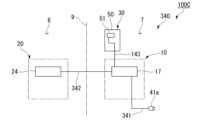
- FIG. 13 is a schematic diagram showing a wiring configuration 340 of an air conditioner 100C according to the third modification.
- the wiring configuration 340 of this modified example has a first electric wire 341, a second electric wire 342, and a third electric wire 143.
- the third electric wire 143 connects the outdoor unit 10 and the ventilation device 30 together.
- the second electric wire 342 connects the indoor unit 20 and the outdoor unit 10.
- the second electric wire 342, together with the circulation path section 18 and the ventilation pipe 31, is drawn from the indoor space 8 to the outdoor space 7 through the through hole 9h in the wall 9.
- the second electric wire 342 is connected to the control unit 24 inside the indoor unit 20.
- the second electric wire 342 is connected to the control unit 17 inside the outdoor unit 10.
- the second electric wire 342 supplies power from the outdoor unit 10 to the indoor unit 20.
- the wiring configuration 340 of this modified example can be used when the outlet into which the power plug 41a is inserted is located outside the room 7. With the wiring configuration 340 of this modified example, there is no need to pass the third electric wire 143 through the through hole 9h in the wall 9, improving the ease of wiring installation. With the wiring configuration 340 of this modified example, the control unit 17 of the outdoor unit 10 controls the ventilation device 30, so there is no need to provide a circuit board inside the ventilation device main body 50, and the ventilation device main body 50 can be made smaller.
- FIG. 14 is a schematic diagram showing a wiring configuration 440 of an air conditioner 100D according to the fourth modification.
- the wiring configuration 440 of this modified example has a first electric wire 441 , a second electric wire 442 , and a third electric wire 443 .
- the first electric wire 441 extends from the ventilation device 30.
- the ventilation device 30 of this modified example has a control unit 30e inside the ventilation device main body 50.
- the control unit 30e of the ventilation device 30 controls the ventilation fan 51 inside the ventilation device main body 50.
- the first electric wire 441 is connected to the control unit 30e inside the ventilation device 30.
- a power plug 41a is provided at the end of the first electric wire 441.
- the power plug 41a is connected to an outlet provided outside 7.
- the first electric wire 441 supplies power for the entire air conditioner 100D to the ventilation device 30.
- the second electric wire 442 connects the indoor unit 20 and the outdoor unit 10.
- the second electric wire 442, together with the circulation path section 18 and the ventilation pipe 31, is drawn from the indoor space 8 to the outdoor space 7 through the through hole 9h in the wall 9.
- the second electric wire 442 is connected to the control unit 24 inside the indoor unit 20.
- the second electric wire 442 is connected to the control unit 17 inside the outdoor unit 10.
- the second electric wire 442 supplies power from the outdoor unit 10 to the indoor unit 20.
- the third electric wire 443 connects the outdoor unit 10 and the ventilation device 30.
- the third electric wire 443 is connected to the control unit 17 inside the outdoor unit 10.
- the third electric wire 443 is connected to the control unit 30e inside the ventilation device 30.
- the third electric wire 443 supplies power from the ventilation device 30 to the outdoor unit 10.
- a third electric wire 442A connecting the indoor unit 20 and the ventilation device 30 may be used instead of the third electric wire 443 of this modified example.
- the third electric wire 442A is pulled from the indoors 8 to the outdoors 7 through the through hole 9h in the wall 9 together with the second electric wire 442.
- power is supplied to the outdoor unit 10 from the indoor unit 20 via the second electric wire 442.
- the wiring configuration 440 of this modified example can be used when the outlet into which the power plug 41a is inserted is located outside the room 7.
- the air conditioner 100 of this embodiment includes an indoor unit 20, an outdoor unit 10, a circulation path section (refrigerant piping) 18, and a ventilation device 30.
- the indoor unit 20 is installed in the room 8 and has a heat exchanger (first heat exchanger) 22.
- the outdoor unit 10 is installed in the outdoor 7 and has a heat exchanger (second heat exchanger) 13.
- the circulation path section 18 passes through a through hole 9h of a wall 9 that separates the room 8 from the outdoor 7, and connects the heat exchanger 22 of the indoor unit 20 to the heat exchanger 13 of the outdoor unit 10.
- the ventilation device 30 exhausts air from the room 8 to the outdoor 7 from an exhaust port.
- the ventilation device 30 includes a ventilation pipe 31 and a ventilation device main body 50.
- the ventilation pipe 31 is drawn from the indoor unit 20 to the outdoor 7 through the through hole 9h.
- the ventilation device main body 50 is fixed to a wall surface 9b of the outdoor 7.
- the ventilation device main body 50 has a ventilation fan 51, an intake air duct 80 connecting the ventilation pipe 31 and the ventilation fan 51, and an exhaust air duct 90 connecting the ventilation fan 51 and the exhaust port 46a.
- the ventilation fan 51 has a fan intake port 59a connected to the intake air duct 80 and a fan exhaust port 59b connected to the exhaust air duct 90.
- Two directions perpendicular to the vertical direction Z and perpendicular to each other are defined as a first direction (left-right direction Y in the embodiment) and a second direction (front-rear direction X in the embodiment).
- the intake air duct 80 has an inlet 81, a first region 82, a chamber region 83, a second region 84, and an outlet 85.
- the inlet 81 opens upward (in the +Z direction) and is connected to the ventilation pipe 31.
- the first region 82 extends downward (in the -Z direction) from the inlet 81.
- the chamber region 83 is connected to the first region 82 and extends in the first direction (left-right direction Y).
- the second region 84 is located on one side (-Y direction) of the first region 82 in the first direction (left-right direction Y) and extends upward (+Z direction) from the chamber region 83.
- the outlet 85 is located at the upper end of the second region 84 and connects to the fan intake 59a.
- the exhaust air duct 90 extends downward (-Z direction) from the fan exhaust vent 59b and overlaps with the intake air duct 80 when viewed from the second direction (front-back direction X).
- the ventilation fan 51 is disposed inside the ventilation device main body 50 outside the room 7, so that noise caused by the operation of the ventilation fan 51 is unlikely to be transmitted to the room 8, and the room 8 can be kept quiet.
- disposing the ventilation fan 51 outside the room 7 causes condensation water to be generated in the ventilation pipe 31 of the ventilation device 30 and the intake air duct 80 (see FIG. 9).
- the intake air duct 80 is formed in a U-shape in the first region 82, the chamber region 83, and the second region 84.
- condensation water generated in the ventilation pipe 31 and the intake air duct 80 is easily kept in the chamber region 83 corresponding to the lower end of the U-shape, and the intrusion of condensation water into the inside of the ventilation fan 51 disposed downstream of the intake air duct 80 can be suppressed.
- the inlet 81 of the intake air duct 80 opens upward, the condensation water generated in the ventilation pipe 31 can be guided into the intake air duct 80, and the accumulation of the condensation water in the ventilation pipe 31 can be suppressed.
- the intake air duct 80 provided inside the ventilation device main body 50 is U-shaped, so that a long air duct that is bent upstream of the ventilation fan 51 is secured. Therefore, the driving sound generated by the ventilation fan 51 is difficult to be transmitted to the room 8 through the intake air duct 80 and the ventilation piping 31, and the quietness of the room 8 can be maintained.
- the second direction is a direction perpendicular to the wall surface 9b.
- the chamber area 83 has a rectangular cross section with its short side in the second direction (front-back direction X) and extends in the first direction (left-right direction Y).
- the chamber area 83 has a retention portion 83d that extends to one side (-Y direction) in the first direction (left-right direction Y) relative to a connection portion 87 with the second area 84.
- the cross-sectional shape of the chamber region 83 is rectangular, so that the volume of the chamber region 83 can be secured large while preventing the dimension in the second direction (front-rear direction X) from becoming large. Also, with this configuration, since the chamber region 83 has a retention portion 83d, the air that flows along the outer wall surface of the air that flows into the chamber region 83 from the first region 82 is retained in the retention portion 83d and is unlikely to flow directly into the second region 84. Therefore, the wind speed of the air can be slowed down in the chamber region 83 to make the air flow gentle, and a stable amount of air can be supplied to the second region located downstream of the chamber region 83.
- the suction efficiency of the ventilation fan 51 can be increased, and turbulence can be prevented from flowing into the ventilation fan 51, thereby preventing noise generation from the ventilation fan 51. Furthermore, by making the shape of the flow passage cross section of the chamber region 83 a rectangle with the short side in the second direction (front-to-back direction X), it is possible to increase the amount of air that can be stored in the chamber region 83 while suppressing an increase in the dimension of the chamber region in the second direction (front-to-back direction X).
- the first region 82 has a first straight portion 82a and a first bent portion 82b.
- the first straight portion 82a extends linearly in the vertical direction Z.
- the first bent portion 82b bends to one side (-Y direction) in the first direction (left-right direction Y) as it extends downward from the lower end of the first straight portion 82a and connects to the end of the chamber region 83 on the other side (+Y direction) in the first direction (left-right direction Y).
- the flow path cross section of the first straight portion 82a is rectangular with its short side in the second direction (front-back direction X), and the area continuously increases as it extends downward.
- the flow path cross section of the first bent portion 82b is rectangular with its short side in the second direction (front-back direction X).
- the first region 82 has the first bent portion 82b, which smoothly connects the first region 82 and the chamber region 83, and allows air to be stably sent from the first region 82 to the chamber region 83.
- the volume of the chamber region 83 can be secured large without creating a step at the connection portion 86 with the chamber region 83.
- the first region 82 since the first region 82 is continuously connected to the upstream side of the chamber region 83, it plays a part of the function of stabilizing pressure, which is the function of the chamber region 83.
- the first region 82 By making the first region 82 a rectangular shape with the second direction (front-rear direction X) as the short side, it is possible to increase the amount of air that can be stored in the first region 82 while suppressing an increase in the dimension in the second direction (front-rear direction X).
- the outlet 85 opens in the second direction (front-to-back direction X).
- the second region 84 has a second straight portion 84a and a second bent portion 84b.
- the second straight portion 84a extends linearly in the vertical direction Z.
- the second bent portion 84b bends to one side (+X direction) in the second direction (front-to-back direction X) as it extends upward from the upper end of the second straight portion 84a and connects to the outlet 85.
- the flow path cross section of the second straight portion 84a has a continuously increasing area as it extends upward from the connection portion 87 with the chamber region 83.
- the second region 84 has the second bend portion 84b, so that the air in the second region 84 can be stably sent toward the outlet 85 that opens in the second direction (front-rear direction X).
- the flow path cross-sectional area of the second straight portion 84a increases toward the top, so that the flow path cross-sectional area is narrowed at the connection portion 87 with the chamber region 83 to make the air flow uniform within the air passage cross-section, and the air with increased wind speed can be rectified by gradually decreasing the wind speed while maintaining uniformity. This prevents turbulence from flowing into the ventilation fan 51, increases the suction efficiency of the ventilation fan 51, reduces the power consumption of the ventilation fan 51, and suppresses noise generation by the ventilation fan 51.
- the flow path cross section of the second straight section 84a is circular. With this configuration, it is possible to reduce the airflow resistance in the second straight section 84a and straighten the air flowing through the second straight section 84a. This increases the suction efficiency of the ventilation fan 51 and reduces noise generated by the ventilation fan 51.
- the second bend 84b is provided with a plate-shaped stator vane 62 that extends in the second direction (front-rear direction X) and divides the flow passage cross section of the second bend 84b into two regions, upper and lower.
- the stator vane 62 divides the second bend 84b into upper and lower regions, thereby ensuring the amount of air flowing into the lower region, the inner corner region 84d. This makes it possible to homogenize the air flowing into the inside of the ventilation fan 51 from the outlet 85, increasing the suction efficiency of the ventilation fan 51 and suppressing noise generated by the ventilation fan 51.
- the stator vane 62 has an upwardly convex curved shape with an apex at the center 62m in the first direction (left-right direction Y) when viewed from the second direction (front-back direction X).
- the air volume distribution in the second region is greatest at the center in the first direction (left-right direction Y).
- the fan intake 59a is located on one side (+X direction) of the outlet 85 in the second direction (front-rear direction X).
- the end 62c on one side (+X direction) of the second direction (front-rear direction X) of the stator blade 62 is located on the other side (-X direction) of the second direction (front-rear direction X) of the fan intake 59a.
- some turbulence T may occur on the upper surface 62a of the stator blade 62. If this turbulence T reaches the inside of the ventilation fan 51, it may vibrate the impeller of the ventilation fan 51 and cause noise.
- the stator blade 62 does not protrude toward the inside of the ventilation fan 51, so the turbulence T is unlikely to reach the inside of the ventilation fan 51, and noise generation from the ventilation fan 51 can be suppressed.
- the fan intake 59a is located on one side (+X direction) of the outlet 85 in the second direction (front-rear direction X).
- the end 62d on the other side (-X direction) of the second direction (front-rear direction X) of the stator blade 62 is located on one side (+X direction) of the second direction (front-rear direction X) of the center line CL of the second region 84. If the stator blade 62 is extended too far in the other side (-X direction) of the second direction (front-rear direction X), the amount of air flowing from the second straight portion 84a to the inner corner region 84d becomes too large, and the air flow distribution in the flow passage cross section of the outlet 85 becomes uneven. According to the above-mentioned configuration, by locating the rear end 62d of the stator blade 62 forward of the center line CL, it is possible to easily equalize the flow rate flowing in the outer corner region 84c and the inner corner region 84d.
- the second direction is a direction perpendicular to the wall surface 9b.
- the exhaust air duct 90 overlaps the intake air duct 80 when viewed from the second direction (front-rear direction X) and is disposed closer to the wall 9 than the intake air duct 80.
- the ventilation device main body 50 can be made smaller in the vertical direction Z and the first direction (left-right direction Y).
- the ventilation pipe 31 connected to the intake air duct 80 can be easily aligned along the wall surface 9b.
- drain air duct E can be disposed farther away from the wall surface 9b than the intake air duct 80, and the exhaust port 46a connected to the exhaust air duct 90 can be moved away from the wall surface 9b. This can suppress adhesion of dirt to the wall surface 9b caused by exhaust from the exhaust port 46a.
- the air conditioner 100 of this embodiment shown in FIG. 1 includes an indoor unit 20, an outdoor unit 10, a circulation path section (refrigerant piping) 18, a ventilation device 30, a first electric line 41, a second electric line 42, and a third electric line 43.
- the indoor unit 20 is installed on a wall surface 9a of the room 8, and has a heat exchanger (first heat exchanger) 22.
- the outdoor unit 10 is installed on the outside 7, and has a heat exchanger (second heat exchanger) 13.
- the circulation path section 18 passes through a through hole 9h in the wall 9 that separates the room 8 from the outside 7, and connects the heat exchanger 22 of the indoor unit 20 to the heat exchanger 13 of the outdoor unit 10.
- the ventilation device 30 exhausts air from the room 8 to the outside 7 from an exhaust port.
- the first electric wire 41 extends from the indoor unit 20 and has a power plug 41a at its end.
- the second electric wire 42 connects the indoor unit 20 to the outdoor unit 10.
- the third electric wire 43 connects the indoor unit 20 to the ventilation device 30.
- the number of outlets into which the power plug 41a is inserted can be reduced, allowing the air conditioner 100 to be widely installed even in locations where the number of available outlets is limited. Also, in cases where the ventilation device 30 is placed closer to the indoor unit 20 than the outdoor unit 10, the third electric wire 43 can be made shorter, reducing the effect of external noise on the operation. Furthermore, because the control unit 24 of the indoor unit 20 controls the ventilation device 30, there is no need to provide a circuit board inside the ventilation device main body 50, and the ventilation device main body 50 can be made more compact.
- the air conditioner 100A of the first modified example shown in FIG. 11 includes an indoor unit 20, an outdoor unit 10, a circulation path section (refrigerant piping) 18, a ventilation device 30, a first electric line 41, a second electric line 42, and a third electric line 143.
- the indoor unit 20 is installed on a wall surface 9a of the room 8, and has a heat exchanger (first heat exchanger) 22.
- the outdoor unit 10 is installed on the outside 7, and has a heat exchanger (second heat exchanger) 13.
- the circulation path section 18 passes through a through hole 9h in the wall 9 that separates the room 8 from the outside 7, and connects the heat exchanger 22 of the indoor unit 20 to the heat exchanger 13 of the outdoor unit 10.
- the ventilation device 30 exhausts air from the room 8 to the outside 7 from an exhaust port. It has a ventilation fan 51 arranged on the outside 7, and exhausts air from the room 8 to the outside 7.
- the first electric wire 41 extends from the indoor unit 20 and has a power plug 41a at its end.
- the second electric wire 42 connects the indoor unit 20 and the outdoor unit 10.
- the third electric wire 143 connects the outdoor unit 10 and the ventilation device 30.
- the air conditioner 100A can be widely installed even in places where there is a limit to the number of available outlets. Furthermore, with this configuration, the third electric wire 143 can be made shorter, for example in cases where the ventilation device 30 is placed closer to the outdoor unit 10 than the indoor unit 20. With this configuration, there is no need to pass the third electric wire 143 through the through hole 9h in the wall 9, improving the ease of installation of wiring. With this configuration, the control unit 17 of the outdoor unit 10 controls the ventilation device 30, making it possible to reduce the size of the ventilation device main body 50.
- the outdoor unit 10 has a connector part C into which the third electric wire 243 can be inserted and removed. With this configuration, the user can select whether or not to install the ventilation device 30 as necessary.
- the air conditioner 100C of the third modified example shown in FIG. 13 includes an indoor unit 20, an outdoor unit 10, a circulation path section (refrigerant piping) 18, a ventilation device 30, a first electric line 341, a second electric line 342, and a third electric line 143.
- the indoor unit 20 is installed on a wall surface 9a of the room 8, and has a heat exchanger (first heat exchanger) 22.
- the outdoor unit 10 is installed on the outside 7, and has a heat exchanger (second heat exchanger) 13.
- the circulation path section 18 passes through a through hole 9h in the wall 9 that separates the room 8 from the outside 7, and connects the heat exchanger 22 of the indoor unit 20 to the heat exchanger 13 of the outdoor unit 10.
- the ventilation device 30 exhausts air from the room 8 to the outside 7 from an exhaust port. It has a ventilation fan 51 arranged on the outside 7, and exhausts air from the room 8 to the outside 7.
- the first electric wire 341 extends from the outdoor unit 10 and has a power plug 41a at its end.
- the second electric wire 342 connects the indoor unit 20 and the outdoor unit 10.
- the third electric wire 143 connects the outdoor unit 10 and the ventilation device 30.
- the air conditioner 100C of this configuration can be used when the outlet into which the power plug 41a is inserted is located outside 7. With this configuration, there is no need to pass the third electric wire 143 through the through hole 9h in the wall 9, improving the ease of wiring installation. With this configuration, the control unit 17 of the outdoor unit 10 controls the ventilation device 30, making it possible to reduce the size of the ventilation device main body 50.
- the air conditioner 100D of the modified example 4 shown in FIG. 14 includes an indoor unit 20, an outdoor unit 10, a circulation path section (refrigerant piping) 18, a ventilation device 30, a first electric line 441, a second electric line 442, and a third electric line 443.
- the indoor unit 20 is installed on a wall surface 9a of the room 8, and has a heat exchanger (first heat exchanger) 22.
- the outdoor unit 10 is installed on the outside 7, and has a heat exchanger (second heat exchanger) 13.
- the circulation path section 18 passes through a through hole 9h in the wall 9 that separates the room 8 from the outside 7, and connects the heat exchanger 22 of the indoor unit 20 to the heat exchanger 13 of the outdoor unit 10.
- the ventilation device 30 exhausts air from the room 8 to the outside 7 from an exhaust port. It has a ventilation fan 51 arranged on the outside 7, and exhausts air from the room 8 to the outside 7.
- the first electric wire 441 extends from the ventilation device 30 and has a power plug 41a at its tip.
- the second electric wire 442 connects the indoor unit 20 and the outdoor unit 10.
- the third electric wire 443 connects the indoor unit 20 or the outdoor unit 10 to the ventilation device 30.
- the air conditioner 100D having this configuration can be used when the outlet into which the power plug 41a is inserted is located outside 7.
- each flow passage cross section in each region of the intake air duct 80 is not limited to the above-mentioned embodiments, and various shapes can be adopted.
- a centrifugal blower is used as the ventilation fan 51, but the type of ventilation fan 51 is not limited to the above-mentioned configuration.
Landscapes
- Engineering & Computer Science (AREA)
- Chemical & Material Sciences (AREA)
- Combustion & Propulsion (AREA)
- Mechanical Engineering (AREA)
- General Engineering & Computer Science (AREA)
- Air-Conditioning Room Units, And Self-Contained Units In General (AREA)
Priority Applications (2)
| Application Number | Priority Date | Filing Date | Title |
|---|---|---|---|
| PCT/JP2023/000901 WO2024154169A1 (ja) | 2023-01-16 | 2023-01-16 | 空気調和機 |
| JP2024571431A JP7802211B2 (ja) | 2023-01-16 | 2023-01-16 | 空気調和機 |
Applications Claiming Priority (1)
| Application Number | Priority Date | Filing Date | Title |
|---|---|---|---|
| PCT/JP2023/000901 WO2024154169A1 (ja) | 2023-01-16 | 2023-01-16 | 空気調和機 |
Publications (1)
| Publication Number | Publication Date |
|---|---|
| WO2024154169A1 true WO2024154169A1 (ja) | 2024-07-25 |
Family
ID=91955526
Family Applications (1)
| Application Number | Title | Priority Date | Filing Date |
|---|---|---|---|
| PCT/JP2023/000901 Ceased WO2024154169A1 (ja) | 2023-01-16 | 2023-01-16 | 空気調和機 |
Country Status (2)
| Country | Link |
|---|---|
| JP (1) | JP7802211B2 (https=) |
| WO (1) | WO2024154169A1 (https=) |
Citations (4)
| Publication number | Priority date | Publication date | Assignee | Title |
|---|---|---|---|---|
| JPS5831235A (ja) * | 1981-08-19 | 1983-02-23 | Matsushita Electric Ind Co Ltd | 分離形空気調和機の取付装置 |
| JPH06300312A (ja) * | 1993-04-20 | 1994-10-28 | Hitachi Ltd | 換気機能付空気調和機 |
| JP2006046243A (ja) * | 2004-08-06 | 2006-02-16 | Mitsubishi Electric Corp | シロッコファン、換気装置および換気装置付き空気調和機 |
| JP2006153361A (ja) * | 2004-11-30 | 2006-06-15 | Hitachi Home & Life Solutions Inc | 空気調和機 |
-
2023
- 2023-01-16 JP JP2024571431A patent/JP7802211B2/ja active Active
- 2023-01-16 WO PCT/JP2023/000901 patent/WO2024154169A1/ja not_active Ceased
Patent Citations (4)
| Publication number | Priority date | Publication date | Assignee | Title |
|---|---|---|---|---|
| JPS5831235A (ja) * | 1981-08-19 | 1983-02-23 | Matsushita Electric Ind Co Ltd | 分離形空気調和機の取付装置 |
| JPH06300312A (ja) * | 1993-04-20 | 1994-10-28 | Hitachi Ltd | 換気機能付空気調和機 |
| JP2006046243A (ja) * | 2004-08-06 | 2006-02-16 | Mitsubishi Electric Corp | シロッコファン、換気装置および換気装置付き空気調和機 |
| JP2006153361A (ja) * | 2004-11-30 | 2006-06-15 | Hitachi Home & Life Solutions Inc | 空気調和機 |
Also Published As
| Publication number | Publication date |
|---|---|
| JPWO2024154169A1 (https=) | 2024-07-25 |
| JP7802211B2 (ja) | 2026-01-19 |
Similar Documents
| Publication | Publication Date | Title |
|---|---|---|
| JP5474199B2 (ja) | 空気調和機の室内機、及び空気調和機 | |
| JP5409544B2 (ja) | 空気調和機の室内機、及び空気調和機 | |
| JP4015016B2 (ja) | ターボファン及びこれを用いた空気調和機 | |
| KR102076668B1 (ko) | 공기 조화기의 실내기 | |
| CN103528131B (zh) | 空调的室内单元和控制该空调的方法 | |
| US12366368B2 (en) | Indoor unit for air conditioner | |
| JP4502057B2 (ja) | 床置型空気調和機の室内機 | |
| JP5606533B2 (ja) | 空気調和機の室内機、及び空気調和機 | |
| KR101852800B1 (ko) | 공기 조화기의 실내기 | |
| JP3700578B2 (ja) | 空気調和装置の室内機 | |
| JP5206365B2 (ja) | 送風装置 | |
| JP5591334B2 (ja) | 空気調和機の室内機、及び空気調和機 | |
| JP7802211B2 (ja) | 空気調和機 | |
| CN112503645A (zh) | 整体式空调器 | |
| WO2024154175A1 (ja) | 空気調和機 | |
| JP7837439B2 (ja) | 空気調和機 | |
| KR20020026726A (ko) | 환기 장치가 구비된 공기 조화기 | |
| US12422149B2 (en) | Air conditioner | |
| EP4317827B1 (en) | Wall-mounted air conditioner | |
| KR20210112776A (ko) | 공기조화기 | |
| JP7785203B2 (ja) | 空気調和機 | |
| KR100792060B1 (ko) | 공기조화기의 연결배관 설치구조 | |
| KR200312467Y1 (ko) | 천장카세트형 에어컨의 흡입그릴 구조 | |
| KR20020026724A (ko) | 환기 장치가 구비된 공기 조화기 | |
| WO2024024072A1 (ja) | 空気調和機 |
Legal Events
| Date | Code | Title | Description |
|---|---|---|---|
| 121 | Ep: the epo has been informed by wipo that ep was designated in this application |
Ref document number: 23917384 Country of ref document: EP Kind code of ref document: A1 |
|
| WWE | Wipo information: entry into national phase |
Ref document number: 2024571431 Country of ref document: JP |
|
| NENP | Non-entry into the national phase |
Ref country code: DE |
|
| 122 | Ep: pct application non-entry in european phase |
Ref document number: 23917384 Country of ref document: EP Kind code of ref document: A1 |