WO2024136758A1 - Thiopeptide compounds - Google Patents
Thiopeptide compounds Download PDFInfo
- Publication number
- WO2024136758A1 WO2024136758A1 PCT/SG2023/050853 SG2023050853W WO2024136758A1 WO 2024136758 A1 WO2024136758 A1 WO 2024136758A1 SG 2023050853 W SG2023050853 W SG 2023050853W WO 2024136758 A1 WO2024136758 A1 WO 2024136758A1
- Authority
- WO
- WIPO (PCT)
- Prior art keywords
- optionally substituted
- compound
- alkyl
- alkenyl
- alkynyl
- Prior art date
- Legal status (The legal status is an assumption and is not a legal conclusion. Google has not performed a legal analysis and makes no representation as to the accuracy of the status listed.)
- Ceased
Links
Classifications
-
- A—HUMAN NECESSITIES
- A61—MEDICAL OR VETERINARY SCIENCE; HYGIENE
- A61P—SPECIFIC THERAPEUTIC ACTIVITY OF CHEMICAL COMPOUNDS OR MEDICINAL PREPARATIONS
- A61P31/00—Antiinfectives, i.e. antibiotics, antiseptics, chemotherapeutics
- A61P31/04—Antibacterial agents
-
- A—HUMAN NECESSITIES
- A61—MEDICAL OR VETERINARY SCIENCE; HYGIENE
- A61P—SPECIFIC THERAPEUTIC ACTIVITY OF CHEMICAL COMPOUNDS OR MEDICINAL PREPARATIONS
- A61P35/00—Antineoplastic agents
-
- C—CHEMISTRY; METALLURGY
- C07—ORGANIC CHEMISTRY
- C07K—PEPTIDES
- C07K5/00—Peptides containing up to four amino acids in a fully defined sequence; Derivatives thereof
- C07K5/04—Peptides containing up to four amino acids in a fully defined sequence; Derivatives thereof containing only normal peptide links
- C07K5/06—Dipeptides
- C07K5/06008—Dipeptides with the first amino acid being neutral
- C07K5/06017—Dipeptides with the first amino acid being neutral and aliphatic
- C07K5/0606—Dipeptides with the first amino acid being neutral and aliphatic the side chain containing heteroatoms not provided for by C07K5/06086 - C07K5/06139, e.g. Ser, Met, Cys, Thr
-
- A—HUMAN NECESSITIES
- A61—MEDICAL OR VETERINARY SCIENCE; HYGIENE
- A61K—PREPARATIONS FOR MEDICAL, DENTAL OR TOILETRY PURPOSES
- A61K38/00—Medicinal preparations containing peptides
Definitions
- the present disclosure generally relates to thiopeptide compounds, and more particularly relates to thiopeptide compounds, their methods of production and uses thereof.
- Antimicrobial resistance is one of the leading threats to human health globally. High rates of resistance against antibiotics used to treat common infections have been observed worldwide. Recently, it was estimated that 1.2 million people died from antibiotic-resistant bacterial infections, which was more than that caused by HIV/ATDS or malaria. Notably, Staphylococcus aureus is one of the leading pathogens (the second after Escherichia coli) for fatalities associated with resistance. Strains of 5. aureus resistant to antistaphylococcal antibiotics, also known as methicillin -resistant Staphylococcus aureus (MRSA), have become increasingly common as the cause of infections. MRS A treatments involve second -line antibacterials such as vancomycin, that may come with more serious side effects. The World Health Organization (WHO) estimates MRSA proportions to exceed 20% globally, and that people with MRSA infections are 64% more likely to die than people with drug-sensitive infections.
- WHO World Health Organization
- antimicrobial resistance requires a comprehensive, multi-sectoral approach that involves both human and animal health sectors, as well as the environment.
- Strategies include promoting appropriate use of antimicrobials, developing new drugs and treatment regimens, implementing infection prevention and control measures, and raising awareness among healthcare providers, patients, and the general public.
- R1 is -C(O)-R6 or -A-G-J-L
- A is optionally substituted carbocyclylene, optionally substituted heterocarbocyclylene, optionally substituted cycloalkylene, optionally substituted heterocycloalkylene, optionally substituted arylene, optionally substituted heteroarylene, or -C(O)N(R7a)-
- G is -C(O)- or optionally substituted -alkylene-C(O)-
- J is optionally substituted carbocyclylene, optionally substituted heterocarbocyclylene, optionally substituted cycloalkylene, optionally substituted heterocycloalkylene, optionally substituted arylene, or optionally substituted heteroarylene
- L is -C(O)-R6
- R2 is optionally substituted carbocyclylene, optionally substituted heterocarbocyclylene, optionally substituted cycloalkylene, optionally substituted heterocycloalkylene, optional
- a pharmaceutical composition comprising a therapeutically effective amount of a compound disclosed herein, or a pharmaceutically acceptable salt, metabolite, prodrug or stereoisomer thereof, and a pharmaceutically acceptable excipient.
- a method of treating a bacterial, microbial and/or fungal infection comprising administering a therapeutically effective amount of a compound of Formula (I), or a h i ll l l bolite, prodrug or stereoisomer thereof, to a subject in need of t Formula (I) wherein: R 1 is -C(O)-R 6 or -A-G-J-L; A is optionally substituted carbocyclylene, optionally substituted heterocarbocyclylene, optionally substituted cycloalkylene, optionally substituted heterocycloalkylene, optionally substituted arylene, optionally substituted heteroarylene, or -C(O)N(R7a)-; G is -C(O)- or optionally substituted -alkylene-C(O)-; J is optionally substituted carbocyclylene, optionally substituted heterocarbocyclylene, optionally substituted cycloalkylene
- a method of treating cancer comprising administering a therapeutically effective amount of a compound of Formula (I), or a pharmaceutically acceptable salt, metabolite, prodrug or stereoisomer thereof, to a subject in need of treatment:
- R1 is -C(O)-R6 or -A-G-J-L
- A is optionally substituted carbocyclylene, optionally substituted heterocarbocyclylene, optionally substituted cycloalkylene, optionally substituted heterocycloalkylene, optionally substituted arylene, optionally substituted heteroarylene, or -C(O)N(R7a)-
- G is -C(O)- or optionally substituted -alkylene-C(O)-
- J is optionally substituted carbocyclylene, optionally substituted heterocarbocyclylene, optionally substituted cycloalkylene, optionally substituted heterocycloalkylene, optionally substituted arylene
- R1 is -C(O)-R6 or -A-G-J-L
- A is optionally substituted carbocyclylene, optionally substituted heterocarbocyclylene, optionally substituted cycloalkylene, optionally substituted heterocycloalkylene, optionally substituted arylene, optionally substituted heteroarylene, or -C(O)N(R7a)-
- G is -C(O)- or optionally substituted -alkylene-C(O)-
- J is optionally substituted carbocyclylene, optionally substituted heterocarbocyclylene, optionally substituted cycloalkylene, optionally substituted heterocycloalkylene, optionally substituted arylene, or optionally substituted heteroarylene
- L is -C(O)-R 6
- R2 is -H, optionally substituted alkyl, optionally
- the compounds disclosed and/or described herein contain olefinic double bonds or other centers of geometric asymmetry, it is intended that the compounds include both E and Z isomers.
- the compounds described herein contain moieties capable of tautomerization, and unless specified otherwise, it is intended that the compounds include all possible tautomers.
- the term “isomers” refers to compounds having the same number and kind of atoms, and hence the same molecular weight, but differing in respect to the structural arrangement or configuration of the atoms.
- the term “tautomer” refers to one of two or more structural isomers that exist in equilibrium and which are readily converted from one isomeric form to another.
- alkyl includes within its meaning monovalent (“alkyl”) and divalent (“alkylene”) straight chain or branched chain saturated aliphatic groups having from 1 to 12 carbon atoms, eg, 1, 2, 3, 4, 5, 6, 7, 8, 9, 10, 11 or 12 carbon atoms.
- alkyl includes, but is not limited to, methyl, ethyl, 1-propyl, isopropyl, 1-butyl, 2-butyl, isobutyl, tert-butyl, amyl, 1,2- dimethylpropyl, 1,1-dimethylpropyl, pentyl, isopentyl, hexyl, 4-methylpentyl, 1-methylpentyl, 2- methylpentyl, 3-methylpentyl, 2,2-dimethylbutyl, 3,3-dimethylbutyl, 1,2-dimethylbutyl, 1,3- dimethylbutyl, 1,2,2-trimethylpropyl, 1,1,2-trimethylpropyl, 2-ethylpentyl, 3-ethylpentyl, heptyl, 1- methylhexyl, 2,2-dimethylpentyl, 3,3-dimethylpentyl, 4,4-dimethylpentyl, 1,2-dimethylpentyl,
- Alkyl groups may be optionally substituted.
- alkenyl includes within its meaning monovalent (“alkenyl”) and divalent (“alkenylene”) straight chain or branched chain unsaturated aliphatic groups containing at least one carbon-carbon double bond and having from 2 to 12 carbon atoms, eg, 2, 3, 4, 5, 6, 7, 8, 9, 10, 11 or 12 carbon atoms.
- alkenyl includes, but is not limited to, ethenyl, propenyl, butenyl, 1-butenyl, 2-butenyl, 2-methylpropenyl, 1-pentenyl, 2-pentenyl, 2-methylbut-1-enyl, 3- methylbut-1-enyl, 2-methylbut-2-enyl, 1-hexenyl, 2-hexenyl, 3-hexenyl, 2,2-dimethyl-2-butenyl, 2- methyl-2-hexenyl, 3-methyl-1-pentenyl, 1,5-hexadienyl and the like.
- Alkenyl groups may be optionally substituted.
- alkynyl includes within its meaning monovalent (“alkynyl”) and divalent (“alkynylene”) unsaturated aliphatic groups containing at least one carbon-carbon triple bond and having from 2 to 12 carbon atoms, eg, 2, 3, 4, 5, 6, 7, 8, 9, 10, 11 or 12 carbon atoms.
- alkynyl includes, but is not limited to, ethynyl, propynyl, 1-butynyl, 2-butynyl, 1-pentynyl, 2- pentynyl, 1-hexynyl, 2-hexynyl, 3-hexynyl, 3-methyl-1-pentynyl, and the like.
- Alkynyl groups may be optionally substituted.
- the term “heterocarbocyclylene” or “heterocyclylene” refers to a divalent non-aromatic, aromatic, mono- or multi-cyclic ring system comprising at least 3 carbons and has at least one heteroatom in the ring system.
- cycloalkylene which is a non-aromatic mono- or multi-cyclic ring system
- arylene which is an aromatic mono- or multi-cyclic ring system
- heterocycloalkylene which is a non-aromatic mono- or multi-cyclic ring system having at least one heteroatom in the ring system
- heteroarylene which is an aromatic mono- or multi-cyclic ring system having at least one heteroatom in the ring system.
- aryl refers to monovalent (“aryl”) and divalent (“arylene”) single, polynuclear, conjugated and fused residues of aromatic hydrocarbons having from 6 to 10 carbon atoms.
- groups include, for example, phenyl, biphenyl, naphthyl, phenanthrenyl, and the like.
- Aryl groups may be optionally substituted.
- cycloalkyl or variants such as “cycloalkylene” as used herein refers to monovalent (“cycloalkyl”) and divalent (“cycloalkylene”) non-aromatic mono- or multicyclic ring system comprising about 3 to about 10 carbon atoms.
- the cycloalkyl can be optionally substituted with one or more "ring system substituents" which may be the same or different, and are as defined herein.
- suitable monocyclic cycloalkyls include cyclopropyl, cyclopentyl, cyclohexyl, cycloheptyl and the like.
- suitable multicyclic cycloalkyls include 1 -decalinyl, norbornyl, adamantyl and the like.
- cycloalkyl include the following:
- heterocycloalkyl or variants such as “heterocycloalkylene” as used herein refers to a cycloalkyl or cycloalkylene, where one or more of the atoms in the ring system is not a carbon atom, namely a heteroatom that is selected from N, O, P and S. Heterocycloalkyl groups may be optionally substituted.
- heteroaryl or variants such as “heteroarylene” as used herein refers to monovalent (“heteroaryl”) and divalent (“heteroarylene”) aromatic monocyclic or multicyclic ring system comprising about 5 to about 14 ring atoms, preferably about 5 to about 10 ring atoms, in which one or more of the ring atoms is an element other than carbon, for example nitrogen, oxygen or sulfur, alone or in combination.
- Heteroaryl may also include a heteroaryl as defined above fused to an aryl as defined above.
- Non- limiting examples of suitable heteroaryls include pyridyl, pyrazinyl, furanyl, thienyl, pyrimidinyl, pyridone (including N-substituted pyridones), isoxazolyl, isothiazolyl, oxazolyl, thiazolyl, pyrazolyl, furazanyl, pyrrolyl, pyrazolyl, triazolyl, 1 ,2,4-thiadiazolyl, pyrazinyl, pyridazinyl, quinoxalinyl, phthalazinyl, oxindolyl, imidazo[1 ,2-a]pyridinyl, imidazo[2,1 -b]thiazolyl, benzofurazanyl, indolyl, azaindolyl, benzimidazolyl, benzothienyl, quinolinyl, imidazolyl, thienopyr
- heteroaryl also refers to partially saturated heteroaryl moieties such as, for example, tetrahydroisoquinolyl, tetrahydroquinolyl and the like. Heteroaryl groups may be optionally substituted.
- carrieroaryl or variants such as “carbocyclic ring” or “carbocyclylene” as used herein refers to monovalent (“carbocycle”) and divalent (“carbocyclylene”) any stable 3, 4, 5, 6, or 7- membered monocyclic or bicyclic or 7, 8, 9, 10, 11, 12, or 13-membered bicyclic or tricyclic, any of which may be saturated, partially unsaturated, or aromatic.
- carbocycles include, but are not limited to, cyclopropyl, cyclobutyl, cyclopentyl, cyclohexyl, cycloheptyl, adamantyl, cyclooctyl, [3.3.0]bicyclooctane, [4.3.0]bicyclononane, [4.4.0]bicyclodecane (decalin), [2.2.2]bicyclooctane, fluorenyl, phenyl, naphthyl, indanyl, adamantyl, or tetrahydronaphthyl (tetralin).
- carbocycles are cyclopropyl, cyclobutyl, cyclopentyl, cyclohexyl, phenyl, naphthyl, and indanyl.
- carbocycle When the term “carbocycle” is used, it is intended to include “aryl”. Carbocycles may be optionally substituted.
- heterocarbocyclyl As used herein, “heterocarbocyclyl”, “heterocyclylene” or “heterocarbocyclylene” refers to a carbocycle or carbocyclylene, where one or more of the atoms in the ring system is not a carbon atom, namely a heteroatom that is selected from N, O, P and S.
- Heterocarbocyclyl groups may be optionally substituted. While “alkyl”, “alkenyl”, “alkynyl”, “carbocyclyl”, “heterocarbocyclyl”, “cycloalkyl”, “heterocycloalkyl”, “aryl”, “heteroaryl” are end-of-chain groups, the corresponding “alkylene”, “alkenylene”, “alkynylene”, “carbocyclylene”, “heterocarbocyclylene”, “cycloalkylene”, “heterocycloalkylene”, “arylene”, “heteroarylene” are each mid-chain moieties. When compounded chemical names, e.g.
- arylalkyl and arylimine are used herein, they are understood to have a specific connectivity to the core of the chemical structure.
- the group listed farthest to the right e.g. alkyl in “arylalkyl”
- alkyl in “arylalkyl” is the group that is directly connected to the core.
- an “arylalkyl” group for example, is an alkyl group substituted with an aryl group (e.g. phenylmethyl (i.e., benzyl)) and the alkyl group is attached to the core.
- alkylaryl is an aryl group substituted with an alkyl group (e.g., p-methylphenyl (i.e., p-tolyl)) and the aryl group is attached to the core.
- alkyl group e.g., p-methylphenyl (i.e., p-tolyl)
- optionally substituted means the group to which this term refers may be unsubstituted, or may be substituted with one or more groups other than hydrogen provided that the indicated atom’s normal valency is not exceeded, and that the substitution results in a stable compound.
- Such groups may be, for example, halogen, hydroxy, oxo, cyano, nitro, alkyl, alkoxy, haloalkyl, haloalkoxy, aryl-4-alkoxy, alkylthio, hydroxyalkyl, alkoxyalkyl, cycloalkyl, cycloalkylalkoxy, alkanoyl, alkoxycarbonyl, alkylsulfonyl, alkylsulfonyloxy, alkylsulfonylalkyl, arylsulfonyl, arylsulfonyloxy, arylsulfonylalkyl, alkylsulfonamido, alkylamido, alkylsulfonamidoalkyl, alkylamidoalkyl, arylsulfonamido, arylcarboxamido, arylsulfonamidoalkyl, arylcarbox
- substituted means the group to which this term refers is substituted with one or more groups other than hydrogen provided that the indicated atom’s normal valency is not exceeded, and that the substitution results in a stable compound.
- groups may be, for example, halogen, hydroxy, oxo, cyano, nitro, alkyl, alkoxy, haloalkyl, haloalkoxy, arylalkoxy, alkylthio, hydroxyalkyl, alkoxyalkyl, cycloalkyl, cycloalkylalkoxy, alkanoyl, alkoxycarbonyl, alkylsulfonyl, alkylsulfonyloxy, alkylsulfonylalkyl, arylsulfonyl, arylsulfonyloxy, arylsulfonylalkyl, alkylsulfonamido, alkylamido, alkylsul
- any carbon or heteroatom with unsatisfied valences in the text, schemes, examples, structural formulae, and any Tables herein is assumed to have the hydrogen atom or atoms to satisfy the valences.
- pharmaceutically acceptable salt refers to salts that are within sound medical judgement, that may be suitable for medical applications, or suitable for use to contact human and/or animal tissue without undue toxicity, allergic response, irritation and the like, and have a reasonable benefit/risk ratio.
- Such salts are well known in the art and may include, for example, salts formed with inorganic acids such as hydrochloric acid, hydrobromic acid, phosphoric acid, sulfuric acid and perchloric acid or with organic acids such as acetic acid, oxalic acid, maleic acid, tartaric acid, citric acid, succinic acid, lactic acid, malic acid or malonic acid.
- inorganic acids such as hydrochloric acid, hydrobromic acid, phosphoric acid, sulfuric acid and perchloric acid
- organic acids such as acetic acid, oxalic acid, maleic acid, tartaric acid, citric acid, succinic acid, lactic acid, malic acid or malonic acid.
- salts include adipate, alginate, ascorbate, aspartate, benzenesulfonate, benzoate, bisulfate, borate, butyrate, camphorate, camphorsulfonate, citrate, cyclopentanepropionate, digluconate, dodecyl sulfate, cthancsulfonatc, formate, fumarate, glucoheptonate, glycerophosphate, gluconate, hcmisulfatc, heptanoate, hexanoate, hydroiodide, 2-hydroxy-ethanesulfonate, lactobionate, lactate, laurate, lauryl sulfate, malate, maleate, malonate, methanesulfonate, 2-naphthalenesulfonate, nicotinate, nitrate, oleate, oxalate, palmitate, pamoate, peroxine sodium
- alkali or alkaline earth metal salts include sodium, lithium, potassium, calcium, magnesium, and the like.
- Further pharmaceutically acceptable salts include, when appropriate, nontoxic ammonium, quaternary ammonium, and amine cations formed using counterions such as halide, hydroxide, carboxylate, sulfate, phosphate, nitrate, lower alkyl sulfonate and aryl sulfonate.
- pharmaceutically acceptable carrier is intended to include solvents, dispersion media, coatings, anti-bacterial and anti-fungal agents, isotonic and absorption delaying agents, and the like.
- the use of such media and agents for pharmaceutically active substances is well known in the art. Except insofar as any conventional media or agent is incompatible with the compound, use thereof in the therapeutic compositions and methods of treatment and prophylaxis is contemplated.
- Supplementary active compounds may also be incorporated into the compositions according to the present invention. It is especially advantageous to formulate parenteral compositions in dosage unit form for ease of administration and uniformity of dosage.
- Dosage unit form refers to physically discrete units suited as unitary dosages for the individual to be treated; each unit containing a predetermined quantity of compound(s) is calculated to produce the desired therapeutic effect in association with the required pharmaceutical carrier.
- the compound(s) may be formulated for convenient and effective administration in effective amounts with a suitable pharmaceutically acceptable carrier in an acceptable dosage unit.
- the dosages arc determined by reference to the usual dose and manner of administration of the said ingredients.
- the term “metabolite” refers to any substance that is produced during metabolism or that takes part in metabolism. Metabolism refers to the biochemical reactions involved in maintaining the living condition of the cells in an organism.
- the term “prodrug” refers to therapeutic agent precursors that may be intrinsically and/or largely inactive, but can be transformed in vivo into one or more active compounds that exhibit therapeutic efficacy. Suitable prodrugs include esters, phosphonate esters etc, of the active form of the compound.
- FIG 1 A first figure.
- Fig. 1 is a scheme of a phylogenetic tree showing the evolutionary relationship between A761 1 and other type species of the genus Nonomuraea, with the bar indicating 0.01 substitutions per nucleotide position.
- Fig. 2 is an image showing the results of Global Natural Products Social Molecular Networking (GNPS) performed on the extract of A7611 strain, with insets showing the structures attributed to nodes in the thiopeptide GNPS clusters.
- GNPS Global Natural Products Social Molecular Networking
- Fig. 3 is a diagram showing the chemical structures of compounds 1-9.
- Fig. 4 is a series of ultraviolet (UV) spectra for compounds 1-9.
- Fig. 5 is a series of (+)-High Resolution Electrospray Ionisation Mass Spectrometry (HRESTMS) spectra for compounds 1-9.
- Fig. 6 is a diagram showing selected homonuclear Correlation SpectroscopY (COSY) and Heteronuclear Multiple Bond Correlation (HMBC) correlations of compounds 1-9.
- COSY homonuclear Correlation SpectroscopY
- HMBC Heteronuclear Multiple Bond Correlation
- Fig. 7a is a 1 H NMR spectrum (DMSO-t/s, 400 MHz) of compound 1.
- Fig. 7b is a 13 C NMR spectrum (DMSO-cA,. 100 MHz) of compound 1.
- Fig. 7c is a COSY spectrum of compound 1.
- Fig. 7d is a Heteronuclear Single Quantum Coherence (HSQC) spectrum of compound 1.
- Fig. 7e is a HMBC spectrum of compound 1.
- Fig. 8a is a ' l l NMR spectrum (DMSO-A, 400 MHz) of compound 2.
- Fig. 8b is a 13 C NMR spectrum (DMSO- ⁇ /-,, 100 MHz) of compound 2.
- Fig. 8c is a COSY spectrum of compound 2.
- Fig. 8d is a HSQC spectrum of compound 2.
- Fig. 8e is a HMBC spectrum of compound 2.
- FIG. 9 A A first figure.
- Fig. 9b is a COSY spectrum of compound 3.
- FIG. 9c is a HSQC spectrum of compound 3.
- FIG. 9D is a HSQC spectrum of compound 3.
- Fig. 9d is a HMBC spectrum of compound 3.
- Fig. 10a is a 1 H NMR spectrum i'D ⁇ 1SO- ⁇ f . 400 MHz) of compound 4.
- Fig. 10b is a 13 C NMR spectrum (DMSO-cfe, 100 MHz) of compound 4.
- Fig. 10c is a COSY spectrum of compound 4.
- Fig. lOe is a HMBC spectrum of compound 4.
- Fig. 1 la is a *H NMR spectrum i'DMSO- ⁇ 7 ⁇ . 400 MHz) of compound 5.
- Fig. l ib is a ] l C NMR spectrum (DMSO-ds, 100 MHz) of compound 5.
- Fig. 11c is a COSY spectrum of compound 5.
- FIG. HD is a diagrammatic representation of FIG.
- Fig. 1 1 d is a HSQC spectrum of compound 5.
- Fig. 1 le is a HMBC spectrum of compound 5.
- FIG. 12A is a diagrammatic representation of FIG. 12A
- FIG. 12a is a 1 H NMR spectrum (DMSO- ⁇ s, 400 MHz) of compound 6.
- FIG. 12B is a 1 H NMR spectrum (DMSO- ⁇ s, 400 MHz) of compound 6.
- Fig. 12b is a 13 C NMR spectrum (DMSO-c/e, 100 MHz) of compound 6.
- Fig. 12c is a COSY spectrum of compound 6.
- Fig. 12d is a HSQC spectrum of compound 6.
- Fig. 12e is a HMBC spectrum of compound 6.
- Fig. 13a is a *H NMR spectrum (DMSO-rfs, 400 MHz) of compound 7.
- Fig. 13b is a n C NMR spectrum ( L)MSO-d ⁇ . 100 MHz) of compound 7.
- Fig. 13c is a COSY spectrum of compound 7.
- Fig. 13d is a HSQC spectrum of compound 7.
- Fig. 13e is a HMBC spectrum of compound 7.
- Fig. 14 is a ’H NMR spectrum (DMSO-ds, 400 MHz) of compound 8. spectrum (DMSOA 400 MHz) of compound 9.
- Fig. 16 is a series of images showing (a) the extracted ion chromatogram; (b) the (+)-HRESIMS spectrum; and (c) the MS/MS spectrum of GE2270A (a thiopeptide detected from Planobispora rosea) in the extract of the Nonomuraeajiangxiensis strain A7611.
- Fig. 17 is a series of inhibitory effect dose response curves of compounds 1-9 against Staphylococcus aureus Rosenbach (ATCC® 25923TM) with gentamicin as positive control.
- Fig. 18a is scheme showing the synthetic route for intermediate I.
- Fig. 18b is scheme showing the synthetic route towards intermediate II.
- Fig. 18c is scheme showing the synthetic route towards intermediates III and IV.
- Fig. 18d is scheme showing the synthetic route towards compounds 7, 8, and 9.
- Fig. 18e is scheme showing the synthetic route towards compounds 1, 2, 3, and 4.
- Fig. 18f is scheme showing the synthetic route towards compounds 5 and 6.
- the present invention discloses a compound of Formula (I) or a pharmaceutically acceptable salt, metabolite, prodrug or stereoisomer thereof:
- Ri is -C(O)-R 6 or -A-G-J-L;
- A is optionally substituted carbocyclylene, optionally substituted heterocarbocyclylene, optionally substituted cycloalkylene, optionally substituted heterocycloalkylene, optionally substituted arylene, optionally substituted heteroarylene, or -C(O)N(R?a)-;
- G is -C(O)- or optionally substituted -alkylene-C(O)-;
- J is optionally substituted carbocyclylene, optionally substituted heterocarbocyclylene, optionally substituted cycloalkylene, optionally substituted heterocycloalkylene, optionally substituted arylene, or optionally substituted heteroarylene;
- L is -C(O)-R 6 ;
- Rz is H, optionally substituted alkyl, optionally substituted alkenyl, or optionally substituted alkynyl, or optionally substituted alkalkoxy;
- R 3 is H, optionally substituted alkyl, optionally substituted alkenyl, or optionally substituted alkynyl;
- R 4 is H, -OH, optionally substituted alkyl, optionally substituted alkenyl, optionally substituted alkynyl, or -N(R 7a )(R 7b );
- R5 is independently selected from the group consisting of H, halogen, -N(R7a)(R7b), optionally substituted alkoxy, optionally substituted alkyl, optionally substituted alkenyl, optionally substituted alkynyl, optionally substituted carbocyclyl, optionally substituted heterocarbocyclyl, optionally substituted cycloalkyl, optionally substituted heterocycloalkyl, optionally substituted aryl, or optionally
- R1 is -C(O)-R6 or -A-G-J-L
- A is optionally substituted carbocyclylene, optionally substituted heterocarbocyclylene, optionally substituted cycloalkylene, optionally substituted heterocycloalkylene, optionally substituted arylene, optionally substituted heteroarylene, or -C(O)N(R7a)-
- G is -C(O)- or optionally substituted -alkylene-C(O)-
- J is optionally substituted carbocyclylene, optionally substituted heterocarbocyclylene, optionally substituted cycloalkylene, optionally substituted heterocycloalkylene, optionally substituted arylene, or optionally substituted heteroarylene
- L is -C(O)-R6
- R 2 is -H, optionally substituted alkyl, optionally substituted
- R1 is -C(O)-R6 or -A-G-J-L. In some embodiments, R1 is -C(O)-R6. In other embodiments, R1 is -COOH. In some other embodiments, R1 is an acid derivative, e.g., an ester (-COOR), or an amide (-CONRaRb), where R, Ra and/or R b may be optionally substituted alkyl, e.g., optionally substituted C 1-12 alkyl or optionally substituted C 1 , C 2 , C 3 , C 4 , C 5 , C 6 , C 7 , C 8 , C 9 , C 10 , C 11 , C 12 alkyl, optionally substituted alkenyl, e.g., optionally substituted C 2-12 alkenyl or optionally substituted C 2 , C 3 , C 4 , C 5 , C 6 , C 7 , C 8 , C 9 , C 10
- R 1 is -C(O)-R 6
- R 6 is -OH, alkoxy, or -N(R 7a )(R 7b ).
- the alkoxy is MeO-, EtO-, PrO-, iPrO-, n-BuO-, sec-BuO-, or t-BuO-.
- -N(R7a)(R7b) is -NH2, -NHMe, -N(Me)2, - NHEt, -N(Et)2, or -NMeEt.
- A is optionally substituted carbocyclylene, e.g., optionally substituted C 3-12 carbocyclylene or optionally substituted C 3 , C 4 , C 5 , C 6 , C 7 , C 8 , C 9 , C 10 , C 11 , C 12 carbocyclylene, optionally substituted heterocarbocyclylene, e.g., optionally substituted C 3-12 heterocarbocyclylene or optionally substituted C 3 , C 4 , C 5 , C 6 , C 7 , C 8 , C 9 , C 10 , C 11 , C 12 heterocarbocyclylene, optionally substituted cycloalkylene, e.g., optionally substituted C3-12 cycloalkylene or optionally substituted C3, C4, C5, C6, C7, C8, C9, C10, C11, C12 cycloalkylene, optionally substituted heterocycloalkylene, e.g., optionally substituted C
- the heteroatom is N, O, P, S and/or Se.
- A is , , or , or isomers thereof, wherein represents a connection to the rest of the compound and * represents a connection to G.
- G is -C(O)- or optionally substituted -alkylene-C(O)-.
- the optionally substituted alkylene may be methylene, ethylene, propylene, butylene, pentylene, hexylene, all of which may be optionally substituted or isomers thereof.
- the alkylene is optionally substituted methylene.
- G is -C(O)- or –CH(R 8 )-C(O)-, wherein R 8 is optionally substituted alkylene, e.g., optionally substituted C 1-12 alkylene or optionally substituted C 1 , C 2 , C 3 , C 4 , C 5 , C 6 , C 7 , C 8 , C 9 , C 10 , C 11 , C 12 alkylene, substituted with -OH.
- R 8 is methylene substituted with one -OH, i.e., -CH 2 OH.
- G is -C(O)-, , or , or isomers thereof, whe ein represents a connection to A and * re onnec .
- J is optionally substituted carbocyclylene, e.g., optionally substituted C3-12 carbocyclylene or optionally substituted C3, C4, C5, C6, C7, C8, C9, C10, C11, C12 carbocyclylene, optionally substituted heterocarbocyclylene, e.g., optionally substituted C3-12 heterocarbocyclylene or optionally substituted C3, C4, C5, C6, C7, C8, C9, C10, C11, C12 heterocarbocyclylene, optionally substituted cycloalkylene, e.g., optionally substituted C3-12 cycloalkylene or optionally substituted C3, C 4 , C 5 , C 6 , C 7 , C 8 , C 9 , C 10 , C 11 , C 12
- the heteroatom is N, O, P, S and/or Se.
- heterocarbocyclylene In some preferred embodiments, J is , or , or isomers thereof, wherein represents a connection to G and * represents a connection to L.
- L is -C(O)-R 6 . In other embodiments, L is -COOH.
- L is an acid derivative, e.g., an ester (-COOR), or an amide (-CONR a R b ), where R, R a and/or R b may be optionally substituted alkyl, e.g., optionally substituted C 1-12 alkyl or optionally substituted C 1 , C 2 , C 3 , C 4 , C 5 , C 6 , C 7 , C 8 , C 9 , C 10 , C 11 , C 12 alkyl, optionally substituted alkenyl, e.g., optionally substituted C 2-12 alkenyl or optionally substituted C 2 , C 3 , C 4 , C 5 , C 6 , C 7 , C 8 , C 9 , C 10 , C 11 , C 12 alkenyl, or optionally substituted alkynyl, e.g., optionally substituted C 2-12 alkynyl or optionally substituted C 2 , C 3 , C
- R 1 is -C(O)-R 6
- R 6 is -OH, optionally substituted alkoxy, e.g., optionally substituted C 1-12 alkoxy or optionally substituted C 1 , C 2 , C 3 , C 4 , C 5 , C 6 , C 7 , C 8 , C 9 , C 10 , C 11 , C 12 alkoxy, or -N(R 7a )(R 7b ).
- the optionally substituted alkoxy is MeO-, EtO-, PrO-, iPrO-, n-BuO-, sec-BuO-, or t-BuO-.
- -N(R 7a )(R 7b ) is -NH 2 , -NHMe, -N(Me) 2 , -NHEt, -N(Et) 2 , or -NMeEt.
- L is -COOH or -C(O)NH 2 .
- R 1 is selected from the group consisting of -COOH, - C(O)O some other preferred embodiments, R 1 is selected from the group consisting of .
- R2 is -H, optionally substituted alkyl, e.g., optionally substituted C1-12 alkyl or optionally substituted C1, C2, C3, C4, C5, C6, C7, C8, C9, C10, C11, C12 alkyl, optionally substituted alkenyl, e.g., optionally substituted C2-12 alkenyl or optionally substituted C2, C3, C4, C5, C6, C7, C8, C9, C10, C11, C12 alkenyl, or optionally substituted alkynyl, e.g., optionally substituted C2-12 alkynyl or optionally substituted C2, C3, C4, C5, C6, C7, C8, C9, C10, C11, C12 alkynyl, or optionally substituted alkalkoxy, e.g., optionally substituted C1-12 alkalkoxy or optionally substituted C1, C2, C3, C4, C5, C6, C7, C8, C9, C10, C11,
- R2 is -H or -CH2OCH3.
- R3 is -H, optionally substituted alkyl, e.g., optionally substituted C1-12 alkyl or optionally substituted C1, C2, C3, C4, C5, C6, C7, C8, C9, C10, C11, C12 alkyl, optionally substituted alkenyl, e.g., optionally substituted C 2-12 alkenyl or optionally substituted C 2 , C 3 , C 4 , C 5 , C 6 , C 7 , C 8 , C 9 , C 10 , C 11 , C 12 alkenyl, or optionally substituted alkynyl, e.g., optionally substituted C 2-12 alkynyl or optionally substituted C 2 , C 3 , C 4 , C 5 , C 6 , C 7 , C 8 , C 9 , C 10 , C 11 , C 12 alkynyl.
- R 3 is -H or -CH 3 .
- R 4 is -H, -OH, optionally substituted alkyl, e.g., optionally substituted C 1-12 alkyl or optionally substituted C 1 , C 2 , C 3 , C 4 , C 5 , C 6 , C 7 , C 8 , C 9 , C 10 , C 11 , C 12 alkyl, optionally substituted alkenyl, e.g., optionally substituted C 2-12 alkenyl or optionally substituted C 2 , C 3 , C 4 , C 5 , C 6 , C 7 , C 8 , C 9 , C 10 , C 11 , C 12 alkenyl, optionally substituted alkynyl, e.g., optionally substituted C 2-12 alkynyl or optionally substituted C 2 , C 3 , C 4 , C 5 , C 6 , C 7 , C 8 , C 9 , C 10 , C 11
- R 4 is -NH(CH 3 ).
- R 5 is -H, halogen, -N(R 7a )(R 7b ), optionally substituted alkoxy, e.g., optionally substituted C 1-12 alkoxy or optionally substituted C 1 , C 2 , C 3 , C 4 , C 5 , C 6 , C 7 , C 8 , C 9 , C 10 , C 11 , C 12 alkoxy, optionally substituted alkyl, e.g., optionally substituted C 1-12 alkyl or optionally substituted C 1 , C 2 , C 3 , C 4 , C 5 , C 6 , C 7 , C 8 , C 9 , C 10 , C 11 , C 12 alkyl, optionally substituted alkenyl, e.g., optionally substituted C 2-12 alkenyl or optionally substituted C 2 , C 3 , C 4 , C 5 , C 6
- the heteroatom is N, O, P, S and/or Se.
- R5 is -H.
- R6 is -OH, optionally substituted alkoxy, e.g., optionally substituted C1- 12 alkoxy or optionally substituted C1, C2, C3, C4, C5, C6, C7, C8, C9, C10, C11, C12 alkoxy, or -N(R7a)(R7b).
- R6 is -OH, -OMe, or -NHMe.
- each of R7a and R7b is independently -H or optionally substituted alkyl, e.g., optionally substituted C1-12 alkyl or optionally substituted C1, C2, C3, C4, C5, C6, C7, C8, C9, C10, C11, C12 alkyl.
- each of R7a and R7b is independently -H or -Me.
- the present invention also discloses a compound of Formula (I) or a pharmaceutically acceptable salt, metabolite, prodrug or stereoisomer thereof:
- R 1 is -C(O)-R 6 or -A-G-J-L
- A is optionally substituted carbocyclylene, optionally substituted heterocarbocyclylene, optionally substituted cycloalkylene, optionally substituted heterocycloalkylene, optionally substituted arylene, optionally substituted heteroarylene, or -C(O)N(R 7a )-
- G is -C(O)- or optionally substituted -alkylene-C(O)-
- J is optionally substituted carbocyclylene, optionally substituted heterocarbocyclylene, optionally substituted cycloalkylene, optionally substituted heterocycloalkylene, optionally substituted arylene, or optionally substituted heteroarylene
- L is -C(O)-R 6
- R 2 is -H, optionally substituted alkyl, optionally substituted alkenyl, or optionally substituted alkynyl, or optionally substituted alkalkoxy;
- the present invention also discloses a having a Formula (III): Formula (III)
- the present invention also discloses a compound having a Formula (IV): Formula (IV)
- R3 when R2 is optionally substituted alkalkoxy, R3 is -H, optionally substituted alkenyl, or optionally substituted alkynyl. In some other embodiments, when R2 is optionally substituted alkalkoxy, R3 is not optionally substituted alkyl.
- R2 is -CO2OCH3
- R3 is - H, optionally substituted alkenyl, or optionally substituted alkynyl.
- R2 when R2 is - CO2OCH3, R3 is not -CH3.
- R, R 1 , R 2 , R 3 , R 4 , R 5 , R 6 , R 7 , R 7a , R 7b , R 8 may be as defined anywhere in the specification.
- the compound of Formula (I) or a pharmaceutically acceptable salt, metabolite, prodrug or stereoisomer thereof may be selected from the following group:
- the present disclosure also provides for a pharmaceutical composition
- a pharmaceutical composition comprising the compound disclosed herein, or its pharmaceutically acceptable salt, metabolite, prodrug, stereoisomer, enantiomer, diastereomer, geometric isomer, and/or isomer thereof, all of which are disclosed herein.
- the pharmaceutical composition may comprise a therapeutically effective amount of the compound disclosed herein. Further, the pharmaceutical composition may also comprise the compound disclosed herein, or its pharmaceutically acceptable salt, metabolite, prodrug, stereoisomer, enantiomer, diastereomer, geometric isomer, and/or isomer thereof.
- a pharmaceutical composition comprising a therapeutically effective amount of a compound disclosed herein, or a pharmaceutically acceptable salt, metabolite, prodrug or stereoisomer thereof, and a pharmaceutically acceptable excipient.
- the compounds disclosed in the present invention may be used in therapy.
- the present invention discloses methods of treatment using the compounds disclosed herein or their pharmaceutically acceptable salts, metabolites, prodrugs, stereoisomers, enantiomers, diastereomers, geometric isomers, and/or isomers, or pharmaceutical compositions of any of the foregoing, all of which are disclosed herein.
- the present invention discloses the compounds disclosed herein or their pharmaceutically acceptable salts, metabolites, prodrugs, stereoisomers, enantiomers, diastereomers, geometric isomers, and/or isomers, or pharmaceutical compositions of any of the foregoing, all of which are disclosed herein, for use in therapy or in treatment.
- the present invention also discloses the use of the compounds disclosed herein or their pharmaceutically acceptable salts, metabolites, prodrugs, stereoisomers, enantiomers, diastereomers, geometric isomers, and/or isomers, or pharmaceutical compositions of any of the foregoing, all of which are disclosed herein, in the manufacture of a medicament for therapy, or for treatment of any diseases, infections or indications disclosed herein and throughout the disclosure.
- the compounds disclosed in the present invention may be used to treat various microbial, bacterial, fungal infections, and/or cancer.
- the present invention provides a method of treating a bacterial, microbial and/or fungal infection, comprising administering a therapeutically effective amount of a compound of Formula (I), or a pharmaceutically acceptable salt, metabolite, prodrug or stereoisomer thereof, to a subject in need of treatment:
- R 1 is -C(O)-R 6 or -A-G-J-L;
- A is optionally substituted carbocyclylene, optionally substituted heterocarbocyclylene, optionally substituted cycloalkylene, optionally substituted heterocycloalkylene, optionally substituted arylene, optionally substituted heteroarylene, or -C(O)N(R7a)-;
- G is -C(O)- or optionally substituted -alkylene-C(O)-;
- J is optionally substituted carbocyclylene, optionally substituted heterocarbocyclylene, optionally substituted cycloalkylene, optionally substituted heterocycloalkylene, optionally substituted arylene, or optionally substituted heteroarylene;
- L is -C(O)-R6;
- R2 is -H, optionally substituted alkyl, optionally substituted alkenyl, or optionally substituted alkynyl, or optionally substituted alkalk
- the present invention provides a compound of Formula (I), or a pharmaceutically acceptable s l b li d i r thereof, for use in treating a bacterial, microbial and/or fun Formula (I) wherein: R 1 is -C(O)-R 6 or -A-G-J-L; A is optionally substituted carbocyclylene, optionally substituted heterocarbocyclylene, optionally substituted cycloalkylene, optionally substituted heterocycloalkylene, optionally substituted arylene, optionally substituted heteroarylene, or -C(O)N(R7a)-; G is -C(O)- or optionally substituted -alkylene-C(O)-; J is optionally substituted carbocyclylene, optionally substituted heterocarbocyclylene, optionally substituted cycloalkylene, optionally substituted heterocycloalkylene, optionally substituted arylene, or optionally substituted heteroarylene; L is
- the present invention provides a use of a compound of Formula (I), or a pharmaceutically acceptable salt, metabolite, prodrug or stereoisomer thereof, in the manufacture of a medicament for treating a bacterial, microbial and/or fungal infection:
- R1 is -C(O)-R6 or -A-G-J-L
- A is optionally substituted carbocyclylene, optionally substituted heterocarbocyclylene, optionally substituted cycloalkylene, optionally substituted heterocycloalkylene, optionally substituted arylene, optionally substituted heteroarylene, or -C(O)N(R7a)-
- G is -C(O)- or optionally substituted -alkylene-C(O)-
- J is optionally substituted carbocyclylene, optionally substituted heterocarbocyclylene, optionally substituted cycloalkylene, optionally substituted heterocycloalkylene, optionally substituted arylene,
- Such treatable infections may be caused by, but are not limited to, Staphylococcus, Bacillus, Clostridium, Acinetobacter, Klebsiella, Candida, Enterococcus, Micrococcus, or Pseudomonas pathogens.
- the infection is a Staphylococcus, Bacillus, Clostridium, Acinetobacter, Klebsiella, Candida, Enterococcus, Micrococcus, or Pseudomonas infection.
- the infection is caused by, but not limited to Staphylococcus aureus, Staphylococcus aureus Rosenbach, gram ⁇ positive methicillin ⁇ resistant Staphylococcus aureus (MRSA), Bacillus cereus, Bacillus subtilis, Clostridium perfringens, Acinetobacter baumannii, Klebsiella aerogenes, Pseudomonas aeruginosa, Candida albicans, Clostridium difficile, Enterococcus faecalis, Enterococcus faecium, or Micrococcus luteus.
- Staphylococcus aureus Staphylococcus aureus Rosenbach
- MRSA gram ⁇ positive methicillin ⁇ resistant Staphylococcus aureus
- Bacillus cereus Bacillus subtilis
- Clostridium perfringens Clostridium perfringens
- Acinetobacter baumannii Klebsiella aerogenes
- the present invention provides a method of treating cancer, comprising administering a therapeutically effective amount of a compound of Formula (I), or a pharmaceutically acceptable salt, metabolite, prodrug or stereoisomer thereof, to a subject in need of treatment:
- R 1 is -C(O)-R 6 or -A-G-J-L;
- A is optionally substituted carbocyclylene, optionally substituted heterocarbocyclylene, optionally substituted cycloalkylene, optionally substituted heterocycloalkylene, optionally substituted arylene, optionally substituted heteroarylene, or -C(O)N(R7a)-;
- G is -C(O)- or optionally substituted -alkylene-C(O)-;
- J is optionally substituted carbocyclylene, optionally substituted heterocarbocyclylene, optionally substituted cycloalkylene, optionally substituted heterocycloalkylene, optionally substituted arylene, or optionally substituted heteroarylene;
- L is -C(O)-R6;
- R2 is -H, optionally substituted alkyl, optionally substituted alkenyl, or optionally substituted alkynyl, or optionally substituted alkalk
- the present invention provides a compound of Formula (I), or a pharmaceutically acceptable salt, metabolite, prodrug or stereoisomer thereof, for use in treating cancer: Formula (I) wherein: R1 is -C(O)-R6 or -A-G-J-L; A is optionally substituted carbocyclylene, optionally substituted heterocarbocyclylene, optionally substituted cycloalkylene, optionally substituted heterocycloalkylene, optionally substituted arylene, optionally substituted heteroarylene, or -C(O)N(R7a)-; G is -C(O)- or optionally substituted -alkylene-C(O)-; J is optionally substituted carbocyclylene, optionally substituted heterocarbocyclylene, optionally substituted cycloalkylene, optionally substituted heterocycloalkylene, optionally substituted arylene, or optionally substituted heteroarylene; L is -C(O)-R 6 ;
- the present invention provides a use of a compound of Formula (I), or a pharmaceutically acceptable s l b li d i thereof, in the manufacture of a medicament for treating cance Formula (I) wherein: R 1 is -C(O)-R 6 or -A-G-J-L; A is optionally substituted carbocyclylene, optionally substituted heterocarbocyclylene, optionally substituted cycloalkylene, optionally substituted heterocycloalkylene, optionally substituted arylene, optionally substituted heteroarylene, or -C(O)N(R7a)-; G is -C(O)- or optionally substituted -alkylene-C(O)-; J is optionally substituted carbocyclylene, optionally substituted heterocarbocyclylene, optionally substituted cycloalkylene, optionally substituted heterocycloalkylene, optionally substituted arylene, or optionally substituted heteroarylene; L is -C(O)-R
- R, R 1 , R 2 , R 3 , R 4 , R 5 , R 6 , R 7 , R 7a , R 7b , R 8 may be as defined anywhere in the specification.
- the compounds for use, or the compound as used in any methods of therapy or manufacture of medicaments for therapy are compounds as disclosed in the present invention, or their pharmaceutically acceptable salts, metabolites, prodrugs, stereoisomers, enantiomers, diastereomers, geometric isomers, and/or isomers, or pharmaceutical compositions of any of the foregoing.
- the compounds for use, or the compound as used in any methods of therapy or manufacture of medicaments for therapy, or their pharmaceutically acceptable salts, metabolites, prodrugs, stereoisomers, enantiomers, diastereomers, geometric isomers, and/or isomers, or pharmaceutical compositions of any of the foregoing may be selected from the group consisting of:
- the compounds for use, or the compound as used in any methods of therapy or manufacture of medicaments for therapy, or their pharmaceutically acceptable salts, metabolites, prodrugs, stereoisomers, enantiomers, diastereomers, geometric isomers, and/or isomers, or pharmaceutical compositions of any of the foregoing may be selected from the group consisting of Compounds la-2a, 5a-9a, 1-2 and 5-9. Isolation of Compounds Special fermentation and/or culture conditions may be required to induce the microbe(s) to produce the compounds of the present invention.
- the microbe is a bacteria.
- the bacteria is a Nonomuraea strain.
- the bacteria is Nonomuraea jiangxiensis.
- the present invention provides a method of isolating compounds disclosed in the present invention, the method comprising: (i) expanding a bacteria strain under culture conditions that allow expansion of the strain to obtain a seed culture; (ii) using the seed culture to inoculate a fermentation culture; (iii) incubating the fermentation culture; and (iv) isolating the compound from the fermentation culture.
- the present invention also discloses a method of isolating a compound of Formula (I), Formula (I) wherein: R1 is -C(O)-R6 or -A-G-J-L; A is optionally substituted carbocyclylene, optionally substituted heterocarbocyclylene, optionally substituted cycloalkylene, optionally substituted heterocycloalkylene, optionally substituted arylene, optionally substituted heteroarylene, or -C(O)N(R7a)-; G is -C(O)- or optionally substituted -alkylene-C(O)-; J is optionally substituted carbocyclylene, optionally substituted heterocarbocyclylene, optionally substituted cycloalkylene, optionally substituted heterocycloalkylene, optionally substituted arylene, or optionally substituted heteroarylene;
- L is -C(O)-R 6 ;
- R- is -H, optionally substituted alkyl, optionally substituted alkenyl, or optionally substituted alkynyl, or optionally substituted alkalkoxy;
- R ⁇ is -H, optionally substituted alkyl, optionally substituted alkenyl, or optionally substituted alkynyl;
- R4 is -H, -OH, optionally substituted alkyl, optionally substituted alkenyl, optionally substituted alkynyl, or -N(R 7a )(R7b);
- Rs is independently selected from the group consisting of -H, halogen, -N(R 7 a)(R 7 b), optionally substituted alkoxy, optionally substituted alkyl, optionally substituted alkenyl, optionally substituted alkynyl, optionally substituted carbocyclyl, optionally substituted heterocarbocyclyl, optionally substituted cycloalkyl, optionally substituted heterocycloalkyl, optionally substituted aryl, or optionally substituted heteroaryl;
- Rs is -OH, alkoxy, or -N(R 7a )(R 7 b);
- R 7a and R 7 b are independently -H or optionally substituted alkyl, the method comprising:
- the present invention also discloses a method of isolating a compound of Formula (I),
- Ri is -C(O)-R 6 or -A-G-J-L;
- A is optionally substituted carbocyclylene, optionally substituted heterocarbocyclylene, optionally substituted cycloalkylene, optionally substituted heterocycloalkylene, optionally substituted arylene, optionally substituted heteroarylene, or -C(O)N(R?a)-;
- G is -C(O)- or optionally substituted -alkylcnc-C(O)-;
- J is optionally substituted carbocyclylene, optionally substituted heterocarbocyclylene, optionally substituted cycloalkylene, optionally substituted heterocycloalkylene, optionally substituted arylene, or optionally substituted heteroarylene;
- L is -C(O)-Re
- R2 is -H, optionally substituted alkyl, optionally substituted alkenyl, or optionally substituted alkynyl, or optionally substituted alkalkoxy;
- R3 is -H, optionally substituted alkyl, optionally substituted alkenyl, or optionally substituted alkynyl;
- R4 is -H, -OH, optionally substituted alkyl, optionally substituted alkenyl, optionally substituted alkynyl, or -N(R 7a )(R7b); Rs is independently selected from the group consisting of -H, halogen, -N(R7 a )(R7t>), optionally substituted alkoxy, optionally substituted alkyl, optionally substituted alkenyl, optionally substituted alkynyl, optionally substituted carbocyclyl, optionally substituted heterocarbocyclyl, optionally substituted cycloalkyl, optionally substituted heterocycloalkyl, optionally substituted aryl, or optionally substituted heteroaryl;
- Rs is -OH, alkoxy, or -Ni'R , ,)iR ,h);
- R and R ,s are independently -H or optionally substituted alkyl, the method comprising:
- step (i) comprises expanding the bacteria strain in media, for example an SV2 media.
- the media may comprise glucose, glycerol, soya peptone, calcium carbonate, and/or combinations thereof.
- the pH of the media may be adjusted to be in a range of at least about 5.0, at least about 5.5, at least about 6.0, at least about 6.5, at least about 7.0, at least about 7.5, at least about 8.0; or from about 5.0 to about 8.0, from about 5.0 to about 7.5, from about 5.0 to about 7.0, from about 5.0 to about 6.5, from about 5.0 to about 6.0, from about 5.0 to about 5.5, from about 5.5 to about 8.0, from about 5.5 to about 7.5, from about 5.5 to about 7.0, from about 5.5 to about 6.5, from about 5.5 to about 6.0, from about 6.0 to about 8.0, from about 6.0 to about 7.5, from about 6.0 to about 7.0, from about 6.0 to about 6.5, from about 6.5 to about 8.0, from about 6.5 to about 7.5, from about 6.5 to about 7.0, from about 7.0 to about 8.0, from about 7.0 to about 7.5, from about 7.5 to about 8.0; or at most about 5.0,
- step (i) comprises expanding the bacteria strain in a range of at least about 1 day, at least about 2 days, at least about 3 days, at least about 4 days, at least about 5 days; or from about 1 day to about 5 days, from about 1 day to about 4 days, from about 1 day to about 3 days, from about 1 day to about 2 days, from about 2 days to about 5 days, from about 2 days to about 4 days, from about 2 days to about 3 days, from about 3 days to about 5 days, from about 3 days to about 4 days, from about 4 days to about 5 days; or at most about 1 day, at most about 2 days, at most about 3 days, at most about 4 days, at most about 5 days; or about 1 day, about 2 days, about 3 days, about 4 days, about 5 days, or any ranges or values therebetween.
- step (i) comprises expanding the bacteria strain for 3 days.
- step (i) comprises expanding the bacteria strain at a temperature range of at least about 25 oC, at least about 27 oC, at least about 28 oC, at least about 29 oC, at least about 30 oC, at least about 32 oC, at least about 35 oC; or from about 25 oC to about 35 oC, from about 25 oC to about 32 oC, from about 25 oC to about 30 oC, from about 25 oC to about 29 oC, from about 25 oC to about 28 oC, from about 25 oC to about 27 oC, from about 27 oC to about 35 oC, from about 27 oC to about 32 oC, from about 27 oC to about 30 oC, from about 27 oC to about 29 oC, from about 27 oC to about 28 oC, from about 28 oC to about 35 oC, from about 28 oC to about 35 o
- step (i) comprises expanding the bacteria strain at about 28 oC. In some embodiments, step (i) comprises expanding the bacteria strain with a shaking condition in a range of at least about 150 rpm, at least about 175 rpm, at least about 200 rpm, at least about 225 rpm, at least about 250 rpm, at least about 300 rpm, at least about 350 rpm; or from about 150 rpm to about 350 rpm, from about 150 rpm to about 300 rpm, from about 150 rpm to about 250 rpm, from about 150 rpm to about 225 rpm, from about 150 rpm to about 200 rpm, from about 150 rpm to about 175 rpm, from about 175 rpm to about 350 rpm, from about 175 rpm to about 300 rpm, from about 175 rpm to about 250 rpm, from about 175 rpm to about 225 rpm, from about 175 rpm to about 200 rpm,
- step (i) comprises expanding the bacteria strain with a shaking condition at 200 rpm.
- the fermentation culture in step (ii) is CA09LB media.
- the media may comprise meat extract, yeast extract, glucose, glycerol, and/or combinations thereof.
- the pH of the fermentation culture may be adjusted to be in a range of at least about 5.0, at least about 5.5, at least about 6.0, at least about 6.5, at least about 7.0, at least about 7.5, at least about 8.0; or from about 5.0 to about 8.0, from about 5.0 to about 7.5, from about 5.0 to about 7.0, from about 5.0 to about 6.5, from about 5.0 to about 6.0, from about 5.0 to about 5.5, from about 5.5 to about 8.0, from about 5.5 to about 7.5, from about 5.5 to about 7.0, from about 5.5 to about 6.5, from about 5.5 to about 6.0, from about 6.0 to about 8.0, from about 6.0 to about 7.5, from about 6.0 to about 7.0, from about 6.0 to about 6.5, from about 6.5 to about 8.0, from about 6.5 to about 7.5, from about 6.5 to about 7.0, from about 7.0 to about 8.0, from about 7.0 to about 7.5, from about 7.5 to about 8.0; or at most about 5.0
- step (iii) comprises incubating the fermentation culture in a range of at least about 7 days, at least about 8 days, at least about 9 days, at least about 10 days, at least about 11 days, at least about 12 days; or from about 7 days to about 12 days, from about 7 days to about 11 days, from about 7 days to about 10 days, from about 7 days to about 9 days, from about 7 days to about 8 days, from about 8 days to about 12 days, from about 8 days to about 11 days, from about 8 days to about 10 days, from about 8 days to about 9 days, from about 9 days to about 12 days, from about 9 days to about 11 days, from about 9 days to about 10 days, from about 10 days to about 12 days, from about 10 days to about 11 days, from about 11 days to about 12 days; or at most about 7 days, at most about 8 days, at most about 9 days, at most about 10 days, at most about 11 days, at most about 12 days; or about
- step (iii) comprises incubating the fermentation culture for about 7 days to about 12 days. In some other preferred embodiments, step (iii) comprises incubating the fermentation culture for about 9 days. In some embodiments, step (iii) comprises incubating the fermentation culture at a temperature range of at least about 25 oC, at least about 27 oC, at least about 28 oC, at least about 29 oC, at least about 30 oC, at least about 32 oC, at least about 35 oC; or from about 25 oC to about 35 oC, from about 25 oC to about 32 oC, from about 25 oC to about 30 oC, from about 25 oC to about 29 oC, from about 25 oC to about 28 oC, from about 25 oC to about 27 oC, from about 27 oC to about 35 oC, from about 27 oC to about 32 oC, from about 27 oC to about 30 oC, from about 27 oC to about 30
- step (iii) comprises incubating the fermentation culture at about 28 oC. In some embodiments, step (iii) comprises incubating the fermentation culture with a shaking condition in a range of at least about 150 rpm, at least about 175 rpm, at least about 200 rpm, at least about 225 rpm, at least about 250 rpm, at least about 300 rpm, at least about 350 rpm; or from about 150 rpm to about 350 rpm, from about 150 rpm to about 300 rpm, from about 150 rpm to about 250 rpm, from about 150 rpm to about 225 rpm, from about 150 rpm to about 200 rpm, from about 150 rpm to about 175 rpm, from about 175 rpm to about 350 rpm, from about 175 rpm to about 300 rpm, from about 175 rpm to about 250 rpm, from about 175 rpm to about 225 rpm, from about 175 rpm, from about
- step (iii) comprises incubating the fermentation culture with a shaking condition at 200 rpm. In some embodiments, step (iii) comprises incubating the fermentation culture for 9 days at 28 °C with shaking condition of 200 rpm. In some embodiments, the compound is isolated using centrifugation, precipitation, filtration, liquid extraction, methanol extraction, chromatography, column chromatography, affinity chromatography, evaporation, lyophilization, and/or combinations thereof.
- the compound isolated, or its pharmaceutically acceptable salt, metabolite, prodrug, stereoisomer, enantiomer, diastereomer, geometric isomer, and/or isomer of any of the foregoing is a compound as disclosed herein.
- R, R 1 , R 2 , R 3 , R 4 , R 5 , R 6 , R 7 , R 7a , R 7b , R 8 may be as defined anywhere in the specification.
- the compound isolated, or its pharmaceutically acceptable salt, metabolite, prodrug, stereoisomer, enantiomer, diastereomer, geometric isomer, and/or isomer of any of the foregoing may be selected from the group consisting of: Compound 5a Compound 6a
- the present invention provides a compound prepared by the method disclosed herein.
- Formula (IV) 6 The compound of any one of embodiments 1 to 5, wherein A is heterocarbocyclylene or -C(O)N(R 7a )-. 7. The compound of any one of embodiments 1 to 6, wherein G is –C(O)- or optionally substituted -alkylene-C(O)-. 8. The compound of any one of embodiments 1 to 7, wherein G is -C(O)- or –CH(R8)-C(O)-, wherein R8 is alkylene substituted with -OH. 9. The compound of embodiment 8, wherein R8 is -CH2-OH. 10. The compound of any one of embodiments 1 to 9, wherein J is heterocarbocyclylene. 11.
- a pharmaceutical composition comprising a therapeutically effective amount of a compound of any one of embodiments 1 to 18, or a pharmaceutically acceptable salt, metabolite, prodrug or stereoisomer thereof, and a pharmaceutically acceptable excipient.
- MRSA methicillin-resistant Staphylococcus aureus
- embodiment 23 wherein the infection is caused by Staphylococcus aureus, Staphylococcus aureus Rosenbach, gram-positive methicillin-resistant Staphylococcus aureus (MRSA), Bacillus cereus, Bacillus subtilis, Clostridium perfringens, Acinetobacter baumannii, Klebsiella aerogenes, Pseudomonas aeruginosa, Candida albicans, Clostridium difficile, Enterococcus faecalis, Enterococcus faecium, or Micrococcus luteus. 25.
- MRSA methicillin-resistant Staphylococcus aureus
- a method of treating a bacterial, microbial and/or fungal infection comprising administering a therapeutically effective amount of a compound of Formula (I), or a pharmaceutically acceptable salt, metabolite, prodrug or stereoisomer thereof, to a subject in need of treatment Formula (I) wherein: R1 is -C(O)-R6 or -A-G-J-L; A is optionally substituted carbocyclylene, optionally substituted heterocarbocyclylene, optionally substituted cycloalkylene, optionally substituted heterocycloalkylene, optionally substituted arylene, optionally substituted heteroarylene, or -C(O)N(R7a)-; G is -C(O)- or optionally substituted -alkylene-C(O)-; J is optional
- a method of treating cancer comprising administering a therapeutically effective amount of a compound selected from the following, or a pharmaceutically acceptable salt, metabolite, prodrug or stereoisomer thereof, to a subject in need of treatment:
- R 1 is -C(O)-R 6 or -A-G-J-L;
- A is optionally substituted carbocyclylene, optionally substituted heterocarbocyclylene, optionally substituted cycloalkylene, optionally substituted heterocycloalkylene, optionally substituted arylene, optionally substituted heteroarylene, or -C(O)N(R7a)-;
- G is -C(O)- or optionally substituted -alkylene-C(O)-;
- J is optionally substituted carbocyclylene, optionally substituted heterocarbocyclylene, optionally substituted cycloalkylene, optionally substituted heterocycloalkylene, optionally substituted arylene, or optionally substituted heteroarylene;
- L is -C(O)-R6;
- R2 is H, optionally substituted alkyl, optionally substituted alkenyl, or optionally substituted alkynyl, or optionally substituted alkalkoxy;
- Ri is -C(O)-R 6 or -A-G-J-L;
- A is optionally substituted carbocyclylene, optionally substituted heterocarbocyclylene, optionally substituted cycloalkylene, optionally substituted heterocycloalkylene, optionally substituted arylene, optionally substituted heteroarylene, or -C(O)N(R 7a )-;
- G is -C(O)- or optionally substituted -alkylene-C(O)-;
- J is optionally substituted carbocyclylene, optionally substituted heterocarbocyclylene, optionally substituted cycloalkylene, optionally substituted heterocycloalkylene, optionally substituted arylene, or optionally substituted heteroarylene;
- L is -C(O)-Rfi
- R2 is H, optionally substituted alkyl, optionally substituted alkenyl, or optionally substituted alkynyl, or optionally substituted alkalkoxy;
- R3 is H, optionally substituted alkyl, optionally substituted alkenyl, or optionally substituted alkynyl;
- R4 is H, -OH, optionally substituted alkyl, optionally substituted alkenyl, optionally substituted alkynyl, or -N(R 7a )(R7b);
- R 5 is independently selected from the group consisting of H, halogen, -N(R 7a )(R 7b ), optionally substituted alkoxy, optionally substituted alkyl, optionally substituted alkenyl, optionally substituted alkynyl, optionally substituted carbocyclyl, optionally substituted heterocarbocyclyl, optionally substituted cycloalkyl, optionally substituted heterocycloalkyl, optionally substituted aryl, or optionally substituted heteroaryl;
- R6 is -OH, alkoxy, or -N(R7a)(R7b); and R 7a and R 7b are independently H or optionally substituted alkyl.
- step (i) comprises incubating the fermentation culture for about 7 to about 12 days.
- step (iii) comprises incubating the fermentation culture at a temperature of about 25 °C to 35 °C. 35.
- step (iii) comprises incubating the fermentation culture with a shaking condition of about 150 to 350 rpm.
- step (iii) comprises incubating the fermentation culture for 9 days at 28 °C with shaking condition of 200 rpm.
- step (iii) comprises incubating the fermentation culture for 9 days at 28 °C with shaking condition of 200 rpm.
- 37 The method of any one of embodiments 32 to 36, wherein the compound is isolated using a method selected from the group consisting of centrifugation, precipitation, filtration, liquid extraction, methanol extraction, chromatography, column chromatography, affinity chromatography, evaporation, lyophilization, and combinations thereof.
- 38. The method of any one of embodiments 32 to 37, wherein the compound is a compound of any one of embodiments 1 to 18.
- 39. The method of any one of embodiments 32 to 38, wherein the compound is a compound selected from the group consisting of:
- the bacterial strain A7611 was isolated from terrestrial soil in Singapore.
- the isolated bacterial strain A761 1 was grown on Bennett Agar for 5 days to 7 days at 28 °C.
- the DNA of the strain was extracted from the plate using the DNeasy PowerSoil Pro Kit (Qiagen, Hilden, Germany) according to the manufacturer’s protocol where the cells underwent a beat-beating step for cell disruption using an automated tissue homogenizer and cell lyser 1600 MiniG (SPEX SamplePrep, Metuchen, New Jersey, US) at 1500 rpm for 3 minutes.
- the NanoDrop2000 spectroscopy system (ThermoFisher Scientific, Waltham, Massachusetts, US) was used to measure the DNA purity and yield extracted.
- Bacterial 16S rRNA genes were amplified from the DNA extracted from the isolated actinobacteria with universal 16S primers 27F (5’ - AGA GTT TGA TCC TGG CTC AG - 3’) and 1492R (5’ - TAC GGY TAC CTT GTT ACG ACT T - 3’) [12,13], The PCR amplification reactions were performed using Applied Biosystems ProFlex Thermocycler (ThermoFisher Scientific, Waltham, Massachusetts, US) with a total reaction of 20 pl that comprised 2.0 pl of lOx PCR buffer with 20 mM MgClz, 2.0 pl of 2 mM dNTPs, 1 unit of Taq polymerase (ThermoFisher Scientific, Waltham, Massachusetts, US), 1.0 pl of 10 pM of each primer and 1.0 pl of purified DNA templates.
- Applied Biosystems ProFlex Thermocycler ThermoFisher Scientific, Waltham, Massachusetts
- a non-tcmplatc and negative control using sterile resuspension buffer were included in the run.
- the reactions were subjected to the following temperature cycling profile of initial denaturation at 95 °C for 5 minutes; 30 cycles each of 30 seconds at 95 °C for denaturation, 50 seconds at 60 °C for annealing and 1 minute at 72 °C for extension, with a final extension of 5 minutes at 72 °C.
- the 16S rRNA region sequence of the isolated strain A761 1 was aligned with related actinobactcria strains retrieved from the GcnBank databases using ClustalW. A neighbor-joining tree algorithm method was used to determine the genetic relationship between the strains.
- the phylogenetic tree was constructed with a bootstrapped database containing 1000 replicates in MEGA 11.0 software (Mega, US).
- the DNA sequence for sample A7611 reported in the present disclosure were deposited with GenBank database of NCBI under the accession numbers OM967343.
- a nucleotide BLAST search of the 16S rRNA gene sequence of A7611 performed against the NCBI 16S ribosomal RNA database revealed that the isolate shared 99.93% sequence identity (E-value 0.0) to the 16S rRNA of Nonomuraea jiangxiensis having an accession number NR 116645.1.
- the phylogenetic relatedness using the neighbor-joining analysis method of isolated strain and its closely related species obtained from the GenBank database is shown in Fig. 1.
- the neighbor -joining phylogenetic tree was constructed based on 16S rRNA gene sequence showing the relationship between isolated strain A7611 and representatives or related actinobacteria strains retrieved from the GenBank with their respective accession numbers. Bootstrap values greater than 50% are shown at the number on the branches nodes which were analyzed based on 1,000 replicates. Bar, 0.01 substitutions per nucleotide position.
- the Nonomuraea jiangxiensis strain A7611 was cultured in 5 mL SV2 media, (for 1 L, add 15 g glucose (1st BASE, Singapore), 15 g glycerol (VWR, Radnor, Pennsylvania, US), 15 g soya peptone (Oxoid, Basingstoke, Hampshire, UK), and 1 g calcium carbonate (Sigma-Aldrich, St. Louis, Missouri, US), pH adjusted to 7.0) for 3 days at 28 °C with shaking at 200 rpm.
- the dried extracts obtained were combined and partitioned with CHzClz/MeOH/HzO in a ratio of 2:1 :1.
- the CH2CI2 was removed under reduced pressure and the CH2CI2 crude extract (692 mg) was redissolved in CH2CI2 and subjected to a silica gel column chromatography (Merck, Silica gel 60, 0.040-0.063 mm).
- the column was eluted with a stepwise gradient of 0%, 2%, 4%, 8%, 10% and 12% MeOH in CH 2 C1 2 followed by 100% MeOH.
- the 12% MeOH in CH2CI2 and 100% MeOH fractions were combined to obtain an enriched fraction of thiopeptide analogues (350 mg).
- the dried mixtures were dissolved in MeOH and separated with Cis RP-HPLC (solvent A: H2O + 0.1% HCOOH, solvent B: acetonitrile + 0.1 % HCOOH; flow rate: 24 mL/min, gradient conditions: 70:30 isocratic for 5 minutes; 30% to 60% of solvent B over 55 minutes, 60% to 100% of solvent B over 2 minutes, and finally isocratic at 100% of solvent B for 10 minutes.
- JASCO P-2000 digital polarimeter was utilized to measure specific rotations of the compounds.
- Preparative HPLC experiment was performed using Agilent 1260 Infinity Preparativescale LC/MS Purification System coupled to Agilent 6130B single quadrupole mass spectrometer with XTerra Prep MS Cis column (19 x 300 mm, 10 pm).
- the detection wavelength used in the preparative HPLC was 254 nm.
- the HPLC-MS was performed using an Agilent UHPLC 1290 Infinity coupled to Agilent 1290 DAD detector (for UV measurement) and Agilent 6540 accurate-mass quadrupole time-of- flight (QTOF) mass spectrometer equipped with an ESI source and a splitter.
- the analyses were conducted with an Acquity UPLC BEH C18 column (2.1 x 50 mm, 1.7 pm), at a flow rate of 0.5 mL/min and under standard gradient condition of 2% MeCN (0.1 % formic acid) to 100% MeCN (0.1% formic acid) over 8.6 minutes.
- a Broker DRX-400 NMR spectrometer was utilized to obtain NMR spectra of the compounds.
- Specifications of the NMR spectrometer include a Cryoprobe, and a 5 -mm BBI (1H, G-COSY, multiplicity-edited G-HSQC, and G-HMBC spectra) or BBO (13C spectra) probe heads equipped with z-gradients. Residual solvent peaks for DMSO-t/fiwere set at 8n 2.50 and 8c 39.5 ppm as reference signals in the ’H and 13 C NMR spectra, respectively.
- the LC-MS/MS data file (.d) created from the Agilent QTOF mass was converted to .mgf file format with Agilent Qualitative 10.0 and uploaded to the GNPS Web platform (http://gnps.ucsd.edu.) for classical molecular networking generation.
- MS -Cluster (0.1 Da tolerance) and a 0.02 Da tolerance for fragment ions were applied to create consensus parent mass spectra.
- a network was generated where there were more than six matched fragment ions and the edges were filtered to have a minimal cosine score of 0.7.
- a maximum size of a molecular family was also set to 100.
- the output molecular networking was visualized and analyzed using Cytoscape 3.9.0.
- Example 5b GNPS Analysis HPLC-MS analysis of the extract of Nonomuraea jiangxiensis strain A7611 found several masses of sulfur and nitrogen containing compounds, indicating the presence of thiopeptide. To visualize the overall chemical space in the extract, HPLC-MS/MS experiments were performed and the MS/MS data used to generate a consolidated GNPS molecular network as shown in Fig.2. In this molecular network, each node represents one molecular feature (m/z).
- Example 5c Characterisation of Compounds The characterisation data for the isolated compounds are summarised in Table 1.
- Compound 1 (Fig. 3) was isolated as a white amorphous powder and its molecular formula was established as C56H54N14O11S6 based on HR-ESIMS measurement.
- NMR data of compound 1 may be found in Figs, la-le, with peak assignments found in Table 2.
- the 'H NMR data revealed features of a peptide-derived compound, including five amide H signals (8H 9.29, 8.69, 8.69, 8.45, 7.41 ).
- the 13 C NMR data (Table 2, Fig. 7b) was also consistent with a pcptidc-dcrivcd compound, comprising of oxazolinc and thiazole units including five amide carbonyls and one carboxylic acid carbonyl signals (8c 169.4, 169.3, 163.2, 161.2, 161.0, 160.2), 6 thiazole (3c 170.8, 168.3, 167.9, 165.4, 164.5, 160.3) and oxazoline (8c 160.1) moieties.
- NMR data for compounds 2 to 4 may be found in Figs. 8a-8e, 9a-9d, and lOa-lOe respectively.
- NMR data for compounds 5-6 may be found in Figs, lla-lle and 12a-12e respectively.
- GE2270A is a ribosomally synthesized, post-translationally modified peptide (RiPP), as what have also been observed in other known thiopeptides. Therefore, 1-9 was presumed to occur in the configuration as shown in Fig. 3, and determined to be new members of GE2270 thiopeptides. This was further supported by comparison of the specific rotation and 1 H and 13 C NMR data of 1-9 with those of GE2270A, whose configuration was confirmed by total synthesis.
- Example 6 Biological assays
- Isolated compounds of interest were tested against 5 microbial strains for antimicrobial testing which are Acinetobacter baumannii (ATCC® 19606TM), Klebsiella aerogenes (ATCC® 13048TM), Pseudomonas aeruginosa (ATCC® 9027TM), Staphylococcus aureus Rosenbach (ATCC® 25923TM) and Aspergillus fumigatus (ATCC® 46645TM).
- Acinetobacter baumannii ATCC® 19606TM
- Klebsiella aerogenes ATCC® 13048TM
- Pseudomonas aeruginosa ATCC® 9027TM
- Staphylococcus aureus Rosenbach ATCC® 25923TM
- Aspergillus fumigatus ATCC® 46645TM.
- MIMC/MFC Minimum inhibition/hactericidal/fungicidal concentration
- the minimum inhibition concentration (MIC) and minimum bactcricidal/fungicidal concentration (MBC/MFC) were carried out using the microbroth dilution method according to the Clinical Laboratory Standards Institute (CLSI) guidelines, with some modifications.
- the bacterial cells were seeded at a concentration of 5.5 x 10° cells/mL and fungal spores at a concentration of 2.5 x 10 4 spores/mL.
- the tested compounds were then incubated together with bacterial cells at 37 °C for 24 hrs and with fungal spores at 25 °C for 72 hrs respectively.
- ODeoo measurement was subsequentially carried out to evaluate the inhibitory effect of the compounds.
- iL of the treated culture was transferred onto new media microplatcs. The plates were incubated under the same condition, followed by ODeoo measurement.
- the cytotoxicity effect of the isolated compounds was also tested on A549 human lung carcinoma cells (ATCC® CCL-185TM), where cells were seeded at 3.3 x 10 4 cells/mL. The cells were then treated with the compounds for 72 hrs at 37 °C in the presence of 5% CO2.
- Cytotoxic effect was detected with PrestoBlueTM cell viability reagent (ThermoFisher Scientific, Waltham, Massachusetts, US). The cells were read with fluorescence reading at excitation of 560 nm and emission 590 nm. Standard inhibitors gentamicin (Gibco, Waltham, Massachusetts, US), amphotericin (Sigma-Aldrich, St. Louis, Missouri, US) and puromycin (Sigma-Aldrich, St. Louis, Missouri, US) were used as the assay controls respectively for the antibacterial, antifungal and cytotoxicity assay. All compounds were tested in triplicates to ensure reproducibility of the results. GraphPad Prism 8 software (GraphPad, San Diego, California, US) was used for analysis of bioactivity to determine the respective IC90 and IC50 values.
- Example 6b Biological activities against Staphylococcus aureus Rosenbach (ATCC® 25923TM)
- thiopcptidcs exhibited a wide range of biological properties; and are strong antibiotics against Gram -positive bacteria, including contemporary strains of methicillin-resistant Staphylococcus aureus (MRSA). While 1, 2, 6, 7, 8 and 9 displayed activities against S. aureus Rosenbach (ATCC® 25923TM), the only Gram-positive bacterial strain tested (Table 6 and Fig. 17). Interestingly, 3, 4 and 5 were found to be inactive against S. aureus.
- Intermediate I may be synthesized via the following procedure and as shown in Fig. 18a.
- Commercially available L-serine may be used to form Gamer’s aldehyde according to Koskinen’s procedure, after which the Gamer’s aldehyde may then undergo a subsequent Hantzsch thiazole synthesis to obtain intermediate la.
- a second thiazole may first be formed by subjecting cysteine methyl ester to Hantzsch thiazole synthesis, following which la and the second thiazole may be condensed under KHCO3 to form intermediate lb through a cyclodehydration reaction. Dimerization of intermediate lb in the presence of AgzCOs, DBU and benzylamine affords intermediate Ic.
- Intermediate Ic may be heated with DBU to give intermediate Id, following which reaction of Id with an L-erythro phenylserine derivative would provide intermediate le.
- intermediate le may be protected at the -OH group, following which treatment with Lawesson’s reagent would provide intermediate I.
- Intermediate II may be synthesized via the following procedure (Fig. 18b). Intermediate I may be deprotected, following which treatment with DAST would form Intermediate lib with the 2,3-dihydrothiazolidine ring via dehydration of the corresponding free alcohol. Intermediate lib may be oxidised in the presence of BiCCI s to form intermediate He, following which deprotection and amide condensation with Boc-glycine would furnish intermediate He. Further deprotection of the - NHBoc group would provide intermediate II.
- Example 7c Synthesis of building blocks III and IV Compound III may be synthesized via the following procedure (Fig. 18c). Boc-L-valinamide may be reacted with the corresponding ethyl 2-diazo-3-oxopropanoate, in the presence of Rh(OAc)2 to form intermediate Illa, following which cyclodehydration with Lawesson’s reagent to form the thiazole and treatment with LiOH to hydrolyse the ester would form intermediate III.
- 5-methyl-2-[(lS)-3-(methylamino)-l-[[(2-methylpropan-2-yl)oxy- oxomethyl]amino]-3-oxopropyl]-4-thiazolecarboxylic acid methyl ester (CAS no. 348155-30-6) may cross-esterified to the corresponding O-allyl ester before being deprotected to release the amine.
- Compounds 7 and 8 may be synthesized via the following procedure (Fig. 18d). Condensation of intermediates II and III would furnish compound Va, after which treatment with Me ⁇ SnOH would provide intermediate Vb. Further condensation with intermediate IV would provide intermediate Vc. Subsequent deprotection of the -Oallyl and -NHTBS groups, and subsequent macrolactamisation with FDPP would provide intermediate Vd. Compounds 7 and 8 may be synthesized by simply removing the -OTBS group using TBAF.
- Compounds 1 and 4 may be synthesized via the following procedure (Fig. 18e).
- Intermediate Ve may first be coupled with L-serine methyl ester to furnish intermediate Via, following which cyclisation using DAST would form intermediate VIb. Deprotection of the -COOMe followed by condensation with proline methyl ester would furnish intermediate Vic. Deprotection of both the -COOMe and -OTBS groups would then provide compounds 1, 2, 3 and 4.
- Compounds 5 and 6 may be synthesized via the following procedure (Fig. 18f).
- Intermediate Via may first be treated with MesSnOH. following which condensation with proline amide would furnish intermediate Vile.
- the -OTBs group of intermediate Vile may be simply removed to afford compounds 5 and 6.
- the present invention relates to thiopeptide compounds, and more particularly relates to thiopeptide compounds, their methods of production and uses thereof.
- the thiopeptide compounds of the present disclosure possess bacterial activity against Gram-positive bacteria, in particular, S. aureus.
- the present invention also refers to a method isolating the disclosed compounds.
- the disclosed method may be easily scaled up for industrial-scale production.
- Current industrial infrastructure may also be used to produce the disclosed compounds in large quantities.
- this invention is capable of industrial applicability.
Landscapes
- Health & Medical Sciences (AREA)
- Chemical & Material Sciences (AREA)
- Organic Chemistry (AREA)
- General Health & Medical Sciences (AREA)
- Medicinal Chemistry (AREA)
- Life Sciences & Earth Sciences (AREA)
- Public Health (AREA)
- Nuclear Medicine, Radiotherapy & Molecular Imaging (AREA)
- Veterinary Medicine (AREA)
- Animal Behavior & Ethology (AREA)
- Pharmacology & Pharmacy (AREA)
- Chemical Kinetics & Catalysis (AREA)
- General Chemical & Material Sciences (AREA)
- Biochemistry (AREA)
- Genetics & Genomics (AREA)
- Proteomics, Peptides & Aminoacids (AREA)
- Biophysics (AREA)
- Molecular Biology (AREA)
- Communicable Diseases (AREA)
- Oncology (AREA)
- Pharmaceuticals Containing Other Organic And Inorganic Compounds (AREA)
Abstract
Description


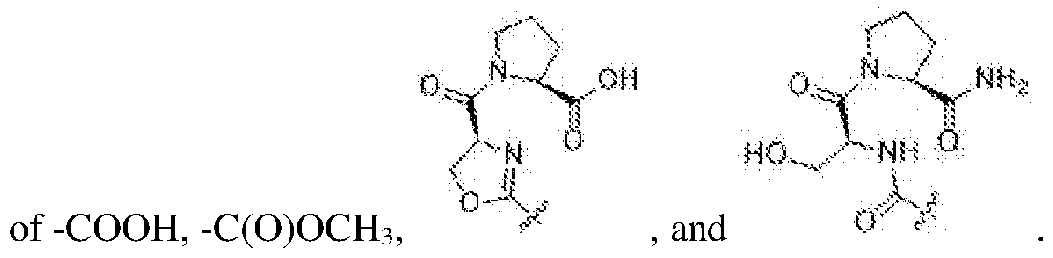


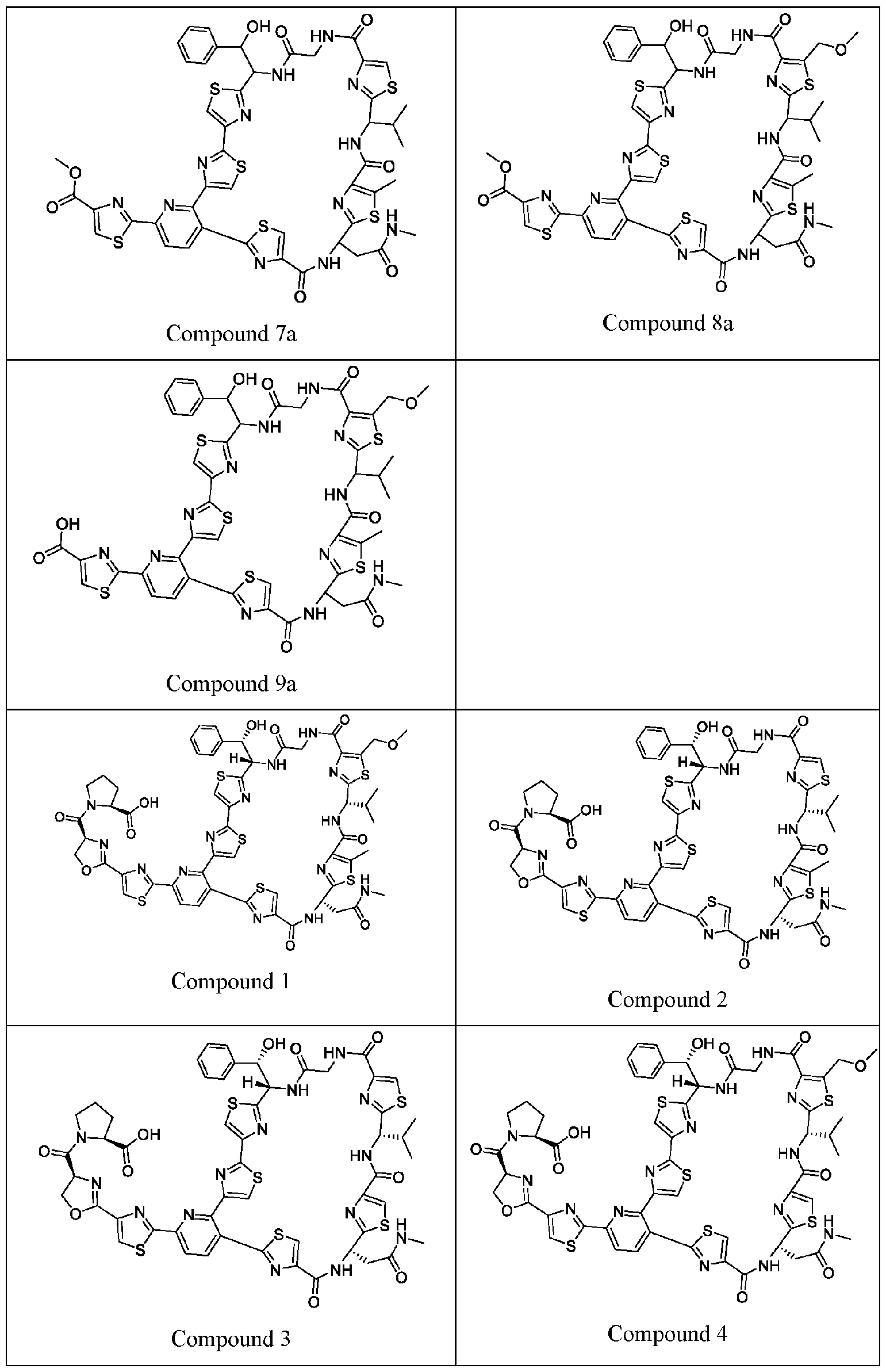


Claims


Applications Claiming Priority (2)
| Application Number | Priority Date | Filing Date | Title |
|---|---|---|---|
| SG10202260543X | 2022-12-21 | ||
| SG10202260543X | 2022-12-21 |
Publications (1)
| Publication Number | Publication Date |
|---|---|
| WO2024136758A1 true WO2024136758A1 (en) | 2024-06-27 |
Family
ID=91590245
Family Applications (1)
| Application Number | Title | Priority Date | Filing Date |
|---|---|---|---|
| PCT/SG2023/050853 Ceased WO2024136758A1 (en) | 2022-12-21 | 2023-12-21 | Thiopeptide compounds |
Country Status (1)
| Country | Link |
|---|---|
| WO (1) | WO2024136758A1 (en) |
Citations (3)
| Publication number | Priority date | Publication date | Assignee | Title |
|---|---|---|---|---|
| WO1997030078A1 (en) * | 1996-02-14 | 1997-08-21 | Biosearch Italia S.P.A. | DERIVATIVES OF ANTIBIOTIC GE2270 FACTORS C2a, D2 AND E |
| WO2002066046A1 (en) * | 2001-02-20 | 2002-08-29 | Jonghee Kim | Cancer therapeutic agent comprising thiopeptide with multiple thiazole rings |
| WO2014167371A1 (en) * | 2013-04-12 | 2014-10-16 | Naicons S.C.A.R.L. | Analogs of the antibiotic aminothiazole ge2270 |
-
2023
- 2023-12-21 WO PCT/SG2023/050853 patent/WO2024136758A1/en not_active Ceased
Patent Citations (3)
| Publication number | Priority date | Publication date | Assignee | Title |
|---|---|---|---|---|
| WO1997030078A1 (en) * | 1996-02-14 | 1997-08-21 | Biosearch Italia S.P.A. | DERIVATIVES OF ANTIBIOTIC GE2270 FACTORS C2a, D2 AND E |
| WO2002066046A1 (en) * | 2001-02-20 | 2002-08-29 | Jonghee Kim | Cancer therapeutic agent comprising thiopeptide with multiple thiazole rings |
| WO2014167371A1 (en) * | 2013-04-12 | 2014-10-16 | Naicons S.C.A.R.L. | Analogs of the antibiotic aminothiazole ge2270 |
Non-Patent Citations (5)
| Title |
|---|
| "Compounds having the structure of formula (I)", DATABASE REGISTRY, 24 February 2008 (2008-02-24) * |
| "Compounds having the structure of formula (I)", DATABASE REGISTRY, 30 August 2009 (2009-08-30) * |
| CHING KUAN-CHIEH, CHIN ELAINE J., WIBOWO MARIO, TAN ZANN Y., YANG LAY-KIEN, SEOW DEBORAH C., LEONG CHUNG-YAN, NG VERONICA W., NG S: "Antibacterial Thiopeptide GE2270-Congeners from Nonomuraea jiangxiensis", MOLECULES, vol. 28, no. 1, 1 January 2023 (2023-01-01), CH , pages 1 - 15, XP093189038, ISSN: 1420-3049, DOI: 10.3390/molecules28010101 * |
| K. C. NICOLAOU; DATTATRAYA H. DETHE; GULICE Y. C. LEUNG; BIN ZOU; DAVID Y.‐K. CHEN: "Total Synthesis of Thiopeptide Antibiotics GE2270A, GE2270T, and GE2270C1", CHEMISTRY - AN ASIAN JOURNAL, vol. 3, no. 2, 10 January 2008 (2008-01-10), Hoboken, USA, pages 413 - 429, XP072419936, ISSN: 1861-4728, DOI: 10.1002/asia.200700361 * |
| LI XIAOMIN, ZHANG LIMIN, DING YUN, GAO YONGSHENG, RUAN JISHENG, HUANG YING: "Nonomuraea jiangxiensis sp. nov., isolated from acidic soil", INTERNATIONAL JOURNAL OF SYSTEMATIC AND EVOLUTIONARY MICROBIOLOGY, vol. 62, no. 6, 1 June 2012 (2012-06-01), GB , pages 1409 - 1413, XP093189048, ISSN: 1466-5026, DOI: 10.1099/ijs.0.034520-0 * |
Similar Documents
| Publication | Publication Date | Title |
|---|---|---|
| EP3233863B1 (en) | Fused ring heteroaryl compounds and their use as trk inhibitors | |
| EP2809660B1 (en) | Macrocyclic compounds for modulating il-17 | |
| ES2461967T3 (en) | Pyrrolo [2,3-d] pyrimidine compounds | |
| US20230382925A1 (en) | Modulators of cystic fibrosis transmembrane conductance regulator | |
| EP3412663B1 (en) | Nitrogen-containing heterocycle and carbocycle derivatives having trka inhibitory activity | |
| US10822377B2 (en) | Substituted urea depsipeptide analogs as activators of the ClpP endopeptidase | |
| EP3697781B1 (en) | Antagonists of the muscarinic acetylcholine receptor m4 | |
| JP2021513519A (en) | Muscarinic acetylcholine receptor M4 antagonist | |
| CN113260619A (en) | Rapamycin derivatives | |
| US12209096B2 (en) | Compounds and compositions for inducing chondrogenesis | |
| AU2012205416A1 (en) | Solid forms of gyrase inhibitor (R)-1-ethyl-3-(5-(2-{1-hydroxy-1-methyl-ethyl}pyrimidin-5-yl)-7-(tetrahydrofuran-2-yl}-1H-benzimidazol-2-yl)urea | |
| JP2019502667A (en) | Antibacterial compound | |
| EP1757609A1 (en) | Novel water-soluble prodrug | |
| WO2024024961A1 (en) | 2(1h)-pyridinimine derative | |
| CN109422753A (en) | One kind has inhibition and the active compound of tyrosine protein kinase JAK1 or JAK2 of degrading | |
| CN119708122A (en) | Cyclic peptide against Acinetobacter baumannii and its application | |
| US20190127313A1 (en) | Antimicrobial agents | |
| FI105270B (en) | Process for the preparation of therapeutically useful octahydro-1H-1-pyrindine-4,5,6,7-tetrols | |
| JP5476650B2 (en) | New DIF-1 derivative | |
| WO2024107120A1 (en) | Spirotetronate polyketide compounds | |
| UA109676C2 (en) | ANTIFUNGAL 5,6-DIHYDRO-4H-PYROLO$1,2-α]$1,4]BENZODIAZEPINES AND 6H-PYROLO$1,2-α]$1,4]BENZODIAZEPINES SUBSTITUTED BY PHENYL DERIVATIVES | |
| KR101881115B1 (en) | Novel 2-substituted tetrahydropyran or 2-substituted tetrahydrofuran derivatives, method for preparing the same, and use thereof | |
| KR100823676B1 (en) | Genistein 7-α-L-6-deoxy-talofyranoside derivatives and antifungal agents containing the same | |
| US20240279232A1 (en) | Use of substituted 5-(4-methyl-6-phenyl-4h-benzo[f]imidazo[1,5-a][1,4] diazepin-3-yl)-1,2,4-oxadiazoles in the treatment of inflammatory conditions | |
| HK40096806A (en) | Compounds and compositions for inducing chondrogenesis |
Legal Events
| Date | Code | Title | Description |
|---|---|---|---|
| 121 | Ep: the epo has been informed by wipo that ep was designated in this application |
Ref document number: 23907970 Country of ref document: EP Kind code of ref document: A1 |
|
| WWE | Wipo information: entry into national phase |
Ref document number: 11202501400X Country of ref document: SG |
|
| WWP | Wipo information: published in national office |
Ref document number: 11202501400X Country of ref document: SG |
|
| NENP | Non-entry into the national phase |
Ref country code: DE |
|
| 122 | Ep: pct application non-entry in european phase |
Ref document number: 23907970 Country of ref document: EP Kind code of ref document: A1 |