WO2024136755A1 - Albumin binding compounds and methods of use thereof - Google Patents
Albumin binding compounds and methods of use thereof Download PDFInfo
- Publication number
- WO2024136755A1 WO2024136755A1 PCT/SG2023/050846 SG2023050846W WO2024136755A1 WO 2024136755 A1 WO2024136755 A1 WO 2024136755A1 SG 2023050846 W SG2023050846 W SG 2023050846W WO 2024136755 A1 WO2024136755 A1 WO 2024136755A1
- Authority
- WO
- WIPO (PCT)
- Prior art keywords
- optionally substituted
- bond
- compound
- denotes
- independently
- Prior art date
- Legal status (The legal status is an assumption and is not a legal conclusion. Google has not performed a legal analysis and makes no representation as to the accuracy of the status listed.)
- Ceased
Links
Classifications
-
- A—HUMAN NECESSITIES
- A61—MEDICAL OR VETERINARY SCIENCE; HYGIENE
- A61P—SPECIFIC THERAPEUTIC ACTIVITY OF CHEMICAL COMPOUNDS OR MEDICINAL PREPARATIONS
- A61P31/00—Antiinfectives, i.e. antibiotics, antiseptics, chemotherapeutics
-
- A—HUMAN NECESSITIES
- A61—MEDICAL OR VETERINARY SCIENCE; HYGIENE
- A61K—PREPARATIONS FOR MEDICAL, DENTAL OR TOILETRY PURPOSES
- A61K47/00—Medicinal preparations characterised by the non-active ingredients used, e.g. carriers or inert additives; Targeting or modifying agents chemically bound to the active ingredient
- A61K47/50—Medicinal preparations characterised by the non-active ingredients used, e.g. carriers or inert additives; Targeting or modifying agents chemically bound to the active ingredient the non-active ingredient being chemically bound to the active ingredient, e.g. polymer-drug conjugates
- A61K47/51—Medicinal preparations characterised by the non-active ingredients used, e.g. carriers or inert additives; Targeting or modifying agents chemically bound to the active ingredient the non-active ingredient being chemically bound to the active ingredient, e.g. polymer-drug conjugates the non-active ingredient being a modifying agent
- A61K47/54—Medicinal preparations characterised by the non-active ingredients used, e.g. carriers or inert additives; Targeting or modifying agents chemically bound to the active ingredient the non-active ingredient being chemically bound to the active ingredient, e.g. polymer-drug conjugates the non-active ingredient being a modifying agent the modifying agent being an organic compound
-
- A—HUMAN NECESSITIES
- A61—MEDICAL OR VETERINARY SCIENCE; HYGIENE
- A61P—SPECIFIC THERAPEUTIC ACTIVITY OF CHEMICAL COMPOUNDS OR MEDICINAL PREPARATIONS
- A61P35/00—Antineoplastic agents
-
- A—HUMAN NECESSITIES
- A61—MEDICAL OR VETERINARY SCIENCE; HYGIENE
- A61P—SPECIFIC THERAPEUTIC ACTIVITY OF CHEMICAL COMPOUNDS OR MEDICINAL PREPARATIONS
- A61P37/00—Drugs for immunological or allergic disorders
-
- C—CHEMISTRY; METALLURGY
- C07—ORGANIC CHEMISTRY
- C07H—SUGARS; DERIVATIVES THEREOF; NUCLEOSIDES; NUCLEOTIDES; NUCLEIC ACIDS
- C07H21/00—Compounds containing two or more mononucleotide units having separate phosphate or polyphosphate groups linked by saccharide radicals of nucleoside groups, e.g. nucleic acids
-
- C—CHEMISTRY; METALLURGY
- C09—DYES; PAINTS; POLISHES; NATURAL RESINS; ADHESIVES; COMPOSITIONS NOT OTHERWISE PROVIDED FOR; APPLICATIONS OF MATERIALS NOT OTHERWISE PROVIDED FOR
- C09B—ORGANIC DYES OR CLOSELY-RELATED COMPOUNDS FOR PRODUCING DYES, e.g. PIGMENTS; MORDANTS; LAKES
- C09B29/00—Monoazo dyes prepared by diazotising and coupling
- C09B29/24—Monoazo dyes prepared by diazotising and coupling from coupling components containing both hydroxyl and amino directing groups
- C09B29/28—Amino naphthols
- C09B29/30—Amino naphtholsulfonic acid
Definitions
- the present disclosure relates, in general terms, to albumin binding compounds and their methods of use thereof.
- Reduction of clearance is particularly desired for protein drugs, as they are highly vulnerable to degradation by proteases.
- Fusion of protein drugs with large proteins such as albumin or the Fc domain of immunoglobulin G (IgG) can increase drug half-life by increasing the molecular size of the drug and m turn reducing renal clearance.
- fusion with either albumin or the IgG Fc domain adds functionality to the fused complex and enables interaction with the neonatal Fc receptor (FcRn), which salvages bound ligands from intracellular catabolism by recycling them back to circulation.
- FcRn neonatal Fc receptor
- This interaction with FcRn contributes to the extraordinarily long 21-day serum half-life of albumin and IgG in humans. Therefore, engineering proteins to interact with serum IgG has the potential to significantly increase half-life by reducing both renal clearance and intracellular catabolism. Through these methods the in vivo exposure of the polypeptide or protein therapeutics can be extended. Small molecule drugs may also improve their in vivo pharmacokinetics by association with various plasma components.
- HSA Human serum albumin
- ABM albumin binding moiety
- ABMs e.g. 4-(p-iodophenyl) butyric acid derivatives
- each Ri is independently selected from halo, hydroxy, optionally substituted alkyl, optionally substituted alkenyl, optionally substituted alkoxy, or optionally substituted sulfinyl: each p is independently an integer selected from 0 to 4; wherein Qi and Q2 are independently a bond or a spacer selected from wherein * denotes a bond to the amide moiety, denotes a bond to the phenylene or T, r is an integer selected from 1 to 5 ; wherein Qs is an amide moiety; wherein T is selected from optionally substituted alkyl or one of the following: wherein * denotes a bond to Q2, x is halo, each R2 is independently optionally substituted alkyl, optionally substituted alkenyl, and q is an integer selected from 1 to 5; L is a spacer
- the compound of Formula (I) is a compound of Formula (I'): (I') each R1 is independently selected from halo, hydroxy, optionally substituted alkyl, optionally substituted alkenyl, optionally substituted alkoxy, optionally substituted sulfinyl; each p is independently an integer selected from 0 to 4; wherein Q1 and Q2 are independently a bond or a spacer selected from ; wherein * denotes a bond to the amide moiety, denotes a bond to the phenylene or T, r is an integer selected from 1 to 5; wherein T is selected from
- optionally substituted alkyl, optionally substituted alkenyl, and q is an integer selected from 1 to 5;
- L is a spacer selected from alkyl substituted with isothiocyanate, isocyanate, acyl, carbodiimde, acyl azide, anhydride, fluorobenzenyl, fluorophenyl ester, carbonate, NHS ester, imidoester, epoxy, ; wherein * denotes a bond to C, m is an integer selected from 1 to 5; and n is an integer selected from 1 to 5.
- each R1 is independently selected from halo, hydroxy, optionally substituted alkyl, optionally substituted alkenyl, optionally substituted alkoxy, optionally substituted sulfinyl; each p is independently an integer selected from 0 to 4; wherein Q 1 and Q 2 are independently a bond or a spacer selected from ; wherein * denotes a bond to the amide moiety, denotes a bond to the phenylene or T, r is an integer selected from 1 to 5; wherein T is selected from optionally substituted alkyl or ; wherein * denotes a bond to Q2, x is halo, q is an integer from 1 to 5; L is a spacer selected from alkyl substituted with isothiocyanate, isocyanate, acyl, carbodiimde, acyl azide, anhydride, fluorobenzenyl, fluorophenyl ester, carbonate
- each R1 is independently selected from hydroxyl or optionally substituted C1-C5 alkyl.
- p is 1 or 2.
- Q1 is a bond.
- Q2 is , wherein * denotes a bond to Q3, denotes a bond to T, r is 1.
- T is wherein * denotes a bond to Qi, each Ri is independently selected from hydroxyl or optionally substituted C1-C5 alkyl; and p is 1 or 2.
- L is selected from O wherein * denotes a bond to C.
- n 1 or 3.
- m is 1 or 2.
- r is 1.
- the present disclosure relates to a compound of Formula (II), or a pharmaceutically acceptable salt, solvate, stereoisomer or prodrug thereof, comprising:
- each R1 is independently selected from halo, hydroxy, optionally substituted alkyl, optionally substituted alkenyl, optionally substituted alkoxy, optionally substituted alkylthionyl; each p is independently an integer selected from 0 to 4; wherein Q1 and Q2 are independently a bond or a spacer selected wherein * denotes a bond to the amide moiety, de he phenylene or T, r is an integer selected from 1 5; wherein Q3 is an amide moiety; wherein T is selected from optionally substituted alkyl or one of the following:
- each R2 is independently optionally substituted alkyl, optionally substituted alkenyl, and q is an integer selected from 1 to 5;
- L is a spacer selected from alkyl substituted with isothiocyanate, isocyanate, acyl, carbodiimde, acyl azide, anhydride, fluorobenzenyl, fluorophenyl ester, carbonate, NHS ester, imidoester, epoxy, ;
- * denotes m is an integer selected f n is an integer selected from 1 to 5;
- CpG is an oligonucleotide comprising an unmethylated cytosine–guanine (CpG) motif; and wherein L is conjugated to CpG.
- CpG is a single strand oligodexonucleotide comprising a CpG motif.
- the single strand oligodexonucleotide is TCCATGA1GTTCCTGACGTT (SEQ ID NO: 1).
- the compound of Formula (I) and/or (II) is characterised by a dissociation constant (Kd) of about 4 ⁇ M to about 10 ⁇ M.
- the compound of Formula (I) and/or (II) is characterised by a dissociation constant (Kd) of about 6 ⁇ M to about 9 ⁇ M.
- the present disclosure also relates to a method of treating an immunodeficiency disorder in a patient in need thereof, comprising administering to the patient a therapeutically effective amount of a compound of Formula (II) or a pharmaceutically acceptable salt, solvate, stereoisomer or prodrug thereof.
- the present disclosure also relates to a compound of Formula (II) or a pharmaceutically acceptable salt, solvate, stereoisomer or prodrug thereof for use in treating an immunodeficiency disorder.
- the present disclosure also relates to a use of a compound of Formula (II) or a pharmaceutically acceptable salt, solvate, stereoisomer or prodrug thereof in the manufacture of a medicament for treating for an immunodeficiency disorder.
- the compound of Formula (II) is characterised by an in vivo retention time of at least 120 h.
- the compound of Formula (II) is characterised by a spleen weight/body weight of less than about 8 mg/g.
- the compound of Formula (II) is capable of improving the immunogenicity of ovalbumin relative to free CpG by at least 2 times.
- the immunodeficiency disorder is selected from an allergy, a solid tumor or an infectious disease.
- Figure 1 shows a schematic illustration of dimeric albumin binding molecules for lymph node delivery of immunostimutory CpG.
- Figure 2 shows albumin binding affinity of a monomeric albumin binding moiety (EB- NH2), a dimeric albumin binding moiety (EB2), a monomeric albumin binding moiety conjugated to CpG (EB-CpG), and a dimeric albumin binding moiety conjugated to CpG (EB2-CpG) as measured by Biolayer Interference method.
- Figure 3 shows in vitro immunostimulatory efficacy of EB2-CpG.
- Data were presented as mean ⁇ s.d, **** p ⁇ 0.0001.
- FIG. 4 shows IVIS imaging and quantification of EB and EB2 accumulation in draining lymph nodes.
- Data were presented as mean ⁇ s.d, * p ⁇ 0.05, ** p ⁇ 0.01
- Figure 7 shows EB2-CpG+OVA for cancer immunotherapy. Tumor growth curve and mouse survival after treatment of CpG+OVA and EB2-CpG+OVA.
- Figure 8 shows lymph nodes accumulation of compounds in mice.
- Figure 9 shows a protocol for mice studies and in vivo antitumor immune responses of the mice.
- FIG. 10 shows T cell priming.
- Figure 11 shows anti-tumor analysis of EB2-CpG.
- an albumin binding moiety when functionalized with therapeutic molecules through linkers can at least retain the high binding affinity to albumin.
- the ABM may be conjugated with immune-stimulatory oligodeoxynucleotide CpG.
- the lymph node By leveraging an exogenous molecule as a carrier, the lymph node may be more specifically targeted and the toxicity of the therapeutic molecule reduced.
- the ABM may also act to spatially protect the therapeutic molecule.
- the ABM may be a Evans Blue dye derivative.
- Evans Blue (EB) dye the tetrasodium salt of 6,6'-((3,3'-dimethyl[l,l--biphenyl]-4,4'-diyl)bis[diazene-2,l- diyl]]bis(4-amino-5-hydroxynaphthalene-l,3-disulfonate), has been an important tool for physiology and pathology, especially for assessing integrity of the blood-brain barrier and vascular permeability, because of its strong affinity for albumin.
- EB Evans Blue
- truncated Evans Blue (tEB) derivatives have been developed as ABMs for various applications, including blood pool imaging, tumor vaccination, radioligand therapy, and anti-diabetic treatment (See for example, WO2016/209795, WO2017/196806, International Application No. PCT/US 17/054863, and U.S. Application No. 62/633648,).
- truncation of EB resulted in reduction of its binding affinity for albumin and its fluorescence emission.
- the linker connecting the EB derivative to the therapeutic molecule is also not stable and can be cleaved even before reaching the targeted site.
- the inventors have found that a dimeric albumin binding moiety when functionalized with therapeutic molecules through linkers may improve or at least retain the high binding affinity to albumin. Additionally, due to the relative spatial positions of the dimers, the therapeutic product is not spatially hindered from performing its function. It was further found that the dimers may further improve the pharmacokinetic properties of the therapeutic molecule.
- the present disclosure relates to a compound of Formula (I), or a pharmaceutically acceptable salt, solvate, stereoisomer or prodrug thereof, comprising:
- each Ri is independently selected from halo, hydroxy, optionally substituted alkyl, optionally substituted alkenyl, optionally substituted alkoxy, optionally substituted sulfinyl; each p is independently an integer selected from 0 to 4;
- Qi and Q2 are independently a bond or a spacer selected from O ; wherein * denotes a bond to the amide moiety or Qa, denotes a bond to the phenylene or T, r is an integer selected from 1 to 5; wherein Qa is an amide moiety; wherein T is selected from optionally substituted alkyl or one of the following:
- R2 is independently optionally substituted alkyl, optionally substituted alkenyl, and q is an integer selected from 1 to 5;
- L is a spacer selected from alkyl substituted with isothiocyanate, isocyanate, acyl, carbodiimde, acyl azide, anhydride, fluorobenzenyl, fluorophenyl ester, carbonate, NHS
- ester imidoester, epoxy, 0 wherein * denotes a bond to C, m is an integer selected from 1 to 5; and n is an integer selected from 1 to 5.
- the compound of Formula (I) is a compound of Formula (I 1 ): each Ri is independently selected from halo, hydroxy, optionally substituted alkyl, optionally substituted alkenyl, optionally substituted alkoxy, optionally substituted sulfinyl; each p is independently an integer selected from 0 to 4;
- Qi and Q2 are independently a bond or a spacer selected from O ⁇ wherein * denotes a bond to the amide moiety, denotes a bond to the phenylene or T, r is an integer selected from 1 to 5; wherein T is selected from
- the compound of Formula (I) is a compound of Formula (I"):
- each Ri is independently selected from halo, hydroxy, optionally substituted alkyl, optionally substituted alkenyl, optionally substituted alkoxy, optionally substituted sulfinyl; each p is independently an integer selected from 0 to 4;
- Qi and Q2 are independently a bond or a spacer selected from O ; wherein * denotes a bond to the amide moiety, denotes a bond to the phenylene or T, r is an integer selected from 1 to 5; wherein T is selected from optionally substituted alkyl or wherein * denotes a bond to Q2, x is halo, q is an integer from 1 to 5;
- L is a spacer selected from alkyl substituted with isothiocyanate, isocyanate, acyl, carbodiimde, acyl azide, anhydride, fluorobenzenyl, fluorophenyl ester, carbonate, NHS ester, imidoester, epoxy, O wherein * denotes a bond to C, m is an integer selected from 1 to 5; and n is an integer selected from 1 to 5.
- Alkyl refers to monovalent alkyl groups which may be straight chained or branched and preferably have from 1 to 10 carbon atoms or more preferably 1 to 6 carbon atoms. Examples of such alkyl groups include methyl, ethyl, n-propyl, iso-propyl, n-butyl, isobutyl, n-hexyl, and the like.
- Alkylene refers to divalent alkyl groups preferably having from 1 to 10 carbon atoms and more preferably 1 to 6 carbon atoms. Examples of such alkylene groups include methylene (-CH2-), ethylene (-CH2CH2-), and the propylene isomers (e.g., -CH2CH2CH2- and -CH(CH3)CH2-), and the like.
- Alkoxy refers to the group alkyl-O- where the alkyl group is as described above. Examples include, methoxy, ethoxy, n-propoxy, iso-propoxy, n-butoxy, tert-butoxy, sec-butoxy, n-pentoxy, n-hexoxy, 1,2-dimethylbutoxy, and the like.
- Aryl refers to an unsaturated aromatic carbocyclic group having a single ring (eg. phenyl) or multiple condensed rings (eg. naphthyl or anthryl), preferably having from 6 to 14 carbon atoms.
- aryl groups include phenyl, naphthyl and the like.
- Heteroaryl refers to a monovalent aromatic heterocyclic group which fulfils the Hiickel criteria for aromaticity (ie. contains 4n + 2 n electrons) and preferably has from 2 to 10 carbon atoms and 1 to 4 heteroatoms selected from oxygen, nitrogen, selenium, and sulfur within the ring (and includes oxides of sulfur, selenium and nitrogen).
- Such heteroaryl groups can have a single ring (eg. pyridyl, pyrrolyl or N- oxides thereof or furyl) or multiple condensed rings (eg. indolizinyl, benzoimidazolyl, coumarinyl, quinolinyl, isoquinolinyl or benzothienyl).
- heteroaryl groups include, but are not limited to, oxazole, pyrrole, imidazole, pyrazole, pyridine, pyrazine, pyrimidine, pyridazine, indolizine, isoindole, indole, indazole, purine, isoquinoline, quinoline, phthalazine, naphthylpyridine, quinoxaline, quinazoline, cinnoline, pteridine, carbazole, carboline, phenanthridine, acridine, phenanthroline, isothiazole, phenazine, isoxazole, isothiazole, phenoxazine, phenothiazine, thiazole, thiadiazoles, oxadiazole, oxatriazole, tetrazole, thiophene, benzo[b]thiophene, triazole, imidazopyridine,
- Cycloalkyl refers to cyclic alkyl groups having a single cyclic ring or multiple condensed rings, preferably incorporating 3 to 11 carbon atoms.
- Such cycloalkyl groups include, by way of example, single ring structures such as cyclopropyl, cyclobutyl, cyclopentyl, cyclohexyl, cyclooctyl, and the like, or multiple ring structures such as adamantanyl, indanyl, 1,2,3,4-tetrahydronapthalenyl and the like.
- Heterocyclyl refers to a monovalent saturated or unsaturated group having a single ring or multiple condensed rings, preferably from 1 to 8 carbon atoms and from 1 to 4 hetero atoms selected from nitrogen, sulfur, oxygen, selenium or phosphorous within the ring. The most preferred heteroatom is nitrogen. It will be understood that where, for instance, R2 or R 1 is an optionally substituted heterocyclyl which has one or more ring heteroatoms, the heterocyclyl group can be connected to the core molecule of the compounds of the present disclosure, through a C-C or C-heteroatom bond, in particular a C-N bond.
- heterocyclyl and heteroaryl groups include, but are not limited to, oxazole, pyrrole, imidazole, pyrazole, pyridine, pyrazine, pyrimidine, pyridazine, indolizine, isoindole, indole, indazole, purine, quinolizine, isoquinoline, quinoline, phthalazine, naphthylpyridine, quinoxaline, quinazoline, cinnoline, pteridine, carbazole, carboline, phenanthridine, acridine, phenanthroline, isothiazole, phenazine, isoxazole, isothiazole, phenoxazine, phenothiazine, imidazolidine, imidazoline, piperidine, piperazine, indoline, phthalimide, 1, 2, 3, 4-tetra hydroisoquinoline, 4,5,6,7-t
- Sulfinyl refers to groups H-S(O)-, alkyl-S(O)-, cycloalkyl-S(O)-, aryl-S(O)-, heteroaryl-S(O)-, and heterocyclyl-S(O)-, where alkyl, cycloalkyl, aryl, heteroaryl and heterocyclyl are as described herein.
- a group may or may not be further substituted or fused (so as to form a condensed polycyclic group) with one or more groups selected from hydroxyl, acyl, alkyl, alkoxy, alkenyl, alkenyloxy, alkynyl, alkynyloxy, amino, aminoacyl, thio, arylalkyl, arylalkoxy, aryl, aryloxy, carboxyl, acylamino, cyano, halogen, nitro, phosphono, sulfo, phosphorylamino, phosphinyl, heteroaryl, heteroarylalkyl, heteroaryloxy, heterocyclyl, heterocyclylalkyl, heterocyclyloxy, oxyacyl, oxime, oxime ether, hydrazone, oxyacylamino, oxysulfonylamino, aminoacyloxy, trihalomethyl, trialkyl, alkoxy, alkenyl, alken
- Compounds described herein can comprise one or more asymmetric centers, and thus can exist in various isomeric forms, e.g., enantiomers and/or diastereomers.
- the compounds described herein can be in the form of an individual enantiomer, diastereomer or geometric isomer, or can be in the form of a mixture of stereoisomers, including racemic mixtures and mixtures enriched in one or more stereoisomer.
- Isomers can be isolated from mixtures by methods known to those skilled in the art, including chiral high pressure liquid chromatography (HPLC) and the formation and crystallization of chiral salts; or preferred isomers can be prepared by asymmetric syntheses.
- HPLC high pressure liquid chromatography
- the disclosure additionally encompasses compounds described herein as individual isomers substantially free of other isomers, and alternatively, as mixtures of various isomers.
- Optically-enriched means that the compound is made up of a significantly greater proportion of one enantiomer.
- the compound of the present disclosure is made up of at least about 90% by weight of a preferred enantiomer.
- the compound is made up of at least about 95%, 98%, or 99% by weight of a preferred enantiomer.
- Preferred enantiomers may be isolated from racemic mixtures by any method known to those skilled in the art, including chiral high pressure liquid chromatography (HPLC) and the formation and crystallization of chiral salts or prepared by asymmetric syntheses.
- HPLC high pressure liquid chromatography
- Jacques et a!. Enantiomers, Racemates and Resolutions (Wiley Interscience, New York, 1981); Wilen et al., Tetrahedron 33:2725 (1977); Eliel, Stereochemistry of Carbon Compounds (McGraw-Hill, NY, 1962); and Wilen, Tables of Resolving Agents and Optical Resolutions p. 268 (E.L. Eliel, Ed., Univ, of Notre Dame Press, Notre Dame, IN 1972).
- each Ri is independently selected from halo, hydroxy, optionally substituted alkyl, optionally substituted alkoxy, or optionally substituted sulfinyl. In some embodiments, each Ri is independently selected from hydroxyl or optionally substituted alkyl. In some embodiments, each Ri is independently selected from hydroxyl or optionally substituted Ci-Cs alkyl. In some embodiments, each Ri is independently C1-C5 alkyl. In some embodiments, each Ri is independently selected from methyl, ethyl, n-propyl, tert-propyl, n-butyl, iso-butyl, sec-butyl or tert-butyl. In some embodiments, p is independently selected from 0, 1, 2 or 3. In some embodiments, p is independently selected from 1 or 2. In some embodiments, p is independently 1.
- n is independently selected from 1, 2, 3 or 4. In some embodiments, n is independently selected from 1, 2 or 3. In some embodiments, n is independently selected from 1 or 2. In some embodiments, n is 1 or 3.
- n is independently selected from 1, 2 or 3. In some embodiments, m is 1 or 2.
- Qi and Q2 are each independently a spacer selected from
- the spacer further separates the two ABMs such that they do not sterically hinder each other during the association process.
- the moieties Qi and Q2 increase the flexibility of the two ABMs thus possibility of binding two albumin molecules simultaneously.
- Qi is a bond and Q2 is ° . In some embodiments, Q2
- r is 1, 2 or 3. In some embodiments, r is 1 or 2. In some embodiments, r is 1.
- Qs is O or H wherein * denotes a bond to C and denotes a bond to Q2.
- the compound of Formula (I) may be represented by Formula (I 1 ) or (I"):
- T is selected from optionally substituted alkyl or one of the
- T is selected from optionally substituted alkyl or one of the following:
- T is selected from
- T is selected from optionally substituted alkyl or one of the following:
- x is selected from F, Cl or Br. In some embodiments, x is para substituted halo. In some embodiments, x is meta substituted halo. In some embodiments, x is ortho substituted halo.
- T is optionally substituted C5-C20 alkyl. In some embodiments, T is optionally substituted C10-C20 alkyl. In some embodiments, T is optionally substituted C15-C20 alkyl.
- T is a derivative of ibuprofen, propofol, thioethylamino-2,4- dimethylphenyl, tetradecanoic acid (myristic acid), dansyl-L-phenylalanine, dansyl-L- norvaline, dansyl-L-sarcosine, or 4-(p-iodophenyl)butyric acid.
- each R2 is independently optionally substituted C2-C24 alkyl, or optionally substituted C2-C24 alkenyl. In some embodiments, each R2 is independently C2-C24 alkyl, or C2-C24 alkenyl. In some embodiments, each R2 is independently C2-C24 alkyl. In some embodiments, each R2 is independently C14-C20 alkyl.
- q is an integer selected from 1 to 4, 1 to 3, or 1 to 2. In some embodiments, q is 2.
- T is N
- L is an amine reactive spacer.
- L is a spacer selected from alkyl substituted with isothiocyanate, isocyanate, acyl, carbodiimde, acyl azide, anhydride, fluorobenzenyl, fluorophenyl ester, carbonate, NHS O N N N N N NH NH ⁇ ⁇ ester, imidoester, epoxy, O ⁇ ; wherein * denotes a bond to C.
- the amine reactive spacer may be . O N N N N NH NH ⁇ N ⁇
- L is a spacer selected from O ⁇ .
- the compound of Formula (I') is SO 3 H N R 1 p HO 3 S N NH 2 OH R 1 p O O Q 1 Q 2 T N n N H HN H O m L
- each R1 is optionally substituted alkyl; each p is independently 1; wherein Qi is a bond; wherein Q2 is O ; wherein * denotes a bond to the amide moiety, denotes a bond to T, r is an integer selected from 1 to 5; wherein T is selected from
- L is a spacer selected from O wherein * denotes a bond to C, m is an integer selected from 1 to 5; and n is an integer selected from 1 to 5.
- the compound of Formula (I 1 ) is N-(2-aminoethyl)-2-aminoethyl-N-(2-aminoethyl)-2-aminoethyl-N-(2-aminoethyl)-2-aminoethyl-N-(2-aminoethyl)-2-aminoethyl-N-(2-aminoethyl)-2-aminoethyl-N-(2-aminoethyl)-2-aminoethyl-N-(2-aminoethyl)-2-aminoethyl-N-(2-aminoethyl)-2-aminoethyl-N-(2-aminoethyl)-2-aminoethyl-N-(2-aminoethyl)-2-aminoethyl-N-(2-aminoethyl)-2-aminoethyl-N
- each Ri is methyl; each p is independently 1; wherein Qi is a bend; wherein Q? is O ; wherein * denotes a bond to the amide moiety, denotes a bond to T, r is 1; wherein T is wherein * denotes a bond to Q2; L is a spacer selected from O ; wherein * denotes a bond to C, m is 2; and n is 1.
- the compound of Formula (I") is
- L is a spacer selected from O * ; wherein * denotes a bond to C, m is an integer selected from 1 to 5; and n is an integer selected from 1 to 5.
- the compound of Formula (I) may be conjugated at L to a molecule having an amine moiety.
- the molecule may be an oligonucleotide, protein, peptide, aptamers, or any other biomolecule.
- the molecule may be a therapeutic molecule, for example a radioligand, or a compound for chemotherapeutics.
- the present disclosure relates to a compound of Formula (II), or a pharmaceutically acceptable salt, solvate, stereoisomer or prodrug thereof, comprising:
- each Ri is independently selected from halo, hydroxy, optionally substituted alkyl, optionally substituted alkenyl, optionally substituted alkoxy, optionally substituted a Ikylth io nyl ; each p is independently an integer selected from 0 to 4;
- Qi and Q2 are independently a bond or a spacer selected from O ; wherein * denotes a bond to the amide moiety, denotes a bond to the phenylene or T, r is an integer selected from 1 to 5; wherein Qa is an amide moiety; wherein T is selected from optionally substituted alkyl or one of the following:
- R2 is independently optionally substituted alkyl, optionally substituted alkenyl, and q is an integer selected from 1 to 5;
- L is a spacer selected from alkyl substituted with isothiocyanate, isocyanate, acyl, carbodiimde, acyl azide, anhydride, fluorobenzenyl, fluorophenyl ester, carbonate, NHS
- CpG is an oligonucleotide comprising a unmethylated cytosine-guanine (CpG) motif; and wherein L is conjugated to CpG.
- the compound of Formula (II) is a compound of Formula (II 1 ):
- each Ri is independently selected from halo, hydroxy, optionally substituted alkyl, optionally substituted alkenyl, optionally substituted alkoxy, optionally substituted a Iky Ith io nyl ; each p is independently an integer selected from 0 to 4;
- Qi and Q2 are independently a bond or a spacer selected from O ; wherein * denotes a bond to the amide moiety, denotes a bond to the phenylene or T, r is an integer selected from 1 to 5; wherein T is selected from SO,H wherein * denotes a bond to Qz, x is halo, each Rz is independently optionally substituted alkyl, optionally substituted alkenyl, and q is an integer selected from 1 to 5; L is a spacer selected from alkyl substituted with isothiocyanate, isocyanate, acyl, carbodiimde, acyl azide, anhydride, fluorobenzenyl, fluorophenyl ester, carbonate, NHS ester, imidoester, epoxy, O * ; wherein * denotes a bond to C, m is an integer selected from 1 to 5; n is an integer selected from 1 to 5;
- CpG is an oligonucleotide comprising an unmethylated cytosine-guanine (CpG) motif; and wherein L is conjugated to CpG.
- the compound of Formula (II) is a compound of Formula (II"):
- each Ri is independently selected from halo, hydroxy, optionally substituted alkyl, optionally substituted alkenyl, optionally substituted alkoxy, optionally substituted a Ikylthionyl; each p is independently an integer selected from 0 to 4; wherein Qi and Q2 are independently a bond or a spacer selected from O ; wherein * denotes a bond to the amide moiety, denotes a bond to the phenylene or T, r is an integer selected from 1 to 5; wherein T is selected from optionally substituted alkyl or one of the following: wherein * denotes a bond to Q2, x is halo, each R2 is independently optionally substituted alkyl, optionally substituted alkenyl, and q is an integer selected from 1 to 5;
- L is a spacer selected from alkyl substituted with isothiocyanate, isocyanate, acyl, carbodiimde, acyl azide, anhydride, fluorobenzenyl, fluorophenyl ester, carbonate, NHS ester, imidoester, epoxy, 0 wherein * denotes a bond to C, m is an integer selected from 1 to 5; n is an integer selected from 1 to 5;
- CpG is an oligonucleotide comprising an unmethylated cytosine-guanine (CpG) motif; and wherein L is conjugated to CpG.
- ABMs dimeric albumin binding molecules
- compounds of Formula (II) may have a high albumin-binding affinity and may bind to multiple albumins at the same time.
- the lymph node delivery is also enhanced and the retention of immunostimulator in lymph nodes is prolonged, thus improving the interactions to antigen presenting cells and inducing stronger immune responses.
- the leakage of immunostimulator to circulation system is reduced, and thus eliminate or at least reduce treatment induced systemic toxicity.
- CpG is a single strand oligodexonucleotide comprising a CpG motif.
- CpG oligodeoxynucleotides are short single-stranded synthetic DNA molecules that contain a cytosine triphosphate deoxynucleotide ("C") followed by a guanine triphosphate deoxynucleotide (“G”).
- C cytosine triphosphate deoxynucleotide
- G guanine triphosphate deoxynucleotide
- the "p” refers to the phosphodiester link between consecutive nucleotides, although some CpG motifs have a modified phosphorothioate (PS) backbone instead. When these CpG motifs are unmethylated, they act as immunostimulants.
- CpG motifs are considered pathogen-associated molecular patterns (PAMPs) due to theirabundance in microbial genomes but is rare in vertebrate genomes.
- PAMPs pathogen-associated molecular patterns
- the CpG PAMP is recognized by the pattern recognition receptor (PRR) Toll-Like Receptor 9 (TLR9), which is constitutively expressed only in B cells and plasmacytoid dendritic cells (pDCs) in humans and other higher primates.
- PRR pattern recognition receptor
- TLR9 Toll-Like Receptor 9
- L is conjugated to CpG via an amino moiety. In some embodiments, L is conjugated to CpG via a thiol moiety.
- the single strand oligodexonucleotide is a K-type CpG selected from one of the following: CpG 1826 TCCATGA1GTTCCTGACGTT (SEQ ID NO: 1)
- the single strand oligodexonucleotide is a D-type CpG selected from one of the following :
- the compound of Formula (I) and/or (II) is characterised by a dissociation constant (Kd) of about 4 pM to about 10 pM. In some embodiments, the compound of Formula (I) and/or (II) is characterised by a dissociation constant (Kd) of about 5 pM to about 10 pM, or about 6 pM to about 10 pM. In some embodiments, the compound of Formula (I) and/or (II) is characterised by a dissociation constant (Kd) of about 6 pM to about 9 pM.
- the compound of Formula (II 1 ) is N-(2-aminoethyl)-2-aminoethyl-N-(2-aminoethyl)-2-aminoethyl-N-(2-aminoethyl)-2-aminoethyl-N-(2-aminoethyl)-2-aminoethyl-N-(2-aminoethyl)-2-aminoethyl-N-(2-aminoethyl)-2-aminoethyl-N-(2-aminoethyl)-2-aminoethyl-N-(2-aminoethyl)-2-aminoethyl-N-(2-aminoethyl)-2-aminoethyl-N-(2-aminoethyl)-2-aminoethyl-N-(2-aminoethyl)-2-aminoethyl-N
- each Ri is independently optionally substituted alkyl; each p is 1 ; wherein Qi is a bond;
- * denotes a bond to Qz, x is halo, each Rz is independently optionally substituted alkyl, optionally substituted alkenyl, and q is an integer selected from 1 to 5; L is a spacer selected from O * ; wherein * denotes a bond to C, m is an integer selected from 1 to 5; n is an integer selected from 1 to 5;
- CpG is an oligonucleotide comprising an unmethylated cytosine-guanine (CpG) motif; and wherein L is conjugated to CpG.
- the compound of Formula (II 1 ) is N-(2-aminoethyl)-2-aminoethyl-N-(2-aminoethyl)-2-aminoethyl-N-(2-aminoethyl)-2-aminoethyl-N-(2-aminoethyl)-2-aminoethyl-N-(2-aminoethyl)-2-aminoethyl-N-(2-aminoethyl)-2-aminoethyl-N-(2-aminoethyl)-2-aminoethyl-N-(2-aminoethyl)-2-aminoethyl-N-(2-aminoethyl)-2-aminoethyl-N-(2-aminoethyl)-2-aminoethyl-N-(2-aminoethyl)-2-aminoethyl-N
- L is a spacer selected from O ; wherein * denotes a bond to C, m is 2; n is 1;
- CpG is an oligonucleotide comprising an unmethylated cytosine-guanine (CpG) motif; and wherein L is conjugated to CpG.
- the compound of Formula (II) is N-(2-aminoethyl)-2-aminoethyl-N-(2-aminoethyl)-2-aminoethyl-N-(2-aminoethyl)-2-aminoethyl-N-(2-aminoethyl)-2-aminoethyl-N-(2-aminoethyl)-2-aminoethyl-N-N-(2-aminoethyl)-2-aminoethyl-N-(2-aminoethyl)-2-aminoethyl-N-(2-aminoethyl)-2-aminoethyl-N-(2-aminoethyl)-2-aminoethyl-N-(2-aminoethyl)-2-aminoethyl-N-(2-aminoethyl)-2-aminoethyl
- L is a spacer selected from O * ; wherein * denotes a bond to C, m is an integer selected from 1 to 5; n is an integer selected from 1 to 5;
- CpG is an oligonucleotide comprising an unmethylated cytosine-guanine (CpG) motif; and wherein L is conjugated to CpG.
- the compound of Formula (II) is selected from:
- the present disclosure also relates to a method of treating an immunodeficiency disorder in a patient in need thereof, comprising administering to the patient a therapeutically effective amount of a compound of Formula (II) or a pharmaceutically acceptable salt, solvate, stereoisomer or prodrug thereof.
- the present disclosure also relates to a compound of Formula (II) or a pharmaceutically acceptable salt, solvate, stereoisomer or prodrug thereof for use in treating an immunodeficiency disorder.
- the present disclosure also relates to a use of a compound of Formula (II) or a pharmaceutically acceptable salt, solvate, stereoisomer or prodrug thereof in the manufacture of a medicament for treating for an immunodeficiency disorder.
- the compound of Formula (II) is characterised by an in vivo retention time of at least 120 h.
- the retention may be within the lymph nodes.
- the retention time is at least 110 h, 100 h, 90 h, 80 h, 70 h, 60 h, 50 h, 40 h, 30 h, 20 h, or 10 h.
- the compound of Formula (II) is characterised by a spleen weight/body weight of less than about 10 mg/g.
- a low spleen weight/body weight ratio signifies that systemic toxicity is minimised.
- the spleen weight/body weight is less than about 9 mg/g, about 8 mg/g, about 7 mg/g, about 6 mg/g, or about 5 mg/g.
- the compound of Formula (II) is capable of improving the immunogenicity of OVA as compared to free CpG.
- the immunogenicity to OVA is improved by at least 1.5 times, 1.6 times, 1.8 times, 2 times, 2.2 times, 2.4 times, 2.6 times, 2.8 times, 3 times, 3.2 times, or 3.4 times.
- Immunodeficiency disorder is a medical condition in which your body is unable to fight the external factors like bacteria, viruses, and parasites. When the immune system of a body does not function properly, a person is left open to repeated diseases and infections of severe nature. They are either acquired or are infected by an external source. A congenital, or primary immunodeficiency disorder is the one you are born with. Secondary or acquired immunodeficiency disorders mostly happen in the later years of life. In some embodiments, the immunodeficiency disorder is a secondary immunodeficiency disorder. In some embodiments, the immunodeficiency disorder is selected from an allergy, a solid tumor or an infectious disease.
- Immunodeficiency is also the hallmark of acquired immunodeficiency syndrome (AIDS), caused by the human immunodeficiency virus (HIV).
- AIDS acquired immunodeficiency syndrome
- HAV human immunodeficiency virus
- Suitable pharmaceutically acceptable salts include, but are not limited to salts of pharmaceutically acceptable inorganic acids such as hydrochloric, sulphuric, phosphoric, nitric, carbonic, boric, sulfamic, and hydrobromic acids, or salts of pharmaceutically acceptable organic acids such as acetic, propionic, butyric, tartaric, maleic, hydroxymaleic, fumaric, maleic, citric, lactic, mucic, gluconic, benzoic, succinic, oxalic, phenylacetic, methanesulphonic, toluenesulphonic, benezenesulphonic, salicyclic sulphanilic, aspartic, glutamic, edetic, stearic, palmitic, oleic, lauric, pantothenic, tannic, ascorbic and valeric acids.
- pharmaceutically acceptable inorganic acids such as hydrochloric, sulphuric, phosphoric, nitric
- Base salts include, but are not limited to, those formed with pharmaceutically acceptable cations, such as sodium, potassium, lithium, calcium, magnesium, ammonium and alkylammonium.
- the present disclosure includes within its scope cationic salts eg sodium or potassium salts, or alkyl esters (eg methyl, ethyl) of the phosphate group.
- Basic nitrogen-containing groups may be quarternised with such agents as lower alkyl halide, such as methyl, ethyl, propyl, and butyl chlorides, bromides and iodides; dialkyl sulfates like dimethyl and diethyl sulfate; and others.
- lower alkyl halide such as methyl, ethyl, propyl, and butyl chlorides, bromides and iodides
- dialkyl sulfates like dimethyl and diethyl sulfate; and others.
- prodrug any compound that is a prodrug of the compound of formula (I) or (II) is also within the scope and spirit of the disclosure.
- the compound of the disclosure can be administered to a subject in the form of a pharmaceutically acceptable pro-drug.
- pro-drug is used in its broadest sense and encompasses those derivatives that are converted in vivo to the compound of the disclosure. Such derivatives would readily occur to those skilled in the art.
- Other texts which generally describe prodrugs (and the preparation thereof) include: Design of Prodrugs, 1985, H. Bundgaard (Elsevier); The Practice of Medicinal Chemistry, 1996, Camille G.
- hydroxy groups may be esterified, amino groups may be protected by a carbamate moiety, or the sulfonic acid moieties may be reacted with a salt to form an ionised compound.
- the compound of the disclosure may be in crystalline form either as the free compound or as a solvate (e.g. hydrate) and it is intended that both forms are within the scope of the present disclosure. Methods of solvation are generally known within the art.
- a therapeutically effective amount is intended to include at least partially attaining the desired effect, or delaying the onset of, or inhibiting the progression of, or halting or reversing altogether the onset or progression of immunodeficiency.
- the term "effective amount" relates to an amount of compound which, when administered according to a desired dosing regimen, provides the desired therapeutic activity. Dosing may occur at intervals of minutes, hours, days, weeks, months or years or continuously over any one of these periods. Suitable dosages may lie within the range of about 0.1 ng per kg of body weight to 1 g per kg of body weight per dosage, such as is in the range of 1 mg to 1 g per kg of body weight per dosage. In one embodiment, the dosage may be in the range of 1 mg to 500 mg per kg of body weight per dosage. In another embodiment, the dosage may be in the range of 1 mg to 250 mg per kg of body weight per dosage. In yet another embodiment, the dosage may be in the range of 1 mg to 100 mg per kg of body weight per dosage, such as up to 50 mg per body weight per dosage.
- Suitable dosage amounts and dosing regimens can be determined by the attending physician and may depend on the severity of the condition as well as the general age, health and weight of the patient to be treated.
- the compound of the disclosure may be administered in a single dose or a series of doses. While it is possible for the active ingredient to be administered alone, it is preferable to present it as a composition, preferably as a pharmaceutical composition.
- the formulation of such compositions is well known to those skilled in the art.
- the composition may contain any suitable carriers, diluents or excipients. These include all conventional solvents, dispersion media, fillers, solid carriers, coatings, antifungal and antibacterial agents, dermal penetration agents, surfactants, isotonic and absorption agents and the like. It will be understood that the compositions of the disclosure may also include other supplementary physiologically active agents.
- compositions may conveniently be presented in unit dosage form and may be prepared by any methods well known in the art of pharmacy. Such methods include the step of bringing into association the active ingredient with the carrier which constitutes one or more accessory ingredients. In general, the compositions are prepared by uniformly and intimately bringing into association the active ingredient with liquid carriers or finely divided solid carriers or both, and then if necessary shaping the product.
- the compound may be injected directly to the eye, and in particular the vitreous of the eye.
- the compound, or composition of the disclosure can be administered to the vitreous of the eye using any intravitreal or transscleral administration technique.
- the compound, or composition can be administered to the vitreous of the eye by intravitreal injection.
- Intravitreal injection typically involves administering a compound of the disclosure or a pharmaceutically acceptable salt, solvate or prodrug in a total amount between 0.1 ng to 10 mg per dose.
- Injectables for such use can be prepared in conventional forms, either as a liquid solution or suspension or in a solid form suitable for preparation as a solution or suspension in a liquid prior to injection, or as an emulsion.
- Carriers can include, for example, water, saline (e.g., normal saline (NS), phosphate-buffered saline (PBS), balanced saline solution (BSS)), sodium lactate Ringer's solution, dextrose, glycerol, ethanol, and the like; and if desired, minor amounts of auxiliary substances, such as wetting or emulsifying agents, buffers, and the like can be added.
- saline e.g., normal saline (NS), phosphate-buffered saline (PBS), balanced saline solution (BSS)
- NS normal saline
- PBS phosphate-buffered saline
- BSS balanced saline solution
- Proper fluidity can be maintained, for example, by using a coating such as lecithin, by maintaining the required particle size in the case of dispersion and by using surfactants.
- the compound, or composition can be dissolved in a pharmaceutically effective carrier and be injected into the vitreous of the eye with a fine gauge hollow bore needle (e.g., 30 gauge, 1/2 or 3/8 inch needle) using a temporal approach (e.g., about 3 to about 4 mm posterior to the limbus for human eye to avoid damaging the lens).
- a person skilled in the art will appreciate that other means for injecting and/or administering the compound, or composition to the vitreous of the eye can also be used.
- These other means can include, for example, intravitreal medical delivery devices.
- These devices and methods can include, for example, intravitreal medicine delivery devices, and biodegradable polymer delivery members that are inserted in the eye for long term delivery of medicaments.
- These devices and methods can further include transscleral delivery devices.
- solutions or suspensions of the compound, or composition of the disclosure may be formulated as eye drops, or as a membranous ocular patch, which is applied directly to the surface of the eye.
- Topical application typically involves administering the compound of the disclosure in an amount between 0.1 ng and 10 mg.
- the compound, or composition of the disclosure may also be suitable for intravenous administration.
- a compound of formula (I), (II) or a pharmaceutically acceptable salt, solvate or prodrug thereof may be administered intravenously at a dose of up to 16 mg/m 2 .
- the compound, or composition of the disclosure may also be suitable for oral administration and may be presented as discrete units such as capsules, sachets or tablets each containing a predetermined amount of the active ingredient; as a powder or granules; as a solution or a suspension in an aqueous or non-aqueous liquid; or as an oil-in-water liquid emulsion or a water-in-oil liquid emulsion.
- the active ingredient may also be presented as a bolus, electuary or paste.
- the compound of formula (I), (II) or a pharmaceutically acceptable salt, solvate or prodrug is orally administerable.
- a tablet may be made by compression or moulding, optionally with one or more accessory ingredients.
- Compressed tablets may be prepared by compressing in a suitable machine the active ingredient in a free-flowing form such as a powder or granules, optionally mixed with a binder (e.g inert diluent, preservative disintegrant (e.g. sodium starch glycolate, cross-linked polyvinyl pyrrolidone, cross-linked sodium carboxymethyl cellulose) surface-active or dispersing agent.
- a binder e.g inert diluent, preservative disintegrant (e.g. sodium starch glycolate, cross-linked polyvinyl pyrrolidone, cross-linked sodium carboxymethyl cellulose) surface-active or dispersing agent.
- Moulded tablets may be made by moulding in a suitable machine a mixture of the powdered compound moistened with an inert liquid diluent.
- the tablets may optionally be coated or scored and may be formulated so as to provide slow or controlled release of the active ingredient therein using, for example, hydroxypropylmethyl cellulose in varying proportions to provide the desired release profile. Tablets may optionally be provided with an enteric coating, to provide release in parts of the gut other than the stomach.
- the compound, or composition of the disclosure may be suitable for topical administration in the mouth including lozenges comprising the active ingredient in a flavoured base, usually sucrose and acacia or tragacanth gum; pastilles comprising the active ingredient in an inert basis such as gelatine and glycerin, or sucrose and acacia gum; and mouthwashes comprising the active ingredient in a suitable liquid carrier.
- lozenges comprising the active ingredient in a flavoured base, usually sucrose and acacia or tragacanth gum
- pastilles comprising the active ingredient in an inert basis such as gelatine and glycerin, or sucrose and acacia gum
- mouthwashes comprising the active ingredient in a suitable liquid carrier.
- the compound, or composition of the disclosure may be suitable for topical administration to the skin may comprise the compounds dissolved or suspended in any suitable carrier or base and may be in the form of lotions, gel, creams, pastes, ointments and the like.
- suitable carriers include mineral oil, propylene glycol, polyoxyethylene, polyoxypropylene, emulsifying wax, sorbitan monostearate, polysorbate 60, cetyl esters wax, cetearyl alcohol, 2-octyldodecanol, benzyl alcohol and water.
- Transdermal patches may also be used to administer the compounds of the disclosure.
- the compound, or composition of the disclosure may be suitable for parenteral administration include aqueous and non-aqueous isotonic sterile injection solutions which may contain anti-oxidants, buffers, bactericides and solutes which render the compound, or composition isotonic with the blood of the intended recipient; and aqueous and non-aqueous sterile suspensions which may include suspending agents and thickening agents.
- the compound, or composition may be presented in unit-dose or multi-dose sealed containers, for example, ampoules and vials, and may be stored in a freeze-dried (lyophilised) condition requiring only the addition of the sterile liquid carrier, for example water for injections, immediately prior to use.
- Extemporaneous injection solutions and suspensions may be prepared from sterile powders, granules and tablets of the kind previously described.
- Preferred unit dosage composition are those containing a daily dose or unit, daily subdose, as herein above described, or an appropriate fraction thereof, of the active ingredient.
- composition of this disclosure may include other agents conventional in the art having regard to the type of composition in question, for example, those suitable for oral administration may include such further agents as binders, sweeteners, thickeners, flavouring agents disintegrating agents, coating agents, preservatives, lubricants and/or time delay agents.
- suitable sweeteners include sucrose, lactose, glucose, aspartame or saccharine.
- Suitable disintegrating agents include cornstarch, methylcellulose, polyvinylpyrrolidone, xanthan gum, bentonite, alginic acid or agar.
- Suitable flavouring agents include peppermint oil, oil of Wintergreen, cherry, orange or raspberry flavouring.
- Suitable coating agents include polymers or copolymers of acrylic acid and/or methacrylic acid and/or their esters, waxes, fatty alcohols, zein, shellac or gluten.
- Suitable preservatives include sodium benzoate, vitamin E, alpha-tocopherol, ascorbic acid, methyl paraben, propyl paraben or sodium bisulphite.
- Suitable lubricants include magnesium stearate, stearic acid, sodium oleate, sodium chloride or talc.
- Suitable time delay agents include glyceryl monostearate or glyceryl distearate.
- EB-NH2 refers to compound 7.
- EB2 refers to compound 8.
- EB-CpG refers to a compound with only 1 EB moiety (compound 7) conjugated to CpG.
- FIG 1 shows a schematic illustration of dimeric albumin binding molecules for lymph node delivery of immunostimulatory CpG.
- the dissociation constant (Kd) of EB2-CpG, EB-CpG and EB2 at different concentrations were calculated by biolayer interferometry (BLI).
- EB2-CpG showed much higher K O n value (3.51 x 10 3 M 1 S’ 1 ) than EB-CpG (2.36 x 10 2 M 1 S’ 1 ) and relatively lower K o rf value (1.33 x 10 3 S’ 1 ) than EB-CpG (2.33 x 10’ 3 S’ 1 ). These results demonstrated the superior albumin binding ability of EB2-CpG than EB-CpG.
- EB-ICG is complex of EB monomer with indocyanine green (ICG) dye
- EB2-ICG is complex of EB dimer with ICG dye.
- ICG indocyanine green
- EB2-ICG is complex of EB dimer with ICG dye.
- the retention of ICG labelled EB and EB2 was monitored to draining lymph nodes after intra-paw injection to C57BL/6 mice.
- EB2-ICG accumulation in lymph nodes were remarkably higher than EB-ICG.
- the accumulation of EB2-ICG in draining lymph nodes were still much higher than EB-ICG while the fluorescence signal of EB was nearly disappeared, presumably due to improved albumin binding affinity of EB2 molecules.
- EB2-CpG+OVA markedly retarded EG7.OVA tumor growth as compared with free CpG+OVA with improved mouse survival benefits ( Figure 7).
- lymph node delivery of two albumin binding molecules were evaluated via in vivo IVIS imaging by conjugating EB2 and EB-IPA with ICG dye.
- EB2-ICG was delivered to inguinal lymph node effectively, whose fluorescence intensity was nearly 2 and 4 fold greater than that of EB-ICG and EB-IPA-ICG at 24h post injection (Figure 8b).
Landscapes
- Health & Medical Sciences (AREA)
- Chemical & Material Sciences (AREA)
- Life Sciences & Earth Sciences (AREA)
- Organic Chemistry (AREA)
- General Health & Medical Sciences (AREA)
- Medicinal Chemistry (AREA)
- Veterinary Medicine (AREA)
- Public Health (AREA)
- Animal Behavior & Ethology (AREA)
- Pharmacology & Pharmacy (AREA)
- Chemical Kinetics & Catalysis (AREA)
- Nuclear Medicine, Radiotherapy & Molecular Imaging (AREA)
- General Chemical & Material Sciences (AREA)
- Engineering & Computer Science (AREA)
- Biochemistry (AREA)
- Bioinformatics & Cheminformatics (AREA)
- Molecular Biology (AREA)
- Biotechnology (AREA)
- Immunology (AREA)
- Epidemiology (AREA)
- Genetics & Genomics (AREA)
- Communicable Diseases (AREA)
- Oncology (AREA)
- Pharmaceuticals Containing Other Organic And Inorganic Compounds (AREA)
Abstract
The disclosure concerns albumin binding compounds comprising Evan Blue derivatives are conjugated to immune- stimulatory oligodeoxynucleotide CpG and their methods of use thereof. The albumin binding compounds relate to a compound of formula (I) or (II), or a pharmaceutically acceptable salt, solvate, stereoisomer or prodrug thereof. The albumin binding compounds may be used to treat an immunodeficiency disorder.
Description
Albumin Binding Compounds and Methods of Use Thereof
Technical Field
The present disclosure relates, in general terms, to albumin binding compounds and their methods of use thereof.
Background
The effectiveness of pharmaceuticals depends heavily on pharmacokinetics. In particular, compounds for pharmaceutical use must have sufficient half-life to exert the desired effect on the patient. Various approaches have been used to increase the half- life of pharmaceutical compounds in the body. One method of increasing half-life is to reduce the rate of clearance of the drug from the body, which can be done by inhibition of clearance mechanisms, either through direct modification of the drug, or by addition of other agents which act on the clearance pathways.
Reduction of clearance is particularly desired for protein drugs, as they are highly vulnerable to degradation by proteases.
Fusion of protein drugs with large proteins such as albumin or the Fc domain of immunoglobulin G (IgG) can increase drug half-life by increasing the molecular size of the drug and m turn reducing renal clearance. In addition to increasing size, fusion with either albumin or the IgG Fc domain adds functionality to the fused complex and enables interaction with the neonatal Fc receptor (FcRn), which salvages bound ligands from intracellular catabolism by recycling them back to circulation. This interaction with FcRn contributes to the extraordinarily long 21-day serum half-life of albumin and IgG in humans. Therefore, engineering proteins to interact with serum IgG has the potential to significantly increase half-life by reducing both renal clearance and intracellular catabolism. Through these methods the in vivo exposure of the polypeptide or protein therapeutics can be extended. Small molecule drugs may also improve their in vivo pharmacokinetics by association with various plasma components.
Human serum albumin (HSA) has been used as a drug carrier for decades, due to its abundance (35-50 mg/mL) in blood and long systemic circulation. The most popular
strategy to "hitchhike" on albumin is to link a drug candidate with an albumin binding moiety (ABM) so that the conjugate binds to circulating albumin in situ. Several FDA- approved drugs incorporate fatty acids as an ABM. However, these fatty acid conjugates tend to have high propensity to accumulate in the liver. The lipophilic nature also increases the difficulty of chemical synthesis and production of these drugs. While other endogenous and exogenous molecules can also bind albumin, a majority of them cannot be used as ABMs because of reduced binding affinity for albumin upon chemical modification. Researchers have used DNA-encoded chemical library and phage display to identify conjugate-able ABMs (e.g. 4-(p-iodophenyl) butyric acid derivatives). However, the application of these ABMs has been limited by moderate improvements in the pharmacokinetics of the conjugates or by the mismatch between ABM and drug load. Therefore, an ABM with versatile drug loading ability is still needed to improve drug delivery.
It would be desirable to overcome or ameliorate at least one of the above-described problems.
Summary
The present disclosure relates to a compound of Formula (I), or a pharmaceutically acceptable salt, solvate, stereoisomer or prodrug thereof, comprising:
 each Ri is independently selected from halo, hydroxy, optionally substituted alkyl, optionally substituted alkenyl, optionally substituted alkoxy, or optionally substituted sulfinyl: each p is independently an integer selected from 0 to 4;
wherein Qi and Q2 are independently a bond or a spacer selected from
each Ri is independently selected from halo, hydroxy, optionally substituted alkyl, optionally substituted alkenyl, optionally substituted alkoxy, or optionally substituted sulfinyl: each p is independently an integer selected from 0 to 4;
wherein Qi and Q2 are independently a bond or a spacer selected from
 wherein * denotes a bond to the amide moiety, denotes a bond to the phenylene or T, r is an integer selected from 1 to 5
 ; wherein Qs is an amide moiety; wherein T is selected from optionally substituted alkyl or one of the following:
 wherein * denotes a bond to Q2, x is halo, each R2 is independently optionally
substituted alkyl, optionally substituted alkenyl, and q is an integer selected from 1 to 5; L is a spacer selected from alkyl substituted with isothiocyanate, isocyanate, acyl, carbodiimde, acyl azide, anhydride, fluorobenzenyl, fluorophenyl ester, carbonate, NHS ester, imidoester, epoxy, ; wherein * denotes a bond to C, m is an integer selected from 1 to 5; and n is an integer selected from 1 to 5. In some embodiments, the compound of Formula (I) is a compound of Formula (I'): (I') each R1 is independently selected from halo, hydroxy, optionally substituted alkyl, optionally substituted alkenyl, optionally substituted alkoxy, optionally substituted sulfinyl; each p is independently an integer selected from 0 to 4; wherein Q1 and Q2 are independently a bond or a spacer selected from ; wherein * denotes a bond to the amide moiety, denotes a bond to the phenylene or T, r is an integer selected from 1 to 5; wherein T is selected from
wherein * denotes a bond to Q2, x is halo, each R2 is independently optionally
substituted alkyl, optionally substituted alkenyl, and q is an integer selected from 1 to 5; L is a spacer selected from alkyl substituted with isothiocyanate, isocyanate, acyl, carbodiimde, acyl azide, anhydride, fluorobenzenyl, fluorophenyl ester, carbonate, NHS ester, imidoester, epoxy, ; wherein * denotes a bond to C, m is an integer selected from 1 to 5; and n is an integer selected from 1 to 5. In some embodiments, the compound of Formula (I) is a compound of Formula (I'): (I') each R1 is independently selected from halo, hydroxy, optionally substituted alkyl, optionally substituted alkenyl, optionally substituted alkoxy, optionally substituted sulfinyl; each p is independently an integer selected from 0 to 4; wherein Q1 and Q2 are independently a bond or a spacer selected from ; wherein * denotes a bond to the amide moiety, denotes a bond to the phenylene or T, r is an integer selected from 1 to 5; wherein T is selected from
optionally
 substituted alkyl, optionally substituted alkenyl, and q is an integer selected from 1 to 5; L is a spacer selected from alkyl substituted with isothiocyanate, isocyanate, acyl, carbodiimde, acyl azide, anhydride, fluorobenzenyl, fluorophenyl ester, carbonate, NHS ester, imidoester, epoxy,
 ; wherein * denotes a bond to C, m is an integer selected from 1 to 5; and n is an integer selected from 1 to 5. In s ula (I''):
 (I'') each R1 is independently selected from halo, hydroxy, optionally substituted alkyl,
optionally substituted alkenyl, optionally substituted alkoxy, optionally substituted sulfinyl; each p is independently an integer selected from 0 to 4; wherein Q1 and Q2 are independently a bond or a spacer selected from ; wherein * denotes a bond to the amide moiety, denotes a bond to the phenylene or T, r is an integer selected from 1 to 5; wherein T is selected from optionally substituted alkyl or ; wherein * denotes a bond to Q2, x is halo, q is an integer from 1 to 5; L is a spacer selected from alkyl substituted with isothiocyanate, isocyanate, acyl, carbodiimde, acyl azide, anhydride, fluorobenzenyl, fluorophenyl ester, carbonate, NHS ester, imidoester, epoxy, ; wherein * denotes a bond to C, m is an integer selected from 1 to 5; and n is an integer selected from 1 to 5. In some embodiments, each R1 is independently selected from hydroxyl or optionally substituted C1-C5 alkyl. In some embodiments, p is 1 or 2. In some embodiments, Q1 is a bond. In some embodiments, Q2 is , wherein * denotes a bond to Q3, denotes a bond to T, r is 1.
In some embodiments, T is wherein * denotes a bond to Qi, each Ri is independently selected from hydroxyl or optionally substituted C1-C5 alkyl; and p is 1 or 2.
(I'') each R1 is independently selected from halo, hydroxy, optionally substituted alkyl,
optionally substituted alkenyl, optionally substituted alkoxy, optionally substituted sulfinyl; each p is independently an integer selected from 0 to 4; wherein Q1 and Q2 are independently a bond or a spacer selected from ; wherein * denotes a bond to the amide moiety, denotes a bond to the phenylene or T, r is an integer selected from 1 to 5; wherein T is selected from optionally substituted alkyl or ; wherein * denotes a bond to Q2, x is halo, q is an integer from 1 to 5; L is a spacer selected from alkyl substituted with isothiocyanate, isocyanate, acyl, carbodiimde, acyl azide, anhydride, fluorobenzenyl, fluorophenyl ester, carbonate, NHS ester, imidoester, epoxy, ; wherein * denotes a bond to C, m is an integer selected from 1 to 5; and n is an integer selected from 1 to 5. In some embodiments, each R1 is independently selected from hydroxyl or optionally substituted C1-C5 alkyl. In some embodiments, p is 1 or 2. In some embodiments, Q1 is a bond. In some embodiments, Q2 is , wherein * denotes a bond to Q3, denotes a bond to T, r is 1.
In some embodiments, T is wherein * denotes a bond to Qi, each Ri is independently selected from hydroxyl or optionally substituted C1-C5 alkyl; and p is 1 or 2.
In some embodiments, L is selected from O wherein * denotes a bond to C.
In some embodiments, n is 1 or 3.
In some embodiments, m is 1 or 2.
In some embodiments, r is 1.
The present disclosure relates to a compound of Formula (II), or a pharmaceutically acceptable salt, solvate, stereoisomer or prodrug thereof, comprising:
each R1 is independently selected from halo, hydroxy, optionally substituted alkyl, optionally substituted alkenyl, optionally substituted alkoxy, optionally substituted alkylthionyl; each p is independently an integer selected from 0 to 4; wherein Q1 and Q2 are independently a bond or a spacer selected wherein * denotes a bond to the amide moiety, de he
 phenylene or T, r is an integer selected from 1 5; wherein Q3 is an amide moiety;
 wherein T is selected from optionally substituted alkyl or one of the following:
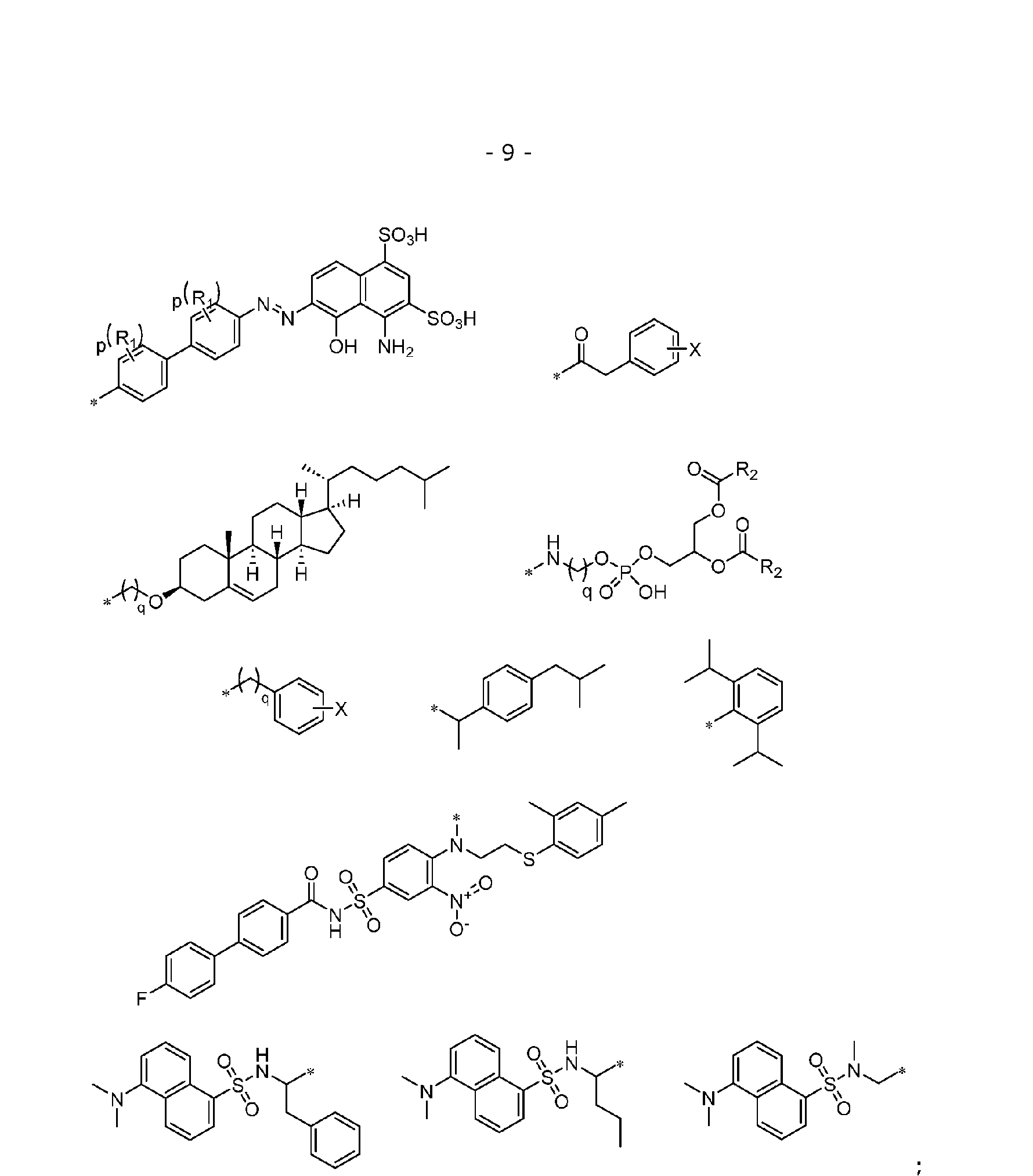

In some embodiments, the compound of Formula (II) is characterised by a spleen weight/body weight of less than about 8 mg/g.
In some embodiments, the compound of Formula (II) is capable of improving the immunogenicity of ovalbumin relative to free CpG by at least 2 times.
In some embodiments, the immunodeficiency disorder is selected from an allergy, a solid tumor or an infectious disease.
Brief description of the drawings
Embodiments of the present disclosure will now be described, by way of non-limiting example, with reference to the drawings in which:
Figure 1 shows a schematic illustration of dimeric albumin binding molecules for lymph node delivery of immunostimutory CpG.
Figure 2 shows albumin binding affinity of a monomeric albumin binding moiety (EB- NH2), a dimeric albumin binding moiety (EB2), a monomeric albumin binding moiety conjugated to CpG (EB-CpG), and a dimeric albumin binding moiety conjugated to CpG (EB2-CpG) as measured by Biolayer Interference method.
Figure 3 shows in vitro immunostimulatory efficacy of EB2-CpG. Flow cytometry examination of co-simulators expression of a) bone marrow-derived dendritic cells (BMDC) and b) Raw264.7 treated with 200 nM CpG equivalents at 24 h. ELISA analysis of TNF-a production in c) BMDC and d) Raw 264.7 cell line with the concentrations of 200 nM CpG equivalents.. Data were presented as mean ± s.d, **** p < 0.0001.
Figure 4 shows IVIS imaging and quantification of EB and EB2 accumulation in draining lymph nodes. C57BL/6 mice were injected with ICG labelled EB and EB2 molecules (n = 3). Data were presented as mean ± s.d, * p < 0.05, ** p < 0.01
Figure 5 shows in vivo toxicity analysis of EB2-CpG. Data were presented as mean±s.d. (n = 4). Mice were injected with 4 nmol CpG equivalents per mouse at day 0 and day 7 at the tail base. Spleens at day 14, spleen/body weight ratios were measured.
Figure 6 shows in vivo T cell immune responses analysis. C57BL/6 mice (n=4) were vaccinated with OVA together with free CpG or EB2-CpG (OVA 20 pg and 2 nmol CpG equivalents per mouse) on day 0 and day 14 followed by flow cytometry analysis of CD8+ T cells, SIINFEKL specific T cells and INF-y producing T cells in peripheral blood. Figure 7 shows EB2-CpG+OVA for cancer immunotherapy. Tumor growth curve and mouse survival after treatment of CpG+OVA and EB2-CpG+OVA.
Figure 8 shows lymph nodes accumulation of compounds in mice.
Figure 9 shows a protocol for mice studies and in vivo antitumor immune responses of the mice.
Figure 10 shows T cell priming.
Figure 11 shows anti-tumor analysis of EB2-CpG.
Detailed description
The present disclosure is predicated on the understanding that an albumin binding moiety (ABM) when functionalized with therapeutic molecules through linkers can at least retain the high binding affinity to albumin. In particular, the ABM may be conjugated with immune-stimulatory oligodeoxynucleotide CpG. By leveraging an exogenous molecule as a carrier, the lymph node may be more specifically targeted and the toxicity of the therapeutic molecule reduced. The ABM may also act to spatially protect the therapeutic molecule.
For example, the ABM may be a Evans Blue dye derivative. Evans Blue (EB) dye, the tetrasodium salt of 6,6'-((3,3'-dimethyl[l,l--biphenyl]-4,4'-diyl)bis[diazene-2,l- diyl]]bis(4-amino-5-hydroxynaphthalene-l,3-disulfonate), has been an important tool for physiology and pathology, especially for assessing integrity of the blood-brain barrier and vascular permeability, because of its strong affinity for albumin. A series of truncated Evans Blue (tEB) derivatives have been developed as ABMs for various applications, including blood pool imaging, tumor vaccination, radioligand therapy, and anti-diabetic treatment (See for example, WO2016/209795, WO2017/196806, International Application No. PCT/US 17/054863, and U.S. Application No. 62/633648,). However, truncation of EB resulted in reduction of its binding affinity for albumin and its fluorescence emission. The linker connecting the EB derivative to the therapeutic molecule is also not stable and can be cleaved even before reaching the targeted site.
The inventors have found that a dimeric albumin binding moiety when functionalized with therapeutic molecules through linkers may improve or at least retain the high binding affinity to albumin. Additionally, due to the relative spatial positions of the dimers, the therapeutic product is not spatially hindered from performing its function. It was further found that the dimers may further improve the pharmacokinetic properties of the therapeutic molecule.
Accordingly, the present disclosure relates to a compound of Formula (I), or a pharmaceutically acceptable salt, solvate, stereoisomer or prodrug thereof, comprising:
HN. ,0 L (I) each Ri is independently selected from halo, hydroxy, optionally substituted alkyl, optionally substituted alkenyl, optionally substituted alkoxy, optionally substituted sulfinyl; each p is independently an integer selected from 0 to 4;
. > H wherein Qi and Q2 are independently a bond or a spacer selected from O ; wherein * denotes a bond to the amide moiety or Qa, denotes a bond to the phenylene or T, r is an integer selected from 1 to 5; wherein Qa is an amide moiety; wherein T is selected from optionally substituted alkyl or one of the following:
wherein * denotes a bond to Q2, x is halo, each R2 is independently optionally substituted alkyl, optionally substituted alkenyl, and q is an integer selected from 1 to 5; L is a spacer selected from alkyl substituted with isothiocyanate, isocyanate, acyl, carbodiimde, acyl azide, anhydride, fluorobenzenyl, fluorophenyl ester, carbonate, NHS
ester, imidoester, epoxy, 0 wherein * denotes a bond to C, m is an integer selected from 1 to 5; and n is an integer selected from 1 to 5.
In some embodiments, the compound of Formula (I) is a compound of Formula (I1): each Ri is independently selected from halo, hydroxy, optionally substituted alkyl, optionally substituted alkenyl, optionally substituted alkoxy, optionally substituted sulfinyl; each p is independently an integer selected from 0 to 4;
/ v H
•%NV wherein Qi and Q2 are independently a bond or a spacer selected from O ■ wherein * denotes a bond to the amide moiety, denotes a bond to the phenylene or T, r is an integer selected from 1 to 5; wherein T is selected from
SO,H wherein * denotes a bond to Qz, x is halo, each Rz is independently optionally substituted alkyl, optionally substituted alkenyl, and q is an integer selected from 1 to 5; L is a spacer selected from alkyl substituted with isothiocyanate, isocyanate, acyl, carbodiimde, acyl azide, anhydride, fluorobenzenyl, fluorophenyl ester, carbonate, NHS ester, imidoester, epoxy, O wherein * denotes a bond to C, m is an integer selected from 1 to 5; and n is an integer selected from 1 to 5.
In some embodiments, the compound of Formula (I) is a compound of Formula (I"):
SO,H
(I") each Ri is independently selected from halo, hydroxy, optionally substituted alkyl,
optionally substituted alkenyl, optionally substituted alkoxy, optionally substituted sulfinyl; each p is independently an integer selected from 0 to 4;
, , H wherein Qi and Q2 are independently a bond or a spacer selected from O ; wherein * denotes a bond to the amide moiety, denotes a bond to the phenylene or T, r is an integer selected from 1 to 5; wherein T is selected from optionally substituted alkyl or wherein * denotes a bond to Q2, x is halo, q is an integer from 1 to 5;
L is a spacer selected from alkyl substituted with isothiocyanate, isocyanate, acyl, carbodiimde, acyl azide, anhydride, fluorobenzenyl, fluorophenyl ester, carbonate, NHS ester, imidoester, epoxy, O wherein * denotes a bond to C, m is an integer selected from 1 to 5; and n is an integer selected from 1 to 5.
"Alkyl" refers to monovalent alkyl groups which may be straight chained or branched and preferably have from 1 to 10 carbon atoms or more preferably 1 to 6 carbon atoms. Examples of such alkyl groups include methyl, ethyl, n-propyl, iso-propyl, n-butyl, isobutyl, n-hexyl, and the like.
"Alkylene" refers to divalent alkyl groups preferably having from 1 to 10 carbon atoms and more preferably 1 to 6 carbon atoms. Examples of such alkylene groups include methylene (-CH2-), ethylene (-CH2CH2-), and the propylene isomers (e.g., -CH2CH2CH2- and -CH(CH3)CH2-), and the like.
Alkoxy" refers to the group alkyl-O- where the alkyl group is as described above.
Examples include, methoxy, ethoxy, n-propoxy, iso-propoxy, n-butoxy, tert-butoxy, sec-butoxy, n-pentoxy, n-hexoxy, 1,2-dimethylbutoxy, and the like.
"Aryl" refers to an unsaturated aromatic carbocyclic group having a single ring (eg. phenyl) or multiple condensed rings (eg. naphthyl or anthryl), preferably having from 6 to 14 carbon atoms. Examples of aryl groups include phenyl, naphthyl and the like.
"Heteroaryl" refers to a monovalent aromatic heterocyclic group which fulfils the Hiickel criteria for aromaticity (ie. contains 4n + 2 n electrons) and preferably has from 2 to 10 carbon atoms and 1 to 4 heteroatoms selected from oxygen, nitrogen, selenium, and sulfur within the ring (and includes oxides of sulfur, selenium and nitrogen). Such heteroaryl groups can have a single ring (eg. pyridyl, pyrrolyl or N- oxides thereof or furyl) or multiple condensed rings (eg. indolizinyl, benzoimidazolyl, coumarinyl, quinolinyl, isoquinolinyl or benzothienyl).
Examples of heteroaryl groups include, but are not limited to, oxazole, pyrrole, imidazole, pyrazole, pyridine, pyrazine, pyrimidine, pyridazine, indolizine, isoindole, indole, indazole, purine, isoquinoline, quinoline, phthalazine, naphthylpyridine, quinoxaline, quinazoline, cinnoline, pteridine, carbazole, carboline, phenanthridine, acridine, phenanthroline, isothiazole, phenazine, isoxazole, isothiazole, phenoxazine, phenothiazine, thiazole, thiadiazoles, oxadiazole, oxatriazole, tetrazole, thiophene, benzo[b]thiophene, triazole, imidazopyridine and the like.
"Cycloalkyl" refers to cyclic alkyl groups having a single cyclic ring or multiple condensed rings, preferably incorporating 3 to 11 carbon atoms. Such cycloalkyl groups include, by way of example, single ring structures such as cyclopropyl, cyclobutyl, cyclopentyl, cyclohexyl, cyclooctyl, and the like, or multiple ring structures such as adamantanyl, indanyl, 1,2,3,4-tetrahydronapthalenyl and the like.
"Heterocyclyl" refers to a monovalent saturated or unsaturated group having a single ring or multiple condensed rings, preferably from 1 to 8 carbon atoms and from 1 to 4 hetero atoms selected from nitrogen, sulfur, oxygen, selenium or phosphorous within the ring. The most preferred heteroatom is nitrogen. It will be understood
that where, for instance, R2 or R1 is an optionally substituted heterocyclyl which has one or more ring heteroatoms, the heterocyclyl group can be connected to the core molecule of the compounds of the present disclosure, through a C-C or C-heteroatom bond, in particular a C-N bond.
Examples of heterocyclyl and heteroaryl groups include, but are not limited to, oxazole, pyrrole, imidazole, pyrazole, pyridine, pyrazine, pyrimidine, pyridazine, indolizine, isoindole, indole, indazole, purine, quinolizine, isoquinoline, quinoline, phthalazine, naphthylpyridine, quinoxaline, quinazoline, cinnoline, pteridine, carbazole, carboline, phenanthridine, acridine, phenanthroline, isothiazole, phenazine, isoxazole, isothiazole, phenoxazine, phenothiazine, imidazolidine, imidazoline, piperidine, piperazine, indoline, phthalimide, 1, 2, 3, 4-tetra hydroisoquinoline, 4,5,6,7-tetrahydrobenzo[b]thiophene, thiazole, thiadiazoles, oxadiazole, oxatriazole, tetrazole, thiazolidine, thiophene, benzo[b]thiophene, morpholino, piperidinyl, pyrrolidine, tetra hydrofuranyl, triazole, and the like.
"Sulfinyl" refers to groups H-S(O)-, alkyl-S(O)-, cycloalkyl-S(O)-, aryl-S(O)-, heteroaryl-S(O)-, and heterocyclyl-S(O)-, where alkyl, cycloalkyl, aryl, heteroaryl and heterocyclyl are as described herein.
In this specification "optionally substituted" is taken to mean that a group may or may not be further substituted or fused (so as to form a condensed polycyclic group) with one or more groups selected from hydroxyl, acyl, alkyl, alkoxy, alkenyl, alkenyloxy, alkynyl, alkynyloxy, amino, aminoacyl, thio, arylalkyl, arylalkoxy, aryl, aryloxy, carboxyl, acylamino, cyano, halogen, nitro, phosphono, sulfo, phosphorylamino, phosphinyl, heteroaryl, heteroarylalkyl, heteroaryloxy, heterocyclyl, heterocyclylalkyl, heterocyclyloxy, oxyacyl, oxime, oxime ether, hydrazone, oxyacylamino, oxysulfonylamino, aminoacyloxy, trihalomethyl, trialkylsilyl, pentafluoroethyl, trifluoromethoxy, difluoromethoxy, trifluoromethanethio, trifluoroethenyl, mono- and di-alkylamino, mono-and di-(substituted alkyl)amino, mono- and di-arylamino, mono- and di-heteroarylamino, mono- and di-heterocyclyl amino, and unsymmetric di-substituted amines having different substituents selected from alkyl, aryl, heteroaryl and heterocyclyl, and the like, and may also include a bond to a solid support material, (for example, substituted onto a polymer
resin). For instance, an "optionally substituted amino" group may include amino acid and peptide residues.
Compounds described herein can comprise one or more asymmetric centers, and thus can exist in various isomeric forms, e.g., enantiomers and/or diastereomers. For example, the compounds described herein can be in the form of an individual enantiomer, diastereomer or geometric isomer, or can be in the form of a mixture of stereoisomers, including racemic mixtures and mixtures enriched in one or more stereoisomer. Isomers can be isolated from mixtures by methods known to those skilled in the art, including chiral high pressure liquid chromatography (HPLC) and the formation and crystallization of chiral salts; or preferred isomers can be prepared by asymmetric syntheses. The disclosure additionally encompasses compounds described herein as individual isomers substantially free of other isomers, and alternatively, as mixtures of various isomers. "Optically-enriched," as used herein, means that the compound is made up of a significantly greater proportion of one enantiomer. In certain embodiments the compound of the present disclosure is made up of at least about 90% by weight of a preferred enantiomer. In other embodiments the compound is made up of at least about 95%, 98%, or 99% by weight of a preferred enantiomer. Preferred enantiomers may be isolated from racemic mixtures by any method known to those skilled in the art, including chiral high pressure liquid chromatography (HPLC) and the formation and crystallization of chiral salts or prepared by asymmetric syntheses. See, for example, Jacques et a!., Enantiomers, Racemates and Resolutions (Wiley Interscience, New York, 1981); Wilen et al., Tetrahedron 33:2725 (1977); Eliel, Stereochemistry of Carbon Compounds (McGraw-Hill, NY, 1962); and Wilen, Tables of Resolving Agents and Optical Resolutions p. 268 (E.L. Eliel, Ed., Univ, of Notre Dame Press, Notre Dame, IN 1972).
In some embodiments, each Ri is independently selected from halo, hydroxy, optionally substituted alkyl, optionally substituted alkoxy, or optionally substituted sulfinyl. In some embodiments, each Ri is independently selected from hydroxyl or optionally substituted alkyl. In some embodiments, each Ri is independently selected from hydroxyl or optionally substituted Ci-Cs alkyl. In some embodiments, each Ri is independently C1-C5 alkyl. In some embodiments, each Ri is independently selected from methyl, ethyl, n-propyl, tert-propyl, n-butyl, iso-butyl, sec-butyl or tert-butyl.
In some embodiments, p is independently selected from 0, 1, 2 or 3. In some embodiments, p is independently selected from 1 or 2. In some embodiments, p is independently 1.
In some embodiments, n is independently selected from 1, 2, 3 or 4. In some embodiments, n is independently selected from 1, 2 or 3. In some embodiments, n is independently selected from 1 or 2. In some embodiments, n is 1 or 3.
In some embodiments, m is independently selected from 1, 2 or 3. In some embodiments, m is 1 or 2.
In some embodiments, Qi and Q2 are each independently a spacer selected from
O . The spacer further separates the two ABMs such that they do not sterically hinder each other during the association process. The moieties Qi and Q2 increase the flexibility of the two ABMs thus possibility of binding two albumin molecules simultaneously.
, , H
In some embodiments, Qi is a bond and Q2 is ° . In some embodiments, Q2
, > H
•V? is a bond and Qi is 0 . In some embodiments, Qi and Q2 are both bonds.
In some embodiments, r is 1, 2 or 3. In some embodiments, r is 1 or 2. In some embodiments, r is 1.
H 5 O
/O n I N A
In some embodiments, Qs is O or H wherein * denotes a bond to C and denotes a bond to Q2.
Accordingly, the compound of Formula (I) may be represented by Formula (I1) or (I"):
(I").
In some embodiments, T is selected from optionally substituted alkyl or one of the
5 following:
In some embodiments, T is selected from optionally substituted alkyl or one of the following:
In some embodiments, T is selected from
In some embodiments, T is selected from optionally substituted alkyl or one of the following:
In some embodiments, x is selected from F, Cl or Br. In some embodiments, x is para substituted halo. In some embodiments, x is meta substituted halo. In some embodiments, x is ortho substituted halo.
In some embodiments, T is optionally substituted C5-C20 alkyl. In some embodiments, T is optionally substituted C10-C20 alkyl. In some embodiments, T is optionally substituted C15-C20 alkyl.
In some embodiments, T is a derivative of ibuprofen, propofol, thioethylamino-2,4- dimethylphenyl, tetradecanoic acid (myristic acid), dansyl-L-phenylalanine, dansyl-L- norvaline, dansyl-L-sarcosine, or 4-(p-iodophenyl)butyric acid.
In some embodiments, each R2 is independently optionally substituted C2-C24 alkyl, or optionally substituted C2-C24 alkenyl. In some embodiments, each R2 is independently C2-C24 alkyl, or C2-C24 alkenyl. In some embodiments, each R2 is independently C2-C24 alkyl. In some embodiments, each R2 is independently C14-C20 alkyl.
In some embodiments, q is an integer selected from 1 to 4, 1 to 3, or 1 to 2. In some embodiments, q is 2.
In some embodiments, T is
In some embodiments, L is an amine reactive spacer. In some embodiments, L is a spacer selected from alkyl substituted with isothiocyanate, isocyanate, acyl,
carbodiimde, acyl azide, anhydride, fluorobenzenyl, fluorophenyl ester, carbonate, NHS O N N N N N NH NH ∗ ∗ ester, imidoester, epoxy, O ∗ ; wherein * denotes a bond to C. The amine reactive spacer may be . O N N N N NH NH ∗ N ∗ In some embodiments, L is a spacer selected from O ∗ . In some embodiments, the compound of Formula (I') is SO3H N R1 p HO3S N NH2 OH R1 p O O Q1 Q2 T N n N H HN H O m L (I') each R1 is optionally substituted alkyl;
each p is independently 1; wherein Qi is a bond; wherein Q2 is O ; wherein * denotes a bond to the amide moiety, denotes a bond to T, r is an integer selected from 1 to 5; wherein T is selected from
SO,H wherein * denotes a bond to Qz, x is halo, each R2 is independently optionally substituted alkyl, optionally substituted alkenyl, and q is an integer selected from 1 to 5;
L is a spacer selected from O wherein * denotes a bond to C, m is an integer selected from 1 to 5; and n is an integer selected from 1 to 5.
In some embodiments, the compound of Formula (I1) is
NH2 OH each Ri is methyl; each p is independently 1; wherein Qi is a bend; wherein Q? is O ; wherein * denotes a bond to the amide moiety, denotes a bond to T, r is 1; wherein T is wherein * denotes a bond to Q2; L is a spacer selected from O ; wherein * denotes a bond to C, m is 2; and n is 1. In some embodiments, the compound of Formula (I") is
each Ri is optionally substituted alkyl; each p is independently 1; wherein Qi and Q2 are independently a bond; wherein T is selected from optionally substituted alkyl or wherein * denotes a bond to Q2, x is halo, q is an integer from 1 to 5;
L is a spacer selected from O * ; wherein * denotes a bond to C, m is an integer selected from 1 to 5; and n is an integer selected from 1 to 5.
The compound of Formula (I) may be conjugated at L to a molecule having an amine moiety. For example, the molecule may be an oligonucleotide, protein, peptide, aptamers, or any other biomolecule. Alternatively, the molecule may be a therapeutic molecule, for example a radioligand, or a compound for chemotherapeutics.
The present disclosure relates to a compound of Formula (II), or a pharmaceutically acceptable salt, solvate, stereoisomer or prodrug thereof, comprising:
each Ri is independently selected from halo, hydroxy, optionally substituted alkyl, optionally substituted alkenyl, optionally substituted alkoxy, optionally substituted a Ikylth io nyl ; each p is independently an integer selected from 0 to 4;
, X H
•%NV wherein Qi and Q2 are independently a bond or a spacer selected from O ; wherein * denotes a bond to the amide moiety, denotes a bond to the phenylene or T, r is an integer selected from 1 to 5; wherein Qa is an amide moiety; wherein T is selected from optionally substituted alkyl or one of the following:
wherein * denotes a bond to Q2, x is halo, each R2 is independently optionally substituted alkyl, optionally substituted alkenyl, and q is an integer selected from 1 to 5; L is a spacer selected from alkyl substituted with isothiocyanate, isocyanate, acyl, carbodiimde, acyl azide, anhydride, fluorobenzenyl, fluorophenyl ester, carbonate, NHS
ester, imidoester, epoxy, 0 wherein * denotes a bond to C, m is an integer selected from 1 to 5; n is an integer selected from 1 to 5; CpG is an oligonucleotide comprising a unmethylated cytosine-guanine (CpG) motif; and wherein L is conjugated to CpG.
In some embodiments, the compound of Formula (II) is a compound of Formula (II1):
SO,H
(H1) each Ri is independently selected from halo, hydroxy, optionally substituted alkyl, optionally substituted alkenyl, optionally substituted alkoxy, optionally substituted a Iky Ith io nyl ; each p is independently an integer selected from 0 to 4;
, x H •%NV wherein Qi and Q2 are independently a bond or a spacer selected from O ; wherein * denotes a bond to the amide moiety, denotes a bond to the phenylene or T, r is an integer selected from 1 to 5; wherein T is selected from
SO,H wherein * denotes a bond to Qz, x is halo, each Rz is independently optionally substituted alkyl, optionally substituted alkenyl, and q is an integer selected from 1 to 5; L is a spacer selected from alkyl substituted with isothiocyanate, isocyanate, acyl, carbodiimde, acyl azide, anhydride, fluorobenzenyl, fluorophenyl ester, carbonate, NHS ester, imidoester, epoxy, O * ; wherein * denotes a bond to C, m is an integer selected from 1 to 5; n is an integer selected from 1 to 5;
CpG is an oligonucleotide comprising an unmethylated cytosine-guanine (CpG) motif; and wherein L is conjugated to CpG. In some embodiments, the compound of Formula (II) is a compound of Formula (II"):
each Ri is independently selected from halo, hydroxy, optionally substituted alkyl, optionally substituted alkenyl, optionally substituted alkoxy, optionally substituted a Ikylthionyl; each p is independently an integer selected from 0 to 4; wherein Qi and Q2 are independently a bond or a spacer selected from O ; wherein * denotes a bond to the amide moiety, denotes a bond to the phenylene or T, r is an integer selected from 1 to 5; wherein T is selected from optionally substituted alkyl or one of the following: wherein * denotes a bond to Q2, x is halo, each R2 is independently optionally substituted alkyl, optionally substituted alkenyl, and q is an integer selected from 1 to 5;
L is a spacer selected from alkyl substituted with isothiocyanate, isocyanate, acyl, carbodiimde, acyl azide, anhydride, fluorobenzenyl, fluorophenyl ester, carbonate, NHS ester, imidoester, epoxy, 0 wherein * denotes a bond to C, m is an integer selected from 1 to 5;
n is an integer selected from 1 to 5;
CpG is an oligonucleotide comprising an unmethylated cytosine-guanine (CpG) motif; and wherein L is conjugated to CpG.
Clinical translation of immunostimulators are hindered due to their systemic toxicity and unsatisfactory efficacy. The present disclosure solves the above mentioned problems (safety and efficacy) through chemical conjugation with dimeric albumin binding molecules (ABMs) which enables high albumin binding affinity and increased accumulation of immunostimulators in targeted lymph nodes. In this regard, compounds of Formula (II) may have a high albumin-binding affinity and may bind to multiple albumins at the same time. The lymph node delivery is also enhanced and the retention of immunostimulator in lymph nodes is prolonged, thus improving the interactions to antigen presenting cells and inducing stronger immune responses. The leakage of immunostimulator to circulation system is reduced, and thus eliminate or at least reduce treatment induced systemic toxicity.
In some embodiments, CpG is a single strand oligodexonucleotide comprising a CpG motif.
CpG oligodeoxynucleotides are short single-stranded synthetic DNA molecules that contain a cytosine triphosphate deoxynucleotide ("C") followed by a guanine triphosphate deoxynucleotide ("G"). The "p" refers to the phosphodiester link between consecutive nucleotides, although some CpG motifs have a modified phosphorothioate (PS) backbone instead. When these CpG motifs are unmethylated, they act as immunostimulants. CpG motifs are considered pathogen-associated molecular patterns (PAMPs) due to theirabundance in microbial genomes but is rare in vertebrate genomes. The CpG PAMP is recognized by the pattern recognition receptor (PRR) Toll-Like Receptor 9 (TLR9), which is constitutively expressed only in B cells and plasmacytoid dendritic cells (pDCs) in humans and other higher primates.
In some embodiments, L is conjugated to CpG via an amino moiety. In some embodiments, L is conjugated to CpG via a thiol moiety.
In some embodiments, the single strand oligodexonucleotide is a K-type CpG selected from one of the following:
CpG 1826 TCCATGA1GTTCCTGACGTT (SEQ ID NO: 1)
CpG 7909 TCGTCGTTTTGTCGTTTTGTCGTT (SEQ ID NO: 2)
CpG10103 TCGTCG I I I I I CGGTCGTTTT (SEQ ID NO: 3)
K X ATAATCGACGTTCAAGCAAG (SEQ ID NO: 4)
K22 CTCGAGCGTTCTC (SEQ ID NO: 5)
K21 TCTCGAGCGTTCTC (SEQ ID NO: 6)
K82 ACTCTGGAGCGTTCTC (SEQ ID NO: 7)
K30 TGCAGCGTTCTC (SEQ ID NO: 8) k31 TCGAGGCTTCTC (SEQ ID NO: 9)
K39 GTCGGCGTTGAC (SEQ ID NO: 10)
K16 TCGACTCTCGAGCGTTCTC (SEQ ID NO: 11)
K3 ATCGACTCTCGAGCGTTCTC (SEQ ID NO: 12) k23 TCGAGCGTTCTC (SEQ ID NO: 13)
K40 GTCGGCGTCGAC (SEQ ID NO: 14)
K34 GTCGACGTTGAC (SEQ ID NO: 15)
K83 ACTCTCGAGGGTTCTC (SEQ ID NO: 16)
K19 ACTCTCGAGCGTTCTC (SEQ ID NO: 17)
K73 GTCGTCGATGAC (SEQ ID NO: 18)
K46 GTCGACGCTGAC (SEQ ID NO: 19)
K47 GTCGACGTCGAC (SEQ ID NO: 20)
K72 GTCATCGATGCA (SEQ ID NO: 21)
K37 GTCAGCGTCGAC (SEQ ID NO: 22) k25 TCGAGCGTTCT (SEQ ID NO: 23)
K82 ACTCTGGAGCGTTCTC (SEQ ID NO: 24)
K83 ACTCTCGAGGGTTCTC (SEQ ID NO: 25)
K84 ACTCTCGAGCGTTCTA (SEQ ID NO: 26)
K85 CATCTCGAGCGTTCTC (SEQ ID NO: 27)
K89 ACTCTTTCGTTCTC (SEQ ID NO: 28)
K109 TCGAGCGTTCT (SEQ ID NO: 29)
K123 TCGTTCGTTCTC (SEQ ID NO: 30)
K1555 GCTAGACGTTAGCGT (SEQ ID NO: 31)
KI 10 TCGAGGCTTCTC (SEQ ID NO: 32)
In some embodiments, the single strand oligodexonucleotide is a D-type CpG selected from one of the following :
5 'XXTGCATCGATGCAGGGGGG 31 (SEQ ID NO: 33)
5 1 XXTGC ACCGGTGC AGGGGGG3 ' (SEQ ID NO: 34),
5 1 XXTGCGTCGACGC AGGGGGG3 1 (SEQ ID NO: 35),
5 'XXTGCGTCGATGCAGGGGGG3 ' (SEQ ID NO: 36),
5 'XXTGCGCCGGCGCAGGGGGG3 ' (SEQ ID NO: 37),
5 1 XXTGCGCCGATGC AGGGGGG3 1 (SEQ ID NO: 38),
5 1 XXTGC ATCGACGC AGGGGGG3 1 (SEQ ID NO: 39),
5 'XXTGCGTCGGTGCAGGGGGG3 ' (SEQ ID NO: 40),
D104 GGTGCATCGATGCAGGGGGG (SEQ ID NO: 41)
D19 GGTGCATCGATGCAGGGGGG (SEQ ID NO: 42)
D29 GGTGCACCGGTGCAGGGGGG (SEQ ID NO: 43)
D35 GGTGCATCGATGCAGGGGGG (SEQ ID NO: 44)
D28 GGTGCGTCGATGCAGGGGGG (SEQ ID NO: 45)
D 106 GGTGTGTCGATGCAGGGGGG (SEQ ID NO: 46)
D 116 TGCATCGATGCAGGGGGG (SEQ ID NO: 47)
D113 GGTGCATCGATACAGGGGGG (SEQ ID NO: 48)
D34 GGTGCATCGATGCAGGGGGG (SEQ ID NO: 49)
D102 GGTGCATCGTTGCAGGGGGG (SEQ ID NO: 50) D32 GGTGCGTCGACGCAGGGGGG (SEQ ID NO: 51) D117 GGTCGATCGATGCACGGGGG (SEQ ID NO: 52) D37 GGTGCATCGATGCAGGGGGG (SEQ ID NO: 53) D25 GGTGCATCGATGCAGGGGGG (SEQ ID NO: 54) D30 GGTGCATCGACGCAGGGGGG (SEQ ID NO: 55) d 120 GGTGCATCGATAGGCGGGGG (SEQ ID NO: 56) D27 GGTGCACCGATGCAGGGGGG (SEQ ID NO: 57) dl 19 CCTGCATCGATGCAGGGGGG (SEQ ID NO: 58) D142 GGTATATCGATATAGGGGGG (SEQ ID NO: 59) d 143 GGTGGATCGATCCAGGGGGG (SEQ ID NO: 60)
In some embodiments, the compound of Formula (I) and/or (II) is characterised by a dissociation constant (Kd) of about 4 pM to about 10 pM. In some embodiments, the compound of Formula (I) and/or (II) is characterised by a dissociation constant (Kd) of about 5 pM to about 10 pM, or about 6 pM to about 10 pM. In some embodiments, the compound of Formula (I) and/or (II) is characterised by a dissociation constant (Kd) of about 6 pM to about 9 pM.
In some embodiments, the compound of Formula (II1) is
(II1) each Ri is independently optionally substituted alkyl; each p is 1 ; wherein Qi is a bond;
, x H wherein Q2 is O ; wherein * denotes a bond to the amide moiety, denotes a bond to T, r is an integer selected from 1 to 5; wherein T is selected from
wherein * denotes a bond to Qz, x is halo, each Rz is independently optionally substituted alkyl, optionally substituted alkenyl, and q is an integer selected from 1 to 5; L is a spacer selected from O * ; wherein * denotes a bond to C, m is an integer selected from 1 to 5; n is an integer selected from 1 to 5;
CpG is an oligonucleotide comprising an unmethylated cytosine-guanine (CpG) motif; and wherein L is conjugated to CpG.
In some embodiments, the compound of Formula (II1) is
each Ri is independently methyl; each p is 1; wherein Qi is a bond;
, , H wherein Qz is O ; wherein * denotes a bond to the amide moiety, denotes a bond to T, r is 1; wherein T is
SO3H
(R > PX^N''N'V T 'SO>H OH NH2 wherein * denotes a bond to Q2;
■i?
L is a spacer selected from O ; wherein * denotes a bond to C, m is 2; n is 1;
CpG is an oligonucleotide comprising an unmethylated cytosine-guanine (CpG) motif; and wherein L is conjugated to CpG.
In some embodiments, the compound of Formula (II") is
each Ri is optionally substituted alkyl; each p is independently 1; wherein Qi and Q2 are independently a bond; wherein T is selected from optionally substituted alkyl or wherein * denotes a bond to Q2, x is halo, q is an integer from 1 to 5;
L is a spacer selected from O * ; wherein * denotes a bond to C, m is an integer selected from 1 to 5; n is an integer selected from 1 to 5;
CpG is an oligonucleotide comprising an unmethylated cytosine-guanine (CpG) motif; and wherein L is conjugated to CpG.
In some embodiments, the compound of Formula (II) is selected from
EB2-CpG
EB-iPA-CpG
The present disclosure also relates to a method of treating an immunodeficiency disorder in a patient in need thereof, comprising administering to the patient a therapeutically effective amount of a compound of Formula (II) or a pharmaceutically acceptable salt, solvate, stereoisomer or prodrug thereof.
The present disclosure also relates to a compound of Formula (II) or a pharmaceutically acceptable salt, solvate, stereoisomer or prodrug thereof for use in treating an
immunodeficiency disorder.
The present disclosure also relates to a use of a compound of Formula (II) or a pharmaceutically acceptable salt, solvate, stereoisomer or prodrug thereof in the manufacture of a medicament for treating for an immunodeficiency disorder.
In some embodiments, the compound of Formula (II) is characterised by an in vivo retention time of at least 120 h. The retention may be within the lymph nodes. In some embodiments, the retention time is at least 110 h, 100 h, 90 h, 80 h, 70 h, 60 h, 50 h, 40 h, 30 h, 20 h, or 10 h.
In some embodiments, the compound of Formula (II) is characterised by a spleen weight/body weight of less than about 10 mg/g. A low spleen weight/body weight ratio signifies that systemic toxicity is minimised. In other embodiments, the spleen weight/body weight is less than about 9 mg/g, about 8 mg/g, about 7 mg/g, about 6 mg/g, or about 5 mg/g.
In some embodiments, the compound of Formula (II) is capable of improving the immunogenicity of OVA as compared to free CpG. In other embodiments, the immunogenicity to OVA is improved by at least 1.5 times, 1.6 times, 1.8 times, 2 times, 2.2 times, 2.4 times, 2.6 times, 2.8 times, 3 times, 3.2 times, or 3.4 times.
Immunodeficiency disorder is a medical condition in which your body is unable to fight the external factors like bacteria, viruses, and parasites. When the immune system of a body does not function properly, a person is left open to repeated diseases and infections of severe nature. They are either acquired or are infected by an external source. A congenital, or primary immunodeficiency disorder is the one you are born with. Secondary or acquired immunodeficiency disorders mostly happen in the later years of life. In some embodiments, the immunodeficiency disorder is a secondary immunodeficiency disorder. In some embodiments, the immunodeficiency disorder is selected from an allergy, a solid tumor or an infectious disease. This includes many types of cancer, particularly those of the bone marrow and blood cells (leukemia, lymphoma, multiple myeloma), and certain chronic infections. Immunodeficiency is also the hallmark of acquired immunodeficiency syndrome (AIDS), caused by the human immunodeficiency virus (HIV).
The compound of the disclosure can be administered to a subject as a pharmaceutically acceptable salt thereof. Suitable pharmaceutically acceptable salts include, but are not limited to salts of pharmaceutically acceptable inorganic acids such as hydrochloric, sulphuric, phosphoric, nitric, carbonic, boric, sulfamic, and hydrobromic acids, or salts of pharmaceutically acceptable organic acids such as acetic, propionic, butyric, tartaric, maleic, hydroxymaleic, fumaric, maleic, citric, lactic, mucic, gluconic, benzoic, succinic, oxalic, phenylacetic, methanesulphonic, toluenesulphonic, benezenesulphonic, salicyclic sulphanilic, aspartic, glutamic, edetic, stearic, palmitic, oleic, lauric, pantothenic, tannic, ascorbic and valeric acids.
Base salts include, but are not limited to, those formed with pharmaceutically acceptable cations, such as sodium, potassium, lithium, calcium, magnesium, ammonium and alkylammonium. In particular, the present disclosure includes within its scope cationic salts eg sodium or potassium salts, or alkyl esters (eg methyl, ethyl) of the phosphate group.
Basic nitrogen-containing groups may be quarternised with such agents as lower alkyl halide, such as methyl, ethyl, propyl, and butyl chlorides, bromides and iodides; dialkyl sulfates like dimethyl and diethyl sulfate; and others.
It will be appreciated that any compound that is a prodrug of the compound of formula (I) or (II) is also within the scope and spirit of the disclosure. Thus the compound of the disclosure can be administered to a subject in the form of a pharmaceutically acceptable pro-drug. The term "pro-drug" is used in its broadest sense and encompasses those derivatives that are converted in vivo to the compound of the disclosure. Such derivatives would readily occur to those skilled in the art. Other texts which generally describe prodrugs (and the preparation thereof) include: Design of Prodrugs, 1985, H. Bundgaard (Elsevier); The Practice of Medicinal Chemistry, 1996, Camille G. Wermuth etal., Chapter 31 (Academic Press); and A Textbook of Drug Design and Development, 1991, Bundgaard et al., Chapter 5, (Harwood Academic Publishers). For example, hydroxy groups may be esterified, amino groups may be protected by a carbamate moiety, or the sulfonic acid moieties may be reacted with a salt to form an ionised compound.
The compound of the disclosure may be in crystalline form either as the free compound or as a solvate (e.g. hydrate) and it is intended that both forms are within the scope of the present disclosure. Methods of solvation are generally known within the art.
The compound of the disclosure, or a pharmaceutically acceptable salt, solvate or prodrug thereof is administered to the patient in a therapeutically effective amount. As used herein, a therapeutically effective amount is intended to include at least partially attaining the desired effect, or delaying the onset of, or inhibiting the progression of, or halting or reversing altogether the onset or progression of immunodeficiency.
As used herein, the term "effective amount" relates to an amount of compound which, when administered according to a desired dosing regimen, provides the desired therapeutic activity. Dosing may occur at intervals of minutes, hours, days, weeks, months or years or continuously over any one of these periods. Suitable dosages may lie within the range of about 0.1 ng per kg of body weight to 1 g per kg of body weight per dosage, such as is in the range of 1 mg to 1 g per kg of body weight per dosage. In one embodiment, the dosage may be in the range of 1 mg to 500 mg per kg of body weight per dosage. In another embodiment, the dosage may be in the range of 1 mg to 250 mg per kg of body weight per dosage. In yet another embodiment, the dosage may be in the range of 1 mg to 100 mg per kg of body weight per dosage, such as up to 50 mg per body weight per dosage.
Suitable dosage amounts and dosing regimens can be determined by the attending physician and may depend on the severity of the condition as well as the general age, health and weight of the patient to be treated.
The compound of the disclosure may be administered in a single dose or a series of doses. While it is possible for the active ingredient to be administered alone, it is preferable to present it as a composition, preferably as a pharmaceutical composition. The formulation of such compositions is well known to those skilled in the art. The composition may contain any suitable carriers, diluents or excipients. These include all conventional solvents, dispersion media, fillers, solid carriers, coatings, antifungal and antibacterial agents, dermal penetration agents, surfactants, isotonic and absorption agents and the like. It will be understood that the compositions of the disclosure may also include other supplementary physiologically active agents.
The carrier must be pharmaceutically "acceptable" in the sense of being compatible with the other ingredients of the composition and not injurious to the patient. The compositions may conveniently be presented in unit dosage form and may be prepared by any methods well known in the art of pharmacy. Such methods include the step of bringing into association the active ingredient with the carrier which constitutes one or more accessory ingredients. In general, the compositions are prepared by uniformly and intimately bringing into association the active ingredient with liquid carriers or finely divided solid carriers or both, and then if necessary shaping the product.
The compound may be injected directly to the eye, and in particular the vitreous of the eye. The compound, or composition of the disclosure can be administered to the vitreous of the eye using any intravitreal or transscleral administration technique. For example, the compound, or composition can be administered to the vitreous of the eye by intravitreal injection. Intravitreal injection typically involves administering a compound of the disclosure or a pharmaceutically acceptable salt, solvate or prodrug in a total amount between 0.1 ng to 10 mg per dose.
Injectables for such use can be prepared in conventional forms, either as a liquid solution or suspension or in a solid form suitable for preparation as a solution or suspension in a liquid prior to injection, or as an emulsion. Carriers can include, for example, water, saline (e.g., normal saline (NS), phosphate-buffered saline (PBS), balanced saline solution (BSS)), sodium lactate Ringer's solution, dextrose, glycerol, ethanol, and the like; and if desired, minor amounts of auxiliary substances, such as wetting or emulsifying agents, buffers, and the like can be added. Proper fluidity can be maintained, for example, by using a coating such as lecithin, by maintaining the required particle size in the case of dispersion and by using surfactants. By way of example, the compound, or composition can be dissolved in a pharmaceutically effective carrier and be injected into the vitreous of the eye with a fine gauge hollow bore needle (e.g., 30 gauge, 1/2 or 3/8 inch needle) using a temporal approach (e.g., about 3 to about 4 mm posterior to the limbus for human eye to avoid damaging the lens).
A person skilled in the art will appreciate that other means for injecting and/or administering the compound, or composition to the vitreous of the eye can also be used. These other means can include, for example, intravitreal medical delivery devices. These
devices and methods can include, for example, intravitreal medicine delivery devices, and biodegradable polymer delivery members that are inserted in the eye for long term delivery of medicaments. These devices and methods can further include transscleral delivery devices.
Other modes of administration including topical or intravenous administration may also be possible. For example, solutions or suspensions of the compound, or composition of the disclosure may be formulated as eye drops, or as a membranous ocular patch, which is applied directly to the surface of the eye. Topical application typically involves administering the compound of the disclosure in an amount between 0.1 ng and 10 mg.
The compound, or composition of the disclosure may also be suitable for intravenous administration. For example, a compound of formula (I), (II) or a pharmaceutically acceptable salt, solvate or prodrug thereof may be administered intravenously at a dose of up to 16 mg/m2.
The compound, or composition of the disclosure may also be suitable for oral administration and may be presented as discrete units such as capsules, sachets or tablets each containing a predetermined amount of the active ingredient; as a powder or granules; as a solution or a suspension in an aqueous or non-aqueous liquid; or as an oil-in-water liquid emulsion or a water-in-oil liquid emulsion. The active ingredient may also be presented as a bolus, electuary or paste. In another embodiment, the compound of formula (I), (II) or a pharmaceutically acceptable salt, solvate or prodrug is orally administerable.
A tablet may be made by compression or moulding, optionally with one or more accessory ingredients. Compressed tablets may be prepared by compressing in a suitable machine the active ingredient in a free-flowing form such as a powder or granules, optionally mixed with a binder (e.g inert diluent, preservative disintegrant (e.g. sodium starch glycolate, cross-linked polyvinyl pyrrolidone, cross-linked sodium carboxymethyl cellulose) surface-active or dispersing agent. Moulded tablets may be made by moulding in a suitable machine a mixture of the powdered compound moistened with an inert liquid diluent. The tablets may optionally be coated or scored and may be formulated so as to provide slow or controlled release of the active ingredient therein using, for example, hydroxypropylmethyl cellulose in varying
proportions to provide the desired release profile. Tablets may optionally be provided with an enteric coating, to provide release in parts of the gut other than the stomach.
The compound, or composition of the disclosure may be suitable for topical administration in the mouth including lozenges comprising the active ingredient in a flavoured base, usually sucrose and acacia or tragacanth gum; pastilles comprising the active ingredient in an inert basis such as gelatine and glycerin, or sucrose and acacia gum; and mouthwashes comprising the active ingredient in a suitable liquid carrier.
The compound, or composition of the disclosure may be suitable for topical administration to the skin may comprise the compounds dissolved or suspended in any suitable carrier or base and may be in the form of lotions, gel, creams, pastes, ointments and the like. Suitable carriers include mineral oil, propylene glycol, polyoxyethylene, polyoxypropylene, emulsifying wax, sorbitan monostearate, polysorbate 60, cetyl esters wax, cetearyl alcohol, 2-octyldodecanol, benzyl alcohol and water. Transdermal patches may also be used to administer the compounds of the disclosure.
The compound, or composition of the disclosure may be suitable for parenteral administration include aqueous and non-aqueous isotonic sterile injection solutions which may contain anti-oxidants, buffers, bactericides and solutes which render the compound, or composition isotonic with the blood of the intended recipient; and aqueous and non-aqueous sterile suspensions which may include suspending agents and thickening agents. The compound, or composition may be presented in unit-dose or multi-dose sealed containers, for example, ampoules and vials, and may be stored in a freeze-dried (lyophilised) condition requiring only the addition of the sterile liquid carrier, for example water for injections, immediately prior to use. Extemporaneous injection solutions and suspensions may be prepared from sterile powders, granules and tablets of the kind previously described.
Preferred unit dosage composition are those containing a daily dose or unit, daily subdose, as herein above described, or an appropriate fraction thereof, of the active ingredient.
It should be understood that in addition to the active ingredients particularly mentioned above, the composition of this disclosure may include other agents conventional in the
art having regard to the type of composition in question, for example, those suitable for oral administration may include such further agents as binders, sweeteners, thickeners, flavouring agents disintegrating agents, coating agents, preservatives, lubricants and/or time delay agents. Suitable sweeteners include sucrose, lactose, glucose, aspartame or saccharine. Suitable disintegrating agents include cornstarch, methylcellulose, polyvinylpyrrolidone, xanthan gum, bentonite, alginic acid or agar. Suitable flavouring agents include peppermint oil, oil of Wintergreen, cherry, orange or raspberry flavouring. Suitable coating agents include polymers or copolymers of acrylic acid and/or methacrylic acid and/or their esters, waxes, fatty alcohols, zein, shellac or gluten. Suitable preservatives include sodium benzoate, vitamin E, alpha-tocopherol, ascorbic acid, methyl paraben, propyl paraben or sodium bisulphite. Suitable lubricants include magnesium stearate, stearic acid, sodium oleate, sodium chloride or talc. Suitable time delay agents include glyceryl monostearate or glyceryl distearate.
An exemplary working of the disclosure is laid out below. In the embodiments that follows, the disclosure is described in relation to some conditions for consistency to showcase the present disclosure. However, the skilled person would understand that the disclosure is not limited to such.
Examples
General Protocol (EB2-CpG)
EB-NH2 refers to compound 7. EB2 refers to compound 8. EB-CpG refers to a compound with only 1 EB moiety (compound 7) conjugated to CpG.
Results and analysis
Figure 1 shows a schematic illustration of dimeric albumin binding molecules for lymph node delivery of immunostimulatory CpG. As shown in Figure 2 and the table, the dissociation constant (Kd) of EB2-CpG, EB-CpG and EB2 at different concentrations were calculated by biolayer interferometry (BLI). The Kd value of EB-NH2 is 130 pM, which was approximately 15 times higher than that for EB2-NH2 (Kd = 8.8 pM). The Kd value of EB-CpG (Kd = 32 pM) is 5 times higher than EB2-CpG (Kd = 6.3 pM). Additionally, EB2-CpG showed much higher KOn value (3.51 x 10³ M 1 S’1) than EB-CpG (2.36 x 10² M 1 S’1) and relatively lower Korf value (1.33 x 10 3 S’1) than EB-CpG (2.33 x 10’3 S’1). These results demonstrated the superior albumin binding ability of EB2-CpG than EB-CpG.
Table 1. Fitted values and reaction constants.
09912 1.49X19’ 1.01X10 3 130
0 9419 6.11X10’ 1.83X10 ’ 8.8
09834 2.36x10’ 2.33X10-’ 32
09733 3 51 *10’ 1 33 *10- 6.3
The immunostimulatory efficacy of EB2-CpG was evaluated in BMDCs and Raw264.7 cell lines (Figure 3). As shown in Figure 3a and b, the percentage of CD86+/CD80+ BMDC and Raw 264.7 were significantly increased when treated with EB2-CpG as compared control group. Impressively, the percentage of CD86+/CD80+ BMDC and Raw 264.7 after the treatment of EB2-CpG was comparable to free CpG and EB-CpG, demonstrating the robust immunostimulation efficacy of EB2-CpG. Consistently, ELISA results presented that EB2-CpG could elicit substantial TNF-o production in both BMDCs and Raw264.7 cells. EB2-CpG-HSA or HSA/EB2-CpG refers to HSA binding/complexing with EB2-CpG.
The lymphatic delivery of EB and EB2 molecules was evaluated in vivo by fluorescence imaging (Figure 4). EB-ICG is complex of EB monomer with indocyanine green (ICG) dye; EB2-ICG is complex of EB dimer with ICG dye. The retention of ICG labelled EB and EB2 was monitored to draining lymph nodes after intra-paw injection to C57BL/6 mice. At 0.5 h post injection, EB2-ICG accumulation in lymph nodes were remarkably higher than EB-ICG. By 120 h after injection, the accumulation of EB2-ICG in draining lymph nodes were still much higher than EB-ICG while the fluorescence signal of EB was nearly disappeared, presumably due to improved albumin binding affinity of EB2 molecules.
To evaluate the systemic toxicity of EB2-CpG, C57BL/6 mice were injected with EB2- CpG, EB-CpG and free CpG (dose: 5 nmol CpG equivalent on day 0 and day 6). At 6 days after the last injection, spleens were harvested and weighed. Splenomegaly was determined as the ratio of spleen weight/mouse body weight. As shown in Figure 5, both Free CpG and EB-CpG treatment led to overt systemic toxicity which presented as higher ratio of spleen weight/mouse body weight, while no splenomegaly was observed after the EB2-CpG treatment, demonstrating that EB2 modification mitigated the toxicity risk induced by CpG.
The T cell immune responses induced by EB2-CpG + ovalbumin (OVA) treatment was studied . C57BL/6 mice were injected with EB2-CpG and free CpG together with OVA
(dose: 2 nmol CpG equivalent and 20 pg OVA on day 0 and day 14). As shown in Figure 6, compared with free CpG+OVA, EB2-CpG+OVA markedly improved the proliferation of CD8+ T cells. Additionally, by contrast to free CpG+OVA, the frequencies of SINFEKL+ CD8+ T cells and INF+ CD8+ T cells were significantly enhanced by EB2-CpG+OVA. Collectively, these results verified that EB2-CpG can improve the immunogenicity of OVA as compared with free CpG.
C57BL/6 mice (n=5/group) were subcutaneously inoculated with 5 x 10⁵ EG7.OVA cells on day 0, and treated with free CpG+OVA or EB2-CpG+OVA on day 6, 12 and 18 (CpG equivalents 2 nmol, OVA 20 pg per mouse). EB2-CpG+OVA markedly retarded EG7.OVA tumor growth as compared with free CpG+OVA with improved mouse survival benefits (Figure 7). These results verified that EB2-CpG potentiated the therapeutic efficacy of OVA.
The lymph node delivery of two albumin binding molecules (EB2 and EB-IPA) were evaluated via in vivo IVIS imaging by conjugating EB2 and EB-IPA with ICG dye. C57BL/6 mice (n = 3/group) were injected with EB2-ICG, EB-IPA-ICA, EB-ICG and PBS at the tail base followed by IVIS imaging at day 1, 2 and 3 (Figure 8a). As quantified, EB2-ICG was delivered to inguinal lymph node effectively, whose fluorescence intensity was nearly 2 and 4 fold greater than that of EB-ICG and EB-IPA-ICG at 24h post injection (Figure 8b).
Systemic immunogenicity of EB2-CpG, EB-IPA-CpG and EB-CpG were analysed then. C57BL/6 mice (n=5/group) were subcutaneously inoculated with 1 x 10⁶ EG7.OVA cells on day 0, and vaccinated with PBS, free CpG+OVA, EB-CpG+OVA, EB-IPA-CpG+OVA and EB2-CpG+OVA for three times (CpG equivalents 2 nmol, OVA 20 pg per mouse). Tumor draining lymph nodes were collected 3 days after the last vaccination. As compared with free CpG, co-delivery of EB-CpG, EB2-CpG and EB-IPA-CpG with OVA showed higher expression of antigens as indicated by increased number of SIINKFEKL+CD11+ dendritic cells and MHCII+CD11+ dendric cells (Figure 9). The numbers of SIINKFEKL+CD8+ T cells and central memory T cells in mice treated with EB2-CpG+OVA were significantly higher than that of other treatments (Figure 10). In contrast to moderate inhibition of tumor growth of EB-CpG and EB-IPA-CpG, EB2-CpG inhibit tumor progression more effectively and enabled prolong survival time of mice (Figure 11).
It will be appreciated that many further modifications and permutations of various aspects of the described embodiments are possible. Accordingly, the described aspects are intended to embrace all such alterations, modifications, and variations that fall within the spirit and scope of the appended claims.
Throughout this specification and the claims which follow, unless the context requires otherwise, the word "comprise", and variations such as "comprises" and "comprising", will be understood to imply the inclusion of a stated integer or step or group of integers or steps but not the exclusion of any other integer or step or group of integers or steps.
Throughout this specification and the claims which follow, unless the context requires otherwise, the phrase "consisting essentially of", and variations such as "consists essentially of" will be understood to indicate that the recited element(s) is/are essential i.e. necessary elements of the invention. The phrase allows for the presence of other non-recited elements which do not materially affect the characteristics of the invention but excludes additional unspecified elements which would affect the basic and novel characteristics of the method defined.
The reference in this specification to any prior publication (or information derived from it), or to any matter which is known, is not, and should not be taken as an acknowledgment or admission or any form of suggestion that that prior publication (or information derived from it) or known matter forms part of the common general knowledge in the field of endeavour to which this specification relates.
Claims
1. A compound of Formula (I), or a pharmaceutically acceptable salt, solvate, stereoisomer or prodrug thereof, comprising: each Ri is independently selected from halo, hydroxy, optionally substituted alkyl, optionally substituted alkenyl, optionally substituted alkoxy, or optionally substituted sulfinyl; each p is independently an integer selected from 0 to 4;
. > H
•%NV wherein Qi and Q? are independently a bond or a spacer selected from ° ; wherein * denotes a bond to the amide moiety, denotes a bond to the phenylene or T, r is an integer selected from 1 to 5; wherein Qs is an amide moiety; wherein T is selected from optionally substituted alkyl or one of the following:
wherein * denotes a bond to Q2, x is halo, each R2 is independently optionally substituted alkyl, optionally substituted alkenyl, and q is an integer selected from 1 to 5; L is a spacer selected from alkyl substituted with isothiocyanate, isocyanate, acyl, carbodiimde, acyl azide, anhydride, fluorobenzenyl, fluorophenyl ester, carbonate, NHS
ester, imidoester, epoxy, 0 wherein * denotes a bond to C, m is an integer selected from 1 to 5; and n is an integer selected from 1 to 5.
2. The compound according to claim 1, wherein the compound is a compound of Formula (I1):
SO,H each Ri is independently selected from halo, hydroxy, optionally substituted alkyl, optionally substituted alkenyl, optionally substituted alkoxy, optionally substituted sulfinyl; each p is independently an integer selected from 0 to 4;
. > H
•%NV wherein Qi and Q2 are independently a bond or a spacer selected from O ; wherein * denotes a bond to the amide moiety, $ denotes a bond to the phenylene or T, r is an integer selected from 1 to 5; wherein T is selected from
SO,H wherein * denotes a bond to Qz, x is halo, each Rz is independently optionally substituted alkyl, optionally substituted alkenyl, and q is an integer selected from 1 to 5; L is a spacer selected from alkyl substituted with isothiocyanate, isocyanate, acyl, carbodiimde, acyl azide, anhydride, fluorobenzenyl, fluorophenyl ester, carbonate, NHS ester, imidoester, epoxy, O wherein * denotes a bond to C, m is an integer selected from 1 to 5; and n is an integer selected from 1 to 5.
3. The compound according to claim 1, wherein the compound is a compound of Formula (I"):
(I")
each Ri is independently selected from halo, hydroxy, optionally substituted alkyl, optionally substituted alkenyl, optionally substituted alkoxy, optionally substituted sulfinyl; each p is independently an integer selected from 0 to 4;
. > H wherein Qi and Q2 are independently a bond or a spacer selected from •V O v ; wherein * denotes a bond to the amide moiety, denotes a bond to the phenylene or T, r is an integer selected from 1 to 5; wherein T is selected from optionally substituted alkyl or wherein * denotes a bond to Q2, x is halo, q is an integer from 1 to 5;
L is a spacer selected from alkyl substituted with isothiocyanate, isocyanate, acyl, carbodiimde, acyl azide, anhydride, fluorobenzenyl, fluorophenyl ester, carbonate, NHS ester, imidoester, epoxy, 0 wherein * denotes a bond to C, m is an integer selected from 1 to 5; and n is an integer selected from 1 to 5.
4. The compound according to any one of claims 1 to 3, wherein each Ri is independently selected from hydroxyl or optionally substituted C1-C5 alkyl.
5. The compound according to any one of claims 1 to 4, wherein p is 1 or 2.
6. The compound according to any one of claims 1 to 5, wherein Qi is a bond.
7. The compound according to any one of claims 1 to 6, wherein Q2 is 0
, wherein * denotes a bond to Qs, denotes a bond to T, r is 1.
8. The compound according to any one of claims 1 to 7, wherein T is
SO3H
N y SO3H
OH NH2 wherein * denotes a bond to Q2, each Ri is independently selected from hydroxyl or optionally substituted C1-C5 alkyl; and p is 1 or 2.
9. The compound according to any one of claims 1 to 8, wherein L is selected from
; wherein * denotes a bond to C.
10. The compound according to any one of claims 1 to 9, wherein n is 1 or 3.
11. The compound according to any one of claims 1 to 10, wherein m is 1 or 2.
12. The compound according to any one of 1 to 11, wherein r is 1.
13. A compound of Formula (II), or a pharmaceutically acceptable salt, solvate, stereoisomer or prodrug thereof, comprising:
each Ri is independently selected from halo, hydroxy, optionally substituted alkyl, optionally substituted alkenyl, optionally substituted alkoxy, optionally substituted a Ikylth io nyl ; each p is independently an integer selected from 0 to 4;
, x H
•%NV wherein Qi and Q2 are independently a bond or a spacer selected from O ; wherein * denotes a bond to the amide moiety, denotes a bond to the phenylene or T, r is an integer selected from 1 to 5; wherein Qa is an amide moiety; wherein T is selected from optionally substituted alkyl or one of the following:
wherein * denotes a bond to Q2, x is halo, each R? is independently optionally substituted alkyl, optionally substituted alkenyl, and q is an integer selected from 1 to 5; L is a spacer selected from alkyl substituted with isothiocyanate, isocyanate, acyl, carbodiimde, acyl azide, anhydride, fluorobenzenyl, fluorophenyl ester, carbonate, NHS ester, imidoester, epoxy, O
wherein * denotes a bond to C, m is an integer selected from 1 to 5; n is an integer selected from 1 to 5;
CpG is an oligonucleotide comprising an unmethylated cytosine-guanine (CpG) motif; and wherein L is conjugated to CpG.
14. The compound according to claim 13, wherein CpG is a single strand oligodexonucleotide comprising a CpG motif.
15. The compound according to claim 13 or 14, wherein the single strand oligodexonucleotide is TCCATGA1GTTCCTGACGTT (SEQ ID NO: 1).
16. The compound according to any one of claims 13 to 15, wherein the compound of Formula (I) and/or (II) is characterised by a dissociation constant ( Kd) of about 4 pM to about 10 pM.
17. The compound according to any one of claims 13 to 16, wherein the compound of Formula (I) and/or (II) is characterised by a dissociation constant (Ko) of about 6 pM to about 9 pM.
18. A method of treating an immunodeficiency disorder in a patient in need thereof, comprising administering to the patient a therapeutically effective amount of a compound of Formula (II) or a pharmaceutically acceptable salt, solvate, stereoisomer or prodrug thereof.
19. A compound of Formula (II) or a pharmaceutically acceptable salt, solvate, stereoisomer or prodrug thereof for use in treating an immunodeficiency disorder.
20. A use of a compound of Formula (II) or a pharmaceutically acceptable salt, solvate, stereoisomer or prodrug thereof in the manufacture of a medicament for treating for an immunodeficiency disorder.
21. The method, compound for use and use according to any one of claims 18 to 20, wherein the compound of Formula (II) is characterised by an in vivo retention time of
at least 120 h.
22. The method, compound for use and use according to any one of claims 18 to 21, wherein the compound of Formula (II) is characterised by a spleen weight/body weight of less than about 8 mg/g.
23. The method, compound for use and use according to any one of claims 18 to 22, wherein the compound of Formula (II) is capable of improving the immunogenicity of ovalbumin relative to free CpG by at least 2 times.
24. The method, compound for use and use according to any one of claims 18 to 23, wherein the immunodeficiency disorder is selected from an allergy, a solid tumor or an infectious disease.
Applications Claiming Priority (2)
| Application Number | Priority Date | Filing Date | Title |
|---|---|---|---|
| SG10202260577T | 2022-12-23 | ||
| SG10202260577T | 2022-12-23 |
Publications (1)
| Publication Number | Publication Date |
|---|---|
| WO2024136755A1 true WO2024136755A1 (en) | 2024-06-27 |
Family
ID=91590249
Family Applications (1)
| Application Number | Title | Priority Date | Filing Date |
|---|---|---|---|
| PCT/SG2023/050846 Ceased WO2024136755A1 (en) | 2022-12-23 | 2023-12-20 | Albumin binding compounds and methods of use thereof |
Country Status (1)
| Country | Link |
|---|---|
| WO (1) | WO2024136755A1 (en) |
Citations (3)
| Publication number | Priority date | Publication date | Assignee | Title |
|---|---|---|---|---|
| WO2017192874A1 (en) * | 2016-05-04 | 2017-11-09 | The United States Of America, As Represented By The Secretary, Department Of Health And Human Services | Albumin-binding immunomodulatory compositions and methods of use thereof |
| CN107629016A (en) * | 2017-11-12 | 2018-01-26 | 莎穆(上海)生物科技有限公司 | Azo-Blue complex and its preparation method and application |
| WO2020160222A2 (en) * | 2019-01-30 | 2020-08-06 | The United States Of America, As Represented By The Secretary, Department Of Health And Human Services | Conjugates of bivalent evans blue dye derivatives and methods of use |
-
2023
- 2023-12-20 WO PCT/SG2023/050846 patent/WO2024136755A1/en not_active Ceased
Patent Citations (3)
| Publication number | Priority date | Publication date | Assignee | Title |
|---|---|---|---|---|
| WO2017192874A1 (en) * | 2016-05-04 | 2017-11-09 | The United States Of America, As Represented By The Secretary, Department Of Health And Human Services | Albumin-binding immunomodulatory compositions and methods of use thereof |
| CN107629016A (en) * | 2017-11-12 | 2018-01-26 | 莎穆(上海)生物科技有限公司 | Azo-Blue complex and its preparation method and application |
| WO2020160222A2 (en) * | 2019-01-30 | 2020-08-06 | The United States Of America, As Represented By The Secretary, Department Of Health And Human Services | Conjugates of bivalent evans blue dye derivatives and methods of use |
Similar Documents
| Publication | Publication Date | Title |
|---|---|---|
| KR101057102B1 (en) | High molecular weight derivatives of camptothecin | |
| US10300018B2 (en) | Compositions and methods for nanoparticle lyophile forms | |
| AU2015306574B2 (en) | Specifically activated micromolecular target coupling body in tumor microenvironment and use thereof | |
| CN104024236A (en) | Pharmaceutical formulations for fumagillin derivative-phf conjugates | |
| EP2773379A2 (en) | Subcutaneous delivery of polymer conjugates of therapeutic agents | |
| WO2006033296A1 (en) | Novel block copolymer, micelle preparation, and anticancer agent containing the same as active ingredient | |
| BR112020008546A2 (en) | oligonucleotide constructs and their uses | |
| US20190298824A1 (en) | Albumin-binding immunomodulatory compositions and methods of use thereof | |
| US20180009758A1 (en) | Multi-Tyrosine Kinase Inhibitors Derivatives and Methods of Use | |
| WO2023200671A1 (en) | Tryptamine analogues | |
| US20160376239A1 (en) | N-Acylalkyl Prodrugs of Multi-Tyrosine Kinase Inhibitors and Methods of Use | |
| WO2025140632A1 (en) | Targeting compound for use in delivery and use thereof | |
| US20260053906A1 (en) | Dna origami vaccines | |
| JP2024063189A (en) | Peptide nucleic acid complex capable of penetrating the blood-brain barrier and composition containing the same | |
| EP4637828A1 (en) | Pharmaceutical compositions for delivery to the eye | |
| WO2026102567A1 (en) | Lipid nanoparticles and methods thereof | |
| KR102256453B1 (en) | Novel polymer-based hydrotropes for hydrophobic drug delivery | |
| US11633485B2 (en) | Cleavable esters for nanocarrier-based cancer therapy | |
| US10464902B1 (en) | Multi-tyrosine kinase inhibitors derivatives and methods of use | |
| US11623917B2 (en) | Multi-tyrosine kinase inhibitors derivatives and methods of use | |
| CN103037842B (en) | Novel pharmaceutical compounds | |
| US20160129117A1 (en) | Novel Boronic Acid Compound Preparation | |
| WO2025102261A1 (en) | Lipid compounds for delivering therapeutic agent, preparation method therefor and use thereof | |
| CN117730082A (en) | Synthesis of substituted tricyclic amides and their analogs | |
| TW202142238A (en) | Water-soluble polymer derivative of Venotog |
Legal Events
| Date | Code | Title | Description |
|---|---|---|---|
| 121 | Ep: the epo has been informed by wipo that ep was designated in this application |
Ref document number: 23907967 Country of ref document: EP Kind code of ref document: A1 |
|
| NENP | Non-entry into the national phase |
Ref country code: DE |
|
| 122 | Ep: pct application non-entry in european phase |
Ref document number: 23907967 Country of ref document: EP Kind code of ref document: A1 |