WO2024127747A1 - 二次電池用正極および二次電池 - Google Patents
二次電池用正極および二次電池 Download PDFInfo
- Publication number
- WO2024127747A1 WO2024127747A1 PCT/JP2023/032773 JP2023032773W WO2024127747A1 WO 2024127747 A1 WO2024127747 A1 WO 2024127747A1 JP 2023032773 W JP2023032773 W JP 2023032773W WO 2024127747 A1 WO2024127747 A1 WO 2024127747A1
- Authority
- WO
- WIPO (PCT)
- Prior art keywords
- positive electrode
- particles
- active material
- electrode active
- secondary battery
- Prior art date
- Legal status (The legal status is an assumption and is not a legal conclusion. Google has not performed a legal analysis and makes no representation as to the accuracy of the status listed.)
- Ceased
Links
Images


Classifications
-
- H—ELECTRICITY
- H01—ELECTRIC ELEMENTS
- H01M—PROCESSES OR MEANS, e.g. BATTERIES, FOR THE DIRECT CONVERSION OF CHEMICAL ENERGY INTO ELECTRICAL ENERGY
- H01M10/00—Secondary cells; Manufacture thereof
- H01M10/05—Accumulators with non-aqueous electrolyte
- H01M10/052—Li-accumulators
-
- H—ELECTRICITY
- H01—ELECTRIC ELEMENTS
- H01M—PROCESSES OR MEANS, e.g. BATTERIES, FOR THE DIRECT CONVERSION OF CHEMICAL ENERGY INTO ELECTRICAL ENERGY
- H01M10/00—Secondary cells; Manufacture thereof
- H01M10/05—Accumulators with non-aqueous electrolyte
- H01M10/056—Accumulators with non-aqueous electrolyte characterised by the materials used as electrolytes, e.g. mixed inorganic/organic electrolytes
- H01M10/0564—Accumulators with non-aqueous electrolyte characterised by the materials used as electrolytes, e.g. mixed inorganic/organic electrolytes the electrolyte being constituted of organic materials only
- H01M10/0566—Liquid materials
-
- H—ELECTRICITY
- H01—ELECTRIC ELEMENTS
- H01M—PROCESSES OR MEANS, e.g. BATTERIES, FOR THE DIRECT CONVERSION OF CHEMICAL ENERGY INTO ELECTRICAL ENERGY
- H01M4/00—Electrodes
- H01M4/02—Electrodes composed of, or comprising, active material
- H01M4/13—Electrodes for accumulators with non-aqueous electrolyte, e.g. for lithium-accumulators; Processes of manufacture thereof
-
- H—ELECTRICITY
- H01—ELECTRIC ELEMENTS
- H01M—PROCESSES OR MEANS, e.g. BATTERIES, FOR THE DIRECT CONVERSION OF CHEMICAL ENERGY INTO ELECTRICAL ENERGY
- H01M4/00—Electrodes
- H01M4/02—Electrodes composed of, or comprising, active material
- H01M4/13—Electrodes for accumulators with non-aqueous electrolyte, e.g. for lithium-accumulators; Processes of manufacture thereof
- H01M4/131—Electrodes based on mixed oxides or hydroxides, or on mixtures of oxides or hydroxides, e.g. LiCoOx
-
- H—ELECTRICITY
- H01—ELECTRIC ELEMENTS
- H01M—PROCESSES OR MEANS, e.g. BATTERIES, FOR THE DIRECT CONVERSION OF CHEMICAL ENERGY INTO ELECTRICAL ENERGY
- H01M4/00—Electrodes
- H01M4/02—Electrodes composed of, or comprising, active material
- H01M4/36—Selection of substances as active materials, active masses, active liquids
- H01M4/362—Composites
- H01M4/364—Composites as mixtures
-
- H—ELECTRICITY
- H01—ELECTRIC ELEMENTS
- H01M—PROCESSES OR MEANS, e.g. BATTERIES, FOR THE DIRECT CONVERSION OF CHEMICAL ENERGY INTO ELECTRICAL ENERGY
- H01M4/00—Electrodes
- H01M4/02—Electrodes composed of, or comprising, active material
- H01M4/36—Selection of substances as active materials, active masses, active liquids
- H01M4/38—Selection of substances as active materials, active masses, active liquids of elements or alloys
-
- H—ELECTRICITY
- H01—ELECTRIC ELEMENTS
- H01M—PROCESSES OR MEANS, e.g. BATTERIES, FOR THE DIRECT CONVERSION OF CHEMICAL ENERGY INTO ELECTRICAL ENERGY
- H01M4/00—Electrodes
- H01M4/02—Electrodes composed of, or comprising, active material
- H01M4/36—Selection of substances as active materials, active masses, active liquids
- H01M4/48—Selection of substances as active materials, active masses, active liquids of inorganic oxides or hydroxides
- H01M4/485—Selection of substances as active materials, active masses, active liquids of inorganic oxides or hydroxides of mixed oxides or hydroxides for inserting or intercalating light metals, e.g. LiTi2O4 or LiTi2OxFy
-
- H—ELECTRICITY
- H01—ELECTRIC ELEMENTS
- H01M—PROCESSES OR MEANS, e.g. BATTERIES, FOR THE DIRECT CONVERSION OF CHEMICAL ENERGY INTO ELECTRICAL ENERGY
- H01M4/00—Electrodes
- H01M4/02—Electrodes composed of, or comprising, active material
- H01M4/36—Selection of substances as active materials, active masses, active liquids
- H01M4/58—Selection of substances as active materials, active masses, active liquids of inorganic compounds other than oxides or hydroxides, e.g. sulfides, selenides, tellurides, halogenides or LiCoFy; of polyanionic structures, e.g. phosphates, silicates or borates
-
- H—ELECTRICITY
- H01—ELECTRIC ELEMENTS
- H01M—PROCESSES OR MEANS, e.g. BATTERIES, FOR THE DIRECT CONVERSION OF CHEMICAL ENERGY INTO ELECTRICAL ENERGY
- H01M4/00—Electrodes
- H01M4/02—Electrodes composed of, or comprising, active material
- H01M4/36—Selection of substances as active materials, active masses, active liquids
- H01M4/58—Selection of substances as active materials, active masses, active liquids of inorganic compounds other than oxides or hydroxides, e.g. sulfides, selenides, tellurides, halogenides or LiCoFy; of polyanionic structures, e.g. phosphates, silicates or borates
- H01M4/581—Chalcogenides or intercalation compounds thereof
- H01M4/5815—Sulfides
-
- H—ELECTRICITY
- H01—ELECTRIC ELEMENTS
- H01M—PROCESSES OR MEANS, e.g. BATTERIES, FOR THE DIRECT CONVERSION OF CHEMICAL ENERGY INTO ELECTRICAL ENERGY
- H01M4/00—Electrodes
- H01M4/02—Electrodes composed of, or comprising, active material
- H01M4/62—Selection of inactive substances as ingredients for active masses, e.g. binders, fillers
-
- H—ELECTRICITY
- H01—ELECTRIC ELEMENTS
- H01M—PROCESSES OR MEANS, e.g. BATTERIES, FOR THE DIRECT CONVERSION OF CHEMICAL ENERGY INTO ELECTRICAL ENERGY
- H01M4/00—Electrodes
- H01M4/02—Electrodes composed of, or comprising, active material
- H01M2004/021—Physical characteristics, e.g. porosity, surface area
-
- H—ELECTRICITY
- H01—ELECTRIC ELEMENTS
- H01M—PROCESSES OR MEANS, e.g. BATTERIES, FOR THE DIRECT CONVERSION OF CHEMICAL ENERGY INTO ELECTRICAL ENERGY
- H01M4/00—Electrodes
- H01M4/02—Electrodes composed of, or comprising, active material
- H01M2004/026—Electrodes composed of, or comprising, active material characterised by the polarity
- H01M2004/028—Positive electrodes
-
- Y—GENERAL TAGGING OF NEW TECHNOLOGICAL DEVELOPMENTS; GENERAL TAGGING OF CROSS-SECTIONAL TECHNOLOGIES SPANNING OVER SEVERAL SECTIONS OF THE IPC; TECHNICAL SUBJECTS COVERED BY FORMER USPC CROSS-REFERENCE ART COLLECTIONS [XRACs] AND DIGESTS
- Y02—TECHNOLOGIES OR APPLICATIONS FOR MITIGATION OR ADAPTATION AGAINST CLIMATE CHANGE
- Y02E—REDUCTION OF GREENHOUSE GAS [GHG] EMISSIONS, RELATED TO ENERGY GENERATION, TRANSMISSION OR DISTRIBUTION
- Y02E60/00—Enabling technologies; Technologies with a potential or indirect contribution to GHG emissions mitigation
- Y02E60/10—Energy storage using batteries
Definitions
- This technology relates to positive electrodes for secondary batteries and secondary batteries.
- secondary batteries are being developed as a power source that is small, lightweight, and has a high energy density.
- These secondary batteries have a positive electrode (positive electrode for secondary batteries), a negative electrode, and an electrolyte, and various studies are being conducted on the configuration of these secondary batteries.
- a porous body formed from titanium nitride nanoparticles, a porous nonwoven fabric, a sulfur composite (porous body) containing conductive titanium oxide nanoparticles or oxygen-reduced titanium oxide (TiO 2-x ) is used as the positive electrode (see, for example, Patent Documents 1 to 4).
- the positive electrode for a secondary battery includes a positive electrode current collector and a positive electrode active material layer supported by the positive electrode current collector.
- the positive electrode active material layer includes a plurality of retaining particles including anatase-type titanium oxide and a plurality of positive electrode active material particles including a sulfur-containing material.
- the plurality of retaining particles are directly bonded to each other to form a porous structure, and the porous structure is directly connected to the positive electrode current collector.
- the plurality of positive electrode active material particles are retained by each of the plurality of retaining particles, and the average particle size of the plurality of retaining particles is 100 nm or less.
- the secondary battery of one embodiment of the present technology includes a positive electrode, a negative electrode, and an electrolyte, and the positive electrode has a configuration similar to that of the positive electrode for the secondary battery of one embodiment of the present technology described above.
- the average particle size of the multiple retained particles is calculated based on the observation results (electron microscope photographs) obtained by observing the cross section of the positive electrode active material layer using an electron microscope.
- the definition of this "average particle size,” i.e., the details of the procedure for calculating the average particle size based on electron microscope photographs, will be described later.
- the positive electrode for a secondary battery or the secondary battery includes a positive electrode collector and a positive electrode active material layer
- the positive electrode active material layer includes a plurality of retaining particles and a plurality of positive electrode active material particles
- the plurality of retaining particles include anatase-type titanium oxide
- the plurality of positive electrode active material particles include a sulfur-containing material
- the plurality of retaining particles are directly bonded to each other to form a porous structure
- the porous structure is directly connected to the positive electrode collector
- the plurality of positive electrode active material particles are retained by each of the plurality of retaining particles
- the average particle size of the plurality of retaining particles is 100 nm or less, so that excellent battery characteristics can be obtained.
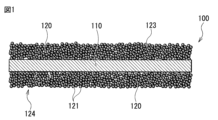
- FIG. 1 is a cross-sectional view illustrating a configuration of a positive electrode for a secondary battery according to an embodiment of the present technology.
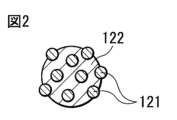
- 2 is an enlarged cross-sectional view showing a configuration of a part of the positive electrode for a secondary battery shown in FIG. 1.
- FIG. 2 is a schematic diagram showing an electron microscope photograph of a cross section of the positive electrode for a secondary battery shown in FIG. 1 .
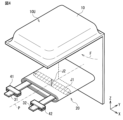
- 1 is a perspective view illustrating a configuration of a secondary battery according to an embodiment of the present technology.
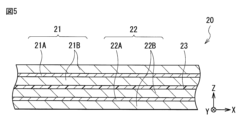
- 5 is a cross-sectional view illustrating the configuration of the battery element illustrated in FIG. 4.
- FIG. 2 is a cross-sectional view showing the configuration of a test secondary battery.
- Positive electrode for secondary battery 1-1 Configuration 1-2. Operation 1-3. Manufacturing method 1-4. Action and effect 2. Secondary battery 2-1. Configuration 2-2. Operation 2-3. Manufacturing method 2-4. Action and effect 3. Modification 4. Uses of secondary battery
- Positive electrode for secondary batteries First, a positive electrode for a secondary battery (hereinafter simply referred to as a "positive electrode") according to an embodiment of the present technology will be described.
- the positive electrode described here is used in a secondary battery, which is an electrochemical device.
- the positive electrode may also be used in electrochemical devices other than secondary batteries. Examples of other electrochemical devices include primary batteries and capacitors.
- This positive electrode operates by utilizing the electrochemical reaction of a sulfur-containing material in an electrochemical device.
- the sulfur-containing material is electrochemically oxidized during discharge and electrochemically reduced during charge. Details of the sulfur-containing material will be described later.
- Fig. 1 shows a cross-sectional structure of a positive electrode 100, which is an example of a positive electrode.
- Fig. 2 shows an enlarged cross-sectional structure of a portion of the positive electrode 100 shown in Fig. 1.
- Fig. 3 shows a schematic electron microscope photograph 200 of a cross section of the positive electrode 100 shown in Fig. 1.
- the positive electrode 100 includes a positive electrode current collector 110 and a positive electrode active material layer 120.
- the positive electrode current collector 110 is a conductive support member that supports the positive electrode active material layer 120, and has a pair of surfaces (upper and lower surfaces) on which the positive electrode active material layer 120 is provided.
- the positive electrode current collector 110 contains one or more types of conductive materials such as metal materials, and specific examples of the conductive materials include titanium, aluminum, titanium alloys, and aluminum alloys.
- the positive electrode active material layer 120 is a site (layer) where the sulfur-containing material undergoes an electrochemical reaction, and is supported by the positive electrode current collector 110.
- the positive electrode active material layer 120 includes a positive electrode active material including a sulfur-containing material, and a support that holds the positive electrode active material.
- the positive electrode active material layer 120 may further include one or more of other materials such as a positive electrode binder and a positive electrode conductor.
- the positive electrode active material layer 120 is provided on both sides (upper and lower) of the positive electrode collector 110.
- the positive electrode active material layer 120 may be provided on only one side (upper or lower) of the positive electrode collector 110.
- the positive electrode active material layer 120 contains two types of particles, as shown in Figures 1 and 2.
- the first type of particles are the retaining particles 121 that form the retainer (porous structure 124 described below), and the second type of particles are the positive electrode active material particles 122 that are particulate positive electrode active material.
- the retaining particles 121 contain anatase type titanium oxide (TiO 2 ). That is, the titanium oxide contained in the retaining particles 121 has an anatase type crystal structure.
- the retaining particles 121 described here are not secondary particles that are an aggregate of a plurality of primary particles, but are primary particles.
- anatase-type titanium oxide contains one or more of the compounds represented by formula (1).
- the anatase type titanium oxide may contain one or more of the dopants.
- the dopant is an element that is doped into the anatase type titanium oxide, and the type of the dopant is not particularly limited as long as it is an element that can be doped into the anatase type titanium oxide.
- the type of dopant can be appropriately selected for the purpose of improving the conductivity of the porous structure 124 that is the support and promoting the formation of the porous structure 124.
- Specific examples of dopants include Nb, Ta, Fe, Zr, La, As, P, and B.
- anatase type titanium oxide that does not contain a dopant is preferable to anatase type titanium oxide that contains a dopant.
- the reason why the retaining particles 121 contain anatase-type titanium oxide is that the electrochemical reaction of the multiple positive electrode active material particles 122 (sulfur-containing material) in the positive electrode active material layer 120 is more likely to proceed stably than when the retaining particles 121 contain rutile-type or brookite-type titanium oxide.
- anatase titanium oxide has the property of more easily promoting the electrochemical reaction of sulfur-containing materials than rutile or brookite titanium oxide.
- the retaining particles 121 containing anatase titanium oxide tend to stably promote the electrochemical reaction of sulfur-containing materials compared to the retaining particles 121 containing rutile or brookite titanium oxide.
- the positive electrode active material layer 120 includes a porous structure 124 in which multiple retaining particles 121, which are multiple primary particles, are directly bonded to each other, and the porous structure 124 has multiple gaps (pores 123).
- the positive electrode active material layer 120 includes a sintered body of a plurality of retaining particles 121 formed using a firing method, and the sintered body is the retaining body (porous structure 124) described above.
- the plurality of retaining particles 121 are directly bonded to each other inside the positive electrode active material layer 120. Details of the method of forming the positive electrode active material layer 120 using this firing method will be described later.
- the porous structure 124 is a sintered body of a plurality of retained particles 121. That is, the plurality of retained particles 121 are not indirectly bonded to each other via a binder to form the porous structure 124, but are directly bonded to each other without the binder. Also, the plurality of retained particles 121 are not electrically connected to each other via the conductive agent due to being indirectly bonded to each other via the conductive agent to form the porous structure 124, but are electrically connected to each other without the conductive agent due to being directly bonded to each other without the conductive agent.
- the positive electrode active material layer 120 contains the porous structure 124 which is a sintered body of the multiple retention particles 121 is that the multiple retention particles 121 are physically and electrically connected to each other. This increases the energy density per volume of the positive electrode active material layer 120 and improves the electronic conductivity between the multiple retention particles 121. Therefore, the electrical resistance is reduced while the energy density is guaranteed in the positive electrode 100, and a high discharge capacity can be obtained in a secondary battery using the positive electrode 100.
- This porous structure 124 is directly connected to the positive electrode current collector 110. As a result, not only are the multiple retaining particles 121 directly bonded to one another to form the porous structure 124, but some of the multiple retaining particles 121 that form the porous structure 124 are directly connected to the positive electrode current collector 110.
- This "directly connected to each other” means that some of the multiple retaining particles 121 are not indirectly connected to the positive electrode collector 110 via a binder or conductive agent, but rather some of the multiple retaining particles 121 are directly connected to the positive electrode collector 110 without a binder or conductive agent.
- the multiple retention particles 121 are directly bonded to each other as shown in FIG. 1 to form a porous structure 124 that serves as the skeleton of the positive electrode active material layer 120.
- the retention particles 121 hold multiple positive electrode active material particles 122 as shown in FIG. 2. That is, each of the multiple retention particles 121 holds multiple positive electrode active material particles 122. Note that in FIG. 2, only one retention particle 121 is shown to simplify the illustration.
- the average particle size AS of the multiple retaining particles 121 forming the porous structure 124 is sufficiently small, specifically, 100 nm or less.
- the retaining particles 121 are so-called nanoparticles. This is because the energy density per weight of the positive electrode active material layer 120 is improved and migration paths (multiple pores 123) for the sulfur-containing material are easily formed inside the positive electrode active material layer 120. This promotes the electrochemical reaction of the multiple positive electrode active material particles 122 (sulfur-containing material) on the surface of the retaining particles 121, making it easier for the electrochemical reaction to proceed stably. Therefore, the battery capacity of a secondary battery using the positive electrode 100 is increased.
- the average particle size AS is preferably 30 nm or less. This is because the electrochemical reaction of the multiple positive electrode active material particles 122 (sulfur-containing material) on the surface of the retaining particle 121 is further promoted. In addition, this is because the energy density per weight of the positive electrode active material layer 120 is further improved, and multiple pores 123 are more easily formed inside the positive electrode active material layer 120.
- the lower limit of the average particle size AS is not particularly limited. Specifically, the average particle size AS is preferably 7 nm or more. This is because it makes it easier for multiple retained particles 121 to be stably formed.
- the procedure for calculating the average particle size AS is as follows. To calculate this average particle size AS, an electron microscope photograph 200 is used.
- the positive electrode 100 is cut in the thickness direction (the vertical direction in FIG. 1) to expose the cross section of the positive electrode 100.
- the positive electrode 100 is cut using a cutting device such as an ion milling device to expose the cross section of the positive electrode active material layer 120.
- a cutting device such as an ion milling device to expose the cross section of the positive electrode active material layer 120.
- the ion milling device that can be used is an ion milling device such as the ArBlade (registered trademark) 5000 manufactured by Hitachi High-Tech Corporation.
- an electron microscope is used to observe the cross section of the positive electrode active material layer 120 to obtain an electron microscope photograph 200.
- the type of electron microscope is not particularly limited, but specifically, it is one or more of a scanning electron microscope (SEM) and a transmission electron microscope (TEM).
- SEM scanning electron microscope
- TEM transmission electron microscope
- the observation conditions are not particularly limited, but specifically, the acceleration voltage is 5.0 kV and the magnification is 150,000 times.
- the multiple retaining particles 121 are directly bonded to each other, and thus a porous structure 124 having multiple pores 123 is observed.
- the planar shape of each of the multiple retaining particles 121 is rectangular, and the multiple positive electrode active material particles 122 are not shown.
- 50 retained particles 121 are arbitrarily selected from the plurality of retained particles 121 visible in the electron microscope photograph 200, and the particle size S (maximum outer diameter) of each of the 50 retained particles 121 is measured. This provides the particle size S of the 50 particles.
- the retained particle 121 that is closest to the front is selected from among the multiple overlapping retained particles 121.
- a retained particle 121 (121Y) whose outer edge is not entirely visible because it overlaps with one or more other retained particles 121 is not selected.
- a retained particle 121 (121X) whose outer edge is entirely visible because it does not overlap with one or more other retained particles 121 is selected.
- some of the retained particles 121X to be selected are shaded.
- the average particle size S of the 50 particles is calculated and this average is set as the average particle size AS.
- the series of configuration conditions include the volume density (g/cm 3 ), the specific surface area (m 2 /g), and the porosity (%).
- the plurality of positive electrode active material particles 122 are held by the plurality of holding particles 121, respectively.
- the plurality of positive electrode active material particles 122 are adsorbed to the surfaces of the plurality of holding particles 121, respectively. Note that the plurality of positive electrode active material particles 122 are not shown in FIG. 1.
- the reason why the multiple positive electrode active material particles 122 are held by the multiple holding particles 121 is that the electrochemical reaction of the multiple positive electrode active material particles 122 on the surface of the holding particles 121 tends to proceed sufficiently and stably. As a result, a secondary battery using the positive electrode 100 can stably obtain a sufficient battery capacity.
- the positive electrode active material particles 122 contain one or more of the sulfur-containing materials.
- the sulfur-containing material is a general term for materials that contain sulfur as a constituent element.
- the sulfur-containing material may be elemental sulfur (hereinafter referred to as "elemental sulfur"), an alloy of sulfur, a compound of sulfur, a mixture of two or more of these, or a material that contains one or more of these phases.
- the "element” described here refers to a general element, and the element may contain a small amount of impurities. In other words, the purity of the element is not necessarily limited to 100%.
- the sulfur compound may contain a salt.
- This salt contains an anion containing sulfur as a constituent element (hereinafter referred to as a "sulfur-containing anion") and an arbitrary cation.
- the type of cation is not particularly limited, but among them, a cation that promotes an electrochemical reaction in a secondary battery using the positive electrode 100 is preferable. This is because the energy density is improved.
- the cations are cations of light metals such as alkali metals and alkaline earth metals.
- alkali metals include lithium, sodium, and potassium
- alkaline earth metals include beryllium, magnesium, and calcium.
- sulfur-containing materials include elemental sulfur, alkali metal sulfides, alkaline earth metal sulfides, alkali metal polysulfides, and alkaline earth metal polysulfides.
- the sulfur-containing material preferably contains an alkali metal polysulfide, and more preferably contains lithium polysulfide. This is because the electrochemical reaction of the multiple positive electrode active material particles 122 can proceed more easily.
- a specific example of lithium polysulfide is lithium sulfide (Li2S8).
- n and x are not particularly limited. Specifically, n preferably satisfies 2 ⁇ n ⁇ 20, and more preferably satisfies 2 ⁇ n ⁇ 12. x preferably satisfies 0 ⁇ x ⁇ 2, and more preferably is 2.
- the positive electrode binder contains one or more of synthetic rubbers and polymeric compounds, etc.
- synthetic rubbers include styrene-butadiene rubbers
- polymeric compounds include polyethylene glycol, polyvinylidene fluoride, and polyimide.
- the positive electrode conductive agent contains one or more conductive materials such as a carbon material, a metal material, and a conductive polymer compound.
- conductive materials such as a carbon material, a metal material, and a conductive polymer compound.
- Specific examples of the carbon material include graphite, carbon black, acetylene black, and ketjen black.
- the cathode 100 operates as follows.
- the cathode active material layer 120 electrochemically reduces the cathode active material particles 122 (sulfur-containing material) on the surfaces of the retaining particles 121.
- the sulfur-containing material contains a highly soluble sulfur-containing anion
- a salt containing the sulfur-containing anion may be dissolved from the retaining particles 121 into the electrolyte.
- the cathode active material particles 122 are electrochemically oxidized on the surfaces of the retaining particles 121 in the cathode active material layer 120.
- the sulfur-containing material contains a sulfur-containing anion having high solubility
- the salt containing the sulfur-containing anion contained in the electrolyte is electrochemically oxidized, and the salt may precipitate on the surfaces of the retaining particles 121, resulting in the formation of some or all of the cathode active material particles 122.
- n/ 8S8 + xe- Snx -... (2) (where n satisfies 2 ⁇ n ⁇ 20, and x satisfies 0 ⁇ x ⁇ 2.)
- elemental sulfur is reduced to polysulfide ions during discharge, and is oxidized to elemental sulfur during charge.
- the positive electrode active material particles 122 are reduced, so elemental sulfur becomes a salt containing polysulfide ions, and some or all of the salt may be dissolved by the electrolyte.
- the salt containing polysulfide ions which is the positive electrode active material particles 122, may be oxidized, or the salt containing polysulfide ions dissolved in the electrolyte may be oxidized, so some or all of the multiple positive electrode active material particles 122 may be formed.
- the positive electrode 100 is manufactured by the procedure of one example of which is described below.
- a paste is obtained by mixing a plurality of retaining particles 121 (anatase-type titanium oxide), a positive electrode binder, and a solvent.
- a plurality of retaining particles 121 with an average particle size AS of 100 nm or less are used.
- the type of solvent is not particularly limited, but specifically, it is an aqueous solvent such as water, and a paste using an aqueous solvent as the solvent is a so-called aqueous paste.
- the composition (mixing ratio) of the paste can be set arbitrarily.
- the paste is applied to both sides of the positive electrode collector 110 to form a coating film, and then the positive electrode collector 110 with the coating film formed thereon is pressed.
- the pressing conditions can be set arbitrarily. As a result, the coating film is pressed onto both sides of the positive electrode collector 110.
- the positive electrode current collector 110 on which the coating film is formed is fired in the atmosphere.
- the firing conditions such as the firing temperature and firing time, can be set as desired. In this case, the firing conditions are adjusted so that the multiple retaining particles 121 containing anatase-type titanium oxide are directly bonded to each other while maintaining their primary particle state.
- the maximum temperature during firing is 500°C to 1200°C.
- the environmental conditions during firing are not particularly limited, so the firing process may be performed in an oxygen atmosphere.
- the positive electrode binder is degreased as it is fired.
- the multiple retaining particles 121 are directly bonded to each other, forming a porous structure 124 having multiple pores 123.
- part of the porous structure 124 i.e., part of the multiple retaining particles 121, is directly connected to the positive electrode current collector 110.
- the sulfur-containing material is added to the solvent, and the solvent is stirred to prepare a sulfur-containing solution.
- the type of solvent is not particularly limited, but specifically, it is an organic solvent, etc.
- the positive electrode collector 110 with the porous structure 124 formed therein is immersed in a sulfur-containing solution, and then the positive electrode collector 110 with the porous structure 124 formed therein is removed from the sulfur-containing solution and dried.
- the immersion conditions such as the immersion time, can be set arbitrarily.
- the multiple positive electrode active material particles 122 are held by each of the multiple holding particles 121.
- a positive electrode active material layer 120 is formed that includes a plurality of retaining particles 121 (porous structure 124) and a plurality of positive electrode active material particles 122, completing the positive electrode 100.
- the positive electrode 100 When making the positive electrode 100, a method other than the method of baking a coating film containing the positive electrode binder described above may be used. If it is possible to form the porous structure 124 using a baking process, the procedure for making the positive electrode 100 can be changed as appropriate.
- the plurality of retaining particles 121 may be press-molded without using a positive electrode binder, and then the plurality of retaining particles 121 may be fired.
- a dispersion liquid in which the plurality of retaining particles 121 are dispersed may be applied to both sides of the positive electrode current collector 110, and the dispersion liquid may be dried, and then the positive electrode current collector 110 to which the dispersion liquid has been applied may be fired.
- the positive electrode 100 includes a positive electrode current collector 110 and a positive electrode active material layer 120, and the positive electrode active material layer 120 includes a plurality of retention particles 121 (anatase type titanium oxide) and a plurality of positive electrode active material particles 122 (sulfur-containing material).
- the positive electrode active material layer 120 includes a porous structure 124, and the porous structure 124 is formed by directly bonding the plurality of retention particles 121 to each other, and is directly connected to the positive electrode current collector 110.
- the plurality of positive electrode active material particles 122 are held by the plurality of retention particles 121, respectively, and the average particle size AS of the plurality of retention particles 121 is 100 nm or less.
- the positive electrode active material layer 120 contains a porous structure 124 that is a sintered body of a plurality of retaining particles 121, the plurality of retaining particles 121 are physically and electrically connected to each other. In this case, the energy density of the positive electrode active material layer 120 increases, and the electronic conductivity between the plurality of retaining particles 121 improves. This reduces the electrical resistance while maintaining the energy density.
- the retaining particles 121 contain anatase-type titanium oxide, the electrochemical reaction of the multiple positive electrode active material particles 122 (sulfur-containing material) in the positive electrode active material layer 120 tends to proceed stably.
- the average particle size AS of the multiple retaining particles 121 is 100 nm or less, the energy density per weight of the positive electrode active material layer 120 is improved, and migration paths (multiple pores 123) for the sulfur-containing material are easily formed inside the positive electrode active material layer 120.
- the electrochemical reaction of the sulfur-containing material in the positive electrode 100 is facilitated.
- the positive electrode 100 containing the porous structure 124 can be easily manufactured using existing firing methods. As a result, it becomes easier to stably obtain sufficient discharge capacity during charging and discharging, and a secondary battery with excellent battery characteristics can be realized using the positive electrode 100.
- the sulfur-containing material moves more easily inside the positive electrode active material layer 120, the energy density per weight of the positive electrode active material layer 120 is improved, and migration paths (multiple pores 123) for the sulfur-containing material are more easily formed inside the positive electrode active material layer 120, resulting in greater effects.
- the sulfur-containing material contains an alkali metal polysulfide
- the electrochemical reaction of the sulfur-containing material will proceed more easily, and a greater effect will be obtained.
- the alkali metal polysulfide contains lithium polysulfide
- the electrochemical reaction of the multiple positive electrode active material particles 122 will proceed more easily, and an even greater effect will be obtained.
- the secondary battery described here is a secondary battery that obtains battery capacity by utilizing the electrochemical reaction of electrode reactants, and is equipped with a positive electrode, a negative electrode, and an electrolyte.
- the negative electrode active material is a material capable of electrochemically reacting with cations capable of forming salts with sulfur-containing anions.
- the cations are ions of light metals such as alkali metals and alkaline earth metals.
- alkali metals include lithium, sodium, and potassium
- alkaline earth metals include beryllium, magnesium, and calcium.
- the negative electrode active material contains one or both of an alkali metal material and an alkaline earth metal material.
- An alkali metal material is a material that contains an alkali metal element as a constituent element
- an alkaline earth metal material is a material that contains an alkaline earth metal element as a constituent element.
- the type of each of the alkali metal element and the alkaline earth metal material may be only one type, or two or more types.
- each of the alkali metal material and the alkaline earth metal material may be a simple substance, an alloy, or a compound, or two or more types of these. The meaning of a simple substance is as described above.
- a secondary battery that obtains capacity by utilizing the absorption and release of lithium in the negative electrode is known as a lithium-sulfur secondary battery.
- Fig. 4 shows a perspective configuration of a secondary battery
- Fig. 5 shows a cross-sectional configuration of the battery element 20 shown in Fig. 4.
- Fig. 4 shows a state in which the exterior film 10 and the battery element 20 are separated from each other, and shows a cross section of the battery element 20 along the XZ plane by a dashed line.
- this secondary battery includes an exterior film 10, a battery element 20, a positive electrode lead 31, a negative electrode lead 32, and sealing films 41 and 42.
- the secondary battery described here is a so-called laminate film type secondary battery, since, as described above, a flexible exterior film 10 is used as the exterior member for housing the battery element 20.
- the exterior film 10 has a bag-like structure that is sealed when the battery element 20 is housed therein. As a result, the exterior film 10 houses a positive electrode 21, a negative electrode 22, a separator 23, and an electrolyte solution, which will be described later.
- the exterior film 10 is a single film-like member that is folded in the folding direction F.
- This exterior film 10 is provided with a recessed portion 10U (a so-called deep drawn portion) for accommodating the battery element 20.
- the exterior film 10 is a three-layer laminate film in which a fusion layer, a metal layer, and a surface protection layer are laminated in this order from the inside, and when the exterior film 10 is folded, the outer peripheral edges of the opposing fusion layers are fused to each other.
- the fusion layer contains a polymer compound such as polypropylene.
- the metal layer contains a metallic material such as aluminum.
- the surface protection layer contains a polymer compound such as nylon.
- the configuration (number of layers) of the exterior film 10 is not particularly limited, so it may be one or two layers, or four or more layers.
- the battery element 20 is housed in an exterior film 10.
- the battery element 20 is a so-called power generating element, and includes a positive electrode 21, a negative electrode 22, a separator 23, and an electrolyte (not shown), as shown in Figures 4 and 5 .
- the battery element 20 is a so-called wound electrode body. That is, the positive electrode 21 and the negative electrode 22 are wound around the winding axis P while facing each other via the separator 23. As is clear from FIG. 4, this winding axis P is a virtual axis extending in the Y-axis direction.
- the three-dimensional shape of the battery element 20 is not particularly limited.
- the battery element 20 has a flat three-dimensional shape, so that the shape of the cross section (cross section along the XZ plane) of the battery element 20 intersecting the winding axis P is a flat shape defined by the major axis J1 and the minor axis J2.
- the long axis J1 is an imaginary axis extending in the X-axis direction and has a length greater than that of the short axis J2.
- the short axis J2 is an imaginary axis extending in the Z-axis direction intersecting the X-axis direction and has a length less than that of the long axis J1.
- the three-dimensional shape of the battery element 20 is a flattened cylinder, and therefore the cross-sectional shape of the battery element 20 is a flattened, approximately elliptical shape.
- the positive electrode 21 has a configuration similar to that of the positive electrode 100. That is, the positive electrode 21 includes a positive electrode current collector 21A and a positive electrode active material layer 21B as shown in Fig. 5. The configurations of the positive electrode current collector 21A and the positive electrode active material layer 21B are similar to the configurations of the positive electrode current collector 110 and the positive electrode active material layer 120, respectively.
- the negative electrode 22 includes a negative electrode current collector 22A and a negative electrode active material layer 22B.
- the negative electrode current collector 22A has a pair of surfaces on which the negative electrode active material layer 22B is provided.
- This negative electrode current collector 22A contains a conductive material such as a metal material, and a specific example of the conductive material is copper.
- the negative electrode active material layer 22B contains one or more types of negative electrode active materials capable of absorbing and releasing lithium. However, the negative electrode active material layer 22B may further contain one or more types of other materials such as a negative electrode binder and a negative electrode conductor.
- the method of forming the negative electrode active material layer 22B is not particularly limited, but specifically includes one or more types of a coating method, a gas phase method, a liquid phase method, a thermal spraying method, and a firing method (sintering method).
- the negative electrode active material layer 22B is provided on both sides of the negative electrode collector 22A.
- the negative electrode active material layer 22B may be provided on only one side of the negative electrode collector 22A on the side where the negative electrode 22 faces the positive electrode 21.
- the type of negative electrode active material is not particularly limited, but specific examples include carbon materials, metal-based materials, and metallic lithium (so-called lithium element). This is because a high energy density can be obtained.
- the meaning of element is as described above.
- the type of carbon material is not particularly limited, but specific examples include non-graphitizable carbon, graphitizable carbon, graphite (natural graphite and artificial graphite), pyrolytic carbons, cokes, glassy carbons, fired organic polymer compounds, carbon fiber, and activated carbon. These cokes include pitch coke, needle coke, and petroleum coke.
- Fired organic polymer compounds are materials in which polymer compounds such as phenolic resins and furan resins are fired at an appropriate temperature to carbonize the polymer compounds. However, some fired organic polymer compounds may be classified as non-graphitizable carbon or fired organic polymer carbon.
- Carbon materials are preferred because they undergo very little change in crystal structure during charging and discharging, resulting in high charge and discharge capacity, and also because they provide good cycle characteristics.
- Graphite is particularly preferred because it has a large electrochemical equivalent and a high energy density.
- Non-graphitizable carbon is also preferred because it provides excellent cycle characteristics.
- carbon materials with a low charge and discharge potential more specifically carbon materials with a charge and discharge potential close to that of lithium metal, are preferred because they allow secondary batteries to easily achieve high energy density.
- Metal-based materials are materials that contain, as constituent elements, one or more of the metal elements and metalloid elements that can form an alloy with lithium.
- Specific examples of the metal elements and metalloid elements include magnesium, boron, aluminum, titanium, gallium, indium, silicon, germanium, tin, lead, bismuth, cadmium, silver, zinc, hafnium, zirconium, yttrium, palladium, and platinum.
- This metallic material may be crystalline or amorphous. More specifically, the metallic material may be a simple substance, an alloy, a compound, a mixture of two or more of these, or a material containing two or more of these phases. The meaning of simple substance is as described above.
- the alloy may be not only a material containing two or more metallic elements as constituent elements, but also a material containing one or more metallic elements and one or more semimetallic elements as constituent elements.
- the alloy may also contain one or more nonmetallic elements as constituent elements.
- the structure of the alloy is not particularly limited, but may be specifically a solid solution, a eutectic (eutectic mixture), an intermetallic compound, or a mixture of two or more of these.
- the metallic material it is preferable for the metallic material to contain a metal element or a metalloid element of Group 4B in the short periodic table as a constituent element, and it is even more preferable for the metallic material to contain one or both of silicon and tin as constituent elements. This is because a sufficiently high energy density can be obtained.
- Silicon alloys contain, other than silicon, one or more of the following as constituent elements: tin, nickel, copper, iron, cobalt, manganese, zinc, indium, silver, titanium, germanium, bismuth, antimony, niobium, molybdenum, aluminum, phosphorus, gallium, and chromium.
- Tin alloys contain, other than tin, one or more of the following as constituent elements: silicon, nickel, copper, iron, cobalt, manganese, zinc, indium, silver, titanium, germanium, bismuth, antimony, niobium, molybdenum, aluminum, phosphorus, gallium, and chromium.
- Each of the silicon compounds and tin compounds contains one or more of oxygen, carbon, etc. as a constituent element. Note that each of the silicon compounds and tin compounds may contain one or more of the elements described for silicon alloys as a constituent element.
- the metallic material contains tin as a constituent element
- the metallic material contains cobalt, tin, and carbon as constituent elements and has low crystallinity or amorphousness. This is because a sufficiently high energy density can be obtained.
- the negative electrode active material may be a metal oxide or a polymeric compound capable of absorbing and releasing lithium.
- the type of metal oxide is not particularly limited, but specific examples include lithium titanium oxide, iron oxide, ruthenium oxide, and molybdenum oxide.
- a specific example of the lithium titanium oxide is lithium titanate ( Li4Ti5O12 ), and specific examples of the polymeric compound are polyacetylene, polyaniline, and polypyrrole.
- the separator 23 is an insulating porous film interposed between the positive electrode 21 and the negative electrode 22, and allows lithium to pass through in an ion state while preventing the occurrence of a short circuit due to contact between the positive electrode 21 and the negative electrode 22.
- the separator 23 contains a polymer compound such as polyethylene.
- the electrolytic solution is a liquid electrolyte, and is impregnated into each of the positive electrode 21, the negative electrode 22, and the separator 23.
- the electrolytic solution contains a solvent and an electrolyte salt.
- the solvent contains one or more types of non-aqueous solvents (organic solvents), and the electrolyte containing the non-aqueous solvent is a so-called non-aqueous electrolyte.
- the non-aqueous solvent is an ester or ether, and more specifically, one or more of the following compounds: a carbonate ester compound, a carboxylate ester compound, and a lactone compound. This is because it improves the dissociation of the electrolyte salt and the mobility of the ions.
- Carbonate compounds include cyclic carbonates and chain carbonates. Specific examples of cyclic carbonates include ethylene carbonate and propylene carbonate, while specific examples of chain carbonates include dimethyl carbonate, diethyl carbonate, and ethyl methyl carbonate.
- Carboxylic acid ester compounds include chain carboxylates.
- chain carboxylates include ethyl acetate, ethyl propionate, propyl propionate, and ethyl trimethylacetate.
- Lactone compounds include lactones. Specific examples of lactones include gamma-butyrolactone and gamma-valerolactone.
- the ethers may be tetrahydrofuran, 1,3-dioxolane, 1,4-dioxane, etc.
- the ethers may be a compound represented by formula (3).
- This compound is a linear ether having an ethyleneoxy structural unit as a repeating unit, and specific examples of this compound include 1,2-dimethoxyethane, diethylene glycol dimethyl ether, and tetraethylene glycol dimethyl ether.
- R1 and R2 are each an alkyl group having 1 to 10 carbon atoms.
- n is an integer of 1 to 10.
- the non-aqueous solvent is one or more of the following: unsaturated cyclic carbonates, fluorinated cyclic carbonates, sulfonates, phosphates, acid anhydrides, nitrile compounds, and isocyanate compounds. This is because the dissociation of the electrolyte salt and the mobility of the ions are improved.
- unsaturated cyclic carbonates include vinylene carbonate, vinylethylene carbonate, and methyleneethylene carbonate.
- fluorinated cyclic carbonates include monofluoroethylene carbonate and difluoroethylene carbonate.
- sulfonic acid esters include propane sultone and propene sultone.
- phosphate esters include trimethyl phosphate and triethyl phosphate.
- acid anhydrides include succinic anhydride, 1,2-ethanedisulfonic anhydride, and 2-sulfobenzoic anhydride.
- nitrile compounds include succinonitrile.
- isocyanate compounds include hexamethylene diisocyanate.
- the electrolyte salt contains one or more types of light metal salts such as lithium salts.
- lithium salts include lithium hexafluorophosphate ( LiPF6 ), lithium tetrafluoroborate ( LiBF4 ), lithium trifluoromethanesulfonate ( LiCF3SO3 ), lithium bis(fluorosulfonyl)imide (LiN( FSO2 ) 2 ), lithium bis(trifluoromethanesulfonyl)imide (LiN( CF3SO2 ) 2 ), lithium tris( trifluoromethanesulfonyl )methide (LiC( CF3SO2 ) 3 ), lithium bis(oxalato)borate (LiB(C2O4)2 ) , lithium monofluorophosphate ( Li2PFO3 ), lithium difluorophosphate ( LiPF2O2 ), and lithium nitrate ( LiNO3 ). This is because a high battery capacity can be obtained.
- LiPF6 lithium hexafluorophosphate
- LiBF4 lithium te
- the amount of electrolyte salt contained is not particularly limited, but is typically 0.3 mol/kg to 3.0 mol/kg relative to the solvent. This is because high ionic conductivity is obtained.
- the positive electrode lead 31 is a positive electrode wiring connected to the positive electrode current collector 21A of the positive electrode 21, and is led out of the exterior film 10.
- the positive electrode lead 31 contains a conductive material such as a metal material, and a specific example of the conductive material is aluminum.
- the shape of the positive electrode lead 31 is either a thin plate shape or a mesh shape.
- the negative electrode lead 32 is a negative electrode wiring connected to the negative electrode 22, and is led out of the exterior film 10.
- the lead-out direction of the negative electrode lead 32 is the same as the lead-out direction of the positive electrode lead 31.
- This negative electrode lead 32 contains a conductive material such as a metal material, and a specific example of the conductive material is copper.
- the details of the shape of the negative electrode lead 32 are the same as the details of the shape of the positive electrode lead 31.
- sealing film 41 is inserted between the exterior film 10 and the positive electrode lead 31.
- sealing film 42 is inserted between the exterior film 10 and the negative electrode lead 32.
- one or both of the sealing films 41 and 42 may be omitted.
- the sealing film 41 is a sealing member that prevents outside air and the like from entering the inside of the exterior film 10.
- This sealing film 41 contains a polymer compound such as polyolefin that has adhesion to the positive electrode lead 31, and a specific example of the polymer compound is polypropylene.
- the configuration of the sealing film 42 is the same as that of the sealing film 41, except that the sealing film 42 is a sealing member that has adhesion to the negative electrode lead 32.
- the sealing film 42 contains a polymer compound such as polyolefin that has adhesion to the negative electrode lead 32.
- This secondary battery operates as follows during charging and discharging.
- lithium When charging, lithium is released from the positive electrode 21 in the battery element 20 and is absorbed in the negative electrode 22 via the electrolyte.
- lithium when discharging, lithium is released from the negative electrode 22 in the battery element 20 and is absorbed in the positive electrode 21 via the electrolyte.
- discharging and charging lithium is absorbed and released in an ionic state.
- the positive electrode 21 is produced by a procedure similar to that for producing the positive electrode 100.
- the positive electrode active material layers 21B are formed on both sides of the positive electrode current collector 21A.
- the negative electrode active material, the negative electrode binder, and the negative electrode conductive agent are mixed together to prepare a negative electrode mixture.
- the negative electrode mixture is put into a solvent to prepare a paste-like negative electrode mixture slurry.
- This solvent may be an aqueous solvent or an organic solvent.
- the negative electrode mixture slurry is applied to both sides of the negative electrode current collector 22A to form the negative electrode active material layer 22B.
- the negative electrode active material layer 22B may be compression molded using a roll press or the like. In this case, the negative electrode active material layer 22B may be heated, or the compression molding may be repeated multiple times. As a result, the negative electrode active material layer 22B is formed on both sides of the negative electrode current collector 22A, and the negative electrode 22 is produced.
- electrolyte solution An electrolyte salt is added to a solvent, whereby the electrolyte salt is dispersed or dissolved in the solvent, and an electrolyte solution is prepared.
- the positive electrode lead 31 is connected to the positive electrode collector 21A of the positive electrode 21 using a joining method such as welding, and the negative electrode lead 32 is connected to the negative electrode collector 22A of the negative electrode 22 using a joining method such as welding.
- the positive electrode 21 and the negative electrode 22 are stacked on top of each other with the separator 23 interposed therebetween, and the positive electrode 21, the negative electrode 22, and the separator 23 are wound to produce a wound body (not shown).
- the wound body is then pressed using a press or the like to form the wound body into a flat shape.
- the wound body after this formation has a configuration similar to that of the battery element 20, except that the positive electrode 21, the negative electrode 22, and the separator 23 are not impregnated with the electrolyte.
- the exterior film 10 adheresive layer/metal layer/surface protection layer
- the exterior film 10 is folded so that the exterior films 10 face each other.
- the outer edges of two of the opposing adhesive layers are joined to each other using an adhesive method such as heat fusion, thereby placing the roll inside the bag-shaped exterior film 10.
- a sealing film 41 is inserted between the exterior film 10 and the positive electrode lead 31, and a sealing film 42 is inserted between the exterior film 10 and the negative electrode lead 32.
- the wound body is impregnated with the electrolyte, forming the battery element 20, which is a wound electrode body.
- the battery element 20 is then sealed inside the bag-shaped exterior film 10, completing the secondary battery.
- the positive electrode 21 has a configuration similar to that of the positive electrode 100. Therefore, for the reasons described above, it becomes easier to stably obtain a sufficient discharge capacity during charging and discharging, and therefore it is possible to obtain excellent battery characteristics.
- the secondary battery is a lithium-sulfur secondary battery, sufficient battery capacity can be stably obtained by utilizing the absorption and release of lithium, resulting in even greater effects.
- the sulfur-containing material includes an alkali metal polysulfide, and the alkali metal polysulfide includes lithium polysulfide.
- the alkali metal polysulfide may include sodium polysulfide.
- a secondary battery that has a positive electrode 21 to which a positive electrode 100 is applied and a negative electrode 22, and obtains capacity by utilizing the absorption and release of sodium in the negative electrode 22, is known as a sodium-sulfur secondary battery.
- the configuration of this sodium-sulfur secondary battery is the same as that of the lithium-sulfur secondary battery described above, except as described below.
- the type of negative electrode active material is not particularly limited, but specific examples include carbon materials and metallic sodium (so-called simple sodium). The meaning of simple sodium is as described above.
- the electrolyte salt of the electrolyte contains one or more types of sodium salts. Specific examples of sodium salts include sodium salts corresponding to the specific examples of lithium salts described above.
- the sulfur-containing material includes an alkali metal polysulfide.
- the sulfur-containing material may include an alkaline earth metal polysulfide, more specifically, may include magnesium polysulfide.
- a secondary battery that has a positive electrode 21 to which a positive electrode 100 is applied and a negative electrode 22, and obtains capacity by utilizing the absorption and release of magnesium in the negative electrode 22, is known as a magnesium-sulfur secondary battery.
- This magnesium-sulfur secondary battery is similar to that of the lithium-sulfur secondary battery described above, except as described below.
- the type of negative electrode active material is not particularly limited, but specifically includes magnesium-based materials.
- This magnesium-based material is a material that contains magnesium as a constituent element, and may be magnesium alone, a magnesium alloy, a magnesium compound, a mixture of two or more of these, or a material containing two or more of these phases.
- the meaning of "single element" is as described above.
- the type of metal element (excluding magnesium) contained as a constituent element in a magnesium alloy is not particularly limited, and can be selected arbitrarily.
- Magnesium compounds contain one or more of non-metallic elements such as carbon, oxygen, sulfur, and halogens as constituent elements, and specific examples of the halogens include fluorine, chlorine, bromine, and iodine.
- the electrolyte salt of the electrolyte solution contains one or more types of magnesium salts.
- the type of magnesium salt is not particularly limited.
- the solvent of the electrolyte solution contains an ether (straight-chain ether) shown in formula (3). This is because the electrolyte salt is more likely to be dissolved stably in the solvent.
- the magnesium salt is a magnesium salt represented by formula (4).
- the magnesium salt is a so-called halogen metal salt.
- halogens include F, Cl, Br, and I.
- X may be an ion other than a halogen ion.
- Specific examples of magnesium salts in which X is an ion other than a halogen ion include magnesium perchlorate (Mg( ClO4 ) 2 ), magnesium nitrate (Mg( NO3 ) 2 ), magnesium sulfate ( MgSO4 ), magnesium acetate (Mg( CH3COO ) 2 ), magnesium trifluoroacetate (Mg( CF3COO ) 2 ), magnesium tetrafluoroborate (Mg( BF4 ) 2 ), magnesium tetraphenylborate (Mg[ B(C6H5 ) 4 ] 2 ), magnesium hexafluorophosphate (Mg( PF6 ) 2 ), magnesium hexafluoroarsenate (Mg( AsF6 ) 2 ), magnesium salt of perfluoroalkylsulfonic acid (Mg( RfSO3 ) 2 ), and
- magnesium salt of hexaalkyldisilazide Mg[N( SiR3 ) 2 ]), Mg[B(OCH( CRff3 ) 2 ) 4 ] 2 , etc., where Rf is a perfluoroalkyl group and R is an alkyl group.
- Rf is a perfluoroalkyl group and R is an alkyl group.
- Each of the 48 Rff's is either H or F, and at least one of the 48 Rff's is F.
- the magnesium salt contains one or both of a halogen-based magnesium salt and an imide-based magnesium salt. This is because the energy density is further improved.
- the magnesium salt may contain only one of a halogen-based magnesium salt and an imide-based magnesium salt, or the magnesium salt may contain both a halogen-based magnesium salt and an imide-based magnesium salt.
- the halogen-based magnesium salt is a magnesium salt in which X is a halogen ion in formula (4).
- Specific examples of the halogen-based magnesium salt include magnesium fluoride ( MgF2 ), magnesium chloride ( MgCl2 ), magnesium bromide ( MgBr2 ), and magnesium iodide ( MgI2 ).
- the halogen-based magnesium salt is preferably magnesium chloride, because a sufficiently high energy density can be obtained.
- the imide-based magnesium salt is a magnesium salt having an imide-type molecular structure, and is preferably a magnesium salt having a sulfonylimide-type molecular structure. This is because a higher energy density can be obtained. In particular, if an imide-based magnesium salt is used in combination with a halogen-based magnesium salt, an even higher energy density can be obtained.
- a specific example of the imide-based magnesium salt is the above-mentioned magnesium salt of perfluoroalkylsulfonylimide.
- the number of carbon atoms in the perfluoroalkyl group (Rf) may be 1 to 10, 1 to 8, 1 to 6, 1 to 4, 1 to 3, or 1 or 2.
- a specific example of the magnesium salt of perfluoroalkylsulfonylimide is magnesium bis(trifluoromethanesulfonyl)imide (Mg(CF 3 SO 2 ) 2 N).
- Mg(CF 3 SO 2 ) 2 N magnesium bis(trifluoromethanesulfonyl)imide and magnesium chloride are used in combination, an even higher energy density can be obtained.
- a porous membrane separator 23 is used.
- a laminated separator including a polymer compound layer may be used instead of the porous membrane separator 23.
- the laminated separator includes a porous membrane having a pair of surfaces, and a polymer compound layer provided on one or both surfaces of the porous membrane. This is because the adhesion of the separator to each of the positive electrode 21 and the negative electrode 22 is improved, thereby suppressing misalignment of the battery element 20, i.e., miswinding of the positive electrode 21, the negative electrode 22, and the separator. This suppresses swelling of the secondary battery even if a decomposition reaction of the electrolyte occurs.
- the polymer compound layer includes a polymer compound such as polyvinylidene fluoride. This is because polymer compounds such as polyvinylidene fluoride have excellent physical strength and are electrochemically stable.
- one or both of the porous film and the polymer compound layer may contain a plurality of insulating particles.
- the plurality of insulating particles dissipate heat when the secondary battery generates heat, improving the safety (heat resistance) of the secondary battery.
- the plurality of insulating particles contain one or more types of insulating materials such as inorganic particles and resin particles.
- the inorganic particles are aluminum oxide, aluminum nitride, boehmite, silicon oxide, titanium oxide, magnesium oxide, zirconium oxide, etc.
- the resin particles are acrylic resin, styrene resin, etc.
- a precursor solution containing a polymer compound and an organic solvent is prepared, and then the precursor solution is applied to one or both sides of a porous film.
- the precursor solution may contain multiple insulating particles.
- the lithium can move in an ionic state between the positive electrode 21 and the negative electrode 22, so the same effect can be obtained.
- the displacement of the battery element 20 is suppressed, thereby further suppressing swelling of the secondary battery, so that a greater effect can be obtained.
- the positive electrode 21 and the negative electrode 22 are stacked on top of each other with the separator 23 and the electrolyte layer in between, and the positive electrode 21, the negative electrode 22, the separator 23, and the electrolyte layer are wound.
- the electrolyte layer is interposed between the positive electrode 21 and the separator 23, and also between the negative electrode 22 and the separator 23.
- the electrolyte layer contains a polymer compound together with an electrolyte solution, and the electrolyte solution is held by the polymer compound. This is because leakage of the electrolyte solution is suppressed.
- the composition of the electrolyte solution is as described above.
- the polymer compound contains polyvinylidene fluoride and the like.
- the lithium can move in an ionic state between the positive electrode 21 and the negative electrode 22 via the electrolyte layer, so the same effect can be obtained.
- leakage of the electrolyte is particularly suppressed as described above, so a greater effect can be obtained.
- the use (application example) of the secondary battery is not particularly limited.
- the secondary battery used as a power source may be a main power source for electronic devices and electric vehicles, or may be an auxiliary power source.
- the main power source is a power source that is used preferentially regardless of the presence or absence of other power sources.
- the auxiliary power source is a power source that is used instead of the main power source, or a power source that is switched from the main power source.
- secondary batteries are as follows: Electronic devices such as video cameras, digital still cameras, mobile phones, laptop computers, headphone stereos, portable radios, and portable information terminals. Storage devices such as backup power sources and memory cards. Power tools such as electric drills and power saws. Battery packs installed in electronic devices. Medical electronic devices such as pacemakers and hearing aids. Electric vehicles such as electric cars (including hybrid cars). Power storage systems such as home or industrial battery systems that store power in preparation for emergencies. In these applications, one secondary battery may be used, or multiple secondary batteries may be used.
- the battery pack may use a single cell or a battery pack.
- the electric vehicle is a vehicle that operates (runs) using a secondary battery as its driving power source, and may be a hybrid vehicle that also has a driving source other than the secondary battery.
- a home power storage system it is possible to use home electrical appliances, etc., by using the power stored in the secondary battery, which is the power storage source.
- the secondary battery may be used for purposes other than the series of uses exemplified here.
- a secondary battery was manufactured according to the procedure described below.
- test secondary battery was fabricated to perform a simple evaluation of the battery characteristics.
- Figure 6 shows the cross-sectional structure of the test secondary battery (a coin-type lithium-sulfur secondary battery).
- this secondary battery includes a test electrode 61, a counter electrode 62, a separator 63, an exterior cup 64, an exterior can 65, a gasket 66, and an electrolyte (not shown).
- the test electrode 61 corresponds to the positive electrode
- the counter electrode 62 corresponds to the negative electrode.
- the test electrode 61 is housed in an exterior cup 64, and the counter electrode 62 is housed in an exterior can 65.
- the test electrode 61 and the counter electrode 62 are stacked together via a separator 63, and the test electrode 61, the counter electrode 62, and the separator 63 are each impregnated with an electrolyte.
- the exterior cup 64 and the exterior can 65 are crimped together via a gasket 66, so that the test electrode 61, the counter electrode 62, and the separator 63 are sealed by the exterior cup 64 and the exterior can 65.
- a firing method was used to prepare the test electrode 61. Specifically, first, a plurality of retaining particles 121 (anatase type titanium oxide (anatase type TiO 2 ) or anatase type titanium oxide doped with 4 mol % of a dopant (boron) relative to titanium (anatase type TiO 2 (boron doped))), a positive electrode binder (polyethylene glycol), and an aqueous solvent (water) were mixed together to obtain an aqueous paste. In this case, the mixing ratio (weight ratio) of the plurality of retaining particles 121:positive electrode binder was 90:10.
- a coating film was formed by applying an aqueous paste to one side of the positive electrode collector 110 (titanium foil with a thickness of 20 ⁇ m).
- a roll press was used to press the positive electrode collector 110 on which the coating film had been formed, thereby pressing the coating film onto the positive electrode collector 110.
- the positive electrode binder was degreased, and the multiple retaining particles 121 were sintered together to form a porous structure 124.
- a sulfur-containing material lithium sulfide ( Li2S8 ) which is a lithium polysulfide
- a solvent (1,2- dimethoxyethane
- the multiple positive electrode active material particles 122 sulfur-containing material
- the test electrode 61 was produced.
- a test electrode 61 was produced in the same manner, except that rutile titanium oxide (rutile TiO 2 ) was used instead of anatase titanium oxide as the material for forming the plurality of holding particles 121 .
- rutile TiO 2 rutile TiO 2
- a test electrode 61 was produced in a similar manner, except that a carbon material (Ketjen black) was used instead of anatase-type titanium oxide as the material for forming the multiple retaining particles 121.
- a coating method was used as a method for producing the test electrode 61. Specifically, a paste-like mixture slurry was prepared by adding a positive electrode active material (carbon material), a positive electrode binder (styrene butadiene rubber), and a dispersant (carboxymethyl cellulose) to a solvent (a mixture of water, which is an aqueous solvent, and ethanol, which is an organic solvent). The mixture slurry was then applied to one side of the positive electrode current collector 110, and the mixture slurry was dried.
- a positive electrode active material carbon material
- a positive electrode binder styrene butadiene rubber
- a dispersant carboxymethyl cellulose
- the "Porous structure” column in Table 1 indicates whether or not the porous structure 124 has been formed. "Formed” means that a sintered body of multiple retained particles 121 was formed, so that the porous structure 124 was formed. “Non-formed” means that a sintered body of multiple retained particles 121 was not formed, so that the porous structure 124 was not formed.
- test electrode 61 was accommodated in the exterior cup 64, and the counter electrode 62 was accommodated in the exterior can 65.
- the test electrode 61 accommodated in the exterior cup 64 and the counter electrode 62 accommodated in the exterior can 65 were stacked on each other through a separator 63 (a glass fiber separator having a thickness of 200 ⁇ m) impregnated with an electrolyte.
- the test electrode 61 was arranged so that the positive electrode active material layer 120 faces the counter electrode 62 through the separator 63.
- the exterior cup 64 and the exterior can 65 were crimped on each other through the gasket 66.
- the test electrode 61 and the counter electrode 62 were enclosed in the exterior cup 64 and the exterior can 65, and thus a secondary battery was completed.
- the secondary battery was disassembled to recover the test electrode 61.
- the average particle size AS (nm) of the multiple retained particles 121 was calculated according to the procedure described above. The calculation results of this average particle size AS are shown in Table 1.
- the current (mA) was measured while sweeping the potential (V) in the range of 1.9 V to 2.8 V at a sweep rate of 0.01 mV / sec, and the correlation between the potential and the current (cyclic voltammogram) was obtained.
- the cyclic voltammogram was then divided into a discharge region (where the current is negative) and a charge region (where the current is positive).
- the discharge capacity was calculated by integrating the current over time in the discharge region, and the charge capacity was calculated by integrating the current over time in the charge region.
- initial efficiency charge capacity (mAh) / discharge capacity (mAh).
- the secondary battery was first disassembled to recover the test electrode 61 and peel the positive electrode current collector 110 from the positive electrode active material layer 120.
- the positive electrode active material layer 120 was put into an organic solvent (1,2-dimethoxyethane), the organic solvent was stirred, and then the organic solvent was filtered.
- the plurality of positive electrode active material particles 122 were dissolved in the organic solvent, and a filtrate, which was an undissolved component, was recovered. This filtrate contained the porous structure 124 (the plurality of retained particles 121).
- the surface area ( m2 ) of the porous structure 124 was measured.
- a fully automatic specific surface area measuring device, Macsorb (registered trademark), manufactured by Mountec Co., Ltd. was used as the surface area measuring device.
- the surface area was measured using the BET method (nitrogen gas).
- the initial efficiency and basic capacity increased more when the average particle size AS was 30 nm or less, more specifically, 7 nm to 30 ⁇ m.
- Example 4 when boron-doped anatase-type titanium oxide was used as the material for the retaining particles 121 (Example 4), the basic capacity was increased while maintaining a significantly high initial efficiency compared to when non-boron-doped anatase-type titanium oxide was used (Example 2).
- the positive electrode active material layer 120 includes a plurality of retaining particles 121 (anatase type titanium oxide) and a plurality of positive electrode active material particles 122 (sulfur-containing material), the positive electrode active material layer 120 includes a porous structure 124, the porous structure 124 is formed by directly bonding the plurality of retaining particles 121 to each other and is directly connected to the positive electrode collector 110, the plurality of positive electrode active material particles 122 are retained by each of the plurality of retaining particles 121, and the average particle size AS of the plurality of retaining particles 121 is 100 nm or less, a high initial efficiency was obtained and a high basic capacity was also obtained. Therefore, since both the initial charge/discharge characteristics and the battery capacity characteristics were improved, excellent battery characteristics could be obtained in the secondary battery.
- the configuration of the secondary battery of the present technology has been described above with reference to one embodiment and examples. However, the configuration of the secondary battery of the present technology is not limited to the configuration described in the embodiment and examples, and can be modified in various ways.
- the battery structure of the secondary battery has been described as being of a laminate film type and a coin type.
- the battery structure of the secondary battery is not particularly limited, and may be of a cylindrical type, a square type, a button type, etc.
- the battery element has been described as having a wound structure.
- the structure of the battery element is not particularly limited, and may be a stacked type or a zigzag type.
- the positive and negative electrodes are stacked on top of each other, and in the zigzag type, the positive and negative electrodes are folded in a zigzag pattern.
- the present technology can also be configured as follows.
- a positive electrode, a negative electrode, and an electrolyte solution are provided,
- the positive electrode is A positive electrode current collector; a positive electrode active material layer supported by the positive electrode current collector,
- the positive electrode active material layer is A plurality of retaining particles including anatase titanium oxide; a plurality of positive electrode active material particles including a sulfur-containing material; the plurality of retaining particles are directly bonded to each other to form a porous structure; the porous structure is directly connected to the positive electrode current collector; the plurality of positive electrode active material particles are held by the plurality of holding particles,
- the average particle size of the plurality of retained particles is 100 nm or less. Secondary battery.
- the average particle size is 30 nm or less.
- the sulfur-containing material includes an alkali metal polysulfide.
- the alkali metal polysulfide includes lithium polysulfide.
- ⁇ 5> It is a lithium-sulfur secondary battery.
Landscapes
- Chemical & Material Sciences (AREA)
- Chemical Kinetics & Catalysis (AREA)
- Electrochemistry (AREA)
- General Chemical & Material Sciences (AREA)
- Inorganic Chemistry (AREA)
- Engineering & Computer Science (AREA)
- Manufacturing & Machinery (AREA)
- Composite Materials (AREA)
- Materials Engineering (AREA)
- Physics & Mathematics (AREA)
- Condensed Matter Physics & Semiconductors (AREA)
- General Physics & Mathematics (AREA)
- Secondary Cells (AREA)
- Battery Electrode And Active Subsutance (AREA)
Priority Applications (3)
| Application Number | Priority Date | Filing Date | Title |
|---|---|---|---|
| CN202380072923.5A CN119998954A (zh) | 2022-12-14 | 2023-09-08 | 二次电池用正极以及二次电池 |
| JP2024564165A JP7827171B2 (ja) | 2022-12-14 | 2023-09-08 | 二次電池用正極および二次電池 |
| US19/084,377 US20250219076A1 (en) | 2022-12-14 | 2025-03-19 | Positive electrode for secondary battery, and secondary battery |
Applications Claiming Priority (2)
| Application Number | Priority Date | Filing Date | Title |
|---|---|---|---|
| JP2022199729 | 2022-12-14 | ||
| JP2022-199729 | 2022-12-14 |
Related Child Applications (1)
| Application Number | Title | Priority Date | Filing Date |
|---|---|---|---|
| US19/084,377 Continuation US20250219076A1 (en) | 2022-12-14 | 2025-03-19 | Positive electrode for secondary battery, and secondary battery |
Publications (1)
| Publication Number | Publication Date |
|---|---|
| WO2024127747A1 true WO2024127747A1 (ja) | 2024-06-20 |
Family
ID=91484747
Family Applications (1)
| Application Number | Title | Priority Date | Filing Date |
|---|---|---|---|
| PCT/JP2023/032773 Ceased WO2024127747A1 (ja) | 2022-12-14 | 2023-09-08 | 二次電池用正極および二次電池 |
Country Status (4)
| Country | Link |
|---|---|
| US (1) | US20250219076A1 (https=) |
| JP (1) | JP7827171B2 (https=) |
| CN (1) | CN119998954A (https=) |
| WO (1) | WO2024127747A1 (https=) |
Citations (4)
| Publication number | Priority date | Publication date | Assignee | Title |
|---|---|---|---|---|
| JP2013503094A (ja) * | 2009-08-28 | 2013-01-31 | 南京工▲業▼大学 | メソ多孔性複合酸化チタン及びその調製方法 |
| CN103840143A (zh) * | 2014-03-19 | 2014-06-04 | 中南大学 | 一种锂硫电池正极用S/TiO2复合材料的制备方法 |
| US20190173080A1 (en) * | 2017-10-27 | 2019-06-06 | Ewha University - Industry Collaboration Foundation | Metal oxide nanosheet-sulfur nanocomposite and lithium-sulfur battery using the same |
| US20200044239A1 (en) * | 2018-07-18 | 2020-02-06 | Daegu Gyeongbuk Institute Of Science And Technology | Porous inorganic insulator-sulfur composite, and lithium-sulfur battery comprising the same |
-
2023
- 2023-09-08 JP JP2024564165A patent/JP7827171B2/ja active Active
- 2023-09-08 WO PCT/JP2023/032773 patent/WO2024127747A1/ja not_active Ceased
- 2023-09-08 CN CN202380072923.5A patent/CN119998954A/zh active Pending
-
2025
- 2025-03-19 US US19/084,377 patent/US20250219076A1/en active Pending
Patent Citations (4)
| Publication number | Priority date | Publication date | Assignee | Title |
|---|---|---|---|---|
| JP2013503094A (ja) * | 2009-08-28 | 2013-01-31 | 南京工▲業▼大学 | メソ多孔性複合酸化チタン及びその調製方法 |
| CN103840143A (zh) * | 2014-03-19 | 2014-06-04 | 中南大学 | 一种锂硫电池正极用S/TiO2复合材料的制备方法 |
| US20190173080A1 (en) * | 2017-10-27 | 2019-06-06 | Ewha University - Industry Collaboration Foundation | Metal oxide nanosheet-sulfur nanocomposite and lithium-sulfur battery using the same |
| US20200044239A1 (en) * | 2018-07-18 | 2020-02-06 | Daegu Gyeongbuk Institute Of Science And Technology | Porous inorganic insulator-sulfur composite, and lithium-sulfur battery comprising the same |
Also Published As
| Publication number | Publication date |
|---|---|
| US20250219076A1 (en) | 2025-07-03 |
| JP7827171B2 (ja) | 2026-03-10 |
| CN119998954A (zh) | 2025-05-13 |
| JPWO2024127747A1 (https=) | 2024-06-20 |
Similar Documents
| Publication | Publication Date | Title |
|---|---|---|
| KR102470110B1 (ko) | 충전식 배터리 셀 | |
| US20220140422A1 (en) | Solid-state battery having a hybrid capacitor material with a metal-organic framework | |
| JP5253905B2 (ja) | 非水電解液および非水電解液二次電池 | |
| CA2616327C (en) | Plastic crystal electrolyte in lithium-based electrochemical devices | |
| KR102097266B1 (ko) | 사이클릭 4급 암모늄 염, 비수성 용매, 비수성 전해질, 및 축전 장치 | |
| US20190363396A1 (en) | Lithium secondary battery | |
| WO2010128584A1 (ja) | 非水溶媒、並びにそれを用いた非水電解液および非水系二次電池 | |
| KR20030079736A (ko) | 전해액용 재료 및 이의 용도 | |
| JP7676564B2 (ja) | 充電式電池セルのためのso2系電解質および充電式電池セル | |
| US20210057721A1 (en) | Lithium ion secondary battery | |
| JPWO2018193683A1 (ja) | 電気化学デバイス用部材及び電気化学デバイス | |
| KR20140008104A (ko) | 마그네슘전지용 유기전해액 및 이를 포함하는 마그네슘전지 | |
| CN114270564A (zh) | 锂二次电池 | |
| JP6730284B2 (ja) | 電極の製造方法及び蓄電デバイスの製造方法 | |
| US12519131B2 (en) | Polymer blend gel electrolytes | |
| JP7835769B2 (ja) | 充電式電池セル | |
| WO2018147404A1 (ja) | 金属空気電池 | |
| KR20230137980A (ko) | 충전식 배터리 셀 | |
| JP7166115B2 (ja) | 二次電池、電池パック、車両及び定置用電源 | |
| JP2019129119A (ja) | イオン伝導性セパレータ及び電気化学デバイス | |
| JP7827171B2 (ja) | 二次電池用正極および二次電池 | |
| JP6470486B2 (ja) | リチウムイオン二次電池、電池パック、電動車両、電力貯蔵システム、電動工具および電子機器 | |
| WO2023249834A1 (en) | Hybrid batteries with ionic conductive electrodes | |
| WO2024116532A1 (ja) | 二次電池用負極および二次電池 | |
| KR20240121862A (ko) | 이차 전지 셀 |
Legal Events
| Date | Code | Title | Description |
|---|---|---|---|
| 121 | Ep: the epo has been informed by wipo that ep was designated in this application |
Ref document number: 23903049 Country of ref document: EP Kind code of ref document: A1 |
|
| WWE | Wipo information: entry into national phase |
Ref document number: 202380072923.5 Country of ref document: CN |
|
| WWP | Wipo information: published in national office |
Ref document number: 202380072923.5 Country of ref document: CN |
|
| WWE | Wipo information: entry into national phase |
Ref document number: 2024564165 Country of ref document: JP |
|
| NENP | Non-entry into the national phase |
Ref country code: DE |
|
| 122 | Ep: pct application non-entry in european phase |
Ref document number: 23903049 Country of ref document: EP Kind code of ref document: A1 |