WO2024106341A1 - 新規微生物、新規微生物の培養物または抽出物、およびエルゴチオネインの生産方法 - Google Patents
新規微生物、新規微生物の培養物または抽出物、およびエルゴチオネインの生産方法 Download PDFInfo
- Publication number
- WO2024106341A1 WO2024106341A1 PCT/JP2023/040594 JP2023040594W WO2024106341A1 WO 2024106341 A1 WO2024106341 A1 WO 2024106341A1 JP 2023040594 W JP2023040594 W JP 2023040594W WO 2024106341 A1 WO2024106341 A1 WO 2024106341A1
- Authority
- WO
- WIPO (PCT)
- Prior art keywords
- strain
- base sequence
- rdna
- region
- nite
- Prior art date
- Legal status (The legal status is an assumption and is not a legal conclusion. Google has not performed a legal analysis and makes no representation as to the accuracy of the status listed.)
- Ceased
Links
Images






Classifications
-
- C—CHEMISTRY; METALLURGY
- C12—BIOCHEMISTRY; BEER; SPIRITS; WINE; VINEGAR; MICROBIOLOGY; ENZYMOLOGY; MUTATION OR GENETIC ENGINEERING
- C12N—MICROORGANISMS OR ENZYMES; COMPOSITIONS THEREOF; PROPAGATING, PRESERVING, OR MAINTAINING MICROORGANISMS; MUTATION OR GENETIC ENGINEERING; CULTURE MEDIA
- C12N1/00—Microorganisms; Compositions thereof; Processes of propagating, maintaining or preserving microorganisms or compositions thereof; Processes of preparing or isolating a composition containing a microorganism; Culture media therefor
- C12N1/14—Fungi; Culture media therefor
- C12N1/16—Yeasts; Culture media therefor
- C12N1/165—Yeast isolates
-
- C—CHEMISTRY; METALLURGY
- C12—BIOCHEMISTRY; BEER; SPIRITS; WINE; VINEGAR; MICROBIOLOGY; ENZYMOLOGY; MUTATION OR GENETIC ENGINEERING
- C12P—FERMENTATION OR ENZYME-USING PROCESSES TO SYNTHESISE A DESIRED CHEMICAL COMPOUND OR COMPOSITION OR TO SEPARATE OPTICAL ISOMERS FROM A RACEMIC MIXTURE
- C12P17/00—Preparation of heterocyclic carbon compounds with only O, N, S, Se or Te as ring hetero atoms
- C12P17/10—Nitrogen as only ring hetero atom
-
- C—CHEMISTRY; METALLURGY
- C12—BIOCHEMISTRY; BEER; SPIRITS; WINE; VINEGAR; MICROBIOLOGY; ENZYMOLOGY; MUTATION OR GENETIC ENGINEERING
- C12N—MICROORGANISMS OR ENZYMES; COMPOSITIONS THEREOF; PROPAGATING, PRESERVING, OR MAINTAINING MICROORGANISMS; MUTATION OR GENETIC ENGINEERING; CULTURE MEDIA
- C12N1/00—Microorganisms; Compositions thereof; Processes of propagating, maintaining or preserving microorganisms or compositions thereof; Processes of preparing or isolating a composition containing a microorganism; Culture media therefor
- C12N1/14—Fungi; Culture media therefor
-
- C—CHEMISTRY; METALLURGY
- C12—BIOCHEMISTRY; BEER; SPIRITS; WINE; VINEGAR; MICROBIOLOGY; ENZYMOLOGY; MUTATION OR GENETIC ENGINEERING
- C12N—MICROORGANISMS OR ENZYMES; COMPOSITIONS THEREOF; PROPAGATING, PRESERVING, OR MAINTAINING MICROORGANISMS; MUTATION OR GENETIC ENGINEERING; CULTURE MEDIA
- C12N1/00—Microorganisms; Compositions thereof; Processes of propagating, maintaining or preserving microorganisms or compositions thereof; Processes of preparing or isolating a composition containing a microorganism; Culture media therefor
- C12N1/14—Fungi; Culture media therefor
- C12N1/145—Fungi isolates
-
- C—CHEMISTRY; METALLURGY
- C12—BIOCHEMISTRY; BEER; SPIRITS; WINE; VINEGAR; MICROBIOLOGY; ENZYMOLOGY; MUTATION OR GENETIC ENGINEERING
- C12N—MICROORGANISMS OR ENZYMES; COMPOSITIONS THEREOF; PROPAGATING, PRESERVING, OR MAINTAINING MICROORGANISMS; MUTATION OR GENETIC ENGINEERING; CULTURE MEDIA
- C12N1/00—Microorganisms; Compositions thereof; Processes of propagating, maintaining or preserving microorganisms or compositions thereof; Processes of preparing or isolating a composition containing a microorganism; Culture media therefor
- C12N1/14—Fungi; Culture media therefor
- C12N1/16—Yeasts; Culture media therefor
-
- C—CHEMISTRY; METALLURGY
- C12—BIOCHEMISTRY; BEER; SPIRITS; WINE; VINEGAR; MICROBIOLOGY; ENZYMOLOGY; MUTATION OR GENETIC ENGINEERING
- C12R—INDEXING SCHEME ASSOCIATED WITH SUBCLASSES C12C - C12Q, RELATING TO MICROORGANISMS
- C12R2001/00—Microorganisms ; Processes using microorganisms
- C12R2001/645—Fungi ; Processes using fungi
Definitions
- the present invention relates to a novel microorganism, a culture or extract of the novel microorganism, and a method for producing ergothioneine.
- Ergothioneine is a type of sulfur-containing amino acid. It has antioxidant properties superior to those of vitamin E, and is attracting attention as a compound with great potential for use in the fields of health and beauty.
- Patent Document 1 and Non-Patent Document 1 describe transformed filamentous fungi with enhanced ergothioneine production ability.
- Non-Patent Document 2 describes a transformed microorganism of the genus Methylobacrium with enhanced ergothioneine production ability.
- Non-Patent Document 2 describes that microorganisms of the genera Aureobasidium and Rhodotorula have ergothioneine production ability.
- Non-Patent Document 3 describes that microorganisms of the genus Pleurotus have the ability to produce ergothioneine.
- Patent Document 2 describes that microorganisms of the genera Methylobactrium and Rhodotorula have the ability to produce ergothioneine.
- Patent Document 3 describes that microorganisms of the genus Moniliella have the ability to produce ergothioneine.
- Patent Document 4 describes that microorganisms of the genera Dirkmeia, Papiliotrema, and Apiotrichum have the ability to produce ergothioneine.
- Ergothioneine is not biosynthesized in the human body, but is known to be biosynthesized by some microorganisms. Therefore, as described in the above-mentioned prior art documents, research and development is being conducted to search for microorganisms that produce ergothioneine, and to modify microorganisms to enhance ergothioneine production.
- the present invention was made in consideration of the above problems, and aims to provide a novel microorganism that produces a high amount of ergothioneine.
- the microorganism according to one embodiment of the present invention is a microorganism belonging to Dirkmeia turashimaensis (Accession No.: NITE BP-03707, Accession No.: NITE BP-03708, Accession No.: NITE BP-03709, Accession No.: NITE BP-03711, or Accession No.: NITE BP-03712), Aureobasidium melanogenum (Accession No.: NITE BP-03706), or a microorganism belonging to a species closely related to Ustilago sporobori-indici (Ustilago sp.) (Accession No.: NITE BP-03710).
- a microorganism capable of producing a high amount of ergothioneine can be provided.
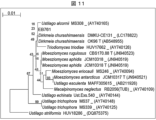
- FIG. 1 shows a simplified molecular phylogenetic tree based on the base sequence of the 26S rDNA D1/D2 region of the EB682 strain.
- FIG. 1 shows a simplified molecular phylogenetic tree based on the base sequence of the ITS region of the rDNA of the EB682 strain.
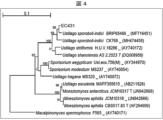
- This shows a simplified molecular phylogenetic tree based on the base sequence of the 26S rDNA D1/D2 region of the EC431 strain.
- FIG. 1 shows a simplified molecular phylogenetic tree based on the base sequence of the ITS region of the rDNA of the EC431 strain.
- FIG. 1 shows a simplified molecular phylogenetic tree based on the base sequence of the 26S rDNA D1/D2 region of the EC171 strain.
- FIG. 1 shows a simplified molecular phylogenetic tree based on the base sequence of the ITS region of the rDNA of the EC171 strain.
- This shows a simplified molecular phylogenetic tree based on the base sequence of the 26S rDNA D1/D2 region of the EC581 strain.
- FIG. 1 shows a simplified molecular phylogenetic tree based on the base sequence of the ITS region of the rDNA of the EC581 strain.
- FIG. 1 shows a simplified molecular phylogenetic tree based on the base sequence of the 26S rDNA D1/D2 region of the EC592 strain.
- FIG. 1 shows a simplified molecular phylogenetic tree based on the base sequence of the ITS region of the rDNA of the EC592 strain.
- This shows a simplified molecular phylogenetic tree based on the base sequence of the 26S rDNA D1/D2 region of the EB761 strain.
- FIG. 1 shows a simplified molecular phylogenetic tree based on the base sequence of the ITS region of the rDNA of the EB761 strain.
- FIG. 1 shows a simplified molecular phylogenetic tree based on the base sequence of the ITS region of the rDNA of the EC021 strain.
- a to B indicating a numerical range means “A or more (including A and greater than A) and B or less (including B and less than B).
- a microorganism according to one embodiment of the present invention is a microorganism belonging to Dirkmeia turashimaensis or Aureobasidium melanogenum having the ability to produce ergothioneine, or a microorganism belonging to the genus Ustilago having the ability to produce ergothioneine.
- the microorganism according to one embodiment of the present invention produces a high amount of ergothioneine.
- Ergothioneine is a type of sulfur-containing amino acid and has excellent antioxidant properties.
- the microorganism according to one embodiment of the present invention since it has not been modified by recombinant gene technology or the like, it can also be used in the food industry.
- Aureobasidium melanogenum EB682 Aureobasidium melanogenum EB682 is a microorganism that was first isolated from hibiscus leaves as an isolation source.
- the nucleotide sequences of the D1/D2 and ITS regions of the 26S rDNA ribosomal RNA gene were determined.
- a BLAST homology search was then performed against the TechnoSuruga Laboratory Microbial Identification System (TechnoSuruga Laboratory, Japan) database DB-FU13.0 and the international nucleotide sequence database (DDBJ/ENA(EMBL)/GenBank).
- DDBJ/ENA(EMBL)/GenBank the international nucleotide sequence database
- Yeast EB682 was deposited at the Patent Microorganisms Depository (NPMD) of the National Institute of Technology and Evaluation (hereinafter abbreviated as "NITE"), Room 122, 2-5-8 Kazusa Kamatari, Kisarazu City, Chiba Prefecture (original deposit date: August 5, 2022, accession number: NITE BP-03706).
- NPMD Patent Microorganisms Depository
- NITE National Institute of Technology and Evaluation
- the yeast EB152 may be cultured in accordance with the general culture method used for microorganisms of the genus Aureobasidium.
- the culture form is batch culture using a liquid medium or fed-batch culture in which a carbon source and/or an organic nitrogen source is continuously added to the culture system, and aeration and stirring are preferable.
- the medium may contain a carbon source, a nitrogen source, or a necessary nutrient source such as inorganic salts that can be assimilated by microorganisms belonging to the genus Aureobasidium.
- the culture pH is preferably 3 to 8
- the culture temperature is preferably 20°C to 30°C
- the culture time is preferably 2 to 14 days.
- Ustilago sp. EC431 Ustilago sp. EC431 (hereinafter sometimes abbreviated as "yeast EC431”) is a microorganism that was first isolated using the rind of the Sudachi fruit as an isolation source.
- the nucleotide sequences of the D1/D2 and ITS regions of the 26S rDNA ribosomal RNA gene were determined.
- a BLAST homology search was then performed against the TechnoSuruga Laboratory Microbial Identification System (TechnoSuruga Laboratory, Japan) database DB-FU13.0 and the international nucleotide sequence database (DDBJ/ENA(EMBL)/GenBank). The results showed that EC431 is closely related to Ustilago sporoboli-indici.
- Yeast EC431 was deposited at the Patent Microorganisms Depository (NPMD) of the National Institute of Technology and Evaluation (hereinafter abbreviated as "NITE"), Room 122, 2-5-8 Kazusa Kamatari, Kisarazu City, Chiba Prefecture (original deposit date: August 5, 2022, accession number: NITE BP-03710).
- NPMD Patent Microorganisms Depository
- NITE National Institute of Technology and Evaluation
- the yeast EC431 may be cultured in accordance with the general culture method used for microorganisms of the genus Ustilago.
- the culture form is batch culture using a liquid medium or fed-batch culture in which a carbon source and/or an organic nitrogen source is continuously added to the culture system, and aeration and stirring are preferable.
- the medium may contain a carbon source, a nitrogen source, or a necessary nutrient source such as inorganic salts that can be assimilated by microorganisms belonging to the genus Ustilago.
- the culture pH is preferably 3 to 8
- the culture temperature is preferably 20°C to 30°C
- the culture time is preferably 2 to 14 days.
- the nucleotide sequences of the D1/D2 and ITS regions of the 26S rDNA ribosomal RNA gene were determined.
- a BLAST homology search was then performed against the TechnoSuruga Laboratory Microbial Identification System (TechnoSuruga Laboratory, Japan) database DB-FU13.0 and the international nucleotide sequence database (DDBJ/ENA(EMBL)/GenBank).
- DDBJ/ENA(EMBL)/GenBank the international nucleotide sequence database
- Yeast EC171 was deposited at the Patent Microorganisms Depository (NPMD) of the National Institute of Technology and Evaluation (hereinafter referred to as "NITE"), Room 122, 2-5-8 Kazusa Kamatari, Kisarazu City, Chiba Prefecture (original deposit date: August 5, 2022, accession number: NITE BP-03709).
- NPMD Patent Microorganisms Depository
- NITE National Institute of Technology and Evaluation
- the yeast EC171 may be cultured in accordance with the general culture method used for microorganisms of the genus Dirkmeia.
- the culture form is batch culture using a liquid medium or fed-batch culture in which a carbon source and/or an organic nitrogen source is continuously added to the culture system, and aeration and stirring are preferable.
- the medium may contain a carbon source, a nitrogen source, or a necessary nutrient source such as inorganic salts that can be assimilated by microorganisms belonging to the genus Dirkmeia.
- the culture pH is preferably 3 to 8
- the culture temperature is preferably 20°C to 30°C
- the culture time is preferably 2 to 14 days.
- Dirkmeia turashimaensis EC581 Dirkmeia churashimaensis EC581 (hereinafter sometimes abbreviated as "yeast EC581”) is a microorganism that was first isolated from kale leaves as an isolation source.
- the nucleotide sequences of the D1/D2 and ITS regions of the 26S rDNA ribosomal RNA gene were determined.
- a BLAST homology search was then performed against the TechnoSuruga Laboratory Microbial Identification System (TechnoSuruga Laboratory, Japan) database DB-FU13.0 and the international nucleotide sequence database (DDBJ/ENA(EMBL)/GenBank).
- DDBJ/ENA(EMBL)/GenBank the international nucleotide sequence database
- Yeast EC581 was deposited at the Patent Microorganism Depository (NPMD) of the National Institute of Technology and Evaluation (hereinafter referred to as "NITE"), Room 122, 2-5-8 Kazusa Kamatari, Kisarazu City, Chiba Prefecture (original deposit date: August 5, 2022, accession number: NITE BP-03711).
- NPMD Patent Microorganism Depository
- NITE National Institute of Technology and Evaluation
- the method for culturing yeast EC581 can be the same as the method for culturing yeast EC171.
- Dirkmeia turashimaensis EC592 Dirkmeia churashimaensis EC592 (hereinafter sometimes abbreviated as "yeast EC592”) is a microorganism that was first isolated from kale leaves as an isolation source.
- the nucleotide sequences of the D1/D2 and ITS regions of the 26S rDNA ribosomal RNA gene were determined.
- a BLAST homology search was then performed against the TechnoSuruga Laboratory Microbial Identification System (TechnoSuruga Laboratory, Japan) database DB-FU13.0 and the international nucleotide sequence database (DDBJ/ENA(EMBL)/GenBank).
- DDBJ/ENA(EMBL)/GenBank the international nucleotide sequence database
- Yeast EC592 was deposited at the Patent Microorganism Depository (NPMD) of the National Institute of Technology and Evaluation (hereinafter referred to as "NITE"), Room 122, 2-5-8 Kazusa Kamatari, Kisarazu City, Chiba Prefecture (original deposit date: August 5, 2022, accession number: NITE BP-03712).
- NPMD Patent Microorganism Depository
- NITE National Institute of Technology and Evaluation
- the method for culturing yeast EC592 can be the same as the method for culturing yeast EC171.
- the nucleotide sequences of the D1/D2 and ITS regions of the 26S rDNA ribosomal RNA gene were determined.
- a BLAST homology search was then performed against the TechnoSuruga Laboratory Microbial Identification System (TechnoSuruga Laboratory, Japan) database DB-FU13.0 and the international nucleotide sequence database (DDBJ/ENA(EMBL)/GenBank).
- DDBJ/ENA(EMBL)/GenBank the international nucleotide sequence database
- Yeast EB761 was deposited at the Patent Microorganism Depository (NPMD) of the National Institute of Technology and Evaluation (hereinafter abbreviated as "NITE"), Room 122, 2-5-8 Kazusa Kamatari, Kisarazu City, Chiba Prefecture (original deposit date: August 5, 2022, accession number: NITE BP-03707).
- NPMD Patent Microorganism Depository
- NITE National Institute of Technology and Evaluation
- the method for culturing yeast EB761 can be the same as the method for culturing yeast EC171.
- the nucleotide sequences of the D1/D2 and ITS regions of the 26S rDNA ribosomal RNA gene were determined.
- a BLAST homology search was then performed against the TechnoSuruga Laboratory Microbial Identification System (TechnoSuruga Laboratory, Japan) database DB-FU13.0 and the international nucleotide sequence database (DDBJ/ENA(EMBL)/GenBank).
- DDBJ/ENA(EMBL)/GenBank the international nucleotide sequence database
- Yeast EC021 was deposited at the Patent Microorganism Depository (NPMD) of the National Institute of Technology and Evaluation (hereinafter referred to as "NITE"), Room 122, 2-5-8 Kazusa Kamatari, Kisarazu City, Chiba Prefecture (original deposit date: August 5, 2022, accession number: NITE BP-03708).
- NPMD Patent Microorganism Depository
- NITE National Institute of Technology and Evaluation
- the method for culturing yeast EC021 can be the same as the method for culturing yeast EC171.
- the culture according to one embodiment of the present invention is a culture of yeast EB682, EC431, EC171, EC581, EC592, EB761, or EC021.
- the culture according to one embodiment of the present invention includes a culture supernatant, a culture precipitate, a medium, a cultured bacterial cell, a cultured bacterial cell disruptant, a cultured bacterial cell treatment product such as a freeze-dried product of the cultured bacterial cell, and the like.
- the culture according to one embodiment of the present invention contains ergothioneine.
- the extract according to one embodiment of the present invention is an extract of yeast EB682, EC431, EC171, EC581, EC592, EB761 or EC021.
- microorganism extract refers to an extract obtained by performing an extraction process on a microorganism, and an extract obtained by performing an extraction process on a culture of a microorganism.
- the extract according to one embodiment of the present invention is obtained, for example, by extracting yeast EB682, EC431, EC171, EC581, EC592, EB761 or EC021, or by extracting a culture of yeast EB682, EC431, EC171, EC581, EC592, EB761 or EC021.
- the extract according to one embodiment of the present invention contains ergothioneine.
- Extraction processes include hot water extraction; solvent extraction using organic solvents, etc.; pressure extraction; chemical extraction using enzymes and surfactants, etc.; ultrasonic extraction; alkaline extraction; acid extraction; extraction using osmotic pressure; extraction by crushing; extraction by grinding; extraction by freezing and thawing; extraction using liquid nitrogen; extraction by high speed stirring; etc.
- Hot water extraction is preferable as the extraction process because it exerts an excellent plant growth effect.
- One type of extraction process may be performed, or two or more types of extraction processes may be performed.
- Hot water extraction involves contacting or immersing the material to be extracted in hot water for a certain period of time.
- the temperature of the water used in hot water extraction is preferably 40°C or higher, and more preferably 60°C or higher.
- the extract according to one embodiment of the present invention may be a hot water extract, a solvent extract using an organic solvent or the like; a pressurized extract; a chemical extract using an enzyme, a surfactant or the like; an ultrasonic extract; an alkaline extract; an acid extract; an extract using osmotic pressure; an extract using crushing; an extract using grinding; an extract using freeze-thawing; an extract using liquid nitrogen; or an extract using high speed stirring; of a microorganism that is yeast EB682, EC431, EC171, EC581, EC592, EB761 or EC021.
- An example of the use of the culture or extract according to one embodiment of the present invention is as a plant growth regulator that contains the culture or extract as an active ingredient.
- a method for producing ergothioneine according to one embodiment of the present invention includes a step of culturing the above-mentioned microorganism to obtain a culture containing ergothioneine.
- one type of microorganism may be cultured, or multiple types of microorganisms may be cultured.
- Ergothioneine can be recovered from a culture containing ergothioneine by, for example, a method for recovering and purifying ergothioneine from a normal microbial culture.
- the culture is centrifuged or the like to recover the bacterial cells.
- the recovered bacterial cells are then subjected to hot water extraction or the like to obtain an extract containing ergothioneine.
- Ergothioneine can then be recovered by purifying the extract.
- the amount of ergothioneine produced by the microorganism can be quantified, for example, by measuring the obtained extract using a high-performance liquid chromatography device and a mass spectrometer such as LCMS.
- a microorganism according to one embodiment of the present invention is a microorganism belonging to Dirkmeia turashimaensis (Accession No.: NITE BP-03707, Accession No.: NITE BP-03708, Accession No.: NITE BP-03709, Accession No.: NITE BP-03711, or Accession No.: NITE BP-03712), Aureobasidium melanogenum (Accession No.: NITE BP-03706), or a microorganism belonging to a species closely related to Ustilago sporobori-indici (Ustilago sp.) (Accession No.: NITE BP-03710).
- the culture according to one embodiment of the present invention is a culture of the above-mentioned microorganism.
- the extract according to one aspect of the present invention is an extract of the above-mentioned microorganism.
- a method for producing ergothioneine according to one embodiment of the present invention includes a step of culturing the above-mentioned microorganism and obtaining a culture containing ergothioneine.
- % refers to % by mass.
- the collected samples were then immersed in 15 mL plastic tubes containing 2 mL of screening medium, and cultured at 200 rpm at 25°C for 3 to 7 days.
- the screening medium used was YM medium containing antibiotics. Specifically, the medium used contained 1% glucose, 0.5% peptone, 0.3% yeast extract, 0.3% malt extract, 0.01% streptomycin sulfate, and 0.005% chloramphenicol.
- the culture fluids of the 126 samples selected in (1) above were diluted 100-fold or 10,000-fold with YM medium.
- the diluted culture fluids were then spread onto YM agar medium and YM agar medium supplemented with 3 mM H2O2 (hereinafter abbreviated as H2O2 - containing YM agar medium), and cultured at 25°C for 2 to 7 days.
- H2O2 - containing YM agar medium 3 mM H2O2
- the bacterial pellet obtained by centrifugation was suspended in 0.1 mL of pure water. The resulting suspension was heated at 96°C for 10 minutes to extract the intracellular components. The extracted intracellular components were then centrifuged to remove the bacterial residue, and an extract was obtained.
- the LCMS analysis was performed using an LCMS-2020 manufactured by Shimadzu Corporation.
- the LC column used was an Asahipak NH2P-40 2D+ guard column manufactured by Shodex.
- a mixture of 10 mM ammonium formate and acetonitrile (10 mM ammonium formate/acetonitrile 30/70 (v/v)) was used as the LC mobile phase.
- the flow rate was 0.1 mL/min, and the analysis was performed at 25°C.
- the culture fluid was appropriately collected on the 3rd to 7th day of cultivation. As in (3) above, the cells were centrifuged and washed, and the extract was then recovered by hot water extraction.
- the obtained extract was analyzed by LCMS in the same manner as in (4) above, and seven strains (EB682, EC431, EC171, EC581, EC592, EB761, and EC021) with high ergothioneine production were selected.
- Extracts of each microorganism were obtained by aerobically culturing each microorganism for 5 days at 25°C in a 5L jar fermenter containing 2L of YM medium, and then extracting the dried cells with hot water after the culture. The amount of EGT (mg/L) in the extract was then measured by LCMS.
- the amount of ergothioneine produced, the production rate, and the amount of EGT in the extract for each strain are shown in Tables 1 and 2.
- the EGT production amount (mg/L-culture medium) in Table 1 is the amount of EGT produced per 1 L of culture medium on the 5th day of cultivation.
- the EGT production rate (mg/L/d) is the amount of EGT produced per day (mg/L).
- the EGT production amount (mg/g-dry cells) in Table 2 is the amount of EGT produced per 1 g of dry cells.
- Tables 3 and 4 show the production amounts and production rates of known microorganisms.
- the EGT production amount of Aspergillus oryzae NSAR1 is the amount of EGT produced per kg of culture liquid
- the EGT production rate is the amount of EGT produced per day (mg/kg).
- - indicates that it has not been measured.
- Aureobasidium melanogenum EB682 was found to produce a higher amount of EGT than Aureobasidium pullulans kz25.
- Ustilago sp. EC431 was found to produce a higher amount of EGT than Ustilago maydis UM521.
- Dirkmeia churashimaensis EC171, Dirkmeia churashimaensis EC581 and Dirkmeia churashimaensis EC592 were found to produce a higher amount of EGT than Dirkmeia churashimaensis S111. It was also confirmed that all of the extracts from the five strains evaluated in Evaluation Example 2 were rich in EGT.
- Table 6 shows the results of a BLAST search for DB-FU, as well as the base sequence analysis data for the D1/D2 region of 26S rDNA that were found to be in the top 30 by homology score. * indicates sequence data used in simple molecular phylogenetic analysis.
- Table 7 shows the results of a BLAST search against the international sequence database, and the sequence analysis data for the D1/D2 region of 26S rDNA that were found to be in the top 30 by homology score. * indicates sequence data used for simple molecular phylogenetic analysis. Aureobasidium pullulans var. melanigenum is thought to correspond to the current name Aureobasidium melanogenum.
- Figure 1 shows a simplified molecular phylogenetic tree based on the base sequence of the D1/D2 region of the 26S rDNA of the EB682 strain.
- the line in the upper left corner indicates the scale bar.
- the numbers at the branches of the phylogenetic branches indicate bootstrap values.
- the "T” at the end of the strain name indicates the type strain for that species, and "NT" indicates a new type strain for that species.
- the base sequence (SEQ ID NO: 2) of the ITS region of the rDNA of the EB682 strain showed 99.8-100% identity with multiple base sequences of Aureobasidium melanogenum, a type of ascomycete yeast (Tables 8 and 9).
- the EB682 strain formed a cluster with multiple base sequences of Aureobasidium melanogenum.
- Table 8 shows the results of a BLAST search for DB-FU, and the base sequence analysis data for the ITS region of rDNA that was found to be in the top 30 by homology score. * indicates sequence data used for simple molecular phylogenetic analysis.
- Table 9 shows the results of a BLAST search against the international sequence database, and the base sequence analysis data for the ITS region of rDNA that was found to be in the top 30 by homology score. * indicates sequence data used in simple molecular phylogenetic analysis. Aureobasidium pullulans var. melanigenum is thought to correspond to the current name Aureobasidium melanogenum.
- Figure 2 shows a simplified molecular phylogenetic tree based on the base sequence of the ITS region of the rDNA of the EB682 strain.
- the line in the upper left corner indicates the scale bar.
- the numbers at the branches of the phylogenetic branches indicate the bootstrap values.
- the "T” at the end of the strain name indicates the type strain of that species, and "NT" indicates a new type strain of that species.
- the EB682 strain was identified as Aureobasidium melanogenum based on the results of base sequence analysis of the D1/D2 region of 26S rDNA and the ITS region of rDNA.
- the morphological properties of EB682 strain were examined by observing the properties and morphology of the colonies. After 2 days of cultivation on YM plate medium, the colonies showed cream to light brown color, moist surfaces, and mycelial properties. On the third day of cultivation, the formation of colorless, thin-walled, broadly elliptical to lemon-shaped yeast-like budding cells was confirmed. In addition, the formation of broadly elliptical to lemon-shaped, one-celled, unformed, smooth budding conidia was observed from short projection-like structures on the vegetative mycelium.
- strain EB682 was determined to be a novel microorganism belonging to Aureobasidium melanogenum.
- the EC431 strain formed a single phylogenetic branch in the phylogenetic group consisting of the genus Ustilago.
- Table 10 shows the results of a BLAST search for DB-FU, and the base sequence analysis data for the D1/D2 region of 26S rDNA that were found to be in the top 30 by homology score. * indicates sequence data used for simple molecular phylogenetic analysis.
- Table 11 shows the results of a BLAST search against the international base sequence database, and the base sequence analysis data for the D1/D2 region of 26S rDNA that were found to be in the top 30 by homology score. * indicates sequence data used for simple molecular phylogenetic analysis.
- Figure 3 shows a simplified molecular phylogenetic tree based on the base sequence of the D1/D2 region of the 26S rDNA of the EC431 strain.
- the line in the upper left corner indicates the scale bar.
- the numbers at the branches of the phylogenetic branches indicate the bootstrap values.
- the "T" at the end of the strain name indicates the type strain of that species.
- the base sequence (SEQ ID NO: 4) of the ITS region of the rDNA of strain EC431 showed 95.5-97.9% identity with multiple base sequences of Ustilago sporoboli-indici, a type of basidiomycete (basidiomycete yeast) (Tables 12 and 13).
- strain EC431 was included in the phylogenetic group composed of the genus Ustilago, and formed a cluster with multiple base sequences of Ustilago sporoboli-indici, supported by a bootstrap value of 99%.
- Table 12 shows the results of a BLAST search for DB-FU, and the base sequence analysis data for the ITS region of rDNA that was found to be in the top 30 by homology score. * indicates sequence data used for simple molecular phylogenetic analysis.
- Table 13 shows the results of a BLAST search against the international base sequence database, and the base sequence analysis data for the ITS region of rDNA that was found to be in the top 30 by homology score. * indicates sequence data used for simple molecular phylogenetic analysis.
- Figure 4 shows a simplified molecular phylogenetic tree based on the base sequence of the ITS region of the rDNA of the EC431 strain.
- the line in the upper left corner indicates the scale bar.
- the numbers at the branches of the phylogenetic branches indicate the bootstrap values.
- the "T" at the end of the strain name indicates the type strain of that species.
- the EC431 strain was identified as a Ustilago sp. closely related to Ustilago sporoboli-indici based on the results of base sequence analysis of the D1/D2 region of 26S rDNA and the ITS region of rDNA.
- the morphological properties of the EC431 strain were examined by observing the properties and morphology of the colonies. After 4 days of cultivation on YM plate medium, the colonies exhibited cream to yellow-orange color, smooth to wrinkled surfaces, and buttery, moist properties. The vegetative cells were elliptical to cylindrical, and it was confirmed that proliferation was by budding from the short stalks at the cell poles. Furthermore, no formation of sexual reproductive organs was observed on plates approximately 3 weeks after the start of cultivation.
- strain EC431 was determined to be a novel microorganism belonging to Ustilago sp., closely related to Ustilago sporoboli-indici.
- Table 14 shows the results of a BLAST search for DB-FU, and the base sequence analysis data for the D1/D2 region of 26S rDNA that were found to be in the top 30 by homology score. * indicates sequence data used for simple molecular phylogenetic analysis.
- Table 15 shows the results of a BLAST search against the international base sequence database, and shows the base sequence analysis data of the D1/D2 region of 26S rDNA that was found to be in the top 30 by homology score. * indicates sequence data used in simple molecular phylogenetic analysis. " a " in Table 15 is not a base sequence derived from the type strain, and was excluded from the analysis because it suggested the possibility of an error in the registered information.
- Figure 5 shows a simplified molecular phylogenetic tree based on the base sequence of the D1/D2 region of the 26S rDNA of the EC171 strain.
- the line in the upper left corner indicates the scale bar.
- the numbers at the branches of the phylogenetic branches indicate the bootstrap values.
- the "T" at the end of the strain name indicates the type strain of that species.
- the base sequence (SEQ ID NO: 6) of the ITS region of the rDNA of the EC171 strain showed 98.4-100% identity with multiple base sequences of Dirkmeia churashimaensis, a type of basidiomycete yeast (Tables 16 and 17).
- the EC171 strain formed a cluster supported by a high bootstrap value of 100% with multiple base sequences of Dirkmeia churashimaensis.
- Table 16 shows the results of a BLAST search for DB-FU, and the base sequence analysis data for the ITS region of rDNA that was found to be in the top 30 by homology score. * indicates sequence data used for simple molecular phylogenetic analysis.
- Table 17 shows the results of a BLAST search against the international base sequence database, and the base sequence analysis data for the ITS region of rDNA that was found to be in the top 30 by homology score. * indicates sequence data used for simple molecular phylogenetic analysis.
- Figure 6 shows a simplified molecular phylogenetic tree based on the base sequence of the ITS region of the rDNA of the EC171 strain.
- the line in the upper left corner indicates the scale bar.
- the numbers at the branches of the phylogenetic branches indicate the bootstrap values.
- the "T" at the end of the strain name indicates the type strain of that species.
- the EC171 strain was identified as Dirkmeia churashimaensis based on the results of base sequence analysis of the D1/D2 region of 26S rDNA and the ITS region of rDNA.
- the morphological properties of the EC171 strain were investigated by observing the properties and morphology of the colonies. After 4 days of cultivation on YM plate medium, the colonies exhibited yellow-orange to cream color, a smooth surface, and a buttery, moist, viscous consistency. The vegetative cells were elliptical to ovoid, and it was confirmed that proliferation was by budding from the short stalks at the cell poles. Furthermore, no formation of sexual reproductive organs was observed on the plates approximately 3 weeks after the start of cultivation.
- strain EC171 was determined to be a novel microorganism belonging to Dirkmeia churashimaensis.
- Table 18 shows the results of a BLAST search for DB-FU, and the base sequence analysis data for the D1/D2 region of 26S rDNA that were found to be in the top 30 by homology score. * indicates sequence data used for simple molecular phylogenetic analysis.
- Table 19 shows the results of a BLAST search against the international base sequence database, and shows the base sequence analysis data of the D1/D2 region of 26S rDNA that was found to be in the top 30 by homology score. * indicates sequence data used in simple molecular phylogenetic analysis. " a " in Table 19 is not a base sequence derived from the type strain, and was excluded from the analysis because it suggested the possibility of an error in the registered information.
- Figure 7 shows a simplified molecular phylogenetic tree based on the base sequence of the D1/D2 region of the 26S rDNA of the EC581 strain.
- the line in the upper left corner indicates the scale bar.
- the numbers at the branches of the phylogenetic branches indicate the bootstrap values.
- the "T" at the end of the strain name indicates the type strain of that species.
- the base sequence (SEQ ID NO: 8) of the ITS region of the rDNA of the EC581 strain showed 98.4-100% identity with multiple base sequences of Dirkmeia churashimaensis, a type of basidiomycete yeast (Tables 20 and 21).
- the EC581 strain formed a cluster supported by a high bootstrap value of 100% with multiple base sequences of Dirkmeia churashimaensis.
- Table 20 shows the results of a BLAST search for DB-FU, and the base sequence analysis data for the ITS region of rDNA that was found to be in the top 30 by homology score. * indicates sequence data used for simple molecular phylogenetic analysis.
- Table 21 shows the results of a BLAST search against the international base sequence database, and the base sequence analysis data for the ITS region of rDNA that was found to be in the top 30 by homology score. * indicates sequence data used for simple molecular phylogenetic analysis.
- Figure 8 shows a simplified molecular phylogenetic tree based on the base sequence of the ITS region of the rDNA of the EC581 strain.
- the line in the upper left corner indicates the scale bar.
- the numbers at the branches of the phylogenetic branches indicate the bootstrap values.
- the "T" at the end of the strain name indicates the type strain of that species.
- the EC581 strain was identified as Dirkmeia churashimaensis based on the base sequence analysis of the D1/D2 region of 26S rDNA and the ITS region of rDNA.
- the morphological properties of the EC581 strain were examined by observing the properties and morphology of the colonies. After 4 days of cultivation on YM plate medium, the colonies exhibited yellow-orange to cream color, a smooth surface, and a buttery, moist, viscous consistency. The vegetative cells were elliptical to ovoid, and it was confirmed that proliferation was due to budding from short stalks at the cell site. Furthermore, no formation of sexual reproductive organs was observed on the plates approximately 3 weeks after the start of cultivation.
- strain EC581 was determined to be a novel microorganism belonging to Dirkmeia churashimaensis.
- Table 22 shows the results of a BLAST search for DB-FU, and the base sequence analysis data for the D1/D2 region of 26S rDNA that were found to be in the top 30 by homology score. * indicates sequence data used for simple molecular phylogenetic analysis.
- Table 23 shows the results of a BLAST search against the international base sequence database, and shows the base sequence analysis data of the D1/D2 region of 26S rDNA that was found to be in the top 30 by homology score. * indicates sequence data used in simple molecular phylogenetic analysis. " a " in Table 23 is not a base sequence derived from the type strain, and was excluded from the analysis because it suggested the possibility of an error in the registered information.
- Figure 9 shows a simplified molecular phylogenetic tree based on the base sequence of the D1/D2 region of the 26S rDNA of the EC592 strain.
- the line in the upper left corner indicates the scale bar.
- the numbers at the branches of the phylogenetic branches indicate the bootstrap values.
- the "T" at the end of the strain name indicates the type strain of that species.
- the base sequence (SEQ ID NO: 10) of the ITS region of the rDNA of the EC592 strain showed 98.4-100% identity with multiple base sequences of Dirkmeia churashimaensis, a type of basidiomycete yeast (Tables 24 and 25).
- the EC592 strain formed a cluster supported by a high bootstrap value of 100% with multiple base sequences of Dirkmeia churashimaensis.
- Table 24 shows the results of a BLAST search for DB-FU, and the base sequence analysis data for the ITS region of rDNA that was found to be in the top 30 by homology score. * indicates sequence data used in simple molecular phylogenetic analysis.
- Table 25 shows the results of a BLAST search against the international base sequence database, and the base sequence analysis data for the ITS region of rDNA that was found to be in the top 30 by homology score. * indicates sequence data used for simple molecular phylogenetic analysis.
- Figure 10 shows a simplified molecular phylogenetic tree based on the base sequence of the ITS region of the rDNA of the EC592 strain.
- the line in the upper left corner indicates the scale bar.
- the numbers at the branches of the phylogenetic branches indicate the bootstrap values.
- the "T" at the end of the strain name indicates the type strain of that species.
- the EC592 strain was identified as Dirkmeia churashimaensis based on the results of base sequence analysis of the D1/D2 region of 26S rDNA and the ITS region of rDNA.
- the morphological properties of the EC592 strain were examined by observing the properties and morphology of the colonies. After 4 days of cultivation on YM plate medium, the colonies exhibited yellow-orange to cream color, a smooth surface, and a buttery, moist, viscous consistency. The vegetative cells were elliptical to ovoid, and it was confirmed that proliferation was by budding from the short stalks at the cell poles. Furthermore, no formation of sexual reproductive organs was observed on the plates approximately 3 weeks after the start of cultivation.
- strain EC592 was determined to be a novel microorganism belonging to Dirkmeia churashimaensis.
- Table 26 shows the results of a BLAST search for DB-FU, and the base sequence analysis data for the D1/D2 region of 26S rDNA that were found to be in the top 30 by homology score. * indicates sequence data used for simple molecular phylogenetic analysis.
- Table 27 shows the results of a BLAST search against the international base sequence database, and shows the base sequence analysis data of the D1/D2 region of 26S rDNA that was found to be in the top 30 by homology score. * indicates sequence data used in simple molecular phylogenetic analysis. " a " in Table 27 is not a base sequence derived from the type strain, and was excluded from the analysis because it suggested the possibility of an error in the registered information.
- Figure 11 shows a simplified molecular phylogenetic tree based on the base sequence of the D1/D2 region of the 26S rDNA of the EB761 strain.
- the line in the upper left corner indicates the scale bar.
- the numbers located at the branches of the phylogenetic branches indicate the bootstrap values.
- the "T" at the end of the strain name indicates the type strain of that species.
- strain EB761 As a result of a BLAST homology search against DB-FU and the international base sequence database using the microbial identification system "ENKI,” the base sequence (SEQ ID NO: 12) of the ITS region of the rDNA of strain EB761 showed 98.3-100% identity with multiple base sequences of Dirkmeia churashimaensis, a type of basidiomycete yeast (Tables 28 and 29).
- Figure 12 analyzed based on the base sequences obtained by the homology search against DB-FU and the international base sequence database, strain EB761 formed a cluster supported by a high bootstrap value of 100% with multiple base sequences of Dirkmeia churashimaensis.
- Table 28 shows the results of a BLAST search for DB-FU, and the base sequence analysis data for the ITS region of rDNA that was found to be in the top 30 by homology score. * indicates sequence data used for simple molecular phylogenetic analysis.
- Table 29 shows the results of a BLAST search against the international base sequence database, and the base sequence analysis data for the ITS region of rDNA that was found to be in the top 30 by homology score. * indicates sequence data used in simple molecular phylogenetic analysis.
- Figure 12 shows a simplified molecular phylogenetic tree based on the base sequence of the ITS region of the rDNA of the EB761 strain.
- the line in the upper left corner indicates the scale bar.
- the numbers at the branches of the phylogenetic branches indicate the bootstrap values.
- the "T" at the end of the strain name indicates the type strain of that species.
- the EB761 strain was identified as Dirkmeia churashimaensis based on the base sequence analysis of the D1/D2 region of 26S rDNA and the ITS region of rDNA.
- the morphological properties of the EB761 strain were examined by observing the properties and morphology of the colonies. After two days of cultivation on YM plate medium, the colonies exhibited yellow-orange to cream color, a smooth, buttery, moist surface. On the third day of cultivation, the vegetative cells were elliptical to ovoid, and it was confirmed that proliferation was due to budding from the short stalks at the cell poles. Furthermore, no formation of sexual reproductive organs was observed on plates approximately five weeks after cultivation began.
- strain EB761 was determined to be a novel microorganism belonging to Dirkmeia churashimaensis.
- Table 30 shows the results of a BLAST search for DB-FU, and the base sequence analysis data for the D1/D2 region of 26S rDNA that were found to be in the top 30 by homology score. * indicates sequence data used for simple molecular phylogenetic analysis.
- Table 31 shows the results of a BLAST search against the international base sequence database, and shows the base sequence analysis data of the D1/D2 region of 26S rDNA that was ranked in the top 30 by homology score. * indicates sequence data used in simple molecular phylogenetic analysis. " a " in Table 31 is not a base sequence derived from the type strain, and was excluded from the analysis because it suggested the possibility of an error in the registered information.
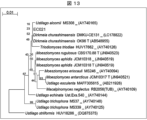
- Figure 13 shows a simplified molecular phylogenetic tree based on the base sequence of the D1/D2 region of the 26S rDNA of the EC021 strain.
- the line in the upper left corner indicates the scale bar.
- the numbers located at the branches of the phylogenetic branches indicate the bootstrap values.
- the "T" at the end of the strain name indicates the type strain of that species.
- Table 32 shows the results of a BLAST search for DB-FU, and the base sequence analysis data for the ITS region of rDNA that was found to be in the top 30 by homology score. * indicates sequence data used for simple molecular phylogenetic analysis.
- Table 33 shows the results of a BLAST search against the international base sequence database, and the base sequence analysis data for the ITS region of rDNA that was found to be in the top 30 by homology score. * indicates sequence data used for simple molecular phylogenetic analysis.
- Figure 14 shows a simplified molecular phylogenetic tree based on the base sequence of the ITS region of the rDNA of the EC021 strain.
- the line in the upper left corner indicates the scale bar.
- the numbers at the branches of the phylogenetic branches indicate the bootstrap values.
- the "T" at the end of the strain name indicates the type strain of that species.
- the EC021 strain was identified as Dirkmeia churashimaensis based on the results of base sequence analysis of the D1/D2 region of 26S rDNA and the ITS region of rDNA.
- the morphological properties of the EC021 strain were investigated by observing the properties and morphology of the colonies. After culturing for three days on YM plate medium, the colonies exhibited yellow-orange to cream color, a smooth surface, and a buttery, moist, viscous consistency. The vegetative cells were elliptical to ovoid, and it was confirmed that proliferation was due to budding from short stalks at the cell site. Furthermore, no formation of sexual reproductive organs was observed on the plates approximately three weeks after the start of culturing.
- strain EC021 was determined to be a novel microorganism belonging to Dirkmeia churashimaensis.
- the microorganism of the present invention produces a high amount of ergothioneine and can be used in fields such as health and beauty.
Landscapes
- Life Sciences & Earth Sciences (AREA)
- Chemical & Material Sciences (AREA)
- Engineering & Computer Science (AREA)
- Health & Medical Sciences (AREA)
- Organic Chemistry (AREA)
- Zoology (AREA)
- Wood Science & Technology (AREA)
- Bioinformatics & Cheminformatics (AREA)
- Genetics & Genomics (AREA)
- Biotechnology (AREA)
- Mycology (AREA)
- General Engineering & Computer Science (AREA)
- Biochemistry (AREA)
- Microbiology (AREA)
- General Health & Medical Sciences (AREA)
- Biomedical Technology (AREA)
- Tropical Medicine & Parasitology (AREA)
- Virology (AREA)
- Medicinal Chemistry (AREA)
- Botany (AREA)
- Chemical Kinetics & Catalysis (AREA)
- General Chemical & Material Sciences (AREA)
- Micro-Organisms Or Cultivation Processes Thereof (AREA)
Priority Applications (3)
| Application Number | Priority Date | Filing Date | Title |
|---|---|---|---|
| JP2024558835A JP7833152B2 (ja) | 2022-11-18 | 2023-11-10 | 新規微生物、新規微生物の培養物または抽出物、およびエルゴチオネインの生産方法 |
| EP23891489.9A EP4621043A4 (en) | 2022-11-18 | 2023-11-10 | NEW MICROORGANISM, NEW CULTURE OR MICROORGANISM EXTRACT, AND PROCESS FOR THE PRODUCTION OF ERGOTHIONEIN |
| US19/110,358 US20260085277A1 (en) | 2022-11-18 | 2023-11-10 | Novel microorganism, novel microorganism culture or extract, and ergothioneine production method |
Applications Claiming Priority (2)
| Application Number | Priority Date | Filing Date | Title |
|---|---|---|---|
| JP2022-185256 | 2022-11-18 | ||
| JP2022185256 | 2022-11-18 |
Publications (1)
| Publication Number | Publication Date |
|---|---|
| WO2024106341A1 true WO2024106341A1 (ja) | 2024-05-23 |
Family
ID=91084702
Family Applications (1)
| Application Number | Title | Priority Date | Filing Date |
|---|---|---|---|
| PCT/JP2023/040594 Ceased WO2024106341A1 (ja) | 2022-11-18 | 2023-11-10 | 新規微生物、新規微生物の培養物または抽出物、およびエルゴチオネインの生産方法 |
Country Status (4)
| Country | Link |
|---|---|
| US (1) | US20260085277A1 (https=) |
| EP (1) | EP4621043A4 (https=) |
| JP (1) | JP7833152B2 (https=) |
| WO (1) | WO2024106341A1 (https=) |
Citations (5)
| Publication number | Priority date | Publication date | Assignee | Title |
|---|---|---|---|---|
| WO2016121285A1 (ja) | 2015-01-30 | 2016-08-04 | キッコーマン株式会社 | エルゴチオネイン生産能が増強された形質転換糸状菌及びエルゴチオネインの製造方法 |
| WO2019004234A1 (ja) | 2017-06-27 | 2019-01-03 | 三菱ケミカル株式会社 | エルゴチオネインの製造方法 |
| WO2021140693A1 (ja) | 2020-01-09 | 2021-07-15 | 株式会社クレハ | 新規微生物およびエルゴチオネインの生産方法 |
| JP2021141826A (ja) * | 2020-03-10 | 2021-09-24 | 株式会社クレハ | エルゴチオネインの生産方法 |
| WO2022149593A1 (ja) * | 2021-01-08 | 2022-07-14 | 株式会社クレハ | 植物生長調整剤または植物の生長促進方法 |
Family Cites Families (2)
| Publication number | Priority date | Publication date | Assignee | Title |
|---|---|---|---|---|
| JP6758703B2 (ja) | 2016-06-21 | 2020-09-23 | 国立大学法人 岡山大学 | エルゴチオネインの産生方法 |
| CN115029398B (zh) * | 2022-07-07 | 2025-07-22 | 南京工业大学 | 一种提高榆黄菇胞内麦角硫因产量的方法 |
-
2023
- 2023-11-10 US US19/110,358 patent/US20260085277A1/en active Pending
- 2023-11-10 EP EP23891489.9A patent/EP4621043A4/en active Pending
- 2023-11-10 JP JP2024558835A patent/JP7833152B2/ja active Active
- 2023-11-10 WO PCT/JP2023/040594 patent/WO2024106341A1/ja not_active Ceased
Patent Citations (5)
| Publication number | Priority date | Publication date | Assignee | Title |
|---|---|---|---|---|
| WO2016121285A1 (ja) | 2015-01-30 | 2016-08-04 | キッコーマン株式会社 | エルゴチオネイン生産能が増強された形質転換糸状菌及びエルゴチオネインの製造方法 |
| WO2019004234A1 (ja) | 2017-06-27 | 2019-01-03 | 三菱ケミカル株式会社 | エルゴチオネインの製造方法 |
| WO2021140693A1 (ja) | 2020-01-09 | 2021-07-15 | 株式会社クレハ | 新規微生物およびエルゴチオネインの生産方法 |
| JP2021141826A (ja) * | 2020-03-10 | 2021-09-24 | 株式会社クレハ | エルゴチオネインの生産方法 |
| WO2022149593A1 (ja) * | 2021-01-08 | 2022-07-14 | 株式会社クレハ | 植物生長調整剤または植物の生長促進方法 |
Non-Patent Citations (4)
| Title |
|---|
| S. TAKUSAGAWA, BIOSCI. BIOTECHNOL., vol. 83, 2019, pages 181 - 184 |
| See also references of EP4621043A1 |
| SY. LIN, INT. J. MED. MUSHROOMS, vol. 17, 2015, pages 749 - 761 |
| Y. FUJITANI ET AL., J. BIOSCI. BIOENG., vol. 126, 2018, pages 715 - 722 |
Also Published As
| Publication number | Publication date |
|---|---|
| US20260085277A1 (en) | 2026-03-26 |
| EP4621043A1 (en) | 2025-09-24 |
| JP7833152B2 (ja) | 2026-03-19 |
| JPWO2024106341A1 (https=) | 2024-05-23 |
| EP4621043A4 (en) | 2026-04-15 |
Similar Documents
| Publication | Publication Date | Title |
|---|---|---|
| JP7120588B2 (ja) | 新規微生物およびエルゴチオネインの生産方法 | |
| CN101285046B (zh) | 一种诱变菌株白色链霉菌TUST2及利用该诱变菌株生产ε-聚赖氨酸及其盐的方法 | |
| CN114934002B (zh) | 一株放线菌新物种及其在植物抗旱促生中的应用 | |
| CN115927043B (zh) | 帕勒隆尼氏假单胞菌菌株zjucs 1001及其用途 | |
| CN112175887A (zh) | 一种大丽轮枝菌内共生菌短波单胞菌及其应用 | |
| WO2024106341A1 (ja) | 新規微生物、新規微生物の培養物または抽出物、およびエルゴチオネインの生産方法 | |
| JP7756402B2 (ja) | 新規微生物、新規微生物の培養物または抽出物、およびエルゴチオネインの生産方法 | |
| CN104651264B (zh) | 解淀粉芽孢杆菌及其应用 | |
| Li | Konjac anthracnose is caused by Colletotrichum gloeosporioides in Yunnan Province of China | |
| CN103146614B (zh) | 一株产喜树碱的喜树内生细菌-ly214及其用途 | |
| JP4643873B2 (ja) | 耐熱性ラッカーゼおよびその製造方法 | |
| CN115247141B (zh) | 解淀粉芽孢杆菌菌株a9及其应用 | |
| CN105274005A (zh) | 一株产紫杉醇的烟曲霉真菌tms-26 | |
| CN121203819A (zh) | 一种酱香大曲中产漆酶细菌的筛选方法 | |
| BR112022013285B1 (pt) | Método para produzir ergotioneína | |
| EA044426B1 (ru) | Новый микроорганизм и способ получения эрготионеина | |
| CN121320179A (zh) | 一株具有抗羊肚菌重茬作用的高地芽孢杆菌cl6及其应用 | |
| CN119955633A (zh) | 一种斯洛菲囊担菌zeng-LT02及其应用 | |
| CN115927095A (zh) | 杨浦链霉菌及其应用 | |
| Raja et al. | Production and characterization of protease enzyme isolated from Penicillium sp. by solid state fermentation |
Legal Events
| Date | Code | Title | Description |
|---|---|---|---|
| 121 | Ep: the epo has been informed by wipo that ep was designated in this application |
Ref document number: 23891489 Country of ref document: EP Kind code of ref document: A1 |
|
| WWE | Wipo information: entry into national phase |
Ref document number: 2024558835 Country of ref document: JP |
|
| WWE | Wipo information: entry into national phase |
Ref document number: 202517019358 Country of ref document: IN |
|
| WWP | Wipo information: published in national office |
Ref document number: 202517019358 Country of ref document: IN |
|
| WWE | Wipo information: entry into national phase |
Ref document number: 2023891489 Country of ref document: EP |
|
| NENP | Non-entry into the national phase |
Ref country code: DE |
|
| ENP | Entry into the national phase |
Ref document number: 2023891489 Country of ref document: EP Effective date: 20250618 |
|
| WWP | Wipo information: published in national office |
Ref document number: 2023891489 Country of ref document: EP |