WO2024101423A1 - 包装物品及びその製造方法 - Google Patents
包装物品及びその製造方法 Download PDFInfo
- Publication number
- WO2024101423A1 WO2024101423A1 PCT/JP2023/040414 JP2023040414W WO2024101423A1 WO 2024101423 A1 WO2024101423 A1 WO 2024101423A1 JP 2023040414 W JP2023040414 W JP 2023040414W WO 2024101423 A1 WO2024101423 A1 WO 2024101423A1
- Authority
- WO
- WIPO (PCT)
- Prior art keywords
- adhesive
- packaging material
- roll
- packaging
- adhesive body
- Prior art date
- Legal status (The legal status is an assumption and is not a legal conclusion. Google has not performed a legal analysis and makes no representation as to the accuracy of the status listed.)
- Ceased
Links
Images



Classifications
-
- B—PERFORMING OPERATIONS; TRANSPORTING
- B65—CONVEYING; PACKING; STORING; HANDLING THIN OR FILAMENTARY MATERIAL
- B65D—CONTAINERS FOR STORAGE OR TRANSPORT OF ARTICLES OR MATERIALS, e.g. BAGS, BARRELS, BOTTLES, BOXES, CANS, CARTONS, CRATES, DRUMS, JARS, TANKS, HOPPERS, FORWARDING CONTAINERS; ACCESSORIES, CLOSURES, OR FITTINGS THEREFOR; PACKAGING ELEMENTS; PACKAGES
- B65D85/00—Containers, packaging elements or packages, specially adapted for particular articles or materials
- B65D85/02—Containers, packaging elements or packages, specially adapted for particular articles or materials for annular articles
- B65D85/04—Containers, packaging elements or packages, specially adapted for particular articles or materials for annular articles for coils of wire, rope or hose
-
- B—PERFORMING OPERATIONS; TRANSPORTING
- B65—CONVEYING; PACKING; STORING; HANDLING THIN OR FILAMENTARY MATERIAL
- B65D—CONTAINERS FOR STORAGE OR TRANSPORT OF ARTICLES OR MATERIALS, e.g. BAGS, BARRELS, BOTTLES, BOXES, CANS, CARTONS, CRATES, DRUMS, JARS, TANKS, HOPPERS, FORWARDING CONTAINERS; ACCESSORIES, CLOSURES, OR FITTINGS THEREFOR; PACKAGING ELEMENTS; PACKAGES
- B65D85/00—Containers, packaging elements or packages, specially adapted for particular articles or materials
- B65D85/67—Containers, packaging elements or packages, specially adapted for particular articles or materials for web or tape-like material
-
- C—CHEMISTRY; METALLURGY
- C09—DYES; PAINTS; POLISHES; NATURAL RESINS; ADHESIVES; COMPOSITIONS NOT OTHERWISE PROVIDED FOR; APPLICATIONS OF MATERIALS NOT OTHERWISE PROVIDED FOR
- C09J—ADHESIVES; NON-MECHANICAL ASPECTS OF ADHESIVE PROCESSES IN GENERAL; ADHESIVE PROCESSES NOT PROVIDED FOR ELSEWHERE; USE OF MATERIALS AS ADHESIVES
- C09J201/00—Adhesives based on unspecified macromolecular compounds
- C09J201/02—Adhesives based on unspecified macromolecular compounds characterised by the presence of specified groups, e.g. terminal or pendant functional groups
- C09J201/10—Adhesives based on unspecified macromolecular compounds characterised by the presence of specified groups, e.g. terminal or pendant functional groups containing hydrolysable silane groups
-
- C—CHEMISTRY; METALLURGY
- C09—DYES; PAINTS; POLISHES; NATURAL RESINS; ADHESIVES; COMPOSITIONS NOT OTHERWISE PROVIDED FOR; APPLICATIONS OF MATERIALS NOT OTHERWISE PROVIDED FOR
- C09J—ADHESIVES; NON-MECHANICAL ASPECTS OF ADHESIVE PROCESSES IN GENERAL; ADHESIVE PROCESSES NOT PROVIDED FOR ELSEWHERE; USE OF MATERIALS AS ADHESIVES
- C09J7/00—Adhesives in the form of films or foils
- C09J7/20—Adhesives in the form of films or foils characterised by their carriers
- C09J7/22—Plastics; Metallised plastics
-
- C—CHEMISTRY; METALLURGY
- C09—DYES; PAINTS; POLISHES; NATURAL RESINS; ADHESIVES; COMPOSITIONS NOT OTHERWISE PROVIDED FOR; APPLICATIONS OF MATERIALS NOT OTHERWISE PROVIDED FOR
- C09J—ADHESIVES; NON-MECHANICAL ASPECTS OF ADHESIVE PROCESSES IN GENERAL; ADHESIVE PROCESSES NOT PROVIDED FOR ELSEWHERE; USE OF MATERIALS AS ADHESIVES
- C09J7/00—Adhesives in the form of films or foils
- C09J7/30—Adhesives in the form of films or foils characterised by the adhesive composition
- C09J7/38—Pressure-sensitive adhesives [PSA]
Definitions
- the present invention relates to a packaging item and a method for manufacturing the same.
- double-sided tape When bonding two or more types of items, adhesive materials such as double-sided tape are sometimes used, but bonding is difficult when the shapes of the items to be bonded are complex or the bonding area is narrow.
- the double-sided tape may be cut to narrow widths or punched, but a large amount of unnecessary release liners and unnecessary parts after processing are discarded, increasing the amount of waste and CO2 emissions.
- adhesives such as thread-like adhesives are used. Since adhesives are in a product form that does not require a release liner, they can greatly contribute to reducing waste. However, because the adhesive does not have a release liner, there is a problem that the adhesive strength decreases when the adhesive is stored and transported in a rolled form.
- Patent Document 1 describes a method of packaging liquid crystalline polymer fibers in an olefin substrate.
- Patent Document 2 also describes that for a rolled body of a thread-like adhesive tape that does not have a release liner, the outermost surface may be protected with a separator (corresponding to the "release liner" in this specification) or the like, or the rolled body may be placed in a case or the like.
- Patent Document 1 relates to a technology for preventing fluffing of packaged liquid crystalline polymer fibers, which is in a different technical field from that of adhesive bodies, and therefore does not take into consideration whether the adhesive strength is maintained when the adhesive body is packaged in the same manner.
- Patent Document 2 only describes that the thread-shaped adhesive tape can be simply stored in a case or the like, but does not consider the specific manner of storage or the associated effects.
- the present invention aims to provide a packaging article that does not experience a decrease in adhesive strength after storage and transportation as a roll, even if the adhesive body does not have a release liner.
- the present inventors conducted extensive research to solve the above problems. As a result, they discovered that when a roll of an adhesive body containing an adhesive layer as the outermost layer is stored in a packaging material, by folding the end of the packaging material inside the roll to form a package, even if the adhesive body does not have a release liner, there is no decrease in adhesive strength after storage and transportation of the roll, which led to the completion of the present invention.
- the present invention relates to the following.
- the package includes a roll of an adhesive body including an adhesive layer as an outermost layer, and a packaging material, The wound body is contained in the packaging material, The end of the packaging material is folded inside the roll, forming a packaged article.
- a method for producing a packaged article comprising: a roll of an adhesive body including an adhesive layer as an outermost layer; and a packaging material, the roll being housed in the packaging material, the method comprising: The method of manufacturing a packaged article includes folding an end portion of the packaging material inside the roll.
- the packaging article has the ends of the packaging material folded inside the roll of the adhesive. Therefore, even if the adhesive, which includes an adhesive layer as the outermost layer, does not have a release liner, there is no loss of adhesive strength after storage and transportation in the roll.
- FIG. 1 is a schematic cross-sectional view of an example of a configuration of a roll of an adhesive body.
- FIG. 2 is a schematic cross-sectional view of one configuration example of an adhesive body.
- FIG. 3 is a schematic cross-sectional view of one configuration example of the adhesive body.
- FIG. 4 is a schematic diagram of an example of a configuration of a roll of an adhesive body.
- the packaging article of this embodiment includes a roll of an adhesive body including an adhesive layer as the outermost layer and packaging material, with the roll being stored in the packaging material and the ends of the packaging material being folded inside the roll.
- the roll of the adhesive body in this embodiment has an adhesive body including an adhesive layer as the outermost layer.
- This is a roll of the adhesive body in which the surfaces of the adhesive layers are in contact with each other, and since the adhesive layers in contact can be peeled off at the interface after adhering to each other, no release liner is required.
- the roll of the adhesive body is also simply referred to as a roll.
- the roll of adhesive is in a form in which the surfaces of the adhesive layers of the adhesive are in contact with each other, the adhesive is rolled up into a roll, and has a hollow portion.
- the adhesive body in the present embodiment may be in the form of a sheet or a line.
- the adhesive body may further include a substrate, but may be an adhesive body consisting of only a pressure-sensitive adhesive layer without including a substrate.
- the pressure-sensitive adhesive is in the form of a sheet, it may further include a substrate, in which case pressure-sensitive adhesive layers are provided on both sides of the substrate.
- the concept of a sheet here may include what are called tapes, labels, films, etc.
- FIG. 1 shows an example of the structure of a wound adhesive body in this embodiment.
- the wound adhesive body 100 may be in a form in which a sheet-like adhesive body 2 is wound in a spiral shape around a core as an axis, or may be in a form in which it is wound without a core.
- the adhesive body 2 may be, for example, a double-sided adhesive sheet having a cross-sectional structure shown in FIG. 1.
- the adhesive body 2 is composed of a substrate 20 and a first adhesive layer 11 and a second adhesive layer 12 provided on a first surface and a second surface of the substrate 20, respectively. In the wound adhesive body 100 of this form, the surface of the second adhesive layer 12 is in contact with the surface of the first adhesive layer 11.
- the adhesive body When the adhesive body is linear, it may be a support (core material)-less adhesive body consisting of a linear adhesive layer, or may further contain a core material.
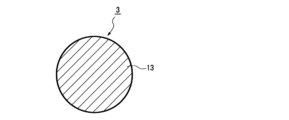
- 2 shows a schematic cross-sectional view of one configuration example of the adhesive body 3 according to this embodiment in a direction perpendicular to the longitudinal direction of the adhesive body 3.
- the adhesive body 3 of this configuration example is a support-less adhesive body made of a linear adhesive layer 13.
- linear as used here is a concept that includes not only straight lines, curved lines, and bent lines, but also a state that can be bent in various directions and angles like a thread (hereinafter sometimes referred to as "thread-like").
- the adhesive layer in this specification also includes linear adhesive bodies.
- cross-sectional shape of the adhesive body 3 in this configuration example is circular, this embodiment is not limited to this, and the cross-sectional shape can be circular, elliptical, rectangular, or other shapes.
- Figure 3 shows a schematic cross-sectional view of an example of the configuration of an adhesive body according to this embodiment, taken in a direction perpendicular to the longitudinal direction of the adhesive body.
- the adhesive body 4 shown in Figure 3 comprises a linear core material 14 and an adhesive layer 13 that covers the longitudinal surface of the core material 14.
- cross-sectional shape of the adhesive body 4 in this configuration example is circular, this embodiment is not limited to this, and the cross-sectional shape can be circular, elliptical, rectangular, or other shapes.
- FIG. 4 shows another example of the structure of the adhesive roll in this embodiment.
- the adhesive roll 200 may be formed by winding the adhesive 4 around a core, as shown in FIG. 4.
- the roll is preferably one in which the adhesive is wound around a core.
- the material of the core can be any suitable material of the core, but for example, paper, plastic, etc. can be used.
- the outer diameter of the core can be, for example, 4 cm or more and 20 cm or less.
- the inner diameter of the core can be, for example, 3 cm or more and 19 cm or less.
- the width of the core can be, for example, 1 cm or more and 100 cm or less.
- the adhesive body includes an adhesive layer as the outermost layer.
- the adhesive layer is made of an adhesive formed from an adhesive composition.
- the adhesive is not particularly limited, and known adhesives can be used.
- acrylic adhesives, rubber adhesives, vinyl alkyl ether adhesives, silicone adhesives, polyester adhesives, polyamide adhesives, urethane adhesives, fluorine adhesives, epoxy adhesives, etc. can be mentioned.
- acrylic adhesives, urethane adhesives, silicone adhesives, rubber adhesives, or polyester adhesives are preferable, and acrylic adhesives are particularly preferable because the adhesion is easy to control.
- the adhesive in this embodiment is preferably a pressure-sensitive adhesive that has adhesion at room temperature and can attach an adherend to its surface by the pressure generated when the surface of the adhesive and the surface of the adherend come into contact with each other. If it is a pressure-sensitive adhesive, it does not require heating and can be applied to adherends that are weak against heat.
- Both solvent-based and water-dispersed adhesives can be used as the adhesive, and it is preferable to use an adhesive in which crosslinking progresses as the adhesive composition dries (solvent evaporation, heating) and the crosslinking is completed quickly after drying. This is because new crosslinking is not increased after the surfaces of the adhesive layers come into contact with each other.
- water-dispersed adhesives are preferred because they can be applied at high speed, are environmentally friendly, and have little effect (swelling, dissolution) on the substrate and core material due to the solvent, and water-dispersed acrylic adhesives are more preferred.
- acrylic adhesive refers to an adhesive that uses an acrylic polymer as the base polymer (the main component of the polymer component, i.e., a component that accounts for 50% or more by weight).
- Acrylic polymer refers to a polymer that uses a monomer having at least one (meth)acryloyl group in one molecule (hereinafter, this may be referred to as "acrylic monomer”) as the main constituent monomer component (the main component of the monomer, i.e., a component that accounts for more than 50% by weight of the total amount of monomers that make up the acrylic polymer).
- acrylic monomer refers to acryloyl and methacryloyl in a comprehensive sense.
- (meth)acrylic acid ester refers to acrylic acid ester and methacrylic acid ester
- (meth)acrylic refers to acrylic and methacrylic in a comprehensive sense.
- the acrylic polymer is preferably, for example, a polymer of a monomer raw material that contains an alkyl (meth)acrylate ester as the main monomer and may further contain a sub-monomer that is copolymerizable with the main monomer.
- the main monomer refers to a component that accounts for more than 50% by weight of the monomer composition in the monomer raw material.
- R1 represents a hydrogen atom or a methyl group
- R2 represents an alkyl group having 2 to 14 carbon atoms.
- Examples of the compound include compounds represented by the following formula:
- R2 examples include an ethyl group, a propyl group, an isopropyl group, a butyl group, an isobutyl group, an isoamyl group, a hexyl group, a heptyl group, a 2-ethylhexyl group, an isooctyl group, an isononyl group, and an isodecyl group.
- an alkyl group having 2 to 10 carbon atoms such as a butyl group or a 2-ethylhexyl group, is preferred as R2 .
- the above (meth)acrylic acid alkyl esters can be used alone or in combination of two or more kinds.
- the ratio of the (meth)acrylic acid alkyl ester [for example, the above-mentioned (meth)acrylic acid C2-14 alkyl ester] in a monomer mixture containing the (meth)acrylic acid alkyl ester as a main component is generally 80% by weight or more (for example, about 80 to 99.8% by weight), preferably 85% by weight or more (for example, about 85 to 99.5% by weight), and more preferably 90% by weight or more (for example, about 90 to 99% by weight).
- the monomer mixture usually contains a functional group-containing monomer (thermally crosslinkable functional group-containing monomer) to introduce crosslinking points for thermal crosslinking.
- a functional group-containing monomer thermalally crosslinkable functional group-containing monomer
- the adhesive strength to the adherend is also improved.
- Examples of the functional group-containing monomer include carboxyl group-containing monomers such as acrylic acid, methacrylic acid, itaconic acid, maleic acid, crotonic acid, and maleic anhydride, or their acid anhydrides; hydroxyl group-containing monomers such as 2-hydroxyethyl (meth)acrylate, 2-hydroxypropyl (meth)acrylate, and 2-hydroxybutyl (meth)acrylate; amide group-containing monomers such as (meth)acrylamide, N,N-dimethyl (meth)acrylamide, N-methylol (meth)acrylamide, N-methoxymethyl (meth)acrylamide, and N-butoxymethyl (meth)acrylamide; amino group-containing monomers such as dimethylaminoethyl (meth)acrylate and t-butylaminoethyl (meth)acrylate; glycidyl group-containing monomers such as glycidyl (meth)acrylate; (meth)acrylonitrile, N
- the amount of the functional group-containing monomer used is, for example, 0.5 to 12 parts by weight, and preferably about 1 to 8 parts by weight, per 100 parts by weight of the (meth)acrylic acid alkyl ester.
- the monomer mixture may contain other copolymerizable monomers as necessary to enhance properties such as cohesive strength.
- copolymerizable monomers include vinyl esters such as methyl (meth)acrylate and vinyl acetate; aromatic vinyl compounds such as styrene and vinyl toluene; (meth)acrylic acid esters of cyclic alcohols such as cyclopentyl di(meth)acrylate and isobornyl (meth)acrylate; and (meth)acrylic acid esters of polyhydric alcohols such as neopentyl glycol di(meth)acrylate, hexanediol di(meth)acrylate, propylene glycol di(meth)acrylate, trimethylolpropane tri(meth)acrylate, tetramethylolmethane tri(meth)acrylate, and dipentaerythritol hexa(meth)acrylate. These copolymerizable monomers may be used alone or in combination.
- the crosslinking agent used in the acrylic adhesives may be any commonly used crosslinking agent, such as silane-based crosslinking agents, organic peroxides, epoxy-based compounds, amino group-containing compounds, organic metal salts, metal alcoholates, metal chelates, hydrazide-based crosslinking agents, carbodiimide-based crosslinking agents, isocyanate-based crosslinking agents, and silanol-based crosslinking agents.
- organic metal salts, metal chelates, hydrazide-based crosslinking agents, and silane-based crosslinking agents are preferred because crosslinking is completed quickly after drying of the adhesive composition.
- crosslinking agent may be either oil-soluble or water-soluble, and may be used alone or in combination of two or more types.
- silane crosslinking agent it is preferable to use a silane monomer that is copolymerizable with the (meth)acrylic acid alkyl ester.
- the silane monomer is not particularly limited as long as it is a polymerizable compound having a silicon atom, but a silane compound having a (meth)acryloyl group such as a (meth)acryloyloxyalkylsilane derivative is preferable because it has excellent copolymerizability with the (meth)acrylic acid alkyl ester.
- silane monomer examples include ⁇ -methacryloxypropyltrimethoxysilane, 3-acryloyloxypropyltrimethoxysilane, 3-methacryloyloxypropyltriethoxysilane, 3-acryloyloxypropyltriethoxysilane, 3-methacryloyloxypropylmethyldimethoxysilane, 3-acryloyloxypropylmethyldimethoxysilane, 3-methacryloyloxypropylmethyldiethoxysilane, and 3-acryloyloxypropylmethyldiethoxysilane. These silane monomers can be used alone or in combination of two or more.
- copolymerizable silane monomers examples include vinyltrimethoxysilane, vinyltriethoxysilane, 4-vinylbutyltrimethoxysilane, 4-vinylbutyltriethoxysilane, 8-vinyloctyltrimethoxysilane, 8-vinyloctyltriethoxysilane, 10-methacryloyloxydecyltrimethoxysilane, 10-acryloyloxydecyltrimethoxysilane, 10-methacryloyloxydecyltriethoxysilane, and 10-acryloyloxydecyltriethoxysilane.
- the amount of crosslinking agent used can be appropriately selected depending on the type of monomer raw material and the application of the adhesive article.
- the amount of crosslinking agent per 100 parts by weight of the monomer raw material (excluding the crosslinking agent) is preferably 0.005 to 5 parts by weight, and more preferably in the range of 0.01 to 3 parts by weight.
- crosslinking agents may be used, and crosslinking using other crosslinking agents, UV crosslinking, radiation crosslinking such as electron beam crosslinking, etc. may be applied.
- other crosslinking agents commonly used crosslinking agents may be used, and examples of such agents include organic peroxides, epoxy compounds, amino group-containing compounds, organic metal salts, metal alcoholates, metal chelates, hydrazide crosslinking agents, carbodiimide crosslinking agents, isocyanate crosslinking agents, silane or silanol crosslinking agents, etc.
- the other crosslinking agents may be either oil-soluble or water-soluble.
- the pressure-sensitive adhesive layer can be formed using a pressure-sensitive adhesive composition, and the pressure-sensitive adhesive composition is preferably a water-dispersed pressure-sensitive adhesive composition.
- the water-dispersed PSA composition can be prepared, for example, by subjecting a monomer mixture containing the above-mentioned alkyl (meth)acrylate ester as a main component and a silane-based monomer to conventional emulsion polymerization to obtain an aqueous dispersion of a (meth)acrylic acid ester copolymer, and adding thereto, as necessary, the above-mentioned other crosslinking agent.
- the polymerization method can be a general batch polymerization, continuous dropwise polymerization, or divided dropwise polymerization, and the polymerization temperature is, for example, about 20 to 100°C.
- the polymerization initiator used in the polymerization is, for example, 2,2'-azobis[N-(2-carboxyethyl)-2-methylpropionamidine]n-hydrate, 2,2'-azobisisobutyronitrile, 2,2'-azobis(2-methylpropionamidine) disulfate, 2,2'-azobis(2-amidinopropane)dihydrochloride, 2,2'-azobis[2-(5-methyl-2-imidazolin-2-yl)propane]dihydrochloride, 2,2'-azobis(N,N'-dimethyl
- initiators include, but are not limited to, azo initiators such as phenylisobutylamidine; persulfates such as potassium persulfate and ammonium persulfate; peroxide initiators such as benzoyl peroxide, t-butyl hydroperoxide, and hydrogen peroxide; substituted ethane initiators such as phenyl-sub
- a chain transfer agent may also be used in the polymerization.
- the chain transfer agent include conventional chain transfer agents, such as mercaptans such as lauryl mercaptan and dodecanethiol.
- the amount of the chain transfer agent used is, for example, about 0.001 to 0.5 parts by weight per 100 parts by weight of the total amount of monomers.
- anionic emulsifiers such as sodium lauryl sulfate, polyoxyethylene sodium lauryl sulfate, ammonium lauryl sulfate, sodium dodecylbenzenesulfonate, polyoxyethylene alkyl ether sodium sulfate, polyoxyethylene alkyl phenyl ether ammonium sulfate, and polyoxyethylene alkyl phenyl ether sodium sulfate; nonionic emulsifiers such as polyoxyethylene alkyl ether and polyoxyethylene alkyl phenyl ether may be used. These emulsifiers may be used alone or in combination of two or more. The amount of the emulsifier used is, for example, about 0.2 to 10 parts by weight, and preferably about 0.5 to 5 parts by weight, per 100 parts by weight of the total amount of monomers.
- the pressure-sensitive adhesive composition may be prepared by obtaining the (meth)acrylic acid ester copolymer by a method other than emulsion polymerization, adding the crosslinking agent as necessary, and dispersing the copolymer in water with an emulsifier.
- the adhesive composition may also contain, as necessary, a base (such as aqueous ammonia) or an acid to adjust the pH, and additives commonly used in adhesives, such as tackifier resins, thickeners, surfactants, antioxidants, fillers, pigments, and colorants.
- a base such as aqueous ammonia
- additives commonly used in adhesives such as tackifier resins, thickeners, surfactants, antioxidants, fillers, pigments, and colorants.
- tackifier resin for example, one or more types selected from various tackifier resins such as rosin-based resins, rosin derivative resins, petroleum-based resins, terpene-based resins, phenol-based resins, and ketone-based resins can be used.
- the content of the tackifier resin is preferably 60 parts by weight or less, more preferably 50 parts by weight or less, even more preferably 40 parts by weight or less, and even more preferably 30 parts by weight or less, per 100 parts by weight of the base polymer.
- Thickeners include, for example, polyacrylic acid-based thickeners, urethane-based thickeners, polyvinyl alcohol-based thickeners, etc. Among these, polyacrylic acid-based thickeners and urethane-based thickeners are preferred.
- the content of the thickener is preferably 10 parts by weight or less, and more preferably 5 parts by weight or less, per 100 parts by weight of the base polymer.
- the method for forming the adhesive body of this embodiment is not particularly limited, but for example, when forming the adhesive layer, a method in which the adhesive composition is directly applied to a peelable or non-peeling substrate and then dried or cured (direct method); a method in which the adhesive composition is applied to a peelable surface and then dried or cured to form an adhesive layer on the surface, and then the adhesive layer is attached to a substrate and transferred (transfer method); etc. can be used.
- the sheet-like adhesive (adhesive sheet) can be obtained, for example, by applying the above-mentioned adhesive composition onto a substrate and thermally crosslinking the composition to form an adhesive layer. It is also possible to obtain an adhesive sheet without a substrate by first forming the above-mentioned adhesive layer on a release liner and then removing the release liner.
- the adhesive sheet may be an adhesive tape, and from the standpoint of strength and handling, the width of the adhesive tape is preferably 0.01 mm or more, and more preferably 0.02 mm or more. In addition, since the adhesive can be applied to a variety of adherend surface shapes and areas, the width is preferably 40 mm or less, and more preferably 20 mm or less.
- the thickness is not particularly limited, but if the thickness is too small, handling may be impaired, so for example, it is preferably 1 ⁇ m or more, and more preferably 5 ⁇ m or more. Also, if the thickness is too large, flexibility may be lacking, so for example, it is preferably 100 ⁇ m or less, and more preferably 50 ⁇ m or less.
- the substrate has a higher adhesive strength between the adhesive layer and the substrate than between the adhesive layers themselves, from the viewpoint of maintaining the shape of the adhesive.
- plastic films such as polypropylene film, ethylene-propylene copolymer film, polyester film, and polyvinyl chloride; paper such as kraft paper; and metal foil can be used.
- the plastic film may be either a non-stretched film or a stretched (uniaxially stretched or biaxially stretched) film.
- the surface of the substrate to which the adhesive composition is applied may be subjected to a surface treatment such as a commonly used primer or a corona discharge method.
- the thickness of the substrate can be appropriately selected depending on the purpose, but is generally about 10 to 500 ⁇ m.
- the thickness of the adhesive layer is not particularly limited and can be selected appropriately depending on the purpose. Generally, the thickness of the adhesive layer is appropriately set to about 1 ⁇ m to 200 ⁇ m, and preferably to about 3 ⁇ m to 150 ⁇ m.
- the adhesive composition can be applied using a conventional coater, such as a gravure roll coater, reverse roll coater, kiss roll coater, dip roll coater, bar coater, knife coater, or spray coater.
- the adhesive composition is applied so that the thickness of the adhesive layer after drying is, for example, about 10 to 100 ⁇ m.
- the drying temperature can be appropriately selected, but is preferably 40° C. to 200° C., more preferably 50° C. to 180° C., and particularly preferably 70° C. to 120° C.
- An appropriate drying time can be selected as appropriate.
- the drying time is preferably 5 seconds to 20 minutes, more preferably 5 seconds to 10 minutes, and particularly preferably 10 seconds to 5 minutes.
- Thermal crosslinking is carried out by a conventional method, for example, by heating to a temperature at which the crosslinking reaction proceeds depending on the type of crosslinking agent.
- the solvent-insoluble portion of the crosslinked adhesive layer is, for example, about 5 to 70% by weight.
- the molecular weight (weight average molecular weight; standard polystyrene equivalent) of the solvent-soluble portion of the crosslinked adhesive layer is, for example, about 100,000 to 600,000, preferably about 200,000 to 450,000.
- the molecular weight of the solvent-insoluble portion and solvent-soluble portion of the crosslinked adhesive layer can be set as desired, for example, by appropriately adjusting the ratio of the crosslinking agent or functional group-containing monomer to the total amount of monomers, the type and amount of the chain transfer agent, and particularly the amounts of the crosslinking agent and chain transfer agent.
- the linear adhesive body can be obtained, for example, by the following method.
- the method of forming the linear adhesive body is not particularly limited, but for example, a method of preparing an adhesive composition constituting the adhesive body, applying the adhesive composition in a line on a release liner using a dispenser to form an adhesive body once, and then removing the release liner can be mentioned.
- the adhesive body is an adhesive body having a core material and an adhesive layer
- the adhesive composition can be applied to the surface of the core material by dipping, immersion, coating, etc., and then heated and dried to form an adhesive layer on the surface of the core material.
- the application of the adhesive composition can be performed using a conventional coater such as a gravure roll coater, reverse roll coater, kiss roll coater, dip roll coater, bar coater, knife coater, spray coater, etc.
- the drying temperature can be appropriately adopted, but is preferably 40°C to 200°C, more preferably 50°C to 180°C, and particularly preferably 70°C to 120°C.
- the drying time can be appropriately adopted. The drying time is preferably 5 seconds to 20 minutes, more preferably 5 seconds to 10 minutes, and particularly preferably 10 seconds to 5 minutes.
- the diameter of the cross-section of the adhesive body is not particularly limited, but since a diameter that is too small may cause the adhesive body to break easily, it is preferable that the diameter is, for example, 20 ⁇ m or more, and more preferably 50 ⁇ m or more. Furthermore, since a diameter that is too large may cause the adhesive body to lack flexibility, it is preferable that the diameter is, for example, 1000 ⁇ m or less, and more preferably 500 ⁇ m or less.
- the adhesive layer may cover the entire surface of the core material (surface in the longitudinal direction), or may cover only a part of the surface of the core material.
- the adhesive layer is typically formed continuously, but is not limited to such a form, and may be formed in a regular or random pattern such as dots or stripes.
- the end faces of the core material may or may not be covered by the adhesive layer. For example, in cases where the adhesive article is cut during the manufacturing process or during use, the end faces of the core material may not be covered by the adhesive layer.
- the core material used in the adhesive is not particularly limited, but may be, for example, a resin, rubber, foam, inorganic fiber, or a composite of these. From the viewpoint of maintaining the shape of the adhesive, it is preferable that the adhesive strength between the adhesive layer and the core material is higher than the self-adhesive strength between the adhesive layers.
- resins include polyolefins such as polyethylene (PE), polypropylene (PP), ethylene-propylene copolymer, and ethylene-vinyl acetate copolymer; polyesters such as polyethylene terephthalate (PET); vinyl chloride resins; vinyl acetate resins; polyimide resins; polyamide resins; fluorine-based resins; and the like.
- Examples of rubbers include synthetic rubbers such as natural rubber and urethane rubber; examples of foams include polyurethane foam and polychloroprene rubber foam; examples of fibers include glass fiber, carbon fiber, and metal fiber; and the like.
- the cross-sectional shape of the core material is not particularly limited, but it usually has a cross-sectional shape corresponding to the cross-sectional shape of the adhesive article.
- the material of the thread-like core material that can be used for the thread-like adhesive body is not particularly limited, and may be chemical fiber or natural fiber.
- chemical fibers include various polymer materials such as rayon, cupra, acetate, promix, nylon, aramid, vinylon, vinylidene, polyvinyl chloride, polyester, acrylic, polyethylene, polypropylene, polyurethane, polychlar, polylactic acid, glass, carbon fiber, synthetic rubber such as polyurethane, metal, etc.
- natural fibers include silk, natural rubber, cotton, wool, etc.
- polyester is preferred as the material of the core material because it is easy to control the physical properties such as diameter and tensile strength, and polyethylene terephthalate (PET) is more preferred.
- the thread-like core material for example, in addition to monofilament, multifilament, spun yarn, processed yarn generally called textured yarn, bulky yarn, stretch yarn which has been subjected to crimping processing, bulking processing, etc., or yarns which are combined by twisting these together, etc.
- the cross-sectional shape may be not only circular but also short shaped yarn such as rectangular or star-shaped, elliptical, hollow, etc.
- the core material may contain various additives such as fillers (inorganic fillers, organic fillers, etc.), anti-aging agents, antioxidants, UV absorbers, antistatic agents, lubricants, plasticizers, colorants (pigments, dyes, etc.), etc., as necessary.
- the surface of the core material may be subjected to known or conventional surface treatments, such as corona discharge treatment, plasma treatment, application of a primer, etc.
- the cross-sectional size of the core material is not particularly limited and can be selected appropriately depending on the purpose, but for example, if the cross-sectional shape is circular, from the viewpoint of handleability (resistance to cutting), the diameter is preferably 1 ⁇ m to 2000 ⁇ m, and more preferably 10 ⁇ m to 1000 ⁇ m.
- the thickness of the adhesive layer is not particularly limited, but from the viewpoint of adhesiveness, it is preferably, for example, 1 ⁇ m or more, and more preferably 3 ⁇ m or more. Also, from the viewpoint of drying property, it is preferably, for example, 200 ⁇ m or less, and more preferably 150 ⁇ m or less.
- the diameter of the adhesive body is not particularly limited, but for example, when the cross-sectional shape is circular, from the viewpoint of processability, it is preferably 50 ⁇ m to 1000 ⁇ m, more preferably 100 ⁇ m to 800 ⁇ m, and even more preferably 200 ⁇ m to 600 ⁇ m.
- the linear adhesive body in this embodiment is preferable because it can be attached to a narrow member or a narrow area while suppressing overflow, and can be easily disassembled (reworked).
- the linear adhesive body is also referred to as a linear adhesive body.
- the linear adhesive body in this embodiment can be suitably used for fixing an article in the manufacture of electronic devices and for fixing an in-vehicle component, and can also be applied to fixing a narrow frame of a mobile terminal such as a mobile phone or a smartphone, and fixing a battery, a motor, etc.
- the adhesive body in this embodiment is linear, it can be inserted into a narrow gap to adhere to the surface of the gap or fill the gap.
- the adhesive body in this embodiment is preferably bendable, and is particularly preferably a thread-like adhesive body that can be bent in various directions and angles like a thread.
- a bendable adhesive body particularly a thread-like adhesive body, has the advantage of being easily applicable to complex shapes such as curves, curved surfaces, and unevenness.
- a thread-like adhesive body is also referred to as a thread-like adhesive body.
- the adhesive body in this embodiment is preferably a thread-like adhesive body.
- the adhesive body has bendability, particularly the filamentous adhesive body, it can be firmly applied without causing wrinkles or overlaps even when applied to a portion having a complex shape such as a curve, a curved surface, or an uneven surface. Furthermore, the filamentous adhesive body can be applied to the desired portion at once, i.e., in one process, so that it is easy to work with and can be applied to an automated line.
- the thread-like adhesive can be used to fix cables such as electric wires and optical fibers, LED fiber lights, optical fiber sensors such as FBG (Fiber Bragg Gratings), various wires (linear members) such as threads, strings, and wires, and thin members in a desired shape.
- cables such as electric wires and optical fibers, LED fiber lights, optical fiber sensors such as FBG (Fiber Bragg Gratings), various wires (linear members) such as threads, strings, and wires, and thin members in a desired shape.
- FBG Fiber Bragg Gratings
- various wires linear members
- the thread-like adhesive can be used to firmly fix the wire or thin member with excellent workability while suppressing protrusion, wrinkles, and overlaps in accordance with the complex shape that the wire or thin member should have.
- the thread-like adhesive can be attached in advance to the surface of the other member in accordance with the shape in which the wire or thin member should be fixed, and then the wire or thin member can be attached to the adhesive attached to the surface of the other member.
- the thread-shaped adhesive may be attached to a wire or narrow member, and then the wire or narrow member may be fixed to another member in the desired configuration.
- the thread-like adhesive can also be suitably used for the purpose of temporarily fixing (temporarily fastening) an article to the surface of another article. More specifically, the thread-like adhesive is particularly suitably used for the purpose of temporarily fixing (temporarily fastening) an article when manufacturing textile products such as clothes, shoes, bags, hats, and leather products. However, the use is not limited thereto, and the thread-like adhesive can be suitably used for various purposes in which temporary fixing (temporarily fastening) is desired. For example, when fixing one article to the surface of another article, the first article is provisionally fixed to the surface of the other article using a thread-like adhesive to position it, and then the two articles are fixed (mainly fixed) by a fixing method such as thermocompression bonding or sewing.
- a fixing method such as thermocompression bonding or sewing.
- the thread-like adhesive it is easy to provisionally fix the two articles while avoiding the fixing part provided between the two articles.
- a thread-like adhesive when sewing textile products or leather products, if provisionally fixing is performed using a thread-like adhesive, it is easy to provisionally fix the two articles while avoiding the sewing part, and it is easy to prevent the adhesive from adhering to the needle.
- a thread-like adhesive even if the shapes of both articles are complex, such as curved lines, curved surfaces, or unevenness, the articles can be attached well while minimizing overflow, wrinkles, and overlapping, and the articles can be attached in a single process, making the process easy to work with.
- the adhesive is a thread-like adhesive, it is easy to remove the thread-like adhesive from between the two fixed (full-fixed) articles after the two articles are fixed (full-fixed) together, if necessary. In this way, the adhesive can be prevented from spilling out, and the deterioration of the design caused by the discoloration of the remaining adhesive over time can be effectively prevented.
- the adhesive is a thread-like material, it can be twisted together with threads made of other materials to create a combined thread, or woven with threads or fabrics (including nonwoven fabrics and sheets) made of other materials, allowing for the combination of functions.
- the thread-like adhesive can be used as a dam material to prevent the adhesive or pressure-sensitive adhesive from spilling out when the adhesive or pressure-sensitive adhesive is applied to the object to be bonded (adherend).
- the dam material can be used, for example, to prevent the sealing resin used in bonding optical panels from spilling out.
- the thread-like adhesive can be peeled off after the adhesive or pressure-sensitive adhesive has hardened, or it can be left in place.
- the packaged article in this embodiment is characterized in that it is obtained by storing the above-mentioned roll of adhesive body in a packaging material.
- the packaging material is not particularly limited as long as it can package the roll, and examples of the packaging material include packaging materials made of resin, paper, metal foil, etc. Among these, from the viewpoint of versatility of the material, packaging materials made of resin are preferred. Examples of packaging materials made of paper include release paper, release liners made of paper that have been treated for release, etc. Examples of packaging materials made of metal foil include aluminum foil with a release layer, etc.
- resin packaging materials examples include packaging materials made of polypropylene (PP) such as polyethylene terephthalate (PET), polymethylpentene (TPX), and biaxially oriented polypropylene (OPP), polyethylene (PE), and fluorine-based resins (ethylene-tetrafluoroethylene copolymer (ETFE), polytetrafluoroethylene (PTFE), etc.).
- PET polypropylene
- TPX polymethylpentene
- OPP biaxially oriented polypropylene
- PE polyethylene
- fluorine-based resins ethylene-tetrafluoroethylene copolymer
- PTFE polytetrafluoroethylene
- the adhesive body wound into a roll contains an adhesive layer as the outermost layer, when the roll of the adhesive body is removed from the packaging material after storing and transporting the packaged article, the adhesive body may stick to the packaging material.
- the packaging material has a release layer on at least one side, the adhesive can be prevented from sticking to the packaging material, which is preferable because it improves workability.
- a resin packaging material having a release layer on at least one side for example, a packaging material obtained by providing a release layer on at least one side of the above-mentioned resin packaging material can be used. Examples of such packaging materials include packaging materials made of polyethylene foam (PE foam) and packaging materials made of polyethylene terephthalate (PET).
- the thickness of the packaging material is preferably 5 ⁇ m to 100 ⁇ m, more preferably 10 ⁇ m to 50 ⁇ m, and even more preferably 15 ⁇ m to 40 ⁇ m.
- the thickness of the packaging material is preferably 5 ⁇ m or more in terms of low moisture permeability, and the thickness of the packaging material is preferably 100 ⁇ m or less in terms of flexibility.
- the water vapor transmission rate of the packaging material under the conditions of 40°C and 92% RH is preferably 100 g/( m2 ⁇ 24 h) or less, more preferably 80 g/( m2 ⁇ 24 h) or less, and even more preferably 50 g/( m2 ⁇ 24 h) or less.
- RH indicates relative humidity.
- the water vapor permeability of the packaging material can be measured, for example, by the cup method (JIS Z 0208).
- the water vapor transmission rate of the packaging material is 100 g/(m 2 ⁇ 24 h) or less, the decrease in adhesive strength when the adhesive body is stored and transported as a roll is further suppressed, which is preferable.
- the water vapor permeability of packaging materials it is usually 3.0 g/(m 2 ⁇ 24 h) or more.
- the shape of the packaging material is not particularly limited as long as it can accommodate the roll of the adhesive body and can fold the end of the packaging material inside the roll.
- Examples of the shape of the packaging material include a sheet shape, a bag shape, a tube shape, and the like. That is, the packaged article of the present embodiment is preferably formed by individually packaging rolls of the adhesive body using the packaging material having a sheet, bag or tube shape.
- the end of the packaging material means a portion of the packaging material that protrudes in the longitudinal direction of the hollow portion of the roll of the adhesive body when the roll of the adhesive body is housed.
- folding the end of the packaging material into the inside of the roll of the adhesive body means folding and pushing the end of the packaging material into the hollow portion of the roll.
- rolls of adhesive material are individually packaged means that one roll is packaged per packaged article.
- the roll is wrapped in the packaging material so that there is as little space as possible between the roll of adhesive and the packaging material, and so that the adhesive located on the side of the roll is not exposed, and the ends of the packaging material are folded inwardly into the roll. Folding the ends of the packaging material inwardly into the roll of adhesive is performed on both ends of the packaging material.
- the roll of the adhesive body is placed into the bag-shaped packaging material, the roll is wrapped in the packaging material so that there is as little space as possible between the roll and the packaging material and so that the adhesive body located on the side of the roll is not exposed, and the ends of the packaging material are folded inside the roll.
- Folding the ends of the packaging material inside the roll of the adhesive body is performed on both ends of the packaging material. In other words, both the closed end and the open end of the bag-shaped packaging material are folded inside the roll.
- the roll of adhesive is passed through the inside of the cylindrical packaging material, and the roll is wrapped in the packaging material so that there is as little gap as possible between the roll and the packaging material and so that the adhesive located on the side of the roll is not exposed, and the ends of the packaging material are folded inside the roll. Folding the ends of the packaging material inside the roll of adhesive is performed on both ends of the packaging material.
- the method for manufacturing a packaging article according to the present embodiment is a method for manufacturing a packaging article including a roll of an adhesive body including an adhesive layer as the outermost layer and packaging material, the roll being stored in the packaging material, and includes a step of folding an end of the packaging material into the inside of the roll.
- the aspects of the rolled body of the adhesive material, the adhesive material, the packaging material, etc. are as described above, and the preferred aspects are also the same.
- the process of folding the ends of the packaging material inside the roll of the adhesive may be done manually or may be automated using industrial equipment, etc.
- the package includes a roll of an adhesive body including an adhesive layer as an outermost layer, and a packaging material, The wound body is contained in the packaging material, The end of the packaging material is folded inside the roll, forming a packaged article.
- ⁇ 4> The packaging article according to any one of ⁇ 1> to ⁇ 3>, wherein the packaging material has a water vapor transmission rate of 100 g/( m2 ⁇ 24 h) or less under conditions of 40° C. and 92% RH.
- ⁇ 5> The packaging article according to any one of ⁇ 1> to ⁇ 4>, wherein the packaging material has a release layer on at least one surface thereof.
- ⁇ 6> The packaging article according to any one of ⁇ 1> to ⁇ 5>, wherein the adhesive body is a string-like adhesive body.
- a method for producing a packaged article comprising: a roll of an adhesive body including an adhesive layer as an outermost layer; and a packaging material, the roll being stored in the packaging material, the method comprising: The method of manufacturing a packaged article includes folding an end portion of the packaging material inside the roll.
- monomer emulsion A 85 parts by weight of 2-ethylhexyl acrylate, 13 parts by weight of methyl acrylate, 1.25 parts by weight of acrylic acid, 0.75 parts by weight of methacrylic acid, 0.05 parts by weight of lauryl mercaptan (chain transfer agent), 0.02 parts by weight of ⁇ -methacryloxypropyltrimethoxysilane (manufactured by Shin-Etsu Chemical Co., Ltd., product name "KBM-503”), and 2 parts by weight of polyoxyethylene sodium lauryl sulfate (emulsifier) were added to 30 parts by weight of ion-exchanged water and emulsified.
- a tackifier resin emulsion (manufactured by Arakawa Chemical Industries, Ltd., product name "E-865NT") was added so that the tackifier resin was 32 parts by weight per 100 parts by weight of the acrylic polymer contained in the acrylic polymer emulsion.
- ion-exchanged water was added to adjust the solids concentration to 50% by weight, and coating solution 1 was obtained.
- a multifilament yarn was prepared by twisting 70 times per meter of seven polyethylene terephthalate (PET) fibers (manufactured by Teijin Frontier Co., Ltd.) having a fineness of 167 dtex and a number of 48 filaments.
- PET polyethylene terephthalate
- the core material was coated with the coating solution 1 by dipping using a coating roller rotating at the same speed as the unwinding speed, and then dried at 100° C. for 1 minute to obtain a thread-like adhesive body having a diameter (width in the short direction) of about 450 ⁇ m.
- the thread-like adhesive body was wound up by 100 m onto a bobbin (paper) ball core (manufactured by Sankyo Shigyo Co., Ltd.) having an outer diameter of 86 mm, an inner diameter of 76 mm and a width of 100 mm, without a release liner, to obtain a wound body of the thread-like adhesive body.
- a bobbin paper ball core (manufactured by Sankyo Shigyo Co., Ltd.) having an outer diameter of 86 mm, an inner diameter of 76 mm and a width of 100 mm, without a release liner, to obtain a wound body of the thread-like adhesive body.
- Example 1 Using a polyethylene terephthalate (PET) diamond foil MRF38 (manufactured by Mitsubishi Chemical Corporation) measuring 600 mm x 200 mm x 38 ⁇ m as a sheet-like packaging material, the roll of the adhesive body obtained above was wrapped with the packaging material so that there was as little space as possible between the roll and the packaging material and so that the adhesive body located on the side of the roll was not exposed. Then, both ends of the packaging material were folded inside the roll of the adhesive body to obtain the packaged article of Example 1.
- the packaging material used in Example 1 had a silicone layer as a release layer.
- the packaging material had a release layer on only one side, and the release layer was disposed so as to be in contact with the adhesive body.
- the water vapor permeability was measured according to JIS Z 0208 (cup method).
- the polyethylene terephthalate (PET) Diafoil MRF38 manufactured by Mitsubishi Chemical Corporation, which was the packaging material used in Example 1, was cut into a circle with a diameter of 90 mm, and the water vapor permeability was calculated from the weighing results of the moisture absorbent before and after the test under conditions of 40°C and 92% RH. The results are shown in Table 1.
- ABS plate acrylonitrile-butadiene-styrene copolymer synthetic resin plate
- ABS plate was further placed on top of it, and pressed with a press machine (servo press, manufactured by Hitachi Chemical Co., Ltd.) at a load of 0.35 MPa for 10 seconds to obtain a bonded body for adhesive strength evaluation (after 60°C x 7d).
- a press machine servo press, manufactured by Hitachi Chemical Co., Ltd.
- the cleavage peel strength of the resulting bonded body for adhesive strength evaluation (after 60°C x 7d) was measured using a tensile tester (AG-X/R, manufactured by Shimadzu Corporation). The measurement was performed at 23°C and a tensile speed of 300 mm/min. The obtained measured value was converted per unit area to obtain the pull-off test strength (after 60°C x 7d) (N/mm 2 ). The results are shown in Table 1.
- a bonded body (initial) for adhesive strength evaluation was obtained in the same manner as that performed for the packaged article, except that the wound body of the thread-like adhesive body obtained in Example 1 was used immediately after production without being stored.
- a pull-off test force (initial) (N/mm 2 ) was determined in the same manner as for the bonded body for evaluating adhesive strength (after 60° C. ⁇ 7 d).
- Example 2 The packaging article of Example 2 was obtained in the same manner as in Example 1, except that a 600 mm x 200 mm x 100 ⁇ m polyethylene (PE) foam release liner with a release layer (F-WD, manufactured by Fujiko Co., Ltd.) was used as the sheet-like packaging material.
- the packaging material used in Example 2 had silicone layers on both sides as release layers.
- the packaging material and packaging article of Example 2 were evaluated in the same manner as in Example 1. The results are shown in Table 1.
- Example 3 A packaged article of Example 3 was obtained in the same manner as in Example 1, except that a 600 mm x 200 mm x 50 ⁇ m polymethylpentene (TPX) Opulent X88B (manufactured by Mitsui Chemicals Tocello Co., Ltd.) was used as the sheet-like packaging material.
- the packaging material and packaging article of Example 3 were evaluated in the same manner as in Example 1. The results are shown in Table 1.
- Example 4 A packaged article of Example 4 was obtained in the same manner as in Example 1, except that a 600 mm x 200 mm x 30 ⁇ m biaxially oriented polypropylene (OPP) Pylen OT-2070 (manufactured by Toyobo Co., Ltd.) was used as the sheet-like packaging material.
- OPP biaxially oriented polypropylene
- the packaging material and packaging article of Example 4 were evaluated in the same manner as in Example 1. The results are shown in Table 1.
- the packaging article of the present invention can be used to store and transport the adhesive body as a roll.
Landscapes
- Chemical & Material Sciences (AREA)
- Organic Chemistry (AREA)
- Engineering & Computer Science (AREA)
- Mechanical Engineering (AREA)
- Packaging Of Machine Parts And Wound Products (AREA)
- Packaging Of Special Articles (AREA)
- Adhesive Tapes (AREA)
Priority Applications (1)
| Application Number | Priority Date | Filing Date | Title |
|---|---|---|---|
| JP2024557848A JPWO2024101423A1 (https=) | 2022-11-11 | 2023-11-09 |
Applications Claiming Priority (2)
| Application Number | Priority Date | Filing Date | Title |
|---|---|---|---|
| JP2022-181323 | 2022-11-11 | ||
| JP2022181323 | 2022-11-11 |
Publications (1)
| Publication Number | Publication Date |
|---|---|
| WO2024101423A1 true WO2024101423A1 (ja) | 2024-05-16 |
Family
ID=91032514
Family Applications (1)
| Application Number | Title | Priority Date | Filing Date |
|---|---|---|---|
| PCT/JP2023/040414 Ceased WO2024101423A1 (ja) | 2022-11-11 | 2023-11-09 | 包装物品及びその製造方法 |
Country Status (3)
| Country | Link |
|---|---|
| JP (1) | JPWO2024101423A1 (https=) |
| TW (1) | TW202426356A (https=) |
| WO (1) | WO2024101423A1 (https=) |
Citations (4)
| Publication number | Priority date | Publication date | Assignee | Title |
|---|---|---|---|---|
| JPH0223367U (https=) * | 1988-08-02 | 1990-02-15 | ||
| JPH02117366U (https=) * | 1989-03-10 | 1990-09-20 | ||
| JP2013227073A (ja) * | 2012-03-30 | 2013-11-07 | Kuraray Co Ltd | フィルムロールの包装体 |
| JP2020019923A (ja) * | 2018-02-21 | 2020-02-06 | 日東電工株式会社 | 粘着性物品 |
-
2023
- 2023-11-09 JP JP2024557848A patent/JPWO2024101423A1/ja active Pending
- 2023-11-09 WO PCT/JP2023/040414 patent/WO2024101423A1/ja not_active Ceased
- 2023-11-10 TW TW112143430A patent/TW202426356A/zh unknown
Patent Citations (4)
| Publication number | Priority date | Publication date | Assignee | Title |
|---|---|---|---|---|
| JPH0223367U (https=) * | 1988-08-02 | 1990-02-15 | ||
| JPH02117366U (https=) * | 1989-03-10 | 1990-09-20 | ||
| JP2013227073A (ja) * | 2012-03-30 | 2013-11-07 | Kuraray Co Ltd | フィルムロールの包装体 |
| JP2020019923A (ja) * | 2018-02-21 | 2020-02-06 | 日東電工株式会社 | 粘着性物品 |
Also Published As
| Publication number | Publication date |
|---|---|
| TW202426356A (zh) | 2024-07-01 |
| JPWO2024101423A1 (https=) | 2024-05-16 |
Similar Documents
| Publication | Publication Date | Title |
|---|---|---|
| JP7534487B2 (ja) | 線状粘着体 | |
| JP2024116320A (ja) | 粘着性物品 | |
| TW202018031A (zh) | 黏著性物品 | |
| JP2019065280A (ja) | 粘着性物品 | |
| WO2024101423A1 (ja) | 包装物品及びその製造方法 | |
| WO2024101426A1 (ja) | 粘着体の巻回体及びその製造方法 | |
| WO2024101424A1 (ja) | 粘着体 | |
| WO2024204362A1 (ja) | 糸状粘着体 | |
| KR20220156846A (ko) | 세퍼레이터를 갖는 점착체 | |
| WO2024101422A1 (ja) | 糸状粘着体 | |
| JP7640242B2 (ja) | 糸状粘着体 | |
| WO2025143264A1 (ja) | 糸状粘着体 | |
| WO2024101425A1 (ja) | 糸状粘着体 | |
| TW202120639A (zh) | 線狀黏著體之貼附方法及附暫時支持體之線狀黏著體 | |
| WO2019065877A1 (ja) | 粘着性物品 |
Legal Events
| Date | Code | Title | Description |
|---|---|---|---|
| 121 | Ep: the epo has been informed by wipo that ep was designated in this application |
Ref document number: 23888768 Country of ref document: EP Kind code of ref document: A1 |
|
| WWE | Wipo information: entry into national phase |
Ref document number: 2024557848 Country of ref document: JP |
|
| NENP | Non-entry into the national phase |
Ref country code: DE |
|
| 122 | Ep: pct application non-entry in european phase |
Ref document number: 23888768 Country of ref document: EP Kind code of ref document: A1 |