WO2024075012A1 - Improved host cells for aav vector production - Google Patents
Improved host cells for aav vector production Download PDFInfo
- Publication number
- WO2024075012A1 WO2024075012A1 PCT/IB2023/059919 IB2023059919W WO2024075012A1 WO 2024075012 A1 WO2024075012 A1 WO 2024075012A1 IB 2023059919 W IB2023059919 W IB 2023059919W WO 2024075012 A1 WO2024075012 A1 WO 2024075012A1
- Authority
- WO
- WIPO (PCT)
- Prior art keywords
- gene
- cell
- aav
- cells
- expression
- Prior art date
- Legal status (The legal status is an assumption and is not a legal conclusion. Google has not performed a legal analysis and makes no representation as to the accuracy of the status listed.)
- Ceased
Links
Classifications
-
- C—CHEMISTRY; METALLURGY
- C12—BIOCHEMISTRY; BEER; SPIRITS; WINE; VINEGAR; MICROBIOLOGY; ENZYMOLOGY; MUTATION OR GENETIC ENGINEERING
- C12N—MICROORGANISMS OR ENZYMES; COMPOSITIONS THEREOF; PROPAGATING, PRESERVING, OR MAINTAINING MICROORGANISMS; MUTATION OR GENETIC ENGINEERING; CULTURE MEDIA
- C12N15/00—Mutation or genetic engineering; DNA or RNA concerning genetic engineering, vectors, e.g. plasmids, or their isolation, preparation or purification; Use of hosts therefor
- C12N15/09—Recombinant DNA-technology
- C12N15/63—Introduction of foreign genetic material using vectors; Vectors; Use of hosts therefor; Regulation of expression
- C12N15/79—Vectors or expression systems specially adapted for eukaryotic hosts
- C12N15/85—Vectors or expression systems specially adapted for eukaryotic hosts for animal cells
- C12N15/86—Viral vectors
-
- C—CHEMISTRY; METALLURGY
- C12—BIOCHEMISTRY; BEER; SPIRITS; WINE; VINEGAR; MICROBIOLOGY; ENZYMOLOGY; MUTATION OR GENETIC ENGINEERING
- C12N—MICROORGANISMS OR ENZYMES; COMPOSITIONS THEREOF; PROPAGATING, PRESERVING, OR MAINTAINING MICROORGANISMS; MUTATION OR GENETIC ENGINEERING; CULTURE MEDIA
- C12N15/00—Mutation or genetic engineering; DNA or RNA concerning genetic engineering, vectors, e.g. plasmids, or their isolation, preparation or purification; Use of hosts therefor
- C12N15/09—Recombinant DNA-technology
- C12N15/63—Introduction of foreign genetic material using vectors; Vectors; Use of hosts therefor; Regulation of expression
Definitions
- Adeno-associated virus (AAV) vectors have emerged as an important new modality for treating rare monogenic diseases and disorders where the mutated gene resulting in the loss of function phenotype is known, classic examples being hemophilia A and B, and Duchenne muscular dystrophy. As the field matures, however, there is growing interest in applying the AAV system to treat more complex multigenic disorders, as well as more common diseases with underlying genetic causes. Achieving these goals will, however, require the ability to economically manufacture to GMP standards ever increasing amounts of vector.
- AAV vectors are complex therapeutics which incorporate certain structural and functional features of AAV virions.
- AAV vectors like AAV virions, possess a protein shell, the capsid, which encloses a genome.
- the capsid is responsible for specifically binding surface receptors on target cells and protecting the genome as the vector penetrates the cell by endocytosis, a process called transduction which is akin to viral infection.
- the genome is modified to prevent vector replication in target cells, and further contains genetic information required to express a therapeutic protein of interest in the target cells once transduced.
- three plasmids are used, variously containing genes for expressing proteins forming the capsid and which are involved in genome replication and packaging (i.e., AAV cap and rep genes), genes to express helper RNA and proteins from another virus (usually adenovirus or herpes virus) also required for vector replication, and the vector genome sequence itself.
- AAV cap and rep genes genes to express helper RNA and proteins from another virus (usually adenovirus or herpes virus) also required for vector replication, and the vector genome sequence itself.
- helper RNA and proteins usually adenovirus or herpes virus
- the other approach relies on infecting insect host cells with baculovirus engineered to express the genes required for vector production.
- cellular factors may exist which hinder the rate and/or extent at which vector components are synthesized and intact vectors made. For example, it is known that cellular defense mechanisms have evolved to protect cells from virus infection or replication.
- the present disclosure provides modified host cells in which cellular factors upregulated after the introduction of exogenous genetic material required for vector biosynthesis are deleted or repressed, resulting in improvements in vector productivity and quality attributes, such as the proportion of capsids containing intact genomes.
- the disclosure also provides improved methods for using such host cells to produce AAV vectors, as well as AAV vectors produced using such host cells and methods.
- E Certain enumerated non-limiting embodiments (E) of the inventions of the disclosure are set forth below. These and related embodiments are described in further detail in the Detailed Description, including the Examples and Drawings. Those skilled in the art will recognize or will be able to ascertain, using no more than routine experimentation, equivalents to the specific embodiments described herein.
- E1. An animal cell modified to reduce expression of at least one gene upregulated in an otherwise unmodified animal cell of the same type in response to infection by an adeno- associated virus (AAV), or to biosynthesis of recombinant AAV (rAAV) vector directed by exogenously introduced nucleic acid.
- AAV adeno- associated virus
- rAAV recombinant AAV
- the animal cell of E1 wherein said upregulated gene is associated with a reduction in the amount of intact AAV vector produced in said unmodified animal cell of the same type relative to the amount of intact AAV vector produced in said modified animal cell.
- E3. The animal cell of E1 or E2, wherein the exogenously introduced nucleic acid is introduced into said otherwise unmodified animal cell of the same type by infection with a virus containing such nucleic acid, or by transfection.
- E4 The animal cell of E1 to E3, wherein said animal cell is an insect cell and the exogenously introduced nucleic acid is introduced into an otherwise unmodified insect cell of the same type by infection with a baculovirus.
- E6. The mammalian cell of E5, wherein said mammalian cell is selected from the group consisting of: HeLa cells, Cos cells, HEK293 cells A549 cells, BHK cells, Vero cells, NIH 3T3 cells, HT-1080 cells, Sp2/0 cells, NS0 cells, C127 cells, AGE1.HN cells, CAP cells, HKB-11 cells, WI-38 cells, MRC-5 cells, and PER.C6 cells.
- HeLa cells Cos cells
- HEK293 cells A549 cells
- BHK cells Vero cells
- NIH 3T3 cells HT-1080 cells
- Sp2/0 cells Sp2/0 cells
- NS0 cells C127 cells
- AGE1.HN cells CAP cells
- HKB-11 cells AGE1.H
- E8. The mammalian cell of E7, wherein said mammalian cell is a derivative or variant of HEK293 cells selected from the group consisting of: HEK293E, HEK293F, HEK293FT, HEK293G, HEK293H, HEK293S, HEK293SG, and HEK293T cells.
- E10 The mammalian cell of E9, wherein said gene is upregulated at least 3 hours after transient transfection. E11. The mammalian cell of E9, wherein said gene is upregulated at least 6 hours after transient transfection. E12. The mammalian cell of E9, wherein said gene is upregulated at least 12 hours after transient transfection. E13. The mammalian cell of E9, wherein said gene is upregulated at least 24 hours after transient transfection. E14. The mammalian cell of E9, wherein said gene is upregulated at least 36 hours after transient transfection. E15. The mammalian cell of E9, wherein said gene is upregulated at least 48 hours after transient transfection. E16.
- E17. The animal cell of E1 to E16, wherein said upregulated gene is a member of a gene ontology category selected from the group consisting of: rDNA Heterochromatin Assembly Gene Ontology (GO:0000183), Inactivation of MAPK Activity Gene Ontology (GO:0000188), mRNA Splicing, Via Spliceosome Gene Ontology (GO:0000398), Innate Immune Response in Mucosa Gene Ontology (GO:0002227), Nucleosome Assembly Gene Ontology (GO:0006334), DNA Replication-Dependent Nucleosome Assembly Gene Ontology (GO:0006335), DNA Replication- Independent Nucleosome Assembly Gene Ontology (GO:0006336), DNA-Templated Transcription, Initiation Gene Ontology (GO:0006352), Inflammatory Response Gene Ontology (GO:0006954), Immune Response Gene
- E18 The animal cell of E1 to E16, wherein said upregulated gene is selected from the group of genes consisting of: ABCC2, ABCF1, ACKR2, ACTA1, ARL14, AGO1, ALB, ANG, ANKRD1, ANO8, ANXA1, AOC3, APEX1, APLN, APOA1, APOBEC3B, APOBEC3H, APOE, APP, ARNT2, ASNS, ATF3, ATF4, BDNF, BHLHA15, BLNK, BST2, BUD31, C3, C4A, C4B, C5, C5AR1, CALCR, CALR3, CAMP, CBX5, CCL20, CCL25, CCL26, CCL4, CCL5, CCND1, CCR10, CCR4, CD14, CD8A, CEBPA, CEBPB, CEBPG, CENPQ, CFP, CGAS, CHGB, CHUK, CISH, CLIC5, CNIH1, COL16A1, CREB1, CREBBP
- E19 The animal cell of E1 to E18, wherein the expression level of said upregulated gene is repressed pre-transcriptionally or post-transcriptionally.
- E20 The animal cell of E1 to E19, wherein the expression level of said upregulated gene is repressed by contacting said sails with a compound effective to repress expression of said upregulated gene.
- AON antisense oligonucleotide
- RNAi RNA interference
- CRISPRi CRISPR interference
- RNAi is effected by contacting said cell with, or by expressing in said cell, a guide strand RNA molecule effective to target an RNA transcript transcribed from said upregulated gene, such as an mRNA.
- a guide strand RNA molecule effective to target an RNA transcript transcribed from said upregulated gene, such as an mRNA.
- said guide strand RNA molecule is comprised by a siRNA molecule, a shRNA molecule, or a miRNA molecule.
- E25 The animal cell of E23 or E24, wherein said guide strand RNA molecule, siRNA molecule, shRNA molecule, or miRNA molecule, is expressed from an expression construct introduced into said cell transiently or stably.
- the animal cell of E28 wherein the genome of said cell is altered by deleting nucleotides from, adding nucleotides to, or substituting nucleotides within at least one DNA sequence, or portion thereof, that is required for said upregulated gene to be transcribed or translated from one or both alleles of said gene.
- said DNA sequence required for said upregulated gene to be transcribed or translated is selected from the group consisting of: a silencer sequence, an insulator sequence, a histone binding site, an enhancer sequence, a promoter sequence, a translation initiation sequence, an exon sequence, an intron sequence, a splice donor or acceptor sequence, a stop codon, and a transcription termination signal sequence.
- E34 The animal cell of E34, wherein said gene editing is effected by expression of a zinc-finger nuclease protein, a transcription-activator-like effector nuclease (TALEN), or a CRISPR-Cas complex comprising a Cas enzyme and guide RNA.
- TALEN transcription-activator-like effector nuclease
- CRISPR-Cas complex comprising a Cas enzyme and guide RNA.
- a method for producing an adeno-associated virus (AAV) vector comprising introducing into the modified animal cell of E1 to E34 exogenous genetic information required for AAV vector biosynthesis, incubating said cell under conditions and for time sufficient for the biosynthesis of said AAV vector to occur, and purifying from said cell the AAV vector produced thereby.
- AAV adeno-associated virus
- the method of E36 wherein the exogenous genetic information required for AAV vector biosynthesis comprises one or more genes selected from the group consisting of: an AAV cap gene, an AAV rep gene, a viral helper RNA or protein, and an AAV vector genome.
- the method of E36, wherein the exogenous genetic information required for AAV vector biosynthesis comprises an AAV cap gene, an AAV rep gene, nucleotide sequence encoding a viral helper RNA and protein, and an AAV vector genome.
- E39. The method of E36 to E38, wherein the exogenous genetic information required for AAV vector biosynthesis is introduced into said modified animal cells in the form of one or more DNA plasmids by transient or stable transfection.
- E36 to E38 wherein the exogenous genetic information required for AAV vector biosynthesis is introduced into said modified animal cells in the form of one or more recombinant baculoviruses by infection.
- E41 The method of E39, wherein a first DNA plasmid comprises an AAV cap and an AAV rep gene, a second DNA plasmid comprises sequence for a viral helper RNA and protein, and a third DNA plasmid comprises sequence for an AAV vector genome.
- E42. The method of E36 to E39, or E40 to E41, wherein said modified animal cell is a modified mammalian cell.
- E43 The method of E36 to E39, or E40 to E41, wherein said modified animal cell is a modified mammalian cell.
- modified mammalian cell is a modified HEK293 cell, or derivative or variant thereof.
- modified HEK293 cell derivative or variant is selected from the group consisting of: HEK293E, HEK293F, HEK293FT, HEK293G, HEK293H, HEK293S, HEK293SG, and HEK293T cells.
- E36 to E44 wherein said method is effective to produce an amount of AAV vector that is at least 50%, 100%, 150%, 200%, 250%, 300%, 350%, 400%, 450%, or 500% greater than the amount of AAV vector which could be produced in unmodified animal cells of the same type under otherwise identical conditions.
- E46. The method of E45, wherein the amount of AAV vector produced is determined using quantitative PCR.
- E47. An AAV vector produced according to the method of E36 to E44.
- An expression vector comprising an expression cassette for expressing in a host cell a miRNA, a shRNA, or other type of non-coding RNA capable of repressing by RNA interference expression of at least one gene upregulated in response to infection by an adeno-associated virus (AAV), or to biosynthesis of recombinant AAV (rAAV) vector directed by exogenously introduced nucleic acid.
- AAV adeno-associated virus
- rAAV recombinant AAV
- E48 to E50 wherein said gene is selected from the group of genes consisting of: ACTA1, ARL14, BDNF, CALCR, CSF1, CXCL11, DOCK8, EIF2AK2, EP300, EPHB1, ESRP1, FAM83A, FGF2, FOXO1, GNRH1, HGF, HS3ST4, IFI44L, ITGAM, KITLG, MAP2K3, MAPK1, MAPK3, MIF, MSC, MYD88, OAS3, ODAPH, PAF1, PDE6G, PNN, PPRC1, PTX3, RC3H1, SMARCA4, SP110, SPI1, STAT4, TGM2, TICAM1 and/or TRIM24.
- ACTA1, ARL14 BDNF
- CALCR CSF1, CXCL11
- DOCK8 EIF2AK2AK2
- EP300 EPHB1, ESRP1, FAM83A
- a method for producing an adeno-associated virus (AAV) vector comprising introducing into a host cell the expression vector of E48 to E51 and then, contemporaneously therewith or subsequently, introducing into said host cell exogenous genetic information required for AAV vector biosynthesis, incubating said cell under conditions and for time sufficient for the biosynthesis of said AAV vector to occur, and purifying from said host cell the AAV vector produced thereby.
- AAV adeno-associated virus
- E52 to E53 wherein both the expression vector and the exogenous genetic information required for AAV vector biosynthesis is introduced into said host cell in the form of one or more DNA plasmids by transient transfection.
- E55. The method of E48 to E54, wherein said host cell is a mammalian cell.
- E56 wherein said HEK293 cell derivative or variant is selected from the group consisting of: HEK293E, HEK293F, HEK293FT, HEK293G, HEK293H, HEK293S, HEK293SG, and HEK293T cells.
- E58. The method of E48 to E57, wherein said method is effective to produce an amount of AAV vector that is at least 50%, 100%, 150%, 200%, 250%, 300%, 350%, 400%, 450%, or 500% greater than the amount of AAV vector which could be produced in a host cell of the same type in the absence of introducing said expression vector comprising said expression cassette.
- E59
- FIG. 1 An AAV vector produced according to the method of E48 to E58. BRIEF DESCRIPTION OF THE DRAWINGS [0007]
- Fig. 1. The experimental design and workflow of transcriptome analysis of rAAV- producing HEK293 cells in production bioreactors. Three independent 50L single-use bioreactors (SUBs) were each sampled prior to transfection and at 7 timepoints post-transfection. RNA was prepared from these samples and subjected to RNA-Seq. [0008] Figs. 2A-2F. Kinetics of rAAV production and cell growth in 50L and 2L Bioreactors. (Figs.
- vg vector genome
- VCD viable cell density
- percent viable cells were determined for each of the three 50L bioreactors.
- Figs.2D-2F An additional set of three independent 2L bioreactors were performed and sampled in the same manner, and vg titer, VCD, and percent viability were determined.
- Viral genome titer was determined by rAAV qPCR described in Material and Methods.
- VCD and cell viability were measured by Vi-Cell XR cell viability analyzer (Beckman Coulter Life Sciences).
- FIG.3A-3G Overview of transcriptional response to transfection and rAAV production.
- Fig. 3A Number of up- and down-regulated DEGs with at a least 2-fold relative to pre- transfection (0h) baseline. A total of 1,850 DEGs were detected using DESeq2 with FDR ⁇ 0.05, as described in Methods and Figure S1B.
- Figs. 3B-3C Significantly enriched pathways were manually curated and categorized into two major biological functions.
- the x-axis shows the log transformed corrected p-value in pathway analysis. GO terms with corrected p-value ⁇ 0.05 (dotted line) were considered significant, based on Fisher’s exact test followed by Benjamini- Hochberg multiple test correction.
- Figs. 3D-3F Transcriptional changes at each time point are shown for DEGs associated with gene ontology categories for inflammatory response, defense response to virus and nucleosome assembly, respectively. DEGs were clustered by hierarchical clustering on the y-axis and ordered by time points on the x-axis. Expression fold-changes were calculated compared with pre-transfection time point 0h. The fold changes were indicated in log2 scale as shown in the lower right legend.
- 3G DEGs were clustered according to coordinate temporal changes in transcription.
- the x-axis represents sampling time points.
- the y- axis represents log2 fold-change standardized to time zero mean and unit variance across 8 time points and triplicates.
- Red lines indicate standardized expression level of individual DEGs.
- the dark blue line represents the mean of clustered genes while the blue shade area is the range of 95% confidence interval.
- GO terms were significant when corrected p-value ⁇ 0.05 using Fisher’s exact test followed by Benjamini-Hochberg multiple test correction.
- Figs.4A-4I The upregulation of selected DEGs is confirmed at protein and mRNA levels.
- FIG.4A Time-course protein expression of EGR1 in rAAV-producing cells from a 2L bioreactor by immunoblot. The quantification of EGR1 expression was normalized to actin and compared with pre-transfection (0h) sample. EGR1 transcription FC shows the mean fold change of EGR1 transcripts observed in transcriptome data. FC: fold-change.
- FIGs. 4B-4F Select DEGs were confirmed by qRT-PCR analysis of samples from 2L bioreactors. Time-course mRNA expression of IFNB1 (Fig.4B), CCL5 (Fig.4C), IL-8 (Fig.4D), IFIT2 (Fig.4E) and OASL (Fig.4F) are shown. (Figs.
- FIG. 4G-4I Secretion of IFN- ⁇ (Fig. 4G), CCL5 (Fig. 4H) and IL-8 (Fig. 4I) in spent medium were quantified by ELISA. The spent medium preparation was described in Methods. Lowest linear point of standard curve is shown to indicate the limit of detection (black dashed line).
- Figs. 5A-5C Upstream regulator analysis to predict potential master regulators that may modulate transcriptional changes to AAV production.
- FIG. 5A Schematic of upstream regulator analysis. Using Ingenuity Pathway Analysis software, observed expression changes were compared to known gene regulatory interactions, and potential upstream regulators were identified based on consistency between the predicted regulatory effects of each regulator and the actual observed changes in the transcriptome. The circles represent distinct genes.
- Green arrows (upregulated) and red arrows (downregulated) represent the direction of the observed the transcriptional changes, while the width of arrow indicates the magnitude of change.
- Fig. 5B The process to select predicted upstream regulators (UR) via IPA analysis based on number of modulated DEGs.
- the predicted URs were ranked by activation z-score described in IPA tool inferring whether the expression changes of URs in our RNA-seq agreed (positive z-score) or disagreed (negative z-score) with the protein-protein interaction and/or transcription regulation shown in the literature based on the direction of expression changes of observed DEGs.
- the UR selection process stopped when the subset of ranked URs collectively regulated more than 80% of DEGs at given time point (dashed line).
- the red curve indicates the number of cumulative DEGs accounted for at each point in the list of URs.
- the blue curve represented the DEG/UR ratio given the number of selected URs.
- Fig.5C The hierarchical clustering heatmap of 107 URs that were expressed in AAV-producing HEK293 cells. Expression fold-changes were calculated compared with pre-transfection time point 0h. The fold change is indicated by the intensity (i.e., lightness to darkness) of a grayscale pad using a log2 scale.
- Fig. 6 Schematic diagram describing the kinetics of the cellular response to rAAV production in transiently transfected HEK293 cells. The acute cellular response to transfection is induced at early time points post transfection, while inflammatory responses and type-I IFN signaling pathway are increasingly upregulated over time during rAAV production.
- Figs. 7A-7B Fig. 7A
- RNA-Seq RNA-Seq preprocessing conducted in this study and corresponding criteria to select regulated genes by transcriptional changes.
- TPM transcript per million, estimated by kallisto (Bray, N.L., Pimentel, H., Melsted, P., and Pachter, L. (2016). Near-optimal probabilistic RNA-seq quantification. Nat Biotechnol 34, 525-527.10.1038/nbt.3519).
- Figs. 9A-9G Hierarchical clustering of genes involved in nucleosome assembly and 8 related biological processes significantly enriched in GO enrichment analysis. Heatmap was ordered by time points. All listed genes were DEGs that passed the selection criteria described in Figure 7B. Expression fold-changes were calculated compared with pre-transfection time point 0h.
- Figs. 10A-10C Hierarchical clustering of genes involved in response to virus and 6 related biological processes significantly enriched in GO enrichment analysis. Heatmap was ordered by time points. All listed genes were DEGs that passed the selection criteria described in Figure 7B. Expression fold-changes were calculated compared with pre-transfection time point 0h.
- Figs.11A-11M Time series analysis using DPGP mixture model classified 1,850 DEGs into 13 distinct clusters.
- the x-axis represents sampling time points.
- the y-axis represents standardized log2 fold change standardized to zero mean and unit variance across 8 time points and triplicates.
- Red lines indicate standardized expression level for individual genes.
- the dark blue line represents the mean of clustered genes while the blue shade area is the range of ⁇ 2 standard deviation.
- Figs.12A-12E DPGP identified clusters and the significantly enriched gene ontologies identified from clustered DEGs.
- the x-axis of the lower graph in each figure shows the adjusted p-value (FDR) after multiple testing correction using Benjamini-Hochberg procedure. GO terms were significant when FDR ⁇ 0.05, black dashed line.
- Figs.13A-13B Hierarchical clustering of genes involved in the Early responding cluster and 2 related biological processes significantly enriched in GO enrichment analysis. Heatmap was ordered by time points. All listed genes were DEGs that passed the selection criteria described in Figure 7B. Expression fold-changes were calculated compared with pre-transfection time point 0h.
- the fold change is indicated by the intensity (i.e., lightness to darkness) of a grayscale pad using a log2 scale. Upregulated expression is indicated by progressively darker grayscale without stipple, whereas downregulated expression is indicated by progressively darker grayscale with stipple. White indicates basal, or unchanged, expression.
- Figs.14A-14O Hierarchical clustering of additional genes significantly enriched in GO enrichment analysis. Heatmap was ordered by time points. All listed genes were DEGs that passed the selection criteria described in Figure 7B. Expression fold-changes were calculated compared with pre-transfection time point 0h. The fold change is indicated by the intensity (i.e., lightness to darkness) of a grayscale pad using a log2 scale.
- Fig. 15 Graph demonstrating effect on AAV titer of repressing expression of two selected DEGs simultaneously in HEK293 cells as a result of siRNA treatment.
- Figs.16A-16D Graphs demonstrating lack of off-target effect of treating HEK293 cells with siRNA targeting two different selected DEGs.
- DETAILED DESCRIPTION OF THE INVENTION [0023] The following discussion is directed to various embodiments of the invention. The term “invention” is not intended to refer to any particular embodiment or otherwise limit the scope of the disclosure.
- adeno-associated virus vector means an adeno-associated virus (AAV) comprising a naturally occurring or non-naturally occurring AAV capsid encapsidating a vector genome.
- Adeno-associated virus vector may be abbreviated “AAV vector,” and depending on context, may be referred to by synonymous terms, such as “recombinant AAV vector,” “rAAV vector,” “rAAV,” or just “vector.”
- vector genome means an AAV genome modified both to include a heterologous nucleotide sequence and to render any AAV vector containing the vector genome replication incompetent, such as by inactivating or deleting an endogenous AAV rep and/or cap gene.
- heterologous nucleotide sequence means a nucleotide sequence that is introduced into an organism (including a virus) from a different organism (including an organism).
- sequence of a heterologous nucleotide sequence may be the same as one that occurs in nature, or may be a modified version thereof, or even partially or entirely synthetic.
- expression cassette means a nucleotide sequence comprising a transgene operably linked with regulatory regions or elements for controlling the initiation and termination of transcription of the transgene from DNA into RNA.
- transgene means a nucleotide sequence that encodes at least one polypeptide, and/or the nucleotide sequence coding for at least one functional RNA molecule.
- Transgene may be referred to by the synonymous term “gene of interest.”
- the term “purify,” and the related terms “purified” and “purification,” when used in connection with an AAV vector, or sample or preparation thereof, indicates a relative increase or improvement in purity compared with a starting material containing the vector, and/or a prior intermediate purification step in some scheme of sequential purification steps intended to purify the biological product, and does not require a particular qualitative or quantitative degree of purity, unless otherwise specified.
- transduction means the introduction into a target cell of the genome of an AAV vector.
- Target cell means a cell that an AAV vector is designed or intended to transduce, or is experimentally observed to be transduced by an AAV vector, whether in vitro, or in vivo in a subject.
- subject means an organism to which an AAV vector is administered for purposes of preventing or treating a disease, disorder, or condition.
- the disclosure provides host cells modified to reduce or eliminate expression of one or more genes (such as the differentially expressed genes (DEG) described below) upregulated in unmodified host cells of the same type after introduction, such as by transient transfection, of exogenous genetic material, such as in the form of one or more DNA plasmids, required to direct biosynthesis of recombinant AAV vectors, and/or at different times during their biosynthesis after introduction of the exogenous genetic material.
- DEG differentially expressed genes
- host cell means any type of cell suitable for or adapted to producing recombinant AAV vectors. Host cells can be derived from any type of organism, whether single or multi-cellular.
- host cells are animal cells, which in some embodiments are mammalian cells, non-limiting examples of which include cells derived from human, non- human primate (such as macaque, rhesus, or cynomolgus, or some other non-human primate), rat, murine, hamster, porcine, bovine, ovine, caprine, or other type of mammal.
- host cells are clonal cell lines capable of dividing for multiple generations before senescence stops growth, or may even be immortal.
- host cells can be maintained in adherent cell culture, or in suspension cell culture, or can be adapted to growth in suspension cell culture after initially being maintained in adherent cell culture.
- Non-limiting examples of mammalian host cells maintained as cell lines include HeLa cells, Cos cells, HEK293 cells, A549 cells, BHK cells, Vero cells, NIH 3T3 cells, HT-1080 cells, Sp2/0 cells, NS0 cells, C127 cells, AGE1.HN cells, CAP cells, HKB-11 cells, WI-38 cells, MRC-5 cells, or PER.C6 cells, with many others being possible, any of which can be modified to reduce or eliminate expression of one or more genes (such as the DEGs identified herein, or corresponding non-human orthologs of such DEGs for host cells of other than human origin) upregulated in unmodified host cells of the same type after introduction, such as by transient transfection, of exogenous genetic material, such as in the form of one or more DNA plasmids, required to direct biosynthesis of recombinant AAV vectors, and/or at different times during their biosynthesis after introduction of the exogenous genetic material.
- exogenous genetic material such as in
- modified host cells are modified insect host cells, non-limiting examples of which include Sf9 cells, ExpiSf9, Sf21 cells, S2 cells, D.Mel2 cells, Tn-368 cells, or BTI-Tn-5B1-4 cells, with many others being possible, any of which can be modified to reduce or eliminate expression of one or more genes (such as the insect orthologs of the DEGs identified herein) upregulated in unmodified host cells of the same type after introduction, such as by infection, of exogenous genetic material, such as in the form of recombinant baculovirus, required to direct biosynthesis of recombinant AAV vectors, and/or at different times during their biosynthesis after introduction of the exogenous genetic material.
- exogenous genetic material such as in the form of recombinant baculovirus
- modified host cells are modified HEK293 cells (or any variant, strain or derivative of HEK293 cells, including, without limitation, HEK293E (or HEK293-EBNA1), HEK293F, HEK293FT, HEK293G, HEK293H, HEK293S, HEK293SG, or HEK293T cells), which are modified to reduce or eliminate expression of one or more genes (such as the DEGs identified herein) upregulated in unmodified HEK293 cells of the same type after introduction, such as by transient transfection, of exogenous genetic material, such as in the form of one or more DNA plasmids, required to direct biosynthesis of recombinant AAV vectors, and/or at different times during their biosynthesis after introduction of the exogenous genetic material.
- HEK293E or HEK293-EBNA1
- HEK293F HEK293F
- HEK293FT HEK
- HEK293 cells, and variants, strains or derivatives thereof can be adapted for growth in suspension cell culture, and/or in the absence of animal-derived serum.
- identity of a sample of host cells as being the same as that of a previously characterized type of host cell, such as a particular cell line, such as HEK293 cells, or any other type of known cell or cell line can be authenticated using short tandem repeat (STR) profiling of cells in such sample and comparing the results against STR profiling of a sample of reference cells obtained from a reliable source, such as a cell line repository, such as American Type Culture Collection (ATCC).
- ATCC American Type Culture Collection
- a sample of putative HEK293 cells can be authenticated as such by confirming they comprise the following set of human STR genomic loci and specific alleles (denoted within parentheses): Amelogenin (X); CSF1PO (11, 12); D13S317 (12, 14); D16S539 (9, 13); D5S818 (8, 9); D7S820 (11, 12); THO1 (7, 9.3); TPOX (11); and vWA (16, 19).
- Derivatives and variants of HEK293 cells may, however, deviate from the aforementioned STR genotype.
- STR profiling for purposes of cell type authentication is described further in such references as American Type Culture Collection Standards Development Organization Workgroup ASN-0002, Nat Revs Cancer, 10:441-8 (2010); Almeida JL, et al., PLoS Biol 14(6):e1002476. doi:10.1371/journal.pbio.1002476 (2016); Tian, F, et al., BioPharm Intl, 30(7):37-41 (2017); ANSI/ATCC ASN-0002-2021 Authentication of Human Cell Lines: Standardization of Short Tandem Repeat (STR) Profiling.
- STR Short Tandem Repeat
- a sample of cells can also be authenticated by establishing their provenance, such as by documenting a reliable chain of custody leading from the sample back to the individual or individuals who originally developed the type of cells in question, such as HEK293 cells, or who originally deposited a viable sample of such cells with a reliable biological depository.
- HEK293 cells are described further in such references as Graham, FL, et al., J Gen Virol, 36:59-72 (1977); Thomas, P and Smart, TG, J Pharm Tox Meths 51:187-200 (2005); Dumont, J, et al., Crit Revs Biotech, 36(6):1110-22 (2016).
- HEK293 cells, and certain variants, strains, and derivatives thereof are available from the American Type Culture Collection (ATCC) (e.g., CRL- 1573), among other reliable sources.
- ATCC American Type Culture Collection
- Host Cell Genes Upregulated During AAV Vector Production As described further in the Examples, the inventors have surprisingly discovered that a variety of genes are upregulated in host cells shortly after introduction of exogenous genetic material for guiding biosynthesis of AAV vectors and then at different time points during production of AAV vectors by such cells. The inventors even more surprisingly discovered that many of the upregulated genes can be grouped into Gene Ontology categories, which provides important clues as to their function, individually and as part of interrelated networks which are active within the host cells at different times as vector production proceeds. More information about Gene Ontologies can be found in sources such as The Gene Ontology Handbook, Eds.
- the inventors furthermore identified upstream regulators which may control the expression kinetics of the upregulated genes.
- upregulated genes which are sometimes herein identified as differentially expressed genes, or DEGs
- DEGs differentially expressed genes
- modified host cells are provided in which repression or elimination of DEG expression results in improvements in the amount of intact AAV vector that such host cells are able to produce relative to unmodified host cells of the same type in which expression of a respective DEG is not reduced. Further provided are methods of using such modified host cells to produce AAV vectors, and AAV vectors produced using such host cells and methods.
- the host cells in which the expression of DEGs is repressed or eliminated are host cells of human origin, and the DEGs are human genes.
- the host cells are other than of human origin, and the non-human DEGs which are repressed are genes orthologous to human DEGs.
- host cells are modified to repress or eliminate expression of genes within Gene Ontology (GO) ID No. 0000183, rDNA Heterochromatin Assembly, non- limiting examples of which genes include those identified in Table 1.
- host cells are modified to repress or eliminate expression of genes within GO ID No. 0000188, Inactivation of MAPK Activity, non-limiting examples of which genes include those identified in Table 2.
- host cells are modified to repress or eliminate expression of genes within GO ID No. 0000398, mRNA Splicing, via Spliceosome, non-limiting examples of which genes include those identified in Table 3.
- host cells are modified to repress or eliminate expression of genes within GO ID No.0002227, Innate Immune Response in Mucosa, non-limiting examples of which genes include those identified in Table 4.
- host cells are modified to repress or eliminate expression of genes within GO ID No. 0006334, Nucleosome Assembly, non-limiting examples of which genes include those identified in Table 5.
- host cells are modified to repress or eliminate expression of genes within GO ID No. 0006335, DNA Replication-Dependent Nucleosome Assembly, non-limiting examples of which genes include those identified in Table 6.
- host cells are modified to repress or eliminate expression of genes within GO ID No.0006336, DNA Replication-Independent Nucleosome, non-limiting examples of which genes include those identified in Table 7.
- host cells are modified to repress or eliminate expression of genes within GO ID No. 0006352, DNA-Templated Transcription, Initiation, non-limiting examples of which genes include those identified in Table 8.
- host cells are modified to repress or eliminate expression of genes within GO ID No. 0006954, Inflammatory Response, non-limiting examples of which genes include those identified in Table 9.
- host cells are modified to repress or eliminate expression of genes within GO ID No.
- host cells are modified to repress or eliminate expression of genes within GO ID No. 0006357, Regulation of Transcription by RNA Polymerase II, non-limiting examples of which genes include those identified in Table 11.
- host cells are modified to repress or eliminate expression of genes within GO ID No. 0007565, Female Pregnancy, non-limiting examples of which genes include those identified in Table 12.
- host cells are modified to repress or eliminate expression of genes within GO ID No.0009615, Response to Virus, non- limiting examples of which genes include those identified in Table 13.
- host cells are modified to repress or eliminate expression of genes within GO ID No.
- host cells are modified to repress or eliminate expression of genes within GO ID No. 0019731, Antibacterial Humoral Response, non-limiting examples of which genes include those identified in Table 15.
- host cells are modified to repress or eliminate expression of genes within GO ID No. 0030968, Endoplasmic Reticulum Unfolded Protein Response, non-limiting examples of which genes include those identified in Table 16.
- host cells are modified to repress or eliminate expression of genes within GO ID No.0032200, Telomere Organization, non-limiting examples of which genes include those identified in Table 17.
- host cells are modified to repress or eliminate expression of genes within GO ID No.0034080, CENP-A Containing Nucleosome Assembly, non- limiting examples of which genes include those identified in Table 18.
- host cells are modified to repress or eliminate expression of genes within GO ID No. 0036499, PERK-Mediated Unfolded Protein Response, non-limiting examples of which genes include those identified in Table 19.
- host cells are modified to repress or eliminate expression of genes within GO ID No.0044267, Cellular Protein Metabolic Process, non-limiting examples of which genes include those identified in Table 20.
- host cells are modified to repress or eliminate expression of genes within GO ID No.
- host cells are modified to repress or eliminate expression of genes within GO ID No. 0045652, Regulation of Megakaryocyte Differentiation, non-limiting examples of which genes include those identified in Table 22.
- host cells are modified to repress or eliminate expression of genes within GO ID No. 0045653, Negative Regulation of Megakaryocyte Differentiation, non-limiting examples of which genes include those identified in Table 23.
- host cells are modified to repress or eliminate expression of genes within GO ID No.0045814, Negative Regulation of Gene Expression, Epigenetic, non-limiting examples of which genes include those identified in Table 24.
- host cells are modified to repress or eliminate expression of genes within GO ID No. 0050911, Detection of Chemical Stimulus Involved in Sensory Perception of Smell, non- limiting examples of which genes include those identified in Table 25.
- host cells are modified to repress or eliminate expression of genes within GO ID No. 0051607, Defense Response to Virus, non-limiting examples of which genes include those identified in Table 26.
- host cells are modified to repress or eliminate expression of genes within GO ID No.0060337, Type I Interferon Signaling Pathway, non-limiting examples of which genes include those identified in Table 27.
- host cells are modified to repress or eliminate expression of genes within GO ID No. 0060700, Regulation of Ribonuclease Activity, non-limiting examples of which genes include those identified in Table 28.
- host cells are modified to repress or eliminate expression of genes within GO ID No. 0060964, Regulation of Gene silencing by miRNA, non-limiting examples of which genes include those identified in Table 29.
- host cells are modified to repress or eliminate expression of genes within GO ID No. 0071347, Cellular Response to Interleukin-1, non-limiting examples of which genes include those identified in Table 30.
- host cells are modified to repress or eliminate expression of genes that are upstream regulators of other genes within the Gene Ontology groups described herein, non- limiting examples of which upstream regulatory genes include those identified in Table 31.
- host cells which are modified to repress or eliminate expression of genes within such Gene Ontology groups can be any host cell known in the art to be suitable for producing AAV vectors, including without limitation, animal cells, such as insect or mammal cells, including without limitation, cells of human origin, such as cell lines of human origin, including without limitation, HEK293 cells, including variants, strains, and derivatives thereof.
- host cells which are modified to repress or eliminate expression of such genes can be any host cell known in the art to be suitable for producing AAV vectors, including without limitation, animal cells, such as insect or mammal cells, including without limitation, cells of human origin, such as cell lines of human origin, including without limitation, HEK293 cells, including variants, strains, and derivatives thereof.
- modified host cells are provided which are modified to repress or eliminate expression of any one or more of the following human DEGs (or respective orthologous non-human genes of host cells of non-human origin): ACTA1, ARL14, BDNF, CALCR, CSF1, CXCL11, DOCK8, EIF2AK2, EP300, EPHB1, ESRP1, FAM83A, FGF2, FOXO1, GNRH1, HGF, HS3ST4, IFI44L, ITGAM, KITLG, MAP2K3, MAPK1, MAPK3, MIF, MSC, MYD88, OAS3, ODAPH, PAF1, PDE6G, PNN, PPRC1, PTX3, RC3H1, SMARCA4, SP110, SPI1, STAT4, TGM2, TICAM1 and/or TRIM24.
- human DEGs or respective orthologous non-human genes of host cells of non-human origin
- modified host cells which are modified to repress or eliminate expression of such genes can be any host cell known in the art to be suitable for producing AAV vectors, including without limitation, animal cells, such as insect or mammal cells, including without limitation, cells of human origin, such as cell lines of human origin, including without limitation, HEK293 cells, including variants, strains, and derivatives thereof.
- the modified host cells are modified to repress or eliminate expression of any of the foregoing genes singly, or in combination with one or more others of the listed genes.
- modified host cells which are modified to repress or eliminate expression of ACTA1 alone, or in combination with one or more of ARL14, BDNF, CALCR, CSF1, CXCL11, DOCK8, EIF2AK2, EP300, EPHB1, ESRP1, FAM83A, FGF2, FOXO1, GNRH1, HGF, HS3ST4, IFI44L, ITGAM, KITLG, MAP2K3, MAPK1, MAPK3, MIF, MSC, MYD88, OAS3, ODAPH, PAF1, PDE6G, PNN, PPRC1, PTX3, RC3H1, SMARCA4, SP110, SPI1, STAT4, TGM2, TICAM1 and/or TRIM24; or ARL14 alone, or in combination with one or more of ACTA1, BDNF, CALCR, CSF1, CXCL11, DOCK8, EIF2AK2, EP300, EPHB1, ESRP1, FAM83A,
- modified host cells are provided which are modified to repress or eliminate expression of the human genes (or respective orthologous non- human genes of host cells of non-human origin) MIF and OAS3; OAS3 and PAF1; OAS3 and RC3H1; OAS3 and PPRC1; MIF and PAF1; MIF and RC3H1; MIF and PPRC1; PAF1 and RC3H1; PAF1 and PPRC1; or PPRC1 and RC3H1.
- human genes or respective orthologous non- human genes of host cells of non-human origin
- repression or elimination in host cells of expression of any gene (such as the DEGs described herein) upregulated in unmodified host cells of the same type after introduction of exogenous genetic material required to direct biosynthesis of recombinant AAV vectors, and/or at different times during their biosynthesis after introduction of the exogenous genetic material is effective to increase the amount of intact AAV vectors produced in such host cells compared to the amount of AAV vectors produced from unmodified host cells of the same type in which the gene has not been repressed or eliminated.
- the amount of a particular AAV vector produced in modified host cells is at least or about 50%, 60%, 70%, 80%, 90%, 100%, 110%, 120%, 130%, 140%, 150%, 175%, 200%, 225%, 250%, 275%, 300%, 325%, 350%, 375%, 400%, 425%, 450%, 475%, or 500% greater than the amount which could be produced in unmodified host cells of the same type under otherwise identical conditions, or a range between and encompassing any of the foregoing specifically enumerated values.
- repression or elimination in host cells of any gene (such as the DEGs described herein) upregulated in unmodified host cells of the same type after introduction of exogenous genetic material required to direct biosynthesis of recombinant AAV vectors, and/or at different times during their biosynthesis after introduction of the exogenous genetic material, is effective to increase the proportion of AAV vectors produced in such host cells that possess a key quality attribute compared to the proportion of AAV vectors possessing the same key quality attribute produced from unmodified host cells of the same type in which the gene has not been repressed or eliminated.
- any gene such as the DEGs described herein
- the proportion of a particular AAV vector produced in modified host cells possessing a key quality attribute is at least or about 50%, 60%, 70%, 80%, 90%, 100%, 110%, 120%, 130%, 140%, 150%, 175%, 200%, 225%, 250%, 275%, 300%, 325%, 350%, 375%, 400%, 425%, 450%, 475%, or 500% greater than the proportion of AAV vectors possessing the same key quality attribute which could be produced in unmodified host cells of the same type under otherwise identical conditions, or a range between and encompassing any of the foregoing specifically enumerated values.
- key quality attributes include the percentage of capsids which contain full length vector genomes relative to the percentage containing less than full length vector genomes, or which do not contain vector genomes.
- Other key quality attributes include stability, potency, and any other key quality attribute known to those ordinary skill in the art.
- RNA transcripts which encode proteins, or non-coding RNA transcripts (which may be processed similarly as mRNAs in terms of capping, splicing, and polyadenylation) which have some other function within a cell (although, as known in the art, some protein-encoding transcripts can also contain non-coding functional RNA regions, such as sequences of miRNAs).
- the genome of a host cell is permanently modified in a manner which is effective to prevent transcription of a desired gene into RNA.
- the genome is modified so as to delete (“knock-out”) one or more functional DNA sequences essential to gene function, such as deletion of part or all of a transcription control region required to transcribe the gene into RNA, such as a promoter and/or enhancer, or deletion of one or more splice junctions or exons required for a stable mRNA or protein to be expressed.
- the entire gene is deleted from the genome.
- the genome is modified so as to insert (“knock-in”) a DNA sequence which interferes with the proper function of one or more other DNA sequences essential to the expression of the gene, such as insertion of a DNA sequence which disrupts a transcription control region, or which prevents correct mRNA splicing, or which introduces a premature stop codon.
- knock-in a DNA sequence which interferes with the proper function of one or more other DNA sequences essential to the expression of the gene, such as insertion of a DNA sequence which disrupts a transcription control region, or which prevents correct mRNA splicing, or which introduces a premature stop codon.
- Methods for deleting or inserting a desired sequence from or into a genome, respectively are known in the art including, for example, gene targeting by homologous recombination, or with gene editing methods relying on expression or introduction into cells of zinc-finger nucleases, transcription activator-like effector nucleases (TALEN), or ribonucleoprotein (RNP) editing complexes, such as CRISPR/Cas9, or variants, such as CRISPR/Cas12a (described further in Zhang, L, et al. Nat Comms. 12(1):3908 (2021)).
- Gene editing technologies are described further in Gaj T, et al., Trends Biotechnol.
- a gene can be silenced by introducing into a host cell a vector (such as a plasmid or viral vector) for expressing a protein effective to repress transcription of the gene, even though the gene itself remains intact.
- a vector such as a plasmid or viral vector
- the vector can express a modified transcription factor capable of specifically binding to the transcription control region of a gene, but which carries a repressor domain (such as a KRAB domain) which actively represses transcription of the gene into RNA.
- a target gene can be silenced using CRISPR interference (CRISPRi), in which the expressed protein is a mutated version of the Cas9 enzyme, termed dead Cas9 (dCas9), in which the catalytic subunits are mutated to prevent their cleavage of DNA.
- CRISPRi CRISPR interference
- the dCas9 protein When expressed or otherwise introduced into a host cell (such as by electroporation or lipofection) and targeted to a particular transcription control region by a suitable guide RNA, the dCas9 protein can bind and passively prevent binding by transcription activator proteins, temporarily blocking transcription from the gene.
- the dCas9 protein can also be further modified by fusing it with a transcriptional repressor domain (such as a KRAB domain), such that after binding a target gene’s transcription control region as directed by a guide RNA, transcription of the gene is actively repressed.
- a transcriptional repressor domain such as a KRAB domain
- expression of the components required for CRISPRi (mutated Cas enzyme and guide RNA) from a vector can be effected transiently, or stably and therefore permanently.
- CRISPRi and dCas9 are described further in Qi, LS, et al., Cell 152(5):1173–1183 (2013), and Gilbert, LA, et al., Cell 154(2):442-451 (2013).
- a gene can be effectively silenced post-transcriptionally by targeting the RNA transcript from the gene, rather than the gene itself (as it is embodied in the genome).
- RNA transcripts from genes such as mRNAs
- host cells can be treated with an expression repression effective amount of one or more types of DNA or RNA anti-sense oligonucleotides (AON) comprising a nucleotide sequence that is complementary (wholly or in part) to a subsequence present in an RNA transcript expressed from a target gene to be silenced.
- AON DNA or RNA anti-sense oligonucleotides
- AONs can bind to the transcript through complementary base-pairing and prevent translation from and/or enhance degradation (for example, by RNase H) of the RNA, thereby reducing or eliminating expression of the gene product.
- Use of AONs for gene silencing is described further in Crooke, ST, et al., J Biol Chem 296:100416 (2021) (doi: 10.1016/j.jbc.2021.100416); Crooke, ST, Nuc Acid Thera 27(2):70-77 (2017) (DOI:10.1089/nat.2016.0656); Lennox KA, et al., J Rare Dis Res Treat 1(3):66–70 (2016); Walder RY and Walder JA, Proc Natl Acad Sci USA 85(14):5011–5015 (1988); Dagle JM, et al., Nucleic Acids Res.
- ribozymes designed to target specific RNA transcripts can be expressed in host cells from a vector (such as a plasmid or viral vector).
- RNA targeting using ribozymes is described further in James, HA and Gibson, I, Blood 91(2):371-382 (1998); Trang, P, et al., Cellular Micro 6(6):499-508 (2004) (doi:10.1111/j.1462-5822.2004.00398.x); Kumar, R, et al., Gene Ther 12:1486-1492 (2005); Kharma, N, et al., Nuc Acids Res 44(4):1-12 (2015) (doi: 10.1093/nar/gkv1111). [0059] In other embodiments, aspects of the CRISPR/Cas system can be used to target RNA transcripts, rather than DNA genes.
- RNA nucleases from the Cas13 family can be expressed or otherwise introduced into host cells and targeted to particular RNA transcripts via suitable guide RNAs.
- RNA targeting with Cas13 enzymes is described further in Abudayyeh, OO, et al., Nature 550(7675):280-284 (2017); Cox, DBT, et al., Science 358(6366):1019-1027 (2017); and Konermann, S, et al., Cell 173(3):665-676 (2016).
- the RNA transcript of a gene to be silenced can be targeted through mechanisms of RNA interference (RNAi) by introducing into host cells small interfering RNA (siRNA) molecules, short hairpin RNA (shRNA) molecules, microRNA (miRNA) molecules, or any other RNA molecule or RNA mimetic capable of gene silencing by RNAi.
- RNAi RNA interference
- gene expression in host cells can be reduced or eliminated by introducing into such cells one or more types of small interfering RNA (siRNA) molecules.
- small interfering RNA are short (for example, 21-26 bases long) double-stranded RNA molecules with 2 nucleotide 3’ overhangs at each end of the duplex.
- siRNAs can be designed so that one of the strands of the siRNA duplex serves as a guide strand capable of binding, through complementary base-pairing, to a specific RNA transcript (for example, mRNA).
- RNA transcript for example, mRNA
- guide strands of siRNA are loaded by cellular molecular machinery into RNA-induced silencing complexes (RISC) naturally existing within the cells and act to program RISC to target the RNA transcript, thereby preventing translation into protein, and/or enhance degradation by endogenous ribonucleases.
- RISC RNA-induced silencing complexes
- the other strand within the shRNA duplex is called the passenger and is not incorporated into RISC.
- siRNA molecules can be prepared in any way that is known in the art.
- siRNA can be synthesized chemically and then purified, or can be produced biosynthetically as part of a longer double stranded RNA molecule containing concatenated copies of the siRNA sequence which are then cleaved enzymatically to release multiple siRNA from the dsRNA molecule.
- siRNA may include modified nucleotides which enhance resistance to ribonucleases which might otherwise quickly destroy the molecules.
- siRNA can be introduced into host cells using any method known in the art.
- siRNA can be mixed with a polycationic polymer, such as polyethyleneimine (PEI), and then transfected into host cells.
- PEI polyethyleneimine
- RNAi gene silencing via RNAi can be effected with shRNA and miRNA, which share certain features.
- MicroRNAs miRNA or miR are small (for example 18-24 nucleotide long) double stranded RNA molecules, at least one strand of which contains complementary sequence to that occurring in mRNA transcripts of a variety of genes.
- miRNAs evolved in animals and plants as a post-transcriptional mechanism for regulating gene expression.
- miRNAs are expressed from a host gene, usually by RNA pol II, into a long primary miRNA transcript (pri-miRNA) which may be spliced and processed similarly as mRNA.
- pri-miRNA long primary miRNA transcript
- the sequences of the mature miRNA strands are found in the pri-miRNA as adjacent regions of (often imperfectly) self-complementary sequence, separated by a shorter region of non-complementary nucleotides. Together, these sequences form a hairpin of variable length (for example, 60-90 nucleotides long), with a stem and terminal loop.
- the hairpin is recognized by the Microprocessor complex, containing the RNase III enzyme Drosha, which cleaves the pri-miRNA near the base of the stem, releasing the hairpin as a precursor miRNA (pre-miRNA) with a 2 nucleotide 3’ overhang.
- pre-miRNAs are then transported from the nucleus into the cytoplasm where they are further processed by another RNase III enzyme, Dicer, which cleaves the hairpin in two places, releasing the terminal loop sequence, and producing the mature miRNA duplex, including a second 2 nucleotide 3’ overhang.
- Short hairpin is similar in structure to pre-miRNA, and can also function to silence genes by RNAi, but do not exist naturally.
- shRNA molecules possess a stem and terminal loop formed when adjacent self-complementary nucleotide sequences (for example, 19-22 nucleotides long) separated by a shorter region of non-complementary nucleotides (for example, 4-11 nucleotides long) anneal to one another.
- the hairpin of shRNA can be recognized by Dicer and cleaved to remove the terminal loop, producing a short RNA duplex functionally equivalent to a siRNA molecule, in which one of the strands serves as guide for programming RISC to target a specific RNA transcript, preventing its translation into protein, and/or enhancing its degradation by endogenous ribonucleases.
- miRNA or shRNA containing a guide strand sequence designed to target a specific mRNA for repression via RNAi can be produced in host cells using any method known in the art.
- an expression vector such as a plasmid or viral vector, is constructed containing the sequence for an RNA guide strand with the additional sequences required to form miRNA (from a pre-miRNA) or shRNA in the cell.
- sequences required to form the stem and loop of a shRNA can be cloned into an expression vector and placed under the control of an RNA pol III promoter, such as a U6 promoter or H1 promoter, and terminated with a short polythymidine tract.
- an expression vector containing a miRNA scaffold derived from a naturally occurring pri-mRNA controlled by an RNA pol II promoter and polyA signal sequence can be provided, into which is cloned sequence required to form a mature miRNA duplex (i.e., guide and passenger strands).
- Such vectors for expressing shRNA or miRNA can be introduced into host cells, transiently or stably, such as by transfection of a plasmid or transduction by a viral vector, after which the RNA transcripts containing the shRNA or pre- miRNA sequences are transcribed, processed by Drosha and/or Dicer, producing siRNA from the shRNA or mature miRNA duplex from the pre-miRNA, and from them guide strands for loading into RISC to target a desired mRNA by RNAi.
- the expression vectors for producing shRNA or miRNA in cells can be constructed so that expression of the shRNA or miRNA is constitutive, or inducible in response to an exogenously provided drug.
- Expression vectors for producing shRNA or miRNA in cells are well known in the art, including vectors available from commercial sources, including the BLOCK-iT shRNA and miRNA vectors sold by ThermoFisher Scientific Inc., which include plasmid, lentiviral, and adenoviral vectors for expressing shRNA and miRNA in cells to silence specific genes by RNAi.
- Host cells modified to repress, reduce or eliminate expression of one or more desired genes, such as the DEGs identified herein, may then be used in the production of AAV vectors using any method known in the art or yet to be discovered.
- Adeno-Associated Virus (AAV)
- Modified host cells of the disclosure may be used in the production of vectors created from recombinantly modified adeno-associated virus (AAV).
- AAV vectors are capable of delivering genes, which may be under the control of transcriptional and other regulatory elements, into targeted cells via transduction. By supplying a functional copy of a gene to a target cell in which the endogenous version is missing or mutated, AAV vectors are useful in gene therapy for a variety of diseases and disorders.
- AAV is a small non-enveloped, apparently non-pathogenic parvovirus that depends on certain other viruses to supply gene products, known as helper factors, essential to its own replication, a quirk of biology that has made AAV well-suited to serve as a recombinant vector.
- adenovirus AdV
- AdV can serve as a helper virus by providing certain adenoviral factors, such as the E1A, E1B55K, E2A, and E4ORF6 proteins, and the VA RNA, in cells co-infected by adenovirus and AAV.
- helper viruses such as herpes simplex virus, have been identified as well.
- AAV virions have two major structural features, called the capsid and genome, respectively.
- the capsid is an icosahedral protein shell that encloses and protects (encapsidates) the viral genome, which contains genes and other sequences required for viral replication in infected cells.
- the AAV genome is a single strand of DNA containing two genes called rep and cap.
- rep and cap a naturally occurring AAV that infects humans and is particularly well characterized biologically, the genome is about 4.7 kilobases long.
- the rep gene is capable of producing four related multifunctional proteins called Rep (called Rep 78, Rep 68, Rep 52 and Rep 40 in AAV2, named according to their apparent molecular weights) which are involved in viral gene expression, and replication and packaging of genomes.
- Rep four related multifunctional proteins
- Alternative splicing of the transcript from the single promoter controlling the single cap gene produces three related structural proteins, VP1, VP2, and VP3, a total of 60 of which self-assemble to form the virus’s icosahedral capsid in a ratio of approximately 1:1:10, respectively.
- VP1 is longest of the three VP proteins and contains amino acids in its amino terminal region that are absent from VP2, which in turn is longer than VP3 and contains amino acids in its amino terminal region that are absent from VP3.
- capsid proteins mediate specific binding interactions with receptors on the surface of target cells, based on which AAV can be restricted in their ability to infect certain animal species, and even tissues within the same type of animal, a phenomenon called tropism.
- AAV may preferentially infect liver cells (e.g., hepatocytes) as compared to muscle or neuronal cells.
- ITRs In addition to the rep and cap genes, intact AAV genomes have a relatively short (145 nucleotides in AAV2) sequence element positioned at each of their 5' and 3' ends called an inverted terminal repeat (ITR). ITRs contain nested palindromic sequences that can self-anneal through Watson-Crick base pairing to form a T-shaped, or hairpin, secondary structure. In AAV2, ITRs have been demonstrated to have important functions required for the viral life cycle, including converting the single stranded DNA genome into double stranded form required for gene expression, as well as packaging by Rep proteins of single stranded AAV genomes into capsid assemblies. [0071] Numerous naturally occurring types of AAV have been discovered in different species.
- AAV7 and AAV8 were discovered by PCR amplification of DNA from rhesus monkeys using primers targeting highly conserved regions in the cap genes of the previously discovered AAVs. Gao, G, et al., Novel adeno-associated viruses from rhesus monkeys as vectors for human gene therapy, PNAS (USA) 99(18):11854–11859 (2002).
- AAV capsid protein sequences are highly similar to each other, or previously identified AAVs, and while often referred to as distinct AAV “serotypes,” not all such capsids would necessarily be expected to be immunologically distinguishable if tested by antibody cross reactivity.
- AAVs, or AAV capsids which are not serologically distinguishable from a defined serotype but contain capsid proteins with a different amino acid sequence are better termed variants of the known serotype.
- Numerous capsids made from naturally and non-naturally occurring capsid proteins have found utility in creating AAV gene therapy vectors. [0072] As established studying AAV2, after binding its cognate receptor on a cell surface, the AAV viral particle enters the cell via endocytosis. Upon reaching the low pH of lysosomes, capsid proteins undergo a conformational change which allows the capsid to escape into the cytosol and then be transported into the nucleus.
- AAV Vectors [0073] The relative simplicity of AAV structure and life cycle, and the fact that it is not known to be pathogenic in humans, inspired researchers to engineer AAV and investigate if it could be converted from a virus to a recombinant vector for gene therapy.
- helper factors genes for the so-called helper factors (such as, in the case of AdV, the E1A, E1B55K, E2A, E4ORF6, and VA RNA helper factors) were cloned into a third plasmid.
- helper factors such as, in the case of AdV, the E1A, E1B55K, E2A, E4ORF6, and VA RNA helper factors
- AAV vectors are highly versatile because vector genomes comprising a variety of transgenes under the control of different functional sequences and regulatory elements in various configurations can be designed and paired with a variety of naturally occurring and engineered capsids, with different tropisms and other properties. Many types of gene products can therefore be produced, with a degree of control over the types of cells that are transduced and amount of gene product that is made.
- AAV vectors comprise a vector genome encapsidated by an AAV capsid.
- the AAV vector genome is a molecule of single-stranded DNA (ssDNA) comprising at least one AAV inverted terminal repeat (ITR) and a heterologous nucleotide sequence with a desired function when present or expressed in a transduced target cell.
- ssDNA single-stranded DNA
- ITR AAV inverted terminal repeat
- the heterologous nucleotide sequence originates from a different type of virus, or an entirely different type of organism, such as an animal, plant, protist, fungus, bacteria, archaea, or other type of organism.
- the heterologous nucleotide sequence replaces some or all of the native AAV rep and/or cap genes so that the vector is incapable of expressing functional Rep or VP proteins in transduced target cells.
- the entire sequence of the vector genome consists of heterologous nucleotide sequences except for AAV inverted terminal repeat sequences positioned at the ends of the genome.
- Expression Cassettes and Transgenes [0077]
- the heterologous nucleotide sequence comprises or consists of an expression cassette comprising a transgene operably linked with a promoter and optionally one or more enhancers, serving to control transcription initiation of the transgene from DNA into RNA, as well as a transcription termination element, such as a polyadenylation signal sequence, serving to terminate transcription of the transgene into RNA.
- AAV vectors can comprise more than one transgene, either as part of one transcriptional unit, or each being part of its own transcriptional unit.
- expression cassettes can further comprise additional sequence elements designed to influence transcription, transcript stability, translation, or other functions.
- expression cassettes can further comprise additional sequence elements designed to influence transcription, transcript stability, translation, or other functions.
- the structure of the expression cassette, and the genome overall is limited by the packaging capacity of the capsid, so that the length of the transgene when combined with all other elements in the genome required for vector function, such as the transcriptional control elements and ITRs, does not exceed approximately 5 kilobases in the case of AAV2, although other types of capsids may have greater or smaller packaging limits.
- the transgene can be any gene, the product of which would be understood to prevent or treat, although not necessarily cure, any disease, disorder or condition of a subject in need of prevention or treatment.
- gene therapy is intended to prevent or treat a disease, disorder or condition characterized by an abnormally low amount or even absence of a product produced by a naturally occurring gene in a subject, such as might occur due to a loss of function mutation.
- the transgene can be one intended to compensate for the subject’s defective gene by providing to at least some of the subject’s cells the same or similar gene product when expressed.
- a non- limiting example would be a vector designed to express a functional version of clotting factor IX for use in gene therapy of hemophilia B, which is caused by a loss of function mutation in the native factor IX gene.
- the transgene could be one intended to counteract the effects of a deleterious gain of function mutation in targeted cells.
- the transgene can encode a transcriptional activator to increase the activity of an endogenous gene which produces a desirable gene product, or conversely a transcriptional repressor to decrease the activity of an endogenous gene which produces a deleterious gene product.
- the transgene encodes a polypeptide, examples of which include, but are not limited to, a mini- or micro-dystrophin, a clotting factor (or variants thereof), such as Factor IX or Factor VIII, ⁇ 1-antitrypsin, aromatic l-amino acid decarboxylase, arylsulfatase B, cyclic nucleotide-gated channel- ⁇ 3, dysferlin, glucose-6-phosphatase catalytic subunit, ⁇ - glucosidase, gigaxonin, glial cell line-derived neurotrophic factor, low-density lipoprotein receptor, N- ⁇ -acetylglucosaminidase, NADH-ubiquinone oxidoreductase chain 4, neurotrophin 3, ornithine transcarbamylase, RAB escort protein 1, retinaldehyde-binding protein 1, retinal pigment epithelium-specific 65 kD
- transgenes encoding polypeptides for use in AAV vectors of the disclosure will be familiar to those of ordinary skill in the art.
- Protein encoding sequences in a transgene can be codon-optimized, and translation start sites (e.g., Kozak sequence) can be modified to increase or decrease their tendency to initiate translation.
- a transgene encoding amino acid sequence can contain one or more open reading frames, and/or contain one or more splice donor and acceptor site pairs to permit alternative splicing of different messages and polypeptide sequences from such messages.
- Transgenes encoding proteins further comprise one or more stop codons to end translation of the polypeptide chain.
- the transgene codes for an RNA molecule with a function distinct from encoding protein, such as a regulatory non-coding RNA molecule (e.g., micro-RNA, small interfering RNA, piwi-acting RNA, enhancer RNA, long non-coding RNA, etc.)
- a vector genome can be designed for purposes of editing or otherwise modifying the genome of a target cell.
- a vector genome can include an expression cassette or transgene flanked by homology arms intended to promote homologous recombination between the vector genome and the target cell genome.
- a vector genome can be designed to carry out CRISPR gene editing by expressing a guide RNA (gRNA) and/or an endonuclease, such as Cas9 or related endonucleases, such as SaCas9, capable of binding the gRNA and cleaving a DNA sequence targeted by the gRNA.
- gRNA guide RNA
- endonuclease such as Cas9 or related endonucleases, such as SaCas9
- Selection of any suitable transgene is within the knowledge of the person of ordinary skill in the art based on the intended purpose of gene therapy with the AAV vector, such as prophylaxis and/or therapy of a particular disease, disorder, or condition, existing in a subject for which prevention or treatment is desired.
- AAV vectors of the disclosure intended to express a transgene in and/or from transduced cells can further comprise, as part of the vector genome, one or more transcription control regions in operable linkage with the transgene.
- transcription control regions are known in the art which can be used to control initiation of transcription of the transgene into RNA.
- operable linkage and variations such as “operative linkage,” “operably linked,” and “operatively linked,” refers to a functional relationship between the transcription control region and transgene, so that the control region can affect transcription of the transgene (whether positively or negatively), without specifying any particular spatial or structural relationship between them.
- a transcription control region could be operably linked with a transgene even though it is positioned 5' or 3' of the transgene, and/or positioned immediately adjacent to or distal from the transgene.
- Transcription control regions can be constituitively active, active in specific cells or tissues, inducibly active in response to some environmental stimulus, be derived from a naturally occurring gene (of any suitable species) and can be modified to improve or change its function, or even be entirely synthetic.
- a transcription control region comprises a promoter region, which comprises the minimal DNA sequence required to initiate transcription by the transcription apparatus in transduced cells (e.g., a TATA box or initiator sequence), often as well as one or more additional proximal elements that act singly or cooperatively to increase the rate of transcription from the basal promoter.
- a promoter can initiate transcription by RNA polymerase I, II, or III, but promoters from protein encoding genes, which are usually transcribed by RNA pol II, are often used in AAV vectors intended to express a polypeptide product from a transgene in transduced cells.
- a transcription control region comprises or further comprises at least one enhancer region, which functions to further increase the rate of gene transcription beyond what the basal promoter alone can sustain.
- enhancers are often positioned distal from the promoter of the gene on which they act, sometimes tens to hundreds or thousands of base pairs upstream (i.e., 5'), but enhancers can also occur elsewhere, such as in introns or downstream (i.e., 3') of the gene on which they act. While promoter regions may contain proximal enhancer elements (subsequences which, if removed, would reduce transcription from the basal promoter), enhancers do not usually contain sequences that can function as a basal promoter.
- enhancer regions are often positioned distally to the promoter of the gene on which they act, enhancer regions, or enhancer elements from within larger enhancer regions (such elements often corresponding to DNA binding sites for transcription factors), can sometimes retain at least some of their transcription enhancing function when removed from their natural context and repositioned much closer to a promoter, whether from the same or even a different gene.
- Enhancer and promoter regions of genes described in the scientific literature may be too large to be accommodated by the packaging capacity of AAV capsids when combined with a transgene and other genomic elements required for vector function.
- functional subsequences within longer enhancer or promoter regions can be identified using methods familiar to those of ordinary skill, and the shorter functional subsequences incorporated into transcription control regions for use in the vectors of the disclosure. In this manner, the size of transcription control regions can be reduced while maintaining their desired function.
- functional elements from naturally occurring enhancers or promoters can be combined in novel ways, such as by modifying their number, spacing and/or arrangement, to create hybrid or synthetic enhancers and or promoters with improved properties.
- the enhancer and promoter can each be derived from the same, naturally occurring gene, whereas in other embodiments, the enhancer and promoter can originate from entirely different genes, including genes of different species.
- a promoter sequence is positioned 5' of a downstream sequence to be transcribed into RNA, such as a transgene encoding a protein.
- an enhancer element or region can be positioned 5' of the promoter sequence, or instead be positioned elsewhere in the genome, such as in a 5' or 3' untranslated region (UTR) adjacent the transgene, in an intron, 3' of a transcription termination signal sequence, or elsewhere.
- a vector genome can comprise more than one enhancer region (of same or different types), which can be positioned adjacent to each other, or spaced apart, and/or separated by other functional elements within the genome.
- the same enhancer element or region is provided in a tandemly arranged array of repeating units, such as 2, 3, 4, or more.
- transcription control regions for use in the AAV vectors of the disclosure are non-tissue specific, meaning that they are constitutively active in many different cell types, although not necessarily all.
- non-tissue specific transcription control regions include promoters (which may include enhancer elements proximal to a basal promoter) derived from certain viruses, such as the human cytomegalovirus major immediate early gene (CMV-IE) (Boshart, M, et al., Cell, 41:521-30 (1985); Yew, NL, et al., Hum Gene Ther, 8:575-84 (1997)); simian virus 40 (SV40); as well as the retroviral long terminal repeat (LTR) promoters from Rous sarcoma virus (RSV) and Moloney murine leukemia virus (MoMLV).
- CMV-IE human cytomegalovirus major immediate early gene
- RSV40 Rous sarcoma virus
- MoMLV Moloney murine leukemia virus
- non-tissue specific transcription control regions include promoters (which may include proximal enhancer elements) can be derived from genes active in many different cell types, including from different types of animals, such as the human polypeptide chain elongation factor (EF1 ⁇ ) gene; the phosphoglycerate kinase (PGK) gene; the ubiquitin C (UbiC) gene; the chicken beta-actin (CBA) gene; the U1a1 or U1b2 small nuclear RNA promoters (Bartlett, JS, et al., Proc Natl Acad Sci USA 93: 8852-7 (1996); Wu, Z, et al., Mol Ther, 16(2):280-9 (2008)); the histone H2 or histone H3 promoters (Hurt, MM, et al., Mol Cell Biol 11:2929-36 (1991); Wu, Z, et al., Mol Ther, 16(2):280-9 (2008)).
- promoters which may include proximal enhance
- enhancer regions can be derived from viruses and genes active in different cell types from different types of animals.
- a promoter and enhancer derived from the same gene can be combined to create a transcription control region for use in the vectors of the disclosure, but enhancers and promoters from different genes can be combined to create hybrid transcription control regions.
- CAG CAG
- CBA chicken beta actin
- CBA intron/exon 1 CMV immediate-early enhancer
- CBA chicken beta actin
- CBA intron/exon 1 CBA intron/exon 1
- later modifications that reduced its size including one in which the CBA intron was replaced with a smaller simian virus 40 (SV40) intron (Wang, Z, et al., Gene Ther, 10:2105-11 (2003)), and another called CBA hybrid intron (CBh) which replaced the SV40 intron with a hybrid intron composed of a 5' donor splice site from the CBA 5' UTR and a 3' acceptor splice site from the MVM intron (Gray, SJ, et al., Hum Gene Ther,
- transcription control regions for use in the AAV vectors of the disclosure can be tissue or cell-type specific, meaning that they are more or most active in directing expression of a transgene in tissues or cells of a particular type, compared to other types of tissues or cells.
- Non-limiting examples include transcription control units that are specifically and more highly active in tissues such as liver (for example, in hepatocytes), brain (for example, in neurons), or skeletal muscle (for example, in myocytes), as compared to other types of tissue or cell existing within a subject organism.
- tissue or cell specificity is the presence in an enhancer and/or promoter of one or more specific binding sites for DNA binding transcriptional activator proteins that are preferentially expressed in certain types of cells as compared to others.
- Use of a tissue or cell specific transcription control region can be advantageous, in some embodiments, by reducing or even preventing undesired transgene expression in cells of other types that may be transduced by a vector, which can beneficially reduce the risk of off-target effects.
- Tissue or cell- specific transcription control regions can be derived from genes that are naturally expressed at high levels in tissues or cells of a desired type.
- a liver tissue specific transcription control region could be obtained from a gene which is expressed at high levels in liver cells but no other types of cells, such as the genes for albumin, transthyretin (prealbumin), alpha 1-antitrypsin, prothrombin, or others.
- certain tissue or cell-specific genes expressed at high level have both enhancers and promoters, which may be included in transcription control regions.
- an enhancer and a promoter derived from the same gene may be combined in a tissue or cell- specific transcription control region, whereas in other embodiments, an enhancer from one gene and a promoter from a different gene may be combined in a hybrid tissue or cell-specific transcription control region.
- a transcription control region sequence comprising one or more enhancers and promoter may be copied as it exists in the native gene from which it is derived, or engineered to reduce its length, such as by deleting non- transcriptionally active sequences separating the one or more enhancers and the promoter.
- enhancers and promoters for use in tissue or cell-specific transcription control regions may derive from genes of different species.
- the sequence of an enhancer and/or a promoter in a transcription control region can be modified relative to its original sequence by changing, adding or removing nucleotides to improve its function, such as increasing transcription activator binding, reducing transcription repressor binding, or reducing the size of the transcription control region.
- it is the enhancer that provides for tissue or cell-specific expression and the promoter is not itself tissue or cell-specific, whereas in other embodiments, it is the promoter that provides for tissue or cell- specific expression and the enhancer, if present, is not itself tissue or cell-specific but is capable of increasing the rate of transcription from the tissue or cell-specific promoter.
- a strong viral enhancer such as the human CMV major immediate early gene enhancer
- a tissue or cell-specific promoter could be paired with a tissue or cell-specific promoter
- a strong tissue or cell-specific enhancer could be paired with a strong viral promoter, such as the SV40 early promoter.
- both the enhancer and promoter each are tissue or cell-specific.
- different enhancer regions can be combined to form chimeric enhancer regions that are used in transcription control regions in AAV vectors of the disclosure.
- AAV vectors of the disclosure comprise a vector genome comprising a transcription terminator sequence positioned, from the perspective of a coding (plus) strand single stranded DNA vector genome, 3' of the transgene.
- another sequence such as 3' untranslated region (UTR) sequence, can be positioned between the transgene sequence and the transcription terminator sequence.
- UTR 3' untranslated region
- the transcription terminator sequence can be a polyadenylation signal sequence (abbreviated variously as “polyA,” “pA,” “poly(A)” or “p(A)”).
- pA signal sequences can be derived from naturally occurring genes and used in vectors, whereas in other embodiments, pA signals can be modified, such as by shortening them compared to their natural counterparts or altering their sequence to make them more efficient at transcription termination. In other embodiments, pA signals can be hybrid sequences, combining pA sequences from different genes, or synthetic.
- Non-limiting examples of pA signals that may be used in the vectors of the disclosure include the pA signal from the bovine growth hormone gene (bGH pA); human, mouse or rabbit beta-globin gene; SV40 late gene; sNRP1; spA; herpes simplex virus thymidine kinase gene (HSV TK); or adenovirus type 5 L3 polyadenylation site, with many others being possible.
- bGH pA bovine growth hormone gene
- HSV TK herpes simplex virus thymidine kinase gene
- adenovirus type 5 L3 polyadenylation site with many others being possible.
- transcription terminators for use in vectors of the disclosure include those that terminate RNA transcripts without directing polyadenylation, such as the histone H4 gene mRNA 3' end processing signal (Whitelaw, E, et al., Nucleic Acids Res, 14:7059-70 (1986)).
- Other Vector Genomic Elements [0096] In addition to transcription control regions and transcription termination signal, other sequences, including cis-regulatory elements, can be included in genomes of AAV vectors of the disclosure to improve, control or modulate transgene expression and/or translation in transduced cells, or confer other functions to the vectors.
- Such elements include, without limitation, untranslated regions from the 5' and/or 3' ends of genes, non-coding exons, introns, splice donor and acceptor sites, lox sites, internal ribosome entry sites (IRES), sequence encoding 2A peptides, elements that stabilize RNA transcripts, binding sites for regulatory miRNAs, micro RNA (miRNA) sequences, elements that enhance nuclear export of mRNAs, including viral post- transcriptional regulatory elements, such as the woodchuck hepatitis virus post-transcriptional regulatory element (WPRE), as well as any other element demonstrated empirically to improve transgene expression, even if the mechanism may be uncertain.
- VRPRE woodchuck hepatitis virus post-transcriptional regulatory element
- vector genomes can include so-called stuffer or filler sequences, which are intended only to increase the overall length of the vector genome to a desired size, for example, to achieve a length close to but still under the packaging capacity of a particular capsid, and thereby reduce the likelihood of adventitiously packaging truncated vector genomes or non-vector DNA into capsids.
- Introns can, in some embodiments, be included in vector genomes to increase transgene expression and/or transcript stability.
- a protein encoding transgene is provided in which the sequence of exons and intron(s) is the same as in the naturally occurring gene.
- an intron can be provided from an entirely different gene than the gene providing the coding sequence for the vector transgene.
- the intron can be modified from its original sequence, for example by changing certain nucleotides, or removing internal sequences to reduce its overall length while maintaining the splice donor and acceptor sequence motifs required for efficient splicing to occur, or other intronic cis elements important for function (for example, enhancers that may reside in the original unmodified intron sequence).
- Introns can also be hybrid, where the splice donor portion of the intron from one gene is paired with the splice acceptor portion of the intron from a different gene, or synthetic, with sequence that does not correspond to any known gene’s intron.
- Introns in some embodiments, can be positioned within, and therefore interrupt, the coding sequence of a transgene (and be provided with the donor and acceptor sites necessary for efficient splicing to occur), whereas in other embodiments an intron is present, but does not interrupt the protein coding sequence, and is instead positioned either 5' or 3' of the coding sequence. Where an intron does not interrupt coding sequence, it may be provided with some exonic sequence carried over from its original genetic context, so long as the exonic sequence does not contain a cryptic translation start signal. In some embodiments, an intron can be positioned 3' of a promoter (from the perspective of plus strand ssDNA vector genome) and 5' of the coding sequence.
- an intron can be positioned distally from coding sequence in a vector genome, either upstream or downstream.
- introns that may be used in the AAV vectors of the disclosure include the small intron from the minute virus of mice (MVM) (Haut, DD and Pintel, DJ, J Virol, 72(3):1834-43 (1998); Haut, DD and Pintel, DJ, Virology, 258:84-94 (1999)); internally deleted intron 1 from human clotting factor IX (FIXm1 and FIXm2) (Kurachi, S, et al., J Biol Chem, 270(10):5276-81 (1995)); chimeric beta globin splice donor and immunoglobulin heavy chain splice acceptor intron (GenBank U47120.2 nucleotides 890-1022); intron 1 from the mouse alpha globin gene; and the SV40 small t antigen intron which can comprise or consist of base pairs
- post-transcriptional regulatory elements can be included in vector genomes to increase transgene expression.
- Examples of PRE include the woodchuck hepatitis virus post-transcriptional regulatory element (WPRE), the hepatitis B virus post- transcriptional regulatory element (HPRE), and modifications thereof.
- At least one WPRE sequence can be positioned downstream of a transgene (thus, 3' of the stop codon for a transgene encoding a polypeptide) and upstream of the poly(A) signal sequence.
- a plurality of PRE can be included, such as 2, 3, or more PRE, of the same or different type, which can be arranged in tandem.
- AAV Inverted Terminal Repeats [00100] Positioned at the termini of the adeno-associated virus genome are unique nucleotide sequences called inverted terminal repeats (abbreviated, “ITR”) which function as origins of viral DNA replication and as priming sites to support the conversion, in infected cells, of the single- stranded (ssDNA) genome into a double-stranded form (dsDNA) competent to support transcription of the rep and cap protein-encoding genes, also contained in the virus genome.
- ITRs also function in packaging of replicated ssDNA genomes into AAV capsids.
- AAV ITRs contain multipalindromic sequences that fold back on themselves via intrastrand complementary base pairing to form dsDNA T-shaped hairpin secondary structures.
- the ITRs are the only AAV viral DNA sequences required to be retained in the vector genome because of their crucial roles in DNA replication and packaging during vector biosynthesis and assembly, and conversion of ssDNA genomes to dsDNA form competent to support transgene transcription after transduction.
- the rep and cap genes and those encoding the viral helper functions which are also needed to produce vectors, can be provided in trans in a variety of ways known in the art.
- genomes of AAV vectors of the disclosure can include one or more AAV ITRs, such as one, two, three ITRs, or more if desired, which function similarly as they do in unmodified virus.
- ITR inverted terminal repeat
- ITR includes intact full-length ITRs, as well as ITRs with modified sequences (such as truncations, internal deletions (such as of a trs or D sequence), additions, and substitutions of one or more nucleotides) that retain one or more of the functions attributable to ITRs (even if less efficiently compared to an intact ITR of the same type), including but not limited to rescue of vector genome from recombinant DNA (such as a plasmid), vector genome replication, and/or packaging of vector genome into assembled AAV capsids.
- recombinant DNA such as a plasmid
- vector genome replication and/or packaging of vector genome into assembled AAV capsids.
- an ITR may be positioned at each of the 5' and/or 3' ends of the ssDNA genome.
- the 5' ITR can also be referred to as the “left” ITR, and the 3' ITR can also referred to as the “right” ITR.
- the vector genome sequence will exist in complementary double-stranded form, such that there will be two sets each of 5' ITRs and 3' ITRs.
- the 5' or 3' ITR of the plus or sense strand or the 5' or 3' ITR of the minus or antisense strand, where the plus/sense or minus/antisense strand is in reference to the nucleotide sequence of the transgene.
- the ITRs of genomes of AAV vectors of the disclosure can be in either the flip or flop configuration.
- the 5' and 3' ITRs may both be flip, or both be flop, or the 5' ITR may be flip and the 3' ITR flop, or the 5' ITR may be flop and the 3' ITR flip.
- a sample of AAV vectors can comprise eight possible configurations in similar or potentially different proportions.
- genomes of AAV vectors of the disclosure are not limited to any of these particular configurations. Rather, any or all could be packaged by such vectors.
- AAV ITRs contain a so-called D sequence toward the non-terminal end of the ITR which does not have a complementary sequence within the ITR but does have a complementary sequence in the D region of the ITR at the opposite end of the genome (thus, D and D').
- D and D' the opposite end of the genome
- replication of ssDNA vector genomes ordinarily produces genomes with both positive (plus, or sense) and negative (minus, or anti-sense) strand polarities, and evidence suggests they are packaged into capsids with equal efficiency. Consequently, preparations of AAV vectors, like the viruses from which they are adapted, can contain ssDNA sense and antisense genomes in about equal proportion.
- ITRs can also be modified, however, by selective removal of the D sequence from one of the two ITRs used to produce AAV vectors, to restrict packaging to either the negative or the positive strand of the vector genome, as described further in Wang, X-S, et al., J Virol, 70(3):1668-77 (1996).
- at least one of the ITRs of genomes of AAV vectors of the disclosure can be modified to remove the D sequence and, in so doing, produce a preparation of AAV vectors in which most or substantially all the vector genomes are either positively stranded or negatively stranded.
- AAV vector genomes of AAV vectors of the disclosure can contain one or more AAV ITRs originating from different AAV serotypes and variants, have different sequences and lengths, and be positioned at different locations within the genome.
- the sequence of AAV ITRs for use in the vectors of the disclosure can be wild-type or modified.
- AAV ITR sequences can also be included as part of vector genome sequences in plasmids and other types of vectors, such as baculoviruses, used to introduce the vector genome sequence into host cells for purposes of vector production.
- ITRs from AAV2 are frequently used in producing AAV vectors, but alternative embodiments can include using ITRs from any AAV serotype or variant including, for example, ITRs from AAV1, AAV3, AAV3B, AAV4, AAV5, AAV6, AAV7, AAV8, or AAV9, or any other AAV serotype or variant known or yet to be discovered, so long as such ITRs are functional for vector genome replication and packaging, and transgene expression. ITRs could also include modifications to the sequence of a wild-type ITR sequence or be fully synthetic.
- a modified ITR can be at least 90%, 91%, 92%, 93%, 94%, 95%, 96%, 97%, 98%, or 99% identical to a wild type ITR sequence, such as that from AAV2.
- a vector genome in some embodiments, can comprise ITRs from different AAV serotypes or variants (thus, for example, a 5' ITR from one serotype or variant, and a 3' ITR from a different serotype or variant).
- the double-stranded stem of the hairpin structure formed by palindromic subsequences within the ITR contains a sequence motif, the Rep-binding element (RBE), to which the large AAV Rep proteins bind, after which Rep can introduce a sequence-specific and strand-specific nick in the ITR sequence at a position which is known as the terminal resolution site (trs), a step required for DNA replication of the viral genome to occur.
- RBE Rep-binding element
- trs terminal resolution site
- an ITR for use in vectors of the disclosure is modified by adding, deleting and/or changing nucleotides in the sequence of the ITR to disrupt the terminal resolution site (trs), which is involved a strategy for producing vectors with self-complementary vector genomes (scAAV), which may have increased transduction efficiency and expression of the vector transgene compared to conventional ssDNA vector genomes.
- trs terminal resolution site
- scAAV self-complementary vector genomes
- Mutating or deleting the terminal resolution site from one ITR has been reported to inhibit or eliminate single-strand nicking at that ITR trs during the vector genome replication cycle, resulting in a dimeric replicative intermediate capable of generating a ssDNA vector genome containing a 5' wild-type ITR, non- ITR genome sequence of one polarity, a central mutated ITR (with no free ends), complementary genome sequence of opposite polarity, and a 3' wild-type ITR.
- the self-complementary regions (apart from the ITRs) will comprise an expression cassette to express a heterologous transgene.
- scAAV vector genomes By containing self-complementary regions of significant length within the same DNA molecule, such scAAV vector genomes are hypothesized to quickly renature after uncoating to form a dsDNA transcriptional template through intramolecular base pairing (hybridization), thereby enhancing transduction efficiency.
- hybridization intramolecular base pairing
- vector genomes of reduced length so that the ssDNA dimeric inverted repeat genomes, when formed, would not exceed AAV packaging capacity, it is possible to produce vector particles containing self-complementary genomes.
- scDNA genomes reside within capsids in single-stranded form, similar to conventional non-self-complementary genomes, but then rapidly self-anneal after uncoating to form a dsDNA molecule with a covalently closed ITR at one end and two open ITRs at the other end, resembling the structure of a conventional viral genome after dsDNA conversion through self-priming.
- ITR terminal resolution sites can be disrupted in various ways to facilitate production of scAAV vectors. For example, an exogeneous sequence can be inserted into the terminal resolution site (trs) sequence itself, or into an adjacent sequence of the ITR, such as between the Rep binding element and the trs.
- the trs sequence could be deleted partially or in its entirety.
- the adjacent D region can be deleted partially or in its entirety.
- nucleotides within the trs can be substituted with different nucleotides that reduce frequency of trs nicking by Rep.
- Other ways of rendering ITRs non- resolvable are within the ordinary skill in the art.
- the ITRs chosen for use in vector production will be from the same serotype or variant as the capsid.
- AAV2 ITRs can be used in conjunction with AAV2 capsids.
- vectors can be pseudotyped or hybrid, meaning that a vector genome with ITRs from one serotype or variant can be packaged into a capsid from a different serotype or variant.
- a vector genome with ITRs from AAV2 could be packaged into a capsid from AAV8 (or any other serotype or variant capsid).
- This pseudotype is often abbreviated AAV2/8, where the number before the slash indicates the viral origin of the ITRs, and the number after the slash indicates the viral origin of the capsid.
- AAV vectors of the disclosure can contain vector genomes with different numbers of ITRs.
- AAV viral genomes usually possess two ITRs, one each positioned at the 5' and 3' termini respectively, and AAV vectors produced using intact ITRs and packaged with ssDNA genomes can also have two ITRs similarly positioned.
- vectors can be designed in such a way that their genomes include three ITRs, two at the ends of the genome as in virus or conventional vectors, but one additional at or near the middle (intact or mutated), as in self-complementary vectors. It has also been observed, however that with some vectors, particularly if the genome length exceeds the average packaging capacity of a capsid, 5' ITRs may be truncated or missing entirely due, it is hypothesized, to premature or variable packaging termination.
- AAV vectors of the disclosure can contain genomes comprising a single functional ITR, such as at the 3' end or the 5', and where at the opposite end is a non-functional truncated ITR, or no ITR sequence.
- an AAV ITR can be positioned at the 5' end of the genome, or at the 3' end of the genome, or at both the 5' and 3' ends of the genome, as well as in other positions.
- an AAV vector genome includes an intact full length ITR at each of its 5' and 3' ends.
- both ITRs are from AAV2
- such full-length ITRs would be 145 nucleotides long.
- one or more of the ITRs may be truncated, missing one or more terminal nucleotides relative to the canonical full-length sequence for that type of ITR.
- an ITR may lack at least or about 1, 2, 3, 4, 5, 6, 7, 8, 9, 10, 11, 12, 13, 14, 15, 16, 17, 18, 19, 20 nucleotides, or more, from its terminal end relative to the canonical full-length sequence for that type of ITR, such as that of AAV2.
- Such truncated ITRs can occur in genomes packaged by AAV vectors of the disclosure, but also in vector genome sequences used in the production of AAV vectors, such as in a plasmid.
- AAV vectors of the disclosure can utilize capsids made from any AAV capsid protein, whether naturally occurring or modified, including those presently known or yet to be discovered or developed, which are suitable for transducing cells in a subject to express GCase protein from a vector transgene.
- capsid protein to use in creating an AAV vector can be guided by many considerations and factors.
- different AAV capsids can have different cell or tissue tropisms, which can be an advantage when it is desired to preferentially transduce certain tissues versus others.
- to express a transgene product preferentially in muscle one might produce a vector using a capsid with tropism for muscle over liver.
- to express a transgene product in liver one might produce a vector using a capsid with tropism for liver over muscle or other tissues.
- Other factors may be important as well.
- AAV vectors of the disclosure can use capsids made from capsid proteins from naturally occurring AAVs, as well as modified or engineered capsid proteins.
- capsid proteins can be modified by inserting or deleting amino acids or peptides, or by introducing amino acid substitutions, in the VP1, VP2, and/or VP3 protein sequence intended to improve capsid function in some way, such as tissue tropism, immunogenicity, stability, or manufacturability.
- Other examples include novel capsids with improved properties created by swapping amino acids or domains from one known capsid to another (mosaic or chimeric capsids) or using DNA shuffling and directed evolution methods.
- AAV vectors of the disclosure can use capsids from known AAV serotypes and variants, as well as non-naturally occurring capsids, including, without limitation AAV1, AAV2, AAV3A, AAV3B, AAV4, AAV5, AAV6, AAV7, AAV8, AAV9, AAVrh10, AAVrh74, AAV- DJ, AAV-PHP.B, Anc80, AAV2.5, and AAV2i8, with many others being possible.
- AAV Vector Production Generally Modified host cells of the disclosure can be used in the production of AAV vectors using any method known in the art, or yet to be discovered, which is effective to produce AAV vectors in host cells.
- AAV vectors can be produced, including at large scale, in a variety of ways.
- AAV vectors for example, can be made in mammalian or insect cells and then purified.
- the traditional approach which does not rely on coinfection with a helper virus, involves use of three plasmids in the so-called triple transfection method.
- One plasmid contains genes for helper virus factors, a second contains the AAV genome sequence in double stranded form, and the third contains AAV rep and cap genes.
- the rep/cap plasmid often contains a rep gene from AAV2, although this is not a requirement, and the cap gene sequence is chosen based on which AAV capsid protein is desired to constitute the capsid.
- the three plasmids are often separately replicated in bacteria, purified, mixed in solution together in predetermined proportions, and then mixed with a transfection agent.
- the transfection mixture is then used to transfect suitable mammalian host cells (in adherent or suspension cell culture) which are incubated for sufficient time (e.g., 48 to 72 hours, etc.) and under conditions sufficient for the host cells to express the helper factors and the rep and cap genes, and for AAV vector genome to be replicated from its plasmid template and packaged into capsids.
- the host cells are HEK293 cells, which constitutively express AdV helper factors E1A and E1B, such that the helper plasmid only need contain the AdV E2A, E4ORF6, and VA RNA genes.
- AdV helper factors E1A and E1B constitutively express AdV helper factors E1A and E1B, such that the helper plasmid only need contain the AdV E2A, E4ORF6, and VA RNA genes.
- Use of other mammalian host cells that do not produce AdV or other viral helper factor on their own would necessitate use of a helper plasmid containing whichever helper factors are missing or are otherwise required.
- triple transfection method described above is commonly employed, there is no requirement that the genes for the helper factors, and rep and cap genes, be provided on separate plasmids.
- AAV vectors in packaging cells without transfection by first infecting them with an AdV (either wild type or in which the E2b gene is deleted) which supplies AdV E1 gene products, which induce rep and cap expression in the cells, as well as helper factors required for AAV replication, followed by infection with a replication deficient hybrid AdV in which an AAV vector genome replaces the E1 gene in the genome of the hybrid virus.
- AdV AdV
- producer cell lines contain stably integrated AAV rep and cap genes, and also an AAV vector genome. Production of AAV in producer cells requires them to be infected with a helper virus.
- Packaging and producer cells are described further in, e.g., Martin, J, et al., Generation and characterization of adeno-associated virus producer cell lines for research and preclinical vector production, Hum. Gene Methods, 24:253–269 (2013); Gao, GP, et al., High- titer adeno-associated viral vectors from a Rep/Cap cell line and hybrid shuttle virus, Hum. Gene Ther., 9:2353–62 (1998); Martin, J, et al., Generation and Characterization of Adeno-Associated Virus Producer Cell Lines for Research and Preclinical Vector Production, Hum. Gene Ther.
- AAV vectors in which Sf9 insect cells are infected with recombinant baculovirus vectors that variously contain the AAV rep and cap genes and the AAV genome. The exogenous genes are expressed, followed by genome packaging into vector particles within the cells.
- each component, rep, cap, and genome were carried by three separate baculoviruses. Later, modifications were made, such as combining rep and cap into a single baculovirus, so that only two types of baculovirus were required, as well as producing Sf9 cell lines containing stably integrated AAV rep and cap genes, which only require infection with a single type of recombinant baculovirus containing an AAV vector genome.
- Use of the baculovirus system to produce AAV vector is described further in, e.g., Urabe, M, et al., Insect Cells as a Factory to Produce Adeno-Associated Virus Type 2 Vectors, Hum.
- exogenous genetic information designed to direct biosynthesis of the various components required for AAV vector assembly can be introduced into host cells transiently or non-transiently.
- host cells can be transfected with exogenously supplied nucleic acid, such as in the form of one or more DNA plasmids, containing nucleotide sequences coding for the required vector components.
- nucleic acid Various ways are known in the art for transfecting host cells with nucleic acid. These include, without limitation, mixing nucleic acid with certain compounds that can complex with nucleic acids and then be taken up into the cells, including calcium phosphate or cationic organic compounds, such as DEAE-dextran, polyethyleneimine (PEI), polylysine, polyornithine, polybrene, cyclodextrin, cationic lipids, and others known in the art. Transfection can also be performed non-chemically via electroporation and more exotic technologies, such as biolistic particle delivery. As known in the art, transfection can be transient or stable.
- certain compounds that can complex with nucleic acids and then be taken up into the cells including calcium phosphate or cationic organic compounds, such as DEAE-dextran, polyethyleneimine (PEI), polylysine, polyornithine, polybrene, cyclodextrin, cationic lipids, and others known in the art.
- transient transfection With transient transfection, the transfected nucleic acid exists in the cell for a limited period of time and, in the case of DNA, does not integrate into the genome. With stable transfection, DNA introduced into the cell can persist for long periods either as an episomal plasmid or integrated into a chromosome.
- a plasmid containing a selection marker gene, as well as nucleotide sequence coding for one or more of the required vector components is transfected into the cells which are then grown and maintained under selective pressure, i.e., conditions that kill non-transfected cells or transfected cells from which the exogenous DNA, including its selection marker, are lost for some reason.
- plasmids can contain an antibiotic resistance gene and transfected cells can be selected for by adding the antibiotic to the media in which the cells are grown.
- the nucleotide sequence coding for one or more of the required vector components introduced into stably transfected host cells is under the control of an inducible promoter and is not expressed, or only at a low level, unless an environmental factor, such as a drug, metal ion, or temperature increase, which induces the promoter, is introduced as the cells are grown.
- host cell genomes can be modified in a non-transient and targeted fashion using genetic engineering methods, such as knock-in, or gene editing methods, to direct host cells to produce one or more of the required vector components.
- modified host cells include producer cells and packaging cells.
- nucleotide sequence coding for one or more of the required vector components can be introduced into host cells for purposes of directing production of AAV vectors via transduction, in which host cells are infected with modified viruses containing such nucleotide sequences.
- viral vectors useful for such purposes include adenovirus, retroviruses (including lentiviruses), baculoviruses, vaccinia virus, and herpes simplex virus, with others being possible.
- the disclosure provides methods for producing AAV vectors in host cells in which one or more of the differentially expressed genes (DEGs) described herein is transiently repressed.
- the DEG is transiently repressed by transiently expressing in host cells a miRNA, a shRNA, or other type of non-coding RNA which is capable of repressing DEG expression by the mechanism of RNA interference.
- the miRNA, shRNA, or other type of non-coding RNA capable of repressing DEG expression by RNAi is produced from an expression vector which is introduced into host cells before or with the exogenous genetic information required to direct biosynthesis of the various components required for AAV vector assembly (e.g., AAV capsid proteins, Rep proteins, helper virus factors, and vector genomes), such as by the classic triple transfection method, or similar methods.
- AAV vector assembly e.g., AAV capsid proteins, Rep proteins, helper virus factors, and vector genomes
- a miRNA expression vector can contain an expression cassette comprising a promoter, such as an RNA pol II promoter (such as a CMV promoter, or other type of viral or non-viral RNA pol II promoter), and a sequence coding for a pri-miRNA in which the endogenous miRNA guide and passenger strand subsequences are replaced with engineered guide and passenger strand sequences intended to target the DEG mRNA of interest.
- a promoter such as an RNA pol II promoter (such as a CMV promoter, or other type of viral or non-viral RNA pol II promoter)
- a sequence coding for a pri-miRNA in which the endogenous miRNA guide and passenger strand subsequences are replaced with engineered guide and passenger strand sequences intended to target the DEG mRNA of interest.
- a shRNA expression vector can contain an expression cassette comprising a promoter, such as an RNA pol III promoter (such as a U6 promoter, or others), and a sequence coding for a shRNA comprising a target sequence present in the DEG mRNA of interest, a loop sequence, and a guide sequence complementary to the target sequence, followed by a pol III terminator.
- a promoter such as an RNA pol III promoter (such as a U6 promoter, or others)
- a sequence coding for a shRNA comprising a target sequence present in the DEG mRNA of interest, a loop sequence, and a guide sequence complementary to the target sequence, followed by a pol III terminator.
- the miRNA or shRNA expression cassette is contained within a plasmid, which can be introduced into host cells by transfection, whereas in other embodiments, the miRNA or shRNA expression cassette is contained within viral vector (such as a lentiviral vector, or other type of viral vector), which can be introduced into host
- the DEG targeted for repression is any one or more of ACTA1, ARL14, BDNF, CALCR, CSF1, CXCL11, DOCK8, EIF2AK2, EP300, EPHB1, ESRP1, FAM83A, FGF2, FOXO1, GNRH1, HGF, HS3ST4, IFI44L, ITGAM, KITLG, MAP2K3, MAPK1, MAPK3, MIF, MSC, MYD88, OAS3, ODAPH, PAF1, PDE6G, PNN, PPRC1, PTX3, RC3H1, SMARCA4, SP110, SPI1, STAT4, TGM2, TICAM1 and/or TRIM24.
- the expression vector containing a miRNA, a shRNA, or other type of non-coding RNA capable of repressing DEG expression by RNAi contains an expression cassette that is bicistronic or multicistonic, and thus is capable of expressing a miRNA, a shRNA, or other type of non-coding RNA capable of repressing DEG expression by RNAi against two or more DEG of interest.
- the expression vector containing a miRNA, a shRNA, or other type of non-coding RNA capable of repressing DEG expression by RNAi contains two or more expression cassettes, each of which is capable of expressing separately from others a miRNA, a shRNA, or other type of non-coding RNA capable of repressing DEG expression by RNAi against a single distinct DEG of interest.
- the DEG targeted for repression is any one or more of ACTA1, ARL14, BDNF, CALCR, CSF1, CXCL11, DOCK8, EIF2AK2, EP300, EPHB1, ESRP1, FAM83A, FGF2, FOXO1, GNRH1, HGF, HS3ST4, IFI44L, ITGAM, KITLG, MAP2K3, MAPK1, MAPK3, MIF, MSC, MYD88, OAS3, ODAPH, PAF1, PDE6G, PNN, PPRC1, PTX3, RC3H1, SMARCA4, SP110, SPI1, STAT4, TGM2, TICAM1 and/or TRIM24.
- AAV vectors are produced by first transiently repressing a DEG of interest in host cells and thereafter introducing into such host cells the exogenous genetic information required for AAV vector production.
- DEG expression is transiently repressed by introducing into the host cells an expression cassette for producing a miRNA, shRNA, or other type of non-coding RNA capable of repressing DEG expression by RNAi, such as by transfection with a plasmid comprising such expression cassette, or transduction with a viral vector comprising such expression cassette.
- DEG expression may be transiently repressed by introducing into host cells an expression vector containing a plurality of expression cassettes, each of which is capable of expressing a miRNA, a shRNA, or other type of non-coding RNA capable of repressing DEG expression by RNAi against a single distinct DEG of interest, or an expression vector containing a bicistronic or multicistonic expression cassette, as described above, or by introducing into host cells a plurality of distinct expression vectors, each one of which is capable of expressing one of the DEG of interest desired to be repressed.
- the DEG targeted for repression is any one or more of ACTA1, ARL14, BDNF, CALCR, CSF1, CXCL11, DOCK8, EIF2AK2, EP300, EPHB1, ESRP1, FAM83A, FGF2, FOXO1, GNRH1, HGF, HS3ST4, IFI44L, ITGAM, KITLG, MAP2K3, MAPK1, MAPK3, MIF, MSC, MYD88, OAS3, ODAPH, PAF1, PDE6G, PNN, PPRC1, PTX3, RC3H1, SMARCA4, SP110, SPI1, STAT4, TGM2, TICAM1 and/or TRIM24.
- host cells are first transfected with a plasmid comprising an expression cassette for producing a miRNA, shRNA, or other type of non-coding RNA capable of repressing DEG expression by RNAi. Then, after sufficient time for expression in the host cells of the miRNA, shRNA, or other type of non-coding RNA capable of repressing DEG expression by RNAi from the transfected plasmids, the exogenous genetic information required for AAV vector production is introduced, such as by further transfection with one or more plasmids comprising such exogenous genetic information, such as by the classic triple transfection method.
- the time between transfecting host cells with a plasmid comprising an expression cassette for producing a miRNA, shRNA, or other type of non-coding RNA capable of repressing DEG expression by RNAi and subsequently transfecting the host cells with the exogenous genetic information required for AAV vector production is at least or about 0.5, 0.75, 1, 1.5, 2, 2.5, 3, 3.5, 4, 4.5, 5, 5.5, 6, 6.5, 7, 7.5, 8, 8.5, 9, 9.5, 10, 11, 12, 13, 14, 15, 16, 17, 18, 19, 20, 21, 22, 23, or 24 or more hours, or a period of time ranging between any of the foregoing specifically enumerated values.
- the amount of mRNA for the DEG which is being targeted for repression by RNAi is reduced at least or about 5%, 10%, 15%, 20%, 25%, 30%, 35%, 40%, 45%, 50%, 55%, 60%, 65%, 70%, 75%, 80%, 85%, 90%, 95%, or more, compared to the mRNA level prevailing before transfection, or by an amount ranging between any of the foregoing specifically enumerated values.
- the amount of AAV vector produced in host cells in which expression of a selected DEG is transiently repressed is increased at least or about 20%, 25%, 30%, 40%, 50%, 60%, 70%, 75%, 80%, 90%, 100%, 125%, 150%, 175%, 200%, 225%, 250%, 275%, 300%, 350%, 400%, 450%, or 500%, or more, compared to the amount of AAV produced in similar host cells in the absence of transiently repressed DEG expression, or by an amount ranging between any of the foregoing specifically enumerated values.
- the DEG targeted for repression is any one or more of ACTA1, ARL14, BDNF, CALCR, CSF1, CXCL11, DOCK8, EIF2AK2, EP300, EPHB1, ESRP1, FAM83A, FGF2, FOXO1, GNRH1, HGF, HS3ST4, IFI44L, ITGAM, KITLG, MAP2K3, MAPK1, MAPK3, MIF, MSC, MYD88, OAS3, ODAPH, PAF1, PDE6G, PNN, PPRC1, PTX3, RC3H1, SMARCA4, SP110, SPI1, STAT4, TGM2, TICAM1 and/or TRIM24.
- host cells are transfected with a plasmid comprising an expression cassette for producing a miRNA, shRNA, or other type of non-coding RNA capable of repressing DEG expression by RNAi (referred to hereafter for convenience as the RNAi expression cassette) at the same time as introduction into the host cells of the exogenous genetic information required for AAV vector production.
- the RNAi expression cassette is contained within its own plasmid, and the exogenous genetic information required for AAV vector production is contained within one or more additional separate plasmids. All four plasmids are then transfected into host cells at the same time.
- the RNAi expression cassette can be contained within a first plasmid, the viral helper factors contained within a second plasmid, the AAV rep and cap genes contained within a third plasmid, and finally the vector genome contained within a fourth plasmid.
- the RNAi expression cassette can be contained within one of the plasmids more typically used for AAV production, such as the plasmid comprising the viral helper factors, the plasmid comprising the AAV rep and cap genes, or the plasmid comprising the vector genome, thereby reducing the total number of plasmids used for AAV production by at least one.
- RNAi expression cassette is provided in the same plasmid as the viral helper factors.
- a combination helper-RNAi plasmid can comprise one or more viral helper genes, such as those expressing the adenoviral E2A, E4 and/or VA gene products, as well as an RNAi expression cassette comprising a suitable promoter and transcription terminator, as well as sequence for producing a miRNA, shRNA, or other type of non-coding RNA capable of repressing a desired DEG expression by RNAi.
- the amount of mRNA for the DEG which is being targeted for repression by RNAi is reduced at least or about 5%, 10%, 15%, 20%, 25%, 30%, 35%, 40%, 45%, 50%, 55%, 60%, 65%, 70%, 75%, 80%, 85%, 90%, 95%, or more, compared to the mRNA level prevailing before transfection, or by an amount ranging between any of the foregoing specifically enumerated values.
- the amount of AAV vector produced in host cells in which expression of a selected DEG is transiently repressed by RNAi using a combination helper-RNAi plasmid as described herein is increased at least or about 20%, 25%, 30%, 40%, 50%, 60%, 70%, 75%, 80%, 90%, 100%, 125%, 150%, 175%, 200%, 225%, 250%, 275%, 300%, 350%, 400%, 450%, or 500%, or more, compared to the amount of AAV produced in similar host cells in the absence of transiently repressed DEG expression, or by an amount ranging between any of the foregoing specifically enumerated values.
- the DEG targeted for repression is any one or more of ACTA1, ARL14, BDNF, CALCR, CSF1, CXCL11, DOCK8, EIF2AK2, EP300, EPHB1, ESRP1, FAM83A, FGF2, FOXO1, GNRH1, HGF, HS3ST4, IFI44L, ITGAM, KITLG, MAP2K3, MAPK1, MAPK3, MIF, MSC, MYD88, OAS3, ODAPH, PAF1, PDE6G, PNN, PPRC1, PTX3, RC3H1, SMARCA4, SP110, SPI1, STAT4, TGM2, TICAM1 and/or TRIM24.
- modified host cells can be grown or maintained in culture under controlled conditions conducive to their growth and vector biosynthesis.
- modified host cells can be grown in liquid media of defined chemical composition that provides all the nutrients necessary for cell growth and biosynthesis.
- Exemplary media includes DMEM, DMEM/F12, MEM, RPMI 1640, for mammalian host cells, and Express Five SFM, Sf-900 II SFM, Sf-900 III, or ExpiSf CD, for certain insect cells.
- Such media may be supplemented with antibiotics, growth factors or cytokines (produced recombinantly or present in animal serum, such as FBS) known to stimulate growth of the particular type of cells in use, as well as other ingredients that may be required for optimal biosynthesis of AAV vectors, but that would otherwise be in limiting supply.
- exemplary supplements include essential amino acids, glutamine, vitamin K, insulin, BSA, or transferrin.
- other culture conditions may be controlled to optimize growth and/or productivity of the cells, such as pH, temperature and CO 2 and oxygen concentration.
- Modified host cells in culture can be grown or maintained in many containers known in the art, such as stirred tank bioreactors, wave bags, spinner flasks, hollow fiber bioreactors, or roller bottle, some of which can be designed and configured for single use or multiple use.
- host cells can be grown in adherent cell culture, where the cells attach to and grow while in contact with a physical substrate, or in suspension cell culture, either where single cells float free in the media that sustains them, or while attached to bead microcarriers, which are suspended in the media.
- Samples of modified host cells can be maintained in frozen cell banks, such as master cell banks and working cell banks, which facilitate production of biological products in many batches over time, while ensuring consistent performance by the host cells.
- frozen cell banks such as master cell banks and working cell banks, which facilitate production of biological products in many batches over time, while ensuring consistent performance by the host cells.
- a frozen sample of host cells from a cell bank would typically be thawed, seeded into a small culture volume, and grown to ever higher densities or numbers in cultures of increasing volume.
- exogenous genetic material can be introduced, such as by transfection with plasmid DNA or infection or transduction with viral vectors, to cause them to begin producing the AAV vector.
- exogenous genetic material can be introduced, such as by transfection with plasmid DNA or infection or transduction with viral vectors, to cause them to begin producing the AAV vector.
- the environmental factor necessary to induce expression can be introduced.
- Host cells can then be grown or maintained in culture for time and under conditions sufficient for them to produce the AAV vectors.
- AAV Vector Purification [00135] After biosynthesis in modified host cells, AAV vectors can be purified in a variety of ways known in the art.
- host cells can be lysed mechanically or chemically, such with detergent, after which host cell DNA and other components are removed, followed by steps such as density gradient centrifugation, or use of one or more chromatographic separation methods, to achieve a highly purified preparation of AAV vectors for use in research or methods of treatment.
- Chromatography methods useful in the purification of AAV vectors include, without limitation, size exclusion chromatography (SEC); affinity chromatography, using any affinity ligand attached to the chromatography resin or matrix capable of specific binding to a capsid, such as an antibody, lectin, or glycan; immobilized metal chelate chromatography (IMAC); thiophilic adsorption chromatography; hydrophobic interaction chromatography (HIC); multimodal chromatography ⁇ (MMC); pseudo-affinity chromatography; and ion exchange chromatography ⁇ (IEX or IEC), such as anion exchange chromatography (AEX) ⁇ or cation exchange chromatography (CEX).
- SEC size exclusion chromatography
- IMAC immobilized metal chelate chromatography
- HIC hydrophobic interaction chromatography
- MMC multimodal chromatography
- pseudo-affinity chromatography and ion exchange chromatography ⁇ (IEX or IEC), such as anion exchange chromatography (AEX) ⁇ or
- AAV vectors can be purified using antibody-based affinity chromatography in which an antibody, or antibody fragment thereof, is attached to a stationary phase (matrix or resin) loaded into a chromatography column through which a host cell lysate is pumped, followed by washing and eluting of vector which had bound to the antibodies.
- the antibody bound to the solid phase can be an IgG, or fragment thereof, or a single-chain camelid antibody (such as a heavy chain variable region camelid antibody), other types of antibodies being possible.
- ligand affinity resins include Sepharose AVB, POROS CaptureSelect AAVX, POROS CaptureSelect AAV8, and POROS CaptureSelect AAV9.
- AAV vectors can be purified using ligand chromatography in which the stationary phase has attached to it the same type of ligand that certain AAVs are known to use when binding to cells, such as a glycan, sialic acid (e.g., an O-linked or N-linked sialic acid), galactose, heparin, heparan sulfate, or a proteoglycan, such as a heparan or heparin sulfate proteoglycan (HSPG).
- sialic acid e.g., an O-linked or N-linked sialic acid
- galactose heparin
- heparan sulfate e.g., an O-linked or N-linked sialic acid
- proteoglycan such as a heparan or heparin sulfate proteoglycan (HSPG).
- an affinity matrix containing sialic acid residues can be used to purify AAV vectors with capsids that specifically bind to sialic acid (e.g., AAV1, AAV4, AAV5, or AAV6);
- an affinity matrix containing galactose can be used to purify AAV vectors with capsids that specifically bind to galactose (e.g., AAV9);
- an affinity matrix containing heparin, heparan, or HSPG can be used to purify AAV vectors with capsids that specifically bind to HSPG (e.g., AAV2, AAV3A, AAV3B, AAV6, or AAV13).
- AAV vectors can be further purified by performing anion exchange, cation exchange, or hydrophobic interaction chromatography.
- Other downstream process steps useful for purifying AAV vectors may be used as well, such as, without limitation, desalting and buffer exchange, ultrafiltration, nanofiltration, diafiltration, and tangential flow filtration (TFF).
- Use of more than one downstream processing step is possible, and a plurality of downstream processing steps can be performed in any order according to the knowledge of those ordinarily skilled in the art.
- a preparation of AAV vectors can be titered using any method known in the art, to determine the amount of vector which is present, for example on a volume basis.
- the amount of AAV vector in a sample can be determined using quantitative polymerase chain reaction (qPCR) relative to a suitable standard.
- qPCR quantitative polymerase chain reaction
- a sample of AAV vector is titered using qPCR in which the forward primer, the reverse primer, or probe oligonucleotide are designed to anneal in one of the vector ITR sequences, and/or in some other region within the vector genome, including a sequence unique to the vector, such as a sequence within the transgene.
- qPCR qPCR-like reverse transcriptase kinase kinase
- a preparation of AAV vectors can be assayed to determine the proportion of vector in the sample which possesses a predefined key quality attribute, non- limiting examples of which include vector potency, stability, and the percentage of capsids which contain full length vector genomes (full capsids) versus the percentage of capsids containing less than full length vector genomes, such as truncated genomes, contaminating plasmid or host cell DNA, or no genomes or detectable nucleic acid material at all (the latter being termed empty capsids).
- a predefined key quality attribute non- limiting examples of which include vector potency, stability, and the percentage of capsids which contain full length vector genomes (full capsids) versus the percentage of capsids containing less than full length vector genomes, such as truncated genomes, contaminating plasmid or host cell DNA, or no genomes
- compositions comprising such vectors and as at least one pharmaceutically acceptable excipient, diluent, or carrier.
- Such vectors may be used, among other things, in methods of prevention and treatment of any desired disease, disorder, or condition affecting a subject.
- compositions comprising AAV vectors of the disclosure can be provided as aqueous solutions or suspensions, emulsions, and in other forms, such as lyophilized cakes.
- Vector compositions can be formulated using any suitable diluent and excipients that may be necessary to achieve desired properties, such as pH, ionic strength, tonicity, stability, shelf-life, resistance to freeze-thaw cycles, and ability to be freeze dried, as well as considering the mode of administration.
- Exemplary diluents and carriers include, without limitation, sterile water for injection, ethanol, and glycerol.
- compositions comprising AAV vectors of the disclosure for use in preventing or treating a disease, disorder, or condition in a subject can be packaged in any suitable form, such as vials or pre-filled syringes.
- kits are provided with a plurality of vials containing sufficient total amount of vector to achieve a desired total dose to be delivered to a particular subject based on relevant variables, such as such subject’s disease severity, body mass, sex, or others.
- compositions comprising AAV vectors of the disclosure can be administered by any suitable route of administration, non-limiting examples of which include systemic administration, administration directly into a tissue or organ, intravenous administration, intraarterial administration, intralymphatic administration, intraperitoneal administration, intramuscular administration, intraparenchymal administration, intrathecal administration, intracerebroventricular administration, or intracisternal magna administration, with others being possible.
- Compositions comprising AAV vectors of the disclosure can be administered alone, without any other kinds of therapy, or can be administered simultaneously, contemporaneously, or at any suitable dosing interval with a standard of care treatment, or some other agent, compound, drug, treatment or therapeutic regimen.
- compositions comprising AAV vectors of the disclosure can be administered after prophylaxis with immunosuppressive agent, such as a steroid or tacrolimus, or other immunosuppressant drug, or immunosuppressant drugs can be administered afterward to control any humoral and/or cellular immune reaction to the gene therapy.
- immunosuppressive agent such as a steroid or tacrolimus, or other immunosuppressant drug, or immunosuppressant drugs can be administered afterward to control any humoral and/or cellular immune reaction to the gene therapy.
- Vector compositions can contain any suitable amount of an AAV vector calculated to deliver a prophylactically or therapeutically effective amount of such vector to a subject in a volume that is easily handled or administered to the subject, and/or would not be expected to cause any discomfort or undesirable side effects to the subject.
- AAV vectors and compositions comprising such vectors can be administered in any suitable dose predicted or determined to be effective to achieve the desired degree of prevention or treatment.
- doses of an AAV vector of the disclosure for preventing or treating a desired disease, disorder, or condition affecting a subject can be quantified and expressed as vector genomes (vg) per kilogram of subject body weight, abbreviated “vg/kg.”
- exemplary efficacious doses of an AAV vector of the disclosure include, without limitation, at least or about 1x10 9 vg/kg, 1x10 10 vg/kg, 1x10 11 vg/kg, 1x10 12 vg/kg, 1x10 13 vg/kg, 1x10 14 vg/kg, or 1x10 15 vg/kg, or a range of doses between and including any of the foregoing specifically enumerated doses, other doses being possible.
- a plurality of expressly recited numeric ranges also describes a range the lower bound of which is derived from the lower or upper bound of any one of the expressly recited ranges, and the upper bound of which is derived from the lower or upper bound of any other of the expressly recited ranges.
- the series of expressly recited ranges “10-20, 20-30, 30-40, 40-50, 100-150, 200-250, 275-300,” also describes the ranges 10-50, 50-100, 100-200, and 150-250, among many others.
- HEK293 cell line and cell culture Materials and Methods HEK293 cell line and cell culture [00154] For the cell expansion for 50L bioreactor culture, HEK293 cells adapted to growth in suspension were cultured in 1L serum-free FreeStyle F17 Expression Medium supplemented with GlutaMAX Supplement at 10mM (ThermoFisher Scientific, USA) at 37°C, 5% CO 2 , 50% humidity and 64 RPM in 3L Corning vent cap flask.
- Cells were then seeded at 0.3E+6 viable cell density in 5L of F17 medium supplemented with GlutaMAX at 10mM, 0.2% Pluronic F68 and 0.1% FoamAway Irradiated Animal Origin-Free antifoaming agent (ThermoFisher Scientific, USA) in a 10L Wave bag. The Wave bag was rocked at 25 RPM, 37°C, 5% CO 2 . Finally, cells were cultured in 50L single-use bioreactor (SUB) (ThermoFisher Scientific, USA) containing 20L of F17 supplemented with 10mM GlutaMAX, 500mL of 10% Pluronic F68 and 25mL of FoamAway and 5L cell culture medium from 10L wave bag described above.
- SUV single-use bioreactor
- the temperature was set at 37°C and the agitator was set at 70 RPM.
- 15L of Expi293 Expression medium (ThermoFisher Scientific, USA) along with 300mL of 10% Pluronic F68 was added to the culture.
- the culture was brought to cell density of 5E+6 cells/ml before transfection.
- Viable cell density (VCD) and cell viability were measured by Vi-Cell XR cell viability analyzer (Beckman Coulter Life Sciences).
- the medium and process controls remained the same as 50L SUBs and targeted the final culture volume of 1L with cell density of 5E+6 cells/ml before transfection.
- a three-plasmid mix including plasmids encoding AdV helper factors, Rep2/Cap9 genes, and genome containing a mini-dys transgene flanked by AAV2 ITRs was transfected into HEK293 cells using polyethyleneimine (PEI) transfection reagent.
- PEI polyethyleneimine
- One microgram of plasmid mix per million viable cells was used for cell transfection.
- PEI was added at two times the mass of the three-plasmid mix, seven minutes before delivering the transfection mix to the SUB or 2L bioreactor. Viable cell density and percentage of viable cells were measured using Vi-Cell at the 8 selected sampling time points.
- rAAV titer determination Cells sampled at 36h, 48h and 72h after transfection were submitted for rAAV titer measurement. The fresh cells were lysed using freeze-thaw lysis method, which allowed rAAV viral particles to remain intact.
- Unencapsidated DNA in cell lysate was digested using DNase-I (MP Biomedicals, USA) at 263 U/mL incubated at room temperature for 60 minutes followed by DNase-I inactivation and rAAV capsid proteolytic degradation at the same time using 1.3 mM EDTA and 0.53X of Teknova qPCR protease K buffer (1.11 M NaCl, 1.11% Sarkosyl) at 95 o C incubation for 10 minutes. FAM-labeled probe and primer pairs specific for the mini-dys transgene were used for TaqMan qPCR protocol on QuantStudio 6 Flex Real-Time PCR system.
- RNA-Seq Cell pellets at 8 selected sampling time points were submitted for RNA-seq. Messenger RNA enrichment followed by random priming was used for RNA library preparation to exclude rRNA or tRNA. Each RNA library was sequenced three times by Illumina HiSeq 2x150 pair-end configuration. The RNA library preparation and sequencing were conducted by GENEWIZ Inc. Note that each sample was submitted to individual library preparation and independent flow cells without multiplexing, eliminating the likelihood that the clustering was due to artifact of NGS sequencing. Transcriptome data preprocessing [00158] Expression levels of 35616 distinct transcripts in the human genome were determined by Kallisto using RNA-Seq data 51 .
- the reference genome sequences for read mapping was GRCh38.99 along with viral transcripts on either HEK293 cells including E1A and E1B or three transfected plasmids including E2A, E4orf6, VAI, VAII, p5 transcript, p19 transcript and p40 transcript. Three technical repeats from each RNA library were pooled to determine expression level for each transcript. Transcripts with more than 0.5 transcript per million (TPM) at any time points were defined as expressed transcripts. The TPM cutoff was set to observe at least one transcript in each sampled cell assuming two million RNA molecules per cell in average at the time of sampling.
- TPM transcript per million
- DEGs Differentially expressed genes
- LRT likelihood ratio test
- FDR false discovery rate
- Time-series analysis was performed using Python program based on Dirichlet process Gaussian process (DPGP) mixture model for expression pattern clustering 25 .
- DPGP Dirichlet process Gaussian process
- the DPGP mixture model assumes that the expression levels at adjacent time points are dependent, which makes an ideal fit for time-course transcriptome samples.
- DEGs were submitted to clustering with 200 iterations of cluster assignment using DPGP mixture model.
- Enriched pathway analysis was conducted using GOATOOLS 52 .
- IFNB1 FAM-labeled TaqMan Gene Expression Assay
- CCL5 Hs00982282_m1
- CXCL8 Hs00174103_m1
- OASL Hs00984387_m1
- IFIT2 Hs00533665_m1
- HPRT1 Hs02800695_m1
- ELISA Enzyme-linked immunosorbent assay
- the spent medium was collected from the supernatant of culture after centrifugation at 2000 x g for 10 minutes at 4°C.
- Spent medium was concentrated 10-fold using disposable ultrafiltration units with a molecular weight cutoff of 3 kDa (ThermoFisher Scientific, USA) before assay.
- Standard curve was diluted in concentrated medium (F17 and Expi293 in 1:1 ratio) to account for potential matrix effect of concentrated medium selected ELISA kits.
- the limit of detection was set at the point with lowest concentration on the linear slope of the standard curve and the absorbance obtained using concentrated medium negative control was defined as noise for background subtraction.
- RNA-seq polyadenylated transcripts
- the rAAV produced in these lots encoded a transgene designed to express a mini-dystrophin protein comprising minimal domains from human dystrophin protein required for muscle function delivered by the AAV9 capsid, and manufacture was enabled by a helper plasmid encoding the adenovirus E2A, E4, and VA RNA genes 9 .
- Samples were collected immediately prior to transfection (0h) and at 3, 6, 12, 24, 36, 48, and 72 hours post transfection (HPT) ( Figure 1).
- RNA-seq quantification identified 17209 expressed transcripts in at least one of the 24 samples ( Figures 7A-7B).
- PCA principal component analysis
- the gene ontology category Inflammatory Response was also enriched in the DEG set (Figure 3D).
- a subset of chemokines and chemokine receptors was induced by 12h after transfection.
- Key components of the NLRC4 inflammasome including NLRC4 and PYCARD (also known as ASC) involved in the activation of inflammatory and apoptotic pathways peaked at 12h post transfection.
- IL17F a pro-inflammatory cytokine that activates expression of other chemokines, was induced between 24h and 36h time points 24 .
- Additional gene ontology categories for which DEGs were highly enriched were also identified by enrichment analysis. These include those identified in Figs.9A-9G, Figs.10A-10C, Figs.13A-13B, and Figs.14A-14O, which also describe the enriched DEGs within each ontology, and the expression fold changes of each DEG over the time course of the experiments (3 hr to 72 hr post transfection). More specifically, gene ontology categories for which DEGs were highly enriched include GO ID No. 0045814, Negative Regulation of Gene Expression, Epigenetic (Fig. 9A); GO ID No. 0000183, rDNA Heterochromatin Assembly (Fig. 9B); GO ID No.
- Fig. 13A Inactivation of MAPK Activity
- Fig. 13B GO ID No. 0006357, Regulation of Transcription by RNA Polymerase II
- Fig.13B GO ID No.0000398, mRNA Splicing, via Spliceosome
- Fig. 14A GO ID No. 0002227, Innate Immune Response in Mucosa
- Fig. 14C GO ID No. 0007565, Female Pregnancy
- Fig. 14D GO ID No. 0016233, Telomere Capping
- Fig. 14E GO ID No. 0030968, Endoplasmic Reticulum Unfolded Protein Response
- Fig. 13E Endoplasmic Reticulum Unfolded Protein Response
- Fig.14M Regulation of Ribonuclease Activity
- Fig.14N Regulation of Gene silencing by miRNA
- pathway analysis can discern the general functional categories of gene expression in response to rAAV production, it does not necessarily identify the triggers of these responses.
- DEGs were clustered based on their expression pattern via time-series analysis followed by gene ontology enrichment analysis. This time series analysis allows transcriptional changes to be correlated with the processes required for transfection, rAAV replication, and vector assembly.
- Pattern clustering method based on Dirichlet process Gaussian process was used to categorize similar expression dynamics on time-series data without a pre-specified number of clusters 25 .
- DPGP Dirichlet process Gaussian process
- 13 clusters, with 142 genes on average per cluster were identified ( Figures 11A-11M).
- Clusters containing at least 40 genes were then subjected to gene ontology enrichment analysis, to avoid the high risk of false positive enrichment associated with small gene sets 26 .
- Five out of eight clusters had significantly enriched biological processes using gene ontology enrichment analysis (FDR ⁇ 0.05) ( Figures 12A-12E). These five clusters covered 62.8% of the DEGs.
- the DUSPs feedback to negatively regulate stress kinase activity and are MAPK signaling-inducible genes responding to acute environmental stimuli such as transfection and pathogen recognition receptor signaling 28 .
- the protein expression analysis of EGR1 validated the kinetic of EGR1 transcription across time points ( Figure 4A). Based on the immediate early timing and MAPK pathway involvement, these genes are potentially induced by transfection-associated stress or the earliest stages of rAAV and adenovirus helper gene expression.
- Genes in clusters that showed upregulated transcription in the mid-late and late clusters comprised the majority DEGs, and primarily consisted of nucleosome assembly, inflammatory response and type-I interferon-driven pathways described above ( Figures 3B-3G).
- the mid-late cluster included inflammasome-regulated genes and histone subunits and was characterized by significant up-regulation 6h post transfection and sustained up-regulation 12h post transfection (Figure 3G).
- the late responding cluster included DEGs that were not induced until 24h post transfection.
- type I interferon induced genes were significantly enriched.
- Expression of interferon beta (IFNB1) was detected at these time points, albeit at low levels, and correlated with up-regulation of multiple ISGs including IFIT2 and OASL.
- TLRs toll-like receptors
- cGAS cyclic GMP-AMP synthetase
- STING1 stimulator of interferon gene
- viral vectors must be made in living cells. Both the manufacturing processes and the final drug product of viral gene therapy vectors are incompletely understood. Manufacturing highly pure, highly concentrated viral vectors is further complicated by the fact that the mammalian and insect cell lines used to produce them encode multiple pathogen recognition sensors and downstream signaling pathways that evolved to antagonize both exogenous gene expression and viral replication.
- HEK293 cells have gained broad acceptance as a cellular host for gene therapy vector production, due in part to their ease of transfection.
- HEK293 express low levels of sensors of exogenous DNA, which may contribute to their utility for viral vector production 21,32 .
- HEK293 are not agnostic to the non-self-molecules and parasitic gene expression pathways required to produce viral vectors, but instead respond with robust upregulation of, among others, innate immune response genes.
- IRF interferon regulatory factor
- TLR signaling MyD88
- the PRRs are constitutively expressed for surveillance of exogenous stimuli and are also inducible by antiviral responses.
- Many TLRs are cell type specific, and most are not generally thought to be expressed in HEK293 cells.
- our data indicated detectable transcription of TLRs 2, 3, 5 and 6.
- Our analysis suggests that bacterial, viral DNA, or viral RNA in the cytosol, are being recognized by cognate nucleic acid sensors. While our data do not directly define the pathogen molecules or cellular sensors inducing the gene expression patterns we describe, a recent study demonstrated that rAAV transduction in mouse induced DNA sensor cGAS and antiviral response including TNF- ⁇ 35 .
- HEK293 lines do not express the dominant key adapter of cytoplasmic DNA sensor, STING, while others are reported to 22 .
- STING the dominant key adapter of cytoplasmic DNA sensor
- the HEK293 line used in our experiments do express low but detectable cGAS, which may detect transfected plasmid, or replicating or transduced AAV DNA during bioreactor culture.
- Multiple additional cytosolic sensors bind transfected plasmid DNA in some cell types, but the relative contribution of these sensors to the effects we observe in HEK293 is not known 36 .
- TLR2 another potential regulator identified by our analyses, may be activated by bacterial cell wall components such as triacylated lipoproteins 37 .
- the ligands for TLR2 activation could come from the residual bacterial lipoproteins derived from the E. coli plasmid host.
- AAV capsid has been reported as a PAMP recognized by TLR2 on the plasma membrane and induced pro- inflammatory cytokines through NF- ⁇ B signaling 30 . Note that the sensors and adaptors hypothesized above were transcriptionally expressed based on our RNA-seq data. This contradicts previous evidence that TLR family, cGAS, STING or RIG-I were not detectable in HEK293 cells 21-23 .
- a recent study identified “defense response” as one of significantly enriched pathways in a proteomic analysis between transfected AAV5- producing HEK293 cells and non-transfected control, likely responding to stress including transfection or exogenous components 38 . Additional investigation may be used to elucidate exactly which sensors cause the induction of the observed antiviral response in HEK293 cells during rAAV production.
- the MAPK family is one of the earliest kinase cascades activated in response to various stressors, including pathogen infection. Previous studies suggested that the internalization of polyethyleneimine (PEI) transfection reagent could induce cell stress and trigger PKC activation 13 .
- PEI polyethyleneimine
- the stress response activates MAPK signaling pathway and transient up-regulation of immediate early genes including EGR1 and FOS/JUN gene families, as well as DUSPs that properly control the MAPK activation 27,28 .
- the upregulation of the DUSPs is a negative feedback mechanism to prevent sustained MAPK activation, and several DUSPs have been implicated in downregulating the signaling cascades activated by PRR-PAMP interactions 28 . While we observed upregulation of only three DUSP family members, this finding in response to rAAV production is consistent with PRR pathway activation. Confirming this mechanism will require further studies. [00174] We observed upregulation of 39 histone genes with mid-late kinetics, at 24 HPT.
- Histone gene transcription is significantly increased during S phase in mammalian cells 39 .
- Histone gene transcription is tightly coupled with the progression of DNA synthesis and downregulated as cells exit S phase or by replication inhibitors 40,41 . Therefore, histone up-regulation is a characteristic of high energy demand tied with active cell proliferation, or in the case of rAAV production, likely with intensive vector genome replication.
- Previous proteomic analysis on transfected HEK293 cells that generates viral-like particles identified significant up-regulation of histones and mitochondrial components under high metabolic demand conditions, which is consistent with our findings of increased histone expression 42 .
- the Adenovirus genes E1A and E4orf6 required for effective rAAV production inhibit Cdc2 and promote degradation of cyclin A, allow HEK293 cells stay in S phase 43 . Therefore, the histone up-regulation could be a consequence of cell cycle regulation induced by helper proteins that facilitate AAV genome replication or vector production.
- Production of biotherapeutics is heavily dependent upon the choice of producer cell line for efficient manufacture.
- highly efficient CHO cell lines have been developed by adaptation and targeted modification 44 .
- the interaction between the host cell and viral replication during the manufacture of viral vectors is significantly more complicated.
- the AAV Rep proteins and helper genes E2a and E4 are cytotoxic 45-47 .
- the cells In addition to producing the protein components of the vector, the cells must also host a robust viral DNA replication process. Viral replication frequently triggers an inhibitory innate immune response, which we demonstrate here is the case for rAAV production following plasmid transfection. The antiviral response has been shown to affect protein synthesis, cellular metabolism, cell proliferation and even promote programmed cell death, and these responses could significantly curtail rAAV production in HEK293 as well as other types of cells 48 .
- Overexpression of cGAS/STING to activate DNA sensing response in lentiviral vector producing HEK293T cells activated promoters of NF- ⁇ B and interferon- ⁇ promoters 49 .
- Cyclic GMP-AMP synthase is a cytosolic DNA sensor that activates the type I interferon pathway. Science 339, 786-791. 10.1126/science.1232458. Burdette, D.L., Monroe, K.M., Sotelo-Troha, K., Iwig, J.S., Eckert, B., Hyodo, M., Hayakawa, Y., and Vance, R.E. (2011).
- STING is a direct innate immune sensor of cyclic di-GMP. Nature 478, 515-518.10.1038/nature10429. Hornung, V., Rothenfusser, S., Britsch, S., Krug, A., Jahrsdorfer, B., Giese, T., Endres, S., and Hartmann, G. (2002). Quantitative expression of toll-like receptor 1-10 mRNA in cellular subsets of human peripheral blood mononuclear cells and sensitivity to CpG oligodeoxynucleotides. J Immunol 168, 4531-4537.10.4049/jimmunol.168.9.4531.
- Interferon regulatory factor 1 is an essential and direct transcriptional activator for interferon ⁇ gamma ⁇ -induced RANTES/CCl5 expression in macrophages. J Biol Chem 280, 24347-24355.10.1074/jbc.M500973200. Lee, A.H., Hong, J.H., and Seo, Y.S. (2000). Tumour necrosis factor-alpha and interferon-gamma synergistically activate the RANTES promoter through nuclear factor kappaB and interferon regulatory factor 1 (IRF-1) transcription factors. Biochem J 350 Pt 1, 131-138.
- IRF-1 interferon regulatory factor 1
- EXAMPLE 2 Repressing Expression of Upregulated Genes Increases AAV Vector Titer
- a subset of 302 DEGs identified in Example 1 were selected for further study to determine if repressing their expression in host cells individually or in combination through RNA interference would be effective to increase yield of AAV vectors.
- the selected DEGs included both genes corresponding to upstream regulators (UR) identified using a list of differentially expressed genes and protein networks in the Ingenuity Pathway Analysis (IPA) tool as well as genes the transcriptional change for which was at least 10-fold greater compared with controls at any time point post transfection in the RNA-seq data.
- UR upstream regulators
- IPA Ingenuity Pathway Analysis
- An optimized screening assay was developed in which synthetic siRNA targeting each of the selected DEGs was transfected into suspension adapted HEK293 cells, after which treated cells were transfected with a mixture of 3 plasmids for production of an AAV vector. Vector yields were then determined relative to controls. Briefly, HEK293 cells grown in suspension culture were added to 96 well plates in 1 mL medium. Cells were then transfected with a mixture of 25nM of siRNA specific for each selected DEG and 1uL of RNAiMAX transfection reagent. After transfection, the cell concentration was 5x10 5 cells/mL.
- telomeres were transfected with a mixture of 3 plasmids (transgene, helper and rep/cap in a 1:1:2 molar ratio) and polyethyleneimine (PEI) transfection reagent for production of AAV9 vectors containing a genome encoding a mini-dystrophin protein. Seventy-two hours later, titer of AAV vectors produced by the cells was determined by qPCR. As a proxy for the number of viable cells, ATP concentration per well was determined using a Cell-Titer Glo 2.0 Luminescence assay. Two positive and one negative control siRNAs were also tested.
- PEI polyethyleneimine
- the positive control siRNAs included one with a sequence targeting the cap gene transcript expressed from the rep/cap plasmid (i3663), which reduces AAV vector titer, and the second targeting the rep gene transcript (i782), which increases AAV vector titer by reducing transcripts from the p5 and p19 promoters.
- the negative control siRNA included sequence targeting no known region of the human genome (iNON) and was therefore expected to have no specific effect on AAV vector titers, and thus reflected the background effect of treatment conditions.
- Four replicates for each DEG were performed and results analyzed statistically using Dunnetts’s T3 multiple comparison test on pairwise comparisons between results for each gene tested and the iNON negative control.
- Results of the first-round screening assay are shown in Table 32, below, which identifies each gene repressed by siRNA transfection, the average AAV titer produced after treatment with DEG-specific siRNA normalized to the AAV titer produced after treatment with the iNON siRNA (i.e., corrected for background), as well as the average AAV titer relative to iNON further normalized to correct for the average amount of ATP per experimental replicate.
- HEK293 cells were transfected with siRNA targeting MIF, OAS3, PAF1, RC3H1, and PPRC1 alone, and in combinations targeting two of these genes simultaneously, as well as in combination with a siRNA targeting expression of the AAV rep gene (i782). Twenty-four hours thereafter, treated cells were transfected with the 3-plasmid mixture directing their production of the AAV9 mini- dys vector, and titers determined 72 hours later. The results, shown in Figure 15, demonstrated that combined simultaneous repression of two of these genes, or combined simultaneous repression of one of these genes and rep expression, often resulted in enhanced AAV vector production by the treated HEK293 host cells.
Landscapes
- Health & Medical Sciences (AREA)
- Genetics & Genomics (AREA)
- Life Sciences & Earth Sciences (AREA)
- Engineering & Computer Science (AREA)
- Zoology (AREA)
- Bioinformatics & Cheminformatics (AREA)
- Biomedical Technology (AREA)
- Organic Chemistry (AREA)
- Biotechnology (AREA)
- General Engineering & Computer Science (AREA)
- Chemical & Material Sciences (AREA)
- Wood Science & Technology (AREA)
- Microbiology (AREA)
- Physics & Mathematics (AREA)
- Plant Pathology (AREA)
- Molecular Biology (AREA)
- Biochemistry (AREA)
- General Health & Medical Sciences (AREA)
- Biophysics (AREA)
- Virology (AREA)
- Micro-Organisms Or Cultivation Processes Thereof (AREA)
Abstract
The disclosure provides improved host cells for producing recombinant adeno-associated virus (AAV) vectors, methods of producing AAV vectors using such improved host cells, and AAV vectors produced thereby.
Description
PC072899A IMPROVED HOST CELLS FOR AAV VECTOR PRODUCTION BACKGROUND OF THE INVENTION [0001] Adeno-associated virus (AAV) vectors have emerged as an important new modality for treating rare monogenic diseases and disorders where the mutated gene resulting in the loss of function phenotype is known, classic examples being hemophilia A and B, and Duchenne muscular dystrophy. As the field matures, however, there is growing interest in applying the AAV system to treat more complex multigenic disorders, as well as more common diseases with underlying genetic causes. Achieving these goals will, however, require the ability to economically manufacture to GMP standards ever increasing amounts of vector. [0002] AAV vectors are complex therapeutics which incorporate certain structural and functional features of AAV virions. AAV vectors, like AAV virions, possess a protein shell, the capsid, which encloses a genome. The capsid is responsible for specifically binding surface receptors on target cells and protecting the genome as the vector penetrates the cell by endocytosis, a process called transduction which is akin to viral infection. The genome, in turn, is modified to prevent vector replication in target cells, and further contains genetic information required to express a therapeutic protein of interest in the target cells once transduced. Different strategies have been developed for producing AAV vectors at lab and commercial scales, but all involve growing host cells, introducing various genes required to direct the biosynthetic machinery of the cells to replicate and package vector genomes into capsids, and then purify the resulting vectors made by the cells after a period of incubation. [0003] Two major approaches have been adopted for introducing into host cells the exogenous genetic material required for vector production. One approach relies on transfecting DNA plasmids into usually mammalian host cells. Often, three plasmids are used, variously containing genes for expressing proteins forming the capsid and which are involved in genome replication and packaging (i.e., AAV cap and rep genes), genes to express helper RNA and proteins from another virus (usually adenovirus or herpes virus) also required for vector replication, and the vector genome sequence itself. The other approach relies on infecting insect host cells with baculovirus engineered to express the genes required for vector production. With either approach, cellular factors may exist which hinder the rate and/or extent at which vector components are synthesized and intact vectors made. For example, it is known that cellular defense mechanisms have evolved to protect cells from virus infection or replication.
[0004] Because host cells are central and essential to the vector manufacturing process, the existence of cellular bottlenecks are a major impediment to efficient and economical vector production at commercial scale. Accordingly, there exists a need in the art for improved host cells in which cellular factors which interfere with vector biosynthesis are deleted or repressed. SUMMARY OF THE INVENTION [0005] To address the need in the art, the present disclosure provides modified host cells in which cellular factors upregulated after the introduction of exogenous genetic material required for vector biosynthesis are deleted or repressed, resulting in improvements in vector productivity and quality attributes, such as the proportion of capsids containing intact genomes. The disclosure also provides improved methods for using such host cells to produce AAV vectors, as well as AAV vectors produced using such host cells and methods. [0006] Certain enumerated non-limiting embodiments (E) of the inventions of the disclosure are set forth below. These and related embodiments are described in further detail in the Detailed Description, including the Examples and Drawings. Those skilled in the art will recognize or will be able to ascertain, using no more than routine experimentation, equivalents to the specific embodiments described herein. E1. An animal cell modified to reduce expression of at least one gene upregulated in an otherwise unmodified animal cell of the same type in response to infection by an adeno- associated virus (AAV), or to biosynthesis of recombinant AAV (rAAV) vector directed by exogenously introduced nucleic acid. E2. The animal cell of E1, wherein said upregulated gene is associated with a reduction in the amount of intact AAV vector produced in said unmodified animal cell of the same type relative to the amount of intact AAV vector produced in said modified animal cell. E3. The animal cell of E1 or E2, wherein the exogenously introduced nucleic acid is introduced into said otherwise unmodified animal cell of the same type by infection with a virus containing such nucleic acid, or by transfection. E4. The animal cell of E1 to E3, wherein said animal cell is an insect cell and the exogenously introduced nucleic acid is introduced into an otherwise unmodified insect cell of the same type by infection with a baculovirus.
E5. The animal cell of E1 to E3, wherein said animal cell is a mammalian cell and the exogenously introduced nucleic acid is introduced into an otherwise unmodified mammalian cell of the same type by transfection. E6. The mammalian cell of E5, wherein said mammalian cell is selected from the group consisting of: HeLa cells, Cos cells, HEK293 cells A549 cells, BHK cells, Vero cells, NIH 3T3 cells, HT-1080 cells, Sp2/0 cells, NS0 cells, C127 cells, AGE1.HN cells, CAP cells, HKB-11 cells, WI-38 cells, MRC-5 cells, and PER.C6 cells. E7. The mammalian cell of E6, wherein said mammalian cell is a HEK293 cell, or derivative or variant thereof. E8. The mammalian cell of E7, wherein said mammalian cell is a derivative or variant of HEK293 cells selected from the group consisting of: HEK293E, HEK293F, HEK293FT, HEK293G, HEK293H, HEK293S, HEK293SG, and HEK293T cells. E9. The mammalian cell of E5 to E8, wherein said exogenously introduced nucleic acid is introduced into an otherwise unmodified mammalian cell of the same type by transient transfection of one or more DNA plasmids. E10. The mammalian cell of E9, wherein said gene is upregulated at least 3 hours after transient transfection. E11. The mammalian cell of E9, wherein said gene is upregulated at least 6 hours after transient transfection. E12. The mammalian cell of E9, wherein said gene is upregulated at least 12 hours after transient transfection. E13. The mammalian cell of E9, wherein said gene is upregulated at least 24 hours after transient transfection. E14. The mammalian cell of E9, wherein said gene is upregulated at least 36 hours after transient transfection. E15. The mammalian cell of E9, wherein said gene is upregulated at least 48 hours after transient transfection. E16. The mammalian cell of E9, wherein said gene is upregulated at least 72 hours after transient transfection.
E17. The animal cell of E1 to E16, wherein said upregulated gene is a member of a gene ontology category selected from the group consisting of: rDNA Heterochromatin Assembly Gene Ontology (GO:0000183), Inactivation of MAPK Activity Gene Ontology (GO:0000188), mRNA Splicing, Via Spliceosome Gene Ontology (GO:0000398), Innate Immune Response in Mucosa Gene Ontology (GO:0002227), Nucleosome Assembly Gene Ontology (GO:0006334), DNA Replication-Dependent Nucleosome Assembly Gene Ontology (GO:0006335), DNA Replication- Independent Nucleosome Assembly Gene Ontology (GO:0006336), DNA-Templated Transcription, Initiation Gene Ontology (GO:0006352), Inflammatory Response Gene Ontology (GO:0006954), Immune Response Gene Ontology (GO:0006955), Regulation of Transcription by RNA Polymerase II Gene Ontology (GO:0006357), Female Pregnancy Gene Ontology (GO:0007565), Response to Virus Gene Ontology (GO:0009615), Telomere Capping Gene Ontology (GO:0016233), Antibacterial Humoral Response Gene Ontology (GO:0019731), Endoplasmic Reticulum Unfolded Protein Response Gene Ontology (GO:0030968), Telomere Organization Gene Ontology (GO:0032200), CENP-A Containing Nucleosome Assembly Gene Ontology (GO:0034080), PERK-Mediated Unfolded Protein Response Gene Ontology (GO:0036499), Cellular Protein Metabolic Process Gene Ontology (GO:0044267), Negative Regulation of Viral Genome Replication Gene Ontology (GO:0045071), Regulation of Megakaryocyte Differentiation Gene Ontology (GO:0045652), Negative Regulation of Megakaryocyte Differentiation Gene Ontology (GO:0045653), Negative Regulation of Gene Expression, Epigenetic Gene Ontology (GO:0045814), Detection of Chemical Stimulus Involved in Sensory Perception of Smell Gene Ontology (GO:0050911), Defense Response to Virus Gene Ontology (GO:0051607), Type I Interferon Signaling Pathway Gene Ontology (GO:0060337), Regulation of Ribonuclease Activity Gene Ontology (GO:0060700), Regulation of Gene silencing by miRNA Gene Ontology (GO:0060964), and Cellular Response to Interleukin-1 Gene Ontology (GO:0071347). E18. The animal cell of E1 to E16, wherein said upregulated gene is selected from the group of genes consisting of: ABCC2, ABCF1, ACKR2, ACTA1, ARL14, AGO1, ALB, ANG, ANKRD1, ANO8, ANXA1, AOC3, APEX1, APLN, APOA1, APOBEC3B, APOBEC3H, APOE, APP, ARNT2, ASNS, ATF3, ATF4, BDNF, BHLHA15, BLNK, BST2, BUD31, C3, C4A, C4B, C5, C5AR1, CALCR, CALR3, CAMP, CBX5, CCL20, CCL25, CCL26, CCL4, CCL5, CCND1, CCR10, CCR4, CD14, CD8A, CEBPA, CEBPB, CEBPG, CENPQ, CFP, CGAS, CHGB, CHUK, CISH, CLIC5, CNIH1, COL16A1, CREB1, CREBBP, CREBRF, CSF1, CTH, CTSK, CTSW, CX3CR1, CXCL11, CXCL8, CXCR2, CYP1A1, DAXX, DDIT3, DDIT4, DDX58, DDX60, DNMT3B, DOCK8, DTX3L, DUSP1, DUSP10, DUSP14, DUSP16, DUSP4, DUSP5, DUSP6, DUSP8, ECM1, EGF, EGR1, EIF2AK2, ELK1, EP300, EPAS1, EPHB1, ERBB2,
ESRP1, EXOSC5, FAM83A, FAS, FCGR2A, FEV, FGF2, FGF21, FGF23, FOS, FOSB, FOSL1, FOXO1, FOXO3, GBP1, GBP3, GEM, GIP, GNRH1, GPER1, H1-0, H1-2, H1-3, H1-4, H1-5, H2BC11, H2BC12, H2BC13, H2BC14, H2BC15, H2BC17, H2BC18, H2BC21, H2BC4, H2BC5, H2BC6, H2BC7, H2BC8, H2BU1, H2BW2, H3C1, H3C10, H3C12, H3C13, H3C14, H3C15, H3C2, H3C6, H4-16, H4C1, H4C12, H4C14, H4C15, H4C2, H4C3, H4C4, H4C5, H4C8, H4C9, HAS2, HERPUD1, HGF, HIF1A, HLA-DRB1, HMGA1, HRH1, HS3ST4, IFI27, IFI44, IFI44L, IFI6, IFIH1, IFIT1, IFIT2, IFIT3, IFITM1, IFITM3, IFNAR1, IFNB1, IGFBP3, IGFBP5, IGFBP7, IKBKB, IKBKE, IKBKG, IL16, IL17B, IL17F, IL17RE, IL18, IL23A, IL32, IL33, IL34, IL5, IRAK3, IRF1, IRF3, IRF5, IRF7, IRF9, IRGM, ISG15, ISG20, ITGAM, JUN, JUNB, KDM1A, KITLG, KLF2, LAMB1, LGALS1, LGALS9, LMCD1, LST1, LTB4R, LTB4R2, MADCAM1, MAP2K1, MAP2K3, MAP3K1, MAP3K14, MAPK1, MAPK14, MAPK3, MAPK8, MAVS, MEF2C, MEF2D, MEP1B, MIF, MMP13, MMP25, MR1, MSC, MSLN, MYD88, MYLPF, NFIL3, NFKB1, NFKBIA, NGF, NKX3-1, NLRC4, NOVA2, NR1D1, NR4A3, OAS1, OAS2, OAS3, OASL, ODAPH, OR2B6, OR51E2, OVGP1, PAF1, PARP9, PCK1, PDE6G, PIK3CD, PLA2G1B, PLA2G4C, PLP1, PLSCR1, PMAIP1, PML, PNN, PPRC1, PRDM1, PRKCD, PROC, PSG4, PTAFR, PTGS2, PTHLH, PTPRJ, PTX3, PYCARD, RAF1, RAVER1, RBPJ, RC3H1, RELA, RELB, REST, RET, RGS3, RLN1, RPL39, RPS15A, RSAD2, SAFB, SASH1, SCG2, SCG3, SELENOS, SIM1, SIRT1, SLC38A2, SLPI, SMAD3, SMARCA4, SMARCB1, SMPD1, SOCS1, SOCS3, SP100, SP110, SPI1, SRF, STAT1, STAT4, STC2, STING1, TAC1, TAC3, TAPBP, TFRC, TGFB1, TGFB3, TGM2, TICAM1, TICAM2, TLR2, TLR3, TMEM132A, TNC, TNFAIP3, TNFSF12, TP53, TPT1, TRAF3IP2, TRIM22, TRIM24, TRIM5, ULBP1, VEGFA, VGF, VPREB3, WFDC2, and XBP1. E19. The animal cell of E1 to E18, wherein the expression level of said upregulated gene is repressed pre-transcriptionally or post-transcriptionally. E20. The animal cell of E1 to E19, wherein the expression level of said upregulated gene is repressed by contacting said sails with a compound effective to repress expression of said upregulated gene. E21. The animal cell of E1 to E19, wherein the expression level of said upregulated gene is repressed by RNase H recruitment, such as by contacting said cell with an antisense oligonucleotide (AON) comprising nucleotide sequence that is complementary to an RNA transcript transcribed from said upregulated gene, such as an mRNA, by RNA interference (RNAi), or by CRISPR interference (CRISPRi). E22. The animal cell of E21, wherein RNAi is effected transiently or permanently. E23. The animal cell of E21 or E22, wherein RNAi is effected by contacting said cell with, or by expressing in said cell, a guide strand RNA molecule effective to target an RNA transcript transcribed from said upregulated gene, such as an mRNA.
E24. The animal cell of E23, wherein said guide strand RNA molecule is comprised by a siRNA molecule, a shRNA molecule, or a miRNA molecule. E25. The animal cell of E23 or E24, wherein said guide strand RNA molecule, siRNA molecule, shRNA molecule, or miRNA molecule, is expressed from an expression construct introduced into said cell transiently or stably. E26. The animal cell of E19 to E25, wherein the expression level of said upregulated gene is repressed at least 10%, 20%, 30%, 40%, 50%, 60%, 70%, 80%, 90%, 95%, 96%, 97%, 98%, or 99% compared to the expression of level of said upregulated gene in unmodified animal cells of the same type. E27. The animal cell of E1 to E18, wherein said upregulated gene is inactivated. E28. The animal cell of E27, wherein said upregulated gene is inactivated by altering the genome of said cell. E29. The animal cell of E28, wherein the genome of said cell is altered by deleting nucleotides from, adding nucleotides to, or substituting nucleotides within at least one DNA sequence, or portion thereof, that is required for said upregulated gene to be transcribed or translated from one or both alleles of said gene. E30. The animal cell of E29, wherein said DNA sequence required for said upregulated gene to be transcribed or translated is selected from the group consisting of: a silencer sequence, an insulator sequence, a histone binding site, an enhancer sequence, a promoter sequence, a translation initiation sequence, an exon sequence, an intron sequence, a splice donor or acceptor sequence, a stop codon, and a transcription termination signal sequence. E31. The animal cell of E27 to E30, wherein said upregulated gene is inactivated by deleting all the exons of said gene. E32. The animal cell of E27 to E30, wherein said upregulated gene is inactivated by introducing at least one premature stop codon. E33. The animal cell of E28 to E31, wherein the genome of said cell is altered by homologous recombination. E34. The animal cell of E28 to E32, wherein the genome of said cell is altered by gene editing.
E35. The animal cell of E34, wherein said gene editing is effected by expression of a zinc-finger nuclease protein, a transcription-activator-like effector nuclease (TALEN), or a CRISPR-Cas complex comprising a Cas enzyme and guide RNA. E36. A method for producing an adeno-associated virus (AAV) vector, comprising introducing into the modified animal cell of E1 to E34 exogenous genetic information required for AAV vector biosynthesis, incubating said cell under conditions and for time sufficient for the biosynthesis of said AAV vector to occur, and purifying from said cell the AAV vector produced thereby. E37. The method of E36, wherein the exogenous genetic information required for AAV vector biosynthesis comprises one or more genes selected from the group consisting of: an AAV cap gene, an AAV rep gene, a viral helper RNA or protein, and an AAV vector genome. E38. The method of E36, wherein the exogenous genetic information required for AAV vector biosynthesis comprises an AAV cap gene, an AAV rep gene, nucleotide sequence encoding a viral helper RNA and protein, and an AAV vector genome. E39. The method of E36 to E38, wherein the exogenous genetic information required for AAV vector biosynthesis is introduced into said modified animal cells in the form of one or more DNA plasmids by transient or stable transfection. E40. The method of E36 to E38, wherein the exogenous genetic information required for AAV vector biosynthesis is introduced into said modified animal cells in the form of one or more recombinant baculoviruses by infection. E41. The method of E39, wherein a first DNA plasmid comprises an AAV cap and an AAV rep gene, a second DNA plasmid comprises sequence for a viral helper RNA and protein, and a third DNA plasmid comprises sequence for an AAV vector genome. E42. The method of E36 to E39, or E40 to E41, wherein said modified animal cell is a modified mammalian cell. E43. The method of E42, wherein said modified mammalian cell is a modified HEK293 cell, or derivative or variant thereof. E44. The method of E43, wherein said modified HEK293 cell derivative or variant is selected from the group consisting of: HEK293E, HEK293F, HEK293FT, HEK293G, HEK293H, HEK293S, HEK293SG, and HEK293T cells.
E45. The method of E36 to E44, wherein said method is effective to produce an amount of AAV vector that is at least 50%, 100%, 150%, 200%, 250%, 300%, 350%, 400%, 450%, or 500% greater than the amount of AAV vector which could be produced in unmodified animal cells of the same type under otherwise identical conditions. E46. The method of E45, wherein the amount of AAV vector produced is determined using quantitative PCR. E47. An AAV vector produced according to the method of E36 to E44. E48. An expression vector comprising an expression cassette for expressing in a host cell a miRNA, a shRNA, or other type of non-coding RNA capable of repressing by RNA interference expression of at least one gene upregulated in response to infection by an adeno-associated virus (AAV), or to biosynthesis of recombinant AAV (rAAV) vector directed by exogenously introduced nucleic acid. E49. The expression vector of E48, wherein said expression cassette expresses a miRNA under control of an RNA pol II promoter. E50. The expression vector of E48, wherein said expression cassette expresses a shRNA under control of an RNA pol III promoter. E51. The expression vector of E48 to E50, wherein said gene is selected from the group of genes consisting of: ACTA1, ARL14, BDNF, CALCR, CSF1, CXCL11, DOCK8, EIF2AK2, EP300, EPHB1, ESRP1, FAM83A, FGF2, FOXO1, GNRH1, HGF, HS3ST4, IFI44L, ITGAM, KITLG, MAP2K3, MAPK1, MAPK3, MIF, MSC, MYD88, OAS3, ODAPH, PAF1, PDE6G, PNN, PPRC1, PTX3, RC3H1, SMARCA4, SP110, SPI1, STAT4, TGM2, TICAM1 and/or TRIM24. E52. A method for producing an adeno-associated virus (AAV) vector, comprising introducing into a host cell the expression vector of E48 to E51 and then, contemporaneously therewith or subsequently, introducing into said host cell exogenous genetic information required for AAV vector biosynthesis, incubating said cell under conditions and for time sufficient for the biosynthesis of said AAV vector to occur, and purifying from said host cell the AAV vector produced thereby. E53. The method of E52, wherein the exogenous genetic information required for AAV vector biosynthesis comprises an AAV cap gene, an AAV rep gene, a nucleotide sequence encoding a viral helper RNA and protein, and an AAV vector genome.
E54. The method of E52 to E53, wherein both the expression vector and the exogenous genetic information required for AAV vector biosynthesis is introduced into said host cell in the form of one or more DNA plasmids by transient transfection. E55. The method of E48 to E54, wherein said host cell is a mammalian cell. E56. The method of E55, wherein said mammalian cell is a HEK293 cell, or derivative or variant thereof. E57. The method of E56, wherein said HEK293 cell derivative or variant is selected from the group consisting of: HEK293E, HEK293F, HEK293FT, HEK293G, HEK293H, HEK293S, HEK293SG, and HEK293T cells. E58. The method of E48 to E57, wherein said method is effective to produce an amount of AAV vector that is at least 50%, 100%, 150%, 200%, 250%, 300%, 350%, 400%, 450%, or 500% greater than the amount of AAV vector which could be produced in a host cell of the same type in the absence of introducing said expression vector comprising said expression cassette. E59. An AAV vector produced according to the method of E48 to E58. BRIEF DESCRIPTION OF THE DRAWINGS [0007] Fig. 1. The experimental design and workflow of transcriptome analysis of rAAV- producing HEK293 cells in production bioreactors. Three independent 50L single-use bioreactors (SUBs) were each sampled prior to transfection and at 7 timepoints post-transfection. RNA was prepared from these samples and subjected to RNA-Seq. [0008] Figs. 2A-2F. Kinetics of rAAV production and cell growth in 50L and 2L Bioreactors. (Figs. 2A-2C) For each time point selected for transcriptome analysis, the vector genome (vg) titer, viable cell density (VCD) and percent viable cells were determined for each of the three 50L bioreactors. (Figs.2D-2F) An additional set of three independent 2L bioreactors were performed and sampled in the same manner, and vg titer, VCD, and percent viability were determined. Viral genome titer was determined by rAAV qPCR described in Material and Methods. VCD and cell viability were measured by Vi-Cell XR cell viability analyzer (Beckman Coulter Life Sciences). Dashed lines in (Fig.2A) and (Fig.2D) indicate the limit of quantification (LOQ) for AAV titer using the qPCR method. Error bars indicate standard deviation of measurements among technical replicates. [0009] Figs.3A-3G. Overview of transcriptional response to transfection and rAAV production. (Fig. 3A) Number of up- and down-regulated DEGs with at a least 2-fold relative to pre-
transfection (0h) baseline. A total of 1,850 DEGs were detected using DESeq2 with FDR < 0.05, as described in Methods and Figure S1B. (Figs. 3B-3C) Significantly enriched pathways were manually curated and categorized into two major biological functions. The x-axis shows the log transformed corrected p-value in pathway analysis. GO terms with corrected p-value < 0.05 (dotted line) were considered significant, based on Fisher’s exact test followed by Benjamini- Hochberg multiple test correction. (Figs. 3D-3F) Transcriptional changes at each time point are shown for DEGs associated with gene ontology categories for inflammatory response, defense response to virus and nucleosome assembly, respectively. DEGs were clustered by hierarchical clustering on the y-axis and ordered by time points on the x-axis. Expression fold-changes were calculated compared with pre-transfection time point 0h. The fold changes were indicated in log2 scale as shown in the lower right legend. (Fig. 3G) DEGs were clustered according to coordinate temporal changes in transcription. The x-axis represents sampling time points. The y- axis represents log2 fold-change standardized to time zero mean and unit variance across 8 time points and triplicates. Red lines indicate standardized expression level of individual DEGs. The dark blue line represents the mean of clustered genes while the blue shade area is the range of 95% confidence interval. GO terms were significant when corrected p-value < 0.05 using Fisher’s exact test followed by Benjamini-Hochberg multiple test correction. [0010] Figs.4A-4I. The upregulation of selected DEGs is confirmed at protein and mRNA levels. (Fig.4A) Time-course protein expression of EGR1 in rAAV-producing cells from a 2L bioreactor by immunoblot. The quantification of EGR1 expression was normalized to actin and compared with pre-transfection (0h) sample. EGR1 transcription FC shows the mean fold change of EGR1 transcripts observed in transcriptome data. FC: fold-change. (Figs. 4B-4F) Select DEGs were confirmed by qRT-PCR analysis of samples from 2L bioreactors. Time-course mRNA expression of IFNB1 (Fig.4B), CCL5 (Fig.4C), IL-8 (Fig.4D), IFIT2 (Fig.4E) and OASL (Fig.4F) are shown. (Figs. 4G-4I) Secretion of IFN-β (Fig. 4G), CCL5 (Fig. 4H) and IL-8 (Fig. 4I) in spent medium were quantified by ELISA. The spent medium preparation was described in Methods. Lowest linear point of standard curve is shown to indicate the limit of detection (black dashed line). [0011] Figs. 5A-5C. Upstream regulator analysis to predict potential master regulators that may modulate transcriptional changes to AAV production. (Fig. 5A) Schematic of upstream regulator analysis. Using Ingenuity Pathway Analysis software, observed expression changes were compared to known gene regulatory interactions, and potential upstream regulators were identified based on consistency between the predicted regulatory effects of each regulator and
the actual observed changes in the transcriptome. The circles represent distinct genes. Green arrows (upregulated) and red arrows (downregulated) represent the direction of the observed the transcriptional changes, while the width of arrow indicates the magnitude of change. (Fig. 5B) The process to select predicted upstream regulators (UR) via IPA analysis based on number of modulated DEGs. The predicted URs were ranked by activation z-score described in IPA tool inferring whether the expression changes of URs in our RNA-seq agreed (positive z-score) or disagreed (negative z-score) with the protein-protein interaction and/or transcription regulation shown in the literature based on the direction of expression changes of observed DEGs. The UR selection process stopped when the subset of ranked URs collectively regulated more than 80% of DEGs at given time point (dashed line). The red curve indicates the number of cumulative DEGs accounted for at each point in the list of URs. The blue curve represented the DEG/UR ratio given the number of selected URs. (Fig.5C) The hierarchical clustering heatmap of 107 URs that were expressed in AAV-producing HEK293 cells. Expression fold-changes were calculated compared with pre-transfection time point 0h. The fold change is indicated by the intensity (i.e., lightness to darkness) of a grayscale pad using a log2 scale. Upregulated expression is indicated by progressively darker grayscale without stipple, whereas downregulated expression is indicated by progressively darker grayscale with stipple. White indicates basal, or unchanged, expression. [0012] Fig. 6. Schematic diagram describing the kinetics of the cellular response to rAAV production in transiently transfected HEK293 cells. The acute cellular response to transfection is induced at early time points post transfection, while inflammatory responses and type-I IFN signaling pathway are increasingly upregulated over time during rAAV production. [0013] Figs. 7A-7B. (Fig. 7A) Bioinformatic workflow for the identification of potential mechanisms and corresponding genes that regulated AAV production via plasmid transfection in HEK293 cells. A total of 708,113 Mbases was yield across 24 samples with mean quality score of 35.85. The percentage of sequences with error rate lower than 0.001 was 93.17%. Expression pattern clustering was performed using time-series analysis based on Dirichlet process Gaussian process (DPGP) mixture model (McDowell, I.C., Manandhar, D., Vockley, C.M., Schmid, A.K., Reddy, T.E., and Engelhardt, B.E. (2018). Clustering gene expression time series data using an infinite Gaussian process mixture model. PLoS Comput Biol 14, e1005896. 10.1371/journal.pcbi.1005896). Pathway analysis was conducted using GOATOOLS with Gene Ontology (GO) database (Klopfenstein, D.V., Zhang, L., Pedersen, B.S., Ramirez, F., Warwick Vesztrocy, A., Naldi, A., Mungall, C.J., Yunes, J.M., Botvinnik, O., Weigel, M., Dampier, W., et al.
(2018). GOATOOLS: A Python library for Gene Ontology analyses. Sci Rep 8, 10872. 10.1038/s41598-018-28948-z). The upstream regulator analysis was one function in Ingenuity Pathway Analysis (IPA) that identifies upstream transcriptional regulators that coordinate the expressional changes observed in transcriptome. (Fig.7B) Step-by-step RNA-Seq preprocessing conducted in this study and corresponding criteria to select regulated genes by transcriptional changes. TPM: transcript per million, estimated by kallisto (Bray, N.L., Pimentel, H., Melsted, P., and Pachter, L. (2016). Near-optimal probabilistic RNA-seq quantification. Nat Biotechnol 34, 525-527.10.1038/nbt.3519). [0014] Fig. 8. Transcriptome data showed high reproducibility among replicates within sampling time points and progressing expression profiles in relation to time in principal component analysis (PCA). The dotted line indicates the trendline of transcriptional changes over time on the plane of PC1 and PC2. These two principal components combined can explain 52.8% of variation of transcriptional change in RNA-Seq results. [0015] Figs. 9A-9G. Hierarchical clustering of genes involved in nucleosome assembly and 8 related biological processes significantly enriched in GO enrichment analysis. Heatmap was ordered by time points. All listed genes were DEGs that passed the selection criteria described in Figure 7B. Expression fold-changes were calculated compared with pre-transfection time point 0h. The fold change is indicated by the intensity (i.e., lightness to darkness) of a grayscale pad using a log2 scale. Upregulated expression is indicated by progressively darker grayscale without stipple, whereas downregulated expression is indicated by progressively darker grayscale with stipple. White indicates basal, or unchanged, expression. [0016] Figs. 10A-10C. Hierarchical clustering of genes involved in response to virus and 6 related biological processes significantly enriched in GO enrichment analysis. Heatmap was ordered by time points. All listed genes were DEGs that passed the selection criteria described in Figure 7B. Expression fold-changes were calculated compared with pre-transfection time point 0h. The fold change is indicated by the intensity (i.e., lightness to darkness) of a grayscale pad using a log2 scale. Upregulated expression is indicated by progressively darker grayscale without stipple, whereas downregulated expression is indicated by progressively darker grayscale with stipple. White indicates basal, or unchanged, expression. [0017] Figs.11A-11M. Time series analysis using DPGP mixture model classified 1,850 DEGs into 13 distinct clusters. The x-axis represents sampling time points. The y-axis represents standardized log2 fold change standardized to zero mean and unit variance across 8 time points
and triplicates. Red lines indicate standardized expression level for individual genes. The dark blue line represents the mean of clustered genes while the blue shade area is the range of ±2 standard deviation. [0018] Figs.12A-12E. DPGP identified clusters and the significantly enriched gene ontologies identified from clustered DEGs. The x-axis of the lower graph in each figure shows the adjusted p-value (FDR) after multiple testing correction using Benjamini-Hochberg procedure. GO terms were significant when FDR < 0.05, black dashed line. [0019] Figs.13A-13B. Hierarchical clustering of genes involved in the Early responding cluster and 2 related biological processes significantly enriched in GO enrichment analysis. Heatmap was ordered by time points. All listed genes were DEGs that passed the selection criteria described in Figure 7B. Expression fold-changes were calculated compared with pre-transfection time point 0h. The fold change is indicated by the intensity (i.e., lightness to darkness) of a grayscale pad using a log2 scale. Upregulated expression is indicated by progressively darker grayscale without stipple, whereas downregulated expression is indicated by progressively darker grayscale with stipple. White indicates basal, or unchanged, expression. [0020] Figs.14A-14O. Hierarchical clustering of additional genes significantly enriched in GO enrichment analysis. Heatmap was ordered by time points. All listed genes were DEGs that passed the selection criteria described in Figure 7B. Expression fold-changes were calculated compared with pre-transfection time point 0h. The fold change is indicated by the intensity (i.e., lightness to darkness) of a grayscale pad using a log2 scale. Upregulated expression is indicated by progressively darker grayscale without stipple, whereas downregulated expression is indicated by progressively darker grayscale with stipple. White indicates basal, or unchanged, expression. [0021] Fig. 15. Graph demonstrating effect on AAV titer of repressing expression of two selected DEGs simultaneously in HEK293 cells as a result of siRNA treatment. [0022] Figs.16A-16D. Graphs demonstrating lack of off-target effect of treating HEK293 cells with siRNA targeting two different selected DEGs. DETAILED DESCRIPTION OF THE INVENTION [0023] The following discussion is directed to various embodiments of the invention. The term “invention” is not intended to refer to any particular embodiment or otherwise limit the scope of the disclosure. Although one or more of these embodiments may be preferred, the
embodiments disclosed should not be interpreted, or otherwise used, as limiting the scope of the disclosure, including the claims. In addition, one skilled in the art will understand that the following description has broad application, and the discussion of any embodiment is meant only to be an example of that embodiment, and not intended to intimate that the scope of the disclosure, including the claims, is limited to that embodiment. Certain Definitions [0024] As used herein, “adeno-associated virus vector” means an adeno-associated virus (AAV) comprising a naturally occurring or non-naturally occurring AAV capsid encapsidating a vector genome. Adeno-associated virus vector may be abbreviated “AAV vector,” and depending on context, may be referred to by synonymous terms, such as “recombinant AAV vector,” “rAAV vector,” “rAAV,” or just “vector.” [0025] As used herein, “vector genome” means an AAV genome modified both to include a heterologous nucleotide sequence and to render any AAV vector containing the vector genome replication incompetent, such as by inactivating or deleting an endogenous AAV rep and/or cap gene. [0026] As used herein, “heterologous nucleotide sequence” means a nucleotide sequence that is introduced into an organism (including a virus) from a different organism (including an organism). The sequence of a heterologous nucleotide sequence may be the same as one that occurs in nature, or may be a modified version thereof, or even partially or entirely synthetic. [0027] As used herein, “expression cassette” means a nucleotide sequence comprising a transgene operably linked with regulatory regions or elements for controlling the initiation and termination of transcription of the transgene from DNA into RNA. [0028] As used herein, “transgene” means a nucleotide sequence that encodes at least one polypeptide, and/or the nucleotide sequence coding for at least one functional RNA molecule. Transgene may be referred to by the synonymous term “gene of interest.” [0029] As used herein, the term “purify,” and the related terms “purified” and “purification,” when used in connection with an AAV vector, or sample or preparation thereof, indicates a relative increase or improvement in purity compared with a starting material containing the vector, and/or a prior intermediate purification step in some scheme of sequential purification steps intended to purify the biological product, and does not require a particular qualitative or quantitative degree of purity, unless otherwise specified.
[0030] As used herein, “transduction” means the introduction into a target cell of the genome of an AAV vector. Transduction is distinguished from infection, the latter term being used to refer to the introduction into a cell of the genome of a replication competent adeno- associated virus. [0031] As used herein, “target cell” means a cell that an AAV vector is designed or intended to transduce, or is experimentally observed to be transduced by an AAV vector, whether in vitro, or in vivo in a subject. [0032] As used herein, “subject” means an organism to which an AAV vector is administered for purposes of preventing or treating a disease, disorder, or condition. Modified Host Cells [0033] Among other embodiments, the disclosure provides host cells modified to reduce or eliminate expression of one or more genes (such as the differentially expressed genes (DEG) described below) upregulated in unmodified host cells of the same type after introduction, such as by transient transfection, of exogenous genetic material, such as in the form of one or more DNA plasmids, required to direct biosynthesis of recombinant AAV vectors, and/or at different times during their biosynthesis after introduction of the exogenous genetic material. [0034] As used herein, “host cell” means any type of cell suitable for or adapted to producing recombinant AAV vectors. Host cells can be derived from any type of organism, whether single or multi-cellular. In some embodiments, host cells are animal cells, which in some embodiments are mammalian cells, non-limiting examples of which include cells derived from human, non- human primate (such as macaque, rhesus, or cynomolgus, or some other non-human primate), rat, murine, hamster, porcine, bovine, ovine, caprine, or other type of mammal. In some embodiments, host cells are clonal cell lines capable of dividing for multiple generations before senescence stops growth, or may even be immortal. In some embodiments, host cells can be maintained in adherent cell culture, or in suspension cell culture, or can be adapted to growth in suspension cell culture after initially being maintained in adherent cell culture. [0035] Non-limiting examples of mammalian host cells maintained as cell lines include HeLa cells, Cos cells, HEK293 cells, A549 cells, BHK cells, Vero cells, NIH 3T3 cells, HT-1080 cells, Sp2/0 cells, NS0 cells, C127 cells, AGE1.HN cells, CAP cells, HKB-11 cells, WI-38 cells, MRC-5 cells, or PER.C6 cells, with many others being possible, any of which can be modified to reduce or eliminate expression of one or more genes (such as the DEGs identified herein, or corresponding
non-human orthologs of such DEGs for host cells of other than human origin) upregulated in unmodified host cells of the same type after introduction, such as by transient transfection, of exogenous genetic material, such as in the form of one or more DNA plasmids, required to direct biosynthesis of recombinant AAV vectors, and/or at different times during their biosynthesis after introduction of the exogenous genetic material. [0036] According to other embodiments, modified host cells are modified insect host cells, non-limiting examples of which include Sf9 cells, ExpiSf9, Sf21 cells, S2 cells, D.Mel2 cells, Tn-368 cells, or BTI-Tn-5B1-4 cells, with many others being possible, any of which can be modified to reduce or eliminate expression of one or more genes (such as the insect orthologs of the DEGs identified herein) upregulated in unmodified host cells of the same type after introduction, such as by infection, of exogenous genetic material, such as in the form of recombinant baculovirus, required to direct biosynthesis of recombinant AAV vectors, and/or at different times during their biosynthesis after introduction of the exogenous genetic material. [0037] In some embodiments, modified host cells are modified HEK293 cells (or any variant, strain or derivative of HEK293 cells, including, without limitation, HEK293E (or HEK293-EBNA1), HEK293F, HEK293FT, HEK293G, HEK293H, HEK293S, HEK293SG, or HEK293T cells), which are modified to reduce or eliminate expression of one or more genes (such as the DEGs identified herein) upregulated in unmodified HEK293 cells of the same type after introduction, such as by transient transfection, of exogenous genetic material, such as in the form of one or more DNA plasmids, required to direct biosynthesis of recombinant AAV vectors, and/or at different times during their biosynthesis after introduction of the exogenous genetic material. [0038] In some embodiments, HEK293 cells, and variants, strains or derivatives thereof, can be adapted for growth in suspension cell culture, and/or in the absence of animal-derived serum. [0039] The identity of a sample of host cells as being the same as that of a previously characterized type of host cell, such as a particular cell line, such as HEK293 cells, or any other type of known cell or cell line, can be authenticated using short tandem repeat (STR) profiling of cells in such sample and comparing the results against STR profiling of a sample of reference cells obtained from a reliable source, such as a cell line repository, such as American Type Culture Collection (ATCC). According to some non-limiting embodiments, a sample of putative HEK293 cells can be authenticated as such by confirming they comprise the following set of human STR genomic loci and specific alleles (denoted within parentheses): Amelogenin (X); CSF1PO (11, 12); D13S317 (12, 14); D16S539 (9, 13); D5S818 (8, 9); D7S820 (11, 12); THO1 (7, 9.3); TPOX (11); and
vWA (16, 19). Derivatives and variants of HEK293 cells may, however, deviate from the aforementioned STR genotype. [0040] STR profiling for purposes of cell type authentication is described further in such references as American Type Culture Collection Standards Development Organization Workgroup ASN-0002, Nat Revs Cancer, 10:441-8 (2010); Almeida JL, et al., PLoS Biol 14(6):e1002476. doi:10.1371/journal.pbio.1002476 (2016); Tian, F, et al., BioPharm Intl, 30(7):37-41 (2017); ANSI/ATCC ASN-0002-2021 Authentication of Human Cell Lines: Standardization of Short Tandem Repeat (STR) Profiling. Other methods, such as genetic or biochemical methods, for authenticating a sample of cells as being of a particular type, such as of a particular cell line, such as HEK293 cells, are known in the art. A sample of cells can also be authenticated by establishing their provenance, such as by documenting a reliable chain of custody leading from the sample back to the individual or individuals who originally developed the type of cells in question, such as HEK293 cells, or who originally deposited a viable sample of such cells with a reliable biological depository. [0041] HEK293 cells are described further in such references as Graham, FL, et al., J Gen Virol, 36:59-72 (1977); Thomas, P and Smart, TG, J Pharm Tox Meths 51:187-200 (2005); Dumont, J, et al., Crit Revs Biotech, 36(6):1110-22 (2016). HEK293 cells, and certain variants, strains, and derivatives thereof are available from the American Type Culture Collection (ATCC) (e.g., CRL- 1573), among other reliable sources. Host Cell Genes Upregulated During AAV Vector Production [0042] As described further in the Examples, the inventors have surprisingly discovered that a variety of genes are upregulated in host cells shortly after introduction of exogenous genetic material for guiding biosynthesis of AAV vectors and then at different time points during production of AAV vectors by such cells. The inventors even more surprisingly discovered that many of the upregulated genes can be grouped into Gene Ontology categories, which provides important clues as to their function, individually and as part of interrelated networks which are active within the host cells at different times as vector production proceeds. More information about Gene Ontologies can be found in sources such as The Gene Ontology Handbook, Eds. Dessimoz, C and Škunca, N, Humana, New York, NY (2017) (ISBN 978-1-4939-3743-1). The inventors furthermore identified upstream regulators which may control the expression kinetics of the upregulated genes.
[0043] Based on function of the upregulated genes (which are sometimes herein identified as differentially expressed genes, or DEGs), predicted from their grouping within the Gene Ontology categories and the kinetics with which their expression increases over the time course of vector production, the inventors hypothesized that certain DEGs operate, alone and/or in concert with others, to limit the rate and/or extent of vector production and that repressing the expression of such DEGs in host cells is effective to increase vector yield. Confirming the hypothesis, modified host cells are provided in which repression or elimination of DEG expression results in improvements in the amount of intact AAV vector that such host cells are able to produce relative to unmodified host cells of the same type in which expression of a respective DEG is not reduced. Further provided are methods of using such modified host cells to produce AAV vectors, and AAV vectors produced using such host cells and methods. [0044] In some embodiments, the host cells in which the expression of DEGs is repressed or eliminated are host cells of human origin, and the DEGs are human genes. In other embodiments, the host cells are other than of human origin, and the non-human DEGs which are repressed are genes orthologous to human DEGs. [0045] In some embodiments, host cells are modified to repress or eliminate expression of genes within Gene Ontology (GO) ID No. 0000183, rDNA Heterochromatin Assembly, non- limiting examples of which genes include those identified in Table 1. In some embodiments, host cells are modified to repress or eliminate expression of genes within GO ID No. 0000188, Inactivation of MAPK Activity, non-limiting examples of which genes include those identified in Table 2. In some embodiments, host cells are modified to repress or eliminate expression of genes within GO ID No. 0000398, mRNA Splicing, via Spliceosome, non-limiting examples of which genes include those identified in Table 3. In some embodiments, host cells are modified to repress or eliminate expression of genes within GO ID No.0002227, Innate Immune Response in Mucosa, non-limiting examples of which genes include those identified in Table 4. In some embodiments, host cells are modified to repress or eliminate expression of genes within GO ID No. 0006334, Nucleosome Assembly, non-limiting examples of which genes include those identified in Table 5. In some embodiments, host cells are modified to repress or eliminate expression of genes within GO ID No. 0006335, DNA Replication-Dependent Nucleosome Assembly, non-limiting examples of which genes include those identified in Table 6. In some embodiments, host cells are modified to repress or eliminate expression of genes within GO ID No.0006336, DNA Replication-Independent Nucleosome, non-limiting examples of which genes
include those identified in Table 7. In some embodiments, host cells are modified to repress or eliminate expression of genes within GO ID No. 0006352, DNA-Templated Transcription, Initiation, non-limiting examples of which genes include those identified in Table 8. In some embodiments, host cells are modified to repress or eliminate expression of genes within GO ID No. 0006954, Inflammatory Response, non-limiting examples of which genes include those identified in Table 9. In some embodiments, host cells are modified to repress or eliminate expression of genes within GO ID No. 0006955, Immune Response, non-limiting examples of which genes include those identified in Table 10. In some embodiments, host cells are modified to repress or eliminate expression of genes within GO ID No. 0006357, Regulation of Transcription by RNA Polymerase II, non-limiting examples of which genes include those identified in Table 11. In some embodiments, host cells are modified to repress or eliminate expression of genes within GO ID No. 0007565, Female Pregnancy, non-limiting examples of which genes include those identified in Table 12. In some embodiments, host cells are modified to repress or eliminate expression of genes within GO ID No.0009615, Response to Virus, non- limiting examples of which genes include those identified in Table 13. In some embodiments, host cells are modified to repress or eliminate expression of genes within GO ID No. 0016233, Telomere Capping, non-limiting examples of which genes include those identified in Table 14. In some embodiments, host cells are modified to repress or eliminate expression of genes within GO ID No. 0019731, Antibacterial Humoral Response, non-limiting examples of which genes include those identified in Table 15. In some embodiments, host cells are modified to repress or eliminate expression of genes within GO ID No. 0030968, Endoplasmic Reticulum Unfolded Protein Response, non-limiting examples of which genes include those identified in Table 16. In some embodiments, host cells are modified to repress or eliminate expression of genes within GO ID No.0032200, Telomere Organization, non-limiting examples of which genes include those identified in Table 17. In some embodiments, host cells are modified to repress or eliminate expression of genes within GO ID No.0034080, CENP-A Containing Nucleosome Assembly, non- limiting examples of which genes include those identified in Table 18. In some embodiments, host cells are modified to repress or eliminate expression of genes within GO ID No. 0036499, PERK-Mediated Unfolded Protein Response, non-limiting examples of which genes include those identified in Table 19. In some embodiments, host cells are modified to repress or eliminate expression of genes within GO ID No.0044267, Cellular Protein Metabolic Process, non-limiting examples of which genes include those identified in Table 20. In some embodiments, host cells are modified to repress or eliminate expression of genes within GO ID No. 0045071, Negative
Regulation of Viral Genome Replication, non-limiting examples of which genes include those identified in Table 21. In some embodiments, host cells are modified to repress or eliminate expression of genes within GO ID No. 0045652, Regulation of Megakaryocyte Differentiation, non-limiting examples of which genes include those identified in Table 22. In some embodiments, host cells are modified to repress or eliminate expression of genes within GO ID No. 0045653, Negative Regulation of Megakaryocyte Differentiation, non-limiting examples of which genes include those identified in Table 23. In some embodiments, host cells are modified to repress or eliminate expression of genes within GO ID No.0045814, Negative Regulation of Gene Expression, Epigenetic, non-limiting examples of which genes include those identified in Table 24. In some embodiments, host cells are modified to repress or eliminate expression of genes within GO ID No. 0050911, Detection of Chemical Stimulus Involved in Sensory Perception of Smell, non- limiting examples of which genes include those identified in Table 25. In some embodiments, host cells are modified to repress or eliminate expression of genes within GO ID No. 0051607, Defense Response to Virus, non-limiting examples of which genes include those identified in Table 26. In some embodiments, host cells are modified to repress or eliminate expression of genes within GO ID No.0060337, Type I Interferon Signaling Pathway, non-limiting examples of which genes include those identified in Table 27. In some embodiments, host cells are modified to repress or eliminate expression of genes within GO ID No. 0060700, Regulation of Ribonuclease Activity, non-limiting examples of which genes include those identified in Table 28. In some embodiments, host cells are modified to repress or eliminate expression of genes within GO ID No. 0060964, Regulation of Gene silencing by miRNA, non-limiting examples of which genes include those identified in Table 29. In some embodiments, host cells are modified to repress or eliminate expression of genes within GO ID No. 0071347, Cellular Response to Interleukin-1, non-limiting examples of which genes include those identified in Table 30. In some embodiments, host cells are modified to repress or eliminate expression of genes that are upstream regulators of other genes within the Gene Ontology groups described herein, non- limiting examples of which upstream regulatory genes include those identified in Table 31. In any of the foregoing embodiments, host cells which are modified to repress or eliminate expression of genes within such Gene Ontology groups can be any host cell known in the art to be suitable for producing AAV vectors, including without limitation, animal cells, such as insect or mammal cells, including without limitation, cells of human origin, such as cell lines of human origin, including without limitation, HEK293 cells, including variants, strains, and derivatives thereof.
TABLE 1 rDNA Heterochromatin Assembly Gene Ontology (GO:0000183) SYMBOL ENSEMBL UniProt 10163 H4C8 ENSG00000158406 P62805
 Inactivation of MAPK Activity Gene Ontology (GO:0000188) SYMBOL ENSEMBL UniProt 3867 DUSP16 ENSG00000111266 Q9BY84 6
 mRNA Splicing, Via Spliceosome Gene Ontology (GO:0000398) SYMBOL ENSEMBL UniProt 9
 Innate Immune Response in Mucosa Gene Ontology (GO:0002227) SYMBOL ENSEMBL UniProt
 5549 H2BC11 ENSG00000124635 P06899 11161 CAMP ENSG00000164047
 Nucleosome Assembly Gene Ontology (GO:0006334) SYMBOL ENSEMBL UniProt 2569 H2BW2 ENSG00000101812 P0C1H6 6
 34331 H4C5 ENSG00000276966 34366 H4C4 ENSG00000277157 DNA Replic
 a o - epe e uceoso e sse y e e oogy (GO:0006335) SYMBOL ENSEMBL UniProt 10163 H4C8 ENSG00000158406 P62805
 DNA Replication-Independent Nucleosome Assembly Gene Ontology (GO:0006336) SYMBOL ENSEMBL UniProt 10163 H4C8 ENSG00000158406 P62805
 DNA-Templated Transcription, Initiation Gene Ontology (GO:0006352) SYMBOL ENSEMBL UniProt
 17007 H4C3 ENSG00000197061 17227 H4-16 ENSG00000197837
 Inflammatory Response Gene Ontology (GO:0006954) SYMBOL ENSEMBL UniProt 126 TAC1 ENSG00000006128 P20366 8
 13034 PIK3CD ENSG00000171608 O00329 13113 SCG2 ENSG00000171951 P13521
 Immune Response Gene Ontology (GO:0006955) SYMBOL ENSEMBL UniProt 121 MAP3K14 ENSG00000006062 Q99558 6
 12491 CXCL11 ENSG00000169248 O14625 12524 PTAFR ENSG00000169403 P25105
 Regulation of Transcription by RNA Polymerase II Gene Ontology (GO:0006357) SYMBOL ENSEMBL UniProt 997 KLF6 ENSG00000067082 Q99612
 Female Pregnancy Gene Ontology (GO:0007565) SYMBOL ENSEMBL UniProt 7
 8936 GNRH1 ENSG00000147437 P01148 10276 GIP ENSG00000159224 P09681 0
 espo se o us e e oogy : SYMBOL ENSEMBL UniProt 1819 OAS1 ENSG00000089127 P00973 1
 Telomere Capping Gene Ontology (GO:0016233) SYMBOL ENSEMBL UniProt
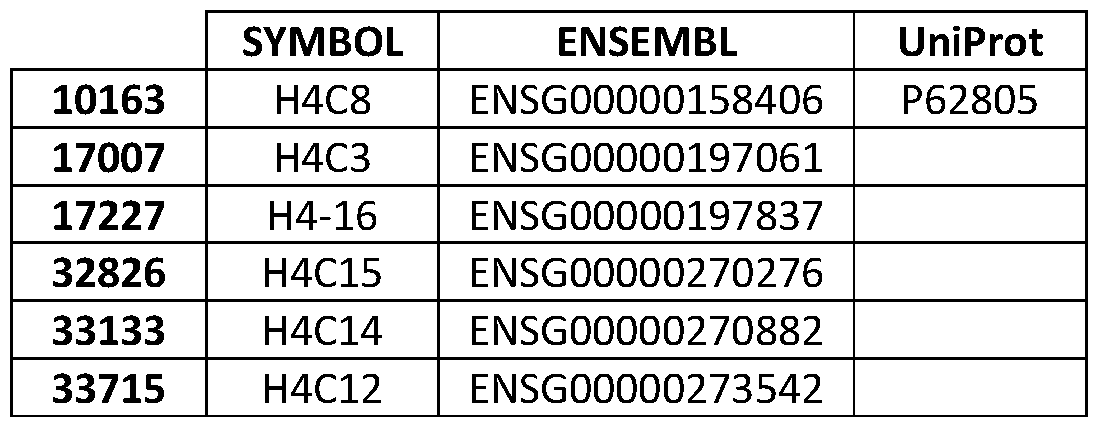 34196 H4C9 ENSG00000276180 34331 H4C5 ENSG00000276966 A
 p gy 9731) SYMBOL ENSEMBL UniProt 2528 WFDC2 ENSG00000101443 Q14508
 Endoplasmic Reticulum Unfolded Protein Response Gene Ontology (GO:0030968) SYMBOL ENSEMBL UniProt 689 HERPUD1 ENSG00000051108 Q15011
 Telomere Organization Gene Ontology (GO:0032200) SYMBOL ENSEMBL UniProt
 33133 H4C14 ENSG00000270882 33715 H4C12 ENSG00000273542 CENP-A
 Containing Nucleosome Assembly Gene Ontology (GO:0034080) SYMBOL ENSEMBL UniProt 490 CENPQ ENSG00000031691 Q7L2Z9
 PERK-Mediated Unfolded Protein Response Gene Ontology (GO:0036499) SYMBOL ENSEMBL UniProt 689 HERPUD1 ENSG00000051108 15011
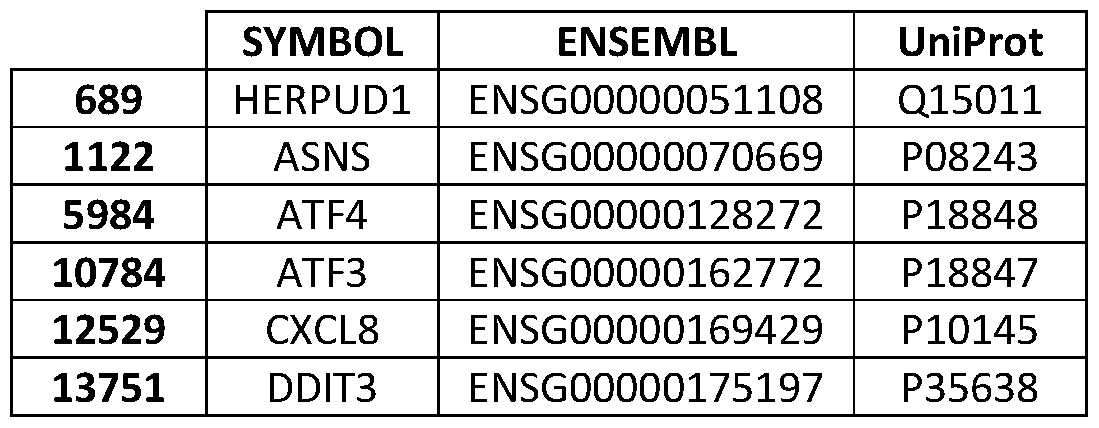 Cellular Protein Metabolic Process Gene Ontology (GO:0044267) SYMBOL ENSEMBL UniProt
 2183 LGALS1 ENSG00000100097 P09382 2706 MSLN ENSG00000102854 Q13421 2
 Negative Regulation of Viral Genome Replication Gene Ontology (GO:0045071) SYMBOL ENSEMBL UniProt 1
 8165 IFITM3 ENSG00000142089 Q01628 13090 IFNB1 ENSG00000171855 P01574 Regulati
 on o egaaryocye eren a on ene noogy ( O:0045652) SYMBOL ENSEMBL UniProt 1982 AGO1 ENSG00000092847 Q9UL18
 Negative Regulation of Megakaryocyte Differentiation Gene Ontology (GO:0045653) SYMBOL ENSEMBL UniProt
 34665 H4C2 ENSG00000278705 TABLE 24 Negative Regulation of Gene Expression, Epigenetic Gene Ontology (GO:0045814) SYMBOL ENSEMBL UniProt 1767 DNMT3B ENSG00000088305 Q9UBC3
 Detection of Chemical Stimulus Involved in Sensory Perception of Smell Gene Ontology (GO:0050911) SYMBOL ENSEMBL UniProt 5551 OR2B6 ENSG00000124657 P58173
 Defense Response to Virus Gene Ontology (GO:0051607) SYMBOL ENSEMBL UniProt 8
 4676 GBP1 ENSG00000117228 P32455 4971 IFIT3 ENSG00000119917 O14879 1
 Type I Interferon Signaling Pathway Gene Ontology (GO:0060337) SYMBOL ENSEMBL UniProt 996 SP100 ENSG00000067066 P23497 1
 15829 IFIT1 ENSG00000185745 P09914 15862 IFITM1 ENSG00000185885 P13164 Reg
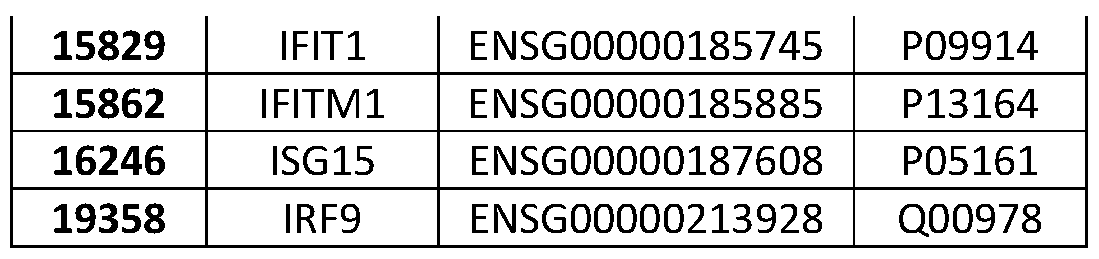 y y 60700) SYMBOL ENSEMBL UniProt 1819 OAS1 ENSG00000089127 P00973 Regu
 lation of Gene silencing by miRNA Gene Ontology (GO:0060964) SYMBOL ENSEMBL UniProt 1982 AGO1 ENSG00000092847 Q9UL18
 Cellular Response to Interleukin-1 Gene Ontology (GO:0071347) SYMBOL ENSEMBL UniProt
 5799 NR1D1 ENSG00000126368 P20393 5912 KLF2 ENSG00000127528 Q9Y5W3
 Upstream Regulators SYMBOL ENSEMBL UniProt KDM1A ENSG00000004487 O60341
 SIM1 ENSG00000112246 P81133 SRF ENSG00000112658 P11831
 GPER1 ENSG00000164850 Q99527 RET ENSG00000165731 P07949
 [0046] In some non-limiting embodiments, modified host cells are provided which are modified to repress or eliminate expression of any one or more of the following human differentially expressed genes (DEGs)(or respective orthologous non-human genes of host cells of non-human origin): ABCC2, ABCF1, ACKR2, ACTA1 (Entrez Gene ID 58; UniProt Accession P68133), AGO1, ALB, ANG, ANKRD1, ANO8, ANXA1, AOC3, APEX1, APLN, APOA1, APOBEC3B, APOBEC3H, APOE, APP, ARL14 (Entrez Gene ID 80117; UniProt Accession Q8N4G2), ARNT2, ASNS, ATF3, ATF4, BDNF, BHLHA15, BLNK, BST2, BUD31, C3, C4A, C4B, C5, C5AR1, CALCR (Entrez Gene ID 799; UniProt Accession P30988), CALR3, CAMP, CBX5, CCL20, CCL25, CCL26, CCL4, CCL5, CCND1, CCR10, CCR4, CD14, CD8A, CEBPA, CEBPB, CEBPG, CENPQ, CFP, CGAS, CHGB, CHUK, CISH, CLIC5, CNIH1, COL16A1, CREB1, CREBBP, CREBRF, CSF1, CTH, CTSK, CTSW, CX3CR1, CXCL11, CXCL8, CXCR2, CYP1A1, DAXX, DDIT3, DDIT4, DDX58, DDX60, DNMT3B, DOCK8, DTX3L, DUSP1, DUSP10, DUSP14, DUSP16, DUSP4, DUSP5, DUSP6, DUSP8, ECM1, EGF, EGR1, EIF2AK2, ELK1, EP300, EPAS1, EPHB1, ERBB2, ESRP1 (Entrez Gene ID 54845; UniProt Accession Q6NXG1), EXOSC5, FAM83A (Entrez Gene ID 84985; UniProt Accession Q86UY5), FAS, FCGR2A, FEV, FGF2,
FGF21, FGF23, FOS, FOSB, FOSL1, FOXO1, FOXO3, GBP1, GBP3, GEM, GIP, GNRH1, GPER1, H1-0, H1-2, H1-3, H1-4, H1-5, H2BC11, H2BC12, H2BC13, H2BC14, H2BC15, H2BC17, H2BC18, H2BC21, H2BC4, H2BC5, H2BC6, H2BC7, H2BC8, H2BU1, H2BW2, H3C1, H3C10, H3C12, H3C13, H3C14, H3C15, H3C2, H3C6, H4-16, H4C1, H4C12, H4C14, H4C15, H4C2, H4C3, H4C4, H4C5, H4C8, H4C9, HAS2, HERPUD1, HGF, HIF1A, HLA-DRB1, HMGA1, HRH1, HS3ST4 (Entrez Gene ID 9951; UniProt Accession Q9Y661), IFI27, IFI44, IFI44L, IFI6, IFIH1, IFIT1, IFIT2, IFIT3, IFITM1, IFITM3, IFNAR1, IFNB1, IGFBP3, IGFBP5, IGFBP7, IKBKB, IKBKE, IKBKG, IL16, IL17B, IL17F, IL17RE, IL18, IL23A, IL32, IL33, IL34, IL5, IRAK3, IRF1, IRF3, IRF5, IRF7, IRF9, IRGM, ISG15, ISG20, ITGAM (Entrez Gene ID 3684; UniProt Accession P11215), JUN, JUNB, KDM1A, KITLG, KLF2, LAMB1, LGALS1, LGALS9, LMCD1, LST1, LTB4R, LTB4R2, MADCAM1, MAP2K1, MAP2K3, MAP3K1, MAP3K14, MAPK1, MAPK14, MAPK3, MAPK8, MAVS, MEF2C, MEF2D, MEP1B, MIF, MMP13, MMP25, MR1, MSC, MSLN, MYD88, MYLPF, NFIL3, NFKB1, NFKBIA, NGF, NKX3-1, NLRC4, NOVA2, NR1D1, NR4A3, OAS1, OAS2, OAS3, OASL, ODAPH (Entrez Gene ID 152816; UniProt Accession Q17RF5), OR2B6, OR51E2, OVGP1, PAF1, PARP9, PCK1, PDE6G (Entrez Gene ID 5148; UniProt Accession P18545), PIK3CD, PLA2G1B, PLA2G4C, PLP1, PLSCR1, PMAIP1, PML, PNN (Entrez Gene ID 5411; UniProt Accession Q9H307), PPRC1, PRDM1, PRKCD, PROC, PSG4, PTAFR, PTGS2, PTHLH, PTPRJ, PTX3, PYCARD, RAF1, RAVER1, RBPJ, RC3H1, RELA, RELB, REST, RET, RGS3, RLN1, RPL39, RPS15A, RSAD2, SAFB, SASH1, SCG2, SCG3, SELENOS, SIM1, SIRT1, SLC38A2, SLPI, SMAD3, SMARCA4, SMARCB1, SMPD1, SOCS1, SOCS3, SP100, SP110, SPI1, SRF, STAT1, STAT4, STC2, STING1, TAC1, TAC3, TAPBP, TFRC, TGFB1, TGFB3, TGM2, TICAM1, TICAM2, TLR2, TLR3, TMEM132A, TNC, TNFAIP3, TNFSF12, TP53, TPT1, TRAF3IP2, TRIM22, TRIM24 (Entrez Gene ID 8805; UniProt Accession O15164), TRIM5, ULBP1, VEGFA, VGF, VPREB3, WFDC2, and/or XBP1. In any of the foregoing embodiments, host cells which are modified to repress or eliminate expression of such genes can be any host cell known in the art to be suitable for producing AAV vectors, including without limitation, animal cells, such as insect or mammal cells, including without limitation, cells of human origin, such as cell lines of human origin, including without limitation, HEK293 cells, including variants, strains, and derivatives thereof. [0047] In some non-limiting embodiments, modified host cells are provided which are modified to repress or eliminate expression of any one or more of the following human DEGs (or respective orthologous non-human genes of host cells of non-human origin): ACTA1, ARL14, BDNF, CALCR, CSF1, CXCL11, DOCK8, EIF2AK2, EP300, EPHB1, ESRP1, FAM83A, FGF2, FOXO1, GNRH1, HGF, HS3ST4, IFI44L, ITGAM, KITLG, MAP2K3, MAPK1, MAPK3, MIF, MSC, MYD88, OAS3, ODAPH, PAF1, PDE6G, PNN, PPRC1, PTX3, RC3H1, SMARCA4, SP110, SPI1, STAT4, TGM2, TICAM1
and/or TRIM24. In any of the foregoing embodiments, modified host cells which are modified to repress or eliminate expression of such genes can be any host cell known in the art to be suitable for producing AAV vectors, including without limitation, animal cells, such as insect or mammal cells, including without limitation, cells of human origin, such as cell lines of human origin, including without limitation, HEK293 cells, including variants, strains, and derivatives thereof. [0048] In some of these embodiments, the modified host cells are modified to repress or eliminate expression of any of the foregoing genes singly, or in combination with one or more others of the listed genes. Thus, for example, in some non-limiting embodiments modified host cells are provided which are modified to repress or eliminate expression of ACTA1 alone, or in combination with one or more of ARL14, BDNF, CALCR, CSF1, CXCL11, DOCK8, EIF2AK2, EP300, EPHB1, ESRP1, FAM83A, FGF2, FOXO1, GNRH1, HGF, HS3ST4, IFI44L, ITGAM, KITLG, MAP2K3, MAPK1, MAPK3, MIF, MSC, MYD88, OAS3, ODAPH, PAF1, PDE6G, PNN, PPRC1, PTX3, RC3H1, SMARCA4, SP110, SPI1, STAT4, TGM2, TICAM1 and/or TRIM24; or ARL14 alone, or in combination with one or more of ACTA1, BDNF, CALCR, CSF1, CXCL11, DOCK8, EIF2AK2, EP300, EPHB1, ESRP1, FAM83A, FGF2, FOXO1, GNRH1, HGF, HS3ST4, IFI44L, ITGAM, KITLG, MAP2K3, MAPK1, MAPK3, MIF, MSC, MYD88, OAS3, ODAPH, PAF1, PDE6G, PNN, PPRC1, PTX3, RC3H1, SMARCA4, SP110, SPI1, STAT4, TGM2, TICAM1 and/or TRIM24; or BDNF alone, or in combination with one or more of ACTA1, ARL14, CALCR, CSF1, CXCL11, DOCK8, EIF2AK2, EP300, EPHB1, ESRP1, FAM83A, FGF2, FOXO1, GNRH1, HGF, HS3ST4, IFI44L, ITGAM, KITLG, MAP2K3, MAPK1, MAPK3, MIF, MSC, MYD88, OAS3, ODAPH, PAF1, PDE6G, PNN, PPRC1, PTX3, RC3H1, SMARCA4, SP110, SPI1, STAT4, TGM2, TICAM1 and/or TRIM24; or CALCR alone, or in combination with one or more of ACTA1, ARL14, BDNF, CSF1, CXCL11, DOCK8, EIF2AK2, EP300, EPHB1, ESRP1, FAM83A, FGF2, FOXO1, GNRH1, HGF, HS3ST4, IFI44L, ITGAM, KITLG, MAP2K3, MAPK1, MAPK3, MIF, MSC, MYD88, OAS3, ODAPH, PAF1, PDE6G, PNN, PPRC1, PTX3, RC3H1, SMARCA4, SP110, SPI1, STAT4, TGM2, TICAM1 and/or TRIM24; or CSF1 alone, or in combination with one or more of ACTA1, ARL14, BDNF, CALCR, CXCL11, DOCK8, EIF2AK2, EP300, EPHB1, ESRP1, FAM83A, FGF2, FOXO1, GNRH1, HGF, HS3ST4, IFI44L, ITGAM, KITLG, MAP2K3, MAPK1, MAPK3, MIF, MSC, MYD88, OAS3, ODAPH, PAF1, PDE6G, PNN, PPRC1, PTX3, RC3H1, SMARCA4, SP110, SPI1, STAT4, TGM2, TICAM1 and/or TRIM24; or CXCL11 alone, or in combination with one or more of ACTA1, ARL14, BDNF, CALCR, CSF1, DOCK8, EIF2AK2, EP300, EPHB1, ESRP1, FAM83A, FGF2, FOXO1, GNRH1, HGF, HS3ST4, IFI44L, ITGAM, KITLG, MAP2K3, MAPK1, MAPK3, MIF, MSC, MYD88, OAS3, ODAPH, PAF1, PDE6G, PNN, PPRC1, PTX3, RC3H1, SMARCA4, SP110, SPI1, STAT4, TGM2, TICAM1 and/or TRIM24; or
DOCK8 alone, or in combination with one or more of ACTA1, ARL14, BDNF, CALCR, CSF1, CXCL11, EIF2AK2, EP300, EPHB1, ESRP1, FAM83A, FGF2, FOXO1, GNRH1, HGF, HS3ST4, IFI44L, ITGAM, KITLG, MAP2K3, MAPK1, MAPK3, MIF, MSC, MYD88, OAS3, ODAPH, PAF1, PDE6G, PNN, PPRC1, PTX3, RC3H1, SMARCA4, SP110, SPI1, STAT4, TGM2, TICAM1 and/or TRIM24; or EIF2AK2 alone, or in combination with one or more of ACTA1, ARL14, BDNF, CALCR, CSF1, CXCL11, DOCK8, EP300, EPHB1, ESRP1, FAM83A, FGF2, FOXO1, GNRH1, HGF, HS3ST4, IFI44L, ITGAM, KITLG, MAP2K3, MAPK1, MAPK3, MIF, MSC, MYD88, OAS3, ODAPH, PAF1, PDE6G, PNN, PPRC1, PTX3, RC3H1, SMARCA4, SP110, SPI1, STAT4, TGM2, TICAM1 and/or TRIM24; or EP300 alone, or in combination with one or more of ACTA1, ARL14, BDNF, CALCR, CSF1, CXCL11, DOCK8, EIF2AK2, EPHB1, ESRP1, FAM83A, FGF2, FOXO1, GNRH1, HGF, HS3ST4, IFI44L, ITGAM, KITLG, MAP2K3, MAPK1, MAPK3, MIF, MSC, MYD88, OAS3, ODAPH, PAF1, PDE6G, PNN, PPRC1, PTX3, RC3H1, SMARCA4, SP110, SPI1, STAT4, TGM2, TICAM1 and/or TRIM24; or EPHB1 alone, or in combination with one or more of ACTA1, ARL14, BDNF, CALCR, CSF1, CXCL11, DOCK8, EIF2AK2, EP300, ESRP1, FAM83A, FGF2, FOXO1, GNRH1, HGF, HS3ST4, IFI44L, ITGAM, KITLG, MAP2K3, MAPK1, MAPK3, MIF, MSC, MYD88, OAS3, ODAPH, PAF1, PDE6G, PNN, PPRC1, PTX3, RC3H1, SMARCA4, SP110, SPI1, STAT4, TGM2, TICAM1 and/or TRIM24; or ESRP1 alone, or in combination with one or more of ACTA1, ARL14, BDNF, CALCR, CSF1, CXCL11, DOCK8, EIF2AK2, EP300, EPHB1, FAM83A, FGF2, FOXO1, GNRH1, HGF, HS3ST4, IFI44L, ITGAM, KITLG, MAP2K3, MAPK1, MAPK3, MIF, MSC, MYD88, OAS3, ODAPH, PAF1, PDE6G, PNN, PPRC1, PTX3, RC3H1, SMARCA4, SP110, SPI1, STAT4, TGM2, TICAM1 and/or TRIM24; or FAM83A alone, or in combination with one or more of ACTA1, ARL14, BDNF, CALCR, CSF1, CXCL11, DOCK8, EIF2AK2, EP300, EPHB1, ESRP1, FGF2, FOXO1, GNRH1, HGF, HS3ST4, IFI44L, ITGAM, KITLG, MAP2K3, MAPK1, MAPK3, MIF, MSC, MYD88, OAS3, ODAPH, PAF1, PDE6G, PNN, PPRC1, PTX3, RC3H1, SMARCA4, SP110, SPI1, STAT4, TGM2, TICAM1 and/or TRIM24; or FGF2 alone, or in combination with one or more of ACTA1, ARL14, BDNF, CALCR, CSF1, CXCL11, DOCK8, EIF2AK2, EP300, EPHB1, ESRP1, FAM83A, FOXO1, GNRH1, HGF, HS3ST4, IFI44L, ITGAM, KITLG, MAP2K3, MAPK1, MAPK3, MIF, MSC, MYD88, OAS3, ODAPH, PAF1, PDE6G, PNN, PPRC1, PTX3, RC3H1, SMARCA4, SP110, SPI1, STAT4, TGM2, TICAM1 and/or TRIM24; or FOXO1 alone, or in combination with one or more of ACTA1, ARL14, BDNF, CALCR, CSF1, CXCL11, DOCK8, EIF2AK2, EP300, EPHB1, ESRP1, FAM83A, FGF2, GNRH1, HGF, HS3ST4, IFI44L, ITGAM, KITLG, MAP2K3, MAPK1, MAPK3, MIF, MSC, MYD88, OAS3, ODAPH, PAF1, PDE6G, PNN, PPRC1, PTX3, RC3H1, SMARCA4, SP110, SPI1, STAT4, TGM2, TICAM1 and/or TRIM24; or GNRH1 alone, or in combination with one or more of ACTA1, ARL14, BDNF, CALCR, CSF1, CXCL11, DOCK8, EIF2AK2, EP300, EPHB1, ESRP1, FAM83A, FGF2, FOXO1, HGF, HS3ST4, IFI44L, ITGAM, KITLG, MAP2K3,
MAPK1, MAPK3, MIF, MSC, MYD88, OAS3, ODAPH, PAF1, PDE6G, PNN, PPRC1, PTX3, RC3H1, SMARCA4, SP110, SPI1, STAT4, TGM2, TICAM1 and/or TRIM24; or HGF alone, or in combination with one or more of ACTA1, ARL14, BDNF, CALCR, CSF1, CXCL11, DOCK8, EIF2AK2, EP300, EPHB1, ESRP1, FAM83A, FGF2, FOXO1, GNRH1, HS3ST4, IFI44L, ITGAM, KITLG, MAP2K3, MAPK1, MAPK3, MIF, MSC, MYD88, OAS3, ODAPH, PAF1, PDE6G, PNN, PPRC1, PTX3, RC3H1, SMARCA4, SP110, SPI1, STAT4, TGM2, TICAM1 and/or TRIM24; or HS3ST4 alone, or in combination with one or more of ACTA1, ARL14, BDNF, CALCR, CSF1, CXCL11, DOCK8, EIF2AK2, EP300, EPHB1, ESRP1, FAM83A, FGF2, FOXO1, GNRH1, HGF, HS3ST4, IFI44L, ITGAM, KITLG, MAP2K3, MAPK1, MAPK3, MIF, MSC, MYD88, OAS3, ODAPH, PAF1, PDE6G, PNN, PPRC1, PTX3, RC3H1, SMARCA4, SP110, SPI1, STAT4, TGM2, TICAM1 and/or TRIM24; or IFI44L alone, or in combination with one or more of ACTA1, ARL14, BDNF, CALCR, CSF1, CXCL11, DOCK8, EIF2AK2, EP300, EPHB1, ESRP1, FAM83A, FGF2, FOXO1, GNRH1, HGF, HS3ST4, ITGAM, KITLG, MAP2K3, MAPK1, MAPK3, MIF, MSC, MYD88, OAS3, ODAPH, PAF1, PDE6G, PNN, PPRC1, PTX3, RC3H1, SMARCA4, SP110, SPI1, STAT4, TGM2, TICAM1 and/or TRIM24; or ITGAM alone, or in combination with one or more of ACTA1, ARL14, BDNF, CALCR, CSF1, CXCL11, DOCK8, EIF2AK2, EP300, EPHB1, ESRP1, FAM83A, FGF2, FOXO1, GNRH1, HGF, HS3ST4, IFI44L, KITLG, MAP2K3, MAPK1, MAPK3, MIF, MSC, MYD88, OAS3, ODAPH, PAF1, PDE6G, PNN, PPRC1, PTX3, RC3H1, SMARCA4, SP110, SPI1, STAT4, TGM2, TICAM1 and/or TRIM24; or KITLG alone, or in combination with one or more of ACTA1, ARL14, BDNF, CALCR, CSF1, CXCL11, DOCK8, EIF2AK2, EP300, EPHB1, ESRP1, FAM83A, FGF2, FOXO1, GNRH1, HGF, HS3ST4, IFI44L, ITGAM, MAP2K3, MAPK1, MAPK3, MIF, MSC, MYD88, OAS3, ODAPH, PAF1, PDE6G, PNN, PPRC1, PTX3, RC3H1, SMARCA4, SP110, SPI1, STAT4, TGM2, TICAM1 and/or TRIM24; or MAP2K3 alone, or in combination with one or more of ACTA1, ARL14, BDNF, CALCR, CSF1, CXCL11, DOCK8, EIF2AK2, EP300, EPHB1, ESRP1, FAM83A, FGF2, FOXO1, GNRH1, HGF, HS3ST4, IFI44L, ITGAM, KITLG, MAPK1, MAPK3, MIF, MSC, MYD88, OAS3, ODAPH, PAF1, PDE6G, PNN, PPRC1, PTX3, RC3H1, SMARCA4, SP110, SPI1, STAT4, TGM2, TICAM1 and/or TRIM24; or MAPK1 alone, or in combination with one or more of ACTA1, ARL14, BDNF, CALCR, CSF1, CXCL11, DOCK8, EIF2AK2, EP300, EPHB1, ESRP1, FAM83A, FGF2, FOXO1, GNRH1, HGF, HS3ST4, IFI44L, ITGAM, KITLG, MAP2K3, MAPK3, MIF, MSC, MYD88, OAS3, ODAPH, PAF1, PDE6G, PNN, PPRC1, PTX3, RC3H1, SMARCA4, SP110, SPI1, STAT4, TGM2, TICAM1 and/or TRIM24; or MAPK3 alone, or in combination with one or more of ACTA1, ARL14, BDNF, CALCR, CSF1, CXCL11, DOCK8, EIF2AK2, EP300, EPHB1, ESRP1, FAM83A, FGF2, FOXO1, GNRH1, HGF, HS3ST4, IFI44L, ITGAM, KITLG, MAP2K3, MAPK1, MIF, MSC, MYD88, OAS3, ODAPH, PAF1, PDE6G, PNN, PPRC1, PTX3, RC3H1, SMARCA4, SP110, SPI1, STAT4, TGM2, TICAM1 and/or TRIM24; or MIF alone, or in
combination with one or more of ACTA1, ARL14, BDNF, CALCR, CSF1, CXCL11, DOCK8, EIF2AK2, EP300, EPHB1, ESRP1, FAM83A, FGF2, FOXO1, GNRH1, HGF, HS3ST4, IFI44L, ITGAM, KITLG, MAP2K3, MAPK1, MAPK3, MSC, MYD88, OAS3, ODAPH, PAF1, PDE6G, PNN, PPRC1, PTX3, RC3H1, SMARCA4, SP110, SPI1, STAT4, TGM2, TICAM1 and/or TRIM24; or MSC alone, or in combination with one or more of ACTA1, ARL14, BDNF, CALCR, CSF1, CXCL11, DOCK8, EIF2AK2, EP300, EPHB1, ESRP1, FAM83A, FGF2, FOXO1, GNRH1, HGF, HS3ST4, IFI44L, ITGAM, KITLG, MAP2K3, MAPK1, MAPK3, MIF, MYD88, OAS3, ODAPH, PAF1, PDE6G, PNN, PPRC1, PTX3, RC3H1, SMARCA4, SP110, SPI1, STAT4, TGM2, TICAM1 and/or TRIM24; or MYD88 alone, or in combination with one or more of ACTA1, ARL14, BDNF, CALCR, CSF1, CXCL11, DOCK8, EIF2AK2, EP300, EPHB1, ESRP1, FAM83A, FGF2, FOXO1, GNRH1, HGF, HS3ST4, IFI44L, ITGAM, KITLG, MAP2K3, MAPK1, MAPK3, MIF, MSC, OAS3, ODAPH, PAF1, PDE6G, PNN, PPRC1, PTX3, RC3H1, SMARCA4, SP110, SPI1, STAT4, TGM2, TICAM1 and/or TRIM24; or OAS3 alone, or in combination with one or more of ACTA1, ARL14, BDNF, CALCR, CSF1, CXCL11, DOCK8, EIF2AK2, EP300, EPHB1, ESRP1, FAM83A, FGF2, FOXO1, GNRH1, HGF, HS3ST4, IFI44L, ITGAM, KITLG, MAP2K3, MAPK1, MAPK3, MIF, MSC, MYD88, ODAPH, PAF1, PDE6G, PNN, PPRC1, PTX3, RC3H1, SMARCA4, SP110, SPI1, STAT4, TGM2, TICAM1 and/or TRIM24; or ODAPH alone, or in combination with one or more of ACTA1, ARL14, BDNF, CALCR, CSF1, CXCL11, DOCK8, EIF2AK2, EP300, EPHB1, ESRP1, FAM83A, FGF2, FOXO1, GNRH1, HGF, HS3ST4, IFI44L, ITGAM, KITLG, MAP2K3, MAPK1, MAPK3, MIF, MSC, MYD88, OAS3, PAF1, PDE6G, PNN, PPRC1, PTX3, RC3H1, SMARCA4, SP110, SPI1, STAT4, TGM2, TICAM1 and/or TRIM24; or PAF1 alone, or in combination with one or more of ACTA1, ARL14, BDNF, CALCR, CSF1, CXCL11, DOCK8, EIF2AK2, EP300, EPHB1, ESRP1, FAM83A, FGF2, FOXO1, GNRH1, HGF, HS3ST4, IFI44L, ITGAM, KITLG, MAP2K3, MAPK1, MAPK3, MIF, MSC, MYD88, OAS3, ODAPH, PDE6G, PNN, PPRC1, PTX3, RC3H1, SMARCA4, SP110, SPI1, STAT4, TGM2, TICAM1 and/or TRIM24; or PDE6G alone, or in combination with one or more of ACTA1, ARL14, BDNF, CALCR, CSF1, CXCL11, DOCK8, EIF2AK2, EP300, EPHB1, ESRP1, FAM83A, FGF2, FOXO1, GNRH1, HGF, HS3ST4, IFI44L, ITGAM, KITLG, MAP2K3, MAPK1, MAPK3, MIF, MSC, MYD88, OAS3, ODAPH, PAF1, PNN, PPRC1, PTX3, RC3H1, SMARCA4, SP110, SPI1, STAT4, TGM2, TICAM1 and/or TRIM24; or PNN alone, or in combination with one or more of ACTA1, ARL14, BDNF, CALCR, CSF1, CXCL11, DOCK8, EIF2AK2, EP300, EPHB1, ESRP1, FAM83A, FGF2, FOXO1, GNRH1, HGF, HS3ST4, IFI44L, ITGAM, KITLG, MAP2K3, MAPK1, MAPK3, MIF, MSC, MYD88, OAS3, ODAPH, PAF1, PDE6G, PPRC1, PTX3, RC3H1, SMARCA4, SP110, SPI1, STAT4, TGM2, TICAM1 and/or TRIM24; or PPRC1 alone, or in combination with one or more of ACTA1, ARL14, BDNF, CALCR, CSF1, CXCL11, DOCK8, EIF2AK2, EP300, EPHB1, ESRP1, FAM83A, FGF2, FOXO1, GNRH1, HGF, HS3ST4, IFI44L, ITGAM, KITLG,
MAP2K3, MAPK1, MAPK3, MIF, MSC, MYD88, OAS3, ODAPH, PAF1, PDE6G, PNN, PTX3, RC3H1, SMARCA4, SP110, SPI1, STAT4, TGM2, TICAM1 and/or TRIM24; or PTX3 alone, or in combination with one or more of ACTA1, ARL14, BDNF, CALCR, CSF1, CXCL11, DOCK8, EIF2AK2, EP300, EPHB1, ESRP1, FAM83A, FGF2, FOXO1, GNRH1, HGF, HS3ST4, IFI44L, ITGAM, KITLG, MAP2K3, MAPK1, MAPK3, MIF, MSC, MYD88, OAS3, ODAPH, PAF1, PDE6G, PNN, PPRC1, RC3H1, SMARCA4, SP110, SPI1, STAT4, TGM2, TICAM1 and/or TRIM24; or RC3H1 alone, or in combination with one or more of ACTA1, ARL14, BDNF, CALCR, CSF1, CXCL11, DOCK8, EIF2AK2, EP300, EPHB1, ESRP1, FAM83A, FGF2, FOXO1, GNRH1, HGF, HS3ST4, IFI44L, ITGAM, KITLG, MAP2K3, MAPK1, MAPK3, MIF, MSC, MYD88, OAS3, ODAPH, PAF1, PDE6G, PNN, PPRC1, PTX3, SMARCA4, SP110, SPI1, STAT4, TGM2, TICAM1 and/or TRIM24; or SMARCA4 alone, or in combination with one or more of ACTA1, ARL14, BDNF, CALCR, CSF1, CXCL11, DOCK8, EIF2AK2, EP300, EPHB1, ESRP1, FAM83A, FGF2, FOXO1, GNRH1, HGF, HS3ST4, IFI44L, ITGAM, KITLG, MAP2K3, MAPK1, MAPK3, MIF, MSC, MYD88, OAS3, ODAPH, PAF1, PDE6G, PNN, PPRC1, PTX3, RC3H1, SP110, SPI1, STAT4, TGM2, TICAM1 and/or TRIM24; or SP110 alone, or in combination with one or more of ACTA1, ARL14, BDNF, CALCR, CSF1, CXCL11, DOCK8, EIF2AK2, EP300, EPHB1, ESRP1, FAM83A, FGF2, FOXO1, GNRH1, HGF, HS3ST4, IFI44L, ITGAM, KITLG, MAP2K3, MAPK1, MAPK3, MIF, MSC, MYD88, OAS3, ODAPH, PAF1, PDE6G, PNN, PPRC1, PTX3, RC3H1, SMARCA4, SPI1, STAT4, TGM2, TICAM1 and/or TRIM24; or SPI1 alone, or in combination with one or more of ACTA1, ARL14, BDNF, CALCR, CSF1, CXCL11, DOCK8, EIF2AK2, EP300, EPHB1, ESRP1, FAM83A, FGF2, FOXO1, GNRH1, HGF, HS3ST4, IFI44L, ITGAM, KITLG, MAP2K3, MAPK1, MAPK3, MIF, MSC, MYD88, OAS3, ODAPH, PAF1, PDE6G, PNN, PPRC1, PTX3, RC3H1, SMARCA4, SP110, STAT4, TGM2, TICAM1 and/or TRIM24; or STAT4 alone, or in combination with one or more of ACTA1, ARL14, BDNF, CALCR, CSF1, CXCL11, DOCK8, EIF2AK2, EP300, EPHB1, ESRP1, FAM83A, FGF2, FOXO1, GNRH1, HGF, HS3ST4, IFI44L, ITGAM, KITLG, MAP2K3, MAPK1, MAPK3, MIF, MSC, MYD88, OAS3, ODAPH, PAF1, PDE6G, PNN, PPRC1, PTX3, RC3H1, SMARCA4, SP110, SPI1, TGM2, TICAM1 and/or TRIM24; or TGM2 alone, or in combination with one or more of ACTA1, ARL14, BDNF, CALCR, CSF1, CXCL11, DOCK8, EIF2AK2, EP300, EPHB1, ESRP1, FAM83A, FGF2, FOXO1, GNRH1, HGF, HS3ST4, IFI44L, ITGAM, KITLG, MAP2K3, MAPK1, MAPK3, MIF, MSC, MYD88, OAS3, ODAPH, PAF1, PDE6G, PNN, PPRC1, PTX3, RC3H1, SMARCA4, SP110, SPI1, STAT4, TICAM1 and/or TRIM24; or TICAM1 alone, or in combination with one or more of ACTA1, ARL14, BDNF, CALCR, CSF1, CXCL11, DOCK8, EIF2AK2, EP300, EPHB1, ESRP1, FAM83A, FGF2, FOXO1, GNRH1, HGF, HS3ST4, IFI44L, ITGAM, KITLG, MAP2K3, MAPK1, MAPK3, MIF, MSC, MYD88, OAS3, ODAPH, PAF1, PDE6G, PNN, PPRC1, PTX3, RC3H1, SMARCA4, SP110, SPI1, STAT4, TGM2, and/or TRIM24; or TRIM24 alone, or in
combination with one or more of ACTA1, ARL14, BDNF, CALCR, CSF1, CXCL11, DOCK8, EIF2AK2, EP300, EPHB1, ESRP1, FAM83A, FGF2, FOXO1, GNRH1, HGF, HS3ST4, IFI44L, ITGAM, KITLG, MAP2K3, MAPK1, MAPK3, MIF, MSC, MYD88, OAS3, ODAPH, PAF1, PDE6G, PNN, PPRC1, PTX3, RC3H1, SMARCA4, SP110, SPI1, STAT4, TGM2, and/or TICAM1. [0049] In some other non-limiting embodiments, modified host cells are provided which are modified to repress or eliminate expression of the human genes (or respective orthologous non- human genes of host cells of non-human origin) MIF and OAS3; OAS3 and PAF1; OAS3 and RC3H1; OAS3 and PPRC1; MIF and PAF1; MIF and RC3H1; MIF and PPRC1; PAF1 and RC3H1; PAF1 and PPRC1; or PPRC1 and RC3H1. [0050] In some embodiments, repression or elimination in host cells of expression of any gene (such as the DEGs described herein) upregulated in unmodified host cells of the same type after introduction of exogenous genetic material required to direct biosynthesis of recombinant AAV vectors, and/or at different times during their biosynthesis after introduction of the exogenous genetic material, is effective to increase the amount of intact AAV vectors produced in such host cells compared to the amount of AAV vectors produced from unmodified host cells of the same type in which the gene has not been repressed or eliminated. In some embodiments, the amount of a particular AAV vector produced in modified host cells is at least or about 50%, 60%, 70%, 80%, 90%, 100%, 110%, 120%, 130%, 140%, 150%, 175%, 200%, 225%, 250%, 275%, 300%, 325%, 350%, 375%, 400%, 425%, 450%, 475%, or 500% greater than the amount which could be produced in unmodified host cells of the same type under otherwise identical conditions, or a range between and encompassing any of the foregoing specifically enumerated values. [0051] In some embodiments, repression or elimination in host cells of any gene (such as the DEGs described herein) upregulated in unmodified host cells of the same type after introduction of exogenous genetic material required to direct biosynthesis of recombinant AAV vectors, and/or at different times during their biosynthesis after introduction of the exogenous genetic material, is effective to increase the proportion of AAV vectors produced in such host cells that possess a key quality attribute compared to the proportion of AAV vectors possessing the same key quality attribute produced from unmodified host cells of the same type in which the gene has not been repressed or eliminated. In some embodiments, the proportion of a particular AAV vector produced in modified host cells possessing a key quality attribute is at least or about 50%, 60%, 70%, 80%, 90%, 100%, 110%, 120%, 130%, 140%, 150%, 175%, 200%, 225%, 250%, 275%, 300%, 325%, 350%, 375%, 400%, 425%, 450%, 475%, or 500% greater than the proportion of
AAV vectors possessing the same key quality attribute which could be produced in unmodified host cells of the same type under otherwise identical conditions, or a range between and encompassing any of the foregoing specifically enumerated values. In some embodiments, key quality attributes include the percentage of capsids which contain full length vector genomes relative to the percentage containing less than full length vector genomes, or which do not contain vector genomes. Other key quality attributes include stability, potency, and any other key quality attribute known to those ordinary skill in the art. Methods of Modifying Host Cells [0052] Host cells of the disclosure can be modified to repress, reduce or eliminate expression of one or more desired genes (such as the DEGs identified herein) (i.e., silence such genes) using any method known in the art, or yet to be developed, which is effective repress, reduce or eliminate expression of specific genes in similar types of cells. Known approaches include interventions targeting the gene at it exists in the genome, transcription of a gene into RNA, translation of an mRNA into protein, and protein function. Different approaches may be combined, if so desired, to reduce expression of a particular gene, or of multiple genes in the same cell. [0053] As generally understood, gene transcription gives rise to messenger RNA (mRNA) transcripts which encode proteins, or non-coding RNA transcripts (which may be processed similarly as mRNAs in terms of capping, splicing, and polyadenylation) which have some other function within a cell (although, as known in the art, some protein-encoding transcripts can also contain non-coding functional RNA regions, such as sequences of miRNAs). For convenience, unless otherwise specified, where the disclosure mentions mRNA, such reference is intended to apply to functional non-coding RNA transcripts of genes as well. [0054] In some embodiments, the genome of a host cell is permanently modified in a manner which is effective to prevent transcription of a desired gene into RNA. In some embodiments, the genome is modified so as to delete (“knock-out”) one or more functional DNA sequences essential to gene function, such as deletion of part or all of a transcription control region required to transcribe the gene into RNA, such as a promoter and/or enhancer, or deletion of one or more splice junctions or exons required for a stable mRNA or protein to be expressed. In other embodiments, the entire gene is deleted from the genome. In other embodiments, the genome is modified so as to insert (“knock-in”) a DNA sequence which interferes with the proper function of one or more other DNA sequences essential to the expression of the gene, such as insertion
of a DNA sequence which disrupts a transcription control region, or which prevents correct mRNA splicing, or which introduces a premature stop codon. [0055] Methods for deleting or inserting a desired sequence from or into a genome, respectively, are known in the art including, for example, gene targeting by homologous recombination, or with gene editing methods relying on expression or introduction into cells of zinc-finger nucleases, transcription activator-like effector nucleases (TALEN), or ribonucleoprotein (RNP) editing complexes, such as CRISPR/Cas9, or variants, such as CRISPR/Cas12a (described further in Zhang, L, et al. Nat Comms. 12(1):3908 (2021)). Gene editing technologies are described further in Gaj T, et al., Trends Biotechnol. 31(7):397-405 (2013); LaFountaine JS, et al., Int J Pharm.494(1):180–194 (2015); Carroll, D, Gene Genome Edit (2021) (doi.org/10.1016/j.ggedit.2021.100002); Liu, G, et al., Mol Cell 82:333-347 (2022) (doi.org/10.1016/j.molcel.2021.12.002); Nemudryi, AA, et al., Acta naturae 6(3):19-40 (2014); Shalem, O, et al., SCIENCE 343:84-87 (2014) (DOI: 10.1126/science.1247005); Becker, S and Boch, J, Gene Genome Edit (2021) (doi.org/10.1016/j.ggedit.2021.100007); Bogdanove, AJ and Voytas, DF, SCIENCE 333:1843-1846 (2011) (DOI:10.1126/science.1204094); Costa, JR, et al, Genome Editing Using Engineered Nucleases and Their Use in Genomic Screening (2017) in Assay Guidance Manual, Markossian S, et al., Eds.; Guha, TK and Edgell, DR, Int J Mol Sci 18:2565 (2017) (doi:10.3390/ijms18122565); Wang, H, et al., Nature Biotech 31(6):530-532 (2013) (doi:10.1038/nbt.2595); Bouabe, H and Okkenhaug, K, Methods Mol Biol.1064:315–336 (2013) (doi:10.1007/978-1-62703-601-6_23); Hall, B, et al., Curr Protoc Cell Biol 19.12.1-19.12.17 (2009) (doi:10.1002/0471143030.cb1912s44); Hendrie, PC and Russell, DW, Mol Ther 12(1):9-17 (2005) (doi:10.1016/j.ymthe.2005.04.006); Zhang, C, et al., Nuc Acids Res 33(3):1-7 (2005) (doi:10.1093/nar/gni014); Turakainen, H, et al., PLOS One 4(2):1-12 (2009) (doi:10.1371/journal.pone.0004341); Topaloglu, O, et al., Nuc Acids Res 33(18):1-7 (2005) (doi:10.1093/nar/gni160). [0056] In some embodiments, a gene can be silenced by introducing into a host cell a vector (such as a plasmid or viral vector) for expressing a protein effective to repress transcription of the gene, even though the gene itself remains intact. For example, the vector can express a modified transcription factor capable of specifically binding to the transcription control region of a gene, but which carries a repressor domain (such as a KRAB domain) which actively represses transcription of the gene into RNA. In other embodiments of this nature, a target gene can be silenced using CRISPR interference (CRISPRi), in which the expressed protein is a mutated version
of the Cas9 enzyme, termed dead Cas9 (dCas9), in which the catalytic subunits are mutated to prevent their cleavage of DNA. When expressed or otherwise introduced into a host cell (such as by electroporation or lipofection) and targeted to a particular transcription control region by a suitable guide RNA, the dCas9 protein can bind and passively prevent binding by transcription activator proteins, temporarily blocking transcription from the gene. The dCas9 protein can also be further modified by fusing it with a transcriptional repressor domain (such as a KRAB domain), such that after binding a target gene’s transcription control region as directed by a guide RNA, transcription of the gene is actively repressed. As understood in the art, expression of the components required for CRISPRi (mutated Cas enzyme and guide RNA) from a vector can be effected transiently, or stably and therefore permanently. CRISPRi and dCas9 are described further in Qi, LS, et al., Cell 152(5):1173–1183 (2013), and Gilbert, LA, et al., Cell 154(2):442-451 (2013). [0057] In some embodiments, a gene can be effectively silenced post-transcriptionally by targeting the RNA transcript from the gene, rather than the gene itself (as it is embodied in the genome). A variety of ways of targeting RNA transcripts from genes (such as mRNAs) have been developed, and the particular choice should not be considered limiting. Thus, for example, in some embodiments, host cells can be treated with an expression repression effective amount of one or more types of DNA or RNA anti-sense oligonucleotides (AON) comprising a nucleotide sequence that is complementary (wholly or in part) to a subsequence present in an RNA transcript expressed from a target gene to be silenced. In sufficient amounts, AONs can bind to the transcript through complementary base-pairing and prevent translation from and/or enhance degradation (for example, by RNase H) of the RNA, thereby reducing or eliminating expression of the gene product. Use of AONs for gene silencing is described further in Crooke, ST, et al., J Biol Chem 296:100416 (2021) (doi: 10.1016/j.jbc.2021.100416); Crooke, ST, Nuc Acid Thera 27(2):70-77 (2017) (DOI:10.1089/nat.2016.0656); Lennox KA, et al., J Rare Dis Res Treat 1(3):66–70 (2016); Walder RY and Walder JA, Proc Natl Acad Sci USA 85(14):5011–5015 (1988); Dagle JM, et al., Nucleic Acids Res. 18(16):4751–4757 (1990); Braasch DA, et al., Nucleic Acids Res. 30(23):5160–5167 (2002); Kurreck J, et al., Nucleic Acids Res. 30(9):1911-1918 (2002); Grünweller A, et al., Nucleic Acids Res.31(12):3185-3193 (2003). [0058] In other embodiments, ribozymes designed to target specific RNA transcripts can be expressed in host cells from a vector (such as a plasmid or viral vector). RNA targeting using ribozymes is described further in James, HA and Gibson, I, Blood 91(2):371-382 (1998); Trang, P,
et al., Cellular Micro 6(6):499-508 (2004) (doi:10.1111/j.1462-5822.2004.00398.x); Kumar, R, et al., Gene Ther 12:1486-1492 (2005); Kharma, N, et al., Nuc Acids Res 44(4):1-12 (2015) (doi: 10.1093/nar/gkv1111). [0059] In other embodiments, aspects of the CRISPR/Cas system can be used to target RNA transcripts, rather than DNA genes. For example, RNA nucleases from the Cas13 family can be expressed or otherwise introduced into host cells and targeted to particular RNA transcripts via suitable guide RNAs. RNA targeting with Cas13 enzymes is described further in Abudayyeh, OO, et al., Nature 550(7675):280-284 (2017); Cox, DBT, et al., Science 358(6366):1019-1027 (2017); and Konermann, S, et al., Cell 173(3):665-676 (2018). [0060] In other embodiments, the RNA transcript of a gene to be silenced can be targeted through mechanisms of RNA interference (RNAi) by introducing into host cells small interfering RNA (siRNA) molecules, short hairpin RNA (shRNA) molecules, microRNA (miRNA) molecules, or any other RNA molecule or RNA mimetic capable of gene silencing by RNAi. [0061] In some embodiments, gene expression in host cells can be reduced or eliminated by introducing into such cells one or more types of small interfering RNA (siRNA) molecules. Small interfering RNA are short (for example, 21-26 bases long) double-stranded RNA molecules with 2 nucleotide 3’ overhangs at each end of the duplex. siRNAs can be designed so that one of the strands of the siRNA duplex serves as a guide strand capable of binding, through complementary base-pairing, to a specific RNA transcript (for example, mRNA). After being introduced into host cells, guide strands of siRNA are loaded by cellular molecular machinery into RNA-induced silencing complexes (RISC) naturally existing within the cells and act to program RISC to target the RNA transcript, thereby preventing translation into protein, and/or enhance degradation by endogenous ribonucleases. The other strand within the shRNA duplex is called the passenger and is not incorporated into RISC. [0062] siRNA molecules can be prepared in any way that is known in the art. For example, siRNA can be synthesized chemically and then purified, or can be produced biosynthetically as part of a longer double stranded RNA molecule containing concatenated copies of the siRNA sequence which are then cleaved enzymatically to release multiple siRNA from the dsRNA molecule. When produced via chemical synthesis, siRNA may include modified nucleotides which enhance resistance to ribonucleases which might otherwise quickly destroy the molecules. For purposes of gene silencing, siRNA can be introduced into host cells using any method known in the art. For example, siRNA can be mixed with a polycationic polymer, such as
polyethyleneimine (PEI), and then transfected into host cells. Alternatively, long dsRNA molecules containing multiple copies of a siRNA sequence can also be transfected into host cells, and after entering the cytoplasm, can be processed by the cytoplasmic ribonuclease Dicer, to produce multiple copies of siRNA with the characteristic 3’ overhangs. [0063] As noted above, in other embodiments, gene silencing via RNAi can be effected with shRNA and miRNA, which share certain features. MicroRNAs (miRNA or miR) are small (for example 18-24 nucleotide long) double stranded RNA molecules, at least one strand of which contains complementary sequence to that occurring in mRNA transcripts of a variety of genes. miRNA evolved in animals and plants as a post-transcriptional mechanism for regulating gene expression. As they exist in nature, miRNAs are expressed from a host gene, usually by RNA pol II, into a long primary miRNA transcript (pri-miRNA) which may be spliced and processed similarly as mRNA. The sequences of the mature miRNA strands are found in the pri-miRNA as adjacent regions of (often imperfectly) self-complementary sequence, separated by a shorter region of non-complementary nucleotides. Together, these sequences form a hairpin of variable length (for example, 60-90 nucleotides long), with a stem and terminal loop. In the nucleus, the hairpin is recognized by the Microprocessor complex, containing the RNase III enzyme Drosha, which cleaves the pri-miRNA near the base of the stem, releasing the hairpin as a precursor miRNA (pre-miRNA) with a 2 nucleotide 3’ overhang. pre-miRNAs are then transported from the nucleus into the cytoplasm where they are further processed by another RNase III enzyme, Dicer, which cleaves the hairpin in two places, releasing the terminal loop sequence, and producing the mature miRNA duplex, including a second 2 nucleotide 3’ overhang. One of the strands is then loaded as the guide into RISC, which can then recognize specific mRNAs through complementary base pairing between a subsequence within the guide and complementary target sequence in the mRNA, preventing its translation into protein, and/or enhancing its degradation by endogenous ribonucleases. [0064] Short hairpin (shRNA) is similar in structure to pre-miRNA, and can also function to silence genes by RNAi, but do not exist naturally. Like pre-miRNA, shRNA molecules possess a stem and terminal loop formed when adjacent self-complementary nucleotide sequences (for example, 19-22 nucleotides long) separated by a shorter region of non-complementary nucleotides (for example, 4-11 nucleotides long) anneal to one another. Also, like pre-miRNA, the hairpin of shRNA can be recognized by Dicer and cleaved to remove the terminal loop, producing a short RNA duplex functionally equivalent to a siRNA molecule, in which one of the
strands serves as guide for programming RISC to target a specific RNA transcript, preventing its translation into protein, and/or enhancing its degradation by endogenous ribonucleases. A characteristic difference between shRNA and miRNA, however, is that while the stem regions of pre-miRNA often contain small regions of non-complementary sequence (bulges), the sequences forming the stem in shRNA hairpins are typically perfectly complementary. [0065] miRNA or shRNA containing a guide strand sequence designed to target a specific mRNA for repression via RNAi can be produced in host cells using any method known in the art. In some embodiments, an expression vector, such as a plasmid or viral vector, is constructed containing the sequence for an RNA guide strand with the additional sequences required to form miRNA (from a pre-miRNA) or shRNA in the cell. For example, the sequences required to form the stem and loop of a shRNA can be cloned into an expression vector and placed under the control of an RNA pol III promoter, such as a U6 promoter or H1 promoter, and terminated with a short polythymidine tract. In other embodiments, an expression vector containing a miRNA scaffold derived from a naturally occurring pri-mRNA controlled by an RNA pol II promoter and polyA signal sequence can be provided, into which is cloned sequence required to form a mature miRNA duplex (i.e., guide and passenger strands). Such vectors for expressing shRNA or miRNA can be introduced into host cells, transiently or stably, such as by transfection of a plasmid or transduction by a viral vector, after which the RNA transcripts containing the shRNA or pre- miRNA sequences are transcribed, processed by Drosha and/or Dicer, producing siRNA from the shRNA or mature miRNA duplex from the pre-miRNA, and from them guide strands for loading into RISC to target a desired mRNA by RNAi. In some embodiments, the expression vectors for producing shRNA or miRNA in cells can be constructed so that expression of the shRNA or miRNA is constitutive, or inducible in response to an exogenously provided drug. Expression vectors for producing shRNA or miRNA in cells are well known in the art, including vectors available from commercial sources, including the BLOCK-iT shRNA and miRNA vectors sold by ThermoFisher Scientific Inc., which include plasmid, lentiviral, and adenoviral vectors for expressing shRNA and miRNA in cells to silence specific genes by RNAi. [0066] Host cells modified to repress, reduce or eliminate expression of one or more desired genes, such as the DEGs identified herein, may then be used in the production of AAV vectors using any method known in the art or yet to be discovered. Adeno-Associated Virus (AAV)
[0067] Modified host cells of the disclosure may be used in the production of vectors created from recombinantly modified adeno-associated virus (AAV). AAV vectors are capable of delivering genes, which may be under the control of transcriptional and other regulatory elements, into targeted cells via transduction. By supplying a functional copy of a gene to a target cell in which the endogenous version is missing or mutated, AAV vectors are useful in gene therapy for a variety of diseases and disorders. [0068] AAV is a small non-enveloped, apparently non-pathogenic parvovirus that depends on certain other viruses to supply gene products, known as helper factors, essential to its own replication, a quirk of biology that has made AAV well-suited to serve as a recombinant vector. For example, adenovirus (AdV) can serve as a helper virus by providing certain adenoviral factors, such as the E1A, E1B55K, E2A, and E4ORF6 proteins, and the VA RNA, in cells co-infected by adenovirus and AAV. Other helper viruses, such as herpes simplex virus, have been identified as well. The dependence of AAV replication on accessory factors supplied by other viruses led AAV to be characterized as a type of dependovirus. AAV virions have two major structural features, called the capsid and genome, respectively. The capsid is an icosahedral protein shell that encloses and protects (encapsidates) the viral genome, which contains genes and other sequences required for viral replication in infected cells. [0069] The AAV genome is a single strand of DNA containing two genes called rep and cap. In AAV2, a naturally occurring AAV that infects humans and is particularly well characterized biologically, the genome is about 4.7 kilobases long. By virtue of alternative splicing of the transcripts from two promoters, the rep gene is capable of producing four related multifunctional proteins called Rep (called Rep 78, Rep 68, Rep 52 and Rep 40 in AAV2, named according to their apparent molecular weights) which are involved in viral gene expression, and replication and packaging of genomes. Alternative splicing of the transcript from the single promoter controlling the single cap gene produces three related structural proteins, VP1, VP2, and VP3, a total of 60 of which self-assemble to form the virus’s icosahedral capsid in a ratio of approximately 1:1:10, respectively. VP1 is longest of the three VP proteins and contains amino acids in its amino terminal region that are absent from VP2, which in turn is longer than VP3 and contains amino acids in its amino terminal region that are absent from VP3. In addition to containing the genome, capsid proteins mediate specific binding interactions with receptors on the surface of target cells, based on which AAV can be restricted in their ability to infect certain animal species, and even tissues within the same type of animal, a phenomenon called tropism.
For example, one type of AAV may preferentially infect liver cells (e.g., hepatocytes) as compared to muscle or neuronal cells. [0070] In addition to the rep and cap genes, intact AAV genomes have a relatively short (145 nucleotides in AAV2) sequence element positioned at each of their 5' and 3' ends called an inverted terminal repeat (ITR). ITRs contain nested palindromic sequences that can self-anneal through Watson-Crick base pairing to form a T-shaped, or hairpin, secondary structure. In AAV2, ITRs have been demonstrated to have important functions required for the viral life cycle, including converting the single stranded DNA genome into double stranded form required for gene expression, as well as packaging by Rep proteins of single stranded AAV genomes into capsid assemblies. [0071] Numerous naturally occurring types of AAV have been discovered in different species. At one time, only six types of primate AAV had been isolated from biological samples (AAV1, AAV2, AAV3, AAV4, AAV5, and AAV6), the first five of which were sufficiently distinct structurally to be classified as different serotypes based on antibody cross reactivity experiments. Later, two novel AAVs, called AAV7 and AAV8 were discovered by PCR amplification of DNA from rhesus monkeys using primers targeting highly conserved regions in the cap genes of the previously discovered AAVs. Gao, G, et al., Novel adeno-associated viruses from rhesus monkeys as vectors for human gene therapy, PNAS (USA) 99(18):11854–11859 (2002). Subsequently, a similar approach was used to clone numerous novel AAVs from human and non-human primate tissues, vastly expanding the scope of known AAV capsid protein sequences. Gao, G, et al., Clades of Adeno-Associated Viruses Are Widely Disseminated in Human Tissues, J Virol.78(12):6381–6388 (2004). Many AAV capsid protein sequences are highly similar to each other, or previously identified AAVs, and while often referred to as distinct AAV “serotypes,” not all such capsids would necessarily be expected to be immunologically distinguishable if tested by antibody cross reactivity. AAVs, or AAV capsids, which are not serologically distinguishable from a defined serotype but contain capsid proteins with a different amino acid sequence are better termed variants of the known serotype. Numerous capsids made from naturally and non-naturally occurring capsid proteins have found utility in creating AAV gene therapy vectors. [0072] As established studying AAV2, after binding its cognate receptor on a cell surface, the AAV viral particle enters the cell via endocytosis. Upon reaching the low pH of lysosomes, capsid proteins undergo a conformational change which allows the capsid to escape into the cytosol and then be transported into the nucleus. Once there, the capsid disassembles, releasing the
genome which is acted on by cellular DNA polymerases to synthesize the second DNA strand starting at the ITR at the 3' end, which functions as a primer after self-annealing. Expression of the rep and cap genes can then commence, followed by formation and release from the cell of new viral particles. AAV Vectors [0073] The relative simplicity of AAV structure and life cycle, and the fact that it is not known to be pathogenic in humans, inspired researchers to engineer AAV and investigate if it could be converted from a virus to a recombinant vector for gene therapy. Briefly, this was done by cloning the entire genome of AAV2, including both ITRs, into a plasmid, removing the rep and cap genes into a separate plasmid, and replacing them with a heterologous gene expression cassette comprising a promoter controlling a protein encoding transgene. Thus, the only viral genomic sequences retained in the vector genome were the ITRs, due to their critical function in packaging and gene expression, and without which AAV vectors could not be produced or function to express the transgene after transduction of target cells. Finally, to avoid the need for co-infection with a helper virus, necessary for replication of AAV virions, genes for the so- called helper factors (such as, in the case of AdV, the E1A, E1B55K, E2A, E4ORF6, and VA RNA helper factors) were cloned into a third plasmid. [0074] When the three plasmids (which are sometimes called the transgene, rep/cap, and helper plasmids) were transfected together into mammalian host cells, Rep and capsid proteins, and the helper virus factors were expressed from their respective plasmids. These gene products then functioned in the host cells to replicate the vector genome into single stranded DNA from the plasmid on which its sequence resided, assemble capsids, and package the single stranded genomes into the capsids, forming vectors. The vectors could then be purified from the host cells. Because the rep and cap genes existed in trans on a different plasmid, outside their usual context flanked by ITRs, they were not packaged into the vectors. Consequently, while AAV vectors produced this way were able to bind to and convey the expression cassette within their genomes into target cells, they are unable to replicate and create new vector particles. [0075] If vectors function as intended, after transduction, the expression cassette will be transcriptionally active and produce the gene product encoded by the transgene in the target cell. AAV vectors are highly versatile because vector genomes comprising a variety of transgenes under the control of different functional sequences and regulatory elements in various configurations can be designed and paired with a variety of naturally occurring and engineered
capsids, with different tropisms and other properties. Many types of gene products can therefore be produced, with a degree of control over the types of cells that are transduced and amount of gene product that is made. [0076] AAV vectors comprise a vector genome encapsidated by an AAV capsid. In some embodiments, the AAV vector genome is a molecule of single-stranded DNA (ssDNA) comprising at least one AAV inverted terminal repeat (ITR) and a heterologous nucleotide sequence with a desired function when present or expressed in a transduced target cell. In some embodiments, the heterologous nucleotide sequence originates from a different type of virus, or an entirely different type of organism, such as an animal, plant, protist, fungus, bacteria, archaea, or other type of organism. In some embodiments, the heterologous nucleotide sequence replaces some or all of the native AAV rep and/or cap genes so that the vector is incapable of expressing functional Rep or VP proteins in transduced target cells. In some embodiments, the entire sequence of the vector genome consists of heterologous nucleotide sequences except for AAV inverted terminal repeat sequences positioned at the ends of the genome. Expression Cassettes and Transgenes [0077] In some embodiments, the heterologous nucleotide sequence comprises or consists of an expression cassette comprising a transgene operably linked with a promoter and optionally one or more enhancers, serving to control transcription initiation of the transgene from DNA into RNA, as well as a transcription termination element, such as a polyadenylation signal sequence, serving to terminate transcription of the transgene into RNA. AAV vectors can comprise more than one transgene, either as part of one transcriptional unit, or each being part of its own transcriptional unit. As described in later sections, expression cassettes can further comprise additional sequence elements designed to influence transcription, transcript stability, translation, or other functions. [0078] As AAV vectors are typically designed, the structure of the expression cassette, and the genome overall, is limited by the packaging capacity of the capsid, so that the length of the transgene when combined with all other elements in the genome required for vector function, such as the transcriptional control elements and ITRs, does not exceed approximately 5 kilobases in the case of AAV2, although other types of capsids may have greater or smaller packaging limits. Within the size constraints, however, there is great flexibility in choice of transgenes, ITRs, and the other elements required for the vector to function for its intended purpose.
[0079] For purposes of gene therapy, the transgene can be any gene, the product of which would be understood to prevent or treat, although not necessarily cure, any disease, disorder or condition of a subject in need of prevention or treatment. In some embodiments, gene therapy is intended to prevent or treat a disease, disorder or condition characterized by an abnormally low amount or even absence of a product produced by a naturally occurring gene in a subject, such as might occur due to a loss of function mutation. Relating to such embodiments, the transgene can be one intended to compensate for the subject’s defective gene by providing to at least some of the subject’s cells the same or similar gene product when expressed. A non- limiting example would be a vector designed to express a functional version of clotting factor IX for use in gene therapy of hemophilia B, which is caused by a loss of function mutation in the native factor IX gene. In other embodiments, however, the transgene could be one intended to counteract the effects of a deleterious gain of function mutation in targeted cells. In some embodiments, the transgene can encode a transcriptional activator to increase the activity of an endogenous gene which produces a desirable gene product, or conversely a transcriptional repressor to decrease the activity of an endogenous gene which produces a deleterious gene product. [0080] In some embodiments, the transgene encodes a polypeptide, examples of which include, but are not limited to, a mini- or micro-dystrophin, a clotting factor (or variants thereof), such as Factor IX or Factor VIII, α1-antitrypsin, aromatic l-amino acid decarboxylase, arylsulfatase B, cyclic nucleotide-gated channel-β3, dysferlin, glucose-6-phosphatase catalytic subunit, α- glucosidase, gigaxonin, glial cell line-derived neurotrophic factor, low-density lipoprotein receptor, N-α-acetylglucosaminidase, NADH-ubiquinone oxidoreductase chain 4, neurotrophin 3, ornithine transcarbamylase, RAB escort protein 1, retinaldehyde-binding protein 1, retinal pigment epithelium-specific 65 kDa protein, retinitis pigmentosa GTPase regulator, retinoschisin 1, N-sulfoglucosamine sulfohydrolase, survival of motor neuron protein, UDP glucuronosyltransferase family 1 member A1, and vascular endothelial growth factor, as well as transgenes encoding an antibody, or antigen binding fragment thereof, including modified or engineered antibodies or antigen binding fragments thereof, as well as antigen-binding molecules derived from antibodies, such as scFv, scFv-Fc, minibodies, diabodies, or nanobodies, others being possible. Additional transgenes encoding polypeptides for use in AAV vectors of the disclosure will be familiar to those of ordinary skill in the art. Protein encoding sequences in a transgene can be codon-optimized, and translation start sites (e.g., Kozak sequence) can be modified to increase or decrease their tendency to initiate translation. In some embodiments, a
transgene encoding amino acid sequence can contain one or more open reading frames, and/or contain one or more splice donor and acceptor site pairs to permit alternative splicing of different messages and polypeptide sequences from such messages. Transgenes encoding proteins further comprise one or more stop codons to end translation of the polypeptide chain. [0081] In some embodiments, the transgene codes for an RNA molecule with a function distinct from encoding protein, such as a regulatory non-coding RNA molecule (e.g., micro-RNA, small interfering RNA, piwi-acting RNA, enhancer RNA, long non-coding RNA, etc.) [0082] In some embodiments, a vector genome can be designed for purposes of editing or otherwise modifying the genome of a target cell. For example, a vector genome can include an expression cassette or transgene flanked by homology arms intended to promote homologous recombination between the vector genome and the target cell genome. In another example, a vector genome can be designed to carry out CRISPR gene editing by expressing a guide RNA (gRNA) and/or an endonuclease, such as Cas9 or related endonucleases, such as SaCas9, capable of binding the gRNA and cleaving a DNA sequence targeted by the gRNA. [0083] Selection of any suitable transgene is within the knowledge of the person of ordinary skill in the art based on the intended purpose of gene therapy with the AAV vector, such as prophylaxis and/or therapy of a particular disease, disorder, or condition, existing in a subject for which prevention or treatment is desired. Transcription Control Regions [0084] AAV vectors of the disclosure intended to express a transgene in and/or from transduced cells can further comprise, as part of the vector genome, one or more transcription control regions in operable linkage with the transgene. As discussed further below, different types of transcription control regions are known in the art which can be used to control initiation of transcription of the transgene into RNA. As used herein, the term “operable linkage,” and variations such as “operative linkage,” “operably linked,” and “operatively linked,” refers to a functional relationship between the transcription control region and transgene, so that the control region can affect transcription of the transgene (whether positively or negatively), without specifying any particular spatial or structural relationship between them. Thus, for example, a transcription control region could be operably linked with a transgene even though it is positioned 5' or 3' of the transgene, and/or positioned immediately adjacent to or distal from the transgene. Transcription control regions can be constituitively active, active in specific cells or tissues, inducibly active in response to some environmental stimulus, be derived from a
naturally occurring gene (of any suitable species) and can be modified to improve or change its function, or even be entirely synthetic. [0085] In some embodiments, a transcription control region comprises a promoter region, which comprises the minimal DNA sequence required to initiate transcription by the transcription apparatus in transduced cells (e.g., a TATA box or initiator sequence), often as well as one or more additional proximal elements that act singly or cooperatively to increase the rate of transcription from the basal promoter. Depending on its sequence, a promoter can initiate transcription by RNA polymerase I, II, or III, but promoters from protein encoding genes, which are usually transcribed by RNA pol II, are often used in AAV vectors intended to express a polypeptide product from a transgene in transduced cells. [0086] In other embodiments, a transcription control region comprises or further comprises at least one enhancer region, which functions to further increase the rate of gene transcription beyond what the basal promoter alone can sustain. In their natural context, enhancers are often positioned distal from the promoter of the gene on which they act, sometimes tens to hundreds or thousands of base pairs upstream (i.e., 5'), but enhancers can also occur elsewhere, such as in introns or downstream (i.e., 3') of the gene on which they act. While promoter regions may contain proximal enhancer elements (subsequences which, if removed, would reduce transcription from the basal promoter), enhancers do not usually contain sequences that can function as a basal promoter. Although in nature enhancer regions are often positioned distally to the promoter of the gene on which they act, enhancer regions, or enhancer elements from within larger enhancer regions (such elements often corresponding to DNA binding sites for transcription factors), can sometimes retain at least some of their transcription enhancing function when removed from their natural context and repositioned much closer to a promoter, whether from the same or even a different gene. [0087] Enhancer and promoter regions of genes described in the scientific literature may be too large to be accommodated by the packaging capacity of AAV capsids when combined with a transgene and other genomic elements required for vector function. Accordingly, in some embodiments, functional subsequences within longer enhancer or promoter regions can be identified using methods familiar to those of ordinary skill, and the shorter functional subsequences incorporated into transcription control regions for use in the vectors of the disclosure. In this manner, the size of transcription control regions can be reduced while maintaining their desired function. Using this approach functional elements from naturally
occurring enhancers or promoters can be combined in novel ways, such as by modifying their number, spacing and/or arrangement, to create hybrid or synthetic enhancers and or promoters with improved properties. In some embodiments, the enhancer and promoter can each be derived from the same, naturally occurring gene, whereas in other embodiments, the enhancer and promoter can originate from entirely different genes, including genes of different species. [0088] In some embodiments, from the perspective of a coding strand (i.e., plus strand) single stranded DNA AAV vector genome, a promoter sequence is positioned 5' of a downstream sequence to be transcribed into RNA, such as a transgene encoding a protein. In some embodiments, an enhancer element or region, if present, can be positioned 5' of the promoter sequence, or instead be positioned elsewhere in the genome, such as in a 5' or 3' untranslated region (UTR) adjacent the transgene, in an intron, 3' of a transcription termination signal sequence, or elsewhere. In some embodiments, a vector genome can comprise more than one enhancer region (of same or different types), which can be positioned adjacent to each other, or spaced apart, and/or separated by other functional elements within the genome. In some embodiments, the same enhancer element or region is provided in a tandemly arranged array of repeating units, such as 2, 3, 4, or more. [0089] In some embodiments, transcription control regions for use in the AAV vectors of the disclosure are non-tissue specific, meaning that they are constitutively active in many different cell types, although not necessarily all. According to some embodiments, non-tissue specific transcription control regions include promoters (which may include enhancer elements proximal to a basal promoter) derived from certain viruses, such as the human cytomegalovirus major immediate early gene (CMV-IE) (Boshart, M, et al., Cell, 41:521-30 (1985); Yew, NL, et al., Hum Gene Ther, 8:575-84 (1997)); simian virus 40 (SV40); as well as the retroviral long terminal repeat (LTR) promoters from Rous sarcoma virus (RSV) and Moloney murine leukemia virus (MoMLV). In other embodiments, non-tissue specific transcription control regions include promoters (which may include proximal enhancer elements) can be derived from genes active in many different cell types, including from different types of animals, such as the human polypeptide chain elongation factor (EF1α) gene; the phosphoglycerate kinase (PGK) gene; the ubiquitin C (UbiC) gene; the chicken beta-actin (CBA) gene; the U1a1 or U1b2 small nuclear RNA promoters (Bartlett, JS, et al., Proc Natl Acad Sci USA 93: 8852-7 (1996); Wu, Z, et al., Mol Ther, 16(2):280-9 (2008)); the histone H2 or histone H3 promoters (Hurt, MM, et al., Mol Cell Biol 11:2929-36 (1991); Wu, Z, et al., Mol Ther, 16(2):280-9 (2008)).
[0090] Likewise, enhancer regions can be derived from viruses and genes active in different cell types from different types of animals. As noted, in some embodiments, a promoter and enhancer derived from the same gene can be combined to create a transcription control region for use in the vectors of the disclosure, but enhancers and promoters from different genes can be combined to create hybrid transcription control regions. A commonly used example is the 1.6 kb hybrid enh/pro region called CAG (or CAGGS) comprising the CMV immediate-early enhancer, the chicken beta actin (CBA) gene promoter and the CBA intron/exon 1 (Niwa, H, et al., Gene, 108:193-9 (1991); Ikawa, M, et al., Dev Growth Differ, 37:455-9 (1995)), and later modifications that reduced its size, including one in which the CBA intron was replaced with a smaller simian virus 40 (SV40) intron (Wang, Z, et al., Gene Ther, 10:2105-11 (2003)), and another called CBA hybrid intron (CBh) which replaced the SV40 intron with a hybrid intron composed of a 5' donor splice site from the CBA 5' UTR and a 3' acceptor splice site from the MVM intron (Gray, SJ, et al., Hum Gene Ther, 22:1143-53 (2011)). [0091] In other embodiments, transcription control regions for use in the AAV vectors of the disclosure can be tissue or cell-type specific, meaning that they are more or most active in directing expression of a transgene in tissues or cells of a particular type, compared to other types of tissues or cells. Non-limiting examples include transcription control units that are specifically and more highly active in tissues such as liver (for example, in hepatocytes), brain (for example, in neurons), or skeletal muscle (for example, in myocytes), as compared to other types of tissue or cell existing within a subject organism. Without wishing to be bound by theory, one mechanism by which tissue or cell specificity may occur is the presence in an enhancer and/or promoter of one or more specific binding sites for DNA binding transcriptional activator proteins that are preferentially expressed in certain types of cells as compared to others. Use of a tissue or cell specific transcription control region can be advantageous, in some embodiments, by reducing or even preventing undesired transgene expression in cells of other types that may be transduced by a vector, which can beneficially reduce the risk of off-target effects. Tissue or cell- specific transcription control regions can be derived from genes that are naturally expressed at high levels in tissues or cells of a desired type. For example, in certain non-limiting embodiments, should it be desired to express a particular transgene in liver cells, then a liver tissue specific transcription control region could be obtained from a gene which is expressed at high levels in liver cells but no other types of cells, such as the genes for albumin, transthyretin (prealbumin), alpha 1-antitrypsin, prothrombin, or others.
[0092] Certain tissue or cell-specific genes expressed at high level have both enhancers and promoters, which may be included in transcription control regions. In some embodiments an enhancer and a promoter derived from the same gene may be combined in a tissue or cell- specific transcription control region, whereas in other embodiments, an enhancer from one gene and a promoter from a different gene may be combined in a hybrid tissue or cell-specific transcription control region. When from the same gene, a transcription control region sequence comprising one or more enhancers and promoter may be copied as it exists in the native gene from which it is derived, or engineered to reduce its length, such as by deleting non- transcriptionally active sequences separating the one or more enhancers and the promoter. In some embodiments, enhancers and promoters for use in tissue or cell-specific transcription control regions may derive from genes of different species. In yet other embodiments, the sequence of an enhancer and/or a promoter in a transcription control region can be modified relative to its original sequence by changing, adding or removing nucleotides to improve its function, such as increasing transcription activator binding, reducing transcription repressor binding, or reducing the size of the transcription control region. In some embodiments, it is the enhancer that provides for tissue or cell-specific expression and the promoter is not itself tissue or cell-specific, whereas in other embodiments, it is the promoter that provides for tissue or cell- specific expression and the enhancer, if present, is not itself tissue or cell-specific but is capable of increasing the rate of transcription from the tissue or cell-specific promoter. For example, a strong viral enhancer, such as the human CMV major immediate early gene enhancer, could be paired with a tissue or cell-specific promoter, or a strong tissue or cell-specific enhancer could be paired with a strong viral promoter, such as the SV40 early promoter. In other embodiments, both the enhancer and promoter each are tissue or cell-specific. In some embodiments, different enhancer regions can be combined to form chimeric enhancer regions that are used in transcription control regions in AAV vectors of the disclosure. Transcription Termination Signal Sequences [0093] In some embodiments, AAV vectors of the disclosure comprise a vector genome comprising a transcription terminator sequence positioned, from the perspective of a coding (plus) strand single stranded DNA vector genome, 3' of the transgene. In some embodiments, another sequence, such as 3' untranslated region (UTR) sequence, can be positioned between the transgene sequence and the transcription terminator sequence. General information about transcription termination can be found, e.g., in Proudfoot, NJ, Genes Devel, 25:1770-82 (2011);
Kuehner, JN, et al., Nat Rev Mol Cell Biol, 12:283-94 (2011); Porrua, O and Libri, D, Nat Rev Mol Cell Biol, 16:190–202 (2015). [0094] In some embodiments, particularly when the transgene contains protein encoding sequence (as opposed to the sequence of an RNA with some function other than encoding protein), the transcription terminator sequence can be a polyadenylation signal sequence (abbreviated variously as “polyA,” “pA,” “poly(A)” or “p(A)”). In some embodiments, pA signal sequences can be derived from naturally occurring genes and used in vectors, whereas in other embodiments, pA signals can be modified, such as by shortening them compared to their natural counterparts or altering their sequence to make them more efficient at transcription termination. In other embodiments, pA signals can be hybrid sequences, combining pA sequences from different genes, or synthetic. [0095] Non-limiting examples of pA signals that may be used in the vectors of the disclosure include the pA signal from the bovine growth hormone gene (bGH pA); human, mouse or rabbit beta-globin gene; SV40 late gene; sNRP1; spA; herpes simplex virus thymidine kinase gene (HSV TK); or adenovirus type 5 L3 polyadenylation site, with many others being possible. In other embodiments, transcription terminators for use in vectors of the disclosure include those that terminate RNA transcripts without directing polyadenylation, such as the histone H4 gene mRNA 3' end processing signal (Whitelaw, E, et al., Nucleic Acids Res, 14:7059-70 (1986)). Other Vector Genomic Elements [0096] In addition to transcription control regions and transcription termination signal, other sequences, including cis-regulatory elements, can be included in genomes of AAV vectors of the disclosure to improve, control or modulate transgene expression and/or translation in transduced cells, or confer other functions to the vectors. Such elements include, without limitation, untranslated regions from the 5' and/or 3' ends of genes, non-coding exons, introns, splice donor and acceptor sites, lox sites, internal ribosome entry sites (IRES), sequence encoding 2A peptides, elements that stabilize RNA transcripts, binding sites for regulatory miRNAs, micro RNA (miRNA) sequences, elements that enhance nuclear export of mRNAs, including viral post- transcriptional regulatory elements, such as the woodchuck hepatitis virus post-transcriptional regulatory element (WPRE), as well as any other element demonstrated empirically to improve transgene expression, even if the mechanism may be uncertain. In other embodiments, vector genomes can include so-called stuffer or filler sequences, which are intended only to increase the overall length of the vector genome to a desired size, for example, to achieve a length close
to but still under the packaging capacity of a particular capsid, and thereby reduce the likelihood of adventitiously packaging truncated vector genomes or non-vector DNA into capsids. [0097] Introns can, in some embodiments, be included in vector genomes to increase transgene expression and/or transcript stability. In some embodiments, a protein encoding transgene is provided in which the sequence of exons and intron(s) is the same as in the naturally occurring gene. In a gene possessing multiple exons and introns, however, one or more of the introns can be removed so as to minimize the overall length to facilitate the inclusion of other elements while not exceeding the capsid packaging capacity. In other embodiments, however, an intron can be provided from an entirely different gene than the gene providing the coding sequence for the vector transgene. Whether the intron is from the same or a different gene as the transgene, the intron can be modified from its original sequence, for example by changing certain nucleotides, or removing internal sequences to reduce its overall length while maintaining the splice donor and acceptor sequence motifs required for efficient splicing to occur, or other intronic cis elements important for function (for example, enhancers that may reside in the original unmodified intron sequence). Introns can also be hybrid, where the splice donor portion of the intron from one gene is paired with the splice acceptor portion of the intron from a different gene, or synthetic, with sequence that does not correspond to any known gene’s intron. Introns, in some embodiments, can be positioned within, and therefore interrupt, the coding sequence of a transgene (and be provided with the donor and acceptor sites necessary for efficient splicing to occur), whereas in other embodiments an intron is present, but does not interrupt the protein coding sequence, and is instead positioned either 5' or 3' of the coding sequence. Where an intron does not interrupt coding sequence, it may be provided with some exonic sequence carried over from its original genetic context, so long as the exonic sequence does not contain a cryptic translation start signal. In some embodiments, an intron can be positioned 3' of a promoter (from the perspective of plus strand ssDNA vector genome) and 5' of the coding sequence. In other embodiments, an intron can be positioned distally from coding sequence in a vector genome, either upstream or downstream. [0098] Non-limiting examples of introns that may be used in the AAV vectors of the disclosure include the small intron from the minute virus of mice (MVM) (Haut, DD and Pintel, DJ, J Virol, 72(3):1834-43 (1998); Haut, DD and Pintel, DJ, Virology, 258:84-94 (1999)); internally deleted intron 1 from human clotting factor IX (FIXm1 and FIXm2) (Kurachi, S, et al., J Biol Chem, 270(10):5276-81 (1995)); chimeric beta globin splice donor and immunoglobulin heavy chain
splice acceptor intron (GenBank U47120.2 nucleotides 890-1022); intron 1 from the mouse alpha globin gene; and the SV40 small t antigen intron which can comprise or consist of base pairs 4644 to 4552 of GenBank record J02400.1, and which can be modified at positions 4582 (g to c), 4580 (g to c), 4578 (a to c), and 4561 (a to t), as reported in Nathwani, AC, et al., Blood, 107(7):2653- 61 (2006). [0099] In some embodiments, post-transcriptional regulatory elements (PRE) can be included in vector genomes to increase transgene expression. Examples of PRE include the woodchuck hepatitis virus post-transcriptional regulatory element (WPRE), the hepatitis B virus post- transcriptional regulatory element (HPRE), and modifications thereof. Donello, JE, et al., J Virol, 72(6):5085-92 (1998); Loeb, JE, et al., Hum Gene Ther, 10:2295-2305 (1999); Zanta-Boussif, MA, et al., Gene Ther, 16:605-19 (2009); Patricio, MI, et al., Mol Ther Nucleic Acids, 6:198-208 (2017); US Pub. Pat. Appl. 2018-0353620 A1. In some embodiments, from the perspective of a coding (plus) strand single stranded DNA vector genome, at least one WPRE sequence can be positioned downstream of a transgene (thus, 3' of the stop codon for a transgene encoding a polypeptide) and upstream of the poly(A) signal sequence. In some embodiments, a plurality of PRE can be included, such as 2, 3, or more PRE, of the same or different type, which can be arranged in tandem. In some embodiments, AAV Inverted Terminal Repeats (ITRs) [00100] Positioned at the termini of the adeno-associated virus genome are unique nucleotide sequences called inverted terminal repeats (abbreviated, “ITR”) which function as origins of viral DNA replication and as priming sites to support the conversion, in infected cells, of the single- stranded (ssDNA) genome into a double-stranded form (dsDNA) competent to support transcription of the rep and cap protein-encoding genes, also contained in the virus genome. The ITRs also function in packaging of replicated ssDNA genomes into AAV capsids. AAV ITRs contain multipalindromic sequences that fold back on themselves via intrastrand complementary base pairing to form dsDNA T-shaped hairpin secondary structures. To produce AAV vectors, the ITRs are the only AAV viral DNA sequences required to be retained in the vector genome because of their crucial roles in DNA replication and packaging during vector biosynthesis and assembly, and conversion of ssDNA genomes to dsDNA form competent to support transgene transcription after transduction. By contrast, the rep and cap genes and those encoding the viral helper functions, which are also needed to produce vectors, can be provided in trans in a variety of ways known in the art.
[00101] As explained further below, genomes of AAV vectors of the disclosure can include one or more AAV ITRs, such as one, two, three ITRs, or more if desired, which function similarly as they do in unmodified virus. Unless stated otherwise, use of the term “inverted terminal repeat” or “ITR” herein includes intact full-length ITRs, as well as ITRs with modified sequences (such as truncations, internal deletions (such as of a trs or D sequence), additions, and substitutions of one or more nucleotides) that retain one or more of the functions attributable to ITRs (even if less efficiently compared to an intact ITR of the same type), including but not limited to rescue of vector genome from recombinant DNA (such as a plasmid), vector genome replication, and/or packaging of vector genome into assembled AAV capsids. [00102] As they exist in packaged vector genomes, an ITR may be positioned at each of the 5' and/or 3' ends of the ssDNA genome. The 5' ITR can also be referred to as the “left” ITR, and the 3' ITR can also referred to as the “right” ITR. In the context of a DNA plasmid, however, such as might be used in vector production, the vector genome sequence will exist in complementary double-stranded form, such that there will be two sets each of 5' ITRs and 3' ITRs. To avoid ambiguity therefore, it may be specified on which strand an ITR exists so as to distinguish among them, for example, the 5' or 3' ITR of the plus or sense strand, or the 5' or 3' ITR of the minus or antisense strand, where the plus/sense or minus/antisense strand is in reference to the nucleotide sequence of the transgene. [00103] As is known in the art, when an ITR renatures to form the hairpin secondary structure, it can fold into one of two configurations, called flip and flop, in which the sequential order of the internal palindromic sequences differs, a phenomenon which is discussed in more detail in Lusby, E, et al., J Virol, 34:402-9 (1980); Srivastava, A, et al., J Virol, 45(2):555-64 (1983); Samulski, RJ, et al., Cell, 33:135-143 (1983). Thus, in some embodiments, the ITRs of genomes of AAV vectors of the disclosure can be in either the flip or flop configuration. Thus, for example, in a genome with two terminal ITRs, one each at the 5' and 3' ends, the 5' and 3' ITRs may both be flip, or both be flop, or the 5' ITR may be flip and the 3' ITR flop, or the 5' ITR may be flop and the 3' ITR flip. When combined with the observation that ssDNA genomes can occur as positive or negative strands, a sample of AAV vectors can comprise eight possible configurations in similar or potentially different proportions. Unless otherwise specified, genomes of AAV vectors of the disclosure are not limited to any of these particular configurations. Rather, any or all could be packaged by such vectors.
[00104] As known in the art, in addition to the palindromic sequences, AAV ITRs contain a so- called D sequence toward the non-terminal end of the ITR which does not have a complementary sequence within the ITR but does have a complementary sequence in the D region of the ITR at the opposite end of the genome (thus, D and D'). As is also known in the art, replication of ssDNA vector genomes ordinarily produces genomes with both positive (plus, or sense) and negative (minus, or anti-sense) strand polarities, and evidence suggests they are packaged into capsids with equal efficiency. Consequently, preparations of AAV vectors, like the viruses from which they are adapted, can contain ssDNA sense and antisense genomes in about equal proportion. ITRs can also be modified, however, by selective removal of the D sequence from one of the two ITRs used to produce AAV vectors, to restrict packaging to either the negative or the positive strand of the vector genome, as described further in Wang, X-S, et al., J Virol, 70(3):1668-77 (1996). Thus, in some embodiments, at least one of the ITRs of genomes of AAV vectors of the disclosure can be modified to remove the D sequence and, in so doing, produce a preparation of AAV vectors in which most or substantially all the vector genomes are either positively stranded or negatively stranded. [00105] In some embodiments, AAV vector genomes of AAV vectors of the disclosure can contain one or more AAV ITRs originating from different AAV serotypes and variants, have different sequences and lengths, and be positioned at different locations within the genome. The sequence of AAV ITRs for use in the vectors of the disclosure can be wild-type or modified. In other embodiments, AAV ITR sequences can also be included as part of vector genome sequences in plasmids and other types of vectors, such as baculoviruses, used to introduce the vector genome sequence into host cells for purposes of vector production. [00106] ITRs from AAV2 are frequently used in producing AAV vectors, but alternative embodiments can include using ITRs from any AAV serotype or variant including, for example, ITRs from AAV1, AAV3, AAV3B, AAV4, AAV5, AAV6, AAV7, AAV8, or AAV9, or any other AAV serotype or variant known or yet to be discovered, so long as such ITRs are functional for vector genome replication and packaging, and transgene expression. ITRs could also include modifications to the sequence of a wild-type ITR sequence or be fully synthetic. A modified ITR can be at least 90%, 91%, 92%, 93%, 94%, 95%, 96%, 97%, 98%, or 99% identical to a wild type ITR sequence, such as that from AAV2. A vector genome, in some embodiments, can comprise ITRs from different AAV serotypes or variants (thus, for example, a 5' ITR from one serotype or variant, and a 3' ITR from a different serotype or variant).
[00107] As is known in the art, the double-stranded stem of the hairpin structure formed by palindromic subsequences within the ITR (specifically, the A and A' palindromes) contains a sequence motif, the Rep-binding element (RBE), to which the large AAV Rep proteins bind, after which Rep can introduce a sequence-specific and strand-specific nick in the ITR sequence at a position which is known as the terminal resolution site (trs), a step required for DNA replication of the viral genome to occur. In the wild-type AAV2 ITR, which is 145 nucleotides long, the trs occurs between nucleotides 124 and 125, counting from the 3' end. In some embodiments, an ITR for use in vectors of the disclosure is modified by adding, deleting and/or changing nucleotides in the sequence of the ITR to disrupt the terminal resolution site (trs), which is involved a strategy for producing vectors with self-complementary vector genomes (scAAV), which may have increased transduction efficiency and expression of the vector transgene compared to conventional ssDNA vector genomes. [00108] In AAV virions and conventional vectors with ssDNA genomes, after uncoating but before viral genes can be transcribed, the genome must first be converted to dsDNA through complementary strand synthesis by cellular DNA polymerase initiating strand elongation at the self-priming 3' ITR, a process which is believed to be slow and inefficient. Mutating or deleting the terminal resolution site from one ITR, such as in the plasmid containing the vector genome sequence used for vector production, has been reported to inhibit or eliminate single-strand nicking at that ITR trs during the vector genome replication cycle, resulting in a dimeric replicative intermediate capable of generating a ssDNA vector genome containing a 5' wild-type ITR, non- ITR genome sequence of one polarity, a central mutated ITR (with no free ends), complementary genome sequence of opposite polarity, and a 3' wild-type ITR. Typically, the self-complementary regions (apart from the ITRs) will comprise an expression cassette to express a heterologous transgene. By containing self-complementary regions of significant length within the same DNA molecule, such scAAV vector genomes are hypothesized to quickly renature after uncoating to form a dsDNA transcriptional template through intramolecular base pairing (hybridization), thereby enhancing transduction efficiency. By designing vector genomes of reduced length so that the ssDNA dimeric inverted repeat genomes, when formed, would not exceed AAV packaging capacity, it is possible to produce vector particles containing self-complementary genomes. While not wishing to be bound by theory, it is likely that scDNA genomes reside within capsids in single-stranded form, similar to conventional non-self-complementary genomes, but then rapidly self-anneal after uncoating to form a dsDNA molecule with a covalently closed ITR at one end and two open ITRs at the other end, resembling the structure of a conventional viral
genome after dsDNA conversion through self-priming. Additional information about AAV genome replication and the design of scAAV can be found in McCarty, DM, et al., Gene Therapy, 10:2112-18 (2003); McCarty, DM, et al., Gene Therapy, 8:1248-54 (2001); McCarty, DM, Molecular Therapy, 16(10):1648-56 (2008); US Pat. No.7,790,154. [00109] ITR terminal resolution sites can be disrupted in various ways to facilitate production of scAAV vectors. For example, an exogeneous sequence can be inserted into the terminal resolution site (trs) sequence itself, or into an adjacent sequence of the ITR, such as between the Rep binding element and the trs. Alternatively, the trs sequence could be deleted partially or in its entirety. In other embodiments, the adjacent D region can be deleted partially or in its entirety. In yet other embodiments, nucleotides within the trs can be substituted with different nucleotides that reduce frequency of trs nicking by Rep. Other ways of rendering ITRs non- resolvable are within the ordinary skill in the art. [00110] In some embodiments, the ITRs chosen for use in vector production will be from the same serotype or variant as the capsid. For example, AAV2 ITRs can be used in conjunction with AAV2 capsids. In other embodiments, however, vectors can be pseudotyped or hybrid, meaning that a vector genome with ITRs from one serotype or variant can be packaged into a capsid from a different serotype or variant. For example, a vector genome with ITRs from AAV2 could be packaged into a capsid from AAV8 (or any other serotype or variant capsid). This pseudotype is often abbreviated AAV2/8, where the number before the slash indicates the viral origin of the ITRs, and the number after the slash indicates the viral origin of the capsid. [00111] According to some embodiments, AAV vectors of the disclosure can contain vector genomes with different numbers of ITRs. For example, intact AAV viral genomes usually possess two ITRs, one each positioned at the 5' and 3' termini respectively, and AAV vectors produced using intact ITRs and packaged with ssDNA genomes can also have two ITRs similarly positioned. As discussed, above, however vectors can be designed in such a way that their genomes include three ITRs, two at the ends of the genome as in virus or conventional vectors, but one additional at or near the middle (intact or mutated), as in self-complementary vectors. It has also been observed, however that with some vectors, particularly if the genome length exceeds the average packaging capacity of a capsid, 5' ITRs may be truncated or missing entirely due, it is hypothesized, to premature or variable packaging termination. Although defective interfering particles can result, it is also hypothesized that such particles could nevertheless support transgene expression as a result of complementation of otherwise incomplete genomes
(Kapranov, P, et al., Hum Gene Ther, 23:46-55 (2012)). Accordingly, in some embodiments AAV vectors of the disclosure can contain genomes comprising a single functional ITR, such as at the 3' end or the 5', and where at the opposite end is a non-functional truncated ITR, or no ITR sequence. Thus, in some embodiments of AAV vector genomes of AAV vectors of the disclosure, an AAV ITR can be positioned at the 5' end of the genome, or at the 3' end of the genome, or at both the 5' and 3' ends of the genome, as well as in other positions. [00112] In some embodiments, an AAV vector genome includes an intact full length ITR at each of its 5' and 3' ends. Thus, for example, if both ITRs are from AAV2, such full-length ITRs would be 145 nucleotides long. In other embodiments, however, one or more of the ITRs may be truncated, missing one or more terminal nucleotides relative to the canonical full-length sequence for that type of ITR. Thus, for example, an ITR may lack at least or about 1, 2, 3, 4, 5, 6, 7, 8, 9, 10, 11, 12, 13, 14, 15, 16, 17, 18, 19, 20 nucleotides, or more, from its terminal end relative to the canonical full-length sequence for that type of ITR, such as that of AAV2. Such truncated ITRs can occur in genomes packaged by AAV vectors of the disclosure, but also in vector genome sequences used in the production of AAV vectors, such as in a plasmid. For example, it has been observed that truncated ITRs can still function to produce AAV due to capacity for self-repair if sequences missing from one ITR are retained in the other, which is described further in Wang, X-S, et al., J Mol Biol, 250:573-80 (1995); Samulski, RJ, et al., Cell, 33:135-43 (1983). AAV Capsids [00113] AAV vectors of the disclosure can utilize capsids made from any AAV capsid protein, whether naturally occurring or modified, including those presently known or yet to be discovered or developed, which are suitable for transducing cells in a subject to express GCase protein from a vector transgene. [00114] Choice of which capsid protein to use in creating an AAV vector (and the corresponding cap gene sequence to be used in its production) can be guided by many considerations and factors. As noted above, by virtue of interacting specifically with certain cell surface receptors, different AAV capsids can have different cell or tissue tropisms, which can be an advantage when it is desired to preferentially transduce certain tissues versus others. For example, to express a transgene product preferentially in muscle, one might produce a vector using a capsid with tropism for muscle over liver. Conversely, to express a transgene product in liver, one might produce a vector using a capsid with tropism for liver over muscle or other tissues.
[00115] Other factors may be important as well. Research has established, for example, that some humans have high neutralizing antibody titers to certain capsids as a result of exposure to naturally occurring AAVs, which can interfere with the ability of AAV vectors with the same or similar capsids to transduce target cells. Thus, in designing a vector for gene therapy, choice of capsid may in some cases be guided by the immunogenicity of the capsid, and/or the seroprevalence of the patients to be treated. Other considerations that may influence capsid choice include manufacturability and stability during storage, with others being known in the art. [00116] AAV vectors of the disclosure can use capsids made from capsid proteins from naturally occurring AAVs, as well as modified or engineered capsid proteins. For example, naturally occurring capsid proteins can be modified by inserting or deleting amino acids or peptides, or by introducing amino acid substitutions, in the VP1, VP2, and/or VP3 protein sequence intended to improve capsid function in some way, such as tissue tropism, immunogenicity, stability, or manufacturability. Other examples include novel capsids with improved properties created by swapping amino acids or domains from one known capsid to another (mosaic or chimeric capsids) or using DNA shuffling and directed evolution methods. [00117] In some embodiments, AAV vectors of the disclosure can use capsids from known AAV serotypes and variants, as well as non-naturally occurring capsids, including, without limitation AAV1, AAV2, AAV3A, AAV3B, AAV4, AAV5, AAV6, AAV7, AAV8, AAV9, AAVrh10, AAVrh74, AAV- DJ, AAV-PHP.B, Anc80, AAV2.5, and AAV2i8, with many others being possible. AAV Vector Production Generally [00118] Modified host cells of the disclosure can be used in the production of AAV vectors using any method known in the art, or yet to be discovered, which is effective to produce AAV vectors in host cells. As known in the art, AAV vectors can be produced, including at large scale, in a variety of ways. AAV vectors, for example, can be made in mammalian or insect cells and then purified. The traditional approach, which does not rely on coinfection with a helper virus, involves use of three plasmids in the so-called triple transfection method. One plasmid contains genes for helper virus factors, a second contains the AAV genome sequence in double stranded form, and the third contains AAV rep and cap genes. The rep/cap plasmid often contains a rep gene from AAV2, although this is not a requirement, and the cap gene sequence is chosen based on which AAV capsid protein is desired to constitute the capsid. In practice, the three plasmids are often separately replicated in bacteria, purified, mixed in solution together in predetermined proportions, and then mixed with a transfection agent. The transfection mixture is then used to
transfect suitable mammalian host cells (in adherent or suspension cell culture) which are incubated for sufficient time (e.g., 48 to 72 hours, etc.) and under conditions sufficient for the host cells to express the helper factors and the rep and cap genes, and for AAV vector genome to be replicated from its plasmid template and packaged into capsids. In some embodiments, the host cells are HEK293 cells, which constitutively express AdV helper factors E1A and E1B, such that the helper plasmid only need contain the AdV E2A, E4ORF6, and VA RNA genes. Use of other mammalian host cells that do not produce AdV or other viral helper factor on their own would necessitate use of a helper plasmid containing whichever helper factors are missing or are otherwise required. Although the so-called triple transfection method described above is commonly employed, there is no requirement that the genes for the helper factors, and rep and cap genes, be provided on separate plasmids. In principle all these genes could be housed in one plasmid, for example, in which case two plasmids can be used in the transfection. [00119] Seeking more efficient methods of producing AAV vector at large scale, stable cell lines have been created that contain some but not all the components that would otherwise need to be introduced into cells by transient transfection. Packaging cell lines contain stably integrated AAV rep and cap genes. Production of AAV in packaging cells requires them to be transiently transfected with a plasmid containing an AAV vector genome and infected with a helper virus. It is also possible to produce AAV vectors in packaging cells without transfection by first infecting them with an AdV (either wild type or in which the E2b gene is deleted) which supplies AdV E1 gene products, which induce rep and cap expression in the cells, as well as helper factors required for AAV replication, followed by infection with a replication deficient hybrid AdV in which an AAV vector genome replaces the E1 gene in the genome of the hybrid virus. [00120] In another option, producer cell lines contain stably integrated AAV rep and cap genes, and also an AAV vector genome. Production of AAV in producer cells requires them to be infected with a helper virus. Packaging and producer cells are described further in, e.g., Martin, J, et al., Generation and characterization of adeno-associated virus producer cell lines for research and preclinical vector production, Hum. Gene Methods, 24:253–269 (2013); Gao, GP, et al., High- titer adeno-associated viral vectors from a Rep/Cap cell line and hybrid shuttle virus, Hum. Gene Ther., 9:2353–62 (1998); Martin, J, et al., Generation and Characterization of Adeno-Associated Virus Producer Cell Lines for Research and Preclinical Vector Production, Hum. Gene Ther. Meth., 24:253-69 (2013); Clement, N and JC Grieger, Manufacturing of recombinant adeno-associated viral vectors for clinical trials, Mol. Ther. Meth. & Clin. Dev. (2016) 3, 16002
(doi:10.1038/mtm.2016.2). Other cellular systems for producing AAV vectors in mammalian cells, including at commercial scale, are possible. [00121] The baculovirus system has also been employed to produce AAV vectors, in which Sf9 insect cells are infected with recombinant baculovirus vectors that variously contain the AAV rep and cap genes and the AAV genome. The exogenous genes are expressed, followed by genome packaging into vector particles within the cells. In early versions of the system, each component, rep, cap, and genome, were carried by three separate baculoviruses. Later, modifications were made, such as combining rep and cap into a single baculovirus, so that only two types of baculovirus were required, as well as producing Sf9 cell lines containing stably integrated AAV rep and cap genes, which only require infection with a single type of recombinant baculovirus containing an AAV vector genome. Use of the baculovirus system to produce AAV vector is described further in, e.g., Urabe, M, et al., Insect Cells as a Factory to Produce Adeno-Associated Virus Type 2 Vectors, Hum. Gene Ther., 13:1935–43 (2002); Virag, T, et al., Producing recombinant adeno-associated virus in foster cells: Overcoming production limitations using a baculovirus-insect cell expression strategy, Hum. Gene Ther., 20:807–17 (2009); Smith, RH, et al., A simplified baculovirus-AAV expression vector system coupled with one-step affinity purification yields high-titer rAAV stocks from insect cells, Mol. Ther., 17:1888–96 (2009); Mietzsch, M, et al., OneBac: platform for scalable and high-titer production of adeno-associated virus serotype 1-12 vectors for gene therapy, Hum. Gene. Ther. 25(3):212-22 (2014). Other cellular systems for producing AAV vectors in insect cells, including at commercial scale, are possible. Introducing Exogenous Genetic Material into Host Cells for AAV Vector Production [00122] To produce vectors, exogenous genetic information designed to direct biosynthesis of the various components required for AAV vector assembly (e.g., AAV capsid proteins, Rep proteins, helper virus factors, and vector genomes) can be introduced into host cells transiently or non-transiently. For example, host cells can be transfected with exogenously supplied nucleic acid, such as in the form of one or more DNA plasmids, containing nucleotide sequences coding for the required vector components. [00123] Various ways are known in the art for transfecting host cells with nucleic acid. These include, without limitation, mixing nucleic acid with certain compounds that can complex with nucleic acids and then be taken up into the cells, including calcium phosphate or cationic organic compounds, such as DEAE-dextran, polyethyleneimine (PEI), polylysine, polyornithine, polybrene, cyclodextrin, cationic lipids, and others known in the art. Transfection can also be performed
non-chemically via electroporation and more exotic technologies, such as biolistic particle delivery. As known in the art, transfection can be transient or stable. With transient transfection, the transfected nucleic acid exists in the cell for a limited period of time and, in the case of DNA, does not integrate into the genome. With stable transfection, DNA introduced into the cell can persist for long periods either as an episomal plasmid or integrated into a chromosome. Usually, to produce stably transfected cells, a plasmid containing a selection marker gene, as well as nucleotide sequence coding for one or more of the required vector components, is transfected into the cells which are then grown and maintained under selective pressure, i.e., conditions that kill non-transfected cells or transfected cells from which the exogenous DNA, including its selection marker, are lost for some reason. For example, plasmids can contain an antibiotic resistance gene and transfected cells can be selected for by adding the antibiotic to the media in which the cells are grown. In some embodiments, the nucleotide sequence coding for one or more of the required vector components introduced into stably transfected host cells is under the control of an inducible promoter and is not expressed, or only at a low level, unless an environmental factor, such as a drug, metal ion, or temperature increase, which induces the promoter, is introduced as the cells are grown. [00124] In other embodiments, host cell genomes can be modified in a non-transient and targeted fashion using genetic engineering methods, such as knock-in, or gene editing methods, to direct host cells to produce one or more of the required vector components. Examples of such modified host cells include producer cells and packaging cells. In other embodiments, nucleotide sequence coding for one or more of the required vector components can be introduced into host cells for purposes of directing production of AAV vectors via transduction, in which host cells are infected with modified viruses containing such nucleotide sequences. Examples of viral vectors useful for such purposes include adenovirus, retroviruses (including lentiviruses), baculoviruses, vaccinia virus, and herpes simplex virus, with others being possible. Methods for AAV Vector Production Using Transiently Modified Host Cells [00125] In some embodiments, the disclosure provides methods for producing AAV vectors in host cells in which one or more of the differentially expressed genes (DEGs) described herein is transiently repressed. In some of these embodiments, the DEG is transiently repressed by transiently expressing in host cells a miRNA, a shRNA, or other type of non-coding RNA which is capable of repressing DEG expression by the mechanism of RNA interference. In some of these embodiments, the miRNA, shRNA, or other type of non-coding RNA capable of repressing DEG
expression by RNAi is produced from an expression vector which is introduced into host cells before or with the exogenous genetic information required to direct biosynthesis of the various components required for AAV vector assembly (e.g., AAV capsid proteins, Rep proteins, helper virus factors, and vector genomes), such as by the classic triple transfection method, or similar methods. [00126] In some non-limiting embodiments of such methods, a miRNA expression vector can contain an expression cassette comprising a promoter, such as an RNA pol II promoter (such as a CMV promoter, or other type of viral or non-viral RNA pol II promoter), and a sequence coding for a pri-miRNA in which the endogenous miRNA guide and passenger strand subsequences are replaced with engineered guide and passenger strand sequences intended to target the DEG mRNA of interest. In some non-limiting embodiments, a shRNA expression vector can contain an expression cassette comprising a promoter, such as an RNA pol III promoter (such as a U6 promoter, or others), and a sequence coding for a shRNA comprising a target sequence present in the DEG mRNA of interest, a loop sequence, and a guide sequence complementary to the target sequence, followed by a pol III terminator. In some embodiments, the miRNA or shRNA expression cassette is contained within a plasmid, which can be introduced into host cells by transfection, whereas in other embodiments, the miRNA or shRNA expression cassette is contained within viral vector (such as a lentiviral vector, or other type of viral vector), which can be introduced into host cells by viral transduction. Design and production of expression vectors containing a miRNA, a shRNA, or other type of non-coding RNA capable of repressing DEG expression by RNAi for use in the methods of AAV vector production described herein is within the knowledge of those of ordinary skill in the art, including, for example, use of computer algorithms to select the miRNA or shRNA guide, loop, and/or passenger sequences to be included in corresponding expression cassettes to target any particular DEG mRNA of interest. In any of the foregoing embodiments, the DEG targeted for repression is any one or more of ACTA1, ARL14, BDNF, CALCR, CSF1, CXCL11, DOCK8, EIF2AK2, EP300, EPHB1, ESRP1, FAM83A, FGF2, FOXO1, GNRH1, HGF, HS3ST4, IFI44L, ITGAM, KITLG, MAP2K3, MAPK1, MAPK3, MIF, MSC, MYD88, OAS3, ODAPH, PAF1, PDE6G, PNN, PPRC1, PTX3, RC3H1, SMARCA4, SP110, SPI1, STAT4, TGM2, TICAM1 and/or TRIM24. [00127] In some embodiments, the expression vector containing a miRNA, a shRNA, or other type of non-coding RNA capable of repressing DEG expression by RNAi contains an expression cassette that is bicistronic or multicistonic, and thus is capable of expressing a miRNA, a shRNA,
or other type of non-coding RNA capable of repressing DEG expression by RNAi against two or more DEG of interest. In some other embodiments, the expression vector containing a miRNA, a shRNA, or other type of non-coding RNA capable of repressing DEG expression by RNAi contains two or more expression cassettes, each of which is capable of expressing separately from others a miRNA, a shRNA, or other type of non-coding RNA capable of repressing DEG expression by RNAi against a single distinct DEG of interest. In any of the foregoing embodiments, the DEG targeted for repression is any one or more of ACTA1, ARL14, BDNF, CALCR, CSF1, CXCL11, DOCK8, EIF2AK2, EP300, EPHB1, ESRP1, FAM83A, FGF2, FOXO1, GNRH1, HGF, HS3ST4, IFI44L, ITGAM, KITLG, MAP2K3, MAPK1, MAPK3, MIF, MSC, MYD88, OAS3, ODAPH, PAF1, PDE6G, PNN, PPRC1, PTX3, RC3H1, SMARCA4, SP110, SPI1, STAT4, TGM2, TICAM1 and/or TRIM24. [00128] In some embodiments, AAV vectors are produced by first transiently repressing a DEG of interest in host cells and thereafter introducing into such host cells the exogenous genetic information required for AAV vector production. In some embodiments of these methods, DEG expression is transiently repressed by introducing into the host cells an expression cassette for producing a miRNA, shRNA, or other type of non-coding RNA capable of repressing DEG expression by RNAi, such as by transfection with a plasmid comprising such expression cassette, or transduction with a viral vector comprising such expression cassette. In some embodiments where it is desired to repress more than one DEG, DEG expression may be transiently repressed by introducing into host cells an expression vector containing a plurality of expression cassettes, each of which is capable of expressing a miRNA, a shRNA, or other type of non-coding RNA capable of repressing DEG expression by RNAi against a single distinct DEG of interest, or an expression vector containing a bicistronic or multicistonic expression cassette, as described above, or by introducing into host cells a plurality of distinct expression vectors, each one of which is capable of expressing one of the DEG of interest desired to be repressed. In any of the foregoing embodiments, the DEG targeted for repression is any one or more of ACTA1, ARL14, BDNF, CALCR, CSF1, CXCL11, DOCK8, EIF2AK2, EP300, EPHB1, ESRP1, FAM83A, FGF2, FOXO1, GNRH1, HGF, HS3ST4, IFI44L, ITGAM, KITLG, MAP2K3, MAPK1, MAPK3, MIF, MSC, MYD88, OAS3, ODAPH, PAF1, PDE6G, PNN, PPRC1, PTX3, RC3H1, SMARCA4, SP110, SPI1, STAT4, TGM2, TICAM1 and/or TRIM24. [00129] In some embodiments, host cells are first transfected with a plasmid comprising an expression cassette for producing a miRNA, shRNA, or other type of non-coding RNA capable of repressing DEG expression by RNAi. Then, after sufficient time for expression in the host cells of
the miRNA, shRNA, or other type of non-coding RNA capable of repressing DEG expression by RNAi from the transfected plasmids, the exogenous genetic information required for AAV vector production is introduced, such as by further transfection with one or more plasmids comprising such exogenous genetic information, such as by the classic triple transfection method. In some embodiments, the time between transfecting host cells with a plasmid comprising an expression cassette for producing a miRNA, shRNA, or other type of non-coding RNA capable of repressing DEG expression by RNAi and subsequently transfecting the host cells with the exogenous genetic information required for AAV vector production is at least or about 0.5, 0.75, 1, 1.5, 2, 2.5, 3, 3.5, 4, 4.5, 5, 5.5, 6, 6.5, 7, 7.5, 8, 8.5, 9, 9.5, 10, 11, 12, 13, 14, 15, 16, 17, 18, 19, 20, 21, 22, 23, or 24 or more hours, or a period of time ranging between any of the foregoing specifically enumerated values. In some embodiments, the amount of mRNA for the DEG which is being targeted for repression by RNAi is reduced at least or about 5%, 10%, 15%, 20%, 25%, 30%, 35%, 40%, 45%, 50%, 55%, 60%, 65%, 70%, 75%, 80%, 85%, 90%, 95%, or more, compared to the mRNA level prevailing before transfection, or by an amount ranging between any of the foregoing specifically enumerated values. In some embodiments, the amount of AAV vector produced in host cells in which expression of a selected DEG is transiently repressed is increased at least or about 20%, 25%, 30%, 40%, 50%, 60%, 70%, 75%, 80%, 90%, 100%, 125%, 150%, 175%, 200%, 225%, 250%, 275%, 300%, 350%, 400%, 450%, or 500%, or more, compared to the amount of AAV produced in similar host cells in the absence of transiently repressed DEG expression, or by an amount ranging between any of the foregoing specifically enumerated values. In any of the foregoing embodiments, the DEG targeted for repression is any one or more of ACTA1, ARL14, BDNF, CALCR, CSF1, CXCL11, DOCK8, EIF2AK2, EP300, EPHB1, ESRP1, FAM83A, FGF2, FOXO1, GNRH1, HGF, HS3ST4, IFI44L, ITGAM, KITLG, MAP2K3, MAPK1, MAPK3, MIF, MSC, MYD88, OAS3, ODAPH, PAF1, PDE6G, PNN, PPRC1, PTX3, RC3H1, SMARCA4, SP110, SPI1, STAT4, TGM2, TICAM1 and/or TRIM24. [00130] In some embodiments, host cells are transfected with a plasmid comprising an expression cassette for producing a miRNA, shRNA, or other type of non-coding RNA capable of repressing DEG expression by RNAi (referred to hereafter for convenience as the RNAi expression cassette) at the same time as introduction into the host cells of the exogenous genetic information required for AAV vector production. In some embodiments, the RNAi expression cassette is contained within its own plasmid, and the exogenous genetic information required for AAV vector production is contained within one or more additional separate plasmids. All four
plasmids are then transfected into host cells at the same time. Thus, for example, in the context of the classic triple transfection technique for AAV production, the RNAi expression cassette can be contained within a first plasmid, the viral helper factors contained within a second plasmid, the AAV rep and cap genes contained within a third plasmid, and finally the vector genome contained within a fourth plasmid. In some other embodiments, however, the RNAi expression cassette can be contained within one of the plasmids more typically used for AAV production, such as the plasmid comprising the viral helper factors, the plasmid comprising the AAV rep and cap genes, or the plasmid comprising the vector genome, thereby reducing the total number of plasmids used for AAV production by at least one. [00131] In some embodiments, the RNAi expression cassette is provided in the same plasmid as the viral helper factors. Thus, for example, according to one non-limiting embodiment, a combination helper-RNAi plasmid can comprise one or more viral helper genes, such as those expressing the adenoviral E2A, E4 and/or VA gene products, as well as an RNAi expression cassette comprising a suitable promoter and transcription terminator, as well as sequence for producing a miRNA, shRNA, or other type of non-coding RNA capable of repressing a desired DEG expression by RNAi. In some methods of AAV vector production employing a combination helper-RNAi plasmid as described herein, the amount of mRNA for the DEG which is being targeted for repression by RNAi is reduced at least or about 5%, 10%, 15%, 20%, 25%, 30%, 35%, 40%, 45%, 50%, 55%, 60%, 65%, 70%, 75%, 80%, 85%, 90%, 95%, or more, compared to the mRNA level prevailing before transfection, or by an amount ranging between any of the foregoing specifically enumerated values. In some embodiments, the amount of AAV vector produced in host cells in which expression of a selected DEG is transiently repressed by RNAi using a combination helper-RNAi plasmid as described herein is increased at least or about 20%, 25%, 30%, 40%, 50%, 60%, 70%, 75%, 80%, 90%, 100%, 125%, 150%, 175%, 200%, 225%, 250%, 275%, 300%, 350%, 400%, 450%, or 500%, or more, compared to the amount of AAV produced in similar host cells in the absence of transiently repressed DEG expression, or by an amount ranging between any of the foregoing specifically enumerated values. In any of the foregoing embodiments, the DEG targeted for repression is any one or more of ACTA1, ARL14, BDNF, CALCR, CSF1, CXCL11, DOCK8, EIF2AK2, EP300, EPHB1, ESRP1, FAM83A, FGF2, FOXO1, GNRH1, HGF, HS3ST4, IFI44L, ITGAM, KITLG, MAP2K3, MAPK1, MAPK3, MIF, MSC, MYD88, OAS3, ODAPH, PAF1, PDE6G, PNN, PPRC1, PTX3, RC3H1, SMARCA4, SP110, SPI1, STAT4, TGM2, TICAM1 and/or TRIM24.
Host Cell Culture [00132] For purposes of producing AAV vectors, modified host cells can be grown or maintained in culture under controlled conditions conducive to their growth and vector biosynthesis. For example, modified host cells can be grown in liquid media of defined chemical composition that provides all the nutrients necessary for cell growth and biosynthesis. Exemplary media includes DMEM, DMEM/F12, MEM, RPMI 1640, for mammalian host cells, and Express Five SFM, Sf-900 II SFM, Sf-900 III, or ExpiSf CD, for certain insect cells. Such media may be supplemented with antibiotics, growth factors or cytokines (produced recombinantly or present in animal serum, such as FBS) known to stimulate growth of the particular type of cells in use, as well as other ingredients that may be required for optimal biosynthesis of AAV vectors, but that would otherwise be in limiting supply. Exemplary supplements include essential amino acids, glutamine, vitamin K, insulin, BSA, or transferrin. In addition to the growth media, other culture conditions may be controlled to optimize growth and/or productivity of the cells, such as pH, temperature and CO2 and oxygen concentration. [00133] Modified host cells in culture can be grown or maintained in many containers known in the art, such as stirred tank bioreactors, wave bags, spinner flasks, hollow fiber bioreactors, or roller bottle, some of which can be designed and configured for single use or multiple use. Depending on the characteristics of the host cells in question, host cells can be grown in adherent cell culture, where the cells attach to and grow while in contact with a physical substrate, or in suspension cell culture, either where single cells float free in the media that sustains them, or while attached to bead microcarriers, which are suspended in the media. As known in the art, various technologies have been developed and can be used to grow host cells to high cell density, such as perfusion culture, which can increase the overall amount of AAV vector generated per production run. [00134] Samples of modified host cells can be maintained in frozen cell banks, such as master cell banks and working cell banks, which facilitate production of biological products in many batches over time, while ensuring consistent performance by the host cells. Before a campaign to produce an AAV vector, a frozen sample of host cells from a cell bank would typically be thawed, seeded into a small culture volume, and grown to ever higher densities or numbers in cultures of increasing volume. When host cells have reached a desired cell density and/or volume in culture, exogenous genetic material can be introduced, such as by transfection with plasmid DNA or infection or transduction with viral vectors, to cause them to begin producing
the AAV vector. Alternatively, if using non-transiently modified host cells in which the nucleotide sequence coding for one or more of the required vector components is under inducible control, the environmental factor necessary to induce expression can be introduced. Host cells can then be grown or maintained in culture for time and under conditions sufficient for them to produce the AAV vectors. AAV Vector Purification [00135] After biosynthesis in modified host cells, AAV vectors can be purified in a variety of ways known in the art. For example, in some embodiments, host cells can be lysed mechanically or chemically, such with detergent, after which host cell DNA and other components are removed, followed by steps such as density gradient centrifugation, or use of one or more chromatographic separation methods, to achieve a highly purified preparation of AAV vectors for use in research or methods of treatment. [00136] Chromatography methods useful in the purification of AAV vectors include, without limitation, size exclusion chromatography (SEC); affinity chromatography, using any affinity ligand attached to the chromatography resin or matrix capable of specific binding to a capsid, such as an antibody, lectin, or glycan; immobilized metal chelate chromatography (IMAC); thiophilic adsorption chromatography; hydrophobic interaction chromatography (HIC); multimodal chromatography^(MMC); pseudo-affinity chromatography; and ion exchange chromatography^(IEX or IEC), such as anion exchange chromatography (AEX)^or cation exchange chromatography (CEX). [00137] In some embodiments, AAV vectors can be purified using antibody-based affinity chromatography in which an antibody, or antibody fragment thereof, is attached to a stationary phase (matrix or resin) loaded into a chromatography column through which a host cell lysate is pumped, followed by washing and eluting of vector which had bound to the antibodies. The antibody bound to the solid phase can be an IgG, or fragment thereof, or a single-chain camelid antibody (such as a heavy chain variable region camelid antibody), other types of antibodies being possible. Non-limiting examples of ligand affinity resins include Sepharose AVB, POROS CaptureSelect AAVX, POROS CaptureSelect AAV8, and POROS CaptureSelect AAV9. See, e.g., Terova, O, et al., Affinity Chromatography Accelerates Viral Vector Purification for Gene Therapies, BioPharm Intl. eBook pp. 27-35 (2017); Mietzsch, M, et al., Characterization of AAV- Specific Affinity Ligands: Consequences for Vector Purification and Development Strategies, Mol. Ther. Meth. & Clin. Dev., 19:362-73 (2020); Rieser, R, et al., Comparison of Different Liquid
Chromatography-Based Purification Strategies for Adeno-Associated Virus Vectors, Pharmaceutics 13, 748 (2021) (doi.org/10.3390/pharmaceutics13050748). [00138] In other embodiments, AAV vectors can be purified using ligand chromatography in which the stationary phase has attached to it the same type of ligand that certain AAVs are known to use when binding to cells, such as a glycan, sialic acid (e.g., an O-linked or N-linked sialic acid), galactose, heparin, heparan sulfate, or a proteoglycan, such as a heparan or heparin sulfate proteoglycan (HSPG). For example, an affinity matrix containing sialic acid residues can be used to purify AAV vectors with capsids that specifically bind to sialic acid (e.g., AAV1, AAV4, AAV5, or AAV6); an affinity matrix containing galactose can be used to purify AAV vectors with capsids that specifically bind to galactose (e.g., AAV9); and an affinity matrix containing heparin, heparan, or HSPG can be used to purify AAV vectors with capsids that specifically bind to HSPG (e.g., AAV2, AAV3A, AAV3B, AAV6, or AAV13). [00139] Depending on the physicochemical characteristics of the vector, such as the charge on the capsid, AAV vectors can be further purified by performing anion exchange, cation exchange, or hydrophobic interaction chromatography. Other downstream process steps useful for purifying AAV vectors may be used as well, such as, without limitation, desalting and buffer exchange, ultrafiltration, nanofiltration, diafiltration, and tangential flow filtration (TFF). Use of more than one downstream processing step is possible, and a plurality of downstream processing steps can be performed in any order according to the knowledge of those ordinarily skilled in the art. [00140] Once purified, a preparation of AAV vectors can be titered using any method known in the art, to determine the amount of vector which is present, for example on a volume basis. According to one non-limiting embodiment, the amount of AAV vector in a sample can be determined using quantitative polymerase chain reaction (qPCR) relative to a suitable standard. In some embodiments, a sample of AAV vector is titered using qPCR in which the forward primer, the reverse primer, or probe oligonucleotide are designed to anneal in one of the vector ITR sequences, and/or in some other region within the vector genome, including a sequence unique to the vector, such as a sequence within the transgene. Methods employing qPCR, as well as other methods, to titer the amount of AAV vector in a sample will be familiar to those of ordinary skill in the art. [00141] Once purified, a preparation of AAV vectors can be assayed to determine the proportion of vector in the sample which possesses a predefined key quality attribute, non-
limiting examples of which include vector potency, stability, and the percentage of capsids which contain full length vector genomes (full capsids) versus the percentage of capsids containing less than full length vector genomes, such as truncated genomes, contaminating plasmid or host cell DNA, or no genomes or detectable nucleic acid material at all (the latter being termed empty capsids). Methods for determining the proportion of AAV vectors in a sample which possesses any desired key quality attribute, such as potency, stability, or the percentage of full versus capsids will be familiar to those of ordinary skill in the art. AAV Vector Compositions, Formulations, Methods of Administration, Dosages [00142] In addition to AAV vectors, the present disclosure provides compositions comprising such vectors and as at least one pharmaceutically acceptable excipient, diluent, or carrier. Such vectors may be used, among other things, in methods of prevention and treatment of any desired disease, disorder, or condition affecting a subject. [00143] Compositions comprising AAV vectors of the disclosure can be provided as aqueous solutions or suspensions, emulsions, and in other forms, such as lyophilized cakes. Vector compositions can be formulated using any suitable diluent and excipients that may be necessary to achieve desired properties, such as pH, ionic strength, tonicity, stability, shelf-life, resistance to freeze-thaw cycles, and ability to be freeze dried, as well as considering the mode of administration. Exemplary diluents and carriers include, without limitation, sterile water for injection, ethanol, and glycerol. Exemplary excipients include, without limitation, salts, buffers, acids, bases, surfactants, saccharides, sugar alcohols, and many others known in the art. Compositions comprising AAV vectors of the disclosure for use in preventing or treating a disease, disorder, or condition in a subject can be packaged in any suitable form, such as vials or pre-filled syringes. In some embodiments, kits are provided with a plurality of vials containing sufficient total amount of vector to achieve a desired total dose to be delivered to a particular subject based on relevant variables, such as such subject’s disease severity, body mass, sex, or others. [00144] Compositions comprising AAV vectors of the disclosure can be administered by any suitable route of administration, non-limiting examples of which include systemic administration, administration directly into a tissue or organ, intravenous administration, intraarterial administration, intralymphatic administration, intraperitoneal administration, intramuscular administration, intraparenchymal administration, intrathecal administration,
intracerebroventricular administration, or intracisternal magna administration, with others being possible. [00145] Compositions comprising AAV vectors of the disclosure can be administered alone, without any other kinds of therapy, or can be administered simultaneously, contemporaneously, or at any suitable dosing interval with a standard of care treatment, or some other agent, compound, drug, treatment or therapeutic regimen. In some embodiments, compositions comprising AAV vectors of the disclosure can be administered after prophylaxis with immunosuppressive agent, such as a steroid or tacrolimus, or other immunosuppressant drug, or immunosuppressant drugs can be administered afterward to control any humoral and/or cellular immune reaction to the gene therapy. [00146] Vector compositions can contain any suitable amount of an AAV vector calculated to deliver a prophylactically or therapeutically effective amount of such vector to a subject in a volume that is easily handled or administered to the subject, and/or would not be expected to cause any discomfort or undesirable side effects to the subject. [00147] In connection with the methods of prevention and treatment provided by the disclosure, AAV vectors and compositions comprising such vectors can be administered in any suitable dose predicted or determined to be effective to achieve the desired degree of prevention or treatment. In some embodiments, doses of an AAV vector of the disclosure for preventing or treating a desired disease, disorder, or condition affecting a subject can be quantified and expressed as vector genomes (vg) per kilogram of subject body weight, abbreviated “vg/kg.” In some embodiments, exemplary efficacious doses of an AAV vector of the disclosure include, without limitation, at least or about 1x10⁹ vg/kg, 1x10¹⁰ vg/kg, 1x10¹¹ vg/kg, 1x10¹² vg/kg, 1x10¹³ vg/kg, 1x10¹⁴ vg/kg, or 1x10¹⁵ vg/kg, or a range of doses between and including any of the foregoing specifically enumerated doses, other doses being possible. * * * [00148] Other objects, features and advantages of the present invention will be apparent from the foregoing detailed description. It should be understood, however, that the detailed description and the specific examples that follow, while indicating specific embodiments of the invention, are given by way of illustration only, since various changes, modifications and equivalents within the spirit and scope of the invention will be apparent from the detailed description and examples to those of ordinary skill in the art and fall within the scope of the appended claims.
[00149] Unless otherwise indicated, use of the term “or” in reference to one or more members of a set of embodiments is equivalent in meaning to “and/or,” and does not require that they be mutually exclusive of each other. Unless otherwise indicated, a plurality of expressly recited numeric ranges also describes a range the lower bound of which is derived from the lower or upper bound of any one of the expressly recited ranges, and the upper bound of which is derived from the lower or upper bound of any other of the expressly recited ranges. Thus, for example, the series of expressly recited ranges “10-20, 20-30, 30-40, 40-50, 100-150, 200-250, 275-300,” also describes the ranges 10-50, 50-100, 100-200, and 150-250, among many others. Unless otherwise indicated, use of the term “about” before a series of numerical values or ranges is intended to modify not only the value or range appearing immediately after it but also each and every value or range appearing thereafter in the same series. Thus, for example, the phrase “about 1, 2, or 3,” is equivalent to “about 1, about 2, or about 3.” [00150] All publications and references, including but not limited to articles, abstracts, patents, patent applications (whether published or unpublished), and biological sequences (including, but not limited to those identified by specific database reference numbers) cited herein are hereby incorporated herein by reference in their entirety for all purposes to the same extent as if each individual publication or reference were specifically and individually indicated to be so incorporated by reference. Any patent application to which this application claims priority directly or indirectly is also incorporated herein by reference in its entirety. [00151] Unless otherwise indicated, the examples below describe experiments that were or are performed using standard techniques well known and routine to those of ordinary skill in the art. The examples are illustrative, but do not limit the invention. * * * EXAMPLES [00152] The following examples as well as the figures are included to demonstrate preferred embodiments of the invention. It should be appreciated by those of skill in the art that the techniques disclosed in the examples or figures represent techniques discovered by the inventors to function well in the practice of the invention, and thus can be considered to constitute preferred modes for its practice. However, those of skill in the art should, in light of the present disclosure, appreciate that many changes can be made in the specific embodiments which are disclosed and still obtain a like or similar result without departing from the spirit and scope of the invention.
EXAMPLE 1 Identification of Genes Upregulated After Transfection or During AAV Vector Biosynthesis [00153] Experiments were designed and carried out to identify genes upregulated in HEK293 host cells at different time points after transfection and during synthesis of AAV vectors. Materials and Methods HEK293 cell line and cell culture [00154] For the cell expansion for 50L bioreactor culture, HEK293 cells adapted to growth in suspension were cultured in 1L serum-free FreeStyle F17 Expression Medium supplemented with GlutaMAX Supplement at 10mM (ThermoFisher Scientific, USA) at 37°C, 5% CO2, 50% humidity and 64 RPM in 3L Corning vent cap flask. Cells were then seeded at 0.3E+6 viable cell density in 5L of F17 medium supplemented with GlutaMAX at 10mM, 0.2% Pluronic F68 and 0.1% FoamAway Irradiated Animal Origin-Free antifoaming agent (ThermoFisher Scientific, USA) in a 10L Wave bag. The Wave bag was rocked at 25 RPM, 37°C, 5% CO2. Finally, cells were cultured in 50L single-use bioreactor (SUB) (ThermoFisher Scientific, USA) containing 20L of F17 supplemented with 10mM GlutaMAX, 500mL of 10% Pluronic F68 and 25mL of FoamAway and 5L cell culture medium from 10L wave bag described above. The temperature was set at 37°C and the agitator was set at 70 RPM. Forty-eight hours after inoculation, 15L of Expi293 Expression medium (ThermoFisher Scientific, USA) along with 300mL of 10% Pluronic F68 was added to the culture. The culture was brought to cell density of 5E+6 cells/ml before transfection. Viable cell density (VCD) and cell viability were measured by Vi-Cell XR cell viability analyzer (Beckman Coulter Life Sciences). For the culture in 2L bioreactors, the medium and process controls remained the same as 50L SUBs and targeted the final culture volume of 1L with cell density of 5E+6 cells/ml before transfection. Transfection for rAAV production [00155] A three-plasmid mix including plasmids encoding AdV helper factors, Rep2/Cap9 genes, and genome containing a mini-dys transgene flanked by AAV2 ITRs was transfected into HEK293 cells using polyethyleneimine (PEI) transfection reagent. One microgram of plasmid mix per million viable cells was used for cell transfection. PEI was added at two times the mass of the three-plasmid mix, seven minutes before delivering the transfection mix to the SUB or 2L bioreactor. Viable cell density and percentage of viable cells were measured using Vi-Cell at the 8 selected sampling time points.
rAAV titer determination [00156] Cells sampled at 36h, 48h and 72h after transfection were submitted for rAAV titer measurement. The fresh cells were lysed using freeze-thaw lysis method, which allowed rAAV viral particles to remain intact. Unencapsidated DNA in cell lysate was digested using DNase-I (MP Biomedicals, USA) at 263 U/mL incubated at room temperature for 60 minutes followed by DNase-I inactivation and rAAV capsid proteolytic degradation at the same time using 1.3 mM EDTA and 0.53X of Teknova qPCR protease K buffer (1.11 M NaCl, 1.11% Sarkosyl) at 95oC incubation for 10 minutes. FAM-labeled probe and primer pairs specific for the mini-dys transgene were used for TaqMan qPCR protocol on QuantStudio 6 Flex Real-Time PCR system. RNA-Seq [00157] Cell pellets at 8 selected sampling time points were submitted for RNA-seq. Messenger RNA enrichment followed by random priming was used for RNA library preparation to exclude rRNA or tRNA. Each RNA library was sequenced three times by Illumina HiSeq 2x150 pair-end configuration. The RNA library preparation and sequencing were conducted by GENEWIZ Inc. Note that each sample was submitted to individual library preparation and independent flow cells without multiplexing, eliminating the likelihood that the clustering was due to artifact of NGS sequencing. Transcriptome data preprocessing [00158] Expression levels of 35616 distinct transcripts in the human genome were determined by Kallisto using RNA-Seq data51. The reference genome sequences for read mapping was GRCh38.99 along with viral transcripts on either HEK293 cells including E1A and E1B or three transfected plasmids including E2A, E4orf6, VAI, VAII, p5 transcript, p19 transcript and p40 transcript. Three technical repeats from each RNA library were pooled to determine expression level for each transcript. Transcripts with more than 0.5 transcript per million (TPM) at any time points were defined as expressed transcripts. The TPM cutoff was set to observe at least one transcript in each sampled cell assuming two million RNA molecules per cell in average at the time of sampling. Bioinformatic analysis [00159] Differentially expressed genes (DEGs) were identified using likelihood ratio test (LRT) in DESeq2 package in R for any expressed transcript that show significant change in expression across 8 time points with false discovery rate (FDR) adjusted p-value less than 0.05 using custom
R script. Time-series analysis was performed using Python program based on Dirichlet process Gaussian process (DPGP) mixture model for expression pattern clustering25. The DPGP mixture model assumes that the expression levels at adjacent time points are dependent, which makes an ideal fit for time-course transcriptome samples. DEGs were submitted to clustering with 200 iterations of cluster assignment using DPGP mixture model. Enriched pathway analysis was conducted using GOATOOLS52. The results and figures generated from DP_GP and GOATOOLS Python packages can be reproduced using custom Python code. RT-qPCR [00160] Total RNA was extracted using TRIZol reagent (Invitrogen, USA). Reverse transcription was achieved with oligo dT primer using SuperScript IV first-strand synthesis system (Invitrogen, USA) for enrichment of polyA+ mRNAs. Expression level of target genes was measured by qPCR using FAM-labeled TaqMan Gene Expression Assay (IFNB1: Hs01077958_s1, CCL5: Hs00982282_m1, CXCL8: Hs00174103_m1, OASL: Hs00984387_m1, IFIT2: Hs00533665_m1) and TaqMan Fast Advanced Master Mix (ThermoFisher Scientific, USA). HPRT1 (Hs02800695_m1) was used as internal control. Enzyme-linked immunosorbent assay (ELISA) [00161] The time-course cell culture samples post-transfection were collected from three independent bioreactors. The spent medium was collected from the supernatant of culture after centrifugation at 2000 x g for 10 minutes at 4°C. Spent medium was concentrated 10-fold using disposable ultrafiltration units with a molecular weight cutoff of 3 kDa (ThermoFisher Scientific, USA) before assay. Standard curve was diluted in concentrated medium (F17 and Expi293 in 1:1 ratio) to account for potential matrix effect of concentrated medium selected ELISA kits. The limit of detection was set at the point with lowest concentration on the linear slope of the standard curve and the absorbance obtained using concentrated medium negative control was defined as noise for background subtraction. Results [00162] To understand the response of host cells to rAAV vector production via plasmid transfection, samples were collected throughout the course of three 50L production batches and analyzed by bulk RNA sequencing of polyadenylated transcripts (RNA-seq). The rAAV produced in these lots encoded a transgene designed to express a mini-dystrophin protein comprising minimal domains from human dystrophin protein required for muscle function delivered by the
AAV9 capsid, and manufacture was enabled by a helper plasmid encoding the adenovirus E2A, E4, and VA RNA genes9. Samples were collected immediately prior to transfection (0h) and at 3, 6, 12, 24, 36, 48, and 72 hours post transfection (HPT) (Figure 1). To validate the RNA-seq results via gene-specific assays and to define rAAV replication kinetics, three 2L batches were also conducted under conditions which have been qualified to replicate the 50L process (Figure 2). The titer of encapsidated rAAV genome showed that the packaged vectors were predominantly produced between 12 and 24 hpt but continued to increase before harvest (Figures 2A and 2D). [00163] RNA-seq quantification identified 17209 expressed transcripts in at least one of the 24 samples (Figures 7A-7B). The result of principal component analysis (PCA) on all expressed transcripts showed clear clustering by sampling time (Figure 8), indicating a consistent response to rAAV production via plasmid transfection among biological replicates. Furthermore, the time- series transcriptomic samples were ordered in relation to sampling times on the PCA graph as commonly seen with longitudinal samples. The results from PCA, combined with similar cell growth and viability among replicates (Figure 2), suggested that the transcriptomic regulation in transfected cells was highly reproducible between replicates. [00164] To characterize the cellular transcriptional response to rAAV manufacture, differentially expressed genes (DEGs) were identified in all post-transfection time points relative to pre-transfection cells (0h). In total, 1850 unique DEGs were identified across all time points (Figure 7B). The number of upregulated genes increased over time post-transfection (Figure 3A). [00165] To better understand how host cells responded to transfection and rAAV vector production, gene ontology enrichment analysis was performed to identify altered pathways. Significant pathways using 1850 DEGs in gene ontology analysis were involved in DNA/chromatin organization and DNA metabolic processes (Figure 3B). Interestingly, most of the DEGs involved in these pathways were histone subunits induced 24 hours post transfection, by which time rAAV production was fully underway (Figure 3F). Another subset of significant pathways was related to the innate immune response to virus (Figure 3C). Many interferon-stimulated genes (ISGs) were significantly enriched (Figure 3E). Expression levels of ISGs generally increased until the time of harvest (72 hours post transfection). The gene ontology category Inflammatory Response was also enriched in the DEG set (Figure 3D). A subset of chemokines and chemokine receptors was induced by 12h after transfection. Key components of the NLRC4 inflammasome including NLRC4 and PYCARD (also known as ASC) involved in the activation of inflammatory and apoptotic pathways peaked at 12h post transfection. IL17F, a pro-inflammatory cytokine that
activates expression of other chemokines, was induced between 24h and 36h time points24. These DEGs identified in gene ontologies related to antiviral response suggests an active response to pathogen-associated stimuli in transfected HEK293. [00166] Additional gene ontology categories for which DEGs were highly enriched were also identified by enrichment analysis. These include those identified in Figs.9A-9G, Figs.10A-10C, Figs.13A-13B, and Figs.14A-14O, which also describe the enriched DEGs within each ontology, and the expression fold changes of each DEG over the time course of the experiments (3 hr to 72 hr post transfection). More specifically, gene ontology categories for which DEGs were highly enriched include GO ID No. 0045814, Negative Regulation of Gene Expression, Epigenetic (Fig. 9A); GO ID No. 0000183, rDNA Heterochromatin Assembly (Fig. 9B); GO ID No. 0006335, DNA Replication-Dependent Nucleosome Assembly (Fig.9C); GO ID No.0034080, CENP-A Containing Nucleosome Assembly (Fig.9D); GO ID No.0032200, Telomere Organization (Fig.9E); GO ID No. 0006352, DNA-Templated Transcription, Initiation (Fig.9F); GO ID No.0006336, DNA Replication- Independent Nucleosome (Fig.9G); GO ID No.0006955, Immune Response (Fig.10A); GO ID No. 0009615, Response to Virus (Fig.10B); GO ID No.0045071, Negative Regulation of Viral Genome Replication (Fig. 10C); GO ID No. 0000188, Inactivation of MAPK Activity (Fig. 13A); GO ID No. 0006357, Regulation of Transcription by RNA Polymerase II (Fig.13B); GO ID No.0000398, mRNA Splicing, via Spliceosome (Fig. 14A); GO ID No. 0002227, Innate Immune Response in Mucosa (Fig. 14B); GO ID No. 0007565, Female Pregnancy (Fig. 14C); GO ID No. 0016233, Telomere Capping (Fig. 14D); GO ID No. 0019731, Antibacterial Humoral Response (Fig. 14E); GO ID No. 0030968, Endoplasmic Reticulum Unfolded Protein Response (Fig. 14F); GO ID No. 0036499, PERK-Mediated Unfolded Protein Response (Fig. 14G); GO ID No. 0044267, Cellular Protein Metabolic Process (Fig.14H); GO ID No.0045652, Regulation of Megakaryocyte Differentiation (Fig.14I); GO ID No.0045653, Negative Regulation of Megakaryocyte Differentiation (Fig.14J); GO ID No.0050911, Detection of Chemical Stimulus Involved in Sensory Perception of Smell (Fig. 14K); GO ID No. 0060337, Type I Interferon Signaling Pathway (Fig. 14L); GO ID No. 0060700, Regulation of Ribonuclease Activity (Fig.14M); GO ID No.0060964, Regulation of Gene silencing by miRNA (Fig.14N); and GO ID No.0071347, Cellular Response to Interleukin-1 (Fig.14O). [00167] While pathway analysis can discern the general functional categories of gene expression in response to rAAV production, it does not necessarily identify the triggers of these responses. To begin to dissect this mechanistic question, DEGs were clustered based on their expression pattern via time-series analysis followed by gene ontology enrichment analysis. This
time series analysis allows transcriptional changes to be correlated with the processes required for transfection, rAAV replication, and vector assembly. Pattern clustering method based on Dirichlet process Gaussian process (DPGP) was used to categorize similar expression dynamics on time-series data without a pre-specified number of clusters25. By this method 13 clusters, with 142 genes on average per cluster were identified (Figures 11A-11M). Clusters containing at least 40 genes were then subjected to gene ontology enrichment analysis, to avoid the high risk of false positive enrichment associated with small gene sets26. Five out of eight clusters had significantly enriched biological processes using gene ontology enrichment analysis (FDR <0.05) (Figures 12A-12E). These five clusters covered 62.8% of the DEGs. Based on the time that the normalized transcription reached above the y=0 axis, clusters with significantly enriched gene ontologies were categorized into early, mid-late and late stages. [00168] Genes in the early cluster were induced at 3 and 6 hpt and reverted to basal expression level by 12 hpt (Figure 3G). Notable genes in this cluster included dual specificity phosphatases (DUSPs) 1, 8 and 16, regulate mitogen-activated protein kinase (MAPK) activity. (Figure 3G, Figures 12A-12E). The MAPK signaling pathways participate in transcription of immediate-early genes that respond to extracellular stimuli, including Early Growth Response 1 (EGR1), FOS, JUN and MYC (Figures 12A-12E)27. The DUSPs feedback to negatively regulate stress kinase activity and are MAPK signaling-inducible genes responding to acute environmental stimuli such as transfection and pathogen recognition receptor signaling28. The protein expression analysis of EGR1 validated the kinetic of EGR1 transcription across time points (Figure 4A). Based on the immediate early timing and MAPK pathway involvement, these genes are potentially induced by transfection-associated stress or the earliest stages of rAAV and adenovirus helper gene expression. [00169] Genes in clusters that showed upregulated transcription in the mid-late and late clusters comprised the majority DEGs, and primarily consisted of nucleosome assembly, inflammatory response and type-I interferon-driven pathways described above (Figures 3B-3G). The mid-late cluster included inflammasome-regulated genes and histone subunits and was characterized by significant up-regulation 6h post transfection and sustained up-regulation 12h post transfection (Figure 3G). The late responding cluster included DEGs that were not induced until 24h post transfection. Among these, type I interferon induced genes were significantly enriched. Expression of interferon beta (IFNB1) was detected at these time points, albeit at low levels, and correlated with up-regulation of multiple ISGs including IFIT2 and OASL. This
expression pattern was confirmed by RT-qPCR in samples from transfected 2L bioreactors, which showed a consistent trend of mature polyadenylated IFNB1, IFIT2 and OASL mRNAs (Figures 4B, 4E and 4F). Interestingly, however, interferon beta protein could not be detected in culture media by ELISA at any timepoint after transfection. This may be due to rapid binding to ubiquitously expressed IFN receptors on HEK cells, maintaining steady state levels of IFNB below the limit of detection. CCL5, a pro-inflammatory ISG that can also be induced by activation of NF- κB and IRF129,30, was strongly upregulated in the late cluster. CCL5 transcription was upregulated as early as 6h post transfection, while CCL5 secretion was significantly increased 24h post transfection (Figures 4C and 4H). Transcription of another ISG cytokine, IL-8, was also significantly increased followed by increase of IL-8 protein in media (Figures 4D and 4I)31. These results suggested that transcriptional up-regulation of innate immune response pathways was induced as early as 12h post transfection, with low level expression of type I interferons, which in turn induced cytokine production and the up-regulation of ISGs later in the process. Up- regulation of innate immune response in the cells (Figure 2D) correlated with the exponential increase in rAAV titer between 12-24 HPT, suggesting that HEK293 cells detect viral replication and respond with antiviral gene expression. [00170] To gain insight into what host pathways may be responsible for the observed pattern of antiviral and inflammatory gene expression, we conducted analysis of potential upstream regulators, based on published gene regulatory databases (Figure 5A). Using this approach on DEGs identified at 72 HPT, 98 potential upstream regulators were predicted to affect 672 DEGs identified at 72 HPT (Figure 5B). This approach was then applied to all seven time points. Note that the upstream regulators were selected regardless of their expression level in the transcriptomic data during the analysis. However, genes that were not detectable prior to or after transfection are unlikely to regulate rAAV production. The union of all seven time points included 107 candidate upstream regulators with expression level higher than 0.5 TPM (Figure 5C). The majority of candidate regulators are transcription factors, pathogen recognition receptors, cytokines/cytokine receptors, protein kinases and growth factors. Key signaling nodes of the innate anti-pathogen response were predicted regulators, including interferon alpha/beta receptor subunit 1 (IFNAR1) and interferon regulatory factors (IRF) IRF1, IRF3, IRF5, and IRF7. Notably, toll-like receptors (TLRs) including TLR2 and TLR3, and innate immune signaling transduction adaptor MYD88, as well as both cyclic GMP-AMP synthetase (cGAS) and stimulator of interferon gene (STING1), were detectably expressed in transfected HEK293 and predicted as upstream regulators responsible for observed DEGs. This suggests that the process of plasmid
transfection and rAAV production directly deliver stimuli that induce anti-pathogen responses in HEK293 cells. Discussion [00171] Viral vectors are proving remarkably versatile in multiple approaches to gene therapy, both in vivo and ex vivo. However, given their distinct requirements for replication and packaging of the therapeutic genetic payload, viral vectors must be made in living cells. Both the manufacturing processes and the final drug product of viral gene therapy vectors are incompletely understood. Manufacturing highly pure, highly concentrated viral vectors is further complicated by the fact that the mammalian and insect cell lines used to produce them encode multiple pathogen recognition sensors and downstream signaling pathways that evolved to antagonize both exogenous gene expression and viral replication. HEK293 cells have gained broad acceptance as a cellular host for gene therapy vector production, due in part to their ease of transfection. HEK293 express low levels of sensors of exogenous DNA, which may contribute to their utility for viral vector production21,32. However, our results indicate that HEK293 are not agnostic to the non-self-molecules and parasitic gene expression pathways required to produce viral vectors, but instead respond with robust upregulation of, among others, innate immune response genes. In this study, we identified, among others, three cellular responses, including (1) negative regulation of MAPK activity, (2) an inflammatory antiviral response, and (3) transcriptional up-regulation of histone genes. [00172] Among these induced cellular responses, antiviral genes clearly have the potential to negatively impact rAAV production29. The upregulated DEGs in significantly enriched GOs involving type-I interferon and inflammatory response were ISGs inducible not only directly by interferon but also by the interferon regulatory factor (IRF) family of transcription that are generally activated by pathogen sensors (Figure 3D and 3E)33. These sensors, also known as pattern recognition receptors (PRR), recognize pathogen-associated molecular patterns (PAMP) from bacterial or viral infection34. In combined with literature-based analysis, IRF1/3/5/7 along with PRRs including TLR2, TLR3, cGAS/STING, RIG-I (also known as DDX58) and PKR (also known as EIF2AK2) were implicated as candidate upstream regulators of ISG expression. An important adaptor of TLR signaling, MyD88, was also identified in the list of potential regulators. The PRRs are constitutively expressed for surveillance of exogenous stimuli and are also inducible by antiviral responses. Many TLRs are cell type specific, and most are not generally thought to be expressed in HEK293 cells. However, our data indicated detectable transcription of TLRs 2, 3, 5
and 6. Our analysis suggests that bacterial, viral DNA, or viral RNA in the cytosol, are being recognized by cognate nucleic acid sensors. While our data do not directly define the pathogen molecules or cellular sensors inducing the gene expression patterns we describe, a recent study demonstrated that rAAV transduction in mouse induced DNA sensor cGAS and antiviral response including TNF-α35. The potential for endosomal or cytosolic AAV DNA or dsRNA to activate PRRs has not been characterized in rAAV-producing bioreactors. Some HEK293 lines do not express the dominant key adapter of cytoplasmic DNA sensor, STING, while others are reported to22. We found that the HEK293 line used in our experiments do express low but detectable cGAS, which may detect transfected plasmid, or replicating or transduced AAV DNA during bioreactor culture. Multiple additional cytosolic sensors bind transfected plasmid DNA in some cell types, but the relative contribution of these sensors to the effects we observe in HEK293 is not known36. TLR2, another potential regulator identified by our analyses, may be activated by bacterial cell wall components such as triacylated lipoproteins37. The ligands for TLR2 activation could come from the residual bacterial lipoproteins derived from the E. coli plasmid host. Finally, AAV capsid has been reported as a PAMP recognized by TLR2 on the plasma membrane and induced pro- inflammatory cytokines through NF-κB signaling30. Note that the sensors and adaptors hypothesized above were transcriptionally expressed based on our RNA-seq data. This contradicts previous evidence that TLR family, cGAS, STING or RIG-I were not detectable in HEK293 cells21-23. Consistent with our findings, a recent study identified “defense response” as one of significantly enriched pathways in a proteomic analysis between transfected AAV5- producing HEK293 cells and non-transfected control, likely responding to stress including transfection or exogenous components38. Additional investigation may be used to elucidate exactly which sensors cause the induction of the observed antiviral response in HEK293 cells during rAAV production. [00173] The MAPK family is one of the earliest kinase cascades activated in response to various stressors, including pathogen infection. Previous studies suggested that the internalization of polyethyleneimine (PEI) transfection reagent could induce cell stress and trigger PKC activation13. The stress response activates MAPK signaling pathway and transient up-regulation of immediate early genes including EGR1 and FOS/JUN gene families, as well as DUSPs that properly control the MAPK activation27,28. The upregulation of the DUSPs is a negative feedback mechanism to prevent sustained MAPK activation, and several DUSPs have been implicated in downregulating the signaling cascades activated by PRR-PAMP interactions28. While we observed upregulation
of only three DUSP family members, this finding in response to rAAV production is consistent with PRR pathway activation. Confirming this mechanism will require further studies. [00174] We observed upregulation of 39 histone genes with mid-late kinetics, at 24 HPT. Histone gene transcription is significantly increased during S phase in mammalian cells39. Histone gene transcription is tightly coupled with the progression of DNA synthesis and downregulated as cells exit S phase or by replication inhibitors40,41. Therefore, histone up-regulation is a characteristic of high energy demand tied with active cell proliferation, or in the case of rAAV production, likely with intensive vector genome replication. Previous proteomic analysis on transfected HEK293 cells that generates viral-like particles identified significant up-regulation of histones and mitochondrial components under high metabolic demand conditions, which is consistent with our findings of increased histone expression42. The Adenovirus genes E1A and E4orf6 required for effective rAAV production inhibit Cdc2 and promote degradation of cyclin A, allow HEK293 cells stay in S phase43. Therefore, the histone up-regulation could be a consequence of cell cycle regulation induced by helper proteins that facilitate AAV genome replication or vector production. [00175] Production of biotherapeutics is heavily dependent upon the choice of producer cell line for efficient manufacture. In the case of monoclonal antibodies (mAbs) production, highly efficient CHO cell lines have been developed by adaptation and targeted modification44. In contrast to mAbs and other recombinant protein products, the interaction between the host cell and viral replication during the manufacture of viral vectors is significantly more complicated. The AAV Rep proteins and helper genes E2a and E4 are cytotoxic45-47. In addition to producing the protein components of the vector, the cells must also host a robust viral DNA replication process. Viral replication frequently triggers an inhibitory innate immune response, which we demonstrate here is the case for rAAV production following plasmid transfection. The antiviral response has been shown to affect protein synthesis, cellular metabolism, cell proliferation and even promote programmed cell death, and these responses could significantly curtail rAAV production in HEK293 as well as other types of cells48. Overexpression of cGAS/STING to activate DNA sensing response in lentiviral vector producing HEK293T cells activated promoters of NF-κB and interferon-β promoters49. The activation of the downstream innate immune response, however, did not strongly impact lentiviral vector production. Nevertheless, existing pathogen sensors that are constitutively expressed may play more significant roles in the regulation of vector production in these producer cell lines. A recent study improved the production of
lentiviral vector in HEK293 cells by 6.7-fold after knocking out constitutively expressed antiviral effectors including PKR and 2’-5’-oligoadenylate synthetase 1 (OAS1), suggesting that host pathways were capable of inhibiting vector production50. This is consistent with our finding on the induction of antiviral response during rAAV production. Together, the time-course transcriptomic analysis revealed the cellular response and potential pathways that the host cells use to recognize exogenous stimuli throughout the process of rAAV vector production in suspension HEK293 cells at manufacturing scale for the first time. Our experiments improve our understanding of the state of the host cell during rAAV production, results which led us to strategies for improving vector production platforms better able to meet the growing clinical demand for these therapeutics. References 1. Penaud-Budloo, M., Francois, A., Clement, N., and Ayuso, E. (2018). Pharmacology of Recombinant Adeno-associated Virus Production. Mol Ther Methods Clin Dev 8, 166-180. 10.1016/j.omtm.2018.01.002. 2. Xiao, X., Li, J., and Samulski, R.J. (1998). Production of high-titer recombinant adeno-associated virus vectors in the absence of helper adenovirus. J Virol 72, 2224-2232.10.1128/JVI.72.3.2224- 2232.1998. 3. Berk, A.J. (2005). Recent lessons in gene expression, cell cycle control, and cell biology from adenovirus. Oncogene 24, 7673-7685.10.1038/sj.onc.1209040. 4. Louis, N., Evelegh, C., and Graham, F.L. (1997). Cloning and sequencing of the cellular-viral junctions from the human adenovirus type 5 transformed 293 cell line. Virology 233, 423-429. 10.1006/viro.1997.8597. 5. Graham, F.L., Smiley, J., Russell, W.C., and Nairn, R. (1977). Characteristics of a human cell line transformed by DNA from human adenovirus type 5. J Gen Virol 36, 59-74.10.1099/0022-1317- 36-1-59. 6. Cote, J., Garnier, A., Massie, B., and Kamen, A. (1998). Serum-free production of recombinant proteins and adenoviral vectors by 293SF-3F6 cells. Biotechnol Bioeng 59, 567-575. 7. Garnier, A., Cote, J., Nadeau, I., Kamen, A., and Massie, B. (1994). Scale-up of the adenovirus expression system for the production of recombinant protein in human 293S cells. Cytotechnology 15, 145-155.10.1007/BF00762389. 8. Graham, F.L. (1987). Growth of 293 cells in suspension culture. J Gen Virol 68 ( Pt 3), 937-940. 10.1099/0022-1317-68-3-937. 9. Grieger, J.C., Soltys, S.M., and Samulski, R.J. (2016). Production of Recombinant Adeno- associated Virus Vectors Using Suspension HEK293 Cells and Continuous Harvest of Vector From the Culture Media for GMP FIX and FLT1 Clinical Vector. Mol Ther 24, 287-297. 10.1038/mt.2015.187. 10. FDA, U.S. (2021). Cellular, Tissue, and Gene Therapies Advisory Committee September 2-3, 2021 Meeting Briefing Document- FDA. In CBER, ed. 11. Raof, N.A., Rajamani, D., Chu, H.C., Gurav, A., Johnson, J.M., LoGerfo, F.W., Pradhan-Nabzdyk, L., and Bhasin, M. (2016). The effects of transfection reagent polyethyleneimine (PEI) and non- targeting control siRNAs on global gene expression in human aortic smooth muscle cells. BMC Genomics 17, 20.10.1186/s12864-015-2267-9. 12. Brunot, C., Ponsonnet, L., Lagneau, C., Farge, P., Picart, C., and Grosgogeat, B. (2007). Cytotoxicity of polyethyleneimine (PEI), precursor base layer of polyelectrolyte multilayer films. Biomaterials 28, 632-640.10.1016/j.biomaterials.2006.09.026.
Kopatz, I., Remy, J.S., and Behr, J.P. (2004). A model for non-viral gene delivery: through syndecan adhesion molecules and powered by actin. J Gene Med 6, 769-776.10.1002/jgm.558. Berthet, C., Raj, K., Saudan, P., and Beard, P. (2005). How adeno-associated virus Rep78 protein arrests cells completely in S phase. Proc Natl Acad Sci U S A 102, 13634-13639. 10.1073/pnas.0504583102. Hermanns, J., Schulze, A., Jansen-Db1urr, P., Kleinschmidt, J.A., Schmidt, R., and zur Hausen, H. (1997). Infection of primary cells by adeno-associated virus type 2 results in a modulation of cell cycle-regulating proteins. J Virol 71, 6020-6027.10.1128/JVI.71.8.6020-6027.1997. Zhu, J., Huang, X., and Yang, Y. (2009). The TLR9-MyD88 pathway is critical for adaptive immune responses to adeno-associated virus gene therapy vectors in mice. J Clin Invest 119, 2388-2398. 10.1172/JCI37607. Martino, A.T., Suzuki, M., Markusic, D.M., Zolotukhin, I., Ryals, R.C., Moghimi, B., Ertl, H.C., Muruve, D.A., Lee, B., and Herzog, R.W. (2011). The genome of self-complementary adeno- associated viral vectors increases Toll-like receptor 9-dependent innate immune responses in the liver. Blood 117, 6459-6468.10.1182/blood-2010-10-314518. Faust, S.M., Bell, P., Cutler, B.J., Ashley, S.N., Zhu, Y., Rabinowitz, J.E., and Wilson, J.M. (2013). CpG-depleted adeno-associated virus vectors evade immune detection. J Clin Invest 123, 2994- 3001.10.1172/JCI68205. Stracker, T.H., Carson, C.T., and Weitzman, M.D. (2002). Adenovirus oncoproteins inactivate the Mre11-Rad50-NBS1 DNA repair complex. Nature 418, 348-352.10.1038/nature00863. Hart, L.S., Ornelles, D., and Koumenis, C. (2007). The adenoviral E4orf6 protein induces atypical apoptosis in response to DNA damage. J Biol Chem 282, 6061-6067.10.1074/jbc.M610405200. Sun, L., Wu, J., Du, F., Chen, X., and Chen, Z.J. (2013). Cyclic GMP-AMP synthase is a cytosolic DNA sensor that activates the type I interferon pathway. Science 339, 786-791. 10.1126/science.1232458. Burdette, D.L., Monroe, K.M., Sotelo-Troha, K., Iwig, J.S., Eckert, B., Hyodo, M., Hayakawa, Y., and Vance, R.E. (2011). STING is a direct innate immune sensor of cyclic di-GMP. Nature 478, 515-518.10.1038/nature10429. Hornung, V., Rothenfusser, S., Britsch, S., Krug, A., Jahrsdorfer, B., Giese, T., Endres, S., and Hartmann, G. (2002). Quantitative expression of toll-like receptor 1-10 mRNA in cellular subsets of human peripheral blood mononuclear cells and sensitivity to CpG oligodeoxynucleotides. J Immunol 168, 4531-4537.10.4049/jimmunol.168.9.4531. Catterall, T., Fynch, S., Kay, T.W.H., Thomas, H.E., and Sutherland, A.P.R. (2020). IL-17F induces inflammation, dysfunction and cell death in mouse islets. Sci Rep 10, 13077.10.1038/s41598- 020-69805-2. McDowell, I.C., Manandhar, D., Vockley, C.M., Schmid, A.K., Reddy, T.E., and Engelhardt, B.E. (2018). Clustering gene expression time series data using an infinite Gaussian process mixture model. PLoS Comput Biol 14, e1005896.10.1371/journal.pcbi.1005896. Rivals, I., Personnaz, L., Taing, L., and Potier, M.C. (2007). Enrichment or depletion of a GO category within a class of genes: which test? Bioinformatics 23, 401-407. 10.1093/bioinformatics/btl633. Bahrami, S., and Drablos, F. (2016). Gene regulation in the immediate-early response process. Adv Biol Regul 62, 37-49.10.1016/j.jbior.2016.05.001. Lang, R., and Raffi, F.A.M. (2019). Dual-Specificity Phosphatases in Immunity and Infection: An Update. Int J Mol Sci 20.10.3390/ijms20112710. Liu, J., Guan, X., and Ma, X. (2005). Interferon regulatory factor 1 is an essential and direct transcriptional activator for interferon {gamma}-induced RANTES/CCl5 expression in macrophages. J Biol Chem 280, 24347-24355.10.1074/jbc.M500973200. Lee, A.H., Hong, J.H., and Seo, Y.S. (2000). Tumour necrosis factor-alpha and interferon-gamma synergistically activate the RANTES promoter through nuclear factor kappaB and interferon regulatory factor 1 (IRF-1) transcription factors. Biochem J 350 Pt 1, 131-138. Wagoner, J., Austin, M., Green, J., Imaizumi, T., Casola, A., Brasier, A., Khabar, K.S., Wakita, T., Gale, M., Jr., and Polyak, S.J. (2007). Regulation of CXCL-8 (interleukin-8) induction by double-
stranded RNA signaling pathways during hepatitis C virus infection. J Virol 81, 309-318. 10.1128/JVI.01411-06. Igoucheva, O., Alexeev, V., and Yoon, K. (2006). Differential cellular responses to exogenous DNA in mammalian cells and its effect on oligonucleotide-directed gene modification. Gene Ther 13, 266-275.10.1038/sj.gt.3302643. Taniguchi, T., Ogasawara, K., Takaoka, A., and Tanaka, N. (2001). IRF family of transcription factors as regulators of host defense. Annu Rev Immunol 19, 623-655. 10.1146/annurev.immunol.19.1.623. Gordon, S. (2002). Pattern recognition receptors: doubling up for the innate immune response. Cell 111, 927-930.10.1016/s0092-8674(02)01201-1. Chandler, L.C., Barnard, A.R., Caddy, S.L., Patricio, M.I., McClements, M.E., Fu, H., Rada, C., MacLaren, R.E., and Xue, K. (2019). Enhancement of Adeno-Associated Virus-Mediated Gene Therapy Using Hydroxychloroquine in Murine and Human Tissues. Mol Ther Methods Clin Dev 14, 77-89.10.1016/j.omtm.2019.05.012. Semenova, N., Bosnjak, M., Markelc, B., Znidar, K., Cemazar, M., and Heller, L. (2019). Multiple cytosolic DNA sensors bind plasmid DNA after transfection. Nucleic Acids Res 47, 10235-10246. 10.1093/nar/gkz768. Aliprantis, A.O., Yang, R.B., Mark, M.R., Suggett, S., Devaux, B., Radolf, J.D., Klimpel, G.R., Godowski, P., and Zychlinsky, A. (1999). Cell activation and apoptosis by bacterial lipoproteins through toll-like receptor-2. Science 285, 736-739.10.1126/science.285.5428.736. Strasser, L., Boi, S., Guapo, F., Donohue, N., Barron, N., Rainbow-Fletcher, A., and Bones, J. (2021). Proteomic Landscape of Adeno-Associated Virus (AAV)-Producing HEK293 Cells. Int J Mol Sci 22.10.3390/ijms222111499. DeLisle, A.J., Graves, R.A., Marzluff, W.F., and Johnson, L.F. (1983). Regulation of histone mRNA production and stability in serum-stimulated mouse 3T6 fibroblasts. Mol Cell Biol 3, 1920-1929. 10.1128/mcb.3.11.1920-1929.1983. Polo, S.E., and Almouzni, G. (2005). Histone metabolic pathways and chromatin assembly factors as proliferation markers. Cancer Lett 220, 1-9.10.1016/j.canlet.2004.08.024. Marzluff, W.F., and Duronio, R.J. (2002). Histone mRNA expression: multiple levels of cell cycle regulation and important developmental consequences. Curr Opin Cell Biol 14, 692-699. 10.1016/s0955-0674(02)00387-3. Lavado-Garcia, J., Jorge, I., Cervera, L., Vazquez, J., and Godia, F. (2020). Multiplexed Quantitative Proteomic Analysis of HEK293 Provides Insights into Molecular Changes Associated with the Cell Density Effect, Transient Transfection, and Virus-Like Particle Production. J Proteome Res 19, 1085-1099.10.1021/acs.jproteome.9b00601. Ben-Israel, H., and Kleinberger, T. (2002). Adenovirus and cell cycle control. Front Biosci 7, d1369-1395.10.2741/ben. Fischer, S., Handrick, R., and Otte, K. (2015). The art of CHO cell engineering: A comprehensive retrospect and future perspectives. Biotechnol Adv 33, 1878-1896. 10.1016/j.biotechadv.2015.10.015. Schmidt, M., Afione, S., and Kotin, R.M. (2000). Adeno-associated virus type 2 Rep78 induces apoptosis through caspase activation independently of p53. J Virol 74, 9441-9450. 10.1128/jvi.74.20.9441-9450.2000. Jing, X.J., Kalman-Maltese, V., Cao, X., Yang, Q., and Trempe, J.P. (2001). Inhibition of adenovirus cytotoxicity, replication, and E2a gene expression by adeno-associated virus. Virology 291, 140- 151.10.1006/viro.2001.1192. Marcellus, R.C., Lavoie, J.N., Boivin, D., Shore, G.C., Ketner, G., and Branton, P.E. (1998). The early region 4 orf4 protein of human adenovirus type 5 induces p53-independent cell death by apoptosis. J Virol 72, 7144-7153.10.1128/JVI.72.9.7144-7153.1998. Fritsch, S.D., and Weichhart, T. (2016). Effects of Interferons and Viruses on Metabolism. Front Immunol 7, 630.10.3389/fimmu.2016.00630. Ferreira, C.B., Sumner, R.P., Rodriguez-Plata, M.T., Rasaiyaah, J., Milne, R.S., Thrasher, A.J., Qasim, W., and Towers, G.J. (2020). Lentiviral Vector Production Titer Is Not Limited in HEK293T
by Induced Intracellular Innate Immunity. Mol Ther Methods Clin Dev 17, 209-219. 10.1016/j.omtm.2019.11.021. 50. Han, J., Tam, K., Tam, C., Hollis, R.P., and Kohn, D.B. (2021). Improved lentiviral vector titers from a multi-gene knockout packaging line. Mol Ther Oncolytics 23, 582-592. 10.1016/j.omto.2021.11.012. 51. Bray, N.L., Pimentel, H., Melsted, P., and Pachter, L. (2016). Near-optimal probabilistic RNA-seq quantification. Nat Biotechnol 34, 525-527.10.1038/nbt.3519. 52. Klopfenstein, D.V., Zhang, L., Pedersen, B.S., Ramirez, F., Warwick Vesztrocy, A., Naldi, A., Mungall, C.J., Yunes, J.M., Botvinnik, O., Weigel, M., Dampier, W., et al. (2018). GOATOOLS: A Python library for Gene Ontology analyses. Sci Rep 8, 10872.10.1038/s41598-018-28948-z. EXAMPLE 2 Repressing Expression of Upregulated Genes Increases AAV Vector Titer [00176] A subset of 302 DEGs identified in Example 1 were selected for further study to determine if repressing their expression in host cells individually or in combination through RNA interference would be effective to increase yield of AAV vectors. The selected DEGs included both genes corresponding to upstream regulators (UR) identified using a list of differentially expressed genes and protein networks in the Ingenuity Pathway Analysis (IPA) tool as well as genes the transcriptional change for which was at least 10-fold greater compared with controls at any time point post transfection in the RNA-seq data. [00177] An optimized screening assay was developed in which synthetic siRNA targeting each of the selected DEGs was transfected into suspension adapted HEK293 cells, after which treated cells were transfected with a mixture of 3 plasmids for production of an AAV vector. Vector yields were then determined relative to controls. Briefly, HEK293 cells grown in suspension culture were added to 96 well plates in 1 mL medium. Cells were then transfected with a mixture of 25nM of siRNA specific for each selected DEG and 1uL of RNAiMAX transfection reagent. After transfection, the cell concentration was 5x10⁵ cells/mL. Twenty-four hours after siRNA transfection, cells were transfected with a mixture of 3 plasmids (transgene, helper and rep/cap in a 1:1:2 molar ratio) and polyethyleneimine (PEI) transfection reagent for production of AAV9 vectors containing a genome encoding a mini-dystrophin protein. Seventy-two hours later, titer of AAV vectors produced by the cells was determined by qPCR. As a proxy for the number of viable cells, ATP concentration per well was determined using a Cell-Titer Glo 2.0 Luminescence assay. Two positive and one negative control siRNAs were also tested. The positive control siRNAs included one with a sequence targeting the cap gene transcript expressed from the rep/cap plasmid (i3663), which reduces AAV vector titer, and the second targeting the rep gene transcript (i782), which increases AAV vector titer by reducing transcripts from the p5 and p19
promoters. The negative control siRNA included sequence targeting no known region of the human genome (iNON) and was therefore expected to have no specific effect on AAV vector titers, and thus reflected the background effect of treatment conditions. Four replicates for each DEG were performed and results analyzed statistically using Dunnetts’s T3 multiple comparison test on pairwise comparisons between results for each gene tested and the iNON negative control. Results of the first-round screening assay are shown in Table 32, below, which identifies each gene repressed by siRNA transfection, the average AAV titer produced after treatment with DEG-specific siRNA normalized to the AAV titer produced after treatment with the iNON siRNA (i.e., corrected for background), as well as the average AAV titer relative to iNON further normalized to correct for the average amount of ATP per experimental replicate. Table 32 Mean fold Mean fold increase in increase in Gene r o
 CAMP 820 #N/A 0.40 0.45 CATSPERD 257062 Q86XM0 0.68 0.86
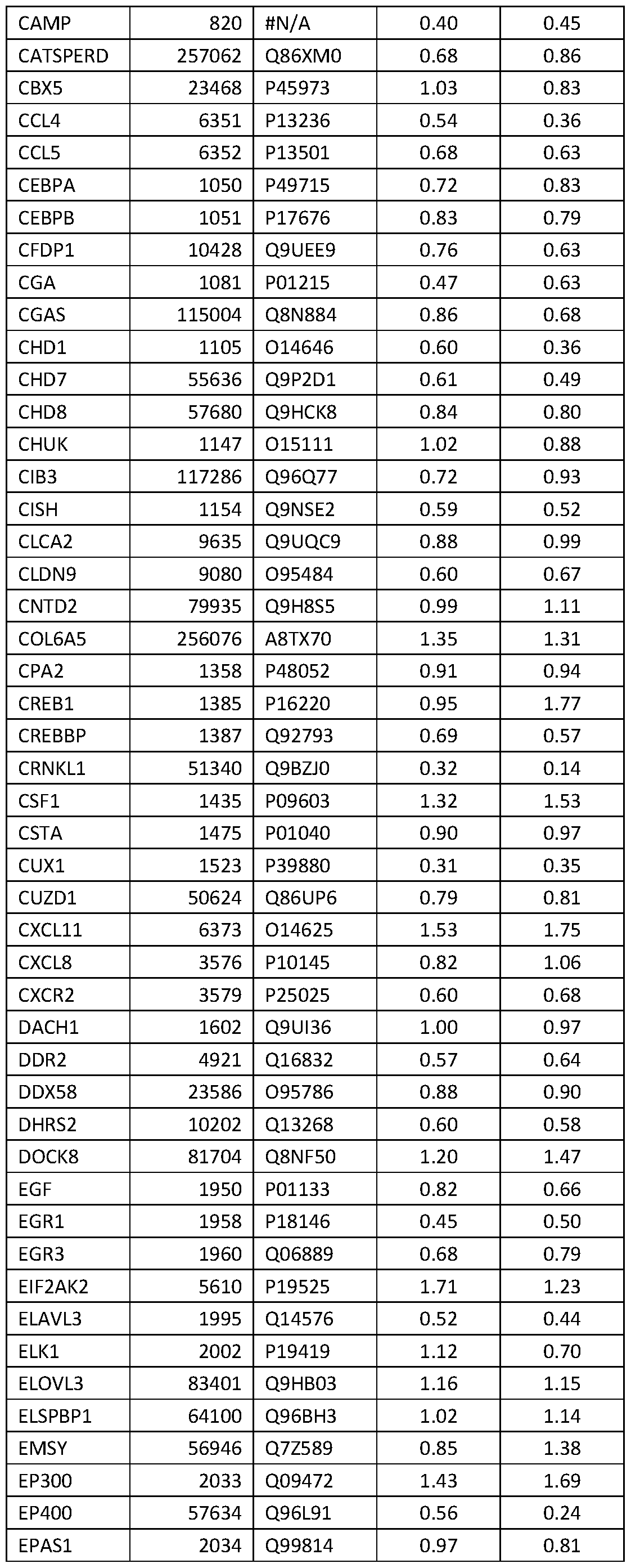 EPHB1 2047 P54762 1.37 1.12 ERBB2 2064 P04626 1.00 1.53
 IFI44L 10964 Q53G44 1.39 1.42 IFIT2 3433 P09913 0.61 0.66
 MPIG6B 80739 O95866 0.75 0.71 MSANTD2 79684 Q6P1R3 0.92 1.04
 RFC1 5981 P35251 0.15 0.42 RFPL4A 342931 A6NLU0 0.37 0.38
 TGM2 7052 P21980 1.23 1.18 TICAM1 148022 Q8IUC6 1.94 1.40
 [00178] Based on the results from the first-round screen, a subset of DEGs observed to increase AAV titer by at least 1.4-fold, either relative to background and/or to ATP levels, as well as select other DEGs, were selected for further analysis to confirm that their repression by RNAi in HEK293 host cells led to an increase in AAV titer. A similar experimental format used in the first-round screen was employed, but the effect of siRNA treatment on AAV titer was tested in 3 independent experiments with 4 replicates each. Results from the second-round screen are shown in Table 33 below, which confirmed that repressing expression of a substantial number
of the genes identified from the first-round screen increased the titer of AAV vectors produced from the treated HEK293 host cells. Table 33 Mean fold Mean fold increase in increase in Gene AAV titer AAV titer
 PDE6G 1.46 1.03 PNN 1.33 1.75
 [00179] It was next tested whether repressing expression in of more than one of the genes observed to increase AAV vector titer when repressed singly might further increase AAV vector production in HEK293 host cells. Using an assay format similar those described above, HEK293 cells were transfected with siRNA targeting MIF, OAS3, PAF1, RC3H1, and PPRC1 alone, and in combinations targeting two of these genes simultaneously, as well as in combination with a siRNA targeting expression of the AAV rep gene (i782). Twenty-four hours thereafter, treated cells were transfected with the 3-plasmid mixture directing their production of the AAV9 mini- dys vector, and titers determined 72 hours later. The results, shown in Figure 15, demonstrated that combined simultaneous repression of two of these genes, or combined simultaneous repression of one of these genes and rep expression, often resulted in enhanced AAV vector production by the treated HEK293 host cells. To test for off-target effects of co-transfecting cells with siRNA targeting two different genes simultaneously, total RNA was prepared from selected host cells used in the experiment and analyzed by RT-qPCR to determine the amount of targeted gene expression before and after siRNA treatment. The results, shown in Figures 16A-16D, indicate that while the efficiency with which targeted genes were repressed by siRNA treatment varied from gene to gene, the extent of repression was highly consistent even in the presence of other siRNA to target expression of other genes. These results suggested that for the 4 genes examined, off-target effects by the other siRNA affecting expression levels of the gene under examination were minimal or non-existent.
Claims
CLAIMS What is claimed is: 1. A modified animal cell with reduced expression of a gene upregulated in an otherwise unmodified animal cell of the same type in response to infection by an adeno-associated virus (AAV), or to biosynthesis of recombinant AAV (rAAV) vector directed by exogenously introduced nucleic acid, wherein said upregulated gene is associated with a reduction in the amount of intact AAV vector produced in said unmodified animal cell of the same type relative to the amount of intact AAV vector produced in said modified animal cell.
2. The modified animal cell of claim 1, wherein said modified animal cell is an insect cell and the exogenously introduced nucleic acid is introduced into an otherwise unmodified insect cell of the same type by infection with a baculovirus, or wherein said modified animal cell is a mammalian cell and the exogenously introduced nucleic acid is introduced into an otherwise unmodified mammalian cell of the same type by transfection.
3. The modified animal cell of claim 2, wherein said modified animal cell is a mammalian cell selected from the group consisting of: HeLa cells, Cos cells, HEK293 cells A549 cells, BHK cells, Vero cells, NIH 3T3 cells, HT-1080 cells, Sp2/0 cells, NS0 cells, C127 cells, AGE1.HN cells, CAP cells, HKB-11 cells, WI-38 cells, MRC-5 cells, and PER.C6 cells.
4. The modified mammalian cell of claim 3, wherein said mammalian cell is a HEK293 cell, or derivative or variant thereof.
5. The modified mammalian cell of any one of claims 3 to 4, wherein said exogenously introduced nucleic acid is introduced into an otherwise unmodified mammalian cell of the same type by transient transfection of one or more DNA plasmids.
6. The modified animal cell of any one of claims 1 to 5, wherein the expression level of said upregulated gene is reduced pre-transcriptionally or post-transcriptionally.
7. The modified animal cell of any one of claims 1 to 6, wherein the expression level of said upregulated gene is reduced by contacting said cell with a compound effective to repress expression of said upregulated gene transiently or permanently.
8. The modified animal cell of any one of claims 1 to 7, wherein the expression level of said upregulated gene is repressed by RNase H recruitment, by RNA interference (RNAi), or by CRISPR interference (CRISPRi).
9. The modified animal cell of claim 8, wherein RNAi is effected by contacting said cell with, or by expressing in said cell, a guide strand RNA molecule effective to target an RNA transcript transcribed from said upregulated gene, wherein said guide strand RNA molecule is comprised by a siRNA molecule, a shRNA molecule, or a miRNA molecule.
10. The modified animal cell of claim 9, wherein said guide strand RNA molecule, siRNA molecule, shRNA molecule, or miRNA molecule, is expressed from an expression construct introduced into said cell transiently or stably.
11. The modified animal cell of any one of claims 1 to 10, wherein the expression level of said upregulated gene is reduced at least 10%, 20%, 30%, 40%, 50%, 60%, 70%, 80%, 90%, 95%, 96%, 97%, 98%, or 99% compared to the expression of level of said upregulated gene in unmodified animal cells of the same type.
12. The modified animal cell of any one of claims 1 to 6, wherein said upregulated gene is inactivated.
13. The modified animal cell of claim 12, wherein said cell is inactivated by deleting nucleotides from, adding nucleotides to, or substituting nucleotides within at least one DNA sequence, or portion thereof, that is required for said upregulated gene to be transcribed or translated from one or both alleles of said gene.
14. The modified animal cell of claim 13, wherein said DNA sequence required for said upregulated gene to be transcribed or translated is selected from the group consisting of: a silencer sequence, an insulator sequence, a histone binding site, an enhancer sequence, a promoter sequence, a translation initiation sequence, an exon sequence, an intron sequence, a splice donor or acceptor sequence, a stop codon, and a transcription termination signal sequence.
15. The modified animal cell of any one of claims 12 to 14, wherein said upregulated gene is inactivated by deleting all the exons of said gene, or by introducing at least one premature stop codon into the coding sequence of said gene, or by homologous recombination, or by gene editing.
16. The modified animal cell of claim 15, wherein said gene editing is effected by expression of a zinc-finger nuclease protein, a transcription-activator-like effector nuclease (TALEN), or a CRISPR-Cas complex comprising a Cas enzyme and guide RNA.
17. The modified animal cell of any one of claims 1 to 16, wherein said upregulated gene is selected from the group consisting of: ACTA1, ARL14, BDNF, CALCR, CSF1, CXCL11, DOCK8,
EIF2AK2, EP300, EPHB1, ESRP1, FAM83A, FGF2, FOXO1, GNRH1, HGF, HS3ST4, IFI44L, ITGAM, KITLG, MAP2K3, MAPK1, MAPK3, MIF, MSC, MYD88, OAS3, ODAPH, PAF1, PDE6G, PNN, PPRC1, PTX3, RC3H1, SMARCA4, SP110, SPI1, STAT4, TGM2, TICAM1, and TRIM24.
18. A method for producing an adeno-associated virus (AAV) vector, comprising introducing into the modified animal cell of any one of claims 1 to 17 exogenous genetic information required for AAV vector biosynthesis, incubating said cell under conditions and for time sufficient for the biosynthesis of said AAV vector to occur, and purifying from said cell the AAV vector produced thereby.
19. The method of claim 18, wherein the exogenous genetic information required for AAV vector biosynthesis comprises an AAV cap gene, an AAV rep gene, nucleotide sequence encoding a viral helper RNA and protein, and an AAV vector genome.
20. The method of claim 18 or claim 19, wherein the exogenous genetic information required for AAV vector biosynthesis is introduced into said modified animal cell in the form of one or more recombinant baculoviruses by infection, or wherein the exogenous genetic information required for AAV vector biosynthesis is introduced into said modified animal cell in the form of one or more DNA plasmids by transient or stable transfection.
21. The method of any one of claims 18 to 20, wherein said modified animal cell is a modified HEK293 cell, or derivative or variant thereof.
22. The method of any one of claims 18 to 21, wherein said method is effective to produce an amount of AAV vector that is at least 50%, 100%, 150%, 200%, 250%, 300%, 350%, 400%, 450%, or 500% greater than the amount of AAV vector produced in an unmodified animal cell of the same type under otherwise identical conditions.
23. An AAV vector produced according to the method of any one of claims 18 to 21.
24. An expression vector comprising an expression cassette for expressing in a host cell a miRNA, a shRNA, or other type of non-coding RNA capable of repressing by RNA interference expression of at least one gene upregulated in response to infection by an adeno-associated virus (AAV), or to biosynthesis of recombinant AAV (rAAV) vector directed by exogenously introduced nucleic acid.
25. The expression vector of claim 24, wherein said expression cassette expresses a miRNA under control of an RNA pol II promoter, or a shRNA under control of an RNA pol III promoter.
26. The expression vector of claim 24 or claim 25, wherein said gene is selected from the group consisting of: ACTA1, ARL14, BDNF, CALCR, CSF1, CXCL11, DOCK8, EIF2AK2, EP300, EPHB1, ESRP1, FAM83A, FGF2, FOXO1, GNRH1, HGF, HS3ST4, IFI44L, ITGAM, KITLG, MAP2K3, MAPK1, MAPK3, MIF, MSC, MYD88, OAS3, ODAPH, PAF1, PDE6G, PNN, PPRC1, PTX3, RC3H1, SMARCA4, SP110, SPI1, STAT4, TGM2, TICAM1, and TRIM24.
27. A method for producing an adeno-associated virus (AAV) vector, comprising introducing into a host cell the expression vector of any one of claims 24 to 26 and then, contemporaneously therewith or subsequently, introducing into said host cell exogenous genetic information required for AAV vector biosynthesis, incubating said cell under conditions and for time sufficient for the biosynthesis of said AAV vector to occur, and purifying from said host cell the AAV vector produced thereby.
28. The method of claim 27, wherein the exogenous genetic information required for AAV vector biosynthesis comprises an AAV cap gene, an AAV rep gene, a nucleotide sequence encoding a viral helper RNA and protein, and a nucleotide sequence for an AAV vector genome.
29. The method of claim 27 or claim 28, wherein both the expression vector and the exogenous genetic information required for AAV vector biosynthesis is introduced into said host cell in the form of one or more DNA plasmids by transient transfection.
30. The method of claim 29, wherein said host cell is a HEK293 cell, or derivative or variant thereof.
31. The method of any one of claims 27 to 30, wherein said method is effective to produce an amount of AAV vector that is at least 50%, 100%, 150%, 200%, 250%, 300%, 350%, 400%, 450%, or 500% greater than the amount of AAV vector produced in a host cell of the same type in the absence of introducing said expression vector comprising said expression cassette.
32. An AAV vector produced according to the method of any one of claims 27 to 31.
Applications Claiming Priority (4)
| Application Number | Priority Date | Filing Date | Title |
|---|---|---|---|
| US202263378602P | 2022-10-06 | 2022-10-06 | |
| US63/378,602 | 2022-10-06 | ||
| US202363583381P | 2023-09-18 | 2023-09-18 | |
| US63/583,381 | 2023-09-18 |
Publications (1)
| Publication Number | Publication Date |
|---|---|
| WO2024075012A1 true WO2024075012A1 (en) | 2024-04-11 |
Family
ID=88412936
Family Applications (1)
| Application Number | Title | Priority Date | Filing Date |
|---|---|---|---|
| PCT/IB2023/059919 Ceased WO2024075012A1 (en) | 2022-10-06 | 2023-10-03 | Improved host cells for aav vector production |
Country Status (1)
| Country | Link |
|---|---|
| WO (1) | WO2024075012A1 (en) |
Cited By (6)
| Publication number | Priority date | Publication date | Assignee | Title |
|---|---|---|---|---|
| CN118569908A (en) * | 2024-07-31 | 2024-08-30 | 国网浙江省电力有限公司营销服务中心 | A risk-aware stream identification method and system for power grid marketing event risks |
| CN119185552A (en) * | 2024-11-11 | 2024-12-27 | 中国农业科学院农业基因组研究所 | Use of silent ECM1 genes against PRRSV infection |
| EP4628576A1 (en) * | 2024-04-07 | 2025-10-08 | Ascend Advanced Therapies GmbH | Microrna molecules for use in methods for improving recombinant aav production |
| WO2025227131A1 (en) * | 2024-04-26 | 2025-10-30 | Canbridge Pharmaceuticals, Inc. | Dystrophin constructs and methods of use thereof |
| WO2026039386A3 (en) * | 2024-08-13 | 2026-03-26 | Amgen Inc. | Improved antibody production |
| WO2026078664A1 (en) * | 2024-10-10 | 2026-04-16 | Instituto De Biologia Experimental E Tecnológica (Ibet) | Transcription factor enhancing recombinant adeno-associated virus production, products, methods and uses thereof |
Citations (3)
| Publication number | Priority date | Publication date | Assignee | Title |
|---|---|---|---|---|
| US7790154B2 (en) | 2000-06-01 | 2010-09-07 | The University Of North Carolina At Chapel Hill | Duplexed parvovirus vectors |
| US20180353620A1 (en) | 2016-02-23 | 2018-12-13 | Eyeserv Gmbh | Gene therapy for the treatment of a retinal degeneration disease |
| WO2023077078A1 (en) * | 2021-10-29 | 2023-05-04 | Ultragenyx Pharmaceutical Inc. | Engineered cell lines for increased production of recombinant adeno-associated virus (raav) |
-
2023
- 2023-10-03 WO PCT/IB2023/059919 patent/WO2024075012A1/en not_active Ceased
Patent Citations (3)
| Publication number | Priority date | Publication date | Assignee | Title |
|---|---|---|---|---|
| US7790154B2 (en) | 2000-06-01 | 2010-09-07 | The University Of North Carolina At Chapel Hill | Duplexed parvovirus vectors |
| US20180353620A1 (en) | 2016-02-23 | 2018-12-13 | Eyeserv Gmbh | Gene therapy for the treatment of a retinal degeneration disease |
| WO2023077078A1 (en) * | 2021-10-29 | 2023-05-04 | Ultragenyx Pharmaceutical Inc. | Engineered cell lines for increased production of recombinant adeno-associated virus (raav) |
Non-Patent Citations (131)
| Title |
|---|
| "American Type Culture Collection Standards Development Organization Workgroup ASN-0002", NAT REVS CANCER, vol. 10, 2010, pages 441 - 8 |
| "GenBank", Database accession no. J02400.1 |
| "UniProt", Database accession no. 015164 |
| ABUDAYYEH, 00 ET AL., NATURE, vol. 550, no. 7675, 2017, pages 280 - 284 |
| ALIPRANTIS, A.O.YANG, R.B.MARK, M.R.SUGGETT, S.DEVAUX, B.RADOLF, J.D.KLIMPEL, G.R.GODOWSKI, P.ZYCHLINSKY, A.: "Cell activation and apoptosis by bacterial lipoproteins through toll-like receptor-2", SCIENCE, vol. 285, 1999, pages 736 - 739, XP000985942, DOI: 10.1126/science.285.5428.736 |
| ALMEIDA JL ET AL., PLOS BIOL, vol. 14, no. 6, 2016, pages e1002476 |
| BAHRAMI, S., DRABLOS, F.: "Gene regulation in the immediate-early response process", ADV BIOL REGUL, vol. 62, 2016, pages 37 - 49, XP029755127, DOI: 10.1016/j.jbior.2016.05.001 |
| BARTLETT, JS ET AL., PROC NATL ACAD SCI USA, vol. 93, 1996, pages 8852 - 7 |
| BECKERSAND BOCH, J, GENE GENOME EDIT, 2021 |
| BEN-ISRAEL, H.KLEINBERGER, T.: "Adenovirus and cell cycle control", FRONT BIOSCI, vol. 7, 2002, pages d1369 - 1395 |
| BERK, A.J.: "Recent lessons in gene expression, cell cycle control, and cell biology from adenovirus", ONCOGENE, vol. 24, 2005, pages 7673 - 7685, XP037738877, DOI: 10.1038/sj.onc.1209040 |
| BERTHET, C.RAJ, K.SAUDAN, P.BEARD, P.: "How adeno-associated virus Rep78 protein arrests cells completely in S phase", PROC NATL ACAD SCI U S A, vol. 102, 2005, pages 13634 - 13639 |
| BOGDANOVE, AJVOYTAS, DF, SCIENCE, vol. 333, 2011, pages 1843 - 1846 |
| BOSHART, M ET AL., CELL, vol. 41, 1985, pages 521 - 30 |
| BRAASCH DA ET AL., NUCLEIC ACIDS RES., vol. 30, no. 23, 2002, pages 1911 - 1918 |
| BRAY, N.L.PIMENTEL, H.MELSTED, P.PACHTER, L.: "Near-optimal probabilistic RNA-seq quantification", NAT BIOTECHNOL, vol. 34, 2016, pages 525 - 527 |
| BRUNOT, C.PONSONNET, L.LAGNEAU, C.FARGE, P.PICART, C.GROSGOGEAT, B.: "Cytotoxicity of polyethyleneimine (PE!), precursor base layer of polyelectrolyte multilayer films", BIOMATERIALS, vol. 28, 2007, pages 632 - 640, XP005842193, DOI: 10.1016/j.biomaterials.2006.09.026 |
| BURDETTE, D.L.MONROE, K.M.SOTELO-TROHA, K.IWIG, J.S.ECKERT, B.HYODO, M.HAYAKAWA, Y.VANCE, R.E.: "STING is a direct innate immune sensor of cyclic di-GMP", NATURE, vol. 478, 2011, pages 515 - 518, XP037922710, DOI: 10.1038/nature10429 |
| CATTERALL, T.FYNCH, S.KAY, T.W.H.THOMAS, H.E.SUTHERLAND, A.P.R.: "IL-17F induces inflammation, dysfunction and cell death in mouse islets", SCI REP, vol. 10, 2020, pages 13077 |
| CHANDLER, L.C.BARNARD, A.R.CADDY, S.L.PATRICIO, M.I.MCCLEMENTS, M.E.FU, H.RADA, C.MACLAREN, R.E.XUE, K.: "Enhancement of Adeno-Associated Virus-Mediated Gene Therapy Using Hydroxychloroquine in Murine and Human Tissues", MOL THER METHODS CLIN DEV, vol. 14, 2019, pages 77 - 89, XP055704940, DOI: 10.1016/j.omtm.2019.05.012 |
| CHUNG CHENG-HAN ET AL: "Production of rAAV by plasmid transfection induces antiviral and inflammatory responses in suspension HEK293 cells", MOLECULAR THERAPY- METHODS & CLINICAL DEVELOPMENT, vol. 28, 1 March 2023 (2023-03-01), GB, pages 272 - 283, XP093113170, ISSN: 2329-0501, DOI: 10.1016/j.omtm.2023.01.002 * |
| CLEMENT, NJC GRIEGER: "Manufacturing of recombinant adeno-associated viral vectors for clinical trials", MOL. THER. METH. & CLIN. DEV., vol. 3, 2016, pages 16002, XP055387003, DOI: 10.1038/mtm.2016.2 |
| COSTA, JR ET AL.: "The Gene Ontology Handbook", 2017, HUMANA, article "Genome Editing Using Engineered Nucleases and Their Use in Genomic Screening" |
| COTE, J.GARNIER, A.MASSIE, B.KAMEN, A.: "Serum-free production of recombinant proteins and adenoviral vectors by 293SF-3F6 cells", BIOTECHNOL BIOENG, vol. 59, 1998, pages 567 - 575, XP002164413, DOI: 10.1002/(SICI)1097-0290(19980905)59:5<567::AID-BIT6>3.0.CO;2-8 |
| COX, DBT ET AL., SCIENCE, vol. 358, no. 6366, 2017, pages 1019 - 1027 |
| CROOKE, ST ET AL., J BIOL CHEM, vol. 296, 2021, pages 100416 |
| CROOKE, ST, NUC ACID THERA, vol. 27, no. 2, 2017, pages 70 - 77 |
| DAGLE JM ET AL., NUCLEIC ACIDS RES., vol. 18, no. 16, 1990, pages 4751 - 4757 |
| DELISLE, A.J.GRAVES, R.A.MARZLUFF, W.F.JOHNSON, L.F.: "Regulation of histone mRNA production and stability in serum-stimulated mouse 3T6 fibroblasts", MOL CELL BIOL, vol. 3, 1983, pages 1920 - 1929 |
| DUMONT, J ET AL., CRIT REVS BIOTECH, vol. 36, no. 6, 2016, pages 1110 - 22 |
| FAUST, S.M.BELL, P.CUTLER, B.J.ASHLEY, S.N.ZHU, Y.RABINOWITZ, J.E.WILSON, J.M.: "CpG-depleted adeno-associated virus vectors evade immune detection", J CLIN INVEST, vol. 123, 2013, pages 2994 - 3001, XP055646367, DOI: 10.1172/JCI68205 |
| FDA, U.S.: "CBER", 2021, article "Cellular, Tissue, and Gene Therapies Advisory Committee September 2-3, 2021 Meeting Briefing Document- FDA" |
| FERREIRA, C.B.SUMNER, R.P.RODRIGUEZ-PLATA, M.T.RASAIYAAH, J.MILNE, R.S.THRASHER, A.J.QASIM, W.TOWERS, G.J.: "Lentiviral Vector Production Titer Is Not Limited in HEK293T by Induced Intracellular Innate Immunity", MOL THER METHODS CLIN DEV, vol. 17, 2020, pages 209 - 219 |
| FISCHER, S.HANDRICK, R.OTTE, K.: "The art of CHO cell engineering: A comprehensive retrospect and future perspectives", BIOTECHNOL ADV, vol. 33, 2015, pages 1878 - 1896, XP029328726, DOI: 10.1016/j.biotechadv.2015.10.015 |
| FRITSCH, S.D.WEICHHART, T.: "Effects of Interferons and Viruses on Metabolism", FRONT IMMUNOL, vol. 7, 2016, pages 630 |
| GAJ T ET AL., TRENDS BIOTECHNOL, vol. 31, no. 7, 2013, pages 397 - 405 |
| GAO, G ET AL.: "Clades of Adeno-Associated Viruses Are Widely Disseminated in Human Tissues", J VIROL, vol. 78, no. 12, 2004, pages 6381 - 6388, XP002321999, DOI: 10.1128/JVI.78.12.6381-6388.2004 |
| GAO, G ET AL.: "Novel adeno-associated viruses from rhesus monkeys as vectors for human gene therapy", PNAS (USA), vol. 99, no. 18, 2002, pages 11854 - 11859 |
| GAO, GP ET AL.: "High-titer adeno-associated viral vectors from a Rep/Cap cell line and hybrid shuttle virus", HUM. GENE THER., vol. 9, 1998, pages 2353 - 62 |
| GARNIER, A., COTE, J., NADEAU, I., KAMEN, A., MASSIE, B.: "Scale-up of the adenovirus expression system for the production of recombinant protein in human 293S cells", CYTOTECHNOLOGY, vol. 15, 1994, pages 145 - 155, XP001088662, DOI: 10.1007/BF00762389 |
| GILBERT, LA ET AL., CELL, vol. 154, no. 2, 2013, pages 1173 - 1183 |
| GORDON, S: "Pattern recognition receptors: doubling up for the innate immune response", CELL, vol. 111, 2002, pages 927 - 930 |
| GRAHAM, F.L.: "Growth of 293 cells in suspension culture", J GEN VIROL, vol. 68, 1987, pages 937 - 940 |
| GRAHAM, F.L.SMILEY, J.RUSSELL, W.C.NAIRN, R.: "Characteristics of a human cell line transformed by DNA from human adenovirus type 5", J GEN VIROL, vol. 36, 1977, pages 59 - 74 |
| GRAY, SJ ET AL., HUM GENE THER, vol. 22, 2011, pages 1143 - 53 |
| GRIEGER, J.C.SOLTYS, S.M.SAMULSKI, R.J.: "Production of Recombinant Adeno-associated Virus Vectors Using Suspension HEK293 Cells and Continuous Harvest of Vector From the Culture Media for GMP FIX and FLT1 Clinical Vector", MOL THER, vol. 24, 2016, pages 287 - 297, XP055436946, DOI: 10.1038/mt.2015.187 |
| GRÜNWELLER A, NUCLEIC ACIDS RES., vol. 31, no. 12, 2003, pages 3185 - 3193 |
| GUHA, TKEDGELL, DR, INT J MOL SCI, vol. 18, 2017, pages 2565 |
| HAN, J.TAM, K.TAM, C.HOLLIS, R.P.KOHN, D.B.: "Improved lentiviral vector titers from a multi-gene knockout packaging line", MOL THER ONCOLYTICS, vol. 23, 2021, pages 582 - 592 |
| HART, L.S.ORNELLES, D.KOUMENIS, C.: "The adenoviral E4orf6 protein induces atypical apoptosis in response to DNA damage", J BIOL CHEM, vol. 282, 2007, pages 6061 - 6067 |
| HAUT, DDPINTEL, DJ, VIROLOGY, vol. 258, 1999, pages 84 - 94 |
| HERMANNS, J., SCHULZE, A., JANSEN-DBLURR, P., KLEINSCHMIDT, J.A., SCHMIDT, R., ZUR HAUSEN, H.: "Infection of primary cells by adeno-associated virus type 2 results in a modulation of cell cycle-regulating proteins", J VIROL, vol. 71, 1997, pages 6020 - 6027, XP002156720 |
| HORNUNG, V.ROTHENFUSSER, S.BRITSCH, S.KRUG, A.JAHRSDORFER, B.GIESE, T.ENDRES, S.HARTMANN, G.: "Quantitative expression of toll-like receptor 1-10 mRNA in cellular subsets of human peripheral blood mononuclear cells and sensitivity to CpG oligodeoxynucleotides", J IMMUNOL, vol. 168, 2002, pages 4531 - 4537, XP002438973 |
| HURT, MM ET AL., MOL CELL BIOL, vol. 11, 1991, pages 2929 - 36 |
| IGOUCHEVA, O.ALEXEEV, V.YOON, K.: "Differential cellular responses to exogenous DNA in mammalian cells and its effect on oligonucleotide-directed gene modification", GENE THER, vol. 13, 2006, pages 266 - 275, XP037773026, DOI: 10.1038/sj.gt.3302643 |
| IKAWA, M ET AL., DEV GROWTH DIFFER, vol. 37, 1995, pages 455 - 9 |
| JAMES, HAGIBSON, I, BLOOD, vol. 91, no. 2, 1998, pages 371 - 382 |
| JING, X.J.KALMAN-MALTESE, V.CAO, X.YANG, Q.TREMPE, J.P.: "Inhibition of adenovirus cytotoxicity, replication, and E2a gene expression by adeno-associated virus", VIROLOGY, vol. 291, 2001, pages 140 - 151 |
| KAPRANOV, P ET AL., HUM GENE THER, vol. 23, 2012, pages 46 - 55 |
| KHARMA, N ET AL., NUC ACIDS RES, vol. 44, no. 4, 2015, pages 1 - 12 |
| KLOPFENSTEIN, D.V., ZHANG, L., PEDERSEN, B.S., RAMIREZ, F., WARWICK VESZTROCY, A., NALDI, A., MUNGALL, C.J., YUNES, J.M., BOTVINNI: "GOATOOLS: A Python library for Gene Ontology analyses", SCI REP, vol. 8, 2018, pages 10872 |
| KONERMANN, S ET AL., CELL, vol. 173, no. 3, 2018, pages 665 - 676 |
| KOPATZ, I.REMY, J.S.BEHR, J.P.: "A model for non-viral gene delivery: through syndecan adhesion molecules and powered by actin", J GENE MED, vol. 6, 2004, pages 769 - 776 |
| KUEHNER, JN ET AL., NOT REV MOL CELL BIOL, vol. 12, 2011, pages 283 - 94 |
| KUMAR, R ET AL., GENE THER, vol. 12, 2005, pages 1486 - 1492 |
| KURACHI, S ET AL., J BIOL CHEM, vol. 270, no. 10, 1995, pages 5276 - 81 |
| LAFOUNTAINE JS ET AL., INT J PHARM, vol. 494, no. 1, 2015, pages 180 - 194 |
| LANG, R.RAFFI, F.A.M.: "Dual-Specificity Phosphatases in Immunity and Infection: An Update", INT J MOL SCI, vol. 20, 2019 |
| LAVADO-GARCIA, J.JORGE, I.CERVERA, L.VAZQUEZ, J.GODIA, F.: "Multiplexed Quantitative Proteomic Analysis of HEK293 Provides Insights into Molecular Changes Associated with the Cell Density Effect, Transient Transfection, and Virus-Like Particle Production", J PROTEOME RES, vol. 19, 2020, pages 1085 - 1099 |
| LEE, A.H.HONG, J.H.SEO, Y.S.: "Tumour necrosis factor-alpha and interferon-gamma synergistically activate the RANTES promoter through nuclear factor kappaB and interferon regulatory factor 1 (IRF-1) transcription factors", BIOCHEM J, vol. 350, 2000, pages 131 - 138 |
| LENNOX KA ET AL., J RARE DIS RES TREAT, vol. 1, no. 3, 2016, pages 66 - 70 |
| LIU, G ET AL., MOL CELL, vol. 82, 2022, pages 333 - 347 |
| LIU, J.GUAN, X.MA, X.: "Interferon regulatory factor 1 is an essential and direct transcriptional activator for interferon {gamma}-induced RANTES/CCI5 expression in macrophages", J BIOL CHEM, vol. 280, 2005, pages 24347 - 24355 |
| LOEB, JE ET AL., HUM GENE THER, vol. 10, 1999, pages 2295 - 2305 |
| LOUIS, N.EVELEGH, C.GRAHAM, F.L.: "Cloning and sequencing of the cellular-viral junctions from the human adenovirus type 5 transformed 293 cell line", VIROLOGY, vol. 233, 1997, pages 423 - 429, XP004452203, DOI: 10.1006/viro.1997.8597 |
| LUSBY, E ET AL., J VIROL, vol. 34, 1980, pages 402 - 9 |
| MANO MIGUEL ET AL: "Genome-wide RNAi screening identifies host restriction factors critical for in vivo AAV transduction", PROCEEDINGS OF THE NATIONAL ACADEMY OF SCIENCES, vol. 112, no. 36, 24 August 2015 (2015-08-24), pages 11276 - 11281, XP093113502, ISSN: 0027-8424, DOI: 10.1073/pnas.1503607112 * |
| MARCELLUS, R.C., LAVOIE, J.N., BOIVIN, D., SHORE, G.C., KETNER, G., BRANTON, P.E.: "The early region 4 orf4 protein of human adenovirus type 5 induces p53-independent cell death by apoptosis", J VIROL, vol. 72, 1998, pages 7144 - 7153 |
| MARTIN, J ET AL.: "Generation and characterization of adeno-associated virus producer cell lines for research and preclinical vector production", HUM. GENE METHODS, vol. 24, 2013, pages 253 - 269, XP055312388, DOI: 10.1089/hgtb.2013.046 |
| MARTIN, J ET AL.: "Generation and Characterization of Adeno-Associated Virus Producer Cell Lines for Research and Preclinical Vector Production", HUM. GENE THER. METH., vol. 24, 2013, pages 253 - 69, XP055312388, DOI: 10.1089/hgtb.2013.046 |
| MARTINO, A.T.SUZUKI, M.MARKUSIC, D.M.ZOLOTUKHIN, I.RYALS, R.C.MOGHIMI, B.ERTL, H.C.MURUVE, D.A.LEE, B.HERZOG, R.W.: "The genome of self-complementary adeno-associated viral vectors increases Toll-like receptor 9-dependent innate immune responses in the liver", BLOOD, vol. 117, 2011, pages 6459 - 6468, XP055646370, DOI: 10.1182/blood-2010-10-314518 |
| MARZLUFF, W.F.DURONIO, R.J.: "Histone mRNA expression: multiple levels of cell cycle regulation and important developmental consequences", CURR OPIN CELL BIOL, vol. 14, 2002, pages 692 - 699 |
| MCCARTY, DM ET AL., GENE THERAPY, vol. 10, 2003, pages 2112 - 18 |
| MCCARTY, DM ET AL., GENE THERAPY, vol. 8, 2001, pages 1248 - 54 |
| MCCARTY, DM, MOLECULAR THERAPY, vol. 16, no. 10, 2008, pages 1648 - 56 |
| MCDOWELL, I.C., MANANDHAR, D., VOCKLEY, C.M., SCHMID, A.K., REDDY, T.E., ENGELHARDT, B.E.: "Clustering gene expression time series data using an infinite Gaussian process mixture model", PLOS COMPUT BIOL, vol. 14, 2018, pages e1005896 |
| MIETZSCH, M ET AL.: "Characterization of AAV-Specific Affinity Ligands: Consequences for Vector Purification and Development Strategies", MOL. THER. METH. & CLIN. DEV., vol. 19, 2020, pages 362 - 73, XP055887596, DOI: 10.1016/j.omtm.2020.10.001 |
| MIETZSCH, M ET AL.: "Oneeac: platform for scalable and high-titer production of adeno-associated virus serotype 1-12 vectors for gene therapy", HUM. GENE. THER., vol. 25, no. 3, 2014, pages 212 - 22, XP055416407, DOI: 10.1089/hum.2013.184 |
| NATHWANI, AC ET AL., BLOOD, vol. 107, no. 7, 2006, pages 2653 - 61 |
| NEMUDRYI, AA ET AL., ACTA NATURAE, vol. 6, no. 3, 2014, pages 19 - 40 |
| NIWA, H ET AL., GENE, vol. 108, 1991, pages 193 - 9 |
| PATRICIO, MI ET AL., MOL THER NUCLEIC ACIDS, vol. 6, 2017, pages 198 - 208 |
| PENAUD-BUDLOO, M.FRANCOIS, A.CLEMENT, N.AYUSO, E.: "Pharmacology of Recombinant Adeno-associated Virus Production", MOL THER METHODS CLIN DEV, vol. 8, 2018, pages 166 - 180, XP055713307, DOI: 10.1016/j.omtm.2018.01.002 |
| POLO, S.E.ALMOUZNI, G.: "Histone metabolic pathways and chromatin assembly factors as proliferation markers", CANCER LETT, vol. 220, 2005, pages 1 - 9, XP004769034, DOI: 10.1016/j.canlet.2004.08.024 |
| PORRUA, OLIBRI, D, NAT REV MOL CELL BIOL, vol. 16, 2015, pages 190 - 202 |
| PROUDFOOT, NJ, GENES DEVEL, vol. 25, 2011, pages 1770 - 82 |
| RAOF, N.A., RAJAMANI, D., CHU, H.C., GURAV, A., JOHNSON, J.M., LOGERFO, F.W., PRADHAN-NABZDYK, L., BHASIN, M.: "The effects of transfection reagent polyethyleneimine (PEI) and non-targeting control siRNAs on global gene expression in human aortic smooth muscle cells", BMC GENOMICS, vol. 17, 2016, XP021232521, DOI: 10.1186/s12864-015-2267-9 |
| RIESER, R ET AL.: "Comparison of Different Liquid Chromatography-Based Purification Strategies for Adeno-Associated Virus Vectors", PHARMACEUTICS, vol. 13, 2021, pages 748 |
| RIVALS, I.PERSONNAZ, L.TAING, L.POTIER, M.C.: "Enrichment or depletion of a GO category within a class of genes: which test?", BIOINFORMATICS, vol. 23, 2007, pages 401 - 407, XP055286734, DOI: 10.1093/bioinformatics/btl633 |
| SAMULSKI, RJ ET AL., CELL, vol. 33, 1983, pages 135 - 143 |
| SCHMIDT, M.AFIONE, S.KOTIN, R.M.: "Adeno-associated virus type 2 Rep78 induces apoptosis through caspase activation independently of p53", J VIROL, vol. 74, 2000, pages 9441 - 9450 |
| SEMENOVA, N.BOSNJAK, M.MARKELC, B.ZNIDAR, K.CEMAZAR, M.HELLER, L.: "Multiple cytosolic DNA sensors bind plasmid DNA after transfection", NUCLEIC ACIDS RES, vol. 47, 2019, pages 10235 - 10246 |
| SHALEM, O ET AL., SCIENCE, vol. 343, 2014, pages 84 - 87 |
| SMITH, RH ET AL.: "A simplified baculovirus-AAV expression vector system coupled with one-step affinity purification yields high-titer rAAV stocks from insect cells", MOL. THER., vol. 17, 2009, pages 1888 - 96, XP002667812, DOI: 10.1038/MT.2009.128 |
| SRIVASTAVA, A ET AL., J VIROL, vol. 45, no. 2, 1983, pages 555 - 64 |
| STRACKER, T.H., CARSON, C.T., WEITZMAN, M.D.: "Adenovirus oncoproteins inactivate the Mrell-Rad50-NBS1 DNA repair complex", NATURE, vol. 418, 2002, pages 348 - 352, XP055616819 |
| STRASSER LISA ET AL: "Proteomic Landscape of Adeno-Associated Virus (AAV)-Producing HEK293 Cells", INTERNATIONAL JOURNAL OF MOLECULAR SCIENCES, vol. 22, no. 21, 25 October 2021 (2021-10-25), Basel, CH, pages 11499, XP093113486, ISSN: 1422-0067, Retrieved from the Internet <URL:https://www.ncbi.nlm.nih.gov/pmc/articles/PMC8584267/pdf/ijms-22-11499.pdf> DOI: 10.3390/ijms222111499 * |
| STRASSER, L., BOI, S., GUAPO, F., DONOHUE, N., BARRON, N., RAINBOW-FLETCHER, A., BONES, J.: "Proteomic Landscape of Adeno-Associated Virus (AAV)-Producing HEK293 Cells", INT J MOL SCI, vol. 22, 2021 |
| SUN, L.WU, J.DU, F.CHEN, X.CHEN, Z.J.: "Cyclic GMP-AMP synthase is a cytosolic DNA sensor that activates the type I interferon pathway", SCIENCE, vol. 339, 2013, pages 786 - 791, XP055294100, DOI: 10.1126/science.1232458 |
| TANIGUCHI, T.OGASAWARA, K.TAKAOKA, A.TANAKA, N.: "IRF family of transcription factors as regulators of host defense", ANNU REV IMMUNOL, vol. 19, 2001, pages 623 - 655 |
| TEROVA, O ET AL.: "Affinity Chromatography Accelerates Viral Vector Purification for Gene Therapies", BIOPHARM INTL. EBOOK, 2017, pages 27 - 35 |
| THOMAS, PSMART, TG, J PHARM TOX METHS, vol. 51, 2005, pages 187 - 200 |
| TIAN, F ET AL., BIOPHARM INTL, vol. 30, no. 7, 2017, pages 37 - 41 |
| TRANG, P ET AL., CELLULAR MICRO, vol. 6, no. 6, 2004, pages 499 - 508 |
| URABE, M ET AL.: "Insect Cells as a Factory to Produce Adeno-Associated Virus Type 2 Vectors", HUM. GENE THER., vol. 13, 2002, pages 1935 - 43, XP002394454, DOI: 10.1089/10430340260355347 |
| VIRAG, T ET AL.: "Producing recombinant adeno-associated virus in foster cells: Overcoming production limitations using a baculovirus-insect cell expression strategy", HUM. GENE THER.,, vol. 20, 2009, pages 807 - 17, XP055052744, DOI: 10.1089/hum.2009.092 |
| VIRGOLINI NIKOLAUS ET AL: "Transcriptome analysis of Sf9 insect cells during production of recombinant Adeno-associated virus", BIOTECHNOLOGY JOURNAL, vol. 18, no. 2, 9 December 2022 (2022-12-09), DE, XP093113550, ISSN: 1860-6768, Retrieved from the Internet <URL:https://onlinelibrary.wiley.com/doi/full-xml/10.1002/biot.202200466> DOI: 10.1002/biot.202200466 * |
| WAGONER, J.AUSTIN, M.GREEN, J.IMAIZUMI, T.CASOLA, A.BRASIER, A.KHABAR, K.S.WAKITA, T.GALE, M., JR.POLYAK, S.J.: "Regulation of CXCL-8 (interleukin-8) induction by double- stranded RNA signaling pathways during hepatitis C virus infection", J VIROL, vol. 81, 2007, pages 309 - 318 |
| WALDER RYWALDER JA, PROC NATL ACAD SCI USA, vol. 85, no. 14, 1988, pages 5011 - 5015 |
| WANG YONGDAN ET AL: "Supplementary Information Transcriptomic Features Reveal Molecular Signatures Associated with Recombinant Adeno-associated Virus Production in HEK293 Cells", BIOTECHNOLOGY PROGRESS, 2 May 2023 (2023-05-02), pages 1 - 17, XP093113266, Retrieved from the Internet <URL:https://aiche.onlinelibrary.wiley.com/doi/full/10.1002/btpr.3346> [retrieved on 20231218] * |
| WANG YONGDAN ET AL: "Transcriptomic Features Reveal Molecular Signatures Associated with Recombinant Adeno-associated Virus Production in HEK293 Cells", BIOTECHNOLOGY PROGRESS, vol. 39, no. 4, 2 May 2023 (2023-05-02), Hoboken, USA, XP093113228, ISSN: 8756-7938, Retrieved from the Internet <URL:https://aiche.onlinelibrary.wiley.com/doi/pdf/10.1002/btpr.3346> DOI: 10.1002/btpr.3346 * |
| WANG, X-S ET AL., J MOL BIOL, vol. 250, 1995, pages 573 - 80 |
| WANG, X-S ET AL., J VIROL, vol. 70, no. 3, 1996, pages 1668 - 77 |
| WANG, Z ET AL., GENE THER, vol. 10, 2003, pages 2105 - 11 |
| WHITELAW, E ET AL., NUCLEIC ACIDS RES, vol. 14, 1986, pages 7059 - 70 |
| WU, Z ET AL., MOL THER, vol. 16, no. 2, 2008, pages 280 - 9 |
| XIAO, X.LI, J.SAMULSKI, R.J.: "Production of high-titer recombinant adeno-associated virus vectors in the absence of helper adenovirus", J VIROL, vol. 72, no. 6, 1998, pages 2224 - 2232 |
| YEW, NL ET AL., HUM GENE THER, vol. 8, 1997, pages 575 - 84 |
| ZANTA-BOUSSIF, MA ET AL., GENE THER, vol. 16, 2009, pages 605 - 19 |
| ZHANG, L ET AL., NAT COMMS, vol. 12, no. 1, 2021, pages 3908 |
| ZHU, J.HUANG, X.YANG, Y.: "The TLR9-MyD88 pathway is critical for adaptive immune responses to adeno-associated virus gene therapy vectors in mice", J CLIN INVEST, vol. 119, 2009, pages 2388 - 2398, XP055438193, DOI: 10.1172/JCI37607 |
Cited By (7)
| Publication number | Priority date | Publication date | Assignee | Title |
|---|---|---|---|---|
| EP4628576A1 (en) * | 2024-04-07 | 2025-10-08 | Ascend Advanced Therapies GmbH | Microrna molecules for use in methods for improving recombinant aav production |
| WO2025214919A1 (en) * | 2024-04-07 | 2025-10-16 | Ascend Advanced Therapies Gmbh | Microrna molecules for use in methods for improving recombinant aav production |
| WO2025227131A1 (en) * | 2024-04-26 | 2025-10-30 | Canbridge Pharmaceuticals, Inc. | Dystrophin constructs and methods of use thereof |
| CN118569908A (en) * | 2024-07-31 | 2024-08-30 | 国网浙江省电力有限公司营销服务中心 | A risk-aware stream identification method and system for power grid marketing event risks |
| WO2026039386A3 (en) * | 2024-08-13 | 2026-03-26 | Amgen Inc. | Improved antibody production |
| WO2026078664A1 (en) * | 2024-10-10 | 2026-04-16 | Instituto De Biologia Experimental E Tecnológica (Ibet) | Transcription factor enhancing recombinant adeno-associated virus production, products, methods and uses thereof |
| CN119185552A (en) * | 2024-11-11 | 2024-12-27 | 中国农业科学院农业基因组研究所 | Use of silent ECM1 genes against PRRSV infection |
Similar Documents
| Publication | Publication Date | Title |
|---|---|---|
| AU2019228504B2 (en) | Novel adeno-associated virus (AAV) vectors, AAV vectors having reduced capsid deamidation and uses therefor | |
| JP2023159235A (en) | Novel adeno-associated virus (AAV) vectors, AAV vectors with reduced capsid deamidation, and uses thereof | |
| TW201741458A (en) | Gene therapy for treating hemophilia A | |
| WO2018222503A1 (en) | Adeno-associated virus with variant capsid and methods of use thereof | |
| CN115141258A (en) | Methods of predicting ancestral viral sequences and uses thereof | |
| CN105518145A (en) | AAV vectors and for the detection of neutralizing antibodies against AAV (adeno-associated virus) | |
| EP4615518A1 (en) | Gene therapy for frontotemporal dementia | |
| CN117660534B (en) | Helper plasmid for reducing host cell DNA residues in recombinant adeno-associated virus and application | |
| US20250223590A1 (en) | Nucleic acid regulation of ApoE | |
| CN116710567A (en) | Recombinant adeno-associated virus composition and production method thereof | |
| JP2022514112A (en) | Replication-deficient viral vectors and methods for measuring viral infectivity | |
| CN118725047B (en) | Adeno-associated virus mutant and its application | |
| CN117660533A (en) | A packaging plasmid that reduces rcAAV residues in recombinant adeno-associated viruses and its application | |
| JP2025534229A (en) | Elements for detargeting gene expression in the dorsal root ganglia and/or liver | |
| CN118480099B (en) | Adeno-associated virus mutant and its application | |
| TW202408593A (en) | Elements for de-targeting gene expression in liver | |
| EP4424705A1 (en) | Composition for cell addition | |
| EP4544065A1 (en) | Methods and kits for the improved fermentative production of a recombinant virus | |
| US12514933B2 (en) | Modified CPG dinucleotides for recombinant viral vector production | |
| CA3115524C (en) | Methods for measuring the infectivity of replication defective viral vectors and viruses | |
| WO2025157259A1 (en) | Novel muscle-specific promoters | |
| WO2025157262A1 (en) | Nucleic acids encoding follistatin and uses thereof | |
| WO2026090356A2 (en) | Modified mammalian cells for improved production | |
| EP4628576A1 (en) | Microrna molecules for use in methods for improving recombinant aav production | |
| WO2024223931A1 (en) | Manufacturing and use of recombinant self-complementary aav vectors |
Legal Events
| Date | Code | Title | Description |
|---|---|---|---|
| 121 | Ep: the epo has been informed by wipo that ep was designated in this application |
Ref document number: 23790081 Country of ref document: EP Kind code of ref document: A1 |
|
| NENP | Non-entry into the national phase |
Ref country code: DE |
|
| 122 | Ep: pct application non-entry in european phase |
Ref document number: 23790081 Country of ref document: EP Kind code of ref document: A1 |