WO2024070878A1 - 情報処理システム、情報処理装置、制御方法、およびプログラム - Google Patents
情報処理システム、情報処理装置、制御方法、およびプログラム Download PDFInfo
- Publication number
- WO2024070878A1 WO2024070878A1 PCT/JP2023/034228 JP2023034228W WO2024070878A1 WO 2024070878 A1 WO2024070878 A1 WO 2024070878A1 JP 2023034228 W JP2023034228 W JP 2023034228W WO 2024070878 A1 WO2024070878 A1 WO 2024070878A1
- Authority
- WO
- WIPO (PCT)
- Prior art keywords
- signal
- subject
- information processing
- abnormal sound
- processing system
- Prior art date
- Legal status (The legal status is an assumption and is not a legal conclusion. Google has not performed a legal analysis and makes no representation as to the accuracy of the status listed.)
- Ceased
Links
Images










Classifications
-
- A—HUMAN NECESSITIES
- A61—MEDICAL OR VETERINARY SCIENCE; HYGIENE
- A61B—DIAGNOSIS; SURGERY; IDENTIFICATION
- A61B5/00—Measuring for diagnostic purposes; Identification of persons
- A61B5/08—Measuring devices for evaluating the respiratory organs
-
- A—HUMAN NECESSITIES
- A61—MEDICAL OR VETERINARY SCIENCE; HYGIENE
- A61B—DIAGNOSIS; SURGERY; IDENTIFICATION
- A61B5/00—Measuring for diagnostic purposes; Identification of persons
-
- A—HUMAN NECESSITIES
- A61—MEDICAL OR VETERINARY SCIENCE; HYGIENE
- A61B—DIAGNOSIS; SURGERY; IDENTIFICATION
- A61B5/00—Measuring for diagnostic purposes; Identification of persons
- A61B5/08—Measuring devices for evaluating the respiratory organs
- A61B5/0816—Measuring devices for examining respiratory frequency
-
- A—HUMAN NECESSITIES
- A61—MEDICAL OR VETERINARY SCIENCE; HYGIENE
- A61B—DIAGNOSIS; SURGERY; IDENTIFICATION
- A61B5/00—Measuring for diagnostic purposes; Identification of persons
- A61B5/103—Measuring devices for testing the shape, pattern, colour, size or movement of the body or parts thereof, for diagnostic purposes
- A61B5/11—Measuring movement of the entire body or parts thereof, e.g. head or hand tremor or mobility of a limb
- A61B5/1101—Detecting tremor
-
- A—HUMAN NECESSITIES
- A61—MEDICAL OR VETERINARY SCIENCE; HYGIENE
- A61B—DIAGNOSIS; SURGERY; IDENTIFICATION
- A61B5/00—Measuring for diagnostic purposes; Identification of persons
- A61B5/103—Measuring devices for testing the shape, pattern, colour, size or movement of the body or parts thereof, for diagnostic purposes
- A61B5/11—Measuring movement of the entire body or parts thereof, e.g. head or hand tremor or mobility of a limb
- A61B5/113—Measuring movement of the entire body or parts thereof, e.g. head or hand tremor or mobility of a limb occurring during breathing
-
- A—HUMAN NECESSITIES
- A61—MEDICAL OR VETERINARY SCIENCE; HYGIENE
- A61B—DIAGNOSIS; SURGERY; IDENTIFICATION
- A61B5/00—Measuring for diagnostic purposes; Identification of persons
- A61B5/68—Arrangements of detecting, measuring or recording means, e.g. sensors, in relation to patient
- A61B5/6801—Arrangements of detecting, measuring or recording means, e.g. sensors, in relation to patient specially adapted to be attached to or worn on the body surface
- A61B5/6802—Sensor mounted on worn items
- A61B5/6804—Garments; Clothes
-
- A—HUMAN NECESSITIES
- A61—MEDICAL OR VETERINARY SCIENCE; HYGIENE
- A61B—DIAGNOSIS; SURGERY; IDENTIFICATION
- A61B5/00—Measuring for diagnostic purposes; Identification of persons
- A61B5/68—Arrangements of detecting, measuring or recording means, e.g. sensors, in relation to patient
- A61B5/6801—Arrangements of detecting, measuring or recording means, e.g. sensors, in relation to patient specially adapted to be attached to or worn on the body surface
- A61B5/6813—Specially adapted to be attached to a specific body part
- A61B5/6823—Trunk, e.g., chest, back, abdomen, hip
-
- A—HUMAN NECESSITIES
- A61—MEDICAL OR VETERINARY SCIENCE; HYGIENE
- A61B—DIAGNOSIS; SURGERY; IDENTIFICATION
- A61B5/00—Measuring for diagnostic purposes; Identification of persons
- A61B5/68—Arrangements of detecting, measuring or recording means, e.g. sensors, in relation to patient
- A61B5/6801—Arrangements of detecting, measuring or recording means, e.g. sensors, in relation to patient specially adapted to be attached to or worn on the body surface
- A61B5/6843—Monitoring or controlling sensor contact pressure
-
- A—HUMAN NECESSITIES
- A61—MEDICAL OR VETERINARY SCIENCE; HYGIENE
- A61B—DIAGNOSIS; SURGERY; IDENTIFICATION
- A61B5/00—Measuring for diagnostic purposes; Identification of persons
- A61B5/68—Arrangements of detecting, measuring or recording means, e.g. sensors, in relation to patient
- A61B5/6887—Arrangements of detecting, measuring or recording means, e.g. sensors, in relation to patient mounted on external non-worn devices, e.g. non-medical devices
- A61B5/6891—Furniture
-
- A—HUMAN NECESSITIES
- A61—MEDICAL OR VETERINARY SCIENCE; HYGIENE
- A61B—DIAGNOSIS; SURGERY; IDENTIFICATION
- A61B5/00—Measuring for diagnostic purposes; Identification of persons
- A61B5/72—Signal processing specially adapted for physiological signals or for diagnostic purposes
- A61B5/7203—Signal processing specially adapted for physiological signals or for diagnostic purposes for noise prevention, reduction or removal
- A61B5/7207—Signal processing specially adapted for physiological signals or for diagnostic purposes for noise prevention, reduction or removal of noise induced by motion artifacts
-
- A—HUMAN NECESSITIES
- A61—MEDICAL OR VETERINARY SCIENCE; HYGIENE
- A61B—DIAGNOSIS; SURGERY; IDENTIFICATION
- A61B5/00—Measuring for diagnostic purposes; Identification of persons
- A61B5/72—Signal processing specially adapted for physiological signals or for diagnostic purposes
- A61B5/7235—Details of waveform analysis
- A61B5/725—Details of waveform analysis using specific filters therefor, e.g. Kalman or adaptive filters
-
- A—HUMAN NECESSITIES
- A61—MEDICAL OR VETERINARY SCIENCE; HYGIENE
- A61B—DIAGNOSIS; SURGERY; IDENTIFICATION
- A61B7/00—Instruments for auscultation
- A61B7/003—Detecting lung or respiration noise
-
- G—PHYSICS
- G01—MEASURING; TESTING
- G01L—MEASURING FORCE, STRESS, TORQUE, WORK, MECHANICAL POWER, MECHANICAL EFFICIENCY, OR FLUID PRESSURE
- G01L1/00—Measuring force or stress, in general
- G01L1/16—Measuring force or stress, in general using properties of piezoelectric devices
-
- A—HUMAN NECESSITIES
- A61—MEDICAL OR VETERINARY SCIENCE; HYGIENE
- A61B—DIAGNOSIS; SURGERY; IDENTIFICATION
- A61B2562/00—Details of sensors; Constructional details of sensor housings or probes; Accessories for sensors
- A61B2562/02—Details of sensors specially adapted for in-vivo measurements
- A61B2562/0247—Pressure sensors
Definitions
- This disclosure relates to an information processing system that detects vibrations emitted by a subject.
- Patent Document 1 describes a technique for non-invasively monitoring at least one breathing pattern and/or at least one heart rate pattern of a sleeping subject.
- Information about the illness of the subject can be obtained from the type of abnormal sound (including accessory noises such as buzzing and water bubbles) contained in the sounds related to the subject's breathing.
- the type of abnormal sound including accessory noises such as buzzing and water bubbles
- the information processing system includes a sensor that detects vibrations emitted from the subject's torso at a position that is not in contact with the subject or at a position that is in contact with the subject's torso, a signal extraction unit that extracts, from the detection signal output from the sensor, a pressure signal that indicates the pressure applied to the sensor and a respiratory signal that indicates sounds related to the subject's breathing, a respiratory phase determination unit that determines the exhalation and inhalation periods of the subject based on fluctuations in the intensity of the pressure signal, an abnormal sound determination unit that determines whether the sounds related to breathing include abnormal sounds based on the respiratory signal, and an estimation unit that, if an abnormal sound is included in the sounds related to breathing, estimates whether the abnormal sound is occurring in the exhalation period or the inhalation period.
- the respiratory phase (the expiratory or inhalation period) in which an abnormal sound is occurring that is included in sounds related to the subject's breathing.
- FIG. 1 is a conceptual diagram illustrating an example of a configuration of an information processing system according to an embodiment of the present invention.
- FIG. 2 is a diagram illustrating an example of a schematic configuration of an information processing device of the information processing system.
- FIG. 2 is a diagram illustrating another example of a schematic configuration of an information processing device of the information processing system.
- FIG. 2 is a diagram illustrating another example of a schematic configuration of an information processing device of the information processing system.
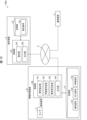
- FIG. 2 is a functional block diagram showing an example of a configuration of the information processing system.
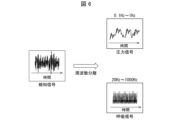
- 3A to 3C are diagrams illustrating various signals included in a detection signal.
- FIG. 2 is a diagram for explaining classification of adventitious sounds included in abnormal sounds and representative cases corresponding to each adventitious sound.
- FIG. 4 is a flowchart showing an example of a flow of processing performed by the configuration of the information processing system.
- FIG. 2 is a diagram showing an example of a display screen displayed on a display unit of a communication device of the information processing system.
- FIG. 11 is a functional block diagram showing a modified example of the configuration of the information processing system.
- FIG. 11 is a functional block diagram showing an example of a configuration of an information processing system according to a second embodiment of the present invention.
- 4 is a flowchart showing an example of a flow of processing performed by the information processing system.
- FIG. 2 is a diagram showing an example of a display screen displayed on a display unit of a communication device of the information processing system.
- FIG. 11 is a functional block diagram showing a modified example of the configuration of the information processing system.
- FIG. 11 is a functional block diagram showing another modified example of the configuration of the information processing system.
- 13 is a flowchart showing the flow of processing performed by an abnormal sound detector included in an information processing system according to a third embodiment of the present invention.
- 13 is a graph showing a specific example of processing performed by an abnormal sound detector included in an information processing system according to a third embodiment of the present invention.
- 13 is a graph showing the results of processing performed by an abnormal sound detector included in an information processing system according to a third embodiment of the present invention.
- 13 is a graph showing the results of processing performed by an abnormal sound detector included in an information processing system according to a third embodiment of the present invention.
- FIG. 13 is a diagram showing a specific example of processing performed by an abnormal sound detector included in an information processing system according to a third embodiment of the present invention.
- FIG. 13 is a diagram showing a specific example of processing performed by an abnormal sound detector included in an information processing system according to a third embodiment of the present invention.
- FIG. 13 is a diagram showing a specific example of processing performed by an abnormal sound detector included in an information processing system according to a third embodiment of the present invention.
- 13 is a graph showing the results of processing performed by an abnormal sound detector included in an information processing system according to a third embodiment of the present invention.
- the information processing system 100 is a system that estimates in which respiratory phase, the exhalation phase or the inhalation phase, an abnormal sound contained in sounds related to the breathing of a subject W1 is occurring, based on a detection signal output from a sensor that detects vibrations emitted from the torso of the subject W1 at a position not in contact with the subject W1 or at a position in contact with the torso of the subject W1.
- a "subject” is typically a patient reclining in bed or the like who requires monitoring by medical personnel W2 or the like.
- a “detection signal” is a signal indicating vibrations emitted by the subject W1, and is raw data output from a sensor, or data obtained by amplifying or removing noise from the raw data. Noise removal can be performed, for example, by filtering the range of 2000 Hz or higher of the raw data.
- a typical example of the "torso" of the subject W1 is at least one of the subject W1's chest, abdomen, and back, but it may be other parts.
- Fig. 1 is a conceptual diagram showing an example of the configuration of the information processing system 100.
- the information processing system 100 may include an information processing device 1 and a communication device 3.
- the number of information processing devices 1 and communication devices 3 included in the information processing system 100 may be one each, or multiple.
- the information processing device 1 analyzes a detection signal indicating vibrations emitted from the torso of the subject W1, which is output from a sensor 11 (see FIG. 5) that detects vibrations emitted from the torso of the subject W1 at a position that is not in contact with the subject W1 or at a position that is in contact with the torso of the subject W1, and if the sounds related to the breathing of the subject W1 include an abnormal sound, estimates in which respiratory phase, the expiration period or the inspiration period, the abnormal sound is occurring, and outputs the estimation result to the outside.
- the information processing device 1 may output to the outside information on the frequency characteristics of the abnormal sound signal indicating the abnormal sound contained in the respiratory signal extracted from the detection signal together with the estimation result. Furthermore, the information processing device 1 may output to the outside the estimation result which estimates what type of accessory noise the abnormal sound is. Furthermore, the information processing device 1 may output to the outside information on the health condition corresponding to the estimated type of accessory noise.
- the output destination of the estimation result etc. is typically the communication device 3.
- the communication device 3 is typically a computer, smartphone, tablet terminal, etc. used by medical personnel W2 etc., and is installed in a nurse's center, for example.
- the information processing device 1 may further estimate the type of complex sound contained in the abnormal sound contained in the respiratory signal, and output the estimation result of the type of complex sound to the outside (e.g., communication device 3).
- the sensor 11 is placed in a position that does not contact the subject W1 or in a position that contacts the torso of the subject W1.
- the sensor 11 may be placed on the bed on which the subject W1 lies.
- the sensor 11 may be placed under the mattress, between the bed and the mattress, or between the bed sheet and the mattress on the mattress.
- the sensor 11 may be placed on the top surface of the bed.
- the sensor 11 is preferably typically formed in a thin plate (sheet) shape, which allows the sensor 11 to be attached to various locations.
- the information processing system 100 uses a sensor 11 that is installed in a position that does not contact the subject W1 or that contacts the torso of the subject W1, so the subject W1 does not need to be in a specified detection area or take a specified detection posture.
- the information processing device 1 and the communication device 3 may be directly connected, or may be communicatively connected via a communication network 9 as shown in FIG. 1.
- the form of the communication network 9 is not limited, and may be a local area network (LAN) or the Internet.
- the information processing system 100 may also include a server device (not shown) communicatively connected to the information processing device 1 and the communication device 3.
- the server device may be configured to store and manage the estimation results sent from multiple information processing devices 1 for each subject W1. Medical personnel W2 and the like may be able to access the server device using the communication device 3 and refer to the estimation results for each subject W1.
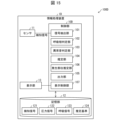
- Fig. 5 is a functional block diagram showing an example of the configuration of the information processing device 1.
- the information processing device 1 includes a sensor 11, a control unit 10, and a memory unit 12.
- the sensor 11 is a sensor capable of detecting vibrations emitted from the torso of the subject W1 at a position not in contact with the subject W1 or at a position in contact with the torso of the subject W1.
- the type of the sensor 11 is not particularly limited.
- the sensor 11 is a piezoelectric sensor. If a piezoelectric sensor is used as the sensor 11, it is easy to make the sensor thin, so that the possibility of causing discomfort to the subject can be reduced.
- Examples of the piezoelectric sensor include a piezoelectric sensor that generates a current in response to compression deformation, a piezoelectric sensor that generates a current in response to extension deformation, and a piezoelectric sensor that generates a current in response to twist deformation.
- a piezoelectric sensor that generates a current by compression deformation it is preferable to apply as the sensor 11.
- a piezoelectric sensor including a foam as the sensor 11.
- the senor 11 has a wide frequency band of detectable vibrations. This eliminates the need to deploy multiple types of sensors with different frequency bands, facilitating maintenance and management by medical personnel W2 and improving convenience.
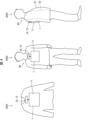
- FIGS. 2 to 4 are diagrams showing an example of the schematic configuration of the information processing device 1.
- the sensor 11 may be installed in a position supporting the torso of the bed on which the subject W1 lies.
- the sensor 11 is preferably formed in a thin plate (sheet) shape.
- the sensor 11 may be installed in a position supporting the torso of a chair on which the subject W1 sits. In this way, the sensor 11 can detect vibrations emitted from the torso of the subject W1 in a natural position while lying on the bed or sitting in a chair.
- the sensor 11 When the sensor 11 is installed on the bed, the sensor 11 may be installed on the mattress between the bed sheet and the mattress. Also, when the subject W1 is wearing clothes, the sensor 11 may be installed on the top surface of the bed.
- the sensor 11 may be attached to clothing worn by the subject W1.
- 5001 in FIG. 4 shows an example of attaching the sensor 11 to clothing.
- 5002 and 5003 in FIG. 4 show an example of the subject W1 wearing the clothing with the sensor 11 attached.
- 5001 the sensor 11 may be attached to the clothing such that the sensor 11 is located on the chest side of the subject W1 when the subject W1 wears the clothing.
- 5003 the sensor 11 may be attached to the clothing such that the sensor 11 is located on the back side of the subject W1 when the subject W1 wears the clothing.
- the sensor 11 of the information processing device 1 when the sensor 11 of the information processing device 1 is installed on the clothing worn by the subject W1, as shown in 5003 in FIG. 4, the sensor 11 may be installed in a position on the clothing worn by the subject W1 (reference symbol X1 in FIG. 4) where the clothing is sandwiched between the sensor 11 and the torso (reference symbol X2 in FIG. 4). In this case, it is possible to detect vibrations emitted by the subject W1 without having the subject W1 come into contact with the sensor 11. Furthermore, according to the above configuration, even if the subject W1 moves from one place to another, as long as the subject W1 is wearing clothing equipped with the sensor 11, it is possible to detect vibrations emitted from the torso of the subject W1.
- the sensor 11 may have one or more detection areas. If the sensor 11 has multiple detection areas, the sensor 11 may output a detection signal detected in each of the multiple detection areas. If the sensor 11 is formed in a thin plate shape, the multiple detection areas may be arranged side by side on the same plane.
- the information processing device 1 shown in 3001 of FIG. 2 has a sensor 11 with one detection area D.
- the information processing device 1 shown in 3002 of FIG. 2 has a sensor 11 with detection areas D1 to D3 arranged in three columns.
- the information processing device 1 shown in 3003 of FIG. 2 has a sensor 11 with detection areas D1a to D3d arranged in four rows and three columns.
- the detection signals detected in each of the detection areas D1 to D3 are output separately.
- the detection signals detected in each of the detection areas D1a to D3d are output separately.
- Each of the detection areas D1a to D3d may be, for example, 10 cm square.
- control unit 10 may be a CPU (Central Processing Unit).
- the control unit 10 reads a control program, which is software stored in the storage unit 12, and loads it into a memory such as a RAM (Random Access Memory) to execute various functions.
- the control unit 10 includes a signal extraction unit 101, a respiratory phase determination unit 102, an abnormal sound determination unit 103, an estimation unit 104, and an output unit 105. Note that, in the storage unit 12 shown in Fig. 5, the control program is omitted from the illustration in order to simplify the explanation.
- the signal extraction unit 101 acquires the detection signal output from the sensor 11, and extracts from the acquired detection signal a pressure signal indicating the pressure applied to the sensor 11 and a breathing signal indicating sounds related to the breathing of the subject W1.
- Sensor 11 can detect vibrations in various frequency ranges generated by subject W1. Therefore, the detection signal output from sensor 11 is a signal in which multiple vibrations having various frequency characteristics are superimposed on each other.
- sensor 11 may be capable of acquiring a pressure signal with a frequency of 0.1 Hz or more and 1 Hz or less, and a respiratory signal with a frequency of 20 Hz or more and 1000 Hz or less. Note that the pressure signal and the respiratory signal can be distinguished based on the frequency components (spectrum).
- the information processing device 1 may be equipped with a sensor 11 that can detect vibrations over a wide frequency band. This eliminates the need to place multiple different types of sensors on the information processing device 1, and makes it easier for medical personnel W2 and others who use the information processing system 100 to maintain and manage the information processing device 1, thereby improving the convenience of the information processing device 1.
- the signal extraction unit 101 may apply well-known techniques such as frequency separation to the detection signal to extract a pressure signal and a respiration signal from the detection signal. This will be explained using FIG. 6.
- FIG. 6 is a diagram explaining various signals contained in the detection signal. As shown in FIG. 6, by frequency separation, it is possible to extract a pressure signal and a respiration signal, which have different frequency characteristics, from the detection signal.
- the signal extraction unit 101 may extract a respiratory signal from the detection signal using a bandpass filter corresponding to the frequency of each type of auxiliary noise. As described below, FIG. 7 shows the frequency of each type of auxiliary noise. For example, when extracting bubbling sounds from the detection signal, a bandpass filter corresponding to 250 to 500 Hz may be used.
- the signal extraction unit 101 stores the detection signal acquired from the sensor 11, and the pressure signal and respiration signal extracted from the detection signal in the memory unit 12 (detection signal 121, pressure signal 122, and respiration signal 123). These signals may be stored together with time information indicating the time when the detection signal from which they were extracted was detected.
- the respiratory phase determination unit 102 determines the exhalation and inhalation periods of the subject based on the fluctuations in the strength of the pressure signal extracted by the signal extraction unit 101. For example, the respiratory phase may be determined by defining a period in which the strength of the pressure signal shows an increasing trend as the inhalation period, and a period in which the strength of the pressure signal shows a decreasing trend as the exhalation period.
- the abnormal sound detector 103 determines whether or not the sounds related to breathing include abnormal sounds based on the breathing signal extracted by the signal extractor 101.
- the abnormal sound detector 103 may determine that the sounds related to breathing include abnormal sounds in at least one of the following cases (A1) to (A4).
- the respiratory signal has a predetermined frequency characteristic that indicates an abnormal sound.
- Each frequency band of the respiratory signal contains a signal that exceeds a predetermined intensity.
- the respiratory signal includes a signal exceeding a predetermined intensity in a frequency band that is detected during abnormal breathing.
- the ratio of the signal strength in the frequency band detected during normal breathing to the signal strength in the frequency band detected during abnormal breathing is equal to or greater than a predetermined threshold.
- predetermined frequency characteristics refer to different frequency characteristics that various types of accessory noise have. For example, as shown in FIG. 7, bubbling sounds have frequency characteristics of 250-500 Hz, crackling sounds have frequency characteristics of 500-1000 Hz, whistling sounds have frequency characteristics of 400 Hz or more, and snoring has frequency characteristics of 200-250 Hz. If the respiratory signal has these frequency characteristics, it may be determined that the sounds related to breathing include abnormal sounds.
- the "predetermined strength for each frequency band" in (A2) above may be, for example, the signal strength around 100 Hz when normal breathing sounds of less than 200 Hz are acquired.
- the "frequency band detected during abnormal breathing” in (A3) above may be, for example, around 200 Hz when normal breathing sounds of less than 200 Hz are acquired.
- the "predetermined strength” may be the signal strength around 100 Hz when normal breathing sounds of less than 200 Hz are acquired.
- the "predetermined threshold" in (A4) above is, for example, the signal strength around 100 Hz when normal breathing sounds below 200 Hz are acquired. If a signal strength equal to or greater than the predetermined threshold is detected around 200 Hz, it may be determined that the breathing-related sounds include abnormal sounds.
- the estimation unit 104 estimates the type of adventitious noise based on the judgment result of the respiratory phase judgment unit 102 or the judgment result of the abnormal sound judgment unit 103.
- the estimation unit 104 estimates the type of adventitious noise based on at least one of the following: whether the abnormal sound is included in the expiration period or the inspiration period, the frequency of the abnormal sound signal indicating the abnormal sound, the change in sound pressure of the abnormal sound in the expiration period or the inspiration period, and the time interval at which the abnormal sound occurs. These estimations are made with reference to the estimation criteria 124 stored in the memory unit 12.
- the estimation criteria 124 include information on the characteristics of various types of auxiliary noise (occurrence intervals, frequency characteristics, sound pressure changes, time intervals, etc.).
- the estimation unit 104 may further calculate a smoothing strength that smoothes the time variation in the strength of a signal in the same frequency band that includes the frequency of the abnormal sound signal, and estimate the type of the auxiliary noise according to the smoothing strength.
- accumulation averaging is performed as an example of smoothing processing.
- Accumulation averaging can cancel out and reduce noise contained in a signal by accumulating and averaging a large amount of measured data.
- a smoothing strength can be obtained by accumulating and averaging the strength of signals in the same frequency band, including the frequency of the abnormal sound signal, over the course of measurement time.
- Another example of smoothing processing is moving averaging. These processes can estimate the type of auxiliary noise with high accuracy and sensitivity.
- the output unit 105 may output the estimation result of the estimation unit 104 and information on the health condition based on the estimation result to the communication device 3.
- the health condition information to be output may be information acquired via the communication network 9, or may be information stored in advance in the storage unit 12.
- the communication device 3 includes an input unit 31, a control unit 30, a storage unit 32, and a display unit 33.
- the input unit 31 may be a keyboard, a touch panel, a mouse, etc.
- the control unit 30 reads a control program, which is software stored in the storage unit 32, and expands it into a memory such as a RAM to execute various functions.
- the control unit 30 is equipped with a display control unit 301 that displays various information on the display unit 33.
- Fig. 7 is a diagram explaining classification of side noises and representative cases corresponding to each type of side noise.
- adventitious noises are sounds that are included in abnormal sounds related to breathing.
- Introductionitious noises include “rales” and “pleural friction sounds”.
- "Rales” include discontinuous rales and continuous rales.
- Discontinuous rales include bubbling sounds and crepitus sounds
- continuous rales include whistles, snoring, stridor, and squawks.
- adventitious noises include at least any of subject W1's bubbling sounds, crepitus sounds, whistles, snoring, stridor, squawk, and pleural friction sounds.
- Both bubbling sounds and crackles are characterized by being intermittent and occurring during the inhalation section.
- Snoring is characterized by being continuous and occurring during both the exhalation and inhalation sections.
- Whistling is characterized by being continuous and occurring during the exhalation section.
- subject W1 may be suffering from pneumonia, alveolar hemorrhage, heart failure, emphysema, etc., and if crepitus sounds are mixed in, subject W1 may be suffering from pneumonia, etc.
- whistling sounds are mixed in with the sounds related to breathing of subject W1
- subject W1 may be suffering from COPD (chronic obstructive pulmonary disease) and bronchial asthma, etc., and if snoring is mixed in, subject W1 may be suffering from chronic bronchitis, etc.
- the type of accessory noise can be estimated based on the sound related to the breathing of the subject W1, it is possible to estimate and detect early the disease that the subject W1 may be suffering from.
- Fig. 8 is a flowchart showing an example of the flow of processing performed by the information processing system 100 (for example, the information processing device 1).
- the signal extraction unit 101 extracts a pressure signal and a respiration signal from the detection signal output from the sensor 11 (step S1).
- the abnormal sound detector 103 determines whether the sounds related to breathing include abnormal sounds based on the breathing signal extracted by the signal extractor 101 (step S2). If it is determined that no abnormal sounds are included (NO in step S2), the process returns to step S1.
- the estimation unit 104 estimates whether the abnormal sound is occurring in the exhalation section or the inhalation section based on the pressure signal (step S3).
- the estimation unit 104 further estimates the type of accessory noise contained in the abnormal sound based on the respiratory phase determination unit 102, the abnormal sound determination unit 103, and the estimation criteria 124 stored in the memory unit 12 (step S4).
- the output unit 105 (health condition output unit) outputs the type of the adjunct noise estimated by the estimation unit 104 and information on the subject's health condition identified according to the type of adjunct noise estimated by the estimation unit 104 (step S5).
- the timing at which the information processing system 100 executes each process shown in FIG. 8 can be set arbitrarily.
- the information processing system 100 may execute each process shown in FIG. 8 at predetermined intervals (e.g., one hour), or may execute each time the sensor 11 determines that the subject has left the bed.
- FIG. 9 is a diagram showing an example of a display screen displayed on the display unit 33 of the communication device 3 of the information processing system 100.
- the display unit 33 may display an area R1 displaying waveform data of the respiratory signal of the subject W1, an area R2 displaying a sonograph showing the frequency characteristics and intensity of an abnormal sound signal indicating an abnormal sound, and an area R3 displaying the estimation results related to (B1) and (B4) above and the information related to (B5) above.
- FIG. 10 is a functional block diagram showing a modified example of the configuration of the information processing system 100. As shown in FIG.
- the information processing system 100A shown in FIG. 10 differs from the information processing system 100 shown in FIG. 5 in that the estimation unit 104 provided in the control unit 10 of the information processing device 1 is provided as an estimation unit 201 in the estimation device 2, which is an external device, whereas the control unit 10A of the information processing device 1A does not have this.
- the estimation device 2 is provided with a control unit 20 and a memory unit 22.
- the control unit 20 is provided with an estimation unit 201 and an output unit 205.
- the output unit 105 in the information processing device 1A outputs the determination results of the respiratory phase determination unit 102 and the abnormal sound determination unit 103 to the estimation device 2 via the communication network 9.
- the estimation unit 201 estimates the type of side noise and information regarding the health condition of the subject W1 by referring to the judgment result output by the output unit 105 and the estimation criteria 221 stored in the memory unit 22.
- the output unit 205 outputs the type of side noise estimated by the estimation unit 201 and information regarding the health condition of the subject W1 to the communication device 3 via the communication network 9.
- the configuration of the information processing system 100 is not limited. As described above, the various units of the information processing device 1 may be newly provided as external devices, or may be integrated into a single device.
- Fig. 11 is a functional block diagram showing an example of the configuration of the information processing system 100B.
- the information processing system 100B may include an information processing device 1B and a communication device 3.
- the information processing device 1B includes a sensor 11 having multiple detection areas, a control unit 10B, and a memory unit 12.
- the control unit 10B includes a signal extraction unit 101, a respiratory phase determination unit 102, an abnormal sound determination unit 103, an estimation unit 104, and an output unit 105, as well as a source location estimation unit 106.
- the source location estimation unit 106 estimates the source location of the abnormal sound inside the subject W1's body based on the respiratory signal extracted from each of the area-specific detection signals.
- the configuration in which the occurrence location estimation unit 106 is provided in the information processing device 1B has been described as an example, but this is not limiting.
- the occurrence location estimation unit 106 may be provided in the communication device 3 or a server device (not shown).
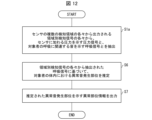
- Fig. 12 is a flowchart showing an example of the flow of processing performed by the information processing system 100B.
- the signal extraction unit 101 acquires area-specific detection signals output from each detection area (e.g., detection areas D1 to D4 shown in FIG. 3) and extracts pressure and respiration signals from each area-specific detection signal (step S1a).
- the source location estimation unit 106 estimates the location in the subject W1's body from which the abnormal sound is originating, based on the respiratory signals extracted from each of the region-specific detection signals (step S6). For example, the source location estimation unit 106 may identify the position of the detection region that outputs the region-specific detection signal from which the respiratory signal containing the most abnormal sound is extracted, and estimate a part of the subject's body that is estimated to be close to the identified position as the abnormal sound originating location.
- the output unit 105 outputs abnormal area information indicating the estimated area where the abnormal sound is occurring (step S7).
- the information processing system 100B can accurately measure the respiratory signal of the subject W1 and identify the area where abnormal sounds related to the subject W1's illness are occurring. For example, by providing the output respiratory signal and information on the area where abnormal sounds are occurring to medical personnel, etc., the medical personnel, etc. can diagnose with high accuracy not only the health condition of the subject W1, but also which part of the subject W1's body may be experiencing an abnormality.
- FIG. 13 is a diagram showing an example of a display screen displayed on the display unit 33 of the communication device 3 of the information processing system 100B.
- the display unit 33 may further display a region R4 capable of displaying abnormal area information relating to the subject related to (B6) above.
- the area where the abnormal sound is occurring is shown as an oval mark M in a diagram simulating the front and back of the subject's body in region R4.
- medical personnel can refer to the display on the communication device 3 to make an appropriate judgment about the subject's health condition, the type and location of the disease the subject is suffering from, and the need for medical intervention for the subject.
- FIG. 14 is a functional block diagram showing a modified configuration of an information processing system.
- Information processing system 100C shown in FIG. 14 differs from information processing system 100B shown in FIG. 11 in that estimation device 2A, which is an external device, is provided with estimation unit 201 and occurrence location estimation unit 202, respectively, as opposed to estimation unit 104 and occurrence location estimation unit 106 provided in control unit 10B of information processing device 1B, whereas control unit 10C of information processing device 1C is not provided with these.
- Estimation device 2A is provided with control unit 20A and memory unit 22.
- control unit 20A is provided with estimation unit 201 and output unit 205.
- the output unit 105 in the information processing device 1C outputs the determination results of the respiratory phase determination unit 102 and the abnormal sound determination unit 103 and the respiratory signals extracted from each of the area-specific detection signals to the estimation device 2A via the communication network 9.
- the output unit 205 in the estimation device 2A outputs the estimation result of the estimation unit 201, information on the health condition of the subject W1, and the estimation result of the occurrence site estimation unit 202 to the communication device 3 via the communication network 9.
- FIG. 15 is a functional block diagram showing another modified example of the configuration of an information processing system.
- the information processing system 100D shown in FIG. 15 includes all of the components that make up the information processing system 100B shown in FIG. 11 and the information processing system 100C shown in FIG. 14 in an information processing device 1D.
- the information processing device 1D includes a display unit 13 in addition to a sensor 11, a control unit 10D, and a memory unit 12.
- the control unit 10D includes a signal extraction unit 101, a respiratory phase determination unit 102, an abnormal sound determination unit 103, an estimation unit 104, an output unit 105, and an occurrence site estimation unit 106, as well as a display control unit 107 that causes the display unit 13 to display various information.
- the display unit 13 displays the display screen shown in FIG. 13 as an example.
- the information processing device 1D may communicate with at least one or more communication devices 3 via the communication network 9.
- the information displayed on the display unit 13 may also be displayed on communication devices 3 such as smartphones and tablet terminals owned by multiple medical personnel W2.
- the configurations of the information processing system 100C shown in FIG. 14 and the information processing system 100D shown in FIG. 15 are merely examples and are not limited to such configurations. Each part constituting the information processing system may be provided as an external device.
- An information processing system 100E is a system including an abnormal sound detection unit 103A that determines whether or not sounds related to breathing include abnormal sounds based on a result of performing an averaging process on a respiratory signal indicating sounds related to breathing of a subject W1.
- the information processing system 100E is a system that, in the above-described information processing systems 100 to 100D, includes an abnormal sound detection unit 103A instead of the abnormal sound detection unit 103 of each of the information processing devices 1 to 1D.
- the information processing system 100E will be described by taking as an example a system in which the information processing device 1 of the information processing system 100 includes the abnormal sound detection unit 103A instead of the abnormal sound detection unit 103.
- Fig. 16 is a flowchart showing an example of the flow of processing performed by the abnormal sound detector 103A.
- the abnormal sound detector 103A extracts a first respiratory signal having a frequency equal to or higher than the first frequency and a second respiratory signal having a frequency equal to or lower than the second frequency from the detection signal output from the sensor (step S10).
- the first respiratory signal and the second respiratory signal may be any respiratory signal that does not include a frequency band that represents the heartbeat of the subject W1.
- the first frequency may be greater than the upper limit of the frequency that represents the heartbeat of the subject W1
- the second frequency may be less than the lower limit of the frequency that represents the heartbeat of the subject W1.
- the frequency that represents the heartbeat varies depending on the age and lifestyle of the subject W1, so it is preferable that the first and second frequencies can be set arbitrarily according to the age and lifestyle of the subject W1.
- the first frequency may be set to 3 Hz or more if the subject W1 is a child, 1.5 Hz or more if the subject W1 is an athlete, and 2.0 Hz or more if the subject W1 is an adult.
- the second frequency may be set to 1 Hz or less regardless of the age and lifestyle of the subject W1. This makes it possible to remove the frequency signal representing the heart rate from the respiratory signal representing sounds related to the breathing of subject W1, making it possible to more accurately determine whether or not there is abnormal sound.
- the first frequency is preferably 20 Hz or more in order to remove signals representing vibrations other than sound, and more preferably 60 Hz or more in order to remove signals representing hum.
- the method for extracting the first and second respiratory signals is not particularly limited, but in this embodiment, the first and second respiratory signals are extracted using a bandpass filter, a lowpass filter, or the like. It is also possible to use a highpass filter instead of a bandpass filter to extract the first respiratory signal, but in this embodiment, a bandpass filter is used to prevent aliasing that occurs in digital processing.
- the first and second respiratory signals described above may correspond to the respiratory signal and pressure signal extracted by the signal extraction unit 101.
- the abnormal sound detector 103A divides the first respiratory signal extracted in step S10 at a predetermined time interval, and calculates a power spectrum for each of the divided segments (step S11).
- the abnormal sound detector 103A may divide the first respiratory signal into unit segments corresponding to the expiration segment and the inspiration segment determined by the respiratory phase detector 102, or the combined expiration segment and inspiration segment, and calculate a power spectrum for each of the unit segments.
- the predetermined time interval for dividing the first respiratory signal may be the time interval of each unit segment, or may be an arbitrarily set time interval.
- the arbitrarily set time interval is preferably 0.1 seconds or more and 0.8 seconds or less, and more preferably 0.1 seconds.
- multiple power spectra may be calculated for one unit segment.
- the power spectrum of the first respiratory signal is calculated for each unit segment.
- the abnormal sound detector 103A determines the time to be used as the starting point in the averaging process of the power spectrum of the first respiratory signal, which will be described later (step S12). As an example, the abnormal sound detector 103A determines the time to be used as the starting point for each unit section in the averaging process of the power spectrum of the first respiratory signal from the second respiratory signal extracted in step S10. At this time, the abnormal sound detector 103A may perform a process to remove a large amplitude signal having an amplitude larger than a predetermined standard amplitude from the second respiratory signal extracted in step S10. For example, the starting time may be determined from the second respiratory signal in which the large amplitude signal has been changed to the standard amplitude, or the starting time may be determined from the second respiratory signal from which the large amplitude signal has been removed.
- the abnormal sound detector 103A averages the power spectrum calculated in step S11 (step S13).
- the abnormal sound detector 103A aligns the time as the starting point of each unit section determined in step S12 and averages the power spectrum of the first respiratory signal for each unit section.
- the abnormal sound detector 103A may remove a large amplitude signal having an amplitude larger than a predetermined standard amplitude from the first respiratory signal.
- the averaging process may be performed on the power spectrum of the first respiratory signal in which the large amplitude signal has been changed to the standard amplitude, or the averaging process may be performed on the power spectrum of the first respiratory signal in which the large amplitude signal has been removed.
- the method of averaging the power spectrum of the first respiratory signal in the averaging process is not particularly limited and can be determined arbitrarily.
- Specific examples of the method of averaging the power spectrum of the first respiratory signal include a power average for each frequency on the vertical axis (frequency axis) of the power spectrum, a moving average of the power spectrum, or a method using the following low-pass filter (low-pass IIR filter).
- the abnormal sound detector 103A determines whether or not the sounds related to the breathing of the subject W1 include abnormal sounds based on the result of the averaging process of the power spectrum of the first respiratory signal (step S14). As an example, the abnormal sound detector 103A determines that the sounds related to the breathing of the subject W1 include abnormal sounds when the ratio of the variance of the power spectrum to the square of the power mean of the first respiratory signal is equal to or greater than a predetermined threshold.
- the abnormal sound detection unit 103A may also perform frequency-based correction processes.
- Frequency-based correction processes are processes that subtract a time offset at each frequency of a sonogram that represents a power spectrum three-dimensionally (frequency x amplitude x time). Specifically, these processes include processes that subtract a time-averaged value for each frequency in the display section of the sonogram, and processes that apply a high-pass filter on the time axis for each frequency to remove the offset.
- frequency-based correction processes it is possible to remove noises that are concentrated at specific frequencies, such as hum noise and motor noise. This makes it possible to highlight changes due to breathing in the sonogram, making it easier to visually determine whether breathing-related sounds include abnormal sounds.
- the abnormal sound detection unit 103A of the information processing device 10E executes the above-mentioned processes (steps S10 to S14) as an example, but the entity that executes each process is not limited to the abnormal sound detection unit 103A.
- a new averaging processing unit may be provided, and step S10 may be executed by the signal extraction unit 101, step S12 by the respiratory phase determination unit 102, steps S11 and S13 by the averaging processing unit, and step S14 by the abnormal sound detection unit 103A.
- step S11 The process of calculating the power spectrum of the first respiratory signal will now be described.
- the power spectrum of the first respiratory signal is calculated by executing the following process.
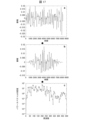
- FIG. 17 is a diagram for explaining the process performed to calculate the power spectrum of the first respiratory signal.
- the abnormal sound detector 103A converts the first respiratory signal sampled at 44.1 kHz into a sequence y(n) (process (C1)).
- a signal set is created for the sequence representing the first respiratory signal (process (C2)).
- the signal set created here is, as an example, a signal set in which the starting point of the sequence y(n) is shifted by a predetermined number.
- a signal set Y 8192 with 8192 elements is created by shifting the starting point from the sequence y(n) by 2048 elements (approximately 46 msec).
- each element of the signal set is weighted by a window function (process (C3)).
- a signal set WY 8192 in which each of the 8192 elements is weighted by a Hanning window function is obtained.
- process (3) changes the graph representing the first respiratory signal as shown in "a" of Fig. 17 to the graph shown in "b" of Fig. 17.
- each element weighted by the window function is Fourier transformed (process (C4)).
- CY 8192 is obtained by Fourier transforming the signal set WY 8192.
- CY 8192 is complex number data.
- the power spectrum of each element that has been subjected to the Fourier transform is calculated (process (C5)).
- a process may be performed to remove singular values from the power spectrum of the first respiratory signal (process (6)).
- the singular values are pulsating noise.
- the abnormal sound detector 103A can calculate the power spectrum of the first respiratory signal from which pulse noise has been removed.
- step S12 (Calculation of starting time (step S12)) The process of determining a time to be used as a starting point in the averaging process of the power spectrum of the first respiratory signal from the second respiratory signal will be described below.
- the time to be used as the starting point is determined by executing the following process.
- the abnormal sound detector 103A converts the second respiratory signal sampled at 44.1 kHz into a sequence x(n) (process (D1)).
- the abnormal sound detector 103A performs downsampling to reduce the amount of data (processing (D2)).
- processing (D2) the second respiratory signal is resampled at a sampling interval N 2048 (approximately 46 msec).
- a digital filter is applied to the sequence x(n) representing the downsampled second respiratory signal (process (D3)).
- an IIR filter is applied to the sequence x(n).
- a filtered waveform is created by correcting the delay of the sequence x(n) representing the second respiratory signal that has been digitally filtered (process (D4)).
- D4 digitally filtered
- applying a filter to a signal causes a delay.
- the sequence x(n) representing the second respiratory signal is deviated from the sound representing the actual breathing of subject W1 by applying the digital filter in process (D3) above.
- a filtered waveform is created in which this deviation has been corrected.
- the starting time in the averaging process of the power spectrum of the first respiratory signal is determined (process (D5)).
- the starting time here may be any point in the respiratory phase in the filtered waveform representing the second respiratory signal, but must be a point in the same phase during the respiratory phase. Therefore, in this embodiment, delay correction is performed on the filtered waveform obtained by applying an IIR filter to the second respiratory signal, and the starting time is determined to be the time corresponding to the extreme value in the waveform after delay correction.
- the starting time when an antisymmetric waveform is used by applying an FIR filter to the second respiratory signal, the starting time may be the time corresponding to a value where the amplitude is 0. However, it is necessary to select either the point where the amplitude changes from negative to positive, or the point where the amplitude changes from positive to negative.
- the vertical axis represents the power spectrum density
- the horizontal axis represents the frequency
- the shading represents the amplitude.
- FIG. 19 shows a spectrogram when averaging is performed on the power spectrum of the first respiratory signal.
- the averaging is performed using first-order low-pass IIR filters designed with different averaging parameters ⁇ .
- the averaging parameter ⁇ is the pole of the first-order low-pass IIR filter. In other words, it represents the cutoff frequency of the first-order low-pass IIR filter, i.e., the point at which the transfer function becomes ⁇ .
- the value of the averaging parameter ⁇ is 0, it indicates that no averaging is performed, and when the value of the averaging parameter ⁇ is 1, it indicates that everything is averaged.
- the abnormal sound detector 103A described above may execute a process of linearly combining the power spectra of the first respiratory signal that have been subjected to an n-th power mean operation (n is a natural number equal to or greater than 2) in addition to averaging the power spectra of the first respiratory signal.
- the abnormal sound detector 103A calculates the variance of the power spectrum of the first respiratory signal represented by ⁇ pow(w) 2 >- ⁇ pow(w)> 2 , or ⁇ pow(w) 2 >-2 ⁇ pow(w)> 2 , for each unit section.
- Figs. 20 to 22 show a calculation method assuming that the first respiratory signal is a pulse train in which a plurality of pulses Af(t) of the same waveform and pulse width ⁇ t are generated for a period Te of the cycle Tr.
- A is the amplitude of the pulse.
- the timing of generation is random during the period Te, and the pulses are generated at an average density of n (pulse/sec).
- the start time of Te is ⁇ m .
- the value of ⁇ pow(w) 2 >- ⁇ pow(w)> 2 or ⁇ pow(w) 2 >-2 ⁇ pow(w)> 2 is calculated according to the following procedure.
- Fig. 23 is a diagram showing the results of applying the above-mentioned calculation method to models of hair crepitus and normal sound.
- case 1 shows the case of a respiratory signal representing hair crepitus containing a small number of pulses with large amplitude
- case 2 shows the case of a respiratory signal representing normal sound containing a large number of pulses with small amplitude.
- the value of ⁇ pow(w)> 2 which represents the square of the average of the power spectrum of case 1 and case 2, is the same value. That is, it is difficult to distinguish between hair crepitation and normal sounds by averaging the power spectrum of the respiratory signal.
- the values are different by about 10 times for V(pow(w)) and about 100 times for U(pow(w)). Therefore, it is possible to distinguish between hair crepitation and normal sounds by comparing the values of V(pow(w)) or U(pow(w)).
- the abnormal sound detector 103A can more accurately determine whether the sounds related to the breathing of the subject W1 include abnormal sounds by comparing the value of ⁇ pow(w) 2 >- ⁇ pow(w)> 2 and the value of ⁇ pow(w) 2 >-2 ⁇ pow(w)> 2 calculated from the power spectrum of the first respiratory signal with the value of ⁇ pow(w) 2 >- ⁇ pow(w)> 2 and the value of ⁇ pow(w) 2 >-2 ⁇ pow(w)> 2 calculated from the power spectrum of the respiratory signal representing normal sounds.
- each step (control method) shown in Figure 8 and Figure 12 may be executed by one or more information processing devices.
- each step (control method) shown in Figure 8 and Figure 12 may be executed by one information processing device, or may be executed by multiple information processing devices in a shared manner.
- the functions of the information processing systems 100, 100A-100D (hereinafter referred to as "systems"), the information processing devices 1, 1A-1D, and the estimation devices 2, 2A can be realized by programs for causing a computer to function as the systems and the devices, and for causing a computer to function as each control block (particularly each part included in the control unit) of the system and the information processing device 1.
- the system and device are provided with a computer having at least one control device (e.g., a processor) and at least one storage device (e.g., a memory) as hardware for executing the program.
- control device e.g., a processor
- storage device e.g., a memory
- the program may be recorded on one or more computer-readable recording media, not on a temporary basis.
- the recording media may or may not be included in the device. In the latter case, the program may be supplied to the device via any wired or wireless transmission medium.
- each of the above control blocks can be realized by a logic circuit.
- a logic circuit for example, an integrated circuit in which a logic circuit that functions as each of the above control blocks is formed is also included in the scope of the present invention.
- each process described in each of the above embodiments may be executed by AI (Artificial Intelligence).
- AI Artificial Intelligence
- the AI may run on the control device, or may run on another device (such as an edge computer or a cloud server).
- the information processing system comprises a sensor that detects vibrations emitted from the subject's torso at a position not in contact with the subject or at a position in contact with the subject's torso, a signal extraction unit that extracts, from the detection signal output from the sensor, a pressure signal indicative of the pressure applied to the sensor and a respiratory signal indicative of sounds related to the subject's breathing, a respiratory phase determination unit that determines the exhalation period and inhalation period of the subject based on fluctuations in intensity of the pressure signal, an abnormal sound determination unit that determines whether the sounds related to breathing include an abnormal sound based on the respiratory signal, and an estimation unit that, if the sounds related to breathing include an abnormal sound, estimates in which of the exhalation period or the inhalation period the abnormal sound is occurring.
- the sounds associated with the subject's breathing may contain abnormal sounds. It is known that there are several types of abnormal sounds that can be included in the sounds associated with breathing, and it may be possible to determine the type of abnormality occurring in the subject's body from the type of abnormal sound.
- Breathing has two respiratory phases: the inhalation phase in which air is taken into the lungs, and the exhalation phase in which air is expelled from the lungs. If the respiratory phase in which an abnormal sound is occurring can be identified, it becomes possible to accurately identify the type of abnormal sound.
- the information processing system extracts a pressure signal and a respiratory signal from a detection signal output from a sensor that detects vibrations emitted from the subject's torso.
- the information processing system determines the subject's respiratory phase (the expiratory and inhalation periods) based on fluctuations in the intensity of the pressure signal, and determines whether the sounds related to breathing include abnormal sounds based on the respiratory signal. If the sounds related to breathing include abnormal sounds, the information processing system estimates whether the abnormal sounds are occurring in the expiratory or inhalation period.
- the abnormal sound detection unit may determine that the breathing-related sound includes the abnormal sound in at least one of the following cases: when the breathing signal has a predetermined frequency characteristic; when the breathing signal includes a signal exceeding a predetermined intensity for each frequency band; when the breathing signal includes a signal exceeding a predetermined intensity in a predetermined frequency band; and when the ratio of the signal intensity in the breathing signal in a frequency band detected during normal breathing to the signal intensity in the predetermined frequency band is equal to or greater than a predetermined threshold value.
- the information processing system uses at least one of the frequency characteristics of the subject's breathing signal, the strength of the breathing signal, and the ratio of the breathing signal during normal breathing to a signal in a predetermined frequency band to determine the presence or absence of abnormal sounds. This allows the information processing system to accurately determine abnormal sounds contained in sounds related to breathing.
- the abnormal sound may include an accessory noise
- the estimation unit may estimate the type of the accessory noise based on whether the abnormal sound is included in the expiration period or the inspiration period.
- the type of adventitious noise is estimated based on whether the abnormal sound is contained in the expiratory or inhalation period.
- the type of adventitious noise can be estimated with high accuracy.
- the estimation unit may estimate the type of the accessory noise according to the frequency of an abnormal sound signal indicating the abnormal sound.
- Adjacent noises have different frequency characteristics depending on the type. With the above configuration, the type of adjacent noise can be estimated with higher reliability based on the frequency of an abnormal sound signal indicating an abnormal sound.
- the information processing system is any one of aspects 1 to 4 above, in which the estimation unit calculates a smoothing strength that smoothes the time fluctuation in the strength of a signal in the same frequency band that includes the frequency of the abnormal sound signal, and estimates the type of the accessory noise according to the smoothing strength.
- the information processing system can estimate the type of auxiliary noise with high accuracy and sensitivity.
- the estimation unit may estimate the type of the accessory noise based on the change in sound pressure of the abnormal sound in the expiration section or the inspiration section and the time interval at which the abnormal sound occurs.
- bubbling sounds are low-pitched sounds that sound like "gurgling” or "bubble," while hair crepitus sounds are high-pitched sounds that sound like "crunch, crackle.” Both bubbling sounds and hair crepitus sounds are characterized by being intermittent and occurring during the inhalation section.
- Snoring is a low-pitched "buzzing” sound that is continuous and occurs during both the exhalation and inhalation sections.
- a whistle is a high-pitched "beep, crackle” sound that is continuous and occurs during the exhalation section. In other words, depending on the type of adventitious noise, (1) it differs in whether it occurs during the exhalation section or the inhalation section, and (2) the time interval at which it occurs (i.e., whether it is continuous or intermittent) differs.
- the information processing system estimates the type of accessory noise based on the change in sound pressure of the abnormal sound during the exhalation or inhalation period and the time interval at which the abnormal sound occurs. This allows the information processing system to accurately estimate the type of accessory noise.
- the information processing system may further include a health condition output unit that outputs information regarding the subject's health condition that is specified according to the type of the estimated accessory noise in any one of aspects 3 to 6 above.
- the information processing system can output to the subject information relating to a health condition related to the occurrence of adventitious noise (e.g., information about a disease or pathology). For example, medical personnel who refer to the output health information can begin medical intervention for the subject at an early stage.
- a health condition related to the occurrence of adventitious noise e.g., information about a disease or pathology.
- medical personnel who refer to the output health information can begin medical intervention for the subject at an early stage.
- the frequency of the pressure signal may be 0.1 Hz or more and 1 Hz or less.
- the above configuration makes it possible to extract a pressure signal from a detection signal based on frequency characteristics.
- the frequency of the respiratory signal may be 20 Hz or more and 1000 Hz or less.
- the above configuration makes it possible to extract a breathing signal from a detection signal based on frequency characteristics.
- the senor that detects the vibrations at a position that does not contact the subject may be installed in a position on the subject's clothing where the clothing is sandwiched between the sensor and the torso, or may be installed in a position that supports the torso on a bed on which the subject lies or on a chair on which the subject sits.
- the senor can detect vibrations emitted from the subject's torso at a position that is not in contact with the subject or at a position that is in contact with the subject's torso.
- the subject does not need to be in a specified detection area, and does not need to be in a specified detection posture. For example, when a clothed subject is leaning back in a chair or lying down in bed, the subject and the sensor will naturally be close to each other, and vibrations emitted from the subject's torso can be detected with high accuracy.
- the torso may include at least the chest of the subject.
- the above configuration allows for more accurate detection of vibrations emitted from the subject's respiratory system.
- the information processing system according to aspect 12 of the present disclosure is any one of aspects 1 to 11, in which the sensor may be thin plate-shaped.
- the senor can be attached to various locations.
- it can be attached to clothing worn by the subject.
- the senor may include a piezoelectric sensor.
- the above configuration makes it easy to make the sensor thinner, reducing the possibility of causing discomfort to the subject.
- the senor may include a plurality of detection areas that output the detection signals, and the signal extraction unit may extract the pressure signal and the respiration signal from each of the area-specific detection signals output from each of the plurality of detection areas.
- the information processing system extracts a pressure signal and a respiration signal from each of the area-specific detection signals output from each of the multiple detection areas. This allows the information processing system to detect vibrations emitted from the subject's torso in a detection area close to the location where the vibrations are generated. Therefore, the information processing system can detect vibrations emitted from the subject's torso with greater accuracy.
- the information processing system may further include a part estimation unit that estimates the part of the subject's body where the abnormal sound is occurring based on the respiratory signal extracted from each of the region-specific detection signals in the above-mentioned aspect 14.
- the information processing system estimates the location in the subject's body where the abnormal sound is occurring based on the respiratory signal extracted from each of the area-specific detection signals. This makes it possible to estimate which part of the subject's body may be experiencing an abnormality (e.g., inflammation).
- an abnormality e.g., inflammation
- the signal extraction unit may extract the respiratory signal from the detection signal using a bandpass filter corresponding to the frequency of each type of accessory noise.
- each type of adventitious noise has its own unique frequency characteristics, it is possible to extract the respiratory signal from the detection signal by using a bandpass filter that corresponds to the frequency of each type of adventitious noise.
- the information processing device includes a signal extraction unit that extracts, from a detection signal output from a sensor that detects vibrations emitted from the subject's torso at a position not in contact with the subject or at a position in contact with the subject's torso, a pressure signal indicating the pressure applied to the sensor and a respiratory signal indicating sounds related to the subject's breathing, a respiratory phase determination unit that determines the subject's expiration and inspiration periods based on fluctuations in the intensity of the pressure signal, an abnormal sound determination unit that determines whether the sounds related to breathing include abnormal sounds based on the respiratory signal, and an estimation unit that, if the sounds related to breathing include abnormal sounds, estimates in which of the expiration period or the inspiration period the abnormal sound is occurring.
- This configuration provides the same effects as the information processing system according to aspect 1 above.
- the information processing device includes a signal extraction unit that extracts a pressure signal indicating the pressure applied to the sensor and a breathing signal indicating a sound related to the breathing of the subject from a detection signal output from a sensor that detects vibrations emitted from the subject's torso at a position not in contact with the subject or at a position in contact with the torso of the subject, a breathing phase determination unit that determines the exhalation and inhalation periods of the subject based on fluctuations in the intensity of the pressure signal, and an abnormal sound determination unit that determines whether the sound related to the breathing includes an abnormal sound based on the breathing signal, and further includes an output unit that outputs the determination result by the breathing phase determination unit and the determination result by the abnormal sound determination unit to an external device that includes an estimation unit that estimates whether the abnormal sound is occurring in the exhalation period or the inhalation period if the sound related to the breathing includes an abnormal sound.
- This configuration achieves the same effect as the information processing system according to aspect 1 above.
- the control method according to aspect 19 of the present disclosure is a control method executed by one or more information processing devices, and includes a signal extraction step of extracting a pressure signal indicating the pressure applied to a sensor and a respiratory signal indicating a sound related to the subject's breathing from a detection signal output from a sensor that detects vibrations emitted from the subject's torso at a position not in contact with the subject or at a position in contact with the torso of the subject, a respiratory phase determination step of determining the exhalation and inhalation periods of the subject based on fluctuations in the intensity of the pressure signal, an abnormal sound determination step of determining whether the sound related to breathing includes an abnormal sound based on the respiratory signal, and an estimation step of estimating in which of the exhalation and inhalation periods the abnormal sound is occurring if an abnormal sound is included in the sound related to breathing.
- This configuration provides the same effect as the information processing system according to aspect 1 above.
- the program according to aspect 20 of the present disclosure is a program for controlling a computer as the information processing system described in aspect 1, and is a program for causing a computer to function as the signal extraction unit, the respiratory phase determination unit, the abnormal sound determination unit, and the estimation unit. This configuration produces the same effects as the information processing system according to aspect 1.
- the abnormal sound detection unit calculates the power spectrum of a first respiratory signal having a first frequency or higher contained in the detection signal for unit sections corresponding to each of the expiration section and the inspiration section, or a breathing section consisting of the expiration section and the inspiration section combined, determines a starting time for an averaging process of the power spectrum for each unit section from a second respiratory signal having a second frequency or lower contained in the breathing signal, and determines whether the breathing-related sound includes an abnormal sound based on the result of the averaging process by matching the starting point in the power spectrum to each of the unit sections.
- the above configuration removes signals in unnecessary frequency bands from the breathing signal and performs averaging processing, making it possible to more accurately determine whether the sounds related to the subject's breathing include abnormal sounds.
- the determination process determines that the breathing sounds include abnormal sounds if the ratio of the variance of the power spectrum to the square of the power average of the first respiratory signal is equal to or greater than a predetermined threshold value in the averaging process.
- the above configuration makes it possible to determine with high accuracy whether or not an abnormal sound is present, and to distinguish between similar abnormal sounds.
- the above configuration simplifies complex processing. This makes it possible to accurately and efficiently determine whether the sounds related to the subject's breathing include abnormal sounds.
- the large amplitude signal is removed from the unit section and the averaging process is performed.
- the above configuration can simplify complex processing. This makes it possible to accurately and efficiently determine whether the sounds related to the subject's breathing include abnormal sounds.
- the information processing system determines whether the breathing-related sounds include abnormal sounds based on a value calculated by a linear combination of the power spectra that have been subjected to an n-th power mean operation (n is a natural number equal to or greater than 2) in the above-mentioned aspect 21.
- the above configuration allows for highly accurate determination of breathing signals that cannot be distinguished from normal sounds using averaging processing.
Landscapes
- Health & Medical Sciences (AREA)
- Life Sciences & Earth Sciences (AREA)
- Engineering & Computer Science (AREA)
- General Health & Medical Sciences (AREA)
- Public Health (AREA)
- Veterinary Medicine (AREA)
- Animal Behavior & Ethology (AREA)
- Surgery (AREA)
- Molecular Biology (AREA)
- Medical Informatics (AREA)
- Heart & Thoracic Surgery (AREA)
- Biomedical Technology (AREA)
- Physics & Mathematics (AREA)
- Biophysics (AREA)
- Pathology (AREA)
- Physiology (AREA)
- Pulmonology (AREA)
- Signal Processing (AREA)
- Psychiatry (AREA)
- Artificial Intelligence (AREA)
- Computer Vision & Pattern Recognition (AREA)
- Dentistry (AREA)
- Oral & Maxillofacial Surgery (AREA)
- General Physics & Mathematics (AREA)
- Measurement Of The Respiration, Hearing Ability, Form, And Blood Characteristics Of Living Organisms (AREA)
Priority Applications (3)
| Application Number | Priority Date | Filing Date | Title |
|---|---|---|---|
| CN202380065610.7A CN119866194A (zh) | 2022-09-29 | 2023-09-21 | 信息处理系统、信息处理装置、控制方法和程序 |
| KR1020257007438A KR20250084914A (ko) | 2022-09-29 | 2023-09-21 | 정보 처리 시스템, 정보 처리 장치, 제어 방법 및 프로그램 |
| JP2024506208A JPWO2024070878A1 (https=) | 2022-09-29 | 2023-09-21 |
Applications Claiming Priority (2)
| Application Number | Priority Date | Filing Date | Title |
|---|---|---|---|
| JP2022-157010 | 2022-09-29 | ||
| JP2022157010 | 2022-09-29 |
Publications (1)
| Publication Number | Publication Date |
|---|---|
| WO2024070878A1 true WO2024070878A1 (ja) | 2024-04-04 |
Family
ID=90477667
Family Applications (1)
| Application Number | Title | Priority Date | Filing Date |
|---|---|---|---|
| PCT/JP2023/034228 Ceased WO2024070878A1 (ja) | 2022-09-29 | 2023-09-21 | 情報処理システム、情報処理装置、制御方法、およびプログラム |
Country Status (5)
| Country | Link |
|---|---|
| JP (1) | JPWO2024070878A1 (https=) |
| KR (1) | KR20250084914A (https=) |
| CN (1) | CN119866194A (https=) |
| TW (1) | TW202434165A (https=) |
| WO (1) | WO2024070878A1 (https=) |
Citations (4)
| Publication number | Priority date | Publication date | Assignee | Title |
|---|---|---|---|---|
| JP2015042293A (ja) * | 2014-10-27 | 2015-03-05 | 株式会社豊田中央研究所 | 個人認証装置及び個人認証プログラム |
| WO2018124173A1 (ja) * | 2016-12-27 | 2018-07-05 | Ami株式会社 | 生体モニタリング装置 |
| WO2021112131A1 (ja) * | 2019-12-04 | 2021-06-10 | 積水化学工業株式会社 | 状態判定方法、状態判定装置、状態判定システム、状態判定プログラム及び記録媒体 |
| JP2021159311A (ja) * | 2020-03-31 | 2021-10-11 | テイ・エス テック株式会社 | 生体運動誘導システム、生体運動誘導方法及びプログラム |
Family Cites Families (1)
| Publication number | Priority date | Publication date | Assignee | Title |
|---|---|---|---|---|
| US7314451B2 (en) | 2005-04-25 | 2008-01-01 | Earlysense Ltd. | Techniques for prediction and monitoring of clinical episodes |
-
2023
- 2023-09-21 JP JP2024506208A patent/JPWO2024070878A1/ja active Pending
- 2023-09-21 WO PCT/JP2023/034228 patent/WO2024070878A1/ja not_active Ceased
- 2023-09-21 CN CN202380065610.7A patent/CN119866194A/zh active Pending
- 2023-09-21 KR KR1020257007438A patent/KR20250084914A/ko active Pending
- 2023-09-22 TW TW112136256A patent/TW202434165A/zh unknown
Patent Citations (4)
| Publication number | Priority date | Publication date | Assignee | Title |
|---|---|---|---|---|
| JP2015042293A (ja) * | 2014-10-27 | 2015-03-05 | 株式会社豊田中央研究所 | 個人認証装置及び個人認証プログラム |
| WO2018124173A1 (ja) * | 2016-12-27 | 2018-07-05 | Ami株式会社 | 生体モニタリング装置 |
| WO2021112131A1 (ja) * | 2019-12-04 | 2021-06-10 | 積水化学工業株式会社 | 状態判定方法、状態判定装置、状態判定システム、状態判定プログラム及び記録媒体 |
| JP2021159311A (ja) * | 2020-03-31 | 2021-10-11 | テイ・エス テック株式会社 | 生体運動誘導システム、生体運動誘導方法及びプログラム |
Also Published As
| Publication number | Publication date |
|---|---|
| CN119866194A (zh) | 2025-04-22 |
| TW202434165A (zh) | 2024-09-01 |
| KR20250084914A (ko) | 2025-06-11 |
| JPWO2024070878A1 (https=) | 2024-04-04 |
Similar Documents
| Publication | Publication Date | Title |
|---|---|---|
| Nam et al. | Estimation of respiratory rates using the built-in microphone of a smartphone or headset | |
| FI126600B (en) | Detection of sleep phenomena using ballistocardiography | |
| CN108289638B (zh) | 生物体状态判定装置以及生物体状态判定方法 | |
| CN109222961B (zh) | 一种便携式睡眠监测系统及相关睡眠监测方法 | |
| JP2001037742A (ja) | 呼吸器系疾患のモニタ装置 | |
| CA2847412C (en) | System and methods for estimating respiratory airflow | |
| JP7691999B2 (ja) | 遠隔患者のスクリーニング及びトリアージのためのシステム及び方法 | |
| CN108289779B (zh) | 身体状况检查装置、身体状况检查方法以及床系统 | |
| KR101706197B1 (ko) | 압전센서를 이용한 폐쇄성수면무호흡 선별검사를 위한 장치 및 방법 | |
| CN115778366B (zh) | 呼吸监测方法及装置 | |
| JP5070701B2 (ja) | 寝具に加わる被験者の荷重変化により得られる呼吸信号の解析方法および装置 | |
| US20200100727A1 (en) | System for determining a set of at least one cardio-respiratory descriptor of an individual during sleep | |
| Thirion et al. | BCG-VARS: BallistoCardioGraphy vital algorithms for real-time systems | |
| AU2025202413A1 (en) | Method and arrangement for respiratory measurement | |
| CN113692523B (zh) | 生物体信息监测系统、床系统以及生物体信息监测方法 | |
| WO2015178439A2 (ja) | 睡眠時無呼吸の中枢型/閉塞型診断支援装置および診断支援方法、ならびに睡眠時無呼吸の中枢型/閉塞型診断支援プログラムを記録したコンピュータ読み取り可能な記録媒体 | |
| CN120345883B (zh) | 睡眠期间肺功能特征构建方法及设备 | |
| WO2023176948A1 (ja) | 無呼吸低呼吸指標推定装置、方法およびプログラム | |
| WO2024070878A1 (ja) | 情報処理システム、情報処理装置、制御方法、およびプログラム | |
| JP6011240B2 (ja) | 生体情報取得方法及び生体情報取得装置 | |
| JP4480473B2 (ja) | Ah測定装置 | |
| JP7089650B2 (ja) | 処理装置、システム、処理方法、およびプログラム | |
| WO2023140390A1 (ja) | 睡眠状態判定装置、睡眠状態判定方法およびプログラム | |
| JP6013002B2 (ja) | 生体信号表示装置およびその制御方法 | |
| JP2019088392A (ja) | 肺機能検査装置 |
Legal Events
| Date | Code | Title | Description |
|---|---|---|---|
| ENP | Entry into the national phase |
Ref document number: 2024506208 Country of ref document: JP Kind code of ref document: A |
|
| 121 | Ep: the epo has been informed by wipo that ep was designated in this application |
Ref document number: 23872104 Country of ref document: EP Kind code of ref document: A1 |
|
| WWE | Wipo information: entry into national phase |
Ref document number: 202380065610.7 Country of ref document: CN |
|
| WWP | Wipo information: published in national office |
Ref document number: 202380065610.7 Country of ref document: CN |
|
| NENP | Non-entry into the national phase |
Ref country code: DE |
|
| WWP | Wipo information: published in national office |
Ref document number: 1020257007438 Country of ref document: KR |
|
| 122 | Ep: pct application non-entry in european phase |
Ref document number: 23872104 Country of ref document: EP Kind code of ref document: A1 |