WO2024062756A1 - ラベルおよびラベルの製造方法 - Google Patents
ラベルおよびラベルの製造方法 Download PDFInfo
- Publication number
- WO2024062756A1 WO2024062756A1 PCT/JP2023/026713 JP2023026713W WO2024062756A1 WO 2024062756 A1 WO2024062756 A1 WO 2024062756A1 JP 2023026713 W JP2023026713 W JP 2023026713W WO 2024062756 A1 WO2024062756 A1 WO 2024062756A1
- Authority
- WO
- WIPO (PCT)
- Prior art keywords
- base layer
- printing
- label
- water
- layer
- Prior art date
- Legal status (The legal status is an assumption and is not a legal conclusion. Google has not performed a legal analysis and makes no representation as to the accuracy of the status listed.)
- Ceased
Links
Images



Classifications
-
- G—PHYSICS
- G09—EDUCATION; CRYPTOGRAPHY; DISPLAY; ADVERTISING; SEALS
- G09F—DISPLAYING; ADVERTISING; SIGNS; LABELS OR NAME-PLATES; SEALS
- G09F3/00—Labels, tag tickets, or similar identification or indication means; Seals; Postage or like stamps
- G09F3/02—Forms or constructions
-
- G—PHYSICS
- G09—EDUCATION; CRYPTOGRAPHY; DISPLAY; ADVERTISING; SEALS
- G09F—DISPLAYING; ADVERTISING; SIGNS; LABELS OR NAME-PLATES; SEALS
- G09F3/00—Labels, tag tickets, or similar identification or indication means; Seals; Postage or like stamps
- G09F3/08—Fastening or securing by means not forming part of the material of the label itself
- G09F3/10—Fastening or securing by means not forming part of the material of the label itself by an adhesive layer
-
- G—PHYSICS
- G09—EDUCATION; CRYPTOGRAPHY; DISPLAY; ADVERTISING; SEALS
- G09F—DISPLAYING; ADVERTISING; SIGNS; LABELS OR NAME-PLATES; SEALS
- G09F3/00—Labels, tag tickets, or similar identification or indication means; Seals; Postage or like stamps
- G09F3/02—Forms or constructions
- G09F2003/0202—Forms or constructions printed before use
-
- G—PHYSICS
- G09—EDUCATION; CRYPTOGRAPHY; DISPLAY; ADVERTISING; SEALS
- G09F—DISPLAYING; ADVERTISING; SIGNS; LABELS OR NAME-PLATES; SEALS
- G09F3/00—Labels, tag tickets, or similar identification or indication means; Seals; Postage or like stamps
- G09F3/02—Forms or constructions
- G09F2003/0208—Indicia
-
- G—PHYSICS
- G09—EDUCATION; CRYPTOGRAPHY; DISPLAY; ADVERTISING; SEALS
- G09F—DISPLAYING; ADVERTISING; SIGNS; LABELS OR NAME-PLATES; SEALS
- G09F3/00—Labels, tag tickets, or similar identification or indication means; Seals; Postage or like stamps
- G09F3/02—Forms or constructions
- G09F2003/0208—Indicia
- G09F2003/021—Indicia behind the front foil
-
- G—PHYSICS
- G09—EDUCATION; CRYPTOGRAPHY; DISPLAY; ADVERTISING; SEALS
- G09F—DISPLAYING; ADVERTISING; SIGNS; LABELS OR NAME-PLATES; SEALS
- G09F3/00—Labels, tag tickets, or similar identification or indication means; Seals; Postage or like stamps
- G09F3/02—Forms or constructions
- G09F2003/0223—Forms or constructions recyclable
-
- G—PHYSICS
- G09—EDUCATION; CRYPTOGRAPHY; DISPLAY; ADVERTISING; SEALS
- G09F—DISPLAYING; ADVERTISING; SIGNS; LABELS OR NAME-PLATES; SEALS
- G09F3/00—Labels, tag tickets, or similar identification or indication means; Seals; Postage or like stamps
- G09F3/02—Forms or constructions
- G09F2003/0272—Labels for containers
-
- G—PHYSICS
- G09—EDUCATION; CRYPTOGRAPHY; DISPLAY; ADVERTISING; SEALS
- G09F—DISPLAYING; ADVERTISING; SIGNS; LABELS OR NAME-PLATES; SEALS
- G09F3/00—Labels, tag tickets, or similar identification or indication means; Seals; Postage or like stamps
- G09F3/02—Forms or constructions
- G09F2003/0272—Labels for containers
- G09F2003/0273—Labels for bottles, flasks
Definitions
- the present disclosure relates to a label and a method for manufacturing the label.
- plastic containers such as polyethylene terephthalate bottles (PET bottles) have been used for various products. It is also common for a plastic label provided with a printing layer for displaying product information, etc. to be attached to the body of a plastic container.
- PET bottles polyethylene terephthalate bottles
- Patent Document 1 in a container label that is provided with a display on a raw film and is removably attached by being wrapped around a container body, a first display that can be recognized from the outside surface is provided on the raw film. and a first printed base layer that hides the background of the first display, a second display that can be recognized from the inner side, and a second printed base layer that hides the background of the second display, and
- the first printed base layer and the second printed base layer are both white ink layers with a thickness of 2 to 6 ⁇ m, and the first display,
- the first printed base layer, the second printed base layer, and the second display are provided in this order in a multilayered manner, and the first printed base layer is provided so as to cover the first display.
- the second printed base layer is provided on a part of the surface of the first printed base layer, and the second display indicates that the second printed base layer is provided on the second printed base layer.
- a characteristic container label is disclosed ([Claim 1] of Patent Document 1).
- plastic labels have been made by applying an oil-based ink to the surface of a plastic film to form an ink layer.
- VOCs volatile organic compounds
- a label having a substrate, the substrate having a first surface which is one surface of the substrate and a second surface which is the surface opposite to the first surface, the label further having a first indicia which is an aqueous ink printed layer on at least one of the first surface and the second surface of the substrate, a first printed base layer which is an aqueous ink printed layer on the first surface of the substrate, a second printed base layer which is an aqueous ink printed layer on the first printed base layer, and a second indicia which is an aqueous ink printed layer on the second printed base layer, the first printed base layer being in contact with the second printed base layer, and a label can be provided in which the area of the second printed base layer is larger than the area of the first printed base layer in a plan view from the first surface side or the second surface side of the substrate.
- a method for manufacturing a label including a base material, the base material having a first surface that is one surface of the base material and a surface opposite to the first surface. forming a first indicia, which is a water-based ink printing layer, on at least one of the first surface and the second surface of the substrate; forming a first printing base layer, which is a water-based ink printing layer, on one surface; forming a second printing base layer, which is a water-based ink printing layer, on the first printing base layer; and a second printing layer.
- the step of forming the second printed base layer includes the step of forming a second display on the base layer, and the step of forming the second printed base layer is the first printing in a plan view from the first surface side or the second surface side of the base material.
- the step of forming the indicia includes the step of printing a water-based ink for forming the second indicia on the second printed base layer, the water-based ink for forming the second printed base layer includes a hardening agent, and the water-based ink for forming the second indicia includes a curing agent;
- the water-based ink for forming the second indication does not contain a curing agent, and can provide a method for producing a label.
- the first display can be visually recognized from the second surface side of the base material, and the second display can be visually recognized from the first surface side of the base material. Therefore, it is possible to provide a label having an excellent design and a method for manufacturing the label, which has a design on both the first surface and the second surface of the base material. Further, according to the embodiment disclosed herein, the first printed base layer and the second printed base layer are located on the first surface side of the base material, and the first printed base layer and the second printed base layer are located on the first surface side of the base material.
- Both of the base layers exhibit a shielding effect, so that the first display cannot be seen from the first surface side of the base material, and the second display cannot be seen from the second surface side of the base material. It is possible to provide a label and a method for manufacturing the label that enable the following.
- FIG. 2 is a schematic cross-sectional view of the label of Embodiment 1.
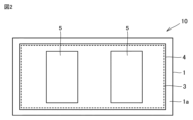
- FIG. 2 is a schematic plan view of an example of the relationship between the first printed base layer and the second printed base layer when viewed from the first surface side of the base material of the label of Embodiment 1.
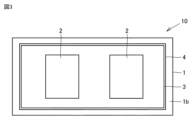
- FIG. 2 is a schematic plan view of an example of the relationship between the first printed base layer and the second printed base layer when viewed from the second surface side of the base material of the label of Embodiment 1.
- FIG. 3 is a schematic cross-sectional view of a label of Embodiment 2.
- FIG. 7 is a schematic cross-sectional view of an example of a laminated structure after printing a water-based ink used for forming a second display on a second printing base layer by flexographic printing in the label manufacturing method of Embodiment 2.
- FIG. 1 shows a schematic cross-sectional view of a label 10 of Embodiment 1, which is an example of a label of the embodiment.
- the label 10 of Embodiment 1 shown in FIG. 1 includes a base material 1.
- the base material 1 includes a first surface 1a that is one surface of the base material 1, and a second surface 1b that is the surface on the opposite side to the first surface 1a.
- the label 10 comprises a first indicia 2 on the first surface 1a of the substrate 1.
- the label 10 further comprises a first printed base layer 3 which is a water-based ink printed layer on the first surface 1a of the substrate 1, and a second printed base layer which is a water-based ink printed layer on the first printed base layer 3. 4 and a second indicia 5 which is an aqueous ink printing layer on the second printing substrate 4.
- the first printed substrate 3 covers the first indicia 2 and the first printed substrate 3 and the second printed substrate 4 are in contact.
- the label 10 may further comprise a third printed substrate 6 on the second indicia 5.
- the label 10 can be used, for example, as a wrap label or a shrink label.
- the label 10 When using the label 10 as a wrapping label, for example, it may be wrapped around and attached to an article such as a container so that the second surface 1b side of the base material 1 is on the outside and the first surface 1a of the base material 1 is on the inside. It can be used by When the label 10 is used as a wrapping label, the label 10 can be used, for example, by applying an adhesive to one end and the other end on the first surface 1a side of the base material 1, and then attaching the one end to an article (for example, , the body of the container body), is wound around the article, and the other end is placed over the other end and used.
- an article for example, , the body of the container body
- the label 10 When the label 10 is used as a shrink label, the label 10 is formed into a cylindrical shape such that the second surface 1b side of the base material 1 is on the outside and the first surface 1a of the base material 1 is on the inside. It is used by fitting one end and the other end together onto an article and then heat-shrinking it.
- the base material 1 is a base material containing a resin capable of supporting at least the first display 2, the first printed base layer 3, the second printed base layer 4, and the second display 5.
- the base material 1 may be a transparent (colorless transparent or colored transparent) base material or a base material having appropriate strength and flexibility.
- the base material 1 is preferably colorless and transparent.
- a thermoplastic resin film for example, a resin film that heat-shrinks in the circumferential direction of the cylinder when formed into a cylinder
- the resin contained in the base material for example, polyester, polypropylene, polystyrene, polyethylene, or the like can be used.
- the base material 1 may be composed of, for example, a single layer containing one or more of the above-mentioned resins, or may be composed of a plurality of layers in which a plurality of the single layers are laminated.
- the first display 2 can be, for example, a water-based ink printing layer capable of displaying a pattern or characters that are visible when the label 10 is viewed from the second surface 1b side of the base material 1. .
- the first display 2 can be formed, for example, by printing the aqueous ink used for forming the first display 2 on the base material 1 by letterpress printing, preferably flexo printing, and then drying it.
- an aqueous ink containing an aqueous solvent such as water or an aqueous alcohol solution, a resin, an additive, a pigment, etc. can be used.
- the water-based ink used to form the first display 2 and the first display 2 formed using the water-based ink are applied to a first printed base layer 3, a second printed base layer 4, and a third printed base layer, which will be described later.
- it does not contain a curing agent such as that which may be contained in the water-based ink used to form No. 6.
- the hardening agent is harder than the water-based ink printing layer formed by printing and drying the water-based ink containing the hardening agent than the water-based ink printing layer formed by printing and drying the water-based ink containing the hardening agent. It is a material used to increase the hardness of.
- the first display 2 may also be composed of a single layer containing, for example, one or more of the above-mentioned resins, or may be composed of a plurality of layers in which a plurality of the single layers are laminated.
- a thermoplastic resin may be used as the resin contained in the water-based ink used to form the first display 2.
- the water-based ink contains a hardening agent
- a resin that can react with the hardening agent it is particularly preferable to use a urethane-based thermoplastic resin or an acrylic-based thermoplastic resin.
- a urethane-based thermoplastic resin or an acrylic-based thermoplastic resin This also applies to the water-based ink used to form the first printed base layer 3, second printed base layer 4, second display 5, and third printed base layer 6, which will be described later.
- additives contained in water-based ink include pigments, plasticizers, antisettling agents, dispersants, stabilizers, antifoaming agents, fillers, antioxidants, ultraviolet absorbers, antistatic agents, and color separation prevention agents. , an emulsifier, a lubricant, or the like can be used.
- the pigment contained in the aqueous ink for example, at least one colored pigment of a desired color such as red or blue can be used.
- the first display 2 can be a water-based color ink layer.
- at least one of the water-based inks used to form the first display 2 does not contain a curing agent. Most preferably, all aqueous inks used to form the first indicia 2 are free of curing agents.
- the water-based ink used to form the first display 2 may have an aqueous solvent content of 30% by weight or more of the water-based ink, for example. It is possible to use an aqueous ink in which the content of resins, additives, coloring pigments, etc. other than the aqueous solvent is 70% by weight or less of the aqueous ink.
- the aqueous solvent may be 100% water or may be an aqueous solution containing alcohol such as ethanol or isopropyl alcohol.
- the label 10 includes the first display 2 on the first surface 1a of the base material 1, but the label 10 is not limited to this configuration.
- the first display 2 may be provided on the second surface 1b of the base material 1, and the first display 2 may be provided on both the first surface 1a and the second surface 1b of the base material 1. You may be prepared.
- the first printing base layer 3 is, for example, a water-based ink printing layer that preferably contains a curing agent and can hide the background of the first display 2 when the label 10 is viewed from the second surface 1b side of the base material 1. It can be done.
- the first printed base layer 3 is formed, for example, by printing a water-based ink used for forming the first printed base layer 3 on the first surface 1a of the base material 1 by letterpress printing, preferably flexographic printing, and then drying it. can be formed.
- an aqueous ink used to form the first printing base layer 3 for example, an aqueous ink containing an aqueous solvent such as water or an aqueous alcohol solution, a resin, an additive, a pigment, preferably a curing agent, etc. can be used.
- an aqueous ink containing an aqueous solvent such as water or an aqueous alcohol solution, a resin, an additive, a pigment, preferably a curing agent, etc.
- a curing agent that is compatible with the resin contained in the water-based ink can be used.
- an isocyanate-based hardening agent can be used as the hardening agent.
- an epoxy-based hardening agent can be used as the hardening agent.
- the curing agent may be a carbodiimide-based curing agent, an aziridine-based curing agent, an oxazoline-based curing agent, or a hydrazide-based curing agent.
- the resin of the aqueous ink has a hydroxyl group
- an aziridine-based curing agent can be used as the curing agent that can be included in the aqueous ink.
- the first printing base layer 3 is preferably a water-based white ink printing layer. , it is more preferable to use a water-based white ink solid printing layer.
- the first printing base layer 3, which is a water-based white ink printing layer or a water-based white ink solid printing layer, may be formed by, for example, including a white pigment in the water-based ink used to form the first printing base layer 3, and using the water-based ink by letterpress printing, preferably. can be formed by drying after flexographic printing (particularly solid printing).
- the white pigment it is preferable to use titanium oxide.
- the content of the white pigment is preferably 30% by weight or more and 85% by weight or less of the total weight of the first printing base layer 3.
- the first printing base layer 3 is a water-based white ink printing layer, preferably a water-based white ink solid printing layer
- the first printing base layer 3 includes, for example, a resin, a curing agent, and the entire first printing base layer 3. 30% to 85% by weight of a white pigment.
- the solid printing layer refers to a layer formed by printing the water-based ink on an area of 90% or more per unit area of the water-based ink printing area.
- the second printing base layer 4 is, for example, a water-based ink printing layer that preferably contains a curing agent and can hide the background of the second display 5 when the label 10 is viewed from the first surface 1a side of the base material 1. It can be done.
- the second printed base layer 4 may be formed, for example, by printing the water-based ink used for forming the second printed base layer 4 on the first printed base layer 3 by letterpress printing, preferably flexographic printing, and then drying it. Can be done.
- an aqueous ink used to form the second printing base layer 4 for example, an aqueous ink containing an aqueous solvent such as water or an aqueous alcohol solution, a resin, an additive, a pigment, a hardening agent, etc. can be used.
- an aqueous ink containing an aqueous solvent such as water or an aqueous alcohol solution, a resin, an additive, a pigment, a hardening agent, etc.
- the second printing base layer 4 is preferably a water-based white ink printing layer. , it is more preferable to use a water-based white ink solid printing layer.
- the second printing base layer 4, which is a water-based white ink printing layer or a water-based white ink solid printing layer, may be formed by, for example, including a white pigment in the water-based ink used to form the second printing base layer 4, and using the water-based ink by letterpress printing, preferably. can be formed by drying after flexographic printing (particularly solid printing).
- the second display 5 can be, for example, a water-based ink printing layer capable of displaying a pattern or characters that are visible when the label 10 is viewed from the first surface 1a side of the base material 1.
- the second display 5 can be formed, for example, by printing the water-based ink used for forming the second display 5 on the second printing base layer 4 by letterpress printing, preferably flexographic printing, and then drying it.
- an aqueous ink used to form the second display 5 for example, an aqueous ink containing an aqueous solvent such as water or an aqueous alcohol solution, a resin, an additive, a pigment, etc. can be used.
- the water-based ink used to form the second display 5 of the label 10 of Embodiment 1 shown in FIG. 1 and the second display 5 formed using the water-based ink are Preferably, it does not contain a curing agent that may be included in the water-based ink used to form the printed base layer 4 and the third printed base layer 6.
- the second display 5 since the third printed base layer 6 is provided on the second display 5, the second display 5 does not contain a curing agent, so that the second display There is a tendency for the display 5 to have an excellent design.
- the third printing base layer 6 is, for example, a water-based ink printing layer containing a resin, a lubricant, and a curing agent that can protect the second display 5 from the first surface 1a side of the base material 1. Can be done.
- the third printed base layer 6 can be formed, for example, by printing the water-based ink used for forming the third printed base layer 6 on the second display 5 by letterpress printing, preferably flexographic printing, and then drying it. can.
- the aqueous ink used to form the third printing base layer 6 for example, an aqueous ink containing an aqueous solvent such as water or an aqueous alcohol solution, a resin, an additive, a pigment, a lubricant, a hardening agent, etc. can be used.
- an aqueous ink containing an aqueous solvent such as water or an aqueous alcohol solution, a resin, an additive, a pigment, a lubricant, a hardening agent, etc.
- the lubricant for example, a material can be used that allows the third printed base layer 6 to slide easily on the outer surface of the container when the label 10 is attached to the container.
- the third printed base layer 6 is preferably transparent, and more preferably colorless and transparent.
- the third printing base layer 6 is preferably a water-based transparent ink printing layer; It is more preferable to use a printed layer.
- the third printing base layer 6, which is a water-based transparent ink printing layer or a water-based transparent ink solid printing layer, can be formed by letterpress printing using, for example, the water-based ink used to form the third printing base layer 6 without containing a coloring pigment. , preferably by drying after flexographic printing (particularly solid printing).
- the label 10 of Embodiment 1 shown in FIG. 1 can be manufactured, for example, as follows.
- the first display 2 is formed on the first surface 1a of the base material 1.
- the first display 2 is formed, for example, by printing the water-based ink used for forming the first display 2 on the first surface 1a of the base material 1 by letterpress printing, preferably flexographic printing, and then drying it. be able to.
- a first printing base layer 3 is formed on the first display 2.
- the first printing base layer 3 is, for example, coated with the first display 2 on the first surface 1a of the base material 1, and the water-based ink used for forming the first printing base layer 3 is applied by letterpress printing. , preferably by printing by flexographic printing and then drying.
- a second printed base layer 4 is formed on the first printed base layer 3.
- the second printed base layer 4 has a larger area than the first printed base layer 3 in plan view from the first surface 1a side of the base material 1, and has an aqueous base layer 4 for forming the second printed base layer 4. It can be formed by printing the ink in contact with the first printing base layer 3 by letterpress printing, preferably flexography, and then drying it.
- a second display 5 is formed on the second printing base layer 4.
- the second display 5 can be formed, for example, by printing the water-based ink used for forming the second display 5 on the second printing base layer 4 by letterpress printing, preferably flexographic printing, and then drying it. .
- the label 10 of Embodiment 1 shown in FIG. 1 can be manufactured.
- FIG. 2 shows a schematic diagram of an example of the relationship between the first printed base layer 3 and the second printed base layer 4 in plan view from the first surface 1a side of the base material 1 of the label 10 of Embodiment 1 shown in FIG. A top view is shown.
- FIG. 3 shows a schematic diagram of an example of the relationship between the first printed base layer 3 and the second printed base layer 4 in plan view from the second surface 1b side of the base material 1 of the label 10 of Embodiment 1 shown in FIG. A top view is shown.
- the printed base layer 4 is such that the area of the second printed base layer 4 is larger than the area of the first printed base layer 3. Since the label 10 has this relationship, it is possible to suppress deterioration of the design of the appearance of the label 10.
- the second printing base layer is formed by letterpress printing, especially flexo printing
- a letterpress plate on which the water-based ink is placed is formed.
- the upper edge of the convex part of the letterpress plate scrapes off a portion of the first printing base layer, which sometimes impairs the design of the appearance of the container label.
- the area is larger than the area of the first printed base layer 3 in plan view from the first surface 1a side or the second surface 1b side of the base material 1.
- a water-based ink for forming the second printing base layer 4 on the first printing base layer 3 by letterpress printing, preferably flexographic printing, so as to contact the first printing base layer 3, and then drying.
- a second printed base layer 4 is formed. Therefore, when forming the second printed base layer 4, it is possible to prevent the edge of the upper surface of the convex part of the relief plate of letterpress printing, preferably flexographic printing, from scraping off a part of the first printed base layer 3. It becomes possible to suppress deterioration of the design of the appearance of the label 10.
- the burden on the environment can be reduced compared to the case where oil-based ink is used.
- the outer edge of the second printed base layer 4 does not touch the first printed base layer 3.
- the first display 2 and the second display 5 indicate that the first printed base layer 3 and the second printed base layer 4 is preferably provided within a plane area overlapping with To suppress the occurrence of a phenomenon in which the first display 2 is visible through when the label 10 is viewed from the second surface 1b side of the base material 1 by providing the first display 2 within the plane area. Can be done. Furthermore, by providing the second display 5 within the plane area, it is possible to suppress the occurrence of a phenomenon in which the second display 5 is seen through when the label 10 is viewed from the first surface 1a side of the base material 1. can do.
- the second printed base layer 4 covers the entire first printed base layer 3. Further, as shown in a plan view from the first surface 1a side of the base material 1 in FIG. 2, the outer edge of the second printed base layer 4 is located outside the outer edge of the first printed base layer 3, Preferably, the outer edge of the second printed base layer 4 and the outer edge of the first printed base layer 3 define an annular region of a predetermined width. Further, as shown in a plan view from the first surface 1a side of the base material 1 in FIG. 2, it is preferable that the outer edge of the second printed base layer 4 is located so as not to overlap with the first printed base layer 3.
- the second printed base layer 4 is formed by letterpress printing, preferably flexo printing, so as to be in contact with the first printed base layer 3, a letterpress plate for forming the second printed base layer 4 ( Since the outer edge of the flexo plate (flexo plate) can be prevented from coming into contact with the first printing base layer 3, it is possible to further suppress deterioration of the design of the appearance of the label 10.
- FIG. 4 shows a schematic cross-sectional view of the label 10 of Embodiment 2, which is another example of the label of the embodiment.
- Embodiment 2 of the label 10 shown in FIG. 4 comprises a third printed base layer 6 on the second indicia 5 while the second indicia 5 in the outermost layer of the label 10 contains a curing agent. It is characterized by the fact that there is no Moreover, in the label 10 of Embodiment 2 shown in FIG. 4, it is preferable that the second printed base layer 4 and the second display 5 are in contact with each other.
- a curing agent compatible with the resin contained in the water-based ink used to form the second display 5 can be used.
- an isocyanate-based hardening agent can be used as the hardening agent.
- an epoxy-based hardening agent can be used as the hardening agent.
- a carbodiimide-based hardening agent when the resin contained in the water-based ink has a carbonyl group, a carbodiimide-based hardening agent, an aziridine-based hardening agent, or a hydrazide-based hardening agent can be used as the hardening agent.
- the label 10 of Embodiment 2 also has first printed base layers 3 that are in contact with each other in a plan view from the first surface 1a side or the second surface 1b side of the base material 1. and the second printed base layer 4 have such a relationship that the area of the second printed base layer 4 is larger than the area of the first printed base layer 3. Therefore, for the same reason as the label 10 of Embodiment 1, it is possible to suppress deterioration of the design of the appearance of the label 10.
- the label 10 of embodiment 2 is able to suppress the occurrence of blocking (a phenomenon in which, in a label roll on which the label 10 is wound, the aqueous ink on the first surface 1a side of the substrate 1 of the label 10 transfers to the substrate 1 of another label 10 located directly above or below the label 10, causing the labels 10 located above and below to stick to each other, making it difficult to unwind the label 10 from the label roll) compared to the label 10 of embodiment 1.
- blocking a phenomenon in which, in a label roll on which the label 10 is wound, the aqueous ink on the first surface 1a side of the substrate 1 of the label 10 transfers to the substrate 1 of another label 10 located directly above or below the label 10, causing the labels 10 located above and below to stick to each other, making it difficult to unwind the label 10 from the label roll
- the occurrence of blocking can be further suppressed by including a hardener in the aqueous ink used to form the second marking 5, thereby increasing the hardness of the second marking 5 after the aqueous ink has dried.
- the second display 5 containing the lubricant may be formed by including a lubricant in the aqueous ink used to form the second display 5.
- a lubricant it is possible to improve the ease of attaching the label 10 of the second embodiment to a container or the like.
- the second display 5 does not contain a lubricant, from the viewpoint of improving the attachability of the label 10 of the second embodiment to a container or the like, it is preferable to use the base material 1 as shown in FIG. 2 or 3, for example.
- the area of the second display 5 occupying the surface of the second printed base layer 4 is 50% of the area of the surface of the second printed base layer 4. % or less.
- the label 10 of Embodiment 2 can be manufactured, for example, as follows. First, the first display 2 is formed on the first surface 1a of the base material 1. Next, a first printing base layer 3 is formed on the first display 2 . The steps up to this point are the same as the label manufacturing method of Embodiment 1.
- a second printed base layer 4 is formed on the first printed base layer 3.
- the second printed base layer 4 has an area larger than the area of the first printed base layer 3 in a plan view from the first surface 1a side or the second surface 1b side of the base material 1, and also has a larger area than the second printed base layer 3. It can be formed by printing the aqueous ink for forming No. 4 on the first printing base layer 3 by letterpress printing, preferably flexo printing so as to contact the first printing base layer 3, and then drying it.
- the aqueous ink for forming the second printing base layer 4 contains a curing agent included in the above-mentioned second indication 5 together with the resin.
- the resin contained in the aqueous ink for forming the second printing base layer 4 it is preferable to use, for example, a urethane thermoplastic resin or an acrylic thermoplastic resin having a hydroxyl group, a carboxy group, an amino group, or a carbonyl group.
- a curing agent compatible with the resin contained in the water-based ink can be used.
- an isocyanate-based hardening agent can be used as the hardening agent.
- an epoxy-based hardening agent can be used as the hardening agent.
- the curing agent may be a carbodiimide-based curing agent, an aziridine-based curing agent, an oxazoline-based curing agent, or a hydrazide-based curing agent. can be used.
- an aziridine-based curing agent can be used as the curing agent that can be included in the aqueous ink.
- water-based ink 5a used to form the second display 5 is printed on the second printing base layer 4 by letterpress printing, preferably flexography.
- the water-based ink 5a used to form the second display 5 does not contain the curing agent contained in the second display 5, but the curing agent contained in the water-based ink for forming the second printing base layer 4.
- the resin of the aqueous ink 5a that can bond with the curing agent contained in the aqueous ink for forming the second printing base layer 4 is, for example, a urethane thermoplastic resin having a hydroxyl group, a carboxy group, an amino group, or a carbonyl group.
- the entire laminated structure after printing with the water-based ink 5a is dried.
- the resin in the water-based ink 5a and the curing agent are combined. Make it react.
- the label 10 of Embodiment 2 with guaranteed label physical properties can be manufactured without forming the third printing base layer 6.
- 1 base material 1a first surface, 1b second surface, 2 first display, 3 first printing base layer, 4 second printing base layer, 5 second display, 5a water-based ink, 6 third Printing base layer.
Landscapes
- Physics & Mathematics (AREA)
- General Physics & Mathematics (AREA)
- Engineering & Computer Science (AREA)
- Theoretical Computer Science (AREA)
- Details Of Rigid Or Semi-Rigid Containers (AREA)
- Laminated Bodies (AREA)
Priority Applications (3)
| Application Number | Priority Date | Filing Date | Title |
|---|---|---|---|
| JP2024548110A JPWO2024062756A1 (https=) | 2022-09-20 | 2023-07-21 | |
| US19/105,868 US20260065810A1 (en) | 2022-09-20 | 2023-07-21 | Label and label manufacturing method |
| EP23867882.5A EP4592990A1 (en) | 2022-09-20 | 2023-07-21 | Label and method for producing label |
Applications Claiming Priority (2)
| Application Number | Priority Date | Filing Date | Title |
|---|---|---|---|
| JP2022149110 | 2022-09-20 | ||
| JP2022-149110 | 2022-09-20 |
Publications (1)
| Publication Number | Publication Date |
|---|---|
| WO2024062756A1 true WO2024062756A1 (ja) | 2024-03-28 |
Family
ID=90454366
Family Applications (1)
| Application Number | Title | Priority Date | Filing Date |
|---|---|---|---|
| PCT/JP2023/026713 Ceased WO2024062756A1 (ja) | 2022-09-20 | 2023-07-21 | ラベルおよびラベルの製造方法 |
Country Status (4)
| Country | Link |
|---|---|
| US (1) | US20260065810A1 (https=) |
| EP (1) | EP4592990A1 (https=) |
| JP (1) | JPWO2024062756A1 (https=) |
| WO (1) | WO2024062756A1 (https=) |
Cited By (1)
| Publication number | Priority date | Publication date | Assignee | Title |
|---|---|---|---|---|
| WO2026009059A1 (en) | 2024-07-01 | 2026-01-08 | Precision Planting Llc | Seeding system |
Citations (3)
| Publication number | Priority date | Publication date | Assignee | Title |
|---|---|---|---|---|
| JP2000276051A (ja) * | 1999-03-23 | 2000-10-06 | Funai Electric Co Ltd | 面状印刷表示体とその製造方法 |
| JP2002323854A (ja) * | 2001-04-26 | 2002-11-08 | Dainippon Printing Co Ltd | 容器用ラベル |
| JP2019179107A (ja) * | 2018-03-30 | 2019-10-17 | 株式会社フジシール | ラベル連続体 |
-
2023
- 2023-07-21 US US19/105,868 patent/US20260065810A1/en active Pending
- 2023-07-21 EP EP23867882.5A patent/EP4592990A1/en active Pending
- 2023-07-21 WO PCT/JP2023/026713 patent/WO2024062756A1/ja not_active Ceased
- 2023-07-21 JP JP2024548110A patent/JPWO2024062756A1/ja active Pending
Patent Citations (4)
| Publication number | Priority date | Publication date | Assignee | Title |
|---|---|---|---|---|
| JP2000276051A (ja) * | 1999-03-23 | 2000-10-06 | Funai Electric Co Ltd | 面状印刷表示体とその製造方法 |
| JP2002323854A (ja) * | 2001-04-26 | 2002-11-08 | Dainippon Printing Co Ltd | 容器用ラベル |
| JP4802387B2 (ja) | 2001-04-26 | 2011-10-26 | 大日本印刷株式会社 | 容器用ラベル |
| JP2019179107A (ja) * | 2018-03-30 | 2019-10-17 | 株式会社フジシール | ラベル連続体 |
Cited By (1)
| Publication number | Priority date | Publication date | Assignee | Title |
|---|---|---|---|---|
| WO2026009059A1 (en) | 2024-07-01 | 2026-01-08 | Precision Planting Llc | Seeding system |
Also Published As
| Publication number | Publication date |
|---|---|
| JPWO2024062756A1 (https=) | 2024-03-28 |
| EP4592990A1 (en) | 2025-07-30 |
| US20260065810A1 (en) | 2026-03-05 |
Similar Documents
| Publication | Publication Date | Title |
|---|---|---|
| AU2011224748B2 (en) | Reconfigurable multilayer laminates and methods | |
| JP2022019796A (ja) | 隠蔽シートの製造方法 | |
| WO2024062756A1 (ja) | ラベルおよびラベルの製造方法 | |
| JP7063897B2 (ja) | ラベル及びラベルの製造方法 | |
| US8266832B2 (en) | Wrap-around protective label | |
| JP2008230233A (ja) | 包装材及び液体容器用材料 | |
| JP6444102B2 (ja) | 筒状ラベル | |
| JP2010068916A (ja) | 遊技機用化粧板 | |
| JP6545596B2 (ja) | シュリンクラベル、筒状シュリンクラベル、シュリンクラベル長尺体 | |
| JP7688531B2 (ja) | ラベル | |
| JP7169136B2 (ja) | ラベル基材及び筒状ラベル | |
| JP4802387B2 (ja) | 容器用ラベル | |
| JP2020055269A (ja) | 水転写シールおよび水転写シールの製造方法 | |
| JP2022055745A (ja) | ラベル原反 | |
| CN217917151U (zh) | 一种包装膜和包装纸 | |
| JP2015193243A (ja) | 貼紙防止シート | |
| JP7340890B2 (ja) | Popラベル | |
| AU2015205860B2 (en) | Reconfigurable multilayer laminates and methods | |
| JP4816998B2 (ja) | ストレッチラベル | |
| JP5477904B2 (ja) | 学習具 | |
| JP7068892B2 (ja) | 筒状ラベル | |
| JP6013835B2 (ja) | 塗布具用筒状部材 | |
| JP2026031407A (ja) | 筒状ラベル、ラベル付き容器、筒状ラベル連続体、および筒状ラベル連続体の製造方法 | |
| CN106169273A (zh) | 可移不干胶标签 | |
| JP6180840B2 (ja) | Popラベル |
Legal Events
| Date | Code | Title | Description |
|---|---|---|---|
| 121 | Ep: the epo has been informed by wipo that ep was designated in this application |
Ref document number: 23867882 Country of ref document: EP Kind code of ref document: A1 |
|
| WWE | Wipo information: entry into national phase |
Ref document number: 2024548110 Country of ref document: JP |
|
| WWE | Wipo information: entry into national phase |
Ref document number: 2023867882 Country of ref document: EP |
|
| NENP | Non-entry into the national phase |
Ref country code: DE |
|
| ENP | Entry into the national phase |
Ref document number: 2023867882 Country of ref document: EP Effective date: 20250422 |
|
| WWP | Wipo information: published in national office |
Ref document number: 2023867882 Country of ref document: EP |