WO2024058155A1 - 二本鎖環状dnaベクター、直鎖状共有結合閉鎖dnaの作製方法、並びにプロテロメラーゼ及びエンドヌクレアーゼを含む融合ポリペプチド - Google Patents
二本鎖環状dnaベクター、直鎖状共有結合閉鎖dnaの作製方法、並びにプロテロメラーゼ及びエンドヌクレアーゼを含む融合ポリペプチド Download PDFInfo
- Publication number
- WO2024058155A1 WO2024058155A1 PCT/JP2023/033127 JP2023033127W WO2024058155A1 WO 2024058155 A1 WO2024058155 A1 WO 2024058155A1 JP 2023033127 W JP2023033127 W JP 2023033127W WO 2024058155 A1 WO2024058155 A1 WO 2024058155A1
- Authority
- WO
- WIPO (PCT)
- Prior art keywords
- protelomerase
- endonuclease
- sequence
- double
- dna
- Prior art date
- Legal status (The legal status is an assumption and is not a legal conclusion. Google has not performed a legal analysis and makes no representation as to the accuracy of the status listed.)
- Ceased
Links
Images


Classifications
-
- C—CHEMISTRY; METALLURGY
- C12—BIOCHEMISTRY; BEER; SPIRITS; WINE; VINEGAR; MICROBIOLOGY; ENZYMOLOGY; MUTATION OR GENETIC ENGINEERING
- C12N—MICROORGANISMS OR ENZYMES; COMPOSITIONS THEREOF; PROPAGATING, PRESERVING, OR MAINTAINING MICROORGANISMS; MUTATION OR GENETIC ENGINEERING; CULTURE MEDIA
- C12N15/00—Mutation or genetic engineering; DNA or RNA concerning genetic engineering, vectors, e.g. plasmids, or their isolation, preparation or purification; Use of hosts therefor
- C12N15/09—Recombinant DNA-technology
- C12N15/11—DNA or RNA fragments; Modified forms thereof; Non-coding nucleic acids having a biological activity
- C12N15/62—DNA sequences coding for fusion proteins
-
- C—CHEMISTRY; METALLURGY
- C07—ORGANIC CHEMISTRY
- C07K—PEPTIDES
- C07K19/00—Hybrid peptides, i.e. peptides covalently bound to nucleic acids, or non-covalently bound protein-protein complexes
-
- C—CHEMISTRY; METALLURGY
- C12—BIOCHEMISTRY; BEER; SPIRITS; WINE; VINEGAR; MICROBIOLOGY; ENZYMOLOGY; MUTATION OR GENETIC ENGINEERING
- C12N—MICROORGANISMS OR ENZYMES; COMPOSITIONS THEREOF; PROPAGATING, PRESERVING, OR MAINTAINING MICROORGANISMS; MUTATION OR GENETIC ENGINEERING; CULTURE MEDIA
- C12N15/00—Mutation or genetic engineering; DNA or RNA concerning genetic engineering, vectors, e.g. plasmids, or their isolation, preparation or purification; Use of hosts therefor
- C12N15/09—Recombinant DNA-technology
- C12N15/10—Processes for the isolation, preparation or purification of DNA or RNA
-
- C—CHEMISTRY; METALLURGY
- C12—BIOCHEMISTRY; BEER; SPIRITS; WINE; VINEGAR; MICROBIOLOGY; ENZYMOLOGY; MUTATION OR GENETIC ENGINEERING
- C12N—MICROORGANISMS OR ENZYMES; COMPOSITIONS THEREOF; PROPAGATING, PRESERVING, OR MAINTAINING MICROORGANISMS; MUTATION OR GENETIC ENGINEERING; CULTURE MEDIA
- C12N15/00—Mutation or genetic engineering; DNA or RNA concerning genetic engineering, vectors, e.g. plasmids, or their isolation, preparation or purification; Use of hosts therefor
- C12N15/09—Recombinant DNA-technology
- C12N15/11—DNA or RNA fragments; Modified forms thereof; Non-coding nucleic acids having a biological activity
-
- C—CHEMISTRY; METALLURGY
- C12—BIOCHEMISTRY; BEER; SPIRITS; WINE; VINEGAR; MICROBIOLOGY; ENZYMOLOGY; MUTATION OR GENETIC ENGINEERING
- C12N—MICROORGANISMS OR ENZYMES; COMPOSITIONS THEREOF; PROPAGATING, PRESERVING, OR MAINTAINING MICROORGANISMS; MUTATION OR GENETIC ENGINEERING; CULTURE MEDIA
- C12N15/00—Mutation or genetic engineering; DNA or RNA concerning genetic engineering, vectors, e.g. plasmids, or their isolation, preparation or purification; Use of hosts therefor
- C12N15/09—Recombinant DNA-technology
- C12N15/63—Introduction of foreign genetic material using vectors; Vectors; Use of hosts therefor; Regulation of expression
-
- C—CHEMISTRY; METALLURGY
- C12—BIOCHEMISTRY; BEER; SPIRITS; WINE; VINEGAR; MICROBIOLOGY; ENZYMOLOGY; MUTATION OR GENETIC ENGINEERING
- C12N—MICROORGANISMS OR ENZYMES; COMPOSITIONS THEREOF; PROPAGATING, PRESERVING, OR MAINTAINING MICROORGANISMS; MUTATION OR GENETIC ENGINEERING; CULTURE MEDIA
- C12N15/00—Mutation or genetic engineering; DNA or RNA concerning genetic engineering, vectors, e.g. plasmids, or their isolation, preparation or purification; Use of hosts therefor
- C12N15/09—Recombinant DNA-technology
- C12N15/63—Introduction of foreign genetic material using vectors; Vectors; Use of hosts therefor; Regulation of expression
- C12N15/64—General methods for preparing the vector, for introducing it into the cell or for selecting the vector-containing host
-
- C—CHEMISTRY; METALLURGY
- C12—BIOCHEMISTRY; BEER; SPIRITS; WINE; VINEGAR; MICROBIOLOGY; ENZYMOLOGY; MUTATION OR GENETIC ENGINEERING
- C12N—MICROORGANISMS OR ENZYMES; COMPOSITIONS THEREOF; PROPAGATING, PRESERVING, OR MAINTAINING MICROORGANISMS; MUTATION OR GENETIC ENGINEERING; CULTURE MEDIA
- C12N15/00—Mutation or genetic engineering; DNA or RNA concerning genetic engineering, vectors, e.g. plasmids, or their isolation, preparation or purification; Use of hosts therefor
- C12N15/09—Recombinant DNA-technology
- C12N15/63—Introduction of foreign genetic material using vectors; Vectors; Use of hosts therefor; Regulation of expression
- C12N15/70—Vectors or expression systems specially adapted for E. coli
-
- C—CHEMISTRY; METALLURGY
- C12—BIOCHEMISTRY; BEER; SPIRITS; WINE; VINEGAR; MICROBIOLOGY; ENZYMOLOGY; MUTATION OR GENETIC ENGINEERING
- C12N—MICROORGANISMS OR ENZYMES; COMPOSITIONS THEREOF; PROPAGATING, PRESERVING, OR MAINTAINING MICROORGANISMS; MUTATION OR GENETIC ENGINEERING; CULTURE MEDIA
- C12N15/00—Mutation or genetic engineering; DNA or RNA concerning genetic engineering, vectors, e.g. plasmids, or their isolation, preparation or purification; Use of hosts therefor
- C12N15/09—Recombinant DNA-technology
- C12N15/63—Introduction of foreign genetic material using vectors; Vectors; Use of hosts therefor; Regulation of expression
- C12N15/74—Vectors or expression systems specially adapted for prokaryotic hosts other than E. coli, e.g. Lactobacillus, Micromonospora
-
- C—CHEMISTRY; METALLURGY
- C12—BIOCHEMISTRY; BEER; SPIRITS; WINE; VINEGAR; MICROBIOLOGY; ENZYMOLOGY; MUTATION OR GENETIC ENGINEERING
- C12N—MICROORGANISMS OR ENZYMES; COMPOSITIONS THEREOF; PROPAGATING, PRESERVING, OR MAINTAINING MICROORGANISMS; MUTATION OR GENETIC ENGINEERING; CULTURE MEDIA
- C12N15/00—Mutation or genetic engineering; DNA or RNA concerning genetic engineering, vectors, e.g. plasmids, or their isolation, preparation or purification; Use of hosts therefor
- C12N15/09—Recombinant DNA-technology
- C12N15/63—Introduction of foreign genetic material using vectors; Vectors; Use of hosts therefor; Regulation of expression
- C12N15/74—Vectors or expression systems specially adapted for prokaryotic hosts other than E. coli, e.g. Lactobacillus, Micromonospora
- C12N15/75—Vectors or expression systems specially adapted for prokaryotic hosts other than E. coli, e.g. Lactobacillus, Micromonospora for Bacillus
-
- C—CHEMISTRY; METALLURGY
- C12—BIOCHEMISTRY; BEER; SPIRITS; WINE; VINEGAR; MICROBIOLOGY; ENZYMOLOGY; MUTATION OR GENETIC ENGINEERING
- C12N—MICROORGANISMS OR ENZYMES; COMPOSITIONS THEREOF; PROPAGATING, PRESERVING, OR MAINTAINING MICROORGANISMS; MUTATION OR GENETIC ENGINEERING; CULTURE MEDIA
- C12N15/00—Mutation or genetic engineering; DNA or RNA concerning genetic engineering, vectors, e.g. plasmids, or their isolation, preparation or purification; Use of hosts therefor
- C12N15/09—Recombinant DNA-technology
- C12N15/63—Introduction of foreign genetic material using vectors; Vectors; Use of hosts therefor; Regulation of expression
- C12N15/79—Vectors or expression systems specially adapted for eukaryotic hosts
- C12N15/80—Vectors or expression systems specially adapted for eukaryotic hosts for fungi
-
- C—CHEMISTRY; METALLURGY
- C12—BIOCHEMISTRY; BEER; SPIRITS; WINE; VINEGAR; MICROBIOLOGY; ENZYMOLOGY; MUTATION OR GENETIC ENGINEERING
- C12N—MICROORGANISMS OR ENZYMES; COMPOSITIONS THEREOF; PROPAGATING, PRESERVING, OR MAINTAINING MICROORGANISMS; MUTATION OR GENETIC ENGINEERING; CULTURE MEDIA
- C12N15/00—Mutation or genetic engineering; DNA or RNA concerning genetic engineering, vectors, e.g. plasmids, or their isolation, preparation or purification; Use of hosts therefor
- C12N15/09—Recombinant DNA-technology
- C12N15/63—Introduction of foreign genetic material using vectors; Vectors; Use of hosts therefor; Regulation of expression
- C12N15/79—Vectors or expression systems specially adapted for eukaryotic hosts
- C12N15/80—Vectors or expression systems specially adapted for eukaryotic hosts for fungi
- C12N15/81—Vectors or expression systems specially adapted for eukaryotic hosts for fungi for yeasts
-
- C—CHEMISTRY; METALLURGY
- C12—BIOCHEMISTRY; BEER; SPIRITS; WINE; VINEGAR; MICROBIOLOGY; ENZYMOLOGY; MUTATION OR GENETIC ENGINEERING
- C12N—MICROORGANISMS OR ENZYMES; COMPOSITIONS THEREOF; PROPAGATING, PRESERVING, OR MAINTAINING MICROORGANISMS; MUTATION OR GENETIC ENGINEERING; CULTURE MEDIA
- C12N5/00—Undifferentiated human, animal or plant cells, e.g. cell lines; Tissues; Cultivation or maintenance thereof; Culture media therefor
- C12N5/10—Cells modified by introduction of foreign genetic material
-
- C—CHEMISTRY; METALLURGY
- C12—BIOCHEMISTRY; BEER; SPIRITS; WINE; VINEGAR; MICROBIOLOGY; ENZYMOLOGY; MUTATION OR GENETIC ENGINEERING
- C12N—MICROORGANISMS OR ENZYMES; COMPOSITIONS THEREOF; PROPAGATING, PRESERVING, OR MAINTAINING MICROORGANISMS; MUTATION OR GENETIC ENGINEERING; CULTURE MEDIA
- C12N9/00—Enzymes; Proenzymes; Compositions thereof; Processes for preparing, activating, inhibiting, separating or purifying enzymes
- C12N9/10—Transferases (2.)
-
- C—CHEMISTRY; METALLURGY
- C12—BIOCHEMISTRY; BEER; SPIRITS; WINE; VINEGAR; MICROBIOLOGY; ENZYMOLOGY; MUTATION OR GENETIC ENGINEERING
- C12N—MICROORGANISMS OR ENZYMES; COMPOSITIONS THEREOF; PROPAGATING, PRESERVING, OR MAINTAINING MICROORGANISMS; MUTATION OR GENETIC ENGINEERING; CULTURE MEDIA
- C12N9/00—Enzymes; Proenzymes; Compositions thereof; Processes for preparing, activating, inhibiting, separating or purifying enzymes
- C12N9/10—Transferases (2.)
- C12N9/12—Transferases (2.) transferring phosphorus containing groups, e.g. kinases (2.7)
-
- C—CHEMISTRY; METALLURGY
- C12—BIOCHEMISTRY; BEER; SPIRITS; WINE; VINEGAR; MICROBIOLOGY; ENZYMOLOGY; MUTATION OR GENETIC ENGINEERING
- C12N—MICROORGANISMS OR ENZYMES; COMPOSITIONS THEREOF; PROPAGATING, PRESERVING, OR MAINTAINING MICROORGANISMS; MUTATION OR GENETIC ENGINEERING; CULTURE MEDIA
- C12N9/00—Enzymes; Proenzymes; Compositions thereof; Processes for preparing, activating, inhibiting, separating or purifying enzymes
- C12N9/14—Hydrolases (3)
-
- C—CHEMISTRY; METALLURGY
- C12—BIOCHEMISTRY; BEER; SPIRITS; WINE; VINEGAR; MICROBIOLOGY; ENZYMOLOGY; MUTATION OR GENETIC ENGINEERING
- C12N—MICROORGANISMS OR ENZYMES; COMPOSITIONS THEREOF; PROPAGATING, PRESERVING, OR MAINTAINING MICROORGANISMS; MUTATION OR GENETIC ENGINEERING; CULTURE MEDIA
- C12N9/00—Enzymes; Proenzymes; Compositions thereof; Processes for preparing, activating, inhibiting, separating or purifying enzymes
- C12N9/14—Hydrolases (3)
- C12N9/16—Hydrolases (3) acting on ester bonds (3.1)
-
- C—CHEMISTRY; METALLURGY
- C12—BIOCHEMISTRY; BEER; SPIRITS; WINE; VINEGAR; MICROBIOLOGY; ENZYMOLOGY; MUTATION OR GENETIC ENGINEERING
- C12N—MICROORGANISMS OR ENZYMES; COMPOSITIONS THEREOF; PROPAGATING, PRESERVING, OR MAINTAINING MICROORGANISMS; MUTATION OR GENETIC ENGINEERING; CULTURE MEDIA
- C12N9/00—Enzymes; Proenzymes; Compositions thereof; Processes for preparing, activating, inhibiting, separating or purifying enzymes
- C12N9/14—Hydrolases (3)
- C12N9/16—Hydrolases (3) acting on ester bonds (3.1)
- C12N9/22—Ribonucleases [RNase]; Deoxyribonucleases [DNase]
-
- C—CHEMISTRY; METALLURGY
- C12—BIOCHEMISTRY; BEER; SPIRITS; WINE; VINEGAR; MICROBIOLOGY; ENZYMOLOGY; MUTATION OR GENETIC ENGINEERING
- C12N—MICROORGANISMS OR ENZYMES; COMPOSITIONS THEREOF; PROPAGATING, PRESERVING, OR MAINTAINING MICROORGANISMS; MUTATION OR GENETIC ENGINEERING; CULTURE MEDIA
- C12N9/00—Enzymes; Proenzymes; Compositions thereof; Processes for preparing, activating, inhibiting, separating or purifying enzymes
- C12N9/90—Isomerases (5.)
-
- C—CHEMISTRY; METALLURGY
- C12—BIOCHEMISTRY; BEER; SPIRITS; WINE; VINEGAR; MICROBIOLOGY; ENZYMOLOGY; MUTATION OR GENETIC ENGINEERING
- C12P—FERMENTATION OR ENZYME-USING PROCESSES TO SYNTHESISE A DESIRED CHEMICAL COMPOUND OR COMPOSITION OR TO SEPARATE OPTICAL ISOMERS FROM A RACEMIC MIXTURE
- C12P19/00—Preparation of compounds containing saccharide radicals
- C12P19/26—Preparation of nitrogen-containing carbohydrates
- C12P19/28—N-glycosides
- C12P19/30—Nucleotides
- C12P19/34—Polynucleotides, e.g. nucleic acids, oligoribonucleotides
-
- C—CHEMISTRY; METALLURGY
- C07—ORGANIC CHEMISTRY
- C07K—PEPTIDES
- C07K2319/00—Fusion polypeptide
-
- C—CHEMISTRY; METALLURGY
- C12—BIOCHEMISTRY; BEER; SPIRITS; WINE; VINEGAR; MICROBIOLOGY; ENZYMOLOGY; MUTATION OR GENETIC ENGINEERING
- C12Y—ENZYMES
- C12Y301/00—Hydrolases acting on ester bonds (3.1)
- C12Y301/21—Endodeoxyribonucleases producing 5'-phosphomonoesters (3.1.21)
-
- C—CHEMISTRY; METALLURGY
- C12—BIOCHEMISTRY; BEER; SPIRITS; WINE; VINEGAR; MICROBIOLOGY; ENZYMOLOGY; MUTATION OR GENETIC ENGINEERING
- C12Y—ENZYMES
- C12Y301/00—Hydrolases acting on ester bonds (3.1)
- C12Y301/22—Endodeoxyribonucleases producing 3'-phosphomonoesters (3.1.22)
Definitions
- the present invention relates to a double-stranded circular DNA vector, a transformed cell, and a method for producing a linear covalently closed DNA.
- Double-stranded circular DNA vectors are widely used as easily manipulated DNA vectors.
- the double-stranded circular DNA vector contains a replication origin sequence, an antibiotic resistance gene, etc., which are sequences necessary for maintenance and replication of the plasmid.
- a double-stranded circular DNA vector is introduced into animal tissues or cells, these sequences are also delivered together with the target gene sequence, but this is undesirable from the viewpoint of avoiding immunogenicity.
- LCC DNA Linear covalently closed DNA
- Linear covalently closed DNA is a linear double-stranded DNA whose end portion is closed with a hairpin structure, and when protelomerase cleaves double-stranded DNA, it has the activity of forming a hairpin structure at the cut end. It can be made using For example, a double-stranded circular DNA vector is prepared in which a gene sequence of interest is placed between a pair of protelomerase recognition sequences. Next, by applying protelomerase activity to this double-stranded circular DNA vector, it is possible to create a linear covalently closed DNA containing only the desired gene sequence and having hairpin structures at the ends. .
- the linear covalently closed DNA thus prepared is stable because it is resistant to exonucleases, and has the advantage of being small in size and having high efficiency of introduction into cells.
- by placing the protelomerase recognition sequence it is possible to remove replication origin sequences, antibiotic resistance genes, etc. from the linear covalently closed DNA containing the target gene, thereby reducing risks such as immunogenicity. can.
- Patent Document 1 discloses a method for producing linear covalently closed DNA in vitro.
- the method described in Patent Document 1 involves synthesizing double-stranded DNA molecules in vitro using DNA polymerase, followed by treatment with protelomerase to cleave the double-stranded DNA molecules, thereby forming linear covalent bonds.
- This is a method for producing closed DNA.
- this method involves complicated procedures for reacting various enzymes in vitro.
- Patent Document 2 discloses a method for producing linear covalently closed DNA within cells.
- Patent Document 2 amplifies a double-stranded DNA molecule in a cell, and then cleaves the double-stranded DNA molecule by inducing the expression of protelomerase in the cell, thereby producing a linear covalently
- This is a method for creating bonded closed DNA.
- an unnecessary second linear covalently closed DNA derived from a vector sequence other than the gene of interest is simultaneously generated. Therefore, there remains a need for a procedure to selectively degrade and remove the second linear covalently closed DNA in vitro after isolating the first and second linear covalently closed DNA from E. coli. .
- An object of the present invention is to provide a new method for easily and efficiently producing linear covalently closed DNA.
- the present inventors have developed a simple method by introducing into one double-stranded circular DNA vector all the elements necessary for producing linear covalently closed DNA in cells. devised a method to produce linear covalently closed DNA. Specifically, a first linear covalently closed DNA is generated from a double-stranded circular DNA vector in a cell, and at the same time, the unnecessary second linear covalently closed DNA generated is induced to degrade.
- fusion polypeptide containing the gene of interest located between the protelomerase recognition sequences, and the protelomerase and endonuclease located in other regions between the protelomerase recognition sequences, in one double-stranded circular DNA vector for the purpose of A fusion gene sequence encoding this and an endonuclease recognition sequence were placed. An endonuclease and an endonuclease recognition sequence were introduced to induce degradation of the unwanted second linear covalently closed DNA.
- the present inventors introduced the double-stranded circular DNA vector into E. coli as a host cell and induced the expression of a fusion polypeptide containing protelomerase and endonuclease. It has been found that by inducing degradation, the first linear covalently closed DNA containing the desired gene sequence can be produced simply and efficiently.
- a double-stranded circular DNA vector a fusion gene sequence encoding a fusion polypeptide comprising a protelomerase or an active fragment thereof and an endonuclease or an active fragment thereof; a pair of protelomerase recognition sequences for the protelomerase or active fragment thereof to recognize and cleave the vector; at least one endonuclease recognition sequence recognized by the endonuclease or an active fragment thereof to cleave the vector, and a gene sequence of interest encoding a protein of interest or a fragment thereof;
- the fusion gene sequence and the endonuclease recognition sequence are located within the same region between the pair of protelomerase recognition sequences, and the target gene sequence is located between the pair of protelomerase recognition sequences.
- the double-stranded circular DNA vector (2) The double-stranded circular DNA vector according to (1), wherein in the fusion polypeptide, the protelomerase or an active fragment thereof is located on the N-terminal side of the endonuclease or an active fragment thereof. (3) The double-stranded circular DNA vector according to (1) or (2), wherein the fusion polypeptide further includes a linker sequence between the protelomerase or active fragment thereof and the endonuclease or active fragment thereof. .
- the double-stranded circular DNA vector according to any one of (1) to (3) further comprising a spacer sequence arranged between the endonuclease recognition sequence and the protelomerase recognition sequence.
- the double-stranded circular DNA vector according to (4) wherein the spacer sequence is 200 bases or less in length.
- a method for producing a linear covalently closed DNA comprising: A culturing step of culturing the transformed cells according to (10), The method described above includes an expression inducing step of inducing expression of the fusion polypeptide in the transformed cells after the culturing step, and a DNA extraction step of extracting DNA from the transformed cells after the expression inducing step. (12) The method according to (11), further comprising a separation step of separating linear covalently closed DNA after the DNA extraction step. (13) further comprising an introduction step of introducing the double-stranded circular DNA vector according to any one of (1) to (9) into a host cell before the culturing step to obtain transformed cells; or (11) or ( 12).
- the present inventors generated a first linear covalently closed DNA from a double-stranded circular DNA vector in cells, and at the same time decomposed an unnecessary second linear covalently closed DNA that was generated.
- the gene of interest located between the protelomerase recognition sequences, as well as the protelomerase gene sequence, endonuclease located in other regions between the protelomerase recognition sequences.
- Gene sequences and endonuclease recognition sequences were located. An endonuclease and an endonuclease recognition sequence were introduced to induce degradation of the unwanted second linear covalently closed DNA.
- the present inventors introduced the double-stranded circular DNA vector into E. coli as a host cell and induced the expression of protelomerase and endonuclease, thereby inducing degradation of the second linear covalently closed DNA. It has been found that the first linear covalently closed DNA containing the desired gene sequence can be produced simply and efficiently by this method.
- the present invention is based on the above findings and provides the following.
- a double-stranded circular DNA vector a protelomerase gene sequence encoding protelomerase or an active fragment thereof; an endonuclease gene sequence encoding an endonuclease or an active fragment thereof; a pair of protelomerase recognition sequences for the protelomerase or active fragment thereof to recognize and cleave the vector; at least one endonuclease recognition sequence for the endonuclease or active fragment thereof to recognize and cleave the vector, and a nucleic acid sequence of interest (e.g., a gene sequence of interest encoding a protein of interest or a fragment thereof);
- the protelomerase gene sequence, the endonuclease gene sequence, and the endonuclease recognition sequence are located within the same region between the pair of protelomerase recognition sequences, and the target nucleic acid sequence ( For example, the target gene sequence) is located in another region between the pair of protelomerase recognition sequences, and
- the double-stranded circular DNA vector (2) The double-stranded circular DNA vector according to (1), which is a plasmid. (3) The double-stranded circular DNA vector according to (1) or (2), wherein the protelomerase is TelN protelomerase, TelA protelomerase, or TelK protelomerase. (4) The double-stranded circular DNA vector according to any one of (1) to (3), wherein the endonuclease is a homing endonuclease.
- (6) A transformed cell containing the double-stranded circular DNA vector according to any one of (1) to (5).
- (7) The transformed cell according to (6), wherein the cell is a bacterial cell or a eukaryotic cell.
- a method for producing a linear covalently closed DNA comprising: A culturing step of culturing the transformed cells according to any one of (6) to (9); an expression induction step of inducing expression of the protelomerase or an active fragment thereof and the endonuclease or an active fragment thereof in the transformed cells after the culture step; and a DNA extraction step of extracting DNA from the transformed cells after the expression induction step.
- the method comprising the steps.
- (12) further comprising an introduction step of introducing the double-stranded circular DNA vector according to any one of (1) to (5) into a host cell before the culturing step to obtain transformed cells, or (10) or ( 11).
- (13) The method according to any one of (10) to (12), wherein the transformed cell expresses an exonuclease.
- a double-stranded circular DNA vector a protelomerase gene sequence encoding protelomerase or an active fragment thereof; an endonuclease gene sequence encoding an endonuclease or an active fragment thereof; a pair of protelomerase recognition sequences for the protelomerase or active fragment thereof to recognize and cleave the vector; at least one endonuclease recognition sequence for the endonuclease or active fragment thereof to recognize and cleave the vector, and a nucleic acid sequence of interest (e.g., a gene sequence of interest encoding a protein of interest or a fragment thereof);
- the protelomerase gene sequence, the endonuclease gene sequence, and the endonuclease recognition sequence are located within the same region between the pair of protelomerase recognition sequences, and the target nucleic acid sequence ( For example, the target gene sequence) is located in another region between the pair of
- the double-stranded circular DNA vector (2) The double-stranded cyclic compound according to (1), wherein the protelomerase gene sequence and the endonuclease gene sequence encode a fusion polypeptide comprising the protelomerase or an active fragment thereof and the endonuclease or an active fragment thereof. DNA vector. (3) The double-stranded circular DNA vector according to (2), wherein in the fusion polypeptide, the protelomerase or an active fragment thereof is located on the N-terminal side of the endonuclease or an active fragment thereof.
- a method for producing a linear covalently closed DNA comprising: A culturing step of culturing the transformed cells according to any one of (12) to (15); an expression induction step of inducing the expression of the protelomerase or an active fragment thereof and the endonuclease or an active fragment thereof in the transformed cells after the culture step; and a DNA extraction step of extracting DNA from the transformed cells after the expression induction step.
- the method comprising the steps.
- the method according to (16) further comprising a separation step of separating linear covalently closed DNA after the DNA extraction step.
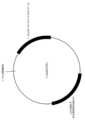
- FIG. 3 shows a control vector for producing linear covalently closed DNA.
- FIG. 3 shows isolated expression vectors for producing linear covalently closed DNA.
- FIG. 2 is a diagram showing a fusion polypeptide and DNA in which I-SceI homing endonuclease is fused to the C-terminal side of TelN protelomerase via a linker sequence.
- FIG. 2 shows a fusion expression vector for producing linear covalently closed DNA. It is a figure which shows the electrophoresis result of linear covalently closed DNA.
- a linear covalently closed DNA containing a nucleic acid encoding a packaging protein is used as the "target linear covalently closed DNA”
- a linear covalently closed DNA containing a nucleic acid encoding TelN protelomerase and I-SceI homing endonuclease is used as the "target linear covalently closed DNA”.
- the bound closed DNA is shown as "unnecessary linear covalently closed DNA”.
- Con indicates a control vector
- M indicates a DNA marker (manufactured by New England Biolabs, N3200).
- FIG. 2 is a diagram showing the results of examining expression induction conditions.
- Method A shows a method of shaking culture at 37°C for 6 hours
- Method B shows a method of shaking culture at 30°C for 4 hours, followed by shaking culture at 37°C for 2 hours.
- pH indicates the pH of Plus Grow II medium added at the time of expression induction.
- M indicates a DNA marker (manufactured by New England Biolabs, N3200).
- T6 control vector
- I-SceI vector among the two vectors for producing linear covalently closed DNA produced in Comparative Example 1.
- FIG. 3 is a diagram showing the electrophoresis results of linear covalently closed DNA in Comparative Example 2.
- the linear covalently closed DNA containing the nucleic acid encoding the packaging protein is defined as the “desired linearly covalently closed DNA,” and the other linear covalently closed DNA is designated as “unnecessary linearly covalently closed DNA.” DNA.
- the band with high electrophoresis corresponds to the remaining I-SceI vector.
- M indicates a DNA marker (manufactured by New England Biolabs, N3200).
- Double-stranded circular DNA vector 1-1 The first aspect of the present invention is a double-stranded circular DNA vector.
- the double-stranded circular DNA vector of this embodiment has a fusion gene sequence encoding a fusion polypeptide containing protelomerase or an active fragment thereof and endonuclease or an active fragment thereof within the same region between a pair of protelomerase recognition sequences, and It contains an endonuclease recognition sequence, and contains the nucleic acid sequence of interest within the other region between the pair of protelomerase recognition sequences.
- a linear covalently closed DNA containing a target nucleic acid sequence can be easily and efficiently produced.
- linear covalently closed DNA refers to linear double-stranded DNA whose ends are closed with a hairpin structure. At each end of the linear covalently closed DNA, the 5' and 3' ends of the two DNA strands are linked to form a hairpin structure.
- a linear covalently closed DNA has a terminal portion protected by a hairpin structure that is resistant to degradation by exonucleases.
- protelomerase refers to recognizing a specific sequence in a double-stranded DNA molecule, cleaving the double-stranded DNA molecule at a position within or near the recognition sequence, and cutting the 5-stranded DNA molecule at the cut end. It refers to a polypeptide having an activity (hereinafter referred to as "protelomerase activity") of linking the 'terminus and the 3' end to form a covalently closed end.
- protelomerase derived from Agrobacterium fabrum TelA protelomerase, ACCESSION No.
- protelomerase derived from Halomonas virus HAP1 (ACCESSION No. ABY90402)
- Protelomerase derived from Vibrio virus VP882 ACCESSION No. ABM734148
- Klebsiella phage phiKO2 protelomerase derived from Rhizobium pusense (ACCESSION No. QKJ91773)
- Feldmannia species vir protelomerase derived from us ACCESSION No. ACH46812
- protelomerase derived from Vibrio phage vB_VpaM_MAR ( ACCESSION No.
- protelomerase derived from Yersinia phage PY54 (Tel protelomerase, ACCESSION No. CAD91792), protelomerase derived from Escherichia virus N15 ( TelN protelomerase, ACCESSION No. AAB81106), or any of the above protelomerase Examples include mutants. Note that in this specification, protelomerase is not included in the endonuclease described below.
- active fragment of protelomerase refers to a fragment that contains a partial region of protelomerase and retains protelomerase activity, for example, 1% or more, 10% or more, 20% or more of the activity of the full-length protein. % or more, 30% or more, 40% or more, 50% or more, 60% or more, 70% or more, 80% or more, 90% or more, 95% or more, 98% or more, or equivalent or more. .
- the amino acid length of the polypeptide constituting the present active fragment is not particularly limited. For example, it may be a contiguous region of at least 100, 150, 200, 250, 300, 350, or 400 amino acids that includes the catalytic domain in protelomerase.
- protelomerase gene is a gene encoding protelomerase or an active fragment thereof.
- protelomerase genes include genes encoding any of the above-mentioned protelomerase or active fragments thereof. Examples include a protelomerase gene encoding TelN protelomerase consisting of the amino acid sequence shown by SEQ ID NO: 24, for example, a TelN protelomerase gene consisting of the base sequence shown by SEQ ID NO: 2, and the like.
- protetelomerase recognition sequence refers to a sequence recognized by protelomerase.
- Protelomerase recognizes the protelomerase recognition sequence, cleaves the double-stranded DNA molecule at a position within or near the protelomerase recognition sequence, and rejoins the cleaved ends.
- Protelomerase recognition sequences are known to be palindromic or palindromic sequences.
- restriction enzyme refers to an enzyme that has the activity of cleaving phosphodiester bonds within a nucleotide chain.
- endonucleases endonucleases that recognize a specific sequence and cleave a double-stranded DNA molecule within or near that sequence are particularly called restriction enzymes.
- restriction enzymes include naturally occurring restriction enzymes, artificial restriction enzymes such as TALEN and zinc finger nuclease (ZFN), genome editing enzymes such as Cas9 protein, and mutants of any of the above endonucleases.
- the endonuclease may be either an enzyme having the activity of cleaving two DNA strands or an enzyme (nickase) cleaving only one DNA strand.
- homing endonucleases those found in inteins, introns, etc. are particularly called "homing endonucleases.” Generally, homing endonucleases are known to recognize long recognition sequences of 12 to 40 bp, and it is also known that the recognition sequences are not palindromic sequences. In this specification, the type of homing endonuclease is not particularly limited. For example, I-SceI (ACCESSION No. NP009324), I-CeuI (ACCESSION No. CAA78934), I-CreI (ACCESSION No.
- I-SceI I-ChuI, I-DmoI, I-CreI, I-CsmI, PI-PfuI, PI-SceI, PI-TliI, I-MsoI, PI-MtuI, I-CeuI, I-SceII. , I-SceIII, HO, or a mutant of any of the above homing endonucleases, etc.
- I-SceI, I-ChuI, I-DmoI, I-CreI, I-CsmI, PI-SceI, PI-PfuI, PI-TliI, I-MsoI, PI-MtuI, I-CeuI, or a mutant of any of the above homing endonucleases, etc. are more preferred, and I-SceI, I-CeuI, I-CreI or any of the above homing endonucleases More preferred are nuclease mutants.
- an "active fragment" of an endonuclease is a fragment that contains a partial region of the endonuclease and retains endonuclease activity, for example, 1% or more, 10% or more, 20% or more of the activity of the full-length protein. % or more, 30% or more, 40% or more, 50% or more, 60% or more, 70% or more, 80% or more, 90% or more, 95% or more, 98% or more, or equivalent or more. .
- the amino acid length of the polypeptide constituting the present active fragment is not particularly limited. For example, it may be a contiguous region of at least 100, 150, 200, 250, 300, 350, or 400 amino acids that includes the catalytic domain in an endonuclease.
- the term "endonuclease gene” refers to a gene encoding an endonuclease or an active fragment thereof.
- endonuclease genes include genes encoding any of the endonucleases mentioned above or active fragments thereof.
- examples include a gene encoding I-SceI homing endonuclease consisting of the amino acid sequence shown in SEQ ID NO: 25, for example, an I-SceI homing endonuclease gene consisting of the base sequence shown in SEQ ID NO: 4.
- endonuclease recognition sequence means a sequence recognized by an endonuclease. Endonucleases recognize endonuclease recognition sequences and cleave double-stranded DNA molecules at positions within or near the endonuclease recognition sequences.
- a "double-stranded circular DNA vector” means a circular double-stranded DNA molecule that can be retained and/or replicated within cells.
- the double-stranded circular DNA vector can contain sequences necessary for intracellular maintenance and replication, such as a replication origin and/or a gene encoding an antibiotic resistance protein.
- the double-stranded circular DNA vector may be, for example, a plasmid vector or a bacmid vector. Further, the vector may be a shuttle vector capable of replicating between bacteria such as E. coli and mammalian cells.
- the double-stranded circular DNA vector of this embodiment includes a fusion gene sequence, a pair of protelomerase recognition sequences, at least one endonuclease recognition sequence, and a nucleic acid sequence of interest.
- the fusion gene sequence and the endonuclease recognition sequence are located within the same region between the pair of protelomerase recognition sequences, and the target nucleic acid sequence is located between the pair of protelomerase recognition sequences. placed within another area.
- the fusion gene sequence is placed under the control of a promoter that can control expression.
- fusion gene sequence refers to a gene sequence encoding a fusion polypeptide containing protelomerase or an active fragment thereof and endonuclease or an active fragment thereof.
- the fusion gene sequence may be codon-optimized according to the codon usage frequency in the cell into which the double-stranded circular DNA vector is introduced.
- a fusion polypeptide comprising protelomerase or its active fragment and endonuclease or its active fragment means that protelomerase or its active fragment is located on the N-terminal side of the endonuclease or its active fragment.
- the fusion polypeptide may be either a fusion polypeptide or a fusion polypeptide in which the protelomerase or active fragment thereof is located C-terminal to the endonuclease or active fragment thereof.
- protelomerase or an active fragment thereof is located N-terminal to the endonuclease or active fragment thereof.
- the type of protelomerase or active fragment thereof contained in the fusion polypeptide is not particularly limited as long as it has protelomerase activity, and any sequence other than the pair of protelomerase recognition sequences, especially the target nucleic acid sequence, in the double-stranded circular DNA vector may be used. It is fine as long as it is not recognized. Furthermore, the genome sequence of the cell into which the double-stranded circular DNA vector is introduced may not include a protelomerase recognition sequence.
- the length of the protelomerase recognition sequence recognized by protelomerase or its active fragment contained in the fusion polypeptide is not limited, but may be 5 bp or more, 6 bp or more, 7 bp or more, 8 bp or more, 9 bp or more, 10 bp or more, 15 bp or more, It may be 20 bp or more, 25 bp or more, 30 bp or more, 35 bp or more, 40 bp or more, 45 bp or more, 50 bp or more, 55 bp or more, 60 bp or more, 65 bp or more, 70 bp or more, 80 bp or more, or 90 bp or more.
- protelomerases include TelN protelomerase, TelA protelomerase, TelK protelomerase, or mutants thereof. There are no particular restrictions on the mutant, and it can be appropriately selected depending on the purpose. For example, the homology with the original amino acid sequence may be 80% or more, 90% or more, 95% or more, or 99% or more.
- the endonuclease or active fragment thereof contained in the fusion polypeptide is not particularly limited as long as it has endonuclease activity, and it does not recognize sequences other than the endonuclease recognition sequence, especially the target nucleic acid sequence, in a double-stranded circular DNA vector. Good to have. Furthermore, the genome sequence of the cell into which the double-stranded circular DNA vector is introduced may not have an endonuclease recognition sequence.
- the endonuclease or active fragment thereof may be a restriction enzyme or a nickase.
- the length of the endonuclease recognition sequence recognized by the endonuclease or active fragment thereof contained in the fusion polypeptide is not limited, but may be 4 bp or more, 5 bp or more, 6 bp or more, 7 bp or more, 8 bp or more, 9 bp or more, 10 bp or more, It may be 15 bp or more, 20 bp or more, 25 bp or more, 30 bp or more, 35 bp or more, 40 bp or more, 45 bp or more, 50 bp or more, 60 bp or more, 70 bp or more, 80 bp or more, 90 bp or more, or 100 bp or more.
- the endonuclease may be a homing endonuclease.
- Homing endonucleases include, but are not limited to, I-SceI, I-CeuI, I-CreI, I-AniI, I-ChuI, I-DmoI, I-CsmI, PI-SceI, PI-TIiI, PI- MtuI, I-CeuI, I-SceII, I-SceIII, HO, PI-CivI, PI-CtrI, PI-AaeI, PI-BsuI, PI-DhaI, PI-DraI, PI-MavI, PI-MchI, PI- MfuI, PI-MflI, PI-MgaI, PI-MgoI, PI-MinI, PI-MkaI, PI-MkaI, PI-MM
- the fusion gene sequence is placed under the control of a promoter that can control expression.
- expression controllable promoter refers to a gene expression regulator that can control the expression of genes, etc. located downstream (on the 3' end side) in cells into which a double-stranded circular DNA vector has been introduced.
- a promoter is a region that can induce expression of a target gene, etc. at any time within a cell.
- a promoter whose expression can be controlled can be induced by conditions such as the presence or absence of a specific factor or temperature.
- the type of promoter that can control expression is not limited and can be appropriately selected depending on the purpose.
- heat-inducible promoters (lambda PR, lambda PL, etc.), arabinose-inducible promoters (araBAD promoter, etc.), IPTG-inducible promoters (LAC promoter, LACUV5 promoter, TAC promoter, Trc promoter, LPP promoter, etc.), T7 promoter, cold-inducible promoter (cspA promoter, etc.), Trp promoter, rhamnose-inducible promoter (rhaT promoter, etc.), proU promoter, prpB promoter, phoA promoter, recA promoter, tetA promoter, cadA promoter, or mutants thereof.
- Arabinose inducible promoters are preferred.
- placed under the control of a promoter whose expression can be controlled means that the gene to be expressed is placed in the downstream region of the promoter under the control of a promoter whose expression can be controlled.
- the fusion polypeptide described above may include a linker sequence between the protelomerase or active fragment thereof and the endonuclease or active fragment thereof.
- linker sequence refers to a fusion polypeptide that can be inserted between protelomerase or an active fragment thereof and endonuclease or an active fragment thereof in order for each part to be fused to perform a desired function. It is a peptide.
- the length of the linker sequence is not limited, but for example, 1 amino acid or more, 2 amino acids or more, 3 amino acids or more, 4 amino acids or more, 5 amino acids or more, 6 amino acids or more, 7 amino acids or more, 8 amino acids or more , 9 amino acids or more, 10 amino acids or more, 11 amino acids or more, 12 amino acids or more, 13 amino acids or more, 14 amino acids or more, 15 amino acids or more, 20 amino acids or more, 25 amino acids or more, 30 amino acids or more , 35 amino acids or more, 40 amino acids or more, 45 amino acids or more, 50 amino acids or more, 60 amino acids or more, 70 amino acids or more, 80 amino acids or more, 90 amino acids or more, 100 amino acids or more, 110 amino acids or more , 120 amino acids or more, 150 amino acids or more, 200 amino acids or more, 300 amino acids or more, 400 amino acids or more, or 500 amino acids or more, and/or 5000 amino acids or less, 4000 amino acids or less, 3000 amino acids or less, 2000 amino acids or less, 1000
- the pair of protelomerase recognition sequences in the double-stranded circular DNA vector of this embodiment are protelomerase recognition sequences recognized by protelomerase or an active fragment thereof contained in the fusion polypeptide.
- Specific examples of protelomerase recognition sequences include the nucleotide sequence recognized by TelA protelomerase (SEQ ID NO: 26), the nucleotide sequence recognized by Halomonas virus HAP1-derived protelomerase (SEQ ID NO: 27), and the Vibrio virus VP882-derived nucleotide sequence (SEQ ID NO: 27).
- telomerase Base sequence recognized by telomerase (SEQ ID NO: 28), base sequence recognized by TelK protelomerase (SEQ ID NO: 29), base sequence recognized by Rhizobium pusense-derived protelomerase, Feldmannia species virus-derived protelomerase base sequence recognized by Vibriophage vB_VpaM_MAR-derived protelomerase, base sequence recognized by Tel protelomerase (SEQ ID NO: 30), base sequence recognized by TelN protelomerase (telRL sequence) (SEQ ID NO: 3) can be mentioned.
- the endonuclease recognition sequence in the double-stranded circular DNA vector of this embodiment is an endonuclease recognition sequence recognized by the endonuclease or active fragment thereof contained in the fusion polypeptide.
- endonuclease recognition sequences include restriction enzyme recognition sequences, TALEN recognition sequences, ZFN recognition sequences, CRISPR/Cas9 recognition sequences, and the like.
- examples of homing endonuclease recognition sequences include I-SceI recognition sequence (SEQ ID NO: 31), I-CeuI recognition sequence (SEQ ID NO: 32), and I-CreI recognition sequence (SEQ ID NO: 32). No. 33), etc.
- the number of endonuclease recognition sequences in the double-stranded circular DNA vector of the present invention may be one or more.
- double-stranded circular DNA vectors of the invention include 1, 2, 3, 4, 5, 6, 7, 8, 9, or 10 or more endonuclease recognition sequences. be able to.
- the region containing the target nucleic acid sequence between a pair of protelomerase recognition sequences does not contain an endonuclease recognition sequence.
- nucleic acid sequence of interest is not particularly limited as long as it is a sequence containing two or more nucleotides. More specifically, the target nucleic acid sequence is not limited to a sequence encoding a protein or a fragment thereof, or RNA, but may be a sequence that can function as a nucleic acid medicine, for example, and for introducing the target nucleic acid sequence. It may be an array that can be used. Specific examples of nucleic acid sequences include, but are not limited to, gene sequences encoding proteins or fragments thereof; nucleic acid sequences encoding non-coding RNA such as siRNA, shRNA, miRNA, lncRNA, or ribozymes; or antisense nucleic acids.
- sequences that can be used to introduce a target nucleic acid sequence include sequences that can be recognized/cleaved by nucleases such as restriction enzymes and genome editing enzymes, and sequences that can be recognized/cleaved by two or more nucleases. Examples include multi-cloning sites that include.
- the term "gene sequence of interest” refers to a gene sequence that encodes a protein of interest or a fragment thereof, or an RNA molecule of interest.
- the protein of interest or its fragment There are no particular restrictions on the protein of interest or its fragment, and it can be appropriately selected depending on the purpose. Examples include polypeptides constituting viruses, polypeptides produced by animals, plants, fungi, algae, bacteria, viruses, etc., and fragments thereof. These can be used as cell/gene therapeutic agents, vaccines, disease therapeutic agents, and the like. Polypeptides produced by animals, plants, fungi, algae, bacteria, viruses, etc. are not particularly limited, and can be appropriately selected depending on the purpose.
- enzymes such as phytase, amylase, glucosidase, cellulase, lipase, protease, glutaminase, peptidase, oxidase, lactase, xylanase, trypsin, pectinase, isomerase, antibody-binding proteins such as protein A, protein G, protein L, and human antibodies.
- humanized antibody chimeric antibody, llama antibody, alpaca antibody, single chain antibody, heavy chain antibody, multivalent antibody, Fab, F(ab'), F(ab') 2 , Fc, Fc fusion protein, bispecific Antibodies, such as heavy chain (H chain), light chain (L chain), single chain Fv (scFv), sc (Fv) 2 , disulfide bond Fv (sdFv), diabody, antibody-like molecular target peptide (micro antibody), etc.
- antibody-like molecules serum albumin such as human serum albumin
- epidermal growth factors such as human epidermal growth factor, insulin, Growth hormone, erythropoietin, interferon, blood coagulation factor VIII, granulocyte colony stimulating factor (G-CSF), granulocyte macrophage colony stimulating factor (GM-CSF), thrombopoietin, IL-1, IL-6, tissue plasminogen
- TAA activation factor
- urokinase urokinase
- leptin stem cell growth factor (SCF)
- fibroin fluorescent protein
- hepatitis B virus surface antigen hirudin, and the like.
- a nucleic acid sequence of interest such as a gene sequence of interest, can also include a promoter in addition to the nucleic acid sequence of interest (for example, a sequence encoding a protein of interest or a fragment thereof). Furthermore, it may further contain components such as introns, enhancers, terminators, and/or polyA signals as necessary.
- the fusion gene sequence and the endonuclease recognition sequence are arranged in the same region between the pair of protelomerase recognition sequences, and the target nucleic acid sequence is arranged in the same region between the pair of protelomerase recognition sequences. is located within the area of
- the endonuclease recognition sequence may be placed adjacent to one of the protelomerase recognition sequences, or a spacer sequence may be placed between the endonuclease recognition sequence and the protelomerase recognition sequence.
- the "spacer sequence” means that the protelomerase or its active fragment contained in the fusion polypeptide recognizes the protelomerase recognition sequence, and the endonuclease or its active fragment contained in the fusion polypeptide recognizes the endonuclease recognition sequence.
- the length of the spacer sequence is not limited as long as it is 1 base or more, but for example, 1 base or more, 2 bases or more, 3 bases or more, 4 bases or more, 5 bases or more, 6 bases or more, 7 bases or more, 8 bases or more, 9 bases or more.
- the length of the spacer sequence can be determined based on the length of the linker sequence.
- the double-stranded circular DNA vector of this embodiment can contain other sequences in addition to the fusion gene sequence, a pair of protelomerase recognition sequences, at least one endonuclease recognition sequence, and the nucleic acid sequence of interest.
- Other arrangements are not particularly limited and can be appropriately selected depending on the purpose. For example, sequences necessary for maintenance and replication of vectors within cells, such as elements essential for general plasmid vectors such as genes encoding origins of replication and/or antibiotic resistance proteins, LacI genes, AraC genes, etc.
- Examples include a sequence encoding an activator or repressor protein, a cloning site, an overlapping region for use with Clontech's In-Fusion cloning system, New England Biolabs' Gibson Assembly system, etc.
- genes encoding antibiotic resistance proteins include the ⁇ -lactamase gene (sometimes referred to as "ampR gene") that confers ampicillin resistance, and the aminoglycoside 3' phosphotransferase gene (“kanR gene”) that confers kanamycin resistance. ), a tetracycline efflux transporter gene that confers tetracycline resistance, and a CAT (chloramphenicol acetyltransferase) gene that confers chloramphenicol resistance.
- the other sequences are within the same region as the fusion gene sequence and endonuclease recognition sequence between the pair of protelomerase recognition sequences, or within the same region as the target nucleic acid sequence between the pair of protelomerase recognition sequences.
- it can be placed anywhere, it is more preferable that it be placed in the same region as the fusion gene sequence between the pair of protelomerase recognition sequences and the endonuclease recognition sequence.
- all elements other than the nucleic acid sequence of interest can be placed within the same region as the fusion gene sequence and the endonuclease recognition sequence.
- the method for producing the double-stranded circular DNA vector of this embodiment is not particularly limited, and can be appropriately selected depending on the purpose. Examples include methods using total synthesis method, PCR method, Clontech's In-Fusion cloning system, New England Biolabs' Gibson Assembly system, and the like. For example, it can be produced based on commercially available or known vectors, such as pUC vector, pET vector, pGEM vector, etc. In particular, a design based on a plasmid having a pUC-based ori such as the pUC19 vector is preferred in terms of high DNA replication efficiency.
- the double-stranded circular DNA vector of the present invention can be produced. You can also do it.
- the protelomerase recognition sequence is recognized by the protelomerase or its active fragment contained in the fusion polypeptide, and the cut ends are recombined.
- the second linear covalently closed DNA is cleaved by the endonuclease or active fragment thereof contained in the fusion polypeptide upon recognition of the endonuclease recognition sequence.
- the second linear covalently closed DNA is degraded by endogenous exonuclease activity, so that the first linear covalently closed DNA can be efficiently obtained.
- the double-stranded circular DNA vector of the present invention contains all the elements necessary for producing a linear covalently closed DNA in a cell, so it Bonded closed DNA can be produced simply and efficiently.
- fusion polypeptide comprising an N-terminal protelomerase or an active fragment thereof and a C-terminal endonuclease or an active fragment thereof is also provided. Additionally provided are nucleic acids encoding fusion polypeptides.
- the second aspect of the present invention is a transformed cell.
- the transformed cell of this embodiment contains the double-stranded circular DNA vector described in the first embodiment.
- the transformed cell of this embodiment contains a double-stranded circular DNA vector as an essential component.
- the type of transformed cells herein is not limited.
- the transformed cell may be any cell that can introduce the double-stranded circular DNA vector and that can retain and/or replicate the double-stranded circular DNA vector. Examples include archaea, bacteria, or eukaryotic cells.
- the bacteria may be E. coli, lactic acid bacteria, or Bacillus subtilis.
- Examples of eukaryotic cells include fungal cells (e.g. yeast cells), algae cells, plant cells, protozoan cells, insect cells, nematode cells, fish cells, avian cells (e.g. chicken cells), and mammalian cells (e.g. , mouse cells, chimpanzee cells, and human cells). Among these, cells that can replicate double-stranded circular DNA vectors are preferred.
- Escherichia coli examples include the genus Escherichia. More specifically, examples include Escherichia coli (eg, Escherichia coli K-12 strain, Escherichia coli B strain), and the like.
- Escherichia coli eg, Escherichia coli K-12 strain, Escherichia coli B strain
- E. coli strains and E. coli strains from the Biological Resource Center can be used, such as JM109 strain, DH5 strain, DH5 ⁇ strain, DH10B strain, NEB10 ⁇ strain, HST08 strain, HST16CR strain, HB101 strain, W3110 strain, MG1655 strain.
- strain, BL21 strain, BL21 DE3 strain, etc. can also be used. These strains are manufactured by New England Biolabs, Takara Bio, Thermo Fisher Scientific, Toyobo, ATCC (American Type Culture Collection), and NBRP (National Bio Resource). Project).
- strains derived from the above-mentioned E. coli strains can also be used.
- strain JW3973 available from NBRP
- strain JW2806 available from NBRP
- strain JW3582 available from NBRP
- cysteine auxotrophy thiamine and histidine.
- ME5305 strain available from NBRP
- the transformed cell of this aspect expresses an exonuclease.
- the exonuclease is not particularly limited as long as it can degrade DNA cleaved by the endonuclease contained in the fusion polypeptide or its active fragment from its cleaved end.
- the exonuclease may be, for example, an endogenous exonuclease.
- the third aspect of the present invention is a method for producing linear covalently closed DNA.
- the production method of this embodiment includes a culture step, an expression induction step, and a DNA extraction step as essential steps, and a separation step and/or an introduction step as a selection step. According to the production method of this embodiment, a linear covalently closed DNA can be produced simply and efficiently.
- the "introduction step” is a step of introducing the double-stranded circular DNA vector of the first embodiment into a host cell to obtain a transformed cell.
- the method for introducing the double-stranded circular DNA vector into host cells in this step is not particularly limited.
- Green & Sambrook, 2012, Molecular Cloning: A Laboratory Manual Fourth Ed. , Cold Spring Harbor Laboratory Press, Cold Spring Harbor, New York, etc. may be used as well known gene introduction methods (transformation methods) in the art. Specifically, heat shock method, lipofection method, electroporation method, microinjection method, calcium phosphate method, DEAE dextran method, introduction using cationic lipids, introduction using cationic polymers (e.g. polyethyleneimine (PEI)), and nanoparticles. introduction by virus, introduction by virus, particle bombardment, etc.
- PEI polyethyleneimine
- the host cells into which the double-stranded circular DNA vector has been introduced in this step can be appropriately selected in a medium containing antibiotics based on the gene encoding the antibiotic resistance protein in the double-stranded circular DNA vector. .
- the "culturing step” is a step of culturing transformed cells. This step aims to increase the intracellular copy number of the double-stranded circular DNA vector before proceeding to the expression induction step described below by growing the transformed cells before the expression induction step described below. do.
- the method for culturing the transformed cells in this step is not particularly limited and can be appropriately selected depending on the type of transformed cells.
- a culturing method known in the art described in Green & Sambrook, 2012, Molecular Cloning: A Laboratory Manual Fourth Ed., Cold Spring Harbor Laboratory Press, Cold Spring Harbor, New York, etc. may be used.
- the medium for culturing the transformed cells in this step may be either a liquid medium or a solid medium.
- a medium for example, protein enzyme decomposition products such as peptone and tryptone, biological extracts such as potato dextrose and yeast extract, amino acids or salts thereof such as glutamic acid, sugars such as glucose, glycerol, and sucrose, sodium chloride, magnesium chloride, Any medium may be used as long as it contains one or more components selected from inorganic salts such as potassium dihydrogen phosphate.
- Specific media and compositions include LB medium (tryptone, yeast extract, sodium chloride), YPG medium (yeast extract, peptone, glucose), PD medium (potato dextrose), TB medium (tryptone, yeast extract, hydrogen phosphate). dipotassium, potassium dihydrogen phosphate), etc.
- the double-stranded circular DNA vector contains a gene encoding an antibiotic resistance protein
- this step can be performed in the presence of an antibiotic.
- antibiotics include ampicillin, carbenicillin, kanamycin, tetracycline, or chloramphenicol.
- the culture conditions for this step can be selected as appropriate depending on the type of transformed cells.
- the culture in this step can be performed at 20-42°C, 25-40°C, 30-38°C, or 35-37°C.
- the culture time in this step is not limited as long as a sufficient amount of double-stranded circular DNA vector can be obtained.
- the period may be 1 hour or more, 2 hours or more, 4 hours or more, 12 hours or more, 24 hours or more, 2 days or more, 3 days or more, or 1 week or more.
- the pH of the medium used in this step is not particularly limited as long as the transformed cells can grow.
- It may be pH 10 or less, pH 9.5 or less, pH 9 or less, pH 8.5 or less, pH 8 or less, or pH 7.5 or less, for example, pH 3 to 11, pH 4 to 10, pH 5 to 9, or pH 7 to 9, or pH 7. .5 to pH 10.5, pH 8 to pH 10, or pH 8.5 to pH 9.5.
- the "expression induction step” is a step of inducing expression of the fusion polypeptide in transformed cells after the culturing step.
- the method for inducing expression of the fusion polypeptide in this step is not particularly limited, and can be appropriately selected depending on the type of promoter that can control expression.
- an expression inducer is added to the medium after the culturing step.
- an arabinose-inducible promoter an IPTG-inducible promoter, or a rhamnose-inducible promoter
- a method of adding arabinose, IPTG, or rhamnose as an expression inducer to the medium containing the transformed cells after the culture step can be mentioned.
- the time for culturing the transformed cells in the presence of the expression-inducing agent is not particularly limited, as long as the expression of the fusion polypeptide is sufficiently induced. For example, 1 minute or more, 5 minutes or more, 10 minutes or more, 20 minutes or more, 30 minutes or more, 1 hour or more, 2 hours or more, 3 hours or more, 6 hours or more, 12 hours or more, or 24 hours or more. good.
- the pH of the medium used in this step may be within a range in which the fusion polypeptide can function within the cell, that is, a range in which both protelomerase and endonuclease can function, for example, pH 3 to 11, pH 4 to 10, pH 5. ⁇ 9, or pH 7 ⁇ 9.
- a pH range between the protelomerase pH optimum and the endonuclease pH optimum can be used.
- the temperature at which the transformed cells are cultured in the presence of the expression inducer is, for example, 20°C or higher, 25°C or higher, 26°C or higher, 27°C or higher, 28°C or higher, 29°C or higher, 30°C or higher, or 31°C.
- the transformed cells can be cultured under multiple temperature conditions in the presence of an expression-inducing agent.
- the plurality of temperature conditions include optimal temperature ranges for each enzyme activity of protelomerase and endonuclease.
- the optimal temperature for the enzymatic activity of protelomerase can be, for example, 26-37°C, 27-35°C, 28-33°C, or 29-31°C (eg, 30°C).
- the optimal temperature for the enzymatic activity of the homing endonuclease may be, for example, 30-42°C, 32-40°C, 34-39°C, or 36-38°C (eg, 37°C).
- the culture time under each temperature condition is 10 minutes or more, 20 minutes or more, 30 minutes or more, 1 hour or more, 2 hours or more, 3 hours or more, 4 hours or more, 5 hours or more, 6 hours or more, 8 hours or more.
- the duration may be longer than 1 hour, 10 hours or longer, 12 hours or longer, or 24 hours or longer.
- the culture in this step may be performed at any combination of the above-mentioned temperature and culture time. For example, after culturing at 28 to 32°C for 2 hours or more (for example, 4 hours or more), it is also possible to culture at 35 to 39°C for 2 hours or more (for example, 4 hours or more).
- heat shock or cold shock may be applied.
- the conditions for heat shock or cold shock are not particularly limited as long as the temperature and time are such that expression of the fusion polypeptide is sufficiently induced.
- the temperature is 36°C to 45°C, 37°C to 44°C, 38°C to 43°C, 39°C to 42°C, or 40°C to 41°C for 10 seconds or more, 20 seconds or more, or 30 seconds or more.
- the fusion polypeptide is expressed in the transformed cells, and the first linear covalently closed DNA containing the target nucleic acid sequence and the second linear covalently closed DNA containing the fusion gene sequence and the endonuclease recognition sequence are A bonded closed DNA is generated, and a second linear covalently closed DNA is cleaved and degraded by endogenous exonuclease activity.
- the “DNA extraction step” is a step of extracting DNA from transformed cells after the expression induction step.
- a conventional method known in the art may be used. For example, Green & Sambrook, 2012, Molecular Cloning: A Laboratory Manual Fourth Ed. , Cold Spring Harbor Laboratory Press, Cold Spring Harbor, New York. Alternatively, it may be prepared using a commercially available DNA extraction kit. Through this step, the first linear covalently closed DNA containing the target nucleic acid sequence is extracted.
- the “separation step” is a step of separating linear covalently closed DNA after the DNA extraction step. This step removes DNA components other than the linear covalently bonded closed DNA containing the target nucleic acid sequence extracted in the DNA extraction step, such as genomic DNA fragments, uncut DNA fragments, and unnecessary linear chains containing endonuclease recognition sequences. The purpose is to remove covalently closed DNA, etc.
- the method for separating the linear covalently closed DNA in this step is not particularly limited and can be selected as appropriate. Examples include a method of purification using a commercially available kit, a method of separation using gel extraction, cation chromatography, anion chromatography, size exclusion chromatography, a filter, or an ultrafiltration membrane.
- linear covalently closed DNA can be produced simply and efficiently. Based on the production method of the present invention, mass production of linear covalently closed DNA can be achieved with a small number of steps.
- Double-stranded circular DNA vector 4-1 is a double-stranded circular DNA vector.
- the double-stranded circular DNA vector of this embodiment includes a protelomerase gene sequence, an endonuclease gene sequence, and an endonuclease recognition sequence within the same region between the pair of protelomerase recognition sequences; Contains the nucleic acid sequence of interest within other regions.
- a linear covalently closed DNA containing a target nucleic acid sequence can be easily and efficiently produced.
- the double-stranded circular DNA vector of this embodiment includes a protelomerase gene sequence, an endonuclease gene sequence, a pair of protelomerase recognition sequences, at least one endonuclease recognition sequence, and a nucleic acid sequence of interest.
- the protelomerase gene sequence, the endonuclease gene sequence, and the endonuclease recognition sequence are located within the same region between the pair of protelomerase recognition sequences
- the target nucleic acid sequence is located in the same region between the pair of protelomerase recognition sequences. is located within the other region between the protelomerase recognition sequences.
- the protelomerase gene sequence and the endonuclease gene sequence are placed under the control of a promoter that can control expression.
- protelomerase gene sequence refers to a gene sequence encoding protelomerase or an active fragment thereof.
- the protelomerase gene sequence may be codon-optimized according to the codon usage frequency in the cell into which the double-stranded circular DNA vector is introduced.
- the type of protelomerase encoded by the protelomerase gene sequence or its active fragment is not particularly limited as long as it has protelomerase activity, and sequences other than the pair of protelomerase recognition sequences in the double-stranded circular DNA vector, especially the target nucleic acid. Any device that does not recognize arrays is fine. Furthermore, the genome sequence of the cell into which the double-stranded circular DNA vector is introduced may not include a protelomerase recognition sequence.
- the length of the protelomerase recognition sequence recognized by protelomerase or its active fragment is not limited, but may be 5 bp or more, 6 bp or more, 7 bp or more, 8 bp or more, 9 bp or more, 10 bp or more, 15 bp or more, 20 bp or more, 25 bp or more, It may be 30 bp or more, 35 bp or more, 40 bp or more, 45 bp or more, 50 bp or more, 55 bp or more, 60 bp or more, 65 bp or more, 70 bp or more, 80 bp or more, or 90 bp or more.
- protelomerases include TelN protelomerase, TelA protelomerase, TelK protelomerase, or mutants thereof. There are no particular restrictions on the mutant, and it can be appropriately selected depending on the purpose. For example, the homology with the original amino acid sequence may be 80% or more, 90% or more, 95% or more, or 99% or more.
- the term "endonuclease gene sequence” refers to a gene sequence encoding an endonuclease or an active fragment thereof.
- the endonuclease gene sequence may be codon-optimized according to the codon usage frequency of the cell into which the double-stranded circular DNA vector is introduced.
- the endonuclease encoded by the endonuclease gene sequence or its active fragment is not particularly limited as long as it has endonuclease activity, and does not recognize sequences other than the endonuclease recognition sequence, particularly the target nucleic acid sequence, in a double-stranded circular DNA vector. It is fine as long as it is something. Furthermore, the genome sequence of the cell into which the double-stranded circular DNA vector is introduced may not have an endonuclease recognition sequence.
- the endonuclease or active fragment thereof may be a restriction enzyme or a nickase.
- the length of the endonuclease recognition sequence recognized by the endonuclease or its active fragment is not limited, but may be 4 bp or more, 5 bp or more, 6 bp or more, 7 bp or more, 8 bp or more, 9 bp or more, 10 bp or more, 15 bp or more, 20 bp or more, It may be 25 bp or more, 30 bp or more, 35 bp or more, 40 bp or more, 45 bp or more, 50 bp or more, 60 bp or more, 70 bp or more, 80 bp or more, 90 bp or more, or 100 bp or more.
- the protelomerase gene sequence and endonuclease gene sequence are placed under the control of a promoter that can control expression.
- the protelomerase gene sequence and the endonuclease gene sequence may be placed under the control of different expression-controllable promoters, or may be placed under the control of the same expression-controllable promoter. You can. If the protelomerase gene sequence and the endonuclease gene sequence are placed under the control of the same expression controllable promoter, the protelomerase gene sequence and the endonuclease gene sequence may be placed within the same operon, or A sequence encoding a self-cleavage peptide, an IRES sequence, etc. can also be placed between the protelomerase gene sequence and the endonuclease gene sequence.
- the pair of protelomerase recognition sequences in the double-stranded circular DNA vector of this embodiment are protelomerase recognition sequences recognized by protelomerase encoded by the protelomerase gene sequence or an active fragment thereof.
- Specific examples of protelomerase recognition sequences include the nucleotide sequence recognized by TelA protelomerase (SEQ ID NO: 26), the nucleotide sequence recognized by Halomonas virus HAP1-derived protelomerase (SEQ ID NO: 27), and the Vibrio virus VP882-derived nucleotide sequence (SEQ ID NO: 27).
- telomerase Base sequence recognized by telomerase (SEQ ID NO: 28), base sequence recognized by TelK protelomerase (SEQ ID NO: 29), base sequence recognized by Rhizobium pusense-derived protelomerase, Feldmannia species virus-derived protelomerase base sequence recognized by Vibriophage vB_VpaM_MAR-derived protelomerase, base sequence recognized by Tel protelomerase (SEQ ID NO: 30), base sequence recognized by TelN protelomerase (telRL sequence) (SEQ ID NO: 3) can be mentioned.
- the endonuclease recognition sequence in the double-stranded circular DNA vector of this embodiment is an endonuclease recognition sequence that is recognized by the endonuclease encoded by the endonuclease gene sequence or its active fragment.
- endonuclease recognition sequences include restriction enzyme recognition sequences, TALEN recognition sequences, ZFN recognition sequences, CRISPR/Cas9 recognition sequences, and the like.
- homing endonuclease recognition sequences include I-SceI recognition sequence (SEQ ID NO: 31), I-CeuI recognition sequence (SEQ ID NO: 32), and I-CreI recognition sequence (SEQ ID NO: 32). No. 33), etc.
- the protelomerase gene sequence, the endonuclease gene sequence, and the endonuclease recognition sequence are located within the same region between the pair of protelomerase recognition sequences, and the target nucleic acid sequence is located between the pair of protelomerase recognition sequences. Located within other regions between protelomerase recognition sequences.
- the endonuclease recognition sequence may be placed adjacent to one of the protelomerase recognition sequences, or a spacer sequence may be placed between the endonuclease recognition sequence and the protelomerase recognition sequence.
- the term "spacer sequence” refers to an endonuclease recognition sequence and a spacer sequence so that a protelomerase or an active fragment thereof can recognize the protelomerase recognition sequence, and an endonuclease or an active fragment thereof can recognize the endonuclease recognition sequence.
- This is a sequence that can be inserted between the telomerase recognition sequence and the telomerase recognition sequence.
- the length of the spacer sequence is not limited as long as it is 1 base or more, but for example, 1 base or more, 2 bases or more, 3 bases or more, 4 bases or more, 5 bases or more, 6 bases or more, 7 bases or more, 8 bases or more, 9 bases or more.
- the double-stranded circular DNA vector of this embodiment includes a protelomerase gene sequence, an endonuclease gene sequence, a pair of protelomerase recognition sequences, at least one endonuclease recognition sequence, and other sequences in addition to the target nucleic acid sequence.
- a protelomerase gene sequence an endonuclease gene sequence, a pair of protelomerase recognition sequences, at least one endonuclease recognition sequence, and other sequences in addition to the target nucleic acid sequence.
- Other arrangements are not particularly limited and can be appropriately selected depending on the purpose.
- sequences necessary for maintenance and replication of vectors within cells such as elements essential for general plasmid vectors such as genes encoding origins of replication and/or antibiotic resistance proteins, LacI genes, AraC genes, etc.
- Examples include a sequence encoding an activator or repressor protein, a cloning site, an overlapping region for use with Clontech's In-Fusion cloning system, New England Biolabs' Gibson Assembly system, etc.
- genes encoding antibiotic resistance proteins include the ⁇ -lactamase gene (ampR gene) that confers ampicillin resistance, the aminoglycoside 3' phosphotransferase gene (kanR gene) that confers kanamycin resistance, and the tetracycline efflux gene that confers tetracycline resistance.
- Examples include a transporter gene, a CAT (chloramphenicol acetyltransferase) gene that confers chloramphenicol resistance, and the like.
- the other sequences are within the same region as the protelomerase gene sequence, the endonuclease gene sequence, and the endonuclease recognition sequence between the pair of protelomerase recognition sequences, or the target nucleic acid between the pair of protelomerase recognition sequences.
- the protelomerase gene sequence between a pair of protelomerase recognition sequences, the endonuclease gene sequence, and the endonuclease recognition sequence may be located within the same region. is more preferable.
- all elements other than the nucleic acid sequence of interest can be placed within the same region as the protelomerase gene sequence, endonuclease gene sequence, and endonuclease recognition sequence.
- the method for producing the double-stranded circular DNA vector of this embodiment is not particularly limited, and can be appropriately selected depending on the purpose. Examples include methods using total synthesis, PCR, Clontech's In-Fusion cloning system, New England Biolabs' Gibson Assembly system, and the like. For example, it can be produced based on commercially available or known vectors, such as pUC vector, pET vector, pGEM vector, etc. In particular, a design based on a plasmid having a pUC-based ori such as the pUC19 vector is preferred in terms of high DNA replication efficiency.
- the double-stranded circular form of the present invention can be prepared.
- DNA vectors can also be created.
- the protelomerase gene sequence and the endonuclease gene sequence encode a fusion polypeptide comprising a protelomerase or an active fragment thereof and an endonuclease or an active fragment thereof.
- This embodiment corresponds to the first aspect described above, and the gene sequence encoding the fusion polypeptide in this embodiment corresponds to the fusion gene sequence in the first aspect.
- the fifth aspect of the present invention is a transformed cell.
- the transformed cell of this aspect contains the double-stranded circular DNA vector described in the fourth aspect.
- the transformed cell of this embodiment contains a double-stranded circular DNA vector as an essential component.
- the transformed cell of this aspect expresses an exonuclease.
- the exonuclease is not particularly limited as long as it can be degraded from the end of DNA cut by the endonuclease encoded by the endonuclease gene sequence or an active fragment thereof.
- the exonuclease may be, for example, an endogenous exonuclease.
- the sixth aspect of the present invention is a method for producing a linear covalently closed DNA.
- the production method of this embodiment includes a culture step, an expression induction step, and a DNA extraction step as essential steps, and a separation step and/or an introduction step as a selection step. According to the production method of this embodiment, a linear covalently closed DNA can be produced simply and efficiently.
- the "introduction step” is a step of introducing the double-stranded circular DNA vector of the first embodiment into a host cell to obtain a transformed cell.
- the configuration of this step is similar to the description of the third aspect, so a description thereof will be omitted here.
- the "culturing step” is a step of culturing transformed cells. This step aims to increase the intracellular copy number of the double-stranded circular DNA vector before proceeding to the expression induction step described below by growing the transformed cells before the expression induction step described below. do.
- the configuration of this step is similar to the description of the third aspect, so a description thereof will be omitted here.
- the "expression induction step” is a step of inducing expression of endonuclease or an active fragment thereof and protelomerase or an active fragment thereof in transformed cells after the culturing step.
- the method for inducing the expression of endonuclease or its active fragment and protelomerase or its active fragment in this step is not particularly limited, and can be appropriately selected depending on the type of promoter that can control expression.
- an expression inducer is added to the medium after the culturing step.
- an arabinose-inducible promoter an IPTG-inducible promoter, or a rhamnose-inducible promoter
- a method of adding arabinose, IPTG, or rhamnose as an expression inducer to the medium containing the transformed cells after the culture step can be mentioned.
- the time for culturing the transformed cells in the presence of the expression-inducing agent is not particularly limited as long as the expression of the endonuclease or its active fragment and protelomerase or its active fragment is sufficiently induced. For example, 1 minute or more, 5 minutes or more, 10 minutes or more, 20 minutes or more, 30 minutes or more, 1 hour or more, 2 hours or more, 3 hours or more, 6 hours or more, 12 hours or more, or 24 hours or more. good.
- the pH of the medium used in this step may be within a range in which endonuclease or its active fragment and/or protelomerase or its active fragment can function in cells, for example, pH 3 to 11, pH 4 to 10, pH 5 to 9. , or the pH may be 7 to 9.
- a pH range between the protelomerase pH optimum and the endonuclease pH optimum can be used.
- the temperature at which the transformed cells are cultured in the presence of the expression inducer is, for example, 20°C or higher, 25°C or higher, 28°C or higher, 30°C or higher, or 31°C or higher, and/or 42°C or lower, 40°C.
- a temperature range between the optimal temperature for protelomerase and the optimal temperature for endonuclease can be used.
- the transformed cells can be cultured under multiple temperature conditions in the presence of an expression-inducing agent.
- a plurality of temperature conditions can be selected from the optimal temperature ranges for each enzyme activity of protelomerase and endonuclease.
- the optimal temperature for the enzymatic activity of protelomerase can be, for example, 26-37°C, 27-35°C, 28-33°C, or 29-31°C (eg, 30°C).
- the optimal temperature for the enzymatic activity of the homing endonuclease may be, for example, 30-42°C, 32-40°C, 34-39°C, or 36-38°C (eg, 37°C).
- the culture time under each temperature condition in this embodiment is 10 minutes or more, 20 minutes or more, 30 minutes or more, 1 hour or more, 2 hours or more, 3 hours or more, 6 hours or more, 12 hours or more, or 24 hours or more. can do.
- heat shock or cold shock may be applied.
- the conditions for heat shock or cold shock are not particularly limited as long as the temperature and time are sufficient to induce the expression of endonuclease or its active fragment and protelomerase or its active fragment.
- the temperature is 36°C to 45°C, 37°C to 44°C, 38°C to 43°C, 39°C to 42°C, or 40°C to 41°C for 10 seconds or more, 20 seconds or more, or 30 seconds or more.
- the endonuclease or its active fragment and the protelomerase or its active fragment are expressed in the transformed cells, and the first linear covalently closed DNA containing the target nucleic acid sequence, the protelomerase gene sequence, the endonuclease A second linear covalently closed DNA containing the gene sequence and an endonuclease recognition sequence is generated, and the second linear covalently closed DNA is cleaved and degraded by endogenous exonuclease activity.
- the “DNA extraction step” is a step of extracting DNA from transformed cells after the expression induction step.
- the configuration of this step is similar to the description of the third aspect, so a description thereof will be omitted here.
- the “separation step” is a step of separating linear covalently closed DNA after the DNA extraction step. This step removes DNA components other than the linear covalently bonded closed DNA containing the target nucleic acid sequence extracted in the DNA extraction step, such as genomic DNA fragments, uncut DNA fragments, and unnecessary linear chains containing endonuclease recognition sequences.
- the purpose is to remove covalently closed DNA, etc.
- the configuration of this step is similar to the description of the third aspect, so a description thereof will be omitted here. 6-3. Effects According to the method for producing linear covalently closed DNA of this embodiment, linear covalently closed DNA can be produced simply and efficiently. Based on the production method of this embodiment, mass production of linear covalently closed DNA can be achieved with a small number of steps.
- Example 1 Construction of vector for producing linear covalently closed DNA> (the purpose) A vector for producing linear covalently closed DNA is constructed.
- Prime STAR MAX DNA Polymerase manufactured by Takara Bio Inc.
- the reaction conditions were in accordance with the method described in the attached manual.
- nucleic acid fragment used for constructing a vector for producing a linear covalently closed DNA was produced as follows.
- Nucleic acid encoding fusion polypeptide SEQ ID NO: 1
- TelN protelomerase protelomerase derived from Escherichia virus N15
- linker sequence amino acid sequence encoded by the base sequence shown in SEQ ID NO: 34
- I-SceI homing endonuclease homing derived from Saccharomyces cerevisiae.
- a nucleic acid (SEQ ID NO: 1) encoding a fusion polypeptide (SEQ ID NO: 1) was produced by PCR using primer 1 (forward, SEQ ID NO: 14) and primer 4 (reverse, SEQ ID NO: 17).
- Nucleic acid encoding TelN protelomerase (SEQ ID NO: 2) Nucleic acid encoding TelN protelomerase (SEQ ID NO: 2) is prepared by using primer 1 (forward, SEQ ID NO: 14) and primer 2 (reverse, SEQ ID NO: 15) using the nucleic acid (SEQ ID NO: 1) encoding the above fusion polypeptide as a template.
- telRL sequence SEQ ID NO: 3
- SEQ ID NO: 3 A nucleic acid having a pair of protelomerase recognition sequences
- Nucleic acid encoding I-SceI homing endonuclease (SEQ ID NO: 4) A nucleic acid (SEQ ID NO: 4) encoding I-SceI homing endonuclease derived from Saccharomyces cerevisiae was prepared by using primer 3 (forward, SEQ ID NO: 16) and primer 4 using the nucleic acid encoding the above fusion polypeptide (SEQ ID NO: 1) as a template. (Reverse, SEQ ID NO: 17).
- SEQ ID NOS: 5 to 9 Sequence containing telRL sequence and I-SceI recognition sequence (SEQ ID NOS: 5 to 9) Sequences containing the telRL sequence and the I-SceI recognition sequence (SEQ ID NOs: 5 to 9) were created by total synthesis.
- SEQ ID NO: 5 is a sequence in which a telRL sequence and an I-SceI recognition sequence are adjacent to each other without a spacer sequence.
- SEQ ID NOs: 6, 7, 8, and 9 include T0 (no spacer), T2, T4, T6, and T8 as spacer sequences between the telRL sequence and the I-SceI recognition sequence, respectively.
- AraC gene sequence under promoter control (SEQ ID NO: 11) The AraC gene sequence (SEQ ID NO: 11) under promoter control was produced by PCR using primer 5 (forward, SEQ ID NO: 18) and primer 6 (reverse, SEQ ID NO: 19).
- Arabinose-inducible promoter sequence (SEQ ID NO: 12) The arabinose-inducible promoter sequence (SEQ ID NO: 12) was created by total synthesis.
- Arabinose-inducible promoter sequence including control sequence SEQ ID NO: 13
- An arabinose-inducible promoter sequence (SEQ ID NO: 13) containing a control sequence was generated by PCR using primer 7 (forward, SEQ ID NO: 20) and primer 8 (reverse, SEQ ID NO: 21).
- control vector A vector expressing TelN protelomerase under the control of an arabinose-inducible promoter (hereinafter referred to as "control vector") was prepared as a vector for producing linear covalently closed DNA (FIG. 1).
- the method for producing the control vector is as follows. First, the telRL sequence (c) above was inserted into the EcoRV site and SnaBI site of the pRC2-mi342 vector (manufactured by Takara Bio Inc.). Next, the above (b), (f), and (g) were inserted into the SmaI site of this vector.
- a Rep gene (SEQ ID NO: 22) and a Cap gene (SEQ ID NO: 23) are placed between a pair of protelomerase recognition sequences (telRL sequences) ( Figure 1). Note that the Rep gene and Cap gene each encode a packaging protein of adeno-associated virus.
- the method for producing the isolated expression vector is as follows. First, the telRL sequence in (c) above was inserted into the SnaBI site of pRC2-mi342 vector (manufactured by Takara Bio Inc.). Next, the above (b), (d), (f), (g), and (h) were inserted into the SmaI site of this vector. By inserting five sequences (SEQ ID NOs: 5 to 9) containing the telRL sequence and I-SceI recognition sequence of (e) above into the EcoRV site of the obtained vector, a separate expression vector (T0) and a separate expression vector (T2), a separate expression vector (T4), a separate expression vector (T6), and a separate expression vector (T8) were produced (FIG. 2).
- the separate expression vector is designed to separately express I-SceI homing endonuclease and TelN protelomerase under the control of an arabinose-inducible promoter. Furthermore, a Rep gene and a Cap gene are located between a pair of protelomerase recognition sequences (telRL sequences) (FIG. 2).
- fusion expression vector a vector containing a gene encoding a fusion polypeptide of TelN protelomerase and I-SceI homing endonuclease (hereinafter referred to as "fusion expression vector”) is produced.
- I-SceI homing in the fusion polypeptide is required.
- the placement of the endonuclease and TelN protelomerase (N-terminal or C-terminal fusion) and relative position to the I-SceI homing endonuclease recognition sequence and the TelN protelomerase recognition sequence (telRL sequence) are important.
- the N-terminal side of TelN protelomerase is located near the center of the DNA recognition sequence (telRL sequence), while the C-terminal side (positions 606 to 641) is folded and located far from the DNA recognition sequence. It has become clear that the DNA can be located in various positions relative to the DNA. This is because the loop region predicted between the N-terminal side and the C-terminal side (positions 535 to 583) is flexible, so even if the N-terminal side is bound to DNA, the loop region is not bound to the DNA. This is because the C-terminal side of the bond can take various configurations ( Figure 3).
- the method for producing the fusion expression vector is as follows. First, the telRL sequence (c) in Example 1 was inserted into the SnaBI site of pRC2-mi342 vector (manufactured by Takara Bio Inc.). Next, (a), (f), and (g) in Example 1 were inserted into the SmaI site of this vector.
- the fusion expression vector (T0), A fusion expression vector (T2), a fusion expression vector (T4), a fusion expression vector (T6), and a fusion expression vector (T8) were produced (FIG. 4).
- the fusion expression vector is designed to express a fusion polypeptide of I-SceI homing endonuclease and TelN protelomerase under the control of an arabinose-inducible promoter. Furthermore, a Rep gene and a Cap gene are arranged between a pair of protelomerase recognition sequences (telRL sequences) (FIG. 4).
- Example 3 Production of linear covalently closed DNA> (the purpose) E. coli is transformed with the vector for producing linear covalently closed DNA prepared in Example 1 to produce linear covalently closed DNA. The production amount of linear covalently closed DNA is evaluated.
- Transformation Control vector prepared in Example 1 isolated expression vector (T0), isolated expression vector (T2), isolated expression vector (T4), isolated expression vector (T6), isolated expression vector (T8), fusion E. coli was transformed with each vector: expression vector (T0), fusion expression vector (T2), fusion expression vector (T4), fusion expression vector (T6), and fusion expression vector (T8).
- Linear covalently closed DNA was evaluated by electrophoresis. Specifically, the DNA solution obtained in (4) above was prepared to a concentration of 2 to 10 ng/ ⁇ L and analyzed using a microchip electrophoresis device MultiNA (manufactured by Shimadzu Corporation) for DNA/RNA analysis.
- a microchip electrophoresis device MultiNA manufactured by Shimadzu Corporation
- Figure 5 shows the results of electrophoresis using MultiNA.
- a linear covalently closed DNA containing a nucleic acid encoding a packaging protein is referred to as a "target linear covalently closed DNA” and a linear covalently closed DNA containing a nucleic acid encoding a packaging protein is used as a linear covalently closed DNA derived from a vector sequence other than a nucleic acid encoding a packaging protein.
- the linear covalently closed DNA is shown as "unnecessary linear covalently closed DNA.”
- the left side shows a sample cultured with shaking at an expression induction culture temperature of 30°C for 6 hours
- the right side shows a sample cultured with shaking at an expression induction culture temperature of 37°C for 6 hours.
- the residual rate of unnecessary linear covalently closed DNA was 115.8% (30°C) and 90.7% (37°C) in the control vector.
- the residual rate of unnecessary linear covalently closed DNA was significantly reduced. This result suggests that the homing endonuclease recognition sequence of both the isolated expression vector and the fused expression vector was cleaved by I-SceI homing nuclease, and the cleaved end was degraded by endogenous exonuclease within E. coli. There is.
- Example 4 Examination of expression induction conditions> (the purpose) Culture conditions for producing linear covalently closed DNA will be examined. Specifically, the pH and temperature conditions when culturing transformed E. coli will be examined.
- the culture temperature in the expression induction step is not particularly limited as long as protelomerase and homing endonuclease can function within the cells, but the condition is that the shaking culture is carried out at 37°C for 6 hours after addition of the arabinose solution.
- the residual rate of unnecessary linear covalently closed DNA was lower in the isolated expression vector than in the fused expression vector.
- the fusion expression vector has a higher residual amount of unnecessary linear covalently closed DNA than the isolated expression vector. rate was low.
- the pH in the expression induction step is not particularly limited as long as the protelomerase and homing endonuclease can function in the cells;
- the medium added in the expression induction step had a pH of 8.0
- the residual rate of unnecessary linear covalently closed DNA was lower than when the medium was pH 7.0.
- the pH of the medium added in the expression induction step increases from 7.0 to 9.0 for both isolated expression vectors and fused expression vectors, the residual rate of unnecessary linear covalently closed DNA increases. has become lower.
- Example 5 Study of fusion polypeptide> (the purpose) A fusion polypeptide containing TelN protelomerase on the N-terminal side and I-SceI homing endonuclease on the C-terminal side (hereinafter referred to as "PH-type fusion polypeptide”), and I-SceI homing endonuclease on the N-terminal side and the C-terminus. A fusion polypeptide containing TelN protelomerase (hereinafter referred to as "HP-type fusion polypeptide”) is prepared, and the production efficiency of linear covalently closed DNA is compared.
- PH-type fusion polypeptide I-SceI homing endonuclease on the C-terminal side
- HP-type fusion polypeptide A fusion polypeptide containing TelN protelomerase
- PH type and HP type fusion expression vector Contains TelN protelomerase, linker sequence (amino acid sequence encoded by the base sequence shown in SEQ ID NO: 34), and I-SceI homing endonuclease in order from the N-terminus.
- the "fusion expression vector (T0)" prepared in Example 2 was used as a vector for producing a linear covalently closed DNA containing a gene encoding a PH-type fusion polypeptide (hereinafter referred to as "PH-type fusion expression vector"). used.
- a PH-type fusion expression vector is designed to express a PH-type fusion polypeptide under the control of an arabinose-inducible promoter.
- a covalently closed DNA production vector (hereinafter referred to as "HP type fusion expression vector") is produced by replacing the region encoding TelN protelomerase and the region encoding I-SceI homing endonuclease in the above-mentioned PH type fusion expression vector. Created.
- the HP-type fusion expression vector is designed to express the HP-type fusion polypeptide under the control of an arabinose-inducible promoter.
- Table 5 shows the results of calculating the total DNA yield obtained from 200 mL of culture solution based on measurements by Nanodrop.
- ⁇ Comparative Example 1 Construction of two vectors for producing linear covalently closed DNA> (the purpose) A control vector (T6) and an I-SceI vector are constructed as two vectors for the construction of linear covalently closed DNA. (Method and results) (1) Preparation of Nucleic Acid Fragment As a nucleic acid fragment used for vector construction, a nucleic acid (SEQ ID NO: 35) encoding aminoglycoside 3' phosphotransferase that confers kanamycin resistance was prepared by total synthesis.
- control vector (T6) A vector that expresses TelN protelomerase under the control of an arabinose-inducible promoter (hereinafter referred to as "control vector (T6)", which contains T6 as a spacer sequence between the telRL sequence and the I-SceI recognition sequence). )” (Fig. 7).
- the method for producing the control vector (T6) is as follows. First, using the isolated expression vector (T6) produced in Example 1 as a template, a nucleic acid fragment was produced by PCR using primer 9 (forward, SEQ ID NO: 36) and primer 10 (reverse, SEQ ID NO: 37).
- control vector (T6) was produced by circularizing the obtained overlapping region at the end of the nucleic acid fragment using the Gibson Assembly system of New England Biolabs (FIG. 7).
- the control vector (T6) is a vector from which the I-SceI homing endonuclease gene, which is designed to be expressed under the control of an arabinose-inducible promoter, is removed from the isolated expression vector (T6).
- the Rep gene and Cap gene are arranged between a pair of protelomerase recognition sequences (telRL sequences) (FIG. 7).
- I-SceI vector A vector that expresses I-SceI homing endonuclease under the control of an arabinose-inducible promoter (hereinafter referred to as "I-SceI vector") was created ( Figure 8).
- the method for producing the I-SceI vector is as follows. First, the nucleic acid encoding ⁇ -lactamase conferring ampicillin resistance contained in the isolated expression vector (T6) prepared in Example 1 was replaced with the nucleic acid encoding aminoglycoside 3' phosphotransferase conferring kanamycin resistance (SEQ ID NO: 35). did. A nucleic acid fragment was produced by PCR using the substituted vector as a template and primer 7 (forward, SEQ ID NO: 20) and primer 11 (reverse, SEQ ID NO: 38). Next, the I-SceI vector was prepared by circularizing the overlapping regions of the ends of the obtained nucleic acid fragments using the Gibson Assembly system of New England Biolabs (FIG. 8). The I-SceI vector does not contain a protelomerase recognition sequence (telRL sequence) but does contain an I-SceI recognition sequence (FIG. 8).
- ⁇ Comparative Example 2 Production of linear covalently closed DNA> (the purpose) E. coli is transformed with the two vectors prepared in Comparative Example 1 to produce linear covalently closed DNA. The production amount of linear covalently closed DNA is evaluated. (Method and results) (1) Transformation E. coli was transformed with the control vector (T6) and I-SceI vector prepared in Comparative Example 1. In addition, as a control group, E. coli cells transformed only with the control vector (T6) were also produced. 25 ⁇ L of a competent cell solution of Escherichia coli DH10B strain and a solution containing each vector were mixed and allowed to stand on ice for 30 minutes.
- kanamycin sulfate manufactured by Fujifilm Wako Pure Chemical Industries, Ltd.
- a strain that grew in static culture at 37°C for 1 day was selected, and E. coli into which the vector had been introduced was obtained.
- E. coli into which only the control vector (T6) obtained above had been introduced was inoculated into 2 mL of Plusgrow II medium (4% Plusgrow II, 0.005% carbenicillin disodium), and the mixture was shaken at 37°C for 6 hours. After culturing, a preculture solution was obtained. 200 ⁇ L of the preculture solution was inoculated into 100 mL of Plusgrow II medium (4% Plusgrow II, 0.005% carbenicillin disodium) in a flask, and this was cultured with shaking at 37° C. for 16 hours.
- Plusgrow II medium 4% Plusgrow II, 0.005% carbenicillin disodium
- E. coli into which the control vector (T6) and I-SceI vector obtained above had been introduced was grown in 2 mL of Plusgrow II medium (4% Plusgrow II, 0.005% carbenicillin disodium, 0.005% kanamycin sulfate). After culturing with shaking at 37° C. for 6 hours, a preculture solution was obtained. Inoculate 200 ⁇ L of the preculture solution into 100 mL of Plusgrow II medium (4% Plusgrow II, 0.005% carbenicillin disodium, 0.005% kanamycin sulfate) in a flask, and culture with shaking at 37°C for 16 hours. did.
- Plusgrow II medium 4% Plusgrow II, 0.005% carbenicillin disodium, 0.005% kanamycin sulfate
- Linear covalently closed DNA was evaluated by electrophoresis. Specifically, the DNA solution obtained in (4) above was prepared to a concentration of 2 to 10 ng/ ⁇ L and analyzed using a microchip electrophoresis device MultiNA (manufactured by Shimadzu Corporation) for DNA/RNA analysis.
- a microchip electrophoresis device MultiNA manufactured by Shimadzu Corporation
- Figure 9 shows the results of electrophoresis using MultiNA.
- a linear covalently closed DNA containing a nucleic acid encoding a packaging protein is defined as "target linear covalently closed DNA” and a linear covalently closed DNA derived from a vector sequence other than a nucleic acid encoding a packaging protein is used.
- the linear covalently closed DNA is shown as "unnecessary linear covalently closed DNA.”
- the left side shows a sample cultured with shaking at an expression induction culture temperature of 30°C for 6 hours
- the right side shows a sample cultured with shaking at an expression induction culture temperature of 37°C for 6 hours.
Landscapes
- Health & Medical Sciences (AREA)
- Life Sciences & Earth Sciences (AREA)
- Genetics & Genomics (AREA)
- Engineering & Computer Science (AREA)
- Chemical & Material Sciences (AREA)
- Organic Chemistry (AREA)
- Zoology (AREA)
- Wood Science & Technology (AREA)
- Bioinformatics & Cheminformatics (AREA)
- Biomedical Technology (AREA)
- Biotechnology (AREA)
- General Engineering & Computer Science (AREA)
- Molecular Biology (AREA)
- Biochemistry (AREA)
- General Health & Medical Sciences (AREA)
- Microbiology (AREA)
- Biophysics (AREA)
- Plant Pathology (AREA)
- Physics & Mathematics (AREA)
- Medicinal Chemistry (AREA)
- Mycology (AREA)
- Chemical Kinetics & Catalysis (AREA)
- General Chemical & Material Sciences (AREA)
- Cell Biology (AREA)
- Proteomics, Peptides & Aminoacids (AREA)
- Crystallography & Structural Chemistry (AREA)
- Enzymes And Modification Thereof (AREA)
- Micro-Organisms Or Cultivation Processes Thereof (AREA)
Priority Applications (4)
| Application Number | Priority Date | Filing Date | Title |
|---|---|---|---|
| CN202380065085.9A CN119790157A (zh) | 2022-09-12 | 2023-09-12 | 双链环状dna载体、直链状共价闭合dna的制备方法、以及包含前端粒酶及核酸内切酶的融合多肽 |
| EP23865507.0A EP4589008A1 (en) | 2022-09-12 | 2023-09-12 | Double stranded circular dna vector, method for producing linear covalently closed dna, and fusion polypeptide containing protelomerase and endonuclease |
| JP2024546969A JPWO2024058155A1 (https=) | 2022-09-12 | 2023-09-12 | |
| US19/076,287 US20250207165A1 (en) | 2022-09-12 | 2025-03-11 | Double stranded circular dna vector, method for producing linear covalently closed dna, and fusion polypeptide containing protelomerase and endonuclease |
Applications Claiming Priority (4)
| Application Number | Priority Date | Filing Date | Title |
|---|---|---|---|
| JP2022-144282 | 2022-09-12 | ||
| JP2022144285 | 2022-09-12 | ||
| JP2022-144285 | 2022-09-12 | ||
| JP2022144282 | 2022-09-12 |
Related Child Applications (1)
| Application Number | Title | Priority Date | Filing Date |
|---|---|---|---|
| US19/076,287 Continuation US20250207165A1 (en) | 2022-09-12 | 2025-03-11 | Double stranded circular dna vector, method for producing linear covalently closed dna, and fusion polypeptide containing protelomerase and endonuclease |
Publications (1)
| Publication Number | Publication Date |
|---|---|
| WO2024058155A1 true WO2024058155A1 (ja) | 2024-03-21 |
Family
ID=90275051
Family Applications (1)
| Application Number | Title | Priority Date | Filing Date |
|---|---|---|---|
| PCT/JP2023/033127 Ceased WO2024058155A1 (ja) | 2022-09-12 | 2023-09-12 | 二本鎖環状dnaベクター、直鎖状共有結合閉鎖dnaの作製方法、並びにプロテロメラーゼ及びエンドヌクレアーゼを含む融合ポリペプチド |
Country Status (5)
| Country | Link |
|---|---|
| US (1) | US20250207165A1 (https=) |
| EP (1) | EP4589008A1 (https=) |
| JP (1) | JPWO2024058155A1 (https=) |
| CN (1) | CN119790157A (https=) |
| WO (1) | WO2024058155A1 (https=) |
Cited By (2)
| Publication number | Priority date | Publication date | Assignee | Title |
|---|---|---|---|---|
| WO2025057672A1 (ja) * | 2023-09-12 | 2025-03-20 | 株式会社カネカ | 形質転換細胞及び直鎖状共有結合閉鎖dnaの作製方法 |
| WO2026042384A1 (ja) * | 2024-08-20 | 2026-02-26 | 株式会社カネカ | 二本鎖環状dnaベクター |
Citations (7)
| Publication number | Priority date | Publication date | Assignee | Title |
|---|---|---|---|---|
| JP2013535210A (ja) * | 2010-08-04 | 2013-09-12 | タッチライト ジェネティックス リミテッド | パリンドローム配列を用いた閉鎖型直鎖状dnaの生成 |
| US9109250B2 (en) | 2009-01-30 | 2015-08-18 | Vanessa Hill | Production of closed linear DNA |
| WO2022156188A1 (en) * | 2021-01-22 | 2022-07-28 | Nanjing GenScript Biotech Co., Ltd. | Method for producing target dna sequence and cloning vector |
| JP2022144285A (ja) | 2021-03-18 | 2022-10-03 | 三浦工業株式会社 | 開閉装置及び釜 |
| JP2022144282A (ja) | 2021-03-18 | 2022-10-03 | ヤフー株式会社 | 情報処理装置、情報処理方法および情報処理プログラム |
| WO2022209987A1 (ja) | 2021-03-29 | 2022-10-06 | 株式会社カネカ | ベクター、及びそれを用いた直鎖状共有結合閉鎖dnaの作製方法、並びにパルボウイルスベクターの作製方法、及びパルボウイルスベクター産生細胞 |
| WO2022264095A1 (en) * | 2021-06-16 | 2022-12-22 | Mediphage Bioceuticals, Inc. | Expression vectors, bacterial sequence-free vectors, and methods of making and using the same |
-
2023
- 2023-09-12 WO PCT/JP2023/033127 patent/WO2024058155A1/ja not_active Ceased
- 2023-09-12 EP EP23865507.0A patent/EP4589008A1/en active Pending
- 2023-09-12 JP JP2024546969A patent/JPWO2024058155A1/ja active Pending
- 2023-09-12 CN CN202380065085.9A patent/CN119790157A/zh active Pending
-
2025
- 2025-03-11 US US19/076,287 patent/US20250207165A1/en active Pending
Patent Citations (7)
| Publication number | Priority date | Publication date | Assignee | Title |
|---|---|---|---|---|
| US9109250B2 (en) | 2009-01-30 | 2015-08-18 | Vanessa Hill | Production of closed linear DNA |
| JP2013535210A (ja) * | 2010-08-04 | 2013-09-12 | タッチライト ジェネティックス リミテッド | パリンドローム配列を用いた閉鎖型直鎖状dnaの生成 |
| WO2022156188A1 (en) * | 2021-01-22 | 2022-07-28 | Nanjing GenScript Biotech Co., Ltd. | Method for producing target dna sequence and cloning vector |
| JP2022144285A (ja) | 2021-03-18 | 2022-10-03 | 三浦工業株式会社 | 開閉装置及び釜 |
| JP2022144282A (ja) | 2021-03-18 | 2022-10-03 | ヤフー株式会社 | 情報処理装置、情報処理方法および情報処理プログラム |
| WO2022209987A1 (ja) | 2021-03-29 | 2022-10-06 | 株式会社カネカ | ベクター、及びそれを用いた直鎖状共有結合閉鎖dnaの作製方法、並びにパルボウイルスベクターの作製方法、及びパルボウイルスベクター産生細胞 |
| WO2022264095A1 (en) * | 2021-06-16 | 2022-12-22 | Mediphage Bioceuticals, Inc. | Expression vectors, bacterial sequence-free vectors, and methods of making and using the same |
Non-Patent Citations (4)
| Title |
|---|
| "Molecular Cloning", 1989, COLD SPRING HARBOR LABORATORY PRESS |
| GREENSAMBROOK: "Molecular Cloning: A Laboratory Manual", 2012, COLD SPRING HARBOR LABORATORY PRESS |
| MIRDITA M ET AL., NATURE METHODS, 2022 |
| SHIRLEY WONG, ET AL.: "Production of Double-stranded DNA Ministrings", JOURNAL OF VISUALIZED EXPERIMENTS, vol. 108, no. 53177, 29 February 2016 (2016-02-29), pages 1 - 2, XP055587725, DOI: 10.3791/53177 * |
Cited By (2)
| Publication number | Priority date | Publication date | Assignee | Title |
|---|---|---|---|---|
| WO2025057672A1 (ja) * | 2023-09-12 | 2025-03-20 | 株式会社カネカ | 形質転換細胞及び直鎖状共有結合閉鎖dnaの作製方法 |
| WO2026042384A1 (ja) * | 2024-08-20 | 2026-02-26 | 株式会社カネカ | 二本鎖環状dnaベクター |
Also Published As
| Publication number | Publication date |
|---|---|
| CN119790157A (zh) | 2025-04-08 |
| JPWO2024058155A1 (https=) | 2024-03-21 |
| EP4589008A1 (en) | 2025-07-23 |
| US20250207165A1 (en) | 2025-06-26 |
Similar Documents
| Publication | Publication Date | Title |
|---|---|---|
| KR102647766B1 (ko) | 클래스 ii, 타입 v crispr 시스템 | |
| US20250207165A1 (en) | Double stranded circular dna vector, method for producing linear covalently closed dna, and fusion polypeptide containing protelomerase and endonuclease | |
| CN110373404B (zh) | 一种酶突变体 | |
| CN116179513B (zh) | 一种Cpf1蛋白及其在基因编辑中的应用 | |
| WO2019094859A1 (en) | Cell-free protein synthesis platform derived from cellular extracts of vibrio natriegens | |
| US20080233614A1 (en) | Production of recombinant collagenases colg and colh in escherichia coli | |
| AU2022284808A1 (en) | Class ii, type v crispr systems | |
| CN106589134A (zh) | 嵌合蛋白pAgoE及构建方法、应用以及使用向导的嵌合蛋白pAgoE及构建方法、应用 | |
| US20180057823A1 (en) | Expression Vector | |
| JP2024533038A (ja) | カーゴヌクレオチド配列を転位するための系及び方法 | |
| KR101765255B1 (ko) | rnpA 유전자 발현감소를 통한 재조합단백질의 제조방법 | |
| WO2025057672A1 (ja) | 形質転換細胞及び直鎖状共有結合閉鎖dnaの作製方法 | |
| CN108424943B (zh) | 一种生产2’-脱氧-2’-氟-β-D-阿拉伯糖腺苷酸的方法 | |
| JP2023139191A (ja) | Crm197タンパク質発現方法 | |
| US11203760B2 (en) | Gene therapy DNA vector GDTT1.8NAS12 and the method for obtaining thereof | |
| RU2502803C2 (ru) | ПЛАЗМИДА ДЛЯ ЭКСПРЕССИИ В КЛЕТКАХ БАКТЕРИИ, ПРИНАДЛЕЖАЩЕЙ К РОДУ Escherichia, НЕАКТИВНОГО ПРЕДШЕСТВЕННИКА ДНКазы I ЧЕЛОВЕКА ИЛИ ЕЕ МУТЕИНОВ, БАКТЕРИЯ, ПРИНАДЛЕЖАЩАЯ К РОДУ Escherichia, - ПРОДУЦЕНТ НЕАКТИВНОГО ПРЕДШЕСТВЕННИКА РЕКОМБИНАНТНОЙ ДНКазы I ЧЕЛОВЕКА ИЛИ ЕЕ МУТЕИНА, ПРЕДШЕСТВЕННИК РЕКОМБИНАНТНОЙ ДНКазы I ЧЕЛОВЕКА ИЛИ ЕЕ МУТЕИНА, СПОСОБ ПОЛУЧЕНИЯ РЕКОМБИНАНТНОЙ ДНКазы I ЧЕЛОВЕКА ИЛИ ЕЕ МУТЕИНА, СПОСОБ ПОЛУЧЕНИЯ КОНЪЮГАТОВ ПОЛИЭТИЛЕНГЛИКОЛЯ И РЕКОМБИНАНТНОГО МУТЕИНА ДНКазы I ЧЕЛОВЕКА, ФЕРМЕНТАТИВНО АКТИВНЫЙ КОНЪЮГАТ МУТЕИНА РЕКОМБИНАНТНОЙ ДНКазы I ЧЕЛОВЕКА | |
| CN118019843A (zh) | Ii类v型crispr系统 | |
| TW201224144A (en) | Cell for preparing a competent cell and the use thereof, novel Escherichia coli and the use thereof, and method for preparing a competent cell | |
| WO2026042384A1 (ja) | 二本鎖環状dnaベクター | |
| KR101658081B1 (ko) | CysQ를 융합파트너로 이용한 재조합 단백질의 제조방법 | |
| KR101912631B1 (ko) | 막 단백질 제조용 융합 단백질, 발현 벡터, 및 이를 이용한 막 단백질 제조방법 | |
| WO2025177984A1 (ja) | 二本鎖環状dnaベクター | |
| RU2842532C1 (ru) | Нуклеиновая кислота для получения рекомбинантной эндонуклеазы Serratia marcescens (варианты) и генетические конструкции, её содержащие | |
| RU2774120C1 (ru) | Штамм escherichia coli bl21(de3)plyss/pet15b-hiscpf1 - продуцент рнк-направляемой эндонуклеазы crispr/cpf1 | |
| KR101658082B1 (ko) | Eda를 융합파트너로 이용한 재조합 단백질의 제조방법 |
Legal Events
| Date | Code | Title | Description |
|---|---|---|---|
| 121 | Ep: the epo has been informed by wipo that ep was designated in this application |
Ref document number: 23865507 Country of ref document: EP Kind code of ref document: A1 |
|
| WWE | Wipo information: entry into national phase |
Ref document number: 2024546969 Country of ref document: JP |
|
| WWE | Wipo information: entry into national phase |
Ref document number: 202380065085.9 Country of ref document: CN |
|
| WWP | Wipo information: published in national office |
Ref document number: 202380065085.9 Country of ref document: CN |
|
| WWE | Wipo information: entry into national phase |
Ref document number: 2023865507 Country of ref document: EP |
|
| NENP | Non-entry into the national phase |
Ref country code: DE |
|
| ENP | Entry into the national phase |
Ref document number: 2023865507 Country of ref document: EP Effective date: 20250414 |
|
| WWP | Wipo information: published in national office |
Ref document number: 2023865507 Country of ref document: EP |