WO2024048228A1 - 電子機器及び電子機器の制御方法 - Google Patents
電子機器及び電子機器の制御方法 Download PDFInfo
- Publication number
- WO2024048228A1 WO2024048228A1 PCT/JP2023/029033 JP2023029033W WO2024048228A1 WO 2024048228 A1 WO2024048228 A1 WO 2024048228A1 JP 2023029033 W JP2023029033 W JP 2023029033W WO 2024048228 A1 WO2024048228 A1 WO 2024048228A1
- Authority
- WO
- WIPO (PCT)
- Prior art keywords
- electronic device
- location
- security level
- security
- determining
- Prior art date
- Legal status (The legal status is an assumption and is not a legal conclusion. Google has not performed a legal analysis and makes no representation as to the accuracy of the status listed.)
- Ceased
Links
Images






Classifications
-
- G—PHYSICS
- G06—COMPUTING OR CALCULATING; COUNTING
- G06F—ELECTRIC DIGITAL DATA PROCESSING
- G06F21/00—Security arrangements for protecting computers, components thereof, programs or data against unauthorised activity
- G06F21/30—Authentication, i.e. establishing the identity or authorisation of security principals
- G06F21/31—User authentication
-
- G—PHYSICS
- G06—COMPUTING OR CALCULATING; COUNTING
- G06F—ELECTRIC DIGITAL DATA PROCESSING
- G06F21/00—Security arrangements for protecting computers, components thereof, programs or data against unauthorised activity
- G06F21/30—Authentication, i.e. establishing the identity or authorisation of security principals
- G06F21/45—Structures or tools for the administration of authentication
-
- G—PHYSICS
- G06—COMPUTING OR CALCULATING; COUNTING
- G06F—ELECTRIC DIGITAL DATA PROCESSING
- G06F21/00—Security arrangements for protecting computers, components thereof, programs or data against unauthorised activity
- G06F21/60—Protecting data
-
- G—PHYSICS
- G06—COMPUTING OR CALCULATING; COUNTING
- G06F—ELECTRIC DIGITAL DATA PROCESSING
- G06F21/00—Security arrangements for protecting computers, components thereof, programs or data against unauthorised activity
- G06F21/70—Protecting specific internal or peripheral components, in which the protection of a component leads to protection of the entire computer
- G06F21/88—Detecting or preventing theft or loss
-
- G—PHYSICS
- G06—COMPUTING OR CALCULATING; COUNTING
- G06F—ELECTRIC DIGITAL DATA PROCESSING
- G06F2221/00—Indexing scheme relating to security arrangements for protecting computers, components thereof, programs or data against unauthorised activity
- G06F2221/21—Indexing scheme relating to G06F21/00 and subgroups addressing additional information or applications relating to security arrangements for protecting computers, components thereof, programs or data against unauthorised activity
- G06F2221/2111—Location-sensitive, e.g. geographical location, GPS
Definitions
- the present disclosure relates to an electronic device and a method of controlling the electronic device.
- Patent Document 1 discloses an information processing device that has a lock function that restricts user operations.
- the information processing device described in Patent Document 1 includes a lock setting section, a lock release section, and a changing section.
- the lock setting unit transitions the information processing device to a locked state when no user operation is input for a predetermined period or more.
- the lock release unit releases the locked state in response to input of a first password set in advance.
- the changing unit changes the number of input characters of the first password for releasing the locked state, depending on the usage status of the information processing device.
- Patent Document 1 still has room for improvement in terms of improving security.
- the present disclosure provides an electronic device and a method of controlling the electronic device that can improve security.
- An electronic device includes: a processor; a storage unit storing instructions to be executed by the processor on a BIOS (Basic Input Output System) or a UEFI (Unified Extensible Firmware Interface); Equipped with The said instruction is Obtaining location information indicating the location of electronic devices; obtaining security setting information indicating security settings determined according to the location of the electronic device; determining a security level based on the location of the electronic device using the location information and the security setting information; and determining an authentication method to enable use of the electronic device according to the security level; including.
- BIOS Basic Input Output System
- UEFI Unified Extensible Firmware Interface
- a method for controlling an electronic device includes: A method for controlling an electronic device executed on BIOS (Basic Input Output System) or UEFI (Unified Extensible Firmware Interface), acquiring location information indicating the location of the electronic device; obtaining security setting information indicating security settings determined according to the location of the electronic device; determining a security level based on the location of the electronic device using the location information and the security setting information; and determining an authentication method to enable use of the electronic device according to the security level; including.
- BIOS Basic Input Output System
- UEFI Unified Extensible Firmware Interface
- BIOS Basic Input Output System
- the inventors of the present invention have conducted extensive research and developed an electronic device that determines the authentication method depending on the location where the electronic device is used, leading to the present disclosure.
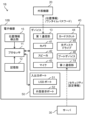
- FIG. 1 is a schematic block diagram showing the configuration of a control system 1 including an electronic device 10 according to Embodiment 1 of the present disclosure. As shown in FIG. 1, in the control system 1, an electronic device 10 and an external device 20 perform short-range wireless communication. Further, the electronic device 10 and the server 30 communicate via a network.
- the electronic device 10 is, for example, a laptop PC.
- the electronic device 10 includes a processor 11 , a storage section 12 , a first communication section 13 , a second communication section 14 , and a position information detection section 15 .
- the processor 11 controls each component of the electronic device 10.
- the processor 11 reads data, instructions, or programs stored in the storage unit 12 and performs various arithmetic operations to achieve predetermined functions.
- the processor 11 can be realized by a circuit made up of semiconductor elements or the like.
- the processor 11 can be configured with, for example, a microcomputer, CPU, MPU, GPU, DSP, FPGA, or ASIC.
- the processor 11 executes instructions on the BIOS.
- an OS operation system
- Windows registered trademark
- Linux registered trademark
- the storage unit 12 stores instructions executed by the processor 11 on the BIOS.
- the storage unit 12 is a storage medium that stores instructions, programs, or data necessary to implement the functions of the electronic device 10.
- the storage unit 12 can be realized by, for example, RAM, ROM, PROM, PROM, EPROM, flash memory, HDD, SSD, or a combination thereof.
- the storage unit 12 stores a BIOS.
- the first communication unit 13 performs short-range wireless communication with the external device 20.
- Near field wireless communication means, for example, wireless communication within several meters.
- the short-range wireless communication may be wireless communication within 50 m, preferably within 10 m, and more preferably within 5 m.
- the first communication unit 13 includes a circuit that performs short-range wireless communication with the external device 20 in accordance with a predetermined communication standard.
- the predetermined communication standard includes, for example, Bluetooth (registered trademark).
- the second communication unit 14 communicates with the server 30 via the network.
- the second communication unit 14 includes a circuit that communicates with the server 30 via a wireless or wired network in accordance with a predetermined communication standard.
- the electronic device 10 may be connected to a LAN (Local Area Network), WAN (Wide Area Network), Wi-Fi (registered trademark), WWAN (Wireless Wide Area Network), or WLAN (Wireless Network).
- LAN Local Area Network
- WAN Wide Area Network
- Wi-Fi registered trademark
- WWAN Wireless Wide Area Network
- WLAN Wireless Network
- the position information detection unit 15 detects the position of the electronic device 10.
- the position information detection unit 15 includes, for example, a GPS (Global Positioning System).
- the location information includes, for example, latitude and longitude.
- the external device 20 performs short-range wireless communication with the electronic device 10 .
- the external device 20 may be, for example, a mobile terminal such as a smartphone or a tablet PC that can be carried by the user.
- the external device 20 may be an information processing device placed at a predetermined location.
- the external device 20 includes a processor and a storage unit that stores a program executed by the processor.
- the processor controls each component of the external device 20.
- a processor implements a predetermined function by reading data, instructions, or programs stored in a storage unit and performing various arithmetic operations.
- the processor can be realized by a circuit made up of a semiconductor element or the like.
- the processor can be configured with, for example, a microcomputer, CPU, MPU, GPU, DSP, FPGA, or ASIC.
- the storage unit can be realized by, for example, RAM, ROM, PROM, PROM, EPROM, flash memory, HDD, SSD, or a combination thereof.
- the external device 20 includes a communication circuit that performs short-range wireless communication with the electronic device 10 in accordance with a predetermined communication standard. Further, the external device 20 includes a sensor that detects the position of the external device 20. The sensor is, for example, a GPS. In this embodiment, the sensor of the external device 20 can detect the position with higher accuracy than the position information detection section 15 of the electronic device 10.
- the external device 20 transmits the position information acquired by the external device 20 to the electronic device 10 by performing short-range wireless communication with the electronic device 10. Further, the external device 20 receives a one-time password, which will be described later, from the electronic device 10.
- the server 30 communicates with the electronic device 10 via a network.
- the server 30 is an information processing device connectable to a network.
- the server 30 includes a processor and a storage unit that stores a program executed by the processor.
- a processor controls each component of the server 30.
- a processor implements a predetermined function by reading data, instructions, or programs stored in a storage unit and performing various arithmetic operations.
- the processor can be realized by a circuit made of a semiconductor element or the like.
- the processor can be configured with, for example, a microcomputer, CPU, MPU, GPU, DSP, FPGA, or ASIC.
- the storage unit can be realized by, for example, RAM, ROM, PROM, PROM, EPROM, flash memory, HDD, SSD, or a combination thereof.
- the server 30 stores security setting information indicating security settings determined according to the location of the electronic device 10 in its storage unit.
- the security setting information includes information for determining the security level according to the location.
- the security level is a level indicating the level of security required for authentication to enable use of the electronic device 10. That is, the security level is a level indicating the level of security that is a standard when determining the authentication method of the electronic device 10. For example, the higher the security level, the less secure the location where the electronic device 10 is used is, and the electronic device 10 requests authentication using an authentication method with relatively high security.
- the authentication method includes authentication using a BIOS password, authentication using a one-time password that is valid only once, authentication using a fingerprint, etc.
- the security level increases in proportion to the order of BIOS password authentication, one-time password authentication, and fingerprint authentication.
- the security setting information includes a registered position indicating a pre-registered position, a first security level set for the registered position, and a second security level set for an unregistered position other than the registered position. ,including.
- the first security level is set lower than the second security level.
- the security setting information may be a table showing locations and security levels corresponding to the locations.
- a first security level which is a relatively low security level
- a relatively high second security level is set for unregistered locations.
- the registered location is, for example, a place where security can be ensured, such as a workplace or a co-working space.
- An unregistered location is a location where security cannot be guaranteed, and is, for example, a location other than a workplace or a coworking space.
- the security setting information can be set, changed, or updated by the administrator of the server 30, for example.
- the server 30 includes a circuit that communicates with the electronic device 10 via a wireless or wired network in accordance with a predetermined communication standard.
- the server 30 transmits the security setting information stored in the storage unit to the electronic device 10.
- FIG. 2 shows a control flowchart of an example of a method for controlling the electronic device 10 according to Embodiment 1 of the present disclosure.
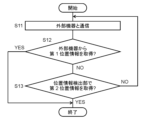
- FIG. 3 shows a flowchart of an example of a process for acquiring position information of the electronic device 10.
- FIG. 4 shows a flowchart of an example of a process for acquiring security setting information.
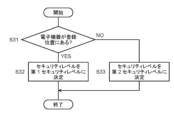
- FIG. 5 shows a flowchart of an example of a process for determining a security level.
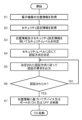
- FIG. 6 shows a flowchart of an example of a process for determining an authentication method.
- step S1 the electronic device 10 acquires position information of the electronic device 10.
- step S1 includes steps S11 to S13.
- step S11 the electronic device 10 communicates with the external device 20.
- the electronic device 10 acquires the position information acquired by the external device 20 by performing short-range wireless communication with the external device 20.
- the position information acquired by the external device 20 is referred to as "first position information.”
- the external device 20 acquires the first position information using a sensor of the external device 20.
- the external device 20 transmits the first location information to the electronic device 10.
- the electronic device 10 receives first position information from the external device 20 through the first communication unit 13 .
- step S12 the electronic device 10 determines whether or not the first position information has been acquired from the external device 20.
- step S12 if it is determined that the electronic device 10 has acquired the first position information, the process of acquiring the position information ends. In this case, the electronic device 10 determines that the position indicated by the first position information is the position used by the electronic device 10.
- step S12 If it is determined in step S12 that the electronic device 10 has not acquired the first position information, the process proceeds to step S13. For example, if the electronic device 10 cannot communicate with the external device 20, or if it can communicate with the external device 20 but cannot receive the first location information, the electronic device 10 determines that the first location information has not been acquired from the external device 20. .
- step S12 if the electronic device 10 is unable to acquire the first position information for a predetermined period, the process may proceed to step S13.
- the process may proceed to step S13.
- step S13 the electronic device 10 determines whether the position information of the electronic device 10 has been acquired using the position information detection unit 15 of the electronic device 10.
- the position information acquired by the position information detection unit 15 of the electronic device 10 is referred to as "second position information.”
- step S13 If it is determined in step S13 that the electronic device 10 has acquired the second position information using the position information detection unit 15, the process of acquiring position information ends. In this case, the electronic device 10 determines that the position indicated by the second position information is the position used by the electronic device 10.
- step S13 If it is determined in step S13 that the electronic device 10 has not acquired the second position information using the position information detection unit 15, the process returns to step S11.
- step S1 the electronic device 10 acquires position information indicating the position of the electronic device 10 by performing steps S11 to S13.
- the electronic device 10 acquires security setting information.
- the security setting information is information indicating security settings determined according to the location of the electronic device 10.
- the security setting information includes a registered position indicating a pre-registered position, a first security level set for the registered position, and a second security level set for a position other than the registered position. and, including.
- the first security level is set lower than the second security level.
- the electronic device 10 stores security setting information in the storage unit 12. Therefore, in step S2, the electronic device 10 may acquire the security setting information by reading the security setting information from the storage unit 12.
- Security setting information is set, changed, or updated by the administrator.
- the electronic device 10 can set, change, or update the security setting information stored in the storage unit 12 of the electronic device 10.
- step S21 the electronic device 10 communicates with the server 30.
- the electronic device 10 communicates with the server 30 via the network using the second communication unit 14 .
- step S22 the electronic device 10 acquires security setting information from the server 30.
- the server 30 stores security setting information set, changed, or updated by an administrator in a storage unit.
- the server 30 transmits security setting information to the electronic device 10 via the network.
- the electronic device 10 receives security setting information from the server 30 via the network by the second communication unit 14 .
- step S23 the electronic device 10 stores the security setting information in the storage unit 12.
- steps S21 to S23 the electronic device 10 can acquire the latest security setting information and store it in the storage unit 12.
- steps S21 to S23 may be performed automatically at a predetermined time, or may be performed by a user's operation.
- step S3 the electronic device 10 uses the position information and security setting information of the electronic device 10 to determine the security level based on the position of the electronic device 10. As shown in FIG. 5, step S3 includes steps S31 to S32.
- step S31 it is determined whether the electronic device 10 is at the registered position.
- the electronic device 10 uses the position information of the electronic device 10 acquired in step S1 and the security setting information acquired in step S2 to determine whether the electronic device 10 is at the registered position.
- the electronic device 10 determines whether the location indicated by the location information of the electronic device 10 acquired in step S1 is a registered location registered in the security setting information. For example, the electronic device 10 compares the location indicated by the location information and the registered location included in the security setting information. If the location indicated by the location information matches the registered location, or if the location indicated by the location information is within a predetermined range from the registered location, it is determined that the electronic device 10 is at the registered location.
- the predetermined range can be set arbitrarily. For example, the predetermined range may be set at the facility, land, or location indicated by the registered position, or may be set at a room within the facility, land, or a part of the location.
- step S31 If it is determined in step S31 that the electronic device 10 is at the registered position, the process proceeds to step S32. If it is determined that the electronic device 10 is not at the registered position, that is, it is determined that the electronic device 10 is at an unregistered position, the process advances to step S33.
- step S32 the electronic device 10 determines the security level to be the first security level. Based on the security setting information, the electronic device 10 sets the first security level set for the registered position determined in step S31 as the security level.
- the security level is set to a relatively low first security level.
- step S33 the electronic device 10 determines the security level to be the second security level. Based on the security setting information, the electronic device 10 sets the second security level set for the unregistered position determined in step S31 as the security level.
- the security level is set to the second security level, which is relatively high.
- step S3 the electronic device 10 determines the security level based on the location of the electronic device 10 by performing steps S31 to S33.
- step S4 the electronic device 10 determines an authentication method according to the security level.
- the electronic device 10 determines an authentication method according to the security level determined in step S3.
- the electronic device 10 stores authentication method information including a security level and an authentication method set for the security level in the storage unit 12.
- the authentication method information may be a table showing security levels and authentication methods corresponding to the security levels.
- Authentication method information can be set, changed, or updated by an administrator.
- the authentication method information stored in the storage unit 12 can be acquired from the server 30 and set, changed, or updated similarly to the security setting information. Note that the authentication method information may be included in the security setting information.
- the authentication method includes authentication using a BIOS password, authentication using a one-time password, authentication using a fingerprint, etc., depending on the security level.
- authentication using a BIOS password is set at the first security level, which is a relatively low security level
- authentication using a one-time password, which is valid only once is set at the second security level, which is relatively high. There is.
- step S4 includes steps S41 to S43.
- step S41 the electronic device 10 determines whether the security level is the first security level or the second security level. In step S41, if the security level is the first security level, the process advances to step S42. If the security level is the second security level, the process advances to step S43.
- step S42 the electronic device 10 determines authentication using the BIOS password.
- the electronic device 10 searches for an authentication method corresponding to the first security level based on the authentication method information. In this embodiment, since authentication using a BIOS password is set as the first security level, the electronic device 10 determines authentication using a BIOS password.
- Authentication using a BIOS password is a password that can be set in the BIOS, and is an authentication method that allows the electronic device 10 to be used as many times as the user enters the set password.
- step S43 the electronic device 10 determines authentication using a one-time password.
- the electronic device 10 searches for an authentication method corresponding to the second security level based on the authentication method information. In this embodiment, since authentication using a one-time password that is valid only once is set in the second security level, the electronic device 10 determines authentication using a one-time password that is valid only once.
- Authentication using a one-time password is an authentication method that allows the electronic device 10 to be used when a valid password is entered only once. In authentication using a one-time password, for example, if the correct password is entered, the electronic device 10 can be used only once, but even if the same password is entered the second time or later, the electronic device 10 can still be used. I can't.
- step S4 the electronic device 10 determines the authentication method according to the security level by implementing steps S41 to S43.
- step S5 the electronic device 10 outputs an authentication request according to the determined authentication method.
- the electronic device 10 displays a screen requesting authentication on the display of the electronic device 10.
- the electronic device 10 displays a screen display requesting input of the BIOS password on the display.
- the user looks at the screen display and inputs the BIOS password into the electronic device 10 using an input interface such as a keyboard.
- the electronic device 10 transmits the one-time password to the external device 20, for example, while displaying a screen display requesting input of the one-time password on the display. That is, the electronic device 10 notifies the external device 20 of the one-time password.
- the external device 20 displays a one-time password to be input into the electronic device 10. The user inputs the one-time password displayed on the external device 20 into the electronic device 10 through the input interface.
- step S6 the electronic device 10 determines whether or not it has been authenticated. If authenticated, that is, if a correct password has been entered, the electronic device 10 boots the OS. If the password has not been authenticated, that is, if the wrong password has been entered, the process returns to step S5.
- the electronic device 10 includes a processor 11 and a storage unit 12 that stores instructions executed by the processor 11 on the BIOS.
- the instructions include steps S1 to S4.
- step S1 the electronic device 10 acquires position information indicating the position of the electronic device 10.
- step S2 the electronic device 10 acquires security setting information indicating security settings determined according to the location of the electronic device 10.
- step S3 the electronic device 10 uses the location information and security setting information to determine the security level based on the location of the electronic device 10.
- the electronic device 10 determines an authentication method to enable use of the electronic device 10 according to the security level.
- the authentication method can be determined depending on the location of the electronic device 10, so security can be improved. For example, if the electronic device 10 is in a relatively high security position, an authentication method with a relatively low security level is determined, and if the electronic device 10 is in a relatively low security position, an authentication method with a relatively high security level is determined. Determine. In this way, since the authentication method can be changed depending on the location of the electronic device 10, security can be improved.
- the electronic device 10 when the electronic device 10 is located in a secure location such as a workplace, the electronic device 10 can be made usable using a relatively simple authentication method. Therefore, when the electronic device 10 is used in a position where security is ensured, there is an effect that the convenience of the electronic device 10 is not reduced.
- Step S4 of determining the authentication method includes determining at least one of authentication using a BIOS password and authentication using a one-time password that is valid only once. With such a configuration, security can be further improved without reducing convenience by using different authentication methods that require password input depending on the location of the electronic device 10.
- the electronic device 10 includes a first communication unit 13 that communicates with an external device 20 that acquires position information.
- Step S1 of acquiring location information includes acquiring location information from the external device 20 by the first communication unit 13.
- the position information of the electronic device 10 can be acquired based on the position information acquired by the external device 20.
- the external device 20 is a device equipped with a GPS that is more accurate than the location information detection unit 15 of the electronic device 10, such as a smartphone, the electronic device 10 can acquire more accurate location information.
- the electronic device 10 includes a position information detection unit 15 that acquires position information of the electronic device 10.
- Step S1 of acquiring position information includes acquiring position information by the position information detection unit 15. With such a configuration, the electronic device 10 can acquire position information by itself without relying on the external device 20. This can improve convenience.
- the security setting information is stored in the server 30 on the network.
- the electronic device 10 includes a second communication unit 14 that communicates with the server 30 via the network.
- the instruction includes steps S21 to S23 in which the second communication unit 14 acquires security setting information from the server 30.
- the electronic device 10 can acquire security setting information from the server 30. For example, when the administrator sets, changes, or updates the security setting information stored in the server 30, the electronic device 10 obtains the latest set, changed, or updated security setting information by communicating with the server 30. be able to.
- the security setting information includes a registered position indicating a pre-registered position and a first security level set for the registered position.
- Step S3 of determining the security level includes determining whether the electronic device 10 is at the registered position, and if the electronic device 10 is at the registered position, determining the security level to be the first security level.
- the authentication method can be changed depending on information as to whether or not the electronic device 10 is at the registered position. For example, if the security of the registered location is relatively high, a relatively simple authentication method can be adopted by lowering the first security level. This can improve convenience.
- step S4 of determining the authentication method includes determining authentication using a BIOS password. With such a configuration, relatively simple password authentication can be employed to further improve convenience.
- the security setting information includes a second security level set for unregistered locations other than registered locations.
- the second security level is higher than the first security level.
- Step S3 of determining the security level includes determining the security level to be the second security level if the electronic device 10 is not at the registered position.
- step S4 of determining the authentication method includes determining authentication using a one-time password that is valid only once.
- the instruction includes step S5 of outputting authentication according to the determined authentication method.
- the electronic device 10 is a laptop PC
- the present invention is not limited to this.
- the electronic device 10 may be a computer such as a desktop PC or a tablet PC.
- first communication unit 13 and the second communication unit 14 are separate bodies, but the present invention is not limited to this.
- first communication unit 13 and the second communication unit 14 may be integrally configured.
- the external device 20 is a smartphone
- the present invention is not limited to this.
- the external device 20 only needs to be capable of short-range communication with the electronic device 10, and may communicate with the electronic device 10 through wired communication.
- external device 20 may be a beacon.
- the beacon may be fixed at a specific location, such as a conference room.
- the electronic device 10 does not need to include the position information detection section 15 such as GPS.
- the electronic device 10 may detect that it is in a relatively high security location by communicating with a beacon.
- the present invention is not limited to this.
- the sensor of the external device 20 may have lower position detection accuracy than the position information detection unit 15 of the electronic device 10.
- the electronic device 10 may use the position information of the sensor of the external device 20 and the position information detection unit 15, whichever has higher accuracy of position detection.
- the step S1 of acquiring position information includes acquiring first position information from the external device 20 and acquiring second position information by the position information detection unit 15 of the electronic device 10.
- position information may be acquired from at least one of the external device 20 and the position information detection section 15.
- the electronic device 10 does not need to include the position information detection section 15.
- the electronic device 10 does not need to acquire the first position information from the external device 20 and the second position information.
- the electronic device 10 may not include the first communication unit 13. In this case, the electronic device 10 does not need to acquire the second position information using the position information detection unit 15 and communicate with the external device 20 to acquire the first position information.
- the location information of the electronic device 10 may be obtained from an IP address, a beacon, or the like.
- the location information detection unit 15 may be configured with a circuit that identifies the location from an IP address, beacon, or the like.
- step S2 of acquiring security setting information reads security setting information stored in the storage unit 12, but the present invention is not limited to this.
- the security setting information may be obtained directly from the server 30.
- security setting information that has been set, changed, or updated is acquired from the server 30, but the present invention is not limited to this.
- the configured, changed, or updated security configuration information may be stored in a computer-readable storage medium.
- the electronic device 10 may read security setting information from the computer-readable storage medium and store it in the storage unit 12 . In this case, the electronic device 10 does not need to communicate with the server 30.
- the security setting information includes a registered location, a first security level set for the registered location, and a second security level set for the unregistered location.
- a security level may be set for each of a plurality of registered positions.
- a location with guaranteed security is registered as a registered location
- a location with relatively low security may be registered as a registered location.
- a relatively high security level may be set for a registered location with relatively low security.
- the security level of a registered location may be set higher than the security level of an unregistered location.
- a relatively high security level may be set.
- the electronic device 10 may decide to authenticate using a one-time password.
- the electronic device 10 may decide to authenticate using the BIOS.
- the authentication method includes authentication using a BIOS password, authentication using a one-time password, or authentication using a fingerprint, but is not limited thereto.
- the authentication method may include other authentication methods.
- the authentication method may include biometric authentication such as retinal authentication and facial authentication.
- biometric authentication such as retinal authentication and facial authentication.
- authentication may not be required.
- the electronic device 10 does not need to output a screen display requesting authentication such as entering a password. The user can use the electronic device 10 without being authenticated.
- both authentication using a BIOS password and authentication using a one-time password may be set for the second security level.
- the one-time password is input via the input interface of the electronic device 10, but the present invention is not limited to this.
- the one-time password may be input into the external device 20.
- the external device 20 may transmit the one-time password to the electronic device 10 via wireless communication.
- the one-time password may be generated using a common key method in which the BIOS of the electronic device 10 and the external device 20 each generate a one-time password using a common key.
- the one-time password may be generated using any method other than the common key method.
- the present invention is not limited to this.
- the method for controlling the electronic device 10 may be executed on a UEFI (Unified Extensible Firmware Interface). That is, the processor 11 may execute instructions on the BIOS or UEFI.
- UEFI Unified Extensible Firmware Interface
- FIG. 7 shows a flowchart of processing for determining the security level in Modification 1.
- FIG. 8 shows a flowchart of processing for determining an authentication method in Modification 1.
- Modification 1 differs from Embodiment 1 in that different security levels are set for multiple registered locations and authentication is not required. . Note that in Modification 1, descriptions of the same processes as in Embodiment 1 will be omitted.
- the security setting information includes a first security level set for the first registered position, a second security level set for the second registered position, and a second security level set for the unregistered position. Includes a third security level.
- the security levels increase in the order of first, second and third security levels.
- the authentication method information it is set that no authentication is required for the first security level, authentication by BIOS password is set for the second security level, and one-time password is set for the third security level. authentication is set.
- Step S3 of determining the security level in Modification 1 will be explained using FIG. 7.
- step S31 it is determined whether the electronic device 10 is at the registered position. If it is determined in step S31 that the electronic device 10 is at the registered position, the process advances to step S31A. If it is determined that the electronic device 10 is not at the registered position, the process advances to step S33A.
- step S31A the electronic device 10 determines whether the electronic device 10 is at the first registration position or at the second registration position. If the electronic device 10 is at the first registration position, the process advances to step S32A. If the electronic device 10 is at the second registration position, the process advances to step S32B.
- step S32A the electronic device 10 determines the security level to be the first security level set for the first registered position.
- step S32B the electronic device 10 determines the security level to be the second security level set for the second registered position.
- step S33A the electronic device 10 determines the security level to be the third security level set for the unregistered position.
- step S4 of determining the authentication method in Modification 1 will be explained using FIG. 8.
- step S41A the electronic device 10 determines whether the security level is the first security level, the second security level, or the third security level. If it is determined that the security level is the first security level, the process advances to step S42A. If it is determined that the security level is the second security level, the process advances to step S42B. If it is determined that the security level is the third security level, the process advances to step S43.
- step S42A the electronic device 10 determines not to request authentication.
- step S42A the electronic device 10 determines authentication using the BIOS password.
- the electronic device 10 refers to the authentication method set for the second security level and determines authentication using the BIOS password.
- step S43 the electronic device 10 determines authentication using a one-time password.
- the electronic device 10 refers to the authentication method set for the third security level and determines authentication using a one-time password.
- the electronic device 10 uses the authentication method information to determine an authentication method by referring to the authentication method set for each security level.
- authentication methods can be determined individually for multiple registered locations. For example, if the first registered location is the workplace and the second registered location is the home, the authentication method can be changed depending on whether the electronic device 10 is located at the workplace or at home.
- Embodiment 2 An electronic device according to Embodiment 2 of the present disclosure will be described. Note that in the second embodiment, differences from the first embodiment will be mainly explained. In the second embodiment, the same or equivalent configurations as those in the first embodiment will be described with the same reference numerals. Furthermore, in the second embodiment, descriptions that overlap with those in the first embodiment will be omitted.
- FIG. 9 shows a schematic block diagram showing an example of the configuration of a control system 1A according to Embodiment 2 of the present disclosure.
- FIG. 10 shows a control flowchart of an example of a method for controlling the electronic device 10A according to Embodiment 2 of the present disclosure.
- FIG. 11 shows a flowchart of an example of a process for determining an authentication method.
- the second embodiment differs from the first embodiment in that the electronic device 10A includes an environmental information detection section 16 and determines an authentication method based on the environment information detected by the environment information detection section 16.
- the electronic device 10A includes an environmental information detection section 16.
- the environmental information detection unit 16 acquires environmental information indicating the environment around the electronic device 10.
- the environment information includes, for example, sounds or images around the electronic device 10.
- the environmental information detection unit 16 is, for example, a microphone or a camera.
- the method for controlling the electronic device 10A includes steps S1 to S6.
- Steps S1 to S3 and S5 to S6 in the second embodiment are the same as steps S1 to S3 and S5 to S6 in the first embodiment, so a detailed explanation will be omitted.
- step S1 the electronic device 10A acquires position information of the electronic device 10A.
- step S2 the electronic device 10A obtains security setting information.
- step S3 the electronic device 10A determines the security level using the location information and security setting information.
- step S3A the electronic device 10A acquires environmental information around the electronic device 10A.
- the electronic device 10A acquires environmental information using the environmental information detection unit 16.
- the environmental information detection unit 16 is a microphone or a camera, and the environmental information is sounds or images around the electronic device 10A.
- step S4A the electronic device 10A determines an authentication method based on the security level and environmental information. As shown in FIG. 11, step S4A includes step S41B in addition to steps S41 to S43 of the first embodiment.
- step S41 the electronic device 10A determines whether the security level is the first security level or the second security level. If the security level is the first security level, the process advances to step S41B. If the security level is the second security level, the process advances to step S43.
- step S41B the electronic device 10A determines whether there is anyone other than the user around the electronic device 10. Specifically, the electronic device 10A determines whether there is anyone other than the user around the electronic device 10A based on the environmental information acquired by the environmental information detection unit 16 in step S41B.
- the electronic device 10A determines that there is a person other than the user around the electronic device 10A when the volume of the sound acquired by the environmental information detection unit 16 exceeds a predetermined threshold.
- the electronic device 10A detects whether a person other than the user is shown in the image acquired by the environmental information detection unit 16, and if a person other than the user is detected, there is a person other than the user around the electronic device 10A. It is determined that there is.
- the electronic device 10A Even if the electronic device 10A is used at a registered position with relatively high security, if it is determined that there are people other than the user around the electronic device 10A, the electronic device 10A is determined to have low security. and lower the security level.
- step S41B If it is determined in step S41B that there is a person other than the user around the electronic device 10A, the process proceeds to step S43. If it is determined that there is no person other than the user around the electronic device 10A, the process advances to step S42.
- step S42 the electronic device 10A determines authentication using the BIOS password set for the first security level.
- step S43 the electronic device 10A determines authentication using the one-time password set for the second security level.
- the instructions executed on the BIOS further include step S3A of acquiring environmental information indicating the environment around the electronic device 10A.
- Step S4A of determining an authentication method includes determining an authentication method based on environmental information. With such a configuration, an authentication method can be determined in consideration of the surrounding environment of the electronic device 10A. Thereby, security can be further improved.
- the electronic device 10A can change the authentication method based on the environmental information, the electronic device 10A can be used more safely.
- the environmental information includes information about sounds or images around the electronic device. Determining the authentication method based on environmental information means determining whether there is a person other than the user around the electronic device 10A based on sound or image, and determining that there is a person other than the user around the electronic device 10A.
- the method includes determining authentication of a one-time password that is valid only once. With such a configuration, security can be improved by performing authentication using a one-time password when a third party other than the user is around the electronic device 10A.
- the environmental information may be any information that allows the user to know the environment around the electronic device 10A.
- the environmental information may be an image, temperature, brightness, etc. around the electronic device 10A.
- the environmental information detection section 16 is a microphone or a camera
- the present invention is not limited to this.
- the environmental information detection unit 16 may be an infrared sensor, an illuminance sensor, a human sensor, or the like.
- the authentication method may be changed to a relatively high security authentication method other than a one-time password. Further, when it is determined that there is no one around the electronic device 10A, the security level may be lowered and the authentication method may be changed to a relatively low security authentication method.
- Embodiment 3 An electronic device according to Embodiment 3 of the present disclosure will be described. Note that in the third embodiment, the points that are different from the first embodiment will be mainly explained. In Embodiment 3, the same or equivalent configurations as in Embodiment 1 are given the same reference numerals and explained. Further, in the third embodiment, descriptions that overlap with those in the first embodiment will be omitted.
- FIG. 12 shows a schematic block diagram illustrating an example of the configuration of a control system 1B including an electronic device 10B according to Embodiment 3 of the present disclosure.
- FIG. 13 shows a control flowchart of an example of a method for controlling electronic device 10B according to Embodiment 3 of the present disclosure.
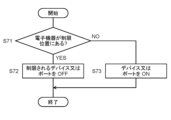
- FIG. 14 shows a flowchart of an example of a process for controlling ON or OFF of the device 40 or port 50.
- Embodiment 3 differs from Embodiment 1 in that ON or OFF of the device 40 or port 50 included in electronic device 10B is controlled depending on the position of electronic device 10B.
- the electronic device 10B includes multiple devices 40 and multiple ports 50.
- the plurality of devices 40 and the plurality of ports 50 can be turned on or off by the processor 11 on the BIOS.
- the plurality of devices 40 include a first communication unit 13, a second communication unit 14, a camera 41, a speaker 42, a microphone 43, a card slot 44, an optical disk drive 45, a boot device 46, and the like.
- the card slot 44 is, for example, an SD card slot.
- the boot device 46 is an HDD or SSD in which an OS is stored.
- the plurality of ports 50 include a USB port 51 and an external display port 52.
- the external display port 52 is, for example, an HDMI (registered trademark) port.
- Control information for controlling ON or OFF of the device 40 or the port 50 according to the position is stored in the storage unit 12 of the electronic device 10B.
- the control information includes a restriction position that restricts the use of the device 40 or port 50, and an ON or OFF setting of the device 40 or port 50 set for the restriction position.
- the control information may be a table showing the restricted position and ON or OFF settings of the device 40 or port 50 corresponding to the restricted position.
- Control information can be set, changed, or updated by an administrator.
- the control information stored in the storage unit 12 can be acquired from the server 30 and set, changed, or updated similarly to the security setting information. Note that the control information may be included in the security setting information.
- steps S1 to S6 in the third embodiment are the same as steps S1 to S6 in the first embodiment, so the explanation will be omitted.
- step S7 the electronic device 10B controls ON or OFF of the device 40 or the port 50 based on the position information.
- the electronic device 10B controls ON or OFF of the device 40 or the port 50 based on the position information of the electronic device 10B acquired in step S1 and the control information stored in the storage unit 12.
- step S7 includes steps S71 to S73.
- step S71 it is determined whether the electronic device 10B is in the restricted position.
- the electronic device 10B determines whether the electronic device 10B is at the restricted position by comparing the position indicated by the position information and the restricted position registered in the control information.
- step S72 If the electronic device 10B is in the restricted position, the process advances to step S72. If the electronic device 10B is not in the restricted position, the process advances to step S73.
- step S72 the electronic device 10B controls the device 40 or the port 50 to turn on.
- the restricted position is a position with relatively low security
- the device 40 or the port 50 is controlled to be OFF, thereby making the device 40 or the port 50 unusable.
- step S73 the electronic device 10B controls the device 40 or the port 50 to turn on.
- the device 40 or the port 50 is made usable by controlling the device 40 or the port 50 to be turned on at positions other than the restricted position.
- the electronic device 10B uses the control information to turn the device 40 or the port 50 ON or OFF by referring to the ON or OFF setting of the device 40 or the port 50 set for the restricted position. Controls OFF.
- controlling ON or OFF of the device 40 or port 50 refers to controlling ON or OFF of at least one device 40 or port 50 among the plurality of devices 40 or the plurality of ports 50. means.
- controlling the device 40 to OFF when the electronic device 10B is in the restricted position means controlling to OFF the device that is restricted by the control information among the plurality of devices 40, and turns the other devices ON. It may be .
- the electronic device 10B includes a device 40 or a port 50 controlled by the processor 11.
- the command includes step S7 of controlling ON or OFF of the device 40 or the port 50 based on position information indicating the position of the electronic device 10B. With such a configuration, ON or OFF of the device 40 or the port 50 can be controlled depending on the position of the electronic device 10B. This further improves security.
- the device 40 includes at least one of the communication units 13 and 14, a camera 41, a speaker 42, a microphone 43, a card slot 44, an optical disk drive 45, or a boot device 46.
- the ports 50 include at least one of a USB port 51 or an external display port 52. With such a configuration, it is possible to control ON or OFF of various devices or ports depending on the position of the electronic device 10B.
- a highly confidential area such as a research institute or a specific conference room is registered as a restricted location in the control information.
- the electronic device 10B controls the camera 41 or the microphone 43 to be turned off.
- the electronic device 10B controls the camera 41 or the microphone 43 to turn on. This makes it possible to prevent documents and objects placed in highly confidential areas from being captured by the camera 41 and from recording conversations in a specific conference room with the microphone 43.
- a specific location is registered as a restricted location in the control information.
- the electronic device 10B controls the boot device 46 to be turned off. Furthermore, when the electronic device 10B is outside a specific location, the electronic device 10B controls the boot device 46 to turn on. This prevents the OS from starting in a specific location, thereby preventing user login and data leakage in the storage.
- the electronic device 10B controls the optical disk drive 45 or the USB port 51 to turn off. Further, when the electronic device 10B is not in a specific location, the electronic device 10B controls the optical disk drive 45 or the USB port 51 to turn on. This makes it impossible to use an external device such as the optical disk drive 45 or a USB memory as a boot device in a specific location, thereby preventing data from being initialized or leaked.
- the electronic device 10B controls the first communication section 13 or the second communication section 14 to be turned ON or OFF.
- the electronic device 10B controls the WWAN to ON in order to prohibit the use of Free Wi-Fi in the specific location, and connects the wired LAN, wireless LAN, etc. Control other communication functions other than WWAN to OFF. This makes it possible to protect communication packets from unauthorized information leakage devices.
- the electronic device 10B may be controlled to use either eSIM or nanoSIM.
- the electronic device 10B controls the card slot 44, optical disk drive 45, or USB port 51 to be turned off. This makes it possible to prevent information from leaking from external storage devices by not allowing external storage or ports to be used in specific locations.
- the electronic device 10B controls ON or OFF of the device 40 or the port 50 according to position information, but the present invention is not limited to this.
- the electronic device 10B may control ON or OFF of the device 40 or the port 50 depending on the security level.
- Embodiment 4 An electronic device according to Embodiment 4 of the present disclosure will be described. Note that in the fourth embodiment, differences from the first embodiment will be mainly explained. In Embodiment 4, the same or equivalent configurations as in Embodiment 1 will be described with the same reference numerals. Furthermore, in the fourth embodiment, descriptions that overlap with those in the first embodiment will be omitted.
- FIG. 15 shows a control flowchart of an example of a method for controlling electronic device 10 according to Embodiment 4 of the present disclosure.
- Embodiment 4 differs from Embodiment 1 in that electronic device 10 determines the authentication method based on the location information of electronic device 10 without determining the security level.
- the method for controlling the electronic device 10 includes steps S1 to S2 and S4B to S6.
- Steps S1 to S2 and S5 to S6 in the fourth embodiment are the same as steps S1 to S2 and S5 to S6 in the first embodiment, so a detailed explanation will be omitted.
- step S1 the electronic device 10 acquires position information of the electronic device 10.
- the electronic device 10 acquires security setting information.
- the security setting information includes information on an authentication method set for the location of the electronic device 10.
- the security setting information includes the location of the electronic device 10 and an authentication method preset for the location of the electronic device 10.
- BIOS for a registered position with relatively high security, no authentication or a password authentication method using BIOS may be set. Further, an authentication method using a one-time password may be set for locations other than the registered location.
- step S4B the electronic device 10 determines an authentication method using the location information and security setting information.
- Steps S5 to S6 are the same as in Embodiment 1, so the explanation will be omitted.
- the security setting information includes the location of the electronic device 10 and an authentication method set in advance according to the location of the electronic device 10. Further, the electronic device 10 of the fourth embodiment determines an authentication method using the position information and security setting information of the electronic device 10 without determining the security level.
- the authentication method can be determined depending on the location of the electronic device 10, so security can be improved.
- An electronic device of the present disclosure includes a processor and a storage unit storing instructions executed by the processor on a BIOS (Basic Input Output System) or UEFI (Unified Extensible Firmware Interface), and the instructions are , acquiring location information indicating the location of the electronic device; acquiring security setting information indicating security settings determined according to the location of the electronic device; using the location information and the security setting information; The method includes determining a security level based on the location of an electronic device, and determining an authentication method to enable use of the electronic device according to the security level.
- BIOS Basic Input Output System
- UEFI Unified Extensible Firmware Interface
- determining the authentication method includes not requiring authentication, the authentication using a password of the BIOS or the UEFI, or the authentication using a one-time password that is valid only once;
- the method may include determining at least one of the following.
- the electronic device of (1) or (2) further includes a first communication unit that communicates with an external device that acquires the position information, and acquiring the position information is performed by the first communication unit using the first communication unit.
- the position information may be acquired from an external device.
- the electronic device further includes a position information detection unit that acquires the position information of the electronic device, and acquiring the position information is performed by detecting the position information.
- the location information may be acquired by a unit.
- the security setting information is stored in a server on a network, and the electronic device has a second electronic device that communicates with the server via the network.
- the device may further include a communication unit, and the instruction may include acquiring the security setting information from the server by the second communication unit.
- the security setting information includes a registered position indicating a pre-registered position and a first security level set for the registered position.
- determining the security level includes determining whether the electronic device is at the registered location, and if the electronic device is at the registered location, the security level is set to the first security level. may include determining the level.
- determining the authentication method may include determining the authentication using a one-time password that is valid only once. may have.
- determining the authentication method means not requiring authentication, or authentication using a password of the BIOS or the UEFI. , may include determining.
- the security setting information further includes a second security level set for a position other than the registered position, and the second security level is higher than the first security level, and determining the security level includes determining the security level to be the second security level if the electronic device is not at the registered location, and the When the security level is determined to be the second security level, determining the authentication method may include determining authentication using a one-time password that is valid only once.
- the instruction further includes acquiring environmental information indicating an environment around the electronic device, and determining the authentication method.
- the method may include determining the authentication method based on the environment information.
- the environmental information includes information on sounds or images around the electronic device, and determining the authentication method based on the environmental information includes the sound or the image. determining whether or not there is a person other than the user around the electronic device based on the electronic device, and determining authentication of a one-time password that is valid only once when it is determined that there is a person other than the user. , may have.
- the instruction may further include outputting a request for authentication according to the determined authentication method.
- the electronic device further includes a device or a port controlled by the processor, and the command is configured to turn on or off the device or the port based on the position information. It may further include controlling OFF.
- the device includes at least one of a communication unit, a camera, a speaker, a microphone, a card slot, an optical disk drive, or a boot device, and the port is a USB port or an external display. at least one of the ports.
- the method for controlling an electronic device of the present disclosure is a method for controlling an electronic device executed on a BIOS (Basic Input Output System) or a UEFI (Unified Extensible Firmware Interface), the method comprising: a position indicating a position of the electronic device; acquiring security setting information indicating security settings determined according to the location of the electronic device; and determining a security level based on the location of the electronic device using the location information and the security setting information. and determining an authentication method that enables use of the electronic device according to the security level.
- BIOS Basic Input Output System
- UEFI Unified Extensible Firmware Interface
- a computer-readable storage medium of the present disclosure stores the program (16).
- An electronic device of the present disclosure includes a processor and a storage unit storing instructions executed by the processor on a BIOS (Basic Input Output System) or UEFI (Unified Extensible Firmware Interface), and the instructions are , acquiring location information indicating the location of the electronic device, acquiring security setting information indicating security settings determined according to the location of the electronic device, and using the location information and the security setting information to including determining an authentication method to enable use of the electronic device.
- BIOS Basic Input Output System
- UEFI Unified Extensible Firmware Interface
- the present disclosure can be applied to an electronic device that determines an authentication method for the electronic device depending on the location of the electronic device.
Landscapes
- Engineering & Computer Science (AREA)
- Theoretical Computer Science (AREA)
- Computer Security & Cryptography (AREA)
- Computer Hardware Design (AREA)
- General Physics & Mathematics (AREA)
- General Engineering & Computer Science (AREA)
- Physics & Mathematics (AREA)
- Software Systems (AREA)
- Health & Medical Sciences (AREA)
- Bioethics (AREA)
- General Health & Medical Sciences (AREA)
- Telephonic Communication Services (AREA)
- Telephone Function (AREA)
Priority Applications (2)
| Application Number | Priority Date | Filing Date | Title |
|---|---|---|---|
| JP2024544081A JPWO2024048228A1 (https=) | 2022-09-01 | 2023-08-09 | |
| US19/058,217 US20250190528A1 (en) | 2022-09-01 | 2025-02-20 | Electronic device and control method for electronic device |
Applications Claiming Priority (2)
| Application Number | Priority Date | Filing Date | Title |
|---|---|---|---|
| JP2022139409 | 2022-09-01 | ||
| JP2022-139409 | 2022-09-01 |
Related Child Applications (1)
| Application Number | Title | Priority Date | Filing Date |
|---|---|---|---|
| US19/058,217 Continuation US20250190528A1 (en) | 2022-09-01 | 2025-02-20 | Electronic device and control method for electronic device |
Publications (1)
| Publication Number | Publication Date |
|---|---|
| WO2024048228A1 true WO2024048228A1 (ja) | 2024-03-07 |
Family
ID=90099347
Family Applications (1)
| Application Number | Title | Priority Date | Filing Date |
|---|---|---|---|
| PCT/JP2023/029033 Ceased WO2024048228A1 (ja) | 2022-09-01 | 2023-08-09 | 電子機器及び電子機器の制御方法 |
Country Status (3)
| Country | Link |
|---|---|
| US (1) | US20250190528A1 (https=) |
| JP (1) | JPWO2024048228A1 (https=) |
| WO (1) | WO2024048228A1 (https=) |
Cited By (1)
| Publication number | Priority date | Publication date | Assignee | Title |
|---|---|---|---|---|
| US20240362305A1 (en) * | 2023-04-26 | 2024-10-31 | Lenovo Enterprise Solutions (Singapore) Pte Ltd. | Unlocking a locked firmware setup utility using multi-factor authentication supported by a baseboard management controller |
Citations (5)
| Publication number | Priority date | Publication date | Assignee | Title |
|---|---|---|---|---|
| JP2016076274A (ja) * | 2011-04-19 | 2016-05-12 | パナソニックIpマネジメント株式会社 | 情報端末および情報漏洩防止方法 |
| JP2016218817A (ja) * | 2015-05-22 | 2016-12-22 | 三菱電機株式会社 | 認証装置 |
| JP2019152024A (ja) * | 2018-03-02 | 2019-09-12 | シャープ株式会社 | 解錠システム、解錠装置、解錠方法、端末装置及びプログラム |
| JP2019160210A (ja) * | 2018-03-16 | 2019-09-19 | Dynabook株式会社 | 電子機器、制御方法及びプログラム |
| WO2022013952A1 (ja) * | 2020-07-14 | 2022-01-20 | 日本電気株式会社 | 表示制御装置、表示制御方法、及びコンピュータ可読媒体 |
-
2023
- 2023-08-09 JP JP2024544081A patent/JPWO2024048228A1/ja active Pending
- 2023-08-09 WO PCT/JP2023/029033 patent/WO2024048228A1/ja not_active Ceased
-
2025
- 2025-02-20 US US19/058,217 patent/US20250190528A1/en active Pending
Patent Citations (5)
| Publication number | Priority date | Publication date | Assignee | Title |
|---|---|---|---|---|
| JP2016076274A (ja) * | 2011-04-19 | 2016-05-12 | パナソニックIpマネジメント株式会社 | 情報端末および情報漏洩防止方法 |
| JP2016218817A (ja) * | 2015-05-22 | 2016-12-22 | 三菱電機株式会社 | 認証装置 |
| JP2019152024A (ja) * | 2018-03-02 | 2019-09-12 | シャープ株式会社 | 解錠システム、解錠装置、解錠方法、端末装置及びプログラム |
| JP2019160210A (ja) * | 2018-03-16 | 2019-09-19 | Dynabook株式会社 | 電子機器、制御方法及びプログラム |
| WO2022013952A1 (ja) * | 2020-07-14 | 2022-01-20 | 日本電気株式会社 | 表示制御装置、表示制御方法、及びコンピュータ可読媒体 |
Cited By (2)
| Publication number | Priority date | Publication date | Assignee | Title |
|---|---|---|---|---|
| US20240362305A1 (en) * | 2023-04-26 | 2024-10-31 | Lenovo Enterprise Solutions (Singapore) Pte Ltd. | Unlocking a locked firmware setup utility using multi-factor authentication supported by a baseboard management controller |
| US12511355B2 (en) * | 2023-04-26 | 2025-12-30 | Lenovo Enterprise Solutions (Singapore) Pte Ltd. | Unlocking a locked firmware setup utility using multi-factor authentication supported by a baseboard management controller |
Also Published As
| Publication number | Publication date |
|---|---|
| US20250190528A1 (en) | 2025-06-12 |
| JPWO2024048228A1 (https=) | 2024-03-07 |
Similar Documents
| Publication | Publication Date | Title |
|---|---|---|
| EP2985975A1 (en) | Method, apparatus and system for authenticating access and computer program | |
| US20150358333A1 (en) | Geo-location and biometric presence security | |
| AU2017203166B2 (en) | Systems and methods for secure location-based document viewing | |
| US9779225B2 (en) | Method and system to provide access to secure features of a device | |
| US20220417359A1 (en) | Remote control device, information processing method and recording program | |
| US20190253324A1 (en) | Systems and methods to use digital assistant to join network | |
| CN104021358A (zh) | 移动终端的防盗控制方法和装置 | |
| US10540489B2 (en) | Authentication using multiple images of user from different angles | |
| JP2016031650A (ja) | 電子機器、電子機器の表示画面の表示制御方法及びプログラム | |
| US20230224355A1 (en) | Providing network access via communal device | |
| US20220286451A1 (en) | Information processing system, information processing method, and program | |
| US20250190528A1 (en) | Electronic device and control method for electronic device | |
| WO2016169236A1 (zh) | 一种终端解锁方法、装置及计算机存储介质 | |
| JP2024138338A (ja) | 管理システム、制御装置、管理方法及びプログラム | |
| JP6979135B2 (ja) | 端末装置、情報処理方法、及びプログラム | |
| CN116325844A (zh) | 用于管理智能家庭配置的技术 | |
| US10250692B2 (en) | Voice user interface for pairing between devices | |
| TW201738793A (zh) | 高安全性使用者多重認證系統及方法 | |
| WO2015182308A1 (ja) | 情報処理端末、情報処理システム、および情報処理方法 | |
| US12500895B2 (en) | Access control system with user profiles identifying user data sources for verifying user identity during a login attempt | |
| KR20190015555A (ko) | 서비스 제공 시스템, 서비스 통신 시스템, 서비스 제공 방법 및 기록 매체 | |
| JP6926351B1 (ja) | 端末装置、情報処理方法、及びプログラム | |
| JP7756336B2 (ja) | 通信方法、プログラム及び情報処理端末 | |
| US20250014455A1 (en) | Electronic device and control method | |
| US20250190599A1 (en) | Electronic device, and method for controlling electronic device |
Legal Events
| Date | Code | Title | Description |
|---|---|---|---|
| 121 | Ep: the epo has been informed by wipo that ep was designated in this application |
Ref document number: 23859995 Country of ref document: EP Kind code of ref document: A1 |
|
| WWE | Wipo information: entry into national phase |
Ref document number: 2024544081 Country of ref document: JP |
|
| NENP | Non-entry into the national phase |
Ref country code: DE |
|
| 122 | Ep: pct application non-entry in european phase |
Ref document number: 23859995 Country of ref document: EP Kind code of ref document: A1 |