WO2024042786A1 - シート付枕およびシート - Google Patents
シート付枕およびシート Download PDFInfo
- Publication number
- WO2024042786A1 WO2024042786A1 PCT/JP2023/017713 JP2023017713W WO2024042786A1 WO 2024042786 A1 WO2024042786 A1 WO 2024042786A1 JP 2023017713 W JP2023017713 W JP 2023017713W WO 2024042786 A1 WO2024042786 A1 WO 2024042786A1
- Authority
- WO
- WIPO (PCT)
- Prior art keywords
- sheet
- pillow
- pillow body
- user
- head
- Prior art date
- Legal status (The legal status is an assumption and is not a legal conclusion. Google has not performed a legal analysis and makes no representation as to the accuracy of the status listed.)
- Ceased
Links
Images



Classifications
-
- A—HUMAN NECESSITIES
- A47—FURNITURE; DOMESTIC ARTICLES OR APPLIANCES; COFFEE MILLS; SPICE MILLS; SUCTION CLEANERS IN GENERAL
- A47G—HOUSEHOLD OR TABLE EQUIPMENT
- A47G9/00—Bed-covers; Counterpanes; Travelling rugs; Sleeping rugs; Sleeping bags; Pillows
- A47G9/10—Pillows
Definitions
- the present disclosure relates to a pillow with a sheet and a sheet.
- Patent Document 1 discloses a structure that exerts a chiropractic effect on the user. According to this pillow, by forming it with a highly resilient material, the back of the head is prevented from sinking unnecessarily during use. Thereby, the pillow can adjust the user's posture during use and exert a chiropractic effect.
- the pillow of Patent Document 1 is made of one homogeneous material. Therefore, if the user feels that the pillow is hard, it may be difficult to adjust the tactile sensation.
- An object of the present disclosure is to provide a pillow with a sheet and a sheet that can easily adjust the feel of the pillow without impairing the therapeutic effect.
- a pillow with a sheet according to one aspect of the present disclosure includes a pillow and a resin sheet stacked on the pillow.
- the sheet according to one aspect of the present disclosure is stacked on the surface of the pillow on which the head is placed, and is made of resin.
- the pillow can be adjusted to have a desired tactile feel. Further, in the use state, the user's head is placed on the pillow via the sheet. Thereby, the pillow with a sheet can provide the user with the tactile sensation of the sheet and stably support the user's head with the pillow. As a result, the pillow with a sheet and the sheet can easily adjust the feel of the pillow without impairing the therapeutic effect of the pillow.
- FIG. 1 is a perspective view showing a pillow with a sheet in an embodiment of the present disclosure.
- FIG. 1 is a schematic diagram showing how a pillow with a sheet is used in an embodiment of the present disclosure.
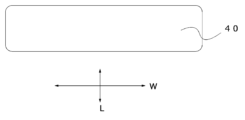
- FIG. 7 is a top view showing a sheet in another embodiment of the present disclosure.
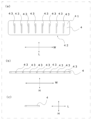
- FIG. 7 is a top view showing a sheet in another embodiment of the present disclosure.
- a pillow with a sheet 1 that supports the back of the user's M head will be described as an example.
- the pillow with sheet 1 of this embodiment is installed on a mattress or futon.
- the pillow with sheet 1 is formed to have a size in the width direction W, the front-rear direction L, and the height direction H, respectively.
- the pillow with sheet 1 of this embodiment is installed so that the width direction W generally coincides with the width direction of a mattress or futon (not shown).
- the front-rear direction L is installed so as to roughly match the length direction of the mattress or futon.
- FIG. 2 in the front-rear direction L, the side that supports the shoulders of the user M in the state of use is described as the front, and the side that supports the vicinity of the top of the head is described as the rear.
- the pillow with sheet 1 includes a pillow body (an example of a pillow) 2, a sheet 4, and a cover 6.
- the pillow main body 2 of this embodiment supports mainly the back of the head of the user M in a state of use. Thereby, the pillow main body 2 can assist the user M to maintain a stable posture.
- the pillow body 2 has approximately the same size as the outer shape of the pillow with sheet 1.
- the pillow body 2 is formed to have a size in the width direction W of about 500 mm to 1400 mm. Further, the size of the pillow body 2 in the width direction W may be about 200 mm to 1800 mm.
- the pillow body 2 of this embodiment is formed to approximately match the size in the width direction of the mattress or mattress on which the pillow with sheet 1 is installed. Thereby, the head of the user M can be stably supported even if the user M moves by turning over or the like.
- the pillow main body 2 is formed so that its size in the front-rear direction L roughly matches the length of the user M from the head to the shoulders. Further, the pillow body 2 is formed so that its size in the front-rear direction L is larger than the sheet 4 described later. That is, the pillow main body 2 is formed so that the size in the front-back direction L is about 350 mm to 800 mm. Further, the size of the pillow body 2 in the front-rear direction L may be approximately 100 mm to 900 mm.
- the thickness of the pillow body 2 in the height direction H is set to a height that can support the curve of the back of the user's M head.
- the thickness of the pillow body 2 in the height direction H is formed to be approximately 30 mm to 200 mm. Further, the thickness of the pillow body 2 in the height direction H may be approximately 10 mm to 300 mm.
- the pillow main body 2 has a generally rectangular parallelepiped shape in which the length in the width direction W is longer than the front-back direction L and the thickness in the height direction H.
- the pillow body 2 becomes thinner from the rear side to the front side in the front-rear direction L.
- the pillow main body 2 can stably support the head of the user M along the curve of the user's M body in the state of use.
- the pillow main body 2 is not limited to such a rectangular parallelepiped shape, but can be changed to various shapes.
- the pillow body 2 may be thinner from the front side to the rear side in the front-rear direction L, or may be flat over the entire surface.
- the pillow body 2 is formed of a foamed resin material such as polyurethane foam, or a bag whose filling is made of feathers, buckwheat hulls, resin pipes, beads, etc.
- the pillow body 2 of this embodiment is formed of a flexible polyurethane foam or a semi-rigid polyurethane foam containing an open cell structure.
- the pillow body 2 may be formed of materials other than the polyurethane foam commonly used for pillows, such as feathers, cotton, and resin. Further, the pillow body 2 may be made of a recycled material such as a polyurethane foam pulverizer compressed with a binder (adhesive). In any case, the pillow body 2 may be made of any material that can be used as a pillow. Note that the hardness and repulsive force are appropriately selected depending on the relationship with the sheet 4 described later.
- the pillow body 2 has a surface 21 on which the head of the user M is placed.
- the surface 21 is the side on which the head of the user M is placed when the pillow with sheet 1 is in use. That is, it goes without saying that the surface 21 may extend not only to the area where the head of the user M is in direct contact, but also to the entire surface extending in the width direction W and the front-rear direction L of the pillow body 2.
- a part of the body of the user M is placed on the surface 21 via a portion of the seat 4 and the cover 6.
- the surface 21 of this embodiment is inclined downward from near the center in the front-rear direction L to the front end.
- the sheet 4 is used to overlap the surface 21 of the pillow body 2.
- the seat 4 has a generally rectangular shape extending in the width direction W and the front-rear direction L.
- the sheet 4 is not limited to such a rectangular shape, but can be changed to various shapes.
- the sheet 4 may have an oval shape or a circular shape that covers a portion of the surface 21 of the pillow body 2.
- the sheet 4 may have a thickness that changes from the front side to the rear side in the front-rear direction L, or may be flat over the entire surface.
- the sheet 4 is arranged so as to cover part or all of the surface 21 of the pillow body 2.
- the sheet 4 of this embodiment is arranged so as to cover the vicinity of the center of the pillow body 2 in the front-rear direction L. Moreover, the sheet 4 is arranged so as to cover the entire pillow body 2 in the width direction W.
- the size of the sheet 4 in the width direction W is the same as or shorter than the pillow with sheet 1 and the pillow body 2.
- the sheet 4 is formed to have a size in the width direction W of about 500 mm to 1400 mm. Further, the size of the sheet 4 in the width direction W may be approximately 200 mm to 1600 mm. Furthermore, the size of the sheet 4 in the width direction W may span the entire length of the pillow body 2 in the width direction W.
- the sheet 4 of this embodiment has approximately the same size in the width direction W as the pillow with sheet 1 and the pillow body 2. Thereby, the sheet 4 is stably arranged between the user's M's head and the pillow body 2 regardless of the user's M position in the use state.
- the size of the sheet 4 in the front-rear direction L is smaller than the pillow with sheet 1 and the pillow body 2.
- the seat 4 is formed so that the size in the front-rear direction L is about 150 mm to 250 mm. Further, the size of the seat 4 in the front-rear direction L may be approximately 30 mm to 500 mm. Furthermore, the size of the sheet 4 in the front-rear direction L may span the entire length of the pillow body 2 in the front-rear direction L.
- the sheet 4 is formed so that the thickness in the height direction H is 25 mm or less.
- the thickness of the sheet 4 in the height direction H may be approximately 2 mm to 15 mm. Further, the thickness of the sheet 4 in the height direction H may be approximately 0.1 mm to 25 mm.
- the thickness of the sheet 4 in the height direction H is formed to be in a range of about 3 mm to 10 mm.
- the sheet 4 is formed of a resin material such as polyurethane, acrylic, melamine, and olefin resin such as polyethylene.
- the sheet 4 of this embodiment is formed of a flexible polyurethane foam or semi-rigid polyurethane foam having an open cell structure, which is a foamable resin material.
- the sheet 4 may be made of an elastic body such as rubber or elastomer, a gel-like resin material, or a gel-like resin material wrapped in a bag. Further, the sheet 4 may be a foamed material or a non-foamed material, but it is more preferably a foamed material. Furthermore, the sheet 4 may be formed of a recycled material made by compressing a polyurethane foam pulverizer with a binder (adhesive). Note that the hardness and repulsive force are appropriately selected depending on the relationship with the pillow body 2, which will be described later.
- the sheet 4 has a front surface 41, a back surface 42, and a plurality of through holes 43.
- the surface 41 is a surface against which the head of the user M comes into contact during use.
- the back surface 42 is a surface opposite to the front surface 41 and is arranged on the front surface 21 side of the pillow body 2.
- FIG. 3(a) is a top view showing the sheet 4 of this embodiment.
- FIG. 3(b) and FIG. 3(c) are a cross-sectional view and a side view, respectively, showing the sheet 4 of this embodiment.
- the seat 4 of this embodiment is represented in the same manner in a top view, a bottom view, a right side view, and a left side view.
- the plurality of through holes 43 penetrate from the front surface 41 to the back surface 42.
- the through hole 43 can provide ventilation between the front surface 41 and the back surface 42. Therefore, the through hole 43 can prevent air from remaining between the seat 4 and the pillow body 2 or between the seat 4 and the head of the user M.
- the sheet 4 can prevent the user M from feeling uncomfortable such as stuffiness between the sheet 4 and the sheet 4 during use.
- the through hole 43 has a linear shape extending along the front-rear direction L.
- the size of the through hole 43 in the width direction W may be about 5 mm to 20 mm. Further, the size of the through hole 43 in the width direction W may be approximately 0.5 mm to 50 mm. The size of the through hole 43 in the width direction W of the through hole 43 of this embodiment is about 10 mm.
- the size of the through hole 43 in the front-rear direction L only needs to be smaller than that of the sheet 4.
- the size of the through hole 43 in the front-rear direction L may be about 50 mm to 200 mm. Further, the size of the through hole 43 in the front-rear direction L may be about 0.5 mm to 450 mm.
- the size of the through hole 43 in this embodiment in the front-rear direction L is about 130 mm.
- the plurality of through holes 43 are arranged evenly on the left and right sides with the center in the width direction W interposed therebetween.
- a total of eight through holes 43 are provided, four on the right side and four on the left side when facing the sheet 4.
- the interval between the two through holes 43 arranged with the center in between is larger than the interval between other adjacent through holes 43.
- the spacing, number, and arrangement of the through holes 43 can be changed to various numerical values and arrangement according to the dimensions of the pillow body 2 and the sheet 4.
- the cover 6 is a knitted bag that covers the pillow body 2 and the sheet 4.
- the cover 6 includes a main body cover 61 and a sheet accommodating portion 62.
- the main body cover 61 accommodates the pillow main body 2.
- the sheet storage section 62 is sewn integrally with the main body cover 61 and stores the sheet 4 therein. Thereby, the cover 6 can prevent the positions of the pillow body 2 and the sheet 4 from shifting when the pillow with sheet 1 is used.
- the cover 6 of this embodiment is made of knit, it is not limited thereto, and the cover 6 may be made of cotton, rayon, or other fiber materials.
- the pillow body 2 and the sheet 4 have a difference in 40% compression hardness, which is the stress when subjected to 40% constant compression according to JIS K 6400-2; 2012, of 5N or more, preferably 15N or more, more preferably 30N or more, and even more preferably is formed to be 60N or more, particularly preferably 90N or more.
- the pillow body 2 and the sheet 4 have a difference in impact resilience according to JIS K 6400-3; 2012 of 5% or more, preferably 10% or more, more preferably 20% or more, still more preferably 30% or more, particularly preferably 40% or more.
- the breathability of the pillow main body 2 may be any value as long as it is a generally applicable value.
- the pillow body 2 is formed to have a 40% compression hardness of 10N to 75N.
- the 40% compression hardness of the pillow body 2 is not limited to this range, but may be within the range of 7N to 110N, or further within the range of 5N to 140N.
- the sheet 4 is formed to have a 40% compression hardness of 100N to 200N. Further, the 40% compression hardness of the sheet 4 may be within the range of 75N to 300N, or further within the range of 30N to 500N. In any case, the compression hardness of the pillow body 2 and the sheet 4 may be any value that can be selected within a range that satisfies the difference in compression hardness between the pillow body 2 and the sheet 4 described above.
- the rebound resilience of the pillow body 2 and the sheet 4 may be the same value or may be different values. That is, the rebound resilience of the pillow body 2 may be higher than that of the sheet 4, or the resilience of the sheet 4 may be higher than that of the pillow body 2. If there is a difference in impact resilience between the pillow body 2 and the sheet 4, it is preferable to select within a range that satisfies the above-mentioned difference in impact resilience between the pillow body 2 and the sheet 4.
- the rebound resilience of the pillow body 2 is set to 1% to 15%, more preferably 4 to 15%, and even more preferably 8%. It may be set to 15%.
- the rebound resilience of the sheet 4 is set to 16% to 96%, more preferably 20% to 70%, and even more preferably 30% to 65%, and the rebound resilience of the pillow body 2 and the sheet 4 is within this range. Just select a value that satisfies the difference.
- the user M can use the soft pillow body 2 in combination with the hard sheet 4.
- the user M can feel that the body pressure is dispersed by the pillow body 2 and that the head is supported by the sheet 4 in the vicinity of the head that is in contact with the sheet 4.
- the tactile feel of the pillow with sheet 1 can be adjusted without impairing the therapeutic effect of the pillow body 2.
- the pillow body 2 may be formed of polyurethane foam having a 40% compression hardness of 90N to 200N. Further, the 40% compression hardness of the pillow body 2 may be within the range of 50N to 300N, or further within the range of 30N to 500N.
- the sheet 4 may be formed of polyurethane foam and have a 40% compression hardness of 10N to 75N.
- the 40% compression hardness of the sheet 4 may be within the range of 7N to 110N, or even within the range of 5N to 140N.
- the compression hardness of the pillow body 2 and the sheet 4 is such that even if the compression hardness of the pillow body 2 is harder than the compression hardness of the sheet 4, the compression hardness of the sheet 4 is harder than the compression hardness of the pillow body 2.
- any value may be selected as long as it satisfies the difference in compression hardness between the pillow body 2 and the sheet 4 described above.
- the rebound resilience of the pillow body 2 and the sheet 4 may have the same value or may have different values. That is, the rebound resilience of the pillow body 2 may be higher than that of the sheet 4, or the resilience of the sheet 4 may be higher than that of the pillow body 2.
- the user M can use the hard pillow body 2 in combination with the soft sheet 4.
- the user M can feel that his or her head is firmly supported by the pillow body 2, and the sheet 4 can soften the feel of the head in the vicinity of the head that is in contact with the sheet 4.
- the tactile feel of the pillow with sheet 1 can be adjusted without impairing the therapeutic effect of the pillow body 2.
- the combination of the pillow body 2 and the sheet 4 may be such that the pillow body 2 and the sheet 4 have a different impact resilience, regardless of the compression hardness of the pillow body 2 and the sheet 4. That is, the resilience of the sheet 4 may be made higher than the resilience of the pillow body 2 by the difference in resilience between the pillow body 2 and the sheet 4 described above. On the other hand, the resilience of the pillow body 2 may be made higher than the resilience of the sheet 4 by the difference in resilience between the pillow body 2 and the sheet 4 described above.
- the sheet 40 of the sheet-equipped pillow in another embodiment may be formed without a through hole.
- the through hole 431 of the sheet 401 of the pillow with sheet in another embodiment may be in the shape of a rod extending in the width direction W.
- the plurality of through holes 431 may be evenly arranged on the sheet 401 at predetermined intervals.
- the through hole may have an arc shape that bulges outward in the width direction W.
- the through hole arranged on the right side when facing the sheet 4 may be formed in an arc shape that bulges to the right side.
- the through hole arranged on the left side when facing the sheet 4 may have an arc shape that bulges out to the left side.
- the shape of the through hole can be various shapes such as circular, elliptical, polygonal, and star-shaped in addition to the circular arc shape.
- the present disclosure is not limited to this. That is, the number of sheets 4 can be selected as appropriate according to the preference of the user M.
- the pillow 1 with a sheet may be used by stacking two or more sheets 4 on the pillow body 2.
- Pillow with sheet 2 Pillow body (pillow) 21: Surface 4 (40, 401): Sheet 43 (431): Through hole
Landscapes
- Health & Medical Sciences (AREA)
- General Health & Medical Sciences (AREA)
- Otolaryngology (AREA)
- Pulmonology (AREA)
- Bedding Items (AREA)
Priority Applications (3)
| Application Number | Priority Date | Filing Date | Title |
|---|---|---|---|
| JP2024542586A JP7766811B2 (ja) | 2022-08-24 | 2023-05-11 | シート付枕およびシート |
| JP2024192507A JP7818674B2 (ja) | 2022-08-24 | 2024-10-31 | シート付枕およびシート |
| JP2025247383A JP2026031786A (ja) | 2022-08-24 | 2025-12-12 | シート付枕の製造方法 |
Applications Claiming Priority (2)
| Application Number | Priority Date | Filing Date | Title |
|---|---|---|---|
| JP2022-132873 | 2022-08-24 | ||
| JP2022132873 | 2022-08-24 |
Publications (1)
| Publication Number | Publication Date |
|---|---|
| WO2024042786A1 true WO2024042786A1 (ja) | 2024-02-29 |
Family
ID=90012985
Family Applications (1)
| Application Number | Title | Priority Date | Filing Date |
|---|---|---|---|
| PCT/JP2023/017713 Ceased WO2024042786A1 (ja) | 2022-08-24 | 2023-05-11 | シート付枕およびシート |
Country Status (2)
| Country | Link |
|---|---|
| JP (3) | JP7766811B2 (https=) |
| WO (1) | WO2024042786A1 (https=) |
Citations (3)
| Publication number | Priority date | Publication date | Assignee | Title |
|---|---|---|---|---|
| JP2000279301A (ja) * | 1999-03-26 | 2000-10-10 | Ja Ick Koo | 枕 |
| JP2004123651A (ja) * | 2002-10-04 | 2004-04-22 | Kenji Nakamura | 保温消臭殺菌用配合剤および保温消臭殺菌用材 |
| JP2018051282A (ja) * | 2016-09-23 | 2018-04-05 | 公一郎 岡▲崎▼ | 枕装着用頚部牽引シート |
Family Cites Families (4)
| Publication number | Priority date | Publication date | Assignee | Title |
|---|---|---|---|---|
| JP2007037912A (ja) | 2005-08-05 | 2007-02-15 | Yamada Shuori Makura Kenkyusho:Kk | 高さが調整できるマクラ |
| JP3147396U (ja) | 2008-10-15 | 2008-12-25 | コロンビア・ワールド・カンパニー・リミテッド | 快眠枕 |
| ITVR20110206A1 (it) * | 2011-11-21 | 2013-05-22 | Technogel Italia Srl | Elemento di supporto e metodo per la realizzazione dello stesso |
| KR20210152946A (ko) * | 2020-06-09 | 2021-12-16 | 슌 티엔 훙 | 지지 구조물을 구비하는 베개 |
-
2023
- 2023-05-11 WO PCT/JP2023/017713 patent/WO2024042786A1/ja not_active Ceased
- 2023-05-11 JP JP2024542586A patent/JP7766811B2/ja active Active
-
2024
- 2024-10-31 JP JP2024192507A patent/JP7818674B2/ja active Active
-
2025
- 2025-12-12 JP JP2025247383A patent/JP2026031786A/ja active Pending
Patent Citations (3)
| Publication number | Priority date | Publication date | Assignee | Title |
|---|---|---|---|---|
| JP2000279301A (ja) * | 1999-03-26 | 2000-10-10 | Ja Ick Koo | 枕 |
| JP2004123651A (ja) * | 2002-10-04 | 2004-04-22 | Kenji Nakamura | 保温消臭殺菌用配合剤および保温消臭殺菌用材 |
| JP2018051282A (ja) * | 2016-09-23 | 2018-04-05 | 公一郎 岡▲崎▼ | 枕装着用頚部牽引シート |
Also Published As
| Publication number | Publication date |
|---|---|
| JP7818674B2 (ja) | 2026-02-20 |
| JPWO2024042786A1 (https=) | 2024-02-29 |
| JP2026031786A (ja) | 2026-02-24 |
| JP7766811B2 (ja) | 2025-11-10 |
| JP2025024711A (ja) | 2025-02-20 |
Similar Documents
| Publication | Publication Date | Title |
|---|---|---|
| CN101801243B (zh) | 具有多层结构的枕头 | |
| KR101015628B1 (ko) | 스프링을 이용한 기능성 방석 | |
| US6954953B2 (en) | Novelty cushion | |
| JP2009160039A (ja) | 枕 | |
| US20140053336A1 (en) | Long-filament fiber memory foam pillow | |
| KR102415257B1 (ko) | 포켓 스프링을 포함하는 베개 | |
| WO2024042786A1 (ja) | シート付枕およびシート | |
| JP3181090U (ja) | 枕 | |
| JP2019198413A (ja) | 枕 | |
| KR20170123155A (ko) | 탄성보강부재가 구비된 소파 | |
| JP6140028B2 (ja) | 枕 | |
| JP3206930U (ja) | マットレス | |
| JP3100278U (ja) | 多機能マット | |
| JP2002159375A (ja) | 寝 具 | |
| JP3217501U (ja) | 枕 | |
| JP3240313U (ja) | 枕 | |
| KR101674828B1 (ko) | 합성수지 베개 | |
| JP3233327U (ja) | ソファ | |
| JP2007007131A (ja) | 枕 | |
| JP2021048932A (ja) | 疼痛の除去マット | |
| KR102594561B1 (ko) | 사용자 체형 맞춤 기능성 베개 | |
| KR20180009618A (ko) | 궁형 건강 베개 | |
| JP2025026052A (ja) | クッション材 | |
| JP2016087340A (ja) | 枕及びクッション構造体 | |
| KR20180050966A (ko) | 침대용 매트리스 |
Legal Events
| Date | Code | Title | Description |
|---|---|---|---|
| 121 | Ep: the epo has been informed by wipo that ep was designated in this application |
Ref document number: 23855835 Country of ref document: EP Kind code of ref document: A1 |
|
| WWE | Wipo information: entry into national phase |
Ref document number: 2024542586 Country of ref document: JP |
|
| NENP | Non-entry into the national phase |
Ref country code: DE |
|
| 122 | Ep: pct application non-entry in european phase |
Ref document number: 23855835 Country of ref document: EP Kind code of ref document: A1 |