WO2024009441A1 - ディスクレスクライアント認証システム、認証サーバ、プログラムおよびディスクレスクライアント認証方法 - Google Patents
ディスクレスクライアント認証システム、認証サーバ、プログラムおよびディスクレスクライアント認証方法 Download PDFInfo
- Publication number
- WO2024009441A1 WO2024009441A1 PCT/JP2022/026872 JP2022026872W WO2024009441A1 WO 2024009441 A1 WO2024009441 A1 WO 2024009441A1 JP 2022026872 W JP2022026872 W JP 2022026872W WO 2024009441 A1 WO2024009441 A1 WO 2024009441A1
- Authority
- WO
- WIPO (PCT)
- Prior art keywords
- client
- diskless
- diskless client
- authentication
- server
- Prior art date
- Legal status (The legal status is an assumption and is not a legal conclusion. Google has not performed a legal analysis and makes no representation as to the accuracy of the status listed.)
- Ceased
Links
Images


Classifications
-
- H—ELECTRICITY
- H04—ELECTRIC COMMUNICATION TECHNIQUE
- H04L—TRANSMISSION OF DIGITAL INFORMATION, e.g. TELEGRAPHIC COMMUNICATION
- H04L63/00—Network architectures or network communication protocols for network security
- H04L63/08—Network architectures or network communication protocols for network security for authentication of entities
- H04L63/0876—Network architectures or network communication protocols for network security for authentication of entities based on the identity of the terminal or configuration, e.g. MAC address, hardware or software configuration or device fingerprint
-
- G—PHYSICS
- G06—COMPUTING OR CALCULATING; COUNTING
- G06F—ELECTRIC DIGITAL DATA PROCESSING
- G06F21/00—Security arrangements for protecting computers, components thereof, programs or data against unauthorised activity
- G06F21/30—Authentication, i.e. establishing the identity or authorisation of security principals
- G06F21/44—Program or device authentication
Definitions
- the present invention relates to a diskless client authentication system, an authentication server, a program, and a diskless client authentication method that authenticate diskless clients before system startup.
- a diskless client is a system that does not store an OS (Operating System), application programs, user data, etc., and relies on a server (file server).
- Diskless clients do not have hard disk drives (HDDs), which are prone to failures, so they are less prone to failures, they can easily replicate systems with the same configuration, and are easy to set up; once reset, they restart with the same configuration as the last time they were started. It has advantages such as high recovery since it starts up.
- HDDs hard disk drives
- the general operations at startup of a diskless client are as follows (1) to (3).
- (1) Obtain and configure network setting information (for example, IP address, netmask value, gateway address, etc.) using DHCP (Dynamic Host Configuration Protocol) or the like.
- (2) Obtain a boot file from a TFTP (Trivial File Transfer Protocol) server and execute it.
- (3) Obtain the OS (OS loader and other files) using NFS (Network File System), etc., and start the OS.
- NFS Network File System
- the diskless client is a technology that assumes that the client and network are reliable, and the startup operation does not include client or server authentication.
- client authentication is required.
- a terminal authentication method for a diskless client three terminal authentication methods are considered in Non-Patent Document 1.
- Non-Patent Document 1 proposes authentication using MAC (Media Access Control Address), authentication using public key, and authentication using line (for example, NGN (Next Generation Network) standard).
- MAC Media Access Control Address
- NGN Next Generation Network
- the usable scenes are limited, the de facto software used needs to be modified, and the firmware installed in the diskless client needs to be modified.
- the present invention has been made in view of this background, and an object of the present invention is to enable authentication of diskless clients using popular technology.
- a diskless client authentication system includes a filter on a communication path between an authentication server for a diskless client and a file server storing a startup file for the diskless client.
- a diskless client authentication system comprising: a filter that permits or prohibits communication between the diskless client and the file server according to an instruction from the authentication server; a storage unit including a client management database that stores identification information and authentication status in association with each other; an address allocation unit that executes a process of allocating a network address to the diskless client; and authenticating the diskless client to which a network address has already been allocated.
- a filter control unit that instructs the filter to permit or prohibit communication between the diskless client and the file server, and a diskless client to which a network address has already been assigned refer to the client management database. If the diskless client is in an unauthenticated state, the authentication unit is instructed to execute a process to authenticate the diskless client, and if the authentication process is successful, the filter control unit is instructed to authenticate the diskless client and the file server. and a client control unit that instructs to permit communication.
- FIG. 1 is a diagram for explaining the overall configuration of a diskless client authentication system according to the present embodiment.
- FIG. 2 is a functional block diagram of an authentication server according to the present embodiment.
- FIG. 2 is a data configuration diagram of a client management database according to the present embodiment.
- FIG. 3 is a sequence diagram of authentication processing according to the present embodiment.
- FIG. 3 is a sequence diagram of termination processing according to the present embodiment.
- FIG. 2 is a hardware configuration diagram showing an example of a computer that implements the functions of an authentication server according to the present embodiment.
- the diskless client authentication system includes an authentication server and a filter.
- the filter is located between the diskless client and a file server (storage) that stores boot files and OS files, and filters communication data.
- the filter is, for example, a router (edge router), and filters IP datagrams based on the MAC address, network address, and protocol.
- the filter prohibits communication between diskless clients and file servers. However, if there is a permission instruction from the authentication server, the filter allows communication between the diskless client and the file server until a prohibition instruction is received.
- the authentication server uses standard hardware-based management authentication functionality to authenticate the diskless client after assigning an IP address to the diskless client using DHCP. If the authentication is successful, the authentication server instructs the filter to allow communication between the diskless client and the file server, and instructs the diskless client to restart. The restarted diskless client is able to communicate with the file server and starts the OS according to the normal procedure. If the authentication fails, communication between the diskless client and the file server remains prohibited, and the diskless client cannot start the OS.
- diskless client authentication system only authenticated diskless clients can boot (the OS) using a diskless client equipped with popular technology or an existing file server. There is no need to modify diskless clients or file servers, and diskless client systems can be easily introduced.
- FIG. 1 is a diagram for explaining the overall configuration of a diskless client authentication system 10 according to this embodiment.
- the diskless client authentication system 10 includes an authentication server 100 and a filter 230.
- Diskless client authentication system 10 may further include a boot file server 210 and a storage server 220.
- the boot file server 210 is, for example, a TFTP server, and transmits a boot file (for example, a PXE (Preboot eXecution Environment) boot image) in response to a request from the diskless client 280.
- the storage server 220 is, for example, an NFS server, and exchanges the OS, application programs, and user data in response to requests from the diskless client 280.
- the boot file server 210 and the storage server 220 will be collectively referred to as the file server 200.
- the filter 230 is installed between the network to which the diskless client 280 is connected and the network to which the file server 200 is connected, and filters communication data.
- the filter 230 performs filtering based on, for example, physical addresses, network addresses (IP addresses), and protocols (for example, port numbers).
- the filter 230 permits communication for setting network information including a network address and communication for authentication exchanged between the diskless client 280 and the authentication server 100. However, the filter 230 basically prohibits (filters) communication between the diskless client 280 and the file server 200. When receiving a permission instruction from the authentication server 100, the filter 230 allows communication between the specified diskless client 280 and the file server 200. Communication between other diskless clients 280 and file server 200 remains prohibited. When receiving a prohibition instruction from the authentication server 100, the filter 230 prohibits communication between the instructed diskless client 280 and the file server 200.
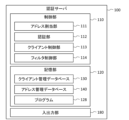
- FIG. 2 is a functional block diagram of the authentication server 100 according to this embodiment.
- Authentication server 100 is a computer and includes a control section 110, a storage section 120, and an input/output section 180.
- User interface devices such as a display, keyboard, and mouse are connected to the input/output unit 180.
- the input/output unit 180 includes a communication device and can send and receive data to and from the filter 230 and the diskless client 280. Further, a media drive may be connected to the input/output unit 180, so that data can be exchanged using a recording medium.
- the storage unit 120 includes storage devices such as ROM (Read Only Memory), RAM (Random Access Memory), and SSD (Solid State Drive).
- the storage unit 120 stores a client management database 130, an address management database 140, and a program 128.
- the program 128 includes a description of a processing procedure of the authentication server 100 in an authentication process (see FIG. 4, which will be described later), which will be described later.
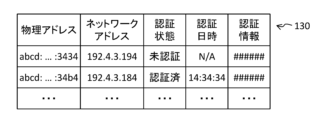
- FIG. 3 is a data configuration diagram of the client management database 130 according to this embodiment.
- the client management database 130 is, for example, data in a tabular format, and each row (record) indicates the status of the diskless client 280.
- the record includes columns (attributes) of physical address, network address, authentication status, authentication date and time, and authentication information.
- the physical address indicates the physical address of the diskless client 280, and is, for example, an Ethernet address.
- the physical address is referred to as identification information of the diskless client 280.
- the network address indicates a network address assigned to the diskless client 280, and is, for example, an assigned IP address.
- the authentication status indicates whether or not the diskless client 280 has successfully authenticated (authenticated/unauthenticated (including pre-authentication and authentication failure)).
- the authentication date and time indicates the date and time (only the time is shown in FIG. 3) when the diskless client 280 was last authenticated.
- the authentication information indicates information that is referred to when authenticating the diskless client 280, and is, for example, a public key or secret information (password) shared with the diskless client 280.
- the authentication information is preset (registered) together with the physical address.
- Client management database 130 may also include other information (attributes). For example, it may include the date and time of successful authentication, the date and time of assignment of a network address, etc.
- the address management database 140 stores network addresses assigned to the diskless clients 280. Each network address is associated with whether it has been assigned or not, the deadline for assignment, the physical address of the assigned diskless client 280, the physical address of the last assigned diskless client 280, and so on.
- the control unit 110 includes a CPU (Central Processing Unit), and includes an address assignment unit 111, an authentication unit 112, a client control unit 113, and a filter control unit 114.
- CPU Central Processing Unit
- the control unit 110 includes a CPU (Central Processing Unit), and includes an address assignment unit 111, an authentication unit 112, a client control unit 113, and a filter control unit 114.
- the address assignment unit 111 assigns a network address to the diskless client 280.
- the address allocation unit 111 also notifies the diskless client 280 of various network setting information (for example, the default gateway and the network address of the boot file server 210).
- the address allocation unit 111 performs allocation and notification using, for example, DHCP.
- the authentication unit 112 authenticates the diskless client 280. At the time of starting authentication, the diskless client 280 has a network address assigned to it, but is in a state before the OS is started. The authentication unit 112 performs authentication using the authentication function of the hardware-based management of the diskless client 280. Examples of hardware-based management include Intel AMT (Active Management Technology) and AMD PRO. The authentication unit 112 authenticates the diskless client 280 using an authentication function that is standardly installed in the hardware of the diskless client 280. The client control unit 113 controls the diskless client 280 by instructing it to perform authentication processing, restarting, and the like.
- the filter control unit 114 instructs the filter 230 to filter the communication between the diskless client 280 and the file server 200. For example, the filter control unit 114 notifies the filter of the physical address and network address of the diskless client 280 and instructs the filter to permit communication between the diskless client 280 and the file server 200.
- the filter 230 refers to the physical address, network address, port number (protocol identification information), etc., and permits passage of communication data exchanged between the diskless client 280 and the file server 200.
- FIG. 4 is a sequence diagram of authentication processing according to this embodiment.
- the processing after the diskless client 280 starts up (powers on) until it starts up the OS will be described.
- the diskless client 280 is referred to as a "client”
- the client control unit 113 is referred to as a "C control unit”.
- step S11 the diskless client 280 and the address allocation unit 111 execute network address allocation processing using, for example, DHCP. In addition to network address assignment, the default gateway and boot file server 210 addresses are notified.
- the address assignment unit 111 uses the network address in the network address of the record. Assign.
- the address allocation unit 111 If there is no record of the diskless client 280 in the client management database 130 (unregistered), the address allocation unit 111 notifies the diskless client 280 of an error and does not allocate an address. When the authentication status of the record is "unauthenticated”, the address allocation unit 111 refers to the address management database 140 and allocates an unallocated network address. The reason for processing in this way will be described later.
- step S12 the address allocation unit 111 updates the client management database 130.
- the address assignment unit 111 updates the network address of the record of the diskless client 280 specified by the physical address to the network address assigned in step S11. Note that the authentication status of the record is "unauthenticated”.
- the address assignment unit 111 When the authentication state of the client management database 130 is "authenticated" and a certain network address is assigned to the network address, the address assignment unit 111 does not update the client management database 130. In step S13, the address assignment unit 111 notifies the client control unit 113 of the physical address of the diskless client 280 to which the address has been assigned.
- step S14 the client control unit 113 refers to the client management database 130 and obtains the authentication status of the diskless client 280 notified in step S13.
- the client control unit 113 ends the authentication process if the authentication has been completed (step S14 ⁇ YES), and proceeds to step S15 if the client has not been authenticated (step S14 ⁇ NO).
- step S14 ⁇ YES the authentication has been completed
- step S15 the client has not been authenticated
- step S15 the client control unit 113 instructs the authentication unit 112 to perform authentication processing for the diskless client 280.
- the diskless client 280 and the authentication unit 112 execute authentication processing.
- step S17 the authentication unit 112 updates the client management database 130. To explain in detail, the authentication unit 112 updates the authentication status to "authenticated” or “unauthenticated” depending on the success or failure of authentication.
- step S18 the authentication unit 112 notifies the client control unit 113 of the result of the authentication process (see step S16).
- the client control unit 113 proceeds to step S20 if the authentication is successful (step S19 ⁇ YES), and ends the authentication process if it is unsuccessful (step S19 ⁇ NO).
- step S20 the client control unit 113 notifies the physical address and network address of the diskless client 280 and instructs the filter control unit 114 to permit communication between the diskless client 280 and the file server 200.
- step S21 the filter control unit 114 notifies the physical address and network address of the diskless client 280 and instructs the filter 230 to permit communication between the diskless client 280 and the file server 200.
- step S22 the client control unit 113 instructs the diskless client 280 to restart.
- the diskless client 280 that has received the restart instruction restarts and returns to step S11.
- the diskless client 280 and the file server 200 are able to communicate with each other, so normal startup processing can be performed. That is, the restarted diskless client 280 acquires network information such as a network address (see step S11), acquires and executes a boot file from the boot file server 210, and loads the OS loader and other files from the storage server 220. Boot the OS by acquiring and executing it.
- the assigned network address is the same as the previous one (the network address acquired in the unauthenticated state, see step S11) since it is in the authenticated state.
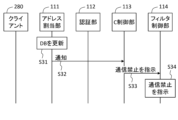
- FIG. 5 is a sequence diagram of the termination process according to this embodiment. With reference to FIG. 5, processing will be explained when an address release notification is received from the diskless client 280, when the network address allocation deadline has passed, or when an instruction to disconnect the diskless client 280 is received from the administrator. .
- step S31 the address allocation unit 111 updates the client management database 130 (see FIG. 3). To explain in detail, the address allocation unit 111 sets the network address corresponding to the diskless client 280 to "N/A”, sets the authentication state to "unauthenticated”, and sets the authentication date and time to "N/A". Note that "N/A” is an abbreviation for Not Applicable, meaning not applicable, inapplicable, invalid, etc. Further, the address assignment unit 111 updates the network address assigned to the diskless client 280 in the address management database 140 to an unassigned state.
- step S32 the address allocation unit 111 notifies the client control unit 113 of the physical address of the diskless client 280.
- the client control unit 113 notifies the physical address of the diskless client 280 and instructs the filter control unit 114 to prohibit communication between the diskless client 280 and the file server 200.
- the filter control unit 114 notifies the physical address of the diskless client 280 and instructs the filter 230 to prohibit (filter) communication between the diskless client 280 and the file server 200.
- the authentication server 100 allocates a network address (see step S11), performs authentication (see step S16), and if successful (see step S19 ⁇ YES), authenticates the diskless client 280 with the file server 200. Communication is permitted (see step S21). If the authentication is not successful, such as not being registered in the client management database 130, the diskless client 280 cannot communicate with the file server 200 and cannot start the OS.
- the authentication process is performed using the hardware-based management function, which is a popular technology, and can be used with many diskless clients on the market. Furthermore, there is no need for any intervention by the user of the diskless client 280, and the usability remains the same as in the past.
- Restart instruction The authentication server 100 of the embodiment described above instructs the diskless client 280 to restart (see step S22) after the authentication process (see step S16) is successful. If the diskless client 280 is attempting to access the boot file server 210 during the authentication process, the reboot instruction may be omitted.
- the restart instruction may be omitted. From the moment communication is permitted (see step S21), the diskless client 280 can access the boot file server 210, and can continue normal startup processing including network address acquisition (see step S11).
- the authentication server 100 includes an address assignment unit 111 and assigns a network address to the diskless client 280, but it may be separated as a network address assignment server (DHCP server). However, the already assigned network address is assigned to the authenticated diskless client 280.
- DHCP server network address assignment server
- the address assignment unit 111 updates the authentication status of the diskless client 280 in the client management database 130 (see FIG. 3) to "unauthenticated” (see step S31 in FIG. 5).
- the client control unit 113 may update after receiving the notification (see step S32).
- the present invention can take various other embodiments, and furthermore, various changes such as omissions and substitutions can be made without departing from the gist of the present invention. These embodiments and their modifications are included within the scope and gist of the invention described in this specification and the like, as well as within the scope of the invention described in the claims and its equivalents.
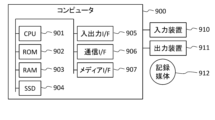
- FIG. 6 is a hardware configuration diagram showing an example of a computer 900 that implements the functions of the authentication server 100 according to this embodiment.
- the computer 900 includes a CPU 901, a ROM 902, a RAM 903, an SSD 904, an input/output interface 905 (indicated as an input/output I/F (Interface) in FIG. 6), a communication interface 906 (indicated as a communication I/F in FIG. 6), and a media interface. 907 (described as media I/F in FIG. 6).
- the computer 900 may include an HDD (Hard Disc Drive) instead of the SSD 904, or may further include an HDD in addition to the SSD 904.
- HDD Hard Disc Drive
- the CPU 901 operates based on a program stored in the ROM 902 or the SSD 904, and is controlled by the control unit 110 in FIG.
- the ROM 902 stores a boot program executed by the CPU 901 when the computer 900 is started, programs related to the hardware of the computer 900, and the like.
- the CPU 901 controls an input device 910 such as a mouse and a keyboard, and an output device 911 such as a display and a printer via an input/output interface 905.
- the CPU 901 obtains data from the input device 910 via the input/output interface 905 and outputs the generated data to the output device 911.
- the SSD 904 stores programs executed by the CPU 901 and data used by the programs.
- the communication interface 906 receives data from other devices not shown (for example, the filter 230 or the diskless client 280) via the communication network and outputs it to the CPU 901, and also outputs data generated by the CPU 901 via the communication network. and send it to another device.
- Media interface 907 reads a program or data stored in recording medium 912 and outputs it to CPU 901 via RAM 903.
- the CPU 901 loads a program from the recording medium 912 onto the RAM 903 via the media interface 907, and executes the loaded program.
- the recording medium 912 is an optical recording medium such as a DVD (Digital Versatile Disk), a magneto-optical recording medium such as an MO (Magneto Optical disk), a magnetic recording medium, a conductive memory tape medium, a semiconductor memory, or the like.
- the CPU 901 of the computer 900 executes the function of the authentication server 100 by executing the program 128 (see FIG. 2) loaded onto the RAM 903. Realize.
- the CPU 901 reads the program from the recording medium 912 and executes it.
- the CPU 901 may read a program from another device via a communication network, or may install the program 128 from the recording medium 912 into the SSD 904 and execute it.
- the diskless client authentication system 10 includes an authentication server 100 for a diskless client 280, and a file server that stores the diskless client 280 and startup files (boot files and OS files) for the diskless client 280. 200, and includes a filter 230 on the communication path with 200.
- the filter 230 allows or prohibits communication between the diskless client 280 and the file server 200 according to instructions from the authentication server 100.
- the authentication server 100 includes a storage unit 120 including a client management database 130 that stores identification information (physical address) of the diskless client 280 and authentication status in association with each other.
- the authentication server 100 includes an address assignment unit 111 that executes a process of assigning a network address to the diskless client 280.
- the authentication server 100 includes an authentication unit 112 that executes processing to authenticate the diskless client 280 to which a network address has been assigned.
- the authentication server 100 includes a filter control unit 114 that instructs the filter 230 to permit or prohibit communication between the diskless client 280 and the file server 200. If the diskless client 280 to which a network address has already been assigned refers to the client management database 130 and is in an unauthenticated state, the authentication server 100 instructs the authentication unit to execute processing to authenticate the diskless client, and authenticates the diskless client. If the processing is successful, a client control unit 113 is provided that instructs the filter control unit 114 to permit communication between the diskless client 280 and the file server 200.
- the diskless client 280 that has been successfully authenticated becomes able to access the file server 200 and successfully starts (the OS/system).
- the diskless client 280 that has failed authentication cannot access the file server 200 and cannot start up.
- Authentication can be performed using hardware-based management functionality, which is a popular technology and is available in many diskless clients on the market.
- the client control unit 113 When instructing the filter control unit 114 to permit communication between the diskless client 280 and the file server 200, the client control unit 113 according to the embodiment described above instructs the diskless client 280 to restart.
- the file server 200 can be accessed after acquiring the network address again. Then you will be able to start it.
- the client control unit 113 When the client control unit 113 according to the above-described embodiment receives a release notification of the allocated network address from the diskless client 280, when the network address allocation deadline has been reached, and (for example, from the administrator) In either case, the filter control unit 114 is instructed to prohibit communication between the diskless client 280 and the file server 200, and the authentication state of the diskless client 280 is changed to unauthenticated. do.
- the diskless client 280 whose network address has been released, whose network address has expired, or who has been designated by the administrator cannot access the file server 200. Furthermore, it cannot be restarted without authentication.
- the filter 230 performs communication between the diskless client 280 and the file server 200 based on at least one of a physical address, a network address, and protocol identification information (for example, a boat number) of the diskless client 280 and the file server 200. Allow or disallow communication data to pass through.
- a standard router or switch can be used as the filter 230.
- Diskless client authentication system 100 Authentication server 111 Address allocation unit 112 Authentication unit 113 Client control unit 114 Filter control unit 130 Client management database 200 File server 230 Filter 280 Diskless client
Landscapes
- Engineering & Computer Science (AREA)
- Computer Security & Cryptography (AREA)
- General Engineering & Computer Science (AREA)
- Computer Hardware Design (AREA)
- Computer Networks & Wireless Communication (AREA)
- Computing Systems (AREA)
- Power Engineering (AREA)
- Signal Processing (AREA)
- Theoretical Computer Science (AREA)
- Software Systems (AREA)
- Physics & Mathematics (AREA)
- General Physics & Mathematics (AREA)
- Stored Programmes (AREA)
Abstract
Description
本発明は、このような背景に鑑みてなされたものであり、普及技術を用いたディスクレスクライアントの認証を可能にすることを課題とする。
以下に本発明を実施するための形態(実施形態)におけるディスクレスクライアント認証システムについて説明する。ディスクレスクライアント認証システムは、認証サーバとフィルタとを含んで構成される。フィルタは、ディスクレスクライアントと、ブート用ファイルやOSのファイルを格納するファイルサーバ(ストレージ)との間にあり、通信データをフィルタリングする。フィルタは、例えばルータ(エッジルータ)であって、MACアドレスやネットワークアドレス、プロトコルを基にIPデータグラムのフィルタリングを行う。フィルタは、ディスクレスクライアントとファイルサーバ間の通信を原則として禁止する。しかし、認証サーバからの許可の指示があればフィルタは、禁止の指示があるまでディスクレスクライアントとファイルサーバ間の通信を許可する。
図1は、本実施形態に係るディスクレスクライアント認証システム10の全体構成を説明するための図である。ディスクレスクライアント認証システム10は、認証サーバ100とフィルタ230とを含んで構成される。ディスクレスクライアント認証システム10は、さらにブートファイルサーバ210およびストレージサーバ220を含んでもよい。
図2は、本実施形態に係る認証サーバ100の機能ブロック図である。認証サーバ100はコンピュータであり、制御部110、記憶部120、および入出力部180を備える。入出力部180には、ディスプレイやキーボード、マウスなどのユーザインターフェイス機器が接続される。入出力部180が通信デバイスを備え、フィルタ230やディスクレスクライアント280とのデータ送受信が可能である。また入出力部180にメディアドライブが接続され、記録媒体を用いたデータのやり取りが可能であってもよい。
記憶部120は、ROM(Read Only Memory)やRAM(Random Access Memory)、SSD(Solid State Drive)などの記憶機器を含んで構成される。記憶部120には、クライアント管理データベース130、アドレス管理データベース140、およびプログラム128が記憶される。プログラム128には、後記する認証処理(後記する図4参照)における認証サーバ100の処理手順の記述が含まれる。
認証状態は、ディスクレスクライアント280が認証に成功済か否か(認証済/未認証(認証前、認証失敗を含む))を示す。認証日時は、ディスクレスクライアント280が最後に認証された日時(図3では時刻のみを記載)を示す。
クライアント管理データベース130は、他の情報(属性)を含んでもよい。例えば認証に成功した日時や、ネットワークアドレスが割り当てられた日時などを含んでもよい。
制御部110は、CPU(Central Processing Unit)を含んで構成され、アドレス割当部111、認証部112、クライアント制御部113、およびフィルタ制御部114が備わる。
クライアント制御部113は、ディスクレスクライアント280に対して認証処理や再起動などを指示して制御する。
図4は、本実施形態に係る認証処理のシーケンス図である。図4を参照しながら、ディスクレスクライアント280が起動(電源投入)以降の、OSを起動するまでの処理を説明する。なお図4では、ディスクレスクライアント280を「クライアント」、クライアント制御部113を「C制御部」と記載している。
ステップS13においてアドレス割当部111は、アドレスを割り当てたディスクレスクライアント280の物理アドレスをクライアント制御部113に通知する。
ステップS16においてディスクレスクライアント280と認証部112とは、認証処理を実行する。
ステップS17において認証部112は、クライアント管理データベース130を更新する。詳しく説明すると認証部112は、認証の成功または失敗に応じて、認証状態を「認証済」または「未認証」に更新する。
ステップS19においてクライアント制御部113は、認証が成功ならば(ステップS19→YES)ステップS20に進み、失敗ならば(ステップS19→NO)認証処理を終了する。
ステップS21においてフィルタ制御部114は、ディスクレスクライアント280の物理アドレスとネットワークアドレスとを通知して、当該ディスクレスクライアント280とファイルサーバ200との通信を許可するようにフィルタ230に指示する。
図5は、本実施形態に係る終了処理のシーケンス図である。図5を参照して、ディスクレスクライアント280からのアドレス解放通知を受信した場合や、ネットワークアドレスの割り当て期限が過ぎた場合、管理者からディスクレスクライアント280の切断指示を受けた場合などの処理を説明する。
ステップS33においてクライアント制御部113は、ディスクレスクライアント280の物理アドレスを通知して、当該ディスクレスクライアント280とファイルサーバ200との通信を禁止するようにフィルタ制御部114に指示する。
ステップS34においてフィルタ制御部114は、ディスクレスクライアント280の物理アドレスを通知して、当該ディスクレスクライアント280とファイルサーバ200との通信を禁止(フィルタリング)するようにフィルタ230に指示する。
認証サーバ100は、ディスクレスクライアント280がネットワークに接続または起動すると、ネットワークアドレスを割り当て(ステップS11参照)、認証を行って(ステップS16参照)成功すれば(ステップS19→YES参照)ファイルサーバ200との通信を許可する(ステップS21参照)。クライアント管理データベース130に未登録など認証に成功しない場合には、ディスクレスクライアント280はファイルサーバ200と通信ができず、OSを起動できない。認証処理は、普及技術であるハードウェアベースマネージメントの機能により実行されており、市場に流通する多くのディスクレスクライアントで利用可能である。またディスクレスクライアント280の利用者の介在不要であり、従来の使い勝手と変わらない。
上記した実施形態の認証サーバ100は、認証処理(ステップS16参照)に成功した後にディスクレスクライアント280に再起動を指示している(ステップS22参照)。認証処理を行っている間中、ディスクレスクライアント280がブートファイルサーバ210へのアクセスを試行しているならば、再起動の指示をなくしてもよい。
以上、本発明のいくつかの実施形態について説明したが、これらの実施形態は、例示に過ぎず、本発明の技術的範囲を限定するものではない。例えば認証サーバ100は、アドレス割当部111を備え、ディスクレスクライアント280にネットワークアドレスを割り当てているが、ネットワークアドレス割り当てサーバ(DHCPサーバ)として分離してもよい。但し認証済みのディスクレスクライアント280に対しては、割り当て済のネットワークアドレスを割り当てる。
上記した実施形態に係る認証サーバ100は、例えば図6に示すような構成のコンピュータ900によって実現される。図6は、本実施形態に係る認証サーバ100の機能を実現するコンピュータ900の一例を示すハードウェア構成図である。コンピュータ900は、CPU901、ROM902、RAM903、SSD904、入出力インターフェイス905(図6では入出力I/F(Interface)と記載)、通信インターフェイス906(図6では通信I/Fと記載)、およびメディアインターフェイス907(図6ではメディアI/Fと記載)を備える。コンピュータ900は、SSD904に替わりにHDD(Hard Disc Drive)を備えてもよいし、SSD904に加えて、さらにHDDを備えてもよい。
CPU901は、入出力インターフェイス905を介して、マウスやキーボードなどの入力装置910、およびディスプレイやプリンタなどの出力装置911を制御する。CPU901は、入出力インターフェイス905を介して、入力装置910からデータを取得するとともに、生成したデータを出力装置911へ出力する。
メディアインターフェイス907は、記録媒体912に格納されたプログラムまたはデータを読み取り、RAM903を介してCPU901へ出力する。CPU901は、プログラムを、メディアインターフェイス907を介して記録媒体912からRAM903上にロードし、ロードしたプログラムを実行する。記録媒体912は、DVD(Digital Versatile Disk)などの光学記録媒体、MO(Magneto Optical disk)などの光磁気記録媒体、磁気記録媒体、導体メモリテープ媒体または半導体メモリなどである。
以下に、ディスクレスクライアント認証システム10の効果を説明する。
フィルタ230は、認証サーバ100の指示により、ディスクレスクライアント280とファイルサーバ200との通信を許可または禁止する。
認証サーバ100は、ディスクレスクライアント280の識別情報(物理アドレス)と認証状態とを関連付けて記憶するクライアント管理データベース130を備える記憶部120を備える。
認証サーバ100は、ディスクレスクライアント280に対してネットワークアドレスを割り当てる処理を実行するアドレス割当部111を備える。
認証サーバ100は、ネットワークアドレスが割り当て済のディスクレスクライアント280を認証する処理を実行する認証部112を備える。
認証サーバ100は、フィルタ230に、ディスクレスクライアント280とファイルサーバ200との通信を許可または禁止を指示するフィルタ制御部114を備える。
認証サーバ100は、ネットワークアドレス割り当て済のディスクレスクライアント280がクライアント管理データベース130を参照して未認証の状態であれば、前記認証部に指示して当該ディスクレスクライアントを認証する処理を実行し、認証する処理が成功すれば、フィルタ制御部114に当該ディスクレスクライアント280とファイルサーバ200との通信を許可するように指示するクライアント制御部113を備える。
100 認証サーバ
111 アドレス割当部
112 認証部
113 クライアント制御部
114 フィルタ制御部
130 クライアント管理データベース
200 ファイルサーバ
230 フィルタ
280 ディスクレスクライアント
Claims (7)
- ディスクレスクライアントの認証サーバ、および、前記ディスクレスクライアントと当該ディスクレスクライアントの起動用ファイルを格納したファイルサーバとの通信経路上にあるフィルタを含んで構成されるディスクレスクライアント認証システムであって、
前記フィルタは、
前記認証サーバの指示により、前記ディスクレスクライアントと前記ファイルサーバとの通信を許可または禁止し、
前記認証サーバは、
前記ディスクレスクライアントの識別情報と認証状態とを関連付けて記憶するクライアント管理データベースを備える記憶部と、
前記ディスクレスクライアントに対してネットワークアドレスを割り当てる処理を実行するアドレス割当部と、
ネットワークアドレスが割り当て済の前記ディスクレスクライアントを認証する処理を実行する認証部と、
前記フィルタに、前記ディスクレスクライアントと前記ファイルサーバとの通信を許可または禁止を指示するフィルタ制御部と、
ネットワークアドレス割り当て済のディスクレスクライアントが前記クライアント管理データベースを参照して未認証の状態であれば、前記認証部に指示して当該ディスクレスクライアントを認証する処理を実行し、
前記認証する処理が成功すれば、前記フィルタ制御部に当該ディスクレスクライアントと前記ファイルサーバとの通信を許可するように指示するクライアント制御部と、を備える
ディスクレスクライアント認証システム。 - 前記クライアント制御部は、
前記フィルタ制御部に前記ディスクレスクライアントと前記ファイルサーバとの通信を許可するように指示する際に、当該ディスクレスクライアントに再起動を指示する
請求項1に記載のディスクレスクライアント認証システム。 - 前記クライアント制御部は、
前記ディスクレスクライアントから、割り当てたネットワークアドレスの解放通知を受け取った場合、
前記ネットワークアドレスの割り当て期限に達した場合、および、
前記ディスクレスクライアントの切断指示を受けた場合の何れかの場合に、
前記フィルタ制御部に当該ディスクレスクライアントと前記ファイルサーバとの通信を禁止するように指示するとともに、当該ディスクレスクライアントの認証状態を未認証にする
請求項1に記載のディスクレスクライアント認証システム。 - 前記フィルタは、
前記ディスクレスクライアント、および、前記ファイルサーバの、物理アドレス、ネットワークアドレス、およびプロトコル識別情報の少なくとも1つを基に、前記ディスクレスクライアントと前記ファイルサーバとの間でやり取りされる通信データの通過を許可または禁止する
請求項1に記載のディスクレスクライアント認証システム。 - ディスクレスクライアントと当該ディスクレスクライアントの起動用ファイルを格納したファイルサーバとの通信経路上にあって、前記ディスクレスクライアントと前記ファイルサーバとの通信を許可または禁止するフィルタに通信接続され、前記ディスクレスクライアントを認証する認証サーバであって、
前記ディスクレスクライアントの識別情報と認証状態とを関連付けて記憶するクライアント管理データベースを備える記憶部と、
前記ディスクレスクライアントに対してネットワークアドレスを割り当てる処理を実行するアドレス割当部と、
ネットワークアドレスが割り当て済の前記ディスクレスクライアントを認証する処理を実行する認証部と、
前記フィルタに、前記ディスクレスクライアントと前記ファイルサーバとの通信を許可または禁止を指示するフィルタ制御部と、
ネットワークアドレス割り当て済のディスクレスクライアントが前記クライアント管理データベースを参照して未認証の状態であれば、前記認証部に指示して当該ディスクレスクライアントを認証する処理を実行し、
前記認証する処理が成功すれば、前記フィルタ制御部に当該ディスクレスクライアントと前記ファイルサーバとの通信を許可するように指示するクライアント制御部と、を備える
認証サーバ。 - コンピュータを請求項5の認証サーバとして機能させるためのプログラム。
- ディスクレスクライアントと当該ディスクレスクライアントの起動用ファイルを格納したファイルサーバとの通信経路上にあって、前記ディスクレスクライアントと前記ファイルサーバとの通信を許可または禁止するフィルタに通信接続され、前記ディスクレスクライアントを認証する認証サーバのディスクレスクライアント認証方法であって、
前記認証サーバは、
前記ディスクレスクライアントの識別情報と認証状態とを関連付けて記憶するクライアント管理データベースを備える記憶部を備え、
前記ディスクレスクライアントに対してネットワークアドレスを割り当てる処理を実行するステップと、
ネットワークアドレス割り当て済のディスクレスクライアントが前記クライアント管理データベースを参照して未認証の状態であれば、当該ディスクレスクライアントを認証するステップと、
当該ディスクレスクライアントの認証に成功すれば、前記フィルタに対して当該ディスクレスクライアントと前記ファイルサーバとの通信を許可するように指示するステップと、を実行する
ディスクレスクライアント認証方法。
Priority Applications (3)
| Application Number | Priority Date | Filing Date | Title |
|---|---|---|---|
| PCT/JP2022/026872 WO2024009441A1 (ja) | 2022-07-06 | 2022-07-06 | ディスクレスクライアント認証システム、認証サーバ、プログラムおよびディスクレスクライアント認証方法 |
| JP2024531831A JP7827148B2 (ja) | 2022-07-06 | 2022-07-06 | ディスクレスクライアント認証システム、認証サーバ、プログラムおよびディスクレスクライアント認証方法 |
| US18/878,791 US20250385908A1 (en) | 2022-07-06 | 2022-07-06 | Diskless client authentication system, authentication server, program, and diskless client authentication method |
Applications Claiming Priority (1)
| Application Number | Priority Date | Filing Date | Title |
|---|---|---|---|
| PCT/JP2022/026872 WO2024009441A1 (ja) | 2022-07-06 | 2022-07-06 | ディスクレスクライアント認証システム、認証サーバ、プログラムおよびディスクレスクライアント認証方法 |
Publications (1)
| Publication Number | Publication Date |
|---|---|
| WO2024009441A1 true WO2024009441A1 (ja) | 2024-01-11 |
Family
ID=89453064
Family Applications (1)
| Application Number | Title | Priority Date | Filing Date |
|---|---|---|---|
| PCT/JP2022/026872 Ceased WO2024009441A1 (ja) | 2022-07-06 | 2022-07-06 | ディスクレスクライアント認証システム、認証サーバ、プログラムおよびディスクレスクライアント認証方法 |
Country Status (3)
| Country | Link |
|---|---|
| US (1) | US20250385908A1 (ja) |
| JP (1) | JP7827148B2 (ja) |
| WO (1) | WO2024009441A1 (ja) |
Citations (3)
| Publication number | Priority date | Publication date | Assignee | Title |
|---|---|---|---|---|
| JP2003218873A (ja) * | 2002-01-24 | 2003-07-31 | Fujitsu Ltd | 通信監視装置及び監視方法 |
| JP2004341578A (ja) * | 2003-05-13 | 2004-12-02 | Nippon Telegr & Teleph Corp <Ntt> | ファイル提供装置、ファイル提供方法、ファイル提供プログラム及びそのプログラムを記録した記録媒体 |
| JP2008015786A (ja) * | 2006-07-06 | 2008-01-24 | Hitachi Ltd | アクセス制御システム及びアクセス制御サーバ |
Family Cites Families (1)
| Publication number | Priority date | Publication date | Assignee | Title |
|---|---|---|---|---|
| US7668945B2 (en) * | 2006-08-18 | 2010-02-23 | Intel Corporation | Network booting using a platform management coprocessor |
-
2022
- 2022-07-06 US US18/878,791 patent/US20250385908A1/en active Pending
- 2022-07-06 WO PCT/JP2022/026872 patent/WO2024009441A1/ja not_active Ceased
- 2022-07-06 JP JP2024531831A patent/JP7827148B2/ja active Active
Patent Citations (3)
| Publication number | Priority date | Publication date | Assignee | Title |
|---|---|---|---|---|
| JP2003218873A (ja) * | 2002-01-24 | 2003-07-31 | Fujitsu Ltd | 通信監視装置及び監視方法 |
| JP2004341578A (ja) * | 2003-05-13 | 2004-12-02 | Nippon Telegr & Teleph Corp <Ntt> | ファイル提供装置、ファイル提供方法、ファイル提供プログラム及びそのプログラムを記録した記録媒体 |
| JP2008015786A (ja) * | 2006-07-06 | 2008-01-24 | Hitachi Ltd | アクセス制御システム及びアクセス制御サーバ |
Also Published As
| Publication number | Publication date |
|---|---|
| JP7827148B2 (ja) | 2026-03-10 |
| US20250385908A1 (en) | 2025-12-18 |
| JPWO2024009441A1 (ja) | 2024-01-11 |
Similar Documents
| Publication | Publication Date | Title |
|---|---|---|
| US10402206B2 (en) | Methods and systems for attaching an encrypted data partition during the startup of an operating system | |
| US8261364B2 (en) | Network system for accessing the storage units based on log-in request having password granted by administration server | |
| CN102884535B (zh) | 受保护装置管理 | |
| EP2698957B1 (en) | Method, device and system for realizing communication after virtual machine migration | |
| US12166823B2 (en) | Bare-metal connection storage method and system, and apparatus | |
| KR101159355B1 (ko) | 클라이언트 장치를 안전하게 준비하는 방법 및 시스템 | |
| JP2009536375A (ja) | 拡張可能なインターネットエンジン用のiSCSIブートドライブシステムおよび方法 | |
| WO2012173751A1 (en) | Method and apparatus for remote delivery of managed usb services via a mobile computing device | |
| WO2018001023A1 (zh) | 一种云终端登录虚拟桌面方法及装置 | |
| JP4879643B2 (ja) | ネットワークアクセス制御システム、端末、アドレス付与装置、端末システム認証装置、ネットワークアクセス制御方法、及び、コンピュータプログラム | |
| US20200382509A1 (en) | Controlling access to common devices using smart contract deployed on a distributed ledger network | |
| JP7827148B2 (ja) | ディスクレスクライアント認証システム、認証サーバ、プログラムおよびディスクレスクライアント認証方法 | |
| CN120872482A (zh) | 用于对计算基础设施进行自动化部署的方法和系统 | |
| US20200329012A1 (en) | System and method for dedicated storage, through a secure internet connection, in a remote location | |
| WO2010150413A1 (ja) | 計算機システム | |
| CN101137993A (zh) | 网络系统、对存储装置的访问控制方法、管理服务器、存储装置、登录控制方法、网络引导系统及单位存储单元的访问方法 | |
| JP5073171B2 (ja) | ネットワークブートシステム、クライアント端末の起動方法、および管理サーバ | |
| CN115150170B (zh) | 安全策略配置方法、装置、电子设备和存储介质 | |
| JP2025173175A (ja) | セキュリティシステム、セキュリティ方法及びプログラム | |
| CN113868645A (zh) | 一种基于非root方式的vsftpd系统及分布式vsftpd系统 | |
| CN115766070A (zh) | 一种基于总控设备的终端管控方法、装置与计算设备 | |
| HK1181146B (en) | Protected device management |
Legal Events
| Date | Code | Title | Description |
|---|---|---|---|
| 121 | Ep: the epo has been informed by wipo that ep was designated in this application |
Ref document number: 22950235 Country of ref document: EP Kind code of ref document: A1 |
|
| WWE | Wipo information: entry into national phase |
Ref document number: 2024531831 Country of ref document: JP |
|
| WWE | Wipo information: entry into national phase |
Ref document number: 18878791 Country of ref document: US |
|
| NENP | Non-entry into the national phase |
Ref country code: DE |
|
| 122 | Ep: pct application non-entry in european phase |
Ref document number: 22950235 Country of ref document: EP Kind code of ref document: A1 |
|
| WWP | Wipo information: published in national office |
Ref document number: 18878791 Country of ref document: US |