WO2023219754A1 - Corrosion inhibitor solutions and corrosion-resistant substrates that include pyridinium hydroxyl alkyl ether compounds and methods of making the same - Google Patents
Corrosion inhibitor solutions and corrosion-resistant substrates that include pyridinium hydroxyl alkyl ether compounds and methods of making the same Download PDFInfo
- Publication number
- WO2023219754A1 WO2023219754A1 PCT/US2023/018627 US2023018627W WO2023219754A1 WO 2023219754 A1 WO2023219754 A1 WO 2023219754A1 US 2023018627 W US2023018627 W US 2023018627W WO 2023219754 A1 WO2023219754 A1 WO 2023219754A1
- Authority
- WO
- WIPO (PCT)
- Prior art keywords
- cis
- corrosion
- group
- alkyl group
- substrate
- Prior art date
- Legal status (The legal status is an assumption and is not a legal conclusion. Google has not performed a legal analysis and makes no representation as to the accuracy of the status listed.)
- Ceased
Links
Classifications
-
- C—CHEMISTRY; METALLURGY
- C23—COATING METALLIC MATERIAL; COATING MATERIAL WITH METALLIC MATERIAL; CHEMICAL SURFACE TREATMENT; DIFFUSION TREATMENT OF METALLIC MATERIAL; COATING BY VACUUM EVAPORATION, BY SPUTTERING, BY ION IMPLANTATION OR BY CHEMICAL VAPOUR DEPOSITION, IN GENERAL; INHIBITING CORROSION OF METALLIC MATERIAL OR INCRUSTATION IN GENERAL
- C23F—NON-MECHANICAL REMOVAL OF METALLIC MATERIAL FROM SURFACE; INHIBITING CORROSION OF METALLIC MATERIAL OR INCRUSTATION IN GENERAL; MULTI-STEP PROCESSES FOR SURFACE TREATMENT OF METALLIC MATERIAL INVOLVING AT LEAST ONE PROCESS PROVIDED FOR IN CLASS C23 AND AT LEAST ONE PROCESS COVERED BY SUBCLASS C21D OR C22F OR CLASS C25
- C23F11/00—Inhibiting corrosion of metallic material by applying inhibitors to the surface in danger of corrosion or adding them to the corrosive agent
- C23F11/08—Inhibiting corrosion of metallic material by applying inhibitors to the surface in danger of corrosion or adding them to the corrosive agent in other liquids
- C23F11/10—Inhibiting corrosion of metallic material by applying inhibitors to the surface in danger of corrosion or adding them to the corrosive agent in other liquids using organic inhibitors
- C23F11/14—Nitrogen-containing compounds
- C23F11/149—Heterocyclic compounds containing nitrogen as hetero atom
-
- C—CHEMISTRY; METALLURGY
- C09—DYES; PAINTS; POLISHES; NATURAL RESINS; ADHESIVES; COMPOSITIONS NOT OTHERWISE PROVIDED FOR; APPLICATIONS OF MATERIALS NOT OTHERWISE PROVIDED FOR
- C09D—COATING COMPOSITIONS, e.g. PAINTS, VARNISHES OR LACQUERS; FILLING PASTES; CHEMICAL PAINT OR INK REMOVERS; INKS; CORRECTING FLUIDS; WOODSTAINS; PASTES OR SOLIDS FOR COLOURING OR PRINTING; USE OF MATERIALS THEREFOR
- C09D5/00—Coating compositions, e.g. paints, varnishes or lacquers, characterised by their physical nature or the effects produced; Filling pastes
- C09D5/08—Anti-corrosive paints
- C09D5/082—Anti-corrosive paints characterised by the anti-corrosive pigment
- C09D5/086—Organic or non-macromolecular compounds
-
- C—CHEMISTRY; METALLURGY
- C07—ORGANIC CHEMISTRY
- C07D—HETEROCYCLIC COMPOUNDS
- C07D213/00—Heterocyclic compounds containing six-membered rings, not condensed with other rings, with one nitrogen atom as the only ring hetero atom and three or more double bonds between ring members or between ring members and non-ring members
- C07D213/02—Heterocyclic compounds containing six-membered rings, not condensed with other rings, with one nitrogen atom as the only ring hetero atom and three or more double bonds between ring members or between ring members and non-ring members having three double bonds between ring members or between ring members and non-ring members
- C07D213/04—Heterocyclic compounds containing six-membered rings, not condensed with other rings, with one nitrogen atom as the only ring hetero atom and three or more double bonds between ring members or between ring members and non-ring members having three double bonds between ring members or between ring members and non-ring members having no bond between the ring nitrogen atom and a non-ring member or having only hydrogen or carbon atoms directly attached to the ring nitrogen atom
-
- C—CHEMISTRY; METALLURGY
- C07—ORGANIC CHEMISTRY
- C07D—HETEROCYCLIC COMPOUNDS
- C07D213/00—Heterocyclic compounds containing six-membered rings, not condensed with other rings, with one nitrogen atom as the only ring hetero atom and three or more double bonds between ring members or between ring members and non-ring members
- C07D213/02—Heterocyclic compounds containing six-membered rings, not condensed with other rings, with one nitrogen atom as the only ring hetero atom and three or more double bonds between ring members or between ring members and non-ring members having three double bonds between ring members or between ring members and non-ring members
- C07D213/04—Heterocyclic compounds containing six-membered rings, not condensed with other rings, with one nitrogen atom as the only ring hetero atom and three or more double bonds between ring members or between ring members and non-ring members having three double bonds between ring members or between ring members and non-ring members having no bond between the ring nitrogen atom and a non-ring member or having only hydrogen or carbon atoms directly attached to the ring nitrogen atom
- C07D213/06—Heterocyclic compounds containing six-membered rings, not condensed with other rings, with one nitrogen atom as the only ring hetero atom and three or more double bonds between ring members or between ring members and non-ring members having three double bonds between ring members or between ring members and non-ring members having no bond between the ring nitrogen atom and a non-ring member or having only hydrogen or carbon atoms directly attached to the ring nitrogen atom containing only hydrogen and carbon atoms in addition to the ring nitrogen atom
- C07D213/16—Heterocyclic compounds containing six-membered rings, not condensed with other rings, with one nitrogen atom as the only ring hetero atom and three or more double bonds between ring members or between ring members and non-ring members having three double bonds between ring members or between ring members and non-ring members having no bond between the ring nitrogen atom and a non-ring member or having only hydrogen or carbon atoms directly attached to the ring nitrogen atom containing only hydrogen and carbon atoms in addition to the ring nitrogen atom containing only one pyridine ring
- C07D213/20—Quaternary compounds thereof
-
- C—CHEMISTRY; METALLURGY
- C09—DYES; PAINTS; POLISHES; NATURAL RESINS; ADHESIVES; COMPOSITIONS NOT OTHERWISE PROVIDED FOR; APPLICATIONS OF MATERIALS NOT OTHERWISE PROVIDED FOR
- C09D—COATING COMPOSITIONS, e.g. PAINTS, VARNISHES OR LACQUERS; FILLING PASTES; CHEMICAL PAINT OR INK REMOVERS; INKS; CORRECTING FLUIDS; WOODSTAINS; PASTES OR SOLIDS FOR COLOURING OR PRINTING; USE OF MATERIALS THEREFOR
- C09D7/00—Features of coating compositions, not provided for in group C09D5/00; Processes for incorporating ingredients in coating compositions
- C09D7/20—Diluents or solvents
-
- C—CHEMISTRY; METALLURGY
- C09—DYES; PAINTS; POLISHES; NATURAL RESINS; ADHESIVES; COMPOSITIONS NOT OTHERWISE PROVIDED FOR; APPLICATIONS OF MATERIALS NOT OTHERWISE PROVIDED FOR
- C09D—COATING COMPOSITIONS, e.g. PAINTS, VARNISHES OR LACQUERS; FILLING PASTES; CHEMICAL PAINT OR INK REMOVERS; INKS; CORRECTING FLUIDS; WOODSTAINS; PASTES OR SOLIDS FOR COLOURING OR PRINTING; USE OF MATERIALS THEREFOR
- C09D7/00—Features of coating compositions, not provided for in group C09D5/00; Processes for incorporating ingredients in coating compositions
- C09D7/40—Additives
- C09D7/45—Anti-settling agents
-
- C—CHEMISTRY; METALLURGY
- C09—DYES; PAINTS; POLISHES; NATURAL RESINS; ADHESIVES; COMPOSITIONS NOT OTHERWISE PROVIDED FOR; APPLICATIONS OF MATERIALS NOT OTHERWISE PROVIDED FOR
- C09D—COATING COMPOSITIONS, e.g. PAINTS, VARNISHES OR LACQUERS; FILLING PASTES; CHEMICAL PAINT OR INK REMOVERS; INKS; CORRECTING FLUIDS; WOODSTAINS; PASTES OR SOLIDS FOR COLOURING OR PRINTING; USE OF MATERIALS THEREFOR
- C09D7/00—Features of coating compositions, not provided for in group C09D5/00; Processes for incorporating ingredients in coating compositions
- C09D7/40—Additives
- C09D7/60—Additives non-macromolecular
- C09D7/63—Additives non-macromolecular organic
-
- C—CHEMISTRY; METALLURGY
- C09—DYES; PAINTS; POLISHES; NATURAL RESINS; ADHESIVES; COMPOSITIONS NOT OTHERWISE PROVIDED FOR; APPLICATIONS OF MATERIALS NOT OTHERWISE PROVIDED FOR
- C09K—MATERIALS FOR MISCELLANEOUS APPLICATIONS, NOT PROVIDED FOR ELSEWHERE
- C09K8/00—Compositions for drilling of boreholes or wells; Compositions for treating boreholes or wells, e.g. for completion or for remedial operations
- C09K8/54—Compositions for in situ inhibition of corrosion in boreholes or wells
-
- C—CHEMISTRY; METALLURGY
- C23—COATING METALLIC MATERIAL; COATING MATERIAL WITH METALLIC MATERIAL; CHEMICAL SURFACE TREATMENT; DIFFUSION TREATMENT OF METALLIC MATERIAL; COATING BY VACUUM EVAPORATION, BY SPUTTERING, BY ION IMPLANTATION OR BY CHEMICAL VAPOUR DEPOSITION, IN GENERAL; INHIBITING CORROSION OF METALLIC MATERIAL OR INCRUSTATION IN GENERAL
- C23F—NON-MECHANICAL REMOVAL OF METALLIC MATERIAL FROM SURFACE; INHIBITING CORROSION OF METALLIC MATERIAL OR INCRUSTATION IN GENERAL; MULTI-STEP PROCESSES FOR SURFACE TREATMENT OF METALLIC MATERIAL INVOLVING AT LEAST ONE PROCESS PROVIDED FOR IN CLASS C23 AND AT LEAST ONE PROCESS COVERED BY SUBCLASS C21D OR C22F OR CLASS C25
- C23F11/00—Inhibiting corrosion of metallic material by applying inhibitors to the surface in danger of corrosion or adding them to the corrosive agent
- C23F11/08—Inhibiting corrosion of metallic material by applying inhibitors to the surface in danger of corrosion or adding them to the corrosive agent in other liquids
- C23F11/10—Inhibiting corrosion of metallic material by applying inhibitors to the surface in danger of corrosion or adding them to the corrosive agent in other liquids using organic inhibitors
- C23F11/14—Nitrogen-containing compounds
- C23F11/141—Amines; Quaternary ammonium compounds
-
- C—CHEMISTRY; METALLURGY
- C23—COATING METALLIC MATERIAL; COATING MATERIAL WITH METALLIC MATERIAL; CHEMICAL SURFACE TREATMENT; DIFFUSION TREATMENT OF METALLIC MATERIAL; COATING BY VACUUM EVAPORATION, BY SPUTTERING, BY ION IMPLANTATION OR BY CHEMICAL VAPOUR DEPOSITION, IN GENERAL; INHIBITING CORROSION OF METALLIC MATERIAL OR INCRUSTATION IN GENERAL
- C23F—NON-MECHANICAL REMOVAL OF METALLIC MATERIAL FROM SURFACE; INHIBITING CORROSION OF METALLIC MATERIAL OR INCRUSTATION IN GENERAL; MULTI-STEP PROCESSES FOR SURFACE TREATMENT OF METALLIC MATERIAL INVOLVING AT LEAST ONE PROCESS PROVIDED FOR IN CLASS C23 AND AT LEAST ONE PROCESS COVERED BY SUBCLASS C21D OR C22F OR CLASS C25
- C23F11/00—Inhibiting corrosion of metallic material by applying inhibitors to the surface in danger of corrosion or adding them to the corrosive agent
- C23F11/08—Inhibiting corrosion of metallic material by applying inhibitors to the surface in danger of corrosion or adding them to the corrosive agent in other liquids
- C23F11/10—Inhibiting corrosion of metallic material by applying inhibitors to the surface in danger of corrosion or adding them to the corrosive agent in other liquids using organic inhibitors
- C23F11/14—Nitrogen-containing compounds
- C23F11/141—Amines; Quaternary ammonium compounds
- C23F11/142—Hydroxy amines
-
- C—CHEMISTRY; METALLURGY
- C08—ORGANIC MACROMOLECULAR COMPOUNDS; THEIR PREPARATION OR CHEMICAL WORKING-UP; COMPOSITIONS BASED THEREON
- C08K—Use of inorganic or non-macromolecular organic substances as compounding ingredients
- C08K5/00—Use of organic ingredients
- C08K5/16—Nitrogen-containing compounds
- C08K5/17—Amines; Quaternary ammonium compounds
-
- C—CHEMISTRY; METALLURGY
- C08—ORGANIC MACROMOLECULAR COMPOUNDS; THEIR PREPARATION OR CHEMICAL WORKING-UP; COMPOSITIONS BASED THEREON
- C08K—Use of inorganic or non-macromolecular organic substances as compounding ingredients
- C08K5/00—Use of organic ingredients
- C08K5/16—Nitrogen-containing compounds
- C08K5/34—Heterocyclic compounds having nitrogen in the ring
- C08K5/3412—Heterocyclic compounds having nitrogen in the ring having one nitrogen atom in the ring
- C08K5/3432—Six-membered rings
-
- C—CHEMISTRY; METALLURGY
- C09—DYES; PAINTS; POLISHES; NATURAL RESINS; ADHESIVES; COMPOSITIONS NOT OTHERWISE PROVIDED FOR; APPLICATIONS OF MATERIALS NOT OTHERWISE PROVIDED FOR
- C09K—MATERIALS FOR MISCELLANEOUS APPLICATIONS, NOT PROVIDED FOR ELSEWHERE
- C09K2208/00—Aspects relating to compositions of drilling or well treatment fluids
- C09K2208/32—Anticorrosion additives
Definitions
- the present disclosure relates to corrosion-resistance and, more specifically, to corrosion-resistant films on substrates formed from corrosion inhibitors.
- Corrosion is an issue for many materials when they interact with their environments over time.
- species such as H2S, CO2, organic acids, and brine solutions in produced oil may create a corrosive environment for transportation pipelines and oil processing units in an oil and gas facility.
- CO2 and H2S are dissolved in water, these species may behave like weak acids and promote the corrosion of steel, thus resulting in damage to the internal walls of the transportation pipelines and oil processing units and causing leaks that will increase the maintenance time and costs associated with the oil and gas processing.
- Many conventional compounds may be used in corrosion inhibitors and corrosionresistant films in order to reduce corrosion of surfaces. However, these conventional compounds are often toxic and non-biodegradable.
- corrosion-resistant films comprising these corrosion-resistant films, and corrosion inhibitor solutions that may be contacted and dried onto surfaces of substrates to create the corrosion-resistant substrates.
- These corrosion inhibitor solutions and corrosion-resistant films may comprise pyridinium hydroxyl alkyl ether compounds.
- the presence of these pyridinium hydroxyl alkyl ether compounds in these corrosion inhibitor solutions and corrosion-resistant films may result in relatively strong bonding between the corrosion-resistant films and the substrates and relatively high corrosion-resistant properties in a wet sour environment when compared to conventional compounds adhered to a substrate or a substrate with no corrosion-resistant film.
- pyridinium hydroxyl alkyl ether compounds in the corrosion inhibitor solutions and corrosion-resistant films may reduce the cost associated with the production of corrosion inhibitor solutions and corrosion-resistant films. Also, these pyridinium hydroxyl alkyl ether compounds in the corrosion inhibitor solutions and corrosion-resistant films may be less toxic than conventional compounds present in corrosion inhibitor solutions and corrosion-resistant films.
- a corrosionresistant substrate may comprise a substrate comprising a first surface and a corrosion-resistant film positioned on at least a portion of the first surface of the substrate, wherein the corrosionresistant film may be solid, and wherein the corrosion-resistant film may comprise a pyridinium hydroxyl alkyl ether compound having a general formula:
- RI may be a Ci-Cis alkyl group, a Ci-Cis hydroxyl alkyl group, a Ci-Cis alkenyl group, a Ci-Cis alkynl group, a Ci-Cis acryl group, a Ci-Cis cycloalkyl group, or a Ci-Cis functional alkyl group and RA, B, C, D, and RE may each independently be chosen from hydrogen, a Ci-Cis alkyl group, a Ci-Cis hydroxyl alkyl group, a Ci-Cis alkenyl group, a Ci-Cis alkynl group, a Ci-Cis acryl group, a Ci-Cis cycloalkyl group, or a Ci-Cis functional alkyl group.
- a method of producing a corrosion-resistant substrate comprises contacting at least a portion of a first surface of a substrate with a corrosion inhibitor solution, wherein the corrosion inhibitor solution comprises a solvent and a pyridinium hydroxyl alkyl ether compound and drying the corrosion inhibitor solution to produce the corrosion-resistant film on the substrate, wherein at least a portion of the solvent may be expelled from the corrosion inhibitor solution during the drying to form the corrosion-resistant film, such that the corrosion-resistant film is solid.
- the pyridinium hydroxyl alkyl ether compound may have the general formula:
- Ri may be a Ci-Cis alkyl group, a Ci-Cis hydroxyl alkyl group, a Ci-Cis alkenyl group, a Ci-Cis alkynl group, a Ci-Cis acryl group, a Ci-Cis cycloalkyl group, or a Ci-Cis functional alkyl group and RA, RB, RC, RD, and RE may each independently be chosen from hydrogen, a Ci-Cis alkyl group, a Ci-Cis hydroxyl alkyl group, a Ci-Cis alkenyl group, a Ci-Cis alkynl group, a Ci-Cis acryl group, a Ci-Cis cycloalkyl group, or a Ci-Cis functional alkyl group.
- a corrosion inhibitor solution comprises a solvent and a pyridinium hydroxyl alkyl ether compound having a general formula:
- RI may be a Ci-Cis alkyl group, a Ci-Cis hydroxyl alkyl group, a Ci-Cis alkenyl group, a Ci-Cis alkynl group, a Ci-Cis acryl group, a Ci-Cis cycloalkyl group, or a Ci-Cis functional alkyl group and RA, RB, RC, RD, and RE may each independently be chosen from hydrogen, a Ci-Cis alkyl group, a Ci-Cis hydroxyl alkyl group, a Ci-Cis alkenyl group, a Ci-Cis alkynl group, a Ci-Cis acryl group, a Ci-Cis cycloalkyl group, or a Ci-Cis functional alkyl group.
- FIG. 1 schematically depicts a cross-sectional view of a substrate comprising a corrosion-resistant film, according to one or more embodiments shown and described herein;
- FIG. 2 schematically depicts a cross-sectional view cut in the axial direction of a metal pipe comprising a corrosion-resistant film, according to one or more embodiments shown and described herein;
- FIG. 3 graphically depicts the H-NMR spectrum of a synthesized pyridinium hydroxyl alkyl ether compound (l-[3-(decyloxy)-2-hydroxypropyl] pyridinium chloride), according to one or more embodiments shown and described herein; and
- FIG. 4 graphically depicts the C-NMR spectrum of a synthesized pyridinium hydroxyl alkyl ether compound (l-[3-(decyloxy)-2-hydroxypropyl] pyridinium chloride), according to one or more embodiments shown and described herein.
- the present disclosure is directed to corrosion-resistant films made from corrosion inhibitor solutions and corrosion-resistant substrates that comprise substrates having a first surface and corrosion-resistant films positioned on at least a portion of the first surface of the substrates.
- the corrosion inhibitor solutions and corrosion-resistant films comprise pyridinium hydroxyl alkyl ether compounds.
- corrosion refers to a process in which a material is oxidized by substances in the environment that causes the material to lose electrons and deteriorates at least a portion of the material.
- corrosion-resistant generally refers to the resistance that a material has against corrosion.
- corrosion-resistant materials display enhanced resistance to corrosion on the substrates, which may be achieved, as is described in embodiments herein, by forming a barrier over the substrates, thus shielding the substrates from the environment.
- the corrosionresistant substrates 150 may comprise a substrate 200 that may comprise at least a first surface 204.
- the term “substrate” may refer to any object with at least one surface where a solution may contact and form a film that remains on at least a portion of that surface.
- the corrosion-resistant substrates 150 may also comprise a corrosion-resistant film 100 that comprises at least a first surface 102 and a second surface 104 opposite the first surface 102.
- the corrosion-resistant film 100 may be positioned on at least a portion of the first surface 204 of the substrate 200.
- the corrosion-resistant substrates 150 may have the first surface 102 of the corrosionresistant film 100 positioned on and in direct contact with at least a portion of the first surface 204 of the substrate 200.
- the second surface 104 of the corrosion-resistant film 100 may be an “airside” surface defining the outer edge of the corrosion-resistant substrate 150.
- the corrosion- resistant film 100 is a solid.
- the term “solid” may refer to a material that is generally firm, stable in shape, and is not a liquid or a fluid. Accordingly, when the corrosion-resistant film 100 is a solid, the first surface 102 of the corrosionresistant film 100 adheres to the first surface 204 of the substrate 200 so that the corrosion-resistant film 100 remains on the substrate 200 and holds its shape while the substrate 200 and/or the corrosion-resistant film 100 is moved.
- the corrosion-resistant film 100 has a thickness of from 0.1 nm to 1 ,000, such as a thickness of from 0.1 nm to 900 nm, from 0.1 nm to 800 nm, from 0.1 nm to 700 nm, from 0.1 nm to 600 nm, from 0.1 nm to 500 nm, from 0.1 nm to 400 nm, from 0.1 nm to 300 nm, from 0.1 nm to 200 nm, from 0.1 nm to 100 nm, from 1 nm to 1,000 nm, from 10 nm to 1,000 nm, from 50 nm to 1,000 nm, from 100 nm to 1,000 nm, from 200 nm to 1,000 nm, from 300 nm to 1,000 nm, from 400 nm to 1,000 nm, from 500 nm to 1,000 nm, from 600 nm to 1,000 nm, from 700 nm to 1,000
- the substrate 200 of the corrosion-resistant substrates may be a metal pipe that comprises at least a first surface 204 and a second surface 202.
- the term “pipe” may refer to a tubular hollow cylinder having a circular, or near circular, cross section that is used to transport substances (for example liquids, gases, slurries, powders, small solids, etc.).
- the metal pipe may comprise one or more metals and one or more surfaces of the metal pipe may comprise metal oxides.
- the metal pipe may comprise carbon steel.
- the first surface 204 of the metal pipe may be the internal surface of the metal pipe, and the pipe may further comprise an outer surface 202.
- the term “internal surface” may refer to the surface of the inside of the metal pipe that is enclosed within the tubular cylinder of the metal pipe.
- the first surface 102 of the corrosion- resistant film 100 may be in direct contact with the internal surface of the metal pipe. Without being bound by a theory, it is believed that the corrosion-resistant film 100 being in direct contact with a least a portion of the internal surface of the metal pipe creates a barrier between the substances that flow through the metal pipe and the internal surface of the metal pipe.
- the corrosion inhibitor solutions and corrosion-resistant films comprise a pyridinium hydroxyl alkyl ether compound having the structure of Chemical Structure #1.
- the general structure includes Ri, RA, RB, RC, RD, and RE that each represent various functional groups that can be included in the pyridinium hydroxyl alkyl ether compound.
- Ri may be a Ci-Cis alkyl group, a Ci -Cis hydroxyl alkyl group, a Ci-Cis alkenyl group, a Ci-Cis alkynl group, a Ci-Cis acryl group, a Ci-Cis cycloalkyl group, or a Ci-Cis functional alkyl group.
- RA, RB, RC, RD, and RE may each be independently chosen from hydrogen, a Ci-Cis alkyl group, a Ci-Cis hydroxyl alkyl group, a Ci-Cis alkenyl group, a Ci-Cis alkynl group, a Ci-Cis acryl group, a Ci-Cis cycloalkyl group, or a Ci-Cis functional alkyl group.
- Ri, RA, RB, RC, RD, and RE having a relatively long carbon chain moiety allows the corrosion-resistant film produced from the corrosion inhibitor solution to better adhere to the surface of a substrate. Further, if the carbon chain moiety has greater than 18 carbon atoms, there is an increased risk of the corrosion-resistant film being removed from the surface of the substrate.
- the term “functional group” or “group” may refer to a substituent or moiety that is present in the pyridinium hydroxyl alkyl ether compound.
- Ri may be a methyl group
- the methyl group (-CH3) replaces Ri of the general structure of the pyridinium hydroxyl alkyl ether compound, where the carbon atom of the methyl group is now bonded to the oxygen atom of the pyridinium hydroxyl alkyl ether compound that Ri was bonded to.
- moieties may be defined by the number of carbon atoms included in the moiety, such as C x -C y , where x is the least number of carbon atoms and y is the greatest number of carbon atoms contemplated.
- Ci-Cis describes a moiety that has from 1 to 18 carbon atoms.
- Ri, RA, RB, RC, RD, and RE may each independently be a Ci-Cis alkyl group.
- alkyl group refers to a functional group that only contains carbon and hydrogen atoms where the carbon atoms and hydrogen atoms are only connected by single bonds.
- Ri, RA, RB, RC, RD, and RE may each independently be a straight chained alkyl group having the chemical formula -(CH2) X CH3, where x is from 0 to 17, such as 0 (a methyl group), 1, 2, 3, 4, 5, 6, 7, 8, 9, 10, 11, 12, 13, 14, 15, 16, or 17.
- Ri, RA, RB, RC, RD, and RE may each independently be branched alkyl groups having from 3 to 18 carbon atoms, such as 3, 4, 5, 6, 7, 8, 9, 10, 11, 12, 13, 14, 15, 16, 17, or 18 carbon atoms.
- the alkyl group may include a ring structure, such as a pentane ring, a hexane ring, etc.
- Ri, RA, RB, RC, RD, and RE may each independently be a Ci-Cis hydroxyl alkyl group.
- hydroxyl alkyl group refers to a functional group that includes one or more a hydroxyl moieties (-OH) bonded to an alkyl group. According to embodiments, the hydroxyl alkyl group may include 1, 2, 3, 4, 5, or even more hydroxyl moieties.
- Ri, RA, RB, RC, RD, and RE may each independently be a straight chained hydroxyl alkyl group having the chemical formula -(CH2) X OH, where x is from 1 to 18.
- Ri, RA, RB, RC, RD, and RE may each independently be branched hydroxyl alkyl groups having from 1 to 18 carbon atoms and at least one hydroxyl group.
- Ri, RA, RB, RC, RD, and RE may each independently be a Ci-Cis alkenyl group.
- alkenyl group refers to a functional group consisting of hydrogen and carbon atoms where at least two carbon atoms have a double bond.
- Ri, RA, RB, RC, RD, and RE may each independently be a Ci-Cis alkynl group.
- alkynyl group refers to a functional group consisting of hydrogen and carbon atoms where at least two carbon atoms have a triple bond.
- Ri, RA, RB, RC, RD, and RE may each independently be a Ci-Cis acryl group.
- acryl group refers to a functional group consisting of a carboncarbon double bond and a carbon-oxygen double bond separated by a carbon-carbon single bond.
- the acryl group may have the general formula -(CH2) n COCHCH2, where n is any integer from 0 to 15, such as 0, 1, 2, 3, 4, 5, 6, 7, 8, 9, 10, 1 1 , 12, 13, 14, or 15.
- Ri, RA, RB, RC, RD, and RE may each independently be a Ci-Cis functional alkyl group.
- the term “functional alkyl group” refers to an alkyl group which includes at least one moiety bonded to any carbon atom of the alkyl group. In some embodiments, the functional alkyl group may comprise more than one of the same moiety. In some embodiments, the functional alkyl group may comprise two or more different moieties. In some embodiments, the functional alkyl group may comprise a moiety chosen form a carboxyl group (i.e., -COOH), an amine group (i.e., -NH2), or a thiol group (i.e., -SH).
- Ri may be a C2-C17 alkyl group
- RA, RB, RC, RD, and RE may each be hydrogen.
- Ri may be a C4-C16 alkyl group, a C6-C14 alkyl group, or a C8-C12 alkyl group.
- Ri may be a C1-C17, a C1-C16, a C1-C15, a C1-C14, a C1-C13, a C1-C12, a Ci-Cn, a C1-C10, a C1-C9, a Ci-C 8 , a C1-C7, a Ci-C 6 , a C1-C5, a C1-C4, a C1-C3, or a C1-C2 alkyl group.
- Ri may be a C2-C18, C3-C18, C4-C18, C5-C18, C'6- C18, C7-C18, C 8 -C18, C9-C18, C10-C18, C11-C18, C12-C18, C13-C18, C14-C18, C15-C18, C16-C18, Or C17- Cis alkyl group.
- Ri may be a C10 alkyl group (i.e., a decyl group) and RA, RB, RC, RD, and RE may each be hydrogen.
- the corrosion-resistant film 100 may comprise from 30 wt.% to 80 wt.% of the pyridinium hydroxyl alkyl ether compound. In some embodiments, the corrosion-resistant film 100 may comprise from 30 wt.% to 70 wt.%, from 35 wt.% to 60 wt.%, from 40 wt.% to 60 wt.%, or from 45 wt.% to 55 wt.% of the pyridinium hydroxyl alkyl ether compound.
- the corrosion-resistant film 100 may comprise from 30 wt.% to 75 wt.%, from 30 wt.% to 70 wt.%, from 30 wt.% to 65 wt.%, from 30 wt.% to 60 wt.%, from 30 wt.% to 55 wt.%, from 30 wt.% to 50 wt.%, from 30 wt.% to 45 wt.%, from 30 wt.% to 40 wt.%, or from 30 wt.% to 35 wt.% of the pyridinium hydroxyl alkyl ether compound.
- the corrosion-resistant film 100 may comprise from 35 wt.% to 80 wt.%, from 40 wt.% to 80 wt.%, from 45 wt.% to 80 wt.%, from 50 wt.% to 80 wt.%, from 55 wt.% to 80 wt.%, from 60 wt.% to 80 wt.%, from 65 wt.% to 80 wt.%, from 70 wt.% to 80 wt.%, or from 75 wt.% to 80 wt.% of the pyridinium hydroxyl alkyl ether compound.
- the pyridinium hydroxyl alkyl ether compound has relatively strong bonding to a metal surface due to both the physiorption and chemisorption of multiple parts of the pyridinium hydroxyl alkyl ether compound and the metal surface.
- physiorption refers to the physical bonding of liquid molecules onto a material’s surface. Van der Waal interactions, or similar interactions, between atoms on the surface of a metal may cause these surface atoms to be reactive, thus causing them to attract molecules to satisfy the atomic force imbalance.
- chemisorption refers to the adsorption between a surface and an adsorbate due to chemical bonding.
- Multiple parts of the pyridinium hydroxyl alkyl ether compound including, but not limited to, hydroxyl groups, ether groups, and pyridinium groups may bond with the metal surface.
- the corrosion-resistant film 100 that comprises the pyridinium hydroxyl alkyl ether compound forms stronger interactions and bonds with a metal surface and, thus, provides the metal surface with a stronger and longer lasting corrosion-resistant film 100 than many conventional films that use conventional compounds for resisting corrosion on a metal surface.
- the corrosion-resistant film 100 may further comprise, in addition to the pyridinium hydroxyl alkyl ether compound, at least one imidazoline- based compound.
- the term “imidazoline-based compound” may refer to a compound that comprises at least one 5-membered cyclic chemical compound that contains two nitrogen atoms, where the nitrogen atoms are the first and third members of the cyclic ring, carbon atoms are the second, fourth, and fifth members of the cyclic ring, and there is one double bond present in the cyclic ring.
- the corrosion-resistant film 100 may comprise 2-(8- heptadecenyl)-2-imidazoline-l -ethanol.
- the corrosion-resistant film 100 may comprise from 5 wt.% to 50 wt.% of the imidazoline-based compound.
- the corrosionresistant film 100 may comprise from 10 wt.% to 40 wt.%, from 10 wt.% to 35 wt.%, from 15 wt.% to 30 wt.%, or from 15 wt.% to 25 wt.% of the imidazoline-based compound.
- the corrosion-resistant film 100 may comprise from 5 wt.% to 45 wt.%, from 5 wt.% to 40 wt.%, from 5 wt.% to 35 wt.%, from 5 wt.% to 30 wt.%, from 5 wt.% to 25 wt.%, from 5 wt.% to 20 wt.%, from 5 wt.% to 15 wt.%, or from 5 wt.% to 10 wt.% of the imidazoline-based compound.
- the corrosion-resistant film 100 may comprise from 10 wt.% to 50 wt.%, 15 wt.% to 50 wt.%, 20 wt.% to 50 wt.%, 25 wt.% to 50 wt.%, 30 wt.% to 50 wt.%, 35 wt.% to 50 wt.%, 40 wt.% to 50 wt.%, or 45 wt.% to 50 wt.% of the imidazoline-based compound.
- the imidazoline-based compound is able to demonstrate relatively strong bonding to a metal surface due to both the physiorption and chemisorption of the metal surface and multiple parts of the imidazoline-based compound including, but not limited to, the nitrogen atoms of the cyclic ring, the long alkyl chains (i.e., C3+ alkyl chains) that may be bonded to any atom of the cyclic ring, and various functional groups that may be bonded to the long alkyl chains.
- the corrosion- resistant film 100 may comprise a synergist. In some embodiments, the corrosion-resistant film 100 may comprise more than one synergist.
- the term “synergist” may refer to a chemical compound that increases the corrosionresistant activity of the imidazoline-based compound and pyridinium hydroxyl alkyl ether compound in the corrosion-resistant film 100.
- the synergist may comprise thioglycolic acid, 2-mercaptoethanol, or combinations thereof.
- the corrosion-resistant film 100 may comprise from 5 wt.% to 40 wt.% of the synergist.
- the corrosion-resistant film 100 may comprise from 10 wt.% to 35 wt.%, from 15 wt.% to 30 wt.%, or from 15 wt.% to 25 wt.% of the synergist. In some embodiments, the corrosion-resistant film 100 may comprise from 5 wt.% to 35 wt.%, 5 wt.% to 30 wt.%, 5 wt.% to 25 wt.%, 5 wt.% to 20 wt.%, 5 wt.% to 15 wt.%, or 5 wt.% to 10 wt.%, of the synergist.
- the corrosion-resistant film 100 may comprise from 10 wt.% to 40 wt.%, 15 wt.% to 40 wt.%, 20 wt.% to 40 wt.%, 25 wt.% to 40 wt.%, 30 wt.% to 40 wt.%, or 35 wt.% to 40 wt.% of the synergist.
- the synergist may bind to a metal surface due to its high electron density and help the pyridinium hydroxyl alkyl ether compound bond with the metal surface in order to provide a more effective physical barrier between the metal surface and substances surrounding the metal surface.
- the corrosion- resistant film 100 may comprise a surfactant.
- the corrosion-resistant film 100 may comprise more than one surfactant.
- surfactant may refer to a compound that lowers the surface tension (or interfacial tension) between two liquids, between a gas and a liquid, or between a liquid and a solid.
- the surfactant may be a long chained ethoxylated alcohol.
- the corrosion-resistant film 100 may comprise from 1 wt.% to 5 wt.% of the surfactant.
- the corrosion-resistant film 100 may comprise from 1.5 wt.% to 4 wt.%, from 1.5 wt.% to 3 wt.%, or from 2 wt.% to 2.5 wt.% of the surfactant. In some embodiments, the corrosion-resistant film 100 may comprise from 1 wt.% to 4.5 wt.%, from 1 wt.% to 4 wt.%, from 1 wt.% to 3.5 wt.%, from 1 wt.% to 3 wt.%, from 1 wt.% to 2.5 wt.%, from 1 wt.% to 2 wt.%, or from 1 wt.% to 1.5 wt.% of the surfactant.
- the corrosion-resistant film 100 may comprise from 1.5 wt.% to 5 wt.%, 2 wt.% to 5 wt.%, 2.5 wt.% to 5 wt.%, 3 wt.% to 5 wt.%, 3.5 wt.% to 5 wt.%, 4 wt.% to 5 wt.%, or 4.5 wt.% to 5 wt.%, of the surfactant.
- a surfactant may possess a hydrophilic section that may bond with a metal surface and a lipophilic section that may bond with oil, or similar, compounds and prevent the oil, or similar, compounds from interacting with the metal surface.
- the corrosion-resistant film 100 may comprise an ethoxylated amine. In some embodiments, the corrosion-resistant film 100 may comprise more than one ethoxylated amine.
- the term “ethoxylated amine” may refer to a chemical compound that comprises a nitrogen atom with a -(CH2CH2O) X H functional group and a -(CH2CH2O) y H functional group bonded to the nitrogen atom, where x and y is any integer greater than or equal to 1.
- the ethoxylated amine may comprise 2-2-(2- hydroxyethoxy)ethylaminoethanol.
- the corrosion-resistant film 100 may comprise from 1 wt.% to 10 wt.% of the ethoxylated amine. In some embodiments, the corrosion-resistant film 100 may comprise from 2 wt.% to 8 wt.%, from 2.5 wt.% to 7 wt.%, or from 3 wt.% to 5 wt.% of the ethoxylated amine.
- the corrosion-resistant film 100 may comprise from 2 wt.% to 10 wt.%, from 3 wt.% to 10 wt.%, from 4 wt.% to 10 wt.%, from 5 wt.% to 10 wt.%, from 6 wt.% to 10 wt.%, from 7 wt.% to 10 wt.%, from 8 wt.% to 10 wt.%, or from 9 wt.% to 10 wt.% of the ethoxylated amine.
- the corrosion-resistant film 100 may comprise from 1 wt.% to 9 wt.%, from 1 wt.% to 8 wt.%, from 1 wt.% to 7 wt.%, from 1 wt.% to 6 wt.%, from 1 wt.% to 5 wt.%, from 1 wt.% to 4 wt.%, from 1 wt.% to 3 wt.%, or from 1 wt.% to 2 wt.% of the ethoxylated amine.
- an ethoxylated amine may promote better film formation and react with anodic or cathodic reaction sites of corrosive materials in order to slow down the oxidation or reduction reactions between a metal surface and corrosive materials.
- the corrosion- resistant film 100 may comprise a coupling agent.
- the corrosion-resistant film 100 may comprise more than one coupling agent.
- the term “coupling agent” may refer to a chemical that can enhance adhesion or bonding between a surface and a polymer matrix.
- the coupling agent may be an alkyl dipropionic acid sodium salt.
- the corrosion-resistant film 100 may comprise from 2 wt.% to 8 wt.%, from 2.5 wt.% to 7 wt.%, or from 3 wt.% to 5 wt.% of the coupling agent.
- the corrosion-resistant film 100 may comprise from 2 wt.% to 10 wt.%, from 3 wt.% to 10 wt.%, from 4 wt.% to 10 wt.%, from 5 wt.% to 10 wt.%, from 6 wt.% to 10 wt.%, from 7 wt.% to 10 wt.%, from 8 wt.% to 10 wt.%, or from 9 wt.% to 10 wt.% of the coupling agent.
- the corrosion- resistant film 100 may comprise from 1 wt.% to 9 wt.%, from 1 wt.% to 8 wt.%, from 1 wt.% to 7 wt.%, from 1 wt.% to 6 wt.%, from 1 wt.% to 5 wt.%, from 1 wt.% to 4 wt.%, from 1 wt.% to 3 wt.%, or from 1 wt.% to 2 wt.% of the coupling agent.
- a coupling agent avoids phase separation of components in the corrosion-resistant films due to changes in temperature.
- the present disclosure is also directed to methods of producing corrosion-resistant substrates 150 and various embodiments of corrosion inhibitor solutions.
- the methods of producing corrosion-resistant substrates 150 may comprise contacting at least a portion of a first surface 204 of a substrate 200 with a corrosion inhibitor solution, where the corrosion inhibitor solution comprises a solvent and the pyridinium hydroxyl alkyl ether compound described herein. Then, the methods may further comprise drying the corrosion inhibitor solution to produce the corrosion-resistant film 100 on the substrate 200, where at least a portion of the solvent is expelled from the corrosion inhibitor solution during the drying to form the solid corrosion-resistant film 100.
- the corrosion inhibitor solution is adhered on the internal surface of the pipe and the corrosion inhibitor solution dries on the internal surface of the pipe to form the solid corrosionresistant film 100 on the internal surface of the pipe.
- the corrosion inhibitor solution may comprise a solvent, a pyridinium hydroxyl alkyl ether compound, an imidazoline-based compound, a synergist, a surfactant, an ethoxylated amine, and/or a coupling agent as described herein.
- the solvent may comprise water, ethylene glycol, ethylene diamine, or combinations thereof.
- the corrosion inhibitor solution may comprise from 50 wt.% to 90 wt.% of the solvent. In some embodiments, the corrosion inhibitor solution may comprise from 55 wt.% to 85 wt.%, from 65 wt.% to 85 wt.%, or from 70 wt.% to 80 wt.% of the solvent.
- the corrosion inhibitor solution may comprise from 50 wt.% to 85 wt.%, from 50 wt.% to 80 wt.%, from 50 wt.% to 75 wt.%, from 50 wt.% to 70 wt.%, from 50 wt.% to 65 wt.%, from 50 wt.% to 60 wt.%, or from 50 wt.% to 55 wt.% of the solvent.
- the corrosion inhibitor solution may comprise from 55 wt.% to 90 wt.%, from 60 wt.% to 90 wt.%, from 65 wt.% to 90 wt.%, from 70 wt.% to 90 wt.%, from 75 wt.% to 90 wt.%, from 80 wt.% to 90 wt.%, or from 85 wt.% to 90 wt.% of the solvent.
- the corrosion inhibitor solution may comprise from 1 wt.% to 20 wt.% of the pyridinium hydroxyl alkyl ether compound. In some embodiments, the corrosion inhibitor solution may comprise from 2 wt.% to 18 wt.%, from 4 wt.% to 16 wt.%, from 6 wt.% to 14 wt.%, or from 8 wt.% to 12 wt.% of the pyridinium hydroxyl alkyl ether compound.
- the corrosion inhibitor solution may comprise from 1 wt.% to 18 wt.%, 1 wt.% to 16 wt.%, 1 wt.% to 14 wt.%, 1 wt.% to 12 wt.%, 1 wt.% to 10 wt.%, 1 wt.% to 8 wt.%, 1 wt.% to 6 wt.%, 1 wt.% to 4 wt.%, or 1 wt.% to 2 wt.% of the pyridinium hydroxyl alkyl ether compound.
- the corrosion inhibitor solution may comprise from 2 wt.% to 20 wt.%, from 4 wt.% to 20 wt.%, from 6 wt.% to 20 wt.%, from 8 wt.% to 20 wt.%, from 10 wt.% to 20 wt.%, from 12 wt.% to 20 wt.%, from 14 wt.% to 20 wt.%, from 16 wt.% to 20 wt.%, or from 18 wt.% to 20 wt.% of the pyridinium hydroxyl alkyl ether compound.
- the corrosion inhibitor solution may comprise from 1 wt.% to 20 wt.% of the imidazoline-based compound. In some embodiments, the corrosion inhibitor solution may comprise from 1 wt.% to 15 wt.%, from 2 wt.% to 10 wt.%, or from 2.5 wt.% to 7.5 wt.% of the imidazoline-based compound.
- the corrosion inhibitor solution may comprise from 1 wt.% to 18 wt.%, 1 wt.% to 16 wt.%, 1 wt.% to 14 wt.%, 1 wt.% to 12 wt.%, 1 wt.% to 10 wt.%, 1 wt.% to 8 wt.%, 1 wt.% to 6 wt.%, 1 wt.% to 4 wt.%, or 1 wt.% to 2 wt.% of the imidazoline-based compound.
- the corrosion inhibitor solution may comprise from 2 wt.% to 20 wt.%, from 4 wt.% to 20 wt.%, from 6 wt.% to 20 wt.%, from 8 wt.% to 20 wt.%, from 10 wt.% to 20 wt.%, from 12 wt.% to 20 wt.%, from 14 wt.% to 20 wt.%, from 16 wt.% to 20 wt.%, or from 18 wt.% to 20 wt.% of the imidazoline-based compound.
- the corrosion inhibitor solution may comprise from 0.1 wt.% to 5 wt.% of, independently or in combination, the surfactant, the ethoxylated amine, and the coupling agent. In some embodiments, the corrosion inhibitor solution may comprise from 0.2 wt.% to 2.5 wt.%, from 0.25 wt.% to 1.5 wt.%, or from 0.3 wt.% to 1 wt.% of, independently or in combination, the surfactant, the ethoxylated amine, and the coupling agent.
- the corrosion inhibitor solution may comprise from 0.5 wt.% to 5 wt.%, from 1 wt.% to 1.5 wt.%, from 1.5 wt.% to 5 wt.%, from 2 wt.% to 5 wt.%, from 2.5 wt.% to 5 wt.%, from 3 wt.% to 5 wt.%, from 3.5 wt.% to 5 wt.%, from 4 wt.% to 5 wt.%, or from 4.5 wt.% to 5 wt.% of, independently or in combination, the surfactant, the ethoxylated amine, and the coupling agent.
- the corrosion inhibitor solution may comprise from 0.1 wt.% to 4.5 wt.%, from 0.1 wt.% to 4 wt.%, from 0.1 wt.% to 3.5 wt.%, from 0.1 wt.% to 3 wt.%, from 0.1 wt.% to 2.5 wt.%, from 0.1 wt.% to 2 wt.%, from 0.1 wt.% to 1.5 wt.%, or from 0.1 wt.% to 1 wt.% of, independently or in combination, the surfactant, the ethoxylated amine, and the coupling agent.
- drying the corrosion inhibitor solution in order to produce the solid corrosion-resistant film 100 may include passively drying the corrosion inhibitor solution. Passively drying the corrosion inhibitor solution may refer to allowing the corrosion inhibitor solution to dry on the first surface 204 of the substrate 200 without the use of an external heat source. For example, the corrosion inhibitor solution may be allowed to dry at room temperature after contacting the first surface 204 of the substrate 200 or any similar method where the corrosion inhibitor solution is not heated with an external heat source. Further, drying the corrosion inhibitor solution in order to produce the solid corrosion-resistant film 100 may include heating the corrosion inhibitor solution with a heat source.
- Heating the corrosion inhibitor solution with a heat source may refer to any method where heat from an outside source is transferred to the corrosion inhibitor solution and the first surface 204 of the substrate 200 in order to dry the corrosion inhibitor solution.
- a heat lamp may be directed onto the corrosion inhibitor solution and the first surface 204 of the substrate 200 in order to accelerate the drying time of the corrosion inhibitor solution.
- external processing units, liquids, or gases may transfer heat to the corrosion inhibitor solution and the first surface 204 of the substrate 200 in order to accelerate the drying time of the corrosion inhibitor solution.
- the drying of the corrosion inhibitor solution in order to produce the solid corrosion- resistant film 100 may include both passively drying the corrosion inhibitor solution and heating the corrosion inhibitor solution with a heat source.
- Table 1 discloses a corrosion inhibitor solution that comprises l-[3-(decyloxy)-2-hydroxypropyl] pyridinium chloride, among other components, that was used for performance evaluation and comparison with a commercial corrosion inhibitor.
- a High-Temperature and High-Pressure (HTHP) autoclave rotating cage was used to conduct the corrosion tests under simulated and controlled dynamic field conditions.
- a four- liter reactor was constructed from C-276 alloy, which was capable of withstanding a harsh corrosive environment.
- the test material was carbon steel coupons and the coupons were cleaned and degreased before and after testing.
- the coupons were positioned in a fixed cage made out of polyetheretherketone (PEEK) material and then mounted in the autoclave.
- PEEK polyetheretherketone
- the autoclave was purged with N2 to remove dissolved oxygen.
- the autoclave was then pressurized with the required gases (H2S and CO2).
- the autoclave was heated to the required test temperature (182 °F).
- a kerosene and water (1 :1) mixture was stirred at room temperature with 10 ppm of the corrosion-resistant film sample. After 2 hours, the kerosene was removed and the remaining water was used in the autoclave for the final test.
- the final pressure was maintained at the required pressure (250 psi) using high purity nitrogen gas.
- the corrosion inhibitor solutions were injected immediately after fixing the coupons in the autoclave.
- the corrosion rate and inhibition efficiency of the samples were calculated using a weight loss by the following equation 1 and 2:
- Inhibition efficiency (CRbiank- CRinhibitor)* 100/CRbiank (2)
- AW is the weight loss of coupon in mg
- D is the density of the standard mild steel coupon (C-1018) (7.89 g/cm 3 )
- A is an area of the exposed coupon (7.86 square inches)
- T is the exposure time (one day).
- the MPY unit means mg of coupon material lost per year.
- CRbiank is the corrosion rate measured for the carbon steel coupons without the corrosionresistant film
- CRinhibitor is the corrosion rate measured for the carbon steel coupons with the corrosion-resistant film.
- the corrosion inhibition efficiency and corrosion rate of a commercial corrosion inhibitor, including alkyl pyridine benzyl chloride, and the disclosed corrosion-resistant film are shown below in Table 2.
- the disclosed corrosion-resistant film has a lower corrosion rate and a higher corrosion inhibition efficiency than the commercial/conventional corrosion inhibitor used in gas oil separation plants (GOSPs) for a wet sour environment in the oil and gas industry.
- a first aspect includes a substrate comprising a first surface and a corrosion-resistant film positioned on at least a portion of the first surface of the substrate, wherein the corrosion-resistant film is solid, and wherein the corrosion-resistant film comprises a pyridinium hydroxyl alkyl ether compound having a general formula: wherein Ri is a Ci-Cis alkyl group, a Ci-Cis hydroxyl alkyl group, a Ci-Cis alkenyl group, a Ci- Cis alkynl group, a Ci-Cis acryl group, a Ci-Cis cycloalkyl group, or a Ci-Cis functional alkyl group; and wherein RA, RB, RC, RD, and RE are each independently chosen from hydrogen, a Ci- Cis alkyl group, a Ci -Cis hydroxyl alkyl group, a Ci-Cis alkenyl group, a Ci-Cis alkynl
- a third aspect includes any above aspect, wherein the first surface is metal or metal oxide.
- a fourth aspect includes any above aspect, wherein the substrate is a metal pipe and the first surface is an internal surface of the metal pipe.
- a fifth aspect includes any above aspect, wherein the corrosion-resistant film further comprises at least one imidazoline-based compound and the corrosion-resistant film comprises from 5 wt.% to 50 wt.% of the imidazoline-based compound.
- a sixth aspect includes any above aspect, wherein the corrosion-resistant film comprises from 30 wt.% to 80 wt.% of the pyridinium hydroxyl alkyl ether compound.
- a seventh aspect includes any above aspect, wherein the corrosion-resistant film further comprises one or more of a synergist, a surfactant, an ethoxylated amine, or a coupling agent.
- An eighth aspect includes any above aspect, wherein the corrosion-resistant film comprises from 5 wt.% to 40 wt.% of the synergist.
- a ninth aspect includes any above aspect, wherein the corrosion-resistant film comprises from 1 wt.% to 5 wt.% of the surfactant.
- a tenth aspect includes any above aspect, wherein the corrosion-resistant film comprises from 1 wt.% to 10 wt.% of the ethoxylated amine.
- An eleventh aspect includes any above aspect, wherein the corrosion-resistant film comprises from 1 wt.% to 10 wt.% of the coupling agent.
- a twelfth aspect includes any above aspect, wherein Ri is a decyl group and RA, RB, RC, RD, and RE are hydrogen.
- a thirteenth aspect includes a method of producing a corrosion-resistant substrate, the method comprising contacting at least a portion of a first surface of a substrate with a corrosion inhibitor solution, wherein the corrosion inhibitor solution comprises a solvent and a pyridinium hydroxyl alkyl ether compound having a general formula: wherein Ri is a Ci-Cis alkyl group, a Ci-Cis hydroxyl alkyl group, a Ci-Cis alkenyl group, a Ci- Cis alkynl group, a Ci-Cis acryl group, a Ci-Cis cycloalkyl group, or a Ci-Cis functional alkyl group; and wherein RA, RB, RC, RD, and RE are each independently chosen from hydrogen, a Ci- Cis alkyl group, a Ci -Cis hydroxyl alkyl group, a Ci-Cis alkenyl group, a Ci-Cis alkynl group, a Ci-Cis acryl group,
- a fourteenth aspect includes any above aspect, wherein the Ci-Cis functional alkyl group comprises a moiety chosen from a carboxyl group, an amine group, or a thiol group.
- a fifteenth aspect includes any above aspect, wherein the solvent comprises one or more of water, ethylene glycol, or ethylene diamine.
- a sixteenth aspect includes any above aspect, wherein the first surface is metal or metal oxide.
- a seventeenth aspect includes any above aspect, wherein the substrate is a metal pipe and the first surface is an internal surface of the metal pipe.
- An eighteenth aspect includes any above aspect, wherein Ri is a decyl group and RA, RB, RC, RD, and RE are hydrogen.
- a nineteenth aspect includes any above aspect, wherein the corrosion-resistant film further comprises at least one imidazoline-based compound.
- a twentieth aspect includes a corrosion inhibitor solution, wherein the corrosion inhibitor solution comprises a solvent and a pyridinium hydroxyl alkyl ether compound having a general formula: wherein Ri is a Ci-Cis alkyl group, a Ci-Cis hydroxyl alkyl group, a Ci-Cis alkenyl group, a Ci- Cis alkynl group, a Ci-Cis acryl group, a Ci-Cis cycloalkyl group, or a Ci-Cis functional alkyl group; and wherein RA, RB, RC, RD, and RE are each independently chosen from hydrogen, a Ci- Cis alkyl group, a Ci -Cis hydroxyl alkyl group, a Ci-Cis alkenyl group, a Ci-Cis alkynl group, a Ci-Cis acryl group, a
- first component is described as “comprising” a second component, it is contemplated that, in some embodiments, the first component “consists” or “consists essentially of’ that second component. It should further be understood that where a first component is described as “comprising” a second component, it is contemplated that, in some embodiments, the first component comprises at least 10%, at least 20%, at least 30%, at least 40%, at least 50%, at least 60%, at least 70%, at least 80%, at least 90%, at least 95%, or even at least 99% that second component (where % can be weight % or molar %).
Landscapes
- Chemical & Material Sciences (AREA)
- Organic Chemistry (AREA)
- Engineering & Computer Science (AREA)
- Materials Engineering (AREA)
- Life Sciences & Earth Sciences (AREA)
- Wood Science & Technology (AREA)
- Mechanical Engineering (AREA)
- Metallurgy (AREA)
- General Life Sciences & Earth Sciences (AREA)
- Preventing Corrosion Or Incrustation Of Metals (AREA)
Abstract
According to embodiments disclosed herein, a corrosion-resistant substrate may comprise a substrate comprising a first surface and a corrosion-resistant film positioned on at least a portion of the first surface of the substrate. A method of producing a corrosion-resistant substrate may comprise contacting at least a portion of a first surface of a substrate with a corrosion inhibitor solution and drying the corrosion inhibitor solution to produce the corrosion-resistant film on the substrate, wherein at least a portion of the solvent may be expelled from the corrosion inhibitor solution during the drying to form the corrosion-resistant film, such that the corrosion-resistant film is solid. The corrosion inhibitor solution and the corrosion-resistant film may comprise a pyridinium hydroxyl alkyl ether compound.
Description
CORROSION INHIBITOR SOLUTIONS AND CORROSION-RESISTANT SUBSTRATES THAT INCLUDE PYRIDINIUM HYDROXYL ALKYL ETHER COMPOUNDS AND METHODS OF MAKING THE SAME
CROSS-REFERENCE TO RELATED APPLICATION
[0001] This application claims priority to U.S. Application Serial No. 17/741,960 filed May 11 , 2022, the entire disclosure of which is hereby incorporated by reference.
Technical Field
[0002] The present disclosure relates to corrosion-resistance and, more specifically, to corrosion-resistant films on substrates formed from corrosion inhibitors.
BACKGROUND
[0003] Corrosion is an issue for many materials when they interact with their environments over time. For example, the presence of species such as H2S, CO2, organic acids, and brine solutions in produced oil may create a corrosive environment for transportation pipelines and oil processing units in an oil and gas facility. Specifically, when CO2 and H2S are dissolved in water, these species may behave like weak acids and promote the corrosion of steel, thus resulting in damage to the internal walls of the transportation pipelines and oil processing units and causing leaks that will increase the maintenance time and costs associated with the oil and gas processing. Many conventional compounds may be used in corrosion inhibitors and corrosionresistant films in order to reduce corrosion of surfaces. However, these conventional compounds are often toxic and non-biodegradable. Additionally, there is a relatively high cost associated with the production of these conventional compounds. Further, these conventional compounds do not sufficiently resist the corrosive effects present in a wet sour environment (i.e., an environment rich in H2S), which are often present in crude oil processing facilities. As such, new compounds are needed in corrosion inhibitors and corrosion-resistant films.
SUMMARY
[0004] Described herein are corrosion-resistant films, corrosion-resistant substrates comprising these corrosion-resistant films, and corrosion inhibitor solutions that may be contacted and dried onto surfaces of substrates to create the corrosion-resistant substrates. These corrosion inhibitor solutions and corrosion-resistant films may comprise pyridinium hydroxyl alkyl ether compounds. The presence of these pyridinium hydroxyl alkyl ether compounds in these corrosion inhibitor solutions and corrosion-resistant films may result in relatively strong bonding between the corrosion-resistant films and the substrates and relatively high corrosion-resistant properties in a wet sour environment when compared to conventional compounds adhered to a substrate or a substrate with no corrosion-resistant film. Further, using these pyridinium hydroxyl alkyl ether compounds in the corrosion inhibitor solutions and corrosion-resistant films may reduce the cost associated with the production of corrosion inhibitor solutions and corrosion-resistant films. Also, these pyridinium hydroxyl alkyl ether compounds in the corrosion inhibitor solutions and corrosion-resistant films may be less toxic than conventional compounds present in corrosion inhibitor solutions and corrosion-resistant films.
[0005] According to one or more embodiments of the present disclosure, a corrosionresistant substrate may comprise a substrate comprising a first surface and a corrosion-resistant film positioned on at least a portion of the first surface of the substrate, wherein the corrosionresistant film may be solid, and wherein the corrosion-resistant film may comprise a pyridinium hydroxyl alkyl ether compound having a general formula:
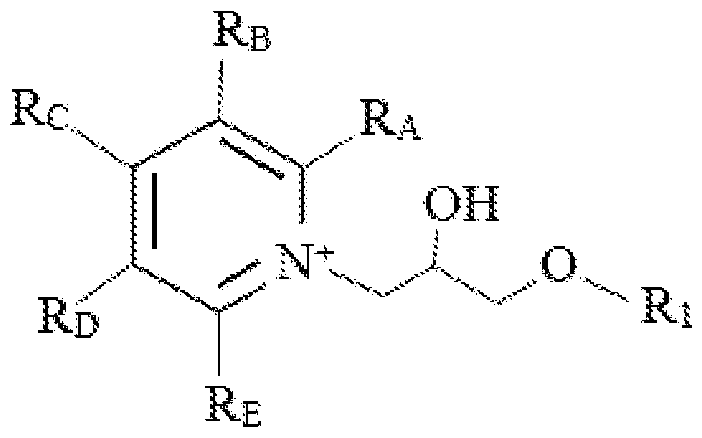
RI may be a Ci-Cis alkyl group, a Ci-Cis hydroxyl alkyl group, a Ci-Cis alkenyl group, a Ci-Cis alkynl group, a Ci-Cis acryl group, a Ci-Cis cycloalkyl group, or a Ci-Cis functional alkyl group and RA, B, C, D, and RE may each independently be chosen from hydrogen, a Ci-Cis alkyl
group, a Ci-Cis hydroxyl alkyl group, a Ci-Cis alkenyl group, a Ci-Cis alkynl group, a Ci-Cis acryl group, a Ci-Cis cycloalkyl group, or a Ci-Cis functional alkyl group.
[0006] According to one or more embodiments of the present disclosure, a method of producing a corrosion-resistant substrate comprises contacting at least a portion of a first surface of a substrate with a corrosion inhibitor solution, wherein the corrosion inhibitor solution comprises a solvent and a pyridinium hydroxyl alkyl ether compound and drying the corrosion inhibitor solution to produce the corrosion-resistant film on the substrate, wherein at least a portion of the solvent may be expelled from the corrosion inhibitor solution during the drying to form the corrosion-resistant film, such that the corrosion-resistant film is solid. The pyridinium hydroxyl alkyl ether compound may have the general formula:

Ri may be a Ci-Cis alkyl group, a Ci-Cis hydroxyl alkyl group, a Ci-Cis alkenyl group, a Ci-Cis alkynl group, a Ci-Cis acryl group, a Ci-Cis cycloalkyl group, or a Ci-Cis functional alkyl group and RA, RB, RC, RD, and RE may each independently be chosen from hydrogen, a Ci-Cis alkyl group, a Ci-Cis hydroxyl alkyl group, a Ci-Cis alkenyl group, a Ci-Cis alkynl group, a Ci-Cis acryl group, a Ci-Cis cycloalkyl group, or a Ci-Cis functional alkyl group.
[0007] According to one or more embodiments of the present disclosure, a corrosion inhibitor solution comprises a solvent and a pyridinium hydroxyl alkyl ether compound having a general formula:

RI may be a Ci-Cis alkyl group, a Ci-Cis hydroxyl alkyl group, a Ci-Cis alkenyl group, a Ci-Cis alkynl group, a Ci-Cis acryl group, a Ci-Cis cycloalkyl group, or a Ci-Cis functional alkyl group and RA, RB, RC, RD, and RE may each independently be chosen from hydrogen, a Ci-Cis alkyl group, a Ci-Cis hydroxyl alkyl group, a Ci-Cis alkenyl group, a Ci-Cis alkynl group, a Ci-Cis acryl group, a Ci-Cis cycloalkyl group, or a Ci-Cis functional alkyl group.
[0008] These and other embodiments are described in more detail in the detailed description. It is to be understood that both the foregoing general description and the following detailed description present embodiments of the presently disclosed technology, and are intended to provide an overview or framework for understanding the nature and character of the presently disclosed technology as it is claimed. The accompanying drawings are included to provide a further understanding of the presently disclosed technology and are incorporated into and constitute a part of this specification. The drawings illustrate various embodiments and, together with the description, serve to explain the principles and operations of the presently disclosed technology. Additionally, the drawings and descriptions are meant to be merely illustrative, and are not intended to limit the scope of the claims in any manner.
BRIEF DESCRIPTION OF THE DRAWINGS
[0009] The following detailed description of specific embodiments of the present disclosure can be best understood when read in conjunction with the following drawings, where like structure is indicated with like reference numerals and wherein:
[0010] FIG. 1 schematically depicts a cross-sectional view of a substrate comprising a corrosion-resistant film, according to one or more embodiments shown and described herein;
[0011] FIG. 2 schematically depicts a cross-sectional view cut in the axial direction of a metal pipe comprising a corrosion-resistant film, according to one or more embodiments shown and described herein;
[0012] FIG. 3 graphically depicts the H-NMR spectrum of a synthesized pyridinium hydroxyl alkyl ether compound (l-[3-(decyloxy)-2-hydroxypropyl] pyridinium chloride), according to one or more embodiments shown and described herein; and
[0013] FIG. 4 graphically depicts the C-NMR spectrum of a synthesized pyridinium hydroxyl alkyl ether compound (l-[3-(decyloxy)-2-hydroxypropyl] pyridinium chloride), according to one or more embodiments shown and described herein.
DETAILED DESCRIPTION
[0014] The present disclosure is directed to corrosion-resistant films made from corrosion inhibitor solutions and corrosion-resistant substrates that comprise substrates having a first surface and corrosion-resistant films positioned on at least a portion of the first surface of the substrates. The corrosion inhibitor solutions and corrosion-resistant films comprise pyridinium hydroxyl alkyl ether compounds.
[0015] As described herein, corrosion refers to a process in which a material is oxidized by substances in the environment that causes the material to lose electrons and deteriorates at least a portion of the material. The term “corrosion-resistant” generally refers to the resistance that a material has against corrosion. As described herein, corrosion-resistant materials display enhanced resistance to corrosion on the substrates, which may be achieved, as is described in embodiments herein, by forming a barrier over the substrates, thus shielding the substrates from the environment.
[0016] Referring now to FIG. 1, according to one or more embodiments, the corrosionresistant substrates 150 may comprise a substrate 200 that may comprise at least a first surface 204. The term “substrate” may refer to any object with at least one surface where a solution may contact and form a film that remains on at least a portion of that surface. The corrosion-resistant substrates 150 may also comprise a corrosion-resistant film 100 that comprises at least a first surface 102 and a second surface 104 opposite the first surface 102. The corrosion-resistant film 100 may be positioned on at least a portion of the first surface 204 of the substrate 200. As
depicted, the corrosion-resistant substrates 150 may have the first surface 102 of the corrosionresistant film 100 positioned on and in direct contact with at least a portion of the first surface 204 of the substrate 200. The second surface 104 of the corrosion-resistant film 100 may be an “airside” surface defining the outer edge of the corrosion-resistant substrate 150.
[0017] In one or more embodiments, the corrosion- resistant film 100 is a solid. The term “solid” may refer to a material that is generally firm, stable in shape, and is not a liquid or a fluid. Accordingly, when the corrosion-resistant film 100 is a solid, the first surface 102 of the corrosionresistant film 100 adheres to the first surface 204 of the substrate 200 so that the corrosion-resistant film 100 remains on the substrate 200 and holds its shape while the substrate 200 and/or the corrosion-resistant film 100 is moved.
[0018] In one or more embodiments, the corrosion-resistant film 100 has a thickness of from 0.1 nm to 1 ,000, such as a thickness of from 0.1 nm to 900 nm, from 0.1 nm to 800 nm, from 0.1 nm to 700 nm, from 0.1 nm to 600 nm, from 0.1 nm to 500 nm, from 0.1 nm to 400 nm, from 0.1 nm to 300 nm, from 0.1 nm to 200 nm, from 0.1 nm to 100 nm, from 1 nm to 1,000 nm, from 10 nm to 1,000 nm, from 50 nm to 1,000 nm, from 100 nm to 1,000 nm, from 200 nm to 1,000 nm, from 300 nm to 1,000 nm, from 400 nm to 1,000 nm, from 500 nm to 1,000 nm, from 600 nm to 1,000 nm, from 700 nm to 1,000 nm, from 800 nm to 1,000 nm, from 900 nm to 1,000 nm, from 10 nm to 900 nm, from 100 nm to 800 nm, from 200 nm to 700 nm, or from 300 nm to 600 nm.
[0019] Now, referring to FIG. 2, in one or more embodiments, the substrate 200 of the corrosion-resistant substrates may be a metal pipe that comprises at least a first surface 204 and a second surface 202. The term “pipe” may refer to a tubular hollow cylinder having a circular, or near circular, cross section that is used to transport substances (for example liquids, gases, slurries, powders, small solids, etc.). The metal pipe may comprise one or more metals and one or more surfaces of the metal pipe may comprise metal oxides. For example, the metal pipe may comprise carbon steel. In some embodiments, the first surface 204 of the metal pipe may be the internal surface of the metal pipe, and the pipe may further comprise an outer surface 202. The term “internal surface” may refer to the surface of the inside of the metal pipe that is enclosed within the tubular cylinder of the metal pipe. For example, when the substrate 200 is a metal pipe and the first surface 204 is the internal surface of the metal pipe, the first surface 102 of the corrosion-
resistant film 100 may be in direct contact with the internal surface of the metal pipe. Without being bound by a theory, it is believed that the corrosion-resistant film 100 being in direct contact with a least a portion of the internal surface of the metal pipe creates a barrier between the substances that flow through the metal pipe and the internal surface of the metal pipe.
[0020] According to one or more embodiments, the corrosion inhibitor solutions and corrosion-resistant films comprise a pyridinium hydroxyl alkyl ether compound having the structure of Chemical Structure #1.
• Chemical Structure #1

[0021] Referring to Chemical Structure #1, the general structure includes Ri, RA, RB, RC, RD, and RE that each represent various functional groups that can be included in the pyridinium hydroxyl alkyl ether compound. Ri may be a Ci-Cis alkyl group, a Ci -Cis hydroxyl alkyl group, a Ci-Cis alkenyl group, a Ci-Cis alkynl group, a Ci-Cis acryl group, a Ci-Cis cycloalkyl group, or a Ci-Cis functional alkyl group. RA, RB, RC, RD, and RE may each be independently chosen from hydrogen, a Ci-Cis alkyl group, a Ci-Cis hydroxyl alkyl group, a Ci-Cis alkenyl group, a Ci-Cis alkynl group, a Ci-Cis acryl group, a Ci-Cis cycloalkyl group, or a Ci-Cis functional alkyl group. Without being bound by a theory, it is believed that one or more of Ri, RA, RB, RC, RD, and RE having a relatively long carbon chain moiety allows the corrosion-resistant film produced from the corrosion inhibitor solution to better adhere to the surface of a substrate. Further, if the carbon chain moiety has greater than 18 carbon atoms, there is an increased risk of the corrosion-resistant film being removed from the surface of the substrate.
[0022] In one or more embodiments, the term “functional group” or “group” may refer to a substituent or moiety that is present in the pyridinium hydroxyl alkyl ether compound. For example, when the disclosure states that Ri may be a methyl group, the methyl group (-CH3)
replaces Ri of the general structure of the pyridinium hydroxyl alkyl ether compound, where the carbon atom of the methyl group is now bonded to the oxygen atom of the pyridinium hydroxyl alkyl ether compound that Ri was bonded to.
[0023] As described herein, moieties may be defined by the number of carbon atoms included in the moiety, such as Cx-Cy, where x is the least number of carbon atoms and y is the greatest number of carbon atoms contemplated. For example, Ci-Cis describes a moiety that has from 1 to 18 carbon atoms.
[0024] In some embodiments, Ri, RA, RB, RC, RD, and RE may each independently be a Ci-Cis alkyl group. The term “alkyl group” refers to a functional group that only contains carbon and hydrogen atoms where the carbon atoms and hydrogen atoms are only connected by single bonds. In some embodiments, Ri, RA, RB, RC, RD, and RE may each independently be a straight chained alkyl group having the chemical formula -(CH2)XCH3, where x is from 0 to 17, such as 0 (a methyl group), 1, 2, 3, 4, 5, 6, 7, 8, 9, 10, 11, 12, 13, 14, 15, 16, or 17. In additional embodiments, Ri, RA, RB, RC, RD, and RE may each independently be branched alkyl groups having from 3 to 18 carbon atoms, such as 3, 4, 5, 6, 7, 8, 9, 10, 11, 12, 13, 14, 15, 16, 17, or 18 carbon atoms. In some embodiment, the alkyl group may include a ring structure, such as a pentane ring, a hexane ring, etc.
[0025] In some embodiments, Ri, RA, RB, RC, RD, and RE may each independently be a Ci-Cis hydroxyl alkyl group. The term “hydroxyl alkyl group” refers to a functional group that includes one or more a hydroxyl moieties (-OH) bonded to an alkyl group. According to embodiments, the hydroxyl alkyl group may include 1, 2, 3, 4, 5, or even more hydroxyl moieties. In some embodiments, Ri, RA, RB, RC, RD, and RE may each independently be a straight chained hydroxyl alkyl group having the chemical formula -(CH2)XOH, where x is from 1 to 18. In additional embodiments, Ri, RA, RB, RC, RD, and RE may each independently be branched hydroxyl alkyl groups having from 1 to 18 carbon atoms and at least one hydroxyl group.
[0026] In some embodiments, Ri, RA, RB, RC, RD, and RE may each independently be a Ci-Cis alkenyl group. The term “alkenyl group” refers to a functional group consisting of hydrogen and carbon atoms where at least two carbon atoms have a double bond. In some embodiments, the alkenyl group may have a single carbon to carbon double bond that is at the end
of moiety (i.e., having the structure -(CH2)XCH=CH2, where x is from 0 to 16, such as 0, 1, 2, 3, 4, 5, 6, 7, 8, 9, 10, 1 1, 12, 13, 14, 15, or 16).
[0027] In some embodiments, Ri, RA, RB, RC, RD, and RE may each independently be a Ci-Cis alkynl group. The term “alkynyl group” refers to a functional group consisting of hydrogen and carbon atoms where at least two carbon atoms have a triple bond. In some embodiments, the alkynl group may have a single carbon to carbon triple bond that is at the end of moiety (i.e., having the structure -(CH2)XC = CH, where x is from 0 to 16, such as 0, 1, 2, 3, 4, 5, 6, 7, 8, 9, 10, 1 1, 12, 13, 14, 15, or 16).
[0028] In some embodiments, Ri, RA, RB, RC, RD, and RE may each independently be a Ci-Cis acryl group. The term “acryl group” refers to a functional group consisting of a carboncarbon double bond and a carbon-oxygen double bond separated by a carbon-carbon single bond. The acryl group may have the general formula -(CH2)nCOCHCH2, where n is any integer from 0 to 15, such as 0, 1, 2, 3, 4, 5, 6, 7, 8, 9, 10, 1 1 , 12, 13, 14, or 15.
[0029] In some embodiments, Ri, RA, RB, RC, RD, and RE may each independently be a Ci-Cis functional alkyl group. The term “functional alkyl group” refers to an alkyl group which includes at least one moiety bonded to any carbon atom of the alkyl group. In some embodiments, the functional alkyl group may comprise more than one of the same moiety. In some embodiments, the functional alkyl group may comprise two or more different moieties. In some embodiments, the functional alkyl group may comprise a moiety chosen form a carboxyl group (i.e., -COOH), an amine group (i.e., -NH2), or a thiol group (i.e., -SH).
[0030] In some embodiments, Ri may be a C2-C17 alkyl group, and RA, RB, RC, RD, and RE may each be hydrogen. For example, Ri may be a C4-C16 alkyl group, a C6-C14 alkyl group, or a C8-C12 alkyl group. In some embodiments, Ri may be a C1-C17, a C1-C16, a C1-C15, a C1-C14, a C1-C13, a C1-C12, a Ci-Cn, a C1-C10, a C1-C9, a Ci-C8, a C1-C7, a Ci-C6, a C1-C5, a C1-C4, a C1-C3, or a C1-C2 alkyl group. In some embodiments, Ri may be a C2-C18, C3-C18, C4-C18, C5-C18, C'6- C18, C7-C18, C8-C18, C9-C18, C10-C18, C11-C18, C12-C18, C13-C18, C14-C18, C15-C18, C16-C18, Or C17- Cis alkyl group. In one embodiment, Ri may be a C10 alkyl group (i.e., a decyl group) and RA, RB, RC, RD, and RE may each be hydrogen.
[0031] In one or more embodiments, the corrosion-resistant film 100 may comprise from 30 wt.% to 80 wt.% of the pyridinium hydroxyl alkyl ether compound. In some embodiments, the corrosion-resistant film 100 may comprise from 30 wt.% to 70 wt.%, from 35 wt.% to 60 wt.%, from 40 wt.% to 60 wt.%, or from 45 wt.% to 55 wt.% of the pyridinium hydroxyl alkyl ether compound. In some embodiments, the corrosion-resistant film 100 may comprise from 30 wt.% to 75 wt.%, from 30 wt.% to 70 wt.%, from 30 wt.% to 65 wt.%, from 30 wt.% to 60 wt.%, from 30 wt.% to 55 wt.%, from 30 wt.% to 50 wt.%, from 30 wt.% to 45 wt.%, from 30 wt.% to 40 wt.%, or from 30 wt.% to 35 wt.% of the pyridinium hydroxyl alkyl ether compound. In some embodiments, the corrosion-resistant film 100 may comprise from 35 wt.% to 80 wt.%, from 40 wt.% to 80 wt.%, from 45 wt.% to 80 wt.%, from 50 wt.% to 80 wt.%, from 55 wt.% to 80 wt.%, from 60 wt.% to 80 wt.%, from 65 wt.% to 80 wt.%, from 70 wt.% to 80 wt.%, or from 75 wt.% to 80 wt.% of the pyridinium hydroxyl alkyl ether compound.
[0032] Without being bound by a theory, it is believed that the pyridinium hydroxyl alkyl ether compound has relatively strong bonding to a metal surface due to both the physiorption and chemisorption of multiple parts of the pyridinium hydroxyl alkyl ether compound and the metal surface. The term “physiorption” refers to the physical bonding of liquid molecules onto a material’s surface. Van der Waal interactions, or similar interactions, between atoms on the surface of a metal may cause these surface atoms to be reactive, thus causing them to attract molecules to satisfy the atomic force imbalance. It is believed that the presence of the positively- charged nitrogen atom of the pyridinium hydroxyl alkyl ether compound forms strong Van der Waal, or similar, interactions with the metal surface. The term “chemisorption” refers to the adsorption between a surface and an adsorbate due to chemical bonding. Multiple parts of the pyridinium hydroxyl alkyl ether compound including, but not limited to, hydroxyl groups, ether groups, and pyridinium groups may bond with the metal surface. It is believed that due to the increased number of functional groups on the pyridinium hydroxyl alkyl ether compound that can interact with a metal surface through physiorption and/or chemisorption, the corrosion- resistant film 100 that comprises the pyridinium hydroxyl alkyl ether compound forms stronger interactions and bonds with a metal surface and, thus, provides the metal surface with a stronger and longer lasting corrosion-resistant film 100 than many conventional films that use conventional compounds for resisting corrosion on a metal surface.
[0033] In one or more embodiments, the corrosion-resistant film 100 may further comprise, in addition to the pyridinium hydroxyl alkyl ether compound, at least one imidazoline- based compound. According to embodiments, the term “imidazoline-based compound” may refer to a compound that comprises at least one 5-membered cyclic chemical compound that contains two nitrogen atoms, where the nitrogen atoms are the first and third members of the cyclic ring, carbon atoms are the second, fourth, and fifth members of the cyclic ring, and there is one double bond present in the cyclic ring. For example, the corrosion-resistant film 100 may comprise 2-(8- heptadecenyl)-2-imidazoline-l -ethanol. The corrosion-resistant film 100 may comprise from 5 wt.% to 50 wt.% of the imidazoline-based compound. In some embodiments, the corrosionresistant film 100 may comprise from 10 wt.% to 40 wt.%, from 10 wt.% to 35 wt.%, from 15 wt.% to 30 wt.%, or from 15 wt.% to 25 wt.% of the imidazoline-based compound. In some embodiments, the corrosion-resistant film 100 may comprise from 5 wt.% to 45 wt.%, from 5 wt.% to 40 wt.%, from 5 wt.% to 35 wt.%, from 5 wt.% to 30 wt.%, from 5 wt.% to 25 wt.%, from 5 wt.% to 20 wt.%, from 5 wt.% to 15 wt.%, or from 5 wt.% to 10 wt.% of the imidazoline-based compound. In some embodiments, the corrosion-resistant film 100 may comprise from 10 wt.% to 50 wt.%, 15 wt.% to 50 wt.%, 20 wt.% to 50 wt.%, 25 wt.% to 50 wt.%, 30 wt.% to 50 wt.%, 35 wt.% to 50 wt.%, 40 wt.% to 50 wt.%, or 45 wt.% to 50 wt.% of the imidazoline-based compound. Without being bound by a theory, it is believed that the imidazoline-based compound is able to demonstrate relatively strong bonding to a metal surface due to both the physiorption and chemisorption of the metal surface and multiple parts of the imidazoline-based compound including, but not limited to, the nitrogen atoms of the cyclic ring, the long alkyl chains (i.e., C3+ alkyl chains) that may be bonded to any atom of the cyclic ring, and various functional groups that may be bonded to the long alkyl chains.
[0034] In one or more embodiments, the corrosion- resistant film 100 may comprise a synergist. In some embodiments, the corrosion-resistant film 100 may comprise more than one synergist. The term “synergist” may refer to a chemical compound that increases the corrosionresistant activity of the imidazoline-based compound and pyridinium hydroxyl alkyl ether compound in the corrosion-resistant film 100. For example, the synergist may comprise thioglycolic acid, 2-mercaptoethanol, or combinations thereof. According to embodiments, the corrosion-resistant film 100 may comprise from 5 wt.% to 40 wt.% of the synergist. In some embodiments, the corrosion-resistant film 100 may comprise from 10 wt.% to 35 wt.%, from 15 wt.% to 30 wt.%, or from 15 wt.% to 25 wt.% of the synergist. In some embodiments, the
corrosion-resistant film 100 may comprise from 5 wt.% to 35 wt.%, 5 wt.% to 30 wt.%, 5 wt.% to 25 wt.%, 5 wt.% to 20 wt.%, 5 wt.% to 15 wt.%, or 5 wt.% to 10 wt.%, of the synergist. In some embodiments, the corrosion-resistant film 100 may comprise from 10 wt.% to 40 wt.%, 15 wt.% to 40 wt.%, 20 wt.% to 40 wt.%, 25 wt.% to 40 wt.%, 30 wt.% to 40 wt.%, or 35 wt.% to 40 wt.% of the synergist. Without being bound by a theory, it is believed that the synergist may bind to a metal surface due to its high electron density and help the pyridinium hydroxyl alkyl ether compound bond with the metal surface in order to provide a more effective physical barrier between the metal surface and substances surrounding the metal surface.
[0035] In one or more embodiments, the corrosion- resistant film 100 may comprise a surfactant. In some embodiments, the corrosion-resistant film 100 may comprise more than one surfactant. The term “surfactant” may refer to a compound that lowers the surface tension (or interfacial tension) between two liquids, between a gas and a liquid, or between a liquid and a solid. For example, the surfactant may be a long chained ethoxylated alcohol. According to embodiments, the corrosion-resistant film 100 may comprise from 1 wt.% to 5 wt.% of the surfactant. In some embodiments, the corrosion-resistant film 100 may comprise from 1.5 wt.% to 4 wt.%, from 1.5 wt.% to 3 wt.%, or from 2 wt.% to 2.5 wt.% of the surfactant. In some embodiments, the corrosion-resistant film 100 may comprise from 1 wt.% to 4.5 wt.%, from 1 wt.% to 4 wt.%, from 1 wt.% to 3.5 wt.%, from 1 wt.% to 3 wt.%, from 1 wt.% to 2.5 wt.%, from 1 wt.% to 2 wt.%, or from 1 wt.% to 1.5 wt.% of the surfactant. In some embodiments, the corrosion-resistant film 100 may comprise from 1.5 wt.% to 5 wt.%, 2 wt.% to 5 wt.%, 2.5 wt.% to 5 wt.%, 3 wt.% to 5 wt.%, 3.5 wt.% to 5 wt.%, 4 wt.% to 5 wt.%, or 4.5 wt.% to 5 wt.%, of the surfactant. Without being bound by a theory, it is believed that a surfactant may possess a hydrophilic section that may bond with a metal surface and a lipophilic section that may bond with oil, or similar, compounds and prevent the oil, or similar, compounds from interacting with the metal surface.
[0036] In one or more embodiments, the corrosion-resistant film 100 may comprise an ethoxylated amine. In some embodiments, the corrosion-resistant film 100 may comprise more than one ethoxylated amine. The term “ethoxylated amine” may refer to a chemical compound that comprises a nitrogen atom with a -(CH2CH2O)XH functional group and a -(CH2CH2O)yH functional group bonded to the nitrogen atom, where x and y is any integer greater than or equal to 1. For example, the ethoxylated amine may comprise 2-2-(2-
hydroxyethoxy)ethylaminoethanol. According to some embodiments, the corrosion-resistant film 100 may comprise from 1 wt.% to 10 wt.% of the ethoxylated amine. In some embodiments, the corrosion-resistant film 100 may comprise from 2 wt.% to 8 wt.%, from 2.5 wt.% to 7 wt.%, or from 3 wt.% to 5 wt.% of the ethoxylated amine. In some embodiments, the corrosion-resistant film 100 may comprise from 2 wt.% to 10 wt.%, from 3 wt.% to 10 wt.%, from 4 wt.% to 10 wt.%, from 5 wt.% to 10 wt.%, from 6 wt.% to 10 wt.%, from 7 wt.% to 10 wt.%, from 8 wt.% to 10 wt.%, or from 9 wt.% to 10 wt.% of the ethoxylated amine. In some embodiments, the corrosion-resistant film 100 may comprise from 1 wt.% to 9 wt.%, from 1 wt.% to 8 wt.%, from 1 wt.% to 7 wt.%, from 1 wt.% to 6 wt.%, from 1 wt.% to 5 wt.%, from 1 wt.% to 4 wt.%, from 1 wt.% to 3 wt.%, or from 1 wt.% to 2 wt.% of the ethoxylated amine. Without being bound by a theory, it is believed that an ethoxylated amine may promote better film formation and react with anodic or cathodic reaction sites of corrosive materials in order to slow down the oxidation or reduction reactions between a metal surface and corrosive materials.
[0037] In one or more embodiments, the corrosion- resistant film 100 may comprise a coupling agent. In some embodiments, the corrosion-resistant film 100 may comprise more than one coupling agent. The term “coupling agent” may refer to a chemical that can enhance adhesion or bonding between a surface and a polymer matrix. For example, the coupling agent may be an alkyl dipropionic acid sodium salt. According to some embodiments, the corrosion-resistant film 100 may comprise from 2 wt.% to 8 wt.%, from 2.5 wt.% to 7 wt.%, or from 3 wt.% to 5 wt.% of the coupling agent. In some embodiments, the corrosion-resistant film 100 may comprise from 2 wt.% to 10 wt.%, from 3 wt.% to 10 wt.%, from 4 wt.% to 10 wt.%, from 5 wt.% to 10 wt.%, from 6 wt.% to 10 wt.%, from 7 wt.% to 10 wt.%, from 8 wt.% to 10 wt.%, or from 9 wt.% to 10 wt.% of the coupling agent. In some embodiments, the corrosion- resistant film 100 may comprise from 1 wt.% to 9 wt.%, from 1 wt.% to 8 wt.%, from 1 wt.% to 7 wt.%, from 1 wt.% to 6 wt.%, from 1 wt.% to 5 wt.%, from 1 wt.% to 4 wt.%, from 1 wt.% to 3 wt.%, or from 1 wt.% to 2 wt.% of the coupling agent. Without being bound by a theory, it is believed that a coupling agent avoids phase separation of components in the corrosion-resistant films due to changes in temperature.
[0038] The present disclosure is also directed to methods of producing corrosion-resistant substrates 150 and various embodiments of corrosion inhibitor solutions. The methods of producing corrosion-resistant substrates 150 may comprise contacting at least a portion of a first surface 204 of a substrate 200 with a corrosion inhibitor solution, where the corrosion inhibitor
solution comprises a solvent and the pyridinium hydroxyl alkyl ether compound described herein. Then, the methods may further comprise drying the corrosion inhibitor solution to produce the corrosion-resistant film 100 on the substrate 200, where at least a portion of the solvent is expelled from the corrosion inhibitor solution during the drying to form the solid corrosion-resistant film 100. For example, when the substrate 200 is a pipe and the first surface 204 is the internal surface of the pipe, the corrosion inhibitor solution is adhered on the internal surface of the pipe and the corrosion inhibitor solution dries on the internal surface of the pipe to form the solid corrosionresistant film 100 on the internal surface of the pipe.
[0039] In one or more embodiments, the corrosion inhibitor solution may comprise a solvent, a pyridinium hydroxyl alkyl ether compound, an imidazoline-based compound, a synergist, a surfactant, an ethoxylated amine, and/or a coupling agent as described herein. In some embodiments, the solvent may comprise water, ethylene glycol, ethylene diamine, or combinations thereof.
[0040] According to one or more embodiments, the corrosion inhibitor solution may comprise from 50 wt.% to 90 wt.% of the solvent. In some embodiments, the corrosion inhibitor solution may comprise from 55 wt.% to 85 wt.%, from 65 wt.% to 85 wt.%, or from 70 wt.% to 80 wt.% of the solvent. In some embodiments, the corrosion inhibitor solution may comprise from 50 wt.% to 85 wt.%, from 50 wt.% to 80 wt.%, from 50 wt.% to 75 wt.%, from 50 wt.% to 70 wt.%, from 50 wt.% to 65 wt.%, from 50 wt.% to 60 wt.%, or from 50 wt.% to 55 wt.% of the solvent. In some embodiments, the corrosion inhibitor solution may comprise from 55 wt.% to 90 wt.%, from 60 wt.% to 90 wt.%, from 65 wt.% to 90 wt.%, from 70 wt.% to 90 wt.%, from 75 wt.% to 90 wt.%, from 80 wt.% to 90 wt.%, or from 85 wt.% to 90 wt.% of the solvent.
[0041] According to one or more embodiments, the corrosion inhibitor solution may comprise from 1 wt.% to 20 wt.% of the pyridinium hydroxyl alkyl ether compound. In some embodiments, the corrosion inhibitor solution may comprise from 2 wt.% to 18 wt.%, from 4 wt.% to 16 wt.%, from 6 wt.% to 14 wt.%, or from 8 wt.% to 12 wt.% of the pyridinium hydroxyl alkyl ether compound. In some embodiments, the corrosion inhibitor solution may comprise from 1 wt.% to 18 wt.%, 1 wt.% to 16 wt.%, 1 wt.% to 14 wt.%, 1 wt.% to 12 wt.%, 1 wt.% to 10 wt.%, 1 wt.% to 8 wt.%, 1 wt.% to 6 wt.%, 1 wt.% to 4 wt.%, or 1 wt.% to 2 wt.% of the pyridinium hydroxyl alkyl ether compound. In some embodiments, the corrosion inhibitor solution may
comprise from 2 wt.% to 20 wt.%, from 4 wt.% to 20 wt.%, from 6 wt.% to 20 wt.%, from 8 wt.% to 20 wt.%, from 10 wt.% to 20 wt.%, from 12 wt.% to 20 wt.%, from 14 wt.% to 20 wt.%, from 16 wt.% to 20 wt.%, or from 18 wt.% to 20 wt.% of the pyridinium hydroxyl alkyl ether compound.
[0042] According to one or more embodiments, the corrosion inhibitor solution may comprise from 1 wt.% to 20 wt.% of the imidazoline-based compound. In some embodiments, the corrosion inhibitor solution may comprise from 1 wt.% to 15 wt.%, from 2 wt.% to 10 wt.%, or from 2.5 wt.% to 7.5 wt.% of the imidazoline-based compound. In some embodiments, the corrosion inhibitor solution may comprise from 1 wt.% to 18 wt.%, 1 wt.% to 16 wt.%, 1 wt.% to 14 wt.%, 1 wt.% to 12 wt.%, 1 wt.% to 10 wt.%, 1 wt.% to 8 wt.%, 1 wt.% to 6 wt.%, 1 wt.% to 4 wt.%, or 1 wt.% to 2 wt.% of the imidazoline-based compound. In some embodiments, the corrosion inhibitor solution may comprise from 2 wt.% to 20 wt.%, from 4 wt.% to 20 wt.%, from 6 wt.% to 20 wt.%, from 8 wt.% to 20 wt.%, from 10 wt.% to 20 wt.%, from 12 wt.% to 20 wt.%, from 14 wt.% to 20 wt.%, from 16 wt.% to 20 wt.%, or from 18 wt.% to 20 wt.% of the imidazoline-based compound.
[0043] According to one or more embodiments, the corrosion inhibitor solution may comprise from 0.1 wt.% to 5 wt.% of, independently or in combination, the surfactant, the ethoxylated amine, and the coupling agent. In some embodiments, the corrosion inhibitor solution may comprise from 0.2 wt.% to 2.5 wt.%, from 0.25 wt.% to 1.5 wt.%, or from 0.3 wt.% to 1 wt.% of, independently or in combination, the surfactant, the ethoxylated amine, and the coupling agent. In some embodiments, the corrosion inhibitor solution may comprise from 0.5 wt.% to 5 wt.%, from 1 wt.% to 1.5 wt.%, from 1.5 wt.% to 5 wt.%, from 2 wt.% to 5 wt.%, from 2.5 wt.% to 5 wt.%, from 3 wt.% to 5 wt.%, from 3.5 wt.% to 5 wt.%, from 4 wt.% to 5 wt.%, or from 4.5 wt.% to 5 wt.% of, independently or in combination, the surfactant, the ethoxylated amine, and the coupling agent. In some embodiments, the corrosion inhibitor solution may comprise from 0.1 wt.% to 4.5 wt.%, from 0.1 wt.% to 4 wt.%, from 0.1 wt.% to 3.5 wt.%, from 0.1 wt.% to 3 wt.%, from 0.1 wt.% to 2.5 wt.%, from 0.1 wt.% to 2 wt.%, from 0.1 wt.% to 1.5 wt.%, or from 0.1 wt.% to 1 wt.% of, independently or in combination, the surfactant, the ethoxylated amine, and the coupling agent.
[0044] In some embodiments, drying the corrosion inhibitor solution in order to produce the solid corrosion-resistant film 100 may include passively drying the corrosion inhibitor solution. Passively drying the corrosion inhibitor solution may refer to allowing the corrosion inhibitor solution to dry on the first surface 204 of the substrate 200 without the use of an external heat source. For example, the corrosion inhibitor solution may be allowed to dry at room temperature after contacting the first surface 204 of the substrate 200 or any similar method where the corrosion inhibitor solution is not heated with an external heat source. Further, drying the corrosion inhibitor solution in order to produce the solid corrosion-resistant film 100 may include heating the corrosion inhibitor solution with a heat source. Heating the corrosion inhibitor solution with a heat source may refer to any method where heat from an outside source is transferred to the corrosion inhibitor solution and the first surface 204 of the substrate 200 in order to dry the corrosion inhibitor solution. For example, a heat lamp may be directed onto the corrosion inhibitor solution and the first surface 204 of the substrate 200 in order to accelerate the drying time of the corrosion inhibitor solution. In another example, external processing units, liquids, or gases may transfer heat to the corrosion inhibitor solution and the first surface 204 of the substrate 200 in order to accelerate the drying time of the corrosion inhibitor solution. In some embodiments, the drying of the corrosion inhibitor solution in order to produce the solid corrosion- resistant film 100 may include both passively drying the corrosion inhibitor solution and heating the corrosion inhibitor solution with a heat source.
EXAMPLES
[0045] Examples are provided herein which may disclose one or more embodiments of the present disclosure. However, the Examples should not be viewed as limiting on the claimed embodiments hereinafter provided.
EXAMPLE 1 - SYNTHESIS OF 1-[3-(DECYLOXY)-2-HYDROXYPROPYL] PYRIDINIUM CHLORIDE
[0046] Pyridine (1.5 mol) and hydrochloric acid (1 mol) were added to a round bottom flask and purged with nitrogen and stirred at room temperature (25 °C) for 10 minutes. Then, octyl/decyl glycidyl ether (1 mol) was added to the flask and again stirred for 30 minutes and then the contents of the flask were heated at 110 °C for 6 hours. At the end of this elapsed time, excess pyridine was removed from the final solution using a rotavapor.
[0047] The final solution was added to a separating funnel and dichloromethane (CH2CI2) and a saturated solution of NaCl in water and potassium carbonate (K2CO3) was added to separate the organic and aqueous phases. The organic phase was collected and a rotavapor was used to remove the organic solvent and dark brown gel-like l-[3-(decyloxy)-2-hydroxypropyl] pyridinium chloride was collected. FIG. 3 provides the H-NMR spectrum and FIG. 4 provides the C-NMR spectrum of this formed l-[3-(decyloxy)-2-hydroxypropyl] pyridinium chloride.
[0048] The pyridine, octyl/decyl glycidyl ether, hydrochloric acid (37%), dichloromethane, and diethyl ether were purchased from Sigma-Aldrich and used without any further purification.
EXAMPLE 2 - COMPOSITION OF PRECURSOR SOLUTION COMPRISING 1-[3-(DECYLOXY)-2- HYDROXYPROPYL] PYRIDINIUM CHLORIDE
[0049] The following table, Table 1 , discloses a corrosion inhibitor solution that comprises l-[3-(decyloxy)-2-hydroxypropyl] pyridinium chloride, among other components, that was used for performance evaluation and comparison with a commercial corrosion inhibitor.
Table 1

 EXAMPLE 3 - PERFORMANCE EVALUATION OF A CORROSION-RESISTANT FILM COMPRISING l-[3- (DECYLOXY)-2-HYDROXYPROPYL] PYRIDINIUM CHLORIDE
[0050] A High-Temperature and High-Pressure (HTHP) autoclave rotating cage was used to conduct the corrosion tests under simulated and controlled dynamic field conditions. A four- liter reactor was constructed from C-276 alloy, which was capable of withstanding a harsh corrosive environment. The test material was carbon steel coupons and the coupons were cleaned and degreased before and after testing. The coupons were positioned in a fixed cage made out of polyetheretherketone (PEEK) material and then mounted in the autoclave.
[0051] The autoclave was purged with N2 to remove dissolved oxygen. The autoclave was then pressurized with the required gases (H2S and CO2). The autoclave was heated to the required test temperature (182 °F). A kerosene and water (1 :1) mixture was stirred at room temperature with 10 ppm of the corrosion-resistant film sample. After 2 hours, the kerosene was removed and the remaining water was used in the autoclave for the final test. The final pressure was maintained at the required pressure (250 psi) using high purity nitrogen gas. In all the tests, the corrosion inhibitor solutions were injected immediately after fixing the coupons in the autoclave. The corrosion rate and inhibition efficiency of the samples were calculated using a weight loss by the following equation 1 and 2:
Corrosion rate (CR) (MPY) = AW * 22,300 / D * A* T (1)
Inhibition efficiency (IE%) = (CRbiank- CRinhibitor)* 100/CRbiank (2) where AW is the weight loss of coupon in mg, D is the density of the standard mild steel coupon (C-1018) (7.89 g/cm3), A is an area of the exposed coupon (7.86 square inches) and T is the exposure time (one day). The MPY unit means mg of coupon material lost per year. For equation 2, CRbiank is the corrosion rate measured for the carbon steel coupons without the corrosionresistant film and CRinhibitor is the corrosion rate measured for the carbon steel coupons with the corrosion-resistant film. The corrosion inhibition efficiency and corrosion rate of a commercial corrosion inhibitor, including alkyl pyridine benzyl chloride, and the disclosed corrosion-resistant film are shown below in Table 2. The disclosed corrosion-resistant film has a lower corrosion rate and a higher corrosion inhibition efficiency than the commercial/conventional corrosion
inhibitor used in gas oil separation plants (GOSPs) for a wet sour environment in the oil and gas industry.
Table 2

[0052] The present disclosure includes one or more non-limiting aspects. A first aspect includes a substrate comprising a first surface and a corrosion-resistant film positioned on at least a portion of the first surface of the substrate, wherein the corrosion-resistant film is solid, and wherein the corrosion-resistant film comprises a pyridinium hydroxyl alkyl ether compound having a general formula:
 wherein Ri is a Ci-Cis alkyl group, a Ci-Cis hydroxyl alkyl group, a Ci-Cis alkenyl group, a Ci- Cis alkynl group, a Ci-Cis acryl group, a Ci-Cis cycloalkyl group, or a Ci-Cis functional alkyl group; and wherein RA, RB, RC, RD, and RE are each independently chosen from hydrogen, a Ci- Cis alkyl group, a Ci -Cis hydroxyl alkyl group, a Ci-Cis alkenyl group, a Ci-Cis alkynl group, a Ci-Cis acryl group, a Ci-Cis cycloalkyl group, or a Ci-Cis functional alkyl group.
[0053] A second aspect includes any above aspect, wherein the Ci-Cis functional alkyl group comprises a moiety chosen from a carboxyl group, an amine group, or a thiol group.
wherein Ri is a Ci-Cis alkyl group, a Ci-Cis hydroxyl alkyl group, a Ci-Cis alkenyl group, a Ci- Cis alkynl group, a Ci-Cis acryl group, a Ci-Cis cycloalkyl group, or a Ci-Cis functional alkyl group; and wherein RA, RB, RC, RD, and RE are each independently chosen from hydrogen, a Ci- Cis alkyl group, a Ci -Cis hydroxyl alkyl group, a Ci-Cis alkenyl group, a Ci-Cis alkynl group, a Ci-Cis acryl group, a Ci-Cis cycloalkyl group, or a Ci-Cis functional alkyl group.
[0053] A second aspect includes any above aspect, wherein the Ci-Cis functional alkyl group comprises a moiety chosen from a carboxyl group, an amine group, or a thiol group.
[0054] A third aspect includes any above aspect, wherein the first surface is metal or metal oxide.
[0055] A fourth aspect includes any above aspect, wherein the substrate is a metal pipe and the first surface is an internal surface of the metal pipe.
[0056] A fifth aspect includes any above aspect, wherein the corrosion-resistant film further comprises at least one imidazoline-based compound and the corrosion-resistant film comprises from 5 wt.% to 50 wt.% of the imidazoline-based compound.
[0057] A sixth aspect includes any above aspect, wherein the corrosion-resistant film comprises from 30 wt.% to 80 wt.% of the pyridinium hydroxyl alkyl ether compound.
[0058] A seventh aspect includes any above aspect, wherein the corrosion-resistant film further comprises one or more of a synergist, a surfactant, an ethoxylated amine, or a coupling agent.
[0059] An eighth aspect includes any above aspect, wherein the corrosion-resistant film comprises from 5 wt.% to 40 wt.% of the synergist.
[0060] A ninth aspect includes any above aspect, wherein the corrosion-resistant film comprises from 1 wt.% to 5 wt.% of the surfactant.
[0061] A tenth aspect includes any above aspect, wherein the corrosion-resistant film comprises from 1 wt.% to 10 wt.% of the ethoxylated amine.
[0062] An eleventh aspect includes any above aspect, wherein the corrosion-resistant film comprises from 1 wt.% to 10 wt.% of the coupling agent.
[0063] A twelfth aspect includes any above aspect, wherein Ri is a decyl group and RA, RB, RC, RD, and RE are hydrogen.
[0064] A thirteenth aspect includes a method of producing a corrosion-resistant substrate, the method comprising contacting at least a portion of a first surface of a substrate with a corrosion
inhibitor solution, wherein the corrosion inhibitor solution comprises a solvent and a pyridinium hydroxyl alkyl ether compound having a general formula:
 wherein Ri is a Ci-Cis alkyl group, a Ci-Cis hydroxyl alkyl group, a Ci-Cis alkenyl group, a Ci- Cis alkynl group, a Ci-Cis acryl group, a Ci-Cis cycloalkyl group, or a Ci-Cis functional alkyl group; and wherein RA, RB, RC, RD, and RE are each independently chosen from hydrogen, a Ci- Cis alkyl group, a Ci -Cis hydroxyl alkyl group, a Ci-Cis alkenyl group, a Ci-Cis alkynl group, a Ci-Cis acryl group, a Ci-Cis cycloalkyl group, or a Ci-Cis functional alkyl group; and drying the corrosion inhibitor solution to produce the corrosion-resistant film on the substrate, wherein at least a portion of the solvent is expelled from the corrosion inhibitor solution during the drying to form the corrosion-resistant film, such that the corrosion-resistant film is solid.
[0065] A fourteenth aspect includes any above aspect, wherein the Ci-Cis functional alkyl group comprises a moiety chosen from a carboxyl group, an amine group, or a thiol group.
[0066] A fifteenth aspect includes any above aspect, wherein the solvent comprises one or more of water, ethylene glycol, or ethylene diamine.
[0067] A sixteenth aspect includes any above aspect, wherein the first surface is metal or metal oxide.
[0068] A seventeenth aspect includes any above aspect, wherein the substrate is a metal pipe and the first surface is an internal surface of the metal pipe.
[0069] An eighteenth aspect includes any above aspect, wherein Ri is a decyl group and RA, RB, RC, RD, and RE are hydrogen.
[0070] A nineteenth aspect includes any above aspect, wherein the corrosion-resistant film further comprises at least one imidazoline-based compound.
[0071] A twentieth aspect includes a corrosion inhibitor solution, wherein the corrosion inhibitor solution comprises a solvent and a pyridinium hydroxyl alkyl ether compound having a general formula:
 wherein Ri is a Ci-Cis alkyl group, a Ci-Cis hydroxyl alkyl group, a Ci-Cis alkenyl group, a Ci- Cis alkynl group, a Ci-Cis acryl group, a Ci-Cis cycloalkyl group, or a Ci-Cis functional alkyl group; and wherein RA, RB, RC, RD, and RE are each independently chosen from hydrogen, a Ci- Cis alkyl group, a Ci -Cis hydroxyl alkyl group, a Ci-Cis alkenyl group, a Ci-Cis alkynl group, a Ci-Cis acryl group, a Ci-Cis cycloalkyl group, or a Ci-Cis functional alkyl group.
[0072] The subject matter of the present disclosure has been described in detail and by reference to specific embodiments. It should be understood that any detailed description of a component or feature of an embodiment does not necessarily imply that the component or feature is essential to the particular embodiment or to any other embodiment. Further, it should be apparent to those skilled in the art that various modifications and variations can be made to the described embodiments without departing from the spirit and scope of the claimed subject matter.
[0073] It is noted that one or more of the following claims utilize the term “wherein” as a transitional phrase. For the purposes of defining the present technology, it is noted that this term is introduced in the claims as an open-ended transitional phrase that is used to introduce a recitation of a series of characteristics of the structure and should be interpreted in like manner as the more commonly used open-ended preamble term “comprising.”
[0074] It should be understood that where a first component is described as “comprising” a second component, it is contemplated that, in some embodiments, the first component “consists” or “consists essentially of’ that second component. It should further be understood that where a first component is described as “comprising” a second component, it is contemplated that, in some
embodiments, the first component comprises at least 10%, at least 20%, at least 30%, at least 40%, at least 50%, at least 60%, at least 70%, at least 80%, at least 90%, at least 95%, or even at least 99% that second component (where % can be weight % or molar %).
[0075] It is also noted that recitations herein of “at least one” component, element, etc., should not be used to create an inference that the alternative use of the articles “a” or “an” should be limited to a single component, element, etc.
[0076] For the purposes of describing and defining the presently disclosed technology it is noted that the terms “substantially” and “about” are utilized herein to represent the inherent degree of uncertainty that may be attributed to any quantitative comparison, value, measurement, or other representation. The terms “substantially” and “about” are also utilized herein to represent the degree by which a quantitative representation may vary from a stated reference without resulting in a change in the basic function of the subject matter at issue.
Claims
1. A corrosion-resistant substrate comprising: a substrate comprising a first surface; and a corrosion-resistant film positioned on at least a portion of the first surface of the substrate, wherein the corrosion-resistant film is solid, and wherein the corrosion-resistant film comprises a pyridinium hydroxyl alkyl ether compound having a general formula:
 wherein Ri is a Ci-Cis alkyl group, a Ci-Cis hydroxyl alkyl group, a Ci-Cis alkenyl group, a Ci-Cis alkynl group, a Ci-Cis acryl group, a Ci-Cis cycloalkyl group, or a Ci-Cis functional alkyl group; and wherein RA, RB, RC, RD, and RE are each independently chosen from hydrogen, a Ci-Cis alkyl group, a Ci -Cis hydroxyl alkyl group, a Ci-Cis alkenyl group, a Ci-Cis alkynl group, a Ci- Cis acryl group, a Ci-Cis cycloalkyl group, or a Ci-Cis functional alkyl group.
2. The corrosion-resistant substrate of claim 1, wherein the Ci-Cis functional alkyl group comprises a moiety chosen from a carboxyl group, an amine group, or a thiol group.
3. The corrosion-resistant substrate of claim 1, wherein the first surface is metal or metal oxide.
4. The corrosion-resistant substrate of claim 3, wherein the substrate is a metal pipe and the first surface is an internal surface of the metal pipe.
5. The corrosion-resistant substrate of any one of claims 1-4, wherein the corrosion-resistant film comprises from 30 wt.% to 80 wt.% of the pyridinium hydroxyl alkyl ether compound.
6. The corrosion-resistant substrate of any one of claims 1-5, wherein the corrosion-resistant film further comprises from 5 wt.% to 50 wt.% of at least one imidazoline-based compound.
7. The corrosion-resistant substrate of any one of claims 1-6, wherein the corrosion-resistant film further comprises from 5 wt.% to 40 wt.% of a synergist, from 1 wt.% to 5 wt.% of a surfactant, from 1 wt.% to 10 wt.% of an ethoxylated amine, from 1 wt.% to 10 wt.% of a coupling agent, or any combination of these.
8. The corrosion-resistant substrate of any one of claims 1-7, wherein Ri is a decyl group and RA, RB, RC, RD, and RE are hydrogen.
9. A method of producing a corrosion-resistant substrate, the method comprising: contacting at least a portion of a first surface of a substrate with a corrosion inhibitor solution, wherein the corrosion inhibitor solution comprises a solvent and a pyridinium hydroxyl alkyl ether compound having a general formula:
 wherein Ri is a Ci-Cis alkyl group, a Ci-Cis hydroxyl alkyl group, a Ci-Cis alkenyl group, a Ci-Cis alkynl group, a Ci-Cis acryl group, a Ci-Cis cycloalkyl group, or a Ci-Cis functional alkyl group; and wherein RA, RB, RC, RD, and RE are each independently chosen from hydrogen, a Ci-Cis alkyl group, a Ci -Cis hydroxyl alkyl group, a Ci-Cis alkenyl group, a Ci-Cis alkynl group, a Ci- Cis acryl group, a Ci-Cis cycloalkyl group, or a Ci-Cis functional alkyl group; and drying the corrosion inhibitor solution to produce the corrosion-resistant film on the substrate, wherein at least a portion of the solvent is expelled from the corrosion inhibitor solution during the drying to form the corrosion-resistant film, such that the corrosion-resistant film is solid.
10. The method of claim 9, wherein the Ci-Cis functional alkyl group comprises a moiety chosen from a carboxyl group, an amine group, or a thiol group and the solvent comprises one or more of water, ethylene glycol, or ethylene diamine.
11. The method of claim 10, wherein the first surface is metal or metal oxide.
12. The method of claim 11, wherein the substrate is a metal pipe and the first surface is an internal surface of the metal pipe.
13. The method of any one of claims 9-12, wherein Ri is a decyl group and RA, RB, RC, RD, and RE are hydrogen.
14. The method of any one of claims 9-13, wherein the corrosion-resistant film further comprises at least one imidazoline-based compound.
15. A corrosion inhibitor solution, wherein the corrosion inhibitor solution comprises a solvent and a pyridinium hydroxyl alkyl ether compound having a general formula:
 wherein Ri is a Ci-Cis alkyl group, a Ci-Cis hydroxyl alkyl group, a Ci-Cis alkenyl group, a Ci-Cis alkynl group, a Ci-Cis acryl group, a Ci-Cis cycloalkyl group, or a Ci-Cis functional alkyl group; and wherein RA, RB, RC, RD, and RE are each independently chosen from hydrogen, a Ci-Cis alkyl group, a Ci -Cis hydroxyl alkyl group, a Ci-Cis alkenyl group, a Ci-Cis alkynl group, a Ci- Cis acryl group, a Ci-Cis cycloalkyl group, or a Ci-Cis functional alkyl group.
Applications Claiming Priority (2)
| Application Number | Priority Date | Filing Date | Title |
|---|---|---|---|
| US17/741,960 | 2022-05-11 | ||
| US17/741,960 US12227670B2 (en) | 2022-05-11 | 2022-05-11 | Corrosion inhibitor solutions and corrosion-resistant substrates that include pyridinium hydroxyl alkyl ether compounds and methods of making the same |
Publications (1)
| Publication Number | Publication Date |
|---|---|
| WO2023219754A1 true WO2023219754A1 (en) | 2023-11-16 |
Family
ID=86330419
Family Applications (1)
| Application Number | Title | Priority Date | Filing Date |
|---|---|---|---|
| PCT/US2023/018627 Ceased WO2023219754A1 (en) | 2022-05-11 | 2023-04-14 | Corrosion inhibitor solutions and corrosion-resistant substrates that include pyridinium hydroxyl alkyl ether compounds and methods of making the same |
Country Status (2)
| Country | Link |
|---|---|
| US (1) | US12227670B2 (en) |
| WO (1) | WO2023219754A1 (en) |
Citations (3)
| Publication number | Priority date | Publication date | Assignee | Title |
|---|---|---|---|---|
| US3945824A (en) * | 1973-08-03 | 1976-03-23 | Fuji Photo Film Co., Ltd. | Process for forming optical sound track |
| WO1998033953A1 (en) * | 1997-02-03 | 1998-08-06 | Stanchem Inc. | Corrosion inhibition through the use of a quaternary pyridine salt-hydrocarbon combination |
| US20080308770A1 (en) * | 2007-06-14 | 2008-12-18 | Laxmikant Tiwari | Mono and bis-ester derivatives of pyridinium and quinolinium compounds as environmentally friendly corrosion inhibitors |
Family Cites Families (41)
| Publication number | Priority date | Publication date | Assignee | Title |
|---|---|---|---|---|
| US2955083A (en) | 1956-08-13 | 1960-10-04 | Bj Service Inc | Corrosion inhibitors in well treating compositions |
| US3283005A (en) | 1963-04-29 | 1966-11-01 | Armour & Co | p-xylylene bis quaternary ammonium compounds |
| US3629104A (en) | 1967-06-29 | 1971-12-21 | Texaco Inc | Water soluble corrosion inhibitors for well fluids |
| US3623979A (en) | 1967-06-29 | 1971-11-30 | Texaco Inc | Composition and process for inhibiting corrosion in oil wells |
| GB2131785B (en) | 1982-11-24 | 1986-09-03 | Exxon Research Engineering Co | Corrosion inhibitors |
| US5000873A (en) | 1984-01-09 | 1991-03-19 | The Dow Chemical Company | N-(hydrophobe aromatic)pyridinium compounds |
| US4672118A (en) | 1984-01-09 | 1987-06-09 | The Dow Chemical Company | N-(hydrophobe aromatic)pyridinium compounds |
| US4637899A (en) | 1984-01-30 | 1987-01-20 | Dowell Schlumberger Incorporated | Corrosion inhibitors for cleaning solutions |
| US4784796A (en) * | 1984-03-29 | 1988-11-15 | The Dow Chemical Company | Corrosion inhibitors |
| US4734277A (en) | 1984-12-03 | 1988-03-29 | Jordan Chemical Company | Bis-quaternary ammonium compounds |
| US4673436A (en) | 1986-04-22 | 1987-06-16 | Exxon Chemical Patents Inc. | N, S containing corrosion inhibitors |
| US4812263A (en) | 1986-08-22 | 1989-03-14 | Ppg Industries, Inc. | Bis-quaternary ammonium compounds |
| US4744948A (en) | 1987-06-04 | 1988-05-17 | Texaco Inc. | Thiol ester corrosion inhibition system |
| US5002673A (en) | 1989-03-31 | 1991-03-26 | Exxon Chemical Patents Inc. | Corrosion inhibitor and method of use |
| US5336441A (en) | 1991-05-29 | 1994-08-09 | Petrolite Corporation | Corrosion inhibition in highly acidic environments by use of pyridine salts in combination with certain cationic surfactants |
| US5292480A (en) | 1992-06-11 | 1994-03-08 | Westvaco Corporation | Acid-anhydride esters as oil field corrosion inhibitors |
| US5611991A (en) | 1994-05-24 | 1997-03-18 | Champion Technologies, Inc. | Corrosion inhibitor containing phosphate groups |
| US6118000A (en) | 1996-11-04 | 2000-09-12 | Hydrochem Industrial Services, Inc. | Methods for preparing quaternary ammonium salts |
| US5756004A (en) | 1997-05-13 | 1998-05-26 | Halliburton Energy Services, Inc. | Quaternary ammonium compounds useful for inhibiting metal corrosion |
| WO1999033953A1 (en) | 1997-12-25 | 1999-07-08 | Nikken Chemicals Co., Ltd. | Novel microorganism and process for producing polyols by using the same |
| US5993693A (en) | 1998-11-09 | 1999-11-30 | Nalco/Exxon Energy Chemicals, L.P. | Zwitterionic water-soluble substituted imine corrosion inhibitors |
| US6303079B1 (en) | 1999-03-15 | 2001-10-16 | Nalco/Exxon Energy Chemicals, L.P. | Corrosion inhibitor compositions |
| SE523240C2 (en) | 2001-12-12 | 2004-04-06 | Akzo Nobel Nv | Use of hydroxyethyl substituted amine as corrosion inhibitor in saline environment in oilfield applications |
| US7057050B2 (en) | 2003-04-11 | 2006-06-06 | Nalco Energy Services L.P. | Imidazoline corrosion inhibitors |
| US8999315B2 (en) | 2004-07-15 | 2015-04-07 | Nalco Company | Bis-quaternary ammonium salt corrosion inhibitors |
| US20060062753A1 (en) | 2004-09-17 | 2006-03-23 | Ali Naraghi | Polymeric quaternary ammonium salts useful as corrosion inhibitors and biocides |
| US20060180794A1 (en) | 2005-02-15 | 2006-08-17 | Goddard Richard J | Polyamine-based corrosion inhibitors |
| US7951754B2 (en) | 2007-12-07 | 2011-05-31 | Nalco Company | Environmentally friendly bis-quaternary compounds for inhibiting corrosion and removing hydrocarbonaceous deposits in oil and gas applications |
| DE102008006391B4 (en) * | 2008-01-28 | 2016-11-17 | Airbus Operations Gmbh | Chromate-free composition, its use as corrosion protection and thus produced corrosion protection coating for fuel tanks |
| US7989403B2 (en) | 2009-03-02 | 2011-08-02 | Nalco Company | Corrosion inhibitors containing amide surfactants for a fluid |
| US8618027B2 (en) | 2010-12-08 | 2013-12-31 | Nalco Company | Corrosion inhibitors for oil and gas applications |
| US9074289B2 (en) | 2011-11-08 | 2015-07-07 | Nalco Company | Environmentally friendly corrosion inhibitor |
| US9303236B2 (en) | 2013-07-02 | 2016-04-05 | Ecolab Usa Inc. | Oilfield cleaner and corrosion inhibitor comprising a polyamine sulfonic acid salt |
| US9238588B2 (en) | 2013-08-02 | 2016-01-19 | Ecolab USA, Inc. | Organic disulfide based corrosion inhibitors |
| GB2532990A (en) * | 2014-12-05 | 2016-06-08 | Schlumberger Holdings | Corrosion inhibition |
| US9816024B2 (en) | 2015-06-01 | 2017-11-14 | King Fahd University of Pertoleum and Minerals | 2-(p-alkoxyphenyl)-2-imidazolines and their use as corrosion inhibitors |
| MX383731B (en) | 2015-07-27 | 2025-03-13 | Mexicano Inst Petrol | CORROSION INHIBITOR DERIVED FROM VEGETABLE OILS AND ITS OBTAINING PROCEDURE. |
| AU2017222670B2 (en) | 2016-02-26 | 2022-06-02 | Championx Usa Inc. | Corrosion inhibiting compositions to mitigate corrosion in environments containing elemental sulfur and/or polysulfides |
| US11021642B2 (en) | 2017-03-23 | 2021-06-01 | Baker Hughes Holdings Llc | Formulation and method for dissolution of metal sulfides, inihibition of acid gas corrosion, and inhibition of scale formation |
| US10323327B2 (en) | 2017-05-19 | 2019-06-18 | King Fahd University Of Petroleum And Minerals | Composition and methods for inhibition of metal corrosion for use in the oil and gas industry |
| US11118272B2 (en) | 2019-04-05 | 2021-09-14 | King Fahd University Of Petroleum And Minerals | Heterocyclic corrosion inhibitor compounds and uses thereof |
-
2022
- 2022-05-11 US US17/741,960 patent/US12227670B2/en active Active
-
2023
- 2023-04-14 WO PCT/US2023/018627 patent/WO2023219754A1/en not_active Ceased
Patent Citations (3)
| Publication number | Priority date | Publication date | Assignee | Title |
|---|---|---|---|---|
| US3945824A (en) * | 1973-08-03 | 1976-03-23 | Fuji Photo Film Co., Ltd. | Process for forming optical sound track |
| WO1998033953A1 (en) * | 1997-02-03 | 1998-08-06 | Stanchem Inc. | Corrosion inhibition through the use of a quaternary pyridine salt-hydrocarbon combination |
| US20080308770A1 (en) * | 2007-06-14 | 2008-12-18 | Laxmikant Tiwari | Mono and bis-ester derivatives of pyridinium and quinolinium compounds as environmentally friendly corrosion inhibitors |
Also Published As
| Publication number | Publication date |
|---|---|
| US12227670B2 (en) | 2025-02-18 |
| US20230365814A1 (en) | 2023-11-16 |
Similar Documents
| Publication | Publication Date | Title |
|---|---|---|
| CN102439199B (en) | Inhibiting corrosion and scaling of surfaces contacted by sulfur-containing materials | |
| Okafor et al. | Corrosion inhibition of mild steel by ethylamino imidazoline derivative in CO2-saturated solution | |
| Negm et al. | Corrosion inhibition efficiency of nonionic Schiff base amphiphiles of p-aminobenzoic acid for aluminum in 4N HCL | |
| Shaban et al. | Gravimetric and electrochemical evaluation of three nonionic dithiol surfactants as corrosion inhibitors for mild steel in 1 M HCl solution | |
| CN101531635B (en) | A kind of imidazoline unsymmetrical diquaternary ammonium salt and its preparation method and application | |
| Ricky et al. | The study of m-pentadecylphenol on the inhibition of mild steel corrosion in 1 M HCl solution | |
| CN102382638A (en) | Application of pyridine compound for preparing acidization corrosion inhibitors | |
| US10676829B2 (en) | Corrosion inhibition composition for pipelines, process of elaboration and synthesis | |
| Jiang et al. | Inhibition of carbon steel corrosion in HCl solution using N-oleyl-1, 3-propanediamine based formulation | |
| CN105132919A (en) | A kind of corrosion inhibitor for suppressing CO2 corrosion in oil and gas field and preparation method thereof | |
| El-Aouni et al. | Study of new phosphorus-sulfur epoxy polymer for CS anticorrosion in HCl solution: experimental and theoretical investigations | |
| Zhao et al. | Corrosion inhibition approach of oil production systems in offshore oilfields | |
| CN103897681A (en) | Corrosion inhibitor for gas field and preparation method thereof | |
| CN103924249A (en) | Schiff base pyridine carbon steel pickling corrosion inhibitor and application thereof | |
| WO2023219754A1 (en) | Corrosion inhibitor solutions and corrosion-resistant substrates that include pyridinium hydroxyl alkyl ether compounds and methods of making the same | |
| US12590256B2 (en) | Corrosion inhibitor formulations based on compounds with both pyridinium and hydroxy substituents | |
| US9771657B2 (en) | Compositions for corrosion inhibition | |
| CN116903539A (en) | A gemini-type ionic liquid corrosion inhibitor resistant to CO2/H2S/H2O corrosion and its preparation method and use | |
| US12065582B2 (en) | Corrosion inhibitor solutions and corrosion-resistant substrates that include bis-quaternized ammonium compounds and methods of making the same | |
| CN102268677A (en) | Corrosion inhibitor for inhibiting H2S/CO2 corrosion and preparation method thereof | |
| US20150275377A1 (en) | Nanoparticles of diquaternary schiff dibases as corrosion inhibitors for protecting steel against exposure to acidic fluids | |
| CN103102311B (en) | Cinnamyl imidazoline derivative and its preparation method and use | |
| Wang et al. | Excellent inhibition performance of an imidazole based ionic liquid on steel-N80 in 15% hydrochloric acid medium | |
| Bahtiti et al. | Anti-corrosive effect of Jordanian-bay-leaves aqueous extract on mild steel in 1.0 M hydrochloric acid solution | |
| Chen et al. | Construction of DOPA-SAM multilayers with corrosion resistance via controlled molecular self-assembly |
Legal Events
| Date | Code | Title | Description |
|---|---|---|---|
| 121 | Ep: the epo has been informed by wipo that ep was designated in this application |
Ref document number: 23722754 Country of ref document: EP Kind code of ref document: A1 |
|
| NENP | Non-entry into the national phase |
Ref country code: DE |
|
| 32PN | Ep: public notification in the ep bulletin as address of the adressee cannot be established |
Free format text: NOTING OF LOSS OF RIGHTS PURSUANT TO RULE 112(1) EPC (EPO FORM 1205A DATED 04/03/2025) |
|
| 122 | Ep: pct application non-entry in european phase |
Ref document number: 23722754 Country of ref document: EP Kind code of ref document: A1 |