WO2023219617A1 - Fat compositions for baked goods - Google Patents
Fat compositions for baked goods Download PDFInfo
- Publication number
- WO2023219617A1 WO2023219617A1 PCT/US2022/028944 US2022028944W WO2023219617A1 WO 2023219617 A1 WO2023219617 A1 WO 2023219617A1 US 2022028944 W US2022028944 W US 2022028944W WO 2023219617 A1 WO2023219617 A1 WO 2023219617A1
- Authority
- WO
- WIPO (PCT)
- Prior art keywords
- dough
- fat composition
- baked good
- fat
- component
- Prior art date
- Legal status (The legal status is an assumption and is not a legal conclusion. Google has not performed a legal analysis and makes no representation as to the accuracy of the status listed.)
- Ceased
Links
Classifications
-
- A—HUMAN NECESSITIES
- A21—BAKING; EDIBLE DOUGHS
- A21D—TREATMENT OF FLOUR OR DOUGH FOR BAKING, e.g. BY ADDITION OF MATERIALS; BAKING; BAKERY PRODUCTS
- A21D2/00—Treatment of flour or dough by adding materials thereto before or during baking
- A21D2/08—Treatment of flour or dough by adding materials thereto before or during baking by adding organic substances
- A21D2/30—Organic phosphorus compounds
- A21D2/32—Phosphatides
-
- A—HUMAN NECESSITIES
- A23—FOODS OR FOODSTUFFS; TREATMENT THEREOF, NOT COVERED BY OTHER CLASSES
- A23D—EDIBLE OILS OR FATS, e.g. MARGARINES, SHORTENINGS OR COOKING OILS
- A23D9/00—Other edible oils or fats, e.g. shortenings or cooking oils
- A23D9/007—Other edible oils or fats, e.g. shortenings or cooking oils characterised by ingredients other than fatty acid triglycerides
- A23D9/013—Other fatty acid esters, e.g. phosphatides
-
- A—HUMAN NECESSITIES
- A21—BAKING; EDIBLE DOUGHS
- A21D—TREATMENT OF FLOUR OR DOUGH FOR BAKING, e.g. BY ADDITION OF MATERIALS; BAKING; BAKERY PRODUCTS
- A21D10/00—Batters, dough or mixtures before baking
- A21D10/02—Ready-for-oven doughs
- A21D10/025—Packaged doughs
-
- A—HUMAN NECESSITIES
- A21—BAKING; EDIBLE DOUGHS
- A21D—TREATMENT OF FLOUR OR DOUGH FOR BAKING, e.g. BY ADDITION OF MATERIALS; BAKING; BAKERY PRODUCTS
- A21D13/00—Finished or partly finished bakery products
- A21D13/10—Multi-layered products
- A21D13/16—Multi-layered pastry, e.g. puff pastry; Danish pastry or laminated dough
-
- A—HUMAN NECESSITIES
- A21—BAKING; EDIBLE DOUGHS
- A21D—TREATMENT OF FLOUR OR DOUGH FOR BAKING, e.g. BY ADDITION OF MATERIALS; BAKING; BAKERY PRODUCTS
- A21D2/00—Treatment of flour or dough by adding materials thereto before or during baking
- A21D2/08—Treatment of flour or dough by adding materials thereto before or during baking by adding organic substances
- A21D2/14—Organic oxygen compounds
- A21D2/16—Fatty acid esters
- A21D2/165—Triglycerides
-
- A—HUMAN NECESSITIES
- A23—FOODS OR FOODSTUFFS; TREATMENT THEREOF, NOT COVERED BY OTHER CLASSES
- A23D—EDIBLE OILS OR FATS, e.g. MARGARINES, SHORTENINGS OR COOKING OILS
- A23D9/00—Other edible oils or fats, e.g. shortenings or cooking oils
- A23D9/02—Other edible oils or fats, e.g. shortenings or cooking oils characterised by the production or working-up
- A23D9/04—Working-up
- A23D9/05—Forming free-flowing pieces
Definitions
- the present disclosure relates to fat compositions that extend a favorable eating experience in baked goods.
- Such fat compositions are anhydrous and contain lecithin and/or certain distilled monoglycerides in an amount of about 3% to about 10% by weight.
- a fat composition provided herein is anhydrous and solid at 20° C, and consists of at least 99% by weight of a combination of: a. a first component consisting of a bakery compatible fat in an amount of about 90% to about 97% by weight of the composition; and b. a second component consisting of a lecithin, a distilled monoglyceride having an iodine value (IV) of less than 50, or a combination thereof, the second component included in an amount of about 3% to about 10% by weight of the composition.
- a first component consisting of a bakery compatible fat in an amount of about 90% to about 97% by weight of the composition
- a second component consisting of a lecithin, a distilled monoglyceride having an iodine value (IV) of less than 50, or a combination thereof, the second component included in an amount of about 3% to about 10% by weight of the composition.
- the second component consists of a soy lecithin, a sunflower lecithin, or a rapeseed/canola lecithin.
- a fat composition provided herein can be in a form of chips or flakes.
- a flake- or chip-form fat composition can have a first component that has a Mettler Dropping Point (MDP) of greater than 25° C (e.g., about 35° C to about 60° C), and consists essentially of palm oil, a palm oil fraction, palm kernel oil, a palm kernel oil fraction, a coconut oil, a coconut oil fraction, or any interesterified or non-interesterified combination thereof.
- MDP Mettler Dropping Point
- a flake- or chip-form fat composition can have a first component that has a Mettler Dropping Point (MDP) of greater than 25° C (e.g., about 45° C to about 60° C), consists essentially of an interesterified and/or non-interesterified combination of a liquid oil and a fully hydrogenated oil.
- MDP Mettler Dropping Point
- Some embodiments of a flake- or chip-form fat composition can have a second component that is included in an amount of about 5% to about 9% by weight of the composition.
- a fat composition provided herein can be in a form of a laminating fat composition.
- a laminating fat composition can have a first component that has an MDP of greater than 25° C, and consists essentially of a blend of: a. a hard fat consisting essentially of palm oil, a palm oil fraction, a fully hydrogenated palm oil or palm oil fraction, palm kernel oil, a palm kernel oil fraction, a fully hydrogenated palm kernel oil or palm kernel oil fraction, or any interesterified or non-interesterified combination thereof; and b. a liquid oil.
- Some embodiments of a laminating fat composition can have a second component that is included in an amount of about 3% to about 8% by weight of the composition.
- a dough is provided herein that includes a fat composition described herein.
- a method of making a baked good is also provided.
- a method of making a baked good can include cooking a dough that contains a fat composition described herein to produce a ready- to-eat baked good or par-cooked baked good.
- a baked good made according to a disclosed method of making a baked good is also provided.
- a method of making a packaged refrigerated or frozen dough is provided herein.
- a method of making a packaged refrigerated or frozen dough can include: a. combining a flour, water, and the fat composition of any one of claims 1-10 to produce a dough; b. forming the dough into portions; c. refrigerating or freezing the portions; and d. packaging the portions.
- a fat composition used in a method of making a packaged refrigerated or frozen dough can be in a form of chips or flakes, where the chips or flakes are included in an amount of about 5% to about 25% by weight of the dough, and the chips or flakes are distributed throughout the dough.
- a fat composition used in a method of making a packaged refrigerated or frozen dough can be in a form of a laminating fat composition, where the fat composition is included in an amount of about 5% to about 40% by weight of the dough, and the dough contains the fat composition in laminated layers.
- a packaged dough product includes packaged portions of a refrigerated or frozen dough made according to a method of making a refrigerated or frozen dough described herein.
- a method of making a baked good including cooking a dough from a packaged dough product described herein to produce a ready-to-eat baked good or par-cooked baked good.
- a baked good made according to a method of making a baked good described herein.
- a method of making a packaged baked good is provided herein.
- a method of making a packaged baked good can include: a. combining a flour, water, and the fat composition of any one of claims 1-10 to produce a dough; b. forming the dough into portions; c. baking the portions to produce a baked good; and d. packaging the baked good.
- a method of making a packaged baked good includes refrigerating or freezing the baked good.
- a baked good is a par baked refrigerated or frozen baked good.
- the baked good is ready-to-eat.
- the fat composition in a method of making a packaged baked good, can be in a form of chips or flakes, the chips or flakes are included in an amount of 5% to about 25% by weight of the dough, and the chips or flakes are distributed throughout the dough.
- the dough can be a biscuit dough, a pizza dough, a bread dough, a pie crust dough, or a pastry dough.
- the fat composition in a method of making a packaged baked good, can be in a form of a laminating fat composition included in an amount of about 5% to about 40% by weight of the dough, and the dough contains the fat composition in laminated layers.
- the dough can be a croissant dough or a puff pastry dough.
- a packaged baked good made according to a method of making a packaged baked good described herein.
- Figure 1 shows pictures of a whole pastry roll and a pastry roll cut in half made using a laminated dough containing a control anhydrous laminating fat, shown from a top view (left) and a top perspective view (right).
- Figure 2 shows pictures of a pastry roll made using an inventive laminated dough containing a laminating fat containing 3.5% soy lecithin, shown from a top view (left) and a top perspective view (right).
- Figure 3 shows pictures of a pastry roll made using an inventive laminated dough containing a laminating fat containing 7% soy lecithin, shown from a top view (left) and a top perspective view (right).
- Baked goods at restaurants, bakeries, and other food-service businesses are often baked ahead to serve an anticipated demand. After baking, such baked goods may be held in a warming oven, under a heating lamp, or reheated in an attempt to provide a fresh-baked experience.
- heated hold times can result in reduced quality over time and reduce the consumers’ enjoyment of the baked good.
- later reheating generally results in a less desirable eating experience.
- anhydrous fat compositions that are described herein that include about 3% to about 10% by weight of certain emulsifiers can provide one or more unexpected benefit after baking. It was discovered that inclusion of a described fat composition in a dough can prolong a good eating experience during an extended heated state following baking, such as sometimes employed in food service settings. For example, a baked good made using a fat composition provided herein can maintain acceptable eating quality over a heated hold time of 150° F for times that exceed control by at least 30 minutes (e.g., at least 60 minutes, at least 90 minutes, at least 120 minutes, at least 180 minutes, or at least 240 minutes).
- inclusion of a described fat composition in a dough can improve the eating quality of a reheated baked good.
- a baked good that has been baked and then held at room temperature and reheated in an oven or a microwave oven can have an eating quality that is significantly improved over control.
- the described fat compositions included in baked goods made from laminated doughs can increase flakiness, a trait consumers enjoy in such baked goods.
- emulsifiers While small amounts of emulsifiers are sometimes included in anhydrous fat compositions to improve handling characteristics, such as including small amounts of lecithin in shortening chips to prevent adhesion to one another, emulsifiers are more typically included in hydrated fats to maintain emulsions. In addition, many emulsifiers are believed to negatively affect flavor characteristics of fat compositions when included in higher amounts. Thus, prior to the present discovery, it was commonly believed to be best practice to limit the amount of emulsifier included in a fat composition to levels sufficient to achieve handling benefits (typically less than 1% by weight) or to maintain an emulsion (typically less than 5% by weight).
- fat compositions described herein do not require inclusion of emulsifiers to maintain an emulsion because they are anhydrous (i.e., contains less than 0.1% water)
- certain emulsifiers including lecithin and distilled monoglycerides having an iodine value (IV) of less than 50 (e.g., about 30 to about 48, or about 35 to about 45)
- IV iodine value
- a fat composition provided herein consists of (by weight of the fat composition) a first component in an amount of about 90% to about 97%, a second component in an amount of about 3% to about 10%, and less than 1% (e.g., less than 0.5%, or 0%) any other component.
- the first component in a fat composition is a bakery compatible fat.
- a “bakery compatible fat” refers to an edible triglyceride composition suitable for use in baked goods.
- a bakery compatible fat is generally solid at 20° C, but can contain non- interesterified or interesterified blends that include one or more liquid oil (e.g., soybean oil, sunflower oil, or the like).
- a bakery compatible fat can be in any suitable form, such as a solid chip or flake, or a laminating fat (also sometimes called “roll-in fat”).
- a bakery compatible fat suitable for use in a fat composition provided herein is anhydrous.
- a bakery compatible fat is a triglyceride composition
- it may contain minor amounts of naturally occurring free fatty acids, diglycerides, and other compounds.
- palm oil can contain up to 4-8% naturally occurring diglycerides
- soybean oil typically contains less than 2% of naturally occurring diglycerides.
- a fat composition herein may contain such naturally occurring compounds as contributed by a bakery compatible fat.
- Any bakery compatible fat can be a first component in a composition provided herein so long as it fits the above description.
- a suitable bakery compatible fat can have a Mettler Dropping Point (MDP) of greater than 25° C (e.g., about 35° C to about 60° C, about 35° C to about 50° C, about 45° C to about 60° C, or about 50° C to about 60° C).
- MDP is measured according to AOCS Cc 18-80 (Firestone, D. (Ed.). (2009). Official Methods and Recommended Practices of the AOCS (6 th ed.). AOCS Press.).
- a suitable bakery compatible fat can include a single non-interesterified or interesterified fat type, any non-interesterified or interesterified blends of fat types, where the fat types within a blend can be interesterified or non-interesterified.
- fat types include whole fats or oils, or fractions and/or fully hydrogenated versions thereof, such as, without limitation, palm oil, palm kernel oil, coconut oil, soybean oil, sunflower oil, corn oil, canola/rapeseed oil, cottonseed oil, or the like.
- Particularly suitable bakery compatible fats include, for example, shortening chips or flakes with an MDP greater than 25° C (e.g., from about 40° C to about 60° C) that consist essentially of palm oil, a palm oil fraction, palm kernel oil, a palm kernel oil fraction, a coconut oil, a coconut oil fraction, or any interesterified or non-interesterified combination thereof.
- Another example of a particularly suitable bakery compatible fat includes shortening chips or flakes with an MDP greater than 25° C (e.g., from about 50° C to about 65° C) that consist essentially of an interesterified and/or non-interesterified combination of a liquid oil and a fully hydrogenated oil.
- a particularly suitable bakery compatible fat includes a laminating fat with an MDP greater than 25° C (e.g., from about (e.g., from about 50° C to about 65° C, or from about 50° C to about 55° C) that consists essentially of a hard fat consisting essentially of palm oil, a palm oil fraction, a fully hydrogenated palm oil or palm oil fraction, palm kernel oil, a palm kernel oil fraction, a fully hydrogenated palm kernel oil or palm kernel oil fraction, or any interesterified or non- interesterified combination thereof; and a liquid oil.
- a laminating fat with an MDP greater than 25° C e.g., from about (e.g., from about 50° C to about 65° C, or from about 50° C to about 55° C) that consists essentially of a hard fat consisting essentially of palm oil, a palm oil fraction, a fully hydrogenated palm oil or palm oil fraction, palm kernel oil, a palm kernel oil fraction, a fully hydrogenated palm kernel oil or palm kernel oil
- a bakery compatible fat consisting essentially of palm oil, a palm oil fraction, palm kernel oil, a palm kernel oil fraction, a coconut oil, a coconut oil fraction, or any interesterified or non-interesterified combination thereof means that the bakery compatible fat consists of at least 98% of the listed contents (i.e., palm oil, a palm oil fraction, palm kernel oil, a palm kernel oil fraction, a coconut oil, a coconut oil fraction, or any interesterified or non-interesterified combination thereof) by weight, and no more than a total of 2% other components, such as emulsifiers (e.g., lecithin, mono- and di-glycerides, and the like), antioxidants (e.g., TBHQ), colorants (e.g., beta car
- the second component in a fat composition is one or a combination of suitable emulsifiers.
- suitable emulsifiers include lecithin (e.g., soy lecithin, sunflower lecithin, rape seed lecithin, and the like) and distilled monoglycerides that have an iodine value (IV) of less than 50 (e.g., an IV of about 30 to about 48, or about 35 to about 45).
- IV iodine value
- Lecithins, particularly soy lecithin are especially effective in a fat composition provided herein. However, it was found that all of the lecithin sources that were tested were effective, and the described distilled monoglycerides were also effective.
- Suitable distilled monoglycerides can be derived from any appropriate source, including for example, palm oil, palm oil stearin, hydrogenated oils (e.g., palm, soy, canola/rapeseed, and the like), and blends of oils.
- iodine value (IV) is measured by cyclohexane-acetic acid method according to AOCS Cd ld-92 ((2017). Official Methods and Recommended Practices of the AOCS (7 th ed.). AOCS Press.).
- the second component in a fat composition is included in an amount of about 3% to about 10% (e.g., about 3% to about 8%, or about 5% to about 9%) by weight of the fat composition.
- a fat composition is included at higher levels in a dough, it might be preferred to keep the second component content to about 8% or less in the fat composition to avoid significant flavor impact.
- the total measurable amount of lecithin and/or monoglycerides in a fat composition may exceed 10%, but in many cases, does not exceed 12%.
- a fat composition provided herein can contain more than 12% lecithin and/or monoglycerides, especially if the fat composition is used in making a baked good in which the flavor is not significantly negatively impacted, or where the lecithin and/or monoglycerides do not become cost prohibitive.
- the second component is blended with the first component so that the second component is distributed throughout a fat composition.
- a first component can be melted (e.g., heated to a temperature at or above its MDP, such as a temperature at least 5° C above its MDP) and mixed with a second component to distribute the second component throughout the first component to produce a fat composition described herein.
- Blending a first component with a second component can be performed using any appropriate equipment.
- a fat composition can be further processed using known methods, such as forming into flakes or chips.
- a fat composition can be formed into flakes or chips by applying the fat composition in liquid form to a chilled drum or belt, then fracturing the resulting solid fat into the desired flakes or chips.
- chilled drums or belts examples include, for example, Sandvik Belt Flaker manufactured by Hampford Research Inc (Stratford, CT, USA), or a cooling drum flaker manufactured by Buflovak (Buffalo, NY, USA).
- a fat composition can be processed via a scraped surface heat exchanger.
- scraped surface heat exchangers include, for example, Votator® II manufactured by Waukesha Cherry-Burrell® (Delevan, WI, USA), Contherm manufactured by Alfa Laval, Inc. (Richmond, VA, USA), Terlotherm manufactured by Terlet BV (Zutphen, Netherlands), and Gerstenberg Schroder Kombinator manufactured by SPXFlow (Soeborg, Denmark).
- the second component For application of a second component onto a surface of a first component in the form of a flake or a chip, the second component can be sprayed, painted, or otherwise applied to the surface of the first component and allowed to set.
- a second component can be mixed with an oil to facilitate application to the surface of a first component chip or flake.
- a second component may be more susceptible to shedding into a dough if it is on the surface of a flake or a chip than if it is blended with the first component.
- the second component (lecithin or distilled monoglycerides) does not provide any benefit, and in fact may reduce eating quality, e.g., resulting in mass cohesion during eating of the resulting baked good, if the second component is combined with a dough without being associated directly with a bakery compatible fat.
- lecithin produced the above-described benefits in a fat composition, it was initially believed that the effect was due to the emulsifying properties of lecithin.
- lecithin and the described distilled monoglycerides provided benefits described above, but other tested emulsifiers, such as PGPR 90, calcium stearoyl lactylate (CSL), non-distilled monoglycerides, and distilled soft monoglycerides having an IV above 50, did not. Further, beneficial effects of lecithin did not depend on hydrophilic-lipophilic balance (HLB), since lecithins with HLB values ranging from 4 to 12 were found to benefit eating quality of baked goods over an extended heated hold time with no apparent link of effectiveness to HLB value.
- HLB hydrophilic-lipophilic balance
- Crystal formation type was determined using x-ray diffraction analysis of fats (XRD).
- XRD is performed using a TERRA Mobile XRD System (Olympus Scientific Solutions Americas Inc., Waltham, MA, USA) by pressing a sample onto the window of the sample plate without compressing the sample in a particular direction or pressing excessively, and measuring x- ray diffraction according to the manufacturer’s instructions.
- the results of XRD are graphed with diffraction angle in degrees 29 (2 -theta) along the x-axis and intensity of signal along the y-axis.
- a beta tending crystal forming fat composition has a prominent peak, as determined by peak signal intensity, around 22.4° 29, while a beta prime tending forming fat composition has a prominent peak, as determined by peak signal intensity, around 24.6° 29 and a secondary peak around 27.2° 29.
- a fat composition provided herein can be combined with a flour and water to produce a dough that can be cooked to produce a baked good.
- the term “dough” refers to an uncooked product that can be cooked to make a baked good
- “baked good” refers to a food that is either fully cooked and ready-to-eat, or par-cooked and requiring some additional cooking prior to eating.
- Such baked goods include, for example, biscuits, pizza crust, pie crust, pastries (e.g., croissants, sweet rolls, puff pastries, and the like), breads, and the like.
- a dough provided herein is typically cooked by baking, in some cases, a dough provided herein may be cooked by other means, such as frying (e.g., a donut), steaming, or microwaving.
- a dough provided herein can be made using any suitable method or formulation that includes incorporation of a fat composition described herein.
- a fat composition in the form of chips or flakes can be mixed with flour and water to form a dough, where the chips or flakes are incorporated throughout the dough.
- Such a dough might suitably be formulated to produce a biscuit, a pizza crust, a pie crust, a bread, or a pastry such as a sweet roll.
- a fat composition provided herein can be included in any suitable amount for such a dough.
- a fat composition may suitably be included in the form of a chip or a flake in an amount of about 5% to about 25% (e.g., about 10% to about 20%, or about 10% to about 15%) by weight of a dough.
- a dough provided herein can be made using any appropriate equipment and conditions, including using home or commercial kitchen equipment, or using industrial scale food manufacturing equipment.
- a fat composition in the form of a laminating fat composition can be included in a dough as laminated layers.
- a dough might suitably be formulated to produce a croissant, puff pastry, or the like.
- a fat composition provided herein can be included in any suitable amount for such a dough.
- a fat composition may suitably be included in the form of a laminating fat composition in an amount of about 5% to about 40% (e.g., about 10% to about 35%, or about 12% to about 35%) by weight of a dough.
- a flour can include one or a combination of a grain flour (e.g., wheat, oat, barley, rye, rice, or the like, or any combination thereof), a seed flour (e.g., buckwheat, quinoa, sunflower, or the like, or any combination thereof), a legume flour (e.g., soybean, peanut, lentil, or the like, or any combination thereof), a nut flour (e.g., almond, coconut, and the like, or any combination thereof), a tuber flour (e.g., potato, cassava, or the like, or any combination thereof), or any other flour suitable for making a baked good.
- a grain flour e.g., wheat, oat, barley, rye, rice, or the like, or any combination thereof
- a seed flour e.g., buckwheat, quinoa, sunflower, or the like, or any combination thereof
- a legume flour e.g., soybean, peanut, lentil, or the like, or any
- Suitable ingredients can be included in a dough provided herein, such as sugar, leavening ingredients (e.g., yeast, leavening acid/base combinations, or the like), inclusions (e.g., dried fruit, confectionery pieces, chocolate, or the like), salt, flavorants, dairy and/or egg ingredients, dough conditioners, preservatives, and the like.
- Water content in a dough can be included in an amount suitable for the dough type desired.
- a dough can include additional bakery compatible fats or oils that do not include a second component.
- a dough provided herein can have a fat content that is higher than the amount of included fat composition.
- Table 1 “fat composition” refers to a fat composition provided herein, while “other ingredients” can, in some embodiments, include bakery compatible fats or oils that have less than 3% lecithin and/or distilled monoglycerides.
- a dough provided herein can be formed into portions and either packaged as a refrigerated or frozen dough, or cooked and packaged as a ready-to-eat or par-cooked baked good.
- a packaged dough can be formed into portions suitable for making a single baked good from the portion, or into a larger dough portion that can be cooked and then portioned, or portioned and then cooked.
- a packaged dough can be formed into biscuit dough pucks that can be cooked, such that each puck forms a finished biscuit.
- a larger packaged dough portion can be reportioned into smaller portions to be cooked into bread loaves.
- a larger packaged dough portion can be cooked into a focaccia bread loaf and then portioned after cooking into pieces.
- a packaged dough provided herein can be a refrigerated or frozen dough.
- the dough can be formulated to require a rest period prior to cooking, for example to thaw, reach room temperature, and/or to proof.
- a dough can be formulated as refrigerator- to-oven dough or freezer-to-oven dough.
- the term “refrigerator-to-oven dough” refers to a dough that is formulated to be able to be taken from a cooler or refrigerator and cooked directly (e.g., in an oven, fryer, steamer, or microwave) without requiring a rest period.
- freeze-to-oven dough refers to a dough that is formulated to be able to be taken from a freezer and cooked directly (e.g., in an oven, fryer, steamer, or microwave) without requiring a rest period.
- a portioned dough can be fully cooked (i.e., ready-to-eat) or par cooked and packaged to produce a packaged baked good.
- a packaged baked good can be stored at any temperature (e.g., heated, room temperature, refrigerated, or frozen).
- a fully cooked packaged baked good may be considered a “ready-to-eat baked good” even if it is stored at refrigerated or frozen temperatures, so long as no further cooking is necessary for consumption.
- a ready-to-eat baked good that is stored at room temperature, refrigerated, or frozen may be heated to improve the eating experience, but heating is not necessary to render it fully cooked.
- a par-cooked packaged baked good that is refrigerated or frozen can be formulated to require a rest period prior to further cooking, for example to thaw or reach room temperature.
- a parcooked packaged baked good can be formulated as a refrigerator-to-oven baked good or freezer-to-oven baked good.
- the term “refrigerator-to-oven baked good” refers to a baked good that is formulated to be able to be taken from a cooler or refrigerator and cooked directly (e.g., in an oven, fryer, steamer, or microwave) without requiring a rest period.
- freeze-to-oven baked good refers to a baked good that is formulated to be able to be taken from a freezer and cooked directly (e.g., in an oven, fryer, steamer, or microwave) without requiring a rest period.
- Example 1 Fat compositions
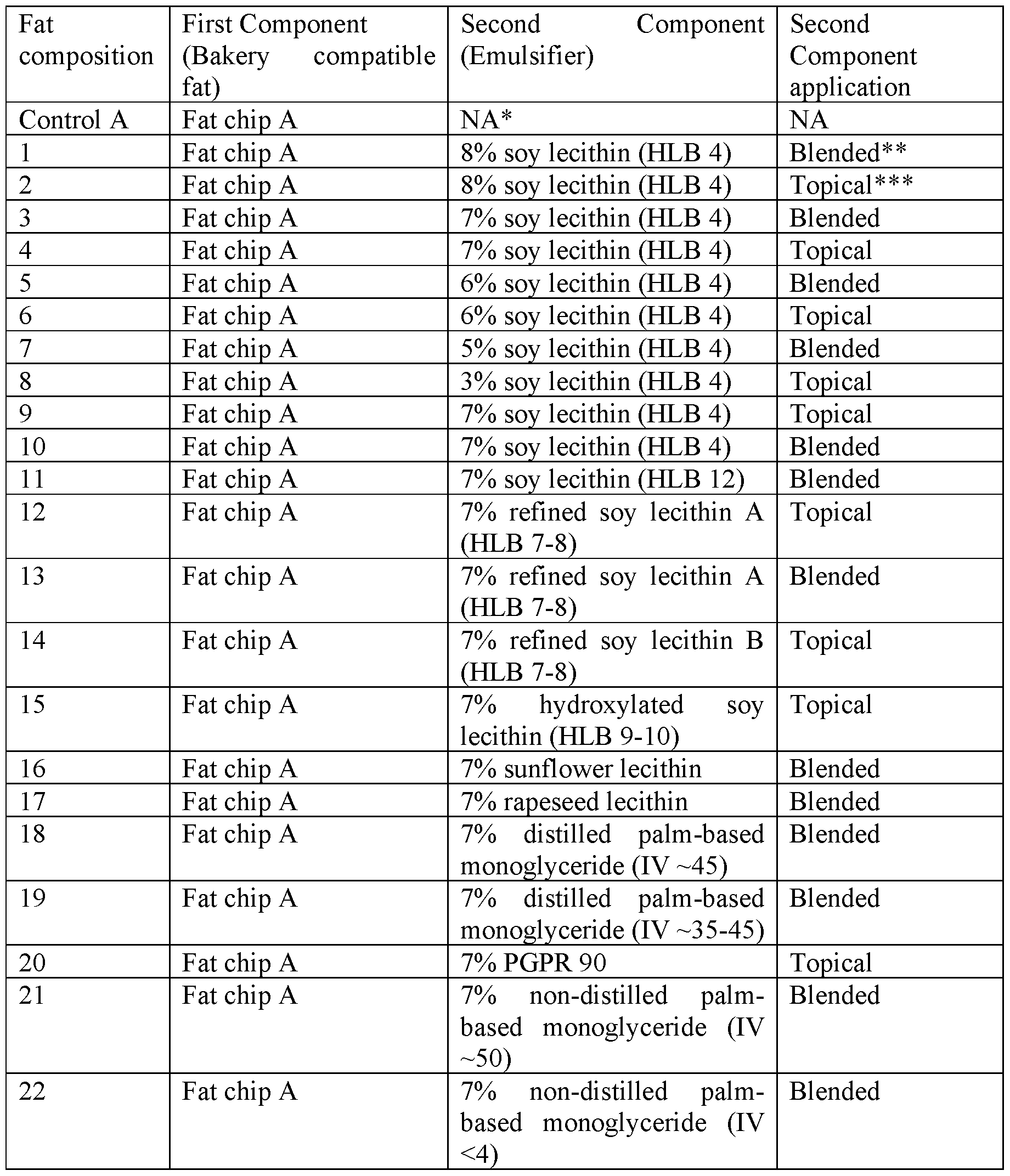
- Fat compositions were produced by blending bakery compatible fats with lecithin, distilled monoglycerides, undistilled monoglycerides, or other emulsifiers, as set forth in Table 2. Briefly, if indicated as “blended,” each composition was made by melting each indicated component, typically at a temperature at least 5° C greater than its MDP, and blending the molten ingredients together to create a molten mixture. Fat chips were made by depositing the molten mixture onto a cold surface (typically -18° C to -6° C) and cooling to create a solid sheet of the fat composition, with sheets being approximately 0.042 inches thick. The sheet is fractured into irregular pieces to form fat composition chips.
- a cold surface typically -18° C to -6° C
- Fat chip A is a palm oil and palm kernel oil-based shortening chip with an MDP of about 44-46° C
- fat chip B is a palm oil-based shortening chip with an MDP of about 54-55° C
- fat chip C is a soybean oil-based shortening chip with an MDP of about 58-60° C
- laminating fat A is a soybean and palm-based shortening with an MDP of about 53-54° C.
- Biscuit doughs formulated as freezer-to-oven dough suitable for food service use were made using each of fat compositions 1-26, and the appropriate controls.
- the biscuit doughs were formulated to contain 10-20% by weight of the respective fat composition. Briefly, the doughs were made as follows: the selected fat composition was blended with flour to distribute the chips throughout the flour, and then water and butter flavor were added, and the mixture was further mixed to produce a dough. The dough was cut to produce round dough pieces and frozen. To test the quality of a baked good made from each dough over a heated hold time, the frozen dough was baked at 325° F in a convection oven with a high fan speed for 17-22 minutes to produce fully cooked biscuits.
- biscuits were held in a 150° F oven and evaluated at 0, 30, 60, 90, 120, 150, 180, and 210 minutes, with samples 1-6 also being evaluated at 270 and 330 minutes.
- Each biscuit was deemed acceptable, marginally acceptable, or unacceptable based on its eating qualities (e.g., texture, flavor, moistness).
- Control A typically remained acceptable for at least 60 minutes, but in each experiment, it was marginally acceptable at 90 minutes, and unacceptable by 150 minutes.
- Control B typically remained acceptable for at least 90 minutes, but it generally found to be marginally acceptable at 120 minutes, and unacceptable by 180 minutes.
- Control C typically remained acceptable for at least 60 minutes, but it generally found to be marginally acceptable at 90 minutes, and unacceptable by 150 minutes.
- Table 3 shows the time interval last evaluated to be acceptable and marginally acceptable for each sample, and the first time interval each sample was evaluated as unacceptable. Table 3 also indicates how much longer a sample remains acceptable after the appropriate control sample is last evaluated to be acceptable. Samples have the same number as the included fat composition from Table 2.
- Control A and Sample 3 biscuits were made, cooked, and cooled to room temperature, and then stored in a sealed plastic storage bag overnight at room temperature. Control A and Sample 3 biscuits were similar after the overnight storage, exhibiting a soft crust rather than crispy, as when freshly baked, and a chewy center, with Sample 3 being slightly less chewy than Control A. After a 10 second reheat in a microwave, however, Sample 3 had a remarkably better eating quality. After microwaving, Control A was warm, but tough to chew, while Sample 3 was moister and more tender than Control A. The improvement in eating quality could be particularly beneficial for consumers who make more baked goods from a packaged dough than they can immediately consume because it improves the quality of baked goods that are reheated later.
- Example 3 Laminated pastry rolls
- Laminated doughs formulated as refrigerated croissant-like pastry dough suitable for consumer packaged goods use were made using each of fat compositions 27, 28, and Control D to produce dough samples that were designated with the same number as the included fat composition from Table 2.
- the laminated doughs were formulated to contain 6% by weight of the respective fat composition.
- a dough of a croissant-like pastry product is characterized by a laminated structure of alternating thinly stretched dough layers separated by thin layers of fat that enhance oven rise and the development of crisp, flaky crust of the product.
- the laminated structure is typically created by repeated extrusion, rolling, and folding of dough and fat.
Landscapes
- Life Sciences & Earth Sciences (AREA)
- Engineering & Computer Science (AREA)
- Food Science & Technology (AREA)
- Chemical & Material Sciences (AREA)
- Oil, Petroleum & Natural Gas (AREA)
- Polymers & Plastics (AREA)
- Bakery Products And Manufacturing Methods Therefor (AREA)
Abstract
Description




Claims
Priority Applications (3)
| Application Number | Priority Date | Filing Date | Title |
|---|---|---|---|
| US18/864,826 US20250302063A1 (en) | 2022-05-12 | 2022-05-12 | Fat compositions for baked goods |
| PCT/US2022/028944 WO2023219617A1 (en) | 2022-05-12 | 2022-05-12 | Fat compositions for baked goods |
| CA3253029A CA3253029A1 (en) | 2022-05-12 | 2022-05-12 | Fat compositions for baked goods |
Applications Claiming Priority (1)
| Application Number | Priority Date | Filing Date | Title |
|---|---|---|---|
| PCT/US2022/028944 WO2023219617A1 (en) | 2022-05-12 | 2022-05-12 | Fat compositions for baked goods |
Publications (1)
| Publication Number | Publication Date |
|---|---|
| WO2023219617A1 true WO2023219617A1 (en) | 2023-11-16 |
Family
ID=82019728
Family Applications (1)
| Application Number | Title | Priority Date | Filing Date |
|---|---|---|---|
| PCT/US2022/028944 Ceased WO2023219617A1 (en) | 2022-05-12 | 2022-05-12 | Fat compositions for baked goods |
Country Status (3)
| Country | Link |
|---|---|
| US (1) | US20250302063A1 (en) |
| CA (1) | CA3253029A1 (en) |
| WO (1) | WO2023219617A1 (en) |
Citations (5)
| Publication number | Priority date | Publication date | Assignee | Title |
|---|---|---|---|---|
| US20120064195A1 (en) * | 2010-09-13 | 2012-03-15 | Erickson Braden J | Shortening particle compositions and dough products made therefrom |
| WO2013162802A1 (en) * | 2012-04-27 | 2013-10-31 | General Mills, Inc. | Fat particle compositions containing salt, dough and baked dough articles made therefrom, and related methods |
| WO2014184598A1 (en) * | 2013-05-13 | 2014-11-20 | MEDINA, Camilo | Lipid composition |
| US20180220659A1 (en) * | 2017-02-06 | 2018-08-09 | General Mills, Inc. | Fat Composition |
| WO2021242713A2 (en) * | 2020-05-29 | 2021-12-02 | Cargill, Incorporated | Interesterified cottonseed stearin as alternative fat |
-
2022
- 2022-05-12 US US18/864,826 patent/US20250302063A1/en active Pending
- 2022-05-12 CA CA3253029A patent/CA3253029A1/en active Pending
- 2022-05-12 WO PCT/US2022/028944 patent/WO2023219617A1/en not_active Ceased
Patent Citations (5)
| Publication number | Priority date | Publication date | Assignee | Title |
|---|---|---|---|---|
| US20120064195A1 (en) * | 2010-09-13 | 2012-03-15 | Erickson Braden J | Shortening particle compositions and dough products made therefrom |
| WO2013162802A1 (en) * | 2012-04-27 | 2013-10-31 | General Mills, Inc. | Fat particle compositions containing salt, dough and baked dough articles made therefrom, and related methods |
| WO2014184598A1 (en) * | 2013-05-13 | 2014-11-20 | MEDINA, Camilo | Lipid composition |
| US20180220659A1 (en) * | 2017-02-06 | 2018-08-09 | General Mills, Inc. | Fat Composition |
| WO2021242713A2 (en) * | 2020-05-29 | 2021-12-02 | Cargill, Incorporated | Interesterified cottonseed stearin as alternative fat |
Non-Patent Citations (2)
| Title |
|---|
| "Official Methods and Recommended Practices of the AOCS", 2009, AOCS PRESS |
| "OfficialMethods and Recommended Practices of the AOCS", 2017, AOCS PRESS |
Also Published As
| Publication number | Publication date |
|---|---|
| US20250302063A1 (en) | 2025-10-02 |
| CA3253029A1 (en) | 2023-11-16 |
Similar Documents
| Publication | Publication Date | Title |
|---|---|---|
| US5110614A (en) | Process of making a microwaveable bakery product | |
| EP0098642A2 (en) | Doughs and cookies providing storage-stable texture variability | |
| CN107006568B (en) | Cooked dough products and methods of making | |
| US5266345A (en) | Method of making a microwaveable bakery product | |
| US20250134124A1 (en) | Baking Ingredients Suitable for Fat Replacement | |
| US20130337145A1 (en) | Shortening particle compositions and dough products made therefrom | |
| US20030099748A1 (en) | Cryogenic crystallisation of fats | |
| US20070009643A1 (en) | Monoglyceride and emulsifier compositions and processes of producing the same | |
| US5505977A (en) | Process for preparing bread product containing heat-denatured egg yolk based material | |
| US20250302063A1 (en) | Fat compositions for baked goods | |
| CA2804116C (en) | Flavor infused pastry fats for puff pastry | |
| US20060177556A1 (en) | Microwaveable dough, dough product, and manner of preparing a dough product | |
| WO2018139030A1 (en) | Method for producing bakery food | |
| WO1997042826A1 (en) | Refrigerated yeast-raised pizza dough | |
| JP7615551B2 (en) | FAT COMPOSITION FOR KNEADING INTO FROZEN PASTRY DOUGH, FROZEN PASTRY DOUGH | |
| US20040115328A1 (en) | Ready to bake refrigerated dough | |
| JP2024145484A (en) | Roll-in oil composition and pastry containing the roll-in oil composition | |
| JP2024089209A (en) | Fried bakery products and their manufacturing method | |
| JP2023016246A (en) | Method of producing pastry and frozen pastry dough | |
| JP2023046134A (en) | Water-in-oil emulsion composition for bakery foods | |
| JP2025136229A (en) | Method for preventing deterioration of texture of layered bakery foods due to microwave heating | |
| JP2023019746A (en) | Bread dough for bread crumbs, bread crumbs, and method for producing them | |
| JP2022127804A (en) | Method of producing bakery food product that is eaten frozen | |
| List et al. | Performance and Formulation of Trait‐Modified Oils in Bakery Shortenings | |
| JPS633584B2 (en) |
Legal Events
| Date | Code | Title | Description |
|---|---|---|---|
| 121 | Ep: the epo has been informed by wipo that ep was designated in this application |
Ref document number: 22729883 Country of ref document: EP Kind code of ref document: A1 |
|
| WWE | Wipo information: entry into national phase |
Ref document number: 202417086797 Country of ref document: IN Ref document number: 18864826 Country of ref document: US |
|
| NENP | Non-entry into the national phase |
Ref country code: DE |
|
| 122 | Ep: pct application non-entry in european phase |
Ref document number: 22729883 Country of ref document: EP Kind code of ref document: A1 |
|
| WWP | Wipo information: published in national office |
Ref document number: 18864826 Country of ref document: US |