WO2023217608A1 - Method for predicting the development of cutaneous signs over time - Google Patents
Method for predicting the development of cutaneous signs over time Download PDFInfo
- Publication number
- WO2023217608A1 WO2023217608A1 PCT/EP2023/061690 EP2023061690W WO2023217608A1 WO 2023217608 A1 WO2023217608 A1 WO 2023217608A1 EP 2023061690 W EP2023061690 W EP 2023061690W WO 2023217608 A1 WO2023217608 A1 WO 2023217608A1
- Authority
- WO
- WIPO (PCT)
- Prior art keywords
- interest
- area
- input image
- cutaneous signs
- predicting
- Prior art date
- Legal status (The legal status is an assumption and is not a legal conclusion. Google has not performed a legal analysis and makes no representation as to the accuracy of the status listed.)
- Ceased
Links
Images
Classifications
-
- G—PHYSICS
- G06—COMPUTING OR CALCULATING; COUNTING
- G06V—IMAGE OR VIDEO RECOGNITION OR UNDERSTANDING
- G06V10/00—Arrangements for image or video recognition or understanding
- G06V10/70—Arrangements for image or video recognition or understanding using pattern recognition or machine learning
- G06V10/82—Arrangements for image or video recognition or understanding using pattern recognition or machine learning using neural networks
-
- A—HUMAN NECESSITIES
- A61—MEDICAL OR VETERINARY SCIENCE; HYGIENE
- A61B—DIAGNOSIS; SURGERY; IDENTIFICATION
- A61B5/00—Measuring for diagnostic purposes; Identification of persons
- A61B5/0059—Measuring for diagnostic purposes; Identification of persons using light, e.g. diagnosis by transillumination, diascopy, fluorescence
- A61B5/0077—Devices for viewing the surface of the body, e.g. camera, magnifying lens
-
- A—HUMAN NECESSITIES
- A61—MEDICAL OR VETERINARY SCIENCE; HYGIENE
- A61B—DIAGNOSIS; SURGERY; IDENTIFICATION
- A61B5/00—Measuring for diagnostic purposes; Identification of persons
- A61B5/44—Detecting, measuring or recording for evaluating the integumentary system, e.g. skin, hair or nails
- A61B5/441—Skin evaluation, e.g. for skin disorder diagnosis
-
- A—HUMAN NECESSITIES
- A61—MEDICAL OR VETERINARY SCIENCE; HYGIENE
- A61B—DIAGNOSIS; SURGERY; IDENTIFICATION
- A61B5/00—Measuring for diagnostic purposes; Identification of persons
- A61B5/72—Signal processing specially adapted for physiological signals or for diagnostic purposes
- A61B5/7235—Details of waveform analysis
- A61B5/7264—Classification of physiological signals or data, e.g. using neural networks, statistical classifiers, expert systems or fuzzy systems
- A61B5/7267—Classification of physiological signals or data, e.g. using neural networks, statistical classifiers, expert systems or fuzzy systems involving training the classification device
-
- G—PHYSICS
- G06—COMPUTING OR CALCULATING; COUNTING
- G06V—IMAGE OR VIDEO RECOGNITION OR UNDERSTANDING
- G06V40/00—Recognition of biometric, human-related or animal-related patterns in image or video data
- G06V40/10—Human or animal bodies, e.g. vehicle occupants or pedestrians; Body parts, e.g. hands
- G06V40/16—Human faces, e.g. facial parts, sketches or expressions
- G06V40/178—Human faces, e.g. facial parts, sketches or expressions estimating age from face image; using age information for improving recognition
-
- A—HUMAN NECESSITIES
- A61—MEDICAL OR VETERINARY SCIENCE; HYGIENE
- A61B—DIAGNOSIS; SURGERY; IDENTIFICATION
- A61B5/00—Measuring for diagnostic purposes; Identification of persons
- A61B5/44—Detecting, measuring or recording for evaluating the integumentary system, e.g. skin, hair or nails
- A61B5/441—Skin evaluation, e.g. for skin disorder diagnosis
- A61B5/442—Evaluating skin mechanical properties, e.g. elasticity, hardness, texture, wrinkle assessment
Definitions
- the subject of the invention is a cosmetic and non-therapeutic method for predicting the development of cutaneous signs in an area of interest of a user over time and in motion. It also targets a system for implementing this method.
- a cosmetic product is a product as defined in Regulation (EC) No 1223/2009 of the European Parliament and of the Council dated 30 November 2009 relating to cosmetic products.
- the document US8218862 discloses a method for generating a cutaneous mask delimiting a region of interest (ROI) in an image of skin comprising:
- skin detection comprising:
- Atlases represent a portion of the knowledge on which the tools for evaluating cutaneous signs are based. The performance thereof for evaluating cosmetic products or for modelling the kinetics of the development of ageing based on hundreds of thousands of photos is known.
- the data from the atlases were used to feed the algorithms, by associating a photo with a score. Then, they were trained to score these various observation areas.
- the patent application WO2020169214 filed by the applicant discloses predicting cutaneous ageing by taking into account the atlases and also the surroundings or the habits of a user, notably sleep time, pollution and/or living place. By combining the data originating from selfies with information such as the pace of life, the sleep or the surroundings of users, this prediction offers an " ageing curve " based on these data.
- the subject of the invention is a cosmetic and non-therapeutic method for predicting the appearance of an area of interest of a user, the area of interest being divided into regions of interest comprising cutaneous signs, the method comprising (i) acquiring an input image of the area of interest, processing the input image, on the one hand, with (ii) an image segmentation and analysis algorithm for determining optical properties of the area of interest and extracting features of the cutaneous signs and, on the other hand, with (iii) an algorithm for predicting and/or displaying the future development of the cutaneous signs from the input image by comparing the features of the cutaneous signs extracted from the input image with reference data prestored in a reference database, (iv) ideally or acceleratedly simulating the future appearance of the area of interest as a function of time.
- the cutaneous signs are analysed one by one, for markedly improved prediction in terms of reliability and in terms of overall performance, notably relative to WO2020169214.
- the features of each cutaneous sign are detected, analysed and compared one by one with identical features extracted from a reference database.
- the analysis of the cutaneous signs is much finer and more complete than that of the prior art, which was an overall analysis of the area of interest.
- the invention makes use of the best of clinical and instrumental evaluation in a single method.
- the invention brings together the best of two objective means for measuring the features of the face in the cosmetic field, that is to say:
- a clinical means with deep learning algorithms based on artificial intelligence which are trained with dermatologists and experts calibrating with the reference of published photographic clinical scales. Automatic clinical visual evaluation is within reach.
- the " appearance" can be understood as being the overall appearance of the area of interest, either in motion or fixed.
- each datum newly collected by the method according to the invention can feed the reference data prestored in the reference database:
- Examples of “area of interest” can include the hair, the nails, the face, the scalp, the neck, the regions of the eyes, the ears, the torso, the arms, the legs and/or other body parts.
- a “region of interest” is a portion of the area of interest. For example, if the area of interest is the face, the contour of the eyes, the forehead, the cheekbones and the contour of the lips are associated areas of the interest.
- the external body part is the face.
- the " reference database" can comprise:
- Atlases displayed on screen or printed on a medium or in a form stored on a computer storage medium such as the atlas described in the patent application WO2011/141769, each atlas representing various gradations of at least one feature of bodily typology,
- the data can be processed by artificial intelligence (AI) algorithms which can include fuzzy logic, neural networks, genetic programming and decision tree programming.
- AI artificial intelligence
- All engines can be trained on the basis of inputs such as information on the product, advice from experts, a user profile or data based on sensory perception.
- an AI engine can implement an iterative learning process.
- Training can be based on a wide variety of learning rules or training algorithms from scientific publications, such as the publications:
- the invention also relates to a cosmetic and non-therapeutic method for predicting the appearance of an area of interest of a user, the area of interest being divided into regions of interest comprising cutaneous signs, the method comprising (i) acquiring an input image of the area of interest, processing the input image, on the one hand, with (ii) an image segmentation and analysis algorithm for determining optical properties of the area of interest and extracting features of the cutaneous signs and, on the other hand, with (iii) an algorithm for predicting and/or displaying the rejuvenation of the cutaneous signs from the input image by comparing the features of the cutaneous signs extracted from the input image with reference data prestored in a reference database, (iv) ideally or acceleratedly simulating the future appearance of the area of interest as a function of time.
- the invention also relates to a cosmetic and non-therapeutic method for predicting the appearance of an area of interest of a user, the area of interest being divided into regions of interest comprising cutaneous signs, the method comprising (i) acquiring an input image of the area of interest, processing the input image, on the one hand, with (ii) an image segmentation and analysis algorithm for determining optical properties of the area of interest and extracting features of the cutaneous signs and, on the other hand, with (iii) an algorithm for predicting and/or displaying, in the event that the performance of a product is known, an effect produced on cutaneous signs from the input image by comparing the features of the cutaneous signs extracted from the input image with reference data prestored in a reference database, (iv) ideally or acceleratedly simulating the future appearance of the area of interest as a function of time.
- the invention also relates to a cosmetic and non-therapeutic system for predicting the appearance of an area of interest of a user, comprising communication means which are suitable for communicating with a user computing device and configured to import, from an image library of the user computing device, at least one input image comprising a representation of the area of interest of the user; processing means configured to subject the input image to (ii) an image segmentation and analysis algorithm for determining optical properties of the area of interest and extracting features of the cutaneous signs, and to (iii) an algorithm for predicting and/or displaying the future development of the cutaneous signs from the input image by comparing the features of the cutaneous signs extracted from the reference image with reference data prestored in a reference database, (iv) means for ideally or acceleratedly simulating the future appearance of the area of interest as a function of time.
- the invention also relates to a computer program comprising instructions which, when the program is executed by a computer, cause the latter to implement the method described above.
- the invention relates lastly to a computer-readable medium comprising instructions which, when they are executed by a computer, cause the latter to implement the method described above.
- the cosmetic and non-therapeutic method for detecting and for quantifying cutaneous signs in an area of interest of a user exhibits one or more of the following features, taken alone or in combination:
- Processing the input image includes an overall analysis of the area of interest as well as an analysis of regions of interest.
- the algorithm for predicting and/or displaying is a deep learning algorithm based on artificial intelligence.
- the algorithm for predicting and/or displaying the future development, the rejuvenation or the produced effect of the cutaneous signs from the input image is based on a photorealistic or realistic physical 3D/2D rendering algorithm.
- the algorithm for predicting and/or displaying the future development, the rejuvenation or the produced effect of the cutaneous signs from the input image is based on a neural rendering algorithm.
- Processing the input image comprises evaluating at least two cutaneous signs.
- It comprises (v) processing one or more pieces of information describing the lifestyle of the user.
- It comprises (vi) estimating a rate of acceleration of ageing from each cutaneous sign as a function of the information describing the lifestyle of the user, of the input image and of the prestored reference data.
- It comprises (vii) evaluating the appearance of each cutaneous sign as a function of time, based on the rate of acceleration of ageing and on the input image.
- It comprises (viii) simulating the future appearance of the area of interest in an exposome of the user and possibly (viii) simulating the future appearance of the area of interest in an ideal exposome.
- the regions of interest are chosen from the forehead, the contour of the eyes, the nose, the cheekbones, the contour of the lips, the chin, the lips and the cheeks.
- the machine learning model is a pretrained convolutional neural network.
- the cutaneous signs are chosen from pores, skin texture, a line, a fine line, crow's feet, sagging, shadows under the eyes, skin grain, a facial expression, morphology, redness, sheen.
- the features of the cutaneous signs are chosen from openness, surface area, volume, depth, width, length, colour, degree of moisturization, degree of sheen, distribution, intensity, reflectivity, frequency, homogeneity, suppleness, firmness, translucency, luminosity, pigmentation, degree of mattness, elasticity or density.
- the simulation is generated by unsupervised learning algorithms, notably generative adversarial networks (GANs).
- GANs generative adversarial networks
- a cosmetic product is selected and the future appearance of the area of interest to which the product was applied is simulated.
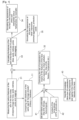
- FIG. 1 is a block diagram of a prediction method in accordance with the present invention.
- the method according to the invention comprises a step 31 of evaluating the various features of the cutaneous signs on the basis of an input image.
- the weight of the area of the eyes with respect to the overall face in terms of apparent age is calculated.
- More than 20 features of the face can be automatically captured: more signs analysed means a more specific and more accurate evaluation for each cutaneous sign.
- these features evaluated on the basis of the input image are compared with reference features prestored in a database.
- a step 41 the responses of the user to a questionnaire relating to their life habits can be stored and be processed in a database.
- These responses can, for example, belong to categories such as physical features of the user, their living place, the demography of their place of residence, nutritional information, information on the use of cosmetics, environmental information, information on the use of beauty products, way of life, dietary habits, the geographical location of the place of residence, the location of the workplace, work habits, sleep habits, exercise habits, relaxation habits, beauty care habits, smoking and alcohol consumption habits, sun exposure habits, the use of sunscreen, the propensity to tan, the number of sunburns and of serious sunburns, dietary requirements, dietary supplements or vitamins, travel habits, information on physical condition, undesirable reactions to products, the use of previous beauty care products and their efficacy, leisure, civil status, country and region of birth, whether the subject is a city, suburb or country dweller, the size of the urban area in which the subject lives, whether the subject is retired.
- categories such as physical features of the user, their living place, the demography of their place of residence, nutritional information, information on the use of cosmetics, environmental information, information on the use of beauty products,
- the life context of the user can be stored and processed additionally in the same database.
- the database is fed with scientific data such as publications, reviews, articles, encyclopaedias, atlases, patents, data on the exposome and ageing, testimony.
- a step 32 the information gathered at the end of the steps 11, 41, 42 and 43 is processed in order to estimate the rate of acceleration of ageing from each cutaneous sign.
- An “ accelerator” is a parameter which will accelerate ageing, such as the sun, pollution or certain medicines.
- the accelerator modifies the predicted information on the ageing of the external body part of the user with respect to predicted information generated without any accelerator.
- a user not having an associated accelerator would be a user living a very healthy or ideal life.
- the " rate of acceleration" is a numerical value which quantifies the influence of an accelerator on ageing.
- the rate of acceleration is high when the influence of the accelerator on the predicted information is high, such as the sun, and weak if it has only a weak effect.
- a step 33 the future development of the cutaneous signs is evaluated on the basis of the information originating from the steps 31 and 32, namely the features of the various cutaneous signs and the rate of acceleration.
- a step 34 the appearance of the face of the user in their predictable actual exposome is simulated, notably according to the information which they communicated in the steps 41 and 42.
- a step 35 the appearance of the face of the user in an imaginary ideal exposome can be simulated.
Landscapes
- Health & Medical Sciences (AREA)
- Engineering & Computer Science (AREA)
- Life Sciences & Earth Sciences (AREA)
- Physics & Mathematics (AREA)
- General Health & Medical Sciences (AREA)
- Medical Informatics (AREA)
- Artificial Intelligence (AREA)
- Evolutionary Computation (AREA)
- Heart & Thoracic Surgery (AREA)
- Molecular Biology (AREA)
- Surgery (AREA)
- Animal Behavior & Ethology (AREA)
- Biomedical Technology (AREA)
- Public Health (AREA)
- Veterinary Medicine (AREA)
- Pathology (AREA)
- Biophysics (AREA)
- Theoretical Computer Science (AREA)
- General Physics & Mathematics (AREA)
- Computer Vision & Pattern Recognition (AREA)
- Multimedia (AREA)
- Human Computer Interaction (AREA)
- Signal Processing (AREA)
- Dermatology (AREA)
- Oral & Maxillofacial Surgery (AREA)
- Psychiatry (AREA)
- Mathematical Physics (AREA)
- Physiology (AREA)
- Fuzzy Systems (AREA)
- Computing Systems (AREA)
- Databases & Information Systems (AREA)
- Software Systems (AREA)
- Measurement Of The Respiration, Hearing Ability, Form, And Blood Characteristics Of Living Organisms (AREA)
- Measuring And Recording Apparatus For Diagnosis (AREA)
Abstract
Description
Claims (22)
- Cosmetic and non-therapeutic method for predicting the appearance of an area of interest of a user, the area of interest being divided into regions of interest comprising cutaneous signs, the method comprising (i) acquiring an input image of the area of interest, processing (31) the input image, on the one hand, with (ii) an image segmentation and analysis algorithm for determining optical properties of the area of interest and extracting features of the cutaneous signs and, on the other hand, with (iii) a deep learning algorithm based on artificial intelligence, for predicting and/or displaying the future development (33) of the cutaneous signs from the input image by comparing (11) the features of the cutaneous signs extracted from the input image with reference data prestored in a reference database (43), (iv) ideally or acceleratedly simulating (34, 35) the future appearance of the area of interest as a function of time.
- Cosmetic and non-therapeutic method for predicting the appearance of an area of interest of a user, the area of interest being divided into regions of interest comprising cutaneous signs, the method comprising (i) acquiring an input image of the area of interest, processing (31) the input image, on the one hand, with (ii) an image segmentation and analysis algorithm for determining optical properties of the area of interest and extracting features of the cutaneous signs and, on the other hand, with (iii) a deep learning algorithm based on artificial intelligence, for predicting and/or displaying the rejuvenation of the cutaneous signs from the input image by comparing (11) the features of the cutaneous signs extracted from the input image with reference data prestored in a reference database (43), (iv) ideally or acceleratedly simulating (34, 35) the future appearance of the area of interest as a function of time.
- Cosmetic and non-therapeutic method for predicting the appearance of an area of interest of a user, the area of interest being divided into regions of interest comprising cutaneous signs, the method comprising (i) acquiring an input image of the area of interest, processing (31) the input image, on the one hand, with (ii) an image segmentation and analysis algorithm for determining optical properties of the area of interest and extracting features of the cutaneous signs and, on the other hand, with (iii) a deep learning algorithm based on artificial intelligence, for predicting and/or displaying, in the event that the performance of a product is known, an effect produced on cutaneous signs from the input image by comparing (11) the features of the cutaneous signs extracted from the input image with reference data prestored in a reference database (43), (iv) ideally or acceleratedly simulating (34, 35) the future appearance of the area of interest as a function of time.
- Method according to any one of the preceding claims, characterized in that the algorithm for predicting and/or displaying is a deep learning algorithm based on artificial intelligence.
- Method according to any one of the preceding claims, characterized in that processing the input image includes an overall analysis of the area of interest as well as an analysis of regions of interest.
- Method according to any one of the preceding claims, characterized in that processing the input image comprises evaluating at least two cutaneous signs.
- Method according to any one of the preceding claims, characterized in that it comprises (v) processing one or more pieces of information describing the lifestyle of the user (41, 42).
- Method according to any one of the preceding claims, characterized in that it comprises (vi) estimating (32) a rate of acceleration of ageing from each cutaneous sign as a function of the information describing the lifestyle of the user, of the input image and of the prestored reference data.
- Method according to any one of the preceding claims, characterized in that it comprises (vii) evaluating (33) the appearance of each cutaneous sign as a function of time, based on the rate of acceleration of ageing and on the input image.
- Method according to any one of the preceding claims, characterized in that it comprises (viii) simulating the future appearance of the area of interest in an exposome of the user (34) and possibly (viii) simulating the future appearance of the area of interest in an ideal exposome (35).
- Method according to any one of the preceding claims, characterized in that the areas of interest are chosen from the forehead, the contour of the eyes, the nose, the cheekbones, the contour of the lips, the chin, the lips and the cheeks.
- Method according to any one of the preceding claims, in which the algorithm for predicting and/or displaying the future development, the rejuvenation or the produced effect of the cutaneous signs from the input image is based on a deep learning algorithm based on artificial intelligence.
- Method according to any one of the preceding claims, in which the algorithm for predicting and/or displaying the future development, the rejuvenation or the produced effect of the cutaneous signs from the input image is based on a photorealistic or realistic physical 3D/2D rendering algorithm.
- Method according to any one of the preceding claims, in which the algorithm for predicting and/or displaying the future development, the rejuvenation or the produced effect of the cutaneous signs from the input image is based on a neural rendering algorithm.
- Method according to any one of the preceding claims, in which the machine learning model is a pretrained convolutional neural network.
- Method according to any one of the preceding claims, in which the cutaneous signs are chosen from pores, skin texture, a line, a fine line, crow's feet, sagging, shadows under the eyes, skin grain, a facial expression, morphology, redness, sheen.
- Method according to any one of the preceding claims, in which the features of the cutaneous signs are chosen from openness, surface area, volume, depth, width, length, colour, degree of moisturization, degree of sheen, distribution, intensity, reflectivity, frequency, homogeneity, suppleness, firmness, translucency, luminosity, pigmentation, degree of mattness, elasticity or density.
- Method according to any one of the preceding claims, in which the simulation is generated by unsupervised learning algorithms, notably generative adversarial networks (GANs).
- Method according to any one of the preceding claims, in which a cosmetic product is selected and the future appearance of the area of interest to which the product was applied is simulated.
- Cosmetic and non-therapeutic system for predicting the appearance of an area of interest of a user, comprising communication means which are suitable for communicating with a user computing device and configured to import, from an image library of the user computing device, at least one input image comprising a representation of the area of interest of the user; processing means configured to subject the input image to (ii) an image segmentation and analysis algorithm for determining optical properties of the area of interest and extracting features of the cutaneous signs, and to (iii) a deep learning algorithm based on artificial intelligence, for predicting and/or displaying the future development of the cutaneous signs from the input image by comparing the features of the cutaneous signs extracted from the reference image with reference data prestored in a reference database, (iv) means for ideally or acceleratedly simulating the future appearance of the area of interest as a function of time.
- Computer program comprising instructions which, when the program is executed by a computer, cause the latter to implement the method according to one of Claims 1 to 19.
- Computer-readable medium comprising instructions which, when they are executed by a computer, cause the latter to implement the method according to one of Claims 1 to 19.
Method for predicting the development of cutaneous signs over time
Priority Applications (1)
| Application Number | Priority Date | Filing Date | Title |
|---|---|---|---|
| CN202380039097.4A CN119677453A (en) | 2022-05-10 | 2023-05-03 | Method for predicting the development of skin signs over time |
Applications Claiming Priority (2)
| Application Number | Priority Date | Filing Date | Title |
|---|---|---|---|
| FR2204419A FR3135557B1 (en) | 2022-05-10 | 2022-05-10 | Method for predicting the temporal evolution of cutaneous signs |
| FRFR2204419 | 2022-05-10 |
Publications (1)
| Publication Number | Publication Date |
|---|---|
| WO2023217608A1 true WO2023217608A1 (en) | 2023-11-16 |
Family
ID=83900192
Family Applications (1)
| Application Number | Title | Priority Date | Filing Date |
|---|---|---|---|
| PCT/EP2023/061690 Ceased WO2023217608A1 (en) | 2022-05-10 | 2023-05-03 | Method for predicting the development of cutaneous signs over time |
Country Status (3)
| Country | Link |
|---|---|
| CN (1) | CN119677453A (en) |
| FR (1) | FR3135557B1 (en) |
| WO (1) | WO2023217608A1 (en) |
Citations (4)
| Publication number | Priority date | Publication date | Assignee | Title |
|---|---|---|---|---|
| WO2011141769A1 (en) | 2010-05-10 | 2011-11-17 | L'oreal | Method for evaluating a body typology characteristic |
| US8218862B2 (en) | 2008-02-01 | 2012-07-10 | Canfield Scientific, Incorporated | Automatic mask design and registration and feature detection for computer-aided skin analysis |
| WO2020169214A1 (en) | 2019-02-21 | 2020-08-27 | L'oreal | Machine-implemented beauty assistant for predicting face aging |
| US20210407153A1 (en) * | 2020-06-30 | 2021-12-30 | L'oreal | High-resolution controllable face aging with spatially-aware conditional gans |
-
2022
- 2022-05-10 FR FR2204419A patent/FR3135557B1/en active Active
-
2023
- 2023-05-03 WO PCT/EP2023/061690 patent/WO2023217608A1/en not_active Ceased
- 2023-05-03 CN CN202380039097.4A patent/CN119677453A/en active Pending
Patent Citations (4)
| Publication number | Priority date | Publication date | Assignee | Title |
|---|---|---|---|---|
| US8218862B2 (en) | 2008-02-01 | 2012-07-10 | Canfield Scientific, Incorporated | Automatic mask design and registration and feature detection for computer-aided skin analysis |
| WO2011141769A1 (en) | 2010-05-10 | 2011-11-17 | L'oreal | Method for evaluating a body typology characteristic |
| WO2020169214A1 (en) | 2019-02-21 | 2020-08-27 | L'oreal | Machine-implemented beauty assistant for predicting face aging |
| US20210407153A1 (en) * | 2020-06-30 | 2021-12-30 | L'oreal | High-resolution controllable face aging with spatially-aware conditional gans |
Non-Patent Citations (7)
| Title |
|---|
| FREDERIC FLAMENT ET AL.: "Comment une fatigue induite par une journée de travail peut modifier certains signes faciaux chez des femmes caucasiennes d'age different [Elow fatigue induced by a day of work can modify certain facial signs in Caucasian women of different ages)", INTERNATIONAL JOURNAL OF COSMETIC SCIENCE, vol. 39, 2017, pages 467 - 475 |
| FREDERIC FLAMENT ET AL.: "Effect of the sun on visible clinical signs of aging in Caucasian skin", CLINICAL, COSMETIC AND INVESTIGATIONAL DERMATOLOGY, vol. 6, 2013, pages 221 - 232 |
| FREDERIC FLAMENT ET AL.: "Effets de la saisonnalite et d'une photo-protection quo-tidienne sur certains signes du visage des femmes chinoises [Effects of seasonality and of daily photoprotection on certain signs of the face of Chinese women", INTERNATIONAL JOURNAL OF COSMETIC SCIENCE, vol. 39, 2017, pages 256 - 268 |
| FREDERIC FLAMENT ET AL.: "Une pollution urbaine exterieure chronique severe altere certains signes de vieillissement du visage chez les femmes chinoises [Severe chronic external urban pollution alters certain signs of ageing of the face in Chinese women)'', Journal international des sciences cosmetiques", INTERNATIONAL JOURNAL OF COSMETIC SCIENCE, vol. 40, 2018, pages 467 - 481 |
| GRIMMER MARCEL ET AL: "Deep Face Age Progression: A Survey", IEEE ACCESS, IEEE, USA, vol. 9, 3 June 2021 (2021-06-03), pages 83376 - 83393, XP011860953, DOI: 10.1109/ACCESS.2021.3085835 * |
| LI PEIPEI ET AL: "Global and Local Consistent Age Generative Adversarial Networks", 25 January 2018 (2018-01-25), pages 1073 - 1078, XP093011572, ISBN: 978-1-5386-3788-3, Retrieved from the Internet <URL:https://arxiv.org/pdf/1801.08390.pdf> [retrieved on 20230104], DOI: 10.1109/ICPR.2018.8545119 * |
| SHI CHENGLONG ET AL: "CAN-GAN: Conditioned-attention normalized GAN for face age synthesis", PATTERN RECOGNITION LETTERS, ELSEVIER, AMSTERDAM, NL, vol. 138, 31 August 2020 (2020-08-31), pages 520 - 526, XP086293551, ISSN: 0167-8655, [retrieved on 20200831], DOI: 10.1016/J.PATREC.2020.08.021 * |
Also Published As
| Publication number | Publication date |
|---|---|
| CN119677453A (en) | 2025-03-21 |
| FR3135557A1 (en) | 2023-11-17 |
| FR3135557B1 (en) | 2024-09-27 |
Similar Documents
| Publication | Publication Date | Title |
|---|---|---|
| US9330298B2 (en) | Face impression analyzing method, aesthetic counseling method, and face image generating method | |
| KR100993875B1 (en) | Fuzzy Based Personal Color Diagnosis System and Its Method | |
| CN108694736A (en) | Image processing method, device, server and computer storage media | |
| Liu et al. | Could linear model bridge the gap between low-level statistical features and aesthetic emotions of visual textures? | |
| WO2020169214A1 (en) | Machine-implemented beauty assistant for predicting face aging | |
| JP5651385B2 (en) | Face evaluation method | |
| JP2016081075A (en) | Method and device for improving impression | |
| JP2004166801A (en) | Evaluation method for luster of skin | |
| WO2021243640A1 (en) | Oral care based digital imaging systems and methods for determining perceived attractiveness of facial image portion | |
| WO2023217608A1 (en) | Method for predicting the development of cutaneous signs over time | |
| Bastanfard et al. | Toward E-appearance of human face and hair by age, expression and rejuvenation | |
| WO2023217626A1 (en) | Detection and visualization of cutaneous signs using a heat map | |
| US12340510B2 (en) | Oral care based digital imaging systems and methods for analyzing attributes of a facial image portion | |
| CN120530424A (en) | Method for modeling and evaluating the evolution of aging signs in users | |
| JP7520679B2 (en) | Method for estimating lively face degree, device for estimating lively face degree, and program for estimating lively face degree | |
| Popescu et al. | 3D Virtual Modeling and Artificial Intelligence Clothing Try-on Technologies, Hyper-Realistic Augmented Reality-powered Makeup Filters, and Cognitive and Affective Algorithms for Beauty Ideal Cultural Constructions | |
| CA3218635A1 (en) | Computer-based body part analysis methods and systems | |
| JP2023038870A (en) | Impression evaluation method and impression evaluation system | |
| JP7429683B2 (en) | Method for determining temporal change characteristics of facial surface texture | |
| JP7512167B2 (en) | Skin Classification Based on Blemish Distribution in Cheek Images | |
| JP2023038871A (en) | Feature extraction method and feature extraction system | |
| Toyota et al. | Principal component analysis for pigmentation distribution in whole facial image and prediction of the facial image in various ages | |
| Burcea et al. | Joanna Szydło1, Cătălina Ioana Bonciu2, Ştefan Gabriel Burcea3, and Cătălina-Oana Dumitrescu3 | |
| Shen et al. | The Impact of Varying Levels of Figurative Representation on Aesthetic Evaluation: A Computational Aesthetic Analysis of Xu Beihong's Horse Paintings | |
| Martin et al. | Understanding the visual effects of cosmetic products on beauty via deep learning |
Legal Events
| Date | Code | Title | Description |
|---|---|---|---|
| 121 | Ep: the epo has been informed by wipo that ep was designated in this application |
Ref document number: 23724274 Country of ref document: EP Kind code of ref document: A1 |
|
| WWE | Wipo information: entry into national phase |
Ref document number: 202380039097.4 Country of ref document: CN |
|
| NENP | Non-entry into the national phase |
Ref country code: DE |
|
| WWP | Wipo information: published in national office |
Ref document number: 202380039097.4 Country of ref document: CN |
|
| 122 | Ep: pct application non-entry in european phase |
Ref document number: 23724274 Country of ref document: EP Kind code of ref document: A1 |