WO2023213728A1 - Substituted aryl esters of coumarin-3-carboxylic acid and their use as host cell proteases inhibitors - Google Patents
Substituted aryl esters of coumarin-3-carboxylic acid and their use as host cell proteases inhibitors Download PDFInfo
- Publication number
- WO2023213728A1 WO2023213728A1 PCT/EP2023/061344 EP2023061344W WO2023213728A1 WO 2023213728 A1 WO2023213728 A1 WO 2023213728A1 EP 2023061344 W EP2023061344 W EP 2023061344W WO 2023213728 A1 WO2023213728 A1 WO 2023213728A1
- Authority
- WO
- WIPO (PCT)
- Prior art keywords
- compound
- nmr
- dmso
- carbon atoms
- basic group
- Prior art date
- Legal status (The legal status is an assumption and is not a legal conclusion. Google has not performed a legal analysis and makes no representation as to the accuracy of the status listed.)
- Ceased
Links
Classifications
-
- A—HUMAN NECESSITIES
- A61—MEDICAL OR VETERINARY SCIENCE; HYGIENE
- A61K—PREPARATIONS FOR MEDICAL, DENTAL OR TOILETRY PURPOSES
- A61K31/00—Medicinal preparations containing organic active ingredients
- A61K31/33—Heterocyclic compounds
- A61K31/335—Heterocyclic compounds having oxygen as the only ring hetero atom, e.g. fungichromin
- A61K31/365—Lactones
- A61K31/366—Lactones having six-membered rings, e.g. delta-lactones
- A61K31/37—Coumarins, e.g. psoralen
-
- A—HUMAN NECESSITIES
- A61—MEDICAL OR VETERINARY SCIENCE; HYGIENE
- A61K—PREPARATIONS FOR MEDICAL, DENTAL OR TOILETRY PURPOSES
- A61K31/00—Medicinal preparations containing organic active ingredients
- A61K31/33—Heterocyclic compounds
- A61K31/395—Heterocyclic compounds having nitrogen as a ring hetero atom, e.g. guanethidine or rifamycins
- A61K31/495—Heterocyclic compounds having nitrogen as a ring hetero atom, e.g. guanethidine or rifamycins having six-membered rings with two or more nitrogen atoms as the only ring heteroatoms, e.g. piperazine or tetrazines
- A61K31/496—Non-condensed piperazines containing further heterocyclic rings, e.g. rifampin, thiothixene or sparfloxacin
-
- A—HUMAN NECESSITIES
- A61—MEDICAL OR VETERINARY SCIENCE; HYGIENE
- A61P—SPECIFIC THERAPEUTIC ACTIVITY OF CHEMICAL COMPOUNDS OR MEDICINAL PREPARATIONS
- A61P11/00—Drugs for disorders of the respiratory system
-
- A—HUMAN NECESSITIES
- A61—MEDICAL OR VETERINARY SCIENCE; HYGIENE
- A61K—PREPARATIONS FOR MEDICAL, DENTAL OR TOILETRY PURPOSES
- A61K9/00—Medicinal preparations characterised by special physical form
- A61K9/0012—Galenical forms characterised by the site of application
- A61K9/007—Pulmonary tract; Aromatherapy
- A61K9/0073—Sprays or powders for inhalation; Aerolised or nebulised preparations generated by other means than thermal energy
Definitions
- the present invention relates to substituted aryl esters of coumarin-3- carboxylic acid and their use for the treatment of respiratory diseases, in particular as transmembrane serine protease 2 inhibitors.
- the present invention also relates to pharmaceutical compositions comprising substituted aryl esters of coumarin-3- carboxylic acid. BACKGROUND OF THE INVENTION There is an urgent need to identify new therapies to prevent acute respiratory syndrome coronavirus 2 (SARS-CoV-2) infection and improve the outcome of COVID-19 patients.
- SARS-CoV-2 acute respiratory syndrome coronavirus 2
- SARS-CoV-2 utilizes the membrane ectopeptidase angiotensin-converting enzyme 2 (ACE2) as its receptor to initiate binding and entry in host cells (Hoffmann et al., Cell 2020, 181, 271).
- ACE2 membrane ectopeptidase angiotensin-converting enzyme 2
- S protein spike glycoprotein
- the S protein undergoes proteolytic cleavage events.
- TMPRSS2 transmembrane serine protease 2
- TMPRSS2 is also known to be implicated in the activation of influenza A, influenza B, and other coronaviruses to drive efficient infection of the lungs (Matsuyama et al., J. Virol.2010, 84, 12658 and Limburg et al., J. Virol.2019, 93, 1). As a result, TMPRSS2 is an attractive target for new antiviral agents, as inhibiting its proteolytic activity blocks efficiently viral entry (Hoffmann et al., Cell 2020, 181, 271, Singh et al., Eur. J. Pharm. Sci. 2020, 153, 105495). It should be specified that TMPRSS2 alone does not mediate viral infection.
- TMPRSS2 co-expression of TMPRSS2 with ACE2 results in enhanced infectivity, inducing S protein cleavage and exposing the fusion peptide for efficient viral entry (Chavez- Medina et al., Arch. Microbiol. 2022, 204, 77).
- TMPRSS2 appears to be a druggable anti- SARS-CoV-2 host protein target for the following reasons. The host protein is not subject to mutation.
- TMPRSS2 being used by other viruses (i.e.
- TMPRSS2 inhibitors may be used to treat a wide class of diseases caused by different pathogens (Cannalire et al., Int. J. Mol. Sci. 2020, 21, 5707), including SARS-CoV-2 variants.
- TMPRSS2-knockout mice TMPRSS2 appeared to be useless for normal development and organ function (Stopsack et al., Cancer Discov. 2020, 10, 779).
- TMPRSS2 inhibition may have few on-target side effects (Huang et al., Int. J. Mol. Sci. 2021, 22, 7060).
- TMPRSS2 constitutes an attractive therapeutic target
- many recent works were dedicated to the evaluation of existing TMPRSS2 inhibitors as possible antiviral agents.
- the irreversible serine protease inhibitors camostat and nafamostat currently on the Japanese pharmaceutical market for therapeutic indications other than antivirals, were found to be effective at preventing host cell entry and replication of SARS-CoV-2 in Calu-3 cells through a TMPRSS2-dependent mechanism (Hoffmann et al., Cell 2020, 181, 271, Hoffmann et al., Antimicrob. Agents Chermother. 2020, 64, e00754-20).
- TMPRSS2 inhibitors There is thus still a need to develop potent and highly selective TMPRSS2 inhibitors. There is also a need to develop potent and highly selective inhibitors against other serine protease involved in respiratory diseases such as human airways trypsin-like protease TMPRSS11D (HAT), cathepsin B/L or furin protease.
- HAT human airways trypsin-like protease TMPRSS11D
- HAT trypsin-like protease
- cathepsin B/L cathepsin B/L
- furin protease An inhibitor being able to target both TMPRSS2 and HAT can have an effect both on infection and inflammation. A combined inhibition may thus be of interest in the treatment and/or the prevention of respiratory diseases.
- some coumarin derivatives were described with their activity as protease inhibitors (Reboud-Ravaux et al. WO98/55472).
- R 1 is a substituted linear or branched alkyl chain of 1 to 6 carbon atoms
- R 2 is a basic group bearing a positive charge at physiological pH or a precursor thereof, such basic group or precursor thereof being optionally preceded by a linear or branched alkyl chain of 1 to 6 carbon atoms and R 2 being in the ortho, meta or para position of the ester group on the aryl ring
- R 3 is a halogen with x being an integer between 0 and 4
- R 4 is a halogen with y being an integer between 0 and 3
- Such compounds of Formula I present an inhibitory activity against enzymes such as host cell proteases.
- Host cell proteases may be transmembrane serine protease 2, generally referred to as TMPRSS2, human airways trypsin-like protease TMPRSS11D (HAT), another major serine protease involved in respiratory diseases, cathepsin B/L or furin protease.
- TMPRSS2 transmembrane serine protease 2
- HAT human airways trypsin-like protease
- a test to show the inhibitory activity consists of incubating the enzyme, optionally a buffer, and a compound as recited above and then determining the activity of the enzyme by comparison of the initial rates to those obtained in control experiments without the tested compounds.
- the IC50 values express the inhibitory activity.
- the coumarin derivatives are designed to present a basic group (R 2 ), which bears a positive charge at physiological pH.
- R 2 a basic group
- bearing a positive charge is also meant having a cationic group at physiological pH.
- a physiological pH is a pH of about 7 to about 8.
- Examples of such basic group are an amine, an amidine or a guanidine group, providing an aminium, an amidinium or a guanidinium group at physiological pH. These may be directly or not directly linked to the aromatic ring and introduced in the ortho, meta or para position of the ester group on the aryl group.
- these groups are linked through a short linear or branched alkyl chain such a linear or branched alkyl chain with 1 to 6 carbon atoms.
- alkyl chain is preferably a linear alkyl chain.
- This cationic group enables to target the anionic carboxylate function of Asp435 of the enzymatic catalytic site of TMPRSS2 and to promote the establishment of a salt bridge between the enzyme and its inhibitor.
- the basic group may advantageously be chosen among a relatively strong basic group such as amidine or guanidine or a mild basic group such as a primary amine.
- the coumarine derivative are low molecular weight non peptidic molecules.
- TMPRSS2 or other host cell proteases of interest (furin, cathepsin B/L, TMPRSS11D) to combat respiratory diseases.
- This may also lead to either dual inhibitors or use of a combination of inhibitors, both strategies being susceptible to increase antiviral potency.
- they may have a dual inhibition against TMPRSS2 and HAT.
- compounds may be designed as prodrugs.
- prodrug is meant a compound that, after administration, is metabolized into a pharmacologically active drug.
- prodrug of Formula I is meant any compound that can be metabolized into a compound of Formula I.
- a prodrug form can be advantageous to improve the oral bioavailability.
- the basic group of Formula I when the basic group of Formula I is an amidine or a guanidine-bearing group, it might exhibit poor oral bioavailability due to the permanent cationic form of these groups in biological media. It is for example known that the antithrombotic agent dabigatran bearing an amidine function is used as a prodrug (dabigatran etexilate) suitable for oral administration.
- the precursor of the basic group may bear a carbamate function or a pseudocarbamate function.
- a (pseudo)carbamate function may be metabolized into a basic group after administration to a subject.
- Other precursors of amine function or other precursors of other basic functions are also possible.
- n may be 1 or 2 to facilitate the target of the anionic carboxylate function of Asp435 of the enzymatic catalytic site of TMPRSS2 and to promote the establishment of a salt bridge between the enzyme and its inhibitor.
- the aryl ring linked to the ester function of the coumarin derivative is substituted by one or more halogen atoms (R 3 ).
- a halogen atom may be fluorine, chlorine, bromine or iodine.
- a halogen atom is chlorine or bromine.
- the aryl ring bears one or two or three halogen atoms, to favour the inhibitory activity on the enzyme.
- the aryl ring bears a hydrogen in each position where no halogen or other substituent is present.
- the aryl ring linked to the ester function of the coumarin derivative does not bear a halogen atom (R 3 ).
- x in Formula I may be equal to 0.
- the coumarin core also bears one or more halogen atoms (R 4 ), preferably 1 or 2. It will also be easily understood by a person skilled in the art that the coumarin bears a hydrogen in each position where no halogen or other substituent is present. Alternatively, the coumarin core does not bear a halogen atom (R 4 ).
- y in Formula I may be equal to 0.
- An alkyl chain of 1 to 6 carbon atom may be a methyl, an ethyl, a propyl, a butyl, a pentyl, a hexyl, a tert-butyl.
- a substituent on the R 1 linear or branched alkyl chain of 1 to 6 carbon atoms may be one or more suitable substituent(s) to favour interaction with the host cell protease.
- Suitable substituents may be a halogen.
- Suitable substituents may be chosen among chloride, bromide, iodide, mesylate, triflate, tosylate, acetate or trifluoroacetate.
- the one or more substituent(s) may be positioned on any carbon atom of the said R 1 alkyl chain.
- the substituent may be a leaving group.
- leaving group is meant an atom or a group of atoms that is able to depart upon heterolysis taking with it the bonding electrons. Chloride and bromide are preferred leaving groups.
- a leaving group is linked to the aryl ring with a short linear or branched alkyl chain, such as an alkyl chain with 1 to 6 carbon atoms, such as a linear or branched alkyl chain of 1 to 6 carbon atoms e.g. a methyl.
- R 1 is -CH 2 Cl or -CH 2 Br.
- a salt of the compound of Formula I may have as counterion for example chloride, bromide, iodide or trifluoroacetate.
- a compound of Formula I may also be in the form of a conjugate acid base, such as in the form of a hydrochloride for example.
- respiratory disease one means a pathological condition affecting the organs, and/or the tissues and/or the cells thereof, that enable to breathe, making such breathing difficult.
- organs or tissues include the lungs, the trachea, the bronchi, the bronchioles, the alveoli, the pleura and pleural cavity, the nerves and muscles of respiration.
- Respiratory diseases include but are not limited to the cold, influenza, pharyngitis, bronchitis, pneumonia, tuberculosis, asthma, lung cancer, Covid-19 or other severe acute respiratory syndromes (SARS).
- Targeted cells may be cells expressing transmembrane serine protease 2 such as for example lung epithelial cells. Treatment may also include a reduction of the inflammation observed in such cells.
- the respiratory disease may be a viral infection or another type of infection affecting the respiratory system.
- a compound of Formula I or a prodrug thereof and/or a salt thereof, may also be used in the prevention of respiratory diseases.
- the invention also pertains to a compound of Formula I or a prodrug thereof and/or a salt thereof, wherein R 2 is a basic group bearing a positive charge at physiological pH or a precursor thereof, such basic group or precursor thereof being preceded by a linear or branched alkyl chain of 1 to 6 carbon atoms, preferably of 1 to 2 carbon atoms.
- a basic group are an amine, an amidine or a guanidine group, providing an aminium, an amidinium or a guanidinium group at physiological pH.
- An example of precursor of a basic group is a carbamate function or a pseudocarbamate function.
- the invention also pertains to a compound of Formula I or a prodrug thereof and/or a salt thereof, wherein R 2 is a basic group bearing a positive charge at physiological pH or a precursor thereof, such basic group or precursor thereof being preceded by a linear or branched alkyl chain of 1 to 6 carbon atoms, preferably of 1 to 2 carbon atoms for use as a medicament.
- R 2 is a basic group bearing a positive charge at physiological pH or a precursor thereof, such basic group or precursor thereof being preceded by a linear or branched alkyl chain of 1 to 6 carbon atoms, preferably of 1 to 2 carbon atoms for use as a medicament.
- Such compounds present an inhibitory activity against serine proteases, as shown in the examples.
- the invention also pertains to a pharmaceutical composition
- a pharmaceutical composition comprising a compound of Formula I or a prodrug thereof and/or salt thereof, wherein R 2 is a basic group bearing a positive charge at physiological pH or a precursor thereof, such basic group or precursor thereof being preceded by a linear or branched alkyl chain of 1 to 6 carbon atoms, preferably of 1 to 2 carbon atoms and a pharmaceutically acceptable carrier.
- the invention particularly pertains to a compound of Formula I wherein R 1 is a methyl substituted by a chloride, R 2 is an amine or a guanidine or an amidine preceded by a methyl or an ethyl, R 2 being in ortho, meta or para position of the ester group on the aryl ring and wherein x and y are both 0, or a prodrug thereof and/or a salt thereof.
- a prodrug is particularly meant that the amine, guanidine or amidine may be present as a carbamate or a pseudocarbamate function bearing a methyl, ethyl, propyl, butyl, pentyl, hexyl or tertbutyl function.
- a salt is particularly meant that the amine, guanidine or amidine may be conjugated with a hydrochloride.
- the invention also particularly pertains to pharmaceutical compositions of those compounds and their use as a medicament. Examples of compounds according to the invention are: Compound a Compound b Compound c Compound d Compound e Compound f The invention also pertains to the preparation of such compounds.
- a general method of synthesis may imply the following steps: - Preparation of a phenol intermediate bearing the desired R 2 group in ortho, meta or para position and optionally one or more R 3 groups.
- the basic group comprised in R 2 is advantageously protected by a tert-butyloxycarbonyl group or any other suitable protecting group -
- a 2-oxo-2H-1-benzopyran-3-carbonyl chloride bearing the desired R 1 group and optionally one or more R 4 groups from a salicylic aldehyde according to the process described in the literature (Pochet et al. J. Med. Chem. 1996, 39, 2579-252585) - Adding the obtained 2-oxo-2H-1-benzopyran-3-carbonyl chloride to the phenol intermediate bearing the desired protected R 2 group in ortho, meta or para position and optionally one or more R 3 groups.
- the invention also pertains to the preparation of such pharmaceutical composition.
- pharmaceutically acceptable carrier is intended to mean a medium that is compatible with the respiratory system, such as for example the pulmonary system.
- the pharmaceutical composition according to the invention can be administered through any type of administration, such as an oral administration, a cutaneous administration, an injection, an intravenous administration, a subcutaneous administration, a systemic administration, a parenteral, digestive, rectal or transcutaneous administration, a transmucosal administration, a pulmonary, nasal or sublingual administration, an inhalation or a nebulization or an aerosol administration.
- the composition is administered orally, by injection or by an aerosol.
- a pulmonary or aerosol administration can be through a gaseous composition, a volatile composition or through a composition that is a suspension in a gaseous vector.
- the pharmaceutical composition may be in a form suitable for an aerosol administration.
- Compounds as recited above are also referred to as coumarin derivatives. Possible routes of synthesis of the coumarin derivatives are described in the examples. It will however be understood that such synthetic routes do not limit the present invention.
- Reagents are for step i: diethyl malonate, piperidine, HOAc, EtOH; for step ii: HOH, H + , EtOH; for step iii: SOCl 2 or SOBr 2 ; for step iv: intermediate 9, 12 or 13, pyridine, dioxane; for step v: HX, methylene chloride.
- the phenol intermediates bearing the tert-butoxycarbonyl (Boc)- protected amidines (9) or guanidines (12,13) are prepared according to schemes 1 and 2.
- Intermediate 17 obtained according to a well-known classical synthetic process (Pochet et al., J. Med. Chem.
- Reagents of scheme 8 are for step: i: benzyl bromide, K 2 CO 3 , CH 3 CN; for step ii: HCl, EtOH; for step iii: NH 4 OH, EtOH; for step iv: (Boc) 2 O, pyridine, DMAP, CH 2 Cl 2 ; for step v: H 2 , Pd/C, EtOH.
- Table 1 Compounds obtained in example 2b
- Example 3 In vitro enzymatic assays and inhibition mechanistic studies The compounds were evaluated in vitro for their inhibitory potential on the human recombinant TMPRSS2 and HAT (TMPRSS11D. The enzyme activities are measured at 25°C in the presence of appropriate commercially available fluorogenic peptide substrates, Boc-QAR-AMC for TMPRSS2 and, Boc-VPR-AMC for HAT using a fluorescence microplate reader (BMG Fluostar Optima). The experimental conditions are summarized in Table 2. Table 2. Experimental conditions used for inhibition studies of TMPRSS2 and HAT. Compounds (5-100 ⁇ M) were tested in triplicate for each inhibitor to detect its inhibitory potential.
- the tested compounds were previously incubated with TMPRSS2 or HAT in the appropriate buffer for 15 min at 25°C.
- the enzymatic reactions were triggered by the addition of the fluorogenic substrate and the kinetics were monitored for 30 min.
- Initial rates (V0) determined in control experiments (no inhibitor) were considered to be 100% of the proteinase activity; initial rates Vi that were below 100% in the presence of a tested compound were considered to be inhibitions. The same percentage of co-solvent was used in both cases.
- the inhibitory activity of compounds was expressed as IC50 (inhibitor concentrations giving 50% inhibition).
- the inhibition of TMPRSS2 and HAT was favored by the presence of a positive charge (factor of 74 for TMPRSS2 and of 10 for HAT) by comparing compounds 16c and 15c.
- the charged compounds 16f, 16e and 16i displayed about 100% inhibition à 10 ⁇ M inhibitor concentration.
- the selectivity spectrum was studied using a panel of representative proteases including several trypsin-like kallikrein-related peptidases (KLK5, KLK6, KLK8, KLK13), plasma-blood serine proteases (plasmin, thrombin, tPA) transmembrane serine proteases (matriptase) (Table 4).
Landscapes
- Health & Medical Sciences (AREA)
- Veterinary Medicine (AREA)
- Chemical & Material Sciences (AREA)
- Medicinal Chemistry (AREA)
- Pharmacology & Pharmacy (AREA)
- Life Sciences & Earth Sciences (AREA)
- Animal Behavior & Ethology (AREA)
- General Health & Medical Sciences (AREA)
- Public Health (AREA)
- Epidemiology (AREA)
- Engineering & Computer Science (AREA)
- Bioinformatics & Cheminformatics (AREA)
- Pulmonology (AREA)
- Chemical Kinetics & Catalysis (AREA)
- General Chemical & Material Sciences (AREA)
- Nuclear Medicine, Radiotherapy & Molecular Imaging (AREA)
- Organic Chemistry (AREA)
- Acyclic And Carbocyclic Compounds In Medicinal Compositions (AREA)
Abstract
Compound of Formula (I) wherein R1 is a substituted linear or branched alkyl chain of 1 to 6 carbon atoms; R2 is a basic group bearing a positive charge at physiological pH or a precursor thereof, such basic group or precursor thereof being optionally preceded by a linear or branched alkyl chain of 1 to 6 carbon atoms and R2 being in the ortho, meta or para position of the ester group on the aryl ring; R3 is a halogen with x being an integer between 0 and 4; R4 is a halogen with y being an integer between 0 and 3; or a prodrug thereof, and/or a salt thereof, for its use in the treatment of respiratory diseases and compounds of formula I wherein R2 is a basic group bearing a positive charge at physiological pH or a precursor thereof, such basic group or precursor thereof being preceded by a linear or branched alkyl chain of 1 to 6 carbon atoms, preferably of 1 to 2 carbon atoms for use as a medicament.
Description
Title: SUBSTITUTED ARYL ESTERS OF COUMARIN-3-CARBOXYLIC ACID AND THEIR USE AS HOST CELL PROTEASES INHIBITORS TECHNICAL FIELD OF THE INVENTION The present invention relates to substituted aryl esters of coumarin-3- carboxylic acid and their use for the treatment of respiratory diseases, in particular as transmembrane serine protease 2 inhibitors. The present invention also relates to pharmaceutical compositions comprising substituted aryl esters of coumarin-3- carboxylic acid. BACKGROUND OF THE INVENTION There is an urgent need to identify new therapies to prevent acute respiratory syndrome coronavirus 2 (SARS-CoV-2) infection and improve the outcome of COVID-19 patients. SARS-CoV-2 utilizes the membrane ectopeptidase angiotensin-converting enzyme 2 (ACE2) as its receptor to initiate binding and entry in host cells (Hoffmann et al., Cell 2020, 181, 271). The virus binds to ACE2 through the receptor binding domain of its spike glycoprotein (S protein). To facilitate fusion with host cell membranes, the S protein undergoes proteolytic cleavage events. In respiratory epithelia, the predominant mode of viral entry appears to be membrane fusion at the cell surface, where a cell surface-expressed serine protease, transmembrane serine protease 2 (TMPRSS2), executes the appropriate cleavage of the viral S protein. TMPRSS2 is also known to be implicated in the activation of influenza A, influenza B, and other coronaviruses to drive efficient infection of the lungs (Matsuyama et al., J. Virol.2010, 84, 12658 and Limburg et al., J. Virol.2019, 93, 1). As a result, TMPRSS2 is an attractive target for new antiviral agents, as inhibiting its proteolytic activity blocks efficiently viral entry (Hoffmann et al., Cell 2020, 181, 271, Singh et al., Eur. J. Pharm. Sci. 2020, 153, 105495). It should be specified that TMPRSS2 alone does not mediate viral infection. However, co- expression of TMPRSS2 with ACE2 results in enhanced infectivity, inducing S protein cleavage and exposing the fusion peptide for efficient viral entry (Chavez- Medina et al., Arch. Microbiol. 2022, 204, 77). According to recent literature, TMPRSS2 appears to be a druggable anti- SARS-CoV-2 host protein target for the following reasons. The host protein is not
subject to mutation. Moreover, TMPRSS2 being used by other viruses (i.e. SARS- CoV, MERS-CoV and influenza viruses) for the activation of surface glycoproteins, TMPRSS2 inhibitors may be used to treat a wide class of diseases caused by different pathogens (Cannalire et al., Int. J. Mol. Sci. 2020, 21, 5707), including SARS-CoV-2 variants. Lastly, in TMPRSS2-knockout mice, TMPRSS2 appeared to be useless for normal development and organ function (Stopsack et al., Cancer Discov. 2020, 10, 779). As a result, TMPRSS2 inhibition may have few on-target side effects (Huang et al., Int. J. Mol. Sci. 2021, 22, 7060). Since TMPRSS2 constitutes an attractive therapeutic target, many recent works were dedicated to the evaluation of existing TMPRSS2 inhibitors as possible antiviral agents. The irreversible serine protease inhibitors camostat and nafamostat, currently on the Japanese pharmaceutical market for therapeutic indications other than antivirals, were found to be effective at preventing host cell entry and replication of SARS-CoV-2 in Calu-3 cells through a TMPRSS2-dependent mechanism (Hoffmann et al., Cell 2020, 181, 271, Hoffmann et al., Antimicrob. Agents Chermother. 2020, 64, e00754-20). A recent publication also reports the discovery of small-molecule ketobenzothiazole TMPRSS2 inhibitors with improved activity over the existing known inhibitors (Mahoney et al., Proc. Natl. Acad. Sci. 2021, 118, 43 e2108728118). A clinical trial is ongoing to assess the efficacity of nafamostat as a novel treatment for SARS-CoV-2 infection (Zhuravel et al., E Clinical Medicine 2021, 41, 101169). However, this drug lacks high selectivity for TMPRSS2 and presents poor bioavailability (rapid metabolization after parenteral administration) (Quinn et al, medRxiv 2021, 10.06.21264648). There is thus still a need to develop potent and highly selective TMPRSS2 inhibitors. There is also a need to develop potent and highly selective inhibitors against other serine protease involved in respiratory diseases such as human airways trypsin-like protease TMPRSS11D (HAT), cathepsin B/L or furin protease. An inhibitor being able to target both TMPRSS2 and HAT can have an effect both on infection and inflammation. A combined inhibition may thus be of interest in the treatment and/or the prevention of respiratory diseases. In previous work, some coumarin derivatives were described with their activity as protease inhibitors (Reboud-Ravaux et al. WO98/55472). However, while some coumarin derivatives were found to be potent and selective inhibitors of α-
chymotrypsin (Pochet et al., J. Med. Chem. 1996, 39, 2579), human leukocyte elastase (Doucet et al., J. Med. Chem. 1999, 424161 and Pochet et al., Bioorg. Med. Chem. 2000, 8, 1489), thrombin (Frederick et al., J. Med. Chem. 2005, 48, 7592) or disease-related kallikreins (WO2013/010963, Tan et al., J. Med. Chem.2015, 58, 598; Hanke et al., J. Med. Chem. 2020, 63, 5723), no activity was yet reported towards the inhibition of TMPRSS2. It is an aim of the present invention to provide compounds for use as selective inhibitors of host cell proteases such as TMPRSS2, HAT, cathepsin B/L, furin and/or other enzymes involved in respiratory diseases. It is also an aim of the present invention to provide compounds that heal or relief from pulmonary infections, in particular viral infections. It is also an aim of the present invention to provide new substituted aryl esters of coumarin-3-carboxylic acid. SUMMARY OF THE INVENTION The invention pertains to compounds of Formula I as presented below:
 wherein R1 is a substituted linear or branched alkyl chain of 1 to 6 carbon atoms; R2 is a basic group bearing a positive charge at physiological pH or a precursor thereof, such basic group or precursor thereof being optionally preceded by a linear or branched alkyl chain of 1 to 6 carbon atoms and R2 being in the ortho, meta or para position of the ester group on the aryl ring; R3 is a halogen with x being an integer between 0 and 4; R4 is a halogen with y being an integer between 0 and 3; or a prodrug thereof, and/or a salt thereof, for its use in the treatment of respiratory diseases. Such compounds of Formula I present an inhibitory activity against enzymes such as host cell proteases. Host cell proteases may be transmembrane
serine protease 2, generally referred to as TMPRSS2, human airways trypsin-like protease TMPRSS11D (HAT), another major serine protease involved in respiratory diseases, cathepsin B/L or furin protease. By inhibitory activity, one means a decrease of the activity of the enzyme. A test to show the inhibitory activity consists of incubating the enzyme, optionally a buffer, and a compound as recited above and then determining the activity of the enzyme by comparison of the initial rates to those obtained in control experiments without the tested compounds. The IC50 values (inhibitor concentration giving 50% inhibition) express the inhibitory activity. Advantageously, the coumarin derivatives are designed to present a basic group (R2), which bears a positive charge at physiological pH. By bearing a positive charge is also meant having a cationic group at physiological pH. A physiological pH is a pH of about 7 to about 8. Examples of such basic group are an amine, an amidine or a guanidine group, providing an aminium, an amidinium or a guanidinium group at physiological pH. These may be directly or not directly linked to the aromatic ring and introduced in the ortho, meta or para position of the ester group on the aryl group. When not directly linked, these groups are linked through a short linear or branched alkyl chain such a linear or branched alkyl chain with 1 to 6 carbon atoms. Such alkyl chain is preferably a linear alkyl chain. This cationic group enables to target the anionic carboxylate function of Asp435 of the enzymatic catalytic site of TMPRSS2 and to promote the establishment of a salt bridge between the enzyme and its inhibitor. The basic group may advantageously be chosen among a relatively strong basic group such as amidine or guanidine or a mild basic group such as a primary amine. Advantageously, the coumarine derivative are low molecular weight non peptidic molecules. Advantageously, their modular structure allows structural variations to obtain selective inhibitors of TMPRSS2 or other host cell proteases of interest (furin, cathepsin B/L, TMPRSS11D) to combat respiratory diseases. This may also lead to either dual inhibitors or use of a combination of inhibitors, both strategies being susceptible to increase antiviral potency. Advantageously they may have a dual inhibition against TMPRSS2 and HAT. Alternatively, compounds may be designed as prodrugs. By prodrug is meant a compound that, after administration, is metabolized into a pharmacologically active drug. Hence, by prodrug of Formula I is meant any
compound that can be metabolized into a compound of Formula I. A prodrug form can be advantageous to improve the oral bioavailability. As an illustration, when the basic group of Formula I is an amidine or a guanidine-bearing group, it might exhibit poor oral bioavailability due to the permanent cationic form of these groups in biological media. It is for example known that the antithrombotic agent dabigatran bearing an amidine function is used as a prodrug (dabigatran etexilate) suitable for oral administration. In some embodiments, the precursor of the basic group may bear a carbamate function or a pseudocarbamate function. A carbamate function refers to - NH-COORwhile a pseudocarbamate function may refer to -(=NH)NH-COORor -NH- C(=NH)NH-COOR, or -NH-C(=NH)NH-COOR. Such a (pseudo)carbamate function may be metabolized into a basic group after administration to a subject. Other precursors of amine function or other precursors of other basic functions are also possible. In some embodiments, R2 is chosen from the group consisting of -(CH2)n- NH2, -(CH2)n-C(=NH)NH2, -(CH2)n-NH-C(=NH)NH2 or -(CH2)n-NH-COOR5 , -(CH2)n- C(=NH)NH-COOR5 , -(CH2)n-NH-C(=NH)NH-COOR5 with R5 being a linear or branched alkyl chain with 1 to 6 carbon atoms and with n being an integer between 0 and 6. Advantageously, n may be 1 or 2 to facilitate the target of the anionic carboxylate function of Asp435 of the enzymatic catalytic site of TMPRSS2 and to promote the establishment of a salt bridge between the enzyme and its inhibitor. Advantageously, the aryl ring linked to the ester function of the coumarin derivative is substituted by one or more halogen atoms (R3). A halogen atom may be fluorine, chlorine, bromine or iodine. Preferably a halogen atom is chlorine or bromine. Preferably the aryl ring bears one or two or three halogen atoms, to favour the inhibitory activity on the enzyme. It will be easily understood by a person skilled in the art that the aryl ring bears a hydrogen in each position where no halogen or other substituent is present. Alternatively, the aryl ring linked to the ester function of the coumarin derivative does not bear a halogen atom (R3). In other words, x in Formula I may be equal to 0. Advantageously the coumarin core also bears one or more halogen atoms (R4), preferably 1 or 2. It will also be easily understood by a person skilled in the art
that the coumarin bears a hydrogen in each position where no halogen or other substituent is present. Alternatively, the coumarin core does not bear a halogen atom (R4). In other words, y in Formula I may be equal to 0. An alkyl chain of 1 to 6 carbon atom may be a methyl, an ethyl, a propyl, a butyl, a pentyl, a hexyl, a tert-butyl. A substituent on the R1 linear or branched alkyl chain of 1 to 6 carbon atoms may be one or more suitable substituent(s) to favour interaction with the host cell protease. Suitable substituents may be a halogen. Suitable substituents may be chosen among chloride, bromide, iodide, mesylate, triflate, tosylate, acetate or trifluoroacetate. The one or more substituent(s) may be positioned on any carbon atom of the said R1 alkyl chain. Advantageously, the substituent may be a leaving group. By leaving group is meant an atom or a group of atoms that is able to depart upon heterolysis taking with it the bonding electrons. Chloride and bromide are preferred leaving groups. Preferably a leaving group is linked to the aryl ring with a short linear or branched alkyl chain, such as an alkyl chain with 1 to 6 carbon atoms, such as a linear or branched alkyl chain of 1 to 6 carbon atoms e.g. a methyl. In preferred embodiments, R1 is -CH2Cl or -CH2Br. A salt of the compound of Formula I may have as counterion for example chloride, bromide, iodide or trifluoroacetate. A compound of Formula I may also be in the form of a conjugate acid base, such as in the form of a hydrochloride for example. By respiratory disease one means a pathological condition affecting the organs, and/or the tissues and/or the cells thereof, that enable to breathe, making such breathing difficult. Such organs or tissues include the lungs, the trachea, the bronchi, the bronchioles, the alveoli, the pleura and pleural cavity, the nerves and muscles of respiration. Respiratory diseases include but are not limited to the cold, influenza, pharyngitis, bronchitis, pneumonia, tuberculosis, asthma, lung cancer, Covid-19 or other severe acute respiratory syndromes (SARS). Targeted cells may be cells expressing transmembrane serine protease 2 such as for example lung epithelial cells. Treatment may also include a reduction of the inflammation observed in such cells.
The respiratory disease may be a viral infection or another type of infection affecting the respiratory system. A compound of Formula I or a prodrug thereof and/or a salt thereof, may also be used in the prevention of respiratory diseases. The invention also pertains to a compound of Formula I or a prodrug thereof and/or a salt thereof, wherein R2 is a basic group bearing a positive charge at physiological pH or a precursor thereof, such basic group or precursor thereof being preceded by a linear or branched alkyl chain of 1 to 6 carbon atoms, preferably of 1 to 2 carbon atoms. Examples of a basic group are an amine, an amidine or a guanidine group, providing an aminium, an amidinium or a guanidinium group at physiological pH. An example of precursor of a basic group is a carbamate function or a pseudocarbamate function. The invention also pertains to a compound of Formula I wherein R2 is - (CH2)n-NH-COOR5 or -(CH2)n-C(=NH)NH-COOR5 or -(CH2)n-NH-C(=NH)NH-COOR5 with R5 being a linear or branched alkyl chain with 1 to 6 carbon atoms and with n being an integer between 0 and 6, preferably between 1 and 6. The invention also pertains to a compound of Formula I or a prodrug thereof and/or a salt thereof, wherein R2 is a basic group bearing a positive charge at physiological pH or a precursor thereof, such basic group or precursor thereof being preceded by a linear or branched alkyl chain of 1 to 6 carbon atoms, preferably of 1 to 2 carbon atoms for use as a medicament. Such compounds present an inhibitory activity against serine proteases, as shown in the examples. The invention also pertains to a pharmaceutical composition comprising a compound of Formula I or a prodrug thereof and/or salt thereof, wherein R2 is a basic group bearing a positive charge at physiological pH or a precursor thereof, such basic group or precursor thereof being preceded by a linear or branched alkyl chain of 1 to 6 carbon atoms, preferably of 1 to 2 carbon atoms and a pharmaceutically acceptable carrier. The invention particularly pertains to a compound of Formula I wherein R1 is a methyl substituted by a chloride, R2 is an amine or a guanidine or an amidine preceded by a methyl or an ethyl, R2 being in ortho, meta or para position of the ester group on the aryl ring and wherein x and y are both 0, or a prodrug thereof and/or a
salt thereof. By a prodrug is particularly meant that the amine, guanidine or amidine may be present as a carbamate or a pseudocarbamate function bearing a methyl, ethyl, propyl, butyl, pentyl, hexyl or tertbutyl function. By a salt is particularly meant that the amine, guanidine or amidine may be conjugated with a hydrochloride. The invention also particularly pertains to pharmaceutical compositions of those compounds and their use as a medicament. Examples of compounds according to the invention are:
wherein R1 is a substituted linear or branched alkyl chain of 1 to 6 carbon atoms; R2 is a basic group bearing a positive charge at physiological pH or a precursor thereof, such basic group or precursor thereof being optionally preceded by a linear or branched alkyl chain of 1 to 6 carbon atoms and R2 being in the ortho, meta or para position of the ester group on the aryl ring; R3 is a halogen with x being an integer between 0 and 4; R4 is a halogen with y being an integer between 0 and 3; or a prodrug thereof, and/or a salt thereof, for its use in the treatment of respiratory diseases. Such compounds of Formula I present an inhibitory activity against enzymes such as host cell proteases. Host cell proteases may be transmembrane
serine protease 2, generally referred to as TMPRSS2, human airways trypsin-like protease TMPRSS11D (HAT), another major serine protease involved in respiratory diseases, cathepsin B/L or furin protease. By inhibitory activity, one means a decrease of the activity of the enzyme. A test to show the inhibitory activity consists of incubating the enzyme, optionally a buffer, and a compound as recited above and then determining the activity of the enzyme by comparison of the initial rates to those obtained in control experiments without the tested compounds. The IC50 values (inhibitor concentration giving 50% inhibition) express the inhibitory activity. Advantageously, the coumarin derivatives are designed to present a basic group (R2), which bears a positive charge at physiological pH. By bearing a positive charge is also meant having a cationic group at physiological pH. A physiological pH is a pH of about 7 to about 8. Examples of such basic group are an amine, an amidine or a guanidine group, providing an aminium, an amidinium or a guanidinium group at physiological pH. These may be directly or not directly linked to the aromatic ring and introduced in the ortho, meta or para position of the ester group on the aryl group. When not directly linked, these groups are linked through a short linear or branched alkyl chain such a linear or branched alkyl chain with 1 to 6 carbon atoms. Such alkyl chain is preferably a linear alkyl chain. This cationic group enables to target the anionic carboxylate function of Asp435 of the enzymatic catalytic site of TMPRSS2 and to promote the establishment of a salt bridge between the enzyme and its inhibitor. The basic group may advantageously be chosen among a relatively strong basic group such as amidine or guanidine or a mild basic group such as a primary amine. Advantageously, the coumarine derivative are low molecular weight non peptidic molecules. Advantageously, their modular structure allows structural variations to obtain selective inhibitors of TMPRSS2 or other host cell proteases of interest (furin, cathepsin B/L, TMPRSS11D) to combat respiratory diseases. This may also lead to either dual inhibitors or use of a combination of inhibitors, both strategies being susceptible to increase antiviral potency. Advantageously they may have a dual inhibition against TMPRSS2 and HAT. Alternatively, compounds may be designed as prodrugs. By prodrug is meant a compound that, after administration, is metabolized into a pharmacologically active drug. Hence, by prodrug of Formula I is meant any
compound that can be metabolized into a compound of Formula I. A prodrug form can be advantageous to improve the oral bioavailability. As an illustration, when the basic group of Formula I is an amidine or a guanidine-bearing group, it might exhibit poor oral bioavailability due to the permanent cationic form of these groups in biological media. It is for example known that the antithrombotic agent dabigatran bearing an amidine function is used as a prodrug (dabigatran etexilate) suitable for oral administration. In some embodiments, the precursor of the basic group may bear a carbamate function or a pseudocarbamate function. A carbamate function refers to - NH-COORwhile a pseudocarbamate function may refer to -(=NH)NH-COORor -NH- C(=NH)NH-COOR, or -NH-C(=NH)NH-COOR. Such a (pseudo)carbamate function may be metabolized into a basic group after administration to a subject. Other precursors of amine function or other precursors of other basic functions are also possible. In some embodiments, R2 is chosen from the group consisting of -(CH2)n- NH2, -(CH2)n-C(=NH)NH2, -(CH2)n-NH-C(=NH)NH2 or -(CH2)n-NH-COOR5 , -(CH2)n- C(=NH)NH-COOR5 , -(CH2)n-NH-C(=NH)NH-COOR5 with R5 being a linear or branched alkyl chain with 1 to 6 carbon atoms and with n being an integer between 0 and 6. Advantageously, n may be 1 or 2 to facilitate the target of the anionic carboxylate function of Asp435 of the enzymatic catalytic site of TMPRSS2 and to promote the establishment of a salt bridge between the enzyme and its inhibitor. Advantageously, the aryl ring linked to the ester function of the coumarin derivative is substituted by one or more halogen atoms (R3). A halogen atom may be fluorine, chlorine, bromine or iodine. Preferably a halogen atom is chlorine or bromine. Preferably the aryl ring bears one or two or three halogen atoms, to favour the inhibitory activity on the enzyme. It will be easily understood by a person skilled in the art that the aryl ring bears a hydrogen in each position where no halogen or other substituent is present. Alternatively, the aryl ring linked to the ester function of the coumarin derivative does not bear a halogen atom (R3). In other words, x in Formula I may be equal to 0. Advantageously the coumarin core also bears one or more halogen atoms (R4), preferably 1 or 2. It will also be easily understood by a person skilled in the art
that the coumarin bears a hydrogen in each position where no halogen or other substituent is present. Alternatively, the coumarin core does not bear a halogen atom (R4). In other words, y in Formula I may be equal to 0. An alkyl chain of 1 to 6 carbon atom may be a methyl, an ethyl, a propyl, a butyl, a pentyl, a hexyl, a tert-butyl. A substituent on the R1 linear or branched alkyl chain of 1 to 6 carbon atoms may be one or more suitable substituent(s) to favour interaction with the host cell protease. Suitable substituents may be a halogen. Suitable substituents may be chosen among chloride, bromide, iodide, mesylate, triflate, tosylate, acetate or trifluoroacetate. The one or more substituent(s) may be positioned on any carbon atom of the said R1 alkyl chain. Advantageously, the substituent may be a leaving group. By leaving group is meant an atom or a group of atoms that is able to depart upon heterolysis taking with it the bonding electrons. Chloride and bromide are preferred leaving groups. Preferably a leaving group is linked to the aryl ring with a short linear or branched alkyl chain, such as an alkyl chain with 1 to 6 carbon atoms, such as a linear or branched alkyl chain of 1 to 6 carbon atoms e.g. a methyl. In preferred embodiments, R1 is -CH2Cl or -CH2Br. A salt of the compound of Formula I may have as counterion for example chloride, bromide, iodide or trifluoroacetate. A compound of Formula I may also be in the form of a conjugate acid base, such as in the form of a hydrochloride for example. By respiratory disease one means a pathological condition affecting the organs, and/or the tissues and/or the cells thereof, that enable to breathe, making such breathing difficult. Such organs or tissues include the lungs, the trachea, the bronchi, the bronchioles, the alveoli, the pleura and pleural cavity, the nerves and muscles of respiration. Respiratory diseases include but are not limited to the cold, influenza, pharyngitis, bronchitis, pneumonia, tuberculosis, asthma, lung cancer, Covid-19 or other severe acute respiratory syndromes (SARS). Targeted cells may be cells expressing transmembrane serine protease 2 such as for example lung epithelial cells. Treatment may also include a reduction of the inflammation observed in such cells.
The respiratory disease may be a viral infection or another type of infection affecting the respiratory system. A compound of Formula I or a prodrug thereof and/or a salt thereof, may also be used in the prevention of respiratory diseases. The invention also pertains to a compound of Formula I or a prodrug thereof and/or a salt thereof, wherein R2 is a basic group bearing a positive charge at physiological pH or a precursor thereof, such basic group or precursor thereof being preceded by a linear or branched alkyl chain of 1 to 6 carbon atoms, preferably of 1 to 2 carbon atoms. Examples of a basic group are an amine, an amidine or a guanidine group, providing an aminium, an amidinium or a guanidinium group at physiological pH. An example of precursor of a basic group is a carbamate function or a pseudocarbamate function. The invention also pertains to a compound of Formula I wherein R2 is - (CH2)n-NH-COOR5 or -(CH2)n-C(=NH)NH-COOR5 or -(CH2)n-NH-C(=NH)NH-COOR5 with R5 being a linear or branched alkyl chain with 1 to 6 carbon atoms and with n being an integer between 0 and 6, preferably between 1 and 6. The invention also pertains to a compound of Formula I or a prodrug thereof and/or a salt thereof, wherein R2 is a basic group bearing a positive charge at physiological pH or a precursor thereof, such basic group or precursor thereof being preceded by a linear or branched alkyl chain of 1 to 6 carbon atoms, preferably of 1 to 2 carbon atoms for use as a medicament. Such compounds present an inhibitory activity against serine proteases, as shown in the examples. The invention also pertains to a pharmaceutical composition comprising a compound of Formula I or a prodrug thereof and/or salt thereof, wherein R2 is a basic group bearing a positive charge at physiological pH or a precursor thereof, such basic group or precursor thereof being preceded by a linear or branched alkyl chain of 1 to 6 carbon atoms, preferably of 1 to 2 carbon atoms and a pharmaceutically acceptable carrier. The invention particularly pertains to a compound of Formula I wherein R1 is a methyl substituted by a chloride, R2 is an amine or a guanidine or an amidine preceded by a methyl or an ethyl, R2 being in ortho, meta or para position of the ester group on the aryl ring and wherein x and y are both 0, or a prodrug thereof and/or a
salt thereof. By a prodrug is particularly meant that the amine, guanidine or amidine may be present as a carbamate or a pseudocarbamate function bearing a methyl, ethyl, propyl, butyl, pentyl, hexyl or tertbutyl function. By a salt is particularly meant that the amine, guanidine or amidine may be conjugated with a hydrochloride. The invention also particularly pertains to pharmaceutical compositions of those compounds and their use as a medicament. Examples of compounds according to the invention are:
 Compound a
 Compound b
 Compound c
 Compound d
 Compound e
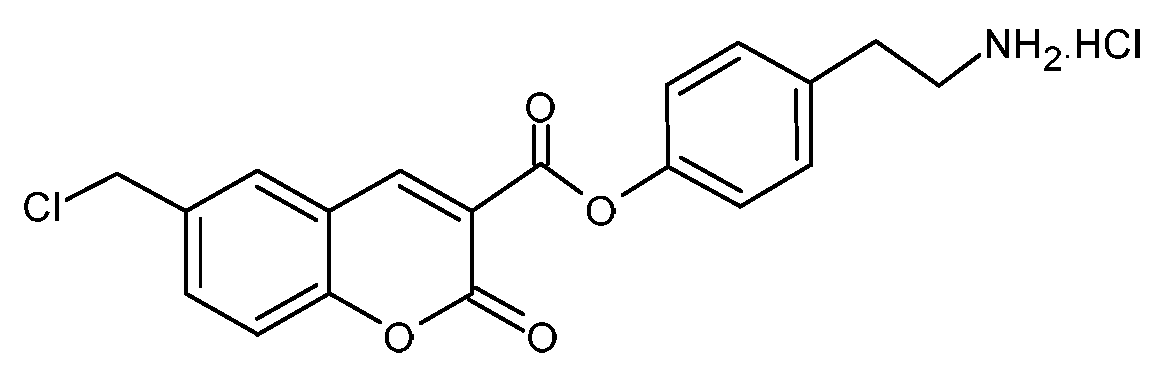 Compound f The invention also pertains to the preparation of such compounds. A general method of synthesis may imply the following steps: - Preparation of a phenol intermediate bearing the desired R2 group in ortho, meta or para position and optionally one or more R3 groups. The basic group comprised in R2 is advantageously protected by a tert-butyloxycarbonyl group or any other suitable protecting group - Preparation of a 2-oxo-2H-1-benzopyran-3-carbonyl chloride bearing the desired R1 group and optionally one or more R4 groups from a salicylic aldehyde according to the process described in the literature (Pochet et al. J. Med. Chem. 1996, 39, 2579-252585) - Adding the obtained 2-oxo-2H-1-benzopyran-3-carbonyl chloride to the phenol intermediate bearing the desired protected R2 group in ortho, meta or para position and optionally one or more R3 groups. - Optionally deprotecting the protected basic group of the R2 group in acidic conditions. The invention also pertains to the preparation of such pharmaceutical composition. The term “pharmaceutically acceptable carrier” is intended to mean a medium that is compatible with the respiratory system, such as for example the pulmonary system.
The pharmaceutical composition according to the invention can be administered through any type of administration, such as an oral administration, a cutaneous administration, an injection, an intravenous administration, a subcutaneous administration, a systemic administration, a parenteral, digestive, rectal or transcutaneous administration, a transmucosal administration, a pulmonary, nasal or sublingual administration, an inhalation or a nebulization or an aerosol administration. Preferably, the composition is administered orally, by injection or by an aerosol. A pulmonary or aerosol administration can be through a gaseous composition, a volatile composition or through a composition that is a suspension in a gaseous vector. Advantageously, the pharmaceutical composition may be in a form suitable for an aerosol administration. Compounds as recited above are also referred to as coumarin derivatives. Possible routes of synthesis of the coumarin derivatives are described in the examples. It will however be understood that such synthetic routes do not limit the present invention. EXAMPLES Example 1: Organic synthesis of the aryl esters of coumarin-3-carboxylic acid with amidine or guanidine function. One of the possible pathways to access the compounds of formula I bearing an amidine or a guanidine function is reported in schemes 1-3. It should be understood that present invention is not limited to the below synthesis strategies.
Compound f The invention also pertains to the preparation of such compounds. A general method of synthesis may imply the following steps: - Preparation of a phenol intermediate bearing the desired R2 group in ortho, meta or para position and optionally one or more R3 groups. The basic group comprised in R2 is advantageously protected by a tert-butyloxycarbonyl group or any other suitable protecting group - Preparation of a 2-oxo-2H-1-benzopyran-3-carbonyl chloride bearing the desired R1 group and optionally one or more R4 groups from a salicylic aldehyde according to the process described in the literature (Pochet et al. J. Med. Chem. 1996, 39, 2579-252585) - Adding the obtained 2-oxo-2H-1-benzopyran-3-carbonyl chloride to the phenol intermediate bearing the desired protected R2 group in ortho, meta or para position and optionally one or more R3 groups. - Optionally deprotecting the protected basic group of the R2 group in acidic conditions. The invention also pertains to the preparation of such pharmaceutical composition. The term “pharmaceutically acceptable carrier” is intended to mean a medium that is compatible with the respiratory system, such as for example the pulmonary system.
The pharmaceutical composition according to the invention can be administered through any type of administration, such as an oral administration, a cutaneous administration, an injection, an intravenous administration, a subcutaneous administration, a systemic administration, a parenteral, digestive, rectal or transcutaneous administration, a transmucosal administration, a pulmonary, nasal or sublingual administration, an inhalation or a nebulization or an aerosol administration. Preferably, the composition is administered orally, by injection or by an aerosol. A pulmonary or aerosol administration can be through a gaseous composition, a volatile composition or through a composition that is a suspension in a gaseous vector. Advantageously, the pharmaceutical composition may be in a form suitable for an aerosol administration. Compounds as recited above are also referred to as coumarin derivatives. Possible routes of synthesis of the coumarin derivatives are described in the examples. It will however be understood that such synthetic routes do not limit the present invention. EXAMPLES Example 1: Organic synthesis of the aryl esters of coumarin-3-carboxylic acid with amidine or guanidine function. One of the possible pathways to access the compounds of formula I bearing an amidine or a guanidine function is reported in schemes 1-3. It should be understood that present invention is not limited to the below synthesis strategies.
 Scheme 1 Reagents are for step i: EtOH, HCl, for step ii: NH3, MeOH, for step iii: di-tert-butyl dicarbonate (Boc)2O, NaOH, dioxane/H2O, Boc is tert-butyloxycarbonyl protecting group.


Claims
CLAIMS 1. Compound of Formula I:
 wherein R1 is a substituted linear or branched alkyl chain of 1 to 6 carbon atoms; R2 is a basic group bearing a positive charge at physiological pH or a precursor thereof, such basic group or precursor thereof being optionally preceded by a linear or branched alkyl chain of 1 to 6 carbon atoms and R2 being in the ortho, meta or para position of the ester group on the aryl ring; R3 is a halogen with x being an integer between 0 and 4; R4 is a halogen with y being an integer between 0 and 3; or a prodrug thereof, and/or a salt thereof, for its use in the treatment of respiratory diseases.
2. Compound for use according to claim 1 wherein the basic group bears an amine function, an amidine function or a guanidine function.
3. Compound for use according to claim 1 or 2 wherein the precursor of the basic group bears a (pseudo)carbamate function.
4. Compound for use according to claim 2 wherein R2 is chosen from the group consisting of -(CH2)n-NH2, -(CH2)n-C(=NH)NH2, -(CH2)n-NH-C(=NH)NH2, -(CH2)n- NH-COOR5 , -(CH2)n-C(=NH)NH-COOR5 , -(CH2)n-NH-C(=NH)NH-COOR5 with R5 being a linear or branched alkyl chain with 1 to 6 carbon atoms and with n being an integer between 0 and 6.
5. Compound for use according to claim 4 wherein n is 1 or 2.
6. Compound for use according to any of previous claims wherein x is 1 or 2.
7. Compound for use according to any of previous claims wherein y is 0, 1 or 2.
8. Compound for use according to any of previous claims wherein R1 is -CH2Cl or –CH2Br.
9. Compound for use according to any of previous claims wherein said respiratory disease is a viral infection.
10. Compound of Formula I or a prodrug thereof, and/or a salt thereof for its use in the prevention of respiratory diseases.
11. Compound of Formula I or a prodrug thereof, and/or a salt thereof wherein R2 is a basic group bearing a positive charge at physiological pH or a precursor thereof, such basic group or precursor thereof being preceded by a linear or branched alkyl chain of 1 to 6 carbon atoms, preferably of 1 to 2 carbon atoms.
12. Compound according to claim 11 wherein R2 is -(CH2)n-NH-COOR5, -(CH2)n- C(=NH)NH-COOR5 , -(CH2)n-NH-C(=NH)NH-COOR5 with R5 being a linear or branched alkyl chain with 1 to 6 carbon atoms and with n being an integer between 1 and 6.
13. Compound according to any of claims 11 to 12 for use as a medicament.
14. A pharmaceutical composition comprising a compound as defined in any of claim 11 or 12 and a pharmaceutically acceptable carrier.
15. A pharmaceutical composition according to claim 14 in a form suitable for an aerosol administration.
Applications Claiming Priority (2)
| Application Number | Priority Date | Filing Date | Title |
|---|---|---|---|
| EP22290023 | 2022-05-03 | ||
| EP22290023.5 | 2022-05-03 |
Publications (1)
| Publication Number | Publication Date |
|---|---|
| WO2023213728A1 true WO2023213728A1 (en) | 2023-11-09 |
Family
ID=81846329
Family Applications (1)
| Application Number | Title | Priority Date | Filing Date |
|---|---|---|---|
| PCT/EP2023/061344 Ceased WO2023213728A1 (en) | 2022-05-03 | 2023-04-28 | Substituted aryl esters of coumarin-3-carboxylic acid and their use as host cell proteases inhibitors |
Country Status (1)
| Country | Link |
|---|---|
| WO (1) | WO2023213728A1 (en) |
Citations (2)
| Publication number | Priority date | Publication date | Assignee | Title |
|---|---|---|---|---|
| WO1998055472A1 (en) | 1997-06-03 | 1998-12-10 | Centre National De La Recherche Scientifique | Coumarin derivatives, methods of preparation and application as medicines |
| WO2013010963A1 (en) | 2011-07-15 | 2013-01-24 | Universite Pierre Et Marie Curie (Paris 6) | Use of coumarin derivatives for the preparation of drugs for treating skin diseases |
-
2023
- 2023-04-28 WO PCT/EP2023/061344 patent/WO2023213728A1/en not_active Ceased
Patent Citations (2)
| Publication number | Priority date | Publication date | Assignee | Title |
|---|---|---|---|---|
| WO1998055472A1 (en) | 1997-06-03 | 1998-12-10 | Centre National De La Recherche Scientifique | Coumarin derivatives, methods of preparation and application as medicines |
| WO2013010963A1 (en) | 2011-07-15 | 2013-01-24 | Universite Pierre Et Marie Curie (Paris 6) | Use of coumarin derivatives for the preparation of drugs for treating skin diseases |
Non-Patent Citations (22)
| Title |
|---|
| BISSONNETTE E Y ET AL: "Coumarinic derivatives show anti-inflammatory effects on alveolar macrophages, but their anti-elastase activity is essential to reduce lung inflammation in vivo", INTERNATIONAL IMMUNOPHARMACOLOGY, ELSEVIER, AMSTERDAM, NL, vol. 9, no. 1, 1 January 2009 (2009-01-01), pages 49 - 54, XP025868950, ISSN: 1567-5769, [retrieved on 20090101], DOI: 10.1016/J.INTIMP.2008.09.009 * |
| CANNALIRE ET AL., NT. J. MOL. SCI., vol. 21, 2020, pages 5707 |
| CHAVEZ-MEDINA ET AL., ARCH. MICROBIOL., vol. 204, 2022, pages 77 |
| DOUCET ET AL., J. MED. CHEM., vol. 42, 1999, pages 4161 - 4171 |
| FREDERICK ET AL., BIOORG. MED. CHEM. LETT., vol. 16, 2006 |
| FREDERICK ET AL., J. MED. CHEM., vol. 48, 2005, pages 7592 |
| HANKE ET AL., J. MED. CHEM., vol. 63, 2020, pages 5723 |
| HOFFMANN ET AL., ANTIMICROB. AGENTS CHERMOTHER., vol. 64, 2020, pages 00754 - 20 |
| HOFFMANN ET AL., CELL, vol. 181, 2020, pages 271 |
| HUANG ET AL., INT. J. MOL. SCI., vol. 22, 2021, pages 7060 |
| I KEMPEN ET AL: "3-Bromophenyl 6-acetoxymethyl-2-oxo-2H-1-benzopyran-3-carboxylate inhibits cancer cell invasion in vitro and tumour growth in vivo", BRITISH JOURNAL OF CANCER, vol. 88, no. 7, 7 April 2003 (2003-04-07), pages 1111 - 1118, XP055038116, ISSN: 0007-0920, DOI: 10.1038/sj.bjc.6600856 * |
| LIMBURG ET AL., J. VIROL., vol. 93, 2019, pages 1 |
| MAHONEY ET AL., PROC. NATL. ACAD. SCI., vol. 118, no. 43, 2021, pages 2108728118 |
| MATSUYAMA ET AL., J. VIROL., vol. 84, 2010, pages 12658 |
| POCHET ET AL., BIOORG. MED. CHEM., vol. 8, 2000, pages 1489 |
| POCHET ET AL., J. MED. CHEM., vol. 39, 1996, pages 2579 - 252585 |
| POCHET L ET AL: "ESTERS AND AMIDES OF 6-(CHLOROMETHYL)-2-OXO-2H-1-BENYOPYRAN-3- CARBOXYLIC ACID AS INHIBITORS OF ASPIRE-CHYMOTRYSPIN: SIGNIFICANCE OF THE "AROMATIC" NATURE OF THE NOVEL ESTER-TYPE COUMARIN FOR STRONG INHIBITORY ACTIVITY", JOURNAL OF MEDICINAL CHEMISTRY, AMERICAN CHEMICAL SOCIETY, US, vol. 39, 1 January 1996 (1996-01-01), pages 2579 - 2585, XP002053886, ISSN: 0022-2623, DOI: 10.1021/JM960090B * |
| QUINN ET AL., MEDRXIV, 2021 |
| SINGH ET AL., EUR. J. PHARM. SCI., vol. 153, 2020, pages 105495 |
| STOPSACK ET AL., CANCER DISCOV, vol. 10, 2020, pages 779 |
| TAN ET AL., J. MED. CHEM., vol. 58, 2015, pages 598 |
| ZHURAVEL ET AL., E CLINICAL MEDICINE, vol. 41, 2021, pages 101169 |
Similar Documents
| Publication | Publication Date | Title |
|---|---|---|
| JP4443037B2 (en) | Cysteine and serine protease inhibitors of peptide-containing α-ketoamides | |
| JP7611045B2 (en) | Protease inhibitors, their preparation and uses | |
| CN102050815B (en) | Dabigatran ester derivatives as prodrug | |
| EP1032393B1 (en) | Quinoline-containing alpha-ketoamide cysteine and serine protease inhibitors | |
| EP1115390B1 (en) | Hydroxamate-containing cysteine and serine protease inhibitors | |
| WO2023213728A1 (en) | Substituted aryl esters of coumarin-3-carboxylic acid and their use as host cell proteases inhibitors | |
| JP4209659B2 (en) | Amidino derivative and anticoagulant and thrombosis therapeutic agent using the same | |
| CN115197102B (en) | Peptoid hydroxamic acid-type Plasmodium falciparum aminopeptidase inhibitors and preparation methods and applications thereof | |
| JP4078494B2 (en) | Hepatitis C drug | |
| MXPA00003419A (en) | PEPTIDE-CONTAINING&agr;-KETOAMIDE CYSTEINE AND SERINE PROTEASE INHIBITORS | |
| HK1029936B (en) | Quinoline-containing alpha-ketoamide cysteine and serine protease inhibitors | |
| HK40077416A (en) | Protease inhibitors, preparation, and uses thereof | |
| MXPA00003431A (en) | QUINOLINE-CONTAINING&agr;-KETOAMIDE CYSTEINE AND SERINE PROTEASE INHIBITORS |
Legal Events
| Date | Code | Title | Description |
|---|---|---|---|
| 121 | Ep: the epo has been informed by wipo that ep was designated in this application |
Ref document number: 23723531 Country of ref document: EP Kind code of ref document: A1 |
|
| NENP | Non-entry into the national phase |
Ref country code: DE |
|
| 122 | Ep: pct application non-entry in european phase |
Ref document number: 23723531 Country of ref document: EP Kind code of ref document: A1 |