WO2023191048A1 - 全固体電池 - Google Patents
全固体電池 Download PDFInfo
- Publication number
- WO2023191048A1 WO2023191048A1 PCT/JP2023/013537 JP2023013537W WO2023191048A1 WO 2023191048 A1 WO2023191048 A1 WO 2023191048A1 JP 2023013537 W JP2023013537 W JP 2023013537W WO 2023191048 A1 WO2023191048 A1 WO 2023191048A1
- Authority
- WO
- WIPO (PCT)
- Prior art keywords
- solid
- current collecting
- container
- battery
- collecting member
- Prior art date
- Legal status (The legal status is an assumption and is not a legal conclusion. Google has not performed a legal analysis and makes no representation as to the accuracy of the status listed.)
- Ceased
Links
Images


Classifications
-
- H—ELECTRICITY
- H01—ELECTRIC ELEMENTS
- H01M—PROCESSES OR MEANS, e.g. BATTERIES, FOR THE DIRECT CONVERSION OF CHEMICAL ENERGY INTO ELECTRICAL ENERGY
- H01M10/00—Secondary cells; Manufacture thereof
- H01M10/05—Accumulators with non-aqueous electrolyte
- H01M10/056—Accumulators with non-aqueous electrolyte characterised by the materials used as electrolytes, e.g. mixed inorganic/organic electrolytes
- H01M10/0561—Accumulators with non-aqueous electrolyte characterised by the materials used as electrolytes, e.g. mixed inorganic/organic electrolytes the electrolyte being constituted of inorganic materials only
- H01M10/0562—Solid materials
-
- H—ELECTRICITY
- H01—ELECTRIC ELEMENTS
- H01M—PROCESSES OR MEANS, e.g. BATTERIES, FOR THE DIRECT CONVERSION OF CHEMICAL ENERGY INTO ELECTRICAL ENERGY
- H01M10/00—Secondary cells; Manufacture thereof
- H01M10/05—Accumulators with non-aqueous electrolyte
- H01M10/058—Construction or manufacture
- H01M10/0585—Construction or manufacture of accumulators having only flat construction elements, i.e. flat positive electrodes, flat negative electrodes and flat separators
-
- H—ELECTRICITY
- H01—ELECTRIC ELEMENTS
- H01M—PROCESSES OR MEANS, e.g. BATTERIES, FOR THE DIRECT CONVERSION OF CHEMICAL ENERGY INTO ELECTRICAL ENERGY
- H01M4/00—Electrodes
- H01M4/02—Electrodes composed of, or comprising, active material
- H01M4/64—Carriers or collectors
- H01M4/66—Selection of materials
-
- H—ELECTRICITY
- H01—ELECTRIC ELEMENTS
- H01M—PROCESSES OR MEANS, e.g. BATTERIES, FOR THE DIRECT CONVERSION OF CHEMICAL ENERGY INTO ELECTRICAL ENERGY
- H01M4/00—Electrodes
- H01M4/02—Electrodes composed of, or comprising, active material
- H01M4/64—Carriers or collectors
- H01M4/70—Carriers or collectors characterised by shape or form
- H01M4/80—Porous plates, e.g. sintered carriers
-
- H—ELECTRICITY
- H01—ELECTRIC ELEMENTS
- H01M—PROCESSES OR MEANS, e.g. BATTERIES, FOR THE DIRECT CONVERSION OF CHEMICAL ENERGY INTO ELECTRICAL ENERGY
- H01M50/00—Constructional details or processes of manufacture of the non-active parts of electrochemical cells other than fuel cells, e.g. hybrid cells
- H01M50/10—Primary casings; Jackets or wrappings
- H01M50/102—Primary casings; Jackets or wrappings characterised by their shape or physical structure
- H01M50/109—Primary casings; Jackets or wrappings characterised by their shape or physical structure of button or coin shape
-
- H—ELECTRICITY
- H01—ELECTRIC ELEMENTS
- H01M—PROCESSES OR MEANS, e.g. BATTERIES, FOR THE DIRECT CONVERSION OF CHEMICAL ENERGY INTO ELECTRICAL ENERGY
- H01M50/00—Constructional details or processes of manufacture of the non-active parts of electrochemical cells other than fuel cells, e.g. hybrid cells
- H01M50/10—Primary casings; Jackets or wrappings
- H01M50/102—Primary casings; Jackets or wrappings characterised by their shape or physical structure
- H01M50/11—Primary casings; Jackets or wrappings characterised by their shape or physical structure having a chip structure, e.g. micro-sized batteries integrated on chips
-
- H—ELECTRICITY
- H01—ELECTRIC ELEMENTS
- H01M—PROCESSES OR MEANS, e.g. BATTERIES, FOR THE DIRECT CONVERSION OF CHEMICAL ENERGY INTO ELECTRICAL ENERGY
- H01M50/00—Constructional details or processes of manufacture of the non-active parts of electrochemical cells other than fuel cells, e.g. hybrid cells
- H01M50/20—Mountings; Secondary casings or frames; Racks, modules or packs; Suspension devices; Shock absorbers; Transport or carrying devices; Holders
- H01M50/202—Casings or frames around the primary casing of a single cell or a single battery
-
- H—ELECTRICITY
- H01—ELECTRIC ELEMENTS
- H01M—PROCESSES OR MEANS, e.g. BATTERIES, FOR THE DIRECT CONVERSION OF CHEMICAL ENERGY INTO ELECTRICAL ENERGY
- H01M50/00—Constructional details or processes of manufacture of the non-active parts of electrochemical cells other than fuel cells, e.g. hybrid cells
- H01M50/50—Current conducting connections for cells or batteries
-
- H—ELECTRICITY
- H01—ELECTRIC ELEMENTS
- H01M—PROCESSES OR MEANS, e.g. BATTERIES, FOR THE DIRECT CONVERSION OF CHEMICAL ENERGY INTO ELECTRICAL ENERGY
- H01M50/00—Constructional details or processes of manufacture of the non-active parts of electrochemical cells other than fuel cells, e.g. hybrid cells
- H01M50/50—Current conducting connections for cells or batteries
- H01M50/531—Electrode connections inside a battery casing
- H01M50/533—Electrode connections inside a battery casing characterised by the shape of the leads or tabs
-
- H—ELECTRICITY
- H01—ELECTRIC ELEMENTS
- H01M—PROCESSES OR MEANS, e.g. BATTERIES, FOR THE DIRECT CONVERSION OF CHEMICAL ENERGY INTO ELECTRICAL ENERGY
- H01M50/00—Constructional details or processes of manufacture of the non-active parts of electrochemical cells other than fuel cells, e.g. hybrid cells
- H01M50/50—Current conducting connections for cells or batteries
- H01M50/531—Electrode connections inside a battery casing
- H01M50/534—Electrode connections inside a battery casing characterised by the material of the leads or tabs
-
- Y—GENERAL TAGGING OF NEW TECHNOLOGICAL DEVELOPMENTS; GENERAL TAGGING OF CROSS-SECTIONAL TECHNOLOGIES SPANNING OVER SEVERAL SECTIONS OF THE IPC; TECHNICAL SUBJECTS COVERED BY FORMER USPC CROSS-REFERENCE ART COLLECTIONS [XRACs] AND DIGESTS
- Y02—TECHNOLOGIES OR APPLICATIONS FOR MITIGATION OR ADAPTATION AGAINST CLIMATE CHANGE
- Y02E—REDUCTION OF GREENHOUSE GAS [GHG] EMISSIONS, RELATED TO ENERGY GENERATION, TRANSMISSION OR DISTRIBUTION
- Y02E60/00—Enabling technologies; Technologies with a potential or indirect contribution to GHG emissions mitigation
- Y02E60/10—Energy storage using batteries
-
- Y—GENERAL TAGGING OF NEW TECHNOLOGICAL DEVELOPMENTS; GENERAL TAGGING OF CROSS-SECTIONAL TECHNOLOGIES SPANNING OVER SEVERAL SECTIONS OF THE IPC; TECHNICAL SUBJECTS COVERED BY FORMER USPC CROSS-REFERENCE ART COLLECTIONS [XRACs] AND DIGESTS
- Y02—TECHNOLOGIES OR APPLICATIONS FOR MITIGATION OR ADAPTATION AGAINST CLIMATE CHANGE
- Y02P—CLIMATE CHANGE MITIGATION TECHNOLOGIES IN THE PRODUCTION OR PROCESSING OF GOODS
- Y02P70/00—Climate change mitigation technologies in the production process for final industrial or consumer products
- Y02P70/50—Manufacturing or production processes characterised by the final manufactured product
Definitions
- This application relates to an all-solid-state battery with excellent electrical connectivity.
- All-solid-state batteries that use solid electrolytes instead of organic electrolytes have been actively developed. All-solid-state batteries are highly safe because they do not use flammable organic electrolytes. In addition, all-solid-state batteries are not only highly safe, but also highly reliable, highly environmentally resistant, and have a long lifespan, so they can continue to contribute to the development of society while also contributing to safety and security. It is expected to be a maintenance-free battery.
- SDGs Sustainable Development Goals
- all-solid-state batteries usually use a laminated electrode assembly in which a solid electrolyte molded body is sandwiched between a positive electrode molded body containing a positive electrode active material and a negative electrode molded body containing a negative electrode active material.
- a laminated electrode assembly in which a solid electrolyte molded body is sandwiched between a positive electrode molded body containing a positive electrode active material and a negative electrode molded body containing a negative electrode active material.
- the body has low flexibility, and the laminated electrode body repeatedly expands and contracts during charging and discharging, making it impossible to maintain good electrical connection between the laminated electrode body and the current collecting member.
- Patent Document 1 proposes a solid battery in which a current collecting member having elasticity and containing a conductive substance is disposed between a laminated electrode body and a conductor part. Further, Patent Document 2 proposes a flat all-solid-state battery in which a flexible conductive porous member is disposed between a laminated electrode body and the inner bottom surface of an outer can or the inner bottom surface of a sealed can.
- the present application was made under the above circumstances, and is intended to provide an all-solid-state battery that can realize good electrical connectivity in the current collection structure of the all-solid-state battery.
- the all-solid-state battery of the present application includes a battery container and a power generation member housed in the battery container, the battery container includes a concave container, and a sealing body, and the concave container has a bottom part and a side wall part. and an opening, the opening of the concave container is covered with the sealing body, and the power generation member includes a positive electrode, a negative electrode, and a solid electrolyte layer disposed between the positive electrode and the negative electrode.
- an elastic member and a current collecting member are stacked in this order from the sealing body side, and the current collecting member is made of a porous metal member or a carbon
- the current collecting member is made of a fibrous porous member and is pressed against the power generating member by the pressing force of the elastic member.
- an all-solid-state battery with excellent electrical connectivity can be provided.
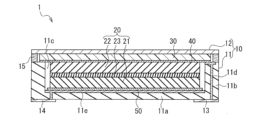
- FIG. 1 is a cross-sectional view schematically showing the all-solid-state battery of the first embodiment.
- FIG. 2 is a cross-sectional view schematically showing the all-solid-state battery of the second embodiment.
- FIG. 3 is a cross-sectional view schematically showing an all-solid-state battery according to a third embodiment.
- the all-solid-state battery of this embodiment includes a battery container and a power generation member housed in the battery container, the battery container includes a concave container, and a sealing body, and the concave container has a bottom portion and a power generation member housed in the battery container.
- the concave container includes a side wall and an opening, the opening of the concave container is covered with the sealing member, and the power generation member includes a positive electrode, a negative electrode, and a solid electrolyte disposed between the positive electrode and the negative electrode.
- an elastic member and a current collecting member are stacked in this order from the sealing member side between the power generation member and the inner bottom surface of the sealing member, and the current collecting member is a porous metal member.
- the power collecting member is made of a carbon fiber porous member, and the current collecting member is pressed against the power generating member by the pressing force of the elastic member.
- an elastic member and a current collecting member formed from a porous metal member or a carbon fiber porous member are disposed between the power generating member and the inner bottom surface of the sealing member to collect current. Since the member is pressed and compressed by the power generating member by the pressing force of the elastic member, even if the power generating member itself does not have flexibility, the current collecting member itself can be flexibly deformed by the pressing force, and Even if there is some unevenness on the surface of the power generation member, the current collection member can absorb the unevenness, so that the electrical contact between the power generation member and the current collection member is good, and the electricity between the power generation member and the current collection member is improved. Connectivity can be improved.
- a current collecting member made of a porous metal member or a carbon fiber porous member is further disposed between the power generating member and the bottom surface of the concave container. Since the pressing force of the elastic member also acts between the power generation member and the bottom of the concave container, good electrical contact is achieved between the power generation member and the current collecting member on the concave container side as well, and as a result, the entire battery This can improve electrical connectivity between the power generation member and the current collection member.
- the power generation member may be composed of a laminate including a positive electrode, a negative electrode, and a solid electrolyte layer. This type of laminate repeatedly expands and contracts as the battery charges and discharges, but the elastic member repeatedly compresses and restores itself in response to the expansion and contraction of the laminate, thereby allowing the laminate and current collecting member to A good electrical connection can be maintained with the
- the power generation member may be composed of a flat battery including a positive electrode, a negative electrode, and a solid electrolyte layer. Although this flat battery does not have flexibility, the current collecting member itself can be flexibly deformed by pressing force, so electrical contact between the flat battery and the current collecting member is good, and the flat battery and the current collecting member can be flexibly deformed. Electrical connectivity with electrical components can be improved.
- the current collecting member is electrically connected to a conductor part, and the conductor part is electrically connected to a connection terminal part of the battery container. Thereby, the electric power generated from the power generation member can be led to the outside.
- the concave container and the sealing body may be bonded together with an adhesive, or may be fixed by welding through a seal ring.
- the materials of the concave container and the sealing body are not particularly limited, and various materials can be used, such as resin, glass (borosilicate glass, glass ceramics, etc.), metal, and ceramic. It may also be a composite material in which ceramic or glass powder is dispersed in a resin.
- the concave container is made of a metal material
- the inner surface of the bottom and the inner surface of the side wall of the concave container may be covered with an insulating material such as a resin material or glass in order to ensure insulation between the concave container and the power generation member. desirable.
- FIG. 1 is a cross-sectional view schematically showing the all-solid-state battery of the first embodiment.
- an all-solid-state battery 1 includes a battery container 10 and a laminate 20 (power generation member) made up of power generation elements housed within the battery container 10.
- the battery container 10 includes a concave container 11 and a sealing body 12.
- the concave container 11 includes a bottom portion 11a, a side wall portion 11b, and an opening 11c. covered.
- the battery container 10 also includes a connection terminal portion 13 and a connection terminal portion 14 .
- the laminate 20 includes a positive electrode 21 , a negative electrode 22 , and a solid electrolyte layer 23 disposed between the positive electrode 21 and the negative electrode 22 .
- an elastic sheet 30 (elastic member) and a current collecting member 40 are stacked in this order from the sealing body 12 side.
- the current collecting member 40 is pressed against the laminate 20 by the pressing force of the elastic sheet 30.
- a current collecting member 50 is also arranged between the stacked body 20 and the bottom surface portion 11a of the concave container 11. Both the current collecting member 40 and the current collecting member 50 are formed from a porous metal member or a carbon fiber porous member.
- the concave container 11 is made of ceramic.
- the concave container 11 includes a circular bottom portion 11a and a cylindrical side wall portion 11b that is formed continuously from the outer periphery of the bottom portion 11a and has a space for accommodating the laminate 20 therein.
- the side wall portion 11b is provided so as to extend substantially perpendicularly to the bottom surface portion 11a when viewed in longitudinal section.
- a conductor portion 11d is formed inside the side wall portion 11b.
- the conductor portion 11d is conductively connected to the current collecting member 40 and the connection terminal portion 13, so that the negative electrode 22 of the laminate 20 and the connection terminal portion 13 are electrically connected.
- a conductor portion 11e is formed inside the bottom surface portion 11a.
- the conductor portion 11e extends above the inner bottom surface of the bottom portion 11a so as to be conductively connected to the current collecting member 50, and thereby the positive electrode 21 of the laminate 20 and the connection terminal portion 14 are electrically connected.
- a method for manufacturing the concave container 11 will be described later.
- the concave container 11 is not limited to ceramic, and may be made of an insulating material such as synthetic resin. Further, the concave container 11 is not limited to a circular shape in plan view, but may be a square shape, an elliptical shape, or a polygonal shape.
- the sealing body 12 is a circular thin metal plate that covers the opening 11c of the concave container 11. As shown in FIG. 1, the sealing body 12 is joined (seamed) to the concave container 11 by a circular frame-shaped seal ring 15 disposed between the lower surface of its outer peripheral end and the upper end of the side wall 11b of the concave container 11. welded). Thereby, the internal space of the battery container 10 is completely sealed.
- the interior space of the battery container 10 is preferably in a vacuum atmosphere or an inert gas atmosphere such as nitrogen in consideration of the influence on the laminate 20, which is a power generation element. Note that the sealing body 12 is not limited to a thin metal plate as long as it can cover the opening 11c of the concave container 11.
- the sealing body 12 is not limited to a circular shape, but can be variously changed to a rectangular shape, an elliptical shape, a polygonal shape, etc. depending on the shape of the concave container 11 in a plan view. Further, the sealing body 12 may have a shape other than a flat plate. Note that the sealing body 12 may be bonded to the concave container 11 with an adhesive, and the method of joining the sealing body 12 and the concave container 11 is not particularly limited.
- connection terminal portion 13 is arranged on the outer surface of the bottom portion 11a of the concave container 11.
- the connection terminal portion 13 is electrically connected to the negative electrode 22 via the conductor portion 11d and the current collecting member 40. Therefore, the conductor portion 11d and the current collecting member 40 become a conduction path that connects the connection terminal portion 13 and the negative electrode 22, and the connection terminal portion 13 functions as a negative electrode terminal.
- connection terminal portion 14 is arranged on the outer surface of the bottom surface portion 11a of the concave container 11 away from the connection terminal portion 13.
- the connection terminal portion 14 is electrically connected to the positive electrode 21 via the conductor portion 11e and the current collecting member 50. Therefore, the conductor portion 11e and the current collecting member 50 serve as a conduction path that connects the connection terminal portion 14 and the positive electrode 21, and the connection terminal portion 14 functions as a positive electrode terminal.
- the arrangement of the connecting terminal portion 13 and the connecting terminal portion 14 is not limited to the above, and may be arranged on the outer surface of the side wall portion 11b of the concave container 11.
- a method for manufacturing the concave container 11 will be explained. First, a metal paste is printed and coated on a ceramic green sheet to form a printed pattern that will become the conductor portions 11d and 11e. Next, a plurality of green sheets having these printed patterns formed thereon are laminated and fired. Thereby, the concave container 11 having the conductor portion 11d and the conductor portion 11e inside can be manufactured. Note that the connecting terminal portion 13 and the connecting terminal portion 14 can also be formed by a printed pattern of this metal paste.
- a laminate 20 made of power generation elements constituting a power generation member includes a positive electrode 21 made of a molded body of a positive electrode mixture containing a positive electrode active material, a negative electrode 22 made of a molded body of a negative electrode mixture containing a negative electrode active material, and a solid electrolyte. It is formed by laminating layers 23 and 23. Solid electrolyte layer 23 is arranged between positive electrode 21 and negative electrode 22.
- the laminate 20 is formed into a cylindrical shape. In the laminate 20, a positive electrode 21, a solid electrolyte layer 23, and a negative electrode 22 are laminated in this order from the bottom 11a side (lower side in the drawing) of the concave container 11.
- the laminate 20 is not limited to a cylindrical shape, and can be modified in various ways according to the shape of the concave container 11. Further, the laminate 20 may include a plurality of laminates. In this case, the plurality of laminates may be stacked so as to be connected in series.
- the type of positive electrode active material used in the positive electrode 21 is not particularly limited as long as it functions as a positive electrode component of the power generation element, and examples thereof include lithium cobalt oxide, lithium nickel oxide, lithium manganate, and lithium nickel cobalt manganese composite. Oxides, olivine-type composite oxides, etc. can be used, and these may be mixed as appropriate. Specifically, in the case of a positive electrode used in a lithium ion secondary battery, for example, lithium cobalt oxide, a sulfide-based solid electrolyte, and graphene as a conductive agent are mixed in a mass ratio of 65:30:5. A positive electrode molded body (pellet) formed by molding a positive electrode mixture into a cylindrical shape can be used as the positive electrode.
- the type of negative electrode active material used for the negative electrode 22 is not particularly limited as long as it functions as a negative electrode component of the power generation element, and examples thereof include lithium titanate; metallic lithium, lithium alloy; graphite, low-crystalline carbon, etc. Carbon materials; oxides such as SiO can be used, and these may be mixed as appropriate.
- a negative electrode used in a lithium ion secondary battery for example, LTO (Li 4 Ti 5 O 12 , lithium titanate), a sulfide-based solid electrolyte, and graphene are mixed at a mass ratio of 50.
- a negative electrode molded body (pellet) obtained by molding a negative electrode mixture containing a ratio of :40:10 into a cylindrical shape can be used as a negative electrode.
- the solid electrolyte layer 23 can be used as a molded body (pellet) formed by molding a solid electrolyte into a cylindrical shape.
- the type of solid electrolyte used in the solid electrolyte layer 23 is not particularly limited, and for example, hydride solid electrolytes, sulfide solid electrolytes, oxide solid electrolytes, etc. can be used, but ion conductive solid electrolytes may be used. From this point of view, sulfide-based solid electrolytes, particularly argyrodite-type sulfide-based solid electrolytes, are preferably used.
- the surface of the positive electrode active material is preferably coated with a lithium ion conductive material such as niobium oxide in order to prevent reaction with the positive electrode active material.
- the solid electrolyte contained in the positive electrode 21 and the negative electrode 22 described above is not particularly limited, and may be a hydride-based solid electrolyte, an oxide-based solid electrolyte, or the like.
- the current collecting member 40 is a sheet material having a circular shape in plan view and made of a porous metal member or a carbon fiber porous member installed in the opening 11c of the concave container 11 of the battery container 10. Further, the current collecting member 40 is pressed against the negative electrode 22 of the laminate 20 by the elastic sheet 30, and the end of the current collecting member 40 is electrically connected to the conductor portion 11d. Thereby, the current collecting member 40 functions as a current collector and forms part of a conduction path that electrically connects the negative electrode 22 and the connection terminal portion 13.
- the current collecting member 40 is supported by the upper end of the side wall 11b of the concave container 11 and covers the entire surface of the opening 11c of the concave container 11, but if a conductive path with the connection terminal portion 13 can be secured,
- the shape and size can be set as appropriate.
- the shape of the current collecting member 40 is not limited to a circular shape in a plan view, but may be a rectangular shape or a polygonal shape.
- the current collecting member 50 is a sheet material having a circular shape in plan view and made of a porous metal member or a carbon fiber porous member installed on the bottom portion 11a side of the concave container 11 of the battery container 10. Further, the current collecting member 50 is pressed against the positive electrode 21 of the laminate 20, and the entire surface of the current collecting member 50 is electrically connected to the conductor portion 11e. Thereby, the current collecting member 50 functions as a current collector and forms part of a conduction path that electrically connects the positive electrode 21 and the connection terminal portion 14.
- the type of porous metal member forming the current collecting member is not particularly limited as long as it can be compressed by pressing force, but examples thereof include a metal powder sintered base material, a metal fiber sintered base material, a foamed metal base material etc. can be used.
- metal types that can be used for the porous metal member include Ni, Al, Cu, Ni--Cr alloy, Ni--Sn alloy, and the like.
- the porosity of the porous metal member before compression is not particularly limited as long as its compressibility can be maintained, but it can be set to, for example, 50 to 98%.
- the thickness of the porous metal member after compression is not particularly limited, but can be set to, for example, 0.05 to 1 mm.
- a conductive plastic body can also be used as the porous metal member.
- the carbon fiber porous member forming the current collecting member is not particularly limited in type as long as it can be compressed by pressing force, but examples include carbon felt; woven or nonwoven fabric of carbon fiber; woven fabric of carbon nanotube fibers. Alternatively, nonwoven fabric or the like can be used.
- the fiber diameter of the carbon fiber used in the carbon fiber porous member is preferably 1 nm to 1 ⁇ m.
- the basis weight of the carbon fiber porous member is preferably 5 to 200 g/m 2 .
- the thickness of the carbon fiber porous member after compression is not particularly limited, but can be set to, for example, 0.05 to 1 mm.
- a conductive plastic body can also be used as the carbon fiber porous member.
- the elastic sheet 30 is a circular sheet material disposed between the current collecting member 40 and the inner bottom surface of the sealing body 12 in a plan view.
- the elastic sheet 30 is compressed because it is pushed into the interior of the battery container 10 by the sealing body 12, and the elastic sheet 30 closes the concave container due to its elastic force.
- the laminated body 20 is pressed together with the current collecting members 40 and 50 in the direction of the bottom surface 11 a of the laminate 11 . Thereby, the laminated body 20 and the current collecting members 40 and 50 can maintain good electrical connection.
- the shape of the elastic sheet 30 is not limited to a circular shape in plan view, but may be a square shape. By having the same shape as the current collecting member 40, the elastic sheet 30 can press the current collecting member 40 over the entire surface.
- the elastic sheet 30 is arranged to cover the entire surface of the current collecting member 40. This allows the elastic sheet 30 to press the current collecting member 40 over a wide area, and by electrically connecting the laminate 20, which is a power generating member, and the current collecting member 40 over a wider area, the laminate The electrical connectivity between the current collecting member 20 and the current collecting member 40 can be further improved. Note that the shape and size of the elastic sheet 30 may be set as appropriate unless there is a problem with the electrical connection between the laminate 20 and the current collecting member 40 or between the current collecting member 40 and the conductor portion 11d. be able to.
- the type of elastic sheet 30 is not particularly limited, for example, an insulating elastic sheet such as a silicone rubber sheet, a silicone sponge sheet, a butyl rubber sheet, or a fluororesin rubber sheet is used.
- the thickness of the elastic sheet 30 after compression is not particularly limited, but can be set to, for example, 0.05 to 1 mm. Further, the thickness of the elastic sheet 30 before compression is not particularly limited, but may be set to be 0.1 to 2 mm larger than the thickness after compression.
- the laminate 20 may be housed in the internal space of the battery container 10 with its top and bottom upside down.
- the connection terminal portion 13 functions as a positive electrode terminal
- the connection terminal portion 14 functions as a negative electrode terminal.
- FIG. 2 is a cross-sectional view schematically showing the all-solid-state battery of the second embodiment.
- the all-solid-state battery 1 of the present embodiment shown in FIG. 2 is the all-solid-state battery of the first embodiment, except that the laminate 20 of the all-solid-state battery 1 of the first embodiment shown in FIG. 1, therefore, in the all-solid-state battery 1 of this embodiment, the description of the same configuration as the all-solid-state battery 1 of the first embodiment will be basically omitted, and the all-solid-state battery 1 of the first embodiment will not be described. Only the configurations that are different from the above will be explained.
- the all-solid-state battery 1 of this embodiment accommodates a flat battery 60 as a power generation member in the internal space of the battery container 10.
- the flat battery 60 includes an outer can 61, a sealed can 62, a laminate 20 made of the power generation element described in the first embodiment, and a gasket 63.
- flat batteries that are larger in diameter than height are called coin batteries or button batteries, but there is no clear difference between coin batteries and button batteries.
- the flat batteries used in this embodiment include both coin-shaped batteries and button-shaped batteries. Further, the shape of this flat battery when viewed from above is not particularly limited and may be circular, square, rectangular, or the like.
- the outer can 61 includes a circular flat portion 61a and a cylindrical side wall portion 61b that is continuously formed from the outer periphery of the flat portion 61a.
- the cylindrical side wall portion 61b is provided so as to extend substantially perpendicularly to the flat portion 61a when viewed in longitudinal section.
- the outer can 61 is made of a metal material such as stainless steel.
- the sealing can 62 includes a circular flat portion 62a and a cylindrical peripheral wall portion 62b that is continuously formed from the outer periphery of the flat portion 62a.
- the opening of the sealed can 62 faces the opening of the outer can 61.
- the sealing can 62 is made of a metal material such as stainless steel.
- the outer can 61 and the sealing can 62 are connected to each other via a gasket 63 arranged between the cylindrical side wall 61b of the outer can 61 and the peripheral wall 62b of the sealing can 62 after the laminate 20 is accommodated in the internal space. It is caulked. Thereby, the internal space formed by the outer can 61 and the sealing can 62 is in a sealed state.
- the outer can 61 and the sealed can 62 are not limited to circular shapes in a plan view, but can be modified into various shapes such as elliptical shapes or polygonal shapes.
- the gasket 63 is made of a resin material such as polyamide resin, polypropylene resin, or polyphenylene sulfide resin.
- the method for sealing the internal space formed by the outer can 61 and the sealing can 62 is not limited to caulking via the gasket 63, and may be performed by other methods.
- the cylindrical side wall portion 61b of the outer can 61 and the peripheral wall portion 62b of the sealing can 62 may be joined with a hot-melt resin, an adhesive, or the like interposed therebetween for sealing.
- the flat battery 60 may be housed in the internal space of the battery container 10 with its top and bottom upside down.
- the connection terminal portion 13 functions as a positive electrode terminal
- the connection terminal portion 14 functions as a negative electrode terminal.
- FIG. 3 is a cross-sectional view schematically showing an all-solid-state battery according to a third embodiment.
- the all-solid-state battery 1 of this embodiment shown in FIG. 3 uses an elastic conductive plate 70 in place of the elastic sheet 30 of the all-solid-state battery 1 of the first embodiment shown in FIG. 1, and the concave container 11 is shown in FIG. Except for the change in shape, it has almost the same configuration as the all-solid-state battery 1 of the first embodiment, so the all-solid-state battery 1 of this embodiment basically has the same configuration as the all-solid-state battery 1 of the first embodiment.
- the explanation will be omitted, and only the configurations that are different from the all-solid-state battery 1 of the first embodiment will be explained.
- the side wall portion 11b of the concave container 11 has a support portion 11f that supports the elastic conductive plate 70.
- the support part 11f is formed at the upper end of the inner circumferential surface of the side wall part 11b, and is a projecting part that projects inward in the radial direction.
- the conductor portion 11d is formed inside the side wall portion 11b and is exposed on the lower surface and side surface of the support portion 11f.
- the conductor portion 11d is conductively connected to the current collecting member 40 via the elastic conductive plate 70, and is further conductively connected to the connecting terminal portion 13, so that the negative electrode 22 of the laminate 20 and the connecting terminal portion 13 are electrically connected. .
- the method for manufacturing the concave container 11 is almost the same as in the first embodiment, but the above-mentioned support portion 11f is formed by laminating and firing a plurality of green sheets having different shapes.
- the current collecting member 40 is formed of a porous metal member or a carbon fiber porous member installed between the laminate 20 and the elastic conductive plate 70 so as to cover the entire upper surface of the laminate 20. It is a shaped sheet material. Further, the current collecting member 40 is pressed against the negative electrode 22 of the laminate 20 by an elastic conductive plate 70.
- the elastic conductive plate 70 is a thin metal plate installed in the opening 11c of the concave container 11.
- the elastic conductive plate 70 includes a supported portion 71 corresponding to the aforementioned supporting portion 11f.
- the supported portion 71 is a hook-shaped locking piece that is locked to the support portion 11f. More specifically, the supported portion 71 extends from the edge of the elastic conductive plate 70 toward the support portion 11f (downward in FIG. 3). Further, the supported portion 71 has a tip that is folded back toward the lower surface of the supporting portion 11f. The tip of the supported portion 71 is in contact with the conductor portion 11d exposed on the lower surface and side surface of the supporting portion 11f.
- the elastic conductive plate 70 functions as a current collector together with the current collecting member 40, and forms part of a conductive path that electrically connects the negative electrode 22 and the connection terminal portion 13.
- the supported part 71 is inserted into a recess provided in the upper end surface of the side wall part 11b, and the elastic conductive plate is pressed against the supported part 71. 70 may be fixed.
- the elastic conductive plate 70 includes a recess 72 facing the upper surface side of the laminate 20.
- the bottom surface of the recess 72 is formed into a planar shape so that the upper surface side of the laminate 20 can be pressed over a wider area. This allows the elastic conductive plate 70 to press the current collecting member 40 over a wide area, and by electrically connecting the laminate 20, which is a power generating member, and the current collecting member 40 over a wider area, the laminate Electrical connectivity between the body 20 and the current collecting member 40 can be further improved.
- Examples of metals constituting the elastic conductive plate 70 include nickel, iron, copper, chromium, cobalt, titanium, aluminum, and alloys thereof, and in order to facilitate the function as a leaf spring, SUS301-CSP and SUS304 are used.
- Stainless steels for springs such as -CSP, SUS316-CSP, SUS420J2-CSP, SUS631-CSP and SUS632J1-CSP are preferably used.
- the thickness of the elastic conductive plate 70 is preferably 0.05 mm or more, and more preferably 0.07 mm or more, in order to maintain the pressing force against the laminate 20 and the current collecting member 40 at a certain level or more. , 0.1 mm or more is particularly preferable.
- the thickness of the elastic conductive plate 70 is preferably 0.5 mm or less, more preferably 0.4 mm or less, and particularly preferably 0.3 mm or less.
- the elastic conductive plate 70 is placed on the upper surface of the laminate with current collecting members after the laminate 20 (laminate with current collecting members) in which the current collecting members 40 and 50 are stacked is housed inside the concave container 11. be placed. With the elastic conductive plate 70 placed on the upper surface of the laminate with a current collecting member, the tip of the supported portion 71 is connected to the current collecting member in the axial direction of the laminate with a current collecting member (vertical direction in FIG. 3). It is positioned between the upper surface of the attached laminate and the lower surface of the support section 11f. Then, while pushing the supported portion 71 of the elastic conductive plate 70 toward the bottom portion 11a of the concave container 11, the tip of the supported portion 71 is locked to the lower surface of the supporting portion 11f.
- the elastic conductive plate 70 presses the stacked body with a current collecting member toward the bottom surface 11a of the concave container 11 by its elastic force. That is, the elastic conductive plate 70 functions as a plate spring. As described above, the configuration is not particularly limited as long as the elastic conductive plate 70 functions as a plate spring that presses the laminate with a current collecting member.
- a gap is formed between the elastic conductive plate 70 and the sealing body 12. That is, the elastic conductive plate 70 and the sealing body 12 are not in contact with each other. Thereby, even if the elastic conductive plate 70 is pushed toward the sealing body 12 due to a change in the volume of the laminate 20 made of power generation elements, contact between the elastic conductive plate 70 and the sealing body 12 can be avoided.
- Example 1 using an elastic conductive plate 70 made of SUS304-CSP of The electrical connection between the elastic conductive plate and the laminate 20 was achieved by Example 2, which was configured in the same manner as 1, and by Comparative Example 1, which was configured such that the elastic conductive plate 70 directly pressed the laminate 20 without using a current collecting member. Connectivity was evaluated. Specifically, for the all-solid-state batteries of Examples 1 and 2 and Comparative Example 1, the AC impedance at 1 kHz was measured at an applied voltage of 10 mV to determine the internal resistance of the batteries. The results are shown in Table 1.
- Example 1 in which a current collecting member made of a porous metal member or a carbon fiber porous member is pressed against a power generation member by the pressing force of an elastic member made of a metal conductive plate It is clear that the all-solid-state battery of Example 2 can achieve better electrical connectivity than the all-solid-state battery of Comparative Example 1 in which the power generation member is directly pressed by the elastic member.
- the laminate 20 made of power generation elements is used as the power generation member, but similarly to the second embodiment described above, a flat battery may be used as the power generation member instead of the laminate 20. In that case as well, the same effects as the all-solid-state battery of this embodiment can be achieved.
Landscapes
- Chemical & Material Sciences (AREA)
- Chemical Kinetics & Catalysis (AREA)
- Electrochemistry (AREA)
- General Chemical & Material Sciences (AREA)
- Engineering & Computer Science (AREA)
- Manufacturing & Machinery (AREA)
- Physics & Mathematics (AREA)
- Condensed Matter Physics & Semiconductors (AREA)
- General Physics & Mathematics (AREA)
- Inorganic Chemistry (AREA)
- Materials Engineering (AREA)
- Secondary Cells (AREA)
Priority Applications (2)
| Application Number | Priority Date | Filing Date | Title |
|---|---|---|---|
| CN202380027884.7A CN118891768A (zh) | 2022-03-31 | 2023-03-31 | 全固体电池 |
| JP2024512900A JPWO2023191048A1 (https=) | 2022-03-31 | 2023-03-31 |
Applications Claiming Priority (4)
| Application Number | Priority Date | Filing Date | Title |
|---|---|---|---|
| JP2022058480 | 2022-03-31 | ||
| JP2022-058480 | 2022-03-31 | ||
| JP2022-058481 | 2022-03-31 | ||
| JP2022058481 | 2022-03-31 |
Publications (1)
| Publication Number | Publication Date |
|---|---|
| WO2023191048A1 true WO2023191048A1 (ja) | 2023-10-05 |
Family
ID=88202462
Family Applications (1)
| Application Number | Title | Priority Date | Filing Date |
|---|---|---|---|
| PCT/JP2023/013537 Ceased WO2023191048A1 (ja) | 2022-03-31 | 2023-03-31 | 全固体電池 |
Country Status (2)
| Country | Link |
|---|---|
| JP (1) | JPWO2023191048A1 (https=) |
| WO (1) | WO2023191048A1 (https=) |
Cited By (3)
| Publication number | Priority date | Publication date | Assignee | Title |
|---|---|---|---|---|
| JPWO2024070787A1 (https=) * | 2022-09-26 | 2024-04-04 | ||
| WO2025142958A1 (ja) * | 2023-12-28 | 2025-07-03 | マクセル株式会社 | 電気化学素子の組立方法及び組立装置 |
| EP4560763A4 (en) * | 2022-07-19 | 2025-12-03 | Maxell Ltd | COMPLETELY SOLID BATTERY |
Citations (3)
| Publication number | Priority date | Publication date | Assignee | Title |
|---|---|---|---|---|
| JP2015533013A (ja) * | 2012-09-11 | 2015-11-16 | ルートジェイド インコーポレイテッド | 積層型2次電池 |
| WO2020066323A1 (ja) * | 2018-09-26 | 2020-04-02 | マクセルホールディングス株式会社 | 扁平形全固体電池およびその製造方法 |
| WO2022030424A1 (ja) * | 2020-08-07 | 2022-02-10 | 京セラ株式会社 | 電池用パッケージおよび電池モジュール |
-
2023
- 2023-03-31 WO PCT/JP2023/013537 patent/WO2023191048A1/ja not_active Ceased
- 2023-03-31 JP JP2024512900A patent/JPWO2023191048A1/ja active Pending
Patent Citations (3)
| Publication number | Priority date | Publication date | Assignee | Title |
|---|---|---|---|---|
| JP2015533013A (ja) * | 2012-09-11 | 2015-11-16 | ルートジェイド インコーポレイテッド | 積層型2次電池 |
| WO2020066323A1 (ja) * | 2018-09-26 | 2020-04-02 | マクセルホールディングス株式会社 | 扁平形全固体電池およびその製造方法 |
| WO2022030424A1 (ja) * | 2020-08-07 | 2022-02-10 | 京セラ株式会社 | 電池用パッケージおよび電池モジュール |
Cited By (5)
| Publication number | Priority date | Publication date | Assignee | Title |
|---|---|---|---|---|
| EP4560763A4 (en) * | 2022-07-19 | 2025-12-03 | Maxell Ltd | COMPLETELY SOLID BATTERY |
| JPWO2024070787A1 (https=) * | 2022-09-26 | 2024-04-04 | ||
| WO2024070787A1 (ja) * | 2022-09-26 | 2024-04-04 | 京セラ株式会社 | 電池用パッケージおよび電池モジュール |
| JP7785965B2 (ja) | 2022-09-26 | 2025-12-15 | 京セラ株式会社 | 電池用パッケージおよび電池モジュール |
| WO2025142958A1 (ja) * | 2023-12-28 | 2025-07-03 | マクセル株式会社 | 電気化学素子の組立方法及び組立装置 |
Also Published As
| Publication number | Publication date |
|---|---|
| JPWO2023191048A1 (https=) | 2023-10-05 |
Similar Documents
| Publication | Publication Date | Title |
|---|---|---|
| WO2023191048A1 (ja) | 全固体電池 | |
| EP3654438B1 (en) | Coin-shaped battery and method for producing same | |
| US20180053962A1 (en) | Bipolar battery | |
| JP6750390B2 (ja) | バイポーラ電池 | |
| EP4492559A1 (en) | Electrochemical element | |
| US20240356169A1 (en) | Electrochemical device | |
| JP2018018698A (ja) | 蓄電装置及び蓄電装置の製造方法 | |
| JP6750389B2 (ja) | バイポーラ電池 | |
| EP4571994A1 (en) | Electrochemical element | |
| EP3923308B1 (en) | Cover for a wound electrodes energy storage device | |
| EP3297055B1 (en) | Stacked battery | |
| US20260031506A1 (en) | All-solid-state battery | |
| JPWO2023191048A5 (https=) | ||
| CN118891768A (zh) | 全固体电池 | |
| JP2024144900A (ja) | 電気化学素子 | |
| CN221928496U (zh) | 电化学元件 | |
| CN221747435U (zh) | 电化学元件 | |
| WO2024204620A1 (ja) | 全固体電池 | |
| JP2021082562A (ja) | 全固体電池 | |
| JP2026060166A (ja) | 全固体電池 | |
| JP2025009520A (ja) | 電気化学素子 | |
| JP2024102519A (ja) | 電気化学素子 | |
| JP7729050B2 (ja) | リチウム硫黄固体電池 | |
| WO2026074666A1 (ja) | 電気化学素子 | |
| JPH0822816A (ja) | 角形密閉電池 |
Legal Events
| Date | Code | Title | Description |
|---|---|---|---|
| 121 | Ep: the epo has been informed by wipo that ep was designated in this application |
Ref document number: 23781056 Country of ref document: EP Kind code of ref document: A1 |
|
| WWE | Wipo information: entry into national phase |
Ref document number: 2024512900 Country of ref document: JP |
|
| WWE | Wipo information: entry into national phase |
Ref document number: 202380027884.7 Country of ref document: CN |
|
| NENP | Non-entry into the national phase |
Ref country code: DE |
|
| 122 | Ep: pct application non-entry in european phase |
Ref document number: 23781056 Country of ref document: EP Kind code of ref document: A1 |