WO2023189596A1 - 情報処理装置、情報処理方法、プログラム及び非一時的コンピュータ可読媒体 - Google Patents
情報処理装置、情報処理方法、プログラム及び非一時的コンピュータ可読媒体 Download PDFInfo
- Publication number
- WO2023189596A1 WO2023189596A1 PCT/JP2023/010056 JP2023010056W WO2023189596A1 WO 2023189596 A1 WO2023189596 A1 WO 2023189596A1 JP 2023010056 W JP2023010056 W JP 2023010056W WO 2023189596 A1 WO2023189596 A1 WO 2023189596A1
- Authority
- WO
- WIPO (PCT)
- Prior art keywords
- information processing
- energy
- molecule
- processors
- processing device
- Prior art date
- Legal status (The legal status is an assumption and is not a legal conclusion. Google has not performed a legal analysis and makes no representation as to the accuracy of the status listed.)
- Ceased
Links
Images



Classifications
-
- G—PHYSICS
- G16—INFORMATION AND COMMUNICATION TECHNOLOGY [ICT] SPECIALLY ADAPTED FOR SPECIFIC APPLICATION FIELDS
- G16C—COMPUTATIONAL CHEMISTRY; CHEMOINFORMATICS; COMPUTATIONAL MATERIALS SCIENCE
- G16C20/00—Chemoinformatics, i.e. ICT specially adapted for the handling of physicochemical or structural data of chemical particles, elements, compounds or mixtures
- G16C20/10—Analysis or design of chemical reactions, syntheses or processes
-
- G—PHYSICS
- G06—COMPUTING OR CALCULATING; COUNTING
- G06F—ELECTRIC DIGITAL DATA PROCESSING
- G06F30/00—Computer-aided design [CAD]
- G06F30/10—Geometric CAD
-
- G—PHYSICS
- G06—COMPUTING OR CALCULATING; COUNTING
- G06N—COMPUTING ARRANGEMENTS BASED ON SPECIFIC COMPUTATIONAL MODELS
- G06N99/00—Subject matter not provided for in other groups of this subclass
-
- G—PHYSICS
- G16—INFORMATION AND COMMUNICATION TECHNOLOGY [ICT] SPECIALLY ADAPTED FOR SPECIFIC APPLICATION FIELDS
- G16C—COMPUTATIONAL CHEMISTRY; CHEMOINFORMATICS; COMPUTATIONAL MATERIALS SCIENCE
- G16C20/00—Chemoinformatics, i.e. ICT specially adapted for the handling of physicochemical or structural data of chemical particles, elements, compounds or mixtures
- G16C20/70—Machine learning, data mining or chemometrics
Definitions
- the present disclosure relates to an information processing device, an information processing method, a program, and a non-transitory computer-readable medium.
- reaction path searches and transition state searches are important.
- searching for a reaction route it is relatively easy to search for a stable structure, but it is generally difficult to search for a saddle point that can become a reaction route from this stable structure.
- the reaction path search uses the stationary point search and the NEB (Nudged Elastic Band) method, but the former cannot be searched successfully unless the search is performed from near the saddle point, and the latter requires a rough reaction path as a premise. It is necessary to obtain it.
- GRRM registered trademark
- GRRM Global Reaction Route Mapping
- the ADDF method and AFIR method are computationally expensive, and the size of molecules that can be calculated and the number of molecules that can be searched are limited. Limited. This is because it is necessary to calculate energy, force, or Hessian by an enormous number of first-principles calculations while moving the atomic nucleus. It is necessary to perform calculations on structures far away from stable molecules, which is difficult to apply using classical force fields.
- the direction of molecular deformation is set to be the direction in which the downward anharmonic strain is large, but since calculating the downward anharmonic strain using first-principles calculations is extremely computationally expensive, the search method is There is also a concern that it will fail.
- the AFIR method it is difficult to determine the artificial force parameters, and furthermore, it is difficult to judge whether the reaction has been correctly reproduced after the calculation is completed.
- the present disclosure proposes an information processing device that speeds up computation by using a trained model that outputs at least one of the quantities obtained during computation.
- the information processing device includes: one or more memories; one or more processors; Equipped with The one or more processors are: When the three-dimensional configuration of two or more atoms that make up a molecule is input, reaction paths are searched using one or more trained models that output physical quantities related to the molecule.
- 1 is a flowchart showing processing according to an embodiment. 1 is a flowchart showing processing according to an embodiment. 1 is a flowchart showing processing according to an embodiment. 1 is a flowchart showing processing according to an embodiment. 1 is a flowchart showing processing according to an embodiment. 1 is a flowchart showing processing according to an embodiment. 1 is a flowchart illustrating an example of hardware implementation according to an embodiment.
- ADDF method is a method to find the transition state by deforming the molecule in the direction in which the potential energy is smaller than in the harmonic approximation, that is, in the direction in which the Anharmonic Downward Distortion (ADD) is minimized.
- ADD Anharmonic Downward Distortion
- the energy E is calculated as a function of the nuclear coordinate x.
- N is the number of atoms.
- T represents the transpose of a vector or matrix.
- the harmonic approximated energy can be expressed as:
- RHR T becomes a diagonal matrix D by appropriately selecting R.
- the direction in which the actual energy that is not harmonically approximated is minimum is the direction in which the transition state exists, and the transition state can be reached by deforming the molecule in that direction. can.
- ⁇ 1 to ⁇ 3N-1 may be optimized in polar coordinate representation with r fixed as shown below.
- the harmonic approximation energy includes a first-order term with respect to ⁇ x.
- the direction of molecular deformation can be determined by treating ⁇ x T H ⁇ x in the same way.
- the trained model outputs the difference from the harmonic approximation on the hypersurface where the energy of the harmonic approximation is equal from the deformation direction ⁇ x of the molecule, by deforming the molecule in the direction where the value of this energy difference is minimum, , transition states can be explored.
- a method of searching for this transition state using a trained model will be described as a second embodiment.
- the ADDF method it takes time to calculate the Hessian matrix (second-order differential of energy) and determine the direction of molecular deformation based on this result. Therefore, once the direction of deformation of the molecule is determined, the number of calculations for the Hessian matrix can be reduced by continuing to deform the molecule in that direction while calculating the force (first-order differential of energy). Calculating the Hessian matrix is computationally expensive and time consuming. Therefore, speeding up can be achieved by reducing the number of calculations.
- Hessian update method the directional component along the structural change of the Hessian matrix is updated using the gradient change accompanying the structural change.
- the obtained Hessian matrix is approximate, its accuracy affects the behavior of the stationary point search calculation.
- the accuracy of the Hessian matrix is not so important at the stage of bringing the structure closer to the energy stopping point.
- the speed of convergence from the vicinity of the energy stopping point to the energy stopping point largely depends on the accuracy of the Hessian matrix.
- the total amount of calculation is determined by the balance between these calculations, but in many cases, the calculation time can be reduced by using the Hessian update method.
- An application of this method is to calculate the exact Hessian matrix every few steps, and use Hessian updates in other steps.
- H 0 OLD is the Hessian matrix before update.
- a matrix obtained by adding H kl DIFF to H 0 OLD is actually used as a Hessian matrix to be determined in the optimization step.
- the first to third terms on the right side are the gradient differences along ⁇ x kl
- the fourth to sixth terms correspond to the terms that eliminate the projected part in the ⁇ x kl direction.
- a method of calculating or updating the Hessian matrix at appropriate timing using a trained model will be described as a third embodiment.
- a trained model it is possible to ensure search without performing these calculation time reductions, but by performing these calculation time reductions, even faster It is possible to aim for
- the ADDF method is a method that searches starting from a single molecule, whereas the AFIR method is a method that can also search for routes in which multiple molecules react.
- AFIR artificial force reaction induction
- an optimization problem that requires searching also in the direction up the potential surface which is difficult in reaction path searching, can be replaced with a structural optimization problem that goes down the potential surface.
- the AFIR method by removing the artificial force term ⁇ r AB after completing the path calculation, an approximate reaction path can be obtained and the position of the barrier can also be identified.
- the AFIR method is a method that allows reaction paths to be searched without calculating downward anharmonic distortion, which is costly.
- E(Q) is the potential energy depending on the coordinate Q.
- r ij is the distance between atoms i and j. Multiply r ij by a weighting function ⁇ ij and calculate the sum over all atoms included in fragments A and B.
- Ri and Rj are the covalent bond radii of atoms i and j, respectively.
- the constant ⁇ is the model collision energy and gives an approximate upper bound on the barrier that can be exceeded.
- the model collision energy ⁇ is set by the user.
- ⁇ 1.0061 [kJ/mol]
- R0 3.8164 [ ⁇ ]
- ⁇ is the corresponding Lennard Jones in a direct collision of two Ar atoms with model collision energy ⁇ . It corresponds to the average force acting on two Ar atoms from the potential energy minimum point to the turning point.
- the GRRM program implements the SC-AFIR method (Single-Component AFIR algorithm), which is an automatic reaction path search method using the AFIR method.
- SC-AFIR method automatically defines fragments to which artificial forces are applied, and by applying the AFIR method, a route search is performed to search for a new stable structure EQ. Apply the AFIR method to the new EQ to obtain a new reaction path and EQ.
- the SC-AFIR method automatically performs this iterative process.
- Non-Patent Document 3 exemplifies 100 [kJ/mol] as a setting for ⁇ , which can be used as a guideline.
- a method of using a trained model in this AFIR will be described as a fourth embodiment.
- An information processing device that is hardware is implemented using, for example, one or more processors (processing circuits) and one or more memories (storage circuits) connected to the processors.
- a processing circuit included in an information processing device writes or reads data to or from a storage circuit at appropriate timing.
- the data may be data required for processing or input/output, or may be a program for executing information processing.
- the trained model is, for example, a model related to NNP (Neural Network Potential).
- a model related to NNP is a model that outputs the energy for each atom when inputting information such as the three-dimensional arrangement of atoms.
- the information processing device can use this model by having the processing circuit refer to the storage circuit.
- MATLANTIS registered trademark
- Processes surrounded by thick lines in the flowchart are processes that can be calculated using a trained model in the present disclosure.
- energy and the like are used as physical quantities, but the physical quantities used can be arbitrarily selected.
- the processing circuit uses a model centered on a trained model in NNP for acquiring energy, as an example, but this can also be read as a trained model for acquiring any physical quantity as appropriate.
- FIG. 1 is a flowchart showing the processing of the processing circuit according to the first embodiment.
- FIG. 1 an example of the use of a trained model to speed up processing in the ADDF method will be described.
- the processing circuit reads data regarding the structure of the target molecule, etc. (S100).
- Data regarding the structure includes, for example, the types of atoms that make up the molecule and the three-dimensional coordinates of the atoms.
- the processing circuit calculates a physical quantity, for example, energy, for the read structure, and if this physical quantity is not minimal, searches for a minimal energy structure (S102).
- the processing circuitry may perform this processing using a trained model. Note that since this process is outside the iteration, it is less likely to become a bottleneck than modeling other processes even if a trained model is not used.
- this trained model can be a model that outputs the value of equation (1) that outputs energy when a structure is input.
- the processing circuit can use a trained model that is trained using stable structures obtained by the various optimization methods described above as training data. If the energy is not minimum, the processing circuit obtains a stable structure x0 for the structure x read out in S100 via the trained model.
- the processing circuit performs a transition state search process using this minimal structure as an initial value ( Execute S104 to S112).
- the processing circuit obtains the physical quantity from the structure (S104).
- the processing circuit obtains the energy and Hessian matrix, as shown in FIG. 1 as an example. This process may be performed using a trained model.
- the processing circuit may obtain energy from the structure using the trained model and obtain a Hessian matrix by second differentiating this energy.
- the trained model may output a physical quantity that allows calculation of the second-order differential of energy, and the physical quantity may be used to obtain the second-order differential (Hessian matrix) of energy. Examples of physical quantities from which the second derivative of energy can be calculated include natural frequency and reduced mass.
- the processing circuitry may use a trained model that receives structural data and outputs a Hessian matrix.
- the processing circuit may acquire the Hessian matrix by positionally differentiating the force value. For example, after the second iteration, the processing circuit can shorten the calculation time of the Hessian matrix by using the processing result of S112, which will be described later, in the previous iteration.
- the directions in which molecules are deformed can be determined.
- the processing circuit sets the width for deforming this molecule within the maximum value of the amount of molecule deformation displacement specified by the user (S106).
- the initial value may be one input by the user.
- the width may be automatically determined from the width obtained in the previous iteration, for example, the width may be narrowed or widened depending on the state obtained in the iteration.
- a known method may be used to set the molecular deformation width.
- the processing circuit calculates the direction in which the difference from the harmonic approximation of energy is minimal, that is, the direction of molecule deformation (S108).
- the processing circuitry may, for example, calculate the difference from the harmonic approximation based on the harmonic approximation energy calculated from equation (2,3,4,5,6,7,9) and You may also search for an energy minimum on the hypersphere where the harmonic approximation energies are equal.
- the processing circuit may also be configured to obtain this direction using a trained model.
- the trained model used in this step may be, for example, a model trained using various teacher data obtained using equations (2) to (9).
- the processing circuit obtains the coordinates of each atom whose molecule is deformed within the width set in S106 in the direction obtained in S108 (S110).
- the processing circuit uses the structure containing the deformed coordinates to calculate the force acting on each atom (S112). This step may be performed using a trained model.
- the processing circuit may obtain the force by, for example, obtaining the energy of each atom using a trained model that obtains energy from structural data, and positionally differentiating (first-order differential) this energy.
- the processing circuitry may obtain the forces using a trained model that obtains the forces from structural data, as another example.
- the processing circuit determines whether the structure obtained in S110 is a stationary point (S114).
- the processing circuit may make this determination, for example, depending on whether the force acquired in S112 is 0. Further, the processing circuit may use, for example, whether this force is less than a predetermined minute value as a criterion for determination.
- the processing circuit repeats the process from S104 using the structure transformed in S110.
- the processing circuit determines a reaction path based on the structure deformed in S110 (S116).
- the processing circuit determines the reaction path by, for example, bidirectionally performing structural optimization from the transition state.
- the processing circuit may utilize a trained model. Note that, like the process in S102, the process in S116 is outside the iteration, so for reasons such as improving accuracy, the processing circuit uses a general optimization method instead of using a trained model. Good too.
- the information processing device can execute calculations at arbitrary granularity using a trained model. If a trained model is not used, it is necessary to find the energy by first-principles calculation, and then find the first derivative (force) and second derivative (Hessian matrix) of this energy, but it takes a long time to calculate this energy. , the process of searching for a stationary point, which must be sequentially executed multiple times within an iteration, takes an enormous amount of time.
- the trained model can output the first-order differential of energy, the Hessian matrix can be obtained by first-order differentiating this value. This also contributes to speeding up. Furthermore, if the trained model can output the second derivative of energy, the speedup effect will be even more significant.
- a trained model for each process, the present invention is not limited to this. For example, it may be possible to select whether to execute the same process using a trained model or by first-principles calculation or the like depending on the iteration. As a non-limiting example, a first-principles calculation may be performed for at least one processing step every predetermined number of iterations to ensure a certain degree of accuracy. This applies not only to this embodiment but also to any of the embodiments described below.
- FIG. 2 is a flowchart showing the processing of the processing circuit according to the first embodiment.
- an example of the use of a trained model to speed up processing in the ADDF method will be described.
- the processing circuit reads data regarding the structure of the target molecule, etc. (S200). This process is equivalent to S100 in the first embodiment.
- the processing circuit calculates a physical quantity, for example, energy, for the read structure, and if this physical quantity is not minimal, searches for a minimal energy structure (S202). This process is equivalent to S102 in the first embodiment.
- the processing circuit performs a transition state search process using this minimal structure as an initial value ( Execute S204 to S210).
- the processing circuit sets the width for deforming the molecule (S204). This process is, for example, a process equivalent to the process of S106 in the first embodiment.
- the processing circuitry may perform the process without using a trained model to obtain at least one of energy, force, or Hessian matrix.
- Processing circuitry may take the structure as input and obtain this deformation direction using a trained model that outputs the anharmonicity.
- the processing circuit may use a model that outputs the difference from the harmonic approximation on a hypersurface where the energies of the harmonic approximation are equal based on the direction of change of the molecule.
- the processing circuit can estimate the deformation direction by searching for the direction in which the molecules change in which the difference in energy is minimal. Appropriate teacher data can also be obtained for training this trained model.
- the processing circuit calculates the direction in which the difference from the harmonic approximation of energy is minimal, that is, the direction of molecule deformation (S206). This process is equivalent to the process of S108 in the first embodiment.
- the processing circuit obtains the coordinates of each atom whose molecule is deformed within the width set in S204 in the direction obtained in S206 (S208). This process is equivalent to the process of S110 in the first embodiment.
- the processing circuit uses the structure containing the deformed coordinates to calculate the force acting on each atom (S210). This process is equivalent to the process of S112 in the first embodiment.
- the processing circuit determines whether the structure obtained in S208 is a stationary point (S212). This process is equivalent to the process of S114 in the first embodiment.
- the processing circuit repeats the process from S204 using the structure transformed in S208.
- the processing circuit determines a reaction path based on the structure deformed in S208 (S214).
- the subsequent processing is equivalent to S114 to S116 in the first embodiment.
- the information processing device can execute calculations at arbitrary granularity using a trained model, as in the first embodiment. Furthermore, according to the present embodiment, it is possible to obtain data for determining the deformation direction without directly obtaining energy or the like.
- anharmonic data can be acquired without calculating physical quantities such as energy, so a more reliable search can be realized. Furthermore, since it is not necessary to obtain various physical quantities for obtaining anharmonicity, it is possible to further speed up the method in the first embodiment.
- FIG. 3 is a flowchart showing the processing of the processing circuit according to the third embodiment.
- FIG. 3 shows the processing of the processing circuit according to the third embodiment.
- an example of the use of a trained model to speed up processing in the ADDF method will be described.
- the processing according to this embodiment traces the ADDF processing that does not use a trained model, and uses the trained model in processing that requires high calculation cost.
- the processing circuit obtains physical quantities, such as energy and Hessian matrix, from the structure outside the iteration (S304).
- the content of the process is the same as S104 of the first embodiment.
- the processing circuit searches for a transition state using this minimal structure as an initial value. Execute processing (S306 to S318).
- the processing from S306 to S316 is the same as the processing from S106 to S116 of the first embodiment, except for the processing at the branch destination of S314.
- the processing circuit moves to the process of obtaining a Hessian matrix (S318).
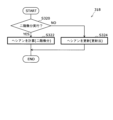
- FIG. 4 is a flowchart showing the process of acquiring a Hessian matrix according to this embodiment.
- the processing circuit determines whether to perform second-order differentiation (S320). As described above, when the direction of deformation is further obtained after deforming a molecule, it is not necessarily necessary to perform expensive Hessian matrix calculations for each iteration.
- the processing circuit determines whether to perform second-order differentiation to calculate a highly accurate Hessian matrix, or to update the Hessian matrix without performing second-order differentiation.
- This condition may be determined, for example, by the number of iterations, or may be determined based on an energy difference or the like.
- the processing circuit obtains a Hessian matrix by performing second-order differentiation (S322).
- the processing circuit may use the trained model to obtain the Hessian matrix.
- the trained model may output a physical quantity that allows calculation of the second-order differential of energy, and the physical quantity may be used to obtain the second-order differential (Hessian matrix) of energy. Examples of physical quantities from which the second derivative of energy can be calculated include natural frequency and reduced mass.
- the processing circuitry may, for example, obtain energy with a trained model and perform a second differentiation, force with a trained model and perform a first differentiation, or a Hessian matrix with a trained model. You may obtain it.
- the processing circuit obtains the Hessian matrix without performing the second-order differentiation (S324).
- the processing circuit updates the Hessian matrix using, for example, a Hessian update method.
- the Hessian update method updates the Hessian matrix based on equation (10).
- the processing circuitry may perform this processing using a trained model or may perform this processing without using a trained model.
- the information processing device can execute calculations at arbitrary granularity using a trained model. If a trained model is not used, it is necessary to find the energy by first-principles calculation, and then find the first derivative (force) and second derivative (Hessian matrix) of this energy, but it takes a long time to calculate this energy. , the process of searching for a stationary point, which must be sequentially executed multiple times within an iteration, takes an enormous amount of time.
- the ADDF method has been described, but in this ADDF method, the calculation of the Hessian matrix determines the speed.
- it when executed using first-principles calculations, it currently takes about 1028 minutes on a 4-core processor and 340 minutes on a 16-core processor.
- it takes about 1.33 seconds not including I/O, and about 33 seconds including I/O. Therefore, even at a low estimate, it is possible to achieve a speedup of about 600 times.
- the information processing device executes processing at high speed using a trained model for the AFIR method.
- FIG. 5 is a flowchart illustrating an example of processing according to this embodiment.
- the processing circuit reads the initial configuration of the molecule (S400).
- the processing circuit reads, for example, the arrangement of molecules of interest in the AFIR method.
- the processing circuit calculates the artificial force parameter (artificial force coefficient) ⁇ ij (or ⁇ in equation (11)) in equation (12) between these read molecules (S402).
- the processing circuit obtains the weighting coefficient of the artificial force based on, for example, equation (14) from the model collision energy ⁇ .
- the processing circuit may obtain this parameter by, for example, estimating the energy maximum point or calculating the energy difference ⁇ E from the starting structure.
- the processing circuit may calculate artificial force parameters from input values or define them for automatic estimation.
- the processing circuit estimates the reacting 2 atoms from the specified fragment and the direction of the force (attraction or repulsion), estimates the activation energy near the transition state, and calculates the artificial force necessary for path searching. Define automatically.
- the processing circuit estimates the reacting 2 atoms from the specified fragment and the direction of the force (attraction or repulsion), estimates the activation energy near the transition state, and calculates the artificial force necessary for path searching. Define automatically.
- a method for determining the artificial force parameter the following may be used as some non-limiting examples.
- the processing circuit may determine this artificial force parameter from input parameters, for example.
- input parameters use a list of at least one of typical activation parameters, bond energies, or reaction rate constants related to the bond formation/dissociation of two atoms in the estimated reaction, and use artificial force parameters as input parameters. may be estimated.
- the intermediate is estimated using the preset typical interatomic distance of the transition state involved in bond formation/dissociation of the estimated reaction two atoms, and one-point energy calculation is performed. Artificial force parameters may also be estimated.
- the processing circuit searches for the position of the atom using the calculated artificial force parameters (S404 to S410).
- the processing circuit obtains the force according to formula (11) or formula (12) using the parameters determined in S402 (S404).
- the processing circuitry may perform this force acquisition calculation using a trained model that acquires forces from atomic configurations and artificial force parameters.
- the processing circuit moves the position of each atom according to the force obtained in S404 (S406).
- the processing circuit acquires energy based on the structure according to the position of the atom moved in S406 (S408).
- the processing circuit may perform this energy capture calculation using a trained model.
- the processing circuit determines whether the energy acquired in S408 is lower than the energy before the atom movement in S406 (S410). In this comparison, the processing circuit may use energy values obtained in previous iterations. The processing circuitry may also, in the first iteration, obtain the energy in states of atoms that are not otherwise moving, with or without the trained model.
- the processing circuit determines whether to end the movement of atoms (S412). The processing circuit makes this determination by determining whether the reaction has been properly tracked based on, for example, changes in the binding state. The processing circuit determines that the movement of atoms has not been completed, for example, when the bonding state is stopped midway.
- the processing circuit may determine whether the target chemical reaction was traced at the end of the reaction path search on the PES to which artificial force was applied. As a method for determining whether or not this tracking is possible, the following may be used as some non-limiting examples.
- the processing circuit may determine the presence or absence of a local maximum point in the route search with the artificial force removed, and may make the determination in S412 based on this determination result.
- the processing circuit may make the determination by using the typical connection distance and comparing symmetric matrices that store connection information before and after the route search.
- a symmetric matrix may be, for example, a matrix that is 1 when below the typical distance and 0 otherwise.
- the processing circuit may determine S412 by using the RMSD (Root Mean Square Deviation) of the atomic positions of the structures before and after the reaction and comparing it with a reference value.
- RMSD Root Mean Square Deviation
- the processing circuit repeats the process from S404.
- the processing circuit may, for example, increase the value of ⁇ and update it to a parameter that has a possibility of exceeding the local maximum point, and repeat the process from S404.
- the processing circuit selects the coordinates of the atom (approximate transition state) where the energy excluding the artificial force is maximum (S414).
- the processing circuit starts from the approximate transition state selected in S414 and searches for a transition state (S416).
- the processing circuit may perform at least one of the processes regarding the transition state search using the trained model.
- the processing circuit acquires the structural data resulting from the search in S416 and determines the reaction path by bidirectionally optimizing the structure from the transition state (S418).
- the AFIR method can also be executed at high speed. For example, by executing operations such as S404 and S408 at high speed using a trained model, information processing equipment can significantly speed up the AFIR method, which requires calculating energy and force for many structures. can do.
- parameters can be easily determined.
- the reaction path can be reliably searched correctly.
- the three-dimensional structure provided as training data does not necessarily need to include a reaction transition state.
- a reaction transition state For example, by giving a three-dimensional structure that deviates from the minimum energy structure obtained in molecular dynamics calculations as training data, we can estimate the energy of the reaction transition state, the first differential of energy, the second differential of energy, and the anharmonicity of energy. It is possible to obtain a possible trained model. In this case, since there is no need to calculate reaction transition states when creating training data, a large amount of training data can be prepared quickly, and as a result, it is possible to improve the accuracy of the trained model.
- the trained model in the above-described embodiment may be a concept that includes, for example, a model that has been trained as described and further distilled using a general method.
- each device may be configured with hardware, or may be configured with software (programs) executed by a CPU (Central Processing Unit) or GPU (Graphics Processing Unit). ) may consist of information processing.
- the software that realizes at least some of the functions of each device in the above-described embodiments may be installed on CD-ROM (Compact Disc-Read Only Memory), USB (Universal Serial Bus) memory, etc.
- Software information processing may be executed by storing the information in a non-transitory storage medium (non-transitory computer-readable medium) such as the following and reading it into a computer. Further, the software may be downloaded via a communication network.
- all or part of the software processing may be implemented in a circuit such as an ASIC (Application Specific Integrated Circuit) or an FPGA (Field Programmable Gate Array), so that the information processing by the software may be executed by hardware. .
- the storage medium that stores the software may be a removable one such as an optical disk, or a fixed storage medium such as a hard disk or memory. Further, the storage medium may be provided inside the computer (main storage device, auxiliary storage device, etc.) or may be provided outside the computer.
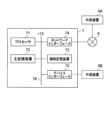
- FIG. 6 is a block diagram showing an example of the hardware configuration of each device (information processing device) in the embodiment described above.
- Each device includes, for example, a processor 71, a main storage device 72 (memory), an auxiliary storage device 73 (memory), a network interface 74, and a device interface 75, which are connected via a bus 76. It may also be realized as a computer 7.
- the computer 7 in FIG. 6 includes one of each component, it may include a plurality of the same components.
- the software may be installed on multiple computers, and each of the multiple computers may execute the same or different part of the software. Good too. In this case, it may be a form of distributed computing in which each computer communicates via the network interface 74 or the like to execute processing.
- each device (information processing device) in the embodiments described above may be configured as a system that realizes functions by having one or more computers execute instructions stored in one or more storage devices. good.
- the information transmitted from the terminal may be processed by one or more computers provided on the cloud, and the processing results may be sent to the terminal.
- each device information processing device
- various calculations may be executed in parallel using one or more processors or multiple computers via a network. Further, various calculations may be distributed to a plurality of calculation cores within the processor and executed in parallel. Further, a part or all of the processing, means, etc. of the present disclosure may be realized by at least one of a processor and a storage device provided on a cloud that can communicate with the computer 7 via a network. In this way, each device in the embodiments described above may be in the form of parallel computing using one or more computers.
- the processor 71 may be an electronic circuit (processing circuit, processing circuit, CPU, GPU, FPGA, ASIC, etc.) that performs at least one of computer control or calculation. Further, the processor 71 may be a general-purpose processor, a dedicated processing circuit designed to execute a specific operation, or a semiconductor device including both a general-purpose processor and a dedicated processing circuit. Furthermore, the processor 71 may include an optical circuit or may include an arithmetic function based on quantum computing.
- the processor 71 may perform calculation processing based on data and software input from each device in the internal configuration of the computer 7, and may output calculation results and control signals to each device.
- the processor 71 may control each component constituting the computer 7 by executing the OS (Operating System) of the computer 7, applications, and the like.
- processor 71 may refer to one or more electronic circuits arranged on one chip, or one or more electronic circuits arranged on two or more chips or two or more devices. You can also point. When using multiple electronic circuits, each electronic circuit may communicate by wire or wirelessly.
- the main memory device 72 may store instructions and various data to be executed by the processor 71, and the information stored in the main memory device 72 may be read by the processor 71.
- Auxiliary storage device 73 is a storage device other than main storage device 72. Note that these storage devices are any electronic components capable of storing electronic information, and may be semiconductor memories. Semiconductor memory may be either volatile memory or nonvolatile memory.
- the storage device for storing various data in each device (information processing device) in the embodiments described above may be realized by the main storage device 72 or the auxiliary storage device 73, and may be realized by the built-in memory built in the processor 71. May be realized.
- the memory circuit in the embodiment described above may be realized by the main memory device 72 or the auxiliary memory device 73.
- each device (information processing device) in the embodiment described above is composed of at least one storage device (memory) and at least one processor connected (coupled) to this at least one storage device
- the storage device 1 At least one processor may be connected to each.
- at least one storage device may be connected to one processor.
- the configuration may include a configuration in which at least one processor among the plurality of processors is connected to at least one storage device among the plurality of storage devices. Further, this configuration may be realized by a storage device and a processor included in a plurality of computers. Furthermore, it may include a configuration in which the storage device is integrated with the processor (for example, a cache memory including an L1 cache and an L2 cache).
- the network interface 74 is an interface for connecting to the communication network 8 wirelessly or by wire. As the network interface 74, an appropriate interface such as one that complies with existing communication standards may be used. The network interface 74 may exchange information with the external device 9A connected via the communication network 8.
- the communication network 8 may be WAN (Wide Area Network), LAN (Local Area Network), PAN (Personal Area Network), etc., or a combination thereof, and may be a communication network between the computer 7 and the external device 9A. Any system that allows information to be exchanged between them is fine. Examples of WAN include the Internet, examples of LAN include IEEE 802.11 and Ethernet (registered trademark), and examples of PAN include Bluetooth (registered trademark) and NFC (Near Field Communication).
- the device interface 75 is an interface such as USB that connects directly to the external device 9B.
- the external device 9A is a device connected to the computer 7 via a network.
- External device 9B is a device directly connected to computer 7.
- the external device 9A or the external device 9B may be an input device, for example.
- the input device is, for example, a device such as a camera, a microphone, a motion capture device, various sensors, etc., a keyboard, a mouse, or a touch panel, and provides the acquired information to the computer 7.
- the device may be a device including an input section, a memory, and a processor, such as a personal computer, a tablet terminal, or a smartphone.
- the external device 9A or the external device 9B may be an output device, for example.
- the output device may be, for example, a display device such as an LCD (Liquid Crystal Display) or an organic EL (Electro Luminescence) panel, or may be a speaker that outputs audio or the like.
- the device may be a device including an output unit, a memory, and a processor, such as a personal computer, a tablet terminal, or a smartphone.
- the external device 9A or the external device 9B may be a storage device (memory).
- the external device 9A may be a network storage or the like, and the external device 9B may be a storage such as an HDD.
- the external device 9A or the external device 9B may be a device that has some of the functions of the components of each device (information processing device) in the embodiments described above.
- the computer 7 may transmit some or all of the processing results to the external device 9A or 9B, or may receive some or all of the processing results from the external device 9A or 9B. .
- the expression "at least one of a, b, and c" or "at least one of a, b, or c" (including similar expressions) When used, it includes either a, b, c, a - b, a - c, b - c or a - b - c. Additionally, multiple instances of any element may be included, such as a - a, a - b - b, a - a - b - b - c - c, etc. Furthermore, it also includes adding other elements other than the listed elements (a, b, and c), such as having d, such as a - b - c - d.
- connection and “coupled” refer to direct connection/coupling and indirect connection/coupling. , including, but not limited to, electrically connected/coupled, communicatively connected/coupled, functionally connected/coupled, physically connected/coupled, etc. intended as a term.
- the term should be interpreted as appropriate depending on the context in which the term is used, but forms of connection/coupling that are not intentionally or naturally excluded are not included in the term. Should be construed in a limited manner.
- the expression "A configured to B” when used, it means that the physical structure of element A is capable of performing operation B. configuration, including that the permanent or temporary setting / configuration of element A is configured / set to actually perform action B. good.
- element A is a general-purpose processor
- the processor has a hardware configuration that can execute operation B, and can perform operation B by setting a permanent or temporary program (instruction). It only needs to be configured to actually execute.
- element A is a dedicated processor or a dedicated arithmetic circuit, the circuit structure of the processor is designed to actually execute operation B, regardless of whether control instructions and data are actually attached. It is sufficient if it is implemented.
- maximum refers to determining the global maximum value, or determining an approximate value of the global maximum value. This term includes determining, determining a local maximum value, and determining an approximation of a local maximum value, and should be interpreted as appropriate depending on the context in which the term is used. It also includes finding approximate values of these maximum values probabilistically or heuristically. Similarly, when terms such as “minimize/minimization” are used, we are referring to finding a global minimum, finding an approximation of a global minimum, or finding a local minimum.
- This term includes determining and approximating a local minimum, and should be interpreted as appropriate depending on the context in which the term is used. It also includes finding approximate values of these minimum values probabilistically or heuristically.
- optimize refers to finding a global optimum, finding an approximation of a global optimum, or calculating a local optimum. This term includes determining and approximating a local optimum, and should be interpreted accordingly depending on the context in which the term is used. It also includes finding approximate values of these optimal values probabilistically or heuristically.
- each piece of hardware when multiple pieces of hardware perform a predetermined process, each piece of hardware may cooperate to perform the predetermined process, or some of the hardware may perform the predetermined process. You may do all of the above. Further, some hardware may perform part of a predetermined process, and another piece of hardware may perform the rest of the predetermined process.
- expressions such as "one or more hardware performs the first processing, and the one or more hardware performs the second processing" (including similar expressions) are used. If used, the hardware that performs the first process and the hardware that performs the second process may be the same or different. In other words, the hardware that performs the first process and the hardware that performs the second process may be included in the one or more pieces of hardware.
- the hardware may include an electronic circuit, a device including an electronic circuit, or the like.
- each storage device among the multiple storage devices may store only part of the data. , the entire data may be stored. Further, a configuration may be included in which some of the plurality of storage devices store data.
Landscapes
- Engineering & Computer Science (AREA)
- Theoretical Computer Science (AREA)
- Physics & Mathematics (AREA)
- General Physics & Mathematics (AREA)
- Chemical & Material Sciences (AREA)
- Geometry (AREA)
- Computing Systems (AREA)
- Crystallography & Structural Chemistry (AREA)
- Bioinformatics & Computational Biology (AREA)
- Evolutionary Computation (AREA)
- General Engineering & Computer Science (AREA)
- Life Sciences & Earth Sciences (AREA)
- Bioinformatics & Cheminformatics (AREA)
- Pure & Applied Mathematics (AREA)
- Analytical Chemistry (AREA)
- Computational Mathematics (AREA)
- Computer Hardware Design (AREA)
- Chemical Kinetics & Catalysis (AREA)
- Mathematical Analysis (AREA)
- Mathematical Optimization (AREA)
- Software Systems (AREA)
- Artificial Intelligence (AREA)
- Medical Informatics (AREA)
- General Health & Medical Sciences (AREA)
- Databases & Information Systems (AREA)
- Data Mining & Analysis (AREA)
- Computer Vision & Pattern Recognition (AREA)
- Health & Medical Sciences (AREA)
- Mathematical Physics (AREA)
- Management, Administration, Business Operations System, And Electronic Commerce (AREA)
Abstract
[課題]反応経路探索の演算の高速化等をする。 [解決手段]情報処理装置は、1 又は複数のメモリと、1 又は複数のプロセッサと、を備える。前記 1 又は複数のプロセッサは、分子を構成する 2 以上の原子についての 3 次元配置を入力すると、前記分子に関する物理量を出力する 1 又は複数の訓練済みモデル用いて、反応経路を探索する。
Description
本開示は、情報処理装置、情報処理方法、プログラム及び非一時的コンピュータ可読媒体に関する。
分子間における反応経路における遷移状態、活性化パラメータ又は速度定数等の情報を取得するために、反応経路探索や遷移状態探索が重要となる。反応経路の探索において、安定構造を探索することは、比較的容易であるが、この安定構造から反応経路となり得る鞍点を探索することは、一般的に困難である。反応経路探索は、例えば、停留点探索、 NEB (Nudged Elastic Band) 法を用いるが、前者は、鞍点の近傍から探索を実行しないと探索がうまくできず、後者は、前提として大まかな反応経路を取得しておく必要がある。 ADDF (Anharmonic Downward Distortion Following) 法や AFIR (Artificial Force Induced Reaction) 法といった手法又はこれらの方法を組み合わせて用いる GRRM (登録商標) (Global Reaction Route Mapping) は、これらの課題を解決しうる方法である。
上記の方法を用いることで、反応経路を自動的に探索することが可能であるが、 ADDF 法、 AFIR 法は、計算コストが高く、計算可能な分子のサイズや探索を施行できる分子の数が限定される。これは、原子核を動かしながら、エネルギー、力、又は、ヘシアンを膨大な回数の第一原理計算により計算する必要があるためである。安定分子から離れた構造についても演算を実行する必要があり、古典力場では適用することが困難である。 ADDF 法においては、分子変形の方向は、下方非調和歪が大きい方向とするが、第一原理計算による下方非調和歪の計算は極めて演算コストが高いため、高速化手法を用いる代償として探索に失敗する懸念もある。また、 AFIR 法においては、人工力パラメータを決定することが難しく、さらには、演算終了後に反応を正しく再現できているか否かの判断も難しい。
S. Maeda, et. al., "Systematic Exploration of the Mechanism of Chemical Reactions: Global Reaction Rout Mapping (GRRM) Strategy by the ADDF and AFIR Methods", Phys. Chem. Chem. Phys., 15, 3683-3701 (2013)
S. Maeda, et. al., "Implementation and performance of the artificial force induced reaction method in the GRRM17 program", J. Comput. Chem., 39, 233-250(2018)
W.M.C. Sameera, S. Maeda, and K. Morokuma, "Computational Catalysis Using the Artificial Force Induced Reaction Method", Acc. Chem. Res., 49, 763-773 (2016)
本開示は、演算中に取得する量のうちの少なくとも 1 つを出力する訓練済みモデルを用いることで演算の高速化等を図る情報処理装置を提案する。
一実施形態によれば、情報処理装置は、
1 又は複数のメモリと、
1 又は複数のプロセッサと、
を備える。
前記 1 又は複数のプロセッサは、
分子を構成する 2 以上の原子についての 3 次元配置を入力すると、前記分子に関する物理量を出力する 1 又は複数の訓練済みモデル用いて、反応経路を探索する。
1 又は複数のメモリと、
1 又は複数のプロセッサと、
を備える。
前記 1 又は複数のプロセッサは、
分子を構成する 2 以上の原子についての 3 次元配置を入力すると、前記分子に関する物理量を出力する 1 又は複数の訓練済みモデル用いて、反応経路を探索する。
以下、図面を参照して本開示の実施形態について説明する。図面及び実施形態の説明は一例として示すものであり、本発明を限定するものではない。
まず、本開示において自動探索に用いる ADDF 法及び AFIR 法について、簡単に説明し、その後にそれぞれの方法を実装する各実施形態について図面を用いながら詳細に説明する。
(ADDF 法)
ADDF 法は、ポテンシャルエネルギーが調和近似に比較して小さくなる方向、すなわち、下方非調和歪 (ADD: Anharmonic Downward Distortion) が極小となる方向に分子を変形させて、遷移状態を求める方法である。説明は、一例として提示するものであり、本開示における実施形態においてはこれらに限定されるものではない。
ADDF 法は、ポテンシャルエネルギーが調和近似に比較して小さくなる方向、すなわち、下方非調和歪 (ADD: Anharmonic Downward Distortion) が極小となる方向に分子を変形させて、遷移状態を求める方法である。説明は、一例として提示するものであり、本開示における実施形態においてはこれらに限定されるものではない。
第一原理計算においても訓練済みモデルにおいても、エネルギー E は、原子核座標 x の関数として計算される。

ここでNは原子の数である。
したがって、第一原理計算を用いても訓練済みモデルを用いても、例えば、最急降下方、共役勾配法、 BFGS 法 (Broyden-Fletcher-Goldfarb-Shanno algorithm) といった種々の最適化方法によって、エネルギーが極小となる構造を探索することができる。換言すると、安定構造の原子核座標である x0 = (x01, x02, x03, ..., x03N)T を探索することができる。
x0 においては、エネルギーの座標に関する 1 階微分、すなわち、力は 0 であるため、 x0 近傍の x = (x1, x2, x3, ..., x3N) T におけるエネルギーは、次のように調和近似される。

ここで、 Δx = x - x0 であり、 H は、 x0 におけるヘッセ行列 (ヘシアン) である。また、 T は、ベクトル又は行列の転置を表す。

直交行列 R によって、 Δ x を y に座標変換することを考える。

この場合、調和近似されたエネルギーは、次のように表すことができる。

ヘッセ行列 H は、対称行列であるから、 R を適切に選択することで RHRT は、対角行列 D となる。

さらに、 zi = Dii
1/2 yi と座標変換して次の式を得ることができる。

こうして取得された 3N 次元内の超球面上において、調和近似しない実際のエネルギーが極小となる方向が、遷移状態の存在する方向であり、その方向に分子を変形させることによって遷移状態に至ることができる。
なお、制約条件 Σzi
2 = r2 のもとで、エネルギー極小の方向を探索するためには、様々な方法を利用することができる。例えば、ラグランジュの未定常数法を用いることもできる。また、以下の様に r を固定した極座標表示において θ1 から θ3N-1 を最適化してもよい。

エネルギーが極小の構造から出発して、分子を変形させる方向を探索する方法について説明したが、分子を一度変形させると、エネルギーの極小状態ではなくなる。この場合、調和近似したエネルギーは、 Δx に関する一次の項を含む。

しかし、この場合も ΔxTHΔx に対して同様の扱いをすることで、分子変形の方向を決定することができる。
エネルギーの調和近似からの差が極小となる方向への分子変形を継続して行うことにより、エネルギーの鞍点である遷移状態を見いだすことができる。なお、エネルギーの鞍点そのものではなくとも鞍点の近傍に至ることができれば、ニュートン法による停留点探索といった探索をすることで、より容易に鞍点に到達することができる。
エネルギーの鞍点である遷移状態を探索することができれば、そこからエネルギーの最小化により、反応経路を取得することができる。訓練済みモデルを用いてエネルギー又はヘッセ行列を計算することにより反応経路を自動探索する手法を、第 1 実施形態として説明する。
訓練済みモデルが、分子の変形方向 Δx から調和近似したエネルギーが等しくなる超曲面上における調和近似との差を出力する場合、このエネルギーの差の値が極小となる方向に分子を変形させることで、遷移状態を探索することができる。訓練済みモデルを用いてこの遷移状態を探索する手法を、第 2 実施形態として説明する。
ADDF 法においては、ヘッセ行列 (エネルギーの二階微分) を計算し、この結果に基づいて分子変形の方向を決定することに時間が掛かる。そこで、一度分子の変形方向を求めた後に、力 (エネルギーの一階微分) を計算しながら当該方向への分子変形を継続することによって、ヘッセ行列の演算回数を削減することができる。ヘッセ行列の演算は、計算コストが高く時間が掛かる。このため、この演算回数を削減することで、高速化を図ることができる。
また、分子変形の方向を再計算する場合であっても、高コストなヘッセ行列の演算をイテレーションごとに実行することは必ずしも必須ではない。この方法の一例として、ヘシアン更新法が用いられる。ヘシアン更新法では、構造変化に伴う勾配変化を利用して、ヘッセ行列の構造変化に沿った方向成分を更新する。
取得されるヘッセ行列は近似的なものであるので、その精度は、停留点探索計算の挙動に影響を及ぼす。構造をエネルギー停留点に近づける段階においては、ヘッセ行列の精度はそれほど重要ではない。一方で、エネルギー停留点近傍からのエネルギー停留点への収束速度は、ヘッセ行列の精度に大きく依存する。
このため、ヘシアン更新法を用いると、極近傍において構造最適化のステップ数が増加するが、ヘッセ行列の演算による取得を必要としないため、最適化ステップそれぞれに要する時間を大幅に削減することができる。
これらの演算の兼ね合いでトータルの計算量が決定されるが、多くの場合、ヘシアン更新法を用いることにより演算時間を削減することができる。この応用として、数ステップに一度、正確なヘッセ行列を計算し、それ以外のステップではヘシアン更新を用いる、という手法もある。
ここで、構造 xk と、構造 xl の変化 Δxkl = xk - xl と対応する勾配変化 Δgkl = gk - gl を用いて差分を取ることで、更新行列 ΔHkl
DIFF が得られる。
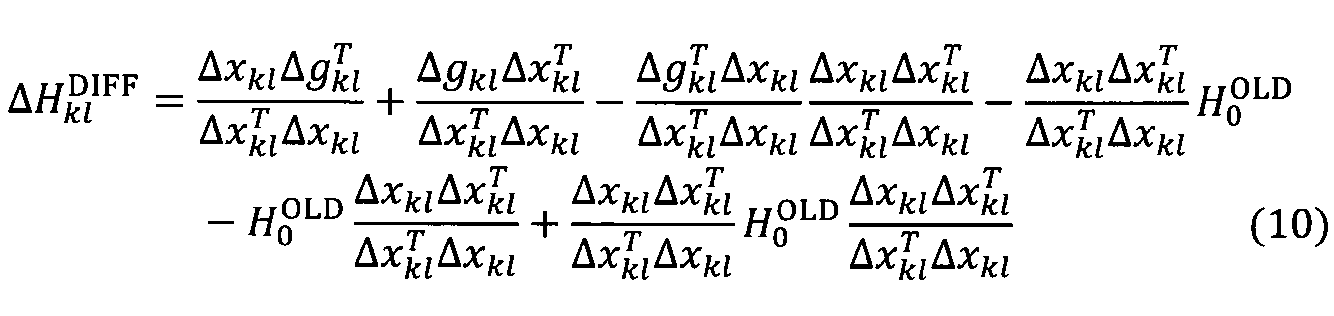
ここで、 H0
OLD は、更新前のヘッセ行列である。構造最適化計算を実行する場合、実際には、 H0
OLD に Hkl
DIFF を加えた行列を、最適化ステップで決定するためのヘッセ行列として用いる。右辺第 1 項から第 3 項は、 Δxkl に沿った勾配の差分であり、第 4 項から第 6 項は、その中の Δxkl 方向の射影部分を消去する項に対応する。
詳細な説明は省略するが、極小点及び一次鞍点の構造最適化において、それぞれよい結果を与える別のヘシアン更新法もある。
このようにヘッセ行列を適切なタイミングで演算し、又は、更新する方法について訓練済みモデルを用いる方法を、第 3 実施形態として説明する。前述したように、訓練済みモデルを用いる本開示においては、これらの演算時間短縮を実行せずに探索を確実なものとすることもできるが、これらの演算時間短縮を実行することで、さらなる高速化を図ることができる。
(AFIR 法)
ADDF 法は、 1 分子から出発して探索する方法であるのに対して、 AFIR 法は、複数の分子が反応する経路も探索可能な方法である。
ADDF 法は、 1 分子から出発して探索する方法であるのに対して、 AFIR 法は、複数の分子が反応する経路も探索可能な方法である。
AFIR (人工力反応誘起) 法では、反応分子同士を押しつけることで反応を誘起する。例えば、反応物A 、 B を反応する場合に、 A 、 B の距離 rAB に比例する項をエネルギーに加算することで、反応障壁を打ち消したポテンシャル面での構造最適化を実行する。

これを用いることで、反応経路探索において困難であった、ポテンシャル曲面を上る方向についても探索が必要となる最適化問題を、ポテンシャル曲面を下る構造最適化問題に置き換えることができる。 AFIR 法によれば、経路計算終了後に人工力項 αrAB を取り除くことで、近似的な反応経路を取得することができ、障壁の位置を特定することもできる。
また、 ADDF 法に対して AFIR 法は、計算コストが大きな下方非調和歪を計算せずに反応経路探索可能な手法である。
多原子分子への応用では、次の様に表すことができる人工力関数を用いる。

ここで、 E(Q) は、座標 Q に依存したポテンシャルエネルギーである。 ρ = 1 の場合、人工力によって反応分子同士は押し付けられ、 ρ = -1 の場合、人工力によって反応分子同士は引き離される。 rij は、原子 i と j の距離である。 rij に重み関数 ωij を乗じ、フラグメント A 、 B に含まれる全原子において和を算出する。また、 Ri 及び Rj は、それぞれ原子 i と j の共有結合半径である。

計算は、 p の値にセンシティブではなく、任意の実数 p として、 6.0 が設定されることが多い。力の強さを求める定数 α は、次式のように与えられる。

定数 γ は、モデル衝突エネルギーであり、超えることができる障壁の近似的な上限を与える。モデル衝突エネルギー γ は、ユーザが設定する。ここで、限定されない一例として ε = 1.0061 [kJ/mol] 、 R0 = 3.8164 [Å] としてもよく、この場合、 α は、モデル衝突エネルギー γ での Ar 二原子の直衝突において、対応するレナードジョーンズポテンシャルのエネルギー極小点から転回点までに Ar 二原子に働く平均力に相当する。
GRRM プログラムは、 AFIR 法を用いた反応経路自動探索手法である SC-AFIR 法 (Single-Component AFIR algorithm) が実装されている。 SC-AFIR 法では、人工力を加えるフラグメントを自動定義し、 AFIR 法を適用することで、経路探索を行って新しい安定構造 EQ を探索する。新規 EQ においても AFIR 法を適用し、新しい反応経路と EQ を取得する。
SC-AFIR 法は、この繰り返し処理を自動で実行する。この自動探索において、力を押しつける反応 (ρ = 1) のみではなく、引き離す力 (ρ = -1) も適用するため、結合切断を伴う反応経路の探索も可能である。
このため、適切な γ の設定等、演算条件の設定は、ユーザの経験が必要とされることがある。なお、非特許文献3には γ の設定として 100 [kJ /mol] が例示されており、目安とすることができる。
この AFIR において訓練済みモデルを利用する方法を、第 4 実施形態として説明する。
以下、上記のそれぞれについて、限定されない例を示す実施形態として説明する。それぞれの実施形態において、処理は、例えば、ソフトウェアによる情報処理がハードウェア資源を用いて具体的に実現される。ハードウェアである情報処理装置は、例えば、 1 又は複数のプロセッサ (処理回路) と、当該プロセッサに接続される 1 又は複数のメモリ (記憶回路) と、を用いて実装される。
情報処理装置に備えられる処理回路は、適切なタイミングで記憶回路にデータを書き込み又は読み出す。データは、処理に必要となり、又は、入出力となるデータであってもよいし、情報処理を実行するためのプログラムであってもよい。
以下において、訓練済みモデルは、例えば、 NNP (Neural Network Potential) に関するモデルである。 NNP に関するモデルは、例えば、原子の 3 次元配置等の情報を入力すると、それぞれの原子に対するエネルギーを出力するモデルである。情報処理装置は、このモデルを処理回路が記憶回路を参照することで利用することができる。NNPとしては、MATLANTIS (登録商標)を使用してもよい。
フローチャートにおいて太線で囲まれている処理は、本開示において訓練済みモデルを用いて演算可能な処理である。以下においては、物理量としてエネルギー等を用いるが、用いる物理量は、任意に選択することができる。また、処理回路は、一例として、エネルギーを取得するための NNP における訓練済みモデルを中心としたモデルを利用するが、こちらも任意の物理量を取得するための訓練済みモデルと適宜読み替えることができる。
(第 1 実施形態)
図1は、第 1 実施形態に係る処理回路の処理を示すフローチャートである。本実施形態においては、 ADDF 法における処理を高速化する訓練済みモデルの利用の一例について説明する。
図1は、第 1 実施形態に係る処理回路の処理を示すフローチャートである。本実施形態においては、 ADDF 法における処理を高速化する訓練済みモデルの利用の一例について説明する。
処理回路は、対象となる分子等の構造に関するデータを読み込む (S100) 。構造に関するデータは、例えば、分子を構成する原子の種類、及び、当該原子の 3 次元座標を含むデータである。
処理回路は、読み込んだ構造に対して物理量、例えば、エネルギーを計算し、この物理量が極小でない場合には、エネルギーの極小構造を探索する (S102) 。処理回路は、訓練済みモデルを用いてこの処理を実行してもよい。なお、この処理は、イテレーションの外側であるので、訓練済みモデルを用いなくても他の処理のモデル化よりもボトルネックとはなりにくい。
この S102 において訓練済みモデルを用いる場合、この訓練済みモデルは、構造を入力するとエネルギーを出力する式 (1) の値を出力するモデルを用いることができる。また、処理回路は、上記に説明した種々の最適化手法により取得した安定構造を教師データとして訓練した訓練済みモデルを用いることができる。処理回路は、エネルギーが極小でない場合には、 S100 で読み出した構造 x に対して安定構造 x0 を、訓練済みモデルを介して取得する。
処理回路は、読み出した構造 x から取得した物理量が極小である場合、又は、 S102 において物理量が極小となる構造 x0 を探索した後、この極小となる構造を初期値として、遷移状態の探索処理 (S104 ~ S112) を実行する。
処理回路は、構造から、物理量を取得する (S104) 。処理回路は、一例として図1に示すように、エネルギー及びヘッセ行列を取得する。この処理は、訓練済みモデルを用いて実行してもよい。処理回路は、訓練済みモデルを用いて構造からエネルギーを取得し、このエネルギーを二階微分することでヘッセ行列を取得してもよい。また、訓練済みモデルによって、エネルギーの二階微分を算出できる物理量を出力し、当該物理量を用いてエネルギーの二階微分 (ヘッセ行列) を取得してもよい。エネルギーの二階微分を算出できる物理量として、例えば、固有振動数と換算質量が挙げられる。
別の例として、処理回路は、構造データを入力すると、ヘッセ行列を出力する訓練済みモデルを用いてもよい。さらに別の例として、処理回路は、力が取得できている場合、この力の値を位置微分することでヘッセ行列を取得してもよい。処理回路は、例えば、 2 回目のイテレーション以降においては前のイテレーションにおける後述する S112 の処理結果を用いることでヘッセ行列の演算時間を短縮することが可能である。
ADDF においては、分子を変形する方向、例えば、並進、回転、屈曲等の方向は、求めることができる。処理回路は、ユーザが指定する分子変形変位量の最大値の範囲内において、この分子を変形する幅を設定する (S106) 。初期値は、ユーザが入力したものを用いてもよい。次のイテレーションからは、前のイテレーションにより取得された幅から自動的に決定、例えば、イテレーションにおいて取得した状態により、幅を狭めたり、広めたりする手法としてもよい。分子変形幅の設定は、公知の方法を用いてもよい。
分子変形幅を設定した後、処理回路は、エネルギーの調和近似からの差が極小となる方向、すなわち、分子の変形方向を計算する (S108) 。処理回路は、例えば、式 (2,3,4,5,6,7,9) から計算される調和近似エネルギーに基づいて調和近似からの差を計算してもよく、また式 (8) で示される、調和近似エネルギーが等しい超球面上におけるエネルギー極小を探索してもよい。また、処理回路は、訓練済みモデルを用いて、この方向を取得する形態であってもよい。本ステップにおいて用いる訓練済みモデルは、例えば、式 (2) から式 (9) を用いて取得した種々の教師データを用いて訓練されたモデルであってもよい。
処理回路は、 S108 で取得された方向に、 S106 で設定した幅内において分子を変形させたそれぞれの原子の座標を取得する (S110) 。
処理回路は、変形した座標を含む構造を用いて、それぞれの原子に働く力を計算する (S112) 。本ステップは、訓練済みモデルを用いて実行してもよい。処理回路は、例えば、構造データからエネルギーを取得する訓練済みモデルを用いてそれぞれの原子のエネルギーを取得し、このエネルギーを位置微分 (一階微分) することで、力を取得してもよい。処理回路は、別の例として、構造データから力を取得する訓練済みモデルを用いて、力を取得してもよい。
処理回路は、 S110 において取得した構造が停留点であるか否かを判定する (S114) 。処理回路は、例えば、 S112 で取得した力が 0 であるか否かにより、この判定を実行してもよい。また、処理回路は、例えば、この力が微小の所定値以下であるかを判定基準に用いてもよい。
停留点ではないと判定する場合 (S114: NO) 、処理回路は、 S110 において変形した構造を用いて、 S104 からの処理を繰り返す。
停留点であると判定する場合 (S114: YES) 、処理回路は、 S110 において変形した構造に基づいて、反応経路を決定する (S116) 。処理回路は、例えば、遷移状態から双方向に構造最適化を実行することで、反応経路を決定する。この反応経路の決定における構造最適化の処理について、処理回路は、訓練済みモデルを利用してもよい。なお、 S102 の処理と同様に、処理回路は、 S116 の処理もイテレーションの外側であるので、精度向上等の理由により、訓練済みモデルを利用するのではなく、一般的な最適化手法を用いてもよい。
以上のように、本実施形態によれば、情報処理装置は、演算を任意の粒度で訓練済みモデルを用いて実行することができる。訓練済みモデルを使用しない場合、第一原理計算によりエネルギーを求め、このエネルギーの一階微分 (力) 及びエネルギーの二階微分 (ヘッセ行列) を求める必要があるが、このエネルギーの演算時間が長いため、これをイテレーション内において逐次的に複数回実行しなければならない停留点探索の処理は、膨大な時間を要する。
本実施形態によれば、エネルギーの計算が大幅に高速化されるため、全体的な処理時間を短縮することが可能となる。また、訓練済みモデルがエネルギーの一階微分を出力できる場合、この値を一階微分することでヘッセ行列を取得することができる。このことも、高速化に寄与する。さらに、訓練済みモデルがエネルギーの二階微分を出力できる場合、高速化の効果は、さらに顕著なものとなる。
なお、上述においては、処理ごとに訓練済みモデルを用いるか否かを選択できることを説明したが、これに限定されるものではない。例えば、同じ処理をイテレーションによって、訓練済みモデルを用いて実行するか、第一原理計算等により実行するかを選択できてもよい。限定されない例として、少なくとも 1 つのある処理ステップについて、所定数ごとのイテレーションにおいては、ある程度の精度を担保するために第一原理計算を実行するといった態様としてもよい。これは、本実施形態に限らず、以下に説明するいずれの実施形態においても同様である。
(第 2 実施形態)
図2は、第 1 実施形態に係る処理回路の処理を示すフローチャートである。本実施形態においては、 ADDF 法における処理を高速化する訓練済みモデルの利用の一例について説明する。
図2は、第 1 実施形態に係る処理回路の処理を示すフローチャートである。本実施形態においては、 ADDF 法における処理を高速化する訓練済みモデルの利用の一例について説明する。
処理回路は、対象となる分子等の構造に関するデータを読み込む (S200) 。この処理は、第 1 実施形態における S100 と同等の処理である。
処理回路は、読み込んだ構造に対して物理量、例えば、エネルギーを計算し、この物理量が極小でない場合には、エネルギーの極小構造を探索する (S202) 。この処理は、第 1 実施形態における S102 と同等の処理である。
処理回路は、読み出した構造 x から取得した物理量が極小である場合、又は、 S202 において物理量が極小となる構造 x0 を探索した後、この極小となる構造を初期値として、遷移状態の探索処理 (S204 ~ S210) を実行する。
処理回路は、分子を変形する幅を設定する (S204) 。この処理は、一例として、第 1 実施形態における S106 の処理と同等の処理である。
別例として、この処理において、処理回路は、エネルギー、力又はヘッセ行列のうち少なくとも 1 つを訓練済みモデルを用いて取得することなく、処理を実行してもよい。処理回路は、構造を入力すると、非調和性を出力する訓練済みモデルを用いて、この変形方向を取得してもよい。
一例として、処理回路は、分子の変更方向から、調和近似したエネルギーが等しくなる超曲面上における調和近似との差を出力するモデルを用いてもよい。このようなモデルを用いて、エネルギーの差が極小となる分子の変更方向を探索することで、処理回路は、変形方向を推定することが可能となる。この訓練済みモデルの訓練についても、適切な教師データを取得することが可能である。
分子変形幅を設定した後、処理回路は、エネルギーの調和近似からの差が極小となる方向、すなわち、分子の変形方向を計算する (S206) 。この処理は、第 1 実施形態における S108 の処理と同等の処理である。
処理回路は、 S206 で取得された方向に、 S204 で設定した幅内において分子を変形させたそれぞれの原子の座標を取得する (S208) 。この処理は、第 1 実施形態における S110 の処理と同等の処理である。
処理回路は、変形した座標を含む構造を用いて、それぞれの原子に働く力を計算する (S210) 。この処理は、第 1 実施形態における S112 の処理と同等の処理である。
処理回路は、 S208 において取得した構造が停留点であるか否かを判定する (S212) 。この処理は、第 1 実施形態における S114 の処理と同等の処理である。
停留点ではないと判定する場合 (S212: NO) 、処理回路は、 S208 において変形した構造を用いて、 S204 からの処理を繰り返す。
停留点であると判定する場合 (S212: YES) 、処理回路は、 S208 において変形した構造に基づいて、反応経路を決定する (S214) 。これ以降の処理は、第 1 実施形態における S114 ~ S116 と同等の処理である。
本実施形態によれば、情報処理装置は、第 1 実施形態と同様に、演算を任意の粒度で訓練済みモデルを用いて実行することができる。さらに、本実施形態によれば、エネルギー等を直接的に取得することなく、変形方向を求めるためのデータを取得することが可能となる。
分子を変形させる方向を求める探索においては、途中経過における演算の多さから実時間的には成功しないことがあった。本実施形態に係る情報処理装置によれば、エネルギー等の物理量を算出することなく、非調和性のデータを取得することができるので、より確実な探索を実現することができる。また、非調和性を取得するための種々の物理量を取得しなくてもよいことから、第 1 実施形態における手法をさらに高速化することが可能となる。
(第 3 実施形態)
図3は、第 3 実施形態に係る処理回路の処理を示すフローチャートである。本実施形態においては、 ADDF 法における処理を高速化する訓練済みモデルの利用の一例について説明する。本実施形態に係る処理は、訓練済みモデルを利用しない ADDF の処理をトレースして、演算コストが高い処理において、訓練済みモデルを用いるものである。
図3は、第 3 実施形態に係る処理回路の処理を示すフローチャートである。本実施形態においては、 ADDF 法における処理を高速化する訓練済みモデルの利用の一例について説明する。本実施形態に係る処理は、訓練済みモデルを利用しない ADDF の処理をトレースして、演算コストが高い処理において、訓練済みモデルを用いるものである。
S300 及び S302 の処理は、第 1 実施形態における S100 及び S102 の処理とそれぞれ同等の処理である。
処理回路は、イテレーションの外側において、構造から物理量、例えば、エネルギー及びヘッセ行列を取得する (S304) 。処理の内容については、第 1 実施形態の S104 と同等の処理である。
処理回路は、 S302 において読み出した構造 x から取得した物理量が極小である場合、又は、 S302 において物理量が極小となる構造 x0 を探索した後、この極小となる構造を初期値として、遷移状態の探索処理 (S306 ~ S318) を実行する。
S306 から S316 の処理は、 S314 の分岐先の処理を除き、それぞれ第 1 実施形態の S106 から S116 の処理と同等の処理である。
処理回路は、変形した構造が停留点でない場合 (S314: NO) 、ヘッセ行列を取得する処理に移行する (S318) 。
図4は、本実施形態に係るヘッセ行列を取得する処理を示すフローチャートである。
処理回路は、ヘッセ行列を取得する判定をすると、二階微分を実行するか否かを判定する (S320) 。上述したように、分子を変形した後にさらに変形の方向を取得する場合、高コストなヘッセ行列の演算をイテレーションごとに実行することは必ずしも必要ではない。
処理回路は、種々の条件により、二階微分を実行して精度の高いヘッセ行列を演算するか、二階微分を実行せずにヘッセ行列を更新するかを判定する。この条件は、例えば、イテレーションの回数で決定されてもよいし、エネルギー差等に基づいて決定されてもよい。
二階微分実行すると判定した場合 (S320: YES) 、処理回路は、二階微分を実行することでヘッセ行列を取得する (S322) 。処理回路は、訓練済みモデルを用いてヘッセ行列を取得してもよい。また、訓練済みモデルによって、エネルギーの二階微分を算出できる物理量を出力し、当該物理量を用いてエネルギーの二階微分 (ヘッセ行列) を取得してもよい。エネルギーの二階微分を算出できる物理量として例えば、固有振動数と換算質量が挙げられる。
処理回路は、例えば、エネルギーを訓練済みモデルで取得し、二階微分してもよいし、力を訓練済みモデルで取得し、一階微分してもよいし、又は、ヘッセ行列を訓練済みモデルで取得してもよい。
二階微分実行しないと判定した場合 (S320: NO) 、処理回路は、二階微分を実行することなくヘッセ行列を取得する (S324) 。処理回路は、例えば、ヘシアン更新法を用いて、ヘッセ行列を更新する。ヘシアン更新法は、式 (10) に基づいて、ヘッセ行列を更新する。処理回路は、訓練済みモデルを用いてこの処理を実行してもよいし、訓練済みモデルを用いずにこの処理を実行してもよい。
以上のように、本実施形態によれば、情報処理装置は、演算を任意の粒度で訓練済みモデルを用いて実行することができる。訓練済みモデルを使用しない場合、第一原理計算によりエネルギーを求め、このエネルギーの一階微分 (力) 及びエネルギーの二階微分 (ヘッセ行列) を求める必要があるが、このエネルギーの演算時間が長いため、これをイテレーション内において逐次的に複数回実行しなければならない停留点探索の処理は、膨大な時間を要する。
本実施形態によれば、ヘッセ行列の演算を適切に省略することで、前述の実施形態と比較してさらなる高速化を実現することが可能である。
第 1 実施形態から第 3 実施形態においては、 ADDF 法について説明したが、この ADDF 法においては、ヘッセ行列の演算が速度を律速する。一例として、第一原理計算において実行した場合、現状では、 4 コアのプロセッサで 1028 分程度、 16 コアで 340 分程度かかる。一方、本開示の実施形態によれば、 I/O を含まないと 1.33 秒程度、 I/O を含むと 33 秒程度である。このため、低く見積もっても、約 600 倍程度の高速化を実現できる。
(第 4 実施形態)
本実施形態に係る情報処理装置は、 AFIR 法について訓練済みモデルを用いて処理を高速に実行する。
本実施形態に係る情報処理装置は、 AFIR 法について訓練済みモデルを用いて処理を高速に実行する。
図5は、本実施形態に係る処理の一例を示すフローチャートである。
処理回路は、分子の初期配置を読み込む (S400) 。処理回路は、例えば、 AFIR 法において着目している分子の配置を読み込む。
処理回路は、これらの読み込んだ分子間における式 (12) における人工力のパラメータ (人工力の係数) ωij (又は 式 (11) における α) を計算する (S402) 。処理回路は、例えば、モデル衝突エネルギー γ から、式 (14) 等に基づいて人工力の重み付け係数を取得する。処理回路は、例えば、エネルギー極大点の推定をしたり、出発構造とのエネルギー差 ΔE を計算したりすることで、このパラメータを取得してもよい。
処理回路は、人工力パラメータを入力値から計算し、又は、自動推定するための定義をしてもよい。自動推定定義では、処理回路は、指定したフラグメントと力の方向 (引力又は斥力) から、反応する 2 原子を推定し、遷移状態付近の活性化エネルギーを推定し、経路探索に必要な人工力を自動定義する。人工力パラメータの決定法は、限定されないいくつかの例として、以下のものを用いてもよい。
処理回路は、例えば、入力されたパラメータからこの人工力パラメータを決定してもよい。
入力されたパラメータとして、あらかじめ設定された、推定反応 2 原子の結合形成/解離に係る典型的な活性化パラメータ、結合エネルギー、又は、反応速度定数のうち少なくとも 1 つのリストを使用し、人工力パラメータを推定してもよい。
入力されたパラメータとして、あらかじめ設定された、推定反応 2 原子の結合形成/解離に係る遷移状態の典型的な原子間距離を使用して中間体を推定し、 1 点エネルギー計算を実行することで人工力パラメータを推定してもよい。
入力されたパラメータとして、あらかじめ設定された、推定反応 2 原子の結合形成/解離に係る遷移状態の典型的な反応座標距離を使用し、指定フラグメント間に非常に大きな人工力 (通常の化学反応で議論する値の 10 倍以上程度) を加えた PES (Potential Energy Surface) 上で典型反応座標距離分動かした構造を作成し、その点を推定中間体とし、 1 点エネルギー計算を実行することで人工力パラメータを推定してもよい。
処理回路は、この計算した人工力のパラメータを用いて、原子の位置を探索する (S404 ~ S410) 。
処理回路は、 S402 において求められたパラメータを用いて、式 (11) 又は 式 (12) にしたがい、力を取得する (S404) 。処理回路は、この力の取得の計算を、原子の配置及び人工力のパラメータから力を取得する訓練済みモデルを用いて実行してもよい。
処理回路は、 S404 で取得した力にしたがい、それぞれの原子の位置を移動させる (S406) 。
処理回路は、 S406 で移動させた原子の位置にしたがう構造に基づいて、エネルギーを取得する (S408) 。処理回路は、このエネルギーの取得の計算を、訓練済みモデルを用いて実行してもよい。
処理回路は、 S408 で取得したエネルギーが、 S406 における原子の移動前のエネルギーと比較して低下しているか否かを判定する (S410) 。この比較において、処理回路は、前のイテレーションにおいて取得されているエネルギー値を用いてもよい。また、処理回路は、最初のイテレーションにおいては、別途移動していない原子の状態におけるエネルギーを、訓練済みモデルを用いて、又は、用いずに取得してもよい。
処理回路は、エネルギーが低下している場合 (S410: YES) 、 S404 からの処理を繰り返す。
処理回路は、エネルギーが低下していない場合 (S410: NO) 、原子の移動を終了するか否かを判定する (S412) 。処理回路は、例えば、結合状態の変化等から、反応を適切に追跡できたかを判定することで、この判定を実行する。処理回路は、例えば、結合状態が途中で止まっていた等の場合において、原子の移動が終了していないと判定する。
処理回路は、例えば、人工力を加えた PES 上での反応経路探索終了時に目的化学反応を追跡できたか否かを判定してもよい。この追跡可否の判定法は、限定されないいくつかの例として、以下のものを用いてもよい。
処理回路は、人工力を取り除いた経路探索において、極大点の有無を判定し、この判定結果に基づいて、 S412 の判定をしてもよい。
処理回路は、典型結合距離を使用し、経路探索前後の結合情報を保存した対称行列を比較することで判断してもよい。対称行列は、例えば、典型距離を下回る場合には、 1 であり、それ以外では 0 である行列であってもよい。
処理回路は、反応前後構造の原子位置の RMSD (二乗平均偏差: Root Mean Square Deviation) を使用し、基準値と比較することで、 S412 の判定をしてもよい。
処理回路は、原子の移動が終了していない場合 (S412: NO) 、 S404 からの処理を繰り返す。ここで、処理回路は、同じパラメータで処理を繰り返すのではなく、例えば、 γ の値を大きくして極大点を超える可能性を有するパラメータに更新して、 S404 からの処理を繰り返してもよい。
処理回路は、人工力を除いたエネルギーが極大となる原子の座標 (近似的遷移状態) を選択する (S414) 。
処理回路は、 S414 で選択した近似的遷移状態から出発し、遷移状態の探索を行う (S416) 。処理回路は、この遷移状態の探索についての処理のうち少なくとも 1 つを訓練済みモデルを用いて実行してもよい。
処理回路は、 S416 で探索した結果の構造データを取得し、遷移状態から双方向に構造最適化することで、反応経路を決定する (S418) 。
以上のように、本実施形態に係る情報処理装置によれば、 AFIR 法についても高速に実行することが可能である。例えば、 S404 、 S408 等の演算を、訓練済みモデルを用いて高速に実行することで、情報処理装置は、多くの構造に対してエネルギー及び力を計算する必要がある AFIR 法を大幅に高速化することができる。
また、例えば、 S402 の処理を実行することで、パラメータを容易に決定することもできる。さらに、例えば、 S412 の判定を実行することで、反応経路を確実に正しく探索することができる。
これらの実施形態において使用される訓練済みモデルを得るための学習において、教師データとして与える 3 次元構造は、必ずしも反応遷移状態を含んでいる必要は無い。たとえば分子動力学計算において得られる、エネルギー極小構造から逸脱した 3 次元構造を教師データとして与えることにより、反応遷移状態のエネルギー、エネルギーの一階微分、エネルギーの二階微分、エネルギーの非調和性を推定可能な訓練済みモデルを得ることが可能である。この場合、教師データの作成において反応遷移状態を計算する必要が無いため、教師データを高速に大量に用意でき、その結果訓練済みモデルの精度を高めることが可能である。なお、前述の実施形態における訓練済みモデルは、例えば、説明したように訓練した上で、さらに、一般的な手法により蒸留されたモデルを含む概念であってもよい。
前述した実施形態における各装置(情報処理装置)の一部又は全部は、ハードウェアで構成されていてもよいし、 CPU (Central Processing Unit) 又は GPU (Graphics Processing Unit) 等が実行するソフトウェア (プログラム) の情報処理で構成されてもよい。ソフトウェアの情報処理で構成される場合には、前述した実施形態における各装置の少なくとも一部の機能を実現するソフトウェアを、 CD-ROM (Compact Disc-Read Only Memory) 、 USB (Universal Serial Bus) メモリ等の非一時的な記憶媒体 (非一時的なコンピュータ可読媒体) に収納し、コンピュータに読み込ませることにより、ソフトウェアの情報処理を実行してもよい。また、通信ネットワークを介して当該ソフトウェアがダウンロードされてもよい。さらに、ソフトウェアの処理の全部又は一部が ASIC (Application Specific Integrated Circuit) 又は FPGA (Field Programmable Gate Array) 等の回路に実装されることにより、当該ソフトウェアによる情報処理がハードウェアにより実行されてもよい。
ソフトウェアを収納する記憶媒体は、光ディスク等の着脱可能なものでもよいし、ハードディスク又はメモリ等の固定型の記憶媒体であってもよい。また、記憶媒体は、コンピュータ内部に備えられてもよいし (主記憶装置または補助記憶装置等) 、コンピュータ外部に備えられてもよい。
図6は、前述した実施形態における各装置 (情報処理装置) のハードウェア構成の一例を示すブロック図である。各装置は、一例として、プロセッサ71と、主記憶装置72 (メモリ) と、補助記憶装置73 (メモリ) と、ネットワークインタフェース74と、デバイスインタフェース75と、を備え、これらがバス76を介して接続されたコンピュータ7として実現されてもよい。
図6のコンピュータ7は、各構成要素を一つ備えているが、同じ構成要素を複数備えていてもよい。また、図6では、1台のコンピュータ7が示されているが、ソフトウェアが複数台のコンピュータにインストールされて、当該複数台のコンピュータそれぞれがソフトウェアの同一の又は異なる一部の処理を実行してもよい。この場合、コンピュータそれぞれがネットワークインタフェース74等を介して通信して処理を実行する分散コンピューティングの形態であってもよい。つまり、前述した実施形態における各装置 (情報処理装置) は、1又は複数の記憶装置に記憶された命令を1台又は複数台のコンピュータが実行することで機能を実現するシステムとして構成されてもよい。また、端末から送信された情報をクラウド上に設けられた1台又は複数台のコンピュータで処理し、この処理結果を端末に送信するような構成であってもよい。
前述した実施形態における各装置 (情報処理装置) の各種演算は、1又は複数のプロセッサを用いて、又は、ネットワークを介した複数台のコンピュータを用いて、並列処理で実行されてもよい。また、各種演算が、プロセッサ内に複数ある演算コアに振り分けられて、並列処理で実行されてもよい。また、本開示の処理、手段等の一部又は全部は、ネットワークを介してコンピュータ7と通信可能なクラウド上に設けられたプロセッサ及び記憶装置の少なくとも一方により実現されてもよい。このように、前述した実施形態における各装置は、1台又は複数台のコンピュータによる並列コンピューティングの形態であってもよい。
プロセッサ71は、少なくともコンピュータの制御又は演算のいずれかを行う電子回路 (処理回路、 Processing circuit 、 Processing circuitry 、 CPU 、 GPU 、 FPGA 、 ASIC 等) であってもよい。また、プロセッサ71は、汎用プロセッサ、特定の演算を実行するために設計された専用の処理回路又は汎用プロセッサと専用の処理回路との両方を含む半導体装置等のいずれであってもよい。また、プロセッサ71は、光回路を含むものであってもよいし、量子コンピューティングに基づく演算機能を含むものであってもよい。
プロセッサ71は、コンピュータ7の内部構成の各装置等から入力されたデータやソフトウェアに基づいて演算処理を行ってもよく、演算結果や制御信号を各装置等に出力してもよい。プロセッサ71は、コンピュータ7の OS (Operating System) や、アプリケーション等を実行することにより、コンピュータ7を構成する各構成要素を制御してもよい。
前述した実施形態における各装置 (情報処理装置) は、1又は複数のプロセッサ71により実現されてもよい。ここで、プロセッサ71は、1チップ上に配置された1又は複数の電子回路を指してもよいし、2つ以上のチップあるいは2つ以上のデバイス上に配置された1又は複数の電子回路を指してもよい。複数の電子回路を用いる場合、各電子回路は有線又は無線により通信してもよい。
主記憶装置72は、プロセッサ71が実行する命令及び各種データ等を記憶してもよく、主記憶装置72に記憶された情報がプロセッサ71により読み出されてもよい。補助記憶装置73は、主記憶装置72以外の記憶装置である。なお、これらの記憶装置は、電子情報を格納可能な任意の電子部品を意味するものとし、半導体のメモリでもよい。半導体のメモリは、揮発性メモリ又は不揮発性メモリのいずれでもよい。前述した実施形態における各装置 (情報処理装置) において各種データ等を保存するための記憶装置は、主記憶装置72又は補助記憶装置73により実現されてもよく、プロセッサ71に内蔵される内蔵メモリにより実現されてもよい。例えば、前述した実施形態における記憶回路は、主記憶装置72又は補助記憶装置73により実現されてもよい。
前述した実施形態における各装置 (情報処理装置) が、少なくとも1つの記憶装置 (メモリ) と、この少なくとも1つの記憶装置に接続 (結合) される少なくとも1つのプロセッサで構成される場合、記憶装置1つに対して、少なくとも1つのプロセッサが接続されてもよい。また、プロセッサ1つに対して、少なくとも1つの記憶装置が接続されてもよい。また、複数のプロセッサのうち少なくとも1つのプロセッサが、複数の記憶装置のうち少なくとも1つの記憶装置に接続される構成を含んでもよい。また、複数台のコンピュータに含まれる記憶装置とプロセッサによって、この構成が実現されてもよい。さらに、記憶装置がプロセッサと一体になっている構成 (例えば、 L1 キャッシュ、 L2 キャッシュを含むキャッシュメモリ) を含んでもよい。
ネットワークインタフェース74は、無線又は有線により、通信ネットワーク8に接続するためのインタフェースである。ネットワークインタフェース74は、既存の通信規格に適合したもの等、適切なインタフェースを用いればよい。ネットワークインタフェース74により、通信ネットワーク8を介して接続された外部装置9Aと情報のやり取りが行われてもよい。なお、通信ネットワーク8は、 WAN (Wide Area Network) 、 LAN (Local Area Network) 、 PAN (Personal Area Network) 等のいずれか、又は、それらの組み合わせであってよく、コンピュータ7と外部装置9Aとの間で情報のやりとりが行われるものであればよい。 WAN の一例としてインターネット等があり、 LAN の一例として IEEE 802.11 やイーサネット (登録商標) 等があり、 PAN の一例として Bluetooth (登録商標) や NFC (Near Field Communication) 等がある。
デバイスインタフェース75は、外部装置9Bと直接接続する USB 等のインタフェースである。
外部装置9Aは、コンピュータ7とネットワークを介して接続されている装置である。外部装置9Bは、コンピュータ7と直接接続されている装置である。
外部装置9A又は外部装置9Bは、一例として、入力装置であってもよい。入力装置は、例えば、カメラ、マイクロフォン、モーションキャプチャ、各種センサ等、キーボード、マウス又はタッチパネル等のデバイスであり、取得した情報をコンピュータ7に与える。また、パーソナルコンピュータ、タブレット端末又はスマートフォン等の入力部とメモリとプロセッサを備えるデバイスであってもよい。
また、外部装置9A又は外部装置9Bは、一例として、出力装置でもよい。出力装置は、例えば、 LCD (Liquid Crystal Display) 、有機 EL (Electro Luminescence) パネル等の表示装置であってもよいし、音声等を出力するスピーカ等であってもよい。また、パーソナルコンピュータ、タブレット端末又はスマートフォン等の出力部とメモリとプロセッサを備えるデバイスであってもよい。
また、外部装置9A又は外部装置9Bは、記憶装置 (メモリ) であってもよい。例えば、外部装置9Aは、ネットワークストレージ等であってもよく、外部装置9Bは、 HDD 等のストレージであってもよい。
また、外部装置9A又は外部装置9Bは、前述した実施形態における各装置 (情報処理装置) の構成要素の一部の機能を有する装置でもよい。つまり、コンピュータ7は、外部装置9A又は外部装置9Bに処理結果の一部又は全部を送信してもよいし、外部装置9A又は外部装置9Bから処理結果の一部又は全部を受信してもよい。
本明細書 (請求項を含む) において、「a 、b 及び c の少なくとも1つ (一方) 」又は「a 、b 又は c の少なくとも1つ (一方) 」の表現 (同様な表現を含む) が用いられる場合は、a、b、c、a - b、a - c、b - c 又は a - b - c のいずれかを含む。また、a - a、a - b - b、a - a - b - b - c - c 等のように、いずれかの要素について複数のインスタンスを含んでもよい。さらに、a - b - c - d のように d を有する等、列挙された要素 (a 、b 及び c) 以外の他の要素を加えることも含む。
本明細書 (請求項を含む) において、「データを入力として/を用いて/データに基づいて/に従って/に応じて」等の表現(同様な表現を含む)が用いられる場合は、特に断りがない場合、データそのものを用いる場合や、データに何らかの処理を行ったもの (例えば、ノイズ加算したもの、正規化したもの、データから抽出した特徴量、データの中間表現等) を用いる場合を含む。また、「データを入力として/を用いて/データに基づいて/に従って/に応じて」何らかの結果が得られる旨が記載されている場合 (同様な表現を含む) 、特に断りが無い場合、当該データのみに基づいて当該結果が得られる場合や、当該データ以外の他のデータ、要因、条件及び/又は状態等にも影響を受けて当該結果が得られる場合を含む。また、「データを出力する」旨が記載されている場合 (同様な表現を含む) 、特に断りがない場合、データそのものを出力として用いる場合や、データに何らかの処理を行ったもの (例えば、ノイズ加算したもの、正規化したもの、データから抽出した特徴量、データの中間表現等) を出力として用いる場合を含む。
本明細書 (請求項を含む) において、「接続される (connected) 」及び「結合される (coupled) 」との用語が用いられる場合は、直接的な接続/結合、間接的な接続/結合、電気的 (electrically) な接続/結合、通信的 (communicatively) な接続/結合、機能的 (operatively) な接続/結合、物理的 (physically) な接続/結合等のいずれをも含む非限定的な用語として意図される。当該用語は、当該用語が用いられた文脈に応じて適宜解釈されるべきであるが、意図的に或いは当然に排除されるのではない接続/結合形態は、当該用語に含まれるものして非限定的に解釈されるべきである。
本明細書 (請求項を含む) において、「AがBするよう構成される (A configured to B) 」との表現が用いられる場合は、要素Aの物理的構造が、動作Bを実行可能な構成を有するとともに、要素Aの恒常的 (permanent) 又は一時的 (temporary) な設定 (setting / configuration) が、動作Bを実際に実行するように設定 (configured / set) されていることを含んでよい。例えば、要素Aが汎用プロセッサである場合、当該プロセッサが動作Bを実行可能なハードウェア構成を有するとともに、恒常的 (permanent) 又は一時的 (temporary) なプログラム (命令) の設定により、動作Bを実際に実行するように設定 (configured) されていればよい。また、要素Aが専用プロセッサ又は専用演算回路等である場合、制御用命令及びデータが実際に付属しているか否かとは無関係に、当該プロセッサの回路的構造等が動作Bを実際に実行するように構築 (implemented) されていればよい。
本明細書 (請求項を含む) において、含有又は所有を意味する用語 (例えば、「含む (comprising / including) 」及び「有する (having) 」等) が用いられる場合は、当該用語の目的語により示される対象物以外の物を含有又は所有する場合を含む、 open-ended な用語として意図される。これらの含有又は所有を意味する用語の目的語が数量を指定しない又は単数を示唆する表現 (a 又は an を冠詞とする表現) である場合は、当該表現は特定の数に限定されないものとして解釈されるべきである。
本明細書 (請求項を含む) において、ある箇所において「1つ又は複数 (one or more) 」又は「少なくとも1つ (at least one) 」等の表現が用いられ、他の箇所において数量を指定しない又は単数を示唆する表現 (a 又は an を冠詞とする表現) が用いられているとしても、後者の表現が「1つ」を意味することを意図しない。一般に、数量を指定しない又は単数を示唆する表現 (a 又は an を冠詞とする表現) は、必ずしも特定の数に限定されないものとして解釈されるべきである。
本明細書において、ある実施形態の有する特定の構成について特定の効果 (advantage / result) が得られる旨が記載されている場合、別段の理由がない限り、当該構成を有する他の1つ又は複数の実施形態についても当該効果が得られると理解されるべきである。但し、当該効果の有無は、一般に種々の要因、条件及び/又は状態等に依存し、当該構成により必ず当該効果が得られるものではないと理解されるべきである。当該効果は、種々の要因、条件及び/又は状態等が満たされたときに実施形態に記載の当該構成により得られるものに過ぎず、当該構成又は類似の構成を規定したクレームに係る発明において、当該効果が必ずしも得られるものではない。
本明細書 (請求項を含む) において、「最大化する (maximize) /最大化 (maximization) 」等の用語が用いられる場合は、グローバルな最大値を求めること、グローバルな最大値の近似値を求めること、ローカルな最大値を求めること及びローカルな最大値の近似値を求めることを含み、当該用語が用いられた文脈に応じて適宜解釈されるべきである。また、これら最大値の近似値を確率的又はヒューリスティックに求めることを含む。同様に、「最小化する (minimize) /最小化 (minimization) 」等の用語が用いられる場合は、グローバルな最小値を求めること、グローバルな最小値の近似値を求めること、ローカルな最小値を求めること及びローカルな最小値の近似値を求めることを含み、当該用語が用いられた文脈に応じて適宜解釈されるべきである。また、これら最小値の近似値を確率的又はヒューリスティックに求めることを含む。同様に、「最適化する (optimize) /最適化 (optimization) 」等の用語が用いられる場合は、グローバルな最適値を求めること、グローバルな最適値の近似値を求めること、ローカルな最適値を求めること、及びローカルな最適値の近似値を求めることを含み、当該用語が用いられた文脈に応じて適宜解釈されるべきである。また、これら最適値の近似値を確率的又はヒューリスティックに求めることを含む。
本明細書 (請求項を含む) において、複数のハードウェアが所定の処理を行う場合、各ハードウェアが協働して所定の処理を行ってもよいし、一部のハードウェアが所定の処理の全てを行ってもよい。また、一部のハードウェアが所定の処理の一部を行い、別のハードウェアが所定の処理の残りを行ってもよい。本明細書 (請求項を含む) において、「1又は複数のハードウェアが第1処理を行い、前記1又は複数のハードウェアが第2処理を行う」等の表現 (同様な表現を含む) が用いられている場合、第1処理を行うハードウェアと第2処理を行うハードウェアは同じものであってもよいし、異なるものであってもよい。つまり、第1処理を行うハードウェア及び第2処理を行うハードウェアが、前記1又は複数のハードウェアに含まれていればよい。なお、ハードウェアは、電子回路、又は、電子回路を含む装置等を含んでもよい。
本明細書 (請求項を含む) において、複数の記憶装置 (メモリ) がデータの記憶を行う場合、複数の記憶装置のうち個々の記憶装置は、データの一部のみを記憶してもよいし、データの全体を記憶してもよい。また、複数の記憶装置のうち一部の記憶装置がデータを記憶する構成を含んでもよい。
以上、本開示の実施形態について詳述したが、本開示は上記した個々の実施形態に限定されるものではない。特許請求の範囲に規定された内容及びその均等物から導き出される本開示の概念的な思想と趣旨を逸脱しない範囲において、種々の追加、変更、置き換え及び部分的削除等が可能である。例えば、前述した実施形態において、数値又は数式を説明に用いている場合、これらは例示的な目的で示されたものであり、本開示の範囲を限定するものではない。また、実施形態で示した各動作の順序も、例示的なものであり、本開示の範囲を限定するものではない。
Claims (11)
1 又は複数のメモリと、
1 又は複数のプロセッサと、
を備え、
前記 1 又は複数のプロセッサは、
分子を構成する 2 以上の原子についての 3 次元配置を入力すると、前記分子に関する物理量を出力する 1 又は複数の訓練済みモデル用いて、反応経路を探索する、
情報処理装置。
1 又は複数のプロセッサと、
を備え、
前記 1 又は複数のプロセッサは、
分子を構成する 2 以上の原子についての 3 次元配置を入力すると、前記分子に関する物理量を出力する 1 又は複数の訓練済みモデル用いて、反応経路を探索する、
情報処理装置。
前記 1 又は複数の訓練済みモデルは、エネルギー、エネルギーの一階微分、エネルギーの二階微分、エネルギーの二階微分を算出できる物理量、又は、非調和性のうち、少なくとも 1 つを出力するモデルである、
請求項1に記載の情報処理装置。
請求項1に記載の情報処理装置。
前記訓練済みモデルは、反応遷移状態を含まない教師データを用いて訓練されたモデルである、
請求項1に記載の情報処理装置。
請求項1に記載の情報処理装置。
前記 1 又は複数のプロセッサは、
ADDF (Anharmonic Downward Distortion Following) 法を用いて遷移状態を探索する、
請求項1から請求項3のいずれかに記載の情報処理装置。
ADDF (Anharmonic Downward Distortion Following) 法を用いて遷移状態を探索する、
請求項1から請求項3のいずれかに記載の情報処理装置。
前記 1 又は複数のプロセッサは、
ADDF 法において、分子変形を行うごとにエネルギーの二階微分を表すヘッセ行列を、前記 1 又は複数の訓練済みモデルのうち少なくとも 1 つを用いて取得する、
請求項4に記載の情報処理装置。
ADDF 法において、分子変形を行うごとにエネルギーの二階微分を表すヘッセ行列を、前記 1 又は複数の訓練済みモデルのうち少なくとも 1 つを用いて取得する、
請求項4に記載の情報処理装置。
前記 1 又は複数のプロセッサは、
AFIR (Artificial Force Induced Reaction) 法を用いて遷移状態を探索する、
請求項1から請求項3のいずれかに記載の情報処理装置。
AFIR (Artificial Force Induced Reaction) 法を用いて遷移状態を探索する、
請求項1から請求項3のいずれかに記載の情報処理装置。
前記 1 又は複数のプロセッサは、
AFIR 法における人工力パラメータを、入力されたパラメータに基づいて決定する、
請求項6に記載の情報処理装置。
AFIR 法における人工力パラメータを、入力されたパラメータに基づいて決定する、
請求項6に記載の情報処理装置。
前記 1 又は複数のプロセッサは、
AFIR 法における計算を実行後に、目的となる化学反応を探索できたかを判定し、
探索を続行する場合に、
人工力パラメータを更新し、
経路探索を実行する、
請求項6に記載の情報処理装置。
AFIR 法における計算を実行後に、目的となる化学反応を探索できたかを判定し、
探索を続行する場合に、
人工力パラメータを更新し、
経路探索を実行する、
請求項6に記載の情報処理装置。
1 又は複数のプロセッサが、分子を構成する 2 以上の原子についての 3 次元配置を入力すると、前記分子に関する物理量を出力する 1 又は複数の訓練済みモデル用いて、反応経路を探索する、
情報処理方法。
情報処理方法。
1 又は複数のプロセッサに、分子を構成する 2 以上の原子についての 3 次元配置を入力すると、前記分子に関する物理量を出力する 1 又は複数の訓練済みモデル用いて、反応経路を探索する、
情報処理方法を実行させるプログラム。
情報処理方法を実行させるプログラム。
1 又は複数のプロセッサに、分子を構成する 2 以上の原子についての 3 次元配置を入力すると、前記分子に関する物理量を出力する 1 又は複数の訓練済みモデル用いて、反応経路を探索する、
情報処理方法を実行させるプログラムを格納した非一時的コンピュータ可読媒体。
情報処理方法を実行させるプログラムを格納した非一時的コンピュータ可読媒体。
Priority Applications (1)
| Application Number | Priority Date | Filing Date | Title |
|---|---|---|---|
| US18/900,321 US20250021705A1 (en) | 2022-03-31 | 2024-09-27 | Information processing device, information processing method, and non-transitory computer readable medium |
Applications Claiming Priority (2)
| Application Number | Priority Date | Filing Date | Title |
|---|---|---|---|
| JP2022-060943 | 2022-03-31 | ||
| JP2022060943A JP2023151364A (ja) | 2022-03-31 | 2022-03-31 | 情報処理装置、情報処理方法、プログラム及び非一時的コンピュータ可読媒体 |
Related Child Applications (1)
| Application Number | Title | Priority Date | Filing Date |
|---|---|---|---|
| US18/900,321 Continuation US20250021705A1 (en) | 2022-03-31 | 2024-09-27 | Information processing device, information processing method, and non-transitory computer readable medium |
Publications (1)
| Publication Number | Publication Date |
|---|---|
| WO2023189596A1 true WO2023189596A1 (ja) | 2023-10-05 |
Family
ID=88201605
Family Applications (1)
| Application Number | Title | Priority Date | Filing Date |
|---|---|---|---|
| PCT/JP2023/010056 Ceased WO2023189596A1 (ja) | 2022-03-31 | 2023-03-15 | 情報処理装置、情報処理方法、プログラム及び非一時的コンピュータ可読媒体 |
Country Status (3)
| Country | Link |
|---|---|
| US (1) | US20250021705A1 (ja) |
| JP (1) | JP2023151364A (ja) |
| WO (1) | WO2023189596A1 (ja) |
Citations (3)
| Publication number | Priority date | Publication date | Assignee | Title |
|---|---|---|---|---|
| US20200401111A1 (en) * | 2019-06-18 | 2020-12-24 | International Business Machines Corporation | Generating control settings for a chemical reactor |
| WO2021064461A1 (en) * | 2019-10-01 | 2021-04-08 | Molecule One Sp. Z O O. | Systems and method for designing organic synthesis pathways for desired organic molecules |
| JP2021513177A (ja) * | 2018-01-30 | 2021-05-20 | ピーター マドリッド | 化学合成経路および方法の計算生成 |
-
2022
- 2022-03-31 JP JP2022060943A patent/JP2023151364A/ja active Pending
-
2023
- 2023-03-15 WO PCT/JP2023/010056 patent/WO2023189596A1/ja not_active Ceased
-
2024
- 2024-09-27 US US18/900,321 patent/US20250021705A1/en active Pending
Patent Citations (3)
| Publication number | Priority date | Publication date | Assignee | Title |
|---|---|---|---|---|
| JP2021513177A (ja) * | 2018-01-30 | 2021-05-20 | ピーター マドリッド | 化学合成経路および方法の計算生成 |
| US20200401111A1 (en) * | 2019-06-18 | 2020-12-24 | International Business Machines Corporation | Generating control settings for a chemical reactor |
| WO2021064461A1 (en) * | 2019-10-01 | 2021-04-08 | Molecule One Sp. Z O O. | Systems and method for designing organic synthesis pathways for desired organic molecules |
Also Published As
| Publication number | Publication date |
|---|---|
| JP2023151364A (ja) | 2023-10-16 |
| US20250021705A1 (en) | 2025-01-16 |
Similar Documents
| Publication | Publication Date | Title |
|---|---|---|
| US12282858B2 (en) | Systems and methods for spatial graph convolutions with applications to drug discovery and molecular simulation | |
| CN104567871B (zh) | 一种基于地磁梯度张量的四元数卡尔曼滤波姿态估计方法 | |
| Vuillemot et al. | NMMD: Efficient cryo-EM flexible fitting based on simultaneous normal mode and molecular dynamics atomic displacements | |
| KR102212825B1 (ko) | 이미지를 기반으로 포즈 계산을 위한 지도의 최신성을 유지하는 방법 및 시스템 | |
| KR20220006558A (ko) | 양자 컴퓨팅 인에이블드 분자 초기 시뮬레이션을 위한 방법 및 시스템 | |
| CN113767364B (zh) | 重塑和广播优化以避免不必要的数据移动 | |
| US20240105288A1 (en) | Inferring device, training device, method, and non-transitory computer readable medium | |
| JP7044077B2 (ja) | モデル推定システム、方法およびプログラム | |
| US12080016B2 (en) | Method and apparatus with pose prediction | |
| US20240127121A1 (en) | Training device, method, non-transitory computer readable medium, and inferring device | |
| Zapico-Valle et al. | A new method for finite element model updating in structural dynamics | |
| CN117952389A (zh) | 天车双层规划智能调度优化方法、装置、设备及介质 | |
| AU2020310860B2 (en) | Anti-collision well trajectory design | |
| JP2024075646A (ja) | 推定装置、訓練装置、推定方法、訓練方法、プログラム及び非一時的コンピュータ可読媒体 | |
| CN117334247A (zh) | 抗原抗体亲和力预测模型的训练方法和抗体筛选方法 | |
| Johnston et al. | A computational approach to persistence, permanence, and endotacticity of biochemical reaction systems | |
| US20250272462A1 (en) | Determination device and calculation method | |
| CN118936459A (zh) | 视觉惯性融合定位方法及设备 | |
| WO2023189596A1 (ja) | 情報処理装置、情報処理方法、プログラム及び非一時的コンピュータ可読媒体 | |
| CN118571321B (zh) | 抗体结构预测方法、装置、设备、存储介质和程序产品 | |
| CN115458040A (zh) | 蛋白质的生成方法、装置、电子设备及存储介质 | |
| US20250232841A1 (en) | Designing proteins by jointly modeling sequence and structure | |
| US7693694B2 (en) | Shape simulation method, program and apparatus | |
| Troch et al. | Action-Conditioned Hamiltonian Generative Networks (AC-HGN) for Supervised and Reinforcement Learning | |
| US20250028884A1 (en) | Information processing device, information processing method, and non-transitory computer readable medium |
Legal Events
| Date | Code | Title | Description |
|---|---|---|---|
| 121 | Ep: the epo has been informed by wipo that ep was designated in this application |
Ref document number: 23779614 Country of ref document: EP Kind code of ref document: A1 |
|
| NENP | Non-entry into the national phase |
Ref country code: DE |
|
| 122 | Ep: pct application non-entry in european phase |
Ref document number: 23779614 Country of ref document: EP Kind code of ref document: A1 |