WO2023164656A2 - Compounds and methods for modulating atn1 expression - Google Patents
Compounds and methods for modulating atn1 expression Download PDFInfo
- Publication number
- WO2023164656A2 WO2023164656A2 PCT/US2023/063280 US2023063280W WO2023164656A2 WO 2023164656 A2 WO2023164656 A2 WO 2023164656A2 US 2023063280 W US2023063280 W US 2023063280W WO 2023164656 A2 WO2023164656 A2 WO 2023164656A2
- Authority
- WO
- WIPO (PCT)
- Prior art keywords
- modified
- certain embodiments
- oligomeric
- seq
- oligomeric compound
- Prior art date
- Legal status (The legal status is an assumption and is not a legal conclusion. Google has not performed a legal analysis and makes no representation as to the accuracy of the status listed.)
- Ceased
Links
Classifications
-
- C—CHEMISTRY; METALLURGY
- C12—BIOCHEMISTRY; BEER; SPIRITS; WINE; VINEGAR; MICROBIOLOGY; ENZYMOLOGY; MUTATION OR GENETIC ENGINEERING
- C12N—MICROORGANISMS OR ENZYMES; COMPOSITIONS THEREOF; PROPAGATING, PRESERVING, OR MAINTAINING MICROORGANISMS; MUTATION OR GENETIC ENGINEERING; CULTURE MEDIA
- C12N15/00—Mutation or genetic engineering; DNA or RNA concerning genetic engineering, vectors, e.g. plasmids, or their isolation, preparation or purification; Use of hosts therefor
- C12N15/09—Recombinant DNA-technology
- C12N15/11—DNA or RNA fragments; Modified forms thereof; Non-coding nucleic acids having a biological activity
- C12N15/113—Non-coding nucleic acids modulating the expression of genes, e.g. antisense oligonucleotides; Antisense DNA or RNA; Triplex- forming oligonucleotides; Catalytic nucleic acids, e.g. ribozymes; Nucleic acids used in co-suppression or gene silencing
-
- C—CHEMISTRY; METALLURGY
- C12—BIOCHEMISTRY; BEER; SPIRITS; WINE; VINEGAR; MICROBIOLOGY; ENZYMOLOGY; MUTATION OR GENETIC ENGINEERING
- C12N—MICROORGANISMS OR ENZYMES; COMPOSITIONS THEREOF; PROPAGATING, PRESERVING, OR MAINTAINING MICROORGANISMS; MUTATION OR GENETIC ENGINEERING; CULTURE MEDIA
- C12N2310/00—Structure or type of the nucleic acid
- C12N2310/10—Type of nucleic acid
- C12N2310/11—Antisense
-
- C—CHEMISTRY; METALLURGY
- C12—BIOCHEMISTRY; BEER; SPIRITS; WINE; VINEGAR; MICROBIOLOGY; ENZYMOLOGY; MUTATION OR GENETIC ENGINEERING
- C12N—MICROORGANISMS OR ENZYMES; COMPOSITIONS THEREOF; PROPAGATING, PRESERVING, OR MAINTAINING MICROORGANISMS; MUTATION OR GENETIC ENGINEERING; CULTURE MEDIA
- C12N2310/00—Structure or type of the nucleic acid
- C12N2310/30—Chemical structure
- C12N2310/31—Chemical structure of the backbone
- C12N2310/315—Phosphorothioates
-
- C—CHEMISTRY; METALLURGY
- C12—BIOCHEMISTRY; BEER; SPIRITS; WINE; VINEGAR; MICROBIOLOGY; ENZYMOLOGY; MUTATION OR GENETIC ENGINEERING
- C12N—MICROORGANISMS OR ENZYMES; COMPOSITIONS THEREOF; PROPAGATING, PRESERVING, OR MAINTAINING MICROORGANISMS; MUTATION OR GENETIC ENGINEERING; CULTURE MEDIA
- C12N2310/00—Structure or type of the nucleic acid
- C12N2310/30—Chemical structure
- C12N2310/32—Chemical structure of the sugar
- C12N2310/321—2'-O-R Modification
-
- C—CHEMISTRY; METALLURGY
- C12—BIOCHEMISTRY; BEER; SPIRITS; WINE; VINEGAR; MICROBIOLOGY; ENZYMOLOGY; MUTATION OR GENETIC ENGINEERING
- C12N—MICROORGANISMS OR ENZYMES; COMPOSITIONS THEREOF; PROPAGATING, PRESERVING, OR MAINTAINING MICROORGANISMS; MUTATION OR GENETIC ENGINEERING; CULTURE MEDIA
- C12N2310/00—Structure or type of the nucleic acid
- C12N2310/30—Chemical structure
- C12N2310/33—Chemical structure of the base
- C12N2310/334—Modified C
- C12N2310/3341—5-Methylcytosine
-
- C—CHEMISTRY; METALLURGY
- C12—BIOCHEMISTRY; BEER; SPIRITS; WINE; VINEGAR; MICROBIOLOGY; ENZYMOLOGY; MUTATION OR GENETIC ENGINEERING
- C12N—MICROORGANISMS OR ENZYMES; COMPOSITIONS THEREOF; PROPAGATING, PRESERVING, OR MAINTAINING MICROORGANISMS; MUTATION OR GENETIC ENGINEERING; CULTURE MEDIA
- C12N2310/00—Structure or type of the nucleic acid
- C12N2310/30—Chemical structure
- C12N2310/34—Spatial arrangement of the modifications
- C12N2310/341—Gapmers, i.e. of the type ===---===
Definitions
- compositions for reducing the amount or activity of ATN1 RNA in a cell or subject, and in certain instances reducing the amount of atrophin-1 protein in a cell or subject.
- Such compounds, methods, and pharmaceutical compositions are useful to ameliorate at least one symptom or hallmark of a poly glutamine (polyQ) disease or disorder associated with ATN1.
- polyQ poly glutamine
- Such symptoms and hallmarks include seizure, ataxia, myoclonus, choreoathetosis, dementia, epilepsy, intellectual impairment, psychiatric symptoms, neuronal atrophy and dysfunction, action tremor, fetal cystic hygroma, atrophy of the dentate nucleus, dysarthria, dysdiadochokinesis, dysmetria, dyssynergia, hyperintensity of cerebral white matter on magnetic resonance imaging (MRI), hyporeflexia, impaired proprioception, nystagmus, ophthalmoparesis. optic neuropathy, saccadic smooth pursuit, blepharospasm, memory impairment, oromandibular dystonia, or abnormal pyramidal sign.
- Such polyQ diseases or disorders include dentatorubral-pallidoluysian atrophy (DRPLA).
- DRPLA Dentatorubral-pallidoluysian atrophy
- CAG repeats can lead to the development of adult DRPLA while a number of CAG repeats higher than 62 can lead to the development of juvenile DRPLA (Carroll, et al., “Dentatorubral-pallidoluysian Atrophy: An Update.” Tremor and other hyperkinetic movements (New York, NY , vol. 8, 577. 1 Oct. 2018).
- DRPLA is characterized by a variety of symptoms and hallmarks including, but not limited to, seizure, ataxia, myoclonus, choreoathetosis, dementia, epilepsy, intellectual impairment, psychiatric symptoms, and neuronal atrophy and dysfunction.
- the symptoms and hallmarks include action tremor, fetal cystic hygroma, atrophy of the dentate nucleus, dysarthria, dysdiadochokinesis, dysmetria, dyssynergia, hyperintensity of cerebral white matter on MRI, hyporeflexia, impaired proprioception, nystagmus, ophthalmoparesis, optic neuropathy, saccadic smooth pursuit, blepharospasm, memory impairment, oromandibular dystonia, or abnormal pyramidal sign.
- the ataxia includes progressive cerebellar ataxia, gait ataxia, limb ataxia, or truncal ataxia.
- compounds, pharmaceutical compositions, and methods of use for reducing the amount or activity of ATN1 RNA, and in certain embodiments reducing the amount of atrophin-1 protein in a cell or subject has a poly glutamine (polyQ) disease or disorder associated with ATN1.
- the subject has DRPL A.
- compounds useful for reducing the amount or activity of ATN1 RNA are oligomeric compounds.
- compounds useful for reducing the amount or activity of ATN1 RNA are modified oligonucleotides.
- compounds useful for reducing the amount or activity of atrophin-1 protein are oligomeric compounds.
- compounds useful for reducing the amount or activity of atrophin-1 protein are modified oligonucleotides.
- the poly glutamine (polyQ) disease or disorder associated with ATN 1 is DRPLA.
- the symptoms or hallmarks include, but are not limited to, seizure, ataxia, myoclonus, choreoathetosis, dementia, epilepsy, intellectual impairment, psychiatric symptoms, neuronal atrophy and dysfunction, action tremor, fetal cystic hygroma, atrophy of the dentate nucleus, dysarthria, dysdiadochokinesis, dysmetria, dyssynergia, hyperintensity of cerebral white matter on MRI, hyporeflexia, impaired proprioception, nystagmus, ophthalmoparesis, optic neuropathy, saccadic smooth pursuit, blepharospasm, memory impairment, oromandibular dystonia, or abnormal pyramid
- 2’-deoxynucleoside means a nucleoside comprising a 2’-H(H) deoxyribosyl sugar moiety.
- a 2’-dcoxynuclcosidc is a 2 ’-0-D -deoxy nucleoside and comprises a 2 ’-p-D-dcoxy ribosyl sugar moiety, which has the -D ribosyl configuration as found in naturally occurring deoxyribonucleic acids (DNA).
- a 2’-deoxynucleoside or a nucleoside comprising an unmodified 2’-deoxyribosyl sugar moiety may comprise a modified nucleobase or may comprise anRNA nucleobase (uracil).
- 2 ’-MOE means a 2’-OCH 2 CH 2 OCH 3 group in place of the 2 ’-OH group of a ribosyl sugar moiety.
- a “2’-M0E sugar moiety” or a “2’-O-methoxyethyl sugar moiety” or “2’-M0E ribosyl sugar moiety” means a sugar moiety with a 2’-OCH 2 CH 2 OCH 3 group in place of the 2’-OH group of a ribosyl sugar moiety. Unless otherwise indicated, a 2 ’-MOE sugar moiety is in the P-D configuration. “MOE” means O-methoxy ethyl.
- 2’-M0E nucleoside or “2’- O(CH 2 ) 2 OCH 3 nucleoside” means a nucleoside comprising a 2’- MOE sugar moiety (or 2’-O(CH 2 ) 2 OCH 3 ribosyl sugar moiety).
- 2’-0Me means a 2’-0CH 3 group in place of the 2’-OH group of a ribosyl sugar moiety.
- a “2’-O-methyl sugar moiety” means a sugar moiety with a 2’-OCH 3 group in place of the 2’-OH group of a ribosyl sugar moiety.
- a 2’-0Me has the P-D ribosyl stereochemical configuration.
- 2’-0Me nucleoside means a nucleoside comprising a 2’-OMe sugar moiety.
- 2’-F means a 2’-fluoro group in place of the 2’-OH group of a ribosyl sugar moiety.
- a “2’-F sugar moiety” or “2’-fluororibosyl sugar moiety” means a sugar moiety with a 2’-F group in place of the 2’-OH group of a ribosyl sugar moiety. Unless otherwise indicated, a 2’-F has the P-D ribosyl stereochemical configuration.
- 2’-F nucleoside means a nucleoside comprising a 2’-F sugar moiety .
- 2 ’-substituted nucleoside means a nucleoside comprising a 2’-substituted furanosyl sugar moiety.
- 2 ’-substituted in reference to a sugar moiety means a sugar moiety comprising at least one 2'- substituent group other than H or OH.
- 5-methylcytosine means a cytosine modified with a methyl group attached to the 5 position.
- a 5-methylcytosine is a modified nucleobase.
- abasic sugar moiety means a sugar moiety of a nucleoside that is not attached to a nucleobase. Such abasic sugar moieties are sometimes referred to in the art as “abasic nucleosides.”
- administering means providing a pharmaceutical agent or composition to an animal.
- “ameliorate” in reference to a treatment means improvement in at least one symptom or hallmark relative to the same symptom or hallmark in the absence of the treatment.
- amelioration is the reduction in the severity or frequency of a symptom or hallmark or the delayed onset or slowing of progression in the severity or frequency of a symptom or hallmark.
- the symptom or hallmark is seizures, ataxia, myoclonus, choreoathetosis, dementia, epilepsy, intellectual impairment, psychiatric symptoms, neuronal atrophy and dysfunction, action tremor, fetal cystic hygroma, atrophy of the dentate nucleus, dysarthria, dysdiadochokinesis, dysmetria, dyssynergia, hyperintensity of cerebral white matter on MRI, hyporeflexia, impaired proprioception, nystagmus, ophthalmoparesis, optic neuropathy, saccadic smooth pursuit, blepharo spasm, memory impairment, oromandibular dystonia, or abnormal pyramidal sign.
- the progression or severity of indicators may be determined by subjective or objective measures, which are known to those skilled in the art.
- antisense activity means any detectable and/or measurable change attributable to the hybridization of an antisense compound to its target nucleic acid. In certain embodiments, antisense activity is a decrease in the amount or expression of a target nucleic acid or protein encoded by such target nucleic acid compared to target nucleic acid levels or target protein levels in the absence of the antisense compound.
- antisense agent means an antisense compound and optionally one or more additional features, such as a sense compound.
- antisense compound means an antisense oligonucleotide and optionally one or more additional features, such as a conjugate group.
- sense compound means a sense oligonucleotide and optionally one or more additional features, such as a conjugate group.
- antisense oligonucleotide means an oligonucleotide, including the oligonucleotide portion of an antisense compound, that is capable of hybridizing to a target nucleic acid and is capable of at least one antisense activity.
- Antisense oligonucleotides include but are not limited to antisense RNAi oligonucleotides and antisense RNase H oligonucleotides.
- sense oligonucleotide means an oligonucleotide, including the oligonucleotide portion of a sense compound, that is capable of hybridizing to an antisense oligonucleotide.
- Sense oligonucleotides include, but are not limited to, sense RNAi oligonucleotides.
- bicyclic nucleoside or “BNA” means a nucleoside comprising a bicyclic sugar moiety.
- bicyclic sugar or “bicyclic sugar moiety” means a modified sugar moiety comprising two rings, wherein the second ring is formed via a bridge connecting two of the atoms in the first ring thereby forming a bicyclic structure.
- the first ring of the bicyclic sugar moiety is a furanosyl sugar moiety.
- the furanosyl sugar moiety is a ribosyl sugar moiety.
- the bicyclic sugar moiety does not comprise a furanosyl sugar moiety.
- RNAi agent blunt or blunt ended in reference to an oligomeric duplex formed by two oligonucleotides means that there are no terminal unpaired nucleotides (i.e., no overhanging nucleotides).
- One or both ends of a doublestranded RNAi agent can be blunt.
- cell-targeting moiety means a conjugate group or portion of a conjugate group that is capable of binding to a particular cell type or particular cell types.
- Cerebrospinal fluid or “CSF” means the fluid filling the space around the brain and spinal cord.
- Artificial cerebrospinal fluid” or “aCSF” means a prepared or manufactured fluid that has certain properties (e.g., osmolarity, pH, and/or electrolytes) similar to cerebrospinal fluid and is biocompatible with CSF.
- chirally enriched in reference to a population means a plurality of molecules of identical molecular formula, wherein the number or percentage of molecules within the population that contain a particular stereochemical configuration at a particular chiral center is greater than tire number or percentage of molecules expected to contain tire same particular stereochemical configuration at tire same particular chiral center within the population if tire particular chiral center were stereorandom as defined herein. Chirally enriched populations of molecules having multiple chiral centers within each molecule may contain one or more stereorandom chiral centers.
- the molecules are modified oligonucleotides.
- the molecules are oligomeric compounds comprising modified oligonucleotides.
- the chiral center is at the phosphorous atom of a phosphorothioate intemucleoside linkage. In certain embodiments, the chiral center is at the phosphorous atom of a mesyl phosphoramidatc intemucleoside linkage.
- clcavablc moiety means a bond or group of atoms that is cleaved under physiological conditions, for example, inside a cell, an animal, or a human.
- complementary in reference to an oligonucleotide means that at least 70% of the nucleobases of the oligonucleotide or one or more portions thereof and the nucleobases of another nucleic acid or one or more portions thereof are capable of hydrogen bonding with one another when the nucleobase sequence of the oligonucleotide and the other nucleic acid are aligned in opposing directions.
- complementary nucleobases means nucleobases that are capable of forming hydrogen bonds with one another.
- Complementary nucleobase pairs include adenine (A) and thymine (T), adenine (A) and uracil (U), cytosine (C) and guanine (G), 5 -methylcytosine ( m C) and guanine (G).
- Certain modified nucleobases that pair with unmodified nucleobases or with other modified nucleobases are known in the art.
- inosine can pair with adenosine, cytosine, or uracil.
- Complementary oligonucleotides and/or nucleic acids need not have nucleobase complementarity at each nucleoside. Rather, some mismatches are tolerated.
- oligonucleotide or a portion thereof, means that the oligonucleotide, or portion thereof, is complementary to another oligonucleotide or nucleic acid at each nucleobase of the shorter of the two oligonucleotides, or at each nucleoside if the oligonucleotides are the same length.
- complementary region in reference to a region of an oligonucleotide means that at least 70% of the nucleobases of that region and the nucleobases of another nucleic acid or one or more regions thereof are capable of hydrogen bonding with one another when the nucleobase sequence of the oligonucleotide and the other nucleic acid are aligned in opposing directions.
- conjugate group means a group of atoms that is directly attached to an oligonucleotide and confers at least one property to the resulting conjugated oligonucleotide.
- Conjugate groups include a conjugate moiety and a conjugate linker that attaches the conjugate moiety to the oligonucleotide.
- conjugate linker means a single bond or a group of atoms comprising at least one bond that connects a conjugate moiety to an oligonucleotide.
- conjugate moiety means a group of atoms covalently bound to an oligonucleotide via a conjugate linker.
- oligonucleotide refers to nucleosides, nucleobases, sugar moieties, or intemucleoside linkages that are immediately adjacent to each other.
- contiguous nucleobases means nucleobases that are immediately adjacent to each other in a sequence.
- constraining ethyl or “cEt” or “cEt sugar moiety” means a -D ribosyl bicyclic sugar moiety wherein the second ring of the bicyclic sugar is formed via a bridge connecting the 4’-carbon and the 2’-carbon of the (3- D ribosyl sugar moiety, wherein the bridge lias the formula 4'-CH(CH3)-O-2', and wherein the methyl group of the bridge is in the S configuration.
- cEt nucleoside means a nucleoside comprising a cEt sugar moiety .
- deoxy region means a region of 5-12 contiguous nucleotides, wherein at least 70% of the nucleosides are 2’-p-D-deoxynucleosides.
- each nucleoside is selected from a 2’- -D- deoxynucleoside, a bicyclic nucleoside, and a 2’-substituted nucleoside.
- a deoxy region supports RNase H activity.
- a deoxy region is the gap or internal region of a gapmer.
- diluent means an ingredient in a composition that lacks pharmacological activity but is pharmaceutically necessary' or desirable.
- the diluent in an injected composition can be a liquid, e.g., aCSF, PBS, or saline solution.
- double-stranded in reference to a region or an oligonucleotide means a duplex formed by complementary strands of nucleic acids (including, but not limited to oligonucleotides) hybridized to one another.
- the two strands of a double-stranded region are separate molecules.
- the two strands are regions of the same molecule that has folded onto itself (e.g., a hairpin structure).
- duplex or “duplex region” means the structure formed by two oligonucleotides or portions thereof that are hybridized to one another.
- gapmer means a modified oligonucleotide comprising an internal region having a plurality of nucleosides that support RNase H cleavage positioned between external regions having one or more nucleosides, wherein the nucleosides comprising the internal region are chemically distinct from the nucleoside or nucleosides comprising the external regions.
- the internal region may be referred to as the “gap” and the external regions may be referred to as the “wings” or “wing segments.”
- the internal region is a deoxy region.
- the positions of the internal region or gap refer to the order of the nucleosides of the internal region and are counted starting from the 5 ’-end of the internal region.
- each nucleoside of the gap is a 2’-P-D-deoxynucleoside.
- the gap comprises one 2’-substituted nucleoside at position 1, 2, 3, 4, or 5 of the gap, and the remainder of the nucleosides of the gap are 2’-0- D-deoxynucleosides.
- MOE gapmer indicates a gapmer having a gap comprising 2’-0-D- deoxynucleosides and wings comprising 2’-M0E nucleosides.
- the term “mixed wing gapmer” indicates a gapmer having wings comprising modified nucleosides comprising at least two different sugar modifications. Unless otherwise indicated, a gapmer may comprise one or more modified intemucleoside linkages and/or modified nucleobases and such modifications do not necessarily follow the gapmer pattern of the sugar modifications.
- hotspot region is a range of nucleobases on a target nucleic acid that is amenable to oligomeric agent or oligomeric compound-mediated reduction of the amount or activity of the target nucleic acid.
- hybridization means the annealing of oligonucleotides and/or nucleic acids. While not limited to a particular mechanism, the most common mechanism of hybridization involves hydrogen bonding, which may be Watson-Crick, Hoogsteen or reversed Hoogsteen hydrogen bonding, between complementary nucleobases.
- complementary nucleic acid molecules include, but are not limited to, an antisense compound and a nucleic acid target. In certain embodiments, complementary nucleic acid molecules include, but are not limited to, an oligonucleotide and a nucleic acid target.
- internucleoside linkage means the covalent linkage between contiguous nucleosides in an oligonucleotide.
- modified internucleoside linkage means any internucleoside linkage other than a phosphodiester intemucleoside linkage.
- Phosphorothioate intemucleoside linkage or “PS intemucleoside linkage” is a modified intemucleoside linkage in which one of the non-bridging oxygen atoms of a phosphodiester intemucleoside linkage is replaced with a sulfur atom.
- inverted nucleoside means a nucleotide having a 3’ to 3’ and/or 5’ to 5’ intemucleoside linkage, as shown herein.
- inverted sugar moiety means the sugar moiety of an inverted nucleoside or an abasic sugar moiety having a 3’ to 3’ and/or 5’ to 5’ intemucleoside linkage.
- linked nucleosides are nucleosides that are connected in a contiguous sequence (i.e., no additional nucleosides are presented between those that are linked).
- linker-nucleoside means a nucleoside that links, either directly or indirectly, an oligonucleotide to a conjugate moiety. Linker-nucleosides are located within the conjugate linker of an oligomeric compound. Linker-nucleosides are not considered part of the oligonucleotide portion of an oligomeric compound even if they are contiguous with the oligonucleotide.
- mismatch or “non-complementary” means a nucleobase of a first nucleic acid sequence that is not complementary with the corresponding nucleobase of a second nucleic acid sequence or target nucleic acid when the first and second nucleic acid sequences are aligned in opposing directions.
- motif means the pattern of unmodified and/or modified sugar moieties, nucleobases, and/or intemucleoside linkages, in an oligonucleotide.
- non-bicyclic modified sugar moiety means a modified sugar moiety that comprises a modification, such as a substituent, that does not form a bridge between two atoms of the sugar to form a second ring.
- nucleobase means an unmodified nucleobase or a modified nucleobase.
- an “unmodified nucleobase” is adenine (A), thymine (T), cytosine (C), uracil (U), or guanine (G).
- a “modified nucleobase” is a group of atoms other than unmodified A, T, C, U, or G capable of pairing with at least one unmodified nucleobase.
- a “5-methylcytosine” is a modified nucleobase.
- a universal base is a modified nucleobase that can pair with any one of the five unmodified nucleobases.
- nucleobase sequence means the order of contiguous nucleobases in a nucleic acid or oligonucleotide, including such nucleobases that are each optionally independently modified or unmodified, and independent of any sugar or intemucleoside linkage modification.
- nucleobase sequence of a reference SEQ ID NO, refers only to the nucleobase sequence provided in such SEQ ID NO and therefore, does not limit sugar or intemucleoside linkage modifications.
- each nucleobase may be an unmodified nucleobase, or a modified nucleobase as defined herein.
- A represents unmodified or modified adenine
- C represents unmodified or modified cytosine
- T represents unmodified or modified thymidine
- U represents unmodified or modified uracil
- G represents unmodified or modified guanine.
- nucleoside means a compound, or fragment of a compound, comprising a nucleobase and a sugar moiety.
- the nucleobase and sugar moiety are each, independently, unmodified or modified.
- modified nucleoside means a nucleoside comprising a modified nucleobase and/or a modified sugar moiety. Modified nucleosides include abasic nucleosides, which lack a nucleobase. “Linked nucleosides” are nucleosides that are connected in a contiguous sequence (i.e., no additional nucleosides are presented between those that are linked).
- oligomeric agent means an oligomeric compound and optionally one or more additional features, such as a second oligomeric compound. An oligomeric agent may be a single-stranded oligomeric compound or may be an oligomeric duplex formed by two complementary oligomeric compounds.
- oligomeric compound means an oligonucleotide and optionally one or more additional features, such as a conjugate group or terminal group.
- An oligomeric compound may be paired with a second oligomeric compound that is complementary to the first oligomeric compound or may be unpaired.
- a “singled-stranded oligomeric compound” is an unpaired oligomeric compound.
- oligomeric duplex means a duplex formed by two oligomeric compounds having complementary nucleobase sequences. Each oligomeric compound of an oligomeric duplex may be referred to as a “duplexed oligomeric compound.”
- oligonucleotide means a strand of linked nucleosides connected via intemucleoside linkages, wherein each nucleoside and intemucleoside linkage may be modified or unmodified. Unless otherwise indicated, oligonucleotides consist of 8-50 linked nucleosides.
- modified oligonucleotide means an oligonucleotide, wherein at least one nucleoside or intemucleoside linkage is modified.
- unmodified oligonucleotide means an oligonucleotide that does not comprise any nucleoside modifications or intemucleoside modifications.
- An oligonucleotide may be paired with a second oligonucleotide that is complementary to the oligonucleotide or it may be unpaired.
- a “single-stranded oligonucleotide” is an unpaired oligonucleotide.
- a “doublestranded oligonucleotide” is an oligonucleotide that is paired with a second oligonucleotide.
- pharmaceutically acceptable carrier or diluent means any substance suitable for use in administering to a subject. Certain such carriers enable pharmaceutical compositions to be formulated as, for example, tablets, pills, dragees, capsules, liquids, gels, syrups, slurries, suspension and lozenges for the oral ingestion by a subject.
- a pharmaceutically acceptable carrier or diluent is sterile water, sterile saline, sterile buffer solution or sterile artificial cerebrospinal fluid.
- pharmaceutically acceptable salts means physiologically and pharmaceutically acceptable salts of compounds. Pharmaceutically acceptable salts retain the desired biological activity of the parent compound and do not impart undesired toxicological effects thereto.
- a pharmaceutical composition means a mixture of substances suitable for administering to a subject.
- a pharmaceutical composition may comprise an oligomeric compound and a sterile aqueous solution.
- a pharmaceutical composition shows activity in free uptake assay in certain cell lines.
- population means a plurality of molecules of identical molecular formula.
- prodrug means a therapeutic agent in a first form outside the body that is converted to a second form within an animal or cells thereof.
- conversion of a prodrug within the animal is facilitated by the action of an enzymes (e.g., endogenous or viral enzyme) or chemicals present in cells or tissues and/or by physiologic conditions.
- an enzymes e.g., endogenous or viral enzyme
- the first form of tire prodrug is less active than tire second form.
- reducing or inhibiting tire amount or activity refers to a reduction or blockade of tire transcriptional expression or activity relative to tire transcriptional expression or activity in an untreated or control sample and does not necessarily indicate a total elimination of transcriptional expression or activity.
- RNA means an RNA transcript and includes pre-mRNA and mature mRNA unless otherwise specified.
- RNAi agent means an antisense agent that acts, at least in part, through RISC or Ago2 to modulate a target nucleic acid and/or protein encoded by a target nucleic acid.
- RNAi agents include, but arc not limited to double-stranded siRNA, single-stranded RNA (ssRNAi), and microRNA, including microRNA mimics.
- RNAi agents may comprise conjugate groups and/or terminal groups.
- an RNAi agent modulates the amount, activity, and/or splicing of a target nucleic acid.
- the term RNAi agent excludes antisense agents that act through RNase H.
- RNase H agent means an antisense agent that acts through RNase H to modulate a target nucleic acid and/or protein encoded by a target nucleic acid.
- RNase H agents are singlestranded.
- RNase H agents are double-stranded.
- RNase H agents may comprise conjugate groups and/or terminal groups.
- an RNase H agent modulates the amount and/or activity of a target nucleic acid.
- the term RNase H agent excludes antisense agents that act principally through RISC/Ago2.
- antisense RNase H oligonucleotide means an oligonucleotide comprising a region that is complementary to a target sequence, and which includes at least one chemical modification suitable for RNase Id- mediated nucleic acid reduction.
- RNAi oligonucleotide means an oligonucleotide comprising a region that is complementary to a target sequence, and which includes at least one chemical modification suitable for RNAi-mediated nucleic acid reduction.
- oligonucleotide that at least partially hybridizes to itself.
- single-stranded means a nucleic acid (including but not limited to an oligonucleotide) that is unpaired and is not part of a duplex.
- Single-stranded compounds are capable of hybridizing with complementary nucleic acids to form duplexes, at which point they are no longer single-stranded.
- stabilized phosphate group means a 5 ’-phosphate analog that is metabolically more stable than a 5’-phosphate as naturally occurs onDNA or RNA.
- standard in vitro assay means the assay described in Examples 1,2, 4, or 5, and reasonable variations thereof.
- stereorandom or “stereorandom chiral center” in the context of a population of molecules of identical molecular formula means a chiral center that is not controlled during synthesis, or enriched following synthesis, for a particular absolute stereochemical configuration.
- the stereochemical configuration of a chiral center is considered random when it is the result of a synthetic method that is not designed to control the stereochemical configuration.
- the number of molecules having the (S) configuration of the stereorandom chiral center may be but is not necessarily the same as the number of molecules having Hie ( ) configuration of the stereorandom chiral center (“racemic”).
- the stereorandom chiral center is not racemic because one absolute configuration predominates following synthesis, e.g., due to tire action of non-chiral reagents near tire enriched stereochemistry of an adjacent sugar moiety.
- a stereorandom chiral center is a stereorandom phosphorothioate intemucleoside linkage or a mesyl phosphoramidate intemucleoside linkage.
- “subject” means a human or non-human animal. In certain embodiments, the subject is a human.
- sugar moiety means an unmodified sugar moiety or a modified sugar moiety.
- unmodified sugar moiety means a 2’-OH(H) p-D-ribosyl sugar moiety, as found in RNA (an “unmodified RNA sugar moiety”), or a 2’-H(H) -D-dcoxyribosyl sugar moiety, as found in DNA (an “unmodified DNA sugar moiety”).
- Unmodified sugar moieties have one hydrogen at each of the 1’, 3’, and 4’ positions, an oxygen at the 3’ position, and two hydrogens at the 5’ position.
- modified sugar moiety or “modified sugar” means a modified furanosyl sugar moiety or a sugar surrogate.
- sugar surrogate means a modified sugar moiety having other than a furanosyl moiety that can link a nucleobase to another group, such as an intemucleoside linkage, conjugate group, or terminal group in an oligonucleotide.
- Modified nucleosides comprising sugar surrogates can be incorporated into one or more positions within an oligonucleotide and such oligonucleotides are capable of hybridizing to complementary oligomeric compounds or target nucleic acids.
- symptom or hallmark means any physical feature or test result that indicates the existence or extent of a disease or disorder.
- a symptom is apparent to a subject or to a medical professional examining or testing said subject.
- a hallmark is apparent upon invasive diagnostic testing, including, but not limited to, post-mortem tests.
- symptoms and hallmarks include seizure, ataxia, myoclonus, choreoathetosis, dementia, epilepsy, intellectual impairment, psychiatric symptoms, neuronal atrophy and dysfunction, action tremor, fetal cystic hygroma, atrophy of the dentate nucleus, dysarthria, dysdiadochokinesis, dysmetria, dyssynergia, hyperintensity of cerebral white matter on MRI, hyporeflexia, impaired proprioception, nystagmus, ophthalmoparesis, optic neuropathy, saccadic smooth pursuit, blepharospasm, memory impairment, oromandibular dystonia, or abnormal pyramidal sign.
- target nucleic acid and “target RNA” mean a nucleic acid that an antisense compound is designed to affect.
- Target RNA means an RNA transcript and includes pre-mRNA and mature mRNA unless otherwise specified.
- target region means a portion of a target nucleic acid to which an oligomeric compound is designed to hybridize.
- terminal group means a chemical group or group of atoms that is covalently linked to a terminus of an oligonucleotide.
- treating means improving a subject’s disease or condition by administering an oligomeric agent or oligomeric compound described herein.
- treating a subject improves a symptom relative to the same symptom in the absence of the treatment.
- treatment reduces in the severity or frequency of a symptom, or delays the onset of a symptom, slows the progression of a symptom, or slows the severity or frequency of a symptom.
- terapéuticaally effective amount means an amount of a pharmaceutical agent or composition that provides a therapeutic benefit to a subject. For example, a therapeutically effective amount improves a symptom of a disease.
- Embodiment 1 An oligomeric compound comprising a modified oligonucleotide consisting of 12 to 50 linked nucleosides wherein the nuclcobasc sequence of the modified oligonucleotide is at least 80% complementary to an equal length portion of an ATN 1 nucleic acid, and wherein the modified oligonucleotide comprises at least one modification selected from a modified sugar moiety and a modified intemucleoside linkage.
- Embodiment 2 An oligomeric compound comprising a modified oligonucleotide consisting of 12 to 50 linked nucleosides and having a nucleobase sequence comprising at least 12, at least 13, at least 14, at least 15, at least 16, at least 17, at least 18, at least 19, or 20 contiguous nucleobases of any of SEQ ID NOs: 15-2443, wherein the modified oligonucleotide comprises at least one modification selected from a modified sugar moiety and a modified intemucleoside linkage.
- Embodiment 3 An oligomeric compound comprising a modified oligonucleotide consisting of 12 to 50 linked nucleosides and having a nucleobase sequence comprising at least 8, at least 9, at least 10, at least 11, at least 12, at least 13, at least 14, at least 15, at least 16, at least 17, at least 18, at least 19, or 20 contiguous nucleobases complementary to: an equal length portion of nucleobases 6584-6607 of SEQ ID NO: 1; an equal length portion of nucleobases 6865-6890 of SEQ ID NO: 1; an equal length portion of nucleobases 7364-7409 of SEQ ID NO: 1; an equal length portion of nucleobases 7405-7430 of SEQ ID NO: 1; an equal length portion of nucleobases 7484-7514 of SEQ ID NO: 1; an equal length portion of nucleobases 7621-7658 of SEQ ID NO: 1; an equal length portion of nucleobases 7886-7922 of
- Embodiment 4 An oligomeric compound comprising a modified oligonucleotide consisting of 12 to 50 linked nucleosides and having a nucleobase sequence comprising at least 8, at least 9, at least 10, at least 11, at least 12, at least 13, at least 14, at least 15, at least 16, at least 17, at least 18, at least 19, or 20 contiguous nucleobases of a sequence selected from: SEQ ID NOs: 528, 2437, 2296, 483, and 2137;
- Embodiment 5 The oligomeric compound of any of embodiments 1-4, wherein the modified oligonucleotide has a nuclcobasc sequence that is at least 85%, at least 90%, at least 95%, or 100% complementary to an equal length portion of a ATN1 nucleic acid, wherein the ATN1 nucleic acid has the nucleobase sequence of SEQ ID NO: 1 or SEQ ID NO: 2.
- Embodiment 6 The oligomeric compound of any of embodiments 1-5, wherein the modified oligonucleotide consists of 12 to 20, 12 to 25, 12 to 30, 12 to 50, 13 to 20, 13 to 25, 13 to 30, 13 to 50, 14 to 20, 14 to 25, 14 to 30, 14 to 50, 15 to 20, 15 to 25, 15 to 30, 15 to 50, 16 to 18,16 to 20, 16 to 25, 16 to 30, 16 to 50, 17 to 20, 17 to 25, 17 to 30, 17 to 50, 18 to 20, 18 to 25, 18 to 30, 18 to 50, 19 to 20, 19 to 25, 19 to 30, 19 to 50, 20 to 25, 20 to 30, or 20 to 50 linked nucleosides.
- the modified oligonucleotide consists of 12 to 20, 12 to 25, 12 to 30, 12 to 50, 13 to 20, 13 to 25, 13 to 30, 13 to 50, 14 to 20, 14 to 25, 14 to 30, 14 to 50, 15 to 20, 15 to 25, 15 to 30, 15 to 50, 16 to 18,16 to 20, 16 to 25, 16 to 30, 16 to 50, 17 to 20, 17 to 25, 17 to 30, 17 to 50,
- Embodiment 7 The oligomeric compound of any of embodiments 1-6, wherein the modified oligonucleotide comprises at least one modified nucleoside.
- Embodiment 8 The oligomeric compound of embodiment 7, wherein the at least one modified nucleoside comprises a modified sugar moiety.
- Embodiment 9 The oligomeric compound of embodiment 8, wherein the modified sugar moiety comprises a bicyclic sugar moiety.
- Embodiment 10 The oligomeric compound of embodiment 9, wherein the bicyclic sugar moiety comprises a 2’-4’ bridge selected from -O-CH 2 -; and -O-CH(CH 3 )-.
- Embodiment 11 The oligomeric compound of any of embodiments 7-10, wherein the modified oligonucleotide comprises at least one modified nucleoside comprising a non-bicyclic modified sugar moiety.
- Embodiment 12 The oligomeric compound of embodiment 11, wherein the non-bicyclic modified sugar moiety is a 2’-M0E sugar moiety, a 2’-OMe sugar moiety, or a 2’-F sugar moiety.
- Embodiment 13 The oligomeric compound of any of embodiments 7-12, wherein the modified oligonucleotide comprises at least one modified nucleoside comprising a sugar surrogate.
- Embodiment 14 The oligomeric compound of embodiment 13, wherein the sugar surrogate is selected from morpholino, modified morpholino, glycol nucleic acid (GNA), six-membered tetrahydropyran (THP), and F-hexitol nucleic acid (F-HNA).
- the sugar surrogate is selected from morpholino, modified morpholino, glycol nucleic acid (GNA), six-membered tetrahydropyran (THP), and F-hexitol nucleic acid (F-HNA).
- Embodiment 15 The oligomeric compound of any of embodiments 1-14, wherein the modified oligonucleotide is a gapmer.
- Embodiment 16 The oligomeric compound of any of embodiments 1-15, wherein the modified oligonucleotide comprises at least one modified intemucleoside linkage.
- Embodiment 17 The oligomeric compound of embodiment 16, wherein at least one intemucleoside linkage is a phosphorothioate intemucleoside linkage.
- Embodiment 18 The oligomeric compound of any of embodiments 1-17, wherein the modified oligonucleotide comprises at least one phosphodiester intemucleoside linkage
- Embodiment 19 The oligomeric compound of any of embodiments 16-18, wherein each intemucleoside linkage is independently selected from a phosphodiester intemucleoside linkage and a phosphorothioate intemucleoside linkage.
- Embodiment 20 The oligomeric compound of any of embodiments 1-19, wherein at least 4, at least 5, at least 6, at least 7, at least 8, at least 9, at least 10, at least 11, at least 12, at least 13, at least 14, at least 15, at least 16, at least 17, at least 18, or 19 intemucleoside linkages of the modified oligonucleotide are phosphorothioate intemucleoside linkages.
- Embodiment 21 The oligomeric compound of any of embodiments 1-19, wherein at least 4, at least 5, at least 6, at least 7, at least 8, at least 9, at least 10, at least 11, at least 12, at least 13, at least 14, at least 15, at least 16, at least 17, at least 18, or 19 intemucleoside linkages of the modified oligonucleotide are phosphorothioate intemucleoside linkages.
- Embodiment 21 Embodiment 21.
- Embodiment 22 The oligomeric compound of any of embodiments 1-21, wherein the modified oligonucleotide comprises at least one modified nucleobase.
- Embodiment 23 The oligomeric compound of embodiment 22, wherein the modified nucleobase is a 5- methylcytosine.
- Embodiment 24 The oligomeric compound of embodiment 23, wherein each cytosine is a 5-methylcytosine.
- Embodiment 25 The oligomeric compound of any of embodiments 1-24, wherein the modified oligonucleotide comprises a deoxy region.
- Embodiment 26 The oligomeric compound of embodiment 25, wherein each nucleoside of the deoxy region is a 2’-P-D-deoxynucleoside.
- Embodiment 27 The oligomeric compound of embodiment 25 or embodiment 26, wherein the deoxy region consists of 6, 7, 8, 9, 10, or 6-10 linked nucleosides.
- Embodiment 28 The oligomeric compound of any of embodiments 25-27, wherein each nucleoside immediately adjacent to the deoxy region comprises a modified sugar moiety.
- Embodiment 29 The oligomeric compound of any of embodiments 24-27, wherein the deoxy region is flanked on the 5’-side by a 5’-region consisting of 1-6 linked 5 ’-region nucleosides and on the 3 ’-side by a 3 ’-region consisting of 1-6 linked 3 ’-region nucleosides; wherein at least one nucleoside of the 5’-region comprises a modified sugar moiety; and at least one nucleoside of the 3 ’-region comprises a modified sugar moiety.
- Embodiment 30 The oligomeric compound of embodiment 29, wherein each nucleoside of the 5’- region comprises a modified sugar moiety.
- Embodiment 31 The oligomeric compound of embodiment 29 or embodiment 30, wherein each nucleoside of the 3 ’-region comprises a modified sugar moiety.
- Embodiment 32 The oligomeric compound of any of embodiments 1-31, wherein the modified oligonucleotide consists of 12-30, 12-22, 12-20,14-18, 14-20, 15-17, 15-25, 16-20, 18-22, or 18-20 linked nucleosides, or a pharmaceutically acceptable salt thereof.
- Embodiment 33 The oligomeric compound of any of embodiments 1-32, wherein the modified oligonucleotide consists of 20 linked nucleosides, or a pharmaceutically acceptable salt thereof.
- Embodiment 34 The oligomeric compound of embodiment 31 or embodiment 33, which is a pharmaceutically acceptable salt comprising one or more cations selected from sodium, potassium, calcium, and magnesium.
- Embodiment 35 The oligomeric compound of any of embodiments 1-34, wherein the modified oligonucleotide consists of 20 linked nucleosides.
- Embodiment 36 The oligomeric compound of any of embodiments 1-25, wherein the modified oligonucleotide comprises: a 5 ’-region consisting of 1-6 linked 5 ’-region nucleosides; a central region consisting of 6-10 linked central region nucleosides; and a 3 ’ -region consisting of 1 -6 linked 3 ’ -region nucleosides; wherein each of the 5’-region nucleosides and each of the 3’-region nucleosides comprises a modified sugar moiety, and each of the central region nucleosides comprises a 2 '-[1-D-dcoxy ribosyl sugar moiety.
- Embodiment 37 The oligomeric compound of any of embodiments 1-36, wherein the modified oligonucleotide comprises: a 5 ’-region consisting of 5 linked 5 ’-region nucleosides; a central region consisting of 10 linked central region nucleosides; and a 3 ’ -region consisting of 5 linked 3 ’ -region nucleosides; wherein each of the 5’-region nucleosides and each of the 3’-region nucleosides comprises a modified sugar moiety, and each of the central region nucleosides comprises a 2 '-[1-D-dcoxy ribosyl sugar moiety.
- Embodiment 38 The oligomeric compound of embodiment 35, wherein the modified oligonucleotide has a 5 ’-region consisting of 5 linked 5 ’-region nucleosides; a central region consisting of 10 linked central region nucleosides; and a 3 ’ -region consisting of 5 linked 3 ’ -region nucleosides; wherein each of the 5’-region nucleosides and each of the 3’-region nucleosides comprises a 2’-MOE sugar moiety, and each of the central region nucleosides comprises a 2 ’-P-D-deoxy ribosyl sugar moiety.
- Embodiment 39 The oligomeric compound of any of embodiments 1-38, wherein the oligomeric compound consists of the modified oligonucleotide.
- Embodiment 40 The oligomeric compound of any of embodiments 1-38, wherein the oligomeric compound comprises a conjugate group.
- Embodiment 41 The oligomeric compound of embodiment 40, wherein the conjugate group comprises a conjugate moiety and a conjugate linker.
- Embodiment 42 The oligomeric compound of embodiment 41, wherein the conjugate linker is a phosphodiester linker.
- Embodiment 43 The oligomeric compound of embodiment 41, wherein the conjugate linker consists of a single bond.
- Embodiment 44 The oligomeric compound of any of embodiments 41-43, wherein the conjugate linker is cleavable.
- Embodiment 45 The oligomeric compound of any of embodiments 41-44, wherein the conjugate linker comprises 1-3 linker-nucleosides.
- Embodiment 46 The oligomeric compound of any of embodiments 40-45, wherein the conjugate group is attached to the modified oligonucleotide at the 5 ‘-end of the modified oligonucleotide.
- Embodiment 47 The oligomeric compound of any of embodiments 40-45, wherein the conjugate group is attached to fire modified oligonucleotide at the 3 ’-end of tire modified oligonucleotide.
- Embodiment 48 The oligomeric compound of any of embodiments 1-47, wherein the oligomeric compound comprises a terminal group.
- Embodiment 49 The oligomeric compound of any of embodiments 1-40 or 46-48, wherein the oligomeric compound does not comprise linker-nucleosides.
- Embodiment 50 A chirally enriched population of oligomeric compounds of any of embodiments 1-49, wherein the population is enriched for modified oligonucleotides comprising at least one particular phosphorothioatc intcmuclcosidc linkage having a particular stereochemical configuration.
- Embodiment 51 The chirally enriched population of embodiment 50, wherein the population is enriched for modified oligonucleotides comprising at least one particular phosphorothioate intemucleoside linkage having the (.S'p) configuration.
- Embodiment 52 The chirally enriched population of embodiment 50, wherein the population is enriched for modified oligonucleotides comprising at least one particular phosphorothioate intemucleoside linkage having the (7?p) configuration.
- Embodiment 53 The chirally enriched population of embodiment 50, wherein the population is enriched for modified oligonucleotides having a particular, independently selected stereochemical configuration at each phosphorothioate intemucleoside linkage.
- Embodiment 54 The chirally enriched population of embodiment 50, wherein the population is enriched for modified oligonucleotides having the (Sp) configuration at each phosphorothioate intemucleoside linkage or for modified oligonucleotides having the (Ap) configuration at each phosphorothioate intemucleoside linkage.
- Embodiment 55 The chirally enriched population of embodiment 50, wherein the population is enriched for modified oligonucleotides having the (Ap) configuration at one particular phosphorothioate intemucleoside linkage and the (S’p) configuration at each of the remaining phosphorothioate intemucleoside linkages.
- Embodiment 56 The chirally enriched population of embodiment 50, wherein the population is enriched for modified oligonucleotides having at least 3 contiguous phosphorothioate intemucleoside linkages in the S’p, S’p, and 7?p configurations, in the 5’ to 3’ direction.
- Embodiment 57 A population of oligomeric compounds of any of embodiments 1-49, wherein all of the phosphorothioate intemucleoside linkages of the modified oligonucleotide are stereorandom.
- Embodiment 58 An oligomeric duplex comprising a first oligomeric compound and a second oligomeric compound comprising a second modified oligonucleotide, wherein the first oligomeric compound is an oligomeric compound of any of embodiments 1-49.
- Embodiment 59 The oligomeric duplex of embodiment 58, wherein the second modified oligonucleotide consists of 12 to 50 linked nucleosides, and wherein the nucleobase sequence of the second modified oligonucleotide comprises a complementary region of at least 12 nucleobases that is at least 90% complementary to an equal length portion of the first modified oligonucleotide.
- Embodiment 60 The oligomeric duplex of embodiment 58 or embodiment 59, wherein the modified oligonucleotide of the first oligomeric compound comprises a 5 ’-stabilized phosphate group.
- Embodiment 61 The oligomeric duplex of embodiment 61, wherein the slabilized phosphate group comprises a cyclopropyl phosphonate or a vinyl phosphonate.
- Embodiment 62 The oligomeric duplex of any of embodiments 58-61, wherein at least one nucleoside of the second modified oligonucleotide comprises a modified sugar moiety.
- Embodiment 63 The oligomeric duplex of embodiment 62, wherein the modified sugar moiety of the second modified oligonucleotide comprises a bicyclic sugar moiety.
- Embodiment 64 The oligomeric duplex of embodiment 63, wherein the bicyclic sugar moiety comprises a 2’- 4’ bridge selected from -O-CH 2 -; and -O-CH(CH 3 )-.
- Embodiment 65 The oligomeric duplex of embodiment 62, wherein the modified sugar moiety of the second modified oligonucleotide comprises a non-bicyclic modified sugar moiety.
- Embodiment 66 The oligomeric duplex of embodiment 65, wherein the non-bicyclic modified sugar moiety of the second modified oligonucleotide is a 2’-0Me sugar moiety or a 2’-F sugar moiety.
- Embodiment 67 The oligomeric duplex of any of embodiments 62-66, wherein at least one nucleoside of the second modified oligonucleotide comprises a sugar surrogate.
- Embodiment 68 The oligomeric duplex of any of embodiments 58-67, wherein the second modified oligonucleotide comprises at least one modified intemucleoside linkage.
- Embodiment 69 The oligomeric duplex of embodiment 68, wherein at least one modified intemucleoside linkage of the second modified oligonucleotide is a phosphorothioate intemucleoside linkage.
- Embodiment 70 The oligomeric duplex of embodiment 68, wherein each intemucleoside linkage of the second modified oligonucleotide is independently selected from a phosphodiester and a phosphorothioate intemucleoside linkage.
- Embodiment 71 The oligomeric duplex of any of embodiments 58-70, wherein the second modified oligonucleotide comprises at least one modified nucleobase.
- Embodiment 72 The oligomeric duplex of embodiment 71, wherein the at least one modified nucleobase is 5- methylcytosine.
- Embodiment 73 The oligomeric duplex of any of embodiments 58-72, wherein the second oligomeric compound comprises a conjugate group.
- Embodiment 74 The oligomeric duplex of embodiment 73, wherein the conjugate group comprises a conjugate moiety and a conjugate linker.
- Embodiment 75 The oligomeric duplex of embodiment 74, wherein the conjugate linker consists of a single bond.
- Embodiment 76 The oligomeric duplex of embodiment 74 or embodiment 75, wherein the conjugate linker is cleavable.
- Embodiment 77 The oligomeric duplex of any of embodiments 74-76, wherein the conjugate linker comprises 1-3 linker-nucleosides.
- Embodiment 78 The oligomeric duplex of any of embodiments 74-77, wherein the conjugate linker is a phosphodiester linker.
- Embodiment 79 The oligomeric duplex of any of embodiments 73-78, wherein the conjugate group is attached to tire 5’-end of the second modified oligonucleotide.
- Embodiment 80 The oligomeric duplex of any of embodiments 73-78, wherein the conjugate group is attached to tire 3 ’-end of the second modified oligonucleotide.
- Embodiment 81 The oligomeric duplex of any of embodiments 73-78, wherein the conjugate group is attached via the 2’ position of a ribosyl sugar moiety at an internal position of the second modified oligonucleotide.
- Embodiment 82 The oligomeric duplex of any of embodiments 73-81, wherein the conjugate group comprises a C22 alkyl, C20 alkyl, C16 alkyl, CIO alkyl, C21 alkyl, C19 alkyl, C18 alkyl, C17 alkyl, C15 alkyl, C14 alkyl, C13 alkyl, C12 alkyl, CH alkyl, C9 alkyl, C8 alkyl, C7 alkyl, C6 alkyl, C5 alkyl, C22 alkenyl, C20 alkenyl, C16 alkenyl, CIO alkenyl, C21 alkenyl, C19 alkenyl, C18 alkenyl, C17 alkenyl, C15 alkenyl, C14 alkenyl, C13 alkenyl, C12 alkenyl, Cll alkenyl, C9 alkenyl, C8 alkenyl, C7 alkenyl, C6 al
- Embodiment 83 The oligomeric duplex of any of embodiments 73-82, wherein the conjugate group comprises a cell-targeting moiety.
- Embodiment 84 The oligomeric duplex of any of embodiments 58-83, wherein the second modified oligonucleotide comprises a terminal group.
- Embodiment 85 The oligomeric duplex of embodiment 74, wherein the terminal group is an abasic sugar moiety.
- Embodiment 86 An antisense agent comprising or consisting of an antisense compound, wherein the antisense compound is the oligomeric compound of any of embodiments 1-49.
- Embodiment 87 An antisense agent, wherein the antisense agent is the oligomeric duplex of any of embodiments 56-83.
- Embodiment 88 The antisense agent of embodiment 86 or embodiment 87, wherein the antisense agent is: i) an RNase H agent capable of reducing the amount of ATN 1 nucleic acid through the activation of RNase H; or ii) an RNAi agent capable of reducing the amount of ATN1 nucleic acid through the activation of RISC/Ago2.
- Embodiment 89 The antisense agent of any of embodiments 86-88, wherein the antisense agent comprises a conjugate group, and wherein the conjugate group comprises a cell-targeting moiety.
- Embodiment 90 A pharmaceutical composition comprising an oligomeric compound of any of embodiments 1- 49, a population of oligomeric compounds of any of embodiments 50-57, an oligomeric duplex of any of embodiments 58-85, or an antisense agent of any of embodiments 86-89, and a pharmaceutically acceptable diluent.
- Embodiment 91 The pharmaceutical composition of embodiment 90, wherein the pharmaceutically acceptable diluent is phosphate buffered saline (PBS) or artificial CSF (aCSF).
- PBS phosphate buffered saline
- ACSF artificial CSF
- Embodiment 92 The pharmaceutical composition of embodiment 91, wherein the pharmaceutical composition consists essentially of the oligomeric compound , the population of oligomeric compounds, the oligomeric duplex, or the antisense agent, and aCSF.
- Embodiment 93 The pharmaceutical composition of embodiment 91, wherein the pharmaceutical composition consists essentially of the oligomeric compound, the population of oligomeric compounds, the oligomeric duplex, or the antisense agent, and PBS.
- Embodiment 94 A method comprising administering to a subject an oligomeric compound of any of embodiments 1-49, a population of oligomeric compounds of any of embodiments 50-57, an oligomeric duplex of any of embodiments 58-85, an antisense agent of any of embodiments 86-89, or a pharmaceutical composition of any of embodiments 90-93.
- Embodiment 95 A method of treating a polyglutamine (polyQ) disease or disorder associated with ATN 1 comprising administering to a subject having or at risk for developing the polyQ disease or disorder associated with ATN1 a therapeutically effective amount of an oligomeric compound of any of embodiments 1-49, a population of oligomeric compounds of any of embodiments 50-57, an oligomeric duplex of any of embodiments 58-85, an antisense agent of any of embodiments 86-89, or a pharmaceutical composition of any of embodiments 90-93; thereby treating the polyQ disease or disorder associated with ATN1.
- polyQ polyglutamine
- Embodiment 96 The method of embodiment 95, wherein the polyQ disease or disorder associated with ATN1 is dentatombral-pallidoluysian atrophy (DRPLA).
- DPLA dentatombral-pallidoluysian atrophy
- Embodiment 97 The method of embodiment 95 or 96, wherein at least one symptom or hallmark of the polyQ disease or disorder associated with ATN1 is ameliorated.
- Embodiment 98 The method of embodiment 97, wherein the symptom or hallmark is seizure, ataxia, myoclonus, choreoathetosis, dementia, epilepsy, intellectual impairment, psychiatric symptoms, neuronal atrophy and dysfunction, action tremor, fetal cystic hygroma, atrophy of the dentate nucleus, dysarthria, dysdiadochokinesis, dysmetria, dyssynergia, hyperintensity of cerebral white matter on MRI, hyporeflexia, impaired proprioception, nystagmus, ophthalmoparesis, optic neuropathy, saccadic smooth pursuit, blepharospasm, memory impairment, oromandibular dystonia, or abnormal pyramidal sign.
- the symptom or hallmark is seizure, ataxia, myoclonus, choreoathetosis, dementia, epilepsy, intellectual impairment, psychiatric symptoms, neuronal atrophy and dysfunction,
- Embodiment 99 The method of embodiment 97 or embodiment 97, wherein administering the oligomeric compound, the population of oligomeric compounds, the oligomeric duplex, the antisense agent, or the pharmaceutical composition reduces or delays the onset or progression of seizure, ataxia, myoclonus, choreoathetosis, dementia, epilepsy, intellectual impairment, psychiatric symptoms, neuronal atrophy and dysfunction, action tremor, fetal cystic hygroma, atrophy of the dentate nucleus, dysarthria, dysdiadochokinesis, dysmetria, dyssynergia, hyperintensity of cerebral white matter on MRI, hyporeflexia, impaired proprioception, nystagmus, ophthalmoparesis, optic neuropathy, saccadic smooth pursuit, blepharospasm, memory impairment, oromandibular dystonia, or abnormal pyramidal sign.
- Embodiment 100 The method of any of embodiments 94-99, wherein the oligomeric compound, the population of oligomeric compounds, the oligomeric duplex, the antisense agent, or the pharmaceutical composition is administered to the central nervous system or systemically.
- Embodiment 101 The method of embodiment 100, wherein the oligomeric compound, the population of oligomeric compounds, the oligomeric duplex, the antisense agent, or the pharmaceutical composition is administered intrathecally.
- Embodiment 102 The method of any of embodiments 94-101, wherein the subject is a human.
- Embodiment 103 A method of reducing expression of ATN1 in a cell comprising contacting the cell with an oligomeric compound of any of embodiments 1-49, a population of oligomeric compounds of any of embodiments 50- 57, an oligomeric duplex of any of embodiments 58-85, an antisense agent of any of embodiments 86-89, or a pharmaceutical composition of any of embodiments 90-93.
- Embodiment 104 The method of embodiment 103, wherein the cell is a brain cell.
- Embodiment 105 The method of embodiment 103 or embodiment 104, wherein the cell is a human cell.
- Embodiment 106 Use of an oligomeric compound of any of embodiments 1-49, a population of oligomeric compounds of any of embodiments 50-57, an oligomeric duplex of any of embodiments 58-85, an antisense agent of any of embodiments 86-89, or a pharmaceutical composition of any of embodiments 90-93 for treating a polyglutamine (polyQ) disease or disorder associated with ATN1.
- polyQ polyglutamine
- Embodiment 107 Use of an oligomeric compound of any of embodiments 1-49, a population of oligomeric compounds of any of embodiments 50-57, an oligomeric duplex of any of embodiments 58-85, an antisense agent of any of embodiments 86-89, or a pharmaceutical composition of any of embodiments 90-93 in the manufacture of a medicament for treating a poly glutamine (polyQ) disease or disorder associated with ATN1.
- polyQ poly glutamine
- Embodiment 108 The use of embodiment 106 or embodiment 107, wherein the poly glutamine (polyQ) disease or disorder associated with ATN1 is dentatorubral-pallidoluysian atrophy (DRPL A).
- polyQ poly glutamine
- DRPL A dentatorubral-pallidoluysian atrophy
- oligomeric compounds comprising oligonucleotides, which consist of linked nucleosides.
- Oligonucleotides may be unmodified oligonucleotides (RNA or DNA) or may be modified oligonucleotides.
- Modified oligonucleotides comprise at least one modification relative to unmodified RNA or DNA. That is, modified oligonucleotides comprise at least one modified nucleoside (comprising a modified sugar moiety and/or a modified nucleobase) and/or at least one modified intemucleoside linkage. Certain modified nucleosides and modified intemucleoside linkages suitable for use in modified oligonucleotides are described below.
- Modified nucleosides comprise a modified sugar moiety or a modified nucleobase or both a modified sugar moiety and a modified nucleobase.
- modified nucleosides comprising the following modified sugar moieties and/or the following modified nucleobases may be incorporated into antisense oligonucleotides.
- modified sugar moieties are non-bicyclic modified sugar moieties. In certain embodiments, modified sugar moieties are bicyclic or tricyclic sugar moieties. In certain embodiments, modified sugar moieties are sugar surrogates. Such sugar surrogates may comprise one or more substitutions corresponding to those of other types of modified sugar moieties.
- modified sugar moieties are non-bicyclic modified furanosyl sugar moieties comprising one or more acyclic substituent, including, but not limited to, substituents at the 2’, 3’, 4’, and/or 5’ positions.
- the furanosyl sugar moiety is a ribosyl sugar moiety.
- one or more acyclic substituent of non-bicyclic modified sugar moieties is branched.
- non-bicyclic modifed sugar moieties comprise a substituent group at the 2’-position.
- substituent groups suitable for the 2’-position of modified sugar moieties include but are not limited to: -F, -OCH3 (“OMe” or “O-methyl”), and -OCH2CH2OCH3 (“MOE” or “O-methoxyethyl”).
- these 2'-substituent groups can be further substituted with one or more substituent groups independently selected from among: hydroxyl, amino, alkoxy, carboxy, benzyl, phenyl, nitro (NO2), thiol, thioalkoxy, thioalkyl, halogen, alkyl, aryl, alkenyl and alkynyl.
- a non-bridging 2 ’-substituent group selected from: F,
- a non-bridging 2 ’-substituent group selected from: F, OCF 3J OCH 3 , OCH 2 CH 2 OCH 3 , O(CH 2 ) 2 SCH 3 , O(CH 2 ) 2 ON(
- a 2 ’-substituted non-bicyclic modified nucleoside comprises a sugar moiety comprising a non-bridging 2 ’-substituent group selected from: F, OCH 3 , and OCH 2 CH 2 OCH 3 .
- modified furanosyl sugar moieties and nucleosides incorporating such modified furanosyl sugar moieties are further defined by isomeric configuration.
- a 2’-deoxyfuranosyl sugar moiety may be in seven isomeric configurations other than the naturally occurring P-D-deoxyribosyl configuration.
- modified sugar moieties are described in, e.g., WO 2019/157531, incorporated by reference herein.
- a 2’-modified sugar moiety has an additional stereocenter at the 2’-position relative to a 2’-deoxyfuranosyl sugar moiety; therefore, such sugar moieties have a total of sixteen possible isomeric configurations.
- 2’-modified sugar moieties described herein are in the P-D-ribosyl isomeric configuration unless otherwise specified.
- non-bicyclic modifed sugar moieties comprise a substituent group at the 4’-position.
- substituent groups suitable for the 4’-position of modified sugar moieties include but are not limited to alkoxy (e.g., methoxy), alkyl, and those described in Manoharan et al., W02015/106128.
- non-bicyclic modifed sugar moieties comprise a substituent group at the 3 ’-position.
- substituent groups suitable for the 3 ’-position of modified sugar moieties include, but are not limited to, alkoxy (e.g., methoxy) and alkyl (e.g., methyl, ethyl).
- non-bicyclic modifed sugar moieties comprise a substituent group at the 5 ’-position.
- substituent groups suitable for the 5 ’-position of modified sugar moieties include, but are not limited to, vinyl, alkoxy (e.g., methoxy), and alkyl (e g., methyl (R or S). ethyl).
- non-bicyclic modified sugar moieties comprise more than one non-bridging sugar substituent, for example, 2'-F-5'-methyl sugar moieties and the modified sugar moieties and modified nucleosides described in Migawa et al., WO 2008/101157 and Rajeev et al., US2013/0203836).
- oligonucleotides include one or more nucleoside or sugar moiety linked al an alternative position, for example at the 2’ position or inverted 5’ to 3’.
- the linkage is at the 2’ position
- the 2’-substituent groups may instead be at the 3 ’-position.
- modified sugar moieties comprise a substituent that bridges two atoms of the furanosyl ring to fonn a second ring, resulting in a bicyclic sugar moiety.
- the bicyclic sugar moiety comprises a bridge between the 4' and the 2' furanose ring atoms.
- Examples of such 4’ to 2’ bridging sugar substituents include, but are not limited to: 4'-CH 2 -2', 4'-(CH 2 ) 2 -2', 4'-(CH 2 ) 3 -2', 4'-CH 2 -O-2' (“LNA”), 4'-CH 2 -S-2', 4'-(CH 2 ) 2 -O-2' (“ENA”), 4'- CH(CH 3 )-O-2' (referred to as “constrained ethyl” or “cEt”), 4’-CH 2 -O-CH 2 -2’, 4’-CH 2 -N(R)-2’, 4'-CH(CH 2 OCH 3 )-O-2' (“constrained MOE” or “cMOE”) and analogs thereof (see, e.g., Seth ct al., U.S.
- each R, Ra, and Ri is, independently, H, a protecting group, or C1-C12 alkyl (see, e.g. Imanishi et al, U.S. 7,427,672).
- bicyclic sugar moieties and nucleosides incorporating such bicyclic sugar moieties are further defined by isomeric configuration.
- an LNA nucleoside (described herein) may be in the a-L configuration or in the 0-D configuration.
- bicyclic nucleosides include bodr isomeric configurations.
- positions of specific bicyclic nucleosides e.g., LNA or cEt
- they are in the -D configuration, unless otherwise specified.
- modified sugar moictics comprise one or more non-bridging sugar substituent and one or more bridging sugar substituent (e.g., 5 ’-substituted and 4’-2’ bridged sugars).
- modified sugar moieties are sugar surrogates.
- the oxygen atom of the sugar moiety is replaced, e.g., with a sulfur, carbon or nitrogen atom.
- such modified sugar moieties also comprise bridging and/or non-bridging substituents as described herein.
- certain sugar surrogates comprise a 4’-sulfur atom and a substitution at the 2'-position (see, e.g., Bhat et al., U.S. 7,875,733 and Bhat et al., U.S. 7,939,677) and/or the 5’ position.
- sugar surrogates comprise rings having other than 5 atoms.
- a sugar surrogate comprises a six-membered tetrahydropyran (“THP”).
- TTP tetrahydropyrans
- Such tetrahydropyrans may be firrther modified or substituted.
- Nucleosides comprising such modified tetrahydropyrans include but are not limited to hexitol nucleic acid (“HNA”), anitol nucleic acid (“ANA”), mannitol nucleic acid (“MNA”) (see, e.g., Leumann, CJ. Bioorg. & Med. Chem. 2002, 10, 841-854), fluoro HNA:
- F-HNA see e.g., Swayze et al., U.S. 8,088,904; Swayze et al., U.S. 8,440,803; Swayze et al., U.S. 8,796,437; and
- F-HNA can also be referred to as a F-THP or 3'-fluoro tetrahydropyran
- nucleosides comprising additional modified THP compounds having the formula: wherein, independently, for each of said modified THP nucleoside:
- Bx is a nucleobase moiety
- modified THP nucleosides are provided wherein q 4 , q 2 , q 3 , q 4 , q 5 , qe and q? are each H. In certain embodiments, at least one of qi, q 2 , q 3 , q 4 , q 3 , qe and q 7 is other than H. In certain embodiments, at least one of qi, q 2 , q 3 , q 4 , q 3 , qe and q 7 is methyl. In certain embodiments, modified THP nucleosides are provided wherein one of Ri and R 2 is F. In certain embodiments, Ri is F and R 2 is H, in certain embodiments, Ri is methoxy and R 2 is H, and in certain embodiments, Ri is methoxy ethoxy and R 2 is H.
- sugar surrogates comprise rings having more than 5 atoms and more than one heteroatom.
- nucleosides comprising morpholino sugar moieties and their use in oligonucleotides have been reported (see, e.g., Braasch et al., Biochemistry, 2002, 41, 4503-4510 and Summerton et ai., U.S. 5,698,685; Summerton et al., U.S. 5,166,315; Summerton et al., U.S. 5,185,444; and Summerton et al., U.S. 5,034,506).
- morpholino means a sugar surrogate having the following structure:
- morpholinos may be modified, for example by adding or altering various substituent groups from the above morpholino structure.
- sugar surrogates are referred to herein as “modified morpholinos.”
- sugar surrogates comprise acyclic moieties.
- nucleosides and oligonucleotides comprising such acyclic sugar surrogates include, but are not limited to, peptide nucleic acid (“PNA”), acyclic butyl nucleic acid (see, e.g., Kumar et al., Org. Biomol. Chem., 2013, 11, 5853-5865), and nucleosides and oligonucleotides described in Manoliaran et al., WO2011/133876.
- sugar surrogates comprise acyclic moieties.
- nucleosides and oligonucleotides comprising such acyclic sugar surrogates include, but are not limited to, peptide nucleic acid (“PNA”), acyclic butyl nucleic acid (see, e.g., Kumar et al., Org. Biomol. Chem., 2013, 11, 5853-5865), and nucleosides and oligonucleotides described in Manoharan et al., US2013/130378.
- Representative U.S. patents that teach the preparation of PNA compounds include, but arc not limited to, U.S. Patent Nos. 5,539,082; 5,714,331; and 5,719,262. Additional PNA compounds suitable for use in the oligonucleotides of the invention are described in, for example, in Nielsen et al., Science, 1991, 254, 1497-1500.
- sugar surrogates are the “unlocked” sugar structure of UNA (unlocked nucleic acid) nucleosides.
- UNA is an unlocked acyclic nucleic acid, wherein any of the bonds of the sugar has been removed, forming an unlocked sugar surrogate.
- Representative U.S. publications that teach the preparation of UNA include, but are not limited to, US Patent No. 8,314,227; and US Patent Publication Nos. 2013/0096289; 2013/0011922; and 2011/0313020, the entire contents of each of which are hereby incorporated herein by reference.
- sugar surrogates are the glycerol as found in GNA (glycol nucleic acid) nucleosides as depicted below:
- modified oligonucleotides comprise one or more nucleoside comprising an unmodified nucleobase. In certain embodiments, modified oligonucleotides comprise one or more nucleoside comprising a modified nucleobase. In certain embodiments, modified oligonucleotides comprise one or more nucleoside that does not comprise a nucleobase, referred to as an abasic nucleoside. In certain embodiments, modified oligonucleotides comprise one or more inosine nucleosides (i.e., nucleosides comprising a hypoxanthine nucleobase).
- modified nucleobases are selected from: 5-substituted pyrimidines, 6-azapyrimidines, alkyl or alkynyl substituted pyrimidines, alkyl substituted purines, and N-2, N-6 and O-6 substituted purines.
- nuclcobascs include tricyclic pyrimidines, such as 1,3 -diazapheno xazinc- 2-onc, l,3-diazaphcnothiazinc-2-onc and 9-(2-aminocthoxy)-l,3-diazaphcnoxazinc-2-onc (G-clamp).
- Modified nucleobases may also include those in which the purine or pyrimidine base is replaced with other heterocycles, for example 7-deaza-adenine, 7-deazaguanosine, 2-aminopyridine and 2-pyridone.
- Further nucleobases include those disclosed in Merigan et al., U.S.
- nucleosides of modified oligonucleotides may be linked together using one or more modified intemucleoside linkages.
- the two main classes of intemucleoside linking groups are defined by the presence or absence of a phosphorus atom.
- Modified intemucleoside linkages compared to naturally occurring phosphodiester intemucleoside linkages, can be used to alter, typically increase, nuclease resislance of the oligonucleotide.
- intemucleoside linkages having a chiral atom can be prepared as a racemic mixture, or as separate enantiomers. Methods of preparation of phosphorous-containing and non- phosphorous-containing intemucleoside linkages are well known to those skilled in the art.
- a modified intemucleoside linkage is any of those described in WO 2021/030778, incorporated by reference herein.
- a modified intemucleoside linkage comprises the formula: wherein independently for each intemucleoside linking group of the modified oligonucleotide:
- X is selected from O or S
- Ri is selected from H, Ci-Ce alkyl, and substituted Ci-Ce alkyl;
- R2 is selected from an aryl, a substituted aryl, a heterocycle, a substituted heterocycle, an aromatic heterocycle, a substituted aromatic heterocycle, a diazole, a substituted diazole, a Ci-Ce alkoxy, Ci-Ce alkyl, Ci-Ce alkenyl, Ci-Ce alkynyl, substituted Ci-Ce alkyl, substituted Ci-Ce alkenyl substituted Ci-Ce alkynyl, and a conjugate group;
- R 3 is selected from an aryl, a substituted aryl, CH 3 , N(CH 3 ) 2 , OCH 3 and a conjugate group;
- R 4 is selected from OCH 3 , OH, Ci-C 6 alkyl, substituted Ci-C 6 alkyd and a conjugate group;
- Rs is selected from OCH 3 , OH, Ci-Ce alky l, and substituted Ci-Ce alky l.
- a modified intemucleoside linkage comprises a mesyl phosphoramidate linking group having a formula:
- a mesyl phosphoramidate intemucleoside linkage may comprise a chiral center.
- modified oligonucleotides comprising (7?p) and/or (Sp) mesyl phosphoramidates comprise one or more of the following formulas, respectively, wherein “B” indicates a nucleobase:
- Representative intemucleoside linkages having a chiral center include but are not limited to alkylphosphonates, phosphoramidates, and phosphorothioates.
- Modified oligonucleotides comprising intemucleoside linkages having a chiral center can be prepared as populations of modified oligonucleotides comprising stereorandom intemucleoside linkages, or as populations of modified oligonucleotides comprising phosphorothioate linkages in particular stereochemical configurations.
- populations of modified oligonucleotides comprise phosphorothioate intemucleoside linkages wherein all of the phosphorothioate intemucleoside linkages arc stcrcorandom.
- Such modified oligonucleotides can be generated using synthetic methods that result in random selection of the stereochemical configuration of each phosphorothioate linkage. Nonetheless, each individual phosphorothioate of each individual oligonucleotide molecule has a defined stereoconfiguration.
- populations of modified oligonucleotides are enriched for modified oligonucleotides comprising one or more particular phosphorothioate intemucleoside linkages in a particular, independently selected stereochemical configuration.
- the particular configuration of the particular phosphorothioate linkage is present in at least 65% of the molecules in the population. In certain embodiments, the particular configuration of the particular phosphorothioate linkage is present in at least 70% of the molecules in the population. In certain embodiments, the particular configuration of the particular phosphorothioate linkage is present in at least 80% of the molecules in the population. In certain embodiments, the particular configuration of the particular phosphorothioate linkage is present in at least 90% of the molecules in the population. In certain embodiments, the particular configuration of the particular phosphorothioate linkage is present in at least 99% of the molecules in the population.
- modified oligonucleotides can be generated using synthetic methods known in the art, e.g., methods described in Oka et al., JACS 125, 8307 (2003), Wan et al. Nuc. Acid. Res. 42, 13456 (2014), and WO 2017/015555.
- a population of modified oligonucleotides is enriched for modified oligonucleotides having at least one indicated phosphorothioate in the t.S'p) configuration.
- a population of modified oligonucleotides is enriched for modified oligonucleotides having at least one phosphorothioate in the (7?p) configuration.
- modified oligonucleotides comprising ( ?p) and/or (Sp) phosphorothioates comprise one or more of the following formulas, respectively, wherein “B” indicates a nucleobase:
- chiral intemucleoside linkages of modified oligonucleotides described herein can be stereorandom or in a particular stereochemical configuration.
- Further neutral intemucleoside linkages include nonionic linkages comprising siloxane (dialkylsiloxane), carboxylate ester, carboxamide, sulfide, sulfonate ester and amides (See for example: Carbohydrate Modifications in Antisense Research', Y.S. Sanghvi and P.D. Cook, Eds., ACS Symposium Series 580; Chapters 3 and 4, 40-65).
- Further neutral intemucleoside linkages include nonionic linkages comprising mixed N, O, S and CH 2 component parts.
- modified oligonucleotides comprise one or more inverted nucleoside, as shown below: wherein each Bx independently represents any nucleobase.
- an inverted nucleoside is terminal (i.e., the last nucleoside on one end of an oligonucleotide) and so only one intemucleoside linkage depicted above will be present.
- additional features such as a conjugate group may be attached to the inverted nucleoside.
- Such terminal inverted nucleosides can be attached to either or both ends of an oligonucleotide.
- such groups lack a nucleobase and are referred to herein as inverted sugar moieties.
- an inverted sugar moiety is terminal (i.e., attached to the last nucleoside on one end of an oligonucleotide) and so only one intemucleoside linkage above will be present.
- additional features such as a conjugate group may be attached to the inverted sugar moiety.
- Such terminal inverted sugar moieties can be attached to either or both ends of an oligonucleotide.
- nucleic acids can be linked 2’ to 5’ rather than the standard 3’ to 5’ linkage. Such a linkage is illustrated below. wherein eachBx represents any nucleobase.
- modified oligonucleotides comprise one or more modified nucleosides comprising a modified sugar moiety. In certain embodiments, modified oligonucleotides comprise one or more modified nucleosides comprising a modified nucleobase. In certain embodiments, modified oligonucleotides comprise one or more modified intemucleoside linkage. In such embodiments, the modified, unmodified, and differently modified sugar moieties, nucleobases, and/or intemucleoside linkages of a modified oligonucleotide define a pattern or motif. In certain embodiments, the patterns of sugar moieties, nucleobases, and intemucleoside linkages are each independent of one another.
- a modified oligonucleotide may be described by its sugar motif, nucleobase motif and/or intemucleoside linkage motif (as used herein, nucleobase motif describes the modifications to the nucleobases independent of the sequence of nucleobases).
- oligonucleotides comprise one or more type of modified sugar and/or unmodified sugar moiety arranged along the oligonucleotide or region thereof in a defined pattern or sugar motif.
- sugar motifs include but are not limited to any of the sugar modifications discussed herein.
- modified oligonucleotides comprise or consist of a region having a gapmer motif, which is defined by two external regions or "w ings" and a central or internal region or “gap.”
- the three regions of a gapmer motif (the 5'-w ing. the gap, and the 3 ’-wing) form a contiguous sequence of nucleosides wherein at least some of the sugar moieties of the nucleosides of each of the wings differ from at least some of the sugar moieties of the nucleosides of the gap.
- the sugar moieties of the nucleosides of each wing that are closest to the gap differ from the sugar moiety of the neighboring gap nucleosides, thus defining the boundary between the wings and the gap (i.e., the wing/gap junction).
- the sugar moieties w ithin the gap are the same as one another.
- the gap includes one or more nucleoside having a sugar moiety that differs from the sugar moiety of one or more other nucleosides of the gap.
- the sugar motifs of the two wings are the same as one another (symmetric gapmer).
- the sugar motif of the 5’-wing differs from the sugar motif of the 3’-wing (asymmetric gapmer).
- the wings of a gapmer comprise 1-6 nucleosides.
- each nucleoside of each wing of a gapmer comprises a modified sugar moiety.
- at least one nucleoside of each wing of a gapmer comprises a modified sugar moiety.
- at least two nucleosides of each wing of a gapmer comprises a modified sugar moiety.
- at least three nucleosides of each wing of a gapmer comprises a modified sugar moiety.
- at least four nucleosides of each wing of a gapmer comprises a modified sugar moiety.
- at least five nucleosides of each wing of a gapmer comprises a modified sugar moiety.
- the gap of a gapmer comprises 7-12 nucleosides.
- each nucleoside of tire gap of a gapmer comprises a 2’-p-D-deoxyribosyl sugar moiety.
- at least one nucleoside of the gap of a gapmer comprises a modified sugar moiety.
- the gapmer is a deoxy gapmer.
- the nucleosides on the gap side of each wing/gap junction comprise 2’-p-D-dcoxyribosyl sugar moieties and the nucleosides on the wing sides of each wing/gap junction comprise modified sugar moieties.
- each nucleoside of the gap comprises a 2’-p-D-dcoxyribosyl sugar moiety.
- each nucleoside of each wing of a gapmer comprises a modified sugar moiety.
- at least one nucleoside of the gap of a gapmer comprises a modified sugar moiety.
- at least one nucleoside of the gap of a gapmer comprises a 2’-0Me sugar moiety.
- modified oligonucleotides comprise or consist of a portion having a fully modified sugar motif.
- each nucleoside of the fully modified portion of the modified oligonucleotide comprises a modified sugar moiety.
- each nucleoside of the entire modified oligonucleotide comprises a modified sugar moiety.
- modified oligonucleotides comprise or consist of a portion having a fully modified sugar motif, wherein each nucleoside within the fully modified portion comprises the same modified sugar moiety, referred to herein as a uniformly modified sugar motif.
- a fully modified oligonucleotide is a uniformly modified oligonucleotide.
- each nucleoside of a uniformly modified oligonucleotide comprises the same 2 ’-modification.
- the lengths (number of nucleosides) of the three regions of a gapmer may be provided using the notation [# of nucleosides in the 5 ’-wing] - [# of nucleosides in the gap] - [# of nucleosides in the 3 ’-wing].
- a 3- 10-3 gapmer consists of 3 linked nucleosides in each wing and 10 linked nucleosides in the gap. Where such nomenclature is followed by a specific modification, that modification is the modification in each sugar moiety of each wing and the gap nucleosides comprise 2’-(3-D-deoxyribosyl sugar moieties.
- a 5-10-5 MOE gapmer consists of 5 linked 2’-MOE nucleosides in the 5’-wing, 10 linked 2’- (3-D-deoxynucleosides in the gap, and 5 linked 2’-MOE nucleosides in the 3 ’-wing.
- a 3-10-3 cEt gapmer consists of 3 linked cEt nucleosides in the 5’-wing, 10 linked 2’- (3-D- deoxynucleosides in the gap, and 3 linked cEt nucleosides in the 3’-wing.
- a 5-8-5 gapmer consists of 5 linked nucleosides comprising a modified sugar moiety in the 5 ’-wing, 8 linked 2 ’-(3-D-deoxynucleosides in the gap, and 5 linked nucleosides comprising a modified sugar moiety in the 3 ’-wing.
- a 5-8-5 mixed gapmer has at least two different modified sugar moieties in the 5 ’ - and/or the 3 ’ -wing.
- modified oligonucleotides are 5-10-5 MOE gapmers. In certain embodiments, modified oligonucleotides are 3-10-3 BNA gapmers. In certain embodiments, modified oligonucleotides are 3-10-3 cEt gapmers. In certain embodiments, modified oligonucleotides are 3-10-3 LNA gapmers.
- modified oligonucleotides have a sugar motif of 5’ - eeeeeddddddddddeeee -3’, wherein each "d " represents a 2’-p-D-deoxyribosyl sugar moiety, each “e” represents a 2’-MOE sugar moiety.
- oligonucleotides comprise modified and/or unmodified nucleobases arranged along the oligonucleotide or region thereof in a defined pattern or motif.
- each nucleobase is modified.
- none of the nucleobases are modified.
- each purine or each pyrimidine is modified.
- each adenine is modified.
- each guanine is modified.
- each thymine is modified.
- each uracil is modified.
- each cytosine is modified.
- modified oligonucleotides comprise a block of modified nucleobases. In certain such embodiments, the block is at the 3 ’-end of the oligonucleotide. In certain embodiments the block is within 3 nucleosides of the 3’-cnd of the oligonucleotide. In certain embodiments, the block is at the 5’-cnd of the oligonucleotide. In certain embodiments the block is within 3 nucleosides of the 5 ’-end of the oligonucleotide.
- oligonucleotides having a gapmer motif comprise a nucleoside comprising a modified nucleobase.
- one nucleoside comprising a modified nucleobase is in the central gap of an oligonucleotide having a gapmer motif.
- the sugar moiety of said nucleoside is a 2’- 0-D- deoxyribosyl sugar moiety.
- the modified nucleobase is selected from a 2-thiopyrimidine and a 5 -propynepyrimidine .
- oligonucleotides comprise modified and/or unmodified intemucleoside linkages arranged along the oligonucleotide or region thereof in a defined pattern or motif.
- each intemucleoside linkage of a modified oligonucleotide is independently selected from a phosphorothioate intemucleoside linkage and phosphodiester intemucleoside linkage.
- each phosphorothioate intemucleoside linkage is independently selected from a stereorandom phosphorothioate a t.S'p) phosphorothioate, and a (ftp) phosphorothioate.
- the sugar motif of a modified oligonucleotide is a gapmer and the intemucleoside linkages within the gap are all modified. In certain embodiments, some or all of the intemucleoside linkages in the wings are unmodified phosphodiester intemucleoside linkages. In certain embodiments, the terminal intemucleoside linkages are modified.
- the sugar motif of a modified oligonucleotide is a gapmer
- the intemucleoside linkage motif comprises at least one phosphodiester intemucleoside linkage in at least one wing, wherein the at least one phosphodiester linkage is not a terminal intemucleoside linkage, and the remaining intemucleoside linkages are phosphorothioate intemucleoside linkages.
- all of the phosphorothioate linkages are stereorandom.
- all of the phosphorothioate linkages in the wings are (Sp) phosphorothioates
- the gap comprises at least one Sp, Sp, or Rp motif.
- populations of modified oligonucleotides are enriched for modified oligonucleotides comprising such intemucleoside linkage motifs.
- modified oligonucleotides have an intemucleoside linkage motif of (from 5’ to 3’) sosossssssssssooss or sooossssssssooss, wherein each “s” represents a phosphorothioate intemucleoside linkage and each “o” represents a phosphodiester intemucleoside linkage.
- modified oligonucleotides have an intemucleoside linkage motif comprising one or more mesyl phosphoramidate intemucleoside linkages.
- one or more phosphorothioate intemucleoside linkages or one or more phosphodiester intemucleoside linkages of the intemucleoside linkage motifs herein is substituted with a mesyl phosphoramidate intemucleoside linkage.
- oligonucleotides can have any of a variety of ranges of lengths.
- oligonucleotides consist of X to Y linked nucleosides, where X represents the fewest number of nucleosides in the range and Y represents the largest number nucleosides in the range.
- X and Y are each independently selected from 8, 9, 10, 11, 12, 13, 14, 15, 16, 17, 18, 19, 20, 21, 22, 23, 24, 25, 26, 27, 28, 29, 30, 31, 32, 33, 34, 35, 36, 37, 38, 39, 40, 41, 42, 43, 44, 45, 46, 47, 48, 49, and 50; provided that X ⁇ Y.
- oligonucleotides consist of 12 to 13, 12 to 14, 12 to 15, 12 to 16, 12 to 17, 12 to 18, 12 to 19, 12 to 20, 12 to 21, 12 to 22, 12 to 23, 12 to 24, 12 to 25, 12 to 26, 12 to 27, 12 to 28, 12 to 29, 12 to
- oligonucleotides consist of 16 linked nucleosides. In certain embodiments, oligonucleotides (including modified oligonucleotides) consist of 17 linked nucleosides. In certain embodiments, oligonucleotides (including modified oligonucleotides) consist of 18 linked nucleosides. In certain embodiments, oligonucleotides (including modified oligonucleotides) consist of 19 linked nucleosides. In certain embodiments, oligonucleotides (including modified oligonucleotides) consist of 20 linked nucleosides.
- tire above modifications are incorporated into a modified oligonucleotide.
- modified oligonucleotides are characterized by their modification motifs and overall lengths. In certain embodiments, such parameters are each independent of one another. Thus, unless otherwise indicated, each intemucleoside linkage of an oligonucleotide having a gapmer sugar motif may be modified or unmodified and may or may not follow the gapmer modification pattern of the sugar modifications.
- the intemucleoside linkages within the wing regions of a sugar gapmer may be the same or different from one another and may be the same or different from the intemucleoside linkages of the gap region of the sugar motif.
- sugar gapmer oligonucleotides may comprise one or more modified nuclcobasc independent of the gapmer pattern of the sugar modifications. Unless otherwise indicated, all modifications are independent of nucleobase sequence.
- Populations of modified oligonucleotides in which all of the modified oligonucleotides of the population have the same molecular formula can be stereorandom populations or chirally enriched populations. All of the chiral centers of all of the modified oligonucleotides are stereorandom in a stereorandom population. In a chirally enriched population, at least one particular chiral center is not stereorandom in the modified oligonucleotides of the population.
- the modified oligonucleotides of a chirally enriched population are enriched for 0-D ribosyl sugar moieties, and all of the phosphorothioate intemucleoside linkages are stereorandom.
- the modified oligonucleotides of a chirally enriched population are enriched for both P-D ribosyl sugar moieties and at least one, particular phosphorothioate intemucleoside linkage in a particular stereochemical configuration.
- oligonucleotides are further described by their nucleobase sequence.
- oligonucleotides have a nucleobase sequence that is complementary to a second oligonucleotide or an identified reference nucleic acid, such as a target nucleic acid.
- a region of an oligonucleotide has a nucleobase sequence that is complementary to a second oligonucleotide or an identified reference nucleic acid, such as a target nucleic acid.
- the nucleobase sequence of a region or entire length of an oligonucleotide is at least 50%, at least 60%, at least 70%, at least 80%, at least 85%, at least 90%, at least 95%, or 100% complementary to the second oligonucleotide or nucleic acid, such as a target nucleic acid.
- oligomeric compounds which consist of an oligonucleotide (modified or unmodified) and optionally one or more conjugate groups and/or terminal groups.
- Conjugate groups consist of one or more conjugate moiety and a conjugate linker which links the conjugate moiety to the oligonucleotide. Conjugate groups may be attached to either or both ends of an oligonucleotide and/or at any internal position. In certain embodiments, conjugate groups are attached to the 2'-position of a nucleoside of a modified oligonucleotide. In certain embodiments, conjugate groups that are attached to either or both ends of an oligonucleotide are terminal groups.
- conjugate groups or terminal groups are attached at the 3’ and/or 5 ’-end of oligonucleotides. In certain such embodiments, conjugate groups (or terminal groups) are attached at the 3 ’-end of oligonucleotides. In certain embodiments, conjugate groups are attached near tire 3 ’-end of oligonucleotides. In certain embodiments, conjugate groups (or terminal groups) are attached at the 5 ’-end of oligonucleotides. In certain embodiments, conjugate groups are attached near the 5 ’-end of oligonucleotides. Examples of terminal groups include but are not limited to conjugate groups, capping groups, phosphate moictics, protecting groups, modified or unmodified nucleosides, and two or more nucleosides that arc independently modified or unmodified.
- oligo nucleotides are covalently attached to one or more conjugate groups.
- conjugate groups modify one or more properties of the attached oligonucleotide, including but not limited to pharmacodynamics, pharmacokinetics, stability, binding, absorption, tissue distribution, cellular distribution, cellular uptake, charge and clearance.
- conjugation of one or more carbohydrate moieties to a modified oligonucleotide can optimize one or more properties of the modified oligonucleotide.
- the carbohydrate moiety is attached to a modified subunit of the modified oligonucleotide.
- the ribose sugar of one or more ribonucleotide subunits of a modified oligonucleotide can be replaced with another moiety, e.g., a non-carbohydrate (preferably cyclic) carrier to which is attached a carbohydrate ligand.
- a ribonucleotide subunit in which the ribose sugar of the subunit has been so replaced is referred to herein as a ribose replacement modification subunit (RRMS), which is a modified sugar moiety.
- RRMS ribose replacement modification subunit
- a cyclic carrier may be a carbocyclic ring system, i.e., one or more ring atoms may be a heteroatom, e.g, nitrogen, oxygen, sulphur.
- the cyclic carrier may be a monocyclic ring system, or may contain two or more rings, e.g., fused rings.
- the cyclic carrier may be a fully saturated ring system, or it may contain one or more double bonds.
- the modified oligonucleotide is a gapmer.
- conjugate groups impart a new property on the attached oligonucleotide, e.g. , fluorophores or reporter groups that enable detection of the oligonucleotide.
- Certain conjugate groups and conjugate moieties have been described previously, for example: cholesterol moiety (Letsinger et al., Proc. Natl. Acad. Sci. USA, 1989, 86, 6553-6556), cholic acid (Manoharan et al., Bioorg. Med. Chem. Lett., 1994, 4, 1053-1060), a thioether, e.g., hexyl-S-tritylthiol (Manoharan et al., Ann. A. Y.
- Acids Res., 1990, 18, 3777-3783 a polyamine or a polyethylene glycol chain (Manoharan et al., Nucleosides & Nucleotides, 1995, 14, 969-973), or adamantane acetic acid a palmityl moiety (Mishra et al., Biochim. Biophys. Acta, 1995, 1264, 229-237), an octadecylamine or hexylamino-carbonyl-oxycholesterol moiety (Crooke et al., J. Pharmacol. Exp.
- conjugate groups may be selected from any of a C22 alkyl, C20 alkyl, C16 alkyl, CIO alkyl, C21 alkyl, C19 alkyl, C18 alkyl, C17 alkyl, C15 alkyl, C14 alkyl, C13 alkyl, C12 alkyl, CH alkyl, C9 alkyl, C8 alkyl, Cl alkyl, C6 alkyl, C5 alkyl, C22 alkenyl, C20 alkenyl, C16 alkenyl, CIO alkenyl, C21 alkenyl, C19 alkenyl, C18 alkenyl, C17 alkenyl, C15 alkenyl, C14 alkenyl, C13 alkenyl, C12 alkenyl, Cl l alkenyl, C9 alkenyl, C8 alkenyl, Cl alkenyl, C6 alkenyl, or C5 alkenyl.
- conjugate groups may be selected from any of C22 alkyl, C20 alkyl, C16 alkyl, CIO alkyl, C21 alkyl, C19 alkyl, C18 alkyl, C17 alkyl, C15 alkyl, C14 alkyl, C13 alkyl, C12 alkyl, CH alkyl, C9 alkyl, C8 alkyl, C7 alkyl, C6 alkyl, and C5 alkyl, where the alkyl chain has one or more unsaturated bonds.
- a conjugate group is a lipid having the following structure:
- Conjugate moieties include, without limitation, intercalators, reporter molecules, polyamines, polyamides, peptides, carbohydrates (e g., GalNAc), antibodies, vitamin moieties, polyethylene glycols, thioethers, polyethers, cholesterols, thiocholesterols, cholic acid moieties, folate, lipids, phospholipids, biotin, phenazine, phenanthridine, anthraquinone, adamantane, acridine, fluoresceins, rhodamines, coumarins, fluorophores, and dyes.
- intercalators include, without limitation, intercalators, reporter molecules, polyamines, polyamides, peptides, carbohydrates (e g., GalNAc), antibodies, vitamin moieties, polyethylene glycols, thioethers, polyethers, cholesterols, thiocholesterols, cholic acid moieties, folate, lipids, phospho
- a conjugate moiety comprises an active drug substance, for example, aspirin, warfarin, phenylbutazone, ibuprofen, suprofen, fen-bufen, ketoprofen, (S)-(+)-pranoprofen, carprofen, dansylsarcosine, 2,3,5- triiodobenzoic acid, fingolimod, flufenamic acid, folinic acid, a benzothiadiazide, chlorothiazide, a diazepine, indo-methicin, a barbiturate, a cephalosporin, a sulfa drug, an antidiabetic, an antibacterial or an antibiotic.
- an active drug substance for example, aspirin, warfarin, phenylbutazone, ibuprofen, suprofen, fen-bufen, ketoprofen, (S)-(+)-pranoprofen, car
- Conjugate moieties are attached to oligonucleotides through conjugate linkers.
- the conjugate linker is a single chemical bond (i.e., the conjugate moiety is attached directly to an oligonucleotide through a single bond).
- the conjugate linker comprises a chain structure, such as a hydrocarbyl chain, or an oligomer of repeating units such as ethylene glycol, nucleosides, or amino acid units.
- a conjugate linker comprises pyrrolidine.
- a conjugate linker comprises one or more groups selected from alky l, amino, oxo, amide, disulfide, polyethylene glycol, ether, thioether, and hydroxylamino. In certain such embodiments, the conjugate linker comprises groups selected from alkyl, amino, oxo, amide and ether groups. In certain embodiments, the conjugate linker comprises groups selected from alkyl and amide groups. In certain embodiments, the conjugate linker comprises groups selected from alkyl and ether groups. In certain embodiments, the conjugate linker comprises at least one phosphorus moiety. In certain embodiments, the conjugate linker comprises at least one phosphate group. In certain embodiments, the conjugate linker includes at least one neutral linking group.
- conjugate linkers are bifunctional linking moieties, e.g., those known in the art to be useful for attaching conjugate groups to compounds, such as the oligonucleotides provided herein.
- a bifunctional linking moiety comprises at least two functional groups. One of the functional groups is selected to bind to a particular site on a compound and the other is selected to bind to a conjugate group. Examples of functional groups used in a bifunctional linking moiety include but arc not limited to electrophiles for reacting with nucleophilic groups and nucleophiles for reacting with electrophilic groups.
- bifunctional linking moieties comprise one or more groups selected from amino, hydroxyl, carboxylic acid, thiol, alkyl, alkenyl, and alkynyl.
- conjugate linkers include but arc not limited to pyrrolidine, 8-amino-3,6-dioxaoctanoic acid (ADO), succinimidyl 4-(N-maleimidomethyl) cyclohexane- 1 -carboxylate (SMCC) and 6-aminohexanoic acid (AHEX or AHA).
- ADO 8-amino-3,6-dioxaoctanoic acid
- SMCC succinimidyl 4-(N-maleimidomethyl) cyclohexane- 1 -carboxylate
- AHEX or AHA 6-aminohexanoic acid
- conjugate linkers include but are not limited to substituted or unsubstituted C1-C10 alkyl, substituted or unsubstituted C2-C10 alkenyl or substituted or unsubstituted C2-C10 alkynyl, wherein a nonlimiting list of preferred substituent groups includes hydroxyl, amino, alkoxy, carboxy, benzyl, phenyl, nitro, thiol, thioalkoxy, halogen, alkyl, aryl, alkenyl and alkynyl.
- conjugate linkers comprise 1-10 linker-nucleosides. In certain embodiments, conjugate linkers comprise 2-5 linker-nucleosides. In certain embodiments, conjugate linkers comprise exactly 3 linker- nucleosides. In certain embodiments, conjugate linkers comprise the TCA motif. In certain embodiments, such linker- nucleosides are modified nucleosides. In certain embodiments such linker-nucleosides comprise a modified sugar moiety. In certain embodiments, linker-nucleosides are unmodified. In certain embodiments, linker-nucleosides comprise an optionally protected heterocyclic base selected from a purine, substituted purine, pyrimidine or substituted pyrimidine.
- a cleavable moiety is a nucleoside selected from uracil, thymine, cytosine, 4-N- benzoylcytosine, 5-methylcytosine, 4-N-benzoyl-5-methylcytosine, adenine, 6-N-benzoyladenine, guanine and 2-N- isobutyrylguanine. It is typically desirable for linker-nucleosides to be cleaved from the oligomeric compound after it reaches a target tissue. Accordingly, linker-nucleosides are typically linked to one another and to the remainder of the oligomeric compound through cleavable bonds. In certain embodiments, such cleavable bonds are phosphodiester bonds.
- linker-nucleosides are not considered to be part of the oligonucleotide. Accordingly, in embodiments in which an oligomeric compound comprises an oligonucleotide consisting of a specified number or range of linked nucleosides and/or a specified percent complementarity to a reference nucleic acid and the oligomeric compound also comprises a conjugate group comprising a conjugate linker comprising linker-nucleosides, those linker-nucleosides are not counted toward the length of the oligonucleotide and are not used in determining the percent complementarity of the oligonucleotide for the reference nucleic acid.
- an oligomeric compound may comprise (1) a modified oligonucleotide consisting of 8-30 nucleosides and (2) a conjugate group comprising 1-10 linker-nucleosides that are contiguous with the nucleosides of the modified oligonucleotide.
- the total number of contiguous linked nucleosides in such an oligomeric compound is more than 30.
- an oligomeric compound may comprise a modified oligonucleotide consisting of 8-30 nucleosides and no conjugate group. The total number of contiguous linked nucleosides in such an oligomeric compound is no more than 30.
- conjugate linkers comprise no more than 10 linker-nucleosides. In certain embodiments, conjugate linkers comprise no more than 5 linker- nucleosides. In certain embodiments, conjugate linkers comprise no more than 3 linker-nucleosides. In certain embodiments, conjugate linkers comprise no more than 2 linker-nucleosides. In certain embodiments, conjugate linkers comprise no more than 1 linker-nucleoside.
- a conjugate group it is desirable for a conjugate group to be cleaved from the oligonucleotide.
- oligomeric compounds comprising a particular conjugate moiety are better taken up by a particular cell type, but once the oligomeric compound has been taken up, it is desirable that the conjugate group be cleaved to release the unconjugated or parent oligonucleotide.
- certain conjugate linkers may comprise one or more clcavablc moieties.
- a clcavablc moiety is a clcavablc bond.
- a clcavablc moiety is a group of atoms comprising at least one cleavable bond.
- a cleavable moiety comprises a group of atoms having one, two, three, four, or more than four clcavablc bonds.
- a clcavablc moiety is selectively cleaved inside a cell or subccllular compartment, such as a lysosome.
- a cleavable moiety is selectively cleaved by endogenous enzymes, such as nucleases.
- a cleavable bond is selected from among an amide, an ester, an ether, one or both esters of a phosphodiester, a phosphate ester, a carbamate, or a disulfide. In certain embodiments, a cleavable bond is one or both of the esters of a phosphodiester. In certain embodiments, a cleavable moiety comprises a phosphate or phosphodiester. In certain embodiments, the cleavable moiety is a phosphate linkage between an oligonucleotide and a conjugate moiety or conjugate group.
- a cleavable moiety comprises or consists of one or more linker-nucleo sides.
- the one or more linker-nucleosides are linked to one another and/or to the remainder of the oligomeric compound through cleavable bonds.
- such cleavable bonds are unmodified phosphodiester bonds.
- a cleavable moiety is 2'-deoxynucleoside that is attached to either the 3' or 5'-terminal nucleoside of an oligonucleotide by a phosphate intemucleoside linkage and covalently attached to the remainder of the conjugate linker or conjugate moiety by a phosphate or phosphorothioate linkage.
- the cleavable moiety is 2'-deoxyadenosine.
- a conjugate group comprises a cell-targeting moiety. In certain embodiments, a conjugate group has the general formula:
- n is from 1 to about 3, m is 0 when n is 1, m is 1 when n is 2 or greater, j is 1 or 0, and k is 1 or 0.
- n is 1, j is 1 and k is 0. In certain embodiments, n is 1, j is 0 and k is 1. In certain embodiments, n is 1, j is 1 and k is 1. In certain embodiments, n is 2, j is 1 and k is 0. In certain embodiments, n is 2, j is 0 and k is 1. In certain embodiments, n is 2, j is 1 and k is 1. In certain embodiments, n is 3, j is 1 and k is 0. In certain embodiments, n is 3 , j is 0 and k is 1. In certain embodiments, n is 3 , j is 1 and k is 1.
- conjugate groups comprise cell-targeting moieties that have at least one tethered ligand.
- cell-targeting moieties comprise two tethered ligands covalently attached to a branching group.
- cell-targeting moieties comprise three tethered ligands covalently attached to a branching group.
- each ligand of a cell-targeting moiety has an affinity for at least one type of receptor on a target cell. In certain embodiments, each ligand has an affinity for at least one type of receptor on the surface of a mammalian liver cell. In certain embodiments, each ligand has an affinity for the hepatic asialoglycoprotein receptor (ASGP-R). In certain embodiments, each ligand is a carbohydrate. In certain embodiments, a conjugate group comprises a cell-targeting conjugate moiety. In certain embodiments, a conjugate group has the general formula:
- n is from 1 to about 3, m is 0 when n is 1, m is 1 when n is 2 or greater, j is 1 or 0, and k is 1 or 0.
- n is 1, j is 1 and k is 0. In certain embodiments, n is 1, j is 0 and k is 1. In certain embodiments, n is 1, j is 1 and k is 1. In certain embodiments, n is 2, j is 1 and k is 0. In certain embodiments, n is 2, j is 0 and k is 1. In certain embodiments, n is 2, j is 1 and k is 1. In certain embodiments, n is 3, j is 1 and k is 0. In certain embodiments, n is 3 , j is 0 and k is 1. In certain embodiments, n is 3 , j is 1 and k is 1.
- conjugate groups comprise cell-targeting moieties that have at least one tethered ligand.
- cell-targeting moieties comprise two tethered ligands covalently attached to a branching group.
- cell-targeting moieties comprise three tethered ligands covalently attached to a branching group.
- the cell-targeting moiety targets neurons. In certain embodiments, the cell-targeting moiety targets a neurotransmitter receptor. In certain embodiments, the cell targeting moiety targets a neurotransmitter transporter. In certain embodiments, the cell targeting moiety targets a GABA transporter. See e.g., WO 2011/131693, WO 2014/064257.
- conjugate groups comprise cell-targeting moieties that have affinities for transferrin receptor (TfR) (also referred to herein as TfRl and CD71).
- TfR transferrin receptor
- a conjugate group described herein comprises an anti-TfRl antibody or fragment thereof.
- the conjugate group comprises a protein or peptide capable of binding TfRl.
- the conjugate group comprises an aptamer capable of binding TfRl .
- the anti-TfRl antibody or fragment thereof can be any known in the art including but not limited to those described in WO1991/004753; W02013/103800; WO2014/144060; WO2016/081643;
- a fragment of an anti-TfRl antibody is F(ab')2, Fab, Fab', Fv, or scFv.
- the conjugate group comprises a protein or peptide capable of binding TfRl.
- the protein or peptide capable of binding TfRl can be any known in the art including but not limited to those described in W02019/140050; W02020/037150; W02020/124032; and US 10,138,483.
- the conjugate group comprises an aptamer capable of binding TfRl.
- the aptamer capable of binding TfRl can be any known in the art including but not limited to those described in WO2013/163303; WO2019/033051; and WO2020/245198.
- oligomeric compounds comprise one or more terminal groups.
- oligomeric compounds comprise a stabilized 5’-phosphate.
- Stabilized 5’-phosphates include, but are not limited to 5’-phosphonates, including, but not limited to 5’-vinylphosphonates.
- terminal groups comprise one or more abasic sugar moictics and/or inverted nucleosides.
- terminal groups comprise one or more 2’-linkcd nucleosides or sugar moictics.
- the 2’-linkcd group is an abasic sugar moiety.
- oligomeric compounds and oligomeric duplexes are capable of hybridizing to a target nucleic acid, resulting in at least one antisense activity; such oligomeric compounds and oligomeric duplexes are antisense compounds.
- antisense compounds have antisense activity when they reduce or inhibit the amount or activity of a target nucleic acid by 25% or more in the standard in vitro assay. In certain embodiments, antisense compounds selectively affect one or more target nucleic acid.
- Such antisense compounds comprise a nucleobase sequence that hybridizes to one or more target nucleic acid, resulting in one or more desired antisense activity and does not hybridize to one or more non-target nucleic acid or does not hybridize to one or more non-target nucleic acid in such a way that results in significant undesired antisense activity .
- hybridization of an antisense compound to a target nucleic acid results in recruitment of a protein that cleaves the target nucleic acid.
- certain antisense compounds result in RNase H mediated cleavage of the target nucleic acid.
- RNase H is a cellular endonuclease that cleaves the RNA strand of an RNA:DNA duplex.
- the DNA in such an RNA:DNA duplex need not be unmodified DNA.
- described herein are antisense compounds that are sufficiently “DNA-like” to elicit RNase H activity.
- one or more non-DNA-like nucleoside in the gap of a gapmer is tolerated.
- an antisense compound or a portion of an antisense compound is loaded into an RNA-induced silencing complex (RISC), ultimately resulting in cleavage of the target nucleic acid.
- RISC RNA-induced silencing complex
- certain antisense compounds result in cleavage of the target nucleic acid by Argonaute.
- Antisense compounds that are loaded into RISC are RNAi agents. RNAi agents may be double-stranded (siRNA or dsRNAi) or single-stranded (ssRNAi).
- hybridization of an antisense compound to a target nucleic acid does not result in recruitment of a protein that cleaves that target nucleic acid. In certain embodiments, hybridization of the antisense compound to the target nucleic acid results in alteration of splicing of the target nucleic acid. In certain embodiments, hybridization of an antisense compound to a target nucleic acid results in inhibition of a binding interaction betw een the target nucleic acid and a protein or other nucleic acid. In certain embodiments, hybridization of an antisense compound to a target nucleic acid results in alteration of translation of the target nucleic acid.
- Antisense activities may be observed directly or indirectly.
- observation or detection of an antisense activity involves observation or detection of a change in an amount of a target nucleic acid or protein encoded by such target nucleic acid, a change in the ratio of splice variants of a nucleic acid or protein and/or a phenotypic change in a cell or subject.
- oligomeric compounds comprise or consist of an oligonucleotide comprising a region that is complementary to a target nucleic acid.
- the target nucleic acid is an endogenous RNA molecule.
- the target nucleic acid encodes a protein.
- the target nucleic acid is selected from: a mature mRNA and a pre-mRNA, including intronic, exonic and untranslated regions.
- the target RNA is a mature mRNA.
- the target nucleic acid is a pre- mRNA.
- the target region is entirely within an intron. In certain embodiments, the target region spans an intron/exon junction.
- the target region is at least 50% within an intron.
- the target nucleic acid is the RNA transcriptional product of a retrogene.
- the target nucleic acid is a non-coding RNA.
- the target non-coding RNA is selected from: a long non-coding RNA, a short non-coding RNA, an intronic RNA molecule.
- oligonucleotides are complementary to the target nucleic acid over the entire length of the oligonucleotide. In certain embodiments, oligonucleotides are 99%, 95%, 90%, 85%, or 80% complementary to the target nucleic acid. In certain embodiments, oligonucleotides are at least 80% complementary to the target nucleic acid over the entire length of the oligonucleotide and comprise a region that is 100% or hilly complementary to a target nucleic acid. In certain embodiments, the region of full complementarity is from 6 to 20, 10 to 18, or 18 to 20 nucleobases in length.
- Gautschi et al J. Natl. Cancer Inst. 93:463-471, March 2001
- this oligonucleotide demonstrated potent anti-tumor activity in vivo. Maher and Dolnick (Nuc. Acid. Res.
- oligonucleotides compnse one or more mismatched nucleobases relative to the target nucleic acid.
- antisense activity against the target is reduced by such mismatch, but activity against a non-target is reduced by a greater amount.
- selectivity of the oligonucleotide is improved.
- a mismatch is specifically positioned within an oligonucleotide having a gapmer motif.
- the mismatch is at position 1, 2, 3, 4, 5, 6, 7, or 8 from the 5’-end of the gap region.
- the mismatch is at position 9, 8, 7, 6, 5, 4, 3, 2, 1 from the 3 ’-end of the gap region.
- the mismatch is at position 1, 2, 3, or 4 from the 5 ’-end of the wing region.
- the mismatch is at position 4, 3, 2, or 1 from the 3 ’-end of the wing region.
- oligomeric compounds comprise or consist of an oligonucleotide comprising a region that is complementaiy to a target nucleic acid, wherein the target nucleic acid is ATN1.
- the oligomeric compounds target the ATN1 nucleic acid.
- the ATN1 nucleic acid has the sequence set forth in SEQ ID NO: 1 (GcnBank AcccssionNo. NC 000012.12 truncated from nucleosides 6923463 to 6943321) or SEQ ID NO: 2 (GenBank Accession No. NM 001940.3).
- contacting a cell with an oligomeric compound complementary to SEQ ID NO: 1 or SEQ ID NO: 2 reduces the amount of ATN1 RNA, and in certain embodiments reduces the amount of atrophin-1 protein. In certain embodiments, contacting a cell with an oligomeric compound complementary to SEQ ID NO: 1 or SEQ ID NO: 2 results in reduced aggregation of atrophin-1 protein.
- the oligomeric compound consists of a modified oligonucleotide. In certain embodiments, the oligomeric compound consists of a modified oligonucleotide and a conjugate group.
- contacting a cell with an oligomeric compound complementary to SEQ ID NO: 1 or SEQ ID NO: 2 reduces the amount of ATN1 RNA in a cell. In certain embodiments, contacting a cell with an oligomeric compound complementary to SEQ ID NO: 1 or SEQ ID NO: 2 reduces the amount of atrophin-1 protein in the cell. In certain embodiments, the cell is in vitro. In certain embodiments, the cell is in a subject. In certain embodiments, the oligomeric compound consists of a modified oligonucleotide.
- contacting a cell in a subject with an oligomeric compound complementary to SEQ ID NO: 1 or SEQ ID NO: 2 ameliorates one or more symptoms or hallmarks of a poly glutamine (polyQ) disease or disorder associated with ATN1.
- the poly glutamine (polyQ) disease or disorder associated with ATN1 is dentatorubral-pallidoluysian atrophy (DRPLA).
- an oligomeric compound complementary to SEQ ID NO: 1 or SEQ ID NO: 2 is capable of reducing the amount of ATN1 RNA in vitro by at least 10%, at least 20%, at least 30%, at least 40%, at least 50%, at least 60%, at least 70%, at least 80%, or at least 90% when administered according to the standard in vitro assay.
- an oligomeric compound complementary to SEQ ID NO: 1 or SEQ ID NO: 2 is capable of reducing the amount of ATN 1 RNA in vivo by at least 10%, at least 20%, at least 30%, at least 40%, at least 50%, at least 60%, at least 70%, at least 80%, or at least 90% when administered according to the standard in vivo assay.
- an oligomeric compound complementary to SEQ ID NO: 1 or SEQ ID NO: 2 is capable of reducing the amount of atrophin-1 protein in vitro by at least 10%, at least 20%, at least 30%, at least 40%, at least 50%, at least 60%, at least 70%, at least 80%, or at least 90% when administered according to the standard in vitro assay.
- an oligomeric compound complementary to SEQ ID NO: 1 or SEQ ID NO: 2 is capable of reducing the amount of atrophin-1 protein in vivo by at least 10%, at least 20%, at least 30%, at least 40%, at least 50%, at least 60%, at least 70%, at least 80%, or at least 90% when administered according to the standard in vivo assay.
- an oligomeric compound complementary to SEQ ID NO: 1 or SEQ ID NO: 2 is capable of reducing the amount of ATN1 RNA in the cell of a subject by at least 10%, at least 20%, at least 30%, at least 40%, at least 50%, at least 60%, at least 70%, at least 80%, or at least 90%.
- an oligomeric compound complementary to SEQ ID NO: 1 or SEQ ID NO: 2 is capable of reducing the amount of atrophin-1 protein or the amount of atrophin-1 protein aggregation in the cell of a subject by at least 10%, at least 20%, at least 30%, at least 40%, at least 50%, at least 60%, at least 70%, at least 80%, or at least 90%.
- oligomeric compounds comprise or consist of an oligonucleotide comprising a region that is complementary to a target nucleic acid, wherein tire target nucleic acid is expressed in a pharmacologically relevant tissue.
- the pharmacologically relevant tissues include the cortex, spinal cord, globus pallidus, subthalamic nucleus, thalamus, inferior olive, substantia nigra, and the cerebellum.
- the cells arc brain cells.
- the cells include neurons and oligodendrocytes.
- Certain embodiments provided herein relate to methods of reducing or inhibiting ATN1 expression or activity, which can be useful for treating, preventing, or ameliorating a poly glutamine (polyQ) disease or disorder associated with ATN1.
- the poly glutamine (polyQ) disease or disorder associated with ATN1 is dentatorubral- pallidoluysian atrophy (DRPLA).
- a method comprises administering to a subject an oligomeric compound, a modified oligonucleotide, an oligomeric duplex, or an antisense agent, any of which having a nucleobase sequence complementary to an ATN1 nucleic acid.
- the subject has or is at risk for developing a poly glutamine (polyQ) disease or disorder associated with ATN1.
- the subject has or is at risk for developing DRPLA.
- the subject has DRPLA.
- a method for treating a poly glutamine (polyQ) disease or disorder associated with ATN1 comprises administering to a subject an oligomeric compound, a modified oligonucleotide, an oligomeric duplex, or an antisense agent, any of which having a nucleobase sequence complementary to an ATN1 nucleic acid.
- the subject has or is at risk for developing a poly glutamine (polyQ) disease or disorder associated with ATN1.
- the subject has or is at risk for developing DRPLA.
- the subject has DRPLA.
- at least one symptom or hallmark of the poly glutamine (polyQ) disease or disorder associated with ATN1 is ameliorated.
- the at least one symptom or hallmark is seizure, ataxia, myoclonus, choreoathetosis, dementia, epilepsy, intellectual impairment, psychiatric symptoms, neuronal atrophy and dysfunction, action tremor, fetal cystic hygroma, atrophy of the dentate nucleus, dysarthria, dysdiadochokinesis, dysmetria, dyssynergia, hyperintensity of cerebral white matter on MRI, hyporeflexia, impaired proprioception, nystagmus, ophthalmoparesis, optic neuropathy, saccadic smooth pursuit, blepharospasm, memory impairment, oromandibular dystonia, or abnormal pyramidal sign.
- a method of reducing expression of ATN1, for example RNA, or reducing the expression of atrophin-1 protein in a cell comprises contacting the cell with an oligomeric compound, a modified oligonucleotide, an oligomeric duplex, or an antisense agent, any of which having a nucleobase sequence complementary to an ATN1 nucleic acid.
- the subject has or is at risk for developing a poly glutamine (polyQ) disease or disorder associated with ATN1.
- the subject has or is at risk for developing DRPLA.
- the subject has DRPLA.
- the cell is a neuron or oligodendrocyte.
- the cell is a human cell.
- Certain embodiments are drawn to an oligomeric compound, a modified oligonucleotide, an oligomeric duplex, or an antisense agent, any of which having a nucleobase sequence complementary to an ATN1 nucleic acid, for use in treating a poly glutamine (polyQ) disease or disorder associated with ATN 1 or for use in the manufacture of a medicament for treating a polyglutamine (polyQ) disease or disorder associated with ATN1.
- tlie poly glutamine (polyQ) disease or disorder associated with ATN1 is DRPLA.
- the oligomeric compound, the modified oligonucleotide, the oligomeric duplex, or tire antisense agent can be any described herein.
- compositions comprising one or more oligomeric compounds.
- the one or more oligomeric compounds each consists of a modified oligonucleotide.
- the pharmaceutical composition comprises a pharmaceutically acceptable diluent or carrier.
- a pharmaceutical composition comprises or consists of a sterile saline solution and one or more oligomeric compound.
- the sterile saline is pharmaceutical grade saline.
- a pharmaceutical composition comprises or consists of one or more oligomeric compound and sterile water.
- the sterile water is pharmaceutical grade water.
- a pharmaceutical composition comprises or consists of one or more oligomeric compound and phosphate- buffered saline (PBS).
- PBS phosphate- buffered saline
- the sterile PBS is pharmaceutical grade PBS.
- a pharmaceutical composition comprises or consists of one or more oligomeric compound and artificial cerebrospinal fluid (“artificial CSF” or “aCSF”).
- artificial cerebrospinal fluid is pharmaceutical grade.
- a pharmaceutical composition comprises a modified oligonucleotide and artificial cerebrospinal fluid (aCSF).
- a pharmaceutical composition consists of a modified oligonucleotide and artificial cerebrospinal fluid.
- a pharmaceutical composition consists essentially of a modified oligonucleotide and artificial cerebrospinal fluid.
- the artificial cerebrospinal fluid is pharmaceutical grade.
- aCSF comprises sodium chloride, potassium chloride, sodium dihydrogen phosphate dihydrate, sodium phosphate dibasic anhydrous, calcium chloride dihydrate, and magnesium chloride hexahydrate.
- the pH of an aCSF solution is modulated with a suitable pH-adjusting agent, for example, with acids such as hydrochloric acid and alkalis such as sodium hydroxide, to a range of from about 7.1-7.3, or to about 7.2.
- compositions comprise one or more oligomeric compound and one or more excipients.
- excipients are selected from water, salt solutions, alcohol, polyethylene glycols, gelatin, lactose, amylase, magnesium stearate, talc, silicic acid, viscous paraffin, hydroxymethylcellulose and polyvinylpyrrolidone .
- oligomeric compounds may be admixed with pharmaceutically acceptable active and/or inert substances for the preparation of pharmaceutical compositions or formulations.
- Compositions and methods for the formulation of pharmaceutical compositions depend on a number of criteria, including, but not limited to, route of administration, extent of disease, or dose to be administered.
- compositions comprising an oligomeric compound encompass any pharmaceutically acceptable salts of the oligomeric compound, esters of the oligomeric compound, or salts of such esters.
- pharmaceutical compositions comprising oligomeric compounds comprising one or more oligonucleotide upon administration to a subject, including a human subject, are capable of providing (directly or indirectly) the biologically active metabolite or residue thereof. Accordingly, for example, the disclosure is also drawn to pharmaceutically acceptable salts of oligomeric compounds, prodrugs, pharmaceutically acceptable salts of such prodrugs, and other bioequivalents.
- pharmaceutically acceptable salts comprise inorganic salts, such as monovalent or divalent inorganic salts.
- Suitable pharmaceutically acceptable salts include, but are not limited to, sodium, potassium, calcium, and magnesium salts.
- prodrugs comprise one or more conjugate group attached to an oligonucleotide, wherein the conjugate group is cleaved by endogenous nucleases within the body.
- oligomeric compounds are lyophilized and isolated as sodium salts.
- the sodium salt of an oligomeric compound is mixed with a pharmaceutically acceptable diluent.
- the pharmaceutically acceptable diluent comprises sterile saline, sterile water, PBS, or aCSF.
- the sodium salt of an oligomeric compound is mixed with PBS.
- the sodium salt of an oligomeric compound is mixed with aCSF.
- Lipid moieties have been used in nucleic acid therapies in a variety of methods.
- the nucleic acid such as an oligomeric compound, is introduced into preformed liposomes or lipoplexes made of mixtures of cationic lipids and neutral lipids.
- DNA complexes with mono- or poly-cationic lipids are formed without the presence of a neutral lipid.
- a lipid moiety is selected to increase distribution of a pharmaceutical agent to a particular cell or tissue.
- a lipid moiety is selected to increase distribution of a pharmaceutical agent to fat tissue.
- a lipid moiety is selected to increase distribution of a pharmaceutical agent to muscle tissue.
- compositions comprise a delivery system.
- deliveiy systems include, but are not limited to, liposomes and emulsions.
- Certain delivery systems are useful for preparing certain pharmaceutical compositions including those comprising hydrophobic compounds.
- certain organic solvents such as dimethylsulfoxide are used.
- compositions comprise one or more tissue-specific delivery molecules designed to deliver the one or more pharmaceutical agents of the present invention to specific tissues or cell types.
- pharmaceutical compositions include liposomes coated with a tissue-specific antibody.
- compositions comprise a co-solvent system.
- co-solvent systems comprise, for example, benzyl alcohol, a nonpolar surfactant, a water-miscible organic polymer, and an aqueous phase.
- co-solvent systems are used for hydrophobic compounds.
- a non-limiting example of such a co-solvent system is the VPD co-solvent system, which is a solution of absolute ethanol comprising 3% w/v benzyl alcohol, 8% w/v of the nonpolar surfactant Polysorbate 80TM and 65% w/v polyethylene glycol 300.
- the proportions of such co-solvent systems may be varied considerably without significantly altering their solubility and toxicity characteristics.
- co-solvent components may be varied: for example, other surfactants may be used instead of Polysorbate 80TM; the fraction size of polyethylene glycol may be varied; other biocompatible polymers may replace polyethylene glycol, e.g., polyvinyl pyrrolidone; and other sugars or polysaccharides may substitute for dextrose.
- compositions are prepared for oral administration.
- pharmaceutical compositions are prepared for buccal administration.
- a pharmaceutical composition is prepared for administration by injection (e.g., intravenous, subcutaneous, intramuscular, intrathecal (IT), intracerebroventricular (ICV), etc.).
- a pharmaceutical composition comprises a carrier and is formulated in aqueous solution, such as water or physiologically compatible buffers such as Hanks's solution, Ringer's solution, or physiological saline buffer.
- other ingredients are included (e.g., ingredients that aid in solubility or serve as preservatives).
- injectable suspensions are prepared using appropriate liquid carriers, suspending agents and the like.
- compositions for injection arc presented in unit dosage form, e.g., in ampoules or in multi-dosc containers.
- Certain pharmaceutical compositions for injection are suspensions, solutions or emulsions in oily or aqueous vehicles, and may contain formulatory agents such as suspending, stabilizing and/or dispersing agents.
- Certain solvents suitable for use in pharmaceutical compositions for injection include, but arc not limited to, lipophilic solvents and fatty oils, such as sesame oil, synthetic fatty acid esters, such as ethyl oleate or triglycerides, and liposomes.
- certain compounds disclosed herein act as acids. Although such compounds may be drawn or described in protonated (free acid) form or ionized and in association with a cation (salt) form, aqueous solutions of such compounds exist in equilibrium among such forms. For example, a phosphodiester linkage of an oligonucleotide in aqueous solution exists in equilibrium among free acid, anion and salt forms. Unless otherwise indicated, compounds described herein are intended to include all such forms. Moreover, certain oligonucleotides have several such linkages, each of which is in equilibrium. Thus, oligonucleotides in solution exist in an ensemble of forms at multiple positions all at equilibrium. The term “oligonucleotide” is intended to include all such forms.
- a structure depicting the free acid of a compound followed by the term “or a pharmaceutically acceptable salt thereof’ expressly includes all such forms that may be fully or partially protonated/de-protonated/in association with one or more cations selected from sodium, potassium, calcium, and magnesium.
- modified oligonucleotides or oligomeric compounds are in aqueous solution with sodium. In certain embodiments, modified oligonucleotides or oligomeric compounds are in aqueous solution with potassium. In certain embodiments, modified oligonucleotides or oligomeric compounds are in PBS. In certain embodiments, modified oligonucleotides or oligomeric compounds are in water. In certain such embodiments, the pH of the solution is adjusted with NaOH and/or HC1 to achieve a desired pH.
- a dose may be in the form of a dosage unit.
- a dose (or dosage unit) of a modified oligonucleotide or an oligomeric compound in milligrams indicates the mass of the free acid form of the modified oligonucleotide or oligomeric compound.
- the free acid is in equilibrium with anionic and salt forms.
- the modified oligonucleotide or oligomeric compound exists as a solvent-free, sodium-acetate free, anhydrous, free acid.
- a modified oligonucleotide or an oligomeric compound may be partially or fully deprotonated and in association with sodium ions.
- the mass of the protons is nevertheless counted toward the weight of tlie dose, and the mass of the sodium ions is not counted toward the weight of the dose.
- a dose, or dosage unit, of 10 mg of Compound No. 541106 or Compound No. 613801 equals the number of fully protonated molecules that weighs 10 mg.
- a modified oligonucleotide or oligomeric compound is in a solution, such as aCSF, comprising sodium, potassium, calcium, and magnesium
- the modified oligonucleotide or oligomeric compound may be partially or fully de-protonated and in association with sodium, potassium, calcium, and/or magnesium.
- the mass of the protons is nevertheless counted toward the weight of the dose, and the mass of the sodium, potassium, calcium, and magnesium ions is not counted toward the weight of the dose.
- an oligomeric compound comprises a conjugate group
- the mass of the conjugate group may be included in calculating the dose of such oligomeric compound. If the conjugate group also has an acid, the conjugate group is likewise assumed to be fully protonated for the purpose of calculating dose.
- nucleobases 6584-6607 of SEQ ID NO: 1 comprise a hotspot region.
- modified oligonucleotides are complementary within nucleobases 6584-6607 of SEQ ID NO: 1.
- modified oligonucleotides are 20 nucleobases in length.
- modified oligonucleotides are gapmers.
- modified oligonucleotides are MOE gapmers. In certain embodiments, modified oligonucleotides are 5-10-5 MOE gapmers. In certain embodiments, the sugar motif for the gapmers is (from 5’ to 3’) eeeeeddddddddddeeee, wherein each “d” represents a 2 '-[1-D-deoxy ribosyl sugar moiety, and each “e” represents a 2’- MOE sugar moiety.
- the intemucleoside linkages of the modified oligonucleotides are phosphorothioate intemucleoside linkages and phosphodiester intemucleoside linkages.
- the phosphodiester (“o”) and phosphorothioate (“s”) intemucleoside linkages are arranged in order from 5’ to 3’ .
- modified oligonucleotides have an intemucleoside linkage motif of (from 5’ to 3’) sosossssssssssooss or sooossssssssooss, wherein each “s” represents a phosphorothioate intemucleoside linkage and each “o” represents a phosphodiester intemucleoside linkage.
- nucleobase sequences of SEQ ID Nos: 528, 2437, 2296, 483, and 2137 are complementaiy within nucleobases 6584-6607 of SEQ ID NO: 1.
- Compounds 1475694, 1441013, 1572931, 1441008, and 1572877 are complementaty within nucleobases 6584- 6607 of SEQ ID NO: 1.
- modified oligonucleotides complementary within nucleobases 6584-6607 of SEQ ID NO: 1 achieve at least 66% reduction of ATN 1 RNA in the standard in vitro assay as described in Example 5. In certain embodiments, modified oligonucleotides complementary within nucleobases 6584-6607 of SEQ ID NO: 1 achieve an average of 76% reduction of ATN1 RNA in the standard in vitro assay as described in Example 5.
- nucleobases 6865-6890 of SEQ ID NO: 1 comprise a hotspot region.
- modified oligonucleotides are complementary within nucleobases 6865-6890 of SEQ ID NO: 1.
- modified oligonucleotides are 20 nucleobases in length.
- modified oligonucleotides are gapmers.
- modified oligonucleotides are MOE gapmers.
- modified oligonucleotides arc 5-10-5 MOE gapmers.
- the sugar motif for the gapmers is (from 5’ to 3’) cccccdddddddddddccccc, wherein each “d” represents a 2 '-[1-D-dcoxy ribosyl sugar moiety, and each “c” represents a 2’- MOE sugar moiety.
- the intemucleoside linkages of the modified oligonucleotides are phosphorothioate intemucleoside linkages and phosphodiester intemucleoside linkages.
- the phosphodiester (“o”) and phosphorothioate (“s”) intemucleoside linkages are arranged in order from 5’ to 3’.
- modified oligonucleotides have an intemucleoside linkage motif of (from 5’ to 3’) sosossssssssssooss or sooossssssssooss, wherein each “s” represents a phosphorothioate intemucleoside linkage and each “o” represents a phosphodiester intemucleoside linkage.
- nucleobase sequences of SEQ ID NOs: 1329, 1241, 1166, 459, 70, and 1116 are complementary within nucleobases 6865-6890 of SEQ ID NO: 1.
- modified oligonucleotides complementary within nucleobases 6865-6890 of SEQ ID NO: 1 achieve at least 38% reduction of ATN1 RNA in the standard in vitro assay as described in Example 5. In certain embodiments, modified oligonucleotides complementary within nucleobases 6865-6890 of SEQ ID NO: 1 achieve an average of 63% reduction of ATN1 RNA in the standard in vitro assay as described in Example 5.
- nucleobases 7364-7409 of SEQ ID NO: 1 comprise a hotspot region.
- modified oligonucleotides are complementary within nucleobases 7364-7409 of SEQ ID NO: 1.
- modified oligonucleotides are 20 nucleobases in length.
- modified oligonucleotides are gapmers.
- modified oligonucleotides are MOE gapmers. In certain embodiments, modified oligonucleotides are 5-10-5 MOE gapmers. In certain embodiments, the sugar motif for the gapmers is (from 5’ to 3’) eeeeeddddddddddeeeee, wherein each “d” represents a 2 '-(l-D-dcoxy ribosyl sugar moiety, and each “e” represents a 2’- MOE sugar moiety.
- the intemucleoside linkages of the modified oligonucleotides are phosphorothioate intemucleoside linkages and phosphodiester intemucleoside linkages.
- the phosphodiester (“o”) and phosphorothioate (“s”) intemucleoside linkages are arranged in order from 5’ to 3’.
- modified oligonucleotides have an intemucleoside linkage motif of (from 5’ to 3’) sosossssssssssooss or sooossssssssooss, wherein each “s” represents a phosphorothioate intemucleoside linkage and each “o” represents a phosphodiester intemucleoside linkage.
- nucleobase sequences of SEQ ID NOs: 770, 699, 2100, 2027, 677, 1942, 606, 527, 841, 1799, 769, 716, 654, 605, 492, 876, 1719, and 799 are complementary within nucleobases 7364-7409 of SEQ ID NO: 1.
- modified oligonucleotides complementary within nucleobases 7364-7409 of SEQ ID NO: 1 achieve at least 61% reduction of ATN1 RNA in the standard in vitro assay as described in Examples 1 and 4. In certain embodiments, modified oligonucleotides complementary within nucleobases 7364-7409 of SEQ ID NO: 1 achieve an average of 81% reduction of ATN1 RNA in the standard in vitro assay as described in Examples 1 and 4.
- nucleobases 7405-7430 of SEQ ID NO: 1 comprise a hotspot region.
- modified oligonucleotides are complementary within nucleobases 7405-7430 of SEQ ID NO: 1.
- modified oligonucleotides are 20 nucleobases in length.
- modified oligonucleotides are gapmers.
- modified oligonucleotides are MOE gapmers. In certain embodiments, modified oligonucleotides are 5-10-5 MOE gapmers. In certain embodiments, the sugar motif for the gapmers is (from 5’ to 3’) eeeeeddddddddddeeee, wherein each “d” represents a 2 '-[1-D-deoxy ribosyl sugar moiety, and each “e” represents a 2’- MOE sugar moiety.
- the intemucleoside linkages of the modified oligonucleotides are phosphorothioate intemucleoside linkages and phosphodiester intemucleoside linkages.
- the phosphodiester (“o”) and phosphorothioate (“s”) intemucleoside linkages are arranged in order from 5’ to 3’.
- modified oligonucleotides have an intemucleoside linkage motif of (from 5’ to 3’) sosossssssssssooss or sooossssssssooss, wherein each “s” represents a phosphorothioate intemucleoside linkage and each “o” represents a phosphodiester intemucleoside linkage.
- nucleobase sequences of SEQ ID Nos: 1626, 1557, 1486, 1412, 1337, 1251, and 1187 are complementaiy within nucleobases 7405-7430 of SEQ ID NO: 1.
- Compounds 1573038, 1573460, 1573206, 1573262, 1573360, 1573017, and 1573359 are complementary within nucleobases 7405-7430 of SEQ ID NO: 1.
- modified oligonucleotides complementary within nucleobases 7405-7430 of SEQ ID NO: 1 achieve at least 46% reduction of ATN1 RNA in the standard in vitro assay as described in Example 5. In certain embodiments, modified oligonucleotides complementary within nucleobases 7405-7430 of SEQ ID NO: 1 achieve an average of 63% reduction of ATN1 RNA in the standard in vitro assay as described in Example 5.
- nucleobases 7484-7514 of SEQ ID NO: 1 comprise a hotspot region.
- modified oligonucleotides are complementary within nucleobases 7484-7514 of SEQ ID NO: 1.
- modified oligonucleotides are 20 nucleobases in length.
- modified oligonucleotides are gapmers.
- modified oligonucleotides are MOE gapmers. In certain embodiments, modified oligonucleotides are 5-10-5 MOE gapmers. In certain embodiments, the sugar motif for the gapmers is (from 5’ to 3’) eeeeeddddddddddeeeee, wherein each “d” represents a 2 '-[>-D-dcoxy ribosyl sugar moiety, and each “e” represents a 2’- MOE sugar moiety.
- the intemucleoside linkages of the modified oligonucleotides are phosphorothioate intcmuclcosidc linkages and phosphodicstcr intemucleoside linkages.
- the phosphodicstcr (“o”) and phosphorothioate (“s”) intcmuclcosidc linkages arc arranged in order from 5’ to 3’.
- modified oligonucleotides have an intemucleoside linkage motif of (from 5’ to 3’) sosossssssssssooss or sooossssssssooss, wherein each “s” represents a phosphorothioate intemucleoside linkage and each “o” represents a phosphodiester intemucleoside linkage.
- nucleobase sequences of SEQ ID NOs: 948, 651, 2410, 2316, 2205, 2163, 2073, 2003, 1961, 1872, and 1782 are complementary within nucleobases 7484-7514 of SEQ ID NO: 1.
- Compounds 1573130, 1475561, 1573665, 1573327, 1572525, 1573282, 1573001, 1572893, 1573757, 1573403, and 1573229 are complementary within nucleobases 7484-7514 of SEQ ID NO: 1.
- modified oligonucleotides complementary within nucleobases 7484-7514 of SEQ ID NO: 1 achieve at least 47% reduction of ATN1 RNA in the standard in vitro assay as described in Example 5. In certain embodiments, modified oligonucleotides complementary within nucleobases 7484-7514 of SEQ ID NO: 1 achieve an average of 61% reduction of ATN1 RNA in the standard in vitro assay as described in Example 5.
- nucleobases 7621-7658 of SEQ ID NO: 1 comprise a hotspot region.
- modified oligonucleotides are complementary within nucleobases 7621-7658 of SEQ ID NO: 1.
- modified oligonucleotides are 20 nucleobases in length.
- modified oligonucleotides are gapmers.
- modified oligonucleotides are MOE gapmers. In certain embodiments, modified oligonucleotides are 5-10-5 MOE gapmers. In certain embodiments, the sugar motif for the gapmers is (from 5’ to 3’) eeeeeddddddddddeeeee, wherein each “d” represents a 2' -
- the intemucleoside linkages of the modified oligonucleotides are phosphorothioate intemucleoside linkages and phosphodiester intemucleoside linkages.
- the phosphodiester (“o”) and phosphorothioate (“s”) intemucleoside linkages are arranged in order from 5’ to 3’.
- modified oligonucleotides have an intemucleoside linkage motif of (from 5’ to 3’) sosossssssssssooss or sooossssssssooss, wherein each “s” represents a phosphorothioate intemucleoside linkage and each “o” represents a phosphodiester intemucleoside linkage.
- nucleobase sequences of SEQ ID NOs: 2200, 2155, 583, 2434, 2115, 2028, 1914, 1888, 1747, 1693, 1659, 1532, 1493, 1367, 1346, 1262, 1172, 460, and 71 are complementary' within nucleobases 7621-7658 of SEQ ID NO: 1.
- Compounds 1572397, 1573194, 1475582, 1441010, 1573756, 1573548, 1572721, 1573773, 1572556, 1572896, 1573748, 1572705, 1573497, 1572429, 1573530, 1573145, 1573117, 1143646, and 1143647 are complementary' within nucleobases 7621-7658 of SEQ ID NO: 1.
- modified oligonucleotides complementary within nucleobases 7621-7658 of SEQ ID NO: 1 achieve at least 27% reduction of ATN1 RNA in the standard in vitro assay as described in Example 5. In certain embodiments, modified oligonucleotides complementary within nucleobases 7621-7658 of SEQ ID NO: 1 achieve an average of 61% reduction of ATN1 RNA in the standard in vitro assay as described in Example 5. 7. Nucleobases 7886-7922 of SEQ ID NO: 1
- nucleobases 7886-7922 of SEQ ID NO: 1 comprise a hotspot region.
- modified oligonucleotides are complementary within nucleobases 7886-7922 of SEQ ID NO: 1.
- modified oligonucleotides are 20 nucleobases in length.
- modified oligonucleotides are gapmers.
- modified oligonucleotides are MOE gapmers. In certain embodiments, modified oligonucleotides are 5-10-5 MOE gapmers. In certain embodiments, the sugar motif for the gapmers is (From 5’ to 3’) eeeeeddddddddddeeee, wherein each “d” represents a 2 '-[1-D-deoxy ribosyl sugar moiety, and each “e” represents a 2’- MOE sugar moiety.
- the intemucleoside linkages of the modified oligonucleotides are phosphorothioate intemucleoside linkages and phosphodiester intemucleoside linkages.
- the phosphodiester (“o”) and phosphorothioate (“s”) intemucleoside linkages are arranged in order from 5’ to 3’.
- modified oligonucleotides have an intemucleoside linkage motif of (from 5’ to 3’) sosossssssssssooss or sooossssssssooss, wherein each “s” represents a phosphorothioate intemucleoside linkage and each “o” represents a phosphodiester intemucleoside linkage.
- nucleobase sequences of SEQ ID NOs: 1632, 1587, 1452, 1434, 1301, 1260, 1140, 1095, 1021, 960, 2362, 2306, 2224, and 2160 are complementary within nucleobases 7886-7922 of SEQ ID NO: 1.
- Compounds 1573116, 1573853, 1572520, 1573721, 1572671, 1573121, 1572371, 1573029, 1573120, 1573331, 1572738, 1573071, 1572911, and 1573261 are complementary within nucleobases 7886-7922 of SEQ ID NO: 1.
- modified oligonucleotides complementary within nucleobases 7886-7922 of SEQ ID NO: 1 achieve at least 16% reduction of ATN1 RNA in the standard in vitro assay as described in Example 5. In certain embodiments, modified oligonucleotides complementary within nucleobases 7886-7922 of SEQ ID NO: 1 achieve an average of 57% reduction of ATN 1 RNA in the standard in vitro assay as described in Example 5.
- nucleobases 8763-8809 of SEQ ID NO: 1 comprise a hotspot region.
- modified oligonucleotides are complementary within nucleobases 8763-8809 of SEQ ID NO: 1.
- modified oligonucleotides are 20 nucleobases in length.
- modified oligonucleotides are gapmers.
- modified oligonucleotides are MOE gapmers. In certain embodiments, modified oligonucleotides are 5-10-5 MOE gapmers. In certain embodiments, the sugar motif for the gapmers is (from 5’ to 3’) eeeeeddddddddddeeee, wherein each “d” represents a 2’-p-D-deoxyribosyl sugar moiety, and each “e” represents a 2’- MOE sugar moiety.
- tire intemucleoside linkages of the modified oligonucleotides are phosphorothioate intemucleoside linkages and phosphodiester intemucleoside linkages.
- the phosphodiester (“o”) and phosphorothioate (“s”) intemucleoside linkages are arranged in order from 5’ to 3’.
- modified oligonucleotides have an intemucleoside linkage motif of (from 5’ to 3’) sosossssssssssooss or sooossssssssooss, wherein each “s” represents a phosphorothioate intemucleoside linkage and each “o” represents a phosphodicstcr intemucleoside linkage.
- nuclcobasc sequences of SEQ ID NOs: 1711, 1635, 1524, 1502, 1385, 1296, 1276, 150, 228, 1093, 985, 907, 306, and 2278 are complementary within nucleobases 8763-8809 of SEQ ID NO: 1.
- Compounds 1573213, 1573235, 1572498, 1573645, 1572794, 1572543, 1573563, 1143654, 1475477, 1143655, 1572990, 1572331, 1572362, 1143656, 1572728, and 1572533 are complementary within nucleobases 8763-8809 of SEQ ID NO: 1.
- modified oligonucleotides complementary within nucleobases 8763-8809 of SEQ ID NO: 1 achieve at least 48% reduction of ATN1 RNA in the standard in vitro assay as described in Example 5. In certain embodiments, modified oligonucleotides complementary within nucleobases 8763-8809 of SEQ ID NO: 1 achieve an average of 69% reduction of ATN1 RNA in the standard in vitro assay as described in Example 5.
- nucleobases 9082-9107 of SEQ ID NO: 1 comprise a hotspot region.
- modified oligonucleotides are complementary within nucleobases 9082-9107 of SEQ ID NO: 1.
- modified oligonucleotides are 20 nucleobases in length.
- modified oligonucleotides are gapmers.
- modified oligonucleotides are MOE gapmers. In certain embodiments, modified oligonucleotides are 5-10-5 MOE gapmers. In certain embodiments, the sugar motif for the gapmers is (from 5’ to 3’) eeeeeddddddddddeeeee, wherein each “d” represents a 2 '-fl-D-dcoxy ribosyl sugar moiety, and each “e” represents a 2’- MOE sugar moiety.
- the intemucleoside linkages of the modified oligonucleotides are phosphorothioate intemucleoside linkages and phosphodiester intemucleoside linkages.
- the phosphodiester (“o”) and phosphorothioate (“s”) intemucleoside linkages are arranged in order from 5’ to 3’.
- modified oligonucleotides have an intemucleoside linkage motif of (from 5’ to 3’) sosossssssssssooss or sooossssssssooss, wherein each “s” represents a phosphorothioate intemucleoside linkage and each “o” represents a phosphodiester intemucleoside linkage.
- nucleobase sequences of SEQ ID Nos: 1970, 1896, 765, 694, 1801, 643, and 590 are complementary within nucleobases 9082-9107 of SEQ ID NO: 1.
- Compounds 1572457, 1572383, 1475415, 1475398, 1573621, 1475507, and 1475594 are complementary within nucleobases 9082-9107 of SEQ ID NO: 1.
- modified oligonucleotides complementary within nucleobases 9082-9107 of SEQ ID NO: 1 achieve at least 36% reduction of ATN1 RNA in Hie standard in vitro assay as described in Example 5. In certain embodiments, modified oligonucleotides complementary within nucleobases 9082-9107 of SEQ ID NO: 1 achieve an average of 75% reduction of ATN1 RNA in the standard in vitro assay as described in Example 5.
- nucleobases 9093-9174 of SEQ ID NO: 1 comprise a hotspot region.
- modified oligonucleotides arc complementary within nucleobases 9093-9174 of SEQ ID NO: 1.
- modified oligonucleotides are 20 nucleobases in length.
- modified oligonucleotides arc gapmers.
- modified oligonucleotides arc MOE gapmers. In certain embodiments, modified oligonucleotides are 5-10-5 MOE gapmers. In certain embodiments, the sugar motif for the gapmers is (from 5’ to 3’) eeeeeddddddddddeeee, wherein each “d” represents a 2 '-[1-D-deoxy ribosyl sugar moiety, and each “e” represents a 2’- MOE sugar moiety.
- the intemucleoside linkages of the modified oligonucleotides are phosphorothioate intemucleoside linkages and phosphodiester intemucleoside linkages.
- the phosphodiester (“o”) and phosphorothioate (“s”) intemucleoside linkages are arranged in order from 5’ to 3’.
- modified oligonucleotides have an intemucleoside linkage motif of (from 5’ to 3’) sosossssssssssooss or sooossssssssooss, wherein each “s” represents a phosphorothioate intemucleoside linkage and each “o” represents a phosphodiester intemucleoside linkage.
- nucleobase sequences of SEQ ID NOs: 867, 812, 464, 1288, 704, 1215, 75, 1191, 153, 231, 562, 548, 1060, 861, 834, 1029, 690, 680, 309, and 387 are complementary within nucleobases 9093-9174 of SEQ ID NO: 1.
- Compounds 1475569, 1475687, 1143670, 1572392, 1475456, 1572391, 1143671, 1573399, 1143672, 1143673, 1475632, 1475425, 1475810, 1572349, 1475536, 1475816, 1573225, 1475375, 1475770, 1143674, 1143675, and 1475605 are complementary within nucleobases 9093-9174 of SEQ ID NO: 1.
- modified oligonucleotides complementary within nucleobases 9093-9174 of SEQ ID NO: 1 achieve at least 36% reduction of ATN1 RNA in the standard in vitro assay as described in Examples 1 and 4. In certain embodiments, modified oligonucleotides complementary within nucleobases 9093-9174 of SEQ ID NO: 1 achieve an average of 68% reduction of ATN1 RNA in the standard in vitro assay as described in Examples 1 and 4.
- nucleobases 9483-9525 of SEQ ID NO: 1 comprise a hotspot region.
- modified oligonucleotides are complementary within nucleobases 9483-9525 of SEQ ID NO: 1.
- modified oligonucleotides are 20 nucleobases in length.
- modified oligonucleotides are gapmers.
- modified oligonucleotides are MOE gapmers. In certain embodiments, modified oligonucleotides are 5-10-5 MOE gapmers. In certain embodiments, the sugar motif for the gapmers is (from 5’ to 3’) eeeeeddddddddddeeeee, wherein each “d” represents a 2 '-fl-D-dcoxy ribosyl sugar moiety, and each “e” represents a 2’- MOE sugar moiety.
- the intemucleoside linkages of the modified oligonucleotides are phosphorothioate intemucleoside linkages and phosphodiester intemucleoside linkages.
- die phosphodiester (“o”) and phosphorothioate (“s”) intemucleoside linkages are arranged in order from 5’ to 3’.
- modified oligonucleotides have an intemucleoside linkage motif of (from 5’ to 3 ’) sosossssssssssooss or sooossssssssooss, wherein each “s” represents a phosphorodiioate intemucleoside linkage and each “o” represents a phosphodiester intemucleoside linkage.
- nucleobase sequences of SEQ ID NOs: 625, 1359, 1244, 2440, 1150, 1091, 1032, 929, 2413, 2300, and 2259 arc complementary within nucleobases 9483-9525 of SEQ ID NO: 1.
- Compounds 1475370, 1573767, 1572847, 1441016, 1572584, 1572960, 1573296, 1572736, 1573764, 1573019, and 1573649 arc complementary within nuclcobascs 9483-9525 of SEQ ID NO: 1.
- modified oligonucleotides complementary within nuclcobascs 9483-9525 of SEQ ID NO: 1 achieve at least 47% reduction of ATN1 RNA in the standard in vitro assay as described in Example 5. In certain embodiments, modified oligonucleotides complementary within nucleobases 9483-9525 of SEQ ID NO: 1 achieve an average of 64% reduction of ATN1 RNA in the standard in vitro assay as described in Example 5.
- nucleobases 10163-10200 of SEQ ID NO: 1 comprise a hotspot region.
- modified oligonucleotides are complementary within nucleobases 10163-10200 of SEQ ID NO: 1.
- modified oligonucleotides are 20 nucleobases in length.
- modified oligonucleotides are gapmers.
- modified oligonucleotides are MOE gapmers. In certain embodiments, modified oligonucleotides are 5-10-5 MOE gapmers. In certain embodiments, the sugar motif for the gapmers is (from 5’ to 3’) eeeeeddddddddddeeee, wherein each “d” represents a 2 '-(1-D-deoxy ribosyl sugar moiety, and each “e” represents a 2’- MOE sugar moiety.
- the intemucleoside linkages of the modified oligonucleotides are phosphorothioate intemucleoside linkages and phosphodiester intemucleoside linkages.
- the phosphodiester (“o”) and phosphorothioate (“s”) intemucleoside linkages are arranged in order from 5’ to 3’.
- modified oligonucleotides have an intemucleoside linkage motif of (from 5’ to 3’) sosossssssssssooss or sooossssssssooss, wherein each “s” represents a phosphorothioate intemucleoside linkage and each “o” represents a phosphodiester intemucleoside linkage.
- nucleobase sequences of SEQ ID NOs: 634, 581, 543, 863, 809, 721, 669, 157, and 235 are complementaiy within nucleobases 10163-10200 of SEQ ID NO: 1.
- Compounds 1475440, 1475557, 1475779, 1475546, 1475682, 1475574, 1475678, 1143696, and 1143697 are complementary within nucleobases 10163-10200 of SEQ ID NO: 1.
- modified oligonucleotides complementary within nucleobases 10163-10200 of SEQ ID NO: 1 achieve at least 57% reduction of ATN 1 RNA in the standard in vitro assay as described in Examples 1 and 4. In certain embodiments, modified oligonucleotides complementary within nucleobases 10163-10200 of SEQ ID NO: 1 achieve an average of 75% reduction of ATN1 RNA in the standard in vitro assay as described in Examples 1 and 4.
- nucleobases 11033-11081 of SEQ ID NO: 1 comprise a hotspot region.
- modified oligonucleotides are complementaiy within nucleobases 11033-11081 of SEQ ID NO: 1.
- modified oligonucleotides are 20 nucleobases in length.
- modified oligonucleotides are gapmers.
- modified oligonucleotides are MOE gapmers. In certain embodiments, modified oligonucleotides are 5-10-5 MOE gapmers. In certain embodiments, the sugar motif for the gapmers is (from 5’ to 3’) eeeeeddddddddddeeeee, wherein each “d” represents a 2 '-[t-D-dcoxy ribosyl sugar moiety, and each “e” represents a 2’- MOE sugar moiety.
- the intcmuclcosidc linkages of the modified oligonucleotides arc phosphorothioatc intemucleoside linkages and phosphodiester intemucleoside linkages.
- the phosphodiester (“o”) and phosphorothioate (“s”) intemucleoside linkages are arranged in order from 5’ to 3’.
- modified oligonucleotides have an intemucleoside linkage motif of (from 5’ to 3’) sosossssssssssooss or sooossssssssooss, wherein each “s” represents a phosphorothioate intemucleoside linkage and each “o” represents a phosphodiester intemucleoside linkage.
- nucleobase sequences of SEQ ID NOs: 94, 172, 681, 250, 502, 927, 878, 792, 732, 328, 406, 2355, 573, 538, 2272, 902, 827, and 740 are complementary within nucleobases 11033-11081 of SEQ ID NO: 1.
- Compounds 1143318, 1143319, 1475577, 1475775, 1143320, 1475601, 1475510, 1572717, 1475620, 1475532, 1475658, 1143321, 1143322, 1475459, 1572612, 1475509, 1475750, 1510556, 1475777, 1475763, and 1475695 are complementary within nucleobases 11033-11081 of SEQ ID NO: 1.
- modified oligonucleotides complementary within nucleobases 11033-11081 of SEQ ID NO: 1 achieve at least 41% reduction of ATN 1 RNA in the standard in vitro assay as described in Examples 1 and 4. In certain embodiments, modified oligonucleotides complementary within nucleobases 11033-11081 of SEQ ID NO: 1 achieve an average of 69% reduction of ATN1 RNA in the standard in vitro assay as described in Examples 1 and 4.
- nucleobases 12214-12244 of SEQ ID NO: 1 comprise a hotspot region.
- modified oligonucleotides are complementary within nucleobases 12214-12244 of SEQ ID NO: 1.
- modified oligonucleotides are 20 nucleobases in length.
- modified oligonucleotides are gapmers.
- modified oligonucleotides are MOE gapmers. In certain embodiments, modified oligonucleotides are 5-10-5 MOE gapmers. In certain embodiments, the sugar motif for the gapmers is (from 5’ to 3’) eeeeeddddddddddeeeee, wherein each “d” represents a 2‘-
- the intemucleoside linkages of the modified oligonucleotides are phosphorothioate intemucleoside linkages and phosphodiester intemucleoside linkages.
- the phosphodiester (“o”) and phosphorothioate (“s”) intemucleoside linkages are arranged in order from 5’ to 3’.
- modified oligonucleotides have an intemucleoside linkage motif of (from 5’ to 3’) sosossssssssssooss or sooossssssssooss, wherein each “s” represents a phosphorothioate intemucleoside linkage and each “o” represents a phosphodiester intemucleoside linkage.
- nucleobase sequences of SEQ ID Nos: 779, 741, 2370, 645, 2309, 594, 499, 903, 775, and 738 are complementary within nucleobases 12214-12244 of SEQ ID NO: 1.
- Compounds 1475449, 1475706, 1572867, 1475517, 1573094, 1475628, 1475496, 1475799, 1475434, and 1475683 are complementary within nucleobases 12214-12244 of SEQ ID NO: 1.
- modified oligonucleotides complementary within nucleobases 12214-12244 of SEQ ID NO: 1 achieve at least 61% reduction of ATN 1 RNA in the standard in vitro assay as described in Examples 1 and 4. In certain embodiments, modified oligonucleotides complementary within nucleobases 12214-12244 of SEQ ID NO: 1 achieve an average of 79% reduction of ATN1 RNA in the standard in vitro assay as described in Examples 1 and 4.
- nucleobases 12360-12400 of SEQ ID NO: 1 comprise a hotspot region.
- modified oligonucleotides are complementary within nucleobases 12360-12400 of SEQ ID NO: 1.
- modified oligonucleotides are 20 nucleobases in length.
- modified oligonucleotides are gapmers.
- modified oligonucleotides are MOE gapmers. In certain embodiments, modified oligonucleotides are 5-10-5 MOE gapmers. In certain embodiments, the sugar motif for the gapmers is (from 5’ to 3’) 5’- eeeeeddddddddddeeeee -3’, wherein each “d” represents a 2'-(>-D-dcoxyribosyl sugar moiety, and each “e” represents a 2 ’-MOE sugar moiety.
- the intemucleoside linkages of the modified oligonucleotides are phosphorothioate intemucleoside linkages and phosphodiester intemucleoside linkages.
- the phosphodiester (“o”) and phosphorothioate (“s”) intemucleoside linkages are arranged in order from 5’ to 3’.
- modified oligonucleotides have an intemucleoside linkage motif of (from 5’ to 3’) sosossssssssssooss or sooossssssssooss, wherein each “s” represents a phosphorothioate intemucleoside linkage and each “o” represents a phosphodiester intemucleoside linkage.
- nucleobase sequences of SEQ ID NOs: 2053, 2032, 1925, 1821, 1780, 1696, 1613, 176, 254, 332, 1499, 410, 21, 99, 518, 177, and 255 are complementary within nucleobases 12360-12400 of SEQ ID NO: 1.
- modified oligonucleotides complementary within nucleobases 12360-12400 of SEQ ID NO: 1 achieve at least 60% reduction of ATN1 RNA in the standard in vitro assay as described in Example 5. In certain embodiments, modified oligonucleotides complementary within nucleobases 12360-12400 of SEQ ID NO: 1 achieve an average of 76% reduction of ATN 1 RNA in the standard in vitro assay as described in Example 5.
- nucleobases 12929-12957 of SEQ ID NO: 1 comprise a hotspot region.
- modified oligonucleotides are complementary within nucleobases 12929-12957 of SEQ ID NO: 1.
- modified oligonucleotides are 20 nucleobases in length.
- modified oligonucleotides are gapmers.
- modified oligonucleotides are MOE gapmers. In certain embodiments, modified oligonucleotides are 5-10-5 MOE gapmers. In certain embodiments, the sugar motif for the gapmers is (from 5’ to 3’) eeeeeddddddddddeeeee, wherein each “d” represents a 2 '-[S-D-dcoxy ribosyl sugar moiety, and each “e” represents a 2’- MOE sugar moiety.
- the intemucleoside linkages of the modified oligonucleotides are phosphorothioate intemucleoside linkages and phosphodicstcr intemucleoside linkages.
- the phosphodicstcr (“o”) and phosphorothioate (“s”) intemucleoside linkages are arranged in order from 5’ to 3’.
- modified oligonucleotides have an intemucleoside linkage motif of (from 5’ to 3’) sosossssssssssooss or sooossssssssooss, wherein each “s” represents a phosphorothioate intemucleoside linkage and each “o” represents a phosphodiester intemucleoside linkage.
- nucleobase sequences of SEQ ID NOs: 2110, 181, 1993, 259, 337, 1847, 1746, 711, and 415 are complementary within nucleobases 12929-12957 of SEQ ID NO: 1.
- Compounds 1573672, 1143373, 1572732, 1143374, 1475801, 1143375, 1475433, 1572975, 1572508, 1475491, and 1143376 are complementary within nucleobases 12929-12957 of SEQ ID NO: 1.
- modified oligonucleotides complementary within nucleobases 12929-12957 of SEQ ID NO: 1 achieve at least 71% reduction of ATN 1 RNA in the standard in vitro assay as described in Examples 1 and 4. In certain embodiments, modified oligonucleotides complementary within nucleobases 12929-12957 of SEQ ID NO: 1 achieve an average of 84% reduction of ATN1 RNA in the standard in vitro assay as described in Examples 1 and 4.
- nucleobases 13300-13330 of SEQ ID NO: 1 comprise a hotspot region.
- modified oligonucleotides are complementary within nucleobases 13300-13330 of SEQ ID NO: 1.
- modified oligonucleotides are 20 nucleobases in length.
- modified oligonucleotides are gapmers.
- modified oligonucleotides are MOE gapmers. In certain embodiments, modified oligonucleotides are 5-10-5 MOE gapmers. In certain embodiments, the sugar motif for the gapmers is (from 5’ to 3’) eeeeeddddddddddeeeee, wherein each “d” represents a 2 '-fl-D-dcoxy ribosyl sugar moiety, and each “e” represents a 2’- MOE sugar moiety.
- the intemucleoside linkages of the modified oligonucleotides are phosphorothioate intemucleoside linkages and phosphodiester intemucleoside linkages.
- the phosphodiester (“o”) and phosphorothioate (“s”) intemucleoside linkages are arranged in order from 5’ to 3’.
- modified oligonucleotides have an intemucleoside linkage motif of (from 5’ to 3’) sosossssssssssooss or sooossssssssooss, wherein each “s” represents a phosphorothioate intemucleoside linkage and each “o” represents a phosphodiester intemucleoside linkage.
- nucleobase sequences of SEQ ID NOs: 2283, 2198, 2139, 2062, 1981, 1909, 1860, 416, 1695, 1622, and 1567 are complementary within nucleobases 13300-13330 of SEQ ID NO: 1.
- Compounds 1572645, 1572352, 1572889, 1572778, 1572581, 1572555, 1573174, 1143382, 1573462, 1572923, 1572972, and 1573537 are complementary' within nucleobases 13300-13330 of SEQ ID NO: 1.
- modified oligonucleotides complementary within nucleobases 13300-13330 of SEQ ID NO: 1 achieve at least 73% reduction of ATN 1 RNA in tire standard in vitro assay as described in Example 5. In certain embodiments, modified oligonucleotides complementary within nucleobases 13300-13330 of SEQ ID NO: 1 achieve an average of 87% reduction of ATN 1 RNA in the standard in vitro assay as described in Example 5.
- nucleobases 14061-14097 of SEQ ID NO: 1 In certain embodiments, nucleobases 14061-14097 of SEQ ID NO: 1 comprise a hotspot region. In certain embodiments, modified oligonucleotides arc complementary within nucleobases 14061-14097 of SEQ ID NO: 1. In certain embodiments, modified oligonucleotides arc 20 nucleobases in length. In certain embodiments, modified oligonucleotides are gapmers.
- modified oligonucleotides are MOE gapmers. In certain embodiments, modified oligonucleotides are 5-10-5 MOE gapmers. In certain embodiments, the sugar motif for the gapmers is (from 5’ to 3’) eeeeeddddddddddeeee, wherein each “d” represents a 2 '-[1-D-deoxy ribosyl sugar moiety, and each “e” represents a 2’- MOE sugar moiety.
- the intemucleoside linkages of the modified oligonucleotides are phosphorothioate intemucleoside linkages and phosphodiester intemucleoside linkages.
- the phosphodiester (“o”) and phosphorothioate (“s”) intemucleoside linkages are arranged in order from 5’ to 3’.
- modified oligonucleotides have an intemucleoside linkage motif of (from 5’ to 3’) sosossssssssssooss or sooossssssssooss, wherein each “s” represents a phosphorothioate intemucleoside linkage and each “o” represents a phosphodiester intemucleoside linkage.
- nucleobase sequences of SEQ ID NOs: 1553, 34, 1480, 112, 1331, 190, 1165, 1075, 1059, 982, 2365, 2299, 2243, 2157, 2097, 1982, 1943, and 1858 are complementary within nucleobases 14061-14097 of SEQ ID NO: 1.
- Compounds 1573378, 1143425, 1475639, 1573132, 1143426, 1572741, 1573277, 1143427, 1573659, 1572819, 1572623, 1573855, 1573831, 1572814, 1573012, 1573295, 1573216, 1573434, 1572583, 1573426, and 1573156 are complementary within nucleobases 14061-14097 of SEQ ID NO: 1.
- modified oligonucleotides complementary within nucleobases 14061-14097 of SEQ ID NO: 1 achieve at least 29% reduction of ATN 1 RNA in the standard in vitro assay as described in Example 5. In certain embodiments, modified oligonucleotides complementary within nucleobases 14061-14097 of SEQ ID NO: 1 achieve an average of 58% reduction of ATN 1 RNA in the standard in vitro assay as described in Example 5.
- nucleobases 18284-18363 of SEQ ID NO: 1 comprise a hotspot region.
- modified oligonucleotides are complementary within nucleobases 18284-18363 of SEQ ID NO: 1.
- modified oligonucleotides are 20 nucleobases in length.
- modified oligonucleotides are gapmers.
- modified oligonucleotides are MOE gapmers. In certain embodiments, modified oligonucleotides are 5-10-5 MOE gapmers. In certain embodiments, the sugar motif for the gapmers is (from 5’ to 3’) eeeeeddddddddddeeee, wherein each “d” represents a 2 ’- -D-deoxy ribosyl sugar moiety, and each “e” represents a 2’- MOE sugar moiety.
- tire intemucleoside linkages of the modified oligonucleotides are phosphorothioate intemucleoside linkages and phosphodiester intemucleoside linkages.
- tire phosphodiester (“o”) and phosphorothioate (“s”) intemucleoside linkages are arranged in order from 5’ to 3’.
- modified oligonucleotides have an intemucleoside linkage motif of (from 5’ to 3’) sosossssssssssooss or sooossssssssooss, wherein each “s” represents a phosphorothioate intemucleoside linkage and each “o” represents a phosphodicstcr intemucleoside linkage.
- nucleobase sequences of SEQ ID NOs: 584, 551, 887, 800, 702, 637, 591, 201, 279, 494, 357, 435, 865, 46, 124, 202, 280, and 358 arc complementary within nuclcobascs 18284-18363 of SEQ ID NO: 1.
- Compounds 1475583, 1475821, 1475677, 1475600, 1475450, 1475476, 1475598, 1143493, 1143494, 1475448, 1143495, 1143496, 1475560, 1143497, 1143498, 1143499, 1143500, and 1143501 are complementary within nucleobases 18284-18363 of SEQ ID NO: 1.
- modified oligonucleotides complementary within nucleobases 18284-18363 of SEQ ID NO: 1 achieve at least 43% reduction of ATN 1 RNA in the standard in vitro assay as described in Examples 1 and 4. In certain embodiments, modified oligonucleotides complementary within nucleobases 18284-18363 of SEQ ID NO: 1 achieve an average of 63% reduction of ATN1 RNA in the standard in vitro assay as described in Examples 1 and 4.
- nucleobases 18658-18689 of SEQ ID NO: 1 comprise a hotspot region.
- modified oligonucleotides are complementary within nucleobases 18658-18689 of SEQ ID NO: 1.
- modified oligonucleotides are 20 nucleobases in length.
- modified oligonucleotides are gapmers.
- modified oligonucleotides are MOE gapmers. In certain embodiments, modified oligonucleotides are 5-10-5 MOE gapmers. In certain embodiments, the sugar motif for the gapmers is (from 5’ to 3’) eeeeeddddddddddeeeee, wherein each “d” represents a 2 '-fl-D-dcoxy ribosyl sugar moiety, and each “e” represents a 2’- MOE sugar moiety.
- the intemucleoside linkages of the modified oligonucleotides are phosphorothioate intemucleoside linkages and phosphodiester intemucleoside linkages.
- the phosphodiester (“o”) and phosphorothioate (“s”) intemucleoside linkages are arranged in order from 5’ to 3’.
- modified oligonucleotides have an intemucleoside linkage motif of (from 5’ to 3’) sosossssssssssooss or sooossssssssooss, wherein each “s” represents a phosphorothioate intemucleoside linkage and each “o” represents a phosphodiester intemucleoside linkage.
- nucleobase sequences of SEQ ID NOs: 895, 764, 691, 678, 438, 49, 874, 828, 754, 127, 205, and 561 are complementary within nucleobases 18658-18689 of SEQ ID NO: 1.
- Compounds 1475739, 1475406, 1475389, 1475752, 1143514, 1475644, 1143515, 1475692, 1475599, 1475767, 1475776, 1143516, 1475442, 1143517, and 1475412 are complementary within nucleobases 18658-18689 of SEQ ID NO: 1.
- modified oligonucleotides complementary within nucleobases 18658-18689 of SEQ ID NO: 1 achieve at least 37% reduction of ATN 1 RNA in the standard in vitro assay as described in Examples 1 and 4.
- modified oligonucleotides complementary within nucleobases 18658-18689 of SEQ ID NO: 1 achieve an average of 59% reduction of ATN1 RNA in the standard in vitro assay as described in Examples 1 and 4.
- nucleobase ranges described in the Table below comprise hotspot regions. Each hotspot region begins with the nucleobase of SEQ ID NO: 1 identified in the “Start Site SEQ ID NO: 1” column and ends with the nucleobase of SEQ ID NO: 1 identified in the “Stop Site SEQ ID NO: 1” column.
- oligomeric compounds comprise modified oligonucleotides that are complementary within any of the hotspot regions 1- 26, as defined in the table below.
- modified oligonucleotides arc 20 nuclcobascs in length.
- modified oligonucleotides arc gapmers.
- modified oligonucleotides arc 5- 10-5 MOE gapmers.
- the sugar motif for the gapmers is 5’ - eeeeeddddddddddeeee -3’; wherein each “d” represents a 2’-
- the intemucleoside linkages of the modified oligonucleotides are phosphorothioate intemucleoside linkages and phosphodiester intemucleoside linkages.
- the phosphodiester (“o”) and phosphorothioate (“s”) intemucleoside linkages are arranged as: 5’- sososssssssssooss - 3’ or 5’- sooossssssssooss - 3’, wherein each “s” represents a phosphorothioate intemucleoside linkage and each “o” represents a phosphodiester intemucleoside linkage.
- nucleobase sequence of compounds listed in the “Compound No. in range” column in the table below are complementary to SEQ ID NO: 1 within the specified hotspot region.
- nucleobase sequence of the oligonucleotides listed in the “SEQ ID NOs in range” column in the table below are complementary to SEQ ID NO: 1 within the specified hotspot region.
- nucleobase sequences of the oligomeric compounds in the table below are complementary to SEQ ID NO: 1 within the specified hotspot region.
- compounds comprising a modified oligonucleotide complementary to nucleobases within the hotspot region achieve at least “Min.% Red.” (minimum % reduction, relative to untreated control cells) of ATN 1 RNA in the standard in vitro assay, as indicated in the table below.
- modified oligonucleotides complementary to nucleobases within the hotspot region achieve an average of “Avg.% Red.” (average % reduction, relative to untreated control cells) of ATN1 RNA in the standard in vitro assay, as indicated in the table below.
- modified oligonucleotides complementary to nucleobases within the hotspot region achieve a maximum “Max. % Red. ” (maximum % reduction, relative to untreated control cells) of ATN1 RNA in the standard in vitro assay, as indicated in the table below.
- RNA nucleoside comprising a 2’-OH sugar moiety and a thymine base
- RNA a DNA having a modified sugar (2’-OH in place of one 2’-H of DNA
- RNA having a modified base thymine (methylated uracil) in place of an uracil of RNA
- nucleic acid sequences provided herein are intended to encompass nucleic acids containing any combination of natural or modified RNA and/or DNA, including, but not limited to such nucleic acids having modified nucleobases.
- an oligomeric compound having the nucleobase sequence “ATCGATCG” encompasses any oligomeric compounds having such nucleobase sequence, whether modified or unmodified, including, but not limited to, such compounds comprising RNA bases, such as those having sequence “AUCGAUCG” and those having some DNA bases and some RNA bases such as “AUCGATCG” and oligomeric compounds having other modified nuclcobascs, such as “AT m CGAUCG,” wherein m C indicates a cytosine base comprising a methyl group at the 5-position.
- Certain compounds described herein e.g., modified oligonucleotides have one or more asymmetric center and thus give rise to enantiomers, diastereomers, and other stereoisomeric configurations that may be defined, in terms of absolute stereochemistry, as (R) or (S), as a or 0 such as for sugar anomers, or as (D) or (L), such as for amino acids, etc.
- Compounds provided herein that are drawn or described as having certain stereoisomeric configurations include only the indicated compounds.
- Compounds provided herein that are drawn or described with undefined stereochemistry include all such possible isomers, including their stereorandom and optically pure forms, unless specified otherwise.
- tautomeric forms of the compounds herein are also included unless otherwise indicated. Unless otherwise indicated, compounds described herein are intended to include corresponding salt forms.
- the compounds described herein include variations in which one or more atoms are replaced with a nonradioactive isotope or radioactive isotope of the indicated element.
- compounds herein that comprise hydrogen atoms encompass all possible deuterium substitutions for each of the 4 H hydrogen atoms.
- Isotopic substitutions encompassed by the compounds herein include but are not limited to: 2 H or 3 H in place of 1 H, 13 C or 14 C in place of 12 C, 15 N in place of 14 N, 17 O or 18 O in place of 16 O, and 33 S, 34 S, 35 S, or 36 S in place of 32 S.
- non-radioactive isotopic substitutions may impart new properties on the oligomeric compound that are beneficial for use as a therapeutic or research tool.
- radioactive isotopic substitutions may make the compound suitable for research or diagnostic purposes such as imaging.
- Example 1 Effect of 5-10-5 MOE gapmers complementary to human ATN1 RNA in vitro, single dose
- Modified oligonucleotides complementary to a human ATN 1 RNA were designed and tested for their single dose effects on ATN1 RNA in vitro.
- the modified oligonucleotides were tested in a series of experiments that had the same culture conditions.
- the modified oligonucleotides in Table 2 below are 5-10-5 MOE gapmers with mixed PS/PO intemucleoside linkages.
- the modified oligonucleotides in the table below are 20 nucleosides in length, wherein the sugar motif for the modified oligonucleotides is (from 5’ to 3’): eeeeeddddddddddeeeee; wherein “e” represents a 2’-M0E ribosyl sugar moiety, and each “d” represents a 2’deoxyribosyl sugar moiety.
- the intemucleoside linkage motif for the modified oligonucleotides is (from 5’ to 3 ’): sosossssssssooss; wherein each “s” represents a phosphorothioate intemucleoside linkage, and each “o” represents a phosphodiester intemucleoside linkage. Each cytosine residue is a 5-methylcytosine.
- Start site indicates the 5’-most nucleoside to which the modified oligonucleotide is complementary in the target nucleic acid sequence.
- “Stop site” indicates the 3’-most nucleoside to which the modified oligonucleotide is complementary in the target nucleic acid sequence.
- Each modified oligonucleotide listed in Table 2 below is 100% complementary to SEQ ID NO: 1 (GenBank Accession No. NC 000012.12 truncated from nucleosides 6923463 to 6943321), to SEQ ID NO: 2 (GenBank Accession No. NM 001940.3), or to both.
- N/A indicates that the modified oligonucleotide is not 100% complementary to that particular target nucleic acid sequence.
- A431 cells were treated with modified oligonucleotide at a concentration of 4,000 nM by free uptake at a density of 10,000 cells per well. After a treatment period of 48 hours, total RNA was isolated from the cells and ATN1 RNA levels were measured by quantitative real-time RT-PCR. ATN1 RNA levels were measured by human primer-probe set RTS40640 (forward sequence AGGAGACCAATGCACCAAA, designated herein as SEQ ID NO: 3; reverse sequence GCTTCGGTTGTCCTGGTC, designated herein as SEQ ID NO: 4; and probe sequence CCGAGGGAGTTCCTGCTCAGTTT, designated herein as SEQ ID NO: 5).
- RTS40640 forward sequence AGGAGACCAATGCACCAAA, designated herein as SEQ ID NO: 3
- reverse sequence GCTTCGGTTGTCCTGGTC designated herein as SEQ ID NO: 4
- probe sequence CCGAGGGAGTTCCTGCTCAGTTT designated herein as SEQ ID NO: 5
- ATN1 RNA levels were normalized to total RNA content, as measured by RIBOGREEN®. Reduction of ATN1 RNA is presented in the table below as percent ATN1 RNA relative to the amount of ATN1 RNA in untreated control cells (%UTC) The values marked with a “f” indicate that the modified oligonucleotide is complementary to the amplicon region of the primer probe set. Additional assays may be used to measure the potency and efficacy of the modified oligonucleotides complementary to the amplicon region.
- Example 2 Dose-dependent inhibition of human ATN1 in A431 cells by modified oligonucleotides, in vitro
- Modified oligonucleotides selected from the example above were tested at various doses in A431 cells.
- A431 cells plated at a density of 10,000 cells per well were treated using free uptake with various concentrations of modified oligonucleotide as specified in the tables below.
- total RNA was isolated from the cells and ATN1 RNA levels were measured by quantitative real-time RT-PCR.
- Human ATN1 primerprobe set RTS40640 (described herein above) was used to measure RNA levels as described above.
- ATN1 RNA levels were normalized to total RNA content, as measured by RIBOGREEN®.
- ATN1 RNA Reduction of ATN1 RNA is presented in the table below as percent ATN1 RNA, relative to the amount of ATN1 RNA in untreated control cells (% UTC).
- IC50 half maximal inhibitory concentration
- Example 3 Dose-dependent inhibition of human ATN1 in fibroblast cells by modified oligonucleotides, in vitro Modified oligonucleotides selected from the examples above were tested at various doses in GM13716 Dentatorubral-Pallidoluysian Atrophy (DRPLA) patient fibroblast cells (Coriell Institute). GM13716 cells plated at a density of 17,000 cells per well were treated using electroporation with various concentrations of modified oligonucleotide as specified in the table below. After a treatment period of approximately 24 hours, total RNA was isolated from the cells and ATN1 RNA levels were measured by quantitative real-time RT-PCR.
- DPLA Dentatorubral-Pallidoluysian Atrophy
- Human ATN1 primerprobe set RTS40640 (described herein above) was used to measure RNA levels as described above. ATN1 RNA levels were normalized to GAPDH. Human GAPDH was measured using the human primer-probe set RTS 104 (forward sequence GAAGGTGAAGGTCGGAGTC, designated herein as SEQ ID NO: 6; reverse sequence GAAGATGGTGATGGGATTTC, designated herein as SEQ ID NO: 7; probe sequence CAAGCTTCCCGTTCTCAGCC, designated herein as SEQ ID NO: 8). Reduction of ATN1 RNA is presented in the table below as percent ATN1 RNA, relative to the amount of ATN1 RNA in untreated control cells (% UTC).
- IC50 half maximal inhibitory concentration
- Modified oligonucleotides complementary to a human ATN RNA were designed and tested for their single dose effects on ATN1 RNA in vitro.
- the modified oligonucleotides were tested in a doctor-to-care tests that had the same culture conditions.
- the modified oligonucleotides in the table below are 5-10-5 MOE gapmers with mixed PS/PO intemucleoside linkages.
- the modified oligonucleotides in the table below are 20 nucleosides in length, wherein the sugar motif for the modified oligonucleotides is (from 5’ to 3’): eeeeeddddddddddeeeee; wherein “e” represents a 2’-M0E ribosyl sugar moiety, and each “d” represents a 2’deoxyribosyl sugar moiety.
- the intemucleoside linkage motif for the modified oligonucleotides is (from 5’ to 3 ’): sooosssssssssooss; wherein each “s” represents a phosphorothioate intemucleoside linkage, and each “o” represents a phosphodiester intemucleoside linkage.
- Each cytosine residue is a 5-methylcytosine.
- “Start site” indicates the 5’-most nucleoside to which the modified oligonucleotide is complementary in the target nucleic acid sequence. “Stop site” indicates the 3’-most nucleoside to which the modified oligonucleotide is complementary in the target nucleic acid sequence.
- Each modified oligonucleotide listed in the table below is 100% complementary to SEQ ID NO: 1 (GenBank Accession No. NC 000012.12 truncated from nucleosides 6923463 to 6943321), to SEQ ID NO: 2 (GenBank Accession No. NM 001940.3), or to both. ‘N/A’ indicates that the modified oligonucleotide is not 100% complementary to that particular target nucleic acid sequence.
- A431 cells were treated with modified oligonucleotide at a concentration of 4,000 nM by free uptake at a density of 10,000 cells per well. After a treatment period of 48 hours, total RNA was isolated from the cells and ATN1 RNA levels were measured by quantitative real-time RT-PCR. ATN1 RNA levels were measured by human primer-probe set RTS40640 (described herein above). ATN1 RNA levels were normalized to total RNA content, as measured by RIBOGREEN®. Reduction of ATN1 RNA is presented in the table below as percent ATN1 RNA relative to the amount of ATN1 RNA in untreated control cells (% UTC).
- the values marked with a “f” indicate that the modified oligonucleotide is complementary to the amplicon region of the primer probe set. Additional assays may be used to measure the potency and efficacy of the modified oligonucleotides complementary to the amplicon region. Each separate experiment described in this example is identified by an Assay Identification letter in the table column labeled “AID”.
- Example 5 Effect of 5-10-5 MOE gapmers complementary to human ATN1 RNA in vitro, single dose
- Modified oligonucleotides complementary to a human ATN RNA were designed and tested for their single dose effects on ATN1 RNA in vitro.
- the modified oligonucleotides were tested in a series of experiments that had the same culture conditions.
- the modified oligonucleotides in the table below are 5-10-5 MOE gapmers with mixed PS/PO internucleoside linkages.
- the modified oligonucleotides in the table below are 20 nucleosides in length, wherein the sugar motif for the modified oligonucleotides is (from 5’ to 3’): eeeeeddddddddddeeeee; wherein “e” represents a 2’-M0E ribosyl sugar moiety, and each “d” represents a 2’deoxyribosyl sugar moiety.
- the intemucleoside linkage motif for the modified oligonucleotides is (from 5’ to 3 ’): sooossssssssooss; wherein each “s” represents a phosphorothioate intemucleoside linkage, and each “o” represents a phosphodicstcr intemucleoside linkage.
- Each cytosine residue is a 5-mcthylcytosinc.
- “Start site” indicates the 5’-most nucleoside to which the modified oligonucleotide is complementary in the target nucleic acid sequence. “Stop site” indicates the 3’-most nucleoside to which the modified oligonucleotide is complementary in the target nucleic acid sequence.
- Each modified oligonucleotide listed in the table below is 100% complementary to SEQ ID NO: 1 (GenBank Accession No. NC 000012.12 truncated from nucleosides 6923463 to 6943321), to SEQ ID NO: 2 (GenBank Accession No. NM 001940.3), or to both. ‘N/A’ indicates that the modified oligonucleotide is not 100% complementary to that particular target nucleic acid sequence.
- A431 cells were treated with modified oligonucleotide at a concentration of 1,000 nM by free uptake at a density of 7,000 cells per well. After a treatment period of 48 hours, total RNA was isolated from the cells and ATN1 RNA levels were measured by quantitative real-time RT-PCR. ATN1 RNA levels were measured by human primer-probe set RTS40640 (described herein above). ATN1 RNA levels were normalized to total RNA content, as measured by RIBOGREEN®. Reduction of ATN1 RNA is presented in the table below as percent ATN1 RNA relative to the amount of ATN1 RNA in untreated control cells (% UTC).
- Example 6 Dose-dependent inhibition of human ATN1 in A431 cells by modified oligonucleotides, in vitro
- Modified oligonucleotides selected from the examples above were tested at various doses in A431 cells.
- A431 cells plated at a density of 10,000 cells per well were treated using free uptake with various concentrations of modified oligonucleotide as specified in the tables below.
- total RNA was isolated from the cells and ATN1 RNA levels were measured by quantitative real-time RT-PCR.
- Human ATN1 primerprobe set RTS40640 (described herein above) was used to measure RNA levels as described above.
- ATN1 RNA levels were normalized to total RNA content, as measured by RIBOGREEN®.
- ATN1 RNA Reduction of ATN1 RNA is presented in the table below as percent ATN1 RNA, relative to the amount of ATN1 RNA in untreated control cells (% UTC).
- the values marked with a “f ” indicate that the modified oligonucleotide is complementary to the amplicon region of the primer probe set.
- ICso half maximal inhibitory concentration
- Example 7 Dose-dependent inhibition of human ATN1 in A431 cells by 5-10-5 MOE gapmers, in vitro
- Modified oligonucleotides selected from the examples above were tested at various doses in A431 cells.
- A431 cells plated at a density of 10,000 cells per well were treated using free uptake with various concentrations of modified oligonucleotide as specified in the tables below.
- total RNA was isolated from the cells and ATN1 RNA levels were measured by quantitative real-time RT-PCR.
- Human ATN1 primerprobe set RTS40640 (described herein above) was used to measure RNA levels as described above.
- ATN1 RNA levels were normalized to total RNA content, as measured by RIBOGREEN®. Reduction of ATN1 RNA is presented in the table below as percent ATN1 RNA, relative to the amount of ATN1 RNA in untreated control cells (% UTC).
- IC50 half maximal inhibitory concentration
- Modified oligonucleotides complementary to a human ATN RNA were designed and tested for their effects on ATN1 RNA in vitro.
- the modified oligonucleotides in the tables below arc 5-10-5 MOE gapmers with mixed PS/PO intemucleoside linkages.
- the modified oligonucleotides in the table below are 20 nucleosides in length, wherein the sugar motif for the modified oligonucleotides is (from 5’ to 3’): eeeeeddddddddddeeeee; wherein “e” represents a 2’- MOE ribosyl sugar moiety, and each “d” represents a 2’deoxyribosyl sugar moiety.
- the intemucleoside linkage motif for the modified oligonucleotides is (from 5’ to 3’): sooosssssssssooss; wherein each “s” represents a phosphorothioate intemucleoside linkage, and each “o” represents a phosphodiester intemucleoside linkage.
- Each cytosine residue is a 5- methylcytosine.
- ‘’Start site” indicates the 5’-most nucleoside to which the modified oligonucleotide is complementary in the target nucleic acid sequence. “Stop site” indicates the 3’-most nucleoside to which the modified oligonucleotide is complementary in the target nucleic acid sequence.
- Each modified oligonucleotide listed in the tables below is 100% complementary to SEQ ID NO: 1 (GenBank Accession No. NC 000012.12 truncated from nucleosides 6923463 to 6943321).
- Modified oligonucleotides were tested at various doses in A431 cells.
- A431 cells plated at a density of 10,000 cells per well were treated using free uptake with various concentrations of modified oligonucleotide as specified in the tables below.
- total RNA was isolated from the cells and ATN1 RNA levels were measured by quantitative real-time RT-PCR.
- Human ATN1 primer-probe set RTS40640 (described herein above) was used to measure RNA levels as described above.
- ATN1 RNA levels were normalized to total RNA content, as measured by RIBOGREEN®.
- ATN1 RNA Reduction of ATN1 RNA is presented in the table below as percent ATN1 RNA, relative to the amount of ATN 1 RNA in untreated control cells (% UTC).
- the half maximal inhibitory concentration (IC 5 o) of each modified oligonucleotide was calculated using a linear regression on a log/linear plot of the data in Excel and is also presented in the table below. “N.C.” indicates that a value was not calculated. Each table represents a separate experiment.
- Example 9 Tolerability of modified oligonucleotides complementary to human ATN1 in wild-type mice, 3-hour study
- Modified oligonucleotides described above were tested in wild-type mice to assess the tolerability of the oligonucleotides.
- Wild-type female C57BL/6 mice each received a single ICV dose of 700 pg of modified oligonucleotide.
- Each treatment group consisted of 4 mice.
- a group of 4 mice received PBS as a negative control.
- mice were evaluated according to seven different criteria. The criteria are (1) the mouse was bright, alert, and responsive; (2) the mouse was standing or hunched without stimuli; (3) the mouse showed any movement without stimuli; (4) the mouse demonstrated forward movement after it was lifted; (5) the mouse demonstrated any movement after it was lifted; (6) the mouse responded to tail pinching; (7) regular breathing.
- Example 10 Tolerability of modified oligonucleotides complementary to human ATN1 in rats, 3-hour study
- oligonucleotides described above were tested in rats to assess the tolerability of the oligonucleotides.
- Sprague Dawley rats Engelbrex rats (Envigo) each received a single intrathecal (IT) dose of 3 mg of oligonucleotide listed in the table below.
- Each treatment group consisted of 4 rats.
- a group of 4 rats received PBS as a negative control.
- movement in 7 different parts of the body were evaluated for each rat.
- the 7 body parts are (1) the rat’s tail; (2) the rat’s posterior posture; (3) the rat’s hind limbs; (4) the rat’s hind paws; (5) the rat’s forepaws; (6) the rat’s anterior posture; (7) die rat’s head.
- each rat was given a sub-score of 0 if the body part was moving or 1 if tire body part was paralyzed (tire functional observational batteiy score or FOB). After each of tire 7 body parts were evaluated, the sub-scores were summed for each rat and then averaged for each group.
- a rat For example, if a rat’s tail, head, and all other evaluated body parts were moving 3 hours after tire 3 mg IT dose, it would get a summed score of 0. If another rat was not moving its tail 3 hours after the 3 mg IT dose but all other evaluated body parts were moving, it would receive a score of 1. Results are presented as the average score for each treatment group.
- Example 11 Activity of modified oligonucleotides complementary to human ATN1 in transgenic mice, 2 weeks
- Modified oligonucleotides from the above examples were analyzed for their effects on ATN1 mRNA in humanized ATN1 mice where hiiinan . l 7 ⁇ 7 gene is knocked into mouse Atnl locus via CRISPR/Cas-9-mediated gene editing on a C57BL/6NTac background.
- the line was generated by Taconic, and is called C57BL/6NTac- Atnl em7219(ATN1)Tac , but is herein referred to as ATN1 transgenic mice.
- ATN1 transgenic mice were divided into groups of 2 mice. Each mouse received a single ICV bolus of 300 pg. A group of 4 mice received a single ICV bolus with PBS as a negative control.
- mice Two weeks post treatment, mice were sacrificed, and RNA was extracted from cortical brain tissue, spinal cord, and brainstem for quantitative real-time RTPCR analysis of RNA expression of ATN1 using human primer probe set RTS40640 (described herein above).
- ATN1 RNA levels were normalized to mouse PPIA.
- Mouse PPIA was amplified using primer probe set m cyclo24 (forward sequence TCGCCGCTTGCTGCA, designated herein as SEQ ID NO: 9; reverse sequence ATCGGCCGTGATGTCGA, designated herein as SEQ ID NO: 10; probe sequence CCATGGTCAACCCCACCGTGTTC, designated herein as SEQ ID NO: 11). Results are presented as percent human ATN1 RNA relative to the amount of human ATN1 RNA in PBS treated animals. (% control). The values marked with a
- f indicate that the modified oligonucleotide is complementary to the amplicon region of the primer probe set. Additional assays may be used to measure the potency and efficacy of the modified oligonucleotides complementary to the amplicon region. Table 17
- $ indicates fewer than 2 treatment samples available or fewer than 4 PBS samples available
- Example 12 Activity of modified oligonucleotides complementary to human ATN1 in transgenic mice, 8 weeks
- Modified oligonucleotides from the above examples were analyzed for their effects on ATN1 mRNA in transgenic ATN1 mice (described herein above).
- ATN1 transgenic mice were divided into groups of 3-4 mice. Each mouse received a single ICV bolus of 300 pg. A group of 4 mice received a single ICV bolus with PBS as a negative control.
- mice Eight weeks post treatment, mice were sacrificed, and RNA was extracted from cortical brain tissue, spinal cord, and brainstem for quantitative real-time RTPCR analysis of RNA expression of ATN1 using human primer probe set RTS40640 (described herein above).
- ATN1 RNA levels were normalized to mouse PPIA.
- Mouse PPIA was amplified using primer probe set m_cyclo24 (described herein above). Results are presented as percent human ATN1 RNA relative to the amount of ATN 1 RNA in PBS treated animals, (% control). The values marked with a “f ” indicate that the modified oligonucleotide is complementary to the amplicon region of the primer probe set. Additional assays may be used to measure the potency and efficacy of the modified oligonucleotides complementary to the amplicon region.
- Example 13 Activity of modified oligonucleotides complementary to human ATN1 in transgenic mice, 16 weeks
- Modified oligonucleotides from the above examples were analyzed for their effects on ATN1 mRNA in transgenic ATN1 mice (described herein above).
- ATN1 transgenic mice were divided into groups of 4 mice. Each mouse received a single ICV bolus of 300 pg. A group of 4 mice received a single ICV bolus with PBS as a negative control.
- mice Sixteen weeks post treatment, mice were sacrificed, and RNA was extracted from cortical brain tissue, spinal cord, and brainstem for quantitative real-time RTPCR analysis of RNA expression of ATN1 using human primer probe set RTS40640 (described herein above). ATN1 RNA levels were normalized to mouse PPIA. Mouse PPIA was amplified using primer probe set m_cyclo24 (described herein above). Results are presented as percent human ATN1 RNA relative to the amount of ATN1 RNA in PBS treated animals, (% control).
- Example 14 Potency of modified oligonucleotides complementary to human ATN1 in transgenic mice, 8 weeks
- Modified oligonucleotides from the above examples were analyzed for their effects on ATN1 mRNA in transgenic ATN1 mice (described herein above).
- ATN1 transgenic mice were divided into groups of 4 mice. Each mouse received a single ICV bolus of modified oligonucleotide at doses indicated in the tables below. A group of 4 mice received a single ICV bolus with PBS as a negative control.
- mice Eight weeks post treatment, mice were sacrificed, and RNA was extracted from cortical brain tissue, spinal cord, and brainstem for quantitative real-time RTPCR analysis of RNA expression of ATN1 using human primer probe set RTS40640 (described herein above). ATN1 RNA levels were normalized to mouse PPIA. Mouse PPIA was amplified using primer probe set m_cyclo24 (described herein above). Results are presented as percent human ATN1 RNA relative to the amount of ATN1 RNA in PBS treated animals, (% control).
Landscapes
- Health & Medical Sciences (AREA)
- Life Sciences & Earth Sciences (AREA)
- Engineering & Computer Science (AREA)
- Genetics & Genomics (AREA)
- Biomedical Technology (AREA)
- Chemical & Material Sciences (AREA)
- Molecular Biology (AREA)
- Organic Chemistry (AREA)
- Biotechnology (AREA)
- General Engineering & Computer Science (AREA)
- Zoology (AREA)
- Bioinformatics & Cheminformatics (AREA)
- Wood Science & Technology (AREA)
- Microbiology (AREA)
- Plant Pathology (AREA)
- Physics & Mathematics (AREA)
- Biochemistry (AREA)
- General Health & Medical Sciences (AREA)
- Biophysics (AREA)
- Pharmaceuticals Containing Other Organic And Inorganic Compounds (AREA)
- Saccharide Compounds (AREA)
Abstract
Provided arc compounds, pharmaceutical compositions, and methods of use for reducing the amount or activity of ATN1 RNA in a cell or subject, and in certain instances reducing the amount of atrophin-1 protein in a cell or subject. Such compounds, methods, and pharmaceutical compositions are useful to ameliorate at least one symptom or hallmark of a poly glutamine (polyQ) disease or disorder associated with ATN1.
Description
COMPOUNDS AND METHODS FOR MODULATING ATN1 EXPRESSION
Sequence Listing
The present application is being filed along with a Sequence Listing in electronic format. The Sequence Listing is provided as a file entitled BIOL0402SEQ.xml, created on February 15, 2023, which is 2128 KB in size. The information in the electronic format of the sequence fisting is incorporated herein by reference in its entirety.
Field
Provided are compounds, pharmaceutical compositions, and methods of use for reducing the amount or activity of ATN1 RNA in a cell or subject, and in certain instances reducing the amount of atrophin-1 protein in a cell or subject. Such compounds, methods, and pharmaceutical compositions are useful to ameliorate at least one symptom or hallmark of a poly glutamine (polyQ) disease or disorder associated with ATN1. Such symptoms and hallmarks include seizure, ataxia, myoclonus, choreoathetosis, dementia, epilepsy, intellectual impairment, psychiatric symptoms, neuronal atrophy and dysfunction, action tremor, fetal cystic hygroma, atrophy of the dentate nucleus, dysarthria, dysdiadochokinesis, dysmetria, dyssynergia, hyperintensity of cerebral white matter on magnetic resonance imaging (MRI), hyporeflexia, impaired proprioception, nystagmus, ophthalmoparesis. optic neuropathy, saccadic smooth pursuit, blepharospasm, memory impairment, oromandibular dystonia, or abnormal pyramidal sign. Such polyQ diseases or disorders include dentatorubral-pallidoluysian atrophy (DRPLA).
Background
Dentatorubral-pallidoluysian atrophy (DRPLA) is an autosomal dominant neurodegenerative disorder that is caused by an extended CAG repeat in the ATN1 gene, which encodes atrophin-1 protein. In certain instances, a mutation in the ATN1 gene extends the CAG repeat to 48 times or more, resulting in an aberrant structure of atrophin-1 protein and subsequent accumulation of the protein in the neurons. The number of CAG repeats further influences the severity of the symptoms as well as the age at onset of DRPLA. For example, about 48 to 65 CAG repeats can lead to the development of adult DRPLA while a number of CAG repeats higher than 62 can lead to the development of juvenile DRPLA (Carroll, et al., “Dentatorubral-pallidoluysian Atrophy: An Update.” Tremor and other hyperkinetic movements (New York, NY , vol. 8, 577. 1 Oct. 2018).
In certain embodiments, DRPLA is characterized by a variety of symptoms and hallmarks including, but not limited to, seizure, ataxia, myoclonus, choreoathetosis, dementia, epilepsy, intellectual impairment, psychiatric symptoms, and neuronal atrophy and dysfunction. In certain embodiments, the symptoms and hallmarks include action tremor, fetal cystic hygroma, atrophy of the dentate nucleus, dysarthria, dysdiadochokinesis, dysmetria, dyssynergia, hyperintensity of cerebral white matter on MRI, hyporeflexia, impaired proprioception, nystagmus, ophthalmoparesis, optic neuropathy, saccadic smooth pursuit, blepharospasm, memory impairment, oromandibular dystonia, or abnormal pyramidal sign. In certain embodiments, the ataxia includes progressive cerebellar ataxia, gait ataxia, limb ataxia, or truncal ataxia.
Currently there is a lack of acceptable options for treating poly glutamine (polyQ) diseases or disorders associated with ATN1 such as DRPLA. It is therefore an objective herein to provide compounds, methods, and pharmaceutical compositions for the treatment of such diseases or disorders.
Summary
Provided herein arc compounds, pharmaceutical compositions, and methods of use for reducing the amount or activity of ATN1 RNA, and in certain embodiments reducing the amount of atrophin-1 protein in a cell or subject. In certain embodiments, the subject has a poly glutamine (polyQ) disease or disorder associated with ATN1. In certain embodiments, the subject has DRPL A. In certain embodiments, compounds useful for reducing the amount or activity of ATN1 RNA are oligomeric compounds. In certain embodiments, compounds useful for reducing the amount or activity of ATN1 RNA are modified oligonucleotides. In certain embodiments, compounds useful for reducing the amount or activity of atrophin-1 protein are oligomeric compounds. In certain embodiments, compounds useful for reducing the amount or activity of atrophin-1 protein are modified oligonucleotides.
Also provided are methods useful for ameliorating at least one symptom or hallmark of a poly glutamine (polyQ) disease or disorder associated with ATN1. In certain embodiments, the poly glutamine (polyQ) disease or disorder associated with ATN 1 is DRPLA. In certain embodiments, the symptoms or hallmarks include, but are not limited to, seizure, ataxia, myoclonus, choreoathetosis, dementia, epilepsy, intellectual impairment, psychiatric symptoms, neuronal atrophy and dysfunction, action tremor, fetal cystic hygroma, atrophy of the dentate nucleus, dysarthria, dysdiadochokinesis, dysmetria, dyssynergia, hyperintensity of cerebral white matter on MRI, hyporeflexia, impaired proprioception, nystagmus, ophthalmoparesis, optic neuropathy, saccadic smooth pursuit, blepharospasm, memory impairment, oromandibular dystonia, or abnormal pyramidal sign.
Detailed Description
It is to be understood that both the foregoing general description and the following detailed description are exemplary and explanatory only and are not restrictive. Herein, the use of the singular includes the plural unless specifically stated otherwise. As used herein, the use of “or” means “and/or” unless stated otherwise. Furthermore, the use of the term “including” as well as other forms, such as “includes” and “included”, is not limiting. Also, terms such as “element” or “component” encompass both elements and components comprising one unit and elements and components that comprise more than one subunit, unless specifically stated otherwise.
The section headings used herein are for organizational purposes only and are not to be construed as limiting the subject matter described. All documents, or portions of documents, cited in this application, including, but not limited to, patents, patent applications, articles, books, and treatises, are hereby expressly incorporated by reference for the portions of the document discussed herein, as well as in their entirety.
DEFINITIONS
Unless specific definitions are provided, the nomenclature used in connection with, and the procedures and techniques of, analytical chemistry, synthetic organic chemistry, and medicinal and pharmaceutical chemistry described herein are those well-known and commonly used in the art. Where permitted, all patents, applications, published applications and other publications and other data referred to throughout the disclosure are incorporated by reference herein in their entirety.
Unless otherwise indicated, the following terms have the following meanings:
As used herein, “2’-deoxynucleoside” means a nucleoside comprising a 2’-H(H) deoxyribosyl sugar moiety. In certain embodiments, a 2’-dcoxynuclcosidc is a 2 ’-0-D -deoxy nucleoside and comprises a 2 ’-p-D-dcoxy ribosyl sugar moiety, which has the -D ribosyl configuration as found in naturally occurring deoxyribonucleic acids (DNA). In certain embodiments, a 2’-deoxynucleoside or a nucleoside comprising an unmodified 2’-deoxyribosyl sugar moiety may comprise a modified nucleobase or may comprise anRNA nucleobase (uracil).
As used herein, “2 ’-MOE” means a 2’-OCH2CH2OCH3 group in place of the 2 ’-OH group of a ribosyl sugar moiety. A “2’-M0E sugar moiety” or a “2’-O-methoxyethyl sugar moiety” or “2’-M0E ribosyl sugar moiety” means a sugar moiety with a 2’-OCH2CH2OCH3 group in place of the 2’-OH group of a ribosyl sugar moiety. Unless otherwise indicated, a 2 ’-MOE sugar moiety is in the P-D configuration. “MOE” means O-methoxy ethyl.
As used herein, “2’-M0E nucleoside” or “2’- O(CH2)2OCH3 nucleoside” means a nucleoside comprising a 2’- MOE sugar moiety (or 2’-O(CH2)2OCH3 ribosyl sugar moiety).
As used herein, “2’-0Me” means a 2’-0CH3 group in place of the 2’-OH group of a ribosyl sugar moiety. A “2’-O-methyl sugar moiety” means a sugar moiety with a 2’-OCH3 group in place of the 2’-OH group of a ribosyl sugar moiety. Unless otherwise indicated, a 2’-0Me has the P-D ribosyl stereochemical configuration.
As used herein, “2’-0Me nucleoside” means a nucleoside comprising a 2’-OMe sugar moiety.
As used herein, “2’-F” means a 2’-fluoro group in place of the 2’-OH group of a ribosyl sugar moiety. A “2’-F sugar moiety” or “2’-fluororibosyl sugar moiety” means a sugar moiety with a 2’-F group in place of the 2’-OH group of a ribosyl sugar moiety. Unless otherwise indicated, a 2’-F has the P-D ribosyl stereochemical configuration.
As used herein, “2’-F nucleoside” means a nucleoside comprising a 2’-F sugar moiety .
As used herein, “2 ’-substituted nucleoside” means a nucleoside comprising a 2’-substituted furanosyl sugar moiety. As used herein, “2 ’-substituted” in reference to a sugar moiety means a sugar moiety comprising at least one 2'- substituent group other than H or OH.
As used herein, “5-methylcytosine” means a cytosine modified with a methyl group attached to the 5 position. A 5-methylcytosine is a modified nucleobase.
As used herein, “abasic sugar moiety” means a sugar moiety of a nucleoside that is not attached to a nucleobase. Such abasic sugar moieties are sometimes referred to in the art as “abasic nucleosides.”
As used herein, “administration” or “administering” means providing a pharmaceutical agent or composition to an animal.
As used herein, “ameliorate” in reference to a treatment means improvement in at least one symptom or hallmark relative to the same symptom or hallmark in the absence of the treatment. In certain embodiments, amelioration is the reduction in the severity or frequency of a symptom or hallmark or the delayed onset or slowing of progression in the severity or frequency of a symptom or hallmark. In certain embodiments, the symptom or hallmark is seizures, ataxia, myoclonus, choreoathetosis, dementia, epilepsy, intellectual impairment, psychiatric symptoms, neuronal atrophy and dysfunction, action tremor, fetal cystic hygroma, atrophy of the dentate nucleus, dysarthria, dysdiadochokinesis, dysmetria, dyssynergia, hyperintensity of cerebral white matter on MRI, hyporeflexia, impaired proprioception, nystagmus, ophthalmoparesis, optic neuropathy, saccadic smooth pursuit, blepharo spasm, memory impairment, oromandibular dystonia, or abnormal pyramidal sign. The progression or severity of indicators may be determined by subjective or objective measures, which are known to those skilled in the art.
As used herein, “animal” means a human or non-human animal.
As used herein, “antisense activity” means any detectable and/or measurable change attributable to the hybridization of an antisense compound to its target nucleic acid. In certain embodiments, antisense activity is a decrease in the amount or expression of a target nucleic acid or protein encoded by such target nucleic acid compared to target nucleic acid levels or target protein levels in the absence of the antisense compound.
As used herein, “antisense agent” means an antisense compound and optionally one or more additional features, such as a sense compound.
As used herein, “antisense compound” means an antisense oligonucleotide and optionally one or more additional features, such as a conjugate group.
As used herein, “sense compound” means a sense oligonucleotide and optionally one or more additional features, such as a conjugate group.
As used herein, “antisense oligonucleotide” means an oligonucleotide, including the oligonucleotide portion of an antisense compound, that is capable of hybridizing to a target nucleic acid and is capable of at least one antisense activity. Antisense oligonucleotides include but are not limited to antisense RNAi oligonucleotides and antisense RNase H oligonucleotides.
As used herein, “sense oligonucleotide” means an oligonucleotide, including the oligonucleotide portion of a sense compound, that is capable of hybridizing to an antisense oligonucleotide. Sense oligonucleotides include, but are not limited to, sense RNAi oligonucleotides.
As used herein, “bicyclic nucleoside” or “BNA” means a nucleoside comprising a bicyclic sugar moiety.
As used herein, “bicyclic sugar” or “bicyclic sugar moiety” means a modified sugar moiety comprising two rings, wherein the second ring is formed via a bridge connecting two of the atoms in the first ring thereby forming a bicyclic structure. In certain embodiments, the first ring of the bicyclic sugar moiety is a furanosyl sugar moiety. In certain embodiments, the furanosyl sugar moiety is a ribosyl sugar moiety. In certain embodiments, the bicyclic sugar moiety does not comprise a furanosyl sugar moiety.
As used herein, “blunt” or “blunt ended” in reference to an oligomeric duplex formed by two oligonucleotides means that there are no terminal unpaired nucleotides (i.e., no overhanging nucleotides). One or both ends of a doublestranded RNAi agent can be blunt.
As used herein, “cell-targeting moiety ” means a conjugate group or portion of a conjugate group that is capable of binding to a particular cell type or particular cell types.
As used herein, “cerebrospinal fluid” or “CSF” means the fluid filling the space around the brain and spinal cord. “Artificial cerebrospinal fluid” or “aCSF” means a prepared or manufactured fluid that has certain properties (e.g., osmolarity, pH, and/or electrolytes) similar to cerebrospinal fluid and is biocompatible with CSF.
As used herein, “chirally enriched” in reference to a population means a plurality of molecules of identical molecular formula, wherein the number or percentage of molecules within the population that contain a particular stereochemical configuration at a particular chiral center is greater than tire number or percentage of molecules expected to contain tire same particular stereochemical configuration at tire same particular chiral center within the population if tire particular chiral center were stereorandom as defined herein. Chirally enriched populations of molecules having multiple chiral centers within each molecule may contain one or more stereorandom chiral centers. In certain embodiments, the molecules are modified oligonucleotides. In certain embodiments, the molecules are oligomeric compounds comprising modified oligonucleotides. In certain embodiments, the chiral center is at the phosphorous atom
of a phosphorothioate intemucleoside linkage. In certain embodiments, the chiral center is at the phosphorous atom of a mesyl phosphoramidatc intemucleoside linkage.
As used herein, “clcavablc moiety” means a bond or group of atoms that is cleaved under physiological conditions, for example, inside a cell, an animal, or a human.
As used herein, “complementary” in reference to an oligonucleotide means that at least 70% of the nucleobases of the oligonucleotide or one or more portions thereof and the nucleobases of another nucleic acid or one or more portions thereof are capable of hydrogen bonding with one another when the nucleobase sequence of the oligonucleotide and the other nucleic acid are aligned in opposing directions. As used herein, “complementaiy nucleobases” means nucleobases that are capable of forming hydrogen bonds with one another. Complementary nucleobase pairs include adenine (A) and thymine (T), adenine (A) and uracil (U), cytosine (C) and guanine (G), 5 -methylcytosine (mC) and guanine (G). Certain modified nucleobases that pair with unmodified nucleobases or with other modified nucleobases are known in the art. For example, inosine can pair with adenosine, cytosine, or uracil. Complementary oligonucleotides and/or nucleic acids need not have nucleobase complementarity at each nucleoside. Rather, some mismatches are tolerated. As used herein, “fully complementary” or “100% complementaiy ” in reference to an oligonucleotide, or a portion thereof, means that the oligonucleotide, or portion thereof, is complementary to another oligonucleotide or nucleic acid at each nucleobase of the shorter of the two oligonucleotides, or at each nucleoside if the oligonucleotides are the same length.
As used herein, “complementary region” in reference to a region of an oligonucleotide means that at least 70% of the nucleobases of that region and the nucleobases of another nucleic acid or one or more regions thereof are capable of hydrogen bonding with one another when the nucleobase sequence of the oligonucleotide and the other nucleic acid are aligned in opposing directions.
As used herein, “conjugate group” means a group of atoms that is directly attached to an oligonucleotide and confers at least one property to the resulting conjugated oligonucleotide. Conjugate groups include a conjugate moiety and a conjugate linker that attaches the conjugate moiety to the oligonucleotide.
As used herein, “conjugate linker” means a single bond or a group of atoms comprising at least one bond that connects a conjugate moiety to an oligonucleotide.
As used herein, “conjugate moiety” means a group of atoms covalently bound to an oligonucleotide via a conjugate linker.
As used herein, "contiguous" in the context of an oligonucleotide refers to nucleosides, nucleobases, sugar moieties, or intemucleoside linkages that are immediately adjacent to each other. For example, “contiguous nucleobases” means nucleobases that are immediately adjacent to each other in a sequence.
As used herein, “constrained ethyl” or “cEt” or “cEt sugar moiety” means a -D ribosyl bicyclic sugar moiety wherein the second ring of the bicyclic sugar is formed via a bridge connecting the 4’-carbon and the 2’-carbon of the (3- D ribosyl sugar moiety, wherein the bridge lias the formula 4'-CH(CH3)-O-2', and wherein the methyl group of the bridge is in the S configuration.
As used herein, “cEt nucleoside” means a nucleoside comprising a cEt sugar moiety .
As used herein, “deoxy region” means a region of 5-12 contiguous nucleotides, wherein at least 70% of the nucleosides are 2’-p-D-deoxynucleosides. In certain embodiments, each nucleoside is selected from a 2’- -D-
deoxynucleoside, a bicyclic nucleoside, and a 2’-substituted nucleoside. In certain embodiments, a deoxy region supports RNase H activity. In certain embodiments, a deoxy region is the gap or internal region of a gapmer.
As used herein, “diluent” means an ingredient in a composition that lacks pharmacological activity but is pharmaceutically necessary' or desirable. For example, the diluent in an injected composition can be a liquid, e.g., aCSF, PBS, or saline solution.
As used herein, “double-stranded” in reference to a region or an oligonucleotide means a duplex formed by complementary strands of nucleic acids (including, but not limited to oligonucleotides) hybridized to one another. In certain embodiments, the two strands of a double-stranded region are separate molecules. In certain embodiments, the two strands are regions of the same molecule that has folded onto itself (e.g., a hairpin structure).
As used herein, “duplex” or “duplex region” means the structure formed by two oligonucleotides or portions thereof that are hybridized to one another.
As used herein, “gapmer” means a modified oligonucleotide comprising an internal region having a plurality of nucleosides that support RNase H cleavage positioned between external regions having one or more nucleosides, wherein the nucleosides comprising the internal region are chemically distinct from the nucleoside or nucleosides comprising the external regions. The internal region may be referred to as the “gap” and the external regions may be referred to as the “wings” or “wing segments.” In certain embodiments, the internal region is a deoxy region. The positions of the internal region or gap refer to the order of the nucleosides of the internal region and are counted starting from the 5 ’-end of the internal region. Unless otherwise indicated, “gapmef’ refers to a sugar motif. In certain embodiments, each nucleoside of the gap is a 2’-P-D-deoxynucleoside. In certain embodiments, the gap comprises one 2’-substituted nucleoside at position 1, 2, 3, 4, or 5 of the gap, and the remainder of the nucleosides of the gap are 2’-0- D-deoxynucleosides. As used herein, the term “MOE gapmer” indicates a gapmer having a gap comprising 2’-0-D- deoxynucleosides and wings comprising 2’-M0E nucleosides. As used herein, the term “mixed wing gapmer” indicates a gapmer having wings comprising modified nucleosides comprising at least two different sugar modifications. Unless otherwise indicated, a gapmer may comprise one or more modified intemucleoside linkages and/or modified nucleobases and such modifications do not necessarily follow the gapmer pattern of the sugar modifications.
As used herein, “hotspot region” is a range of nucleobases on a target nucleic acid that is amenable to oligomeric agent or oligomeric compound-mediated reduction of the amount or activity of the target nucleic acid.
As used herein, “hybridization” means the annealing of oligonucleotides and/or nucleic acids. While not limited to a particular mechanism, the most common mechanism of hybridization involves hydrogen bonding, which may be Watson-Crick, Hoogsteen or reversed Hoogsteen hydrogen bonding, between complementary nucleobases. In certain embodiments, complementary nucleic acid molecules include, but are not limited to, an antisense compound and a nucleic acid target. In certain embodiments, complementary nucleic acid molecules include, but are not limited to, an oligonucleotide and a nucleic acid target.
As used herein, “internucleoside linkage” means the covalent linkage between contiguous nucleosides in an oligonucleotide. As used herein, “modified internucleoside linkage” means any internucleoside linkage other than a phosphodiester intemucleoside linkage. “Phosphorothioate intemucleoside linkage” or “PS intemucleoside linkage” is a modified intemucleoside linkage in which one of the non-bridging oxygen atoms of a phosphodiester intemucleoside linkage is replaced with a sulfur atom.
As used herein, “inverted nucleoside” means a nucleotide having a 3’ to 3’ and/or 5’ to 5’ intemucleoside linkage, as shown herein.
As used herein, “inverted sugar moiety” means the sugar moiety of an inverted nucleoside or an abasic sugar moiety having a 3’ to 3’ and/or 5’ to 5’ intemucleoside linkage.
As used herein, “linked nucleosides” are nucleosides that are connected in a contiguous sequence (i.e., no additional nucleosides are presented between those that are linked).
As used herein, “linker-nucleoside” means a nucleoside that links, either directly or indirectly, an oligonucleotide to a conjugate moiety. Linker-nucleosides are located within the conjugate linker of an oligomeric compound. Linker-nucleosides are not considered part of the oligonucleotide portion of an oligomeric compound even if they are contiguous with the oligonucleotide.
As used herein, “mismatch” or “non-complementary” means a nucleobase of a first nucleic acid sequence that is not complementary with the corresponding nucleobase of a second nucleic acid sequence or target nucleic acid when the first and second nucleic acid sequences are aligned in opposing directions.
As used herein, “motif’ means the pattern of unmodified and/or modified sugar moieties, nucleobases, and/or intemucleoside linkages, in an oligonucleotide.
As used herein, “non-bicyclic modified sugar moiety” means a modified sugar moiety that comprises a modification, such as a substituent, that does not form a bridge between two atoms of the sugar to form a second ring.
As used herein, "nucleobase" means an unmodified nucleobase or a modified nucleobase. As used herein an “unmodified nucleobase” is adenine (A), thymine (T), cytosine (C), uracil (U), or guanine (G). As used herein, a “modified nucleobase” is a group of atoms other than unmodified A, T, C, U, or G capable of pairing with at least one unmodified nucleobase. A “5-methylcytosine” is a modified nucleobase. A universal base is a modified nucleobase that can pair with any one of the five unmodified nucleobases.
As used herein, “nucleobase sequence” means the order of contiguous nucleobases in a nucleic acid or oligonucleotide, including such nucleobases that are each optionally independently modified or unmodified, and independent of any sugar or intemucleoside linkage modification.
As used herein, “the nucleobase sequence of’ a reference SEQ ID NO, refers only to the nucleobase sequence provided in such SEQ ID NO and therefore, does not limit sugar or intemucleoside linkage modifications. Unless otherwise specified, each nucleobase may be an unmodified nucleobase, or a modified nucleobase as defined herein. For example, “A” represents unmodified or modified adenine; “C” represents unmodified or modified cytosine, “T” represents unmodified or modified thymidine, “U” represents unmodified or modified uracil, and “G” represents unmodified or modified guanine. Modified nucleobases that fall outside of these definitions are represented in the sequence by a different symbol, such as an “X”. As used herein, “nucleoside” means a compound, or fragment of a compound, comprising a nucleobase and a sugar moiety. The nucleobase and sugar moiety are each, independently, unmodified or modified.
As used herein, “modified nucleoside” means a nucleoside comprising a modified nucleobase and/or a modified sugar moiety. Modified nucleosides include abasic nucleosides, which lack a nucleobase. “Linked nucleosides” are nucleosides that are connected in a contiguous sequence (i.e., no additional nucleosides are presented between those that are linked).
As used herein, “oligomeric agent” means an oligomeric compound and optionally one or more additional features, such as a second oligomeric compound. An oligomeric agent may be a single-stranded oligomeric compound or may be an oligomeric duplex formed by two complementary oligomeric compounds.
As used herein, “oligomeric compound” means an oligonucleotide and optionally one or more additional features, such as a conjugate group or terminal group. An oligomeric compound may be paired with a second oligomeric compound that is complementary to the first oligomeric compound or may be unpaired. A “singled-stranded oligomeric compound” is an unpaired oligomeric compound.
The term “oligomeric duplex” means a duplex formed by two oligomeric compounds having complementary nucleobase sequences. Each oligomeric compound of an oligomeric duplex may be referred to as a “duplexed oligomeric compound.”
As used herein, “oligonucleotide” means a strand of linked nucleosides connected via intemucleoside linkages, wherein each nucleoside and intemucleoside linkage may be modified or unmodified. Unless otherwise indicated, oligonucleotides consist of 8-50 linked nucleosides. As used herein, “modified oligonucleotide” means an oligonucleotide, wherein at least one nucleoside or intemucleoside linkage is modified. As used herein, “unmodified oligonucleotide” means an oligonucleotide that does not comprise any nucleoside modifications or intemucleoside modifications. An oligonucleotide may be paired with a second oligonucleotide that is complementary to the oligonucleotide or it may be unpaired. A “single-stranded oligonucleotide” is an unpaired oligonucleotide. A “doublestranded oligonucleotide” is an oligonucleotide that is paired with a second oligonucleotide.
As used herein, “pharmaceutically acceptable carrier or diluent” means any substance suitable for use in administering to a subject. Certain such carriers enable pharmaceutical compositions to be formulated as, for example, tablets, pills, dragees, capsules, liquids, gels, syrups, slurries, suspension and lozenges for the oral ingestion by a subject. In certain embodiments, a pharmaceutically acceptable carrier or diluent is sterile water, sterile saline, sterile buffer solution or sterile artificial cerebrospinal fluid.
As used herein “pharmaceutically acceptable salts” means physiologically and pharmaceutically acceptable salts of compounds. Pharmaceutically acceptable salts retain the desired biological activity of the parent compound and do not impart undesired toxicological effects thereto.
As used herein “pharmaceutical composition” means a mixture of substances suitable for administering to a subject. For example, a pharmaceutical composition may comprise an oligomeric compound and a sterile aqueous solution. In certain embodiments, a pharmaceutical composition shows activity in free uptake assay in certain cell lines.
As used herein, “population” means a plurality of molecules of identical molecular formula.
As used herein “prodrug” means a therapeutic agent in a first form outside the body that is converted to a second form within an animal or cells thereof. Typically, conversion of a prodrug within the animal is facilitated by the action of an enzymes (e.g., endogenous or viral enzyme) or chemicals present in cells or tissues and/or by physiologic conditions. In certain embodiments, the first form of tire prodrug is less active than tire second form.
As used herein, “reducing or inhibiting tire amount or activity” refers to a reduction or blockade of tire transcriptional expression or activity relative to tire transcriptional expression or activity in an untreated or control sample and does not necessarily indicate a total elimination of transcriptional expression or activity.
As used herein, “RNA” means an RNA transcript and includes pre-mRNA and mature mRNA unless otherwise specified.
As used herein, “RNAi agent” means an antisense agent that acts, at least in part, through RISC or Ago2 to modulate a target nucleic acid and/or protein encoded by a target nucleic acid. RNAi agents include, but arc not limited to double-stranded siRNA, single-stranded RNA (ssRNAi), and microRNA, including microRNA mimics. RNAi agents may comprise conjugate groups and/or terminal groups. In certain embodiments, an RNAi agent modulates the amount, activity, and/or splicing of a target nucleic acid. The term RNAi agent excludes antisense agents that act through RNase H.
As used herein, “RNase H agent” means an antisense agent that acts through RNase H to modulate a target nucleic acid and/or protein encoded by a target nucleic acid. In certain embodiments, RNase H agents are singlestranded. In certain embodiments, RNase H agents are double-stranded. RNase H agents may comprise conjugate groups and/or terminal groups. In certain embodiments, an RNase H agent modulates the amount and/or activity of a target nucleic acid. The term RNase H agent excludes antisense agents that act principally through RISC/Ago2.
As used herein, “antisense RNase H oligonucleotide” means an oligonucleotide comprising a region that is complementary to a target sequence, and which includes at least one chemical modification suitable for RNase Id- mediated nucleic acid reduction.
As used herein, “antisense RNAi oligonucleotide” means an oligonucleotide comprising a region that is complementary to a target sequence, and which includes at least one chemical modification suitable for RNAi-mediated nucleic acid reduction.
As used herein, “self-complementary” in reference to an oligonucleotide means an oligonucleotide that at least partially hybridizes to itself.
As used herein, “single-stranded” means a nucleic acid (including but not limited to an oligonucleotide) that is unpaired and is not part of a duplex. Single-stranded compounds are capable of hybridizing with complementary nucleic acids to form duplexes, at which point they are no longer single-stranded.
As used herein, “stabilized phosphate group” means a 5 ’-phosphate analog that is metabolically more stable than a 5’-phosphate as naturally occurs onDNA or RNA.
As used herein, “standard in vitro assay” means the assay described in Examples 1,2, 4, or 5, and reasonable variations thereof.
As used herein, “stereorandom” or “stereorandom chiral center” in the context of a population of molecules of identical molecular formula means a chiral center that is not controlled during synthesis, or enriched following synthesis, for a particular absolute stereochemical configuration. The stereochemical configuration of a chiral center is considered random when it is the result of a synthetic method that is not designed to control the stereochemical configuration. For example, in a population of molecules comprising a stereorandom chiral center, the number of molecules having the (S) configuration of the stereorandom chiral center may be but is not necessarily the same as the number of molecules having Hie ( ) configuration of the stereorandom chiral center (“racemic”). In certain embodiments, the stereorandom chiral center is not racemic because one absolute configuration predominates following synthesis, e.g., due to tire action of non-chiral reagents near tire enriched stereochemistry of an adjacent sugar moiety. In certain embodiments, a stereorandom chiral center is a stereorandom phosphorothioate intemucleoside linkage or a mesyl phosphoramidate intemucleoside linkage.
As used herein, “subject” means a human or non-human animal. In certain embodiments, the subject is a human.
As used herein, “sugar moiety” means an unmodified sugar moiety or a modified sugar moiety. As used herein, “unmodified sugar moiety” means a 2’-OH(H) p-D-ribosyl sugar moiety, as found in RNA (an “unmodified RNA sugar moiety”), or a 2’-H(H) -D-dcoxyribosyl sugar moiety, as found in DNA (an “unmodified DNA sugar moiety”). Unmodified sugar moieties have one hydrogen at each of the 1’, 3’, and 4’ positions, an oxygen at the 3’ position, and two hydrogens at the 5’ position. As used herein, “modified sugar moiety” or “modified sugar” means a modified furanosyl sugar moiety or a sugar surrogate.
As used herein, "sugar surrogate" means a modified sugar moiety having other than a furanosyl moiety that can link a nucleobase to another group, such as an intemucleoside linkage, conjugate group, or terminal group in an oligonucleotide. Modified nucleosides comprising sugar surrogates can be incorporated into one or more positions within an oligonucleotide and such oligonucleotides are capable of hybridizing to complementary oligomeric compounds or target nucleic acids.
As used herein, “symptom or hallmark” means any physical feature or test result that indicates the existence or extent of a disease or disorder. In certain embodiments, a symptom is apparent to a subject or to a medical professional examining or testing said subject. In certain embodiments, a hallmark is apparent upon invasive diagnostic testing, including, but not limited to, post-mortem tests. In certain embodiments, symptoms and hallmarks include seizure, ataxia, myoclonus, choreoathetosis, dementia, epilepsy, intellectual impairment, psychiatric symptoms, neuronal atrophy and dysfunction, action tremor, fetal cystic hygroma, atrophy of the dentate nucleus, dysarthria, dysdiadochokinesis, dysmetria, dyssynergia, hyperintensity of cerebral white matter on MRI, hyporeflexia, impaired proprioception, nystagmus, ophthalmoparesis, optic neuropathy, saccadic smooth pursuit, blepharospasm, memory impairment, oromandibular dystonia, or abnormal pyramidal sign.
As used herein, “target nucleic acid” and “target RNA” mean a nucleic acid that an antisense compound is designed to affect. Target RNA means an RNA transcript and includes pre-mRNA and mature mRNA unless otherwise specified.
As used herein, “target region” means a portion of a target nucleic acid to which an oligomeric compound is designed to hybridize.
As used herein, “terminal group” means a chemical group or group of atoms that is covalently linked to a terminus of an oligonucleotide.
As used herein, “treating” means improving a subject’s disease or condition by administering an oligomeric agent or oligomeric compound described herein. In certain embodiments, treating a subject improves a symptom relative to the same symptom in the absence of the treatment. In certain embodiments, treatment reduces in the severity or frequency of a symptom, or delays the onset of a symptom, slows the progression of a symptom, or slows the severity or frequency of a symptom.
As used herein, “therapeutically effective amount” means an amount of a pharmaceutical agent or composition that provides a therapeutic benefit to a subject. For example, a therapeutically effective amount improves a symptom of a disease.
CERTAIN EMBODIMENTS
The present disclosure provides the following non-limiting numbered embodiments:
Embodiment 1. An oligomeric compound comprising a modified oligonucleotide consisting of 12 to 50 linked nucleosides wherein the nuclcobasc sequence of the modified oligonucleotide is at least 80% complementary to an equal length portion of an ATN 1 nucleic acid, and wherein the modified oligonucleotide comprises at least one modification selected from a modified sugar moiety and a modified intemucleoside linkage.
Embodiment 2. An oligomeric compound comprising a modified oligonucleotide consisting of 12 to 50 linked nucleosides and having a nucleobase sequence comprising at least 12, at least 13, at least 14, at least 15, at least 16, at least 17, at least 18, at least 19, or 20 contiguous nucleobases of any of SEQ ID NOs: 15-2443, wherein the modified oligonucleotide comprises at least one modification selected from a modified sugar moiety and a modified intemucleoside linkage.
Embodiment 3. An oligomeric compound comprising a modified oligonucleotide consisting of 12 to 50 linked nucleosides and having a nucleobase sequence comprising at least 8, at least 9, at least 10, at least 11, at least 12, at least 13, at least 14, at least 15, at least 16, at least 17, at least 18, at least 19, or 20 contiguous nucleobases complementary to: an equal length portion of nucleobases 6584-6607 of SEQ ID NO: 1; an equal length portion of nucleobases 6865-6890 of SEQ ID NO: 1; an equal length portion of nucleobases 7364-7409 of SEQ ID NO: 1; an equal length portion of nucleobases 7405-7430 of SEQ ID NO: 1; an equal length portion of nucleobases 7484-7514 of SEQ ID NO: 1; an equal length portion of nucleobases 7621-7658 of SEQ ID NO: 1; an equal length portion of nucleobases 7886-7922 of SEQ ID NO: 1; an equal length portion of nucleobases 8763-8809 of SEQ ID NO: 1; an equal length portion of nucleobases 9082-9107 of SEQ ID NO: 1; an equal length portion of nucleobases 9093-9174 of SEQ ID NO: 1; an equal length portion of nucleobases 9483-9525 of SEQ ID NO: 1; an equal length portion of nucleobases 10163-10200 of SEQ ID NO: 1; an equal length portion of nucleobases 11033-11081 of SEQ ID NO: 1; an equal length portion of nucleobases 12214-12244 of SEQ ID NO: 1; an equal length portion of nucleobases 12360-12400 of SEQ ID NO: 1; an equal length portion of nucleobases 12929-12957 of SEQ ID NO: 1; an equal length portion of nucleobases 13300-13330 of SEQ ID NO: 1; an equal length portion of nucleobases 14061-14097 of SEQ ID NO: 1; an equal length portion of nucleobases 18284-18363 of SEQ ID NO: 1; an equal length portion of nucleobases 18658-18689 of SEQ ID NO: 1; or an equal length portion of nucleobase ranges disclosed in Table 1; wherein the modified oligonucleotide comprises at least one modification selected from a modified sugar moiety and a modified intemucleoside linkage.
Embodiment 4. An oligomeric compound comprising a modified oligonucleotide consisting of 12 to 50 linked nucleosides and having a nucleobase sequence comprising at least 8, at least 9, at least 10, at least 11, at least 12, at least 13, at least 14, at least 15, at least 16, at least 17, at least 18, at least 19, or 20 contiguous nucleobases of a sequence selected from:
SEQ ID NOs: 528, 2437, 2296, 483, and 2137;
SEQ ID NOs: 1329, 1241, 1166, 459, 70, and 1116;
SEQ ID NOs: 770, 699, 2100, 2027, 677, 1942, 606, 527, 841, 1799, 769, 716, 654, 605, 492, 876, 1719, and 799;
SEQ ID NOs: 1626, 1557, 1486, 1412, 1337, 1251, and 1187;
SEQ ID NOs: 948, 651, 2410, 2316, 2205, 2163, 2073, 2003, 1961, 1872, and 1782;
SEQ ID NOs: 2200, 2155, 583, 2434, 2115, 2028, 1914, 1888, 1747, 1693, 1659, 1532, 1493, 1367, 1346, 1262, 1172, 460, and 71;
SEQ ID NOs: 1632, 1587, 1452, 1434, 1301, 1260, 1140, 1095, 1021, 960, 2362, 2306, 2224, and 2160;
SEQ ID NOs: 1711, 1635, 1524, 1502, 1385, 1296, 1276, 150, 228, 1093, 985, 907, 306, and 2278; SEQ ID NOs: 1970, 1896, 765, 694, 1801, 643, and 590;
SEQ ID NOs: 867, 812, 464, 1288, 704, 1215, 75, 1191, 153, 231, 562, 548, 1060, 861, 834, 1029, 690, 680, 309, and 387;
SEQ ID NOs: 625, 1359, 1244, 2440, 1150, 1091, 1032, 929, 2413, 2300, and 2259;
SEQ ID NOs: 634, 581, 543, 863, 809, 721, 669, 157, and 235;
SEQ ID NOs: 94, 172, 681, 250, 502, 927, 878, 792, 732, 328, 406, 2355, 573, 538, 2272, 902, 827, and 740;
SEQ ID NOs: 779, 741, 2370, 645, 2309, 594, 499, 903, 775, and 738;
SEQ ID NOs: 2053, 2032, 1925, 1821, 1780, 1696, 1613, 176, 254, 332. 1499, 410, 21, 99, 518, 177, and 255;
SEQ ID NOs: 2110, 181, 1993, 259, 337, 1847, 1746, 711, and 415;
SEQ ID NOs: 2283, 2198, 2139, 2062, 1981, 1909, 1860, 416, 1695, 1622, and 1567;
SEQ ID NOs: 1553, 34, 1480, 112, 1331, 190, 1165, 1075, 1059, 982, 2365, 2299, 2243, 2157, 2097, 1982, 1943, and 1858;
SEQ ID NOs: 584, 551, 887, 800, 702, 637, 591, 201, 279, 494, 357, 435, 865, 46, 124, 202, 280, and 358;
SEQ ID NOs: 895, 764, 691, 678, 438, 49, 874, 828, 754, 127, 205, and 561; and
SEQ ID NOs: 870, 819, 1278, 1151, 1066, 1205, 1114, 748, 304, 1771, 1732, 1595, 1526, 1508, 149, 1390, 227, 1248, 2085, 2030, 1959, 1730, 1611, 1520, 739, 665, 604, 509, 844, 152, 1457, 1387, 1297, 1216, 1188, 1097, 1016, 2284, 787, 757, 2250, 308, 386, 2153, 627, 615, 510, 905, 2197, 465, 2091, 1976, 1953, 833, 729, 666, 597, 530, 629, 613, 519, 890, 832, 1212, 689, 676, 807, 713, 664, 612, 511, 836, 777, 709, 683, 557, 983, 512, 1286, 411, 22, 100, 2074, 1992, 1939, 1825, 791, 752, 1809, 1722, 1607, 1528, 569, 537, 858, 1369, 816, 717, 659, 1109, 1014, 962, 2368, 258, 2212, 2130, 2071, 1977, 182, 1703, 1592, 1565, 1462, 1371, 1292, 1245, 1200, 1101, 996, 964, 2114, 2024, 1938, 1889, 1839, 1742, 614, 1727, 267, 839, 785, 351, 429, 761, 40, 1853, 1802, 118, 1682, 196, 1537, 1498, 1407, 1321, 679, 601, 549, 853, 547, 899, 2358, 2335, 2202, 2189, 359, 2004, and 437.
Embodiment 5. The oligomeric compound of any of embodiments 1-4, wherein the modified oligonucleotide has a nuclcobasc sequence that is at least 85%, at least 90%, at least 95%, or 100% complementary to an equal length
portion of a ATN1 nucleic acid, wherein the ATN1 nucleic acid has the nucleobase sequence of SEQ ID NO: 1 or SEQ ID NO: 2.
Embodiment 6. The oligomeric compound of any of embodiments 1-5, wherein the modified oligonucleotide consists of 12 to 20, 12 to 25, 12 to 30, 12 to 50, 13 to 20, 13 to 25, 13 to 30, 13 to 50, 14 to 20, 14 to 25, 14 to 30, 14 to 50, 15 to 20, 15 to 25, 15 to 30, 15 to 50, 16 to 18,16 to 20, 16 to 25, 16 to 30, 16 to 50, 17 to 20, 17 to 25, 17 to 30, 17 to 50, 18 to 20, 18 to 25, 18 to 30, 18 to 50, 19 to 20, 19 to 25, 19 to 30, 19 to 50, 20 to 25, 20 to 30, or 20 to 50 linked nucleosides.
Embodiment 7. The oligomeric compound of any of embodiments 1-6, wherein the modified oligonucleotide comprises at least one modified nucleoside.
Embodiment 8. The oligomeric compound of embodiment 7, wherein the at least one modified nucleoside comprises a modified sugar moiety.
Embodiment 9. The oligomeric compound of embodiment 8, wherein the modified sugar moiety comprises a bicyclic sugar moiety.
Embodiment 10. The oligomeric compound of embodiment 9, wherein the bicyclic sugar moiety comprises a 2’-4’ bridge selected from -O-CH2-; and -O-CH(CH3)-.
Embodiment 11. The oligomeric compound of any of embodiments 7-10, wherein the modified oligonucleotide comprises at least one modified nucleoside comprising a non-bicyclic modified sugar moiety.
Embodiment 12. The oligomeric compound of embodiment 11, wherein the non-bicyclic modified sugar moiety is a 2’-M0E sugar moiety, a 2’-OMe sugar moiety, or a 2’-F sugar moiety.
Embodiment 13. The oligomeric compound of any of embodiments 7-12, wherein the modified oligonucleotide comprises at least one modified nucleoside comprising a sugar surrogate.
Embodiment 14. The oligomeric compound of embodiment 13, wherein the sugar surrogate is selected from morpholino, modified morpholino, glycol nucleic acid (GNA), six-membered tetrahydropyran (THP), and F-hexitol nucleic acid (F-HNA).
Embodiment 15. The oligomeric compound of any of embodiments 1-14, wherein the modified oligonucleotide is a gapmer.
Embodiment 16. The oligomeric compound of any of embodiments 1-15, wherein the modified oligonucleotide comprises at least one modified intemucleoside linkage.
Embodiment 17. The oligomeric compound of embodiment 16, wherein at least one intemucleoside linkage is a phosphorothioate intemucleoside linkage.
Embodiment 18. The oligomeric compound of any of embodiments 1-17, wherein the modified oligonucleotide comprises at least one phosphodiester intemucleoside linkage
Embodiment 19. The oligomeric compound of any of embodiments 16-18, wherein each intemucleoside linkage is independently selected from a phosphodiester intemucleoside linkage and a phosphorothioate intemucleoside linkage.
Embodiment 20. The oligomeric compound of any of embodiments 1-19, wherein at least 4, at least 5, at least 6, at least 7, at least 8, at least 9, at least 10, at least 11, at least 12, at least 13, at least 14, at least 15, at least 16, at least 17, at least 18, or 19 intemucleoside linkages of the modified oligonucleotide are phosphorothioate intemucleoside linkages.
Embodiment 21. The oligomeric compound of any of embodiments 1-20, wherein the modified oligonucleotide comprises an intcmuclcosidc linkage motif (from 5’ to 3’) selected from sososssssssssssooss and sooosssssssssssooss, wherein each “s” represents a phosphorothioatc intcmuclcosidc linkage and each “o” represents a phosphodicstcr intemucleoside linkage.
Embodiment 22. The oligomeric compound of any of embodiments 1-21, wherein the modified oligonucleotide comprises at least one modified nucleobase.
Embodiment 23. The oligomeric compound of embodiment 22, wherein the modified nucleobase is a 5- methylcytosine.
Embodiment 24. The oligomeric compound of embodiment 23, wherein each cytosine is a 5-methylcytosine.
Embodiment 25. The oligomeric compound of any of embodiments 1-24, wherein the modified oligonucleotide comprises a deoxy region.
Embodiment 26. The oligomeric compound of embodiment 25, wherein each nucleoside of the deoxy region is a 2’-P-D-deoxynucleoside.
Embodiment 27. The oligomeric compound of embodiment 25 or embodiment 26, wherein the deoxy region consists of 6, 7, 8, 9, 10, or 6-10 linked nucleosides.
Embodiment 28. The oligomeric compound of any of embodiments 25-27, wherein each nucleoside immediately adjacent to the deoxy region comprises a modified sugar moiety.
Embodiment 29. The oligomeric compound of any of embodiments 24-27, wherein the deoxy region is flanked on the 5’-side by a 5’-region consisting of 1-6 linked 5 ’-region nucleosides and on the 3 ’-side by a 3 ’-region consisting of 1-6 linked 3 ’-region nucleosides; wherein at least one nucleoside of the 5’-region comprises a modified sugar moiety; and at least one nucleoside of the 3 ’-region comprises a modified sugar moiety.
Embodiment 30. The oligomeric compound of embodiment 29, wherein each nucleoside of the 5’- region comprises a modified sugar moiety.
Embodiment 31. The oligomeric compound of embodiment 29 or embodiment 30, wherein each nucleoside of the 3 ’-region comprises a modified sugar moiety.
Embodiment 32. The oligomeric compound of any of embodiments 1-31, wherein the modified oligonucleotide consists of 12-30, 12-22, 12-20,14-18, 14-20, 15-17, 15-25, 16-20, 18-22, or 18-20 linked nucleosides, or a pharmaceutically acceptable salt thereof.
Embodiment 33. The oligomeric compound of any of embodiments 1-32, wherein the modified oligonucleotide consists of 20 linked nucleosides, or a pharmaceutically acceptable salt thereof.
Embodiment 34. The oligomeric compound of embodiment 31 or embodiment 33, which is a pharmaceutically acceptable salt comprising one or more cations selected from sodium, potassium, calcium, and magnesium.
Embodiment 35. The oligomeric compound of any of embodiments 1-34, wherein the modified oligonucleotide consists of 20 linked nucleosides.
Embodiment 36. The oligomeric compound of any of embodiments 1-25, wherein the modified oligonucleotide comprises: a 5 ’-region consisting of 1-6 linked 5 ’-region nucleosides; a central region consisting of 6-10 linked central region nucleosides; and a 3 ’ -region consisting of 1 -6 linked 3 ’ -region nucleosides; wherein
each of the 5’-region nucleosides and each of the 3’-region nucleosides comprises a modified sugar moiety, and each of the central region nucleosides comprises a 2 '-[1-D-dcoxy ribosyl sugar moiety.
Embodiment 37. The oligomeric compound of any of embodiments 1-36, wherein the modified oligonucleotide comprises: a 5 ’-region consisting of 5 linked 5 ’-region nucleosides; a central region consisting of 10 linked central region nucleosides; and a 3 ’ -region consisting of 5 linked 3 ’ -region nucleosides; wherein each of the 5’-region nucleosides and each of the 3’-region nucleosides comprises a modified sugar moiety, and each of the central region nucleosides comprises a 2 '-[1-D-dcoxy ribosyl sugar moiety.
Embodiment 38. The oligomeric compound of embodiment 35, wherein the modified oligonucleotide has a 5 ’-region consisting of 5 linked 5 ’-region nucleosides; a central region consisting of 10 linked central region nucleosides; and a 3 ’ -region consisting of 5 linked 3 ’ -region nucleosides; wherein each of the 5’-region nucleosides and each of the 3’-region nucleosides comprises a 2’-MOE sugar moiety, and each of the central region nucleosides comprises a 2 ’-P-D-deoxy ribosyl sugar moiety.
Embodiment 39. The oligomeric compound of any of embodiments 1-38, wherein the oligomeric compound consists of the modified oligonucleotide.
Embodiment 40. The oligomeric compound of any of embodiments 1-38, wherein the oligomeric compound comprises a conjugate group.
Embodiment 41. The oligomeric compound of embodiment 40, wherein the conjugate group comprises a conjugate moiety and a conjugate linker.
Embodiment 42. The oligomeric compound of embodiment 41, wherein the conjugate linker is a phosphodiester linker.
Embodiment 43. The oligomeric compound of embodiment 41, wherein the conjugate linker consists of a single bond.
Embodiment 44. The oligomeric compound of any of embodiments 41-43, wherein the conjugate linker is cleavable.
Embodiment 45. The oligomeric compound of any of embodiments 41-44, wherein the conjugate linker comprises 1-3 linker-nucleosides.
Embodiment 46. The oligomeric compound of any of embodiments 40-45, wherein the conjugate group is attached to the modified oligonucleotide at the 5 ‘-end of the modified oligonucleotide.
Embodiment 47. The oligomeric compound of any of embodiments 40-45, wherein the conjugate group is attached to lire modified oligonucleotide at the 3 ’-end of tire modified oligonucleotide.
Embodiment 48. The oligomeric compound of any of embodiments 1-47, wherein the oligomeric compound comprises a terminal group.
Embodiment 49. The oligomeric compound of any of embodiments 1-40 or 46-48, wherein the oligomeric compound does not comprise linker-nucleosides.
Embodiment 50. A chirally enriched population of oligomeric compounds of any of embodiments 1-49, wherein the population is enriched for modified oligonucleotides comprising at least one particular phosphorothioatc intcmuclcosidc linkage having a particular stereochemical configuration.
Embodiment 51. The chirally enriched population of embodiment 50, wherein the population is enriched for modified oligonucleotides comprising at least one particular phosphorothioate intemucleoside linkage having the (.S'p) configuration.
Embodiment 52. The chirally enriched population of embodiment 50, wherein the population is enriched for modified oligonucleotides comprising at least one particular phosphorothioate intemucleoside linkage having the (7?p) configuration.
Embodiment 53. The chirally enriched population of embodiment 50, wherein the population is enriched for modified oligonucleotides having a particular, independently selected stereochemical configuration at each phosphorothioate intemucleoside linkage.
Embodiment 54. The chirally enriched population of embodiment 50, wherein the population is enriched for modified oligonucleotides having the (Sp) configuration at each phosphorothioate intemucleoside linkage or for modified oligonucleotides having the (Ap) configuration at each phosphorothioate intemucleoside linkage.
Embodiment 55. The chirally enriched population of embodiment 50, wherein the population is enriched for modified oligonucleotides having the (Ap) configuration at one particular phosphorothioate intemucleoside linkage and the (S’p) configuration at each of the remaining phosphorothioate intemucleoside linkages.
Embodiment 56. The chirally enriched population of embodiment 50, wherein the population is enriched for modified oligonucleotides having at least 3 contiguous phosphorothioate intemucleoside linkages in the S’p, S’p, and 7?p configurations, in the 5’ to 3’ direction.
Embodiment 57. A population of oligomeric compounds of any of embodiments 1-49, wherein all of the phosphorothioate intemucleoside linkages of the modified oligonucleotide are stereorandom.
Embodiment 58. An oligomeric duplex comprising a first oligomeric compound and a second oligomeric compound comprising a second modified oligonucleotide, wherein the first oligomeric compound is an oligomeric compound of any of embodiments 1-49.
Embodiment 59. The oligomeric duplex of embodiment 58, wherein the second modified oligonucleotide consists of 12 to 50 linked nucleosides, and wherein the nucleobase sequence of the second modified oligonucleotide comprises a complementary region of at least 12 nucleobases that is at least 90% complementary to an equal length portion of the first modified oligonucleotide.
Embodiment 60. The oligomeric duplex of embodiment 58 or embodiment 59, wherein the modified oligonucleotide of the first oligomeric compound comprises a 5 ’-stabilized phosphate group.
Embodiment 61. The oligomeric duplex of embodiment 61, wherein the slabilized phosphate group comprises a cyclopropyl phosphonate or a vinyl phosphonate.
Embodiment 62. The oligomeric duplex of any of embodiments 58-61, wherein at least one nucleoside of the second modified oligonucleotide comprises a modified sugar moiety.
Embodiment 63. The oligomeric duplex of embodiment 62, wherein the modified sugar moiety of the second modified oligonucleotide comprises a bicyclic sugar moiety.
Embodiment 64. The oligomeric duplex of embodiment 63, wherein the bicyclic sugar moiety comprises a 2’- 4’ bridge selected from -O-CH2-; and -O-CH(CH3)-.
Embodiment 65. The oligomeric duplex of embodiment 62, wherein the modified sugar moiety of the second modified oligonucleotide comprises a non-bicyclic modified sugar moiety.
Embodiment 66. The oligomeric duplex of embodiment 65, wherein the non-bicyclic modified sugar moiety of the second modified oligonucleotide is a 2’-0Me sugar moiety or a 2’-F sugar moiety.
Embodiment 67. The oligomeric duplex of any of embodiments 62-66, wherein at least one nucleoside of the second modified oligonucleotide comprises a sugar surrogate.
Embodiment 68. The oligomeric duplex of any of embodiments 58-67, wherein the second modified oligonucleotide comprises at least one modified intemucleoside linkage.
Embodiment 69. The oligomeric duplex of embodiment 68, wherein at least one modified intemucleoside linkage of the second modified oligonucleotide is a phosphorothioate intemucleoside linkage.
Embodiment 70. The oligomeric duplex of embodiment 68, wherein each intemucleoside linkage of the second modified oligonucleotide is independently selected from a phosphodiester and a phosphorothioate intemucleoside linkage.
Embodiment 71. The oligomeric duplex of any of embodiments 58-70, wherein the second modified oligonucleotide comprises at least one modified nucleobase.
Embodiment 72. The oligomeric duplex of embodiment 71, wherein the at least one modified nucleobase is 5- methylcytosine.
Embodiment 73. The oligomeric duplex of any of embodiments 58-72, wherein the second oligomeric compound comprises a conjugate group.
Embodiment 74. The oligomeric duplex of embodiment 73, wherein the conjugate group comprises a conjugate moiety and a conjugate linker.
Embodiment 75. The oligomeric duplex of embodiment 74, wherein the conjugate linker consists of a single bond.
Embodiment 76. The oligomeric duplex of embodiment 74 or embodiment 75, wherein the conjugate linker is cleavable.
Embodiment 77. The oligomeric duplex of any of embodiments 74-76, wherein the conjugate linker comprises 1-3 linker-nucleosides.
Embodiment 78. The oligomeric duplex of any of embodiments 74-77, wherein the conjugate linker is a phosphodiester linker.
Embodiment 79. The oligomeric duplex of any of embodiments 73-78, wherein the conjugate group is attached to tire 5’-end of the second modified oligonucleotide.
Embodiment 80. The oligomeric duplex of any of embodiments 73-78, wherein the conjugate group is attached to tire 3 ’-end of the second modified oligonucleotide.
Embodiment 81. The oligomeric duplex of any of embodiments 73-78, wherein the conjugate group is attached via the 2’ position of a ribosyl sugar moiety at an internal position of the second modified oligonucleotide.
Embodiment 82. The oligomeric duplex of any of embodiments 73-81, wherein the conjugate group comprises a C22 alkyl, C20 alkyl, C16 alkyl, CIO alkyl, C21 alkyl, C19 alkyl, C18 alkyl, C17 alkyl, C15 alkyl, C14 alkyl, C13
alkyl, C12 alkyl, CH alkyl, C9 alkyl, C8 alkyl, C7 alkyl, C6 alkyl, C5 alkyl, C22 alkenyl, C20 alkenyl, C16 alkenyl, CIO alkenyl, C21 alkenyl, C19 alkenyl, C18 alkenyl, C17 alkenyl, C15 alkenyl, C14 alkenyl, C13 alkenyl, C12 alkenyl, Cll alkenyl, C9 alkenyl, C8 alkenyl, C7 alkenyl, C6 alkenyl, or C5 alkenyl.
Embodiment 83. The oligomeric duplex of any of embodiments 73-82, wherein the conjugate group comprises a cell-targeting moiety.
Embodiment 84. The oligomeric duplex of any of embodiments 58-83, wherein the second modified oligonucleotide comprises a terminal group.
Embodiment 85. The oligomeric duplex of embodiment 74, wherein the terminal group is an abasic sugar moiety.
Embodiment 86. An antisense agent comprising or consisting of an antisense compound, wherein the antisense compound is the oligomeric compound of any of embodiments 1-49.
Embodiment 87. An antisense agent, wherein the antisense agent is the oligomeric duplex of any of embodiments 56-83.
Embodiment 88. The antisense agent of embodiment 86 or embodiment 87, wherein the antisense agent is: i) an RNase H agent capable of reducing the amount of ATN 1 nucleic acid through the activation of RNase H; or ii) an RNAi agent capable of reducing the amount of ATN1 nucleic acid through the activation of RISC/Ago2.
Embodiment 89. The antisense agent of any of embodiments 86-88, wherein the antisense agent comprises a conjugate group, and wherein the conjugate group comprises a cell-targeting moiety.
Embodiment 90. A pharmaceutical composition comprising an oligomeric compound of any of embodiments 1- 49, a population of oligomeric compounds of any of embodiments 50-57, an oligomeric duplex of any of embodiments 58-85, or an antisense agent of any of embodiments 86-89, and a pharmaceutically acceptable diluent.
Embodiment 91. The pharmaceutical composition of embodiment 90, wherein the pharmaceutically acceptable diluent is phosphate buffered saline (PBS) or artificial CSF (aCSF).
Embodiment 92. The pharmaceutical composition of embodiment 91, wherein the pharmaceutical composition consists essentially of the oligomeric compound , the population of oligomeric compounds, the oligomeric duplex, or the antisense agent, and aCSF.
Embodiment 93. The pharmaceutical composition of embodiment 91, wherein the pharmaceutical composition consists essentially of the oligomeric compound, the population of oligomeric compounds, the oligomeric duplex, or the antisense agent, and PBS.
Embodiment 94. A method comprising administering to a subject an oligomeric compound of any of embodiments 1-49, a population of oligomeric compounds of any of embodiments 50-57, an oligomeric duplex of any of embodiments 58-85, an antisense agent of any of embodiments 86-89, or a pharmaceutical composition of any of embodiments 90-93.
Embodiment 95. A method of treating a polyglutamine (polyQ) disease or disorder associated with ATN 1 comprising administering to a subject having or at risk for developing the polyQ disease or disorder associated with ATN1 a therapeutically effective amount of an oligomeric compound of any of embodiments 1-49, a population of oligomeric compounds of any of embodiments 50-57, an oligomeric duplex of any of embodiments 58-85, an antisense
agent of any of embodiments 86-89, or a pharmaceutical composition of any of embodiments 90-93; thereby treating the polyQ disease or disorder associated with ATN1.
Embodiment 96. The method of embodiment 95, wherein the polyQ disease or disorder associated with ATN1 is dentatombral-pallidoluysian atrophy (DRPLA).
Embodiment 97. The method of embodiment 95 or 96, wherein at least one symptom or hallmark of the polyQ disease or disorder associated with ATN1 is ameliorated.
Embodiment 98. The method of embodiment 97, wherein the symptom or hallmark is seizure, ataxia, myoclonus, choreoathetosis, dementia, epilepsy, intellectual impairment, psychiatric symptoms, neuronal atrophy and dysfunction, action tremor, fetal cystic hygroma, atrophy of the dentate nucleus, dysarthria, dysdiadochokinesis, dysmetria, dyssynergia, hyperintensity of cerebral white matter on MRI, hyporeflexia, impaired proprioception, nystagmus, ophthalmoparesis, optic neuropathy, saccadic smooth pursuit, blepharospasm, memory impairment, oromandibular dystonia, or abnormal pyramidal sign.
Embodiment 99. The method of embodiment 97 or embodiment 97, wherein administering the oligomeric compound, the population of oligomeric compounds, the oligomeric duplex, the antisense agent, or the pharmaceutical composition reduces or delays the onset or progression of seizure, ataxia, myoclonus, choreoathetosis, dementia, epilepsy, intellectual impairment, psychiatric symptoms, neuronal atrophy and dysfunction, action tremor, fetal cystic hygroma, atrophy of the dentate nucleus, dysarthria, dysdiadochokinesis, dysmetria, dyssynergia, hyperintensity of cerebral white matter on MRI, hyporeflexia, impaired proprioception, nystagmus, ophthalmoparesis, optic neuropathy, saccadic smooth pursuit, blepharospasm, memory impairment, oromandibular dystonia, or abnormal pyramidal sign.
Embodiment 100. The method of any of embodiments 94-99, wherein the oligomeric compound, the population of oligomeric compounds, the oligomeric duplex, the antisense agent, or the pharmaceutical composition is administered to the central nervous system or systemically.
Embodiment 101. The method of embodiment 100, wherein the oligomeric compound, the population of oligomeric compounds, the oligomeric duplex, the antisense agent, or the pharmaceutical composition is administered intrathecally.
Embodiment 102. The method of any of embodiments 94-101, wherein the subject is a human.
Embodiment 103. A method of reducing expression of ATN1 in a cell comprising contacting the cell with an oligomeric compound of any of embodiments 1-49, a population of oligomeric compounds of any of embodiments 50- 57, an oligomeric duplex of any of embodiments 58-85, an antisense agent of any of embodiments 86-89, or a pharmaceutical composition of any of embodiments 90-93.
Embodiment 104. The method of embodiment 103, wherein the cell is a brain cell.
Embodiment 105. The method of embodiment 103 or embodiment 104, wherein the cell is a human cell.
Embodiment 106. Use of an oligomeric compound of any of embodiments 1-49, a population of oligomeric compounds of any of embodiments 50-57, an oligomeric duplex of any of embodiments 58-85, an antisense agent of any of embodiments 86-89, or a pharmaceutical composition of any of embodiments 90-93 for treating a polyglutamine (polyQ) disease or disorder associated with ATN1.
Embodiment 107. Use of an oligomeric compound of any of embodiments 1-49, a population of oligomeric compounds of any of embodiments 50-57, an oligomeric duplex of any of embodiments 58-85, an antisense agent of any
of embodiments 86-89, or a pharmaceutical composition of any of embodiments 90-93 in the manufacture of a medicament for treating a poly glutamine (polyQ) disease or disorder associated with ATN1.
Embodiment 108. The use of embodiment 106 or embodiment 107, wherein the poly glutamine (polyQ) disease or disorder associated with ATN1 is dentatorubral-pallidoluysian atrophy (DRPL A).
I. Certain Oligonucleotides
In certain embodiments, provided herein are oligomeric compounds comprising oligonucleotides, which consist of linked nucleosides. Oligonucleotides may be unmodified oligonucleotides (RNA or DNA) or may be modified oligonucleotides. Modified oligonucleotides comprise at least one modification relative to unmodified RNA or DNA. That is, modified oligonucleotides comprise at least one modified nucleoside (comprising a modified sugar moiety and/or a modified nucleobase) and/or at least one modified intemucleoside linkage. Certain modified nucleosides and modified intemucleoside linkages suitable for use in modified oligonucleotides are described below.
A. Certain Modified Nucleosides
Modified nucleosides comprise a modified sugar moiety or a modified nucleobase or both a modified sugar moiety and a modified nucleobase. In certain embodiments, modified nucleosides comprising the following modified sugar moieties and/or the following modified nucleobases may be incorporated into antisense oligonucleotides.
1. Certain Sugar Moieties
In certain embodiments, modified sugar moieties are non-bicyclic modified sugar moieties. In certain embodiments, modified sugar moieties are bicyclic or tricyclic sugar moieties. In certain embodiments, modified sugar moieties are sugar surrogates. Such sugar surrogates may comprise one or more substitutions corresponding to those of other types of modified sugar moieties.
In certain embodiments, modified sugar moieties are non-bicyclic modified furanosyl sugar moieties comprising one or more acyclic substituent, including, but not limited to, substituents at the 2’, 3’, 4’, and/or 5’ positions. In certain embodiments, the furanosyl sugar moiety is a ribosyl sugar moiety. In certain embodiments, one or more acyclic substituent of non-bicyclic modified sugar moieties is branched.
In certain embodiments, non-bicyclic modifed sugar moieties comprise a substituent group at the 2’-position. Examples of substituent groups suitable for the 2’-position of modified sugar moieties include but are not limited to: -F, -OCH3 (“OMe” or “O-methyl”), and -OCH2CH2OCH3 (“MOE” or “O-methoxyethyl”). In certain embodiments, 2’- substituent groups are selected from among: halo, allyl, amino, azido, SH, CN, OCN, CF3, OCF3, O-C1-C10 alkoxy, O- C1-C10 substituted alkoxy, O-C1-C10 alkyl, O-Ci-Cw substituted alkyl, S-alkyl, N(Rm)-alkyl, O-alkenyl, S-alkenyl, N(Rm)-alkenyl, O-alkynyl, S-alkynyl, N(Rm)-alkynyl, O-alkylenyl-O-alkyl, alkynyl, alkaryl, aralkyl, O-alkaryl, O- aralkyl, ©(CIL SCJL, O(CH2)2ON(Rm)(Rn) or OCH2C(=O)-N(Rm)(Rn), where each Rm and Rn is, independently, H, an amino protecting group, or substituted or unsubslituted C1-C10 alkyl, -O(CH2)2ON(CH3)2 (“DMAOE”), 2’- O(CH2)2O(CH2)2N(CH3)2 (“DMAEOE”), and the 2 ’-substituent groups described in Cook et al., U.S. 6,531,584; Cook et al., U.S. 5,859,221; and Cook et al., U.S. 6,005,087. Certain embodiments of these 2'-substituent groups can be further substituted with one or more substituent groups independently selected from among: hydroxyl, amino, alkoxy, carboxy, benzyl, phenyl, nitro (NO2), thiol, thioalkoxy, thioalkyl, halogen, alkyl, aryl, alkenyl and alkynyl.
In certain embodiments, a 2 ’-substituted non-bicyclic modified nucleoside comprises a sugar moiety comprising a non-bridging 2 ’-substituent group selected from: F, NFL, N3, OCF3J OCH3, O(CH2)3NH2, CH2CFUCH2,
OCH2CH=CH2, OCH2CH2OCH3 (“MOE”), O(CH2)2SCH3, O(CH2)2ON(Rm)(Rn), O(CH2)2O(CH2)2N(CH3)2, and N- substitutcd acetamide (OCH2C(=O)-N(Rm)(Rn)), where each Rm and Rn is, independently, H, an amino protecting group, or substituted or unsubstituted C1-C10 alkyl.
In certain embodiments, a 2’-substituted nucleoside non-bicyclic modified nucleoside comprises a sugar moiety comprising a non-bridging 2 ’-substituent group selected from: F, OCF3J OCH3, OCH2CH2OCH3, O(CH2)2SCH3, O(CH2)2ON(CH3)2, O(CH2)2O(CH2)2N(CH3)2, O(CH2)2ON(CH3)2 (“DMAOE”), O(CH2)2O(CH2)2N(CH3)2 (“DMAEOE”), and OCH2C(=O)-N(H)CH3 (“NMA”).
In certain embodiments, a 2 ’-substituted non-bicyclic modified nucleoside comprises a sugar moiety comprising a non-bridging 2 ’-substituent group selected from: F, OCH3, OCH2CH2OCH3, O(CH2)2SCH3, O(CH2)2ON(CH3)2, O(CH2)2O(CH2)2N(CH3)2, and OCH2C(=O)-N(H)CH3 (“NMA”).
In certain embodiments, a 2 ’-substituted non-bicyclic modified nucleoside comprises a sugar moiety comprising a non-bridging 2 ’-substituent group selected from: F, OCH3, and OCH2CH2OCH3.
In certain embodiments, modified furanosyl sugar moieties and nucleosides incorporating such modified furanosyl sugar moieties are further defined by isomeric configuration. For example, a 2’-deoxyfuranosyl sugar moiety may be in seven isomeric configurations other than the naturally occurring P-D-deoxyribosyl configuration. Such modified sugar moieties are described in, e.g., WO 2019/157531, incorporated by reference herein. A 2’-modified sugar moiety has an additional stereocenter at the 2’-position relative to a 2’-deoxyfuranosyl sugar moiety; therefore, such sugar moieties have a total of sixteen possible isomeric configurations. 2’-modified sugar moieties described herein are in the P-D-ribosyl isomeric configuration unless otherwise specified.
In certain embodiments, non-bicyclic modifed sugar moieties comprise a substituent group at the 4’-position. Examples of substituent groups suitable for the 4’-position of modified sugar moieties include but are not limited to alkoxy (e.g., methoxy), alkyl, and those described in Manoharan et al., W02015/106128.
In certain embodiments, non-bicyclic modifed sugar moieties comprise a substituent group at the 3 ’-position. Examples of substituent groups suitable for the 3 ’-position of modified sugar moieties include, but are not limited to, alkoxy (e.g., methoxy) and alkyl (e.g., methyl, ethyl).
In certain embodiments, non-bicyclic modifed sugar moieties comprise a substituent group at the 5 ’-position. Examples of substituent groups suitable for the 5 ’-position of modified sugar moieties include, but are not limited to, vinyl, alkoxy (e.g., methoxy), and alkyl (e g., methyl (R or S). ethyl).
In certain embodiments, non-bicyclic modified sugar moieties comprise more than one non-bridging sugar substituent, for example, 2'-F-5'-methyl sugar moieties and the modified sugar moieties and modified nucleosides described in Migawa et al., WO 2008/101157 and Rajeev et al., US2013/0203836).
In naturally occurring (unmodified) nucleic acids, sugars are linked to one another 3’ to 5’. In certain embodiments, oligonucleotides include one or more nucleoside or sugar moiety linked al an alternative position, for example at the 2’ position or inverted 5’ to 3’. For example, where the linkage is at the 2’ position, the 2’-substituent groups may instead be at the 3 ’-position.
Certain modified sugar moieties comprise a substituent that bridges two atoms of the furanosyl ring to fonn a second ring, resulting in a bicyclic sugar moiety. In certain embodiments, the bicyclic sugar moiety comprises a bridge between the 4' and the 2' furanose ring atoms. Examples of such 4’ to 2’ bridging sugar substituents include, but are not limited to: 4'-CH2-2', 4'-(CH2)2-2', 4'-(CH2)3-2', 4'-CH2-O-2' (“LNA”), 4'-CH2-S-2', 4'-(CH2)2-O-2' (“ENA”), 4'-
CH(CH3)-O-2' (referred to as “constrained ethyl” or “cEt”), 4’-CH2-O-CH2-2’, 4’-CH2-N(R)-2’, 4'-CH(CH2OCH3)-O-2' (“constrained MOE” or “cMOE”) and analogs thereof (see, e.g., Seth ct al., U.S. 7,399,845, Bhat ct al., U.S. 7,569,686, Swayzc ct al., U.S. 7,741,457, and Swayzc ct al., U.S. 8,022,193), 4'-C(CH3)(CH3)-O-2’ and analogs thereof (see, e.g., Seth et al, U.S. 8,278,283), 4'-CH2-N(OCH3)-2' and analogs thereof (see, e.g., Prakash et al, U.S. 8,278,425), 4'-CH2- O-N(CH3)-2' (see, e.g., Allerson et al, U.S. 7,696,345 and Allerson et al, U.S. 8,124,745), 4'-CH2-C(H)(CH3)-2' (see, e.g., Zhou, et al., J. Org. Chem. ,2009, 74, 118-134), 4'-CH2-C(=CH2)-2' and analogs thereof (see e.g.,, Seth et al, U.S. 8,278,426), 4’-C(RaRb)-N(R)-O-2’, 4’-C(RaRb)-O-N(R)-2’, 4'-CH2-O-N(R)-2', and 4'-CH2-N(R)-O-2', wherein each R, Ra, and Ri, is, independently, H, a protecting group, or C1-C12 alkyl (see, e.g. Imanishi et al, U.S. 7,427,672).
In certain embodiments, such 4’ to 2’ bridges independently comprise from 1 to 4 linked groups independently selected from: -[C(Ra)(Rb)]„-, -[C(Ra)(Rb)]„-O-, -C(Ra)=C(Rb)-, -C(Ra)=N-, -C(=NRa)-, -C(=O)-, -C(=S)-, -O-, -Si(Ra)2-, -S(=O)X-, and -N(Ra)-; wherein: x is 0, 1, or 2; n is 1, 2, 3, or 4; each Ra and Rb is, independently, H, a protecting group, hydroxyl, Ci-Ci2 alkyl, substituted Ci-Ci2 alkyl, C2-C32 alkenyl, substituted C2-C32 alkenyl, C2-Ci2 alkynyl, substituted C2-Ci2 alkynyl, C5-C20 aryl, substituted C5-C20 aryl, heterocycle radical, substituted heterocycle radical, heteroaryl, substituted heteroaryl, C--CS alicyclic radical, substituted Cs-C? alicyclic radical, halogen, OJi, NJIJ2, SJi, N3, COOJi, acyl (C(=O)-H), substituted acyl, CN, sulfonyl (S(=O)2-Ji), or sulfoxyl (S(=O)-Ji); and each Ji and J2 is, independently, H, C1-C12 alkyd, substituted C1-C12 alkyl, C2-Ci2 alkenyl, substituted C2-Ci2 alkenyl, C2-Ci2 alkynyl, substituted C2-Ci2 alkynyl, Cs-C2o aryl, substituted Cs-C’21 aryl, acyl (C(=O)-H), substituted acyl, a heterocycle radical, a substituted heterocycle radical, Ci-C12 aminoalkyl, substituted Ci-C12 aminoalkyl, or a protecting group.
Additional bicyclic sugar moieties are known in the art, see, for example: Freier et al., Nucleic Acids Research, 1997, 25(22), 4429-4443, Albaek et al., J. Org. Chem., 2006, 71, 7731-7740, Singh et al., Chem. Commun., 1998, 4, 455-456; Koshkin et al., Tetrahedron, 1998, 54, 3607-3630; Wahlestedt et al., Proc. Natl. Acad. Sci. U. S. A., 2000, 97, 5633-5638; Kumar et al., Bioorg. Med. Chem. Lett., 1998, 8, 2219-2222; Singh et al., J. Org. Chem., 1998, 63, 10035- 10039; Srivastava et al., J. Am. Chem. Soc., 2007, 129, 8362-8379; Elayadi et al., Curr. Opinion Inverts. Drugs, 2001, 2, 558-561; Braasch et al., Chem. Biol., 2001, 8, 1-7; Orum et al., Curr. Opinion Mol. Ther., 2001, 3, 239-243; Wengel et al., U.S. 7,053,207, Imanishi et al., U.S. 6,268,490, Imanishi et al. U.S. 6,770,748, Imanishi et al., U.S. RE44,779; Wengel et al., U.S. 6,794,499, Wengel et al., U.S. 6,670,461; Wengel et al., U.S. 7,034,133, Wengel et al., U.S. 8,080,644; Wengel et al., U.S. 8,034,909; Wengel et al., U.S. 8,153,365; Wengel et al., U.S. 7,572,582; and Ramasamy et al, U.S. 6,525,191, Torsten et al., WO 2004/106356, Wengel et al, WO 1999/014226; Set et al. WO 2007/134181; Seth et al, U.S. 7,547,684; Seth et al, U.S. 7,666,854; Seth et al, U.S. 8,088,746; Seth et al, U.S. 7,750,131; Seth et al, U.S. 8,030,467; Seth et al, U.S. 8,268,980; Seth et al, U.S. 8,546,556; Seth et al, U.S. 8,530,640; Migawa et al, U.S. 9,012,421; Seth et al, U.S. 8,501,805; Allerson et al, US2008/0039618; and Migawa et al, US2015/0191727.
In certain embodiments, bicyclic sugar moieties and nucleosides incorporating such bicyclic sugar moieties are further defined by isomeric configuration. For example, an LNA nucleoside (described herein) may be in the a-L configuration or in the 0-D configuration.

LNA (P-D-configuration) a-L-LNA (a-L-configuration) bridge = 4'-CH2-O-2' bridge = 4'-CH2-O-2' a-L-methyleneoxy (4’-CH2-O-2’) or a-L-LNA bicyclic nucleosides have been incorporated into oligonucleotides that showed antisense activity (Frieden et al.. Nucleic Acids Research, 2003, 21, 6365-6372). The addition of locked nucleic acids to siRNAs lias been shown to increase siRNA stability in serum, and to reduce off-target effects (Elmen, J. et al., (2005) Nucleic Acids Research 33(l):439-447; Mook, OR. et al., (2007) Mai Cane Ther 6(3):833-843; Grunweller, A. et al., (2003) Nucleic Acids Research 31(12):3185-3193). Herein, general descriptions of bicyclic nucleosides include bodr isomeric configurations. When the positions of specific bicyclic nucleosides (e.g., LNA or cEt) are identified in exemplified embodiments herein, they are in the -D configuration, unless otherwise specified.
In certain embodiments, modified sugar moictics comprise one or more non-bridging sugar substituent and one or more bridging sugar substituent (e.g., 5 ’-substituted and 4’-2’ bridged sugars).
In certain embodiments, modified sugar moieties are sugar surrogates. In certain such embodiments, the oxygen atom of the sugar moiety is replaced, e.g., with a sulfur, carbon or nitrogen atom. In certain such embodiments, such modified sugar moieties also comprise bridging and/or non-bridging substituents as described herein. For example, certain sugar surrogates comprise a 4’-sulfur atom and a substitution at the 2'-position (see, e.g., Bhat et al., U.S. 7,875,733 and Bhat et al., U.S. 7,939,677) and/or the 5’ position.
In certain embodiments, sugar surrogates comprise rings having other than 5 atoms. For example, in certain embodiments, a sugar surrogate comprises a six-membered tetrahydropyran (“THP”). Such tetrahydropyrans may be firrther modified or substituted. Nucleosides comprising such modified tetrahydropyrans include but are not limited to hexitol nucleic acid (“HNA”), anitol nucleic acid (“ANA”), mannitol nucleic acid (“MNA”) (see, e.g., Leumann, CJ. Bioorg. & Med. Chem. 2002, 10, 841-854), fluoro HNA:

F-HNA
(“F-HNA”, see e.g., Swayze et al., U.S. 8,088,904; Swayze et al., U.S. 8,440,803; Swayze et al., U.S. 8,796,437; and
Swayze et al., U.S. 9,005,906; F-HNA can also be referred to as a F-THP or 3'-fluoro tetrahydropyran), and nucleosides comprising additional modified THP compounds having the formula:
 wherein, independently, for each of said modified THP nucleoside:
Bx is a nucleobase moiety;
T3 and T4 are each, independently, an intemucleoside linking group linking the modified THP nucleoside to the remainder of an oligonucleotide or one of T3 and T4 is an intemucleoside linking group linking the modified THP nucleoside to the remainder of an oligonucleotide and the other of T3 and T4 is H, a hy droxyl protecting group, a linked conjugate group, or a 5' or 3 '-terminal group; qi, q2, q3, q4, q5, qe and q7 are each, independently, H, Ci-C6 alkyl, substituted Ci-C6 alkyl, C2-C6 alkenyl, substituted C2-C6 alkenyl, C2-C6 alkynyl, or substituted C2-C6 alkynyl; and each of Ri and R2 is independently selected from among hydrogen, halogen, substituted or unsubstituted alkoxy, NJiJ2, SJi, N3, OC(=X)Ji, OC(=X)NJiJ2, NJ3C(=X)NJIJ2, and CN, wherein X is O, S or NJb and each Ji, J2, and J3 is, independently, H or Ci-Ce alkyl.
In certain embodiments, modified THP nucleosides are provided wherein q4, q2, q3, q4, q5, qe and q? are each H. In certain embodiments, at least one of qi, q2, q3, q4, q3, qe and q7 is other than H. In certain embodiments, at least one of qi, q2, q3, q4, q3, qe and q7 is methyl. In certain embodiments, modified THP nucleosides are provided wherein one of Ri and R2 is F. In certain embodiments, Ri is F and R2 is H, in certain embodiments, Ri is methoxy and R2 is H, and in certain embodiments, Ri is methoxy ethoxy and R2 is H.
In certain embodiments, sugar surrogates comprise rings having more than 5 atoms and more than one heteroatom. For example, nucleosides comprising morpholino sugar moieties and their use in oligonucleotides have been reported (see, e.g., Braasch et al., Biochemistry, 2002, 41, 4503-4510 and Summerton et ai., U.S. 5,698,685; Summerton et al., U.S. 5,166,315; Summerton et al., U.S. 5,185,444; and Summerton et al., U.S. 5,034,506). As used here, the term “morpholino” means a sugar surrogate having the following structure:

In certain embodiments, morpholinos may be modified, for example by adding or altering various substituent groups from the above morpholino structure. Such sugar surrogates are referred to herein as “modified morpholinos.”
In certain embodiments, sugar surrogates comprise acyclic moieties. Examples of nucleosides and oligonucleotides comprising such acyclic sugar surrogates include, but are not limited to, peptide nucleic acid (“PNA”), acyclic butyl nucleic acid (see, e.g., Kumar et al., Org. Biomol. Chem., 2013, 11, 5853-5865), and nucleosides and oligonucleotides described in Manoliaran et al., WO2011/133876. In certain embodiments, sugar surrogates comprise acyclic moieties. Examples of nucleosides and oligonucleotides comprising such acyclic sugar surrogates include, but are not limited to, peptide nucleic acid (“PNA”), acyclic butyl nucleic acid (see, e.g., Kumar et al., Org. Biomol. Chem.,
2013, 11, 5853-5865), and nucleosides and oligonucleotides described in Manoharan et al., US2013/130378. Representative U.S. patents that teach the preparation of PNA compounds include, but arc not limited to, U.S. Patent Nos. 5,539,082; 5,714,331; and 5,719,262. Additional PNA compounds suitable for use in the oligonucleotides of the invention are described in, for example, in Nielsen et al., Science, 1991, 254, 1497-1500.
In certain embodiments, sugar surrogates are the “unlocked” sugar structure of UNA (unlocked nucleic acid) nucleosides. UNA is an unlocked acyclic nucleic acid, wherein any of the bonds of the sugar has been removed, forming an unlocked sugar surrogate. Representative U.S. publications that teach the preparation of UNA include, but are not limited to, US Patent No. 8,314,227; and US Patent Publication Nos. 2013/0096289; 2013/0011922; and 2011/0313020, the entire contents of each of which are hereby incorporated herein by reference.
In certain embodiments, sugar surrogates are the glycerol as found in GNA (glycol nucleic acid) nucleosides as depicted below:
(Sl-GNA
 where Bx represents any nucleobase.
Many other bicyclic and tricyclic sugar and sugar surrogates are known in the art that can be used in modified nucleosides.
2. Certain Modified Nucleobases
In certain embodiments, modified oligonucleotides comprise one or more nucleoside comprising an unmodified nucleobase. In certain embodiments, modified oligonucleotides comprise one or more nucleoside comprising a modified nucleobase. In certain embodiments, modified oligonucleotides comprise one or more nucleoside that does not comprise a nucleobase, referred to as an abasic nucleoside. In certain embodiments, modified oligonucleotides comprise one or more inosine nucleosides (i.e., nucleosides comprising a hypoxanthine nucleobase).
In certain embodiments, modified nucleobases are selected from: 5-substituted pyrimidines, 6-azapyrimidines, alkyl or alkynyl substituted pyrimidines, alkyl substituted purines, and N-2, N-6 and O-6 substituted purines. In certain embodiments, modified nucleobases are selected from: 5-methylcytosine, 2-aminopropyladenine, 5-hydroxy meth l cytosine, xanthine, hypoxanthine, 2-aminoadenine, 6-N-methylguanine, 6-N-methyladenine, 2-propyladenine , 2- thiouracil, 2-thiothymine and 2-thiocytosine, 5-propynyl (-C=C-CHi) uracil, 5-propynylcytosine, 6-azouracil, 6- azocytosine, 6-azothymine, 5-ribosyluracil (pseudouracil), 4-thiouracil, 8-halo, 8-amino, 8-thiol, 8-thioalkyl, 8-hydroxyl, 8-aza and other 8-substituted purines, 5-halo, particularly 5-bromo, 5 -trifluoromethyl, 5-halouracil, and 5-halocytosine, 7-methylguanine, 7-methyladenine, 2-F-adenine, 2-aminoadenine, 7-deazaguanine, 7-deazaadenine, 3 -deazaguanine, 3- deazaadenine, 6-N-benzoyladenine, 2-N-isobutyrylguanine, 4-N-benzoylcytosine, 4-N-benzoyluracil, 5-methyl 4-N-
benzoylcytosine, 5-methyl 4-N-benzoyluracil, universal bases, hydrophobic bases, promiscuous bases, size-expanded bases, and fluorinated bases. Further modified nuclcobascs include tricyclic pyrimidines, such as 1,3 -diazapheno xazinc- 2-onc, l,3-diazaphcnothiazinc-2-onc and 9-(2-aminocthoxy)-l,3-diazaphcnoxazinc-2-onc (G-clamp). Modified nucleobases may also include those in which the purine or pyrimidine base is replaced with other heterocycles, for example 7-deaza-adenine, 7-deazaguanosine, 2-aminopyridine and 2-pyridone. Further nucleobases include those disclosed in Merigan et al., U.S. 3,687,808, those disclosed in The Concise Encyclopedia Of Polymer Science And Engineering, Kroschwitz, J. I., Ed., John Wiley & Sons, 1990, 858-859; Englisch et al., Angewandte Chemie, International Edition, 1991, 30, 613; Sanghvi, Y.S., Chapter 15, Antisense Research and Applications, Crooke, S.T. and Lebleu, B., Eds., CRC Press, 1993, 273-288; and those disclosed in Chapters 6 and 5, Antisense Drug Technology, Crooke S.T., Ed., CRC Press, 2008, 163-166 and 442-443.
Publications that teach the preparation of certain of the above noted modified nucleobases as well as other modified nucleobases include without limitation, Manoharan et al., US 2003/0158403; Manoharan et al., US 2003/0175906; Dinh et al., U.S. 4,845,205; Spielvogel et al., U.S. 5,130,302; Rogers et al., U.S. 5,134,066; Bischofberger et al., U.S. 5,175,273; Urdea et al., U.S. 5,367,066; Benner et al., U.S. 5,432,272; Matteucci et al., U.S. 5,434,257; Gmeiner et al., U.S. 5,457,187; Cook et al., U.S. 5,459,255; Froehler et al., U.S. 5,484,908; Matteucci et al., U.S. 5,502,177; Hawkins et al., U.S. 5,525,711; Haralambidis et al., U.S. 5,552,540; Cook et al., U.S. 5,587,469; Froehler et al., U.S. 5,594,121; Switzer et al., U.S. 5,596,091; Cook et al., U.S. 5,614,617; Froehler et al., U.S. 5,645,985; Cook et al., U.S. 5,681,941; Cook et al., U.S. 5,811,534; Cook et al., U.S. 5,750,692; Cook et al., U.S. 5,948,903; Cook et al., U.S. 5,587,470; Cook et al., U.S. 5,457,191; Matteucci et al., U.S. 5,763,588; Froehler et al., U.S. 5,830,653; Cook et al., U.S. 5,808,027; Cook et al., U.S. 6,166,199; and Matteucci et al., U.S. 6,005,096.
3. Certain Modified Internucleoside Linkages
The naturally occurring intemucleoside linkage of RNA and DNA is a 3' to 5' phosphodiester linkage. In certain embodiments, nucleosides of modified oligonucleotides may be linked together using one or more modified intemucleoside linkages. The two main classes of intemucleoside linking groups are defined by the presence or absence of a phosphorus atom. Representative phosphorus-containing intemucleoside linkages include, but are not limited to, phosphodiesters, which contain a phosphodiester bond (“P=O”) (also referred to as unmodified or naturally occurring linkages), phosphotriesters, methylphosphonates, phosphoramidates, phosphorothioates (“P=S”), and phosphorodithioates (“HS-P=S”). Representative non-phosphorus containing intemucleoside linking groups include, but are not limited to, methylenemethylimino (-CH2-N(CH3)-O-CH2-), thiodiester, thionocarbamate (-O-C(=O)(NH)-S-); siloxane (-O-SiH2-O-); and N,N'-dimethylhydrazine (-CH2-N(CH3)-N(CH3)-). Modified intemucleoside linkages, compared to naturally occurring phosphodiester intemucleoside linkages, can be used to alter, typically increase, nuclease resislance of the oligonucleotide. In certain embodiments, intemucleoside linkages having a chiral atom can be prepared as a racemic mixture, or as separate enantiomers. Methods of preparation of phosphorous-containing and non- phosphorous-containing intemucleoside linkages are well known to those skilled in the art.
In certain embodiments, a modified intemucleoside linkage is any of those described in WO 2021/030778, incorporated by reference herein. In certain embodiments, a modified intemucleoside linkage comprises the formula:
 wherein independently for each intemucleoside linking group of the modified oligonucleotide:
X is selected from O or S;
Ri is selected from H, Ci-Ce alkyl, and substituted Ci-Ce alkyl; and
T is selected from SO2R2, C(=O)R3, and P(=O)R4Rs, wherein:
R2 is selected from an aryl, a substituted aryl, a heterocycle, a substituted heterocycle, an aromatic heterocycle, a substituted aromatic heterocycle, a diazole, a substituted diazole, a Ci-Ce alkoxy, Ci-Ce alkyl, Ci-Ce alkenyl, Ci-Ce alkynyl, substituted Ci-Ce alkyl, substituted Ci-Ce alkenyl substituted Ci-Ce alkynyl, and a conjugate group;
R3 is selected from an aryl, a substituted aryl, CH3, N(CH3)2, OCH3 and a conjugate group;
R4 is selected from OCH3, OH, Ci-C6 alkyl, substituted Ci-C6 alkyd and a conjugate group; and
Rs is selected from OCH3, OH, Ci-Ce alky l, and substituted Ci-Ce alky l.
In certain embodiments, a modified intemucleoside linkage comprises a mesyl phosphoramidate linking group having a formula:

In certain embodiments, a mesyl phosphoramidate intemucleoside linkage may comprise a chiral center. In certain embodiments, modified oligonucleotides comprising (7?p) and/or (Sp) mesyl phosphoramidates comprise one or more of the following formulas, respectively, wherein “B” indicates a nucleobase:

Representative intemucleoside linkages having a chiral center include but are not limited to alkylphosphonates, phosphoramidates, and phosphorothioates. Modified oligonucleotides comprising intemucleoside linkages having a chiral center can be prepared as populations of modified oligonucleotides comprising stereorandom intemucleoside linkages, or as populations of modified oligonucleotides comprising phosphorothioate linkages in particular stereochemical configurations.
In certain embodiments, populations of modified oligonucleotides comprise phosphorothioate intemucleoside linkages wherein all of the phosphorothioate intemucleoside linkages arc stcrcorandom. Such modified oligonucleotides can be generated using synthetic methods that result in random selection of the stereochemical configuration of each phosphorothioate linkage. Nonetheless, each individual phosphorothioate of each individual oligonucleotide molecule has a defined stereoconfiguration. In certain embodiments, populations of modified oligonucleotides are enriched for modified oligonucleotides comprising one or more particular phosphorothioate intemucleoside linkages in a particular, independently selected stereochemical configuration.
In certain embodiments, the particular configuration of the particular phosphorothioate linkage is present in at least 65% of the molecules in the population. In certain embodiments, the particular configuration of the particular phosphorothioate linkage is present in at least 70% of the molecules in the population. In certain embodiments, the particular configuration of the particular phosphorothioate linkage is present in at least 80% of the molecules in the population. In certain embodiments, the particular configuration of the particular phosphorothioate linkage is present in at least 90% of the molecules in the population. In certain embodiments, the particular configuration of the particular phosphorothioate linkage is present in at least 99% of the molecules in the population. Such chirally enriched populations of modified oligonucleotides can be generated using synthetic methods known in the art, e.g., methods described in Oka et al., JACS 125, 8307 (2003), Wan et al. Nuc. Acid. Res. 42, 13456 (2014), and WO 2017/015555. In certain embodiments, a population of modified oligonucleotides is enriched for modified oligonucleotides having at least one indicated phosphorothioate in the t.S'p) configuration. In certain embodiments, a population of modified oligonucleotides is enriched for modified oligonucleotides having at least one phosphorothioate in the (7?p) configuration. In certain embodiments, modified oligonucleotides comprising ( ?p) and/or (Sp) phosphorothioates comprise one or more of the following formulas, respectively, wherein “B” indicates a nucleobase:

Unless otherwise indicated, chiral intemucleoside linkages of modified oligonucleotides described herein can be stereorandom or in a particular stereochemical configuration.
Neutral intemucleoside linkages include, without limitation, phosphotriesters, methylphosphonates, MMI (3'- CH2-N(CH3)-O-5'), amide-3 (3'-CH2-C(=O)-N(H)-5'), amide-4 (3'-CH2-N(H)-C(=O)-5'), formacetal (3'-O-CH2-O-5'), methoxypropyl (MOP), and thioformacetal (3'-S-CH2-O-5'). Further neutral intemucleoside linkages include nonionic linkages comprising siloxane (dialkylsiloxane), carboxylate ester, carboxamide, sulfide, sulfonate ester and amides (See for example: Carbohydrate Modifications in Antisense Research', Y.S. Sanghvi and P.D. Cook, Eds., ACS Symposium Series 580; Chapters 3 and 4, 40-65). Further neutral intemucleoside linkages include nonionic linkages comprising mixed N, O, S and CH2 component parts.
In certain embodiments, modified oligonucleotides comprise one or more inverted nucleoside, as shown below:
 wherein each Bx independently represents any nucleobase.
In certain embodiments, an inverted nucleoside is terminal (i.e., the last nucleoside on one end of an oligonucleotide) and so only one intemucleoside linkage depicted above will be present. In certain such embodiments, additional features (such as a conjugate group) may be attached to the inverted nucleoside. Such terminal inverted nucleosides can be attached to either or both ends of an oligonucleotide.
In certain embodiments, such groups lack a nucleobase and are referred to herein as inverted sugar moieties. In certain embodiments, an inverted sugar moiety is terminal (i.e., attached to the last nucleoside on one end of an oligonucleotide) and so only one intemucleoside linkage above will be present. In certain such embodiments, additional features (such as a conjugate group) may be attached to the inverted sugar moiety. Such terminal inverted sugar moieties can be attached to either or both ends of an oligonucleotide.
In certain embodiments, nucleic acids can be linked 2’ to 5’ rather than the standard 3’ to 5’ linkage. Such a linkage is illustrated below.
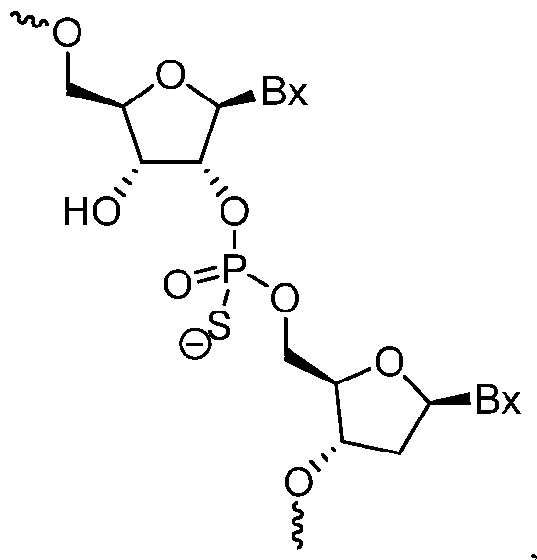 wherein eachBx represents any nucleobase.
B. Certain Motifs
wherein eachBx represents any nucleobase.
B. Certain Motifs
In certain embodiments, modified oligonucleotides comprise one or more modified nucleosides comprising a modified sugar moiety. In certain embodiments, modified oligonucleotides comprise one or more modified nucleosides comprising a modified nucleobase. In certain embodiments, modified oligonucleotides comprise one or more modified intemucleoside linkage. In such embodiments, the modified, unmodified, and differently modified sugar moieties, nucleobases, and/or intemucleoside linkages of a modified oligonucleotide define a pattern or motif. In certain embodiments, the patterns of sugar moieties, nucleobases, and intemucleoside linkages are each independent of one another. Thus, a modified oligonucleotide may be described by its sugar motif, nucleobase motif and/or intemucleoside linkage motif (as used herein, nucleobase motif describes the modifications to the nucleobases independent of the sequence of nucleobases).
1. Certain Sugar Motifs
In certain embodiments, oligonucleotides comprise one or more type of modified sugar and/or unmodified sugar moiety arranged along the oligonucleotide or region thereof in a defined pattern or sugar motif. In certain instances, such sugar motifs include but are not limited to any of the sugar modifications discussed herein.
In certain embodiments, modified oligonucleotides comprise or consist of a region having a gapmer motif, which is defined by two external regions or "w ings" and a central or internal region or “gap.” The three regions of a gapmer motif (the 5'-w ing. the gap, and the 3 ’-wing) form a contiguous sequence of nucleosides wherein at least some of the sugar moieties of the nucleosides of each of the wings differ from at least some of the sugar moieties of the nucleosides of the gap. Specifically, at least the sugar moieties of the nucleosides of each wing that are closest to the gap (the 3 ’-most nucleoside of the 5’-wing and the 5 ’-most nucleoside of the 3 ’-wing) differ from the sugar moiety of the neighboring gap nucleosides, thus defining the boundary between the wings and the gap (i.e., the wing/gap junction). In certain embodiments, the sugar moieties w ithin the gap are the same as one another. In certain embodiments, the gap includes one or more nucleoside having a sugar moiety that differs from the sugar moiety of one or more other nucleosides of the gap. In certain embodiments, the sugar motifs of the two wings are the same as one another (symmetric gapmer). In certain embodiments, the sugar motif of the 5’-wing differs from the sugar motif of the 3’-wing (asymmetric gapmer).
In certain embodiments, the wings of a gapmer comprise 1-6 nucleosides. In certain embodiments, each nucleoside of each wing of a gapmer comprises a modified sugar moiety. In certain embodiments, at least one nucleoside of each wing of a gapmer comprises a modified sugar moiety. In certain embodiments, at least two nucleosides of each wing of a gapmer comprises a modified sugar moiety. In certain embodiments, at least three nucleosides of each wing of a gapmer comprises a modified sugar moiety. In certain embodiments, at least four nucleosides of each wing of a gapmer comprises a modified sugar moiety. In certain embodiments, at least five nucleosides of each wing of a gapmer comprises a modified sugar moiety.
In certain embodiments, the gap of a gapmer comprises 7-12 nucleosides. In certain embodiments, each nucleoside of tire gap of a gapmer comprises a 2’-p-D-deoxyribosyl sugar moiety. In certain embodiments, at least one nucleoside of the gap of a gapmer comprises a modified sugar moiety.
In certain embodiments, the gapmer is a deoxy gapmer. In certain embodiments, the nucleosides on the gap side of each wing/gap junction comprise 2’-p-D-dcoxyribosyl sugar moieties and the nucleosides on the wing sides of each
wing/gap junction comprise modified sugar moieties. In certain embodiments, each nucleoside of the gap comprises a 2’-p-D-dcoxyribosyl sugar moiety. In certain embodiments, each nucleoside of each wing of a gapmer comprises a modified sugar moiety. In certain embodiments, at least one nucleoside of the gap of a gapmer comprises a modified sugar moiety. In certain embodiments, at least one nucleoside of the gap of a gapmer comprises a 2’-0Me sugar moiety.
In certain embodiments, modified oligonucleotides comprise or consist of a portion having a fully modified sugar motif. In such embodiments, each nucleoside of the fully modified portion of the modified oligonucleotide comprises a modified sugar moiety. In certain embodiments, each nucleoside of the entire modified oligonucleotide comprises a modified sugar moiety. In certain embodiments, modified oligonucleotides comprise or consist of a portion having a fully modified sugar motif, wherein each nucleoside within the fully modified portion comprises the same modified sugar moiety, referred to herein as a uniformly modified sugar motif. In certain embodiments, a fully modified oligonucleotide is a uniformly modified oligonucleotide. In certain embodiments, each nucleoside of a uniformly modified oligonucleotide comprises the same 2 ’-modification.
Herein, the lengths (number of nucleosides) of the three regions of a gapmer may be provided using the notation [# of nucleosides in the 5 ’-wing] - [# of nucleosides in the gap] - [# of nucleosides in the 3 ’-wing]. Thus, a 3- 10-3 gapmer consists of 3 linked nucleosides in each wing and 10 linked nucleosides in the gap. Where such nomenclature is followed by a specific modification, that modification is the modification in each sugar moiety of each wing and the gap nucleosides comprise 2’-(3-D-deoxyribosyl sugar moieties. Thus, a 5-10-5 MOE gapmer consists of 5 linked 2’-MOE nucleosides in the 5’-wing, 10 linked 2’- (3-D-deoxynucleosides in the gap, and 5 linked 2’-MOE nucleosides in the 3 ’-wing. A 3-10-3 cEt gapmer consists of 3 linked cEt nucleosides in the 5’-wing, 10 linked 2’- (3-D- deoxynucleosides in the gap, and 3 linked cEt nucleosides in the 3’-wing. A 5-8-5 gapmer consists of 5 linked nucleosides comprising a modified sugar moiety in the 5 ’-wing, 8 linked 2 ’-(3-D-deoxynucleosides in the gap, and 5 linked nucleosides comprising a modified sugar moiety in the 3 ’-wing. A 5-8-5 mixed gapmer has at least two different modified sugar moieties in the 5 ’ - and/or the 3 ’ -wing.
In certain embodiments, modified oligonucleotides are 5-10-5 MOE gapmers. In certain embodiments, modified oligonucleotides are 3-10-3 BNA gapmers. In certain embodiments, modified oligonucleotides are 3-10-3 cEt gapmers. In certain embodiments, modified oligonucleotides are 3-10-3 LNA gapmers.
In certain embodiments, modified oligonucleotides have a sugar motif of 5’ - eeeeeddddddddddeeeee -3’, wherein each "d " represents a 2’-p-D-deoxyribosyl sugar moiety, each “e” represents a 2’-MOE sugar moiety.
2. Certain Nucleobase Motifs
In certain embodiments, oligonucleotides comprise modified and/or unmodified nucleobases arranged along the oligonucleotide or region thereof in a defined pattern or motif. In certain embodiments, each nucleobase is modified. In certain embodiments, none of the nucleobases are modified. In certain embodiments, each purine or each pyrimidine is modified. In certain embodiments, each adenine is modified. In certain embodiments, each guanine is modified. In certain embodiments, each thymine is modified. In certain embodiments, each uracil is modified. In certain embodiments, each cytosine is modified. In certain embodiments, some or all of the cytosine nucleobases in a modified oligonucleotide are 5-methylcytosines. In certain embodiments, all of the cytosine nucleobases are 5 -methylcytosines and all of the other nucleobases of the modified oligonucleotide are unmodified nucleobases.
In certain embodiments, modified oligonucleotides comprise a block of modified nucleobases. In certain such embodiments, the block is at the 3 ’-end of the oligonucleotide. In certain embodiments the block is within 3 nucleosides of the 3’-cnd of the oligonucleotide. In certain embodiments, the block is at the 5’-cnd of the oligonucleotide. In certain embodiments the block is within 3 nucleosides of the 5 ’-end of the oligonucleotide.
In certain embodiments, oligonucleotides having a gapmer motif comprise a nucleoside comprising a modified nucleobase. In certain such embodiments, one nucleoside comprising a modified nucleobase is in the central gap of an oligonucleotide having a gapmer motif. In certain such embodiments, the sugar moiety of said nucleoside is a 2’- 0-D- deoxyribosyl sugar moiety. In certain embodiments, the modified nucleobase is selected from a 2-thiopyrimidine and a 5 -propynepyrimidine .
3. Certain Internucleoside Linkage Motifs
In certain embodiments, oligonucleotides comprise modified and/or unmodified intemucleoside linkages arranged along the oligonucleotide or region thereof in a defined pattern or motif. In certain embodiments, each intemucleoside linking group is a phosphodiester intemucleoside linkage (P=O). In certain embodiments, each intemucleoside linking group of a modified oligonucleotide is a phosphorothioate intemucleoside linkage (P=S). In certain embodiments, each intemucleoside linkage of a modified oligonucleotide is independently selected from a phosphorothioate intemucleoside linkage and phosphodiester intemucleoside linkage. In certain embodiments, each phosphorothioate intemucleoside linkage is independently selected from a stereorandom phosphorothioate a t.S'p) phosphorothioate, and a (ftp) phosphorothioate.
In certain embodiments, the sugar motif of a modified oligonucleotide is a gapmer and the intemucleoside linkages within the gap are all modified. In certain embodiments, some or all of the intemucleoside linkages in the wings are unmodified phosphodiester intemucleoside linkages. In certain embodiments, the terminal intemucleoside linkages are modified. In certain embodiments, the sugar motif of a modified oligonucleotide is a gapmer, and the intemucleoside linkage motif comprises at least one phosphodiester intemucleoside linkage in at least one wing, wherein the at least one phosphodiester linkage is not a terminal intemucleoside linkage, and the remaining intemucleoside linkages are phosphorothioate intemucleoside linkages. In certain such embodiments, all of the phosphorothioate linkages are stereorandom. In certain embodiments, all of the phosphorothioate linkages in the wings are (Sp) phosphorothioates, and the gap comprises at least one Sp, Sp, or Rp motif. In certain embodiments, populations of modified oligonucleotides are enriched for modified oligonucleotides comprising such intemucleoside linkage motifs.
In certain embodiments, modified oligonucleotides have an intemucleoside linkage motif of (from 5’ to 3’) sososssssssssssooss or sooosssssssssssooss, wherein each “s” represents a phosphorothioate intemucleoside linkage and each “o” represents a phosphodiester intemucleoside linkage.
In certain embodiments, modified oligonucleotides have an intemucleoside linkage motif comprising one or more mesyl phosphoramidate intemucleoside linkages. In certain embodiments, one or more phosphorothioate intemucleoside linkages or one or more phosphodiester intemucleoside linkages of the intemucleoside linkage motifs herein is substituted with a mesyl phosphoramidate intemucleoside linkage.
C. Certain Lengths
It is possible to increase or decrease the length of an oligonucleotide without eliminating activity. For example, in Woolf ct al. (Proc. Natl. Acad. Sci. USA 89:7305-7309, 1992), a scries of oligonucleotides 13-25 nuclcobascs in length were tested for their ability to induce cleavage of a target RNA in an oocyte injection model. Oligonucleotides 25 nucleobases in length with 8 or 11 mismatch bases near the ends of the oligonucleotides were able to direct specific cleavage of the target RNA, albeit to a lesser extent than the oligonucleotides that contained no mismatches. Similarly, target specific cleavage was achieved using 13 nucleobase oligonucleotides, including those with 1 or 3 mismatches.
In certain embodiments, oligonucleotides (including modified oligonucleotides) can have any of a variety of ranges of lengths. In certain embodiments, oligonucleotides consist of X to Y linked nucleosides, where X represents the fewest number of nucleosides in the range and Y represents the largest number nucleosides in the range. In certain such embodiments, X and Y are each independently selected from 8, 9, 10, 11, 12, 13, 14, 15, 16, 17, 18, 19, 20, 21, 22, 23, 24, 25, 26, 27, 28, 29, 30, 31, 32, 33, 34, 35, 36, 37, 38, 39, 40, 41, 42, 43, 44, 45, 46, 47, 48, 49, and 50; provided that X<Y. For example, in certain embodiments, oligonucleotides consist of 12 to 13, 12 to 14, 12 to 15, 12 to 16, 12 to 17, 12 to 18, 12 to 19, 12 to 20, 12 to 21, 12 to 22, 12 to 23, 12 to 24, 12 to 25, 12 to 26, 12 to 27, 12 to 28, 12 to 29, 12 to
30, 13 to 14, 13 to 15, 13 to 16, 13 to 17, 13 to 18, 13 to 19, 13 to 20, 13 to 21, 13 to 22, 13 to 23, 13 to 24, 13 to 25, 13 to 26, 13 to 27, 13 to 28, 13 to 29, 13 to 30, 14 to 15, 14 to 16, 14 to 17, 14 to 18, 14 to 19, 14 to 20, 14 to 21, 14 to 22,
14 to 23, 14 to 24, 14 to 25, 14 to 26, 14 to 27, 14 to 28, 14 to 29, 14 to 30, 15 to 16, 15 to 17, 15 to 18, 15 to 19, 15 to
20, 15 to 21, 15 to 22, 15 to 23, 15 to 24, 15 to 25, 15 to 26, 15 to 27, 15 to 28, 15 to 29, 15 to 30, 16 to 17, 16 to 18, 16 to 19, 16 to 20, 16 to 21, 16 to 22, 16 to 23, 16 to 24, 16 to 25, 16 to 26, 16 to 27, 16 to 28, 16 to 29, 16 to 30, 17 to 18,
17 to 19, 17 to 20, 17 to 21, 17 to 22, 17 to 23, 17 to 24, 17 to 25, 17 to 26, 17 to 27, 17 to 28, 17 to 29, 17 to 30, 18 to
19, 18 to 20, 18 to 21, 18 to 22, 18 to 23, 18 to 24, 18 to 25, 18 to 26, 18 to 27, 18 to 28, 18 to 29, 18 to 30, 19 to 20, 19 to 21, 19 to 22, 19 to 23, 19 to 24, 19 to 25, 19 to 26, 19 to 27, 19 to 28, 19 to 29, 19 to 30, 20 to 21, 20 to 22, 20 to 23,
20 to 24, 20 to 25, 20 to 26, 20 to 27, 20 to 28, 20 to 29, 20 to 30, 21 to 22, 21 to 23, 21 to 24, 21 to 25, 21 to 26, 21 to
27, 21 to 28, 21 to 29, 21 to 30, 22 to 23, 22 to 24, 22 to 25, 22 to 26, 22 to 27, 22 to 28, 22 to 29, 22 to 30, 23 to 24, 23 to 25, 23 to 26, 23 to 27, 23 to 28, 23 to 29, 23 to 30, 24 to 25, 24 to 26, 24 to 27, 24 to 28, 24 to 29, 24 to 30, 25 to 26,
25 to 27, 25 to 28, 25 to 29, 25 to 30, 26 to 27, 26 to 28, 26 to 29, 26 to 30, 27 to 28, 27 to 29, 27 to 30, 28 to 29, 28 to
30, or 29 to 30 linked nucleosides.
In certain embodiments, oligonucleotides (including modified oligonucleotides) consist of 16 linked nucleosides. In certain embodiments, oligonucleotides (including modified oligonucleotides) consist of 17 linked nucleosides. In certain embodiments, oligonucleotides (including modified oligonucleotides) consist of 18 linked nucleosides. In certain embodiments, oligonucleotides (including modified oligonucleotides) consist of 19 linked nucleosides. In certain embodiments, oligonucleotides (including modified oligonucleotides) consist of 20 linked nucleosides.
D. Certain Modified Oligonucleotides
In certain embodiments, tire above modifications (sugar, nucleobase, internucleoside linkage) are incorporated into a modified oligonucleotide. In certain embodiments, modified oligonucleotides are characterized by their modification motifs and overall lengths. In certain embodiments, such parameters are each independent of one another. Thus, unless otherwise indicated, each intemucleoside linkage of an oligonucleotide having a gapmer sugar motif may be modified or unmodified and may or may not follow the gapmer modification pattern of the sugar modifications. For
example, the intemucleoside linkages within the wing regions of a sugar gapmer may be the same or different from one another and may be the same or different from the intemucleoside linkages of the gap region of the sugar motif. Likewise, such sugar gapmer oligonucleotides may comprise one or more modified nuclcobasc independent of the gapmer pattern of the sugar modifications. Unless otherwise indicated, all modifications are independent of nucleobase sequence.
E. Certain Populations of Modified Oligonucleotides
Populations of modified oligonucleotides in which all of the modified oligonucleotides of the population have the same molecular formula can be stereorandom populations or chirally enriched populations. All of the chiral centers of all of the modified oligonucleotides are stereorandom in a stereorandom population. In a chirally enriched population, at least one particular chiral center is not stereorandom in the modified oligonucleotides of the population. In certain embodiments, the modified oligonucleotides of a chirally enriched population are enriched for 0-D ribosyl sugar moieties, and all of the phosphorothioate intemucleoside linkages are stereorandom. In certain embodiments, the modified oligonucleotides of a chirally enriched population are enriched for both P-D ribosyl sugar moieties and at least one, particular phosphorothioate intemucleoside linkage in a particular stereochemical configuration.
F. Nucleobase Sequence
In certain embodiments, oligonucleotides (unmodified or modified oligonucleotides) are further described by their nucleobase sequence. In certain embodiments oligonucleotides have a nucleobase sequence that is complementary to a second oligonucleotide or an identified reference nucleic acid, such as a target nucleic acid. In certain such embodiments, a region of an oligonucleotide has a nucleobase sequence that is complementary to a second oligonucleotide or an identified reference nucleic acid, such as a target nucleic acid. In certain embodiments, the nucleobase sequence of a region or entire length of an oligonucleotide is at least 50%, at least 60%, at least 70%, at least 80%, at least 85%, at least 90%, at least 95%, or 100% complementary to the second oligonucleotide or nucleic acid, such as a target nucleic acid.
II. Certain Oligomeric Compounds
In certain embodiments, provided herein are oligomeric compounds, which consist of an oligonucleotide (modified or unmodified) and optionally one or more conjugate groups and/or terminal groups. Conjugate groups consist of one or more conjugate moiety and a conjugate linker which links the conjugate moiety to the oligonucleotide. Conjugate groups may be attached to either or both ends of an oligonucleotide and/or at any internal position. In certain embodiments, conjugate groups are attached to the 2'-position of a nucleoside of a modified oligonucleotide. In certain embodiments, conjugate groups that are attached to either or both ends of an oligonucleotide are terminal groups. In certain such embodiments, conjugate groups or terminal groups are attached at the 3’ and/or 5 ’-end of oligonucleotides. In certain such embodiments, conjugate groups (or terminal groups) are attached at the 3 ’-end of oligonucleotides. In certain embodiments, conjugate groups are attached near tire 3 ’-end of oligonucleotides. In certain embodiments, conjugate groups (or terminal groups) are attached at the 5 ’-end of oligonucleotides. In certain embodiments, conjugate groups are attached near the 5 ’-end of oligonucleotides.
Examples of terminal groups include but are not limited to conjugate groups, capping groups, phosphate moictics, protecting groups, modified or unmodified nucleosides, and two or more nucleosides that arc independently modified or unmodified.
A. Certain Conjugate Groups
In certain embodiments, oligo nucleotides are covalently attached to one or more conjugate groups. In certain embodiments, conjugate groups modify one or more properties of the attached oligonucleotide, including but not limited to pharmacodynamics, pharmacokinetics, stability, binding, absorption, tissue distribution, cellular distribution, cellular uptake, charge and clearance.
In certain embodiments, conjugation of one or more carbohydrate moieties to a modified oligonucleotide can optimize one or more properties of the modified oligonucleotide. In certain embodiments, the carbohydrate moiety is attached to a modified subunit of the modified oligonucleotide. For example, the ribose sugar of one or more ribonucleotide subunits of a modified oligonucleotide can be replaced with another moiety, e.g., a non-carbohydrate (preferably cyclic) carrier to which is attached a carbohydrate ligand. A ribonucleotide subunit in which the ribose sugar of the subunit has been so replaced is referred to herein as a ribose replacement modification subunit (RRMS), which is a modified sugar moiety. A cyclic carrier may be a carbocyclic ring system, i.e., one or more ring atoms may be a heteroatom, e.g, nitrogen, oxygen, sulphur. The cyclic carrier may be a monocyclic ring system, or may contain two or more rings, e.g., fused rings. The cyclic carrier may be a fully saturated ring system, or it may contain one or more double bonds. In certain embodiments, the modified oligonucleotide is a gapmer.
In certain embodiments, conjugate groups impart a new property on the attached oligonucleotide, e.g. , fluorophores or reporter groups that enable detection of the oligonucleotide. Certain conjugate groups and conjugate moieties have been described previously, for example: cholesterol moiety (Letsinger et al., Proc. Natl. Acad. Sci. USA, 1989, 86, 6553-6556), cholic acid (Manoharan et al., Bioorg. Med. Chem. Lett., 1994, 4, 1053-1060), a thioether, e.g., hexyl-S-tritylthiol (Manoharan et al., Ann. A. Y. Acad. Sci., 1992, 660, 306-309; Manoharan et al., Bioorg. Med. Chem. Lett, 1993, 3, 2765-2770), a thiocholesterol (Oberhauser et al., Nucl. Acids Res., 1992, 20, 533-538), an aliphatic chain, e.g., do-decan-diol or undecyl residues (Saison-Behmoaras et al., EMBO J., 1991, 10, 1111-1118; Kabanov et al., FEES Lett., 1990, 259, 327-330; Svinarchuk et al., Biochimie, 1993, 75, 49-54), a phospholipid, e.g., di-hexadecyl-rac-glycerol or triethyl-ammonium l,2-di-O-hexadecyl-rac-glycero-3-H -phosphonate (Manoharan et al., Tetrahedron Lett., 1995, 36, 3651-3654; Shea et al., Nucl. Acids Res., 1990, 18, 3777-3783), a polyamine or a polyethylene glycol chain (Manoharan et al., Nucleosides & Nucleotides, 1995, 14, 969-973), or adamantane acetic acid a palmityl moiety (Mishra et al., Biochim. Biophys. Acta, 1995, 1264, 229-237), an octadecylamine or hexylamino-carbonyl-oxycholesterol moiety (Crooke et al., J. Pharmacol. Exp. Ther., 1996, 277, 923-937), a tocopherol group (Nishina et al., Molecular Therapy Nucleic Acids, 2015, 4, e220; and Nishina et al., Molecular Therapy, 2008, 16, 734-740), or a GalNAc cluster (e.g., WO2014/179620).
In certain embodiments, conjugate groups may be selected from any of a C22 alkyl, C20 alkyl, C16 alkyl, CIO alkyl, C21 alkyl, C19 alkyl, C18 alkyl, C17 alkyl, C15 alkyl, C14 alkyl, C13 alkyl, C12 alkyl, CH alkyl, C9 alkyl, C8 alkyl, Cl alkyl, C6 alkyl, C5 alkyl, C22 alkenyl, C20 alkenyl, C16 alkenyl, CIO alkenyl, C21 alkenyl, C19 alkenyl, C18 alkenyl, C17 alkenyl, C15 alkenyl, C14 alkenyl, C13 alkenyl, C12 alkenyl, Cl l alkenyl, C9 alkenyl, C8 alkenyl, Cl alkenyl, C6 alkenyl, or C5 alkenyl.
In certain embodiments, conjugate groups may be selected from any of C22 alkyl, C20 alkyl, C16 alkyl, CIO alkyl, C21 alkyl, C19 alkyl, C18 alkyl, C17 alkyl, C15 alkyl, C14 alkyl, C13 alkyl, C12 alkyl, CH alkyl, C9 alkyl, C8 alkyl, C7 alkyl, C6 alkyl, and C5 alkyl, where the alkyl chain has one or more unsaturated bonds.
In certain embodiments, a conjugate group is a lipid having the following structure:

1. Conjugate Moieties
Conjugate moieties include, without limitation, intercalators, reporter molecules, polyamines, polyamides, peptides, carbohydrates (e g., GalNAc), antibodies, vitamin moieties, polyethylene glycols, thioethers, polyethers, cholesterols, thiocholesterols, cholic acid moieties, folate, lipids, phospholipids, biotin, phenazine, phenanthridine, anthraquinone, adamantane, acridine, fluoresceins, rhodamines, coumarins, fluorophores, and dyes.
In certain embodiments, a conjugate moiety comprises an active drug substance, for example, aspirin, warfarin, phenylbutazone, ibuprofen, suprofen, fen-bufen, ketoprofen, (S)-(+)-pranoprofen, carprofen, dansylsarcosine, 2,3,5- triiodobenzoic acid, fingolimod, flufenamic acid, folinic acid, a benzothiadiazide, chlorothiazide, a diazepine, indo-methicin, a barbiturate, a cephalosporin, a sulfa drug, an antidiabetic, an antibacterial or an antibiotic.
2. Conjugate Linkers
Conjugate moieties are attached to oligonucleotides through conjugate linkers. In certain oligomeric compounds, the conjugate linker is a single chemical bond (i.e., the conjugate moiety is attached directly to an oligonucleotide through a single bond). In certain embodiments, the conjugate linker comprises a chain structure, such as a hydrocarbyl chain, or an oligomer of repeating units such as ethylene glycol, nucleosides, or amino acid units.
In certain embodiments, a conjugate linker comprises pyrrolidine.
In certain embodiments, a conjugate linker comprises one or more groups selected from alky l, amino, oxo, amide, disulfide, polyethylene glycol, ether, thioether, and hydroxylamino. In certain such embodiments, the conjugate linker comprises groups selected from alkyl, amino, oxo, amide and ether groups. In certain embodiments, the conjugate linker comprises groups selected from alkyl and amide groups. In certain embodiments, the conjugate linker comprises groups selected from alkyl and ether groups. In certain embodiments, the conjugate linker comprises at least one phosphorus moiety. In certain embodiments, the conjugate linker comprises at least one phosphate group. In certain embodiments, the conjugate linker includes at least one neutral linking group.
In certain embodiments, conjugate linkers, including the conjugate linkers described above, are bifunctional linking moieties, e.g., those known in the art to be useful for attaching conjugate groups to compounds, such as the oligonucleotides provided herein. In general, a bifunctional linking moiety comprises at least two functional groups. One of the functional groups is selected to bind to a particular site on a compound and the other is selected to bind to a conjugate group. Examples of functional groups used in a bifunctional linking moiety include but arc not limited to electrophiles for reacting with nucleophilic groups and nucleophiles for reacting with electrophilic groups. In certain
embodiments, bifunctional linking moieties comprise one or more groups selected from amino, hydroxyl, carboxylic acid, thiol, alkyl, alkenyl, and alkynyl.
Examples of conjugate linkers include but arc not limited to pyrrolidine, 8-amino-3,6-dioxaoctanoic acid (ADO), succinimidyl 4-(N-maleimidomethyl) cyclohexane- 1 -carboxylate (SMCC) and 6-aminohexanoic acid (AHEX or AHA). Other conjugate linkers include but are not limited to substituted or unsubstituted C1-C10 alkyl, substituted or unsubstituted C2-C10 alkenyl or substituted or unsubstituted C2-C10 alkynyl, wherein a nonlimiting list of preferred substituent groups includes hydroxyl, amino, alkoxy, carboxy, benzyl, phenyl, nitro, thiol, thioalkoxy, halogen, alkyl, aryl, alkenyl and alkynyl.
In certain embodiments, conjugate linkers comprise 1-10 linker-nucleosides. In certain embodiments, conjugate linkers comprise 2-5 linker-nucleosides. In certain embodiments, conjugate linkers comprise exactly 3 linker- nucleosides. In certain embodiments, conjugate linkers comprise the TCA motif. In certain embodiments, such linker- nucleosides are modified nucleosides. In certain embodiments such linker-nucleosides comprise a modified sugar moiety. In certain embodiments, linker-nucleosides are unmodified. In certain embodiments, linker-nucleosides comprise an optionally protected heterocyclic base selected from a purine, substituted purine, pyrimidine or substituted pyrimidine. In certain embodiments, a cleavable moiety is a nucleoside selected from uracil, thymine, cytosine, 4-N- benzoylcytosine, 5-methylcytosine, 4-N-benzoyl-5-methylcytosine, adenine, 6-N-benzoyladenine, guanine and 2-N- isobutyrylguanine. It is typically desirable for linker-nucleosides to be cleaved from the oligomeric compound after it reaches a target tissue. Accordingly, linker-nucleosides are typically linked to one another and to the remainder of the oligomeric compound through cleavable bonds. In certain embodiments, such cleavable bonds are phosphodiester bonds.
Herein, linker-nucleosides are not considered to be part of the oligonucleotide. Accordingly, in embodiments in which an oligomeric compound comprises an oligonucleotide consisting of a specified number or range of linked nucleosides and/or a specified percent complementarity to a reference nucleic acid and the oligomeric compound also comprises a conjugate group comprising a conjugate linker comprising linker-nucleosides, those linker-nucleosides are not counted toward the length of the oligonucleotide and are not used in determining the percent complementarity of the oligonucleotide for the reference nucleic acid. For example, an oligomeric compound may comprise (1) a modified oligonucleotide consisting of 8-30 nucleosides and (2) a conjugate group comprising 1-10 linker-nucleosides that are contiguous with the nucleosides of the modified oligonucleotide. The total number of contiguous linked nucleosides in such an oligomeric compound is more than 30. Alternatively, an oligomeric compound may comprise a modified oligonucleotide consisting of 8-30 nucleosides and no conjugate group. The total number of contiguous linked nucleosides in such an oligomeric compound is no more than 30. Unless otherw ise indicated conjugate linkers comprise no more than 10 linker-nucleosides. In certain embodiments, conjugate linkers comprise no more than 5 linker- nucleosides. In certain embodiments, conjugate linkers comprise no more than 3 linker-nucleosides. In certain embodiments, conjugate linkers comprise no more than 2 linker-nucleosides. In certain embodiments, conjugate linkers comprise no more than 1 linker-nucleoside.
In certain embodiments, it is desirable for a conjugate group to be cleaved from the oligonucleotide. For example, in certain circumstances oligomeric compounds comprising a particular conjugate moiety are better taken up by a particular cell type, but once the oligomeric compound has been taken up, it is desirable that the conjugate group be cleaved to release the unconjugated or parent oligonucleotide. Thus, certain conjugate linkers may comprise one or more clcavablc moieties. In certain embodiments, a clcavablc moiety is a clcavablc bond. In certain embodiments, a clcavablc
moiety is a group of atoms comprising at least one cleavable bond. In certain embodiments, a cleavable moiety comprises a group of atoms having one, two, three, four, or more than four clcavablc bonds. In certain embodiments, a clcavablc moiety is selectively cleaved inside a cell or subccllular compartment, such as a lysosome. In certain embodiments, a cleavable moiety is selectively cleaved by endogenous enzymes, such as nucleases.
In certain embodiments, a cleavable bond is selected from among an amide, an ester, an ether, one or both esters of a phosphodiester, a phosphate ester, a carbamate, or a disulfide. In certain embodiments, a cleavable bond is one or both of the esters of a phosphodiester. In certain embodiments, a cleavable moiety comprises a phosphate or phosphodiester. In certain embodiments, the cleavable moiety is a phosphate linkage between an oligonucleotide and a conjugate moiety or conjugate group.
In certain embodiments, a cleavable moiety comprises or consists of one or more linker-nucleo sides. In certain such embodiments, the one or more linker-nucleosides are linked to one another and/or to the remainder of the oligomeric compound through cleavable bonds. In certain embodiments, such cleavable bonds are unmodified phosphodiester bonds. In certain embodiments, a cleavable moiety is 2'-deoxynucleoside that is attached to either the 3' or 5'-terminal nucleoside of an oligonucleotide by a phosphate intemucleoside linkage and covalently attached to the remainder of the conjugate linker or conjugate moiety by a phosphate or phosphorothioate linkage. In certain such embodiments, the cleavable moiety is 2'-deoxyadenosine.
3. Cell-Targeting Moieties
In certain embodiments, a conjugate group comprises a cell-targeting moiety. In certain embodiments, a conjugate group has the general formula:
[Ligand — Tether]— [Branching group ]— [Linker Moiety ]- — [ Cleavable ]—

Cell-targeting moiety Conjugate Tanker wherein n is from 1 to about 3, m is 0 when n is 1, m is 1 when n is 2 or greater, j is 1 or 0, and k is 1 or 0.
In certain embodiments, n is 1, j is 1 and k is 0. In certain embodiments, n is 1, j is 0 and k is 1. In certain embodiments, n is 1, j is 1 and k is 1. In certain embodiments, n is 2, j is 1 and k is 0. In certain embodiments, n is 2, j is 0 and k is 1. In certain embodiments, n is 2, j is 1 and k is 1. In certain embodiments, n is 3, j is 1 and k is 0. In certain embodiments, n is 3 , j is 0 and k is 1. In certain embodiments, n is 3 , j is 1 and k is 1.
In certain embodiments, conjugate groups comprise cell-targeting moieties that have at least one tethered ligand. In certain embodiments, cell-targeting moieties comprise two tethered ligands covalently attached to a branching group. In certain embodiments, cell-targeting moieties comprise three tethered ligands covalently attached to a branching group.
In certain embodiments, each ligand of a cell-targeting moiety has an affinity for at least one type of receptor on a target cell. In certain embodiments, each ligand has an affinity for at least one type of receptor on the surface of a mammalian liver cell. In certain embodiments, each ligand has an affinity for the hepatic asialoglycoprotein receptor (ASGP-R). In certain embodiments, each ligand is a carbohydrate.
In certain embodiments, a conjugate group comprises a cell-targeting conjugate moiety. In certain embodiments, a conjugate group has the general formula:

Cell-targeting conjugate moiety Conjugate Linker wherein n is from 1 to about 3, m is 0 when n is 1, m is 1 when n is 2 or greater, j is 1 or 0, and k is 1 or 0.
In certain embodiments, n is 1, j is 1 and k is 0. In certain embodiments, n is 1, j is 0 and k is 1. In certain embodiments, n is 1, j is 1 and k is 1. In certain embodiments, n is 2, j is 1 and k is 0. In certain embodiments, n is 2, j is 0 and k is 1. In certain embodiments, n is 2, j is 1 and k is 1. In certain embodiments, n is 3, j is 1 and k is 0. In certain embodiments, n is 3 , j is 0 and k is 1. In certain embodiments, n is 3 , j is 1 and k is 1.
In certain embodiments, conjugate groups comprise cell-targeting moieties that have at least one tethered ligand. In certain embodiments, cell-targeting moieties comprise two tethered ligands covalently attached to a branching group. In certain embodiments, cell-targeting moieties comprise three tethered ligands covalently attached to a branching group.
In certain embodiments, the cell-targeting moiety targets neurons. In certain embodiments, the cell-targeting moiety targets a neurotransmitter receptor. In certain embodiments, the cell targeting moiety targets a neurotransmitter transporter. In certain embodiments, the cell targeting moiety targets a GABA transporter. See e.g., WO 2011/131693, WO 2014/064257.
In certain embodiments, conjugate groups comprise cell-targeting moieties that have affinities for transferrin receptor (TfR) (also referred to herein as TfRl and CD71). In certain embodiments, a conjugate group described herein comprises an anti-TfRl antibody or fragment thereof. In certain embodiments, the conjugate group comprises a protein or peptide capable of binding TfRl. In certain embodiments, the conjugate group comprises an aptamer capable of binding TfRl . In certain embodiments, the anti-TfRl antibody or fragment thereof can be any known in the art including but not limited to those described in WO1991/004753; W02013/103800; WO2014/144060; WO2016/081643;
WO2016/179257; WO2016/207240; WO2017/221883; WO2018/129384; WO2018/124121; WO2019/151539; WO2020/132584; W02020/028864; US 7,208,174; US 9,034,329; and US 10,550,188. In certain embodiments, a fragment of an anti-TfRl antibody is F(ab')2, Fab, Fab', Fv, or scFv.
In certain embodiments, the conjugate group comprises a protein or peptide capable of binding TfRl. In certain embodiments, the protein or peptide capable of binding TfRl can be any known in the art including but not limited to those described in W02019/140050; W02020/037150; W02020/124032; and US 10,138,483.
In certain embodiments, the conjugate group comprises an aptamer capable of binding TfRl. In certain embodiments, the aptamer capable of binding TfRl can be any known in the art including but not limited to those described in WO2013/163303; WO2019/033051; and WO2020/245198.
B. Certain Terminal Groups
In certain embodiments, oligomeric compounds comprise one or more terminal groups. In certain such embodiments, oligomeric compounds comprise a stabilized 5’-phosphate. Stabilized 5’-phosphates include, but are not
limited to 5’-phosphonates, including, but not limited to 5’-vinylphosphonates. In certain embodiments, terminal groups comprise one or more abasic sugar moictics and/or inverted nucleosides. In certain embodiments, terminal groups comprise one or more 2’-linkcd nucleosides or sugar moictics. In certain such embodiments, the 2’-linkcd group is an abasic sugar moiety.
III. Antisense Activity
In certain embodiments, oligomeric compounds and oligomeric duplexes are capable of hybridizing to a target nucleic acid, resulting in at least one antisense activity; such oligomeric compounds and oligomeric duplexes are antisense compounds. In certain embodiments, antisense compounds have antisense activity when they reduce or inhibit the amount or activity of a target nucleic acid by 25% or more in the standard in vitro assay. In certain embodiments, antisense compounds selectively affect one or more target nucleic acid. Such antisense compounds comprise a nucleobase sequence that hybridizes to one or more target nucleic acid, resulting in one or more desired antisense activity and does not hybridize to one or more non-target nucleic acid or does not hybridize to one or more non-target nucleic acid in such a way that results in significant undesired antisense activity .
In certain antisense activities, hybridization of an antisense compound to a target nucleic acid results in recruitment of a protein that cleaves the target nucleic acid. For example, certain antisense compounds result in RNase H mediated cleavage of the target nucleic acid. RNase H is a cellular endonuclease that cleaves the RNA strand of an RNA:DNA duplex. The DNA in such an RNA:DNA duplex need not be unmodified DNA. In certain embodiments, described herein are antisense compounds that are sufficiently “DNA-like” to elicit RNase H activity. In certain embodiments, one or more non-DNA-like nucleoside in the gap of a gapmer is tolerated.
In certain antisense activities, an antisense compound or a portion of an antisense compound is loaded into an RNA-induced silencing complex (RISC), ultimately resulting in cleavage of the target nucleic acid. For example, certain antisense compounds result in cleavage of the target nucleic acid by Argonaute. Antisense compounds that are loaded into RISC are RNAi agents. RNAi agents may be double-stranded (siRNA or dsRNAi) or single-stranded (ssRNAi).
In certain embodiments, hybridization of an antisense compound to a target nucleic acid does not result in recruitment of a protein that cleaves that target nucleic acid. In certain embodiments, hybridization of the antisense compound to the target nucleic acid results in alteration of splicing of the target nucleic acid. In certain embodiments, hybridization of an antisense compound to a target nucleic acid results in inhibition of a binding interaction betw een the target nucleic acid and a protein or other nucleic acid. In certain embodiments, hybridization of an antisense compound to a target nucleic acid results in alteration of translation of the target nucleic acid.
Antisense activities may be observed directly or indirectly. In certain embodiments, observation or detection of an antisense activity involves observation or detection of a change in an amount of a target nucleic acid or protein encoded by such target nucleic acid, a change in the ratio of splice variants of a nucleic acid or protein and/or a phenotypic change in a cell or subject.
IV. Certain Target Nucleic Acids
In certain embodiments, oligomeric compounds comprise or consist of an oligonucleotide comprising a region that is complementary to a target nucleic acid. In certain embodiments, the target nucleic acid is an endogenous RNA molecule. In certain embodiments, the target nucleic acid encodes a protein. In certain such embodiments, the target
nucleic acid is selected from: a mature mRNA and a pre-mRNA, including intronic, exonic and untranslated regions. In certain embodiments, the target RNA is a mature mRNA. In certain embodiments, the target nucleic acid is a pre- mRNA. In certain embodiments, the target region is entirely within an intron. In certain embodiments, the target region spans an intron/exon junction. In certain embodiments, the target region is at least 50% within an intron. In certain embodiments, the target nucleic acid is the RNA transcriptional product of a retrogene. In certain embodiments, the target nucleic acid is a non-coding RNA. In certain embodiments, the target non-coding RNA is selected from: a long non-coding RNA, a short non-coding RNA, an intronic RNA molecule.
A. Complementaritv/Mismatches to the Target Nucleic Acid and Duplex Complementarity
In certain embodiments, oligonucleotides are complementary to the target nucleic acid over the entire length of the oligonucleotide. In certain embodiments, oligonucleotides are 99%, 95%, 90%, 85%, or 80% complementary to the target nucleic acid. In certain embodiments, oligonucleotides are at least 80% complementary to the target nucleic acid over the entire length of the oligonucleotide and comprise a region that is 100% or hilly complementary to a target nucleic acid. In certain embodiments, the region of full complementarity is from 6 to 20, 10 to 18, or 18 to 20 nucleobases in length.
It is possible to introduce mismatch bases without eliminating activity. For example, Gautschi et al (J. Natl. Cancer Inst. 93:463-471, March 2001) demonstrated the ability of an oligonucleotide having 100% complementarity to the bcl-2 mRNA and having 3 mismatches to the bcl-xL mRNA to reduce the expression of bothbcl-2 and bcl-xL in vitro and in vivo. Furthermore, this oligonucleotide demonstrated potent anti-tumor activity in vivo. Maher and Dolnick (Nuc. Acid. Res. 16:3341-3358, 1988) tested a series of tandem 14 nucleobase oligonucleotides, and 28 and 42 nucleobase oligonucleotides comprised of the sequence of two or three of the tandem oligonucleotides, respectively, for their ability to arrest translation of human DHFR in a rabbit reticulocyte assay. Each of the three 14 nucleobase oligonucleotides alone was able to inhibit translation, albeit at a more modest level than the 28 or 42 nucleobase oligonucleotides.
In certain embodiments, oligonucleotides compnse one or more mismatched nucleobases relative to the target nucleic acid. In certain embodiments, antisense activity against the target is reduced by such mismatch, but activity against a non-target is reduced by a greater amount. Thus, in certain embodiments selectivity of the oligonucleotide is improved.
In certain embodiments, a mismatch is specifically positioned within an oligonucleotide having a gapmer motif. In certain embodiments, the mismatch is at position 1, 2, 3, 4, 5, 6, 7, or 8 from the 5’-end of the gap region. In certain embodiments, the mismatch is at position 9, 8, 7, 6, 5, 4, 3, 2, 1 from the 3 ’-end of the gap region. In certain embodiments, the mismatch is at position 1, 2, 3, or 4 from the 5 ’-end of the wing region. In certain embodiments, the mismatch is at position 4, 3, 2, or 1 from the 3 ’-end of the wing region.
B. ATN1
In certain embodiments, oligomeric compounds comprise or consist of an oligonucleotide comprising a region that is complementaiy to a target nucleic acid, wherein the target nucleic acid is ATN1. In each of the embodiments described above, the oligomeric compounds target the ATN1 nucleic acid. In certain embodiments, the ATN1 nucleic acid has the sequence set forth in SEQ ID NO: 1 (GcnBank AcccssionNo. NC 000012.12 truncated from nucleosides
6923463 to 6943321) or SEQ ID NO: 2 (GenBank Accession No. NM 001940.3). In certain embodiments, contacting a cell with an oligomeric compound complementary to SEQ ID NO: 1 or SEQ ID NO: 2 reduces the amount of ATN1 RNA, and in certain embodiments reduces the amount of atrophin-1 protein. In certain embodiments, contacting a cell with an oligomeric compound complementary to SEQ ID NO: 1 or SEQ ID NO: 2 results in reduced aggregation of atrophin-1 protein. In certain embodiments, the oligomeric compound consists of a modified oligonucleotide. In certain embodiments, the oligomeric compound consists of a modified oligonucleotide and a conjugate group.
In certain embodiments, contacting a cell with an oligomeric compound complementary to SEQ ID NO: 1 or SEQ ID NO: 2 reduces the amount of ATN1 RNA in a cell. In certain embodiments, contacting a cell with an oligomeric compound complementary to SEQ ID NO: 1 or SEQ ID NO: 2 reduces the amount of atrophin-1 protein in the cell. In certain embodiments, the cell is in vitro. In certain embodiments, the cell is in a subject. In certain embodiments, the oligomeric compound consists of a modified oligonucleotide. In certain embodiments, contacting a cell in a subject with an oligomeric compound complementary to SEQ ID NO: 1 or SEQ ID NO: 2 ameliorates one or more symptoms or hallmarks of a poly glutamine (polyQ) disease or disorder associated with ATN1. In certain embodiments, the poly glutamine (polyQ) disease or disorder associated with ATN1 is dentatorubral-pallidoluysian atrophy (DRPLA).
In certain embodiments, an oligomeric compound complementary to SEQ ID NO: 1 or SEQ ID NO: 2 is capable of reducing the amount of ATN1 RNA in vitro by at least 10%, at least 20%, at least 30%, at least 40%, at least 50%, at least 60%, at least 70%, at least 80%, or at least 90% when administered according to the standard in vitro assay. In certain embodiments, an oligomeric compound complementary to SEQ ID NO: 1 or SEQ ID NO: 2 is capable of reducing the amount of ATN 1 RNA in vivo by at least 10%, at least 20%, at least 30%, at least 40%, at least 50%, at least 60%, at least 70%, at least 80%, or at least 90% when administered according to the standard in vivo assay. In certain embodiments, an oligomeric compound complementary to SEQ ID NO: 1 or SEQ ID NO: 2 is capable of reducing the amount of atrophin-1 protein in vitro by at least 10%, at least 20%, at least 30%, at least 40%, at least 50%, at least 60%, at least 70%, at least 80%, or at least 90% when administered according to the standard in vitro assay. In certain embodiments, an oligomeric compound complementary to SEQ ID NO: 1 or SEQ ID NO: 2 is capable of reducing the amount of atrophin-1 protein in vivo by at least 10%, at least 20%, at least 30%, at least 40%, at least 50%, at least 60%, at least 70%, at least 80%, or at least 90% when administered according to the standard in vivo assay. In certain embodiments, an oligomeric compound complementary to SEQ ID NO: 1 or SEQ ID NO: 2 is capable of reducing the amount of ATN1 RNA in the cell of a subject by at least 10%, at least 20%, at least 30%, at least 40%, at least 50%, at least 60%, at least 70%, at least 80%, or at least 90%. In certain embodiments, an oligomeric compound complementary to SEQ ID NO: 1 or SEQ ID NO: 2 is capable of reducing the amount of atrophin-1 protein or the amount of atrophin-1 protein aggregation in the cell of a subject by at least 10%, at least 20%, at least 30%, at least 40%, at least 50%, at least 60%, at least 70%, at least 80%, or at least 90%.
C. Certain Target Nucleic Adds in Certain Tissues
In certain embodiments, oligomeric compounds comprise or consist of an oligonucleotide comprising a region that is complementary to a target nucleic acid, wherein tire target nucleic acid is expressed in a pharmacologically relevant tissue. In certain embodiments, the pharmacologically relevant tissues include the cortex, spinal cord, globus pallidus, subthalamic nucleus, thalamus, inferior olive, substantia nigra, and the cerebellum. In certain embodiments, the cells arc brain cells. In certain embodiments, the cells include neurons and oligodendrocytes.
V. Certain Methods and Uses
Certain embodiments provided herein relate to methods of reducing or inhibiting ATN1 expression or activity, which can be useful for treating, preventing, or ameliorating a poly glutamine (polyQ) disease or disorder associated with ATN1. In certain embodiments, the poly glutamine (polyQ) disease or disorder associated with ATN1 is dentatorubral- pallidoluysian atrophy (DRPLA).
In certain embodiments, a method comprises administering to a subject an oligomeric compound, a modified oligonucleotide, an oligomeric duplex, or an antisense agent, any of which having a nucleobase sequence complementary to an ATN1 nucleic acid. In certain embodiments, the subject has or is at risk for developing a poly glutamine (polyQ) disease or disorder associated with ATN1. In certain embodiments, the subject has or is at risk for developing DRPLA. In certain embodiments, the subject has DRPLA.
In certain embodiments, a method for treating a poly glutamine (polyQ) disease or disorder associated with ATN1 comprises administering to a subject an oligomeric compound, a modified oligonucleotide, an oligomeric duplex, or an antisense agent, any of which having a nucleobase sequence complementary to an ATN1 nucleic acid. In certain embodiments, the subject has or is at risk for developing a poly glutamine (polyQ) disease or disorder associated with ATN1. In certain embodiments, the subject has or is at risk for developing DRPLA. In certain embodiments, the subject has DRPLA. In certain embodiments, at least one symptom or hallmark of the poly glutamine (polyQ) disease or disorder associated with ATN1 is ameliorated. In certain embodiments, the at least one symptom or hallmark is seizure, ataxia, myoclonus, choreoathetosis, dementia, epilepsy, intellectual impairment, psychiatric symptoms, neuronal atrophy and dysfunction, action tremor, fetal cystic hygroma, atrophy of the dentate nucleus, dysarthria, dysdiadochokinesis, dysmetria, dyssynergia, hyperintensity of cerebral white matter on MRI, hyporeflexia, impaired proprioception, nystagmus, ophthalmoparesis, optic neuropathy, saccadic smooth pursuit, blepharospasm, memory impairment, oromandibular dystonia, or abnormal pyramidal sign.
In certain embodiments, a method of reducing expression of ATN1, for example RNA, or reducing the expression of atrophin-1 protein in a cell comprises contacting the cell with an oligomeric compound, a modified oligonucleotide, an oligomeric duplex, or an antisense agent, any of which having a nucleobase sequence complementary to an ATN1 nucleic acid. In certain embodiments, the subject has or is at risk for developing a poly glutamine (polyQ) disease or disorder associated with ATN1. In certain embodiments, the subject has or is at risk for developing DRPLA. In certain embodiments, the subject has DRPLA. In certain embodiments, the cell is a neuron or oligodendrocyte. In certain embodiments, the cell is a human cell.
Certain embodiments are drawn to an oligomeric compound, a modified oligonucleotide, an oligomeric duplex, or an antisense agent, any of which having a nucleobase sequence complementary to an ATN1 nucleic acid, for use in treating a poly glutamine (polyQ) disease or disorder associated with ATN 1 or for use in the manufacture of a medicament for treating a polyglutamine (polyQ) disease or disorder associated with ATN1. In certain embodiments, tlie poly glutamine (polyQ) disease or disorder associated with ATN1 is DRPLA.
In any of the methods or uses described herein, the oligomeric compound, the modified oligonucleotide, the oligomeric duplex, or tire antisense agent can be any described herein.
VI. Certain Pharmaceutical Compositions
In certain embodiments, described herein arc pharmaceutical compositions comprising one or more oligomeric compounds. In certain embodiments, the one or more oligomeric compounds each consists of a modified oligonucleotide. In certain embodiments, the pharmaceutical composition comprises a pharmaceutically acceptable diluent or carrier. In certain embodiments, a pharmaceutical composition comprises or consists of a sterile saline solution and one or more oligomeric compound. In certain embodiments, the sterile saline is pharmaceutical grade saline. In certain embodiments, a pharmaceutical composition comprises or consists of one or more oligomeric compound and sterile water. In certain embodiments, the sterile water is pharmaceutical grade water. In certain embodiments, a pharmaceutical composition comprises or consists of one or more oligomeric compound and phosphate- buffered saline (PBS). In certain embodiments, the sterile PBS is pharmaceutical grade PBS. In certain embodiments, a pharmaceutical composition comprises or consists of one or more oligomeric compound and artificial cerebrospinal fluid (“artificial CSF” or “aCSF”). In certain embodiments, the artificial cerebrospinal fluid is pharmaceutical grade.
In certain embodiments, a pharmaceutical composition comprises a modified oligonucleotide and artificial cerebrospinal fluid (aCSF). In certain embodiments, a pharmaceutical composition consists of a modified oligonucleotide and artificial cerebrospinal fluid. In certain embodiments, a pharmaceutical composition consists essentially of a modified oligonucleotide and artificial cerebrospinal fluid. In certain embodiments, the artificial cerebrospinal fluid is pharmaceutical grade.
In certain embodiments, aCSF comprises sodium chloride, potassium chloride, sodium dihydrogen phosphate dihydrate, sodium phosphate dibasic anhydrous, calcium chloride dihydrate, and magnesium chloride hexahydrate. In certain embodiments, the pH of an aCSF solution is modulated with a suitable pH-adjusting agent, for example, with acids such as hydrochloric acid and alkalis such as sodium hydroxide, to a range of from about 7.1-7.3, or to about 7.2.
In certain embodiments, pharmaceutical compositions comprise one or more oligomeric compound and one or more excipients. In certain embodiments, excipients are selected from water, salt solutions, alcohol, polyethylene glycols, gelatin, lactose, amylase, magnesium stearate, talc, silicic acid, viscous paraffin, hydroxymethylcellulose and polyvinylpyrrolidone .
In certain embodiments, oligomeric compounds may be admixed with pharmaceutically acceptable active and/or inert substances for the preparation of pharmaceutical compositions or formulations. Compositions and methods for the formulation of pharmaceutical compositions depend on a number of criteria, including, but not limited to, route of administration, extent of disease, or dose to be administered.
In certain embodiments, pharmaceutical compositions comprising an oligomeric compound encompass any pharmaceutically acceptable salts of the oligomeric compound, esters of the oligomeric compound, or salts of such esters. In certain embodiments, pharmaceutical compositions comprising oligomeric compounds comprising one or more oligonucleotide, upon administration to a subject, including a human subject, are capable of providing (directly or indirectly) the biologically active metabolite or residue thereof. Accordingly, for example, the disclosure is also drawn to pharmaceutically acceptable salts of oligomeric compounds, prodrugs, pharmaceutically acceptable salts of such prodrugs, and other bioequivalents. In certain embodiments, pharmaceutically acceptable salts comprise inorganic salts, such as monovalent or divalent inorganic salts. Suitable pharmaceutically acceptable salts include, but are not limited to, sodium, potassium, calcium, and magnesium salts. In certain embodiments, prodrugs comprise one or more conjugate group attached to an oligonucleotide, wherein the conjugate group is cleaved by endogenous nucleases within the body.
In certain embodiments, oligomeric compounds are lyophilized and isolated as sodium salts. In certain embodiments, the sodium salt of an oligomeric compound is mixed with a pharmaceutically acceptable diluent. In certain embodiments, the pharmaceutically acceptable diluent comprises sterile saline, sterile water, PBS, or aCSF. In certain embodiments, the sodium salt of an oligomeric compound is mixed with PBS. In certain embodiments, the sodium salt of an oligomeric compound is mixed with aCSF.
Lipid moieties have been used in nucleic acid therapies in a variety of methods. In certain such methods, the nucleic acid, such as an oligomeric compound, is introduced into preformed liposomes or lipoplexes made of mixtures of cationic lipids and neutral lipids. In certain methods, DNA complexes with mono- or poly-cationic lipids are formed without the presence of a neutral lipid. In certain embodiments, a lipid moiety is selected to increase distribution of a pharmaceutical agent to a particular cell or tissue. In certain embodiments, a lipid moiety is selected to increase distribution of a pharmaceutical agent to fat tissue. In certain embodiments, a lipid moiety is selected to increase distribution of a pharmaceutical agent to muscle tissue.
In certain embodiments, pharmaceutical compositions comprise a delivery system. Examples of deliveiy systems include, but are not limited to, liposomes and emulsions. Certain delivery systems are useful for preparing certain pharmaceutical compositions including those comprising hydrophobic compounds. In certain embodiments, certain organic solvents such as dimethylsulfoxide are used.
In certain embodiments, pharmaceutical compositions comprise one or more tissue-specific delivery molecules designed to deliver the one or more pharmaceutical agents of the present invention to specific tissues or cell types. For example, in certain embodiments, pharmaceutical compositions include liposomes coated with a tissue-specific antibody.
In certain embodiments, pharmaceutical compositions comprise a co-solvent system. Certain of such co-solvent systems comprise, for example, benzyl alcohol, a nonpolar surfactant, a water-miscible organic polymer, and an aqueous phase. In certain embodiments, such co-solvent systems are used for hydrophobic compounds. A non-limiting example of such a co-solvent system is the VPD co-solvent system, which is a solution of absolute ethanol comprising 3% w/v benzyl alcohol, 8% w/v of the nonpolar surfactant Polysorbate 80™ and 65% w/v polyethylene glycol 300. The proportions of such co-solvent systems may be varied considerably without significantly altering their solubility and toxicity characteristics. Furthermore, the identity of co-solvent components may be varied: for example, other surfactants may be used instead of Polysorbate 80™; the fraction size of polyethylene glycol may be varied; other biocompatible polymers may replace polyethylene glycol, e.g., polyvinyl pyrrolidone; and other sugars or polysaccharides may substitute for dextrose.
In certain embodiments, pharmaceutical compositions are prepared for oral administration. In certain embodiments, pharmaceutical compositions are prepared for buccal administration. In certain embodiments, a pharmaceutical composition is prepared for administration by injection (e.g., intravenous, subcutaneous, intramuscular, intrathecal (IT), intracerebroventricular (ICV), etc.). In certain of such embodiments, a pharmaceutical composition comprises a carrier and is formulated in aqueous solution, such as water or physiologically compatible buffers such as Hanks's solution, Ringer's solution, or physiological saline buffer. In certain embodiments, other ingredients are included (e.g., ingredients that aid in solubility or serve as preservatives). In certain embodiments, injectable suspensions are prepared using appropriate liquid carriers, suspending agents and the like. Certain pharmaceutical compositions for injection arc presented in unit dosage form, e.g., in ampoules or in multi-dosc containers. Certain pharmaceutical
compositions for injection are suspensions, solutions or emulsions in oily or aqueous vehicles, and may contain formulatory agents such as suspending, stabilizing and/or dispersing agents. Certain solvents suitable for use in pharmaceutical compositions for injection include, but arc not limited to, lipophilic solvents and fatty oils, such as sesame oil, synthetic fatty acid esters, such as ethyl oleate or triglycerides, and liposomes.
Under certain conditions, certain compounds disclosed herein act as acids. Although such compounds may be drawn or described in protonated (free acid) form or ionized and in association with a cation (salt) form, aqueous solutions of such compounds exist in equilibrium among such forms. For example, a phosphodiester linkage of an oligonucleotide in aqueous solution exists in equilibrium among free acid, anion and salt forms. Unless otherwise indicated, compounds described herein are intended to include all such forms. Moreover, certain oligonucleotides have several such linkages, each of which is in equilibrium. Thus, oligonucleotides in solution exist in an ensemble of forms at multiple positions all at equilibrium. The term “oligonucleotide” is intended to include all such forms. Drawn structures necessarily depict a single form. Nevertheless, unless otherw ise indicated, such drawings are likewise intended to include corresponding forms. Herein, a structure depicting the free acid of a compound followed by the term “or a pharmaceutically acceptable salt thereof’ expressly includes all such forms that may be fully or partially protonated/de-protonated/in association with a cation or a combination of cations. In certain embodiments, one or more specific cation is identified. The cations include, but are not limited to, sodium, potassium, calcium, and magnesium. In certain embodiments, a structure depicting the free acid of a compound followed by the term “or a pharmaceutically acceptable salt thereof’ expressly includes all such forms that may be fully or partially protonated/de-protonated/in association with one or more cations selected from sodium, potassium, calcium, and magnesium.
In certain embodiments, modified oligonucleotides or oligomeric compounds are in aqueous solution with sodium. In certain embodiments, modified oligonucleotides or oligomeric compounds are in aqueous solution with potassium. In certain embodiments, modified oligonucleotides or oligomeric compounds are in PBS. In certain embodiments, modified oligonucleotides or oligomeric compounds are in water. In certain such embodiments, the pH of the solution is adjusted with NaOH and/or HC1 to achieve a desired pH.
Herein, certain specific doses are described. A dose may be in the form of a dosage unit. For clarity, a dose (or dosage unit) of a modified oligonucleotide or an oligomeric compound in milligrams indicates the mass of the free acid form of the modified oligonucleotide or oligomeric compound. As described above, in aqueous solution, the free acid is in equilibrium with anionic and salt forms. However, for the purpose of calculating dose, it is assumed that the modified oligonucleotide or oligomeric compound exists as a solvent-free, sodium-acetate free, anhydrous, free acid.
In certain embodiments, where a modified oligonucleotide or an oligomeric compound is in solution comprising sodium (e.g., saline), the modified oligonucleotide or oligomeric compound may be partially or fully deprotonated and in association with sodium ions. However, the mass of the protons is nevertheless counted toward the weight of tlie dose, and the mass of the sodium ions is not counted toward the weight of the dose. Thus, for example, a dose, or dosage unit, of 10 mg of Compound No. 541106 or Compound No. 613801 equals the number of fully protonated molecules that weighs 10 mg. This would be equivalent to 10.58 mg of solvent-free, sodium acetate-free, anhydrous sodiated Compound No. 541106 or 10.61 mg of solvent-free, sodium acetate-free, anhydrous sodiated Compound No. 613801.
In certain embodiments, where a modified oligonucleotide or oligomeric compound is in a solution, such as aCSF, comprising sodium, potassium, calcium, and magnesium, the modified oligonucleotide or oligomeric compound
may be partially or fully de-protonated and in association with sodium, potassium, calcium, and/or magnesium. However, the mass of the protons is nevertheless counted toward the weight of the dose, and the mass of the sodium, potassium, calcium, and magnesium ions is not counted toward the weight of the dose.
In certain embodiments, when an oligomeric compound comprises a conjugate group, the mass of the conjugate group may be included in calculating the dose of such oligomeric compound. If the conjugate group also has an acid, the conjugate group is likewise assumed to be fully protonated for the purpose of calculating dose.
VII. Certain Hotspot Regions
1. Nuclcobascs 6584-6607 of SEQ ID NO: 1
In certain embodiments, nucleobases 6584-6607 of SEQ ID NO: 1 comprise a hotspot region. In certain embodiments, modified oligonucleotides are complementary within nucleobases 6584-6607 of SEQ ID NO: 1. In certain embodiments, modified oligonucleotides are 20 nucleobases in length. In certain embodiments, modified oligonucleotides are gapmers.
In certain embodiments, modified oligonucleotides are MOE gapmers. In certain embodiments, modified oligonucleotides are 5-10-5 MOE gapmers. In certain embodiments, the sugar motif for the gapmers is (from 5’ to 3’) eeeeeddddddddddeeeee, wherein each “d” represents a 2 '-[1-D-deoxy ribosyl sugar moiety, and each “e” represents a 2’- MOE sugar moiety.
In certain embodiments, the intemucleoside linkages of the modified oligonucleotides are phosphorothioate intemucleoside linkages and phosphodiester intemucleoside linkages. In certain embodiments, the phosphodiester (“o”) and phosphorothioate (“s”) intemucleoside linkages are arranged in order from 5’ to 3’ . In certain embodiments, modified oligonucleotides have an intemucleoside linkage motif of (from 5’ to 3’) sososssssssssssooss or sooosssssssssssooss, wherein each “s” represents a phosphorothioate intemucleoside linkage and each “o” represents a phosphodiester intemucleoside linkage.
The nucleobase sequences of SEQ ID NOs: 528, 2437, 2296, 483, and 2137 are complementaiy within nucleobases 6584-6607 of SEQ ID NO: 1.
Compounds 1475694, 1441013, 1572931, 1441008, and 1572877 are complementaty within nucleobases 6584- 6607 of SEQ ID NO: 1.
In certain embodiments, modified oligonucleotides complementary within nucleobases 6584-6607 of SEQ ID NO: 1 achieve at least 66% reduction of ATN 1 RNA in the standard in vitro assay as described in Example 5. In certain embodiments, modified oligonucleotides complementary within nucleobases 6584-6607 of SEQ ID NO: 1 achieve an average of 76% reduction of ATN1 RNA in the standard in vitro assay as described in Example 5.
2. Nucleobases 6865-6890 of SEQ ID NO: 1
In certain embodiments, nucleobases 6865-6890 of SEQ ID NO: 1 comprise a hotspot region. In certain embodiments, modified oligonucleotides are complementary within nucleobases 6865-6890 of SEQ ID NO: 1. In certain embodiments, modified oligonucleotides are 20 nucleobases in length. In certain embodiments, modified oligonucleotides are gapmers.
In certain embodiments, modified oligonucleotides are MOE gapmers. In certain embodiments, modified oligonucleotides arc 5-10-5 MOE gapmers. In certain embodiments, the sugar motif for the gapmers is (from 5’ to 3’) cccccddddddddddccccc, wherein each “d” represents a 2 '-[1-D-dcoxy ribosyl sugar moiety, and each “c” represents a 2’- MOE sugar moiety.
In certain embodiments, the intemucleoside linkages of the modified oligonucleotides are phosphorothioate intemucleoside linkages and phosphodiester intemucleoside linkages. In certain embodiments, the phosphodiester (“o”) and phosphorothioate (“s”) intemucleoside linkages are arranged in order from 5’ to 3’. In certain embodiments, modified oligonucleotides have an intemucleoside linkage motif of (from 5’ to 3’) sososssssssssssooss or sooosssssssssssooss, wherein each “s” represents a phosphorothioate intemucleoside linkage and each “o” represents a phosphodiester intemucleoside linkage.
The nucleobase sequences of SEQ ID NOs: 1329, 1241, 1166, 459, 70, and 1116 are complementary within nucleobases 6865-6890 of SEQ ID NO: 1.
Compounds 1573191, 1572821, 1572876, 1143640, 1143641, 1573580, and 1573333 are complementary within nucleobases 6865-6890 of SEQ ID NO: 1
In certain embodiments, modified oligonucleotides complementary within nucleobases 6865-6890 of SEQ ID NO: 1 achieve at least 38% reduction of ATN1 RNA in the standard in vitro assay as described in Example 5. In certain embodiments, modified oligonucleotides complementary within nucleobases 6865-6890 of SEQ ID NO: 1 achieve an average of 63% reduction of ATN1 RNA in the standard in vitro assay as described in Example 5.
3. Nucleobases 7364-7409 of SEQ ID NO: 1
In certain embodiments, nucleobases 7364-7409 of SEQ ID NO: 1 comprise a hotspot region. In certain embodiments, modified oligonucleotides are complementary within nucleobases 7364-7409 of SEQ ID NO: 1. In certain embodiments, modified oligonucleotides are 20 nucleobases in length. In certain embodiments, modified oligonucleotides are gapmers.
In certain embodiments, modified oligonucleotides are MOE gapmers. In certain embodiments, modified oligonucleotides are 5-10-5 MOE gapmers. In certain embodiments, the sugar motif for the gapmers is (from 5’ to 3’) eeeeeddddddddddeeeee, wherein each “d” represents a 2 '-(l-D-dcoxy ribosyl sugar moiety, and each “e” represents a 2’- MOE sugar moiety.
In certain embodiments, the intemucleoside linkages of the modified oligonucleotides are phosphorothioate intemucleoside linkages and phosphodiester intemucleoside linkages. In certain embodiments, the phosphodiester (“o”) and phosphorothioate (“s”) intemucleoside linkages are arranged in order from 5’ to 3’. In certain embodiments, modified oligonucleotides have an intemucleoside linkage motif of (from 5’ to 3’) sososssssssssssooss or sooosssssssssssooss, wherein each “s” represents a phosphorothioate intemucleoside linkage and each “o” represents a phosphodiester intemucleoside linkage.
The nucleobase sequences of SEQ ID NOs: 770, 699, 2100, 2027, 677, 1942, 606, 527, 841, 1799, 769, 716, 654, 605, 492, 876, 1719, and 799 are complementary within nucleobases 7364-7409 of SEQ ID NO: 1.
Compounds 1475422, 1475429, 1573520, 1573522, 1475751, 1573392, 1475699, 1475689, 1475384, 1573610, 1475420, 1475514, 1475584, 1475697, 1475446, 1475608, 1573351, and 1475597 are complementary within nucleobases 7364-7409 of SEQ ID NO: 1.
In certain embodiments, modified oligonucleotides complementary within nucleobases 7364-7409 of SEQ ID NO: 1 achieve at least 61% reduction of ATN1 RNA in the standard in vitro assay as described in Examples 1 and 4. In certain embodiments, modified oligonucleotides complementary within nucleobases 7364-7409 of SEQ ID NO: 1 achieve an average of 81% reduction of ATN1 RNA in the standard in vitro assay as described in Examples 1 and 4.
4. Nucleobases 7405-7430 of SEQ ID NO: 1
In certain embodiments, nucleobases 7405-7430 of SEQ ID NO: 1 comprise a hotspot region. In certain embodiments, modified oligonucleotides are complementary within nucleobases 7405-7430 of SEQ ID NO: 1. In certain embodiments, modified oligonucleotides are 20 nucleobases in length. In certain embodiments, modified oligonucleotides are gapmers.
In certain embodiments, modified oligonucleotides are MOE gapmers. In certain embodiments, modified oligonucleotides are 5-10-5 MOE gapmers. In certain embodiments, the sugar motif for the gapmers is (from 5’ to 3’) eeeeeddddddddddeeeee, wherein each “d” represents a 2 '-[1-D-deoxy ribosyl sugar moiety, and each “e” represents a 2’- MOE sugar moiety.
In certain embodiments, the intemucleoside linkages of the modified oligonucleotides are phosphorothioate intemucleoside linkages and phosphodiester intemucleoside linkages. In certain embodiments, the phosphodiester (“o”) and phosphorothioate (“s”) intemucleoside linkages are arranged in order from 5’ to 3’. In certain embodiments, modified oligonucleotides have an intemucleoside linkage motif of (from 5’ to 3’) sososssssssssssooss or sooosssssssssssooss, wherein each “s” represents a phosphorothioate intemucleoside linkage and each “o” represents a phosphodiester intemucleoside linkage.
The nucleobase sequences of SEQ ID NOs: 1626, 1557, 1486, 1412, 1337, 1251, and 1187 are complementaiy within nucleobases 7405-7430 of SEQ ID NO: 1.
Compounds 1573038, 1573460, 1573206, 1573262, 1573360, 1573017, and 1573359 are complementary within nucleobases 7405-7430 of SEQ ID NO: 1.
In certain embodiments, modified oligonucleotides complementary within nucleobases 7405-7430 of SEQ ID NO: 1 achieve at least 46% reduction of ATN1 RNA in the standard in vitro assay as described in Example 5. In certain embodiments, modified oligonucleotides complementary within nucleobases 7405-7430 of SEQ ID NO: 1 achieve an average of 63% reduction of ATN1 RNA in the standard in vitro assay as described in Example 5.
5. Nucleobases 7484-7514 of SEQ ID NO: 1
In certain embodiments, nucleobases 7484-7514 of SEQ ID NO: 1 comprise a hotspot region. In certain embodiments, modified oligonucleotides are complementary within nucleobases 7484-7514 of SEQ ID NO: 1. In certain embodiments, modified oligonucleotides are 20 nucleobases in length. In certain embodiments, modified oligonucleotides are gapmers.
In certain embodiments, modified oligonucleotides are MOE gapmers. In certain embodiments, modified oligonucleotides are 5-10-5 MOE gapmers. In certain embodiments, the sugar motif for the gapmers is (from 5’ to 3’) eeeeeddddddddddeeeee, wherein each “d” represents a 2 '-[>-D-dcoxy ribosyl sugar moiety, and each “e” represents a 2’- MOE sugar moiety.
In certain embodiments, the intemucleoside linkages of the modified oligonucleotides are phosphorothioate intcmuclcosidc linkages and phosphodicstcr intemucleoside linkages. In certain embodiments, the phosphodicstcr (“o”) and phosphorothioate (“s”) intcmuclcosidc linkages arc arranged in order from 5’ to 3’. In certain embodiments, modified oligonucleotides have an intemucleoside linkage motif of (from 5’ to 3’) sososssssssssssooss or sooosssssssssssooss, wherein each “s” represents a phosphorothioate intemucleoside linkage and each “o” represents a phosphodiester intemucleoside linkage.
The nucleobase sequences of SEQ ID NOs: 948, 651, 2410, 2316, 2205, 2163, 2073, 2003, 1961, 1872, and 1782 are complementary within nucleobases 7484-7514 of SEQ ID NO: 1.
Compounds 1573130, 1475561, 1573665, 1573327, 1572525, 1573282, 1573001, 1572893, 1573757, 1573403, and 1573229 are complementary within nucleobases 7484-7514 of SEQ ID NO: 1.
In certain embodiments, modified oligonucleotides complementary within nucleobases 7484-7514 of SEQ ID NO: 1 achieve at least 47% reduction of ATN1 RNA in the standard in vitro assay as described in Example 5. In certain embodiments, modified oligonucleotides complementary within nucleobases 7484-7514 of SEQ ID NO: 1 achieve an average of 61% reduction of ATN1 RNA in the standard in vitro assay as described in Example 5.
6. Nucleobases 7621-7658 of SEQ ID NO: 1
In certain embodiments, nucleobases 7621-7658 of SEQ ID NO: 1 comprise a hotspot region. In certain embodiments, modified oligonucleotides are complementary within nucleobases 7621-7658 of SEQ ID NO: 1. In certain embodiments, modified oligonucleotides are 20 nucleobases in length. In certain embodiments, modified oligonucleotides are gapmers.
In certain embodiments, modified oligonucleotides are MOE gapmers. In certain embodiments, modified oligonucleotides are 5-10-5 MOE gapmers. In certain embodiments, the sugar motif for the gapmers is (from 5’ to 3’) eeeeeddddddddddeeeee, wherein each “d” represents a 2' -|i-D-dcoxy ribosyl sugar moiety, and each “e” represents a 2’- MOE sugar moiety.
In certain embodiments, the intemucleoside linkages of the modified oligonucleotides are phosphorothioate intemucleoside linkages and phosphodiester intemucleoside linkages. In certain embodiments, the phosphodiester (“o”) and phosphorothioate (“s”) intemucleoside linkages are arranged in order from 5’ to 3’. In certain embodiments, modified oligonucleotides have an intemucleoside linkage motif of (from 5’ to 3’) sososssssssssssooss or sooosssssssssssooss, wherein each “s” represents a phosphorothioate intemucleoside linkage and each “o” represents a phosphodiester intemucleoside linkage.
The nucleobase sequences of SEQ ID NOs: 2200, 2155, 583, 2434, 2115, 2028, 1914, 1888, 1747, 1693, 1659, 1532, 1493, 1367, 1346, 1262, 1172, 460, and 71 are complementary' within nucleobases 7621-7658 of SEQ ID NO: 1.
Compounds 1572397, 1573194, 1475582, 1441010, 1573756, 1573548, 1572721, 1573773, 1572556, 1572896, 1573748, 1572705, 1573497, 1572429, 1573530, 1573145, 1573117, 1143646, and 1143647 are complementary' within nucleobases 7621-7658 of SEQ ID NO: 1.
In certain embodiments, modified oligonucleotides complementary within nucleobases 7621-7658 of SEQ ID NO: 1 achieve at least 27% reduction of ATN1 RNA in the standard in vitro assay as described in Example 5. In certain embodiments, modified oligonucleotides complementary within nucleobases 7621-7658 of SEQ ID NO: 1 achieve an average of 61% reduction of ATN1 RNA in the standard in vitro assay as described in Example 5.
7. Nucleobases 7886-7922 of SEQ ID NO: 1
In certain embodiments, nucleobases 7886-7922 of SEQ ID NO: 1 comprise a hotspot region. In certain embodiments, modified oligonucleotides are complementary within nucleobases 7886-7922 of SEQ ID NO: 1. In certain embodiments, modified oligonucleotides are 20 nucleobases in length. In certain embodiments, modified oligonucleotides are gapmers.
In certain embodiments, modified oligonucleotides are MOE gapmers. In certain embodiments, modified oligonucleotides are 5-10-5 MOE gapmers. In certain embodiments, the sugar motif for the gapmers is (From 5’ to 3’) eeeeeddddddddddeeeee, wherein each “d” represents a 2 '-[1-D-deoxy ribosyl sugar moiety, and each “e” represents a 2’- MOE sugar moiety.
In certain embodiments, the intemucleoside linkages of the modified oligonucleotides are phosphorothioate intemucleoside linkages and phosphodiester intemucleoside linkages. In certain embodiments, the phosphodiester (“o”) and phosphorothioate (“s”) intemucleoside linkages are arranged in order from 5’ to 3’. In certain embodiments, modified oligonucleotides have an intemucleoside linkage motif of (from 5’ to 3’) sososssssssssssooss or sooosssssssssssooss, wherein each “s” represents a phosphorothioate intemucleoside linkage and each “o” represents a phosphodiester intemucleoside linkage.
The nucleobase sequences of SEQ ID NOs: 1632, 1587, 1452, 1434, 1301, 1260, 1140, 1095, 1021, 960, 2362, 2306, 2224, and 2160 are complementary within nucleobases 7886-7922 of SEQ ID NO: 1.
Compounds 1573116, 1573853, 1572520, 1573721, 1572671, 1573121, 1572371, 1573029, 1573120, 1573331, 1572738, 1573071, 1572911, and 1573261 are complementary within nucleobases 7886-7922 of SEQ ID NO: 1.
In certain embodiments, modified oligonucleotides complementary within nucleobases 7886-7922 of SEQ ID NO: 1 achieve at least 16% reduction of ATN1 RNA in the standard in vitro assay as described in Example 5. In certain embodiments, modified oligonucleotides complementary within nucleobases 7886-7922 of SEQ ID NO: 1 achieve an average of 57% reduction of ATN 1 RNA in the standard in vitro assay as described in Example 5.
8. Nucleobases 8763-8809 of SEQ ID NO: 1
In certain embodiments, nucleobases 8763-8809 of SEQ ID NO: 1 comprise a hotspot region. In certain embodiments, modified oligonucleotides are complementary within nucleobases 8763-8809 of SEQ ID NO: 1. In certain embodiments, modified oligonucleotides are 20 nucleobases in length. In certain embodiments, modified oligonucleotides are gapmers.
In certain embodiments, modified oligonucleotides are MOE gapmers. In certain embodiments, modified oligonucleotides are 5-10-5 MOE gapmers. In certain embodiments, the sugar motif for the gapmers is (from 5’ to 3’) eeeeeddddddddddeeeee, wherein each “d” represents a 2’-p-D-deoxyribosyl sugar moiety, and each “e” represents a 2’- MOE sugar moiety.
In certain embodiments, tire intemucleoside linkages of the modified oligonucleotides are phosphorothioate intemucleoside linkages and phosphodiester intemucleoside linkages. In certain embodiments, the phosphodiester (“o”) and phosphorothioate (“s”) intemucleoside linkages are arranged in order from 5’ to 3’. In certain embodiments, modified oligonucleotides have an intemucleoside linkage motif of (from 5’ to 3’) sososssssssssssooss or
sooosssssssssssooss, wherein each “s” represents a phosphorothioate intemucleoside linkage and each “o” represents a phosphodicstcr intemucleoside linkage.
The nuclcobasc sequences of SEQ ID NOs: 1711, 1635, 1524, 1502, 1385, 1296, 1276, 150, 228, 1093, 985, 907, 306, and 2278 are complementary within nucleobases 8763-8809 of SEQ ID NO: 1.
Compounds 1573213, 1573235, 1572498, 1573645, 1572794, 1572543, 1573563, 1143654, 1475477, 1143655, 1572990, 1572331, 1572362, 1143656, 1572728, and 1572533 are complementary within nucleobases 8763-8809 of SEQ ID NO: 1.
In certain embodiments, modified oligonucleotides complementary within nucleobases 8763-8809 of SEQ ID NO: 1 achieve at least 48% reduction of ATN1 RNA in the standard in vitro assay as described in Example 5. In certain embodiments, modified oligonucleotides complementary within nucleobases 8763-8809 of SEQ ID NO: 1 achieve an average of 69% reduction of ATN1 RNA in the standard in vitro assay as described in Example 5.
9. Nucleobases 9082-9107 of SEQ ID NO: 1
In certain embodiments, nucleobases 9082-9107 of SEQ ID NO: 1 comprise a hotspot region. In certain embodiments, modified oligonucleotides are complementary within nucleobases 9082-9107 of SEQ ID NO: 1. In certain embodiments, modified oligonucleotides are 20 nucleobases in length. In certain embodiments, modified oligonucleotides are gapmers.
In certain embodiments, modified oligonucleotides are MOE gapmers. In certain embodiments, modified oligonucleotides are 5-10-5 MOE gapmers. In certain embodiments, the sugar motif for the gapmers is (from 5’ to 3’) eeeeeddddddddddeeeee, wherein each “d” represents a 2 '-fl-D-dcoxy ribosyl sugar moiety, and each “e” represents a 2’- MOE sugar moiety.
In certain embodiments, the intemucleoside linkages of the modified oligonucleotides are phosphorothioate intemucleoside linkages and phosphodiester intemucleoside linkages. In certain embodiments, the phosphodiester (“o”) and phosphorothioate (“s”) intemucleoside linkages are arranged in order from 5’ to 3’. In certain embodiments, modified oligonucleotides have an intemucleoside linkage motif of (from 5’ to 3’) sososssssssssssooss or sooosssssssssssooss, wherein each “s” represents a phosphorothioate intemucleoside linkage and each “o” represents a phosphodiester intemucleoside linkage.
The nucleobase sequences of SEQ ID NOs: 1970, 1896, 765, 694, 1801, 643, and 590 are complementary within nucleobases 9082-9107 of SEQ ID NO: 1.
Compounds 1572457, 1572383, 1475415, 1475398, 1573621, 1475507, and 1475594 are complementary within nucleobases 9082-9107 of SEQ ID NO: 1.
In certain embodiments, modified oligonucleotides complementary within nucleobases 9082-9107 of SEQ ID NO: 1 achieve at least 36% reduction of ATN1 RNA in Hie standard in vitro assay as described in Example 5. In certain embodiments, modified oligonucleotides complementary within nucleobases 9082-9107 of SEQ ID NO: 1 achieve an average of 75% reduction of ATN1 RNA in the standard in vitro assay as described in Example 5.
10. Nucleobases 9093-9174 of SEQ ID NO: 1
In certain embodiments, nucleobases 9093-9174 of SEQ ID NO: 1 comprise a hotspot region. In certain embodiments, modified oligonucleotides arc complementary within nucleobases 9093-9174 of SEQ ID NO: 1. In certain
embodiments, modified oligonucleotides are 20 nucleobases in length. In certain embodiments, modified oligonucleotides arc gapmers.
In certain embodiments, modified oligonucleotides arc MOE gapmers. In certain embodiments, modified oligonucleotides are 5-10-5 MOE gapmers. In certain embodiments, the sugar motif for the gapmers is (from 5’ to 3’) eeeeeddddddddddeeeee, wherein each “d” represents a 2 '-[1-D-deoxy ribosyl sugar moiety, and each “e” represents a 2’- MOE sugar moiety.
In certain embodiments, the intemucleoside linkages of the modified oligonucleotides are phosphorothioate intemucleoside linkages and phosphodiester intemucleoside linkages. In certain embodiments, the phosphodiester (“o”) and phosphorothioate (“s”) intemucleoside linkages are arranged in order from 5’ to 3’. In certain embodiments, modified oligonucleotides have an intemucleoside linkage motif of (from 5’ to 3’) sososssssssssssooss or sooosssssssssssooss, wherein each “s” represents a phosphorothioate intemucleoside linkage and each “o” represents a phosphodiester intemucleoside linkage.
The nucleobase sequences of SEQ ID NOs: 867, 812, 464, 1288, 704, 1215, 75, 1191, 153, 231, 562, 548, 1060, 861, 834, 1029, 690, 680, 309, and 387 are complementary within nucleobases 9093-9174 of SEQ ID NO: 1.
Compounds 1475569, 1475687, 1143670, 1572392, 1475456, 1572391, 1143671, 1573399, 1143672, 1143673, 1475632, 1475425, 1475810, 1572349, 1475536, 1475816, 1573225, 1475375, 1475770, 1143674, 1143675, and 1475605 are complementary within nucleobases 9093-9174 of SEQ ID NO: 1.
In certain embodiments, modified oligonucleotides complementary within nucleobases 9093-9174 of SEQ ID NO: 1 achieve at least 36% reduction of ATN1 RNA in the standard in vitro assay as described in Examples 1 and 4. In certain embodiments, modified oligonucleotides complementary within nucleobases 9093-9174 of SEQ ID NO: 1 achieve an average of 68% reduction of ATN1 RNA in the standard in vitro assay as described in Examples 1 and 4.
11. Nucleobases 9483-9525 of SEQ ID NO: 1
In certain embodiments, nucleobases 9483-9525 of SEQ ID NO: 1 comprise a hotspot region. In certain embodiments, modified oligonucleotides are complementary within nucleobases 9483-9525 of SEQ ID NO: 1. In certain embodiments, modified oligonucleotides are 20 nucleobases in length. In certain embodiments, modified oligonucleotides are gapmers.
In certain embodiments, modified oligonucleotides are MOE gapmers. In certain embodiments, modified oligonucleotides are 5-10-5 MOE gapmers. In certain embodiments, the sugar motif for the gapmers is (from 5’ to 3’) eeeeeddddddddddeeeee, wherein each “d” represents a 2 '-fl-D-dcoxy ribosyl sugar moiety, and each “e” represents a 2’- MOE sugar moiety.
In certain embodiments, the intemucleoside linkages of the modified oligonucleotides are phosphorothioate intemucleoside linkages and phosphodiester intemucleoside linkages. In certain embodiments, die phosphodiester (“o”) and phosphorothioate (“s”) intemucleoside linkages are arranged in order from 5’ to 3’. In certain embodiments, modified oligonucleotides have an intemucleoside linkage motif of (from 5’ to 3 ’) sososssssssssssooss or sooosssssssssssooss, wherein each “s” represents a phosphorodiioate intemucleoside linkage and each “o” represents a phosphodiester intemucleoside linkage.
The nucleobase sequences of SEQ ID NOs: 625, 1359, 1244, 2440, 1150, 1091, 1032, 929, 2413, 2300, and 2259 arc complementary within nucleobases 9483-9525 of SEQ ID NO: 1.
Compounds 1475370, 1573767, 1572847, 1441016, 1572584, 1572960, 1573296, 1572736, 1573764, 1573019, and 1573649 arc complementary within nuclcobascs 9483-9525 of SEQ ID NO: 1.
In certain embodiments, modified oligonucleotides complementary within nuclcobascs 9483-9525 of SEQ ID NO: 1 achieve at least 47% reduction of ATN1 RNA in the standard in vitro assay as described in Example 5. In certain embodiments, modified oligonucleotides complementary within nucleobases 9483-9525 of SEQ ID NO: 1 achieve an average of 64% reduction of ATN1 RNA in the standard in vitro assay as described in Example 5.
12. Nucleobases 10163-10200 of SEQ ID NO: 1
In certain embodiments, nucleobases 10163-10200 of SEQ ID NO: 1 comprise a hotspot region. In certain embodiments, modified oligonucleotides are complementary within nucleobases 10163-10200 of SEQ ID NO: 1. In certain embodiments, modified oligonucleotides are 20 nucleobases in length. In certain embodiments, modified oligonucleotides are gapmers.
In certain embodiments, modified oligonucleotides are MOE gapmers. In certain embodiments, modified oligonucleotides are 5-10-5 MOE gapmers. In certain embodiments, the sugar motif for the gapmers is (from 5’ to 3’) eeeeeddddddddddeeeee, wherein each “d” represents a 2 '-(1-D-deoxy ribosyl sugar moiety, and each “e” represents a 2’- MOE sugar moiety.
In certain embodiments, the intemucleoside linkages of the modified oligonucleotides are phosphorothioate intemucleoside linkages and phosphodiester intemucleoside linkages. In certain embodiments, the phosphodiester (“o”) and phosphorothioate (“s”) intemucleoside linkages are arranged in order from 5’ to 3’. In certain embodiments, modified oligonucleotides have an intemucleoside linkage motif of (from 5’ to 3’) sososssssssssssooss or sooosssssssssssooss, wherein each “s” represents a phosphorothioate intemucleoside linkage and each “o” represents a phosphodiester intemucleoside linkage.
The nucleobase sequences of SEQ ID NOs: 634, 581, 543, 863, 809, 721, 669, 157, and 235 are complementaiy within nucleobases 10163-10200 of SEQ ID NO: 1.
Compounds 1475440, 1475557, 1475779, 1475546, 1475682, 1475574, 1475678, 1143696, and 1143697 are complementary within nucleobases 10163-10200 of SEQ ID NO: 1.
In certain embodiments, modified oligonucleotides complementary within nucleobases 10163-10200 of SEQ ID NO: 1 achieve at least 57% reduction of ATN 1 RNA in the standard in vitro assay as described in Examples 1 and 4. In certain embodiments, modified oligonucleotides complementary within nucleobases 10163-10200 of SEQ ID NO: 1 achieve an average of 75% reduction of ATN1 RNA in the standard in vitro assay as described in Examples 1 and 4.
13. Nucleobases 11033-11081 of SEQ ID NO: 1
In certain embodiments, nucleobases 11033-11081 of SEQ ID NO: 1 comprise a hotspot region. In certain embodiments, modified oligonucleotides are complementaiy within nucleobases 11033-11081 of SEQ ID NO: 1. In certain embodiments, modified oligonucleotides are 20 nucleobases in length. In certain embodiments, modified oligonucleotides are gapmers.
In certain embodiments, modified oligonucleotides are MOE gapmers. In certain embodiments, modified oligonucleotides are 5-10-5 MOE gapmers. In certain embodiments, the sugar motif for the gapmers is (from 5’ to 3’)
eeeeeddddddddddeeeee, wherein each “d” represents a 2 '-[t-D-dcoxy ribosyl sugar moiety, and each “e” represents a 2’- MOE sugar moiety.
In certain embodiments, the intcmuclcosidc linkages of the modified oligonucleotides arc phosphorothioatc intemucleoside linkages and phosphodiester intemucleoside linkages. In certain embodiments, the phosphodiester (“o”) and phosphorothioate (“s”) intemucleoside linkages are arranged in order from 5’ to 3’. In certain embodiments, modified oligonucleotides have an intemucleoside linkage motif of (from 5’ to 3’) sososssssssssssooss or sooosssssssssssooss, wherein each “s” represents a phosphorothioate intemucleoside linkage and each “o” represents a phosphodiester intemucleoside linkage.
The nucleobase sequences of SEQ ID NOs: 94, 172, 681, 250, 502, 927, 878, 792, 732, 328, 406, 2355, 573, 538, 2272, 902, 827, and 740 are complementary within nucleobases 11033-11081 of SEQ ID NO: 1.
Compounds 1143318, 1143319, 1475577, 1475775, 1143320, 1475601, 1475510, 1572717, 1475620, 1475532, 1475658, 1143321, 1143322, 1475459, 1572612, 1475509, 1475750, 1510556, 1475777, 1475763, and 1475695 are complementary within nucleobases 11033-11081 of SEQ ID NO: 1.
In certain embodiments, modified oligonucleotides complementary within nucleobases 11033-11081 of SEQ ID NO: 1 achieve at least 41% reduction of ATN 1 RNA in the standard in vitro assay as described in Examples 1 and 4. In certain embodiments, modified oligonucleotides complementary within nucleobases 11033-11081 of SEQ ID NO: 1 achieve an average of 69% reduction of ATN1 RNA in the standard in vitro assay as described in Examples 1 and 4.
14. Nucleobases 12214-12244 of SEQ ID NO: 1
In certain embodiments, nucleobases 12214-12244 of SEQ ID NO: 1 comprise a hotspot region. In certain embodiments, modified oligonucleotides are complementary within nucleobases 12214-12244 of SEQ ID NO: 1. In certain embodiments, modified oligonucleotides are 20 nucleobases in length. In certain embodiments, modified oligonucleotides are gapmers.
In certain embodiments, modified oligonucleotides are MOE gapmers. In certain embodiments, modified oligonucleotides are 5-10-5 MOE gapmers. In certain embodiments, the sugar motif for the gapmers is (from 5’ to 3’) eeeeeddddddddddeeeee, wherein each “d” represents a 2‘-|l-D-dco.\y ribosyl sugar moiety, and each “e” represents a 2’- MOE sugar moiety.
In certain embodiments, the intemucleoside linkages of the modified oligonucleotides are phosphorothioate intemucleoside linkages and phosphodiester intemucleoside linkages. In certain embodiments, the phosphodiester (“o”) and phosphorothioate (“s”) intemucleoside linkages are arranged in order from 5’ to 3’. In certain embodiments, modified oligonucleotides have an intemucleoside linkage motif of (from 5’ to 3’) sososssssssssssooss or sooosssssssssssooss, wherein each “s” represents a phosphorothioate intemucleoside linkage and each “o” represents a phosphodiester intemucleoside linkage.
The nucleobase sequences of SEQ ID NOs: 779, 741, 2370, 645, 2309, 594, 499, 903, 775, and 738 are complementary within nucleobases 12214-12244 of SEQ ID NO: 1.
Compounds 1475449, 1475706, 1572867, 1475517, 1573094, 1475628, 1475496, 1475799, 1475434, and 1475683 are complementary within nucleobases 12214-12244 of SEQ ID NO: 1.
In certain embodiments, modified oligonucleotides complementary within nucleobases 12214-12244 of SEQ ID NO: 1 achieve at least 61% reduction of ATN 1 RNA in the standard in vitro assay as described in Examples 1 and 4.
In certain embodiments, modified oligonucleotides complementary within nucleobases 12214-12244 of SEQ ID NO: 1 achieve an average of 79% reduction of ATN1 RNA in the standard in vitro assay as described in Examples 1 and 4.
15. Nucleobases 12360-12400 of SEQ ID NO: 1
In certain embodiments, nucleobases 12360-12400 of SEQ ID NO: 1 comprise a hotspot region. In certain embodiments, modified oligonucleotides are complementary within nucleobases 12360-12400 of SEQ ID NO: 1. In certain embodiments, modified oligonucleotides are 20 nucleobases in length. In certain embodiments, modified oligonucleotides are gapmers.
In certain embodiments, modified oligonucleotides are MOE gapmers. In certain embodiments, modified oligonucleotides are 5-10-5 MOE gapmers. In certain embodiments, the sugar motif for the gapmers is (from 5’ to 3’) 5’- eeeeeddddddddddeeeee -3’, wherein each “d” represents a 2'-(>-D-dcoxyribosyl sugar moiety, and each “e” represents a 2 ’-MOE sugar moiety.
In certain embodiments, the intemucleoside linkages of the modified oligonucleotides are phosphorothioate intemucleoside linkages and phosphodiester intemucleoside linkages. In certain embodiments, the phosphodiester (“o”) and phosphorothioate (“s”) intemucleoside linkages are arranged in order from 5’ to 3’. In certain embodiments, modified oligonucleotides have an intemucleoside linkage motif of (from 5’ to 3’) sososssssssssssooss or sooosssssssssssooss, wherein each “s” represents a phosphorothioate intemucleoside linkage and each “o” represents a phosphodiester intemucleoside linkage.
The nucleobase sequences of SEQ ID NOs: 2053, 2032, 1925, 1821, 1780, 1696, 1613, 176, 254, 332, 1499, 410, 21, 99, 518, 177, and 255 are complementary within nucleobases 12360-12400 of SEQ ID NO: 1.
Compounds 1572582, 1573643, 1573089, 1572448, 1573158, 1572929, 1572768, 1143343, 1143344, 1143345, 1573383, 1573613, 1143346, 1573315, 1143347, 1573617, 1143348, 1475619, 1143349, and 1143350 are complementary within nucleobases 12360-12400 of SEQ ID NO: 1.
In certain embodiments, modified oligonucleotides complementary within nucleobases 12360-12400 of SEQ ID NO: 1 achieve at least 60% reduction of ATN1 RNA in the standard in vitro assay as described in Example 5. In certain embodiments, modified oligonucleotides complementary within nucleobases 12360-12400 of SEQ ID NO: 1 achieve an average of 76% reduction of ATN 1 RNA in the standard in vitro assay as described in Example 5.
16. Nucleobases 12929-12957 of SEQ ID NO: 1
In certain embodiments, nucleobases 12929-12957 of SEQ ID NO: 1 comprise a hotspot region. In certain embodiments, modified oligonucleotides are complementary within nucleobases 12929-12957 of SEQ ID NO: 1. In certain embodiments, modified oligonucleotides are 20 nucleobases in length. In certain embodiments, modified oligonucleotides are gapmers.
In certain embodiments, modified oligonucleotides are MOE gapmers. In certain embodiments, modified oligonucleotides are 5-10-5 MOE gapmers. In certain embodiments, the sugar motif for the gapmers is (from 5’ to 3’) eeeeeddddddddddeeeee, wherein each “d” represents a 2 '-[S-D-dcoxy ribosyl sugar moiety, and each “e” represents a 2’- MOE sugar moiety.
In certain embodiments, the intemucleoside linkages of the modified oligonucleotides are phosphorothioate intemucleoside linkages and phosphodicstcr intemucleoside linkages. In certain embodiments, the phosphodicstcr (“o”)
and phosphorothioate (“s”) intemucleoside linkages are arranged in order from 5’ to 3’. In certain embodiments, modified oligonucleotides have an intemucleoside linkage motif of (from 5’ to 3’) sososssssssssssooss or sooosssssssssssooss, wherein each “s” represents a phosphorothioate intemucleoside linkage and each “o” represents a phosphodiester intemucleoside linkage.
The nucleobase sequences of SEQ ID NOs: 2110, 181, 1993, 259, 337, 1847, 1746, 711, and 415 are complementary within nucleobases 12929-12957 of SEQ ID NO: 1.
Compounds 1573672, 1143373, 1572732, 1143374, 1475801, 1143375, 1475433, 1572975, 1572508, 1475491, and 1143376 are complementary within nucleobases 12929-12957 of SEQ ID NO: 1.
In certain embodiments, modified oligonucleotides complementary within nucleobases 12929-12957 of SEQ ID NO: 1 achieve at least 71% reduction of ATN 1 RNA in the standard in vitro assay as described in Examples 1 and 4. In certain embodiments, modified oligonucleotides complementary within nucleobases 12929-12957 of SEQ ID NO: 1 achieve an average of 84% reduction of ATN1 RNA in the standard in vitro assay as described in Examples 1 and 4.
17. Nucleobases 13300-13330 of SEQ ID NO: 1
In certain embodiments, nucleobases 13300-13330 of SEQ ID NO: 1 comprise a hotspot region. In certain embodiments, modified oligonucleotides are complementary within nucleobases 13300-13330 of SEQ ID NO: 1. In certain embodiments, modified oligonucleotides are 20 nucleobases in length. In certain embodiments, modified oligonucleotides are gapmers.
In certain embodiments, modified oligonucleotides are MOE gapmers. In certain embodiments, modified oligonucleotides are 5-10-5 MOE gapmers. In certain embodiments, the sugar motif for the gapmers is (from 5’ to 3’) eeeeeddddddddddeeeee, wherein each “d” represents a 2 '-fl-D-dcoxy ribosyl sugar moiety, and each “e” represents a 2’- MOE sugar moiety.
In certain embodiments, the intemucleoside linkages of the modified oligonucleotides are phosphorothioate intemucleoside linkages and phosphodiester intemucleoside linkages. In certain embodiments, the phosphodiester (“o”) and phosphorothioate (“s”) intemucleoside linkages are arranged in order from 5’ to 3’. In certain embodiments, modified oligonucleotides have an intemucleoside linkage motif of (from 5’ to 3’) sososssssssssssooss or sooosssssssssssooss, wherein each “s” represents a phosphorothioate intemucleoside linkage and each “o” represents a phosphodiester intemucleoside linkage.
The nucleobase sequences of SEQ ID NOs: 2283, 2198, 2139, 2062, 1981, 1909, 1860, 416, 1695, 1622, and 1567 are complementary within nucleobases 13300-13330 of SEQ ID NO: 1.
Compounds 1572645, 1572352, 1572889, 1572778, 1572581, 1572555, 1573174, 1143382, 1573462, 1572923, 1572972, and 1573537 are complementary' within nucleobases 13300-13330 of SEQ ID NO: 1.
In certain embodiments, modified oligonucleotides complementary within nucleobases 13300-13330 of SEQ ID NO: 1 achieve at least 73% reduction of ATN 1 RNA in tire standard in vitro assay as described in Example 5. In certain embodiments, modified oligonucleotides complementary within nucleobases 13300-13330 of SEQ ID NO: 1 achieve an average of 87% reduction of ATN 1 RNA in the standard in vitro assay as described in Example 5.
18. Nucleobases 14061-14097 of SEQ ID NO: 1
In certain embodiments, nucleobases 14061-14097 of SEQ ID NO: 1 comprise a hotspot region. In certain embodiments, modified oligonucleotides arc complementary within nucleobases 14061-14097 of SEQ ID NO: 1. In certain embodiments, modified oligonucleotides arc 20 nucleobases in length. In certain embodiments, modified oligonucleotides are gapmers.
In certain embodiments, modified oligonucleotides are MOE gapmers. In certain embodiments, modified oligonucleotides are 5-10-5 MOE gapmers. In certain embodiments, the sugar motif for the gapmers is (from 5’ to 3’) eeeeeddddddddddeeeee, wherein each “d” represents a 2 '-[1-D-deoxy ribosyl sugar moiety, and each “e” represents a 2’- MOE sugar moiety.
In certain embodiments, the intemucleoside linkages of the modified oligonucleotides are phosphorothioate intemucleoside linkages and phosphodiester intemucleoside linkages. In certain embodiments, the phosphodiester (“o”) and phosphorothioate (“s”) intemucleoside linkages are arranged in order from 5’ to 3’. In certain embodiments, modified oligonucleotides have an intemucleoside linkage motif of (from 5’ to 3’) sososssssssssssooss or sooosssssssssssooss, wherein each “s” represents a phosphorothioate intemucleoside linkage and each “o” represents a phosphodiester intemucleoside linkage.
The nucleobase sequences of SEQ ID NOs: 1553, 34, 1480, 112, 1331, 190, 1165, 1075, 1059, 982, 2365, 2299, 2243, 2157, 2097, 1982, 1943, and 1858 are complementary within nucleobases 14061-14097 of SEQ ID NO: 1.
Compounds 1573378, 1143425, 1475639, 1573132, 1143426, 1572741, 1573277, 1143427, 1573659, 1572819, 1572623, 1573855, 1573831, 1572814, 1573012, 1573295, 1573216, 1573434, 1572583, 1573426, and 1573156 are complementary within nucleobases 14061-14097 of SEQ ID NO: 1.
In certain embodiments, modified oligonucleotides complementary within nucleobases 14061-14097 of SEQ ID NO: 1 achieve at least 29% reduction of ATN 1 RNA in the standard in vitro assay as described in Example 5. In certain embodiments, modified oligonucleotides complementary within nucleobases 14061-14097 of SEQ ID NO: 1 achieve an average of 58% reduction of ATN 1 RNA in the standard in vitro assay as described in Example 5.
19. Nucleobases 18284-18363 of SEQ ID NO: 1
In certain embodiments, nucleobases 18284-18363 of SEQ ID NO: 1 comprise a hotspot region. In certain embodiments, modified oligonucleotides are complementary within nucleobases 18284-18363 of SEQ ID NO: 1. In certain embodiments, modified oligonucleotides are 20 nucleobases in length. In certain embodiments, modified oligonucleotides are gapmers.
In certain embodiments, modified oligonucleotides are MOE gapmers. In certain embodiments, modified oligonucleotides are 5-10-5 MOE gapmers. In certain embodiments, the sugar motif for the gapmers is (from 5’ to 3’) eeeeeddddddddddeeeee, wherein each “d” represents a 2 ’- -D-deoxy ribosyl sugar moiety, and each “e” represents a 2’- MOE sugar moiety.
In certain embodiments, tire intemucleoside linkages of the modified oligonucleotides are phosphorothioate intemucleoside linkages and phosphodiester intemucleoside linkages. In certain embodiments, tire phosphodiester (“o”) and phosphorothioate (“s”) intemucleoside linkages are arranged in order from 5’ to 3’. In certain embodiments, modified oligonucleotides have an intemucleoside linkage motif of (from 5’ to 3’) sososssssssssssooss or sooosssssssssssooss, wherein each “s” represents a phosphorothioate intemucleoside linkage and each “o” represents a phosphodicstcr intemucleoside linkage.
The nucleobase sequences of SEQ ID NOs: 584, 551, 887, 800, 702, 637, 591, 201, 279, 494, 357, 435, 865, 46, 124, 202, 280, and 358 arc complementary within nuclcobascs 18284-18363 of SEQ ID NO: 1.
Compounds 1475583, 1475821, 1475677, 1475600, 1475450, 1475476, 1475598, 1143493, 1143494, 1475448, 1143495, 1143496, 1475560, 1143497, 1143498, 1143499, 1143500, and 1143501 are complementary within nucleobases 18284-18363 of SEQ ID NO: 1.
In certain embodiments, modified oligonucleotides complementary within nucleobases 18284-18363 of SEQ ID NO: 1 achieve at least 43% reduction of ATN 1 RNA in the standard in vitro assay as described in Examples 1 and 4. In certain embodiments, modified oligonucleotides complementary within nucleobases 18284-18363 of SEQ ID NO: 1 achieve an average of 63% reduction of ATN1 RNA in the standard in vitro assay as described in Examples 1 and 4.
20. Nucleobases 18658-18689 of SEQ ID NO: 1
In certain embodiments, nucleobases 18658-18689 of SEQ ID NO: 1 comprise a hotspot region. In certain embodiments, modified oligonucleotides are complementary within nucleobases 18658-18689 of SEQ ID NO: 1. In certain embodiments, modified oligonucleotides are 20 nucleobases in length. In certain embodiments, modified oligonucleotides are gapmers.
In certain embodiments, modified oligonucleotides are MOE gapmers. In certain embodiments, modified oligonucleotides are 5-10-5 MOE gapmers. In certain embodiments, the sugar motif for the gapmers is (from 5’ to 3’) eeeeeddddddddddeeeee, wherein each “d” represents a 2 '-fl-D-dcoxy ribosyl sugar moiety, and each “e” represents a 2’- MOE sugar moiety.
In certain embodiments, the intemucleoside linkages of the modified oligonucleotides are phosphorothioate intemucleoside linkages and phosphodiester intemucleoside linkages. In certain embodiments, the phosphodiester (“o”) and phosphorothioate (“s”) intemucleoside linkages are arranged in order from 5’ to 3’. In certain embodiments, modified oligonucleotides have an intemucleoside linkage motif of (from 5’ to 3’) sososssssssssssooss or sooosssssssssssooss, wherein each “s” represents a phosphorothioate intemucleoside linkage and each “o” represents a phosphodiester intemucleoside linkage.
The nucleobase sequences of SEQ ID NOs: 895, 764, 691, 678, 438, 49, 874, 828, 754, 127, 205, and 561 are complementary within nucleobases 18658-18689 of SEQ ID NO: 1.
Compounds 1475739, 1475406, 1475389, 1475752, 1143514, 1475644, 1143515, 1475692, 1475599, 1475767, 1475776, 1143516, 1475442, 1143517, and 1475412 are complementary within nucleobases 18658-18689 of SEQ ID NO: 1.
In certain embodiments, modified oligonucleotides complementary within nucleobases 18658-18689 of SEQ ID NO: 1 achieve at least 37% reduction of ATN 1 RNA in the standard in vitro assay as described in Examples 1 and 4. hi certain embodiments, modified oligonucleotides complementary within nucleobases 18658-18689 of SEQ ID NO: 1 achieve an average of 59% reduction of ATN1 RNA in the standard in vitro assay as described in Examples 1 and 4.
21. Additional Hotspot Regions
In certain embodiments, the nucleobase ranges described in the Table below comprise hotspot regions. Each hotspot region begins with the nucleobase of SEQ ID NO: 1 identified in the “Start Site SEQ ID NO: 1” column and ends with the nucleobase of SEQ ID NO: 1 identified in the “Stop Site SEQ ID NO: 1” column. In certain embodiments,
oligomeric compounds comprise modified oligonucleotides that are complementary within any of the hotspot regions 1- 26, as defined in the table below. In certain embodiments, modified oligonucleotides arc 20 nuclcobascs in length. In certain embodiments, modified oligonucleotides arc gapmers. In certain embodiments, modified oligonucleotides arc 5- 10-5 MOE gapmers. In certain embodiments, the sugar motif for the gapmers is 5’ - eeeeeddddddddddeeeee -3’; wherein each “d” represents a 2’-|3-D-deoxyribosyl sugar moiety, and each “e” represents a 2’-MOE sugar moiety. In certain embodiments, the intemucleoside linkages of the modified oligonucleotides are phosphorothioate intemucleoside linkages and phosphodiester intemucleoside linkages. In certain embodiments, the phosphodiester (“o”) and phosphorothioate (“s”) intemucleoside linkages are arranged as: 5’- sososssssssssssooss - 3’ or 5’- sooosssssssssssooss - 3’, wherein each “s” represents a phosphorothioate intemucleoside linkage and each “o” represents a phosphodiester intemucleoside linkage.
The nucleobase sequence of compounds listed in the “Compound No. in range” column in the table below are complementary to SEQ ID NO: 1 within the specified hotspot region. The nucleobase sequence of the oligonucleotides listed in the “SEQ ID NOs in range” column in the table below are complementary to SEQ ID NO: 1 within the specified hotspot region.
The nucleobase sequences of the oligomeric compounds in the table below are complementary to SEQ ID NO: 1 within the specified hotspot region. In certain embodiments, compounds comprising a modified oligonucleotide complementary to nucleobases within the hotspot region achieve at least “Min.% Red.” (minimum % reduction, relative to untreated control cells) of ATN 1 RNA in the standard in vitro assay, as indicated in the table below. In certain embodiments, modified oligonucleotides complementary to nucleobases within the hotspot region achieve an average of “Avg.% Red.” (average % reduction, relative to untreated control cells) of ATN1 RNA in the standard in vitro assay, as indicated in the table below. In certain embodiments, modified oligonucleotides complementary to nucleobases within the hotspot region achieve a maximum “Max. % Red. ” (maximum % reduction, relative to untreated control cells) of ATN1 RNA in the standard in vitro assay, as indicated in the table below.
Table 1. ATN1 Hotspots


Nonlimiting disclosure and incorporation by reference
Each of the literature and patent publications listed herein is incorporated by reference in its entirety. While certain compounds, compositions and methods described herein have been described with specificity in accordance with certain embodiments, the following examples serve only to illustrate the compounds described herein and are not intended to limit the same. Each of the references, GenBank accession numbers, ENSEMBL identifiers, and the like recited in the present application is incorporated herein by reference in its entirety.
Although the sequence listing accompanying this filing identifies each sequence as either “RNA” or “DNA” as required, in reality, those sequences may be modified with any combination of chemical modifications. One of skill in the art will readily appreciate that such designation as “RNA” or “DNA” to describe modified oligonucleotides is, in certain instances, arbitrary. For example, an oligonucleotide comprising a nucleoside comprising a 2’-OH sugar moiety and a thymine base could be described as a DNA having a modified sugar (2’-OH in place of one 2’-H of DNA) or as an RNA having a modified base (thymine (methylated uracil) in place of an uracil of RNA). Accordingly, nucleic acid sequences provided herein, including, but not limited to those in the sequence listing, are intended to encompass nucleic acids containing any combination of natural or modified RNA and/or DNA, including, but not limited to such nucleic acids having modified nucleobases. By way of further example and without limitation, an oligomeric compound having the nucleobase sequence “ATCGATCG” encompasses any oligomeric compounds having such nucleobase sequence, whether modified or unmodified, including, but not limited to, such compounds comprising RNA bases, such as those
having sequence “AUCGAUCG” and those having some DNA bases and some RNA bases such as “AUCGATCG” and oligomeric compounds having other modified nuclcobascs, such as “ATmCGAUCG,” wherein mC indicates a cytosine base comprising a methyl group at the 5-position.
Certain compounds described herein (e.g., modified oligonucleotides) have one or more asymmetric center and thus give rise to enantiomers, diastereomers, and other stereoisomeric configurations that may be defined, in terms of absolute stereochemistry, as (R) or (S), as a or 0 such as for sugar anomers, or as (D) or (L), such as for amino acids, etc. Compounds provided herein that are drawn or described as having certain stereoisomeric configurations include only the indicated compounds. Compounds provided herein that are drawn or described with undefined stereochemistry include all such possible isomers, including their stereorandom and optically pure forms, unless specified otherwise. Likewise, tautomeric forms of the compounds herein are also included unless otherwise indicated. Unless otherwise indicated, compounds described herein are intended to include corresponding salt forms.
The compounds described herein include variations in which one or more atoms are replaced with a nonradioactive isotope or radioactive isotope of the indicated element. For example, compounds herein that comprise hydrogen atoms encompass all possible deuterium substitutions for each of the 4H hydrogen atoms. Isotopic substitutions encompassed by the compounds herein include but are not limited to: 2H or 3H in place of 1H, 13C or 14C in place of 12C, 15N in place of 14N, 17O or 18O in place of 16O, and 33S, 34S, 35S, or 36S in place of 32S. In certain embodiments, non-radioactive isotopic substitutions may impart new properties on the oligomeric compound that are beneficial for use as a therapeutic or research tool. In certain embodiments, radioactive isotopic substitutions may make the compound suitable for research or diagnostic purposes such as imaging.
EXAMPLES
The following examples illustrate certain embodiments of the present disclosure and are not limiting. Moreover, where specific embodiments are provided, the inventors have contemplated generic application of those specific embodiments. For example, disclosure of an oligonucleotide having a particular motif provides reasonable support for additional oligonucleotides having the same or similar motif. And, for example, where a particular high-affinity modification appears at a particular position, other high-affinity modifications at the same position are considered suitable, unless otherwise indicated.
Example 1: Effect of 5-10-5 MOE gapmers complementary to human ATN1 RNA in vitro, single dose
Modified oligonucleotides complementary to a human ATN 1 RNA were designed and tested for their single dose effects on ATN1 RNA in vitro. The modified oligonucleotides were tested in a series of experiments that had the same culture conditions.
The modified oligonucleotides in Table 2 below are 5-10-5 MOE gapmers with mixed PS/PO intemucleoside linkages. The modified oligonucleotides in the table below are 20 nucleosides in length, wherein the sugar motif for the modified oligonucleotides is (from 5’ to 3’): eeeeeddddddddddeeeee; wherein “e” represents a 2’-M0E ribosyl sugar moiety, and each “d” represents a 2’deoxyribosyl sugar moiety. The intemucleoside linkage motif for the modified oligonucleotides is (from 5’ to 3 ’): sososssssssssssooss; wherein each “s” represents a phosphorothioate intemucleoside linkage, and each “o” represents a phosphodiester intemucleoside linkage. Each cytosine residue is a 5-methylcytosine.
“Start site” indicates the 5’-most nucleoside to which the modified oligonucleotide is complementary in the target nucleic acid sequence. “Stop site” indicates the 3’-most nucleoside to which the modified oligonucleotide is complementary in the target nucleic acid sequence. Each modified oligonucleotide listed in Table 2 below is 100% complementary to SEQ ID NO: 1 (GenBank Accession No. NC 000012.12 truncated from nucleosides 6923463 to 6943321), to SEQ ID NO: 2 (GenBank Accession No. NM 001940.3), or to both. ‘N/A’ indicates that the modified oligonucleotide is not 100% complementary to that particular target nucleic acid sequence.
Cultured A431 cells were treated with modified oligonucleotide at a concentration of 4,000 nM by free uptake at a density of 10,000 cells per well. After a treatment period of 48 hours, total RNA was isolated from the cells and ATN1 RNA levels were measured by quantitative real-time RT-PCR. ATN1 RNA levels were measured by human primer-probe set RTS40640 (forward sequence AGGAGACCAATGCACCAAA, designated herein as SEQ ID NO: 3; reverse sequence GCTTCGGTTGTCCTGGTC, designated herein as SEQ ID NO: 4; and probe sequence CCGAGGGAGTTCCTGCTCAGTTT, designated herein as SEQ ID NO: 5). ATN1 RNA levels were normalized to total RNA content, as measured by RIBOGREEN®. Reduction of ATN1 RNA is presented in the table below as percent ATN1 RNA relative to the amount of ATN1 RNA in untreated control cells (%UTC) The values marked with a “f” indicate that the modified oligonucleotide is complementary to the amplicon region of the primer probe set. Additional assays may be used to measure the potency and efficacy of the modified oligonucleotides complementary to the amplicon region.
Each separate experiment described in this example is identified by an Assay Identification letter in the table column labeled “AID”.
Table 2
Reduction of ATN1 RNA by 5-10-5 MOE gapmers with mixed PS/PO intemucleoside linkages in A-431 cells


Example 2: Dose-dependent inhibition of human ATN1 in A431 cells by modified oligonucleotides, in vitro
Modified oligonucleotides selected from the example above were tested at various doses in A431 cells. A431 cells plated at a density of 10,000 cells per well were treated using free uptake with various concentrations of modified oligonucleotide as specified in the tables below. After a treatment period of approximately 48 hours, total RNA was isolated from the cells and ATN1 RNA levels were measured by quantitative real-time RT-PCR. Human ATN1 primerprobe set RTS40640 (described herein above) was used to measure RNA levels as described above. ATN1 RNA levels were normalized to total RNA content, as measured by RIBOGREEN®. Reduction of ATN1 RNA is presented in the table below as percent ATN1 RNA, relative to the amount of ATN1 RNA in untreated control cells (% UTC). The half maximal inhibitory concentration (IC50) of each modified oligonucleotide was calculated using a linear regression on a log/linear plot of the data in Excel and is also presented in the tables below.
Table 3
Dose-dependent reduction of human ATN 1 RNA in A431 cells by modified oligonucleotides


Table 4
Dose-dependent reduction of human ATN 1 RNA in A431 cells by modified oligonucleotides

Table 5
Dose-dependent reduction of human ATN 1 RNA in A431 cells by modified oligonucleotides


Example 3: Dose-dependent inhibition of human ATN1 in fibroblast cells by modified oligonucleotides, in vitro Modified oligonucleotides selected from the examples above were tested at various doses in GM13716 Dentatorubral-Pallidoluysian Atrophy (DRPLA) patient fibroblast cells (Coriell Institute). GM13716 cells plated at a density of 17,000 cells per well were treated using electroporation with various concentrations of modified oligonucleotide as specified in the table below. After a treatment period of approximately 24 hours, total RNA was isolated from the cells and ATN1 RNA levels were measured by quantitative real-time RT-PCR. Human ATN1 primerprobe set RTS40640 (described herein above) was used to measure RNA levels as described above. ATN1 RNA levels were normalized to GAPDH. Human GAPDH was measured using the human primer-probe set RTS 104 (forward sequence GAAGGTGAAGGTCGGAGTC, designated herein as SEQ ID NO: 6; reverse sequence GAAGATGGTGATGGGATTTC, designated herein as SEQ ID NO: 7; probe sequence CAAGCTTCCCGTTCTCAGCC, designated herein as SEQ ID NO: 8). Reduction of ATN1 RNA is presented in the table below as percent ATN1 RNA, relative to the amount of ATN1 RNA in untreated control cells (% UTC). The half maximal inhibitory concentration (IC50) of each modified oligonucleotide was calculated using GraphPad Prism softw are (v8.2.0, San Diego, CA) using the [inhibitor] vs. normalized response function: Y = 100/(l+X/IC50).
Table 6: Dose-dependent reduction of human ATN 1 RNA in fibroblasts by modified oligonucleotides
 Example 4: Effect of 5-10-5 MOE gapmers complementary to human ATN1 RNA in vitro, single dose
Modified oligonucleotides complementary to a human ATN RNA were designed and tested for their single dose effects on ATN1 RNA in vitro. The modified oligonucleotides were tested in a scries of experiments that had the same culture conditions.
The modified oligonucleotides in the table below are 5-10-5 MOE gapmers with mixed PS/PO intemucleoside linkages. The modified oligonucleotides in the table below are 20 nucleosides in length, wherein the sugar motif for the modified oligonucleotides is (from 5’ to 3’): eeeeeddddddddddeeeee; wherein “e” represents a 2’-M0E ribosyl sugar moiety, and each “d” represents a 2’deoxyribosyl sugar moiety. The intemucleoside linkage motif for the modified oligonucleotides is (from 5’ to 3 ’): sooosssssssssssooss; wherein each “s” represents a phosphorothioate intemucleoside linkage, and each “o” represents a phosphodiester intemucleoside linkage. Each cytosine residue is a 5-methylcytosine.
“Start site” indicates the 5’-most nucleoside to which the modified oligonucleotide is complementary in the target nucleic acid sequence. “Stop site” indicates the 3’-most nucleoside to which the modified oligonucleotide is complementary in the target nucleic acid sequence. Each modified oligonucleotide listed in the table below is 100% complementary to SEQ ID NO: 1 (GenBank Accession No. NC 000012.12 truncated from nucleosides 6923463 to 6943321), to SEQ ID NO: 2 (GenBank Accession No. NM 001940.3), or to both. ‘N/A’ indicates that the modified oligonucleotide is not 100% complementary to that particular target nucleic acid sequence.
Cultured A431 cells were treated with modified oligonucleotide at a concentration of 4,000 nM by free uptake at a density of 10,000 cells per well. After a treatment period of 48 hours, total RNA was isolated from the cells and ATN1 RNA levels were measured by quantitative real-time RT-PCR. ATN1 RNA levels were measured by human primer-probe set RTS40640 (described herein above). ATN1 RNA levels were normalized to total RNA content, as measured by RIBOGREEN®. Reduction of ATN1 RNA is presented in the table below as percent ATN1 RNA relative to the amount of ATN1 RNA in untreated control cells (% UTC). The values marked with a “f” indicate that the modified oligonucleotide is complementary to the amplicon region of the primer probe set. Additional assays may be used to measure the potency and efficacy of the modified oligonucleotides complementary to the amplicon region. Each separate experiment described in this example is identified by an Assay Identification letter in the table column labeled “AID”.
Table 7
Reduction of ATN1 RNA by 5-10-5 MOE gapmers with mixed PS/PO intemucleoside linkages in A-431 cells


Example 5: Effect of 5-10-5 MOE gapmers complementary to human ATN1 RNA in vitro, single dose
Modified oligonucleotides complementary to a human ATN RNA were designed and tested for their single dose effects on ATN1 RNA in vitro. The modified oligonucleotides were tested in a series of experiments that had the same culture conditions.
The modified oligonucleotides in the table below are 5-10-5 MOE gapmers with mixed PS/PO internucleoside linkages. The modified oligonucleotides in the table below are 20 nucleosides in length, wherein the sugar motif for the modified oligonucleotides is (from 5’ to 3’): eeeeeddddddddddeeeee; wherein “e” represents a 2’-M0E ribosyl sugar moiety, and each “d” represents a 2’deoxyribosyl sugar moiety. The intemucleoside linkage motif for the modified oligonucleotides is (from 5’ to 3 ’): sooosssssssssssooss; wherein each “s” represents a phosphorothioate intemucleoside linkage, and each “o” represents a phosphodicstcr intemucleoside linkage. Each cytosine residue is a 5-mcthylcytosinc.
“Start site” indicates the 5’-most nucleoside to which the modified oligonucleotide is complementary in the target nucleic acid sequence. “Stop site” indicates the 3’-most nucleoside to which the modified oligonucleotide is complementary in the target nucleic acid sequence. Each modified oligonucleotide listed in the table below is 100% complementary to SEQ ID NO: 1 (GenBank Accession No. NC 000012.12 truncated from nucleosides 6923463 to 6943321), to SEQ ID NO: 2 (GenBank Accession No. NM 001940.3), or to both. ‘N/A’ indicates that the modified oligonucleotide is not 100% complementary to that particular target nucleic acid sequence.
Cultured A431 cells were treated with modified oligonucleotide at a concentration of 1,000 nM by free uptake at a density of 7,000 cells per well. After a treatment period of 48 hours, total RNA was isolated from the cells and ATN1 RNA levels were measured by quantitative real-time RT-PCR. ATN1 RNA levels were measured by human primer-probe set RTS40640 (described herein above). ATN1 RNA levels were normalized to total RNA content, as measured by RIBOGREEN®. Reduction of ATN1 RNA is presented in the table below as percent ATN1 RNA relative to the amount of ATN1 RNA in untreated control cells (% UTC). The values marked with a “f” indicate that the modified oligonucleotide is complementary to the amplicon region of the primer probe set. Additional assays may be used to measure the potency and efficacy of the modified oligonucleotides complementary to the amplicon region. Each separate experiment described in this example is identified by an Assay Identification letter in the table column labeled “AID”.
Table 8
Reduction of ATN1 RNAby 5-10-5 MOE gapmers with mixed PS/PO intemucleoside linkages in A-431 cells


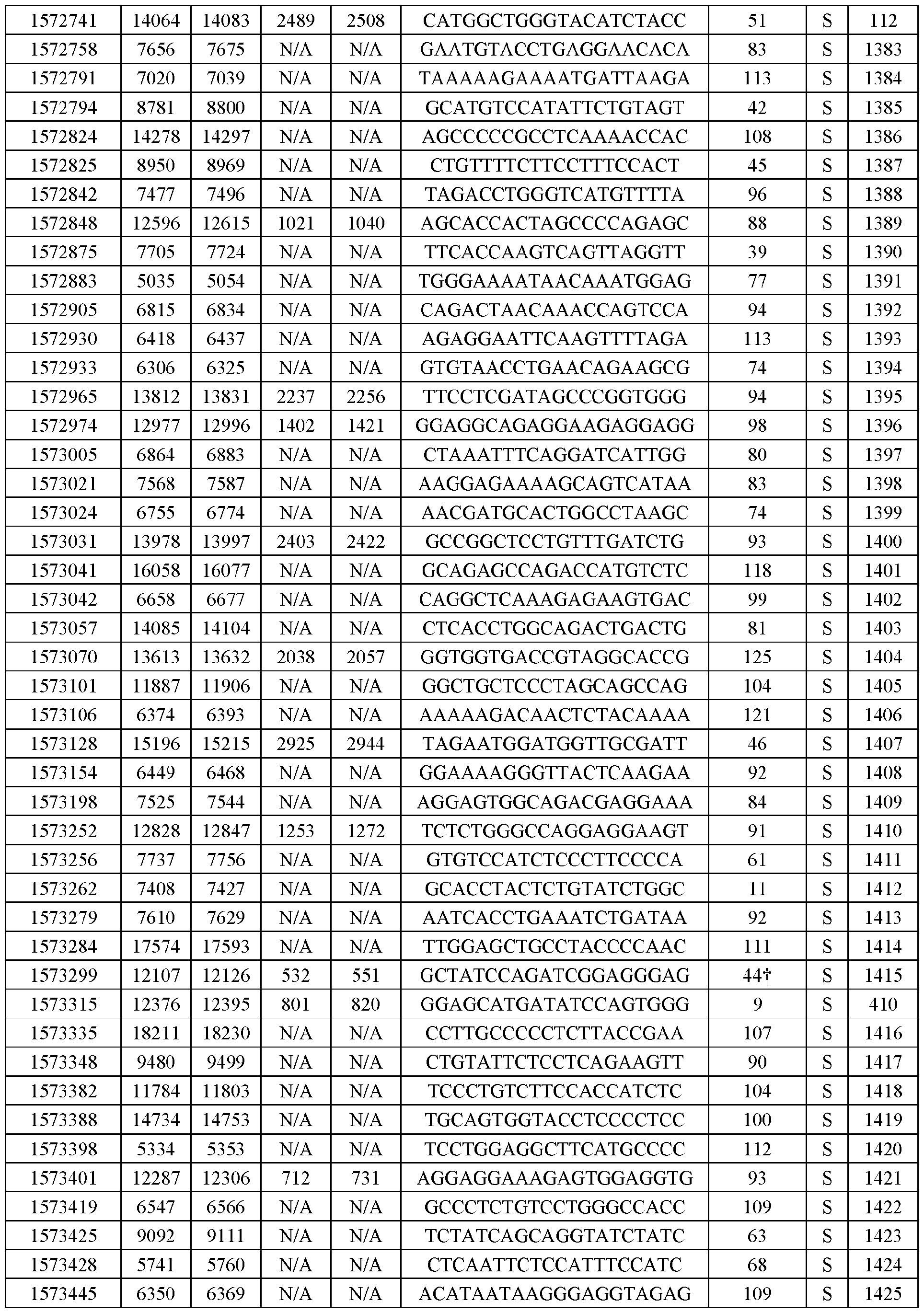


Example 6: Dose-dependent inhibition of human ATN1 in A431 cells by modified oligonucleotides, in vitro
Modified oligonucleotides selected from the examples above were tested at various doses in A431 cells. A431 cells plated at a density of 10,000 cells per well were treated using free uptake with various concentrations of modified oligonucleotide as specified in the tables below. After a treatment period of approximately 48 hours, total RNA was isolated from the cells and ATN1 RNA levels were measured by quantitative real-time RT-PCR. Human ATN1 primerprobe set RTS40640 (described herein above) was used to measure RNA levels as described above. ATN1 RNA levels were normalized to total RNA content, as measured by RIBOGREEN®. Reduction of ATN1 RNA is presented in the
table below as percent ATN1 RNA, relative to the amount of ATN1 RNA in untreated control cells (% UTC). The values marked with a “f ” indicate that the modified oligonucleotide is complementary to the amplicon region of the primer probe set.
The half maximal inhibitory concentration (ICso) of each modified oligonucleotide was calculated using a linear regression on a log/linear plot of the data in Excel and is also presented in the table below.
Table 9
Dose-dependent reduction of human ATN 1 RNA in A431 cells by modified oligonucleotides

Tabic 10 Dose-dependent reduction of human ATN 1 RNA in A431 cells by modified oligonucleotides


Example 7: Dose-dependent inhibition of human ATN1 in A431 cells by 5-10-5 MOE gapmers, in vitro
Modified oligonucleotides selected from the examples above were tested at various doses in A431 cells. A431 cells plated at a density of 10,000 cells per well were treated using free uptake with various concentrations of modified oligonucleotide as specified in the tables below. After a treatment period of approximately 48 hours, total RNA was isolated from the cells and ATN1 RNA levels were measured by quantitative real-time RT-PCR. Human ATN1 primerprobe set RTS40640 (described herein above) was used to measure RNA levels as described above. ATN1 RNA levels were normalized to total RNA content, as measured by RIBOGREEN®. Reduction of ATN1 RNA is presented in the table below as percent ATN1 RNA, relative to the amount of ATN1 RNA in untreated control cells (% UTC).
The half maximal inhibitory concentration (IC50) of each modified oligonucleotide was calculated using a linear regression on a log/linear plot of the data in Excel and is also presented in the table below.
Table 11
Dose-dependent reduction of human ATN1 RNA in A431 cells by 5-10-5 MOE gapmers with mixed PO/PS intemucleoside linkages
 Example 8: Dose-dependent inhibition of human ATN1 in A431 cells by 5-10-5 MOE gapmers, in vitro
Modified oligonucleotides complementary to a human ATN RNA were designed and tested for their effects on ATN1 RNA in vitro. The modified oligonucleotides in the tables below arc 5-10-5 MOE gapmers with mixed PS/PO intemucleoside linkages. The modified oligonucleotides in the table below are 20 nucleosides in length, wherein the sugar motif for the modified oligonucleotides is (from 5’ to 3’): eeeeeddddddddddeeeee; wherein “e” represents a 2’- MOE ribosyl sugar moiety, and each “d” represents a 2’deoxyribosyl sugar moiety. The intemucleoside linkage motif for the modified oligonucleotides is (from 5’ to 3’): sooosssssssssssooss; wherein each “s” represents a phosphorothioate intemucleoside linkage, and each “o” represents a phosphodiester intemucleoside linkage. Each cytosine residue is a 5- methylcytosine.
‘’Start site” indicates the 5’-most nucleoside to which the modified oligonucleotide is complementary in the target nucleic acid sequence. “Stop site” indicates the 3’-most nucleoside to which the modified oligonucleotide is complementary in the target nucleic acid sequence. Each modified oligonucleotide listed in the tables below is 100% complementary to SEQ ID NO: 1 (GenBank Accession No. NC 000012.12 truncated from nucleosides 6923463 to 6943321).
Modified oligonucleotides were tested at various doses in A431 cells. A431 cells plated at a density of 10,000 cells per well were treated using free uptake with various concentrations of modified oligonucleotide as specified in the tables below. After a treatment period of approximately 48 hours, total RNA was isolated from the cells and ATN1 RNA levels were measured by quantitative real-time RT-PCR. Human ATN1 primer-probe set RTS40640 (described herein above) was used to measure RNA levels as described above. ATN1 RNA levels were normalized to total RNA content, as measured by RIBOGREEN®. Reduction of ATN1 RNA is presented in the table below as percent ATN1 RNA, relative to the amount of ATN 1 RNA in untreated control cells (% UTC). The half maximal inhibitory concentration (IC5o) of each modified oligonucleotide was calculated using a linear regression on a log/linear plot of the data in Excel and is also presented in the table below. “N.C.” indicates that a value was not calculated. Each table represents a separate experiment.
Table 12
Dose-dependent reduction of human ATN1 RNA in A431 cells by 5-10-5 MOE gapmers with mixed PO/PS intemucleoside linkages


Table 13
Dose-dependent reduction of human ATN1 RNA in A431 cells by 5-10-5 MOE gapmers with mixed PO/PS intemucleoside linkages

Example 9: Tolerability of modified oligonucleotides complementary to human ATN1 in wild-type mice, 3-hour study
Modified oligonucleotides described above were tested in wild-type mice to assess the tolerability of the oligonucleotides.
Wild-type female C57BL/6 mice (Taconic Biosciences) each received a single ICV dose of 700 pg of modified oligonucleotide. Each treatment group consisted of 4 mice. A group of 4 mice received PBS as a negative control. At 3 hours post-injection, mice were evaluated according to seven different criteria. The criteria are (1) the mouse was bright, alert, and responsive; (2) the mouse was standing or hunched without stimuli; (3) the mouse showed any movement without stimuli; (4) the mouse demonstrated forward movement after it was lifted; (5) the mouse demonstrated any movement after it was lifted; (6) the mouse responded to tail pinching; (7) regular breathing. For each of the 7 criteria, a mouse was given a subscore of 0 if it met the criteria and 1 if it did not (the functional observational battery score or FOB). After all 7 criteria were evaluated, the scores were summed for each mouse and averaged within each treatment group.
Table 14
Tolerability scores in wild-type mice

Table 15
Tolerability scores in wild-type mice
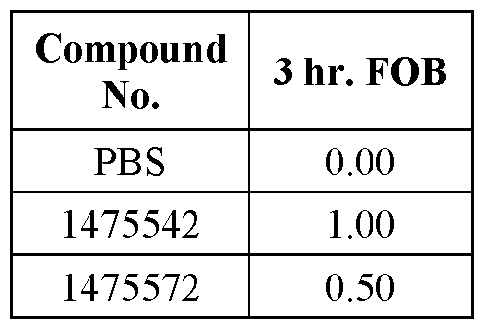 1475787 2.00

Example 10: Tolerability of modified oligonucleotides complementary to human ATN1 in rats, 3-hour study
Modified oligonucleotides described above were tested in rats to assess the tolerability of the oligonucleotides. Sprague Dawley rats (Envigo) each received a single intrathecal (IT) dose of 3 mg of oligonucleotide listed in the table below. Each treatment group consisted of 4 rats. A group of 4 rats received PBS as a negative control. At 3 hours postinjection, movement in 7 different parts of the body were evaluated for each rat. The 7 body parts are (1) the rat’s tail; (2) the rat’s posterior posture; (3) the rat’s hind limbs; (4) the rat’s hind paws; (5) the rat’s forepaws; (6) the rat’s anterior posture; (7) die rat’s head. For each of the 7 different body parts, each rat was given a sub-score of 0 if the body part was moving or 1 if tire body part was paralyzed (tire functional observational batteiy score or FOB). After each of tire 7 body parts were evaluated, the sub-scores were summed for each rat and then averaged for each group. For example, if a rat’s tail, head, and all other evaluated body parts were moving 3 hours after tire 3 mg IT dose, it would get a summed score of 0. If another rat was not moving its tail 3 hours after the 3 mg IT dose but all other evaluated body parts were moving, it would receive a score of 1. Results are presented as the average score for each treatment group.
Table 16
Tolerability scores in rats

Example 11: Activity of modified oligonucleotides complementary to human ATN1 in transgenic mice, 2 weeks
Modified oligonucleotides from the above examples were analyzed for their effects on ATN1 mRNA in humanized ATN1 mice where hiiinan . l 7 \7 gene is knocked into mouse Atnl locus via CRISPR/Cas-9-mediated gene editing on a C57BL/6NTac background. The line was generated by Taconic, and is called C57BL/6NTac- Atnlem7219(ATN1)Tac, but is herein referred to as ATN1 transgenic mice.
ATN1 transgenic mice were divided into groups of 2 mice. Each mouse received a single ICV bolus of 300 pg. A group of 4 mice received a single ICV bolus with PBS as a negative control.
Two weeks post treatment, mice were sacrificed, and RNA was extracted from cortical brain tissue, spinal cord, and brainstem for quantitative real-time RTPCR analysis of RNA expression of ATN1 using human primer probe set RTS40640 (described herein above). ATN1 RNA levels were normalized to mouse PPIA. Mouse PPIA was amplified using primer probe set m cyclo24 (forward sequence TCGCCGCTTGCTGCA, designated herein as SEQ ID NO: 9; reverse sequence ATCGGCCGTGATGTCGA, designated herein as SEQ ID NO: 10; probe sequence CCATGGTCAACCCCACCGTGTTC, designated herein as SEQ ID NO: 11). Results are presented as percent human
ATN1 RNA relative to the amount of human ATN1 RNA in PBS treated animals. (% control). The values marked with a
“f ” indicate that the modified oligonucleotide is complementary to the amplicon region of the primer probe set. Additional assays may be used to measure the potency and efficacy of the modified oligonucleotides complementary to the amplicon region. Table 17
Reduction of human ATN 1 RNA in ATN 1 transgenic mice
 Table 18
Reduction of human ATN 1 RNA in ATN 1 transgenic mice


$ indicates fewer than 2 treatment samples available or fewer than 4 PBS samples available
Table 19
Reduction of human ATN 1 RNA in ATN 1 transgenic mice
 Table 20
Reduction of human ATN 1 RNA in ATN 1 transgenic mice

Example 12: Activity of modified oligonucleotides complementary to human ATN1 in transgenic mice, 8 weeks
Modified oligonucleotides from the above examples were analyzed for their effects on ATN1 mRNA in transgenic ATN1 mice (described herein above).
ATN1 transgenic mice were divided into groups of 3-4 mice. Each mouse received a single ICV bolus of 300 pg. A group of 4 mice received a single ICV bolus with PBS as a negative control.
Eight weeks post treatment, mice were sacrificed, and RNA was extracted from cortical brain tissue, spinal cord, and brainstem for quantitative real-time RTPCR analysis of RNA expression of ATN1 using human primer probe set RTS40640 (described herein above). ATN1 RNA levels were normalized to mouse PPIA. Mouse PPIA was amplified using primer probe set m_cyclo24 (described herein above). Results are presented as percent human ATN1 RNA relative to the amount of ATN 1 RNA in PBS treated animals, (% control). The values marked with a “f ” indicate that the modified
oligonucleotide is complementary to the amplicon region of the primer probe set. Additional assays may be used to measure the potency and efficacy of the modified oligonucleotides complementary to the amplicon region.
Tabic 21

Table 22

Table 23
Reduction of human ATN 1 RNA in ATN 1 transgenic mice

J indicates fewer than 4 samples available
Example 13: Activity of modified oligonucleotides complementary to human ATN1 in transgenic mice, 16 weeks
Modified oligonucleotides from the above examples were analyzed for their effects on ATN1 mRNA in transgenic ATN1 mice (described herein above).
ATN1 transgenic mice were divided into groups of 4 mice. Each mouse received a single ICV bolus of 300 pg. A group of 4 mice received a single ICV bolus with PBS as a negative control.
Sixteen weeks post treatment, mice were sacrificed, and RNA was extracted from cortical brain tissue, spinal cord, and brainstem for quantitative real-time RTPCR analysis of RNA expression of ATN1 using human primer probe set RTS40640 (described herein above). ATN1 RNA levels were normalized to mouse PPIA. Mouse PPIA was amplified using primer probe set m_cyclo24 (described herein above). Results are presented as percent human ATN1 RNA relative to the amount of ATN1 RNA in PBS treated animals, (% control).
Table 24
Reduction of human ATN 1 RNA in ATN 1 transgenic mice

} indicates fewer than 4 samples available
Example 14: Potency of modified oligonucleotides complementary to human ATN1 in transgenic mice, 8 weeks
Modified oligonucleotides from the above examples were analyzed for their effects on ATN1 mRNA in transgenic ATN1 mice (described herein above).
ATN1 transgenic mice were divided into groups of 4 mice. Each mouse received a single ICV bolus of modified oligonucleotide at doses indicated in the tables below. A group of 4 mice received a single ICV bolus with PBS as a negative control.
Eight weeks post treatment, mice were sacrificed, and RNA was extracted from cortical brain tissue, spinal cord, and brainstem for quantitative real-time RTPCR analysis of RNA expression of ATN1 using human primer probe set RTS40640 (described herein above). ATN1 RNA levels were normalized to mouse PPIA. Mouse PPIA was amplified using primer probe set m_cyclo24 (described herein above). Results are presented as percent human ATN1 RNA relative to the amount of ATN1 RNA in PBS treated animals, (% control).
The half maximal effective dose (ED5o) of each modified oligonucleotide was calculated using GraphPad Prism 7 software (GraphPad Software, San Diego, CA). N.C. refers to values not calculated.
Table 25
Dosc-dcpcndcnt percent reduction of human ATN 1 RNA in ATN 1 transgenic mice

Claims
1. An oligomeric compound comprising a modified oligonucleotide consisting of 12 to 50 linked nucleosides wherein the nucleobase sequence of the modified oligonucleotide is at least 80% complementary to an equal length portion of an ATN 1 nucleic acid, and wherein the modified oligonucleotide comprises at least one modification selected from a modified sugar moiety and a modified intemucleoside linkage.
2. An oligomeric compound comprising a modified oligonucleotide consisting of 12 to 50 linked nucleosides and having a nucleobase sequence comprising at least 12, at least 13, at least 14, at least 15, at least 16, at least 17, at least 18, at least 19, or 20 contiguous nucleobases of any of SEQ ID NOs: 15-2443, wherein die modified oligonucleotide comprises at least one modification selected from a modified sugar moiety and a modified intemucleoside linkage.
3. An oligomeric compound comprising a modified oligonucleotide consisting of 12 to 50 linked nucleosides and having a nucleobase sequence comprising at least 8, at least 9, at least 10, at least 11, at least 12, at least 13, at least 14, at least 15, at least 16, at least 17, at least 18, at least 19, or 20 contiguous nucleobases complementary to: an equal length portion of nucleobases 6584-6607 of SEQ ID NO: 1; an equal length portion of nucleobases 6865-6890 of SEQ ID NO: 1; an equal length portion of nucleobases 7364-7409 of SEQ ID NO: 1; an equal length portion of nucleobases 7405-7430 of SEQ ID NO: 1; an equal length portion of nucleobases 7484-7514 of SEQ ID NO: 1 ; an equal length portion of nucleobases 7621-7658 of SEQ ID NO: 1; an equal length portion of nucleobases 7886-7922 of SEQ ID NO: 1; an equal length portion of nucleobases 8763-8809 of SEQ ID NO: 1; an equal length portion of nucleobases 9082-9107 of SEQ ID NO: 1; an equal length portion of nucleobases 9093-9174 of SEQ ID NO: 1; an equal length portion of nucleobases 9483-9525 of SEQ ID NO: 1; an equal length portion of nucleobases 10163-10200 of SEQ ID NO: 1; an equal length portion of nucleobases 1 1033-1 1081 of SEQ ID NO: 1 ; an equal length portion of nucleobases 12214-12244 of SEQ ID NO: 1 ; un equal length portion of nucleobases 12360-12400 of SEQ ID NO: 1; an equal length portion of nucleobases 12929-12957 of SEQ ID NO: 1; an equal length portion of nucleobases 13300-13330 of SEQ ID NO: 1; an equal length portion of nucleobases 14061-14097 of SEQ ID NO: 1; an equal length portion of nucleobases 18284-18363 of SEQ ID NO: 1; an equal length portion of nucleobases 18658-18689 of SEQ ID NO: 1; or an equal length portion of nucleobase ranges disclosed in Table 1; wherein the modified oligonucleotide comprises at least one modification selected from a modified sugar moiety and a modified intemucleoside linkage.
4. An oligomeric compound comprising a modified oligonucleotide consisting of 12 to 50 linked nucleosides and having a nucleobase sequence comprising at least 8, at least 9, at least 10, at least 11, at least 12, at least
13, at least 14, at least 15, at least 16, at least 17, at least 18, at least 19, or 20 contiguous nucleobases of a sequence selected from:
SEQ ID NOs: 528, 2437, 2296, 483, and 2137;
SEQ ID NOs: 1329, 1241, 1166, 459, 70, and 1116;
SEQ ID NOs: 770, 699, 2100, 2027, 677, 1942, 606, 527, 841, 1799, 769, 716, 654, 605, 492, 876, 1719, and 799;
SEQ ID NOs: 1626, 1557, 1486, 1412, 1337, 1251, and 1187;
SEQ ID NOs: 948, 651, 2410, 2316, 2205, 2163, 2073, 2003, 1961, 1872, and 1782;
SEQ ID NOs: 2200, 2155, 583, 2434, 2115, 2028, 1914, 1888, 1747, 1693, 1659, 1532, 1493, 1367, 1346, 1262, 1172, 460, and 71;
SEQ ID NOs: 1632, 1587, 1452, 1434, 1301, 1260, 1140, 1095, 1021, 960, 2362, 2306, 2224, and 2160;
SEQ ID NOs: 1711, 1635, 1524, 1502, 1385, 1296, 1276, 150, 228, 1093, 985, 907, 306, and 2278;
SEQ ID NOs: 1970, 1896, 765, 694, 1801, 643, and 590;
SEQ ID NOs: 867, 812, 464, 1288, 704, 1215, 75, 1191, 153, 231, 562, 548, 1060, 861, 834, 1029, 690, 680, 309, and 387;
SEQ ID NOs: 625, 1359, 1244, 2440, 1150, 1091, 1032, 929, 2413, 2300, and 2259;
SEQ ID NOs: 634, 581, 543, 863, 809, 721, 669, 157, and 235;
SEQ ID NOs: 94, 172, 681, 250, 502, 927, 878, 792, 732, 328, 406, 2355, 573, 538, 2272, 902, 827, and 740;
SEQ ID NOs: 779, 741, 2370, 645, 2309, 594, 499, 903, 775, and 738;
SEQ ID NOs: 2053, 2032, 1925, 1821, 1780, 1696, 1613. 176, 254, 332, 1499, 410, 21, 99, 518, 177, and 255;
SEQ ID NOs: 2110, 181, 1993, 259, 337, 1847, 1746, 711, and 415;
SEQ ID NOs: 2283, 2198, 2139, 2062, 1981, 1909, 1860, 416, 1695, 1622, and 1567;
SEQ ID NOs: 1553, 34, 1480, 112, 1331, 190, 1165, 1075, 1059, 982, 2365, 2299, 2243, 2157, 2097, 1982, 1943, and 1858;
SEQ ID NOs: 584, 551, 887, 800, 702, 637, 591, 201, 279, 494, 357, 435, 865, 46, 124, 202, 280, and 358;
SEQ ID NOs: 895, 764, 691, 678, 438, 49, 874, 828, 754, 127, 205, and 561; and
SEQ ID NOs: 870, 819, 1278, 1151, 1066, 1205, 1114, 748, 304, 1771, 1732, 1595, 1526, 1508, 149, 1390, 227, 1248, 2085, 2030, 1959, 1730, 1611, 1520, 739, 665, 604, 509, 844, 152, 1457, 1387, 1297, 1216, 1188, 1097, 1016, 2284, 787, 757, 2250, 308, 386, 2153, 627, 615, 510, 905, 2197, 465, 2091, 1976, 1953, 833, 729, 666, 597, 530, 629, 613, 519, 890, 832, 1212, 689, 676, 807, 713, 664, 612, 511, 836, 777, 709, 683, 557, 983, 512, 1286, 411, 22, 100, 2074, 1992, 1939, 1825, 791, 752, 1809, 1722, 1607, 1528, 569, 537, 858, 1369, 816, 717, 659, 1109, 1014, 962, 2368, 258, 2212, 2130, 2071, 1977, 182, 1703, 1592, 1565, 1462, 1371, 1292, 1245, 1200, 1101, 996, 964, 2114, 2024, 1938, 1889, 1839, 1742, 614, 1727, 267, 839, 785, 351, 429, 761, 40, 1853, 1802, 118, 1682, 196, 1537, 1498, 1407, 1321, 679, 601, 549, 853, 547, 899, 2358, 2335, 2202, 2189, 359, 2004, and 437.
5. The oligomeric compound of any of claims 1-4, wherein the modified oligonucleotide lias a nucleobase sequence that is at least 85%, at least 90%, at least 95%, or 100% complementary to an equal length portion of a ATN1 nucleic acid, wherein the ATN1 nucleic acid has the nucleobase sequence of SEQ ID NO: 1 or SEQ ID NO: 2.
6. The oligomeric compound of any of claims 1-5, wherein the modified oligonucleotide consists of 12 to 20, 12 to 25, 12 to 30, 12 to 50, 13 to 20, 13 to 25, 13 to 30, 13 to 50, 14 to 20, 14 to 25, 14 to 30, 14 to 50, 15 to 20, 15 to 25, 15 to 30, 15 to 50, 16 to 18, 16 to 20, 16 to 25, 16 to 30, 16 to 50, 17 to 20, 17 to 25, 17 to 30, 17 to 50, 18 to 20, 18 to 25, 18 to 30, 18 to 50, 19 to 20, 19 to 25, 19 to 30, 19 to 50, 20 to 25, 20 to 30, or 20 to 50 linked nucleosides.
7. The oligomeric compound of any of claims 1-6, wherein the modified ohgonucleotide comprises at least one modified nucleoside.
8. The oligomeric compound of claim 7, wherein the at least one modified nucleoside comprises a modified sugar moiety.
9. The oligomeric compound of claim 8, wherein the modified sugar moiety comprises a bicyclic sugar moiety.
10. The oligomeric compound of claim 9, wherein the bicyclic sugar moiety comprises a 2’-4’ bridge selected from -O-CH2- and -O-CH(CH3)-.
11. The oligomeric compound of any of claims 7-10, wherein the modified oligonucleotide comprises at least one modified nucleoside comprising a non-bicyclic modified sugar moiety.
12. The oligomeric compound of claim 11, wherein the non-bicyclic modified sugar moiety is a 2'-MOE sugar moiety, a 2’-OMe sugar moiety, or a 2’-F sugar moiety.
13. The oligomeric compound of any of claims 7-12, wherein the modified oligonucleotide comprises at least one modified nucleoside comprising a sugar surrogate.
14. The oligomeric compound of claim 13, wherein the sugar surrogate is selected from morpholino, modified morpholino, glycol nucleic acid (GNA), six-membered tetrahydropyran (THP), and F-hexitol nucleic acid (F- HNA).
15. The oligomeric compound of any of claims 1-14, wherein the modified oligonucleotide is a gapmer.
16. The oligomeric compound of any of claims 1-15, wherein the modified oligonucleotide comprises at least one modified intemucleoside linkage.
17. The oligomeric compound of claim 16, wherein the at least one modified intemucleoside linkage is a phosphorothioate intemucleoside linkage.
18. The oligomeric compound of any of claims 1-17, wherein the modified oligonucleotide comprises at least one phosphodiester intemucleoside linkage.
19. The oligomeric compound of any of claims 16-18, wherein each intemucleoside linkage is independently selected from a phosphodiester intemucleoside linkage and a phosphorothioate intemucleoside linkage.
20. The oligomeric compound of any of claims 1-19, wherein at least 4, at least 5, at least 6, at least 7, at least 8, at least 9, at least 10, at least 11, at least 12, at least 13, at least 14, at least 15, at least 16, at least 17, at least 18, or 19 intemucleoside linkages of the modified oligonucleotide are phosphorothioate intemucleoside linkages.
21. The oligomeric compound of any of claims 1-20, wherein the modified oligonucleotide comprises an intemucleoside linkage motif (from 5' to 3’) selected from sososssssssssssooss and sooosssssssssssooss, wherein each “s” represents a phosphorothioate intemucleoside linkage and each “o” represents a phosphodiester intemucleoside linkage.
22. The oligomeric compound of any of claims 1-21, wherein the modified oligonucleotide comprises at least one modified nuclcobasc.
23. The oligomeric compound of claim 22, wherein the modified nucleobase is a 5-methylcytosine.
24. The oligomeric compound of claim 23, wherein each cytosine is a 5-mcthylcytosinc.
25. The oligomeric compound of any of claims 1-24, wherein the modified oligonucleotide comprises a deoxy region.
26. The oligomeric compound of claim 25, wherein each nucleoside of the deoxy region is a 2’-0-D- deoxynucleoside.
27. The oligomeric compound of claim 25 or claim 26, wherein the deoxy region consists of 6, 7, 8, 9, 10, or 6-10 linked nucleosides.
28. The oligomeric compound of any of claims 25-27, wherein each nucleoside immediately adjacent to the deoxy region comprises a modified sugar moiety.
29. The oligomeric compound of any of claims 24-27, wherein the deoxy region is flanked on the 5 ’-side by a 5 ’-region consisting of 1-6 linked 5 ’-region nucleosides and on the 3 ’-side by a 3 ’-region consisting of 1-6 linked 3 ’-region nucleosides; wherein at least one nucleoside of the 5’-region comprises a modified sugar moiety; and at least one nucleoside of the 3 ’-region comprises a modified sugar moiety.
30. The oligomeric compound of claim 29, wherein each nucleoside of the 5’-region comprises a modified sugar moiety.
31. The oligomeric compound of claim 29 or claim 30, wherein each nucleoside of the 3 ’-region comprises a modified sugar moiety.
32. The oligomeric compound of any of claims 1-31, wherein the modified oligonucleotide consists of 12- 30, 12-22, 12-20, 14-18, 14-20, 15-17, 15-25, 16-20, 18-22, or 18-20 linked nucleosides, or a pharmaceutically acceptable salt thereof.
33. The oligomeric compound of any of claims 1-32, wherein the modified oligonucleotide consists of 20 linked nucleosides, or a pharmaceutically acceptable salt thereof.
34. The oligomeric compound of claim 32 or claim 33, which is a pharmaceutically acceptable salt comprising one or more cations selected from sodium, potassium, calcium, and magnesium.
35. The oligomeric compound of any of claims 1-34, wherein the modified oligonucleotide consists of 20 linked nucleosides.
36. The oligomeric compound of any of claims 1-35, wherein the modified oligonucleotide comprises: a 5 ’-region consisting of 1-6 linked 5 ’-region nucleosides; a central region consisting of 6-10 linked central region nucleosides; and a 3 ’ -region consisting of 1 -6 linked 3 ’ -region nucleosides; wherein each of the 5’-region nucleosides and each of the 3’-region nucleosides comprises a modified sugar moiety, and each of the central region nucleosides comprises a 2 ’-p-D-deoxy ribosyl sugar moiety.
37. The oligomeric compound of any of claims 1-36, wherein the modified oligonucleotide comprises: a 5 ’-region consisting of 5 linked 5 ’-region nucleosides; a central region consisting of 10 linked central region nucleosides; and a 3 ’ -region consisting of 5 linked 3 ’ -region nucleosides; wherein each of the 5’-region nucleosides and each of the 3’-region nucleosides comprises a modified sugar moiety, and each of the central region nucleosides comprises a 2 ’- -D-dcoxy ribosyl sugar moiety.
38. The oligomeric compound of claim 37, wherein the modified oligonucleotide has a 5 ’-region consisting of 5 linked 5 ’-region nucleosides; a central region consisting of 10 linked central region nucleosides; and a 3 ’ -region consisting of 5 linked 3 ’ -region nucleosides; wherein each of the 5’-region nucleosides and each of the 3’-region nucleosides comprises a 2’-MOE sugar moiety, and each of the central region nucleosides comprises a 2 '-[1-D-deoxy ribosyl sugar moiety.
39. The oligomeric compound of any of claims 1-38, wherein the oligomeric compound consists of the modified oligonucleotide.
40. The oligomeric compound of any of claims 1-38, wherein the oligomeric compound comprises a conjugate group.
41. The oligomeric compound of claim 40, wherein the conjugate group comprises a conjugate moiety and a conjugate linker.
42. The oligomeric compound of claim 41, wherein the conjugate linker is a phosphodiester linker.
43 The oligomeric compound of claim 41, wherein the conjugate linker consists of a single bond.
44. The oligomeric compound of any of claims 41-43, wherein the conjugate linker is cleavable.
45. The oligomeric compound of any of claims 41-44, wherein the conjugate linker comprises 1-3 linker- nucleosides.
46. The oligomeric compound of any of claims 40-45, wherein the conjugate group is attached to the modified oligonucleotide at the 5 ’-end of the modified oligonucleotide.
47. The oligomeric compound of any of claims 40-45, wherein the conjugate group is attached to the modified oligonucleotide at the 3 ’-end of the modified oligonucleotide.
48. The oligomeric compound of any of claims 1-47, wherein the oligomeric compound comprises a terminal group.
49. The oligomeric compound of any of claims 1-45 or 46-48, wherein the oligomeric compound does not comprise linker-nucleosides.
50. A chirally enriched population of oligomeric compounds of any of claims 1-49, wherein the population is enriched for modified oligonucleotides comprising at least one particular phosphorothioate intemucleoside linkage having a particular stereochemical configuration.
51. The chirally enriched population of claim 50, wherein the population is enriched for modified oligonucleotides comprising at least one particular phosphorothioate intemucleoside linkage having the (Sp) configuration.
52. The chirally enriched population of claim 50, wherein the population is enriched for modified oligonucleotides comprising at least one particular phosphorothioate intemucleoside linkage having the (Tip) configuration.
53. The chirally enriched population of claim 50, wherein the population is enriched for modified oligonucleotides having a particular, independently selected stereochemical configuration at each phosphorothioate intemucleoside linkage.
54. The chirally enriched population of claim 50, wherein the population is enriched for modified oligonucleotides having the (.S'p) configuration at each phosphorothioatc intcmuclcosidc linkage or for modified oligonucleotides having the (7?p) configuration at each phosphorothioatc intcmuclcosidc linkage.
55. The chirally enriched population of claim 50, wherein the population is enriched for modified oligonucleotides having the (7?p) configuration at one particular phosphorothioatc intemucleoside linkage and the CS'p) configuration at each of the remaining phosphorothioatc intemucleoside linkages.
56. The chirally enriched population of claim 50, wherein the population is enriched for modified oligonucleotides having at least 3 contiguous phosphorothioatc intemucleoside linkages in the 'p. ,S'p. and Rp configurations, in the 5’ to 3’ direction.
57. A population of oligomeric compounds of any of claims 1-49, wherein all of the phosphorothioate intemucleoside linkages of the modified oligonucleotide are stereorandom.
58. An oligomeric duplex comprising a first oligomeric compound and a second oligomeric compound comprising a second modified oligonucleotide, wherein the first oligomeric compound is an oligomeric compound of any of claims 1-49.
59. The oligomeric duplex of claim 58, wherein the second modified oligonucleotide consists of 12 to 50 linked nucleosides, and wherein the nucleobase sequence of the second modified oligonucleotide comprises a complementary region of at least 12 nucleobases that is at least 90% complementary to an equal length portion of the first modified oligonucleotide.
60. The oligomeric duplex of claim 58 or claim 59, wherein the modified oligonucleotide of the first oligomeric compound comprises a 5 ’-stabilized phosphate group.
61. The oligomeric duplex of claim 60, wherein the stabilized phosphate group comprises a cyclopropyl phosphonate or a vinyl phosphonate.
62. The oligomeric duplex of any of claims 58-61, wherein at least one nucleoside of the second modified oligonucleotide comprises a modified sugar moiety.
63. The oligomeric duplex of claim 62, wherein the modified sugar moiety of the second modified oligonucleotide comprises a bicyclic sugar moiety.
64. The oligomeric duplex of claim 63, wherein the bicyclic sugar moiety comprises a 2’-4’ bridge selected from -O-CH2- and -O-CH(CH3)-.
65. The oligomeric duplex of claim 62, wherein the modified sugar moiety of the second modified oligonucleotide comprises a non-bicyclic modified sugar moiety.
66. The oligomeric duplex of claim 65, wherein the non-bicyclic modified sugar moiety of the second modified oligonucleotide is a 2’-OMe sugar moiety or a 2’-F sugar moiety.
67. The oligomeric duplex of any of claims 62-66, wherein at least one nucleoside of the second modified oligonucleotide comprises a sugar surrogate.
68. The oligomeric duplex of any of claims 58-67, wherein the second modified oligonucleotide comprises at least one modified intemucleoside linkage.
69. The oligomeric duplex of claim 68, wherein the at least one modified intemucleoside linkage of the second modified oligonucleotide is a phosphorothioate intemucleoside linkage.
70. The oligomeric duplex of claim 68, wherein each intemucleoside linkage of the second modified oligonucleotide is independently selected from a phosphodicstcr intemucleoside linkage and a phosphorothioatc intemucleoside linkage.
71. The oligomeric duplex of any of claims 58-70, wherein the second modified oligonucleotide comprises at least one modified nucleobase.
72. The oligomeric duplex of claim 71, wherein the at least one modified nucleobase is 5 -methylcytosine.
73. The oligomeric duplex of any of claims 58-72, wherein the second oligomeric compound comprises a conjugate group.
74. The oligomeric duplex of claim 73, wherein the conjugate group comprises a conjugate moiety and a conjugate linker.
75. The oligomeric duplex of claim 73, wherein the conjugate linker consists of a single bond.
76. The oligomeric duplex of claim 74 or claim 75, wherein the conjugate linker is cleavable.
77. The oligomeric duplex of any of claims 74-76, wherein the conjugate linker comprises 1-3 linker- nucleosides.
78. The oligomeric duplex of any of claims 74-77, wherein the conjugate linker is a phosphodiester linker.
79. The oligomeric duplex of any of claims 73-78, wherein the conjugate group is attached to the 5’-end of the second modified oligonucleotide.
80. The oligomeric duplex of any of claims 73-78, wherein the conjugate group is attached to the 3 ’-end of the second modified oligonucleotide.
81. The oligomeric duplex of any of claims 73-78, wherein the conjugate group is attached via the 2’ position of a ribosyl sugar moiety at an internal position of the second modified oligonucleotide.
82. The oligomeric duplex of any of claims 73-81, wherein the conjugate group comprises a C22 alkyl, C20 alkyl, C16 alkyl, CIO alkyl, C21 alkyl, C19 alkyl, C18 alkyl, C17 alkyl, C15 alkyl, C14 alkyl, C13 alkyl, C12 alkyl, Cll alkyl, C9 alkyl, C8 alkyl, C7 alkyl, C6 alkyl, C5 alkyl, C22 alkenyl, C20 alkenyl, C16 alkenyl, CIO alkenyl, C21 alkenyl, C19 alkenyl, C18 alkenyl, C17 alkenyl, C15 alkenyl, C14 alkenyl, C13 alkenyl, C12 alkenyl, Cl l alkenyl, C9 alkenyl, C8 alkenyl, C7 alkenyl, C6 alkenyl, or C5 alkenyl.
83. The oligomeric duplex of any of claims 73-82, wherein the conjugate group comprises a cell-targeting moiety.
84. The oligomeric duplex of any of claims 58-83, wherein the second modified oligonucleotide comprises a terminal group.
85. The oligomeric duplex of claim 84, wherein the terminal group is an abasic sugar moiety.
86. An antisense agent comprising or consisting of an antisense compound, wherein the antisense compound is the oligomeric compound of any of claims 1-49.
87. An antisense agent, wherein the antisense agent is the oligomeric duplex of any of claims 58-85.
88. The antisense agent of claim 86 or claim 87, wherein the antisense agent is: i) an RNase H agent capable of reducing tire amount of ATN 1 nucleic acid through the activation of RNase H; or ii) an RNAi agent capable of reducing the amount of ATN1 nucleic acid through the activation of RISC/Ago2.
89. The antisense agent of any of claims 86-88, wherein the antisense agent comprises a conjugate group, and wherein the conjugate group comprises a cell-targeting moiety .
90. A pharmaceutical composition comprising an oligomeric compound of any of claims 1-49, a population of oligomeric compounds of any of claims 50-57, an oligomeric duplex of any of claims 58-85, or an antisense agent of any of claims 86-89, and a pharmaceutically acceptable diluent.
91. The pharmaceutical composition of claim 90, wherein the pharmaceutically acceptable diluent is phosphate buffered saline (PBS) or artificial CSF (aCSF).
92. The pharmaceutical composition of claim 90 or claim 91, wherein the pharmaceutical composition consists essentially of the oligomeric compound, the population of oligomeric compounds, the oligomeric duplex, or the antisense agent, and aCSF.
93. The pharmaceutical composition of claim 90 or claim 91 , wherein the pharmaceutical composition consists essentially of the oligomeric compound, the population of oligomeric compounds, the oligomeric duplex 83, or the antisense agent, and PBS.
94 A method comprising administering to a subject an oligomeric compound of any of claims 1-49, a population of oligomeric compounds of any of claims 50-57, an oligomeric duplex of any of claims 58-85, an antisense agent of any of claims 86-89, or a pharmaceutical composition of any of claims 90-93.
95. A method of treating a poly glutamine (polyQ) disease or disorder associated with ATN1 comprising administering to a subject having or at risk for developing the polyQ disease or disorder associated with ATN1 a therapeutically effective amount of an oligomeric compound of any of claims 1-49, a population of oligomeric compounds of any of claims 50-57, an oligomeric duplex of any of claims 58-85, an antisense agent of any of claims 86- 89, or a pharmaceutical composition of any of claims 90-93 and thereby treating the polyQ disease or disorder associated with ATN1.
96. The method of claim 95, wherein the polyQ disease or disorder associated with ATN 1 is dentatorubral-pallidoluysian atrophy (DRPLA).
97. The method of claim 95 or 96, wherein at least one symptom or hallmark of the polyQ disease or disorder associated with ATN 1 is ameliorated.
98. The method of claim 97, wherein the symptom or hallmark is seizure, ataxia, myoclonus, choreoathetosis, dementia, epilepsy, intellectual impairment, psychiatric symptoms, neuronal atrophy and dysfunction, action tremor, fetal cystic hygroma, atrophy of the dentate nucleus, dysarthria, dysdiadochokinesis, dysmetria, dyssynergia, hyperintensity of cerebral white matter on MRI, hyporeflexia, impaired proprioception, nystagmus, ophthalmoparesis, optic neuropathy, saccadic smooth pursuit, blepharospasm, memory impairment, oromandibular dystonia, or abnormal pyramidal sign.
99. The method of claim 97 or claim 98, wherein administering the oligomeric compound, the population of oligomeric compounds, the oligomeric duplex, the antisense agent, or the pharmaceutical composition reduces or delays the onset or progression of seizure, ataxia, myoclonus, choreoathetosis, dementia, epilepsy, intellectual impairment, psychiatric symptoms, neuronal atrophy and dysfunction, action tremor, fetal cystic hygroma, atrophy of the dentate nucleus, dysarthria, dysdiadochokinesis, dysmetria, dyssynergia, hyperintensity of cerebral white matter on MRI, hyporeflexia, impaired proprioception, nystagmus, ophthalmoparesis, optic neuropathy, saccadic smooth pursuit, blepharospasm, memory impairment, oromandibular dystonia, or abnormal pyramidal sign.
100. The method of any of claims 94-99, wherein the oligomeric compound, the population of oligomeric compounds the oligomeric duplex, the antisense agent, or the pharmaceutical composition is administered to the central nervous system or systemically.
101. The method of claim 100, wherein the oligomeric compound, the population of oligomeric compounds, the oligomeric duplex, the antisense agent, or the pharmaceutical composition is administered intrathecally.
102. The method of any of claims 94-101, wherein the subject is a human.
103. A method of reducing expression of ATN1 in a cell comprising contacting the cell with an oligomeric compound of any of claims 1-49, a population of oligomeric compounds of any of claims 50-57, an oligomeric duplex of any of claims 58-85, an antisense agent of any of claims 86-89, or a pharmaceutical composition of any of claims 90-93.
104. The method of claim 103, wherein the cell is a brain cell.
105. The method of claim 103 or claim 104, wherein the cell is a human cell.
106. Use of an oligomeric compound of any of claims 1-49, a population of oligomeric compounds of any of claims 50-57, an oligomeric duplex of any of claims 58-85, an antisense agent of any of claims 86-89, or a pharmaceutical composition of any of claims 90-93 for treating a poly glutamine (polyQ) disease or disorder associated with ATNl.
107. Use of an oligomeric compound of any of claims 1-49, a population of oligomeric compounds of any of claims 50-57, an oligomeric duplex of any of claims 58-85, an antisense agent of any of claims 86-89, or a pharmaceutical composition of any of claims 90-93 in the manufacture of a medicament for treating a poly glutamine (polyQ) disease or disorder associated with ATN1.
108. The use of claim 106 or claim 107, wherein the polyQ disease or disorder associated with ATN 1 is dentatorubral-pallidoluysian atrophy (DRPLA).
Applications Claiming Priority (2)
| Application Number | Priority Date | Filing Date | Title |
|---|---|---|---|
| US202263313948P | 2022-02-25 | 2022-02-25 | |
| US63/313,948 | 2022-02-25 |
Publications (2)
| Publication Number | Publication Date |
|---|---|
| WO2023164656A2 true WO2023164656A2 (en) | 2023-08-31 |
| WO2023164656A3 WO2023164656A3 (en) | 2023-09-28 |
Family
ID=87766780
Family Applications (1)
| Application Number | Title | Priority Date | Filing Date |
|---|---|---|---|
| PCT/US2023/063280 Ceased WO2023164656A2 (en) | 2022-02-25 | 2023-02-24 | Compounds and methods for modulating atn1 expression |
Country Status (1)
| Country | Link |
|---|---|
| WO (1) | WO2023164656A2 (en) |
Cited By (1)
| Publication number | Priority date | Publication date | Assignee | Title |
|---|---|---|---|---|
| US12291710B2 (en) | 2021-12-13 | 2025-05-06 | Nippon Shinyaku Co., Ltd. | Antisense oligonucleotide targeting ATN1 mRNA or pre-mRNA |
Family Cites Families (3)
| Publication number | Priority date | Publication date | Assignee | Title |
|---|---|---|---|---|
| LT2841578T (en) * | 2012-04-23 | 2017-09-25 | Biomarin Technologies B.V. | RNA modulating oligonucleotides with improved characteristics for the treatment of neuromuscular disorders |
| KR20220133925A (en) * | 2020-01-31 | 2022-10-05 | 가부시키가이샤산와카가쿠켄큐쇼 | Antisense oligonucleotides of ATN1 |
| WO2021174031A2 (en) * | 2020-02-28 | 2021-09-02 | Ionis Pharmaceuticals, Inc. | Compounds and methods for modulating splicing of pre-mrna |
-
2023
- 2023-02-24 WO PCT/US2023/063280 patent/WO2023164656A2/en not_active Ceased
Cited By (1)
| Publication number | Priority date | Publication date | Assignee | Title |
|---|---|---|---|---|
| US12291710B2 (en) | 2021-12-13 | 2025-05-06 | Nippon Shinyaku Co., Ltd. | Antisense oligonucleotide targeting ATN1 mRNA or pre-mRNA |
Also Published As
| Publication number | Publication date |
|---|---|
| WO2023164656A3 (en) | 2023-09-28 |
Similar Documents
| Publication | Publication Date | Title |
|---|---|---|
| US12350285B2 (en) | Compounds and methods for reducing ATXN3 expression | |
| EP4341406A2 (en) | Compounds for modulating unc13a expression | |
| US12227746B2 (en) | Compounds and methods for modulating SCN2A | |
| WO2022159712A1 (en) | Compounds and methods for reducing dux4 expression | |
| AU2021315992A1 (en) | Compounds and methods for reducing app expression | |
| AU2020253821A1 (en) | Compounds and methods for modulating UBE3A-ATS | |
| EP3897837A1 (en) | Compounds and methods for reducing pmp22 expression | |
| AU2022213384A1 (en) | Compounds and methods for modulating huntingtin | |
| WO2022246204A2 (en) | Compounds for reducing ptbp1 expression | |
| EP3956450B1 (en) | Compounds and methods for modulating gfap | |
| WO2021258011A1 (en) | Compounds and methods for modulating pmp22 | |
| EP4110919A1 (en) | Compounds and methods for modulating scn1a expression | |
| WO2023164656A2 (en) | Compounds and methods for modulating atn1 expression | |
| WO2024173783A2 (en) | Allele-selective compounds and methods for modulating huntingtin expression | |
| WO2024173762A2 (en) | Compounds and methods for reducing app expression | |
| EP4590308A2 (en) | Compounds and methods for reducing mecp2 expression | |
| WO2025030064A1 (en) | Compounds and methods for reducing tubb4a expression | |
| EP4453216A2 (en) | Compounds and methods for reducing pcdh19 expression |
Legal Events
| Date | Code | Title | Description |
|---|---|---|---|
| NENP | Non-entry into the national phase |
Ref country code: DE |
|
| 122 | Ep: pct application non-entry in european phase |
Ref document number: 23760989 Country of ref document: EP Kind code of ref document: A2 |