WO2023162004A1 - 合成条件生成方法、合成条件生成装置及びプログラム - Google Patents
合成条件生成方法、合成条件生成装置及びプログラム Download PDFInfo
- Publication number
- WO2023162004A1 WO2023162004A1 PCT/JP2022/007265 JP2022007265W WO2023162004A1 WO 2023162004 A1 WO2023162004 A1 WO 2023162004A1 JP 2022007265 W JP2022007265 W JP 2022007265W WO 2023162004 A1 WO2023162004 A1 WO 2023162004A1
- Authority
- WO
- WIPO (PCT)
- Prior art keywords
- evaluation value
- synthesis condition
- synthesis
- condition
- untried
- Prior art date
- Legal status (The legal status is an assumption and is not a legal conclusion. Google has not performed a legal analysis and makes no representation as to the accuracy of the status listed.)
- Ceased
Links
Images




Classifications
-
- G—PHYSICS
- G06—COMPUTING OR CALCULATING; COUNTING
- G06N—COMPUTING ARRANGEMENTS BASED ON SPECIFIC COMPUTATIONAL MODELS
- G06N99/00—Subject matter not provided for in other groups of this subclass
Definitions
- the present invention relates to a synthesis condition generation method, a synthesis condition generation device, and a program.
- Methods for producing thin films (substances, samples) according to given synthesis conditions include, for example, the molecular beam epitaxy method (Non-Patent Document 1).
- Non-Patent Document 1 the molecular beam epitaxy method
- sputtering method pulse laser ablation method
- physical vapor deposition method physical vapor deposition method
- chemical vapor deposition method spin coating method
- atomic layer deposition method floating zone method
- flux method Czochralski method
- Bayesian optimization and the like are known as techniques for generating synthesis conditions to be tried next under problem settings in which evaluation values for synthesis conditions are always obtained (Patent Document 1, Non-Patent Documents 2 and 3).
- the conventional method of searching for a synthesis condition that gives a good evaluation value has the problem that there may be synthesis conditions for which no evaluation value is obtained. This is because a stable substance is not always produced under all synthesis conditions within the search range of synthesis conditions. In addition, under certain synthesis conditions, it is possible to obtain a substance having a composition or crystal structure different from that of the target substance.
- One embodiment of the present invention has been made in view of the above points, and aims to generate synthesis conditions under which an optimum substance can be obtained under a given evaluation index.
- FIG. 10 is a diagram showing an example of trials for obtaining synthesis conditions with good evaluation values; It is a figure showing an example of the whole composition condition generation system concerning this embodiment. It is a figure which shows an example of the hardware constitutions of the synthesis condition production
- 6 is a flowchart showing an example of synthesis condition generation processing according to the embodiment; It is a figure which shows the evaluation value in a simulation experiment. It is a figure which shows the result of a simulation experiment.
- FIG. 3 shows the results of SrRuO 3 experiments.
- a synthesis condition generation system 1 capable of generating synthesis conditions for obtaining an optimum substance under given evaluation indices will be described.
- FIG. 2 shows an example of the overall configuration of the synthesis condition generation system 1 according to this embodiment.
- the synthesis condition generation system 1 according to this embodiment includes a synthesis condition generation device 10 , a substance generation device 20 and a substance evaluation device 30 .
- the synthesis condition generation device 10 sets the index representing the number of trials to n, and generates the synthesis conditions to be used in the current trial, using the synthesis conditions (recipes) obtained up to the previous trials and their evaluation values.
- Synthesis conditions are conditions for obtaining a certain substance by proceeding with the reaction of one or more raw materials by a certain method (for example, the amount of constituent elements, reaction temperature, timing of introducing raw materials, etc.), and are generally expressed in a vector expressed.
- the synthesis conditions are (a) the supply amount of Ru, (b) the temperature of the substrate on which the thin film is deposited, and (c) the temperature of the ozone nozzle supplying oxygen atoms O and the substrate. It is represented by a vector having three elements: the distance between Hereinafter, the n-th trial will also be referred to as "trial n", and the synthetic conditions used to generate the substance in trial n will be "xn " .
- the substance generation device 20 advances the reaction of raw materials according to the synthesis conditions generated by the synthesis condition generation device 10 to generate substances (samples).
- examples of the substance generating device 20 include molecular beam epitaxy, sputtering, pulsed laser ablation, physical vapor deposition, chemical vapor deposition, spin coating, atomic layer deposition, floating zone, flux, and czochral. It is a device that generates substances by thin film synthesis and bulk synthesis methods such as the ski method.
- a molecular beam epitaxy thin film production device can be used as the material production device 20 .
- the substance evaluation device 30 measures an evaluation value obtained by evaluating the substance (sample) generated by the substance generation device 20 using a predetermined evaluation index.
- a predetermined evaluation index an existing evaluation index corresponding to the desired substance and its shape (thin film, bulk, etc.) may be used.
- RRR residual resistance ratio
- the evaluation value is composed of binary information indicating whether a substance (sample) is a stable substance or a desired substance and a scalar value indicating the quality of the substance, Take the scalar value if the material is a stable or desired material and NaN if the material is not a stable or desired material. For example, when obtaining an insulator with high electrical resistance, the evaluation value is the electrical resistance value if a desired sample is obtained, and NaN if not. Note that NaN represents Not a Number.
- the evaluation value for the substance generated by the substance generation device 20 according to the synthesis condition xn is defined as “y n ”, and the larger the evaluation value, the better the evaluation. Note that if the smaller the evaluation value, the better the evaluation, for example, by inverting the sign of the evaluation value, it is possible to apply the present embodiment in the same manner.
- the synthesis condition generation system 1 includes synthesis conditions obtained in previous trials and their evaluation values ⁇ (x n , y n )
- n 1, . . . , N ⁇ (where , N is the number of trials so far .
- the device 30 evaluates and measures the evaluation value y N+1 , and repeats trials to search for a synthesis condition that gives a good evaluation value.
- the substance generation device 20 and the substance evaluation device 30 are treated as black boxes, and the synthesis conditions and their evaluation values ⁇ (x n , y n )
- n 1, . . . , N ⁇ , the synthesis condition generation device 10 generates a synthesis condition x N+1 that gives a better evaluation value in the N+1th trial.
- the synthesis condition generation device 10 generates a synthesis condition x N+1 that gives a better evaluation value in the N+1th trial.
- the overall configuration of the synthesis condition generation system 1 shown in FIG. 2 is an example, and is not limited to this.
- the synthesis condition generation device 10 and two or more of the substance generation device 20 and the substance evaluation device 30 may be realized by the same device.
- FIG. 3 shows a hardware configuration example of the synthesis condition generation device 10 according to this embodiment.
- the synthesis condition generation device 10 includes an input device 101, a display device 102, an external I/F 103, a communication I/F 104, a RAM (random access memory) 105, It has a ROM (Read Only Memory) 106 , an auxiliary storage device 107 and a processor 108 .
- Each of these pieces of hardware is communicably connected via a bus 109 .
- the input device 101 is, for example, a keyboard, mouse, touch panel, or the like.
- the display device 102 is, for example, a display, a display panel, or the like. Note that the synthesis condition generation device 10 may not have at least one of the input device 101 and the display device 102, for example.
- the external I/F 103 is an interface with an external device such as the recording medium 103a.
- the synthesizing condition generating device 10 can perform reading and writing of the recording medium 103a via the external I/F 103.
- FIG. Examples of the recording medium 103a include flexible disks, CDs (Compact Discs), DVDs (Digital Versatile Disks), SD memory cards (Secure Digital memory cards), USB (Universal Serial Bus) memory cards, and the like.
- the communication I/F 104 is an interface for connecting the synthesis condition generation device 10 to a communication network.
- a RAM 105 is a volatile semiconductor memory (storage device) that temporarily holds programs and data.
- the ROM 106 is a non-volatile semiconductor memory (storage device) that can retain programs and data even when the power is turned off.
- the auxiliary storage device 107 is, for example, a storage device (storage device) such as an HDD (Hard Disk Drive) or an SSD (Solid State Drive).
- the processor 108 is, for example, a computing device such as a CPU (Central Processing Unit) or a GPU (Graphics Processing Unit).
- the synthesis condition generation device 10 can implement the synthesis condition generation processing described later.
- the hardware configuration shown in FIG. 3 is an example, and the hardware configuration of the synthesis condition generation device 10 is not limited to this.
- the synthesis condition generation device 10 may have multiple auxiliary storage devices 107 and multiple processors 108, and may have various hardware other than the illustrated hardware.
- FIG. 4 shows a functional configuration example of the synthesis condition generation device 10 according to this embodiment.
- the synthesis condition generation device 10 has an evaluation value input unit 201 , an evaluation value prediction unit 202 , a synthesis condition search unit 203 and a synthesis condition output unit 204 .
- Each of these units is implemented by, for example, one or more programs installed in the synthesis condition generation device 10 causing the processor 108 or the like to execute processing.
- the synthesis condition generation device 10 according to this embodiment has a storage unit 205 .
- the storage unit 205 is realized by, for example, the auxiliary storage device 107 or the like. Note that the storage unit 205 may be realized by a storage device such as a database server connected to the synthesis condition generation device 10 via a communication network, for example.
- the evaluation value input unit 201 inputs the evaluation value yN evaluated by the substance evaluation device 30 in trial N (previous trial). Note that this evaluation value yN is stored in the storage unit 205 .
- T represents the transpose of a vector or matrix.
- xn ,1 is the Ru supply rate
- xn ,2 is the temperature of the substrate on which the thin film is deposited
- xn,3 is the ozone nozzle supplying oxygen atoms O and the substrate. represents the distance between each
- the lower and upper limits of the search range of the d-th element x n, d are respectively
- the evaluation value input unit 201 obtains a normalized evaluation value obtained by normalizing y n ′ using the following formula (3) using the range.
- the evaluation value input unit 201 determines whether the approximate value range for the evaluation value is given. If the approximate value range for the evaluation value is not given, the evaluation value input unit 201
- the normalized synthesis condition obtained by normalizing the synthesis condition x n will be referred to as “ ⁇ x n "
- the normalized evaluation value obtained by normalizing the evaluation value y n ' after conversion processing will be referred to as “ ⁇ y n '”.
- the normalized synthesis condition is also simply referred to as "synthesis condition”
- the normalized evaluation value is simply referred to as "evaluation value”.
- the variable representing the normalized synthesis condition be “ ⁇ x”
- the variable representing the normalized evaluation value be “ ⁇ y”.
- n 1, . . . , N ⁇ to predict the synthesis condition ⁇ evaluation value taken by x ⁇ y that has never been tried before.
- ⁇ y is a random variable following a normal distribution with mean ⁇ ( ⁇ x) and variance ⁇
- ⁇ ( ⁇ x) and ⁇ 2 ( ⁇ x) depending on the synthesis condition ⁇ x are calculated by a Gaussian process using D N as .
- K mn is the m-by-n element of the covariance matrix K N .
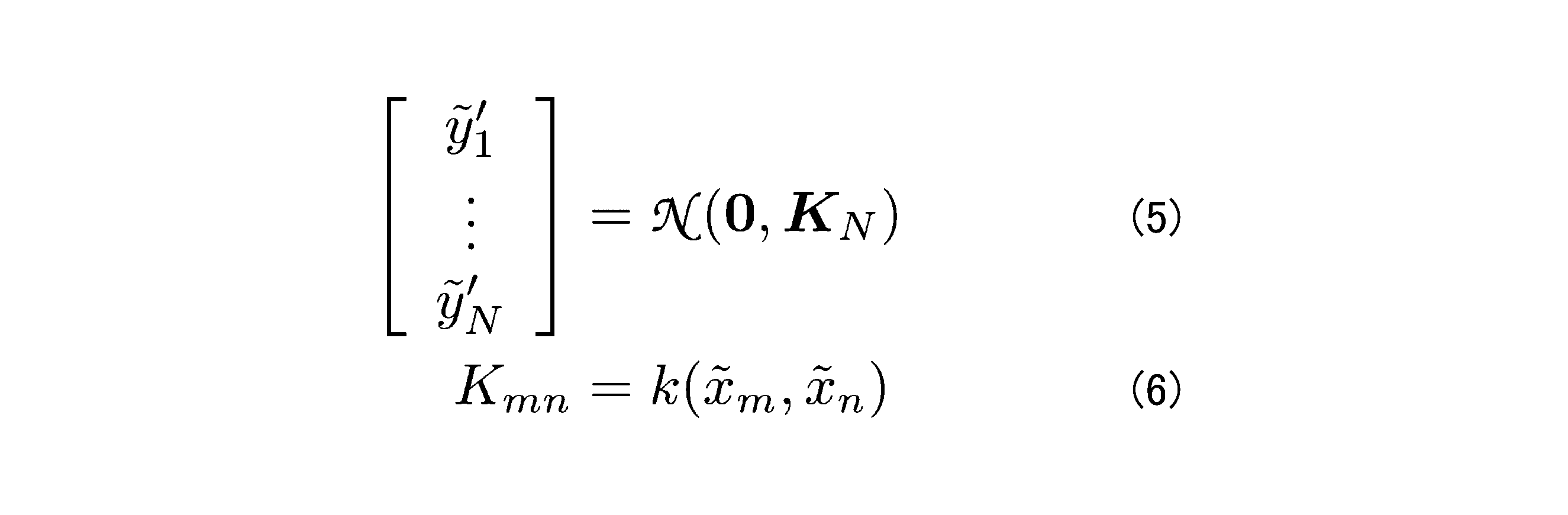
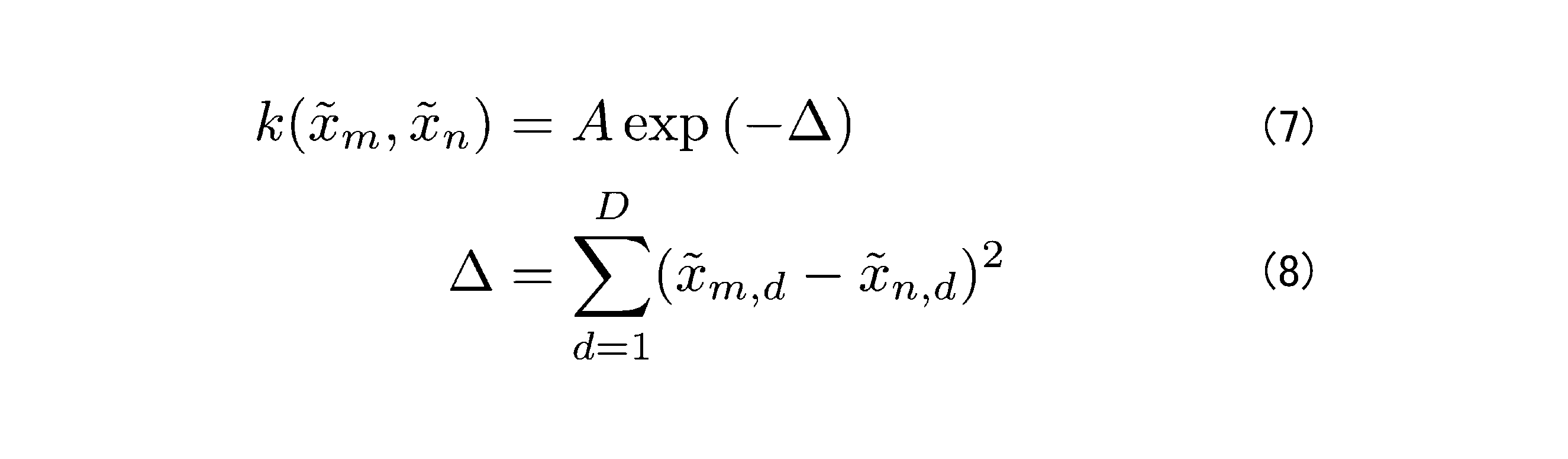
- k ( ⁇ x m , ⁇ x n ) constituting each element of the covariance matrix K N is called a kernel function and represents the similarity between ⁇ x m and ⁇ x n . That is, when ⁇ x m and ⁇ x n have similar values, K mn takes a large value, and as a result, the correlation between ⁇ y m ' and ⁇ y n ' increases (similar values tend to be taken). is a model.
- an RBF (radial basis function) kernel is adopted as the kernel function k.
- kernel function k For RBF kernels with kernel function k, where ⁇ xm and ⁇ xn are D-dimensional vectors, the kernel function k is given by:
- A>0 is a parameter given to the kernel function.
- a kernel function other than the RBF kernel may be employed as the kernel function k.
- the Matern kernel described in Non-Patent Document 2 may be employed when the evaluation value changes sharply with respect to the synthesis condition ⁇ x.
- various kernel functions can be adopted as needed.
- the evaluation value prediction unit 202 uses the above kernel function k( ⁇ , ⁇ ) and D N to calculate ⁇ ( ⁇ x ) and ⁇ 2 ( ⁇ x ) in Equation (4) as follows.
- Synthesis condition search section 203 searches for a synthesis condition ⁇ x that gives a better evaluation value ⁇ y using the distribution of evaluation values predicted by equation (4).
- ⁇ ( ⁇ x) and ⁇ 2 ( ⁇ x) corresponding to it are obtained from equation (9). Therefore, as a measure of the goodness of a certain synthesis condition ⁇ x, the highest evaluation value in trials so far
- p ( ⁇ y) is the probability density function of normal distribution with mean ⁇ ( ⁇ x) and variance ⁇ 2 ( ⁇ x).
- ⁇ ( ⁇ ) and ⁇ ( ⁇ ) are the cumulative density function and probability density function of the standard normal distribution with mean 0 and variance 1, respectively.
- the expected value of the improvement of the evaluation value (Reference 1) is used, but other criteria can be used to improve search efficiency (References 2 and 3). .
- Equation (11) is approximately maximized by increasing the resolution of the grid in the evaluation.
- the search space is first searched and evaluated with a coarse-resolution grid, and then searched and evaluated with a finer-resolution grid in a region having vertices in which the top several points with the highest evaluation results are located. This yields a synthesis condition ⁇ x N+1 that approximately maximizes the expected value of equation (10).
- the storage unit 205 stores the synthesis conditions obtained in previous trials and their evaluation values ⁇ (x n , y n )
- n 1, . . . , N ⁇ .
- the storage unit 205 also stores the normalized synthesis conditions and normalized evaluation values ⁇ ( ⁇ x n , ⁇ y n ′)
- n 1, . . . , N ⁇ .
- the evaluation value input unit 201 inputs the evaluation value yN of the previous trial N (step S101).
- This evaluation value y N is associated with the synthesis condition x N in the previous trial N and stored in the storage unit 205 as (x N , y N ). Note that the synthesis condition x N for the previous trial N has already been stored in the storage unit 205 .
- the evaluation value input unit 201 normalizes the synthesis condition x n according to equation (2) to generate the normalized synthesis condition ⁇ x n , and normalizes the evaluation value y n ′ after conversion processing according to equation (3). y n '.
- These normalized synthesizing conditions and normalized evaluation values ( ⁇ x n , ⁇ y n ') are stored in the storage unit 205 .
- the following steps S104 to S107 are repeatedly performed for untried synthesis conditions ⁇ x in the search space. As described above, first, the following steps S104 to S107 are repeated with a rough grid in the search space as an untried synthesis condition. It is preferred that the following steps S104 to S107 be repeated by increasing the resolution of the grids within the region and using those grids as untried synthesis conditions. Steps S104 to S107 in a certain repetition will be described below.
- the evaluation value prediction unit 202 selects an untried synthesis condition ⁇ x from the search space (step S104).
- the evaluation value prediction unit 202 predicts the evaluation value of the synthesis condition ⁇ x selected in step S104 (step S105). Specifically, the evaluation value prediction unit 202 calculates the average ⁇ ( ⁇ x) and the variance ⁇ 2 ( ⁇ x) that determine the distribution of the evaluation values of the synthesis condition ⁇ x according to Equation (9).
- the synthesis condition searching unit 203 uses the distribution of evaluation values predicted by expression (4) to calculate the expected value of expression (10) (improvement from the highest evaluation value obtained in the N-th trial). expected value) is calculated (step S106).
- the synthesis condition search unit 203 evaluates the expected values obtained in step S106 (for example, sorts the expected values obtained so far in ascending or descending order, specifies the maximum value, etc.). (step S107).
- the synthesis condition output unit 204 performs the inverse normalization process of Equation (12) on the synthesis condition ⁇ x N+1 finally obtained by repeating steps S104 to S107 to generate synthesis condition x N+1. (step S108). Note that this synthesizing condition x N+1 is stored in the storage unit 205 .
- the synthesis condition output unit 204 outputs the synthesis condition x N+1 obtained in step S108 to the substance generation device 20 (step S109).
- the synthesis condition N+1 for the N+1th trial is obtained. Therefore, in the N+1th trial, a sample (substance) is generated by the substance generation device 20 according to the synthesis condition N+1 , and this sample is evaluated by the substance evaluation device 30 to measure the evaluation value y N+1 . By repeating such a trial a predetermined number of times, the synthesis conditions used to generate the sample with the best evaluation value (for example, the maximum evaluation value) are obtained as the synthesis conditions for obtaining the optimum substance. be done.
- the first is an experiment using simulation data (hereinafter referred to as a simulation experiment), in which a two-dimensional synthesis condition search space is given as simulation data.
- the second is an experiment for producing SrRuO 3 by molecular beam epitaxy (hereinafter referred to as SrRuO 3 experiment).
- the search range of the synthesis condition is x ⁇ [-1,1] ⁇ [-1,1]. however,
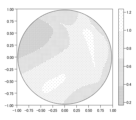
- FIG. 6 shows the evaluation values used in this experiment.
- FIG. 7 Our method represents the synthesis condition generation system 1 according to this embodiment.
- Pad is a conventional method, which treats NaN as an evaluation value of zero.
- the horizontal axis indicates the number of trials to obtain the evaluation value, and the vertical axis indicates the highest evaluation value obtained by the trial excluding NaN (that is, the upper left graph (higher evaluation value with fewer trials) the better.).
- FIG. 8 the horizontal axis indicates the number of trials to obtain the evaluation value, and the vertical axis indicates the maximum evaluation value obtained up to the trial. As shown in FIG. 8, it can be confirmed that the evaluation value continues to improve as the number of trials increases.
- synthesis condition generation system 1 it is possible to automatically search in the synthesis condition space where the substance generation is successful or not, and to discover synthesis conditions with good evaluation values. It can be used for creation, etc.
- synthesis condition generation system 1 it is possible to optimize (maximize or minimize) the evaluation value with fewer trials than the conventional method, reducing the development period / development time of new materials and reducing the cost You can expect the effect of reduction.
- Reference 1 J. Mockus, V. Tiesis, and A. Zilinskas: The application of Bayesian methods for seeking the extremum. Towards Global Optimization 2, 1978.
- Reference 2 N. Srinivas, A. Krause, S. Kakade, and M. Seeger: Gaussian Process Optimization in the Bandit Setting: No Regret and Experimental Design, International Conference on Machine Learning, 2010.
- Reference 3 E. Contal, V. Perchet, and N. Vayatis: Gaussian Process Optimization with Mutual Information, International Conference on Machine Learning, 2014.
- synthesis condition generation system 10 synthesis condition generation device 20 substance generation device 30 substance evaluation device 101 input device 102 display device 103 external I/F 103a recording medium 104 communication I/F 105 RAMs 106 ROMs 107 auxiliary storage device 108 processor 109 bus 201 evaluation value input unit 202 evaluation value prediction unit 203 synthesis condition search unit 204 synthesis condition output unit 205 storage unit
Landscapes
- Engineering & Computer Science (AREA)
- Theoretical Computer Science (AREA)
- Physics & Mathematics (AREA)
- Computing Systems (AREA)
- General Engineering & Computer Science (AREA)
- General Physics & Mathematics (AREA)
- Mathematical Physics (AREA)
- Software Systems (AREA)
- Management, Administration, Business Operations System, And Electronic Commerce (AREA)
Abstract
一実施形態に係る合成条件生成方法は、合成条件に従った物質の生成と前記物質を評価する評価値の測定と前記合成条件の生成とを順に実行する試行における前記合成条件を生成するための合成条件生成方法であって、これまでのN回の試行の中で物質の評価値yn'(n'∈{1,・・・,N})が測定できなかった試行n'が存在する場合、試行n'における評価値yn'を最悪の評価値に置き換える評価値変換手順と、試行n(n=1,・・・,N)における合成条件xn及び評価値ynを用いて、未試行の合成条件xの評価値yを予測する予測手順と、前記未試行の合成条件xの評価値yを予測した結果を用いて、評価値yn(n=1,・・・,N)の最良値よりも良い評価値を取る合成条件を、試行N+1における合成条件xN+1として生成する生成手順と、をコンピュータが実行する。
Description
本発明は、合成条件生成方法、合成条件生成装置及びプログラムに関する。
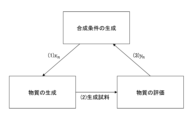
与えられた合成条件(レシピ)に従って生成された物質の評価値を測定する試行を繰り返しながら良い評価値を与える合成条件を探索することが従来から行われている。例えば、図1に示すように、nを試行回数として、(1)合成条件xnを生成し、(2)この合成条件xnに従って試料(物質)を生成し、(3)その試料を評価して評価値ynを測定する、という試行を繰り返しながら良い評価値を与える合成条件を探索することが行われている。
与えられた合成条件に従って薄膜(物質、試料)を生成する手法としては、例えば、分子線エピタキシー法(非特許文献1)等がある。これ以外にも、例えば、スパッタリング法、パルスレーザーアブレーション法、物理蒸着法、化学気相成長法、スピンコート法、原子層堆積法、フローティングゾーン法、フラックス法、チョクラルスキー法等といった薄膜合成・バルク合成法等が挙げられる。また、合成条件に対する評価値が常に得られる問題設定の下で次に試行する合成条件を生成する手法として、ベイズ的最適化等がある(特許文献1、非特許文献2及び3)。なお、合成条件に従って物質が生成され、その物質の用途等に応じて予め設計された評価指標でその物質の評価値を測定するという過程が複雑なため、合成条件と評価値の関係が陽に記述できない状況もあり得るが、ベイズ的最適化では、このような状況においても合成条件を探索できる手法として知られている。
Y. Krockenberger et al. Emerging superconductivity hidden beneath chargetransfer insulators, Scientific Reports 3:2235, 2013.
J. Snoek, H. Larochelle, and R. P. Adams: Practical Bayesian Optimization of Machine Learning Algorithms, Advances in Neural Information Processing Systems 25, pp. 2951-2959, 2012.
Y. K. Wakabayashi et al. Machine-learning-assisted thin-film growth: Bayesian optimization in molecular beam epitaxy of SrRuO3 thin films, APL Materials 7, 101114, 2019.
しかしながら、良い評価値を与える合成条件を探索する従来手法では、評価値が得られない合成条件があり得るという問題点がある。これは、合成条件の探索範囲内のすべての合成条件で安定な物質が生成されるとは限らないためである。また、或る合成条件において、目的とする物質と異なる組成や結晶構造を持つ物質が得られることもあり得るためである。
本発明の一実施形態は、上記の点に鑑みてなされたもので、与えられた評価指標の下で最適な物質が得られる合成条件を生成することを目的とする。
上記目的を達成するため、一実施形態に係る合成条件生成方法は、合成条件に従った物質の生成と前記物質を評価する評価値の測定と前記合成条件の生成とを順に実行する試行における前記合成条件を生成するための合成条件生成方法であって、これまでのN回の試行の中で物質の評価値yn'(n'∈{1,・・・,N})が測定できなかった試行n'が存在する場合、試行n'における評価値yn'を最悪の評価値に置き換える評価値変換手順と、試行n(n=1,・・・,N)における合成条件xn及び評価値ynを用いて、未試行の合成条件xの評価値yを予測する予測手順と、前記未試行の合成条件xの評価値yを予測した結果を用いて、評価値yn(n=1,・・・,N)の最良値よりも良い評価値を取る合成条件を、試行N+1における合成条件xN+1として生成する生成手順と、をコンピュータが実行する。
与えられた評価指標の下で最適な物質が得られる合成条件を生成することができる。
以下、本発明の一実施形態について説明する。以下の実施形態では、与えられた評価指標の下で最適な物質が得られる合成条件を生成することができる合成条件生成システム1について説明する。
<合成条件生成システム1の全体構成>
本実施形態に係る合成条件生成システム1の全体構成例を図2に示す。図2に示すように、本実施形態に係る合成条件生成システム1には、合成条件生成装置10と、物質生成装置20と、物質評価装置30とが含まれる。
本実施形態に係る合成条件生成システム1の全体構成例を図2に示す。図2に示すように、本実施形態に係る合成条件生成システム1には、合成条件生成装置10と、物質生成装置20と、物質評価装置30とが含まれる。
合成条件生成装置10は、試行回数を表すインデックスをnとして、前回の試行までに得られた合成条件(レシピ)とその評価値とを用いて、今回の試行で用いる合成条件を生成する。合成条件とは或る手法により1以上の原料の反応を進めて或る物質を得るための条件(例えば、組成元素の量、反応温度、原料を投入するタイミング等)であり、一般に、ベクトルで表される。一例として、SrRuO3薄膜を生成するタスクでは、合成条件は、(a)Ruの供給量、(b)薄膜を付着させる基板の温度、(c)酸素原子Oを供給するオゾンノズルと基板との間の距離、の3つ要素を持つベクトルで表される。以下、n回目の試行を「試行n」ともいい、試行nで物質の生成に用いられる合成条件を「xn」とする。
物質生成装置20は、合成条件生成装置10により生成された合成条件に従って原料の反応を進めて物質(試料)を生成する。物質生成装置20としては、例えば、分子線エピタキシー法、スパッタリング法、パルスレーザーアブレーション法、物理蒸着法、化学気相成長法、スピンコート法、原子層堆積法、フローティングゾーン法、フラックス法、チョクラルスキー法等といった薄膜合成・バルク合成法等により物質を生成する装置である。一例として、SrRuO3薄膜を生成するタスクでは、分子線エピタキシー法による薄膜生成装置を物質生成装置20として用いることができる。
物質評価装置30は、物質生成装置20により生成された物質(試料)を所定の評価指標により評価した評価値を測定する。なお、評価指標としては、所望の物質とその形状(薄膜、バルク等)に応じた既存の評価指標を用いればよい。一例として、SrRuO3薄膜を生成するタスクでは、薄膜の元素の並びの良さを測る評価指標として残留抵抗比(RRR:Residual Resistivity Ratio)を用いることが考えられる。
以下、評価値は、物質(試料)が安定した物質であるか否か又は所望の物質であるか否かを表す2値情報とその物質の良さを表すスカラ値とで構成されるものとし、物質が安定した物質又は所望の物質である場合はスカラ値、物質が安定した物質又は所望の物質でない場合はNaNを取るものとする。例えば、電気抵抗の大きい絶縁体を得たい場合には、評価値は、所望の試料が得られた場合はその電気抵抗値、そうでなかった場合はNaNを取る。なお、NaNは非数(Not a Number)を表す。
また、以下、合成条件xnに従って物質生成装置20により生成された物質に対する評価値を「yn」として、評価値が大きいほど良い評価であるものとする。なお、評価値が小さいほど良い評価である場合には、例えば、評価値の符号を反転させることで、本実施形態を同様に適用することが可能である。
ここで、本実施形態に係る合成条件生成システム1は、これまでの試行で得られた合成条件とその評価値{(xn,yn)|n=1,・・・,N}(ただし、Nはこれまでの試行回数)を用いて合成条件生成装置10が合成条件xN+1を生成し、この合成条件xN+1に従って物質生成装置20が物質(試料)を生成し、この試料を物質評価装置30が評価して評価値yN+1を測定する、という試行を繰り返しながら良い評価値を与える合成条件を探索する。以下では、物質生成装置20及び物質評価装置30をブラックボックスとして扱い、これまでの試行で得られた合成条件とその評価値{(xn,yn)|n=1,・・・,N}を用いて、N+1回目の試行でより良い評価値を与える合成条件xN+1を合成条件生成装置10が生成する場合について説明する。これにより、この試行が繰り返されることで、最適な物質が得られる合成条件を生成することが可能となる。
ただし、図2に示す合成条件生成システム1の全体構成は一例であって、これに限られるものではない。例えば、合成条件生成装置10と、物質生成装置20及び物質評価装置30のうちの2以上の装置が同一の装置で実現されていてもよい。
<合成条件生成装置10のハードウェア構成>
本実施形態に係る合成条件生成装置10のハードウェア構成例を図3に示す。図3に示すように、本実施形態に係る合成条件生成装置10は、入力装置101と、表示装置102と、外部I/F103と、通信I/F104と、RAM(Random Access Memory)105と、ROM(Read Only Memory)106と、補助記憶装置107と、プロセッサ108とを有する。これらの各ハードウェアは、それぞれがバス109を介して通信可能に接続されている。
本実施形態に係る合成条件生成装置10のハードウェア構成例を図3に示す。図3に示すように、本実施形態に係る合成条件生成装置10は、入力装置101と、表示装置102と、外部I/F103と、通信I/F104と、RAM(Random Access Memory)105と、ROM(Read Only Memory)106と、補助記憶装置107と、プロセッサ108とを有する。これらの各ハードウェアは、それぞれがバス109を介して通信可能に接続されている。
入力装置101は、例えば、キーボード、マウス、タッチパネル等である。表示装置102は、例えば、ディスプレイ、表示パネル等である。なお、合成条件生成装置10は、例えば、入力装置101及び表示装置102のうちの少なくとも一方を有していなくてもよい。
外部I/F103は、記録媒体103a等の外部装置とのインタフェースである。合成条件生成装置10は、外部I/F103を介して、記録媒体103aの読み取りや書き込み等を行うことができる。記録媒体103aとしては、例えば、フレキシブルディスク、CD(Compact Disc)、DVD(Digital Versatile Disk)、SDメモリカード(Secure Digital memory card)、USB(Universal Serial Bus)メモリカード等がある。
通信I/F104は、合成条件生成装置10を通信ネットワークに接続するためのインタフェースである。RAM105は、プログラムやデータを一時保持する揮発性の半導体メモリ(記憶装置)である。ROM106は、電源を切ってもプログラムやデータを保持することができる不揮発性の半導体メモリ(記憶装置)である。補助記憶装置107は、例えば、HDD(Hard Disk Drive)やSSD(Solid State Drive)等のストレージ装置(記憶装置)である。プロセッサ108は、例えば、CPU(Central Processing Unit)やGPU(Graphics Processing Unit)等の演算装置である。
本実施形態に係る合成条件生成装置10は、図3に示すハードウェア構成を有することにより、後述する合成条件生成処理を実現することができる。なお、図3に示すハードウェア構成は一例であって、合成条件生成装置10のハードウェア構成はこれに限られるものではない。例えば、合成条件生成装置10は、複数の補助記憶装置107や複数のプロセッサ108を有していてもよいし、図示したハードウェア以外の様々なハードウェアを有していてもよい。
<合成条件生成装置10の機能構成>
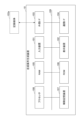
本実施形態に係る合成条件生成装置10の機能構成例を図4に示す。図4に示すように、本実施形態に係る合成条件生成装置10は、評価値入力部201と、評価値予測部202と、合成条件探索部203と、合成条件出力部204とを有する。これら各部は、例えば、合成条件生成装置10にインストールされた1以上のプログラムが、プロセッサ108等に実行させる処理により実現される。また、本実施形態に係る合成条件生成装置10は、記憶部205を有する。記憶部205は、例えば、補助記憶装置107等により実現される。なお、記憶部205は、例えば、合成条件生成装置10と通信ネットワークを介して接続されるデータベースサーバ等の記憶装置により実現されてもよい。
本実施形態に係る合成条件生成装置10の機能構成例を図4に示す。図4に示すように、本実施形態に係る合成条件生成装置10は、評価値入力部201と、評価値予測部202と、合成条件探索部203と、合成条件出力部204とを有する。これら各部は、例えば、合成条件生成装置10にインストールされた1以上のプログラムが、プロセッサ108等に実行させる処理により実現される。また、本実施形態に係る合成条件生成装置10は、記憶部205を有する。記憶部205は、例えば、補助記憶装置107等により実現される。なお、記憶部205は、例えば、合成条件生成装置10と通信ネットワークを介して接続されるデータベースサーバ等の記憶装置により実現されてもよい。
評価値入力部201は、試行N(前回の試行)で物質評価装置30により評価された評価値yNを入力する。なお、この評価値yNは記憶部205に記憶される。
ここで、各評価値yn(n=1,・・・,N)はNaNを取り得るため、yn=NaNのときの変換処理が必要である。また、合成条件xnを構成する各要素のスケールの違いや、評価値ynそのもののスケールによって、評価値予測部202が評価値を予測する際の予測精度が悪化する可能性がある。このため、予測精度を確保し、合成条件を効率よく探索するためには、合成条件xnとその評価値ynの正規化処理が必要である。そこで、評価値入力部201は、評価値yNを入力すると、各n=1,・・・,Nに対して、以下の変換処理により評価値ynをyn'にそれぞれ変換すると共に、以下の正規化処理により合成条件xnとyn'をそれぞれ正規化する。
・変換処理
評価値入力部201は、各評価値yn(n=1,・・・,N)を以下の式(1)により変換する。
評価値入力部201は、各評価値yn(n=1,・・・,N)を以下の式(1)により変換する。



・正規化処理
以下、合成条件xnはD個の要素で構成されるベクトルであるものとして、xn=[xn,1,・・・,xn,D]Τとする。ここで、Τはベクトルや行列の転置を表す。
以下、合成条件xnはD個の要素で構成されるベクトルであるものとして、xn=[xn,1,・・・,xn,D]Τとする。ここで、Τはベクトルや行列の転置を表す。
D個の要素xn,d(d=1,・・・,D)は、或る手法により或る物質を得るための条件を表している。一例として、SrRuO3薄膜を生成するタスクでは、xn,1はRuの供給量、xn,2は薄膜を付着させる基板の温度、xn,3は酸素原子Oを供給するオゾンノズルと基板との間の距離をそれぞれ表している。
d番目の要素xn,dの探索範囲の下限と上限をそれぞれ


このとき、評価値入力部201は、合成条件xn=[xn,1,・・・,xn,D]Τを正規化した正規化合成条件





なお、以下、明細書のテキスト中では、合成条件xnを正規化した正規化合成条件を「~xn」、変換処理後の評価値yn'を正規化した正規化評価値を「~yn'」と表記する。また、誤解の恐れがないときは、正規化合成条件を単に「合成条件」ともいい、正規化評価値を単に「評価値」ともいう。更に、正規化合成条件を表す変数を「~x」、正規化評価値を表す変数を「~y」とする。
評価値予測部202は、評価値入力部201によって求められた正規化合成条件と正規化評価値DN:={(~xn,~yn')|n=1,・・・,N}を用いて、これまでに試行したことがない合成条件~xがとる評価値~yを予測する。ここで、以下では、~yを平均μ(~x)、分散σ2(~x)の正規分布に従う確率変数

ガウス過程では、~y1',・・・,~yN'の同時分布を以下の共分散行列KNを持つ正規分布としてモデル化する。
カーネル関数kであるRBFカーネルである場合、~xmと~xnがD次元ベクトルであるとき、これらに対して、カーネル関数kは、以下で表される。
なお、カーネル関数kとしてRBFカーネル以外の他のカーネル関数を採用してもよい。例えば、合成条件~xに対する評価値の変化が急峻な場合等には、非特許文献2に記載されているMaternカーネルを採用してもよい。これ以外にも、必要に応じて様々なカーネル関数を採用することができる。
このとき、評価値予測部202は、上記のカーネル関数k(・,・)とDNを用いて、以下により式(4)のμ(~x)、σ2(~x)を計算する。

合成条件探索部203は、式(4)で予測される評価値の分布を用いて、より良い評価値~yを与える合成条件~xを探索する。ここで、式(9)により、或る合成条件~xが与えられると、それに対応するμ(~x)、σ2(~x)が求まる。そこで、或る合成条件~xの良さの尺度として、これまでの試行における評価値の最高値


なお、式(10)に示す例では評価値の改善の期待値(参考文献1)を用いたが、他の基準を用いても探索の効率化を図ることができる(参考文献2及び3)。
これにより、良い合成条件~xを探索する問題は、式(10)を大きくする合成条件~xを探索する問題

ここで、合成条件~xの探索空間の次元が大きい場合、式(10)を評価する点の数が、次元の指数関数として増加してしまう。そこで、式(10)の評価回数を小さくする工夫として、まず粗いグリッドで式(10)を評価した後、改善の期待値が高い上位数個の点を頂点に持つ領域を選択し、その領域内においてグリッドの解像度を上げて評価することで、近似的に式(11)の最大化を行う。言い換えれば、まず探索空間内を粗い解像度のグリッドで探索及び評価した後、その評価結果が高い上位数個の点を頂点に持つ領域内でより細かい解像度のグリッドで探索及び評価する。
これにより、式(10)の期待値を近似的に最大化する合成条件~xN+1が得られる。
これにより、式(10)の期待値を近似的に最大化する合成条件~xN+1が得られる。
合成条件出力部204は、合成条件探索部203により探索された合成条件~xN+1の各要素に対して、以下の式(12)に示す逆正規化処理(正規化を元に戻す処理)を行って、xN+1=[xN+1,1,・・・,xN+1,D]Τを出力する。

記憶部205は、これまでの試行で得られた合成条件とその評価値{(xn,yn)|n=1,・・・,N}を記憶する。また、記憶部205は、それらの正規化合成条件と正規化評価値{(~xn,~yn')|n=1,・・・,N}を記憶する。
<合成条件生成処理>
次に、本実施形態に係る合成条件生成処理について、図5を参照しながら説明する。なお、以下では、N回の試行が行われた下で、N+1回目の試行でより良い評価値を与える合成条件xN+1を生成する場合について説明する。
次に、本実施形態に係る合成条件生成処理について、図5を参照しながら説明する。なお、以下では、N回の試行が行われた下で、N+1回目の試行でより良い評価値を与える合成条件xN+1を生成する場合について説明する。
まず、評価値入力部201は、前回の試行Nの評価値yNを入力する(ステップS101)。この評価値yNは前回の試行Nにおける合成条件xNと対応付けて(xN,yN)として記憶部205に記憶される。なお、前回の試行Nにおける合成条件xNは記憶部205に既に記憶されていることに留意されたい。
次に、評価値入力部201は、これまでの評価値yn(n=1,・・・,N)を式(1)の変換処理によりyn'にそれぞれ変換する(ステップS102)。
次に、評価値入力部201は、これまでの合成条件xn(n=1,・・・,N)と変換処理後の評価値yn'(n=1,・・・,N)を正規化処理によりそれぞれ正規化する(ステップS103)。
すなわち、評価値入力部201は、式(2)により合成条件xnを正規化して正規化合成条件~xnを生成すると共に、式(3)により変換処理後の評価値yn'を正規化した正規化評価値~yn'を生成する。これらの正規化合成条件と正規化評価値(~xn,~yn')は記憶部205に記憶される。
以下のステップS104~ステップS107は、探索空間内の未試行の合成条件~xに対して繰り返し実行される。なお、上述したように、まず探索空間内の粗いグリッドを未試行の合成条件として以下のステップS104~ステップS107を繰り返した後、改善の期待値が高い上位数個の点を頂点に持つ領域を選択し、その領域内においてグリッドの解像度を上げてそれらのグリッドを未試行の合成条件として以下のステップS104~ステップS107を繰り返すことが好ましい。以下では、或る繰り返しにおけるステップS104~ステップS107について説明する。
評価値予測部202は、探索空間内から未試行の合成条件~xを選択する(ステップS104)。
次に、評価値予測部202は、上記のステップS104で選択した合成条件~xの評価値を予測する(ステップS105)。具体的には、評価値予測部202は、合成条件~xの評価値の分布を決定する平均μ(~x)、分散σ2(~x)を式(9)により計算する。
次に、合成条件探索部203は、式(4)で予測される評価値の分布を用いて、式(10)の期待値(N回目までの試行で得られた最高評価値からの改善の期待値)を計算する(ステップS106)。
そして、合成条件探索部203は、上記のステップS106で得られた期待値を評価(例えば、これまでに得られた期待値を昇順又は降順にソートしたり、最大値を特定したりする等)する(ステップS107)。
以上のステップS104~ステップS107が繰り返されることで、式(11)に示す合成条件~xN+1が近似的に得られる。
合成条件出力部204は、上記のステップS104~ステップS107の繰り返しで最終的に得られた合成条件~xN+1に対して式(12)の逆正規化処理を行って、合成条件xN+1を生成する(ステップS108)。なお、この合成条件xN+1は記憶部205に記憶される。
そして、合成条件出力部204は、上記のステップS108で得られた合成条件xN+1を物質生成装置20に出力する(ステップS109)。
以上により、N+1回目の試行の合成条件N+1が得られる。したがってN+1目の試行では、この合成条件N+1に従って物質生成装置20で試料(物質)が生成され、この試料が物質評価装置30で評価されて評価値yN+1が測定される。このような試行が所定の回数繰り返されることで、最も良い評価値(例えば、最大の評価値)が測定された試料の生成に用いられた合成条件が、最適な物質が得られる合成条件として得られる。
<実験結果>
以下、本実施形態に係る合成条件生成システム1による2種類の実験結果について説明する。1つ目はシミュレーションデータを用いた実験(以下、シミュレーション実験という。)であり、2次元の合成条件の探索空間がシミュレーションデータとして与えられた場合である。2つ目はSrRuO3を分子線エピタキシー法で生成する実験(以下、SrRuO3実験という。)である。
以下、本実施形態に係る合成条件生成システム1による2種類の実験結果について説明する。1つ目はシミュレーションデータを用いた実験(以下、シミュレーション実験という。)であり、2次元の合成条件の探索空間がシミュレーションデータとして与えられた場合である。2つ目はSrRuO3を分子線エピタキシー法で生成する実験(以下、SrRuO3実験という。)である。
・シミュレーション実験
本実験では、以下の式(13)で表される評価値を用いた。
本実験では、以下の式(13)で表される評価値を用いた。

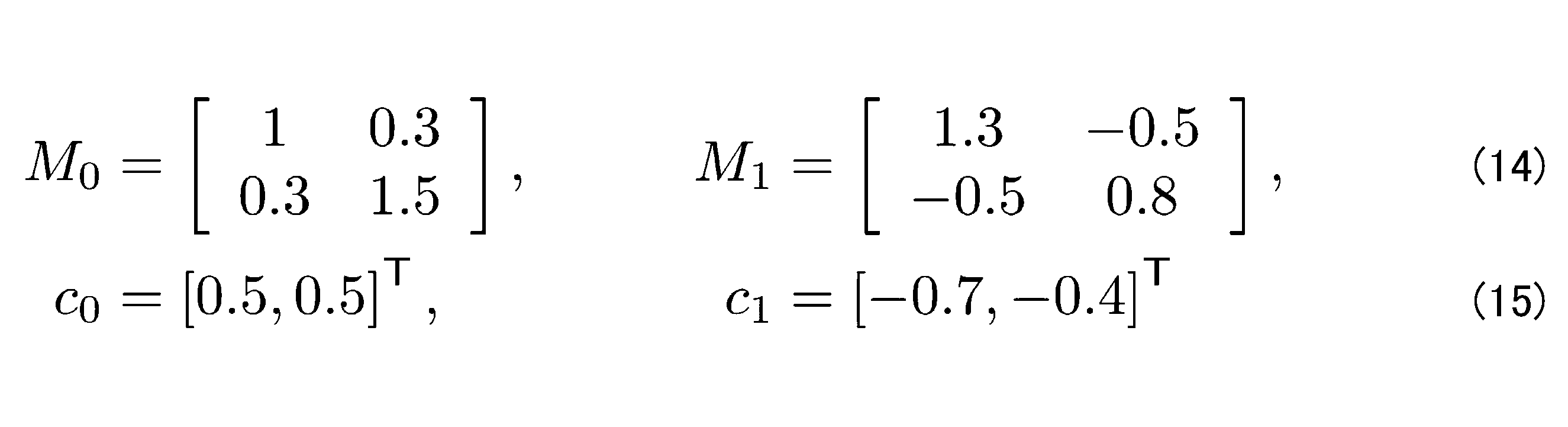
上記の評価値はx≒[0.48,0.52]Τ付近でy≒1.24と最大となる。
合成条件の探索範囲はx∈[-1,1]×[-1,1]である。ただし、

本実験の結果を図7に示す。図7において、Our methodが本実施形態に係る合成条件生成システム1を表す。padは従来手法であり、NaNを評価値0として扱う手法である。図7においては、横軸が評価値を得る試行回数、縦軸がその試行までに得たNaNを除く最高評価値を示している(すなわち、グラフが左上(より少ない試行でより高い評価値)にあるほど良い。)。
図7に示すように、Our methodでは15回程度の試行回数で評価値が1.20を超えた一方で、padでは試行回数が30回を超えても評価値が1.20未満である。このため、Our methodでは、従来手法よりも、より少ない試行回数でより良い評価値が得られていることがわかる。
・SrRuO3実験
合成条件の各要素とその探索範囲を以下の表1に示す。
合成条件の各要素とその探索範囲を以下の表1に示す。

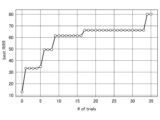
本実験の結果を図8に示す。図8において、横軸が評価値を得る試行回数、縦軸がその試行までに得た最高評価値を示している。図8に示すように、試行回数の増加に応じて継続した評価値の改善が確認できる。
<まとめ>
以上のように、本実施形態に係る合成条件生成システム1では、物質生成に成否のある合成条件空間において自動的に探索を行って評価値の良い合成条件を発見できるため、例えば、新材料の創出等に活用することができる。また、本実施形態に係る合成条件生成システム1では、従来手法よりも少ない試行回数で評価値の最適化(最大化又は最小化)が可能となり、新材料の開発期間・開発時間の削減やコスト削減といった効果が期待できる。
以上のように、本実施形態に係る合成条件生成システム1では、物質生成に成否のある合成条件空間において自動的に探索を行って評価値の良い合成条件を発見できるため、例えば、新材料の創出等に活用することができる。また、本実施形態に係る合成条件生成システム1では、従来手法よりも少ない試行回数で評価値の最適化(最大化又は最小化)が可能となり、新材料の開発期間・開発時間の削減やコスト削減といった効果が期待できる。
本発明は、具体的に開示された上記の実施形態に限定されるものではなく、請求の範囲の記載から逸脱することなく、種々の変形や変更、既知の技術との組み合わせ等が可能である。
[参考文献]
参考文献1:J. Mockus, V. Tiesis, and A. Zilinskas: The application of Bayesian methods for seeking the extremum. Towards Global Optimization 2, 1978.
参考文献2:N. Srinivas, A. Krause, S. Kakade, and M. Seeger: Gaussian Process Optimization in the Bandit Setting: No Regret and Experimental Design, International Conference on Machine Learning, 2010.
参考文献3:E. Contal, V. Perchet, and N. Vayatis: Gaussian Process Optimization with Mutual Information, International Conference on Machine Learning, 2014.
参考文献1:J. Mockus, V. Tiesis, and A. Zilinskas: The application of Bayesian methods for seeking the extremum. Towards Global Optimization 2, 1978.
参考文献2:N. Srinivas, A. Krause, S. Kakade, and M. Seeger: Gaussian Process Optimization in the Bandit Setting: No Regret and Experimental Design, International Conference on Machine Learning, 2010.
参考文献3:E. Contal, V. Perchet, and N. Vayatis: Gaussian Process Optimization with Mutual Information, International Conference on Machine Learning, 2014.
1 合成条件生成システム
10 合成条件生成装置
20 物質生成装置
30 物質評価装置
101 入力装置
102 表示装置
103 外部I/F
103a 記録媒体
104 通信I/F
105 RAM
106 ROM
107 補助記憶装置
108 プロセッサ
109 バス
201 評価値入力部
202 評価値予測部
203 合成条件探索部
204 合成条件出力部
205 記憶部
10 合成条件生成装置
20 物質生成装置
30 物質評価装置
101 入力装置
102 表示装置
103 外部I/F
103a 記録媒体
104 通信I/F
105 RAM
106 ROM
107 補助記憶装置
108 プロセッサ
109 バス
201 評価値入力部
202 評価値予測部
203 合成条件探索部
204 合成条件出力部
205 記憶部
Claims (7)
- 合成条件に従った物質の生成と前記物質を評価する評価値の測定と前記合成条件の生成とを順に実行する試行における前記合成条件を生成するための合成条件生成方法であって、
これまでのN回の試行の中で物質の評価値yn'(n'∈{1,・・・,N})が測定できなかった試行n'が存在する場合、試行n'における評価値yn'を最悪の評価値に置き換える評価値変換手順と、
試行n(n=1,・・・,N)における合成条件xn及び評価値ynを用いて、未試行の合成条件xの評価値yを予測する予測手順と、
前記未試行の合成条件xの評価値yを予測した結果を用いて、評価値yn(n=1,・・・,N)の最良値よりも良い評価値を取る合成条件を、試行N+1における合成条件xN+1として生成する生成手順と、
をコンピュータが実行する合成条件生成方法。 - 前記予測手順は、
試行n(n=1,・・・,N)における合成条件xn及び評価値ynを用いて、前記未試行の合成条件xに依存する平均μ(x)及び分散σ2(x)を前記予測の結果として計算し、
前記生成手順は、
前記平均μ(x)及び分散σ2(x)を用いて、前記未試行の合成条件xの評価値yが前記最良値よりも良い評価値を取る期待値を計算し、前記期待値が最大となる未試行の合成条件を前記合成条件xN+1として生成する、請求項1に記載の合成条件生成方法。 - 前記予測手順は、
合成条件の探索空間内における所定の第1の解像度のグリッド点から未試行の合成条件xを選択し、選択した前記未試行の合成条件の評価値yを予測し、
前記第1の解像度のグリッド点から前記未試行の合成条件xがすべて選択された後は、前記期待値が高い順に所定の個数の前記未試行の合成条件xを選択し、選択した前記未試行の合成条件xを頂点に持つ領域内において、前記第1の解像度よりも高い第2の解像度のグリッド点から未試行の合成条件xを選択し、選択した前記未試行の合成条件の評価値yを予測する、請求項2に記載の合成条件生成方法。 - 前記合成条件生成方法には、
試行Nにおける合成条件xNと前記評価値yNとを正規化する正規化手順が更に含まれ、
前記予測手順は、
正規化後の合成条件xn及び評価値ynを用いて、前記未試行の合成条件xの評価値yを予測する、請求項1乃至3の何れか一項に記載の合成条件生成方法。 - 前記評価値変換手順は、
試行n(n=1,・・・,N)におけるすべての評価値yn(n=1,・・・,N)が測定できなかった場合、yN=0とする、請求項1乃至4の何れか一項に記載の合成条件生成方法。 - 合成条件に従った物質の生成と前記物質を評価する評価値の測定と前記合成条件の生成とを順に実行する試行における前記合成条件を生成するための合成条件生成装置であって、
これまでのN回の試行の中で物質の評価値yn'(n'∈{1,・・・,N})が測定できなかった試行n'が存在する場合、試行n'における評価値yn'を最悪の評価値に置き換える評価値変換部と、
試行n(n=1,・・・,N)における合成条件xn及び評価値ynを用いて、未試行の合成条件xの評価値yを予測するように構成されている予測部と、
前記未試行の合成条件xの評価値yを予測した結果を用いて、評価値yn(n=1,・・・,N)の最良値よりも良い評価値を取る合成条件を、試行N+1における合成条件xN+1として生成するように構成されている生成部と、
を有する合成条件生成装置。 - コンピュータに、請求項1乃至5の何れか一項に記載の合成条件生成方法を実行させるためのプログラム。
Priority Applications (2)
| Application Number | Priority Date | Filing Date | Title |
|---|---|---|---|
| PCT/JP2022/007265 WO2023162004A1 (ja) | 2022-02-22 | 2022-02-22 | 合成条件生成方法、合成条件生成装置及びプログラム |
| JP2024502259A JP7666727B2 (ja) | 2022-02-22 | 2022-02-22 | 合成条件生成方法、合成条件生成装置及びプログラム |
Applications Claiming Priority (1)
| Application Number | Priority Date | Filing Date | Title |
|---|---|---|---|
| PCT/JP2022/007265 WO2023162004A1 (ja) | 2022-02-22 | 2022-02-22 | 合成条件生成方法、合成条件生成装置及びプログラム |
Publications (1)
| Publication Number | Publication Date |
|---|---|
| WO2023162004A1 true WO2023162004A1 (ja) | 2023-08-31 |
Family
ID=87765226
Family Applications (1)
| Application Number | Title | Priority Date | Filing Date |
|---|---|---|---|
| PCT/JP2022/007265 Ceased WO2023162004A1 (ja) | 2022-02-22 | 2022-02-22 | 合成条件生成方法、合成条件生成装置及びプログラム |
Country Status (2)
| Country | Link |
|---|---|
| JP (1) | JP7666727B2 (ja) |
| WO (1) | WO2023162004A1 (ja) |
Citations (2)
| Publication number | Priority date | Publication date | Assignee | Title |
|---|---|---|---|---|
| JP2020027370A (ja) * | 2018-08-09 | 2020-02-20 | 株式会社東芝 | 最適化装置、シミュレーションシステム及び最適化方法 |
| JP2020187642A (ja) * | 2019-05-16 | 2020-11-19 | 富士通株式会社 | 最適化装置、最適化システム、最適化方法および最適化プログラム |
-
2022
- 2022-02-22 JP JP2024502259A patent/JP7666727B2/ja active Active
- 2022-02-22 WO PCT/JP2022/007265 patent/WO2023162004A1/ja not_active Ceased
Patent Citations (2)
| Publication number | Priority date | Publication date | Assignee | Title |
|---|---|---|---|---|
| JP2020027370A (ja) * | 2018-08-09 | 2020-02-20 | 株式会社東芝 | 最適化装置、シミュレーションシステム及び最適化方法 |
| JP2020187642A (ja) * | 2019-05-16 | 2020-11-19 | 富士通株式会社 | 最適化装置、最適化システム、最適化方法および最適化プログラム |
Non-Patent Citations (1)
| Title |
|---|
| YUKI K. WAKABAYASHI; TAKUMA OTSUKA; YOSHIHARU KROCKENBERGER; HIROSHI SAWADA; YOSHITAKA TANIYASU; HIDEKI YAMAMOTO: "Machine-learning-assisted thin-film growth: Bayesian optimization in molecular beam epitaxy of SrRuO3 thin films", ARXIV.ORG, CORNELL UNIVERSITY LIBRARY, 201 OLIN LIBRARY CORNELL UNIVERSITY ITHACA, NY 14853, 2 August 2019 (2019-08-02), 201 Olin Library Cornell University Ithaca, NY 14853 , XP081454340 * |
Also Published As
| Publication number | Publication date |
|---|---|
| JPWO2023162004A1 (ja) | 2023-08-31 |
| JP7666727B2 (ja) | 2025-04-22 |
Similar Documents
| Publication | Publication Date | Title |
|---|---|---|
| Tong et al. | Combining machine learning potential and structure prediction for accelerated materials design and discovery | |
| Chandrashekar et al. | A survey on feature selection methods | |
| Shreem et al. | Hybrid feature selection algorithm using symmetrical uncertainty and a harmony search algorithm | |
| Qi et al. | Feature selection and multiple kernel boosting framework based on PSO with mutation mechanism for hyperspectral classification | |
| US20200294630A1 (en) | Systems and Methods for Determining Molecular Structures with Molecular-Orbital-Based Features | |
| Lindsey et al. | Active learning for robust, high-complexity reactive atomistic simulations | |
| Butler et al. | Machine learning in materials science | |
| Schoeberl et al. | Predictive collective variable discovery with deep Bayesian models | |
| Rosyid et al. | Implementation of quantum machine learning in predicting corrosion inhibition efficiency of expired drugs | |
| Song et al. | PhysNet meets CHARMM: A framework for routine machine learning/molecular mechanics simulations | |
| Wang et al. | Machine-learning adsorption on binary alloy surfaces for catalyst screening | |
| Luo et al. | A set of moment tensor potentials for zirconium with increasing complexity | |
| Calvi et al. | Support tensor machine for financial forecasting | |
| Tripathy et al. | A Study of Algorithm Selection in Data Mining using Meta-Learning. | |
| Akrom et al. | Quantum machine learning for ABO3 perovskite structure prediction | |
| Tang et al. | Feature selection for microarray data using least squares svm and particle swarm optimization | |
| Bian et al. | A review on sample subset selection methods for multivariate modelling | |
| Thomas-Mitchell et al. | Calibration of uncertainty in the active learning of machine learning force fields | |
| Guo et al. | Benchmarking of quantum fidelity kernels for Gaussian process regression | |
| JP7666727B2 (ja) | 合成条件生成方法、合成条件生成装置及びプログラム | |
| Liu et al. | Ensemble component selection for improving ICA based microarray data prediction models | |
| Wu et al. | Evaluation of feature selection methods using bagging and boosting ensemble techniques on high throughput biological data | |
| Kinoshita et al. | Space-Filling Latin Hypercube Design for Efficient Bayesian Optimization With Application to Semiconductor Development | |
| WO2024166378A1 (ja) | 物質合成装置、合成条件生成方法、及びプログラム | |
| WO2023204029A1 (ja) | 情報処理方法、情報処理システム、及びプログラム |
Legal Events
| Date | Code | Title | Description |
|---|---|---|---|
| 121 | Ep: the epo has been informed by wipo that ep was designated in this application |
Ref document number: 22928535 Country of ref document: EP Kind code of ref document: A1 |
|
| ENP | Entry into the national phase |
Ref document number: 2024502259 Country of ref document: JP Kind code of ref document: A |
|
| NENP | Non-entry into the national phase |
Ref country code: DE |
|
| 122 | Ep: pct application non-entry in european phase |
Ref document number: 22928535 Country of ref document: EP Kind code of ref document: A1 |