WO2023153226A1 - ハンガー - Google Patents
ハンガー Download PDFInfo
- Publication number
- WO2023153226A1 WO2023153226A1 PCT/JP2023/002446 JP2023002446W WO2023153226A1 WO 2023153226 A1 WO2023153226 A1 WO 2023153226A1 JP 2023002446 W JP2023002446 W JP 2023002446W WO 2023153226 A1 WO2023153226 A1 WO 2023153226A1
- Authority
- WO
- WIPO (PCT)
- Prior art keywords
- folding line
- hook
- shoulder
- hanger
- folding
- Prior art date
- Legal status (The legal status is an assumption and is not a legal conclusion. Google has not performed a legal analysis and makes no representation as to the accuracy of the status listed.)
- Ceased
Links
Images








Classifications
-
- A—HUMAN NECESSITIES
- A47—FURNITURE; DOMESTIC ARTICLES OR APPLIANCES; COFFEE MILLS; SPICE MILLS; SUCTION CLEANERS IN GENERAL
- A47G—HOUSEHOLD OR TABLE EQUIPMENT
- A47G25/00—Household implements used in connection with wearing apparel; Dress, hat or umbrella holders
- A47G25/14—Clothing hangers, e.g. suit hangers
- A47G25/28—Hangers characterised by their shape
- A47G25/36—Hangers characterised by their shape characterised by the selection of the material, e.g. paper, board, plastics, glass
-
- A—HUMAN NECESSITIES
- A47—FURNITURE; DOMESTIC ARTICLES OR APPLIANCES; COFFEE MILLS; SPICE MILLS; SUCTION CLEANERS IN GENERAL
- A47G—HOUSEHOLD OR TABLE EQUIPMENT
- A47G25/00—Household implements used in connection with wearing apparel; Dress, hat or umbrella holders
- A47G25/14—Clothing hangers, e.g. suit hangers
- A47G25/28—Hangers characterised by their shape
- A47G25/36—Hangers characterised by their shape characterised by the selection of the material, e.g. paper, board, plastics, glass
- A47G25/38—Hook mountings therefor
Definitions
- the present invention relates to hangers.
- Hard plastic hangers are widely used to display and sell clothes such as jackets, trousers, and underwear, and to store and store clothes at dry cleaning shops and at home.
- clothes such as jackets, trousers, and underwear
- clothes at dry cleaning shops and at home.
- lodging facilities such as hotels and ryokans
- hangers made of hard plastic or wood for use by guests (see Patent Document 1 below, Patent Reference 2).
- Hangers made of hard plastic are formed by making molds and injection molding, so there are many hangers that are thick and have structures that are difficult to fold or disassemble, making storage and transportation difficult. there were.
- Patent Document 3 Patent Document 4, Patent Document 5, etc. below propose techniques for using paper hangers instead of plastic hangers.
- the hanger disclosed in Patent Document 3 has a hook portion and a hanger portion that are separated from each other so that each sheet-like part can be disassembled. It is easier to store and transport than a plastic hanger that is integrally molded.
- the hangers disclosed in Patent Documents 4 and 5 have a three-dimensional shape obtained by folding and assembling a single sheet material, and the clothes are less likely to wrinkle or lose their shape during use.
- the hanger of Patent Document 3 requires complicated operations of assembling and disassembling multiple members during use and transportation. In order to eliminate the bulkiness, the hook part and the hanger part are separated, and only one sheet is used. , it is difficult to say that it is sufficiently compact.
- the hangers disclosed in Patent Documents 4 and 5 which are made of sheet material such as paper, are excellent in storability and transportability in the state of the sheet material before assembly, but once assembled, they cannot be stored. It is difficult to return to a form suitable for easy carrying.
- the hanger of Patent Document 5 has a valley-folded portion and a mountain-folded portion on one side of the sheet-like body before assembly, and the manufacturing process is complicated because it is necessary to form creases and the like from both sides of the sheet material. There is a problem that
- the conventional paper hangers disclosed in Patent Documents 3 to 5 are all sheet-shaped thin paper before assembly, compared to integrally molded plastic hangers. It remains excellent in storability and transportability. Therefore, for example, a high degree of space saving when folded is not realized so that a user can achieve portability suitable for carrying when traveling.
- Hangers are expected to be used in various places and situations such as watching sports, outdoor leisure activities such as camping, in buses and trains during travel and sightseeing, in offices and schools, etc. Hangers are often missing when needed. Therefore, there is a demand for a hanger that can be folded compactly into a size that fits in a handbag or the like, is easy to carry, and can be easily assembled.
- the main object of the present invention is to provide a hanger which can be selected between a three-dimensional use form and a folded form with excellent portability, and which can be easily manufactured from a non-plastic sheet material. It is in.
- the first means to solve the above problem is A hanger for clothes, Having a hanger body for hanging clothes and a hook for hanging on a support,
- the hanger main body is composed of a first frame main body and a second frame main body,
- the hook portion is composed of a first hook portion forming piece and a second hook portion forming piece,
- the first frame main body portion, the second frame main body portion, the first hook portion forming piece and the second hook portion forming piece are composed of a single sheet material,
- the first frame main body is a first top;
- a first right shoulder portion and a first left shoulder portion extending in the lateral oblique direction from the first top portion; a first bottom portion connecting the lower portions of the first right shoulder portion and the first left shoulder portion; a first opening bounded by a first top, a first right shoulder, a first left shoulder and a first bottom;
- a first shoulder upper forming piece extending from the first right shoulder portion and the first left shoulder portion via the first shoulder folding line and wide
- a hanger characterized by:
- the second means is The bottom folding line, the first hook folding line, the second hook folding line, the first shoulder folding line, the second shoulder folding line, and the insertion piece forming folding line are half slits and are on the same plane. It is a hanger according to the first means, which is formed in
- a third way is perpendicular to the bottom fold line and passing through the first right shoulder of the first frame body, the bottom of the first frame body, the bottom of the second frame body, and the second right shoulder of the second frame body, a first fold line;
- a second a fold line, and The first folding line and the second folding line are arranged at two positions sandwiching the first hook forming piece and the second hook forming piece so that the first folding line and the second folding line can be folded in three, and a pair of third folding lines parallel to the bottom side folding lines respectively arranged on the first right shoulder portion of the first frame body portion and the second right shoulder portion of the second frame body portion; a pair of fourth fold lines parallel to the bottom fold line, respectively arranged on the first left shoulder portion of the first frame body portion and the second left shoulder portion of the second frame body portion; Either the third folding line or the fourth folding line is located on the top side, and from the three-folded form at the first folding line and the second folding line, the third folding line and the fourth folding line are further three-folde
- a fourth means is First hook folding line, second hook folding line, first shoulder folding line, second shoulder folding line, insertion piece forming folding line, first folding line, second folding line, third folding line, The hanger according to the third means, wherein the fourth folding line is a half slit and is formed on the same plane.
- a fifth means is The hanger according to any one of the above first to fourth means, wherein the sheet material is paper made from pulp fibers, and the paper is multilayer paper in which a plurality of paper layers are laminated.
- a hanger that can be selected from a three-dimensional use form and a folded form that is excellent in portability, and that can be easily manufactured from a non-plastic sheet material.
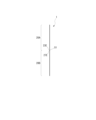
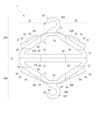
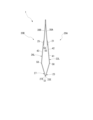
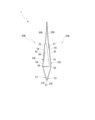
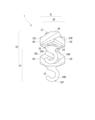
- FIG. 3 is a cross-sectional view for explaining the structure and assembly of the hanger of this embodiment. It is a structure of the hanger of this embodiment, and a left side view after assembly. It is a structure of the hanger of this embodiment, and a front view after assembly. It is a structure of the hanger of this embodiment, and a left side view after assembly. It is a first diagram for explaining folding of the hanger of the present embodiment. It is the second figure for demonstrating folding of the hanger of this embodiment. It is the third figure for demonstrating folding of the hanger of this embodiment. It is the fourth figure for demonstrating folding of the hanger of this embodiment. It is the fifth figure for demonstrating folding of the hanger of this embodiment. It is a figure after folding the hanger of this embodiment. It is a figure after another folding of the hanger of this embodiment. It is a figure of another folding back side of the hanger of this embodiment.
- FIG. 3 is a cross-sectional view for explaining multilayer paper;
- FIG. 1 the invention is not limited to the illustrated shape or this embodiment. It goes without saying that the detailed shape and position of each part can be changed within the scope of the present invention.
- a hanger 1 according to this embodiment is a hanger for clothes, and as shown in FIG. and a hook portion 3 having a portion 3F.
- the hanger body portion 2 is configured such that the first frame body portion 20A and the second frame body portion 20B face each other, and the hook portion 3 includes the first hook portion forming piece 30A and the second hook portion forming piece 30B. are configured to face each other, and the overall shape is three-dimensional.
- each of the first frame main body portion 20A, the second frame main body portion 20B, the first hook portion forming piece 30A and the second hook portion forming piece 30B is formed in a thin plate shape. is developed into a single flexible sheet as shown in FIG.
- the first frame body portion 20A includes a first top portion 21, a first right shoulder portion 22R and a first left shoulder portion 22L extending obliquely outward from the first top portion 21, and a first right shoulder portion. a first bottom portion 23 connecting the lower portions of the portion 22R and the first left shoulder portion 22L; , and the first frame body portion 20A and the first opening portion 24 as a whole form a substantially isosceles triangle shape.
- the second frame main body portion 20B includes a second top portion 25, a second right shoulder portion 26R and a second left shoulder portion 26L extending obliquely outward from the second top portion 25, a second right shoulder portion 26R and a second It has a second bottom portion 27 connecting the lower portions of the left shoulder portion 26L, and a second opening portion 28 surrounded by the second top portion 25, the second right shoulder portion 26R, the second left shoulder portion 26L and the second bottom portion 27.
- the second frame main body portion 20B and the second opening portion 28 are generally in the shape of an isosceles triangle as a whole.
- the first frame main body portion 20A and the second frame main body portion 20B are integrally connected by connecting the bottom edge 23E of the first bottom portion 23 and the bottom edge 27E of the second bottom portion 27 as a common straight bottom folding line 51.
- the first top portion 21 and the second top portion 25 are configured to face each other.
- the illustrated form is a particularly preferred form, with respect to the bottom fold line 51, the first top portion 21 and the second top portion 25, the first right shoulder portion 22R and the second right shoulder portion 26R, the first left shoulder portion 22L and the second shoulder portion 26R.
- the two left shoulder portions 26L, the first bottom portion 23 and the second bottom portion 27, and the first opening portion 24 and the second opening portion 28 are positioned in line symmetry, and are folded to overlap each other.
- the first hook forming piece 30A in the hanger 1 of the present embodiment is connected to the bottom side of the first top 21 via the first hook folding line 55 so as to be foldable, and as shown in FIG. In the unfolded state in which it is not folded back along the first hook folding line 55 , it is positioned inside the first opening 24 . Moreover, by folding back along the first hook folding line 55, the first hook portion 31F is configured to protrude above the first top portion 21, as shown in FIGS.
- the second hook forming piece 30B in the hanger 1 of the present embodiment is connected to the bottom side of the second top portion 25 via the second hook folding line 56 so as to be able to be folded back. It is positioned within the second opening 28 in the unfolded state. Moreover, by folding back along the second hook portion folding line 56, the second hook portion 32F is configured to protrude above the second top portion 25 as shown in FIGS.
- the first hook forming piece 30A and the second hook forming piece 30B have the same shape and are line symmetrical with respect to the bottom fold line 51.
- the hook part 3 is formed by facing and overlapping by folding back.
- the first hook forming piece 30A and the second hook forming piece 30B may not have the same shape.
- the first hook forming piece 30A is folded back along the first hook folding line 55 shown in FIG.
- the first frame body portion 20A or the second frame body portion 20B is folded back along the bottom folding line 51 with the hook portion forming piece 30B folded back
- the first top portion 20B is folded back as shown in FIGS. 21, the first hook portion 31F of the first hook portion forming piece 30A protrudes above the second top portion 25, and the second hook portion 32F of the second hook portion forming piece 30B protrudes above the second top portion 25.
- the forming piece 30A and the second hook forming piece 30B are overlapped and face each other to form the hook portion 3 in which the sheet material is doubled.
- the gap between the first top 21 and the second top 25 is has a thick and strong shape, and above the first top portion 21 and the second top portion 25, a strong hook portion 3F is formed by double sheet material.
- the first frame body portion 20A of the hanger 1 of the present embodiment extends from the first right shoulder portion 22R and the first left shoulder portion 22L via the first shoulder folding line 52, and extends toward the first top portion 21 side.
- a first shoulder upper forming piece 41 widening toward the first bottom portion 23 side from the first bottom portion 23 side; have.
- the first shoulder upper forming piece 41 has a substantially triangular shape with a tapered top side, but the shape is not necessarily limited. It may be substantially trapezoidal. Further, there may be a plurality of first shoulder upper forming pieces 41 .
- the insertion piece 42 has a substantially rectangular shape with rounded corners in the illustrated embodiment, it is not limited to this. The tip may be tapered.
- one insertion piece 42 is formed on one first shoulder upper forming piece 41 , but a plurality of insertion pieces 42 are formed on one first shoulder upper forming piece 41 . may be formed.
- the second frame body portion 20B includes a second shoulder upper forming piece 43 extending from the second right shoulder portion 26R and the second left shoulder portion 26L via the second shoulder folding line 54, and the second right shoulder portion. 26R and the second left shoulder 26L and the second shoulder upper forming piece 43, and an inserting portion 44 into which the inserting piece 42 can be inserted.
- the second shoulder upper forming piece 43 of the second frame main body 20B widens from the second top 25 toward the second bottom 27 in the same manner as the first shoulder upper forming piece 41.
- the second shoulder upper portion forming piece 43 may function as a surplus margin for forming the insertion portion 44 between at least the second right shoulder portion 26R and the second left shoulder portion 26L.
- the insertion portion 44 may have any shape as long as the insertion piece 42 formed on the first frame main body portion 20A can be inserted therein. It is preferable to make the width the same as the length of the insertion piece forming folding line 53 which is the connecting length with the one shoulder portion upper forming piece 41 . It becomes possible to insert the insertion piece 42 into the insertion part 44 to the root. Further, the insertion portion 44 is formed by a slit penetrating the sheet material in the illustrated embodiment. As shown in FIGS. 7 and 8, when the second shoulder portion upper forming piece 43 is folded back, the slit is opened to form an insertion portion 44 which becomes a hole. However, the insertion part 44 is not limited to a slit. Elongated through holes may be formed by punching or hollowing. In the illustrated embodiment, one insertion portion 44 is formed for each of the shoulder portions 26R and 26L. good.
- the insertion piece 42 and the insertion portion 44 of the hanger 1 of the embodiment are formed by folding the first frame main body portion 20A or the second frame main body portion 20B along the bottom side folding line 51 to form the first top portion 21.
- the first shoulder folding line 52, the second shoulder folding line 54, and the insertion piece forming folding line 53 are folded in a state in which the second top portion 25 and the second top portion 25 are in a butting facing position, the difference
- the insertion piece 42 is configured to be insertable into the insertion portion 44 .
- the first shoulder portion upper forming piece 41 and the second shoulder portion extending from each shoulder portion are formed.
- the upper forming piece 43 is formed at a position closely facing each other, and the first shoulder folding line 52, the second shoulder folding line 54, and the insertion piece forming folding line 53 are bent at this closely facing position.
- the insertion piece 42 is configured to be able to be inserted into the insertion portion 44 when the insertion portion 44 is inserted. Then, by inserting the insertion piece 42 into the insertion portion 44, as shown in FIGS.
- a first shoulder upper forming piece 41 is bridged between the first right shoulder 22R and the second right shoulder 26R, and between the first left shoulder 22L and the second left shoulder 26L.
- the first frame main body portion 20A and the second frame main body portion 20B which are folded back at 51 and are facing each other, are positioned between the first right shoulder portion 22R and the second right shoulder portion 26R, the first left shoulder portion 22L and the second left shoulder portion. Each of the portions 26L is connected.
- the second shoulder top forming piece 43 may have any shape as long as it can be overlapped within the range of the first shoulder top forming piece 41 when the first shoulder top forming piece 41 is bridged. .
- the first shoulder upper forming piece 41 has a shape that gradually widens from the first top portion 21 side toward the first bottom portion 23 side. It has a substantially triangular shape.
- the insertion piece 42 is inserted into the insertion portion 44, and between the first right shoulder portion 22R and the second right shoulder portion 26R and between the first left shoulder portion 22L and the second left shoulder portion 26L, respectively,
- the first frame main body portion 20A and the second frame main body portion 20B facing each other are formed into the first right shoulder portion 22R, the second right shoulder portion 26R and the first right shoulder portion 22R and the second right shoulder portion 26R.
- the space between the left shoulder 22L and the second left shoulder 26L is formed in a three-dimensional shape in which the separation distance gradually widens from the top side to the bottom side of the first shoulder upper forming piece 41 toward the bottom side.
- the first right shoulder portion 22R and the second right shoulder portion 26R and the first left shoulder portion 22L and the second left shoulder portion 26L are arranged from the top side toward the bottom side. While the separation distance gradually increases to the bottom side position of the one shoulder portion upper forming piece 41, the first frame main body portion 20A and the second frame main body portion 20B are connected by the bottom side fold line 51.
- the auxiliary folding lines 57, 58 double as the third folding line 57 and the fourth folding line 58, which will be described later in detail, for folding the hanger 1 for easy portability.
- the auxiliary folding lines 57 and 58 are not necessarily required, nor are they required to serve as folding lines.
- the auxiliary folding line is provided, the bending of the sheet material is eliminated by the auxiliary folding line, so that even if the material is stiff, the assembly is facilitated.
- the line 53 and folding auxiliary lines 57 and 58 are lines for facilitating folding and folding of the sheet material, and may be simply printed lines for positioning purposes, but are preferably folding lines. These are ruled lines, also called streaks, perforations, and half slits. In particular, half slits are preferred because they can easily bend even a stiff material. The cut tie ratio in the case of perforations and the slit depth in the case of half slits may be changed according to the thickness and strength of the sheet material.
- the lines 57 and 58 do not have to be of the same type, and for example, the bottom fold line 51 may be perforated and the others may be half slits.
- the cut tie ratio in the case of perforations and the slit depth in the case of half slits may not be the same.
- the structure of the hanger 1 of this embodiment is characterized by the bottom folding line 51, the first hook folding line 55, the second hook folding line 56, the first shoulder folding line 52, the second shoulder
- the bending directions of the respective portions at the partial folding line 54, the insertion piece forming folding line 53, and the auxiliary folding lines 57 and 58 can all be made the same direction.
- all the folding lines are mountain fold lines and the folding directions are the same. That is, at the bottom fold line 51, the first frame main body portion 20A or the second frame main body portion 20B is folded back toward the depth side of the paper surface, and at the first hook portion fold line 55, the first hook forming piece 30A is folded back.
- the second hook forming piece 30B is folded back in the depth direction of the paper surface at the second hook folding line 56, and is folded back in the depth direction of the paper surface at the first shoulder folding line 52.
- the forming piece 41 is folded back in the depth direction of the paper surface
- the second shoulder upper part forming piece 43 is folded back in the depth direction of the paper surface at the second shoulder folding line 54
- the insertion piece forming folding line 53 is folded back.
- the insert piece 42 is folded back toward the depth side of the paper surface.
- the auxiliary folding lines 57 and 58 are formed, either one of the regions divided by the auxiliary folding lines 57 and 58 is folded in the depth direction of the paper surface.
- the half-slit opens on the slit side when folded, making it easy to make a strong hanger. Hanger and easy. Furthermore, when the half slits can be formed on the same surface, the manufacturing process becomes extremely easy compared to the manufacturing method in which cutting is performed from both sides of the paper surface.
- the hanger 1 of this embodiment is perpendicular to the bottom folding line 51, as shown in FIG. It has a first folding line 59 that straightly passes through the first bottom portion 23 of the main body portion 20A, the second bottom portion 27 of the second frame main body portion 20B, and the second right shoulder portion 26R of the second frame main body portion 20B, and , perpendicular to the bottom fold line 51, the first left shoulder portion 22L of the first frame body portion 20A, the first bottom portion 23 of the first frame body portion 20A, the second bottom portion 27 of the second frame body portion 20B, the second frame and a second folding line 60 extending straight through the second left shoulder portion 26L of the body portion 20B.
- first folding line 59 and the second folding line 60 are arranged to pass through the first shoulder upper forming piece 41 and the second shoulder upper forming piece 43, but this arrangement is also possible. good. However, it can also be arranged so as not to pass through the first shoulder upper forming piece 41 and the second shoulder upper forming piece 43 . This is selected according to the positions and shapes of the first shoulder upper forming piece 41 and the second shoulder upper forming piece 43 .
- first folding line 59 and the second folding line 60 are arranged at two positions sandwiching the first hook forming piece 30A and the second hook forming piece 30B. Therefore, regardless of the first hook forming piece 30A and the second hook forming piece 30B, the extending direction of the bottom side folding line 51 in the unfolded state is taken as the width direction, and the first folding line 59 is folded at the first folding line 59.
- the widthwise outer region 2R can be folded back.
- the widthwise outer region 2L can be folded at the second folding line 60 from the second folding line 60 .
- the distance between the first fold line 59 and the second fold line 60 is not limited, but the distance between the first fold line 59 and the second fold line 60 and the first fold line 59 and the second fold line 60 When the distance from the top to the outer edge in the width direction is about 1/3 of the total width, and the distance between the first folding line 59 and the second folding line 60 is slightly widened, the most compact three-folding is achieved. .
- the hanger 1 of the present embodiment is parallel to the bottom folding line 51 arranged on the first right shoulder portion 22R of the first frame main body portion 20A and the second right shoulder portion 26R of the second frame main body portion 20B.
- a fourth fold line 58 of of .
- the third folding line 57 connects the second right shoulder 26R and the second bottom 27 to a position closer to the connection position between the first right shoulder 22R and the first bottom 23 than the first folding line 59 does.
- the fourth folding line 58 is closer to the connection position between the first left shoulder 22L and the first bottom 23 and the connection position between the second left shoulder 26L and the second bottom 27 than the second folding line 60 is. It is placed close to the It should be noted that the distances of each line of the pair of third folding lines 57 from the bottom side folding line 51 are not necessarily the same, but are preferably the same. The same is true for the distances of each line of the pair of fourth folding lines 58 from the bottom side folding line 51. Although they are not necessarily equidistant, they are preferably equidistant. Further, in the illustrated embodiment, the third folding line 57 and the fourth folding line 58 also serve as auxiliary folding lines.
- Either of the third folding line 57 and the fourth folding line 58 is positioned closer to the top portions 21 and 25, and the first folding line 59 and the second folding line 60 form a three-folded shape, which is further folded into a third Three folds are possible at the third fold line 57 and the fourth fold line 58 .
- the hanger 1 in the illustrated form is arranged on the first left shoulder portion 22L of the first frame main body portion 20A and the second left shoulder portion 26L of the second frame main body portion 20B.
- the fourth folding line 58 is positioned closer to the top portions 21 and 25 than the third folding line 57 is.
- the region 2L outside the second folding line 60 in the width direction is folded back in the paper surface at the second folding line 60, and the width direction from the first folding line 59 is folded. It is folded in three over the outer region 2R. At this time, the region 2L outside the second folding line 60 in the width direction where the fourth folding line 58 is located is located further on the back side of the paper surface.
- the fourth folding line 58 and the third folding line 58 are folded in the direction toward the front side of the page, that is, the fourth folding line 58 is outward and the third folding line 57 is inward.
- the portion 2X positioned closer to the top portion 21 than the tri-fold line 57 is folded.
- the portion 2Y located closer to the top portion 25 than the fourth folding line 58 and the third folding line 57 may be folded first.
- the region 2L outside in the width direction from the second folding line 60 where the fourth folding line 58 is formed in the depth direction of the paper surface is folded to the first folding line where the third folding line 57 is formed. Since the region 2R outside in the width direction of 59 is folded so as to be covered and wrapped around, the fourth folding line 58 and the third folding line 57 are not equidistant from the bottom side folding line 51, and the fourth folding line 58 is not at the same distance from the bottom side folding line 51.
- FIG. 1 After folding back the portion 2Y located closer to the top portion 25 than the fourth folding line 58 and the third folding line 57, as shown in FIG. Fold back to return to the base.
- the folding back of the second hook portion 30B may be performed before folding back the portion 2Y positioned closer to the top portion 25 than the fourth folding line 58 and the third folding line 57.
- FIG. 1 After folding back the portion 2Y located closer to the top portion 25 than the fourth folding line 58 and the third folding line 57, as shown in FIG. Fold back to return to the base.
- the folding back of the second hook portion 30B may be performed before folding back the portion 2Y positioned closer to the top portion 25 than the fourth folding line 58 and the third folding line 57.
- the region 2R, the region 2L, the portion X, and the portion Y are folded into a very compact and highly portable shape.
- FIG. 19 shows the shape of the rear side in the folded form shown in FIG.
- the region 2R on the outside in the width direction of the first folding line 59 is first folded in the depth direction of the paper surface, and then the region 2L on the outside in the width direction of the second folding line 60 is folded in the space of the paper.
- the region 2L on the outer side in the width direction of the second folding line 60 is positioned further on the depth side of the paper surface and folded back on the front side, so that the fourth folding line 58 is closer to the top portions 21 and 25.
- the region 2L outside the second folding line 60 in the width direction is folded back in the direction of the paper surface, and then the region 2R outside the first folding line 59 in the width direction is folded in the space.
- the third folding line 57 is positioned closer to the top portion 21 than the fourth folding line 58. , 25 side. That is, which of the third folding line 57 and the fourth folding line 58 is located on the top portion 21, 25 side depends on the folding order of the first folding line 59 and the second folding line 60.
- the folding directions of the parts at the first folding line 59, the second folding line 60, the third folding line 57, and the fourth folding line 58 can all be the same direction. For example, when folding the unfolded state shown in FIG. It is folded.
- a first folding line 59, a second folding line 60, a third folding line 57, and a fourth folding line 58 can also be formed on the same plane as half slits. It is desirable to Since it is only necessary to form the half slits on the same surface, the production is easier than the production method in which the paper is cut from both sides.
- each folding line in the hanger 1 of the present embodiment is a half slit
- the slit depth is not limited, but the tensile strength between the slits is preferably 150 N or more, preferably 170 N or more. .
- This tensile strength is a value measured using a sample in accordance with JIS P 8113, which has a rectangular size of 15 mm wide x 180 mm long and has a half slit formed at 90 mm, which is half the length.
- the tensile speed is set to 20 mm/min and the load cell capacity is set to 1 KN.
- the hanger 1 of this embodiment having the structure described above has a three-dimensional usage pattern in which the first shoulder portion upper forming piece 41 is bridged between the shoulder portions of the first frame main body portion 20A and the second frame main body portion 20B. becomes.
- it can be folded along the first folding line 29, the second folding line 60, the third folding line 57, and the fourth folding line 58, so that it can be folded into a compact folded form with excellent portability.
- the unfolded state is a single sheet material like paper, it can be manufactured from a non-plastic sheet material.
- each part can be folded in the same direction in the unfolded state, and half slits and ruled lines can be formed only on one side to facilitate manufacturing.
- first top portion 21 of the first frame main body portion 20A is above the paper surface and the second top portion 25 of the second frame main body portion 20B is below the paper surface.
- the left and right are explained in .
- the left and right sides of the first right shoulder portion 22R, the first left shoulder portion 22L, the second right shoulder portion 26R, and the second left shoulder portion 26L are conveniently changed depending on the position of the hanger 1 in the unfolded state and the position of the viewer. stomach.
- the sheet material of the present embodiment is desirably paper made from pulp fibers from the viewpoint of eliminating plastics.
- corrugated cardboard, coated cardboard, and multi-layer paper in which a plurality of paper layers are laminated can be exemplified.
- the paper is composed only of fibers derived from natural materials and does not contain synthetic fibers including plastics.
- the paper is made of pulp fibers only.
- particularly preferred papers are multilayer papers having three or more paper layers. As shown in FIG.
- the multi-layer paper 80 has a plurality of paper layers 81 and 82 laminated, so that the characteristics of each layer can be changed, and the paper can be easily folded while having strength. For example, by combining a pair of surface layers 81, which are hard but tend to break easily although they are excellent in water resistance and abrasion resistance, with a flexible middle layer 82, they become excellent in toughness and durability, and can be bent or assembled while having strength. can be made easier. In addition, when each fold line is formed into a half slit, multiple layers including the surface layer can be prevented from being completely cut, and the risk of breakage at each fold line is greatly reduced. It can be produced by papermaking. Moreover, the multi-layered paper 80 may be commercially available, and for example, Ellipra paper manufactured by Dainichi Paper Co., Ltd. can be exemplified.
- the basis weight of the paper is preferably 400 g/m 2 or more, more preferably 430 g/m 2 or more, and particularly preferably 460 g/m 2 or more. With paper of this basis weight, it is easy to assemble by folding each part, and it is easy to make a hanger with sufficient rigidity and strength.
- the upper limit of the basis weight is not limited, there is a possibility that creases may easily occur with a calender roll or the like during papermaking. From this point, the upper limit is preferably 1400 g/m 2 , more preferably 1240 g/m 2 . .
- the thickness of the paper is preferably 500 ⁇ m or more and 1,400 ⁇ m or less, more preferably 550 ⁇ m or more and 1,350 ⁇ m or less.
- the basis weight is a value measured in accordance with "Paper and paperboard - Basis weight measurement method" described in JIS P 8124 (2011), and the paper thickness is a value described in JIS-P8118 (2014) "Paper and paperboard - test methods for thickness and density”.
- the constituent pulp fibers of the paper are not necessarily limited, but preferred constituent pulp fibers are unbleached softwood kraft pulp (NUKP), semi-bleached softwood kraft pulp (NSBKP), and bleached softwood kraft pulp ( NBKP), and hardwood kraft pulp such as unbleached hardwood kraft pulp (LUKP), semi-bleached hardwood kraft pulp (LSBKP), and bleached hardwood kraft pulp (LBKP).
- NUKP unbleached softwood kraft pulp
- NBSKP semi-bleached softwood kraft pulp
- NBKP bleached softwood kraft pulp
- hardwood kraft pulp such as unbleached hardwood kraft pulp (LUKP), semi-bleached hardwood kraft pulp (LSBKP), and bleached hardwood kraft pulp (LBKP).
- Other pulps include chemical pulps such as waste paper pulp, hardwood sulfite pulp and softwood sulfite pulp, or various known pulps such as pulp chemically or mechanically produced from non
- the content of softwood kraft pulp and hardwood kraft pulp is desirably 90 to 100% by mass because it facilitates development of strength.
- the mixing ratio of softwood kraft pulp and hardwood kraft pulp is preferably 5:95 to 30:70. If the hanger is to have a design with a clean and hard feeling, it is particularly preferable to use bleached softwood kraft pulp and bleached hardwood kraft pulp, which are white pulp and have a high degree of whiteness.
- the sheet material is paper
- the paper should have a longitudinal and transverse tensile strength of 20 kN/m or more, preferably 25 kN/m or more, measured according to JIS P 8113 (2006). is desirable. If it has this tensile strength, it is suitable for folding and assembly, and it is easy to make a hanger with sufficient strength.
- the sheet material is paper
- the paper must have a Taber stiffness of 120 mN ⁇ m or more in the longitudinal direction and 40 mN ⁇ m or more in the lateral direction measured in accordance with JIS P 8125 (2000). is desirable. Within this range, the hanger can have sufficient rigidity and strength, and can be easily folded and assembled.
- the sheet material is paper
- the paper is tested according to JAPAN TAPPI Paper Pulp Test Method No. 18-1:2000
- the Z-axis strength is 400 kN/m 2 or more, preferably 450 kN/m 2 or more.
- the unfolded hanger can be easily manufactured by punching such as Thomson processing and cutting using a cutting plotter.
- the paper When the sheet material is paper, the paper preferably has a static friction coefficient of 0.25 to 0.65 according to the JIS P 8147 ISO horizontal method. Appropriate friction is provided when clothes are put on it, and it is difficult to slip off. In this measuring method, it is preferable that the measurement is performed three times for each of the back surfaces and the front surfaces of the sheet material, and the third measurement values for the back surfaces and the front surfaces are all within the above range. In the ISO horizontal method, at least one of the static friction coefficient of the first sliding, the static friction coefficient of the third sliding, or the dynamic friction coefficient of the third sliding should be measured, and the third static friction coefficient is smaller than the first static friction coefficient. The third static friction coefficient has a smaller variation.
- the PPS Parker Print Surf Roughness conforming to JIS P 8151 is preferably 3 to 8 ⁇ m, more preferably 4 to 7 ⁇ m, on both the front and back surfaces. Appropriate surface properties that prevent clothes from slipping off or damage the fabric.
- the paper When the sheet material is paper, the paper preferably has an MMD value of 10 to 25 on both the front and back surfaces. Appropriate surface properties that prevent clothes from slipping off or damage the fabric.
- the MMD is measured using a friction tester (KES-SE, manufactured by Kato Tech Co., Ltd.) or its equivalent.
- KS-SE manufactured by Kato Tech Co., Ltd.
- As the friction element a contact surface having a length and a width of 10 mm is used, which is formed by adjoining 20 standard piano wires having a diameter of 0.5 mm.
- the number of layers is not limited, but is 5 to 9 layers, and the number of layers of the middle layer 82 is 3 layers or more, especially 5 layers. It's good.
- the form shown in FIG. 21 has three intermediate layers 82 . It is said that when the total number of middle layers 82 is three or more, the toughness and durability of the multi-layered paper 80 are likely to be exhibited.
- the upper limit of the total number of intermediate layers 82 is preferably seven or less from the viewpoint of maintaining interlaminar strength. In addition, three to seven layers are easy to operate while maintaining interlaminar strength in the case of using a cylinder multi-cylinder type combined paper machine.
- the basis weight of the surface layer 81 and the middle layer 82 can be adjusted within the range of the overall basis weight when the sheet material is paper, and is not particularly limited.
- the basis weight of the surface layer 81 is 55.0 g/m 2 or more and 150.0 g/m 2 or less, particularly 60 to 145 g/m 2 per layer.
- the basis weight of the entire middle layer 82 is preferably 490 g/m 2 or more and 750 g/m 2 or less, particularly 495 g/m 2 or more and 740 g/m 2 or less.
- the multilayer paper 80 preferably has a ratio of the total basis weight of the pair of surface layers 81, 81 to the total basis weight of the multilayer paper 80 of 15.0% or more and 33.0% or less.
- the rigidity of the pair of surface layers 81 is high, and the softness of the middle layer 82 is excellent. Therefore, the hanger can be easily bent at the folding line position and difficult to be bent at a position other than the folding line, thereby making it easy to obtain a hanger excellent in strength and ease of assembly.
- the blending of the pulp fibers of each layer in the multilayer paper 80 is such that the mass ratio (%) of the softwood kraft pulp and the hardwood kraft pulp in the surface layer 81 is 0/100 or more and 15/85 or less. It is preferable to have In addition to the surface layer 81 of this composition, the middle layer 82 preferably has a mass ratio (%) of softwood kraft pulp and hardwood kraft pulp of 15/85 or more and 35/65 or less. It contains a lot of hardwood kraft pulp that is rigid and easily densified, and the surface layer has high density and rigidity, and the middle layer contains a lot of softwood kraft pulp, which is more flexible than the surface layer. It tends to be a hanger whose strength does not easily decrease even when it is folded at a large angle or repeatedly folded.
- the sheet material is multilayer paper 80
- the multilayer paper 80 has at least one of a sizing agent and a paper strength agent added as a papermaking additive. Easy to adjust to desired intensity.
- the multi-layered paper 80 may contain various other additives as long as they do not impair the intended effects of the present invention. For example, polyvinyl alcohol, wax, or the like can be applied.
- Styrene sizing agents alkyl ketene dimers (AKD), alkenyl succinic anhydrides (ASA), neutral rosin sizing agents, rosin sizing agents, modified rosin emulsion sizing agents, and the like can be used as sizing agents.
- rosin sizing agents and modified rosin emulsion sizing agents are preferred.
- the rosin sizing agent is not particularly limited.
- Rosin-based substances include, for example, rosins such as gum rosin, wood rosin, and tall oil rosin modified with ⁇ , ⁇ -unsaturated carboxylic acids such as fumaric acid, maleic acid, and acrylic acid, or their anhydrides; Rosin esters obtained by reacting polyhydric alcohols such as glycerin, trimethylolethane, trimethylolpropane, pentaerythritol and diglycerin can be mentioned.
- the rosin sizing agent also includes those obtained by emulsifying these alone or a mixture thereof, and those obtained by emulsifying them alone and then mixing them. Furthermore, emulsified products to which various polymers are added in order to further improve size development are also included.
- amphoteric paper strength agents are preferably used.
- amphoteric polyacrylamides include copolymers of acrylamide with anionic monomers and cationic monomers, Mannich-modified copolymers of acrylamide with anionic monomers, Hoffmann decomposition products, and the like.
- amphoteric polyacrylamide since amphoteric polyacrylamide has a self-fixing function, even if it is added to improve inter-paper strength, it does not become excessively cationic. can be established in
- the amount of sizing agent added is preferably 0.5 kg/t or more and 5.0 kg/t or less in solid content.
- the amount of the paper strength agent to be added is preferably 12 kg/t or more and 30 kg/t or less in terms of solid content.
- “kg/t” shows the mass (kg) per 1t of pulp.
- the multilayer paper 80 has at least one of the above sizing agents and paper strength agents added to each layer of the surface layer 81 and the middle layer 82 as a papermaking additive.
- the amount of the sizing agent added to the surface layer 81 is preferably 0.5 kg/t or more and 5.0 kg/t or less in solid content.
- the amount of the sizing agent added to the middle layer 82 is preferably 2.0 kg/t or more and 5.0 kg/t or less in terms of solid content.
- the amount of the paper strength enhancer added to each layer is preferably 12 kg/t or more and 30 kg/t or less in terms of solid content. Within this range, various paper strengths such as interlaminar strength of multilayer paper suitable for hangers can be easily obtained.
- the hanger according to this embodiment preferably contains a siloxane compound.
- a siloxane compound When a siloxane compound is contained, the rigidity, strength, and water resistance are enhanced by siloxane bonds.
- the siloxane compound is not necessarily limited as long as it has a siloxane bond, but since the hanger 1 hangs clothes that come into contact with the human body, it is desirable that the siloxane compound has no or low toxicity to the living body.
- the siloxane compound includes an appropriate alkoxysilane solution and an alkoxysilane solution processed product for the sheet material before assembly and the sheet material as a material, in addition to the mode of coating the siloxane compound on the hanger after assembly. After infiltration, it may be added by warming or heating. This is desirable because the siloxane compound is bound to the pulp fibers themselves or is contained in such a manner as to coat the pulp fibers.
- the hanger according to the present embodiment contains a surface protective agent, an antibacterial agent, and an antiviral agent within a range that does not excessively change the coefficient of friction, surface roughness, and foldability, and does not hinder the functions of the hanger and the effects of the present invention. It may be coated or impregnated.
Landscapes
- Holders For Apparel And Elements Relating To Apparel (AREA)
Applications Claiming Priority (2)
| Application Number | Priority Date | Filing Date | Title |
|---|---|---|---|
| JP2022020529A JP2023117781A (ja) | 2022-02-14 | 2022-02-14 | ハンガー |
| JP2022-020529 | 2022-02-14 |
Publications (1)
| Publication Number | Publication Date |
|---|---|
| WO2023153226A1 true WO2023153226A1 (ja) | 2023-08-17 |
Family
ID=87564077
Family Applications (1)
| Application Number | Title | Priority Date | Filing Date |
|---|---|---|---|
| PCT/JP2023/002446 Ceased WO2023153226A1 (ja) | 2022-02-14 | 2023-01-26 | ハンガー |
Country Status (2)
| Country | Link |
|---|---|
| JP (1) | JP2023117781A (https=) |
| WO (1) | WO2023153226A1 (https=) |
Citations (7)
| Publication number | Priority date | Publication date | Assignee | Title |
|---|---|---|---|---|
| JPH02134074U (https=) * | 1989-04-14 | 1990-11-07 | ||
| KR20090002587U (ko) * | 2007-09-11 | 2009-03-16 | 최무성 | 옷걸이 |
| JP3159829U (ja) * | 2010-03-17 | 2010-06-03 | 株式会社スマイル | 紙製ハンガー |
| KR20100009587U (ko) * | 2009-03-19 | 2010-09-29 | 제이크루즈 컴퍼니 리미티드 | 접이식 행거 |
| JP2011182807A (ja) * | 2010-03-04 | 2011-09-22 | Total Print Yutaka Kogyo Kk | 紙製ハンガー |
| KR20120101804A (ko) * | 2011-03-07 | 2012-09-17 | 이규휘 | 종이 옷걸이 |
| JP2019151364A (ja) * | 2018-03-02 | 2019-09-12 | 三菱商事ファッション株式会社 | 衣類移送方法、衣類梱包体製造方法、衣類梱包体及び紙製ハンガー |
-
2022
- 2022-02-14 JP JP2022020529A patent/JP2023117781A/ja active Pending
-
2023
- 2023-01-26 WO PCT/JP2023/002446 patent/WO2023153226A1/ja not_active Ceased
Patent Citations (7)
| Publication number | Priority date | Publication date | Assignee | Title |
|---|---|---|---|---|
| JPH02134074U (https=) * | 1989-04-14 | 1990-11-07 | ||
| KR20090002587U (ko) * | 2007-09-11 | 2009-03-16 | 최무성 | 옷걸이 |
| KR20100009587U (ko) * | 2009-03-19 | 2010-09-29 | 제이크루즈 컴퍼니 리미티드 | 접이식 행거 |
| JP2011182807A (ja) * | 2010-03-04 | 2011-09-22 | Total Print Yutaka Kogyo Kk | 紙製ハンガー |
| JP3159829U (ja) * | 2010-03-17 | 2010-06-03 | 株式会社スマイル | 紙製ハンガー |
| KR20120101804A (ko) * | 2011-03-07 | 2012-09-17 | 이규휘 | 종이 옷걸이 |
| JP2019151364A (ja) * | 2018-03-02 | 2019-09-12 | 三菱商事ファッション株式会社 | 衣類移送方法、衣類梱包体製造方法、衣類梱包体及び紙製ハンガー |
Also Published As
| Publication number | Publication date |
|---|---|
| JP2023117781A (ja) | 2023-08-24 |
Similar Documents
| Publication | Publication Date | Title |
|---|---|---|
| EP0835344B1 (en) | Creped tissue paper exhibiting unique combination of physical attributes | |
| CA2165841A1 (en) | Multi-layered tissue paper web comprising chemical softening compositions and binder materials and process for making the same | |
| MX2011000523A (es) | Pila de material doblado. | |
| EA020811B1 (ru) | Крепированный лентой впитывающий лист с варьирующейся локальной основной массой, полученный с использованием перфорированной полимерной ленты | |
| KR102732416B1 (ko) | 다층지 및 그의 제조 방법 | |
| JP2019131922A (ja) | 片艶クラフト紙及びその製造方法 | |
| JP2021165458A5 (https=) | ||
| JP2022119747A (ja) | 液体容器用原紙 | |
| AU2006285338B2 (en) | Rolled bath tissue product for children | |
| WO2023153226A1 (ja) | ハンガー | |
| WO2023153239A1 (ja) | 剃刀用の柄体及び剃刀 | |
| JP2024044471A (ja) | ハンガー | |
| US20200275809A1 (en) | Absorbent stack of sheets having compressed binding | |
| JP2023117781A5 (https=) | ||
| JP2023117783A5 (https=) | ||
| JP2023117782A (ja) | ハンガー | |
| US20090280297A1 (en) | Paper product with visual signaling upon use | |
| JP4604466B2 (ja) | 耐油紙 | |
| US20240043193A1 (en) | Packaging bag and sheet package | |
| CA2328817A1 (en) | Laminated country map or road map | |
| JP2025077198A (ja) | 吊り下げ箱 | |
| JP2026032481A (ja) | シューズラック及びシューズラック組立シート | |
| JP2026026795A (ja) | スマートデバイス用スタンド | |
| JP2026069311A (ja) | スマートデバイス用スタンド | |
| JP2023138480A (ja) | ゴルフティー |
Legal Events
| Date | Code | Title | Description |
|---|---|---|---|
| 121 | Ep: the epo has been informed by wipo that ep was designated in this application |
Ref document number: 23752691 Country of ref document: EP Kind code of ref document: A1 |
|
| NENP | Non-entry into the national phase |
Ref country code: DE |
|
| 122 | Ep: pct application non-entry in european phase |
Ref document number: 23752691 Country of ref document: EP Kind code of ref document: A1 |