WO2023112952A1 - 生産物の製造方法、及び細胞培養装置 - Google Patents
生産物の製造方法、及び細胞培養装置 Download PDFInfo
- Publication number
- WO2023112952A1 WO2023112952A1 PCT/JP2022/046000 JP2022046000W WO2023112952A1 WO 2023112952 A1 WO2023112952 A1 WO 2023112952A1 JP 2022046000 W JP2022046000 W JP 2022046000W WO 2023112952 A1 WO2023112952 A1 WO 2023112952A1
- Authority
- WO
- WIPO (PCT)
- Prior art keywords
- culture
- indicates
- container
- foam trap
- cells
- Prior art date
- Legal status (The legal status is an assumption and is not a legal conclusion. Google has not performed a legal analysis and makes no representation as to the accuracy of the status listed.)
- Ceased
Links
Images



Classifications
-
- C—CHEMISTRY; METALLURGY
- C07—ORGANIC CHEMISTRY
- C07K—PEPTIDES
- C07K16/00—Immunoglobulins [IG], e.g. monoclonal or polyclonal antibodies
-
- C—CHEMISTRY; METALLURGY
- C12—BIOCHEMISTRY; BEER; SPIRITS; WINE; VINEGAR; MICROBIOLOGY; ENZYMOLOGY; MUTATION OR GENETIC ENGINEERING
- C12M—APPARATUS FOR ENZYMOLOGY OR MICROBIOLOGY; APPARATUS FOR CULTURING MICROORGANISMS FOR PRODUCING BIOMASS, FOR GROWING CELLS OR FOR OBTAINING FERMENTATION OR METABOLIC PRODUCTS, i.e. BIOREACTORS OR FERMENTERS
- C12M27/00—Means for mixing, agitating or circulating fluids in the vessel
- C12M27/02—Stirrer or mobile mixing elements
-
- C—CHEMISTRY; METALLURGY
- C12—BIOCHEMISTRY; BEER; SPIRITS; WINE; VINEGAR; MICROBIOLOGY; ENZYMOLOGY; MUTATION OR GENETIC ENGINEERING
- C12M—APPARATUS FOR ENZYMOLOGY OR MICROBIOLOGY; APPARATUS FOR CULTURING MICROORGANISMS FOR PRODUCING BIOMASS, FOR GROWING CELLS OR FOR OBTAINING FERMENTATION OR METABOLIC PRODUCTS, i.e. BIOREACTORS OR FERMENTERS
- C12M29/00—Means for introduction, extraction or recirculation of materials, e.g. pumps
- C12M29/06—Nozzles; Sprayers; Spargers; Diffusers
-
- C—CHEMISTRY; METALLURGY
- C12—BIOCHEMISTRY; BEER; SPIRITS; WINE; VINEGAR; MICROBIOLOGY; ENZYMOLOGY; MUTATION OR GENETIC ENGINEERING
- C12M—APPARATUS FOR ENZYMOLOGY OR MICROBIOLOGY; APPARATUS FOR CULTURING MICROORGANISMS FOR PRODUCING BIOMASS, FOR GROWING CELLS OR FOR OBTAINING FERMENTATION OR METABOLIC PRODUCTS, i.e. BIOREACTORS OR FERMENTERS
- C12M29/00—Means for introduction, extraction or recirculation of materials, e.g. pumps
- C12M29/10—Perfusion
-
- C—CHEMISTRY; METALLURGY
- C12—BIOCHEMISTRY; BEER; SPIRITS; WINE; VINEGAR; MICROBIOLOGY; ENZYMOLOGY; MUTATION OR GENETIC ENGINEERING
- C12M—APPARATUS FOR ENZYMOLOGY OR MICROBIOLOGY; APPARATUS FOR CULTURING MICROORGANISMS FOR PRODUCING BIOMASS, FOR GROWING CELLS OR FOR OBTAINING FERMENTATION OR METABOLIC PRODUCTS, i.e. BIOREACTORS OR FERMENTERS
- C12M29/00—Means for introduction, extraction or recirculation of materials, e.g. pumps
- C12M29/20—Degassing; Venting; Bubble traps
-
- C—CHEMISTRY; METALLURGY
- C12—BIOCHEMISTRY; BEER; SPIRITS; WINE; VINEGAR; MICROBIOLOGY; ENZYMOLOGY; MUTATION OR GENETIC ENGINEERING
- C12M—APPARATUS FOR ENZYMOLOGY OR MICROBIOLOGY; APPARATUS FOR CULTURING MICROORGANISMS FOR PRODUCING BIOMASS, FOR GROWING CELLS OR FOR OBTAINING FERMENTATION OR METABOLIC PRODUCTS, i.e. BIOREACTORS OR FERMENTERS
- C12M41/00—Means for regulation, monitoring, measurement or control, e.g. flow regulation
- C12M41/02—Means for regulation, monitoring, measurement or control, e.g. flow regulation of foam
-
- C—CHEMISTRY; METALLURGY
- C12—BIOCHEMISTRY; BEER; SPIRITS; WINE; VINEGAR; MICROBIOLOGY; ENZYMOLOGY; MUTATION OR GENETIC ENGINEERING
- C12N—MICROORGANISMS OR ENZYMES; COMPOSITIONS THEREOF; PROPAGATING, PRESERVING, OR MAINTAINING MICROORGANISMS; MUTATION OR GENETIC ENGINEERING; CULTURE MEDIA
- C12N5/00—Undifferentiated human, animal or plant cells, e.g. cell lines; Tissues; Cultivation or maintenance thereof; Culture media therefor
- C12N5/10—Cells modified by introduction of foreign genetic material
-
- C—CHEMISTRY; METALLURGY
- C07—ORGANIC CHEMISTRY
- C07K—PEPTIDES
- C07K2317/00—Immunoglobulins specific features
- C07K2317/10—Immunoglobulins specific features characterized by their source of isolation or production
- C07K2317/14—Specific host cells or culture conditions, e.g. components, pH or temperature
Definitions
- the present invention relates to a method for producing a product including culturing cells using a cell culture device.
- the invention further relates to a cell culture device.
- Patent Document 1 discloses a culture container capable of enclosing the culture solution and a culture container disposed at the bottom of the culture container.
- a single-use culture device is described that includes a shielding sheet that separates the medium from the liquid surface of the medium.
- An object of the present invention is to provide a method for producing a product by cell culture, which can prevent clogging of the exhaust filter due to foam generated on the upper surface of the culture solution.
- a further object of the present invention is to provide a cell culture apparatus capable of preventing clogging of the exhaust filter due to foam generated on the upper surface of the culture solution.
- the present inventors found that the above problems can be solved by installing a foam trap container between the culture tank and the exhaust filter installed at the top of the culture tank. , have completed the present invention.
- a method for producing a product comprising culturing cells using a cell culture device to produce a product from the cells, wherein the cell culture device contains a cell suspension containing the cells. and at least one or more foam trap vessels capable of accumulating foam, connected to the outside of said culture vessel.
- a drainage line is connected to the foam trap container.
- ⁇ 4> The method for producing a product according to any one of ⁇ 1> to ⁇ 3>, wherein the outlet for the gas aerated to the culture vessel is only a line connecting the culture vessel and the foam trap vessel. .
- ⁇ 5> The method for producing a product according to any one of ⁇ 1> to ⁇ 4>, wherein the drainage line connected to the foam trap container is connected to a sterile drainage tank.
- ⁇ 6> The method for producing a product according to ⁇ 5>, wherein the drainage tank can be switched aseptically.
- Vt indicates the foam trap container volume (L)
- Mi indicates the amount of air permeation (L/min) from a microsparger with a pore size of 1 ⁇ m to 200 ⁇ m
- Ma indicates the permeation rate (L/min) of a macrosparger with a pore size of 0.1 mm to 10 mm
- S represents the air-liquid interface area (m 2 ) of the culture solution
- W indicates the volume (L) of the culture medium in the culture vessel.
- L indicates the length (m) of the tube connecting the foam trap container and the culture container
- S represents the air-liquid interface area (m 2 ) of the culture solution
- P indicates the thickness (mm) of the tube connecting the foam trap container and the culture container
- Mi indicates the amount of air permeation (L/min) from a microsparger with a pore size of 1 ⁇ m to 200 ⁇ m
- Ma indicates the permeation rate (L/min) of a macrosparger with a pore size of 0.1 mm to 10 mm.
- P indicates the thickness (mm) of the tube connecting the foam trap container and the culture container
- S represents the air-liquid interface area (m 2 ) of the culture solution
- L indicates the length (m) of the tube connecting the foam trap container and the culture container
- Mi indicates the amount of air permeation (L/min) from a microsparger with a pore size of 1 ⁇ m to 200 ⁇ m
- Ma indicates the permeation rate (L/min) of a macrosparger with a pore size of 0.1 mm to 10 mm
- Vt indicates the foam trap container volume (L).
- ⁇ 11> The method for producing the product according to any one of ⁇ 1> to ⁇ 10>, which satisfies the following formula.
- ⁇ 12> The method for producing the product according to any one of ⁇ 1> to ⁇ 11>, which satisfies the following formula.
- F indicates the top aeration rate (L/min) flowing into the culture vessel
- Vc indicates the culture vessel volume (L)
- W indicates the amount of culture solution (L) in the culture vessel
- Mi indicates the amount of air permeation (L/min) from a microsparger with a pore size of 1 ⁇ m to 200 ⁇ m
- Ma indicates the permeation rate (L/min) of a macrosparger with a pore size of 0.1 mm to 10 mm
- L indicates the length (m) of the tube connecting the foam trap container and the culture container
- P indicates the thickness (mm) of the tube connecting the foam trap container and the culture container
- S indicates the air-liquid interface area (m 2 ) of the culture solution.
- ⁇ 13> The method for producing a product according to any one of ⁇ 1> to ⁇ 12>, wherein the culture vessel is a single-use culture vessel and/or the foam trap vessel is a single-use bag.
- the foam trap container is a closed container except for the piping connected to the outside.
- the culture medium has a viable cell density of 10 ⁇ 10 6 to 300 ⁇ 10 6 cells/mL.
- ⁇ 16> The method for producing a product according to any one of ⁇ 1> to ⁇ 15>, wherein the amount of culture solution in the culture vessel is 10 L or more.
- ⁇ 17> The method for producing the product according to any one of ⁇ 1> to ⁇ 16>, wherein the method for culturing the cells is perfusion culture.
- ⁇ 18> The method for producing a product according to any one of ⁇ 1> to ⁇ 17>, wherein the cells are CHO cells.
- ⁇ 19> The method for producing a product according to any one of ⁇ 1> to ⁇ 18>, wherein the product produced by the cell is an antibody.
- ⁇ 20> The method for producing the product according to any one of ⁇ 1> to ⁇ 19>, wherein the culture period is 14 days or more.
- a cell culture comprising a culture vessel containing a cell suspension containing cells, and at least one or more foam trap vessels connected to the outside of the culture vessel by piping and capable of accumulating foam.
- Device. ⁇ 22> The cell culture device according to ⁇ 21>, wherein at least one exhaust filter is connected to the foam trap container.
- ⁇ 23> The cell culture device according to ⁇ 21> or ⁇ 22>, wherein a drainage line is connected to the foam trap container.
- ⁇ 24> The cell culturing apparatus according to any one of ⁇ 21> to ⁇ 23>, wherein the outlet for the gas vented to the culture container is only a line connecting the culture container and the foam trap container.
- the drainage line connected to the foam trap container is connected to a drainage tank maintained in a sterile state.
- the drainage tank can be switched aseptically.
- the foam trap container has a physical defoaming mechanism.
- ⁇ 28> The cell culture device according to any one of ⁇ 21> to ⁇ 27>, which satisfies the following formula.
- Mi2xMa0.5 /S / 200 ⁇ Vt ⁇ 10W During the ceremony, Vt indicates the foam trap container volume (L), Mi indicates the amount of air permeation (L/min) from a microsparger with a pore size of 1 ⁇ m to 200 ⁇ m, Ma indicates the permeation rate (L/min) of a macrosparger with a pore size of 0.1 mm to 10 mm, S represents the air-liquid interface area (m 2 ) of the culture solution, W indicates the volume (L) of the culture medium in the culture vessel.
- L indicates the length (m) of the tube connecting the foam trap container and the culture container
- S represents the air-liquid interface area (m 2 ) of the culture solution
- P indicates the thickness (mm) of the tube connecting the foam trap container and the culture container
- Mi indicates the amount of air permeation (L/min) from a microsparger with a pore size of 1 ⁇ m to 200 ⁇ m
- Ma indicates the permeation rate (L/min) of a macrosparger with a pore size of 0.1 mm to 10 mm.
- ⁇ 31> The cell culture device according to any one of ⁇ 21> to ⁇ 30>, which satisfies the following formula. W0.5 /1000 ⁇ E ⁇ Vc/S/100 During the ceremony, E represents the surface area E (m 2 ) of the exhaust filter connected to the foam trap container; W indicates the amount of culture solution (L) in the culture vessel, Vc indicates the culture vessel volume (L), S indicates the air-liquid interface area (m 2 ) of the culture solution. ⁇ 32> The cell culture device according to any one of ⁇ 21> to ⁇ 31>, wherein the culture vessel has a volume of 10 L or more.
- ⁇ 33> The cell culture apparatus according to any one of ⁇ 21> to ⁇ 32>, wherein the culture vessel is a single-use culture vessel and/or the foam trap vessel is a single-use bag.
- the foam trap container is a sealed container except for the piping connected to the outside.
- the present invention it is possible to prevent clogging of the exhaust filter due to foam generated on the upper surface of the culture solution, and it is possible to continue culturing cells at a high concentration.
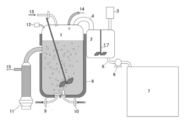
- FIG. 1 shows an example of the cell culture device of the present invention.
- FIG. 2 shows another example of the cell culture device of the present invention.
- FIG. 3 shows still another example of the cell culture device of the present invention.
- FIG. 4 shows still another example of the cell culture device of the present invention.
- the method for producing a product of the present invention is a method including culturing cells using a cell culture apparatus to produce a product from the cells.
- a cell culture apparatus used in a method for producing a product according to the present invention comprises a culture vessel containing a cell suspension containing cells, and at least one cell connected to the outside of the culture vessel capable of accumulating foam.
- a device comprising the above foam trap container.
- the cell culture apparatus of the present invention comprises a culture vessel containing a cell suspension containing cells, and at least one or more foam trap vessels capable of accumulating foam, which are connected by piping to the outside of the culture vessel. is a device containing
- a foam trap container between a culture vessel (also referred to as a culture tank) containing a cell suspension containing cells and an exhaust filter installed at the top of the culture vessel, the foam is trapped. It can be retained in the container, which prevents the foam from clogging the exhaust filter and allows the culture to continue.
- a culture vessel also referred to as a culture tank
- an exhaust filter installed at the top of the culture vessel
- the present invention by providing a space for trapping foam in front of the exhaust filter, it is possible to reliably trap the foam heading toward the exhaust filter.
- the foam trap container when a drainage line is provided in the foam trap container, even if the space of the foam trap container is about to be filled with foam and a liquid generated from the foam, the foam trap container can be drained from the foam trap container by discharging from the drainage line. to prevent foam from clogging the exhaust filter.
- the pressure loss caused by the inflow of foam can be suppressed, and the excessive pressure prevention mechanism can be achieved. Cultivation can be continued without operation and without stopping the supply of various gases to the inside of the culture vessel.
- FIGS. 1 to 4 Specific examples of the cell culture apparatus of the present invention are shown in FIGS. 1 to 4.
- FIG. 1 to 4 the culture vessel 1 is installed inside the vessel 8.
- the culture vessel 1 is a vessel that accommodates a cell suspension containing cells.
- a stirring device having a stirring blade may be provided inside the culture vessel 1 . By rotating the stirring blade, the medium contained in the culture container 1 together with the cells is stirred, and the homogeneity of the medium is maintained.
- the culture vessel 1 may be a single-use culture vessel (single-use bag), and a single-use bag made of a low-eluting material or a gas-barrier material is preferable.
- a foam trap container 2 is connected to the outside of the culture container 1 by a tube 4 that is a pipe.
- the material of the tube 4 is not particularly limited, it is preferably silicone or a material that can be heat-sealed.
- the number of foam trap containers 2 is not particularly limited, and may be one, two, or two or more. 2 to 4 show the case where the number of foam trap containers 2 is one. It is preferable that the outlet for the gas vented into the culture vessel 1 is only the line (tube 4) connecting the culture vessel 1 and the foam trap vessel.
- At least one exhaust filter 3 is connected to the foam trap container 2 .
- a drainage line 5 is connected to the foam trap container 2 , and a drainage pump 6 is installed in the middle of the drainage line 5 .
- a drain line 5 connected to the foam trap container 2 is connected to a sterile drain tank 7 .
- the drain tank may be adapted to be aseptically switched.
- the foam trap container 2 is a sealed container other than the piping connected to the outside.
- the foam trap container may be a single-use bag, preferably a single-use bag made of a low-eluting material or a gas-barrier material.
- FIG. 2 shows a state in which the antifoaming agent 16 is added inside the foam trap container 2 .
- FIG. 3 shows a state in which a physical defoaming mechanism 17 is provided within the foam trap container 2 .
- a stirring device or the like can be used as the physical defoaming mechanism 17 .
- FIG. 4 shows a case where a branched tube is used as the tube connecting the culture container 1 and the foam trap container 2 .
- the bifurcation is provided with a tube clamp 18 and the distal end of the bifurcation is provided with a sterile connector 19 so that an additional foam trap container can be connected.
- FIG. 1 to 4 a macrosparger 9 and a microsparger 10 are provided below the culture vessel 1.
- the macrosparger 9 is used to adjust the gas concentration in the culture solution, preferably a sparger for adjusting the CO2 concentration in the culture solution.
- the microsparger 10 is used to adjust the gas concentration in the culture solution, preferably a sparger for adjusting the oxygen concentration in the culture solution.
- a perfusion device 11 is connected to the culture vessel 1 , the culture solution inside the culture vessel 1 passes through the perfusion device 11 , and a permeate 15 containing cell products is taken out from the culture vessel 1 .
- the culture container 1 is provided with a pressure sensor 12 for measuring the pressure in the space above the culture solution when the culture solution is introduced into the culture container.
- the upper part of the culture vessel 1 is provided with an opening for performing top ventilation 13 .
- an opening for introducing the supply medium 14 is provided in the upper part of the culture vessel 1 .
- Vc indicates the culture vessel volume (L)
- W indicates the volume (L) of the culture medium in the culture vessel.
- S represents the air-liquid interface area (m 2 ) of the culture solution
- F indicates the top aeration rate (L/min) flowing into the culture vessel.
- E indicates the surface area (m 2 ) of the exhaust filter connected to the foam trap container;
- Mi indicates the amount of air permeation (L/min) from a microsparger with a pore size of 1 ⁇ m to 200 ⁇ m,
- Ma indicates the permeation rate (L/min) of a macrosparger with a pore size of 0.1 mm to 10 mm,
- Vt indicates the foam trap container volume (L)
- L indicates the length (m) of the tube connecting the foam trap container and the culture container
- P indicates the thickness (mm) of the tube connecting the foam trap container and the culture container.
- S air-liquid interfacial area of culture solution
- W amount of culture solution in culture vessel
- L tube length
- P thickness of tube
- Vc volume of culture vessel
- Vt foam trap container volume
- E Surface area of exhaust filter
- Vc (culture vessel volume) is preferably 10 L to 50000 L, more preferably 20 L to 20000 L, still more preferably 100 L to 2000 L, and particularly preferably 300 to 1500 L, from the viewpoint of large-scale culture and productivity. is.
- W amount of culture solution in the culture vessel
- S air-liquid interface area of the culture solution
- F (the upper surface aeration rate to flow into the culture vessel) is preferably 0.01 L/min to 200 L/min, more preferably 0.1 L/min to 100 L/min.
- E (the surface area of the exhaust filter connected to the foam trap container) is preferably between 0.01 m 2 and 10 m 2 , more preferably between 0.02 m 2 and 5 m 2 .
- Mi permeation rate through a microsparger having a pore size of 1 ⁇ m to 200 ⁇ m
- the pore size of the microsparger is preferably 5 ⁇ m to 100 ⁇ m, more preferably 10 ⁇ m to 50 ⁇ m.
- Mi may be the amount of aeration from the microsparger for maintaining the oxygen concentration in the culture medium.
- Ma permeation rate of a macrosparger having a pore size of 0.1 mm to 10 mm
- the pore size of the macrosparger is preferably 0.2 mm to 5 mm, more preferably 0.5 mm to 2 mm.
- Ma may be the aeration amount of the macrosparger for adjusting the CO2 concentration in the culture medium.
- Vt suam trap vessel volume
- L length of tube connecting foam trap container and culture container
- P thickness of tube connecting foam trap container and culture container
- P thickness of tube connecting foam trap container and culture container
- the viable cell density of the culture medium is preferably 10 ⁇ 10 6 to 300 ⁇ 10 6 cells/mL, preferably 30 ⁇ 10 6 to 300 ⁇ 10 6 cells/mL, and 40 ⁇ 10 6 to 300 ⁇ 10 6 cells/mL. It is more preferably 10 6 to 300 ⁇ 10 6 cells/mL, further preferably 50 ⁇ 10 6 to 300 ⁇ 10 6 cells/mL, and 70 ⁇ 10 6 to 300 ⁇ 10 6 cells/mL. More preferably 100 ⁇ 10 6 to 300 ⁇ 10 6 cells/mL, even more preferably 120 ⁇ 10 6 to 300 ⁇ 10 6 cells/mL. It is sometimes written as M instead of 10 6 .
- an antifoaming agent may be added to the medium.
- the antifoaming component of the antifoaming agent a silicone-based one is preferable, and dimethicone is particularly preferable.
- the defoaming component of the defoaming agent preferably contains polydimethylsiloxane, more preferably polydimethylsiloxane containing fine powder silica.
- the antifoaming agent for example, HyClone ADCF Antifoam Agent manufactured by Cytiva can be used.
- an antifoaming agent with a higher concentration than the above antifoaming agents since there is no need to consider cell damage due to the antifoaming agent, it is also possible to use an antifoaming agent with a higher concentration than the above antifoaming agents.
- the antifoaming agent 16 described above can be used as the antifoaming agent 16 when the antifoaming agent 16 is added into the foam trap container 2 .
- the cell suspension extracted from the culture vessel may be passed through a separation membrane to separate into a cell-containing liquid and a permeate liquid.
- This operation can be performed using a perfusion device.
- the cell suspension extracted from the culture vessel is divided into a cell-containing liquid having a higher cell concentration than the cell suspension and a permeated liquid having a lower cell concentration than the cell suspension. separated.
- the cell concentration can be measured by Beckman Coulter viable cell analyzer Vi-CELL XR.
- the above-described membrane separation treatment step is preferably tangential filtration, more preferably alternating tangential flow (ATF) or tangential flow, and most preferably alternating tangential flow.
- Filters capable of alternating tangential flow include SuATF10-S02PES and F2 RF02PES manufactured by Repligen.
- the medium used for cell culture the medium used for normal animal cell culture can be used.
- CD OptiCHO manufactured by ThermoFisher
- RPMI-1640 medium RPMI-1641 medium
- F-12K medium Ham's F12 medium
- Iscove's Modified Dulbecco medium (IMDM) McCoy 5A medium
- Leibovitz L-15 medium and EX-CELLTM 300 series (JRH Biosciences)
- CHO-S-SFMII Invitrogen
- CHO-SF Sigma-Aldrich
- CD-CHO Invitrogen
- IS CHO-V Irvine Scientific
- PF-ACF-CHO Sigma-Aldrich
- Serum such as fetal calf serum (FCS) may be added to the medium, or no serum may be added.
- the medium may be supplemented with additional components such as amino acids, salts, sugars, vitamins, hormones, growth factors, buffers, antibiotics, lipids, trace elements, hydrolysates of plant proteins. Protein-free media can also be used.
- the pH of the medium varies depending on the cells to be cultured, it is generally pH 6.0 to 8.0, preferably pH 6.4 to 7.6, more preferably pH 6.7 to 7.4.
- the culture temperature is generally 30° C. to 40° C., preferably 32° C. to 39° C., more preferably 36° C. to 38° C., and may be changed during the culture. Cultivation can be performed in an atmosphere with a CO 2 concentration of 0-40%, preferably 2-25%, more preferably 3-20%.
- the culture period is not particularly limited, but is generally 12 hours to 90 days, preferably 1 day to 80 days, more preferably 1 day or more and less than 70 days, still more preferably 5 days or more and 65 days. less than, particularly preferably 7 days or more and less than 60 days. In the present invention, the culture period is preferably 14 days or longer.
- the stirring rotation speed is not particularly limited, but the stirring power per unit volume is generally 10 to 300 kW/m 3 , preferably 20 to 200 kW/m 3 , and more preferably. is 30-100 kW/m 3 .
- Cell culture can be performed using a cell culture apparatus having the configuration described above in this specification.
- Cell culture equipment includes fermenter type tank culture equipment, air lift type culture equipment, culture flask type culture equipment, spinner flask type culture equipment, microcarrier type culture equipment, fluid bed type culture equipment, hollow fiber type culture equipment, roller Either a bottle-type culture apparatus, a filled tank-type culture apparatus, or the like may be used.
- the viscosity of the culture solution is preferably 1.2 mPa s or more and less than 15 mPa s, more preferably 1.4 mPa s or more and less than 12 mPa s, and particularly preferably 1.6 mPa s or more and less than 10 mPa s. is.
- a pH adjuster may be added during culture.
- the daily addition amount of the pH adjuster added to the culture tank is preferably 8 mmol/day/L or less, more preferably 7 mmol/day/L or less.
- the pH adjuster may not be added.
- the pH adjuster is not particularly limited, Na2CO3 aqueous solution, NaOH aqueous solution or NaHCO3 aqueous solution is preferable, and NaHCO3 aqueous solution is more preferable.
- the pH adjuster may be added alone, or may be added by being mixed with a medium or an antifoaming agent. In order to avoid local pH fluctuations in the culture solution due to the addition of the pH adjuster, it is preferable to add the pH adjuster mixed with the medium.
- the method of culturing cells is not particularly limited, and may be, for example, perfusion culture, batch culture, or fed-batch culture, but perfusion culture is preferred.
- Batch culture is a discontinuous method in which cells are grown in a fixed volume of culture medium for a short period of time and then completely harvested.
- Fed-batch culture is a culture method that improves batch processes by supplying medium in a bolus or continuously to replenish the medium components that have been consumed.
- Perfusion culture is a culture method in which fresh medium is added and used medium is removed at the same time, and it may be possible to further improve batch and fed-batch culture.
- Perfusion culture generally makes it possible to achieve high viable cell densities.
- a typical perfusion culture begins with a batch culture start-up lasting 1 or 2 days, after which fresh feed medium is added continuously, stepwise, and/or intermittently to the culture, and spent medium is removed simultaneously. do.
- methods such as sedimentation, centrifugation or filtration can be used to remove spent medium while maintaining viable cell density.
- An advantage of perfusion culture is that the culture in which the protein of interest is produced is maintained for a longer period of time than batch or fed-batch culture.
- Perfusion may be continuous, stepwise, intermittent, or any combination thereof.
- a continuous form is preferred.
- the animal cells are retained in culture and the spent medium that is removed may be substantially free of cells or have far fewer cells than the culture.
- Products expressed by cell culture can be retained or recovered in culture by selection of membrane pore size.
- a part of the culture medium may be removed together with the cells and the same amount of fresh medium may be added to reduce the viable cell density (cell bleeding).
- the types of cells in the present invention are not particularly limited, but include animal cells, plant cells, eukaryotic cells such as yeast, prokaryotic cells such as Bacillus subtilis, and E. coli.
- the cells are preferably animal cells (more preferably mammalian cells) or insect cells, most preferably mammalian cells. Cells may be primary cells or cell lines.
- Cells include Chinese hamster ovary (CHO) cells, HEK cells (Human Embryonic Kidney-derived cells), BHK cells, 293 cells, myeloma cells (NS0 cells, etc.), PerC6 cells, SP2/0 cells, hybridoma cells, COS cells ( African green monkey kidney-derived cells), 3T3 cells, HeLa cells, Vero cells (African green monkey kidney epithelial cells), MDCK cells (canine kidney tubular epithelial cell-derived cells), PC12 cells, WI38 cells, and the like.
- CHO cells, HEK cells, BHK cells, and hybridomas are preferred, CHO cells and HEK cells are more preferred, and CHO cells are most preferred.
- CHO cells are widely used for the production of recombinant proteins such as cytokines, clotting factors, and antibodies. It is preferable to use dihydrofolate reductase (DHFR)-deficient CHO cells, and CHO-DG44, for example, can be used as DHFR-deficient CHO cells.
- DHFR dihydrofolate reductase
- the cell survival rate is preferably higher, but is preferably 85% or higher, more preferably 90% or higher, particularly preferably 95% or higher, and most preferably 99% or higher.
- These cells may be cells into which a foreign gene encoding a protein to be expressed has been introduced.
- An expression vector can be used to introduce a foreign gene encoding a protein to be expressed into a cell.
- a protein to be expressed is encoded by introducing into cells an expression vector containing a DNA encoding the protein to be expressed, an expression control sequence (e.g., enhancer, promoter, terminator, etc.), and optionally a selectable marker gene. Cells into which exogenous genes have been introduced can be produced.
- the expression vector is not particularly limited, and can be appropriately selected and used according to the cell type, application, and the like.
- CMV cytomegalovirus
- SV40 early promoter SV40 early promoter
- retrovirus promoter metallothionein promoter
- heat shock promoter SR ⁇ promoter
- moloney murine leukemia virus promoter moloney murine leukemia virus promoter and enhancers.
- the enhancer of the IE gene of human CMV may be used together with the promoter.
- selectable marker genes include drug resistance genes (neomycin resistance gene, DHFR gene, puromycin resistance gene, blasticidin resistance gene, hygromycin resistance gene, cycloheximide resistance gene, or fluorescent gene (encoding green fluorescent protein GFP, etc.). genes) can be used.
- the method of introducing the expression vector into the cells is not particularly limited, and for example, the calcium phosphate method, electroporation method, liposome method, gene gun method, lipofection method, and the like can be used.
- a method for producing a product according to the present invention includes culturing cells using a cell culture apparatus to produce a product from the cells.
- the type of product is not particularly limited, but is preferably a recombinant protein.
- Products include, for example, recombinant polypeptide chains, recombinant secreted polypeptide chains, antigen binding proteins, antibodies (e.g., human antibodies, humanized antibodies, chimeric antibodies, murine antibodies, bispecific antibodies, etc.), Fc fusion proteins, fragments conjugated immunoglobulin, single chain antibody (scFv) and the like.
- adenovirus, adeno-associated virus, lentivirus, etc. may be used.
- the product is preferably an antibody, more preferably a human antibody, humanized antibody, chimeric antibody, or mouse antibody.
- Fragmented immunoglobulins include Fab, F(ab')2, Fv, and the like.
- the antibody class is not particularly limited, and may be of any class such as IgG such as IgG1, IgG2, IgG3, and IgG4, IgA, IgD, IgE, and IgM, but IgG and IgM are preferred when used as a medicine.
- Human antibodies include all antibodies that have one or more variable and constant regions derived from human immunoglobulin sequences. In one embodiment, all of the variable and constant domains are derived from human immunoglobulin sequences (a fully human antibody).
- Humanized antibodies are less likely to elicit an immune response and/or elicit a severe immune response when administered to a human subject compared to antibodies of a non-human species. have a sequence that differs from that of an antibody derived from a non-human species by one or more amino acid substitutions, deletions, and/or additions, such that there is less.
- certain amino acids within the heavy and/or light chain framework and constant domains of the non-human species antibody are mutated to produce a humanized antibody.
- constant domains from a human antibody are fused to variable domains of a non-human species.
- a chimeric antibody is an antibody in which a variable region and a constant region derived from different origins are linked.
- an antibody consisting of heavy and light chain variable regions of a mouse antibody and heavy and light chain constant regions of a human antibody is a mouse/human heterologous chimeric antibody.
- a recombinant vector that expresses a chimeric antibody can be produced by ligating DNA encoding the variable region of a mouse antibody with DNA encoding the constant region of a human antibody and incorporating this into an expression vector.
- a chimeric antibody produced during the culture can be obtained by culturing a recombinant cell transformed with the above vector and expressing the integrated DNA.
- a bispecific antibody is an antibody that recognizes two different antigen specificities.
- a method for making bispecific antibodies is to combine two immunoglobulin molecules using a cross-linking agent such as N-succinimidyl 3-(2-pyridyldithiol)propionate or S-acetylmercaptosuccinic acid anhydride.
- a method, a method of producing by binding Fab fragments of immunoglobulin molecules, and the like have been reported.
- a gene encoding a bispecific antibody can be expressed by introducing it into cells.
- Fc fusion protein refers to a protein with an Fc region and includes antibodies.
- Fabs are monovalent fragments with VL, VH, CL and CH1 domains.
- F(ab')2 is a bivalent fragment having two Fab fragments linked by a disulfide bridge at the hinge region.
- An Fv fragment contains the single-armed VL and VH domains of an antibody.
- Single-chain antibodies are antibodies in which the VL and VH regions are joined via a linker (e.g., a synthetic sequence of amino acid residues) to form a continuous protein chain, where the linker is the protein chain is long enough to fold back on itself and form a monovalent antigen binding site.
- antibodies include, but are not limited to, anti-IL-6 receptor antibodies, anti-IL-6 antibodies, anti-glypican-3 antibodies, anti-CD3 antibodies, anti-CD20 antibodies, anti-GPIIb/IIIa antibodies, anti-TNF antibodies, anti-CD25 antibodies, anti-EGFR antibodies, anti-Her2/neu antibodies, anti-RSV antibodies, anti-CD33 antibodies, anti-CD52 antibodies, anti-IgE antibodies, anti-CD11a antibodies, anti-VEGF antibodies and anti-VLA4 antibodies.
- the products produced by the above culture can be purified. Separation and purification of the product may be carried out using separation and purification methods commonly used for proteins. For example, by appropriately selecting and combining chromatography columns such as affinity chromatography, filters, ultrafiltration, salting out, dialysis, sodium dodecyl sulfate (SDS) polyacrylamide gel electrophoresis, isoelectric focusing, etc., the product can be isolated and purified, but not limited to: The concentration of the product obtained above can be measured by absorbance measurement, enzyme-linked immunosorbent assay (ELISA), or the like.
- ELISA enzyme-linked immunosorbent assay
- Chromatography other than affinity chromatography includes, for example, ion exchange chromatography, hydrophobic chromatography, gel filtration, reverse phase chromatography, adsorption chromatography and the like. These chromatographies can be performed using liquid phase chromatography such as HPLC (high performance liquid chromatography) or FPLC (fast protein liquid chromatography).
- the product can be modified or the peptide can be partially removed by allowing an appropriate polypeptide-modifying enzyme to act on the product before or after purification.
- polypeptide-modifying enzymes include trypsin, chymotrypsin, lysylendopeptidase, protein kinase, glucosidase, and the like.
- Achievable viable cell density 1.2 ⁇ 10 8 cells/mL After seeding the cells, the cell density was measured once a day, and if the cell density reached above was exceeded, the culture medium was withdrawn so that the cell density was reached, and the same amount of medium was added to obtain a total The volume of culture fluid was adjusted to be constant, and the cell density was adjusted to maintain the reached density.
- Perfusion ratio 1.2 Two days after the start of culture, perfusion was started. That is, a new medium is continuously supplied to the culture tank, and at the same time, the same amount of the medium as the medium to be supplied is removed from the filtration filter. Adjusted to double.
- F4 RF02PES-V2 membrane was used for Repligen ATF4 system.
- the F4 RF02PES-V2 membrane has a pore size of 0.2 ⁇ m, a hollow fiber diameter of 1 mm, and a filtration area of 0.77 m 2 .
- Oxygen concentration Oxygen concentration was maintained at 33% or more.
- Antifoaming agent HyClone ADCF Antifoam Agent manufactured by Cytiva was continuously added at an addition rate of 0.2 mg/L/hr to Simeticon as an active ingredient from the 7th day of culture. Culture period: In Examples 1 to 3, culture was carried out for 34 days.
- Example 4 Cells; CHO cell culture method; fed-batch culture medium; CD OptiCHO (manufactured by ThermoFisher Scientific) Culture tank: Plastic single-use culture vessel with a diameter of 349 mm and a tank height of 685 mm, the stirring blade is a propeller blade with a diameter of 116 mm.
- Viable cell seeding density 5 ⁇ 10 5 cells/mL Culture environment: 36° C. or higher and 38° C. or lower, pH: 6.7 or higher and 7.4 or lower, CO2 concentration: 160 mmHg or lower
- Achieved viable cell density 4.0 ⁇ 10 7 cells/mL, after cell seeding, once a day Perform cell density measurement.
- Oxygen concentration Maintaining oxygen concentration at 33% or more Defoaming agent: HyClone ADCF Antifoam Agent manufactured by Cytiva was added as needed Culture period: In Example 4, culture was performed for 14 days.
- the range of values in parentheses in the top ventilation volume column is (Formula 5) 1000 ⁇ S 2 ⁇ Mi 2 ⁇ Ma 0.5 ⁇ L/P 2 /(Vc ⁇ W) ⁇ F ⁇ W/10 Indicates the range that satisfies
- the numerical range in parentheses in the exhaust filter area column is (Formula 4) W0.5 /1000 ⁇ E ⁇ Vc/S/100 Indicates the range that satisfies
- the numerical range in parentheses in the foam trap container capacity column is (Formula 1) Mi2xMa0.5 / S /200 ⁇ Vt ⁇ 10W Indicates the range that satisfies
- a to D in the results of Table 3 were evaluated according to the following criteria.
- D Foam accumulated in the exhaust filter, and the culture continued if you can't
- Example 1 the internal pressure in the culture tank could be maintained below 5 psi. Antibody productivity was also high. In Example 2, the internal pressure in the culture tank instantaneously reached 5 psi, but it was possible to continue. Antibody productivity was also high. In Example 3, the internal pressure in the culture tank could be maintained below 5 psi. Antibody productivity was also high. In Example 4, the internal pressure in the culture tank could be maintained below 5 psi. Although the antibody productivity was inferior to that of the perfusion culture, the antibody could be produced.
- Example 5 the internal pressure in the culture tank could be maintained below 5 psi.
- Example 7 the internal pressure in the culture tank instantaneously reached 5 psi, but it was possible to continue.
- Examples 8-11 the internal pressure in the culture tank could be maintained below 5 psi.
- Example 12 the internal pressure in the culture tank instantaneously reached 5 psi, but it was possible to continue.
- Examples 13 and 14 the internal pressure in the culture tank exceeded 5 psi and the control of culture was stopped, but immediately fell below 5 psi and the control was restarted, so the culture could be continued.
- Example 15 the foam reached the exhaust filter attached to the culture tank, and the exhaust filter of the culture tank was clogged. I was able to keep it.
- Example 16 the foam reached the exhaust filter attached to the culture tank, and the exhaust filter of the culture tank was clogged. I was able to keep it.
- Comparative Example 1 since the foam trap was inside and had a small volume, the foam trap was quickly filled with foam, and the foam reached the exhaust filter.
Landscapes
- Chemical & Material Sciences (AREA)
- Health & Medical Sciences (AREA)
- Organic Chemistry (AREA)
- Life Sciences & Earth Sciences (AREA)
- Engineering & Computer Science (AREA)
- Wood Science & Technology (AREA)
- Zoology (AREA)
- Bioinformatics & Cheminformatics (AREA)
- Genetics & Genomics (AREA)
- General Health & Medical Sciences (AREA)
- Biochemistry (AREA)
- Biomedical Technology (AREA)
- Biotechnology (AREA)
- Microbiology (AREA)
- General Engineering & Computer Science (AREA)
- Sustainable Development (AREA)
- Proteomics, Peptides & Aminoacids (AREA)
- Biophysics (AREA)
- Immunology (AREA)
- Molecular Biology (AREA)
- Medicinal Chemistry (AREA)
- Analytical Chemistry (AREA)
- Cell Biology (AREA)
- Apparatus Associated With Microorganisms And Enzymes (AREA)
Priority Applications (4)
| Application Number | Priority Date | Filing Date | Title |
|---|---|---|---|
| EP22907476.0A EP4450609A1 (en) | 2021-12-15 | 2022-12-14 | Method for producing product, and cell culture apparatus |
| CN202280082932.8A CN118541491A (zh) | 2021-12-15 | 2022-12-14 | 产物的制造方法及细胞培养装置 |
| JP2023567809A JPWO2023112952A1 (https=) | 2021-12-15 | 2022-12-14 | |
| US18/743,257 US20240336671A1 (en) | 2021-12-15 | 2024-06-14 | Method for producing product, and cell culture device |
Applications Claiming Priority (2)
| Application Number | Priority Date | Filing Date | Title |
|---|---|---|---|
| JP2021-203376 | 2021-12-15 | ||
| JP2021203376 | 2021-12-15 |
Related Child Applications (1)
| Application Number | Title | Priority Date | Filing Date |
|---|---|---|---|
| US18/743,257 Continuation US20240336671A1 (en) | 2021-12-15 | 2024-06-14 | Method for producing product, and cell culture device |
Publications (1)
| Publication Number | Publication Date |
|---|---|
| WO2023112952A1 true WO2023112952A1 (ja) | 2023-06-22 |
Family
ID=86774361
Family Applications (1)
| Application Number | Title | Priority Date | Filing Date |
|---|---|---|---|
| PCT/JP2022/046000 Ceased WO2023112952A1 (ja) | 2021-12-15 | 2022-12-14 | 生産物の製造方法、及び細胞培養装置 |
Country Status (5)
| Country | Link |
|---|---|
| US (1) | US20240336671A1 (https=) |
| EP (1) | EP4450609A1 (https=) |
| JP (1) | JPWO2023112952A1 (https=) |
| CN (1) | CN118541491A (https=) |
| WO (1) | WO2023112952A1 (https=) |
Families Citing this family (2)
| Publication number | Priority date | Publication date | Assignee | Title |
|---|---|---|---|---|
| JPWO2023190829A1 (https=) * | 2022-03-31 | 2023-10-05 | ||
| CN120272303B (zh) * | 2025-03-11 | 2025-12-26 | 河南飞天生物科技股份有限公司 | 一种麦芽糊精废渣处理装置及方法 |
Citations (9)
| Publication number | Priority date | Publication date | Assignee | Title |
|---|---|---|---|---|
| JPS541097U (https=) * | 1978-05-02 | 1979-01-06 | ||
| JPS575688A (en) * | 1980-06-13 | 1982-01-12 | Toray Ind Inc | Tank for animal cell cultivation |
| JPH01281072A (ja) * | 1988-05-06 | 1989-11-13 | Hitachi Ltd | 細胞培養方法及び装置 |
| JPH05146286A (ja) * | 1991-11-22 | 1993-06-15 | Ajinomoto Co Inc | 好気性培養による発酵生産における培養装置及び消泡制御方法 |
| JP2012170364A (ja) * | 2011-02-18 | 2012-09-10 | Hitachi Plant Technologies Ltd | 生体細胞の培養容器、及び培養装置 |
| JP2016517691A (ja) | 2013-05-03 | 2016-06-20 | フジフィルム・ダイオシンス・バイオテクノロジーズ ・ユーケイ・リミテッド | 発現方法 |
| JP2017127226A (ja) * | 2016-01-19 | 2017-07-27 | 大成建設株式会社 | 自然環境で用いる環境浄化用微生物の培養方法、及び環境浄化方法 |
| CN206688452U (zh) * | 2017-04-28 | 2017-12-01 | 天津科技大学 | 一种发酵尾气高效处理装置 |
| JP2018019615A (ja) | 2016-08-02 | 2018-02-08 | 株式会社日立製作所 | シングルユース培養装置及び培養方法 |
-
2022
- 2022-12-14 JP JP2023567809A patent/JPWO2023112952A1/ja active Pending
- 2022-12-14 WO PCT/JP2022/046000 patent/WO2023112952A1/ja not_active Ceased
- 2022-12-14 EP EP22907476.0A patent/EP4450609A1/en active Pending
- 2022-12-14 CN CN202280082932.8A patent/CN118541491A/zh active Pending
-
2024
- 2024-06-14 US US18/743,257 patent/US20240336671A1/en active Pending
Patent Citations (9)
| Publication number | Priority date | Publication date | Assignee | Title |
|---|---|---|---|---|
| JPS541097U (https=) * | 1978-05-02 | 1979-01-06 | ||
| JPS575688A (en) * | 1980-06-13 | 1982-01-12 | Toray Ind Inc | Tank for animal cell cultivation |
| JPH01281072A (ja) * | 1988-05-06 | 1989-11-13 | Hitachi Ltd | 細胞培養方法及び装置 |
| JPH05146286A (ja) * | 1991-11-22 | 1993-06-15 | Ajinomoto Co Inc | 好気性培養による発酵生産における培養装置及び消泡制御方法 |
| JP2012170364A (ja) * | 2011-02-18 | 2012-09-10 | Hitachi Plant Technologies Ltd | 生体細胞の培養容器、及び培養装置 |
| JP2016517691A (ja) | 2013-05-03 | 2016-06-20 | フジフィルム・ダイオシンス・バイオテクノロジーズ ・ユーケイ・リミテッド | 発現方法 |
| JP2017127226A (ja) * | 2016-01-19 | 2017-07-27 | 大成建設株式会社 | 自然環境で用いる環境浄化用微生物の培養方法、及び環境浄化方法 |
| JP2018019615A (ja) | 2016-08-02 | 2018-02-08 | 株式会社日立製作所 | シングルユース培養装置及び培養方法 |
| CN206688452U (zh) * | 2017-04-28 | 2017-12-01 | 天津科技大学 | 一种发酵尾气高效处理装置 |
Also Published As
| Publication number | Publication date |
|---|---|
| US20240336671A1 (en) | 2024-10-10 |
| EP4450609A1 (en) | 2024-10-23 |
| JPWO2023112952A1 (https=) | 2023-06-22 |
| CN118541491A (zh) | 2024-08-23 |
Similar Documents
| Publication | Publication Date | Title |
|---|---|---|
| US20240240130A1 (en) | Culture method for cells and production method for useful substance | |
| US20240336671A1 (en) | Method for producing product, and cell culture device | |
| ES2642629T3 (es) | Métodos para la producción mejorada de proteínas | |
| CN111406105B (zh) | 具有连续收获而无细胞排出的强化灌流细胞培养方法 | |
| JPWO2019181234A1 (ja) | 生産物の製造方法 | |
| US20250019420A1 (en) | Production method of product and product | |
| US20240002784A1 (en) | Culture method for cells and production method for useful substance | |
| WO2023190300A1 (ja) | 生産物の生産方法、及び生産物 | |
| US20250223624A1 (en) | Production method for product | |
| US20260085282A1 (en) | Cell culture method and production method for product | |
| CN121358529A (zh) | 用于色谱和色谱介质再利用的方法 | |
| US20260085110A1 (en) | Production method for product | |
| WO2024248120A1 (ja) | 生産物の生産方法 | |
| WO2026019782A2 (en) | Methods for reducing filter fouling in perfusion cell cultures with recirculating tangential flow filtration | |
| EP4680380A1 (en) | Virus filtration operations employing an oversized virus prefilter | |
| CN121488027A (zh) | 用于细胞培养基灌注和生物反应器收获的交替再循环切向流(artf)过滤 |
Legal Events
| Date | Code | Title | Description |
|---|---|---|---|
| 121 | Ep: the epo has been informed by wipo that ep was designated in this application |
Ref document number: 22907476 Country of ref document: EP Kind code of ref document: A1 |
|
| WWE | Wipo information: entry into national phase |
Ref document number: 2023567809 Country of ref document: JP |
|
| WWE | Wipo information: entry into national phase |
Ref document number: 202280082932.8 Country of ref document: CN |
|
| WWE | Wipo information: entry into national phase |
Ref document number: 2022907476 Country of ref document: EP |
|
| NENP | Non-entry into the national phase |
Ref country code: DE |
|
| ENP | Entry into the national phase |
Ref document number: 2022907476 Country of ref document: EP Effective date: 20240715 |