WO2023112904A1 - 鮮度保持シート及び保冷庫 - Google Patents
鮮度保持シート及び保冷庫 Download PDFInfo
- Publication number
- WO2023112904A1 WO2023112904A1 PCT/JP2022/045753 JP2022045753W WO2023112904A1 WO 2023112904 A1 WO2023112904 A1 WO 2023112904A1 JP 2022045753 W JP2022045753 W JP 2022045753W WO 2023112904 A1 WO2023112904 A1 WO 2023112904A1
- Authority
- WO
- WIPO (PCT)
- Prior art keywords
- freshness
- humidity
- humidity control
- keeping sheet
- moisture
- Prior art date
- Legal status (The legal status is an assumption and is not a legal conclusion. Google has not performed a legal analysis and makes no representation as to the accuracy of the status listed.)
- Ceased
Links
Images







Classifications
-
- A—HUMAN NECESSITIES
- A23—FOODS OR FOODSTUFFS; TREATMENT THEREOF, NOT COVERED BY OTHER CLASSES
- A23B—PRESERVATION OF FOODS, FOODSTUFFS OR NON-ALCOHOLIC BEVERAGES; CHEMICAL RIPENING OF FRUIT OR VEGETABLES
- A23B7/00—Preservation of fruit or vegetables; Chemical ripening of fruit or vegetables
-
- B—PERFORMING OPERATIONS; TRANSPORTING
- B01—PHYSICAL OR CHEMICAL PROCESSES OR APPARATUS IN GENERAL
- B01D—SEPARATION
- B01D53/00—Separation of gases or vapours; Recovering vapours of volatile solvents from gases; Chemical or biological purification of waste gases, e.g. engine exhaust gases, smoke, fumes, flue gases, aerosols
- B01D53/26—Drying gases or vapours
-
- B—PERFORMING OPERATIONS; TRANSPORTING
- B32—LAYERED PRODUCTS
- B32B—LAYERED PRODUCTS, i.e. PRODUCTS BUILT-UP OF STRATA OF FLAT OR NON-FLAT, e.g. CELLULAR OR HONEYCOMB, FORM
- B32B27/00—Layered products comprising a layer of synthetic resin
-
- B—PERFORMING OPERATIONS; TRANSPORTING
- B32—LAYERED PRODUCTS
- B32B—LAYERED PRODUCTS, i.e. PRODUCTS BUILT-UP OF STRATA OF FLAT OR NON-FLAT, e.g. CELLULAR OR HONEYCOMB, FORM
- B32B7/00—Layered products characterised by the relation between layers; Layered products characterised by the relative orientation of features between layers, or by the relative values of a measurable parameter between layers, i.e. products comprising layers having different physical, chemical or physicochemical properties; Layered products characterised by the interconnection of layers
- B32B7/02—Physical, chemical or physicochemical properties
-
- F—MECHANICAL ENGINEERING; LIGHTING; HEATING; WEAPONS; BLASTING
- F25—REFRIGERATION OR COOLING; COMBINED HEATING AND REFRIGERATION SYSTEMS; HEAT PUMP SYSTEMS; MANUFACTURE OR STORAGE OF ICE; LIQUEFACTION SOLIDIFICATION OF GASES
- F25D—REFRIGERATORS; COLD ROOMS; ICE-BOXES; COOLING OR FREEZING APPARATUS NOT OTHERWISE PROVIDED FOR
- F25D23/00—General constructional features
Definitions
- This disclosure relates to a freshness-preserving sheet and a cold storage.
- This application claims priority to Japanese Patent Application No. 2021-204854 filed in Japan on December 17, 2021, the content of which is incorporated herein.
- Fresh vegetables have an excessive amount of moisture, and when placed in a closed space such as a refrigerator (vegetable compartment) or a cold box, dew condensation occurs due to transpiration from the vegetables and the low temperature inside. Condensation makes it difficult to maintain the quality of vegetables, and leafy vegetables are particularly susceptible to damage. Humidity in the vegetable compartment is adjusted.
- Patent Document 1 discloses a humidity-conditioning sheet formed by sandwiching a water-retaining layer between two outer layers, one outer layer having water permeability and the other outer layer being a non-water-permeable layer, and the water-retaining layer being liquid.
- glycerin is also a nutrient source for fungi, and fungi tend to propagate in areas where the glycerin adheres, resulting in hygiene problems.
- the present disclosure aims to provide a hygienic freshness-keeping sheet that has a humidity control function and does not contaminate food or the inside of a cold storage.
- One aspect of the present disclosure is characterized by comprising a humidity conditioning unit including a humidity conditioning material and a moisture release suppressing unit that suppresses moisture release from the humidity conditioning unit, wherein the humidity conditioning material is solid.
- a refrigerator comprising a freshness-keeping sheet, comprising a storage unit for storing the object whose freshness is to be kept, and a cooling unit for cooling the air in the storage unit,
- the freshness-preserving sheet is characterized in that it is arranged such that the humidity control section faces the object whose freshness is to be preserved.
- the present disclosure since it has a solid humidity conditioning material, leakage of the humidity conditioning material is small, and food and the inside of the refrigerator can be kept sanitary. Further, it is possible to provide a freshness-keeping sheet that has a humidity control function and can absorb or release moisture in a closed space to maintain freshness.
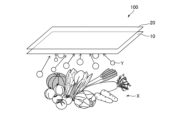
- FIG. 1 is a view when using the freshness-keeping sheet according to the first embodiment.
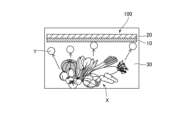
- FIG. 2 is a view when using the freshness-keeping sheet according to the first embodiment.
- FIG. 3 is a cross-sectional view of the freshness-keeping sheet according to the first embodiment.
- FIG. 4 is a cross-sectional view schematically showing the humidity conditioner.
- FIG. 5 is a cross-sectional view schematically showing the humidity conditioning material carried on the carrier.
- FIG. 6 is a diagram showing a freshness-keeping sheet according to the first embodiment.
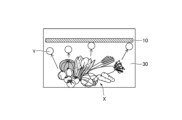
- FIG. 7 is a diagram showing a usage example of the freshness-keeping sheet according to the first embodiment, showing a state in which the interior of the room is sealed.
- FIG. 8 is a diagram showing a usage example of the freshness-keeping sheet according to the first embodiment, showing a state in which the interior of the room is open.
- FIG. 9 is a diagram showing a usage example of the freshness-keeping sheet according to the first embodiment, showing a state in which the room is opened and sealed again.
- FIG. 10 is a diagram showing a seat without a moisture release suppressing portion.
- FIG. 11 is a diagram showing a sheet without a humidity control section.
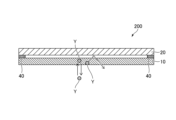
- FIG. 12 is a cross-sectional view showing a freshness-keeping sheet according to the second embodiment.
- FIG. 13 is a cross-sectional view showing a freshness-keeping sheet according to the third embodiment.
- FIG. 14 is a cross-sectional view showing a freshness-keeping sheet according to the fourth embodiment.
- 15 is a cross-sectional view showing a freshness-keeping sheet according to Example 2.
- FIG. FIG. 16 is a schematic diagram of a cold storage with a freshness-keeping sheet according to the
- FIG. 1 and 2 are diagrams when the freshness-keeping sheet 100 according to the first embodiment is used.
- the freshness-keeping sheet 100 according to the first embodiment is used, for example, in a closed space that requires a humidity control function, such as a room such as a vegetable compartment of a refrigerator, or a cold box.
- a humidity control function such as a room such as a vegetable compartment of a refrigerator, or a cold box.
- a room such as a vegetable compartment of a refrigerator, or a cold box.
- a humidity control function such as a room such as a vegetable compartment of a refrigerator, or a cold box.
- an object X whose freshness is to be maintained for example, fresh vegetables as shown in FIG.
- a large amount of water vapor Y is emitted from the object X, and the room becomes excessively humid.
- the target object X such as vegetables, especially leafy vegetables, is easily damaged. Therefore, adjusting indoor humidity is important for maintaining freshness.
- the freshness-keeping sheet 100 has a humidity control function. Indoor dew condensation can be suppressed, and the freshness of the object X can be maintained for a longer period of time.
- the freshness-keeping sheet 100 releases water vapor Y, suppresses drying in the room, and maintains the freshness of the object X for a longer period of time. can be maintained.
- the freshness-keeping sheet 100 can absorb or release the water vapor Y in the room, and the freshness of the object X such as vegetables can be maintained for a longer period of time.
- the freshness-keeping sheet 100 according to the first embodiment will be described in detail below.
- FIG. 3 is a cross-sectional view of the freshness-keeping sheet 100 according to the first embodiment.
- the freshness-keeping sheet 100 according to the first embodiment includes a humidity conditioning section 10 including a humidity conditioning material 11 and a moisture release suppressing section 20 that suppresses moisture release from the humidity conditioning section 10.
- a humidity conditioning section 10 including a humidity conditioning material 11 and a moisture release suppressing section 20 that suppresses moisture release from the humidity conditioning section 10.
- the humidity control section 10 and the moisture release suppression section 20 are layered, and they are laminated so that the humidity control section 10 and the moisture release suppression section 20 are in close contact with each other.
- the humidity control section 10 and the moisture release suppressing section 20 are adhered and integrated.
- the humidity control section and the moisture release suppression section face each other.
- the humidity control unit 10 absorbs and releases water vapor Y, and absorbs and releases moisture.
- the moisture release suppressing section 20 suppresses absorption of the water vapor Y from the outside (outside air) of the moisture release suppressing section 20 and suppresses excessive release of the water vapor Y from the humidity control section 10 .
- the moisture control unit 10 may release too much water vapor Y, so the moisture release suppressing unit 20 suppresses excessive release of water vapor Y to keep the vegetables moist.
- the moisture release suppression part 20 has a lower water vapor transmission rate than the humidity control part 10, suppresses the release of moisture from the humidity control part 10 when the room 30 such as the vegetable compartment is dry, and gives priority to the moisture release toward the vegetables.
- a film material such as polyethylene, polypropylene, PET, or nylon is applied to the moisture release suppressing portion 20 .
- a material having a water vapor transmission rate of approximately 190 g/(m 2 ⁇ h) or less is preferable.
- the moisture release suppressing portion 20 is preferably made of a material whose water vapor transmission rate changes depending on the humidity. Moreover, it is preferable that the moisture release suppressing portion 20 is made of a material having a high water vapor transmission rate at high humidity and a low water vapor transmission rate at low humidity.
- the moisture release suppressing part 20 is made of, for example, an asymmetric polymer film in which a hydrophilic polymer and a hydrophobic polymer are bonded together. When the hydrophilic polymer becomes highly humid, it captures part of the moisture in the atmosphere, creating gaps at the molecular level through which the highly humid air can easily move, thereby increasing the water vapor transmission rate.
- hydrophilic polymers include polyvinyl alcohol
- hydrophobic polymers include polypropylene and polyethylene.
- the weight ratio of the hydrophobic polymer is high on the humidity control section 10 side.
- the humidity control section 10 includes a humidity control material 11 that absorbs moisture when the humidity is high and releases moisture when the humidity is low. That is, the humidity conditioner 11 adjusts the amount of water vapor Y contained in the air.
- the humidity control material 11 has a characteristic of absorbing moisture when the ambient humidity is relatively high with respect to the equilibrium humidity, and releasing moisture when the ambient humidity becomes dry. Unlike desiccants such as silica gel and zeolite, it absorbs and desorbs moisture repeatedly, so in principle it is effective semi-permanently.
- the humidity conditioning material 11 will be described in detail below.
- FIG. 4 is a cross-sectional view schematically showing the humidity control section 10.
- the humidity conditioning material is carried by a carrier.
- the humidity conditioning section 10 is a structure in which the humidity conditioning material 11 is sandwiched between a plurality of supports 15 .
- the humidity conditioning section 10 may be a laminate in which a plurality of structures in which the humidity conditioning material 11 is sandwiched between a plurality of supports 15 are stacked.
- the humidity conditioning unit 10 may be a laminate in which the carrier 15, the humidity conditioning material 11, the carrier 15, the humidity conditioning material 11, and the carrier 15 are laminated in this order.
- the humidity control material 11 is solid.
- solid means a solid at least in a dry state, and includes those that deliquescence and liquefy when moistened, and those that swell and separate from water. Since the humidity conditioning material 11 is solid, it is less likely to leak or scatter into the food or the refrigerator, which is hygienic.
- the humidity conditioning material 11 is preferably a deliquescent substance that absorbs moisture in the air and deliquesces. Deliquescent substances are classified into salts and water-soluble organic substances. Specific examples of salts include sodium formate, potassium formate, ammonium formate, sodium acetate, potassium acetate, lithium acetate, ammonium acetate, sodium lactate, potassium lactate, sodium benzoate, potassium benzoate, sodium propionate, potassium propionate, Calcium chloride, lithium chloride, magnesium chloride, calcium chloride, lithium chloride, potassium chloride, sodium chloride, zinc chloride, aluminum chloride, lithium bromide, calcium bromide, potassium bromide, sodium hydroxide, sodium pyrrolidonecarboxylate, potassium carbonate , magnesium nitrate, disodium hydrogen phosphate, sodium dihydrogen phosphate, sodium citrate and the like. Among these, sodium formate, potassium formate, sodium acetate, potassium acetate, and potassium carbonate, which absorb and release moisture per weight, are preferred.
- water-soluble organic substances include sugars such as sucrose, pullulan, glucose, xylol, fructose, mannitol and sorbitol, carboxylic acids such as citric acid, and amides such as urea.
- the humidity conditioning material 11 preferably contains a resin material.
- the resin material By including the resin material, the moisture in the air or the deliquescent substance absorbs moisture, and the resin material can absorb the aqueous solution after the deliquescence. As a result, leakage and scattering of the moisture conditioning material into the food and the refrigerator can be further reduced.
- resin materials are preferably ionic resins and nonionic resins.
- the ionic resin include alkali metal salts of polyacrylic acid, starch-acrylate graft polymers, and the like.
- alkali metal salts of polyacrylic acid include sodium polyacrylate.
- nonionic resins include vinyl acetate copolymers, maleic anhydride copolymers, polyvinyl alcohols, polyalkylene oxides, and the like.
- sodium polyacrylate is preferable, and this material itself also has the humidity control property of absorbing moisture at high humidity and releasing moisture at low humidity, so that the humidity conditioning ability of the humidity conditioning material 11 can be enhanced.
- the resin material be in the form of powder or particles (beads). Being in the form of powder or particles, it can be easily dispersed on the carrier 15, and uniform humidity control can be obtained in the surface direction.
- a powdery one has a smaller average particle size than a particulate one. Therefore, the contact area with air is large, and the speed of moisture absorption and moisture release (humidity conditioning speed) is high. Since the humidity conditioning speed is high, it is possible to quickly absorb the water vapor that evaporates from the vegetables and suppress dew condensation. On the other hand, since the particles have a large average particle diameter, the amount of moisture absorbed and released per weight of the resin material (humidity control amount) is large.
- the resin material absorbs the aqueous solution after the deliquescent substance has deliquesced, and the absorbed resin material functions as a humidity control material.
- the resin material having the humidity control function can be arbitrarily adjusted in the humidity control speed and the humidity control amount by the average particle diameter, and can be designed according to the use environment.
- the powdery average particle size generally refers to several ⁇ m to several mm
- the particulate average particle size generally refers to several mm to several tens of mm.
- FIG. 5 is a cross-sectional view schematically showing the modified humidity conditioning material 11 carried on the carrier 15. As shown in FIG. As shown in FIG. 5, the humidity conditioning material 11 may be carried on a carrier 15 having unevenness. In this way, the humidity conditioner 11 having a high ratio of surface area to volume can be realized, and the rate of moisture absorption or release can be increased.
- the carrier 15 that carries the humidity conditioning material 11 is preferably made of a material that retains moisture.
- it is composed of hydrophilic fibers such as porous material, nonwoven fabric, and woven fabric.
- non-woven fabrics with high water vapor permeability are preferred.
- the shape of the carrier 15 is sheet-like, and may be molded into various shapes such as a flat plate shape, a pleated shape, or a honeycomb shape.
- a sheet material is first formed into a corrugated shape (flute) or the like by a corrugator, and then fixed and integrated with a flat liner made of the same or different material as the sheet with an adhesive. be done.
- the carrier 15 may have flexibility.
- the carrier 15 may be deformable. In other words, it may be possible to hold an arbitrary shape (a bent shape, a curved shape, etc.).
- FIG. 6 is a diagram showing the freshness-keeping sheet 100 according to the first embodiment.
- the freshness-keeping sheet 100 according to the first embodiment can be cut and divided, and may have a plurality of divided freshness-keeping sheets 101 .
- the divided freshness-keeping sheet 101 can adjust the humidity in the room 30 in detail.
- an easy-to-cut portion 102 with perforations or a plurality of holes may be provided. This makes it possible to easily divide into arbitrary sizes.
- FIG. 7 is a diagram showing a usage example of the freshness-keeping sheet 100 according to the first embodiment, showing a state in which the room 30 is open.
- vegetables are put into a room 30 such as a vegetable compartment of a refrigerator, and a freshness keeping sheet 100 is placed thereon.
- the freshness-keeping sheet 100 it is preferable to install the freshness-keeping sheet 100 so that the humidity control unit 10 faces the vegetables.
- the humidity control unit 10 can easily absorb the water vapor Y released from the vegetables. Therefore, dew condensation in the room 30 can be suppressed, and the freshness of the target object X can be maintained for a longer period of time.
- FIG. 7 shows a vegetable compartment of a refrigerator
- the freshness-keeping sheet according to the first embodiment can also be applied to vegetables stored in a heat insulating box made of polystyrene foam or the like together with a cold insulator or cold storage material.
- FIG. 8 is a diagram showing a usage example of the freshness-keeping sheet 100 according to the first embodiment, showing a state in which the room 30 is open.
- FIG. 9 is a diagram showing a usage example of the freshness-keeping sheet 100 according to the first embodiment, showing a state in which the room 30 is opened and closed again.
- the humidity in the room 30 decreases.
- the freshness-keeping sheet 100 releases the water vapor Y stored in the humidity control unit 10, suppresses drying of the vegetables, and maintains the freshness of the target object X. can be maintained for a longer period of time.
- the temperature of the freshness-keeping sheet 100 rises, and the freshness-keeping sheet 100 releases moisture more easily, so that more water vapor Y stored in the humidity control unit 10 is released, and the vegetables are stored in the refrigerator. drying can be suppressed.
- the amount of transpiration decreases due to the reduction in the amount of vegetables taken out from the indoor 30 such as the vegetable room, and the circulation of cold air in the indoor 30 reduces the humidity in the indoor 30 such as the vegetable room.
- the freshness of X can be maintained by supplying water vapor Y from the humidity control unit 10 .
- the freshness-keeping sheet 100 includes the humidity control section 10 and the moisture release suppressing section 20.
- the humidity control section 10 in the case of the sheet with only the humidity control section 10, in the case of the sheet with only the moisture release suppressing section 20, will be explained.
- FIG. 10 is a diagram showing a seat without the moisture release suppressing portion 20.
- the sheet is only the humidity control section 10 .
- steam Y is released from the vegetables.
- the water vapor Y is absorbed only by the sheet of the humidity control section 10 .
- the humidity of the outdoor side is lower than that of the room 30, so the sheet of only the humidity control section 10 is opened.
- the moisture release suppression unit 20 that suppresses moisture release from the humidity control unit 10
- the water vapor Y absorbed by the sheet of only the humidity control unit 10 without suppressing moisture release is released. More moisture is released than the freshness-keeping sheet 100 according to the first embodiment.
- the amount of water contained in the sheet of only the humidity control part 10 is less than that of the freshness keeping sheet 100 according to the first embodiment, the amount of water supplied to the vegetables is reduced, and the vegetables are gradually dried. loses its freshness. Therefore, the freshness of the object X cannot be maintained for a long period of time in the case of the sheet having only the humidity conditioning section 10 .
- FIG. 11 shows a sheet without the humidity control section 10.
- the sheet is only the moisture release suppressing portion 20 .
- moisture such as water vapor Y is released from the vegetables. Since there is no humidity control section 10 that absorbs moisture, the humidity in the room 30 increases.
- the humidity in the room 30 is sealed only by the sheet of the moisture release suppressing part 20 unless the sheet of the moisture release suppressing part 20 is removed. does not emit Therefore, the room 30 becomes excessively humid, dew condensation occurs, and the freshness of the vegetables gradually decreases. Therefore, in the case of the sheet having only the moisture release suppressing portion 20, the freshness of the object X cannot be maintained for a long period of time.
- the refrigerator is pulled out of the refrigerator to open the room 30 such as the vegetable compartment and the sheet of only the moisture release suppressing part 20 which seals the room 30 is removed, the water vapor Y in the room 30 is released. Then, when the room 30 is sealed again, the sheet of only the moisture release suppressing part 20 does not have the function of releasing moisture such as water vapor Y, so when the vegetables are placed, the humidity in the room 30 such as the vegetable room is increased. When the air is opened repeatedly, the humidity continues to decrease, and eventually it becomes dry. Therefore, in the case of the sheet having only the moisture release suppressing portion 20, the freshness of the object X cannot be maintained for a long period of time.
- the freshness-keeping sheet 100 includes the humidity control unit 10 and the moisture release suppressing unit 20, so that the humidity control unit 10 absorbs or releases moisture such as water vapor Y in the room 30.
- the moisture release suppression unit 20 suppresses the release of moisture from the humidity control unit 10, so that the freshness of the object X can be maintained for a longer period of time.
- the object X and the freshness-keeping sheet 100 are separated in order to illustrate the absorption or release of the water vapor Y between the object X and the freshness-keeping sheet 100, but they may be in contact with each other. . Since the humidity conditioning portion 10 of the freshness-keeping sheet according to the first embodiment is solid, the possibility of the humidity conditioning material 11 adhering to the object X is extremely low even if it comes into contact with it.
- FIG. 12 is a cross-sectional view showing a freshness-keeping sheet 200 according to the second embodiment.
- the freshness-keeping sheet 200 according to the second embodiment has a structure in which the water vapor Y released from the humidity control section 10 does not flow out from the moisture release suppressing section 20 side.
- a spacer 40 is provided to separate the humidity control section 10 and the moisture release suppression section 20 from each other.
- the humidity control section 10 absorbs and releases water vapor Y, and absorbs and releases moisture.
- the moisture release suppressing section 20 suppresses absorption of water vapor Y from the outside (outside air) of the moisture release suppressing section 20 and suppresses excessive release of water vapor Y from the humidity control section 10, especially at low humidity.
- the humidity control unit 10 and the moisture release suppressing unit 20 are separated from each other, the water vapor Y emitted from the humidity control unit 10 can be held in the space between the humidity control unit 10 and the moisture release suppressing unit 20. can. As a result, the amount of water vapor released to the object X during drying can be increased, and the freshness of the object X can be maintained for a longer period of time.
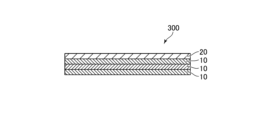
- FIG. 13 is a cross-sectional view showing a freshness-keeping sheet 300 according to the third embodiment.
- the freshness-keeping sheet 300 according to the third embodiment as shown in FIG.
- the humidity control amount can be secured, and the humidity control unit 10 can absorb a larger amount of water vapor Y emitted from the object X such as vegetables whose freshness is to be maintained, and the humidity control unit 10 can More water vapor Y can be released. Therefore, the freshness of the object X can be maintained for a longer period of time.
- freshness-keeping sheet 300 according to the third embodiment may have the moisture release suppressing portion 20 spaced apart, as in the freshness-keeping sheet 200 according to the second embodiment.
- FIG. 14 is a cross-sectional view showing a freshness-keeping sheet 400 according to the fourth embodiment.
- a freshness-keeping sheet 400 according to the fourth embodiment has a plurality of humidity conditioning parts, a first humidity conditioning part 10 and a second humidity conditioning part 12, each of which is a first humidity conditioning material and A second humidity control material is included.
- the second humidity control section 12 is provided between the first humidity control section 10 and the moisture release suppression section 20 .
- the first humidity conditioning material includes a first resin material
- the second humidity conditioning material includes a second resin material.
- the average particle size of the first resin material is smaller than that of the second resin material.
- the first humidity control unit 10 when the amount of moisture retained by the first humidity control unit 10 increases, the amount of water vapor released toward the moisture release suppressing unit 20 increases. Since the second resin material contained in the second humidity control section 12 has a larger average particle size than the first resin material, it can retain a large amount of moisture. As a result, the first humidity control unit 10 prevents a sudden increase in humidity that occurs when vegetables are put into the room 30, and the possibility of dew condensation is greatly reduced. Furthermore, since the second humidity control unit 12 absorbs water vapor that could not be absorbed by the first humidity control unit alone, when the outside air dries, the water vapor from the second humidity control unit is released, and the object X is removed. Maintains freshness for longer.
- the second humidity conditioning material contains resin, at least one of polyhydric alcohol and deliquescent substance, and water, and has a target humidity.
- having a target humidity means adjusting the relative humidity so as to approach a predetermined humidity zone. Specifically, for example, if the target humidity is 50% RH, the humidity conditioning material absorbs (absorbs) moisture when the relative humidity is higher than 50% RH, and when the relative humidity is lower than 50% RH, The humidity control material releases (dehumidifies) moisture. Normally, the target humidity correlates with the material and moisture content of the humidity control material. By maintaining the target humidity in the second humidity conditioning material, it is possible to maintain the indoor humidity near the target humidity.
- Example 1 First, a commercially available moisture-proof sheet made of polyethylene having a thickness of 0.2 mm was prepared as a moisture release suppressing portion. Next, sodium polyacrylate having an average particle size of 200 ⁇ m as a resin material and sodium acetate as a deliquescent substance were sprayed on a nonwoven fabric having a thickness of 0.5 mm and a basis weight of 50 g/m 2 as a humidity control part. Then, it was sandwiched between non-woven fabrics having the same thickness and basis weight, and was thermocompressed to obtain a humidity-conditioning sheet. The freshness-keeping sheet of Example 1 was obtained by adhering the ends of the moisture-conditioning sheet and the moisture-proof sheet thus obtained.
- Example 2 As a resin material having a larger particle size than the resin material of Example 1, sodium polyacrylate having an average particle size of 3 mm was impregnated with a 25% sodium acetate aqueous solution as a humidity control material, and the target was 80% RH. A humidity control material having humidity was obtained. As shown in FIG. 15, this was placed between the moisture-proof sheet of Example 1 and the humidity-conditioning sheet of Example 1, and the edges and joints were adhered to obtain the freshness-keeping sheet of Example 2. rice field. Other conditions were the same as in Example 1.
- Comparative Example 1 and Comparative Example 2 Comparative Example 1 without the freshness-keeping sheet and Comparative Example 2 with only the moisture-proof sheet were cut into pieces of 190 mm x 450 mm in the same manner as in Examples 1 and 2, and the above vegetables were covered. Other conditions were the same as in Examples 1 and 2.
- Table 1 shows the results of the freshness retention evaluation test in the above refrigerator vegetable compartment. As shown in Table 1, a decrease in weight was observed in both cases, but the amount of decrease in Example 1 and Example 2 was about the same, but the amount of decrease was larger in the order of Example 2 and Example 1. . Further, in terms of the appearance of the vegetables, almost no change was observed in Examples 1 and 2, but the spinach in Comparative Examples 1 and 2 wilted significantly. Also, no adhesion of the humidity control material was observed. Furthermore, when the state of dew condensation in the vegetable compartment was observed, Example 2 had less dew condensation than Example 1. The results are summarized in Table 1.
- the freshness-keeping sheets 100, 200, 300, and 400 since they have a solid humidity conditioning material, leakage of the humidity conditioning material is small, and food and the inside of the refrigerator can be kept sanitary. can. In addition, it has a humidity control function, and can absorb or release moisture in a closed space to maintain freshness.
- Example 3 As shown in FIG. 16, a storage unit 501 for storing an object X whose freshness is to be maintained, a cooling unit 502 for cooling the air in the storage unit 501, and a humidity control unit 10 facing the object X.
- a cold storage box 500 provided with the freshness-keeping sheet 101 arranged in the container was prepared.
- a prefabricated refrigerated warehouse with a width of 3.6 m ⁇ depth of 1.8 m ⁇ 1.9 m was used as the storage unit 501, and the target object X was cabbage, broccoli, radish, carrot, and paprika in the same manner as in Example 1.
- the object X was housed in a plastic packaging box 505 (width 200 mm ⁇ depth 500 mm ⁇ height 300 mm) and was placed on the floor of the storage unit 501 .
- the cooling unit 502 is of a so-called gas compression type, which cools by compressing, condensing, and vaporizing the refrigerant. The temperature inside the chamber was maintained at 3 to 10° C.
- the air inside the storage unit 501 of the present disclosure is in a dry state due to the phase transition of water vapor to water or ice by the cooler. , the drying of the object X is prevented, and the freshness of the vegetables is maintained by the humidity conditioning effect of the humidity conditioning unit 10 .
Landscapes
- Engineering & Computer Science (AREA)
- Chemical & Material Sciences (AREA)
- Chemical Kinetics & Catalysis (AREA)
- General Chemical & Material Sciences (AREA)
- Life Sciences & Earth Sciences (AREA)
- Polymers & Plastics (AREA)
- Zoology (AREA)
- Food Science & Technology (AREA)
- Wood Science & Technology (AREA)
- Combustion & Propulsion (AREA)
- Physics & Mathematics (AREA)
- Mechanical Engineering (AREA)
- Thermal Sciences (AREA)
- General Engineering & Computer Science (AREA)
- Analytical Chemistry (AREA)
- Oil, Petroleum & Natural Gas (AREA)
- Storage Of Fruits Or Vegetables (AREA)
- Cold Air Circulating Systems And Constructional Details In Refrigerators (AREA)
Priority Applications (1)
| Application Number | Priority Date | Filing Date | Title |
|---|---|---|---|
| JP2023567781A JP7783911B2 (ja) | 2021-12-17 | 2022-12-13 | 鮮度保持シート及び保冷庫 |
Applications Claiming Priority (2)
| Application Number | Priority Date | Filing Date | Title |
|---|---|---|---|
| JP2021204854 | 2021-12-17 | ||
| JP2021-204854 | 2021-12-17 |
Publications (1)
| Publication Number | Publication Date |
|---|---|
| WO2023112904A1 true WO2023112904A1 (ja) | 2023-06-22 |
Family
ID=86774741
Family Applications (1)
| Application Number | Title | Priority Date | Filing Date |
|---|---|---|---|
| PCT/JP2022/045753 Ceased WO2023112904A1 (ja) | 2021-12-17 | 2022-12-13 | 鮮度保持シート及び保冷庫 |
Country Status (2)
| Country | Link |
|---|---|
| JP (1) | JP7783911B2 (https=) |
| WO (1) | WO2023112904A1 (https=) |
Cited By (1)
| Publication number | Priority date | Publication date | Assignee | Title |
|---|---|---|---|---|
| WO2025094478A1 (ja) * | 2023-10-31 | 2025-05-08 | シャープ株式会社 | 調湿材及び調湿部材 |
Citations (10)
| Publication number | Priority date | Publication date | Assignee | Title |
|---|---|---|---|---|
| JPS58199020A (ja) * | 1982-12-29 | 1983-11-19 | Shin Nisso Kako Co Ltd | 除湿用包装物 |
| JPS63185430A (ja) * | 1987-01-26 | 1988-08-01 | Nippon Synthetic Chem Ind Co Ltd:The | シ−ト状調湿材 |
| JPS6434441A (en) * | 1987-07-29 | 1989-02-03 | Dainippon Printing Co Ltd | Water-and moisture-absorbing sheet |
| JPH05317636A (ja) * | 1992-05-14 | 1993-12-03 | Sharp Corp | 食品保存庫 |
| JPH08303936A (ja) * | 1995-05-08 | 1996-11-22 | Hitachi Ltd | 冷凍冷蔵庫 |
| JPH09280719A (ja) * | 1996-04-11 | 1997-10-31 | Hitachi Ltd | 冷凍冷蔵庫 |
| JPH11294935A (ja) * | 1998-04-15 | 1999-10-29 | Toshiba Corp | 冷蔵庫 |
| JP2000234850A (ja) * | 1999-02-17 | 2000-08-29 | Sharp Corp | 冷蔵庫 |
| JP2001091144A (ja) * | 1999-09-27 | 2001-04-06 | Toshiba Corp | 冷蔵庫 |
| JP2004101028A (ja) * | 2002-09-06 | 2004-04-02 | Matsushita Refrig Co Ltd | 冷蔵庫 |
-
2022
- 2022-12-13 WO PCT/JP2022/045753 patent/WO2023112904A1/ja not_active Ceased
- 2022-12-13 JP JP2023567781A patent/JP7783911B2/ja active Active
Patent Citations (10)
| Publication number | Priority date | Publication date | Assignee | Title |
|---|---|---|---|---|
| JPS58199020A (ja) * | 1982-12-29 | 1983-11-19 | Shin Nisso Kako Co Ltd | 除湿用包装物 |
| JPS63185430A (ja) * | 1987-01-26 | 1988-08-01 | Nippon Synthetic Chem Ind Co Ltd:The | シ−ト状調湿材 |
| JPS6434441A (en) * | 1987-07-29 | 1989-02-03 | Dainippon Printing Co Ltd | Water-and moisture-absorbing sheet |
| JPH05317636A (ja) * | 1992-05-14 | 1993-12-03 | Sharp Corp | 食品保存庫 |
| JPH08303936A (ja) * | 1995-05-08 | 1996-11-22 | Hitachi Ltd | 冷凍冷蔵庫 |
| JPH09280719A (ja) * | 1996-04-11 | 1997-10-31 | Hitachi Ltd | 冷凍冷蔵庫 |
| JPH11294935A (ja) * | 1998-04-15 | 1999-10-29 | Toshiba Corp | 冷蔵庫 |
| JP2000234850A (ja) * | 1999-02-17 | 2000-08-29 | Sharp Corp | 冷蔵庫 |
| JP2001091144A (ja) * | 1999-09-27 | 2001-04-06 | Toshiba Corp | 冷蔵庫 |
| JP2004101028A (ja) * | 2002-09-06 | 2004-04-02 | Matsushita Refrig Co Ltd | 冷蔵庫 |
Cited By (1)
| Publication number | Priority date | Publication date | Assignee | Title |
|---|---|---|---|---|
| WO2025094478A1 (ja) * | 2023-10-31 | 2025-05-08 | シャープ株式会社 | 調湿材及び調湿部材 |
Also Published As
| Publication number | Publication date |
|---|---|
| JPWO2023112904A1 (https=) | 2023-06-22 |
| JP7783911B2 (ja) | 2025-12-10 |
Similar Documents
| Publication | Publication Date | Title |
|---|---|---|
| US6688132B2 (en) | Cooling device and temperature-controlled shipping container using same | |
| US5918480A (en) | Refrigerator | |
| JP4619379B2 (ja) | 冷蔵庫 | |
| US20150203272A1 (en) | Absorbent pad having a desiccant | |
| WO2023112904A1 (ja) | 鮮度保持シート及び保冷庫 | |
| JPH08136113A (ja) | 冷蔵庫 | |
| KR102724710B1 (ko) | 친환경 아이스팩 | |
| US20040224144A1 (en) | Humidity control with solid support | |
| JPH11190584A (ja) | 冷蔵庫 | |
| JPH09126631A (ja) | 冷凍冷蔵庫 | |
| JPWO2023112904A5 (https=) | ||
| JPH09280719A (ja) | 冷凍冷蔵庫 | |
| JPH09324979A (ja) | 保存庫 | |
| JP3582636B2 (ja) | 冷蔵庫 | |
| EP0655972B1 (en) | Method of packaging horticultural produce | |
| CN2190629Y (zh) | 叶菜类的保鲜复合袋 | |
| JP2000279085A (ja) | 青果物用鮮度保持材 | |
| JP2000005550A (ja) | 調湿シート | |
| JPH05317636A (ja) | 食品保存庫 | |
| JPH0365135A (ja) | 鮮度保持用シート材 | |
| US20250346421A1 (en) | Moisture absorbing device for food packaging | |
| JP2001233386A (ja) | 保存容器及び保存方法 | |
| WO2023112402A1 (ja) | 調湿シート | |
| JP2602040B2 (ja) | 保冷材および製法 | |
| JP2818953B2 (ja) | 機能性段ボール材及びこれを用いて形成された機能性段ボール箱 |
Legal Events
| Date | Code | Title | Description |
|---|---|---|---|
| 121 | Ep: the epo has been informed by wipo that ep was designated in this application |
Ref document number: 22907428 Country of ref document: EP Kind code of ref document: A1 |
|
| WWE | Wipo information: entry into national phase |
Ref document number: 2023567781 Country of ref document: JP |
|
| NENP | Non-entry into the national phase |
Ref country code: DE |
|
| 122 | Ep: pct application non-entry in european phase |
Ref document number: 22907428 Country of ref document: EP Kind code of ref document: A1 |