WO2023106061A1 - 毛状体を有する樹脂シート及びその加工品 - Google Patents
毛状体を有する樹脂シート及びその加工品 Download PDFInfo
- Publication number
- WO2023106061A1 WO2023106061A1 PCT/JP2022/042667 JP2022042667W WO2023106061A1 WO 2023106061 A1 WO2023106061 A1 WO 2023106061A1 JP 2022042667 W JP2022042667 W JP 2022042667W WO 2023106061 A1 WO2023106061 A1 WO 2023106061A1
- Authority
- WO
- WIPO (PCT)
- Prior art keywords
- resin sheet
- bodies
- hair
- resin
- less
- Prior art date
- Legal status (The legal status is an assumption and is not a legal conclusion. Google has not performed a legal analysis and makes no representation as to the accuracy of the status listed.)
- Ceased
Links
Images


Classifications
-
- A—HUMAN NECESSITIES
- A41—WEARING APPAREL
- A41D—OUTERWEAR; PROTECTIVE GARMENTS; ACCESSORIES
- A41D31/00—Materials specially adapted for outerwear
-
- A—HUMAN NECESSITIES
- A41—WEARING APPAREL
- A41D—OUTERWEAR; PROTECTIVE GARMENTS; ACCESSORIES
- A41D31/00—Materials specially adapted for outerwear
- A41D31/02—Layered materials
-
- B—PERFORMING OPERATIONS; TRANSPORTING
- B32—LAYERED PRODUCTS
- B32B—LAYERED PRODUCTS, i.e. PRODUCTS BUILT-UP OF STRATA OF FLAT OR NON-FLAT, e.g. CELLULAR OR HONEYCOMB, FORM
- B32B5/00—Layered products characterised by the non- homogeneity or physical structure, i.e. comprising a fibrous, filamentary, particulate or foam layer; Layered products characterised by having a layer differing constitutionally or physically in different parts
- B32B5/02—Layered products characterised by the non- homogeneity or physical structure, i.e. comprising a fibrous, filamentary, particulate or foam layer; Layered products characterised by having a layer differing constitutionally or physically in different parts characterised by structural features of a fibrous or filamentary layer
-
- D—TEXTILES; PAPER
- D06—TREATMENT OF TEXTILES OR THE LIKE; LAUNDERING; FLEXIBLE MATERIALS NOT OTHERWISE PROVIDED FOR
- D06N—WALL, FLOOR, OR LIKE COVERING MATERIALS, e.g. LINOLEUM, OILCLOTH, ARTIFICIAL LEATHER, ROOFING FELT, CONSISTING OF A FIBROUS WEB COATED WITH A LAYER OF MACROMOLECULAR MATERIAL; FLEXIBLE SHEET MATERIAL NOT OTHERWISE PROVIDED FOR
- D06N3/00—Artificial leather, oilcloth or other material obtained by covering fibrous webs with macromolecular material, e.g. resins, rubber or derivatives thereof
-
- D—TEXTILES; PAPER
- D06—TREATMENT OF TEXTILES OR THE LIKE; LAUNDERING; FLEXIBLE MATERIALS NOT OTHERWISE PROVIDED FOR
- D06N—WALL, FLOOR, OR LIKE COVERING MATERIALS, e.g. LINOLEUM, OILCLOTH, ARTIFICIAL LEATHER, ROOFING FELT, CONSISTING OF A FIBROUS WEB COATED WITH A LAYER OF MACROMOLECULAR MATERIAL; FLEXIBLE SHEET MATERIAL NOT OTHERWISE PROVIDED FOR
- D06N3/00—Artificial leather, oilcloth or other material obtained by covering fibrous webs with macromolecular material, e.g. resins, rubber or derivatives thereof
- D06N3/12—Artificial leather, oilcloth or other material obtained by covering fibrous webs with macromolecular material, e.g. resins, rubber or derivatives thereof with macromolecular compounds obtained otherwise than by reactions only involving carbon-to-carbon unsaturated bonds, e.g. gelatine proteins
- D06N3/14—Artificial leather, oilcloth or other material obtained by covering fibrous webs with macromolecular material, e.g. resins, rubber or derivatives thereof with macromolecular compounds obtained otherwise than by reactions only involving carbon-to-carbon unsaturated bonds, e.g. gelatine proteins with polyurethanes
Definitions
- the present invention relates to a resin sheet having hair-like bodies and a processed product thereof.
- Patent Literature 1 proposes a resin sheet having hair-like bodies regularly arranged on the surface.
- the workability may not be sufficient.
- the cushioning property may be poor, and the feeling of weight may be felt.
- the problem to be solved by the present invention is to provide a resin sheet that can be sewn, has cushioning properties, and has a suppressed sense of weight, and a processed product thereof.
- a base layer having regularly arranged hair-like bodies on one side and a fiber sheet layer on the side opposite to the hair-like bodies of the base layer There is no structural boundary between the base layer and the hair-like body, and a continuous phase is formed between the base layer and the hair-like body.
- a resin sheet By making it into a resin sheet, it can be sewn, has cushioning properties, and has a sense of weight.
- the present inventors have found that the resin sheet is suppressed, and have completed the present invention.
- the present invention for solving the above problems is composed of the following.
- a base layer having regularly arranged hairy bodies on one side and a fiber sheet layer on the side opposite to the hairy bodies of the base layer, and the base layer and the hairy bodies Resin sheets forming a continuous phase with no structural boundaries between them.
- the average height of the hairs is 30 ⁇ m or more and 500 ⁇ m or less, the average diameter of the hairs is 1 ⁇ m or more and 50 ⁇ m or less, and the average distance of the hairs is 20 ⁇ m or more and 200 ⁇ m or less.
- the resin sheet according to any one of (1) to (6) having a basis weight of 100 g/m 2 or more and 450 g/m 2 or less.
- the processed product according to (8) which is a sewn processed product.
- a resin sheet that can be sewn, has cushioning properties, and has a suppressed sense of weight, and a processed product thereof.
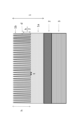
- FIG. 2 is a schematic plan view of the resin sheet of FIG. 1;
- FIG. 5 is a schematic vertical cross-sectional view showing a laminated structure of resin sheets according to a second embodiment of the present invention;
- the resin sheet according to the first embodiment of the present invention comprises an underlayer having regularly arranged hairy bodies on at least one surface, and a fiber sheet layer on the surface opposite to the hairy bodies of the underlayer. and forming a continuous phase without a structural boundary between the base layer and the hair-like bodies. That is, the layer structure of the resin sheet according to the present embodiment is, from top to bottom, a hairy body, a base layer (1), and a fiber sheet layer (2).
- the base layer (1a) is a layer that serves as a base for the hair-like bodies, and refers to the portion of the reference numeral 1 other than the surface hair-like bodies 1b.
- the thickness of the underlayer refers to the thickness from the base of the hair-like body to the opposite surface of the underlayer.
- the average thickness of the underlayer is preferably 15 ⁇ m to 300 ⁇ m, more preferably 30 ⁇ m to 280 ⁇ m, even more preferably 50 ⁇ m to 250 ⁇ m. By setting the thickness to 15 ⁇ m or more, the height of the ciliary body can be sufficiently expressed.
- the thickness may be no structural boundary between the underlayer and the hairs, forming a continuous phase. Structurally free of boundaries means that the base layer and the hair-like bodies are integrally formed and there is no structurally distinct boundary between them.
- Forming a continuous phase refers to a state in which there is no seam between the base layer and the hair-like body and there is no discontinuity (a continuous phase). In this respect, it differs from the structure in which hair-like bodies are implanted in the underlying layer.
- the base layer and the hair-like bodies may have the same composition, and the bond between the base layer and the hair-like bodies may include a covalent bond.
- a covalent bond is a chemical bond formed by sharing an electron pair between two atoms. , which is stronger than the van der Waals bonds and hydrogen bonds that work between polymer molecules.
- the underlayer and the bristles may be derived from the same solid thermoplastic resin sheet that is not separate. Deriving from the same solid thermoplastic resin sheet means, for example, that the hair-like bodies and the base layer are directly or indirectly obtained from the same resin sheet. Further, the base layer and the hair-like members may be formed from the same solid thermoplastic resin sheet.
- Forming from the same solid thermoplastic resin sheet means that the hair-like bodies and the base layer are directly formed by processing one resin sheet. Since there is no structural boundary between the base layer and the hairy bodies and a continuous phase is formed, separation of the hairy bodies from the base layer due to an external stimulus is suppressed, resulting in good tactile sensation. becomes a sheet. In addition, it can be manufactured in fewer steps than in the case of flocking hairy bodies.
- the base layer and the hair-like bodies are made of the same thermoplastic resin composition containing a thermoplastic resin as the main component.
- the main component means to contain 50% by mass or more.
- the content is 60% by mass or more, 70% by mass or more, 80% by mass or more, or 90% by mass or more.
- a resin containing at least one of thermoplastic polyurethane resin (TPU), styrene resin, polyolefin resin, polyvinyl chloride resin, thermoplastic elastomer, and fluorine resin can be used. .
- thermoplastic polyurethane resin is a resin that uses a diisocyanate and a polyol as reaction raw materials. , polyester, and polycarbonate may be selected, or a plurality thereof may be combined. In one embodiment of the present invention, a combination of an MDI-based or HDI-based diisocyanate and a carbonate-based polyol can be preferably used.
- Styrene-based resins include homo- or copolymers of styrene-based monomers such as styrene, ⁇ -methylstyrene, p-methylstyrene, dimethylstyrene, pt-butylstyrene, and chlorostyrene, and those styrene-based monomers and other monomers.
- styrene-based monomers such as a styrene-acrylonitrile copolymer (AS resin), or the styrene-based monomer and further other polymers, such as diene-based rubbers such as polybutadiene, styrene-butadiene copolymer, polyisoprene, and polychloroprene.
- AS resin styrene-acrylonitrile copolymer
- diene-based rubbers such as polybutadiene, styrene-butadiene copolymer
- a graft polymer obtained by graft polymerization in the presence of a high-strength polymer for example, polystyrene such as high impact polystyrene (HIPS resin) and styrene-acrylonitrile graft polymer (ABS resin) can be used.
- HIPS resin high impact polystyrene
- ABS resin styrene-acrylonitrile graft polymer
- a styrene-based thermoplastic elastomer can also be used.
- Polyolefin-based resin means a resin made of a polymer containing ⁇ -olefin as a monomer, and includes polyethylene-based resin and polypropylene-based resin.
- the polyethylene resin high-density polyethylene, low-density polyethylene, linear low-density polyethylene, linear medium-density polyethylene, etc. can be used. and blends can also be used. Examples of the latter resin include ethylene-vinyl acetate copolymer, ethylene-acrylic acid copolymer, ethylene-acrylate copolymer, ethylene-methacrylate copolymer, ethylene-vinyl acetate-vinyl chloride copolymer. Copolymerization and blending of a resin having a polar group in the polyethylene chain, such as coalescence and further blending with a terpolymer with an acid anhydride, etc., can be mentioned.
- the polypropylene resin homopolypropylene, random polypropylene, block polypropylene, etc.
- the structure of the homopolypropylene may be isotactic, atactic, or syndiotactic.
- the ⁇ -olefin to be copolymerized with propylene preferably has 2 to 20 carbon atoms, more preferably 4 to 12 carbon atoms, such as ethylene, 1-butene, 1-pentene and 1-hexene. , 1-heptene, 1-octene, 1-nonene, and 1-decene can be used.
- block polypropylene When block polypropylene is used, a block copolymer (block polypropylene), a block copolymer containing a rubber component, a graft copolymer, or the like can be used. Besides using these olefin resins alone, other olefin resins can also be used in combination.
- polyvinyl chloride resin a vinyl chloride homopolymer or a copolymer of vinyl chloride and other comonomers can be used.
- polyvinyl chloride When polyvinyl chloride is a copolymer, it may be a random copolymer or a graft copolymer.
- graft copolymers include those obtained by using an ethylene-vinyl acetate copolymer or a thermoplastic urethane polymer as a backbone polymer and graft-polymerizing vinyl chloride onto this.
- the polyvinyl chloride of this embodiment refers to extrudable flexible polyvinyl chloride and is a composition containing additives such as polymeric plasticizers.
- polymeric plasticizer known polymeric plasticizers can be used. Examples include ethylene-vinyl acetate-carbon monoxide copolymer, ethylene-(meth)acrylate-carbon monoxide copolymer, acetic acid Preferred examples include ethylene copolymer polymeric plasticizers such as ethylene-vinyl acetate copolymers with high vinyl content.
- Thermoplastic elastomers include those having a structure that combines soft polymer substances and hard polymer substances. Specific examples include styrene-based elastomers, olefin-based elastomers, vinyl chloride-based elastomers, polyester-based elastomers, and polyamide-based elastomers. These elastomers can be selected and used from commercially available ones.
- PVDF Polyvinylidene fluoride
- Hexafluoropropylene copolymer vinylidene fluoride-tetrafluoroethylene copolymer, vinylidene fluoride-chlorotrifluoroethylene copolymer, vinylidene fluoride-trifluoroethylene copolymer, vinylidene fluoride-tetrafluoroethylene-hexa Fluoropropylene terpolymers, vinylidene fluoride-chlorotrifluoroethylene-hexafluoropropylene terpolymers, and mixtures of two or more thereof.
- the melt mass flow rate of the thermoplastic resin composition at 190°C to 300°C is preferably 4 g/10 minutes or more. By making it 4 g/10 minutes or more, the transferability of the shape of the hair-like body can be improved.
- the melt mass flow rate is a value measured according to JIS K 7210 in a temperature range of 190°C to 300°C under a load (2.16 kg to 10.0 kg).
- the thermoplastic resin composition may be obtained by alloying each of the above thermoplastic resins in an arbitrary ratio within a range that does not impair the effects of the present invention. Furthermore, it may contain other additives. Other additives include water and oil repellents, colorants such as pigments and dyes, lubricants and release agents such as silicon oil and alkyl esters, and fibers such as glass fibers, as long as they do not impede the effects of the present invention. Granular fine particles such as talc, clay, silica, etc., scale-like fine particles such as mica, low-molecular-weight antistatic agents such as salt compounds of sulfonic acid and alkali metals, etc., polyether ester amide, etc. Additives such as polymeric antistatic agents, flame retardants, antibacterial agents, antiviral agents, and heat stabilizers can be added. Scrap resin generated in the resin sheet manufacturing process can also be mixed and used.
- Water and oil repellents include silicone water repellents, carnauba wax, and fluorine water and oil repellents.
- silicon include organopolysiloxane, dimethylpolysiloxane, methylphenylpolysiloxane, methylhydrogenpolysiloxane, etc. Among them, dimethylpolysiloxane is preferably used.
- Commercially available products include, for example, "Crimbell CB50-PP", “Crimbell CB-30PE”, “Crimbell CB-1", and “Crimbell CB-50AB” (manufactured by Fuji Chemical Co., Ltd.) in which silicon is alloyed with resin.
- carnauba wax include commercially available products such as "Carnauba No.
- fluorine-based water and oil repellents include surfactants having perfluoroalkyl groups.
- "Surflon KT-PA” manufactured by AGC Seimi Chemical Co., Ltd.
- the amount of water/oil repellent added is preferably 0.5% by mass to 25% by mass. If it is less than 0.5% by mass, sufficient water and oil repellency may not be obtained, and if it exceeds 25% by mass, moldability may deteriorate.
- antistatic agents examples include polyether ester amide-based high-molecular anti-static agents and ionomer-based high-molecular anti-static agents.
- Commercially available polyetheresteramide-based high-molecular-weight antistatic agents include "Perestat 230", “Perestat 6500”, “Pelectron AS”, and “Pelectron HS” (manufactured by Sanyo Kasei Co., Ltd.).
- commercially available ionomer polymer type antistatic agents include "Entira SD100" and "Entira MK400” (manufactured by DuPont Mitsui Polychemicals).
- the amount of the antistatic agent added is preferably 5% by mass to 30% by mass. If the amount is less than 5% by mass, sufficient antistatic properties may not be obtained, and if the amount exceeds 30% by mass, production costs increase.
- an inorganic or organic antibacterial agent can be added.
- an inorganic system is preferable.
- metal ion (Ag, Zn, Cu) inorganic antibacterial agents, calcined shell calcium antibacterial agents, and the like are included.
- Commercially available metal ion inorganic antibacterial agents include "Bactekiller BM102VT” (manufactured by Fuji Chemical Co., Ltd.), "Novaron VZF200", “Novaron (AG300)” (manufactured by Toagosei Co., Ltd.), "KM-10D-G", “IM-10D-L” (manufactured by Sinanen Zeomic) and the like.
- calcined shell calcium-based antibacterial agent examples include "Scallow” (manufactured by FID).
- the amount of the antibacterial agent to be added is preferably 0.5% by mass to 5% by mass. If it is less than 0.5% by mass, sufficient antibacterial properties may not be obtained, and if it exceeds 5% by mass, production costs increase.
- alkyl lubricants and mold release agents such as aliphatic hydrocarbon compounds, higher fatty acid compounds, higher aliphatic alcohol compounds, fatty acid amide compounds, silicone lubricants and mold release agents, fluorine-based Lubricants, releasing agents, etc. can be used.
- the amount added is preferably 0.01 to 5 parts by mass, more preferably 0.05 to 3 parts by mass, out of 100 parts by mass in total with the resin composition, and 0.1 ⁇ 2 parts by mass is more preferred.
- the amount added is 0.01 parts by mass or more, the risk of lowering the release effect is reduced, and when the amount is 5 parts by mass or less, the risk of bleeding out onto the sheet surface is reduced.
- a masterbatch in which a lubricant/release agent is previously alloyed with a thermoplastic resin.
- "Wax Master V" manufactured by BASF
- BASF is a commercially available masterbatch based on a urethane-based thermoplastic elastomer.
- the amount of the masterbatch added is preferably 1 to 8 parts by mass, more preferably 2 to 7 parts by mass, and even more preferably 3 to 6 parts by mass out of 100 parts by mass in total with the resin composition.
- the hair-like bodies (1b) refer to portions extending like hairs from the surface of the underlayer (1a) as shown in FIG.
- the hair-like bodies are regularly arranged on the surface of the underlayer.
- regularly arranged means that the hair-like bodies are arranged in a non-random manner, that is, in a state in which they are arranged orderly (for example, at regular intervals) in one or two directions. . Whether or not the arrangement of the ciliary bodies is regular is judged based on the state of arrangement of the roots of the ciliary bodies.
- the hair-like bodies are positioned on the base layer at predetermined intervals, and the positions of the bottom surfaces of the hair-like bodies are orderly arranged in the longitudinal direction and the width direction of the base layer.
- the form of arrangement of the hair-like bodies is not particularly limited, and it is possible to select a matrix arrangement arranged vertically and horizontally, a zigzag arrangement, or the like.
- the average height (h) of the hair-like bodies is preferably 30 ⁇ m to 500 ⁇ m, more preferably 60 ⁇ m to 250 ⁇ m, even more preferably 80 ⁇ m to 200 ⁇ m, even more preferably 90 ⁇ m to 180 ⁇ m. .
- the average height is preferably 30 ⁇ m to 500 ⁇ m, more preferably 60 ⁇ m to 250 ⁇ m, even more preferably 80 ⁇ m to 200 ⁇ m, even more preferably 90 ⁇ m to 180 ⁇ m. .
- the base layer will Let h be the distance from the surface of the ciliary body.
- the total value of the intervals obtained by subdividing the distance from the tip of the hairy body to the central portion of the root by multi-point measurement is defined as the length L of the hairy body.
- the average height of the hairs and the average length of the hairs were determined by using an electron microscope and image processing software. can be measured and the arithmetic mean of the measurements can be used.
- the average diameter (d) of the hair-like bodies is preferably 1 ⁇ m to 50 ⁇ m, more preferably 5 ⁇ m to 50 ⁇ m, even more preferably 5 ⁇ m to 40 ⁇ m.
- the average diameter of the ciliary bodies is obtained by measuring the diameter of the intermediate height (h/2) of the ciliary bodies from several points on the resin sheet using an electron microscope and image processing software, and calculating the arithmetic mean value of the measured values.
- the aspect ratio of the hair can be expressed as (average height of the hair/average diameter of the hair).
- the aspect ratio of the hair-like bodies is preferably 2-20, more preferably 2-10, even more preferably 2-5.
- the aspect ratio can also be based on the average base diameter of the ciliary bodies.
- the average bottom diameter of the hair-like bodies is preferably 10 ⁇ m to 150 ⁇ m, more preferably 20 ⁇ m to 120 ⁇ m, even more preferably 30 ⁇ m to 100 ⁇ m.
- the average bottom diameter of the hair-like bodies is obtained by measuring the distance between adjacent hair-like bodies at several points on the resin sheet and using the arithmetic mean value of the measured values.
- the aspect ratio based on the bottom diameter of the hair-like body is preferably 1.0 to 10, more preferably 1.0 to 5, and more preferably 1.0 to 2.5. More preferred.
- the aspect ratio By setting the aspect ratio to 1.0 or more, good tactile sensation can be secured, and by setting the aspect ratio to 10 or less, not only can good tactile sensation such as moistness, softness, and fluffyness be obtained, but also It is possible to reduce the risk that the ratio of the height to the length of the shaped body will be below a certain level.
- the average spacing (t) of the ciliary bodies is preferably 20 ⁇ m to 200 ⁇ m, more preferably 40 ⁇ m to 150 ⁇ m, even more preferably 40 ⁇ m to 100 ⁇ m.
- Ciliary spacing means the distance between the center of the root of a ciliary body and the center of the root of an adjacent hair, as shown in FIG. 2, for example.
- the shape of the hair-like body is not particularly limited, but it may have a shape in which the hair-like body extends in a direction away from the underlying layer and gradually becomes thinner as it approaches the tip, or a bulge is formed at the tip of the hair-like body.
- the shape may be such that the cross-sectional area gradually decreases with increasing distance from the underlying layer, then increases once, and then terminates.
- the shape of the tip of the hairy body may be a bud shape or a mushroom shape.
- the hair-like body has a portion located at the base end extending away from the base layer, and a portion extending from the portion located at the base end and bent with a constant curvature or with a gradually changing curvature.
- the bud-like or mushroom-like shape may be formed at the hair-like tip, the ratio of the average diameter of the bud-like or mushroom-like width to the average diameter of the hair-like body is preferably 1.1 times or more.
- the height of the bud-like or mushroom-like shape is preferably 7 ⁇ m or more.
- the average diameter of the hair-like bodies, the average diameter of the bud-shaped or mushroom-shaped width, and the height are measured from electron scanning micrographs, and the arithmetic mean values are taken as values.
- the hair-like body is made of a thermoplastic resin.
- the thermoplastic resin a resin similar to the resin that can be used in the base layer can be used.
- the thermoplastic resin contained in the base layer and the hair-like bodies may at least partially form a three-dimensional crosslinked structure (for example, a three-dimensional network structure).
- a three-dimensional crosslinked structure for example, a three-dimensional network structure.
- at least a portion of the hair is crosslinked; in another embodiment, the entire surface of the hair is crosslinked;
- the entire body (from the boundary with the base layer to the tip) may be a crosslinked body.
- a method of forming a crosslinked body for example, after molding a resin sheet, a method of irradiating an electron beam on the surface having the hair-like body, or adding an organic peroxide and, during or after molding the resin sheet, A method of forming by heating and moistening can be mentioned.
- the fibrous sheet layer (2) is a layer directly or indirectly laminated on the surface of the base layer opposite to the fibrous structure, and includes a sheet of fibrous structure.
- the thickness of the fiber sheet layer is preferably 100 ⁇ m to 3000 ⁇ m, more preferably 200 ⁇ m to 2500 ⁇ m, even more preferably 300 ⁇ m to 2000 ⁇ m. When the thickness is 100 ⁇ m or more, compressibility can be felt when touched. Moreover, the production cost can be suppressed by setting the thickness to 3000 ⁇ m or less.
- the thickness of the fiber sheet layer can be measured according to JIS L 1913:2010.
- the average fiber diameter of the fibrous structures contained in the fiber sheet layer is preferably 0.1 ⁇ m to 150 ⁇ m, more preferably 0.5 ⁇ m to 100 ⁇ m, and more preferably 1.0 ⁇ m to 80 ⁇ m. preferable.
- the cost can be suppressed by setting the thickness to 0.1 ⁇ m or more. Further, by setting the thickness to 150 ⁇ m or less, smoothness can be felt when touched.
- the average fiber diameter of the fibrous structure contained in the fiber sheet layer is preferably 0.1 ⁇ m to 80 ⁇ m, more preferably 0.5 ⁇ m to 50 ⁇ m, and 1.0 ⁇ m. More preferably ⁇ 30 ⁇ m. The cost can be suppressed by setting the thickness to 0.1 ⁇ m or more.
- the average fiber diameter can be obtained by measuring the fiber diameters at arbitrary several points of the fibrous structure using an electron microscope and image processing software, and using the arithmetic mean value of the measured values.
- the fiber sheet layer preferably has a basis weight of 10 g/m 2 or more and 400 g/m 2 or less, more preferably 50 g/m 2 or more and 200 g/m 2 or less.
- the basis weight can be measured according to JIS L 1913:2010 and JIS L 1096:2010.
- the basis weight can be adjusted by the fiber material, diameter, and manufacturing method.
- the raw material of the fibrous structure forming the fiber sheet layer is not particularly limited, but examples thereof include chemical fibers and natural fibers.
- chemical fibers include chemical fibers containing at least one of polyester-based resins, polyethylene-based resins, polypropylene-based resins, polystyrene-based resins, polyamide-based resins, polyvinyl alcohol-based resins, and polyacrylonitrile-based resins.
- other additives may be contained within a range that does not impair the effects of the present invention.
- Other chemical fibers include regenerated fibers mainly composed of cellulose or protein, and inorganic fibers such as carbon fibers and glass fibers.
- nonwoven fabric As natural fibers, vegetable fibers such as cotton and linen, and animal fibers such as wool and silk can be used.
- examples of the structure of the fiber sheet layer include nonwoven fabric, woven fabric, and knitted fabric.
- non-woven fabric is meant a fabric in which fibers are oriented unidirectionally or randomly and bonded by entangling and/or fusion and/or adhesion.
- nonwovens preferably do not include paper, wovens, knits, tufts and crimped felts.
- nonwoven fabrics include chemical bonded nonwoven fabrics, thermal bonded nonwoven fabrics, needle punched nonwoven fabrics, spunlace nonwoven fabrics, spunbond nonwoven fabrics, meltblown nonwoven fabrics, etc., and can be appropriately selected and used.
- woven fabric is meant a fabric in which the warp and weft threads are interlaced (by the loom), usually at right angles to each other. There are plain weaves, twill weaves, satin weaves, and the like, depending on the weaving method, and a suitable selection can be made for use.
- knitted fabric is meant a fabric in which the loops of one or more knitting yarns are interlaced to form a continuous new loop. Depending on the knitting method, there are woven fabrics knitted by weft knitting machines such as circular knitting machines, tricot knitting machines, Rassel knitting machines, and warp knitting machines such as Milanese knitting machines.
- the term “tactile properties” refers to the texture and feel of the surface of the resin sheet. It is determined whether the resin sheet surface feels comfortable to the touch, and if it does, a good feel is defined as a specific texture such as moist, soft, or fluffy.
- the thickness of the resin sheet refers to the sum of the average height of the hair-like bodies, the average thickness of the base layer, and the average thickness of the fiber sheet layer.
- the thickness of the resin sheet is preferably 95 ⁇ m to 2500 ⁇ m, more preferably 190 ⁇ m to 1900 ⁇ m, still more preferably 280 ⁇ m to 1500 ⁇ m. By setting the thickness to 95 ⁇ m or more, good tactile sensation can be sufficiently ensured, and by setting the thickness to 2500 ⁇ m or less, the manufacturing cost can be suppressed.
- the thickness of the resin sheet can be measured according to JIS L 1913:2010.
- the resin sheet in one embodiment of the present invention preferably has a bending resistance of 150 mm or less, more preferably 140 mm or less, measured according to the 45 cantilever method of JIS L 1096:2010, and more preferably 130 mm. It is more preferable that: Favorable workability can be obtained by setting the bending resistance measured according to the JIS L 1096:2010 45 cantilever method to 150 mm or less.
- a certain degree of bending resistance can be achieved.
- the resin sheet in one embodiment of the present invention preferably has a compression work load of 0.02 gf ⁇ cm/cm 2 or more and 0.20 gf ⁇ cm/cm 2 or less measured by the KES method. ⁇ cm/cm 2 or more and 0.18 gf ⁇ cm/cm 2 or less, and more preferably 0.02 gf ⁇ cm/cm 2 or more and 0.16 gf ⁇ cm/cm 2 or less. .
- the amount of compression work is determined by first using a resin sheet of 200 mm x 200 mm as a sample, placing it in a compression tester so that the surface with the hairy bodies faces upward, and compressing the center of the resin sheet from the side with the hairy bodies. and measure.
- the measurement conditions are a disk with an area of 2 cm 2 and a compression maximum load of 10 gf/cm 2 (compression speed: 20 ⁇ m/sec).
- a compression tester for example, KES-FB3-A manufactured by Kato Tech Co., Ltd. can be used.
- a good feel can be obtained by setting the work of compression measured by the KES method to 0.02 gf ⁇ cm/cm 2 or more.
- the compression work amount measured by the KES method to 0.20 gf ⁇ cm/cm 2 or less, the handling during sewing can be improved.
- the type of resin, the type of fibrous structure (material, fiber diameter, basis weight), etc. when synthesizing the thermoplastic resin composition, a certain amount of compression work can be achieved.
- the resin sheet in one embodiment of the present invention preferably has a basis weight of 100 g/m 2 or more and 450 g/m 2 or less, more preferably 125 g/m 2 or more and 435 g/m 2 or less. , 150 g/m 2 or more and 420 g/m 2 or less.
- the basis weight of each resin sheet can be measured according to JIS P8124 (2011) "Paper and paperboard--Measurement of basis weight”. Deformation and breakage of the resin sheet can be suppressed by setting the basis weight to 100 g/m 2 or more.
- the basis weight of the sewn product can be kept low.
- a constant basis weight can be achieved by adjusting the type of resin, the type of fibrous structure (material, fiber diameter, basis weight), etc. when synthesizing the thermoplastic resin composition.
- the resin sheet in one embodiment of the present invention preferably has a tensile strength of 1 MPa or more and 25 MPa or less. It is more preferably 1 MPa or more and 10 MPa or less, and further preferably 1 MPa or more and 5 MPa or less.
- Tensile strength can be measured according to JIS K 7161 for each resin sheet. By setting the tensile strength to 1 MPa or more, the sheet can be transported without breakage during roll-to-roll processing. Also, by setting the tensile strength to 25 MPa or less, it is possible to suppress the occurrence of burrs and cracks during sewing.
- a certain tensile strength can be achieved by adjusting the type of resin, the type of fibrous structure (material, fiber diameter, basis weight), etc. when synthesizing the thermoplastic resin composition.
- the resin sheet in one embodiment of the present invention preferably has a tear strength of 1 N/mm or more and 30 N/mm or less. It is more preferably 5 N/mm or more and 30 N/mm or less, and further preferably 10 N/mm or more and 30 N/mm or less.
- the tear strength of each resin sheet can be measured according to JIS K 7128-3. By setting the tear strength to 1 N/mm or more, the film can be transported without breakage during roll-to-roll processing. Also, by setting the tear strength to 30 N/mm or less, it is possible to suppress the occurrence of burrs and cracks during sewing.
- a certain level of tear strength can be achieved by adjusting the type of resin, the type of fibrous structure (material, fiber diameter, basis weight), etc. when synthesizing the thermoplastic resin composition.
- the resin sheet according to the second embodiment of the present invention As an example of the resin sheet according to the second embodiment of the present invention, as shown in FIG. 3, it is a resin sheet in which a base layer is formed on the surface of the fiber sheet layer opposite to the base layer side. That is, the layer structure of the resin sheet according to the second embodiment is, from top to bottom, hair-like bodies and base layer (1), fiber sheet layer (2), and base layer (3).
- the hair-like body and the base layer are the same as those explained in the first embodiment, the explanation is omitted.
- the total average thickness of the fibrous body, base layer, fiber sheet layer and base layer is 95 ⁇ m to 2500 ⁇ m, more preferably 190 ⁇ m to 1900 ⁇ m, still more preferably 280 ⁇ m to 1500 ⁇ m.
- the average thickness of the substrate layer is preferably 15 ⁇ m to 100 ⁇ m, more preferably 15 ⁇ m to 50 ⁇ m. By setting the average thickness of the base material layer to 100 ⁇ m or less, it is possible to suppress the loss of sewing workability, cushioning properties, and lightness of the resin sheet.
- a thermoplastic resin that can be adhered to the fiber sheet layer.
- the same thermoplastic resin composition as that of the underlayer, polycarbonate resins, polyester resins, and polymer alloy resins thereof can be suitably used.
- the mass ratio of the polycarbonate resin and the polyester resin is preferably 50:50 to 90:10, more preferably 60:40 to 80:20, even more preferably 65:35 to 75:25.
- the polymer alloy resin is a polymer multi-component system, and may be a polymer blend having a certain degree of compatibility by mixing, or a block copolymer or a graft copolymer by copolymerization. It may be a mixture of incompatible resins.
- Polycarbonate resins include those derived from aliphatic dihydroxy compounds and those derived from aromatic dihydroxy compounds.
- one derived from an aromatic dihydroxy compound can be preferably used, particularly one derived from an aromatic dihydroxy compound (bisphenol) in which two aromatic dihydroxy compounds are bonded via a certain linking group.
- aromatic dihydroxy compound bisphenol
- These can be prepared by a known production method by polycondensation of a dihydroxy compound and phosgene or carbonate ester, and the production method is not limited, and commercially available resins can also be used.
- polyester resins include polyethylene terephthalate, polybutylene terephthalate, polyethylene-2,6-naphthalate, and polymethylene terephthalate.
- Copolymer components include diol components such as diethylene glycol, neopentyl glycol, and polyalkylene glycol, and adipic acid.
- the base layer may contain other additives as necessary.
- Other additives include water repellents, oil repellents, colorants such as pigments and dyes, lubricants and release agents such as silicon oil and alkyl esters, glass fibers, etc., as long as they do not impair the effects of the present invention.
- fibrous reinforcing agents and fillers granular fine particles such as talc, clay, silica, scaly fine particles such as mica, low-molecular-weight antistatic agents such as salt compounds of sulfonic acid and alkali metals, etc., and polyether esters Additives such as polymeric antistatic agents such as amides, flame retardants, antibacterial agents, antiviral agents, and heat stabilizers can be added. Scrap resin generated in the resin sheet manufacturing process can also be mixed and used. Moreover, the substrate layer may partially have a crosslinked structure within a range that does not impair the effects of the present invention.
- the method for producing the resin sheet according to the present invention is not limited, and any method may be used. applying regularly arranged hairs to the surface of the substrate.
- feedblocks and multi-manifold dies can be used in manufacturing.
- the layer structure of each embodiment of the resin sheet of the present invention is basically as described above. It may be added to the base material layer or may be laminated as a further layer unless deterioration such as deterioration is observed.
- the method of imparting hairy bodies is not particularly limited, and any method known to those skilled in the art can be used.
- a method of manufacturing using an extrusion molding method a method of manufacturing using a roll-to-roll method, a method of manufacturing using a photolithography method, a method of manufacturing using a heat press method, a pattern roll and UV curing a method of manufacturing using a resin, a method of manufacturing using a 3D printer, and a method of embedding hair-like bodies in a resin layer and then covalently bonding them through a polymerization reaction.
- a resin sheet is extruded by a T-die method, and casting is performed with a transfer roll having unevenness processing so as to impart a hairy body shape to the surface of the resin sheet, and a touch roll.
- a transfer roll with unevenness processing fine unevenness of several ⁇ m to several hundred ⁇ m size is regularly applied to the surface of the roll by laser engraving, electroforming, etching, mill engraving, etc. can be used.
- regular means that the irregularities are arranged in a non-random manner, that is, arranged orderly in one or two directions.
- the arrangement of the projections and depressions in an embodiment it is possible to select a grid arrangement arranged vertically and horizontally, a zigzag arrangement, or the like.
- the shape of the concave-convex portion include a pyramid shape (cone, square pyramid, triangular pyramid, hexagonal pyramid, etc.), semicircle, rectangle (square prism), and the like.
- the opening diameter of the recess, the depth of the recess, and the interval between the recess shapes are several ⁇ m to several hundred ⁇ m.
- metal, ceramic, or the like can be used as the material of the transfer roll.
- the spacing of the recesses of the transfer roll By adjusting the spacing of the recesses of the transfer roll, the spacing of the hair-like bodies can be adjusted, and by adjusting the depth of the recesses of the transfer roll, the height of the hair-like bodies can be adjusted, thereby adjusting the tactile sensation.
- the surface of the transfer roll it is preferable to process the surface of the transfer roll to have a high aspect ratio.
- the aspect ratio (depth of recesses/opening diameter of recesses) in the case of processing recesses on the surface of the transfer roll is preferably 1.0 to 9.0 or 1.0 to 2.0.
- Laser engraving or electroforming is more suitable than etching, blasting, mill engraving, etc. in order to process unevenness with a high aspect ratio on the surface of the transfer roll.
- the material of the transfer roll for example, metal, ceramic, or the like can be used.
- various materials can be used. For example, rolls made of silicone rubber, NBR rubber, EPT rubber, butyl rubber, chloroprene rubber, and fluororubber can be used. In one embodiment, a touch roll with a rubber hardness (JIS K 6253) of 40-100 can be used. A Teflon (registered trademark) layer may be formed on the surface of the touch roll.
- Various materials can be used as the touch roll, and for example, rolls made of silicone rubber, NBR rubber, EPT rubber, butyl rubber, chloroprene rubber, and fluororubber can be used.
- a touch roll with a rubber hardness (JIS K 6253) of 40-100 can be used.
- a Teflon (registered trademark) layer may be formed on the surface of the touch roll.
- the resin sheet of the present embodiment can be produced by using the roll set of the transfer roll and the touch roll.
- the temperature of the transfer roll is adjusted to a temperature near the crystalline melting temperature, glass transition point, or melting point of the thermoplastic resin (for example, 100 to 150 ° C. when using random polypropylene), and the transfer roll and the touch roll are adjusted.
- the resin sheet of the present embodiment can be produced by casting with a pinch pressure of 30 to 120 kg/cm 2 .
- the cast resin sheet is taken up at a line speed of 0.5 to 30 m/min using a pinch roll or the like.
- the present invention is not limited to these.
- the resin sheet having the hair-like bodies of the present invention applied to its surface can be applied to the uses that require good tactile sensation as described above.
- the resin sheet of the present invention can be applied to processed products such as clothing, accessories, and daily necessities, preferably sewn processed products.
- the processed product of the present invention is a processed product using the resin sheet of the present invention.
- the resin sheet of the present invention can be applied to general sewing processing and pasting processing. Sewing processing includes, but is not limited to, hand sewing, machine sewing, and the like. Clothing includes coats, jackets, suits, sweaters, trainers, shirts, pants, skirts, dresses, T-shirts, underwear (innerwear), stockings, and the like. Decorative goods include ties, socks, gloves, hats, belts, bags, wallets, shoes, watch bands, business card cases, and the like. Daily necessities include book covers, document cases, and the like.
- the diameters of 10 hair-like bodies at the intermediate height (h/2) were measured for each sample, and the arithmetic mean value of the 30 measured values was used.
- the average distance between the ciliary bodies the distance between the center of the base of the ciliary body and the center of the base of the adjacent ciliary body was measured at 10 points for each sample, and the arithmetic mean value of the 30 measured values was used.
- the thickness of the base layer and base layer the thickness of each layer was measured at 10 points for each sample, and the arithmetic mean value of the 30 measured values was used.
- the thickness of the underlying layer is the distance from the base of the hair-like body to the interface of the other layer.
- Table 1 shows the results of evaluation tests on various characteristics using the resin sheets obtained in each example and comparative example.
- the resin sheet of Comparative Example 1 is a conventional resin sheet having a base layer, a hair-like body and a base material layer, but has a high bending resistance value, a low compression work value, and a basis weight value of
- it is problematic as a sewn product because it cracks at the folded back when sewn, and cracks appear from the traces of sewing needles. was there.
- the resin sheet of Comparative Example 2 had a thicker base layer than the resin sheet of Comparative Example 1 and had a higher compression work value. There was a problem as a sewn product because cracks appeared from traces of sewing machine needles. In addition, there is also a problem that the value of basis weight is further increased and the feeling of weight is felt more.
- the resin sheet of Comparative Example 4 had a thicker base layer than the resin sheet of Comparative Example 3 and had a higher value of compression work, but the value of basis weight was higher, and there was a problem that it felt heavy. there were.
- the resin sheet of the present embodiment can be sewn, has cushioning properties, and has a suppressed feeling of weight, it provides a processed product that has cushioning properties and has a suppressed feeling of weight even after being sewn. and has industrial applicability.
Landscapes
- Engineering & Computer Science (AREA)
- Textile Engineering (AREA)
- Chemical & Material Sciences (AREA)
- Chemical Kinetics & Catalysis (AREA)
- Dispersion Chemistry (AREA)
- Laminated Bodies (AREA)
Priority Applications (2)
| Application Number | Priority Date | Filing Date | Title |
|---|---|---|---|
| CN202280080821.3A CN118354897A (zh) | 2021-12-06 | 2022-11-17 | 具有毛状体的树脂片材及其加工品 |
| JP2023566198A JP7767456B2 (ja) | 2021-12-06 | 2022-11-17 | 毛状体を有する樹脂シート及びその加工品 |
Applications Claiming Priority (2)
| Application Number | Priority Date | Filing Date | Title |
|---|---|---|---|
| JP2021-197704 | 2021-12-06 | ||
| JP2021197704 | 2021-12-06 |
Publications (1)
| Publication Number | Publication Date |
|---|---|
| WO2023106061A1 true WO2023106061A1 (ja) | 2023-06-15 |
Family
ID=86730252
Family Applications (1)
| Application Number | Title | Priority Date | Filing Date |
|---|---|---|---|
| PCT/JP2022/042667 Ceased WO2023106061A1 (ja) | 2021-12-06 | 2022-11-17 | 毛状体を有する樹脂シート及びその加工品 |
Country Status (4)
| Country | Link |
|---|---|
| JP (1) | JP7767456B2 (https=) |
| CN (1) | CN118354897A (https=) |
| TW (1) | TW202335864A (https=) |
| WO (1) | WO2023106061A1 (https=) |
Citations (4)
| Publication number | Priority date | Publication date | Assignee | Title |
|---|---|---|---|---|
| JPS55137933A (en) * | 1979-04-16 | 1980-10-28 | Sekisui Plastics Co Ltd | Method of producing patterned napped sheet |
| JPS5865076A (ja) * | 1982-07-15 | 1983-04-18 | 株式会社旭化成テキスタイル | バツクスキン調織物 |
| WO2018016562A1 (ja) * | 2016-07-20 | 2018-01-25 | デンカ株式会社 | 毛状体を有する熱可塑性樹脂シート及びその成形品 |
| WO2019049897A1 (ja) * | 2017-09-06 | 2019-03-14 | デンカ株式会社 | 毛状体を有する樹脂シート及びその成形品 |
Family Cites Families (5)
| Publication number | Priority date | Publication date | Assignee | Title |
|---|---|---|---|---|
| JPS57171739A (en) * | 1981-04-15 | 1982-10-22 | Asahi Kasei Textile Kk | Raised fabric and method |
| JP3998511B2 (ja) * | 2002-02-08 | 2007-10-31 | 旭化成せんい株式会社 | 合成皮革 |
| JP4376091B2 (ja) * | 2004-02-27 | 2009-12-02 | セーレン株式会社 | 皮革様構造物及びその製造方法 |
| JP4968168B2 (ja) * | 2008-04-24 | 2012-07-04 | トヨタ紡織株式会社 | 内装表皮材 |
| JP2012255065A (ja) * | 2011-06-08 | 2012-12-27 | Kinsei Seishi Kk | 繊維強化材を有する構造体、およびその製造方法 |
-
2022
- 2022-11-17 CN CN202280080821.3A patent/CN118354897A/zh active Pending
- 2022-11-17 JP JP2023566198A patent/JP7767456B2/ja active Active
- 2022-11-17 WO PCT/JP2022/042667 patent/WO2023106061A1/ja not_active Ceased
- 2022-12-05 TW TW111146520A patent/TW202335864A/zh unknown
Patent Citations (4)
| Publication number | Priority date | Publication date | Assignee | Title |
|---|---|---|---|---|
| JPS55137933A (en) * | 1979-04-16 | 1980-10-28 | Sekisui Plastics Co Ltd | Method of producing patterned napped sheet |
| JPS5865076A (ja) * | 1982-07-15 | 1983-04-18 | 株式会社旭化成テキスタイル | バツクスキン調織物 |
| WO2018016562A1 (ja) * | 2016-07-20 | 2018-01-25 | デンカ株式会社 | 毛状体を有する熱可塑性樹脂シート及びその成形品 |
| WO2019049897A1 (ja) * | 2017-09-06 | 2019-03-14 | デンカ株式会社 | 毛状体を有する樹脂シート及びその成形品 |
Also Published As
| Publication number | Publication date |
|---|---|
| JPWO2023106061A1 (https=) | 2023-06-15 |
| TW202335864A (zh) | 2023-09-16 |
| CN118354897A (zh) | 2024-07-16 |
| JP7767456B2 (ja) | 2025-11-11 |
Similar Documents
| Publication | Publication Date | Title |
|---|---|---|
| TWI752061B (zh) | 具有毛狀體之熱塑性樹脂片及其成形品 | |
| KR102578303B1 (ko) | 모상체를 갖는 수지 시트 및 그 성형품 | |
| CN111601699B (zh) | 具有毛状体的热塑性树脂片及其成型品 | |
| CN102211426B (zh) | 使用伸长性无纺布的复合体 | |
| JP6731568B1 (ja) | 毛状体を有する樹脂シート及びその成形品 | |
| JPWO2020100930A1 (ja) | 毛状体を有する熱可塑性樹脂シート及びその成形品 | |
| JP6935045B1 (ja) | 毛状体を有する樹脂シート及びその成形品 | |
| JP7767456B2 (ja) | 毛状体を有する樹脂シート及びその加工品 | |
| JP7446284B2 (ja) | 毛状体を有する樹脂シート及びその成形品 | |
| TW202502545A (zh) | 包含具有毛狀體之樹脂片材本體與保護層之積層樹脂片材、其製造方法及其成形品 | |
| JP2011001650A (ja) | 成型性、印刷性に優れた成型容器用長繊維不織布およびその製造方法 | |
| JP7321770B2 (ja) | 毛状体を有する樹脂シート及びその成形品 | |
| JP7487309B2 (ja) | 毛状体を有する樹脂シート及びその成形品 | |
| JP2012136801A (ja) | 新規模様を有する人工皮革およびその製造方法 | |
| JP2022136432A (ja) | 皮革様シート及び加飾成形体 | |
| JP2025166601A (ja) | 毛状体を有する樹脂シート本体と保護シートとを含む積層樹脂シート、その製造方法及びその成形品 | |
| TW202317354A (zh) | 具有毛狀體之樹脂薄片及其成形品 | |
| JP2024115853A (ja) | 発泡通気シート | |
| JP2020037761A (ja) | シート状物およびその製造方法 |
Legal Events
| Date | Code | Title | Description |
|---|---|---|---|
| 121 | Ep: the epo has been informed by wipo that ep was designated in this application |
Ref document number: 22903992 Country of ref document: EP Kind code of ref document: A1 |
|
| WWE | Wipo information: entry into national phase |
Ref document number: 2023566198 Country of ref document: JP |
|
| WWE | Wipo information: entry into national phase |
Ref document number: 202280080821.3 Country of ref document: CN |
|
| NENP | Non-entry into the national phase |
Ref country code: DE |
|
| 122 | Ep: pct application non-entry in european phase |
Ref document number: 22903992 Country of ref document: EP Kind code of ref document: A1 |