WO2023085208A1 - 作業学習システム、作業判定システム、学習装置、判定装置、作業学習方法、作業判定方法、および、プログラム - Google Patents
作業学習システム、作業判定システム、学習装置、判定装置、作業学習方法、作業判定方法、および、プログラム Download PDFInfo
- Publication number
- WO2023085208A1 WO2023085208A1 PCT/JP2022/041162 JP2022041162W WO2023085208A1 WO 2023085208 A1 WO2023085208 A1 WO 2023085208A1 JP 2022041162 W JP2022041162 W JP 2022041162W WO 2023085208 A1 WO2023085208 A1 WO 2023085208A1
- Authority
- WO
- WIPO (PCT)
- Prior art keywords
- work
- worker
- information
- information indicating
- learning
- Prior art date
- Legal status (The legal status is an assumption and is not a legal conclusion. Google has not performed a legal analysis and makes no representation as to the accuracy of the status listed.)
- Ceased
Links
Images




Classifications
-
- G—PHYSICS
- G06—COMPUTING OR CALCULATING; COUNTING
- G06N—COMPUTING ARRANGEMENTS BASED ON SPECIFIC COMPUTATIONAL MODELS
- G06N20/00—Machine learning
-
- G—PHYSICS
- G06—COMPUTING OR CALCULATING; COUNTING
- G06T—IMAGE DATA PROCESSING OR GENERATION, IN GENERAL
- G06T7/00—Image analysis
-
- G—PHYSICS
- G06—COMPUTING OR CALCULATING; COUNTING
- G06T—IMAGE DATA PROCESSING OR GENERATION, IN GENERAL
- G06T7/00—Image analysis
- G06T7/20—Analysis of motion
Definitions
- the present disclosure relates to a work learning system, a work judgment system, a learning device, a judgment device, a work learning method, a work judgment method, and a program.
- Patent Literature 1 discloses a position specifying system that includes a wireless terminal device held by a monitored target and a sensor device that wirelessly communicates with the wireless terminal device and captures an image of the monitored target.
- a wireless terminal device transmits a detection signal for detecting the position of the wireless terminal device to a sensor device together with identification information holding identification information unique to the wireless terminal device.
- the sensor device detects the position of the wireless terminal device based on the received detection signal including the identification information, and calculates the position of the monitoring target based on the image captured by the imaging unit.
- the sensor device identifies the position of the monitored target by associating the calculated position of the monitored target with the detected position and identification information of the wireless terminal device.
- Patent Document 1 With the technology described in Patent Document 1, the position of the monitored object is specified and only the movement is tracked. Therefore, even if the technique described in Patent Document 1 is applied to the production site, it is not possible to obtain work information indicating the work classification of the work performed by the worker at that position. Without work information, work analysis cannot be performed.
- the present disclosure has been made in order to solve the above-described problems, and it is possible to easily display position information indicating the position of a worker and work information indicating the work classification of the work being performed by the worker at that position. It is intended to make it possible to obtain
- the work learning system includes a learning device, a position information generation device, a static/motion information generation device, an object information generation device, and a work information generation device.
- the learning device learns the work classification of the work performed by the worker.
- the position information generating device generates position information indicating the position of the worker.
- the still/movement information generating device generates still/movement information indicating the movement of the worker.
- An object information generation device generates object information indicating an object handled by a worker.
- the work information generation device generates work information indicating the work classification of the work performed by the worker.
- the learning device has a data acquisition unit and a model generation unit.
- the data acquisition unit acquires position information, still/movement information, object information, and work information from the position information generation device, the still/motion information generation device, the object information generation device, and the work information generation device, respectively.
- the model generation unit learns the work classification of the work performed by the worker based on the position information, static/movement information, object information, and work information acquired by the data acquisition unit, and generates a learned model.
- the worker when data that associates position information indicating the position of the worker, motion information indicating the movement of the worker, and object information indicating the object handled by the worker is input, the worker performs By generating a trained model that outputs the work classification of the work that the worker is doing, it is possible to easily obtain position information that indicates the position of the worker and work information that indicates the work classification of the work that the worker is doing at that position. become.
- FIG. 1 is a diagram showing a configuration example of a work learning system according to Embodiment 1;
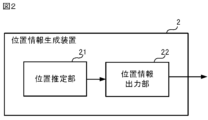
- FIG. FIG. 2 is a block diagram showing an example of the functional configuration of the position information generating device according to Embodiment 1;
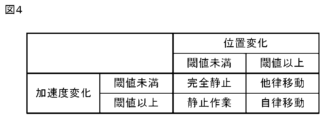
- FIG. 4 is a diagram for explaining a method of determining a worker's movement according to Embodiment 1;
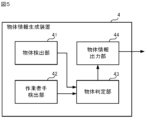
- 1 is a block diagram showing a functional configuration example of an object information generating device according to Embodiment 1;
- FIG. 11 is a diagram showing another example of the functional configuration of the determination device in the work determination system according to Embodiment 2; Flowchart showing an example of operation of determination processing according to Embodiment 2
- FIG. 2 shows an example of a hardware configuration of a learning device according to Embodiment 1 and a determination device according to Embodiment 2;
- a work learning system, a work judgment system, a learning device, a judgment device, a work learning method, a work judgment method, and a program according to the present embodiment will be described in detail below with reference to the drawings. Identical or corresponding parts in the drawings are denoted by the same reference numerals.
- the work learning system 100 includes a learning device 1 that learns the work classification of work performed by a worker, a position information generation device 2 that generates position information indicating the position of the worker, and a static/movement device that indicates the movement of the worker.
- a still/movement information generating device 3 that generates information
- an object information generating device 4 that generates object information indicating an object handled by a worker
- work information that indicates a work classification of work performed by the worker.
- a work information generation device 5 .
- the learning device 1 includes a data acquisition unit 11 that acquires position information, still/movement information, object information, and work information, and a data acquisition unit 11 that acquires position information, still/movement information, object information, and work information to determine the work performed by the worker.
- a model generator 12 that learns work classification and generates a trained model.
- the model generation unit 12 generates learning data based on the position information, stationary/movement information, object information, and work information acquired by the data acquisition unit 11, and learns the work classification of the work performed by the worker by machine learning. do.
- the model generation unit 12 When the learning is completed, the model generation unit 12 generates a trained model and stores it in the external trained model storage unit 6 .
- the learned model storage unit 6 may be provided in the learning device 1 .
- the position information generation device 2 includes a position estimation unit 21 that estimates the position of the worker and a position information output unit 22 that outputs position information.
- the position estimating unit 21 performs, for example, position estimation using a positioning system represented by the Global Positioning System (GPS), Bluetooth (registered trademark), position estimation by surveying using sound waves, etc., and shooting the space where the worker is present.
- the position of the worker is estimated by estimating the position by image processing of images.
- the position information output unit 22 generates time-series position information indicating the position of the worker estimated by the position estimation unit 21 and outputs the position information to the learning device 1 and the motion information generation device 3 .
- the still/movement information generation device 3 includes a position information acquisition unit 31 that acquires position information from the position information generation device 2, an acceleration information generation unit 32 that generates acceleration information indicating the acceleration of the worker, and a movement of the worker. and a stationary/moving information output unit 34 for outputting stationary/moving information.
- the acceleration information generator 32 detects the acceleration of the worker using, for example, an accelerometer worn by the worker.
- the acceleration information generator 32 generates time-series acceleration information indicating the detected acceleration of the worker.
- the still/movement determination unit 33 determines the movement of the worker based on the time-series position information acquired by the position information acquisition unit 31 and the time-series acceleration information generated by the acceleration information generation unit 32 .
- the still/movement determination unit 33 determines whether or not the change in position of the worker per unit time is equal to or greater than a threshold based on the position information.
- the still/movement determination unit 33 determines whether or not the change in acceleration per unit time of the worker is greater than or equal to a threshold based on the acceleration information.
- the still/movement determining unit 33 when the change in position of the worker per unit time is less than the threshold and the change in acceleration of the worker per unit time is less than the threshold, the still/movement determining unit 33 is "completely still". "Completely stationary” represents a state in which the worker is neither moving nor working. If the change in position of the worker per unit time is greater than or equal to the threshold and the change in acceleration per unit time of the worker is less than the threshold, the still/movement determination unit 33 determines that the worker's movement is "heteronomous movement". Determine that there is.
- Heteronomous movement refers to a state in which the worker himself/herself is moving without moving, for example, a state in which the worker is on a transport cart, a forklift, or the like. If the change in position of the worker per unit time is less than the threshold and the change in acceleration per unit time of the worker is greater than or equal to the threshold, the motion determining unit 33 determines that the motion of the worker is "stationary work". I judge. "Stationary work” represents a state in which the worker does not move and is working on the spot.
- the still/movement determination unit 33 determines that the motion of the worker is "autonomous movement". I judge. "Autonomous movement” represents a state in which the worker moves by himself.
- the still/movement determination unit 33 determines whether the worker's movement is “completely still”, “heteronomous movement”, “stationary work”, or “autonomous movement” for each unit time.
- the still/movement information output unit 34 of the still/movement information generation device 3 determines whether the worker's movement determined by the static/movement determination unit 33 is “completely stationary”, “heteronomous movement”, “stationary work”, It generates time-series still/moving information indicating whether it is “autonomous movement” and outputs it to the learning device 1 .
- the object information generation device 4 includes an object detection unit 41 for detecting an object and its position, a worker hand detection unit 42 for detecting a worker's hand and its position, and an object determination unit for determining an object handled by the worker. and an object information output unit 44 for outputting object information.
- the method by which the object detection unit 41 detects the object and its position includes, for example, a method of judging by a marker added to the object in advance based on an image captured by a camera worn by the worker, a method of estimating by AI, and the like.
- Objects refer to, for example, parts, materials, and other workers required for work.
- a method for the worker's hand detection unit 42 to detect the worker's hand and its position includes, for example, a method of determining by a marker given to the worker's hand based on an image captured by a camera worn by the worker. , a method of detecting the skeleton of the worker's hand, and the like.
- the object determination unit 43 determines, for example, an object existing within a predetermined range from the position of the operator's hand as an object handled by the operator.
- the object determination unit 43 further uses the line of sight measurement of the worker to detect objects that exist within a predetermined range from the position of the worker's hand and that the worker has been looking at for a certain period of time or more. You may judge the object you are dealing with.
- the object information output unit 44 generates time-series object information indicating the object handled by the worker determined by the object determination unit 43 and outputs it to the learning device 1 .
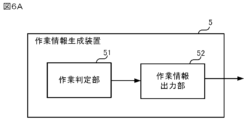
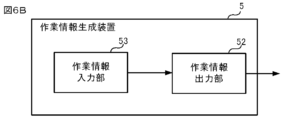
- the work information generation device 5 includes a work determination unit 51 that determines the work classification of the work performed by the worker, and a work information output unit 52 that outputs work information.
- the work determination unit 51 processes the image of the worker and determines the work classification of the work being performed by pattern matching.
- the work determination unit 51 may detect the skeleton of the worker based on a video of the worker and determine the work classification of the work performed by the worker from the movement of the skeleton.
- the work information output unit 52 generates work information indicating the work classification of the work performed by the worker determined by the work determination unit 51 and outputs the work information to the learning device 1 .
- the work information includes time zone information indicating the shooting time zone of the video for which the work classification has been determined.
- the functional configuration of the work information generation device 5 is not limited to this, and as shown in FIG.
- the worker inputs the work classification and work time period of the work to be performed by the worker to the work information input unit 53 .
- the work information output unit 52 generates work information indicating the work classification input to the work information input unit 53 and outputs the work information to the learning device 1 .
- the work information includes time period information indicating the work hours input to the work information input unit 53 . It should be noted that the input of the work classification and work time period may not be performed by the worker himself/herself.
- the work information generation device 5 may include both the work determination unit 51 and the work information input unit 53 .
- the work information output unit 52 gives priority to which work information. It is set in advance whether to generate by
- the data acquisition unit 11 of the learning device 1 obtains position information, static/moving information, object Get information and work information.
- the model generation unit 12 learns the work classification of the work performed by the worker based on the position information, static/movement information, object information, and work information acquired by the data acquisition unit 11, and creates a learned model.
- the timing at which the model generating unit 12 generates a learned model may be, for example, when a learned model generation instruction is input, or when a predetermined timing arrives, or when position information, static/motion information, It may be when a certain period of time has passed since the acquisition of object information and work information started.
- Work classifications are divided into routine and non-routine work classifications, and there are, for example, the following work classifications (1) to (5).
- the work classification is divided into six types: (1) to (5) routine work + (6) non-routine work.
- the work classification is not limited to this, and may be, for example, the name of the work or an identification number that identifies the work.
- the learning algorithms used by the model generation unit 12 include supervised learning, unsupervised learning, and reinforcement learning.
- K-means method which is unsupervised learning
- Unsupervised learning is a method of learning features of data that does not contain results (labels).
- the K-means method is a non-hierarchical clustering algorithm, and is a method of classifying into K clusters using averages of clusters.
- the model generation unit 12 generates learning data xi that associates position information, static/movement information, and object information in the shooting time zone or the work time zone indicated by the time zone information included in the work information for each piece of work information. to generate Work information is associated with the learning data xi.
- the model generation unit 12 calculates the center Vj of each cluster to which the learning data xi are allocated.
- the model generator 12 obtains the distance between each learning data xi and each center Vj, and reassigns the learning data xi to the cluster of the closest center Vj. Then, when the cluster allocation of all the learning data xi does not change in the above processing, or when the amount of change falls below a preset threshold value, it is determined that convergence has occurred, and learning is completed.
- the model generating unit 12 determines the most common work classification among the work classifications indicated by the work information corresponding to the learning data xi assigned to the cluster as the work classification of the cluster. It should be noted that since tasks similar in worker position, movement, and handled object belong to the same task classification, it is assumed that cluster task classifications do not overlap.
- the model generation unit 12 outputs the generated learned model to the learned model storage unit 6.
- the learned model storage unit 6 stores the learned model output from the model generation unit 12 .
- the work classification of the work performed by the worker is learned using the K-means method, which is unsupervised learning.
- the associated data is input, it determines which cluster it corresponds to (which cluster has the closest distance to the center Vj), and outputs the work classification of the applicable cluster.
- the learning process shown in FIG. 7 starts when the learning device 1 is powered on.
- the data acquisition unit 11 of the learning device 1 obtains position information, static/movement information, object information, and work information from the position information generation device 2, the static/motion information generation device 3, the object information generation device 4, and the work information generation device 5, respectively. acquire (step S11). If the learned model generation instruction is not input (step S12; NO), the process proceeds to step S18. When a learned model generation instruction is input (step S12; YES), the model generation unit 12 acquires learning data based on the position information, stationary/movement information, object information, and work information acquired by the data acquisition unit 11. Generate (step S13).
- step S13 the model generation unit 12 acquires position information, static/motion information, and Learning data xi associated with object information is generated. Work information is associated with the learning data xi.
- the model generation unit 12 learns the work classification of the work performed by the worker using the learning data (step S14).
- the model generating unit 12 randomly allocates clusters to each piece of learning data xi in step S14.
- the model generator 12 calculates the center Vj of each cluster to which the learning data xi are allocated.
- the model generator 12 obtains the distance between each learning data xi and each center Vj, and reassigns the learning data xi to the cluster of the closest center Vj.
- step S15 the process returns to step S14 and repeats steps S14 and S15.
- step S15 the model generating unit 12 generates a trained model (step S16).
- the model generation unit 12 determines whether the cluster allocation of all the learning data xi has not changed, or the amount of change has been set in advance. If the value is less than the threshold, it is determined that learning has been completed, and among the work classifications indicated by the work information corresponding to the learning data xi assigned to the cluster, the work classification with the largest number is determined as the work classification of the cluster.
- step S16 the model generation unit 12, when the data in which the position information, static/movement information, and object information are associated is input, determines which cluster it corresponds to (which cluster is closest to the center Vj). and generate a trained model that outputs the work classification of the corresponding cluster.
- step S12 is not limited to determining whether or not a learned model generation instruction has been input. For example, it may be determined whether or not the timing for generating a predetermined learned model has arrived, or whether a certain period of time has elapsed since the acquisition of position information, static/movement information, object information, and work information began. It may be determined whether Steps S11 to S16 are an example of the work learning method.
- data in which position information indicating the position of the worker, static/motion information indicating the movement of the worker, and object information indicating the object handled by the worker are associated are input.
- the work that indicates the work classification of the work performed by the worker at that position along with the position information that indicates the worker's position Information can be obtained easily.
- the learned model generated by the work learning system 100 of the first embodiment is used to classify the work performed by the worker based on the position information, static/movement information, and object information. Determine and output work information.
- the configuration of the work determination system 200 according to Embodiment 2 will be described with reference to FIGS. 8A and 8B.
- the work determination system 200 determines the work performed by the worker with the position information generation device 2, the static/motion information generation device 3, and the object information generation device 4, and outputs work information. and a determination device 7 .
- the functional configurations of the position information generation device 2, the static/motion information generation device 3, and the object information generation device 4 are the same as those of the first embodiment.
- the determination device 7 includes a target data acquisition unit 71 that acquires position information, static/movement information, and object information for determining the work performed by the worker, and data that associates the position information, static/movement information, and object information. into the learned model to determine the work classification of the work performed by the worker.
- the target data acquisition unit 71 acquires position information, still/movement information, and object information from the position information generation device 2, the still/movement information generation device 3, and the object information generation device 4, respectively.
- the determination unit 72 inputs the data associated with the position information, the still/movement information, and the object information acquired by the target data acquisition unit 71 to the learned model stored in the learned model storage unit 6, and outputs from the learned model It generates and outputs work information indicating the work classification of the work performed by the worker.
- the work information may be output by, for example, screen display, voice output, or transmission to a terminal carried or worn by the worker.
- the learned model storage unit 6 may be provided in the determination device 7 .
- the determination device 7 further includes a work performance acquisition unit 73 that acquires work performance information indicating the work classification of the work actually performed by the worker.
- the work performance information may be acquired, for example, by accepting an input from the worker, by receiving it from a terminal used by the worker, or by acquiring it from an external system or device.
- the determination unit 72 feeds back the work performance information acquired by the work performance acquisition unit 73 to the learned model.
- the determination unit 72 determines whether or not the work classification output from the learned model matches based on the work performance information. If the work classification does not match, the determination unit 72 uses the same learning algorithm as that of the model generation unit 12 to determine the location information, static/movement information, and object information for which the work classification does not match, and the actually performed data. Based on the work performance information indicating the work classification of the work, learning data is generated, and the work classification of the worker's work is re-learned to update the learned model. For example, when using the K-means method, the determination unit 72 generates learning data xi based on the position information, static/movement information, and object information for which the work classification does not match, Assign tasks to task classification clusters.
- the determination unit 72 recalculates the center Vj of each cluster, and reassigns each learning data xi to the cluster closest to the center Vj. When the learning is completed, the determination unit 72 determines the most common work classification among the work classifications indicated by the work information corresponding to the learning data xi assigned to the cluster as the work classification of the cluster. This updates the learned model.
- step S21; NO the process proceeds to step S25.
- the determination unit 72 inputs the data obtained by associating the position information, static/motion information and object information obtained by the target data obtaining unit 71 into the learned model stored in the learned model storage unit 6 (step S22).
- the determination unit 72 generates work information indicating the work classification of the work performed by the worker output from the learned model (step S23), and outputs the work information (step S24).
- Step S25 If the power of the determination device 7 is not turned off (step S25; NO), the process returns to step S21, and steps S21 to S25 are repeated. When the power is turned off (step S25; YES), the process ends. Steps S21 to S23 are an example of the work learning method.
- data in which position information indicating the position of the worker, motion information indicating the movement of the worker, and object information indicating the object handled by the worker are associated are input. Then, using a trained model that outputs the work classification of the work performed by the worker, position information indicating the position of the worker and work information indicating the work classification of the work performed by the worker at that position are obtained. can be obtained easily.
- the manager can refer to the output work information to check if there are any abnormalities in the quality, productivity, and lead time of the production activities, and if there are any points for improvement in quality, productivity, and lead time. This can improve quality, productivity and lead times.
- the determination unit 72 generates learning data based on the position information, static/movement information, and object information for which the work classification does not match, and the work performance information indicating the work classification of the work actually performed, and performs the work.
- learning device 1 or determination device 7 includes temporary storage unit 101 , storage unit 102 , calculation unit 103 , input unit 104 , transmission/reception unit 105 and display unit 106 .
- Temporary storage unit 101, storage unit 102, input unit 104, transmission/reception unit 105, and display unit 106 are all connected to calculation unit 103 via BUS.
- the calculation unit 103 is, for example, a CPU (Central Processing Unit). Calculation unit 103 executes the processing of model generation unit 12 or determination unit 72 according to the control program stored in storage unit 102 .
- CPU Central Processing Unit
- the temporary storage unit 101 is, for example, a RAM (Random-Access Memory). Temporary storage unit 101 loads a control program stored in storage unit 102 and is used as a work area for calculation unit 103 .
- RAM Random-Access Memory
- the storage unit 102 is a non-volatile memory such as flash memory, hard disk, DVD-RAM (Digital Versatile Disc-Random Access Memory), DVD-RW (Digital Versatile Disc-ReWritable).
- the storage unit 102 stores in advance a program for causing the calculation unit 103 to perform the processing of the learning device 1 or the determination device 7, and supplies the data stored by this program to the calculation unit 103 according to instructions from the calculation unit 103. and stores the data supplied from the calculation unit 103 . If the learning device 1 or the determination device 7 is configured to include the learned model storage unit 6 , the learned model storage unit 6 is configured in the storage unit 102 .
- the input unit 104 is an input device such as a keyboard, pointing device, voice input device, etc., and an interface device that connects the input device to the BUS. Information input by the user is supplied to the calculation unit 103 via the input unit 104 .
- the input unit 104 functions as the model generation unit 12 when the model generation unit 12 is configured to receive input of a trained model generation instruction.
- the transmitting/receiving unit 105 is a network terminal device or wireless communication device that connects to a network, and a serial interface or LAN (Local Area Network) interface that connects to them.
- the transmission/reception unit 105 functions as the data acquisition unit 11 or the target data acquisition unit 71 .
- the display unit 106 is a display device such as an LCD (Liquid Crystal Display) or an organic EL (electroluminescence) display. If the determination unit 72 is configured to display work information on the screen, the display unit 106 functions as the determination unit 72 .
- the data acquisition unit 11 and the model generation unit 12 of the learning device 1 shown in FIG. 1, the target data acquisition unit 71 and the determination unit 72 of the determination device 7 shown in FIG. 8A, and the work result acquisition unit of the determination device 7 shown in FIG. 8B The processing of 73 is executed by the control program using the temporary storage unit 101, the calculation unit 103, the storage unit 102, the input unit 104, the transmission/reception unit 105, the display unit 106, etc. as resources.
- a computer program for executing the above operations may be recorded on a computer-readable recording medium such as a flexible disk, CD-ROM (Compact Disc-Read Only Memory), DVD-ROM (Digital Versatile Disc-Read Only Memory).
- the learning device 1 or the determination device 7 that executes the above processing may be configured by storing and distributing the program in a computer and installing the computer program in the computer.
- the computer program may be stored in a storage device of a server device on a communication network such as the Internet, and the learning device 1 or the determination device 7 may be configured by downloading it to a normal computer system.
- the functions of the learning device 1 or the determination device 7 are realized by sharing the work of the OS (Operating System) and the application program, or by cooperation between the OS and the application program, only the application program part can be stored in the recording medium. may be stored in the device.
- the computer program may be posted on a bulletin board system (BBS, Bulletin Board System) on the communication network, and the computer program may be provided via the communication network. Then, the computer program may be activated and executed in the same manner as other application programs under the control of the OS to execute the above processing.
- BSS bulletin board System
- the model generation unit 12 learns the work classification of the work performed by the worker based on the position information, static/movement information, object information, and work information acquired by the data acquisition unit 11. , to generate a trained model, but not limited to this. If the work classification of the work performed by the worker can be learned, the model generation unit 12 can perform the work based on part of the position information, static/movement information, and object information acquired by the data acquisition unit 11. A learned model may be generated by learning the work classification of the work performed by a person.
- the determination unit 72 inputs the data in which the position information, the still/movement information, and the object information acquired by the target data acquisition unit 71 are associated to the learned model stored in the learned model storage unit 6. , work information indicating the work classification of the work performed by the worker output from the learned model is generated, but the present invention is not limited to this. If it is possible to determine which cluster the learned model corresponds to, the determining unit 72 obtains data that associates part of the position information, static/moving information, and object information acquired by the target data acquiring unit 71. The work information may be input to the learned model stored in the learned model storage unit 6, and work information indicating the work classification of the work performed by the worker output from the learned model may be generated.
- non-hierarchical clustering by the K-means method as unsupervised learning used in the learning algorithm used by the model generating unit 12
- the present invention is not limited to this.
- unsupervised learning for example, hierarchical clustering by the shortest distance method may be used.
- reinforcement learning supervised learning, semi-supervised learning, deep learning, or the like. The same is true when the determination unit 72 relearns the work classification of the work performed by the worker by machine learning and updates the learned model.
Landscapes
- Engineering & Computer Science (AREA)
- Theoretical Computer Science (AREA)
- Software Systems (AREA)
- Computer Vision & Pattern Recognition (AREA)
- General Physics & Mathematics (AREA)
- Physics & Mathematics (AREA)
- Evolutionary Computation (AREA)
- Medical Informatics (AREA)
- Computing Systems (AREA)
- General Engineering & Computer Science (AREA)
- Data Mining & Analysis (AREA)
- Mathematical Physics (AREA)
- Artificial Intelligence (AREA)
- Multimedia (AREA)
- Image Analysis (AREA)
- General Factory Administration (AREA)
Abstract
Description
実施の形態1に係る作業学習システム100の構成について図1を用いて説明する。作業学習システム100は、作業者が行っている作業の作業分類を学習する学習装置1と、作業者の位置を示す位置情報を生成する位置情報生成装置2と、作業者の動きを示す静動情報を生成する静動情報生成装置3と、作業者が扱っている物体を示す物体情報を生成する物体情報生成装置4と、作業者が行っている作業の作業分類を示す作業情報を生成する作業情報生成装置5とを備える。
実施の形態2では、実施の形態1の作業学習システム100で生成された学習済モデルを用いて、位置情報、静動情報および物体情報に基づいて、作業者が行っている作業の作業分類を判定して作業情報を出力する。
Claims (9)
- 作業者が行っている作業の作業分類を学習する学習装置と、
前記作業者の位置を示す位置情報を生成する位置情報生成装置と、
前記作業者の動きを示す静動情報を生成する静動情報生成装置と、
前記作業者が扱っている物体を示す物体情報を生成する物体情報生成装置と、
前記作業者が行っている作業の作業分類を示す作業情報を生成する作業情報生成装置と、
を備え、
前記学習装置は、
前記位置情報生成装置、前記静動情報生成装置、前記物体情報生成装置および前記作業情報生成装置からそれぞれ、前記位置情報、前記静動情報、前記物体情報および前記作業情報を取得するデータ取得部と、
前記データ取得部が取得した前記位置情報、前記静動情報、前記物体情報および前記作業情報に基づいて、前記作業者が行っている作業の作業分類を学習し、学習済モデルを生成するモデル生成部と、
を有する作業学習システム。 - 作業者が行っている作業の作業分類を判定する判定装置と、
前記作業者の位置を示す位置情報を生成する位置情報生成装置と、
前記作業者の動きを示す静動情報を生成する静動情報生成装置と、
前記作業者が扱っている物体を示す物体情報を生成する物体情報生成装置と、
を備え、
前記判定装置は、
前記位置情報生成装置、前記静動情報生成装置および前記物体情報生成装置からそれぞれ、前記位置情報、前記静動情報および前記物体情報を取得する対象データ取得部と、
前記対象データ取得部が取得した前記位置情報、前記静動情報および前記物体情報を関連付けたデータを、前記作業者が行っている作業の作業分類を学習した学習済モデルに入力して、前記学習済モデルから出力された前記作業者が行っている作業の作業分類を示す作業情報を生成する判定部と、
を有する作業判定システム。 - 作業者が行っている作業の作業分類を学習する学習装置であって、
前記作業者の位置を示す位置情報、前記作業者の動きを示す静動情報、前記作業者が扱っている物体を示す物体情報および前記作業者が行っている作業の作業分類を示す作業情報を取得するデータ取得部と、
前記データ取得部が取得した前記位置情報、前記静動情報、前記物体情報および前記作業情報に基づいて、前記作業者が行っている作業の作業分類を学習し、学習済モデルを生成するモデル生成部と、
を備える学習装置。 - 作業者が行っている作業の作業分類を判定する判定装置であって、
前記作業者の位置を示す位置情報、前記作業者の動きを示す静動情報および前記作業者が扱っている物体を示す物体情報を取得する対象データ取得部と、
前記対象データ取得部が取得した前記位置情報、前記静動情報および前記物体情報を関連付けたデータを、前記作業者が行っている作業の作業分類を学習した学習済モデルに入力して、前記学習済モデルから出力された前記作業者が行っている作業の作業分類を示す作業情報を生成する判定部と、
を有する判定装置。 - 実際に前記作業者が行った作業の作業分類を示す作業実績情報を取得する作業実績取得部をさらに備え、
前記判定部は、
前記作業実績情報に基づいて、前記学習済モデルから出力された前記作業者の作業の作業分類が合っていたか否かを判定し、作業分類が合っていなかった場合には、作業分類が合っていなかった前記位置情報、前記静動情報および前記物体情報と、実際に行われた作業の作業分類を示す前記作業実績情報とに基づいて、前記作業者の作業の作業分類を再学習し、前記学習済モデルを更新する、
請求項4に記載の判定装置。 - 作業者が行っている作業の作業分類を学習する作業学習システムが実行する、
前記作業者の位置を示す位置情報を生成するステップと、
前記作業者の動きを示す静動情報を生成するステップと、
前記作業者が扱っている物体を示す物体情報を生成するステップと、
前記作業者が行っている作業の作業分類を示す作業情報を生成するステップと、
前記位置情報、前記静動情報、前記物体情報および前記作業情報に基づいて、前記作業者が行っている作業の作業分類を学習し、学習済モデルを生成するステップと、
を備える作業学習方法。 - 作業者が行っている作業の作業分類を判定する作業判定システムが実行する、
前記作業者の位置を示す位置情報を生成するステップと、
前記作業者の動きを示す静動情報を生成するステップと、
前記作業者が扱っている物体を示す物体情報を生成するステップと、
前記位置情報、前記静動情報および前記物体情報を関連付けたデータを、前記作業者が行っている作業の作業分類を学習した学習済モデルに入力して、前記学習済モデルから出力された前記作業者が行っている作業の作業分類を示す作業情報を生成するステップと、
を備える作業判定方法。 - コンピュータを、
作業者の位置を示す位置情報、前記作業者の動きを示す静動情報、前記作業者が扱っている物体を示す物体情報および前記作業者が行っている作業の作業分類を示す作業情報に基づいて、前記作業者が行っている作業の作業分類を学習し、学習済モデルを生成するモデル生成部、
として機能させるプログラム。 - コンピュータを、
作業者の位置を示す位置情報、前記作業者の動きを示す静動情報および前記作業者が扱っている物体を示す物体情報を関連付けたデータを、前記作業者が行っている作業の作業分類を学習した学習済モデルに入力して、前記学習済モデルから出力された前記作業者が行っている作業の作業分類を示す作業情報を生成する判定部、
として機能させるプログラム。
Priority Applications (3)
| Application Number | Priority Date | Filing Date | Title |
|---|---|---|---|
| CN202280072358.8A CN118176501A (zh) | 2021-11-09 | 2022-11-04 | 作业学习系统、作业判定系统、学习装置、判定装置、作业学习方法、作业判定方法和程序 |
| JP2023559605A JPWO2023085208A1 (ja) | 2021-11-09 | 2022-11-04 | |
| US18/701,685 US20250029006A1 (en) | 2021-11-09 | 2022-11-04 | Operation learning system, operation identifying system, and identifying-device |
Applications Claiming Priority (2)
| Application Number | Priority Date | Filing Date | Title |
|---|---|---|---|
| JP2021182266 | 2021-11-09 | ||
| JP2021-182266 | 2021-11-09 |
Publications (1)
| Publication Number | Publication Date |
|---|---|
| WO2023085208A1 true WO2023085208A1 (ja) | 2023-05-19 |
Family
ID=86336016
Family Applications (1)
| Application Number | Title | Priority Date | Filing Date |
|---|---|---|---|
| PCT/JP2022/041162 Ceased WO2023085208A1 (ja) | 2021-11-09 | 2022-11-04 | 作業学習システム、作業判定システム、学習装置、判定装置、作業学習方法、作業判定方法、および、プログラム |
Country Status (4)
| Country | Link |
|---|---|
| US (1) | US20250029006A1 (ja) |
| JP (1) | JPWO2023085208A1 (ja) |
| CN (1) | CN118176501A (ja) |
| WO (1) | WO2023085208A1 (ja) |
Citations (2)
| Publication number | Priority date | Publication date | Assignee | Title |
|---|---|---|---|---|
| JP2017010186A (ja) * | 2015-06-19 | 2017-01-12 | 三菱電機株式会社 | 物流作業分析システム |
| JP2019101516A (ja) * | 2017-11-29 | 2019-06-24 | ファナック株式会社 | 作業者管理装置 |
Family Cites Families (4)
| Publication number | Priority date | Publication date | Assignee | Title |
|---|---|---|---|---|
| JP2008077424A (ja) * | 2006-09-21 | 2008-04-03 | Toshiba Corp | 作業分析システム及び方法 |
| JP6834372B2 (ja) * | 2016-11-08 | 2021-02-24 | 株式会社リコー | 情報処理装置、情報処理システム、情報処理方法およびプログラム |
| JP2019200560A (ja) * | 2018-05-16 | 2019-11-21 | パナソニックIpマネジメント株式会社 | 作業分析装置および作業分析方法 |
| JP2021082137A (ja) * | 2019-11-21 | 2021-05-27 | キヤノン株式会社 | 行動認識装置及びその制御方法及びプログラム |
-
2022
- 2022-11-04 WO PCT/JP2022/041162 patent/WO2023085208A1/ja not_active Ceased
- 2022-11-04 CN CN202280072358.8A patent/CN118176501A/zh not_active Withdrawn
- 2022-11-04 US US18/701,685 patent/US20250029006A1/en active Pending
- 2022-11-04 JP JP2023559605A patent/JPWO2023085208A1/ja active Pending
Patent Citations (2)
| Publication number | Priority date | Publication date | Assignee | Title |
|---|---|---|---|---|
| JP2017010186A (ja) * | 2015-06-19 | 2017-01-12 | 三菱電機株式会社 | 物流作業分析システム |
| JP2019101516A (ja) * | 2017-11-29 | 2019-06-24 | ファナック株式会社 | 作業者管理装置 |
Non-Patent Citations (1)
| Title |
|---|
| MATSUMURA, YUKI ET AL.: "Intention Estimation of Workers Based on Tracking of Implementation Process Using Objects and Their Positions as Clues", IEICE TECHNICAL REPORT, vol. 117, no. 483, 1 March 2018 (2018-03-01), pages 41 - 46, XP009545610 * |
Also Published As
| Publication number | Publication date |
|---|---|
| JPWO2023085208A1 (ja) | 2023-05-19 |
| US20250029006A1 (en) | 2025-01-23 |
| CN118176501A (zh) | 2024-06-11 |
Similar Documents
| Publication | Publication Date | Title |
|---|---|---|
| US11308334B2 (en) | Method and apparatus for integration of detected object identifiers and semantic scene graph networks for captured visual scene behavior estimation | |
| CN106774345B (zh) | 一种进行多机器人协作的方法与设备 | |
| US10479328B2 (en) | System and methods for assessing the interior of an autonomous vehicle | |
| JP5682563B2 (ja) | 移動体軌跡識別システム、移動体軌跡識別方法および移動体軌跡識別プログラム | |
| CN115705714A (zh) | 用于分析工作区域的系统和方法 | |
| US12296490B2 (en) | End device, three-party communication system comprising cloud server and edge server for controlling end device, and operation method therefor | |
| US8407024B2 (en) | Motion determination apparatus, method and computer readable medium | |
| JP2019530385A (ja) | 受動的な訪問検知 | |
| US20140160295A1 (en) | Road condition detection | |
| CN110795985B (zh) | 信息处理方法及信息处理系统 | |
| JP2012524439A (ja) | カメラネットワークによる標的の位置決定用システムおよび方法 | |
| EP4036857A1 (en) | Vehicle and method for generating map corresponding to three-dimensional space | |
| CN101446639A (zh) | 在时间和空间中定位射频识别标签的方法和系统 | |
| US20150363706A1 (en) | Fusion of data from heterogeneous sources | |
| CN114387780A (zh) | 车辆损坏识别和事故管理系统和方法 | |
| US20150339591A1 (en) | Collegial Activity Learning Between Heterogeneous Sensors | |
| CN112381853A (zh) | 用于利用无线信号和图像来进行人员检测、跟踪和标识的装置和方法 | |
| TW201727418A (zh) | 分析地面紋理並結合資料記錄的自動行走建議系統及方法 | |
| JP5674550B2 (ja) | 状態追跡装置、方法、及びプログラム | |
| CN111630346B (zh) | 基于图像和无线电词语的移动设备的改进定位 | |
| JP7617980B2 (ja) | 教師モデルによる知識の抽出を用いた、自動車のアプリケーションのためのフェデレーテッドラーニングのためのシステム及び方法 | |
| WO2023085208A1 (ja) | 作業学習システム、作業判定システム、学習装置、判定装置、作業学習方法、作業判定方法、および、プログラム | |
| CN112528078A (zh) | 一种图像归档方法、装置及设备 | |
| US11216969B2 (en) | System, method, and computer-readable medium for managing position of target | |
| Chen et al. | Adaptive cross-camera video analytics at the edge |
Legal Events
| Date | Code | Title | Description |
|---|---|---|---|
| 121 | Ep: the epo has been informed by wipo that ep was designated in this application |
Ref document number: 22892707 Country of ref document: EP Kind code of ref document: A1 |
|
| WWE | Wipo information: entry into national phase |
Ref document number: 2023559605 Country of ref document: JP |
|
| WWE | Wipo information: entry into national phase |
Ref document number: 18701685 Country of ref document: US |
|
| WWE | Wipo information: entry into national phase |
Ref document number: 202280072358.8 Country of ref document: CN |
|
| NENP | Non-entry into the national phase |
Ref country code: DE |
|
| 122 | Ep: pct application non-entry in european phase |
Ref document number: 22892707 Country of ref document: EP Kind code of ref document: A1 |