WO2023084776A1 - ベイズ最適化装置、ベイズ最適化方法、およびベイズ最適化プログラム - Google Patents
ベイズ最適化装置、ベイズ最適化方法、およびベイズ最適化プログラム Download PDFInfo
- Publication number
- WO2023084776A1 WO2023084776A1 PCT/JP2021/041921 JP2021041921W WO2023084776A1 WO 2023084776 A1 WO2023084776 A1 WO 2023084776A1 JP 2021041921 W JP2021041921 W JP 2021041921W WO 2023084776 A1 WO2023084776 A1 WO 2023084776A1
- Authority
- WO
- WIPO (PCT)
- Prior art keywords
- comparison result
- comparison
- bayesian optimization
- model
- unit
- Prior art date
- Legal status (The legal status is an assumption and is not a legal conclusion. Google has not performed a legal analysis and makes no representation as to the accuracy of the status listed.)
- Ceased
Links
Images





Classifications
-
- G—PHYSICS
- G06—COMPUTING OR CALCULATING; COUNTING
- G06N—COMPUTING ARRANGEMENTS BASED ON SPECIFIC COMPUTATIONAL MODELS
- G06N7/00—Computing arrangements based on specific mathematical models
- G06N7/01—Probabilistic graphical models, e.g. probabilistic networks
-
- G—PHYSICS
- G06—COMPUTING OR CALCULATING; COUNTING
- G06N—COMPUTING ARRANGEMENTS BASED ON SPECIFIC COMPUTATIONAL MODELS
- G06N20/00—Machine learning
-
- G—PHYSICS
- G06—COMPUTING OR CALCULATING; COUNTING
- G06N—COMPUTING ARRANGEMENTS BASED ON SPECIFIC COMPUTATIONAL MODELS
- G06N20/00—Machine learning
- G06N20/10—Machine learning using kernel methods, e.g. support vector machines [SVM]
-
- G—PHYSICS
- G06—COMPUTING OR CALCULATING; COUNTING
- G06N—COMPUTING ARRANGEMENTS BASED ON SPECIFIC COMPUTATIONAL MODELS
- G06N5/00—Computing arrangements using knowledge-based models
- G06N5/01—Dynamic search techniques; Heuristics; Dynamic trees; Branch-and-bound
Definitions
- the present invention relates to a Bayesian optimization device, a Bayesian optimization method, and a Bayesian optimization program.
- Personalization is often used in fields where it is easy to create a mechanism for collecting personal data. For example, browsing/playback/click/purchase/evaluation logs are used to personalize products/contents/services/advertisements.
- Non-Patent Document 1 discloses Bayesian optimization as a method of building a model by collecting a small amount of data.
- Bayesian optimization is a mechanism that uses the score for a certain parameter as an input and repeatedly learns the presentation of the parameter to be searched.
- the next recipe to be evaluated is output, and the user gives a score to it. is output.
- Non-Patent Document 2 discloses an example of optimizing a cookie recipe using Bayesian optimization.
- Non-Patent Document 3 proposes a method of learning using a Gaussian process with comparison results as input in order to solve the problem of fluctuations in user scores.
- This method is a mechanism that repeatedly learns the presentation of parameters to be searched, using the results of comparison between the previously selected parameter and the presented parameter as input.
- the parameter selected last time is the parameter with the highest evaluation ever.
- the presented parameter is the parameter to be searched
- the previously selected parameter is the parameter to be compared with the presented parameter, that is, the parameter to be searched.
- the parameters to be searched are also referred to as candidate points to be searched or new candidate points or simply candidate points, and the parameters to be compared with the parameters to be searched are also referred to as comparison points.
- the next recipe to be compared is output, and the user selects in order the previously highly rated recipe and the output recipe to be compared. is repeated, and the recipe that maximizes the user's evaluation is finally output.
- the present invention has been made with a focus on the above circumstances, and its object is to quickly converge learning and reduce the number of comparisons performed by the user. is to provide
- the Bayesian optimization device includes a comparison result expansion unit that receives and expands comparison results from a user, a comparison result storage unit that stores the expanded comparison results, and a model learning that learns a model based on the expanded comparison results.
- a model storage unit for storing learned models; a candidate point selection unit for selecting candidate points to be searched based on the developed comparison result and the learned model; It has a candidate point presenting unit for presenting to the user.
- the Bayesian optimization method receives and expands the user's comparison results, stores the expanded comparison results, learns a model based on the expanded comparison results, and learns the trained model. Storing, selecting candidate points to be searched based on the expanded comparison result and the learned model, and presenting the candidate points to be searched to the user.
- a Bayesian optimization program causes a computer to execute the function of each component of the Bayesian optimization device described above.
- a Bayesian optimization device a Bayesian optimization method, and a Bayesian optimization program are provided in which learning converges quickly and the number of comparisons performed by the user is reduced.
- FIG. 1 is a block diagram illustrating an example of a functional configuration of a Bayesian optimization device according to an embodiment
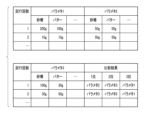
- FIG. FIG. 2 is a diagram illustrating an example of comparison result data received by a comparison result development unit in the Bayesian optimization apparatus according to the embodiment
- FIG. 3 is a diagram illustrating an example of expanded comparison result data output by a comparison result expansion unit in the Bayesian optimization apparatus according to the embodiment
- FIG. 4 is a schematic diagram showing how comparison results are expanded by a comparison result expansion unit in the Bayesian optimization device according to the embodiment.
- FIG. 5 is a block diagram illustrating an example of the hardware configuration of the Bayesian optimization device according to the embodiment
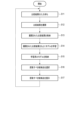
- FIG. 6 is a flow chart diagram showing the operation of the Bayesian optimization device according to the embodiment.
- FIG. 7 is a block diagram showing an example of the functional configuration of a conventional Bayesian optimization device.
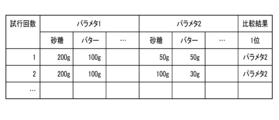
- FIG. 8 is a diagram showing an example of comparison result data stored in a comparison result storage unit in the conventional Bayesian optimization device.
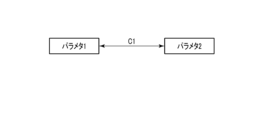
- FIG. 9 is a schematic diagram showing a state of comparison in a conventional Bayesian optimization device.
- FIG. 1 is a block diagram showing an example of a functional configuration of a Bayesian optimization device 10 according to an embodiment.
- the Bayesian optimization device 10 includes a comparison result development unit 11, a comparison result storage unit 12, a model learning unit 13, a model storage unit 14, a candidate point selection unit 15, a candidate point It has a presentation unit 16 .
- the comparison result expansion unit 11 receives the comparison result from the user and expands the received comparison result.
- the comparison result expansion unit 11 also outputs the expanded comparison result to the comparison result storage unit 12 .
- the comparison result storage unit 12 receives the expanded comparison result from the comparison result expansion unit 11 and stores it.
- the model learning unit 13 reads the developed comparison result from the comparison result storage unit 12 and also reads the model from the model storage unit 14 .
- a model learning unit 13 learns a model based on the comparison result.
- the model learning unit 13 also outputs the learned model to the model storage unit 14 .
- the model storage unit 14 stores unlearned models in the initial state. Each time the model learning unit 13 executes model learning, the model storage unit 14 receives a learned model from the model learning unit 13 and stores it. In other words, the model storage unit 14 updates the stored model.
- the candidate point selection unit 15 reads the comparison result from the comparison result storage unit 12 and reads the learned model from the model learning unit 13 .
- the candidate point selection unit 15 also selects candidate points to be searched based on the comparison result and the learned model.
- the candidate point selection unit 15 also outputs candidate points to be searched to the candidate point presentation unit 16 .
- the candidate point presentation unit 16 receives candidate points to be searched from the candidate point selection unit 15 and presents them to the user.
- FIG. 2 is a diagram showing an example of comparison result data input by the user to the comparison result expansion unit 11.
- FIG. 3 is a diagram showing an example of expanded comparison result data output by the comparison result expansion unit.
- the data of the comparison results are presented in tabular form.
- the data of the comparison results are drawn as a two-stage table for convenience.
- the comparison result data in FIGS. 2 and 3 is an example of cookie recipe data and has multiple parameters. Each parameter has information of sugar, butter, and so on.
- the comparison result data also includes comparison result information for each number of trials.
- the user comparison result input to the comparison result development unit 11 has three or more parameters and their comparison results.
- the data of the comparison result in FIG. 2 is data when the number of parameters is three. Therefore, the comparison result data in FIG. 2 has parameters 1, 2, and 3. In FIG.
- the comparison result data in FIG. 2 also has information on the parameters of the first, second, and third ranks for each number of trials as a comparison result.
- the data of the comparison result in FIG. 3 is data having two parameters, namely parameter 1 and parameter 2.
- the comparison result data in FIG. 3 also has information of the first parameter for each number of trials as a comparison result.
- the comparison result expansion unit 11 expands the comparison result data in FIG. 2 to create the comparison result data in FIG.
- the comparison result expansion unit 11 first acquires three comparison results by mutually comparing the parameters 1, 2, and 3 of the comparison result data in FIG.
- the three comparison results are the first comparison result between parameter 1 and parameter 2, the second comparison result between parameter 2 and parameter 3, and the comparison result between parameter 3 and parameter 1.
- a third comparison result is the comparison result expansion unit 11 then ranks these three comparison results to create the comparison result data shown in FIG.
- the Bayesian optimization device 10 is composed of a computer.
- the Bayesian optimization device 10 is configured by a personal computer, a server computer, or the like.
- FIG. 5 is a block diagram showing an example of the hardware configuration of the Bayesian optimization device 10 according to the embodiment.
- the Bayesian optimization device 10 has an input device 21 , a CPU 22 , a storage device 25 and an output device 28 .
- the Bayesian optimization device 10 may further have other peripheral devices in addition to these.
- the input device 21, the CPU 22, the storage device 25, and the output device 28 are electrically connected to each other via the bus 29, and exchange data and commands via the bus 29.
- the input device 21 is a device that receives data and commands from the user.
- the input device 21 is composed of a keyboard and a mouse.
- the input device 21 is not limited to this, and may be composed of any other input device.
- the output device 28 is a device that presents data to the user.
- output device 28 may comprise a display.
- the output device 28 is not limited to this, and may be composed of any other output device.
- the storage device 25 stores programs and data necessary for processing executed by the CPU 22 .
- the CPU 22 performs various processes by reading and executing necessary programs and data from the storage device 25 .
- the storage device 25 has a main storage device 26 and an auxiliary storage device 27 .
- the main memory 26 and the auxiliary memory 27 exchange programs and data between them.
- the main storage device 26 stores programs and data temporarily required for processing by the CPU 22 .
- the main storage device 26 is composed of volatile memory such as RAM (Random Access Memory).
- the auxiliary storage device 27 stores programs and data supplied via an external device or network, and provides the main storage device 26 with the programs and data temporarily required for the processing of the CPU 22 .
- the auxiliary storage device 27 is composed of a non-volatile memory such as an HDD (Hard Disk Drive) or an SSD (Solid State Drive).
- the CPU 22 is a processor and hardware that processes data and instructions.
- the CPU 22 has a control device 23 and an arithmetic device 24 .
- the control device 23 controls the input device 21, the arithmetic device 24, the storage device 25, and the output device 28.
- the arithmetic unit 24 reads programs and data from the main storage device 26, executes the programs to process data, and provides the processed data to the main storage device 26.
- the input device 21, the CPU 22, and the main storage device 26 constitute the comparison result developing section 11.
- the storage device 25 also constitutes the comparison result storage unit 12 and the model storage unit 14 .
- the CPU 22 and the main storage device 26 constitute a model learning section 13 and a candidate point selection section 15 .
- the CPU 22 , the main storage device 26 and the output device 28 constitute the candidate point presenting section 16 .
- FIG. 6 is a flowchart showing the operation of the Bayesian optimization device 10. As shown in FIG.
- step S11 the comparison result expansion unit 11 waits for input of the comparison result by the user. Upon receiving the user's comparison result, the comparison result expansion unit 11 proceeds to the process of step S12.
- a comparison result by the user includes three or more parameters.
- step S12 the comparison result expansion unit 11 expands the comparison result. That is, the comparison result developing unit 11 creates a developed comparison result by mutually comparing three or more parameters of the received comparison result. For example, the comparison result expansion unit 11 receives a comparison result containing three parameters as shown in FIG. 2 and produces a expanded comparison result containing two parameters as shown in FIG. The comparison result development unit 11 outputs the developed comparison result to the comparison result storage unit 12 .
- step S13 the comparison result storage unit 12 receives the developed comparison result from the comparison result development unit 11 and stores it.
- step S14 the model learning unit 13 reads the developed comparison result from the comparison result storage unit 12 and also reads the model from the model storage unit 14.
- a model learning unit 13 learns a model based on the expanded comparison result.
- the model learning unit 13 also outputs the learned model to the model storage unit 14 and the candidate point selection unit 15 .
- step S15 the model storage unit 14 receives the learned model from the model learning unit 13 and stores it.
- step S ⁇ b>16 the candidate point selection unit 15 reads the expanded comparison result from the comparison result storage unit 12 and receives the trained model from the model learning unit 13 .
- the candidate point selection unit 15 also selects candidate points to be searched based on the developed comparison result and the learned model.
- the candidate point selection unit 15 outputs candidate points to be searched to the candidate point presentation unit 16 .
- step S17 the candidate point presentation unit 16 receives candidate points to be searched from the candidate point selection unit 15 and presents them to the user. After that, the Bayesian optimization device 10 returns to the process of step S11.
- FIG. 7 is a block diagram showing an example of a functional configuration of a Bayesian optimization device 50 according to a conventional example.
- the functional configuration with the same reference numerals as the functional configuration in FIG. 1 represents the same functional configuration.
- the Bayesian optimization device 50 according to the conventional example has a configuration in which the comparison result expansion unit 11 is omitted from the Bayesian optimization device 10 according to the embodiment.
- the comparison result storage unit 12 according to the conventional example is configured to include an input device 21 and a CPU 22 in addition to the storage device 25 in terms of hardware.
- FIG. 8 is a diagram showing an example of comparison result data stored in the comparison result storage unit 12 in the Bayesian optimization device 50 of FIG. Similar to the comparison result data shown in FIGS. 2 and 3, the comparison result data shown in FIG. 8 is an example of cookie recipe data, and is represented in a table format.
- the comparison result data in FIG. 8 has two parameters, namely parameter 1 and parameter 2, and the comparison result.
- Each parameter has information of sugar, butter, and so on.
- the comparison result has the information of the first parameter for each number of trials.
- comparison result data in FIG. 8 is the same data as the comparison result data in FIG.
- the user's comparison result having two parameters is input to the comparison result storage unit 12 .
- Model learning unit 13 learns a model based on the comparison result.
- the candidate point selection unit 15 selects candidate points to be searched based on the comparison result and the learned model.
- the candidate point presentation unit 16 presents candidate points to be searched to the user.
- the comparison result storage unit 12 waits for input of the next comparison result by the user. By repeating this, Bayesian optimization is performed.
- FIG. 9 is a schematic diagram showing a state of comparison in the Bayesian optimization device 50 according to the conventional example.
- the user comparison result input to the Bayesian optimizer 50 has two parameters, parameter 1 and parameter 2 .
- the comparison result obtained by comparing the parameter 1 and the parameter 2 is only one comparison result C1.
- the user's comparison result having three or more parameters is input to the comparison result development unit 11 .
- the comparison result developing unit 11 creates a developed comparison result by mutually parameter-comparing three or more parameters.
- the expanded comparison result is a comparison result with two parameters, as shown in FIG.
- the expanded comparison result is stored in the comparison result storage unit 12 .
- a model learning unit 13 learns a model based on the expanded comparison result.
- the candidate point selection unit 15 selects candidate points to be searched based on the comparison result and the learned model.
- the candidate point presentation unit 16 presents candidate points to be searched to the user.
- the comparison result expansion unit 11 waits for the input of the next comparison result by the user. By repeating this, Bayesian optimization is performed.
- FIG. 4 is a schematic diagram showing how comparison results are expanded by the comparison result expansion unit 11 in the Bayesian optimization device 10 according to the embodiment.
- the user's comparison result input to the comparison result expansion unit 11 has three or more parameters.
- FIG. 4 shows a case where the number of parameters is four.
- model learning is performed based on six comparison results obtained by comparing four parameters with each other.
- model learning is expected to converge six times as fast as the conventional Bayesian optimization device 50 that performs model learning. This in turn is expected to reduce the number of comparisons by a user by a factor of 6.
- N is a natural number of 3 or more.
- a comparison result expansion unit 11 acquires N C 2 comparison results by comparing the N parameters with each other, performs ranking based on the N C 2 comparison results, and expands the comparison produce results.
- the model learning unit 13 learns the model based on the expanded comparison result. Therefore, learning converges quickly, and the number of comparisons by the user is reduced.
- the comparison result expansion unit 11 selects M new candidate points and NM comparison points for the N parameters of the user's comparison result.
- M is a natural number equal to or greater than 1 and less than N.
- NM comparison points are as follows. (1) Select NM comparison points with the highest evaluation among those compared in the past. (2) Randomly select NM comparison points from the past comparisons. (3) Select NM comparison points that are far from the new candidate point (for example, the squared distance) from the past comparisons.
- N 10 or less, for example.
- the comparison result expansion unit 11 and the candidate point selection unit 15 search for new candidate points using the Upper Confidence Bound algorithm disclosed in Non-Patent Document 4, the Expected Improvement algorithm disclosed in Non-Patent Document 5, and the Non-Patent Document 6. This is done using the Mutual Information Algorithm, etc.
- a Gaussian process is used for the model, and learning is performed using the following likelihood function.
- the Bayesian optimization device 10 compares N parameters with each other to obtain N C 2 comparison results, and develops comparison results based on these comparison results.
- the model is trained based on Therefore, learning converges quickly, and the number of comparisons by the user is reduced.
- a Bayesian optimization device a Bayesian optimization method, and a Bayesian optimization program are provided in which learning converges quickly and the number of comparisons performed by the user is reduced.
- the present invention is not limited to the above-described embodiments, and can be variously modified in the implementation stage without departing from the gist of the present invention. Further, each embodiment may be implemented in combination as appropriate, in which case the combined effect can be obtained. Furthermore, various inventions are included in the above embodiments, and various inventions can be extracted by combinations selected from a plurality of disclosed constituent elements. For example, even if some constituent elements are deleted from all the constituent elements shown in the embodiments, if the problem can be solved and effects can be obtained, the configuration with the constituent elements deleted can be extracted as an invention.
Landscapes
- Engineering & Computer Science (AREA)
- Theoretical Computer Science (AREA)
- Physics & Mathematics (AREA)
- General Physics & Mathematics (AREA)
- Software Systems (AREA)
- Artificial Intelligence (AREA)
- Computing Systems (AREA)
- General Engineering & Computer Science (AREA)
- Data Mining & Analysis (AREA)
- Mathematical Physics (AREA)
- Evolutionary Computation (AREA)
- Mathematical Analysis (AREA)
- Probability & Statistics with Applications (AREA)
- Algebra (AREA)
- Computational Mathematics (AREA)
- Mathematical Optimization (AREA)
- Pure & Applied Mathematics (AREA)
- Computer Vision & Pattern Recognition (AREA)
- Medical Informatics (AREA)
- Computational Linguistics (AREA)
- Management, Administration, Business Operations System, And Electronic Commerce (AREA)
Abstract
ベイズ最適化装置は、ユーザによる比較結果を受け取って展開する比較結果展開部と、展開された比較結果を格納する比較結果格納部と、展開された比較結果をもとにモデルを学習するモデル学習部と、学習済みのモデルを格納するモデル格納部と、展開された比較結果と学習済みのモデルをもとに、探索すべき候補点を選択する候補点選択部と、探索すべき候補点をユーザに提示する候補点提示部を有する。
Description
本発明は、ベイズ最適化装置、ベイズ最適化方法、およびベイズ最適化プログラムに関する。
個人のデータを収集する仕組みが作りやすい分野において、パーソナライズが多く用いられている。例えば、閲覧/再生/クリック/購買/評価ログから商品/コンテンツ/サービス/広告のパーソナライズが行われている。
一方、個人のデータを収集する仕組みが作りにくい分野においては、パーソナライズは一般的でない。例えば、顔表情/仕草/声からの感情/好感度推定、飲食物からの香り/味/美味しさの感じ方などの五感の評価に代表される、何らかの事物に対してどう感じるか、についてのパーソナライズは一般的でない。
このような主観データを対象としたパーソナライズが実現されれば、例えば、あるAさんの感情認識特性に合わせて顔表情を変換して感情を正しく伝えたり、あるAさんにとって最も美味しく感じられる料理を作ったりするなどの活用が考えられる。
以上から、主観データに関するモデルを容易に構築するための、主観データを効率的に収集する手法が必要である。
B. Shahriari, K. Swersky, Z. Wang, R. Adams, and N. de Freitas : Taking the human out of the loop: A Review of Bayesian Optimization. Proc. of the IEEE,(1), 12/2015(2016)
Google. "The makings of a smart cookie." https://www.blog.google/technology/research/makings-smart-cookie/, 2017.
Chu, Wei, et. al. "Preference learning with Gaussian processes."Proc. of the 22nd international conference on Machine learning, 2005.
Niranjan Srinivas, et. al. "Information-theoretic regret bounds for gaussian process optimization in the bandit setting", IEEE Transactions on Information Theory, vol. 58, no. 5, pp. 3250-3265, 2010.
Jonas Mockus, et. al. "The application of Bayesian methods for seeking the extremum", Towards Global Optimisation, Vol.2, pp. 117-129, 1978.
Emile Contal, et. al. "Gaussian Process Optimization with Mutual Information", International Conference on Machine Learning, pp. 253-261, 2014.
非特許文献1は、少数のデータを収集してモデルを構築する方法としてベイズ最適化を開示している。
ベイズ最適化は、あるパラメタに対する評点を入力として、探索すべきパラメタの提示を繰り返し学習する仕組みである。
例えば、あるレシピの料理に対してユーザが点数付けすると、次に評価すべきレシピが出力され、それをユーザが点数付けする、ということを繰り返し、最終的にユーザの評価が最大化されたレシピが出力される。
非特許文献2は、ベイズ最適化を用いてクッキーのレシピを最適化した例を開示している。
しかし、主観データを収集する上では、ユーザの評点にぶれが大きい問題がある。
非特許文献3は、ユーザの評点のぶれの問題を解決するため、比較結果を入力としガウス過程を用いて学習する手法を提案している。
この手法は、前回選択したパラメタと提示されたパラメタの比較結果を入力として、探索すべきパラメタの提示を繰り返し学習する仕組みである。前回選択したパラメタは、過去最高評価のパラメタである。
ここで、提示されたパラメタは、探索すべきパラメタであり、前回選択したパラメタは、提示されたパラメタすなわち探索すべきパラメタと比較されるパラメタである。以下では、探索すべきパラメタを探索すべき候補点または新規候補点または単に候補点とも称し、また、探索すべきパラメタと比較されるパラメタを比較点とも称する。
例えば、2つのレシピの料理に対してユーザが順に選ぶと、次に比較すべきレシピが出力され、前回高評価としたレシピと出力された比較すべきレシピに対してユーザが順に選ぶ、ということを繰り返し、最終的にユーザの評価が最大化されたレシピが出力される。
しかし、この手法では、収束までに時間がかかり、ユーザが行う比較の回数が多いという課題がある。
本発明は、上記事情に着目してなされたもので、その目的は、学習が早く収束し、ユーザが行う比較の回数が低減されるベイズ最適化装置、ベイズ最適化方法、およびベイズ最適化プログラムを提供することにある。
本発明の一態様は、ベイズ最適化装置である。ベイズ最適化装置は、ユーザによる比較結果を受け取って展開する比較結果展開部と、展開された比較結果を格納する比較結果格納部と、展開された比較結果をもとにモデルを学習するモデル学習部と、学習済みのモデルを格納するモデル格納部と、展開された比較結果と学習済みのモデルをもとに、探索すべき候補点を選択する候補点選択部と、探索すべき候補点をユーザに提示する候補点提示部を有する。
本発明の一態様は、ベイズ最適化方法である。ベイズ最適化方法は、ユーザによる比較結果を受け取って展開することと、展開された比較結果を格納することと、展開された比較結果をもとにモデルを学習することと、学習済みのモデルを格納することと、展開された比較結果と学習済みのモデルをもとに、探索すべき候補点を選択することと、探索すべき候補点をユーザに提示することを有する。
本発明の一態様に係るベイズ最適化プログラムは、上記のベイズ最適化装置の各構成要素の機能をコンピュータに実行させる。
本発明によれば、学習が早く収束し、ユーザが行う比較の回数が低減されるベイズ最適化装置、ベイズ最適化方法、およびベイズ最適化プログラムが提供される。
以下、図面を参照して本発明に係る実施形態を説明する。図1は、実施形態に係るベイズ最適化装置10の機能構成の一例を示すブロック図である。
図1に示されるように、ベイズ最適化装置10は、比較結果展開部11と、比較結果格納部12と、モデル学習部13と、モデル格納部14と、候補点選択部15と、候補点提示部16を有する。
比較結果展開部11は、ユーザによる比較結果を受け取り、受け取った比較結果を展開する。比較結果展開部11はまた、展開された比較結果を比較結果格納部12に出力する。
比較結果格納部12は、展開された比較結果を比較結果展開部11から受け取り、これを格納する。
モデル学習部13は、展開された比較結果を比較結果格納部12から読み込むとともに、モデル格納部14からモデルを読み込む。モデル学習部13は、比較結果をもとにモデルを学習する。モデル学習部13はまた、学習済みのモデルをモデル格納部14に出力する。
モデル格納部14は、初期状態では、未学習のモデルを格納している。モデル学習部13がモデルの学習を実行する都度、モデル格納部14は、学習済みのモデルをモデル学習部13から受け取り、これを格納する。言い換えれば、モデル格納部14は、格納しているモデルを更新する。
候補点選択部15は、比較結果格納部12から比較結果を読み込むとともに、モデル学習部13から学習済みのモデルを読み込む。候補点選択部15はまた、比較結果と学習済みのモデルをもとに、探索すべき候補点を選択する。候補点選択部15はまた、探索すべき候補点を候補点提示部16に出力する。
候補点提示部16は、探索すべき候補点を候補点選択部15から受け取り、これをユーザに提示する。
図2は、比較結果展開部11に入力されるユーザによる比較結果のデータの一例を示す図である。また、図3は、比較結果展開部が出力する展開された比較結果のデータの一例を示す図である。図2と図3において、比較結果のデータは表形式で表されている。また図2では、便宜上、比較結果のデータは2段の表として描かれている。
図2と図3の比較結果のデータは、クッキーのレシピのデータの例であり、複数のパラメタを有する。各パラメタは、砂糖、バター、…の情報を有する。比較結果のデータはまた、試行回数毎に、比較結果の情報を有する。
比較結果展開部11に入力されるユーザによる比較結果は、3つ以上のパラメタとそれらの比較結果を有する。図2の比較結果のデータは、パラメタの数が3の場合のデータである。このため、図2の比較結果のデータは、パラメタ1とパラメタ2とパラメタ3を有する。図2の比較結果のデータはまた、比較結果として、試行回数毎に、1位と2位と3位のパラメタの情報を有する。
図3の比較結果のデータは、2つのパラメタすなわちパラメタ1とパラメタ2を有するデータである。図3の比較結果のデータはまた、比較結果として、試行回数毎に、1位のパラメタの情報を有する。
比較結果展開部11は、図2の比較結果のデータを展開して、図3の比較結果のデータを作り出す。比較結果展開部11は、先ず、図2の比較結果のデータのパラメタ1とパラメタ2とパラメタ3を相互に比較することにより、3個の比較結果を取得する。3個の比較結果は、パラメタ1とパラメタ2の比較結果である第1の比較結果と、パラメタ2とパラメタ3の比較結果である第2の比較結果と、パラメタ3とパラメタ1の比較結果である第3の比較結果である。比較結果展開部11は、次に、これら3個の比較結果に基づいて順位付けを行って、図3の比較結果のデータを作り出す。
次に、ベイズ最適化装置10のハードウェア構成について説明する。ベイズ最適化装置10は、コンピュータで構成される。例えば、ベイズ最適化装置10は、パーソナルコンピュータやサーバコンピュータ等で構成される。
図5は、実施形態に係るベイズ最適化装置10のハードウェア構成の一例を示すブロック図である。図5に示されるように、ベイズ最適化装置10は、入力装置21と、CPU22と、記憶装置25と、出力装置28を有する。ベイズ最適化装置10はさらに、これらに加えて、他の周辺装置を有していてもよい。
入力装置21とCPU22と記憶装置25と出力装置28は、バス29を介して互いに電気的に接続されており、バス29を介してデータや命令のやりとりを行う。
入力装置21は、ユーザからデータや命令を受け取る装置である。例えば、入力装置21は、キーボードやマウスで構成される。入力装置21は、これに限らず、他の任意の入力機器で構成されてもよい。
出力装置28は、ユーザにデータを提示する装置である。例えば、出力装置28は、ディスプレーで構成される。出力装置28は、これに限らず、他の任意の出力機器で構成されてもよい。
記憶装置25は、CPU22が実行する処理に必要なプログラムとデータを記憶している。CPU22は、記憶装置25から必要なプログラムとデータを読み出して実行することにより、各種の処理を行う。
記憶装置25は、主記憶装置26と、補助記憶装置27を有する。主記憶装置26と補助記憶装置27は、相互間でプログラムとデータのやりとりを行う。
主記憶装置26は、CPU22の処理に一時的に必要なプログラムとデータを記憶する。例えば、主記憶装置26は、RAM(Random Access Memory)等の揮発性メモリで構成される。
補助記憶装置27は、外部機器やネットワークを介して供給されるプログラムやデータを記憶しており、CPU22の処理に一時的に必要なプログラムとデータを主記憶装置26に提供する。例えば、補助記憶装置27は、HDD(Hard Disk Drive)やSSD(Solid State Drive)等の不揮発性メモリで構成される。
CPU22は、プロセッサであり、データや命令を処理するハードウェアである。CPU22は、制御装置23と、演算装置24を有する。
制御装置23は、入力装置21と演算装置24と記憶装置25と出力装置28を制御する。
演算装置24は、主記憶装置26からプログラムとデータを読み込み、プログラムを実行してデータを処理し、処理したデータを主記憶装置26に提供する。
このようなハードウェア構成において、入力装置21とCPU22と主記憶装置26は、比較結果展開部11を構成する。また、記憶装置25は、比較結果格納部12とモデル格納部14を構成する。CPU22と主記憶装置26は、モデル学習部13と候補点選択部15を構成する。CPU22と主記憶装置26と出力装置28は、候補点提示部16を構成する。
次に、図6を参照して、ベイズ最適化装置10の動作について説明する。図6は、ベイズ最適化装置10の動作を示すフローチャート図である。
ステップS11において、比較結果展開部11は、ユーザによる比較結果の入力待ちをしている。比較結果展開部11は、ユーザによる比較結果を受け取ると、ステップS12の処理へ進む。ユーザによる比較結果は、3つ以上のパラメタを含む。
ステップS12において、比較結果展開部11は、比較結果を展開する。すなわち、比較結果展開部11は、受け取った比較結果の3つ以上のパラメタを相互に比較することによって、展開された比較結果を作り出す。例えば、比較結果展開部11は、図2に示されるような3つのパラメタを含む比較結果を受け取り、図3に示されるような2つのパラメタを含む展開された比較結果を作り出す。比較結果展開部11は、展開された比較結果を比較結果格納部12に出力する。
ステップS13において、比較結果格納部12は、展開された比較結果を比較結果展開部11から受け取り、これを格納する。
ステップS14において、モデル学習部13は、展開された比較結果を比較結果格納部12から読み込むとともに、モデル格納部14からモデルを読み込む。モデル学習部13は、展開された比較結果をもとにモデルを学習する。モデル学習部13はまた、学習済みのモデルをモデル格納部14と候補点選択部15に出力する。
ステップS15において、モデル格納部14は、学習済みのモデルをモデル学習部13から受け取り、これを格納する。
ステップS16において、候補点選択部15は、展開された比較結果を比較結果格納部12から読み込むとともに、学習済みのモデルをモデル学習部13から受け取る。候補点選択部15はまた、展開された比較結果と学習済みのモデルをもとに、探索すべき候補点を選択する。候補点選択部15は、探索すべき候補点を候補点提示部16に出力する。
ステップS17において、候補点提示部16は、探索すべき候補点を候補点選択部15から受け取り、これをユーザに提示する。その後、ベイズ最適化装置10は、ステップS11の処理へ戻る。
以下、実施形態に係るベイズ最適化装置10と、従来例に係るベイズ最適化装置50とを比較して論じる。図7は、従来例に係るベイズ最適化装置50の機能構成の一例を示すブロック図である。図7において、図1の機能構成と同一の参照符号が付された機能構成は同様の機能構成を表している。
図7を図1と比較して分かるように、従来例に係るベイズ最適化装置50は、実施形態に係るベイズ最適化装置10から比較結果展開部11を省いた構成となっている。これに伴い、従来例に係る比較結果格納部12は、ハードウェア的には、記憶装置25に加えて入力装置21とCPU22を含んで構成される。
図8は、図7のベイズ最適化装置50において比較結果格納部12に格納される比較結果のデータの一例を示す図である。図8の比較結果のデータは、図2と図3の比較結果のデータと同様、クッキーのレシピのデータの例であり、表形式で表されている。
図8の比較結果のデータは、2つのパラメタすなわちパラメタ1とパラメタ2と比較結果を有する。各パラメタは、砂糖、バター、…の情報を有する。比較結果は、試行回数毎に、1位のパラメタの情報を有する。
図8を図3と比較して分かるように、図8の比較結果のデータは、図3の比較結果のデータと同様のデータである。
従来例に係るベイズ最適化装置50では、2つのパラメタを有するユーザによる比較結果が比較結果格納部12に入力される。モデル学習部13は、その比較結果をもとにモデルを学習する。候補点選択部15は、比較結果と学習済みのモデルをもとに、探索すべき候補点を選択する。候補点提示部16は、探索すべき候補点をユーザに提示する。その後、比較結果格納部12は、ユーザによる次の比較結果の入力を待つ。これを繰り返すことによって、ベイズ最適化を行う。
図9は、従来例に係るベイズ最適化装置50における比較の様子を示す模式図である。ベイズ最適化装置50に入力されるユーザによる比較結果は、2つのパラメタすなわちパラメタ1とパラメタ2を有する。パラメタ1とパラメタ2を比較することによって得られる比較結果は、比較結果C1のただ1個である。
これに対して、実施形態に係るベイズ最適化装置10では、3つ以上のパラメタを有するユーザによる比較結果が比較結果展開部11に入力される。比較結果展開部11は、3つ以上のパラメタを相互にパラメタ比較することによって、展開された比較結果を作り出す。展開された比較結果は、図3に示されるように、2つのパラメタを有する比較結果である。展開された比較結果は、比較結果格納部12に格納される。モデル学習部13は、展開された比較結果をもとにモデルを学習する。候補点選択部15は、比較結果と学習済みのモデルをもとに、探索すべき候補点を選択する。候補点提示部16は、探索すべき候補点をユーザに提示する。その後、比較結果展開部11は、ユーザによる次の比較結果の入力を待つ。これを繰り返すことによって、ベイズ最適化を行う。
図4は、実施形態に係るベイズ最適化装置10において、比較結果展開部11が行う比較結果の展開の様子を示す模式図である。比較結果展開部11に入力されるユーザによる比較結果は、3以上のパラメタを有する。図4は、パラメタの数が4の場合を表している。比較結果展開部11は、パラメタ1とパラメタ2とパラメタ3とパラメタ4を相互に比較する。その結果、比較結果展開部11は、4C2=6個の比較結果C1,C2,C3,C4,C5,C6を得る。
このように、実施形態に係るベイズ最適化装置10においては、4つのパラメタを相互に比較して取得した6個の比較結果を基にしてモデルの学習を行うため、2つのパラメタを比較してモデルの学習を行う従来例に係るベイズ最適化装置50と比較して、モデルの学習が理想的には6倍の速度で収束することが期待される。これは、言い換えれば、ユーザによる比較の回数が1/6に低減されることが期待される。
以下、より一般化して、比較結果展開部11が受け取るユーザによる比較結果がN個のパラメタを含む場合について論じる。ここで、Nは、3以上の自然数である。
比較結果展開部11は、N個のパラメタを相互に比較することにより、NC2個の比較結果を取得し、NC2個の比較結果に基づいて順位付けを行って、展開された比較結果を作り出す。この展開された比較結果をもとに、モデル学習部13がモデルを学習する。このため、学習が早く収束し、ユーザによる比較の回数が減る。
比較結果展開部11は、ユーザによる比較結果のN個のパラメタに対して、M個の新規候補点と、N-M個の比較点を選ぶ。ここで、Mは、1以上かつN未満の自然数である。
N-M個の比較点の選び方の例は、例えば、以下のとおりである。
(1)過去に比較したうち評価が上位N-M個の比較点を選ぶ。
(2)過去に比較したうちランダムにN-M個の比較点を選ぶ。
(3)過去に比較したうち新規候補点からの距離(例えば二乗距離など)が遠いN-M個の比較点を選ぶ。
(1)過去に比較したうち評価が上位N-M個の比較点を選ぶ。
(2)過去に比較したうちランダムにN-M個の比較点を選ぶ。
(3)過去に比較したうち新規候補点からの距離(例えば二乗距離など)が遠いN-M個の比較点を選ぶ。
ここで、Nの値の設定について説明する。Nは大きくするほどに、多くの比較結果が得られる。その結果、学習が早く収束し、ユーザによる比較の回数が減る。その反面、ユーザの負担が増える。これらを考慮すると、例えば、Nは10以下であることが望ましい。
次に、Mの値の設定について説明する。Mは小さくすると、1回に追加する新規候補点の数が少なくなる。その結果、新規候補点と比較点との比較結果が多く得られるので、推論性能は向上する。その反面、計算コストは大きくなる。
このため、Nの値とMの値はいずれも、性能とコストのトレードオフの中で決めればよい。
比較結果展開部11と候補点選択部15における新規候補点の探索は、非特許文献4に開示されるUpper Confidence Boundアルゴリズム、非特許文献5に開示されるExpected Improvementアルゴリズム、非特許文献6に開示されるMutual Informationアルゴリズムなどを用いて行う。
次に、モデル学習部13におけるモデルと学習について説明する。モデルにはガウス過程を用い、学習は下記の尤度関数を用いて行う。
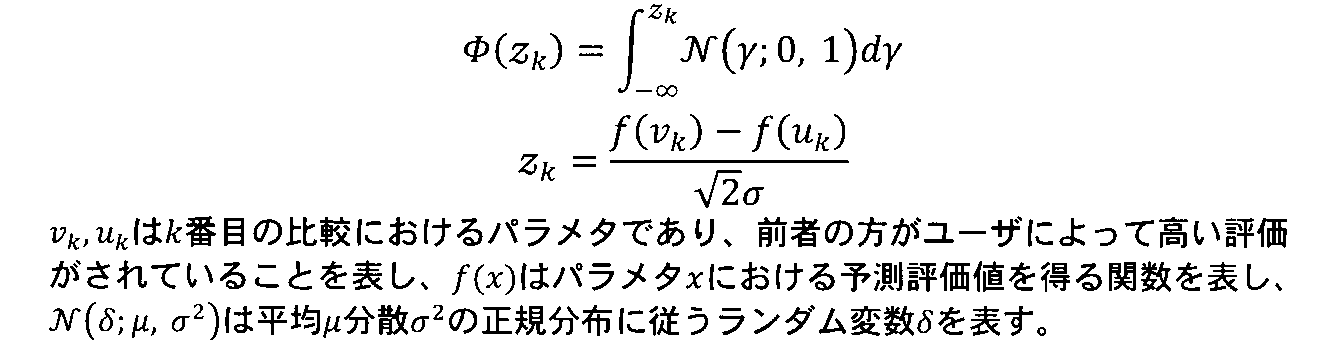
以上に説明したように、実施形態に係るベイズ最適化装置10は、N個のパラメタを相互に比較してNC2個の比較結果を取得し、これらの比較結果に基づく展開された比較結果をもとにモデルの学習を行う。このため、学習が早く収束し、ユーザによる比較の回数が減る。
したがって、実施形態によれば、学習が早く収束し、ユーザが行う比較の回数が低減されるベイズ最適化装置、ベイズ最適化方法、およびベイズ最適化プログラムが提供される。
なお、本発明は、上記実施形態に限定されるものではなく、実施段階ではその要旨を逸脱しない範囲で種々に変形することが可能である。また、各実施形態は適宜組み合わせて実施してもよく、その場合組み合わせた効果が得られる。更に、上記実施形態には種々の発明が含まれており、開示される複数の構成要件から選択された組み合わせにより種々の発明が抽出され得る。例えば、実施形態に示される全構成要件からいくつかの構成要件が削除されても、課題が解決でき、効果が得られる場合には、この構成要件が削除された構成が発明として抽出され得る。
10…実施形態に係るベイズ最適化装置
11…比較結果展開部
12…比較結果格納部
13…モデル学習部
14…モデル格納部
15…候補点選択部
16…候補点提示部
21…入力装置
22…CPU
23…制御装置
24…演算装置
25…記憶装置
26…主記憶装置
27…補助記憶装置
28…出力装置
29…バス
50…従来例に係るベイズ最適化装置
11…比較結果展開部
12…比較結果格納部
13…モデル学習部
14…モデル格納部
15…候補点選択部
16…候補点提示部
21…入力装置
22…CPU
23…制御装置
24…演算装置
25…記憶装置
26…主記憶装置
27…補助記憶装置
28…出力装置
29…バス
50…従来例に係るベイズ最適化装置
Claims (8)
- ユーザによる比較結果を受け取って展開する比較結果展開部と、
展開された比較結果を格納する比較結果格納部と、
展開された比較結果をもとにモデルを学習するモデル学習部と、
学習済みのモデルを格納するモデル格納部と、
展開された比較結果と学習済みのモデルをもとに、探索すべき候補点を選択する候補点選択部と、
探索すべき候補点をユーザに提示する候補点提示部を有する
ベイズ最適化装置。 - 前記比較結果展開部は、前記ユーザによる比較結果に含まれる3つ以上のパラメタを相互に比較して3つ以上の比較結果を取得し、取得した前記3つ以上の比較結果に基づいて前記展開された比較結果を作り出す、
請求項1に記載のベイズ最適化装置。 - 前記比較結果展開部は、前記ユーザによる比較結果に含まれるN個(Nは3以上の自然数)のパラメタを相互に比較してNC2個の比較結果を取得し、取得した前記NC2個の比較結果に基づいて前記展開された比較結果を作り出す、
請求項2に記載のベイズ最適化装置。 - 前記比較結果展開部は、前記N個のパラメタに対して、M個(Mは1以上かつN未満の自然数)の新規候補点と、N-M個の比較点を選ぶ、
請求項3に記載のベイズ最適化装置。 - 前記比較結果展開部は、前記N-M個の比較点として、過去に比較したうち評価が上位N-M個の比較点と、過去に比較したうちランダムにN-M個の比較点と、過去に比較したうち新規候補点からの距離が遠いN-M個の比較点のいずれかを選ぶ、
請求項4に記載のベイズ最適化装置。 - 前記モデル学習部は、モデルにガウス過程を用い、学習は下記の尤度関数を用いて行う、

- ユーザによる比較結果を受け取って展開することと、
展開された比較結果を格納することと、
展開された比較結果をもとにモデルを学習することと、
学習済みのモデルを格納することと、
展開された比較結果と学習済みのモデルをもとに、探索すべき候補点を選択することと、
探索すべき候補点をユーザに提示することを有する
ベイズ最適化方法。 - 請求項1から請求項3までのいずれかひとつに記載のベイズ最適化装置の各構成要素の機能をコンピュータに実行させるベイズ最適化プログラム。
Priority Applications (3)
| Application Number | Priority Date | Filing Date | Title |
|---|---|---|---|
| JP2023559382A JP7613607B2 (ja) | 2021-11-15 | 2021-11-15 | ベイズ最適化装置、ベイズ最適化方法、およびベイズ最適化プログラム |
| PCT/JP2021/041921 WO2023084776A1 (ja) | 2021-11-15 | 2021-11-15 | ベイズ最適化装置、ベイズ最適化方法、およびベイズ最適化プログラム |
| US18/705,737 US20250005408A1 (en) | 2021-11-15 | 2021-11-15 | Bayesian optimization device, bayesian optimization method, and bayesian optimization program |
Applications Claiming Priority (1)
| Application Number | Priority Date | Filing Date | Title |
|---|---|---|---|
| PCT/JP2021/041921 WO2023084776A1 (ja) | 2021-11-15 | 2021-11-15 | ベイズ最適化装置、ベイズ最適化方法、およびベイズ最適化プログラム |
Publications (1)
| Publication Number | Publication Date |
|---|---|
| WO2023084776A1 true WO2023084776A1 (ja) | 2023-05-19 |
Family
ID=86335446
Family Applications (1)
| Application Number | Title | Priority Date | Filing Date |
|---|---|---|---|
| PCT/JP2021/041921 Ceased WO2023084776A1 (ja) | 2021-11-15 | 2021-11-15 | ベイズ最適化装置、ベイズ最適化方法、およびベイズ最適化プログラム |
Country Status (3)
| Country | Link |
|---|---|
| US (1) | US20250005408A1 (ja) |
| JP (1) | JP7613607B2 (ja) |
| WO (1) | WO2023084776A1 (ja) |
Cited By (2)
| Publication number | Priority date | Publication date | Assignee | Title |
|---|---|---|---|---|
| WO2025115172A1 (ja) * | 2023-11-30 | 2025-06-05 | 日本電信電話株式会社 | 機械学習装置、機械学習方法、および、プログラム |
| WO2025115171A1 (ja) * | 2023-11-30 | 2025-06-05 | 日本電信電話株式会社 | 機械学習装置、機械学習方法、および、プログラム |
-
2021
- 2021-11-15 JP JP2023559382A patent/JP7613607B2/ja active Active
- 2021-11-15 US US18/705,737 patent/US20250005408A1/en not_active Abandoned
- 2021-11-15 WO PCT/JP2021/041921 patent/WO2023084776A1/ja not_active Ceased
Non-Patent Citations (2)
| Title |
|---|
| SHAHRIARI BOBAK; SWERSKY KEVIN; WANG ZIYU; ADAMS RYAN P.; DE FREITAS NANDO: "Taking the Human Out of the Loop: A Review of Bayesian Optimization", PROCEEDINGS OF THE IEEE, IEEE. NEW YORK., US, vol. 104, no. 1, 1 January 2016 (2016-01-01), US , pages 148 - 175, XP011594739, ISSN: 0018-9219, DOI: 10.1109/JPROC.2015.2494218 * |
| YANG GAO; CHRISTIAN M. MEYER; IRYNA GUREVYCH: "APRIL: Interactively Learning to Summarise by Combining Active Preference Learning and Reinforcement Learning", ARXIV.ORG, CORNELL UNIVERSITY LIBRARY, 201 OLIN LIBRARY CORNELL UNIVERSITY ITHACA, NY 14853, 29 August 2018 (2018-08-29), 201 Olin Library Cornell University Ithaca, NY 14853 , XP081267261 * |
Cited By (2)
| Publication number | Priority date | Publication date | Assignee | Title |
|---|---|---|---|---|
| WO2025115172A1 (ja) * | 2023-11-30 | 2025-06-05 | 日本電信電話株式会社 | 機械学習装置、機械学習方法、および、プログラム |
| WO2025115171A1 (ja) * | 2023-11-30 | 2025-06-05 | 日本電信電話株式会社 | 機械学習装置、機械学習方法、および、プログラム |
Also Published As
| Publication number | Publication date |
|---|---|
| JPWO2023084776A1 (ja) | 2023-05-19 |
| US20250005408A1 (en) | 2025-01-02 |
| JP7613607B2 (ja) | 2025-01-15 |
Similar Documents
| Publication | Publication Date | Title |
|---|---|---|
| US10930285B1 (en) | Selecting a response in a multi-turn interaction between a user and a conversational bot | |
| US11188831B2 (en) | Artificial intelligence system for real-time visual feedback-based refinement of query results | |
| US10811006B2 (en) | Information processing method, information processing apparatus, and non-transitory recording medium | |
| US11093537B2 (en) | Information processing method, information processing apparatus, and non-transitory recording medium | |
| JP5755823B1 (ja) | 類似度算出システム、類似度算出方法およびプログラム | |
| CN110196972A (zh) | 文案生成方法、装置及计算机可读存储介质 | |
| US9898464B2 (en) | Information extraction supporting apparatus and method | |
| JP7613607B2 (ja) | ベイズ最適化装置、ベイズ最適化方法、およびベイズ最適化プログラム | |
| Van Craenendonck et al. | Cobras: Interactive clustering with pairwise queries | |
| JP6952259B2 (ja) | 情報処理方法、情報処理装置、及び、プログラム | |
| JP2025146990A (ja) | 文書処理プログラム、情報処理装置及び文書処理方法 | |
| JP2018045531A (ja) | 情報処理装置、情報処理方法、およびプログラム | |
| JP7211011B2 (ja) | 学習方法、学習プログラム及び生成方法 | |
| JP2018092586A (ja) | 情報処理方法、情報処理装置およびプログラム | |
| JP5406794B2 (ja) | 検索クエリ推薦装置及び検索クエリ推薦プログラム | |
| US11288457B1 (en) | Dialog management using knowledge graph-driven information state in a natural language processing system | |
| US20250220084A1 (en) | Artificial intelligence profile generation | |
| CN119090002A (zh) | 文本生成及其模型训练方法、电子设备、存储介质及程序产品 | |
| JP6698061B2 (ja) | 単語ベクトル変換装置、方法、及びプログラム | |
| JP2020140674A (ja) | 回答選択装置及びプログラム | |
| JP6205039B1 (ja) | 情報処理装置、情報処理方法、およびプログラム | |
| WO2024169877A9 (zh) | 一种用于直播的互动方法及终端设备 | |
| CN115809328B (zh) | 一种文本摘要的生成方法、装置及设备 | |
| JP6729424B2 (ja) | 機器、出力装置、出力方法および出力プログラム | |
| CN114969287A (zh) | 文档搜索方法、装置、设备及计算机可读存储介质 |
Legal Events
| Date | Code | Title | Description |
|---|---|---|---|
| 121 | Ep: the epo has been informed by wipo that ep was designated in this application |
Ref document number: 21964129 Country of ref document: EP Kind code of ref document: A1 |
|
| WWE | Wipo information: entry into national phase |
Ref document number: 2023559382 Country of ref document: JP |
|
| WWE | Wipo information: entry into national phase |
Ref document number: 18705737 Country of ref document: US |
|
| 122 | Ep: pct application non-entry in european phase |
Ref document number: 21964129 Country of ref document: EP Kind code of ref document: A1 |