WO2023063156A1 - 高硬度貴金属合金及びその製造方法 - Google Patents
高硬度貴金属合金及びその製造方法 Download PDFInfo
- Publication number
- WO2023063156A1 WO2023063156A1 PCT/JP2022/037042 JP2022037042W WO2023063156A1 WO 2023063156 A1 WO2023063156 A1 WO 2023063156A1 JP 2022037042 W JP2022037042 W JP 2022037042W WO 2023063156 A1 WO2023063156 A1 WO 2023063156A1
- Authority
- WO
- WIPO (PCT)
- Prior art keywords
- atomic
- noble metal
- metal alloy
- less
- hardness
- Prior art date
- Legal status (The legal status is an assumption and is not a legal conclusion. Google has not performed a legal analysis and makes no representation as to the accuracy of the status listed.)
- Ceased
Links
Images





Classifications
-
- C—CHEMISTRY; METALLURGY
- C22—METALLURGY; FERROUS OR NON-FERROUS ALLOYS; TREATMENT OF ALLOYS OR NON-FERROUS METALS
- C22C—ALLOYS
- C22C5/00—Alloys based on noble metals
- C22C5/02—Alloys based on gold
-
- C—CHEMISTRY; METALLURGY
- C22—METALLURGY; FERROUS OR NON-FERROUS ALLOYS; TREATMENT OF ALLOYS OR NON-FERROUS METALS
- C22C—ALLOYS
- C22C5/00—Alloys based on noble metals
- C22C5/04—Alloys based on a platinum group metal
-
- C—CHEMISTRY; METALLURGY
- C22—METALLURGY; FERROUS OR NON-FERROUS ALLOYS; TREATMENT OF ALLOYS OR NON-FERROUS METALS
- C22C—ALLOYS
- C22C19/00—Alloys based on nickel or cobalt
- C22C19/03—Alloys based on nickel or cobalt based on nickel
-
- C—CHEMISTRY; METALLURGY
- C22—METALLURGY; FERROUS OR NON-FERROUS ALLOYS; TREATMENT OF ALLOYS OR NON-FERROUS METALS
- C22C—ALLOYS
- C22C30/00—Alloys containing less than 50% by weight of each constituent
-
- C—CHEMISTRY; METALLURGY
- C22—METALLURGY; FERROUS OR NON-FERROUS ALLOYS; TREATMENT OF ALLOYS OR NON-FERROUS METALS
- C22F—CHANGING THE PHYSICAL STRUCTURE OF NON-FERROUS METALS AND NON-FERROUS ALLOYS
- C22F1/00—Changing the physical structure of non-ferrous metals or alloys by heat treatment or by hot or cold working
-
- C—CHEMISTRY; METALLURGY
- C22—METALLURGY; FERROUS OR NON-FERROUS ALLOYS; TREATMENT OF ALLOYS OR NON-FERROUS METALS
- C22F—CHANGING THE PHYSICAL STRUCTURE OF NON-FERROUS METALS AND NON-FERROUS ALLOYS
- C22F1/00—Changing the physical structure of non-ferrous metals or alloys by heat treatment or by hot or cold working
- C22F1/002—Changing the physical structure of non-ferrous metals or alloys by heat treatment or by hot or cold working by rapid cooling or quenching; cooling agents used therefor
-
- C—CHEMISTRY; METALLURGY
- C22—METALLURGY; FERROUS OR NON-FERROUS ALLOYS; TREATMENT OF ALLOYS OR NON-FERROUS METALS
- C22F—CHANGING THE PHYSICAL STRUCTURE OF NON-FERROUS METALS AND NON-FERROUS ALLOYS
- C22F1/00—Changing the physical structure of non-ferrous metals or alloys by heat treatment or by hot or cold working
- C22F1/10—Changing the physical structure of non-ferrous metals or alloys by heat treatment or by hot or cold working of nickel or cobalt or alloys based thereon
-
- C—CHEMISTRY; METALLURGY
- C22—METALLURGY; FERROUS OR NON-FERROUS ALLOYS; TREATMENT OF ALLOYS OR NON-FERROUS METALS
- C22F—CHANGING THE PHYSICAL STRUCTURE OF NON-FERROUS METALS AND NON-FERROUS ALLOYS
- C22F1/00—Changing the physical structure of non-ferrous metals or alloys by heat treatment or by hot or cold working
- C22F1/14—Changing the physical structure of non-ferrous metals or alloys by heat treatment or by hot or cold working of noble metals or alloys based thereon
Definitions
- the present invention relates to a high-hardness precious metal alloy containing precious metals Pt, Au, and Pd as essential constituent metals. More specifically, the present invention relates to a Pt--Au--Ni--Pd quaternary alloy, which is a noble metal alloy that achieves higher hardness than ever before by spinodal decomposition and/or ordering.
- Precious metals such as Pt (platinum) and Au (gold) are metals with excellent chemical stability and corrosion resistance as well as good electrical properties such as electrical conductivity. Therefore, noble metals and their alloys are used in various fields such as electrical/electronic fields and medical fields. Examples of the use of precious metal alloys in the electrical and electronic fields include probe pins incorporated in probe cards for inspection of semiconductor devices, brushes for motors, electrical contacts (sliding contacts, switching contacts) such as relays and switches. is mentioned. Applications in the medical field have recently attracted attention, and noble metal alloys are used as constituent materials for various medical devices. Examples of such medical devices include various forms of medical devices such as embolic coils, embolic clips, guide wires, stents, and catheters.
- a probe pin is required to have wear resistance because it is repeatedly contacted with a mating member for a long period of time.
- mechanical properties such as hardness and springiness are required to ensure smooth operation. requested.
- precious metal alloys are also metals
- general strengthening mechanisms for metal materials can be applied to improve their hardness.
- conventional precious metal alloys are improved in hardness by applying a combination of strengthening mechanisms such as work hardening (dislocation strengthening), solid solution strengthening, and precipitation hardening (dispersion strengthening).
- work hardening dislocation strengthening
- solid solution strengthening solid solution strengthening
- precipitation hardening precipitation hardening
- Pt—Ni alloy described in Patent Document 1 is solid-solution strengthening by alloying Pt with Ni or the like, and work hardening that increases the final working rate.
- Patent Document 2 Al-Pd-Cu alloy
- Patent Document 3 Pt-Cr-Ni alloy
- precious metal alloys are required to have improved mechanical properties such as hardness for various applications. In order to meet this demand, it can be said that it is necessary to achieve further strengthening by means of the various strengthening mechanisms described above.
- solid solution strengthening and precipitation strengthening although the selection of additive elements and the optimization of the amount of addition and the optimization of the manufacturing process such as heat treatment have been attempted, there is a limit to the amount of hardening by these.
- the amount of hardening due to precipitation hardening in the noble metal alloys of Patent Documents 2 and 3 is about 150 Hv, and precipitation hardening alone does not achieve sufficient hardness. In actuality, the hardness of these noble metal alloys is supplemented by work hardening as well as precipitation hardening.
- the present invention is based on the above background, and provides a precious metal alloy with high hardness by applying a strengthening mechanism different from the method that has been commonly used so far.
- the present invention presents a material strengthening method based on a heat treatment-based process without relying on work hardening.
- spinodal decomposition is a form of phase separation in a material structure, and is a phenomenon in which decomposition progresses due to a continuous increase in concentration fluctuations, regardless of the nucleation/growth process applied to precipitation hardening.
- the material texture generated by spinodal decomposition resulting from this concentration fluctuation presents a very fine periodic structure of several nanometers to several tens of nanometers called modulated texture.
- modulated texture developed by spinodal decomposition the concentration of solute atoms in the crystal varies periodically as a function of location, and the lattice constant also varies periodically. This creates a periodic internal stress field on the slip plane, which interacts with the dislocations.
- spinodal decomposition strengthening exhibits a high amount of hardening due to the finely modulated structure, so it is considered useful as a means of improving hardness without causing material embrittlement such as work hardening. .
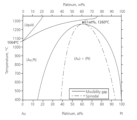
- FIG. 1 shows a Pt—Au system phase diagram.
- thermodynamic calculations have also clarified a region (chemical spinodal curve) indicating the composition and temperature region where spinodal decomposition can occur.
- the amount of hardening is about 160 Hv at maximum, and the hardness obtained is only about 500 Hv.
- the spinodal decomposition although its phenomenon and mechanism are well known, there are few examples of its application, especially to noble metal alloys.
- the present inventors considered that there is room for improvement in spinodal decomposition strengthening as a hardening/strengthening method for noble metal alloys, and decided to conduct further consideration. As a result, the present inventors believe that there is a limit to composition optimization within the range of binary alloys in order to maximize the hardenability of noble metal alloys by spinodal decomposition. It was considered that the alloy should be applied.
- spinodal decomposition can be achieved by optimizing the composition of quaternary alloys of Pt, Au, Ni, and Pd as the composition of the noble metal alloy and performing an appropriate heat treatment. It was found that the hardness can be increased by
- the present inventors also found that the Pt--Au--Ni--Pd quaternary alloy of the above-mentioned predetermined composition can exhibit ordering of the constituent elements together with spinodal decomposition or alone. rice field. By the expression of ordering, an ordered phase with a predetermined structure is generated, which has the effect of increasing hardness.
- the present inventors have conceived that hardening by such ordered phases can act on Pt--Au--Ni--Pd alloys either alone or in combination with hardening by spinodal decomposition.
- the Pt--Au--Ni--Pd alloy is a noble metal alloy that can be hardened by spinodal decomposition and ordering, then naturally there should be a composition range that manifests them.
- the inventors of the present invention have searched for a composition range of alloys that are hardened by spinodal decomposition or the like. In addition to specifying the composition range of , it was found necessary to introduce a parameter relating to their interrelationship (hereafter, this parameter will be referred to as a composition parameter).
- the present inventors have arrived at the present invention by optimizing the alloy composition range and two composition parameters in which high hardness can occur due to spinodal decomposition and ordering.
- the present invention comprises 7.5 atomic % or more and 72.5 atomic % or less of Pt, 5.5 atomic % or more and 62.5 atomic % or less of Au, and 3 atomic % or more and 62.5 atomic % or less of Ni and 0.15 atomic % or more and 38 atomic % or less of Pd, wherein the concentrations (atomic %) of Pt, Au, Ni and Pd are respectively C Pt , C Au , C Ni and C Pd.
- the value of the first composition parameter z1 represented by the following formula is 0.5 or more and 2.88 or less
- the Pd concentration C Pd is C relative to the second composition parameter z2 represented by the following formula It is a noble metal alloy in which Pd ⁇ z2.
- the present invention includes 10 atomic % or more and 67.5 atomic % or less of Pt, 5.85 atomic % or more and 40 atomic % or less of Au, 10 atomic % or more and 60 atomic % or less of Ni, and 0.2 atomic %. % or more and 34 atomic % or less of Pd and satisfying the requirements for the first and second composition parameters.
- the present invention includes 17.5 atomic % or more and 60.5 atomic % or less of Pt, 6.25 atomic % or more and 30 atomic % or less of Au, 15 atomic % or more and 57.5 atomic % or less of Ni,
- the noble metal alloy contains 0.75 atomic % or more and 24.5 atomic % or less of Pd and satisfies the requirements related to the first and second composition parameters.
- the Pt--Au--Ni--Pd alloys in the above three composition ranges contain modulated structures and/or ordered phases due to spinodal decomposition.
- the present application also provides a method for producing the noble metal alloy described above. That is, the method for producing a noble metal alloy according to the present invention comprises 7.5 atomic % or more and 72.5 atomic % or less of Pt, 5.5 atomic % or more and 62.5 atomic % or less of Au, and 3 atomic % or more and 62 atomic % or less. a step of preparing a noble metal alloy containing Ni at 0.5 atomic % or less and Pd at 0.15 atomic % or more and 38 atomic % or less; A method for producing a noble metal alloy, comprising: a heat treatment step; and an aging treatment step of heating the noble metal alloy after the solution heat treatment at a temperature of 300° C. or higher and 700° C. or lower.
- another method for producing a noble metal alloy according to the present invention includes Pt of 7.5 atomic % or more and 72.5 atomic % or less, Au of 5.5 atomic % or more and 62.5 atomic % or less, and 3 atomic %
- the cooling in the heat treatment step includes quenching in a temperature range of 600°C or more below the melting point, and cooling at a cooling rate of 2.5°C/s or less in a temperature range of less than 600°C.
- a method for producing a certain precious metal alloy includes Pt of 7.5 atomic % or more and 72.5 atomic % or less, Au of 5.5 atomic % or more and 62.5 atomic % or less, and 3 atomic %
- the present invention is a noble metal material strengthened by a modulated structure and an ordered phase by spinodal decomposition instead of solid solution strengthening, precipitation strengthening, and work hardening, which have been widely used as material strengthening methods. alloy. According to the present invention, it is possible to obtain a noble metal alloy with a high hardness due to unprecedented strengthening ability without resorting to work hardening (dislocation strengthening), which may cause material embrittlement.
- FIG. 2 shows a Pt—Au system phase diagram and a spinodal curve in a Pt—Au alloy.
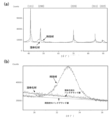
- FIG. 10 shows the XRD results of the solution-treated material and the aged material of Example 20 (Pt67.5-Au10-Ni17.5-Pd5).
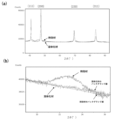
- FIG. 10 is a view showing XRD results of a solution-treated material and an aged material of Example 36 (Pt35-Au10-Ni35-Pd20);
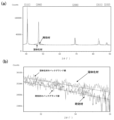
- FIG. 10 is a view showing the XRD results of the solution-treated material and the aged material of Example 71 (Pt42.5-Au10-Ni42.5-Pd5);
- FIG. 10 is a diagram showing the XRD results of the solution-treated material and the aged material of Example 75 (Pt37.5-Au10-Ni37.5-Pd15).
- FIG. 10 is a view showing the XRD results of the solution-treated material and the aged material of Comparative Example 13 (Pt22.5-Au10-Ni22.5-Pd45);
- FIG. 10 is a view showing XRD results of a solution-treated material and an aged material of Comparative Example 11 (Pt30-Au10-Ni30-Pd30); STEM-EDS mapping image showing the modulated texture of Example 75 (Pt37.5-Au10-Ni37.5-Pd15).
- Electron diffraction image showing the ordered phase (L1 2 structure) of Example 75 (Pt37.5-Au10-Ni37.5-Pd15)
- the noble metal alloy according to the present invention is a Pt--Au--Ni--Pd quaternary alloy, and contains at least one of a modulated structure due to spinodal decomposition and an ordered phase due to ordering as its hardening factor.
- each strengthening mechanism in the present invention will be explained, the constituent metals of the noble metal alloy of the present invention, their composition range and two composition parameters, and the material structure and hardness of the noble metal alloy of the present invention will be explained.
- the method for producing a noble metal alloy (heat treatment step) according to the present invention will be explained.
- (A) Structure of the noble metal alloy according to the present invention (A-1) Strengthening mechanism of the noble metal alloy in the present invention (1) Spinodal decomposition
- the structure formed by spinodal decomposition is called a so-called modulated structure.
- Periodic concentration fluctuations occur in the modulated structure, which contributes to high hardness by forming an internal stress field around it.
- the resistance to dislocation motion (critical shear stress) in this periodic internal stress field is expressed by the following equation, and the lattice strain ( ⁇ ), elastic modulus (Y), and concentration modulation amplitude (A) are considered to be the dominant factors.
- ⁇ lattice strain
- Y elastic modulus
- concentration modulation amplitude A
- Equation 3 As a rough trend, it is considered that the elastic modulus is proportional to the Young's modulus of each constituent metal, and the lattice strain ⁇ is proportional to the lattice constant difference between the constituent metals. Further, it is considered that the concentration modulation amplitude A in Equation 3 exhibits a larger value as the mixing enthalpy between the metal elements increases.
- the lattice constants of Pt, Au, Ni and Pd constituting the Pt--Au--Ni--Pd alloy of the present invention the values shown in Table 1 below are known.
- the mixing enthalpy is positive in the combinations of Au--Pt, Au--Ni, and Pt--Pd. It can be understood from their binary phase diagrams that Au--Pt and Au--Ni alloys are characterized by a very high enthalpy of mixing, although a single phase can be obtained at high temperatures.
- the occurrence of spinodal decomposition and remarkable hardening due to the modulated structure in the noble metal alloy according to the present invention is based on the binary phase diagram of each constituent metal, and the lattice constant in Table 1 and the mixing enthalpy in Table 2. It can be estimated by considering Equation 3. A more detailed description of this point will be given later.
- the ordered phase generated by ordering has the following properties: (i) the Burgers vector of the dislocation becomes large; (ii) an antiphase boundary may occur within the ordered phase; and distorting the lattice outside the ordered phase and suppressing dislocation movement contribute to increasing the hardness of the alloy.
- the noble metal alloy according to the present invention includes both metals that make up the Pt—Ni system alloy, a known combination of metals in which ordering occurs. Ordering in Pt--Ni alloys is manifested by solution treatment and aging treatment, and it is known that ordering and hardening occurs by aging treatment in the order-disordered transformation region and air cooling from the single-phase region. There is In the ordering of the Pt—Ni alloy, hardening can occur due to the ordered phase of the L10 type structure or the L12 type structure.
- the noble metal alloy according to the present invention can achieve high hardness due to the ordered phase generated by ordering, as in the above Pt--Ni alloy.
- the composition of the ordered phase in the present invention has not been completely clarified, it is considered to be a phase having the same or similar crystal structure as the ordered phase generated in the above Pt--Ni alloy. That is, it is a phase containing at least Pt and Ni and having an fcc structure and/or an fct structure.
- the ordered phase in the present invention is presumed to be preferably an L10 -type structure, an L12 -type structure, or a phase with a crystal structure similar thereto.
- the noble metal alloy according to the present invention is a Pt--Au--Ni--Pd quaternary alloy.
- Au, Ni, Pd, and Pt when referring to the binary phase diagram composed of these elements, Au—Ni, Au—Pt, and Pt—Pd alloys are two-phase separation types.
- Table 2 it can be seen that there are many combinations of elements in which the mixing enthalpy between the metal elements Au, Ni, Pd, and Pt is positive.
- the Pt--Au--Ni--Pd alloy has a high mixing enthalpy and a strong tendency of phase separation in the low temperature range. Therefore, the Pt--Au--Ni--Pd quaternary alloy has a high possibility of developing spinodal decomposition, and the resulting concentration amplitude (A) is considered to be large. Moreover, since Pt and Ni have relatively high Young's modulus, it is considered that their modulus of elasticity (Y) is also high. Furthermore, Ni has a large difference in lattice constant from Au, Pt, and Pd, so it is considered that Ni has a large lattice strain ( ⁇ ).
- the constituent metals of the noble metal alloy according to the present invention are considered to be a suitable combination for manifesting spinodal decomposition and achieving high hardness due to spinodal decomposition.
- the action of each metal constituting the present invention will be described below.
- Pt Pt is an essential element for causing spinodal decomposition in the alloy system of the present invention.
- Spinodal decomposition does not occur when the Pt concentration is too low or too high, and there is a concentration range of Pt required for expression.
- Pt can form an ordered phase with Ni and contribute to an increase in hardness.
- the Young's modulus of Pt is relatively high at 169.9 GPa.
- Pt can be expected as a metal that increases the amount of hardening of the alloy when spinodal decomposition is caused.
- Au Au is also an essential element for causing spinodal decomposition in the alloy system of the present invention. Spinodal decomposition does not occur when the Au concentration is too low or too high, and there is a concentration range of Au required for the expression. If the Au concentration is outside the optimum range, normal nucleation and growth tend to occur, making it impossible to obtain a suitable increase in hardness.
- Ni Ni acts as a strengthening factor when spinodal decomposition occurs in the noble metal alloy of the present invention.
- Ni has a higher Young's modulus than Au, Pt, and Pd.
- Ni has a large difference in lattice constant from each of Au, Pt, and Pd, and increases the lattice strain ⁇ . Therefore, from Equation 3 above, Ni has the effect of increasing the strengthening ability by spinodal decomposition.
- Ni is a metal capable of forming an ordered phase with Pt, and also has the effect of contributing to an increase in hardness due to ordering.
- Ni is an element of the same group as Pt and Pd and has a similar electronic structure, it can form an alloy without impairing the corrosion resistance and oxidation resistance of noble metals as much as possible. This also has a secondary effect of reducing the price of the entire precious metal alloy.
- Pd Pd has the effect of expanding the solid solubility limit of each element constituting the noble metal alloy of the present invention, widening the concentration range in which spinodal decomposition occurs in the noble metal alloy of the present invention, and promoting spinodal decomposition. It has the effect of improving the amount of curing by.
- Pd when Pd is added excessively, the spinodal decomposition temperature is excessively lowered, which tends to hinder the spinodal decomposition.
- excessive addition of Pd tends to suppress ordering, resulting in a decrease in the amount of hardening of the alloy system as a whole. Therefore, in order to optimize the amount of hardening of the noble metal alloy, Pd also has the above-mentioned optimum concentration range. Also, as will be described later, the Pd concentration is regulated by composition parameters related to the Au concentration.
- composition range of the noble metal alloy according to the present invention (1) Composition range of each metal element The composition range is defined so that they can be exhibited. This composition range is Pt: 7.5 atomic % or more and 72.5 atomic % or less, Au: 5.5 atomic % or more and 62.5 atomic % or less, Ni: 3 atomic % or more and 62.5 atomic % or less, Pd: 0.15 atomic % or more and 38 atomic % or less. This is the concentration range defined for manifesting spinodal decomposition and ordering effective for increasing the hardness of the noble metal alloy. In the following, this composition range is sometimes referred to as composition range A1.
- the details of the method for producing the noble metal alloy of the present invention will be described later, but the spinodal decomposition occurs in the solution treatment and aging treatment steps for rapidly cooling the solid solution alloy of the above composition, and high hardness can be obtained.
- the noble metal alloy of the present invention has a wide range of solid solution regions in the high temperature range, but has a solubility gap in the low temperature range. Therefore, the noble metal alloy of the present invention having the above composition range is considered to form a supersaturated solid solution by rapid cooling after solution treatment in a high temperature range, and spinodal decomposition may occur by subsequent aging treatment.
- thermodynamic behavior transformation point, phase equilibrium, solid solubility limit, melting point, etc.
- CALPHAD method Calculation of Phase Diagrams method
- thermodynamic calculation software eg, Thermo-Calc (Itochu Techno-Solutions Co., Ltd.)
- noble metal alloy database eg, TCNOB1 (Itochu Techno-Solutions Co., Ltd.)
- composition parameters z1, z2 In the noble metal alloy according to the present invention, in addition to setting the composition range of each constituent metal element as described above, the first and second composition parameters z1 and z2 relating to the mutual relationship between the concentrations of each metal element are satisfied. need. These two composition parameters are defined as follows when the concentrations (atomic %) of Pt, Au, and Ni in the noble metal alloy are C Pt , C Au , C Ni , and C Pd , respectively.
- the first composition parameter z1 is defined by the following formula according to the concentrations of Pt, Au and Ni (C Pt , C Au and C Ni ).
- the present invention requires that the value of the first parameter z1 be 0.5 or more and 2.88 or less.
- the value of z1 is less than 0.5, the spinodal strengthening ability is weak, and sufficient hardness cannot be obtained even if aging treatment is performed.
- the value of z1 exceeds 2.88, the solubility limit of each element is low and the tendency of two-phase separation becomes too strong. Therefore, a sufficient supersaturated solid solution cannot be obtained even by solution treatment, and the hardness after aging treatment becomes insufficient.
- the value of the first composition parameter z1 is more preferably 1.0 or more and 2.7 or less, and even more preferably 1.1 or more and 2.6 or less.
- the second composition parameter z2 is defined by the following formula according to the Au concentration (C Au ) of the noble metal alloy.
- the second composition parameter z2 defines the upper limit of the Pd concentration of the noble metal alloy (the Pd concentration defined by this composition parameter z2 is sometimes called the Pd critical concentration).
- the noble metal alloy according to the present invention must have a Pd concentration of z2 or less. When the Pd concentration exceeds z2, spinodal decomposition and/or ordering of the noble metal alloy is suppressed, resulting in insufficient hardening as a whole.
- the second composition parameter z2 is a composition parameter set based on this.
- the second composition parameter z2 is defined by the coefficients a, b, c, and d of the above formula.
- composition of the noble metal alloy according to the present invention must satisfy both the composition range of each metal element described above and the requirements defined based on the two composition parameters z1 and z2.
- the present invention is a noble metal alloy containing Pt, Au, Ni, and Pd within the above ranges, preferably a noble metal alloy comprising Pt, Au, Ni, and Pd within the above ranges and inevitable components.
- An unavoidable component is an unavoidable component that is contained due to impurities in raw materials, manufacturing processes, or the like.
- Specific examples of inevitable components include Ag, Rh, Ir, Ru, Al, Mg, Ca, Fe, Mn, Sc, Y, Zr, Zn, Re, Mo, Cr, Nb, Ta, V, Hf , Ti, W, Co, Si, Sn, Cu, Th, B, C, N, S, P, O, H, and rare earth elements.
- unavoidable impurities are mixed in from raw materials, equipment during melting and casting, and the like.
- the content of these inevitable impurities is preferably within a range that does not impair the properties of the noble metal alloy of the present invention, preferably 0.1 atomic % or less per element, and 0.5 atomic % or less in total. is preferred, and a total content of 0.1 atomic % or less is particularly preferred.
- the above-mentioned unavoidable ingredients are contained in the noble metal alloy, it is difficult to clearly distinguish whether it is an unavoidable ingredient or an intentionally added ingredient. .
- the component does not change the properties of the noble metal alloy, it is treated as an unavoidable component regardless of the intention of its inclusion.
- the noble metal alloy according to the present invention has increased hardness through spinodal decomposition and/or ordering.
- the material texture includes finely modulated textures and/or ordered phases due to spinodal decomposition.
- a modulated structure is a material structure whose composition fluctuates at a nano-level modulation period.
- the main peak In the X-ray diffraction pattern by X-ray diffraction (XRD) or the electron diffraction pattern of TEM, at least one side (preferably both sides) of the main peak has a broad so-called side band peak (satellite peak). A peak is observed. Whether the spinodal decomposition structure is exhibited can be judged by the presence or absence of this side band peak. Since the crystal structure of the matrix of the noble metal alloy according to the present invention is a face-centered cubic structure (fcc), Miller index ⁇ 111 ⁇ plane, ⁇ 200 ⁇ plane, ⁇ 220 ⁇ plane, ⁇ 311 ⁇ plane, etc. appear as main peaks. .
- side band peaks appear on both sides or one side of at least one of the main peaks.
- the side band peak appears only on one side of the main peak, it is considered that it is difficult to separate it from the main peak.
- confirmation of the ordered phase by X-ray diffraction pattern or electron beam diffraction pattern is confirmed by observing the regular reflection peak.
- the modulated structure in the noble metal alloy composed of Pt, Au, Ni, and Pd according to the present invention is a region with relatively high Au concentration and Pd concentration (region with relatively low Pt concentration and Ni concentration) and Au It tends to consist of two regions, one with relatively low concentrations of Pd and one with relatively low concentrations of Pd (regions with relatively high concentrations of Pt and Ni).
- the ordered phase generated in the noble metal alloy according to the present invention includes at least one of an ordered phase of L1 0 type structure or L1 2 type structure, and particularly tends to include an ordered phase of L1 2 type structure.
- the noble metal alloy according to the present invention has the composition range described above and satisfies the two composition parameters z1 and z2, thereby hardening by spinodal decomposition and/or ordering. is planned.
- the noble metal alloy according to the present invention exhibits a Vickers hardness of 500 Hv or more.
- the noble metal alloy according to the present invention can be made into the above-described high-hardness noble metal alloy only by heat treatment without using work hardening at all, that is, without causing material embrittlement due to dislocation strain.
- the hardness value of the noble metal alloy according to the present invention can be adjusted according to its composition range.
- the noble metal alloy exhibits a Vickers hardness of 500 Hv or more.
- Pt 10 atomic % or more and 67.5 atomic % or less
- Au 5.85 atomic % or more and 40 atomic % or less
- Ni 10 atomic % or more and 60 atomic % or less
- Pd 0.2
- a composition range of atomic % to 34 atomic % exhibits a Vickers hardness of 550 Hv or more (hereinafter sometimes referred to as composition range A2).
- composition range A3 A Vickers hardness of 620 Hv or more is exhibited by setting the composition range to 24.5 atomic % or less (hereinafter sometimes referred to as composition range A3).
- composition range A3 A Vickers hardness of 620 Hv or more is exhibited by setting the composition range to 24.5 atomic % or less.
- the above-described requirements based on the two composition parameters z1 and z2 also apply to the above composition ranges A2 and A3.
- the preferred or more preferred values of a, b, c, and d for z2 are equally applicable to the composition ranges A2 and A3.
- the upper limit of the hardness of the noble metal alloy according to the present invention should not be particularly limited, the upper limit is preferably 800 Hv or less. If it exceeds 800 Hv, breakage or chipping may occur during use.
- the Vickers hardness described above is a value at room temperature. Vickers hardness can be measured with a known Vickers hardness tester. The measurement load is preferably 0.05 kgf or more and 0.5 kgf or less, more preferably 0.2 kgf.
- the constituent metals Pt, Au, Ni, Pd
- the precious metal alloy is produced by an optimum heat treatment process for the precious metal alloy.
- the optimum heat treatment process is a heat treatment process by a combination of solution treatment and aging treatment, through which spinodal decomposition and/or ordering progress to increase hardness.
- the method for producing a noble metal alloy according to the present invention is a method for hardening the material by heat treatment without relying on work hardening.
- the method for producing a noble metal alloy according to the present invention will be described with reference to each heat treatment step.
- temperatures such as heating temperatures in the various heat treatments described below refer to the temperature of the noble metal alloy to be treated, unless otherwise specified.
- the noble metal alloy according to the present invention is not produced only by the optimum heat treatment process. Depending on the cooling conditions in the cooling process of the solution treatment, spinodal decomposition and/or ordering progress during the solution treatment, and the noble metal alloy according to the present invention can be obtained at the stage when the solution treatment is completed. That is, even if the aging treatment under the above conditions is omitted, the noble metal alloy according to the present invention can be produced.
- This manufacturing method which should also be called a preferred manufacturing method, will be described after the optimal heat treatment step.
- an untreated noble metal alloy is prepared as a precursor of the noble metal alloy of the present invention.
- the precursor alloy can be produced by a conventional melt casting method.
- the above metal raw materials of Pt, Au, Ni, and Pd are suitably adjusted to the above composition by weighing or the like, melted, and cast to produce an alloy ingot.
- an alloy (mother alloy) such as an Au--Pd alloy or a Pt--Ni alloy may be appropriately combined and melted.
- Melt-casting of the noble metal alloy can be performed by known means such as arc melting, high-frequency melting, vacuum melting, and continuous casting.
- Precious metal alloys may be prepared by methods other than melting and casting, such as powder metallurgy.
- powder metallurgy an alloy ingot to be heat-treated can be obtained by sintering a noble metal alloy powder (for example, a noble metal alloy powder produced by atomization) adjusted to the above composition.
- a near-net shape ingot may be produced by a known additive manufacturing method using the noble metal alloy powder adjusted to the above composition.
- a noble metal alloy layer having the above composition may be formed on any base material by known alloy forming means such as sputtering and thermal spraying.
- Solution treatment is a process in which a noble metal alloy is heated to a high temperature to form a single phase or a solid solution structure similar to a single phase, and then quenched to form a supersaturated solid solution.
- the heating temperature for the solution treatment is preferably a temperature of (Tm ⁇ 500° C.) or higher and Tm or lower, where Tm (° C.) is the melting point (solidus line) of the noble metal alloy.
- the solid solubility of each element is low and insufficient to form a supersaturated solid solution, and above Tm, the material begins to melt near grain boundaries, which is undesirable.
- the holding time during heating is preferably in the range of 0.01 hour to 168 hours. If the heating time is less than 0.01 hour, the formation of the supersaturated solid solution becomes insufficient, and heating for 168 hours or more does not significantly affect the formation of the supersaturated solid solution, which is not preferable from the viewpoint of productivity.
- the melting point means the solidus temperature.
- the cooling rate at this time is preferably 10° C./s or more, more preferably 50° C./s or more.
- a slower cooling rate is preferable. Therefore, from the viewpoint of improving the hardness of the noble metal alloy, in a low-temperature region where grain boundary reactions do not occur and spinodal decomposition and/or ordering do not proceed excessively, the cooling rate referred to as rapid cooling is used. No need. For example, rapid cooling is not required in the temperature range of 400° C. or lower. Therefore, in order to suppress or reduce the occurrence of quench cracks, for example, after rapid cooling to 300° C., air cooling may be performed in the temperature range of 300° C. or lower.
- the end point of cooling in the solution treatment is preferably room temperature.
- the heating temperature should be 300°C or higher and 700°C or lower. If the temperature is less than 300°C, the transformation hardly progresses. Moreover, when the temperature exceeds 700° C., material softening due to grain boundary reaction is remarkable. This heating temperature is more preferably 350° C. or higher and 650° C. or lower. Moreover, the heating time for the aging treatment is preferably 0.01 hour or more and 168 hours or less. If the treatment is less than 0.01 hours, the transformation will be insufficient and the hardness will vary, and if the treatment is 168 hours or more, the productivity will be poor and the production cost will be high. There are no particular restrictions on the cooling method after the aging treatment.
- the high-hardness noble metal alloy according to the present invention can be obtained through solution treatment and aging treatment, which are the optimum heat treatment steps described above.
- processing and heat treatment may be performed as necessary.
- the optional working/heat treatment steps include hot working such as hot forging and hot rolling, and homogenization treatment.
- the hot working can destroy the solidified structure in the prepared noble metal alloy ingot and eliminate defects such as voids.
- the homogenization treatment is a heat treatment in which the noble metal alloy is heated at a high temperature below the melting point for a long period of time. In the homogenization treatment, it is possible to form a metal structure having a uniform element concentration distribution in the prepared noble metal alloy.
- these processing and heat treatments do not affect the progress of spinodal decomposition or ordering. Therefore, these processing and heat treatment steps are optional steps.
- the noble metal alloy according to the present invention is not necessarily produced by a method that combines solution treatment and aging treatment alone.
- the noble metal alloy according to the present invention can be produced by adjusting the cooling conditions during the solution treatment without performing the aging treatment under the above conditions.
- a suitable manufacturing method for manufacturing the noble metal alloy according to the present invention only by this solution treatment will be described.
- a preferred method for producing this noble metal alloy is the same as above up to the steps of preparing the noble metal alloy and heating for solution treatment, but in the subsequent cooling treatment, the alloy is rapidly cooled in a temperature range of 600° C. or higher below the melting point, Cool at a cooling rate of 2.5°C/s or less in a temperature range of less than 600°C. That is, rapid cooling is performed in a high temperature range of 600 ° C. or higher below the melting point where grain boundary reactions tend to occur, but slow cooling of 2.5 ° C./s or less is performed in a medium temperature range of lower than 600 ° C. where spinodal decomposition and / or ordering progresses. cooling at a high speed.
- quenching in a high temperature range is synonymous with quenching in the solution treatment described above, and the cooling rate is preferably 10° C./s or more, more preferably 50° C./s or more.
- the cooling rate is set to 2.5° C./s or less, preferably 1° C./s or less.
- Heat treatment step (aging treatment) For the aging treatment, the specimen after the solution treatment was heated and held at 300 to 650° C. for 1 hour. After that, the sample piece after the aging treatment was embedded in resin for the purpose of removing the residual stress due to the oxidized layer and thermal strain, followed by rough polishing (#500, #800, #1200) and 1 ⁇ m and 1/4 ⁇ m diamond polishing. Mirror polishing was performed with suspension. As described above, samples with various compositions were produced.
- an Au—Pt alloy that is a noble metal alloy capable of exhibiting spinodal decomposition and a Pt—Ni alloy that is a noble metal alloy capable of exhibiting ordering hardening are produced, and solution treatment is performed. Aging treatment was performed and samples were produced in the same manner as in the above embodiment (Reference Examples 1 to 6).
- Hardness measurement Hardness measurements were performed on the samples of each noble metal alloy produced above. The hardness was measured at room temperature using a measuring device (HM-210 manufactured by Mitutoyo Co., Ltd.) with a test load of 0.2 kgf. Table 1 shows the measurement results. The hardness was measured at 15 points randomly for each sample, and the average value was used as the hardness value. As for the measurement position in each sample, while selecting a plurality of crystal grains, the measurement was performed at the non-grain boundary portion of each crystal grain and near the center of the crystal grain as much as possible. Regarding this result, Tables 3 to 5 show the measurement results of the samples classified for each of the composition regions A1, A2, and A3 described above. In addition, Table 6 shows measurement results of noble metal alloys serving as comparative examples and reference examples.
- the Pt--Au--Ni--Pd alloys which are the noble metal alloys of Examples 1 to 89 within the composition range of the present invention, all exhibited values of Vickers hardness of 500 Hv or more.
- Examples 23 to 52 in Table 4 are alloys that satisfy the above composition range A2, and have a hardness of 550 Hv or more by heat treatment.
- the noble metal alloys of Examples 53 to 74 within the composition range A3 exhibit a particularly high hardness of 620 Hv or more by heat treatment.
- Comparative Examples 9 and 10 are noble metal alloys that satisfy the composition range requirements but have a first composition parameter z1 of less than 5.0 (Comparative Example 9) or greater than 2.88 (Comparative Example 10). be. Furthermore, although Comparative Examples 11 and 12 satisfy the composition range requirements, their Pd concentrations exceed the critical Pd concentration calculated as the second composition parameter z2.
- This Pt—Ni alloy has an equimolar composition with a Pt concentration and a Ni concentration, and it is presumed that this tends to cause ordering easily.
- the noble metal alloy of Reference Example 5 also exhibits good hardness, indicating that the ordered phase is also a useful strengthening mechanism. It was also confirmed that the noble metal alloy according to the present invention can exhibit hardness surpassing those of these reference examples by utilizing at least one of spinodal decomposition and ordering.
- XRD analysis was performed on the noble metal alloy according to the present embodiment produced as described above to (a) confirm spinodal decomposition and (b) confirm formation of ordered phases. Analysis conditions such as sample size for each item to be examined by XRD were as follows. The heat treatment process (solution treatment and aging treatment) and the resin-filled polishing after the heat treatment were performed in the same manner as described above. In addition, this XRD analysis was performed on the noble metal alloy after solution treatment (solution treated material) and the noble metal alloy after aging treatment (aged material). expression can be confirmed.
- both sides of the main peak (at the 2 ⁇ angle ⁇ 0.5 to 3°) was judged based on whether or not one or more side band peaks appeared on one side or both sides. If one or more sideband peaks appear, it is assumed that spinodal decomposition has occurred. If no sideband peaks appear, it is assumed that spinodal decomposition has not occurred. did
- Example 36 Pt35-Au10-Ni35-Pd20 in FIG. 3, Example 71 in FIG. 4 (Pt42.5-Au10-Ni42.5-Pd5) and Example 75 in FIG. See the results for the noble metal alloy Au10-Ni37.5-Pd15).
- FIG. 5 shows the XRD results of the noble metal alloy (Pt22.5-Au10-Ni22.5-Pd45) of Comparative Example 13.
- the composition range and composition parameters (z1, z2) of the noble metal alloy are appropriately set, and spinodal decomposition and / or ordering It can be confirmed that a suitable increase in hardness occurs by expressing effectively.
- the noble metal alloys of Examples 34, 36, 39, 44, 67, 68, 71, 72, 73, and 75 in which both spinodal decomposition and ordering occurred hardening exceeding 580 Hv was observed, and those exceeding 700 Hv
- the noble metal alloys of Examples 16, 20, 38, and 52 in which only spinodal decomposition occurred also exhibit good hardness.
- FIG. 8 shows mapping measurement results of each constituent element (Pt, Au, Ni, Pd) of the precious metal alloy of Example 75 by STEM-EDS (Pt, Au, Pd: L line, Ni: K line).
- the material structure of the noble metal alloy of the present embodiment has a modulated structure having two regions, a region with relatively high Au and Pd concentrations and a region with relatively low Au and Pd concentrations. It can be seen that the regions of are alternately connected. Since this modulated structure does not have a clear interface, it is presumed to be due to spinodal decomposition.
- FIG. 9 is an electron beam diffraction pattern obtained by TEM analysis ( ⁇ 001> zone axis incidence condition) of the noble metal alloy of Example 75.
- TEM analysis ⁇ 001> zone axis incidence condition
- FIG. 9 is an electron beam diffraction pattern obtained by TEM analysis ( ⁇ 001> zone axis incidence condition) of the noble metal alloy of Example 75.
- diffraction spots due to the ordered phase were confirmed in addition to the basic reflection due to the fcc structure.
- the diffraction spots of the ordered phase are considered to be due to the L12 structure from the appearance position, intensity, and interplanar spacing. Therefore, it is considered that the noble metal alloy according to the present invention can be ordered by performing an aging treatment to generate an ordered phase of the L12 structure.
- the present invention is a noble metal alloy having a novel constitution/composition range that can exhibit high hardness due to spinodal decomposition and/or ordering.
- a high-hardness alloy material can be obtained without relying on work hardening (dislocation hardening). Therefore, high hardness can be achieved without worrying about embrittlement due to work hardening.
- the noble metal alloy according to the present invention is suitable for various applications such as electrical and electronic materials such as probe pins and electrical contacts, medical instruments, and coating members by sputtering, thermal spraying, plating, etc., which require high hardness and high wear resistance. application is expected.
Landscapes
- Chemical & Material Sciences (AREA)
- Engineering & Computer Science (AREA)
- Materials Engineering (AREA)
- Mechanical Engineering (AREA)
- Metallurgy (AREA)
- Organic Chemistry (AREA)
- Physics & Mathematics (AREA)
- Thermal Sciences (AREA)
- Crystallography & Structural Chemistry (AREA)
- Adornments (AREA)
- Contacts (AREA)
- Dental Preparations (AREA)
Priority Applications (5)
| Application Number | Priority Date | Filing Date | Title |
|---|---|---|---|
| EP22880852.3A EP4379078A4 (en) | 2021-10-15 | 2022-10-04 | PRECIOUS METAL ALLOY WITH HIGH HARDNESS AND METHOD FOR THE PRODUCTION THEREOF |
| KR1020247014924A KR20240073963A (ko) | 2021-10-15 | 2022-10-04 | 고경도 귀금속 합금 및 그 제조 방법 |
| US18/700,703 US20250305094A1 (en) | 2021-10-15 | 2022-10-04 | High-hardness precious metal alloy and method for producing the same |
| JP2023554419A JPWO2023063156A1 (https=) | 2021-10-15 | 2022-10-04 | |
| CN202280065902.6A CN118019867A (zh) | 2021-10-15 | 2022-10-04 | 高硬度贵金属合金及其制造方法 |
Applications Claiming Priority (2)
| Application Number | Priority Date | Filing Date | Title |
|---|---|---|---|
| JP2021-169887 | 2021-10-15 | ||
| JP2021169887 | 2021-10-15 |
Publications (1)
| Publication Number | Publication Date |
|---|---|
| WO2023063156A1 true WO2023063156A1 (ja) | 2023-04-20 |
Family
ID=85988567
Family Applications (1)
| Application Number | Title | Priority Date | Filing Date |
|---|---|---|---|
| PCT/JP2022/037042 Ceased WO2023063156A1 (ja) | 2021-10-15 | 2022-10-04 | 高硬度貴金属合金及びその製造方法 |
Country Status (7)
| Country | Link |
|---|---|
| US (1) | US20250305094A1 (https=) |
| EP (1) | EP4379078A4 (https=) |
| JP (1) | JPWO2023063156A1 (https=) |
| KR (1) | KR20240073963A (https=) |
| CN (1) | CN118019867A (https=) |
| TW (1) | TWI844981B (https=) |
| WO (1) | WO2023063156A1 (https=) |
Cited By (2)
| Publication number | Priority date | Publication date | Assignee | Title |
|---|---|---|---|---|
| WO2024214666A1 (ja) * | 2023-04-14 | 2024-10-17 | 田中貴金属工業株式会社 | 高硬度Au-Ni-Pd-Pt系貴金属合金 |
| WO2025013807A1 (ja) * | 2023-07-11 | 2025-01-16 | 田中貴金属工業株式会社 | 高硬度Au-Ni-Pd-Pt系貴金属合金 |
Families Citing this family (1)
| Publication number | Priority date | Publication date | Assignee | Title |
|---|---|---|---|---|
| CN117448620B (zh) * | 2023-10-30 | 2026-03-13 | 中国科学院物理研究所 | 热电合金薄膜材料及其制备方法和用途 |
Citations (7)
| Publication number | Priority date | Publication date | Assignee | Title |
|---|---|---|---|---|
| JPS56156729A (en) * | 1980-05-02 | 1981-12-03 | Ishifuku Kinzoku Kogyo Kk | Platinum alloy for decoration |
| JPH04147932A (ja) * | 1990-10-08 | 1992-05-21 | Citizen Watch Co Ltd | 腕時計外装用Pt合金 |
| JP2004093355A (ja) * | 2002-08-30 | 2004-03-25 | Toshiba Corp | Pd合金系プローブピンおよびそれを用いたプローブピン装置 |
| JP2005233967A (ja) | 2005-03-04 | 2005-09-02 | Tanaka Kikinzoku Kogyo Kk | プローブピン用材料 |
| JP2012242184A (ja) | 2011-05-17 | 2012-12-10 | Ishifuku Metal Ind Co Ltd | プローブピン用材料、プローブピン及びその製造方法 |
| JP6372952B2 (ja) | 2013-10-25 | 2018-08-15 | 石福金属興業株式会社 | Pt基合金で構成されるプローブピン用材料、プローブピンの製造方法 |
| WO2020110986A1 (ja) * | 2018-11-30 | 2020-06-04 | 田中貴金属工業株式会社 | 耐摩耗性及び耐熱性に優れる導電材料 |
Family Cites Families (4)
| Publication number | Priority date | Publication date | Assignee | Title |
|---|---|---|---|---|
| JPH0419862Y2 (https=) | 1986-10-31 | 1992-05-07 | ||
| US7959855B2 (en) * | 2006-10-19 | 2011-06-14 | Heru Budihartono | White precious metal alloy |
| US10858722B2 (en) * | 2018-09-21 | 2020-12-08 | Deringer-Ney, Inc. | Platinum-nickel-based alloys, products, and methods of making and using same |
| CN111139372B (zh) * | 2020-01-15 | 2020-12-11 | 贵研铂业股份有限公司 | 一种含有贵稀有金属的钯合金及其制备方法和用途 |
-
2022
- 2022-10-04 US US18/700,703 patent/US20250305094A1/en active Pending
- 2022-10-04 WO PCT/JP2022/037042 patent/WO2023063156A1/ja not_active Ceased
- 2022-10-04 CN CN202280065902.6A patent/CN118019867A/zh active Pending
- 2022-10-04 JP JP2023554419A patent/JPWO2023063156A1/ja active Pending
- 2022-10-04 KR KR1020247014924A patent/KR20240073963A/ko active Pending
- 2022-10-04 EP EP22880852.3A patent/EP4379078A4/en active Pending
- 2022-10-07 TW TW111138185A patent/TWI844981B/zh active
Patent Citations (7)
| Publication number | Priority date | Publication date | Assignee | Title |
|---|---|---|---|---|
| JPS56156729A (en) * | 1980-05-02 | 1981-12-03 | Ishifuku Kinzoku Kogyo Kk | Platinum alloy for decoration |
| JPH04147932A (ja) * | 1990-10-08 | 1992-05-21 | Citizen Watch Co Ltd | 腕時計外装用Pt合金 |
| JP2004093355A (ja) * | 2002-08-30 | 2004-03-25 | Toshiba Corp | Pd合金系プローブピンおよびそれを用いたプローブピン装置 |
| JP2005233967A (ja) | 2005-03-04 | 2005-09-02 | Tanaka Kikinzoku Kogyo Kk | プローブピン用材料 |
| JP2012242184A (ja) | 2011-05-17 | 2012-12-10 | Ishifuku Metal Ind Co Ltd | プローブピン用材料、プローブピン及びその製造方法 |
| JP6372952B2 (ja) | 2013-10-25 | 2018-08-15 | 石福金属興業株式会社 | Pt基合金で構成されるプローブピン用材料、プローブピンの製造方法 |
| WO2020110986A1 (ja) * | 2018-11-30 | 2020-06-04 | 田中貴金属工業株式会社 | 耐摩耗性及び耐熱性に優れる導電材料 |
Non-Patent Citations (3)
| Title |
|---|
| AKIRA TAKEUCHIAKIHISA INOUE: "Classification of Bulk Metallic Glasses by Atomic Size Difference, Heat of Mixing and Period of Constituent Elements and Its Application to Characterization of the Main Alloying Element", MATERIALS TRANSACTIONS, vol. 46, 2005, pages 2817 - 2829 |
| MASAHARU KATO, INTRODUCTION TO THE THEORY OF DISLOCATIONS, August 1999 (1999-08-01) |
| See also references of EP4379078A4 |
Cited By (4)
| Publication number | Priority date | Publication date | Assignee | Title |
|---|---|---|---|---|
| WO2024214666A1 (ja) * | 2023-04-14 | 2024-10-17 | 田中貴金属工業株式会社 | 高硬度Au-Ni-Pd-Pt系貴金属合金 |
| WO2025013807A1 (ja) * | 2023-07-11 | 2025-01-16 | 田中貴金属工業株式会社 | 高硬度Au-Ni-Pd-Pt系貴金属合金 |
| TWI898709B (zh) * | 2023-07-11 | 2025-09-21 | 日商田中貴金屬工業股份有限公司 | 高硬度Au-Ni-Pd-Pt系貴金屬合金 |
| DE112024002907T5 (de) | 2023-07-11 | 2026-04-23 | Tanaka Precious Metal Technologies Co., Ltd. | Au-Ni-Pd-Pt-BASIERTE EDELMETALLLEGIERUNG MIT HOHER HÄRTE |
Also Published As
| Publication number | Publication date |
|---|---|
| EP4379078A1 (en) | 2024-06-05 |
| KR20240073963A (ko) | 2024-05-27 |
| EP4379078A4 (en) | 2025-04-30 |
| TWI844981B (zh) | 2024-06-11 |
| TW202330949A (zh) | 2023-08-01 |
| JPWO2023063156A1 (https=) | 2023-04-20 |
| US20250305094A1 (en) | 2025-10-02 |
| CN118019867A (zh) | 2024-05-10 |
Similar Documents
| Publication | Publication Date | Title |
|---|---|---|
| WO2023063156A1 (ja) | 高硬度貴金属合金及びその製造方法 | |
| JP5479798B2 (ja) | 銅合金板材、銅合金板材の製造方法、および電気電子部品 | |
| CN108884529B (zh) | Cr基二相合金及其制造物 | |
| JP5520533B2 (ja) | 銅合金材およびその製造方法 | |
| JP5834528B2 (ja) | 電気・電子機器用銅合金 | |
| JP6324431B2 (ja) | 銅合金板材および銅合金板材の製造方法 | |
| JP5107093B2 (ja) | 高強度および高導電率を兼備した銅合金 | |
| KR102210703B1 (ko) | 강도 및 굽힘가공성이 우수한 자동차 또는 전기전자 부품용 동합금판재의 제조 방법 및 이로부터 제조된 동합금판재 | |
| KR102500630B1 (ko) | 주조용 몰드재 및 Cu-Cr-Zr-Al 합금 소재 | |
| CN111212923B (zh) | 铸造用模具材料及铜合金原材料 | |
| WO2005083137A1 (en) | Copper alloy | |
| TWI898709B (zh) | 高硬度Au-Ni-Pd-Pt系貴金屬合金 | |
| JP4257640B2 (ja) | 工具鋼の製造方法 | |
| TWI902219B (zh) | 高硬度Au-Ni-Pd-Pt系貴金屬合金 | |
| CN119506649A (zh) | Cu-Ti系铜合金板材、其制造方法、通电部件和放热部件 | |
| Mezbanipour et al. | Influence of W addition on the phase evolution, mechanical properties, and corrosion resistance of CoCrFeNi-based high-entropy alloys | |
| KR20170059435A (ko) | 주조용 몰드재 및 Cu-Cr-Zr 합금 소재 | |
| JP7821561B2 (ja) | Ni基合金製積層造形物 | |
| JP6179325B2 (ja) | 連続鋳造用モールド材 | |
| GB2149819A (en) | Thermomechanical treatment of copper beryllium alloys | |
| JP2025031469A (ja) | Cu-Ti系銅合金板材、その製造方法、通電部品および放熱部品 | |
| WO2022071378A1 (ja) | 合金材料、該合金材料を用いた合金製造物、および該合金製造物を有する機械装置 |
Legal Events
| Date | Code | Title | Description |
|---|---|---|---|
| 121 | Ep: the epo has been informed by wipo that ep was designated in this application |
Ref document number: 22880852 Country of ref document: EP Kind code of ref document: A1 |
|
| WWE | Wipo information: entry into national phase |
Ref document number: 2022880852 Country of ref document: EP |
|
| ENP | Entry into the national phase |
Ref document number: 2022880852 Country of ref document: EP Effective date: 20240227 |
|
| WWE | Wipo information: entry into national phase |
Ref document number: 202280065902.6 Country of ref document: CN |
|
| ENP | Entry into the national phase |
Ref document number: 2023554419 Country of ref document: JP Kind code of ref document: A |
|
| ENP | Entry into the national phase |
Ref document number: 20247014924 Country of ref document: KR Kind code of ref document: A |
|
| NENP | Non-entry into the national phase |
Ref country code: DE |
|
| WWP | Wipo information: published in national office |
Ref document number: 18700703 Country of ref document: US |