WO2023017495A1 - A method of generating oxygen by electrochemical water splitting at optimized conditions of ph, temperature, and pressure - Google Patents
A method of generating oxygen by electrochemical water splitting at optimized conditions of ph, temperature, and pressure Download PDFInfo
- Publication number
- WO2023017495A1 WO2023017495A1 PCT/IB2022/057592 IB2022057592W WO2023017495A1 WO 2023017495 A1 WO2023017495 A1 WO 2023017495A1 IB 2022057592 W IB2022057592 W IB 2022057592W WO 2023017495 A1 WO2023017495 A1 WO 2023017495A1
- Authority
- WO
- WIPO (PCT)
- Prior art keywords
- electrolyte
- temperature
- pressure
- potential
- rhe
- Prior art date
- Legal status (The legal status is an assumption and is not a legal conclusion. Google has not performed a legal analysis and makes no representation as to the accuracy of the status listed.)
- Ceased
Links
Classifications
-
- C—CHEMISTRY; METALLURGY
- C25—ELECTROLYTIC OR ELECTROPHORETIC PROCESSES; APPARATUS THEREFOR
- C25B—ELECTROLYTIC OR ELECTROPHORETIC PROCESSES FOR THE PRODUCTION OF COMPOUNDS OR NON-METALS; APPARATUS THEREFOR
- C25B1/00—Electrolytic production of inorganic compounds or non-metals
- C25B1/01—Products
- C25B1/02—Hydrogen or oxygen
- C25B1/04—Hydrogen or oxygen by electrolysis of water
-
- C—CHEMISTRY; METALLURGY
- C25—ELECTROLYTIC OR ELECTROPHORETIC PROCESSES; APPARATUS THEREFOR
- C25B—ELECTROLYTIC OR ELECTROPHORETIC PROCESSES FOR THE PRODUCTION OF COMPOUNDS OR NON-METALS; APPARATUS THEREFOR
- C25B11/00—Electrodes; Manufacture thereof not otherwise provided for
- C25B11/04—Electrodes; Manufacture thereof not otherwise provided for characterised by the material
- C25B11/051—Electrodes formed of electrocatalysts on a substrate or carrier
- C25B11/073—Electrodes formed of electrocatalysts on a substrate or carrier characterised by the electrocatalyst material
- C25B11/075—Electrodes formed of electrocatalysts on a substrate or carrier characterised by the electrocatalyst material consisting of a single catalytic element or catalytic compound
- C25B11/077—Electrodes formed of electrocatalysts on a substrate or carrier characterised by the electrocatalyst material consisting of a single catalytic element or catalytic compound the compound being a non-noble metal oxide
-
- C—CHEMISTRY; METALLURGY
- C25—ELECTROLYTIC OR ELECTROPHORETIC PROCESSES; APPARATUS THEREFOR
- C25B—ELECTROLYTIC OR ELECTROPHORETIC PROCESSES FOR THE PRODUCTION OF COMPOUNDS OR NON-METALS; APPARATUS THEREFOR
- C25B15/00—Operating or servicing cells
-
- C—CHEMISTRY; METALLURGY
- C25—ELECTROLYTIC OR ELECTROPHORETIC PROCESSES; APPARATUS THEREFOR
- C25B—ELECTROLYTIC OR ELECTROPHORETIC PROCESSES FOR THE PRODUCTION OF COMPOUNDS OR NON-METALS; APPARATUS THEREFOR
- C25B15/00—Operating or servicing cells
- C25B15/02—Process control or regulation
- C25B15/023—Measuring, analysing or testing during electrolytic production
- C25B15/025—Measuring, analysing or testing during electrolytic production of electrolyte parameters
-
- C—CHEMISTRY; METALLURGY
- C25—ELECTROLYTIC OR ELECTROPHORETIC PROCESSES; APPARATUS THEREFOR
- C25B—ELECTROLYTIC OR ELECTROPHORETIC PROCESSES FOR THE PRODUCTION OF COMPOUNDS OR NON-METALS; APPARATUS THEREFOR
- C25B15/00—Operating or servicing cells
- C25B15/02—Process control or regulation
- C25B15/023—Measuring, analysing or testing during electrolytic production
- C25B15/025—Measuring, analysing or testing during electrolytic production of electrolyte parameters
- C25B15/027—Temperature
-
- C—CHEMISTRY; METALLURGY
- C25—ELECTROLYTIC OR ELECTROPHORETIC PROCESSES; APPARATUS THEREFOR
- C25B—ELECTROLYTIC OR ELECTROPHORETIC PROCESSES FOR THE PRODUCTION OF COMPOUNDS OR NON-METALS; APPARATUS THEREFOR
- C25B15/00—Operating or servicing cells
- C25B15/02—Process control or regulation
- C25B15/023—Measuring, analysing or testing during electrolytic production
- C25B15/025—Measuring, analysing or testing during electrolytic production of electrolyte parameters
- C25B15/029—Concentration
- C25B15/031—Concentration pH
-
- Y—GENERAL TAGGING OF NEW TECHNOLOGICAL DEVELOPMENTS; GENERAL TAGGING OF CROSS-SECTIONAL TECHNOLOGIES SPANNING OVER SEVERAL SECTIONS OF THE IPC; TECHNICAL SUBJECTS COVERED BY FORMER USPC CROSS-REFERENCE ART COLLECTIONS [XRACs] AND DIGESTS
- Y02—TECHNOLOGIES OR APPLICATIONS FOR MITIGATION OR ADAPTATION AGAINST CLIMATE CHANGE
- Y02E—REDUCTION OF GREENHOUSE GAS [GHG] EMISSIONS, RELATED TO ENERGY GENERATION, TRANSMISSION OR DISTRIBUTION
- Y02E60/00—Enabling technologies; Technologies with a potential or indirect contribution to GHG emissions mitigation
- Y02E60/30—Hydrogen technology
- Y02E60/36—Hydrogen production from non-carbon containing sources, e.g. by water electrolysis
Definitions
- the present disclosure relates to an efficient method of water splitting for large/industrial scale production of oxygen at the anode in an electrolyzer, while simultaneously permitting the large/industrial scale production of hydrogen at the cathode. More particularly, the present disclosure provides optimal operating conditions such as temperature, pressure, and pH for an electrochemical water splitting reactor to generate the maximum amount of oxygen at a given applied potential.
- Oxygen O 2
- Oxygen apart from keeping us alive, has a variety of applications.
- the relatively pure form of oxygen (liquid or compressed) has numerous industrial and medical applications.
- pure oxygen finds application in steel manufacturing, the paper-pulp industry, metal production and fabrication, glass manufacturing, the petrochemical industry, as the breathing gas in space suits, etc.
- oxygen has several use cases in healthcare, including in hospitals, outpatient treatment centers, and people’s homes. Indeed, supplemental oxygen supply at home and in hospitals is critical for the survival of people suffering from breathing disorders such as emphysema, bronchitis, chronic obstructive pulmonary disease, etc.
- the primary method for the industrial production of oxygen is the fractional distillation of liquefied air.
- electrolysis of water is considered an environmentally friendly method to produce oxygen and hydrogen gases.
- Electrolysis involves the passage of electric current through two electrodes – known as the anode and the cathode – connected via an electric circuit, resulting in various chemical reactions involving constituents of the electrolyte solution.
- the electrolyte is an aqueous solution containing an acid or an alkali.
- the electrodes are made using carefully chosen materials, with different types of materials considered for the anode and the cathode.
- the reactions taking place at the anode and the cathode are, respectively, the oxidation and reduction of various aqueous species within the electrolyte.
- the negatively charged hydroxide ions migrate to the positively charged anode where water/OH- oxidation, i.e., the oxygen evolution reaction (OER) takes place and oxygen gas (O 2 ) evolves.
- the positively charged protons diffuse to the negatively charged cathode where water/proton reduction, i.e., the hydrogen evolution reaction (HER) takes place and hydrogen gas ( H 2 ) evolves.
- the overall reaction during water electrolysis is: H 2 O ⁇ H 2 (g)+1 ⁇ 2O 2 (g).
- the electrode potential, solution pH, temperature, and pressure are key operating conditions for any (photo)electrochemical water splitting reactor, as depicted in Figure 1A.
- Several studies have investigated the influence of the electrode potential and solution pH on OER kinetics.
- the temperature-dependent oxygen evolution activity of various electrocatalysts also has been investigated experimentally. Fewer experimental studies have dealt with the pressure- dependence of OER kinetics.
- One study investigated the oxygen partial pressure’s role in modulating the oxygen vacancy concentration in NdNiO 3 , and thereby the OER activity.
- Others have focused on the combined effect of temperature and pressure on water electrolysis.
- thermodynamics and kinetics of the OER only consider conditions of room temperature (25°C) and pressure (1.013 bar) and there are no studies/research or experimentations examining the pressure-dependence of OER thermodynamics and kinetics under optimized reactor operating conditions which would result in improving the commercial water splitting reaction conditions.
- commercial water splitting electrolyzers need to operate at elevated temperatures ( ⁇ 90 °C) and pressure ( ⁇ 100 bar) to achieve faster kinetics and produce oxygen and hydrogen in commercially viable quantities.
- the OER is significantly more sluggish and presents a thermodynamic and kinetic bottleneck to the electrolysis of water. Since the OER is favoured under alkaline operating conditions, researchers have examined the possibility of alkaline water electrolysis using aqueous solutions of potassium hydroxide (KOH) and sodium hydroxide (NaOH) as the electrolyte.
- KOH potassium hydroxide
- NaOH sodium hydroxide
- achieving high current densities of > 1000 mA/cm 2 in an environmentally friendly and cost-effective manner is one of the key challenges that needs to be surmounted before such a technology can be commercialized.
- the present disclosure tries to address these needs outlined above. SUMMARY OF THE DISCLOSURE
- the present disclosure provides an efficient, eco-friendly, and cost-effective method for the production of pure oxygen and hydrogen by electrochemical water splitting in an electrolyzer.
- the present disclosure provides optimized operating conditions of an electrochemical water oxidation reaction such as optimal temperature, pressure, and pH (i.e., alkali content), at a given voltage to drive the oxygen evolution reaction (OER) in the presence of a metal-doped oxide, hydroxide, or oxyhydroxide catalyst (or electrocatalyst) for the production of oxygen at the anode.
- OER oxygen evolution reaction
- the present disclosure provides optimized operating conditions of an electrochemical water oxidation reaction, such as optimal temperature, pressure, pH, and potential, that result in a significant reduction in the required alkali concentration in the aqueous solution and improvement in the OER current density.
- the method of the present disclosure optimizes the pH of the electrolyte as a function of temperature and pressure, while consequently resulting in a significant reduction in the concentration of the alkali required in the electrolyte solution.
- the present disclosure provides a method of generating oxygen by electrochemical water splitting at optimized conditions of pH, temperature, and pressure for an oxygen evolution reaction (OER) current density ranging from about 10 mA/cm 2 to about 10000 mA/cm 2 , said method comprising: a) contacting an anode of an electrolyzer with an electrolyte comprising water and alkali, in the presence of a metal-doped oxide, hydroxide, or oxyhydroxide catalyst; and b) applying a potential ranging from about 1.45 V to about 1.75 V versus (vs.) the reversible hydrogen electrode (RHE) at the anode to allow said generation of the oxygen; wherein pH of the electrolyte ranges from about 7.4 to about 10.9; wherein the pH is
- the pH of the electrolyte is determined based on an unconstrained minimization function applied to the negative of an oxygen evolution reaction (OER) current density (equivalent to the maximization of the OER current density), and wherein the OER current density is a function of the applied potential.
- OER oxygen evolution reaction
- the pH of the electrolyte is maintained in a manner that allows concentration of OH- ions in the electrolyte to be less than 1 M.
- the OER current density is improved by at least twofold when compared to any method performed outside the stated potential ranging from about 1.45 V to about 1.75 V versus the reversible hydrogen electrode (RHE) at the anode, stated pH range of about 7.4 to about 10.9 and the stated temperature range from about 28°C to about 151 °C at a given pressure P, wherein the temperature is less than the boiling point of the electrolyte at the given pressure.
- the OER current density is improved by up to 1000-fold when compared to a method performed outside the stated potential ranging from about 1.45 V to about 1.75 V versus the reversible hydrogen electrode (RHE) at the anode,
- the OER current density improves by at least about 80% when the method is carried out at said optimized conditions of pH, temperature and pressure for the potential range as described herein. In some embodiments of the present disclosure, the OER current density improves by up to 200% when the method is carried out at said optimized conditions of pH, temperature and pressure for the potential range as described herein. In some embodiments of the present disclosure, the potential is about 1.5 V vs.
- the potential is about 1.6 V vs. the RHE at the anode, the pH of the electrolyte ranges from about 8.5 to about 10.9, and the temperature T ranges from about 28 °C to about 92 °C and is less than boiling point of the electrolyte at the given pressure P. In some embodiments of the present disclosure, the potential is about 1.7 V vs.
- the pH of the electrolyte ranges from about 10.2 to about 10.9
- the temperature T ranges from about 28 °C to about 41 °C and is less than boiling point of the electrolyte at the given pressure P.
- the concentration or amount of the required alkali in the electrolyte range from about 0.07 mM to about 1.38 mM, including all values and ranges therebetween.
- the alkali is selected from a group comprising potassium hydroxide (KOH), sodium hydroxide (NaOH), calcium hydroxide (Ca(OH) 2 ), magnesium hydroxide (Mg(OH) 2 ), or any other alkali or alkaline earth hydroxide.
- the pH reduces from about 10.7 to about 7.4 with an increase in temperature and the corresponding increase in the OER current density at the potential of about 1.5 V vs. the RHE; and wherein the concentration or amount of the alkali required for maintaining the stated pH reduces from about 1.38 mM to about 0.07 mM at the given pressure P.
- the pH reduces from about 10.9 to about 8.5 with an increase in temperature and the corresponding increase in the OER current density at the potential of about 1.6 V vs. the RHE; and wherein the concentration or amount of the alkali required for maintaining the stated pH reduces from about 1.37 mM to about 0.14 mM at the given pressure P.
- the pH reduces from about 10.9 to about 10.2 with an increase in temperature and the corresponding increase in the OER current density at the potential of about 1.7 V vs. the RHE; and wherein the concentration or amount of the alkali required for maintaining the stated pH reduces from about 1.37 mM to about 0.47 mM at the given pressure P.
- the metal-doped oxide, hydroxide, or oxyhydroxide catalyst is an iron-doped nickel oxide, hydroxide, or oxyhydroxide catalyst, which is also referred to as a mixed iron/nickel oxide, hydroxide, or oxyhydroxide material.
- the potential applied across the electrolyzer ranges from about 1.45 V to about 1.75 V, including all values and ranges therebetween.
- the electrolyzer further comprises a cathode within the electrolyte, and wherein application of a potential across the electrolyzer generates oxygen at the anode and hydrogen at the cathode.
- the method comprises an electrolyte comprising water and KOH or NaOH having a concentration of about 0.15 mM, and wherein the catalyst is a mixed iron/nickel oxide, hydroxide, or oxyhydroxide material, the potential applied at the anode is 1.51 V versus the reversible hydrogen electrode (RHE), the temperature is about 90 oC, the pressure is about 1 bar, the pH of the electrolyte is maintained at 8.6, and the OER current density is about 997 mA/cm 2 .
- the catalyst is a mixed iron/nickel oxide, hydroxide, or oxyhydroxide material
- the potential applied at the anode is 1.51 V versus the reversible hydrogen electrode (RHE)
- the temperature is about 90 oC
- the pressure is about 1 bar
- the pH of the electrolyte is maintained at 8.6
- the OER current density is about 997 mA/cm 2 .
- the method comprises electrolyte comprising water and KOH or NaOH having a concentration of about 0.15 mM, the catalyst is of a mixed iron/nickel oxide, hydroxide, or oxyhydroxide material, the potential applied at the anode is 1.5 V versus the RHE, the temperature is about 90 oC, the pressure is about 1 bar, the pH of the electrolyte is maintained at 8.6, and the OER current density is about 770 mA/cm 2 .
- the method comprises electrolyte comprising water and alkali (KOH or NaOH) having a concentration of about 0.26 mM, the catalyst is a of a mixed iron/nickel oxide, hydroxide, or oxyhydroxide material, the potential applied at the anode is 1.5 V versus the RHE, the temperature is about 100 oC, the pressure is about 100 bar, the pH of the electrolyte is maintained at 8.6, and the OER current density is about 1241 mA/cm 2 .
- alkali KOH or NaOH
- the method comprises electrolyte comprising water and KOH or NaOH having a concentration of about 0.27 mM
- the catalyst is of a mixed iron/nickel oxide, hydroxide, or oxyhydroxide material
- the potential applied at the anode is 1.5 V versus the RHE
- the temperature is about 110 oC
- the pressure is about 200 bar
- the pH of the electrolyte is maintained at 8.5
- the OER current density is about 1960 mA/cm 2 .
- Figure 1 depicts –
- A a schematic diagram of a water splitting electrolyzer with the OER and the HER occurring at the anode and the cathode, respectively. pH, applied potential (U), temperature (T), and pressure (p) constitute the main operating conditions of the electrolyzer.
- (D) a graph of the standard reduction potentials of the OER and the four elementary steps in the OER mechanism on Fe-doped ⁇ -NiOOH( ) as a function of temperature, with the thermodynamic overpotential ( ⁇ thermo ) indicated.
- Figure 2 illustrates graphs of the vapor-phase oxygen mole fraction, ⁇ as a function of pressure at two different temperatures, 25 °C and 90 °C, and a fixed pH of 12.0.
- FIG. 1 depicts the vapor-phase oxygen mole fraction
- B depicts the aqueous activity of oxygen
- Figure 3 depicts graphs of: (A) The equilibrium constant for water dissociation, KW, as a function of temperature. (B) Water, (C) OH-, and (D) K + activity as a function of pH under alkaline conditions at 25 °C and 90 °C (green). The system pressure is 1 bar in all cases.
- FIG. 5 illustrates the OER current density as a function of temperature at an electrolyte pH of pH 0 (T) (blue) or pH opt (T) (red) at an applied potential of 1.51 V vs. the (A) RHE and (B) standard hydrogen electrode (SHE).
- the vertical axis in panel A is in a linear scale while in panel B it is in a log scale.
- the system pressure is 1 bar in both cases.
- Figure 6 illustrates the K + activity, i.e., the initially supplied KOH concentration, required to maintain the solution at the optimal pH (Fig.4) as a function of temperature.
- Figure 7 illustrates (A) The potential versus the SHE required to obtain the maximum current density at pH opt .
- Figure 8 illustrates graphs of (A) Reaction Gibbs free energies of water splitting, the OER, and the HER as a function of pressure at a fixed temperature of 90 °C, assuming pure reactant and product species. Note the split vertical axis on the plot. Only the free energies at a pressure of 1 bar are standard values. O 2 and H 2 mole fractions assumed as 1.0 in their respective gas- evolution compartments.
- Figure 9 illustrates a graph of the solubility of oxygen in water as a function of the applied pressure with the vapor-phase oxygen mole fraction maintained at unity, at 10 °C and 90 °C.
- Figure 10 illustrates a graph of the OER current density as a function of pressure at an electrolyte pH of pH opt and pH 0 and applied potentials of (A) 1.46 V and (B) 1.51 V vs. the RHE. Note that the reactor (system) temperature, T, in both panels is 90 °C.
- the term/phrase ‘electrolysis of water’, or ‘electrochemical water oxidation’, or ‘electrochemical water splitting’ are used interchangeably and refers to the process of using electricity to decompose water into oxygen and hydrogen gas as described in this disclosure.
- the overall process of water electrolysis consists of two half-cell reactions: the hydrogen evolution reaction (used hereinafter as “HER”) and the oxygen evolution reaction (used hereinafter as “OER”).
- HER hydrogen evolution reaction
- OER oxygen evolution reaction
- electrolysis a system that uses electric current to decompose water into hydrogen and oxygen molecules in a process called electrolysis, as defined above.
- an electrolyzer consists of a cathode (negatively charged electrode), an anode (positively charged electrode), and a membrane.
- the system also contains ancillary components, including, but not limited to, pumps, vents, measuring devices, storage tanks, a power supply, and a separator.
- current density refers to the measure of the amount of electric charge per unit time that flows through a unit area of the cross-section. The area is measured in the direction perpendicular to the flow of current, and the resultant current density is expressed in amperes per square meter (or in other derived units, such as milliamperes per square centimeter). Usually, the more the current in a conductor, the higher will be the current density. In the context of the present disclosure, the conductor is the catalyst material as defined above, and the higher the current density associated with the water splitting process, the higher will be the generation rate of oxygen and hydrogen.
- the term/phrase ‘SHE’ or ‘standard hydrogen electrode’ refers to an electrode that is used as a reference for measuring the potential of a working electrode.
- the value of the SHE potential is, by convention, zero at all temperatures and forms the basis with respect to which cell potentials are measured.
- the SHE consists of a 1.0 M H + (aq) solution in a tube with a square piece of platinized platinum immersed in it. The SHE is connected via a platinum wire to the working electrode.
- the term ‘RHE’ or ‘reversible hydrogen electrode’ refers to an electrode that is used as a reference for measuring the potential of a working electrode.
- the electrolyte in the RHE is not a 1.0 M H + (aq) solution, but is instead the same electrolyte in which the working electrode is immersed. Accordingly, with an aim to overcome the drawbacks associated with the currently existing methods of electrochemical water splitting, the present disclosure provides an improved method for production of oxygen by water electrolysis. Therefore, an objective of the present disclosure is to develop an efficient, eco-friendly, and cost-effective industrial/large scale method for the production of pure oxygen, while producing hydrogen as a by-product. Another objective of the present disclosure is to optimize the operating conditions of pH, temperature, and pressure for a range of potentials for electrochemical water splitting reaction for production of oxygen at an industrial scale.
- Another objective of the present disclosure is to optimize the pH as a function of temperature and pressure to produce the maximum possible amount of oxygen gas for a given applied potential. Another objective of the present disclosure is to reduce the concentration of the alkali solution required for maintaining the optimized pH as mentioned above and develop an eco-friendly, economical electrochemical water oxidation method. Still another objective of the present disclosure is to understand the gaps pertaining to the direct effect of temperature and pressure on OER thermodynamics and kinetics, rather than through indirect mechanisms such as phase stability and defect concentrations. Yet another objective of the present disclosure is to develop a method of water electrolysis that results in generation of oxygen with minimal impact on the kinetics of production by means of achieving a maximal current density.
- Another objective of the present disclosure is to develop a method for the production of oxygen by electrochemical water splitting that can be carried out in conjunction with a counter- electrode for the carbon-dioxide-emission-free production of hydrogen gas.
- Yet another objective of the present disclosure is to provide a device and a process for generation of oxygen by electrochemical water oxidation, that employ the method developed in the present disclosure, at optimal conditions of pH, temperature, and pressure.
- the present disclosure provides an efficient, eco-friendly, and cost-effective method for production of pure oxygen by electrochemical water oxidation in an electrolyzer.
- the present disclosure provides optimized operating conditions of an electrochemical water oxidation reaction such as optimal temperature, pressure, and pH (i.e., alkali content), at a given voltage to drive the oxygen evolution reaction (OER) in the presence of mixed iron/nickel oxide, hydroxide, or oxyhydroxide catalyst for the production of oxygen at the anode. More particularly, the present disclosure provides optimized operating conditions of an electrochemical water oxidation reaction such as optimal temperature, pressure, pH, and potential that results in a significant reduction in the required alkali concentration in the electrolyte and an improvement in the OER current density.
- optimal temperature, pressure, and pH i.e., alkali content
- OER oxygen evolution reaction
- the method of the present disclosure optimizes the pH of the electrolyte as a function of temperature and pressure, that consequently also results in significant reduction of the optimal alkali concentration in the electrolyte.
- the present inventors have analyzed the coupled effects of temperature, pressure, and pH on the thermodynamics and kinetics of the OER electrocatalyzed by a mixed iron/nickel oxyhydroxide catalyst, in order to understand overall electrochemical water-splitting cycles. To this end, the present inventors investigated the thermodynamics and kinetics of elementary steps in electrochemical water splitting and determined the temperature variations of the free energies of molecular and adsorbed species, respectively, to calculate the OER free energy as a function of temperature.
- the present disclosure provides a method of generating oxygen by electrochemical water splitting at optimized conditions of pH, temperature, and pressure for an oxygen evolution reaction (OER) current density ranging from about 10 mA/cm 2 to about 10000 mA/cm 2 , said method comprising: a) contacting an anode of an electrolyzer with an electrolyte comprising water and alkali, in presence of a iron-doped nickel oxide, hydroxide, or oxyhydroxide catalyst; and b) applying a potential ranging from about 1.45 V to about 1.75 V versus the reversible hydrogen electrode (RHE) at the anode to allow said generation of the oxygen; wherein pH of the electrolyte ranges from about 7.4 to about 10.9; wherein the pH is a function of temperature T at a given pressure P; and wherein the temperature T ranges from about 28 °C to 151 °C and is less than boiling point of the electrolyte at the given pressure P.
- OER oxygen evolution reaction
- the pH of the electrolyte ranges from about 7.4 to about 10.9, including all values and ranges therebetween.
- the optimal pH of the electrolyte is about 7.4, about 7.5, about 7.6, about 7.7, about 7.8, about 7.9, about 8.0, about 8.1, about 8.2, about 8.3, about 8.4, about 8.5, about 8.6, about 8.7, about 8.8, about 8.9, about 9.0, about 9.1, about 9.2, about 9.3, about 9.4, about 9.5, about 9.6, about 9.7, about 9.8, about 9.9, about 10.0, about 10.1, about 10.2, about 10.3, about 10.4, about 10.5, about 10.6, about 10.7, about 10.8, or about 10.9, including all values and ranges therebetween.
- the pH of the electrolyte is a function of temperature T at a given pressure P of the electrolyzer and a given potential applied at the anode. In some embodiments of the present disclosure, the pH of the electrolyte changes with the change in the temperature T at a given pressure P and a given potential applied at the anode. In some embodiments of the present disclosure, the pH of the electrolyte decreases with the increase in the temperature T at a given pressure P and a given potential applied at the anode.
- pH of the electrolyte is determined based on an unconstrained minimization function applied to the negative of an oxygen evolution reaction (OER) current density (equivalent to the maximization of the OER current density), and wherein the OER current density is a function of the applied potential.
- OER oxygen evolution reaction
- the pH of the electrolyte is maintained in a manner that allows concentration of OH- ions in the electrolyte to be less than 1 M.
- the electrolyte is a fluid comprising water and alkali.
- the optimal temperature T ranges from about 28 oC to about 151 oC, including all values and ranges therebetween.
- the optimal temperature T is less than the boiling point of the electrolyte at a given pressure P. In some embodiments of the present disclosure, the optimal temperature T ranges from about 28 oC to about 151 oC, including all values and ranges therebetween, and is less than the boiling point of the electrolyte at a given pressure P. In some embodiments of the present disclosure, the optimal temperature T ranges from about 28 oC to about 151 oC, including all values and ranges therebetween, and is less than the boiling point of the electrolyte at a given pressure P, and does not include temperatures below 28 oC.
- the optimal temperature T is about 28 oC, about 30 oC, about 35 oC, about 40 oC, about 45 oC, about 50 oC, about 55 oC, about 60 oC, about 65 oC, about 70 oC, about 75 oC, about 80 oC, about 85 oC, about 90 oC, about 95 oC, about 100 oC, about 105 oC, about 110 oC, about 115 oC, about 120 oC, about 125 oC, about 130 oC, about 135 oC, about 140 oC, about 145 oC, about 150 oC, or about 151 oC, including all values and ranges therebetween.
- the optimal temperature T ranges from about 40 oC to about 151 oC, including all values and ranges therebetween, and is less than the boiling point of the electrolyte at a given pressure P. In some embodiments of the present disclosure, the optimal temperature T ranges from about 50 oC to about 151 oC, including all values and ranges therebetween, and is less than the boiling point of the electrolyte at a given pressure P. In some embodiments of the present disclosure, the optimal temperature T ranges from about 40 oC to about 151 oC, including all values and ranges therebetween, and is less than the boiling point of the electrolyte at a given pressure P, and does not include temperatures below 40 oC.
- the optimal temperature T ranges from about 50 oC to about 151 oC, including all values and ranges therebetween, and is less than the boiling point of the electrolyte at a given pressure P, and does not include temperatures below 50 oC.
- the optimized temperature employed for generating oxygen by electrochemical water splitting is less than the boiling point of the electrolyte at a given pressure P.
- the boiling point of electrolyte will also vary with change in pressure. Accordingly, the optimized temperature employed in the method of the present disclosure also changes depending on the pressure.
- the electrolyte comprises water and alkali, and therefore the optimized temperature employed for generating oxygen by electrochemical water splitting is less than the boiling point of the said electrolyte at a given pressure P.
- the optimal pressure P ranges from about 1 bar to about 210 bar, including all values and ranges therebetween.
- the optimal pressure P is about 1 bar, about 10 bar, about 20 bar, about 30 bar, about 40 bar, about 50 bar, about 60 bar, about 70 bar, about 80 bar, about 90 bar, about 100 bar, about 110 bar, about 120 bar, about 130 bar, about 140 bar, about 150 bar, about 160 bar, about 170 bar, about 180 bar, about 190 bar, about 200 bar, or about 210 bar, including all values and ranges therebetween.
- the optimal potential ranges from about 1.45 V to about 1.75 V versus the reversible hydrogen electrode (RHE) at the anode, including all values and ranges therebetween.
- the optimal potential applied at the anode is about 1.45 V vs. the RHE, about 1.46 V vs. the RHE, about 1.47 V vs. the RHE, about 1.48 V vs. the RHE, about 1.49 V vs. the RHE, about 1.50 V vs. the RHE, about 1.51 V vs. the RHE, about 1.52 V vs. the RHE, about 1.53 V vs. the RHE, about 1.54 V vs. the RHE, about 1.55 V vs. the RHE, about 1.56 V vs. the RHE, about 1.57 V vs. the RHE, about 1.58 V vs.
- the RHE about 1.59 V vs. the RHE, about 1.60 V vs. the RHE, about 1.61 V vs. the RHE, about 1.62 V vs. the RHE, about 1.63 V vs. the RHE, about 1.64 V vs. the RHE, about 1.65 V vs. the RHE, about 1.66 V vs. the RHE, about 1.67 V vs. the RHE, about 1.68 V vs. the RHE, about 1.69 V vs. the RHE, about 1.70 V vs. the RHE, about 1.71 V vs. the RHE, about 1.72 V vs. the RHE, about 1.73 V vs. the RHE, about 1.74 V vs.
- the potential applied at the anode is about 1.5 V versus the RHE and preferably 1.51 V at the RHE. In some embodiments of the present disclosure, the potential applied at the anode is about 1.6 V versus the RHE. In some embodiments of the present disclosure, the potential applied at the anode is about 1.7 V versus the RHE. In some embodiments of the present disclosure, the OER current density ranges from about 10 mA/cm 2 to about 10,000 mA/cm 2 , including all values and ranges therebetween.
- the OER current density ranges from about 400 mA/cm 2 to about 1000 mA/cm 2 , including all values and ranges therebetween. In some embodiments of the present disclosure, the OER current density ranges from about 60 mA/cm 2 to about 1600 mA/cm 2 , including all values and ranges therebetween. In some embodiments of the present disclosure, the OER current density ranges from about 60 mA/cm 2 to about 2500 mA/cm 2 , including all values and ranges therebetween.
- the OER current density is about 10 mA/cm 2 , about 20 mA/cm 2 , about 30 mA/cm 2 , about 40 mA/cm 2 , about 50 mA/cm 2 , about 100 mA/cm 2 , about 200 mA/cm 2 , about 300 mA/cm 2 , about 400 mA/cm 2 , about 500 mA/cm 2 , about 600 mA/cm 2 , about 700 mA/cm 2 , about 800 mA/cm 2 , about 900 mA/cm 2 , about 1000 mA/cm 2 , about 2000 mA/cm 2 , about 3000 mA/cm 2 , about 4000 mA/cm 2 , about 5000 mA/cm 2 , about 6000 mA/cm 2 , about 7000 mA/cm 2 , about 8000
- the OER current density is about 10 mA/cm 2 . In some embodiments of the present disclosure, the OER current density is about 400 mA/cm 2 . In some embodiments of the present disclosure, the OER current density is about 997 mA/cm 2 . In some embodiments of the present disclosure, the OER current density is about 770 mA/cm 2 . In some embodiments of the present disclosure, the OER current density is about 1241 mA/cm 2 . In some embodiments of the present disclosure, the OER current density is about 1960 mA/cm 2 .
- the OER current density is improved by at least twofold when compared to any method performed outside the stated potential ranging from about 1.45 V to about 1.75 V versus the reversible hydrogen electrode (RHE) at the anode, stated pH range of about 7.4 to about 10.9 and the stated temperature range from about 28 °C to about 151 °C at a given pressure P, wherein the temperature is less than the boiling point of the electrolyte at the given pressure.
- RHE reversible hydrogen electrode
- the OER current density is improved by up to 1000-fold when compared to a method performed outside the stated potential ranging from about 1.45 V to about 1.75 V versus the reversible hydrogen electrode (RHE) at the anode, stated pH range of about 7.4 to about 10.9 and the stated temperature range from about 28 °C to about 151 °C at a given pressure P, wherein the temperature is less than the boiling point of the electrolyte at the given pressure.
- RHE reversible hydrogen electrode
- the OER current density is improved in the range of about twofold to 1000-fold when compared to a method performed outside the stated potential ranging from about 1.45 V to about 1.75 V versus the reversible hydrogen electrode (RHE) at the anode, stated pH range of about 7.4 to about 10.9 and the stated temperature range from about 28 °C to about 151 °C at a given pressure P, wherein the temperature is less than the boiling point of the electrolyte at the given pressure.
- RHE reversible hydrogen electrode
- the OER current density is improved by about twofold, about fivefold, about 10-fold, about 50-fold, about 100-fold, about 200-fold, about 300-fold, about 400-fold, about 500-fold, about 600-fold, about 700-fold, about 800-fold, about 900-fold, or about 1000-fold when compared to any method performed outside the stated potential ranging from about 1.45 V to about 1.75 V versus the reversible hydrogen electrode (RHE) at the anode, stated pH range of about 7.4 to about 10.9 and the stated temperature range from about 28 °C to about 151 °C at a given pressure P, wherein the temperature is less than the boiling point of the electrolyte at the given pressure.
- RHE reversible hydrogen electrode
- the OER current density improves by at least about 80% when the method is carried out at said optimized conditions of pH, temperature, potential, and pressure as described herein. This improvement is in comparison with a similar method performed under the same conditions of pressure and potential, but at a temperature of 20 °C. In some embodiments of the present disclosure, the OER current density improves by about 200% when the method is carried out at said optimized conditions of pH, temperature, potential, and pressure as described herein. This improvement is in comparison with a similar method performed under the same conditions of pressure and potential, but at a temperature of 20 °C.
- the OER current density improves by up to about 21700% when the method is carried out at a pressure of about 1 bar, potential of 1.5 V vs. the RHE at the anode and at optimized temperature and pH conditions. In some embodiments of the present disclosure, the OER current density improves by up to about 5000% when the method is carried out at a pressure of about 1 bar, potential of 1.6 V vs. the RHE at the anode and optimized temperature and pH conditions. In some embodiments of the present disclosure, the OER current density improves by up to about 5000% when the method is carried out at a pressure of about 10 bar, potential of 1.6 V vs. the RHE at the anode and optimized temperature and pH conditions.
- the OER current density improves by up to about 5000% when the method is carried out at a pressure of about 200 bar, potential of 1.6 V vs. the RHE at the anode and optimized temperature and pH conditions. In some embodiments of the present disclosure, the OER current density improves by up to about 200% when the method is carried out at a pressure of about 1 bar, potential of 1.7 V vs. The RHE at the anode and optimized temperature and pH conditions. In some embodiments of the present disclosure, the OER current density improves by up to about 200% when the method is carried out at a pressure of about 10 bar, potential of 1.7 V vs. the RHE at the anode and optimized temperature and pH conditions.
- the OER current density improves by up to about 200% when the method is carried out at a pressure of about 100 bar, potential of 1.6 V vs. the RHE at the anode and optimized temperature and pH conditions.
- the potential is about 1.5 V vs. the RHE
- the pH of the electrolyte ranges from about 7.4 to about 10.7
- the temperature T ranges from about 28 °C to about 151 °C and is less than the boiling point of the electrolyte at the given pressure P.
- the potential is about 1.5 V vs.
- the potential is about 1.5 V vs. the RHE, the pH of the electrolyte ranges from about 7.4 to about 10.3, and the temperature T ranges from about 50 °C to about 151 °C and is less than the boiling point of the electrolyte at the given pressure P. In some embodiments of the present disclosure, the potential is about 1.6 V vs.
- the potential is about 1.6 V vs. the RHE, the pH of the electrolyte ranges from about 8.5 to about 10.7, and the temperature T ranges from about 40 °C to about 92 °C and is less than boiling point of the electrolyte at the given pressure P. In some embodiments of the present disclosure, the potential is about 1.6 V vs.
- the potential is about 1.7 V vs. the RHE, the pH of the electrolyte ranges from about 10.2 to about 10.9, and the temperature T ranges from about 28 °C to about 41 °C and is less than boiling point of the electrolyte at the given pressure P. In some embodiments of the present disclosure, the potential is about 1.7 V vs.
- the pH of the electrolyte ranges from about 10.2 to about 10.6, and the temperature T ranges from about 40 °C to about 41 °C and is less than boiling point of the electrolyte at the given pressure P.
- the pressure is about 1 bar
- the potential is about 1.5 V vs. the RHE at the anode
- the pH of the electrolyte ranges from about 8.6 to about 10.7, including all values and ranges therebetween, for temperatures ranging from about 28 °C to about 90 °C. Consequently, the OER current density at these conditions ranges from about 10 mA/cm 2 to about 770 mA/cm 2 .
- the pressure is about 10 bar, the potential is about 1.5 V vs. the RHE at the anode, and the pH of the electrolyte ranges from about 7.4 to about 10.7, including all values and ranges therebetween, for temperatures ranging from about 32 °C to about 151 °C. Consequently, the OER current density at these conditions ranges from about 10 mA/cm 2 to about 10000 mA/cm 2 . In some embodiments of the present disclosure, the pressure is about 10 bar, the potential is about 1.5 V vs.
- the pressure is about 20 bar
- the potential is about 1.5 V vs.
- the pH of the electrolyte ranges from about 7.5 to about 10.0, including all values and ranges therebetween, for temperatures ranging from about 50 °C to about 151 °C.
- the OER current density at these conditions ranges from about 60 mA/cm 2 to about 9800 mA/cm 2 .
- the pressure is about 50 bar
- the potential is about 1.5 V vs.
- the pH of the electrolyte ranges from about 7.7 to about 9.4, including all values and ranges therebetween, for temperatures ranging from about 70 °C to about 140 °C. Consequently, the OER current density at these conditions ranges from about 250 mA/cm 2 to about 6800 mA/cm 2 .
- the pressure is about 100 bar
- the potential is about 1.5 V vs.
- the pressure is about 150 bar
- the potential is about 1.5 V vs.
- the pH of the electrolyte ranges from about 7.6 to about 9.0, including all values and ranges therebetween, for temperatures ranging from about 90 °C to about 150 °C.
- the OER current density at these conditions ranges from about 740 mA/cm 2 to about 9800 mA/cm 2 .
- the pressure ranges from about 1 bar to 210 bar, the potential is about 1.5 V vs. the RHE at the anode, and the pH of the electrolyte ranges from about 7.4 to about 10.9, including all values and ranges therebetween, for temperatures ranging from about 28 °C to about 151 °C. Consequently, the OER current density at these conditions ranges from about 10 mA/cm 2 to about 10000 mA/cm 2 In some embodiments of the present disclosure, the pressure is about 1 bar, the potential is about 1.6 V vs.
- the pH of the electrolyte ranges from about 8.6 to about 10.6, including all values and ranges therebetween, for temperatures ranging from about 30 °C to about 90 °C. Consequently, the OER current density at these conditions ranges from about 370 mA/cm 2 to about 9300 mA/cm 2 .
- the pressure is about 10 bar
- the potential is about 1.6 V vs.
- the pH of the electrolyte ranges from about 8.6 to about 10.3, including all values and ranges therebetween, for temperatures ranging from about 40 °C to about 90 °C.
- the OER current density at these conditions ranges from about 700 mA/cm 2 to about 9300 mA/cm 2 .
- the pressure is about 20 bar
- the potential is about 1.6 V vs.
- the pH of the electrolyte ranges from about 8.7 to about 10, including all values and ranges therebetween, for temperatures ranging from about 50 °C to about 90 °C. Consequently, the OER current density at these conditions ranges from about 1200 mA/cm 2 to about 9300 mA/cm 2 .
- the pressure is about 50 bar
- the potential is about 1.6 V vs.
- the pH of the electrolyte ranges from about 8.8 to about 9.8, including all values and ranges therebetween, for temperatures ranging from about 60 °C to about 90 °C. Consequently, the OER current density at these conditions ranges from about 2195 mA/cm 2 to about 9220 mA/cm 2 .
- the pressure is about 150 bar
- the potential is about 1.6 V vs.
- the pH of the electrolyte ranges from about 8.9 to about 9.6, including all values and ranges therebetween, for temperatures ranging from about 70 °C to about 90 °C.
- the OER current density at these conditions ranges from about 3600 mA/cm 2 to about 9200 mA/cm 2 .
- the pressure is about 200 bar
- the potential is about 1.6 V vs.
- the pH of the electrolyte ranges from about 9 to about 10, including all values and ranges therebetween, for temperatures ranging from about 60 °C to about 90 °C. Consequently, the OER current density at these conditions ranges from about 2180 mA/cm 2 to about 9180 mA/cm 2 .
- the pressure ranges from about 1 bar to 210 bar
- the potential is about 1.6 V vs.
- the pressure is about 1 bar
- the potential is about 1.7 V vs.
- the pH of the electrolyte ranges from about 10.2 to about 10.9, including all values and ranges therebetween, for temperatures ranging from about 30 °C to about 40 °C.
- the OER current density at these conditions ranges from about 5700 mA/cm 2 to about 9900 mA/cm 2 .
- the pressure ranges from about 1 bar to 210 bar
- the potential is about 1.7 V vs.
- the pH of the electrolyte ranges from about 10.2 to about 10.9, including all values and ranges therebetween, for temperatures ranging from about 28 °C to about 41 °C. Consequently, the OER current density at these conditions ranges from about 5500 mA/cm 2 to about 10000 mA/cm 2 .
- the criticality of the present disclosure lies in the optimized conditions of pH, temperature, and pressure for a potential range that have been arrived at herein, for generating oxygen by electrochemical water splitting.
- a person skilled in the art will therefore readily realize that these conditions are unaffected by the type or make of the device or system that employs these conditions for electrochemical water splitting.
- any device or system such as an electrolyzer will be able to electrochemically split water equally well and with higher efficiency of the OER, as long as the electrolyzer functions at the optimized conditions of pH, temperature, and pressure for the potential range as described herein.
- the concentrations or amounts of the required alkali in the electrolyte range from about 0.07 mM to about 1.38 mM, including all values and ranges therebetween.
- the concentration of the alkali in the electrolyte is about 0.07 mM, about 0.08 mM, about 0.09 mM, about 0.1 mM, about 0.2 mM, about 0.3
- the pH reduces from about 10.7 to about 7.4 with an increase in temperature and the corresponding increase in the OER current density at the potential of about 1.5 V vs. the RHE; and wherein the concentration or amount of the alkali required for maintaining the stated pH reduces from about 1.38 mM to about 0.07 mM at the given pressure P.
- the pH reduces from about 10.9 to about 8.5 with an increase in temperature and the corresponding increase in the OER current density at the potential of about 1.6 V vs. the RHE; and wherein the concentration or amount of the alkali required for maintaining the stated pH reduces from about 1.37 mM to about 0.14 mM at the given pressure P.
- the pH reduces from about 10.9 to about 10.2 with an increase in temperature and the corresponding increase in the OER current density at the potential of about 1.7 V vs. the RHE; and wherein the concentration or amount of the alkali required for maintaining the stated pH reduces from about 1.37 mM to about 0.47 mM at the given pressure P.
- the alkali is selected from a group comprising potassium hydroxide (KOH), sodium hydroxide (NaOH), calcium hydroxide (Ca(OH) 2 ), magnesium hydroxide (Mg(OH) 2 ), and any other alkali or alkaline earth hydroxide, or any combination thereof.
- KOH potassium hydroxide
- NaOH sodium hydroxide
- Ca(OH) 2 calcium hydroxide
- Mg(OH) 2 magnesium hydroxide
- the alkali is potassium hydroxide (KOH).
- the amount/concentration of the required alkali in the electrolyte ranges from about 0.07 mM to about 1.38 mM, including all values and ranges therebetween, and wherein the alkali is potassium hydroxide (KOH).
- KOH potassium hydroxide
- the electrolyte ranges from about 0.07 mM to about 1.38 mM, including all values and ranges therebetween, and wherein the alkali is sodium hydroxide (NaOH).
- the amount/concentration of the required alkali in the electrolyte ranges from about 0.07 mM to about 1.38 mM, including all values and ranges therebetween, and wherein the alkali is calcium hydroxide (Ca(OH) 2 ).
- the amount/concentration of the required alkali in the electrolyte ranges from about 0.07 mM to about 1.38 mM, including all values and ranges therebetween, and wherein the alkali is magnesium hydroxide (Mg(OH) 2 ).
- the amount/concentration of the required alkali in the electrolyte ranges from about 0.07 mM to about 1.38 mM, including all values and ranges therebetween, and wherein the alkali is any alkali or alkaline earth hydroxide.
- the anode of the electrolyzer is contacted with an electrolyte comprising water and alkali, in the presence of a metal-doped oxide, hydroxide, or oxyhydroxide catalyst.
- the stated metal- doped oxyhydroxide catalyst is an iron-doped nickel oxide, hydroxide, or oxyhydroxide catalyst, also referred to as a mixed iron/nickel oxide, hydroxide or oxyhydroxide material.
- the electrolyzer further comprises a cathode within the electrolyte.
- application of the potential across the electrolyzer generates hydrogen at the cathode.
- the electrolyzer further comprises a cathode within the electrolyte, and wherein application of the potential across the electrolyzer generates oxygen at anode and hydrogen at cathode.
- the generated oxygen and hydrogen are further captured.
- the generated oxygen is further captured in compressed cylinders or tanks.
- the generated hydrogen is further captured in compressed cylinders or tanks Accordingly, the present disclosure provides a method of generating oxygen by electrochemical water splitting at optimized conditions of pH, temperature, and pressure for an oxygen evolution reaction (OER) current density ranging from about 10 mA/cm 2 to about 10000 mA/cm 2 , said method comprising: a) contacting an anode of an electrolyzer with an electrolyte comprising water and alkali, in presence of a iron-doped nickel oxide, hydroxide, or oxyhydroxide catalyst, wherein the alkali is selected from potassium hydroxide (KOH), sodium hydroxide (NaOH), calcium hydroxide (Ca(OH) 2 ), magnesium hydroxide (Mg(OH) 2 ), another alkali or alkaline earth hydroxide or any combination thereof;
- KOH potassium hydroxide
- NaOH sodium hydroxide
- the method comprises a) contacting an anode of an electrolyzer with an electrolyte comprising water and 0.61 mM KOH, in the presence of a iron-doped nickel oxyhydroxide catalyst; and b) application of a potential of about 1.5 V vs. the RHE at the anode to allow generation of the oxygen; wherein the pH of the electrolyte is about 10.7; wherein the temperature T is about 28 °C at a pressure P of 1 bar; and wherein the OER current density is about 10 mA/cm 2 .
- the method comprises a) contacting an anode of an electrolyzer with an electrolyte comprising water and 0.7 mM KOH, in the presence of a iron-doped nickel oxyhydroxide catalyst; and b) application of a potential of about 1.5 V vs. the RHE at the anode to allow generation of the oxygen; wherein the pH of the electrolyte is about 10.4; wherein the temperature T is about 40 °C at a pressure P of 10 bar; and wherein the OER current density is about 28 mA/cm 2 .
- the method comprises a) contacting an anode of an electrolyzer with an electrolyte comprising water and 0.071 mM NaOH, in the presence of an iron-doped nickel oxyhydroxide catalyst; and b) application of a potential of about 1.5 V vs. the RHE at the anode to allow generation of the oxygen; wherein the pH of the electrolyte is about 7.5; wherein the temperature T is about 150 °C at a pressure P of 10 bar; and wherein the OER current density is about 10000 mA/cm 2 .
- the method comprises a) contacting an anode of an electrolyzer with an electrolyte comprising water and 0.26 mM KOH, in the presence of a mixed iron/nickel hydroxide catalyst; and b) application of a potential of about 1.5 V vs. the RHE at the anode to allow generation of the oxygen; wherein the pH of the electrolyte is about 8.8; wherein the temperature T is about 90 °C at a pressure P of 50 bar; and wherein the OER current density is about 761 mA/cm 2 .
- the method comprises a) contacting an anode of an electrolyzer with an electrolyte comprising water and 0.86 mM KOH, in the presence of a iron-doped nickel oxyhydroxide catalyst; and b) application of a potential of about 1.5 V vs. the RHE at the anode to allow generation of the oxygen; wherein the pH of the electrolyte is about 10.1; wherein the temperature T is about 50 °C at a pressure P of 50 bar; and wherein the OER current density is about 54 mA/cm 2 .
- the method comprises a) contacting an anode of an electrolyzer with an electrolyte comprising water and 0.26 mM KOH or NaOH, in the presence of a mixed iron/nickel oxide catalyst; and b) application of a potential of about 1.5 V vs. the RHE at the anode to allow generation of the oxygen; wherein the pH of the electrolyte is about 8.6; wherein the temperature T is about 100 °C at a pressure P of 100 bar; and wherein the OER current density is about 1241 mA/cm 2 .
- the method comprises a) contacting an anode of an electrolyzer with an electrolyte comprising water and 0.24 mM NaOH, in the presence of a iron-doped nickel oxyhydroxide catalyst; b) application of a potential of about 1.5 V vs. the RHE at the anode to allow generation of the oxygen; wherein the pH of the electrolyte is about 8.4; wherein the temperature T is about 110 °C at a pressure P of 150 bar; and wherein the OER current density is about 1966 mA/cm 2 .
- the method comprises a) contacting an anode of an electrolyzer with an electrolyte comprising water and 0.22 mM KOH, in the presence of an iron-doped nickel oxyhydroxide catalyst; and b) application of a potential of about 1.5 V vs. the RHE at the anode to allow generation of the oxygen; wherein the pH of the electrolyte is about 8.2; wherein the temperature T is about 120 °C at a pressure P of 200 bar; and wherein the OER current density is about 3032 mA/cm 2 .
- the method comprises
- the method comprises a) contacting an anode of an electrolyzer with an electrolyte comprising water and 0.14 mM Ca(OH) 2 , in the presence of an iron-doped nickel oxyhydroxide catalyst; and b) application of a potential of about 1.6 V vs. the RHE the electrolyzer to allow generation of the oxygen; wherein the pH of the electrolyte is about 8.5; wherein the temperature T is about 92 °C at a pressure P of 1 bar; and wherein the OER current density is about 10000 mA/cm 2 .
- the method comprises a) contacting an anode of an electrolyzer with an electrolyte comprising water and 0.32 mM KOH, in the presence of a iron-doped nickel oxyhydroxide catalyst; and b) application of a potential of about 1.6 V vs. the RHE at the anode to allow generation of the oxygen; wherein the pH of the electrolyte is about 8.9; wherein the temperature T is about 92 °C at a pressure P of 100 bar; and wherein the OER current density is about 10000 mA/cm 2 .
- the method comprises a) contacting an anode of an electrolyzer with an electrolyte comprising water and 0.70 mM KOH, in the presence of a iron-doped nickel oxyhydroxide catalyst; and b) application of a potential of about 1.6 V vs. the RHE at the anode to allow generation of the oxygen; wherein the pH of the electrolyte is about 10.4; wherein the temperature T is about 40 °C at a pressure P of 10 bar; and
- the method comprises a) contacting an anode of an electrolyzer with an electrolyte comprising water and 0.52 mM Mg(OH) 2 , in the presence of a mixed iron/nickel oxyhydroxide catalyst; and b) application of a potential of about 1.6 V vs. the RHE at the anode to allow generation of the oxygen; wherein the pH of the electrolyte is about 10; wherein the temperature T is about 50 °C at a pressure P of 10 bar; and wherein the OER current density is about 1271 mA/cm 2 .
- the method comprises a) contacting an anode of an electrolyzer with an electrolyte comprising water and 0.65 mM KOH, in the presence of a mixed iron/nickel hydroxide catalyst; and b) application of a potential of about 1.6 V vs. the RHE at the anode to allow generation of the oxygen; wherein the pH of the electrolyte is about 9.8; wherein the temperature T is about 60 °C at a pressure P of 50 bar; and wherein the OER current density is about 2196 mA/cm 2 .
- the method comprises a) contacting an anode of an electrolyzer with an electrolyte comprising water and 0.63 mM NaOH, in the presence of a iron-doped nickel oxyhydroxide catalyst; and b) application of a potential of about 1.6 V vs. the RHE at the anode to allow generation of the oxygen; wherein the pH of the electrolyte is about 9.6; wherein the temperature T is about 70 °C at a pressure P of 100 bar; and wherein the OER current density is about 3653 mA/cm 2 .
- the method comprises a) contacting an anode of an electrolyzer with an electrolyte comprising water and 0.56 mM Ca(OH) 2 , in the presence of an iron-doped nickel oxyhydroxide catalyst; and
- the method comprises a) contacting an anode of an electrolyzer with an electrolyte comprising water and 0.47 mM Mg(OH) 2 , in the presence of a mixed iron/nickel oxyhydroxide catalyst; and b) application of a potential of about 1.6 V vs.
- the method comprises a) contacting an anode of an electrolyzer with an electrolyte comprising water and 0.47 mM KOH, in the presence of a iron-doped nickel oxyhydroxide catalyst; and b) application of a potential of about 1.7 V vs.
- the method comprises a) contacting an anode of an electrolyzer with an electrolyte comprising water and 0.85 mM NaOH, in the presence of an iron-doped nickel oxyhydroxide catalyst; and b) application of a potential of about 1.7 V vs.
- the RHE at the anode to allow generation of the oxygen wherein the pH of the electrolyte is about 10.8; wherein the temperature T is about 30 °C at a pressure P of 10 bar; and wherein the OER current density is about 5706 mA/cm 2 .
- the method comprises a) contacting an anode of an electrolyzer with an electrolyte comprising water and 1.05 mM KOH, in the presence of a iron-doped nickel oxyhydroxide catalyst; and b) application of a potential of about 1.7 V vs. the RHE at the anode to allow generation of the oxygen; wherein the pH of the electrolyte is about 10.5; wherein the temperature T is about 40 °C at a pressure P of 50 bar; and wherein the OER current density is about 9848 mA/cm 2 .
- the method comprises a) contacting an anode of an electrolyzer with an electrolyte comprising water and 1.18 mM NaOH, in the presence of a iron-doped nickel oxyhydroxide catalyst; and b) application of a potential of about 1.7 V vs. the RHE at the anode to allow generation of the oxygen; wherein the pH of the electrolyte is about 10.9; wherein the temperature T is about 30 °C at a pressure P of 100 bar; and wherein the OER current density is about 5688 mA/cm 2 .
- the method comprises a) contacting an anode of an electrolyzer with an electrolyte comprising water and 1.30 mM KOH, in the presence of an iron-doped nickel oxyhydroxide catalyst; and b) application of a potential of about 1.7 V vs. the RHE at the anode to allow generation of the oxygen; wherein the pH of the electrolyte is about 10.6; wherein the temperature T is about 40 °C at a pressure P of 150 bar; and wherein the OER current density is about 9818 mA/cm 2 .
- the method comprises a) contacting an anode of an electrolyzer with an electrolyte comprising water and 1.27 mM Ca(OH) 2 , in the presence of a mixed iron/nickel oxyhydroxide catalyst; and b) application of a potential of about 1.7 V vs. the RHE at the anode to allow generation of the oxygen;
- the method comprises a) contacting an anode of an electrolyzer with an electrolyte comprising water and 1.38 mM NaOH, in the presence of a iron-doped nickel oxyhydroxide catalyst; and b) application of a potential of about 1.7 V vs.
- the method comprises electrolyte comprising water and KOH or NaOH, the catalyst is of a mixed iron/nickel oxide, hydroxide or oxyhydroxide material, the potential applied at the anode is 1.51 V versus the RHE, the temperature is about 90 oC, the pressure is about 1 bar, and the pH of the electrolyte is maintained at 8.6.
- the method comprises electrolyte comprising water and KOH or NaOH
- the catalyst is of a mixed iron/nickel oxide, hydroxide, or oxyhydroxide material
- the potential applied at the anode is 1.51 V versus the RHE
- the temperature is about 90 oC
- the pressure is about 1 bar
- the pH of the electrolyte is maintained at 8.6
- the OER current density is about 997 mA/cm 2 .
- the method comprises electrolyte comprising water and KOH or NaOH, the catalyst is of a mixed iron/nickel oxide, hydroxide, or oxyhydroxide material, the potential applied at the anode is 1.51 V versus the RHE, the temperature is about 90 oC, the pressure is about 100 bar, and the pH of the electrolyte is maintained at 8.9.
- the method comprises electrolyte comprising water and KOH or NaOH, the catalyst is of a mixed iron/nickel oxide, hydroxide, or oxyhydroxide material, the potential applied at the anode is 1.51 V versus the RHE, the
- the method comprises electrolyte comprising water and KOH or NaOH having a concentration of about 0.15 mM, the catalyst is of a mixed iron/nickel oxide, hydroxide, or oxyhydroxide material, the potential applied at the anode is 1.5 V versus the RHE, the temperature is about 90 oC, the pressure is about 1 bar, and the pH of the electrolyte is maintained at 8.6.
- the method comprises electrolyte comprising water and KOH or NaOH having a concentration of about 0.15 mM, the catalyst is of a mixed iron/nickel oxide, hydroxide, or oxyhydroxide material, the potential applied at the anode is 1.5 V versus the RHE, the temperature is about 90 oC, the pressure is about 1 bar, the pH of the electrolyte is maintained at 8.6, and the OER current density is about 770 mA/cm 2 .
- the method comprises electrolyte comprising water and alkali (KOH or NaOH) having a concentration of about 0.26 mM, the catalyst is a of a mixed iron/nickel oxide, hydroxide, or oxyhydroxide material, the potential applied at the anode is 1.5 V versus the RHE, the temperature is about 100 oC, the pressure is about 100 bar, and the pH of the electrolyte is maintained at 8.6.
- alkali KOH or NaOH
- the method comprises electrolyte comprising water and alkali (KOH or NaOH) having a concentration of about 0.25 mM, the catalyst is a of a mixed iron/nickel oxide, hydroxide, or oxyhydroxide material, the potential applied at the anode is 1.5 V versus the RHE, the temperature is about 100 oC, the pressure is about 100 bar, the pH of the electrolyte is maintained at 8.6, and the OER current density is about 1241 mA/cm 2 .
- alkali KOH or NaOH
- the method comprises electrolyte comprising water and KOH or NaOH having a concentration of about 0.27 mM, the catalyst is of a mixed iron/nickel oxide, hydroxide, or oxyhydroxide material, the potential applied at the anode is 1.5 V versus the RHE, the temperature is about 110 oC, the pressure is about 200 bar, and the pH of the electrolyte is maintained at 8.5.
- the method comprises electrolyte comprising water and KOH or NaOH having a concentration of about 0.27 mM
- the catalyst is of a mixed iron/nickel oxide, hydroxide, or oxyhydroxide material
- the potential applied at the anode is 1.5 V versus the RHE
- the temperature is about 110 oC
- the pressure is about 200 bar
- the pH of the electrolyte is maintained at 8.5
- the OER current density is about 1960 mA/cm 2 .
- the present disclosure also provides a device for generation of oxygen by electrochemical water oxidation.
- the device of the present disclosure for generating oxygen by electrochemical water oxidation comprises a) a reaction chamber comprising a plurality of walls defining an internal cavity; b) an anode within the internal cavity comprising a metal-doped oxide, hydroxide, or oxyhydroxide catalyst; and c) an electrolyte within the internal cavity, in contact with the anode, said electrolyte comprising water and alkali; wherein the device is configured to carry out the electrochemical water oxidation under optimal temperature and pressure conditions as described above.
- the device further comprises a cathode within the internal cavity, the cathode being in contact with the electrolyte and a membrane separating the anode from cathode.
- the features and characteristics of the optimal temperature, pressure, or other conditions, and metal-doped oxide, hydroxide, or oxyhydroxide catalyst is as described by any of the embodiments above.
- the system for generating oxygen by electrochemical water oxidation comprises the device as described above, and a power supply configured to receive power from a power source for application of a potential across the device.
- the system further comprises at least one processor configured to control the temperature, pressure, applied potential, or a combination thereof.
- the features and characteristics of the device, optimal temperature, pressure, or other conditions, and metal-doped oxide, hydroxide, or oxyhydroxide catalyst is as described by any of the embodiments above. For the sake of brevity, and avoiding repetition, each of those embodiments are not being reiterated here again. However, each of the said embodiments, completely fall within the purview of the system for generation of oxygen described herein.
- the method of the present disclosure possesses at least the following advantages: a) Gives an overview of the coupled effect and relationship of temperature, pressure, and pH for a range of potentials on the thermodynamics and kinetics of the OER electrocatalyzed by metal-doped oxide, hydroxide, or oxyhydroxide catalyst to understand overall electrochemical water-splitting cycles; b) Provides optimized operating conditions for electrolyzer that results in high OER current densities (up to 1000-fold higher) and can be used for industrial or large- scale production of pure oxygen; c) Provides significant reduction in the concentration of alkali to be used in the electrolyte.
- the operation conditions would not be highly corrosive (at high temperatures) in an alkaline water electrolyzer and its operational life would also increase substantially, as well as providing more favourable scalability and economics; d) Involves a negligible trade-off in kinetics, thereby leading to cost-savings due to an obviation of downstream hydrogen compression; and e) Provides an efficient, eco-friendly, cost-effective and industrially scalable method for production of pure oxygen by electrochemical water splitting/oxidation in an electrolyzer. It is to be understood that the foregoing description is illustrative not a limitation.
- Example 1 Effect of arbitrary temperature (below the water boiling point) on OER thermodynamics
- DFT density functional theory
- the standard Gibbs free energies of each adsorbed species were plotted as a function of temperature in Figure 1C. It was observed that these free energies vary by ⁇ 0.15 eV over the temperature range considered. Moreover, the changes in the free energies of the adsorbed species with temperature are comparable to that of the gaseous species. Further, the standard Gibbs free energy change associated with the j th step in the OER mechanism, was calculated as: where N s,j denotes the number of species participating in reaction j and v ij represents the signed stoichiometric coefficient of species i in reaction j (>0 for products and ⁇ 0 for reactants).
- Figure 1C also depicts the standard reduction potential of the OER measured vs. the RHE as a function of temperature. Further, for both the SHE and RHE, the hydrogen pressure is set to 1 bar; therefore, for the latter, the sole potential variation arises due to its proton activity.
- EXAMPLE 2 Effect of arbitrary temperature (below the water boiling point) on OER kinetics In this example, OER kinetics as a function of temperature at 1 bar pressure was determined.
- the rate constant for each reaction j, k j is given as: where ⁇ J and ⁇ w j are Marcus parameters denoting the reorganization free energy and the net (product-reactant) work term, respectively, incurred in reaction j.
- the rate constant, k j , for each reaction j is converted to a reaction rate, r j , via multiplying by the reactant activities, a i , raised to the absolute value of their respective stoichiometric coefficients,
- the activation free energies of forward and backward reactions are simply related via the free energy of reaction as where corresponds to the reaction free energy change assuming bulk liquid water, solvated ions, and O 2 gas phases.
- ⁇ w i converts the bulk reaction free energy to the surface reaction free energy by including the work done to transport reactants/products to the catalyst surface, as required for application of Marcus theory. We used the appropriate standard states for H 2 O, H + , OH-, H 2 and O 2 .
- the species activities (a i ) are defined as follows: where is the standard-state molarity of pure water, calculated using its molar mass and its density at temperature is the solubility (mol/L) of O 2 in water at temperature T while is the standard solubility (at 1 bar pressure) of O 2 in water at temperature T.
- K W is the equilibrium constant for water autoionization, which depends primarily on the temperature of the system.
- ⁇ l is the fraction of adsorbed species I l , and is the concentration of adsorbed ecies I l .
- C sites is equal to 2.27 ⁇ 10 1 sp 2 cm -2 , as mentioned above.
- Evaporated water can be recovered and reintroduced into the system by condensing out water vapor from the anodic product gas stream. Further, we consider the effects of these phenomena on the vapor-phase composition, i.e., vapor-phase mole fraction of oxygen and water vapor, which does affect the water-splitting rate via the concentration of dissolved oxygen.
- the oxygen solubility in water is a function of both temperature and pressure, and is calculated as: where p denotes the total pressure of the system, the vapor phase mole fraction of O 2 (g), and the inverse Henry’s law constant for O 2 (g).
- vapor phase mole fraction of O 2 (g) can be calculated as: where is the partial pressure of O 2 (g) and is given in terms of the total system pressure and the water saturation pressure, h can be calculated using Raoult’s law as: wher is the saturation pressure of water vapor, which depends on temperature and can be calculated using Antoine’s relation: 69
- T in K 255.9 ⁇ T ⁇ 373
- a p 4.6543
- B p 1435.264
- C p -64.848
- Eqs. (13), (16), (20), and (23) represent the equilibrium condition for the dissociation of KOH into K + and OH- ions, because KOH, being a strong base, dissociates completely.
- Eq. (26) enforces electroneutrality in the system. Implicit in the above system of equations is the assumption that water/KOH dissociation and water evaporation are much faster than the OER and can be taken to have reached equilibrium.
- EXAMPLE 4 The activities of other aqueous species as a function of temperature and pH It is noted that K W varies from 1.01 ⁇ 10 -14 at 25°C to 3.83 ⁇ 10 -13 at 90°C, as given in Figure 3A. The increase in K W with temperature indicates an increased tendency for water to autoionize. The activities of H 2 O, OH-, and K + at 25°C and 90°C as a function of the pH is given in Figures 3B through 3D, respectively. As can be seen from Figures 3A through 3D, as the pH increases, the ionic activity increases, with a corresponding decrease in the water activity. Further, as temperature increases, water activity decreases due to increased dissociation of water.
- EXAMPLE 6 Determination of concentration of alkali as a function of temperature and pH The operation of the anodic water-splitting half-cell at pH opt ⁇ pH 0 can enable the use of less alkali but with concomitant production of less oxygen. Figure 6 illustrates the activity of K+ ions as a function of temperature when the solution is maintained at the optimal pH, i.e., pH opt .
- Figure 7B shows the extra potential that would be needed at pH opt to obtain the same current density as at pH 0 , which is ⁇ 0.28 V at 90°C.
- pH opt operating at pH opt , compared to pH 0 , leads to 3 orders of magnitude reduction in the alkali requirement (0.7 mM vs. 1 M). If one increases the temperature to 90°C, an additional factor of 4-5 reduction in the amount of alkali is possible.
- EXAMPLE 7 Effect of temperature-modulated OER thermodynamics on OER kinetics
- the effect of temperature-modulated OER thermodynamics on OER kinetics was quantified, beyond the usual Arrhenius effect, as the temperature varies from 10°C to 90°C.
- the OER current density was calculated at a fixed pH of 13.0, applied potential of 1.51 V vs. the RHE, and pressure of 1 bar, under three different conditions: (i) at 10°C, (ii) at 90°C assuming the OER potential to be unchanged from 10°C, and (iii) at 90°C.
- the OER current densities in these three cases were found to be ⁇ 1.5 mA/cm 2 , 197 mA/cm 2 , and 808 mA/cm 2 , respectively.
- an increase in temperature from 10°C to 90°C would increase the OER current density by about two orders of magnitude.
- T the free energy of pure O 2 (g) at arbitrary pressure.
- the free energy of pure O 2 (g) at arbitrary pressure is calculated as: Further, However at any arbitrary pressure (these equalities hold only at standard pressure). This is because: where the two terms on the right-hand side differ because the free energy of the proton-electron couple is always calculated under standard (1 bar) conditions of the SHE.
- the OER free energy is calculated as follows: Using Eqs.
- EXAMPLE 9 Effect of pressure on OER kinetics The effect of pressure on the kinetics of the OER was determined.
- the main parameter that changes as a function of pressure is oxygen solubility in water; we assess this quantity self- consistently using Eqs. (20) through (24). Note that the rate constant does not change with pressure; the sole effect of pressure is on the oxygen activity that multiplies the reverse rate constant for reaction 2.
- the O 2 solubility, as a function of pressure at two different temperatures, 25°C and 90°C is given in Figure 10. Naturally, the O 2 solubility increases with pressure and decreases with temperature.
- This finding indicates Fe-doped NiOOH is an appropriate candidate for use in commercial electrolyzers, which typically function under alkaline conditions at current densities of ⁇ 400 mA/cm 2 and a temperature of 80 °C. It is also shown that at elevated temperatures (close to 90°C), a pH of 14 corresponds to unphysical species activities, and that one should consider the standard pH 0 defined appropriately at each temperature.
- the role played by the reduction in the OER potential with temperature in accelerating OER kinetics beyond simple Arrhenius effects is also determined.
- the present inventors have determined the optimal operating conditions – temperature, pressure and pH, for a range of potentials – for water electrolysis in an electrolyzer and the corresponding OER current density and concentration of alkali required in the method, as given hereinbelow in Table 1 and Table 2.
- Table 1 therefore provides representative examples of optimal combinations of temperature, pressure, pH conditions along with corresponding current density and alkali concentrations required for the said pH at potentials of 1.5 V vs.
- Table 1A the RHE (Table 1A), 1.6 V vs. the RHE (Table 1B) and 1.7 V vs. the RHE at the anode (Table 1C).
- Table 2 further provides representative examples of optimal combinations of temperature, pressure and pH conditions along with alkali concentrations required for the said pH at a potential of 1.5 V vs. the RHE (Table 2A-B) to obtain current density of 10 mA/cm 2 and 10000 mA/cm 2 , respectively; at a potential of 1.6 V vs. the RHE (Table 2C) to obtain current density of 10000 mA/cm 2 ; and at a potential 1.7 V vs.
- Table 2D Optimized operating conditions of temperature, pressure, and pH at an applied potential vs. the RHE at the anode and the corresponding OER current density and concentration of alkali for an iron-doped nickel oxide, hydroxide, or oxyhydroxide catalyst.
- Table 1A At an applied potential of 15 V vs the RHE at the anode
- Table 2 Optimized operating conditions of temperature, pressure, and pH at an applied potential at the anode along with concentration of alkali for an iron-doped nickel oxide, hydroxide, or oxyhydroxide catalyst to obtain the OER current density of about 10 mA/cm 2 and about 10000 mA/cm 2 .
- Table 2A At an applied potential of 1.5 V vs. the RHE at the anode to reach 10 mA/cm 2 current density
- Table 2B At an applied potential of 1.5 V vs. the RHE at the anode to reach 10 A/cm 2 current density
- Table 2C At an applied potential of 1.6 V vs. the RHE at the anode to reach 10 A/cm 2 current density
- Table 2D At an applied potential of 1.7 V vs. the RHE at the anode to reach 10 A/cm 2 current density
Landscapes
- Chemical & Material Sciences (AREA)
- Engineering & Computer Science (AREA)
- Chemical Kinetics & Catalysis (AREA)
- Electrochemistry (AREA)
- Materials Engineering (AREA)
- Metallurgy (AREA)
- Organic Chemistry (AREA)
- Analytical Chemistry (AREA)
- Automation & Control Theory (AREA)
- Inorganic Chemistry (AREA)
- Electrolytic Production Of Non-Metals, Compounds, Apparatuses Therefor (AREA)
Abstract
The present disclosure relates to an efficient method of water splitting for large/industrial scale production of oxygen at the anode in an electrolyzer, while at the same time permitting hydrogen production at the cathode of the same electrolyzer. More particularly, the present disclosure provides optimal operating conditions such as temperature, pressure, and pH for a range of potentials for an electrochemical water splitting reactor to generate the maximum amount of oxygen at a given voltage while supplying the minimum possible amount of alkali.
Description
“A METHOD OF GENERATING OXYGEN BY ELECTROCHEMICAL WATER SPLITTING AT OPTIMIZED CONDITIONS OF pH, TEMPERATURE, AND PRESSURE” STATEMENT REGARDING FEDERALLY SPONSPORED RESEARCH FOR DEVELOPMENT The present invention was made with US government support under Grant No. FA9550-14-1- 0254 awarded by the Air Force Office of Scientific Research. The US government has certain rights in the invention. TECHNICAL FIELD The present disclosure relates to the field of electrolysis and electrochemical water splitting into oxygen and hydrogen. In particular, the present disclosure relates to an efficient method of water splitting for large/industrial scale production of oxygen at the anode in an electrolyzer, while simultaneously permitting the large/industrial scale production of hydrogen at the cathode. More particularly, the present disclosure provides optimal operating conditions such as temperature, pressure, and pH for an electrochemical water splitting reactor to generate the maximum amount of oxygen at a given applied potential. BACKGROUND OF THE DISCLOSURE Oxygen (O2) is a major component of the Earth’s atmosphere and is also one of the most abundant elements on Earth. Oxygen, apart from keeping us alive, has a variety of applications. In particular, the relatively pure form of oxygen (liquid or compressed) has numerous industrial and medical applications. For instance, pure oxygen finds application in steel manufacturing, the paper-pulp industry, metal production and fabrication, glass manufacturing, the petrochemical industry, as the breathing gas in space suits, etc. Furthermore, oxygen has several use cases in healthcare, including in hospitals, outpatient treatment centers, and people’s homes. Indeed, supplemental oxygen supply at home and in hospitals is critical for the survival of people suffering from breathing disorders such as emphysema, bronchitis, chronic obstructive pulmonary disease, etc. The primary method for the industrial production of oxygen is the fractional distillation of liquefied air. In recent years, however, another alternative has emerged – the electrolysis of water into molecular oxygen and hydrogen. The electrolysis of water is considered an
environmentally friendly method to produce oxygen and hydrogen gases. Electrolysis involves the passage of electric current through two electrodes – known as the anode and the cathode – connected via an electric circuit, resulting in various chemical reactions involving constituents of the electrolyte solution. In water electrolysis, the electrolyte is an aqueous solution containing an acid or an alkali. Further, the electrodes are made using carefully chosen materials, with different types of materials considered for the anode and the cathode. The reactions taking place at the anode and the cathode are, respectively, the oxidation and reduction of various aqueous species within the electrolyte. Upon the application of a potential difference across the electrodes, the negatively charged hydroxide ions (OH−) migrate to the positively charged anode where water/OH- oxidation, i.e., the oxygen evolution reaction (OER) takes place and oxygen gas (O2) evolves. Simultaneously, the positively charged protons (H+) diffuse to the negatively charged cathode where water/proton reduction, i.e., the hydrogen evolution reaction (HER) takes place and hydrogen gas ( H2) evolves. The overall reaction during water electrolysis is: H2O→H2(g)+½O2(g). The electrode potential, solution pH, temperature, and pressure are key operating conditions for any (photo)electrochemical water splitting reactor, as depicted in Figure 1A. Several studies have investigated the influence of the electrode potential and solution pH on OER kinetics. The temperature-dependent oxygen evolution activity of various electrocatalysts also has been investigated experimentally. Fewer experimental studies have dealt with the pressure- dependence of OER kinetics. One study investigated the oxygen partial pressure’s role in modulating the oxygen vacancy concentration in NdNiO3, and thereby the OER activity. A second one studied the effect of pressure on the OER mechanism. Others have focused on the combined effect of temperature and pressure on water electrolysis. However, most of the studies of the thermodynamics and kinetics of the OER only consider conditions of room temperature (25°C) and pressure (1.013 bar) and there are no studies/research or experimentations examining the pressure-dependence of OER thermodynamics and kinetics under optimized reactor operating conditions which would result in improving the commercial water splitting reaction conditions. Thus, there is a need to understand the gaps pertaining to the direct effect of temperature and pressure on OER thermodynamics and kinetics and deployment of such understanding of the operating conditions to commercial water splitting reactions.
Further, commercial water splitting electrolyzers need to operate at elevated temperatures (~90 °C) and pressure (~100 bar) to achieve faster kinetics and produce oxygen and hydrogen in commercially viable quantities. Between the two-half reactions, i.e., the OER and HER constituting electrochemical water splitting, the OER is significantly more sluggish and presents a thermodynamic and kinetic bottleneck to the electrolysis of water. Since the OER is favoured under alkaline operating conditions, researchers have examined the possibility of alkaline water electrolysis using aqueous solutions of potassium hydroxide (KOH) and sodium hydroxide (NaOH) as the electrolyte. However, achieving high current densities of > 1000 mA/cm2 in an environmentally friendly and cost-effective manner is one of the key challenges that needs to be surmounted before such a technology can be commercialized. To increase the current density in the water electrolysis process, one needs to optimise the key operating conditions used in the electrochemical water splitting reactor, i.e., the pH, temperature, pressure, and potential. This objective needs to be met while at the same time reducing the concentration of the alkali used in the electrolyte, so as to make the process more environmentally friendly, less corrosive to the reactor, and more economically viable via the use of smaller quantities of alkali. The present disclosure tries to address these needs outlined above. SUMMARY OF THE DISCLOSURE The present disclosure provides an efficient, eco-friendly, and cost-effective method for the production of pure oxygen and hydrogen by electrochemical water splitting in an electrolyzer. In particular, the present disclosure provides optimized operating conditions of an electrochemical water oxidation reaction such as optimal temperature, pressure, and pH (i.e., alkali content), at a given voltage to drive the oxygen evolution reaction (OER) in the presence of a metal-doped oxide, hydroxide, or oxyhydroxide catalyst (or electrocatalyst) for the production of oxygen at the anode. Additionally, the present disclosure provides optimized operating conditions of an electrochemical water oxidation reaction, such as optimal temperature, pressure, pH, and potential, that result in a significant reduction in the required alkali concentration in the aqueous solution and improvement in the OER current density. In particular, the method of the present disclosure optimizes the pH of the electrolyte as a function of temperature and pressure, while consequently resulting in a significant reduction in the concentration of the alkali required in the electrolyte solution.
Accordingly, the present disclosure provides a method of generating oxygen by electrochemical water splitting at optimized conditions of pH, temperature, and pressure for an oxygen evolution reaction (OER) current density ranging from about 10 mA/cm2 to about 10000 mA/cm2, said method comprising: a) contacting an anode of an electrolyzer with an electrolyte comprising water and alkali, in the presence of a metal-doped oxide, hydroxide, or oxyhydroxide catalyst; and b) applying a potential ranging from about 1.45 V to about 1.75 V versus (vs.) the reversible hydrogen electrode (RHE) at the anode to allow said generation of the oxygen; wherein pH of the electrolyte ranges from about 7.4 to about 10.9; wherein the pH is a function of temperature T at a given pressure P; and wherein the temperature T ranges from about 28 °C to 151 °C and is less than the boiling point of the electrolyte at the given pressure P. In some embodiments of the present disclosure, the pH of the electrolyte is determined based on an unconstrained minimization function applied to the negative of an oxygen evolution reaction (OER) current density (equivalent to the maximization of the OER current density), and wherein the OER current density is a function of the applied potential. In some embodiments of the present disclosure, the pH of the electrolyte is maintained in a manner that allows concentration of OH- ions in the electrolyte to be less than 1 M. In some embodiments of the present disclosure, the OER current density is improved by at least twofold when compared to any method performed outside the stated potential ranging from about 1.45 V to about 1.75 V versus the reversible hydrogen electrode (RHE) at the anode, stated pH range of about 7.4 to about 10.9 and the stated temperature range from about 28°C to about 151 °C at a given pressure P, wherein the temperature is less than the boiling point of the electrolyte at the given pressure. In some embodiments of the present disclosure, the OER current density is improved by up to 1000-fold when compared to a method performed outside the stated potential ranging from about 1.45 V to about 1.75 V versus the reversible hydrogen electrode (RHE) at the anode,
stated pH range of about 7.4 to about 10.9 and the stated temperature range from about 28 °C to about 151 °C at a given pressure P, wherein the temperature is less than the boiling point of the electrolyte at the given pressure. In some embodiments of the present disclosure, the OER current density improves by at least about 80% when the method is carried out at said optimized conditions of pH, temperature and pressure for the potential range as described herein. In some embodiments of the present disclosure, the OER current density improves by up to 200% when the method is carried out at said optimized conditions of pH, temperature and pressure for the potential range as described herein. In some embodiments of the present disclosure, the potential is about 1.5 V vs. the RHE at the anode, the pH of the electrolyte ranges from about 7.4 to about 10.7, and the temperature T ranges from about 28 °C to about 151 °C and is less than the boiling point of the electrolyte at the given pressure P. In some embodiments of the present disclosure, the potential is about 1.6 V vs. the RHE at the anode, the pH of the electrolyte ranges from about 8.5 to about 10.9, and the temperature T ranges from about 28 °C to about 92 °C and is less than boiling point of the electrolyte at the given pressure P. In some embodiments of the present disclosure, the potential is about 1.7 V vs. the RHE at the anode, the pH of the electrolyte ranges from about 10.2 to about 10.9, and the temperature T ranges from about 28 °C to about 41 °C and is less than boiling point of the electrolyte at the given pressure P. In some embodiments of the present disclosure, for maintaining the pH range of about 7.4 to about 10.9 of the present disclosure, the concentration or amount of the required alkali in the electrolyte range from about 0.07 mM to about 1.38 mM, including all values and ranges therebetween.
In some embodiments of the present disclosure, the alkali is selected from a group comprising potassium hydroxide (KOH), sodium hydroxide (NaOH), calcium hydroxide (Ca(OH)2), magnesium hydroxide (Mg(OH)2), or any other alkali or alkaline earth hydroxide. In some embodiments of the present disclosure, the pH reduces from about 10.7 to about 7.4 with an increase in temperature and the corresponding increase in the OER current density at the potential of about 1.5 V vs. the RHE; and wherein the concentration or amount of the alkali required for maintaining the stated pH reduces from about 1.38 mM to about 0.07 mM at the given pressure P. In some embodiments of the present disclosure, the pH reduces from about 10.9 to about 8.5 with an increase in temperature and the corresponding increase in the OER current density at the potential of about 1.6 V vs. the RHE; and wherein the concentration or amount of the alkali required for maintaining the stated pH reduces from about 1.37 mM to about 0.14 mM at the given pressure P. In some embodiments of the present disclosure, the pH reduces from about 10.9 to about 10.2 with an increase in temperature and the corresponding increase in the OER current density at the potential of about 1.7 V vs. the RHE; and wherein the concentration or amount of the alkali required for maintaining the stated pH reduces from about 1.37 mM to about 0.47 mM at the given pressure P. In some embodiments of the present disclosure, the metal-doped oxide, hydroxide, or oxyhydroxide catalyst is an iron-doped nickel oxide, hydroxide, or oxyhydroxide catalyst, which is also referred to as a mixed iron/nickel oxide, hydroxide, or oxyhydroxide material. In some embodiments of the present disclosure, the potential applied across the electrolyzer ranges from about 1.45 V to about 1.75 V, including all values and ranges therebetween. In some embodiments of the present disclosure, the electrolyzer further comprises a cathode within the electrolyte, and wherein application of a potential across the electrolyzer generates oxygen at the anode and hydrogen at the cathode.
In some embodiments of the present disclosure, the method comprises an electrolyte comprising water and KOH or NaOH having a concentration of about 0.15 mM, and wherein the catalyst is a mixed iron/nickel oxide, hydroxide, or oxyhydroxide material, the potential applied at the anode is 1.51 V versus the reversible hydrogen electrode (RHE), the temperature is about 90 ºC, the pressure is about 1 bar, the pH of the electrolyte is maintained at 8.6, and the OER current density is about 997 mA/cm2. In some embodiments of the present disclosure, the method comprises electrolyte comprising water and KOH or NaOH having a concentration of about 0.15 mM, the catalyst is of a mixed iron/nickel oxide, hydroxide, or oxyhydroxide material, the potential applied at the anode is 1.5 V versus the RHE, the temperature is about 90 ºC, the pressure is about 1 bar, the pH of the electrolyte is maintained at 8.6, and the OER current density is about 770 mA/cm2. In some embodiments of the present disclosure, the method comprises electrolyte comprising water and alkali (KOH or NaOH) having a concentration of about 0.26 mM, the catalyst is a of a mixed iron/nickel oxide, hydroxide, or oxyhydroxide material, the potential applied at the anode is 1.5 V versus the RHE, the temperature is about 100 ºC, the pressure is about 100 bar, the pH of the electrolyte is maintained at 8.6, and the OER current density is about 1241 mA/cm2. In some embodiments of the present disclosure, the method comprises electrolyte comprising water and KOH or NaOH having a concentration of about 0.27 mM, the catalyst is of a mixed iron/nickel oxide, hydroxide, or oxyhydroxide material, the potential applied at the anode is 1.5 V versus the RHE, the temperature is about 110 ºC, the pressure is about 200 bar, the pH of the electrolyte is maintained at 8.5 and the OER current density is about 1960 mA/cm2. BRIEF DESCRIPTION OF THE ACCOMPANYING FIGURES In order that the present disclosure may be readily understood and put into practical effect, reference will now be made to exemplary embodiments as illustrated with reference to the accompanying figures. The figures together with the detailed description below, are incorporated in and form part of the specification, and serve to further illustrate the embodiments and explain various principles and advantages, where:
Figure 1 depicts – (A) a schematic diagram of a water splitting electrolyzer with the OER and the HER occurring at the anode and the cathode, respectively. pH, applied potential (U), temperature (T), and pressure (p) constitute the main operating conditions of the electrolyzer. (B) a graph of the standard Gibbs free energies of H2O(l), H2(g), and O2(g) as a function of temperature, referenced to their respective values at room temperature ( Tr =10 °C). (C) a graph of the standard Gibbs free energies of the four adsorbed species in the OER = mechanism on Fe- doped β-NiOOH, referenced to their respective values at Tr, calculated using the surface normal modes from another reference. (D) a graph of the standard reduction potentials of the OER and the four elementary steps in the OER mechanism on Fe-doped β-NiOOH(
 ) as a function of temperature, with the thermodynamic overpotential (ηthermo) indicated. Figure 2 illustrates graphs of the vapor-phase oxygen mole fraction,
 మ as a function of pressure at two different temperatures, 25 °C and 90 °C, and a fixed pH of 12.0. (A) depicts the vapor-phase oxygen mole fraction (B) depicts the aqueous activity of oxygen (

 Figure 3 depicts graphs of: (A) The equilibrium constant for water dissociation, KW, as a function of temperature. (B) Water, (C) OH-, and (D) K+ activity as a function of pH under alkaline conditions at 25 °C and 90 °C (green). The system pressure is 1 bar in all cases. Figure 4 illustrates a plot of standard pH with respect to OH-, i.e., the pH at which aOH- = 1 M, denoted as pH0, as a function of temperature. The optimal pH for maximal OER current density, pHopt, calculated at an applied potential of 1.51 V vs. the RHE, is shown as a function of temperature. Figure 5 illustrates the OER current density as a function of temperature at an electrolyte pH of pH0(T) (blue) or pHopt(T) (red) at an applied potential of 1.51 V vs. the (A) RHE and (B) standard hydrogen electrode (SHE). The vertical axis in panel A is in a linear scale while in panel B it is in a log scale. The system pressure is 1 bar in both cases. Figure 6 illustrates the K+ activity, i.e., the initially supplied KOH concentration, required to maintain the solution at the optimal pH (Fig.4) as a function of temperature.
Figure 7 illustrates (A) The potential versus the SHE required to obtain the maximum current density at pHopt. (B) The difference between the absolute potentials (i.e., versus the SHE) at pHopt and pH0 to obtain the same current density as at pH0. Figure 8 illustrates graphs of (A) Reaction Gibbs free energies of water splitting, the OER, and the HER as a function of pressure at a fixed temperature of 90 °C, assuming pure reactant and product species. Note the split vertical axis on the plot. Only the free energies at a pressure of 1 bar are standard values. O2 and H2 mole fractions assumed as 1.0 in their respective gas- evolution compartments. (B) Reduction potentials of the OER and the four elementary steps in the OER mechanism on Fe-doped β-NiOOH as a function of pressure at a fixed temperature of 90 °C. Figure 9 illustrates a graph of the solubility of oxygen in water as a function of the applied pressure with the vapor-phase oxygen mole fraction maintained at unity, at 10 °C and 90 °C. Figure 10 illustrates a graph of the OER current density as a function of pressure at an electrolyte pH of pHopt and pH0 and applied potentials of (A) 1.46 V and (B) 1.51 V vs. the RHE. Note that the reactor (system) temperature, T, in both panels is 90 °C. DESCRIPTION OF THE DISCLOSURE Unless otherwise defined, all terms used in the disclosure, including technical and scientific terms, have meaning as commonly understood by one of ordinary skill in the art to which this invention belongs. By means of further guidance, definitions for some terms are included for better understanding of the present disclosure. As used herein, the singular forms ‘a’, ‘an’ and ‘the’ include both singular and plural referents unless the context clearly dictates otherwise. The term ‘comprising’, ‘comprises’ or ‘comprised of’ as used herein are synonymous with ‘including’, ‘includes’, ‘containing’ or ‘contains’ and are inclusive or open-ended and do not exclude additional, non-recited members, elements or method steps. The recitation of numerical ranges by endpoints includes all numbers and fractions subsumed within the respective ranges, as well as the recited endpoints.
The term ‘about’ as used herein when referring to a measurable value such as a parameter, an amount, a temporal duration, and the like, is meant to encompass variations of ±10% or less, preferably ±5% or less, more preferably ±1% or less and still more preferably ±0.1% or less of and from the specified value, insofar such variations are appropriate to perform the present disclosure. It is to be understood that the value to which the modifier ‘about’ refers is itself also specifically, and preferably disclosed. As used herein, the term/phrase ‘electrolysis of water’, or ‘electrochemical water oxidation’, or ‘electrochemical water splitting’ are used interchangeably and refers to the process of using electricity to decompose water into oxygen and hydrogen gas as described in this disclosure. The overall process of water electrolysis consists of two half-cell reactions: the hydrogen evolution reaction (used hereinafter as “HER”) and the oxygen evolution reaction (used hereinafter as “OER”). In the HER, water/protons is/are reduced at the cathode to produce H2, and in the OER, water/OH- ions is/are oxidized at the anode to produce O2. Currently, three main types of electrolysis technologies are being examined: (1) proton exchange membrane (PEM) electrolysis, (2) alkaline electrolysis, and (3) high-temperature solid oxide water electrolysis. As used herein, the term/phrase ‘electrolyzer’ or ‘electrochemical water splitting reactor’ are interchangeable and refer to a system that uses electric current to decompose water into hydrogen and oxygen molecules in a process called electrolysis, as defined above. In its most basic form, an electrolyzer consists of a cathode (negatively charged electrode), an anode (positively charged electrode), and a membrane. The system also contains ancillary components, including, but not limited to, pumps, vents, measuring devices, storage tanks, a power supply, and a separator. As used herein, the term/phrase ‘current density’ refers to the measure of the amount of electric charge per unit time that flows through a unit area of the cross-section. The area is measured in the direction perpendicular to the flow of current, and the resultant current density is expressed in amperes per square meter (or in other derived units, such as milliamperes per square centimeter). Usually, the more the current in a conductor, the higher will be the current density. In the context of the present disclosure, the conductor is the catalyst material as defined
above, and the higher the current density associated with the water splitting process, the higher will be the generation rate of oxygen and hydrogen. As used herein, the term/phrase ‘SHE’ or ‘standard hydrogen electrode’ refers to an electrode that is used as a reference for measuring the potential of a working electrode. The value of the SHE potential is, by convention, zero at all temperatures and forms the basis with respect to which cell potentials are measured. The SHE consists of a 1.0 M H+(aq) solution in a tube with a square piece of platinized platinum immersed in it. The SHE is connected via a platinum wire to the working electrode. As used herein, the term ‘RHE’ or ‘reversible hydrogen electrode’ refers to an electrode that is used as a reference for measuring the potential of a working electrode. Unlike the SHE, the electrolyte in the RHE is not a 1.0 M H+ (aq) solution, but is instead the same electrolyte in which the working electrode is immersed. Accordingly, with an aim to overcome the drawbacks associated with the currently existing methods of electrochemical water splitting, the present disclosure provides an improved method for production of oxygen by water electrolysis. Therefore, an objective of the present disclosure is to develop an efficient, eco-friendly, and cost-effective industrial/large scale method for the production of pure oxygen, while producing hydrogen as a by-product. Another objective of the present disclosure is to optimize the operating conditions of pH, temperature, and pressure for a range of potentials for electrochemical water splitting reaction for production of oxygen at an industrial scale. Another objective of the present disclosure is to optimize the pH as a function of temperature and pressure to produce the maximum possible amount of oxygen gas for a given applied potential. Another objective of the present disclosure is to reduce the concentration of the alkali solution required for maintaining the optimized pH as mentioned above and develop an eco-friendly, economical electrochemical water oxidation method.
Still another objective of the present disclosure is to understand the gaps pertaining to the direct effect of temperature and pressure on OER thermodynamics and kinetics, rather than through indirect mechanisms such as phase stability and defect concentrations. Yet another objective of the present disclosure is to develop a method of water electrolysis that results in generation of oxygen with minimal impact on the kinetics of production by means of achieving a maximal current density. Another objective of the present disclosure is to develop a method for the production of oxygen by electrochemical water splitting that can be carried out in conjunction with a counter- electrode for the carbon-dioxide-emission-free production of hydrogen gas. Yet another objective of the present disclosure is to provide a device and a process for generation of oxygen by electrochemical water oxidation, that employ the method developed in the present disclosure, at optimal conditions of pH, temperature, and pressure. To achieve the aforesaid objectives, the present disclosure provides an efficient, eco-friendly, and cost-effective method for production of pure oxygen by electrochemical water oxidation in an electrolyzer. In particular, the present disclosure provides optimized operating conditions of an electrochemical water oxidation reaction such as optimal temperature, pressure, and pH (i.e., alkali content), at a given voltage to drive the oxygen evolution reaction (OER) in the presence of mixed iron/nickel oxide, hydroxide, or oxyhydroxide catalyst for the production of oxygen at the anode. More particularly, the present disclosure provides optimized operating conditions of an electrochemical water oxidation reaction such as optimal temperature, pressure, pH, and potential that results in a significant reduction in the required alkali concentration in the electrolyte and an improvement in the OER current density. In particular, the method of the present disclosure optimizes the pH of the electrolyte as a function of temperature and pressure, that consequently also results in significant reduction of the optimal alkali concentration in the electrolyte.
The present inventors have analyzed the coupled effects of temperature, pressure, and pH on the thermodynamics and kinetics of the OER electrocatalyzed by a mixed iron/nickel oxyhydroxide catalyst, in order to understand overall electrochemical water-splitting cycles. To this end, the present inventors investigated the thermodynamics and kinetics of elementary steps in electrochemical water splitting and determined the temperature variations of the free energies of molecular and adsorbed species, respectively, to calculate the OER free energy as a function of temperature. In some embodiments, the present disclosure provides a method of generating oxygen by electrochemical water splitting at optimized conditions of pH, temperature, and pressure for an oxygen evolution reaction (OER) current density ranging from about 10 mA/cm2 to about 10000 mA/cm2, said method comprising: a) contacting an anode of an electrolyzer with an electrolyte comprising water and alkali, in presence of a iron-doped nickel oxide, hydroxide, or oxyhydroxide catalyst; and b) applying a potential ranging from about 1.45 V to about 1.75 V versus the reversible hydrogen electrode (RHE) at the anode to allow said generation of the oxygen; wherein pH of the electrolyte ranges from about 7.4 to about 10.9; wherein the pH is a function of temperature T at a given pressure P; and wherein the temperature T ranges from about 28 °C to 151 °C and is less than boiling point of the electrolyte at the given pressure P. In some embodiments of the present disclosure, the pH of the electrolyte ranges from about 7.4 to about 10.9, including all values and ranges therebetween. In some embodiments of the present disclosure, the optimal pH of the electrolyte is about 7.4, about 7.5, about 7.6, about 7.7, about 7.8, about 7.9, about 8.0, about 8.1, about 8.2, about 8.3, about 8.4, about 8.5, about 8.6, about 8.7, about 8.8, about 8.9, about 9.0, about 9.1, about 9.2, about 9.3, about 9.4, about 9.5, about 9.6, about 9.7, about 9.8, about 9.9, about 10.0, about 10.1, about 10.2, about 10.3, about 10.4, about 10.5, about 10.6, about 10.7, about 10.8, or about 10.9, including all values and ranges therebetween.
In some embodiments of the present disclosure, the pH of the electrolyte is a function of temperature T at a given pressure P of the electrolyzer and a given potential applied at the anode. In some embodiments of the present disclosure, the pH of the electrolyte changes with the change in the temperature T at a given pressure P and a given potential applied at the anode. In some embodiments of the present disclosure, the pH of the electrolyte decreases with the increase in the temperature T at a given pressure P and a given potential applied at the anode. In some embodiments of the present disclosure, pH of the electrolyte is determined based on an unconstrained minimization function applied to the negative of an oxygen evolution reaction (OER) current density (equivalent to the maximization of the OER current density), and wherein the OER current density is a function of the applied potential. In some embodiments of the present disclosure, the pH of the electrolyte is maintained in a manner that allows concentration of OH- ions in the electrolyte to be less than 1 M. In some embodiments, the electrolyte is a fluid comprising water and alkali. In some embodiments of the present disclosure, the optimal temperature T ranges from about 28 ºC to about 151 ºC, including all values and ranges therebetween. In some embodiments of the present disclosure, the optimal temperature T is less than the boiling point of the electrolyte at a given pressure P. In some embodiments of the present disclosure, the optimal temperature T ranges from about 28 ºC to about 151 ºC, including all values and ranges therebetween, and is less than the boiling point of the electrolyte at a given pressure P. In some embodiments of the present disclosure, the optimal temperature T ranges from about 28 ºC to about 151 ºC, including all values and ranges therebetween, and is less than the boiling point of the electrolyte at a given pressure P, and does not include temperatures below 28 ºC.
In some embodiments of the present disclosure, the optimal temperature T is about 28 ºC, about 30 ºC, about 35 ºC, about 40 ºC, about 45 ºC, about 50 ºC, about 55 ºC, about 60 ºC, about 65 ºC, about 70 ºC, about 75 ºC, about 80 ºC, about 85 ºC, about 90 ºC, about 95 ºC, about 100 ºC, about 105 ºC, about 110 ºC, about 115 ºC, about 120 ºC, about 125 ºC, about 130 ºC, about 135 ºC, about 140 ºC, about 145 ºC, about 150 ºC, or about 151 ºC, including all values and ranges therebetween. In some embodiments of the present disclosure, the optimal temperature T ranges from about 40 ºC to about 151 ºC, including all values and ranges therebetween, and is less than the boiling point of the electrolyte at a given pressure P. In some embodiments of the present disclosure, the optimal temperature T ranges from about 50 ºC to about 151 ºC, including all values and ranges therebetween, and is less than the boiling point of the electrolyte at a given pressure P. In some embodiments of the present disclosure, the optimal temperature T ranges from about 40 ºC to about 151 ºC, including all values and ranges therebetween, and is less than the boiling point of the electrolyte at a given pressure P, and does not include temperatures below 40 ºC. In some embodiments of the present disclosure, the optimal temperature T ranges from about 50 ºC to about 151 ºC, including all values and ranges therebetween, and is less than the boiling point of the electrolyte at a given pressure P, and does not include temperatures below 50 ºC. In some embodiments of the present disclosure, the optimized temperature employed for generating oxygen by electrochemical water splitting is less than the boiling point of the electrolyte at a given pressure P. As is known to a person skilled in the art, the boiling point of electrolyte will also vary with change in pressure. Accordingly, the optimized temperature employed in the method of the present disclosure also changes depending on the pressure. In some embodiments of the present disclosure, the electrolyte comprises water and alkali, and therefore the optimized temperature employed for generating oxygen by electrochemical water splitting is less than the boiling point of the said electrolyte at a given pressure P.
In some embodiments of the present disclosure, the optimal pressure P ranges from about 1 bar to about 210 bar, including all values and ranges therebetween. In some embodiments of the present disclosure, the optimal pressure P is about 1 bar, about 10 bar, about 20 bar, about 30 bar, about 40 bar, about 50 bar, about 60 bar, about 70 bar, about 80 bar, about 90 bar, about 100 bar, about 110 bar, about 120 bar, about 130 bar, about 140 bar, about 150 bar, about 160 bar, about 170 bar, about 180 bar, about 190 bar, about 200 bar, or about 210 bar, including all values and ranges therebetween. In some embodiments of the present disclosure, the optimal potential ranges from about 1.45 V to about 1.75 V versus the reversible hydrogen electrode (RHE) at the anode, including all values and ranges therebetween. In some embodiments of the present disclosure, the optimal potential applied at the anode is about 1.45 V vs. the RHE, about 1.46 V vs. the RHE, about 1.47 V vs. the RHE, about 1.48 V vs. the RHE, about 1.49 V vs. the RHE, about 1.50 V vs. the RHE, about 1.51 V vs. the RHE, about 1.52 V vs. the RHE, about 1.53 V vs. the RHE, about 1.54 V vs. the RHE, about 1.55 V vs. the RHE, about 1.56 V vs. the RHE, about 1.57 V vs. the RHE, about 1.58 V vs. the RHE, about 1.59 V vs. the RHE, about 1.60 V vs. the RHE, about 1.61 V vs. the RHE, about 1.62 V vs. the RHE, about 1.63 V vs. the RHE, about 1.64 V vs. the RHE, about 1.65 V vs. the RHE, about 1.66 V vs. the RHE, about 1.67 V vs. the RHE, about 1.68 V vs. the RHE, about 1.69 V vs. the RHE, about 1.70 V vs. the RHE, about 1.71 V vs. the RHE, about 1.72 V vs. the RHE, about 1.73 V vs. the RHE, about 1.74 V vs. the RHE, or about 1.75 V vs. the RHE, including all values and ranges therebetween. In some embodiments of the present disclosure, the potential applied at the anode is about 1.5 V versus the RHE and preferably 1.51 V at the RHE. In some embodiments of the present disclosure, the potential applied at the anode is about 1.6 V versus the RHE. In some embodiments of the present disclosure, the potential applied at the anode is about 1.7 V versus the RHE.
In some embodiments of the present disclosure, the OER current density ranges from about 10 mA/cm2 to about 10,000 mA/cm2, including all values and ranges therebetween. In some embodiments of the present disclosure, the OER current density ranges from about 400 mA/cm2 to about 1000 mA/cm2, including all values and ranges therebetween. In some embodiments of the present disclosure, the OER current density ranges from about 60 mA/cm2 to about 1600 mA/cm2, including all values and ranges therebetween. In some embodiments of the present disclosure, the OER current density ranges from about 60 mA/cm2 to about 2500 mA/cm2, including all values and ranges therebetween. In some embodiments of the present disclosure, the OER current density is about 10 mA/cm2, about 20 mA/cm2, about 30 mA/cm2, about 40 mA/cm2, about 50 mA/cm2, about 100 mA/cm2, about 200 mA/cm2, about 300 mA/cm2, about 400 mA/cm2, about 500 mA/cm2, about 600 mA/cm2, about 700 mA/cm2, about 800 mA/cm2, about 900 mA/cm2, about 1000 mA/cm2, about 2000 mA/cm2, about 3000 mA/cm2, about 4000 mA/cm2, about 5000 mA/cm2, about 6000 mA/cm2, about 7000 mA/cm2, about 8000 mA/cm2, about 9000 mA/cm2, or about 10000 mA/cm2 including all values and ranges therebetween. In some embodiments of the present disclosure, the OER current density is about 10 mA/cm2. In some embodiments of the present disclosure, the OER current density is about 400 mA/cm2. In some embodiments of the present disclosure, the OER current density is about 997 mA/cm2. In some embodiments of the present disclosure, the OER current density is about 770 mA/cm2. In some embodiments of the present disclosure, the OER current density is about 1241 mA/cm2. In some embodiments of the present disclosure, the OER current density is about 1960 mA/cm2.
In some embodiments of the present disclosure, the OER current density is improved by at least twofold when compared to any method performed outside the stated potential ranging from about 1.45 V to about 1.75 V versus the reversible hydrogen electrode (RHE) at the anode, stated pH range of about 7.4 to about 10.9 and the stated temperature range from about 28 °C to about 151 °C at a given pressure P, wherein the temperature is less than the boiling point of the electrolyte at the given pressure. In some embodiments of the present disclosure, the OER current density is improved by up to 1000-fold when compared to a method performed outside the stated potential ranging from about 1.45 V to about 1.75 V versus the reversible hydrogen electrode (RHE) at the anode, stated pH range of about 7.4 to about 10.9 and the stated temperature range from about 28 °C to about 151 °C at a given pressure P, wherein the temperature is less than the boiling point of the electrolyte at the given pressure. In some embodiments of the present disclosure, the OER current density is improved in the range of about twofold to 1000-fold when compared to a method performed outside the stated potential ranging from about 1.45 V to about 1.75 V versus the reversible hydrogen electrode (RHE) at the anode, stated pH range of about 7.4 to about 10.9 and the stated temperature range from about 28 °C to about 151 °C at a given pressure P, wherein the temperature is less than the boiling point of the electrolyte at the given pressure. In some embodiments of the present disclosure, the OER current density is improved by about twofold, about fivefold, about 10-fold, about 50-fold, about 100-fold, about 200-fold, about 300-fold, about 400-fold, about 500-fold, about 600-fold, about 700-fold, about 800-fold, about 900-fold, or about 1000-fold when compared to any method performed outside the stated potential ranging from about 1.45 V to about 1.75 V versus the reversible hydrogen electrode (RHE) at the anode, stated pH range of about 7.4 to about 10.9 and the stated temperature range from about 28 °C to about 151 °C at a given pressure P, wherein the temperature is less than the boiling point of the electrolyte at the given pressure. In some embodiments of the present disclosure, the OER current density improves by at least about 80% when the method is carried out at said optimized conditions of pH, temperature, potential, and pressure as described herein. This improvement is in comparison with a similar
method performed under the same conditions of pressure and potential, but at a temperature of 20 °C. In some embodiments of the present disclosure, the OER current density improves by about 200% when the method is carried out at said optimized conditions of pH, temperature, potential, and pressure as described herein. This improvement is in comparison with a similar method performed under the same conditions of pressure and potential, but at a temperature of 20 °C. In some embodiments of the present disclosure, the OER current density improves by up to about 21700% when the method is carried out at a pressure of about 1 bar, potential of 1.5 V vs. the RHE at the anode and at optimized temperature and pH conditions. In some embodiments of the present disclosure, the OER current density improves by up to about 5000% when the method is carried out at a pressure of about 1 bar, potential of 1.6 V vs. the RHE at the anode and optimized temperature and pH conditions. In some embodiments of the present disclosure, the OER current density improves by up to about 5000% when the method is carried out at a pressure of about 10 bar, potential of 1.6 V vs. the RHE at the anode and optimized temperature and pH conditions. In some embodiments of the present disclosure, the OER current density improves by up to about 5000% when the method is carried out at a pressure of about 200 bar, potential of 1.6 V vs. the RHE at the anode and optimized temperature and pH conditions. In some embodiments of the present disclosure, the OER current density improves by up to about 200% when the method is carried out at a pressure of about 1 bar, potential of 1.7 V vs. The RHE at the anode and optimized temperature and pH conditions. In some embodiments of the present disclosure, the OER current density improves by up to about 200% when the method is carried out at a pressure of about 10 bar, potential of 1.7 V vs. the RHE at the anode and optimized temperature and pH conditions.
In some embodiments of the present disclosure, the OER current density improves by up to about 200% when the method is carried out at a pressure of about 100 bar, potential of 1.6 V vs. the RHE at the anode and optimized temperature and pH conditions. Accordingly, in some embodiments of the present disclosure, the potential is about 1.5 V vs. the RHE, the pH of the electrolyte ranges from about 7.4 to about 10.7, and the temperature T ranges from about 28 °C to about 151 °C and is less than the boiling point of the electrolyte at the given pressure P. In some embodiments of the present disclosure, the potential is about 1.5 V vs. the RHE, the pH of the electrolyte ranges from about 7.4 to about 10.6, and the temperature T ranges from about 40 °C to about 151 °C and is less than the boiling point of the electrolyte at the given pressure P. In some embodiments of the present disclosure, the potential is about 1.5 V vs. the RHE, the pH of the electrolyte ranges from about 7.4 to about 10.3, and the temperature T ranges from about 50 °C to about 151 °C and is less than the boiling point of the electrolyte at the given pressure P. In some embodiments of the present disclosure, the potential is about 1.6 V vs. the RHE, the pH of the electrolyte ranges from about 8.5 to about 10.9, and the temperature T ranges from about 28 °C to about 92 °C and is less than boiling point of the electrolyte at the given pressure P. In some embodiments of the present disclosure, the potential is about 1.6 V vs. the RHE, the pH of the electrolyte ranges from about 8.5 to about 10.7, and the temperature T ranges from about 40 °C to about 92 °C and is less than boiling point of the electrolyte at the given pressure P. In some embodiments of the present disclosure, the potential is about 1.6 V vs. the RHE, the pH of the electrolyte ranges from about 8.5 to about 10.3, and the temperature T ranges from about 50 °C to about 92 °C and is less than boiling point of the electrolyte at the given pressure P.
In some embodiments of the present disclosure, the potential is about 1.7 V vs. the RHE, the pH of the electrolyte ranges from about 10.2 to about 10.9, and the temperature T ranges from about 28 °C to about 41 °C and is less than boiling point of the electrolyte at the given pressure P. In some embodiments of the present disclosure, the potential is about 1.7 V vs. the RHE, the pH of the electrolyte ranges from about 10.2 to about 10.6, and the temperature T ranges from about 40 °C to about 41 °C and is less than boiling point of the electrolyte at the given pressure P. Accordingly, in some embodiments of the present disclosure, the pressure is about 1 bar, the potential is about 1.5 V vs. the RHE at the anode, and the pH of the electrolyte ranges from about 8.6 to about 10.7, including all values and ranges therebetween, for temperatures ranging from about 28 °C to about 90 °C. Consequently, the OER current density at these conditions ranges from about 10 mA/cm2 to about 770 mA/cm2. In some embodiments of the present disclosure, the pressure is about 10 bar, the potential is about 1.5 V vs. the RHE at the anode, and the pH of the electrolyte ranges from about 7.4 to about 10.7, including all values and ranges therebetween, for temperatures ranging from about 32 °C to about 151 °C. Consequently, the OER current density at these conditions ranges from about 10 mA/cm2 to about 10000 mA/cm2. In some embodiments of the present disclosure, the pressure is about 10 bar, the potential is about 1.5 V vs. the RHE at the anode, and the pH of the electrolyte ranges from about 7.4 to about 10.4, including all values and ranges therebetween, for temperatures ranging from about 40 °C to about 151 °C. Consequently, the OER current density at these conditions ranges from about 25 mA/cm2 to about 9800 mA/cm2. In some embodiments of the present disclosure, the pressure is about 20 bar, the potential is about 1.5 V vs. the RHE at the anode, and the pH of the electrolyte ranges from about 7.5 to about 10.0, including all values and ranges therebetween, for temperatures ranging from about 50 °C to about 151 °C. Consequently, the OER current density at these conditions ranges from about 60 mA/cm2 to about 9800 mA/cm2.
In some embodiments of the present disclosure, the pressure is about 50 bar, the potential is about 1.5 V vs. the RHE at the anode, and the pH of the electrolyte ranges from about 7.7 to about 9.4, including all values and ranges therebetween, for temperatures ranging from about 70 °C to about 140 °C. Consequently, the OER current density at these conditions ranges from about 250 mA/cm2 to about 6800 mA/cm2. In some embodiments of the present disclosure, the pressure is about 100 bar, the potential is about 1.5 V vs. the RHE at the anode, and the pH of the electrolyte ranges from about 7.6 to about 9.2, including all values and ranges therebetween, for temperatures ranging from about 80 °C to about 150 °C. Consequently, the OER current density at these conditions ranges from about 435 mA/cm2 to about 9800 mA/cm2. In some embodiments of the present disclosure, the pressure is about 150 bar, the potential is about 1.5 V vs. the RHE at the anode, and the pH of the electrolyte ranges from about 7.6 to about 9.0, including all values and ranges therebetween, for temperatures ranging from about 90 °C to about 150 °C. Consequently, the OER current density at these conditions ranges from about 740 mA/cm2 to about 9800 mA/cm2. In some embodiments of the present disclosure, the pressure ranges from about 1 bar to 210 bar, the potential is about 1.5 V vs. the RHE at the anode, and the pH of the electrolyte ranges from about 7.4 to about 10.9, including all values and ranges therebetween, for temperatures ranging from about 28 °C to about 151 °C. Consequently, the OER current density at these conditions ranges from about 10 mA/cm2 to about 10000 mA/cm2 In some embodiments of the present disclosure, the pressure is about 1 bar, the potential is about 1.6 V vs. the RHE at the anode, the pH of the electrolyte ranges from about 8.6 to about 10.6, including all values and ranges therebetween, for temperatures ranging from about 30 °C to about 90 °C. Consequently, the OER current density at these conditions ranges from about 370 mA/cm2 to about 9300 mA/cm2. In some embodiments of the present disclosure, the pressure is about 10 bar, the potential is about 1.6 V vs. the RHE at the anode, the pH of the electrolyte ranges from about 8.6 to about 10.3, including all values and ranges therebetween, for temperatures ranging from about 40 °C
to about 90 °C. Consequently, the OER current density at these conditions ranges from about 700 mA/cm2 to about 9300 mA/cm2. In some embodiments of the present disclosure, the pressure is about 20 bar, the potential is about 1.6 V vs. the RHE at the anode, the pH of the electrolyte ranges from about 8.7 to about 10, including all values and ranges therebetween, for temperatures ranging from about 50 °C to about 90 °C. Consequently, the OER current density at these conditions ranges from about 1200 mA/cm2 to about 9300 mA/cm2. In some embodiments of the present disclosure, the pressure is about 50 bar, the potential is about 1.6 V vs. the RHE at the anode, the pH of the electrolyte ranges from about 8.8 to about 9.8, including all values and ranges therebetween, for temperatures ranging from about 60 °C to about 90 °C. Consequently, the OER current density at these conditions ranges from about 2195 mA/cm2 to about 9220 mA/cm2. In some embodiments of the present disclosure, the pressure is about 150 bar, the potential is about 1.6 V vs. the RHE at the anode, the pH of the electrolyte ranges from about 8.9 to about 9.6, including all values and ranges therebetween, for temperatures ranging from about 70 °C to about 90 °C. Consequently, the OER current density at these conditions ranges from about 3600 mA/cm2 to about 9200 mA/cm2. In some embodiments of the present disclosure, the pressure is about 200 bar, the potential is about 1.6 V vs. the RHE at the anode, the pH of the electrolyte ranges from about 9 to about 10, including all values and ranges therebetween, for temperatures ranging from about 60 °C to about 90 °C. Consequently, the OER current density at these conditions ranges from about 2180 mA/cm2 to about 9180 mA/cm2. In some embodiments of the present disclosure, the pressure ranges from about 1 bar to 210 bar, the potential is about 1.6 V vs. the RHE at the anode, and the pH of the electrolyte ranges from about 8.5 to about 10.9, including all values and ranges therebetween, for temperatures ranging from about 28 °C to about 92 °C. Consequently, the OER current density at these conditions ranges from about 300 mA/cm2 to about 10000 mA/cm2 .
In some embodiments of the present disclosure, the pressure is about 1 bar, the potential is about 1.7 V vs. the RHE at the anode, the pH of the electrolyte ranges from about 10.2 to about 10.9, including all values and ranges therebetween, for temperatures ranging from about 30 °C to about 40 °C. Consequently, the OER current density at these conditions ranges from about 5700 mA/cm2 to about 9900 mA/cm2. In some embodiments of the present disclosure, the pressure ranges from about 1 bar to 210 bar, the potential is about 1.7 V vs. the RHE at the anode, and the pH of the electrolyte ranges from about 10.2 to about 10.9, including all values and ranges therebetween, for temperatures ranging from about 28 °C to about 41 °C. Consequently, the OER current density at these conditions ranges from about 5500 mA/cm2 to about 10000 mA/cm2 . As is apparent from the embodiments above, the criticality of the present disclosure lies in the optimized conditions of pH, temperature, and pressure for a potential range that have been arrived at herein, for generating oxygen by electrochemical water splitting. A person skilled in the art will therefore readily realize that these conditions are unaffected by the type or make of the device or system that employs these conditions for electrochemical water splitting. Hence, any device or system such as an electrolyzer will be able to electrochemically split water equally well and with higher efficiency of the OER, as long as the electrolyzer functions at the optimized conditions of pH, temperature, and pressure for the potential range as described herein. As mentioned above, since pH is one of the important conditions that has been optimized in the present disclosure, a direct impact of the stated optimization is visible on the concentration or amount of alkali employed in the method for maintaining the stated optimal pH. Accordingly, in some embodiments of the present disclosure, for maintaining the pH range of about 7.4 to about 10.9 of the present disclosure, the concentrations or amounts of the required alkali in the electrolyte range from about 0.07 mM to about 1.38 mM, including all values and ranges therebetween. In some embodiments of the present disclosure, the concentration of the alkali in the electrolyte is about 0.07 mM, about 0.08 mM, about 0.09 mM, about 0.1 mM, about 0.2 mM, about 0.3
mM, about 0.4 mM, about 0.5 mM, about 0.6 mM, about 0.7 mM, about 0.8 mM, about 0.9 mM, about 1 mM, about 1.1 mM, about 1.2 mM, about 1.3 mM, about 1.35 mM, or about 1.38 mM, including all values and ranges therebetween. In some embodiments of the present disclosure, the pH reduces from about 10.7 to about 7.4 with an increase in temperature and the corresponding increase in the OER current density at the potential of about 1.5 V vs. the RHE; and wherein the concentration or amount of the alkali required for maintaining the stated pH reduces from about 1.38 mM to about 0.07 mM at the given pressure P. In some embodiments of the present disclosure, the pH reduces from about 10.9 to about 8.5 with an increase in temperature and the corresponding increase in the OER current density at the potential of about 1.6 V vs. the RHE; and wherein the concentration or amount of the alkali required for maintaining the stated pH reduces from about 1.37 mM to about 0.14 mM at the given pressure P. In some embodiments of the present disclosure, the pH reduces from about 10.9 to about 10.2 with an increase in temperature and the corresponding increase in the OER current density at the potential of about 1.7 V vs. the RHE; and wherein the concentration or amount of the alkali required for maintaining the stated pH reduces from about 1.37 mM to about 0.47 mM at the given pressure P. In some embodiments of the present disclosure, the alkali is selected from a group comprising potassium hydroxide (KOH), sodium hydroxide (NaOH), calcium hydroxide (Ca(OH)2), magnesium hydroxide (Mg(OH)2), and any other alkali or alkaline earth hydroxide, or any combination thereof. Accordingly, in some embodiments of the present disclosure, for maintaining the stated pH range of about 7.4 to about 10.9 of the present disclosure, the amount/concentration of the required alkali in the electrolyte ranges from about 0.07 mM to about 1.38 mM, including all values and ranges therebetween, and wherein the alkali is potassium hydroxide (KOH). In some embodiments of the present disclosure, for maintaining the stated pH range of about 7.4 to about 10.9 of the present disclosure, the amount/concentration of the required alkali in
the electrolyte ranges from about 0.07 mM to about 1.38 mM, including all values and ranges therebetween, and wherein the alkali is sodium hydroxide (NaOH). In some embodiments of the present disclosure, for maintaining the stated pH range of about 7.4 to about 10.9 of the present disclosure, the amount/concentration of the required alkali in the electrolyte ranges from about 0.07 mM to about 1.38 mM, including all values and ranges therebetween, and wherein the alkali is calcium hydroxide (Ca(OH)2). In some embodiments of the present disclosure, for maintaining the stated pH range of about 7.4 to about 10.9 of the present disclosure, the amount/concentration of the required alkali in the electrolyte ranges from about 0.07 mM to about 1.38 mM, including all values and ranges therebetween, and wherein the alkali is magnesium hydroxide (Mg(OH)2). In some embodiments of the present disclosure, for maintaining the stated pH range of about 7.4 to about 10.9 of the present disclosure, the amount/concentration of the required alkali in the electrolyte ranges from about 0.07 mM to about 1.38 mM, including all values and ranges therebetween, and wherein the alkali is any alkali or alkaline earth hydroxide. As mentioned above, in the present disclosure, the anode of the electrolyzer is contacted with an electrolyte comprising water and alkali, in the presence of a metal-doped oxide, hydroxide, or oxyhydroxide catalyst. In some embodiments of the present disclosure, the stated metal- doped oxyhydroxide catalyst is an iron-doped nickel oxide, hydroxide, or oxyhydroxide catalyst, also referred to as a mixed iron/nickel oxide, hydroxide or oxyhydroxide material. In some embodiments of the present disclosure, the electrolyzer further comprises a cathode within the electrolyte. In some embodiments of the present disclosure, application of the potential across the electrolyzer generates hydrogen at the cathode. In some embodiments of the present disclosure, the electrolyzer further comprises a cathode within the electrolyte, and wherein application of the potential across the electrolyzer generates oxygen at anode and hydrogen at cathode.
In some embodiments of the present disclosure, the generated oxygen and hydrogen are further captured. In some embodiments of the present disclosure, the generated oxygen is further captured in compressed cylinders or tanks. In some embodiments of the present disclosure, the generated hydrogen is further captured in compressed cylinders or tanks Accordingly, the present disclosure provides a method of generating oxygen by electrochemical water splitting at optimized conditions of pH, temperature, and pressure for an oxygen evolution reaction (OER) current density ranging from about 10 mA/cm2 to about 10000 mA/cm2, said method comprising: a) contacting an anode of an electrolyzer with an electrolyte comprising water and alkali, in presence of a iron-doped nickel oxide, hydroxide, or oxyhydroxide catalyst, wherein the alkali is selected from potassium hydroxide (KOH), sodium hydroxide (NaOH), calcium hydroxide (Ca(OH)2), magnesium hydroxide (Mg(OH)2), another alkali or alkaline earth hydroxide or any combination thereof; and b) applying a potential ranging from about 1.45 V to about 1.75 V versus the reversible hydrogen electrode (RHE) at the anode to allow said generation of the oxygen; wherein the pH of the electrolyte ranges from about 7.4 to about 10.9; wherein the pH is a function of temperature T at a given pressure P; and wherein the temperature T ranges from about 28 °C to about 151 °C and is less than the boiling point of the electrolyte at the given pressure P. In some embodiments of the present disclosure, the method comprises a) contacting an anode of an electrolyzer with an electrolyte comprising water and 0.61 mM KOH, in the presence of a iron-doped nickel oxyhydroxide catalyst; and b) application of a potential of about 1.5 V vs. the RHE at the anode to allow generation of the oxygen; wherein the pH of the electrolyte is about 10.7; wherein the temperature T is about 28 °C at a pressure P of 1 bar; and wherein the OER current density is about 10 mA/cm2.
In some embodiments of the present disclosure, the method comprises a) contacting an anode of an electrolyzer with an electrolyte comprising water and 0.7 mM KOH, in the presence of a iron-doped nickel oxyhydroxide catalyst; and b) application of a potential of about 1.5 V vs. the RHE at the anode to allow generation of the oxygen; wherein the pH of the electrolyte is about 10.4; wherein the temperature T is about 40 °C at a pressure P of 10 bar; and wherein the OER current density is about 28 mA/cm2. In some embodiments of the present disclosure, the method comprises a) contacting an anode of an electrolyzer with an electrolyte comprising water and 0.071 mM NaOH, in the presence of an iron-doped nickel oxyhydroxide catalyst; and b) application of a potential of about 1.5 V vs. the RHE at the anode to allow generation of the oxygen; wherein the pH of the electrolyte is about 7.5; wherein the temperature T is about 150 °C at a pressure P of 10 bar; and wherein the OER current density is about 10000 mA/cm2. In some embodiments of the present disclosure, the method comprises a) contacting an anode of an electrolyzer with an electrolyte comprising water and 0.26 mM KOH, in the presence of a mixed iron/nickel hydroxide catalyst; and b) application of a potential of about 1.5 V vs. the RHE at the anode to allow generation of the oxygen; wherein the pH of the electrolyte is about 8.8; wherein the temperature T is about 90 °C at a pressure P of 50 bar; and wherein the OER current density is about 761 mA/cm2. In some embodiments of the present disclosure, the method comprises a) contacting an anode of an electrolyzer with an electrolyte comprising water and 0.86 mM KOH, in the presence of a iron-doped nickel oxyhydroxide catalyst; and
b) application of a potential of about 1.5 V vs. the RHE at the anode to allow generation of the oxygen; wherein the pH of the electrolyte is about 10.1; wherein the temperature T is about 50 °C at a pressure P of 50 bar; and wherein the OER current density is about 54 mA/cm2. In some embodiments of the present disclosure, the method comprises a) contacting an anode of an electrolyzer with an electrolyte comprising water and 0.26 mM KOH or NaOH, in the presence of a mixed iron/nickel oxide catalyst; and b) application of a potential of about 1.5 V vs. the RHE at the anode to allow generation of the oxygen; wherein the pH of the electrolyte is about 8.6; wherein the temperature T is about 100 °C at a pressure P of 100 bar; and wherein the OER current density is about 1241 mA/cm2. In some embodiments of the present disclosure, the method comprises a) contacting an anode of an electrolyzer with an electrolyte comprising water and 0.24 mM NaOH, in the presence of a iron-doped nickel oxyhydroxide catalyst; b) application of a potential of about 1.5 V vs. the RHE at the anode to allow generation of the oxygen; wherein the pH of the electrolyte is about 8.4; wherein the temperature T is about 110 °C at a pressure P of 150 bar; and wherein the OER current density is about 1966 mA/cm2. In some embodiments of the present disclosure, the method comprises a) contacting an anode of an electrolyzer with an electrolyte comprising water and 0.22 mM KOH, in the presence of an iron-doped nickel oxyhydroxide catalyst; and b) application of a potential of about 1.5 V vs. the RHE at the anode to allow generation of the oxygen; wherein the pH of the electrolyte is about 8.2; wherein the temperature T is about 120 °C at a pressure P of 200 bar; and wherein the OER current density is about 3032 mA/cm2. In some embodiments of the present disclosure, the method comprises
a) contacting an anode of an electrolyzer with an electrolyte comprising water and 0.12 mM NaOH, in the presence of a mixed iron/nickel oxyhydroxide catalyst; and b) application of a potential of about 1.5 V vs. the RHE at the anode to allow generation of the oxygen; wherein the pH of the electrolyte is about 7.7; wherein the temperature T is about 150 °C at a pressure P of 210 bar; and wherein the OER current density is about 9691 mA/cm2. In some embodiments of the present disclosure, the method comprises a) contacting an anode of an electrolyzer with an electrolyte comprising water and 0.14 mM Ca(OH)2, in the presence of an iron-doped nickel oxyhydroxide catalyst; and b) application of a potential of about 1.6 V vs. the RHE the electrolyzer to allow generation of the oxygen; wherein the pH of the electrolyte is about 8.5; wherein the temperature T is about 92 °C at a pressure P of 1 bar; and wherein the OER current density is about 10000 mA/cm2. In some embodiments of the present disclosure, the method comprises a) contacting an anode of an electrolyzer with an electrolyte comprising water and 0.32 mM KOH, in the presence of a iron-doped nickel oxyhydroxide catalyst; and b) application of a potential of about 1.6 V vs. the RHE at the anode to allow generation of the oxygen; wherein the pH of the electrolyte is about 8.9; wherein the temperature T is about 92 °C at a pressure P of 100 bar; and wherein the OER current density is about 10000 mA/cm2. In some embodiments of the present disclosure, the method comprises a) contacting an anode of an electrolyzer with an electrolyte comprising water and 0.70 mM KOH, in the presence of a iron-doped nickel oxyhydroxide catalyst; and b) application of a potential of about 1.6 V vs. the RHE at the anode to allow generation of the oxygen; wherein the pH of the electrolyte is about 10.4; wherein the temperature T is about 40 °C at a pressure P of 10 bar; and
wherein the OER current density is about 704 mA/cm2. In some embodiments of the present disclosure, the method comprises a) contacting an anode of an electrolyzer with an electrolyte comprising water and 0.52 mM Mg(OH)2, in the presence of a mixed iron/nickel oxyhydroxide catalyst; and b) application of a potential of about 1.6 V vs. the RHE at the anode to allow generation of the oxygen; wherein the pH of the electrolyte is about 10; wherein the temperature T is about 50 °C at a pressure P of 10 bar; and wherein the OER current density is about 1271 mA/cm2. In some embodiments of the present disclosure, the method comprises a) contacting an anode of an electrolyzer with an electrolyte comprising water and 0.65 mM KOH, in the presence of a mixed iron/nickel hydroxide catalyst; and b) application of a potential of about 1.6 V vs. the RHE at the anode to allow generation of the oxygen; wherein the pH of the electrolyte is about 9.8; wherein the temperature T is about 60 °C at a pressure P of 50 bar; and wherein the OER current density is about 2196 mA/cm2. In some embodiments of the present disclosure, the method comprises a) contacting an anode of an electrolyzer with an electrolyte comprising water and 0.63 mM NaOH, in the presence of a iron-doped nickel oxyhydroxide catalyst; and b) application of a potential of about 1.6 V vs. the RHE at the anode to allow generation of the oxygen; wherein the pH of the electrolyte is about 9.6; wherein the temperature T is about 70 °C at a pressure P of 100 bar; and wherein the OER current density is about 3653 mA/cm2. In some embodiments of the present disclosure, the method comprises a) contacting an anode of an electrolyzer with an electrolyte comprising water and 0.56 mM Ca(OH)2, in the presence of an iron-doped nickel oxyhydroxide catalyst; and
b) application of a potential of about 1.6 V vs. the RHE at the anode to allow generation of the oxygen; wherein the pH of the electrolyte is about 9.3; wherein the temperature T is about 80 °C at a pressure P of 150 bar; and wherein the OER current density is about 5880 mA/cm2. In some embodiments of the present disclosure, the method comprises a) contacting an anode of an electrolyzer with an electrolyte comprising water and 0.47 mM Mg(OH)2, in the presence of a mixed iron/nickel oxyhydroxide catalyst; and b) application of a potential of about 1.6 V vs. the RHE at the anode to allow generation of the oxygen; wherein the pH of the electrolyte is about 9.02; wherein the temperature T is about 90 °C at a pressure P of 200 bar; and wherein the OER current density is about 9182 mA/cm2. In some embodiments of the present disclosure, the method comprises a) contacting an anode of an electrolyzer with an electrolyte comprising water and 0.47 mM KOH, in the presence of a iron-doped nickel oxyhydroxide catalyst; and b) application of a potential of about 1.7 V vs. the RHE at the anode to allow generation of the oxygen; wherein the pH of the electrolyte is about 10.2; wherein the temperature T is about 40 °C at a pressure P of 1 bar; and wherein the OER current density is about 10000 mA/cm2. In some embodiments of the present disclosure, the method comprises a) contacting an anode of an electrolyzer with an electrolyte comprising water and 0.85 mM NaOH, in the presence of an iron-doped nickel oxyhydroxide catalyst; and b) application of a potential of about 1.7 V vs. the RHE at the anode to allow generation of the oxygen; wherein the pH of the electrolyte is about 10.8; wherein the temperature T is about 30 °C at a pressure P of 10 bar; and wherein the OER current density is about 5706 mA/cm2.
In some embodiments of the present disclosure, the method comprises a) contacting an anode of an electrolyzer with an electrolyte comprising water and 1.05 mM KOH, in the presence of a iron-doped nickel oxyhydroxide catalyst; and b) application of a potential of about 1.7 V vs. the RHE at the anode to allow generation of the oxygen; wherein the pH of the electrolyte is about 10.5; wherein the temperature T is about 40 °C at a pressure P of 50 bar; and wherein the OER current density is about 9848 mA/cm2. In some embodiments of the present disclosure, the method comprises a) contacting an anode of an electrolyzer with an electrolyte comprising water and 1.18 mM NaOH, in the presence of a iron-doped nickel oxyhydroxide catalyst; and b) application of a potential of about 1.7 V vs. the RHE at the anode to allow generation of the oxygen; wherein the pH of the electrolyte is about 10.9; wherein the temperature T is about 30 °C at a pressure P of 100 bar; and wherein the OER current density is about 5688 mA/cm2. In some embodiments of the present disclosure, the method comprises a) contacting an anode of an electrolyzer with an electrolyte comprising water and 1.30 mM KOH, in the presence of an iron-doped nickel oxyhydroxide catalyst; and b) application of a potential of about 1.7 V vs. the RHE at the anode to allow generation of the oxygen; wherein the pH of the electrolyte is about 10.6; wherein the temperature T is about 40 °C at a pressure P of 150 bar; and wherein the OER current density is about 9818 mA/cm2. In some embodiments of the present disclosure, the method comprises a) contacting an anode of an electrolyzer with an electrolyte comprising water and 1.27 mM Ca(OH)2, in the presence of a mixed iron/nickel oxyhydroxide catalyst; and b) application of a potential of about 1.7 V vs. the RHE at the anode to allow generation of the oxygen;
wherein the pH of the electrolyte is about 10.9; wherein the temperature T is about 30 °C at a pressure P of 200 bar; and wherein the OER current density is about 5669 mA/cm2. In some embodiments of the present disclosure, the method comprises a) contacting an anode of an electrolyzer with an electrolyte comprising water and 1.38 mM NaOH, in the presence of a iron-doped nickel oxyhydroxide catalyst; and b) application of a potential of about 1.7 V vs. the RHE at the anode to allow generation of the oxygen; wherein the pH of the electrolyte is about 10.6; wherein the temperature T is about 40 °C at a pressure P of 210 bar; and wherein the OER current density is about 9801 mA/cm2. . In some embodiments of the present disclosure, the method comprises electrolyte comprising water and KOH or NaOH, the catalyst is of a mixed iron/nickel oxide, hydroxide or oxyhydroxide material, the potential applied at the anode is 1.51 V versus the RHE, the temperature is about 90 ºC, the pressure is about 1 bar, and the pH of the electrolyte is maintained at 8.6. In some embodiments of the present disclosure, the method comprises electrolyte comprising water and KOH or NaOH, the catalyst is of a mixed iron/nickel oxide, hydroxide, or oxyhydroxide material, the potential applied at the anode is 1.51 V versus the RHE, the temperature is about 90 ºC, the pressure is about 1 bar, the pH of the electrolyte is maintained at 8.6 and the OER current density is about 997 mA/cm2. In some embodiments of the present disclosure, the method comprises electrolyte comprising water and KOH or NaOH, the catalyst is of a mixed iron/nickel oxide, hydroxide, or oxyhydroxide material, the potential applied at the anode is 1.51 V versus the RHE, the temperature is about 90 ºC, the pressure is about 100 bar, and the pH of the electrolyte is maintained at 8.9. In some embodiments of the present disclosure, the method comprises electrolyte comprising water and KOH or NaOH, the catalyst is of a mixed iron/nickel oxide, hydroxide, or oxyhydroxide material, the potential applied at the anode is 1.51 V versus the RHE, the
temperature is about 90 ºC, the pressure is about 100 bar, the pH of the electrolyte is maintained at 8.9 and the OER current density is about 985 mA/cm2. In some embodiments of the present disclosure, the method comprises electrolyte comprising water and KOH or NaOH having a concentration of about 0.15 mM, the catalyst is of a mixed iron/nickel oxide, hydroxide, or oxyhydroxide material, the potential applied at the anode is 1.5 V versus the RHE, the temperature is about 90 ºC, the pressure is about 1 bar, and the pH of the electrolyte is maintained at 8.6. In some embodiments of the present disclosure, the method comprises electrolyte comprising water and KOH or NaOH having a concentration of about 0.15 mM, the catalyst is of a mixed iron/nickel oxide, hydroxide, or oxyhydroxide material, the potential applied at the anode is 1.5 V versus the RHE, the temperature is about 90 ºC, the pressure is about 1 bar, the pH of the electrolyte is maintained at 8.6, and the OER current density is about 770 mA/cm2. In some embodiments of the present disclosure, the method comprises electrolyte comprising water and alkali (KOH or NaOH) having a concentration of about 0.26 mM, the catalyst is a of a mixed iron/nickel oxide, hydroxide, or oxyhydroxide material, the potential applied at the anode is 1.5 V versus the RHE, the temperature is about 100 ºC, the pressure is about 100 bar, and the pH of the electrolyte is maintained at 8.6. In some embodiments of the present disclosure, the method comprises electrolyte comprising water and alkali (KOH or NaOH) having a concentration of about 0.25 mM, the catalyst is a of a mixed iron/nickel oxide, hydroxide, or oxyhydroxide material, the potential applied at the anode is 1.5 V versus the RHE, the temperature is about 100 ºC, the pressure is about 100 bar, the pH of the electrolyte is maintained at 8.6, and the OER current density is about 1241 mA/cm2. In some embodiments of the present disclosure, the method comprises electrolyte comprising water and KOH or NaOH having a concentration of about 0.27 mM, the catalyst is of a mixed iron/nickel oxide, hydroxide, or oxyhydroxide material, the potential applied at the anode is 1.5 V versus the RHE, the temperature is about 110 ºC, the pressure is about 200 bar, and the pH of the electrolyte is maintained at 8.5.
In some embodiments of the present disclosure, the method comprises electrolyte comprising water and KOH or NaOH having a concentration of about 0.27 mM, the catalyst is of a mixed iron/nickel oxide, hydroxide, or oxyhydroxide material, the potential applied at the anode is 1.5 V versus the RHE, the temperature is about 110 ºC, the pressure is about 200 bar, the pH of the electrolyte is maintained at 8.5 and the OER current density is about 1960 mA/cm2. The present disclosure also provides a device for generation of oxygen by electrochemical water oxidation. In particular, the device of the present disclosure for generating oxygen by electrochemical water oxidation, comprises a) a reaction chamber comprising a plurality of walls defining an internal cavity; b) an anode within the internal cavity comprising a metal-doped oxide, hydroxide, or oxyhydroxide catalyst; and c) an electrolyte within the internal cavity, in contact with the anode, said electrolyte comprising water and alkali; wherein the device is configured to carry out the electrochemical water oxidation under optimal temperature and pressure conditions as described above. In some embodiments of the present disclosure, the device further comprises a cathode within the internal cavity, the cathode being in contact with the electrolyte and a membrane separating the anode from cathode. In embodiments relating to the device for generation of oxygen, the features and characteristics of the optimal temperature, pressure, or other conditions, and metal-doped oxide, hydroxide, or oxyhydroxide catalyst is as described by any of the embodiments above. For the sake of brevity, and avoiding repetition, each of those embodiments are not being reiterated here again. However, each of the said embodiments, completely fall within the purview of the device for generation of oxygen described herein. The present disclosure refers to a system for generating oxygen by electrochemical water oxidation. In particular, the system for generating oxygen by electrochemical water oxidation comprises the device as described above, and a power supply configured to receive power from a power source for application of a potential across the device.
In some embodiments of the present disclosure, the system further comprises at least one processor configured to control the temperature, pressure, applied potential, or a combination thereof. In embodiments relating to the device for generation of oxygen, the features and characteristics of the device, optimal temperature, pressure, or other conditions, and metal-doped oxide, hydroxide, or oxyhydroxide catalyst is as described by any of the embodiments above. For the sake of brevity, and avoiding repetition, each of those embodiments are not being reiterated here again. However, each of the said embodiments, completely fall within the purview of the system for generation of oxygen described herein. Nonetheless, having said the above, it is important to emphasize that regardless of the device and system described herein, the criticality of the present disclosure lies in the optimized conditions of pH, temperature, potential, and pressure that have been arrived at in the present disclosure, for generating oxygen by electrochemical water splitting. A person skilled in the art will therefore readily realize that these conditions are unaffected by the type or make of the device or system that employs these conditions for electrochemical water splitting. Hence, any device or system such as an electrolyzer will be able to electrochemically split water equally well and with higher efficiency and OER, as long as the electrolyzer functions at the optimized conditions of pH, temperature, and pressure for a range of potentials as described herein. Overall, the method of the present disclosure possesses at least the following advantages: a) Gives an overview of the coupled effect and relationship of temperature, pressure, and pH for a range of potentials on the thermodynamics and kinetics of the OER electrocatalyzed by metal-doped oxide, hydroxide, or oxyhydroxide catalyst to understand overall electrochemical water-splitting cycles; b) Provides optimized operating conditions for electrolyzer that results in high OER current densities (up to 1000-fold higher) and can be used for industrial or large- scale production of pure oxygen; c) Provides significant reduction in the concentration of alkali to be used in the electrolyte. Accordingly, the operation conditions would not be highly corrosive (at high temperatures) in an alkaline water electrolyzer and its operational life would also increase substantially, as well as providing more favourable scalability and economics;
d) Involves a negligible trade-off in kinetics, thereby leading to cost-savings due to an obviation of downstream hydrogen compression; and e) Provides an efficient, eco-friendly, cost-effective and industrially scalable method for production of pure oxygen by electrochemical water splitting/oxidation in an electrolyzer. It is to be understood that the foregoing description is illustrative not a limitation. While considerable emphasis has been placed herein on particular features of this disclosure, it will be appreciated that various modifications can be made, and that many changes can be made in the preferred embodiments without departing from the principles of the disclosure. Those skilled in the art will recognize that the embodiments herein can be practiced with modification within the spirit and scope of the embodiments as described herein. Similarly, additional embodiments and features of the present disclosure will be apparent to one of ordinary skill in art based upon description provided herein. Descriptions of well-known/conventional methods/steps and techniques are omitted so as to not unnecessarily obscure the embodiments herein. Further, the disclosure herein provides for examples illustrating the above-described embodiments, and in order to illustrate the embodiments of the present disclosure, certain aspects have been employed. The examples used herein for such illustration are intended merely to facilitate an understanding of ways in which the embodiments may be practiced and to further enable those of skill in the art to practice the embodiments. Accordingly, following examples should not be construed as limiting the scope of the embodiments herein. EXAMPLES The analysis is based on the standard hydrogen electrode (SHE), whose potential at all temperatures is zero by convention, so that:
 where are the standard Gibbs free energies of the proton-electron
 couple and gaseous hydrogen at temperature T. The superscript 0 denotes standard-state
conditions (1 bar pressure and pure water and oxygen). Hydrogen gas is at 1 bar pressure in the reference electrode at the considered temperature. The OER consists of four proton(hydroxide)-coupled electron transfer reactions, presented as follows: I1 ⇄ I2 + (H++e-) or I1 + OH- ⇄ I2 + H2O +e- I2 + H2O ⇄ I3 + (H++e-) + O2 or I2 + OH- ⇄ I3 + e- + O2 I3 + H2O ⇄ I4 + (H++e-) or I3 + OH- ⇄ I4 + e- I4 ⇄ I1 + (H++e-) or I4 + OH- ⇄ I1 + H2O +e- where I1 = HO*OH + γOH, I2 = HO*O + γOH, I3 = HO* + γOH2, and I4 = HO*OH2 + γOH, * denotes the Fe active site, and γ a Ni atom in the surface layer. Since Fe/Ni are only four-fold- lattice-oxygen-coordinated in the considered surface facet of (Ni,Fe)OOH, two adsorbates can adsorb simultaneously onto the active site, as in I1, I2, and I4. Example 1: Effect of arbitrary temperature (below the water boiling point) on OER thermodynamics The standard Gibbs free energies of molecular (H2, O2, and H2O) and ionic (H++e-) species were first obtained at Tr = 25°C at any temperature T lower than the boiling point of water:
couple and gaseous hydrogen at temperature T. The superscript 0 denotes standard-state
conditions (1 bar pressure and pure water and oxygen). Hydrogen gas is at 1 bar pressure in the reference electrode at the considered temperature. The OER consists of four proton(hydroxide)-coupled electron transfer reactions, presented as follows: I1 ⇄ I2 + (H++e-) or I1 + OH- ⇄ I2 + H2O +e- I2 + H2O ⇄ I3 + (H++e-) + O2 or I2 + OH- ⇄ I3 + e- + O2 I3 + H2O ⇄ I4 + (H++e-) or I3 + OH- ⇄ I4 + e- I4 ⇄ I1 + (H++e-) or I4 + OH- ⇄ I1 + H2O +e- where I1 = HO*OH + γOH, I2 = HO*O + γOH, I3 = HO* + γOH2, and I4 = HO*OH2 + γOH, * denotes the Fe active site, and γ a Ni atom in the surface layer. Since Fe/Ni are only four-fold- lattice-oxygen-coordinated in the considered surface facet of (Ni,Fe)OOH, two adsorbates can adsorb simultaneously onto the active site, as in I1, I2, and I4. Example 1: Effect of arbitrary temperature (below the water boiling point) on OER thermodynamics The standard Gibbs free energies of molecular (H2, O2, and H2O) and ionic (H++e-) species were first obtained at Tr = 25°C at any temperature T lower than the boiling point of water:
 where i denotes either H2(g) or H2O(g), the species’ density functional theory (DFT) total
 energy at zero Kelvin, its zero-point vibrational energy from DFT, and and

 its standard enthalpy and entropy at T, respectively. We determine

 through Shomate equations from the National Institute of Standards and Technology (NIST) database:


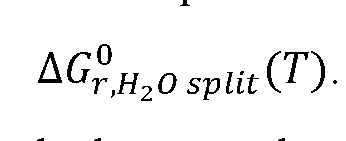


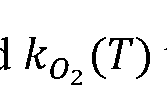


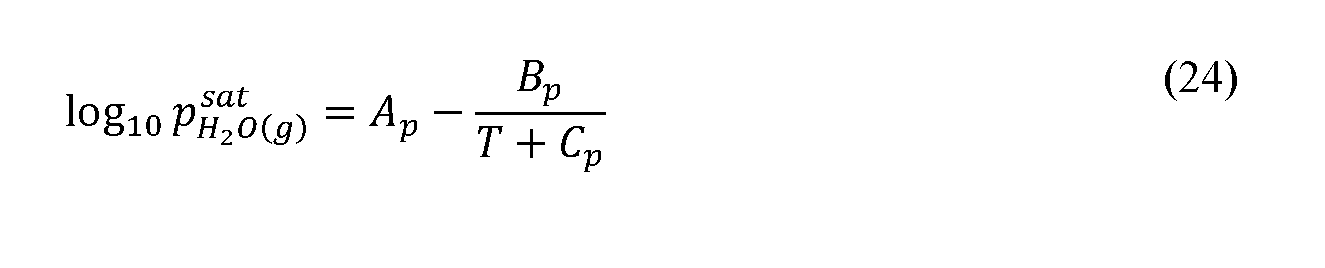


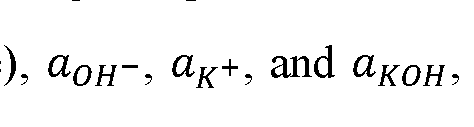


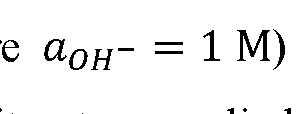


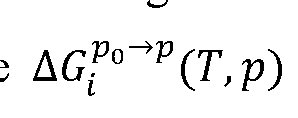


It was also found that increasing pressure causes the OER potential to increase, thereby making the reaction less favourable thermodynamically. In terms of kinetics, for a fixed applied potential, increasing pressure reduces the OER current density marginally, due to an increased solubility of gaseous oxygen in water. As a result, producing compressed oxygen and hydrogen (~100 bar) involves a negligible trade-off in kinetics, while leading to cost-savings due to an obviation of downstream oxygen and hydrogen compression. Further, based on the above understanding between the coupled effects of temperature, pressure, and pH (alkali concentration) on the efficiency (OER current density), the present inventors have determined the optimal operating conditions – temperature, pressure and pH, for a range of potentials – for water electrolysis in an electrolyzer and the corresponding OER current density and concentration of alkali required in the method, as given hereinbelow in Table 1 and Table 2. The data generated herein is intended merely to facilitate an understanding of ways in which the embodiments may be practiced and to further enable those of skill in the art to practice the embodiments. Table 1 therefore provides representative examples of optimal combinations of temperature, pressure, pH conditions along with corresponding current density and alkali concentrations required for the said pH at potentials of 1.5 V vs. the RHE (Table 1A), 1.6 V vs. the RHE (Table 1B) and 1.7 V vs. the RHE at the anode (Table 1C). Table 2 further provides representative examples of optimal combinations of temperature, pressure and pH conditions along with alkali concentrations required for the said pH at a potential of 1.5 V vs. the RHE (Table 2A-B) to obtain current density of 10 mA/cm2 and 10000 mA/cm2, respectively; at a potential of 1.6 V vs. the RHE (Table 2C) to obtain current density of 10000 mA/cm2; and at a potential 1.7 V vs. the RHE (Table 2D) at the anode to obtain current density of 10000 mA/cm2. The data in Table 1 and Table 2 however is not exhaustive, and a person skilled in the art will be able to readily modulate the conditions to arrive at optimum values based on the teachings of the present disclosure. Accordingly, following examples should not be construed as limiting the scope of the disclosure herein. Table 1: Optimized operating conditions of temperature, pressure, and pH at an applied potential vs. the RHE at the anode and the corresponding OER current density and concentration of alkali for an iron-doped nickel oxide, hydroxide, or oxyhydroxide catalyst.
Table 1A: At an applied potential of 15 V vs the RHE at the anode
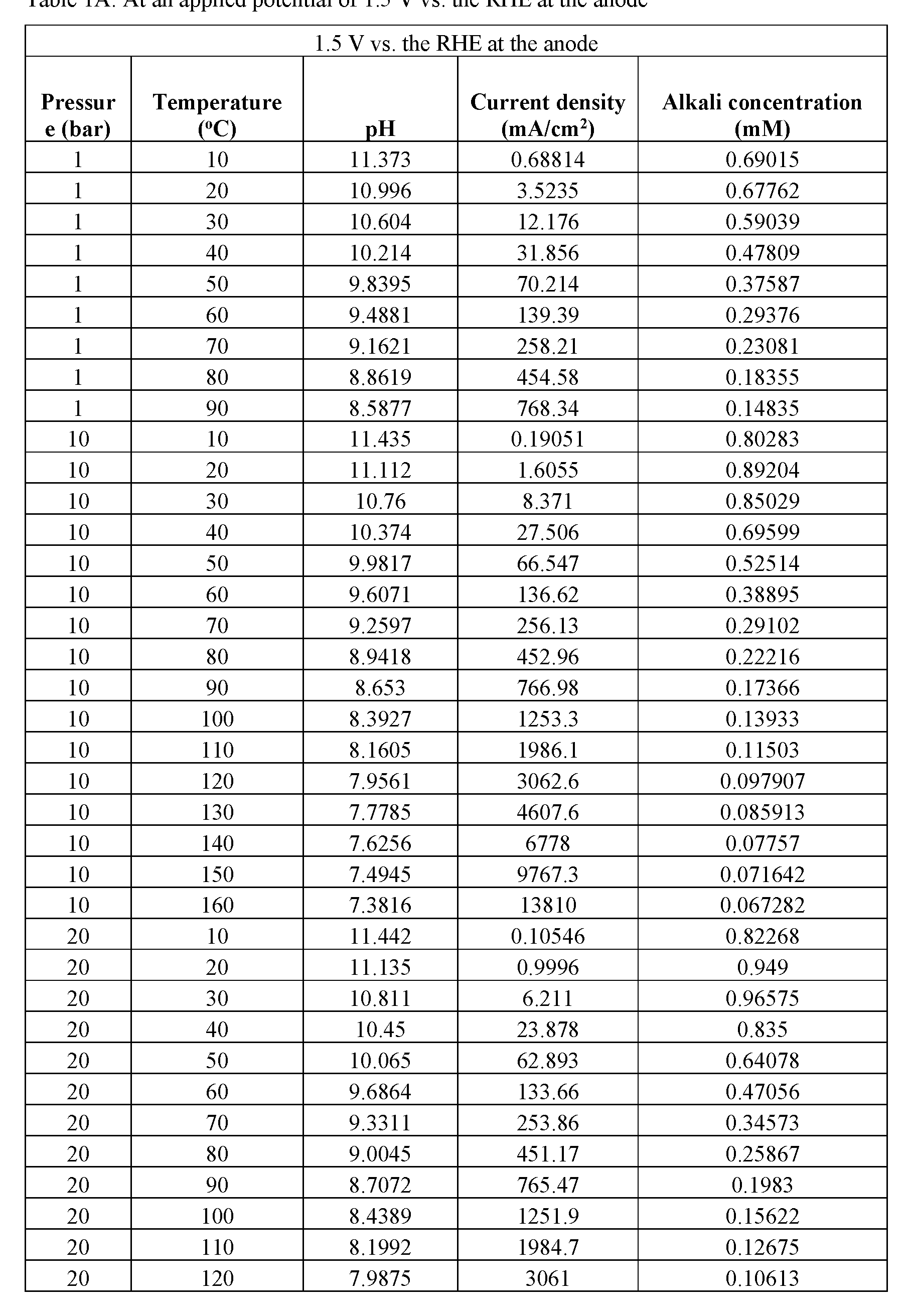


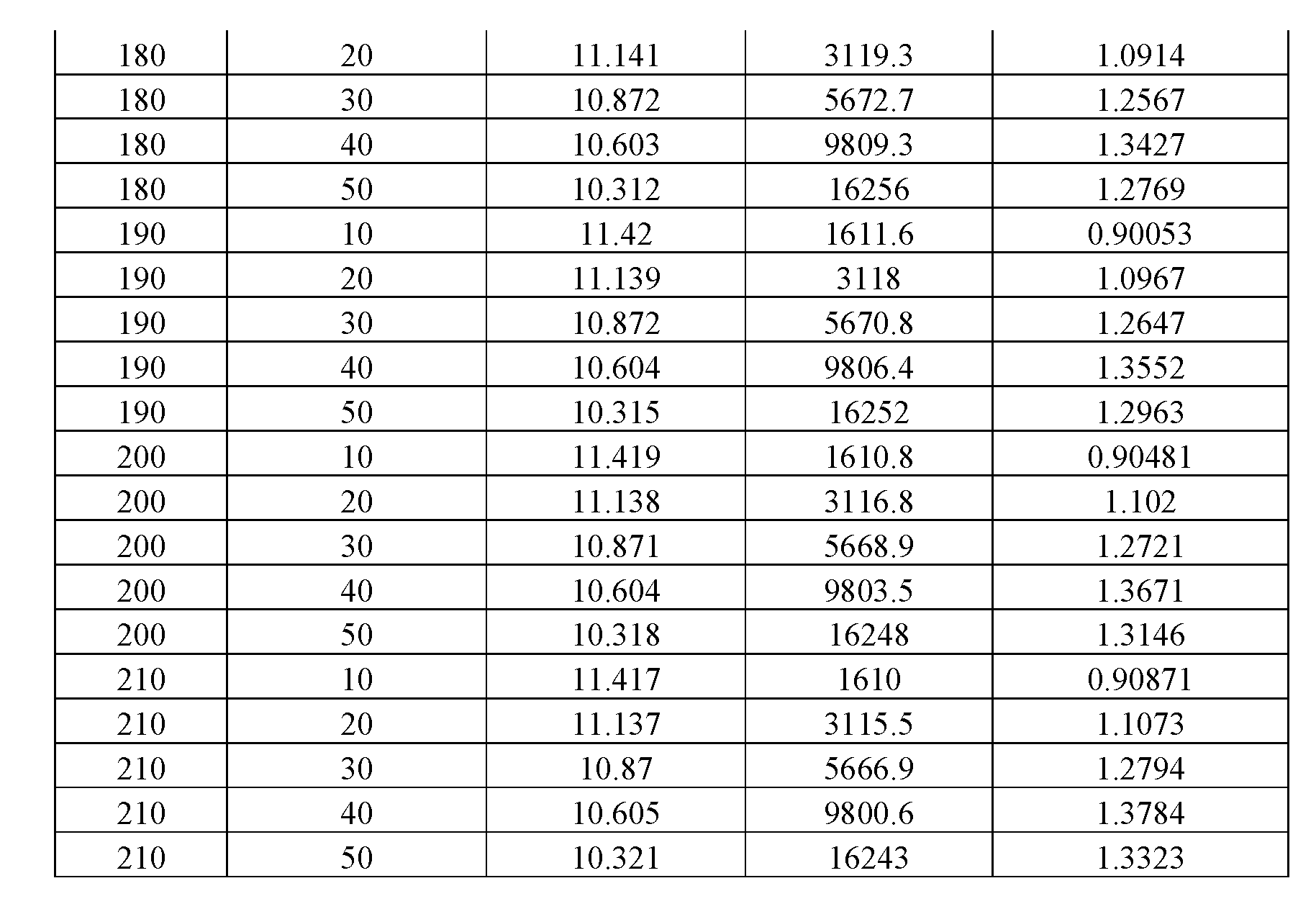


the embodiments herein can be practiced with modification within the spirit and scope of the embodiments as described herein. Throughout this specification, the term ‘combinations thereof’ or ‘any combination thereof’ or ‘any combinations thereof’ are used interchangeably and are intended to have the same meaning, as regularly known in the field of patent disclosures. As regards the embodiments characterized in this specification, it is intended that each embodiment be read independently as well as in combination with another embodiment. For example, in case of an embodiment 1 reciting 3 alternatives A, B and C, an embodiment 2 reciting 3 alternatives D, E and F and an embodiment 3 reciting 3 alternatives G, H and I, it is to be understood that the specification unambiguously discloses embodiments corresponding to combinations A, D, G; A, D, H; A, D, I; A, E, G; A, E, H; A, E, I; A, F, G; A, F, H; A, F, I; B, D, G; B, D, H; B, D, I; B, E, G; B, E, H; B, E, I; B, F, G; B, F, H; B, F, I; C, D, G; C, D, H; C, D, I; C, E, G; C, E, H; C, E, I; C, F, G; C, F, H; C, F, I, unless specifically mentioned otherwise. Any discussion of documents, acts, materials, devices, articles and the like that has been included in this specification is solely for the purpose of providing a context for the disclosure. It is not to be taken as an admission that any or all of these matters form a part of the prior art base or were common general knowledge in the field relevant to the disclosure as it existed anywhere before the priority date of this application.
Claims
WE CLAIM: 1. A method of generating oxygen by electrochemical water splitting at optimized conditions of pH, temperature, and pressure for an oxygen evolution reaction (OER) current density ranging from about 10 mA/cm2 to about 10000 mA/cm2, said method comprising: a) contacting an anode of an electrolyzer with an electrolyte comprising water and alkali, in presence of a metal-doped oxide, hydroxide, or oxyhydroxide catalyst; and b) applying a potential ranging from about 1.45 V to about 1.75 V versus the reversible hydrogen electrode (RHE) at the anode to allow said generation of the oxygen; wherein the pH of the electrolyte ranges from about 7.4 to about 10.9; wherein the pH is a function of temperature T at a given pressure P; and wherein the temperature T ranges from about 28 °C to about 151 °C and is less than the boiling point of the electrolyte at the given pressure P.
2. The method as claimed in claim 1, wherein the pH of the electrolyte is determined based on an unconstrained minimization function applied to the negative of an OER current density, and wherein the OER current density is a function of the applied potential.
3. The method as claimed in claim 2, wherein the pH of the electrolyte is maintained in a manner that allows concentration of OH- ions in the electrolyte to be less than 1 M. 4. The method as claimed in claim 1, wherein when the potential is about 1.5 V vs. the RHE, the pH of the electrolyte ranges from about 7.
4 to about 10.7, and the temperature T ranges from about 28 °C to about 151 °C and is less than the boiling point of the electrolyte at the given pressure P. 5. The method as claimed in claim 1, wherein when the potential is about 1.6 V vs. the RHE, the pH of the electrolyte ranges from about 8.
5 to about 10.9, and the temperature T ranges from about 28 °C to about 92 °C and is less than boiling point of the electrolyte at the given pressure P.
6. The method as claimed in claim 1, wherein when the potential is about 1.7 V vs. the RHE, the pH of the electrolyte ranges from about 10.2 to about 10.9, and the
temperature T ranges from about 28 °C to about 41 °C and is less than boiling point of the electrolyte at the given pressure P.
7. The method as claimed in any one of claims 4 to 6, wherein concentration or amount of the alkali required for maintaining the stated pH, ranges from about 0.07 mM to about 1.38 mM.
8. The method as claimed in claim 7, wherein the pH reduces from about 10.7 to about 7.4 with an increase in temperature and the corresponding increase in the OER current density at the potential of about 1.5 V vs. the RHE; and wherein the concentration or amount of the alkali required for maintaining the stated pH reduces from about 1.38 mM to about 0.07 mM at the given pressure P. 9. The method as claimed in claim 7, wherein the pH reduces from about 10.
9 to about 8.5 with an increase in temperature and the corresponding increase in the OER current density at the potential of about 1.6 V vs. the RHE; and wherein the concentration or amount of the alkali required for maintaining the stated pH reduces from about 1.37 mM to about 0.14 mM at the given pressure P.
10. The method as claimed in claim 7, wherein the pH reduces from about 10.9 to about 10.2 with an increase in temperature and the corresponding increase in the OER current density at the potential of about 1.7 V vs. the RHE; and wherein the concentration or amount of the alkali required for maintaining the stated pH reduces from about 1.37 mM to about 0.47 mM at the given pressure P.
11. The method as claimed in any one of claims 1 to 10, wherein the pressure P ranges from about 1 bar to about 210 bar.
12. The method as claimed in claim 1, wherein the OER current density improves by at least about 80% when the method is carried out at said optimized conditions of pH, temperature, and pressure.
13. The method as claimed in claim 1, wherein the OER current density improves by about 200% when the method is carried out at said optimized conditions of pH, temperature, and pressure.
14. The method as claimed in claim 1, wherein the alkali is selected from a group of highly soluble hydroxides comprising potassium hydroxide (KOH), sodium hydroxide (NaOH), calcium hydroxide (Ca(OH)2), magnesium hydroxide (Mg(OH)2), and an alkali or alkaline earth hydroxide, or any combination thereof.
15. The method as claimed in claim 1, wherein the metal-doped oxide, hydroxide, or oxyhydroxide catalyst is an iron-doped nickel oxide, hydroxide, or oxyhydroxide catalyst, also referred to as a mixed iron/nickel oxide, hydroxide, or oxyhydroxide material.
16. The method as claimed in claim 1, wherein the electrolyzer further comprises a cathode within the electrolyte, and wherein applying a potential across the electrolyzer generates oxygen at the anode and hydrogen at the cathode.
17. The method as claimed in claim 1, further comprising capture of the generated oxygen.
18. The method as claimed in claim 1, further comprising capture of the generated hydrogen.
19. The method as claimed in claim 1, wherein the alkali is KOH or NaOH at a concentration or amount of about 0.15 mM, the catalyst is a mixed iron/nickel oxide, hydroxide, or oxyhydroxide catalyst, the potential applied at the anode is about 1.5 V vs. the RHE, the temperature is about 90 ºC, the pressure is about 1 bar, and the pH of the electrolyte is maintained at about 8.6.
20. The method as claimed in claim 1, wherein the alkali is KOH or NaOH at a concentration or amount of about 0.26 mM, the catalyst is a mixed iron/nickel oxide, hydroxide, or oxyhydroxide catalyst, the potential applied at the anode is about 1.5 V vs. the RHE, the temperature is about 100 ºC, the pressure is about 100 bar, and the pH of the electrolyte is maintained at about 8.6.
21. The method as claimed in claim 1, wherein the alkali is KOH or NaOH having a concentration or amount of about 0.27 mM, the catalyst is a mixed iron/nickel oxide, hydroxide, or oxyhydroxide catalyst, the potential applied at the anode is about 1.5 V vs. the RHE, the temperature is about 110 ºC, the pressure is about 200 bar, and the pH of the electrolyte is maintained at about 8.5.
22. The method as claimed in claim 19, wherein the OER current density is about 770 mA/cm2.
23. The method as claimed in claim 20, wherein the OER current density is about 1241 mA/cm2.
24. The method as claimed in claim 21, wherein the OER current density is about 1960 mA/cm2.
25. The method as claimed in claim 1, wherein when the potential is about 1.5 V vs. the RHE, the pH of the electrolyte ranges from about 7.4 to about 10.6, and the temperature T ranges from about 40 °C to about 151 °C or from about 50 °C to about 151 °C and is less than the boiling point of the electrolyte at the given pressure P.
26. The method as claimed in claim 1, wherein when the potential is about 1.6 V vs. the RHE, the pH of the electrolyte ranges from about 8.5 to about 10.7, and the temperature T ranges from about 40 °C to about 92 °C or from about 50 °C to about 92 °C and is less than boiling point of the electrolyte at the given pressure P.
27. The method as claimed in claim 1, wherein when the potential is about 1.7 V vs. the RHE, the pH of the electrolyte ranges from about 10.2 to about 10.6, and the temperature T ranges from about 40 °C to about 41 °C and is less than boiling point of the electrolyte at the given pressure P.
Applications Claiming Priority (2)
| Application Number | Priority Date | Filing Date | Title |
|---|---|---|---|
| IN202141034520 | 2021-08-13 | ||
| IN202141034520 | 2021-08-13 |
Publications (1)
| Publication Number | Publication Date |
|---|---|
| WO2023017495A1 true WO2023017495A1 (en) | 2023-02-16 |
Family
ID=85200700
Family Applications (1)
| Application Number | Title | Priority Date | Filing Date |
|---|---|---|---|
| PCT/IB2022/057592 Ceased WO2023017495A1 (en) | 2021-08-13 | 2022-08-13 | A method of generating oxygen by electrochemical water splitting at optimized conditions of ph, temperature, and pressure |
Country Status (1)
| Country | Link |
|---|---|
| WO (1) | WO2023017495A1 (en) |
Cited By (2)
| Publication number | Priority date | Publication date | Assignee | Title |
|---|---|---|---|---|
| CN116884510A (en) * | 2023-07-10 | 2023-10-13 | 南通大学 | A potentiostatic-assisted electrochemical catalyst model |
| CN118862527A (en) * | 2024-09-26 | 2024-10-29 | 天目湖先进储能技术研究院有限公司 | A coupled electrochemical-thermal-lifetime model for aqueous zinc-ion batteries |
Citations (1)
| Publication number | Priority date | Publication date | Assignee | Title |
|---|---|---|---|---|
| WO2013160915A1 (en) * | 2012-04-25 | 2013-10-31 | Council Of Scientific And Industrial Research | An electrochemical process for water splitting using porous co3o4 nanorods |
-
2022
- 2022-08-13 WO PCT/IB2022/057592 patent/WO2023017495A1/en not_active Ceased
Patent Citations (1)
| Publication number | Priority date | Publication date | Assignee | Title |
|---|---|---|---|---|
| WO2013160915A1 (en) * | 2012-04-25 | 2013-10-31 | Council Of Scientific And Industrial Research | An electrochemical process for water splitting using porous co3o4 nanorods |
Non-Patent Citations (4)
| Title |
|---|
| DOTAN HEN; LANDMAN AVIGAIL; SHEEHAN STAFFORD W.; MALVIYA KIRTIMAN DEO; SHTER GENNADY E.; GRAVE DANIEL A.; ARZI ZIV; YEHUDAI NACHSH: "Decoupled hydrogen and oxygen evolution by a two-step electrochemical-chemical cycle for efficient overall water splitting", NATURE ENERGY, vol. 4, no. 9, 13 September 2019 (2019-09-13), London , pages 786 - 795, XP036885035, DOI: 10.1038/s41560-019-0462-7 * |
| GOVIND RAJAN ANANTH, CARTER EMILY A.: "Microkinetic model for pH- and potential-dependent oxygen evolution during water splitting on Fe-doped β-NiOOH", ENERGY & ENVIRONMENTAL SCIENCE, vol. 13, no. 12, 1 January 2020 (2020-01-01), Cambridge , pages 4962 - 4976, XP093035570, ISSN: 1754-5692, DOI: 10.1039/D0EE02292F * |
| MILES M. H., KISSEL G., LU P., SRINIVASAN S.: "Effect of Temperature on Electrode Kinetic Parameters for Hydrogen and Oxygen Evolution Reactions on Nickel Electrodes in Alkaline Solutions", JOURNAL OF THE ELECTROCHEMICAL SOCIETY, vol. 123, no. 3, 1 March 1976 (1976-03-01), pages 332 - 336, XP093035571, ISSN: 0013-4651, DOI: 10.1149/1.2132820 * |
| SHINAGAWA TATSUYA, NG MARCUS TZE-KIAT, TAKANABE KAZUHIRO: "Electrolyte Engineering towards Efficient Water Splitting at Mild pH", CHEMSUSCHEM, vol. 10, no. 21, 1 January 2017 (2017-01-01), DE , pages 4155 - 4162, XP093035575, ISSN: 1864-5631, DOI: 10.1002/cssc.201701266 * |
Cited By (3)
| Publication number | Priority date | Publication date | Assignee | Title |
|---|---|---|---|---|
| CN116884510A (en) * | 2023-07-10 | 2023-10-13 | 南通大学 | A potentiostatic-assisted electrochemical catalyst model |
| CN118862527A (en) * | 2024-09-26 | 2024-10-29 | 天目湖先进储能技术研究院有限公司 | A coupled electrochemical-thermal-lifetime model for aqueous zinc-ion batteries |
| CN118862527B (en) * | 2024-09-26 | 2025-01-10 | 天目湖先进储能技术研究院有限公司 | Electrochemical-thermal-life coupling system of water-based zinc ion battery |
Similar Documents
| Publication | Publication Date | Title |
|---|---|---|
| Lee et al. | Catholyte-free electroreduction of CO 2 for sustainable production of CO: concept, process development, techno-economic analysis, and CO 2 reduction assessment | |
| Fan et al. | Ultrastable electrocatalytic seawater splitting at ampere-level current density | |
| Kim et al. | Asymmetric chloride-mediated electrochemical process for CO 2 removal from oceanwater | |
| Li et al. | Recent advances and perspective on electrochemical ammonia synthesis under ambient conditions | |
| Cui et al. | Electrochemical synthesis of ammonia directly from N 2 and water over iron-based catalysts supported on activated carbon | |
| Tijani et al. | Electrochemical characteristics of (PEM) electrolyzer under influence of charge transfer coefficient | |
| Zhang et al. | Electrochemical regeneration of high-purity CO2 from (bi) carbonates in a porous solid electrolyte reactor for efficient carbon capture | |
| Exner et al. | A universal approach to determine the free energy diagram of an electrocatalytic reaction | |
| Li et al. | Development of a continuous reactor for the electro-reduction of carbon dioxide to formate–Part 1: Process variables | |
| US4311569A (en) | Device for evolution of oxygen with ternary electrocatalysts containing valve metals | |
| RU2493293C2 (en) | METHOD OF PRODUCING CxHyOz TYPE COMPOUNDS BY REDUCING CARBON DIOXIDE (CO2) AND/OR CARBON MONOXIDE (CO) | |
| US4528083A (en) | Device for evolution of oxygen with ternary electrocatalysts containing valve metals | |
| US8636880B2 (en) | Electrolysis cell for the conversion of cuprous chloride in hydrochloric acid to cupric chloride and hydrogen gas | |
| Domalanta et al. | Pathways towards achieving high current density water electrolysis: from material perspective to system configuration | |
| WO2023017495A1 (en) | A method of generating oxygen by electrochemical water splitting at optimized conditions of ph, temperature, and pressure | |
| Velikokhatnyi et al. | Fluorine-doped IrO2: a potential electrocatalyst for water electrolysis | |
| Komiya et al. | Electrolyte engineering applying concentrated chloride ions with mixed buffer solutions for a versatile high-productivity water-splitting system | |
| Exner et al. | Full Free Energy Diagram of an Electrocatalytic Reaction over a Single‐Crystalline Model Electrode | |
| Atlas et al. | Thermodynamic energy efficiency of electrochemical systems performing simultaneous water desalination and electricity generation | |
| Tang et al. | A semi-vapor electrolysis technology for hydrogen generation from wide water resources | |
| AU2024249829A1 (en) | Electrolytic method, electrolysis cell, and system | |
| Bi et al. | Crossover, volatilization, and adsorption of ammonium ions in a proton-exchange membrane electrolyzer in relation to electrochemical ammonia production | |
| Kiros et al. | Low energy consumption in chlor-alkali cells using oxygen reduction electrodes | |
| Gasik et al. | Improved operation of SO2 depolarized electrolyser stack for H2 production at ambient conditions | |
| JP2015517970A (en) | Gas production apparatus and method |
Legal Events
| Date | Code | Title | Description |
|---|---|---|---|
| 121 | Ep: the epo has been informed by wipo that ep was designated in this application |
Ref document number: 22855643 Country of ref document: EP Kind code of ref document: A1 |
|
| NENP | Non-entry into the national phase |
Ref country code: DE |
|
| 122 | Ep: pct application non-entry in european phase |
Ref document number: 22855643 Country of ref document: EP Kind code of ref document: A1 |