WO2023008545A1 - 熱処理油組成物 - Google Patents
熱処理油組成物 Download PDFInfo
- Publication number
- WO2023008545A1 WO2023008545A1 PCT/JP2022/029228 JP2022029228W WO2023008545A1 WO 2023008545 A1 WO2023008545 A1 WO 2023008545A1 JP 2022029228 W JP2022029228 W JP 2022029228W WO 2023008545 A1 WO2023008545 A1 WO 2023008545A1
- Authority
- WO
- WIPO (PCT)
- Prior art keywords
- group
- carbon atoms
- general formula
- heat
- sulfides
- Prior art date
- Legal status (The legal status is an assumption and is not a legal conclusion. Google has not performed a legal analysis and makes no representation as to the accuracy of the status listed.)
- Ceased
Links
Images

Classifications
-
- C—CHEMISTRY; METALLURGY
- C21—METALLURGY OF IRON
- C21D—MODIFYING THE PHYSICAL STRUCTURE OF FERROUS METALS; GENERAL DEVICES FOR HEAT TREATMENT OF FERROUS OR NON-FERROUS METALS OR ALLOYS; MAKING METAL MALLEABLE, e.g. BY DECARBURISATION OR TEMPERING
- C21D1/00—General methods or devices for heat treatment, e.g. annealing, hardening, quenching or tempering
- C21D1/56—General methods or devices for heat treatment, e.g. annealing, hardening, quenching or tempering characterised by the quenching agents
- C21D1/58—Oils
-
- C—CHEMISTRY; METALLURGY
- C10—PETROLEUM, GAS OR COKE INDUSTRIES; TECHNICAL GASES CONTAINING CARBON MONOXIDE; FUELS; LUBRICANTS; PEAT
- C10M—LUBRICATING COMPOSITIONS; USE OF CHEMICAL SUBSTANCES EITHER ALONE OR AS LUBRICATING INGREDIENTS IN A LUBRICATING COMPOSITION
- C10M101/00—Lubricating compositions characterised by the base-material being a mineral or fatty oil
- C10M101/02—Petroleum fractions
-
- C—CHEMISTRY; METALLURGY
- C10—PETROLEUM, GAS OR COKE INDUSTRIES; TECHNICAL GASES CONTAINING CARBON MONOXIDE; FUELS; LUBRICANTS; PEAT
- C10M—LUBRICATING COMPOSITIONS; USE OF CHEMICAL SUBSTANCES EITHER ALONE OR AS LUBRICATING INGREDIENTS IN A LUBRICATING COMPOSITION
- C10M101/00—Lubricating compositions characterised by the base-material being a mineral or fatty oil
- C10M101/04—Fatty oil fractions
-
- C—CHEMISTRY; METALLURGY
- C10—PETROLEUM, GAS OR COKE INDUSTRIES; TECHNICAL GASES CONTAINING CARBON MONOXIDE; FUELS; LUBRICANTS; PEAT
- C10M—LUBRICATING COMPOSITIONS; USE OF CHEMICAL SUBSTANCES EITHER ALONE OR AS LUBRICATING INGREDIENTS IN A LUBRICATING COMPOSITION
- C10M129/00—Lubricating compositions characterised by the additive being an organic non-macromolecular compound containing oxygen
-
- C—CHEMISTRY; METALLURGY
- C10—PETROLEUM, GAS OR COKE INDUSTRIES; TECHNICAL GASES CONTAINING CARBON MONOXIDE; FUELS; LUBRICANTS; PEAT
- C10M—LUBRICATING COMPOSITIONS; USE OF CHEMICAL SUBSTANCES EITHER ALONE OR AS LUBRICATING INGREDIENTS IN A LUBRICATING COMPOSITION
- C10M135/00—Lubricating compositions characterised by the additive being an organic non-macromolecular compound containing sulfur, selenium or tellurium
- C10M135/20—Thiols; Sulfides; Polysulfides
- C10M135/22—Thiols; Sulfides; Polysulfides containing sulfur atoms bound to acyclic or cycloaliphatic carbon atoms
-
- C—CHEMISTRY; METALLURGY
- C10—PETROLEUM, GAS OR COKE INDUSTRIES; TECHNICAL GASES CONTAINING CARBON MONOXIDE; FUELS; LUBRICANTS; PEAT
- C10M—LUBRICATING COMPOSITIONS; USE OF CHEMICAL SUBSTANCES EITHER ALONE OR AS LUBRICATING INGREDIENTS IN A LUBRICATING COMPOSITION
- C10M135/00—Lubricating compositions characterised by the additive being an organic non-macromolecular compound containing sulfur, selenium or tellurium
- C10M135/20—Thiols; Sulfides; Polysulfides
- C10M135/28—Thiols; Sulfides; Polysulfides containing sulfur atoms bound to a carbon atom of a six-membered aromatic ring
-
- C—CHEMISTRY; METALLURGY
- C10—PETROLEUM, GAS OR COKE INDUSTRIES; TECHNICAL GASES CONTAINING CARBON MONOXIDE; FUELS; LUBRICANTS; PEAT
- C10M—LUBRICATING COMPOSITIONS; USE OF CHEMICAL SUBSTANCES EITHER ALONE OR AS LUBRICATING INGREDIENTS IN A LUBRICATING COMPOSITION
- C10M169/00—Lubricating compositions characterised by containing as components a mixture of at least two types of ingredient selected from base-materials, thickeners or additives, covered by the preceding groups, each of these compounds being essential
- C10M169/04—Mixtures of base-materials and additives
-
- C—CHEMISTRY; METALLURGY
- C10—PETROLEUM, GAS OR COKE INDUSTRIES; TECHNICAL GASES CONTAINING CARBON MONOXIDE; FUELS; LUBRICANTS; PEAT
- C10N—INDEXING SCHEME ASSOCIATED WITH SUBCLASS C10M RELATING TO LUBRICATING COMPOSITIONS
- C10N2030/00—Specified physical or chemical properties which is improved by the additive characterising the lubricating composition, e.g. multifunctional additives
-
- C—CHEMISTRY; METALLURGY
- C10—PETROLEUM, GAS OR COKE INDUSTRIES; TECHNICAL GASES CONTAINING CARBON MONOXIDE; FUELS; LUBRICANTS; PEAT
- C10N—INDEXING SCHEME ASSOCIATED WITH SUBCLASS C10M RELATING TO LUBRICATING COMPOSITIONS
- C10N2030/00—Specified physical or chemical properties which is improved by the additive characterising the lubricating composition, e.g. multifunctional additives
- C10N2030/10—Inhibition of oxidation, e.g. anti-oxidants
-
- C—CHEMISTRY; METALLURGY
- C10—PETROLEUM, GAS OR COKE INDUSTRIES; TECHNICAL GASES CONTAINING CARBON MONOXIDE; FUELS; LUBRICANTS; PEAT
- C10N—INDEXING SCHEME ASSOCIATED WITH SUBCLASS C10M RELATING TO LUBRICATING COMPOSITIONS
- C10N2040/00—Specified use or application for which the lubricating composition is intended
- C10N2040/20—Metal working
Definitions
- the present invention relates to heat-treated oil compositions.
- Metal materials such as steel are sometimes subjected to heat treatments such as quenching, tempering, annealing, and normalizing for the purpose of improving their properties.
- quenching is a process in which a heated metal material is immersed in a coolant to transform into a predetermined quenched structure. Quenching makes the metal material very hard and improves its mechanical strength.
- a heat-treated oil composition is widely used as a coolant for quenching.
- the heat treatment oil composition is required to have the performance of maintaining the surface gloss of the metal material before quenching even after quenching, from the viewpoint of increasing the commercial value of the metal material after quenching.
- the heat treatment oil composition is required to have the ability to improve the luster of the metal material after quenching.
- a heat-treated oil composition for example, at least one of mineral oil and synthetic oil having a sulfur content of 300 ppm or less is blended with at least one of sulfur and a sulfur compound to make the total sulfur content 3 to 1,000 ppm.
- a heat-treated oil composition and the like using the adjusted base oil have been proposed (see, for example, Patent Document 1).
- Patent Document 1 some of the sulfur compounds (for example, diphenyl disulfide) listed in Patent Document 1 have the effect of improving the luster of the metal material after quenching. found to be inferior. From the viewpoint of making various sulfur compounds widely available, it is possible to improve the brightness even when using a sulfur compound that is inferior in the effect of improving the brightness of the metal material after quenching. It would be desirable to establish a heat treating oil composition formulation that is capable of. Further, the heat-treated oil composition is expected to come into contact with air during use in an open oil tank, and is desired to have excellent oxidation stability.
- the sulfur compounds for example, diphenyl disulfide listed in Patent Document 1 have the effect of improving the luster of the metal material after quenching. found to be inferior. From the viewpoint of making various sulfur compounds widely available, it is possible to improve the brightness even when using a sulfur compound that is inferior in the effect of improving the brightness of the metal material after quenching. It would be desirable to establish a heat treating oil composition formulation that is capable of. Further, the heat
- the present invention can improve the brilliance of a metal material after heat treatment such as quenching even when a sulfur compound is used, which is inferior in the effect of improving the brilliance of the metal material.
- An object of the present invention is to provide a heat-treated oil composition having excellent oxidation stability.
- One or more base oils (A) selected from the group consisting of mineral oil (A1), synthetic oil (A2), and vegetable oil (A3), a sulfur compound (B), and a carboxylic acid compound (C ) and
- the sulfur compound (B) includes sulfides (B1) represented by the following general formula (b1), sulfides (B2) represented by the following general formula (b2), and general formula (b3) below.
- the heat-treated oil composition wherein the carboxylic acid compound (C) is one or more selected from the group consisting of compounds having at least one carboxy group and anhydrides thereof.
- Ar 11 represents an aryl group having 6 to 15 carbon atoms and having at least a hydroxyl group.
- R 11 represents a substituted or unsubstituted hydrocarbon group (X1).
- the hydrocarbon group (X1) includes an alkyl group having 1 to 15 carbon atoms, an alkenyl group having 1 to 15 carbon atoms, a cycloalkyl group having 3 to 15 carbon atoms, a cycloalkenyl group having 3 to 15 carbon atoms, and a cycloalkenyl group having 3 to 15 carbon atoms.
- Ar 12 is an arylene group having 6 to 15 carbon atoms and having at least a hydroxyl group.
- R 12 and R 13 each independently represent a substituted or unsubstituted hydrocarbon group (X2).
- the hydrocarbon group (X2) includes an alkyl group having 1 to 15 carbon atoms, an alkenyl group having 1 to 15 carbon atoms, a cycloalkyl group having 3 to 15 carbon atoms, a cycloalkenyl group having 3 to 15 carbon atoms, and a cycloalkenyl group having 3 to 15 carbon atoms.
- Ar 13 represents an aryl group having 6 to 15 carbon atoms and having at least a hydroxyl group.
- Ar 14 represents a substituted or unsubstituted aryl group having 6 to 15 carbon atoms.
- Ar 15 and Ar 16 each independently represent a substituted or unsubstituted aryl group having 6 to 15 carbon atoms.
- the sulfur compound (B) includes sulfides (B1) represented by the following general formula (b1), sulfides (B2) represented by the following general formula (b2), and general formula (b3) below.
- a method for producing a heat-treated oil composition wherein the carboxylic acid compound (C) is one or more selected from the group consisting of compounds having at least one carboxy group and anhydrides thereof.
- each Ar 11 independently represents an aryl group having 6 to 15 carbon atoms and having at least a hydroxyl group.
- R 11 represents a substituted or unsubstituted hydrocarbon group (X1).
- the hydrocarbon group (X1) includes an alkyl group having 1 to 15 carbon atoms, an alkenyl group having 1 to 15 carbon atoms, a cycloalkyl group having 3 to 15 carbon atoms, a cycloalkenyl group having 3 to 15 carbon atoms, and a cycloalkenyl group having 3 to 15 carbon atoms.
- Ar 12 represents an arylene group having 6 to 15 carbon atoms and having at least a hydroxyl group.
- R 12 and R 13 each independently represent a substituted or unsubstituted hydrocarbon group (X2).
- the hydrocarbon group (X2) includes an alkyl group having 1 to 15 carbon atoms, an alkenyl group having 1 to 15 carbon atoms, a cycloalkyl group having 3 to 15 carbon atoms, a cycloalkenyl group having 3 to 15 carbon atoms, and a cycloalkenyl group having 3 to 15 carbon atoms.
- Ar 13 represents an aryl group having 6 to 15 carbon atoms and having at least a hydroxyl group.
- Ar 14 represents a substituted or unsubstituted aryl group having 6 to 15 carbon atoms.
- Ar 15 and Ar 16 each independently represent a substituted or unsubstituted aryl group having 6 to 15 carbon atoms.
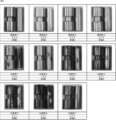
- FIG. 1 is a drawing-substituting photograph showing the state of a test piece after a quenching test using the heat-treated oil compositions of Examples 1 to 4 and Comparative Examples 1 to 7.
- FIG. 10 is a drawing-substituting photograph showing the state of a test piece after a quenching test using the heat-treated oil compositions (new oil) of Examples 5 to 8 and Comparative Examples 8 to 9.
- FIG. 1 is a drawing-substituting photograph showing the state of a test piece after a quenching test using the heat-treated oil compositions (new oil) of Examples 5 to 8 and Comparative Examples 8 to 9.
- the lower and upper limits described stepwise can be independently combined.
- the numerical range "lower limit to upper limit” described in this specification means from the lower limit to the upper limit, unless otherwise specified.
- numerical values in the examples are numerical values that can be used as upper or lower limits.
- kinematic viscosity at 40°C is also referred to as “40°C kinematic viscosity”.
- the heat-treated oil composition of the present embodiment comprises one or more base oils (A) selected from the group consisting of mineral oil (A1), synthetic oil (A2), and vegetable oil (A3), and a sulfur compound (B). , and a carboxylic acid compound (C).
- the sulfur compound (B) includes sulfides (B1) represented by the following general formula (b1), sulfides (B2) represented by the following general formula (b2), and general formula (b3) below. It contains one or more selected from the group consisting of sulfides (B3) and sulfides (B4) represented by the following general formula (b4).
- the carboxylic acid compound (C) is one or more selected from the group consisting of compounds having at least one carboxy group and anhydrides thereof.
- Ar 11 represents an aryl group having 6 to 15 carbon atoms and having at least a hydroxyl group.
- R 11 represents a substituted or unsubstituted hydrocarbon group (X1).
- the hydrocarbon group (X1) includes an alkyl group having 1 to 15 carbon atoms, an alkenyl group having 1 to 15 carbon atoms, a cycloalkyl group having 3 to 15 carbon atoms, a cycloalkenyl group having 3 to 15 carbon atoms, and a cycloalkenyl group having 3 to 15 carbon atoms.
- Ar 12 represents an arylene group having 6 to 15 carbon atoms and having at least a hydroxyl group.
- R 12 and R 13 each independently represent a substituted or unsubstituted hydrocarbon group (X2).
- the hydrocarbon group (X2) includes an alkyl group having 1 to 15 carbon atoms, an alkenyl group having 1 to 15 carbon atoms, a cycloalkyl group having 3 to 15 carbon atoms, a cycloalkenyl group having 3 to 15 carbon atoms, and a cycloalkenyl group having 3 to 15 carbon atoms.
- Ar 13 represents an aryl group having 6 to 15 carbon atoms and having at least a hydroxyl group.
- Ar 14 represents a substituted or unsubstituted aryl group having 6 to 15 carbon atoms.
- Ar 15 and Ar 16 each independently represent a substituted or unsubstituted aryl group having 6 to 15 carbon atoms.
- the inventor of the present invention has made intensive studies to solve the above problems. As a result, the above problem can be solved by combining the sulfur compound (B), which is inferior in the effect of improving the brightness of the metal material after heat treatment such as quenching, with the carboxylic acid compound (C). found to get. According to the examination by the present inventors, even if only the carboxylic acid compound (C) was blended with the base oil (A), no effect of improving the glitter was observed. From this, in the present invention, by using the sulfur compound (B) and the carboxylic acid compound (C) in combination, some interaction occurs between these compounds, and the brightness of the sulfur compound (B) is improved. It is presumed that the effects of the present invention are brought out and the effects of the present invention are exhibited.
- the heat-treated oil composition of the present embodiment may be composed only of the base oil (A), the sulfur compound (B), and the carboxylic acid compound (C). Components other than the base oil (A), the sulfur compound (B), and the carboxylic acid compound (C) may be contained.
- the total content of the base oil (A), the sulfur compound (B), and the carboxylic acid compound (C) is preferably 75% by mass to 100% by mass, based on the total amount of the heat-treated oil composition, More preferably 80% to 100% by mass, still more preferably 85% to 100% by mass, even more preferably 90% to 100% by mass, still more preferably 95% to 100% by mass.
- the heat-treated oil composition of the present embodiment contains a base oil (A).
- the base oil (A) is one or more selected from the group consisting of mineral oil (A1), synthetic oil (A2) and vegetable oil (A3). Mineral oil (A1), synthetic oil (A2), and vegetable oil (A3) are described in detail below.
- mineral oil (A1)) As the mineral oil (A1), mineral oils commonly used in heat-treated oil compositions can be used without particular limitation. Specific examples of the mineral oil (A1) include atmospheric residual oils obtained by atmospheric distillation of crude oils such as paraffinic crude oils, intermediate crude oils, and naphthenic crude oils; Obtained distillate; mineral oil obtained by subjecting the distillate to one or more treatments such as solvent deasphalting, solvent extraction, hydrocracking, solvent dewaxing, catalytic dewaxing, hydrorefining; wax isomerization Mineral oil etc. are mentioned.
- the mineral oil (A1) is preferably a highly refined mineral oil whose sulfur content has been reduced by performing a refining treatment including at least one selected from hydrocracking and hydrorefining.
- the sulfur content of the highly refined mineral oil is preferably less than 10 ppm by mass, more preferably less than 5 ppm by mass, and even more preferably less than 3 ppm by mass, based on the total amount of the highly refined mineral oil.
- Mineral oil (A1) may also be a bright stock with a low sulfur content.
- the term "bright stock” means a distillate obtained by distilling under reduced pressure atmospheric residual oil obtained by atmospheric distillation of crude oil such as paraffinic crude oil, intermediate crude oil, and naphthenic crude oil. Next, the distillate oil is deasphalted to obtain a deasphalted oil, and the deasphalted oil is subjected to one or more refining treatments selected from solvent refining, hydrorefining, etc.
- High viscosity mineral oil 40 ° C dynamic Viscosity: about 350 mm 2 /s to 550 mm 2 /s).
- Bright stock with a low sulfur content is preferably a hydrorefined product, and the sulfur content is preferably less than 10 ppm by mass, more preferably less than 5 ppm by mass, and still more preferably 3 ppm by mass, based on the total amount of bright stock. is less than Bright stock with a low sulfur content is preferably classified into Group II in the API category.
- the mineral oil (A1) may be used alone or in combination of two or more.
- synthetic oil (A2) As the synthetic oil (A2), general synthetic oils for use in heat-treated oil compositions can be used without particular limitation.
- Specific examples of synthetic oils (A2) include poly- ⁇ -olefins, polyphenyl ethers, alkylbenzenes, alkylnaphthalenes, polyphenyl hydrocarbons, ester oils (e.g., neopentyl glycol, trimethylolpropane, and pentaerythritol GTL base oil obtained by isomerizing wax (GTL wax (Gas To Liquids WAX)) produced from natural gas by the Fischer-Tropsch process or the like. etc. Among these, GTL base oils are preferred.
- the synthetic oil (A2) may be used alone or in combination of two or more.
- vegetable oil (A3)) As the vegetable oil (A3), general vegetable oils for use in heat-treated oil compositions can be used without particular limitation. Specific examples of vegetable oils (A3) include linseed oil, safflower oil, sunflower oil, soybean oil, corn oil, cottonseed oil, sesame oil, olive oil, castor oil, peanut oil, coconut oil, palm kernel oil, palm oil, palm oil. oil, rapeseed oil, rice bran oil, and the like. One of the vegetable oils (A3) may be used alone, or two or more of them may be used in combination.
- the base oil (A) may be one or more selected from the group consisting of mineral oil (A1), synthetic oil (A2), and vegetable oil (A3). It is preferably one or more selected from the group consisting of oil (A2). Moreover, the base oil (A) preferably contains a mineral oil (A1).
- the content of the mineral oil (A1) is preferably 20% by mass to 100% by mass, more preferably 30% by mass to 100% by mass, more preferably 40% by mass to 100% by mass, even more preferably 50% by mass to 100% by mass, even more preferably 60% by mass to 100% by mass, still more preferably 70% by mass to 100% by mass, More preferably 80% by mass to 100% by mass, still more preferably 90% by mass to 100% by mass.
- the 40° C. kinematic viscosity of the base oil (A) used in the present embodiment is preferably 5 mm 2 /s to 600 mm 2 /s, more preferably 6 mm 2 /s to 570 mm 2 /s, still more preferably 7 mm 2 /s. ⁇ 540 mm 2 /s, more preferably 8 mm 2 /s to 520 mm 2 /s, even more preferably 9 mm 2 /s to 500 mm 2 /s. If the 40° C.
- kinematic viscosity of the base oil (A) is 5 mm 2 /s or more, it is easy to obtain a heat-treated oil composition that suppresses the generation of soot.
- the 40° C. kinematic viscosity of the base oil (A) is 600 mm 2 /s or less, it is easy to obtain a heat-treated oil composition with good cooling performance.
- 40 degreeC kinematic viscosity is the value measured based on JISK2283:2000.
- a plurality of types of base oils having different 40° C. kinematic viscosities are mixed and used. is preferred.
- the content of the base oil (A) is preferably 80.0% by mass or more, more preferably 82.0% by mass or more, and still more preferably, based on the total amount of the heat-treated oil composition. is 83.0% by mass or more. Moreover, it is preferably 98.99% by mass or less. The upper and lower limits of these numerical ranges can be combined arbitrarily. Specifically, it is preferably 80.0% by mass to 98.99% by mass, more preferably 82.00% by mass to 98.99% by mass, and still more preferably 83.0% by mass to 98.99% by mass. .
- the heat-treated oil composition of the present embodiment contains a sulfur compound (B).
- the sulfur compound (B) is inferior in the effect of improving the luster of the metal material after heat treatment such as quenching. However, by using it in combination with the carboxylic acid compound (C), it is possible to improve the luster of the metal material after heat treatment such as quenching.
- the sulfur compound (B) contains one or more selected from the group consisting of sulfides (B1), sulfides (B2), sulfides (B3), and sulfides (B4).
- the sulfur compound (B) consists of only one or more selected from the group consisting of sulfides (B1), sulfides (B2), sulfides (B3), and sulfides (B4).
- other sulfur compounds other than sulfides (B1), sulfides (B2), sulfides (B3), and sulfides (B4) are contained within a range that does not impair the effects of the present invention.
- one or more selected from the group consisting of sulfides (B1), sulfides (B2), sulfides (B3), and sulfides (B4) includes the following aspects.
- Sulfides (B1) are compounds represented by the following general formula (b1).
- Ar 11 is an aryl group having 6 to 15 carbon atoms and having at least a hydroxyl group.
- the metallic material has good luster after heat treatment such as quenching.
- the carboxylic acid compound (C) it is possible to improve the luster of the metal material after heat treatment such as quenching. If the number of carbon atoms in the aryl group exceeds 15, even if it is combined with the carboxylic acid compound (C), it may not be possible to improve the luster of the metal material after heat treatment such as quenching.
- Examples of the aryl group having 6 to 15 carbon atoms constituting Ar 11 in the general formula (b1) include a phenyl group, a biphenyl group, a naphthyl group, a phenanthryl group, a fluorenyl group, an anthryl group and the like.
- the "6 to 15 carbon atoms" of the "aryl group having 6 to 15 carbon atoms” means “6 to 15 ring carbon atoms”.
- the number of carbon atoms in the aryl group is preferably 6 to 10, more preferably 6, from the viewpoint of making it easier to exhibit the effects of the combination with the carboxylic acid compound (C).
- the aryl group having 6 to 15 carbon atoms constituting Ar 11 has at least one hydroxyl group. If the aryl group does not have a hydroxyl group, the heat-treated oil composition may have insufficient oxidation stability.
- the aryl group may further have a substituent other than a hydroxyl group, or may have no substituent other than a hydroxyl group. Examples of the substituent include monovalent aliphatic hydrocarbon groups having 1 to 10 carbon atoms, alkoxy groups having 1 to 10 carbon atoms, hydroxyl groups, amino groups, nitro groups, amide groups, benzamide groups, carboxy groups, and dicarboxylic acid groups.
- the monovalent aliphatic hydrocarbon group having 1 to 10 carbon atoms is preferably a linear or branched alkyl group having 3 to 10 carbon atoms, more preferably a branched chain having 3 to 10 carbon atoms. It is an alkyl group.
- a halogen atom is, for example, a fluorine atom, a chlorine atom, a bromine atom, or an iodine atom, preferably a chlorine atom.
- the number of hydroxyl groups possessed by the aryl group may be one or plural, but preferably one.
- the aryl group has a substituent other than a hydroxyl group, the number of the substituent may be one or plural.
- the multiple substituents may be the same or different.
- R 11 represents a substituted or unsubstituted hydrocarbon group (X1).
- the hydrocarbon group (X1) has a substituent
- the substituent includes a monovalent aliphatic hydrocarbon group having 1 to 10 carbon atoms, an alkoxy group having 1 to 10 carbon atoms, a hydroxyl group, an amino group, and a nitro group.
- the monovalent aliphatic hydrocarbon group having 1 to 10 carbon atoms is preferably a linear or branched alkyl group having 3 to 10 carbon atoms, more preferably a branched chain having 3 to 10 carbon atoms. It is an alkyl group.
- a halogen atom is, for example, a fluorine atom, a chlorine atom, a bromine atom, or an iodine atom, preferably a chlorine atom.
- the hydrocarbon group (X1) has a substituent, the number of substituents may be one or plural. Moreover, when there are multiple substituents, the multiple substituents may be the same or different.
- the hydrocarbon group (X1) is an alkyl group having 1 to 15 carbon atoms, an alkenyl group having 1 to 15 carbon atoms, a cycloalkyl group having 3 to 15 carbon atoms, a cycloalkyl group having 3 to 15 carbon atoms, A cycloalkenyl group, a cycloalkylalkyl group having 4 to 15 carbon atoms, a cycloalkenylalkyl group having 4 to 15 carbon atoms, an aryl group having 6 to 15 carbon atoms, and an arylalkyl group having 7 to 15 carbon atoms.
- the number of carbon atoms in the hydrocarbon group (X1) does not include the number of carbon atoms in the substituents that the hydrocarbon group (X1) may have.
- the number of carbon atoms in the group that can be selected as the hydrocarbon group (X1) exceeds 15, even in combination with the carboxylic acid compound (C), the luster of the metal material after heat treatment such as quenching is good. Sometimes I can't.
- alkyl groups having 1 to 15 carbon atoms that can be selected as the hydrocarbon group (X1) include methyl group, ethyl group, propyl group, butyl group, pentyl group, hexyl group, heptyl group, octyl group and nonyl group. , decyl group, undecyl group, dodecyl group, tridecyl group, tetradecyl group, and pentadecyl group.
- the alkyl group may be linear or branched.
- alkenyl groups having 2 to 15 carbon atoms that can be selected as the hydrocarbon group (X1) include ethenyl, propenyl, butenyl, pentenyl, hexenyl, heptenyl, octenyl, nonenyl and decenyl groups. , undecenyl group, dodecenyl group, tridecenyl group, tetradecenyl group, and pentadecenyl group.
- the alkenyl group may be linear or branched.
- Examples of the cycloalkyl group having 3 to 15 carbon atoms that can be selected as the hydrocarbon group (X1) include cyclopropyl group, cyclobutyl group, cyclopentyl group, cyclohexyl group, cycloheptyl group and the like.
- the "3 to 15 carbon atoms" of the "cycloalkyl group having 3 to 15 carbon atoms” means “3 to 15 ring carbon atoms”.
- the number of carbon atoms in the cycloalkyl group is preferably 5 to 10, more preferably 5 to 6, from the viewpoint of making it easier to exhibit the effects of the combination with the carboxylic acid compound (C).
- Examples of the cycloalkenyl group having 3 to 15 carbon atoms that can be selected as the hydrocarbon group (X1) include a cyclopropenyl group, a cyclobutenyl group, a cyclopentenyl group, a cyclohexenyl group, and a cycloheptenyl group.
- the "3 to 15 carbon atoms" of the "cycloalkenyl group having 3 to 15 carbon atoms” means “3 to 15 ring carbon atoms”.
- the number of carbon atoms in the cycloalkenyl group is preferably 5 to 10, more preferably 5 to 6, from the viewpoint of making it easier to exhibit the effects of the combination with the carboxylic acid compound (C).
- Examples of cycloalkylalkyl groups having 4 to 15 carbon atoms that can be selected as the hydrocarbon group (X1) include a cyclopropylmethyl group, a cyclopropylethyl group, a cyclopropylpropyl group, a cyclopropylbutyl group and a cyclobutylmethyl group. , a cyclopentylmethyl group, a cyclopentylethyl group, a cyclopentylpropyl group, a cyclohexylmethyl group, a cyclohexylethyl group, and a cyclohexylpropyl group.
- the cycloalkylalkyl group is a group represented by the following general formula (c1), in which one hydrogen atom of the alkyl group is substituted with a cycloalkyl group.
- the circle is a cycloalkyl group and R 31 is an alkylene group.
- the wavy line means the bonding position with the carbon atom in the general formula (b1).
- the "4 to 15 carbon atoms" of the "cycloalkylalkyl group having 4 to 15 carbon atoms” means the total carbon number of the ring-forming carbon number of the cycloalkyl group and the carbon number of the alkylene group (R 31 ). .
- the number of carbon atoms (the number of ring-forming carbon atoms) of the cycloalkyl group constituting the cycloalkylalkyl group is preferably 5 to 10, more It is preferably 5-6.
- the number of carbon atoms in the alkylene group constituting the cycloalkylalkyl group is preferably 1 to 6, more preferably 1 to 4. , more preferably 1-2.
- Examples of cycloalkenylalkyl groups having 4 to 15 carbon atoms that can be selected as the hydrocarbon group (X1) include a cyclopropenylmethyl group, a cyclopropenylethyl group, a cyclopropenylpropyl group, a cyclopropenylbutyl group, a cyclobutenylmethyl cyclopentenylmethyl, cyclopentenylethyl, cyclopentenylpropyl, cyclohexenylmethyl, cyclohexenylethyl, and cyclohexenylpropyl groups.
- the cycloalkenylalkyl group is a group represented by the following general formula (c2), in which one hydrogen atom of the alkyl group is substituted with a cycloalkenyl group.
- the circle is a cycloalkenyl group and R 32 is an alkylene group.
- the wavy line means the bonding position with the carbon atom in the general formula (b1).
- the "4 to 15 carbon atoms" of the "cycloalkenylalkyl group having 4 to 15 carbon atoms” means the total carbon number of the ring-forming carbon number of the cycloalkenyl group and the carbon number of the alkylene group (R 32 ). .
- the number of carbon atoms (the number of ring-forming carbon atoms) of the cycloalkenyl group constituting the cycloalkenylalkyl group is preferably 5 to 10, more It is preferably 5-6.
- the number of carbon atoms in the alkylene group constituting the cycloalkenylalkyl group is preferably 1 to 6, more preferably 1 to 4. , more preferably 1-2.
- Examples of the aryl group having 6 to 15 carbon atoms that can be selected as the hydrocarbon group (X1) include phenyl group, biphenyl group, naphthyl group, phenanthryl group, fluorenyl group and anthryl group.
- the "6 to 15 carbon atoms" of the "aryl group having 6 to 15 carbon atoms” means “6 to 15 ring carbon atoms”.
- the number of carbon atoms in the aryl group is preferably 6 to 10, more preferably 6, from the viewpoint of making it easier to exhibit the effects of the combination with the carboxylic acid compound (C).
- arylalkyl groups having 7 to 15 carbon atoms that can be selected as the hydrocarbon group (X1) include phenylmethyl group, phenylethyl group, phenylpropyl group, biphenylmethyl group, biphenylethyl group, biphenylpropyl group and naphthyl. methyl group, naphthylethyl group, naphthylpropyl group, phenanthrylmethyl group, fluorenylmethyl group, fluorenylethyl group, anthrylmethyl group and the like.
- the arylalkyl group is a group represented by the following general formula (c3), in which one hydrogen atom of the alkyl group is substituted with an aryl group.
- the double circle is an aryl group
- R 33 is an alkylene group.
- a wavy line means a bonding position with a carbon atom in the general formula (b1).
- the "7 to 15 carbon atoms" of the "arylalkyl group having 7 to 15 carbon atoms” means the total carbon number of the ring-forming carbon number of the aryl group and the carbon number of the alkylene group (R 33 ).
- the number of carbon atoms (the number of ring-forming carbon atoms) of the aryl group constituting the arylalkyl group is preferably 6 to 10, more preferably is 6.
- the number of carbon atoms in the alkylene group constituting the arylalkyl group is preferably 1 to 6, more preferably 1 to 4, It is more preferably 1-2.
- the hydrocarbon group (X1) is preferably an aryl group having 6 to 15 carbon atoms and having at least a hydroxyl group.
- the sulfides (B1) preferably contain a compound represented by the following general formula (b1-1).
- the compound represented by the following general formula (b1-1) tends to have better brightness when combined with the carboxylic acid compound (C).
- the content of the compound represented by the following general formula (b1-1) is preferably 70% by mass to 100% by mass, more preferably 80% by mass to 100% by mass, based on the total amount of sulfides (B1). % by mass, more preferably 90% to 100% by mass, and even more preferably 95% to 100% by mass.
- R 15 and R 16 each independently represent an alkyl group having 1 to 10 carbon atoms.
- the alkyl group is preferably a straight-chain or branched-chain alkyl group having 3 to 10 carbon atoms from the viewpoint of making it easier to improve the oxidation stability of the heat-treated oil composition.
- a branched alkyl group is more preferred.
- the branched-chain alkyl group preferably has 4 to 8 carbon atoms, more preferably 4 to 6 carbon atoms, and still more preferably 4 carbon atoms.
- m1 represents an integer of 0-4. m1 is preferably 1 to 3, more preferably 2. When m1 is 2 or more, multiple R 15 may be the same or different.
- m2 represents an integer of 0-4. m2 is preferably 1 to 3, more preferably 2. When m2 is 2 or more, multiple R 16 may be the same or different.
- the hydroxyl group is preferably located at the 4-position of the phenyl group.
- m1 and m2 are each preferably 2, and two R 15 and two R 16 are preferably located at the 3- and 5-positions of the phenyl group, respectively.
- Two R 15 and two R 16 are both preferably branched alkyl groups having 3 to 10 carbon atoms.
- the branched-chain alkyl group preferably has 4 to 8 carbon atoms, more preferably 4 to 6 carbon atoms, and still more preferably 4 carbon atoms.
- sulfides (B1) include bis(3,5-di-tert-butyl-4-hydroxybenzyl)sulfide, 2-ethylthiomethylphenol and the like. Among these, bis(3,5-di-tert-butyl-4-hydroxybenzyl)sulfide is preferred.
- the sulfides (B1) may be used singly or in combination of two or more.
- Sulfides (B2) are compounds represented by the following general formula (b2).
- Ar 12 is an arylene group having 6 to 15 carbon atoms and having at least a hydroxyl group.
- the metal material has good luster after heat treatment such as quenching.
- the carboxylic acid compound (C) it is possible to improve the luster of the metal material after heat treatment such as quenching. If the number of carbon atoms in the arylene group exceeds 15, even if it is combined with the carboxylic acid compound (C), it may not be possible to improve the luster of the metal material after heat treatment such as quenching.
- Examples of the arylene group having 6 to 15 carbon atoms constituting Ar 12 in the general formula (b2) include a phenylene group, a biphenylene group, a naphthylene group, a phenanthrylene group, a fluorenylene group, an anthrylene group and the like.
- the "6 to 15 carbon atoms" in the "arylene group having 6 to 15 carbon atoms” means "6 to 15 ring carbon atoms”.
- the number of carbon atoms in the arylene group is preferably 6 to 10, more preferably 6, from the viewpoint of making it easier to exhibit the effects of the combination with the carboxylic acid compound (C).
- the arylene group having 6 to 15 carbon atoms constituting Ar 12 has at least one hydroxyl group. If the arylene group does not have a hydroxyl group, the heat-treated oil composition may have insufficient oxidation stability.
- the arylene group may further have a substituent other than a hydroxyl group, or may have no substituent other than a hydroxyl group. Examples of the substituent include monovalent aliphatic hydrocarbon groups having 1 to 10 carbon atoms, alkoxy groups having 1 to 10 carbon atoms, hydroxyl groups, amino groups, nitro groups, carboxy groups, and halogen atoms.
- the C 1-10 monovalent aliphatic hydrocarbon group is preferably a C 1-10 linear or branched alkyl group.
- a halogen atom is, for example, a fluorine atom, a chlorine atom, a bromine atom, or an iodine atom, preferably a chlorine atom.
- the number of hydroxyl groups possessed by the arylene group may be one or plural, but preferably one.
- the arylene group has a substituent other than a hydroxyl group, the number of the substituent may be one or plural.
- the multiple substituents may be the same or different.
- R 12 and R 13 each independently represent a substituted or unsubstituted hydrocarbon group (X2).
- the substituent includes a monovalent aliphatic hydrocarbon group having 1 to 10 carbon atoms, an alkoxy group having 1 to 10 carbon atoms, a hydroxyl group, an amino group, and a nitro group. , carboxy groups, and halogen atoms.
- the monovalent aliphatic hydrocarbon group having 1 to 10 carbon atoms is preferably a linear or branched alkyl group having 3 to 10 carbon atoms, more preferably a branched chain having 3 to 10 carbon atoms. It is an alkyl group.
- a halogen atom is, for example, a fluorine atom, a chlorine atom, a bromine atom, or an iodine atom, preferably a chlorine atom.
- the hydrocarbon group (X2) has a substituent, the number of substituents may be one or plural. Moreover, when there are multiple substituents, the multiple substituents may be the same or different.
- the hydrocarbon group (X2) is an alkyl group having 1 to 15 carbon atoms, an alkenyl group having 1 to 15 carbon atoms, a cycloalkyl group having 3 to 15 carbon atoms, a cycloalkyl group having 3 to 15 carbon atoms, A cycloalkenyl group, a cycloalkylalkyl group having 4 to 15 carbon atoms, a cycloalkenylalkyl group having 4 to 15 carbon atoms, an aryl group having 6 to 15 carbon atoms, and an arylalkyl group having 7 to 15 carbon atoms.
- the number of carbon atoms in the hydrocarbon group (X2) does not include the number of carbon atoms in the substituents that the hydrocarbon group (X2) may have.
- the number of carbon atoms in the group that can be selected as the hydrocarbon group (X2) exceeds 15, even in combination with the carboxylic acid compound (C), the luster of the metal material after heat treatment such as quenching is good. Sometimes I can't.
- the hydrocarbon group (X2) As the cycloalkylalkyl group having 4 to 15 carbon atoms, the cycloalkenylalkyl group having 4 to 15 carbon atoms, the aryl group having 6 to 15 carbon atoms, and the arylalkyl group having 7 to 15 carbon atoms, the above-described hydrocarbon group (X1) C 1-15 alkyl group, C 1-15 alkenyl group, C 3-15 cycloalkyl group, C 3-15 cycloalkenyl group, C 4-15 cycloalkyl
- the sulfides (B2) preferably include compounds represented by the following general formula (b2-1).
- the compound represented by the following general formula (b2-1) tends to have better brightness when combined with the carboxylic acid compound (C).
- the content of the compound represented by the following general formula (b2-1) is preferably 70% by mass to 100% by mass, more preferably 80% by mass to 100% by mass, based on the total amount of sulfides (B2). % by mass, more preferably 90% to 100% by mass, and even more preferably 95% to 100% by mass.
- each R 17 independently represents a linear or branched alkyl group having 1 to 10 carbon atoms.
- the alkyl group is preferably a linear or branched alkyl group having 1 to 6 carbon atoms, from the viewpoint of making it easier to improve the oxidation stability of the heat-treated oil composition.
- a straight-chain alkyl group is more preferred.
- m3 represents an integer of 0-3. m3 is preferably 1-2, more preferably 1. When m3 is 2 or more, multiple R 15 may be the same or different.
- R 12 and R 13 each independently represent a substituted or unsubstituted hydrocarbon group (X2).
- the hydrocarbon group (X2) include the same groups as those listed in the explanation of the general formula (b2), and among these, an unsubstituted hydrocarbon group (X2) is preferable. More preferably, it is an unsubstituted alkyl group having 1 to 15 carbon atoms. The number of carbon atoms in the alkyl group is preferably 6-15, more preferably 6-14.
- the alkyl group may be linear or branched, but preferably linear.
- the hydroxyl group is preferably located at the 1-position of the phenylene group.
- m3 is preferably 1
- R17 is preferably located at the 2-position of the phenylene group.
- R 17 is preferably a straight-chain alkyl group having 1 to 3 carbon atoms.
- sulfides (B2) include 2-methyl-4,6-bis[(n-dodecylthio)methyl]phenol, 2-methyl-4,6-bis[(n-octylthio)methyl]phenol, and the like. is mentioned.
- the sulfides (B2) may be used singly or in combination of two or more.
- Sulfides (B3) are compounds represented by the following general formula (b3).
- Ar 13 represents an aryl group having 6 to 15 carbon atoms and having at least a hydroxyl group.
- Ar 14 represents a substituted or unsubstituted aryl group having 6 to 15 carbon atoms.
- Ar 13 includes the same groups as Ar 11 described in general formula (b1), and the preferred range is also the same as Ar 11 .
- Examples of the aryl group having 6 to 15 carbon atoms constituting Ar 14 in the general formula (b3) include a phenyl group, a biphenyl group, a naphthyl group, a phenanthryl group, a fluorenyl group, an anthryl group and the like.
- the "6 to 15 carbon atoms" of the "aryl group having 6 to 15 carbon atoms” means “6 to 15 ring carbon atoms”.
- the number of carbon atoms in the aryl group is preferably 6 to 10, more preferably 6, from the viewpoint of making it easier to exhibit the effects of the combination with the carboxylic acid compound (C).
- the substituent includes a monovalent aliphatic hydrocarbon group having 1 to 10 carbon atoms, an alkoxy group having 1 to 10 carbon atoms, a hydroxyl group, an amino group, a nitro group, and an amido group. , a benzamide group, a carboxy group, a residue obtained by removing a hydrogen atom from one hydroxyl group of a dicarboxylic acid, and a halogen atom.
- the monovalent aliphatic hydrocarbon group having 1 to 10 carbon atoms is preferably a linear or branched alkyl group having 3 to 10 carbon atoms, more preferably a branched chain having 3 to 10 carbon atoms. It is an alkyl group.
- a halogen atom is, for example, a fluorine atom, a chlorine atom, a bromine atom, or an iodine atom, preferably a chlorine atom.
- the number of substituents may be one or plural.
- the multiple substituents may be the same or different.
- the sulfides (B3) preferably include compounds represented by the following general formula (b3-1).
- the compound represented by the following general formula (b3-1) tends to have better luster when combined with the carboxylic acid compound (C).
- the content of the compound represented by the following general formula (b3-1) is preferably 70% by mass to 100% by mass, more preferably 80% by mass to 100% by mass, based on the total amount of sulfides (B3). % by mass, more preferably 90% to 100% by mass, and even more preferably 95% to 100% by mass.
- R 18 and R 19 each independently represent an alkyl group having 1 to 10 carbon atoms.
- the alkyl group is preferably a linear or branched alkyl group having 3 to 10 carbon atoms from the viewpoint of facilitating the improvement of the oxidation stability of the heat-treated oil composition.
- a branched alkyl group is more preferred.
- the branched-chain alkyl group preferably has 4 to 8 carbon atoms, more preferably 4 to 6 carbon atoms, and still more preferably 4 carbon atoms.
- m4 represents an integer of 0-4. m4 is preferably 1-3, more preferably 2. When m4 is 2 or more, multiple R 18 may be the same or different.
- m5 represents an integer of 0-4. m5 is preferably 1-3, more preferably 2. When m5 is 2 or more, multiple R 19 may be the same or different.
- the hydroxyl group is preferably located at the 4-position of the phenyl group.
- m4 and m5 are each preferably 2
- two R 18 and two R 19 are preferably located at the 3- and 5-positions of the phenyl group, respectively.
- Two R 18 and two R 19 are both preferably branched alkyl groups having 3 to 10 carbon atoms.
- the branched-chain alkyl group preferably has 4 to 8 carbon atoms, more preferably 4 to 6 carbon atoms, and still more preferably 4 carbon atoms.
- sulfides (B3) include 4,4′-[propane-2,2-diylbis(sulfanediyl)]bis[2,6-bis(1,1-dimethylethyl)phenol] (probucol ), 4-[4-[2-(4-hydroxy-3,5-di-tert-butyl-phenyl)sulfanylpropan-2-ylsulfanyl]-2,6-di-tert-butyl-phenoxy]-4-oxo -Butanoic acid (succinobucol) and the like.
- 4,4'-[propane-2,2-diylbis(sulfanediyl)]bis[2,6-bis(1,1-dimethylethyl)phenol] (probucol) is preferred.
- the sulfides (B3) may be used singly or in combination of two or more.
- Sulfides (B4) are compounds represented by the following general formula (b4).
- Ar 15 and Ar 16 each independently represent a substituted or unsubstituted aryl group having 6 to 15 carbon atoms.
- the metal material after heat treatment such as quenching
- the metal material after heat treatment such as quenching
- the carboxylic acid compound (C) it is possible to improve the luster of the metal material after heat treatment such as quenching. If the number of carbon atoms in the aryl group exceeds 15, even if it is combined with the carboxylic acid compound (C), it may not be possible to improve the luster of the metal material after heat treatment such as quenching.
- Examples of the aryl group having 6 to 15 carbon atoms constituting Ar 15 and Ar 16 in the general formula (b4) include a phenyl group, a biphenyl group, a naphthyl group, a phenanthryl group, a fluorenyl group, an anthryl group, and the like. be done.
- the "6 to 15 carbon atoms" of the "aryl group having 6 to 15 carbon atoms” means "6 to 15 ring carbon atoms”.
- the number of carbon atoms in the aryl group is preferably 6 to 10, more preferably 6, from the viewpoint of making it easier to exhibit the effects of the combination with the carboxylic acid compound (C).
- the substituent includes a monovalent aliphatic hydrocarbon group having 1 to 10 carbon atoms, an alkoxy group having 1 to 10 carbon atoms, a hydroxyl group, an amino group, a nitro group, and an amido group. , a benzamide group, a carboxy group, a residue obtained by removing a hydrogen atom from one hydroxyl group of a dicarboxylic acid, and a halogen atom.
- the monovalent aliphatic hydrocarbon group having 1 to 10 carbon atoms is preferably a linear or branched alkyl group having 3 to 10 carbon atoms, more preferably a branched chain having 3 to 10 carbon atoms. is an alkyl group.
- a halogen atom is, for example, a fluorine atom, a chlorine atom, a bromine atom, or an iodine atom, preferably a chlorine atom.
- the number of substituents may be one or plural.
- the multiple substituents may be the same or different.
- Ar 15 and Ar 16 are each independently an unsubstituted aryl group having 6 to 15 carbon atoms or an aryl group having 6 to 15 carbon atoms and having at least one or more hydroxyl groups. is preferred, more preferably an unsubstituted aryl group having 6 to 10 carbon atoms or an aryl group having 6 to 10 carbon atoms having at least one or more hydroxyl groups, an unsubstituted aryl group having 6 carbon atoms or at least 1 An aryl group having 6 carbon atoms having one or more hydroxyl groups is more preferred, and an unsubstituted aryl group having 6 carbon atoms is even more preferred.
- sulfides (B4) include diphenyl disulfide, di-p-tolyl disulfide, 4,4'-dithiodianiline, 2,2'-dithiodianiline, 2,2'-dithiodibenzoic acid, bis(2-benzamidophenyl)disulfide, bis(4-hydroxyphenyl)disulfide and the like.
- diphenyl disulfide is preferred.
- the sulfides (B4) may be used singly or in combination of two or more.
- the sulfur compound (B) A group consisting of sulfides (B1) represented by the general formula (b1), sulfides (B2) represented by the general formula (b2), and sulfides (B3) represented by the general formula (b3) It preferably contains one or more selected from the group consisting of sulfides (B1) represented by the general formula (b1) and sulfides (B2) represented by the general formula (b2) It is more preferable to include one or more of In the present embodiment, the sulfides (B1) represented by the general formula (b1), the sulfides (B2) represented by the general formula (b2), and the sulfides represented by the general formula (b3) One or more selected from the group consisting of (B3) includes the following
- the sulfur compound (B) includes sulfides (B1) containing the compound represented by the above general formula (b1-1), sulfides (B2) containing the compound represented by the above general formula (b2-1), and More preferably, it contains one or more selected from the group consisting of sulfides (B3) including the compound represented by the general formula (b3-1).
- the sulfur compound (B) includes sulfides (B1) containing the compound represented by the general formula (b1-1) and the general formula ( It more preferably contains one or more selected from the group consisting of sulfides (B2) including the compound represented by b2-1).
- the sulfides (B1) containing the compound represented by the general formula (b1-1), the sulfides (B2) containing the compound represented by the general formula (b2-1), and the general One or more selected from the group consisting of sulfides (B3) including the compound represented by formula (b3-1) includes the following aspects.
- the content of the sulfur compound (B) is preferably 0.01 mass% or more based on the total amount of the heat-treated oil composition, from the viewpoint of making it easier to exhibit the effects of the present invention. , more preferably 0.02% by mass, and still more preferably 0.05% by mass or more.
- the It is 0.5% by mass or less.
- the upper and lower limits of these numerical ranges can be combined arbitrarily. Specifically, it is preferably 0.01% by mass to 2.0% by mass, more preferably 0.02% by mass to 1.0% by mass, and still more preferably 0.05% by mass to 0.5% by mass. .
- the molecular weight of the sulfur compound (B) is preferably 100 or more, more preferably 150 or more, and still more preferably 180 or more, from the viewpoint of making it easier to exhibit the effects of the present invention. . Also, it is preferably 1,500 or less, more preferably 1,200 or less, and still more preferably 1,000 or less. The upper and lower limits of these numerical ranges can be combined arbitrarily. Specifically, it is preferably 100 to 1,500, more preferably 150 to 1,200, still more preferably 180 to 1,000.
- the heat-treated oil composition of the present embodiment contains a carboxylic acid compound (C).
- the sulfur compound (B) is inferior in the effect of improving the luster of the metal material after heat treatment such as quenching.
- the sulfur compound (B) and the carboxylic acid-based compound (C) interact with each other to improve the luster of the metal material after heat treatment such as quenching. can be done.
- the carboxylic acid compound (C) is one or more selected from the group consisting of compounds having at least one carboxy group and anhydrides thereof.
- a compound having at least one carboxy group may be a monovalent carboxylic acid or a polyvalent carboxylic acid having a valence of 2 or more.
- a partial ester obtained by esterifying a part of the polycarboxylic acid may also be used.
- the compound having at least one carboxy group is preferably a polyvalent carboxylic acid having a valence of 2 or more, from the viewpoint of making it easier to exhibit the effect of the combination with the sulfur compound (B).
- Carboxylic acid is more preferred.
- the carboxylic acid compound (C) is preferably one or more selected from the group consisting of divalent carboxylic acids and their anhydrides. Among these, divalent carboxylic acids are preferred.
- the carboxylic acid compound (C) may be used alone or in combination of two or more.
- Preferred carboxylic acid compounds (C) include one or more selected from bivalent carboxylic acids such as alkylsuccinic acids and alkenylsuccinic acids, and anhydrides thereof.
- bivalent carboxylic acids such as alkylsuccinic acids and alkenylsuccinic acids, and anhydrides thereof.
- one or more selected from divalent carboxylic acids such as alkyl succinic acid and alkenyl succinic acid are preferable from the viewpoint of further facilitating the effect of combination with the sulfur compound (B), and alkenyl succinic acid is more preferred.
- the number of carbon atoms in the alkyl group of the alkylsuccinic acid and the alkenyl group of the alkenylsuccinic acid is preferably 10-20.
- Divalent carboxylic acids such as alkyl succinic acid and alkenyl succinic acid that are preferably used as the carboxylic acid compound (C) have a kinematic viscosity at 40° C. of preferably 10 mm 2 /s or more, more preferably is 15 mm 2 /s or more, more preferably 20 mm 2 /s or more. Also, it is preferably 50 mm 2 /s or less, more preferably 40 mm 2 /s or less, still more preferably 30 mm 2 /s or less. The upper and lower limits of these numerical ranges can be combined arbitrarily.
- the 40° C. kinematic viscosity of divalent carboxylic acids preferably alkenylsuccinic acid
- alkylsuccinic acid and alkenylsuccinic acid means a value measured according to JIS K2283:2000.
- divalent carboxylic acids preferably alkenylsuccinic acids
- alkylsuccinic acids and alkenylsuccinic acids that are preferably used as the carboxylic acid compound (C)
- an acid value preferably 50 mgKOH/g or more, more preferably It is 100 mgKOH/g or more, more preferably 150 mgKOH/g or more.
- it is preferably 400 mgKOH/g or less, more preferably 300 mgKOH/g or less, still more preferably 250 mgKOH/g or less.
- the upper and lower limits of these numerical ranges can be combined arbitrarily.
- the acid value of bivalent carboxylic acids preferably alkenylsuccinic acids
- alkylsuccinic acid and alkenylsuccinic acid is measured by an indicator titration method in accordance with JIS K 2501:2003-5. means value.
- the content of the carboxylic acid compound (C) is preferably 0.1 mass based on the total amount of the heat-treated oil composition from the viewpoint of making it easier to exhibit the effects of the present invention. % or more, more preferably 0.15% by mass, and still more preferably 0.2% by mass or more. Also, it is preferably 5.0% by mass or less, more preferably 3.0% by mass or less, and even more preferably 2.0% by mass or less. The upper and lower limits of these numerical ranges can be combined arbitrarily. Specifically, it is preferably 0.1% by mass to 5.0% by mass, more preferably 0.15% by mass to 3.0% by mass, and still more preferably 0.2% by mass to 2.0% by mass. .
- the content ratio [(B)/(C)] of the sulfur compound (B) and the carboxylic acid compound (C) is from the viewpoint of making it easier to exhibit the effects of the present invention.
- in mass ratio is preferably 0.002 or more, more preferably 0.02 or more, and still more preferably 0.1 or more.
- it is preferably 0.8 or less, more preferably 0.5 or less, and still more preferably 0.3 or less.
- the upper and lower limits of these numerical ranges can be combined arbitrarily. Specifically, it is preferably 0.002 to 0.8, more preferably 0.02 to 0.5, still more preferably 0.1 to 0.3.
- the heat-treated oil composition of the present embodiment is prepared by mixing the base oil (A), the sulfur compound (B), and the carboxylic acid compound (C). You may mix the additive which is carried out.
- additives include, for example, vapor film breakers, gloss improvers, cooling improvers, and antioxidants. The additive may be used singly or in combination of two or more.
- vapor film breaking agent examples include ethylene- ⁇ -olefin copolymers (where the number of carbon atoms in the ⁇ -olefin is 3 to 20) such as ethylene-propylene copolymers; hydrogenation of the ethylene- ⁇ -olefin copolymers; 1-hexene, 1-octene, 1-decene, 1-dodecene, 1-tetradecene, 1-hexadecene, and 1-octadecene, etc.
- ethylene- ⁇ -olefin copolymers such as ethylene-propylene copolymers
- hydrogenation of the ethylene- ⁇ -olefin copolymers 1-hexene, 1-octene, 1-decene, 1-dodecene, 1-tetradecene, 1-hexadecene, and 1-octadecene, etc.
- ⁇ -olefin polymers having 5 to 20 carbon atoms; C3 or 4 olefin polymers such as polypropylene, polybutene, and polyisobutylene; Hydrogenated products of the olefin polymers; Polymer compounds such as polymethacrylate, polymethacrylate, polystyrene, and petroleum resin ; asphalt and the like.
- These vapor film breaking agents may be used alone or in combination of two or more.
- the vapor film breaking agent preferably has a number average molecular weight (Mn) of usually 800 to 100,000.
- the number average molecular weight (Mn) of the vapor film breaking agent is a polystyrene-equivalent value measured using gel permeation chromatography (GPC).
- the content of the vapor film breaking agent is preferably 0.5% by mass to 18% by mass, more preferably 1.0% by mass to 16% by mass, and still more preferably 2.0% by mass, based on the total amount of the heat-treated oil composition. % to 15% by mass.
- luster improvers include oils and fats; complete esters of alkylsuccinic acid, alkylsuccinimides and derivatives thereof; complete esters of alkenylsuccinic acid, alkenylsuccinimides and derivatives thereof; substituted hydroxyaromatic carboxylic acids. Examples include esters (perfect esters) and derivatives thereof.
- One of these luster improvers may be used alone, or two or more may be used in combination.
- the content of the glossiness improver is preferably 0.1% by mass to 5.0% by mass, more preferably 0.3% by mass to 3.0% by mass, and still more preferably, based on the total amount of the heat-treated oil composition. 0.4% by mass to 2.0% by mass.
- Cooling improvers include, for example, metallic detergents such as metal sulfonates, metal salicylates, and metal phenates.
- metals constituting the metallic detergent include alkali metals such as sodium and potassium, and alkaline earth metals such as magnesium, calcium and barium.
- the cooling improver include imide dispersants such as boron-containing alkenyl succinimides, and monovalent or divalent carboxylic acid amides represented by fatty acids or succinic acid. These cooling property improvers may be used singly or in combination of two or more.
- the content of the cooling improver is small.
- the content of the cooling property improver is preferably less than 0.20% by mass, more preferably less than 0.10% by mass, and still more preferably 0.01% by mass, based on the total amount of the heat-treated oil composition. less than, more preferably less than 0.001% by mass, and even more preferably no cooling improver.
- antioxidants examples include phenol antioxidants and amine antioxidants.
- Phenolic antioxidants include, for example, 2,6-di-tert-butyl-paracresol, 2,6-di-tert-butyl-4-ethylphenol, 2,4,6-tri-tert-butylphenol, 2,6-di-tert-butyl-4-hydroxymethylphenol, 2,6-di-tert-butylphenol, 2,4-dimethyl-6-tert-butylphenol, 2,6-di-tert-butyl-4- (N,N-dimethylaminomethyl)phenol, 2,6-di-tert-amyl-4-methylphenol, n-octadecyl-3-(4-hydroxy-3,5-di-tert-butylphenyl)propionate, etc.
- amine antioxidants include diphenylamine antioxidants and naphthylamine antioxidants.
- diphenylamine-based antioxidants include alkylated diphenylamines having an alkyl group having 3 to 20 carbon atoms, and specific examples include diphenylamine, monooctyldiphenylamine, monononyldiphenylamine, and 4,4'-dibutyldiphenylamine. , 4,4′-dihexyldiphenylamine, 4,4′-dioctyldiphenylamine, 4,4′-dinonyldiphenylamine, tetrabutyldiphenylamine, tetrahexyldiphenylamine, tetraoctyldiphenylamine, and tetranonyldiphenylamine.
- naphthylamine-based antioxidants include alkyl-substituted phenyl- ⁇ -naphthylamines having 3 to 20 carbon atoms, and specific examples include ⁇ -naphthylamine, phenyl- ⁇ -naphthylamine, butylphenyl- ⁇ -naphthylamine, hexylphenyl- ⁇ -naphthylamine, octylphenyl- ⁇ -naphthylamine, nonylphenyl- ⁇ -naphthylamine and the like. These antioxidants may be used individually by 1 type, and may be used in combination of 2 or more type.
- the content of the antioxidant is preferably 0.01% by mass to 5.0% by mass, more preferably 0.02% by mass to 3.0% by mass, and still more preferably 0% by mass, based on the total amount of the heat-treated oil composition. 0.05 mass % to 2.0 mass %.
- the heat-treated oil composition of the present embodiment has a sulfur content of preferably 10 mass ppm or more, more preferably 20 mass ppm or more, and still more preferably 25 mass ppm or more, based on the total amount of the heat-treated oil composition. Also, it is preferably 10,000 mass ppm or less, more preferably 7,000 mass ppm or less, even more preferably 5,000 mass ppm or less, and even more preferably 3,000 mass ppm or less. The upper and lower limits of these numerical ranges can be combined arbitrarily.
- the sulfur content in the heat-treated oil composition means a value measured in accordance with the ultraviolet fluorescence method of JIS K 2541-6:2013 in the case of mass ppm order measurement.
- mass % order it means a value measured according to the wavelength dispersive fluorescent X-ray method of JIS K 2541-7:2013.
- the amount of phosphorus, the amount of molybdenum, and the amount of zinc, based on the total amount of the heat-treated oil composition are each independently preferably less than 0.01% by mass, more preferably 0.001% by mass. %, more preferably phosphorus, molybdenum, and zinc.
- the amounts of phosphorus, molybdenum, and zinc in the heat-treated oil composition can be measured according to JPI-5S-38-03.
- the 40° C. kinematic viscosity is set according to the desired oil temperature during heat treatment such as quenching.
- the heat-treated oil composition is classified into cold oil used at low oil temperature, hot oil used at high oil temperature, and semi-hot oil used at intermediate oil temperature.
- Cold oil is classified into one type according to JIS K2242:2012, and semi-hot oil and hot oil are classified into two types according to JIS K2242:2012.
- the 40° C. kinematic viscosity is preferably 5 mm 2 /s or more and less than 40 mm 2 /s.
- the 40° C. kinematic viscosity is more preferably 40 mm 2 /s or more and 500 mm 2 /s or less.
- the 40° C. kinematic viscosity of the heat-treated oil composition means a value measured according to JIS K2283:2000.
- the method for producing the heat-treated oil composition of the present embodiment is not particularly limited.
- the method for producing a heat-treated oil composition of the present embodiment includes one or more base oils (A) selected from the group consisting of mineral oil (A1), synthetic oil (A2), and vegetable oil (A3), sulfur A step of mixing the compound (B) and the carboxylic acid compound (C) is included.
- the sulfur compound (B) includes sulfides (B1) represented by the following general formula (b1), sulfides (B2) represented by the following general formula (b2), and general formula (b3) below.
- each Ar 11 independently represents an aryl group having 6 to 15 carbon atoms and having at least a hydroxyl group.
- R 11 represents a substituted or unsubstituted hydrocarbon group (X1).
- the hydrocarbon group (X1) includes an alkyl group having 1 to 15 carbon atoms, an alkenyl group having 1 to 15 carbon atoms, a cycloalkyl group having 3 to 15 carbon atoms, a cycloalkenyl group having 3 to 15 carbon atoms, and a cycloalkenyl group having 3 to 15 carbon atoms.
- Ar 12 represents an arylene group having 6 to 15 carbon atoms and having at least a hydroxyl group.
- R 12 and R 13 each independently represent a substituted or unsubstituted hydrocarbon group (X2).
- the hydrocarbon group (X2) includes an alkyl group having 1 to 15 carbon atoms, an alkenyl group having 1 to 15 carbon atoms, a cycloalkyl group having 3 to 15 carbon atoms, a cycloalkenyl group having 3 to 15 carbon atoms, and a cycloalkenyl group having 3 to 15 carbon atoms.
- Ar 13 represents an aryl group having 6 to 15 carbon atoms and having at least a hydroxyl group.
- Ar 14 represents a substituted or unsubstituted aryl group having 6 to 15 carbon atoms.
- Ar 15 and Ar 16 each independently represent a substituted or unsubstituted aryl group having 6 to 15 carbon atoms.
- the method for mixing the above components is not particularly limited, but examples include a method comprising the step of blending the base oil (A) with the sulfur compound (B) and the carboxylic acid compound (C).
- the sulfur compound (B) and the carboxylic acid compound (C) may be blended into the base oil (A) simultaneously or separately.
- the heat-treated oil composition further contains other components (above additives) other than the base oil (A), the sulfur compound (B), and the carboxylic acid compound (C)
- the other component is the sulfur compound (B) and the carboxylic acid compound (C) may be added to the base oil (A) at the same time, or may be added separately.
- each component may be blended after adding a diluent oil or the like to form a solution (dispersion). After blending each component, it is preferable to stir and uniformly disperse the components by a known method.
- Preferred aspects of the base oil (A), sulfur compound (B), and carboxylic acid compound (C) are as described above.
- the heat treatment oil composition of the present embodiment can improve the luster of the metal material after heat treatment such as quenching by using it in heat treatment such as quenching.
- it can be suitably used as a heat treatment oil composition when performing heat treatment such as quenching on various alloy steels such as carbon steel, nickel-manganese steel, chromium-molybdenum steel and manganese steel.
- the heat-treated oil composition of the present embodiment is also excellent in oxidation stability. Therefore, the heat-treating oil composition of the present embodiment is preferably used as heat-treating oil (preferably, quenching oil or tempering oil) for quenching metal materials.
- a method for using a heat-treated oil composition in which the heat-treated oil composition of the present embodiment is used as a heat-treating oil (preferably, quenching oil or tempering oil) for quenching metal materials.
- a heat-treating oil preferably, quenching oil or tempering oil
- the oil temperature of the heat treatment oil composition is preferably set to 40°C to 280°C, more preferably 50°C to 200°C, and even more preferably 60°C to 150°C.
- the heat treatment is tempering, the oil temperature may be even higher, for example the upper limit may be 300°C.
- the hardening temperature of the metal material may be 800° C. or higher and 900° C. or lower, or may be higher than 900° C. or higher and 1100° C. or lower.
- [1] One or more base oils (A) selected from the group consisting of mineral oil (A1), synthetic oil (A2), and vegetable oil (A3), a sulfur compound (B), and a carboxylic acid compound (C ) and
- the sulfur compound (B) includes sulfides (B1) represented by the following general formula (b1), sulfides (B2) represented by the following general formula (b2), and general formula (b3) below.
- the heat-treated oil composition wherein the carboxylic acid compound (C) is one or more selected from the group consisting of compounds having at least one carboxy group and anhydrides thereof.
- Ar 11 represents an aryl group having 6 to 15 carbon atoms and having at least a hydroxyl group.
- R 11 represents a substituted or unsubstituted hydrocarbon group (X1).
- the hydrocarbon group (X1) includes an alkyl group having 1 to 15 carbon atoms, an alkenyl group having 1 to 15 carbon atoms, a cycloalkyl group having 3 to 15 carbon atoms, a cycloalkenyl group having 3 to 15 carbon atoms, and a cycloalkenyl group having 3 to 15 carbon atoms.
- Ar 12 is an arylene group having 6 to 15 carbon atoms and having at least a hydroxyl group.
- R 12 and R 13 each independently represent a substituted or unsubstituted hydrocarbon group (X2).
- the hydrocarbon group (X2) includes an alkyl group having 1 to 15 carbon atoms, an alkenyl group having 1 to 15 carbon atoms, a cycloalkyl group having 3 to 15 carbon atoms, a cycloalkenyl group having 3 to 15 carbon atoms, and a cycloalkenyl group having 3 to 15 carbon atoms.
- Ar 13 represents an aryl group having 6 to 15 carbon atoms and having at least a hydroxyl group.
- Ar 14 represents a substituted or unsubstituted aryl group having 6 to 15 carbon atoms.
- Ar 15 and Ar 16 each independently represent a substituted or unsubstituted aryl group having 6 to 15 carbon atoms.
- the sulfur compound (B) includes sulfides (B1) represented by the general formula (b1), sulfides (B2) represented by the general formula (b2), and general formula (b3).
- the sulfur compound (B) includes sulfides (B1) represented by the following general formula (b1), sulfides (B2) represented by the following general formula (b2), and general formula (b3) below.
- a method for producing a heat-treated oil composition wherein the carboxylic acid compound (C) is one or more selected from the group consisting of compounds having at least one carboxy group and anhydrides thereof.
- each Ar 11 independently represents an aryl group having 6 to 15 carbon atoms and having at least a hydroxyl group.
- R 11 represents a substituted or unsubstituted hydrocarbon group (X1).
- the hydrocarbon group (X1) includes an alkyl group having 1 to 15 carbon atoms, an alkenyl group having 1 to 15 carbon atoms, a cycloalkyl group having 3 to 15 carbon atoms, a cycloalkenyl group having 3 to 15 carbon atoms, and a cycloalkenyl group having 3 to 15 carbon atoms.
- Ar 12 represents an arylene group having 6 to 15 carbon atoms and having at least a hydroxyl group.
- R 12 and R 13 each independently represent a substituted or unsubstituted hydrocarbon group (X2).
- the hydrocarbon group (X2) includes an alkyl group having 1 to 15 carbon atoms, an alkenyl group having 1 to 15 carbon atoms, a cycloalkyl group having 3 to 15 carbon atoms, a cycloalkenyl group having 3 to 15 carbon atoms, and a cycloalkenyl group having 3 to 15 carbon atoms.
- Ar 13 represents an aryl group having 6 to 15 carbon atoms and having at least a hydroxyl group.
- Ar 14 represents a substituted or unsubstituted aryl group having 6 to 15 carbon atoms.
- Ar 15 and Ar 16 each independently represent a substituted or unsubstituted aryl group having 6 to 15 carbon atoms.
- Base oil (A), carboxylic acid compound (C), and 40° C. kinematic viscosity of heat-treated oil composition Base oil (A) and carboxylic acid compound (C) used in each example and each comparative example , and the 40° C. kinematic viscosity of the heat-treated oil composition prepared in each example and each comparative example were measured according to JIS K2283:2000.
- Sulfur content The sulfur content of the base oil (A) used in each example and each comparative example, and the heat-treated oil composition prepared in each example and each comparative example, was JIS K 2541-6: 2013 UV Measured according to the fluorescence method.
- Base oil (A) “Mineral oil (A1)-1”: High-viscosity mineral oil classified as Group II in the API category (corresponding to bright stock with low sulfur content), sulfur content: less than 3 mass ppm, 40 ° C kinematic viscosity: 396.7 mm 2 /s ⁇ “Mineral oil (A1)-2”: Mineral oil classified as Group II in the API category, sulfur content: less than 3 ppm by mass, 40° C. kinematic viscosity: 7.573 mm 2 /s ⁇ “Mineral oil (A1)-3”: Mineral oil classified as Group III in the API category, sulfur content: less than 3 ppm by mass, 40° C.
- kinematic viscosity 20.57 mm 2 /s ⁇ "Mineral oil (A1)-4": Mineral oil classified as Group II in the API category, sulfur content: less than 3 ppm by mass, 40°C kinematic viscosity: 31.49 mm 2 /s
- Sulfur compound (B) ⁇ “Sulfides (B1)-1”: bis (3,5-di-tert-butyl-4-hydroxybenzyl) sulfide (molecular weight: 470.75) It is a compound represented by the following chemical formula (b1-1-1).
- m1 and m2 are 2, two R 15 and two R 16 are both tert-butyl groups be.
- a hydroxyl group is located at the 4-position of the phenyl group.
- the tert-butyl groups are located at the 3- and 5-positions of the phenyl group.
- “Sulfides (B2)-1” 2-methyl-4,6-bis[(dodecylthio)methyl]phenol (molecular weight: 536.96) It is a compound represented by the following chemical formula (b2-1-1).
- m3 is 1 and R 17 is a methyl group in the general formula (b2-1).
- the hydroxyl group is located at the 1-position of the phenyl group.
- the methyl group is located at the 2-position of the phenyl group.
- “Sulfides (B4)-1” diphenyl disulfide (molecular weight: 218.33) It is a compound represented by the following chemical formula (b4-1-1). In the compound represented by the above chemical formula (b4-1-1), Ar 15 and Ar 16 are each unsubstituted phenyl groups in the above general formula (b4).
- the alkenyl group has 10 to 20 carbon atoms. 40° C.
- Acid value 195mgKOH/g
- the acid value is a value measured by an indicator titration method in accordance with JIS K 2501:2003-5.
- Non-carboxylic acid compound (C') ⁇ "Calcium sulfonate" base number 300 mgKOH/g
- the base number of calcium sulfonate is a value measured by a potentiometric titration method (base number/perchloric acid method) in accordance with JIS K2501:2003-9.
- the raw materials were sufficiently mixed in the blending amounts (% by mass) shown in Tables 1 and 2 to prepare heat-treated oil compositions of Examples 1-8 and Comparative Examples 1-9.
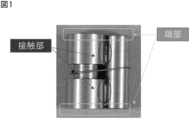
- the dumbbell-shaped steel S45C and the columnar steel SUJ2 were bound at the center to bind the dumbbell-shaped steel S45C and the columnar steel SUJ2 (see FIG. 1). .
- “Steel material S45C” is carbon steel described in JIS G 4051.
- “Steel material SUJ2” is a high carbon chromium bearing steel material described in JIS G 4805.
- "SUS303 wire” is a stainless steel wire described in JIS G 4309. Then, after heating the test piece in a furnace with a mixed gas atmosphere of nitrogen and hydrogen, the test piece was put into the heat-treated oil composition and quenched to conduct a quenching test.
- the conditions for the hardening test were the following two conditions.
- the brightness of the quenched test piece was evaluated based on the following criteria, focusing on "brightness”, “coloration at the edge” and “coloration at the contact portion”. Further, based on the evaluation results of "brightness”, “coloration of edge” and “coloration of contact portion”, the brilliance of the test piece was comprehensively evaluated according to the following criteria.
- (brightness) Appearance samples with predetermined coloring were produced, and the colors of test pieces after quenching and visual observation were compared and evaluated. The degree of coloring of the appearance sample is indicated by the numerical values shown below. 0: No coloring at all. 1: There is light coloring. 2: There is dark brown to black coloring. (Coloring of edges) The end of the test piece (see FIG.
- Evaluation S The sum of the evaluation results for “brightness”, “coloration at the edge”, and “coloration at the contact portion” is 0.
- Evaluation A The sum of the evaluation results for “brightness,” “coloration at the edge,” and “coloration at the contact portion” is 1.
- Evaluation B The sum of the evaluation results for “brightness,” “coloration at the edge,” and “coloration at the contact portion” is 2.
- Evaluation C The sum of the evaluation results for “brightness,” “coloration at the edge,” and “coloration at the contact portion” is 3 or more. Evaluation C was made when any evaluation result was 2 or more.
- the heat-treated oil composition rated as S has extremely excellent luster.
- the heat-treated oil composition evaluated as A has excellent luster.
- the heat-treated oil composition rated as B is slightly inferior in luster.
- the heat-treated oil composition evaluated as C is inferior in luster.
- kinematic viscosity after oxidative deterioration. rate rate (rate of kinematic viscosity increase at 40°C from new oil) was calculated by the following formula.
- (40°C kinematic viscosity increase rate from new oil) [(40°C kinematic viscosity of oil after oxidative deterioration) - (40°C kinematic viscosity of new oil)]/(40°C kinematic viscosity of new oil) It means that the larger the 40° C. kinematic viscosity increase rate from the new oil, the more likely the oxidative deterioration of the heat-treated oil composition progresses. In other words, it means that the heat-treated oil composition has low oxidation stability.
- Table 1 shows the results of evaluating the luster of the heat-treated oil compositions of Examples 1-4 and Comparative Examples 1-7.
- FIG. 2 shows the state of the test pieces after the quenching test using the heat-treated oil compositions of Examples 1-4 and Comparative Examples 1-7.
- Table 2 shows the results of measuring the 40° C. kinematic viscosity of the heat-treated oil compositions of Examples 5-8 and Comparative Examples 8-9.
- Table 2 shows the results of the new oil and the results of the oil after the 24-hour oxidative degradation test for the heat-treated oil composition.
- FIG. 3 shows the state of the test pieces after the quenching test using the heat-treated oil compositions (new oil) of Examples 5-8 and Comparative Examples 8-9.
- ">" means "less than”.
- Table 1 shows the following. From the results shown in Examples 1 to 4, by using the sulfides (B1), (B2), (B3), or (B4) in combination with the carboxylic acid compound (C), the test piece after quenching It can be seen that a heat-treated oil composition having excellent luster can be obtained. On the other hand, when the carboxylic acid compound (C) was used alone as in Comparative Example 2, or when the sulfides (B1), (B2), (B3), or (B4) were used as in Comparative Examples 3 to 6, ) is used alone, the heat-treated oil composition is such that the luster of the test piece after quenching is inferior. Also, in Comparative Example 7, in which calcium sulfonate was used in place of the carboxylic acid compound (C), it was found that the heat-treated oil composition was such that the luster of the test piece after quenching was inferior.
- Table 2 shows the following. From the results shown in Examples 5 to 8, by using the sulfides (B1), (B2), (B3), or (B4) in combination with the carboxylic acid compound (C), the test piece after quenching It can be seen that the brilliance of the heat-treated oil composition is excellent, and the oxidation deterioration of the heat-treated oil composition is less likely to progress, and the oxidation stability of the heat-treated oil composition can be improved.
Landscapes
- Chemical & Material Sciences (AREA)
- Oil, Petroleum & Natural Gas (AREA)
- Organic Chemistry (AREA)
- General Chemical & Material Sciences (AREA)
- Chemical Kinetics & Catalysis (AREA)
- Engineering & Computer Science (AREA)
- Thermal Sciences (AREA)
- Materials Engineering (AREA)
- Metallurgy (AREA)
- Mechanical Engineering (AREA)
- Crystallography & Structural Chemistry (AREA)
- Physics & Mathematics (AREA)
- Lubricants (AREA)
Priority Applications (3)
| Application Number | Priority Date | Filing Date | Title |
|---|---|---|---|
| JP2023538630A JPWO2023008545A1 (https=) | 2021-07-30 | 2022-07-29 | |
| US18/290,844 US20240344157A1 (en) | 2021-07-30 | 2022-07-29 | Heat-treatment oil composition |
| CN202280052645.2A CN117716054A (zh) | 2021-07-30 | 2022-07-29 | 热处理油组合物 |
Applications Claiming Priority (2)
| Application Number | Priority Date | Filing Date | Title |
|---|---|---|---|
| JP2021-126020 | 2021-07-30 | ||
| JP2021126020 | 2021-07-30 |
Publications (1)
| Publication Number | Publication Date |
|---|---|
| WO2023008545A1 true WO2023008545A1 (ja) | 2023-02-02 |
Family
ID=85086985
Family Applications (1)
| Application Number | Title | Priority Date | Filing Date |
|---|---|---|---|
| PCT/JP2022/029228 Ceased WO2023008545A1 (ja) | 2021-07-30 | 2022-07-29 | 熱処理油組成物 |
Country Status (5)
| Country | Link |
|---|---|
| US (1) | US20240344157A1 (https=) |
| JP (1) | JPWO2023008545A1 (https=) |
| CN (1) | CN117716054A (https=) |
| TW (1) | TW202311512A (https=) |
| WO (1) | WO2023008545A1 (https=) |
Citations (6)
| Publication number | Priority date | Publication date | Assignee | Title |
|---|---|---|---|---|
| EP0113157A1 (en) * | 1982-12-30 | 1984-07-11 | EDWIN COOPER & COMPANY LIMITED | Quench oils, concentrates for making quench oils and methods of treating metals |
| JPS61213296A (ja) * | 1985-03-19 | 1986-09-22 | Kao Corp | 金属材料の冷間圧延用潤滑油 |
| JPS6213495A (ja) * | 1985-07-12 | 1987-01-22 | Kao Corp | 金属材料の冷間圧延用潤滑油 |
| JPH08183980A (ja) * | 1994-12-28 | 1996-07-16 | Tonen Corp | 潤滑油組成物 |
| CN105821186A (zh) * | 2016-04-28 | 2016-08-03 | 昌利锻造有限公司 | 一种换挡连杆用淬火油 |
| WO2021157612A1 (ja) * | 2020-02-04 | 2021-08-12 | 出光興産株式会社 | 熱処理油組成物 |
Family Cites Families (2)
| Publication number | Priority date | Publication date | Assignee | Title |
|---|---|---|---|---|
| JP3301446B2 (ja) * | 1991-10-18 | 2002-07-15 | 出光興産株式会社 | 熱処理油組成物 |
| JP2878940B2 (ja) * | 1993-08-31 | 1999-04-05 | 出光興産株式会社 | 熱処理油組成物 |
-
2022
- 2022-07-29 WO PCT/JP2022/029228 patent/WO2023008545A1/ja not_active Ceased
- 2022-07-29 TW TW111128594A patent/TW202311512A/zh unknown
- 2022-07-29 JP JP2023538630A patent/JPWO2023008545A1/ja active Pending
- 2022-07-29 CN CN202280052645.2A patent/CN117716054A/zh active Pending
- 2022-07-29 US US18/290,844 patent/US20240344157A1/en active Pending
Patent Citations (6)
| Publication number | Priority date | Publication date | Assignee | Title |
|---|---|---|---|---|
| EP0113157A1 (en) * | 1982-12-30 | 1984-07-11 | EDWIN COOPER & COMPANY LIMITED | Quench oils, concentrates for making quench oils and methods of treating metals |
| JPS61213296A (ja) * | 1985-03-19 | 1986-09-22 | Kao Corp | 金属材料の冷間圧延用潤滑油 |
| JPS6213495A (ja) * | 1985-07-12 | 1987-01-22 | Kao Corp | 金属材料の冷間圧延用潤滑油 |
| JPH08183980A (ja) * | 1994-12-28 | 1996-07-16 | Tonen Corp | 潤滑油組成物 |
| CN105821186A (zh) * | 2016-04-28 | 2016-08-03 | 昌利锻造有限公司 | 一种换挡连杆用淬火油 |
| WO2021157612A1 (ja) * | 2020-02-04 | 2021-08-12 | 出光興産株式会社 | 熱処理油組成物 |
Also Published As
| Publication number | Publication date |
|---|---|
| US20240344157A1 (en) | 2024-10-17 |
| TW202311512A (zh) | 2023-03-16 |
| CN117716054A (zh) | 2024-03-15 |
| JPWO2023008545A1 (https=) | 2023-02-02 |
Similar Documents
| Publication | Publication Date | Title |
|---|---|---|
| JP7722846B2 (ja) | 熱処理油組成物 | |
| EP2113021B1 (en) | Method for making a lubricant base oil and its use | |
| CN101198680B (zh) | 氧化稳定的油配制物 | |
| US9869001B2 (en) | Heat treatment oil composition | |
| US20070129268A1 (en) | Lubricating oil composition | |
| WO2021252143A1 (en) | Lubricants having improved low temperature, oxidation and deposit control performance | |
| EP3795663A1 (en) | Lubricant composition | |
| JP7653374B2 (ja) | 熱処理油組成物 | |
| JP5490434B2 (ja) | 熱処理油組成物 | |
| JP7699949B2 (ja) | 熱処理油 | |
| WO2023008545A1 (ja) | 熱処理油組成物 | |
| EP4162014A1 (en) | Lubricants having improved oxidation and deposit control performance | |
| JP2024146557A (ja) | 熱処理油組成物 | |
| JP2025154115A (ja) | 熱処理油 |
Legal Events
| Date | Code | Title | Description |
|---|---|---|---|
| 121 | Ep: the epo has been informed by wipo that ep was designated in this application |
Ref document number: 22849605 Country of ref document: EP Kind code of ref document: A1 |
|
| WWE | Wipo information: entry into national phase |
Ref document number: 2023538630 Country of ref document: JP |
|
| WWE | Wipo information: entry into national phase |
Ref document number: 18290844 Country of ref document: US |
|
| WWE | Wipo information: entry into national phase |
Ref document number: 202447004888 Country of ref document: IN |
|
| WWE | Wipo information: entry into national phase |
Ref document number: 202280052645.2 Country of ref document: CN |
|
| NENP | Non-entry into the national phase |
Ref country code: DE |
|
| 122 | Ep: pct application non-entry in european phase |
Ref document number: 22849605 Country of ref document: EP Kind code of ref document: A1 |