WO2022259294A1 - 早期被害予測装置、早期被害予測方法、及び、早期被害予測プログラム - Google Patents
早期被害予測装置、早期被害予測方法、及び、早期被害予測プログラム Download PDFInfo
- Publication number
- WO2022259294A1 WO2022259294A1 PCT/JP2021/021526 JP2021021526W WO2022259294A1 WO 2022259294 A1 WO2022259294 A1 WO 2022259294A1 JP 2021021526 W JP2021021526 W JP 2021021526W WO 2022259294 A1 WO2022259294 A1 WO 2022259294A1
- Authority
- WO
- WIPO (PCT)
- Prior art keywords
- failure
- damage prediction
- degree
- section
- equipment
- Prior art date
- Legal status (The legal status is an assumption and is not a legal conclusion. Google has not performed a legal analysis and makes no representation as to the accuracy of the status listed.)
- Ceased
Links
Images

Classifications
-
- G—PHYSICS
- G06—COMPUTING OR CALCULATING; COUNTING
- G06Q—INFORMATION AND COMMUNICATION TECHNOLOGY [ICT] SPECIALLY ADAPTED FOR ADMINISTRATIVE, COMMERCIAL, FINANCIAL, MANAGERIAL OR SUPERVISORY PURPOSES; SYSTEMS OR METHODS SPECIALLY ADAPTED FOR ADMINISTRATIVE, COMMERCIAL, FINANCIAL, MANAGERIAL OR SUPERVISORY PURPOSES, NOT OTHERWISE PROVIDED FOR
- G06Q50/00—Information and communication technology [ICT] specially adapted for implementation of business processes of specific business sectors, e.g. utilities or tourism
Definitions
- the present invention relates to an early damage prediction device, an early damage prediction method, and an early damage prediction program.
- Non-Patent Document 1 In order to prepare for typhoon damage, the Japan Meteorological Agency provides typhoon track and intensity forecasts five days in advance (see Non-Patent Document 1).
- the present invention has been made in view of the above circumstances, and the purpose of the present invention is to provide a technology that can predict the damage caused by future typhoons from the failure status of equipment caused by past typhoons.
- An early damage prediction device is an early damage prediction device that predicts damage caused by a future typhoon based on failure conditions of facilities caused by past typhoons, wherein the degrees of failure of facilities caused by past typhoons are displayed in fixed units on a map.
- a calculation unit that calculates for each section and for each time, learns the relationship between the degree of failure of equipment for each section and for each time, and the intensity of the past typhoon
- a generation unit that generates a damage prediction learning model capable of predicting the degree of equipment failure, and using the damage prediction learning model, predicts and calculates the degree of equipment failure for each section and time based on the path and intensity forecast of the generated typhoon. and a determination unit that determines the degree of damage caused by the generated typhoon in each section and at each time by using the degree of failure of the equipment for each section and each time and the area information for each section.
- An early damage prediction method of one aspect of the present invention is an early damage prediction method for predicting damage caused by a future typhoon based on failure conditions of facilities caused by past typhoons, wherein an early damage prediction device estimates the degree of failure of facilities caused by past typhoons.
- a step of calculating for each section of a fixed unit on the map and for each time, learning the relationship between the degree of failure of the equipment for each section and for each time and the strength of the past typhoon, and calculating the section from the typhoon course and strength forecast a step of generating a damage prediction learning model capable of predicting the degree of failure of equipment for each period and time; and determining the degree of damage caused by the generated typhoon in each section and at each time by using the failure rate of the equipment for each section and each time and the area information for each section. conduct.
- the early damage prediction program of one aspect of the present invention causes a computer to function as the early damage prediction device.
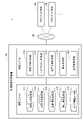
- FIG. 1 is a diagram showing the overall configuration of an early damage prediction system.
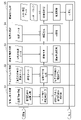
- FIG. 2 is a diagram showing a processing flow of the early damage prediction device.
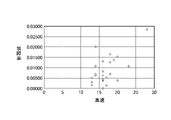
- FIG. 3 is a diagram showing an example of a correlation graph.
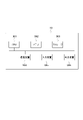
- FIG. 4 is a diagram showing a display example of the degree of damage.
- FIG. 5 is a diagram showing the hardware configuration of the early damage prediction device.
- the present invention discloses a technology capable of predicting damage caused by future typhoons based on failure conditions of facilities caused by past typhoons. Specifically, based on typhoon failure information on equipment possessed by local governments, infrastructure companies, general companies, etc., the degree of damage to equipment due to typhoons that will land in the future is predicted, and the degree of damage to each region is calculated from the degree of damage to the equipment. judge.
- the failure rate of infrastructure such as communication lines and power lines due to past typhoons is accumulated in time series for each section of a certain unit on the map, and the degree of failure of infrastructure in each section, the strength of the typhoon, the number of power outages, and the amount of rainfall.
- Generate a damage prediction learning model that has learned the relationship between Then, the course and intensity forecast of the generated typhoon are input to the damage prediction learning model to predict the degree of damage to the infrastructure, and the degree of damage in each area is determined in consideration of area information such as population. This will enable preemptive crisis response.
- FIG. 1 is a diagram showing the overall configuration of an early damage prediction system.
- the early damage prediction system 1 includes an early damage prediction device 10 for early prediction of typhoon damage, and a plurality of client terminals 20 for processing damage prediction results predicted by the early damage prediction device 10 .
- the early damage prediction device 10 and the plurality of client terminals 20 are physically and electrically connected via a communication network 30 so as to be mutually communicable.
- the client terminal 20 is a client device used by a user. Users are, for example, employees of municipalities, employees of infrastructure companies and general companies.
- the client terminal 20 has a function of transmitting to the early damage prediction apparatus 10 various data necessary for creating a typhoon damage prediction result according to an input command input by a user.
- the client terminal 20 also has a function of receiving damage prediction results predicted by the early damage prediction device 10, displaying the damage prediction results on a display device, printing them on a printing device, and transferring them to other devices.
- the early damage prediction device 10 is a server device that predicts regional damage caused by future typhoons based on equipment failure conditions caused by past typhoons.
- Facilities are, for example, communication facilities and power facilities.
- the early damage prediction device 10 may function as one device of a Geographic Information System (GIS) that creates, stores, uses, manages, displays, and searches geographic information and additional information on a computer.
- GIS Geographic Information System
- the early damage prediction apparatus 10 includes a failure information storage unit 111, a map information storage unit 112, and a weather data storage unit as storage units for storing information or data for creating damage prediction results due to a typhoon.
- An information storage unit 113 , a power failure information storage unit 114 , and an area information storage unit 115 are provided.
- the failure information storage unit 111 has a function of storing facility failure information.
- Equipment failure information is, for example, the failure rate of communication lines and the failure rate of power lines.
- the map information storage unit 112 has a function of storing digital map data of all over Japan.
- the weather information storage unit 113 has a function of storing weather data provided by the Japan Meteorological Agency, weather companies, and the like.
- Meteorological data is, for example, the intensity (wind speed) of a typhoon that occurred at a given latitude and longitude on a given date and time, the magnitude (radius) of the typhoon, the speed of the typhoon, the path of the typhoon (latitude and longitude), and the amount of rainfall caused by the typhoon.
- the power outage information storage unit 114 has a function of storing power outage data provided by the power company.
- the power failure data is, for example, the date and time when the power failure occurred, the address, and the date and time when the power failure was restored, and the address.
- the area information storage unit 115 has a function of storing area information.
- the area information is, for example, the population in the area, the number of buildings (the number of houses, etc.) in the area, and the hazard map of the area.
- the early damage prediction device 10 includes a failure information generation unit 116, an algorithm generation unit 117, and a damage prediction analysis unit 118 as control units for creating damage prediction results due to typhoons. , a map generation unit 119 and a damage degree determination unit 120 .
- the failure information generation unit (calculation unit) 116 has a function of calculating the degree of failure of equipment due to past typhoons for each section of a fixed unit on the map and for each time.
- the algorithm generation unit (generation unit) 117 learns the relationship between the degree of equipment failure for each section and for each time, the intensity of past typhoons, the number of power outages caused by past typhoons, and the amount of rainfall caused by past typhoons. It has a function to generate a damage prediction learning model that can predict the degree of equipment failure for each section and time from the course and intensity forecast.
- the damage prediction analysis unit (analysis unit) 118 has a function of predicting and calculating the degree of equipment failure for each section and time from the course and strength forecast of the generated typhoon using the damage prediction learning model.
- the map generation unit 119 has a function of displaying the predicted and calculated degree of failure of equipment in each section in an area within the section, and further displaying area information of each area.
- the area information is, for example, the population in the area, the number of buildings (the number of houses, etc.) in the area, and the hazard map of the area.
- the map generation unit 119 has a function of displaying each area by color-coding according to the degree of equipment failure and the degree of damage in the area.
- a damage degree determination unit (determination unit) 120 determines the degree of damage caused by the generated typhoon in each section and at each time using the predicted and calculated equipment failure degree for each section and time and area information for each section. It has a function to (determine, calculate).
- FIG. 2 is a diagram showing a processing flow of the early damage prediction device.
- the early damage prediction device 10 performs learning processing for learning damage prediction of facilities, prediction processing for predicting the degree of failure of facilities from the course and intensity forecast of the generated typhoon, and determining the degree of damage to the area from the degree of failure of the facility. and run
- Step S1; Step S1 is a learning process.
- the failure information generation unit 116 uses communication line information in which the communication line ID, position, etc. are set, and communication line failure information in which the date and time of the communication line failure, the ID of the failed communication line, etc. are set. , Calculate the failure rate of communication lines caused by past typhoons in time series for each fixed unit block on the map. For example, the failure information generation unit 116 divides the number of failures of communication lines in each area, which is obtained by dividing the area on the map into meshes in units of 10 km, by the total number of communication lines in the same area. Calculate the failure rate of communication lines in the area. By calculating the failure rate of the communication line for each area of a certain distance, the secrecy of the communication line information and the communication line failure information, which are generally treated as private information, can be maintained.
- Step S2; Step S2 is also a learning process.
- the early damage prediction device 10 provides each area with information on power outages due to past typhoons (whether there were power outages, the number of power outages, etc.) as equipment failure information. In addition, the early damage prediction device 10 provides each area with the intensity of a typhoon and the amount of precipitation due to the typhoon as past typhoon information. After that, the algorithm generation unit 117 learns the relationship between the failure rate of the communication line, the strength of the typhoon, the number of power outages due to the typhoon, and the amount of precipitation due to the typhoon for each mesh area of 10 km units and for each time series.
- the damage prediction learning model is based on "the failure rate of the communication line for each 10 km unit mesh area", “the past typhoon data for each 10 km unit mesh area”, and “the 10 km unit mesh area”. It is a learning model that multiplies past power outage data for each area.
- the algorithm generation unit 117 creates teacher data from past typhoon wind speed data, rainfall data, power outage data, and communication line failure rates, and can predict communication line failure rates from the teacher data. Generate a damage prediction learning model. For example, the algorithm generation unit 117 creates CSV data having the date and time for each area, the maximum wind speed for each date and time, rainfall, power failure information, and communication line failure rate, and the communication line failure rate, power failure number, and rainfall rate for the maximum wind speed. Generate a correlation graph of An example of a correlation graph between maximum wind speed and communication line failure rate is shown in FIG. Note that the algorithm generation unit 117 may generate the correlation graph by deleting data that is not affected by the typhoon (maximum wind speed of 15 m/s or less, etc.) from the CSV data.
- Step S3; Step S3 is a prediction process.
- the damage prediction analysis unit 118 inputs the position data and wind speed data of the generated typhoon into the damage prediction learning model, and causes the damage prediction learning model to perform program processing, so that each area corresponding to the position and wind speed of the typhoon. Predict and calculate the failure rate of communication lines. For example, the damage prediction analysis unit 118 calculates the failure rate of the communication line corresponding to the maximum wind speed from the correlation graph shown in FIG.
- Step S4; Step S4 is also prediction processing.
- the map generation unit 119 displays the predicted and calculated failure rate of the communication line in each area, and displays each area by color-coding according to the failure rate of the communication line.
- the map generator 119 also mashes up the population in the area, the house data in the area, the building data in the area, and the hazard map of the area into each area.
- Step S5; Step S5 is also prediction processing.
- the damage degree determination unit 120 uses the predicted and calculated failure degree of the communication line in each area, the population in the area, the house data in the area, the building data in the area, and the hazard map of the area to determine the degree of damage caused by the typhoon. Determine the degree of damage in each area in chronological order.
- the degree of damage is defined as "predicted value of communication line failure rate for each mesh area of 10 km unit", “population data for each mesh area of 10 km unit", and “mesh area of 10 km unit”. "house data for each area”, “building data for each mesh area in units of 10 km”, and “hazard map for each mesh area in units of 10 km”.
- the damage degree determination unit 120 can calculate the degree of damage using any information or data used in the previous calculations, either alone or in any combination. For example, the damage level determination unit 120 first determines the failure risk level f1 of the communication line within the range of level 1 to level 3 according to the failure rate of the communication line predicted and calculated in step S3. set for each Further, the damage degree determination unit 120 sets the power outage risk f2 within the range of level 1 to level 3 for each area according to the number of power outages of the typhoon predicted from the correlation graph between the maximum wind speed and the number of power outages. Then, the damage degree determination unit 120 incorporates the population data, house data, and hazard map of the national census into the map, and estimates human damage and house damage, thereby determining the degree of damage in each area.
- the map generation unit 119 displays each area by color-coding according to the degree of damage.
- FIG. 4 shows a display example of the degree of damage in each area.
- the early damage prediction device 10 includes the failure information generation unit 116 that calculates the degree of failure of equipment due to past typhoons for each section of a fixed unit on the map and for each time, and for each section and each time.
- Algorithm generation unit that learns the relationship between the degree of equipment failure and the strength of the past typhoon, and generates a damage prediction learning model that can predict the degree of equipment failure for each section and time from the course and intensity forecast of the typhoon 117, a damage prediction analysis unit 118 that predicts and calculates the degree of failure of equipment for each section and for each time from the course and intensity forecast of the generated typhoon using the damage prediction learning model, and the equipment for each section and each time and a damage degree determination unit 120 that determines the degree of damage for each section and each time due to the generated typhoon using the failure degree and area information for each section.
- the early damage prediction device 10 of the present embodiment described above includes, for example, a CPU 901, a memory 902, a storage 903, a communication device 904, an input device 905, and an output device 906, as shown in FIG. It can be realized using a general-purpose computer system equipped with.
- Memory 902 and storage 903 are storage devices.
- each function of the early damage prediction apparatus 10 is realized by executing a predetermined program loaded on the memory 902 by the CPU 901 .
- the early damage prediction device 10 may be implemented by one computer.
- the early damage prediction device 10 may be implemented by multiple computers.
- the early damage prediction device 10 may be a virtual machine implemented on a computer.
- a program for the early damage prediction device 10 can be stored in computer-readable recording media such as HDD, SSD, USB memory, CD, and DVD.
- a program for the early damage prediction device 10 can also be distributed via a communication network.
Landscapes
- Business, Economics & Management (AREA)
- Health & Medical Sciences (AREA)
- Economics (AREA)
- General Health & Medical Sciences (AREA)
- Human Resources & Organizations (AREA)
- Marketing (AREA)
- Primary Health Care (AREA)
- Strategic Management (AREA)
- Tourism & Hospitality (AREA)
- Physics & Mathematics (AREA)
- General Business, Economics & Management (AREA)
- General Physics & Mathematics (AREA)
- Engineering & Computer Science (AREA)
- Theoretical Computer Science (AREA)
- Management, Administration, Business Operations System, And Electronic Commerce (AREA)
Priority Applications (2)
| Application Number | Priority Date | Filing Date | Title |
|---|---|---|---|
| PCT/JP2021/021526 WO2022259294A1 (ja) | 2021-06-07 | 2021-06-07 | 早期被害予測装置、早期被害予測方法、及び、早期被害予測プログラム |
| JP2023527138A JPWO2022259294A1 (https=) | 2021-06-07 | 2021-06-07 |
Applications Claiming Priority (1)
| Application Number | Priority Date | Filing Date | Title |
|---|---|---|---|
| PCT/JP2021/021526 WO2022259294A1 (ja) | 2021-06-07 | 2021-06-07 | 早期被害予測装置、早期被害予測方法、及び、早期被害予測プログラム |
Publications (1)
| Publication Number | Publication Date |
|---|---|
| WO2022259294A1 true WO2022259294A1 (ja) | 2022-12-15 |
Family
ID=84424963
Family Applications (1)
| Application Number | Title | Priority Date | Filing Date |
|---|---|---|---|
| PCT/JP2021/021526 Ceased WO2022259294A1 (ja) | 2021-06-07 | 2021-06-07 | 早期被害予測装置、早期被害予測方法、及び、早期被害予測プログラム |
Country Status (2)
| Country | Link |
|---|---|
| JP (1) | JPWO2022259294A1 (https=) |
| WO (1) | WO2022259294A1 (https=) |
Cited By (3)
| Publication number | Priority date | Publication date | Assignee | Title |
|---|---|---|---|---|
| WO2025004454A1 (ja) * | 2023-06-30 | 2025-01-02 | 株式会社日立製作所 | インシデント対応支援システム及びインシデント対応支援方法 |
| CN119832711A (zh) * | 2024-12-23 | 2025-04-15 | 广西电网有限责任公司 | 光伏场站热带气旋预警方法、装置、设备和介质 |
| WO2025126438A1 (ja) * | 2023-12-14 | 2025-06-19 | 日本電信電話株式会社 | 予測装置 |
Citations (5)
| Publication number | Priority date | Publication date | Assignee | Title |
|---|---|---|---|---|
| JP2007256183A (ja) * | 2006-03-24 | 2007-10-04 | Tokyo Electric Power Co Inc:The | 台風による災害発生予測システム |
| JP2008225564A (ja) * | 2007-03-08 | 2008-09-25 | Central Res Inst Of Electric Power Ind | 被害関数作成方法、装置およびプログラム並びに台風の風速・風向予測方法、装置およびプログラム並びに台風被害予測方法、装置およびプログラム |
| JP2010049433A (ja) * | 2008-08-21 | 2010-03-04 | Chugoku Electric Power Co Inc:The | 台風被害予測支援システム |
| CN103177301A (zh) * | 2013-03-12 | 2013-06-26 | 南京信息工程大学 | 一种台风灾害风险预估方法 |
| US20170039307A1 (en) * | 2015-08-07 | 2017-02-09 | Qrisq Analytics, LLC | Large scale analysis of catastrophic weather damage |
-
2021
- 2021-06-07 WO PCT/JP2021/021526 patent/WO2022259294A1/ja not_active Ceased
- 2021-06-07 JP JP2023527138A patent/JPWO2022259294A1/ja active Pending
Patent Citations (5)
| Publication number | Priority date | Publication date | Assignee | Title |
|---|---|---|---|---|
| JP2007256183A (ja) * | 2006-03-24 | 2007-10-04 | Tokyo Electric Power Co Inc:The | 台風による災害発生予測システム |
| JP2008225564A (ja) * | 2007-03-08 | 2008-09-25 | Central Res Inst Of Electric Power Ind | 被害関数作成方法、装置およびプログラム並びに台風の風速・風向予測方法、装置およびプログラム並びに台風被害予測方法、装置およびプログラム |
| JP2010049433A (ja) * | 2008-08-21 | 2010-03-04 | Chugoku Electric Power Co Inc:The | 台風被害予測支援システム |
| CN103177301A (zh) * | 2013-03-12 | 2013-06-26 | 南京信息工程大学 | 一种台风灾害风险预估方法 |
| US20170039307A1 (en) * | 2015-08-07 | 2017-02-09 | Qrisq Analytics, LLC | Large scale analysis of catastrophic weather damage |
Non-Patent Citations (1)
| Title |
|---|
| TAKATA, HITOSHI ET AL.: "A Prediction Method of Damage by Typhoons to Power Systems in Kagoshima via Linear Regression Model and Neural Network", JOURNAL OF SIGNAL PROCESSING, vol. 3, no. 6, 4 March 2008 (2008-03-04), pages 455 - 461, XP009541856, ISSN: 1342-6230 * |
Cited By (3)
| Publication number | Priority date | Publication date | Assignee | Title |
|---|---|---|---|---|
| WO2025004454A1 (ja) * | 2023-06-30 | 2025-01-02 | 株式会社日立製作所 | インシデント対応支援システム及びインシデント対応支援方法 |
| WO2025126438A1 (ja) * | 2023-12-14 | 2025-06-19 | 日本電信電話株式会社 | 予測装置 |
| CN119832711A (zh) * | 2024-12-23 | 2025-04-15 | 广西电网有限责任公司 | 光伏场站热带气旋预警方法、装置、设备和介质 |
Also Published As
| Publication number | Publication date |
|---|---|
| JPWO2022259294A1 (https=) | 2022-12-15 |
Similar Documents
| Publication | Publication Date | Title |
|---|---|---|
| Liu et al. | A planning-oriented resilience assessment framework for transmission systems under typhoon disasters | |
| US12244267B2 (en) | Systems and methods for distributed-solar power forecasting using parameter regularization | |
| Xu et al. | Improving repair sequence scheduling methods for postdisaster critical infrastructure systems | |
| Nateghi et al. | Comparison and validation of statistical methods for predicting power outage durations in the event of hurricanes | |
| Zorn et al. | Evaluating the magnitude and spatial extent of disruptions across interdependent national infrastructure networks | |
| Amini et al. | Electrical energy systems resilience: A comprehensive review on definitions, challenges, enhancements and future proceedings | |
| Panteli et al. | Assessment of the resilience of transmission networks to extreme wind events | |
| WO2022259294A1 (ja) | 早期被害予測装置、早期被害予測方法、及び、早期被害予測プログラム | |
| US20230315955A1 (en) | System and method for optimizing utility pipe sensors placement using artificial intelligence technology | |
| WO2018071344A1 (en) | Systems and methods for system measurements integrity determination | |
| Ahmadi et al. | Decomposition-based stacked bagging boosting ensemble for dynamic line rating forecasting | |
| Wisetjindawat et al. | Stochastic modeling of road system performance during multihazard events: Flash floods and earthquakes | |
| KR102495864B1 (ko) | 디지털 트윈 모델을 도출하는 장치, 방법 및 컴퓨터 프로그램 | |
| CN118396213A (zh) | 一种极端天气下电网区域性精细化风险预测方法及系统 | |
| Onaolapo et al. | Event-driven power outage prediction using collaborative neural networks | |
| US20220344936A1 (en) | Estimation of distribution network recovery after disaster | |
| Fanucchi et al. | Stochastic indexes for power distribution systems resilience analysis | |
| Angalakudati et al. | Improving emergency storm planning using machine learning | |
| Rod et al. | Recoverability modeling of power distribution systems using accelerated life models: Case of power cut due to extreme weather events in Norway | |
| JP2021068070A (ja) | 事故原因予測装置、事故原因予測システム、事故原因予測方法、及び、事故原因予測プログラム | |
| US11704458B2 (en) | System and method for optimizing utility pipe sensors placement using artificial intelligence technology | |
| Jamal et al. | Strengthening infrastructure resilience to hurricanes by modeling transportation and electric power network interdependencies | |
| Whipple | Predictive storm damage modeling and optimizing crew response to improve storm response operations | |
| CN111027827B (zh) | 保底通信网运行风险分析的方法、装置及计算机设备 | |
| Handa et al. | A Bayesian approach for estimating the post-earthquake recovery trajectories of electric power systems in Japan |
Legal Events
| Date | Code | Title | Description |
|---|---|---|---|
| 121 | Ep: the epo has been informed by wipo that ep was designated in this application |
Ref document number: 21944975 Country of ref document: EP Kind code of ref document: A1 |
|
| WWE | Wipo information: entry into national phase |
Ref document number: 2023527138 Country of ref document: JP |
|
| NENP | Non-entry into the national phase |
Ref country code: DE |
|
| 122 | Ep: pct application non-entry in european phase |
Ref document number: 21944975 Country of ref document: EP Kind code of ref document: A1 |