WO2022254605A1 - 球技用ボール - Google Patents
球技用ボール Download PDFInfo
- Publication number
- WO2022254605A1 WO2022254605A1 PCT/JP2021/020979 JP2021020979W WO2022254605A1 WO 2022254605 A1 WO2022254605 A1 WO 2022254605A1 JP 2021020979 W JP2021020979 W JP 2021020979W WO 2022254605 A1 WO2022254605 A1 WO 2022254605A1
- Authority
- WO
- WIPO (PCT)
- Prior art keywords
- ball
- held
- internal space
- poles
- center
- Prior art date
- Legal status (The legal status is an assumption and is not a legal conclusion. Google has not performed a legal analysis and makes no representation as to the accuracy of the status listed.)
- Ceased
Links
Images




Classifications
-
- A—HUMAN NECESSITIES
- A63—SPORTS; GAMES; AMUSEMENTS
- A63B—APPARATUS FOR PHYSICAL TRAINING, GYMNASTICS, SWIMMING, CLIMBING, OR FENCING; BALL GAMES; TRAINING EQUIPMENT
- A63B43/00—Balls with special arrangements
- A63B43/04—Balls with special arrangements with an eccentric centre of gravity; with mechanism for changing the centre of gravity
-
- A—HUMAN NECESSITIES
- A63—SPORTS; GAMES; AMUSEMENTS
- A63B—APPARATUS FOR PHYSICAL TRAINING, GYMNASTICS, SWIMMING, CLIMBING, OR FENCING; BALL GAMES; TRAINING EQUIPMENT
- A63B41/00—Hollow inflatable balls
-
- A—HUMAN NECESSITIES
- A63—SPORTS; GAMES; AMUSEMENTS
- A63B—APPARATUS FOR PHYSICAL TRAINING, GYMNASTICS, SWIMMING, CLIMBING, OR FENCING; BALL GAMES; TRAINING EQUIPMENT
- A63B41/00—Hollow inflatable balls
- A63B2041/005—Hollow inflatable balls with counterweight for adjusting the centre of gravity
-
- A—HUMAN NECESSITIES
- A63—SPORTS; GAMES; AMUSEMENTS
- A63B—APPARATUS FOR PHYSICAL TRAINING, GYMNASTICS, SWIMMING, CLIMBING, OR FENCING; BALL GAMES; TRAINING EQUIPMENT
- A63B2209/00—Characteristics of used materials
Definitions
- the present invention relates to balls for ball games.
- Patent Document 1 balls for ball games used for sports such as soccer balls and volleyball and for practice thereof are known (see Patent Document 1, for example).
- the ball for ball games described in Patent Literature 1 is formed transparent, and the vicinity of the central portion can be seen through from the outside.
- This transparent ball is provided with a display arrow indicating the target direction in which the ball is to be carried and a display arrow indicating the direction in which the ball is to be rotated.
- a non-spin ball is produced with high accuracy, and by hitting a position deviated from the center of the ball, a ball such as a curve ball (hereinafter referred to as It is called a breaking ball.) is produced with high accuracy. Therefore, if the central body can be maintained at the center of the ball, the player can use the central body to make the player aware of the center of the ball, and to hit the center of the ball or a position deviated from the center of the ball. Training contributes to efficient training for improving ball control skills.
- the holding structure that holds the central body is a rigid structure using a support rod or the like that fixes the central body to the outer skin at the center of the sphere, the central body cannot be moved radially from the center of the sphere. , there is a limit to improving ball control technology.
- the present invention has been made in view of the above points, and is a ball game in which a held body as a central body can be easily moved radially and eccentrically while being held near the center of the ball within the internal space.
- the purpose is to provide a ball for
- One aspect of the present invention includes a spherical skin part at least partially transparent so that the inside of the internal space can be seen from the outside, and the skin part extending in the internal space so as to connect the two poles of the skin part. and a tubular holding portion having an enclosing space, and an object to be held held in the enclosing space between the two poles so as to be visible, wherein the tubular holding portion is provided between the two poles.
- a ball for ball games having a spirally twisted shape.
- the cylindrical holding portion that is spirally twisted between the two poles of the outer skin portion holds the object to be held near the center of the sphere in the internal space, while allowing the object to be held to be easily moved in the radial direction and eccentrically moved.
- FIG. 1 is a perspective view of a ball for ball games according to one embodiment of the present invention
- FIG. 1 is an exploded view of a ball game ball according to an embodiment (only one of a plurality of boat-shaped members having the same shape is shown)
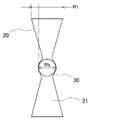
- FIG. 2 is a schematic diagram showing the relationship between a cylindrical holding portion and a held body and a structure for holding the held body at the center of the ball in the ball for ball game of the embodiment.
- FIG. 4 is a diagram showing the relationship between a held body and communication holes in the skin portion of the ball for ball games of the embodiment.
- FIG. 10 is a configuration diagram of a cylindrical holding body included in a ball game ball according to a modification.
- the ball game ball 1 of the present embodiment is, for example, a soccer ball, a volleyball, a basketball, a golf ball, a baseball ball, a tennis ball, etc., and is a spherical ball used for competition or practice. be.
- Ball game ball 1 is a transparent ball that allows the object to be held near the center of the ball to be visually recognized through a transparent skin. Ball game ball 1 is used in a state in which high-pressure air is sealed in the internal space.
- the ball game ball 1 includes a skin portion 10, a cylindrical holding portion 20, and a held body 30. As shown in FIGS. 1 and 2, the ball game ball 1 includes a skin portion 10, a cylindrical holding portion 20, and a held body 30. As shown in FIGS. 1 and 2, the ball game ball 1 includes a skin portion 10, a cylindrical holding portion 20, and a held body 30. As shown in FIGS. 1 and 2, the ball game ball 1 includes a skin portion 10, a cylindrical holding portion 20, and a held body 30. As shown in FIGS.
- the skin part 10 is a part that constitutes the spherical skin of the ball 1 for ball games.
- the skin portion 10 is made of a flexible material such as polyvinyl chloride. At least a portion of the skin portion 10 is transparent, and is configured so that the inside of the internal space (especially the vicinity of the center of the sphere) can be visually recognized from the outside.
- the skin portion 10 is made of a transparent or translucent material.
- the skin portion 10 is configured by compressing a plurality of members by heat or the like.
- the skin portion 10 is composed of a circular pole member 11 and a boat-shaped member 12 .
- the circular pole member 11 is a member arranged at the opposing two poles N and S of the ball 1 for ball games.
- the circular pole member 11 is formed in a circular shape.
- Two circular pole members 11 are provided corresponding to the N and S poles.
- the boat-shaped member 12 is a member that constitutes a portion of the ball for ball 1 other than the poles N and S. As shown in FIG.
- the boat-shaped member 12 is formed in the shape of a boat.
- a plurality (for example, six) of the boat-shaped members 12 are provided so as to line up around the axis connecting the two poles N and S.
- Each boat-shaped member 12 is in contact with the outer edge of the peripherally adjacent boat-shaped member 12 (specifically, the axial central portion of the outer edge) and is in contact with a portion of the outer periphery of the circular pole member 11 .
- the skin portion 10 of the ball 1 for ball games is formed by crimping a plurality of boat-shaped members 12 and circular pole members 11 of both poles N and S in contact with each other at their outer edges.
- an internal space 13 surrounded by the skin portion 10 is formed in the skin portion 10 .
- the epidermis 10 has air holes 14 and blocking plugs 15 .
- the air hole 14 is a hole through which the external air introduced into the internal space 13 and the internal air discharged outward from the internal space 13 pass.
- the air holes 14 are provided in one of the plurality of boat members 12 . That is, the air hole 14 is provided at a location different from the two poles N and S where the circular pole member 11 of the skin portion 10 is arranged. Specifically, the air hole 14 is formed near the middle of the two contact ends of the boat-shaped member 12 where the two circular pole members 11 contact.
- the blocking plug 15 is a part that blocks the air hole 14 .
- the blocking plug 15 is attached around the air hole 14 in the boat-shaped member 12 .
- the blocking plug 15 is detachable from the air hole 14 .
- the internal space 13 is closed.
- ball game ball 1 is held in a state in which air is enclosed in internal space 13 .
- the internal space 13 is filled with high-pressure air, the internal space 13, that is, the skin portion 10 and the ball 1 for ball games is formed into a spherical shape.
- the cylindrical holding part 20 is a part that holds the object to be held 30 .
- the cylindrical holding portion 20 is configured using a member formed in a cylindrical shape, and is capable of forming an encapsulating space 21 .
- the inclusion space 21 can include and hold the object to be held 30 .
- the cylindrical holding portion 20 is formed of a material such as polyvinyl chloride that can change its shape, for example, having flexibility. Note that the cylindrical holding portion 20 may be made of cloth or paper as long as it holds the held body 30 inside. At least a portion of the cylindrical holding portion 20 is formed transparent, and is configured so that the inside of the encapsulating space 21 (particularly near the center of the sphere) can be visually recognized from the outside.
- the cylindrical holding portion 20 is made of a transparent or translucent material.
- the cylindrical holding portion 20 is formed such that the maximum diameter R1 of the inner envelope space 21 is greater than or equal to the outer diameter Rb of the held body 30 (preferably larger than the outer diameter Rb) ( See Figure 3).
- the object to be held 30 can move within the enclosing space 21 .
- the tubular holding part 20 has a structure in which tubular ends on both sides are opened, and the object to be held 30 can be inserted into the internal space 21 from the tubular ends.
- the cylindrical holding part 20 is arranged inside the internal space 13 of the outer skin part 10 .
- Cylindrical holding portion 20 is provided so as to extend so as to connect two poles N and S of skin portion 10 in internal space 13 .
- the cylindrical holding portion 20 is formed as a part of the ball 1 by pressing the edges of the cylindrical end portions on both sides to the inner surface of the skin portion 10 near the joint portion between the circular pole member 11 and the boat-shaped member 12 . Configured.
- the inner space 13 of the outer skin portion 10 and the internal space 21 of the cylindrical holding portion 20 are separated without communicating with each other.
- the cylindrical holding part 20 holds the object to be held 30 in the internal space 21 so that it can be visually recognized near the center between the two poles N and S of the skin part 10 .
- the cylindrical holding part 20 is crimped to the inner surface of the skin part 10 in the vicinity of the junction between the circular pole member 11 and the boat-shaped member 12 while being spirally twisted between the two poles N and S of the skin part 10 .
- the tubular holding portion 20 has a spirally twisted shape between the two poles N and S of the skin portion 10, as shown in FIGS.
- the torsion angle of the cylindrical holding portion 20 is set to such an angle that the cylindrical holding portion 20 covers substantially the entire surface of the held body 30 between the two poles N and S.
- the twist angle between the two poles N and S is preferably 180° or more and 270° or less, more preferably around 225°.
- the torsion angle described above is such that when the ball game ball 1 is used with the air pressure in the internal space 13 higher than a predetermined value, the object to be held 30 is positioned at the two poles N of the skin portion 10 in the internal space 21 . , S (particularly, near the center where the two poles N and S are connected) is suppressed from moving in the radial direction, and the air pressure in the internal space 13 becomes lower than a predetermined value.
- the angle is set so that the object to be held 30 in the enclosing space 21 can be moved in the radial direction by the force of a human hand.
- the player in ball games, it is important for the player to relax and loosen his/her body to handle the ball 1 for ball games in order to improve ball control technique. That is, when the player does not apply enough force to hit the ball 1, it becomes difficult for the player to control the ball.
- the easiness of movement of the object to be held 30 within the encapsulating space 21 changes according to the torsion angle even if the ball game ball 1 is hit with the same amount of force. Specifically, when the torsion angle is small, the movement is likely to occur, while when the torsion angle is large, the movement is difficult to occur.
- the torsion angle is set so that the ball game ball 1 is used while the air pressure in the internal space 13 is within a proper predetermined range, and the ball game ball 1 is hit with an appropriate amount of force.
- the object 30 to be held in the enclosing space 21 is not easily moved in the radial direction. is set to a boundary value that moves radially.
- the setting of the torsion angle when the ball game ball 1 is struck with a force exceeding an appropriate force, the object to be held 30 in the internal space 21 moves in the radial direction. By confirming the position of the object to be held 30 in the enclosed space 21 after handling the ball 1, it is possible to confirm whether or not the player hit the ball 1 with appropriate force. It becomes possible.
- the held body 30 is a member arranged near the center of the ball 1 in the internal space 13 .
- the object to be held 30 is held within the internal space 21 of the cylindrical holding portion 20 so as to be visible between the two poles N and S.
- the object to be held 30 may be, for example, a sphere so as to be easily moved within the internal space 21, or conversely, a rectangular parallelepiped so as to be difficult to move within the internal space 21, or a model of a person, an animal, or the like. It may be a doll or the like.
- the object to be held 30 is configured so that a ball player (player) of the ball game ball 1 can visually recognize it from the outside of the ball game ball 1 .
- the object to be held 30 is preferably colored in red, fluorescent color, or the like.
- the object to be held 30 is made of a material such as cork, synthetic resin, or plastic.
- the object to be held 30 may be, for example, a hollow structure made of a plastic material such as a ping-pong ball, or a rubber tube whose interior can be filled with air.
- the skin portion 10 has communication holes 16 .
- the communication hole 16 is a hole that communicates the inner envelope space 21 of the cylindrical holding portion 20 with the outside air.
- a communication hole 16 is provided in each of the two N, S circular pole members 11 .
- the communication hole 16 may be formed in the center of the circular pole member 11, or may be provided at a position offset from the center.
- the communication hole 16 has a diameter R2 that is smaller than the outer diameter Rb of the held body 30, as shown in FIG.
- the communication hole 16 prevents the object to be held 30 from jumping out of the internal space 21 of the cylindrical holding part 20, and at the time when the object to be held 30 moves within the internal space 21, the internal space 21 and the outside air are connected. It has the function of allowing air to flow in and out.
- the object to be held 30 is contained and held in the internal space 21 of the cylindrical holding portion 20 .
- This holding of the held body 30 is achieved by the cylindrical holding portion 20 being spirally twisted between the two poles N and S of the skin portion 10 and brought into substantially uniform contact with the surface of the held body 30 .
- the held body 30 is arranged near the center of the line connecting the two poles N and S of the skin portion 10 . In this holding state, the object to be held 30 can be visually recognized near the center between the two poles N and S of the skin portion 10 from the outside of the ball game ball 1 .
- the player can handle the ball 1 while viewing the held object 30 held by the tubular holding portion 20 near the center of the ball through the skin portion 10 and the tubular holding portion 20 . Therefore, according to the ball game ball 1, the player who handles the ball game ball 1 can see the cover placed near the center of the ball through the transparent skin portion 10 and the cylindrical holding portion 20 from the outside of the ball game ball 1. The holder 30 can be visually recognized, and the player can handle the ball while being conscious of the center of the ball.
- the ball 1 for ball games can be handled as a ball by a player if the internal space 13 of the skin portion 10 is filled with air of a predetermined or higher pressure.
- the inner space 13 of the outer skin portion 10 and the internal space 21 of the cylindrical holding portion 20 are separated without communicating with each other. Therefore, when the internal space 13 is filled with high-pressure air, the cylindrical holding part 20 does not allow high-pressure air to flow from the internal space 13 into the enclosing space 21 . It remains helically twisted between the two poles N, S of the skin 10 regardless of whether the skin is encapsulated or not.
- the cylindrical holding portion 20 when the internal space 13 is filled with air of a predetermined or higher pressure, the cylindrical holding portion 20 is twisted so that the object to be held 30 is held within the internal space 21.
- the object 30 when the internal space 13 is not filled with air having a pressure higher than a predetermined value, the object 30 can be manually moved inside the encapsulating space 21 to hold the skin portion 10 . can be easily moved radially from the center of the sphere.
- the object to be held 30 is held in the internal space 21 of the tubular holding portion 20, and the object to be held 30 is held by a person from the outside of the skin portion 10. It can be moved radially within its enclosed space 21 by hand.
- the held body 30 when high-pressure air is sealed in the internal space 13 while the held body 30 is moved radially from the center of the ball, the held body 30 is shifted from the center of the ball in an eccentric state. , and can be visually recognized from the outside. In this case, this ball game ball 1 can be handled by a player with the held body 30 being eccentric. Can give erratic behavior.
- the object to be held 30 can be easily held eccentrically in the vicinity of the center of the ball in the internal space 13 of the skin portion 10, and the object to be held in the internal space 21 can be easily held.
- the 30 visible to the player, it is possible to easily convey to the player the possible behavior of the ball for ball 1 depending on the position of the object to be held 30 .
- the cylindrical holding portion 20 is spirally twisted between the two poles N and S of the skin portion 10 in the internal space 13 of the skin portion 10, and extends so as to connect the two poles N and S. exist. Therefore, the player can recognize the cylindrical holding portion 20 as a shaft that connects the two poles N and S of the ball game ball 1 , and the ball game ball 1 can be easily handled.
- the torsion angle of the cylindrical holding portion 20 is such that the object to be held 30 in the internal space 21 moves radially when the ball 1 is hit with an appropriate amount of force.
- the boundary value is set such that the object to be held 30 in the internal space 21 moves in the radial direction when the ball 1 is hit with a force exceeding the appropriate force.
- the player will be made aware of the sphere center with the held object 30, and the sphere center or the sphere will move. Since the player can be trained to hit at a position off-center, it is possible to contribute to efficient training for improving the ball control technique.
- the ball game ball 1 is handled with the object 30 to be held intentionally deviated from the center of the sphere within the enclosing space 21, the player will have to move the object 30 to be held away from the center of the sphere to generate a breaking ball. It is possible to make the player aware of the position where the ball should be hit for the purpose, and to train the player to hit the ball toward the shifted position can contribute to the improvement of the breaking ball.
- the internal space 21 of the cylindrical holding portion 20 communicates with the outside air through the communication hole 16 provided in the circular pole member 11 of the skin portion 10 . Therefore, when the object to be held 30 is moved radially within the enclosing space 21 by hand, air can be taken in and out between the enclosing space 21 and the outside air. Unlike the non-existent structure, the internal pressure between the spaces sandwiching the held object 30 in the enclosing space 21 is uneven during the movement. It is possible to prevent the space on the side where the holding body 30 is moved from becoming high pressure and the space on the opposite side from becoming low pressure, and the movement of the held body 30 in the radial direction can be easily achieved.
- the communication hole 16 is provided in each of the circular pole members 11 arranged at the two poles N and S of the skin portion 10 .
- the present invention is not limited to this. It may be provided on only one of the members 11 .
- the cylindrical holding portion 20 is provided so as to extend so as to connect the two poles N and S on which the circular pole members 11 of the skin portion 10 are arranged.
- the present invention is not limited to this. provided on the boat-shaped member 12).
- the portion where the circular pole member 11 and the boat-shaped member 12 of the skin portion 10 are crimped and the portion where the boat-shaped member 12 and the cylindrical holding portion 20 are crimped can be separated from each other without being close to each other. Since the ball 1 can be separated from the ball, it is possible to prevent the rigidity of the ball 1 from being lowered.
- the two poles N and S to which the circular pole members 11 are arranged in the skin portion 10 and both ends of the cylindrical holding portion 20 are crimped connect the two poles N and S.
- the position is set so that the line segment passes through the center of the sphere, and the cylindrical holding part 20 extends so as to pass through the center of the sphere and connect the two poles N and S with a straight line.
- the present invention is not limited to this.
- the position may be set, but in this case, the cylindrical holding portion 20 shall extend so as to pass through the center of the sphere and connect the two poles with a curved line or polygonal line.
- a supporting member is provided to connect the tubular holding portion 20 and the skin portion 10 . is preferred.
- the ball for ball game 1 includes the tubular holding portion 20 that holds the object to be held 30, and the tubular holding portion 20 is configured using a member formed in a cylindrical shape.
- the cylindrical holding portion 20 may be configured using a member formed in a polygonal cylindrical shape such as a rectangular cylindrical shape.
- the ball for ball game 1 is provided with a cylindrical holding portion 100 for holding the object to be held 30, and as shown in FIG. 101 may be arranged side by side in a circumferential direction such as a circumference to form a cylindrical shape as a whole.
- the member 101 is arranged with a gap in the circumferential direction (this gap is smaller than the outer diameter of the object to be held 30), and the axial end of the tubular holding portion 100 is cylindrical. It may be configured in a state where it is joined to a strip-shaped member 102 having a shape.
Landscapes
- Health & Medical Sciences (AREA)
- General Health & Medical Sciences (AREA)
- Physical Education & Sports Medicine (AREA)
- Display Devices Of Pinball Game Machines (AREA)
- Professional, Industrial, Or Sporting Protective Garments (AREA)
- Toys (AREA)
- Pinball Game Machines (AREA)
Priority Applications (6)
| Application Number | Priority Date | Filing Date | Title |
|---|---|---|---|
| PCT/JP2021/020979 WO2022254605A1 (ja) | 2021-06-02 | 2021-06-02 | 球技用ボール |
| DE112022002868.8T DE112022002868T5 (de) | 2021-06-02 | 2022-06-02 | Ball für ballspiel |
| PCT/JP2022/022464 WO2022255445A1 (ja) | 2021-06-02 | 2022-06-02 | 球技用ボール |
| US18/566,135 US12311235B2 (en) | 2021-06-02 | 2022-06-02 | Ball for ball game |
| JP2023525908A JPWO2022255445A1 (https=) | 2021-06-02 | 2022-06-02 | |
| CN202280045912.3A CN117615825A (zh) | 2021-06-02 | 2022-06-02 | 球类运动用球 |
Applications Claiming Priority (1)
| Application Number | Priority Date | Filing Date | Title |
|---|---|---|---|
| PCT/JP2021/020979 WO2022254605A1 (ja) | 2021-06-02 | 2021-06-02 | 球技用ボール |
Publications (1)
| Publication Number | Publication Date |
|---|---|
| WO2022254605A1 true WO2022254605A1 (ja) | 2022-12-08 |
Family
ID=84322903
Family Applications (2)
| Application Number | Title | Priority Date | Filing Date |
|---|---|---|---|
| PCT/JP2021/020979 Ceased WO2022254605A1 (ja) | 2021-06-02 | 2021-06-02 | 球技用ボール |
| PCT/JP2022/022464 Ceased WO2022255445A1 (ja) | 2021-02-12 | 2022-06-02 | 球技用ボール |
Family Applications After (1)
| Application Number | Title | Priority Date | Filing Date |
|---|---|---|---|
| PCT/JP2022/022464 Ceased WO2022255445A1 (ja) | 2021-02-12 | 2022-06-02 | 球技用ボール |
Country Status (5)
| Country | Link |
|---|---|
| US (1) | US12311235B2 (https=) |
| JP (1) | JPWO2022255445A1 (https=) |
| CN (1) | CN117615825A (https=) |
| DE (1) | DE112022002868T5 (https=) |
| WO (2) | WO2022254605A1 (https=) |
Citations (7)
| Publication number | Priority date | Publication date | Assignee | Title |
|---|---|---|---|---|
| JPS62183886U (https=) * | 1986-05-13 | 1987-11-21 | ||
| JPH0924128A (ja) * | 1995-07-13 | 1997-01-28 | Neo Aasu:Kk | 中心球を有する球技用透明ボール |
| JP2000061003A (ja) * | 1998-08-19 | 2000-02-29 | Yasuki Sonobe | ボール |
| JP3119091U (ja) * | 2005-11-21 | 2006-02-16 | 株式会社コバヤシ | 物品封入可能な中空体 |
| US20110251029A1 (en) * | 2009-10-23 | 2011-10-13 | Verheem Johann B | Exercise device with suspended inertial core |
| JP2019069083A (ja) * | 2017-10-11 | 2019-05-09 | 綾子 武田 | 練習用ゴルフボール |
| JP3232650U (ja) * | 2021-04-15 | 2021-07-01 | 有限会社鈴木化工 | ボール状具 |
Family Cites Families (21)
| Publication number | Priority date | Publication date | Assignee | Title |
|---|---|---|---|---|
| US495863A (en) * | 1893-04-18 | whitz | ||
| US2499483A (en) * | 1947-02-18 | 1950-03-07 | Foy Thomas | Combination ball, rattle, and mirror for infants |
| US4609196A (en) * | 1984-10-11 | 1986-09-02 | Zoran Bozinovic | Zig-zag ball |
| US5161798A (en) * | 1991-10-21 | 1992-11-10 | Marvlee Inc. | Toy ball and method of making it |
| US6158390A (en) * | 1998-04-16 | 2000-12-12 | Our Pet's Company | Pet ball |
| DE20004174U1 (de) * | 2000-03-06 | 2001-07-19 | Braun, Hartmut, 76307 Karlsbad | Spielgerät, Einrichtung zur Erfassung des Spielgeräts sowie Teile dieser Einrichtung |
| US20050049092A1 (en) * | 2003-08-27 | 2005-03-03 | Dr. Edwin Lo | Ball Apparatus Having Adaptive Rotational Inertia |
| DE10350300A1 (de) * | 2003-10-28 | 2005-06-02 | Helmut Staudt | In Kompartimente unterteilter Ball mit integrierten elektronischen Übertragungsmitteln |
| DE102004045176B4 (de) * | 2004-09-17 | 2011-07-21 | Adidas International Marketing B.V. | Blase |
| US7611429B2 (en) * | 2005-03-01 | 2009-11-03 | Primo Research, Inc. | Inflatable articles that provide long term inflation and pressure control |
| US7520830B2 (en) * | 2005-08-11 | 2009-04-21 | Wong Jacob Y | Game ball |
| US7780555B2 (en) * | 2008-06-20 | 2010-08-24 | Gamelot, Inc. | Inflatable ball with predictable movements |
| US7344487B2 (en) * | 2005-09-16 | 2008-03-18 | Blue Light Design, Inc. | Exercise system |
| JP2008272028A (ja) * | 2007-04-25 | 2008-11-13 | Agatsuma:Kk | ボール玩具 |
| US8029394B2 (en) * | 2009-03-04 | 2011-10-04 | Tachikara Usa, Inc. | Game ball with noise suppression disk |
| FR3010909B1 (fr) * | 2013-09-25 | 2015-09-18 | Commissariat Energie Atomique | Dispositif destine a subir des chocs et comprenant des moyens internes piezoelectriques de recuperation d'energie |
| KR20150089107A (ko) * | 2014-01-27 | 2015-08-05 | 이병수 | 내부 이중구조의 공 |
| JP6263414B2 (ja) | 2014-02-26 | 2018-01-17 | 信正 大森 | ボールを用いた競技の練習乃至プレイに用いるボール及びそのボールの使用方法の説明のための模型 |
| BR102017025139A2 (pt) * | 2017-11-23 | 2019-06-11 | Bernardo Correa Ribeiro | Dispositivo para recuperação de bolas |
| CN110090408B (zh) * | 2019-04-18 | 2021-05-07 | 姜星宇 | 一种淘气皮球 |
| CN112057818A (zh) * | 2020-09-21 | 2020-12-11 | 吉安职业技术学院 | 一种控制篮球自动回复球场内的系统 |
-
2021
- 2021-06-02 WO PCT/JP2021/020979 patent/WO2022254605A1/ja not_active Ceased
-
2022
- 2022-06-02 CN CN202280045912.3A patent/CN117615825A/zh active Pending
- 2022-06-02 US US18/566,135 patent/US12311235B2/en active Active
- 2022-06-02 WO PCT/JP2022/022464 patent/WO2022255445A1/ja not_active Ceased
- 2022-06-02 JP JP2023525908A patent/JPWO2022255445A1/ja active Pending
- 2022-06-02 DE DE112022002868.8T patent/DE112022002868T5/de active Pending
Patent Citations (7)
| Publication number | Priority date | Publication date | Assignee | Title |
|---|---|---|---|---|
| JPS62183886U (https=) * | 1986-05-13 | 1987-11-21 | ||
| JPH0924128A (ja) * | 1995-07-13 | 1997-01-28 | Neo Aasu:Kk | 中心球を有する球技用透明ボール |
| JP2000061003A (ja) * | 1998-08-19 | 2000-02-29 | Yasuki Sonobe | ボール |
| JP3119091U (ja) * | 2005-11-21 | 2006-02-16 | 株式会社コバヤシ | 物品封入可能な中空体 |
| US20110251029A1 (en) * | 2009-10-23 | 2011-10-13 | Verheem Johann B | Exercise device with suspended inertial core |
| JP2019069083A (ja) * | 2017-10-11 | 2019-05-09 | 綾子 武田 | 練習用ゴルフボール |
| JP3232650U (ja) * | 2021-04-15 | 2021-07-01 | 有限会社鈴木化工 | ボール状具 |
Also Published As
| Publication number | Publication date |
|---|---|
| DE112022002868T5 (de) | 2024-04-04 |
| US12311235B2 (en) | 2025-05-27 |
| JPWO2022255445A1 (https=) | 2022-12-08 |
| CN117615825A (zh) | 2024-02-27 |
| WO2022255445A1 (ja) | 2022-12-08 |
| US20240278085A1 (en) | 2024-08-22 |
Similar Documents
| Publication | Publication Date | Title |
|---|---|---|
| US9821196B2 (en) | Luminous ball | |
| US6022278A (en) | Golf club, grip, and club positioning method | |
| KR960001937B1 (ko) | 골프 클럽 그립 | |
| US6722889B1 (en) | Training football | |
| US20150157912A1 (en) | Instructional baseball | |
| US20110207564A1 (en) | Ball having modified surfaces for training | |
| US20160271467A1 (en) | Texturized golf grip surfaces | |
| US20080099994A1 (en) | Soft shell practice golf ball | |
| US4804181A (en) | Semi-spherical golf club grip structure | |
| JP6511485B2 (ja) | ゴルフ用透明ボール | |
| WO2022254605A1 (ja) | 球技用ボール | |
| US5306002A (en) | Seamless basketball | |
| US4032145A (en) | Action batter up game apparatus | |
| CA2458489C (en) | Hockey training pucks and methods of using same | |
| US9770638B2 (en) | Swing training device | |
| JP7274200B2 (ja) | 打撃練習用具 | |
| ES2953680T3 (es) | Pelota de juguete | |
| JP3220894U (ja) | 素肌剣術用エアーソフト刀剣遊具 | |
| ES2925064T3 (es) | Balón de prácticas | |
| US7431199B1 (en) | Golf flog | |
| CN205759492U (zh) | 一种乒乓球 | |
| GB2621961A (en) | Ball for ball game | |
| US20070093323A1 (en) | Ball for racquetball with training markings | |
| US20070004309A1 (en) | Aerodynamic throwing toy | |
| KR20200002024U (ko) | 스윙 연습용 탁구 라켓 |
Legal Events
| Date | Code | Title | Description |
|---|---|---|---|
| 121 | Ep: the epo has been informed by wipo that ep was designated in this application |
Ref document number: 21944109 Country of ref document: EP Kind code of ref document: A1 |
|
| NENP | Non-entry into the national phase |
Ref country code: DE |
|
| 122 | Ep: pct application non-entry in european phase |
Ref document number: 21944109 Country of ref document: EP Kind code of ref document: A1 |
|
| NENP | Non-entry into the national phase |
Ref country code: JP |