WO2022250100A1 - Covid-19治療薬及びcovid-19治療薬の製造のための化合物の使用 - Google Patents
Covid-19治療薬及びcovid-19治療薬の製造のための化合物の使用 Download PDFInfo
- Publication number
- WO2022250100A1 WO2022250100A1 PCT/JP2022/021470 JP2022021470W WO2022250100A1 WO 2022250100 A1 WO2022250100 A1 WO 2022250100A1 JP 2022021470 W JP2022021470 W JP 2022021470W WO 2022250100 A1 WO2022250100 A1 WO 2022250100A1
- Authority
- WO
- WIPO (PCT)
- Prior art keywords
- covid
- therapeutic agent
- sc2r
- gene
- sars
- Prior art date
- Legal status (The legal status is an assumption and is not a legal conclusion. Google has not performed a legal analysis and makes no representation as to the accuracy of the status listed.)
- Ceased
Links
Images






Classifications
-
- A—HUMAN NECESSITIES
- A61—MEDICAL OR VETERINARY SCIENCE; HYGIENE
- A61K—PREPARATIONS FOR MEDICAL, DENTAL OR TOILETRY PURPOSES
- A61K31/00—Medicinal preparations containing organic active ingredients
- A61K31/33—Heterocyclic compounds
- A61K31/395—Heterocyclic compounds having nitrogen as a ring hetero atom, e.g. guanethidine or rifamycins
- A61K31/41—Heterocyclic compounds having nitrogen as a ring hetero atom, e.g. guanethidine or rifamycins having five-membered rings with two or more ring hetero atoms, at least one of which being nitrogen, e.g. tetrazole
- A61K31/415—1,2-Diazoles
- A61K31/4155—1,2-Diazoles non condensed and containing further heterocyclic rings
-
- A—HUMAN NECESSITIES
- A61—MEDICAL OR VETERINARY SCIENCE; HYGIENE
- A61K—PREPARATIONS FOR MEDICAL, DENTAL OR TOILETRY PURPOSES
- A61K31/00—Medicinal preparations containing organic active ingredients
- A61K31/33—Heterocyclic compounds
- A61K31/395—Heterocyclic compounds having nitrogen as a ring hetero atom, e.g. guanethidine or rifamycins
- A61K31/41—Heterocyclic compounds having nitrogen as a ring hetero atom, e.g. guanethidine or rifamycins having five-membered rings with two or more ring hetero atoms, at least one of which being nitrogen, e.g. tetrazole
- A61K31/425—Thiazoles
- A61K31/428—Thiazoles condensed with carbocyclic rings
-
- A—HUMAN NECESSITIES
- A61—MEDICAL OR VETERINARY SCIENCE; HYGIENE
- A61K—PREPARATIONS FOR MEDICAL, DENTAL OR TOILETRY PURPOSES
- A61K31/00—Medicinal preparations containing organic active ingredients
- A61K31/33—Heterocyclic compounds
- A61K31/395—Heterocyclic compounds having nitrogen as a ring hetero atom, e.g. guanethidine or rifamycins
- A61K31/535—Heterocyclic compounds having nitrogen as a ring hetero atom, e.g. guanethidine or rifamycins having six-membered rings with at least one nitrogen and one oxygen as the ring hetero atoms, e.g. 1,2-oxazines
- A61K31/5375—1,4-Oxazines, e.g. morpholine
-
- A—HUMAN NECESSITIES
- A61—MEDICAL OR VETERINARY SCIENCE; HYGIENE
- A61K—PREPARATIONS FOR MEDICAL, DENTAL OR TOILETRY PURPOSES
- A61K31/00—Medicinal preparations containing organic active ingredients
- A61K31/33—Heterocyclic compounds
- A61K31/395—Heterocyclic compounds having nitrogen as a ring hetero atom, e.g. guanethidine or rifamycins
- A61K31/55—Heterocyclic compounds having nitrogen as a ring hetero atom, e.g. guanethidine or rifamycins having seven-membered rings, e.g. azelastine, pentylenetetrazole
- A61K31/551—Heterocyclic compounds having nitrogen as a ring hetero atom, e.g. guanethidine or rifamycins having seven-membered rings, e.g. azelastine, pentylenetetrazole having two nitrogen atoms, e.g. dilazep
-
- A—HUMAN NECESSITIES
- A61—MEDICAL OR VETERINARY SCIENCE; HYGIENE
- A61P—SPECIFIC THERAPEUTIC ACTIVITY OF CHEMICAL COMPOUNDS OR MEDICINAL PREPARATIONS
- A61P31/00—Antiinfectives, i.e. antibiotics, antiseptics, chemotherapeutics
- A61P31/12—Antivirals
- A61P31/14—Antivirals for RNA viruses
Definitions
- the present invention relates to COVID-19 therapeutics and the use of compounds for the manufacture of COVID-19 therapeutics.
- COVID-19 coronavirus infection caused by the new coronavirus (SARS-CoV-2) that causes severe acute respiratory syndrome (SARS) has become a global pandemic. COVID-19 has become an urgent problem to be overcome because it has a great impact not only on medical problems but also on the economy, culture and lifestyle.
- SARS-CoV-2 new coronavirus
- SARS-CoV-2 severe acute respiratory syndrome
- Non-Patent Document 1 includes quantitative evaluation of phosphorylation and protein amount due to SARS-CoV-2 infection in order to elucidate the mechanism of viral pathogenicity, and profiles such as changes in phosphorylation that disrupt kinases and pathways. Promising compounds for the treatment of COVID-19 are being investigated based on.
- COVID-19 is prevalent worldwide, and there is a need for new safe COVID-19 therapeutics that are safe and effective for the target population.
- the present invention has been made in view of the above circumstances, and aims to provide a COVID-19 therapeutic drug having high safety and efficacy and a use of a compound for the production of a COVID-19 therapeutic drug. .
- the COVID-19 therapeutic agent according to the first aspect of the present invention is A compound selected from the group consisting of LY2090314, afresertib, talarozole, navitoclax and pharmacologically acceptable salts thereof.
- the compound is is LY2090314; You can do it.
- the use according to the second aspect of the invention is Use of a compound selected from the group consisting of LY2090314, afresertib, talarozole, navitoclax and pharmacologically acceptable salts thereof for the manufacture of a COVID-19 therapeutic.
- the COVID-19 therapeutic drug according to the present invention has high safety and efficacy.
- FIG. 4 shows remdesivir concentration response of replicon RNA replication levels.
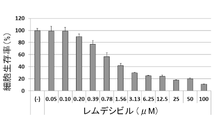
- FIG. 4 shows cell viability to remdesivir.
- FIG. 10 shows the responsiveness of replicon RNA replication levels to the concentration of LY2090314.
- FIG. 4 shows cell viability for LY2090314.
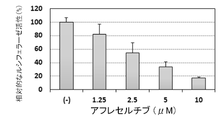
- FIG. 4 shows the responsiveness of replicon RNA replication levels to the concentration of afresertib.
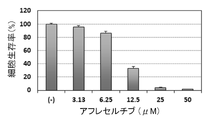
- FIG. 10 shows cell viability for afresertib.
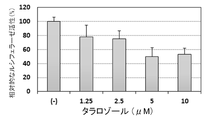
- FIG. 4 shows the response of the replication level of replicon RNA to the concentration of talarozole.
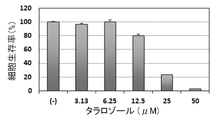
- FIG. 4 shows cell viability to talarozole.
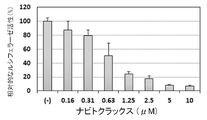
- FIG. 4 shows the response of replicon RNA replication levels to the concentration of navitoclax.
- FIG. 3 shows cell viability against navitoclax.
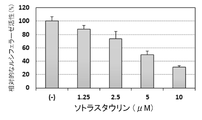
- FIG. 4 shows the responsiveness of the replication level of replicon RNA to the concentration of sotrastaurin.
- FIG. 4 shows cell viability for sotrastaurine.
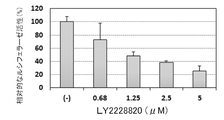
- FIG. 11 shows the responsiveness of replicon RNA replication levels to the concentration of LY2228820.
- FIG. 4 shows cell viability for LY2228820.
- the COVID-19 therapeutic agent according to this embodiment includes a compound selected from the group consisting of LY2090314, afresertib, talarozole, navitoclax and pharmacologically acceptable salts thereof.
- LY2090314, afresertib, talarozole and navitoclax are all safety-confirmed compounds in Phase 1 clinical trials.
- LY2090314 (CAS number: 603288-22-8) is a glycogen synthase kinase-3 (GSK-3) inhibitor.
- GSK-3 glycogen synthase kinase-3
- Afressertib (CAS number: 1047644-62-1) is a protein kinase A (PKA) inhibitor and Akt inhibitor.
- PKA protein kinase A
- Akt protein kinase A
- Talarozole (CAS number: 201410-53-9) is a cytochrome P450 inhibitor. Clinical trials of talarozole for acne and psoriasis have been conducted. The structure of talarozole is shown below.
- Navitoclax (CAS number: 923564-51-6) is a BCL-2 family inhibitor. Clinical trials have been conducted with navitoclax for lymphoma and leukemia. The structure of navitoclax is shown below.
- the above compound contained as an active ingredient in the therapeutic agent for COVID-19 is pharmacologically equivalent to LY2090314, afresertib, talarozole or navitoclax as long as it exhibits antiviral activity against SARS-CoV-2. It may be an acceptable salt. Salts are not particularly limited, and examples include alkali metal salts such as lithium salts, sodium salts and potassium salts, alkaline earth metal salts such as magnesium salts and calcium salts, hydrochlorides, hydrobromides, sulfates, and nitrates.
- inorganic acid salts such as oxalates and phosphates, as well as acetates, propionates, hexanoates, cyclopentanepropionates, glycolates, pyruvates, lactates, malonates, succinates , malate, fumarate, tartrate, citrate, benzoate, o-(4-hydroxybenzoyl)benzoate, cinnamate, mandelate, methanesulfonate, ethanesulfonate, 1,2-ethanedisulfonate, 2-hydroxyethanesulfonate, benzenesulfonate, p-chlorobenzenesulfonate, 2-naphthalenesulfonate, p-toluenesulfonate, camphorsulfonate, 4- Methylbicyclo[2.2.2]oct-2-ene-1-carboxylate, glucoheptanoate, 3-
- the COVID-19 therapeutic agent may contain, as active ingredients, multiple types of compounds selected from the group consisting of LY2090314, afresertib, talarozole, navitoclax, and pharmacologically acceptable salts thereof.
- the COVID-19 therapeutic drug according to the present embodiment is manufactured by a known method, and contains % by weight, 0.001-99.6% by weight, 0.01-99.5% by weight, 0.1-99% by weight, 0.5-60% by weight, 1-50% by weight or 1-20% by weight including the above compounds of A COVID-19 therapeutic agent may be a solid or liquid formulation.
- the COVID-19 therapeutic drug may contain any pharmacologically acceptable ingredient in addition to the above compounds.
- Optional ingredients include, for example, carriers, excipients, lubricants, binders, disintegrants, solvents, solubilizers, suspending agents, tonicity agents, buffers and soothing agents. Additives such as preservatives, antioxidants, coloring agents and sweetening agents may also be incorporated into the COVID-19 therapeutic if desired.
- the dosage of the COVID-19 therapeutic drug according to this embodiment is appropriately determined according to the sex, age, weight, symptoms, etc. of the subject.
- the COVID-19 therapeutic agent is administered such that the compound is in an effective amount.
- An effective amount is the amount of compound necessary to obtain the desired result, which is to suppress the proliferation of SARS-CoV-2, or to delay, inhibit, prevent, or reverse the progression of symptoms due to infection with SARS-CoV-2. or the amount necessary to bring about healing.
- the dosage of the COVID-19 therapeutic agent is, for example, 0.01 mg/kg to 1000 mg/kg, preferably 0.1 mg/kg to 200 mg/kg, more preferably 0.2 mg/kg to 20 mg/kg; It can be administered in one or more divided doses per day.
- the COVID-19 therapeutic agent is administered 1 to 4 times per day.
- the COVID-19 therapeutic may be administered at different dosing frequencies, such as daily, every other day, once a week, every other week and once a month. Amounts outside the above ranges can also be used, if desired.
- COVID-19 therapeutics may be administered, for example, parenterally or orally.
- parenteral administration intravenous injection, subcutaneous injection, intraperitoneal injection, intramuscular injection, transdermal administration, nasal administration, pulmonary administration, enteral administration, transmucosal administration, and the like may be used.
- COVID-19 therapeutics may be administered via an infusion.
- COVID-19 therapeutic agent can be formulated in any form.
- COVID-19 therapeutic agents include tablets such as dragees, buccal tablets, coated tablets and chewable tablets, lozenges, pills, powders and capsules including soft capsules, granules, suspensions, emulsions and dry syrups. It may be a syrup containing and a liquid such as an elixir.
- COVID-19 therapeutic agents may be injections, inhalants, transdermal absorption tapes, aerosols, suppositories, and the like.
- the COVID-19 therapeutic drug will be administered to any subject as long as the subject is infected with SARS-CoV-2.
- the COVID-19 therapeutic agent is preferably administered to vertebrates, more preferably mammals. Mammals include, for example, humans, chimpanzees and other primates, pigs and horses, as well as birds such as ducks and chickens.
- a particularly preferred administration subject is a human.
- the COVID-19 therapeutic agent according to the present embodiment is administered to subjects in whom SARS-CoV-2 is detected for the purpose of preventing the onset of symptoms during the period without clear symptoms or the incubation period after infection.
- the above compounds contained in the COVID-19 therapeutic agent according to this embodiment have been confirmed to be safe in humans. Indeed, as shown in the examples below, the CC50 (50% cytotoxic concentration) of the compounds was well above the EC50 (50% effective concentration). Therefore, the COVID-19 therapeutic agent according to this embodiment has high antiviral activity and high safety.
- LY2090314, afresertib, and navitoclax have been reported to have maximum blood concentrations (C max ) in humans exceeding the EC 50 of each. But it works.
- Also provided in another embodiment is the use of the above compounds for the manufacture of a COVID-19 therapeutic.
- methods of treating, ameliorating or preventing COVID-19 are provided. The method includes administering the compound to the subject.
- Also provided in another embodiment is a compound as described above for use in the treatment of COVID-19.
- BsaI (-) vector The restriction enzyme BsaI site (ggtctc) in the ampicillin resistant gene of pUC19 was transfected into "gAtctc" using QuickChange mutagenesis (manufactured by Stratagene) to construct a BsaI-deficient plasmid pUC19b.
- FIG. 1(A) shows the genome organization of SARS-CoV-2.
- the genome of SARS-CoV-2 consists of nonstructural regions including nonstructural protein gene 1a (ORF1a) and nonstructural protein gene 1b (ORF1b), S gene, ORF3a, E gene, M gene, ORF6, ORF7a, ORF7b, and a structural region containing ORF8, the N gene and ORF10.
- ORF1a nonstructural protein gene 1a
- ORF1b nonstructural protein gene 1b
- the replicon DNA (hereinafter referred to as "SC2R") according to this example is a DNA construct constructed based on the nucleotide sequence of the genome of SARS-CoV-2.
- the nucleotide sequence of SC2R is shown in SEQ ID NO:2.
- a viral replicon maintains a nonstructural region and lacks a structural region, so that it does not have infectivity but propagates autonomously.
- the structure of SC2R is shown in FIG. 1(B).
- SC2R has the non-structural region of SARS-CoV-2 and has no genes contained in the structural region except the N gene.
- SC2R consists of cytomegalovirus (CMV) promoter, ORF1a, ORF1b, secretory luciferase gene (sNLuc), N gene, poly A region (pA), hepatitis delta virus ribozyme gene (Rz ) and bovine growth hormone poly A signal (BGH).
- CMV cytomegalovirus
- ORF1a ORF1a
- ORF1b secretory luciferase gene
- N gene N gene
- pA poly A region
- Rz hepatitis delta virus ribozyme gene
- BGH bovine growth hormone poly A signal
- the N gene has the function of improving the replication level of genomic RNA.
- SC2R is transcribed into RNA (replicon RNA) in cells, translated, and replicated. Duplicated SC2R can be quantified through the activity of sNLuc.
- Neo is a drug resistance gene as a marker gene.
- pA contributes to transcript stability.
- Rz is required for excision by self-cleavage after replication. BGH terminates transcription.
- SC2R was synthesized by artificial synthesis without using a natural virus as a template, by the golden gate method using type IIS restriction enzyme, as follows.
- Ggacc was used to synonymously replace the base sequence corresponding to the BsaI site (gagacc) from 17972nd to 17977th from the 5' end of the base sequence shown in SEQ ID NO: 1.
- 2446 bp F4 10590 to 13379 2790 bp F5, 13376 to 15877 2502 bp F6, 15874 to 18708 2835 bp F7, 18705 to 21114 2410 bp F8, 21111 to 23288 2178 bp F8, 2178 bp 21111 to 23288 2278 bp at position ⁇ 25562 was designated as F10. It was designed so that the nucleotide sequence of the BsaI site was added to both ends of each fragment so that SC2R could be seamlessly incorporated into the BAC vector.
- a BsaI site was introduced at the 5' and 3' ends of each of the 10 fragments.
- F1-4 and F6-10 were introduced into pUC19b (pUC19b/SC2R-F1, F2, F3, F4, F6, F7, F8, F9, F10).
- F5 was introduced into the pCC1-4k vector (pCC1-4k/SC2R-F5).
- PCR fragments A and B containing BsaI inside EcoRI and BamHI were prepared.
- PCR fragment A was performed using the HRP gene shown in SEQ ID NO: 4 as a template and a forward primer (SEQ ID NO: 5) and a reverse primer (SEQ ID NO: 6).
- the nucleotide sequence of PCR fragment A is shown in SEQ ID NO:7.
- PCR was performed using the HRP gene shown in SEQ ID NO: 4 as a template and a forward primer (SEQ ID NO: 8) and a reverse primer (SEQ ID NO: 9).
- the nucleotide sequence of PCR fragment B is shown in SEQ ID NO:10.
- PCR fragment C containing BsaI inside HindIII and BamHI was prepared.
- PCR was performed using the HRP gene shown in SEQ ID NO: 4 as a template and a forward primer (SEQ ID NO: 11) and a reverse primer (SEQ ID NO: 12).
- the nucleotide sequence of PCR fragment C is shown in SEQ ID NO:13.
- pHSG298 was cleaved with EcoRI and BamHI, and PCR fragment A was ligated to construct pHSG298c vector A. Further, pHSG298 was cleaved with EcoRI and BamHI, and PCR fragment B was ligated to construct pHSG298c vector B. pCC1-4k was cleaved with HindIII and BamHI and PCR fragment C was ligated to construct pCC1-4kc vector.
- the cured cell line has a higher level of HCV RNA replication than the parent HuH-7 cell line (Masanori Ikeda, et al., ⁇ Efficient replication of a full-length hepatitis C virus genome, strain O,''). in cell culture, and development of a luciferase reporter system,” Biochem Biophys Res Commun., 2005, 329(4):1350-9).
- HuH-7.6c cells were seeded in a 6-well plate at 1 ⁇ 10 5 cells/well, and the next day, 1 ⁇ g of pSMART BACbc/SC2R was transfected using Fugene HD reagent and introduced into the cells. After 24 hours, cells were detached using trypsin and seeded in 24-well plates at 3 x 10⁴ cells/well. After an additional 24 hours, compounds were added to the indicated concentrations. After culturing for 48 hours, the culture supernatant was collected and luciferase activity was measured using the Nano-Glo Luciferase Assay System.
- HuH-7.6c cells were seeded in 96-well plates at 5 ⁇ 10 3 cells. Twenty-four hours after the initiation of culture, remdesivir was added to the cells to a predetermined concentration. After culturing for 48 hours, 10 ⁇ l of Premix WST-1 Cell Proliferation Assay System (manufactured by Takara Bio Inc.) was added to the medium, cultured at 37° C. for 2 hours, and absorbance at 450 nm was measured using a microplate reader.
- Premix WST-1 Cell Proliferation Assay System manufactured by Takara Bio Inc.
- FIG. 2 shows the luciferase activity when remdesivir was added. Remdesivir concentration-dependently decreased luciferase activity, indicating that SC2R replication was suppressed by remdesivir.
- the EC50 for remdesivir was 16.4 nM. Inhibition of SC2R replication by the positive control remdesivir could be evaluated, confirming that the SC2R assay can identify compounds with anti-SARS-CoV-2 activity. Cell viability versus remdesivir concentration is shown in FIG. CC50 was 1.13 ⁇ M.
- the SC2R assay was used to screen compounds with anti-SARS-CoV-2 activity.
- 350 compounds from the MedChemexpress Phase II drop library were evaluated in the SARS-CoV-2 replicon assay.
- Compounds included in the library are compounds whose molecular targets to act on are known and whose safety has been confirmed in Phase 1 clinical trials.
- FIG. 4 shows luciferase activity and cell viability when LY2090314 was added, respectively.
- Figures 6 and 7 show the luciferase activity and cell viability when afresertib was added, respectively.
- Figures 8 and 9 show the luciferase activity and cell viability when talarozole was added, respectively.
- Figures 10 and 11 show the luciferase activity and cell viability when navitoclax was added, respectively.
- Figures 12 and 13 show the luciferase activity and cell viability when sotrastaurine was added, respectively.
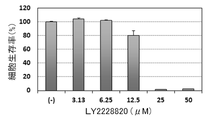
- Figures 14 and 15 show luciferase activity and cell viability when LY2228820 was added, respectively.
- the present invention is useful for treating COVID-19.
Landscapes
- Health & Medical Sciences (AREA)
- Life Sciences & Earth Sciences (AREA)
- Veterinary Medicine (AREA)
- Chemical & Material Sciences (AREA)
- Medicinal Chemistry (AREA)
- Pharmacology & Pharmacy (AREA)
- Animal Behavior & Ethology (AREA)
- General Health & Medical Sciences (AREA)
- Public Health (AREA)
- Epidemiology (AREA)
- Virology (AREA)
- Molecular Biology (AREA)
- Communicable Diseases (AREA)
- Oncology (AREA)
- Chemical Kinetics & Catalysis (AREA)
- General Chemical & Material Sciences (AREA)
- Nuclear Medicine, Radiotherapy & Molecular Imaging (AREA)
- Organic Chemistry (AREA)
- Pharmaceuticals Containing Other Organic And Inorganic Compounds (AREA)
Abstract
COVID-19治療薬は、LY2090314、アフレセルチブ、タラロゾール、ナビトクラックス及びそれらの薬理学的に許容される塩からなる群から選択される化合物を含む。
Description
本発明は、COVID-19治療薬及びCOVID-19治療薬の製造のための化合物の使用に関する。
重症急性呼吸器症候群(SARS)を引き起こす新型コロナウイルス(SARS-CoV-2)感染による新型コロナウイルス感染症(COVID-19)は世界でパンデミックとなっている。COVID-19は、医療上の問題のみならず経済、文化及び生活様式等にも大きな影響を及ぼすため、緊急に克服すべき課題となっている。
COVID-19に対してワクチンの臨床応用が進んでいる。しかし、ワクチンの有効性を低減させる変異株もすでに出現している。このような現状を打破するためには、ワクチンに加えて安全な治療薬の開発が重要である。
非特許文献1には、ウイルス病原性の機序を解明するためにSARS-CoV-2感染によるリン酸化及びタンパク質の量の定量的な評価、並びにキナーゼ及びパスウェイを乱すリン酸化の変化等のプロファイルに基づいて、COVID-19の治療に有望な化合物が検討されている。
Mehdi Bouhaddou,外77名,「The Global Phosphorylation Landscape of SARS-CoV-2 Infection」,2020年,Cell,182,685-712
COVID-19は世界的に流行しており、投与対象に対して安全かつ有効な新規の安全なCOVID-19治療薬が必要とされている。
本発明は上述の事情に鑑みてなされたものであり、高い安全性及び有効性を有するCOVID-19治療薬及びCOVID-19治療薬の製造のための化合物の使用を提供することを目的とする。
本発明の第1の観点に係るCOVID-19治療薬は、
LY2090314、アフレセルチブ、タラロゾール、ナビトクラックス及びそれらの薬理学的に許容される塩からなる群から選択される化合物を含む。
LY2090314、アフレセルチブ、タラロゾール、ナビトクラックス及びそれらの薬理学的に許容される塩からなる群から選択される化合物を含む。
前記化合物は、
LY2090314である、
こととしてもよい。
LY2090314である、
こととしてもよい。
本発明の第2の観点に係る使用は、
COVID-19治療薬の製造のためのLY2090314、アフレセルチブ、タラロゾール、ナビトクラックス及びそれらの薬理学的に許容される塩からなる群から選択される化合物の使用である。
COVID-19治療薬の製造のためのLY2090314、アフレセルチブ、タラロゾール、ナビトクラックス及びそれらの薬理学的に許容される塩からなる群から選択される化合物の使用である。
本発明に係るCOVID-19治療薬は、高い安全性及び有効性を有する。
本発明に係る実施の形態について図面を参照して説明する。なお、本発明は下記の実施の形態及び図面によって限定されるものではない。なお、下記の実施の形態において、“有する”、“含む”又は“含有する”といった表現は、“からなる”又は“から構成される”という意味も包含する。
(実施の形態)
本実施の形態に係るCOVID-19治療薬は、LY2090314、アフレセルチブ、タラロゾール、ナビトクラックス及びそれらの薬理学的に許容される塩からなる群から選択される化合物を含む。LY2090314、アフレセルチブ、タラロゾール及びナビトクラックスは、いずれも臨床試験の第1相試験で安全性が確認された化合物である。
本実施の形態に係るCOVID-19治療薬は、LY2090314、アフレセルチブ、タラロゾール、ナビトクラックス及びそれらの薬理学的に許容される塩からなる群から選択される化合物を含む。LY2090314、アフレセルチブ、タラロゾール及びナビトクラックスは、いずれも臨床試験の第1相試験で安全性が確認された化合物である。
LY2090314(CAS番号:603288-22-8)はグリコーゲン合成酵素キナーゼ-3(glycogen synthase kinase 3;GSK-3)阻害剤である。急性骨髄性白血病に対するLY2090314の臨床試験が行われた。LY2090314の構造を下記に示す。

アフレセルチブ(Afuresertib、CAS番号:1047644-62-1)はプロテインキナーゼA(protein kinase A;PKA)阻害剤及びAkt阻害剤である。前立腺癌に対するアフレセルチブの臨床試験が行われた。アフレセルチブの構造を下記に示す。

タラロゾール(Talarozole、CAS番号:201410-53-9)はチトクロームP450阻害剤である。にきび及び乾癬に対するタラロゾールの臨床試験が行われた。タラロゾールの構造を下記に示す。

ナビトクラックス(Navitoclax、CAS番号:923564-51-6)はBCL-2ファミリー阻害剤である。リンパ腫及び白血病に対するナビトクラックスの臨床試験が行われた。ナビトクラックスの構造を下記に示す。

本実施の形態に係るCOVID-19治療薬に有効成分として含まれる上記化合物は、SARS-CoV-2に対して抗ウイルス活性を示す限り、LY2090314、アフレセルチブ、タラロゾール又はナビトクラックスの薬理学的に許容される塩であってもよい。塩は特に限定されず、例えば、リチウム塩、ナトリウム塩及びカリウム塩等のアルカリ金属塩、マグネシウム塩及びカルシウム塩等のアルカリ土類金属塩等、塩酸塩、臭化水素酸塩、硫酸塩、硝酸塩、シュウ酸塩及びリン酸塩等の無機酸塩、並びに酢酸塩、プロピオン酸塩、ヘキサン酸塩、シクロペンタンプロピオン酸塩、グリコール酸塩、ピルビン酸塩、乳酸塩、マロン酸塩、コハク酸塩、リンゴ酸塩、フマル酸塩、酒石酸塩、クエン酸塩、安息香酸塩、o-(4-ヒドロキシベンゾイル)安息香酸塩、桂皮酸塩、マンデル酸塩、メタンスルホン酸塩、エタンスルホン酸塩、1,2-エタンジスルホン酸塩、2-ヒドロキシエタンスルホン酸塩、ベンゼンスルホン酸塩、p-クロロベンゼンスルホン酸塩、2-ナフタレンスルホン酸塩、p-トルエンスルホン酸塩、カンファースルホン酸塩、4-メチルビシクロ[2.2.2]オクト-2-エン-1-カルボン酸塩、グルコヘプタン酸塩、3-フェニルプロピオン酸塩、トリメチル酢酸塩、第三級ブチル酢酸塩、ラウリル硫酸塩、グルコン酸塩、グルタミン酸塩、ヒドロキシナフトエ酸塩、サリチル酸塩、ステアリン酸塩、及びムコン酸塩等の有機酸塩等である。なお、抗ウイルス活性とは、SARS-CoV-2の感染性、増殖能又は免疫回避能を低下させる活性を意味する。
COVID-19治療薬は、LY2090314、アフレセルチブ、タラロゾール、ナビトクラックス及びそれらの薬理学的に許容される塩からなる群から選択される複数種類の化合物を有効成分として含有してもよい。
本実施の形態に係るCOVID-19治療薬は、既知の方法で製造され、有効成分として0.000001~99.9重量%、0.00001~99.8重量%、0.0001~99.7重量%、0.001~99.6重量%、0.01~99.5重量%、0.1~99重量%、0.5~60重量%、1~50重量%又は1~20重量%の上記化合物を含む。COVID-19治療薬は、固形製剤であっても、液状製剤であってもよい。
COVID-19治療薬は上記化合物に加え、薬理学的に許容される任意の成分を含んでもよい。任意の成分は、例えば、担体、賦形剤、滑沢剤、結合剤、崩壊剤、溶剤、溶解補助剤、懸濁化剤、等張化剤、緩衝剤及び無痛化剤等である。また、必要に応じて、防腐剤、抗酸化剤、着色剤及び甘味剤等の添加物がCOVID-19治療薬に配合されてもよい。
本実施の形態に係るCOVID-19治療薬の投与量は、投与対象の性別、年齢、体重及び症状等によって適宜決定される。当該COVID-19治療薬は、上記化合物が有効量となるように投与される。有効量とは、所望の結果を得るために必要な化合物の量であり、SARS-CoV-2の増殖の抑制、あるいはSARS-CoV-2の感染による症状の進行の遅延、阻害、予防、逆転又は治癒をもたらすのに必要な量である。
COVID-19治療薬の投与量は、例えば、0.01mg/kg~1000mg/kg、好ましくは0.1mg/kg~200mg/kg、より好ましくは0.2mg/kg~20mg/kgであり、1日に1回、又はそれ以上に分割して投与することができる。COVID-19治療薬を分割して投与する場合、COVID-19治療薬は、1日に1~4回投与される。また、COVID-19治療薬は、毎日、隔日、1週間に1回、隔週及び1ヶ月に1回等の様々な投与頻度で投与してもよい。なお、必要に応じて、上記の範囲外の量を用いることもできる。
COVID-19治療薬の投与経路は特に限定されない。COVID-19治療薬は、例えば非経口で投与されてもよいし、経口で投与されてもよい。非経口投与の場合、静脈注射、皮下注射、腹腔内注射、筋肉内注射、経皮投与、経鼻投与、経肺投与、経腸投与及び経粘膜投与等であってもよい。COVID-19治療薬は、点滴を介して投与されてもよい。
COVID-19治療薬は、任意の形態の製剤とすることができる。経口投与の場合、COVID-19治療薬は、糖衣錠、バッカル錠、コーティング錠及びチュアブル錠等の錠剤、トローチ剤、丸剤、散剤及びソフトカプセルを含むカプセル剤、顆粒剤、懸濁剤、乳剤及びドライシロップを含むシロップ剤、並びにエリキシル剤等の液剤であってもよい。非経口投与の場合、COVID-19治療薬は、注射剤、吸入剤、経皮吸収テープ、エアゾール剤及び坐剤等であってもよい。
COVID-19治療薬は、SARS-CoV-2が感染する対象であれば、任意の対象に投与される。例えば、COVID-19治療薬の投与対象は、脊椎動物が好ましく、哺乳類動物がより好ましい。哺乳類動物としては、例えば、ヒト、チンパンジー及びその他の霊長類、ブタ及びウマに加え、カモ及びニワトリ等の鳥類等が挙げられる。特に好ましい投与対象はヒトである。
本実施の形態に係るCOVID-19治療薬は、SARS-CoV-2が検出された対象に対して、明確な症状がない期間、あるいは感染後の潜伏期間に症状の発症を予防する目的で投与されてもよい。
本実施の形態に係るCOVID-19治療薬に含まれる上記の化合物は、ヒトでの安全性が確認されている。実際に下記実施例に示されるように、上記化合物のCC50(50%細胞毒性濃度)はEC50(50%有効濃度)よりも十分に高かった。よって、本実施の形態に係るCOVID-19治療薬は高い抗ウイルス活性と高い安全性とを有する。
なお、LY2090314、アフレセルチブ及びナビトクラックスのヒトで報告されている最高血中濃度(Cmax)は、それぞれのEC50を超えているため、本実施の形態に係るCOVID-19治療薬は臨床上でも有効である。
また、他の実施の形態では、COVID-19治療薬の製造のための上記化合物の使用が提供される。別の実施の形態では、COVID-19を治療、改善又は予防する方法が提供される。当該方法は、上記化合物を対象に投与する工程を含む。
また、他の実施の形態では、COVID-19の治療における使用のための上記化合物が提供される。
以下の実施例により、本発明をさらに具体的に説明するが、本発明は実施例によって限定されるものではない。
(BsaI(-)ベクターの作製)
pUC19のアンピシリン耐性遺伝子内にある制限酵素BsaIサイト(ggtctc)をQuickChange mutagenesis(Stratagene社製)を用いて、“gAtctc”になるよう遺伝子導入を行い、BsaI欠損プラスミドpUC19bを構築した。
pUC19のアンピシリン耐性遺伝子内にある制限酵素BsaIサイト(ggtctc)をQuickChange mutagenesis(Stratagene社製)を用いて、“gAtctc”になるよう遺伝子導入を行い、BsaI欠損プラスミドpUC19bを構築した。
pSMART BACのsopB遺伝子内にある制限酵素BsaIサイト(ggtctc)をQuickChange mutagenesisを用いて、“gAtctc”になるよう遺伝子導入を行い、BsaI欠損プラスミドpSMART BACbを構築した。
(人工遺伝子の設計)
図1(A)はSARS-CoV-2のゲノムの構成を示す。SARS-CoV-2のゲノムは、非構造蛋白遺伝子1a(ORF1a)及び非構造蛋白遺伝子1b(ORF1b)を含む非構造領域と、S遺伝子、ORF3a、E遺伝子、M遺伝子、ORF6、ORF7a、ORF7b、ORF8、N遺伝子及びORF10を含む構造領域と、を有する。SARS-CoV-2のゲノムの5’末端及び3’末端には、それぞれ非翻訳領域(5’UTR及び3’UTR)がある。SARS-CoV-2のゲノムの塩基配列(NCBI Reference Sequence:NC_045512)は配列番号1に例示される。
図1(A)はSARS-CoV-2のゲノムの構成を示す。SARS-CoV-2のゲノムは、非構造蛋白遺伝子1a(ORF1a)及び非構造蛋白遺伝子1b(ORF1b)を含む非構造領域と、S遺伝子、ORF3a、E遺伝子、M遺伝子、ORF6、ORF7a、ORF7b、ORF8、N遺伝子及びORF10を含む構造領域と、を有する。SARS-CoV-2のゲノムの5’末端及び3’末端には、それぞれ非翻訳領域(5’UTR及び3’UTR)がある。SARS-CoV-2のゲノムの塩基配列(NCBI Reference Sequence:NC_045512)は配列番号1に例示される。
本実施例に係るレプリコンDNA(以下、“SC2R”とする)は、SARS-CoV-2のゲノムの塩基配列に基づいて構築されるDNA構築物である。SC2Rの塩基配列は配列番号2に示される。一般にウイルスのレプリコンは、非構造領域を維持し、構造領域を欠くため、感染性を有していないが自律増殖する。SC2Rの構成を図1(B)に示す。SC2Rは、SARS-CoV-2の非構造領域を有し、N遺伝子を除く構造領域に含まれる遺伝子を有していない。詳細には、SC2Rは、5’末端側からサイトメガロウイルス(CMV)プロモーター、ORF1a、ORF1b、分泌型ルシフェラーゼ遺伝子(sNLuc)、N遺伝子、ポリA領域(pA)、肝炎デルタウィルスのリボザイム遺伝子(Rz)及びウシ成長ホルモンポリAシグナル(BGH)を有する。
N遺伝子はゲノムRNAの複製レベルを向上させる機能を有する。SC2Rは、細胞内でRNA(レプリコンRNA)に転写されたうえで、翻訳され、複製される。sNLucの活性を介して複製されたSC2Rを定量することができる。Neoは、マーカー遺伝子としての薬剤耐性遺伝子である。pAは転写産物の安定性に寄与する。Rzは複製後の自己切断による切り出しに必要である。BGHは転写を終結させる。
SC2Rを、天然ウイルスを鋳型として使用しない人工合成により、タイプIIS型制限酵素を用いるゴールデンゲート法で以下のように合成した。
SC2Rの非構造領域では、配列番号1に示す塩基配列の5’末端から17972番目から17977番目までのBsaIサイト(gagacc)に相当する塩基配列を同義置換するために、“gGgacc”とした。
BsaIサイトを欠失させたSC2R(25562bp)を図1(C)に示すように2~3kbの10個のフラグメントF1~F10に分けて人工遺伝子を合成した。詳細には、配列番号2に示すSC2Rの塩基配列の5’末端から1~2735番目の2735bpをF1、2732~5360番目の2829bpをF2、5357~8151番目の2795bpをF3、8148~10593番目の2446bpをF4、10590~13379番目の2790bpをF5、13376~15877番目の2502bpをF6、15874~18708番目の2835bpをF7、18705~21114番目の2410bpをF8、21111~23288番目の2178bpをF9、23285~25562番目の2278bpをF10とした。各フラグメントの両端にBsaIサイトの塩基配列を付加して、シームレスにSC2RをBACベクターに組込むことができるように設計した。
(人工遺伝子の合成)
10個のフラグメントそれぞれの5’末端と3’末端にBsaIサイトを導入した。F1~4とF6~10はpUC19bに導入した(pUC19b/SC2R-F1,F2,F3,F4,F6,F7,F8,F9,F10)。F5はpCC1-4kベクターに導入した(pCC1-4k/SC2R-F5)。
10個のフラグメントそれぞれの5’末端と3’末端にBsaIサイトを導入した。F1~4とF6~10はpUC19bに導入した(pUC19b/SC2R-F1,F2,F3,F4,F6,F7,F8,F9,F10)。F5はpCC1-4kベクターに導入した(pCC1-4k/SC2R-F5)。
(クローニングベクターpSMART BACbcの作製)
人工的に合成したマルチクローニングサイトが導入されたpUC57 NotI-BsaIc-BsaI-EcoRI-HindIII-BamHI-XhoI-AvrIIを制限酵素NotIとAvrIIで切断し、配列番号3に示す955bpの人工遺伝子を得た。pSMART BACbのNotI-AvrIIサイトに人工遺伝子をライゲーションして、pSMART BACbcを作製した。
人工的に合成したマルチクローニングサイトが導入されたpUC57 NotI-BsaIc-BsaI-EcoRI-HindIII-BamHI-XhoI-AvrIIを制限酵素NotIとAvrIIで切断し、配列番号3に示す955bpの人工遺伝子を得た。pSMART BACbのNotI-AvrIIサイトに人工遺伝子をライゲーションして、pSMART BACbcを作製した。
(クローニングベクターpHSG298c及びpCC1-4kcの作製)
pHSG298ベクターにBsaIサイトを導入するため、EcoRIとBamHIの内側にBsaIを含むPCRフラグメントA及びBを作製した。PCRフラグメントAの作製では、配列番号4に示すHRP遺伝子を鋳型として、フォワードプライマー(配列番号5)及びリバースプライマー(配列番号6)を用いてPCRを行った。PCRフラグメントAの塩基配列を配列番号7に示す。PCRフラグメントBの作製では、配列番号4に示すHRP遺伝子を鋳型として、フォワードプライマー(配列番号8)及びリバースプライマー(配列番号9)を用いてPCRを行った。PCRフラグメントBの塩基配列を配列番号10に示す。
pHSG298ベクターにBsaIサイトを導入するため、EcoRIとBamHIの内側にBsaIを含むPCRフラグメントA及びBを作製した。PCRフラグメントAの作製では、配列番号4に示すHRP遺伝子を鋳型として、フォワードプライマー(配列番号5)及びリバースプライマー(配列番号6)を用いてPCRを行った。PCRフラグメントAの塩基配列を配列番号7に示す。PCRフラグメントBの作製では、配列番号4に示すHRP遺伝子を鋳型として、フォワードプライマー(配列番号8)及びリバースプライマー(配列番号9)を用いてPCRを行った。PCRフラグメントBの塩基配列を配列番号10に示す。
また、pCC1-4kベクターにBsaIサイトを導入するため、HindIIIとBamHIの内側にBsaIを含むPCRフラグメントCを作製した。PCRフラグメントCの作製では、配列番号4に示すHRP遺伝子を鋳型として、フォワードプライマー(配列番号11)及びリバースプライマー(配列番号12)を用いてPCRを行った。PCRフラグメントCの塩基配列を配列番号13に示す。
pHSG298をEcoRIとBamHIで切断し、PCRフラグメントAをライゲーションして、pHSG298cベクターAを構築した。また、pHSG298をEcoRIとBamHIで切断し、PCRフラグメントBをライゲーションして、pHSG298cベクターBを構築した。pCC1-4kをHindIIIとBamHIで切断し、PCRフラグメントCをライゲーションして、pCC1-4kcベクターを構築した。
(中間フラグメントpHSG298c/F123、pCC1-4kc/F456及びpHSG298c/F7-10の作製)
pUC19b/F1,F2,F3,F4,F6,F7,F8,F9,F10及びpCC1-4k/F5をそれぞれBsaIで切断した。F1、F2及びF3をpHSG298cベクターAに導入し、pHSG298c/F123とした。F4、F5及びF6をpCC1-4kcベクターに導入し、pCC1-4kc/F456とした。F7、F8、F9及びF10をpHSG298cベクターBに導入し、pHSG298c/F7-10とした。
pUC19b/F1,F2,F3,F4,F6,F7,F8,F9,F10及びpCC1-4k/F5をそれぞれBsaIで切断した。F1、F2及びF3をpHSG298cベクターAに導入し、pHSG298c/F123とした。F4、F5及びF6をpCC1-4kcベクターに導入し、pCC1-4kc/F456とした。F7、F8、F9及びF10をpHSG298cベクターBに導入し、pHSG298c/F7-10とした。
(SC2Rベクターの作製)
pHSG298c/F123、pCC1-4kc/F456及びpHSG298c/F7-10をBsaIで切断し、各フラグメントをpSMART BACbcのBsaI-BsaIサイトにライゲーションした。ライゲーション後、エレクトロポレーション法にてBAC-Optimized Replicator v2.0 Electrocompetent Cells(Lucigen社製)に導入しクローニングを行った。以上により、pSMART BACbc/SC2Rを得た。
pHSG298c/F123、pCC1-4kc/F456及びpHSG298c/F7-10をBsaIで切断し、各フラグメントをpSMART BACbcのBsaI-BsaIサイトにライゲーションした。ライゲーション後、エレクトロポレーション法にてBAC-Optimized Replicator v2.0 Electrocompetent Cells(Lucigen社製)に導入しクローニングを行った。以上により、pSMART BACbc/SC2Rを得た。
(HuH-7.6c細胞の樹立)
レポーター全長HCV RNAをエレクトロポレーションによりHuH-7細胞に導入後G418を添加するとHCV RNA複製レベルの高い細胞が選択されてコロニーを形成する。コロニーの中で最もHCV RNA複製レベルの高いクローン化細胞を細胞株として樹立したものがOR6細胞株となる。次に、OR6細胞にIFNを添加することでHCV RNAを排除して治癒細胞株(HuH-7.6c細胞株)を樹立した。治癒細胞株は親株のHuH-7細胞株よりもHCV RNAの複製レベルが高いことが知られている(Masanori Ikeda、外5名、「Efficient replication of a full-length hepatitis C virus genome, strain O,in cell culture,and development of a luciferase reporter system」、Biochem Biophys Res Commun.、2005年、329(4):1350-9)。
レポーター全長HCV RNAをエレクトロポレーションによりHuH-7細胞に導入後G418を添加するとHCV RNA複製レベルの高い細胞が選択されてコロニーを形成する。コロニーの中で最もHCV RNA複製レベルの高いクローン化細胞を細胞株として樹立したものがOR6細胞株となる。次に、OR6細胞にIFNを添加することでHCV RNAを排除して治癒細胞株(HuH-7.6c細胞株)を樹立した。治癒細胞株は親株のHuH-7細胞株よりもHCV RNAの複製レベルが高いことが知られている(Masanori Ikeda、外5名、「Efficient replication of a full-length hepatitis C virus genome, strain O,in cell culture,and development of a luciferase reporter system」、Biochem Biophys Res Commun.、2005年、329(4):1350-9)。
(SC2Rアッセイによる評価)
HuH-7.6c細胞を6ウェルプレートに1×10⁵細胞/ウェルになるように播種し、翌日pSMART BACbc/SC2R 1μgをFugene HD試薬を用いてトランスフェクションし細胞に導入した。24時間後、トリプシンを用いて細胞を剥離し、24ウェルプレートに3×10⁴細胞/ウェルになるように播種した。さらに24時間後、化合物を所定の濃度になるように添加した。48時間培養後、培養上清を採取し、Nano-Glo Luciferase Assay Systemを用いてルシフェラーゼ活性を測定した。
HuH-7.6c細胞を6ウェルプレートに1×10⁵細胞/ウェルになるように播種し、翌日pSMART BACbc/SC2R 1μgをFugene HD試薬を用いてトランスフェクションし細胞に導入した。24時間後、トリプシンを用いて細胞を剥離し、24ウェルプレートに3×10⁴細胞/ウェルになるように播種した。さらに24時間後、化合物を所定の濃度になるように添加した。48時間培養後、培養上清を採取し、Nano-Glo Luciferase Assay Systemを用いてルシフェラーゼ活性を測定した。
(細胞毒性の評価)
HuH-7.6c細胞を、96ウェルプレートに5×10³個になるように播種した。培養開始から24時間後に、レムデシビルを、所定の濃度になるように細胞に添加した。48時間培養した後、Premix WST-1 Cell Proliferation Assay System(タカラバイオ社製)10μlを培地に添加して、37℃で2時間培養後、マイクロプレートリーダーを用いて450nmの吸光度を測定した。
HuH-7.6c細胞を、96ウェルプレートに5×10³個になるように播種した。培養開始から24時間後に、レムデシビルを、所定の濃度になるように細胞に添加した。48時間培養した後、Premix WST-1 Cell Proliferation Assay System(タカラバイオ社製)10μlを培地に添加して、37℃で2時間培養後、マイクロプレートリーダーを用いて450nmの吸光度を測定した。
(結果)
レムデシビルを添加した場合のルシフェラーゼ活性を図2に示す。レムデシビルの濃度依存的にルシフェラーゼ活性が低下したため、レムデシビルによってSC2Rの複製が抑制されたことが示された。レムデシビルのEC50は16.4nMであった。陽性対照であるレムデシビルによるSC2Rの複製の抑制が評価できたことから、SC2Rアッセイで抗SARS-CoV-2活性を有する化合物を同定できることが確かめられた。レムデシビルの濃度に対する細胞生存率を図3に示す。CC50は1.13μMであった。
レムデシビルを添加した場合のルシフェラーゼ活性を図2に示す。レムデシビルの濃度依存的にルシフェラーゼ活性が低下したため、レムデシビルによってSC2Rの複製が抑制されたことが示された。レムデシビルのEC50は16.4nMであった。陽性対照であるレムデシビルによるSC2Rの複製の抑制が評価できたことから、SC2Rアッセイで抗SARS-CoV-2活性を有する化合物を同定できることが確かめられた。レムデシビルの濃度に対する細胞生存率を図3に示す。CC50は1.13μMであった。
SC2Rアッセイを用いて、抗SARS-CoV-2活性を有する化合物をスクリーニングした。MedChemexpress社のPhase IIドロップライブラリの化合物350種類をSARS-CoV-2レプリコンアッセイで評価した。当該ライブラリに含まれる化合物は、作用する分子標的が既知で、臨床試験における第1相試験で安全性が確認された化合物である。
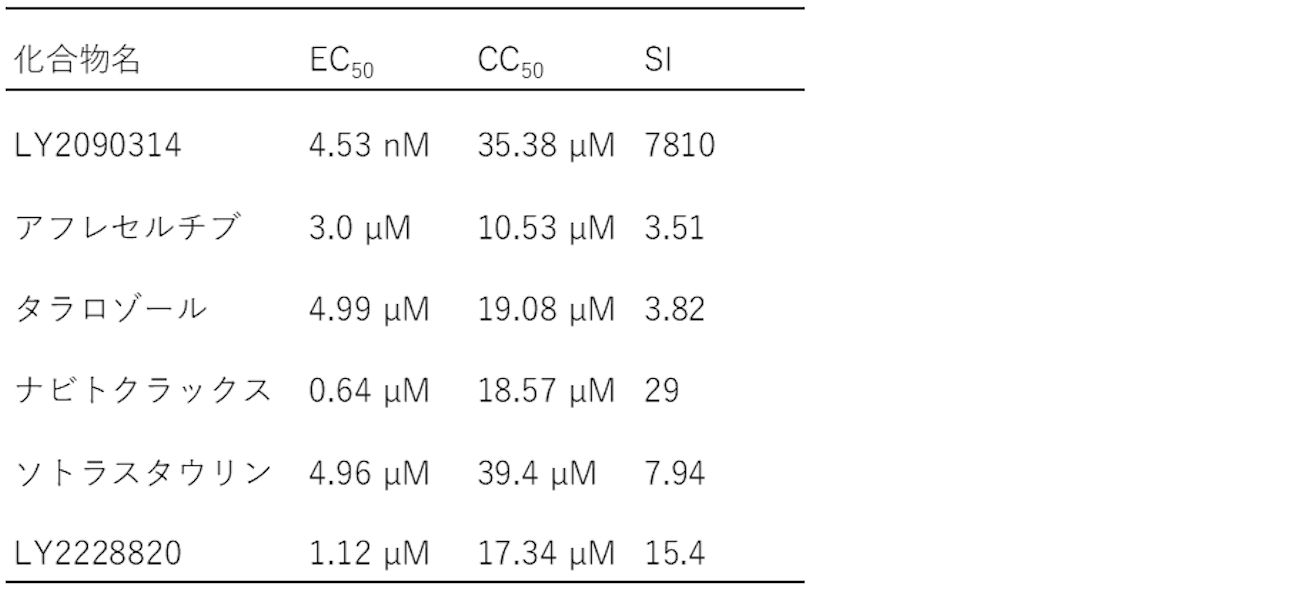
SC2Rアッセイにおけるルシフェラーゼ活性と細胞毒性の結果とから、LY2090314、アフレセルチブ、タラロゾール、ナビトクラックス、ソトラスタウリン(Sotrastaurin)及びLY2228820からなる6種類の化合物をCovid-19治療薬の候補として同定した。図4及び図5はそれぞれLY2090314を添加した場合のルシフェラーゼ活性及び細胞生存率を示す。図6及び図7はそれぞれアフレセルチブを添加した場合のルシフェラーゼ活性及び細胞生存率を示す。図8及び図9はそれぞれタラロゾールを添加した場合のルシフェラーゼ活性及び細胞生存率を示す。
図10及び図11はそれぞれナビトクラックスを添加した場合のルシフェラーゼ活性及び細胞生存率を示す。図12及び図13はそれぞれソトラスタウリンを添加した場合のルシフェラーゼ活性及び細胞生存率を示す。図14及び図15はそれぞれLY2228820を添加した場合のルシフェラーゼ活性及び細胞生存率を示す。
Covid-19治療薬の候補のEC50、CC50及び選択係数(SI=CC50/EC50)を表1に示す。
上述した実施の形態は、本発明を説明するためのものであり、本発明の範囲を限定するものではない。すなわち、本発明の範囲は、実施の形態ではなく、特許請求の範囲によって示される。そして、特許請求の範囲内及びそれと同等の発明の意義の範囲内で施される様々な変形が、本発明の範囲内とみなされる。
本出願は、2021年5月26日に出願された、日本国特許出願2021-088224号に基づく。本明細書中に日本国特許出願2021-088224号の明細書、特許請求の範囲、図面全体を参照として取り込むものとする。
本発明はCOVID-19の治療に有用である。
Claims (3)
- LY2090314、アフレセルチブ、タラロゾール、ナビトクラックス及びそれらの薬理学的に許容される塩からなる群から選択される化合物を含む、
COVID-19治療薬。 - 前記化合物は、
LY2090314である、
請求項1に記載のCOVID-19治療薬。 - COVID-19治療薬の製造のためのLY2090314、アフレセルチブ、タラロゾール、ナビトクラックス及びそれらの薬理学的に許容される塩からなる群から選択される化合物の使用。
Priority Applications (1)
| Application Number | Priority Date | Filing Date | Title |
|---|---|---|---|
| JP2023524220A JPWO2022250100A1 (ja) | 2021-05-26 | 2022-05-25 |
Applications Claiming Priority (2)
| Application Number | Priority Date | Filing Date | Title |
|---|---|---|---|
| JP2021088224 | 2021-05-26 | ||
| JP2021-088224 | 2021-05-26 |
Publications (1)
| Publication Number | Publication Date |
|---|---|
| WO2022250100A1 true WO2022250100A1 (ja) | 2022-12-01 |
Family
ID=84229886
Family Applications (1)
| Application Number | Title | Priority Date | Filing Date |
|---|---|---|---|
| PCT/JP2022/021470 Ceased WO2022250100A1 (ja) | 2021-05-26 | 2022-05-25 | Covid-19治療薬及びcovid-19治療薬の製造のための化合物の使用 |
Country Status (2)
| Country | Link |
|---|---|
| JP (1) | JPWO2022250100A1 (ja) |
| WO (1) | WO2022250100A1 (ja) |
Cited By (1)
| Publication number | Priority date | Publication date | Assignee | Title |
|---|---|---|---|---|
| CN117017996A (zh) * | 2023-06-30 | 2023-11-10 | 上海市重大传染病和生物安全研究院 | Navitoclax(ABT263)在制备广谱抗病毒抑制剂中的应用 |
-
2022
- 2022-05-25 JP JP2023524220A patent/JPWO2022250100A1/ja active Pending
- 2022-05-25 WO PCT/JP2022/021470 patent/WO2022250100A1/ja not_active Ceased
Non-Patent Citations (7)
| Title |
|---|
| BOUHADDOU MEHDI; MEMON DANISH; MEYER BJOERN; WHITE KRIS M.; REZELJ VERONICA V.; CORREA MARRERO MIGUEL; POLACCO BENJAMIN J.; MELNYK: "The Global Phosphorylation Landscape of SARS-CoV-2 Infection", CELL, ELSEVIER, AMSTERDAM NL, vol. 182, no. 3, 28 June 2020 (2020-06-28), Amsterdam NL , pages 685, XP086239962, ISSN: 0092-8674, DOI: 10.1016/j.cell.2020.06.034 * |
| EMBI MOHAMMED NOOR, GANESAN NAGESSWARY, SIDEK HASIDAH MOHD: "Is GSK3β a molecular target of chloroquine treatment against COVID-19?", DD&T DRUG DISCOVERIES & THERAPEUTICS, INTERNATIONAL ADVANCEMENT CENTER FOR MEDICINE & HEALTH RESEARCH CO., LTD., JAPAN, vol. 14, no. 2, 30 April 2020 (2020-04-30), Japan , pages 107 - 108, XP093007455, ISSN: 1881-7831, DOI: 10.5582/ddt.2020.03010 * |
| GREIN JONATHAN: "Compassionate Use of Remdesivir for Patients with Severe Covid-19", THE NEW ENGLAND JOURNAL OF MEDICINE, MASSACHUSETTS MEDICAL SOCIETY, US, vol. 382, no. 24, 11 June 2020 (2020-06-11), US , pages 2327 - 2336, XP055832045, ISSN: 0028-4793, DOI: 10.1056/NEJMoa2007016 * |
| POLITANO GIANFRANCO, BENSO ALFREDO: "IL6-mediated HCoV-host interactome regulatory network and GO/Pathway enrichment analysis", PLOS COMPUTATIONAL BIOLOGY, vol. 16, no. 9, pages e1008238, XP093007457, DOI: 10.1371/journal.pcbi.1008238 * |
| RANA ANIL KUMAR, RAHMATKAR SHUBHAM NILKANTH, KUMAR AMIT, SINGH DAMANPREET: "Glycogen synthase kinase-3: A putative target to combat severe acute respiratory syndrome coronavirus 2 (SARS-CoV-2) pandemic", CYTOKINE & GROWTH FACTOR REVIEWS, ELSEVIER LTD, GB, vol. 58, 1 April 2021 (2021-04-01), GB , pages 92 - 101, XP055928930, ISSN: 1359-6101, DOI: 10.1016/j.cytogfr.2020.08.002 * |
| RUDD CHRISTOPHER E., WÜLFING CHRISTOPH, RUDD CHRISTOPHER E: "GSK-3 Inhibition as a Therapeutic Approach Against SARs CoV2: Dual Benefit of Inhibiting Viral Replication While Potentiating the Immune Response", FRONTIERS IN IMMUNOLOGY, vol. 11, 26 June 2020 (2020-06-26), pages 26, XP055928867, DOI: 10.3389/fimmu.2020.01638 * |
| UPTON HEATHER E., FERGUSON LUCAS, TEMOCHE-DIAZ MORAYMA M., LIU XIAO-MAN, PIMENTEL SYDNEY C., INGOLIA NICHOLAS T., SCHEKMAN RANDY, : "Low-bias ncRNA libraries using ordered two-template relay: Serial template jumping by a modified retroelement reverse transcriptase", PROCEEDINGS OF THE NATIONAL ACADEMY OF SCIENCES, NATIONAL ACADEMY OF SCIENCES, vol. 118, no. 42, 19 October 2021 (2021-10-19), pages e2107900118, XP055892572, ISSN: 0027-8424, DOI: 10.1073/pnas.2107900118 * |
Cited By (2)
| Publication number | Priority date | Publication date | Assignee | Title |
|---|---|---|---|---|
| CN117017996A (zh) * | 2023-06-30 | 2023-11-10 | 上海市重大传染病和生物安全研究院 | Navitoclax(ABT263)在制备广谱抗病毒抑制剂中的应用 |
| CN117017996B (zh) * | 2023-06-30 | 2026-03-17 | 上海市重大传染病和生物安全研究院 | Navitoclax(ABT263)在制备广谱抗病毒抑制剂中的应用 |
Also Published As
| Publication number | Publication date |
|---|---|
| JPWO2022250100A1 (ja) | 2022-12-01 |
Similar Documents
| Publication | Publication Date | Title |
|---|---|---|
| AU2010306639B2 (en) | HBV antisense inhibitors | |
| US20240131046A1 (en) | Anti-viral agent | |
| TW200815384A (en) | Combination therapy method for treating hepatitis C virus infection and pharmaceutical compositions for use therein | |
| EP3904517A1 (en) | Oligomeric nucleic acid molecule and application thereof | |
| WO2023098908A1 (en) | Modification patterns for small interfering rna molecules with high stability and gene silencing activities | |
| Felicetti et al. | Recent progress toward the discovery of small molecules as novel anti-respiratory syncytial virus agents | |
| WO2022250100A1 (ja) | Covid-19治療薬及びcovid-19治療薬の製造のための化合物の使用 | |
| US20240307325A1 (en) | Compounds, compositions, and methods for treating or ameliorating nonalcoholic fatty liver disease and related diseases or disorders | |
| US20190029987A1 (en) | Dimethyl fumarate (dmf) for prevention or treatment of gout, acne, diabetes, vitiligo and/or pyoderma gangrenosum | |
| CN108210510B (zh) | 一种小干扰核酸药物组合物及其用途 | |
| EP2042188A1 (en) | Pharmaceutical composition for treating or preventing hcv infection | |
| WO2023149204A1 (ja) | Covid-19治療薬、covid-19治療用経口組成物及びcovid-19治療薬の製造のための化合物の使用 | |
| JP2009221131A (ja) | C型肝炎ウイルス阻害剤 | |
| CN107737133B (zh) | 非达霉素在制备治疗寨卡病毒感染引起的相关疾病和/或症状的药物中的应用 | |
| KR101993377B1 (ko) | Bcl2 유전자 및 bi-1 유전자의 발현을 동시에 억제하는 핵산 | |
| TW202016302A (zh) | 用於調節mir-122之微小rna化合物及方法 | |
| CA2190375A1 (en) | Vectors with multiple hiv-1 tar sequences inhibiting hiv-1 gene expression | |
| US20220378879A1 (en) | Application of peg interferon and protooncogene product targeting inhibitor in synergistic treatment of renal carcinoma | |
| CN115804775A (zh) | S63845在制备抗新冠病毒感染药物中的应用 | |
| KR20230093859A (ko) | mTOR 유전자 및 STAT3 유전자의 발현을 동시에 억제하는 핵산 | |
| CN117298106B (zh) | 靶向RdRp的含氮杂环化合物在制备治疗新冠病毒感染引起的相关疾病的药物中的应用 | |
| KR101865025B1 (ko) | mTOR 유전자 및 STAT3 유전자의 발현을 동시에 억제하는 핵산 | |
| CN117462559B (zh) | 拉坦前列素硝酸酯在制备新型冠状病毒感染相关疾病的治疗药物中的应用 | |
| US11925646B2 (en) | Agent for treating or preventing cancer, and combination of RF pathway inhibitor and MEK inhibitor for treating or preventing cancer | |
| Tomar et al. | Potential therapeutic landscape of COVID-19: molecular targets, repurposed drugs, and nano-and cell-based intervention |
Legal Events
| Date | Code | Title | Description |
|---|---|---|---|
| 121 | Ep: the epo has been informed by wipo that ep was designated in this application |
Ref document number: 22811370 Country of ref document: EP Kind code of ref document: A1 |
|
| WWE | Wipo information: entry into national phase |
Ref document number: 2023524220 Country of ref document: JP |
|
| NENP | Non-entry into the national phase |
Ref country code: DE |
|
| 122 | Ep: pct application non-entry in european phase |
Ref document number: 22811370 Country of ref document: EP Kind code of ref document: A1 |