WO2022249686A1 - 固体電解質材料および電池 - Google Patents
固体電解質材料および電池 Download PDFInfo
- Publication number
- WO2022249686A1 WO2022249686A1 PCT/JP2022/013355 JP2022013355W WO2022249686A1 WO 2022249686 A1 WO2022249686 A1 WO 2022249686A1 JP 2022013355 W JP2022013355 W JP 2022013355W WO 2022249686 A1 WO2022249686 A1 WO 2022249686A1
- Authority
- WO
- WIPO (PCT)
- Prior art keywords
- solid electrolyte
- battery
- positive electrode
- halide
- negative electrode
- Prior art date
- Legal status (The legal status is an assumption and is not a legal conclusion. Google has not performed a legal analysis and makes no representation as to the accuracy of the status listed.)
- Ceased
Links
Images


Classifications
-
- H—ELECTRICITY
- H01—ELECTRIC ELEMENTS
- H01M—PROCESSES OR MEANS, e.g. BATTERIES, FOR THE DIRECT CONVERSION OF CHEMICAL ENERGY INTO ELECTRICAL ENERGY
- H01M10/00—Secondary cells; Manufacture thereof
- H01M10/05—Accumulators with non-aqueous electrolyte
- H01M10/056—Accumulators with non-aqueous electrolyte characterised by the materials used as electrolytes, e.g. mixed inorganic/organic electrolytes
- H01M10/0561—Accumulators with non-aqueous electrolyte characterised by the materials used as electrolytes, e.g. mixed inorganic/organic electrolytes the electrolyte being constituted of inorganic materials only
- H01M10/0562—Solid materials
-
- C—CHEMISTRY; METALLURGY
- C01—INORGANIC CHEMISTRY
- C01F—COMPOUNDS OF THE METALS BERYLLIUM, MAGNESIUM, ALUMINIUM, CALCIUM, STRONTIUM, BARIUM, RADIUM, THORIUM, OR OF THE RARE-EARTH METALS
- C01F17/00—Compounds of rare earth metals
- C01F17/30—Compounds containing rare earth metals and at least one element other than a rare earth metal, oxygen or hydrogen, e.g. La4S3Br6
- C01F17/36—Compounds containing rare earth metals and at least one element other than a rare earth metal, oxygen or hydrogen, e.g. La4S3Br6 halogen being the only anion, e.g. NaYF4
-
- H—ELECTRICITY
- H01—ELECTRIC ELEMENTS
- H01B—CABLES; CONDUCTORS; INSULATORS; SELECTION OF MATERIALS FOR THEIR CONDUCTIVE, INSULATING OR DIELECTRIC PROPERTIES
- H01B1/00—Conductors or conductive bodies characterised by the conductive materials; Selection of materials as conductors
- H01B1/06—Conductors or conductive bodies characterised by the conductive materials; Selection of materials as conductors mainly consisting of other non-metallic substances
-
- H—ELECTRICITY
- H01—ELECTRIC ELEMENTS
- H01M—PROCESSES OR MEANS, e.g. BATTERIES, FOR THE DIRECT CONVERSION OF CHEMICAL ENERGY INTO ELECTRICAL ENERGY
- H01M10/00—Secondary cells; Manufacture thereof
- H01M10/05—Accumulators with non-aqueous electrolyte
- H01M10/052—Li-accumulators
-
- H—ELECTRICITY
- H01—ELECTRIC ELEMENTS
- H01M—PROCESSES OR MEANS, e.g. BATTERIES, FOR THE DIRECT CONVERSION OF CHEMICAL ENERGY INTO ELECTRICAL ENERGY
- H01M10/00—Secondary cells; Manufacture thereof
- H01M10/05—Accumulators with non-aqueous electrolyte
- H01M10/052—Li-accumulators
- H01M10/0525—Rocking-chair batteries, i.e. batteries with lithium insertion or intercalation in both electrodes; Lithium-ion batteries
-
- H—ELECTRICITY
- H01—ELECTRIC ELEMENTS
- H01M—PROCESSES OR MEANS, e.g. BATTERIES, FOR THE DIRECT CONVERSION OF CHEMICAL ENERGY INTO ELECTRICAL ENERGY
- H01M4/00—Electrodes
- H01M4/02—Electrodes composed of, or comprising, active material
- H01M4/36—Selection of substances as active materials, active masses, active liquids
- H01M4/48—Selection of substances as active materials, active masses, active liquids of inorganic oxides or hydroxides
- H01M4/50—Selection of substances as active materials, active masses, active liquids of inorganic oxides or hydroxides of manganese
- H01M4/505—Selection of substances as active materials, active masses, active liquids of inorganic oxides or hydroxides of manganese of mixed oxides or hydroxides containing manganese for inserting or intercalating light metals, e.g. LiMn2O4 or LiMn2OxFy
-
- H—ELECTRICITY
- H01—ELECTRIC ELEMENTS
- H01M—PROCESSES OR MEANS, e.g. BATTERIES, FOR THE DIRECT CONVERSION OF CHEMICAL ENERGY INTO ELECTRICAL ENERGY
- H01M4/00—Electrodes
- H01M4/02—Electrodes composed of, or comprising, active material
- H01M4/36—Selection of substances as active materials, active masses, active liquids
- H01M4/48—Selection of substances as active materials, active masses, active liquids of inorganic oxides or hydroxides
- H01M4/52—Selection of substances as active materials, active masses, active liquids of inorganic oxides or hydroxides of nickel, cobalt or iron
- H01M4/525—Selection of substances as active materials, active masses, active liquids of inorganic oxides or hydroxides of nickel, cobalt or iron of mixed oxides or hydroxides containing iron, cobalt or nickel for inserting or intercalating light metals, e.g. LiNiO2, LiCoO2 or LiCoOxFy
-
- H—ELECTRICITY
- H01—ELECTRIC ELEMENTS
- H01M—PROCESSES OR MEANS, e.g. BATTERIES, FOR THE DIRECT CONVERSION OF CHEMICAL ENERGY INTO ELECTRICAL ENERGY
- H01M4/00—Electrodes
- H01M4/02—Electrodes composed of, or comprising, active material
- H01M4/62—Selection of inactive substances as ingredients for active masses, e.g. binders, fillers
-
- C—CHEMISTRY; METALLURGY
- C01—INORGANIC CHEMISTRY
- C01P—INDEXING SCHEME RELATING TO STRUCTURAL AND PHYSICAL ASPECTS OF SOLID INORGANIC COMPOUNDS
- C01P2002/00—Crystal-structural characteristics
- C01P2002/70—Crystal-structural characteristics defined by measured X-ray, neutron or electron diffraction data
- C01P2002/72—Crystal-structural characteristics defined by measured X-ray, neutron or electron diffraction data by d-values or two theta-values, e.g. as X-ray diagram
-
- C—CHEMISTRY; METALLURGY
- C01—INORGANIC CHEMISTRY
- C01P—INDEXING SCHEME RELATING TO STRUCTURAL AND PHYSICAL ASPECTS OF SOLID INORGANIC COMPOUNDS
- C01P2004/00—Particle morphology
- C01P2004/60—Particles characterised by their size
- C01P2004/64—Nanometer sized, i.e. from 1-100 nanometer
-
- C—CHEMISTRY; METALLURGY
- C01—INORGANIC CHEMISTRY
- C01P—INDEXING SCHEME RELATING TO STRUCTURAL AND PHYSICAL ASPECTS OF SOLID INORGANIC COMPOUNDS
- C01P2006/00—Physical properties of inorganic compounds
- C01P2006/40—Electric properties
-
- H—ELECTRICITY
- H01—ELECTRIC ELEMENTS
- H01M—PROCESSES OR MEANS, e.g. BATTERIES, FOR THE DIRECT CONVERSION OF CHEMICAL ENERGY INTO ELECTRICAL ENERGY
- H01M4/00—Electrodes
- H01M4/02—Electrodes composed of, or comprising, active material
- H01M2004/026—Electrodes composed of, or comprising, active material characterised by the polarity
- H01M2004/028—Positive electrodes
-
- H—ELECTRICITY
- H01—ELECTRIC ELEMENTS
- H01M—PROCESSES OR MEANS, e.g. BATTERIES, FOR THE DIRECT CONVERSION OF CHEMICAL ENERGY INTO ELECTRICAL ENERGY
- H01M2300/00—Electrolytes
- H01M2300/0017—Non-aqueous electrolytes
- H01M2300/0065—Solid electrolytes
- H01M2300/0068—Solid electrolytes inorganic
-
- H—ELECTRICITY
- H01—ELECTRIC ELEMENTS
- H01M—PROCESSES OR MEANS, e.g. BATTERIES, FOR THE DIRECT CONVERSION OF CHEMICAL ENERGY INTO ELECTRICAL ENERGY
- H01M2300/00—Electrolytes
- H01M2300/0017—Non-aqueous electrolytes
- H01M2300/0065—Solid electrolytes
- H01M2300/0068—Solid electrolytes inorganic
- H01M2300/008—Halides
-
- Y—GENERAL TAGGING OF NEW TECHNOLOGICAL DEVELOPMENTS; GENERAL TAGGING OF CROSS-SECTIONAL TECHNOLOGIES SPANNING OVER SEVERAL SECTIONS OF THE IPC; TECHNICAL SUBJECTS COVERED BY FORMER USPC CROSS-REFERENCE ART COLLECTIONS [XRACs] AND DIGESTS
- Y02—TECHNOLOGIES OR APPLICATIONS FOR MITIGATION OR ADAPTATION AGAINST CLIMATE CHANGE
- Y02E—REDUCTION OF GREENHOUSE GAS [GHG] EMISSIONS, RELATED TO ENERGY GENERATION, TRANSMISSION OR DISTRIBUTION
- Y02E60/00—Enabling technologies; Technologies with a potential or indirect contribution to GHG emissions mitigation
- Y02E60/10—Energy storage using batteries
Definitions
- the present disclosure relates to solid electrolyte materials and batteries.
- Patent Document 1 discloses a battery in which a solid electrolyte sandwiched between a positive electrode layer and a negative electrode layer contains indium as a cation and a halogen element as an anion.
- a solid electrolyte material is containing a halide solid electrolyte,
- the halide solid electrolyte contains Li, at least one selected from the group consisting of metal elements other than Li and metalloid elements, and at least one selected from the group consisting of F, Cl, Br and I,
- the halide solid electrolyte has a crystallite size of 40 nm or more.
- FIG. 1 is a cross-sectional view showing a schematic configuration of a battery according to Embodiment 2.
- FIG. FIG. 2 is a diagram for explaining a method for manufacturing a battery according to the second embodiment.
- FIG. 3 is a cross-sectional view showing a schematic configuration of a battery according to Embodiment 3.
- FIG. 4 is a graph showing the powder X-ray diffraction patterns of the compacts of Example 1 and Comparative Example 1.
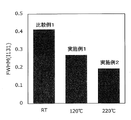
- FIG. 5 is a graph showing the crystallinity of green compacts of Examples 1 and 2 and Comparative Example 1.
- the inventors have made extensive studies to improve the output characteristics of batteries using solid electrolyte materials containing halogen elements. As a result, the present inventors have found that the output characteristics of a battery can be improved by adjusting the crystallite size of a halogen-containing solid electrolyte, that is, a halide solid electrolyte.
- the solid electrolyte material according to the first aspect of the present disclosure is containing a halide solid electrolyte
- the halide solid electrolyte contains Li, at least one selected from the group consisting of metal elements other than Li and metalloid elements, and at least one selected from the group consisting of F, Cl, Br and I,
- the halide solid electrolyte has a crystallite size of 40 nm or more.
- the solid electrolyte material contains a halide solid electrolyte having high ionic conductivity, the effect of improving the output characteristics of the battery is sufficiently exhibited. Moreover, the output characteristics of the battery are further improved by the halide solid electrolyte having a crystallite size of 40 nm or more.
- the halide solid electrolyte may not contain sulfur.
- the halide solid electrolyte may be represented by the following compositional formula (1).
- Li ⁇ 1 M1 ⁇ 1 X1 ⁇ 1 Formula (1) ⁇ 1, ⁇ 1 and ⁇ 1 are each values greater than zero.
- M1 is at least one selected from the group consisting of metal elements other than Li and metalloid elements.
- X1 is at least one selected from the group consisting of F, Cl, Br and I;
- the solid electrolyte material according to the third aspect may satisfy 2 ⁇ 1/ ⁇ 1 ⁇ 2.4 in the composition formula (1).
- M1 may contain yttrium.
- the battery according to the seventh aspect of the present disclosure includes A positive electrode, an electrolyte layer, and a negative electrode are provided in this order, At least one selected from the group consisting of the positive electrode, the electrolyte layer, and the negative electrode includes the solid electrolyte material according to any one of the first to sixth aspects.
- the output characteristics of the battery are further improved.
- the positive electrode may contain a positive electrode active material, and the positive electrode active material may contain nickel cobalt lithium manganate.
- the energy density of the battery can be further improved.
- the solid electrolyte material according to Embodiment 1 includes a halide solid electrolyte.
- the halide solid electrolyte contains Li, at least one selected from the group consisting of metal elements other than Li and metalloid elements, and at least one selected from the group consisting of F, Cl, Br and I.
- the halide solid electrolyte has a crystallite size of 40 nm or more.
- the solid electrolyte material includes a halide solid electrolyte having high ionic conductivity, so that the effect of improving the output characteristics of the battery is sufficiently exhibited. Moreover, the output characteristics of the battery are further improved by the halide solid electrolyte having a crystallite size of 40 nm or more. Good ionic conduction occurs in the crystallites of the halide solid electrolyte of the present embodiment. On the other hand, the ionic conductivity decreases at the crystallite interface of the halide solid electrolyte of the present embodiment. Interfaces can be reduced by adjusting the crystallite size to 40 nm or more. Thereby, ionic conductivity can be improved.
- metal elements are B, Si, Ge, As, Sb and Te.
- Metallic element means all elements contained in Groups 1 to 12 of the periodic table except hydrogen, and B, Si, Ge, As, Sb, Te, C, N, P, O, S, and All elements contained in groups 13 to 16 of the periodic table except Se. That is, the term “semimetallic element” or “metallic element” refers to a group of elements that can become cations when an inorganic compound is formed with a halogen element.
- the crystallite size of the halide solid electrolyte can be calculated by the following method. First, the powder X-ray diffraction measurement of the halide solid electrolyte is performed. From the intensity of a specific X-ray diffraction peak in the measured X-ray diffraction spectrum, the crystallite size D (nm) of the halide solid electrolyte is calculated using the following formulas (1) and (2). For example, when the halide solid electrolyte is Li 3 YBr 2 Cl 4 , the X-ray diffraction peak derived from the (002) plane of Li 3 YBr 2 Cl 4 is 28.6°.
- the halide solid electrolyte has a crystallite size of 40 nm or more
- a halide solid electrolyte having a crystallite size of 40 nm or more is added to at least one of battery members (e.g., electrolyte layer). It means that it can be harvested from the area.
- Equation (2) is the Scherrer equation.
- K represents the Scherrer constant.
- K is 0.94.
- ⁇ represents the wavelength of the X-ray source.
- the X-ray source is CuK ⁇ radiation and ⁇ is 0.15406 nm.
- ⁇ represents the Bragg angle.
- B obs represents the half width of a specific peak in the X-ray diffraction spectrum of the halide solid electrolyte.
- b represents the half width of the standard sample.
- the halide solid electrolyte may have a crystallite size of 45 nm or more, may have a crystallite size of 60 nm or more, or may have a crystallite size of 75 nm or more.
- the upper limit of the crystallite size of the halide solid electrolyte is not particularly limited.
- the halide solid electrolyte may have, for example, a crystallite size of 250 nm or less, a crystallite size of 200 nm or less, or a crystallite size of 150 nm or less.
- the halide solid electrolyte does not have to contain sulfur. According to the above configuration, generation of hydrogen sulfide gas can be prevented. Therefore, it is possible to realize a battery with improved safety.
- the halide solid electrolyte may be represented by the following compositional formula (1).
- Li ⁇ 1 M1 ⁇ 1 X1 ⁇ 1 Formula (1) ⁇ 1, ⁇ 1 and ⁇ 1 are each values greater than zero.
- M1 is at least one selected from the group consisting of metal elements other than Li and metalloid elements.
- X1 is at least one selected from the group consisting of F, Cl, Br and I; According to the above configuration, the ionic conductivity of the solid electrolyte material can be improved. Thereby, the output characteristics of the battery can be further improved.
- composition formula (1) 2 ⁇ 1/ ⁇ 1 ⁇ 2.4 may be satisfied. According to the above configuration, the ionic conductivity of the solid electrolyte material can be further improved. Thereby, the output characteristics of the battery can be further improved.
- M1 may contain yttrium (that is, Y). That is, the halide solid electrolyte may contain Y as a metal element. According to the above configuration, the ionic conductivity of the solid electrolyte material can be further improved. Thereby, the output characteristics of the battery can be further improved.
- the halide solid electrolyte containing Y may be, for example , a compound represented by the composition formula LiaMebYcX16 .
- Me is at least one selected from the group consisting of metal elements and metalloid elements excluding Li and Y.
- m is the valence of the element Me.
- X1 is at least one selected from the group consisting of F, Cl, Br and I; According to the above configuration, the ionic conductivity of the solid electrolyte material can be further improved. Thereby, the output characteristics of the battery can be further improved.
- Me may be, for example, at least one selected from the group consisting of Mg, Ca, Sr, Ba, Zn, Sc, Al, Ga, Bi, Zr, Hf, Ti, Sn, Ta and Nb. According to the above configuration, the ionic conductivity of the solid electrolyte material can be further improved. Thereby, the output characteristics of the battery can be further improved.
- the following materials can be used as the halide solid electrolyte.
- the ionic conductivity of the solid electrolyte material can be further improved.
- the output characteristics of the battery can be further improved.
- the halide solid electrolyte may be a material represented by the following compositional formula (A1).
- Li 6-3d Y d X1 6 Formula (A1) In composition formula (A1), X1 is at least one selected from the group consisting of F, Cl, Br and I.
- composition formula (A1) 0 ⁇ d ⁇ 2 is satisfied in the composition formula (A1).
- the halide solid electrolyte may be a material represented by the following compositional formula (A2).
- Li 3 YX1 6 Formula (A2) In composition formula (A2), X1 is at least one selected from the group consisting of F, Cl, Br and I.
- the halide solid electrolyte may be a material represented by the following compositional formula (A3).
- composition formula (A3) Li 3-3 ⁇ Y 1+ ⁇ Cl 6 Formula (A3) In composition formula (A3), 0 ⁇ 0.15 is satisfied.
- the halide solid electrolyte may be a material represented by the following compositional formula (A4).
- composition formula (A4) Li 3-3 ⁇ Y 1+ ⁇ Br 6 Formula (A4) In composition formula (A4), 0 ⁇ 0.25 is satisfied.
- the halide solid electrolyte may be a material represented by the following compositional formula (A5).
- Me is at least one selected from the group consisting of Mg, Ca, Sr, Ba and Zn.
- composition formula (A5) -1 ⁇ 2, 0 ⁇ a ⁇ 3, 0 ⁇ (3-3 ⁇ +a), 0 ⁇ (1+ ⁇ -a), and 0 ⁇ x ⁇ 6 are satisfied.
- the halide solid electrolyte may be a material represented by the following compositional formula (A6).
- Me is at least one selected from the group consisting of Al, Sc, Ga and Bi.
- composition formula (A6) ⁇ 1 ⁇ 1, 0 ⁇ a ⁇ 2, 0 ⁇ (1+ ⁇ a), and 0 ⁇ x ⁇ 6 are satisfied.
- the halide solid electrolyte may be a material represented by the following compositional formula (A7).
- Me is at least one selected from the group consisting of Zr, Hf and Ti.
- composition formula (A7) -1 ⁇ ⁇ ⁇ 1, 0 ⁇ a ⁇ 1.5, 0 ⁇ (3-3 ⁇ -a), 0 ⁇ (1 + ⁇ -a), and 0 ⁇ x ⁇ 6 .
- the halide solid electrolyte may be a material represented by the following compositional formula (A8).
- Me is at least one selected from the group consisting of Ta and Nb.
- composition formula (A8) -1 ⁇ ⁇ ⁇ 1, 0 ⁇ a ⁇ 1.2, 0 ⁇ (3-3 ⁇ -2a), 0 ⁇ (1 + ⁇ -a), and 0 ⁇ x ⁇ 6 .
- halide solid electrolyte more specifically, for example, Li 3 YX1 6 , Li 2 MgX1 4 , Li 2 FeX1 4 , Li(Al, Ga, In) X1 4 , Li 3 (Al, Ga, In) X1 6 , etc. can be used.
- X1 is at least one selected from the group consisting of F, Cl, Br and I.
- (Al, Ga, In) represents at least one element selected from the parenthesized group of elements. That is, “(Al, Ga, In)” is synonymous with “at least one selected from the group consisting of Al, Ga and In”. The same is true for other elements.
- Embodiment 2 (Embodiment 2) Embodiment 2 will be described below. Descriptions overlapping those of the first embodiment are omitted as appropriate.
- FIG. 1 is a cross-sectional view showing a schematic configuration of a battery 10 according to Embodiment 2.
- FIG. 1 is a cross-sectional view showing a schematic configuration of a battery 10 according to Embodiment 2.
- FIG. 1 is a cross-sectional view showing a schematic configuration of a battery 10 according to Embodiment 2.
- the battery 10 includes a positive electrode 201, an electrolyte layer 100, and a negative electrode 202 in this order.
- the positive electrode 201, the electrolyte layer 100, and the negative electrode 202 are laminated in this order.
- the electrolyte layer 100 is arranged between the positive electrode 201 and the negative electrode 202 .
- At least one selected from the group consisting of positive electrode 201, electrolyte layer 100, and negative electrode 202 contains the solid electrolyte material according to the first embodiment. That is, the solid electrolyte material includes a halide solid electrolyte.
- the halide solid electrolyte contains Li, at least one selected from the group consisting of metal elements other than Li and metalloid elements, and at least one selected from the group consisting of F, Cl, Br and I.
- the halide solid electrolyte has a crystallite size of 40 nm or more.
- the effect of improving the output characteristics of the battery 10 is sufficiently exhibited by the halide solid electrolyte having high ionic conductivity. Moreover, the output characteristics of the battery 10 are further improved by the halide solid electrolyte having a crystallite size of 40 nm or more. Good ionic conduction occurs in the crystallites of the halide solid electrolyte of the present embodiment. On the other hand, the ionic conductivity decreases at the crystallite interface of the halide solid electrolyte of the present embodiment. By adjusting the crystallite size to 40 nm or more, the interface can be reduced, thereby improving the ionic conductivity.
- the desired effect can be obtained regardless of which layer of the positive electrode 201, the electrolyte layer 100, and the negative electrode 202 contains the halide solid electrolyte having a crystallite size of 40 nm or more.
- the halide solid electrolyte having a crystallite size of 40 nm or more may be contained in two selected from the group consisting of the positive electrode 201, the electrolyte layer 100, and the negative electrode 202, or may be contained in only one. , may be included in all
- electrolyte layer 100 is in contact with positive electrode 201 and negative electrode 202 .
- the average thickness of the electrolyte layer 100 may be 1 ⁇ m or more and 300 ⁇ m or less. When the average thickness of electrolyte layer 100 is 1 ⁇ m or more, short circuit between positive electrode 201 and negative electrode 202 is less likely to occur. When the electrolyte layer 100 has an average thickness of 300 ⁇ m or less, the battery 10 can operate at high power.
- the average thickness of the electrolyte layer 100 can be measured by the following method.
- a cross section of the electrolyte layer 100 is observed with a scanning electron microscope (SEM).
- SEM scanning electron microscope
- the cross section is a cross section parallel to the stacking direction of each layer and includes the center of gravity of electrolyte layer 100 in plan view.
- Three arbitrary points are selected in the obtained cross-sectional SEM image.
- the thickness of the electrolyte layer is measured at three arbitrarily selected points. The average of those measurements is taken as the average thickness.
- the electrolyte layer 100 may contain a solid electrolyte material including the halide solid electrolyte described above. When the electrolyte layer 100 contains a halide solid electrolyte, the output characteristics of the battery 10 are further improved.
- the electrolyte layer 100 may contain 100% by mass of the halide solid electrolyte in terms of mass ratio with respect to the entire electrolyte layer 100, except for impurities that are unavoidably mixed. That is, the electrolyte layer 100 may be substantially composed only of the halide solid electrolyte.
- the electrolyte layer 100 contains a halide solid electrolyte as a main component, and may further contain unavoidable impurities, or starting materials, by-products, and decomposition products used when synthesizing the halide solid electrolyte. good.
- the mass ratio of the halide solid electrolyte to the mass of the electrolyte layer 100 may be, for example, 50% by mass or more, or may be 70% by mass or more.
- the positive electrode 201 includes, for example, a material having a characteristic of intercalating and deintercalating metal ions (for example, lithium ions) as a positive electrode active material.
- positive electrode active materials that can be used include lithium-containing transition metal oxides, transition metal fluorides, polyanion materials, fluorinated polyanion materials, transition metal sulfides, transition metal oxysulfides, and transition metal oxynitrides.
- lithium-containing transition metal oxides include Li(Ni, Co, Al) O2 , Li(Ni, Co, Mn) O2 , LiCoO2 , and the like.
- the manufacturing cost can be reduced and the average discharge voltage can be increased.
- the positive electrode active material may contain lithium nickel cobalt manganate.
- the positive electrode active material may contain Li(Ni, Co, Mn) O2 . According to the above configuration, the energy density of the battery 10 can be further improved.
- the positive electrode active material may be Li(Ni,Co,Mn) O2 .
- the positive electrode 201 may contain an electrolyte material, for example, a solid electrolyte material.
- the solid electrolyte material contained in the positive electrode 201 may contain a halide solid electrolyte.
- the halide solid electrolyte contained in positive electrode 201 the halide solid electrolyte exemplified in Embodiment 1 can be used. According to the above configuration, it is possible to further improve the output characteristics of the battery 10 .
- solid electrolyte contained in positive electrode 201 in addition to the halide solid electrolyte exemplified in Embodiment 1, for example, a sulfide solid electrolyte, an oxide solid electrolyte, a polymer solid electrolyte, a complex hydride solid electrolyte, and the like are used.
- a sulfide solid electrolyte, an oxide solid electrolyte, a polymer solid electrolyte, a complex hydride solid electrolyte, and the like can be The output characteristics of the battery 10 can be further improved by the above configuration as well.
- Sulfide solid electrolytes include Li 2 SP 2 S 5 , Li 2 S —SiS 2 , Li 2 S—B 2 S 3 , Li 2 S—GeS 2 , Li 3.25 Ge 0.25 P 0.75 S 4 , Li 10 GeP 2 S 12 and the like are included. Moreover, LiX, Li2O , MOq , LipMOq , etc. may be added to these. Here, X is at least one selected from the group consisting of F, Cl, Br and I. Also, M is at least one selected from the group consisting of P, Si, Ge, B, Al, Ga, In, Fe and Zn. p and q are natural numbers respectively. One or more sulfide solid electrolytes selected from the above materials may be used.
- oxide solid electrolytes examples include NASICON solid electrolytes typified by LiTi 2 (PO 4 ) 3 and element-substituted products thereof, (LaLi)TiO 3 -based perovskite solid electrolytes, Li 14 ZnGe 4 O 16 , Li LISICON solid electrolytes typified by 4 SiO 4 , LiGeO 4 and elemental substitutions thereof, garnet type solid electrolytes typified by Li 7 La 3 Zr 2 O 12 and elemental substitutions thereof, Li 3 PO 4 and its N substitutions Glass or glass-ceramics to which Li2SO4 , Li2CO3 , etc. are added to a Li-BO compound such as LiBO2, Li3BO3 , etc., can be used .
- One or more oxide solid electrolytes selected from the above materials may be used.
- a compound of a polymer compound and a lithium salt can be used.
- the polymer compound may have an ethylene oxide structure.
- a polymer compound having an ethylene oxide structure can contain a large amount of lithium salt. Therefore, the ionic conductivity can be further increased.
- Lithium salts include LiPF6 , LiBF4 , LiSbF6, LiAsF6 , LiSO3CF3 , LiN ( SO2F )2, LiN(SO2CF3)2 , LiN ( SO2C2F5 ) 2 , LiN ( SO2CF3 )( SO2C4F9 ), LiC ( SO2CF3 ) 3 , etc. may be used .
- One lithium salt may be used alone, or two or more may be used in combination.
- LiBH 4 --LiI LiBH 4 --P 2 S 5 or the like
- LiBH 4 --LiI LiBH 4 --P 2 S 5 or the like
- the shape of the solid electrolyte contained in the battery 10 is not limited.
- the shape of the solid electrolyte may be acicular, spherical, oval, or the like, for example.
- the shape of the solid electrolyte may be, for example, particulate.
- the median diameter of the solid electrolyte contained in the positive electrode 201 may be 100 ⁇ m or less.
- the positive electrode active material and the solid electrolyte can form a good dispersion state in the positive electrode 201 . Thereby, the charge/discharge characteristics of the battery 10 are improved.
- the median diameter of the solid electrolyte contained in the positive electrode 201 may be 10 ⁇ m or less.
- the positive electrode active material and the solid electrolyte can form a better dispersion state in the positive electrode 201 .
- the median diameter of the solid electrolyte contained in the positive electrode 201 may be smaller than the median diameter of the positive electrode active material. As a result, the positive electrode active material and the solid electrolyte can form a good dispersion state in the positive electrode 201 .
- the median diameter of the positive electrode active material may be 0.1 ⁇ m or more and 100 ⁇ m or less.
- the positive electrode active material has a median diameter of 0.1 ⁇ m or more, the positive electrode active material and the solid electrolyte can form a good dispersion state in the positive electrode 201 . Therefore, the charge/discharge characteristics of the battery 10 are improved.
- the median diameter of the positive electrode active material is 100 ⁇ m or less, the diffusion rate of lithium in the positive electrode active material increases. Therefore, battery 10 can operate at a high output.
- the median diameter of the positive electrode active material and solid electrolyte means the particle size (d50) corresponding to 50% of the cumulative volume, which is obtained from the particle size distribution measured on a volume basis by the laser diffraction scattering method.
- the particle size distribution can also be measured, for example, using an image analyzer. The same applies to other materials.
- the volume ratio "v1:100-v1" between the positive electrode active material and the solid electrolyte contained in the positive electrode 201 may satisfy 30 ⁇ v1 ⁇ 95.
- v1 represents the volume ratio of the positive electrode active material when the total volume of the positive electrode active material and the solid electrolyte contained in the positive electrode 201 is 100.
- 30 ⁇ v1 a sufficient energy density of the battery can be secured.
- v1 ⁇ 95 the battery 10 can operate at high output.
- the average thickness of the positive electrode 201 may be 10 ⁇ m or more and 500 ⁇ m or less. When the positive electrode 201 has an average thickness of 10 ⁇ m or more, a sufficient energy density of the battery can be ensured. When the average thickness of the positive electrode 201 is 500 ⁇ m or less, the battery 10 can operate at high output.
- the method described for the average thickness of the electrolyte layer 100 can be applied.
- a similar method can be applied to the average thickness of the negative electrode 202 as well.
- the negative electrode 202 includes, for example, a material having a property of intercalating and deintercalating metal ions (for example, lithium ions) as a negative electrode active material.
- a metal material, a carbon material, an oxide, a nitride, a tin compound, a silicon compound, or the like can be used as the negative electrode active material.
- the metal material may be a single metal.
- the metal material may be an alloy. Examples of metallic materials include lithium metal, lithium alloys, and the like.
- Examples of carbon materials include natural graphite, coke, ungraphitized carbon, carbon fiber, spherical carbon, artificial graphite, and amorphous carbon.
- the capacity density can be improved by using silicon (Si), tin (Sn), a silicon compound, a tin compound, or the like.
- Si silicon
- Sn tin
- oxides include Li4Ti5O12 , LiTi2O4 , TiO2 , and the like .
- the negative electrode 202 may contain an electrolyte material, for example, a solid electrolyte material.
- the solid electrolyte material contained in the negative electrode 202 may contain a halide solid electrolyte.
- the halide solid electrolyte contained in the negative electrode 202 the halide solid electrolyte described above can be used. According to the above configuration, it is possible to further improve the output characteristics of the battery 10 .
- the median diameter of the solid electrolyte contained in the negative electrode 202 may be 100 ⁇ m or less.
- the negative electrode active material and the solid electrolyte can form a good dispersion state in the negative electrode 202 . Thereby, the charge/discharge characteristics of the battery 10 are improved.
- the median diameter of the solid electrolyte contained in the negative electrode 202 may be 10 ⁇ m or less.
- the negative electrode active material and the solid electrolyte can form a better dispersion state in the negative electrode 202 .
- the median diameter of the solid electrolyte contained in the negative electrode 202 may be smaller than the median diameter of the negative electrode active material. As a result, the negative electrode active material and the solid electrolyte can form a good dispersion state in the negative electrode 202 .
- the median diameter of the negative electrode active material may be 0.1 ⁇ m or more and 100 ⁇ m or less.
- the median diameter of the negative electrode active material is 0.1 ⁇ m or more, the negative electrode active material and the solid electrolyte can form a good dispersion state in the negative electrode 202 . Thereby, the charge/discharge characteristics of the battery 10 are improved.
- the median diameter of the negative electrode active material is 100 ⁇ m or less, the diffusion rate of lithium in the negative electrode active material increases. Therefore, battery 10 can operate at a high output.
- the volume ratio "v2:100-v2" between the negative electrode active material and the solid electrolyte contained in the negative electrode 202 may satisfy 30 ⁇ v2 ⁇ 95.
- v2 represents the volume ratio of the negative electrode active material when the total volume of the negative electrode active material and the solid electrolyte contained in the negative electrode 202 is 100.
- 30 ⁇ v2 is satisfied, a sufficient energy density of the battery can be secured.
- v2 ⁇ 95 is satisfied, the battery 10 can operate at high output.
- the average thickness of the negative electrode 202 may be 10 ⁇ m or more and 500 ⁇ m or less. When the average thickness of the negative electrode 202 is 10 ⁇ m or more, a sufficient energy density of the battery can be ensured. When the average thickness of the negative electrode 202 is 500 ⁇ m or less, the battery 10 can operate at high output.
- the positive electrode active material and the negative electrode active material may be coated with a coating material in order to reduce the interfacial resistance between each active material and the solid electrolyte.
- a coating material for example, a sulfide solid electrolyte, an oxide solid electrolyte, a halide solid electrolyte, a polymer solid electrolyte, a complex hydride solid electrolyte, and the like can be used.
- the coating material may be an oxide solid electrolyte.
- oxide solid electrolytes that can be used as coating materials include Li--Nb--O compounds such as LiNbO 3 , Li--B--O compounds such as LiBO 2 and Li 3 BO 3 , Li--Al--O compounds such as LiAlO 2 , Li—Si—O compounds such as Li 4 SiO 4 , Li—Ti—O compounds such as Li 2 SO 4 and Li 4 Ti 5 O 12 , Li—Zr—O compounds such as Li 2 ZrO 3 , Li 2 MoO 3 Li--Mo--O compounds such as Li--Mo--O compounds such as LiV 2 O 5 and Li--VO compounds such as Li -- WO 4 and the like.
- Oxide solid electrolytes have high ionic conductivity. Oxide solid electrolytes have excellent high potential stability. Therefore, by using the oxide solid electrolyte as the coating material, the charge/discharge efficiency of the battery 10 can be further improved.
- the electrolyte layer 100 may contain at least one selected from the group consisting of sulfide solid electrolytes, oxide solid electrolytes, polymer solid electrolytes, and complex hydride solid electrolytes.
- Materials exemplified as the solid electrolyte contained in the positive electrode 201 can be used as the sulfide solid electrolyte, the oxide solid electrolyte, the polymer solid electrolyte, and the complex hydride solid electrolyte. According to the above configuration, it becomes easy to transfer lithium ions. Thereby, the output characteristics of the battery 10 can be further improved.
- At least one selected from the group consisting of the positive electrode 201, the electrolyte layer 100, and the negative electrode 202 may contain a non-aqueous electrolyte, a gel electrolyte, or an ionic liquid. According to the above configuration, it becomes easy to transfer lithium ions. Thereby, the output characteristics of the battery 10 can be further improved.
- the non-aqueous electrolyte contains a non-aqueous solvent and a lithium salt dissolved in the non-aqueous solvent.
- a non-aqueous solvent a cyclic carbonate solvent, a chain carbonate solvent, a cyclic ether solvent, a chain ether solvent, a cyclic ester solvent, a chain ester solvent, a fluorine solvent, or the like can be used.
- cyclic carbonate solvents include ethylene carbonate, propylene carbonate, butylene carbonate, and the like.
- Examples of chain carbonate solvents include dimethyl carbonate, ethyl methyl carbonate, diethyl carbonate and the like.
- Examples of cyclic ether solvents include tetrahydrofuran, 1,4-dioxane, 1,3-dioxolane, and the like.
- Examples of chain ether solvents include 1,2-dimethoxyethane, 1,2-diethoxyethane, and the like.
- Examples of cyclic ester solvents include ⁇ -butyrolactone and the like.
- Examples of chain ester solvents include methyl acetate and the like.
- Examples of fluorosolvents include fluoroethylene carbonate, methyl fluoropropionate, fluorobenzene, fluoroethylmethyl carbonate, fluorodimethylene carbonate, and the like.
- the non-aqueous solvent one non-aqueous solvent selected from these may be used alone, or a mixture of two or more non-aqueous solvents selected from these may be used.
- the non-aqueous electrolyte may contain at least one fluorine solvent selected from the group consisting of fluoroethylene carbonate, methyl fluoropropionate, fluorobenzene, fluoroethylmethyl carbonate and fluorodimethylene carbonate.
- Lithium salts include LiPF6 , LiBF4 , LiSbF6 , LiAsF6 , LiSO3CF3 , LiN( SO2F )2, LiN(SO2CF3)2 , LiN ( SO2C2F5 ) 2 , LiN( SO2CF3 )( SO2C4F9 ) , LiC ( SO2CF3 ) 3 , etc. may be used.
- the lithium salt one lithium salt selected from these may be used alone, or a mixture of two or more lithium salts selected from these may be used.
- the lithium salt concentration is, for example, in the range of 0.5 mol/liter or more and 2 mol/liter or less.
- a polymer material impregnated with a non-aqueous electrolyte can be used as the gel electrolyte.
- Polymer materials such as polyethylene oxide, polyacrylonitrile, polyvinylidene fluoride, polymethyl methacrylate, and polymers having ethylene oxide linkages can be used.
- the cations constituting the ionic liquid are aliphatic chain quaternary salts such as tetraalkylammonium and tetraalkylphosphonium; Nitrogen-containing heterocyclic aromatic cations such as group cyclic ammoniums, pyridiniums, and imidazoliums may also be used.
- Anions constituting the ionic liquid are PF 6 ⁇ , BF 4 ⁇ , SbF 6 ⁇ , AsF 6 ⁇ , SO 3 CF 3 ⁇ , N(SO 2 F) 2 ⁇ , N(SO 2 CF 3 ) 2 ⁇ , N ( SO2C2F5 ) 2- , N ( SO2CF3 )( SO2C4F9 )- , C ( SO2CF3 ) 3- , and the like.
- the ionic liquid may contain a lithium salt.
- At least one selected from the group consisting of the positive electrode 201, the electrolyte layer 100, and the negative electrode 202 may contain a binder for the purpose of improving adhesion between particles.
- a binder is used to improve the binding properties of the material that constitutes the electrode.
- Binders include polyvinylidene fluoride, polytetrafluoroethylene, polyethylene, polypropylene, aramid resin, polyamide, polyimide, polyamideimide, polyacrylonitrile, polyacrylic acid, polyacrylic acid methyl ester, polyacrylic acid ethyl ester, poly Acrylate hexyl ester, polymethacrylic acid, polymethacrylic acid methyl ester, polymethacrylic acid ethyl ester, polymethacrylic acid hexyl ester, polyvinyl acetate, polyvinylpyrrolidone, polyether, polyethersulfone, hexafluoropolypropylene, styrene-butadiene rubber, Carboxymethyl cellulose etc.
- Two selected from the group consisting of tetrafluoroethylene, hexafluoroethylene, hexafluoropropylene, perfluoroalkyl vinyl ether, vinylidene fluoride, chlorotrifluoroethylene, ethylene, propylene, pentafluoropropylene, fluoromethyl vinyl ether, acrylic acid and hexadiene Copolymers of the above materials can also be used as binders.
- a mixture of two or more selected from the above materials may be used as the binder.
- At least one of the positive electrode 201 and the negative electrode 202 may contain a conductive aid for the purpose of increasing electronic conductivity.
- conductive aids include graphites such as natural graphite and artificial graphite, carbon blacks such as acetylene black and Ketjen black, conductive fibers such as carbon fiber and metal fiber, carbon fluoride, and metal powder such as aluminum.
- conductive whiskers such as zinc oxide and potassium titanate, conductive metal oxides such as titanium oxide, and conductive polymeric compounds such as polyaniline, polypyrrole, and polythiophene. Cost reduction can be achieved when a carbon conductive aid is used as the conductive aid.
- the shape of the battery 10 includes, for example, coin type, cylindrical type, square type, sheet type, button type, flat type, and laminated type.
- the battery 10 including the positive electrode 201, the electrolyte layer 100, and the negative electrode 202 may be stacked in multiple layers via current collectors. By electrically connecting multiple batteries in series, the voltage of the batteries can be increased. By electrically connecting multiple batteries in parallel, the capacity of the batteries can be increased. By electrically connecting multiple batteries in series and parallel, the voltage and capacity of the batteries can be increased.
- the halide solid electrolyte represented by the compositional formula (1) as the solid electrolyte material can be produced, for example, by the following method.
- a binary halide refers to a compound composed of two elements including a halogen element.
- a binary halide refers to a compound composed of two elements including a halogen element.
- raw material powders LiCl and YCl 3 are prepared at a molar ratio of 3:1.
- the elements of "M1" and "X1" in the composition formula (1) are determined by selecting the type of raw material powder.
- the values of " ⁇ 1", “ ⁇ 1” and “ ⁇ 1” in the composition formula (1) are determined by adjusting the type of raw material powder, the mixing ratio of raw material powder and the synthesis process.
- the mechanochemical milling method is used to react the raw material powders with each other.
- raw material powders may be mixed and pulverized and then sintered in a vacuum or in an inert atmosphere.
- firing may be performed at a temperature of 100° C. or higher and 400° C. or lower for one hour or more.
- the battery 10 using the halide solid electrolyte produced above as the solid electrolyte material can be produced, for example, by the following method (dry method).
- FIG. 2A and 2B are diagrams illustrating a method for manufacturing the battery 10.
- FIG. 2 the lower die 1 is inserted into the insulating tube 3 .
- a solid electrolyte material powder is placed in the insulating tube 3 .
- the upper die 2 is inserted into the insulating tube 3 and the solid electrolyte material powder is pressed to form the electrolyte layer 100 .
- the upper die 2 is removed, and the positive electrode material powder is put into the insulating tube 3 .
- the upper die 2 is inserted into the insulating tube 3 again, and the positive electrode material powder is pressed to form the positive electrode 201 on the electrolyte layer 100 .
- the positive electrode material may contain a halide solid electrolyte.
- the lower die 1 After forming the positive electrode 201 , the lower die 1 is removed and the negative electrode material powder is put into the insulating tube 3 . The lower die 1 is inserted again to press the negative electrode material powder to form the negative electrode 202 . Thereby, the power generation element 9 is formed.
- the negative electrode material may contain a halide solid electrolyte.
- pressure molding is performed at a temperature of 100°C or higher.
- a laminate including the positive electrode 201, the electrolyte layer 100 and the negative electrode 202 is produced.
- Pressure molding is preferably performed at a temperature of 120°C.
- the pressure molding temperature means the surface temperature of the pressurizing mold.
- the electrolyte layer 100 and the negative electrode 202 are laminated, they are pressurized while being heated at a temperature of 100°C or higher.
- the timing of applying pressure while heating is not limited to the above case.
- the powder of the solid electrolyte material may be pressed while being heated.
- the powder of the positive electrode material may be pressurized while being heated.
- the powder of the negative electrode material may be pressed while being heated.
- Electrolyte layer 100, positive electrode 201, and negative electrode 202 may be heated and pressurized, and then positive electrode 201, electrolyte layer 100, and negative electrode 202 may be stacked together and further heated and pressurized.
- the battery 10 includes a positive electrode 201, an electrolyte layer 100 and a negative electrode 202 obtained by pressure molding at a temperature of 100°C or higher. According to the above configuration, the crystallite size can be adjusted so that the halide solid electrolyte has a crystallite size of 40 nm or more. As a result, it is possible to realize the battery 10 with particularly improved output characteristics.
- the battery 10 using the halide solid electrolyte produced above as the solid electrolyte material can also be produced by a wet method.
- a positive electrode slurry containing a positive electrode active material and a solid electrolyte is applied to a current collector to form a coating film.
- the coated film is passed through a roll or flat press heated to a temperature of 120° C. or higher and pressed.
- the positive electrode 201 is obtained.
- An electrolyte layer 100 and a negative electrode 202 are produced in a similar manner.
- the positive electrode 201, the electrolyte layer 100 and the negative electrode 202 are laminated in this order and pressure-molded at a temperature of 100° C. or higher.
- the crystallite size can be adjusted so that the halide solid electrolyte has a crystallite size of 40 nm or more.
- FIG. 3 is a cross-sectional view showing a schematic configuration of the battery 20 according to the third embodiment.
- the battery 20 includes a positive electrode 201, a first electrolyte layer 101, a second electrolyte layer 102, and a negative electrode 202 in this order.
- the positive electrode 201, the first electrolyte layer 101, the second electrolyte layer 102, and the negative electrode 202 are laminated in this order.
- Electrolyte layer 100 includes first electrolyte layer 101 and second electrolyte layer 102 .
- the electrolyte layer 100 is arranged between the positive electrode 201 and the negative electrode 202 .
- First electrolyte layer 101 includes a first solid electrolyte material.
- the second electrolyte layer 102 contains a second solid electrolyte material.
- the first solid electrolyte material and the second solid electrolyte material comprise halide solid electrolytes.
- the halide solid electrolyte contained in the first solid electrolyte material has a composition different from the composition of the halide solid electrolyte contained in the second solid electrolyte material.
- At least one selected from the group consisting of the halide solid electrolyte contained in the first solid electrolyte material and the halide solid electrolyte contained in the second solid electrolyte material has a crystallite size of 40 nm or more.
- the halide solid electrolytes exemplified in Embodiment 1 can be used as the halide solid electrolytes contained in the first solid electrolyte material and the second solid electrolyte material.
- the effect of improving the output characteristics of the battery 20 is sufficiently exhibited by the halide solid electrolyte having high ionic conductivity.
- at least one selected from the group consisting of the halide solid electrolyte contained in the first solid electrolyte material and the halide solid electrolyte contained in the second solid electrolyte material has a crystallite size of 40 nm or more. Output characteristics are further improved.
- Both the halide solid electrolyte contained in the first solid electrolyte material and the halide solid electrolyte contained in the second solid electrolyte material may have a crystallite size of 40 nm or more.
- Either one of the halide solid electrolyte contained in the first solid electrolyte material and the halide solid electrolyte contained in the second solid electrolyte material may have a crystallite size of 40 nm or more.
- the halide solid electrolyte contained in the second solid electrolyte material contains iodine (that is, I)
- the halide solid electrolyte contained in the first solid electrolyte material may not contain iodine.
- the solid electrolyte contains iodine as a halogen element
- an oxidative decomposition layer with poor lithium ion conductivity is formed between the positive electrode active material and the solid electrolyte due to the oxidation reaction of iodine during charging. This oxidative decomposition layer functions as a large interfacial resistance in the electrode reaction of the positive electrode.
- the halide solid electrolyte contained in the first solid electrolyte material and the second solid electrolyte material may not contain sulfur. According to the above configuration, generation of hydrogen sulfide gas is prevented.
- electrolyte layer 100 is in contact with positive electrode 201 and negative electrode 202 .
- the first electrolyte layer 101 is in contact with the positive electrode 201 .
- the second electrolyte layer 102 is in contact with the negative electrode 202 .
- the first electrolyte layer 101 is in contact with the second electrolyte layer 102 .
- the second electrolyte layer 102 does not have to be in contact with the positive electrode 201 .
- a solid electrolyte containing iodine as a halogen element is excellent in ion conductivity, but poor in oxidation stability. Therefore, according to the above configuration, even when the second electrolyte layer 102 contains a halide solid electrolyte containing iodine, an oxidative decomposition layer is less likely to be formed during charging. Therefore, the output characteristics of battery 20 can be further improved.
- the halide solid electrolyte contained in the second solid electrolyte material may be represented by the following compositional formula (2).
- Li ⁇ 2 M2 ⁇ 2 X2 ⁇ 2 Formula (2) ⁇ 2, ⁇ 2 and ⁇ 2 are each values greater than zero.
- M2 contains at least one selected from the group consisting of metal elements other than Li and metalloid elements.
- X2 includes I and at least one selected from the group consisting of F, Cl and Br.
- a halide solid electrolyte containing I is superior to a halide solid electrolyte not containing I in ion conductivity. Therefore, according to the above configuration, the ion conductivity of the second solid electrolyte material can be improved. Thereby, the output characteristics of the battery 20 can be further improved.
- M2 may contain yttrium (that is, Y). That is, the halide solid electrolyte may contain Y as a metal element. According to the above configuration, the ionic conductivity of the second solid electrolyte material can be further improved. Thereby, the output characteristics of the battery 20 can be further improved.
- the halide solid electrolyte containing Y may be, for example , a compound represented by the composition formula LiaMebYcX26 .
- Me is at least one selected from the group consisting of metal elements and metalloid elements excluding Li and Y.
- m is the valence of the element Me.
- X2 includes I and at least one selected from the group consisting of F, Cl and Br. According to the above configuration, the ionic conductivity of the second solid electrolyte material can be further improved. Thereby, the output characteristics of the battery 20 can be further improved.
- Me may be, for example, at least one selected from the group consisting of Mg, Ca, Sr, Ba, Zn, Sc, Al, Ga, Bi, Zr, Hf, Ti, Sn, Ta and Nb. According to the above configuration, the ionic conductivity of the second solid electrolyte material can be further improved. Thereby, the output characteristics of the battery 20 can be further improved.
- the following materials can be used as the halide solid electrolyte contained in the second solid electrolyte material.
- the ionic conductivity of the second solid electrolyte material can be further improved.
- the output characteristics of the battery 20 can be further improved.
- the halide solid electrolyte may be a material represented by the following compositional formula (B1).
- X2 includes I and at least one selected from the group consisting of F, Cl and Br.
- the halide solid electrolyte may be a material represented by the following compositional formula (B2).
- Li 3 YX2 6 Formula (B2) Li 3 YX2 6 Formula (B2)
- X2 includes at least one selected from the group consisting of F, Cl and Br, and I.
- the halide solid electrolyte may be a material represented by the following compositional formula (B3).
- Me is at least one selected from the group consisting of Mg, Ca, Sr, Ba and Zn.
- composition formula (B3) -1 ⁇ ⁇ ⁇ 2, 0 ⁇ a ⁇ 3, 0 ⁇ (3-3 ⁇ + a), 0 ⁇ (1 + ⁇ - a), 0 ⁇ x ⁇ 6, 0 ⁇ y ⁇ 6, and (x+y) ⁇ 6 is satisfied.
- the halide solid electrolyte may be a material represented by the following compositional formula (B4).
- Me is at least one selected from the group consisting of Al, Sc, Ga and Bi.
- composition formula (B4) ⁇ 1 ⁇ 1, 0 ⁇ a ⁇ 2, 0 ⁇ (1+ ⁇ a), 0 ⁇ x ⁇ 6, 0 ⁇ y ⁇ 6, and (x+y) ⁇ 6 are satisfied .
- the halide solid electrolyte may be a material represented by the following compositional formula (B5).
- Me is at least one selected from the group consisting of Zr, Hf and Ti.
- composition formula (B5) -1 ⁇ ⁇ ⁇ 1, 0 ⁇ a ⁇ 1.5, 0 ⁇ (3-3 ⁇ -a), 0 ⁇ (1 + ⁇ -a), 0 ⁇ x ⁇ 6, 0 ⁇ y ⁇ 6 and (x+y) ⁇ 6.
- the halide solid electrolyte may be a material represented by the following compositional formula (B6).
- Me is at least one selected from the group consisting of Ta and Nb.
- composition formula (B6) -1 ⁇ ⁇ ⁇ 1, 0 ⁇ a ⁇ 1.2, 0 ⁇ (3-3 ⁇ -2a), 0 ⁇ (1 + ⁇ -a), 0 ⁇ x ⁇ 6, 0 ⁇ y ⁇ 6 and (x+y) ⁇ 6.
- halide solid electrolyte more specifically, for example, Li3YX26 , Li2MgX24 , Li2FeX24 , Li(Al, Ga, In) X24 , Li3 (Al, Ga, In )X2 6 , etc. can be used.
- X2 includes I and at least one selected from the group consisting of F, Cl and Br.
- the average thickness of the first electrolyte layer 101 and the average thickness of the second electrolyte layer 102 may be 1 ⁇ m or more and 300 ⁇ m or less. When the average thickness of each of first electrolyte layer 101 and second electrolyte layer 102 is 1 ⁇ m or more, short circuit between positive electrode 201 and negative electrode 202 is less likely to occur. When the average thickness of each of first electrolyte layer 101 and second electrolyte layer 102 is 300 ⁇ m or less, battery 10 can operate at high output.
- the average thickness of the first electrolyte layer 101 and the average thickness of the second electrolyte layer 102 may be the same or different.
- the first electrolyte layer 101 may contain 100% by mass of a halide solid electrolyte with respect to the entire first electrolyte layer 101, except for impurities that are unavoidably mixed. That is, the first electrolyte layer 101 may be substantially composed only of the halide solid electrolyte.
- the second electrolyte layer 102 may contain 100% by mass of the halide solid electrolyte with respect to the entire second electrolyte layer 102, except for impurities that are unavoidably mixed. That is, the second electrolyte layer 102 may be substantially composed only of the halide solid electrolyte.
- the first electrolyte layer 101 contains a halide solid electrolyte as a main component, and further contains unavoidable impurities or starting materials, by-products and decomposition products used when synthesizing the halide solid electrolyte.
- the second electrolyte layer 102 contains a halide solid electrolyte as a main component, and further contains unavoidable impurities or starting materials, by-products, and decomposition products used when synthesizing the halide solid electrolyte.
- the mass ratio of the halide solid electrolyte to the mass of the first electrolyte layer 101 may be, for example, 50% by mass or more, or may be 70% by mass or more.
- the mass ratio of the halide solid electrolyte to the mass of the second electrolyte layer 102 may be, for example, 50% by mass or more, or may be 70% by mass or more.
- At least one selected from the group consisting of first electrolyte layer 101 and second electrolyte layer 102 is selected from the group consisting of sulfide solid electrolytes, oxide solid electrolytes, polymer solid electrolytes, and complex hydride solid electrolytes. At least one may be included.
- Materials exemplified as the solid electrolyte contained in the positive electrode 201 can be used as the sulfide solid electrolyte, the oxide solid electrolyte, the polymer solid electrolyte, and the complex hydride solid electrolyte. According to the above configuration, it becomes easy to transfer lithium ions. Thereby, the output characteristics of the battery 20 can be further improved.
- At least one selected from the group consisting of the positive electrode 201, the first electrolyte layer 101, the second electrolyte layer 102, and the negative electrode 202 may contain a non-aqueous electrolyte, a gel electrolyte, or an ionic liquid. According to the above configuration, it becomes easy to transfer lithium ions. Thereby, the output characteristics of the battery 10 can be further improved.
- a non-aqueous electrolyte, gel electrolyte and ionic liquid those exemplified in Embodiment 2 can be applied.
- At least one selected from the group consisting of the positive electrode 201, the first electrolyte layer 101, the second electrolyte layer 102, and the negative electrode 202 may contain a binder for the purpose of improving adhesion between particles.
- a binder those exemplified in Embodiment 2 can be applied.
- the shape of the battery 20 is, for example, coin-shaped, cylindrical, rectangular, sheet-shaped, button-shaped, flat-shaped, and laminated.
- the battery 20 including the positive electrode 201, the first electrolyte layer 101, the second electrolyte layer 102, and the negative electrode 202 may be stacked in multiple layers via current collectors. By electrically connecting multiple batteries in series, the voltage of the batteries can be increased. By electrically connecting multiple batteries in parallel, the capacity of the batteries can be increased. By electrically connecting multiple batteries in series and parallel, the voltage and capacity of battery 20 can be increased.
- the halide solid electrolyte represented by the compositional formula (2) as the second solid electrolyte material can be produced, for example, by the following method.
- a ternary halide refers to a compound composed of three elements including a halogen element.
- a ternary halide refers to a compound composed of three elements including a halogen element.
- raw material powders LiBr, LiCl, LiI, YCl 3 , and YBr 3 are prepared at a molar ratio of 1:1:4:1:1.
- the elements of "M2" and "X2" in the composition formula (2) are determined by selecting the type of raw material powder.
- the values of " ⁇ 2", “ ⁇ 2” and “ ⁇ 2” in the compositional formula (2) are determined by adjusting the type of raw material powder, the mixing ratio of raw material powder and the synthesis process.
- the mechanochemical milling method is used to react the raw material powders with each other.
- raw material powders may be mixed and pulverized and then sintered in a vacuum or in an inert atmosphere.
- firing may be performed at a temperature of 100° C. or higher and 400° C. or lower for one hour or longer.
- a battery using the first solid electrolyte material and the second solid electrolyte material manufactured above can be manufactured, for example, by the method (dry method) described with reference to FIG. 2 in Embodiment 2.
- the powder of the second solid electrolyte material is put into the insulating tube 3 and pressurized to form the second electrolyte layer 102, and then the powder of the first solid electrolyte material is put and pressurized to obtain the first solid electrolyte material.
- a first electrolyte layer 101 is formed on the second electrolyte layer 102 .
- the crystallite size of Li 3 YBr 2 Cl 4 was calculated.
- the measurement conditions for the X-ray diffraction peak are as follows.
- FIG. 4 is a graph showing powder X-ray diffraction patterns of the compacts of Example 1 and Comparative Example 1.
- the vertical axis indicates the number of diffracted X-rays captured by the powder X-ray diffractometer per second, that is, the diffracted X-ray intensity.
- the horizontal axis indicates the diffraction angle (2 ⁇ ).
- diffraction peaks were designated as follows, and the diffraction peaks were separated accordingly.
- Example 2 was also measured for half maximum width (FWHM) of the X-ray diffraction peak. The smaller the FWHM, the higher the crystallinity can be considered.
- the FWHM of Examples 1, 2 and Comparative Example 1 were 0.270, 0.194 and 0.414, respectively. Results are shown in FIG.
- FIG. 5 is a graph showing the crystallinity of the powder compacts of Examples 1 and 2 and Comparative Example 1.
- the vertical axis indicates the X-ray diffraction peak half width (FWHM).
- the horizontal axis indicates temperature.
- Li(Ni, Co, Mn) O 2 (hereinafter referred to as NCM) was used as the positive electrode active material.
- Li 3 YBr 2 Cl 4 prepared according to the method described above was used as the solid electrolyte.
- a positive electrode material was obtained by mixing these raw material powders in an agate mortar.
- Li 4 Ti 5 O 12 (hereinafter referred to as LTO) was used as a negative electrode active material.
- Li 3 YBr 2 Cl 4 prepared according to the method described above was used as the solid electrolyte.
- a negative electrode material was obtained by mixing these raw material powders in an agate mortar.
- the lower die 1 was inserted into the insulating tube 3 as shown in FIG. 120 mg of Li 3 YBr 2 Cl 4 powder and 19.3 mg of positive electrode material were put into the insulating tube 3 in this order.
- a positive electrode 201 was formed on an electrolyte layer 100 made of Li 3 YBr 2 Cl 4 by inserting the upper die 2 into the insulating tube 3 and performing pressure molding at a pressure of 360 MPa.
- the lower die 1 After forming the positive electrode 201, the lower die 1 was removed and 32.1 mg of the negative electrode material was added.
- the negative electrode 202 was formed by inserting the lower die 1 again and performing pressure molding at a pressure of 720 MPa. Thus, the power generation element 9 was formed.
- the battery 10 of Example 3 was manufactured by using an insulating ferrule to shield and seal the inside of the insulating tube 3 from the outside atmosphere.
- the battery was placed in a constant temperature bath at 25°C.
- the battery was charged at a current value of 2C rate (0.5 hour rate) with respect to the theoretical capacity of the battery, and charging was completed at a voltage of 2.75V.
- the green compact of Comparative Example 1 was obtained without heating during pressing.
- the green compact of Example 1 was obtained by pressing while heating.
- the crystallite size of the halide solid electrolyte increased by applying pressure while heating. In the powder compact of Example 1, the crystallite size of the halide solid electrolyte exceeded 45 nm.
- the battery of Comparative Example 2 was obtained without heating during pressurization.
- the pressurizing conditions for the battery of Comparative Example 2 were consistent with the pressurizing conditions for the green compact of Comparative Example 1. Therefore, it can be determined that the state of the solid electrolyte material in the battery of Comparative Example 2 matches the state of the solid electrolyte material in the compact of Comparative Example 1.
- the battery of Example 3 is a battery obtained by applying pressure while heating.
- the pressurizing conditions for the battery of Example 3 were consistent with the pressurizing conditions for the powder compact of Example 1. Therefore, it can be determined that the state of the solid electrolyte material in the battery of Example 3 matches the state of the solid electrolyte material in the compact of Example 1.
- the discharge capacity of the battery of Example 3 exceeded the discharge capacity of the battery of Comparative Example 2.
- the discharge capacity increased by 22.8mAh/g.
- the crystallinity of the halide solid electrolyte was improved through the step of applying pressure while heating, the output characteristics of the battery were also greatly improved.
- the battery of the present disclosure can be used, for example, as an all-solid lithium ion secondary battery.
Landscapes
- Chemical & Material Sciences (AREA)
- General Chemical & Material Sciences (AREA)
- Chemical Kinetics & Catalysis (AREA)
- Electrochemistry (AREA)
- Inorganic Chemistry (AREA)
- Engineering & Computer Science (AREA)
- Manufacturing & Machinery (AREA)
- Organic Chemistry (AREA)
- General Physics & Mathematics (AREA)
- Condensed Matter Physics & Semiconductors (AREA)
- Physics & Mathematics (AREA)
- Materials Engineering (AREA)
- Life Sciences & Earth Sciences (AREA)
- Geology (AREA)
- Secondary Cells (AREA)
Priority Applications (3)
| Application Number | Priority Date | Filing Date | Title |
|---|---|---|---|
| CN202280035509.2A CN117321704A (zh) | 2021-05-26 | 2022-03-23 | 固体电解质材料和电池 |
| JP2023524039A JPWO2022249686A1 (https=) | 2021-05-26 | 2022-03-23 | |
| US18/494,705 US20240055654A1 (en) | 2021-05-26 | 2023-10-25 | Solid electrolyte material and battery |
Applications Claiming Priority (2)
| Application Number | Priority Date | Filing Date | Title |
|---|---|---|---|
| JP2021088783 | 2021-05-26 | ||
| JP2021-088783 | 2021-05-26 |
Related Child Applications (1)
| Application Number | Title | Priority Date | Filing Date |
|---|---|---|---|
| US18/494,705 Continuation US20240055654A1 (en) | 2021-05-26 | 2023-10-25 | Solid electrolyte material and battery |
Publications (1)
| Publication Number | Publication Date |
|---|---|
| WO2022249686A1 true WO2022249686A1 (ja) | 2022-12-01 |
Family
ID=84229813
Family Applications (1)
| Application Number | Title | Priority Date | Filing Date |
|---|---|---|---|
| PCT/JP2022/013355 Ceased WO2022249686A1 (ja) | 2021-05-26 | 2022-03-23 | 固体電解質材料および電池 |
Country Status (4)
| Country | Link |
|---|---|
| US (1) | US20240055654A1 (https=) |
| JP (1) | JPWO2022249686A1 (https=) |
| CN (1) | CN117321704A (https=) |
| WO (1) | WO2022249686A1 (https=) |
Cited By (2)
| Publication number | Priority date | Publication date | Assignee | Title |
|---|---|---|---|---|
| WO2025033290A1 (ja) * | 2023-08-04 | 2025-02-13 | 住友化学株式会社 | 電池、負極材料及び積層体 |
| JP2026512239A (ja) * | 2024-02-13 | 2026-04-15 | エルジー エナジー ソリューション リミテッド | 負極アセンブリ、その製造方法及びそれを含む全固体電池 |
Families Citing this family (2)
| Publication number | Priority date | Publication date | Assignee | Title |
|---|---|---|---|---|
| CN119833732B (zh) * | 2024-12-30 | 2025-11-28 | 电子科技大学 | 一种双卤素掺杂型卤化物电解质及其制备方法 |
| CN120432627A (zh) * | 2025-05-09 | 2025-08-05 | 南开大学 | 一种多阴离子卤化物固态电解质材料及其制备方法和应用 |
Citations (1)
| Publication number | Priority date | Publication date | Assignee | Title |
|---|---|---|---|---|
| WO2019135315A1 (ja) * | 2018-01-05 | 2019-07-11 | パナソニックIpマネジメント株式会社 | 固体電解質材料、および、電池 |
-
2022
- 2022-03-23 WO PCT/JP2022/013355 patent/WO2022249686A1/ja not_active Ceased
- 2022-03-23 CN CN202280035509.2A patent/CN117321704A/zh active Pending
- 2022-03-23 JP JP2023524039A patent/JPWO2022249686A1/ja active Pending
-
2023
- 2023-10-25 US US18/494,705 patent/US20240055654A1/en active Pending
Patent Citations (1)
| Publication number | Priority date | Publication date | Assignee | Title |
|---|---|---|---|---|
| WO2019135315A1 (ja) * | 2018-01-05 | 2019-07-11 | パナソニックIpマネジメント株式会社 | 固体電解質材料、および、電池 |
Cited By (2)
| Publication number | Priority date | Publication date | Assignee | Title |
|---|---|---|---|---|
| WO2025033290A1 (ja) * | 2023-08-04 | 2025-02-13 | 住友化学株式会社 | 電池、負極材料及び積層体 |
| JP2026512239A (ja) * | 2024-02-13 | 2026-04-15 | エルジー エナジー ソリューション リミテッド | 負極アセンブリ、その製造方法及びそれを含む全固体電池 |
Also Published As
| Publication number | Publication date |
|---|---|
| CN117321704A (zh) | 2023-12-29 |
| US20240055654A1 (en) | 2024-02-15 |
| JPWO2022249686A1 (https=) | 2022-12-01 |
Similar Documents
| Publication | Publication Date | Title |
|---|---|---|
| JP7752341B2 (ja) | 正極材料および電池 | |
| JP7253706B2 (ja) | 固体電解質材料、および、電池 | |
| JP7253707B2 (ja) | 固体電解質材料、および、電池 | |
| JP7316571B2 (ja) | 固体電解質材料、および、電池 | |
| JP7199038B2 (ja) | 負極材料およびそれを用いた電池 | |
| JP7653640B2 (ja) | 固体電解質材料、および、電池 | |
| JP7432897B2 (ja) | 固体電解質材料およびそれを用いた電池 | |
| JP7445868B2 (ja) | 固体電解質材料、およびそれを用いた電池 | |
| JP7217433B2 (ja) | 正極材料およびそれを用いた電池 | |
| WO2019146218A1 (ja) | 固体電解質材料、および、電池 | |
| JP7445874B2 (ja) | 固体電解質材料、およびそれを用いた電池 | |
| JP7165898B2 (ja) | 固体電解質材料、および、電池 | |
| JP7766281B2 (ja) | 被覆正極活物質、正極材料、電池、および被覆正極活物質の製造方法 | |
| JP7165899B2 (ja) | 固体電解質材料、および、電池 | |
| US20240055654A1 (en) | Solid electrolyte material and battery | |
| JP7769981B2 (ja) | 固体電解質材料およびそれを用いた電池 | |
| JP7756340B2 (ja) | 固体電解質材料およびそれを用いた電池 | |
| JP7398640B2 (ja) | 電池 | |
| JP7429870B2 (ja) | 負極材料、および電池 | |
| JP7724437B2 (ja) | 固体電解質材料およびそれを用いた電池 | |
| JP7429869B2 (ja) | 負極材料、および、電池 | |
| WO2022244445A1 (ja) | 被覆正極活物質、正極材料および電池 | |
| WO2023013390A1 (ja) | 固体電解質材料およびそれを用いた電池 | |
| JP7804863B2 (ja) | 電池 | |
| JP7656876B2 (ja) | 固体電解質材料およびそれを用いた電池 |
Legal Events
| Date | Code | Title | Description |
|---|---|---|---|
| 121 | Ep: the epo has been informed by wipo that ep was designated in this application |
Ref document number: 22810963 Country of ref document: EP Kind code of ref document: A1 |
|
| WWE | Wipo information: entry into national phase |
Ref document number: 2023524039 Country of ref document: JP |
|
| WWE | Wipo information: entry into national phase |
Ref document number: 202280035509.2 Country of ref document: CN |
|
| NENP | Non-entry into the national phase |
Ref country code: DE |
|
| 122 | Ep: pct application non-entry in european phase |
Ref document number: 22810963 Country of ref document: EP Kind code of ref document: A1 |