WO2022231003A1 - 品質が向上した畜肉練り製品 - Google Patents
品質が向上した畜肉練り製品 Download PDFInfo
- Publication number
- WO2022231003A1 WO2022231003A1 PCT/JP2022/019450 JP2022019450W WO2022231003A1 WO 2022231003 A1 WO2022231003 A1 WO 2022231003A1 JP 2022019450 W JP2022019450 W JP 2022019450W WO 2022231003 A1 WO2022231003 A1 WO 2022231003A1
- Authority
- WO
- WIPO (PCT)
- Prior art keywords
- phospholipase
- heating
- weight
- yield
- meat
- Prior art date
- Legal status (The legal status is an assumption and is not a legal conclusion. Google has not performed a legal analysis and makes no representation as to the accuracy of the status listed.)
- Ceased
Links
Images






Classifications
-
- A—HUMAN NECESSITIES
- A23—FOODS OR FOODSTUFFS; TREATMENT THEREOF, NOT COVERED BY OTHER CLASSES
- A23L—FOODS, FOODSTUFFS OR NON-ALCOHOLIC BEVERAGES, NOT OTHERWISE PROVIDED FOR; PREPARATION OR TREATMENT THEREOF
- A23L13/00—Meat products; Meat meal; Preparation or treatment thereof
- A23L13/60—Comminuted or emulsified meat products, e.g. sausages; Reformed meat from comminuted meat product
-
- A—HUMAN NECESSITIES
- A23—FOODS OR FOODSTUFFS; TREATMENT THEREOF, NOT COVERED BY OTHER CLASSES
- A23L—FOODS, FOODSTUFFS OR NON-ALCOHOLIC BEVERAGES, NOT OTHERWISE PROVIDED FOR; PREPARATION OR TREATMENT THEREOF
- A23L35/00—Foods or foodstuffs not provided for in groups A23L5/00 - A23L33/00; Preparation or treatment thereof
Definitions
- the present invention relates to a livestock meat paste product with improved quality, specifically to a livestock meat paste product with improved yield after heating during production.
- meat paste products after molding the dough obtained by mixing minced meat and other raw materials, it is heated (for example, baked) to make the final product, but the yield after heating (relative to the weight before heating (before baking) If the ratio of the weight after heating (after baking) is high, the meat juice is trapped inside and is considered to be a desirable quality.
- Patent Literature 1 discloses a method for producing a processed meat food in which lipase is added to the food so that the fatty acid content per 1 mg of the food is 13 ⁇ g or more and 80 ⁇ g or less.
- Patent Document 2 describes a method for producing a processed meat food having a salt content of 0.1% to 1% by weight, comprising adding transglutaminase and gluconate or lipase to the processed meat food;
- a method for producing a processed meat food is disclosed, which comprises adding transglutaminase, gluconate and lipase to the processed meat food.
- Patent Document 3 in the production of processed meat products, by using phospholipase C and / or phospholipase D, texture such as hardness and suppleness of processed meat products is not deteriorated during storage of processed meat products. It is disclosed that separation of water can be suppressed.
- the purpose of the present invention is to provide a livestock meat paste product with improved yield after heating during production.
- the present inventors have made intensive studies to solve the above problems, and found new findings that meat paste products such as meatballs containing choline and inositol, which are free products from phospholipids, have a high yield after heating. Found it. Based on the above findings, the present inventors have made further intensive studies and completed the present invention.
- a livestock meat paste product containing either one or both of the following (1) and (2). (1) 65 to 9000 ppm by weight of choline; (2) 230 to 380 ppm by weight of inositol; [3] The meat paste product according to [1] or [2] above, wherein the choline and inositol are derived from phospholipids contained in raw materials of the meat paste product. [4] A method for improving the post-heating yield of a livestock meat paste product, comprising allowing phospholipase D to act on livestock meat that is a raw material (in this specification, "raw meat” is sometimes referred to as "raw material meat”).
- Phospholipase D is Sigma-Aldrich Phospholipase D Streptomyces derived (trade name), Nagase Chemtech Denazym PMD-P1 (trade name) and Asahi Kasei Pharma PHOSPHOLIPASE D [PLDP (T-39) ] (Glycerophospholipid specific) (trade name).
- the meat paste product of the present invention has an improved yield after heating during production, and is expected to have improved texture and taste (for example, improved juiciness).
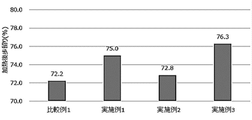
- FIG. 1 shows the results of calculation of the post-heating yield in the production of meatballs of Examples 1 to 3 and Comparative Example 1 in Test Example 1.
- FIG. FIG. 2 shows the results of calculation of the post-heating yield in the production of meatballs of Examples and Comparative Examples in Test Example 2.
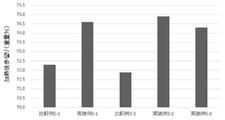
- FIG. 3 shows the results of calculation of the post-heating yield during production of the meatballs of Examples and Comparative Examples in Test Example 3.
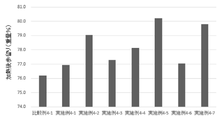
- FIG. 4 shows the results of calculation of post-heating yields in the production of coarsely ground sausages of Examples and Comparative Examples in Test Example 4.
- FIG. FIG. 5 shows the results of calculation of the post-heating yield in the production of meatballs of Examples and Comparative Examples in Test Example 5.
- FIG. FIG. 1 shows the results of calculation of the post-heating yield in the production of meatballs of Examples 1 to 3 and Comparative Example 1 in Test Example 1.
- FIG. 3 shows the results of calculation of the post-heating yield during production of the meatballs of Examples and Comparative Examples in Test Example 3.
- FIG. 6 shows the results of calculation of the post-heating yield in the production of meatballs of Examples and Comparative Examples in Test Example 6.
- FIG. 7 shows the results of calculation of the post-heating yield during production of the meatballs of Examples and Comparative Examples in Test Example 7.
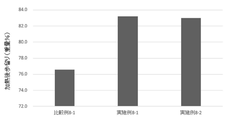
- FIG. 8 shows the results of calculation of post-heating yields in the production of hamburger steaks of Examples and Comparative Examples in Test Example 8.
- FIG. 9 shows the results of calculation of post-heating yields in the production of coarsely ground sausages of Examples and Comparative Examples in Test Example 9.
- FIG. 10 shows the results of calculation of post-heating yields in the production of chicken meatballs of Examples and Comparative Examples in Test Example 10.
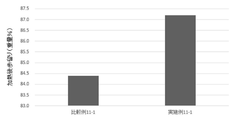
- FIG. 11 shows the results of calculation of post-heating yields during production of coarsely ground sausages of Examples and Comparative Examples in Test Example 11.
- FIG. 11 shows the results of calculation of post-heating yields during production of coarsely ground sausages of Examples and Comparative Examples in Test Example 11.
- the livestock meat paste product of the present invention is characterized by containing either one or both of (1) and (2) below.
- Examples of the livestock meat paste product of the present invention include a livestock meat paste product containing the above (1) and (2).
- Examples of the livestock meat paste product of the present invention include the following (i) to (iv).
- the content of choline and inositol in the livestock meat paste product can be measured by the method described in Test Example 1 below.
- the choline and inositol are preferably choline and inositol derived from phospholipids (phosphatidylcholine, phosphatidylinositol) contained in raw materials of the meat paste product.
- the "phospholipid contained in the raw material of the meat paste product” includes not only those derived from the raw meat of the meat paste product, but also other raw materials (e.g., eggs) that may optionally be contained in the meat paste product. It also includes those derived from The raw meat is the same as those exemplified in the description below.
- the choline and inositol may be added in the product manufacturing process (for example, the raw material mixing process) so that the choline and inositol contents in the final product are within the above ranges.
- the meat paste product of the present invention is a food made from ground meat as a main raw material, and examples thereof include meatballs, sausages (eg, coarsely ground sausages), hamburgers, chicken meatballs, ham, and meatloaf.
- the livestock meat paste product of the present invention contains livestock meat as a raw material.
- the raw meat include beef, pork, horse meat, mutton, goat meat, rabbit meat, chicken, turkey meat, duck meat, goose meat, and quail meat.
- the content of raw livestock meat is, for example, 0.1 to 99% by weight, preferably 1 to 97% by weight, more preferably 10 to 90% by weight, based on the raw materials (total weight) of the product. is.
- the meat paste product of the present invention contains ingredients commonly used in meat paste products (e.g., proteins such as onions, bread crumbs, eggs, vegetable proteins, gluten, egg whites, gelatin, and casein) and food additives.
- ingredients commonly used in meat paste products e.g., proteins such as onions, bread crumbs, eggs, vegetable proteins, gluten, egg whites, gelatin, and casein
- Substances e.g.
- Phospholipases are enzymes that have the activity of hydrolyzing phospholipids.
- Phospholipase D activity units herein are measured and defined as follows. 0.1 mL of the enzyme solution was mixed with 0.9 mL of the substrate solution containing phosphatidylcholine, reacted at 37° C. for 30 minutes, and after stopping the reaction, 50 ⁇ L of the reaction solution was added to 1 mL of the coloring solution containing choline oxidase, peroxidase, etc. and reacted for 5 minutes. After stopping the reaction, the amount of dye produced from choline is measured. 1 U (unit) is defined as the amount of enzyme that liberates 1 ⁇ mole of choline per minute at 37° C. using phosphatidylcholine as a substrate.
- the amount of phospholipase D added is preferably 0.001 U or more, more preferably 0.01 to 100 U, and still more preferably 0.1 to 50 U per 1 g of the raw material of the meat paste product.
- the action time (reaction time) of phospholipase D is not particularly limited as long as it is a time during which the enzyme can act on meat, which is a substrate substance. 10 minutes or longer, 20 minutes or longer, and 30 minutes or longer. Further, for example, 72 hours or less, 48 hours or less, 24 hours or less, 12 hours or less, 6 hours or less, 3 hours or less, 2 hours or less, and 1 hour or less. A realistic action time is preferably 0 to 72 hours, more preferably 30 minutes to 72 hours.
- the action temperature (reaction temperature) is not particularly limited as long as the enzyme maintains its activity. The enzymatic reaction can be terminated, for example, by heating at 70-75° C. for 5-10 minutes.
- At least one enzyme selected from the group consisting of transglutaminase, lipase, and amylolytic enzyme is further added to the raw animal meat and allowed to act. is preferred.
- the order of addition may be in any order, and all may be added simultaneously or sequentially with a time lag. is desirable.
- at least one enzyme selected from the group consisting of transglutaminase, lipase, and amylolytic enzyme is allowed to further act on raw meat, the action time, action temperature, and method for terminating the enzymatic reaction are determined by the action time of phospholipase D described above.
- the following enzymes (I) to (VIII) are given as the enzymes to act on the raw meat.
- (I) Phospholipase D II) phospholipase D and transglutaminase
- III phospholipase D and lipase
- IV phospholipase D and amylolytic enzyme (eg ⁇ -glucosidase)
- V phospholipase D, transglutaminase and lipase
- VI phospholipase D, transglutaminase and amylolytic enzymes (e.g.
- VII Phospholipase D, lipase and amylolytic enzyme (eg ⁇ -glucosidase)
- VIII Phospholipase D, transglutaminase, lipase and amylolytic enzyme (eg ⁇ -glucosidase)
- the transglutaminase used in the present invention is an enzyme having the activity of catalyzing an acyl transfer reaction using a glutamine residue in a protein or peptide as a donor and a lysine residue as an acceptor, and is derived from mammals, for example. , those derived from fish, those derived from microorganisms, etc. are known.
- the origin of the transglutaminase used in the present invention is not particularly limited as long as it has the above-mentioned activity, and transglutaminase of any origin can be used, and recombinant enzymes can also be used.
- the transglutaminase used in the present invention may be a commercial product, and as a specific example, a microorganism-derived transglutaminase commercially available from Ajinomoto Co., Inc. under the trade name of "Activa" TG can be used alone or in combination. can.
- the enzymatic activity of transglutaminase is defined by allowing transglutaminase to act in a reaction system using benzyloxycarbonyl-L-glutamylglycine and hydroxylamine as substrates in a Tris buffer at a temperature of 37° C. and a pH of 6.0.
- the lipase used in the present invention is an enzyme that catalyzes the reaction of hydrolyzing fatty acid esters into fatty acids and glycerol.
- Enzymes commercially available from Amano Enzyme Co., Ltd. under the trade names of "Lipase A 'Amano'6" and “Lipase AY 'Amano'” are examples of lipases.
- the enzymatic activity of lipase was measured by emulsifying 100 ml of olive oil and 150 ml of a 2% PVA test solution as a substrate, mixing 5 ml of the substrate, 4 ml of McIlvaine buffer (pH 7.0) and 1 ml of the enzyme solution, followed by mixing at 37° C. for 60 minutes. After the reaction is terminated, the produced fatty acid is measured by a titration method. 1 U (unit) is defined as the acid liberating activity corresponding to 1 ⁇ mol of liberated oleic acid.
- an amylolytic enzyme is an enzyme that catalyzes the decomposition reaction and transfer reaction of sugar chains containing starch.
- amylolytic enzymes used in the present invention include ⁇ -glucosidase, ⁇ -amylase, ⁇ -amylase, glucoamylase, isomaltase, pullulanase, sucrose- ⁇ -glucosidase, ⁇ -glucosyltransferase, cyclomaltodextrinase, Examples include isoamylase and neopullulanase, with ⁇ -glucosidase being preferred.
- the ⁇ -glucosidase used in the present invention is an enzyme that hydrolyzes a non-reducing terminal ⁇ -1,4-glucosidic bond to produce ⁇ -glucose.
- transglucosidase is preferred.
- An enzyme commercially available from Amano Enzyme Co., Ltd. under the trade name of "Transglucosidase L 'Amano'" is an example of ⁇ -glucosidase.
- the enzymatic activity of ⁇ -glucosidase was measured by adding 1 ml of 0.02 M acetate buffer (pH 5.0) to 1 ml of 1 mM ⁇ -methyl-D-glucoside, adding 0.5 ml of the enzyme solution, and precipitating at 40° C. for 60 minutes.
- the amount of enzyme that produces 1 ⁇ g of glucose in 2.5 ml of reaction solution when acted upon is defined as 1 U (unit).
- the amount of transglutaminase to be added is such that the enzymatic activity is, for example, 0.005 to 3.0 U, preferably 0.01 to 1.0 U, per 1 g of the raw material for the meat paste product. 0 U, more preferably 0.05 to 0.5 U, still more preferably 0.1 to 0.3 U.
- the amount of lipase to be added is such that the enzymatic activity is, for example, 0.1 to 30.0 U, preferably 0.3 to 15.0 U, preferably 0.3 to 15.0 U, per 1 g of the raw material of the meat paste product. It is more preferably 0.5 to 10.0U, still more preferably 1.0 to 3.0U.
- the amount of the amylolytic enzyme (eg, ⁇ -glucosidase) added is such that the enzymatic activity per 1 g of the raw material of the meat paste product is, for example, It is 0.0005 to 0.1 U, preferably 0.001 to 0.05 U, more preferably 0.002 to 0.02 U, still more preferably 0.005 to 0.01 U.
- the meat paste product of the present invention produced by the above-described production method of the present invention has an improved yield after heating during production, and is expected to have an improved texture and taste.
- the present invention also relates to a method for improving the post-heating yield of livestock meat paste products, which comprises allowing phospholipase D to act on raw livestock meat.
- the phospholipase D is Sigma-Aldrich's phospholipase D actinomycete-derived (trade name), Nagase Chemtech's Denazym PMD-P1 (trade name), and Asahi Kasei Pharma's PHOSPHOLIPASE D [PLDP ( T-39)] (Glycerophospholipid specific) (trade names) are preferred.
- At least one enzyme selected from the group consisting of transglutaminase, lipase, and amylolytic enzyme may be further acted on the raw meat.
- the following enzymes (I) to (VIII) are listed as enzymes to act on raw meat.
- VII Phospholipase D, lipase and amylolytic enzyme (eg ⁇ -glucosidase)
- VIII Phospholipase D, transglutaminase, lipase and amylolytic enzyme (eg ⁇ -glucosidase)
- examples of meat paste products examples of raw meat, amounts used, definitions, examples, addition amounts, and addition of phospholipase D, transglutaminase, lipase, and amylolytic enzyme ( ⁇ -glucosidase)
- the method, optional ingredients, additives, etc. are described in the method for producing the livestock meat paste product of the present invention, examples of livestock meat paste products, examples of raw meat paste products, amounts used, phospholipase D, transglutaminase, lipase and It is the same as the definition, exemplification, addition amount, addition method, optionally added components, additives, etc. of the amylolytic enzyme ( ⁇ -glucosidase).
- the post-heating yield of the meat paste product refers to the weight after heating (after baking) relative to the weight before heating (before baking) of the dough (putty) obtained by mixing the raw materials at the time of manufacturing the meat paste product. refers to the ratio (% by weight) of
- the improved yield after heating of the meat paste product means that the yield after heating is higher than that of the meat paste product produced without the addition of enzymes.
- Test Example 1 (Production of meatballs of Examples 1 to 3 and Comparative Example 1)
- the beef rib lean meat and beef Kenne fat shown in Table 1 were minced to 3 mm by a meat grinder (chopper).
- the onion was chopped into pieces of about 2 mm.
- Each phospholipase D shown in Table 2 was added to the raw material of the composition shown in Table 1 so as to be 3.0 U per 1 g of raw material, and a standard mixer ("KitchenAid KSM5WH", manufactured by Whirlpool Corporation) was added. and mixed for 3 minutes at a setting speed of 1 to prepare a meatball dough. After degassing, it was manually molded into 30 g spheres. After molding, baked at 250 ° C.
- cholinesterase kit-NC 289-75181, Fujifilm Wako Pure Chemical Industries, Ltd.
- a calibration curve was prepared from the absorbance, and the content of free choline in meatballs was determined. The results are shown in Table 5-2.
- the choline content in the meatball (estimated value: 60 ppm by weight) is the amount of choline originally contained in the raw material.
- the choline content in the meatballs of Examples 2-1 to 2-5 and Comparative Examples 2-2 to 2-4 shown in Tables 7-1 and 7-2 is the choline originally contained in the raw materials. It is the sum of the amount (estimated value: 60 ppm by weight) and the added amount of choline. (Evaluation of yield after heating) In order to evaluate the yield after heating, the weight before baking and the weight after baking were measured at the time of meatball production.
- Test Example 3 Inositol addition test (production of meatballs of Examples 3-1 to 3-3 and Comparative Examples 3-2 to 3-7)
- the beef rib lean meat and beef kenne fat shown in Table 6 of Test Example 2 were minced to 3 mm by a meat grinder (chopper). The onion was chopped into pieces of about 2 mm.
- a standard mixer (“KitchenAid KSM5WH”, manufactured by Whirlpool Corporation) was prepared using raw materials with the formulations shown in Table 6 of Test Example 2 and inositol in the amounts shown in Tables 8-1 and 8-2. was mixed for 3 minutes at a setting speed of 1 to prepare a meatball dough. After degassing, it was manually molded into 30 g spheres.
- the inositol content in the meatball of Comparative Example 3-1 shown in Table 8-1 is the inositol content in the meatball of Comparative Example 1 of Test Example 1 produced by the same method (213 ppm by weight, Table 5- 3). Since inositol was not added in Comparative Example 3-1, the content of inositol in the meatball (estimated value: 213 ppm by weight) is the amount of inositol originally contained in the raw material.
- the inositol content in the meatballs of Examples 3-1 to 3-3 and Comparative Examples 3-2 to 3-7 shown in Tables 8-1 and 8-2 is the inositol originally contained in the raw materials.
- the collagen casing manufactured by Devro Co., Ltd.
- coarsely ground sausages of Examples 4-1 to 4-7 were produced.
- a coarsely ground sausage of Comparative Example 4-1 was obtained in the same manner as in Examples 4-1 to 4-7 except that no enzyme was added.
- evaluation of yield after heating In order to evaluate the post-heating yield, the weight before drying and the weight after cooling (that is, after the drying-smoking-steaming-cooling process) were measured during the production of the coarsely ground sausage.
- a standard mixer (“KitchenAid KSM5WH”, manufactured by Whirlpool Corporation) was used and mixed at a setting speed of 1 for 3 minutes to prepare a meatball dough. After degassing, it was manually molded into 30 g spheres. After molding, it was allowed to stand in a refrigerator for 1 hour. Baking at 250 ° C. for 1 minute with an impinger (FGJOA 9L, manufactured by Fujimac) and baking at 200 ° C. and RH 50% for 6 minutes in a steam convection oven (FSCC WE 61G, manufactured by Fujimac), Examples 5-1 to 5 -3 meatballs were obtained.
- FGJOA 9L an impinger
- FSCC WE 61G steam convection oven
- Example 5-1 produced by adding phospholipase D
- Examples 5-2 and 5-3 produced by adding phospholipase D and transglutaminase were Compared to Comparative Example 5-1 without enzyme addition and Comparative Example 5-2 without phospholipase D addition, the post-heating yield was higher, and an improvement in post-heating yield was observed.
- Example 6-1 produced by adding phospholipase D and Examples 6-2 to 6-4 produced by adding phospholipase D and ⁇ -glucosidase , Compared to Comparative Example 6-1 without enzyme addition and Comparative Example 6-2 without phospholipase D addition, the yield after heating was high, and an improvement in yield after heating was observed.
- Example 7 Enzyme addition test (combined use of phospholipase D, ⁇ -glucosidase and lipase (production of meatballs of Example 7-1) A meatball of Example 7-1 was obtained in the same manner as in Example 5-1, etc., except that the enzyme was changed to the enzyme and the amount shown in Table 14.
- Enzymes include phospholipase D (Denazyme PMD-P1, manufactured by Nagase ChemteX Co., Ltd.), ⁇ -glucosidase (Transglucosidase L "Amano”, manufactured by Amano Enzyme Co., Ltd.) and lipase (Lipase AY "Amano", manufactured by Amano Enzyme Co., Ltd.). )It was used.
- Production of meatballs in Comparative Example 7-1 A meatball of Comparative Example 7-1 was obtained in the same manner as in Example 7-1 except that no enzyme was added.
- evaluation of yield after heating In order to evaluate the yield after heating, the weight before baking and the weight after baking were measured at the time of meatball production. The post-heating yield was calculated in the same manner as in Test Example 5. The results are shown in Table 14 and FIG.
- Example 7-1 produced by adding phospholipase D, ⁇ -glucosidase and lipase had a higher yield after heating than Comparative Example 7-1 without enzyme addition. was high, and an improvement in yield was observed after heating.
- the dough was weighed to 150 g, and after the air was removed, it was formed into an oval shape (major axis: 130 mm, minor axis: 90 mm, thickness: 12 mm).
- the hamburger dough is baked on a griddle (FGFT60601TC, Fujimac Co., Ltd.) at 230 ° C. for 1 minute each on both sides, and after the surface is baked, baked at 250 ° C. for 4 minutes with an impinger (FGJOA9L, Fujimac Co., Ltd.).
- FGJOA9L Fujimac Co., Ltd.
- Example 9-1 produced by adding phospholipase D has a higher yield after heating than Comparative Example 9-1 without enzyme addition, and the yield after heating is improvement was observed.
- Example 10-1 produced by adding phospholipase D had a higher yield after heating than Comparative Example 10-1 without enzyme addition, and a lower yield after heating. Improvement was observed.
- Example 11-1 produced by adding phospholipase D has a high yield after heating and a high yield after heating compared to Comparative Example 11-1 without enzyme addition. improvement was observed.
Landscapes
- Health & Medical Sciences (AREA)
- Nutrition Science (AREA)
- Life Sciences & Earth Sciences (AREA)
- Chemical & Material Sciences (AREA)
- Engineering & Computer Science (AREA)
- Food Science & Technology (AREA)
- Polymers & Plastics (AREA)
- Meat, Egg Or Seafood Products (AREA)
Priority Applications (2)
| Application Number | Priority Date | Filing Date | Title |
|---|---|---|---|
| BR112023022575A BR112023022575A2 (pt) | 2021-04-30 | 2022-04-28 | Produto de carne amassada, e, método para melhorar o rendimento após aquecimento de um produto de carne amassada |
| JP2023517634A JPWO2022231003A1 (https=) | 2021-04-30 | 2022-04-28 |
Applications Claiming Priority (2)
| Application Number | Priority Date | Filing Date | Title |
|---|---|---|---|
| JP2021-077257 | 2021-04-30 | ||
| JP2021077257 | 2021-04-30 |
Publications (1)
| Publication Number | Publication Date |
|---|---|
| WO2022231003A1 true WO2022231003A1 (ja) | 2022-11-03 |
Family
ID=83846897
Family Applications (1)
| Application Number | Title | Priority Date | Filing Date |
|---|---|---|---|
| PCT/JP2022/019450 Ceased WO2022231003A1 (ja) | 2021-04-30 | 2022-04-28 | 品質が向上した畜肉練り製品 |
Country Status (3)
| Country | Link |
|---|---|
| JP (1) | JPWO2022231003A1 (https=) |
| BR (1) | BR112023022575A2 (https=) |
| WO (1) | WO2022231003A1 (https=) |
Cited By (2)
| Publication number | Priority date | Publication date | Assignee | Title |
|---|---|---|---|---|
| WO2024172143A1 (ja) * | 2023-02-15 | 2024-08-22 | 味の素株式会社 | 改質された蛋白質含有食品の製造方法 |
| WO2024172144A1 (ja) * | 2023-02-15 | 2024-08-22 | 味の素株式会社 | 改質された蛋白質含有液体食品の製造方法 |
Citations (6)
| Publication number | Priority date | Publication date | Assignee | Title |
|---|---|---|---|---|
| JPH11346719A (ja) * | 1998-06-03 | 1999-12-21 | Izu Rice Center:Kk | 孟宗竹を用いた灰汁の生成方法及びこの灰汁を用いた食肉の改質方法 |
| WO2006075771A1 (ja) * | 2005-01-13 | 2006-07-20 | Ajinomoto Co., Inc. | 食肉加工品又は水産練り製品及びその製造方法 |
| WO2010140708A1 (ja) * | 2009-06-05 | 2010-12-09 | 味の素株式会社 | 畜肉加工製品改質用の酵素製剤及び畜肉加工製品の製造方法 |
| WO2013172447A1 (ja) * | 2012-05-17 | 2013-11-21 | ナガセケムテックス株式会社 | 食品素材改質用酵素製剤 |
| CN107593874A (zh) * | 2017-08-24 | 2018-01-19 | 安徽靖童科技农业发展有限公司 | 一种肉类食品加工稳定剂 |
| JP2020145977A (ja) * | 2019-03-14 | 2020-09-17 | 奥野製薬工業株式会社 | 肉製品の食感改良剤および食感改良方法 |
-
2022
- 2022-04-28 JP JP2023517634A patent/JPWO2022231003A1/ja active Pending
- 2022-04-28 BR BR112023022575A patent/BR112023022575A2/pt unknown
- 2022-04-28 WO PCT/JP2022/019450 patent/WO2022231003A1/ja not_active Ceased
Patent Citations (6)
| Publication number | Priority date | Publication date | Assignee | Title |
|---|---|---|---|---|
| JPH11346719A (ja) * | 1998-06-03 | 1999-12-21 | Izu Rice Center:Kk | 孟宗竹を用いた灰汁の生成方法及びこの灰汁を用いた食肉の改質方法 |
| WO2006075771A1 (ja) * | 2005-01-13 | 2006-07-20 | Ajinomoto Co., Inc. | 食肉加工品又は水産練り製品及びその製造方法 |
| WO2010140708A1 (ja) * | 2009-06-05 | 2010-12-09 | 味の素株式会社 | 畜肉加工製品改質用の酵素製剤及び畜肉加工製品の製造方法 |
| WO2013172447A1 (ja) * | 2012-05-17 | 2013-11-21 | ナガセケムテックス株式会社 | 食品素材改質用酵素製剤 |
| CN107593874A (zh) * | 2017-08-24 | 2018-01-19 | 安徽靖童科技农业发展有限公司 | 一种肉类食品加工稳定剂 |
| JP2020145977A (ja) * | 2019-03-14 | 2020-09-17 | 奥野製薬工業株式会社 | 肉製品の食感改良剤および食感改良方法 |
Cited By (2)
| Publication number | Priority date | Publication date | Assignee | Title |
|---|---|---|---|---|
| WO2024172143A1 (ja) * | 2023-02-15 | 2024-08-22 | 味の素株式会社 | 改質された蛋白質含有食品の製造方法 |
| WO2024172144A1 (ja) * | 2023-02-15 | 2024-08-22 | 味の素株式会社 | 改質された蛋白質含有液体食品の製造方法 |
Also Published As
| Publication number | Publication date |
|---|---|
| JPWO2022231003A1 (https=) | 2022-11-03 |
| BR112023022575A2 (pt) | 2024-01-16 |
Similar Documents
| Publication | Publication Date | Title |
|---|---|---|
| JP6984588B2 (ja) | 植物蛋白質含有食品の製造方法 | |
| JP6642617B2 (ja) | デンプン含有食品の製造方法及びデンプン含有食品改質用の酵素製剤 | |
| US5585131A (en) | Dietary fiber compositions for use in foods | |
| US9737086B2 (en) | Oil—or fat-processed starch and method for producing same | |
| JP6066016B2 (ja) | 麺類の製造方法及び麺用ほぐれ改良剤 | |
| EA018153B1 (ru) | Липидацилтрансфераза и содержащая ее пищевая или кормовая композиция | |
| WO2022231003A1 (ja) | 品質が向上した畜肉練り製品 | |
| US20120135111A1 (en) | Enzyme preparation for reforming processed meat products and manufacturing method for processed meat products | |
| BRPI0714478A2 (pt) | proceesso de preparaÇço de um bolo | |
| Yüceer et al. | Texture, rheology, storage stability, and sensory evaluation of meringue's prepared from lipase enzyme‐modified liquid egg white | |
| CN101730482A (zh) | 关于畜肉加工食品或水产品加工食品的制造方法以及用于畜肉加工食品或水产品加工食品改质的酶制剂 | |
| US5294457A (en) | Thermo-irreversible gel particles for use in foods | |
| JP2000513231A (ja) | ベーキングにおけるデアミダーゼの利用 | |
| US20100323058A1 (en) | Method for producing fish paste product, and enzyme preparation for fish paste products | |
| CN108697101B (zh) | 小麦磷脂在烘烤应用中的改善的酶促修饰 | |
| JP2017093299A (ja) | ベーカリー食品用混合物 | |
| Phumsombat et al. | Influence of cooking methods on physicochemical characteristics and in vitro protein digestibility of restructured pork steak hydrolyzed by bromelain and reformed by κ-carrageenan | |
| CN101616593A (zh) | 坯料改良剂 | |
| JPWO2020004506A1 (ja) | ワキシー種澱粉及びその製造方法 | |
| JP2012065554A (ja) | 食感改良剤 | |
| JP4800911B2 (ja) | リゾ化卵黄及びこれを用いた食品 | |
| JP2023142672A (ja) | 肉類及び/又は魚介類の品質向上剤、並びに肉類及び/又は魚介類の品質向上方法 | |
| EP4253533A1 (en) | Heat coagulation gel strength regulating agent for egg white protein | |
| JP6203018B2 (ja) | パン | |
| JP2790838B2 (ja) | 澱粉の老化防止剤並びにこれを含む澱粉質原料及び澱粉含有食品 |
Legal Events
| Date | Code | Title | Description |
|---|---|---|---|
| 121 | Ep: the epo has been informed by wipo that ep was designated in this application |
Ref document number: 22795916 Country of ref document: EP Kind code of ref document: A1 |
|
| ENP | Entry into the national phase |
Ref document number: 2023517634 Country of ref document: JP Kind code of ref document: A |
|
| REG | Reference to national code |
Ref country code: BR Ref legal event code: B01A Ref document number: 112023022575 Country of ref document: BR |
|
| NENP | Non-entry into the national phase |
Ref country code: DE |
|
| ENP | Entry into the national phase |
Ref document number: 112023022575 Country of ref document: BR Kind code of ref document: A2 Effective date: 20231027 |
|
| 122 | Ep: pct application non-entry in european phase |
Ref document number: 22795916 Country of ref document: EP Kind code of ref document: A1 |