WO2022228532A1 - Implementing qubit gates using phase-shifted microwave pulses - Google Patents
Implementing qubit gates using phase-shifted microwave pulses Download PDFInfo
- Publication number
- WO2022228532A1 WO2022228532A1 PCT/CN2022/089985 CN2022089985W WO2022228532A1 WO 2022228532 A1 WO2022228532 A1 WO 2022228532A1 CN 2022089985 W CN2022089985 W CN 2022089985W WO 2022228532 A1 WO2022228532 A1 WO 2022228532A1
- Authority
- WO
- WIPO (PCT)
- Prior art keywords
- gate
- sequence
- qubit
- phase
- quantum
- Prior art date
- Legal status (The legal status is an assumption and is not a legal conclusion. Google has not performed a legal analysis and makes no representation as to the accuracy of the status listed.)
- Ceased
Links
Images


Classifications
-
- G—PHYSICS
- G06—COMPUTING OR CALCULATING; COUNTING
- G06N—COMPUTING ARRANGEMENTS BASED ON SPECIFIC COMPUTATIONAL MODELS
- G06N10/00—Quantum computing, i.e. information processing based on quantum-mechanical phenomena
- G06N10/20—Models of quantum computing, e.g. quantum circuits or universal quantum computers
-
- G—PHYSICS
- G06—COMPUTING OR CALCULATING; COUNTING
- G06N—COMPUTING ARRANGEMENTS BASED ON SPECIFIC COMPUTATIONAL MODELS
- G06N10/00—Quantum computing, i.e. information processing based on quantum-mechanical phenomena
- G06N10/40—Physical realisations or architectures of quantum processors or components for manipulating qubits, e.g. qubit coupling or qubit control
-
- H—ELECTRICITY
- H03—ELECTRONIC CIRCUITRY
- H03K—PULSE TECHNIQUE
- H03K19/00—Logic circuits, i.e. having at least two inputs acting on one output; Inverting circuits
- H03K19/02—Logic circuits, i.e. having at least two inputs acting on one output; Inverting circuits using specified components
- H03K19/195—Logic circuits, i.e. having at least two inputs acting on one output; Inverting circuits using specified components using superconductive devices
Definitions
- the present disclosure generally relates to quantum computing, and more particularly, to implementation of qubit gates using phase-shifted microwave pulses.
- Quantum computations are performed on quantum bits, or qubits. Such computations can be performed by quantum gates, which are analogous to the logic gates of digital computations.
- a quantum computer can be configured to implement arbitrary quantum gates using sequences of other basic quantum gate (s) .
- the performance of the quantum computer can depend on the selection of basic quantum gate (s) and how those gates are combined to implement the arbitrary quantum gates. For example, the quantum computer may only be able to apply a limited number of the basic quantum gate (s) before the targeted qubit (s) become decoherent due to noise. The length of the sequences used to implement the arbitrary quantum gates may therefore determine the number of arbitrary quantum gates that the quantum computer can apply.
- the selection of basic quantum gate (s) can affect the fidelity of the arbitrary quantum gates and the calibration requirements of the quantum computer.
- the disclosed systems and methods relate to implementation of arbitrary single-qubit gates using sequences of one or more phase-shifted microwave pulses.
- Disclosed embodiments can reduce the calibration requirements for a quantum computer, reduce the number of microwave pulses required to implement the arbitrary single-qubit quantum gate, or support improved integration of two-qubit gates with single-qubit gates implemented using phase-shifted microwave pulses.
- the disclosed embodiments include a system for applying a single-qubit quantum gate having a unitary specifiable by at least a first real parameter, a second real parameter, and a third real parameter.
- the system can include a qubit and a quantum controller coupled to the qubit by a driveline.
- the quantum controller can be configured to apply a sequence of phase-shifted Pauli gates to the qubit to implement the single-qubit quantum gate, each phase-shifted Pauli gate in the sequence having a rotation angle and a phase shift.
- the first, second, and third real parameters of the unitary can correspond to a rotation angle in the sequence and the phase shifts in the sequence, or the phase shifts in the sequence.
- the disclosed embodiments include a method for applying a gate sequence of quantum gates to a qubit.
- the method can include operations of implementing a first quantum gate in the gate sequence by applying a first sequence of phase-shifted pulses to the qubit.
- the method can include further operations of implementing a second quantum gate in the gate sequence, after applying the first quantum gate.
- the second quantum gate can be implemented by applying a second sequence of phase-shifted pulses to the qubit.
- An additional rotation introduced by the implementation of the second quantum gate can be independent of the implementation of the first quantum gate.
- a pulse in the second sequence can be configured to implement a virtual Z gate having a first rotation angle, an X gate having a second rotation angle, and the virtual Z gate having a negative of the first rotation angle.
- the disclosed embodiments include a method for implementing a composition of a two-qubit gate and the tensor product of a first single-qubit gate and a second single-qubit gate.
- the method can further include operations of applying a first sequence of phase-shifted pulses to a first qubit, applying a second sequence of phase-shifted pulses to a second qubit, and applying the two-qubit gate to the first qubit and the second qubit.
- Applying the first sequence of phase-shifted pulses to the first qubit can implement the first single-qubit gate.
- This implementation of the first single-qubit gate can introduce an additional rotation phase shift.
- Applying the second sequence of phase-shifted pulses to a second qubit can implement a product of the additional rotation and the second single-qubit gate.
- the two-qubit gate to the first qubit and the second qubit can be applied to obtain a phase-shifted version of the composition of the two-qubit gate and the tensor product of the first single-qubit gate and the second
- the disclosed embodiments include a non-transitory computer-readable medium containing instructions that are executable by a processor of a quantum controller.
- the quantum controller can be coupled to a qubit.
- the instructions can be executable to cause the quantum controller to perform operations for applying a single-qubit quantum gate to the qubit.
- the single-qubit quantum gate can have a unitary specifiable by a first, a second, and a third real parameter.
- the operations can include applying to the qubit a sequence of phase-shifted Pauli gates. Each phase-shifted Pauli gate in the sequence can have a rotation angle and a phase shift.
- the first, second, and third real parameters can correspond to a rotation angle and the phase shifts in the sequence; or to the phase shifts in the sequence.
- FIG. 1 depicts a Bloch sphere representation of a qubit, in accordance with disclosed embodiments.
- FIG. 2 depicts a first, approximate implementation of an arbitrary single-qubit quantum gate using phase-shifted microwave pulses, in accordance with disclosed embodiments.
- FIGs. 3A and 3B depict two differing implementations of an arbitrary single-qubit quantum gate using phase-shifted microwave pulses, in accordance with disclosed embodiments.
- FIG. 4A depicts a sequence of quantum gates including a two-qubit quantum gate, in accordance with disclosed embodiments.
- FIGs. 4B to 4D depict an implementation of the sequence of quantum gates of FIG. 4A using the single-qubit quantum gate implementation of either FIG. 3A or 3B, in accordance with disclosed embodiments.
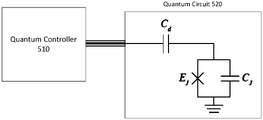
- FIG. 5 depicts a quantum controller for applying quantum gates to one or more qubits, in accordance with disclosed embodiments.
- Quantum computers offer the ability to perform certain tasks (equivalently, solve certain problems) thought to be intractable to classical computers, including any possible future classical computers. To understand the advantage of quantum computers, it is useful to understand how they contrast to classical computers.
- a classical computer operates according to digital logic.
- Digital logic refers to a type of logic system that operates on units of information called bits.
- a bit may have one of two values, usually denoted 0 and 1, and is the smallest unit of information in digital logic.
- Operations are performed on bits using logic gates, which take one or more bits as input and give one or more bits as output.
- a logic gate usually only has one bit as output (though this single bit may be sent as input to multiple other logic gates) and the value of this bit usually depends on the value of at least some of the input bits.
- logic gates are usually composed of transistors and bits are usually represented as the voltage level of wires connecting to the transistors.
- a simple example of a logic gate is the AND gate, which (in its simplest form) takes two bits as input and gives one bit as output. The output of an AND gate is 1 if the value of both inputs is 1 and is zero otherwise.
- Quantum logic refers to a system of logic that operates on units of information referred to as “quantum bits” or simply “qubits. ”
- a qubit is the smallest unit of information in quantum computers, and can have any linear combination of two values, usually denoted
- a qubit can be physically implemented using photons (e.g., in lasers) with their polarizations as the quantum states, electrons or ions (e.g., trapped in an electromagnetic field) with their spins as the quantum states, Josephson junctions (e.g., in a superconducting quantum system) with their charges, current fluxes, or phases as the quantum states, quantum dots (e.g., in semiconductor structures) with their dot spin as the quantum states, topological quantum systems, or any other system that can provide two or more quantum states.
- the quantum logic can use quantum logic gates (or simply “quantum gates” ) to create, remove, or modify qubits.
- a quantum gate is a propagator acting on a quantum state.
- a quantum gate can take one or more qubits as input and give one or more qubits as output, and thus can be represented as a matrix.
- a quantum gate has a characteristic that its input can be determined based on its output and information of the transformation it applies, which is referred to as “reversible. ” Such a reversible characteristic necessitates that the number of outputs of a quantum gate equals to or exceeds the number of its inputs and ensures that the input to a known quantum gate can always be constructed given its output.
- a quantum gate can be implemented as a hardware device capable of generating laser pulses, electromagnetic waves (e.g., microwave pulses) , electromagnetic fields, or any means for changing, maintaining, or controlling the quantum states of the qubits.
- Superconducting quantum circuits can be used to implement qubits and quantum gates.
- Such qubits can be based on currents (e.g., flux qubits) or charges (e.g., charge qubits) , or energy (e.g., phase qubits) .
- Different implementations can have different characteristics, such as sensitivity to external noise, coherence time, or anharmonicity.
- a transmon qubit a type of charge qubit including a capacitively shunted Josephson junction
- fluxonium qubit a type of flux qubit including a Josephson junction shunted by a capacitor and an inductor (the latter realizable using an array of additional Josephson junctions)
- fluxonium qubit can exhibit long coherence times and large anharmonicity.
- FIG. 1 is a diagram illustrating a qubit represented in a Bloch sphere 100, consistent with some embodiments of this disclosure.
- Bloch sphere 100 can be conceptualized as existing in a three-dimensional (3D) space with coordinate axes x, y, and z, respectively. It takes two values (e.g., latitude and longitude, or angles and ⁇ in FIG. 1) to represent a point on the surface of Bloch sphere 100.
- the positive and negative poles of the z-axis correspond to
- quantum algorithms can be expressed in terms of their underlying quantum circuits.
- a quantum circuit includes one or more quantum gates. Because a quantum gate can transform a qubit in an infinite number of ways (e.g., by changing the values of ⁇ and ⁇ in a qubit ⁇
- One type of quantum gates known as “Pauli operators” or “Pauli gates, ” can be used to perform unitary transformations on qubits.
- I there are four Pauli operators, referred to as I, X, Y, and Z, respectively, where I is the identity operator, and X, Y, and Z represent 180° rotations around the x-axis, y-axis, and z-axis in 3D space, respectively.
- the Pauli gates can be represented as matrices and The set of Pauli operators on n qubits can be defined as and where subscripts indicate the qubits on which an operator acts.
- n Pauli matrices each for a possible tensor product (in the form ) of ⁇ i ⁇ [I, X, Y, Z] .
- ⁇ 2 > can be represented as
- the Pauli gates can be understood as rotations around the three principal axes of the Bloch sphere.
- the Pauli X gate, Pauli Y gate, and Pauli Z gate can be understood as causing the point representing
- Single quantum gates can be implemented using sequences of other quantum gates, for example by combining arbitrary Pauli rotations or continuously parametrized geometric gates. But the relationship between gate parameters and the physical control parameters of the system may be complicated.
- a Pauli X gate can be obtained by providing a microwave pulse to a superconducting quantum circuit implementing a qubit.
- the rotation angle ⁇ of the Pauli X gate may depend on a combination of the waveform, length, and amplitude of the microwave pulse.
- this relationship can be affected by a pulse distortions or leakage of quantum information outside the computational subspace. Accordingly, in this example, accurate implementation of the Pauli X gate may require tuning or calibration of the waveform, length, and amplitude of the microwave pulse.
- FIG. 2 depicts an exemplary gate sequence 200, including two single-qubit gates in sequence (gates 201 and 203) .
- the single-qubit gate 201 can be implemented using gate sequence 205, as follows:
- Gate sequence 205 can be approximately realized using phase-shifted microwave (PMW) pulses.
- PMW phase-shifted microwave
- phase-shifting the microwave pulse can cause the microwave pulse to implement the gate sequence Z - ⁇ X ⁇ /2 Z ⁇ .
- an additional “virtual” Z ⁇ gate can be produced using only one physical control parameter: the phase shift ⁇ .
- the physical control parameter maps directed to the gate parameter (the Z-rotation) .
- the phase shift can be precisely controlled (e.g., using a global frequency reference such as an atomic clock, or the like) .
- the disclosed embodiments realizes arbitrary single qubit gates (e.g., using superconducting circuits or the like) using phase-shifted microwave (PMW) pulses.
- a PMW pulse can realize an X gate.
- the X gate can be conjugated with gate.
- an arbitrary single qubit gate can be realized using two PMW X ⁇ /2 gates and one PMW X ⁇ gate, where ⁇ /2 and ⁇ denote the angle of rotation of the unshifted X pulse.
- a single qubit gate can be realized using only one or two PMW X gates.
- an arbitrary single qubit gate can be realized using a PMW X ⁇ /2 gates and a PMW X ⁇ gate, where ⁇ denotes a rotation selected based on the unitary of the arbitrary single qubit gate being realized.
- the disclosed systems and methods can support quantum computation on superconducting circuits with minimal necessary X-pulse calibration.
- Gate sequence 206 can approximately implement gate sequence 205 using a sequence of PMW pulses.
- the sequence of PMW pulses can include a first phase-shifted pulse 207 and a second phase-shifted pulse 209.
- Pulse 207 generates the gate sequence Z - ⁇ X ⁇ /2 Z ⁇ , introducing an additional Z - ⁇ rotation.
- Pulse 209 generates the gate sequence thereby compensating for the Z - ⁇ rotation introduced by pulse 207. But pulse 209 introduces an additional rotation.
- gate sequence 206 would therefore require an additional gate to compensate for the rotation introduced by pulse 209.
- known methods for implementing arbitrary single-qubit gates may provide the compensatory rotation by phase shifting subsequent single-qubit gates. For example, to implement the single-qubit gate sequence U 2 U 1 , where:
- the phase-shifted U 2 gate can be implemented using two PMW pulses:
- an additional rotation (e.g., ) would be required to implement the phase-shifted U 2 gate. This additional rotation may be carried on to the next single-qubit gate in the sequence.
- phase-shifting approach may be suitable for sequences of single qubit gates, this approach may be incompatible with certain two-qubit gates, such as CNOT, or gates.
- the disclosed systems and methods can support the generation of arbitrary single-qubit gates using PMW pulse (s) .
- the PMW pulse (s) can be applied to realize gates of the form Z - ⁇ X ⁇ /2 Z ⁇ , which can be concatenated to implement the arbitrary single-qubit gate.
- these PMW pulse (s) can implement the arbitrary single-qubit gates without necessarily introducing an additional Z-rotation. Therefore, the disclosed systems and methods can be compatible with any two-qubit gate.
- the disclosed systems and methods also maintain the benefits of using of PMW pulse (s) (e.g., control parameter accuracy; reduced calibration requirements; a clear association between physical control parameters, such as phase shift, and gate parameters, such as Z-rotation angle; and the like) . Accordingly, the disclosed systems and methods constitute an improvement in the technical field of quantum computing.
- FIGs. 3A and 3B depict two differing methods for implementing an arbitrary single-qubit quantum gate using phase-shifted microwave pulses, in accordance with disclosed embodiments. Both methods use a sequence of one or more PMW pulses.
- the PMW pulses can be phase-shifted X gates.
- the real parameters of a single-qubit unitary can be mapped to phase-shifts for the gates in gate sequence 310. Accordingly, for any single-qubit unitary, a linear system can be solved to determine the appropriate phase-shifts for implementing that single-qubit unitary.
- the phase-shifted X gates in gate sequence 310 can be selected from the group consisting of X ⁇ /2 and X ⁇ gates.
- the single-qubit quantum gate 201 can be implemented using gate sequence 310.
- This gate sequence can include three PMW pulses: a first phase-shifted pulse 311 (realizing a phase-shifted X ⁇ /2 gate) , a second phase-shifted pulse 313 (realizing a phase-shifted X ⁇ gate) , and a third phase-shifted pulse 313 (realizing a phase-shifted X ⁇ /2 gate) .
- an arbitrary single-qubit gate can be realized using two PMW X ⁇ /2 gates and one PMW X ⁇ gate, as follows:
- an arbitrary single-qubit gate can be realized without requiring further calibration.
- the disclosed embodiments can reduce calibration requirements for performing quantum calculations.
- Equating the coefficients of iX and iY yields
- asingle PMW X ⁇ gate can be used to realize single-qubit gates having support only on iX and iY.
- Equating the coefficients of I and iZ yields
- ⁇ and two PMW X ⁇ gates can be used to realize single-qubit gates having support only on I and iZ.
- the gates used for single-qubit Clifford-based randomized benchmarking can be produced using just one PMW X ⁇ /2 pulse for each benchmarking gate.
- the real parameters of the single-qubit unitary can be mapped to a combination of gate phase-shifts and a gate rotation angle in gate sequence 320. Accordingly, for any single-qubit unitary, a linear system can be solved to determine the appropriate phase-shifts and gate rotation angle for implementing that single-qubit unitary.
- one phase-shifted X gate in gate sequence 320 can be a X ⁇ gate.
- the unitary of the single-qubit gate being implemented by gate sequence 320 can determine the phase shift ⁇ of the other phase-shifted X gate in gate sequence 320.
- a first PMW pulse (e.g., first phase-shifted pulse 321) can implement the sequence of gates:
- a second PMW pulse (e.g., second phase-shifted pulse 323) can implement the sequence of gates:
- the method depicted in FIG. 3B can implement an arbitrary single-qubit quantum gate using two PMW pulses.
- the unitary U ( ⁇ , ⁇ , ⁇ ) can be decomposed into Pauli operators:
- This linear system can be solved to determine appropriate values of ⁇ , and ⁇ for implementing the unitary U ( ⁇ , ⁇ , ⁇ ) .
- the method of FIG. 3B may reduce the number of pulses required to realize a quantum computation, therefore providing an implementation-dependent improvement in gate fidelity.
- this method may involve an additional calibration of the X ⁇ gate, as the X ⁇ gate (unlike, for example, the X ⁇ /2 and X ⁇ gate) may not otherwise be calibrated during initialization or characterization of the quantum computer.
- gate sequence 310 can be used to implement an additional Z rotation.
- a need for an additional Z rotation e.g., in response to frame shifts or other effects
- the additional Z rotation can be implemented during application of a gate sequence by updating PMW phase shifts using the following update rules.
- the final Z rotation value ⁇ can be updated by changing the phase shift for the middle and final pulses (e.g., to implement ⁇ + ⁇ , the phase-shift of the final pulse decreases by ⁇ and the phase shift of the middle pulse decreases by ⁇ /2) .
- the first Z rotation value ⁇ can be updated by changing the phase shift for the first and middle pulses (e.g., to implement ⁇ + ⁇ , the phase-shift of the first pulse increases by ⁇ and the phase shift of the middle pulse increases by ⁇ /2) .
- the Z rotation values ⁇ and ⁇ can be updated by updating the phase-shift of the middle pulse.
- FIG. 4A depicts a sequence of quantum gates including a two-qubit quantum gate, in accordance with disclosed embodiments.
- two single-qubit gates U 0 and U 1 can be applied to two separate qubits in parallel.
- a two-qubit gate V can then be applied to both qubits.
- Two-single qubit gates U′ 0 and U′ 1 can then be applied to two separate qubits in parallel.
- single-qubit gates U 0 and U 1 can differ. Accordingly, when implemented using the gate sequence of FIG. 2, differing additional rotations will be introduced for these two gates. In the general case, such differing additional rotations cannot be carried through the two-qubit gate V.
- Z rotations can be carried through the two-qubit gate V.
- a symmetric-phase-commuting two-qubit gate e.g., an gate, or the like:
- a common Z rotation ⁇ can be carried through the two-qubit gate V, potentially with some updating (e.g., ⁇ 0 and ⁇ 1 ) for each of the qubits.
- FIGs. 4B to 4D depict example implementations of the sequence of quantum gates of FIG. 4A using the single-qubit quantum gate implementation of either FIG. 3A or 3B, in accordance with disclosed embodiments.
- the gate U 0 can be applied to a first qubit using the method depicted in FIG. 2. Accordingly, when:
- the method depicted in FIG. 2 may be used, even through it introduces the additional rotation, because it requires only two PMW pulses (and therefore may support improved gate fidelity, as compared to implementations requiring additional pulses) .
- a phase-shifted version of gate U 1 can be applied to a second qubit using the method of FIG. 3A, the method of FIG. 3B, or by updating an existing implementation of gate U 1 .
- gate U 1 As a non-limiting example of an existing implementation of gate U 1 :
- the rotation can be treated as having commuted with the two-qubit gate V.
- the method of FIG. 2 can then be used to carry the phase shifts forward.
- the method of FIG. 3A or FIG. 3B could be used by subsequent gates to compensate for the additional rotation (e.g., the subsequent gate G could be implemented as or the like) .
- the disclosed systems and method can be used, together with the method of FIG. 2, to implement sequences of one-and two-qubit gates.
- phase-shifted Pauli Y gates could be used in additional to, or as an alternative to, the phase-shifted Pauli X gates described herein.
- FIG. 5 depicts a quantum controller 510 for applying quantum gates to one or more qubits, in accordance with disclosed embodiments.
- quantum controller 510 is coupled to a qubit implemented by superconducting quantum circuit 520 using a microwave drive line.
- the qubit is a transmon qubit and includes capacitor C d in series with a Josephson junction shunted by a capacitor C f .
- other types of qubits may be used, such as fluxonium qubits or the like, consistent with disclosed embodiments.
- superconducting quantum circuit 520 can be realized using a chip containing the qubit and at least a portion of the microwave drive line coupling the qubit to quantum controller 510.
- Quantum controller 510 can be a digital computing device (e.g., a computing device including a central processing unit, graphical processing unit, application specific integrated circuit, field-programmable gate array, or other suitable processor) . Quantum controller 510 can configure quantum circuit 520 for computation, provide computational gates, and read state information out of quantum circuit 520.
- a digital computing device e.g., a computing device including a central processing unit, graphical processing unit, application specific integrated circuit, field-programmable gate array, or other suitable processor.
- Quantum controller 510 can configure quantum circuit 520 for computation, provide computational gates, and read state information out of quantum circuit 520.
- quantum controller 510 can configure the quantum circuit 520 by enabling a gate operation to be performed on one or more qubits of circuit quantum 520.
- quantum circuit 520 can be configured by providing one or more bias drives to move two qubits into resonance.
- Quantum controller 120 can provide the one or more bias drives directly to circuit 520 or can provide instructions to a bias drive source (e.g., waveform generator or the like) , causing the bias drive source to provide the bias drives to circuit 520.
- providing the bias drive can include passing current through a coil external to circuit 520.
- providing the bias drive can include passing current through a coil on the chip. The disclosed embodiments are not limited to a particular method of providing the bias drive or a particular method of biasing the qubits.
- quantum controller 510 can implement computational gates on circuit 520.
- quantum controller 510 can implement such gates by providing one or more PMW pulses (or other gate drives) to qubits in circuit 510.
- quantum controller 510 can implement such gates by providing instructions to a computation drive source (e.g., a waveform generator or the like) , causing the computational drive source to provide such PMW pulses (or other gate drives) to qubits in circuit 510.
- the PMW pulses can be selected to implement one or more quantum gates, as described herein.
- the one or more computational drives can be provided to qubits implemented by quantum circuit 520 using one or more coils coupled to the corresponding qubits. The coils can be external to circuit 520 or on a chip containing circuit 520.
- quantum controller 510 can be configured to determine state information for quantum circuit 520.
- quantum controller 510 can measure a state of one or more qubits of circuit 520. The state can be measured upon completion of a sequence of one or more quantum operations.
- quantum controller 510 can provide a probe signal (e.g., a microwave probe tone) to a coupled resonator of circuit 520, or provide instructions to a readout device (e.g., an arbitrary waveform generator) that provides the probe signal.
- quantum controller 510 can include, or be configured to receive information from, a detector configured to determine an amplitude and phase of an output signal received from the coupled resonator in response to provision of the microwave probe tone. The amplitude and phase of the output signal can be used to determine the state of the probed qubit (s) .
- the disclosed embodiments are not limited to any particular method of measuring the state of the qubits.
- a non-transitory computer-readable storage medium including instructions is also provided, and the instructions may be executed by a device (such as the disclosed encoder and decoder) , for performing the above-described methods.
- a device such as the disclosed encoder and decoder
- Common forms of non-transitory media include, for example, a floppy disk, a flexible disk, hard disk, solid state drive, magnetic tape, or any other magnetic data storage medium, a CD-ROM, any other optical data storage medium, any physical medium with patterns of holes, a RAM, a PROM, and EPROM, a FLASH-EPROM or any other flash memory, NVRAM, a cache, a register, any other memory chip or cartridge, and networked versions of the same.
- the device may include one or more processors (CPUs) , an input/output interface, a network interface, and/or a memory.
- the term “or” encompasses all possible combinations, except where infeasible. For example, if it is stated that a database may include A or B, then, unless specifically stated otherwise or infeasible, the database may include A, or B, or A and B. As a second example, if it is stated that a database may include A, B, or C, then, unless specifically stated otherwise or infeasible, the database may include A, or B, or C, or A and B, or A and C, or B and C, or A and B and C.
- the above-described embodiments can be implemented by hardware, or software (program codes) , or a combination of hardware and software. If implemented by software, it may be stored in the above-described computer-readable media. The software, when executed by the processor can perform the disclosed methods.
- the computing units and other functional units described in this disclosure can be implemented by hardware, or software, or a combination of hardware and software.
- One of ordinary skill in the art will also understand that multiple ones of the above-described modules/units may be combined as one module/unit, and each of the above-described modules/units may be further divided into a plurality of sub-modules/sub-units.
- a system for applying a single-qubit quantum gate having a unitary specifiable by at least a first real parameter, a second real parameter, and a third real parameter comprising: a qubit; and a quantum controller coupled to the qubit by a driveline and configured to: apply a sequence of phase-shifted Pauli gates to the qubit to implement the single-qubit quantum gate, each phase-shifted Pauli gate in the sequence having a rotation angle and a phase shift; and wherein the first, second, and third real parameters correspond to: a rotation angle in the sequence and the phase shifts in the sequence; or the phase shifts in the sequence.
- the quantum controller is further configured to solve a system of linear equations to determine the correspondence between: the first, second, and third real parameters and the rotation angle and two phase shifts in the sequence; or the first, second, and third real parameters and three phase shifts in the sequence.
- the single-qubit quantum gate is selected from the group consisting of X ⁇ /2 , X- ⁇ /2 , Y ⁇ /2 , and Y- ⁇ /2 .
- a method for applying a gate sequence of quantum gates to a qubit comprising: implementing a first quantum gate in the gate sequence by applying a first sequence of phase-shifted pulses to the qubit; and after applying the first quantum gate, implementing a second quantum gate in the gate sequence by applying a second sequence of phase-shifted pulses to the qubit, an additional rotation introduced by the implementation of the second quantum gate being independent of the implementation of the first quantum gate, a pulse in the second sequence configured to implement: a virtual Z gate having a first rotation angle; an X gate having a second rotation angle; and the virtual Z gate having a negative of the first rotation angle.
- a method for implementing a composition of a two-qubit gate and the tensor product of a first single-qubit gate and a second single-qubit gate comprising: applying a first sequence of phase-shifted pulses to a first qubit to implement the first single-qubit gate, the implementation of the first single-qubit gate introducing an additional rotation phase shift; applying a second sequence of phase-shifted pulses to a second qubit to implement a product of the additional rotation and the second single-qubit gate; and applying the two-qubit gate to the first qubit and the second qubit to obtain a phase-shifted version of the composition of the two-qubit gate and the tensor product of the first single-qubit gate and the second single-qubit gate.
- each of the two pulses in the first sequence implements a phase-shifted X ⁇ /2 gate or X- ⁇ /2 gate; and one of the three pulses in the second sequence implements a phase-shifted X ⁇ gate.
- each of the two pulses in the first sequence implements a phase-shifted X ⁇ /2 gate or X- ⁇ /2 gate; and one of the two pulses in the second sequence implements a phase-shifted X gate having a rotation angle dependent on the second single-qubit gate.
- a non-transitory computer-readable medium containing instructions that are executable by a processor of a quantum controller coupled to a qubit to cause the quantum controller to perform operations for applying a single-qubit quantum gate to the qubit, the single-qubit quantum gate having a unitary specifiable by a first, a second, and a third real parameter, the operations comprising: applying to the qubit a sequence of phase-shifted Pauli gates, each phase-shifted Pauli gate in the sequence having a rotation angle and a phase shift; and wherein the first, second, and third real parameters correspond to: a rotation angle and the phase shifts in the sequence; or the phase shifts in the sequence.
Landscapes
- Engineering & Computer Science (AREA)
- Physics & Mathematics (AREA)
- Theoretical Computer Science (AREA)
- General Physics & Mathematics (AREA)
- Computing Systems (AREA)
- General Engineering & Computer Science (AREA)
- Mathematical Physics (AREA)
- Condensed Matter Physics & Semiconductors (AREA)
- Computational Mathematics (AREA)
- Data Mining & Analysis (AREA)
- Evolutionary Computation (AREA)
- Artificial Intelligence (AREA)
- Mathematical Analysis (AREA)
- Mathematical Optimization (AREA)
- Pure & Applied Mathematics (AREA)
- Software Systems (AREA)
- Computer Hardware Design (AREA)
- Superconductor Devices And Manufacturing Methods Thereof (AREA)
- Logic Circuits (AREA)
Abstract
Description


Claims (23)
- A system for applying a single-qubit quantum gate having a unitary specifiable by at least a first real parameter, a second real parameter, and a third real parameter, the system comprising:a qubit; anda quantum controller coupled to the qubit by a driveline and configured to:apply a sequence of phase-shifted Pauli gates to the qubit to implement the single-qubit quantum gate, each phase-shifted Pauli gate in the sequence having a rotation angle and a phase shift; andwherein the first, second, and third real parameters correspond to:a rotation angle in the sequence and the phase shifts in the sequence; orthe phase shifts in the sequence.
- The system of claim 1, wherein:the quantum controller is further configured to solve a system of linear equations to determine the correspondence between:the first, second, and third real parameters and the rotation angle and two phase shifts in the sequence; orthe first, second, and third real parameters and three phase shifts in the sequence.
- The system of claim 1, wherein:the first, second, and third real parameters correspond to three phase shifts in the sequence and each of the three phase shifts is a differing function of two of the first, second, and third real parameters.
- The system of claim 1, wherein:the first, second, and third real parameters correspond to three phase shifts in the sequence and the rotation angles in the sequence are selected from the group consisting of π/2, -π/2, and π.
- The system of claim 1, wherein:the implementation of the single-qubit quantum gate does not introduce an additional rotation.
- The system of claim 1, wherein:the sequence includes two phase-shifted Pauli gates and the first, second, and third real parameters correspond to the rotation angle and two phase shifts in the sequence; orthe sequence includes three phase-shifted Pauli gates and the first, second, and third real parameters correspond to three phase shifts in the sequence.
- The system of claim 1, wherein:all entries on a diagonal of a matrix representing the unitary are zero;the sequence is a single phase-shifted Pauli gate; andwherein the first, second, and third real parameters correspond to a phase shift of the single phase-shifted Pauli gate.
- The system of claim 7, wherein:the single-qubit quantum gate is selected from the group consisting of X π/2, X- π/2, Y π/2, and Y- π/2.
- The system of claim 1, wherein:all entries off a diagonal of a matrix representing the unitary are zero;the sequence is two phase-shifted Pauli gates;the first, second, and third real parameters correspond to phase shifts of the two phase-shifted Pauli gates; andthe rotation angle of each of the two phase-shifted Pauli gates is π.
- A method for applying a gate sequence of quantum gates to a qubit comprising:implementing a first quantum gate in the gate sequence by applying a first sequence of phase-shifted pulses to the qubit; andafter applying the first quantum gate, implementing a second quantum gate in the gate sequence by applying a second sequence of phase-shifted pulses to the qubit, an additional rotation introduced by the implementation of the second quantum gate being independent of the implementation of the first quantum gate, a pulse in the second sequence configured to implement:a virtual Z gate having a first rotation angle;an X gate having a second rotation angle; andthe virtual Z gate having a negative of the first rotation angle.
- The method of claim 10, wherein:the additional rotation introduced by the implementation of the second quantum gate is zero.
- The method of claim 10, wherein:the second sequence includes three pulses and the second rotation angle is selected from the group consisting of π/2, -π/2, and π.
- The method of claim 10, wherein:the second sequence includes two pulses and the second rotation angle depends on the unitary of the second quantum gate.
- The method of claim 10, wherein:all entries on a diagonal of a matrix representing the unitary are zero; andthe second sequence is a single pulse.
- The method of claim 10, wherein:all entries off a diagonal of a matrix representing the unitary are zero; andthe second sequence is two pulses.
- The method of claim 10, further comprising:determining, during application of the gate sequence, an additional Z rotation angle; andthe second sequence of phase-shifted pulses is further configured to additionally implement the additional Z rotation angle.
- A method for implementing a composition of a two-qubit gate and the tensor product of a first single-qubit gate and a second single-qubit gate, comprising:applying a first sequence of phase-shifted pulses to a first qubit to implement the first single-qubit gate, the implementation of the first single-qubit gate introducing an additional rotation phase shift;applying a second sequence of phase-shifted pulses to a second qubit to implement a product of the additional rotation and the second single-qubit gate; andapplying the two-qubit gate to the first qubit and the second qubit to obtain a phase-shifted version of the composition of the two-qubit gate and the tensor product of the first single-qubit gate and the second single-qubit gate.
- The method of claim 17, wherein:the first sequence is two pulses; andthe second sequence is three pulses.
- The method of claim 18, wherein:each of the two pulses in the first sequence implements a phase-shifted X π/2 gate or X- π/2 gate; andone of the three pulses in the second sequence implements a phase-shifted Xπ gate.
- The method of claim 17, wherein:the first sequence is two pulses; andthe second sequence is two pulses.
- The method of claim 20, wherein:each of the two pulses in the first sequence implements a phase-shifted X π/2 gate or X- π/2 gate; andone of the two pulses in the second sequence implements a phase-shifted X gate having a rotation angle dependent on the second single-qubit gate.
- The method of claim 17, wherein:the two-qubit gate is symmetric phase commuting.
- A non-transitory computer-readable medium containing instructions that are executable by a processor of a quantum controller coupled to a qubit to cause the quantum controller to perform operations for applying a single-qubit quantum gate to the qubit, the single-qubit quantum gate having a unitary specifiable by a first, a second, and a third real parameter, the operations comprising:applying to the qubit a sequence of phase-shifted Pauli gates, each phase-shifted Pauli gate in the sequence having a rotation angle and a phase shift; andwherein the first, second, and third real parameters correspond to:a rotation angle and the phase shifts in the sequence; orthe phase shifts in the sequence.
Priority Applications (2)
| Application Number | Priority Date | Filing Date | Title |
|---|---|---|---|
| CN202280032102.4A CN117693759A (en) | 2021-04-29 | 2022-04-28 | Quantum bit gate implementation using phase-shifted microwave pulses |
| JP2023565399A JP2024514969A (en) | 2021-04-29 | 2022-04-28 | Implementation of qubit gating using phase-shifted microwave pulses |
Applications Claiming Priority (2)
| Application Number | Priority Date | Filing Date | Title |
|---|---|---|---|
| US17/244,930 | 2021-04-29 | ||
| US17/244,930 US12204992B2 (en) | 2021-04-29 | 2021-04-29 | Implementing qubit gates using phase-shifted microwave pulses |
Publications (1)
| Publication Number | Publication Date |
|---|---|
| WO2022228532A1 true WO2022228532A1 (en) | 2022-11-03 |
Family
ID=83847783
Family Applications (1)
| Application Number | Title | Priority Date | Filing Date |
|---|---|---|---|
| PCT/CN2022/089985 Ceased WO2022228532A1 (en) | 2021-04-29 | 2022-04-28 | Implementing qubit gates using phase-shifted microwave pulses |
Country Status (4)
| Country | Link |
|---|---|
| US (1) | US12204992B2 (en) |
| JP (1) | JP2024514969A (en) |
| CN (1) | CN117693759A (en) |
| WO (1) | WO2022228532A1 (en) |
Families Citing this family (2)
| Publication number | Priority date | Publication date | Assignee | Title |
|---|---|---|---|---|
| CN117829302B (en) * | 2023-11-24 | 2025-05-13 | 北京百度网讯科技有限公司 | Pulse parameter processing method, device, equipment and storage medium |
| CN118917430B (en) * | 2024-09-29 | 2024-12-10 | 中国科学技术大学 | Compensation microwave generation method and correction method for quantum bit crosstalk correction |
Citations (4)
| Publication number | Priority date | Publication date | Assignee | Title |
|---|---|---|---|---|
| WO2020172538A1 (en) * | 2019-02-22 | 2020-08-27 | Stc.Unm | System and methods for producing magic states for universal quantum computation using gkp error correction |
| US20200311590A1 (en) * | 2019-03-29 | 2020-10-01 | Alibaba Group Holding Limited | Methods and systems for optimizing quantum circuits |
| WO2020263304A1 (en) * | 2019-06-28 | 2020-12-30 | Google Llc | Estimating the fidelity of quantum logic gates and quantum circuits |
| WO2021007560A1 (en) * | 2019-07-11 | 2021-01-14 | President And Fellows Of Harvard College | System and method for parallel implementation of multi-qubit quantum gates |
Family Cites Families (12)
| Publication number | Priority date | Publication date | Assignee | Title |
|---|---|---|---|---|
| CN101118608B (en) * | 2007-08-23 | 2011-07-20 | 清华大学 | Decompose method for arbitrarily quantum bit gate |
| US9633313B2 (en) * | 2013-03-14 | 2017-04-25 | Microsoft Technology Licensing, Llc | Method and system that implement a V-gate quantum circuit |
| US11694104B2 (en) * | 2017-08-09 | 2023-07-04 | Google Llc | Reducing parasitic interactions in a qubit grid |
| US10332023B2 (en) * | 2017-09-22 | 2019-06-25 | International Business Machines Corporation | Hardware-efficient variational quantum eigenvalue solver for quantum computing machines |
| JP7301987B2 (en) * | 2019-02-01 | 2023-07-03 | パリティ クオンタム コンピューティング ゲーエムベーハー | Method and apparatus for performing quantum computation |
| CN111800851B (en) | 2019-04-08 | 2022-12-09 | 大唐移动通信设备有限公司 | Time delay compensation method and device |
| CN111867041B (en) | 2019-04-30 | 2022-01-25 | 中国移动通信有限公司研究院 | Timing advance determination method and device |
| EP3963518B1 (en) * | 2019-05-10 | 2025-10-15 | Google LLC | Frequency tunable qubit control strategy |
| WO2021056115A1 (en) * | 2019-09-26 | 2021-04-01 | Quantum Benchmark, Inc. | Systems and methods for cancellation of crosstalk |
| CN111275196B (en) * | 2020-01-15 | 2023-06-30 | 山东浪潮科学研究院有限公司 | A method, device, and medium for optimizing a single-bit gate sequence for superconducting quantum computing |
| CN111770565B (en) | 2020-06-23 | 2021-08-20 | 中国科学院上海微系统与信息技术研究所 | A Timing Advance Adjustment Method for Non-Terrestrial Networks |
| US12430197B2 (en) * | 2020-12-16 | 2025-09-30 | International Business Machines Corporation | Error mitigation in a quantum program |
-
2021
- 2021-04-29 US US17/244,930 patent/US12204992B2/en active Active
-
2022
- 2022-04-28 CN CN202280032102.4A patent/CN117693759A/en active Pending
- 2022-04-28 JP JP2023565399A patent/JP2024514969A/en active Pending
- 2022-04-28 WO PCT/CN2022/089985 patent/WO2022228532A1/en not_active Ceased
Patent Citations (4)
| Publication number | Priority date | Publication date | Assignee | Title |
|---|---|---|---|---|
| WO2020172538A1 (en) * | 2019-02-22 | 2020-08-27 | Stc.Unm | System and methods for producing magic states for universal quantum computation using gkp error correction |
| US20200311590A1 (en) * | 2019-03-29 | 2020-10-01 | Alibaba Group Holding Limited | Methods and systems for optimizing quantum circuits |
| WO2020263304A1 (en) * | 2019-06-28 | 2020-12-30 | Google Llc | Estimating the fidelity of quantum logic gates and quantum circuits |
| WO2021007560A1 (en) * | 2019-07-11 | 2021-01-14 | President And Fellows Of Harvard College | System and method for parallel implementation of multi-qubit quantum gates |
Also Published As
| Publication number | Publication date |
|---|---|
| CN117693759A (en) | 2024-03-12 |
| JP2024514969A (en) | 2024-04-03 |
| US12204992B2 (en) | 2025-01-21 |
| US20230141379A1 (en) | 2023-05-11 |
Similar Documents
| Publication | Publication Date | Title |
|---|---|---|
| US11900219B1 (en) | Gate formation on a quantum processor | |
| US10469087B1 (en) | Bayesian tuning for quantum logic gates | |
| US20200005186A1 (en) | Compressed Unsupervised Quantum State Preparation with Quantum Autoencoders | |
| US11184006B2 (en) | Techniques for manipulation of two-qubit quantum states and related systems and methods | |
| US11157827B2 (en) | Hybrid quantum-classical computer system for parameter-efficient circuit training | |
| US20200394547A1 (en) | Hybrid Quantum-Classical Computer System and Method for Performing Function Inversion | |
| WO2020077288A9 (en) | Quantum computer with improved continuous quantum generator | |
| US20220358393A1 (en) | Quantum computer system and method for performing quantum computation with reduced circuit depth | |
| US12067458B2 (en) | Parameter initialization on quantum computers through domain decomposition | |
| WO2022228532A1 (en) | Implementing qubit gates using phase-shifted microwave pulses | |
| EP4042338A1 (en) | Quantum algorithm and design for a quantum circuit architecture to simulate interacting fermions | |
| US20230409942A1 (en) | Applying Two-qubit Quantum Logic Gates in a Superconducting Quantum Processing Unit | |
| EP4158551A1 (en) | Separable-state simulation of quantum program code | |
| Sah et al. | A reverse Sidorenko inequality | |
| WO2023043996A1 (en) | Quantum-computing based method and apparatus for estimating ground-state properties | |
| WO2022271092A2 (en) | Benchmarking protocol for quantum gates | |
| US20230131510A1 (en) | Quantum computing system and method for time evolution of bipartite hamiltonians on a lattice | |
| WO2021067666A1 (en) | Generating error-resistant quantum control pulses from geometrical curves | |
| Beyer et al. | Numerical solutions of Einstein’s equations for cosmological spacetimes with spatial topology S 3 and symmetry group U (1) | |
| US20250232199A1 (en) | Method for operating a quantum register | |
| Hou et al. | Nonadiabatic geometric quantum computation in non-Hermitian systems | |
| WO2023172284A2 (en) | Generating non-classical measurements on devices with parameterized time evolution | |
| WO2022271091A2 (en) | Decomposition of two-qubit gates | |
| US20240420002A1 (en) | Implementing net coherent rotations during dynamical decoupling | |
| US12387120B1 (en) | Discrete pulse settling compensation for composite quantum gates |
Legal Events
| Date | Code | Title | Description |
|---|---|---|---|
| 121 | Ep: the epo has been informed by wipo that ep was designated in this application |
Ref document number: 22795002 Country of ref document: EP Kind code of ref document: A1 |
|
| WWE | Wipo information: entry into national phase |
Ref document number: 2023565399 Country of ref document: JP |
|
| WWE | Wipo information: entry into national phase |
Ref document number: 202280032102.4 Country of ref document: CN |
|
| WWE | Wipo information: entry into national phase |
Ref document number: 2022795002 Country of ref document: EP |
|
| NENP | Non-entry into the national phase |
Ref country code: DE |
|
| ENP | Entry into the national phase |
Ref document number: 2022795002 Country of ref document: EP Effective date: 20231129 |
|
| 122 | Ep: pct application non-entry in european phase |
Ref document number: 22795002 Country of ref document: EP Kind code of ref document: A1 |