WO2022224399A1 - 加工条件探索装置、プログラム及び加工条件探索方法 - Google Patents
加工条件探索装置、プログラム及び加工条件探索方法 Download PDFInfo
- Publication number
- WO2022224399A1 WO2022224399A1 PCT/JP2021/016285 JP2021016285W WO2022224399A1 WO 2022224399 A1 WO2022224399 A1 WO 2022224399A1 JP 2021016285 W JP2021016285 W JP 2021016285W WO 2022224399 A1 WO2022224399 A1 WO 2022224399A1
- Authority
- WO
- WIPO (PCT)
- Prior art keywords
- unit
- parameters
- machining
- dimension
- feature amount
- Prior art date
- Legal status (The legal status is an assumption and is not a legal conclusion. Google has not performed a legal analysis and makes no representation as to the accuracy of the status listed.)
- Ceased
Links
Images




Classifications
-
- G—PHYSICS
- G06—COMPUTING OR CALCULATING; COUNTING
- G06N—COMPUTING ARRANGEMENTS BASED ON SPECIFIC COMPUTATIONAL MODELS
- G06N5/00—Computing arrangements using knowledge-based models
- G06N5/02—Knowledge representation; Symbolic representation
- G06N5/022—Knowledge engineering; Knowledge acquisition
-
- G—PHYSICS
- G05—CONTROLLING; REGULATING
- G05B—CONTROL OR REGULATING SYSTEMS IN GENERAL; FUNCTIONAL ELEMENTS OF SUCH SYSTEMS; MONITORING OR TESTING ARRANGEMENTS FOR SUCH SYSTEMS OR ELEMENTS
- G05B19/00—Program-control systems
- G05B19/02—Program-control systems electric
- G05B19/418—Total factory control, i.e. centrally controlling a plurality of machines, e.g. direct or distributed numerical control [DNC], flexible manufacturing systems [FMS], integrated manufacturing systems [IMS] or computer integrated manufacturing [CIM]
- G05B19/41875—Total factory control, i.e. centrally controlling a plurality of machines, e.g. direct or distributed numerical control [DNC], flexible manufacturing systems [FMS], integrated manufacturing systems [IMS] or computer integrated manufacturing [CIM] characterised by quality surveillance of production
-
- G—PHYSICS
- G05—CONTROLLING; REGULATING
- G05B—CONTROL OR REGULATING SYSTEMS IN GENERAL; FUNCTIONAL ELEMENTS OF SUCH SYSTEMS; MONITORING OR TESTING ARRANGEMENTS FOR SUCH SYSTEMS OR ELEMENTS
- G05B2219/00—Program-control systems
- G05B2219/30—Nc systems
- G05B2219/32—Operator till task planning
- G05B2219/32187—Correlation between controlling parameters for influence on quality parameters
Definitions
- the present disclosure relates to a machining condition searching device, a program, and a machining condition searching method.
- a processing machine used for industrial purposes performs processing that changes the shape or state of a material by performing a predetermined processing on the material that is the object to be processed.
- processing machines include machine tools that cut or grind materials, and plant equipment that performs processes such as mixing, reacting, heating, cooling, drying, or baking materials.
- these processing machines are designed so that multiple parameters can be set to reflect the user's intentions. Since the processing result of a processing machine depends on processing conditions, which are a combination of a plurality of parameters, it is necessary to set appropriate processing conditions for the processing machine in order to obtain a desired processing result.
- Patent Document 1 for high-dimensional data, a method of extracting the feature amount using means such as principal component analysis and reducing the dimension of the extracted feature amount makes the problem easier to handle. Proposed.
- the processing result depends not only on control parameters, but also on characteristic parameters related to the properties of the material such as size or specific gravity, or environmental parameters related to the environment of the processing site such as temperature and humidity, etc.
- characteristic parameters related to the properties of the material such as size or specific gravity, or environmental parameters related to the environment of the processing site such as temperature and humidity, etc.
- environmental parameters related to the environment of the processing site such as temperature and humidity, etc.
- one or more aspects of the present invention provide global optimum machining for parameters that are permitted to be changed even if there are parameters that are not permitted to be changed in the machining conditions used for machining. It is intended to allow searching for conditions.
- a machining condition search device stores machining result evaluation information indicating a plurality of machining conditions each having a plurality of parameters, and a plurality of evaluation values for a plurality of machining results under the plurality of machining conditions.
- a processing result evaluation storage unit for evaluating the plurality of parameters, a parameter selection unit for sorting the plurality of parameters into a plurality of variable parameters that are permitted to be changed and one or a plurality of fixed parameters that are not permitted to be changed, and a predetermined a first dimension processing unit that generates one or a plurality of first feature amounts corresponding to the plurality of processing conditions by generating a first feature amount that is equal to or less than the first dimension that is the dimension that is obtained;
- One or more second feature quantities corresponding to the plurality of machining conditions by generating a second feature quantity of a second dimension or less, which is a predetermined dimension, from the one or more fixed parameters and a learning model by learning the relationship between the one or more first feature amounts, the one or more second feature amounts, and the plurality of evaluation values.
- a program causes a computer to store a plurality of machining conditions each having a plurality of parameters, and machining result evaluation information indicating a plurality of evaluation values for a plurality of machining results under the plurality of machining conditions.
- a machining result evaluation storage unit for processing the plurality of parameters, a parameter selection unit for sorting the plurality of parameters into a plurality of variable parameters that are permitted to be changed and one or a plurality of fixed parameters that are not permitted to be changed; a first dimension processing unit that generates one or a plurality of first feature amounts corresponding to the plurality of processing conditions by generating a first feature amount that is equal to or less than a first dimension that is a dimension; Generating one or a plurality of second feature amounts corresponding to the plurality of machining conditions by generating a second feature amount of a second dimension or less, which is a predetermined dimension, from the plurality of fixed parameters.
- a second dimension processing unit a machine learning unit that generates a learning model by learning a relationship between the one or more first feature amounts, the one or more second feature amounts, and the plurality of evaluation values 3. generating a third feature amount of the second dimension or less from one or more target fixed parameters which are one or more fixed parameters used in the target machining conditions which are the machining conditions to be searched; a dimensional processing unit, and a search unit that searches for the optimum value of the feature amount of a plurality of target variable parameters that are a plurality of variable parameters used in the target machining condition, using the third feature amount and the learning model and a specifying unit that specifies a searched machining condition, which is a machining condition searched for as the target machining condition, from the optimum value and the one or more target fixed parameters.
- a machining condition search method includes machining result evaluation information indicating a plurality of machining conditions each having a plurality of parameters and a plurality of evaluation values for a plurality of machining results under the plurality of machining conditions.
- the plurality of parameters are sorted into a plurality of variable parameters that are permitted to be changed and one or a plurality of fixed parameters that are not permitted to be changed, and a first dimension that is a predetermined dimension is selected from the plurality of variable parameters
- a first dimension that is a predetermined dimension is selected from the plurality of variable parameters
- a searched machining condition which is a machining condition searched for as the target machining condition, by searching for an optimum value of a feature amount of a plurality of target variable parameters, which are a plurality of variable parameters, from the optimum value and the one or more target fixed parameters. characterized by specifying
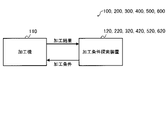
- FIG. 1 is a block diagram schematically showing the configuration of a processing system according to Embodiments 1-6;
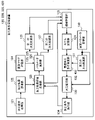
- FIG. 1 is a block diagram schematically showing the configuration of a machining condition search device according to Embodiments 1-4;
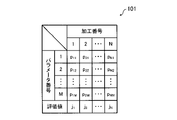
- FIG. It is a schematic diagram showing an example of processing result evaluation information.
- (A) and (B) are schematic diagrams showing examples of parameter data indicating parameters selected by a parameter selection unit. It is a block diagram which shows the hardware structural example of a processing condition search apparatus.
- 4 is a flow chart showing the operation of the processing system according to Embodiment 1;
- FIG. 2 is a schematic diagram for explaining a search method in Embodiment 1;
- FIG. 13 is a block diagram schematically showing the configuration of a parameter selection section 225 according to Embodiment 2;
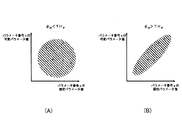
- FIG. (A) and (B) are schematic diagrams showing examples of a case where the correlation between Qx and Rx is low and a case where the correlation is high.
- 10 is a flow chart showing an example of parameter selection operation in a parameter selection unit according to Embodiment 2.
- FIG. FIG. 12 is a block diagram schematically showing the configuration of a parameter selection unit according to Embodiment 3; 14 is a flow chart showing an example of a parameter distribution operation in a parameter distribution unit according to Embodiment 3.
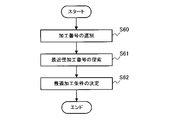
- FIG. FIG. 12 is a flow chart showing the operation of an optimum machining condition search unit at the time of initial search in Embodiment 4;
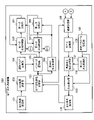
- FIG. 11 is a block diagram schematically showing the configuration of a machining condition search device according to Embodiment 5; 14 is a flow chart showing operations in a first dimension reduction unit, a second dimension reduction unit, a fourth dimension reduction unit, a first comparison unit, and a second comparison unit according to Embodiment 5;
- FIG. 12 is a block diagram schematically showing the configuration of a machining condition search device according to Embodiment 6; 14 is a flow chart showing operations in a first dimension reduction unit, a second dimension reduction unit, a fourth dimension reduction unit, a synthesis unit, and a comparison unit according to Embodiment 6.
- FIG. 12 is a block diagram schematically showing the configuration of a machining condition search device according to Embodiment 6; 14 is a flow chart showing operations in a first dimension reduction unit, a second dimension reduction unit, a fourth dimension reduction unit, a synthesis unit, and a comparison unit according to Embodiment 6.
- FIG. 1 is a block diagram schematically showing the configuration of a processing system 100 according to Embodiment 1.
- the machining system 100 includes a machining machine 110 and a machining condition searching device 120 .
- the processing machine 110 performs processing using the processing conditions from the processing condition searching device 120 and provides the processing result information, which is information indicating the processing results as the result of the processing, to the processing condition searching device 120 .
- the machining condition search device 120 receives machining result information under machining conditions set in the machining machine 110 and searches for machining conditions suitable for the machining machine 110 . Processing conditions consist of a plurality of parameters.
- FIG. 2 is a block diagram schematically showing the configuration of the machining condition search device 120.
- the processing condition search device 120 includes a processing result acquisition unit 121, a processing result evaluation unit 122, a processing result evaluation storage unit 123, a selection flag storage unit 124, a parameter selection unit 125, and a first dimension reduction unit 126. , a second dimension reduction unit 127, a machine learning unit 128, a model storage unit 129, a fixed parameter storage unit 130, a third dimension reduction unit 131, an optimum machining condition search unit 132, and a dimension restoration unit 133 and a machining condition command unit 134 .
- the processing result acquisition unit 121 acquires processing result information, which is information indicating processing results, from the processing machine 110 .
- the acquired processing result information is given to the processing result evaluation unit 122 .
- the type of processing result information differs depending on the type of the processing machine 110, the purpose of processing, or the like.
- the processing result information may be inspection data of the workpiece, and the inspection result value may be the error from the target value determined by the processing specifications or the defect rate.
- processing result acquisition unit 121 acquires processing result information from the processing machine 110 in Embodiment 1
- Embodiment 1 is not limited to such an example.
- processing result information may be acquired from an inspection machine or the like other than the processing machine 110 .
- the user may input the processing result information via an input unit (not shown).
- the machining result evaluation unit 122 determines an evaluation value by evaluating the machining result, which is the result of machining performed by the machining machine 110, and stores the machining used when the machining is performed in the machining result evaluation information described later.
- the determined evaluation value is added in association with the search processing condition, which is the condition.
- the processing result evaluation unit 122 evaluates the processing result indicated by the processing result information from the processing result acquisition unit 121 and determines its evaluation value.
- the evaluation value is a numerical value such as a continuous value or a discrete value, a category value representing an attribute, or a logical value representing the truth of a proposition.
- the evaluation value indicates the quality of the processing result.
- the evaluation value may be a numerical value that takes a continuous value or a discrete value indicating the degree of processing quality.
- the evaluation value may be a category indicating the quality of the processing result, or a logical value indicating whether a predetermined proposition is true or false. Then, the machining result evaluation unit 122 stores the evaluation value in the machining result evaluation storage unit 123 in association with the corresponding machining condition.
- the machining result evaluation storage unit 123 stores a plurality of machining conditions and machining result evaluation information indicating a plurality of evaluation values for a plurality of machining results under the plurality of machining conditions. As described above, each of the multiple processing conditions has multiple parameters.
- machining result evaluation information As a default, a machining condition different from the machining condition searched by the machining condition searching device 120 and an evaluation value of the machining result under the machining condition are stored in association with each other. Such information may be input via an input unit (not shown).
- the machining result evaluation information the machining conditions instructed by the machining condition command unit 134 to the machining machine 110 and the evaluation values determined by the machining result evaluation unit 122 for the machining results under these machining conditions are associated. remembered. It is assumed that the processing result evaluation information is stored in the processing result evaluation storage unit 123 for all processing performed through the processing condition searching device 120 .
- FIG. 3 is a schematic diagram showing an example of processing result evaluation information.
- the machining result evaluation information 101 is a matrix in which various parameters constituting machining conditions and evaluation values corresponding thereto are put together.
- a machining number which is machining identification information for identifying each machining, is assigned to machining that has been performed N times in the past (N is an integer equal to or greater than 1).
- M types M is an integer equal to or greater than 2 of parameters used in processing and evaluation values corresponding thereto are arranged in a vertical row in a matrix.
- parameters are control parameters of the processing machine 110, material parameters representing properties such as the type of material or characteristic values, or environmental parameters such as temperature and humidity at the processing site. These parameters may be numerical values such as continuous or discrete values, categorical values representing attributes, or logical values representing the truth of a proposition.
- the selection flag storage unit 124 stores a selection flag indicating whether each parameter type is a variable parameter or a fixed parameter in order to select a plurality of parameters.
- the selection flag storage unit 124 stores a selection flag indicating whether each type of a plurality of parameters constituting the processing conditions is a changeable variable parameter or an unchangeable fixed parameter.
- variable parameters are parameters that are allowed to be changed
- fixed parameters are parameters that are not allowed to be changed.
- the selection flag may be set by receiving a user's instruction via an input unit (not shown). Alternatively, the selection flag may be automatically set based on conditions such as the type or model of the processing machine 110 . Furthermore, the selection flag may be received from another device via a communication unit (not shown).
- the fixed parameters include, among the control parameters of the processing machine 110, control parameters that cannot be changed or that the user does not desire to change, parameters related to materials such as material properties, sizes, or amounts, or pressure, temperature, and humidity of the processing environment. and other environmental parameters.
- the parameter selection unit 125 selects a plurality of parameters included in the processing result evaluation information into a plurality of variable parameters that are permitted to be changed and one or a plurality of fixed parameters that are not permitted to be changed.
- the parameter selection unit 125 refers to the selection flag to select multiple parameters into multiple variable parameters and one or multiple fixed parameters.
- the parameter selection unit 125 reads a plurality of parameters included in the processing result evaluation information stored in the processing result evaluation storage unit 123 and the selection flags stored in the selection flag storage unit 124, respectively.
- the parameter sorting unit 125 sorts parameters into variable parameters or fixed parameters according to the sorting flag. Then, the parameter selection unit 125 generates variable parameter data indicating the selected variable parameters and fixed parameter data indicating the selected fixed parameters.
- FIG. 4A and 4B are schematic diagrams showing examples of parameter data indicating parameters selected by the parameter selection unit 125.
- FIG. FIG. 4A shows an example of variable parameter data 102 storing variable parameters
- FIG. 4B shows an example of fixed parameter data 103 storing fixed parameters.
- variable parameter data 102 stores Mv parameters
- fixed parameter data 103 stores Mf parameters.
- the variable parameter data 102 and the fixed parameter data 103 are composed of a matrix holding parameters for each machining number for machining performed N times in the past, similar to the machining result evaluation information 101 shown in FIG. .
- Mv and Mf correspond to the number of dimensions of variable parameters and fixed parameters, respectively.
- variable parameter data 102 let qxy be the y-th variable parameter for the machining number x.
- the fixed parameter data 103 the z-th fixed parameter for the machining number x is rxz .
- the first dimensionality reduction unit 126 generates a first feature amount of a first dimension or less, which is a predetermined dimension, from a plurality of variable parameters included in the variable parameter data. is a first dimensional processing unit that generates one or a plurality of first feature amounts corresponding to a plurality of machining conditions.
- the first dimension reduction unit 126 generates the first feature amount by reducing the dimension of the plurality of variable parameters when the dimension of the plurality of variable parameters is larger than the first dimension.
- the first dimension reduction unit 126 analyzes the variable parameter data generated by the parameter selection unit 125, and determines whether the number of dimensions Mv of the variable parameter data is greater than a predetermined threshold THv. . Then, when the number of dimensions Mv is greater than the threshold THv, the first dimension reduction unit 126 converts the variable parameter data into the first feature amount data expressed by the number of dimensions Lv equal to or less than the threshold THv. A first dimensionality reduction process is performed.
- the threshold THv corresponds to the first dimension.
- the first feature amounts of a plurality of dimensions included in the first feature amount data are also referred to as a first feature amount set.
- avnx is a function of variable parameters qn1 , qn2 , ..., qnMv . Therefore, it is represented by the following formula (1).
- avnx fx( qn1 , qn2 , ..., qnMv ) (1)
- fx represents a function that transforms the variable parameter into the x-th element of the first feature amount data. The element here is the first feature amount.
- principal component analysis can be used as this dimensionality reduction process.
- each principal component obtained by principal component analysis becomes a feature quantity.
- the dimensions can be reduced by extracting the first to k-th principal components in descending order of the eigenvalues of the covariance matrix and removing the remaining principal components.
- k Mv.
- An autoencoder using a neural network is also a suitable example of dimensionality reduction processing.
- the feature value is the output of the encoder network of the autoencoder.
- the encoder network is a part of the neural network that constitutes the autoencoder, and means a sub-network involved in encoder processing.
- Random EMbedding Bayesian Optimization which embeds a low-dimensional space into a high-dimensional space using a random matrix, or Line, which limits the search space to a one-dimensional space
- Bayesian optimization which is a type of black-box optimization.
- Processing such as Bayesian Optimization (LINEBO) is known, and these can also be used as the dimension reduction processing in the first embodiment.
- dimensionality reduction processes include multidimensional scaling, independent component analysis, non-negative matrix factor analysis (NMF), local linear embedding (LLE), locality preserving projection (LPP), Laplace eigenmap (LEP ), kernel principal component analysis, Karhunen-Loeve expansion, t-SNE (t-distributed Stochastic Neighbor Embedding), etc. may be used.
- NMF non-negative matrix factor analysis
- LLE local linear embedding
- LPP locality preserving projection
- LEP Laplace eigenmap
- kernel principal component analysis Karhunen-Loeve expansion
- t-SNE t-distributed Stochastic Neighbor Embedding
- the first dimension reduction unit 126 When the number of dimensions Mv of the variable parameter data is equal to or less than the threshold THv, the first dimension reduction unit 126 does not perform dimension reduction and uses the variable parameter data itself as the first feature data. The first dimensionality reduction unit 126 then provides the first feature data to the machine learning unit 128 .
- the second dimension reduction unit 127 generates a second feature amount of a second dimension or less, which is a predetermined dimension, from one or more fixed parameters indicated by the fixed parameter data, thereby performing a plurality of processes.
- a second dimension processing unit that generates one or a plurality of second feature amounts corresponding to conditions.
- the second dimension reduction unit 127 generates the second feature amount by reducing the dimension of the plurality of fixed parameters when the dimension of the plurality of fixed parameters is larger than the second dimension.
- the second dimension reduction unit 127 analyzes the fixed parameter data generated by the parameter selection unit 125, and determines whether the number of dimensions Mf of the fixed parameter data is greater than a predetermined threshold THf. . When the number of dimensions Mf is greater than the threshold THf, the second dimension reduction unit 127 converts the fixed parameter data into second feature amount data represented by the number of dimensions Lf equal to or less than the threshold THf. Perform a two-dimensional reduction process. A specific process of dimension reduction is the same as that of the first dimension reduction unit 126 .
- the number of dimensions Mf corresponds to the second dimension.
- the second feature amounts of a plurality of dimensions included in the second feature amount data are also referred to as a second feature amount set.
- afnx be the x-th element of the second feature amount data for the fixed parameter of the processing number n
- afnx is a function of the fixed parameter values r n1 , r n2 , It is represented by the following formula (2).
- af nx hx(r n1 , r n2 , . . . r nMf ) (2)
- hx represents a function that transforms the fixed parameter into the x-th element of the second feature amount data. The element here becomes the second feature amount.
- the second dimension reduction unit 127 when the number of dimensions Mf of the fixed parameter data is equal to or less than the threshold THf, the second dimension reduction unit 127 does not perform dimension reduction and uses the fixed parameter data itself as the second feature amount data. Then, the second dimension reduction unit 127 provides the second feature amount data to the machine learning unit 128 .
- the fixed parameters are not searched for by the optimum machining condition search unit 132, which will be described later, even if the number of dimensions Mf of the fixed parameter data is large, the second dimension reduction process is omitted, and the fixed parameter data itself is may be used as the second feature amount data.
- the machine learning unit 128 generates a learning model by learning the relationship between one or more first feature amounts, one or more second feature amounts, and multiple evaluation values. For example, the machine learning unit 128 uses the first feature amount data provided by the first dimension reduction unit 126, the second feature amount data provided by the second dimension reduction unit 127, the processing result evaluation storage unit 123 Based on the evaluation values contained in the processing result evaluation information stored in , each feature value is regarded as an input value and the evaluation value is regarded as a response value, and the relationship between the two is learned, and this learning is expressed by a mathematical model. Generate a model.
- a regression model can be applied if the evaluation value is a numerical value such as a continuous value or a discrete value
- a classification model can be applied if the evaluation value is a categorical value or a logical value.
- learning algorithms for generating such learning models include linear regression, nonlinear regression, regression trees, model trees, support vector regression, genetic programming, Gaussian process regression, linear discriminant analysis, logistic regression, k nearest neighbors. , support vector machines, decision trees, random forests or neural networks.
- the model storage unit 129 stores the learning model generated by the machine learning unit 128.
- the fixed parameter storage unit 130 stores one or more fixed parameters used in target machining conditions, which are machining conditions to be searched.
- One or more fixed parameters stored in the fixed parameter storage unit 130 are also referred to as one or more target fixed parameters.
- Data indicating one or more fixed parameters stored in the fixed parameter storage unit 130 is also referred to as fixed parameter data or target fixed parameter data.
- the fixed parameters stored in the fixed parameter storage unit 130 may be set by a user's instruction, set automatically under specific conditions, or input from another device through communication means (not shown). You can do so.
- the selection flags stored in the selection flag storage unit 124 or the fixed parameters stored in the fixed parameter storage unit 130 may be changed after the search procedure described later is performed.
- the third dimension reduction unit 131 is a third dimension processing unit that generates a third feature amount of the second dimension or lower from one or more fixed parameters stored in the fixed parameter storage unit 130 .
- the third dimension reduction unit 131 reduces the dimension of the plurality of fixed parameters to generate the third feature amount. do.
- the third dimension reduction unit 131 analyzes the fixed parameter data stored in the fixed parameter storage unit 130 and determines whether the number of dimensions Mf of the fixed parameter data is greater than the threshold THf.
- the third dimension reduction unit 131 performs dimension reduction processing for converting the fixed parameter data into third feature amount data expressed by the number of dimensions Lf which is less than or equal to the number of dimensions Mf when the number of dimensions Mf is greater than the threshold THf.
- a third dimensionality reduction process is performed.
- the third dimension reduction processing is the same dimension reduction processing as the second dimension reduction processing performed by the second dimension reduction unit 127 .
- the third feature amount data is given to the optimum machining condition searching section 132 . Note that when the number of dimensions Lf is 2 or more, a plurality of third feature amounts included in the third feature amount data are also referred to as a third feature amount set.
- the third dimension reduction unit 131 extracts the same number of principal components as the second feature amount data using the eigenvalues and eigenvectors used at that time. Just do it. Also, when the second dimensionality reduction process uses an autoencoder, the third dimensionality reduction unit 131 inputs fixed parameters to the same encoder network as the second dimensionality reduction unit 127, and outputs the A third feature amount may be used.
- the third dimension reduction unit 131 does not perform the third dimension reduction process, and the fixed parameters read from the fixed parameter storage unit 130 The data itself is given to the optimum machining condition search unit 132 as the third feature amount data.
- the optimum machining condition search unit 132 uses the third feature amount and the learning model to search for the optimum value of the feature amount of the plurality of target variable parameters which are the plurality of variable parameters used in the target machining condition. is. For example, the optimum machining condition search unit 132 searches for optimum machining conditions using a learning model stored in the model storage unit 129 . At this time, the optimum machining condition search unit 132 learns the third feature amount data given from the third dimensionality reduction unit 131 and the feature amount candidates of a plurality of variable parameters generated by a predetermined method. Obtain the predicted value of the evaluation value given as an input to the model and obtained as the response of the learning model. Then, the optimum machining condition searching unit 132 provides the dimension restoring unit 133 with the candidate that gives the best predicted value as the optimum machining condition. The candidates included in the optimum machining conditions correspond to the optimum values.
- the dimension restoration unit 133 is a specification unit that specifies searched machining conditions, which are machining conditions searched as target machining conditions, from the optimum value and one or more target fixed parameters.
- searched machining conditions which are machining conditions searched as target machining conditions, from the optimum value and one or more target fixed parameters.
- the dimension restoration unit 133 restores the parameters from the optimum values so that the dimensions are the same as the dimensions of the plurality of variable parameters.
- g represents a function that transforms the feature amount into variable parameters.
- the dimension restoration unit 133 can convert the optimum processing conditions into variable parameters using the eigenvalues and eigenvectors used in the dimension compression process.
- the dimension restoration unit 133 can obtain a variable parameter as an output by inputting the feature amount to the decoder network.
- the decoder network is a part of the neural network that constitutes the autoencoder, and means a sub-network involved in decoder processing.
- the dimension restoring unit 133 does not restore the dimension and uses the optimum machining conditions given from the optimum machining condition searching unit 132 as the variable parameters.
- the machining condition command unit 134 gives the searched machining conditions to the processing machine 110 to cause the machine 110 to perform machining under the searched machining conditions, and adds the searched machining conditions to the machining result evaluation information.
- the machining condition command unit 134 combines the variable parameter given from the dimension restoring unit 133 and the fixed parameter read from the fixed parameter storage unit 130 to set the machining condition, and performs machining under the machining condition. command the machine 110.
- the machining condition command unit 134 also stores the machining condition in the machining result evaluation information stored in the machining result evaluation storage unit 123 .
- the user may arbitrarily modify the processing conditions via an input unit (not shown).
- the machining conditions corrected by the user are output from the machining condition command unit 134 to the machining machine 110 and the machining result evaluation storage unit 123 .
- the processing machine 110 When the processing conditions are given from the processing condition search device 120 as described above, the processing machine 110 performs processing according to the processing conditions. Then, the processing machine 110 provides processing result information indicating the result of processing to the processing condition searching device 120 .
- the unit 131, the optimum machining condition search unit 132, the dimension restoration unit 133, and the machining condition command unit 134 can each be implemented by a processing circuit.
- the processing circuit may be a circuit that includes a processor, or may be dedicated hardware. Also, these may be realized in a distributed computing environment configured by connecting them on a computer network such as a cloud. In other words, the machining condition search device 120 may be implemented by a computer.
- the processing result evaluation storage unit 123, the selection flag storage unit 124, the model storage unit 129, and the fixed parameter storage unit 130 can be realized by a storage device.
- Storage devices include semiconductor memories such as DRAM (Dynamic Random Access Memory), SRAM (Static Random Access Memory) or flash memory, recording media such as magnetic disks, optical disks or magnetic tapes, or data storage on computer networks. do.
- FIG. 5 is a block diagram showing a hardware configuration example of the processing condition searching device 120.
- the processing circuitry 140 described above comprises, for example, a processor 141 and a memory 142 .
- the processor 141 reads out and executes a program stored in the memory 142, thereby obtaining the processing result acquisition unit 121, the processing result evaluation unit 122, and the parameter selection unit.
- the processing result acquisition unit 121 the processing result evaluation unit 122, the parameter selection unit 125, the first dimension reduction unit 126, the second dimension reduction The unit 127, the machine learning unit 128, the third dimension reduction unit 131, the optimum machining condition search unit 132, the dimension restoration unit 133, and the machining condition command unit 134 are implemented using software programs.
- Such a program may be provided through a network, or may be provided by being recorded on a recording medium. That is, such programs may be provided as program products, for example.
- processing result evaluation storage unit 123 the selection flag storage unit 124 , the model storage unit 129 and the fixed parameter storage unit 130 are realized by the memory 142 .
- Memory 142 is also used as a work area for processor 141 .
- the processor 141 is a CPU (Central Processing Unit) or the like.
- the memory 142 corresponds to, for example, a non-volatile or volatile semiconductor memory such as a RAM (Random Access Memory), a ROM (Read Only Memory), a flash memory, a magnetic disk, or the like.
- the processing circuit may be, for example, an FPGA (Field Programmable Gate Array), an ASIC (Application Specific Integrated Circuit). ).
- Each part of the machining condition search device 120 may be realized by combining a processing circuit including a processor and dedicated hardware.
- the processing condition search device 120 may be realized by connecting a plurality of processing circuits having processors as described above or dedicated hardware via a computer network such as a cloud.
- each part of the processing condition search device 120 can be realized by a processing circuit network.
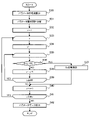
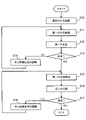
- FIG. 6 is a flow chart showing the operation of the processing system 100 according to the first embodiment.
- the selection flag storage unit 124 stores a selection flag (S10).
- the user of the processing system 100 can set whether each type of a plurality of parameters used in the processing machine 110 is a variable parameter or a fixed parameter via an input unit (not shown). Then, the selection flag should be stored according to the setting.
- the fixed parameter storage unit 130 stores, as fixed parameter data, the values of the parameters designated as unchangeable fixed parameters by the selection flags stored in step S10 (S11).
- This fixed parameter data may also be set by a user's instruction via an input unit (not shown), for example.
- the parameter selection unit 125 reads a plurality of parameters from the processing result evaluation storage unit 123, refers to the selection flags stored in the selection flag storage unit 124, and converts each of the plurality of parameters into variable parameters. Alternatively, fixed parameters are selected (S12). Then, the parameter selection unit 125 generates variable parameter data indicating the selected variable parameter and fixed parameter data indicating the selected fixed parameter, supplies the variable parameter data to the first dimension reduction unit 126, and generates fixed parameter data is given to the second dimension reduction unit 127 .
- the first dimension reduction unit 126 analyzes the variable parameter data generated by the parameter selection unit 125 and determines whether the number of dimensions Mv of the variable parameter data is greater than the threshold THv (S13). If the number of dimensions Mv is greater than the threshold THv (Yes in S13), the process proceeds to step S14, and if the number of dimensions Mv is equal to or less than the threshold THv (No in S13), the process proceeds to step S15. Note that when the number of dimensions Mv is equal to or less than the threshold THv (No in S13), the first dimension reduction unit 126 does not perform dimension reduction, and uses the variable parameter data itself as the first feature amount data in the machine learning unit. Give to 128.
- step S14 the first dimension reduction unit 126 converts the variable parameter data into first feature amount data expressed by the number of dimensions Lv smaller than the threshold THv.
- step S15 the second dimension reduction unit 127 analyzes the fixed parameter data selected by the parameter selection unit 125 and determines whether the number of dimensions Mf of the fixed parameter data is greater than the threshold THf. If the number of dimensions Mf is greater than the threshold THf (Yes in S15), the process proceeds to step S16, and if the number of dimensions Mf is equal to or less than the threshold THf (No in S15), the process proceeds to step S17. Note that when the number of dimensions Mf is equal to or less than the threshold THf (No in S15), the second dimension reduction unit 127 does not perform dimension reduction, and uses the fixed parameter data itself as the second feature data for the machine learning unit. Give to 128.
- step S16 the second dimension reduction unit 127 converts the fixed parameter data into second feature amount data expressed with the number of dimensions Lf that is less than the threshold THf.
- step S17 the third dimension reduction unit 131 determines whether or not the number of dimensions Mf of the fixed parameter data stored in the fixed parameter storage unit 130 is greater than the threshold THf. If the number of dimensions Mf is greater than the threshold THf (Yes in S17), the process proceeds to step S18, and if the number of dimensions Mf is equal to or less than the threshold THf (No in S17), the process proceeds to step S19. Note that when the number of dimensions Mf is equal to or less than the threshold THf (No in S17), the third dimension reduction unit 131 does not perform dimension reduction, and uses the fixed parameter data itself as the third feature amount data for the optimum processing conditions. It is given to the search unit 132 .
- step S18 the third dimension reduction unit 131 reads the fixed parameter data from the fixed parameter storage unit 130, and performs the same dimension reduction processing as the second dimension reduction unit 127 on the fixed parameter data, thereby obtaining the third feature Quantity data is converted into quantity data, and the third feature quantity data is provided to the optimum machining condition searching unit 132 .
- the machine learning unit 128 stores the first feature amount data provided by the first dimension reduction unit 126, the second feature amount data provided by the second dimension reduction unit 127, and the processing result evaluation storage.
- a plurality of evaluation values included in the processing result evaluation information stored in the processing result evaluation storage unit stored in the unit 123 are read, each feature amount is regarded as an input value, and the evaluation value is regarded as a response value. It learns the relationship between the two and generates a learning model that expresses this in a mathematical model.
- the generated learning model is stored in the model storage unit 129 .
- the optimum machining condition search unit 132 searches for optimum machining conditions using the learning model stored in the model storage unit 129 (S20). At this time, the optimum machining condition search unit 132 learns the third feature amount data given from the third dimensionality reduction unit 131 and a plurality of variable parameter feature amount candidates generated by a predetermined method. Given as an input value to the model, the prediction value of the evaluation value obtained as the response of the learning model to this is obtained, and the candidate giving the best prediction value is set as the optimum machining condition.
- FIG. 7 is a schematic diagram for explaining a search method according to Embodiment 1.
- FIG. 7 as an example in which the evaluation value is determined by the feature amount av of the variable parameter and the feature amount af of the fixed parameter, the horizontal axis represents the feature amount av of the variable parameter, and the vertical axis represents the feature amount af of the fixed parameter.
- a graph is shown.
- points P01 to P06 indicated by squares indicate searched processing conditions stored in the processing result evaluation storage unit 123.
- Regions R11, R12, and R13 represent regions in which the processing result is predicted to be poor, good, or best, respectively, by the learning model generated by learning by the machine learning unit 128 based on the searched processing condition data.
- the evaluation value is assumed to be the defective rate. The evaluation value takes a continuous value from 0% to 100%, and the defective rate of less than 1% is defined as best, less than 5% as good, and 5% or more as defective.
- the predicted evaluation value in the region R11 is 5% or more
- the predicted evaluation value in the region R12 is 1% or more and less than 5%
- the predicted evaluation value in the region R13 is less than 1%.
- the search space is on the dashed line L shown in FIG.
- the dimensionality of the search space is equal to the dimensionality of the variable parameter feature, in other words, the first feature.
- the feature amount of the variable parameter is assumed to be one-dimensional for the sake of simple illustration, but in the case of two-dimensional or more, the search space is also two-dimensional or more.
- Search candidates are selected from points on the search space limited by the third feature value in this way, but any means may be used for the selection method.
- the search space may be divided into grids at predetermined intervals as in grid search, and each grid point may be used as a search candidate. A number may be randomly selected.
- methods such as hill-climbing method, simulated annealing method, particle swarm optimization method, or Bayesian optimization method, the predicted value is obtained while selecting candidate points one by one, and the next candidate point is determined based on this result. , a sequential optimization technique may be used.
- a point P21 indicated by a triangle, a point P22 indicated by a circle, and a point P23 indicated by a double circle represent search candidates selected by a predetermined method.
- the abscissa coordinates of each point are candidates for the feature amount of the variable parameter.
- the predicted defect rate in the first search candidate corresponding to point P21 indicated by a triangle is 5% or more, for example, 12%.
- the predicted failure rate of the second search candidate corresponding to the circled point P22 is 1% or more and less than 5%, for example, 3%.
- the predicted failure rate in the third search candidate corresponding to point P23 indicated by a double circle is less than 1%, for example 0.2%.
- the optimum machining condition search unit 132 determines that the third search candidate indicated by point P23 is the best, and gives the dimension restoration unit 133 the feature amount av * of the variable parameter in that candidate as the optimum machining condition.
- the optimum machining condition searching unit 132 can use this to calculate not only the predicted value of the evaluation value but also its confidence interval. is. Then, the optimum machining condition searching unit 132 can calculate a score indicating whether or not to search for any unsearched point using an acquisition function calculated based on the calculated confidence interval. In such a case, the optimum machining condition searching unit 132 may set the feature amount of the variable parameter at the search point that maximizes the score calculated by the acquisition function as the optimum machining condition.
- the optimum machining condition searching unit 132 selects the optimum candidate only for the feature quantity of the variable parameter and sets it as the optimum machining condition while maintaining the feature quantity of the fixed parameter, without changing the fixed parameter. Only variable parameters can be searched. In addition, since the optimum machining condition searching unit 132 selects a candidate predicted by the learning model to give the best result as the optimum machining condition, the number of actual trials by the machining machine 110 can be reduced, and efficient machining conditions can be obtained. allows exploration of
- the dimension restoration unit 133 determines whether or not the number of dimensions Mv of the variable parameter data is greater than the threshold THv (S21). If the number of dimensions Mv of the variable parameter data is greater than the threshold THv (Yes in S21), the process proceeds to step S22. , the process proceeds to step S23.
- step S22 the dimension restoration section 133 converts the optimum machining conditions given from the optimum machining condition searching section 132 into variable parameters. Then, the dimension restoring unit 133 gives the machining conditions obtained by combining the variable parameters and the fixed parameters read from the fixed parameter storage unit 130 to the machining condition command unit 134 as searched machining conditions. On the other hand, in the case of No in step S21, the dimension restoring unit 133 does not perform dimension restoration, and uses the optimum machining conditions given from the optimum machining condition searching unit 132 as variable parameters. The machining conditions combined with the fixed parameters read from the parameter storage unit 130 are given to the machining condition command unit 134 as search machining conditions.
- the processing condition command section 134 commands the processing machine 110 to perform processing under the processing conditions given from the dimension restoration section 133 (S23). Also, the machining condition command unit 134 adds this machining condition to the machining result evaluation information stored in the machining result evaluation storage unit 123 . At this time, the user may arbitrarily modify the processing conditions via an input unit (not shown). In this case, the machining conditions modified by the user are provided from the machining condition command unit 134 to the machining machine 110 and the machining result evaluation storage unit 123 .
- the processing machine 110 performs processing according to the processing conditions given from the processing condition command section 134 (S24). Then, the processing result acquisition unit 121 acquires processing result information from the processing machine 110 (S25).
- the processing result evaluation unit 122 determines the evaluation value of the processing result based on the processing result information acquired by the processing result acquisition unit 121 (S26). Then, the machining result evaluation unit 122 stores the evaluation value in the machining result evaluation information stored in the machining result evaluation storage unit 123 in association with the machining conditions added by the machining condition command unit 134 .
- the parameter selection unit 125 determines whether or not to end the process (S28). If the process is not to end (No in S28), the process returns to step S12 and the above process is repeated. Any method may be used to determine whether to end the process. For example, an arbitrary upper limit for the number of iterations may be set, or the user may be allowed to view the processing result and instruct termination. Furthermore, the processing condition search device 120 may be allowed to terminate the search by itself according to some criteria.
- the machining conditions are divided into fixed parameters and variable parameters, and dimension reduction is performed individually to convert them into feature amounts, and the feature amounts of the fixed parameters are held. Since the optimum machining condition is searched for the feature amount of the variable parameter, even if the parameters constituting the machining condition are high-dimensional and some of them are unchangeable parameters, they can be changed. Optimal values can be searched efficiently only for parameters.
- the optimum machining condition is applied to the feature amount of the variable parameter having a lower dimension than the variable parameter, which is obtained by reducing the dimension of the variable parameter.
- the search space becomes low-dimensional, and the search for the optimum machining conditions becomes easy.
- Embodiment 1 even if the parameters constituting the machining conditions are high-dimensional, machine learning and searching for the optimum machining conditions are performed based on lower-dimensional feature amounts obtained by dimensionality reduction. By doing so, the computational power or memory capacity required for these processes can be reduced.
- the candidates predicted by the learning model to obtain the best result are selected as the optimum machining conditions, the number of actual trials by the machining machine 110 can be reduced, and efficient machining conditions can be obtained. can enable exploration of
- Prediction accuracy can be improved by performing machine learning to create a learning model using fixed parameters and predicting the evaluation value of the machining result by taking fixed parameters into consideration.
- Embodiment 2 variable parameters and fixed parameters are selected according to the selection flag. However, even if the parameters are selected as variable parameters by the selection flag, there are parameters that have a high correlation with the fixed parameters and can be assigned to the fixed parameters. In the second embodiment, such parameters are automatically identified and assigned to fixed parameters.
- a processing system 200 according to Embodiment 2 includes a processing machine 110 and a processing condition searching device 220. As shown in FIG. Processing machine 110 in processing system 200 according to the second embodiment is the same as processing machine 110 in processing system 100 according to the first embodiment.
- the processing condition search device 220 in the second embodiment includes a processing result acquisition unit 121, a processing result evaluation unit 122, a processing result evaluation storage unit 123, and a selection flag storage unit 124. , a parameter selection unit 225, a first dimension reduction unit 126, a second dimension reduction unit 127, a machine learning unit 128, a model storage unit 129, a fixed parameter storage unit 130, and a third dimension reduction unit 131 , an optimum machining condition search unit 132 , a dimension restoration unit 133 , and a machining condition command unit 134 .
- Processing result acquisition unit 121, processing result evaluation unit 122, processing result evaluation storage unit 123, selection flag storage unit 124, first dimension reduction unit 126, and second dimension reduction unit of processing condition search device 220 in Embodiment 2 127, a machine learning unit 128, a model storage unit 129, a fixed parameter storage unit 130, a third dimension reduction unit 131, an optimum machining condition search unit 132, a dimension restoration unit 133, and a machining condition command unit 134 are the Processing result acquisition unit 121, processing result evaluation unit 122, processing result evaluation storage unit 123, selection flag storage unit 124, first dimension reduction unit 126, second dimension reduction unit 127, machine learning unit of processing condition search device 220 128 , model storage unit 129 , fixed parameter storage unit 130 , third dimension reduction unit 131 , optimum machining condition search unit 132 , dimension restoration unit 133 and machining condition command unit 134 .
- the parameter selection unit 225 selects each of a plurality of parameters included in the processing result evaluation information stored in the processing result evaluation storage unit 123 into a variable parameter or a fixed parameter, and selects a variable parameter indicating the selected variable parameter. Generate fixed parameter data indicating the parameter data and the selected fixed parameters.
- FIG. 8 is a block diagram schematically showing the configuration of parameter selection section 225 according to the second embodiment.
- the parameter selection section 225 includes an initial distribution section 250 , a parameter data storage section 251 , a parameter distribution section 254 and an output section 258 .
- the initial sorting unit 250 sorts the multiple parameters into multiple variable parameters and one or multiple fixed parameters by referring to the selection flag.
- the parameters assigned to the variable parameters by the initial assigning unit 250 are also called initial variable parameters
- the parameters assigned to the fixed parameters by the initial assigning unit 250 are also referred to as initial fixed parameters.
- the initial sorting unit 250 according to the selection flag read from the selection flag storage unit 124, each of the plurality of parameters included in the processing result evaluation information stored in the processing result evaluation storage unit 123, By assigning fixed parameters or variable parameters as an initial state, variable parameter data indicating the assigned variable parameters and fixed parameter data indicating the assigned fixed parameters are generated. Then, the initial distribution unit 250 causes the parameter data storage unit 251 to store the variable parameter data and the fixed parameters.
- the parameter data storage unit 251 includes a variable parameter data storage unit 252 that stores variable parameter data generated by the initial allocation unit 250, and a fixed parameter data storage unit that stores fixed parameter data generated by the initial allocation unit 250. 253.
- the parameter allocating section 254 finally sorts the variable parameters and fixed parameters that were initially sorted by the initial allocating section 250 .
- the parameter distribution section 254 includes a correlation analysis section 255 and a redistribution section 256 .
- the correlation analysis unit 255 identifies multiple combinations of each of the multiple initial variable parameters and each of the one or multiple initial fixed parameters, and analyzes the correlation of each of the multiple combinations. For example, the correlation analysis unit 255 combines the variable parameter data stored in the variable parameter data storage unit 252 and the fixed parameter data stored in the fixed parameter data storage unit 253 for each parameter type, and analyze the correlation between
- variable parameter data storage unit 252 stores Mv type variable parameter data 102 for the past N machining operations
- fixed parameter data storage unit 253 stores Mf types of fixed parameter data 103, respectively.
- the correlation score ⁇ xy represented by the following equation (4) is calculated for all combinations of x and y.
- ⁇ xy ⁇ (Qx, Ry) (4)
- 1 ⁇ x ⁇ Mv, 1 ⁇ y ⁇ Mf, and Qx includes variable parameter values q 1x , q2x, .
- a vector Ry is a vector whose elements are fixed parameter values r 1y , r 2y , .
- the function ⁇ is a function that outputs a numerical value representing the correlation between vectors.
- Specific examples of the correlation score ⁇ xy are the absolute value of the correlation coefficient, cross entropy, KL (Kullback-Leibler) information, other mutual information, and the like.
- FIGS. 9A and 9B show examples of cases where the correlation between Qx and Rx is low and high.
- FIG. 9(A) shows a case where the correlation between Qx and Rx is low
- FIG. 9(B) shows a case where the correlation between Qx and Rx is high.
- the vertical axis indicates variable parameters with parameter number x
- the horizontal axis indicates fixed parameters with parameter number y.
- variable parameters when the correlation is low, the variable parameters and the fixed parameters are distributed almost uncorrelated. As shown, when the correlation is high, there is a certain relationship between the variable parameter and the fixed parameter. In other words, in the latter case, variable parameters can be considered to be linked to fixed parameters. In the latter case, variable parameters can also be regarded as parameters whose values are automatically determined when fixed parameters are determined. Thus, such variable parameters can be included in the fixed parameters. This is also the case for the inverse correlation.
- the redistribution unit 256 redistributes the variable parameter data based on the correlation score calculated by the correlation analysis unit 255 . Specifically, the redistribution unit 256 distributes variable parameters satisfying ⁇ xy >TH ⁇ to fixed parameters according to a predetermined threshold TH ⁇ , and stores such variable parameters in the fixed parameter data. . In other words, the redistribution unit 256 selects, among a plurality of combinations of each of the plurality of initial variable parameters and each of the one or a plurality of initial fixed parameters, the combinations whose correlation is higher than a predetermined threshold. By redistributing the initially variable parameters that have been assigned to the initial fixed parameters, the plurality of initially variable parameters after distribution are determined as the plurality of variable parameters, and the one or more initial fixed parameters after distribution are fixed to one or more fixed parameters Confirm as a parameter.
- the output unit 258 provides the variable parameter data stored in the parameter data storage unit 251 to the first dimension reduction unit 126, and transfers the fixed parameter data to the second dimension. It is given to the reduction unit 127 .
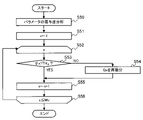
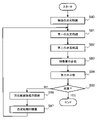
- FIG. 10 is a flowchart showing an example of parameter selection operation in parameter selection section 225 according to the second embodiment.
- the initial distribution unit 250 distributes, as an initial state, a plurality of parameters included in the processing result evaluation information stored in the selection flag storage unit 124 as an initial distribution, thereby obtaining variable parameter data and fixed parameter data. is generated (S30).
- the generated variable parameter data is stored in variable parameter data storage section 252
- the generated fixed parameter data is stored in fixed parameter data storage section 253 .
- the correlation analysis unit 255 combines the variable parameter data stored in the variable parameter data storage unit 252 and the fixed parameter data stored in the fixed parameter data storage unit 253 for each parameter type, and Analyze the correlation between (S31).
- the correlation score ⁇ xy is calculated.
- the redistribution unit 256 initializes the parameter number x for identifying variable parameters to "1" (S32). Then, the redistribution unit 256 repeats the following processing until the parameter number x exceeds the maximum value Mv (S33).
- the redistribution unit 256 initializes the parameter number y for identifying fixed parameters to "1" (S34). Then, the redistribution unit 256 repeats the following process until the parameter number y exceeds the maximum value Mf (S35).
- the redistribution unit 256 determines whether the correlation score ⁇ xy calculated by the correlation analysis unit 255 exceeds a predetermined threshold TH ⁇ (S36). If the correlation score ⁇ xy exceeds the threshold TH ⁇ (Yes in S36), the process proceeds to step S37, and if the correlation score ⁇ xy is equal to or less than the threshold TH ⁇ (No in S36), the process Proceed to step S38.
- the redistribution unit 256 redistributes the variable parameter Qx of the parameter number x when it is determined that the correlation score ⁇ xy exceeds the threshold TH ⁇ as a fixed parameter. Specifically, the redistribution unit 256 extracts the variable parameter Qx from the variable parameter data storage unit 252 and adds it to the fixed parameter data stored in the fixed parameter data storage unit 253 .
- step S38 the redistribution unit 256 adds "1" to the parameter number y. Then, the redistribution unit 256 determines whether or not the parameter number y is equal to or less than the maximum value Mf (S39). If the parameter number y is equal to or less than the maximum value Mf (Yes in S39), the process returns to step S35, and if the parameter number y exceeds the maximum value Mf (No in S39), the process proceeds to step S40. proceed to
- step S40 the redistribution unit 256 adds "1" to the parameter number x. Then, the redistribution unit 256 determines whether or not the parameter number x is equal to or less than the maximum value Mv (S41). If the parameter number x is equal to or less than the maximum value Mv (Yes in S41), the process returns to step S33, and if the parameter number x exceeds the maximum value Mv (No in S41), the process proceeds to step S42. proceed to
- step S42 the output unit 258 outputs variable parameter data and fixed parameter data stored in the parameter data storage unit 251.
- parameters once identified as variable parameters according to the sorting flag are also analyzed for their correlation with fixed parameters, and if the correlation is high, they are reallocated to fixed parameters. . This makes it possible to further reduce the number of variable parameters, making it easier to search for optimum machining conditions.
- Embodiment 3 In the second embodiment, even if a parameter is set as a variable parameter in the selection flag, the variable parameter is assigned to the fixed parameter if the correlation with the fixed parameter is high. Embodiment 3 analyzes whether or not the parameters set as variable parameters in the selection flag contribute to the machining result, and sorts the variable parameters that do not contribute to the fixed parameters.
- a processing system 300 according to Embodiment 3 includes a processing machine 110 and a processing condition searching device 320. As shown in FIG. Processing machine 110 in processing system 300 according to the third embodiment is the same as processing machine 110 in processing system 100 according to the first embodiment.
- the processing condition search device 320 includes a processing result acquisition unit 121, a processing result evaluation unit 122, a processing result evaluation storage unit 123, and a selection flag storage unit 124. , a parameter selection unit 325, a first dimension reduction unit 126, a second dimension reduction unit 127, a machine learning unit 128, a model storage unit 129, a fixed parameter storage unit 130, and a third dimension reduction unit 131 , an optimum machining condition search unit 132 , a dimension restoration unit 133 , and a machining condition command unit 134 .
- Processing result acquisition unit 121, processing result evaluation unit 122, processing result evaluation storage unit 123, selection flag storage unit 124, first dimension reduction unit 126, and second dimension reduction unit of processing condition search device 320 in Embodiment 3 127, a machine learning unit 128, a model storage unit 129, a fixed parameter storage unit 130, a third dimension reduction unit 131, an optimum machining condition search unit 132, a dimension restoration unit 133, and a machining condition command unit 134 are the Processing result acquisition unit 121, processing result evaluation unit 122, processing result evaluation storage unit 123, selection flag storage unit 124, first dimension reduction unit 126, second dimension reduction unit 127, machine learning unit of processing condition search device 220 128 , model storage unit 129 , fixed parameter storage unit 130 , third dimension reduction unit 131 , optimum machining condition search unit 132 , dimension restoration unit 133 and machining condition command unit 134 .
- the parameter selection unit 325 selects each of a plurality of parameters included in the processing result evaluation information stored in the processing result evaluation storage unit 123 into a variable parameter or a fixed parameter, and selects a variable parameter indicating the selected variable parameter. Generate fixed parameter data indicating the parameter data and the selected fixed parameters.
- FIG. 11 is a block diagram schematically showing the configuration of parameter selection section 325 according to the third embodiment.
- the parameter selection section 325 includes an initial distribution section 250 , a parameter data storage section 251 , a parameter distribution section 354 and an output section 258 .
- the initial allocation unit 250, the parameter data storage unit 251 and the output unit 258 of the parameter selection unit 325 in Embodiment 3 are the same as the initial allocation unit 250, the parameter data storage unit 251 and the output unit 251 of the parameter selection unit 325 in Embodiment 2. This is similar to section 258 .
- the parameter distribution unit 354 finally distributes the variable parameters and fixed parameters initially distributed by the initial distribution unit 250 .
- the parameter distribution section 354 includes a redistribution section 356 and a contribution analysis section 357 .
- the contribution analysis unit 357 analyzes the contribution of each of the plurality of initial variable parameters to the corresponding evaluation value. For example, the contribution analysis unit 357 reads variable parameter data from the variable parameter data storage unit 252, and reads evaluation values corresponding to each of a plurality of variable parameters included in the variable parameter data from the processing result evaluation storage unit 123. . Then, contribution analysis section 357 analyzes the contribution of each of the plurality of variable parameters to the evaluation value.
- variable parameter data storage unit 252 stores Mv type variable parameter data 102 for the past N times of machining. Also, it is assumed that the machining result evaluation storage unit 123 stores evaluation values of past N machining operations.
- a contribution score ⁇ x represented by the following equation (5) is calculated for all x satisfying 1 ⁇ x ⁇ Mv.
- ⁇ x ⁇ (Qx, J) (5)
- Qx is a vector whose elements are the variable parameter values q 1x , q 2x , .
- J is a vector whose elements are evaluation values j 1 , j 2 , . . . , j N for the past N times.
- the function ⁇ (Qx, J) is a function for calculating a contribution score that numerically expresses the contribution of Qx to J.
- the contribution score ⁇ x is the absolute value of the correlation coefficient between Qx and J.
- the contribution score ⁇ x may be the reciprocal of the magnitude of the regression error when performing simple regression analysis of J with Qx.
- the contribution score ⁇ x may be the magnitude of regression error when multiple regression analysis is performed on J using all variable parameters except Qx, in other words, all Qi that satisfy i ⁇ x.
- these regression analyzes include nonlinear regression and kernel regression.
- the contribution score calculated in this way indicates whether or not the variable parameter with the parameter number x contributes to the evaluation value. , can be considered to be excluded from the search range for optimum machining conditions.
- the redistribution unit 356 distributes the parameter to a fixed parameter.
- the redistribution unit 356 redistributes, among the plurality of initial variable parameters, the initially variable parameters whose contributions are equal to or less than a predetermined threshold value to the initial fixed parameters, thereby redistributing the plurality of initially variable parameters after distribution. are determined as a plurality of variable parameters, and one or more initial fixed parameters after sorting are determined as one or more fixed parameters.
- FIG. 12 is a flowchart showing an example of a parameter allocation operation in the parameter allocation unit 354 according to the third embodiment.
- the contribution analysis unit 357 reads the variable parameter data from the variable parameter data storage unit 252, and from the processing result evaluation storage unit 123, the evaluation values corresponding to each of the plurality of variable parameters included in the variable parameter data are obtained. read out.
- the contribution analysis unit 357 analyzes the contribution of each parameter type of the plurality of variable parameters to the evaluation value (S50). Specifically, the contribution analysis unit 357 calculates the contribution score ⁇ x for all the parameter numbers x of the variable parameters using the above equation (5).
- the redistribution unit 356 initializes the parameter number x for identifying variable parameters to "1" (S51). Then, the redistribution unit 356 repeats the following processing until the parameter number x exceeds the maximum value Mv (S52).
- the redistribution unit 356 determines whether or not the contribution score ⁇ x of the variable parameter corresponding to the parameter number x is greater than the threshold TH ⁇ (S53). If the contribution score ⁇ x is equal to or less than the threshold TH ⁇ (No in S53), the process proceeds to step S54, and if the contribution score ⁇ x is greater than the threshold TH ⁇ (Yes in S53), the process goes to step S55.
- step S54 the redistribution unit 356 redistributes the variable parameter Qx with the parameter number x when it is determined that the contribution score ⁇ x is greater than the threshold TH ⁇ as the fixed parameter. Specifically, the redistribution unit 356 extracts the variable parameter Qx from the variable parameter data storage unit 252 and adds it to the fixed parameter data stored in the fixed parameter data storage unit 253 . Then, the process proceeds to step S55.
- step S55 the redistribution unit 356 adds "1" to the parameter number x. Then, the redistribution unit 356 determines whether or not the parameter number x is equal to or less than the maximum value Mv (S56). If the parameter number x is equal to or less than the maximum value Mv (Yes in S56), the process returns to step S52, and if the parameter number x exceeds the maximum value Mv (No in S56), the process ends. .
- parameters once identified as variable parameters according to the sorting flag are also analyzed for their degree of contribution to the evaluation value, and if the degree of contribution is low, they are redistributed to fixed parameters. As a result, the number of variable parameters can be further reduced, making it easier to search for optimum machining conditions.
- the optimum machining condition searching unit 132 provides a plurality of variable parameter feature quantity candidates generated by a predetermined method as inputs to the learning model, and evaluates the evaluation values obtained as the responses of the learning model to these candidates. , and the candidate that gives the best predicted value is output as the optimum machining condition.
- the processing result evaluation storage unit 123 stores only data on processing performed in the past. In this case, it is better to select the machining conditions that are close to the machining conditions in the past data and have a track record of obtaining good evaluation values as the optimum machining conditions, rather than the machining conditions predicted by the learning model. may be obtained. Accordingly, Embodiment 4 shows an example of determining optimum processing conditions in the initial search based on the first feature amount data, the second feature amount data, the third feature amount data, and the evaluation value.
- a processing system 400 according to Embodiment 4 includes a processing machine 110 and a processing condition search device 420. As shown in FIG. Processing machine 110 in processing system 400 according to the fourth embodiment is the same as processing machine 110 in processing system 100 according to the first embodiment.
- the processing condition search device 420 includes a processing result acquisition unit 121, a processing result evaluation unit 122, a processing result evaluation storage unit 123, and a selection flag storage unit 124. , a parameter selection unit 125, a first dimension reduction unit 126, a second dimension reduction unit 127, a machine learning unit 128, a model storage unit 129, a fixed parameter storage unit 130, and a third dimension reduction unit 131 , an optimum machining condition search unit 432 , a dimension restoration unit 133 , and a machining condition command unit 134 .
- the processing result acquisition unit 121, the processing result evaluation unit 122, the processing result evaluation storage unit 123, the selection flag storage unit 124, the parameter selection unit 125, the first dimension reduction unit 126, the second The second dimension reduction unit 127, the machine learning unit 128, the model storage unit 129, the fixed parameter storage unit 130, the third dimension reduction unit 131, the dimension restoration unit 133, and the machining condition command unit 134 are the machining conditions in the first embodiment.
- the optimum machining condition search unit 432 selects a plurality of evaluation values included in the machining result evaluation information stored in the machining result evaluation storage unit 123 that satisfy a predetermined criterion. Select all processing numbers that exist. Then, the optimum machining condition search unit 432 identifies the second feature quantity corresponding to the selected machining number in the second feature quantity data, and the identified second feature quantity is the third A processing number that is closest to the third feature indicated by the feature data is specified. For example, it is sufficient to specify one processing number that minimizes the distance between the feature amounts calculated using the distance scale between the second feature amount and the third feature amount.
- the optimum machining condition search unit 432 determines the feature amount corresponding to one specified machining number from the first feature amount data as the optimum machining condition, and the determined optimum machining condition is used by the dimension restoration unit Give to 133. Note that the optimum machining condition search unit 432 determines the optimum machining conditions in the same manner as in the first embodiment in searches other than the first search.
- FIG. 13 is a flow chart showing the operation of the optimum machining condition search unit 432 during the initial search.
- the flowchart shown in FIG. 13 is performed only during the initial search.
- the optimum machining condition search unit 432 searches for all machining numbers that satisfy a predetermined criterion among a plurality of evaluation values included in the machining result evaluation information stored in the machining result evaluation storage unit 123. Sort out. For example, using a predetermined threshold value, all processing numbers for which it is determined that the processing result is better than the evaluation value corresponding to the threshold value may be selected.
- the optimum machining condition searching unit 432 specifies the machining number n * of the second feature quantity closest to the third feature quantity among the second feature quantities corresponding to the selected machining numbers ( S61).
- the optimum machining condition searching unit 432 determines the feature amount corresponding to the machining number n * from among the first feature amount data as the optimum machining condition (S62). Then, the determined optimum machining conditions are given to the dimension restoration unit 133 .
- the third feature quantity is obtained by converting the value of a parameter that cannot be changed in the search into a feature quantity.
- the optimum machining condition search unit 432 selects one or more evaluation values higher than a predetermined evaluation value from a plurality of evaluation values. identifying a value, identifying one or more second feature amounts corresponding to the identified one or more evaluation values among the plurality of second feature amounts, and identifying the identified one or more second feature amounts Among them, specify one second feature value that is closest to the third feature value, specify one first feature value corresponding to that one second feature value, and specify that one first feature value It functions as a search unit that optimizes the quantity.
- the machining result evaluation storage unit 123 in the first search, among the past machining conditions stored in the machining result evaluation storage unit 123, the machining result is good and cannot be changed in this search.
- searching for conditions that are close to the actual value of the fixed parameter that is , and setting the variable parameter paired with this as the initial optimum machining condition it is possible to find good machining conditions with a smaller number of searches. .
- parameter selection unit 125 in Embodiment 4 is the same as the parameter selection unit 125 in Embodiment 1, Embodiment 4 is not limited to such an example.
- parameter selection section 125 in the fourth embodiment may be parameter selection section 225 in the second embodiment or parameter selection section 325 in the third embodiment.
- Embodiment 5 dimensionality reduction is applied to the selected variable parameter data and fixed parameter data separately.
- each reduction process is adjusted so as to approximate the result of dimensionality reduction collectively without sorting the parameter data as a reference.
- a processing system 500 according to Embodiment 5 includes a processing machine 110 and a processing condition search device 520. As shown in FIG. Processing machine 110 in processing system 500 according to the fifth embodiment is the same as processing machine 110 in processing system 100 according to the first embodiment.
- FIG. 14 is a block diagram schematically showing the configuration of the machining condition searching device 520.
- the processing condition search device 520 includes a processing result acquisition unit 121, a processing result evaluation unit 122, a processing result evaluation storage unit 123, a selection flag storage unit 124, a parameter selection unit 125, and a first dimension reduction unit 526.
- a second dimension reduction unit 527 a machine learning unit 128, a model storage unit 129, a fixed parameter storage unit 130, a third dimension reduction unit 131, an optimum machining condition search unit 132, and a dimension restoration unit 133 , a machining condition command unit 134 , a fourth dimension reduction unit 560 , a first comparison unit 561 , and a second comparison unit 562 .
- the fixed parameter storage unit 130, the third dimension reduction unit 131, the optimum machining condition search unit 132, the dimension restoration unit 133, and the machining condition command unit 134 are the machining result acquisition unit 121 of the machining condition search device 120 in Embodiment 1 , processing result evaluation unit 122, processing result evaluation storage unit 123, selection flag storage unit 124, parameter selection unit 125, machine learning unit 128, model storage unit 129, fixed parameter storage unit 130, third dimension reduction unit 131, optimal It is the same as the machining condition searching unit 132 , the dimension restoring unit 133 and the machining condition command unit 134 .
- the fourth dimension reduction unit 560 is a dimension reduction unit that generates a fourth feature quantity by reducing dimensions of a plurality of parameters.
- the fourth dimension reduction unit 560 reads the machining conditions from the machining result evaluation information stored in the machining result evaluation storage unit 123, and reduces the dimensions of a plurality of parameters included in the read machining conditions. By performing the reduction, fourth feature amount data is generated. The generated fourth feature amount data is given to the first comparison section 561 and the second comparison section 562 .
- the first dimension reduction unit 526 generates first feature amount data and provides the generated first feature amount data to the first comparison unit 561 as in the first embodiment. However, the first dimension reduction unit 526 generates the first feature amount by reducing the dimensions of the multiple variable parameters regardless of the number of dimensions of the multiple variable parameters. Then, the first dimensionality reduction unit 526 receives from the first comparison unit 561 a first similarity score calculated by comparing the first feature data and the fourth feature data. Obtain a similarity score and determine if the first similarity score has converged.
- the first dimensionality reduction unit 526 reduces the difference between the first feature amount data and the fourth feature amount data indicated by the first similarity score. Adjust it by changing the dimensionality reduction process so that the degree of similarity increases. Then, the first dimension reduction unit 526 generates the first feature amount data again by the dimension reduction processing after adjustment, and supplies the generated first feature amount data to the first comparison unit 561 . The above processing is repeated until the first similarity score converges.
- the first dimensionality reduction unit 526 provides the machine learning unit 128 with the first feature amount data determined to have converged.
- the first feature amount before the first similarity score converges is also referred to as a first provisional feature amount.
- the first dimension reduction unit 526 repeats the generation of the first provisional feature amount by changing the process of reducing the dimensions of the plurality of variable parameters until the first similarity score converges.
- a first provisional feature amount when one similarity score converges is determined as the first feature amount.
- the second dimension reduction unit 527 generates second feature amount data and provides the generated second feature amount data to the second comparison unit 562 as in the first embodiment. However, the second dimension reduction unit 527 generates the second feature quantity by reducing the dimensions of the plurality of fixed parameters regardless of the number of dimensions of the plurality of fixed parameters. Then, the second dimension reduction unit 527 outputs a second similarity score, which is a similarity score calculated by comparing the second feature amount data and the fourth feature amount data from the second comparison unit 562. Obtain a similarity score and determine if the second similarity score has converged.
- the second dimension reduction unit 527 reduces the second feature amount data and the fourth feature amount data indicated by the second similarity score. Adjust it by changing the dimensionality reduction process so that the degree of similarity increases. Then, the second dimension reduction unit 527 generates the second feature amount data again by the dimension reduction processing after adjustment, and supplies the generated second feature amount data to the second comparison unit 562 . The above processing is repeated until the second similarity score converges.
- the second dimensionality reduction unit 527 provides the machine learning unit 128 with the second feature amount data determined to have converged.
- the second feature amount before the second similarity score converges is also referred to as a second provisional feature amount.
- the second dimension reduction unit 527 repeats generation of the second temporary feature amount by changing the process of reducing the dimensions of the plurality of fixed parameters until the second similarity score converges.
- a second provisional feature amount when the two similarity scores converge is determined as the second feature amount.
- the first comparison unit 561 calculates a first similarity score, which is a similarity score indicating the degree of similarity between the first provisional feature amount and the fourth feature amount.
- the second comparison unit 562 calculates a second similarity score, which is a similarity score indicating the degree of similarity between the second provisional feature amount and the fourth feature amount.
- the absolute value of the correlation coefficient, cross entropy, KL information (Kullback-Leibler Divergence), and other mutual information are used as similarity scores.
- the cross entropy or mutual information takes a lower value as the data to be compared is more similar, so when using it for the similarity score, the positive and negative signs are reversed or in the form of reciprocals.
- the autoencoder is a suitable example of the dimensionality reduction processing of the first dimensionality reduction unit 526, the second dimensionality reduction unit 527 and the fourth dimensionality reduction unit 560 of Embodiment 5, and the first dimensionality reduction unit 526 and ,
- the second dimensionality reduction unit 527 can obtain a dimensionality reduction effect similar to that of the fourth dimensionality reduction unit 560 by adding the above-mentioned cross entropy or KL information amount to the loss function when learning the autoencoder. can.
- ⁇ is a function for calculating the similarity score.
- Av x is a vector whose elements are av 1x , av 2x , . .
- Ao z is a vector having ao 1z , ao 2z , .
- N is the maximum value of the machining number.
- the second similarity score ⁇ 2 is composed of af 1y , af 2y , . and vector Ao z whose element is the z -th dimension feature quantity of the above-mentioned fourth feature quantity data
- the maximum value, minimum value, or average value is the second similarity score ⁇ 2 .
- ⁇ 2 (y,z) ⁇ (Afy,Aoz) (7)
- the amount of change from the previous similarity score is equal to or less than a predetermined threshold, it may be determined that the similarity score has converged.
- the hardware configuration of the processing condition searching device 520 in the fifth embodiment described above is the same as the hardware configuration of the processing condition searching device 120 in the first embodiment.
- the fourth dimensionality reduction unit 560 , the first comparison unit 561 and the second comparison unit 562 can also be realized by the processing circuit 140 .
- FIG. 15 shows the operations of the first dimension reduction unit 526, the second dimension reduction unit 527, the fourth dimension reduction unit 560, the first comparison unit 561, and the second comparison unit 562 in Embodiment 5. It is a flow chart showing.
- the fourth dimension reduction unit 560 reads the processing conditions, in other words, the parameters, included in the processing result evaluation information stored in the processing result evaluation storage unit 123, and performs dimension reduction on the parameters. Then, the fourth feature amount data is generated (S70). The generated fourth feature amount data is given to the first comparison section 561 and the second comparison section 562 .
- the first dimension reduction unit 526 dimension-reduces the variable parameter data from the parameter selection unit 125 in the same manner as in Embodiment 1, and generates first feature amount data (S71).
- the first feature amount data is given to the first comparison section 561 .
- the first comparison unit 561 compares the fourth feature amount data and the first feature amount data, and calculates a first similarity score ⁇ 1 (S73).
- the first similarity score ⁇ 1 is provided to the first dimensionality reducer 526 .
- the first dimension reduction unit 526 determines whether or not the first similarity score ⁇ 1 has converged (S73). If the first similarity score ⁇ 1 has not converged (No in S73), the process proceeds to step S74; if the first similarity score ⁇ 1 has converged (Yes in S73), , the process proceeds to step S75.
- the first dimension reduction unit 526 provides the machine learning unit 128 with the first feature amount data generated in step S71.
- step S74 the first dimension reduction unit 526 changes the dimension reduction process so that the first similarity score ⁇ 1 increases. Then, the process returns to step S71.
- step S75 the second dimension reduction unit 527 dimension-reduces the fixed parameter data from the parameter selection unit 125 to generate second feature data (S72), as in the first embodiment.
- the second feature amount data is given to the second comparison section 562 .
- the second comparison unit 562 compares the fourth feature amount data and the second feature amount data, and calculates a second similarity score ⁇ 2 (S76).
- a second similarity score ⁇ 2 is provided to a second dimensionality reduction unit 527 .
- the second dimension reduction unit 527 determines whether or not the second similarity score ⁇ 2 has converged (S77). If the second similarity score ⁇ 2 has not converged (No in S77), the process proceeds to step S78, and if the second similarity score ⁇ 2 has converged (Yes in S77), , the second dimension reduction unit 527 supplies the second feature amount data generated in step S75 to the machine learning unit 128, and ends the process.
- step S78 the second dimension reduction unit 527 changes the dimension reduction process so that the second similarity score ⁇ 2 increases. Then, the process returns to step S75.
- Embodiment 5 when dimension reduction is applied to the selected variable parameter data and fixed parameter data, the results of dimension reduction collectively without selecting the parameter data are referred to. , the dimensionality reduction effect can be enhanced because each reduction process is adjusted so as to approach this.
- parameter selecting section 125 in Embodiment 5 is the same as the parameter selecting section 125 in Embodiment 1, Embodiment 5 is not limited to such an example.
- parameter selection section 125 in the fifth embodiment may be parameter selection section 225 in the second embodiment or parameter selection section 325 in the third embodiment.
- the optimum machining condition searching section 132 in the fifth embodiment may be the optimum machining condition searching section 432 in the fourth embodiment.
- Embodiment 6 In Embodiment 5, the first feature amount and the second feature amount are individually compared with the fourth feature amount. In Embodiment 6, the first feature amount and the second feature amount are combined so as to have the same number of dimensions as the fourth feature amount, and compared with the fourth feature amount.
- a processing system 600 according to Embodiment 6 includes a processing machine 110 and a processing condition searching device 620. As shown in FIG. Processing machine 110 in processing system 600 according to the sixth embodiment is the same as processing machine 110 in processing system 100 according to the first embodiment.
- FIG. 16 is a block diagram schematically showing the configuration of the machining condition searching device 620.
- the processing condition search device 620 includes a processing result acquisition unit 121, a processing result evaluation unit 122, a processing result evaluation storage unit 123, a selection flag storage unit 124, a parameter selection unit 125, and a first dimension reduction unit 626.
- a second dimension reduction unit 627 a machine learning unit 128, a model storage unit 129, a fixed parameter storage unit 130, a third dimension reduction unit 131, an optimum machining condition search unit 132, and a dimension restoration unit 133 , a machining condition command unit 134 , a fourth dimension reduction unit 560 , a synthesis unit 663 , and a comparison unit 664 .
- the fixed parameter storage unit 130, the third dimension reduction unit 131, the optimum machining condition search unit 132, the dimension restoration unit 133, and the machining condition command unit 134 are the machining result acquisition unit 121 of the machining condition search device 120 in Embodiment 1 , processing result evaluation unit 122, processing result evaluation storage unit 123, selection flag storage unit 124, parameter selection unit 125, machine learning unit 128, model storage unit 129, fixed parameter storage unit 130, third dimension reduction unit 131, optimal It is the same as the machining condition searching unit 132 , the dimension restoring unit 133 and the machining condition command unit 134 .
- the fourth dimension reduction unit 560 of the processing condition search device 620 according to the sixth embodiment is the same as the fourth dimension reduction unit 560 of the processing condition search device 520 according to the fifth embodiment. However, in Embodiment 4, the fourth dimension reduction unit 560 provides the generated fourth feature amount data to the comparison unit 664 .
- the first dimension reduction unit 626 generates first feature amount data and provides the generated first feature amount data to the synthesizing unit 663 in the same manner as in the first embodiment. However, the first dimension reduction unit 626 generates the first feature quantity by reducing the dimensions of the multiple variable parameters regardless of the number of dimensions of the multiple variable parameters. Then, the first dimension reduction unit 626 compares the combined feature amount data indicating the combined feature amount of the first feature amount data and the second feature amount data from the comparison unit 664 with the fourth feature amount data. A similarity score calculated by doing is obtained, and it is determined whether or not the similarity score has converged.
- the first dimension reduction unit 626 increases the degree of similarity between the synthetic feature amount data and the fourth feature amount data, indicated by the similarity score, Adjust it by changing the dimensionality reduction process. Then, the first dimension reduction unit 626 generates the first feature amount data again by the dimension reduction processing after adjustment, and supplies the generated first feature amount data to the synthesizing unit 663 . The above processing is repeated until the similarity score converges.
- the first dimensionality reduction unit 626 provides the machine learning unit 128 with the first feature amount data determined to have converged.
- the first feature amount before the first similarity score converges is also referred to as a first provisional feature amount.
- the first dimension reduction unit 626 repeats the generation of the first provisional feature amount by changing the process of reducing the dimensions of the plurality of variable parameters until the similarity score converges.
- a first provisional feature amount at the time of convergence is determined as a first feature amount.
- the second dimension reduction unit 627 generates second feature amount data and provides the generated second feature amount data to the synthesizing unit 663 as in the first embodiment. However, the second dimension reduction unit 627 generates the second feature quantity by reducing the dimensions of the plurality of fixed parameters regardless of the number of dimensions of the plurality of fixed parameters. Then, the second dimension reduction unit 627 compares the synthetic feature amount data indicating the synthetic feature amount of the first feature amount data and the second feature amount data from the comparison unit 664 with the fourth feature amount data. A similarity score calculated by doing is obtained, and it is determined whether or not the similarity score has converged.
- the second dimension reduction unit 627 increases the degree of similarity between the synthetic feature data and the fourth feature data indicated by the similarity score, Adjust it by changing the dimensionality reduction process. Then, the second dimension reduction unit 627 generates the second feature amount data again by the adjusted dimension reduction processing, and supplies the generated second feature amount data to the synthesizing unit 663 . The above processing is repeated until the similarity score converges.
- the second dimensionality reduction unit 627 provides the machine learning unit 128 with the second feature amount data determined to have converged.
- the second feature amount before the second similarity score converges is also referred to as a second provisional feature amount.
- the second dimension reduction unit 627 repeats the generation of the second temporary feature amount by changing the process of reducing the dimensions of the plurality of fixed parameters until the similarity score converges.
- a second provisional feature amount at the time of convergence is determined as a second feature amount.
- the combining unit 663 generates a combined feature amount by combining the first temporary feature amount and the second temporary feature amount, and combines the dimension of the combined feature amount and the dimension of the fourth feature amount. make it the same
- the synthesizing unit 663 combines the first feature amount indicated by the first feature amount data given from the first dimension reduction unit 626 and the second feature amount output from the second dimension reduction unit 627.
- Synthetic feature amount data showing the synthesized feature amount by synthesizing the second feature amount indicated by the data so that the synthesized feature amount, which is the synthesized feature amount, has the same number of dimensions as the fourth feature amount. to generate
- the generated synthetic feature amount data is given to the comparison section 664 .
- the synthesizing unit 663 performs the following (8) Synthesis can be done by formula. (8)
- the synthesizing unit 663 calculates by comparing the synthetic feature amount data indicating the synthetic feature amount of the first feature amount data and the second feature amount data from the comparing unit 664 with the fourth feature amount data. and determine whether the similarity scores have converged.
- the synthesizing unit 663 changes the synthesizing process so that the degree of similarity between the synthetic feature amount data and the fourth feature amount data indicated by the similarity score increases. adjust it by In other words, the synthesizing unit 663 changes the process of synthesizing the first provisional feature amount and the second provisional feature amount until the similarity score converges.
- the comparison unit 664 calculates a similarity score indicating the degree of similarity between the synthesized feature quantity and the fourth feature quantity. For example, the comparison unit 664 compares the fourth feature amount data and the synthesized feature amount data given from the synthesis unit 663, and calculates the similarity score ⁇ . Specifically, the absolute value of the correlation coefficient, cross entropy, KL information amount, and other mutual information amounts are used as similarity scores. Note that the cross entropy or mutual information takes a lower value as the data to be compared is more similar, so when using it for the similarity score, the positive and negative signs are reversed or in the form of reciprocals.
- the autoencoder is a suitable example of the dimensionality reduction processing of the first dimensionality reduction unit 626, the second dimensionality reduction unit 627 and the fourth dimensionality reduction unit 660 of Embodiment 6, and the first dimensionality reduction unit 626 and ,
- the second dimensionality reduction unit 627 can obtain a dimensionality reduction effect similar to that of the fourth dimensionality reduction unit 660 by adding the above-mentioned cross entropy or KL information amount to the loss function when learning the autoencoder. can.
- the amount of change from the previous similarity score is equal to or less than a predetermined threshold, it may be determined that the similarity score has converged.
- the hardware configuration of the machining condition searching device 620 in the sixth embodiment described above is the same as the hardware configuration of the machining condition searching device 120 in the first embodiment.
- the fourth dimensionality reduction unit 560 , the synthesis unit 663 and the comparison unit 664 can also be realized by the processing circuit 140 .
- FIG. 17 is a flow chart showing operations in the first dimension reduction unit 626, the second dimension reduction unit 627, the fourth dimension reduction unit 660, the synthesis unit 663 and the comparison unit 664 according to the sixth embodiment.
- the fourth dimension reduction unit 560 reads the processing conditions, in other words, the parameters, included in the processing result evaluation information stored in the processing result evaluation storage unit 123, and performs dimension reduction on the parameters. Then, the fourth feature amount data is generated (S80). The generated fourth feature amount data is given to the comparing section 664 .
- the first dimension reduction unit 626 dimension-reduces the variable parameter data from the parameter selection unit 125 in the same manner as in Embodiment 1, and generates first feature amount data (S81).
- the first feature amount data is given to the synthesizing section 663 .
- the second dimension reduction unit 627 dimension-reduces the fixed parameter data from the parameter selection unit 125 to generate second feature amount data (S82).
- the second feature amount data is given to the synthesizing section 663 .
- the synthesizing unit 663 combines the first feature amount indicated by the first feature amount data given from the first dimension reduction unit 626 and the second feature amount data output from the second dimension reduction unit 627. Synthesizing the indicated second feature quantity so that the synthesized feature quantity, which is the synthesized feature quantity, has the same number of dimensions as the fourth feature quantity, thereby generating synthesized feature quantity data indicating the synthesized feature quantity. (S83).
- the generated synthetic feature amount data is given to the comparison section 664 .
- the comparison unit 664 compares the fourth feature amount data and the synthetic feature amount data, and calculates a similarity score ⁇ (S84).
- the similarity score ⁇ is given to the first dimensionality reduction unit 626 , the second dimensionality reduction unit 627 and the combining unit 663 .
- the first dimension reduction unit 626, the second dimension reduction unit 627, and the synthesis unit 663 determine whether or not the similarity score ⁇ converges (S85). If the similarity score ⁇ has not converged (No in S85), the process proceeds to step S86. When the similarity score ⁇ converges (Yes in S85), the first dimension reduction unit 626 reduces the first feature amount data generated in step S81, and the second dimension reduction unit 527 reduces the 2 to the machine learning unit 128, and the process ends.
- step S86 the first dimensionality reduction unit 626 and the second dimensionality reduction unit 627 change the dimensionality reduction process so that the similarity score ⁇ increases.
- the synthesizing unit 663 changes the synthesizing process so as to increase the similarity score ⁇ (S87). Then, the process returns to step S81.
- the sixth embodiment when adjusting the dimension reduction for the selected variable parameter data and the fixed parameter data, referring to the result of the dimension reduction collectively without selecting the parameter data, , Combining the feature values of the variable parameter data and the fixed parameter data, and comparing the feature values obtained as a result of dimensionality reduction collectively without selecting the parameter data so as to have the same number of dimensions. Since the similarity score is used, it is possible to obtain a reduction effect that is closer to the case where the dimensionality reduction is collectively performed without sorting the parameter data.
- parameter selection section 125 in Embodiment 6 is the same as the parameter selection section 125 in Embodiment 1, Embodiment 6 is not limited to such an example.
- parameter selection section 125 in the sixth embodiment may be parameter selection section 225 in the second embodiment or parameter selection section 325 in the third embodiment.
- the optimum machining condition searching section 132 in the sixth embodiment may be the optimum machining condition searching section 432 in the fourth embodiment.
Landscapes
- Engineering & Computer Science (AREA)
- General Engineering & Computer Science (AREA)
- Theoretical Computer Science (AREA)
- General Physics & Mathematics (AREA)
- Physics & Mathematics (AREA)
- Evolutionary Computation (AREA)
- Mathematical Physics (AREA)
- Artificial Intelligence (AREA)
- Computational Linguistics (AREA)
- Data Mining & Analysis (AREA)
- Software Systems (AREA)
- Computing Systems (AREA)
- Automation & Control Theory (AREA)
- Quality & Reliability (AREA)
- Manufacturing & Machinery (AREA)
- Numerical Control (AREA)
- Feedback Control In General (AREA)
- Information Retrieval, Db Structures And Fs Structures Therefor (AREA)
- Manipulator (AREA)
- Management, Administration, Business Operations System, And Electronic Commerce (AREA)
Abstract
Description
図1は、実施の形態1に係る加工システム100の構成を概略的に示すブロック図である。
加工システム100は、加工機110と、加工条件探索装置120とを備える。
加工機110は、加工条件探索装置120からの加工条件を用いて加工を行い、その加工の結果である加工結果を示す情報である加工結果情報を加工条件探索装置120に与える。
加工条件探索装置120は、加工機110に設定した加工条件における加工結果情報を受け取り、加工機110に適した加工条件を探索する。
加工条件は、複数のパラメータからなる。
加工条件探索装置120は、加工結果取得部121と、加工結果評価部122と、加工結果評価記憶部123と、選別フラグ記憶部124と、パラメータ選別部125と、第一の次元削減部126と、第二の次元削減部127と、機械学習部128と、モデル記憶部129と、固定パラメータ記憶部130と、第三の次元削減部131と、最適加工条件探索部132と、次元復元部133と、加工条件指令部134とを備える。
加工結果情報の種類は、加工機110の種別又は加工目的等によって異なる。例えば、加工結果情報は、加工物の検査データであり、その検査結果値は、加工仕様によって定められた目標値からの誤差又は不良率であることが考えられる。
また、評価値は加工結果の良否を示すカテゴリ、又は、予め定められた命題に対して真か偽かを表す論理値であってもよい。
そして、加工結果評価部122は、その評価値を対応する加工条件に対応付けて加工結果評価記憶部123に記憶する。
そして、加工結果評価情報には、加工条件指令部134が加工機110に指示した加工条件と、この加工条件による加工結果に対して、加工結果評価部122が定めた評価値とが対応付けて記憶されている。
なお、加工結果評価情報には、加工条件探索装置120を通じて行われた全ての加工について、これらの情報が加工結果評価記憶部123に記憶されているものとする。
図3に示されているように、加工結果評価情報101は、加工条件を構成する各種パラメータと、これに対応する評価値とをまとめたマトリクスとなっている。
図3に示されている例では、過去N回(Nは、1以上の整数)実施された加工について、それぞれの加工を識別するための加工識別情報である加工番号が付与されている。そして、その加工番号毎に、加工の際に使用されたM種(Mは、2以上の整数)のパラメータと、これに対応する評価値とがマトリクスの縦の一列に並べられている。
新たな加工が実施されると、マトリクスの右端に一つの列が新しく追加され、その列に、加工条件と、その評価値とが記録されていく。
例えば、選別フラグ記憶部124は、加工条件を構成する複数のパラメータの各々の種別について、それぞれが変更可能な可変パラメータであるか、変更不可能な固定パラメータであるかを示す選別フラグを記憶する。言い換えると、可変パラメータは、変更を許可するパラメータであり、固定パラメータは、変更を許可しないパラメータである。
選別フラグは、図示しない入力部を介して、使用者の指示を受けることで設定されてもよい。また、選別フラグは、加工機110の種別又は機種等の条件から自動的に設定されてもよい。さらに、選別フラグは、図示しない通信部を介して、他の装置から受信されてもよい。
固定パラメータには、加工機110の制御パラメータのうち、変更不可能若しくは使用者が変更を望まない制御パラメータ、材料の性状、サイズ若しくは量等の材料に関するパラメータ、又は、加工環境の気圧若しくは温湿度等の環境パラメータ等が含まれる。
例えば、パラメータ選別部125は、加工結果評価記憶部123に記憶されている加工結果評価情報に含まれている複数のパラメータと、選別フラグ記憶部124に記憶されている選別フラグとをそれぞれ読み出す。パラメータ選別部125は、選別フラグに従って、パラメータを可変パラメータ又は固定パラメータに選別する。そして、パラメータ選別部125は、選別された可変パラメータを示す可変パラメータデータ及び選別された固定パラメータを示す固定パラメータデータを生成する。
図4(A)は、可変パラメータを格納した可変パラメータデータ102の例であり、図4(B)は、固定パラメータを格納した固定パラメータデータ103の例である。
可変パラメータデータ102及び固定パラメータデータ103は、図3に示されている加工結果評価情報101と同様に、過去N回実施された加工について、加工番号毎にパラメータを保持したマトリクスで構成されている。Mv及びMfは、それぞれ可変パラメータと、固定パラメータとの次元数に相当する。
avnx=fx(qn1、qn2、・・・、qnMv) (1)
ここで、fxは、可変パラメータを第一の特徴量データのx次元目の要素に変換する関数を表している。ここでの要素が第一の特徴量となる。
ここで、REMBOについては、下記の文献1、LINEBOについては、下記の文献2に詳細に記載されている。
文献1:Wang, Ziyu,et al. “Bayesian optimization in high dimensions via random embeddings.” Twenty-Third International Joint Conference on Artificial Intellgence. 2013
文献2:Kirschner, Johannes, et al. “Adaptive and Safe Bayesian Optimization in High Dimensions via One-Dimensional Subspaces.” arXiv preprint arXiv:1902.03229 (2019)
そして、第一の次元削減部126は、第一の特徴量データを機械学習部128に与える。
afnx=hx(rn1,rn2,・・・,rnMf) (2)
ここで、hxは、固定パラメータを第二の特徴量データのx次元目の要素に変換する関数を表している。ここでの要素が第二の特徴量となる。
そして、第二の次元削減部127は、第二の特徴量データを機械学習部128に与える。
例えば、機械学習部128は、第一の次元削減部126より与えられる第一の特徴量データと、第二の次元削減部127より与えられる第二の特徴量データと、加工結果評価記憶部123に記憶されている加工結果評価情報に含まれている評価値とから、各特徴量を入力値、評価値を応答値とみなして両者の関係性を学習し、これを数理モデルで表現した学習モデルを生成する。
例えば、固定パラメータ記憶部130に記憶される固定パラメータについては、使用者の指示で設定されたり、特定の条件で自動的に設定されるようにしたり、図示しない通信手段を通じて別の機器から入力されるようにすればよい。
なお、選別フラグ記憶部124に記憶されている選別フラグ又は固定パラメータ記憶部130に記憶されている固定パラメータは、後述の探索手順が一通り実施された後に、変更できるようにしてもよい。
また、第二の次元削減処理がオートエンコーダを使用している場合は、第三の次元削減部131は、第二の次元削減部127と同一のエンコーダネットワークに固定パラメータを入力し、その出力を第三の特徴量とすればよい。
なお、固定パラメータデータの次元数Mfが所定の閾値THf以下である場合、第三の次元削減部131は、第三の次元削減処理を行わずに、固定パラメータ記憶部130から読みだした固定パラメータデータそのものを第三の特徴量データとして、最適加工条件探索部132に与える。
例えば、最適加工条件探索部132は、モデル記憶部129に記憶されている学習モデルを用いて、最適加工条件を探索する。この際、最適加工条件探索部132は、第三の次元削減部131から与えられる第三の特徴量データと、予め定められた方法で生成された複数の可変パラメータの特徴量の候補とを学習モデルへの入力として与え、これに対する学習モデルの応答として得られた評価値の予測値を取得する。そして、最適加工条件探索部132は、最も良好な予測値を与える候補を最適加工条件として、次元復元部133に与える。なお、最適加工条件に含まれている候補が最適値に相当する。
qx *=g(av1 *,av2 *,・・・,avLv *) (3)
また、次元圧縮処理がオートエンコーダであれば、次元復元部133は、デコーダネットワークに特徴量を入力すれば、出力として可変パラメータを得ることができる。ここでデコーダネットワークとは、オートエンコーダを構成するニューラルネットワークの一部であり、デコーダ処理に関わるサブネットワークを意味している。
なお、次元復元部133は、可変パラメータデータの次元数Mvが閾値THvよりも小さい場合、次元復元は行わず最適加工条件探索部132から与えられた最適加工条件を、そのまま可変パラメータとする。
例えば、加工条件指令部134は、次元復元部133から与えられた可変パラメータと、固定パラメータ記憶部130から読みだした固定パラメータとを合わせて加工条件とし、その加工条件で加工を行うように加工機110に指令する。また、加工条件指令部134は、その加工条件を加工結果評価記憶部123に記憶されている加工結果評価情報に格納する。
図2に示されている加工結果取得部121、加工結果評価部122、パラメータ選別部125、第一の次元削減部126、第二の次元削減部127、機械学習部128、第三の次元削減部131、最適加工条件探索部132、次元復元部133及び加工条件指令部134は、それぞれ処理回路により実現することができる。
処理回路は、プロセッサを備える回路であってもよいし、専用のハードウェアであってもよい。また、これらは、これらをクラウド等のコンピュータネットワーク上で接続して構成した分散コンピューティング環境において実現されてもよい。言い換えると、加工条件探索装置120は、コンピュータにより実現されてもよい。
記憶装置は、DRAM(Dynamic Random Access Memory)、SRAM(Static Random Access Memory)若しくはフラッシュメモリ等の半導体メモリ、磁気ディスク、光学ディスク若しくは磁気テープ等の記録媒体、又は、コンピュータネットワーク上のデータストレージが該当する。
上述した処理回路140は、例えば、プロセッサ141及びメモリ142を備える。
加工条件探索装置120の各部が処理回路140によって実現される場合、プロセッサ141が、メモリ142に格納されたプログラムを読み出して実行することにより、加工結果取得部121、加工結果評価部122、パラメータ選別部125、第一の次元削減部126、第二の次元削減部127、機械学習部128、第三の次元削減部131、最適加工条件探索部132、次元復元部133及び加工条件指令部134が実現される。
メモリ142は、プロセッサ141の作業領域としても使用される。
言い換えると、加工条件探索装置120の各部は、処理回路網により実現することができる。
図6は、実施の形態1に係る加工システム100の動作を示すフローチャートである。
まず、選別フラグ記憶部124は、選別フラグを記憶する(S10)。ここでは、例えば、加工システム100の使用者が図示しない入力部を介して、加工機110で使用する複数のパラメータの各々の種別について、可変パラメータであるか、固定パラメータであるかを設定することで、その設定に従って選別フラグを記憶させればよい。
図7では、評価値が可変パラメータの特徴量avと、固定パラメータの特徴量afとによって決定される場合の例として、可変パラメータの特徴量avを横軸、固定パラメータの特徴量afを縦軸とするグラフが示されている。
また領域R11、領域R12及び領域R13は、探索済みの加工条件のデータを基に機械学習部128が学習し生成した学習モデルにより、加工結果が不良、良及び最良と予測される領域をそれぞれ表している。ここでは一例として評価値が不良率であるものとする。そして、評価値が、0%から100%までの連続値をとるものとして、不良率1%未満を最良、5%未満を良、5%以上を不良と定義する。このため、領域R11における評価値の予測値は、5%以上、領域R12における評価値の予測値は、1%以上で、5%未満、領域R13における評価値の予測値は、1%未満となる。
なお、これらの領域は自明ではなく、各々の座標に対応する可変パラメータの特徴量の値av及び固定パラメータの特徴量の値afを学習モデルに入力し、これに対する予測値を取得してはじめて観測できるものであるという点に注意する必要がある。
一方、ステップS21でNoの場合には、次元復元部133は、次元復元を行わずに、最適加工条件探索部132から与えられた最適加工条件を、そのまま可変パラメータとし、その可変パラメータと、固定パラメータ記憶部130から読みだした固定パラメータとを合わせた加工条件を探索加工条件として加工条件指令部134に与える。
なお、この際、図示しない入力部を介して使用者が加工条件を任意に修正できるようにしてもよい。この場合、使用者が修正を施した加工条件が、加工条件指令部134から加工機110及び加工結果評価記憶部123に与えられる。
そして、加工結果取得部121は、加工機110から、加工結果情報を取得する(S25)。
そして、加工結果評価部122は、その評価値を、加工結果評価記憶部123に記憶されている加工結果評価情報に、加工条件指令部134により追加された加工条件に対応付けて格納する。
実施の形態1では、選別フラグに従って可変パラメータと固定パラメータとを選別している。しかしながら、選別フラグにおいて可変パラメータに選別されたパラメータであっても、固定パラメータとの相関性が高く、固定パラメータに振り分け可能なパラメータが存在する。実施の形態2では、そのようなパラメータを自動的に識別して、固定パラメータに振り分けする。
実施の形態2に係る加工システム200における加工機110は、実施の形態1に係る加工システム100における加工機110と同様である。
パラメータ選別部225は、初期振分部250と、パラメータデータ記憶部251と、パラメータ振分部254と、出力部258とを備える。
そして、初期振分部250は、可変パラメータデータ及び固定パラメータをパラメータデータ記憶部251に記憶させる。
パラメータ振分部254は、相関性分析部255と、再振分部256とを備える。
例えば、相関性分析部255は、可変パラメータデータ記憶部252に記憶された可変パラメータデータと、固定パラメータデータ記憶部253に記憶された固定パラメータデータについて、パラメータの種別毎に組み合わせて、そのパラメータ間の相関性を分析する。
φxy=Φ(Qx,Ry) (4)
また、関数Φは、ベクトル間の相関性を表す数値を出力する関数である。相関性スコアφxyの具体例は相関係数の絶対値や交差エントロピー、KL(Kullback-Leibler)情報量又はその他の相互情報量等である。
図9(A)は、QxとRxとの相関性が低い場合を示しており、図9(B)は、QxとRxとの相関性が高い場合を示している。
なお、図9(A)及び(B)に示されているグラフでは、縦軸は、パラメータ番号xの可変パラメータを示し、横軸は、パラメータ番号yの固定パラメータを示す。
言い換えると、再振分部256は、複数の初期可変パラメータの各々と、一又は複数の初期固定パラメータの各々との複数の組み合わせの内、相関性が予め定められた閾値よりも高い組み合わせに含まれている初期可変パラメータを、初期固定パラメータに振り分け直すことで、振り分け後の複数の初期可変パラメータを複数の可変パラメータとして確定し、振り分け後の一又は複数の初期固定パラメータを一又は複数の固定パラメータとして確定する。
まず、初期振分部250は、初期の振分けとして選別フラグ記憶部124に記憶されている加工結果評価情報に含まれている複数のパラメータを初期状態として振り分けることで、可変パラメータデータ及び固定パラメータデータを生成する(S30)。生成された可変パラメータデータは、可変パラメータデータ記憶部252に記憶され、生成された固定パラメータデータは、固定パラメータデータ記憶部253に記憶される。
そして、再振分部256は、パラメータ番号xが、最大値Mvを超えるまで、以下の処理を繰り返し行う(S33)。
そして、再振分部256は、パラメータ番号yが、最大値Mfを超えるまで、以下の処理を繰り返し行う(S35)
そして、再振分部256は、パラメータ番号yが最大値Mf以下であるか否かを判断する(S39)。パラメータ番号yが最大値Mf以下である場合(S39でYes)には、処理はステップS35に戻り、パラメータ番号yが最大値Mfを超えている場合(S39でNo)には、処理はステップS40に進む。
そして、再振分部256は、パラメータ番号xが最大値Mv以下であるか否かを判断する(S41)。パラメータ番号xが最大値Mv以下である場合(S41でYes)には、処理はステップS33に戻り、パラメータ番号xが最大値Mvを超えている場合(S41でNo)には、処理はステップS42に進む。
実施の形態2では、選別フラグにおいて可変パラメータとされたパラメータであっても、固定パラメータとの相関性が高い場合に、その可変パラメータを固定パラメータに振分けている。実施の形態3は、選別フラグにおいて可変パラメータとされたパラメータが加工結果に寄与するか否かを分析し、寄与しない可変パラメータを固定パラメータに振り分ける。
実施の形態3に係る加工システム300における加工機110は、実施の形態1に係る加工システム100における加工機110と同様である。
パラメータ選別部325は、初期振分部250と、パラメータデータ記憶部251と、パラメータ振分部354と、出力部258とを備える。
実施の形態3におけるパラメータ選別部325の初期振分部250、パラメータデータ記憶部251及び出力部258は、実施の形態2におけるパラメータ選別部325の初期振分部250、パラメータデータ記憶部251及び出力部258と同様である。
パラメータ振分部354は、再振分部356と、寄与度分析部357とを備える。
例えば、寄与度分析部357は、可変パラメータデータ記憶部252から可変パラメータデータを読み出し、加工結果評価記憶部123から可変パラメータデータに含まれている複数の可変パラメータの各々に対応する評価値を読み出す。そして、寄与度分析部357は、複数の可変パラメータの各々の、評価値への寄与度を分析する。
ψx=Ψ(Qx,J) (5)
ここで、Qxは、可変パラメータデータ102に含まれている、パラメータ番号xの過去N回分の可変パラメータ値q1x,q2x,・・・,qNxを要素とするベクトルである。
また、Jは、過去N回分の評価値j1,j2,・・・,jNを要素とするベクトルである。
また、関数Ψ(Qx,J)は、QxのJへの寄与度を数値で表す寄与度スコアを計算する関数である。
または、寄与度スコアψxは、QxでJを単回帰分析したときの回帰誤差の大きさの逆数であってもよい。
さらに、寄与度スコアψxは、Qxを除くすべての可変パラメータ、言い換えると、i≠xを満たす全てのQiを用いてJを重回帰分析したときの回帰誤差の大きさであってもよい。
また、これらの回帰分析は、線形回帰のほか、非線形回帰又はカーネル回帰が挙げられる。
言い換えると、再振分部356は、複数の初期可変パラメータの内、寄与度が予め定められた閾値以下の初期可変パラメータを、初期固定パラメータに振り分け直すことで、振り分け後の複数の初期可変パラメータを複数の可変パラメータとして確定し、振り分け後の一又は複数の初期固定パラメータを一又は複数の固定パラメータとして確定する。
まず、寄与度分析部357は、可変パラメータデータ記憶部252から可変パラメータデータを読み出し、加工結果評価記憶部123から、可変パラメータデータに含まれている複数の可変パラメータの各々に対応する評価値を読み出す。そして、寄与度分析部357は、複数の可変パラメータの各々のパラメータの種別における評価値への寄与度を分析する(S50)。具体的には、寄与度分析部357は、可変パラメータのパラメータ番号xの全てについて、上記の(5)式により、寄与度スコアψxを算出する。
そして、再振分部356は、パラメータ番号xがその最大値Mvを超えるまで、以下の処理を繰り返す(S52)。
そして、再振分部356は、パラメータ番号xが最大値Mv以下であるか否かを判断する(S56)。パラメータ番号xが最大値Mv以下である場合(S56でYes)には、処理はステップS52に戻り、パラメータ番号xが最大値Mvを超えている場合(S56でNo)には、処理は終了する。
実施の形態1では、最適加工条件探索部132は、所定の方法で生成した複数の可変パラメータの特徴量の候補を学習モデルへの入力として与え、これに対する学習モデルの応答として得られた評価値の予測値を取得し、その中で最も良好な予測値を与える候補を最適加工条件として出力する。
しかしながら、初回の探索では、加工結果評価記憶部123には過去に実施された加工についてのデータのみが記憶されている。この場合、学習モデルによって予測される加工条件よりも、過去のデータの中で、条件が近く、良好な評価値を得た実績のある加工条件を最適加工条件として選択する方が良好な結果が得られる場合がある。
そこで、実施の形態4は、初回の探索において、第一の特徴量データ、第二の特徴量データ、第三の特徴量データ及び評価値に基づいて、最適加工条件を決定する例を示す。
実施の形態4に係る加工システム400における加工機110は、実施の形態1に係る加工システム100における加工機110と同様である。
なお、最適加工条件探索部432は、初回以外の探索では、実施の形態1と同様にして、最適加工条件を決定する。
図13に示されているフローチャートは、初回の探索時のみ行われる。
まず、最適加工条件探索部432は、加工結果評価記憶部123に記憶されている加工結果評価情報に含まれている複数の評価値の中で予め定められた基準を満たしている加工番号を全て選別する。例えば、予め定められた閾値を用いて、閾値に対応する評価値よりも加工結果が良いと判断される全ての加工番号が選別されればよい。
実施の形態1では、選別された可変パラメータデータと、固定パラメータデータとに対し、それぞれ別個に次元削減を施している。実施の形態5では、削減効果を高めるために、パラメータデータを選別せずにまとめて次元削減した結果を参考として、これに近づけるようにそれぞれの削減処理を調整する。
実施の形態5に係る加工システム500における加工機110は、実施の形態1に係る加工システム100における加工機110と同様である。
加工条件探索装置520は、加工結果取得部121と、加工結果評価部122と、加工結果評価記憶部123と、選別フラグ記憶部124と、パラメータ選別部125と、第一の次元削減部526と、第二の次元削減部527と、機械学習部128と、モデル記憶部129と、固定パラメータ記憶部130と、第三の次元削減部131と、最適加工条件探索部132と、次元復元部133と、加工条件指令部134と、第四の次元削減部560と、第一の比較部561と、第二の比較部562とを備える。
例えば、第四の次元削減部560は、加工結果評価記憶部123に記憶されている加工結果評価情報から加工条件を読み出し、読み出された加工条件に含まれている複数のパラメータに対して次元削減を施すことで、第四の特徴量データを生成する。生成された第四の特徴量データは、第一の比較部561及び第二の比較部562に与えられる。
そして、第一の次元削減部526は、第一の比較部561から、第一の特徴量データと、第四の特徴量データとを比較することで算出される類似度スコアである第一の類似度スコアを取得し、第一の類似度スコアが収束したか否かを判断する。
以上の処理は、第一の類似度スコアが収束するまで繰り返される。
そして、第二の次元削減部527は、第二の比較部562から、第二の特徴量データと、第四の特徴量データとを比較することで算出される類似度スコアである第二の類似度スコアを取得し、第二の類似度スコアが収束したか否かを判断する。
以上の処理は、第二の類似度スコアが収束するまで繰り返される。
第二の比較部562は、第二の仮の特徴量と、第四の特徴量とが類似している度合いを示す類似度スコアである第二の類似度スコアを算出する。
α1(x,z)=Γ(Avx,Aoz) (6)
また、Avxは、加工番号nにおける第一の特徴量データのx次元目の特徴量をavnxとしたときに、av1x,av2x,・・・,avNxを要素とするベクトルである。
さらに、Aozは、加工番号nにおける第四の特徴量データのz次元目の特徴量aonzとしたとき、ao1z,ao2z,・・・,aoNxを要素とするベクトルである。
ここで、Nは加工番号の最大値である。
第二の類似度スコアα2も同様に、加工番号nにおける第二の特徴量データのy次元目の特徴量をafnyとしたとき、af1y,af2y,・・・,afNyを要素とするベクトルAfyと、上述の第四の特徴量データのz次元目の特徴量を要素とするベクトルAozにより、次の(7)式で表される類似度スコアα2(y,z)をy=1,2,・・・,Mf及びz=1,2,・・・,Moの全ての組み合わせについて計算し、その最大値、最小値又は平均値を第二の類似度スコアα2とする。
α2(y,z)=Γ(Afy,Aoz) (7)
また、実施の形態5における最適加工条件探索部132も、実施の形態4における最適加工条件探索部432であってもよい。
実施の形態5では、第一の特徴量と、第二の特徴量とを、それぞれ個別に第四の特徴量と比較している。実施の形態6は、第一の特徴量及び第二の特徴量を、第四の特徴量と同一の次元数になるように合成し、第四の特徴量と比較する。
実施の形態6に係る加工システム600における加工機110は、実施の形態1に係る加工システム100における加工機110と同様である。
加工条件探索装置620は、加工結果取得部121と、加工結果評価部122と、加工結果評価記憶部123と、選別フラグ記憶部124と、パラメータ選別部125と、第一の次元削減部626と、第二の次元削減部627と、機械学習部128と、モデル記憶部129と、固定パラメータ記憶部130と、第三の次元削減部131と、最適加工条件探索部132と、次元復元部133と、加工条件指令部134と、第四の次元削減部560と、合成部663と、比較部664とを備える。
そして、第一の次元削減部626は、比較部664から、第一の特徴量データ及び第二の特徴量データの合成特徴量を示す合成特徴量データと、第四の特徴量データとを比較することで算出される類似度スコアを取得し、その類似度スコアが収束したか否かを判断する。
以上の処理は、類似度スコアが収束するまで繰り返される。
そして、第二の次元削減部627は、比較部664から、第一の特徴量データ及び第二の特徴量データの合成特徴量を示す合成特徴量データと、第四の特徴量データとを比較することで算出される類似度スコアを取得し、その類似度スコアが収束したか否かを判断する。
以上の処理は、類似度スコアが収束するまで繰り返される。
例えば、合成部663は、第一の次元削減部626から与えられた第一の特徴量データで示される第一の特徴量と、第二の次元削減部627から出力された第二の特徴量データで示される第二の特徴量を合成し、合成された特徴量である合成特徴量が第四の特徴量と同一の次元数となるようにして、その合成特徴量を示す合成特徴量データを生成する。生成された合成特徴量データは、比較部664に与えられる。

合成手段の他の例としてニューラルネットワークが挙げられる。その場合、asnzはx=1,2,・・・,Mvとしたときのavnx及びy=1,2,・・・,Mfとしたときのafnyをそれぞれ入力したときの、ニューラルネットワークの出力である。
言い換えると、合成部663は、類似度スコアが収束するまで、第一の仮の特徴量及び第二の仮の特徴量を合成する処理を変更する。
例えば、比較部664は、第四の特徴量データと、合成部663から与えられる合成特徴量データとを比較し、類似度スコアαを算出する。
類似度スコアとしては、具体的には、相関係数の絶対値、交差エントロピー、KL情報量、その他の相互情報量が用いられる。なお、交差エントロピー又は相互情報量は、比較するデータが似通っているほど低い値をとるので、類似度スコアに用いる場合は、正負の符号を逆転するか、逆数等の形にする。
次に、合成部663は、類似度スコアαが増加するように合成処理を変更する(S87)。そして、処理はステップS81に戻る。
また、実施の形態6における最適加工条件探索部132も、実施の形態4における最適加工条件探索部432であってもよい。
Claims (14)
- 各々が複数のパラメータを有する複数の加工条件、及び、前記複数の加工条件における複数の加工結果に対する複数の評価値を示す加工結果評価情報を記憶する加工結果評価記憶部と、
前記複数のパラメータを、変更を許可する複数の可変パラメータ及び変更を許可しない一又は複数の固定パラメータに選別するパラメータ選別部と、
前記複数の可変パラメータから、予め定められた次元である第一の次元以下の第一の特徴量を生成することで、前記複数の加工条件に対応する一又は複数の第一の特徴量を生成する第一の次元処理部と、
前記一又は複数の固定パラメータから、予め定められた次元である第二の次元以下の第二の特徴量を生成することで、前記複数の加工条件に対応する一又は複数の第二の特徴量を生成する第二の次元処理部と、
前記一又は複数の第一の特徴量、前記一又は複数の第二の特徴量及び前記複数の評価値の関係を学習することで、学習モデルを生成する機械学習部と、
探索対象となる加工条件である対象加工条件において使用される一又は複数の固定パラメータである一又は複数の対象固定パラメータから、前記第二の次元以下の第三の特徴量を生成する第三の次元処理部と、
前記第三の特徴量及び前記学習モデルを使用して、前記対象加工条件において使用される複数の可変パラメータである複数の対象可変パラメータの特徴量の最適値を探索する探索部と、
前記最適値及び前記一又は複数の対象固定パラメータから、前記対象加工条件として探索された加工条件である探索加工条件を特定する特定部と、を備えること
を特徴とする加工条件探索装置。 - 前記第一の次元処理部は、前記複数の可変パラメータの次元が前記第一の次元よりも大きい場合に、前記複数の可変パラメータの次元を削減することで、前記第一の特徴量を生成すること
を特徴とする請求項1に記載の加工条件探索装置。 - 前記第二の次元処理部は、前記複数の固定パラメータの次元が前記第二の次元よりも大きい場合に、前記複数の固定パラメータの次元を削減することで、前記第二の特徴量を生成すること
を特徴とする請求項1又は2に記載の加工条件探索装置。 - 前記第三の次元処理部は、前記複数の対象固定パラメータの次元が前記第二の次元よりも大きい場合に、前記複数の対象固定パラメータの次元を削減することで、前記第三の特徴量を生成すること
を特徴とする請求項1から3の何れか一項に記載の加工条件探索装置。 - 前記特定部は、前記複数の可変パラメータの次元が前記第一の次元よりも大きい場合に、前記最適値から前記複数の可変パラメータの次元と同一の次元となるように複数のパラメータを復元すること
を特徴とする請求項1から4の何れか一項に記載の加工条件探索装置。 - 前記第一の次元処理部は、前記複数の可変パラメータの次元を削減することで、第一の仮の特徴量を生成し、
前記第二の次元処理部は、前記複数の固定パラメータの次元を削減することで、第二の仮の特徴量を生成し、
前記複数のパラメータの次元を削減することで、第四の特徴量を生成する次元削減部と、
前記第一の仮の特徴量と、前記第四の特徴量とが類似している度合いを示す第一の類似度スコアを算出する第一の比較部と、
前記第二の仮の特徴量と、前記第四の特徴量とが類似している度合いを示す第二の類似度スコアを算出する第二の比較部と、
前記第一の次元処理部は、前記第一の類似度スコアが収束するまで、前記複数の可変パラメータの次元を削減する処理を変更して、前記第一の仮の特徴量の生成を繰り返し、前記第一の類似度スコアが収束した際の前記第一の仮の特徴量を前記第一の特徴量とし、
前記第二の次元処理部は、前記第二の類似度スコアが収束するまで、前記複数の固定パラメータの次元を削減する処理を変更して、前記第二の仮の特徴量の生成を繰り返し、前記第二の類似度スコアが収束した際の前記第二の仮の特徴量を前記第二の特徴量とすること
を特徴とする請求項1に記載の加工条件探索装置。 - 前記第一の次元処理部は、前記複数の可変パラメータの次元を削減することで、第一の仮の特徴量を生成し、
前記第二の次元処理部は、前記複数の固定パラメータの次元を削減することで、第二の仮の特徴量を生成し、
前記複数のパラメータの次元を削減することで、第四の特徴量を生成する次元削減部と、
前記第一の仮の特徴量及び前記第二の仮の特徴量を合成することで、合成特徴量を生成して、前記合成特徴量の次元と、前記第四の特徴量の次元とを同じにする合成部と、
前記合成特徴量と、前記第四の特徴量とが類似している度合いを示す類似度スコアを算出する比較部と、
前記第一の次元処理部は、前記類似度スコアが収束するまで、前記複数の可変パラメータの次元を削減する処理を変更して、前記第一の仮の特徴量の生成を繰り返し、前記類似度スコアが収束した際の前記第一の仮の特徴量を前記第一の特徴量とし、
前記第二の次元処理部は、前記類似度スコアが収束するまで、前記複数の固定パラメータの次元を削減する処理を変更して、前記第二の仮の特徴量の生成を繰り返し、前記類似度スコアが収束した際の前記第二の仮の特徴量を前記第二の特徴量とし、
前記合成部は、前記類似度スコアが収束するまで、前記第一の仮の特徴量及び前記第二の仮の特徴量を合成する処理を変更すること
を特徴とする請求項1に記載の加工条件探索装置。 - 前記特定部は、前記最適値から前記複数の可変パラメータの次元と同一の次元となるようにパラメータを復元すること
を特徴とする請求項6又は7に記載の加工条件探索装置。 - 前記複数のパラメータを選別するために、前記複数のパラメータの種別毎に、可変パラメータであるか、固定パラメータであるかを示す選別フラグを記憶する選別フラグ記憶部をさらに備え、
前記パラメータ選別部は、前記選別フラグを参照することで、前記複数のパラメータを、前記複数の可変パラメータ及び前記一又は複数の固定パラメータに選別すること
を特徴とする請求項1から8の何れか一項に記載の加工条件探索装置。 - 前記複数のパラメータを選別するために、前記複数のパラメータの種別毎に、可変パラメータであるか、固定パラメータであるかを示す選別フラグを記憶する選別フラグ記憶部をさらに備え、
前記パラメータ選別部は、
前記選別フラグを参照することで、前記複数のパラメータを、複数の初期可変パラメータ及び一又は複数の初期固定パラメータに振り分ける初期振分部と、
前記複数の初期可変パラメータの各々と、前記一又は複数の初期固定パラメータの各々との複数の組み合わせを特定し、前記複数の組み合わせの各々の相関性を分析する相関性分析部と、
前記複数の組み合わせの内、前記相関性が予め定められた閾値よりも高い組み合わせに含まれている初期可変パラメータを、初期固定パラメータに振り分け直すことで、振り分け後の複数の初期可変パラメータを前記複数の可変パラメータとし、振り分け後の一又は複数の初期固定パラメータを前記一又は複数の固定パラメータとする再振分部と、を備えること
を特徴とする請求項1から8の何れか一項に記載の加工条件探索装置。 - 前記複数のパラメータを選別するために、前記複数のパラメータの種別毎に、可変パラメータであるか、固定パラメータであるかを示す選別フラグを記憶する選別フラグ記憶部をさらに備え、
前記パラメータ選別部は、
前記選別フラグを参照することで、前記複数のパラメータを、複数の初期可変パラメータ及び一又は複数の初期固定パラメータに振り分ける初期振分部と、
前記複数の初期可変パラメータの各々の前記評価値への寄与度を分析する寄与度分析部と、
前記複数の初期可変パラメータの内、前記寄与度が予め定められた閾値以下の初期可変パラメータを、初期固定パラメータに振り分け直すことで、振り分け後の複数の初期可変パラメータを前記複数の可変パラメータとし、振り分け後の一又は複数の初期固定パラメータを前記一又は複数の固定パラメータとする再振分部と、を備えること
を特徴とする請求項1から8の何れか一項に記載の加工条件探索装置。 - 前記探索加工条件を加工機に与えて、前記加工機に前記探索加工条件で加工を行わせるとともに、前記加工結果評価情報に前記探索加工条件を追加する加工条件指令部と、
前記加工機で行われた加工の結果である加工結果を評価することで評価値を定め、前記加工結果評価情報に、前記探索加工条件に対応付けて定められた前記評価値を追加する加工結果評価部と、をさらに備え、
前記探索部は、前記最適値の探索を初めて行う場合には、前記複数の評価値から、予め定められた評価よりも評価の高い一又は複数の評価値を特定し、複数の前記第二の特徴量の内、前記一又は複数の評価値に対応する一以上の第二の特徴量を特定し、前記一以上の第二の特徴量の内、前記第三の特徴量と最も近い一つの第二の特徴量を特定し、前記一つの第二の特徴量に対応する一つの第一の特徴量を特定し、前記一つの第一の特徴量を前記最適値とすること
を特徴とする請求項1から11の何れか一項に記載の加工条件探索装置。 - コンピュータを、
各々が複数のパラメータを有する複数の加工条件、及び、前記複数の加工条件における複数の加工結果に対する複数の評価値を示す加工結果評価情報を記憶する加工結果評価記憶部、
前記複数のパラメータを、変更を許可する複数の可変パラメータ及び変更を許可しない一又は複数の固定パラメータに選別するパラメータ選別部、
前記複数の可変パラメータから、予め定められた次元である第一の次元以下の第一の特徴量を生成することで、前記複数の加工条件に対応する一又は複数の第一の特徴量を生成する第一の次元処理部、
前記一又は複数の固定パラメータから、予め定められた次元である第二の次元以下の第二の特徴量を生成することで、前記複数の加工条件に対応する一又は複数の第二の特徴量を生成する第二の次元処理部、
前記一又は複数の第一の特徴量、前記一又は複数の第二の特徴量及び前記複数の評価値の関係を学習することで、学習モデルを生成する機械学習部、
探索対象となる加工条件である対象加工条件において使用される一又は複数の固定パラメータである一又は複数の対象固定パラメータから、前記第二の次元以下の第三の特徴量を生成する第三の次元処理部、
前記第三の特徴量及び前記学習モデルを使用して、前記対象加工条件において使用される複数の可変パラメータである複数の対象可変パラメータの特徴量の最適値を探索する探索部、及び、
前記最適値及び前記一又は複数の対象固定パラメータから、前記対象加工条件として探索された加工条件である探索加工条件を特定する特定部、として機能させること
を特徴とするプログラム。 - 各々が複数のパラメータを有する複数の加工条件、及び、前記複数の加工条件における複数の加工結果に対する複数の評価値を示す加工結果評価情報に含まれている前記複数のパラメータを、変更を許可する複数の可変パラメータ及び変更を許可しない一又は複数の固定パラメータに選別し、
前記複数の可変パラメータから、予め定められた次元である第一の次元以下の第一の特徴量を生成することで、前記複数の加工条件に対応する一又は複数の第一の特徴量を生成し、
前記一又は複数の固定パラメータから、予め定められた次元である第二の次元以下の第二の特徴量を生成することで、前記複数の加工条件に対応する一又は複数の第二の特徴量を生成し、
前記一又は複数の第一の特徴量、前記一又は複数の第二の特徴量及び前記複数の評価値の関係を学習することで、学習モデルを生成し、
探索対象となる加工条件である対象加工条件において使用される一又は複数の固定パラメータである一又は複数の対象固定パラメータから、前記第二の次元以下の第三の特徴量を生成し、
前記第三の特徴量及び前記学習モデルを使用して、前記対象加工条件において使用される複数の可変パラメータである複数の対象可変パラメータの特徴量の最適値を探索し、
前記最適値及び前記一又は複数の対象固定パラメータから、前記対象加工条件として探索された加工条件である探索加工条件を特定すること
を特徴とする加工条件探索方法。
Priority Applications (6)
| Application Number | Priority Date | Filing Date | Title |
|---|---|---|---|
| JP2023515970A JP7286055B2 (ja) | 2021-04-22 | 2021-04-22 | 加工条件探索装置、プログラム及び加工条件探索方法 |
| DE112021007121.1T DE112021007121T5 (de) | 2021-04-22 | 2021-04-22 | Bearbeitungsbedingung-sucheinrichtung, programm und bearbeitungsbedingung-suchverfahren |
| PCT/JP2021/016285 WO2022224399A1 (ja) | 2021-04-22 | 2021-04-22 | 加工条件探索装置、プログラム及び加工条件探索方法 |
| CN202180097111.7A CN117157595A (zh) | 2021-04-22 | 2021-04-22 | 加工条件搜索装置、程序和加工条件搜索方法 |
| TW110133193A TW202242579A (zh) | 2021-04-22 | 2021-09-07 | 加工條件探索裝置、記錄媒體、程式產品以及加工條件探索方法 |
| US18/378,185 US20240054361A1 (en) | 2021-04-22 | 2023-10-10 | Processing-condition search device, non-transitory computer-readable medium, and processing-condition search method |
Applications Claiming Priority (1)
| Application Number | Priority Date | Filing Date | Title |
|---|---|---|---|
| PCT/JP2021/016285 WO2022224399A1 (ja) | 2021-04-22 | 2021-04-22 | 加工条件探索装置、プログラム及び加工条件探索方法 |
Related Child Applications (1)
| Application Number | Title | Priority Date | Filing Date |
|---|---|---|---|
| US18/378,185 Continuation US20240054361A1 (en) | 2021-04-22 | 2023-10-10 | Processing-condition search device, non-transitory computer-readable medium, and processing-condition search method |
Publications (1)
| Publication Number | Publication Date |
|---|---|
| WO2022224399A1 true WO2022224399A1 (ja) | 2022-10-27 |
Family
ID=83722204
Family Applications (1)
| Application Number | Title | Priority Date | Filing Date |
|---|---|---|---|
| PCT/JP2021/016285 Ceased WO2022224399A1 (ja) | 2021-04-22 | 2021-04-22 | 加工条件探索装置、プログラム及び加工条件探索方法 |
Country Status (6)
| Country | Link |
|---|---|
| US (1) | US20240054361A1 (ja) |
| JP (1) | JP7286055B2 (ja) |
| CN (1) | CN117157595A (ja) |
| DE (1) | DE112021007121T5 (ja) |
| TW (1) | TW202242579A (ja) |
| WO (1) | WO2022224399A1 (ja) |
Cited By (2)
| Publication number | Priority date | Publication date | Assignee | Title |
|---|---|---|---|---|
| JP2025500054A (ja) * | 2022-02-21 | 2025-01-07 | ユナイテッド グラインディング グループ アクチェンゲゼルシャフト | 工作機械のための動作パラメータのセット、工作機械のための制御システム、工作機械及び動作パラメータのセットを決定するための方法を決定する対話型提案システム |
| WO2025135081A1 (ja) * | 2023-12-22 | 2025-06-26 | 株式会社安川電機 | 製造システム、製造方法、および製造プログラム |
Citations (6)
| Publication number | Priority date | Publication date | Assignee | Title |
|---|---|---|---|---|
| JP2001312308A (ja) * | 2000-02-24 | 2001-11-09 | Matsushita Electric Works Ltd | 数値制御データ作成方法 |
| JP2005115560A (ja) * | 2003-10-06 | 2005-04-28 | Micron Seimitsu Kk | センタレス研削機の制御プログラム、及びセンタレス研削機の調節方法 |
| JP2009282909A (ja) * | 2008-05-26 | 2009-12-03 | Sodick Co Ltd | 加工条件生成装置 |
| JP2012236267A (ja) * | 2011-05-13 | 2012-12-06 | Mitsubishi Electric Corp | 加工条件探索装置 |
| JP2019198876A (ja) * | 2018-05-15 | 2019-11-21 | ファナック株式会社 | 加工条件調整装置及び機械学習装置 |
| US20200272128A1 (en) * | 2019-02-27 | 2020-08-27 | General Electric Company | Sensor based smart segmentation |
Family Cites Families (15)
| Publication number | Priority date | Publication date | Assignee | Title |
|---|---|---|---|---|
| JP2612870B2 (ja) * | 1987-10-22 | 1997-05-21 | コニカ株式会社 | プラントモデルを使ったプロセス制御方法 |
| US20050234761A1 (en) * | 2004-04-16 | 2005-10-20 | Pinto Stephen K | Predictive model development |
| US8060454B2 (en) * | 2007-10-11 | 2011-11-15 | International Business Machines Corporation | Method and apparatus for improved reward-based learning using nonlinear dimensionality reduction |
| JP2011007553A (ja) * | 2009-06-24 | 2011-01-13 | Hitachi High-Technologies Corp | 欠陥検出方法及び装置 |
| US9412673B2 (en) * | 2013-08-23 | 2016-08-09 | Kla-Tencor Corporation | Multi-model metrology |
| EP3278213B1 (en) * | 2015-06-05 | 2025-01-08 | C3.ai, Inc. | Systems, methods, and devices for an enterprise internet-of-things application development platform |
| JP6718338B2 (ja) * | 2016-09-02 | 2020-07-08 | 株式会社デンソー | 連続値最適化問題の大域的探索装置及びプログラム |
| US9953372B1 (en) * | 2017-05-22 | 2018-04-24 | Insurance Zebra Inc. | Dimensionality reduction of multi-attribute consumer profiles |
| JP6939162B2 (ja) * | 2017-07-13 | 2021-09-22 | 横河電機株式会社 | プラント制御支援装置、プラント制御支援方法、プラント制御支援プログラム及び記録媒体 |
| US11120368B2 (en) * | 2017-09-27 | 2021-09-14 | Oracle International Corporation | Scalable and efficient distributed auto-tuning of machine learning and deep learning models |
| US11380594B2 (en) * | 2017-11-15 | 2022-07-05 | Kla-Tencor Corporation | Automatic optimization of measurement accuracy through advanced machine learning techniques |
| JP6663538B1 (ja) * | 2018-04-17 | 2020-03-11 | 三菱電機株式会社 | 機械学習装置 |
| US11544630B2 (en) * | 2018-10-15 | 2023-01-03 | Oracle International Corporation | Automatic feature subset selection using feature ranking and scalable automatic search |
| JP7196058B2 (ja) * | 2019-12-24 | 2022-12-26 | 株式会社日立製作所 | 物体検索装置及び物体検索方法 |
| JP7344149B2 (ja) * | 2020-02-07 | 2023-09-13 | キオクシア株式会社 | 最適化装置及び最適化方法 |
-
2021
- 2021-04-22 WO PCT/JP2021/016285 patent/WO2022224399A1/ja not_active Ceased
- 2021-04-22 JP JP2023515970A patent/JP7286055B2/ja active Active
- 2021-04-22 DE DE112021007121.1T patent/DE112021007121T5/de active Pending
- 2021-04-22 CN CN202180097111.7A patent/CN117157595A/zh active Pending
- 2021-09-07 TW TW110133193A patent/TW202242579A/zh unknown
-
2023
- 2023-10-10 US US18/378,185 patent/US20240054361A1/en active Pending
Patent Citations (6)
| Publication number | Priority date | Publication date | Assignee | Title |
|---|---|---|---|---|
| JP2001312308A (ja) * | 2000-02-24 | 2001-11-09 | Matsushita Electric Works Ltd | 数値制御データ作成方法 |
| JP2005115560A (ja) * | 2003-10-06 | 2005-04-28 | Micron Seimitsu Kk | センタレス研削機の制御プログラム、及びセンタレス研削機の調節方法 |
| JP2009282909A (ja) * | 2008-05-26 | 2009-12-03 | Sodick Co Ltd | 加工条件生成装置 |
| JP2012236267A (ja) * | 2011-05-13 | 2012-12-06 | Mitsubishi Electric Corp | 加工条件探索装置 |
| JP2019198876A (ja) * | 2018-05-15 | 2019-11-21 | ファナック株式会社 | 加工条件調整装置及び機械学習装置 |
| US20200272128A1 (en) * | 2019-02-27 | 2020-08-27 | General Electric Company | Sensor based smart segmentation |
Cited By (3)
| Publication number | Priority date | Publication date | Assignee | Title |
|---|---|---|---|---|
| JP2025500054A (ja) * | 2022-02-21 | 2025-01-07 | ユナイテッド グラインディング グループ アクチェンゲゼルシャフト | 工作機械のための動作パラメータのセット、工作機械のための制御システム、工作機械及び動作パラメータのセットを決定するための方法を決定する対話型提案システム |
| JP7774145B2 (ja) | 2022-02-21 | 2025-11-20 | ユナイテッド グラインディング グループ アクチェンゲゼルシャフト | 工作機械のための動作パラメータのセット、工作機械のための制御システム、工作機械及び動作パラメータのセットを決定するための方法を決定する対話型提案システム |
| WO2025135081A1 (ja) * | 2023-12-22 | 2025-06-26 | 株式会社安川電機 | 製造システム、製造方法、および製造プログラム |
Also Published As
| Publication number | Publication date |
|---|---|
| CN117157595A (zh) | 2023-12-01 |
| US20240054361A1 (en) | 2024-02-15 |
| DE112021007121T5 (de) | 2023-12-21 |
| TW202242579A (zh) | 2022-11-01 |
| JP7286055B2 (ja) | 2023-06-02 |
| JPWO2022224399A1 (ja) | 2022-10-27 |
Similar Documents
| Publication | Publication Date | Title |
|---|---|---|
| Zhang et al. | A practical approach for solving multi-objective reliability redundancy allocation problems using extended bare-bones particle swarm optimization | |
| Agasiev et al. | The program system for automated parameter tuning of optimization algorithms | |
| US20200074306A1 (en) | Feature subset evolution by random decision forest accuracy | |
| JP7286055B2 (ja) | 加工条件探索装置、プログラム及び加工条件探索方法 | |
| CN114091794A (zh) | 专利价值评估模型训练方法、评估方法、装置及其设备 | |
| Rustamovich et al. | Intelligent system of labor market regulation based on the evolutionary modeling of employment | |
| Yahya et al. | Rocchio algorithm-based particle initialization mechanism for effective PSO classification of high dimensional data | |
| Emami et al. | Extreme learning machine based pattern classifiers for symbolic interval data | |
| US11928562B2 (en) | Framework for providing improved predictive model | |
| CN111797989B (zh) | 基于知识的工艺智能推荐方法 | |
| Rigoni et al. | Metamodels for fast multi-objective optimization: trading off global exploration and local exploitation | |
| WO2019220608A1 (ja) | 情報処理装置、情報処理方法および情報処理プログラム | |
| CN119089803A (zh) | 一种基于粒子群算法的施胶工艺参数优化方法 | |
| CN111144569A (zh) | 一种基于遗传算法的良率提升适用模型的优化方法 | |
| WO2022088930A1 (en) | Scalable discovery of leaders from dynamic combinatorial search space using incremental pipeline growth approach | |
| Demir et al. | Multi-objective feature selection with a sparsity-based objective function and gradient local search for multi-label classification | |
| CN117573867A (zh) | 分类和分级非结构化数据方法、系统和计算机设备 | |
| Singh et al. | Genetic Algorithm based Feature Selection to Enhance Breast Cancer Classification | |
| Pereira et al. | A many-objective optimization approach to generate synthetic datasets based on real-world classification problems | |
| Maini et al. | Optimal feature selection using elitist genetic algorithm | |
| Al-Helali et al. | GP-based feature selection and weighted KNN-based instance selection for symbolic regression with incomplete data | |
| Masek et al. | Multi–gpu implementation of machine learning algorithm using cuda and opencl | |
| Łukasik et al. | Efficient astronomical data condensation using approximate nearest neighbors | |
| CN116384034A (zh) | 实验设计的生成方法、装置和计算机设备 | |
| Krawczyk et al. | What Is the Impact of Typical Surrogate Models on the Performance of the JADE Algorithm? |
Legal Events
| Date | Code | Title | Description |
|---|---|---|---|
| 121 | Ep: the epo has been informed by wipo that ep was designated in this application |
Ref document number: 21937892 Country of ref document: EP Kind code of ref document: A1 |
|
| ENP | Entry into the national phase |
Ref document number: 2023515970 Country of ref document: JP Kind code of ref document: A |
|
| WWE | Wipo information: entry into national phase |
Ref document number: 112021007121 Country of ref document: DE |
|
| 122 | Ep: pct application non-entry in european phase |
Ref document number: 21937892 Country of ref document: EP Kind code of ref document: A1 |