WO2022215663A1 - シリカガラス部材およびその製造方法 - Google Patents
シリカガラス部材およびその製造方法 Download PDFInfo
- Publication number
- WO2022215663A1 WO2022215663A1 PCT/JP2022/016901 JP2022016901W WO2022215663A1 WO 2022215663 A1 WO2022215663 A1 WO 2022215663A1 JP 2022016901 W JP2022016901 W JP 2022016901W WO 2022215663 A1 WO2022215663 A1 WO 2022215663A1
- Authority
- WO
- WIPO (PCT)
- Prior art keywords
- silica glass
- glass member
- bubbles
- member according
- surface area
- Prior art date
- Legal status (The legal status is an assumption and is not a legal conclusion. Google has not performed a legal analysis and makes no representation as to the accuracy of the status listed.)
- Ceased
Links
Images




Classifications
-
- C—CHEMISTRY; METALLURGY
- C03—GLASS; MINERAL OR SLAG WOOL
- C03C—CHEMICAL COMPOSITION OF GLASSES, GLAZES OR VITREOUS ENAMELS; SURFACE TREATMENT OF GLASS; SURFACE TREATMENT OF FIBRES OR FILAMENTS MADE FROM GLASS, MINERALS OR SLAGS; JOINING GLASS TO GLASS OR OTHER MATERIALS
- C03C11/00—Multi-cellular glass ; Porous or hollow glass or glass particles
-
- C—CHEMISTRY; METALLURGY
- C03—GLASS; MINERAL OR SLAG WOOL
- C03C—CHEMICAL COMPOSITION OF GLASSES, GLAZES OR VITREOUS ENAMELS; SURFACE TREATMENT OF GLASS; SURFACE TREATMENT OF FIBRES OR FILAMENTS MADE FROM GLASS, MINERALS OR SLAGS; JOINING GLASS TO GLASS OR OTHER MATERIALS
- C03C3/00—Glass compositions
- C03C3/04—Glass compositions containing silica
- C03C3/06—Glass compositions containing silica with more than 90% silica by weight, e.g. quartz
-
- C—CHEMISTRY; METALLURGY
- C03—GLASS; MINERAL OR SLAG WOOL
- C03B—MANUFACTURE, SHAPING, OR SUPPLEMENTARY PROCESSES
- C03B19/00—Other methods of shaping glass
- C03B19/10—Forming beads
- C03B19/1005—Forming solid beads
- C03B19/106—Forming solid beads by chemical vapour deposition; by liquid phase reaction
-
- C—CHEMISTRY; METALLURGY
- C03—GLASS; MINERAL OR SLAG WOOL
- C03B—MANUFACTURE, SHAPING, OR SUPPLEMENTARY PROCESSES
- C03B19/00—Other methods of shaping glass
- C03B19/14—Other methods of shaping glass by gas- or vapour- phase reaction processes
- C03B19/1453—Thermal after-treatment of the shaped article, e.g. dehydrating, consolidating, sintering
-
- C—CHEMISTRY; METALLURGY
- C03—GLASS; MINERAL OR SLAG WOOL
- C03B—MANUFACTURE, SHAPING, OR SUPPLEMENTARY PROCESSES
- C03B20/00—Processes specially adapted for the production of quartz or fused silica articles, not otherwise provided for
-
- C—CHEMISTRY; METALLURGY
- C03—GLASS; MINERAL OR SLAG WOOL
- C03B—MANUFACTURE, SHAPING, OR SUPPLEMENTARY PROCESSES
- C03B32/00—Thermal after-treatment of glass products not provided for in groups C03B19/00, C03B25/00 - C03B31/00 or C03B37/00, e.g. crystallisation, eliminating gas inclusions or other impurities; Hot-pressing vitrified, non-porous, shaped glass products
-
- H—ELECTRICITY
- H10—SEMICONDUCTOR DEVICES; ELECTRIC SOLID-STATE DEVICES NOT OTHERWISE PROVIDED FOR
- H10P—GENERIC PROCESSES OR APPARATUS FOR THE MANUFACTURE OR TREATMENT OF DEVICES COVERED BY CLASS H10
- H10P14/00—Formation of materials, e.g. in the shape of layers or pillars
- H10P14/60—Formation of materials, e.g. in the shape of layers or pillars of insulating materials
-
- H—ELECTRICITY
- H10—SEMICONDUCTOR DEVICES; ELECTRIC SOLID-STATE DEVICES NOT OTHERWISE PROVIDED FOR
- H10P—GENERIC PROCESSES OR APPARATUS FOR THE MANUFACTURE OR TREATMENT OF DEVICES COVERED BY CLASS H10
- H10P50/00—Etching of wafers, substrates or parts of devices
- H10P50/20—Dry etching; Plasma etching; Reactive-ion etching
- H10P50/24—Dry etching; Plasma etching; Reactive-ion etching of semiconductor materials
- H10P50/242—Dry etching; Plasma etching; Reactive-ion etching of semiconductor materials of Group IV materials
-
- C—CHEMISTRY; METALLURGY
- C03—GLASS; MINERAL OR SLAG WOOL
- C03B—MANUFACTURE, SHAPING, OR SUPPLEMENTARY PROCESSES
- C03B2201/00—Type of glass produced
- C03B2201/02—Pure silica glass, e.g. pure fused quartz
- C03B2201/03—Impurity concentration specified
-
- C—CHEMISTRY; METALLURGY
- C03—GLASS; MINERAL OR SLAG WOOL
- C03C—CHEMICAL COMPOSITION OF GLASSES, GLAZES OR VITREOUS ENAMELS; SURFACE TREATMENT OF GLASS; SURFACE TREATMENT OF FIBRES OR FILAMENTS MADE FROM GLASS, MINERALS OR SLAGS; JOINING GLASS TO GLASS OR OTHER MATERIALS
- C03C2201/00—Glass compositions
- C03C2201/02—Pure silica glass, e.g. pure fused quartz
-
- C—CHEMISTRY; METALLURGY
- C03—GLASS; MINERAL OR SLAG WOOL
- C03C—CHEMICAL COMPOSITION OF GLASSES, GLAZES OR VITREOUS ENAMELS; SURFACE TREATMENT OF GLASS; SURFACE TREATMENT OF FIBRES OR FILAMENTS MADE FROM GLASS, MINERALS OR SLAGS; JOINING GLASS TO GLASS OR OTHER MATERIALS
- C03C2201/00—Glass compositions
- C03C2201/80—Glass compositions containing bubbles or microbubbles, e.g. opaque quartz glass
-
- C—CHEMISTRY; METALLURGY
- C03—GLASS; MINERAL OR SLAG WOOL
- C03C—CHEMICAL COMPOSITION OF GLASSES, GLAZES OR VITREOUS ENAMELS; SURFACE TREATMENT OF GLASS; SURFACE TREATMENT OF FIBRES OR FILAMENTS MADE FROM GLASS, MINERALS OR SLAGS; JOINING GLASS TO GLASS OR OTHER MATERIALS
- C03C2203/00—Production processes
- C03C2203/40—Gas-phase processes
- C03C2203/42—Gas-phase processes using silicon halides as starting materials
- C03C2203/44—Gas-phase processes using silicon halides as starting materials chlorine containing
-
- C—CHEMISTRY; METALLURGY
- C03—GLASS; MINERAL OR SLAG WOOL
- C03C—CHEMICAL COMPOSITION OF GLASSES, GLAZES OR VITREOUS ENAMELS; SURFACE TREATMENT OF GLASS; SURFACE TREATMENT OF FIBRES OR FILAMENTS MADE FROM GLASS, MINERALS OR SLAGS; JOINING GLASS TO GLASS OR OTHER MATERIALS
- C03C2203/00—Production processes
- C03C2203/50—After-treatment
- C03C2203/52—Heat-treatment
Definitions
- the present invention relates to a silica glass member and a manufacturing method thereof.
- ALD Atomic Layer Deposition
- CVD Chemical Vapor Deposition
- dummy wafers may be supported on the upper and lower sides of the wafer boat instead of product wafers.
- By supporting the dummy wafer it is possible to improve the flowability of gas in the processing container and the uniformity of temperature between product wafers, thereby improving the uniformity of film formation on product wafers.
- an uneven pattern may be formed on the surface of the dummy wafer by machining.
- the concave-convex pattern By forming the concave-convex pattern on the dummy wafer, the difference between the surface area of the dummy wafer and the surface area of the product wafer, on which the concave-convex pattern is normally formed at high density, becomes smaller, and the variation in gas supply amount in the processing container becomes smaller. , the uniformity of film formation between product wafers can be further improved (see Patent Document 1).
- the concave and convex patterns of product wafers are becoming finer year by year, and along with this, there is a need to further increase the surface area of dummy wafers.
- the protrusions have a long and narrow shape, which may easily cause chipping. Chipping becomes particles and can cause a decrease in yield.
- the present invention has been made in view of the above problems, and an object of the present invention is to provide a technique for obtaining a dummy wafer in which the generation of particles is suppressed while improving the surface area.
- the present invention relates to the following [1] to [10].
- S surface area obtained by the BET method for a 40 mm ⁇ 8 mm ⁇ 0.5 mm sample cut from the silica glass member
- S0 geometric surface area obtained based on the external dimensions of the sample [2]
- the S/S0 is 4 or more.
- S/S0 is 1.5 or more, where SO is the geometric surface area obtained based on the external dimensions of the sample, obtaining a soot body by accumulating silica particles produced by flame hydrolysis of a silicon compound; densifying the soot body in an inert gas atmosphere to obtain a silica glass dense body; obtaining a silica glass porous body by making the silica glass dense body porous under conditions at least at a lower pressure or a higher temperature than when the silica glass dense body was obtained; obtaining a silica glass member having an arbitrary shape by processing the silica glass porous body;
- FIG. 1A and 1B are views showing a silica glass member according to an embodiment
- FIG. 1A is a perspective view of the member
- FIG. It is a diagram
- FIG. 2 is a diagram showing structural changes when it is assumed that only the top surface of the silica glass member according to one embodiment is cleaned.
- FIG. 3 is a flow chart showing a method for manufacturing a silica glass member according to one embodiment.
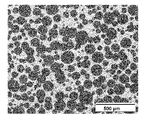
- FIG. 4 is an optical microscope image taken by optically polishing a cut surface of the silica glass member according to Example 1.
- FIG. FIG. 5 is an optical microscope image taken by optically polishing a cut surface of the silica glass member according to Example 3.
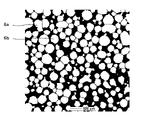
- FIG. 6A is a diagram for explaining a method for calculating the average bubble diameter, and is an X-ray CT image from which noise has been removed for a sample obtained by optically polishing the surface of the evaluation object.
- FIG. 6B is a diagram for explaining a method of calculating the average bubble diameter, and is an image after binarization processing of FIG. 6A.
- FIG. 6C is a diagram for explaining a method of calculating the average bubble diameter, and is an image after the watershed division processing of FIG. 6B.
- FIG. 1(A) is a perspective view of the silica glass member 1
- FIG. 1(B) is a cross-sectional view taken along line XX' of (A).
- the silica glass member 1 shown in FIG. 1A is a rectangular parallelepiped, its shape is not particularly limited. When used as a dummy wafer, it preferably has substantially the same shape as the product wafer.
- the silica glass member 1 has a silica glass portion 10 and a plurality of bubbles 12 .
- the air bubbles 12 include non-communication air bubbles 14 and communication air bubbles 16 .
- the silica glass portion 10 is mainly composed of amorphous silicon oxide (SiO 2 ) and is transparent. Also, its density is about 2.2 g/cm 3 . In addition to SiO 2 , the silica glass portion 10 may contain different elements for the purpose of controlling the properties of the silica glass portion 10 .
- SiO 2 amorphous silicon oxide
- the silica glass portion 10 may contain different elements for the purpose of controlling the properties of the silica glass portion 10 .
- the non-communication bubbles 14 are distributed substantially uniformly in the silica glass member 1 and contain gas inside.
- the shape of the non-communication cell 14 is not particularly limited, it is substantially spherical or substantially flat spherical.
- the communicating air bubbles 16 are formed by connecting adjacent non-communicating air bubbles 14 to each other.
- FIG. 1B two-dimensional communication is depicted, but there are also cases where three-dimensional communication is possible.
- Some or all of the cells 12 contained in the silica glass member 1 form communicating cells 16 .
- a plurality of pits 18 are present on the surface of the silica glass member 1 .
- the pits 18 are formed by the non-communicating cells 14 or communicating cells 16 exposed on the surface.
- the pits 18 have a substantially circular shape, a substantially elliptical shape, or a shape in which these are connected. Since the silica glass member 1 having the pits 18 has an increased surface area, it is suitable as a dummy wafer.
- the value obtained by dividing the surface area S of the silica glass member 1 by the geometric surface area S0 calculated based on the outer dimensions of the silica glass member 1 is 1.5 or more, preferably 3 or more, and more It is preferably 4 or more, more preferably 5 or more, even more preferably 6 or more, and most preferably 8 or more. If S/S0 is 1.5 or more, it can be said that the surface area of the silica glass member 1 is sufficiently large, so that the uniformity of film formation on product wafers is improved.
- the geometric surface area S0 is an imaginary surface area obtained by assuming that the surface of the silica glass member 1 is flat without the pits 18 present.
- the lower limit of the average bubble diameter of the bubbles 12 is preferably 30 ⁇ m, more preferably 40 ⁇ m, still more preferably 50 ⁇ m, and the upper limit is preferably 150 ⁇ m, more preferably 120 ⁇ m. If the average cell diameter is within this range, the effect of increasing the surface area can be sufficiently obtained.
- the average bubble diameter is the average value of the bubble diameters calculated on the assumption that the shape of the bubbles is a perfect circle.
- the communication bubble 16 is divided into a plurality of regions by a method described later, and the diameter of the bubble is obtained by regarding the divided regions as one bubble.
- the lower limit of the bulk density of the silica glass member 1 is preferably 0.3 g/cm 3 , more preferably 0.5 g/cm 3
- the upper limit is preferably 2 g/cm 3 , more preferably 1.6 g/cm 3 . 3 . If the bulk density is 0.3 g/cm 3 or more, sufficient strength of the silica glass member 1 can be obtained. Also, if the bulk density is 2 g/cm 3 or less, the silica glass member 1 will contain a sufficient number of bubbles 12 and the surface area will increase, so that it can be suitably used as a dummy wafer.
- the ratio of the number of communicating cells 16 to the number of multiple cells 12 (the sum of the number of non-communicating cells 14 and the number of communicating cells 16) (hereinafter referred to as the communicating cell rate) is preferably 30% or more, more preferably. is 50% or more, more preferably 70% or more. If the communicating bubble ratio is 30% or more, the probability that the bubbles forming the pits 18 are the communicating bubbles 16 increases, and as a result the surface area of the dummy wafer is sufficiently increased.
- the silica glass portion 10 contains lithium (Li), sodium (Na), magnesium (Mg), aluminum (Al), potassium (K), calcium (Ca), chromium (Cr), manganese (Mn), and iron (Fe). , nickel (Ni), copper (Cu), titanium (Ti), cobalt (Co), zinc (Zn), silver (Ag), cadmium (Cd) and lead (Pb), respectively. It is preferably 0.5 mass ppm or less, more preferably 0.1 mass ppm or less. If the content of each metal impurity is 0.5 ppm by mass or less, it can be suitably used as a member used in a semiconductor manufacturing apparatus. In the specification, ppm means parts per million, and ppb means parts per billion.
- the silica glass member 1 having the structure as described above has fewer places where chipping can occur, compared to a dummy wafer on which an uneven pattern is formed, so that particles are less likely to occur.
- the silica glass member 1 is also advantageous from the viewpoint of washing resistance.
- the dummy wafer is usually cleaned by dry etching using a fluorine-based gas or the like or wet etching using hydrofluoric acid or the like.
- the dummy wafer on which the unevenness pattern is formed may be likely to become substantially flat due to the corners of the unevenness being scraped off, resulting in a reduction in the surface area.
- the silica glass member 1 is suppressed from decreasing in surface area due to cleaning.
- a change in the surface area of the silica glass member 1 during cleaning will be described with reference to FIG. In FIG. 2, it is assumed that only the upper surface of the silica glass member 1 having three pits (18a, 18b, 18c) is cleaned. At this time, the upper surface of the silica glass member 1 and the inner wall surfaces of the pits are etched by washing, and as a result, the pits 18b and 18c disappear. 18e and 18f are formed. In this way, the silica glass member 1 has the air bubbles 12 therein, thereby suppressing the reduction of the surface area due to washing.
- a method for manufacturing the silica glass member 1 according to this embodiment will be described with reference to FIG.
- a VAD (Vapor-phase Axial Deposition) method is used as a method for synthesizing silica glass.
- the method for manufacturing the silica glass member 1 has steps S21 to S25.
- synthetic raw materials for silica glass are selected.
- Synthetic raw materials for silica glass are not particularly limited as long as they are gasifiable silicon-containing raw materials, but typically silicon chlorides (eg, SiCl 4 , SiHCl 3 , SiH 2 Cl 2 , SiCH 3 Cl 3 ) and silicon fluorides are used.
- halogen-containing silicon compounds such as SiF 4 , SiHF 3 , SiH 2 F 2 , or RnSi(OR) 4-n (R: alkyl group having 1 to 4 carbon atoms, n: an integer of 0 to 3)
- alkoxysilanes represented by and halogen-free silicon compounds such as (CH 3 ) 3 Si—O—Si(CH 3 ) 3 .
- step S22 the synthetic raw material is flame hydrolyzed at a temperature of 1000°C to 1500°C to generate silica particles, which are deposited on a rotating substrate by spraying to obtain a soot body.
- silica particles are partly sintered together.
- the soot body may be heat-treated in a vacuum atmosphere to dehydrate and reduce the OH group concentration.
- the temperature during the heat treatment is preferably 1000° C. to 1300° C., and the treatment time is preferably 1 hour to 240 hours.
- step S23 the soot body is subjected to high-temperature and high-pressure treatment in an inert gas atmosphere, so that the silica particles in the soot body are sintered together and densified to obtain a silica glass dense body.
- the silica glass dense body is transparent silica glass containing almost no bubbles or opaque silica glass containing minute bubbles.
- the temperature during the high temperature and high pressure treatment is 1200° C. to 1700° C.
- the pressure is 0.01 MPa to 200 MPa
- the treatment time is 10 hours to 100 hours.
- the inert gas is dissolved in silica glass.
- Inert gases typically include helium (He), neon (Ne), argon (Ar), krypton (Kr), xenon (Xe), nitrogen ( N2 ), or at least two or more of these. It is a mixed gas, and although details will be described later, it is preferably Ar. It is generally known that the solubility of an inert gas in silica glass tends to decrease as the partial pressure of the inert gas in the atmosphere decreases or as the temperature of the silica glass increases.
- step S24 the silica glass dense body is subjected to a high temperature and low pressure treatment, whereby the inert gas dissolved in the silica glass is foamed and the bubbles contained in the silica glass dense body are thermally expanded.
- a silica glass porous body made porous and having air bubbles 12 is obtained.
- the temperature during the high temperature and low pressure treatment is 1300° C. to 1800° C.
- the pressure is 0 Pa to 0.1 MPa
- the treatment time is 1 minute to 20 hours. Note that if the treatment time is within 20 hours, there is no fear that the bubbles 12 will be closed due to excessive heating.
- step S24 if the treatment is performed at a lower pressure or a higher temperature than in step S23, the dissolved amount of the inert gas may become supersaturated, and at this time bubbles will occur in the silica glass. .
- foaming can occur even if the temperature during the high-temperature, low-pressure treatment in step S24 is lower than the temperature during the high-temperature, high-pressure treatment in step S23. is promoted, and porosity tends to progress.
- Ar is preferable from the viewpoint that while it is relatively inexpensive, the temperature dependence of the solubility in silica glass is large, and it is easy to control the porosity.
- the number of bubbles 12 contained in the silica glass member 1 is increased.
- the number, bubble diameter, bulk density, etc. can be controlled.
- the silica glass member 1 is obtained by processing the silica glass porous body into an arbitrary shape using methods such as cutting, slicing, grinding, and polishing.
- the silica glass member 1 is used as a dummy wafer, it preferably has substantially the same shape as the product wafer.
- the silica glass member 1 suitable as a dummy wafer can be obtained without performing complicated and expensive machining for forming an uneven pattern.
- silica glass member 1 is not limited to dummy wafers, and can be applied to various uses within the range in which the properties of the silica glass member 1 described in this specification work advantageously.
- Silicon tetrachloride (SiCl 4 ) was selected as a synthetic raw material for silica glass, flame hydrolyzed to generate silica particles, and deposited on a rotating substrate by spraying to obtain a soot body.
- the soot body is placed in a heating furnace, filled with Ar gas, subjected to high temperature and high pressure treatment at a predetermined temperature, pressure and treatment time to densify the soot body, and then returned to the atmospheric pressure and left to cool. did.
- the silica glass dense body obtained at this time was an opaque silica glass containing minute air bubbles.
- Silica glass members 1 having the parameters shown in Examples 1 to 5 in Table 1 were obtained by arbitrarily combining the temperature, pressure, and treatment time in the high-temperature, high-pressure treatment and the high-temperature, low-pressure treatment. Examples 1-5 are examples.
- FIG. 4 shows an optical microscope image of the surface of the silica glass member 1 of Example 1 taken after optical polishing.
- the silica glass member 1 of Example 1 there are bubbles 12 dispersed substantially uniformly, some of which exist as communicating bubbles 16, and S/S0 is 1.9. Met.
- the silica glass member 1 of Example 1 Li, Mg, K, Cr, Mn, Fe, Ni, Cu, Ti, Co, Zn, Ag, Cd, Ce and Pb Less than 3 ppb, Na 80 ppb, Al 30 ppb, Ca 10 ppb.
- the content of metal impurities was determined by an ICP-MS (Inductively Coupled Plasma-Mass Spectrometer) method after cutting the silica gas member 1 obtained above into an appropriate size.
- FIG. 5 shows an optical microscope image of the surface of the silica glass member 1 of Example 4 taken after optical polishing.
- substantially uniformly dispersed cells 12 exist, some of which exist as communicating cells 16.
- the S/S0 was a high value of 6.9 due to the large average cell diameter and the high open cell ratio.
- the silica glass member 1 of Examples 1 to 5 has a large surface area due to the inclusion of the air bubbles 12 without machining, and the structure suppresses the generation of particles. It can be suitably used as a dummy wafer.
- the surface area S was determined by the BET method according to JIS-Z8830:2013. Specifically, five 40 mm ⁇ 8 mm ⁇ 0.5 mm plate-shaped samples were prepared from the object to be evaluated. After that, adsorption measurement of krypton (Kr) gas was performed using a specific surface area measuring device (BELSORP-max manufactured by Nippon Bell Co., Ltd.), and the surface area S was obtained by dividing the obtained value by 5 (the number of samples). S/S0 was obtained by dividing this by the geometric surface area S0 based on the external dimensions of the sample.
- Kr krypton
- the average bubble diameter was obtained by the following procedures (I) to (IV).
- Denoising using eg, ImageJ
- FIG. 6B the threshold value of the brightness value of the binarization process was determined so that the ratio of the area of the white region (corresponding to the bubble 12) to the area of the entire image in FIG.
- FIG. 6C An image such as that shown in FIG. 6C was obtained by performing a process of dividing the communicating bubbles by the watershed division process.
- the watershed partitioning process is performed by the following procedure: Create a Euclidean Distance Map (EDM) for the image of FIG. 6B and find the Ultimate Erosion Point (UEP), which is the maximum or vertex of the EDM; Expand each UEP until it reaches the edge of each bubble, or until it reaches the edge of the UEP region expanding with communicating bubbles; Divide the communicating cells based on their respective expanded UEP regions.
- EDM Euclidean Distance Map
- UEP Ultimate Erosion Point
- silica glass member 10 silica glass part 12 bubble 14 non-communication bubble 16 open air bubble 18 pit
Landscapes
- Chemical & Material Sciences (AREA)
- Engineering & Computer Science (AREA)
- Materials Engineering (AREA)
- Organic Chemistry (AREA)
- Chemical Kinetics & Catalysis (AREA)
- Geochemistry & Mineralogy (AREA)
- General Chemical & Material Sciences (AREA)
- Life Sciences & Earth Sciences (AREA)
- Physics & Mathematics (AREA)
- Thermal Sciences (AREA)
- Manufacturing & Machinery (AREA)
- Glass Melting And Manufacturing (AREA)
- Glass Compositions (AREA)
- Plasma & Fusion (AREA)
Priority Applications (5)
| Application Number | Priority Date | Filing Date | Title |
|---|---|---|---|
| KR1020237033332A KR20230167358A (ko) | 2021-04-07 | 2022-03-31 | 실리카 유리 부재 및 그 제조 방법 |
| JP2023513005A JPWO2022215663A1 (https=) | 2021-04-07 | 2022-03-31 | |
| CN202280025606.3A CN117083252A (zh) | 2021-04-07 | 2022-03-31 | 二氧化硅玻璃部件及其制造方法 |
| DE112022002001.6T DE112022002001T5 (de) | 2021-04-07 | 2022-03-31 | Quarzglaselement und verfahren zu dessen herstellung |
| US18/479,852 US20240025795A1 (en) | 2021-04-07 | 2023-10-03 | Silica glass member and method for producing same |
Applications Claiming Priority (4)
| Application Number | Priority Date | Filing Date | Title |
|---|---|---|---|
| JP2021065433 | 2021-04-07 | ||
| JP2021-065433 | 2021-04-07 | ||
| JP2021-135895 | 2021-08-23 | ||
| JP2021135895 | 2021-08-23 |
Related Child Applications (1)
| Application Number | Title | Priority Date | Filing Date |
|---|---|---|---|
| US18/479,852 Continuation US20240025795A1 (en) | 2021-04-07 | 2023-10-03 | Silica glass member and method for producing same |
Publications (1)
| Publication Number | Publication Date |
|---|---|
| WO2022215663A1 true WO2022215663A1 (ja) | 2022-10-13 |
Family
ID=83546077
Family Applications (1)
| Application Number | Title | Priority Date | Filing Date |
|---|---|---|---|
| PCT/JP2022/016901 Ceased WO2022215663A1 (ja) | 2021-04-07 | 2022-03-31 | シリカガラス部材およびその製造方法 |
Country Status (6)
| Country | Link |
|---|---|
| US (1) | US20240025795A1 (https=) |
| JP (1) | JPWO2022215663A1 (https=) |
| KR (1) | KR20230167358A (https=) |
| DE (1) | DE112022002001T5 (https=) |
| TW (1) | TW202306917A (https=) |
| WO (1) | WO2022215663A1 (https=) |
Cited By (1)
| Publication number | Priority date | Publication date | Assignee | Title |
|---|---|---|---|---|
| KR102825674B1 (ko) | 2024-05-31 | 2025-06-26 | 신에쯔 세끼에이 가부시키가이샤 | 성막 처리 가스 노출용 석영 유리 부재 및 이의 제조 방법 |
Citations (5)
| Publication number | Priority date | Publication date | Assignee | Title |
|---|---|---|---|---|
| JPH1029836A (ja) * | 1996-07-15 | 1998-02-03 | Shinetsu Quartz Prod Co Ltd | 石英ガラス発泡体の製造方法 |
| JPH1192167A (ja) * | 1997-09-22 | 1999-04-06 | Toshiba Ceramics Co Ltd | 多孔質石英ガラスおよびその製造方法 |
| JP2002362967A (ja) * | 2001-06-06 | 2002-12-18 | Koransha Co Ltd | シリカガラス焼結体からなる半導体ウエハエッチング用部材とその製造方法 |
| JP2007238419A (ja) * | 2006-03-13 | 2007-09-20 | Tosoh Quartz Corp | 不透明焼結体 |
| JP2015173154A (ja) * | 2014-03-11 | 2015-10-01 | 東京エレクトロン株式会社 | 縦型熱処理装置、縦型熱処理装置の運転方法及び記憶媒体 |
Family Cites Families (5)
| Publication number | Priority date | Publication date | Assignee | Title |
|---|---|---|---|---|
| JPH0614480Y2 (ja) * | 1988-04-26 | 1994-04-13 | 信越石英株式会社 | 半導体熱処理装置 |
| JP2571181B2 (ja) * | 1992-11-24 | 1997-01-16 | 日東化学工業株式会社 | 石英ガラス多孔質成形体およびその製造方法 |
| JP2829227B2 (ja) * | 1993-08-24 | 1998-11-25 | 信越石英株式会社 | 不透明石英ガラス |
| JP2021065433A (ja) | 2019-10-23 | 2021-04-30 | 日本製紙クレシア株式会社 | 吸収性物品 |
| JP2021135895A (ja) | 2020-02-28 | 2021-09-13 | 三菱重工業株式会社 | 検知装置、検知方法、およびロボット並びにプログラム |
-
2022
- 2022-03-31 DE DE112022002001.6T patent/DE112022002001T5/de active Pending
- 2022-03-31 KR KR1020237033332A patent/KR20230167358A/ko active Pending
- 2022-03-31 JP JP2023513005A patent/JPWO2022215663A1/ja active Pending
- 2022-03-31 WO PCT/JP2022/016901 patent/WO2022215663A1/ja not_active Ceased
- 2022-04-01 TW TW111112902A patent/TW202306917A/zh unknown
-
2023
- 2023-10-03 US US18/479,852 patent/US20240025795A1/en active Pending
Patent Citations (5)
| Publication number | Priority date | Publication date | Assignee | Title |
|---|---|---|---|---|
| JPH1029836A (ja) * | 1996-07-15 | 1998-02-03 | Shinetsu Quartz Prod Co Ltd | 石英ガラス発泡体の製造方法 |
| JPH1192167A (ja) * | 1997-09-22 | 1999-04-06 | Toshiba Ceramics Co Ltd | 多孔質石英ガラスおよびその製造方法 |
| JP2002362967A (ja) * | 2001-06-06 | 2002-12-18 | Koransha Co Ltd | シリカガラス焼結体からなる半導体ウエハエッチング用部材とその製造方法 |
| JP2007238419A (ja) * | 2006-03-13 | 2007-09-20 | Tosoh Quartz Corp | 不透明焼結体 |
| JP2015173154A (ja) * | 2014-03-11 | 2015-10-01 | 東京エレクトロン株式会社 | 縦型熱処理装置、縦型熱処理装置の運転方法及び記憶媒体 |
Cited By (1)
| Publication number | Priority date | Publication date | Assignee | Title |
|---|---|---|---|---|
| KR102825674B1 (ko) | 2024-05-31 | 2025-06-26 | 신에쯔 세끼에이 가부시키가이샤 | 성막 처리 가스 노출용 석영 유리 부재 및 이의 제조 방법 |
Also Published As
| Publication number | Publication date |
|---|---|
| DE112022002001T5 (de) | 2024-01-18 |
| TW202306917A (zh) | 2023-02-16 |
| US20240025795A1 (en) | 2024-01-25 |
| KR20230167358A (ko) | 2023-12-08 |
| JPWO2022215663A1 (https=) | 2022-10-13 |
Similar Documents
| Publication | Publication Date | Title |
|---|---|---|
| JP5367204B2 (ja) | TiO2を含有するシリカガラスおよびEUVリソグラフィ用光学部材 | |
| JP5796598B2 (ja) | 凹凸パターン形成方法 | |
| EP2463250B2 (en) | Methods for producing and for heat-treating a tio2-sio2 glass body | |
| EP2687623A1 (en) | Silica container for pulling up single crystal silicon, and method for manufacturing same | |
| US20240025795A1 (en) | Silica glass member and method for producing same | |
| US20240025802A1 (en) | Silica glass porous body and manufacturing method therefor | |
| US20240407089A1 (en) | Silica glass substrate | |
| CN117083252A (zh) | 二氧化硅玻璃部件及其制造方法 | |
| JP5630268B2 (ja) | TiO2を含有するシリカガラスからなる光学部材 | |
| US20220411322A1 (en) | Silica glass, high frequency device using silica glass, and silica glass production method | |
| JP7852630B2 (ja) | シリカガラス多孔質体およびその製造方法 | |
| US20250388508A1 (en) | Silica glass porous body and manufacturing method therefor | |
| JP6020680B2 (ja) | 光学部材 | |
| JP2006251781A (ja) | マスクブランクス | |
| JP2011225438A (ja) | 合成石英ガラスの製造方法 | |
| JP5284960B2 (ja) | プラズマエッチング用石英ガラス部材 | |
| JP7711579B2 (ja) | Euvリソグラフィ用基板の識別方法 | |
| JP2011168450A (ja) | TiO2を含有するシリカガラス体の製造方法 | |
| JP2005298322A (ja) | エキシマuvランプ装置用大型合成石英ガラス板 |
Legal Events
| Date | Code | Title | Description |
|---|---|---|---|
| 121 | Ep: the epo has been informed by wipo that ep was designated in this application |
Ref document number: 22784646 Country of ref document: EP Kind code of ref document: A1 |
|
| WWE | Wipo information: entry into national phase |
Ref document number: 202280025606.3 Country of ref document: CN |
|
| WWE | Wipo information: entry into national phase |
Ref document number: 2023513005 Country of ref document: JP |
|
| WWE | Wipo information: entry into national phase |
Ref document number: 112022002001 Country of ref document: DE |
|
| 122 | Ep: pct application non-entry in european phase |
Ref document number: 22784646 Country of ref document: EP Kind code of ref document: A1 |