WO2022209624A1 - ワイピング部材、ワイパー、ワイピング方法及び液体吐出装置 - Google Patents
ワイピング部材、ワイパー、ワイピング方法及び液体吐出装置 Download PDFInfo
- Publication number
- WO2022209624A1 WO2022209624A1 PCT/JP2022/009963 JP2022009963W WO2022209624A1 WO 2022209624 A1 WO2022209624 A1 WO 2022209624A1 JP 2022009963 W JP2022009963 W JP 2022009963W WO 2022209624 A1 WO2022209624 A1 WO 2022209624A1
- Authority
- WO
- WIPO (PCT)
- Prior art keywords
- wiping
- liquid
- wiping member
- ejection
- head
- Prior art date
- Legal status (The legal status is an assumption and is not a legal conclusion. Google has not performed a legal analysis and makes no representation as to the accuracy of the status listed.)
- Ceased
Links
Images












Classifications
-
- B—PERFORMING OPERATIONS; TRANSPORTING
- B41—PRINTING; LINING MACHINES; TYPEWRITERS; STAMPS
- B41J—TYPEWRITERS; SELECTIVE PRINTING MECHANISMS, i.e. MECHANISMS PRINTING OTHERWISE THAN FROM A FORME; CORRECTION OF TYPOGRAPHICAL ERRORS
- B41J2/00—Typewriters or selective printing mechanisms characterised by the printing or marking process for which they are designed
- B41J2/005—Typewriters or selective printing mechanisms characterised by the printing or marking process for which they are designed characterised by bringing liquid or particles selectively into contact with a printing material
- B41J2/01—Ink jet
- B41J2/135—Nozzles
- B41J2/165—Prevention or detection of nozzle clogging, e.g. cleaning, capping or moistening for nozzles
- B41J2/16517—Cleaning of print head nozzles
- B41J2/16535—Cleaning of print head nozzles using wiping constructions
-
- B—PERFORMING OPERATIONS; TRANSPORTING
- B41—PRINTING; LINING MACHINES; TYPEWRITERS; STAMPS
- B41J—TYPEWRITERS; SELECTIVE PRINTING MECHANISMS, i.e. MECHANISMS PRINTING OTHERWISE THAN FROM A FORME; CORRECTION OF TYPOGRAPHICAL ERRORS
- B41J2/00—Typewriters or selective printing mechanisms characterised by the printing or marking process for which they are designed
- B41J2/005—Typewriters or selective printing mechanisms characterised by the printing or marking process for which they are designed characterised by bringing liquid or particles selectively into contact with a printing material
- B41J2/01—Ink jet
- B41J2/135—Nozzles
- B41J2/165—Prevention or detection of nozzle clogging, e.g. cleaning, capping or moistening for nozzles
- B41J2/16517—Cleaning of print head nozzles
- B41J2/16535—Cleaning of print head nozzles using wiping constructions
- B41J2/16538—Cleaning of print head nozzles using wiping constructions with brushes or wiper blades perpendicular to the nozzle plate
-
- B—PERFORMING OPERATIONS; TRANSPORTING
- B41—PRINTING; LINING MACHINES; TYPEWRITERS; STAMPS
- B41J—TYPEWRITERS; SELECTIVE PRINTING MECHANISMS, i.e. MECHANISMS PRINTING OTHERWISE THAN FROM A FORME; CORRECTION OF TYPOGRAPHICAL ERRORS
- B41J2/00—Typewriters or selective printing mechanisms characterised by the printing or marking process for which they are designed
- B41J2/005—Typewriters or selective printing mechanisms characterised by the printing or marking process for which they are designed characterised by bringing liquid or particles selectively into contact with a printing material
- B41J2/01—Ink jet
- B41J2/135—Nozzles
- B41J2/165—Prevention or detection of nozzle clogging, e.g. cleaning, capping or moistening for nozzles
- B41J2/16517—Cleaning of print head nozzles
- B41J2/16535—Cleaning of print head nozzles using wiping constructions
- B41J2/16544—Constructions for the positioning of wipers
-
- B—PERFORMING OPERATIONS; TRANSPORTING
- B41—PRINTING; LINING MACHINES; TYPEWRITERS; STAMPS
- B41J—TYPEWRITERS; SELECTIVE PRINTING MECHANISMS, i.e. MECHANISMS PRINTING OTHERWISE THAN FROM A FORME; CORRECTION OF TYPOGRAPHICAL ERRORS
- B41J2/00—Typewriters or selective printing mechanisms characterised by the printing or marking process for which they are designed
- B41J2/005—Typewriters or selective printing mechanisms characterised by the printing or marking process for which they are designed characterised by bringing liquid or particles selectively into contact with a printing material
- B41J2/01—Ink jet
- B41J2/135—Nozzles
- B41J2/165—Prevention or detection of nozzle clogging, e.g. cleaning, capping or moistening for nozzles
- B41J2/16517—Cleaning of print head nozzles
- B41J2/16552—Cleaning of print head nozzles using cleaning fluids
-
- B—PERFORMING OPERATIONS; TRANSPORTING
- B41—PRINTING; LINING MACHINES; TYPEWRITERS; STAMPS
- B41J—TYPEWRITERS; SELECTIVE PRINTING MECHANISMS, i.e. MECHANISMS PRINTING OTHERWISE THAN FROM A FORME; CORRECTION OF TYPOGRAPHICAL ERRORS
- B41J2/00—Typewriters or selective printing mechanisms characterised by the printing or marking process for which they are designed
- B41J2/005—Typewriters or selective printing mechanisms characterised by the printing or marking process for which they are designed characterised by bringing liquid or particles selectively into contact with a printing material
- B41J2/01—Ink jet
- B41J2/135—Nozzles
- B41J2/165—Prevention or detection of nozzle clogging, e.g. cleaning, capping or moistening for nozzles
- B41J2/16585—Prevention or detection of nozzle clogging, e.g. cleaning, capping or moistening for nozzles for paper-width or non-reciprocating print heads
-
- B—PERFORMING OPERATIONS; TRANSPORTING
- B41—PRINTING; LINING MACHINES; TYPEWRITERS; STAMPS
- B41J—TYPEWRITERS; SELECTIVE PRINTING MECHANISMS, i.e. MECHANISMS PRINTING OTHERWISE THAN FROM A FORME; CORRECTION OF TYPOGRAPHICAL ERRORS
- B41J29/00—Details of, or accessories for, typewriters or selective printing mechanisms not otherwise provided for
- B41J29/17—Cleaning arrangements
-
- B—PERFORMING OPERATIONS; TRANSPORTING
- B41—PRINTING; LINING MACHINES; TYPEWRITERS; STAMPS
- B41J—TYPEWRITERS; SELECTIVE PRINTING MECHANISMS, i.e. MECHANISMS PRINTING OTHERWISE THAN FROM A FORME; CORRECTION OF TYPOGRAPHICAL ERRORS
- B41J2/00—Typewriters or selective printing mechanisms characterised by the printing or marking process for which they are designed
- B41J2/005—Typewriters or selective printing mechanisms characterised by the printing or marking process for which they are designed characterised by bringing liquid or particles selectively into contact with a printing material
- B41J2/01—Ink jet
- B41J2/135—Nozzles
- B41J2/165—Prevention or detection of nozzle clogging, e.g. cleaning, capping or moistening for nozzles
- B41J2/16517—Cleaning of print head nozzles
- B41J2/16552—Cleaning of print head nozzles using cleaning fluids
- B41J2002/16558—Using cleaning liquid for wet wiping
-
- B—PERFORMING OPERATIONS; TRANSPORTING
- B41—PRINTING; LINING MACHINES; TYPEWRITERS; STAMPS
- B41P—INDEXING SCHEME RELATING TO PRINTING, LINING MACHINES, TYPEWRITERS, AND TO STAMPS
- B41P2235/00—Cleaning
- B41P2235/10—Cleaning characterised by the methods or devices
- B41P2235/20—Wiping devices
Definitions
- the present disclosure relates to a wiping member, wiper, wiping method, and liquid ejection device.
- a liquid ejection head that ejects droplets (eg, ink droplets) toward a recording medium (eg, paper) is known.
- a liquid ejection head has, for example, an ejection surface on which a plurality of nozzles for ejecting liquid droplets are opened.
- a technique of performing wiping by sliding a wiping member on the ejection surface is also known (for example, Patent Document 1 below).
- wiping for example, fixed ink deposited on the ejection surface is removed.
- the sticking ink occurs, for example, when a part of the ejected ink droplets becomes mist and rises up, and the mist-like ink adheres to the ejection surface and solidifies.
- the adhered ink for example, the probability that a part or all of each of the plurality of nozzles is blocked by the adhered ink is reduced. As a result, the ejection characteristics of the liquid ejection head are stabilized.
- Patent Document 1 discloses a wiping member (referred to as a cleaner in Patent Document 1) having an elastic member (referred to as a spatula-shaped wiper in Patent Document 1) and a water absorbing member (referred to as a rubbing member in Patent Document 1). is disclosed.
- the scraping member is fixed by adhesive to only one of the surfaces of the spatula wiper.
- a wiping member has an elastic member and a liquid retaining member.
- the elastic member has a first surface and a second surface facing in different directions.
- the liquid retaining member overlaps the elastic member over the first surface and the second surface, and has liquid retaining properties.
- a wiper includes the wiping member and a support member that supports the wiping member.
- the wiping member has a front end, a rear end, a body portion, and a held portion.
- the front end and the rear end are ends on both sides in the direction along the first surface.
- the body portion includes the tip.
- the held portion is located closer to the rear end than the body portion.
- the support member has a holding surface and a convex curved surface.
- the holding surface abuts against the held portion from the side facing the second surface so as to allow bending deformation toward the side facing the second surface of the main body portion.
- the convex curved surface is connected to the tip side of the holding surface, and the closer the wiping member is to the tip side of the wiping member that is not flexibly deformed, the more the convex curved surface faces the second surface. curved away.
- a wiper includes the wiping member, the first support member, and the second support member.
- the first support member contacts the wiping member from the side facing the first surface.
- the second support member contacts the wiping member from the side facing the second surface.
- a wiping method includes a wiping step of wiping, with the wiping member, the ejection surface of the liquid ejection head on which the nozzles are open.
- the wiping member has a front end, a rear end, a body portion, and a held portion. The front end and the rear end are ends on both sides in the direction along the first surface.
- the body portion includes the tip.
- the held portion is located closer to the rear end than the body portion.
- the liquid retaining member has a first portion and a second portion. The first portion is positioned on the main body and on the first surface. The second portion is positioned on the body portion and on the second surface.
- the wiping step includes a contact step and a first step.
- the body portion is brought into contact with the discharge surface while holding the held portion so as to allow bending deformation of the body portion.
- the main body portion in a state in which the main body portion is in contact with the ejection surface, the main body portion is moved in a first direction along the ejection surface and facing the first surface of the held portion. Move the wiping member. At this time, the wiping member is moved in the first direction while pressing the second portion toward the second surface while the first portion is in contact with the ejection surface.
- a wiping method includes a wiping step of wiping an ejection surface on which nozzles of a liquid ejection head are open with the wiping member.
- the wiping member has a front end, a rear end, a body portion, and a held portion. The front end and the rear end are ends on both sides in the direction along the first surface.
- the body portion includes the tip.
- the held portion is located closer to the rear end than the body portion.
- the liquid retaining member has a first portion and a second portion. The first portion is positioned on the main body and on the first surface. The second portion is positioned on the body portion and on the second surface.
- the wiping step includes a contact step, a first step, and a second step.
- the body portion is brought into contact with the discharge surface while holding the held portion so as to allow bending deformation of the body portion.
- the first step in a state in which the first portion is in contact with the ejection surface, in a first direction along the ejection surface and in a first direction facing the first surface of the held portion. moving the wiping member;
- the second step in a state in which the second portion is in contact with the ejection surface, in a direction along the ejection surface and in a second direction facing the second surface of the held portion. moving the wiping member;
- a liquid ejection device includes the wiping member and a moving device.
- the moving device relatively moves the wiping member and the liquid ejection head so that the wiping member wipes the ejection surface of the liquid ejection head on which the nozzles are open.
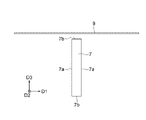
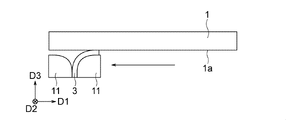
- FIG. 1 is a perspective view schematically showing a liquid ejection head and a wiping member according to an embodiment
- FIG. FIG. 2 is a side view or a cross-sectional view showing an example of how the liquid retaining member is attached to the elastic member in the wiping member of FIG. 1;
- the figure which shows the continuation of FIG. 2A The figure which shows the attachment aspect which concerns on a modification.
- the side view or sectional view which shows the wiping member which concerns on a modification.
- FIG. 2 is a side view or cross-sectional view showing the wiping member of FIG.
- FIG. 6 is a side view or cross-sectional view showing the wiping member and holding portion of FIG. 5 during wiping;
- FIG. 6 is another side view or another cross-sectional view showing the wiping member and holding portion of FIG. 5 during wiping;
- FIG. 6 The side view or sectional view which shows the wiping member and holding
- FIG. 6 is a cross-sectional view showing an example of a manner of fixing two supporting members of the holding part of FIG. 5 ;
- FIG. 6 is a cross-sectional view showing another example of how two supporting members of the holding portion shown in FIG. 5 are fixed;
- FIG. 6 is a side view or a cross-sectional view showing an example of a state in which a support member of the holding part of FIG. 5 is in contact with the wiping member;
- the figure which shows the continuation of FIG. 9A. 6 is a side view or a cross-sectional view showing another example of a state in which the supporting member of the holding part of FIG. 5 is in contact with the wiping member;
- FIG. The figure corresponding to FIG. 10A at a time different from that of FIG. 10A. 4A and 4B are schematic side views or cross-sectional views showing an example of a wiping operation procedure;
- FIG. 11A The figure which shows the continuation of FIG. 11B.
- FIG. 4A and 4B are schematic side views or cross-sectional views showing another example of the wiping operation procedure; FIG. The figure which shows the continuation of FIG. 12A. The figure which shows the continuation of FIG. 12B. The figure which shows the continuation of FIG. 12C.
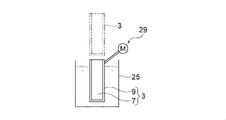
- FIG. 2 is a schematic diagram showing an example of a manner in which cleaning liquid is supplied to the wiping member of FIG. 1;
- FIG. 2 is a schematic diagram showing another example of a manner of supplying the cleaning liquid to the wiping member of FIG. 1;
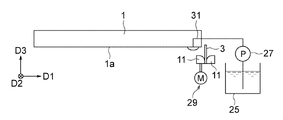
- FIG. 2 is a schematic diagram showing still another example of the manner in which cleaning liquid is supplied to the wiping member of FIG. 1;
- FIG. 2 is a schematic diagram showing an example of a printer having the wiping member of FIG.
- FIG. 14B is a schematic diagram showing the printer of FIG. 14A in a state different from that of FIG. 14A;
- FIG. FIG. 2 is a schematic diagram showing another example of a printer having the wiping member of FIG. 1;
- 15B is a schematic diagram showing the printer of FIG. 15A in a state different from that of FIG. 15A;
- FIG. 2 is a side view of still another example of a printer having the wiping member of FIG. 1;
- FIG. FIG. 17 is a plan view of the printer of FIG. 16;
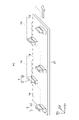
- FIG. 17 is a perspective view showing an example configuration of a wiper used in the printer of FIG. 16;
- FIG. 1 is a perspective view schematically showing a liquid ejection head 1 (hereinafter sometimes simply referred to as "head 1") and a wiping member 3 according to the embodiment.
- FIG. 1 An orthogonal coordinate system D1-D2-D3 is attached to FIG.
- the head 1 and wiping member 3 may be used in any orientation with respect to the vertical direction.
- the +D3 side is assumed to be vertically upward.
- the head 1 is a device that ejects droplets.
- a wiping member 3 is a member for wiping the head 1 .
- FIG. 1 shows a state in which wiping is being performed. In normal use of the head 1, unlike in FIG. 1, the head 1 and the wiping member 3 are arranged apart from each other. Below, the head 1 will be described first, and then the wiping member 3 will be described. In the description of the head 1, unlike FIG. 1, the wiping member 3 is sometimes expressed on the premise that it is positioned away from the head 1. FIG.
- the head 1 is a device that ejects droplets to the -D3 side.
- Droplets are, for example, ink droplets.
- the ejected ink droplets adhere to an unillustrated object (for example, a recording medium such as paper) arranged on the ⁇ D3 side with respect to the head 1 .
- an unillustrated object for example, a recording medium such as paper
- the head 1 is included in, for example, an inkjet printer (not shown).
- the configuration of the head 1 that performs the above operation may be various configurations, or may be the same as a known configuration. In the following description, details of the head 1 may be omitted as appropriate. Further, in the following description, for the sake of convenience, expressions may be made assuming that the head 1 is included in an inkjet printer that prints on a recording medium.
- the head 1 has an ejection surface 1a facing the -D3 side.
- the ejection surface 1a has one or more (a plurality in the illustrated example) nozzles 5 for ejecting droplets.
- the term "discharge surface 1a" may be understood to refer to the entire surface on the -D3 side of the head 1, or may refer only to the area of the -D3 side surface where a plurality of nozzles 5 are arranged. may be taken as
- the ejection surface 1a is, for example, planar. However, depending on the application of the head 1, the ejection surface 1a may be curved or the like.
- the planar shape of the ejection surface 1a is arbitrary. In the illustrated example, the ejection surface 1a is elongated in the D1 direction. More specifically, the ejection surface 1a has a substantially rectangular shape with the D1 direction as the longitudinal direction.
- the dimensions of the ejection surface 1a are arbitrary. For example, the length in the D1 direction may be 1 cm or more and 1 m or less, or may be outside this range.
- the length in the D2 direction (the width of the ejection surface 1a) may be 1 mm or more and 20 cm or less, or may be outside this range.
- the material of the ejection surface 1a is arbitrary, and may be metal or resin, for example.
- a water-repellent film may be provided to cover the metal or resin.
- each nozzle is arbitrary.
- the number and arrangement of the plurality of nozzles 5 are also arbitrary.
- the plurality of nozzles 5 are arranged in one or more (in the illustrated example, a plurality of (two)) rows.
- the direction in which the rows extend is, for example, along the D1 direction (from another point of view, the longitudinal direction of the ejection surface 1a).
- the direction in which the row extends may be parallel to the D1 direction (example shown) or may be inclined.
- the rows are formed by a plurality of nozzles 5, the rows are formed by ejecting ink droplets from the head 1 while relatively moving the head 1 and the recording medium in a direction crossing the rows (for example, the D2 direction).
- a strip-shaped image having a width in the extending direction is formed.
- the nozzles 5 are arranged so that the positions of the nozzles 5 in a plurality of rows do not overlap each other. Dots can be formed on the recording medium at a pitch narrower than the pitch of the nozzles 5.
- the head 1 may be of a piezoelectric type or of a thermal type, for example.
- the piezoelectric head droplets are ejected from the nozzle 5 by applying pressure to the liquid by the piezoelectric body.
- the thermal head bubbles are formed in the liquid by the heat of the heating element, and droplets are ejected from the nozzles 5 by the pressure accompanying the formation of the bubbles.
- the head 1 may be used in, for example, a so-called line printer, or may be used in a serial printer.
- the head 1 used in the line printer has a length that roughly covers the entire length (width) of the recording medium in the D1 direction.
- the head 1 ejects ink droplets while moving relative to the recording medium in the D2 direction. As a result, for example, an image is formed over substantially the entire recording medium.
- a unit that functions as a line printer head may be configured by arranging a plurality of heads 1 . An example of this aspect will be given later.
- the head 1 used in the serial printer forms a band-shaped image by ejecting ink droplets while moving relative to the recording medium in the direction D2, and moves relative to the recording medium in the direction D1. and repeat. As a result, a plurality of band-shaped images are formed in a row. Consequently, an image is formed over substantially the entire recording medium.
- the liquid ejected by the head 1 may be ink, for example.
- Ink contains, for example, a colorant and a solvent. Colorants may be, for example, pigments or dyes.
- the solvent may be, for example, water or an organic solvent. Depending on the technical field, a distinction may be made between ink and paint, but the two are not distinguished in the description of the embodiments.
- the liquid ejected by the head 1 may be something other than ink.
- the liquid may be a coating that does not contain a colorant.
- the liquid may be printed on a circuit board to form a conductive layer.
- the liquid may also be a liquid chemical agent or a liquid containing a chemical agent.
- the wiping member 3 is a member that wipes the ejection surface 1a. As described in the Background Art section, by wiping the ejection surface 1a, for example, adhered ink is removed and the ejection characteristics of the head 1 are stabilized. Also, even when the liquid ejected by the head 1 is not ink, for example, the solidified liquid and/or dust separate from the liquid are removed, and the ejection characteristics of the head 1 are stabilized.
- the wiping member 3 has an elastic member 7 and a liquid retaining member 9 (liquid absorbing member) located on the surface of the elastic member 7 . Since the wiping member 3 has the elastic member 7, for example, the surface of the wiping member 3 (or the liquid retaining member 9 from another point of view) can be brought into contact with the ejection surface 1a without any gap, and/or the contact pressure can be appropriately applied. It is easy to make it a suitable size. As a result, for example, the effect of cleaning by wiping is improved. Since the wiping member 3 has the liquid retaining member 9 , for example, the cleaning liquid can be retained in the liquid retaining member 9 , thereby improving the cleaning effect of wiping.
- the wiping member 3 may have various configurations except that it is composed of the elastic member 7 and the liquid retaining member 9.
- the wiping member 3 may have a known configuration.
- the overall shape and dimensions of the wiping member 3 may be the same as those of known configurations. Below, first, the overall configuration of the wiping member 3 will be described, and then the elastic member 7 and the liquid retaining member 9 will be described.
- the manner of contact and movement of the wiping member 3 with respect to the discharge surface 1a during wiping may be made as appropriate.
- the wiping member 3 is in contact with the entire length of the ejection surface 1a (which may be only the arrangement area of the plurality of nozzles 5 as described above) in the D2 direction. .
- the wiping member 3 moves relative to the ejection surface 1a in the D1 direction. As a result, substantially the entire ejection surface 1a is wiped.
- the wiping member 3 may perform wiping by moving relative to the ejection surface 1a toward the +D1 side (example shown), or may perform wiping by moving relative to the ejection surface 1a toward the -D1 side, or both. may be performed.
- relative movement to either one may be taken as an example without any particular mention. In this case, the relative movement to the other may be performed in the same manner as the relative movement to the one.
- the diagram of movement to the -D1 side and the diagram of movement to the +D1 side may be described as diagrams showing the same state.
- the wiping member 3 may perform wiping by moving relative to the ejection surface 1a in a direction other than the D1 direction.
- the D2 direction can be mentioned, and a direction inclined to the D1 direction can be mentioned.
- the wiping member 3 may not move linearly relative to the discharge surface 1a, but may move in an arc-like manner (curvilinear in a broader concept) like an automobile wiper.
- the wiping member 3 may change the direction of relative movement with respect to the ejection surface 1a in various directions.
- the wiping member 3 has a length extending over the ejection surface 1a in a direction orthogonal to the relative movement with respect to the ejection surface 1a (D2 direction in the illustrated example) when the ejection surface 1a is viewed from above. may not have In this case, the wiping member 3 may wipe the entire ejection surface 1a by reciprocating while changing the position in the direction perpendicular to the ejection surface 1a. Alternatively, two or more wiping members 3 may be used for one head 1 . Contrary to the above, when a plurality of heads 1 are arranged, the wiping member 3 may have a size that covers the plurality of heads 1, thereby wiping a plurality of ejection surfaces 1a at the same time.
- the wiping member 3 has elasticity as a whole due to the presence of the elastic member 7 and the like.
- the wiping member 3 is elastically deformed by being pressed against the head 1 .
- FIG. 2B and the like which will be described later.
- the shape, dimensions, etc. of the wiping member 3 may be expressed assuming a state in which they are not elastically deformed. For example, when referring to the length in the D3 direction, it may be assumed that the state is not elastically deformed.
- the shape of the wiping member 3 may be an appropriate shape.
- the shape of the wiping member 3 is generally a plate shape (blade shape) with a constant thickness.
- the planar shape of the flat wiping member is rectangular.
- the shape of the wiping member 3 is a thin rectangular parallelepiped.
- the wiping member 3 is pressed against the ejection surface 1a with one side of the rectangle (sometimes referred to as a tip 3a) facing the ejection surface 1a. Then, one side (sometimes referred to as the rear end 3b) opposite to the tip 3a is held and moved in the D1 direction. Wiping is thereby performed. Examples of shapes of the wiping member 3 other than the illustrated example will be shown later.
- the rectangle may be a square or a rectangle other than the square.
- the pair of opposite sides which are the leading end 3a and the trailing end 3b, may be long sides or short sides.
- the relative and absolute sizes of the length and thickness of each side are arbitrary. However, in light of the plate concept, the thickness is less than the length of any of the four sides.
- the length of the short side and/or the length of the long side may be 5 or more times or 10 or more times the thickness.
- each dimension may be set variously according to the specific width of the ejection surface 1a.
- the length of the short side and/or the length of the long side may be 1 mm or more and 1 m or less, or may be outside this range.
- the shape and dimensions of the elastic member 7 are such that the shape and dimensions (described above) of the wiping member 3 are reduced by the amount of the liquid retaining member 9 provided, for example.
- the thickness of the liquid retaining member 9 is relatively thin. You may refer to the dimensions.
- the above description of the shape and dimensions of the wiping member 3 may be applied to the shape and dimensions of the elastic member 7 . In this case, the shape and size of the wiping member 3 may deviate from the above-described shape and size by the amount of the liquid retaining member 9 provided.
- the shape of the elastic member 7 is approximately a rectangular flat plate in a state in which no elastic deformation occurs.
- the elastic member 7 has two main surfaces 7a facing opposite sides and four side surfaces 7b connecting the outer edges of the two main surfaces 7a.
- the term "major surface” refers to the widest surfaces (front and back) of the plate shape.
- the two main surfaces 7a are, in other words, two surfaces facing opposite sides, and are the rear surfaces of the other surfaces.
- the two main surfaces 7a and the four side surfaces 7b are, in other words, surfaces facing in different directions.
- the material of the elastic member 7 is, for example, elastomer.
- Elastomers may be thermoset elastomers (so-called rubbers) or thermoplastic elastomers (elastomers in the narrow sense).
- the thermosetting elastomer may be, for example, a vulcanized rubber (rubber in the narrow sense) or a thermosetting resin-based elastomer.
- the hardness of the elastic member 7 may be set appropriately. For example, the hardness measured by a type A durometer specified in K6253 of Japanese Industrial Standards (JIS) may be 30 or more and 80 or less, or 60 or more and 80 or less.
- the liquid retaining member 9 overlaps the elastic member 7 over two or more of the multiple surfaces of the elastic member 7 (two main surfaces 7a and four side surfaces 7b in the illustrated example). As a result, for example, it is possible to increase the area capable of retaining the liquid, or to retain the cleaning liquid on a surface other than the surface pressed against the ejection surface 1a. As a result, for example, it is possible to increase the amount of cleaning liquid and/or diversify the mode of supplying the cleaning liquid to the ejection surface 1a.
- the two or more surfaces on which the liquid retaining member 9 is arranged may be selected as appropriate. From another point of view, the shape and dimensions of the planar shape when it is assumed that the liquid retaining member 9 is developed in a planar shape may be appropriately set.
- the liquid retaining member 9 is provided over three surfaces, ie, two main surfaces 7a and a side surface 7b on the side of the tip 3a. Further, the liquid retaining member 9 overlaps, for example, the entire surface of each of the three surfaces. In other words, the liquid retaining member 9 has a shape in which three rectangular regions are joined together.
- the liquid retaining member 9 may overlap only part of each surface.
- the liquid retaining member 9 may have a width narrower than the width of the elastic member 7 (D2 direction).
- the width (D2 direction) of the liquid retaining member 9 may be wider than the width of the elastic member 7, and the edges may protrude from each surface toward the ⁇ D2 side and/or the +D2 side.
- the liquid retaining member 9 may overlap the elastic member 7 only in a region on the front end 3a side of the main surface 7a, and expose a region on the rear end 3b side of the main surface 7a.
- the liquid retaining member 9 may overlap the side surface 7b on the rear end 3b side and/or the remaining two side surfaces 7b in addition to the three surfaces described above. Further, for example, the liquid retaining member 9 overlaps one main surface 7a and one side surface 7b (for example, the side surface 7b on the side of the tip 3a), or overlaps the two main surfaces 7a and a side surface 7b other than the side surface 7b on the side of the tip 3a. may be overlapped with the side surface 7b of the .
- the thickness of the liquid retaining member 9 may be set as appropriate. Depending on the material of the liquid retaining member 9, the thickness of the liquid retaining member 9 may change greatly due to compression during wiping and/or absorption of liquid. In the description of the embodiments, unless otherwise specified, the thickness of the liquid retaining member 9 refers to the thickness in a dry state with no force applied.
- the thickness of the liquid retaining member 9 is constant over its entirety. However, the liquid retaining member 9 may have different thickness depending on the position. Also, in the illustrated example, the thickness of the liquid retaining member 9 is made thinner than the thickness of the elastic member 7 . In this case, the thickness of the liquid retaining member 9 may be, for example, 1/20 or more and 1/3 or less of the thickness of the elastic member 7 . However, unlike the illustrated example, the thickness of the liquid retaining member 9 may be equal to or greater than the thickness of the elastic member 7 . A relatively narrow range of the thickness of the liquid retaining member 9 can be 0.1 mm or more and 1 mm or less.
- the thickness of the liquid retaining member 9 affects, for example, the amount of cleaning liquid retained by the liquid retaining member 9 and the contact pressure of the wiping member 3 against the discharge surface 1a. As a result, the thickness of the liquid retaining member 9 affects the effect of cleaning by wiping. Therefore, the thickness of the liquid retaining member 9 may be appropriately set (in other words, changed) according to various conditions regarding wiping. Conditions to be considered in setting the thickness include, for example, the type of liquid ejected by the head 1 (for example, ink components), the timing of wiping (described later; frequency from another point of view), and the type (component) of the cleaning liquid. , and the material of the liquid retaining member 9 .
- the material (raw material) of the liquid retaining member 9 may be various materials capable of retaining the liquid.
- the material of the liquid retaining member 9 may be flexible or elastic.
- the term "flexibility" refers to the property of being able to be bent with almost no restoring force (elastic force), and does not include elasticity. Examples of flexible materials include cloth. Other materials having flexibility or elasticity include, for example, porous bodies.
- the cloth may be woven or non-woven.
- woven fabrics are made, for example, by weaving (eg, interlocking) fibers or yarns made of fibers.
- the term woven fabric is intended to refer to a broad concept including knitting and the like.
- Nonwoven fabrics are made by bonding or entangling fibers by thermal, mechanical and/or chemical treatments.
- the fibers may be natural fibers or chemical fibers (in other words, man-made fibers). Natural fibers include, for example, cotton.
- Chemical fibers include, for example, polyester, nylon, acrylic and polyurethane.
- the sponge may be a natural sponge or an artificial sponge.
- natural sponges include those using sponges.
- artificial sponges include those obtained by foam-molding synthetic resins such as polyurethane.
- the artificial sponge may be made of vulcanized rubber.
- the degree of liquid retention (water retention) of the material of the liquid retention member 9 may be appropriately set.
- the value obtained by multiplying the ratio obtained by dividing the mass of water that the material can hold by the mass of the material and multiplying it by 100 is called the water retention rate (%).
- This water retention rate may be measured, for example, by the water absorption rate measurement method specified in JIS L1907 or the water retention rate measurement method specified in JIS L1913. At this time, the water retention rate may be 10% or more and 1000% or less, or 150% or more and 400% or less, or may be outside these ranges.
- JIS L1907 defines the Byrek method for measuring the water absorption speed (mm) by measuring the length of water absorbed by a sample of a predetermined size within a predetermined time.
- the water absorption rate of the material of the liquid retaining member 9 measured by the Byrek method may be, for example, 1 mm or more and 200 mm or less, or 5 mm or more and 100 mm or less, or may be outside of these ranges.
- the amount of liquid that can be retained depending on the liquid retaining property of the material of the liquid retaining member 9 and the thickness of the liquid retaining member 9 may also be appropriately set.
- the thickness of the liquid retaining member 9 may be set to any size within a wide range according to various circumstances, and the amount of liquid that can be retained may also be set to any size within a wide range.
- the amount of water that the liquid retaining member 9 can hold may be 100 g/m 2 or more and 1000 g/m 2 or less.
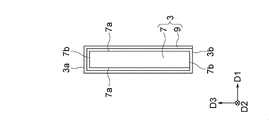
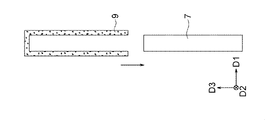
- FIG. 1 is a side views or cross-sectional views showing an example of how the liquid retaining member 9 is attached to the elastic member 7.
- FIG. 2A and 2B are side views or cross-sectional views showing an example of how the liquid retaining member 9 is attached to the elastic member 7.
- FIG. 2A shows the state before installation.
- FIG. 2B shows the state after attachment.
- the liquid retaining member 9 before attachment is also indicated by imaginary lines (double-dot chain lines).
- the liquid retaining member 9 is made of, for example, a flexible material (such as cloth). That is, the liquid retaining member 9 does not have a specific three-dimensional shape realized by restoring force.
- the liquid retaining member 9 is superimposed on the surface of the elastic member 7 and has a shape reflecting the shape of the elastic member 7 . In this state, the liquid retaining member 9 is fixed to the elastic member 7 .
- the liquid retaining member 9 may or may not be tensioned when fixed to the elastic member 7 .
- the size when tension is generated is arbitrary, and the slackness when tension is not generated is also arbitrary.
- the liquid retaining member 9 may be made of an elastic material (for example, an elastic sponge).
- the liquid retaining member 9 has a shape (for example, flat plate shape) that is more developed than the shape when attached to the elastic member 7 in a state in which no restoring force is generated. Then, it is bent along the surface shape of the elastic member 7 and overlapped on the surface of the elastic member 7 . In this state, the liquid retaining member 9 is fixed to the elastic member 7 .
- the presence or absence of tension is optional, as in the case of flexibility.
- the liquid retaining member 9 can be regarded as being wound around the elastic member 7 .
- the liquid-retaining member 9 may be flexible, as described above, or may have no restoring force. It may have elasticity to be in a shape that is expanded.
- the liquid-retaining member 9 extends over at least two surfaces facing opposite sides (and a surface therebetween).
- the liquid retaining member 9 extends over two main surfaces 7a (partially or entirely thereof) and one side surface 7b (partially or entirely thereof). The presence or absence of tension when described as being wrapped is optional.
- a fixing mode for preventing the liquid retaining member 9 from falling off from the elastic member 7 may be appropriately selected.
- the fixing may be such that the liquid retaining member 9 can be attached to and detached from the elastic member 7, or it can be impossible.
- the liquid retaining member 9 may be fixed to the elastic member 7 in its entirety overlapping with the elastic member 7 , or only a part of the portion overlapping with the elastic member 7 may be fixed to the elastic member 7 . It may be fixed. As an example of the latter, for example, there is a mode in which only the portion of the liquid retaining member 9 on the rear end 3b side is fixed to the elastic member 7 .
- the liquid retaining member 9 may or may not be regulated in displacement with respect to the elastic member 7 by exerting tension on the tip 3a side portion of the elastic member 7 and contacting it. good.
- a detachable fixing mode for example, there is a mode using a member (described later) that holds the rear end 3b side portion of the wiping member 3 so as to press the liquid retaining member 9 against the elastic member 7 .
- a detachable member detachably attached to a predetermined portion of the wiping member 3 so as to press the liquid retaining member 9 against the elastic member 7 may be used.
- detachable members include fastening members (screws and/or nuts), those that use fastening members, those that use engagement, and those that tighten the elastic member 7 using the elastic member 7 or the restoring force of the detachable member. things can be mentioned.
- Non-detachable fixing mode is a mode in which an adhesive is interposed between the liquid retaining member 9 and the elastic member 7 . Further, for example, there is a mode in which the liquid retaining member 9 and/or the elastic member 7 are dissolved and joined. Such a non-detachable fixation mode is used in either a mode in which the entire liquid retaining member 9 is secured to the elastic member 7 or a mode in which a portion of the liquid retaining member 9 is secured to the elastic member 7 . good too.
- the shape of the elastic member 7 is the same before and after the liquid retaining member 9 is attached, for example. However, a slight elastic deformation may occur due to the force accompanying the mounting of the liquid retaining member 9 . For example, there may be elastic deformation that has little effect on the wiping action.
- the force that causes elastic deformation is, for example, the tension of the liquid retaining member 9 wound around the elastic member 7, or the force applied by a member holding the elastic member 7 or a member attached to or detached from the elastic member 7 to cause the liquid retaining member 9 to move to the elastic member 7.
- a pressing force or a force associated with curing shrinkage of the adhesive may be used. In describing the shape of the wiping member 3 and the shape of the elastic member 7, such slight elastic deformation is ignored.
- the elastic member 7 may undergo an elastic deformation that affects wiping.
- the elastic member 7 may be bent toward the +D1 side or the -D1 side due to the tension of the liquid retaining member 9 when the wiping member 3 is not pressed against the discharge surface 1a.
- FIG. 3A is a side view or cross-sectional view showing a mounting mode according to a modification.
- the mounting mode according to the modification is a mounting mode in which the liquid retaining member 9 is wound around the elastic member 7, as in the embodiment (FIGS. 2A and 2B).
- the liquid-retaining member 9 did not wrap around the elastic member 7 once in the embodiment, the liquid-retaining member 9 is wound around the elastic member 7 one or more times in the modified example.
- the liquid-retaining member 9 is further wound so that the liquid-retaining member 9 is double or more on at least one of the wiping surfaces. More specifically, the liquid retaining member 9 has two or more layers (two layers in the illustrated example) on three surfaces, ie, the two main surfaces 7a and the side surface 7b on the side of the tip 3a.
- portions of the liquid retaining member 9 may be fixed with an adhesive or the like, or may not be fixed.
- FIG. 3B is a side view or cross-sectional view showing a mounting mode according to another modification.
- the material of the liquid retaining member 9 is assumed to be elastic (for example, sponge).
- the shape of the liquid retaining member 9 in a state in which it is not elastically deformed is substantially the same as the shape after being attached to the elastic member 7 .
- the liquid retaining member 9 is attached to the elastic member 7 so as to cover the elastic member 7 . That is, in the modified example of FIG. 3B, the liquid retaining member 9 is not wound around the elastic member 7 unlike the previous modified examples.
- the inner surface of the liquid-retaining member 9 may have, for example, the same shape and dimensions as the outer surface of the elastic member 7 (the area where the liquid-retaining member 9 overlaps; hereinafter the same applies in this paragraph). After being attached to the elastic member 7, the liquid retaining member 9 does not need to be elastically deformed at all. Different from the above, the inner surface of the liquid retaining member 9 may be partially or wholly smaller than the outer surface of the elastic member 7 . After being attached to the elastic member 7 , the liquid retaining member 9 may generate an inward restoring force to tighten the elastic member 7 . Conversely, part or all of the inner surface of the liquid retaining member 9 may be made larger than the outer surface of the elastic member 7 .
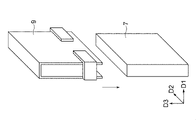
- FIG. 3C is a perspective view showing a mounting mode according to still another modification.
- the material of the liquid retaining member 9 is assumed to be flexible (for example, cloth).
- the liquid retaining member 9 is formed into a bag-like shape or a bag-like shape by fixing parts of the liquid retaining member 9 in a non-detachable manner.
- the liquid retaining member 9 is put on the elastic member 7 rather than being wound thereon.
- Means for non-detachably fixing parts of the liquid retaining member 9 may include stitching and adhesion.
- fixation of parts of the liquid retaining member 9 in FIG. 3C may be detachable.
- fixing means include hook-and-loop fasteners, buttons and hooks. In this case, after winding the liquid retaining member 9 , parts of the liquid retaining member 9 can be fixed together.
- the liquid retaining member 9 may be wound around the elastic member 7 around an axis along another direction instead of around the axis along the D2 direction.
- the liquid retaining member 9 may be wound around the elastic member 7 around an axis along the D3 direction to cover the two main surfaces 7a while exposing the side surface 7b on the +D3 side (the tip 3a side).
- the liquid retaining member 9 may be placed over the elastic member 7 from any of the other five directions instead of being placed over the elastic member 7 from the +D3 side.
- the side surface 7b on the +D3 side may be covered with the liquid retaining member 9 or may be exposed.
- the fixing mode for preventing the liquid retaining member 9 from falling off from the elastic member 7 may be the same as in the embodiment.
- FIG. 4A is a side view or cross-sectional view showing a wiping member 3A according to a modification.
- the elastic member 7A of the wiping member 3A is plate-shaped as a whole and has two main surfaces 7a facing opposite sides, similarly to the elastic member 7 according to the embodiment. However, the elastic member 7A is formed to be thinner toward the tip 3a side, and does not have the side surface 7b on the tip 3a side. For example, the liquid retaining member 9 overlaps the elastic member 7A over the two main surfaces 7a so as to cover the +D3 side end of the elastic member 7A.
- each main surface 7a includes an inclined surface 7c, and the two main surfaces 7a are connected (intersect) with each other.
- the liquid retaining member 9 overlaps the elastic member 7 over two surfaces facing in different directions (more specifically, in opposite directions).
- an inclined surface 7c (different from the main surface 7a) is connected to the tip 3a side of each main surface 7a, and the two inclined surfaces 7c are connected to each other. good.
- the liquid retaining member 9 also has two surfaces (two inclined surfaces 7c or two main surfaces 7a) facing in different directions (more specifically, opposite directions). It can be said that it overlaps with 7.
- the liquid retaining member 9 may overlap the two inclined surfaces 7c and not overlap the main surface 7a.
- the elastic member 7A may not have the main surface 7a, and the inclined surface 7c may be connected to the side surface 7b on the -D3 side. That is, the elastic member 7A may be substantially triangular in side view.
- the liquid retaining member 9 may overlap the two inclined surfaces 7c. Even in these cases, the liquid retaining member 9 overlaps the elastic member 7 over two surfaces (two inclined surfaces 7c) facing in mutually different directions (more specifically, in mutually opposite directions). I can say.
- the two surfaces facing opposite sides need not be parallel to each other.
- the angle formed by two surfaces that are not parallel to each other is less than 90°, less than 80°, less than 60°, or less than 30°, this The two faces may be considered as facing opposite each other.
- the angle formed by the two inclined surfaces 7c may be an angle (for example, 90° or more) that does not mean that the two inclined surfaces 7c face opposite sides of each other. .
- the thickness of the elastic member may differ depending on the part.
- the elastic member may have a different thickness between a portion expected to abut on the ejection surface 1a and a portion not expected to abut on the ejection surface 1a. In this case, either may be thinner than the other.
- the elastic member may have different thicknesses between a portion held by a support member described later and flexural deformation is restricted and a portion not held and flexural deformation is allowed. In this case, either may be thinner than the other.
- the thickness may gradually change so as not to cause a step, or a step may occur.
- FIG. 4B is a side view or sectional view showing a wiping member 3B according to another modification.
- the elastic member 7B does not have to be plate-shaped.
- the elastic member 7B has a substantially square shape when viewed in the D2 direction.
- the liquid retaining member 9 overlaps the elastic member over two or more surfaces, the two or more surfaces do not have to include two surfaces facing opposite sides.
- the liquid retaining member 9 overlaps only the surface of the elastic member 7B on the +D3 side (the tip 3a side) and the surface of the elastic member 7B on the -D1 side. From another point of view, the liquid retaining member 9 is asymmetric with respect to the axis parallel to the D3 direction when viewed in the D2 direction.
- a wiping member such as the wiping member 3B that is asymmetrical with respect to the liquid retaining member 9 and the like has a specific effect that the liquid retaining member 9 exerts in wiping by moving to the -D1 side and wiping by moving to the +D1 side. is different.
- the asymmetric wiping member may be used only for wiping by moving to the -D1 side, may be used only for wiping by moving to the +D1 side, or may be used for both wiping. .
- the shape of the elastic member can be various other than those exemplified so far.
- the end of the elastic member on the +D3 side may be arc-shaped when viewed in the D2 direction (curved outward in a broader concept).
- the curved surface and the other surface may be regarded as two surfaces facing in different directions.
- the curved surface may be considered to include two or more surfaces. For example, consider a virtual plane in contact with one position of a curved surface and another virtual plane in contact with another position of the curved surface.
- the curved surface may be taken to include two surfaces facing opposite each other.
- the elastic member is a plate having a curved portion (a curved portion) and/or a bent portion (a curved portion forming a corner portion) when viewed in the D2 direction. may be in the form of
- the configuration of the holding portion that holds the wiping member 3 may be various configurations, and may be the same configuration as a known configuration, for example. In the following, examples of novel configurations are given. Matters that are not particularly mentioned may be the same as various known configurations.
- a structure including the wiping member 3 and the holding portion is sometimes called a wiper.
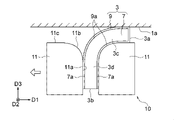
- 6A and 6B are side views or sectional views showing the wiping member 3 and the holding portion 10 (wiper 4).
- FIG. 5 shows a state in which wiping is not performed (a state in which the wiping member 3 is not elastically deformed).
- FIG. 6A shows an example of a state in which the wiping member 3 is moved to the -D1 side to perform wiping.
- FIG. 6B shows an example of a state in which the wiping member 3 is moved to the +D1 side and wiping is being performed.
- the shape shown in these drawings for example, extends over at least the entire length of the wiping member 3 in the D2 direction. However, a portion different from the illustrated shape may exist.
- the holding part 10 has two support members 11 .
- the two support members 11 have the same shape.
- the two support members 11 sandwich the wiping member 3 in the D2 direction.
- the wiping member 3 is held by the holding portion 10 .
- the holding part 10 may have a member for supporting the wiping member 3 in addition to the supporting member 11 .
- Examples of such a member include a member that contacts the wiping member 3 from the +D2 side or the -D2 side, a member that contacts the wiping member 3 from the -D3 side, and a member that penetrates the wiping member 3.
- These members may be configured integrally with the support member 11 .
- the pressure with which the support member 11 compresses the wiping member 3 in the D1 direction may be appropriately set. Note that the two support members 11 do not have to compress the wiping member 3 . In this case, the wiping member 3 may be prevented from coming off by a member other than the support member 11 described above.
- the two support members 11 sandwich a portion of the wiping member 3 on the rear end 3b side.
- a portion of the wiping member 3 on the tip 3a side protrudes to the +D3 side from the two support members 11, and is capable of bending deformation (for example, bending deformation in the D1 direction) with the tip 3a as a free end. It has become.
- the wiping member 3 has a body portion 3c including the tip 3a, and a held portion 3d positioned closer to the rear end 3b than the body portion 3c.
- the support member 11 on the +D1 side has a holding surface 11a that contacts the held portion 3d from the side facing the main surface 7a on the +D1 side.
- the holding surface 11a allows flexural deformation of the main body portion 3c toward the side facing the main surface 7a on the +D1 side.
- D1 is positive or negative.
- the shape of the holding surface 11a is arbitrary.
- the holding surface 11a is planar.
- the holding surface 11a may be curved or may have unevenness.
- the unevenness bites into the planar surface on the +D1 side and/or -D1 side of the held portion 3d, and can contribute to reducing the probability that the held portion 3d slips on the holding surface 11a.
- recesses and/or recesses that engage with the protrusions and/or recesses A protrusion may be provided on the holding surface 11a.
- the length of contact of the holding surface 11a with the wiping member 3 in the D3 direction may be set appropriately.
- one of the length of the body portion 3c in the D3 direction and the length of the held portion 3d in the D3 direction may be longer than or equal to the other.
- the length in the D3 direction of the body portion 3c is longer than the length in the D3 direction of the held portion 3d.
- the holding surface 11a extends from the rear end 3b of the wiping member 3 to the -D3 side.
- the edge of the holding surface 11a on the -D3 side may coincide with the rear end 3b, or the rear end 3b may protrude without expanding to the rear end 3b.
- the length of the holding surface 11a (the same applies to other surfaces described later) may be longer than, equal to, or shorter than the length of the wiping member 3 .
- the holding surface 11 a is in contact with the liquid retaining member 9 .
- the liquid retaining member 9 is provided over the main body portion 3c and the held portion 3d in the D3 direction (in other words, the direction from the front end 3a to the rear end 3b along the main surface 7a).
- the liquid retaining member 9 may be positioned only in the body portion 3c (all or part thereof) in the D3 direction, or may be located in the entirety of the body portion 3c and part of the held portion 3d. may be located in That is, the holding surface 11 a may be in contact with the elastic member 7 or may be in contact with both the elastic member 7 and the liquid retaining member 9 .
- the shape and dimensions of the surface on the +D3 side of the holding surface 11a are arbitrary.
- the support member 11 has a convex surface 11b connected to the holding surface 11a and a tip surface 11c connected to the convex surface 11b. These surfaces may, for example, contribute to pressing the body portion 3c. By this pressing, for example, it is possible to push out the cleaning liquid that has permeated the portion of the liquid retaining member 9 located on the main body portion 3c, or to press the main body portion 3c against the ejection surface 1a.
- the convex curved surface 11b and/or the tip surface 11c may not be used for pressing the body portion 3c.
- the convex curved surface 11b is connected to the tip 3a side with respect to the holding surface 11a.
- the convex curved surface 11b is, as its name suggests, a convex curved surface.
- the convex curved surface 11b of the support member 11 on the +D1 side with respect to the wiping member 3 that is not flexurally deformed, is closer to the +D1 side (+D1 side) as it is positioned closer to the tip 3a side (+D3 side). It is curved away from the side facing the surface 7a).
- the convex curved surface 11b of the support member 11 on the -D1 side is the same, except that the sign of D1 is reversed.
- the specific shape of the D1-D3 cross section of the convex curved surface 11b is arbitrary.
- the convex curved surface 11b may have a constant curvature over its entire length (that is, may be a circular arc) as in the illustrated example, or the curvature may vary depending on the position, unlike the illustrated example. may vary accordingly.
- the convex curved surface 11b may be smoothly connected to the holding surface 11a and/or the tip surface 11c so as not to form a corner (example shown), or may form a corner. good too.
- the -D3 side end of the convex curved surface 11b may or may not have a normal parallel to the D1 direction, and the +D3 side end of the convex curved surface 11b may have a normal in the D3 direction. They may or may not be parallel.
- the dimensions of the convex curved surface 11b in the D1-D3 cross section may be set appropriately.
- the curvature of the convex curved surface 11b is arbitrary.
- the curvature radius is 1/10 or more, 1/5 or more, or 1/3 or more of the length of the main body portion 3c of the wiping member 3.
- the length along the surface of the convex curved surface 11b is shorter than the length of the body portion 3c of the wiping member 3. As shown in FIG. However, it is also possible to make the former equal to or less than the latter.
- the specific shape and dimensions of the D1-D3 cross section of the tip surface 11c are arbitrary.
- the tip surface 11c is planar and parallel to the ejection surface 1a.
- the tip surface 11c may be convex or concave as a whole, may have unevenness, or may be inclined with respect to the ejection surface 1a.
- the length of the tip surface 11c may be shorter than, equal to, or longer than the length of the convex surface 11b.
- the edge of the distal end surface 11c on the side opposite to the convex curved surface 11b is more convex curved surface 11b than the tip 3a of the wiping member 3. It may be located on the opposite side of the tip 3a (the example shown in the figure), may be aligned with the tip 3a, or may be located on the convex curved surface 11b side of the tip 3a.
- (Modified example of holding part) 7A and 7B are side views or cross-sectional views showing the configuration of a holding portion 10A (wiper 4A from another point of view) according to a modification.
- FIG. 7A shows a state in which wiping is not performed (a state in which the wiping member 3 is not elastically deformed).
- FIG. 7B shows an example of a state in which the wiping member 3 is moved to the +D1 side and wiping is being performed.
- the holding part 10A has the above-described supporting member 11 and a supporting member 11A according to a modified example having a shape different from that of the supporting member 11 .
- the wiping member 3 is sandwiched between the supporting member 11 and the supporting member 11A.
- the holding part 10A has an asymmetrical shape with respect to the wiping member 3 when viewed in the D2 direction.
- this modification for example, only wiping is performed by moving the wiping member 3 to the +D1 side, and wiping by moving to the -D1 side is not assumed.
- the positional relationship in the D1 direction of the support member 11 and the support member 11A may be reversed, and in this case, wiping may be performed by moving to the -D1 side.
- the support member 11A has a shape that does not need to have the function of pressing the body portion 3c of the wiping member 3 during wiping.
- the support member 11A has a holding surface 11a and a tip end surface 11d intersecting with the holding surface 11a. That is, the support member 11A does not have the convex surface 11b. Further, the position of the tip surface 11d is located on the -D3 side of the tip surface 11c of the support member 11. As shown in FIG.
- the description of the holding surface 11a of the support member 11 may be applied to the holding surface 11a of the support member 11A.
- the upper edge of the surface of the support member 11A facing the -D1 side (the surface including the holding surface 11a) may be positioned above the held portion 3d of the wiping member 3, unlike the illustrated example. Even in this case, since the convex curved surface 11b of the support member 11 is curved in the direction away from the wiping member 3 which is not elastically deformed, the area where the held portion 3d is substantially held is does not change.
- the tip surface 11d is not supposed to come into contact with the wiping member 3, so it may have any shape and size.
- the tip surface 11d is planar and parallel to the ejection surface 1a.
- the holding surface 11a and the tip surface 11c are not provided with the convex curved surface 11b. may cross.
- a planar inclined surface chamfering the corner between the holding surface 11a and the tip surface 11c (or the tip surface 11d) may be provided.
- the surface connecting the holding surface 11a and the tip surface 11c (or the tip surface 11d) has a convex curved surface and an inclined surface, or two or more inclined surfaces with different angles when viewed in the D2 direction. You can
- the shape and/or They can have different dimensions.
- the curvature and/or the length of the convex surface 11b may be different between the support member 11 on the -D1 side and the support member 11 on the +D1 side.
- the holding part 10A according to the modification has been described as being used for wiping by moving to the +D1 side, but in addition to or instead of wiping by moving to the +D1 side, it can be used for wiping by moving to the -D1 side. I don't mind if it's used.
- the wiping member 3 shown in FIG. 1 was taken as an example among the various wiping members described above.
- any wiping member among various wiping members may be combined with the above-described support portion.
- the combination of the wiping member and the holding portion may be symmetric-symmetric (eg, FIG. 5) or symmetric-asymmetric (eg, FIG. 7A ).
- the symmetrical combination may be asymmetrical-symmetrical.
- the wiping member 3B of FIG. 4B and the holding part 10 of FIG. 5 may be combined.
- the symmetry combination may be asymmetric-asymmetric.
- the wiping member 3B of FIG. 4B and the holding part 10A of FIG. 7A may be combined.
- the two support members 11 may be fixed to each other so as to sandwich and hold the wiping member 3 (in other words, tighten the wiping member 3).
- Various modes of fixing may be used. Below are some examples.
- FIG. 8A is a cross-sectional view showing an example of how the two support members 11 are fixed.
- a bolt 13 is inserted through the two support members 11 in the D1 direction, and a nut 15 is screwed onto the bolt 13 .
- the two support members 11 are fixed to each other so as to tighten the wiping member 3 in the D1 direction.
- the number and specific positions of combinations of bolts 13 and nuts 15 are arbitrary.
- the length of the support member 11 is longer than the length of the wiping member 3 in the D2 direction.
- a bolt 13 and a nut 15 positioned on the -D2 side (front side in the drawing) with respect to the wiping member 3 are illustrated.
- a bolt 13 and a nut 15 may also be provided on the +D2 side of the wiping member 3 .
- the bolt 13 may pass through the wiping member 3 and directly contribute to the positioning of the wiping member 3, unlike the illustrated example.
- the bolt 13 may be positioned below the wiping member 3 .
- a female thread into which the bolt 13 is screwed may be provided in one support member 11 without providing the nut 15 .
- one support member 11 (the -D1 side support member 11 in the illustrated example) may have a mounting portion 17 on which the other support member 11 is mounted.
- the two support members 11 may be connected to each other on the -D3 side. In this case, the tightening of the bolts 13 may elastically deform the -D3 side portions of the two support members 11 so that the two support members 11 tighten the wiping member 3 .
- One support member 11 may have walls that position the other support member 11 from the +D2 side and/or the -D2 side.
- FIG. 8B is a cross-sectional view showing another example of how the two support members 11 are fixed.
- the bolt 13 and nut 15 do not directly fix the two support members 11, but fix the two support members 11 via the two fixing members 19A and 19B.
- the two fixing members 19A and 19B are arranged on both sides of the two supporting members 11 in the D1 direction.
- a bolt 13 is inserted through the fixing members 19A and 19B in the D1 direction, and a nut 15 is screwed onto the bolt 13.
- the two support members 11 are fixed to each other so as to tighten the wiping member 3 in the D1 direction.
- the shape of the fixing members 19A and 19B is arbitrary.
- the fixed member 19A has a placement portion (not labeled) on which the two support members 11 and the fixed member 19B are placed.
- the fixing member 19A may have walls that position the two supporting members 11 and the fixing member 19B from the +D2 side and/or the -D2 side.
- the number and specific positions of combinations of bolts 13 and nuts 15 are arbitrary.
- the bolt 13 and the nut 15 located on the -D2 side (front side in the figure) with respect to the wiping member 3 and the support member 11 are illustrated.
- a bolt 13 and a nut 15 may also be provided on the +D2 side of the wiping member 3 .
- the bolt 13 may pass through the support member 11 and/or the wiping member 3 unlike the illustrated example.
- the bolt 13 may be positioned below the wiping member 3 .
- the fixing member 19B may be provided with a female thread into which the bolt 13 is screwed. The nut 15 may contact the support member 11 without the fixing member 19B.
- the wiping operation using the wiping member 3 may be performed in various ways, and may be, for example, the same operation as a known operation. Various operations, including novel operations, are illustrated below.
- the wiping member 3 moves along its main surface (as described above).
- the widest surface of the plate shape may be brought into contact with the ejection surface 1a (more specifically, surface contact). More specifically, for example, at least a portion of the body portion 3c of the wiping member 3 may be sandwiched (for example, compressed) between the discharge surface 1a and the support member 11 (more specifically, the tip surface 11c). ).
- the main surface of the body portion 3c may come into surface contact with the ejection surface 1a in a state in which the body portion 3c is not sandwiched between the ejection surface 1a and the tip surface 11c.
- the length in the D1 direction where the main surface of the main body portion 3c contacts the discharge surface 1a (or the tip surface 11c) when viewed in the D2 direction is arbitrary.
- this length may be 1/2 or more, 1 time or more, or 2 times or more the thickness of the wiping member 3 or the thickness of the elastic member 7 .
- the length (D1 direction) by which the main surface 7a of the elastic member 7 is parallel to the ejection surface 1a may satisfy the above range.
- the compressive force that the wiping member 3 receives between the discharge surface 1a and the support member 11 is also arbitrary.
- a portion of the liquid-retaining member 9 that is positioned on the main body portion 3c and on the main surface 7a of the elastic member 7 will be referred to as a liquid-retaining main body 9a.
- one of the two liquid-retaining bodies 9a is in surface contact with the ejection surface 1a.
- the liquid holding body 9a which is in surface contact with the ejection surface 1a, is pressed by the elastic member 7 toward the ejection surface 1a.
- the other liquid retaining body 9a is pressed toward the elastic member 7 by the support member 11 (more specifically, the convex surface 11b and the tip surface 11c). Such pressing may contribute to squeezing out the cleaning liquid retained in the liquid-retaining main body 9a.
- FIG. 9A and 9B are side views or sectional views showing examples of other states of the wiping member 3.
- FIG. 9A and 9B are side views or sectional views showing examples of other states of the wiping member 3.
- FIGS. 9A and 9B the convex surface 11b of the support member 11 and its surroundings are shown enlarged. Also, the illustration of the support member 11 on the -D1 side is omitted.
- the wiping member 3 is drawn shorter than in FIG. 5, etc., and does not have a portion that overlaps the tip surface 11c (not shown here). Note that the wiping member 3 may actually have a configuration that does not have a portion that overlaps the tip surface 11c, as shown in the drawing.
- FIGS. 9A and 9B only a portion of the convex curved surface 11b on the holding surface 11a side ( ⁇ D3 side) is attached to the wiping member 3 (more specifically, the liquid retaining body 9a) when viewed in the D2 direction. It touches (pressing from another point of view). From another point of view, FIG. 9A, FIG. 9B, and FIG. 6A are in ascending order of the area of the convex curved surface 11b pressing the liquid-retaining main body 9a. In these figures, assuming that the wiping member 3 and the like have the same configuration, the order of the distance (D3 direction) from the support member 11 to the ejection surface 1a is as shown in FIG. 9A, FIG. 9B, and FIG. 6A. . From another point of view, FIG. 9A, FIG. 9B, and FIG. 6A are in descending order of the force that presses the wiping member 3 toward the ejection surface 1a.
- 6A, 9A, and 9B may be regarded as diagrams showing mutually different wiping operation modes, or may be regarded as mutually different states occurring in one operation mode.
- the wiping member 3 moves to the -D1 side while remaining in the state of FIG. 6A, 9A or 9B.
- the wiping member 3 sequentially transitions between two or more states shown in FIGS. 6A, 9A, and 9B while moving to the -D1 side.
- the state of the wiping member 3 may change in the order of FIGS. 9A, 9B and 6A.
- FIG. 9A of the liquid retaining body 9a, the portion indicated by the arrow a1 is pressed by the convex curved surface 11b, whereby the cleaning liquid retained in this portion is squeezed out toward the tip 3a.
- FIG. 9B the portion where the arrow a2 is drawn is pressed by the convex curved surface 11b, thereby squeezing out the cleaning liquid held in that portion toward the tip 3a.
- the probability that the washing liquid squeezed out from the portion indicated by the arrow a2 is directed toward the rear end 3b is low.
- the washing liquid retained in the liquid-retaining main body 9a is squeezed out from the rear end 3b side to the front end 3a side in order.
- cleaning liquid can be squeezed out over a long travel distance in the D1 direction.
- FIG. 10A and 10B are side views or cross-sectional views showing examples of still other states of the wiping member 3.
- FIG. 10A and 10B are side views or cross-sectional views showing examples of still other states of the wiping member 3.
- FIG. 10A corresponds to a partially enlarged view of FIG. 6A.
- 10B is a diagram corresponding to FIG. 10A, showing a state different from that of FIG. 10A. In these figures, illustration of the support member 11 on the -D1 side is omitted.
- a state in which the pressing forces are different from each other may be realized in a state in which the wiping member 3 is sandwiched between the ejection surface 1a and the support member 11, as shown in FIGS. 10A and 10B.
- the pressing force is increased compared to the state of FIG. 10A. If these two conditions occur in one wiping mode of operation, they may occur in the order of FIGS. 10A and 10B, for example.
- the cleaning liquid remaining in the liquid-retaining main body 9a in the state of FIG. 10A is squeezed out when the state of FIG. 10B is reached.
- the cleaning liquid can be squeezed out over a long travel distance in the D1 direction.
- the contact state of the wiping member 3 described above may be realized at an appropriate time. Some examples are given below.
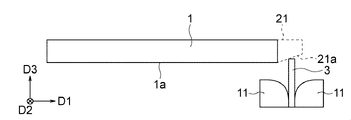
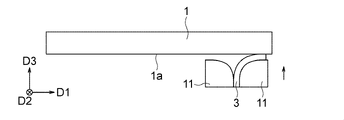
- 11A to 11D are schematic side views or sectional views showing an example of the wiping operation procedure.
- Wiping proceeds in the order of FIGS. 11A, 11B, 11C and 11D.
- wiping is performed with the wiping member 3 sandwiched between the ejection surface 1a and the tip surface 11c of the support member 11 (FIG. 6A). Specifically, it is as follows.
- FIG. 11A shows the state before wiping is performed.
- the wiping member 3 is located on the +D1 side of the ejection surface 1a.
- the tip 3a of the wiping member 3 is located on the +D3 side of the ejection surface 1a.
- the support member 11 is moved to the -D1 side.
- the tip 3a side portion of the wiping member 3 comes into contact with the ejection surface 1a.
- the body portion 3c of the wiping member 3 bends toward the +D1 side (in other words, the side opposite to the traveling direction).
- FIG. 11C the support member 11 is moved to the +D3 side.
- the state described with reference to FIG. 6A and the like is realized. That is, the body portion 3c of the wiping member 3 is sandwiched between the ejection surface 1a and the tip surface 11c of the support member 11. As shown in FIG.
- FIG. 11D the support member 11 is moved from the position in FIG. 11C to the -D1 side. Wiping is thereby performed. At this time, the distance between the ejection surface 1a and the support member 11 (the force pressing the wiping member 3 against the ejection surface 1a) is constant, for example.
- an auxiliary member 21 having an inclined surface 21a connected to the ejection surface 1a may be provided on the +D1 side of the ejection surface 1a.
- the wiping member 3 may be in contact with the inclined surface 21a or separated from the inclined surface 21a before the support member 11 starts moving toward the -D1 side.
- the auxiliary member 21 may be a part of the head 1 or may be a separate member from the head 1 .
- the wiping member 3 may be positioned on the -D3 side of the ejection surface 1a before wiping. Then, the support member 11 may be moved to the -D1 side while moving to the +D3 side. Alternatively, the support member 11 may be moved to the +D3 side to bring the wiping member 3 into contact with the ejection surface 1a, and then the support member 11 may be moved to the -D1 side. Such an operation can also realize the state of FIG. 11B.
- the operations described with reference to FIGS. 9A and 9B may be implemented.
- the +D1 side convex curved surface 11b may gradually press the +D1 side liquid retaining body 9a from the -D3 side.
- the wiping member 3 may be moved to the -D1 side as the wiping member 3 is moved to the +D3 side.
- the convex curved surface 11b is likely to press the liquid retaining body 9a gradually from the -D3 side.
- the moving speed of the wiping member 3 in the D1 direction when wiping is performed after shifting from FIG. 11C to FIG. 11D may be set appropriately.
- the speed may be constant or may vary.
- 12A to 12D are schematic side views or cross-sectional views showing another example of the wiping operation procedure.
- Wiping proceeds in the order of FIGS. 12A, 12B, 12C and 12D.
- the force with which the wiping member 3 is pressed against the ejection surface 1a changes while wiping is performed. Specifically, it is as follows.
- FIG. 12A the state is the same as in FIG. 11B.
- the process up to this state may also be the same as the example of FIG. 11B.
- FIG. 12B the support member 11 is moved from the position in FIG. 12A to the -D1 side. At this time, the support member 11 is also moved to the +D3 side. As a result, the operation of shifting from the state of FIG. 9A to the state of FIG. 9B is realized.
- FIG. 12C the support member 11 is moved further to the -D1 side from the position in FIG. 12B. At this time, the support member 11 is also moved to the +D3 side. As a result, the operation of shifting from the state of FIG. 9B to the state of FIG. 6A is realized.
- FIG. 12D the support member 11 is moved further to the -D1 side from the position in FIG. 12C. At this time, the support member 11 is also moved to the +D3 side. As a result, the operation of shifting from the state of FIG. 10A to the state of FIG. 10B is realized.
- the support member 11 may reach the position in the D3 direction in FIG. 12C when reaching the position in the D1 direction in FIG. 12D. Further, after FIGS. 11A to 11C, the support member 11 may also move to the +D3 side along with the movement to the ⁇ D1 side to reach the position of FIG. 12D from the position of FIG. 11C.
- wiping may be done at an appropriate time.” For example, wiping may be performed when a predetermined operation is performed on an operation unit (not shown) of the printer. Also, wiping may be performed when the control device of the printer determines that the time to perform wiping has arrived. The timing may be, for example, when the printer is in operation, when printing is started after operation, and/or when printing has been performed for a predetermined length of time. The control device may determine whether or not to perform wiping based on information on the state (for example, contamination) of the ejection surface 1a.
- Information on the ejection surface 1a may be obtained, for example, by an imager that captures an image of the ejection surface 1a, or a scanner that scans a printed image (if the image quality is degraded, it can be determined that wiping is necessary). .
- the holding surface 11a of the support member 11 is parallel to the direction D3 (perpendicular to the ejection surface 1a) when viewed in the direction D2.
- the holding surface 11a may be inclined with respect to the D3 direction.
- the holding surface 11a may be inclined so as to be positioned toward the +D1 side toward the +D3 side.
- the holding surface 11a of the support member 11 is parallel to the D2 direction (longitudinal direction of the ejection surface 1a) when viewed in the D3 direction.
- the holding surface 11a may be inclined with respect to the D2 direction.
- ⁇ Supply of cleaning liquid> As already mentioned, in wiping a cleaning liquid may be applied.
- the specific aspect thereof may be various aspects, for example, it may be the same aspect as a known aspect. Below are some examples.
- FIG. 13A is a schematic diagram showing an example of a supply mode of the cleaning liquid.
- the cleaning liquid is supplied to the wiping member 3 by the shower 23 .
- the wiping device including the wiping member 3 and the like has a tank 25 that stores the cleaning liquid and a pump 27 that sends the cleaning liquid from the tank 25 to the shower 23 in addition to the shower 23 .
- a pump 27 that sends the cleaning liquid from the tank 25 to the shower 23 in addition to the shower 23 .
- the relative movement of both to the relative position where the cleaning liquid can be supplied to the wiping member 3 by the shower 23 is realized by movement of the shower 23 and/or the wiping member 3 (support member 11).
- the movement of the wiping member 3 for supplying the cleaning liquid may be performed by a wiper drive mechanism 29 that moves the supporting member 11 (not shown here) relative to the discharge surface 1a for wiping, or a wiping mechanism described later.
- a drive mechanism that moves the entire device may be responsible for this, or both may be responsible for it.
- FIG. 13B is a schematic diagram showing another example of the supply mode of the cleaning liquid.
- the cleaning liquid is supplied to the wiping member 3 by immersing the wiping member 3 in the cleaning liquid stored in the tank 25 .
- the specific configuration of the tank 25 may be made as appropriate. Relative movement of the wiping member 3 and the tank 25 for dipping the wiping member 3 into the cleaning liquid is achieved by movement of the wiping member 3 (support member 11 ) and/or the tank 25 .
- the movement of the wiping member 3 for supplying the cleaning liquid may be performed by a wiper drive mechanism 29 that moves the supporting member 11 (not shown here) relative to the discharge surface 1a for wiping, or a wiping mechanism described later.
- a drive mechanism that moves the entire device may be responsible for this, or both may be responsible for it.
- FIG. 13C is a schematic diagram showing still another example of the supply mode of the cleaning liquid.
- the cleaning liquid is supplied to the ejection surface 1a.
- Various modes of supplying the cleaning liquid to the ejection surface 1a may be employed.
- the cleaning liquid is supplied through a channel 31 provided in the head 1 or a member that can be regarded as part of the head 1 (for example, the auxiliary member 21 in FIG. 11A).
- the flow path 31 opens on the ejection surface 1a or a surface (for example, the inclined surface 21a of the auxiliary member 21) connected to the ejection surface 1a.
- the wiping member 3 holds the cleaning liquid supplied to the ejection surface 1a when the support member 11 is driven by the wiper driving mechanism 29 to start wiping.
- the cleaning liquid may be in various forms, for example, it may be in the same form as a known form.
- the cleaning liquid may be the same as or similar to the solvent of the liquid ejected by the head 1, for example. That is, the cleaning liquid may be the same as or similar to the liquid ejected by the head 1, except that it does not contain a coloring agent.
- the cleaning liquid may be water or an organic solvent.
- the cleaning liquid may contain a surfactant, an antiseptic, an anti-mold agent, etc. as components that the liquid ejected by the head 1 may or may not contain.
- wiping may be performed without supplying cleaning liquid.
- wiping may be performed without cleaning liquid after printing.
- the wiping member 3 wipes off the ink adhering to the ejection surface 1a during printing.
- wiping may be performed without a cleaning liquid after cleaning by so-called capping.
- cleaning by capping is performed as follows. First, by covering the ejection surface 1a with a cap (not shown) (this is called capping), a substantially sealed space is created between the ejection surface 1a and the cap. By repeating the ejection of the liquid from the head 1 in such a state, the liquid clogged in the nozzle 5 and/or the foreign matter and/or the like whose viscosity is higher than that in the standard state is removed. The cap may then be removed and wiping performed.
- the wiping member 3 may be washed as appropriate.
- the supply of the cleaning liquid described above may also serve to clean the wiping member 3 .
- Two or more of the cleaning liquid supply modes illustrated in FIGS. 13A to 13C may be combined.
- One of the two or more combined supply modes may mainly contribute to cleaning the wiping member 3, and the other may mainly contribute to the supply of the cleaning liquid.
- the types (components) of cleaning liquids used in two or more combined supply modes may be the same or different.
- the wiping member 3 may be used in various types of printers. Below are some examples of printer configurations. Here, the relative movement between the head 1 and the wiping member 3 is particularly focused, and the description of the configuration and operation of the printer relating to normal printing is basically omitted.
- FIG. 14A and 14B are schematic diagrams showing a printer 33A having a wiping member 3.
- FIG. 14A shows a state in which printing is being performed.
- FIG. 14B shows a state in which wiping is being performed.
- the printer 33A has a head 1 and a transport section 35 that transports a recording medium (eg, paper) (not shown).
- a recording medium eg, paper
- the printer 33A is assumed to be a line printer that prints on a recording medium conveyed in the D2 direction (direction perpendicular to the longitudinal direction of the head 1).
- the conveying section 35 one having a belt 35a on which a recording medium is placed and a roller 35b for conveying the belt is schematically shown.
- the printer 33A has a wiping device 39.
- the wiping device 39 has, for example, the wiper 4 (the wiping member 3 and the support member 11) and a wiper drive mechanism 29 that drives the support member 11.
- the wiper drive mechanism 29 may be configured including, for example, a rotary electric motor or a linear motor.
- the wiping device 39 may have a container or the like that contains cleaning liquid that scatters and/or drops.
- the head 1 faces the transport section 35 (more specifically, the belt 35a). Accordingly, printing can be performed by ejecting ink droplets from the head 1 . Further, as shown in FIG. 14B, during wiping, the head 1 is transported to the position of the wiping device 39 by the head driving mechanism 37. As shown in FIG. Thereby, wiping can be performed.
- the wiping device 39 may be positioned in either direction with respect to the transport section 35 .
- the head drive mechanism 37 may be configured including, for example, a rotary electric motor or a linear motor.
- the relative movement between the head 1 and the recording medium is realized by conveying the recording medium by the conveying section 35 .
- all or part of the relative movement between the head 1 and the recording medium may be realized by the movement of the head 1 .
- the drive mechanism responsible for moving the recording medium relative to the head 1 may also serve as the head drive mechanism 37 that moves the head 1 to the position of the wiping device 39 .
- the control device 41 may control each part such as the head drive mechanism 37 and the wiper drive mechanism 29 .
- the control device 41 may be configured by, for example, a computer.
- the computer includes, for example, a CPU (central processing unit), a ROM (read only memory), a RAM (random access memory), and an external storage device (not shown).
- Various functional units that perform control and the like are constructed by the CPU executing programs stored in the ROM and/or the external storage device.
- FIG. 15A and 15B are schematic diagrams showing another example of a printer 33B having a wiping member 3.
- FIG. 15A shows a state in which printing is being performed.
- FIG. 15B shows a state in which wiping is being performed.
- the printer 33A by moving the head 1, switching between a printing state and a wiping state is performed.
- the above switching is performed by moving the conveying section 35 and the wiping device 39.
- FIG. Specifically, the transport unit 35 is moved by the transport unit drive mechanism 43 from a position facing the head 1 (FIG. 15A) to a position away from the head 1 (FIG. 15B).
- the wiping device 39 is moved by the wiping device drive mechanism 45 from a position away from the head 1 (FIG. 15A) to a position facing the head 1 (FIG. 15B).
- the transport unit 35 may be positioned in any direction with respect to the head 1 when separated from the head 1 .
- the transport unit drive mechanism 43 may be configured including, for example, a rotary electric motor or a linear motor.
- the wiping device drive mechanism 45 may be configured including, for example, a rotary electric motor or a linear motor. The operation of these mechanisms is controlled by the control device 41 .
- the relative movement between the head 1 and the wiper 4 during wiping is achieved by driving the wiper 4 by the wiper drive mechanism 29.
- at least part of the relative movement between the head 1 and the wiper 4 may be realized by moving the head 1 .
- a mechanism for driving the head 1 in this case, a mechanism for relatively moving the head 1 and the recording medium for printing may be used, or the head driving mechanism 37 shown in FIG. 14B may be used.
- FIG. 16 is a schematic side view of the printer 33C.
- FIG. 17 is a schematic plan view of the printer 33C.
- an orthogonal coordinate system D1-D2-D3 defined for head 1 is attached.
- the printer 33C has a plurality of heads 1.
- FIG. The plurality of heads 1 are oriented slightly differently from each other. Therefore, the Cartesian coordinate system D1-D2-D3 is attached without strictness.
- the printer 33C is configured as a line printer that prints on the printing paper P by ejecting ink droplets from the head 1 whose movement is restricted while conveying the printing paper P in the D2 direction (the short side direction of the head 1). ing. More specifically, the printer 33C moves the printing paper P relative to the head 1 by conveying the printing paper P from the paper supply roller 80A to the collecting roller 80B.
- the paper feed roller 80A, the collection roller 80B, and various rollers to be described later constitute a moving portion 85 that moves the printing paper P and the head 1 relative to each other.
- the control device 41 controls the head 1 based on print data or the like, which is data such as images and/or characters, to eject liquid toward the printing paper P and cause droplets to land on the printing paper P. , and record such as printing on the printing paper P.
- the printer 33C has four flat plate-shaped head mounting frames 70 (hereinafter sometimes simply referred to as frames) so as to be substantially parallel to the printing paper P. Each frame 70 is provided with five holes (not shown), and five heads 1 are mounted in the respective holes. Five heads 1 mounted on one frame 70 constitute one head group 72 . The printer 33C has four head groups 72, and a total of 20 heads 1 are mounted.
- the head 1 mounted on the frame 70 faces the printing paper P with the ejection surface 1a (surface on the -D3 side).
- the distance between the head 1 and the printing paper P is, for example, approximately 0.5 to 20 mm.
- the 20 heads 1 may be directly connected to the control device 41, or may be connected to the control device 41 via a distribution unit that distributes print data.
- the control device 41 may transmit the print data to one distribution section, and the one distribution section may distribute the print data to the twenty heads 1 .
- the control device 41 distributes the print data to four distribution units corresponding to the four head groups 72, and each distribution unit distributes the print data to the five heads 1 in the corresponding head group 72. good too.
- the three heads 1 are arranged along a direction crossing (for example, substantially perpendicular to) the conveying direction of the printing paper P, and the other two heads 1 are arranged along the conveying direction. They are arranged one by one between the three heads 1 at offset positions. In other words, in one head group 72, the heads 1 are arranged in a zigzag pattern. The heads 1 are arranged so that the printable range of each head 1 is connected in the width direction of the printing paper P, that is, in the direction intersecting the conveying direction of the printing paper P, or so that the ends overlap, Printing without a gap in the width direction of the printing paper P is possible.
- the four head groups 72 are arranged along the direction in which the printing paper P is conveyed. Liquid (for example, ink) is supplied to each head 1 from a liquid supply tank (not shown). The heads 1 belonging to one head group 72 are supplied with the same color ink, and the four head groups 72 can print four color inks.
- the colors of ink ejected from each head group 72 are, for example, magenta (M), yellow (Y), cyan (C), and black (K). A color image can be printed by causing such ink to land on the printing paper P.
- M magenta
- Y yellow
- C cyan
- K black
- the number of heads 1 installed in the printer 33C may be one as long as the printable range is printed by one head 1 in a single color.
- the number of heads 1 included in the head group 72 and/or the number of head groups 72 can be appropriately changed according to the target to be printed and/or the printing conditions. For example, the number of head groups 72 may be increased for multicolor printing. Also, if a plurality of head groups 72 for printing in the same color are arranged and printed alternately in the transport direction, the transport speed can be increased even if the heads 1 with the same performance are used. As a result, the print area per hour can be increased. Alternatively, a plurality of head groups 72 for printing in the same color may be prepared and arranged in a staggered manner in the direction intersecting the transport direction to increase the resolution in the width direction of the printing paper P. FIG.
- a liquid such as a coating agent may be printed uniformly or patterned by the head 1 in order to treat the surface of the printing paper P.
- the coating agent for example, in the case of using a recording medium that is difficult for the liquid to permeate, one that forms a liquid-receiving layer so that the liquid can be easily fixed can be used.
- the coating agent is used to suppress liquid permeation so that the liquid does not spread too much or mix too much with another liquid that has landed next to it. Anything that forms a layer can be used.
- the coating agent may be uniformly applied with a coater 76 controlled by the control device 41 .
- the printer 33C prints on printing paper P, which is a recording medium.
- the print paper P is wound around the paper feed roller 80A, and the print paper P sent out from the paper feed roller 80A passes under the head 1 mounted on the frame 70, and then 2 It passes between two conveying rollers 82C and is finally collected by the collecting roller 80B.
- the printing paper P is conveyed at a constant speed by rotating the conveying roller 82C, and printed by the head 1.
- the printing paper P sent out from the paper feed roller 80A passes between the two guide rollers 82A and then under the coater 76. As shown in FIG.
- the coater 76 coats the printing paper P with the coating agent described above.
- the print paper P then enters a head chamber 74 containing a frame 70 on which the head 1 is mounted.
- the head chamber 74 is connected to the outside at a portion such as a portion where the printing paper P enters and exits, but is generally a space isolated from the outside.
- Control factors such as temperature, humidity, and atmospheric pressure of the head chamber 74 are controlled by the controller 41 or the like as necessary.
- the influence of disturbance can be reduced compared to the outside where the printer 33C is installed, so the above-mentioned control factor variation range can be made narrower than the outside.
- Five guide rollers 82B are arranged in the head chamber 74, and the printing paper P is transported on the guide rollers 82B.
- the five guide rollers 82B are arranged so that the center is convex toward the direction in which the frame 70 is arranged when viewed from the side.
- the printing paper P conveyed over the five guide rollers 82B has an arcuate shape when viewed from the side. is stretched so that it is flat.
- One frame 70 is arranged between the two guide rollers 82B. The angle at which the frame 70 is installed is gradually changed so as to be parallel to the printing paper P conveyed under it.
- the print paper P coming out of the head chamber 74 passes between two transport rollers 82C, passes through the dryer 78, passes between two guide rollers 82D, and is collected by the collection roller 80B.
- the conveying speed of the printing paper P is, for example, 100 m/min.
- Each roller may be controlled by the control device 41 or manually operated by a person.
- the dryer 78 may use a plurality of drying methods in order, or may use a plurality of drying methods in combination. Drying methods used in such cases include, for example, hot air blowing, infrared irradiation, and contact with heated rollers. In the case of irradiating infrared rays, infrared rays in a specific frequency range may be applied so that the printing paper P is less damaged and dried faster.
- the heat transfer time may be lengthened by conveying the printing paper P along the cylindrical surface of the roller.
- the range in which the sheet is conveyed along the cylindrical surface of the roller is preferably 1/4 or more of the circumference of the cylindrical surface of the roller, and more preferably 1/2 or more of the circumference of the cylindrical surface of the roller.
- a UV irradiation light source may be arranged instead of or in addition to the dryer 78 .
- a UV illumination source may be positioned between each frame 70 .
- the recording medium may be a roll of cloth or the like.
- the printer 33C may convey a conveying belt instead of directly conveying the printing paper P, and convey the recording medium placed on the conveying belt. In this way, sheets of paper, cut cloth, wood or tiles can be used as the recording medium.
- a wiring pattern of an electronic device or the like may be printed by ejecting a liquid containing conductive particles from the head 1 .
- a chemical agent may be produced by ejecting a predetermined amount of liquid chemical agent or a liquid containing the chemical agent from the head 1 toward a reaction vessel or the like and causing a reaction.
- the printer 33C is equipped with a position sensor, a speed sensor and/or a temperature sensor, etc., and the control device 41 controls each part of the printer 33C according to the state of each part of the printer 33C which is known from the information from each sensor. good too.
- the temperature of the head 1, the temperature of the liquid in the liquid supply tank that supplies the liquid to the head 1, and/or the pressure that the liquid in the liquid supply tank applies to the head 1 are the ejection characteristics of the ejected liquid (for example, ejection amount and/or ejection speed), the driving signal for ejecting the liquid may be changed according to the information.
- FIG. 18 is a schematic diagram showing the configuration of the wiper 4C used in the printer 33C.
- the ejection surface 1a of the head 1 is also indicated by dotted lines.
- the wiper 4C has a plurality of (five in the illustrated example) wipers 4 and a connecting member 47 that connects the plurality of wipers 4 .
- the wiper 4 has the configuration described with reference to FIG. 5 and the like, and has the wiping member 3 and the holding portion 10 (shown more schematically than in FIG. 5 and the like).
- the number and relative positions of the wipers 4 correspond to the number and relative positions of the heads 1 included in one head group 72 . Therefore, by moving the wiper 4C in the D1 direction, all the heads 1 included in one head group 72 can be wiped.
- the shape of the connecting member 47 is arbitrary, and may be, for example, a plate shape (example shown in the drawing) or a skeleton shape.
- a plurality of wipers 4C corresponding to a plurality of head groups 72 may be further connected to form a wiper.
- wipers 4 corresponding to a plurality of heads 1 in one head group 72 may be driven independently without being connected to each other.
- One wiper 4 ( FIG. 5 , etc.) may be configured relatively large so as to be able to wipe a plurality of heads 1 of one head group 72 .
- one wiper 4 may be configured relatively large so as to be able to wipe the ejection surfaces 1a of the plurality of head groups 72 .
- One wiper 4 may be moved relative to a plurality of heads 1 so as to sequentially wipe the plurality of heads 1 .
- the wiping member 3 has the elastic member 7 and the liquid retaining member 9 .
- the elastic member 7 has a first surface and a second surface (for example, two main surfaces 7a) facing in different directions.
- the liquid retaining member 9 overlaps the elastic member 7 over the first surface and the second surface, and has liquid retaining properties.
- the liquid retention member 9 containing the cleaning liquid can be wiped by pressing it against the discharge surface 1a by means of the elastic member 7 having elasticity. This improves the effect of cleaning by wiping.
- the liquid retaining member 9 extends over two surfaces (for example, two main surfaces 7a) of the elastic member 7 .
- a portion for example, one of the two liquid retaining bodies 9a
- the liquid retaining member 9 can be provided with a portion for supplying the cleaning liquid to the head 1 (for example, the other of the two liquid retaining bodies 9a).
- the wiping member 3 it is possible to increase the amount of cleaning liquid held by the wiping member 3, or to supply the cleaning liquid free from contaminants on the ejection surface 1a to the ejection surface 1a. Further, for example, for one supply of the cleaning liquid and/or cleaning of the wiping member 3, a portion located on one of the two surfaces (for example, one of the two liquid retaining bodies 9a) is placed on the ejection surface 1a. Two wiping operations can be performed: wiping with which the other of the two surfaces (for example, the other of the two liquid-retaining bodies 9a) is brought into contact with the discharge surface 1a. As a result, the efficiency of the wiping operation can be improved.
- the first surface and the second surface may face opposite sides.
- a moving device for example, a The configuration of the wiper drive mechanism 29
- the movement direction of the support member 11 is set to the +D1 side and the -D1 side. Just switch with .
- the liquid retaining member 9 may be wound around the elastic member 7 .
- the wiping member 3 having the liquid retaining member 9 can be configured simply by wrapping a flexible sheet such as cloth around the elastic member 7, so the wiping member 3 can be easily manufactured. Further, for example, the wiping member 3 can be configured so that the liquid retaining member 9 can be attached to and detached from the elastic member 7 . Furthermore, as understood from a comparison with FIGS. 2B and 3A, the thickness of the liquid retaining member 9 can be adjusted simply by changing the number of windings. That is, it is easy to adjust the thickness of the liquid retaining member 9, which affects the effect of cleaning by wiping. Also, generally, the water retention rate of a plurality of cloths stacked on each other is higher than the water retention rate of a single cloth. This is because water is retained between cloths. Therefore, by increasing the number of windings, it is possible to efficiently increase the amount of cleaning liquid retained.
- the wiper 4 may have the wiping member 3 and the support member 11 that supports the wiping member 3.
- the wiping member 3 may have a leading end 3a and a trailing end 3b, which are ends on both sides in the direction along the first and second surfaces (for example, the two main surfaces 7a) facing opposite to each other. Further, the wiping member 3 may have a main body portion 3c including the tip 3a and a held portion 3d located closer to the rear end 3b than the main body portion 3c.
- the support member 11 may have a holding surface 11a and a convex curved surface 11b.
- the holding surface 11a is covered from the side facing the second surface (+D1 side) so as to allow bending deformation toward the side facing the second surface (for example, the main surface 7a on the +D1 side) of the body portion 3c. It may abut against the holding portion 3d.
- the convex curved surface 11b is connected to the holding surface 11a on the side of the tip 3a, and the side (+D1 side).
- stress concentration in the wiping member 3 is alleviated.
- the wiping member 3 causes stress concentration in the portion that abuts on the corner when it is flexurally deformed toward the corner.
- the wiping member 3 abuts against the convex curved surface 11b and deforms along the convex curved surface 11b, so that stress concentration is alleviated. Further, when the convex curved surface 11b is provided, as described with reference to FIGS. 9A and 9B, the operation of sequentially pressing the liquid retaining body 9a from the part away from the ejection surface 1a is facilitated. . As a result, for example, cleaning liquid can be squeezed out over a long travel distance in the D1 direction.
- the wiper 4 may have a wiping member 3, a first support member and a second support member (two support members 11).
- the wiping member 3 may have a first side and a second side (for example two main surfaces 7a) facing opposite to each other.
- the first support member (for example, the support member 11 on the -D1 side) may abut the wiping member 3 from the side (-D1 side) facing the first surface (for example, the main surface 7a on the -D1 side).
- the wiping member 3 may be brought into contact with the wiping member 3 from the side (+D1 side) where the second support member (for example, the support member 11 on the +D1 side) and the second surface (for example, the main surface 7a on the +D1 side) face each other.
- the wiping member 3 can be supported by the support member 11 when the holding portion 10 including the two support members 11 is moved to either the -D1 side or the +D1 side. That is, wiping in two directions is facilitated using two liquid-retaining bodies 9a located on two main surfaces 7a facing opposite to each other.
- the wiping method according to the embodiment has a wiping step (for example, FIGS. 11A to 11D) in which the wiping member 3 wipes the ejection surface 1a of the head 1 on which the nozzles 5 are open.
- the wiping member 3 may have a leading end 3a and a trailing end 3b, which are ends on both sides in the direction along the first and second surfaces (for example, the two main surfaces 7a) facing opposite to each other. Further, the wiping member 3 may have a main body portion 3c including the tip 3a and a held portion 3d located closer to the rear end 3b than the main body portion 3c.
- the liquid-retaining member 9 may have a first portion (eg, the liquid-retaining main body 9a on the ⁇ D1 side) and a second portion (eg, the liquid-retaining main body 9a on the +D1 side).
- the -D1 side liquid retaining main body 9a may be positioned on the main body portion 3c and on the first surface (for example, the main surface 7a on the -D1 side).
- the liquid retaining body 9a on the +D1 side may be located on the main body portion 3c and on the second surface (for example, the main surface 7a on the +D1 side).
- the wiping step includes a contact step (for example, FIGS.
- the wiping step is performed in a state in which the body portion 3c is in contact with the ejection surface 1a, and is a direction along the ejection surface 1a, which is a first direction (for example, the -D1 side) in which the first surface of the held portion 3d faces.
- 11C and 11D of moving the wiping member 3 in a direction that is not limited to a direction orthogonal to the first plane.
- the +D1 side retaining liquid body 9a is pressed toward the +D1 side main surface 7a, and the wiping member 3 is moved to - You may move it to the D1 side.
- the cleaning liquid retained by the liquid retaining body 9a in contact with the discharge surface 1a but also the cleaning liquid retained by the liquid retaining body 9a on the opposite side is retained.
- the cleaning liquid can be squeezed out and used.
- the support member 11 presses the liquid holding body 9a that is not in contact with the ejection surface 1a as the support member 11 moves to the +D3 side.
- the pressing may be realized by pressing a member other than the support member 11 against the liquid retaining body 9a by an appropriate driving mechanism or human power.
- the second portion for example, the +D1 side main body 9a
- the second surface for example, the +D1 side main surface
- the wiping step of the wiping method according to the embodiment may have a first step (eg FIG. 6A) and a second step (eg FIG. 6B).
- the first step in a state in which the first portion (for example, the liquid retaining body 9a on the -D1 side) is in contact with the ejection surface 1a, the first surface (
- the wiping member 3 may be moved in the first direction facing the main surface 7a) on the -D1 side (for example, the -D1 side; not limited to the direction perpendicular to the first surface).
- the second surface for example, The wiping member 3 may be moved in a second direction facing the main surface 7a) on the +D1 side (for example, the +D1 side; not limited to the direction perpendicular to the first surface).
- both of the two liquid-retaining bodies 9a located on the two main surfaces 7a are used as parts that directly contribute to wiping by coming into contact with the discharge surface 1a.
- wiping can be performed twice for one supply of the cleaning liquid and/or cleaning of the wiping member 3, thereby improving cleaning efficiency.
- the force with which the wiping member 3 is pressed against the discharge surface 1a may be varied. From another point of view, the distance of the support member 11 from the ejection surface 1a may be changed.
- the cleaning liquid remaining on at least one of the two liquid retaining bodies 9a is removed. can be squeezed out.
- the cleaning liquid can be supplied to the ejection surface 1a not only at the initial stage of wiping, but also after that. As a result, it is facilitated to maintain the cleaning effect until the end of wiping.
- the wiping method includes a preparation step (for example, FIG. 2A, FIG. 3).
- the liquid retaining member 9 is set thicker to increase the amount of cleaning liquid to be retained, thereby enhancing the cleaning effect.
- a liquid ejection device (for example, printers 33A, 33B, and 33C) according to the embodiment may have a wiping member 3 and a moving device (for example, wiper drive mechanism 29).
- the moving device relatively moves the wiping member 3 and the head 1 so that the wiping member 3 wipes the ejection surface 1a of the head 1 on which the nozzles 5 are open.
- each of the main surface 7a, the side surface 7b, and the inclined surface 7c on which the liquid retaining member 9 overlaps is an example of the first surface or the second surface.
- the two main surfaces 7a (and the two side surfaces 7b) are examples of first and second surfaces facing opposite sides.
- the two support members 11 (or 11A) are examples of a first support member and a second support member.
- the two liquid retaining bodies 9a are examples of the first portion and the second portion.
- Wiper drive mechanism 29 is an example of a moving device.
- Each of the printers 33A, 33B and 33C is an example of a liquid ejection device.
- One wiping member may have two or more types of liquid retaining members.
- liquid retaining members made of different materials may be stacked one on top of the other.
- different materials may be located in different regions of the surface of the elastic member.
- the wiping member may have members other than the elastic member and the liquid retaining member.
- the wiping member may have inside the elastic member a member having a Young's modulus higher than that of the elastic member, which regulates bending deformation of the wiping member.
Landscapes
- Ink Jet (AREA)
Priority Applications (3)
| Application Number | Priority Date | Filing Date | Title |
|---|---|---|---|
| US18/550,681 US20240109325A1 (en) | 2021-03-30 | 2022-03-08 | Wiping member, wiper, wiping method, and liquid discharge device |
| EP22779848.5A EP4316857A1 (en) | 2021-03-30 | 2022-03-08 | Wiping member, wiper, wiping method, and liquid ejection device |
| JP2023510750A JP7585463B2 (ja) | 2021-03-30 | 2022-03-08 | ワイピング方法 |
Applications Claiming Priority (2)
| Application Number | Priority Date | Filing Date | Title |
|---|---|---|---|
| JP2021056601 | 2021-03-30 | ||
| JP2021-056601 | 2021-03-30 |
Publications (1)
| Publication Number | Publication Date |
|---|---|
| WO2022209624A1 true WO2022209624A1 (ja) | 2022-10-06 |
Family
ID=83458671
Family Applications (1)
| Application Number | Title | Priority Date | Filing Date |
|---|---|---|---|
| PCT/JP2022/009963 Ceased WO2022209624A1 (ja) | 2021-03-30 | 2022-03-08 | ワイピング部材、ワイパー、ワイピング方法及び液体吐出装置 |
Country Status (4)
| Country | Link |
|---|---|
| US (1) | US20240109325A1 (https=) |
| EP (1) | EP4316857A1 (https=) |
| JP (1) | JP7585463B2 (https=) |
| WO (1) | WO2022209624A1 (https=) |
Cited By (1)
| Publication number | Priority date | Publication date | Assignee | Title |
|---|---|---|---|---|
| WO2025204732A1 (ja) * | 2024-03-26 | 2025-10-02 | ブラザー工業株式会社 | 液体吐出装置 |
Citations (5)
| Publication number | Priority date | Publication date | Assignee | Title |
|---|---|---|---|---|
| JPH04338552A (ja) | 1991-05-15 | 1992-11-25 | Seiko Epson Corp | インクジェット記録装置 |
| JP2004188369A (ja) * | 2002-12-13 | 2004-07-08 | Seiko Epson Corp | 液体噴射装置 |
| JP2009045795A (ja) * | 2007-08-17 | 2009-03-05 | Fujifilm Corp | メンテナンス装置及び液体吐出装置並びにノズル面メンテナンス方法 |
| US20160257122A1 (en) * | 2015-03-04 | 2016-09-08 | Xerox Corporation | System and method for cleaning an inkjet printer |
| JP2018047635A (ja) * | 2016-09-23 | 2018-03-29 | セイコーエプソン株式会社 | 液体噴射装置の駆動方法、及び、液体噴射装置 |
Family Cites Families (10)
| Publication number | Priority date | Publication date | Assignee | Title |
|---|---|---|---|---|
| JPH06126969A (ja) * | 1992-10-15 | 1994-05-10 | Canon Inc | インクジェット記録装置 |
| JPH08207292A (ja) * | 1995-02-07 | 1996-08-13 | Fuji Electric Co Ltd | インクジェット・プリンタ |
| JPH10286970A (ja) * | 1997-04-16 | 1998-10-27 | Seiko Epson Corp | インクジェット記録装置 |
| JP2001260371A (ja) | 2000-03-21 | 2001-09-25 | Sharp Corp | インクジェット画像形成装置 |
| JP2004209107A (ja) | 2003-01-08 | 2004-07-29 | Kao Corp | 清掃用具 |
| JP2004268363A (ja) | 2003-03-07 | 2004-09-30 | Seiko Epson Corp | 液体噴射装置 |
| JP4975667B2 (ja) | 2008-03-21 | 2012-07-11 | 理想科学工業株式会社 | インクジェット記録装置 |
| JP2013139088A (ja) | 2011-12-28 | 2013-07-18 | Fujifilm Corp | インクジェット記録装置 |
| BR112018009724B1 (pt) * | 2015-12-01 | 2022-03-15 | Kimberly-Clark Worldwide, Inc. | Limpador a seco, e, produto limpador a seco |
| JP2017159567A (ja) * | 2016-03-10 | 2017-09-14 | セイコーエプソン株式会社 | 液体吐出装置および吐出ヘッドの洗浄方法 |
-
2022
- 2022-03-08 US US18/550,681 patent/US20240109325A1/en not_active Abandoned
- 2022-03-08 JP JP2023510750A patent/JP7585463B2/ja active Active
- 2022-03-08 WO PCT/JP2022/009963 patent/WO2022209624A1/ja not_active Ceased
- 2022-03-08 EP EP22779848.5A patent/EP4316857A1/en not_active Withdrawn
Patent Citations (5)
| Publication number | Priority date | Publication date | Assignee | Title |
|---|---|---|---|---|
| JPH04338552A (ja) | 1991-05-15 | 1992-11-25 | Seiko Epson Corp | インクジェット記録装置 |
| JP2004188369A (ja) * | 2002-12-13 | 2004-07-08 | Seiko Epson Corp | 液体噴射装置 |
| JP2009045795A (ja) * | 2007-08-17 | 2009-03-05 | Fujifilm Corp | メンテナンス装置及び液体吐出装置並びにノズル面メンテナンス方法 |
| US20160257122A1 (en) * | 2015-03-04 | 2016-09-08 | Xerox Corporation | System and method for cleaning an inkjet printer |
| JP2018047635A (ja) * | 2016-09-23 | 2018-03-29 | セイコーエプソン株式会社 | 液体噴射装置の駆動方法、及び、液体噴射装置 |
Cited By (1)
| Publication number | Priority date | Publication date | Assignee | Title |
|---|---|---|---|---|
| WO2025204732A1 (ja) * | 2024-03-26 | 2025-10-02 | ブラザー工業株式会社 | 液体吐出装置 |
Also Published As
| Publication number | Publication date |
|---|---|
| JP7585463B2 (ja) | 2024-11-18 |
| EP4316857A1 (en) | 2024-02-07 |
| JPWO2022209624A1 (https=) | 2022-10-06 |
| US20240109325A1 (en) | 2024-04-04 |
Similar Documents
| Publication | Publication Date | Title |
|---|---|---|
| EP3530466B1 (en) | Wiping device, head maintenance device, and liquid discharge apparatus | |
| US10099478B2 (en) | Liquid discharge apparatus including wiper to wipe surface of nozzle plate both in forward direction and in opposite direction | |
| US10350895B2 (en) | Head cleaner and liquid discharge apparatus | |
| JP7193946B2 (ja) | 液体吐出装置及びその制御方法 | |
| JP7010047B2 (ja) | ヘッド清掃装置および液体を吐出する装置 | |
| JP6781617B2 (ja) | 液吸収装置、記録システム、記録方法および製造方法 | |
| JPH06340081A (ja) | 全幅インクジェットプリンタ用プリントヘッドメンテナンス装置 | |
| JP2019048410A (ja) | 液滴吐出装置および画像形成装置 | |
| JP7039901B2 (ja) | ヘッド清掃装置、ヘッドメンテナンス装置、液体を吐出する装置 | |
| US20200247126A1 (en) | Liquid discharge apparatus | |
| US11427001B2 (en) | Head maintenance device, liquid discharge apparatus, and printer | |
| WO2022209624A1 (ja) | ワイピング部材、ワイパー、ワイピング方法及び液体吐出装置 | |
| JP6960756B2 (ja) | 液吸収装置、記録装置、及び記録方法 | |
| US8646872B2 (en) | Inkjet recording apparatus including ink receiving assembly | |
| WO2022195424A1 (en) | Inkjet nozzles cleaning in a digital printing system | |
| JP7623975B2 (ja) | ワイパー及び液体吐出装置 | |
| US8529016B2 (en) | Liquid ejection apparatus, controller therefor, nonvolatile storage medium storing program to be executed by the apparatus | |
| JP6976091B2 (ja) | 記録装置及び制御方法 | |
| JP7064170B2 (ja) | 払拭装置、ヘッドメンテナンス装置、液体を吐出する装置 | |
| EP4506173B1 (en) | Liquid discharge apparatus | |
| US12533886B2 (en) | Wiping device and liquid discharge apparatus | |
| JP7467994B2 (ja) | 液体を吐出する装置 | |
| WO2024253158A1 (ja) | インクジェット式プリンターおよびヘッドユニットの清掃方法 | |
| JP2024001474A (ja) | ヘッドメンテナンス装置、液体を吐出する装置及びヘッドメンテナンス方法 | |
| HK40104488A (zh) | 数字印刷系统中喷墨喷嘴的清洁 |
Legal Events
| Date | Code | Title | Description |
|---|---|---|---|
| 121 | Ep: the epo has been informed by wipo that ep was designated in this application |
Ref document number: 22779848 Country of ref document: EP Kind code of ref document: A1 |
|
| WWE | Wipo information: entry into national phase |
Ref document number: 2023510750 Country of ref document: JP |
|
| WWE | Wipo information: entry into national phase |
Ref document number: 18550681 Country of ref document: US |
|
| WWE | Wipo information: entry into national phase |
Ref document number: 2022779848 Country of ref document: EP |
|
| NENP | Non-entry into the national phase |
Ref country code: DE |
|
| ENP | Entry into the national phase |
Ref document number: 2022779848 Country of ref document: EP Effective date: 20231030 |