WO2022202229A1 - 複合樹脂成形体 - Google Patents
複合樹脂成形体 Download PDFInfo
- Publication number
- WO2022202229A1 WO2022202229A1 PCT/JP2022/009446 JP2022009446W WO2022202229A1 WO 2022202229 A1 WO2022202229 A1 WO 2022202229A1 JP 2022009446 W JP2022009446 W JP 2022009446W WO 2022202229 A1 WO2022202229 A1 WO 2022202229A1
- Authority
- WO
- WIPO (PCT)
- Prior art keywords
- fused portion
- resin molded
- molded body
- web
- color
- Prior art date
- Legal status (The legal status is an assumption and is not a legal conclusion. Google has not performed a legal analysis and makes no representation as to the accuracy of the status listed.)
- Ceased
Links
Images
Classifications
-
- B—PERFORMING OPERATIONS; TRANSPORTING
- B32—LAYERED PRODUCTS
- B32B—LAYERED PRODUCTS, i.e. PRODUCTS BUILT-UP OF STRATA OF FLAT OR NON-FLAT, e.g. CELLULAR OR HONEYCOMB, FORM
- B32B27/00—Layered products comprising a layer of synthetic resin
- B32B27/18—Layered products comprising a layer of synthetic resin characterised by the use of special additives
-
- B—PERFORMING OPERATIONS; TRANSPORTING
- B32—LAYERED PRODUCTS
- B32B—LAYERED PRODUCTS, i.e. PRODUCTS BUILT-UP OF STRATA OF FLAT OR NON-FLAT, e.g. CELLULAR OR HONEYCOMB, FORM
- B32B27/00—Layered products comprising a layer of synthetic resin
- B32B27/18—Layered products comprising a layer of synthetic resin characterised by the use of special additives
- B32B27/20—Layered products comprising a layer of synthetic resin characterised by the use of special additives using fillers, pigments, thixotroping agents
-
- B—PERFORMING OPERATIONS; TRANSPORTING
- B32—LAYERED PRODUCTS
- B32B—LAYERED PRODUCTS, i.e. PRODUCTS BUILT-UP OF STRATA OF FLAT OR NON-FLAT, e.g. CELLULAR OR HONEYCOMB, FORM
- B32B5/00—Layered products characterised by the non- homogeneity or physical structure, i.e. comprising a fibrous, filamentary, particulate or foam layer; Layered products characterised by having a layer differing constitutionally or physically in different parts
- B32B5/22—Layered products characterised by the non- homogeneity or physical structure, i.e. comprising a fibrous, filamentary, particulate or foam layer; Layered products characterised by having a layer differing constitutionally or physically in different parts characterised by the presence of two or more layers which are next to each other and are fibrous, filamentary, formed of particles or foamed
- B32B5/24—Layered products characterised by the non- homogeneity or physical structure, i.e. comprising a fibrous, filamentary, particulate or foam layer; Layered products characterised by having a layer differing constitutionally or physically in different parts characterised by the presence of two or more layers which are next to each other and are fibrous, filamentary, formed of particles or foamed one layer being a fibrous or filamentary layer
- B32B5/26—Layered products characterised by the non- homogeneity or physical structure, i.e. comprising a fibrous, filamentary, particulate or foam layer; Layered products characterised by having a layer differing constitutionally or physically in different parts characterised by the presence of two or more layers which are next to each other and are fibrous, filamentary, formed of particles or foamed one layer being a fibrous or filamentary layer another layer next to it also being fibrous or filamentary
-
- C—CHEMISTRY; METALLURGY
- C08—ORGANIC MACROMOLECULAR COMPOUNDS; THEIR PREPARATION OR CHEMICAL WORKING-UP; COMPOSITIONS BASED THEREON
- C08K—Use of inorganic or non-macromolecular organic substances as compounding ingredients
- C08K13/00—Use of mixtures of ingredients not covered by one single of the preceding main groups, each of these compounds being essential
- C08K13/02—Organic and inorganic ingredients
-
- C—CHEMISTRY; METALLURGY
- C08—ORGANIC MACROMOLECULAR COMPOUNDS; THEIR PREPARATION OR CHEMICAL WORKING-UP; COMPOSITIONS BASED THEREON
- C08L—COMPOSITIONS OF MACROMOLECULAR COMPOUNDS
- C08L101/00—Compositions of unspecified macromolecular compounds
-
- D—TEXTILES; PAPER
- D04—BRAIDING; LACE-MAKING; KNITTING; TRIMMINGS; NON-WOVEN FABRICS
- D04H—MAKING TEXTILE FABRICS, e.g. FROM FIBRES OR FILAMENTARY MATERIAL; FABRICS MADE BY SUCH PROCESSES OR APPARATUS, e.g. FELTS, NON-WOVEN FABRICS; COTTON-WOOL; WADDING ; NON-WOVEN FABRICS FROM STAPLE FIBRES, FILAMENTS OR YARNS, BONDED WITH AT LEAST ONE WEB-LIKE MATERIAL DURING THEIR CONSOLIDATION
- D04H3/00—Non-woven fabrics formed wholly or mainly of yarns or like filamentary material of substantial length
- D04H3/08—Non-woven fabrics formed wholly or mainly of yarns or like filamentary material of substantial length characterised by the method of strengthening or consolidating
- D04H3/16—Non-woven fabrics formed wholly or mainly of yarns or like filamentary material of substantial length characterised by the method of strengthening or consolidating with bonds between thermoplastic filaments produced in association with filament formation, e.g. immediately following extrusion
-
- D—TEXTILES; PAPER
- D06—TREATMENT OF TEXTILES OR THE LIKE; LAUNDERING; FLEXIBLE MATERIALS NOT OTHERWISE PROVIDED FOR
- D06M—TREATMENT, NOT PROVIDED FOR ELSEWHERE IN CLASS D06, OF FIBRES, THREADS, YARNS, FABRICS, FEATHERS OR FIBROUS GOODS MADE FROM SUCH MATERIALS
- D06M17/00—Producing multi-layer textile fabrics
Definitions
- the present disclosure relates to composite resin moldings.
- Thermal bond nonwoven fabrics are widely used as surface sheets for absorbent articles because of their excellent air permeability and flexibility.
- Absorbent articles include disposable diapers and sanitary napkins.
- a thermal bonded nonwoven fabric is obtained by sandwiching a web containing fibers made of a thermoplastic resin between a heated embossing roll and a smooth roll to partially melt the fibers and bond the fibers. It has been known.
- valley dyeing is known as a technique for enhancing the decorative effect by increasing the contrast between the uneven pattern and its surroundings (Patent Document 1).
- Valley dyeing is a method in which a colored paint is applied to the pattern convex portions of an embossing roll to form a pattern on the base material, and at the same time, the pattern concave portions of the base material are colored.
- Patent document 1 JP-A-53-24365
- the colored paint adhering to the pattern projections of the embossing roll may decompose due to the heat of the embossing roll. Therefore, there is a possibility that the fused portion of the thermal bond nonwoven fabric cannot be colored as desired. The colored paint adhering to the fused portion may come off from the fused portion. As a result, the fused portion colored by valley dyeing may be difficult to see.
- an object of the present disclosure is to provide a composite resin molded body in which even if the fused portion is not colored from the outside, it is easily visible due to its color tone.
- Means for solving the above problems include the following embodiments.
- a first resin molding containing a first thermoplastic resin and a coloring agent a second resin molding containing a second thermoplastic resin and a coloring agent that promotes color development or discoloration of the coloring agent;
- a composite resin molded body comprising: a fused portion in which a part of the first resin molded body and a part of the second resin molded body are fused together.
- the first resin molding does not contain the colorant
- the first resin molding includes a first fiber, The composite resin molded article according to ⁇ 1> or ⁇ 2>, wherein the second resin molded article includes a second fiber.
- the first resin molded body is a first spunbond web containing the first fibers
- the second resin molded body is a second spunbond web containing the second fibers
- the composite resin molded article according to ⁇ 3> wherein the first spunbond web is laminated on one main surface of the second spunbond web.
- the first resin molding is a first fiber
- the second resin molded body is a second fiber
- the coloring agent is contained in the first fiber
- ⁇ 7> The composite resin molded article according to any one of ⁇ 1> to ⁇ 6>, wherein the fusion-bonded portion contains, at least inside, a coloring compound of the coloring agent and the coloring agent.
- ⁇ 8> The composite resin molded article according to any one of ⁇ 1> to ⁇ 7>, wherein the color former contains a leuco dye.
- a composite resin molded article in which even if the fused portion is not colored from the outside, it is easily visible due to its color tone.
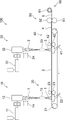
- FIG. 1 is a schematic diagram showing an example of a multi-layer spunbond nonwoven fabric manufacturing apparatus according to an embodiment of the present disclosure.
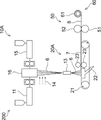
- FIG. 2 is a schematic diagram showing an example of an apparatus for manufacturing a mixed fiber spunbond nonwoven fabric according to an embodiment of the present disclosure.
- % indicating the amount of ingredients in the present disclosure is based on mass.
- a description that does not describe substitution or unsubstituted includes not only those having no substituents but also those having substituents.
- the term "layer” includes not only the case where the layer is formed in the entire region when observing the region where the layer exists, but also the case where it is formed only in part of the region. included.
- the term "process” includes not only an independent process, but also a process that cannot be clearly distinguished from other processes as long as the purpose of the process is achieved.
- a composite resin molded body includes a first resin molded body, a second resin molded body, and a fused portion.
- the first resin molding contains a first thermoplastic resin and a coloring agent.
- the second resin molding contains a second thermoplastic resin and a colorant.
- the color former promotes color development or color change of the color former.
- the first resin molding contains the first thermoplastic resin as a main component.
- the second resin molding preferably contains the second thermoplastic resin as a main component. It is preferable that the first resin molding does not contain a coloring agent. It is preferable that the second resin molding does not contain a coloring agent.
- color former refers to a compound that changes its chemical structure through chemical interaction with a color former and develops or changes color.
- color former refers to a compound that is itself colorless and that chemically interacts with the color former to change the chemical structure of the color former, cause the color former to develop a color, or change the color hue of the color former. show. "Containing the first thermoplastic resin as the main component” means that the content of the first thermoplastic resin in the first resin molded body is 50% by mass or more with respect to the total amount of the first resin molded body. show.
- the first resin molded body "does not contain a color former” means that the content of the color former in the first resin molded body is the same as the total amount of the first resin molded body even in the presence of the color former. 1 is sufficiently low so as not to change the color tone of the resin molded product, preferably 0.005% by mass or less, and 0% by mass.
- "Containing the second thermoplastic resin as the main component” means that the content of the second thermoplastic resin in the second resin molded body is 50% by mass or more with respect to the total amount of the second resin molded body. show.
- the second resin molded body "does not contain a color former" means that the content of the color former in the second resin molded body is the same as the total amount of the second resin molded body even in the presence of the color former. It is sufficiently low to the extent that the color tone of the resin molding does not change, preferably 0.005% by mass or less, and indicates that it contains 0% by mass.
- "Compatible” means that the melt of the first thermoplastic resin and the melt of the second thermoplastic resin do not separate under an atmosphere in which the first thermoplastic resin and the second thermoplastic resin melt. Indicates mixing.
- the first thermoplastic resin and the second thermoplastic resin The compatibility with is preferably high. "Fusing” means that a part of the first resin molded body and a part of the second resin molded body are melted and mixed with each other, and the melted parts of the first resin molded body and the second resin molded body indicates that they are united.
- the term "fused portion” refers to a portion where the first thermoplastic resin contained in the first resin molded body and the second thermoplastic resin contained in the second resin molded body are mixed with each other.
- a composite resin molded article includes a fused portion in which a part of the first resin molded body and a part of the second resin molded body are fused together. Therefore, even if the fused portion is not colored from the outside, it is easily visible due to the color tone. This is presumed for the following reasons. When the color former and the color former are mixed, the color former tends to develop or change color. In one embodiment of the present disclosure, in the first resin molded body and the second resin molded body, the color former and the color former are held separately by the first thermoplastic resin and the second thermoplastic resin. Therefore, the chemical interaction between the coloring agent and the coloring agent is difficult to work.
- the first resin molded body and the second resin molded body are less likely to develop or discolor due to the coloring agent.
- the fused part a part of the first resin molded body and a part of the second resin molded body are fused by heat.
- the fused portion is formed by heating, a state in which the color former and the color former temporarily coexist is formed in the fused portion. Therefore, the chemical interaction between the color former and the color former is facilitated, and the fused portion develops or changes color due to the action of the color former.
- the fused portion and the non-fused portion have different color tones.
- a non-fused portion indicates a portion of the composite resin molding that is not a fused portion. Therefore, even if the fused portion is not colored from the outside, it is easily visible due to its color tone.
- each of the first resin molded body and the second resin molded body may be a molded body molded into any shape. At least one of the first resin molded body and the second resin molded body may be a sheet-like article. That is, the first resin molded body and the second resin molded body may be sheet-like articles, or only one of the first resin molded body and the second resin molded body may be a sheet-like article. Examples of sheet materials include resin films and nonwoven fabric sheets.
- the first resin molded body is a short sheet-like article (hereinafter referred to as "first short sheet")
- the second resin molded body is a short sheet-like article (hereinafter referred to as "second short sheet").
- the composite resin molded body may be a bag.
- the bag body includes a first short sheet, a second short sheet, and a fused portion.
- the fused portion may be formed continuously along the outer periphery of the main surface of the laminated body.
- the stacked body is obtained by stacking the first short sheet and the second short sheet such that the main surfaces of the first short sheet and the second short sheet face each other. Thereby, the user can easily know whether or not the bag body is sealed by the difference in color tone between the fused portion and the non-fused portion.
- the principal surface means each of a pair of surfaces having the widest area in the sheet-like material.
- the composite resin molded article may be a packaging container.
- the packaging container may include a resin film, a tray that is an example of a non-sheet material, and a fused portion.
- the tray has recesses for storing articles.
- the resin film covers the entire opening of the recess so as to form an article storage space between the resin film and the recess of the tray.
- the fused portion may be formed continuously so as to surround the recess. Thereby, the user can easily know whether or not the packaging container is sealed by the difference in color tone between the fused portion and the non-fused portion.
- a food tray etc. are mentioned as a tray.
- the first resin molded body contains the first fibers and the second resin molded body contains the second fibers.
- the composite resin molded body may be a nonwoven fabric, a woven fabric, or a knitted fabric. There may be. From the viewpoint of visibility, among these, the composite resin molded article is preferably a nonwoven fabric.
- "Nonwoven" means a fibrous sheet, web or batt in which the fibers are unidirectionally or randomly oriented and are bonded together by physical entanglement or fusion. Nonwovens do not include paper, wovens, knits, tufts and crimped felts.
- Nonwoven fabrics include spunbond nonwoven fabrics, meltblown nonwoven fabrics, flash-spun nonwoven fabrics, and the like.
- spunbonded nonwoven fabric refers to a group of continuous fibers (filaments) spun from a spinneret by melting or dissolving a thermoplastic resin composition, laminated on a moving collection member, and bonded by one or more methods. shows a nonwoven fabric made of The bonding method includes thermocompression bonding, which will be described later.
- the thermoplastic resin composition, spinneret, and moving collection member will be described later.
- Woven fabrics include plain weaves, twill weaves, and satin weaves. Each of the first fibers and the second fibers may be long fibers or short fibers.
- the coloring agent is contained within the first fiber and the coloring agent is contained within the second fiber.
- the fused part contains the reactant of the color former and the reactant of the color former in its interior.
- the coloration or discoloration of the fused portion is less likely to change due to abrasion of the fused portion than when the fused portion is colored from the outside using a colored paint or the like.
- the first resin molded body contains a first spunbond web containing first fibers
- the second resin molded body contains a second spunbond web containing second fibers.
- spunbond web refers to a web made by extruding a molten or melted thermoplastic resin composition through a spinneret and laying continuous fibers (filaments) onto a moving collection member. Spunbond webs differ from spunbond nonwovens in that the fibers that make up the spunbond web are not bonded together.
- the composite resin molded body is , a multi-layer spunbond nonwoven.
- the multi-layer spunbond nonwoven fabric may comprise first fibers forming a first spunbond web, second fibers forming a second spunbond web, and fused portions.
- the first spunbond web is laminated onto one major surface of the second spunbond web.
- Each of the first fibers that make up the first spunbond web and the second fibers that make up the second spunbond web are long fibers. The definition of long fibers will be described later. Details of the multilayer spunbond nonwoven fabric will be described later.
- the composite resin molded article is a multilayer spunbond nonwoven fabric
- the composite resin molded article may be referred to as a "multilayer spunbond nonwoven fabric.”
- the composite resin molded article is preferably a mixed fiber spunbond web.
- the mixed fiber spunbond web may be composed of each of the first fibers and the second fibers.
- a mixed fiber spunbond web includes first fibers and second fibers.
- the composite resin molding is preferably a mixed fiber spunbonded nonwoven fabric.
- the mixed fiber spunbonded nonwoven fabric includes first fibers and second fibers forming a mixed fiber spunbonded web, and a fused portion.
- Each of the first fibers constituting the mixed fiber spunbond web and the second fibers constituting the mixed fiber spunbond web are long fibers. The details of the mixed fiber spunbond nonwoven fabric will be described later.
- the composite resin molded article when the composite resin molded article is a mixed fiber spunbonded nonwoven fabric, the composite resin molded article may be referred to as a "mixed fiber spunbonded nonwoven fabric.”
- the fused portion is a portion that joins the first resin molded body and the second resin molded body and has a different color tone from the non-fused portion.
- the fused portion includes a reactant of the color former and a reactant of the color former.
- the fused portion may include a first thermoplastic resin and a second thermoplastic resin.
- the fused portion may contain an unreacted product of the color former and an unreacted product of the color former.
- the fused portion may be formed at one location or at a plurality of locations in the composite resin molded body. The site where the fused portion is formed, the shape of the fused portion, and the like may be appropriately adjusted according to the application of the composite resin molding.
- the fused portion When the composite resin molded article is a non-woven fabric, the fused portion is thinner (film-like) than the non-fused portion. If the area ratio of the fused portion is not 100%, it is appropriately adjusted according to the application of the composite resin molding.
- the area ratio of the fused portion is preferably 7% to 20% when the composite resin molded article is a nonwoven fabric.
- the area ratio of the fused portion was determined by taking a test piece of 10 mm x 10 mm from the composite resin molding, and observing the contact surface of the test piece with the embossing roll with an electron microscope (magnification: 100 times). It is the ratio of the area of the fused portion to the area of the composite resin molded body.
- the fused part is a color-forming compound of a color former and a color former (that is, a reaction product obtained by reaction between the color former and the color former to develop or change color, and the color former causes color development or color change). It refers to a compound that has As a result, since the color development or discoloration of the fused portion is caused by the color-developing compound generated by the reaction during heating, the fused portion is colored from the outside using a colored paint or the like. Hard to change due to wear of the attachment part.
- the difference in color tone between the fused portion and the non- fused portion is the color difference ( ⁇ E * ). Since the configuration of the fused portion before fusion is the same as the configuration of the non-fused portion, the difference in color tone between the fused portion and the non-fused portion should be regarded as the difference in color tone before and after fusion. can be done.
- the CIELab color space is represented by a three-dimensional coordinate system in which the L * , a *, and b* axes are orthogonal to each other.
- the L * axis represents lightness. The L value ranges from 0 to 100, and the larger the L value, the brighter the image.
- the + direction of the a * axis represents redness.
- the ⁇ direction of the a * axis represents /green.
- the + direction of the b * axis represents yellowness.
- the ⁇ direction of the b * axis represents blueness.
- the color difference ( ⁇ E * ) between two colors in the CIELAB color space defines the Euclidean distance between color coordinates (color system) in the CIELab color space.
- ⁇ E * before and after fusion can be measured using a spectrophotometer. Specifically, the L1 * value, a1 * value, and b1 * value of the reflected light from the non-fused portion and the L2 * value, a2 * value, and b2 * value of the reflected light from the fused portion are measured.
- ⁇ E * is obtained by applying the value to the following formula (A).
- ⁇ E * is an index of color tone change due to color development or color change of the color former. A larger value of ⁇ E * indicates better visual contrast.
- spectrophotometers examples include “CM-3700A” manufactured by Konica Minolta, Inc.
- ⁇ E * is preferably 3 to 120, more preferably 6 to 120, still more preferably 8 to 120, particularly preferably 10 to 120, still more preferably 15 to 120, still more preferably 20 to 120.
- ⁇ L * varies depending on whether the color former before developing or discoloring (hereinafter referred to as “first color former”) is achromatic or chromatic.
- Achromatic refers to white, gray or black.
- Chratic refers to all colors other than achromatic, examples of which include red, yellow-red, yellow, yellow-green, green, blue-green, blue, blue-violet, purple, or red-purple.
- ⁇ L * is preferably -100 to -15, more preferably -100 to -20, and still more preferably -100 to -25.
- ⁇ L * is preferably -100 to -90, more preferably -100 to -80, and even more preferably -100 to -70. , particularly preferably -100 to -60.
- a preferred range of ⁇ a * varies depending on the color of the first color former.
- ⁇ a * is preferably +15 or more, more preferably +20 or more, even more preferably +25 or more, and particularly preferably +30 or more.
- ⁇ a * is preferably ⁇ 15 or less, more preferably ⁇ 20 or less, still more preferably ⁇ 25 or less, and particularly preferably ⁇ 30 or less.
- a preferred range of ⁇ b * varies depending on the color of the first color former.
- ⁇ b * is preferably ⁇ 15 or less, more preferably ⁇ 20 or less, even more preferably ⁇ 25 or less, and most preferably ⁇ 30 or less.
- the combination of the color former and the color former is such that the color former develops or changes color by chemical interaction with the color former, and the first resin molded body, the second resin molded body, and the composite resin molded body are molded. As long as it can be done normally, you can choose freely. Specific examples include an oxidizing agent and a reducing agent, an acid and a base, and the like. A combination of an acid and a base is preferred from the viewpoint of safety and ease of handling. That is, the chemical interaction between the color former and the color former more preferably includes an acid-base reaction, more preferably an acid-base reaction.
- the coloring agent is appropriately selected according to the application of the composite resin molded article, the color tone developed by chemical interaction with the coloring agent, and the like.
- the color former is preferably a dye that develops color from colorless to colored rather than a dye that changes color from colored to colored. It preferably contains a leuco dye, more preferably a leuco dye.
- leuco dyes that develop color by an acid-base reaction include indolylphthalide-based compounds, indolephthalide-based compounds, fluoran-based compounds, triphenylmethanephthalide-based compounds, phenothiazine-based compounds, indolylazaphthalide-based compounds, Examples include triphenylmethane compounds, spiropyran compounds, triazene compounds, leuco auramine compounds, rhodamine lactam compounds, and the like.
- Indolylazaphthalide-based compounds include 3-(4-diethylamino-2-ethoxyphenyl)-3-(1-ethyl-2-methyl-3-indolyl)-4-azaphthalide.
- Indolephthalide compounds include 3,3-bis(1-n-butyl-2-methylindol-3-yl)phthalide.
- These leuco dyes are colorless or light-colored basic compounds having a lactone ring in the molecule. These leuco dyes develop color when the lactone ring is cleaved by an acid, and become colorless or light-colored when the closed structure of the lactone ring is changed by a base. That is, the color reaction of leuco dyes is reversible.
- These leuco dyes may be used singly or in combination of two or more.
- the leuco dye is preferably a compound that does not thermally decompose at 250°C.
- Spunbond nonwoven fabrics include multilayer spunbond nonwoven fabrics described below and mixed fiber spunbond nonwoven fabrics described below.
- a spunbonded nonwoven fabric may be exposed to an atmosphere of 250° C. during the manufacturing process of the spunbonded nonwoven fabric. Therefore, if the leuco dye is a compound that does not thermally decompose at 250° C., even if the fused portion is not colored from the outside, the fused portion is easily visible due to its color tone. Examples of leuco dyes that do not thermally decompose at 250° C.
- the content of the coloring agent is appropriately selected according to the shape of the first resin molding and the like.
- the content of the coloring agent is preferably 0.01% by mass to 15% by mass, more preferably 0.1% by mass to 15% by mass, based on the total amount of the first resin molding 10% by mass. If the content of the coloring agent is within the above range, it is possible to suppress the occurrence of molding defects such as thread breakage. If the content of the coloring agent is within the above range, sufficient visibility can be imparted to the fused portion of the composite resin molding.
- the content of the color former is preferably 0.01% by mass to 15% by mass, more preferably 0.1% by mass, relative to the total amount of the first resin molded body. % to 10% by mass. If the content of the coloring agent is within the above range, it is possible to suppress the occurrence of molding defects such as sheet tearing. If the content of the coloring agent is within the above range, sufficient visibility can be imparted to the fused portion of the composite resin molding.
- the color former is appropriately selected according to the type of the color former.
- Coloring agents capable of developing basic leuco dyes include phenolic compounds, higher fatty acids, aromatic carboxylic acids, and the like. Examples of phenolic compounds include bisphenol S, 4-isopropoxyphenyl-4-hydroxyphenylsulfone, and the like. Stearic acid etc. are mentioned as a higher fatty acid. These colorants may be used singly or in combination of two or more.
- the colorant is preferably a compound that does not thermally decompose at 250°C. A spunbonded nonwoven fabric may be exposed to an atmosphere of 250° C. during the manufacturing process of the spunbonded nonwoven fabric.
- the coloring agent is a compound that does not thermally decompose at 250° C.
- the color tone of the fused portion is easily visible even if the fused portion is not colored from the outside.
- coloring agents that do not thermally decompose at 250° C. include bisphenol S, 4-isopropoxyphenyl-4-hydroxyphenyl sulfone, and stearic acid.
- the melting point of the coloring agent is preferably lower than the temperature at which the fused portion of the composite resin molding is formed (hereinafter referred to as "fusion temperature"). Accordingly, when a part of the first resin molded body and a part of the second resin molded body are heated at the fusion bonding temperature, the colorant is easily melted.
- the color former and the color former are kept in a more mixed state than when a color former having a melting point equal to or higher than the fusion temperature is used. That is, the fused portion becomes more easily colored. As a result, even if the fused portion is not colored from the outside, it is more easily visible due to its color tone.
- the melting point of the coloring agent is preferably 150° C. or less. Coloring agents having a melting point of 150° C. or lower include 4-isopropoxyphenyl-4-hydroxyphenyl sulfone, stearic acid and the like.
- the colorant is preferably a higher fatty acid from the viewpoint of moldability of the second resin molded article.
- the color former is a basic leuco dye and the fused portion is desired to be colored more strongly
- the acidity of the color former is preferably high, that is, the acid dissociation constant (pKa) is low.
- the content of the coloring agent is appropriately selected according to the shape of the second resin molding and the like.
- the content of the coloring agent is preferably 0.01% by mass to 15% by mass, more preferably 0.1% by mass, based on the total amount of the second resin molded body. ⁇ 10% by mass. If the content of the coloring agent is within the above range, the occurrence of molding defects such as thread breakage can be suppressed. If the content of the coloring agent is within the above range, sufficient visibility can be imparted to the fused portion of the composite resin molding.
- the content of the colorant is preferably 0.01% by mass to 15% by mass, more preferably 0.1%, based on the total amount of the second resin molded product. % to 10% by mass. If the content of the coloring agent is within the above range, it is possible to suppress the occurrence of molding defects such as sheet tearing. If the content of the coloring agent is within the above range, sufficient visibility can be imparted to the fused portion of the composite resin molding.
- the first resin molded body does not contain a coloring agent
- the second resin molded body does not contain the coloring agent.
- the first thermoplastic resin is not particularly limited as long as it is a thermoplastic resin, and is appropriately selected according to the intended use of the composite resin molding. Among them, the first thermoplastic resin is preferably transparent. As such a transparent thermoplastic resin, resins described in "Encyclopedia of Plastic Material Utilization” (Edition number: First edition, Publisher: Industrial Research Institute Encyclopedia Publishing Center, Date of publication: October 20, 2001) are used. You can refer to it. Specific examples of transparent thermoplastic resins include polyolefins, general purpose polystyrene (GPPS), polyvinyl chloride, polyamides, polyesters, polycarbonates, methacrylic resins, and mixtures thereof.
- GPPS general purpose polystyrene
- polyolefins examples include propylene-based polymers, low density polyethylene (LDPE), linear low density polyethylene (LLDPE), and high density polyethylene (HDPE).
- LDPE low density polyethylene
- LLDPE linear low density polyethylene
- HDPE high density polyethylene
- propylene-based polymer examples include propylene homopolymers and propylene copolymers.
- the first thermoplastic resin when the first resin molding is a fiber, the first thermoplastic resin preferably contains a propylene polymer from the viewpoint of spinning stability during molding and stretching processability of the nonwoven fabric. is particularly preferred.
- the melting point (Tm) of the propylene homopolymer is preferably 155°C or higher, more preferably 157°C to 165°C.
- the melting point (Tm) of the propylene copolymer is preferably 130°C or higher and lower than 155°C, more preferably 130°C to 150°C.
- the propylene copolymer is preferably a copolymer of propylene and one or more ⁇ -olefins.
- the ⁇ -olefin is an ⁇ -olefin having 2 or more carbon atoms (excluding 3 carbon atoms), preferably an ⁇ -olefin having 2 to 8 carbon atoms (excluding 3 carbon atoms).
- Examples of ⁇ -olefins having 2 or more carbon atoms include ethylene, 1-butene, 1-pentene, 1-hexene, 1-octene, 4-methyl-1-pentene and the like.
- the melt flow rate (MFR) of the propylene-based polymer is not particularly limited as long as it can be melt-spun, but is usually 1 g/10 minutes to 1000 g/10 minutes, preferably 5 g/10 minutes to 500 g/10 minutes, and further It is preferably 10 g/10 minutes to 100 g/10 minutes.
- the melt flow rate of a propylene-based polymer is measured under the conditions of ASTM D-1238, 230° C., and a load of 2.16 kg.
- the content of the first thermoplastic resin is preferably 50% by mass or more, more preferably 60% by mass or more, and even more preferably 70% by mass or more, relative to the total amount of the first resin molding.
- the second thermoplastic resin is not particularly limited as long as it is a thermoplastic resin, and is appropriately selected according to the intended use of the composite resin molding.
- the second thermoplastic resin include those exemplified as the first thermoplastic resin.
- the second thermoplastic resin may be the same as or different from the first thermoplastic resin.
- the second thermoplastic resin preferably contains a propylene-based polymer, and is particularly preferably a propylene-based polymer.
- the content of the second thermoplastic resin is preferably 50% by mass or more, more preferably 60% by mass or more, and still more preferably 70% by mass or more, relative to the total amount of the second resin molding.
- the first thermoplastic resin and the second thermoplastic resin preferably contain the transparent thermoplastic resin (for example, polyolefin) described above.
- the first resin molded body, the second resin molded body, and the fused portion are more likely to become transparent than in the first configuration.
- each of the first thermoplastic resin and the second thermoplastic resin does not include a transparent thermoplastic resin (eg, polyolefin).
- the contrast between the fused portion and the non-fused portion caused by the coloring or discoloration of the coloring agent can be enhanced. As a result, even if the fused portion is not colored from the outside, it is more easily visible due to its color tone.
- Each of the first resin molded body and the second resin molded body may contain other components, if necessary, within a range that does not impair the effects of one embodiment of the present disclosure.
- Other components include, for example, sensitizers, antioxidants, heat stabilizers, weather stabilizers, antistatic agents, slip agents, antifog agents, lubricants, dyes, pigments, light stabilizers, antiblocking agents, dispersants agents, nucleating agents, softeners, water repellents, fillers, natural oils, synthetic oils, waxes other than ethylene-based polymer waxes, antibacterial agents, preservatives, matting agents, rust inhibitors, fragrances, antifoaming agents , antifungal agents, insect repellents, and the like.
- These other components may be contained inside the composite resin molded article or attached to the surface of the composite resin molded article.
- the multi-layer spunbond nonwoven fabric comprises the first fibers forming the first spunbond web, the second fibers forming the second spunbond web, and the fused portions.
- a first spunbond web is laminated onto one major surface of a second spunbond web. In the fused portion, part of the first fibers and part of the second fibers are fused.
- the first spunbond web is an example of the first resin molding.
- the second spunbond web is an example of the second resin molding.
- the multi-layer spunbond nonwoven fabric has a fused portion where some of the first fibers that make up the first spunbond web and some of the second fibers that make up the second spunbond web are fused together. Therefore, even if the fused portion is not colored from the outside, the fused portion is easily visible due to its color tone. As a result, the multilayer spunbond nonwoven fabric is excellent in design.
- the coloring agent is preferably contained in the first fibers constituting the first spunbond web, and the coloring agent is contained in the second fibers constituting the second spunbond web.
- the fused part contains the reactant of the color former and the reactant of the color former in its interior.
- the basis weight of the first spunbond web is preferably 360 g/m 2 or less, more preferably 240 g/m 2 or less, still more preferably 150 g/m 2 or less, particularly preferably 15 g/m 2 to 120 g/m 2 , still more preferably is between 8 g/m 2 and 25 g/m 2 .
- the method for measuring basis weight is the same as the method described in Examples.
- the average fiber diameter of the first fibers constituting the first spunbond web is preferably 1 ⁇ m to 50 ⁇ m, more preferably 1 ⁇ m to 40 ⁇ m, and still more preferably 1 ⁇ m to 30 ⁇ m.
- the average fiber diameter is obtained as follows. Ten 10 mm x 10 mm test pieces are taken from the obtained spunbond nonwoven fabric, and the fiber diameter is read to the first decimal place in ⁇ m using a Nikon ECLIPSE E400 microscope at 20x magnification. The diameter is measured at 20 arbitrary points for each test piece, and the average value is obtained.
- the thickness of the first spunbond web is appropriately selected depending on the use of the multilayer spunbond nonwoven fabric, and is preferably 0.1 mm to 1.0 mm, more preferably 0.2 mm to 0.5 mm. If the thickness of the first spunbond web is within the above range, the melting efficiency of the spunbond web can be enhanced and the formation of the fused portion can be promoted, and the viewpoint and the fused portion can be given an appropriate thickness to improve color tone visibility. can be improved.
- the method for measuring the thickness of the first spunbond web is the same as the method described in the Examples.
- the basis weight of the second spunbond web is the same as that exemplified as the basis weight of the first spunbond web.
- the basis weight of the second spunbond web may be the same as or different from the basis weight of the first spunbond web.
- the average fiber diameter of the second fibers constituting the second spunbond web is the same as the average fiber diameter of the first fibers constituting the first spunbond web.
- the average fiber diameter of the second fibers forming the second spunbond web may be the same as or different from the average fiber diameter of the first fibers forming the first spunbond web.
- the thickness of the second spunbond web is appropriately selected depending on the application of the multilayer spunbond nonwoven fabric, and is preferably 0.1 mm to 1.0 mm, more preferably 0.2 mm to 0.5 mm. If the thickness of the second spunbonded web is within the above range, the melting efficiency of the spunbonded web can be increased, the formation of the fused portion can be promoted, and an appropriate thickness can be given to the fused portion to improve color visibility. can be made
- the method for measuring the thickness of the second spunbond web is the same as the method described in the Examples.
- the multi-layer spunbond nonwoven may comprise other layers in addition to the first spunbond web, the second spunbond web, and the fuses.
- Other layers may be composed of one layer or two or more layers.
- Other layers may be disposed on surfaces adjacent to only one of the first spunbond web and the second spunbond web. It may be disposed between the first spunbond web and the second spunbond web as long as it does not hinder the formation of the fused portions of the first spunbond web and the second spunbond web.
- fiber aggregates include knitted fabrics, woven fabrics, nonwoven fabrics other than the multilayer spunbond nonwoven fabric according to an embodiment of the present disclosure (hereinafter simply referred to as "nonwoven fabrics"), and the like.
- Nonwoven fabrics include short fiber nonwoven fabrics, long fiber nonwoven fabrics, and the like. “Short fibers” refer to fibers having an average fiber length of 200 mm or less. “Long fiber” refers to "continuous filament” generally used in the technical field, such as Nonwoven Handbook (INDA American Nonwoven Fabric Manufacturers Association, Nonwoven Information Co., Ltd., 1996).
- Nonwoven fabrics include spunbond nonwoven fabrics, meltblown nonwoven fabrics, wet nonwoven fabrics, dry nonwoven fabrics, dry pulp nonwoven fabrics, flash spun nonwoven fabrics, open fiber nonwoven fabrics, and the like.
- the fiber assembly may be a sheet of natural fibers such as cotton.
- resin films include polyolefin films, polyester films, and polyamide films. These other layers may be combined and laminated to the multi-layer spunbond nonwoven. For example, a multilayer spunbond nonwoven fabric, a resin film, and a fiber assembly of natural fibers such as cotton may be laminated in this order.
- Breathable films include, for example, thermoplastic elastomer films and porous films.
- thermoplastic elastomer films include moisture-permeable polyurethane-based elastomers, polyester-based elastomers, polyamide-based elastomers, and the like.
- the porous film is made porous by stretching a thermoplastic resin film containing inorganic particles or organic particles.
- Thermoplastic resins used in porous films include polyolefins such as high pressure low density polyethylene, linear low density polyethylene (LLDPE), high density polyethylene, polypropylene, polypropylene random copolymers, and combinations thereof.
- polyolefins such as high pressure low density polyethylene, linear low density polyethylene (LLDPE), high density polyethylene, polypropylene, polypropylene random copolymers, and combinations thereof.
- the resin film to be laminated with the multilayer spunbond nonwoven fabric include thermoplastic resin films that are not porous when the multilayer spunbond nonwoven fabric does not require air permeability.
- the material of the non-porous thermoplastic resin film include one or more selected from polyolefins (polyethylene, polypropylene, etc.), polyesters, and polyamides.
- the method of laminating (bonding) other layers to the multilayer spunbond nonwoven fabric is not particularly limited, and includes heat fusion, mechanical entangling, methods using adhesives, extrusion lamination, and the like.
- Thermal fusion methods include thermal embossing and ultrasonic fusion.
- Mechanical interlacing methods include needle punch and water jet.
- Adhesives include hot melt adhesives and urethane adhesives.
- Multilayer spunbond nonwovens can be used in textiles.
- Textile products are not particularly limited, and include absorbent articles, sanitary articles, medical articles, clothing materials, packaging materials, and the like.
- absorbent articles include disposable diapers and sanitary products.
- Sanitary articles include sanitary masks and the like.
- Medical articles include, for example, bandages and the like.
- the mixed fiber spunbond nonwoven fabric includes the first fibers and second fibers that form the mixed fiber spunbonded web, and the fused portion.
- the first fibers constituting the mixed fiber spunbond web are an example of the first resin molding.
- the second fibers constituting the mixed fiber spunbond web are an example of the second resin molding.
- the mixed fiber spunbonded nonwoven fabric has a fused portion where a part of the first fibers constituting the mixed fiber spunbonded web and a part of the second fibers constituting the mixed fiber spunbonded web are fused together. Therefore, even if the fused portion is not colored from the outside, the fused portion is easily visible due to its color tone. As a result, the mixed fiber spunbond nonwoven fabric is excellent in design.
- the mixed fiber ratio of the first thermoplastic resin depends on the content of the coloring agent of the first fiber constituting the mixed fiber spunbond web, the coloring content of the second fiber constituting the mixed fiber spunbond web, etc. Selected as appropriate.
- the mixed fiber ratio of the first thermoplastic resin is preferably 20% to 80% by mass, more preferably 40% to 60% by mass.
- the “mixed fiber ratio” refers to the ratio of a specific type of fiber contained in a nonwoven fabric layer formed by mixing two or more types of fibers, or the mixing ratio of various types of fibers in the nonwoven fabric layer. That is, the “mixing ratio of the first fiber” in the mixed fiber spunbond nonwoven fabric layer composed of the first fiber and the second fiber is ⁇ mass of the first fiber of the first thermoplastic resin ⁇ (mass of the first fiber + the mass of the second fiber) ⁇ . The “mixing ratio of the second fibers” is ⁇ mass of the second fibers ⁇ (mass of the first fibers+mass of the second fibers) ⁇ .
- the phrase "different mixed ratios" between the spunbonded nonwoven fabric layers composed of the first thermoplastic resin and the second thermoplastic resin means that the mixing ratio of the first thermoplastic resin and the second thermoplastic resin in each nonwoven fabric layer is different. indicates that
- the average fiber diameter of the first fibers constituting the mixed fiber spunbond web is preferably 50 ⁇ m or less, more preferably 40 ⁇ m or less, and even more preferably 30 ⁇ m or less.
- the average fiber diameter of the first fiber is small, the entire fiber containing the coloring agent is easily melted, which is preferable from the viewpoint of improving the visibility of the color tone of the fused portion.
- Examples of the average fiber diameter of the second fibers that make up the mixed fiber spunbond web are the same as those exemplified as the average fiber diameters of the first fibers that make up the mixed fiber spunbond web.
- the average fiber diameter of the second fibers constituting the mixed fiber spunbond web may be the same as or different from the average fiber diameter of the first fibers constituting the mixed fiber spunbond web.
- the average fiber diameter of the second fiber is small, the entire fiber containing the coloring agent is easily melted, which is preferable from the viewpoint of improving the visibility of the color tone of the fused portion.
- the color former is contained in the first fibers constituting the composite spunbond web, and the color former is contained in the second fibers constituting the composite spunbond web.
- the fused part contains the reactant of the color former and the reactant of the color former in its interior.
- the basis weight of the mixed fiber spunbonded web can be selected according to the application of the mixed fiber spunbonded nonwoven fabric.
- the mixed fiber spunbond nonwoven fabric has a basis weight of preferably 200 g/m 2 or less, more preferably 100 g/m 2 or less, and even more preferably 80 g, from the viewpoint of flexibility and breathability. /m 2 or less, particularly preferably 15 g/m 2 to 60 g/m 2 .
- the thickness of the mixed fiber spunbonded web is appropriately selected according to the application of the mixed fiber spunbonded nonwoven fabric, and is preferably 0.1 mm to 1.0 mm, more preferably 0.2 mm to 0.5 mm. If the thickness of the mixed fiber spunbonded web is within the above range, the melting efficiency of the spunbonded web can be enhanced and the formation of the fused portion can be promoted, and an appropriate thickness is given to the fused portion to improve color tone visibility. can be made The method for measuring the thickness of the mixed fiber spunbond web is the same as the method described in Examples.
- the mixed fiber spunbond nonwoven fabric may comprise other layers in addition to the mixed fiber spunbond web and the fused portion.
- Other layers may be composed of one layer or two or more layers.
- Other layers include those exemplified as other layers described in the multilayer spunbond nonwoven fabric.
- the method of laminating (bonding) another layer to the mixed fiber spunbond nonwoven fabric is the same as the method of laminating (bonding) another layer to the multilayer spunbond nonwoven fabric described in the multilayer spunbond nonwoven fabric. things are mentioned.
- Textile products are not particularly limited, and include absorbent articles, sanitary articles, medical articles, clothing materials, packaging materials, and the like.
- absorbent articles include disposable diapers and sanitary products.
- Sanitary articles include sanitary masks and the like.
- Medical articles include, for example, bandages and the like.
- FIG. 1 is a schematic diagram showing an example of an apparatus for manufacturing a multilayer spunbond nonwoven fabric according to one embodiment of the present disclosure.
- a method for manufacturing a multilayer spunbond nonwoven fabric includes a first spinning step, a first web forming step, a second spinning step, a second web forming step, a thermocompression bonding step, and a winding An aspect having steps is preferred.
- a first spinning process, a first web forming process, a second spinning process, a second web forming process, a thermocompression bonding process, and a winding process are performed in this order.
- a multi-layer spunbond nonwoven fabric manufacturing apparatus 100 is preferably used in the method for manufacturing a multi-layer spunbond nonwoven fabric according to an embodiment of the present disclosure.
- the multi-layer spunbond nonwoven fabric manufacturing apparatus 100 includes a first spinning section 10, a first web forming section 20, a second spinning section 30, a second web forming section 40, and a thermocompression bonding section. 50 and a winding section 60 .
- the first spinning section 10 has a first extruder 11 , a first spinneret 12 and a first ejector 13 .
- the first extruder 11 melt-kneads the first thermoplastic resin composition and extrudes the melt of the first thermoplastic resin composition to the first spinneret 12 .
- the first thermoplastic resin composition indicates the raw material of the first resin molding.
- the first spinneret 12 melt-spun the first thermoplastic resin composition to form the first continuous fiber group 1 .
- the first ejector 13 draws the first continuous fiber group 1 .
- the first web forming section 20 has a moving collection member 21 , a first suction unit 22 and a pair of first compaction rolls 23 .
- the moving collection member 21 has a collection surface for depositing the first continuous fiber group 1 .
- the first suction unit 22 is used to efficiently collect the first continuous fiber group 1 on the collection surface of the moving collection member 21 .
- the first suction unit 22 is provided below the collection surface of the moving collection member 21 .
- a pair of first compaction rolls 23 press the first group of continuous fibers 1 to form the first spunbond web 2 .
- the second spinning section 30 has a second extruder 31 , a second spinneret 32 and a second ejector 33 .
- the second extruder 31 melt-kneads the second thermoplastic resin composition and extrudes the melt of the second thermoplastic resin composition to the second spinneret 32 .
- the second thermoplastic resin composition indicates the raw material of the second resin molding.
- the second spinneret 32 melt-spun the first thermoplastic resin composition to form the second continuous fiber group 3 .
- the second ejector 33 draws the second continuous fiber group 3 .
- the second web forming section 40 has a second suction unit 41 and a pair of second compaction rolls 42 .
- the second suction unit 41 is used to efficiently collect the second continuous fiber group 3 onto the surface of the first spunbond web 2 .
- the second suction unit 41 is provided below the collection surface of the moving collection member 21 .
- the pair of second compaction rolls 42 unites the light fibers (the first spunbond web 2 and the second continuous fiber group 3) together so that the fibers can withstand subsequent processes (for example, thermocompression bonding by the embossing rolls 51). to Specifically, the pair of second compaction rolls 42 presses the first spunbond web 2 and the second continuous fiber group 3 to form the laminated web 4.
- the laminated web 4 is the first spunbond web 2 and the , and a second spunbond web.
- a first spunbond web 2 is laminated to one major surface of a second spunbond web.
- the thermocompression bonding section 50 has an embossing roll 51 and a smoothing roll 52 .
- the embossing roll 51 and smooth roll 52 thermally compress the laminated web 4 .
- the embossing roll 51 is a metal roll with engraving on the roll surface.
- the smooth roll 52 is a metal roll with a smooth roll surface.
- the winding section 60 has a winder 61 .
- a winder 61 winds up the multilayer spunbond nonwoven fabric 5 .
- the first spinning step includes a known process of cooling and stretching the first continuous fiber group 1 before depositing the first continuous fiber group 1 on the collecting surface of the moving collecting member.
- the first thermoplastic resin composition is put into the first extruder 11 and the melt of the first thermoplastic resin is extruded into the first spinneret 12 .
- the heating temperature of the first extruder 11 is appropriately adjusted according to the melting point of the first thermoplastic resin composition, etc., and is preferably 200°C to 250°C.
- the pressure when the melt of the first thermoplastic resin composition is extruded from the first extruder 11 is preferably 20 MPa to 80 MPa.
- the first thermoplastic resin composition is then melt-spun by the first spinneret 12 to form the first continuous fiber group 1 .
- the first continuous fiber group 1 is cooled by the cooling air 14 and drawn by the first ejector 13 .
- the temperature of the cooling air 14 is preferably 5°C to 50°C.
- the wind speed of the cooling air 14 is preferably 100 m/min to 10,000 m/min.
- the first spunbond web 2 is formed by depositing the first continuous fiber group 1 on the collecting surface of the moving collecting member 21 .
- the drawn first continuous fiber group 1 is efficiently collected on the collection surface of the moving collection member 21 by the first suction unit 22 .
- the collected first continuous fiber group 1 is sandwiched between a pair of first compaction rolls 23 to form the first spunbond web 2 .
- the temperature of the pair of first compaction rolls 23 when pressing the first continuous fiber group 1 is preferably 100°C to 120°C.
- the temperature of the compaction roll when pressing the first continuous fiber group 1 is preferably lower than the melting point of the first thermoplastic resin.
- the second thermoplastic resin composition is melt-spun to form the second continuous fiber group 3 .
- the second spinning step likewise includes a known process of cooling and drawing the second continuous fiber group 3 before depositing the second continuous fiber group 3 on the first spunbond web 2 .
- the second thermoplastic resin is put into the second extruder 31 to extrude the melt of the second thermoplastic resin.
- the heating temperature of the second extruder 31 is appropriately adjusted according to the melting point of the second thermoplastic resin, and is preferably 200.degree. C. to 250.degree.
- the pressure when the melt of the second thermoplastic resin is extruded from the second extruder 31 is preferably 20 MPa to 80 MPa.
- a second thermoplastic resin is then melt spun from a second spinneret 32 to form a second continuous fiber group 3 .
- the second continuous fiber group 3 is cooled by the cooling air 34 and stretched by the second ejector 33 .
- the temperature of the cooling air 34 is preferably 5°C to 50°C.
- the wind speed of the cooling air 34 is preferably 100 m/min to 10,000 m/min.
- a second spunbonded web is formed by depositing a second group of continuous fibers 3 on the first spunbonded web 2 to form a laminated web 4 .
- the drawn second continuous fiber group 3 is efficiently collected onto the first spunbond web 2 by the second suction unit 41 .
- the collected second continuous fiber group 3 is sandwiched between a pair of second compaction rolls 42 to form the laminated web 4 .
- the temperature of the pair of second compaction rolls 42 when pressing the second continuous fiber group 3 is preferably 100°C to 120°C.
- the temperature of the compaction roll when pressing the second continuous fiber group 3 is preferably lower than the melting point of each of the first thermoplastic resin and the second thermoplastic resin.
- thermocompression bonding step the laminated web 4 is thermocompression bonded. Thereby, the multilayer spunbond nonwoven fabric 5 is obtained. In other words, a fused portion is formed in the laminated web 4 .
- the laminated web 4 is sandwiched between an embossing roll 51 and a smoothing roll 52 to form a multi-layer spunbond nonwoven fabric 5 .
- the surface temperature of each of the embossing roll 51 and the smoothing roll 52 when pressing the laminated web 4 is preferably 140.degree. C. to 150.degree.
- the pressure when pressing the laminated web 4 is preferably 700 MPa to 1200 MPa.
- the multilayer spunbond nonwoven fabric 5 is wound by the winder 61 .
- FIG. 2 is a schematic diagram showing an example of an apparatus for producing a mixed fiber spunbond nonwoven fabric according to an embodiment of the present disclosure.
- a method for manufacturing a mixed fiber spunbond nonwoven fabric includes a mixed fiber spinning process, a mixed fiber web forming process, a thermocompression bonding process, and a winding process.
- the mixed fiber spinning process, the mixed fiber web forming process, the thermocompression bonding process, and the winding process are executed in this order.
- An apparatus 200 for producing a mixed fiber spunbonded nonwoven fabric is preferably used in the method for producing a mixed fiber spunbonded nonwoven fabric according to an embodiment of the present disclosure.
- the mixed fiber multi-layer spunbonded nonwoven fabric manufacturing apparatus 200 includes a mixed fiber spinning section 10A, a mixed fiber web forming section 20A, a thermocompression bonding section 50, and a winding section 60, as shown in FIG.
- the mixed fiber spinning section 10A has a first extruder 11 , a second extruder 15 , a third spinneret 16 and a first ejector 13 .
- the first extruder 11 melt-kneads the first thermoplastic resin composition and extrudes the melt of the first thermoplastic resin composition to the third spinneret 16 .
- the second extruder 15 melt-kneads the second thermoplastic resin composition and extrudes the melt of the second thermoplastic resin composition to the third spinneret 16 .
- the third spinneret 16 has many spinning holes (nozzles) for each of the first thermoplastic resin composition and the second thermoplastic resin composition.
- the third spinneret 16 discharges the first thermoplastic resin composition and the second thermoplastic resin composition independently and simultaneously from different spinning holes to form the third continuous fiber group 6 .
- the first ejector 13 draws the third continuous fiber group 6 .
- the mixed fiber web forming section 20A has a moving collecting member 21, a first suction unit 22, and a pair of first compaction rolls 23. As shown in FIG.
- each of the first thermoplastic resin composition and the second thermoplastic resin composition is melt-spun to form the third continuous fiber group 6 .
- the mixed fiber spinning process includes a known process of cooling and stretching the third continuous fiber group 6 before depositing the third continuous fiber group 6 on the collecting surface of the moving collecting member 21 .
- the first thermoplastic resin composition is put into the first extruder 11 and the melt of the first thermoplastic resin composition is extruded to the third spinneret 16 .
- the second thermoplastic resin composition is fed into the third extruder 15 and the melt of the second thermoplastic resin composition is extruded to the third spinneret 16 .
- the heating temperature and pressure of each of the first extruder 11 and the third extruder 15 may be the same as the heating temperature and pressure exemplified in the first spinning step described above.
- each of the first thermoplastic resin composition and the second thermoplastic resin composition is melt-spun from the third spinneret 16 to form the third continuous fiber group 6 .
- the third continuous fiber group 6 is cooled by the cooling air 14 and drawn by the first ejector 13 .
- the third continuous fiber group 6 is deposited on the collecting surface of the moving collecting member 21 to form the mixed fiber spunbond web 7 .
- the mixed fiber web forming step can be performed in the same manner as the first web forming step described above.
- thermocompression bonding step the mixed fiber spunbond web 7 is thermocompression bonded. As a result, a mixed fiber spunbond nonwoven fabric 8 is obtained. In other words, a fused portion is formed in the mixed fiber spunbond web 7 .
- thermocompression bonding process is performed in the same manner as the thermocompression bonding process of the multi-layer spunbond nonwoven fabric manufacturing apparatus described above.
- the winding process is performed in the same manner as the winding process of the multi-layer spunbond nonwoven fabric manufacturing apparatus described above.
- the composite resin molded article of the present disclosure will be described below with reference to examples, but the composite resin molded article of the present disclosure is not limited by the following embodiments.
- Components used in Examples and Comparative Examples are as follows.
- ⁇ Thermoplastic resin> ⁇ Propylene homopolymer (MFR: 60 g/10 min, melting point: 162°C)
- ⁇ Color former> ⁇ Blue leuco dye: "Blue-63” manufactured by Yamamoto Kasei Co., Ltd. (3-(4-diethylamino-2-ethoxyphenyl)-3-(1-ethyl-2-methyl-3-indolyl)-4-azaphthalide) ⁇ Red leuco dye: Yamamoto Kasei Co., Ltd.
- Red-40 (3,3-bis (1-n-butyl-2-methylindol-3-yl) phthalide) ⁇ Color agent> -
- First colorant bisphenol S (melting point: 247°C, acid dissociation constant: 4.5)
- Second colorant 4-isopropoxyphenyl-4-hydroxyphenylsulfone (melting point 129°C, acid dissociation constant: 4.5)
- Third coloring agent stearic acid (melting point 70°C, acid dissociation constant: 5.0)
- a propylene homopolymer (100 parts) and a blue leuco dye (1 part) were mixed to obtain a first raw material.
- the first raw material was molded at 190° C. using a press film forming machine to obtain a first resin sheet having a thickness of 100 ⁇ m.
- the color tone of the first resin sheet was colorless and transparent, similar to the color tone of the transparent resin sheet composed only of propylene homopolymer.
- a portion of the first resin sheet was sandwiched between batch-type sealers and thermocompression bonded to form a fused portion.
- a batch sealer comprises a pair of metal plates. The surface temperature of each of the pair of metal plates was 190°C.
- the pressure applied to the first resin sheet was 3 MPa.
- the color tone of the fused portion was colorless and transparent, similar to the color tone of the non-fused portion (colorless and transparent).
- Comparative example 2 In the same manner as in Comparative Example 1, except that a second raw material obtained by mixing propylene homopolymer (100 parts) and red leuco dye (1 part) was used instead of the first raw material. 2 resin sheets were obtained. When the second resin sheet was visually observed, the color tone of the second resin sheet was colorless and transparent, similar to the color tone of the transparent resin sheet composed only of propylene homopolymer. In the same manner as in Comparative Example 1, a fused portion was formed in a portion of the second resin sheet. When the fused portion and the non-fused portion of the second resin sheet were visually observed, the color tone of the fused portion was colorless and transparent, similar to the color tone of the non-fused portion (colorless and transparent).
- Comparative Example 3 The thickness was 100 ⁇ m in the same manner as in Comparative Example 1, except that instead of the first raw material, a third raw material obtained by mixing a propylene homopolymer (100 parts) and a first colorant (2 parts) was used. A third resin sheet was obtained. When the third resin sheet was visually observed, the color tone of the third resin sheet was colorless and transparent, similar to the color tone of the transparent resin sheet composed only of propylene homopolymer. In the same manner as in Comparative Example 1, a fused portion was formed in a portion of the third resin sheet. When the fused portion and the non-fused portion of the third resin sheet were visually observed, the color tone of the fused portion was colorless and transparent, similar to the color tone of the non-fused portion (colorless and transparent).
- Comparative Example 4 The thickness was 100 ⁇ m in the same manner as in Comparative Example 1, except that instead of the first raw material, a fourth raw material obtained by mixing a propylene homopolymer (100 parts) and a second colorant (2 parts) was used. was obtained. When the fourth resin sheet was visually observed, the color tone of the fourth resin sheet was colorless and transparent, similar to the color tone of the transparent resin sheet composed only of propylene homopolymer. In the same manner as in Comparative Example 1, a fused portion was formed in a portion of the fourth resin sheet. When the fused portion and the non-fused portion of the fourth resin sheet were visually observed, the color tone of the fused portion was colorless and transparent, similar to the color tone of the non-fused portion (colorless and transparent).
- Comparative Example 5 The thickness was 100 ⁇ m in the same manner as in Comparative Example 1, except that the fifth raw material was used by mixing the propylene homopolymer (100 parts) and the third colorant (2 parts) instead of the first raw material. was obtained.
- the color tone of the fifth resin sheet was colorless and transparent, similar to the color tone of the transparent resin sheet composed only of propylene homopolymer.
- a fused portion was formed in a portion of the fifth resin sheet. When the fused portion and the non-fused portion of the fifth resin sheet were visually observed, the color tone of the fused portion was colorless and transparent, similar to the color tone of the non-fused portion (colorless and transparent).
- Comparative Example 6 Comparative Example 1 except that instead of the first raw material, a sixth raw material obtained by mixing a propylene homopolymer (100 parts), a blue leuco dye (1 part), and a second colorant (2 parts) was used. A sixth resin sheet having a thickness of 100 ⁇ m was obtained in the same manner as in the above. When the sixth resin sheet was visually observed, the color tone of the sixth resin sheet was blue as a whole, unlike the color tone (colorless and transparent) of the transparent resin sheet composed only of propylene homopolymer. In the same manner as in Comparative Example 1, a fused portion was formed in a portion of the sixth resin sheet. When the fused portion and the non-fused portion of the sixth resin sheet were visually observed, the color tone of the fused portion was blue, similar to the color tone (blue) of the non-fused portion.
- Example 1 A first resin sheet containing a blue leuco dye was obtained in the same manner as in Comparative Example 1.
- a third resin sheet containing the first colorant was obtained in the same manner as in Comparative Example 3.
- the first laminated sheet was obtained by laminating the first resin sheet and the third resin sheet. When the first laminated sheet was visually observed, the color tone of the first laminated sheet was colorless and transparent, similar to the color tone of the transparent resin sheet composed only of propylene homopolymer.
- a fused portion was formed in a part of the first laminated sheet to obtain a first composite resin molding. When the fused portion and the non-fused portion of the first composite resin molding were visually observed, the color tone of the fused portion was blue, unlike the color tone (colorless and transparent) of the non-fused portion.
- Example 2 A first resin sheet containing a blue leuco dye was obtained in the same manner as in Comparative Example 1. A fourth resin sheet containing a second colorant was obtained in the same manner as in Comparative Example 4. The first resin sheet and the fourth resin sheet were laminated to obtain a second laminated sheet. When the second laminated sheet was visually observed, the color tone of the second laminated sheet was colorless and transparent, similar to the color tone of the transparent resin sheet composed only of propylene homopolymer. In the same manner as in Comparative Example 1, a fused portion was formed in a part of the second laminated sheet to obtain a second composite resin molding.
- the color tone of the fused portion was dark blue, unlike the color tone of the non-fused portion (colorless and transparent).
- the color tone of the fused portion of the second composite resin molded body was darker than the color tone of the fused portion of the first composite resin molded body.
- Example 3 A first resin sheet containing a blue leuco dye was obtained in the same manner as in Comparative Example 1. A fifth resin sheet containing the third colorant was obtained in the same manner as in Comparative Example 5. The first resin sheet and the fifth resin sheet were laminated to obtain a third laminated sheet. When the third laminated sheet was visually observed, the color tone of the third laminated sheet was colorless and transparent, similar to the color tone of the transparent resin sheet composed only of propylene homopolymer. In the same manner as in Comparative Example 1, a fused portion was formed in a part of the third laminated sheet to obtain a third composite resin molded body.
- the color tone of the fused portion was pale blue, unlike the color tone of the non-fused portion (colorless and transparent).
- the color tone of the fused portion of the third composite resin molded body was lighter than the color tone of the fused portion of the first composite resin molded body.
- Example 4 A second resin sheet containing a red leuco dye was obtained in the same manner as in Comparative Example 2. A third resin sheet containing the first colorant was obtained in the same manner as in Comparative Example 3. The second resin sheet and the third resin sheet were laminated to obtain a fourth laminated sheet. When the fourth laminated sheet was visually observed, the color tone of the fourth laminated sheet was colorless and transparent, similar to the color tone of the transparent resin sheet composed only of propylene homopolymer. In the same manner as in Comparative Example 1, a fused portion was formed in a part of the fourth laminated sheet to obtain a fourth composite resin molded body. When the fused portion and the non-fused portion of the fourth composite resin molding were visually observed, the color tone of the fused portion was red, unlike the color tone (colorless and transparent) of the non-fused portion.
- Example 5 A second resin sheet containing a red leuco dye was obtained in the same manner as in Comparative Example 2. A fourth resin sheet containing a second colorant was obtained in the same manner as in Comparative Example 4. The second resin sheet and the fourth resin sheet were laminated to obtain a fifth laminated sheet. When the fifth laminated sheet was visually observed, the color tone of the fifth laminated sheet was colorless and transparent, similar to the color tone of the transparent resin sheet composed only of propylene homopolymer. In the same manner as in Comparative Example 1, a fused portion was formed in a portion of the fifth laminated sheet to obtain a fifth composite resin molded body.
- the color tone of the fused portion was dark red, unlike the color tone of the non-fused portion (colorless and transparent).
- the color tone of the fused portion of the fifth composite resin molded body was darker than the color tone of the fused portion of the fourth composite resin molded body.
- Example 6 A second resin sheet containing a red leuco dye was obtained in the same manner as in Comparative Example 2. A fifth resin sheet containing the third colorant was obtained in the same manner as in Comparative Example 5. The second resin sheet and the fifth resin sheet were laminated to obtain a sixth laminated sheet. When the sixth laminated sheet was visually observed, the color tone of the sixth laminated sheet was colorless and transparent, similar to the color tone of the transparent resin sheet composed only of propylene homopolymer. In the same manner as in Comparative Example 1, a fused portion was formed in a part of the sixth laminated sheet to obtain a sixth composite resin molded body.
- the color tone of the fused portion was pale red, unlike the color tone of the non-fused portion (colorless and transparent).
- the color tone of the fused portion of the sixth composite resin molded body was lighter than the color tone of the fused portion of the fourth composite resin molded body.
- Example 7 A first laminated sheet was obtained in the same manner as in Example 1. A portion of the first laminated sheet was sandwiched in a roll press to form a fused portion to obtain a seventh composite resin molded body.
- a roll-type press includes an engraved roll and a smooth roll. Engraved rolls are metal rolls with engravings on the roll surface. A smooth roll is a metal roll with a smooth roll surface. The surface temperature of each of the engraved roll and the smooth roll was 190°C. The pressure applied to the first laminated sheet was 700 MPa. When the fused portion and the non-fused portion of the seventh composite resin molding were visually observed, the color tone of the fused portion was blue, unlike the color tone (colorless and transparent) of the non-fused portion. In other words, only the portion (fused portion) where the engraving of the engraving roll of the seventh composite resin molding was transferred was blue.
- Example 8 A second laminated sheet was obtained in the same manner as in Example 2. In the same manner as in Example 7, a fused portion was formed in a part of the second laminated sheet to obtain an eighth composite resin molded body. When the fused portion and the non-fused portion of the eighth composite resin molding were visually observed, the color tone of the fused portion was dark blue, unlike the color tone of the non-fused portion (colorless and transparent). In other words, only the portion (fused portion) where the engraving of the engraving roll of the eighth composite resin molding was transferred was dark blue. The color tone of the fused portion of the eighth composite resin molded body was darker than the color tone of the fused portion of the seventh composite resin molded body.
- Example 9 A third laminated sheet was obtained in the same manner as in Example 3. In the same manner as in Example 7, a fused portion was formed in a part of the third laminated sheet to obtain a ninth composite resin molding. When the fused portion and the non-fused portion of the ninth composite resin molding were visually observed, the color tone of the fused portion was pale blue, unlike the color tone of the non-fused portion (colorless and transparent). In other words, only the portion (fused portion) where the engraving of the engraving roll of the ninth composite resin molded body was transferred was pale blue. The color tone of the fused portion of the ninth composite resin molded body was lighter than the color tone of the fused portion of the seventh composite resin molded body.
- Example 10 A fourth laminated sheet was obtained in the same manner as in Example 4. In the same manner as in Example 7, a fused portion was formed in a part of the fourth laminated sheet to obtain a tenth composite resin molding. When the fused portion and the non-fused portion of the tenth composite resin molding were visually observed, the color tone of the fused portion was red, unlike the color tone of the non-fused portion (colorless and transparent). In other words, only the portion (fused portion) where the engraving of the engraving roll of the tenth composite resin molding was transferred was red.
- Example 11 A fifth laminated sheet was obtained in the same manner as in Example 5.
- a fused portion was formed in a portion of the fifth laminated sheet to obtain an eleventh composite resin molded body.
- the color tone of the fused portion was dark red, unlike the color tone of the non-fused portion (colorless and transparent). In other words, only the portion (fused portion) where the engraving of the engraving roll of the eleventh composite resin molding was transferred was dark red.
- the color tone of the fused portion of the eleventh composite resin molded body was darker than the color tone of the fused portion of the tenth composite resin molded body.
- Example 12 A sixth laminated sheet was obtained in the same manner as in Example 6. In the same manner as in Example 7, a fused portion was formed in a part of the sixth laminated sheet to obtain a twelfth composite resin molding. When the fused portion and the non-fused portion of the twelfth composite resin molding were visually observed, the color tone of the fused portion was pale red, unlike the color tone of the non-fused portion (colorless and transparent). In other words, only the portion where the engraving on the engraving roll of the twelfth composite resin molding was transferred (fused portion) was pale red. The color tone of the fused portion of the twelfth composite resin molded body was lighter than the color tone of the fused portion of the tenth composite resin molded body.
- Comparative Example 7 A first raw material was obtained in the same manner as in Comparative Example 1. The first raw material was melt-kneaded at 200° C. and spun by a spunbond method. The resulting fibers were deposited onto a collecting surface to obtain a first web. The basis weight of the first web was adjusted to 10 g/m 2 . The average fiber diameter of the fibers forming the first web was 19 ⁇ m. When the first web was visually observed, the color tone of the first web was colorless and transparent, similar to the color tone of the nonwoven fabric composed only of propylene homopolymer. A portion of the first web was sandwiched between embossing rolls to form a fused portion.
- the embossing roll device includes an embossing roll 51 and a smooth roll 52 .
- the surface temperature of each of the embossing roll 51 and the smooth roll 52 was 130°C.
- the pressure applied to the first web was 700 MPa.
- the engraving area ratio of the embossing roll 51 was 10%.
- the engraving area ratio of the embossing roll 51 indicates the ratio of the area of the engravings (projections) to the total area of the roll surface of the embossing roll 51 .
- Comparative Example 8 A fourth raw material was obtained in the same manner as in Comparative Example 4.
- a second web was obtained in the same manner as in Comparative Example 7, except that the fourth raw material was used instead of the first raw material.
- the color tone of the second web was colorless and transparent, similar to the color tone of the nonwoven fabric composed only of propylene homopolymer.
- a fused portion was formed in the second web in the same manner as in Comparative Example 7. When the fused portion and the non-fused portion of the second web were visually observed, the color tone of the fused portion was colorless and transparent, similar to the color tone of the non-fused portion (colorless and transparent).
- Comparative Example 9 A propylene homopolymer (100 parts), a blue leuco dye (1 part), and a second colorant (1 part) were mixed to obtain a seventh raw material.
- a third web was obtained in the same manner as in Comparative Example 7, except that the seventh raw material was used instead of the first raw material.
- the color tone of the third web was blue as a whole, unlike the color tone of the nonwoven fabric made of only the propylene homopolymer.
- a fused portion was formed in the third web in the same manner as in Comparative Example 7. When the fused portion and the non-fused portion of the third web were visually observed, the color tone of the fused portion was blue, similar to the color tone (blue) of the non-fused portion.
- Example 13 A first web was obtained in the same manner as in Comparative Example 7. A second web was obtained in the same manner as in Comparative Example 8. A web laminate was obtained by overlapping the first web and the second web. The total basis weight of the web laminate was 20 g/m 2 .
- a fused portion was formed in a part of the web laminate to obtain a thirteenth composite resin molded article. When the fused portion and the non-fused portion of the thirteenth composite resin molding were visually observed, the color tone of the fused portion was blue, unlike the color tone (colorless and transparent) of the non-fused portion. In other words, only the portion (fused portion) where the engraving of the embossing roll 51 of the thirteenth composite resin molding was transferred was blue.
- Example 14 A first raw material was obtained in the same manner as in Comparative Example 1. A propylene homopolymer (100 parts) and a second colorant (1 part) were mixed to obtain an eighth raw material. As shown in FIG. 8, the first raw material was put into the first extruder 11, the eighth raw material was put into the third extruder 15, and melt-kneaded separately at 200°C. Using a spunbond nonwoven fabric molding machine having a third spinneret 16, spun under the conditions that the resin temperature and die temperature of the third spinneret 16 are both 200°C, the temperature of the cooling air 14 is 25°C, and the drawing air speed is 3500 m/min.
- a third continuous fiber group 6 composed of mixed filaments was deposited on the collection surface of the moving collection member 21 by melt spinning by a bond method to obtain a mixed fiber spunbond web 7 .
- the mixed fiber spunbond web 7 is composed of a mixed fiber of coloring fiber:coloring fiber in a ratio of 40:60 (mass %).
- the basis weight of the mixed fiber spunbond web 7 was 20 g/m 2 .
- the third spinneret 16 has a nozzle pattern in which ejection holes for the first raw material and ejection holes for the eighth raw material are alternately arranged.
- the nozzle diameter was 0.60 mm ⁇ , and the ratio of the number of nozzles was 40:60.
- the color tone of the mixed fiber spunbonded web 7 was colorless, like the color tone of the fibers composed only of the propylene homopolymer.
- a fused portion was formed in a part of the mixed fiber spunbond web 7 to obtain a 14th composite resin molding.
- the color tone of the fused portion was blue, unlike the color tone of the non-fused portion (colorless and transparent). In other words, only the portion (fused portion) where the engraving of the embossing roll 51 of the 14th composite resin molding was transferred was blue.
- Tables 1 and 2 show the color tone of the fused portion and the color tone of the non-fused portion visually observed in Examples 1 to 14 and Comparative Examples 1 to 9.
- Example 15 In the same manner as in Example 2, a laminated sheet was obtained in which a sheet containing a blue leuco dye and a sheet containing a colorant were laminated. In the same manner as in Comparative Example 1, a fused portion was formed in a portion of the third laminated sheet to form a strip-shaped fused portion having a width of 10 mm.
- Example 16 In the same manner as in Example 13, a web laminate having a total basis weight of 20 g/m 2 was obtained by overlapping a web containing a blue leuco dye and a web containing a colorant. In the same manner as in Comparative Example 7, a band-shaped fused portion having a width of 10 mm was formed by forming a fused portion in a part of the web laminate.
- Table 3 shows the color tone of the fused portion and the color difference of the non-fused portion in Examples 15 and 16.
- Example 17 A web laminate having a fused portion was obtained in the same manner as in Example 16.
- a fourth web having a basis weight of 10 g/m 2 made of a propylene homopolymer was obtained in the same manner as in Comparative Example 7, except that only a propylene homopolymer was used as a raw material instead of the first raw material.
- Two sheets of the fourth web were laminated to obtain a web laminate having a total basis weight of 20 g/m 2 .
- a portion of this web laminate was sandwiched between batch-type sealers, and the laminated fourth webs were thermocompression bonded to each other to form a band-shaped fused portion having a width of 10 mm.
- the surface temperature of each of the pair of metal plates of the batch sealer was 190°C.
- the pressure on the laminated web was 3 MPa.
- a blue oil-based paint was applied to the fused portion of the web laminate having the fused portion formed thereon so as to have the same color tone as that of the fused portion of Example 17, and then dried. As a result, a blue coating film was formed on the fused portion.
- Example 17 An abrasion test was conducted on Example 17 and Comparative Example 10. Table 4 shows the evaluation results of the abrasion test.
- the composite resin molded bodies of Examples 1 to 14 each include a first resin molded body, a second resin molded body, and a fused portion.
- the first resin molding contains a propylene homopolymer as a main component and a leuco dye, and does not contain a color former.
- the second resin molding contains a propylene homopolymer as a main component and a colorant, but does not contain a leuco dye.
- a part of the first resin molded body and a part of the second resin molded body are fused together. Therefore, the color tone of the fused portion was different from the color tone of the non-fused portion. As a result, it was found that in the composite resin moldings of Examples 1 to 14, the fused portion was easily visible due to its color tone even if it was not colored from the outside.
- the melting point of the first colorant was higher than the fusion temperature.
- the melting point of the second colorant was lower than the fusing temperature.
- the fused parts of the composite resin moldings of Examples 2, 5, 8, and 11 containing the second colorant are the first colorant containing the first colorant, Example 4, and Example The color developed more strongly than the fused portions of the composite resin moldings of Examples 7 and 10. From this, it was found that by using a coloring agent whose melting point is lower than the fusion temperature, the fused portion can develop a stronger color in the composite resin molded article.
- the acidity of the first colorant was higher than that of the third colorant.
- the melting point of the first colorant was higher than the fusing temperature.
- the melting point of the third colorant was lower than the fusing temperature.
- the fused portion of the composite resin moldings of Examples 1, 4, 7, and 10 containing the first colorant contains the third colorant in Examples 3, 6, and 10. The color developed more strongly than the fused portions of the composite resin moldings of Examples 9 and 12. As a result, even if the coloring agent has a melting point lower than the heat-sealing temperature, if the acidity of the coloring agent is high, the fused portion develops a stronger color than when a coloring agent having a low acidity is used. found to get
- the resin sheets of Comparative Examples 1 to 6 and the webs of Comparative Examples 7 to 9 did not include either the first resin molded body or the second resin molded body. Therefore, the color tone of the fused portion and the color tone of the non-fused portion were the same. It was found that in the resin sheets of Comparative Examples 1 to 6 and the webs of Comparative Examples 7 to 9, the fused portion is not easily visible due to the color tone even if it is not colored from the outside.
- the form of the composite resin molded article of Example 15 is a laminated sheet.
- the composite molded article of Example 16 is the same as that of Example 15 except that its form is a multi-layered spunbond nonwoven fabric. Comparing Example 15 and Example 16, the color difference ( ⁇ E) of the multilayer spunbond nonwoven fabric of Example 16 was 23.37, while the color difference ( ⁇ E) of the laminated sheet of Example 15 was 5.37. was 85. From these results, it was found that the multi-layered spunbond nonwoven fabric of Example 16 had improved visual contrast between the non-fused portion and the fused portion compared to the laminated sheet of Example 15.
- the amount of change in the L * value of the multilayer spunbond nonwoven fabric of Example 16 before and after fusion bonding was greater than the amount of change in the L * value of the laminated sheet of Example 15 before and after fusion bonding. It is presumed that the main reason for this is that the non-fused portion of the spunbond nonwoven fabric is composed of fibers. Specifically, since fibers tend to scatter visible light, the L * value of the non-fused portion made up of fibers is relatively large. As a result, it is presumed that the difference between the L * value of the non-fused portion composed of fibers and the L * value of the fused portion formed into a film by melting the resin increases.
- the amount of change in the b * value of the multilayer spunbond nonwoven fabric of Example 16 before and after fusion bonding was greater than the amount of change in the b * value of the laminated sheet of Example 15 before and after fusion bonding. This is because, in Example 16, both the form of the first resin molded body containing the color former and the form of the second resin molded body containing the color former are fibers, so melting and mixing occur during fusion bonding. It is speculated that the main factor is ease of use.
Landscapes
- Chemical & Material Sciences (AREA)
- Engineering & Computer Science (AREA)
- Textile Engineering (AREA)
- Health & Medical Sciences (AREA)
- Chemical Kinetics & Catalysis (AREA)
- Medicinal Chemistry (AREA)
- Polymers & Plastics (AREA)
- Organic Chemistry (AREA)
- Laminated Bodies (AREA)
- Nonwoven Fabrics (AREA)
Priority Applications (1)
| Application Number | Priority Date | Filing Date | Title |
|---|---|---|---|
| JP2023508909A JP7583151B2 (ja) | 2021-03-25 | 2022-03-04 | 複合樹脂成形体 |
Applications Claiming Priority (2)
| Application Number | Priority Date | Filing Date | Title |
|---|---|---|---|
| JP2021051587 | 2021-03-25 | ||
| JP2021-051587 | 2021-03-25 |
Publications (1)
| Publication Number | Publication Date |
|---|---|
| WO2022202229A1 true WO2022202229A1 (ja) | 2022-09-29 |
Family
ID=83396990
Family Applications (1)
| Application Number | Title | Priority Date | Filing Date |
|---|---|---|---|
| PCT/JP2022/009446 Ceased WO2022202229A1 (ja) | 2021-03-25 | 2022-03-04 | 複合樹脂成形体 |
Country Status (2)
| Country | Link |
|---|---|
| JP (1) | JP7583151B2 (https=) |
| WO (1) | WO2022202229A1 (https=) |
Cited By (1)
| Publication number | Priority date | Publication date | Assignee | Title |
|---|---|---|---|---|
| JP2024051623A (ja) * | 2022-09-30 | 2024-04-11 | 日本製紙クレシア株式会社 | 複合型不織布ワイパー |
Citations (6)
| Publication number | Priority date | Publication date | Assignee | Title |
|---|---|---|---|---|
| JPH0827653A (ja) * | 1994-07-08 | 1996-01-30 | Pilot Ink Co Ltd | 熱変色性不織布 |
| JPH0911622A (ja) * | 1995-06-30 | 1997-01-14 | Tokin Corp | プラスチックカード及びその製造方法 |
| US20030087566A1 (en) * | 2001-10-23 | 2003-05-08 | Polymer Group, Inc. | Meltspun thermochromic fabrics |
| JP2009507556A (ja) * | 2005-09-13 | 2009-02-26 | エスセーアー・ハイジーン・プロダクツ・アーベー | 吸収用品ならびに接合パターンを含むラミネート |
| JP2013119924A (ja) * | 2011-12-08 | 2013-06-17 | Toyota Motor Corp | 高圧タンクの製造方法 |
| WO2018221169A1 (ja) * | 2017-05-31 | 2018-12-06 | 富士フイルム株式会社 | 圧力測定用材料 |
Family Cites Families (1)
| Publication number | Priority date | Publication date | Assignee | Title |
|---|---|---|---|---|
| CN110049877A (zh) * | 2016-12-02 | 2019-07-23 | 比密斯公司 | 用于指示热密封条件的包装 |
-
2022
- 2022-03-04 JP JP2023508909A patent/JP7583151B2/ja active Active
- 2022-03-04 WO PCT/JP2022/009446 patent/WO2022202229A1/ja not_active Ceased
Patent Citations (6)
| Publication number | Priority date | Publication date | Assignee | Title |
|---|---|---|---|---|
| JPH0827653A (ja) * | 1994-07-08 | 1996-01-30 | Pilot Ink Co Ltd | 熱変色性不織布 |
| JPH0911622A (ja) * | 1995-06-30 | 1997-01-14 | Tokin Corp | プラスチックカード及びその製造方法 |
| US20030087566A1 (en) * | 2001-10-23 | 2003-05-08 | Polymer Group, Inc. | Meltspun thermochromic fabrics |
| JP2009507556A (ja) * | 2005-09-13 | 2009-02-26 | エスセーアー・ハイジーン・プロダクツ・アーベー | 吸収用品ならびに接合パターンを含むラミネート |
| JP2013119924A (ja) * | 2011-12-08 | 2013-06-17 | Toyota Motor Corp | 高圧タンクの製造方法 |
| WO2018221169A1 (ja) * | 2017-05-31 | 2018-12-06 | 富士フイルム株式会社 | 圧力測定用材料 |
Cited By (1)
| Publication number | Priority date | Publication date | Assignee | Title |
|---|---|---|---|---|
| JP2024051623A (ja) * | 2022-09-30 | 2024-04-11 | 日本製紙クレシア株式会社 | 複合型不織布ワイパー |
Also Published As
| Publication number | Publication date |
|---|---|
| JP7583151B2 (ja) | 2024-11-13 |
| JPWO2022202229A1 (https=) | 2022-09-29 |
Similar Documents
| Publication | Publication Date | Title |
|---|---|---|
| CN101253289B (zh) | 具有阻液性的双组分片材 | |
| EP1189748B1 (en) | Composite sheet material | |
| US5947944A (en) | Stretched-thinned films comprising low crystallinity polymers and laminates thereof | |
| JP2025026856A (ja) | エンボス加工押印パターンを有する結着表面を有する不織物を含む密封された接触領域を含むパッケージ | |
| CA2732379C (en) | Breathable laminate and method of making same | |
| US6610383B1 (en) | Transversely extensible and retractable necked laminate of no-elastic sheet layers | |
| RU2435882C2 (ru) | Облегченный фильерный нетканый материал с особыми механическими свойствами | |
| KR20000075962A (ko) | 개량 플래쉬-방사 시트 재료 | |
| US20030087566A1 (en) | Meltspun thermochromic fabrics | |
| JP2022079459A5 (https=) | ||
| CN107429459B (zh) | 单层或多层聚酯长纤维无纺布以及使用其的食品用过滤器 | |
| KR102488660B1 (ko) | 가스감지 색변화 용융방사형 부직포, 이의 제조방법 및 이를 포함하는 물품 | |
| CA2523782A1 (en) | Nonwoven breathable composite barrier fabric | |
| JP7583151B2 (ja) | 複合樹脂成形体 | |
| ZA200104368B (en) | Transversely extensible and retractable necked laminate of non-elastic sheet layers. | |
| WO2000038915A1 (en) | Pattern embossed multilayer microporous films | |
| WO2021145049A1 (ja) | 無機物質粉末配合スパンボンド不織布 | |
| US20020004351A1 (en) | Packaging product | |
| JP2017105032A (ja) | 透湿性積層体 | |
| JP2005007756A (ja) | 複合シート | |
| US20030054720A1 (en) | Laminated sheet and its manufacturing | |
| JP3646880B2 (ja) | 使い捨て温熱具 | |
| JP2003512193A (ja) | 横方向に拡伸及び収縮可能にネックされた、非弾性シート層のラミネートの液体移送材料 | |
| US20220307174A1 (en) | Package comprising a sealed contact area including a nonwoven having a bonded surface with an embossed impression pattern | |
| KR20210036683A (ko) | 층상구조의 수류교락 부직포 마스크 팩 시트 및 이의 제조방법 |
Legal Events
| Date | Code | Title | Description |
|---|---|---|---|
| 121 | Ep: the epo has been informed by wipo that ep was designated in this application |
Ref document number: 22775025 Country of ref document: EP Kind code of ref document: A1 |
|
| ENP | Entry into the national phase |
Ref document number: 2023508909 Country of ref document: JP Kind code of ref document: A |
|
| NENP | Non-entry into the national phase |
Ref country code: DE |
|
| 122 | Ep: pct application non-entry in european phase |
Ref document number: 22775025 Country of ref document: EP Kind code of ref document: A1 |