WO2022197963A1 - Long-acting growth hormone compositions - Google Patents
Long-acting growth hormone compositions Download PDFInfo
- Publication number
- WO2022197963A1 WO2022197963A1 PCT/US2022/020807 US2022020807W WO2022197963A1 WO 2022197963 A1 WO2022197963 A1 WO 2022197963A1 US 2022020807 W US2022020807 W US 2022020807W WO 2022197963 A1 WO2022197963 A1 WO 2022197963A1
- Authority
- WO
- WIPO (PCT)
- Prior art keywords
- long
- acting
- rhgh
- pen
- acting rhgh
- Prior art date
- Legal status (The legal status is an assumption and is not a legal conclusion. Google has not performed a legal analysis and makes no representation as to the accuracy of the status listed.)
- Ceased
Links
Classifications
-
- C—CHEMISTRY; METALLURGY
- C07—ORGANIC CHEMISTRY
- C07K—PEPTIDES
- C07K14/00—Peptides having more than 20 amino acids; Gastrins; Somatostatins; Melanotropins; Derivatives thereof
- C07K14/435—Peptides having more than 20 amino acids; Gastrins; Somatostatins; Melanotropins; Derivatives thereof from animals; from humans
- C07K14/575—Hormones
- C07K14/61—Growth hormone [GH], i.e. somatotropin
-
- A—HUMAN NECESSITIES
- A61—MEDICAL OR VETERINARY SCIENCE; HYGIENE
- A61K—PREPARATIONS FOR MEDICAL, DENTAL OR TOILETRY PURPOSES
- A61K38/00—Medicinal preparations containing peptides
- A61K38/16—Peptides having more than 20 amino acids; Gastrins; Somatostatins; Melanotropins; Derivatives thereof
- A61K38/17—Peptides having more than 20 amino acids; Gastrins; Somatostatins; Melanotropins; Derivatives thereof from animals; from humans
- A61K38/22—Hormones
- A61K38/27—Growth hormone [GH], i.e. somatotropin
-
- A—HUMAN NECESSITIES
- A61—MEDICAL OR VETERINARY SCIENCE; HYGIENE
- A61K—PREPARATIONS FOR MEDICAL, DENTAL OR TOILETRY PURPOSES
- A61K47/00—Medicinal preparations characterised by the non-active ingredients used, e.g. carriers or inert additives; Targeting or modifying agents chemically bound to the active ingredient
- A61K47/06—Organic compounds, e.g. natural or synthetic hydrocarbons, polyolefins, mineral oil, petrolatum or ozokerite
- A61K47/08—Organic compounds, e.g. natural or synthetic hydrocarbons, polyolefins, mineral oil, petrolatum or ozokerite containing oxygen, e.g. ethers, acetals, ketones, quinones, aldehydes, peroxides
- A61K47/12—Carboxylic acids; Salts or anhydrides thereof
-
- A—HUMAN NECESSITIES
- A61—MEDICAL OR VETERINARY SCIENCE; HYGIENE
- A61K—PREPARATIONS FOR MEDICAL, DENTAL OR TOILETRY PURPOSES
- A61K9/00—Medicinal preparations characterised by special physical form
- A61K9/0012—Galenical forms characterised by the site of application
- A61K9/0019—Injectable compositions; Intramuscular, intravenous, arterial, subcutaneous administration; Compositions to be administered through the skin in an invasive manner
-
- A—HUMAN NECESSITIES
- A61—MEDICAL OR VETERINARY SCIENCE; HYGIENE
- A61K—PREPARATIONS FOR MEDICAL, DENTAL OR TOILETRY PURPOSES
- A61K9/00—Medicinal preparations characterised by special physical form
- A61K9/08—Solutions
-
- A—HUMAN NECESSITIES
- A61—MEDICAL OR VETERINARY SCIENCE; HYGIENE
- A61P—SPECIFIC THERAPEUTIC ACTIVITY OF CHEMICAL COMPOUNDS OR MEDICINAL PREPARATIONS
- A61P1/00—Drugs for disorders of the alimentary tract or the digestive system
Definitions
- the present disclosure relates generally to the field of pharmaceutical formulations of long-acting growth hormones. Specifically, the present invention relates to long-acting growth hormone formulations and pharmaceutical preparation, dosage forms, and uses thereof.
- Polypeptides are susceptible to denaturation or enzymatic degradation in the blood, liver or kidney. Accordingly, polypeptides typically have short circulatory half-lives of several hours. Because of their low stability, peptide drugs are usually delivered in a sustained frequency so as to maintain an effective plasma concentration of the active peptide. Moreover, since peptide drugs are usually administered by infusion, frequent injection of peptide drugs causes considerable discomfort to a subject.
- Serum half-life is an empirical characteristic of a molecule and must be determined experimentally for each new potential drug.
- physiological clearance mechanisms such as renal filtration can make the maintenance of therapeutic levels of a drug unfeasible because of cost or frequency of the required dosing regimen.
- a long serum half-life is undesirable where a drug or its metabolites have toxic side effects.
- compositions comprising a long-acting recombinant human growth hormone (long-acting rhGH) and excipients capable of preserving an aqueous solution comprising the long-acting rhGH are provided. It is demonstrated that certain formulations are effective to improve stability.
- the compositions provided herein demonstrate long-acting rhGH behavior suitable for a drug product to be used for therapeutic treatment after long-term storage at 2-8 degrees Celsius.
- a long-acting rhGH composition comprises: a long-acting rhGH; citric acid monohydrate; L-Histidine; m-cresol; poloxamer 188; sodium chloride; trisodium citrate dihydrate; and water.
- a long-acting rhGH composition comprises: a long-acting rhGH; citrate; L-Histidine; m-cresol; poloxamer 188; sodium chloride; and water.
- a composition has a pH of about 6.2 to about 7. In some embodiments, a composition has a pH of about 6.6.
- a composition can comprise or consist essentially of a long- acting recombinant human growth hormone (rhGH); citric acid monohydrate; L-Histidine; m- cresol; poloxamer 188; sodium chloride; trisodium citrate dihydrate; and water.
- rhGH human growth hormone
- the long-acting rhGH comprises the amino acid sequence shown in SEQ ID NO: 2. In some embodiments, the long-acting rhGH is glycosylated.
- the composition comprises: about 10 mg/mL to about 90 mg/mL long- acting rhGH; about 7.5 mM to about 12.5 mM citrate; about 7.5 mM to about 12.5 mM L- Histidine; about 110 mM to about 184 mM sodium chloride; about 1.5 mg/mL to about 2.5 mg/mL poloxamer 188; and about 2.4 mg/mL to about 3.6 mg/mL m-cresol, wherein the composition has a pH of about 6.2 to about 7. In some embodiments, the composition has a pH of about 6.6. In some embodiments, the composition comprises about 10 mg/mL, about 20 mg/mL or about 50 mg/mL long-acting rhGH.
- the composition comprises: about 10, 20, 25, 40, 50, 60, 75, or 90 mg/mL long-acting rhGH; 10 mM citrate; 10 mM L-Histidine; 147 mg/mL sodium chloride,
- the composition comprises about 20 mg/mL or 50 mg/mL long-acting rhGH.
- compositions comprising: about 10 to 90 mg/mL long-acting rhGH; about 7.5 to about 12.5 mM citrate; about 7.5 to about 12.5 mM L- Histidine; about 110 to about 184 mM sodium chloride; about 1.5 to about 2.5 mg/mL poloxamer 188; and about 2.4 to about 3.6 mg/mL m-cresol, wherein the composition has a pH of about 6.2 to about 7.
- the composition comprises about 10 mg/mL, about 20 mg/mL or about 50 mg/mL long-acting rhGH.
- methods of treating growth hormone deficiency in a subject in need thereof comprising administering an effective amount of a stable, aqueous pharmaceutical composition to the subject, wherein the composition comprises: about 15 to 55 mg/mL long-acting rhGH; about 9.5 to about 10.5 mM citrate; about 9.5 to about 10.5 mM L-Histidine; about 140 to about 150 mM sodium chloride; about 1.8 to about 2.2 mg/mL poloxamer 188; and about 2.8 to about 3.2 mg/mL m-cresol, wherein the composition has a pH of about 6.8 to about 7.
- the composition comprises about 10 mg/mL, about 20 mg/mL to about 50 mg/mL long-acting rhGH.
- composition comprises: about 10, 20, 25, 40, 50, 60, 75, or 90 mg/mL long-acting rhGH; 10 mM citrate; 10 mM L-Histidine; 147 mg/mL sodium chloride, 2 mg/mL poloxamer 188 and 3 mg/mL m-cresol; wherein the composition has a pH of about 6.6.
- the composition comprises about 10 mg/mL, about 20 mg/mL or about 50 mg/mL long-acting rhGH.
- the long-acting rhGH is a C-terminal peptide (CTP)-modified hGH.
- the long-acting rhGH comprises the amino acid sequence of mature human growth hormone (hGH) with one copy of CTP from the beta chain of human chorionic gonadotropin at the hGH N-terminus and two copies of CTP in tandem at the hGH C-terminus.
- the long-acting rhGH comprises the amino acid sequence shown in SEQ ID NO: 2. In some embodiments, the long-acting rhGH is glycosylated.
- the long-acting rhGH is administered according to a dosing regimen comprising subcutaneous administration of a dose of 0.66 mg per kg body weight once weekly at any time of day. In some embodiments, the long-acting rhGH is administered on the same day each week. In some embodiments, the time between two doses is at least three days. [015] In some embodiments, the long-acting rhGH is administered subcutaneously by a prefilled pen or syringe. In some embodiments, a pen or syringe contains a fill volume of about 1.519 mL. of the aqueous pharmaceutical composition.
- a pen or syringe contains a nominal volume of about 1.2 mL of the aqueous pharmaceutical composition. In some embodiments, a pen or syringe contains a fill volume of about 1.519 mL, wherein about 0.319 mL is overfill. [016] In some embodiments, a long-acting rhGH is administered from a disposable prefilled pen containing 10 mg long-acting rhGH. In some embodiments, a pen delivers a dose in 0.2 mg increments.
- a long-acting rhGH is administered from a disposable prefilled pen containing 12 mg long-acting rhGH.
- a pen delivers a dose in 0.2 mg increments.
- a long-acting rhGH is administered from a disposable prefilled pen containing 24 mg long-acting rhGH.
- a pen delivers a dose in 0.2 mg increments.
- the long-acting rhGH is administered from a disposable prefilled pen containing 60 mg long-acting rhGH.
- the pen delivers a dose in 0.5 mg increments.
- the long-acting rhGH is administered from a disposable prefilled pen containing 120 mg long-acting rhGH.
- the pen delivers a dose in 0.5 mg increments.
- the subject has one or more of the following: isolated growth hormone deficiency (GHD), GH insufficiency as part of multiple pituitary hormone deficiency, pediatric GHD, and Prader-Willi Syndrome.
- GHD isolated growth hormone deficiency
- pediatric GHD GH insufficiency as part of multiple pituitary hormone deficiency
- Prader-Willi Syndrome the subject is a pediatric subject.
- the pediatric subject is three years old or older.
- the subject has adult GHD.
- prefilled pens comprising a stable, aqueous pharmaceutical composition
- the composition comprises: a long-acting recombinant human growth hormone (rhGH); citric acid monohydrate; L-histidine; m-cresol; poloxamer 188; sodium chloride; trisodium citrate dihydrate; and water.
- the aqueous composition has a pH of about 6.6.
- the long-acting rhGH comprises the amino acid sequence of human growth hormone (hGH) with one copy of CTP from the beta chain of human chorionic gonadotropin at the hGH N-terminus and two copies of CTP in tandem at the hGH C-terminus.
- hGH human growth hormone
- the long-acting rhGH comprises the amino acid sequence shown in SEQ ID NO: 2. In some embodiments, the long-acting rhGH is glycosylated.
- a volume of an aqueous pharmaceutical composition in a prefilled pen is about 1.519 mL. In some embodiments, a volume of the aqueous pharmaceutical composition in a prefilled pen is about 1.2 mL.
- a composition in the prefilled pen comprises 24 mg long-acting rhGH; 0.3 mg citric acid monohydrate; 1.9 mg L-Histidine; 4 mg m-cresol; 2 mg poloxamer 188; 10 mg sodium chloride; 3.1 mg trisodium citrate dihydrate; and water up to 1.2 mL.
- the prefilled pen delivers a dose of long-acting rhGH in 0.2 mg increments. In some embodiments, the pen delivers a maximum single dose of long-acting rhGH of 12 mg. In some embodiments, the composition in the prefilled pen comprises 60 mg long- acting rhGH; 0.3 mg citric acid monohydrate; 1.9 mg L-Histidine; 4 mg m-cresol; 2 mg poloxamer 188; 10 mg sodium chloride; 3.1 mg trisodium citrate dihydrate; and water up to 1.2 mL.
- a prefilled pen delivers a dose of long-acting rhGH in 0.5 mg increments. In some embodiments, the pen delivers a maximum single dose of long-acting rhGH of 30 mg. In some embodiments, the prefilled pen is capable of setting and delivering a variable dose of long-acting rhGH, wherein the dose is determined based on subject body weight. In some embodiments, the pen has a use period of 28 days from first use when stored at two to eight degrees Celsius between uses.
- compositions for the manufacture of a medicament for the treatment of growth hormone deficiency, wherein the composition comprises: about 10 mg/mL to about 90 mg/mL long-acting rhGH; about 7.5 mM to about 12.5 mM citrate; about 7.5 mM to about 12.5 mM L-Histidine; about 110 mM to about 184 mM sodium chloride; about 1.5 mg/mL to about 2.5 mg/mL poloxamer 188; and about 2.4 mg/mL to about 3.6 mg/mL m-cresol, wherein the composition has a pH of about 6.2 to about 7. In some embodiments, the composition has a pH of about 6.6.
- the composition comprises about 10 mg/mL, about 20 mg/mL or about 50 mg/mL long-acting rhGH.
- a composition comprises: about 10, 20, 25, 40, 50, 60, 75, or 90 mg/mL long-acting rhGH; 10 mM citrate; 10 mM L-Histidine; 147 mg/mL sodium chloride, 2 mg/mL poloxamer 188 and 3 mg/mL m-cresol; wherein the composition has a pH of about 6.6.
- a composition comprises about 20 mg/mL or 50 mg/mL long-acting rhGH.
- a long-acting rhGH is a C-terminal peptide (CTP)-modified hGH.
- CTP C-terminal peptide
- a long-acting rhGH comprises the amino acid sequence of mature human growth hormone (hGH) with one copy of CTP from the beta chain of human chorionic gonadotropin at the hGH N-terminus and two copies of CTP in tandem at the hGH C-terminus.
- a long-acting rhGH comprises the amino acid sequence shown in SEQ ID NO: 2. In some embodiments, a long-acting rhGH is glycosylated.
- a long-acting rhGH is administered according to a dosing regimen comprising subcutaneous administration of a dose of about 0.66 mg per kg body weight once weekly at any time of day. In some embodiments, the long-acting rhGH is administered on the same day each week. In some embodiments, time between two doses is at least three days. [033] In some embodiments, the long-acting rhGH is administered subcutaneously by a prefilled pen or syringe. In some embodiments, a pen or syringe contains a fill volume of about 1.519 mL of the aqueous pharmaceutical composition.
- a pen or syringe contains a nominal volume of about 1.2 mL of the aqueous pharmaceutical composition. In some embodiments, a pen or syringe contains a fill volume of about 1.519 mL, wherein about 0.319 mL is overfill.
- the long-acting rhGH is administered from a disposable prefilled pen containing 10 mg long-acting rhGH. In some embodiments, the pen delivers a dose in 0.2 mg increments. In some embodiments, the long-acting rhGH is administered from a disposable prefilled pen containing 12 mg long-acting rhGH. In some embodiments, the pen delivers a dose in 0.2 mg increments.
- the long-acting rhGH is administered from a disposable prefilled pen containing 24 mg long-acting rhGH. In some embodiments, the pen delivers a dose in 0.2 mg increments. In some embodiments, the long- acting rhGH is administered from a disposable prefilled pen containing 60 mg long-acting rhGH. In some embodiments, the pen delivers a dose in 0.5 mg increments. In some embodiments, the long-acting rhGH is administered from a disposable prefilled pen containing 120 mg long-acting rhGH. In some embodiments, the pen delivers a dose in 0.5 mg increments.
- Reference to “about” a value or parameter herein includes (and describes) embodiments that are directed to that value or parameter per se. For example, description referring to “about X” includes description of “X.” Numeric ranges are inclusive of the numbers defining the range. As used herein, the term “about” means plus or minus ( ⁇ ) 10% of the recited value.
- compositions and dosage forms of long-acting recombinant human growth hormone useful for treatment of growth deficiency disorders.
- active ingredient refers to the polypeptide sequence of interest, which is accountable for the biological effect.
- an active ingredient is a long-acting rhGH, for example somatrogon.
- an active ingredient is somatrogon, that is, a polypeptide comprising the amino acid sequence of SEQ ID NO:2.
- an active ingredient is somatrogon, that is, a glycosylated polypeptide comprising the amino acid sequence of SEQ ID NO:2.
- buffer refers to an added composition that allows a liquid polypeptide formulation to resist changes in pH, typically by action of its acid-base conjugate components.
- concentration of a buffer it is intended that the recited concentration represent the molar concentration of the free acid or free base form of the buffer.
- a buffer is citrate.
- a buffer is L-histidine.
- L-histidine is added to a composition to provide greater buffer capacity, for example, buffer capacity up to pH 7.
- greater buffer capacity is needed when the pH of a composition is increased (e.g., to about 6.5, about 6.6, about 6.7, about 6.8 or to about 6.5 to about 6.8) to maintain stability of the composition and active ingredients therein (e.g., a long-acting rhGH).
- the term “comparable” refers to two or more agents, entities, situations, sets of conditions, etc., that may not be identical to one another but that are sufficiently similar to permit comparison therebetween so that one skilled in the art will appreciate that conclusions may reasonably be drawn based on differences or similarities observed.
- comparable sets of conditions, circumstances, individuals, or populations are characterized by a plurality of substantially identical features and one or a small number of varied features. Those of ordinary skill in the art will understand, in context, what degree of identity is required in any given circumstance for two or more such agents, entities, situations, sets of conditions, etc. to be considered comparable.
- compositions or “formulation” as they relate to a polypeptide are meant to describe the polypeptide in combination with a pharmaceutically acceptable excipient comprising at least one tonicity agent, at least one buffer, at least one chelating agent, at least one surfactant, wherein the pH is as defined.
- a composition or formulation is a pharmaceutical composition or pharmaceutical formulation.
- a dosing regimen refers to the total course of treatment administered to a patient, e.g., treatment with a long-acting rhGH.
- a dosing regimen comprises administering a long-acting rhGH on a weekly basis.
- a dosing regimen comprises subcutaneous administration of a long-acting rhGH every 6 to 8 days, optionally using a pen device.
- a dosing regimen comprises subcutaneous administration of a long-acting rhGH at a dose of about 0.66 mg/kg/week.
- a dosing regimen comprises subcutaneous administration of a long-acting rhGH at a dose of about 1 mg/week to about 100 mg/week, optionally wherein the dose is based on gender, estrogen status, serum IGF-1 levels or a combination thereof.
- a dosing regimen comprises administering a long-acting rhGH to a subject at an initial dose and at a modified dose.
- a dosing regimen comprises administering a long-acting rhGH to a subject from a disposable prefilled pen or syringe.
- an “effective dosage,” “effective amount,” “therapeutically effective dosage” or “therapeutically effective amount” of drug, compound, or pharmaceutical composition is an amount sufficient to effect any one or more beneficial or desired results.
- beneficial or desired results include eliminating or reducing the risk, lessening the severity, or delaying the outset of the disease, including biochemical, histological and/or behavioral symptoms of the disease, its complications and intermediate pathological phenotypes presenting during development of the disease.
- beneficial or desired results include clinical results, decreasing the dose of other medications required to treat the disease, enhancing the effect of another medication, and/or delaying the progression of the disease of patients.
- an effective amount of a long-acting rhGH maintains a serum IGF-1 level in a subject (optionally a child) between a standard deviation score (SDS) of -2 and +2 (which may be abbreviated as between -2 SDS and +2 SDS).
- SDS standard deviation score
- an effective amount of a long-acting rhGH increases a serum IGF-1 level in a subject (optionally a child) to between -2 SDS and +2 SDS.
- an effective amount of a long-acting rhGH increases and maintains a serum IGF-1 level in a subject (optionally a child) to between -2 SDS and +2 SDS.
- an effective amount of a long-acting rhGH maintains a serum IGF-1 level in a subject (optionally an adult) between -1.5 SDS and +1.5 SDS.
- an effective amount of a long-acting rhGH increases a serum IGF-1 level in a subject (optionally an adult) to between -1.5 SDS and +1.5 SDS.
- an effective amount of a long-acting rhGH increases and maintains a serum IGF-1 level in a subject (optionally an adult) to between -1.5 SDS and +1.5 SDS.
- an effective amount of a long-acting rhGH maintains a serum IGF-1 level in a subject (optionally an adult) between -0.5 SDS and + 1.5 SDS.
- an effective amount of a long-acting rhGH increases a serum IGF-1 level in a subject (optionally an adult) to between -0.5 SDS and + 1.5 SDS.
- an effective amount of a long-acting rhGH increases and maintains a serum IGF-1 level in a subject (optionally an adult) to between -0.5 SDS and + 1.5 SDS.
- IGF-1 SDS is calculated using the modified least squares (LS) mean model (Bidlingmaier et al., J. Clin. Endocrinol. Metab. (2014) 99(5): 1712-1721).
- estimated IGF-1 SDS profiles over the dosing interval is calculated according to Fisher et al., Horm. Res. Paediatr. (2017) 87(5):324-332.
- an effective amount of a long-acting rhGH decreases trunk fat mass, increases lean body mass, decreases trunk fat mass as a percentage of total fat mass, normalizes IGF-1 levels or a combination thereof in a subject (e.g., an adult).
- an effective dosage can be administered in one or more administrations.
- an effective dosage of drug, compound, or pharmaceutical composition is an amount sufficient to accomplish prophylactic or therapeutic treatment either directly or indirectly.
- an effective dosage of a drug, compound, or pharmaceutical composition may or may not be achieved in conjunction with another drug, compound, or pharmaceutical composition.
- an “effective dosage” may be considered in the context of administering one or more therapeutic agents, and a single agent may be considered to be given in an effective amount if, in conjunction with one or more other agents, a desirable result may be or is achieved.
- an effective amount of a long-acting rhGH is administered based on the weight of a subject, for instance mg per kg of body weight.
- an effective amount of a long-acting rhGH, optionally comprising SEQ ID NO:2 is administered based on the weight of a subject and on a dose interval, for instance, mg per kg of body weight per week.
- an effective amount of a long-acting rhGH, optionally comprising SEQ ID NO:2 is adjusted every 1 to 6 months (e.g., every 1, every 2, every 3, every 4, every 5, or every 6 months) based on a subject’s body weight.
- an effective amount of a long-acting rhGH is about 0.16 mg/kg body weight/week, about 0.25 mg/kg body weight/week, about 0.36 mg/kg body weight/week, about 0.40 mg/kg body weight/week, about 0.48 mg/kg body weight/week, about 0.5 mg/kg body weight/week, about 0.56 mg/kg body weight/week, about 0.66 mg/kg body weight/week, about 0.8 mg/kg body weight/week or about 1.0 mg/kg body weight/week.
- an effective amount of a long-acting rhGH is about 0.16 mg/kg body weight/week to about 0.66 mg/kg body weight/week.
- an effective amount of a once daily rhGH therapy is about 0.10 mg per kg body weight per week to about 1.0 mg per kg body weight per week.
- an effective amount of a long-acting rhGH is about 1 mg/week to about 100 mg/week, optionally based on gender, estrogen status, serum IGF-1 levels or a combination thereof.
- an effective amount of a long-acting rhGH is: 2.5 mg/week for a male 50 years of age or less, 2.0 mg/week for a male greater than 50 years of age, 3.0 mg/week for a female not on oral estrogen who is 50 years of age or less, 2.5 mg/week for a female not on oral estrogen who is greater than 50 years of age, 4.0 mg/week for a female on oral estrogen who is 50 years of age or less or 3.5 mg/week for a female on oral estrogen who is greater than 50 years of age.
- an effective amount of a long-acting rhGH ranges from about 1 mg/week to about 11 mg/week for an adult with growth hormone deficiency. In some embodiments, an effective amount of a long-acting rhGH ranges from about 1 mg/week to about 5 mg/week for an adult with growth hormone deficiency.
- GH refers to growth hormone from any species, including bovine, ovine, porcine, equine, and preferably human, in native-sequence or invariant form, and from any source, whether natural, synthetic, or recombinant.
- the phrase “human growth hormone” (hGH) refers to a polypeptide, such as set forth in Genbank Accession No. P01241 (SEQ ID NO: 1). The hGH sequence shown in SEQ ID NO: 1 is further processed to remove the first 26 N-terminal amino acids corresponding to a signal peptide (underlined), resulting in the mature, 191 amino acid form exhibiting hGH activity (i.e. stimulation of growth).
- amino acid sequences shown in SEQ ID NO:4 is the sequence of the mature form of hGH.
- MATGSRTSLL LAFGLLCLPW LOEGSAFPTI PLSRLFDNAM LRAHRLHQLA FDTYQEFEEA YIPKEQKYSF LQNPQTSLCF SESIPTPSNR EETQQKSNLE LLRISLLLIQ SWLEPVQFLR SVFANSLVYG ASDSNVYDLL KDLEEGIQTL
- GH also refers to homologues.
- a GH amino acid sequence of the methods and compositions the present invention is at least 50% homologous to a GH sequence set forth herein as determined using BlastP software of the National Center of Biotechnology Information (NCBI) using default parameters.
- the percent homology is 60%. In other embodiments, the percent homology is 70%. In other embodiments, the percent homology is 80%. In other embodiments, the percent homology is 90%. In other embodiments, the percent homology is at least 95%. In other embodiments, the percent homology is greater than 95%.
- the term “homology” encompasses deletions, insertions, or substitution variants, including an amino acid substitution thereof, and biologically active polypeptide fragments thereof.
- IGF-l refers to insulin-like growth factor from any species, including bovine, ovine, porcine, equine, and preferably human, in native-sequence or in variant form, and from any source, whether natural, synthetic, or recombinant.
- IGF-l is a secreted from the liver and other tissues in response to growth hormone.
- IGF-l is a validated surrogate marker for hGH activity.
- a serum or plasma level of IGF-l in a subject is increased following administration of a long-acting rhGH (e.g., somatrogon).
- a serum or plasma level of IGF-l in a subject is maintained following administration of a long-acting rhGH (e.g., somatrogon).
- a serum or plasma level of IGF-1 in a subject is increased and maintained following administration of a long-acting rhGH (e.g., somatrogon).
- a serum or plasma level of IGF-1 in a subject is maintained within a defined range following administration of a long-acting rhGH (e.g., somatrogon).
- a defined range of a serum or plasma IGF-1 level is comparable to a range of serum or plasma IGF-1 levels in individuals without growth hormone deficiency.
- a defined range of a serum or plasma IGF-1 level is the range of serum or plasma IGF-1 levels in a control population.
- a desired therapeutic range of IGF-1 in a subject treated with a long-acting rhGH is defined as a range between +2 standard deviations through -2 standard deviations from the average IGF-1 levels expected in a control population, stratified by age group and gender.
- a desired therapeutic range of IGF-1 in a subject treated with a long-acting rhGH is defined as a range between +1.5 standard deviations through -1.5 standard deviations from the average IGF-1 levels expected in a control population, stratified by age group and gender.
- a desired therapeutic range of IGF-1 in a subject treated with a long-acting rhGH is defined as a range between +1.5 standard deviations through -0.5 standard deviations from the average IGF-1 levels expected in a control population, stratified by age group and gender.
- IGF-1 standard deviation score is calculated using the modified least squares (LS) mean model (Bidlingmaier et al., J. Clin. Endocrinol. Metab. (2014) 99(5): 1712-1721).
- estimated IGF-1 SDS profiles over the dosing interval is calculated according to Fisher et al., Horm. Res. Paediatr. (2017) 87(5):324-332.
- isolated molecule is a molecule that by virtue of its origin or source of derivation
- a “pharmaceutical composition” or “pharmaceutical formulation” refers to a preparation of one or more of the active ingredients described herein with other chemical components such as physiologically suitable carriers and excipients.
- the purpose of a pharmaceutical composition is to facilitate administration of a compound to an organism, to permit the biological activity of the active ingredients to be effective or both.
- a pharmaceutical composition or pharmaceutical formulation comprises an active ingredient (e.g., somatrogon) and at least one buffer, at least one tonicity agent, at least one surfactant, at least one preservative and wherein the pH is as defined.
- “Pharmaceutically acceptable excipients” are those, which can safely be administered to a subject to provide an effective dose of the active ingredient employed.
- the term “excipient” or “carrier” as used herein refers to an inert substance, which is commonly used as a diluent, buffer, tonicity agent, vehicle, preservative, binder or stabilizing agent for drugs.
- the term “diluent” refers to a pharmaceutically acceptable (safe and non-toxic for administration to a human) solvent and is useful for the preparation of the liquid formulations herein. Exemplary diluents include, but are not limited to, sterile water and bacteriostatic water for injection (BWFI).
- polyol refers an excipient with multiple hydroxyl groups, and includes sugars (reducing and nonreducing sugars), sugar alcohols and sugar acids.
- the term “subject” for purposes of treatment includes any subject, and preferably is a subject who is in need of the treatment of the targeted pathologic condition for example a growth-related disorder.
- the subject is any subject, and preferably is a subject that is at risk for, or is predisposed to, developing the targeted pathologic condition.
- the term “subject” is intended to include living organisms, e.g., prokaryotes and eukaryotes. Examples of subjects include mammals, e.g., humans, dogs, cows, horses, pigs, sheep, goats, cats, mice, rabbits, rats, and transgenic non- human animals.
- the subject is a human, for example a child or an adult.
- a subject with growth hormone deficiency has impaired height (SDS ⁇ -2) and impaired height velocity (HV) (e.g., annualized HV below the 25 th percentile for chronological age [HV ⁇ -0.7 SDS]), an IGF-1 level > 1 SD below the age- and sex-standardized mean IGF-1 level (e.g., SDS ⁇ -1) and/or has not received prior rhGH therapy.
- a subject with growth hormone deficiency is a pediatric subject, for example a subject up to the age of 18 year.
- a subject with growth hormone deficiency is a female of 3 to ⁇ 10 years of age.
- a subject with growth hormone deficiency is a male of 3 to ⁇ 11 years of age.
- the term "surfactant” refers to an excipient that can alter the surface tension of a liquid polypeptide formulation.
- the surfactant reduces the surface tension of a liquid polypeptide formulation.
- the "surfactant” may contribute to an improvement in stability of any of the polypeptide in the formulation.
- the surfactant may reduce aggregation of the formulated polypeptide and/or minimize the formation of particulates in the formulation and/or reduces adsorption.
- the surfactant may also improve stability of the polypeptide during and after a freeze/thaw cycle.
- a surfactant is poloxamer 188.
- the terms “tonicity agent” or “tonicifier” refers to an excipient that can adjust the osmotic pressure of a liquid polypeptide formulation.
- the tonicity agent can adjust the osmotic pressure of a liquid polypeptide formulation to isotonic so that the polypeptide formulation is physiologically compatible with the cells of the body tissue of the subject.
- the “tonicity agent” may contribute to an improvement in stability of antibodies described herein.
- An “isotonic” formulation is one that has essentially the same osmotic pressure as human blood. Isotonic formulations generally have an osmotic pressure from about 250 to 350 mOsm.
- hypotonic describes a formulation with an osmotic pressure below that of human blood.
- hypoertonic is used to describe a formulation with an osmotic pressure above that of human blood, isotonicity can be measured using a vapor pressure or ice-freezing type osmometer, for example.
- the tonicity agent can be in an enantiomeric (e.g., L- or D-enantiomer) or racemic form; isomers such as alpha or beta, including alpha, alpha; or beta, beta; or alpha, beta; or beta, alpha; a free acid or free base form; a hydrated form (e.g., monohydrate), or an anhydrous form.
- a tonicity agent is sodium chloride.
- beneficial or desired clinical results are an approach for obtaining beneficial or desired clinical results.
- the terms “treat” or “treatment” means to administer a therapy that partially or completely alleviates, ameliorates, relieves, inhibits, delays onset of, reduces severity of, and/or reduces incidence of one or more symptoms, features and causes of a particular disease, disorder and/or condition (e.g., growth hormone deficiency).
- beneficial or desired clinical results include, but are not limited to, one or more of the following: improved height velocity, bone maturation, IGF-1 level related to growth hormone deficiency.
- the term includes the administration of a compound or agent of the present invention to prevent or delay the onset of a symptom, complication, or biochemical indicia of a disease, alleviating a symptom or arresting or inhibiting further development of a disease, condition, or disorder.
- Treatment may be prophylactic (to prevent or delay the onset of the disease, or to prevent the manifestation of a clinical or subclinical symptom thereof) or therapeutic suppression or alleviation of a symptom after the manifestation of the disease.
- the disease, condition or disorder is growth hormone deficiency.
- the present teachings provide long-acting recombinant human growth hormone (long-acting rhGH) and methods of producing and using same.
- the long-acting rhGH provided herein comprises recombinant human growth hormone (rhGH) and carboxy terminal peptides (CTPs) of human chorionic gonadotropin (hCG).
- CTP acts as a protectant against degradation of proteins or peptides derived therefrom.
- CTP extends circulatory half-lives of proteins or peptides derived therefrom.
- CTP enhances the potency of proteins or peptides derived therefrom.
- the long-acting rhGH is a CTP -modified growth hormone polypeptide as described in U.S. Patent No. 7,553,941, and PCT Application Publication Nos. WO2015059695, W02016092550 and WO2016092549, each of which is incorporated herein by reference in its entirety for all of its materials, methods, and teachings.
- CTP peptide “carboxy terminal peptide,” “CTP sequence,” and “chorionic gonadotropin C-terminal peptide” are used interchangeably herein.
- the carboxy terminal peptide is a full-length CTP.
- the carboxy terminal peptide is a truncated CTP.
- a CTP peptide comprises an amino acid sequence of SEQ ID NO:3.
- SSSSKAPPPSLPSPSRLPGPSDTPILPQ (SEQ ID NO:3).
- the present teachings provide pharmaceutical formulations comprising a buffer, a tonicity agent, and a long-acting rhGH comprising a human growth hormone and one chorionic gonadotropin CTP attached to the amino terminus of the human growth hormone, and two chorionic gonadotropin CTPs attached to the carboxy terminus of the human growth hormone.
- the long-acting rhGH is somatrogon. Somatrogon is a long-acting rhGH comprising of the amino acid sequence of human growth hormone and three copies of the carboxy -terminal peptide of human chorionic gonadotropin.
- the long-acting rhGH somatrogon comprises the amino acid sequence of SEQ ID NO: 2.
- the long-acting rhGH polypeptide is glycosylated.
- each CTP present in SEQ ID NO: 2 includes multiple O-linked glycosylation sites.
- O-glycan occupancy can range from 9 to 20 moieties per intact long-acting rhGH molecule.
- the predominant gly coforms can include the long-acting rhGH molecule with 15 monosialylated, core-1 O-glycans or 16 monosialylated, core-1 O-glycans.
- the major distribution can be monosilyated, core-1 O- glycan; however, a smaller contribution by either asialylated or disialylated O-glycans can also be also present.
- each CTP region can contain hydroxy proline residues. In some embodiments, there are zero to five hydroxy additions per intact long-acting rhGH molecule.
- Theoretical molecular masses (average) of exemplary aglycosylated and predominant O-linked gly coforms, with full disulfide bond connectivity, are provided in Table 1.
- the long-acting rhGH polypeptide comprises the general properties summarized in Table 2.
- the long-acting rhGH polypeptide comprises two disulfide bridges.
- one disulfide bridge is between cysteine residue 81 and cysteine residue 193 of SEQ ID NO: 2
- a second disulfide bridge is between cysteine residue 210 and cysteine residue 217 of SEQ ID NO: 2.
- the long-acting rhGH polypeptide is glycosylated at one or more of the following sites: Ser-1, Ser-2, Ser-3, Ser-4, Ser-10, Ser-13, Ser-15, Ser-21, Ser-220, Ser-221, Ser-222, Ser-223, Ser-229, Ser-232, Ser-234, Ser-240, Ser- 248, Ser-249, Ser-250, Ser-251, Ser-257, Ser-260, Ser-262, and Ser-268.
- each of following serines can be linked to another serine: Ser-1, Ser-2, Ser-3, Ser-4, Ser-10, Ser- 220, Ser-221, Ser-222, Ser-223, Ser-248, Ser-249, Ser-250, and Ser-251.
- two serines are linked together, only one of the serines is glycosylated.
- the configuration of CTP- growth hormone-CTP-CTP as described herein comprises a growth hormone or an active fragment thereof connected via a linker to at least one CTP unit.
- the linker is a peptide bond.
- the configuration of CTP- growth hormone-CTP-CTP as described herein comprises a growth hormone or an active fragment thereof connected via a peptide bond to at least one CTP unit.
- a CTP- growth hormone -CTP-CTP as described herein comprises a growth hormone or an active fragment thereof connected via a peptide bond to at least one CTP unit which is connected to an additional CTP unit via a peptide bond.
- a polypeptide as described herein comprising a growth hormone fragments thereof and CTP units and/or fragments thereof are interconnected via a peptide bond.
- one nucleic acid molecule encodes a polypeptide as described herein comprising a growth hormone and/or fragments thereof and CTP units and/or fragments thereof.
- the CTP is attached to the polypeptide sequence of interest via a linker. In other embodiments, at least one CTP is optionally attached to said polypeptide sequence of interest via a linker. In other embodiments, the linker which connects the CTP sequence to the polypeptide sequence of interest is a covalent bond. In other embodiments, the linker which connects the CTP sequence to the polypeptide sequence of interest is a peptide bond. In other embodiments, the linker which connects the CTP sequence to the polypeptide sequence of interest is a substituted peptide bond.
- a CTP sequence at the amino terminal end of a polypeptide, a CTP sequence at the carboxy terminal end of the polypeptide, and at least one additional CTP sequence attached in tandem to the CTP sequence at the carboxy terminus provide enhanced protection against degradation of a protein.
- a CTP sequence at the amino terminal end of a polypeptide, a CTP sequence at the carboxy terminal end of the polypeptide, and at least one additional CTP sequence attached in tandem to the CTP sequence at the carboxy terminus provide an extended half-life to the attached protein.
- a CTP sequence at the amino terminal end of a polypeptide, a CTP sequence at the carboxy terminal end of the polypeptide, and at least one additional CTP sequence attached in tandem to the CTP sequence at the carboxy terminus provide enhanced activity of the attached protein.
- at least one CTP sequence at the amino terminal end of a growth hormone and two CTP units in the carboxy terminal end of a growth hormone provide enhanced protection against clearance.
- at least one CTP sequence at the amino terminal end of a growth hormone and two CTP units in the carboxy terminal end of a growth hormone provide prolonged clearance time.
- At least one CTP sequence at the amino terminal end of a growth hormone and two CTP units in the carboxy terminal end of a growth hormone enhance Cm ax of a growth hormone. In other embodiments, at least one CTP sequence at the amino terminal end of a growth hormone and two CTP units in the carboxy terminal end of a growth hormone enhance T max of a growth hormone. In other embodiments, at least one CTP sequence at the amino terminal end of a growth hormone and two CTP units in the carboxy terminal end of a growth hormone enhanced Tm.
- CTP sequences at both the amino terminal end of a growth hormone and at the carboxy terminal end of the growth hormone extend the half-life of the modified growth hormone.
- at least a single CTP sequence at the amino terminal end of a growth hormone and at least two CTP sequences at the carboxy terminal end of the growth hormone provide an extended half-life to the modified growth hormone.
- a single CTP sequence at the amino terminal end of a growth hormone and two CTP sequences at the carboxy terminal end of the growth hormone provide extended half-life to the attached growth hormone.
- a single CTP sequence at the amino terminal end of a growth hormone and two CTP sequences in tandem at the carboxy terminal end of the growth hormone provide extended half-life to the modified growth hormone.
- a CTP sequence at the amino terminal end of a polypeptide, a CTP sequence at the carboxy terminal end of the growth hormone, and at least one additional CTP sequence attached in tandem to the CTP sequence at the carboxy terminus provide enhanced protection against degradation to a growth hormone.
- a CTP sequence at the amino terminal end of a growth hormone, a CTP sequence at the carboxy terminal end of the growth hormone, and at least one additional CTP sequence attached in tandem to the CTP sequence at the carboxy terminus extend the half-life of the growth hormone.
- a CTP sequence at the amino terminal end of a growth hormone, a CTP sequence at the carboxy terminal end of the growth hormone, and at least one additional CTP sequence attached in tandem to the CTP sequence at the carboxy terminus enhance the biological activity of the growth hormone.
- human growth hormone hGH
- the attachment of CTP sequence to both the amino and carboxy termini of the hGH protein results in increased potency.
- the attachment of CTP sequence to both the amino and carboxy termini of the hGH protein results in prolonged in vivo activity.
- the long-acting rhGH provided herein prolongs the half-live of protein drugs of molecular weight lower than 50,000 daltons, such as GH.
- the long-acting rhGH provided herein enables interferons to exert their beneficial effects for a longer period of time.
- the immunogenicity of a long-acting rhGH provided herein is equal to an isolated GH. In other embodiments, the immunogenicity of a long-acting rhGH provided herein is comparable to an isolated GH. In other embodiments, modifying a GH as described herein with CTP peptides reduces the immunogenicity of the GH. In other embodiments, a long-acting rhGH provided herein is as active as an isolated GH protein. In other embodiments, a long-acting rhGH provided herein is more active than an isolated GH. In other embodiments, a long-acting rhGH provided herein maximizes the growth hormone's protective ability against degradation while minimizing reductions in bioactivity.
- the present teachings provide a long-acting rhGH (e.g., somatrogon) composition
- a rhGH comprising SEQ ID NO: 2 and one or more of a buffer (e.g., citrate, L-histidine), atonicifier (e.g., sodium chloride), a preservative (e.g., m- cresol), a surfactant (e.g., poloxamer 188) and water, for a once a week administration to a subject having a growth hormone deficiency.
- a buffer e.g., citrate, L-histidine
- atonicifier e.g., sodium chloride
- a preservative e.g., m- cresol
- a surfactant e.g., poloxamer 188
- water for a once a week administration to a subject having a growth hormone deficiency.
- the subject is a child.
- the subject is a growth hormone deficient child
- the child is between 10 and 17 years of age. In some embodiments, the child is pre-pubertal and between 3 and 10 or 3 and 11 years of age depending upon whether the child is female or male respectively.
- a subject with growth hormone deficiency has impaired height and height velocity (HV) (e.g., annualized HV below the 25 th percentile for chronological age [HV ⁇ -0.7 SDS]) and/or an IGF-1 level > 1 SD below the age and sex-standardized mean IGF-1 level (e.g., SDS ⁇ -1). In some embodiments, a subject with a growth hormone deficiency has not received prior rhGH therapy.
- HV height and height velocity
- the subject is an adult. In other embodiments, the subject is a growth hormone deficient adult.
- the present teachings provide a method of treating a subject in need of GH therapy, comprising administering to said subject a therapeutically effective amount of a composition comprising a long-acting rhGH as described herein, thereby reducing the dosing frequency of a growth hormone in a subject.
- a subject is a human subject.
- the human subject is growth hormone deficient.
- the subject is growth hormone deficient.
- efficacy of a composition comprising a long-acting rhGH is assessed by measuring one or more of: mean height velocity, gain in height standard deviation score (SDS), body mass index, bone maturation, insulin growth factor-1 (IGF-1) SDS, insulin-like growth factor binding protein 3 (IGFBP-3) SDS, pubertal status changed from Tanner 1, mean glucose, HbAlc, thyroid function, and cholesterol values.
- efficacy is indicated by continued bone maturation.
- efficacy of a composition comprising a long-acting rhGH is determined by monitoring glucose levels in a subject.
- efficacy of a composition comprising a long-acting rhGH is determined by measuring or monitoring trunk fat mass, lean body mass, trunk fat mass as a percentage of total fat mass, IGF-1 levels, or a combination thereof, in a subject (e.g., an adult).
- a growth deficiency disorder such as, for example without limitation, isolated growth hormone deficiency (GHD), GH insufficiency as part of multiple pituitary hormone deficiency, pediatric GHD, Prader-Willi Syndrome, Small for Gestational Age, Turner Syndrome, Idiopathic Short Stature, or Adult GHD.
- the subject is a growth hormone deficient child. In other embodiments, the subject is a pre-pubertal growth hormone deficient child. In other embodiments, a subject is a pet. In other embodiments, a subject is a mammal. In other embodiments, a subject is a farm animal. In other embodiments, a subject is a dog. In other embodiments, a subject is a cat. In other embodiments, a subject is a monkey. In other embodiments, a subject is ahorse. In other embodiments, a subject is a cow. In other embodiments, a subject is a mouse. In other embodiments, a subject is a rat. In some embodiments, the subject is male. In other embodiments, the subject is female.
- the present teachings provide a method of increasing insulin like growth factor (IGF-1) levels in a subject, comprising administering to said subject a therapeutically effective amount of a long-acting rhGH composition comprising a rhGH comprising SEQ ID NO:2 and one or more of a buffer (e.g., citrate, L-histidine), a tonicifier (e.g., sodium chloride), a preservative (e.g., m-cresol), a surfactant (e.g., poloxamer 188) and water, thereby increasing insulin-like growth factor (IGF-1) levels in a subject.
- a buffer e.g., citrate, L-histidine
- a tonicifier e.g., sodium chloride
- a preservative e.g., m-cresol
- surfactant e.g., poloxamer 188
- the present teachings provide a method of maintaining insulin like growth factor (IGF-1) levels in a subject, comprising administering to said subject a long- acting rhGH comprising a rhGH comprising SEQ ID NO:2 and one or more of a buffer (e.g., citrate, L-histidine), a tonicifier (e.g., sodium chloride), a preservative (e.g., m-cresol), a surfactant (e.g., poloxamer 188) and water, thereby maintaining insulin-like growth factor (IGF- 1) levels in a subject.
- a buffer e.g., citrate, L-histidine
- a tonicifier e.g., sodium chloride
- a preservative e.g., m-cresol
- surfactant e.g., poloxamer 188
- water thereby maintaining insulin-like growth factor (IGF- 1) levels in a subject.
- the IGF-1 levels are kept in
- the present teachings provide a method of increasing and maintaining insulin-like growth factor (IGF-1) levels within a defined range in a subject, comprising administering to said subject a long-acting rhGH composition comprising a rhGH comprising SEQ ID NO:2 and one or more of a buffer (e.g., citrate, L-histidine), a tonicifier (e.g., sodium chloride), a preservative (e.g., m-cresol), a surfactant (e.g., poloxamer 188) and water, thereby increasing and maintaining insulin-like growth factor (IGF-1) levels within a defined range in a subject.
- a buffer e.g., citrate, L-histidine
- a tonicifier e.g., sodium chloride
- a preservative e.g., m-cresol
- surfactant e.g., poloxamer 188
- the present teachings provide a method of treating a subject in need of GH therapy, the method comprising administering a long-acting growth hormone composition comprising a rhGH comprising SEQ ID NO:2 and one or more of a buffer (e.g., citrate, L- histidine), a tonicifier (e.g., sodium chloride), a preservative (e.g., m-cresol), a surfactant (e.g., poloxamer 188) and water, wherein the subject is small for gestational age, has Turner syndrome or has idiopathic short stature and optionally, wherein the long-acting growth hormone is administered at a dose of about 0.5 mg/kg body weight/week to about 1.5 mg/kg body weight/week, optionally at a dose of about 1.0 mg/kg body weight/week.
- a buffer e.g., citrate, L- histidine
- a tonicifier e.g., sodium chloride
- a preservative e
- provided herein is a method of achieving normal growth recovery of a pre-pubertal growth hormone deficient child, the method comprising administering a pharmaceutical composition comprising a CTP -modified growth hormone provided herein. In other embodiments, provided herein is a method of achieving growth recovery of a pre-pubertal growth hormone deficient child, the method comprising administering a pharmaceutical composition comprising a long-acting rhGH composition provided herein.
- the present teachings provide a method of inducing growth or weight gain in a subject, comprising administering to the subject a therapeutically effective amount of a long-acting rhGH composition comprising human growth hormone, one chorionic gonadotropin CTP attached to an amino terminus of said growth hormone, and two chorionic gonadotropin CTPs attached to a carboxy terminus of the growth hormone, thereby inducing growth or weight gain in a subject.
- a long-acting rhGH composition is administered to a subject in a dose ranging from about 2 to about 24 mg long-acting rhGH, optionally per week. In other embodiments, a long-acting rhGH composition is administered to a subject in a dose ranging from about 2 to about 12 mg long-acting rhGH, optionally per week. In other embodiments, the long-acting rhGH is administered to a subject in a dose ranging from about 0.5 to about 60 mg long-acting rhGH, optionally per week.
- the long-acting rhGH is administered to a subject in a dose ranging from about 0.5 to about 30 mg long-acting rhGH, optionally per week. In other embodiments, the long-acting rhGH is administered to subject in a dose ranging from about 0.5 mg to about 110 mg long-acting rhGH, optionally per week. In other embodiments, the long-acting rhGH is administered to subject in a dose ranging from about 60 mg to about 120 mg long-acting rhGH, optionally per week. In other embodiments, the long-acting rhGH is administered to subject in a dose ranging from about 100 mg to about 140 mg long-acting rhGH, optionally per week.
- a long-acting rhGH composition is administered to a subject in a dose of about 0.25 mg, about 0.48 mg, about 0.56 mg or about 0.66 mg long-acting rhGH per kg body weight.
- a long-acting rhGH composition is administered to a subject in a dose of about 0.16 mg, about 0.25 mg, about 0.36 mg, about 0.40 mg, about 0.48 mg, about 0.5 mg, about 0.56 mg, about 0.66 mg, about 0.8 mg/kg body weight/week, about 1.0 mg or about 1.5 mg of long-acting rhGH per kg body weight per week.
- the long-acting rhGH is administered to a subject in a dose of about 0.66 mg long-acting rhGH per kg body weight. In some embodiments the long-acting rhGH is administered to a subject in a dosage of about 0.66 mg long-acting rhGH per kg body weight per week. In some embodiments, an effective amount or dose of a long-acting rhGH (e.g., somatrogon) is about 0.1 mg per kg body weight per week to about 1.5 mg per kg body weight per week.
- a long-acting rhGH e.g., somatrogon
- an effective amount or dose of a long-acting rhGH is about 0.2 mg per kg body weight per week to about 1.0 mg per kg body weight per week. In some embodiments, an effective amount or dose of a long-acting rhGH (e.g., somatrogon) is about 0.4 mg per kg body weight per week to about 0.8 mg per kg body weight per week. In some embodiments, an effective amount or dose of a long-acting rhGH (e.g., somatrogon) is about 0.6 mg per kg body weight per week to about 0.7 mg per kg body weight per week.
- a dosage regimen comprises administering a long-acting rhGH composition in a dose of about 0.66 mg long-acting rhGH per kg body weight per week.
- a composition comprising a long-acting rhGH is administered to an adult male subject 50 years old or younger at a dosage of about 2.5 mg long-acting rhGH/week or 1.82 mg long-acting rhGH/wk. In some embodiments, a composition comprising long-acting rhGH is administered to an adult male subject older than 50 years old at a dosage of about 2 mg long-acting rhGH/week or 1.45 mg long-acting rhGH/week.
- a composition comprising a long-acting rhGH is administered to an adult female subject 50 years old or younger at a dosage of about 3 mg long-acting rhGH/week or 2.18 mg long-acting rhGH/wk. In some embodiments, a composition comprising a long-acting rhGH is administered to an adult female subject older than 50 years old at a dosage of about 2.5 mg long-acting rhGH/week or 1.2 mg long-acting rhGH/week. In some embodiments, an adult female subject is not on oral estrogen.
- a composition comprising a long-acting rhGH is administered to an adult female subject 50 years old or younger at a dosage of about 4 mg long- acting rhGH/week or 2.9 mg long-acting rhGH/week. In other embodiments, a composition comprising a long-acting rhGH is administered to an adult female subject older than 50 years old at a dosage of about 3.5 mg long-acting rhGH/week or 2.54 mg long-acting rhGH/week. In some embodiments, an adult female subject is on oral estrogen.
- a dosage regimen comprises administering a pharmaceutical composition comprising a long-acting rhGH (e.g., somatrogon) and one or more of a buffer (e.g., citrate, L-histidine), a tonicifier (e.g., sodium chloride), a preservative (e.g., m-cresol), a surfactant (e.g., poloxamer 188) and water to an adult at a dose level ranging from about 1 mg/week to about 5 mg/week (e.g., 1 mg/week, 1.2 mg/week, 1.45 mg/week, 1.82 mg/week, 2 mg/week, 2.18 mg/week, 2.5 mg/week, 2.54 mg/week, 2.9 mg/week, 3 mg/week, 3.5 mg/week,
- a buffer e.g., citrate, L-histidine
- a tonicifier e.g., sodium chloride
- a preservative e.g., m-cresol
- an aqueous pharmaceutical composition comprising a long- acting rhGH (e.g., somatrogon) and one or more of a buffer (e.g., citrate, L-histidine), a tonicifier (e.g., sodium chloride), a preservative (e.g., m-cresol), a surfactant (e.g., poloxamer 188) and water is administered to a subject at an initial dose, at a modified dose or both.
- a modified dose is administered to a subject when an IGF-1 level in the subject has a SDS of greater than +1.5, or greater than +2.0.
- a modified dose is administered to a subject when an IGF-1 level in the subject has an SDS of less than -0.5, less than -1.0 or less than -2.0.
- the defined range is a therapeutic dose range achieved by administering a composition comprising a long-acting rhGH provided herein.
- the defined range is one in which the C max and C trough of the sinusoidal behavior of IGF-1 are maintained following consecutive administrations of a long-acting rhGH provided herein.
- the defined range is a therapeutic dose range for consecutively administering a composition comprising a long-acting rhGH provided herein with excellent responsiveness in a subject and with minimal need for dose modification.
- the defined range is comparable to the range of IGF-1 levels in individuals that are considered to be normal.
- the defined range is the normal range of IGF-1 levels/values in normal individuals. In another yet embodiment, the defined range is within the normal range when IGF-1 SDS values are within ⁇ 2 SDS. In another yet embodiment, the defined range is within the normal range when IGF-1 SDS values are between -0.5 SDS and +1.5 SDS.
- the long-acting rhGH described herein is used in the same manner as unmodified growth hormones.
- the long-acting rhGH described herein has an increased circulating half-life and plasma residence time, decreased clearance, and increased clinical activity in vivo.
- these conjugates are administered less frequently than unmodified growth hormones.
- a pharmaceutical composition comprising a long-acting rhGH (e.g., somatrogon) as described herein is administered once a week to once every two weeks.
- a pharmaceutical composition comprising a long-acting rhGH (e.g., somatrogn) as described herein is administered once every two weeks to once every three weeks.
- decreased frequency of administration will result in improved patient compliance leading to improved treatment outcomes, as well as improved patient quality of life.
- compared to conventional conjugates of growth hormones linked to poly(ethylene glycol) it has been found that growth hormone CTP conjugates having the molecular weight and linker structure of the conjugates of this invention have an improved potency, improved stability, elevated AUC levels, enhanced circulating half-life.
- growth hormones having the molecular weight and linker structure of the conjugates of this invention have an improved potency, improved stability, elevated AUC levels, enhanced circulating half-life.
- a therapeutically effective amount of a conjugated growth hormone is the amount of conjugate necessary for the in vivo measurable expected biological activity.
- a growth hormone utilized according to the teachings disclosed herein exhibits increased potency.
- the attachment of CTP sequence to both the amino and carboxy termini of a growth hormone results in prolonged in-vivo activity.
- a therapeutically effective amount of a long-acting rhGH described herein is determined according to factors as the exact type of condition being treated, the condition of the patient being treated, as well as the other ingredients in the composition.
- a therapeutically effective amount of a conjugated growth hormone is about 0.1 mg to about 1 mg per kg body weight administered once a week.
- a therapeutically effective amount of a conjugated growth hormone is about 0.5 mg to about 0.8 mg per kg body weight, administered once a week.
- a therapeutically effective amount of a conjugated growth hormone is about 0.6 mg to about 0.7 mg per kg body weight, administered once a week.
- a therapeutically effective amount of a conjugated growth hormone is about 0.66 mg per kg body weight, administered once a week. In other embodiments, a therapeutically effective amount of a conjugated growth hormone is 0.66 mg per kg body weight, administered subcutaneously once a week. In other embodiments, a pharmaceutical composition comprising a conjugated growth hormone is formulated at strength effective for administration by various means to a human patient.
- the methods of the invention include increasing the compliance in the use of GH therapy, comprising providing to a subject in need thereof, a long-acting rhGH composition described herein, thereby increasing compliance in the use of growth hormone therapy.
- the methods provided herein include increasing the compliance of subjects afflicted with chronic illnesses that are in need of a GH therapy.
- the methods of the invention enable reduction in the dosing frequency of a GH by modifying the GH with CTPs as described hereinabove.
- the term compliance comprises adherence.
- the methods of the invention include increasing the compliance of patients in need of a GH therapy by reducing the frequency of administration of the GH.
- reduction in the frequency of administration of the GH is achieved due to the CTP modifications which render the CTP -modified GH more stable.
- reduction in the frequency of administration of the GH is achieved as a result of increasing half-life of the growth hormone. In other embodiments, reduction in the frequency of administration of the GH is achieved as a result of increasing the clearance time of the GH. In other embodiments, reduction in the frequency of administration of the growth hormone is achieved as a result of increasing the AUC measure of the growth hormone.
- the present teachings provide a method of decreasing body fat in anon-human subject, comprising administering to said subject a therapeutically effective amount of an expression vector comprising a polynucleotide, said polynucleotide consisting of a non-human growth hormone, one chorionic gonadotropin carboxy terminal peptide (CTP) attached to the amino terminus of said non-human growth hormone, and two chorionic gonadotropin CTPs attached to the carboxy terminus of said non-human growth hormone, and wherein said polypeptide optionally consists of a signal peptide attached to the amino terminus of said one CTP, thereby inducing growth or weight gain in a non-human subject.
- an expression vector comprising a polynucleotide, said polynucleotide consisting of a non-human growth hormone, one chorionic gonadotropin carboxy terminal peptide (CTP) attached to the amino terminus of said non-human growth hormone, and two chorionic gonadotropin
- the present teachings provide a method of increasing insulin- like growth factor (IGF-1) levels in a human subject, comprising administering to said subject an aqueous pharmaceutical composition comprising a therapeutically effective amount of a polypeptide comprising a growth hormone, one chorionic gonadotropin carboxy terminal peptide (CTP) attached to the amino terminus of said growth hormone, and two chorionic gonadotropin CTPs attached to the carboxy terminus of said growth hormone and one or more of a buffer (e.g., citrate, L-histidine), atonicifier (e.g., sodium chloride), a preservative (e.g., m- cresol), a surfactant (e.g., poloxamer 188) and water, thereby increasing IGF-1 levels in said subject.
- a buffer e.g., citrate, L-histidine
- atonicifier e.g., sodium chloride
- preservative e.g., m- cresol
- surfactant
- the present teachings provide a method of increasing insulin- like growth factor (IGF-1) levels in a human subject, comprising administering to said subject a pharmaceutical composition comprising a long-acting rhGH (e.g., somatrogon) and at least one of a buffer (e.g., citrate, L-Histidine), atonicifier (e.g., sodium chloride), a surfactant (e.g., poloxamer 188), a preservative (e.g., m-cresol) and water as described herein, thereby increasing IGF-1 levels in said subject.
- a pharmaceutical composition comprising a long-acting rhGH (e.g., somatrogon) and at least one of a buffer (e.g., citrate, L-Histidine), atonicifier (e.g., sodium chloride), a surfactant (e.g., poloxamer 188), a preservative (e.g., m-cresol) and water as described
- the present teachings provide a method of increasing insulin-like growth factor (IGF-1) levels in anon-human subject, comprising administering to said subject a therapeutically effective amount of an expression vector comprising a polynucleotide, said polynucleotide consisting of a non-human growth hormone, one chorionic gonadotropin carboxy terminal peptide (CTP) attached to the amino terminus of said non-human growth hormone, and two chorionic gonadotropin CTPs attached to the carboxy terminus of said non-human growth hormone, and wherein said polypeptide optionally consists of a signal peptide attached to the amino terminus of said one CTP, thereby inducing growth or weight gain in a non-human subject.
- IGF-1 insulin-like growth factor
- the present teachings provide a method of improving the area under the curve (AUC) of a growth hormone in a subject, comprising administering to said subject a a pharmaceutical composition comprising a long-acting rhGH (e.g., somatrogon) and at least one of a buffer (e.g., citrate, L-Histidine), a tonicifier (e.g., sodium chloride), a surfactant (e.g., poloxamer 188), a preservative (e.g., m-cresol) and water , thereby reducing the dosing frequency of a growth hormone in a subject.
- a pharmaceutical composition comprising a long-acting rhGH (e.g., somatrogon) and at least one of a buffer (e.g., citrate, L-Histidine), a tonicifier (e.g., sodium chloride), a surfactant (e.g., poloxamer 188), a preservative (e.
- the methods provide a long-acting rhGH pharmaceutical composition for stimulating muscle growth.
- increasing IGF-1 levels in a human subject may be effective in treating, preventing or suppressing type 1 diabetes, type 2 diabetes, amyotrophic lateral sclerosis (ALS aka “Lou Gehrig's Disease”), severe bum injury and myotonic muscular dystrophy (MMD).
- ALS amyotrophic lateral sclerosis
- MMD myotonic muscular dystrophy
- the methods utilize any of a pharmaceutical composition comprising a long-acting rhGH (e.g., somatrogon) and at least one of a buffer (e.g., citrate, L- Histidine), a tonicifier (e.g., sodium chloride), a surfactant (e.g., poloxamer 188), a preservative (e.g., m-cresol) and water as described herein for stimulating bone growth.
- a pharmaceutical composition comprising a long-acting rhGH described herein, for stimulating bone growth.
- the methods provide a composition comprising a long-acting rhGH (e.g., somatrogon) as described herein for stimulating muscle growth, increasing cardiac function, stimulating bone growth, maintaining muscle integrity, balancing muscle metabolism, inducing muscle buildup, inducing de-novo muscle build-up, enhancing bone load, treating symptoms associated with osteoporosis, treating a wasting disease, increasing lipolysis, improving fluid balance, treating osteoporosis, improving lung function, improving immunity, regrowing a vital organ, increasing sense of well-being, restoring REM sleep, or any combination thereof.
- a long-acting rhGH e.g., somatrogon
- a nucleic acid molecule encoding a growth hormone as described herein encodes any amino acid sequence of a growth hormone known to one of skill in the art.
- the methods provide a composition comprising a long-acting rhGH for the treatment of wasting disease, AIDS, cachexia, or hGH deficiency.
- the methods provided herein are employed in veterinary medicine.
- the present teachings provide treatment of domesticated mammals which are maintained as human companions (e.g., dogs, cats, horses), which have significant commercial value (e.g., dairy cows beef cattle, sporting animals), which have significant scientific value (e.g., captive or free specimens of endangered species), or which otherwise have value.
- the present teachings provide a method of inducing growth or weight gain in a human subject, comprising the step of administering to said human subject a therapeutically effective amount of an expression vector comprising a polynucleotide consisting of a nucleic acid encoding a long-acting rhGH composition comprising human growth hormone, one chorionic gonadotropin CTP attached to the amino terminus of said non-human growth hormone, and two chorionic gonadotropin CTPs attached to the carboxy terminus of the human growth hormone, thereby inducing growth or weight gain in the human subject.
- an expression vector comprising a polynucleotide consisting of a nucleic acid encoding a long-acting rhGH composition comprising human growth hormone, one chorionic gonadotropin CTP attached to the amino terminus of said non-human growth hormone, and two chorionic gonadotropin CTPs attached to the carboxy terminus of the human growth hormone, thereby inducing growth or weight gain in
- the present teachings provide a method of inducing weight loss or decreasing body fat in a subject, comprising administering to said subject a composition comprising a long-acting rhGH provided herein, thereby inducing weight loss or decreasing body fat in said subject.
- said subject is obese. In other embodiments, said subject is overweight.
- the present teachings provide a method of decreasing body fat in anon-human subject, comprising administering to said subject a composition comprising a long- acting rhGH provided herein, thereby inducing growth or weight gain in a non-human subject.
- the present teachings provide a method of decreasing fat deposits in a subject comprising administering to said subject a composition comprising a long- acting rhGH provided herein, thereby decreasing body fat deposits in the subject.
- the present teachings provide a method of increasing muscle mass in a subject comprising administering to said subject a composition comprising a long-acting rhGH provided herein, thereby increasing muscle mass in the subject.
- the present teachings provide a method of promoting muscle growth in a subject comprising administering to said subject a composition comprising a long-acting rhGH provided herein, thereby promoting muscle growth in the subject.
- the present teachings provide a method of increasing muscle to fat ratio comprising administering to said subject a composition comprising a long-acting rhGH provided herein, thereby increasing muscle to fat ratio in the subject.
- the present teachings provide a method of decreasing body mass index (BMI) or Quetelet index comprising administering to said subject a composition comprising a long-acting rhGH provided herein, thereby decreasing the BMI or Quetelet index.
- BMI body mass index
- Quetelet index comprising administering to said subject a composition comprising a long-acting rhGH provided herein, thereby decreasing the BMI or Quetelet index.
- growth is measured by weight gain. In other embodiments, growth is measured by height gain. In other embodiments, growth is measured by weight gain. In other embodiments, growth is measured by muscle mass gain. In other embodiments, growth is measured by weight gain. In other embodiments, growth is measured by bone mass gain. In other embodiments, growth is measured by weight gain. In other embodiments, growth is measured by muscle mass gain. In other embodiments, the weight gain is due to bone and/or muscle mass gain. In other embodiments, growth is measured by any known measure known to one of skill in the art.
- compositions comprising long-acting human growth hormone polypeptides can be used to treat a subject, with conditions related to growth and weight, such as a growth deficiency disorder, AIDS wasting, aging, impaired immune function of HIV -infected subjects, a catabolic illness, surgical recovery, a congestive cardiomyopathy, liver transplantation, liver regeneration after hepatectomy, chronic renal failure, renal osteodystrophy, osteoporosis, achondroplasia/hypochondroplasia, skeletal dysplasia, a chronic inflammatory or nutritional disorder such as Crohn's disease, short bowel syndrome, juvenile chronic arthritis, cystic fibrosis, male infertility, X-linked hypophosphatemic rickets, Down's syndrome, Spina bifida, Noonan Syndrome, obesity, impaired muscle strength and fibromyalgia.
- a growth deficiency disorder e.g., somatrogon
- somatrogon e.g., somatrogon
- interferon polypeptides are used to treat a subject, with a variety of conditions such as hairy cell leukemia (HCL), Kaposi's sarcoma (KS), chronic myelogenous leukemia (CML), chronic Hepatitis C (CHC), condylomata acuminata (CA), chronic Hepatitis B, malignant melanoma, follicular non-Hodgkin's lymphoma, multiple sclerosis, chronic granulomatous disease, Mycobacterium avium complex (MAC), pulmonary fibrosis and osteoporosis.
- HCL hairy cell leukemia
- KS Kaposi's sarcoma
- CML chronic myelogenous leukemia
- CHC chronic Hepatitis C
- CA condylomata acuminata
- CA condylomata acuminata
- follicular non-Hodgkin's lymphoma multiple sclerosis
- the polypeptides can be provided to the individual per se. In some embodiments, the polypeptides can be provided to the individual as part of a pharmaceutical composition where it is mixed with a pharmaceutically acceptable carrier.
- the present teachings provide a process for making a long- acting rhGH pharmaceutical composition for a once a week administration to a subject having a growth hormone deficiency, the process comprising the steps of: a. modifying a growth hormone by attaching one chorionic gonadotropin carboxy terminal peptide (CTP) attached to the amino terminus of said growth hormone, and two chorionic gonadotropin CTPs attached to the carboxy terminus of said growth hormone; b. mixing the modified growth hormone in step a. with a buffer and a tonicity agent; and, c. pre-filling a pen or syringe with the mixture produced in step b.
- CTP carboxy terminal peptide
- the present teachings provide a process for filling a pen or syringe with a formulation provided herein comprising the steps of: a. formulating a once a week dosage form of said long-acting rhGH having a pre determined amount of long-acting rhGH; and, b. filling the pen or syringe with the formulation.
- the present teachings provide pharmaceutical formulations comprising a long-acting rhGH comprising: a growth hormone, a single chorionic gonadotropin carboxy terminal peptide attached to the amino terminus of the growth hormone, and two chorionic gonadotropin carboxy terminal peptides attached to the carboxy terminus of the growth hormone.
- the present teachings provide a pharmaceutical formulation comprising a long-acting rhGH comprising a growth hormone, a single chorionic gonadotropin carboxy terminal peptide attached to the amino terminus of the growth hormone, two chorionic gonadotropin carboxy terminal peptides attached to the carboxy terminus of the growth hormone, and a signal peptide attached to the amino terminus of one chorionic gonadotropin carboxy terminal peptide.
- aqueous pharmaceutical composition comprising a long-acting hGH (e.g., a glycosylated polypeptide of SEQ ID NO:2) further comprises at least one buffer and a tonicity agent.
- a long-acting hGH e.g., a glycosylated polypeptide of SEQ ID NO:2
- Buffering agents may include, for example, acetate, succinate (e.g., disodium succinate hexahydrate), succinic acid, gluconate, citrate, histidine, acetic acid, phosphate, phosphoric acid, ascorbate, ascorbic acid, tartaric acid, malate, maleic acid, glycine, lactate, lactic acid, bicarbonate, carbonic acid, sodium benzoate, benzoic acid, edetate, imidazole, Tris (e.g., Tris base, Tris HCL or both), and mixtures thereof.
- a composition comprising a long-acting hGH comprises buffering agents that are citrate and L-histidine.
- a concentration of a buffer (e.g., citrate, L-histidine) in a composition comprising a long-acting hGH (e.g., somatrogon) is about 1 mM to about 100 mM, e.g., about 1 mM to about 90 mM, about 1 mM to about 80 mM, about 1 mM to about 70 mM, about 1 mM to about 60 mM, about 1 mM to about 50 mM, about 1 mM to about 40 mM, about 1 mM to about 30 mM, about 1 mM to about 25 mM, about 1 mM to about 20 mM, about 1 mM to about 15 mM, about 1 mM to about 10 mM, or about 5 mM to about 15 mM.
- a buffer e.g., citrate, L-histidine
- a concentration of citrate in a composition comprising a long-acting hGH is about 7.5 mM to about 12.5 mM. In some embodiments, a concentration of L-histidine in a composition comprising a long-acting hGH is about 7.5 mM to about 12.5 mM.
- a concentration of a buffer (e.g., citrate, L-histidine) in a composition comprising a long-acting hGH is about 1 mM, about 2 mM, about 3 mM, about 4 mM, about 5 mM, about 6 mM, about 7 mM, about 8 mM, about 9 mM, about 10 mM, about 11 mM, about 12 mM, about 13 mM, about 14 mM, about 15 mM, about 16 mM, about 17 mM, about 18 mM, about 19 mM, about 20 mM, about 21 mM, about 22 mM, about 23 mM, about 24 mM, about 25 mM, about 26 mM, about 27 mM, about 28 mM, about 29 mM, about 30 mM, about 35 mM, about 40 mM, about 45 mM, about 35 mM, about 40 mM, about 45 mM,
- a concentration of citrate in a composition comprising a long-acting hGH is about 10 mM.
- a 10 mM citrate buffer is a mixture of trisodium citrate dihydrate and citric acid monohydrate.
- a concentration of L-histidine in a composition comprising a long-acting hGH is about 10 mM.
- Tonicity agents may include, for example a polyol, a saccharide, a carbohydrate, a salt, such as sodium chloride, or mixtures thereof.
- the polyol can have a molecular weight that, for example without limitation, is less than about 600 kD (e.g., in the range from about 120 to about 400 kD), and can be, for example without limitation, mannitol, trehalose, sorbitol, erythritol, isomalt, lactitol, maltitol, xylitol, glycerol, lactitol, propylene glycol, polyethylene glycol, inositol, or mixtures thereof.
- the saccharide or carbohydrate can be, for example without limitation, a monosaccharide, disaccharide or polysaccharide, or mixtures of any of the foregoing.
- the saccharide or carbohydrate can be, for example without limitation, fructose, glucose, mannose, sucrose, sorbose, xylose, lactose, maltose, sucrose, dextran, pullulan, dextrin, cyclodextrins, soluble starch, hydroxyethyl starch, water-soluble glucans, or mixtures thereof.
- a composition comprising a long-acting hGH comprises a tonicity agent that is sodium chloride.
- a concentration of a tonicity agent (e.g., sodium chloride) in a composition comprising a long-acting hGH (e.g., somatrogon) is about 1 mM to about 300 mM, e.g., about 1 mM to about 275 mM, about 1 mM to about 250 mM, about 1 mM to about 225 mM, about 1 mM to about 200 mM, about 1 mM to about 175 mM, about 50 mM to about 300 mM, about 50 mM to about 250 mM, about 50 mM to 200 mM, about 50 mM to about 175 mM, about 100 mM to about 300 mM, about 100 mM to about 250 mM, about 100 mM to about 200 mM, about 150 mM to about 200 mM or about 110 mM to about 184 mM.
- a concentration of a tonicity agent e.g.
- a concentration of a tonicity agent (e.g., sodium chloride) in a composition comprising a long-acting hGH is about 1 mM, about 2 mM, about 3 mM, about 4 mM, about 5 mM, about 6 mM, about 7 mM, about 8 mM, about 9 mM, about 10 mM, about 11 mM, about 12 mM, about 13 mM, about 14 mM, about 15 mM, about 16 mM, about 17 mM, about 18 mM, about 19 mM, about 20 mM, about 21 mM, about 22 mM, about 23 mM, about 24 mM, about 25 mM, about 26 mM, about 27 mM, about 28 mM, about 29 mM, about 30 mM, about 35 mM, about 40 mM, about 45 mM, about
- a composition comprises a long-acting hGH (e.g., SEQ ID NO:2), abuffering agent of 10 mM citrate and 10 mM L-histidine and a tonicity agent of 147 mM NaCl.
- a composition is at a pH of about 6.7.
- a composition is at about a pH of 6.6.
- a composition is at about a pH of 6.5.
- a composition is at about a pH of 6.4.
- a composition comprises a buffering agent of 10 mM citrate and 10 mM L-histidine, a tonicity agent of 147 mM NaCl, and a pH of about 6.6. In other embodiments, a composition is at about a pH range of 6.0-6.8.
- an aqueous pharmaceutical composition comprising a glycosylated polypeptide of SEQ ID NO:2, buffering agents (e.g., citrate and L-histidine) and a tonicity agent (e.g., sodium chloride), further comprise a preservative (e.g., m-cresol) and a surfactant (e.g., poloxamer 188).
- buffering agents e.g., citrate and L-histidine
- a tonicity agent e.g., sodium chloride
- a preservative e.g., m-cresol
- surfactant e.g., poloxamer 188
- a composition comprises a preservative.
- a preservative is selected from Phenol, metacresol (m-cresol), benzyl alcohol, benzalkonium chloride, benzalthonium chloride, phenoxyethanol and methyl paraben.
- a composition comprising a long-acting hGH comprises a preservative that is m-cresol.
- a concentration of a preservative (e.g., m-cresol) in a pharmaceutical composition comprising a long-acting rhGH ranges from about 0.001 mg/mL to about 50 mg/mL, from about 0.005 mg/mL to about 15.0 mg/mL, from about 0.008 mg/mLto about 12.0 mg/mL, from about 0.01 mg/mL to about 10.0 mg/mL, from about 0.1 mg/mL to about 10 mg/mL, from about 1 mg/mL to about 10 mg/mL, from about 1 mg/mL to about 5 mg/mL or from about 2.5 mg/mL to about 3.5 mg/mL.
- a concentration of m-cresol in a pharmaceutical composition comprising a long-acting rhGH is about 2.4 mg/mL to about 3.6 mg/mL.
- a concentration of a preservative (e.g., m-cresol) in a pharmaceutical composition comprising a long-acting rhGH is about 0.1 mg/mL, 0.2 mg/mL, 0.3 mg/mL, about 0.4 mg/mL, about 0.5 mg/mL, about 0.6 mg/mL about 0.7 mg/mL, 0.8 mg/mL,
- a concentration of m-cresol in a pharmaceutical composition comprising a long-acting rhGH is about 3 mg/mL.
- a composition comprises a surfactant.
- a surfactant is a polysorbate, poloxamer (including poloxamer 188), triton, sodium dodecyl sulfate (SDS), sodium laurel sulfate, sodium octyl glycoside, lauryl-sulfobetaine, myristyl-sulfobetaine, linoleyl-sulfobetaine, stearyl-sulfobetaine, lauryl-sarcosine, myristyl-sarcosine, linoleyl- sarcosine, stearyl-sarcosine, linoleyl-betaine, myristyl-betaine, cetyl-betaine, lauroamidopropyl- betaine, cocamidopropyl-betaine, linoleamidopropyl-betaine, myristamid
- a surfactant may be, for example, polysorbate 20, polysorbate 21, polysorbate 40, polysorbate 60, polysorbate 61, polysorbate 65, polysorbate 80, polysorbate 81, polysorbate 85, PEG3350 or any combination of such molecules.
- a composition comprising a long-acting hGH comprises a surfactant that is poloxamer 188.
- a concentration of a surfactant (e.g., poloxamer 188 (i.e., P188)) in a pharmaceutical composition comprising a long-acting rhGH ranges from about 0.001 mg/mL to about 50 mg/mL, from about 0.005 mg/mL to about 15.0 mg/mL, from about 0.008 mg/mL to about 12.0 mg/mL, from about 0.01 mg/mL to about 10.0 mg/mL, from about 0.1 mg/mL to about 10 mg/mL, from about 1 mg/mL to about 10 mg/mL, from about 1 mg/mL to about 5 mg/mL, from about 1 mg/mL to about 3 mg/mL or from about 1.5 mg/mL to about 2.5 mg/mL.
- a concentration of PI 88 in a pharmaceutical composition comprising a long-acting rhGH is about 1.5 mg/mL to about 2.5 mg/mL.
- a concentration of a surfactant (e.g., poloxamer 188 (i.e., P188)) in a pharmaceutical composition comprising a long-acting rhGH is about 0.1 mg/mL, 0.2 mg/mL, 0.3 mg/mL, about 0.4 mg/mL, about 0.5 mg/mL, about 0.6 mg/mL, about 0.7 mg/mL, 0.8 mg/mL, 0.9 mg/mL, about 1.0 mg/ml, about 1.5 mg/mL, about 1.6 mg/mL, about 1.7 mg/mL, about 1.8 mg/mL, about 1.9 mg/mL, about 2.0 mg/mL, about 2.1 mg/mL, about 2.2 mg/mL, about 2.3 mg/mL, about 2.4 mg/mL, about 2.5 mg/mL, about 3.0 mg/mL, about 3.5 mg/mL, about 4.0 mg/mL, about 5.0 mg/mL, about 6.0 mg
- an aqueous pharmaceutical composition comprises about 10 to about 90 mg/mL long-acting rhGH, about 7.5 to about 12.5 mM of at least one buffer, about 110 to about 184 mM of a tonicity agent, about 1.5 to about 2.5 mg/mL of a surfactant and about 2.4 to about 3.6 mg/mL of a preservative and wherein the aqueous composition has a pH of about 6.2 to about 7 or a pH of about 6.3 to about 6.9.
- an aqueous pharmaceutical composition comprises about 10 to about 90 mg/mL long-acting rhGH, about 7.5 to about 12.5 mM citrate, about 7.5 to about 12.5 mM L-Histidine, about 110 to about 184 mM sodium chloride, about 1.5 to about 2.5 mg/mL poloxamer 188 and about 2.4 to about 3.6 mg/mL m-cresol and wherein the aqueous composition has a pH of about 6.2 to about 7 or a pH of about 6.3 to about 6.9.
- an aqueous pharmaceutical composition comprises abpit 10 mg/mL, about 20 mg/mL or about 50 mg/mL long-acting rhGH, about 10 mM of at least one buffer, about 147 mM of a tonicity agent, about 2 mg/mL of a surfactant, about 3 mg/mL of a preservative and wherein the aqueous composition has a pH of about 6.6.
- an aqueous pharmaceutical composition comprises about 10 mg/mL, about 20 mg/mL or about 50 mg/mL long-acting rhGH, about 10 mM citrate, about 10 mM L-Histidine, about 147 mM sodium chloride, about 2 mg/mL poloxamer 188, about 3 mg/mL m-cresol and wherein the aqueous composition has a pH of about 6.6.
- an aqueous pharmaceutical composition comprises about 10 mg/mL, about 20 mg/mL or 50 mg/mL long-acting rhGH, about 10 mM citrate, about 10 mM L- Histidine, about 147 mM sodium chloride, about 2 mg/mL poloxamer 188, about 3 mg/mL m- cresol and wherein the aqueous composition has a pH of about 6.6 and has a viscosity of about 1.2 to about 3.1 cP.
- a formulation is a liquid formulation.
- the present teachings provide a formulation comprising a long- acting rhGH, wherein said formulation has increased stability.
- the formulation is stable for at least one year. In other embodiments, the formulation is stable for at least two years.
- provided herein are a once weekly dosage forms comprising the pharmaceutical compositions and pharmaceutical formulations provided herein.
- any of the compositions provided herein may comprise at least two CTP sequences bound to a protein of interest, in any form.
- the present teachings provide combined preparations.
- "a combined preparation” defines especially a "kit of parts" in the sense that the combination partners as defined above can be dosed independently or by use of different fixed combinations with distinguished amounts of the combination partners i.e., simultaneously, concurrently, separately or sequentially.
- the parts of the kit of parts can then, e.g., be administered simultaneously or chronologically staggered, that is at different time points and with equal or different time intervals for any part of the kit of parts.
- the ratio of the total amounts of the combination partners in some embodiments, can be administered in the combined preparation.
- the combined preparation can be varied, e.g., in order to cope with the needs of a patient subpopulation to be treated or the needs of the single patient which different needs can be due to a particular disease, severity of a disease, age, sex, or body weight as can be readily made by a person skilled in the art.
- excipient refers to an inert substance added to a pharmaceutical composition to further facilitate administration of an active ingredient.
- excipients include calcium carbonate, calcium phosphate, various sugars and types of starch, cellulose derivatives, gelatin, vegetable oils and polyethylene glycols.
- a pharmaceutical composition comprising a long-acting rhGH provided herein is subcutaneously administered to a subject.
- the preparation is administered in a local rather than systemic manner, for example, via injection of the preparation directly into a specific region of a patient's body.
- a pharmaceutical composition comprising long-acting rhGH is injected below the skin (subcutaneous injection).
- the long-acting rhGH is injected below the skin.
- the long-acting rhGH is injected into the muscle.
- the long-acting rhGH is injected into the muscle (intramuscular injection).
- suitable routes of administration include oral, rectal, transmucosal, transnasal, intestinal or parenteral delivery, including intramuscular, subcutaneous and intramedullary injections as well as intrathecal, direct intraventricular, intravenous, intraperitoneal, intranasal, or intraocular injections.
- the pharmaceutical composition is administered via injection to a subject, it is done so using a prefilled syringe or a pen.
- compositions provided herein can be subcutaneously administered to a subject using one or more of several modes of administration, including, but not limited to, syringes, pens, pumps, or any combination thereof.
- syringes single-use syringes be used to administer discrete bolus injections of the compositions.
- Syringes useful for administrations of the compositions provided herein include, for example without limitation, syringes which can be designed to hold about 1 mL, about 1.1.
- a pen is a delivery system that can be used to administer the compositions provided herein.
- Pens include those with replaceable cartridges filled with the composition to be administered and those with non-replaceable cartridges.
- Pens with non-replaceable cartridges are typically disposed of when the cartridge has been emptied.
- Pens enable dosing in, for example, half unit, one unit or two unit increments, which are generally measured using a dosing dial or other mechanism to set the dose.
- the composition is then delivered by way of a fine needle attached to the pen.
- Pens are well known in the art and include those described elsewhere.
- the pen or similar device also contains a sensor or monitor than can measure the blood glucose level of the subject (see e.g. W02003047426).
- a pen for the delivery of a long-acting rhGH is motor driven electron delivery device, and optionally reusable.
- Pens and similar delivery devices that can be used, or modified to be used, to deliver the rhGH compositions provided herein are well known in the art and include, but are not limited to, those marketed under the trademarks UnoPenTM (Ypsomed), FixPenTM (Yspomed), YpsomateTM (Ypsomed), Autopen® (Owen Mumford, Inc.), Disetronic Pen (Disetronic Medical Systems), Humalog® Pen (Eli Lilly and Company), Humalog® Mix 75/25 Pen (Eli Lilly and Company), Humulin® 70/30 Pen (Eli Lilly and Company), Humulin® N Pen (Eli Lilly and Company), Novolog® FlexPen (Novo Nordisk), NovoPen® 3 (Novo Nordisk), NovoPen® 4 (Novo Nordisk), NovoPen® Junior (Novo Nordisk), Novolog® Mix 70/30 FlexPen (Novo Nordisk), InDuo® (Novo Nordisk), Novolin® InnoLe
- a long-acting rhGH is administered subcutaneously by a prefilled pen or syringe.
- a pen or syringe contains a fill volume of about 1.519 mL of an aqueous pharmaceutical composition comprising along-acting rhGH.
- a pen or syringe contains a nominal volume of about 1.2 mL of an aqueous pharmaceutical composition comprising a rhGH.
- a pen or syringe contains a fill volume of about 1.519 mL, wherein about 0.319 mL is overfill.
- a long-acting rhGH is administered from a disposable prefilled pen containing 24 mg long-acting rhGH.
- a pen delivers a dose of a long- acting rhGH in 0.2 mg increments.
- a pen delivers a dose of a long-acting rhGH in 10 pL increments.
- a pen delivers a maximum single dose of long-acting rhGH of 12 mg.
- a pen delivers a maximum single dose of long-acting rhGH of 600 pL.
- a long-acting rhGH is administered from a disposable prefilled pen containing a total fill amount of 30 mg long-acting rhGH, optionally wherein a nominal fill amount is 24 mg long-acting rhGH.
- a long-acting rhGH is administered from a disposable prefilled pen containing 60 mg long-acting rhGH.
- a pen delivers a dose of a long- acting rhGH in 0.5 mg increments.
- a pen delivers a dose of a long-acting rhGH in 10 pi increments.
- a pen delivers a maximum single dose of long- acting rhGH of 30 mg.
- a pen delivers a maximum single dose of long- acting rhGH of 600 pL.
- a long-acting rhGH is administered from a disposable prefilled pen containing a total fill amount of 76 mg long-acting rhGH, optionally wherein a nominal fill amount is 60 mg long-acting rhGH.
- the aqueous long-acting rhGH aqueous composition is administered in a dose increment of about 0.2 mg long-acting rhGH per 0.01 mL aqueous composition. In other embodiments, the long-acting rhGH is administered in a dose increment of about 0.5 mg long-acting rhGH per 0.01 mL aqueous composition.
- the long-acting rhGH composition is administered in a dose of about 0.2 mg to about 24 mg long-acting rhGH long-acting rhGH in about 0.01 to about 1.2 mL aqueous composition. In other embodiments, the long-acting rhGH is administered in a dose about 0.5 mg to about 60 mg long-acting rhGH in about 0.01 to about 1.2 mL aqueous composition.
- the long-acting rhGH is formulated in a liquid formulation.
- the pharmaceutical compositions are administered by intravenous, intra-arterial, or intramuscular injection of a liquid preparation.
- liquid formulations include solutions, suspensions, dispersions, emulsions, oils and the like.
- the pharmaceutical compositions are administered intravenously, and are thus formulated in a form suitable for intravenous administration.
- the pharmaceutical compositions are administered intra-arterially, and are thus formulated in a form suitable for intra-arterial administration.
- the pharmaceutical compositions are administered intramuscularly, and are thus formulated in a form suitable for intramuscular administration.
- the pharmaceutical compositions are administered topically to body surfaces, and are thus formulated in a form suitable for topical administration.
- Suitable topical formulations include gels, ointments, creams, lotions, drops and the like.
- the compounds of the present invention are combined with an additional appropriate therapeutic agent or agents, prepared and applied as solutions, suspensions, or emulsions in a physiologically acceptable diluent with or without a pharmaceutical carrier.
- compositions for use in accordance with the present invention is formulated in conventional manner using one or more physiologically acceptable carriers comprising excipients and auxiliaries, which facilitate processing of the active ingredients into preparations which, can be used pharmaceutically.
- formulation is dependent upon the route of administration chosen.
- injectables, of the invention are formulated in aqueous solutions.
- injectables, of the invention are formulated in physiologically compatible buffers such as Hank's solution, Ringer's solution, or physiological salt buffer.
- physiologically compatible buffers such as Hank's solution, Ringer's solution, or physiological salt buffer.
- penetrants appropriate to the barrier to be permeated are used in the formulation. Such penetrants are generally known in the art.
- compositions also comprise, in some embodiments, preservatives, such as benzalkonium chloride and thimerosal and the like; chelating agents, such as edetate sodium and others; buffers such as phosphate, citrate and acetate; tonicity agents such as sodium chloride, potassium chloride, glycerin, mannitol and others; antioxidants such as ascorbic acid, acetylcystine, sodium metabisulfote and others; aromatic agents; viscosity adjustors, such as polymers, including cellulose and derivatives thereof; and polyvinyl alcohol and acid and bases to adjust the pH of these aqueous compositions as needed.
- preservatives such as benzalkonium chloride and thimerosal and the like
- chelating agents such as edetate sodium and others
- buffers such as phosphate, citrate and acetate
- tonicity agents such as sodium chloride, potassium chloride, glycerin, mannitol and
- compositions also comprise, in some embodiments, local anesthetics or other actives.
- the compositions can be used as sprays, mists, drops, and the like.
- the preparation of the present invention is formulated in liquid formulations for subcutaneous injection via a prefilled syringe or pen.
- pharmaceutical compositions suitable for use in context of the present invention include compositions wherein the active ingredients are contained in an amount effective to achieve the intended purpose.
- a therapeutically effective amount means an amount of active ingredients effective to prevent, alleviate or ameliorate symptoms of disease or prolong the survival of the subject being treated.
- dosing can be of a single or a plurality of administrations, with course of treatment lasting from several weeks to several years or until cure is effected or diminution of the disease state is achieved.
- the amount of a composition or formulation to be administered will, of course, be dependent on the subject being treated, the severity of the affliction, the manner of administration, the judgment of the prescribing physician, etc.
- compositions including the preparation of the present invention formulated in a compatible pharmaceutical carrier are also be prepared, placed in an appropriate container, and labeled for treatment of an indicated condition.
- the pharmaceutical composition comprising a long-acting rhGH as described herein is further formulated to comprise complex carriers such as human serum albumin, polyols, sugars, and anionic surface-active stabilizing agents. See, for example, WO 89/10756 (Hara et al. containing polyol and p-hydroxybenzoate).
- the pharmaceutical composition comprises a growth hormone as described herein and is further formulated to comprise lactobionic acid and an acetate/glycine buffer.
- the pharmaceutical composition comprising a long-acting rhGH as described herein is further formulated to comprise amino acids, such as arginine or glutamate that increase the solubility of interferon compositions in water.
- the pharmaceutical composition comprises a long-acting rhGH as described herein and is further formulated to comprise glycine or human serum albumin (HSA), a buffer (e.g., acetate) and an isotonic agent (e.g., NaCl).
- HSA human serum albumin
- the pharmaceutical composition comprises a long-acting rhGH as described herein and is further formulated to comprise a phosphate buffer, glycine and HSA.
- the pharmaceutical composition comprising a long-acting rhGH as described herein is stabilized when placed in buffered solutions having a pH between about 4 and 7.2. In other embodiments, the pharmaceutical composition comprising a long-acting rhGH as described herein is stabilized when placed in buffered solutions having a pH between about 6.2 and 7. In other embodiments, the pharmaceutical composition comprising a long-acting rhGH as described herein is stabilized when placed in buffered solutions having a pH of about 6.6. In other embodiments, the pharmaceutical composition comprising a long-acting rhGH as described herein is stabilized when placed in buffered solutions having a pH of 6.5. In other embodiments, the pharmaceutical composition comprising a long-acting rhGH as described herein is stabilized when placed in buffered solutions having a pH of 6.7.
- the pharmaceutical composition comprising a long-acting rhGH as described herein is stabilized with an amino acid as a stabilizing agent and in some cases a salt (if the amino acid does not contain a charged side chain).
- the pharmaceutical composition is stabilized at room temperature.
- the pharmaceutical composition is stabilized at 2 to 8 °C.
- the pharmaceutical composition is stabilized at 4°C.
- the pharmaceutical composition is stabilized at 5°C.
- the pharmaceutical composition is stabilized at -20°C.
- the pharmaceutical composition is stabilized for at least three months. In some embodiments, the pharmaceutical composition is stabilized for at least six months.
- the pharmaceutical composition is stabilized for at least one year. In some embodiments, the pharmaceutical composition is stabilized for at least two years. [0184] In other embodiments, the pharmaceutical composition comprising a long-acting rhGH provided herein is formulated in an aqueous composition comprising a stabilizing agent at between about 0.3% and 5% by weight which is an amino acid. In some embodiments, an amino acid is L-Histidine.
- the pharmaceutical composition comprising a long-acting rhGH provided herein provides dosing accuracy and product safety.
- the pharmaceutical composition comprising a long-acting rhGH provided herein provides a biologically active, stable, aqueous pharmaceutical composition for use in injectable applications.
- the pharmaceutical composition comprises a non- lyophilized long-acting rhGH provided herein.
- the pharmaceutical composition comprising a long-acting rhGH as described herein provides a liquid formulation permitting storage for a long period of time in a liquid state facilitating storage and shipping prior to administration.
- the pharmaceutical composition comprising a long-acting rhGH as described herein comprises solid lipids as matrix material.
- the injectable pharmaceutical composition comprising a long-acting rhGH as described herein comprises solid lipids as matrix material.
- the production of lipid microparticles by spray congealing was described by Lucasr (Speiser and al., Pharm. Res. 8 (1991) 47-54) followed by lipid nanopellets for peroral administration (Speiser EP 0167825 (1990)).
- lipids, which are used, are well tolerated by the body (e. g.
- the pharmaceutical composition comprising a long-acting rhGH as described herein is in the form of liposomes (J. E. Diederichs and al., Pharm./nd. 56 (1994) 267- 275).
- the long-acting rhGH can be provided to the individual with additional active agents to achieve an improved therapeutic effect as compared to treatment with each agent by itself.
- measures e.g., dosing and selection of the complementary agent
- a stable, aqueous pharmaceutical composition comprising: a long-acting recombinant human growth hormone (rhGH) and at least one of a buffer (e.g., citrate, L-histidine), a tonicifier (e.g., sodium chloride), a surfactant (e.g., poloxamer 188), a preservative (e.g., m-cresol), and water.
- a buffer e.g., citrate, L-histidine
- a tonicifier e.g., sodium chloride
- a surfactant e.g., poloxamer 188
- a preservative e.g., m-cresol
- the aqueous composition of El wherein the long-acting rhGH comprises the amino acid sequence shown in SEQ ID NO: 2.
- a method of treating growth hormone deficiency in a subject in need thereof comprising administering an effective amount of a stable, aqueous pharmaceutical composition to the subject, wherein the aqueous composition comprises: about 10 mg/mL to about 90 mg/mL long-acting rhGH; about 7.5 mM to about 12.5 mM citrate; about 7.5 mM to about 12.5 mM L-histidine; about 110 mM to about 184 mM sodium chloride; about 1.5 mg/mL to about 2.5 mg/mL poloxamer 188; and about 2.5 mg/mL to about 3.6 mg/mL m-cresol; and wherein the aqueous composition has a pH of about 6.2 to about 7.
- E8 The method of E7, wherein the aqueous composition comprises: about 10 mg/mL, about 20 mg/mL or about 50 mg/mL long-acting rhGH; about 10 mM citrate; about 10 mM L-histidine; about 147 mM sodium chloride; about 2 mg/mL poloxamer 188; and about 3 mg/mL m-cresol; and wherein the aqueous composition has a pH of about 6.6.
- E9 The method of E7 or E8, wherein the long-acting rhGH is a C-terminal peptide (CTP)- modified hGH.
- CTP C-terminal peptide
- E10 The method of any one of E7 to E9, wherein the long-acting rhGH comprises the amino acid sequence of mature human growth hormone (hGH) with one copy of CTP from the beta chain of human chorionic gonadotropin at the hGH N-terminus and two copies of CTP in tandem at the hGH C-terminus.
- hGH mature human growth hormone
- E13 The method of any one of E7 to E12, wherein the long-acting rhGH is administered every 6 to 8 days.
- E14 The method of any one of E7 to E13, wherein the long-acting rhGH is administered once per week.
- E15 The method of any one of E7 to E14, wherein the long-acting rhGH is administered on the same day each week.
- E16 The method of any one of E7 to El 5, wherein the time between two doses is at least three days.
- E17 The method of any one of E7 to E16, wherein the long-acting rhGH is administered according to a dosage regimen comprising subcutaneous administration of a dose of about 0.10 mg per kg body weight per week to about 1.0 mg per kg body weight per week.
- E18 The method of El 7, wherein the long-acting rhGH is administered according to a dosage regimen comprising subcutaneous administration of a dose of about 0.16 mg/kg body weight/week, about 0.25 mg/kg body weight/week, about 0.36 mg/kg body weight/week, about 0.40 mg/kg body weight/week, about 0.48 mg/kg body weight/week, about 0.5 mg/kg body weight/week, about 0.56 mg/kg body weight/week, about 0.66 mg/kg body weight/week, about 0.8 mg/kg body weight/week or about 1.0 mg/kg body weight/week.
- E19 The method of El 7 or El 8, wherein the long-acting rhGH is administered according to a dosage regimen comprising subcutaneous administration of a dose of about 0.66 mg per kg body weight once weekly at any time of day.
- E20 The method of any one of E7 to E16, wherein the long-acting rhGH is administered according to a dosage regimen comprising subcutaneous administration of a dose of about 0.50 mg per kg body weight per week to about 1.5 mg per kg body weight per week, optionally at a dose of about 1.0 mg/kg body weight/week, and optionally wherein the subject is small for gestational age, has Turner Syndrome or has idiopathic short stature.
- E21 The method of any one of E7 to E16, wherein the long-acting rhGH is administered according to a dosage regimen comprising subcutaneous administration of a dose of about 1 mg/week to about 100 mg/week and wherein the dose is based on gender, estrogen status, serum IGF-1 levels or a combination thereof.
- E22 The method of E21, wherein in the long-acting rhGH is administered according to a dosage regimen comprising administration of a dose of about 1 mg/week to about 5 mg/week.
- E23 The method of E21 or E22, wherein the long-acting rhGH is administered according to a dosage regimen comprising administration of a dose of about 1 mg/week, about 1.2 mg/week, about 1.45 mg/week, about 1.82 mg/week, about 2 mg/week, about 2.18 mg/week, about 2.5 mg/week, about 2.54 mg/week, about 2.9 mg/week, about 3 mg/week, about 3.5 mg/week, about 4 mg/week, about 4.5 mg/week or a combination thereof.
- E24 The method of any E7 to E23, wherein the dose is at least one of an initial dose, a modified dose and a further modified dose.
- E25 The method of E24, wherein a dosing regimen comprises administering a long-acting rhGH to the subject at a dose of at least one of an initial dose, a modified dose or a further modified dose.
- E26 The method of any one of E7 to E25, wherein the long-acting rhGH is administered subcutaneously by a prefilled pen or syringe.
- E27 The method of E26, wherein the pen or syringe contains a fill volume of about 1.519 mL of the aqueous pharmaceutical composition.
- E28 The method of E26 or E27, wherein the pen or syringe contains a fill volume of about 1.519 mL and wherein about 0.319 mL is overfill.
- E29 The method of any one of E26 to E28, wherein the pen or syringe contains a nominal volume of about 1.2 mL of the aqueous pharmaceutical composition.
- E30 The method of any one of E7 to E29, wherein the long-acting rhGH is administered from a disposable prefilled pen containing 24 mg long-acting rhGH.
- E31 The method of any one of E7 to E30, wherein the long-acting rhGH is administered from a disposable prefilled pen containing a total fill amount of 30 mg long-acting rhGH, optionally wherein a nominal fill amount is 24 mg long-acting rhGH.
- E32 The method of any one of E26 to E31, wherein the pen delivers a dose of long-acting rhGH in 0.2 mg increments.
- E33 The method of any one of E26 to E32, wherein the prefilled pen delivers a dose of long- acting rhGH in 10 pL mg increments.
- E34 The method of any one of E7 to E29, wherein the long-acting rhGH is administered from a disposable prefilled pen containing 60 mg long-acting rhGH.
- E35 The method of any one of E7 to E29 and E34, wherein the long-acting rhGH is administered from a disposable prefilled pen containing a total fill amount of 76 mg long-acting rhGH, optionally wherein a nominal fill amount is 60 mg long-acting rhGH.
- E36 The method of any one of E26 to E29, E34 and E35, wherein the pen delivers a dose in 0.5 mg increments.
- E37 The method of any one of E26 to E29 and E34 to E36, wherein the prefilled pen delivers a dose of long-acting rhGH in 10 pL mg increments.
- E38 The method of any one of E7 to E37, wherein the subject has one or more of the following: isolated growth hormone deficiency (GHD), GH insufficiency as part of multiple pituitary hormone deficiency, pediatric GHD, Prader-Willi Syndrome, Small for Gestational Age, Turner Syndrome, Idiopathic Short Stature and Adult GHD.
- GDD isolated growth hormone deficiency
- GH insufficiency as part of multiple pituitary hormone deficiency
- pediatric GHD Prader-Willi Syndrome
- Small for Gestational Age Turner Syndrome
- Idiopathic Short Stature and Adult GHD Idiopathic Short Stature and Adult GHD.
- E39 The method of any one of E7 to E38, wherein the subject is a child subject.
- E40 The method of E39, wherein the child is three years old or older.
- E41 The method of E39 or E40, wherein the child is between 3 and 12 years of age.
- E42 The method of any one of E39 to E41, wherein the child is pre-pubertal, between 3 and 10 years of age and female, or is pre-pubertal, between 3 and 11 years of age and male.
- E43 The method of E39, wherein the child is between 10 and 17 years of age.
- E44 The method of any one of E7 to E43, wherein the subject with growth hormone deficiency has impaired height and height velocity (HV) (e.g., annualized HV below the 25 th percentile for chronological age [HV ⁇ -0.7 SDS]).
- HV height and height velocity
- E45 The method of any one of E7 to E44, wherein the effective amount of the stable, aqueous pharmaceutical composition improves height velocity in a subject (e.g., a child).
- E46 The method of any one of E7 to E45, wherein efficacy of the stable aqueous pharmaceutical composition is assessed by measuring one or more of mean height velocity, gain in height standard deviation score (SDS), body mass index, bone maturation, insulin growth factor-1 (IGF-1) SDS, insulin-like growth factor binding protein 3 (IGFBP-3) SDS, pubertal status changed from Tanner 1, mean glucose, HbAlc, thyroid function, and cholesterol values in the subject.
- SDS gain in height standard deviation score
- IGF-1 insulin growth factor-1
- IGFBP-3 insulin-like growth factor binding protein 3
- E47 The method of E46, wherein the efficacy is indicated by continued bone maturation.
- E48 The method of any one of E7 to E47, wherein the subject with growth hormone deficiency has an IGF-1 level > 1 SD below the age and sex-standardized mean IGF-1 level (e.g., SDS ⁇ -1).
- E49 The method of any one of E7 to E48, wherein the subject with a growth hormone deficiency has not received prior rhGH therapy.
- E50 The method of any one of E7 to E49, wherein the effective amount of the stable, aqueous pharmaceutical composition increases an IGF-1 level in the subject.
- E51 The method of any one of E7 to E49, wherein the effective amount of the stable, aqueous pharmaceutical composition maintains an IGF-1 level in the subject.
- E52 The method of any one of E7 to E51, wherein the effective amount of the stable, aqueous pharmaceutical composition increased and maintains an IGF-1 level in the subject.
- E53 The method of any one of E7 to E38 and E46 to E52, wherein the subject has adult GHD.
- E54 The method of any one of E7 to E38 and E46 to E53, wherein the effective amount of the stable, aqueous pharmaceutical composition decreases trunk fat mass, increases lean body mass, decreases trunk fat mass as a percentage of total fat mass, normalizes IGF-1 levels or a combination thereof in a subject (e.g., an adult).
- E55 The method of any one of E7 to E38 and E46 to E54, wherein efficacy of the stable aqueous pharmaceutical composition is assessed by measuring or monitoring one or more of trunk fat mass, lean body mass, trunk fat mass as a percentage of total fat mass and IGF-1 levels in the subject (e.g., an adult).
- E56 The method of any one of E7 to E55, wherein the aqueous composition comprises: about 10 mg/mL, about 20 mg/mL or about 50 mg/mL long-acting rhGH; about 10 mM citrate; about 10 mM L-Histidine; about 147 mM sodium chloride; about 2 mg/mL poloxamer 188; and about 3 mg/mL m-cresol; and wherein the aqueous composition has a pH of about 6.6.
- a method of decreasing fat deposits in a subject in need thereof comprising administering an effective amount of a stable, aqueous pharmaceutical composition to the subject, wherein the aqueous composition comprises: about 10 mg/mL to about 90 mg/mL long-acting rhGH; about 7.5 mM to about 12.5 mM citrate; about 7.5 mM to about 12.5 mM L-Histidine; about 110 mM to about 184 mM sodium chloride; about 1.5 mg/mL to about 2.5 mg/mL poloxamer 188; and about
- aqueous composition has a pH of about 6.2 to about 7.
- E58 The method of E57, wherein the aqueous composition comprises: about 10 mg/mL, about 20 mg/mL or about 50 mg/mL long-acting rhGH; about 10 mM citrate; about 10 mM L- Histidine; about 147 mM sodium chloride; about 2 mg/mL poloxamer 188; and about 3 mg/mL m-cresol; and wherein the aqueous composition has a pH of about 6.6.
- a method of increasing muscle mass in a subject in need thereof comprising administering an effective amount of a stable, aqueous pharmaceutical composition to the subject, wherein the aqueous composition comprises: about 10 mg/mL to about 90 mg/mL long-acting rhGH; about 7.5 mM to about 12.5 mM citrate; about 7.5 mM to about 12.5 mM L-Histidine; about 110 mM to about 184 mM sodium chloride; about 1.5 mg/mL to about 2.5 mg/mL poloxamer 188; and about
- aqueous composition has a pH of about 6.2 to about 7.
- E60 The method of E53, wherein the aqueous composition comprises: about 10 mg/mL, about 20 mg/mL or about 50 mg/mL long-acting rhGH; about 10 mM citrate; about 10 mM L- Histidine; about 147 mM sodium chloride; about 2 mg/mL poloxamer 188; and about 3 mg/mL m-cresol; and wherein the aqueous composition has a pH of about 6.6.
- a method of promoting muscle growth in a subject in need thereof comprising administering an effective amount of a stable, aqueous pharmaceutical composition to the subject, wherein the aqueous composition comprises: about 10 mg/mL to about 90 mg/mL long-acting rhGH; about 7.5 mM to about 12.5 mM citrate; about 7.5 mM to about 12.5 mM L-Histidine; about 110 mM to about 184 mM sodium chloride; about 1.5 mg/mL to about 2.5 mg/mL poloxamer 188; and about
- aqueous composition has a pH of about 6.2 to about 7.
- E62 The method of E61, wherein the aqueous composition comprises: about 10 mg/mL, about 20 mg/mL or about 50 mg/mL long-acting rhGH; about 10 mM citrate; about 10 mM L- Histidine; about 147 mM sodium chloride; about 2 mg/mL poloxamer 188; and about 3 mg/mL m-cresol; and wherein the aqueous composition has a pH of about 6.6.
- a method of increasing muscle to fat ratio in a subject in need thereof comprising administering an effective amount of a stable, aqueous pharmaceutical composition to the subject, wherein the aqueous composition comprises: about 10 mg/mL to about 90 mg/mL long-acting rhGH; about 7.5 mM to about 12.5 mM citrate; about 7.5 mM to about 12.5 mM L-Histidine; about 110 mM to about 184 mM sodium chloride; about 1.5 mg/mL to about 2.5 mg/mL poloxamer 188; and about 2.4 mg/mL to about 3.6 mg/mL m-cresol; and wherein the aqueous composition has a pH of about 6.2 to about 7.
- E64 The method of E63, wherein the aqueous composition comprises: about 10 mg/mL, about 20 mg/mL or about 50 mg/mL long-acting rhGH; about 10 mM citrate; about 10 mM L- Histidine; about 147 mM sodium chloride; about 2 mg/mL poloxamer 188; and about 3 mg/mL m-cresol; and wherein the aqueous composition has a pH of about 6.6.
- a method of decreasing a body mass index or Quetelet index in a subject in need thereof comprising administering an effective amount of a stable, aqueous pharmaceutical composition to the subject, wherein the aqueous composition comprises: about 10 mg/mL to about 90 mg/mL long-acting rhGH; about 7.5 mM to about 12.5 mM citrate; about 7.5 mM to about 12.5 mM L-Histidine; about 110 mM to about 184 mM sodium chloride; about 1.5 mg/mL to about 2.5 mg/mL poloxamer 188; and about 2.4 mg/mL to about 3.6 mg/mL m-cresol; and wherein the aqueous composition has a pH of about 6.2 to 7.
- E66 The method of E65, wherein the aqueous composition comprises: about 10 mg/mL, about 20 mg/mL or about 50 mg/mL long-acting rhGH; about 10 mM citrate; about 10 mM L- Histidine; about 147 mM sodium chloride; about 2 mg/mL poloxamer 188; and about 3 mg/mL m-cresol; and wherein the aqueous composition has a pH of about 6.6.
- a prefilled pen comprising a stable, aqueous pharmaceutical composition, wherein the aqueous composition comprises: a long-acting recombinant human growth hormone (rhGH) (e.g., somatrogon); citric acid monohydrate; L-Histidine; m-cresol; poloxamer 188; sodium chloride; trisodium citrate dihydrate; and water.
- rhGH human growth hormone
- E68 The prefilled pen of E67, wherein the aqueous composition comprises: about 10 mg/mL to about 90 mg/mL long-acting rhGH; about 7.5 mM to about 12.5 mM citrate; about 7.5 mM to about 12.5 mM L-Histidine; about 110 mM to about 184 mM sodium chloride; about 1.5 mg/mL to about 2.5 mg/mL poloxamer 188; and about 2.4 mg/mL to about 3.6 mg/mL m-cresol; and wherein the aqueous composition has a pH of about 6.2 to about 7.
- E69 The prefilled pen of E67 or E68, wherein the aqueous composition comprises: about 10 mg/mL, about 20 mg/mL or about 50 mg/mL long-acting rhGH; about 10 mM citrate; about 10 mM L-Histidine; about 147 mM sodium chloride; about 2 mg/mL poloxamer 188; and about 3 mg/mL m-cresol; and wherein the aqueous composition has a pH of about 6.6.
- E70 The prefilled pen of any one of E67 to E69, wherein the long-acting rhGH comprises the amino acid sequence of human growth hormone (hGH) with one copy of CTP from the beta chain of human chorionic gonadotropin at the hGH N-terminus and two copies of CTP in tandem at the hGH C-terminus.
- hGH human growth hormone
- E71 The prefilled pen of any one of E67 to E70, wherein the long-acting rhGH comprises the amino acid sequence shown in SEQ ID NO: 2.
- E72 The prefilled pen of any one of E67 to E71, wherein the long-acting rhGH is glycosylated.
- E73 The prefilled pen of any one of E67 to E72, wherein the pen contains a fill volume of about 1.519 mL of the aqueous pharmaceutical composition.
- E74 The prefilled pen of any one of E67 to E73, wherein the pen contains a fill volume of about 1.519 mL of the aqueous pharmaceutical composition, wherein about 0.319 mL is overfill.
- E75 The prefilled pen of any one of E67 to E74, wherein the pen contains a nominal volume of about 1.2 mL of the aqueous pharmaceutical composition.
- E76 The prefilled pen of E67 to E75, wherein the aqueous composition in the prefilled pen comprises about 24 mg long-acting rhGH; about 0.3 mg citric acid monohydrate; about 1.9 mg L-Histidine; about 4 mg m-cresol; about 2 mg poloxamer 188; about 10 mg sodium chloride; about 3.1 mg trisodium citrate dihydrate; and water up to 1.2 ml.
- E77 The prefilled pen of E76, wherein the concentration of the long-acting rhGH is about 10 mg/mL, about 20 mg/mL.
- E78 The prefilled pen of E67 or E77, wherein the prefilled pen delivers a dose of long-acting rhGH in 0.2 mg increments.
- E79 The prefilled pen of any one of E67 to E78, wherein the prefilled pen delivers a dose of long-acting rhGH in 10 pL increments.
- E80 The prefilled pen of any one of E76 to E79, wherein the pen delivers a maximum single dose of long-acting rhGH of 12 mg.
- E81 The prefilled pen of any one of E67 to E80, wherein the pen delivers a maximum single dose of long-acting rhGH of 600 pL.
- E82 The prefilled pen of any one of E67 to E75, wherein the aqueous composition in the prefilled pen comprises about 60 mg long-acting rhGH; about 0.3 mg citric acid monohydrate; about 1.9 mg L- Histidine; about 4 mg m-cresol; about 2 mg poloxamer 188; about 10 mg sodium chloride; about 3.1 mg trisodium citrate dihydrate; and water up to 1.2 ml.
- E83 The prefilled pen of E82, wherein the concentration of the long-acting rhGH is about 50 mg/mL.
- E84 The prefilled pen of E82 or E83, wherein the prefilled pen delivers a dose of long-acting rhGH in 0.5 mg increments.
- E85 The prefilled pen of any one of E82 to E84, wherein the prefilled pen delivers a dose of long-acting rhGH in 10 pL mg increments.
- E86 The prefilled pen of any one of E82 to E85, wherein the pen delivers a maximum single dose of long-acting rhGH of 30 mg.
- E87 The prefilled pen of any one of E82 to E86, wherein the pen delivers a maximum single dose of long-acting rhGH of 600 pL.
- E88 The prefilled pen of any one of E67 to E87, wherein the prefilled pen is capable of setting and delivering a variable dose of long-acting rhGH, wherein the dose is determined based on subject body weight.
- E89 The prefilled pen of any one of E67 to E88, wherein the pen has a use period of 28 days from first use when stored at two to eight degrees Celsius between uses.
- a process for making a long-acting rhGH pharmaceutical composition for a once a week administration to a subject having a growth hormone deficiency comprising the steps of: d. modifying a growth hormone by attaching one chorionic gonadotropin carboxy terminal peptide (CTP) attached to the amino terminus of said growth hormone, and two chorionic gonadotropin CTPs attached to the carboxy terminus of said growth hormone; e. mixing the modified growth hormone in step a. with a buffer and a tonicity agent; and, f. pre-filling a pen or syringe with the mixture produced in step b.
- CTP carboxy terminal peptide
- E91 The process of E90, wherein the mixture comprises about 24 mg or about 60 mg of long- acting rhGH; about 0.3 mg citric acid monohydrate; about 1.9 mg L-Histidine; about 4 mg m- cresol; about 2 mg poloxamer 188; about 10 mg sodium chloride; about 3.1 mg trisodium citrate dihydrate; and water up to 1.2 ml.
- a process for filling a pen or syringe with a formulation provided herein comprising the steps of: a. formulating a once a week dosage form of said long-acting rhGH having a pre determined amount of long-acting rhGH; and, b. filling the pen or syringe with the formulation.
- E93 The process of E92, wherein the formulation comprises about 24 mg or about 60 mg of long-acting rhGH; about 0.3 mg citric acid monohydrate; about 1.9 mg L-Histidine; about 4 mg m-cresol; about 2 mg poloxamer 188; about 10 mg sodium chloride; about 3.1 mg trisodium citrate dihydrate; and water up to 1.2 ml.
- a stable, aqueous pharmaceutical composition for the manufacture of a medicament for the treatment of growth hormone deficiency, wherein the aqueous composition comprises: about 10 mg/mL to about 90 mg/mL long-acting rhGH; about 7.5 mM to about 12.5 mM citrate; about 7.5 mM to about 12.5 mM L-Histidine; about 110 mM to about 184 mM sodium chloride; about 1.5 mg/mL to about 2.5 mg/mL poloxamer 188; and about 2.4 mg/mL to about 3.6 mg/mL m-cresol, wherein the aqueous composition has a pH of about 6.2 to about 7.
- E95 The use of E94, wherein the aqueous composition comprises: about 20 mg/mL or about 50 mg/mL long-acting rhGH; about 10 mM citrate; about 10 mM L-Histidine; about 147 mM sodium chloride; about 2 mg/mL poloxamer 188; and about 3 mg/mL m-cresol, wherein the aqueous composition has a pH of about 6.6.
- E96 The use of E94 or E95, wherein the long-acting rhGH is a C-terminal peptide (CTP)- modified hGH.
- E97 The use of any one of E94 to E96, wherein the long-acting rhGH comprises the amino acid sequence of mature human growth hormone (hGH) with one copy of CTP from the beta chain of human chorionic gonadotropin at the hGH N-terminus and two copies of CTP in tandem at the hGH C-terminus.
- hGH mature human growth hormone
- E98 The use of any one of E94 to E97, wherein the long-acting rhGH comprises the amino acid sequence shown in SEQ ID NO: 2.
- E99 The use of any one of E94 to E98, wherein the long-acting rhGH is glycosylated.
- E100 The use of any one of E94 to E99, wherein the long-acting rhGH is administered according to a dosage regimen comprising subcutaneous administration of 0.66 mg per kg body weight once weekly at any time of day.
- E101 The use of E100, wherein the long-acting rhGH is administered on the same day each week.
- E102 The use of E100, wherein the time between two doses is at least three days.
- E103 The use of any one of E94-E102, wherein the long-acting rhGH is administered subcutaneously by a prefilled pen or syringe.
- E104 The use of E103, wherein the prefilled pen or syringe contains a fill volume of about 1.519 mL of the aqueous pharmaceutical composition.
- E105 The use of E103 or E104, wherein the prefilled pen or syringe contains a fill volume of about 1.519 mL, wherein about 0.319 mL is overfill.
- E108 The use of E107, wherein the prefilled pen delivers a dose in 0.2 mg increments.
- E110 The use of any one of E103 to E106, wherein the long-acting rhGH is administered from a disposable prefilled pen containing 60 mg long-acting rhGH. Elll. The use of El 10, wherein the pen delivers a dose in 0.5 mg increments.
- a stable, aqueous pharmaceutical composition comprising: along-acting recombinant human growth hormone (rhGH) and at least one of a buffer (e.g., citrate, L-histidine), a tonicity agent (e.g., sodium chloride), a surfactant (e.g., poloxamer 188), a preservative (e.g., m-cresol), and water.
- a buffer e.g., citrate, L-histidine
- a tonicity agent e.g., sodium chloride
- a surfactant e.g., poloxamer 188
- a preservative e.g., m-cresol
- E114 The stable, aqueous pharmaceutical composition of El 13, wherein the concentration of the buffer (e.g., citrate, L-histidine) in the composition ranges from about 1 mM to about 100 mM, e.g., about 1 mM to about 90 mM, about 1 mM to about 80 mM, about 1 mM to about 70 mM, about 1 mM to about 60 mM, about 1 mM to about 50 mM, about 1 mM to about 40 mM, about 1 mM to about 30 mM, about 1 mM to about 25 mM, about 1 mM to about 20 mM, about 1 mM to about 15 mM, about 1 mM to about 10 mM, about 5 mM to about 15 mM or about 7.5 mM to about 12.5 mM.
- the buffer e.g., citrate, L-histidine
- E115 The stable, aqueous pharmaceutical composition of El 13 or El 14, wherein the concentration of the buffer (e.g., citrate, L-histidine) in the composition is about 1 mM, about 2 mM, about 3 mM, about 4 mM, about 5 mM, about 6 mM, about 7 mM, about 8 mM, about 9 mM, about 10 mM, about 11 mM, about 12 mM, about 13 mM, about 14 mM, about 15 mM, about 16 mM, about 17 mM, about 18 mM, about 19 mM, about 20 mM, about 21 mM, about 22 mM, about 23 mM, about 24 mM, about 25 mM, about 26 mM, about 27 mM, about 28 mM, about 29 mM, about 30 mM, about 35 mM, about 40 mM, about 45 mM, about 50 mM, about 55 mM, about
- E116 The stable, aqueous pharmaceutical composition of any one of E113 to E115, wherein the buffer is citrate and the citrate is a mixture of trisodium citrate dihydrate and citric acid monohydrate.
- E117 The aqueous pharmaceutical composition of any one of El 13 to El 16, wherein the buffer is citrate and L-histidine.
- E118. The stable, aqueous pharmaceutical composition of any one of E113 to E117, wherein the concentration of the tonicity agent (e.g., sodium chloride) ranges from about 1 mM to about 300 mM, e.g., about 1 mM to about 275 mM, about 1 mM to about 250 mM, about 1 mM to about 225 mM, about 1 mM to about 200 mM, about 1 mM to about 175 mM, about 50 mM to about 300 mM, about 50 mM to about 250 mM, about 50 mM to 200 mM, about 50 mM to about 175 mM, about 100 mM to about 300 mM, about 100 mM to about 250 mM, about 100 mM to about 200 mM, about 150 mM to about 200 m
- E119 The stable, aqueous pharmaceutical composition of any one of E113 to E118, wherein the concentration of the tonicity agent (e.g., sodium chloride) is about 1 mM, about 5 mM, about 10 mM, about 15 mM, about 20 mM, about 25 mM, about 30 mM, about 35 mM, about 40 mM, about 45 mM, about 50 mM, about 55 mM, about 60 mM, about 65 mM, about 70 mM, about 75 mM, about 80 mM, about 85 mM, about 90 mM, about 95 mM, about 100 mM, about 125 mM, about 130 mM about, 140 mM, about 145 mM, about 147 mM, about 150 mM, about 155 mM, about 160 mM, about 175 mM, about 200 mM, about 250 mM, about 300 mM, about 350 mM, about 400
- E120 The stable, aqueous pharmaceutical composition of any one of El 13 to El 19, wherein the concentration of the surfactant (e.g., poloxamer 188) ranges from about 0.001 mg/mL to about 50 mg/mL, from about 0.005 mg/mL to about 15.0 mg/mL, from about 0.008 mg/mL to about 12.0 mg/mL, from about 0.01 mg/mL to about 10.0 mg/mL, from about 0.1 mg/mL to about 10 mg/mL, from about 1 mg/mL to about 10 mg/mL, from about 1 mg/mL to about 5 mg/mL, from about 1 mg/mL to about 3 mg/mL or from about 1.5 mg/mL to about 2.5 mg/mL.
- the concentration of the surfactant e.g., poloxamer 188 ranges from about 0.001 mg/mL to about 50 mg/mL, from about 0.005 mg/mL to about 15.0 mg/mL, from about 0.008 mg/
- E121 The stable, aqueous pharmaceutical composition of any one of E113 to E120, wherein the concentration of the surfactant (e.g., poloxamer 188) is about 0.1 mg/mL, 0.2 mg/mL, 0.3 mg/mL, about 0.4 mg/mL, about 0.5 mg/mL, about 0.6 mg/mL, about 0.7 mg/mL, 0.8 mg/mL,
- the concentration of the surfactant e.g., poloxamer 188
- 0.9 mg/mL about 1.0 mg/ml, about 1.5 mg/mL, about 1.6 mg/mL, about 1.7 mg/mL, about 1.8 mg/mL, about 1.9 mg/mL, about 2.0 mg/mL, about 2.1 mg/mL, about 2.2 mg/mL, about 2.3 mg/mL, about 2.4 mg/mL, about 2.5 mg/mL, about 3.0 mg/mL, about 3.5 mg/mL, about 4.0 mg/mL, about 5.0 mg/mL, about 6.0 mg/mL, about 7.0 mg/mL, about 8.0 mg/mL, about 9.0 mg/mL or about 10.0 mg/mL.
- E122 The stable, aqueous pharmaceutical composition of any one of E113 to E121, wherein the concentration of the preservative (e.g., m-cresol) ranges from about 0.001 mg/mL to about 50 mg/mL, from about 0.005 mg/mL to about 15.0 mg/mL, from about 0.008 mg/mL to about 12.0 mg/mL, from about 0.01 mg/mL to about 10.0 mg/mL, from about 0.1 mg/mL to about 10 mg/mL, from about 1 mg/mL to about 10 mg/mL, from about 1 mg/mL to about 5 mg/mL or from about 2.5 mg/mL to about 3.5 mg/mL.
- the concentration of the preservative e.g., m-cresol
- E123 The stable, aqueous pharmaceutical composition of any one of E113 to E122, wherein the concentration of the preservative (e.g., m-cresol) is about 0.1 mg/mL, 0.2 mg/mL, 0.3 mg/mL, about 0.4 mg/mL, about 0.5 mg/mL, about 0.6 mg/mL about 0.7 mg/mL, 0.8 mg/mL, 0.9 mg/mL about 1.0 mg/mL, about 2.0 mg/mL, about 2.5 mg/mL, about 2.6 mg/mL, about 2,7 mg/mL, about 2.8 mg/mL, about 2.9 mg/mL, about 3.0 mg/mL, about 3.1 mg/mL, about 3.2 mg/mL, about 3.3 mg/mL, about 3.4 mg/mL, about 3.5 mg/mL, about 4.0 mg/mL, about 5.0 mg/mL, about 6.0 mg/mL, about 7.0 mg/mL, about 8.0 mg/mL, about 9.0
- E127 The stable, aqueous pharmaceutical composition of any one of E113 to E126, wherein the aqueous composition comprises: about 10 mg/mL, about 20 mg/mL or about 50 mg/mL long- acting rhGH; about 10 mM citrate; about 10 mM L-histidine; about 147 mM sodium chloride; about 2 mg/mL poloxamer 188; and about 3 mg/mL m-cresol; and wherein the aqueous composition has a pH of about 6.6.
- E128 The stable, aqueous pharmaceutical composition of any one of El 13 to E127, wherein the aqueous composition has a viscosity of about 1.2 to about 3.1 cP, optionally at a temperature of about 5°C, about 25°C or about 40°C.
- E129 A stable, aqueous pharmaceutical composition of any one of El to E6 or El 13 to E128, for use as a medicament.
- Somatrogon has been characterized using state of the art analytical methodologies, which defined the primary and higher order structure, post-translational modifications and biological activity of the molecule. Somatrogon isoforms present in drug substance, as well as product- and process-related impurities are well understood and were considered in the development of a comprehensive analytical testing panel for drug substance. Degradation pathways and products have been identified and can be detected using stability indicating analytical procedures. The drug substance manufacturing process is robust and reproducibly delivers drug substance of desired quality, purity and biological activity. Analytical procedures used in routine testing and the drug substance manufacturing process have been validated. In depth product and process understanding enabled establishment of the effective control strategy for drug substance that is linked to the quality target product profile (QTPP) for somatrogon drug product and ensures the safety and efficacy of the drug product.
- QTPP quality target product profile
- Somatrogon is a glycoprotein produced in Chinese Hamster Ovary (CHO) cells by recombinant DNA technology. It is comprised of the amino acid sequence of human growth hormone (hGH) with one copy of the C-terminal peptide (CTP) from the beta chain of human chorionic gonadotropin (hCG) at the N-terminus and two copies of CTP (in tandem) at the C- terminus. Each CTP includes multiple O-linked glycosylation sites. The glycosylation and CTP domains account for the half-life of hGH which allows for weekly dosing. The O-glycan occupancy ranges from 9 to 20 moieties per intact somatrogon molecule.
- the predominant somatrogon gly coforms include the molecule with 15 monosialylated, core-1 O-glycans or 16 monosialylated, core-1 O-glycans. Additionally, each CTP region contains hydroxyproline residues, which range from 0-5 hydroxy additions per intact somatrogon molecule.
- the amino acid sequence of somatrogon is shown in SEQ ID NO: 2.
- the shelf life of somatrogon drug substance is 36 months when stored in PETG bottles at the recommended temperature of -60 to -90 °C.
- the shelf life claim is based on the PRC-RB stability program (36 months data for 3 primary and 1 supportive drug substance batches stored at -70 ⁇ 10 °C), the PRC-GC stability program (24 months data for 3 primary batches and 12 months data for 3 supportive batches stored at -70 ⁇ 10 °C), demonstrated comparability between PRC-RB and PRC-GC drug substance, and demonstrated comparability between PRC-RB and PRC-GC drug substance stored at -70 ⁇ 10 °C.
- Somatrogon is a long-acting recombinant human growth hormone (rhGH) comprising the amino acid sequence of human growth hormone and 3 copies of the carboxy -terminal peptide of human chorionic gonadotropin, with a half-life that permits once weekly (QW) administration.
- rhGH human growth hormone
- a 24 mg/1.2 mL (20 mg/mL) and a 60 mg/1.2 mL (50 mg/mL) single-patient-use disposable prefilled pen presentation were developed.
- the pen solution includes sodium citrate, L-histidine, sodium chloride, poloxamer 188 (surfactant), m- Cresol (preservative), and is stored at 2 to 8 °C.
- somatrogon drug product solution shows maximal stability at pH 6.6.
- the drug substance and drug product solution both contain 10 mM sodium citrate, 10 mM L-histidine and 147 mM sodium chloride at pH 6.6.
- the manufacture of the drug product solution requires the addition of poloxamer 188 and m-Cresol buffer solutions to the drug substance to achieve the drug product solution formulation.
- Formulation of somatrogon drug product solution requires preparation of 4 different buffer solutions.
- the composition of the buffers is shown in Table 3.
- Poloxamer 188 is named as Polyoxyethylene (160) Polyoxypropylene (30) glycol in the JPE.
- b Named as Metacresol in the USP. c. q.s.
- the 2X diluent buffer is formulated by dissolving citric acid monohydrate, trisodium citrate dihydrate, L-histidine and sodium chloride in water for injection (WFI). This 2X diluent buffer is filtered through a bioburden reduction filter and utilized to prepare the remaining 3 buffer solutions.
- the poloxamer 188 buffer is prepared by dissolving poloxamer 188 in the 2X diluent buffer and WFI. The poloxamer 188 is not filtered because it is considered low risk for microbial growth promotion.
- the m-Cresol buffer is prepared by dissolving m-Cresol in the 2X diluent buffer and WFI.
- the m-Cresol buffer is not filtered because it is considered low risk for microbial growth promotion.
- the remaining volume of 2X diluent buffer is diluted with WFI at 1 : 1 ratio to obtain IX diluent buffer which is filtered through a bioburden reduction filter before transfer into the manufacturing vessel.
- bioburden and endotoxin testing was performed after holding the unfiltered buffers at room temperature for 24 hours. Since the other three buffers are derived from 2X diluent buffer, additional bioburden and endotoxin testing was performed on the 2X diluent buffer after holding at room temperature for 48 hours.
- the bioburden and endotoxin data for the 2X diluent buffer is summarized in Table 4 and for the poloxamer 188 buffer, m-Cresol buffer and IX diluent buffer in Table 5. All four buffers met the specification for the bioburden test ( ⁇ 100 CFU/100 mL) and for the endotoxins test ( ⁇ 5.00 EU/mL) after each stage at room temperature.
- This laboratory setup was designed to impart worst case shear stresses, mimicking a tip speed of 6.7 cm/s.
- a tip speed of 6.7 cm/s is equivalent to a speed of 90 rpm in a 75 L vessel, while the maximum impeller speed at manufacturing scale is expected to be 55 rpm.
- samples were taken periodically from the bulk drug product solution after exposure to this worst-case shear mixing, for up to 60 minutes. The study was conducted with both 20 mg/mL and 50 mg/mL bulk drug product solution.
- Step 1 addition of drug substance for the 50 mg/mL bulk drug product solution or diluted drug substance for the 20 mg/mL bulk drug product solution (Step 1), addition of poloxamer 188 buffer solution (Step 2) and addition of m-Cresol buffer solution (Step 3).
- Step 2 addition of drug substance for the 50 mg/mL bulk drug product solution or diluted drug substance for the 20 mg/mL bulk drug product solution
- Step 3 addition of m-Cresol buffer solution
- Samples were collected every 20 minutes and were analyzed by SE-HPLC for changes in HMWS and monomer, which are critical quality attributes and the most relevant assay to evaluate shear stress and stability. Terminal time point samples were also analyzed for purity by RP-HPLC for changes in main peak and total related forms and for sub-visible particles.
- Table 6 shows the SE-HPLC results from the laboratory-scale mixing studies under worst-case mixing and control conditions.
- the SE-HPLC data shows an increase of ⁇ 1% HMWS upon addition of the m-Cresol buffer solution (Step 3). This increase has been observed in other laboratory scale studies. Comparing the worst-case mixing conditions to the control, the %HMWS under worst-case conditions was approximately 0.5% higher than the control, suggesting HMWS has the potential to be generated after extended mixing under worst-case conditions. All other analytical testing data generated using worst-case mixing conditions are comparable to the control data generated using representative mixing conditions.
- Step 1 addition of drug substance for the 50 mg/mL bulk drug product solution or diluted drug substance for the 20 mg/mL bulk drug product solution.
- Step 2 addition of poloxamer 188 buffer solution.
- Step 3 addition of m-Cresol buffer solution.
- Formulation of the somatrogon drug product involves multiple dilution and mixing steps. For the 50 mg/mL concentration, the drug substance is immediately mixed. For the 20 mg/mL concentration, IX diluent buffer is added for dilution to an intermediate concentration before mixing. For both 20 mg/mL and 50 mg/mL concentrations, additional IX diluent buffer is then added followed by the addition of poloxamer 188 buffer and m-Cresol buffer to reach the target protein concentration. Mixing is performed after each buffer addition step.
- Table 8 a. Drug substance is not diluted for compounding of 50 mg/mL drug product solution. b. Drug substance is diluted in the previous step for compounding of 20 mg/mL drug product solution. c. Lot AK7464 was not evaluated at the minimum mixing conditions since it is the smallest batch. Maximum mixing conditions present worst case. d. Shorter mixing time and lowest mixing speed. e. Longest mixing time and highest mixing speed.
- Table 9 Impact of mixing conditions on quality attributes during drug substance/diluted drug substance step in drug product solution compounding 3 a. Samples were taken from top (T), middle (M) and bottom (B) of vesse b. Lot AH8122 and Lot AK7466 are in-process bulk drug product solution lots corresponding to Lot AH8136 and Lot AK7464 drug product solution cartridge lots respectively. c. Limit of Quantification (LOQ) for LWMS is 0.5%.
- Somatrogon drug product solution was formulated from drug substance in 10 mM sodium citrate, 10 mM L-histidine, 147 mM sodium chloride, 2.0 mg/mL poloxamer 188, 3.0 mg/mL m-Cresol at pH 6.6.
- Cartridges (3 mL) were filled with 1.2 mL drug product solution at 10 mg/mL and 50 mg/mL for this development study. The cartridges were placed on their sides on an orbital shaker and exposed to 150 rpm for 24 hours at ambient room temperature. Samples were then analyzed for any changes to quality attributes by appearance (color, clarity, visible particles), RP-HPLC, and SE-HPLC. Results are summarized in Table 11.
- Somatrogon is a long-acting recombinant human growth hormone (rhGH) comprising the amino acid sequence of human growth hormone and 3 copies of the carboxy -terminal peptide of human chorionic gonadotropin, with a half-life that permits once weekly (QW) administration.
- rhGH human growth hormone
- the bulk drug product solution is formulated in 10 mM sodium citrate, 10 mM L-histidine 147 mM sodium chloride, 2 mg/mL poloxamer 188 (P188), 3 mg/mL m-Cresol, at target pH 6.6 and is prepared as a preserved sterile liquid in a stoppered 3 mL Type I glass cartridge presented in a prefilled pen, known as the drug product for subcutaneous administration.
- the somatrogon drug product is available in 2 strengths, 24 mg/1.2 mL and 60 mg/1.2 mL, as a single-patient-use, disposable prefilled pen designed for subcutaneous injection. Both pen presentations are mechanically identical, and materials of construction used are commonly used in the pharmaceutical industry for similar administration aids.
- the design of the somatrogon prefilled pen ensures dose accuracy is maintained through full delivery of the cartridge contents. Furthermore, the delivered cartridge content is consistent with the labelled volume, as confirmed by the design verification studies. Design validation has resulted in reducing the risks as far as possible to augment overall effective and safe use of the pen by the intended user population. Manufacturing process and process controls have been established and are supported by process characterization studies and process validation conducted at commercial scale.
- the 2 somatrogon prefilled pen presentations 24 mg - containing a volume of 1.2 mL somatrogon at 20 mg/mL (lilac pen cap, dose button, and label) and 60 mg - containing a volume of 1.2 mL somatrogon at 50 mg/mL (blue pen cap, dose button, and label) are mechanically identical.
- the pen encloses a 3 mL Type I clear glass cartridge containing the somatrogon drug product solution, and together they form a single integral product, intended exclusively for use in the given combination. Needles are not included in the carton containing the pen.
- Each pen presentation contains multiple doses of somatrogon drug product solution.
- the dose is variable, set within the range of 10 to 600 pL, which is selected using a manual dial dose setting mechanism and injected by a manually driven piston.
- the healthcare provider will decide which strength is most appropriate for the patient from the 2 available presentations, based on the dose required which is defined by a patient’s body weight.
- Both pen presentations are mechanically identical.
- the pens vary in the color of the pen cap, dose button, and label.
- the pens also vary in the printing on the dose sleeve of the dosing mechanism and the printing on the cartridge holder.
- the final assembled somatrogon prefilled pen consists of a cartridge containing drug product solution, printed cartridge holder, the dosing mechanism, and a pen cap. The label is wrapped around the body of the prefilled pen.
- the principles and features of operation of the somatrogon prefilled pen include: removal of the pen cap and needle attachment; user-priming and dose setting, with visual, audible and tactile feedback during dose setting; dose delivery, with audible and tactile feedback, at a speed and force controlled by the user; visual feedback that dose delivery has completed; removal and disposal of the needle and replacement of the pen cap for future use, or safe disposal of the needle and pen to avoid injury.
- the somatrogon pen is provided pre-assembled containing the somatrogon drug product solution cartridge and is ready to use following attachment of a recommended needle. Needles are not included in the carton with the pen.
- Somatrogon pen assembly is an automated process with manual inputs, i.e. pen components are manually loaded into the assembly machine and assembly of these components with the drug filled cartridge is automated, initiated by the operator. Labeling of the pen is automated followed by manual transfer to packaging. A single prefilled pen held in an inlay is packaged into a carton with a package insert/IFU.
- sample sets for analysis were taken as follows: sample set 1 was lot release data for the somatrogon drug product solution cartridges used to manufacture the process characterization pen lots.
- Sample set 2 consisted of pens assembled under nominal manufacturing process conditions.
- Sample set 3 consisted of pens assembled with the maximum TOR manufacturing process.
- Sample set 4 consisted of pens assembled through the challenge scenario manufacturing process. Testing was performed against the applicable analytical procedures for the drug product solution. All results are shown to be within specification with no trends in the data observed. The quality of the drug product solution from the pen manufacturing process were comparable to the results of the drug product solution not subjected to pen assembly.
- Somatrogon pen assembly is an automated process with manual inputs, performed at room temperature (15-25 degrees Celsius). An operator manually loads a dosing mechanism, a cartridge holder and a pen cap into fixtures in the assembly machine and assembly is initiated by the operator.
- the drug product solution cartridge is introduced to the process by an automatic loading system and is automatically inserted into the cartridge holder before the dosing mechanism is fitted to the cartridge holder with mechanical snap-fit joints.
- the pen is then assembled with the pen cap to complete the assembly.
- the pen is then transferred to the labeling and packaging processes. Labeling and packaging are performed at room temperature (15-25 degrees Celsius).). Labeling is automated followed by manual transfer to the packaging line whereby a single prefilled pen held in an inlay is packaged into a carton with a package insert/instructions for use (IFU).
- IFU package insert/instructions for use
- Dose accuracy has been tested on each dosing mechanism batch on receipt from the supplier to give confidence that the resulting assembled pen will meet dose accuracy requirements when tested during lot release. It is proposed that for commercial production, testing of the dosing mechanism is performed at incoming receipt only, in lieu of a further repeat test at final release. A study was performed to compare data collected from dose accuracy testing on dosing mechanism batches (as intermediate) and assembled pen lots (as finished product). Results show that the data collected are comparable and meet the proposed dose accuracy acceptance criteria and supportive of the approach for testing on receipt from the supplier in lieu of testing the final assembled pen at release.
- the design of the prefilled pen is such that the contents of the cartridge delivered from the pen equates to the labeled volume.
- the pen To deliver a nominal volume of 1.2 mL, the pen must be able to deliver at least 120 dose increments (units).
- the cartridge fill volume has been optimized primarily based on output of a tolerance analysis using a Monte Carlo simulation model, to ensure the cartridge volume equivalent to at least 120 dose increments (units) of the system mechanics are available to deliver the entire labeled volume in addition to ensuring compliance to the dose accuracy requirements including the last dose according to ISO 11608 Needle Based Injection Systems for Medical Use - Requirements and Test Methods, Part 1:
- the tolerance analysis accounts for the primary container and delivery device component dimensions and tolerances, the system hold-up volume, which is a volume of the cartridge that cannot be extracted by the pen user, together with the cartridge fill process variability.
- the cartridge fill volume 1.519 mL, which was optimized through development of the pen, includes an overfill of 0.319 mL.
- the pen design has been shown to deliver a nominal volume of 1.2 mL, as part of the verification data and specifically the dose accuracy testing performed on both dose strengths, 24 mg and 60 mg.
- the cartridge fill volume is the routine control and is managed by an in-process test for fill weight, to ensure the labeled content is available. This in-process control is implemented in lieu of any release test for delivered or extractable volume test on either the cartridge itself or prefilled pen itself, as the cartridge is an intermediate drug product and does not have any delivery capability unless assembled with the pen components.
- the 10th unsuccessful injection was categorized as ‘dose window not showing “0” when injection finished’. This was determined to be a potential use error which is associated with an essential user step. Assessment of the comment on the PAT concluded that it appeared that the study subject pulled away causing the needle to be removed from the skin before the injection was completed. Consequently, the caregiver could not finish delivering the whole dose due to the action of the study subject. The outcome of the evaluation showed that none of the 17 subjects through the multiple injection attempts made, failed to achieve a successful injection due to an issue with a pen itself. Analysis of the free text responses in the PAT determined there was also no requirement to use a second pen, i.e. a ‘backup’ or replacement pen to receive their intended dose. Furthermore, analysis of the pens through planned returns supported that position and all subjects had appropriately functioning pens. Based on the complaints received, it was also shown after examination of the pen that none were shown to have a fault or mechanical failure.
- somatrogon pen specification thus reflects an understanding of the criticality of the functional attributes of the pen, in addition to an understanding of the performance characteristics from design verification and manufacturing experience with testing at release and through shelf life. Characterization studies conducted on the pen manufacturing process have demonstrated that pen assembly, labeling and packaging processes do not adversely affect the quality of the somatrogon drug product solution.
- the overall shelf life for the prefilled pen is based on the somatrogon drug product solution shelf life; therefore, the results and conclusions from the stability studies on the somatrogon solution applicable to the quality of the overall product.
- the somatrogon drug product solution in the cartridge does not contact any part of the prefilled pen during assembly, storage or use.
- the available data support functional performance of the pen through to 36 months when stored at the recommended storage condition of 2-8 °C.
- This single-patient-use pen has a use-period of 28 days from first use when stored at the recommended temperature of 2- 8 °C between uses.
- the stability of the device constituent of the prefilled pen is not the limiting factor in the shelf life of the combination product as marketed, which is supported by accelerated aging studies on the device components. Two lots each of 24 mg and 60 mg somatrogon prefilled pen were on primary stability, and 1 lot each of 24 mg and 60 mg are on additional stability.
- Primary stability refers to the formal stability studies from which stability data are submitted for the purpose of establishing a shelf life and is the clinical presentation of the pen. The additional stability studies support the proposed shelf life and from the commercial presentation of the pen.
- the data demonstrate that somatrogon prefilled pen appearance and functionality are retained for both 24 mg and 60 mg when:
- This Example illustrates a pH robustness study to verify the acceptable excipient concentration and pH ranges for both the final drug product solution and drug substance.
- the NaCl concentration was the main component that was evaluated.
- the buffer components citrate and L-histidine
- Protein concentration was increased by 20% and NaCl was increased by 25% to cover ranges beyond the manufacturing target. pH was varied to go beyond the specification of 6.3 - 6.9. Instability derived from variation in pH was assessed in the liquid form under accelerated temperature.
- the starting concentration of DS used in this study was approximately 82 mg/mL.
- DS formulations were prepared by first spiking the DS with either a 1 M NaCl, 10 mM citric acid and 10 mM L-histidine HC1 buffer (pH -6.46) or 1M NaCl, 10 mM trisodium citrate dihydrate and 10 mM L-histidine buffer (pH -7.74) to adjust the concentration of NaCl from 147 mM to 184 mM.
- the DS was then titrated to the appropriate pH using a 184 mM NaCl, 10 mM citric acid and 10 mM L-histidine HC1 buffer (pH -2.61) or a 184 mM NaCl, 10 mM trisodium citrate dihydrate and 10 mM L-histidine buffer (pH -7.74). Lastly, the DS was concentrated to -90 mg/mL.
- DS was placed on stability for up to 36 months at 70 °C, 40 °C and 20 °C and up to 2 weeks at 25 °C and 2-8 °C. 2 mL of DS were filled in 30 mL PETG bottles and were analyzed with the assays described in Table 13.
- m Cresol, NaCl and protein concentrations were evaluated at various pH levels. Protein concentration was increased by 20% and NaCl was increased by 25% to cover ranges beyond manufacturing targets. pH was varied to go beyond the specification of 6.3 6.9. m Cresol was evaluated at 3.6 mg/mL, which is the high end of the specification. All formulations except the control formulation were placed on stability in cartridges produced at the lower end of silicone specification to assess the worst-case conditions for break loose and extrusion force (BLEF). The DPS formulations were prepared according Table 14.
- Cartridges were filled with 1.2 mL for BLEF and sub visible particulate analysis. The rest of the cartridges were filled with 0.5 mL of solution. All cartridges were placed on stability for up to 36 months at 2-8 °C, 3 months at 25 °C, and one month at 40 °C in the horizontal orientation. The cartridges were analyzed with the assays described in Table 15. Table 15. Drug product solution Formulation Compositions and Sample Testing Matrix [0253] Samples were placed on stability as outlined in Table 14 and Table 15. Analytics were performed within BTx PharmSci ART), with the exception of appearance, BLEF and HIAC assays which were performed within BTx PharmSci PhRD.
- HMWS aggregation/high molecular weight species
- EXAMPLE 7 Formulation Excipient Robustness Study Report
- This Example illustrates a formulation excipient robustness study to verify the acceptable excipient concentration for both the final drug product solution and drug substance.
- the objective of this study was to assess the robustness of the somatrogon commercial formulation by varying excipient concentrations and pH outside their targets and examining the potential impacts, if any, on product quality. This information will be used to establish the final formulation design space for somatrogon drug substance (DS) and drug product solution (DPS).
- DS somatrogon drug substance
- DPS drug product solution
- the current formulation of the somatrogon DPS may be produced as three presentations: 10, 20 and 50 mg/mL.
- the drug product solution formulation is produced as a liquid solution formulated in 10 mM citrate, 10 mM L-histidine, 147 mM sodium chloride, 2 mg/mL Poloxamer 188 and 3 mg/mL m-Cresol. Drug product solution is then filled into 3 mL- Ompi siliconized cartridges. At the time of the study, the cartridges were produced on line W952 at a target of 5 mg ⁇ 1.5 mg using a 7% DC 365 emulsion.
- the somatrogon DS is manufactured with 10 mM citrate, 10 mM L-histidine, 147 mM sodium chloride at pH 6.6.
- a component of the late stage development process requires verification of the acceptable excipient concentration and pH ranges for both the final drug product solution and drug substances. This study evaluated excipient robustness. pH robustness was evaluated in the study described above in Example 6.
- the starting concentration of DS used in this study was approximately 86 mg/mL.
- DS formulations were prepared by buffer exchanging DS in the described formulation in Table 25. DS concentration was adjusted post-dialysis to the desired concentrations. Only Low-Temperature Differential Scanning Calorimetry (LT-DSC) was performed on the DS samples.
- LT-DSC Low-Temperature Differential Scanning Calorimetry
- the formulations were prepared using the dialyzed drug substance.
- DS for the control formulations was also dialyzed to expose the DS to the same manipulations as the DS used to prepare the other formulations (Tables and 26 and 27).
- Appearance testing was performed at certain time points to evaluate the color, clarity compared to reference standards, and visible particles for DPS formulations.
- Clarity is reported as not more opalescent than standard reported.
- Osmolality was determined for all formulations at TO. Osmolality data are summarized in Table 36.
- the data supports ⁇ 25% variation in the target concentration of NaCl, ⁇ 25% variation in the target concentration of buffer, ⁇ 25% variation in the target concentration of PI 88, -16% to +20% variation in the target concentration of m- Cresol, ⁇ 20% variation in the target concentration of the m-Cresol stock buffer, and ⁇ 20% variation of the target concentrations of somatrogon for DPS.
- ⁇ 25% variation in the target concentration of NaCl ⁇ 25% variation in the target concentration of buffer
- PI 88 -16% to +20% variation in the target concentration of m- Cresol
- ⁇ 20% variation in the target concentration of the m-Cresol stock buffer ⁇ 20% variation of the target concentrations of somatrogon for DPS.
- This Example illustrates the optimization of the concentration of the m-Cresol in the m- Cresol buffer, as well as the final concentration of m-Cresol in the drug product solution.
- the formulation process for the somatrogon drug product solution involves diluting the drug substance in the drug substance (i.e. lx diluent) buffer then adding poloxamer 188 and m- Cresol to a final target of 2 mg/mL and 3 mg/mL, respectively.
- the addition of the poloxamer 188 buffer and m-Cresol buffer further dilutes the concentration of somatrogon in the solution, and the process is designed such that, upon the addition of the m-Cresol buffer, the final drug product solution protein concentration is achieved.
- m-Cresol buffer at 11.0 mg/mL was used to achieve a manufacturing target concentration of 3.30 mg/mL m-Cresol in the formulated bulk product solution.
- the manufacturing target of 3.30 mg/mL m-Cresol was chosen to account for possible loss of m-Cresol due to adsorption to surfaces during manufacturing.
- high concentrations of m-Cresol buffer had been shown to generate high molecular weight species (HMWS) during compounding.
- HMWS high molecular weight species
- the concentration of the m-cresol buffer was reduced to 10.5 mg/mL, and the manufacturing target of m-Cresol was reduced to 3.15 mg/mL m-Cresol for the first clinical campaign.
- the target m-Cresol concentration was achieved and no issues were observed.
- Target protein conc/( 1 - (Target P188 conc/P188 buffer cone + Target m-Cresol conc/m-Cresol buffer cone) Min DS cone
- the drug substance target concentration is 75 mg/mL with an internal target range between 71 and 82 mg/mL.
- the event that occurred with clinical batch W01881 highlighted the need to modify the target concentration of the m-Cresol buffer as well as the manufacturing target concentration of m-Cresol.
- m-Cresol buffer with a concentration of 11 mg/mL targeting a manufacturing concentration of 3.05 mg/mL in the final product was utilized.
- the target m-Cresol manufacturing concentration was reduced to 3.04 mg/mL using a buffer concentration of 11 mg/mL.
- Table 42 provides a summary of the m-Cresol data generated during manufacturing runs. Table 42. Summary of the m-Cresol data generated during manufacturing runs
- This Example illustrates the somatrogon (PF-06836922, MOD-4023) GMP drug substance and drug product solution (DPS) formulation for commercial production and marketing.
- This Example defines the GMP drug substance and GMP drug product solution formulation for manufacturing, regulatory and labeling purposes. This Example may also be referred to for clinical use of clinical and commercial supplies.
- This Example illustrates the definition of the formulation, container closure, storage information, and fill volume for the drug substance and drug product solution.
- This Example also summarizes the drug product solution extractable/deliverable (nominal) volume and the commercial label claim for strength.
- target formulation for somatrogon drug substance was defined as 75 mg/mL somatrogon in 10 mM citrate, 10 mM L-histidine and 147 mM sodium chloride at pH 6.6.
- the drug substance formulation for clinical studies, manufacturing and regulatory purposes including intended commercial production is shown in Table 43.
- the target formulation for somatrogon drug product solution was developed as 20 mg/mL or 50 mg/mL somatrogon in 10 mM sodium citrate, 10 mM L-histidine, 147 mM sodium chloride, 2 mg/mL poloxamer 188 and 3 mg/mL m-Cresol at pH 6.6.
- the DPS is perceived as a colorless to slightly light yellow solution.
- an instrumental colorimetric analysis has been performed, and on the basis of those results, the brown color has been assigned for DPS for the specification.
- the target fill volume of the cartridge is 1.519 mL with an expected nominal volume of 1.2 mL.
- the strengths for the two presentations are 24 mg/1.2 mL (20 mg/mL formulation concentration) and 60 mg/1.2 mL (50 mg/mL formulation concentration), respectively.
- the drug product formulation for clinical studies, manufacturing and regulatory purposes including commercial production is shown in Table 44 for the 24 mg presentation and Table 45 for the 60 mg presentation.
- Table 44. Composition of 20 mg/mL (24 mg/1.2 mL) Somatrogon DPS Presentation
- Filled amount includes overfill. This is calculated by multiplying unit formula (mg/mL) by actual fill volume (1.519 mL).
- Nominal amount does not include overfill and represents the Net Quantity.
- Poloxamer 188 is named as Polyoxyethylene (160) Polyoxypropylene (30) glycol in the JPE. h. q.s. is an abbreviation for quantum satis meaning as much as is sufficient.
- Table 45 Composition of 50 mg/mL (60 mg/1.2 mL) Somatrogon DPS Presentation a. Batch unit formula includes manufacturing overages. b. Filled amount includes overfill. This is calculated by multiplying unit formula (mg/mL) by actual fill volume (1.519 mL). c. Nominal amount does not include overfill and represents the Net Quantity. This is calculated by multiplying unit formula (mg/mL) by nominal volume (1.2 mL). Values are rounded to maintain the same level of precision as the label claim.
- JPE. h. q.s. is an abbreviation for quantum satis meaning as much as is sufficient.
- Target pH 6.6 ⁇ 0.3
- Filtered drug substance from the Grange Castle 2K facility is packaged in sterile polyethylene terephthalate co-polyester G (PETG) bottles with high-density polyethylene (HDPE) screw closures as described in Table 46 below.
- Filtered drug substance from the Grange Castle 12K facility is packaged in ethylene-vinyl acetate (EVA) bags as described in Table 46 below.
- the somatrogon drug product was essentially sodium free as it contained less than 1 mmol (23 mg) sodium per unit volume or per maximum dose.
- the highest level of sodium, 174.5 mM (rounded to 175 mM), was measured for process validation lot CD0567.This level was slightly above the actual target sodium content based on the composition provided above. For the sake of the calculation, a worst case number was used. Based on this measurement, the total sodium content in the drug product per unit volume was determined according to the following calculation: 175 mmoles/L sodium x nominal volume of 1.2 mL (x 0.0012 L) 0.21 mmoles sodium.
Landscapes
- Health & Medical Sciences (AREA)
- Life Sciences & Earth Sciences (AREA)
- Chemical & Material Sciences (AREA)
- Medicinal Chemistry (AREA)
- General Health & Medical Sciences (AREA)
- Veterinary Medicine (AREA)
- Public Health (AREA)
- Animal Behavior & Ethology (AREA)
- Pharmacology & Pharmacy (AREA)
- Endocrinology (AREA)
- Epidemiology (AREA)
- Organic Chemistry (AREA)
- Engineering & Computer Science (AREA)
- Gastroenterology & Hepatology (AREA)
- Proteomics, Peptides & Aminoacids (AREA)
- Zoology (AREA)
- Bioinformatics & Cheminformatics (AREA)
- Chemical Kinetics & Catalysis (AREA)
- General Chemical & Material Sciences (AREA)
- Biophysics (AREA)
- Molecular Biology (AREA)
- Biochemistry (AREA)
- Nuclear Medicine, Radiotherapy & Molecular Imaging (AREA)
- Genetics & Genomics (AREA)
- Oil, Petroleum & Natural Gas (AREA)
- Toxicology (AREA)
- Dermatology (AREA)
- Immunology (AREA)
- Medicines That Contain Protein Lipid Enzymes And Other Medicines (AREA)
Abstract
The subject matter described herein is directed to pharmaceutical compositions comprising a long-acting recombinant human growth hormone, and their use in growth-related disorders, methods of making, dosage forms, and uses thereof. In another aspect, disclosed herein are methods of treating growth-related disorders by administering the pharmaceutical compositions.
Description
LONG-ACTING GROWTH HORMONE COMPOSITIONS
CROSS REFERENCE TO RELATED APPLICATIONS AND INCORPORATION OF
SEQUENCE LISTING
[001] This application claims the benefit of U.S. Provisional Application No.
63/163,506, filed March 19, 2021, and U.S. Provisional Application No. 63/267,680, filed February 8, 2022, each of which is herein incorporated by reference in their entireties. A sequence listing contained in the file named “P35167WOOO_SL.TXT” which is 6,788 bytes (measured in MS-Windows®) and created on March 17, 2022, is filed electronically herewith and incorporated by reference in its entirety.
BACKGROUND
[002] The present disclosure relates generally to the field of pharmaceutical formulations of long-acting growth hormones. Specifically, the present invention relates to long-acting growth hormone formulations and pharmaceutical preparation, dosage forms, and uses thereof.
[003] Polypeptides are susceptible to denaturation or enzymatic degradation in the blood, liver or kidney. Accordingly, polypeptides typically have short circulatory half-lives of several hours. Because of their low stability, peptide drugs are usually delivered in a sustained frequency so as to maintain an effective plasma concentration of the active peptide. Moreover, since peptide drugs are usually administered by infusion, frequent injection of peptide drugs causes considerable discomfort to a subject.
[004] Unfavorable pharmacokinetics, such as a short serum half-life, can prevent the pharmaceutical development of many otherwise promising drug candidates. Serum half-life is an empirical characteristic of a molecule and must be determined experimentally for each new potential drug. For example, with lower molecular weight polypeptide drugs, physiological clearance mechanisms such as renal filtration can make the maintenance of therapeutic levels of a drug unfeasible because of cost or frequency of the required dosing regimen. Conversely, a long serum half-life is undesirable where a drug or its metabolites have toxic side effects.
[005] Thus, there is a need for technologies that will prolong the half-lives of therapeutic polypeptides while maintaining a high pharmacological efficacy thereof. Such desired peptide drugs should also meet the requirements of enhanced serum stability, high activity and a low probability of inducing an undesired immune response when injected into a subject. The present invention addresses this need by providing long-acting recombinant human growth hormone compositions having prolonged half-lives while maintaining a high pharmacological efficacy, and while having enhanced serum stability, high activity and low probability of inducing
undesired immune responses in a subject.
SUMMARY
[006] Stable, aqueous compositions comprising a long-acting recombinant human growth hormone (long-acting rhGH) and excipients capable of preserving an aqueous solution comprising the long-acting rhGH are provided. It is demonstrated that certain formulations are effective to improve stability. Advantageously, the compositions provided herein demonstrate long-acting rhGH behavior suitable for a drug product to be used for therapeutic treatment after long-term storage at 2-8 degrees Celsius.
[007] Provided herein are stable, aqueous pharmaceutical compositions which are suitable for parenteral administration, including subcutaneous, intravenous, intramuscular, intraperitoneal, or intradermal injection. In some embodiments, a long-acting rhGH composition comprises: a long-acting rhGH; citric acid monohydrate; L-Histidine; m-cresol; poloxamer 188; sodium chloride; trisodium citrate dihydrate; and water. In some embodiments, a long-acting rhGH composition comprises: a long-acting rhGH; citrate; L-Histidine; m-cresol; poloxamer 188; sodium chloride; and water. In some embodiments, a composition has a pH of about 6.2 to about 7. In some embodiments, a composition has a pH of about 6.6.
[008] In some embodiments, a composition can comprise or consist essentially of a long- acting recombinant human growth hormone (rhGH); citric acid monohydrate; L-Histidine; m- cresol; poloxamer 188; sodium chloride; trisodium citrate dihydrate; and water.
[009] In some embodiments, the long-acting rhGH comprises the amino acid sequence shown in SEQ ID NO: 2. In some embodiments, the long-acting rhGH is glycosylated.
In some embodiments, the composition comprises: about 10 mg/mL to about 90 mg/mL long- acting rhGH; about 7.5 mM to about 12.5 mM citrate; about 7.5 mM to about 12.5 mM L- Histidine; about 110 mM to about 184 mM sodium chloride; about 1.5 mg/mL to about 2.5 mg/mL poloxamer 188; and about 2.4 mg/mL to about 3.6 mg/mL m-cresol, wherein the composition has a pH of about 6.2 to about 7. In some embodiments, the composition has a pH of about 6.6. In some embodiments, the composition comprises about 10 mg/mL, about 20 mg/mL or about 50 mg/mL long-acting rhGH.
[010] In some embodiments, the composition comprises: about 10, 20, 25, 40, 50, 60, 75, or 90 mg/mL long-acting rhGH; 10 mM citrate; 10 mM L-Histidine; 147 mg/mL sodium chloride,
2 mg/mL poloxamer 188 and 3 mg/mL m-cresol; wherein the composition has a pH of about 6.6. In some embodiments, the composition comprises about 20 mg/mL or 50 mg/mL long-acting rhGH.
[Oil] Also provided are methods of treating growth hormone deficiency in a subject in need
thereof, the methods comprising administering an effective amount of a stable, aqueous pharmaceutical composition to the subject, wherein the composition comprises: about 10 to 90 mg/mL long-acting rhGH; about 7.5 to about 12.5 mM citrate; about 7.5 to about 12.5 mM L- Histidine; about 110 to about 184 mM sodium chloride; about 1.5 to about 2.5 mg/mL poloxamer 188; and about 2.4 to about 3.6 mg/mL m-cresol, wherein the composition has a pH of about 6.2 to about 7. In some embodiments, the composition comprises about 10 mg/mL, about 20 mg/mL or about 50 mg/mL long-acting rhGH. Also provided are method of treating growth hormone deficiency in a subject in need thereof, the methods comprising administering an effective amount of a stable, aqueous pharmaceutical composition to the subject, wherein the composition comprises: about 15 to 55 mg/mL long-acting rhGH; about 9.5 to about 10.5 mM citrate; about 9.5 to about 10.5 mM L-Histidine; about 140 to about 150 mM sodium chloride; about 1.8 to about 2.2 mg/mL poloxamer 188; and about 2.8 to about 3.2 mg/mL m-cresol, wherein the composition has a pH of about 6.8 to about 7. In some embodiments, the composition comprises about 10 mg/mL, about 20 mg/mL to about 50 mg/mL long-acting rhGH. [012] In some embodiments, composition comprises: about 10, 20, 25, 40, 50, 60, 75, or 90 mg/mL long-acting rhGH; 10 mM citrate; 10 mM L-Histidine; 147 mg/mL sodium chloride, 2 mg/mL poloxamer 188 and 3 mg/mL m-cresol; wherein the composition has a pH of about 6.6.
In some embodiments, the composition comprises about 10 mg/mL, about 20 mg/mL or about 50 mg/mL long-acting rhGH.
[013] In some embodiments, the long-acting rhGH is a C-terminal peptide (CTP)-modified hGH. In some embodiments, the long-acting rhGH comprises the amino acid sequence of mature human growth hormone (hGH) with one copy of CTP from the beta chain of human chorionic gonadotropin at the hGH N-terminus and two copies of CTP in tandem at the hGH C-terminus.
In some embodiments, wherein the long-acting rhGH comprises the amino acid sequence shown in SEQ ID NO: 2. In some embodiments, the long-acting rhGH is glycosylated.
[014] In some embodiments, the long-acting rhGH is administered according to a dosing regimen comprising subcutaneous administration of a dose of 0.66 mg per kg body weight once weekly at any time of day. In some embodiments, the long-acting rhGH is administered on the same day each week. In some embodiments, the time between two doses is at least three days. [015] In some embodiments, the long-acting rhGH is administered subcutaneously by a prefilled pen or syringe. In some embodiments, a pen or syringe contains a fill volume of about 1.519 mL. of the aqueous pharmaceutical composition. In some embodiments, a pen or syringe contains a nominal volume of about 1.2 mL of the aqueous pharmaceutical composition. In some embodiments, a pen or syringe contains a fill volume of about 1.519 mL, wherein about 0.319 mL is overfill.
[016] In some embodiments, a long-acting rhGH is administered from a disposable prefilled pen containing 10 mg long-acting rhGH. In some embodiments, a pen delivers a dose in 0.2 mg increments.
[017] In some embodiments, a long-acting rhGH is administered from a disposable prefilled pen containing 12 mg long-acting rhGH. In some embodiments, a pen delivers a dose in 0.2 mg increments.
[018] In some embodiments, a long-acting rhGH is administered from a disposable prefilled pen containing 24 mg long-acting rhGH. In some embodiments, a pen delivers a dose in 0.2 mg increments.
[019] In some embodiments, the long-acting rhGH is administered from a disposable prefilled pen containing 60 mg long-acting rhGH. In some embodiments, the pen delivers a dose in 0.5 mg increments.
[020] In some embodiments, the long-acting rhGH is administered from a disposable prefilled pen containing 120 mg long-acting rhGH. In some embodiments, the pen delivers a dose in 0.5 mg increments.
[021] In some embodiments, the subject has one or more of the following: isolated growth hormone deficiency (GHD), GH insufficiency as part of multiple pituitary hormone deficiency, pediatric GHD, and Prader-Willi Syndrome. In some embodiments, the subject is a pediatric subject. In some embodiments, the pediatric subject is three years old or older. In some embodiments, the subject has adult GHD.
[022] Also provided are prefilled pens comprising a stable, aqueous pharmaceutical composition, wherein the composition comprises: a long-acting recombinant human growth hormone (rhGH); citric acid monohydrate; L-histidine; m-cresol; poloxamer 188; sodium chloride; trisodium citrate dihydrate; and water.
[023] In some embodiments, the aqueous composition has a pH of about 6.6.
[024] In some embodiments, the long-acting rhGH comprises the amino acid sequence of human growth hormone (hGH) with one copy of CTP from the beta chain of human chorionic gonadotropin at the hGH N-terminus and two copies of CTP in tandem at the hGH C-terminus.
In some embodiments, the long-acting rhGH comprises the amino acid sequence shown in SEQ ID NO: 2. In some embodiments, the long-acting rhGH is glycosylated.
[025] In some embodiments, a volume of an aqueous pharmaceutical composition in a prefilled pen is about 1.519 mL. In some embodiments, a volume of the aqueous pharmaceutical composition in a prefilled pen is about 1.2 mL.
[026] In some embodiments, a composition in the prefilled pen comprises 24 mg long-acting rhGH; 0.3 mg citric acid monohydrate; 1.9 mg L-Histidine; 4 mg m-cresol; 2 mg poloxamer 188;
10 mg sodium chloride; 3.1 mg trisodium citrate dihydrate; and water up to 1.2 mL.
[027] In some embodiments, the prefilled pen delivers a dose of long-acting rhGH in 0.2 mg increments. In some embodiments, the pen delivers a maximum single dose of long-acting rhGH of 12 mg. In some embodiments, the composition in the prefilled pen comprises 60 mg long- acting rhGH; 0.3 mg citric acid monohydrate; 1.9 mg L-Histidine; 4 mg m-cresol; 2 mg poloxamer 188; 10 mg sodium chloride; 3.1 mg trisodium citrate dihydrate; and water up to 1.2 mL.
[028] In some embodiments, a prefilled pen delivers a dose of long-acting rhGH in 0.5 mg increments. In some embodiments, the pen delivers a maximum single dose of long-acting rhGH of 30 mg. In some embodiments, the prefilled pen is capable of setting and delivering a variable dose of long-acting rhGH, wherein the dose is determined based on subject body weight. In some embodiments, the pen has a use period of 28 days from first use when stored at two to eight degrees Celsius between uses.
[029] Also provided are uses of a stable, aqueous pharmaceutical composition for the manufacture of a medicament for the treatment of growth hormone deficiency, wherein the composition comprises: about 10 mg/mL to about 90 mg/mL long-acting rhGH; about 7.5 mM to about 12.5 mM citrate; about 7.5 mM to about 12.5 mM L-Histidine; about 110 mM to about 184 mM sodium chloride; about 1.5 mg/mL to about 2.5 mg/mL poloxamer 188; and about 2.4 mg/mL to about 3.6 mg/mL m-cresol, wherein the composition has a pH of about 6.2 to about 7. In some embodiments, the composition has a pH of about 6.6. In some embodiments, the composition comprises about 10 mg/mL, about 20 mg/mL or about 50 mg/mL long-acting rhGH. [030] In some embodiments, a composition comprises: about 10, 20, 25, 40, 50, 60, 75, or 90 mg/mL long-acting rhGH; 10 mM citrate; 10 mM L-Histidine; 147 mg/mL sodium chloride, 2 mg/mL poloxamer 188 and 3 mg/mL m-cresol; wherein the composition has a pH of about 6.6.
In some embodiments, a composition comprises about 20 mg/mL or 50 mg/mL long-acting rhGH.
[031] In some embodiments, a long-acting rhGH is a C-terminal peptide (CTP)-modified hGH. In some embodiments, a long-acting rhGH comprises the amino acid sequence of mature human growth hormone (hGH) with one copy of CTP from the beta chain of human chorionic gonadotropin at the hGH N-terminus and two copies of CTP in tandem at the hGH C-terminus.
In some embodiments, a long-acting rhGH comprises the amino acid sequence shown in SEQ ID NO: 2. In some embodiments, a long-acting rhGH is glycosylated.
[032] In some embodiments, a long-acting rhGH is administered according to a dosing regimen comprising subcutaneous administration of a dose of about 0.66 mg per kg body weight once weekly at any time of day. In some embodiments, the long-acting rhGH is administered on
the same day each week. In some embodiments, time between two doses is at least three days. [033] In some embodiments, the long-acting rhGH is administered subcutaneously by a prefilled pen or syringe. In some embodiments, a pen or syringe contains a fill volume of about 1.519 mL of the aqueous pharmaceutical composition. In some embodiments, a pen or syringe contains a nominal volume of about 1.2 mL of the aqueous pharmaceutical composition. In some embodiments, a pen or syringe contains a fill volume of about 1.519 mL, wherein about 0.319 mL is overfill. In some embodiments, the long-acting rhGH is administered from a disposable prefilled pen containing 10 mg long-acting rhGH. In some embodiments, the pen delivers a dose in 0.2 mg increments. In some embodiments, the long-acting rhGH is administered from a disposable prefilled pen containing 12 mg long-acting rhGH. In some embodiments, the pen delivers a dose in 0.2 mg increments. In some embodiments, the long-acting rhGH is administered from a disposable prefilled pen containing 24 mg long-acting rhGH. In some embodiments, the pen delivers a dose in 0.2 mg increments. In some embodiments, the long- acting rhGH is administered from a disposable prefilled pen containing 60 mg long-acting rhGH. In some embodiments, the pen delivers a dose in 0.5 mg increments. In some embodiments, the long-acting rhGH is administered from a disposable prefilled pen containing 120 mg long-acting rhGH. In some embodiments, the pen delivers a dose in 0.5 mg increments.
[034] Reference to “about” a value or parameter herein includes (and describes) embodiments that are directed to that value or parameter per se. For example, description referring to “about X” includes description of “X.” Numeric ranges are inclusive of the numbers defining the range. As used herein, the term “about” means plus or minus ( ±) 10% of the recited value.
[035] When introducing elements of the present invention or the preferred embodiment(s) thereof, the articles "a", "an", "the" and "said" are intended to mean that there are one or more of the elements. The terms "comprising", "comprise", "comprises", "including" and "having" are intended to be inclusive and mean that there may be additional elements other than the listed elements. It is understood that wherever embodiments are described herein with the language “comprising,” otherwise analogous embodiments described in terms of “consisting of’ and/or “consisting essentially of’ are also provided.
[036] It is understood that wherever embodiments are described herein with the language “comprising,” otherwise analogous embodiments described in terms of “consisting of’ and/or “consisting essentially of’ are also provided. Where aspects or embodiments of the invention are described in terms of a Markush group or other grouping of alternatives, the present invention encompasses not only the entire group listed as a whole, but each member of the group individually and all possible subgroups of the main group, but also the main group absent one or
more of the group members. The present invention also envisages the explicit exclusion of one or more of any of the group members in the claimed invention.
[037] Other features and advantages will become apparent from the following detailed description and examples. Exemplary methods and materials are described herein, although methods and materials similar or equivalent to those described herein can also be used in the practice or testing of the present invention. The materials, methods, and examples are illustrative only and not intended to be limiting.
DETAILED DESCRIPTION
[038] Provided herein are compositions and dosage forms of long-acting recombinant human growth hormone (long-acting rhGH) useful for treatment of growth deficiency disorders.
Definitions
[039] The following terms, unless otherwise indicated, shall be understood to have the following meanings:
[040] In some embodiments, “active ingredient” refers to the polypeptide sequence of interest, which is accountable for the biological effect. In some embodiments, an active ingredient is a long-acting rhGH, for example somatrogon. In some embodiments, an active ingredient is somatrogon, that is, a polypeptide comprising the amino acid sequence of SEQ ID NO:2. In some embodiments, an active ingredient is somatrogon, that is, a glycosylated polypeptide comprising the amino acid sequence of SEQ ID NO:2.
[041] As used herein, the term “buffer” refers to an added composition that allows a liquid polypeptide formulation to resist changes in pH, typically by action of its acid-base conjugate components. When a concentration of a buffer is referred to, it is intended that the recited concentration represent the molar concentration of the free acid or free base form of the buffer.
In some embodiments, a buffer is citrate. In some embodiments, a buffer is L-histidine. In some embodiments, L-histidine is added to a composition to provide greater buffer capacity, for example, buffer capacity up to pH 7. In some embodiments, greater buffer capacity is needed when the pH of a composition is increased (e.g., to about 6.5, about 6.6, about 6.7, about 6.8 or to about 6.5 to about 6.8) to maintain stability of the composition and active ingredients therein (e.g., a long-acting rhGH).
[042] As used herein, the term “comparable” refers to two or more agents, entities, situations, sets of conditions, etc., that may not be identical to one another but that are sufficiently similar to permit comparison therebetween so that one skilled in the art will appreciate that conclusions may reasonably be drawn based on differences or similarities observed. In some embodiments,
comparable sets of conditions, circumstances, individuals, or populations are characterized by a plurality of substantially identical features and one or a small number of varied features. Those of ordinary skill in the art will understand, in context, what degree of identity is required in any given circumstance for two or more such agents, entities, situations, sets of conditions, etc. to be considered comparable. For example, those of ordinary skill in the art will appreciate that sets of circumstances, individuals, or populations are comparable to one another when characterized by a sufficient number and type of substantially identical features to warrant a reasonable conclusion that differences in results obtained or phenomena observed under or with different sets of circumstances, individuals, or populations are caused by or indicative of the variation in those features that are varied.
[043] As used herein, the terms "composition" or "formulation" as they relate to a polypeptide are meant to describe the polypeptide in combination with a pharmaceutically acceptable excipient comprising at least one tonicity agent, at least one buffer, at least one chelating agent, at least one surfactant, wherein the pH is as defined. In some embodiments, a composition or formulation is a pharmaceutical composition or pharmaceutical formulation.
[044] As used herein, the term “dosing regimen” refers to the total course of treatment administered to a patient, e.g., treatment with a long-acting rhGH. In some embodiments, a dosing regimen comprises administering a long-acting rhGH on a weekly basis. In some embodiments a dosing regimen comprises subcutaneous administration of a long-acting rhGH every 6 to 8 days, optionally using a pen device. In some embodiments, a dosing regimen comprises subcutaneous administration of a long-acting rhGH at a dose of about 0.66 mg/kg/week. In some embodiments, a dosing regimen comprises subcutaneous administration of a long-acting rhGH at a dose of about 1 mg/week to about 100 mg/week, optionally wherein the dose is based on gender, estrogen status, serum IGF-1 levels or a combination thereof. In some embodiments, a dosing regimen comprises administering a long-acting rhGH to a subject at an initial dose and at a modified dose. In some embodiments, a dosing regimen comprises administering a long-acting rhGH to a subject from a disposable prefilled pen or syringe.
[045] As used herein, an “effective dosage,” “effective amount,” “therapeutically effective dosage” or “therapeutically effective amount” of drug, compound, or pharmaceutical composition is an amount sufficient to effect any one or more beneficial or desired results. For prophylactic use, beneficial or desired results include eliminating or reducing the risk, lessening the severity, or delaying the outset of the disease, including biochemical, histological and/or behavioral symptoms of the disease, its complications and intermediate pathological phenotypes presenting during development of the disease. For therapeutic use, beneficial or desired results include clinical results, decreasing the dose of other medications required to treat the disease,
enhancing the effect of another medication, and/or delaying the progression of the disease of patients. In some embodiments, an effective amount of a long-acting rhGH (e.g., somatrogon) maintains a serum IGF-1 level in a subject (optionally a child) between a standard deviation score (SDS) of -2 and +2 (which may be abbreviated as between -2 SDS and +2 SDS). In some embodiments, an effective amount of a long-acting rhGH, increases a serum IGF-1 level in a subject (optionally a child) to between -2 SDS and +2 SDS. In some embodiments, an effective amount of a long-acting rhGH (e.g., somatrogon) increases and maintains a serum IGF-1 level in a subject (optionally a child) to between -2 SDS and +2 SDS.
[046] In some embodiments, an effective amount of a long-acting rhGH (e.g., somatrogon) maintains a serum IGF-1 level in a subject (optionally an adult) between -1.5 SDS and +1.5 SDS. In some embodiments, an effective amount of a long-acting rhGH, increases a serum IGF-1 level in a subject (optionally an adult) to between -1.5 SDS and +1.5 SDS. In some embodiments, an effective amount of a long-acting rhGH (e.g., somatrogon) increases and maintains a serum IGF-1 level in a subject (optionally an adult) to between -1.5 SDS and +1.5 SDS.
[047] In some embodiments, an effective amount of a long-acting rhGH (e.g., somatrogon) maintains a serum IGF-1 level in a subject (optionally an adult) between -0.5 SDS and + 1.5 SDS. In some embodiments, an effective amount of a long-acting rhGH, increases a serum IGF-1 level in a subject (optionally an adult) to between -0.5 SDS and + 1.5 SDS. In some embodiments, an effective amount of a long-acting rhGH (e.g., somatrogon) increases and maintains a serum IGF-1 level in a subject (optionally an adult) to between -0.5 SDS and + 1.5 SDS.
[048] In some embodiments, IGF-1 SDS is calculated using the modified least squares (LS) mean model (Bidlingmaier et al., J. Clin. Endocrinol. Metab. (2014) 99(5): 1712-1721). In some embodiments, estimated IGF-1 SDS profiles over the dosing interval is calculated according to Fisher et al., Horm. Res. Paediatr. (2017) 87(5):324-332.
[049] In some embodiments, an effective amount of a long-acting rhGH (e.g., somatrogon) decreases trunk fat mass, increases lean body mass, decreases trunk fat mass as a percentage of total fat mass, normalizes IGF-1 levels or a combination thereof in a subject (e.g., an adult).
[050] An effective dosage can be administered in one or more administrations. For purposes of this invention, an effective dosage of drug, compound, or pharmaceutical composition is an amount sufficient to accomplish prophylactic or therapeutic treatment either directly or indirectly. As is understood in the clinical context, an effective dosage of a drug, compound, or pharmaceutical composition may or may not be achieved in conjunction with another drug, compound, or pharmaceutical composition. Thus, an “effective dosage” may be considered in the
context of administering one or more therapeutic agents, and a single agent may be considered to be given in an effective amount if, in conjunction with one or more other agents, a desirable result may be or is achieved.
[051] In some embodiments, an effective amount of a long-acting rhGH, optionally comprising SEQ ID NO:2, is administered based on the weight of a subject, for instance mg per kg of body weight. In some embodiments, an effective amount of a long-acting rhGH, optionally comprising SEQ ID NO:2, is administered based on the weight of a subject and on a dose interval, for instance, mg per kg of body weight per week. In some embodiments, an effective amount of a long-acting rhGH, optionally comprising SEQ ID NO:2, is adjusted every 1 to 6 months (e.g., every 1, every 2, every 3, every 4, every 5, or every 6 months) based on a subject’s body weight.
[052] In some embodiments, an effective amount of a long-acting rhGH, optionally comprising the amino acid sequence of SEQ ID NO:2, is about 0.16 mg/kg body weight/week, about 0.25 mg/kg body weight/week, about 0.36 mg/kg body weight/week, about 0.40 mg/kg body weight/week, about 0.48 mg/kg body weight/week, about 0.5 mg/kg body weight/week, about 0.56 mg/kg body weight/week, about 0.66 mg/kg body weight/week, about 0.8 mg/kg body weight/week or about 1.0 mg/kg body weight/week. In some embodiments, an effective amount of a long-acting rhGH, optionally comprising the amino acid sequence of SEQ ID NO:2, is about 0.16 mg/kg body weight/week to about 0.66 mg/kg body weight/week. In some embodiments, an effective amount of a once daily rhGH therapy is about 0.10 mg per kg body weight per week to about 1.0 mg per kg body weight per week.
[053] In some embodiments, an effective amount of a long-acting rhGH, optionally comprising the amino acid sequence of SEQ ID NO:2, is about 1 mg/week to about 100 mg/week, optionally based on gender, estrogen status, serum IGF-1 levels or a combination thereof.
[054] In some embodiments, an effective amount of a long-acting rhGH is: 2.5 mg/week for a male 50 years of age or less, 2.0 mg/week for a male greater than 50 years of age, 3.0 mg/week for a female not on oral estrogen who is 50 years of age or less, 2.5 mg/week for a female not on oral estrogen who is greater than 50 years of age, 4.0 mg/week for a female on oral estrogen who is 50 years of age or less or 3.5 mg/week for a female on oral estrogen who is greater than 50 years of age. In some embodiments, an effective amount of a long-acting rhGH ranges from about 1 mg/week to about 11 mg/week for an adult with growth hormone deficiency. In some embodiments, an effective amount of a long-acting rhGH ranges from about 1 mg/week to about 5 mg/week for an adult with growth hormone deficiency.
[055] As used herein, "GH" refers to growth hormone from any species, including bovine,
ovine, porcine, equine, and preferably human, in native-sequence or invariant form, and from any source, whether natural, synthetic, or recombinant. In some embodiments, the phrase “human growth hormone” (hGH) refers to a polypeptide, such as set forth in Genbank Accession No. P01241 (SEQ ID NO: 1). The hGH sequence shown in SEQ ID NO: 1 is further processed to remove the first 26 N-terminal amino acids corresponding to a signal peptide (underlined), resulting in the mature, 191 amino acid form exhibiting hGH activity (i.e. stimulation of growth). The amino acid sequences shown in SEQ ID NO:4 is the sequence of the mature form of hGH. MATGSRTSLL LAFGLLCLPW LOEGSAFPTI PLSRLFDNAM LRAHRLHQLA FDTYQEFEEA YIPKEQKYSF LQNPQTSLCF SESIPTPSNR EETQQKSNLE LLRISLLLIQ SWLEPVQFLR SVFANSLVYG ASDSNVYDLL KDLEEGIQTL MGRLEDGSPR TGQIFKQTYS KFDTNSHNDD ALLKNY GLLY CFRKDMDKVE TFLRIVQCRS VEGSCGF (SEQ ID NO: 1, hGH with leader). FPTI PLSRLFDNAM LRAHRLHQLA FDTYQEFEEA YIPKEQKYSF LQNPQTSLCF SESIPTPSNR EETQQKSNLE LLRISLLLIQ SWLEPVQFLR SVFANSLVYG ASDSNVYDLL KDLEEGIQTL MGRLEDGSPR TGQIFKQTYS KFDTNSHNDD ALLKNY GLLY CFRKDMDKVE TFLRIVQCRS VEGSCGF (SEQ ID NO:
4, hGH without leader).
[056] In other embodiments, “GH” also refers to homologues. In other embodiments, a GH amino acid sequence of the methods and compositions the present invention is at least 50% homologous to a GH sequence set forth herein as determined using BlastP software of the National Center of Biotechnology Information (NCBI) using default parameters. In other embodiments, the percent homology is 60%. In other embodiments, the percent homology is 70%. In other embodiments, the percent homology is 80%. In other embodiments, the percent homology is 90%. In other embodiments, the percent homology is at least 95%. In other embodiments, the percent homology is greater than 95%. Each possibility represents a separate embodiment of the present invention. As used herein, the term “homology” encompasses deletions, insertions, or substitution variants, including an amino acid substitution thereof, and biologically active polypeptide fragments thereof.
[057] As used herein, “IGF-l” refers to insulin-like growth factor from any species, including bovine, ovine, porcine, equine, and preferably human, in native-sequence or in variant form, and from any source, whether natural, synthetic, or recombinant. IGF-l is a secreted from the liver and other tissues in response to growth hormone. In some embodiments, IGF-l is a validated surrogate marker for hGH activity. In some embodiments, a serum or plasma level of IGF-l in a subject is increased following administration of a long-acting rhGH (e.g., somatrogon). In some embodiments, a serum or plasma level of IGF-l in a subject is maintained following administration of a long-acting rhGH (e.g., somatrogon). In some embodiments, a serum or
plasma level of IGF-1 in a subject is increased and maintained following administration of a long-acting rhGH (e.g., somatrogon). In some embodiments, a serum or plasma level of IGF-1 in a subject is maintained within a defined range following administration of a long-acting rhGH (e.g., somatrogon). In some embodiments, a defined range of a serum or plasma IGF-1 level is comparable to a range of serum or plasma IGF-1 levels in individuals without growth hormone deficiency. In some embodiments, a defined range of a serum or plasma IGF-1 level is the range of serum or plasma IGF-1 levels in a control population.
[058] In some embodiments, a desired therapeutic range of IGF-1 in a subject treated with a long-acting rhGH (e.g., somatrogon) is defined as a range between +2 standard deviations through -2 standard deviations from the average IGF-1 levels expected in a control population, stratified by age group and gender. In some embodiments, a desired therapeutic range of IGF-1 in a subject treated with a long-acting rhGH (e.g., somatrogon) is defined as a range between +1.5 standard deviations through -1.5 standard deviations from the average IGF-1 levels expected in a control population, stratified by age group and gender. In some embodiments, a desired therapeutic range of IGF-1 in a subject treated with a long-acting rhGH (e.g., somatrogon) is defined as a range between +1.5 standard deviations through -0.5 standard deviations from the average IGF-1 levels expected in a control population, stratified by age group and gender.
[059] In some embodiments, IGF-1 standard deviation score (SDS) is calculated using the modified least squares (LS) mean model (Bidlingmaier et al., J. Clin. Endocrinol. Metab. (2014) 99(5): 1712-1721). In some embodiments, estimated IGF-1 SDS profiles over the dosing interval is calculated according to Fisher et al., Horm. Res. Paediatr. (2017) 87(5):324-332.
[060] As used herein, the term “isolated molecule” (where the molecule is, for example, a polypeptide or a polynucleotide) is a molecule that by virtue of its origin or source of derivation
(1) is not associated with naturally associated components that accompany it in its native state,
(2) is substantially free of other molecules from the same species (3) is expressed by a cell from a different species, or (4) does not occur in nature. Thus, a molecule that is chemically synthesized, or expressed in a cellular system different from the cell from which it naturally originates, will be “isolated” from its naturally associated components. A molecule also may be rendered substantially free of naturally associated components by isolation, using purification techniques well known in the art. Molecule purity or homogeneity may be assayed by a number of means well known in the art. For example, the purity of a polypeptide sample may be assayed using polyacrylamide gel electrophoresis and staining of the gel to visualize the polypeptide using techniques well known in the art. For certain purposes, higher resolution may be provided by using HPLC or other means well known in the art for purification.
[061] In some embodiments, the terms a “pharmaceutical composition” or “pharmaceutical formulation” refers to a preparation of one or more of the active ingredients described herein with other chemical components such as physiologically suitable carriers and excipients. The purpose of a pharmaceutical composition is to facilitate administration of a compound to an organism, to permit the biological activity of the active ingredients to be effective or both. In some embodiments, a pharmaceutical composition or pharmaceutical formulation comprises an active ingredient (e.g., somatrogon) and at least one buffer, at least one tonicity agent, at least one surfactant, at least one preservative and wherein the pH is as defined.
[062] “Pharmaceutically acceptable excipients” (vehicles, additives) are those, which can safely be administered to a subject to provide an effective dose of the active ingredient employed. The term “excipient” or “carrier” as used herein refers to an inert substance, which is commonly used as a diluent, buffer, tonicity agent, vehicle, preservative, binder or stabilizing agent for drugs. As used herein, the term “diluent” refers to a pharmaceutically acceptable (safe and non-toxic for administration to a human) solvent and is useful for the preparation of the liquid formulations herein. Exemplary diluents include, but are not limited to, sterile water and bacteriostatic water for injection (BWFI).
[063] As used herein, the term "polyol" refers an excipient with multiple hydroxyl groups, and includes sugars (reducing and nonreducing sugars), sugar alcohols and sugar acids.
[064] As used herein, the term “subject” for purposes of treatment includes any subject, and preferably is a subject who is in need of the treatment of the targeted pathologic condition for example a growth-related disorder. For purposes of prevention, the subject is any subject, and preferably is a subject that is at risk for, or is predisposed to, developing the targeted pathologic condition. The term “subject” is intended to include living organisms, e.g., prokaryotes and eukaryotes. Examples of subjects include mammals, e.g., humans, dogs, cows, horses, pigs, sheep, goats, cats, mice, rabbits, rats, and transgenic non- human animals. In specific embodiments of the invention, the subject is a human, for example a child or an adult. In some embodiments, a subject with growth hormone deficiency has impaired height (SDS <-2) and impaired height velocity (HV) (e.g., annualized HV below the 25th percentile for chronological age [HV < -0.7 SDS]), an IGF-1 level > 1 SD below the age- and sex-standardized mean IGF-1 level (e.g., SDS < -1) and/or has not received prior rhGH therapy. In some embodiments, a subject with growth hormone deficiency is a pediatric subject, for example a subject up to the age of 18 year. In some embodiments, a subject with growth hormone deficiency is a female of 3 to < 10 years of age. In some embodiments, a subject with growth hormone deficiency is a male of 3 to < 11 years of age.
[065] As used herein, the term "surfactant" refers to an excipient that can alter the surface
tension of a liquid polypeptide formulation. In certain embodiments, the surfactant reduces the surface tension of a liquid polypeptide formulation. In still other embodiments, the "surfactant" may contribute to an improvement in stability of any of the polypeptide in the formulation. The surfactant may reduce aggregation of the formulated polypeptide and/or minimize the formation of particulates in the formulation and/or reduces adsorption. The surfactant may also improve stability of the polypeptide during and after a freeze/thaw cycle. In some embodiments, a surfactant is poloxamer 188.
[066] As used herein, the terms “tonicity agent” or “tonicifier” refers to an excipient that can adjust the osmotic pressure of a liquid polypeptide formulation. In certain embodiments, the tonicity agent can adjust the osmotic pressure of a liquid polypeptide formulation to isotonic so that the polypeptide formulation is physiologically compatible with the cells of the body tissue of the subject. In still other embodiments, the “tonicity agent” may contribute to an improvement in stability of antibodies described herein. An “isotonic” formulation is one that has essentially the same osmotic pressure as human blood. Isotonic formulations generally have an osmotic pressure from about 250 to 350 mOsm. The term “hypotonic” describes a formulation with an osmotic pressure below that of human blood. Correspondingly, the term “hypertonic” is used to describe a formulation with an osmotic pressure above that of human blood, isotonicity can be measured using a vapor pressure or ice-freezing type osmometer, for example. The tonicity agent can be in an enantiomeric (e.g., L- or D-enantiomer) or racemic form; isomers such as alpha or beta, including alpha, alpha; or beta, beta; or alpha, beta; or beta, alpha; a free acid or free base form; a hydrated form (e.g., monohydrate), or an anhydrous form. In some embodiments, a tonicity agent is sodium chloride.
[067] As used herein, the terms “treat” or “treatment” is an approach for obtaining beneficial or desired clinical results. In some embodiments, the terms “treat” or “treatment” means to administer a therapy that partially or completely alleviates, ameliorates, relieves, inhibits, delays onset of, reduces severity of, and/or reduces incidence of one or more symptoms, features and causes of a particular disease, disorder and/or condition (e.g., growth hormone deficiency). For purposes of this invention, beneficial or desired clinical results include, but are not limited to, one or more of the following: improved height velocity, bone maturation, IGF-1 level related to growth hormone deficiency. The term includes the administration of a compound or agent of the present invention to prevent or delay the onset of a symptom, complication, or biochemical indicia of a disease, alleviating a symptom or arresting or inhibiting further development of a disease, condition, or disorder. Treatment may be prophylactic (to prevent or delay the onset of the disease, or to prevent the manifestation of a clinical or subclinical symptom thereof) or therapeutic suppression or alleviation of a symptom after the manifestation of the disease. In
some embodiments, the disease, condition or disorder is growth hormone deficiency.
[068] Unless otherwise defined, all technical and scientific terms used herein have the same meaning as commonly understood by one of ordinary skill in the art to which this invention belongs. In case of conflict, the present specification, including definitions, will control. Throughout this specification and claims, the word "comprise," or variations such as "comprises" or "comprising" will be understood to imply the inclusion of a stated integer or group of integers but not the exclusion of any other integer or group of integers. Unless otherwise required by context, singular terms shall include pluralities and plural terms shall include the singular. Any example(s) following the term “e.g.” or “for example” is not meant to be exhaustive or limiting.
Long-acting recombinant human growth hormone and uses thereof [069] In some embodiments, the present teachings provide long-acting recombinant human growth hormone (long-acting rhGH) and methods of producing and using same. The long-acting rhGH provided herein comprises recombinant human growth hormone (rhGH) and carboxy terminal peptides (CTPs) of human chorionic gonadotropin (hCG). In some embodiments, CTP acts as a protectant against degradation of proteins or peptides derived therefrom. In other embodiments, CTP extends circulatory half-lives of proteins or peptides derived therefrom. In some embodiments, CTP enhances the potency of proteins or peptides derived therefrom. In some embodiments, the long-acting rhGH is a CTP -modified growth hormone polypeptide as described in U.S. Patent No. 7,553,941, and PCT Application Publication Nos. WO2015059695, W02016092550 and WO2016092549, each of which is incorporated herein by reference in its entirety for all of its materials, methods, and teachings.
[070] The terms “CTP peptide,” “carboxy terminal peptide,” “CTP sequence,” and “chorionic gonadotropin C-terminal peptide” are used interchangeably herein. In other embodiments, the carboxy terminal peptide is a full-length CTP. In other embodiments, the carboxy terminal peptide is a truncated CTP. Each possibility represents a separate embodiment of the present invention. In some embodiments, a CTP peptide comprises an amino acid sequence of SEQ ID NO:3. SSSSKAPPPSLPSPSRLPGPSDTPILPQ (SEQ ID NO:3).
[071] In some embodiments, the present teachings provide pharmaceutical formulations comprising a buffer, a tonicity agent, and a long-acting rhGH comprising a human growth hormone and one chorionic gonadotropin CTP attached to the amino terminus of the human growth hormone, and two chorionic gonadotropin CTPs attached to the carboxy terminus of the human growth hormone. In some embodiments, the long-acting rhGH is somatrogon. Somatrogon is a long-acting rhGH comprising of the amino acid sequence of human growth hormone and three copies of the carboxy -terminal peptide of human chorionic gonadotropin. In
some embodiments, the long-acting rhGH somatrogon comprises the amino acid sequence of SEQ ID NO: 2.
S S S SKAPPPSLPSP SRLPGP SDTPILPQFPTIPLSRLFDNAMLRAHRLHQLAFDTY QEFEEA YIPKEQKYSFLQNPQTSLCFSESIPTPSNREETQQKSNLELLRISLLLIQSWLEPVQFLRSVF ANSLVYGASDSNVYDLLKDLEEGIQTLMGRLEDGSPRTGQIFKQTYSKFDTNSHNDDAL LKNYGLLYCFRKDMDKVETFLRIVQCRSVEGSCGFSSSSKAPPPSLPSPSRLPGPSDTPIL PQSSSSKAPPPSLPSPSRLPGPSDTPILPQ (SEQ ID NO: 2).
[072] In some embodiments, the long-acting rhGH polypeptide is glycosylated. In some embodiments, each CTP present in SEQ ID NO: 2 includes multiple O-linked glycosylation sites. In some embodiments, O-glycan occupancy can range from 9 to 20 moieties per intact long-acting rhGH molecule. In some embodiments, the predominant gly coforms can include the long-acting rhGH molecule with 15 monosialylated, core-1 O-glycans or 16 monosialylated, core-1 O-glycans. In some embodiments, the major distribution can be monosilyated, core-1 O- glycan; however, a smaller contribution by either asialylated or disialylated O-glycans can also be also present. Additionally, each CTP region can contain hydroxy proline residues. In some embodiments, there are zero to five hydroxy additions per intact long-acting rhGH molecule. Theoretical molecular masses (average) of exemplary aglycosylated and predominant O-linked gly coforms, with full disulfide bond connectivity, are provided in Table 1.
[073] Table 1.

[074] In some embodiments, the long-acting rhGH polypeptide comprises the general properties summarized in Table 2.
[075] Table 2.
 [076] In some embodiments, the long-acting rhGH polypeptide comprises two disulfide bridges. In some embodiments of the long-acting rhGH comprising the amino acid sequence of SEQ ID NO: 2, one disulfide bridge is between cysteine residue 81 and cysteine residue 193 of SEQ ID NO: 2, and a second disulfide bridge is between cysteine residue 210 and cysteine residue 217 of SEQ ID NO: 2. In some embodiments, the long-acting rhGH polypeptide is
glycosylated at one or more of the following sites: Ser-1, Ser-2, Ser-3, Ser-4, Ser-10, Ser-13, Ser-15, Ser-21, Ser-220, Ser-221, Ser-222, Ser-223, Ser-229, Ser-232, Ser-234, Ser-240, Ser- 248, Ser-249, Ser-250, Ser-251, Ser-257, Ser-260, Ser-262, and Ser-268. In some embodiments, each of following serines can be linked to another serine: Ser-1, Ser-2, Ser-3, Ser-4, Ser-10, Ser- 220, Ser-221, Ser-222, Ser-223, Ser-248, Ser-249, Ser-250, and Ser-251. In some embodiments when two serines are linked together, only one of the serines is glycosylated.
[077] In some embodiments, the configuration of CTP- growth hormone-CTP-CTP as described herein comprises a growth hormone or an active fragment thereof connected via a linker to at least one CTP unit. In some embodiments, the linker is a peptide bond. In other embodiments, the configuration of CTP- growth hormone-CTP-CTP as described herein comprises a growth hormone or an active fragment thereof connected via a peptide bond to at least one CTP unit. In other embodiments, a CTP- growth hormone -CTP-CTP as described herein comprises a growth hormone or an active fragment thereof connected via a peptide bond to at least one CTP unit which is connected to an additional CTP unit via a peptide bond. In other embodiments, a polypeptide as described herein comprising a growth hormone fragments thereof and CTP units and/or fragments thereof are interconnected via a peptide bond. In other embodiments, one nucleic acid molecule encodes a polypeptide as described herein comprising a growth hormone and/or fragments thereof and CTP units and/or fragments thereof.
[078] In other embodiments, the CTP is attached to the polypeptide sequence of interest via a linker. In other embodiments, at least one CTP is optionally attached to said polypeptide sequence of interest via a linker. In other embodiments, the linker which connects the CTP sequence to the polypeptide sequence of interest is a covalent bond. In other embodiments, the linker which connects the CTP sequence to the polypeptide sequence of interest is a peptide bond. In other embodiments, the linker which connects the CTP sequence to the polypeptide sequence of interest is a substituted peptide bond.
[079] In some embodiments, a CTP sequence at the amino terminal end of a polypeptide, a CTP sequence at the carboxy terminal end of the polypeptide, and at least one additional CTP sequence attached in tandem to the CTP sequence at the carboxy terminus provide enhanced protection against degradation of a protein. In some embodiments, a CTP sequence at the amino terminal end of a polypeptide, a CTP sequence at the carboxy terminal end of the polypeptide, and at least one additional CTP sequence attached in tandem to the CTP sequence at the carboxy terminus provide an extended half-life to the attached protein. In some embodiments, a CTP sequence at the amino terminal end of a polypeptide, a CTP sequence at the carboxy terminal end of the polypeptide, and at least one additional CTP sequence attached in tandem to the CTP sequence at the carboxy terminus provide enhanced activity of the attached protein.
[080] In other embodiments, at least one CTP sequence at the amino terminal end of a growth hormone and two CTP units in the carboxy terminal end of a growth hormone provide enhanced protection against clearance. In other embodiments, at least one CTP sequence at the amino terminal end of a growth hormone and two CTP units in the carboxy terminal end of a growth hormone provide prolonged clearance time. In other embodiments, at least one CTP sequence at the amino terminal end of a growth hormone and two CTP units in the carboxy terminal end of a growth hormone enhance Cmax of a growth hormone. In other embodiments, at least one CTP sequence at the amino terminal end of a growth hormone and two CTP units in the carboxy terminal end of a growth hormone enhance Tmax of a growth hormone. In other embodiments, at least one CTP sequence at the amino terminal end of a growth hormone and two CTP units in the carboxy terminal end of a growth hormone enhanced Tm.
[081] In some embodiments, CTP sequences at both the amino terminal end of a growth hormone and at the carboxy terminal end of the growth hormone extend the half-life of the modified growth hormone. In other embodiments, at least a single CTP sequence at the amino terminal end of a growth hormone and at least two CTP sequences at the carboxy terminal end of the growth hormone provide an extended half-life to the modified growth hormone. In other embodiments, a single CTP sequence at the amino terminal end of a growth hormone and two CTP sequences at the carboxy terminal end of the growth hormone provide extended half-life to the attached growth hormone. In other embodiments, a single CTP sequence at the amino terminal end of a growth hormone and two CTP sequences in tandem at the carboxy terminal end of the growth hormone provide extended half-life to the modified growth hormone.
[082] In some embodiments, a CTP sequence at the amino terminal end of a polypeptide, a CTP sequence at the carboxy terminal end of the growth hormone, and at least one additional CTP sequence attached in tandem to the CTP sequence at the carboxy terminus provide enhanced protection against degradation to a growth hormone. In some embodiments, a CTP sequence at the amino terminal end of a growth hormone, a CTP sequence at the carboxy terminal end of the growth hormone, and at least one additional CTP sequence attached in tandem to the CTP sequence at the carboxy terminus extend the half-life of the growth hormone. In some embodiments, a CTP sequence at the amino terminal end of a growth hormone, a CTP sequence at the carboxy terminal end of the growth hormone, and at least one additional CTP sequence attached in tandem to the CTP sequence at the carboxy terminus enhance the biological activity of the growth hormone.
[083] In some embodiments, human growth hormone (hGH) is utilized according to the teachings of the present invention. In some embodiments, the attachment of CTP sequence to both the amino and carboxy termini of the hGH protein results in increased potency. In some
embodiments, the attachment of CTP sequence to both the amino and carboxy termini of the hGH protein results in prolonged in vivo activity. The long-acting rhGH provided herein prolongs the half-live of protein drugs of molecular weight lower than 50,000 daltons, such as GH. In other embodiments, the long-acting rhGH provided herein enables interferons to exert their beneficial effects for a longer period of time.
[084] In other embodiments, the immunogenicity of a long-acting rhGH provided herein is equal to an isolated GH. In other embodiments, the immunogenicity of a long-acting rhGH provided herein is comparable to an isolated GH. In other embodiments, modifying a GH as described herein with CTP peptides reduces the immunogenicity of the GH. In other embodiments, a long-acting rhGH provided herein is as active as an isolated GH protein. In other embodiments, a long-acting rhGH provided herein is more active than an isolated GH. In other embodiments, a long-acting rhGH provided herein maximizes the growth hormone's protective ability against degradation while minimizing reductions in bioactivity.
Methods of Administration
[085] In some embodiments, the present teachings provide a long-acting rhGH (e.g., somatrogon) composition comprising a rhGH comprising SEQ ID NO: 2 and one or more of a buffer (e.g., citrate, L-histidine), atonicifier (e.g., sodium chloride), a preservative (e.g., m- cresol), a surfactant (e.g., poloxamer 188) and water, for a once a week administration to a subject having a growth hormone deficiency. In some embodiments, the subject is a child. In other embodiments, the subject is a growth hormone deficient child. In some embodiments, the child is between 3 and 12 years of age. In other embodiments, the child is between 10 and 17 years of age. In some embodiments, the child is pre-pubertal and between 3 and 10 or 3 and 11 years of age depending upon whether the child is female or male respectively. In some embodiments, a subject with growth hormone deficiency has impaired height and height velocity (HV) (e.g., annualized HV below the 25th percentile for chronological age [HV < -0.7 SDS]) and/or an IGF-1 level > 1 SD below the age and sex-standardized mean IGF-1 level (e.g., SDS < -1). In some embodiments, a subject with a growth hormone deficiency has not received prior rhGH therapy.
[086] In other embodiments, the subject is an adult. In other embodiments, the subject is a growth hormone deficient adult.
[087] In some embodiments, the present teachings provide a method of treating a subject in need of GH therapy, comprising administering to said subject a therapeutically effective amount of a composition comprising a long-acting rhGH as described herein, thereby reducing the dosing frequency of a growth hormone in a subject. In other embodiments, a subject is a human subject. In some embodiments, the human subject is growth hormone deficient. In some
embodiments, the subject is growth hormone deficient. In some embodiments, efficacy of a composition comprising a long-acting rhGH is assessed by measuring one or more of: mean height velocity, gain in height standard deviation score (SDS), body mass index, bone maturation, insulin growth factor-1 (IGF-1) SDS, insulin-like growth factor binding protein 3 (IGFBP-3) SDS, pubertal status changed from Tanner 1, mean glucose, HbAlc, thyroid function, and cholesterol values. In some embodiments, efficacy is indicated by continued bone maturation.
[088] In some embodiments, efficacy of a composition comprising a long-acting rhGH is determined by monitoring glucose levels in a subject.
[089] In some embodiments, efficacy of a composition comprising a long-acting rhGH is determined by measuring or monitoring trunk fat mass, lean body mass, trunk fat mass as a percentage of total fat mass, IGF-1 levels, or a combination thereof, in a subject (e.g., an adult). [090] In some embodiments, the subject in need of GH therapy has been diagnosed with, and/or suffers from, a growth deficiency disorder such as, for example without limitation, isolated growth hormone deficiency (GHD), GH insufficiency as part of multiple pituitary hormone deficiency, pediatric GHD, Prader-Willi Syndrome, Small for Gestational Age, Turner Syndrome, Idiopathic Short Stature, or Adult GHD.
[091] In some embodiments, the subject is a growth hormone deficient child. In other embodiments, the subject is a pre-pubertal growth hormone deficient child. In other embodiments, a subject is a pet. In other embodiments, a subject is a mammal. In other embodiments, a subject is a farm animal. In other embodiments, a subject is a dog. In other embodiments, a subject is a cat. In other embodiments, a subject is a monkey. In other embodiments, a subject is ahorse. In other embodiments, a subject is a cow. In other embodiments, a subject is a mouse. In other embodiments, a subject is a rat. In some embodiments, the subject is male. In other embodiments, the subject is female.
[092] In other embodiments, the present teachings provide a method of increasing insulin like growth factor (IGF-1) levels in a subject, comprising administering to said subject a therapeutically effective amount of a long-acting rhGH composition comprising a rhGH comprising SEQ ID NO:2 and one or more of a buffer (e.g., citrate, L-histidine), a tonicifier (e.g., sodium chloride), a preservative (e.g., m-cresol), a surfactant (e.g., poloxamer 188) and water, thereby increasing insulin-like growth factor (IGF-1) levels in a subject.
[093] In other embodiments, the present teachings provide a method of maintaining insulin like growth factor (IGF-1) levels in a subject, comprising administering to said subject a long- acting rhGH comprising a rhGH comprising SEQ ID NO:2 and one or more of a buffer (e.g., citrate, L-histidine), a tonicifier (e.g., sodium chloride), a preservative (e.g., m-cresol), a
surfactant (e.g., poloxamer 188) and water, thereby maintaining insulin-like growth factor (IGF- 1) levels in a subject. In other embodiments, the IGF-1 levels are kept in a defined range, as further provided herein.
[094] In other embodiments, the present teachings provide a method of increasing and maintaining insulin-like growth factor (IGF-1) levels within a defined range in a subject, comprising administering to said subject a long-acting rhGH composition comprising a rhGH comprising SEQ ID NO:2 and one or more of a buffer (e.g., citrate, L-histidine), a tonicifier (e.g., sodium chloride), a preservative (e.g., m-cresol), a surfactant (e.g., poloxamer 188) and water, thereby increasing and maintaining insulin-like growth factor (IGF-1) levels within a defined range in a subject.
[095] In some aspects, the present teachings provide a method of treating a subject in need of GH therapy, the method comprising administering a long-acting growth hormone composition comprising a rhGH comprising SEQ ID NO:2 and one or more of a buffer (e.g., citrate, L- histidine), a tonicifier (e.g., sodium chloride), a preservative (e.g., m-cresol), a surfactant (e.g., poloxamer 188) and water, wherein the subject is small for gestational age, has Turner syndrome or has idiopathic short stature and optionally, wherein the long-acting growth hormone is administered at a dose of about 0.5 mg/kg body weight/week to about 1.5 mg/kg body weight/week, optionally at a dose of about 1.0 mg/kg body weight/week.
[096] In some embodiments, provided herein is a method of achieving normal growth recovery of a pre-pubertal growth hormone deficient child, the method comprising administering a pharmaceutical composition comprising a CTP -modified growth hormone provided herein. In other embodiments, provided herein is a method of achieving growth recovery of a pre-pubertal growth hormone deficient child, the method comprising administering a pharmaceutical composition comprising a long-acting rhGH composition provided herein.
[097] In some embodiments, the present teachings provide a method of inducing growth or weight gain in a subject, comprising administering to the subject a therapeutically effective amount of a long-acting rhGH composition comprising human growth hormone, one chorionic gonadotropin CTP attached to an amino terminus of said growth hormone, and two chorionic gonadotropin CTPs attached to a carboxy terminus of the growth hormone, thereby inducing growth or weight gain in a subject.
[098] In other embodiments, a long-acting rhGH composition is administered to a subject in a dose ranging from about 2 to about 24 mg long-acting rhGH, optionally per week. In other embodiments, a long-acting rhGH composition is administered to a subject in a dose ranging from about 2 to about 12 mg long-acting rhGH, optionally per week. In other embodiments, the long-acting rhGH is administered to a subject in a dose ranging from about 0.5 to about 60 mg
long-acting rhGH, optionally per week. In other embodiments, the long-acting rhGH is administered to a subject in a dose ranging from about 0.5 to about 30 mg long-acting rhGH, optionally per week. In other embodiments, the long-acting rhGH is administered to subject in a dose ranging from about 0.5 mg to about 110 mg long-acting rhGH, optionally per week. In other embodiments, the long-acting rhGH is administered to subject in a dose ranging from about 60 mg to about 120 mg long-acting rhGH, optionally per week. In other embodiments, the long-acting rhGH is administered to subject in a dose ranging from about 100 mg to about 140 mg long-acting rhGH, optionally per week.
[099] In some embodiments a long-acting rhGH composition is administered to a subject in a dose of about 0.25 mg, about 0.48 mg, about 0.56 mg or about 0.66 mg long-acting rhGH per kg body weight. In some embodiments, a long-acting rhGH composition is administered to a subject in a dose of about 0.16 mg, about 0.25 mg, about 0.36 mg, about 0.40 mg, about 0.48 mg, about 0.5 mg, about 0.56 mg, about 0.66 mg, about 0.8 mg/kg body weight/week, about 1.0 mg or about 1.5 mg of long-acting rhGH per kg body weight per week. In some embodiments the long-acting rhGH is administered to a subject in a dose of about 0.66 mg long-acting rhGH per kg body weight. In some embodiments the long-acting rhGH is administered to a subject in a dosage of about 0.66 mg long-acting rhGH per kg body weight per week. In some embodiments, an effective amount or dose of a long-acting rhGH (e.g., somatrogon) is about 0.1 mg per kg body weight per week to about 1.5 mg per kg body weight per week. In some embodiments, an effective amount or dose of a long-acting rhGH (e.g., somatrogon) is about 0.2 mg per kg body weight per week to about 1.0 mg per kg body weight per week. In some embodiments, an effective amount or dose of a long-acting rhGH (e.g., somatrogon) is about 0.4 mg per kg body weight per week to about 0.8 mg per kg body weight per week. In some embodiments, an effective amount or dose of a long-acting rhGH (e.g., somatrogon) is about 0.6 mg per kg body weight per week to about 0.7 mg per kg body weight per week.
[0100] In some embodiments, a dosage regimen comprises administering a long-acting rhGH composition in a dose of about 0.66 mg long-acting rhGH per kg body weight per week.
[0101] In some embodiments, a composition comprising a long-acting rhGH is administered to an adult male subject 50 years old or younger at a dosage of about 2.5 mg long-acting rhGH/week or 1.82 mg long-acting rhGH/wk. In some embodiments, a composition comprising long-acting rhGH is administered to an adult male subject older than 50 years old at a dosage of about 2 mg long-acting rhGH/week or 1.45 mg long-acting rhGH/week. In some embodiments, a composition comprising a long-acting rhGH is administered to an adult female subject 50 years old or younger at a dosage of about 3 mg long-acting rhGH/week or 2.18 mg long-acting rhGH/wk. In some embodiments, a composition comprising a long-acting rhGH is administered
to an adult female subject older than 50 years old at a dosage of about 2.5 mg long-acting rhGH/week or 1.2 mg long-acting rhGH/week. In some embodiments, an adult female subject is not on oral estrogen. In other embodiments, a composition comprising a long-acting rhGH is administered to an adult female subject 50 years old or younger at a dosage of about 4 mg long- acting rhGH/week or 2.9 mg long-acting rhGH/week. In other embodiments, a composition comprising a long-acting rhGH is administered to an adult female subject older than 50 years old at a dosage of about 3.5 mg long-acting rhGH/week or 2.54 mg long-acting rhGH/week. In some embodiments, an adult female subject is on oral estrogen.
[0102] In some embodiments, a dosage regimen comprises administering a pharmaceutical composition comprising a long-acting rhGH (e.g., somatrogon) and one or more of a buffer (e.g., citrate, L-histidine), a tonicifier (e.g., sodium chloride), a preservative (e.g., m-cresol), a surfactant (e.g., poloxamer 188) and water to an adult at a dose level ranging from about 1 mg/week to about 5 mg/week (e.g., 1 mg/week, 1.2 mg/week, 1.45 mg/week, 1.82 mg/week, 2 mg/week, 2.18 mg/week, 2.5 mg/week, 2.54 mg/week, 2.9 mg/week, 3 mg/week, 3.5 mg/week,
4 mg/week or 4.5 mg/week).
[0103] In some embodiments, an aqueous pharmaceutical composition comprising a long- acting rhGH (e.g., somatrogon) and one or more of a buffer (e.g., citrate, L-histidine), a tonicifier (e.g., sodium chloride), a preservative (e.g., m-cresol), a surfactant (e.g., poloxamer 188) and water is administered to a subject at an initial dose, at a modified dose or both. In some embodiments, a modified dose is administered to a subject when an IGF-1 level in the subject has a SDS of greater than +1.5, or greater than +2.0. In some embodiments, a modified dose is administered to a subject when an IGF-1 level in the subject has an SDS of less than -0.5, less than -1.0 or less than -2.0. The disclosure of each of U.S. provisional application no. 63/163,504 and 63/272,417 is incorporated herein by reference in its entirely for all of its materials, methods and teachings.
[0104] In other embodiments, the defined range is a therapeutic dose range achieved by administering a composition comprising a long-acting rhGH provided herein. In other embodiments, the defined range is one in which the Cmax and Ctrough of the sinusoidal behavior of IGF-1 are maintained following consecutive administrations of a long-acting rhGH provided herein. In other embodiments, the defined range is a therapeutic dose range for consecutively administering a composition comprising a long-acting rhGH provided herein with excellent responsiveness in a subject and with minimal need for dose modification. In other embodiments, the defined range is comparable to the range of IGF-1 levels in individuals that are considered to be normal. In other embodiments, the defined range is the normal range of IGF-1 levels/values in normal individuals. In another yet embodiment, the defined range is within the normal range
when IGF-1 SDS values are within ±2 SDS. In another yet embodiment, the defined range is within the normal range when IGF-1 SDS values are between -0.5 SDS and +1.5 SDS.
[0105] In other embodiments, the long-acting rhGH described herein is used in the same manner as unmodified growth hormones. In other embodiments the long-acting rhGH described herein has an increased circulating half-life and plasma residence time, decreased clearance, and increased clinical activity in vivo. In other embodiments, due to the improved properties of the long-acting rhGH described herein, these conjugates are administered less frequently than unmodified growth hormones.
[0106] In some embodiments, a pharmaceutical composition comprising a long-acting rhGH (e.g., somatrogon) as described herein is administered once a week to once every two weeks. In other embodiments, a pharmaceutical composition comprising a long-acting rhGH (e.g., somatrogn) as described herein is administered once every two weeks to once every three weeks. [0107] In other embodiments, decreased frequency of administration will result in improved patient compliance leading to improved treatment outcomes, as well as improved patient quality of life. In other embodiments, compared to conventional conjugates of growth hormones linked to poly(ethylene glycol) it has been found that growth hormone CTP conjugates having the molecular weight and linker structure of the conjugates of this invention have an improved potency, improved stability, elevated AUC levels, enhanced circulating half-life. In other embodiments, compared to conventional conjugates of growth hormones linked to poly(ethylene glycol) it has been found that growth hormones having the molecular weight and linker structure of the conjugates of this invention have an improved potency, improved stability, elevated AUC levels, enhanced circulating half-life. In other embodiments, a therapeutically effective amount of a conjugated growth hormone is the amount of conjugate necessary for the in vivo measurable expected biological activity. In other embodiments, a growth hormone utilized according to the teachings disclosed herein exhibits increased potency. In some embodiments, the attachment of CTP sequence to both the amino and carboxy termini of a growth hormone results in prolonged in-vivo activity.
[0108] In other embodiments, a therapeutically effective amount of a long-acting rhGH described herein is determined according to factors as the exact type of condition being treated, the condition of the patient being treated, as well as the other ingredients in the composition. In other embodiments, a therapeutically effective amount of a conjugated growth hormone is about 0.1 mg to about 1 mg per kg body weight administered once a week. In other embodiments, a therapeutically effective amount of a conjugated growth hormone is about 0.5 mg to about 0.8 mg per kg body weight, administered once a week. In other embodiments, a therapeutically effective amount of a conjugated growth hormone is about 0.6 mg to about 0.7 mg per kg body
weight, administered once a week. In other embodiments, a therapeutically effective amount of a conjugated growth hormone is about 0.66 mg per kg body weight, administered once a week. In other embodiments, a therapeutically effective amount of a conjugated growth hormone is 0.66 mg per kg body weight, administered subcutaneously once a week. In other embodiments, a pharmaceutical composition comprising a conjugated growth hormone is formulated at strength effective for administration by various means to a human patient.
[0109] In other embodiments, the methods of the invention include increasing the compliance in the use of GH therapy, comprising providing to a subject in need thereof, a long-acting rhGH composition described herein, thereby increasing compliance in the use of growth hormone therapy.
[0110] In other embodiments, the methods provided herein include increasing the compliance of subjects afflicted with chronic illnesses that are in need of a GH therapy. In other embodiments, the methods of the invention enable reduction in the dosing frequency of a GH by modifying the GH with CTPs as described hereinabove. In other embodiments, the term compliance comprises adherence. In other embodiments, the methods of the invention include increasing the compliance of patients in need of a GH therapy by reducing the frequency of administration of the GH. In other embodiments, reduction in the frequency of administration of the GH is achieved due to the CTP modifications which render the CTP -modified GH more stable. In other embodiments, reduction in the frequency of administration of the GH is achieved as a result of increasing half-life of the growth hormone. In other embodiments, reduction in the frequency of administration of the GH is achieved as a result of increasing the clearance time of the GH. In other embodiments, reduction in the frequency of administration of the growth hormone is achieved as a result of increasing the AUC measure of the growth hormone.
[0111] In other embodiments, the present teachings provide a method of decreasing body fat in anon-human subject, comprising administering to said subject a therapeutically effective amount of an expression vector comprising a polynucleotide, said polynucleotide consisting of a non-human growth hormone, one chorionic gonadotropin carboxy terminal peptide (CTP) attached to the amino terminus of said non-human growth hormone, and two chorionic gonadotropin CTPs attached to the carboxy terminus of said non-human growth hormone, and wherein said polypeptide optionally consists of a signal peptide attached to the amino terminus of said one CTP, thereby inducing growth or weight gain in a non-human subject.
[0112] In other embodiments, the present teachings provide a method of increasing insulin- like growth factor (IGF-1) levels in a human subject, comprising administering to said subject an aqueous pharmaceutical composition comprising a therapeutically effective amount of a polypeptide comprising a growth hormone, one chorionic gonadotropin carboxy terminal
peptide (CTP) attached to the amino terminus of said growth hormone, and two chorionic gonadotropin CTPs attached to the carboxy terminus of said growth hormone and one or more of a buffer (e.g., citrate, L-histidine), atonicifier (e.g., sodium chloride), a preservative (e.g., m- cresol), a surfactant (e.g., poloxamer 188) and water, thereby increasing IGF-1 levels in said subject.
[0113] In other embodiments, the present teachings provide a method of increasing insulin- like growth factor (IGF-1) levels in a human subject, comprising administering to said subject a pharmaceutical composition comprising a long-acting rhGH (e.g., somatrogon) and at least one of a buffer (e.g., citrate, L-Histidine), atonicifier (e.g., sodium chloride), a surfactant (e.g., poloxamer 188), a preservative (e.g., m-cresol) and water as described herein, thereby increasing IGF-1 levels in said subject.
[0114] In other embodiments, the present teachings provide a method of increasing insulin-like growth factor (IGF-1) levels in anon-human subject, comprising administering to said subject a therapeutically effective amount of an expression vector comprising a polynucleotide, said polynucleotide consisting of a non-human growth hormone, one chorionic gonadotropin carboxy terminal peptide (CTP) attached to the amino terminus of said non-human growth hormone, and two chorionic gonadotropin CTPs attached to the carboxy terminus of said non-human growth hormone, and wherein said polypeptide optionally consists of a signal peptide attached to the amino terminus of said one CTP, thereby inducing growth or weight gain in a non-human subject.
[0115] In other embodiments, the present teachings provide a method of improving the area under the curve (AUC) of a growth hormone in a subject, comprising administering to said subject a a pharmaceutical composition comprising a long-acting rhGH (e.g., somatrogon) and at least one of a buffer (e.g., citrate, L-Histidine), a tonicifier (e.g., sodium chloride), a surfactant (e.g., poloxamer 188), a preservative (e.g., m-cresol) and water , thereby reducing the dosing frequency of a growth hormone in a subject.
[0116] In other embodiments, the methods provide a long-acting rhGH pharmaceutical composition for stimulating muscle growth. In some embodiments, increasing IGF-1 levels in a human subject may be effective in treating, preventing or suppressing type 1 diabetes, type 2 diabetes, amyotrophic lateral sclerosis (ALS aka "Lou Gehrig's Disease"), severe bum injury and myotonic muscular dystrophy (MMD).
[0117] In other embodiments, the methods utilize any of a pharmaceutical composition comprising a long-acting rhGH (e.g., somatrogon) and at least one of a buffer (e.g., citrate, L- Histidine), a tonicifier (e.g., sodium chloride), a surfactant (e.g., poloxamer 188), a preservative (e.g., m-cresol) and water as described herein for stimulating bone growth.
[0118] In other embodiments, the methods provide a pharmaceutical composition comprising a long-acting rhGH described herein, for stimulating bone growth.
[0119] In other embodiments, the methods provide a composition comprising a long-acting rhGH (e.g., somatrogon) as described herein for stimulating muscle growth, increasing cardiac function, stimulating bone growth, maintaining muscle integrity, balancing muscle metabolism, inducing muscle buildup, inducing de-novo muscle build-up, enhancing bone load, treating symptoms associated with osteoporosis, treating a wasting disease, increasing lipolysis, improving fluid balance, treating osteoporosis, improving lung function, improving immunity, regrowing a vital organ, increasing sense of well-being, restoring REM sleep, or any combination thereof.
[0120] In other embodiments, a nucleic acid molecule encoding a growth hormone as described herein encodes any amino acid sequence of a growth hormone known to one of skill in the art.
[0121] In other embodiments, the methods provide a composition comprising a long-acting rhGH for the treatment of wasting disease, AIDS, cachexia, or hGH deficiency.
[0122] In some embodiments, the methods provided herein are employed in veterinary medicine. In some embodiments, the present teachings provide treatment of domesticated mammals which are maintained as human companions (e.g., dogs, cats, horses), which have significant commercial value (e.g., dairy cows beef cattle, sporting animals), which have significant scientific value (e.g., captive or free specimens of endangered species), or which otherwise have value.
[0123] In other embodiments, the present teachings provide a method of inducing growth or weight gain in a human subject, comprising the step of administering to said human subject a therapeutically effective amount of an expression vector comprising a polynucleotide consisting of a nucleic acid encoding a long-acting rhGH composition comprising human growth hormone, one chorionic gonadotropin CTP attached to the amino terminus of said non-human growth hormone, and two chorionic gonadotropin CTPs attached to the carboxy terminus of the human growth hormone, thereby inducing growth or weight gain in the human subject.
[0124] In other embodiments, the present teachings provide a method of inducing weight loss or decreasing body fat in a subject, comprising administering to said subject a composition comprising a long-acting rhGH provided herein, thereby inducing weight loss or decreasing body fat in said subject. In some embodiments, said subject is obese. In other embodiments, said subject is overweight.
[0125] In other embodiments, the present teachings provide a method of decreasing body fat in anon-human subject, comprising administering to said subject a composition comprising a long-
acting rhGH provided herein, thereby inducing growth or weight gain in a non-human subject. [0126] In other embodiments, the present teachings provide a method of decreasing fat deposits in a subject comprising administering to said subject a composition comprising a long- acting rhGH provided herein, thereby decreasing body fat deposits in the subject. In other embodiments, the present teachings provide a method of increasing muscle mass in a subject comprising administering to said subject a composition comprising a long-acting rhGH provided herein, thereby increasing muscle mass in the subject. In other embodiments, the present teachings provide a method of promoting muscle growth in a subject comprising administering to said subject a composition comprising a long-acting rhGH provided herein, thereby promoting muscle growth in the subject. In other embodiments, the present teachings provide a method of increasing muscle to fat ratio comprising administering to said subject a composition comprising a long-acting rhGH provided herein, thereby increasing muscle to fat ratio in the subject. In other embodiments, the present teachings provide a method of decreasing body mass index (BMI) or Quetelet index comprising administering to said subject a composition comprising a long-acting rhGH provided herein, thereby decreasing the BMI or Quetelet index.
[0127] In other embodiments, growth is measured by weight gain. In other embodiments, growth is measured by height gain. In other embodiments, growth is measured by weight gain. In other embodiments, growth is measured by muscle mass gain. In other embodiments, growth is measured by weight gain. In other embodiments, growth is measured by bone mass gain. In other embodiments, growth is measured by weight gain. In other embodiments, growth is measured by muscle mass gain. In other embodiments, the weight gain is due to bone and/or muscle mass gain. In other embodiments, growth is measured by any known measure known to one of skill in the art.
[0128] In some embodiment, compositions comprising long-acting human growth hormone polypeptides (e.g., somatrogon) can be used to treat a subject, with conditions related to growth and weight, such as a growth deficiency disorder, AIDS wasting, aging, impaired immune function of HIV -infected subjects, a catabolic illness, surgical recovery, a congestive cardiomyopathy, liver transplantation, liver regeneration after hepatectomy, chronic renal failure, renal osteodystrophy, osteoporosis, achondroplasia/hypochondroplasia, skeletal dysplasia, a chronic inflammatory or nutritional disorder such as Crohn's disease, short bowel syndrome, juvenile chronic arthritis, cystic fibrosis, male infertility, X-linked hypophosphatemic rickets, Down's syndrome, Spina bifida, Noonan Syndrome, obesity, impaired muscle strength and fibromyalgia. In some embodiments, interferon polypeptides are used to treat a subject, with a variety of conditions such as hairy cell leukemia (HCL), Kaposi's sarcoma (KS), chronic myelogenous leukemia (CML), chronic Hepatitis C (CHC), condylomata acuminata (CA),
chronic Hepatitis B, malignant melanoma, follicular non-Hodgkin's lymphoma, multiple sclerosis, chronic granulomatous disease, Mycobacterium avium complex (MAC), pulmonary fibrosis and osteoporosis.
[0129] In some embodiments, the polypeptides can be provided to the individual per se. In some embodiments, the polypeptides can be provided to the individual as part of a pharmaceutical composition where it is mixed with a pharmaceutically acceptable carrier.
Pharmaceutical compositions [0130] In some embodiments, the present teachings provide a process for making a long- acting rhGH pharmaceutical composition for a once a week administration to a subject having a growth hormone deficiency, the process comprising the steps of: a. modifying a growth hormone by attaching one chorionic gonadotropin carboxy terminal peptide (CTP) attached to the amino terminus of said growth hormone, and two chorionic gonadotropin CTPs attached to the carboxy terminus of said growth hormone; b. mixing the modified growth hormone in step a. with a buffer and a tonicity agent; and, c. pre-filling a pen or syringe with the mixture produced in step b.
[0131] In some embodiments, the present teachings provide a process for filling a pen or syringe with a formulation provided herein comprising the steps of: a. formulating a once a week dosage form of said long-acting rhGH having a pre determined amount of long-acting rhGH; and, b. filling the pen or syringe with the formulation.
[0132] In some embodiments, the present teachings provide pharmaceutical formulations comprising a long-acting rhGH comprising: a growth hormone, a single chorionic gonadotropin carboxy terminal peptide attached to the amino terminus of the growth hormone, and two chorionic gonadotropin carboxy terminal peptides attached to the carboxy terminus of the growth hormone. In other embodiments, the present teachings provide a pharmaceutical formulation comprising a long-acting rhGH comprising a growth hormone, a single chorionic gonadotropin carboxy terminal peptide attached to the amino terminus of the growth hormone, two chorionic gonadotropin carboxy terminal peptides attached to the carboxy terminus of the growth hormone, and a signal peptide attached to the amino terminus of one chorionic gonadotropin carboxy terminal peptide.
[0133] In some embodiments, aqueous pharmaceutical composition comprising a long-acting hGH (e.g., a glycosylated polypeptide of SEQ ID NO:2) further comprises at least one buffer and
a tonicity agent.
[0134] Buffering agents may include, for example, acetate, succinate (e.g., disodium succinate hexahydrate), succinic acid, gluconate, citrate, histidine, acetic acid, phosphate, phosphoric acid, ascorbate, ascorbic acid, tartaric acid, malate, maleic acid, glycine, lactate, lactic acid, bicarbonate, carbonic acid, sodium benzoate, benzoic acid, edetate, imidazole, Tris (e.g., Tris base, Tris HCL or both), and mixtures thereof. In some embodiments, a composition comprising a long-acting hGH comprises buffering agents that are citrate and L-histidine.
[0135] In some embodiments, a concentration of a buffer (e.g., citrate, L-histidine) in a composition comprising a long-acting hGH (e.g., somatrogon) is about 1 mM to about 100 mM, e.g., about 1 mM to about 90 mM, about 1 mM to about 80 mM, about 1 mM to about 70 mM, about 1 mM to about 60 mM, about 1 mM to about 50 mM, about 1 mM to about 40 mM, about 1 mM to about 30 mM, about 1 mM to about 25 mM, about 1 mM to about 20 mM, about 1 mM to about 15 mM, about 1 mM to about 10 mM, or about 5 mM to about 15 mM. In some embodiments, a concentration of citrate in a composition comprising a long-acting hGH is about 7.5 mM to about 12.5 mM. In some embodiments, a concentration of L-histidine in a composition comprising a long-acting hGH is about 7.5 mM to about 12.5 mM.
[0136] In some embodiments, a concentration of a buffer (e.g., citrate, L-histidine) in a composition comprising a long-acting hGH (e.g., somatrogon) is about 1 mM, about 2 mM, about 3 mM, about 4 mM, about 5 mM, about 6 mM, about 7 mM, about 8 mM, about 9 mM, about 10 mM, about 11 mM, about 12 mM, about 13 mM, about 14 mM, about 15 mM, about 16 mM, about 17 mM, about 18 mM, about 19 mM, about 20 mM, about 21 mM, about 22 mM, about 23 mM, about 24 mM, about 25 mM, about 26 mM, about 27 mM, about 28 mM, about 29 mM, about 30 mM, about 35 mM, about 40 mM, about 45 mM, about 50 mM, about 55 mM, about 60 mM, about 65 mM, about 70 mM, about 75 mM, about 80 mM, about 85 mM, about 90 mM, about 95 mM or about 100 mM. In some embodiments, a concentration of citrate in a composition comprising a long-acting hGH (e.g., somatrogon) is about 10 mM. In some embodiments, a 10 mM citrate buffer is a mixture of trisodium citrate dihydrate and citric acid monohydrate. In some embodiments, a concentration of L-histidine in a composition comprising a long-acting hGH (e.g., somatrogon) is about 10 mM.
[0137] Tonicity agents may include, for example a polyol, a saccharide, a carbohydrate, a salt, such as sodium chloride, or mixtures thereof. The polyol can have a molecular weight that, for example without limitation, is less than about 600 kD (e.g., in the range from about 120 to about 400 kD), and can be, for example without limitation, mannitol, trehalose, sorbitol, erythritol, isomalt, lactitol, maltitol, xylitol, glycerol, lactitol, propylene glycol, polyethylene glycol, inositol, or mixtures thereof. The saccharide or carbohydrate can be, for example without
limitation, a monosaccharide, disaccharide or polysaccharide, or mixtures of any of the foregoing. The saccharide or carbohydrate can be, for example without limitation, fructose, glucose, mannose, sucrose, sorbose, xylose, lactose, maltose, sucrose, dextran, pullulan, dextrin, cyclodextrins, soluble starch, hydroxyethyl starch, water-soluble glucans, or mixtures thereof. In some embodiments, a composition comprising a long-acting hGH comprises a tonicity agent that is sodium chloride.
[0138] In some embodiments, a concentration of a tonicity agent (e.g., sodium chloride) in a composition comprising a long-acting hGH (e.g., somatrogon) is about 1 mM to about 300 mM, e.g., about 1 mM to about 275 mM, about 1 mM to about 250 mM, about 1 mM to about 225 mM, about 1 mM to about 200 mM, about 1 mM to about 175 mM, about 50 mM to about 300 mM, about 50 mM to about 250 mM, about 50 mM to 200 mM, about 50 mM to about 175 mM, about 100 mM to about 300 mM, about 100 mM to about 250 mM, about 100 mM to about 200 mM, about 150 mM to about 200 mM or about 110 mM to about 184 mM. In some embodiments, a concentration of sodium chloride in a composition comprising a long-acting hGh (e.g., somatrogon) is about 110 mM to about 184 mM.
[0139] In some embodiments, a concentration of a tonicity agent (e.g., sodium chloride) in a composition comprising a long-acting hGH (e.g., somatrogon) is about 1 mM, about 2 mM, about 3 mM, about 4 mM, about 5 mM, about 6 mM, about 7 mM, about 8 mM, about 9 mM, about 10 mM, about 11 mM, about 12 mM, about 13 mM, about 14 mM, about 15 mM, about 16 mM, about 17 mM, about 18 mM, about 19 mM, about 20 mM, about 21 mM, about 22 mM, about 23 mM, about 24 mM, about 25 mM, about 26 mM, about 27 mM, about 28 mM, about 29 mM, about 30 mM, about 35 mM, about 40 mM, about 45 mM, about 50 mM, about 55 mM, about 60 mM, about 65 mM, about 70 mM, about 75 mM, about 80 mM, about 85 mM, about 90 mM, about 95 mM, about 100 mM, about 125 mM, about 130 mM about, 140 mM, about 145 mM, about 147 mM, about 150 mM, about 155 mM, about 160 mM, about 175 mM, about 200 mM, about 225 mM, about 250 mM, about 275 mM, about 300 mM, about 325 mM, about 350 mM, about 375 mM, about 400 mM, about 425 mM, about 450 mM, about 475 mM or about 500 mM. In some embodiments, a concentration of sodium chloride in a composition comprising a long-acting hGH (e.g., somatrogon) is about 147 mM.
[0140] In some embodiments, a composition comprises a long-acting hGH (e.g., SEQ ID NO:2), abuffering agent of 10 mM citrate and 10 mM L-histidine and a tonicity agent of 147 mM NaCl. In some embodiments, a composition is at a pH of about 6.7. In some embodiments, a composition is at about a pH of 6.6. In other embodiments, a composition is at about a pH of 6.5. In other embodiments, a composition is at about a pH of 6.4. In some embodiments, a composition comprises a buffering agent of 10 mM citrate and 10 mM L-histidine, a tonicity
agent of 147 mM NaCl, and a pH of about 6.6. In other embodiments, a composition is at about a pH range of 6.0-6.8.
[0141] In some embodiments, an aqueous pharmaceutical composition comprising a glycosylated polypeptide of SEQ ID NO:2, buffering agents (e.g., citrate and L-histidine) and a tonicity agent (e.g., sodium chloride), further comprise a preservative (e.g., m-cresol) and a surfactant (e.g., poloxamer 188).
[0142] In some embodiments, a composition comprises a preservative. In some embodiments, a preservative is selected from Phenol, metacresol (m-cresol), benzyl alcohol, benzalkonium chloride, benzalthonium chloride, phenoxyethanol and methyl paraben. In some embodiments, a composition comprising a long-acting hGH comprises a preservative that is m-cresol.
[0143] In some embodiments, a concentration of a preservative (e.g., m-cresol) in a pharmaceutical composition comprising a long-acting rhGH ranges from about 0.001 mg/mL to about 50 mg/mL, from about 0.005 mg/mL to about 15.0 mg/mL, from about 0.008 mg/mLto about 12.0 mg/mL, from about 0.01 mg/mL to about 10.0 mg/mL, from about 0.1 mg/mL to about 10 mg/mL, from about 1 mg/mL to about 10 mg/mL, from about 1 mg/mL to about 5 mg/mL or from about 2.5 mg/mL to about 3.5 mg/mL. In some embodiments, a concentration of m-cresol in a pharmaceutical composition comprising a long-acting rhGH is about 2.4 mg/mL to about 3.6 mg/mL.
[0144] In some embodiments, a concentration of a preservative (e.g., m-cresol) in a pharmaceutical composition comprising a long-acting rhGH is about 0.1 mg/mL, 0.2 mg/mL, 0.3 mg/mL, about 0.4 mg/mL, about 0.5 mg/mL, about 0.6 mg/mL about 0.7 mg/mL, 0.8 mg/mL,
0.9 mg/mL about 1.0 mg/mL, about 2.0 mg/mL, about 2.5 mg/mL, about 2.6 mg/mL, about 2,7 mg/mL, about 2.8 mg/mL, about 2.9 mg/mL, about 3.0 mg/mL, about 3.1 mg/mL, about 3.2 mg/mL, about 3.3 mg/mL, about 3.4 mg/mL, about 3.5 mg/mL, about 4.0 mg/mL, about 5.0 mg/mL, about 6.0 mg/mL, about 7.0 mg/mL, about 8.0 mg/mL, about 9.0 mg/mL or about 10.0 mg/mL. In some embodiments, a concentration of m-cresol in a pharmaceutical composition comprising a long-acting rhGH is about 3 mg/mL.
[0145] In some embodiments, a composition comprises a surfactant. In some embodiments, a surfactant is a polysorbate, poloxamer (including poloxamer 188), triton, sodium dodecyl sulfate (SDS), sodium laurel sulfate, sodium octyl glycoside, lauryl-sulfobetaine, myristyl-sulfobetaine, linoleyl-sulfobetaine, stearyl-sulfobetaine, lauryl-sarcosine, myristyl-sarcosine, linoleyl- sarcosine, stearyl-sarcosine, linoleyl-betaine, myristyl-betaine, cetyl-betaine, lauroamidopropyl- betaine, cocamidopropyl-betaine, linoleamidopropyl-betaine, myristamidopropyl-betaine, palmidopropyl-betaine, isostearamidopropyl-betaine, myristamidopropyl-dimethylamine, palmidopropyl-dimethylamine, isostearamidopropyl-dimethylamine, sodium methyl cocoyl-
taurate, disodium methyl oleyl- taurate, dihydroxypropyl PEG 5 linoleammonium chloride, polyethylene glycol, polypropylene glycol, or any combination of such molecules. A surfactant may be, for example, polysorbate 20, polysorbate 21, polysorbate 40, polysorbate 60, polysorbate 61, polysorbate 65, polysorbate 80, polysorbate 81, polysorbate 85, PEG3350 or any combination of such molecules. In some embodiments, a composition comprising a long-acting hGH comprises a surfactant that is poloxamer 188.
[0146] In some embodiments, a concentration of a surfactant (e.g., poloxamer 188 (i.e., P188)) in a pharmaceutical composition comprising a long-acting rhGH ranges from about 0.001 mg/mL to about 50 mg/mL, from about 0.005 mg/mL to about 15.0 mg/mL, from about 0.008 mg/mL to about 12.0 mg/mL, from about 0.01 mg/mL to about 10.0 mg/mL, from about 0.1 mg/mL to about 10 mg/mL, from about 1 mg/mL to about 10 mg/mL, from about 1 mg/mL to about 5 mg/mL, from about 1 mg/mL to about 3 mg/mL or from about 1.5 mg/mL to about 2.5 mg/mL. In some embodiments, a concentration of PI 88 in a pharmaceutical composition comprising a long-acting rhGH is about 1.5 mg/mL to about 2.5 mg/mL.
[0147] In some embodiments, a concentration of a surfactant (e.g., poloxamer 188 (i.e., P188)) in a pharmaceutical composition comprising a long-acting rhGH is about 0.1 mg/mL, 0.2 mg/mL, 0.3 mg/mL, about 0.4 mg/mL, about 0.5 mg/mL, about 0.6 mg/mL, about 0.7 mg/mL, 0.8 mg/mL, 0.9 mg/mL, about 1.0 mg/ml, about 1.5 mg/mL, about 1.6 mg/mL, about 1.7 mg/mL, about 1.8 mg/mL, about 1.9 mg/mL, about 2.0 mg/mL, about 2.1 mg/mL, about 2.2 mg/mL, about 2.3 mg/mL, about 2.4 mg/mL, about 2.5 mg/mL, about 3.0 mg/mL, about 3.5 mg/mL, about 4.0 mg/mL, about 5.0 mg/mL, about 6.0 mg/mL, about 7.0 mg/mL, about 8.0 mg/mL, about 9.0 mg/mL or about 10.0 mg/mL. In some embodiments, a concentration of PI 88 in a pharmaceutical composition comprising a long-acting rhGH is about 2 mg/mL.
[0148] In some embodiments, an aqueous pharmaceutical composition comprises about 10 to about 90 mg/mL long-acting rhGH, about 7.5 to about 12.5 mM of at least one buffer, about 110 to about 184 mM of a tonicity agent, about 1.5 to about 2.5 mg/mL of a surfactant and about 2.4 to about 3.6 mg/mL of a preservative and wherein the aqueous composition has a pH of about 6.2 to about 7 or a pH of about 6.3 to about 6.9.
[0149] In some embodiments, an aqueous pharmaceutical composition comprises about 10 to about 90 mg/mL long-acting rhGH, about 7.5 to about 12.5 mM citrate, about 7.5 to about 12.5 mM L-Histidine, about 110 to about 184 mM sodium chloride, about 1.5 to about 2.5 mg/mL poloxamer 188 and about 2.4 to about 3.6 mg/mL m-cresol and wherein the aqueous composition has a pH of about 6.2 to about 7 or a pH of about 6.3 to about 6.9.
[0150] In some embodiments, an aqueous pharmaceutical composition comprises abpit 10 mg/mL, about 20 mg/mL or about 50 mg/mL long-acting rhGH, about 10 mM of at least one
buffer, about 147 mM of a tonicity agent, about 2 mg/mL of a surfactant, about 3 mg/mL of a preservative and wherein the aqueous composition has a pH of about 6.6.
[0151] In some embodiments, an aqueous pharmaceutical composition comprises about 10 mg/mL, about 20 mg/mL or about 50 mg/mL long-acting rhGH, about 10 mM citrate, about 10 mM L-Histidine, about 147 mM sodium chloride, about 2 mg/mL poloxamer 188, about 3 mg/mL m-cresol and wherein the aqueous composition has a pH of about 6.6.
[0152] In some embodiments an aqueous pharmaceutical composition comprises about 10 mg/mL, about 20 mg/mL or 50 mg/mL long-acting rhGH, about 10 mM citrate, about 10 mM L- Histidine, about 147 mM sodium chloride, about 2 mg/mL poloxamer 188, about 3 mg/mL m- cresol and wherein the aqueous composition has a pH of about 6.6 and has a viscosity of about 1.2 to about 3.1 cP. In some embodiments, a formulation is a liquid formulation.
[0153] In some embodiments, the present teachings provide a formulation comprising a long- acting rhGH, wherein said formulation has increased stability. In some embodiments, the formulation is stable for at least one year. In other embodiments, the formulation is stable for at least two years.
[0154] In other embodiments, provided herein are a once weekly dosage forms comprising the pharmaceutical compositions and pharmaceutical formulations provided herein.
[0155] In some embodiments, any of the compositions provided herein may comprise at least two CTP sequences bound to a protein of interest, in any form. In some embodiments, the present teachings provide combined preparations. In some embodiments, "a combined preparation" defines especially a "kit of parts" in the sense that the combination partners as defined above can be dosed independently or by use of different fixed combinations with distinguished amounts of the combination partners i.e., simultaneously, concurrently, separately or sequentially. In some embodiments, the parts of the kit of parts can then, e.g., be administered simultaneously or chronologically staggered, that is at different time points and with equal or different time intervals for any part of the kit of parts. The ratio of the total amounts of the combination partners, in some embodiments, can be administered in the combined preparation.
In some embodiments, the combined preparation can be varied, e.g., in order to cope with the needs of a patient subpopulation to be treated or the needs of the single patient which different needs can be due to a particular disease, severity of a disease, age, sex, or body weight as can be readily made by a person skilled in the art.
[0156] In some embodiments, "excipient" refers to an inert substance added to a pharmaceutical composition to further facilitate administration of an active ingredient. In some embodiments, excipients include calcium carbonate, calcium phosphate, various sugars and types of starch, cellulose derivatives, gelatin, vegetable oils and polyethylene glycols.
[0157] Techniques for formulation and administration of drugs are found in "Remington’s Pharmaceutical Sciences," Mack Publishing Co., Easton, PA, latest edition, which is incorporated herein by reference.
[0158] In some embodiments, a pharmaceutical composition comprising a long-acting rhGH provided herein is subcutaneously administered to a subject. In some embodiments, the preparation is administered in a local rather than systemic manner, for example, via injection of the preparation directly into a specific region of a patient's body. In other embodiments, a pharmaceutical composition comprising long-acting rhGH is injected below the skin (subcutaneous injection). In other embodiments, the long-acting rhGH is injected below the skin. In other embodiments, the long-acting rhGH is injected into the muscle. In other embodiments, the long-acting rhGH is injected into the muscle (intramuscular injection). In other embodiments, suitable routes of administration, for example, include oral, rectal, transmucosal, transnasal, intestinal or parenteral delivery, including intramuscular, subcutaneous and intramedullary injections as well as intrathecal, direct intraventricular, intravenous, intraperitoneal, intranasal, or intraocular injections.
[0159] In some embodiments, where the pharmaceutical composition is administered via injection to a subject, it is done so using a prefilled syringe or a pen.
[0160] The pharmaceutical compositions provided herein can be subcutaneously administered to a subject using one or more of several modes of administration, including, but not limited to, syringes, pens, pumps, or any combination thereof. For example, single-use syringes be used to administer discrete bolus injections of the compositions. Syringes useful for administrations of the compositions provided herein include, for example without limitation, syringes which can be designed to hold about 1 mL, about 1.1. mL, about 1.2 mL, about 1.3 mL, about 1.4 mL, about 1.5 mL, about 1.6 mL, about 1.7 mL, about 1.8 mL, about 1.9 mL, or about 2 mL, and have markings in units for ease of administration.
[0161] A pen is a delivery system that can be used to administer the compositions provided herein. Pens include those with replaceable cartridges filled with the composition to be administered and those with non-replaceable cartridges. Pens with non-replaceable cartridges are typically disposed of when the cartridge has been emptied. Pens enable dosing in, for example, half unit, one unit or two unit increments, which are generally measured using a dosing dial or other mechanism to set the dose. The composition is then delivered by way of a fine needle attached to the pen. Pens are well known in the art and include those described elsewhere. In some examples, the pen or similar device also contains a sensor or monitor than can measure the blood glucose level of the subject (see e.g. W02003047426). In some embodiments, a pen for the delivery of a long-acting rhGH is motor driven electron delivery device, and optionally
reusable.
[0162] Pens and similar delivery devices that can be used, or modified to be used, to deliver the rhGH compositions provided herein are well known in the art and include, but are not limited to, those marketed under the trademarks UnoPen™ (Ypsomed), FixPen™ (Yspomed), Ypsomate™ (Ypsomed), Autopen® (Owen Mumford, Inc.), Disetronic Pen (Disetronic Medical Systems), Humalog® Pen (Eli Lilly and Company), Humalog® Mix 75/25 Pen (Eli Lilly and Company), Humulin® 70/30 Pen (Eli Lilly and Company), Humulin® N Pen (Eli Lilly and Company), Novolog® FlexPen (Novo Nordisk), NovoPen® 3 (Novo Nordisk), NovoPen® 4 (Novo Nordisk), NovoPen® Junior (Novo Nordisk), Novolog® Mix 70/30 FlexPen (Novo Nordisk), InDuo® (Novo Nordisk), Novolin® InnoLet® (Novo Nordisk), Innovo® (Novo Nordisk), OptiPen® (Sanofi-Aventis) OptiPen® Pro2 (Sanofi-Aventis), OptiSet® (Sanofi- Aventis) and SoloSTAR® (Sanofi-Aventis).
[0163] In some embodiments, a long-acting rhGH is administered subcutaneously by a prefilled pen or syringe. In some embodiments, a pen or syringe contains a fill volume of about 1.519 mL of an aqueous pharmaceutical composition comprising along-acting rhGH. In some embodiments, a pen or syringe contains a nominal volume of about 1.2 mL of an aqueous pharmaceutical composition comprising a rhGH. In some embodiments, a pen or syringe contains a fill volume of about 1.519 mL, wherein about 0.319 mL is overfill.
[0164] In some embodiments, a long-acting rhGH is administered from a disposable prefilled pen containing 24 mg long-acting rhGH. In some embodiments, a pen delivers a dose of a long- acting rhGH in 0.2 mg increments. In some embodiments, a pen delivers a dose of a long-acting rhGH in 10 pL increments. In some embodiments, a pen delivers a maximum single dose of long-acting rhGH of 12 mg. In some embodiments, a pen delivers a maximum single dose of long-acting rhGH of 600 pL.
[0165] In some embodiments, a long-acting rhGH is administered from a disposable prefilled pen containing a total fill amount of 30 mg long-acting rhGH, optionally wherein a nominal fill amount is 24 mg long-acting rhGH.
[0166] In some embodiments, a long-acting rhGH is administered from a disposable prefilled pen containing 60 mg long-acting rhGH. In some embodiments, a pen delivers a dose of a long- acting rhGH in 0.5 mg increments. In some embodiments, a pen delivers a dose of a long-acting rhGH in 10 pi increments. In some embodiments, a pen delivers a maximum single dose of long- acting rhGH of 30 mg. In some embodiments, a pen delivers a maximum single dose of long- acting rhGH of 600 pL.
[0167] In some embodiments, a long-acting rhGH is administered from a disposable prefilled pen containing a total fill amount of 76 mg long-acting rhGH, optionally wherein a nominal fill
amount is 60 mg long-acting rhGH.
[0168] In some embodiments, the aqueous long-acting rhGH aqueous composition is administered in a dose increment of about 0.2 mg long-acting rhGH per 0.01 mL aqueous composition. In other embodiments, the long-acting rhGH is administered in a dose increment of about 0.5 mg long-acting rhGH per 0.01 mL aqueous composition.
[0169] In some embodiments, the long-acting rhGH composition is administered in a dose of about 0.2 mg to about 24 mg long-acting rhGH long-acting rhGH in about 0.01 to about 1.2 mL aqueous composition. In other embodiments, the long-acting rhGH is administered in a dose about 0.5 mg to about 60 mg long-acting rhGH in about 0.01 to about 1.2 mL aqueous composition.
[0170] In some embodiments, the long-acting rhGH is formulated in a liquid formulation. [0171] In other embodiments, the pharmaceutical compositions are administered by intravenous, intra-arterial, or intramuscular injection of a liquid preparation. In some embodiments, liquid formulations include solutions, suspensions, dispersions, emulsions, oils and the like. In some embodiments, the pharmaceutical compositions are administered intravenously, and are thus formulated in a form suitable for intravenous administration. In other embodiments, the pharmaceutical compositions are administered intra-arterially, and are thus formulated in a form suitable for intra-arterial administration. In other embodiments, the pharmaceutical compositions are administered intramuscularly, and are thus formulated in a form suitable for intramuscular administration.
[0172] In other embodiments, the pharmaceutical compositions are administered topically to body surfaces, and are thus formulated in a form suitable for topical administration. Suitable topical formulations include gels, ointments, creams, lotions, drops and the like. For topical administration, the compounds of the present invention are combined with an additional appropriate therapeutic agent or agents, prepared and applied as solutions, suspensions, or emulsions in a physiologically acceptable diluent with or without a pharmaceutical carrier.
[0173] In some embodiments, pharmaceutical compositions for use in accordance with the present invention is formulated in conventional manner using one or more physiologically acceptable carriers comprising excipients and auxiliaries, which facilitate processing of the active ingredients into preparations which, can be used pharmaceutically. In some embodiments, formulation is dependent upon the route of administration chosen.
[0174] In some embodiments, injectables, of the invention are formulated in aqueous solutions. In some embodiments, injectables, of the invention are formulated in physiologically compatible buffers such as Hank's solution, Ringer's solution, or physiological salt buffer. In some embodiments, for transmucosal administration, penetrants appropriate to the barrier to be
permeated are used in the formulation. Such penetrants are generally known in the art.
[0175] The compositions also comprise, in some embodiments, preservatives, such as benzalkonium chloride and thimerosal and the like; chelating agents, such as edetate sodium and others; buffers such as phosphate, citrate and acetate; tonicity agents such as sodium chloride, potassium chloride, glycerin, mannitol and others; antioxidants such as ascorbic acid, acetylcystine, sodium metabisulfote and others; aromatic agents; viscosity adjustors, such as polymers, including cellulose and derivatives thereof; and polyvinyl alcohol and acid and bases to adjust the pH of these aqueous compositions as needed. The compositions also comprise, in some embodiments, local anesthetics or other actives. The compositions can be used as sprays, mists, drops, and the like. [0176] In some embodiments, the preparation of the present invention is formulated in liquid formulations for subcutaneous injection via a prefilled syringe or pen. In some embodiments, pharmaceutical compositions suitable for use in context of the present invention include compositions wherein the active ingredients are contained in an amount effective to achieve the intended purpose. In some embodiments, a therapeutically effective amount means an amount of active ingredients effective to prevent, alleviate or ameliorate symptoms of disease or prolong the survival of the subject being treated.
[0177] In some embodiments, depending on the severity and responsiveness of the condition to be treated, dosing can be of a single or a plurality of administrations, with course of treatment lasting from several weeks to several years or until cure is effected or diminution of the disease state is achieved.
[0178] In some embodiments, the amount of a composition or formulation to be administered will, of course, be dependent on the subject being treated, the severity of the affliction, the manner of administration, the judgment of the prescribing physician, etc.
[0179] In some embodiments, compositions including the preparation of the present invention formulated in a compatible pharmaceutical carrier are also be prepared, placed in an appropriate container, and labeled for treatment of an indicated condition.
[0180] In other embodiments, the pharmaceutical composition comprising a long-acting rhGH as described herein is further formulated to comprise complex carriers such as human serum albumin, polyols, sugars, and anionic surface-active stabilizing agents. See, for example, WO 89/10756 (Hara et al. containing polyol and p-hydroxybenzoate). In other embodiments, the pharmaceutical composition comprises a growth hormone as described herein and is further formulated to comprise lactobionic acid and an acetate/glycine buffer. In other embodiments, the pharmaceutical composition comprising a long-acting rhGH as described herein is further formulated to comprise amino acids, such as arginine or glutamate that increase the solubility of interferon compositions in water. In other embodiments, the pharmaceutical composition
comprises a long-acting rhGH as described herein and is further formulated to comprise glycine or human serum albumin (HSA), a buffer (e.g., acetate) and an isotonic agent (e.g., NaCl). In other embodiments, the pharmaceutical composition comprises a long-acting rhGH as described herein and is further formulated to comprise a phosphate buffer, glycine and HSA.
[0181] In other embodiments, the pharmaceutical composition comprising a long-acting rhGH as described herein is stabilized when placed in buffered solutions having a pH between about 4 and 7.2. In other embodiments, the pharmaceutical composition comprising a long-acting rhGH as described herein is stabilized when placed in buffered solutions having a pH between about 6.2 and 7. In other embodiments, the pharmaceutical composition comprising a long-acting rhGH as described herein is stabilized when placed in buffered solutions having a pH of about 6.6. In other embodiments, the pharmaceutical composition comprising a long-acting rhGH as described herein is stabilized when placed in buffered solutions having a pH of 6.5. In other embodiments, the pharmaceutical composition comprising a long-acting rhGH as described herein is stabilized when placed in buffered solutions having a pH of 6.7.
[0182] In other embodiments, the pharmaceutical composition comprising a long-acting rhGH as described herein is stabilized with an amino acid as a stabilizing agent and in some cases a salt (if the amino acid does not contain a charged side chain). In some embodiments, the pharmaceutical composition is stabilized at room temperature. In some embodiments, the pharmaceutical composition is stabilized at 2 to 8 °C. In other embodiments, the pharmaceutical composition is stabilized at 4°C. In other embodiments, the pharmaceutical composition is stabilized at 5°C. In other embodiments, the pharmaceutical composition is stabilized at -20°C. [0183] In some embodiments, the pharmaceutical composition is stabilized for at least three months. In some embodiments, the pharmaceutical composition is stabilized for at least six months. In some embodiments, the pharmaceutical composition is stabilized for at least one year. In some embodiments, the pharmaceutical composition is stabilized for at least two years. [0184] In other embodiments, the pharmaceutical composition comprising a long-acting rhGH provided herein is formulated in an aqueous composition comprising a stabilizing agent at between about 0.3% and 5% by weight which is an amino acid. In some embodiments, an amino acid is L-Histidine.
[0185] In other embodiments, the pharmaceutical composition comprising a long-acting rhGH provided herein provides dosing accuracy and product safety. In other embodiments, the pharmaceutical composition comprising a long-acting rhGH provided herein provides a biologically active, stable, aqueous pharmaceutical composition for use in injectable applications. In other embodiments, the pharmaceutical composition comprises a non- lyophilized long-acting rhGH provided herein.
[0186] In other embodiments, the pharmaceutical composition comprising a long-acting rhGH as described herein provides a liquid formulation permitting storage for a long period of time in a liquid state facilitating storage and shipping prior to administration.
[0187] In other embodiments, the pharmaceutical composition comprising a long-acting rhGH as described herein comprises solid lipids as matrix material. In other embodiments, the injectable pharmaceutical composition comprising a long-acting rhGH as described herein comprises solid lipids as matrix material. In other embodiments, the production of lipid microparticles by spray congealing was described by Speiser (Speiser and al., Pharm. Res. 8 (1991) 47-54) followed by lipid nanopellets for peroral administration (Speiser EP 0167825 (1990)). In other embodiments, lipids, which are used, are well tolerated by the body (e. g. glycerides composed of fatty acids which are present in the emulsions for parenteral nutrition). [0188] In other embodiments, the pharmaceutical composition comprising a long-acting rhGH as described herein is in the form of liposomes (J. E. Diederichs and al., Pharm./nd. 56 (1994) 267- 275).
[0189] In some embodiments, it will be appreciated that the long-acting rhGH can be provided to the individual with additional active agents to achieve an improved therapeutic effect as compared to treatment with each agent by itself. In other embodiments, measures (e.g., dosing and selection of the complementary agent) are taken to minimize adverse side effects which are associated with combination therapies.
EMBODIMENTS
[0190] Those skilled in the art will recognize or be able to ascertain using no more than routine experimentation, many equivalents to the specific embodiments of the invention described herein. Such equivalents are intended to be encompassed by the following embodiments (E). d in the art will recognize or be able to ascertain using no more than routine experimentation, many equivalents to the specific embodiments of the invention described herein. Such equivalents are intended to be encompassed by the following embodiments (E).
El. A stable, aqueous pharmaceutical composition comprising: a long-acting recombinant human growth hormone (rhGH) and at least one of a buffer (e.g., citrate, L-histidine), a tonicifier (e.g., sodium chloride), a surfactant (e.g., poloxamer 188), a preservative (e.g., m-cresol), and water.
E2. The aqueous composition of El, wherein the long-acting rhGH comprises the amino acid sequence shown in SEQ ID NO: 2.
E3. The aqueous composition of El or E2, wherein the long-acting rhGH is glycosylated.
E4. The aqueous composition of any one of El to E3, wherein the aqueous composition comprises: about 10 mg/mL to about 90 mg/mL long-acting rhGH; about 7.5 mM to about 12.5 mM citrate; about 7.5 mM to about 12.5 mM L-Histidine; about 110 mM to about 184 mM sodium chloride; about 1.5 mg/mL to about 2.5 mg/mL poloxamer 188; and about 2.4 mg/mL to about 3.6 mg/mL m-cresol; and wherein the aqueous composition has a pH of about 6.2 to about 7.
E5. The aqueous composition of any one of El to E4, wherein the aqueous composition comprises: about 10 mg/mL, about 20 mg/mL or about 50 mg/mL long-acting rhGH; about 10 mM citrate; about 10 mM L-histidine; about 147 mM sodium chloride; about 2 mg/mL poloxamer 188; and about 3 mg/mL m-cresol; and wherein the aqueous composition has a pH of about 6.6.
E6. The aqueous composition of any one of El to E5, wherein the aqueous composition has a viscosity of about 1.2 to about 3.1 cP, optionally at a temperature of about 5°C, about 25°C or about 40°C.
E7. A method of treating growth hormone deficiency in a subject in need thereof, the method comprising administering an effective amount of a stable, aqueous pharmaceutical composition to the subject, wherein the aqueous composition comprises: about 10 mg/mL to about 90 mg/mL long-acting rhGH; about 7.5 mM to about 12.5 mM citrate; about 7.5 mM to about 12.5 mM L-histidine; about 110 mM to about 184 mM sodium chloride; about 1.5 mg/mL to about 2.5 mg/mL poloxamer 188; and about 2.5 mg/mL to about 3.6 mg/mL m-cresol; and wherein the aqueous composition has a pH of about 6.2 to about 7.
E8. The method of E7, wherein the aqueous composition comprises: about 10 mg/mL, about 20 mg/mL or about 50 mg/mL long-acting rhGH; about 10 mM citrate; about 10 mM L-histidine; about 147 mM sodium chloride; about 2 mg/mL poloxamer 188; and about 3 mg/mL m-cresol; and wherein the aqueous composition has a pH of about 6.6.
E9. The method of E7 or E8, wherein the long-acting rhGH is a C-terminal peptide (CTP)- modified hGH.
E10. The method of any one of E7 to E9, wherein the long-acting rhGH comprises the amino acid sequence of mature human growth hormone (hGH) with one copy of CTP from the beta chain of human chorionic gonadotropin at the hGH N-terminus and two copies of CTP in tandem at the hGH C-terminus.
Ell. The method of any one of E7 to E10, wherein the long-acting rhGH comprises the amino acid sequence shown in SEQ ID NO: 2.
E12. The method of any one of E7 to El 1, wherein the long-acting rhGH is glycosylated.
E13. The method of any one of E7 to E12, wherein the long-acting rhGH is administered every 6 to 8 days.
E14. The method of any one of E7 to E13, wherein the long-acting rhGH is administered once per week.
E15. The method of any one of E7 to E14, wherein the long-acting rhGH is administered on the same day each week.
E16. The method of any one of E7 to El 5, wherein the time between two doses is at least three days.
E17. The method of any one of E7 to E16, wherein the long-acting rhGH is administered according to a dosage regimen comprising subcutaneous administration of a dose of about 0.10 mg per kg body weight per week to about 1.0 mg per kg body weight per week.
E18. The method of El 7, wherein the long-acting rhGH is administered according to a dosage regimen comprising subcutaneous administration of a dose of about 0.16 mg/kg body weight/week, about 0.25 mg/kg body weight/week, about 0.36 mg/kg body weight/week, about 0.40 mg/kg body weight/week, about 0.48 mg/kg body weight/week, about 0.5 mg/kg body weight/week, about 0.56 mg/kg body weight/week, about 0.66 mg/kg body weight/week, about 0.8 mg/kg body weight/week or about 1.0 mg/kg body weight/week.
E19. The method of El 7 or El 8, wherein the long-acting rhGH is administered according to a dosage regimen comprising subcutaneous administration of a dose of about 0.66 mg per kg body weight once weekly at any time of day.
E20. The method of any one of E7 to E16, wherein the long-acting rhGH is administered according to a dosage regimen comprising subcutaneous administration of a dose of about 0.50 mg per kg body weight per week to about 1.5 mg per kg body weight per week, optionally at a dose of about 1.0 mg/kg body weight/week, and optionally wherein the subject is small for gestational age, has Turner Syndrome or has idiopathic short stature.
E21. The method of any one of E7 to E16, wherein the long-acting rhGH is administered according to a dosage regimen comprising subcutaneous administration of a dose of about 1 mg/week to about 100 mg/week and wherein the dose is based on gender, estrogen status, serum IGF-1 levels or a combination thereof.
E22. The method of E21, wherein in the long-acting rhGH is administered according to a dosage regimen comprising administration of a dose of about 1 mg/week to about 5 mg/week.
E23. The method of E21 or E22, wherein the long-acting rhGH is administered according to a dosage regimen comprising administration of a dose of about 1 mg/week, about 1.2 mg/week, about 1.45 mg/week, about 1.82 mg/week, about 2 mg/week, about 2.18 mg/week, about 2.5 mg/week, about 2.54 mg/week, about 2.9 mg/week, about 3 mg/week, about 3.5 mg/week, about 4 mg/week, about 4.5 mg/week or a combination thereof.
E24. The method of any E7 to E23, wherein the dose is at least one of an initial dose, a modified dose and a further modified dose.
E25. The method of E24, wherein a dosing regimen comprises administering a long-acting rhGH to the subject at a dose of at least one of an initial dose, a modified dose or a further modified dose.
E26. The method of any one of E7 to E25, wherein the long-acting rhGH is administered subcutaneously by a prefilled pen or syringe.
E27. The method of E26, wherein the pen or syringe contains a fill volume of about 1.519 mL of the aqueous pharmaceutical composition.
E28. The method of E26 or E27, wherein the pen or syringe contains a fill volume of about 1.519 mL and wherein about 0.319 mL is overfill.
E29. The method of any one of E26 to E28, wherein the pen or syringe contains a nominal volume of about 1.2 mL of the aqueous pharmaceutical composition.
E30. The method of any one of E7 to E29, wherein the long-acting rhGH is administered from a disposable prefilled pen containing 24 mg long-acting rhGH.
E31. The method of any one of E7 to E30, wherein the long-acting rhGH is administered from a disposable prefilled pen containing a total fill amount of 30 mg long-acting rhGH, optionally wherein a nominal fill amount is 24 mg long-acting rhGH.
E32. The method of any one of E26 to E31, wherein the pen delivers a dose of long-acting rhGH in 0.2 mg increments.
E33. The method of any one of E26 to E32, wherein the prefilled pen delivers a dose of long- acting rhGH in 10 pL mg increments.
E34. The method of any one of E7 to E29, wherein the long-acting rhGH is administered from a disposable prefilled pen containing 60 mg long-acting rhGH.
E35. The method of any one of E7 to E29 and E34, wherein the long-acting rhGH is administered from a disposable prefilled pen containing a total fill amount of 76 mg long-acting rhGH, optionally wherein a nominal fill amount is 60 mg long-acting rhGH.
E36. The method of any one of E26 to E29, E34 and E35, wherein the pen delivers a dose in 0.5 mg increments.
E37. The method of any one of E26 to E29 and E34 to E36, wherein the prefilled pen delivers a dose of long-acting rhGH in 10 pL mg increments.
E38. The method of any one of E7 to E37, wherein the subject has one or more of the following: isolated growth hormone deficiency (GHD), GH insufficiency as part of multiple pituitary hormone deficiency, pediatric GHD, Prader-Willi Syndrome, Small for Gestational Age, Turner Syndrome, Idiopathic Short Stature and Adult GHD.
E39. The method of any one of E7 to E38, wherein the subject is a child subject.
E40. The method of E39, wherein the child is three years old or older.
E41. The method of E39 or E40, wherein the child is between 3 and 12 years of age.
E42. The method of any one of E39 to E41, wherein the child is pre-pubertal, between 3 and 10 years of age and female, or is pre-pubertal, between 3 and 11 years of age and male.
E43. The method of E39, wherein the child is between 10 and 17 years of age.
E44. The method of any one of E7 to E43, wherein the subject with growth hormone deficiency has impaired height and height velocity (HV) (e.g., annualized HV below the 25th percentile for chronological age [HV < -0.7 SDS]).
E45. The method of any one of E7 to E44, wherein the effective amount of the stable, aqueous pharmaceutical composition improves height velocity in a subject (e.g., a child).
E46. The method of any one of E7 to E45, wherein efficacy of the stable aqueous pharmaceutical composition is assessed by measuring one or more of mean height velocity, gain in height standard deviation score (SDS), body mass index, bone maturation, insulin growth factor-1 (IGF-1) SDS, insulin-like growth factor binding protein 3 (IGFBP-3) SDS, pubertal status changed from Tanner 1, mean glucose, HbAlc, thyroid function, and cholesterol values in the subject.
E47. The method of E46, wherein the efficacy is indicated by continued bone maturation.
E48. The method of any one of E7 to E47, wherein the subject with growth hormone deficiency has an IGF-1 level > 1 SD below the age and sex-standardized mean IGF-1 level (e.g., SDS < -1).
E49. The method of any one of E7 to E48, wherein the subject with a growth hormone deficiency has not received prior rhGH therapy.
E50. The method of any one of E7 to E49, wherein the effective amount of the stable, aqueous pharmaceutical composition increases an IGF-1 level in the subject.
E51. The method of any one of E7 to E49, wherein the effective amount of the stable, aqueous pharmaceutical composition maintains an IGF-1 level in the subject.
E52. The method of any one of E7 to E51, wherein the effective amount of the stable, aqueous pharmaceutical composition increased and maintains an IGF-1 level in the subject.
E53. The method of any one of E7 to E38 and E46 to E52, wherein the subject has adult GHD.
E54. The method of any one of E7 to E38 and E46 to E53, wherein the effective amount of the stable, aqueous pharmaceutical composition decreases trunk fat mass, increases lean body mass, decreases trunk fat mass as a percentage of total fat mass, normalizes IGF-1 levels or a combination thereof in a subject (e.g., an adult).
E55. The method of any one of E7 to E38 and E46 to E54, wherein efficacy of the stable aqueous pharmaceutical composition is assessed by measuring or monitoring one or more of trunk fat mass, lean body mass, trunk fat mass as a percentage of total fat mass and IGF-1 levels in the subject (e.g., an adult).
E56. The method of any one of E7 to E55, wherein the aqueous composition comprises: about 10 mg/mL, about 20 mg/mL or about 50 mg/mL long-acting rhGH; about 10 mM citrate; about 10 mM L-Histidine; about 147 mM sodium chloride; about 2 mg/mL poloxamer 188; and about 3 mg/mL m-cresol; and wherein the aqueous composition has a pH of about 6.6.
E57. A method of decreasing fat deposits in a subject in need thereof, the method comprising administering an effective amount of a stable, aqueous pharmaceutical composition to the subject, wherein the aqueous composition comprises:
about 10 mg/mL to about 90 mg/mL long-acting rhGH; about 7.5 mM to about 12.5 mM citrate; about 7.5 mM to about 12.5 mM L-Histidine; about 110 mM to about 184 mM sodium chloride; about 1.5 mg/mL to about 2.5 mg/mL poloxamer 188; and about
2.4 mg/mL to about 3.6 mg/mL m-cresol; and wherein the aqueous composition has a pH of about 6.2 to about 7.
E58. The method of E57, wherein the aqueous composition comprises: about 10 mg/mL, about 20 mg/mL or about 50 mg/mL long-acting rhGH; about 10 mM citrate; about 10 mM L- Histidine; about 147 mM sodium chloride; about 2 mg/mL poloxamer 188; and about 3 mg/mL m-cresol; and wherein the aqueous composition has a pH of about 6.6.
E59. A method of increasing muscle mass in a subject in need thereof, the method comprising administering an effective amount of a stable, aqueous pharmaceutical composition to the subject, wherein the aqueous composition comprises: about 10 mg/mL to about 90 mg/mL long-acting rhGH; about 7.5 mM to about 12.5 mM citrate; about 7.5 mM to about 12.5 mM L-Histidine; about 110 mM to about 184 mM sodium chloride; about 1.5 mg/mL to about 2.5 mg/mL poloxamer 188; and about
2.4 mg/mL to about 3.6 mg/mL m-cresol; and wherein the aqueous composition has a pH of about 6.2 to about 7.
E60. The method of E53, wherein the aqueous composition comprises: about 10 mg/mL, about 20 mg/mL or about 50 mg/mL long-acting rhGH; about 10 mM citrate; about 10 mM L- Histidine; about 147 mM sodium chloride; about 2 mg/mL poloxamer 188; and about 3 mg/mL m-cresol; and wherein the aqueous composition has a pH of about 6.6.
E61. A method of promoting muscle growth in a subject in need thereof, the method comprising administering an effective amount of a stable, aqueous pharmaceutical composition to the subject, wherein the aqueous composition comprises: about 10 mg/mL to about 90 mg/mL long-acting rhGH; about 7.5 mM to about 12.5 mM citrate; about 7.5 mM to about 12.5 mM L-Histidine; about 110 mM to about 184 mM sodium chloride; about 1.5 mg/mL to about 2.5 mg/mL poloxamer 188; and about
2.4 mg/mL to about 3.6 mg/mL m-cresol; and wherein the aqueous composition has a pH of about 6.2 to about 7.
E62. The method of E61, wherein the aqueous composition comprises: about 10 mg/mL, about 20 mg/mL or about 50 mg/mL long-acting rhGH; about 10 mM citrate; about 10 mM L- Histidine; about 147 mM sodium chloride; about 2 mg/mL poloxamer 188; and about 3 mg/mL m-cresol; and wherein the aqueous composition has a pH of about 6.6.
E63. A method of increasing muscle to fat ratio in a subject in need thereof, the method comprising administering an effective amount of a stable, aqueous pharmaceutical composition to the subject, wherein the aqueous composition comprises: about 10 mg/mL to about 90 mg/mL long-acting rhGH; about 7.5 mM to about 12.5 mM citrate; about 7.5 mM to about 12.5 mM L-Histidine; about 110 mM to about 184 mM sodium chloride; about 1.5 mg/mL to about 2.5 mg/mL poloxamer 188; and about 2.4 mg/mL to about 3.6 mg/mL m-cresol; and wherein the aqueous composition has a pH of about 6.2 to about 7.
E64. The method of E63, wherein the aqueous composition comprises: about 10 mg/mL, about 20 mg/mL or about 50 mg/mL long-acting rhGH; about 10 mM citrate; about 10 mM L- Histidine; about 147 mM sodium chloride; about 2 mg/mL poloxamer 188; and about 3 mg/mL m-cresol; and wherein the aqueous composition has a pH of about 6.6.
E65. A method of decreasing a body mass index or Quetelet index in a subject in need thereof, the method comprising administering an effective amount of a stable, aqueous pharmaceutical composition to the subject, wherein the aqueous composition comprises: about 10 mg/mL to about 90 mg/mL long-acting rhGH; about 7.5 mM to about 12.5 mM citrate; about 7.5 mM to about 12.5 mM L-Histidine; about 110 mM to about 184 mM sodium chloride; about 1.5 mg/mL to about 2.5 mg/mL poloxamer 188; and about 2.4 mg/mL to about 3.6 mg/mL m-cresol; and wherein the aqueous composition has a pH of about 6.2 to 7.
E66. The method of E65, wherein the aqueous composition comprises: about 10 mg/mL, about 20 mg/mL or about 50 mg/mL long-acting rhGH; about 10 mM citrate; about 10 mM L- Histidine; about 147 mM sodium chloride; about 2 mg/mL poloxamer 188; and about 3 mg/mL m-cresol; and
wherein the aqueous composition has a pH of about 6.6.
E67. A prefilled pen comprising a stable, aqueous pharmaceutical composition, wherein the aqueous composition comprises: a long-acting recombinant human growth hormone (rhGH) (e.g., somatrogon); citric acid monohydrate; L-Histidine; m-cresol; poloxamer 188; sodium chloride; trisodium citrate dihydrate; and water.
E68. The prefilled pen of E67, wherein the aqueous composition comprises: about 10 mg/mL to about 90 mg/mL long-acting rhGH; about 7.5 mM to about 12.5 mM citrate; about 7.5 mM to about 12.5 mM L-Histidine; about 110 mM to about 184 mM sodium chloride; about 1.5 mg/mL to about 2.5 mg/mL poloxamer 188; and about 2.4 mg/mL to about 3.6 mg/mL m-cresol; and wherein the aqueous composition has a pH of about 6.2 to about 7.
E69. The prefilled pen of E67 or E68, wherein the aqueous composition comprises: about 10 mg/mL, about 20 mg/mL or about 50 mg/mL long-acting rhGH; about 10 mM citrate; about 10 mM L-Histidine; about 147 mM sodium chloride; about 2 mg/mL poloxamer 188; and about 3 mg/mL m-cresol; and wherein the aqueous composition has a pH of about 6.6.
E70. The prefilled pen of any one of E67 to E69, wherein the long-acting rhGH comprises the amino acid sequence of human growth hormone (hGH) with one copy of CTP from the beta chain of human chorionic gonadotropin at the hGH N-terminus and two copies of CTP in tandem at the hGH C-terminus.
E71. The prefilled pen of any one of E67 to E70, wherein the long-acting rhGH comprises the amino acid sequence shown in SEQ ID NO: 2.
E72. The prefilled pen of any one of E67 to E71, wherein the long-acting rhGH is glycosylated.
E73. The prefilled pen of any one of E67 to E72, wherein the pen contains a fill volume of about 1.519 mL of the aqueous pharmaceutical composition.
E74. The prefilled pen of any one of E67 to E73, wherein the pen contains a fill volume of
about 1.519 mL of the aqueous pharmaceutical composition, wherein about 0.319 mL is overfill.
E75. The prefilled pen of any one of E67 to E74, wherein the pen contains a nominal volume of about 1.2 mL of the aqueous pharmaceutical composition.
E76. The prefilled pen of E67 to E75, wherein the aqueous composition in the prefilled pen comprises about 24 mg long-acting rhGH; about 0.3 mg citric acid monohydrate; about 1.9 mg L-Histidine; about 4 mg m-cresol; about 2 mg poloxamer 188; about 10 mg sodium chloride; about 3.1 mg trisodium citrate dihydrate; and water up to 1.2 ml.
E77. The prefilled pen of E76, wherein the concentration of the long-acting rhGH is about 10 mg/mL, about 20 mg/mL.
E78. The prefilled pen of E67 or E77, wherein the prefilled pen delivers a dose of long-acting rhGH in 0.2 mg increments.
E79. The prefilled pen of any one of E67 to E78, wherein the prefilled pen delivers a dose of long-acting rhGH in 10 pL increments.
E80. The prefilled pen of any one of E76 to E79, wherein the pen delivers a maximum single dose of long-acting rhGH of 12 mg.
E81. The prefilled pen of any one of E67 to E80, wherein the pen delivers a maximum single dose of long-acting rhGH of 600 pL.
E82. The prefilled pen of any one of E67 to E75, wherein the aqueous composition in the prefilled pen comprises about 60 mg long-acting rhGH; about 0.3 mg citric acid monohydrate; about 1.9 mg L- Histidine; about 4 mg m-cresol; about 2 mg poloxamer 188; about 10 mg sodium chloride; about 3.1 mg trisodium citrate dihydrate; and water up to 1.2 ml.
E83. The prefilled pen of E82, wherein the concentration of the long-acting rhGH is about 50 mg/mL.
E84. The prefilled pen of E82 or E83, wherein the prefilled pen delivers a dose of long-acting
rhGH in 0.5 mg increments.
E85. The prefilled pen of any one of E82 to E84, wherein the prefilled pen delivers a dose of long-acting rhGH in 10 pL mg increments.
E86. The prefilled pen of any one of E82 to E85, wherein the pen delivers a maximum single dose of long-acting rhGH of 30 mg.
E87. The prefilled pen of any one of E82 to E86, wherein the pen delivers a maximum single dose of long-acting rhGH of 600 pL.
E88. The prefilled pen of any one of E67 to E87, wherein the prefilled pen is capable of setting and delivering a variable dose of long-acting rhGH, wherein the dose is determined based on subject body weight.
E89. The prefilled pen of any one of E67 to E88, wherein the pen has a use period of 28 days from first use when stored at two to eight degrees Celsius between uses.
E90. A process for making a long-acting rhGH pharmaceutical composition for a once a week administration to a subject having a growth hormone deficiency, the process comprising the steps of: d. modifying a growth hormone by attaching one chorionic gonadotropin carboxy terminal peptide (CTP) attached to the amino terminus of said growth hormone, and two chorionic gonadotropin CTPs attached to the carboxy terminus of said growth hormone; e. mixing the modified growth hormone in step a. with a buffer and a tonicity agent; and, f. pre-filling a pen or syringe with the mixture produced in step b.
E91. The process of E90, wherein the mixture comprises about 24 mg or about 60 mg of long- acting rhGH; about 0.3 mg citric acid monohydrate; about 1.9 mg L-Histidine; about 4 mg m- cresol; about 2 mg poloxamer 188; about 10 mg sodium chloride; about 3.1 mg trisodium citrate dihydrate; and water up to 1.2 ml.
E92. A process for filling a pen or syringe with a formulation provided herein comprising the
steps of: a. formulating a once a week dosage form of said long-acting rhGH having a pre determined amount of long-acting rhGH; and, b. filling the pen or syringe with the formulation.
E93. The process of E92, wherein the formulation comprises about 24 mg or about 60 mg of long-acting rhGH; about 0.3 mg citric acid monohydrate; about 1.9 mg L-Histidine; about 4 mg m-cresol; about 2 mg poloxamer 188; about 10 mg sodium chloride; about 3.1 mg trisodium citrate dihydrate; and water up to 1.2 ml.
E94. The use of a stable, aqueous pharmaceutical composition for the manufacture of a medicament for the treatment of growth hormone deficiency, wherein the aqueous composition comprises: about 10 mg/mL to about 90 mg/mL long-acting rhGH; about 7.5 mM to about 12.5 mM citrate; about 7.5 mM to about 12.5 mM L-Histidine; about 110 mM to about 184 mM sodium chloride; about 1.5 mg/mL to about 2.5 mg/mL poloxamer 188; and about 2.4 mg/mL to about 3.6 mg/mL m-cresol, wherein the aqueous composition has a pH of about 6.2 to about 7.
E95. The use of E94, wherein the aqueous composition comprises: about 20 mg/mL or about 50 mg/mL long-acting rhGH; about 10 mM citrate; about 10 mM L-Histidine; about 147 mM sodium chloride; about 2 mg/mL poloxamer 188; and about 3 mg/mL m-cresol, wherein the aqueous composition has a pH of about 6.6.
E96. The use of E94 or E95, wherein the long-acting rhGH is a C-terminal peptide (CTP)- modified hGH.
E97. The use of any one of E94 to E96, wherein the long-acting rhGH comprises the amino acid sequence of mature human growth hormone (hGH) with one copy of CTP from the beta chain of human chorionic gonadotropin at the hGH N-terminus and two copies of CTP in tandem at the hGH C-terminus.
E98. The use of any one of E94 to E97, wherein the long-acting rhGH comprises the amino acid sequence shown in SEQ ID NO: 2.
E99. The use of any one of E94 to E98, wherein the long-acting rhGH is glycosylated.
E100. The use of any one of E94 to E99, wherein the long-acting rhGH is administered according to a dosage regimen comprising subcutaneous administration of 0.66 mg per kg body weight once weekly at any time of day.
E101. The use of E100, wherein the long-acting rhGH is administered on the same day each week.
E102. The use of E100, wherein the time between two doses is at least three days.
E103. The use of any one of E94-E102, wherein the long-acting rhGH is administered subcutaneously by a prefilled pen or syringe.
E104. The use of E103, wherein the prefilled pen or syringe contains a fill volume of about 1.519 mL of the aqueous pharmaceutical composition.
E105. The use of E103 or E104, wherein the prefilled pen or syringe contains a fill volume of about 1.519 mL, wherein about 0.319 mL is overfill.
E106. The use of any one of El 03 to El 05, wherein the prefilled pen or syringe contains a nominal fill volume of about 1.2 mL of the aqueous pharmaceutical composition.
E107. The use of any one of El 03 to El 06, wherein the long-acting rhGH is administered from a disposable prefilled pen containing 24 mg long-acting rhGH.
E108. The use of E107, wherein the prefilled pen delivers a dose in 0.2 mg increments.
E109. The use of any one of El 03 to El 08, wherein the prefilled pen delivers a dose of long- acting rhGH in 10 pL mg increments.
E110. The use of any one of E103 to E106, wherein the long-acting rhGH is administered from a disposable prefilled pen containing 60 mg long-acting rhGH.
Elll. The use of El 10, wherein the pen delivers a dose in 0.5 mg increments.
E112. The use of El 10 or El 11, wherein the prefilled pen delivers a dose of long-acting rhGH in 10 pL mg increments.
E113. A stable, aqueous pharmaceutical composition comprising: along-acting recombinant human growth hormone (rhGH) and at least one of a buffer (e.g., citrate, L-histidine), a tonicity agent (e.g., sodium chloride), a surfactant (e.g., poloxamer 188), a preservative (e.g., m-cresol), and water.
E114. The stable, aqueous pharmaceutical composition of El 13, wherein the concentration of the buffer (e.g., citrate, L-histidine) in the composition ranges from about 1 mM to about 100 mM, e.g., about 1 mM to about 90 mM, about 1 mM to about 80 mM, about 1 mM to about 70 mM, about 1 mM to about 60 mM, about 1 mM to about 50 mM, about 1 mM to about 40 mM, about 1 mM to about 30 mM, about 1 mM to about 25 mM, about 1 mM to about 20 mM, about 1 mM to about 15 mM, about 1 mM to about 10 mM, about 5 mM to about 15 mM or about 7.5 mM to about 12.5 mM.
E115. The stable, aqueous pharmaceutical composition of El 13 or El 14, wherein the concentration of the buffer (e.g., citrate, L-histidine) in the composition is about 1 mM, about 2 mM, about 3 mM, about 4 mM, about 5 mM, about 6 mM, about 7 mM, about 8 mM, about 9 mM, about 10 mM, about 11 mM, about 12 mM, about 13 mM, about 14 mM, about 15 mM, about 16 mM, about 17 mM, about 18 mM, about 19 mM, about 20 mM, about 21 mM, about 22 mM, about 23 mM, about 24 mM, about 25 mM, about 26 mM, about 27 mM, about 28 mM, about 29 mM, about 30 mM, about 35 mM, about 40 mM, about 45 mM, about 50 mM, about 55 mM, about 60 mM, about 65 mM, about 70 mM, about 75 mM, about 80 mM, about 85 mM, about 90 mM, about 95 mM or about 100 mM.
E116. The stable, aqueous pharmaceutical composition of any one of E113 to E115, wherein the buffer is citrate and the citrate is a mixture of trisodium citrate dihydrate and citric acid monohydrate.
E117. The aqueous pharmaceutical composition of any one of El 13 to El 16, wherein the buffer is citrate and L-histidine.
E118. The stable, aqueous pharmaceutical composition of any one of E113 to E117, wherein the concentration of the tonicity agent (e.g., sodium chloride) ranges from about 1 mM to about 300 mM, e.g., about 1 mM to about 275 mM, about 1 mM to about 250 mM, about 1 mM to about 225 mM, about 1 mM to about 200 mM, about 1 mM to about 175 mM, about 50 mM to about 300 mM, about 50 mM to about 250 mM, about 50 mM to 200 mM, about 50 mM to about 175 mM, about 100 mM to about 300 mM, about 100 mM to about 250 mM, about 100 mM to about 200 mM, about 150 mM to about 200 mM or about 110 mM to about 184 mM.
E119. The stable, aqueous pharmaceutical composition of any one of E113 to E118, wherein the concentration of the tonicity agent (e.g., sodium chloride) is about 1 mM, about 5 mM, about 10 mM, about 15 mM, about 20 mM, about 25 mM, about 30 mM, about 35 mM, about 40 mM, about 45 mM, about 50 mM, about 55 mM, about 60 mM, about 65 mM, about 70 mM, about 75 mM, about 80 mM, about 85 mM, about 90 mM, about 95 mM, about 100 mM, about 125 mM, about 130 mM about, 140 mM, about 145 mM, about 147 mM, about 150 mM, about 155 mM, about 160 mM, about 175 mM, about 200 mM, about 250 mM, about 300 mM, about 350 mM, about 400 mM, about 450 mM, or about 500 mM.
E120. The stable, aqueous pharmaceutical composition of any one of El 13 to El 19, wherein the concentration of the surfactant (e.g., poloxamer 188) ranges from about 0.001 mg/mL to about 50 mg/mL, from about 0.005 mg/mL to about 15.0 mg/mL, from about 0.008 mg/mL to about 12.0 mg/mL, from about 0.01 mg/mL to about 10.0 mg/mL, from about 0.1 mg/mL to about 10 mg/mL, from about 1 mg/mL to about 10 mg/mL, from about 1 mg/mL to about 5 mg/mL, from about 1 mg/mL to about 3 mg/mL or from about 1.5 mg/mL to about 2.5 mg/mL.
E121. The stable, aqueous pharmaceutical composition of any one of E113 to E120, wherein the concentration of the surfactant (e.g., poloxamer 188) is about 0.1 mg/mL, 0.2 mg/mL, 0.3 mg/mL, about 0.4 mg/mL, about 0.5 mg/mL, about 0.6 mg/mL, about 0.7 mg/mL, 0.8 mg/mL,
0.9 mg/mL, about 1.0 mg/ml, about 1.5 mg/mL, about 1.6 mg/mL, about 1.7 mg/mL, about 1.8 mg/mL, about 1.9 mg/mL, about 2.0 mg/mL, about 2.1 mg/mL, about 2.2 mg/mL, about 2.3 mg/mL, about 2.4 mg/mL, about 2.5 mg/mL, about 3.0 mg/mL, about 3.5 mg/mL, about 4.0 mg/mL, about 5.0 mg/mL, about 6.0 mg/mL, about 7.0 mg/mL, about 8.0 mg/mL, about 9.0 mg/mL or about 10.0 mg/mL.
E122. The stable, aqueous pharmaceutical composition of any one of E113 to E121, wherein the concentration of the preservative (e.g., m-cresol) ranges from about 0.001 mg/mL to about 50
mg/mL, from about 0.005 mg/mL to about 15.0 mg/mL, from about 0.008 mg/mL to about 12.0 mg/mL, from about 0.01 mg/mL to about 10.0 mg/mL, from about 0.1 mg/mL to about 10 mg/mL, from about 1 mg/mL to about 10 mg/mL, from about 1 mg/mL to about 5 mg/mL or from about 2.5 mg/mL to about 3.5 mg/mL.
E123. The stable, aqueous pharmaceutical composition of any one of E113 to E122, wherein the concentration of the preservative (e.g., m-cresol) is about 0.1 mg/mL, 0.2 mg/mL, 0.3 mg/mL, about 0.4 mg/mL, about 0.5 mg/mL, about 0.6 mg/mL about 0.7 mg/mL, 0.8 mg/mL, 0.9 mg/mL about 1.0 mg/mL, about 2.0 mg/mL, about 2.5 mg/mL, about 2.6 mg/mL, about 2,7 mg/mL, about 2.8 mg/mL, about 2.9 mg/mL, about 3.0 mg/mL, about 3.1 mg/mL, about 3.2 mg/mL, about 3.3 mg/mL, about 3.4 mg/mL, about 3.5 mg/mL, about 4.0 mg/mL, about 5.0 mg/mL, about 6.0 mg/mL, about 7.0 mg/mL, about 8.0 mg/mL, about 9.0 mg/mL or about 10.0 mg/mL.
E124. The stable, aqueous pharmaceutical composition of any one of El 13 to E123, wherein the long-acting rhGH comprises the amino acid sequence shown in SEQ ID NO: 2.
E125. The stable, aqueous pharmaceutical composition of any one of El 13 to E124, wherein the long-acting rhGH is glycosylated.
E126. The stable, aqueous pharmaceutical composition of any one of El 13 to E126, wherein the aqueous composition comprises: about 10 mg/mL to about 90 mg/mL long-acting rhGH; about 7.5 mM to about 12.5 mM citrate; about 7.5 mM to about 12.5 mM L-Histidine; about 110 mM to about 184 mM sodium chloride; about 1.5 mg/mL to about 2.5 mg/mL poloxamer 188; and about 2.4 mg/mL to about 3.6 mg/mL m-cresol; and wherein the aqueous composition has a pH of about 6.2 to about 7.
E127. The stable, aqueous pharmaceutical composition of any one of E113 to E126, wherein the aqueous composition comprises: about 10 mg/mL, about 20 mg/mL or about 50 mg/mL long- acting rhGH; about 10 mM citrate; about 10 mM L-histidine; about 147 mM sodium chloride; about 2 mg/mL poloxamer 188; and about 3 mg/mL m-cresol; and wherein the aqueous composition has a pH of about 6.6.
E128. The stable, aqueous pharmaceutical composition of any one of El 13 to E127, wherein the aqueous composition has a viscosity of about 1.2 to about 3.1 cP, optionally at a temperature of about 5°C, about 25°C or about 40°C.
E129. A stable, aqueous pharmaceutical composition of any one of El to E6 or El 13 to E128, for use as a medicament.
E130. A stable, aqueous pharmaceutical composition of any one of El to E6 or El 13 to E128, for use in the treatment of growth hormone deficiency.
[0191] Additional objects, advantages, and novel features of the present invention will become apparent to one ordinarily skilled in the art upon examination of the following examples, which are not intended to be limiting. Additionally, each of the various embodiments and aspects of the present invention as delineated hereinabove and as claimed in the claims section below finds experimental support in the following examples.
EXAMPLES
[0192] Having described preferred embodiments of the invention with reference to the accompanying drawings, it is to be understood that the invention is not limited to the precise embodiments, and that various changes and modifications may be effected therein by those skilled in the art without departing from the scope or spirit of the invention as defined in the appended claims.
EXAMPLE 1: Drug Substance
[0193] Somatrogon has been characterized using state of the art analytical methodologies, which defined the primary and higher order structure, post-translational modifications and biological activity of the molecule. Somatrogon isoforms present in drug substance, as well as product- and process-related impurities are well understood and were considered in the development of a comprehensive analytical testing panel for drug substance. Degradation pathways and products have been identified and can be detected using stability indicating analytical procedures. The drug substance manufacturing process is robust and reproducibly delivers drug substance of desired quality, purity and biological activity. Analytical procedures used in routine testing and the drug substance manufacturing process have been validated. In depth product and process understanding enabled establishment of the effective control strategy for drug substance that is linked to the quality target product profile (QTPP) for somatrogon drug product and ensures the safety and efficacy of the drug product.
[0194] Somatrogon is a glycoprotein produced in Chinese Hamster Ovary (CHO) cells by recombinant DNA technology. It is comprised of the amino acid sequence of human growth
hormone (hGH) with one copy of the C-terminal peptide (CTP) from the beta chain of human chorionic gonadotropin (hCG) at the N-terminus and two copies of CTP (in tandem) at the C- terminus. Each CTP includes multiple O-linked glycosylation sites. The glycosylation and CTP domains account for the half-life of hGH which allows for weekly dosing. The O-glycan occupancy ranges from 9 to 20 moieties per intact somatrogon molecule. The predominant somatrogon gly coforms include the molecule with 15 monosialylated, core-1 O-glycans or 16 monosialylated, core-1 O-glycans. Additionally, each CTP region contains hydroxyproline residues, which range from 0-5 hydroxy additions per intact somatrogon molecule. The amino acid sequence of somatrogon is shown in SEQ ID NO: 2.
[0195] The shelf life of somatrogon drug substance is 36 months when stored in PETG bottles at the recommended temperature of -60 to -90 °C. The shelf life claim is based on the PRC-RB stability program (36 months data for 3 primary and 1 supportive drug substance batches stored at -70±10 °C), the PRC-GC stability program (24 months data for 3 primary batches and 12 months data for 3 supportive batches stored at -70±10 °C), demonstrated comparability between PRC-RB and PRC-GC drug substance, and demonstrated comparability between PRC-RB and PRC-GC drug substance stored at -70±10 °C.
EXAMPLE 2: Formulation Development
[0196] Somatrogon is a long-acting recombinant human growth hormone (rhGH) comprising the amino acid sequence of human growth hormone and 3 copies of the carboxy -terminal peptide of human chorionic gonadotropin, with a half-life that permits once weekly (QW) administration. [0197] A prefilled pen, containing a preserved formulation, was developed to provide a more convenient drug product presentation. A 24 mg/1.2 mL (20 mg/mL) and a 60 mg/1.2 mL (50 mg/mL) single-patient-use disposable prefilled pen presentation were developed. The pen solution includes sodium citrate, L-histidine, sodium chloride, poloxamer 188 (surfactant), m- Cresol (preservative), and is stored at 2 to 8 °C.
[0198] Based on formulation and pH screening studies, somatrogon drug product solution shows maximal stability at pH 6.6. The drug substance and drug product solution both contain 10 mM sodium citrate, 10 mM L-histidine and 147 mM sodium chloride at pH 6.6. The manufacture of the drug product solution requires the addition of poloxamer 188 and m-Cresol buffer solutions to the drug substance to achieve the drug product solution formulation. Formulation of somatrogon drug product solution requires preparation of 4 different buffer solutions. The composition of the buffers is shown in Table 3.
Table 3
 a. Poloxamer 188 is named as Polyoxyethylene (160) Polyoxypropylene (30) glycol in the JPE. b. Named as Metacresol in the USP. c. q.s. is an abbreviation for quantum satis meaning as much as is sufficient. [0199] The 2X diluent buffer is formulated by dissolving citric acid monohydrate, trisodium citrate dihydrate, L-histidine and sodium chloride in water for injection (WFI). This 2X diluent buffer is filtered through a bioburden reduction filter and utilized to prepare the remaining 3 buffer solutions. The poloxamer 188 buffer is prepared by dissolving poloxamer 188 in the 2X diluent buffer and WFI. The poloxamer 188 is not filtered because it is considered low risk for microbial growth promotion. The m-Cresol buffer is prepared by dissolving m-Cresol in the 2X diluent buffer and WFI. The m-Cresol buffer is not filtered because it is considered low risk for microbial growth promotion. The remaining volume of 2X diluent buffer is diluted with WFI at 1 : 1 ratio to obtain IX diluent buffer which is filtered through a bioburden reduction filter before transfer into the manufacturing vessel. [0200] To assess risk of microbial growth, hold time development studies on representative at scale preparations of all four buffers (2X diluent buffer, poloxamer 188 buffer, m-Cresol buffer and IX diluent buffer) were executed. Bioburden and endotoxin tests were performed on all the buffers after the final mixing step without 0.2 pm filtration. For the poloxamer 188, m-Cresol and IX diluent buffers, additional bioburden and endotoxin testing was performed after holding the unfiltered buffers at room temperature for 24 hours. Since the other three buffers are derived from 2X diluent buffer, additional bioburden and endotoxin testing was performed on the 2X diluent buffer after holding at room temperature for 48 hours. The bioburden and endotoxin data for the 2X diluent buffer is summarized in Table 4 and for the poloxamer 188 buffer, m-Cresol buffer and IX diluent buffer in Table 5. All four buffers met the specification for the bioburden test (<100 CFU/100 mL) and for the endotoxins test (< 5.00 EU/mL) after each stage at room
temperature.
Table 4
 Table 5.

[0201] The bioburden and endotoxin data demonstrate that the buffer preparation process for somatrogon is controlled and the risk of microbial growth during storage of the buffers is low even if the buffers are not filtered.
EXAMPLE 3: Laboratory Scale Mixing Studies to Evaluate Impact of Mixing Shear Conditions on Drug Substance and Drug Product Solution Quality
[0202] Laboratory scale mixing studies were performed at ambient temperature to evaluate the
effect of shear on product quality under various mixing conditions by comparing mixing tip speeds between laboratory and manufacturing scales. The impact of extended mixing at high speed during compounding of drug product solution was evaluated at laboratory scale. This laboratory-scale study demonstrated that mixing under worst-case conditions presents no impact on product quality attributes of somatrogon drug product solution.
[0203] This laboratory setup was designed to impart worst case shear stresses, mimicking a tip speed of 6.7 cm/s. A tip speed of 6.7 cm/s is equivalent to a speed of 90 rpm in a 75 L vessel, while the maximum impeller speed at manufacturing scale is expected to be 55 rpm. In the laboratory, samples were taken periodically from the bulk drug product solution after exposure to this worst-case shear mixing, for up to 60 minutes. The study was conducted with both 20 mg/mL and 50 mg/mL bulk drug product solution. During compounding, mixing was challenged at each mixing step which included addition of drug substance for the 50 mg/mL bulk drug product solution or diluted drug substance for the 20 mg/mL bulk drug product solution (Step 1), addition of poloxamer 188 buffer solution (Step 2) and addition of m-Cresol buffer solution (Step 3). [0204] Samples were collected every 20 minutes and were analyzed by SE-HPLC for changes in HMWS and monomer, which are critical quality attributes and the most relevant assay to evaluate shear stress and stability. Terminal time point samples were also analyzed for purity by RP-HPLC for changes in main peak and total related forms and for sub-visible particles.
[0205] All samples were compared to a control sample generated using a tip speed of 3.0 cm/s for 10 minutes, which supported the target mixing speed at the time of the study (40 rpm). The target mixing speed during manufacture is now 48 rpm, corresponding to a tip speed of 3.6 cm/s with a target mixing time of 10 minutes, in a 75 L mixing vessel. A tip speed of 3.0 cm/s represents the best-case mixing conditions with respect to shear and serves as an appropriate control for this experiment.
[0206] Table 6 shows the SE-HPLC results from the laboratory-scale mixing studies under worst-case mixing and control conditions. The SE-HPLC data shows an increase of ~1% HMWS upon addition of the m-Cresol buffer solution (Step 3). This increase has been observed in other laboratory scale studies. Comparing the worst-case mixing conditions to the control, the %HMWS under worst-case conditions was approximately 0.5% higher than the control, suggesting HMWS has the potential to be generated after extended mixing under worst-case conditions. All other analytical testing data generated using worst-case mixing conditions are comparable to the control data generated using representative mixing conditions.
Table 6.
 a. Step 1 = addition of drug substance for the 50 mg/mL bulk drug product solution or diluted drug substance for the 20 mg/mL bulk drug product solution. b. Step 2 = addition of poloxamer 188 buffer solution. c. Step 3 = addition of m-Cresol buffer solution.
Table 7.
 [0207] This laboratory scale study demonstrates that mixing under worst-case conditions presents minimal impact on somatrogon drug product solution quality attributes. The effect of shear stress was further evaluated during the process qualification studies at worst-case manufacturing scale mixing conditions and an increase in HMWS was not observed.
[0208] Full scale mixing studies were performed during process qualification to evaluate homogeneity after mixing and the effect of shear on product quality under various mixing conditions. Under these study conditions, extended mixing at high speed was considered worst case in terms of shear stress and best case for homogeneity, while abbreviated mixing at low speed was considered worst case for homogeneity and best case for shear stress. These studies established the acceptable ranges for successful mixing by establishing parameters that result in homogeneity with no impact to product quality during drug product solution compounding.
[0209] Formulation of the somatrogon drug product involves multiple dilution and mixing steps. For the 50 mg/mL concentration, the drug substance is immediately mixed. For the 20 mg/mL concentration, IX diluent buffer is added for dilution to an intermediate concentration before mixing. For both 20 mg/mL and 50 mg/mL concentrations, additional IX diluent buffer is then added followed by the addition of poloxamer 188 buffer and m-Cresol buffer to reach the target protein concentration. Mixing is performed after each buffer addition step.
[0210] During manufacture of two process qualification, mixing time and speed were challenged to assess homogeneity at each mixing step in the manufacture of drug product solution at both 20 mg/mL and 50 mg/mL, and evaluate effects of shear stress on somatrogon drug product solution quality. For the 20 mg/mL drug product solution (lot AH8136), to evaluate homogeneity, samples were taken after mixing at the minimum mixing speeds and for the shortest time at the maximum batch volume to assess the worst case for homogeneity. Additionally, to evaluate shear stress on product stability at 20 mg/mL, a final mixing step at the maximum mixing time and speed was included.
[0211] For the 50 mg/mL drug product solution (lot AK7464), to evaluate homogeneity, samples were taken after an initial mixing step of the drug substance at the minimum mixing time and speed to confirm the ability to obtain a homogenous solution. The drug substance and drug product solution were then sampled after mixing at the highest speed for the longest time and highest speed near the minimum batch volume to assess the worst-case shear conditions.
[0212] The mixing parameters evaluated during process qualification for drug product solution are shown in Table 8.
Table 8.

 a. Drug substance is not diluted for compounding of 50 mg/mL drug product solution. b. Drug substance is diluted in the previous step for compounding of 20 mg/mL drug product solution. c. Lot AK7464 was not evaluated at the minimum mixing conditions since it is the smallest batch. Maximum mixing conditions present worst case. d. Shorter mixing time and lowest mixing speed. e. Longest mixing time and highest mixing speed.
[0213] The samples were tested for a subset of attributes that are indicative of shear stress and stability. The results of the homogeneity (Top/Middle/Bottom) and shear stress testing (product quality) for drug substance or diluted drug substance (Table 9) and drug product solution (Table 10) during the PQ indicated that under worst case scenario for shear stress and homogeneity, drug product solution quality was not impacted, and drug product solutions were homogeneous after mixing. These study results supported the operating rangers for speed and time for commercial manufacture.
Table 9. Impact of mixing conditions on quality attributes during drug substance/diluted drug substance step in drug product solution compounding3
 a. Samples were taken from top (T), middle (M) and bottom (B) of vesse b. Lot AH8122 and Lot AK7466 are in-process bulk drug product solution lots corresponding to Lot AH8136 and Lot AK7464 drug product solution cartridge lots respectively. c. Limit of Quantification (LOQ) for LWMS is 0.5%.
Table 10. Impact of mixing conditions on quality attributes of bulk drug product solution3

 b. Lot AH8122 and Lot AK7466 are in-process bulk drug product solution lots corresponding to Lot AH8136 and Lot AK7464 drug product solution cartridge lots respectively. c. Limit of Quantification (LOQ) for LWMS is 0.5%.
[0214] The results of process qualification mixing challenges indicated that under worst case mixing for shear stress and homogeneity, somatrogon drug product solution quality was not impacted, and the bulk drug product solution was homogeneous after mixing. The mixing ranges for bulk drug product solution evaluated during process qualification represent the operating conditions validated during the process validation campaign and support the operating ranges for speed and time for commercial manufacture.
EXAMPLE 4: Drug Product Solution Agitation
[0215] Somatrogon drug product solution was formulated from drug substance in 10 mM sodium citrate, 10 mM L-histidine, 147 mM sodium chloride, 2.0 mg/mL poloxamer 188, 3.0 mg/mL m-Cresol at pH 6.6. Cartridges (3 mL) were filled with 1.2 mL drug product solution at 10 mg/mL and 50 mg/mL for this development study. The cartridges were placed on their sides
on an orbital shaker and exposed to 150 rpm for 24 hours at ambient room temperature. Samples were then analyzed for any changes to quality attributes by appearance (color, clarity, visible particles), RP-HPLC, and SE-HPLC. Results are summarized in Table 11.
Table 11. Product Quality Testing Results after Agitation in Cartridges
 a. Essentially free of visible particles
[0216] The conclusion of this study is that after 24 hours of agitation stress, there is no change to quality attributes of somatrogon drug product solution in cartridges compared to the TO results. The conclusion demonstrates that somatrogon drug product is robust to the agitation conditions in the study.
EXAMPLE 5: Drug Product Prefilled Pen
[0217] Somatrogon is a long-acting recombinant human growth hormone (rhGH) comprising the amino acid sequence of human growth hormone and 3 copies of the carboxy -terminal peptide of human chorionic gonadotropin, with a half-life that permits once weekly (QW) administration. [0218] The bulk drug product solution (BDPS) is formulated in 10 mM sodium citrate, 10 mM L-histidine 147 mM sodium chloride, 2 mg/mL poloxamer 188 (P188), 3 mg/mL m-Cresol, at target pH 6.6 and is prepared as a preserved sterile liquid in a stoppered 3 mL Type I glass cartridge presented in a prefilled pen, known as the drug product for subcutaneous administration.
[0219] The somatrogon drug product is available in 2 strengths, 24 mg/1.2 mL and 60 mg/1.2 mL, as a single-patient-use, disposable prefilled pen designed for subcutaneous injection. Both pen presentations are mechanically identical, and materials of construction used are commonly used in the pharmaceutical industry for similar administration aids. The design of the somatrogon
prefilled pen ensures dose accuracy is maintained through full delivery of the cartridge contents. Furthermore, the delivered cartridge content is consistent with the labelled volume, as confirmed by the design verification studies. Design validation has resulted in reducing the risks as far as possible to augment overall effective and safe use of the pen by the intended user population. Manufacturing process and process controls have been established and are supported by process characterization studies and process validation conducted at commercial scale. A comprehensive control strategy for the somatrogon prefilled pen ensures that the attributes defined as essential to performance are routinely met and this performance is retained throughout the shelf life to minimize potential risks to the patient. [0220] The 2 somatrogon prefilled pen presentations; 24 mg - containing a volume of 1.2 mL somatrogon at 20 mg/mL (lilac pen cap, dose button, and label) and 60 mg - containing a volume of 1.2 mL somatrogon at 50 mg/mL (blue pen cap, dose button, and label) are mechanically identical. The pen encloses a 3 mL Type I clear glass cartridge containing the somatrogon drug product solution, and together they form a single integral product, intended exclusively for use in the given combination. Needles are not included in the carton containing the pen.
Table 12. Description of the Somatrogon 24 mg and 60 mg Prefilled Pen

[0221] Each pen presentation contains multiple doses of somatrogon drug product solution.
The dose is variable, set within the range of 10 to 600 pL, which is selected using a manual dial dose setting mechanism and injected by a manually driven piston. The healthcare provider will decide which strength is most appropriate for the patient from the 2 available presentations, based on the dose required which is defined by a patient’s body weight.
[0222] Both pen presentations are mechanically identical. The pens vary in the color of the pen cap, dose button, and label. The pens also vary in the printing on the dose sleeve of the dosing mechanism and the printing on the cartridge holder.
[0223] The final assembled somatrogon prefilled pen consists of a cartridge containing drug product solution, printed cartridge holder, the dosing mechanism, and a pen cap. The label is wrapped around the body of the prefilled pen.
[0224] The principles and features of operation of the somatrogon prefilled pen include: removal of the pen cap and needle attachment; user-priming and dose setting, with visual, audible and tactile feedback during dose setting; dose delivery, with audible and tactile feedback, at a speed and force controlled by the user; visual feedback that dose delivery has completed; removal and disposal of the needle and replacement of the pen cap for future use, or safe disposal of the needle and pen to avoid injury. [0225] The somatrogon pen is provided pre-assembled containing the somatrogon drug product solution cartridge and is ready to use following attachment of a recommended needle. Needles are not included in the carton with the pen.
[0226] On first use of a new pen, the user is required to attach a needle to the tip of the cartridge holder and “user-prime” the pen ahead of dose setting. The desired dose is then dialed by turning the dose knob until the correct dose in milligrams (mg) is displayed in the dose window on the pen. The injection is performed by the user inserting the needle at the injection site and then pressing down on the injection button until it cannot go any further. The pressure of the user pushing the injection button advances the dosing mechanism flange and plunger stopper within the cartridge, dispensing the required dose into the subcutaneous tissue. The user continues to press the injection button until a hard stop is felt and the number “0” is visible in the dose window. This is followed by a hold time where the user counts to 10 before removing the needle from the injection site. The user is then instructed on how to safely remove and dispose of the needle, and to re-cap and store the pen in are refrigerator for future use. At the point when the cartridge is empty, or if more than 28 days after first use is reached, or after the printed expiration date has passed, whichever is sooner, the entire pen is disposed of as defined in the instructions for use (IFU).
[0227] Somatrogon pen assembly is an automated process with manual inputs, i.e. pen components are manually loaded into the assembly machine and assembly of these components with the drug filled cartridge is automated, initiated by the operator. Labeling of the pen is automated followed by manual transfer to packaging. A single prefilled pen held in an inlay is packaged into a carton with a package insert/IFU.
[0228] The assembly machine and process as well as the label and packaging equipment and process to be used for commercial production is unchanged from that used throughout development.
[0229] A process characterization study was conducted to examine the possible impact of the effects of mechanical stress (e.g., shock, vibration and rotation) and time out of refrigeration (TOR) on the somatrogon drug product solution due to the assembly, labeling and packaging of the prefilled pen. The aim was to demonstrate that the complete manufacturing process does not impact somatrogon drug product solution quality and support the drug product solution quality attributes not being tested post assembly of the cartridge with the pen components.
[0230] Sample sets for analysis were taken as follows: sample set 1 was lot release data for the somatrogon drug product solution cartridges used to manufacture the process characterization pen lots. Sample set 2 consisted of pens assembled under nominal manufacturing process conditions. Sample set 3 consisted of pens assembled with the maximum TOR manufacturing process. Sample set 4 consisted of pens assembled through the challenge scenario manufacturing process. Testing was performed against the applicable analytical procedures for the drug product solution. All results are shown to be within specification with no trends in the data observed. The quality of the drug product solution from the pen manufacturing process were comparable to the results of the drug product solution not subjected to pen assembly.
[0231] All tests for the prefilled pen were conducted against the acceptance criteria. Container closure integrity testing was also performed and confirms that the manufacturing processes does not compromise integrity. Results for both presentations, 24 mg and 60 mg for the pen functionality consistently meet the specifications. No other change in tested quality attributes were observed, thus supporting the position that quality of the drug product solution is not adversely impacted as a result of the pen assembly, and therefore only the functional attributes of the pen will continue to be tested to release commercial pen lots.
[0232] Somatrogon pen assembly is an automated process with manual inputs, performed at room temperature (15-25 degrees Celsius). An operator manually loads a dosing mechanism, a cartridge holder and a pen cap into fixtures in the assembly machine and assembly is initiated by the operator. The drug product solution cartridge is introduced to the process by an automatic loading system and is automatically inserted into the cartridge holder before the dosing mechanism is fitted to the cartridge holder with mechanical snap-fit joints. The pen is then assembled with the pen cap to complete the assembly. The pen is then transferred to the labeling and packaging processes. Labeling and packaging are performed at room temperature (15-25 degrees Celsius).). Labeling is automated followed by manual transfer to the packaging line whereby a single prefilled pen held in an inlay is packaged into a carton with a package insert/instructions for use (IFU).
[0233] Dose accuracy has been tested on each dosing mechanism batch on receipt from the supplier to give confidence that the resulting assembled pen will meet dose accuracy
requirements when tested during lot release. It is proposed that for commercial production, testing of the dosing mechanism is performed at incoming receipt only, in lieu of a further repeat test at final release. A study was performed to compare data collected from dose accuracy testing on dosing mechanism batches (as intermediate) and assembled pen lots (as finished product). Results show that the data collected are comparable and meet the proposed dose accuracy acceptance criteria and supportive of the approach for testing on receipt from the supplier in lieu of testing the final assembled pen at release.
[0234] Additionally, the design of the prefilled pen is such that the contents of the cartridge delivered from the pen equates to the labeled volume. To deliver a nominal volume of 1.2 mL, the pen must be able to deliver at least 120 dose increments (units). The cartridge fill volume has been optimized primarily based on output of a tolerance analysis using a Monte Carlo simulation model, to ensure the cartridge volume equivalent to at least 120 dose increments (units) of the system mechanics are available to deliver the entire labeled volume in addition to ensuring compliance to the dose accuracy requirements including the last dose according to ISO 11608 Needle Based Injection Systems for Medical Use - Requirements and Test Methods, Part 1:
2014 is met. The tolerance analysis accounts for the primary container and delivery device component dimensions and tolerances, the system hold-up volume, which is a volume of the cartridge that cannot be extracted by the pen user, together with the cartridge fill process variability.
[0235] The cartridge fill volume, 1.519 mL, which was optimized through development of the pen, includes an overfill of 0.319 mL. The pen design has been shown to deliver a nominal volume of 1.2 mL, as part of the verification data and specifically the dose accuracy testing performed on both dose strengths, 24 mg and 60 mg. On this basis, the cartridge fill volume is the routine control and is managed by an in-process test for fill weight, to ensure the labeled content is available. This in-process control is implemented in lieu of any release test for delivered or extractable volume test on either the cartridge itself or prefilled pen itself, as the cartridge is an intermediate drug product and does not have any delivery capability unless assembled with the pen components.
[0236] Usability somatrogon prefilled pen was evaluated to understand whether the prefilled pen could successfully be used (‘actual use’, not simulated) in the intended use environment and, if issues did occur, whether they were attributable to the user and related materials or the pen mechanical robustness and function. Data were obtained from 17 subjects; between 5 and 8 injections were recorded for each participant using a patient assessment tool/questionnaire (PAT) which amounted to an assessment of a total of 108 injections performed.
[0237] Of the total 108 injections recorded using the PAT, 10 did not meet the criteria for a successful injection. All 10 unsuccessful injections were administered by a caregiver and were associated with 4 study subjects. Of these 10 injections, 9 were categorized as “small amount of medicine on needle or injection site after injection” based on what users had recorded. In the context of the proposed therapy, a potential low dose resulting from an incomplete injection poses a very low risk to effectiveness of the treatment.
[0238] The 10th unsuccessful injection was categorized as ‘dose window not showing “0” when injection finished’. This was determined to be a potential use error which is associated with an essential user step. Assessment of the comment on the PAT concluded that it appeared that the study subject pulled away causing the needle to be removed from the skin before the injection was completed. Consequently, the caregiver could not finish delivering the whole dose due to the action of the study subject. The outcome of the evaluation showed that none of the 17 subjects through the multiple injection attempts made, failed to achieve a successful injection due to an issue with a pen itself. Analysis of the free text responses in the PAT determined there was also no requirement to use a second pen, i.e. a ‘backup’ or replacement pen to receive their intended dose. Furthermore, analysis of the pens through planned returns supported that position and all subjects had appropriately functioning pens. Based on the complaints received, it was also shown after examination of the pen that none were shown to have a fault or mechanical failure.
[0239] The design outputs for the pen were verified to meet the design inputs. As all requirements successfully met, the pen has been validated to be safe and effective when used by the intended user in the intended use environments.
[0240] The somatrogon pen specification thus reflects an understanding of the criticality of the functional attributes of the pen, in addition to an understanding of the performance characteristics from design verification and manufacturing experience with testing at release and through shelf life. Characterization studies conducted on the pen manufacturing process have demonstrated that pen assembly, labeling and packaging processes do not adversely affect the quality of the somatrogon drug product solution.
[0241] The overall shelf life for the prefilled pen is based on the somatrogon drug product solution shelf life; therefore, the results and conclusions from the stability studies on the somatrogon solution applicable to the quality of the overall product. The somatrogon drug product solution in the cartridge does not contact any part of the prefilled pen during assembly, storage or use.
[0242] Accordingly, the available data support functional performance of the pen through to 36 months when stored at the recommended storage condition of 2-8 °C. This single-patient-use
pen has a use-period of 28 days from first use when stored at the recommended temperature of 2- 8 °C between uses. The stability of the device constituent of the prefilled pen is not the limiting factor in the shelf life of the combination product as marketed, which is supported by accelerated aging studies on the device components. Two lots each of 24 mg and 60 mg somatrogon prefilled pen were on primary stability, and 1 lot each of 24 mg and 60 mg are on additional stability. Primary stability refers to the formal stability studies from which stability data are submitted for the purpose of establishing a shelf life and is the clinical presentation of the pen. The additional stability studies support the proposed shelf life and from the commercial presentation of the pen. [0243] The data demonstrate that somatrogon prefilled pen appearance and functionality are retained for both 24 mg and 60 mg when:
- Storage at long term storage (5 + 3 degrees Celsius) up to 36 months;
- Storage at accelerated storage ((25+2°C/60+5% RH or 30+2°C /75+5% RH) for 3 months
- During the in-use period of 28 days over a period of 36 months, when pens were returned to 5 + 3 °C after use (2 hours at 30±2°C/75±5% RH)
- Thermal stress: storage at 40±2°C/75±5% RH for 2 weeks to support short term temperature excursions above the recommended storage condition
- Thermal stress: storage at -5 + 3 °C for 3 months to support short term temperature excursions below the recommended storage condition
- Thermal cycling: pens subjected to 6 cycles each consisting of 4 hours at 30+2 °C /75+5% RH and 6 days at 5+3 °C to 6 weeks
- Thermal cycling: pens are stored at 1 month at -5+3 °C, then 5+3 °C up to 36 months; results reported for 1 month
- Thermal cycling: pens subjected to 3 cycles each consisting of 3 days at -5+3 °C and 3 days at 30+2 °C /75+5% RH, followed by 5+3 °C up to 36 months; results reported for 18 days.
EXAMPLE 6: pH Robustness Study
[0244] This Example illustrates a pH robustness study to verify the acceptable excipient concentration and pH ranges for both the final drug product solution and drug substance.
[0245] The objective of this study was to assess the robustness of the somatrogon commercial formulation by varying excipient concentrations and pH outside their targets and examining the potential impacts, if any, on product quality. This information will be used to establish the final formulation design space for somatrogon drug substance (DS) and drug product solution (DPS). [0246] Three different DS and four different DP formulation variations were evaluated
alongside the current proposed formulations. The excipients that were selected and ranges tested in this study were based on previous product specific development knowledge as well as general understanding of pharmaceutical development and manufacture to have the greatest impact on product quality. [0247] DS Lot HH7 Lot # 00706263 0162 M07 was used to formulate the different DS and
DPS formulations.
[0248] Because the drug substance is stored at frozen conditions and theoretical calculations, the NaCl concentration was the main component that was evaluated. The buffer components (citrate and L-histidine) remained constant at 10 mM each for all formulations. Protein concentration was increased by 20% and NaCl was increased by 25% to cover ranges beyond the manufacturing target. pH was varied to go beyond the specification of 6.3 - 6.9. Instability derived from variation in pH was assessed in the liquid form under accelerated temperature. [0249] The starting concentration of DS used in this study was approximately 82 mg/mL. DS formulations were prepared by first spiking the DS with either a 1 M NaCl, 10 mM citric acid and 10 mM L-histidine HC1 buffer (pH -6.46) or 1M NaCl, 10 mM trisodium citrate dihydrate and 10 mM L-histidine buffer (pH -7.74) to adjust the concentration of NaCl from 147 mM to 184 mM. The DS was then titrated to the appropriate pH using a 184 mM NaCl, 10 mM citric acid and 10 mM L-histidine HC1 buffer (pH -2.61) or a 184 mM NaCl, 10 mM trisodium citrate dihydrate and 10 mM L-histidine buffer (pH -7.74). Lastly, the DS was concentrated to -90 mg/mL.
[0250] DS was placed on stability for up to 36 months at 70 °C, 40 °C and 20 °C and up to 2 weeks at 25 °C and 2-8 °C. 2 mL of DS were filled in 30 mL PETG bottles and were analyzed with the assays described in Table 13.
Table 13. Drug Substance Formulation Compositions and Sample Testing Matrix


[0251] For the DPS, m Cresol, NaCl and protein concentrations were evaluated at various pH levels. Protein concentration was increased by 20% and NaCl was increased by 25% to cover ranges beyond manufacturing targets. pH was varied to go beyond the specification of 6.3 6.9. m Cresol was evaluated at 3.6 mg/mL, which is the high end of the specification. All formulations except the control formulation were placed on stability in cartridges produced at the lower end of silicone specification to assess the worst-case conditions for break loose and extrusion force (BLEF). The DPS formulations were prepared according Table 14.
Table 14 Preparation of somatrogon DPS solutions

[0252] Cartridges were filled with 1.2 mL for BLEF and sub visible particulate analysis. The rest of the cartridges were filled with 0.5 mL of solution. All cartridges were placed on stability for up to 36 months at 2-8 °C, 3 months at 25 °C, and one month at 40 °C in the horizontal orientation. The cartridges were analyzed with the assays described in Table 15.
Table 15. Drug product solution Formulation Compositions and Sample Testing Matrix
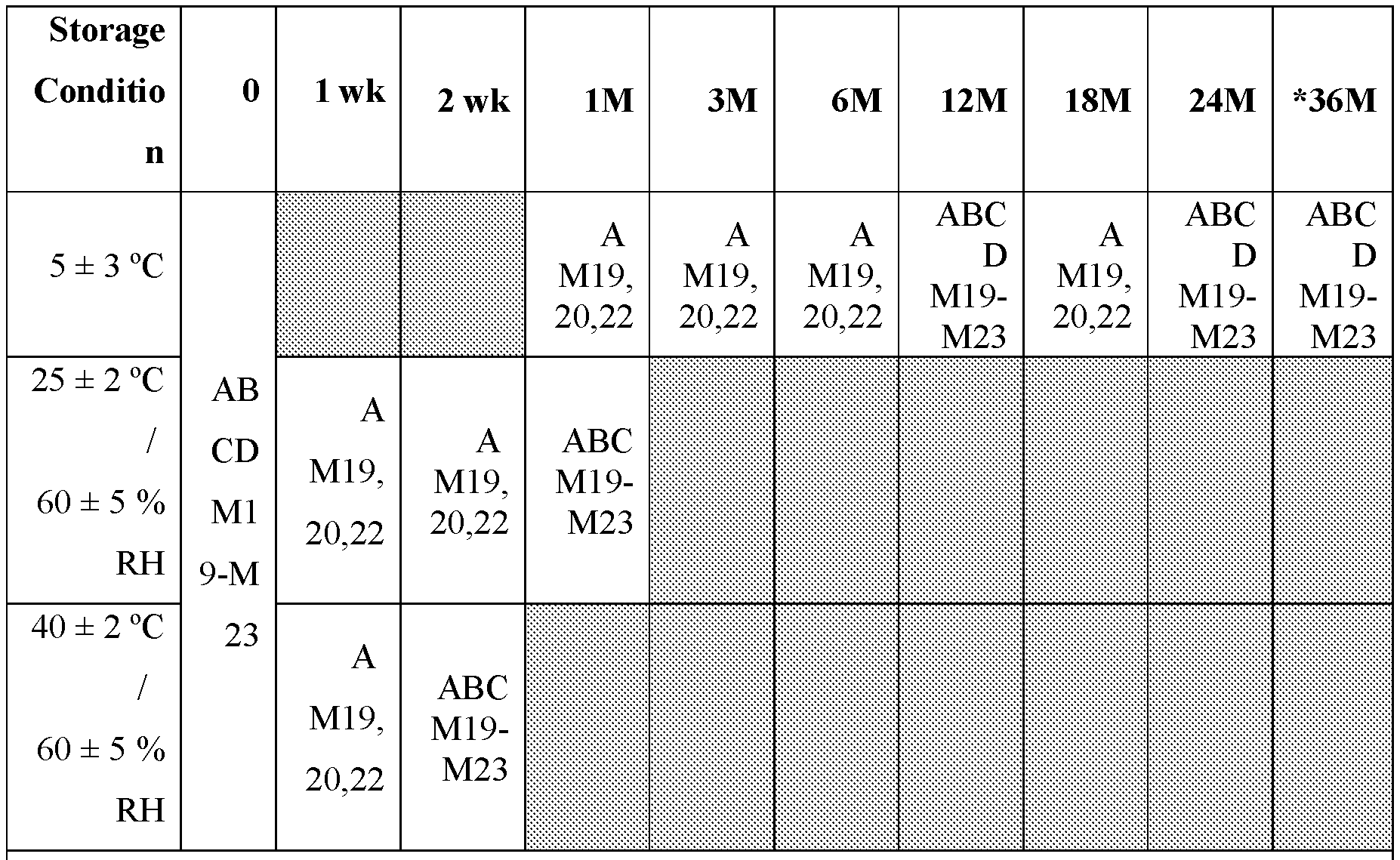


 [0253] Samples were placed on stability as outlined in Table 14 and Table 15. Analytics were performed within BTx PharmSci ART), with the exception of appearance, BLEF and HIAC assays which were performed within BTx PharmSci PhRD.
[0254] Appearance testing was performed to evaluate the color, clarity compared to reference standards, and visible particles for DPS formulations only at certain time points.
[0255] For all formulations evaluated, except in one instance, there was no difference in the color of the DPS. All formulations were less intensely colored than standard BY6, which is a noticeable brown yellow color and is within the established drug product specifications.
[0256] For visible particles and clarity, almost all formulations were essentially free of visible particles and less opalescent than reference I (3 NTU). Appearance results are summarized in Table 16.
Table 16. Appearance Data Summary
 a. Color results are reported as not more intensely colored than the standard reported - BY7 is colorless, BY1 is an intense brown yellow color b. Clarity is reported as not more opalescent than standard reported c. EFVP - Essentially Free of Visible Particles d. One white environmental particle e. One black environmental particle
[0257] At the intended storage temperature of 2 - 8 °C and under accelerated conditions at 25 °C, no apparent difference in aggregation/high molecular weight species (HMWS) between the formulations were observed. Aggregation met the release and stability specification for all formulations after 36 months at 2 - 8 °C. Under 40 °C accelerated storage conditions, HMWS increased for all formulations.
[0258] Decreases were observed in monomer, however these decreases mirrored increases observed in HMWS when appropriate.
[0259] At all temperatures, no apparent increase or difference in aggregation (HMWS) between the formulations was observed. Aggregation was less than the release and stability specification for all formulations at all temperatures. No apparent trend was observed among the formulations.
[0260] All DPS formulations showed a decrease in % main peak and appropriately an increase in % related forms over time at all conditions evaluated.
[0261] At 2 - 8 °C, no apparent difference was observed between the different formulations.
At the 25 °C and 40 °C accelerated conditions, the decreases in % main were larger in the lower pH formulation (M20), suggesting that higher pH improves stability of somatrogon DPS.
[0262] All formulations except the formulation with the lowest pH (Ml 7) showed no significant change in the RP HPLC profile at frozen temperatures, accelerated 2-8 °C or stressed 25 °C. The formulation at pH 6.2 (Ml 7) showed a slight decrease in % main, primarily at the stressed 25 °C condition.
[0263] All DPS formulations showed a decreased in % main and appropriately an increase in % fragment over time at all conditions evaluated.
[0264] At 2-8 °C, no apparent difference was observed between the different formulations. At the 25 °C and 40 °C accelerated conditions, the decreases in % main were larger in the higher pH formulations (M22 and M23).
[0265] Up to 12 months at 2-8 °C, no apparent changes or trends were observed in m-Cresol concentration for all formulations evaluated. m-Cresol concentration for each condition was within 0.2 mg/mL of the target concentration. At the 24-month timepoint, there was an apparent
loss of m-Cresol in all formulations tested. At the 36-month timepoint, the results were similar to the 24 month timepoint indicating that the loss was real. An average of 0.3 mg/mL m-Cresol was lost on stability after 36 months. m-Cresol concentration results are summarized in in Table 17. Table 17. Drug Product Solution: m-Cresol Data Summary
 [0266] After 36 months of collected data, there is no significant change in the glide force in all evaluated formulations at all storage conditions. The break loose force showed higher variability but all the results are within the variability observed with this assay. Refer to Table 18 for the data. Table 18. Drug Product Solution: BLEF Data Summary
 * Not tested because of sample limitation
[0267] No apparent trend or changes were observed in concentration for all formulations evaluated. Refer to Table 19 for data.
Table 19. Drug Product Solution: Concentration (mg/mL)


[0268] No apparent trend was observed in concentration for all formulations evaluated. The concentration showed higher variability but all the results are within the variability observed with this assay. Refer to Table 20 for data. [0269] No apparent changes or trends were observed in pH for all DPS formulations evaluated. pH for each condition is within 0.2 pH units of the target pH. pH results are summarized Table 21
Table 20. Drug Substance: Concentration (mg/mL)


Table 21. Drug Product Solution: pH


* Not tested because of sample limitation
[0270] DS pH was tested at time zero and at 36 months. pH for each condition is within 0.2 pH units of the target pH. pH results are summarized in Table 22.
Table 22. Drug Substance: pH

[0271] No apparent trend or changes were observed in cellular bioassay for all DPS formulations evaluated. All results are currently within release and stability specifications for DPS. Cellular bioassay results are summarized in Table 23.
Table 23. Drug Product Solution: Bioassay Data Summary

[0272] All DPS formulations meet USP <788> standards for 10 mih and 25 mih particles sizes assuming a 1.2 mL fill volume. Except for T36M data, the subvisible particulates counts appear to be higher compared to historical data but there was no difference attributed to the formulation. TO count was higher than subsequent time points. No instability was observed in other critical quality attributes indicating that these data can be considered as outliers. HIAC results are summarized in Table 24.
Table 24. Drug Product Solution: Subvisible Particulates Data


* Not tested because of sample limitation
[0273] After 36 months of DS and DPS stability, the data supports variations in pH of ±0.4 pH units, ±25% variation the target concentration of NaCl, and ±20% variation of the target protein concentrations of somatrogon for both DS and DPS. For each of the formulations evaluated there was no apparent impact of these variations on overall drug product quality attributes under normal storage, in-use or manufacturing conditions.
[0274] These results demonstrate that the 3 DS and 4 DPS formulations evaluated for this study help define a large effective design space for the somatrogon DS and DPS. After 36 months stability, the data supports variations in pH of ±0.4 pH units, ±25% variation the target concentration of NaCl, and ±20% variation of the target concentrations of somatrogon for both
DS and DPS. For each of the formulations evaluated there was no apparent impact of these variations on overall drug product quality attributes. Overall, the data shows that the somatrogon DS and DPS formulations are robust and the molecule is stable when exposed to minor variation in the formulation matrix.
EXAMPLE 7: Formulation Excipient Robustness Study Report
[0275] This Example illustrates a formulation excipient robustness study to verify the acceptable excipient concentration for both the final drug product solution and drug substance. [0276] The objective of this study was to assess the robustness of the somatrogon commercial formulation by varying excipient concentrations and pH outside their targets and examining the potential impacts, if any, on product quality. This information will be used to establish the final formulation design space for somatrogon drug substance (DS) and drug product solution (DPS). [0277] The current formulation of the somatrogon DPS may be produced as three presentations: 10, 20 and 50 mg/mL. The drug product solution formulation is produced as a liquid solution formulated in 10 mM citrate, 10 mM L-histidine, 147 mM sodium chloride, 2 mg/mL Poloxamer 188 and 3 mg/mL m-Cresol. Drug product solution is then filled into 3 mL- Ompi siliconized cartridges. At the time of the study, the cartridges were produced on line W952 at a target of 5 mg ± 1.5 mg using a 7% DC 365 emulsion. The somatrogon DS is manufactured with 10 mM citrate, 10 mM L-histidine, 147 mM sodium chloride at pH 6.6.
[0278] A component of the late stage development process requires verification of the acceptable excipient concentration and pH ranges for both the final drug product solution and drug substances. This study evaluated excipient robustness. pH robustness was evaluated in the study described above in Example 6.
[0279] In this study, two different drug product solution formulation variations were evaluated alongside the current proposed drug product formulation. The variations tested were: low protein concentration/low excipient concentrations and high protein concentration/high excipient concentrations.
[0280] For the low protein/excipients formulation, 1) NaCl, buffer components and P188 concentrations were decreased by 25%; 2) protein concentration was decreased by 20%; 3) compounding was performed with a m-Cresol stock solution that was 20% lower in concentration; and 4) bulk drug product was filled into cartridges produced at the lower end of the siliconization specification in place at the time of the study for cartridges produced on line W952 (3.5 mg using a 7% DC 365 emulsion).
[0281] For the high protein/excipients formulation, 1) NaCl, buffer components and P188 concentrations were increased by 25%; 2) protein concentration was increased by 20%; 3) compounding was performed with a m-Cresol stock solution that was 20% higher in concentration; and 4) bulk drug product was filled into cartridges produced at the higher end of the siliconization specification in place at the time of the study for cartridges produced on line W952 (6.5 mg using a 7% DC 365 emulsion).
[0282] For drug substance, two different drug substance formulation variations were evaluated alongside the current proposed drug product formulation. The variations tested were: high
protein /low excipient concentrations and low protein /high excipient concentrations. In theory, increased NaCl concentration and lower protein concentration decrease the glass transition temperature (Tg’) of the frozen solution of DS, while decreased NaCl concentration and higher protein concentration increase the Tg’ of the frozen solution of DS. These two formulation variations provided the upper and lower end of the glass transition temperatures for the system. [0283] Two different variations of DS and DPS formulation variations were evaluated alongside the current proposed formulation. DS Lot HH6 (Lot # 00706586-0161-M07) was used to formulate the different DS and DPS formulations. Additional materials used are summarized in notebook page 00710012-0135. [0284] Because the drug substance is stored at frozen conditions, the NaCl concentration was the main component that was evaluated. For the low protein concentration/high excipients formulation, the protein concentration was decreased by 10%, while the [NaCl] and [Buffer] were increased by 25%. For the high protein concentration/low excipients formulation, the protein concentration was increased by 10%, while the [NaCl] and [Buffer] were decreased by 25%. pH was not varied and all formulations were at pH 6.6.
[0285] The starting concentration of DS used in this study was approximately 86 mg/mL. DS formulations were prepared by buffer exchanging DS in the described formulation in Table 25. DS concentration was adjusted post-dialysis to the desired concentrations. Only Low-Temperature Differential Scanning Calorimetry (LT-DSC) was performed on the DS samples.
[0286] For DPS, the formulations were prepared using the dialyzed drug substance. DS for the control formulations was also dialyzed to expose the DS to the same manipulations as the DS used to prepare the other formulations (Tables and 26 and 27).
Table 25. Composition of DS Formulations

Table 26. Composition of DPS Formulations

 a. Cartridges manufactured on line W952 (6.5 mg using a 7% DC 365 emulsion)
Table 27. Preparation of somatrogon DPS solutions

[0287] Cartridges were filled with 1.2 mL for BLEF and sub-visible particulate analysis. The rest of the cartridges were filled with 0.5 mL of solution. All cartridges were placed on stability for up to 24 months at 2-8 °C, 1 month at 25 °C, and two weeks at 40 °C in the horizontal orientation. Since the study was initially planned as a short-term study, retains from T=2M stored at 5 ± 3 °C in glass vials were tested at T=12 months for SEC, RP HPLC and m-Cresol. Contingency samples stored at 5 ± 3 °C were tested at T=24 months.
[0288] Analytics were performed within BTx-PharmSci-PhRD. Method numbers are summarized in Table 28.
Table 28. Drug product solution Formulation Compositions and Sample Testing Matrix
 a. Osmolality was performed at TO. b. Retains from T=2M stored at 5 ± 3 °C in glass vials were tested at T=12 months for SEC, RP-HPLC and m-Cresol. c. Contingency samples stored at 5 ± 3 °C were tested at T=24 months.
Nt = not tested
[0289] Appearance testing was performed at certain time points to evaluate the color, clarity compared to reference standards, and visible particles for DPS formulations.
[0290] For all formulations evaluated, there was no difference in the color of the DPS. It was less intensely colored than standard BY7, which is a very slightly brown-yellow color and is within the established drug product specifications.
[0291] For visible particles and clarity, all formulations were essentially free of visible particles and less opalescent than reference I (3 NTU). Appearance results are summarized in
Table 29.
Table 29. Appearance Data Summary

'Color results are reported as not more intensely colored than the standard reported - BY7 is colorless; BY1 is an intense brown-yellow color.
2Clarity is reported as not more opalescent than standard reported.
3EFVP = Essentially Free of Visible Particles. [0292] At the intended storage temperature of 2-8 °C, no apparent increase or difference in aggregation (HMWS) between the formulations was observed. Aggregation was less than the release and stability specification for all formulations. At both 25 °C and 40 °C accelerated
storage conditions, aggregation increased for the High and DPS 50 Control formulations. This difference was primarily observed at 40 °C. No apparent change in HMWS was observed after 24 hours of agitation at 150 rpm for all formulations. Agitation results are summarized in Table 30. Table 30. Agitation SEC Results

[0293] All DPS formulations showed a decrease in % main peak over time at all conditions evaluated. There was no significant difference in the rate of degradation of the DPS 10 Control and the DPS Low formulations. Similarly, there was no significant difference in the rate of degradation of the DPS 50 Control and the DPS High formulations. % Main was within the release and stability specification for all formulations. No apparent change in % main peak was observed after 24 hours of agitation at 150 rpm for all formulations. Agitation RP HPLC results are summarized in Table 31.
Table 31. Agitation RP-HPLC Results

[0294] All DPS formulations showed an increase in % fragments at 40 °C and after 24 months at 5 °C. No other trends are observed. No apparent change in % main peak was observed after 24 hours of agitation at 150 rpm for all formulations. rCGE stability results are summarized in Table 32 and agitation results are summarized in Table 33. Table 32. rCGE Stability Results


Table 33. Agitation rCGE Results

[0295] No apparent changes or trends was observed in m Cresol concentration for all formulations evaluated. The m Cresol concentration for each condition is within 0.2 mg/mL of the target concentration m Cresol concentration results are summarized in Table 34.
Table 34. m-Cresol Concentration Results


[0296] P188 concentration was determined for all formulations at T24 months. P188 concentration data are summarized in Table 35.
Table 35. DPS P188 Results

[0297] Osmolality was determined for all formulations at TO. Osmolality data are summarized in Table 36.
Table 36. DPS Osmolality Result
 [0298] No apparent changes or trends were observed in viscosity for all formulations evaluated.
Viscosity results are summarized in Table 37.
Table 37. Viscosity Data Summary


[0299] No apparent trend or changes were observed in concentration for all formulations evaluated. Refer to Table 38 for data.
Table 38. Concentration by RP-HPLC

[0300] No apparent changes or trends were observed in pH for all DPS formulations evaluated. The pH for each condition is within 0.3 pH units of the target pH. pH results are summarized in Table 39.
Table 39. DPS pH Results


[0301] All DPS formulations meet USP <788>standards for 10 mih and 25 mih particles sizes assuming a 1.2 mL final extractable container volume. The DPS 10 Control formulation showed increased subvisible particulate counts at 4 weeks at 25 °C, however; no instability was observed in other critical quality attributes indicating that this data can be considered an outlier. The subvisible data collected for the pre-formal development stability study confirms that this observation is not temperature related and is most likely an outlier (INX100245421). No other trends were observed. HIAC results are summarized in Table 40.
Table 40. Subvisible Particulate Data Summary


[0302] Low-temperature DSC was performed on 2 different DS formulation variations alongside the current formulation. Glass temperature data are summarized in Table 41. Variations in the formulation matrix do not change the glass transition profile significantly suggesting no stability differences would be anticipated upon storage at -80°C when compared to control DS. Stability data on DS was collected as part of the pH robustness study and the formulation with high salt and high protein concentration (worst case glass transition profile) showed no impact on DS stability profile (INX100335022).
Table 41. DSC Data Summary

[0303] After 12 months of DPS stability, the data supports ± 25% variation in the target concentration of NaCl, ± 25% variation in the target concentration of buffer, ± 25% variation in the target concentration of PI 88, -16% to +20% variation in the target concentration of m- Cresol, ± 20% variation in the target concentration of the m-Cresol stock buffer, and ± 20% variation of the target concentrations of somatrogon for DPS. For each of the formulations evaluated there was no apparent impact of these variations on overall drug product quality attributes under normal storage, in use or manufacturing conditions.
[0304] Overall, the data shows that the somatrogon DS and DPS formulations are robust and the molecule is stable when exposed to minor variation in the formulation matrix.
EXAMPLE 8: Optimization of m-Cresol concentration
[0305] This Example illustrates the optimization of the concentration of the m-Cresol in the m- Cresol buffer, as well as the final concentration of m-Cresol in the drug product solution.
[0306] The formulation process for the somatrogon drug product solution involves diluting the drug substance in the drug substance (i.e. lx diluent) buffer then adding poloxamer 188 and m- Cresol to a final target of 2 mg/mL and 3 mg/mL, respectively. The addition of the poloxamer 188 buffer and m-Cresol buffer further dilutes the concentration of somatrogon in the solution,
and the process is designed such that, upon the addition of the m-Cresol buffer, the final drug product solution protein concentration is achieved.
[0307] During the initial engineering batches, m-Cresol buffer at 11.0 mg/mL was used to achieve a manufacturing target concentration of 3.30 mg/mL m-Cresol in the formulated bulk product solution. The manufacturing target of 3.30 mg/mL m-Cresol was chosen to account for possible loss of m-Cresol due to adsorption to surfaces during manufacturing. While not observed during the engineering runs, high concentrations of m-Cresol buffer had been shown to generate high molecular weight species (HMWS) during compounding.
[0308] The concentration of the m-cresol buffer was reduced to 10.5 mg/mL, and the manufacturing target of m-Cresol was reduced to 3.15 mg/mL m-Cresol for the first clinical campaign. The target m-Cresol concentration was achieved and no issues were observed.
[0309] During the manufacture of the second clinical campaign, an instance arose where the drug substance concentration (73 mg/mL) from Lot W01881 was not high enough to add the m- Cresol (10.5 mg/mL) buffer and achieve the manufacturing target m-Cresol concentration (3.15 mg/mL) without over-diluting the protein. The process includes a slight overage in the m-Cresol target concentration to mitigate any potential loss of m-Cresol due to absorption to product- contact parts.
[0310] The equation for calculating the minimum drug substance concentration required is as follows: Target protein conc/( 1 - (Target P188 conc/P188 buffer cone + Target m-Cresol conc/m-Cresol buffer cone) = Min DS cone
[0311] For the process described above the minimum drug substance concentration was calculated to be 73.2 mg/mL: 50.0/(l-(2/120+3.15/10.5)=73.2 mg/mL [0312] At the manufacturing location, the drug substance target concentration is 75 mg/mL with an internal target range between 71 and 82 mg/mL. The event that occurred with clinical batch W01881 highlighted the need to modify the target concentration of the m-Cresol buffer as well as the manufacturing target concentration of m-Cresol.
[0313] Using a m-Cresol buffer with a target concentration of 11 mg/mL and manufacturing targeting of 3.05 mg/mL in the bulk drug product solution, the minimum drug substance concentration required was reduced to 70.8 mg/mL.
[0314] 50.0/(l-(2/120f 3.05/11.0)=70.8 mg/mL
[0315] For the third clinical campaign, m-Cresol buffer with a concentration of 11 mg/mL targeting a manufacturing concentration of 3.05 mg/mL in the final product was utilized. For process validation lots, the target m-Cresol manufacturing concentration was reduced to 3.04 mg/mL using a buffer concentration of 11 mg/mL.
[0316] Table 42 provides a summary of the m-Cresol data generated during manufacturing runs.
Table 42. Summary of the m-Cresol data generated during manufacturing runs

* m-Cresol concentration in the bulk DPI from the middle of the vessel. ** value represents average of data from intra batch study EXAMPLE 9: Drug Substance and Drug Product Solution Formulation
[0317] This Example illustrates the somatrogon (PF-06836922, MOD-4023) GMP drug substance and drug product solution (DPS) formulation for commercial production and
marketing. This Example defines the GMP drug substance and GMP drug product solution formulation for manufacturing, regulatory and labeling purposes. This Example may also be referred to for clinical use of clinical and commercial supplies. This Example illustrates the definition of the formulation, container closure, storage information, and fill volume for the drug substance and drug product solution. This Example also summarizes the drug product solution extractable/deliverable (nominal) volume and the commercial label claim for strength.
[0318] Based on development studies, target formulation for somatrogon drug substance was defined as 75 mg/mL somatrogon in 10 mM citrate, 10 mM L-histidine and 147 mM sodium chloride at pH 6.6. The drug substance formulation for clinical studies, manufacturing and regulatory purposes including intended commercial production is shown in Table 43.
Table 43. Somatrogon Drug Substance Formulation Description
 a. The drug substance formulation description is denoted interchangeably as citrate and sodium citrate, as citric acid monohydrate is titrated to pH 6.5-6.7 with sodium hydroxide
[0319] The target formulation for somatrogon drug product solution (DPS) was developed as 20 mg/mL or 50 mg/mL somatrogon in 10 mM sodium citrate, 10 mM L-histidine, 147 mM sodium chloride, 2 mg/mL poloxamer 188 and 3 mg/mL m-Cresol at pH 6.6. The DPS is perceived as a colorless to slightly light yellow solution. To support commercial acceptance criteria, however, an instrumental colorimetric analysis has been performed, and on the basis of those results, the brown color has been assigned for DPS for the specification. There are two presentations of pre-filled pen that the DPS cartridge is used in: 24 mg and 60 mg. For both presentations, the target fill volume of the cartridge is 1.519 mL with an expected nominal volume of 1.2 mL. The strengths for the two presentations are 24 mg/1.2 mL (20 mg/mL formulation concentration) and 60 mg/1.2 mL (50 mg/mL formulation concentration), respectively. The drug product formulation for clinical studies, manufacturing and regulatory purposes including commercial production is shown in Table 44 for the 24 mg presentation and Table 45 for the 60 mg presentation. Table 44. Composition of 20 mg/mL (24 mg/1.2 mL) Somatrogon DPS Presentation
 b. Filled amount includes overfill. This is calculated by multiplying unit formula (mg/mL) by actual fill volume (1.519 mL). c. Nominal amount does not include overfill and represents the Net Quantity. This is calculated by multiplying unit formula (mg/mL) by nominal volume (1.2 mL). Values are rounded to maintain the same level of precision as the label claim. For example, 4 mg m-Cresol is rounded from 3.6 mg (3 mg/mL m-Cresol x 1.2 mL) and 2 mg Poloxamer 188 is rounded from 2.4 mg (2 mg/mL x 1.2 mL). d. The combination of the Trisodium Citrate Dihydrate and Citric Acid Monohydrate is equivalent to 10 mM sodium citrate. e. Named as Metacresol in the USP. f. In order to ensure that the target 3 mg/mL m-Cresol is met over the shelf-life of the product, a manufacturing overage of 5% to target 3.15 mg/mL m-Cresol has been added to account
for loss over stability. g. Poloxamer 188 is named as Polyoxyethylene (160) Polyoxypropylene (30) glycol in the JPE. h. q.s. is an abbreviation for quantum satis meaning as much as is sufficient.
Target pH = 6.6 ± 0.3
Table 45. Composition of 50 mg/mL (60 mg/1.2 mL) Somatrogon DPS Presentation

 a. Batch unit formula includes manufacturing overages. b. Filled amount includes overfill. This is calculated by multiplying unit formula (mg/mL) by actual fill volume (1.519 mL). c. Nominal amount does not include overfill and represents the Net Quantity. This is calculated by multiplying unit formula (mg/mL) by nominal volume (1.2 mL). Values are rounded to maintain the same level of precision as the label claim. For example, 4 mg m- Cresol is rounded from 3.6 mg (3 mg/mL m-Cresol x 1.2 mL) and 2 mg Poloxamer 188 is rounded from 2.4 mg (2 mg/mL x 1.2 mL). d. The combination of the Trisodium Citrate Dihydrate and Citric Acid Monohydrate is equivalent to 10 mM sodium citrate. e. Named as Metacresol in the USP. f. In order to ensure that the target 3 mg/mL m-Cresol is met over the shelf-life of the product, a manufacturing overage of 5% to target 3.15 mg/mL m-Cresol has been added to account for loss over stability. g. Poloxamer 188 is named as Polyoxyethylene (160) Polyoxypropylene (30) glycol in the
JPE. h. q.s. is an abbreviation for quantum satis meaning as much as is sufficient. Target pH = 6.6 ± 0.3
[0320] Filtered drug substance from the Grange Castle 2K facility is packaged in sterile polyethylene terephthalate co-polyester G (PETG) bottles with high-density polyethylene (HDPE) screw closures as described in Table 46 below. Filtered drug substance from the Grange Castle 12K facility is packaged in ethylene-vinyl acetate (EVA) bags as described in Table 46 below.
Table 46. Somatrogon Drug Substance Container
 [0321] The container/closure systems for the somatrogon drug product cartridge are summarized in Table 47 below.
Table 47. Somatrogon DPS (Cartridge) Container/Closure System Description
 [0322] The recommended storage temperature of the drug substance supplied in PETG bottles is -60°C to -90°C. The recommended storage temperature of the drug substance supplied in Celsius bags is -30°C to -50°C. The recommended storage temperature of the drug product solution (cartridge) is 2-8°C.
[0323] The somatrogon drug product was essentially sodium free as it contained less than 1 mmol (23 mg) sodium per unit volume or per maximum dose. The highest level of sodium, 174.5 mM (rounded to 175 mM), was measured for process validation lot CD0567.This level was slightly above the actual target sodium content based on the composition provided above. For the sake of the calculation, a worst case number was used. Based on this measurement, the total sodium content in the drug product per unit volume was determined according to the following calculation: 175 mmoles/L sodium x nominal volume of 1.2 mL (x 0.0012 L) = 0.21 mmoles sodium. The maximum dose volume administered was determined to be 2 mL considering a 100 kg patient and a maximum dose of 1 mg/kg/week using the 50 mg/mL strength. Based on these values, the maximum intake of sodium per dose was determined according to the following calculations: 1 mg somatrogon/kg patient body weight * 100 kg patient = 100 mg somatrogon/week
100 mg somatrogon/week / 50 mg/mL somatrogon = 2 mL maximum dose volume 175 mmoles/L sodium x maximum dose volume of 2 mL (x 0.002 L) = 0.35 mmoles sodium.
[0324] Although the disclosed teachings have been described with reference to various applications, methods, and compositions, it will be appreciated that various changes and modifications can be made without departing from the teachings herein and the claimed invention below. The foregoing description and Examples detail certain specific embodiments of the invention and describes the best mode contemplated by the inventors. It will be appreciated, however, that no matter how detailed the foregoing may appear in text, the invention may be practiced in many ways and the invention should be construed in accordance with the appended claims and any equivalents thereof. While the present teachings have been described in terms of these exemplary embodiments, the skilled artisan will readily understand that numerous variations and modifications of these exemplary embodiments are possible without undue experimentation. All such variations and modifications are within the scope of the current teachings.
[0325] All references cited herein, including patents, patent applications, papers, textbooks, and the like, and the references cited therein, to the extent that they are not already, are hereby incorporated by reference in their entirety. In the event that one or more of the incorporated literature and similar materials differs from or contradicts this application, including but not limited to defined terms, term usage, described techniques, or the like, this application controls.
Claims
1. A stable, aqueous pharmaceutical composition comprising: a long-acting recombinant human growth hormone (rhGH); citrate;
L-Histidine; sodium chloride; poloxamer 188; m-cresol; and water.
2. The aqueous composition of claim 1, wherein the long-acting rhGH comprises the amino acid sequence shown in SEQ ID NO: 2.
3. The aqueous composition of claim 1 or 2, wherein the long-acting rhGH is glycosylated.
4. The aqueous composition of any one of claims 1 to 3, wherein the aqueous composition comprises: about 10 mg/mL to about 90 mg/mL long-acting rhGH; about 7.5 mM to about 12.5 mM citrate; about 7.5 mM to about 12.5 mM L-Histidine; about 110 mM to about 184 mM sodium chloride; about 1.5 mg/mL to about 2.5 mg/mL poloxamer 188; and about 2.4 mg/mL to about 3.6 mg/mL m-cresol, wherein the aqueous composition has a pH of about 6.2 to about 7.
5. The aqueous composition of any one of claims 1 to 4, wherein the aqueous composition comprises: about 20 mg/mL or about 50 mg/mL long-acting rhGH; about 10 mM citrate; about 10 mM L-Histidine; about 147 mM sodium chloride; about 2 mg/mL poloxamer 188; and
about 3 mg/mL m-cresol, wherein the aqueous composition has a pH of about 6.6.
6. A method of treating growth hormone deficiency in a subject in need thereof, the method comprising administering an effective amount of a stable, aqueous pharmaceutical composition to the subject, wherein the aqueous composition comprises: about 10 mg/mL to about 90 mg/mL long-acting rhGH; about 7.5 mM to about 12.5 mM citrate; about 7.5 mM to about 12.5 mM L-Histidine; about 110 mM to about 184 mM sodium chloride; about 1.5 mg/mL to about 2.5 mg/mL poloxamer 188; and about 2.4 mg/mL to about 3.6 mg/mL m-cresol, wherein the aqueous composition has a pH of about 6.2 to about 7.
7. The method of claim 6, wherein the aqueous composition comprises:
20 mg/mL or 50 mg/mL long-acting rhGH;
10 mM citrate;
10 mM L-Histidine;
147 mM sodium chloride;
2 mg/mL poloxamer 188; and
3 mg/mL m-cresol, wherein the aqueous composition has a pH of about 6.6.
8. The method of claim 6 or 7, wherein the long-acting rhGH is a C-terminal peptide (CTP)- modified hGH.
9. The method of any one of claims 6 to 8, wherein the long-acting rhGH comprises the amino acid sequence of mature human growth hormone (hGH) with one copy of CTP from the beta chain of human chorionic gonadotropin at the hGH N-terminus and two copies of CTP in tandem at the hGH C-terminus.
10.The method of any one of claims 6 to 9, wherein the long-acting rhGH comprises the amino acid sequence shown in SEQ ID NO: 2.
11.The method of any one of claims 6 to 10, wherein the long-acting rhGH is glycosylated.
12.The method of any one of claims 6 to 11, wherein the long-acting rhGH is administered according to a dosage regimen comprising subcutaneous administration of a dose of 0.66 mg per kg body weight once weekly at any time of day.
13.The method of claim 12, wherein the long-acting rhGH is administered on the same day each week.
14.The method of claim 12, wherein the time between two doses is at least three days.
15.The method of any one of claims 6 to 14, wherein the long-acting rhGH is administered subcutaneously by a prefilled pen or syringe.
16.The method of claim 15, wherein the pen contains about 1.2 mL or about 1.5 mL of the aqueous pharmaceutical composition.
17.The method of any one of claims 6 to 16, wherein the long-acting rhGH is administered from a disposable prefilled pen containing 24 mg long-acting rhGH.
18.The method of claim 17, wherein the pen delivers a dose in 0.2 mg increments.
19.The method of any one of claims 6 to 16, wherein the long-acting rhGH is administered from a disposable prefilled pen containing 60 mg long-acting rhGH.
20.The method of claim 19, wherein the pen delivers a dose in 0.5 mg increments.
21. The method of any one of claims 6 to 20, wherein the subject has one or more of the following: isolated growth hormone deficiency (GHD), GH insufficiency as part of multiple pituitary hormone deficiency, pediatric GHD, and Prader-Willi Syndrome.
22.The method of any one of claims 6 to 21, wherein the subject is a child subject.
23.The method of claim 22, wherein the child subject is three years old or older.
24.The method of any one of claims 6 to 20, wherein the subject has adult GHD.
25. A prefilled pen comprising a stable, aqueous pharmaceutical composition, wherein the aqueous composition comprises: a long-acting recombinant human growth hormone (rhGH); citric acid monohydrate;
L-Histidine; m-cresol; poloxamer 188; sodium chloride; trisodium citrate dihydrate; and water.
26.The prefilled pen of claim 25, wherein the aqueous composition has a pH of about 6.6.
27.The prefilled pen of claim 25 or 26, wherein the long-acting rhGH comprises the amino acid sequence of human growth hormone (hGH) with one copy of CTP from the beta chain of human chorionic gonadotropin at the hGH N-terminus and two copies of CTP in tandem at the hGH C- terminus.
28.The prefilled pen of any one of claims 25 to 27, wherein the long-acting rhGH comprises the amino acid sequence shown in SEQ ID NO: 2.
29.The prefilled pen of any one of claims 25 to 28, wherein the long-acting rhGH is glycosylated.
30.The prefilled pen of any one of claims 25 to 29, wherein the volume of the aqueous pharmaceutical composition in the prefilled pen is about 1.2 mL or about 1.519 mL
31. The prefilled pen of claim 30, wherein the aqueous composition in the prefilled pen comprises
24 mg long-acting rhGH;
0.3 mg citric acid monohydrate;
1.9 mg L-Histidine;
4 mg m-cresol;
2 mg poloxamer 188;
10 mg sodium chloride;
3.1 mg trisodium citrate dihydrate; and water up to 1.2 ml.
32.The prefilled pen of claim 31, wherein the prefilled pen delivers a dose of long-acting rhGH in 0.2 mg increments.
33.The prefilled pen of claim 31 or 32, wherein the pen delivers a maximum single dose of long- acting rhGH of 12 mg and optionally, wherein the pen delivers a maxiumn single dose volume of 600 pL.
34.The prefilled pen of claim 30, wherein the aqueous composition in the prefilled pen comprises
60 mg long-acting rhGH;
0.3 mg citric acid monohydrate;
1.9 mg L-Histidine;
4 mg m-cresol;
2 mg poloxamer 188;
10 mg sodium chloride;
3.1 mg trisodium citrate dihydrate; and water up to 1.2 ml.
35.The prefilled pen of claim 34, wherein the prefilled pen delivers a dose of long-acting rhGH in 0.5 mg increments.
36.The prefilled pen of claim 34 or 35, wherein the pen delivers a maximum single dose of long- acting rhGH of 30 mg and optionally, wherein the pen delivers a maxiumn single dose volume of 600 pL.
37.The prefilled pen of any one of claims 25 to 36, wherein the prefilled pen is capable of setting and delivering a variable dose of long-acting rhGH, wherein the dose is determined based on subject body weight.
38.The prefilled pen of any one of claims 25 to 36, wherein the pen has a use period of 28 days from first use when stored at two to eight degrees Celsius between uses.
39.The use of a stable, aqueous pharmaceutical composition for the manufacture of a medicament for the treatment of growth hormone deficiency, wherein the aqueous composition comprises: about 10 mg/mL to about 90 mg/mL long-acting rhGH; about 7.5 mM to about 12.5 mM citrate; about 7.5 mM to about 12.5 mM L-Histidine; about 110 mM to about 184 mM sodium chloride; about 1.5 mg/mL to about 2.5 mg/mL poloxamer 188; and about 2.4 mg/mL to about 3.6 mg/mL m-cresol, wherein the aqueous composition has a pH of about 6.2 to about 7.
40.The use of claim 39, wherein the aqueous composition comprises:
20 mg/mL or 50 mg/mL long-acting rhGH;
10 mM citrate;
10 mM L-Histidine;
147 mM sodium chloride;
2 mg/mL poloxamer 188; and
3 mg/mL m-cresol, wherein the aqueous composition has a pH of about 6.6.
41. The use of claim 39 or 40, wherein the long-acting rhGH is a C-terminal peptide (CTP)- modified hGH.
42.The use of any one of claims 39 to 41, wherein the long-acting rhGH comprises the amino acid sequence of mature human growth hormone (hGH) with one copy of CTP from the beta chain of human chorionic gonadotropin at the hGH N-terminus and two copies of CTP in tandem at the hGH C-terminus.
43.The use of any one of claims 39 to 42, wherein the long-acting rhGH comprises the amino acid sequence shown in SEQ ID NO: 2.
44.The use of any one of claims 39 to 43, wherein the long-acting rhGH is glycosylated.
45.The use of any one of claims 39 to 44, wherein the long-acting rhGH is administered according to a dosage regimen comprising subcutaneous administration of a dose of about 0.66
mg per kg body weight once weekly at any time of day.
46.The use of claim 45, wherein the long-acting rhGH is administered on the same day each week.
47.The use of claim 45, wherein the time between two doses is at least three days.
48.The use of any one of claims 39 to 47, wherein the long-acting rhGH is administered subcutaneously by a prefilled pen or syringe.
49.The use of claim 48, wherein the pen contains about 1.2 ml or about 1.519 mL of the aqueous pharmaceutical composition.
50.The use of any one of claims 39 to 49, wherein the long-acting rhGH is administered from a disposable prefilled pen containing 24 mg long-acting rhGH.
51. The use of claim 50, wherein the pen delivers a dose in 0.2 mg increments.
52.The use of any one of claims 39 to 49, wherein the long-acting rhGH is administered from a disposable prefilled pen containing 60 mg long-acting rhGH.
53.The use of claim 52, wherein the pen delivers a dose in 0.5 mg increments.
Applications Claiming Priority (4)
| Application Number | Priority Date | Filing Date | Title |
|---|---|---|---|
| US202163163506P | 2021-03-19 | 2021-03-19 | |
| US63/163,506 | 2021-03-19 | ||
| US202263267680P | 2022-02-08 | 2022-02-08 | |
| US63/267,680 | 2022-02-08 |
Publications (1)
| Publication Number | Publication Date |
|---|---|
| WO2022197963A1 true WO2022197963A1 (en) | 2022-09-22 |
Family
ID=83320808
Family Applications (1)
| Application Number | Title | Priority Date | Filing Date |
|---|---|---|---|
| PCT/US2022/020807 Ceased WO2022197963A1 (en) | 2021-03-19 | 2022-03-17 | Long-acting growth hormone compositions |
Country Status (1)
| Country | Link |
|---|---|
| WO (1) | WO2022197963A1 (en) |
Citations (5)
| Publication number | Priority date | Publication date | Assignee | Title |
|---|---|---|---|---|
| WO1993012812A1 (en) * | 1991-12-20 | 1993-07-08 | Novo Nordisk A/S | A stabilized pharmaceutical formulation comprising growth hormone and histidine |
| US20160310576A1 (en) * | 2013-10-21 | 2016-10-27 | Opko Biologics Ltd. | Long-acting polypeptides and methods of producing and administering same |
| US20170312342A1 (en) * | 2014-11-21 | 2017-11-02 | Ascendis Pharma Endocrinology Division A/S | Long-Acting Growth Hormone Dosage Forms |
| US20180111974A1 (en) * | 2014-12-10 | 2018-04-26 | Opko Biologics Ltd. | Methods of producing long acting ctp-modified growth hormone polypeptides |
| US20190060409A1 (en) * | 2016-02-24 | 2019-02-28 | Ferring B.V. | Stable liquid gonadotropin formulation |
-
2022
- 2022-03-17 WO PCT/US2022/020807 patent/WO2022197963A1/en not_active Ceased
Patent Citations (5)
| Publication number | Priority date | Publication date | Assignee | Title |
|---|---|---|---|---|
| WO1993012812A1 (en) * | 1991-12-20 | 1993-07-08 | Novo Nordisk A/S | A stabilized pharmaceutical formulation comprising growth hormone and histidine |
| US20160310576A1 (en) * | 2013-10-21 | 2016-10-27 | Opko Biologics Ltd. | Long-acting polypeptides and methods of producing and administering same |
| US20170312342A1 (en) * | 2014-11-21 | 2017-11-02 | Ascendis Pharma Endocrinology Division A/S | Long-Acting Growth Hormone Dosage Forms |
| US20180111974A1 (en) * | 2014-12-10 | 2018-04-26 | Opko Biologics Ltd. | Methods of producing long acting ctp-modified growth hormone polypeptides |
| US20190060409A1 (en) * | 2016-02-24 | 2019-02-28 | Ferring B.V. | Stable liquid gonadotropin formulation |
Similar Documents
| Publication | Publication Date | Title |
|---|---|---|
| US7312196B2 (en) | Formulations for amylin agonist peptides | |
| US6440930B1 (en) | Protein formulations | |
| JP6385345B2 (en) | Liquid formulation of long-acting insulinotropic peptide conjugate | |
| US6573237B2 (en) | Protein formulations | |
| EP3323423B1 (en) | Rapid establishment and/or termination of substantial steady-state drug delivery | |
| Fineberg et al. | Immunologic effects of insulin lispro [Lys (B28), Pro (B29) human insulin] in IDDM and NIDDM patients previously treated with insulin | |
| JP5551601B2 (en) | LH liquid preparation | |
| CN100475267C (en) | Liquid formulations with a high concentration of human growth hormone (hgh) comprising glycin | |
| KR101573773B1 (en) | Liquid formulation of fsh | |
| US20150174209A1 (en) | Insulin-pramlintide compositions and methods for making and using them | |
| EP3988083B1 (en) | Long-acting growth hormone dosage forms | |
| EP2635296B1 (en) | Novel composition comprising glucagon | |
| US20020061838A1 (en) | Peptide pharmaceutical formulations | |
| EA004761B1 (en) | Stabilized liquid composition of parathyroid hormone, vial containing said composition and process for preparing same | |
| CN1132626C (en) | Stabilized growth hormone preparation and its preparation method | |
| Cappa et al. | Long-acting growth hormone: an update | |
| JP2016539921A (en) | Insulin glulizine stable formulation | |
| NZ515380A (en) | Aqueous stable preserved pharmaceutical compositions of erythropoietin | |
| US9399065B2 (en) | Magnesium compositions for modulating the pharmacokinetics and injection site pain of insulin | |
| JP2024174107A (en) | Insulin premix formulations and products, methods of preparing same, and methods of using same - Patents.com | |
| JP7828300B2 (en) | Stable sustained release therapeutic compositions in aprotic polar solvents and methods for making same | |
| JP2007532515A (en) | Growth hormone solution | |
| JP3555961B2 (en) | Stable peptide pharmaceutical composition | |
| WO2025141472A1 (en) | Stable pharmaceutical compositions comprising tirzepatide | |
| HK40070795A (en) | Long-acting growth hormone dosage forms |
Legal Events
| Date | Code | Title | Description |
|---|---|---|---|
| 121 | Ep: the epo has been informed by wipo that ep was designated in this application |
Ref document number: 22772230 Country of ref document: EP Kind code of ref document: A1 |
|
| NENP | Non-entry into the national phase |
Ref country code: DE |
|
| 122 | Ep: pct application non-entry in european phase |
Ref document number: 22772230 Country of ref document: EP Kind code of ref document: A1 |