WO2022189495A1 - Chirale n-(1,3,4-oxadiazol-2-yl)phenylcarbonsäureamide und ihre verwendung als herbizide - Google Patents
Chirale n-(1,3,4-oxadiazol-2-yl)phenylcarbonsäureamide und ihre verwendung als herbizide Download PDFInfo
- Publication number
- WO2022189495A1 WO2022189495A1 PCT/EP2022/056017 EP2022056017W WO2022189495A1 WO 2022189495 A1 WO2022189495 A1 WO 2022189495A1 EP 2022056017 W EP2022056017 W EP 2022056017W WO 2022189495 A1 WO2022189495 A1 WO 2022189495A1
- Authority
- WO
- WIPO (PCT)
- Prior art keywords
- plants
- oxadiazol
- emergence
- phenylcarboxamides
- compounds
- Prior art date
- Legal status (The legal status is an assumption and is not a legal conclusion. Google has not performed a legal analysis and makes no representation as to the accuracy of the status listed.)
- Ceased
Links
Classifications
-
- C—CHEMISTRY; METALLURGY
- C07—ORGANIC CHEMISTRY
- C07D—HETEROCYCLIC COMPOUNDS
- C07D271/00—Heterocyclic compounds containing five-membered rings having two nitrogen atoms and one oxygen atom as the only ring hetero atoms
- C07D271/02—Heterocyclic compounds containing five-membered rings having two nitrogen atoms and one oxygen atom as the only ring hetero atoms not condensed with other rings
- C07D271/10—1,3,4-Oxadiazoles; Hydrogenated 1,3,4-oxadiazoles
- C07D271/113—1,3,4-Oxadiazoles; Hydrogenated 1,3,4-oxadiazoles with oxygen, sulfur or nitrogen atoms, directly attached to ring carbon atoms, the nitrogen atoms not forming part of a nitro radical
-
- A—HUMAN NECESSITIES
- A01—AGRICULTURE; FORESTRY; ANIMAL HUSBANDRY; HUNTING; TRAPPING; FISHING
- A01N—PRESERVATION OF BODIES OF HUMANS OR ANIMALS OR PLANTS OR PARTS THEREOF; BIOCIDES, e.g. AS DISINFECTANTS, AS PESTICIDES OR AS HERBICIDES; PEST REPELLANTS OR ATTRACTANTS; PLANT GROWTH REGULATORS
- A01N25/00—Biocides, pest repellants or attractants, or plant growth regulators, characterised by their forms, or by their non-active ingredients or by their methods of application, e.g. seed treatment or sequential application; Substances for reducing the noxious effect of the active ingredients to organisms other than pests
- A01N25/02—Biocides, pest repellants or attractants, or plant growth regulators, characterised by their forms, or by their non-active ingredients or by their methods of application, e.g. seed treatment or sequential application; Substances for reducing the noxious effect of the active ingredients to organisms other than pests containing liquids as carriers, diluents or solvents
- A01N25/04—Dispersions, emulsions, suspoemulsions, suspension concentrates or gels
-
- A—HUMAN NECESSITIES
- A01—AGRICULTURE; FORESTRY; ANIMAL HUSBANDRY; HUNTING; TRAPPING; FISHING
- A01N—PRESERVATION OF BODIES OF HUMANS OR ANIMALS OR PLANTS OR PARTS THEREOF; BIOCIDES, e.g. AS DISINFECTANTS, AS PESTICIDES OR AS HERBICIDES; PEST REPELLANTS OR ATTRACTANTS; PLANT GROWTH REGULATORS
- A01N43/00—Biocides, pest repellants or attractants, or plant growth regulators containing heterocyclic compounds
- A01N43/72—Biocides, pest repellants or attractants, or plant growth regulators containing heterocyclic compounds having rings with nitrogen atoms and oxygen or sulfur atoms as ring hetero atoms
- A01N43/82—Biocides, pest repellants or attractants, or plant growth regulators containing heterocyclic compounds having rings with nitrogen atoms and oxygen or sulfur atoms as ring hetero atoms five-membered rings with three ring hetero atoms
-
- A—HUMAN NECESSITIES
- A01—AGRICULTURE; FORESTRY; ANIMAL HUSBANDRY; HUNTING; TRAPPING; FISHING
- A01P—BIOCIDAL, PEST REPELLANT, PEST ATTRACTANT OR PLANT GROWTH REGULATORY ACTIVITY OF CHEMICAL COMPOUNDS OR PREPARATIONS
- A01P13/00—Herbicides; Algicides
Definitions
- the invention relates to the technical field of herbicides, in particular that of herbicides for the selective control of weeds and weed grasses in crops of useful plants.
- WO 2012/126932 A1 and WO 2018/202535 A1 describe herbicidally active benzoylamides which differ from one another essentially in the nature of the N-bonded heterocyclic substituent and the substituents on the phenyl ring.
- Both publications disclose, inter alia, (1,3,4-oxadiazol-2-yl)phenylcarboxamides which carry different alkylsulphinyl radicals in the 3-position of the phenyl ring, the stereochemistry of these chiral alkylsulphinyl radicals not being specified.
- benzoylamides known from the documents mentioned above often have an unfavorable profile with regard to their biological properties, such as herbicidal action, compatibility with crop plants, and toxicological and ecotoxicological properties.
- the object of the present invention is to provide alternative herbicidally active ingredients. This object is achieved by the (1,3,4-oxadiazol-2-yl)phenylcarboxamides according to the invention which are described below and which carry a chiral alkylsulphinyl radical with a stereochemically defined configuration in the 3-position of the phenyl ring.
- the present invention relates to N-(1,3,4-oxadiazol-2-yl)phenylcarboxamides or salts thereof having the absolute configuration given in formula (I). in which the substituents have the following meanings: R is hydrogen or methyl,
- X means CI or methyl
- R' means methyl or c-Pr
- Z means CF 3 or CHF 2 .
- Compounds according to the invention are those compounds of the general formula (I) which, according to the Cahn-Ingold-Prelog rules, are present in the S configuration provided that R' has a lower priority than the phenyl ring. This applies, for example, to compounds of general formula (I) in which R' is methyl or cyclopropyl. Further compounds according to the invention are those compounds of the general formula (I) which, according to the Cahn-Ingold-Prelog rules, are in the R configuration provided that R' has a higher priority than the phenyl ring.
- Compounds 1-1 to 1-5 are particularly preferred: Compounds 1-4 and 1-5 are very particularly preferred:
- racemic N-(1,3,4-oxadiazol-2-yl)phenylcarboxamides (Ia) are known in principle and can be prepared, for example, by the methods described in WO 2012/126932 or WO 2018/202535.
- the compounds of the formula (I) according to the invention have excellent herbicidal activity against a broad spectrum of economically important monocotyledonous and dicotyledonous annual harmful plants.
- the subject matter of the present invention is therefore also a method for controlling unwanted plants or for regulating the growth of plants, preferably in plant cultures, in which one or more compound(s) according to the invention are applied to the plants (e.g. harmful plants such as monocotyledonous or dicotyledonous weeds or unwanted crop plants), the seeds (e.g. grains, seeds or vegetative propagation organs such as tubers or parts of shoots with buds) or the area on which the plants grow (e.g. the area under cultivation) are placed.
- the compounds according to the invention can be applied, for example, before sowing (possibly also by incorporation into the soil), pre-emergence or post-emergence.
- the details are exemplary some representatives of the monocotyledonous and dicotyledonous weed flora mentioned, which can be controlled by the compounds according to the invention, without the naming of a restriction to specific species.
- the compounds according to the invention are applied to the surface of the soil before germination, either the emergence of the weed seedlings is completely prevented or the weeds grow up to the cotyledon stage, but then stop growing.
- the compounds according to the invention can have selectivities in useful crops and can also be used as non-selective herbicides.
- the active compounds can also be used to control harmful plants in crops of known or genetically modified plants that are still to be developed.
- the transgenic plants are usually characterized by particularly advantageous properties, for example resistance to certain active ingredients used in the agricultural industry, especially certain herbicides,
- Plant diseases or pathogens of plant diseases such as certain Insects or microorganisms such as fungi, bacteria or viruses.
- Other special properties concern, for example, the harvested crop in terms of quantity, quality, shelf life, composition and special ingredients.
- transgenic plants with an increased starch content or altered starch quality or those with a different fatty acid composition in the harvested crop are known.
- Other special properties include tolerance or resistance to abiotic stressors such as heat, cold, drought, salt and ultraviolet radiation.
- the compounds of the formula (I) can be used as herbicides in crops of useful plants which are resistant to the phytotoxic effects of the herbicides or have been made resistant by genetic engineering.
- new plants that have modified properties compared to previously existing plants include, for example, classical breeding methods and the generation of mutants.
- new plants with modified properties can be produced using genetic engineering methods (see e.g. EP 0221044,
- EP 0131624 For example, genetic engineering modifications of crop plants for the purpose of modifying the starch synthesized in the plants (eg WO 92/011376 A, WO 92/014827 A, WO 91/019806 A), transgenic crop plants which are active against certain herbicides of the glufosinate (see, for example, EP 0242236 A, EP 0242246 A) or glyphosate (WO 92/000377 A) or sulfonylureas (EP 0257993 A, US Pat . corn or soybean with the trade name or designation OptimumTM GATTM (Glyphosate ALS Tolerant).
- OptimumTM GATTM Glyphosate ALS Tolerant
- transgenic crop plants for example cotton, with the ability to produce Bacillus thuringiensis toxins (Bt toxins), which make the plants resistant to certain pests (EP 0142924 A, EP 0193259 A).
- Bacillus thuringiensis toxins Bacillus thuringiensis toxins
- transgenic crop plants with modified fatty acid composition WO 91/013972 A.
- genetically modified crops with new ingredients or secondary substances such as new phytoalexins that cause increased disease resistance
- EP 0309862 A, EP 0464461 A genetically modified plants with reduced photorespiration that have higher yields and higher stress tolerance
- EP 0305398 A transgenic crops that pharmaceutically or diagnostically important proteins produce
- molecular pharming transgenic crop plants, which are characterized by higher yields or better quality transgenic crop plants, which are distinguished by a combination of, for example, the new properties mentioned above award (“gene stacking")
- nucleic acid molecules can be introduced into plasmids, which allow mutagenesis or sequence modification by recombination of DNA sequences.
- base exchanges can be made, partial sequences can be removed or natural or synthetic sequences can be added.
- Adapters or linkers can be attached to the fragments to join the DNA fragments together, see, e.g., Sambrook et al., 1989, Molecular Cloning, A Laboratory Manual, 2nd ed., Cold Spring Harbor Laboratory Press, Cold Spring Harbor, NY; or Winnacker "Genes and Clones", VCH Weinheim 2nd edition 1996
- the production of plant cells with a reduced activity of a gene product can be achieved, for example, by expressing at least one corresponding antisense RNA, a sense RNA to achieve a cosuppression effect or the expression of at least one correspondingly constructed ribozyme that specifically cleaves transcripts of the above gene product.
- DNA molecules can be used which include the entire coding sequence of a gene product, including any flanking sequences present, as well as DNA molecules which only include parts of the coding sequence, these parts having to be long enough to enter the cells produce an antisense effect. It is also possible to use DNA sequences which have a high degree of homology to the coding sequences of a gene product but are not completely identical.
- the synthesized protein can be located in any compartment of the plant cell.
- the coding region can, for example, be linked to DNA sequences which ensure localization in a specific compartment.
- sequences are known to those skilled in the art (see, for example, Braun et al., EMBO J. 11 (1992), 3219-3227; Wolter et al., Proc. Natl. Acad. Sci. USA 85 (1988), 846-850; Sonnewald et al. (1991) Plant J. 1:95-106).
- the expression of the nucleic acid molecules can also take place in the organelles of the plant cells.
- the transgenic plant cells can be regenerated into whole plants using known techniques.
- the compounds (I) according to the invention can preferably be used in transgenic cultures which are active against growth substances, such as 2,4-D, dicamba or against herbicides, the essential plant enzymes, e.g. acetolactate synthases (ALS), EPSP synthases, glutamine synthases (GS) or hydroxyphenylpyruvate Dioxygenases (HPPD) inhibit or are resistant to herbicides from the group of sulfonylureas, glyphosate, glufosinate or benzoylisoxazoles and analogous active substances, or to any combination of these active substances.
- the essential plant enzymes e.g. acetolactate synthases (ALS), EPSP synthases, glutamine synthases (GS) or hydroxyphenylpyruvate Dioxygenases (HPPD) inhibit or are resistant to herbicides from the group of sulfonylureas, glyphosate, glufosinate or benzoyliso
- the compounds according to the invention can particularly preferably be used in transgenic crop plants which are resistant to a combination of glyphosate and glufosinate, glyphosate and sulfonylureas or imidazolinones.
- the compounds of the invention in transgenic crops such.
- B. corn or soybean with the trade name or designation OptimumTM GATTM (Glyphosate ALS Tolerant) can be used.
- the active compounds according to the invention are used in transgenic cultures, in addition to the effects observed in other cultures against harmful plants, there are often effects that are specific to the application in the respective transgenic culture, for example a modified or specially expanded spectrum of weeds that can be controlled Application rates that can be used for the application, preferably good combinability with the herbicides to which the transgenic crop is resistant, and influencing the growth and yield of the transgenic crop plants.
- the invention therefore also relates to the use of the compounds of the formula (I) according to the invention as herbicides for controlling harmful plants in transgenic crop plants.
- the compounds according to the invention can be used in the customary preparations in the form of wettable powders, emulsifiable concentrates, sprayable solutions, dusts or granules.
- the invention therefore also relates to herbicidal and plant growth-regulating compositions which contain the compounds according to the invention.
- the compounds according to the invention can be formulated in various ways, depending on which biological and/or chemico-physical parameters are given.
- WP wettable powder
- SP water-soluble powder
- EC emulsifiable concentrates
- EW emulsions
- SC suspension concentrates
- SC oil- or water-based dispersions
- CS capsule suspensions
- DP dusts
- dressings granules for spreading and floor application
- granules GR
- WG water-dispersible granules
- SG water-soluble granules
- Wettable powders are preparations that are uniformly dispersible in water and which, in addition to the active ingredient, contain a diluent or inert substance as well as ionic and/or non-ionic surfactants (wetting agents, dispersing agents), e.g. sodium lignosulfonate, sodium 2,2'-dinaphthylmethane-6,6'-disulfonate, sodium dibutylnaphthalenesulfonate or sodium oleoylmethyltaurine.
- wetting agents, dispersing agents e.g. sodium lignosulfonate, sodium 2,2'-dinaphthylmethane-6,6'-disulfonate, sodium dibutylnaphthalenesulfonate or sodium oleoylmethyltaurine.
- the herbicidal active ingredients are finely ground, for example in conventional apparatus such as hammer mills, blower mills and air jet mills, and mixed
- Emulsifiable concentrates are prepared by dissolving the active ingredient in an organic solvent, for example butanol, cyclohexanone, dimethylformamide, xylene or higher-boiling aromatics or hydrocarbons or mixtures of organic solvents, with the addition of one or more ionic and/or nonionic surfactants (emulsifiers).
- organic solvent for example butanol, cyclohexanone, dimethylformamide, xylene or higher-boiling aromatics or hydrocarbons or mixtures of organic solvents.
- alkylarylsulfonic acid calcium salts such as calcium dodecylbenzenesulfonate or nonionic emulsifiers
- fatty acid polyglycol esters alkylaryl polyglycol ethers, fatty alcohol polyglycol ethers, propylene oxide-ethylene oxide condensation products, alkyl polyethers, sorbitan esters such as sorbitan fatty acid esters or polyoxyethylene sorbitan esters such as polyoxyethylene sorbitan fatty acid esters .
- Dusts are obtained by grinding the active ingredient with finely divided solid substances, e.g. talc, natural clays such as kaolin, bentonite and pyrophyllite, or diatomaceous earth.
- finely divided solid substances e.g. talc, natural clays such as kaolin, bentonite and pyrophyllite, or diatomaceous earth.
- Suspension concentrates can be water or oil based. They can be produced, for example, by wet grinding using commercially available bead mills and optionally adding surfactants, such as those already listed above for the other types of formulation.
- Emulsions e.g. oil-in-water emulsions (EW)
- EW oil-in-water emulsions
- Granules can either be produced by spraying the active ingredient onto adsorptive, granulated inert material or by applying active ingredient concentrates using adhesives, e.g. polyvinyl alcohol, sodium polyacrylic acid or mineral oils, to the surface of carriers such as sand, kaolinite or granulated inert material.
- adhesives e.g. polyvinyl alcohol, sodium polyacrylic acid or mineral oils
- Suitable active ingredients can also be granulated in the manner customary for the production of fertilizer granules--if desired in a mixture with fertilizers.
- Water-dispersible granules are generally produced without solid inert material by conventional processes such as spray drying, fluidized bed granulation, pan granulation, mixing with high-speed mixers and extrusion.
- the agrochemical preparations generally contain 0.1 to 99% by weight, in particular 0.1 to 95% by weight, of compounds according to the invention.
- the active substance concentration is about 10 to 90% by weight, the remainder to 100% by weight consists of the usual formulation components.
- the active substance concentration can be about 1 to 90% by weight, preferably 5 to 80% by weight.
- Formulations in dust form contain 1 to 30% by weight of active ingredient, preferably mostly 5 to 20% by weight of active ingredient, and sprayable solutions contain about 0.05 to 80% by weight, preferably 2 to 50% by weight of active ingredient.
- the active ingredient content depends in part on whether the active compound is in liquid or solid form and on the granulation aids, fillers, etc. used.
- the active substance content is, for example, between 1 and 95% by weight, preferably between 10 and 80% by weight.
- the active ingredient formulations mentioned optionally contain the customary adhesives, wetting agents, dispersants, emulsifiers, penetration agents, preservatives, antifreeze agents and solvents, fillers, carriers and dyes, defoamers, evaporation inhibitors and the pH and the Viscosity affecting agents.
- combinations with other pesticidally active substances such as insecticides, acaricides, herbicides, fungicides, and with safeners, fertilizers and/or growth regulators can also be produced, e.g. in the form of a ready-to-use formulation or as a tank mix.
- the formulations which are in the commercially available form, are diluted, if appropriate, in the customary manner, e.g. with water in the case of wettable powders, emulsifiable concentrates, dispersions and water-dispersible granules.
- Preparations in the form of dust, ground or granulated granules and sprayable solutions are usually not diluted with other inert substances before use.
- the required application rate of the compounds of the formula (I) varies with the external conditions such as temperature, humidity, the type of herbicide used, etc. You can continue within Limits vary, for example between 0.001 and 10.0 kg/ha or more active substance, but it is preferably between 0.005 and 5 kg/ha, more preferably in the range from 0.01 to 1.5 kg/ha, particularly preferably in the range of 0.05 to 1 kg/ha g/ha. This applies to both pre-emergence and post-emergence application.
- Carrier means a natural or synthetic, organic or inorganic substance with which the active ingredients are mixed or combined for better applicability, especially for application to plants or parts of plants or seeds.
- the carrier which may be solid or liquid, is generally inert and should be agriculturally useful.
- Suitable solid or liquid carriers are: e.g. ammonium salts and ground natural minerals such as kaolin, clay, talc, chalk, quartz, attapulgite, montmorillonite or diatomaceous earth and ground synthetic minerals such as highly disperse silica, aluminum oxide and natural or synthetic silicates, resins, waxes, solid fertilizers, water, alcohols, especially butanol, organic solvents, mineral and vegetable oils and derivatives thereof. Mixtures of such excipients can also be used.
- Suitable solid carriers for granules are: e.g.
- broken and fractionated natural rocks such as calcite, marble, pumice, sepiolite, dolomite and synthetic granules made from inorganic and organic flours and granules made from organic material such as sawdust, coconut shells, corn cobs and tobacco stalks.
- Suitable liquefied gaseous extenders or carriers are liquids which are gaseous at normal temperature and under normal pressure, e.g. aerosol propellants such as halogenated hydrocarbons, as well as butane, propane, nitrogen and carbon dioxide.
- aerosol propellants such as halogenated hydrocarbons, as well as butane, propane, nitrogen and carbon dioxide.
- Adhesives such as carboxymethylcellulose, natural and synthetic polymers in powder, granular or latic form, such as gum arabic, polyvinyl alcohol, polyvinyl acetate, and natural phospholipids, such as cephalins and lecithins, and synthetic phospholipids can be used in the formulations. Further additives can be mineral and vegetable oils.
- organic solvents can also be used as auxiliary solvents.
- Essential liquid solvents are: aromatics such as xylene, toluene or alkyl naphthalenes, chlorinated aromatics or chlorinated aliphatic hydrocarbons such as chlorobenzenes, chloroethylene or dichloromethane, aliphatic hydrocarbons such as cyclohexane or paraffins, e.g. petroleum fractions, mineral and vegetable oils,
- Alcohols such as butanol or glycol and their ethers and esters, ketones such as acetone, methyl ethyl ketone, methyl isobutyl ketone or cyclohexanone, strongly polar solvents such as dimethyl formamide and dimethyl sulfoxide, and water.
- the agents according to the invention can also contain other components, such as surface-active substances.
- Emulsifying and/or foaming agents, dispersing agents or wetting agents with ionic or non-ionic ones come as surface-active substances Properties or mixtures of these surfactants in question.
- Examples include salts of polyacrylic acid, salts of lignosulphonic acid, salts of phenolsulphonic acid or naphthalenesulphonic acid, polycondensates of ethylene oxide with fatty alcohols or with fatty acids or with fatty amines, substituted phenols (preferably alkylphenols or arylphenols), salts of sulphosuccinic esters, taurine derivatives (preferably alkyl taurates), phosphoric esters of polyethoxylated alcohols or phenols, fatty acid esters of polyols, and derivatives of compounds containing sulfates, sulfonates and phosphates, for example alkylaryl polyglycol ethers, alkyl sulfonates, alkyl sulfates, aryl sulfonates, protein hydrolysates, fignin sulfite waste liquors and methylcellulose.
- the presence of a surfactant is necessary when one of the active ingredients and
- Dyes such as inorganic pigments such as iron oxide, titanium oxide, ferrocyanide and organic dyes such as alizarin, azo and metal phthalocyanine dyes and trace nutrients such as salts of iron, manganese, boron, copper, cobalt, molybdenum and zinc can be used.
- the active ingredients can be combined with any solid or liquid additive commonly used for formulation purposes.
- the agents and formulations according to the invention contain between 0.05 and 99% by weight, 0.01 and 98% by weight, preferably between 0.1 and 95% by weight, particularly preferably between 0.5 and 90% Active ingredient, most preferably between 10 and 70 percent by weight.
- the active ingredients or agents according to the invention can be used as such or depending on their respective physical and / or chemical properties in the form of their formulations or the use forms prepared therefrom, such as aerosols, capsule suspensions, cold mist concentrates, hot mist concentrates, encapsulated granules, fine granules, flowable concentrates for Treatment of seeds, ready-to-use solutions, dustable powders, emulsifiable concentrates, oil-in-water emulsions, water-in-oil emulsions, macrogranules, microgranules, oil-dispersible powders, oil-miscible flowable concentrates, oil-miscible liquids, foams, pastes, Pesticide-coated seeds, suspension concentrates, suspension-emulsion concentrates, soluble concentrates, suspensions, wettable powders, soluble powders, dusts and granules, water-soluble granules or tablets, water-soluble powders for seed treatment, wettable powders, drug
- the formulations mentioned can be prepared in a manner known per se, for example by mixing the active ingredients with at least one conventional extender, solvent or diluent, emulsifier, dispersant and/or binder or fixative, wetting agent, water repellent, if appropriate Siccatives and UV stabilizers and optionally dyes and pigments, defoamers, preservatives, secondary thickeners, adhesives, gibberellins and other processing aids.
- the agents according to the invention include not only formulations which are already ready for use and which can be applied to the plant or the seed using a suitable apparatus, but also commercial concentrates which have to be diluted with water before use.
- the active ingredients according to the invention can be used as such or in their (commercially available) formulations and in the use forms prepared from these formulations in a mixture with other (known) active ingredients such as insecticides, focking agents, sterilants, bactericides, acaricides, nematicides, fungicides, growth regulators, herbicides , fertilizers, safeners or semiochemicals are present.
- the treatment according to the invention of the plants and parts of plants with the active ingredients or agents takes place directly or by acting on their environment, the fecal space or the fecal space, using the usual treatment methods, e.g. Atomizing, nebulizing, (Ver-) scattering, foaming, brushing, spreading, pouring (drenching), drip irrigation and propagation material, especially seeds, also by dry dressing, wet dressing, slurry dressing, encrusting, single or multi-layer encasing, etc. It is also possible to apply the active ingredients using the ultra-flow volume method or to inject the active ingredient preparation or the active ingredient itself into the soil.
- One of the advantages of the present invention is that due to the special systemic properties of the active ingredients or agents according to the invention, the treatment of the seed with these active ingredients or agents not only protects the seed itself but also the resulting plants from phytopathogenic fungi after emergence . In this way, the immediate treatment of the crop at the time of sowing or shortly thereafter can be omitted.
- the active ingredients or agents according to the invention can also be used in particular in the case of transgenic seed, the plant growing from this seed being able to express a protein which acts against pests.
- the active compounds or agents according to the invention By treating such seed with the active compounds or agents according to the invention, certain pests can already be controlled by the expression of the insecticidal protein, for example.
- a further synergistic effect can be observed, which additionally increases the effectiveness of the protection against pest infestation.
- the agents according to the invention are suitable for protecting seed of any plant variety used in agriculture, in greenhouses, in forests or in horticulture and viticulture.
- these are grain seeds (such as wheat, barley, rye, triticale, millet and oats), corn, cotton, soybeans, rice, potatoes, sunflowers, beans, coffee, beet (e.g. sugar beet and fodder beet), peanut, Canola, poppy, olive, coconut, cocoa, sugar cane, tobacco, vegetables (such as tomato, cucumber, onion and lettuce), turf and ornamental plants (see also below).
- the treatment of grain seeds such as wheat, barley, rye, triticale and oats
- maize and rice is of particular importance.
- transgenic seed As also described below, the treatment of transgenic seed with the active ingredients or agents according to the invention is of particular importance.
- the heterologous gene in transgenic seed can be derived, for example, from microorganisms of the species Bacillus, Rhizobium, Pseudomonas, Serratia, Trichoderma, Clavibacter, Glomus or Gliocladium.
- This heterologous gene preferably originates from Bacillus sp., the gene product having an effect against the corn borer (European corn borer) and/or western corn rootworm.
- the heterologous gene is particularly preferably derived from Bacillus thuringiensis.
- the agent according to the invention is applied to the seed alone or in a suitable formulation.
- the seed is treated in a state in which it is sufficiently stable that no damage occurs during the treatment.
- seed treatment can be done at any time between harvest and sowing.
- seeds are used which have been separated from the plant and freed from cobs, husks, stalks, husk, wool or pulp.
- seed can be used that has been harvested, cleaned and dried to a moisture content of less than 15% by weight.
- seeds can be used that, after drying, have been treated with e.g. water and then dried again.
- care when treating the seed, care must be taken to ensure that the amount of the agent according to the invention and/or other additives applied to the seed is chosen such that the germination of the seed is not impaired or the resulting plant is not damaged. This is particularly important for active ingredients that can have phytotoxic effects when applied in certain quantities.
- the agents according to the invention can be applied directly, ie without containing further components and without having been diluted.
- suitable formulations and methods for seed treatment are known to those skilled in the art and are described, for example, in the following documents: US Pat. No. 4,272,417 A, US Pat. No. 4,245,432 A, US Pat A2.
- the active compounds which can be used according to the invention can be converted into the customary seed dressing formulations, such as solutions, emulsions, suspensions, powders, foams, slurries or other coating materials for seed, and also ULV formulations.
- formulations are produced in a known manner by mixing the active ingredients with customary additives, such as customary extenders and solvents or diluents, dyes, wetting agents, dispersants, emulsifiers, defoamers, preservatives, secondary thickeners, adhesives, gibberellins and also water .
- customary additives such as customary extenders and solvents or diluents, dyes, wetting agents, dispersants, emulsifiers, defoamers, preservatives, secondary thickeners, adhesives, gibberellins and also water .
- Suitable dyes which can be present in the seed-dressing formulations which can be used according to the invention are all dyes customary for such purposes. Both pigments which are sparingly soluble in water and dyes which are soluble in water can be used here. Examples which may be mentioned are those designated Rhodamine B, C.I. Pigment Red 112 and C.I. Solvent Red 1 known dyes.
- Suitable wetting agents which can be present in the seed-dressing formulations which can be used according to the invention are all the wetting-promoting substances which are customary for the formulation of agrochemical active ingredients.
- Alkylnaphthalene sulfonates such as diisopropyl or diisobutyl naphthalene sulfonates can preferably be used.
- Suitable dispersants and/or emulsifiers which can be present in the seed-dressing formulations which can be used according to the invention are all nonionic, anionic and cationic dispersants customary for the formulation of agrochemically active compounds.
- Nonionic or anionic dispersants or mixtures of nonionic or anionic dispersants can preferably be used.
- Suitable nonionic dispersants include, in particular, ethylene oxide-propylene oxide block polymers, alkylphenol polyglycol ethers and tristryrylphenol polyglycol ethers and their phosphated or sulfated derivatives.
- Suitable anionic dispersants are, in particular, lignin sulfonates, polyacrylic acid salts and aryl sulfonate-formaldehyde condensates. All foam-inhibiting substances customary for the formulation of agrochemical active substances can be present as foam-inhibiting agents in the seed-dressing formulations which can be used according to the invention. Silicone defoamers and magnesium stearate can preferably be used.
- All substances which can be used for such purposes in agrochemical agents can be present as preservatives in the seed dressing formulations which can be used according to the invention.
- Examples include dichlorophene and benzyl alcohol hemiformal.
- Secondary thickeners which can be present in the seed-dressing formulations which can be used according to the invention are all substances which can be used for such purposes in agrochemical compositions. Cellulose derivatives, acrylic acid derivatives, xanthan, modified clays and highly disperse silicic acid are preferred.
- Suitable adhesives which can be present in the mordant formulations which can be used according to the invention are all the customary binders which can be used in mordants.
- Polyvinylpyrrolidone, polyvinyl acetate, polyvinyl alcohol and tylose may be mentioned as preferred.
- the seed dressing formulations which can be used according to the invention can be used either directly or after prior dilution with water for the treatment of seed of all kinds, including seed of transgenic plants. Additional synergistic effects can also occur in interaction with the substances formed by expression.
- the dressing is carried out by placing the seed in a mixer, adding the desired amount of dressing formulation either as such or after diluting it with water and mixing until the formulation is evenly distributed on the seed. If necessary, a drying process follows.
- the active compounds according to the invention are suitable for the protection of plants and plant organs, for increasing crop yields and improving the quality of crops, while being well tolerated by plants, favorable toxicity to warm-blooded animals and good environmental compatibility. They can preferably be used as crop protection agents. They are active against normally sensitive and resistant species and against all or some developmental stages.
- the compounds according to the invention were prepared by chiral supercritical liquid chromatography (SFC) separation of the corresponding racemates (Ia).
- SFC supercritical liquid chromatography
- the separation of the enantiomers was carried out on a Sepiatec SFC 100 device.
- the conditions of the separations that led to the S enantiomers 1-1, 1-2, 1-3, 1-4, 1-5 and 1-6 are described below by way of example.
- the enantiomeric purity of the separated enantiomers was determined using an analytical SFC system (Aquity UPC 2 from Waters). It is given as the enantiomeric excess ee in the examples described below. Rotational values were determined using a Krüss polarimeter.
- Table 1 Compounds of the general formula (I) according to the invention, in which R, X, Z and R' have the meaning given in Table 1.
- a dust is obtained by mixing 10 parts by weight of a compound of the formula (I) and/or salts thereof and 90 parts by weight of talcum as an inert substance and comminuting in a hammer mill.
- a water-dispersible, wettable powder is obtained by mixing 25 parts by weight of a compound of the formula (I) and/or salts thereof, 64 parts by weight of kaolin-containing quartz as an inert material, 10 parts by weight of potassium lignosulfonate and 1 part by weight mixes sodium oleoylmethyltaurine as a wetting and dispersing agent and grinds it in a pin mill.
- a water-dispersible dispersion concentrate is obtained by mixing 20 parts by weight of a compound of the formula (I) and/or salts thereof with 6 parts by weight of alkylphenol polyglycol ether ( ⁇ Triton X 207), 3 parts by weight of isotridecanol polyglycol ether (8 EO) and 71 parts by weight of paraffinic mineral oil (boiling range, for example, approx. 255 to over 277 C) and ground to a fineness of less than 5 microns in a ball mill.
- An emulsifiable concentrate is obtained from 15 parts by weight of a compound of the formula (I) and/or salts thereof, 75 parts by weight of cyclohexanone as solvent and 10 parts by weight of ethoxylated nonylphenol as emulsifier.
- a water-dispersible granulate is obtained by
- a water-dispersible granulate is also obtained by adding 25 parts by weight of a compound of the formula (I) and/or salts thereof,
- ECHCG Echinochloa crus-galli HORMU Hordeum murinum
- Seeds of monocotyledonous or dicotyledonous weeds or crop plants are laid out in sandy loam soil in wood fiber pots and covered with soil.
- the compounds according to the invention formulated in the form of wettable powders (WP) or as emulsion concentrates (EC) are then applied to the surface of the covering soil as an aqueous suspension or emulsion with a water application rate of the equivalent of 600 to 800 l/ha with the addition of 0.2% wetting agent applied. After treatment, the pots are placed in the greenhouse and maintained under good growth conditions for the test plants.
- WP wettable powders
- EC emulsion concentrates
- Table 2b Pre-emergence effect at 80g/ha against AMARE in %
- Table 3 Pre-emergence effect at 80g/ha against AVEFA in %
- Table 4a Pre-emergence effect at 20g/ha against DIGSA in %
- Table 5b Pre-emergence effect at 20g/ha against ECHCG in %
- Table 5c Pre-emergence effect at 80g/ha against ECHCG in %
- Table 6 Pre-emergence effect at 80g/ha against LOLRI in %
- Table 7a Pre-emergence effect at 20g/ha against MATIN in %
- Table 7b Pre-emergence effect at 80g/ha against MATIN in %
- Table 8 Pre-emergence effect at 80g/ha against PHBPU in %
- Table 9 Pre-emergence effect at 80g/ha against POLCO in %
- Table 10c Pre-emergence effect at 80g/ha against SETVI in %
- Table 11a Pre-emergence effect at 20g/ha against STEME in %
- Table 11b Pre-emergence effect at 80g/ha against STEME in %
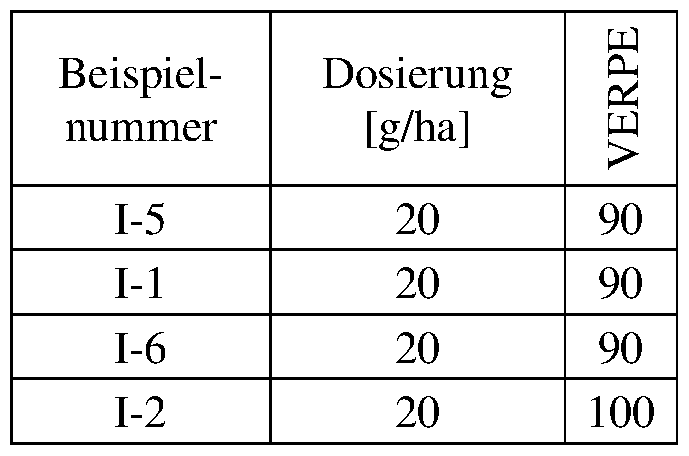
- Table 12a Pre-emergence effect at 20g/ha against VERPE in %
- Table 13a Pre-emergence effect at 20g/ha against VIOTR in %
- Table 13b Pre-emergence effect at 80g/ha against VIOTR in %
- Table 16a Post-emergence effect at 5g/ha against DIGSA in %
- Table 16b Post-emergence effect at 20g/ha against DIGSA in %
- Table 17a Post-emergence effect at 5g/ha against ECHCG in %
- Table 18a Post-emergence effect at 5g/ha against MATIN in %
- Table 18b Post-emergence effect at 20g/ha against MATIN in %
- Table 19a Post-emergence effect at 5g/ha against PHBPU in %
- Table 20 Post-emergence effect at 20g/ha against POLCO in %
- Table 21a Post-emergence effect at 5g/ha against SETVI in %
- Table 21b Post-emergence effect at 20g/ha against SETVI in %
- Table 23a Post-emergence effect at 5g/ha against VERPE in %
- Table 23b Post-emergence effect at 20g/ha against VERPE in %
- Table 24a Post-emergence effect at 1.25g/ha against VIOTR in %
Landscapes
- Life Sciences & Earth Sciences (AREA)
- Chemical & Material Sciences (AREA)
- Organic Chemistry (AREA)
- Wood Science & Technology (AREA)
- Zoology (AREA)
- Plant Pathology (AREA)
- Engineering & Computer Science (AREA)
- Pest Control & Pesticides (AREA)
- Environmental Sciences (AREA)
- Health & Medical Sciences (AREA)
- General Health & Medical Sciences (AREA)
- Dentistry (AREA)
- Agronomy & Crop Science (AREA)
- Chemical Kinetics & Catalysis (AREA)
- General Chemical & Material Sciences (AREA)
- Dispersion Chemistry (AREA)
- Toxicology (AREA)
- Agricultural Chemicals And Associated Chemicals (AREA)
- Heterocyclic Carbon Compounds Containing A Hetero Ring Having Nitrogen And Oxygen As The Only Ring Hetero Atoms (AREA)
- Plural Heterocyclic Compounds (AREA)
- Catching Or Destruction (AREA)
Abstract
Description






Claims


Priority Applications (10)
| Application Number | Priority Date | Filing Date | Title |
|---|---|---|---|
| KR1020237034748A KR20230156760A (ko) | 2021-03-12 | 2022-03-09 | 키랄 n-(1,3,4-옥사디아졸-2-일)페닐 카르복실산 아미드 및 제초제로서의 그의 용도 |
| AU2022232186A AU2022232186A1 (en) | 2021-03-12 | 2022-03-09 | Chiral n-(1,3,4-oxadiazole-2-yl)phenyl carboxylic acid amides and their use as herbicides |
| CN202280020573.3A CN116964040A (zh) | 2021-03-12 | 2022-03-09 | 手性n-(1,3,4-噁二唑-2-基)苯基羧酸酰胺及其作为除草剂的用途 |
| IL305798A IL305798A (en) | 2021-03-12 | 2022-03-09 | Chiral amides of N-(4,3,1-oxadiazol-2yl)phenyl carbonyl acid and their use as herbicides |
| JP2023555205A JP2024509579A (ja) | 2021-03-12 | 2022-03-09 | キラルn-(1,3,4-オキサジアゾール-2-イル)フェニルカルボン酸アミドおよび除草剤としてのそれらの使用 |
| BR112023016920A BR112023016920A2 (pt) | 2021-03-12 | 2022-03-09 | Amidas de ácido n-(1,3,4-oxadiazol-2-il)fenil carboxílico quirais e seu uso como herbicidas |
| EP22709334.1A EP4305025A1 (de) | 2021-03-12 | 2022-03-09 | Chirale n-(1,3,4-oxadiazol-2-yl)phenylcarbonsäureamide und ihre verwendung als herbizide |
| CA3212998A CA3212998A1 (en) | 2021-03-12 | 2022-03-09 | Chiral n-(1,3,4-oxadiazole-2-yl)phenyl carboxylic acid amides and their use as herbicides |
| MX2023010627A MX2023010627A (es) | 2021-03-12 | 2022-03-09 | N-(1,3,4-oxadiazol-2-il)fenilcarboxamidas quirales y su uso como herbicidas. |
| US18/549,497 US20240174624A1 (en) | 2021-03-12 | 2022-03-09 | Chiral n-(1,3,4-oxadiazole-2-yl)phenyl carboxylic acid amides and their use as herbicides |
Applications Claiming Priority (2)
| Application Number | Priority Date | Filing Date | Title |
|---|---|---|---|
| EP21162218.8 | 2021-03-12 | ||
| EP21162218 | 2021-03-12 |
Publications (1)
| Publication Number | Publication Date |
|---|---|
| WO2022189495A1 true WO2022189495A1 (de) | 2022-09-15 |
Family
ID=74873527
Family Applications (1)
| Application Number | Title | Priority Date | Filing Date |
|---|---|---|---|
| PCT/EP2022/056017 Ceased WO2022189495A1 (de) | 2021-03-12 | 2022-03-09 | Chirale n-(1,3,4-oxadiazol-2-yl)phenylcarbonsäureamide und ihre verwendung als herbizide |
Country Status (13)
| Country | Link |
|---|---|
| US (1) | US20240174624A1 (de) |
| EP (1) | EP4305025A1 (de) |
| JP (1) | JP2024509579A (de) |
| KR (1) | KR20230156760A (de) |
| CN (1) | CN116964040A (de) |
| AR (1) | AR125060A1 (de) |
| AU (1) | AU2022232186A1 (de) |
| BR (1) | BR112023016920A2 (de) |
| CA (1) | CA3212998A1 (de) |
| IL (1) | IL305798A (de) |
| MX (1) | MX2023010627A (de) |
| TW (1) | TW202302544A (de) |
| WO (1) | WO2022189495A1 (de) |
Cited By (7)
| Publication number | Priority date | Publication date | Assignee | Title |
|---|---|---|---|---|
| WO2024041926A1 (de) * | 2022-08-25 | 2024-02-29 | Bayer Aktiengesellschaft | Herbizide zusammensetzungen |
| WO2024041925A1 (de) * | 2022-08-25 | 2024-02-29 | Bayer Aktiengesellschaft | Herbizide zusammensetzungen |
| JP2024526285A (ja) * | 2021-07-08 | 2024-07-17 | バイエル・アクチエンゲゼルシヤフト | キラル3-スルフィニル安息香酸類 |
| WO2024194026A1 (de) * | 2023-03-17 | 2024-09-26 | Bayer Aktiengesellschaft | Herbizid wirksame 4-difluormethylbenzoesäureamide |
| EP4549432A1 (de) | 2023-10-31 | 2025-05-07 | Bayer Aktiengesellschaft | Thermodynamisch stabile kristallmodifikation von 2-chlor-n-(5-methyl-1,3,4-oxadiazol-2-yl)-3-[(s)-methylsulfinyl]-4-(trifluormethyl)benzamid |
| WO2025093463A1 (de) | 2023-10-31 | 2025-05-08 | Bayer Aktiengesellschaft | Herbizid/safener-kombinationen basierend auf herbiziden aus der klasse chiraler n-(1,3,4-oxadiazol-2- yl)phenylcarbonsäureamide sowie deren salze |
| WO2025176774A1 (de) | 2024-02-22 | 2025-08-28 | Bayer Aktiengesellschaft | Herbizide zusammensetzungen |
Citations (28)
| Publication number | Priority date | Publication date | Assignee | Title |
|---|---|---|---|---|
| US4245432A (en) | 1979-07-25 | 1981-01-20 | Eastman Kodak Company | Seed coatings |
| US4272417A (en) | 1979-05-22 | 1981-06-09 | Cargill, Incorporated | Stable protective seed coating |
| EP0131624A1 (de) | 1983-01-17 | 1985-01-23 | Monsanto Co | Plasmide zur transformation von pflanzenzellen. |
| EP0142924A2 (de) | 1983-09-26 | 1985-05-29 | Mycogen Plant Science, Inc. | Insektresistente Pflanzen |
| EP0193259A1 (de) | 1985-01-18 | 1986-09-03 | Plant Genetic Systems N.V. | Modifikation von Pflanzen auf pentechnologischem Wege zur Bekämpfung oder zur Kontrolle von Insekten |
| EP0221044A1 (de) | 1985-10-25 | 1987-05-06 | Monsanto Company | Pflanzenvektoren |
| EP0242236A1 (de) | 1986-03-11 | 1987-10-21 | Plant Genetic Systems N.V. | Durch Gentechnologie erhaltene und gegen Glutaminsynthetase-Inhibitoren resistente Pflanzenzellen |
| EP0257993A2 (de) | 1986-08-26 | 1988-03-02 | E.I. Du Pont De Nemours And Company | Herbizid-resistante Pflanzen-Acetolactatsynthase kodierendes Nucleinsäurefragment |
| US4808430A (en) | 1987-02-27 | 1989-02-28 | Yazaki Corporation | Method of applying gel coating to plant seeds |
| EP0305398A1 (de) | 1986-05-01 | 1989-03-08 | Honeywell Inc | Verbindungsanordnung für mehrere integrierte schaltungen. |
| EP0309862A1 (de) | 1987-09-30 | 1989-04-05 | Bayer Ag | Stilbensynthase-Gen |
| US5013659A (en) | 1987-07-27 | 1991-05-07 | E. I. Du Pont De Nemours And Company | Nucleic acid fragment encoding herbicide resistant plant acetolactate synthase |
| WO1991013972A1 (en) | 1990-03-16 | 1991-09-19 | Calgene, Inc. | Plant desaturases - compositions and uses |
| WO1991019806A1 (en) | 1990-06-18 | 1991-12-26 | Monsanto Company | Increased starch content in plants |
| EP0464461A2 (de) | 1990-06-29 | 1992-01-08 | Bayer Ag | Stilbensynthase-Gene aus Weinrebe |
| WO1992000377A1 (en) | 1990-06-25 | 1992-01-09 | Monsanto Company | Glyphosate tolerant plants |
| WO1992011376A1 (en) | 1990-12-21 | 1992-07-09 | Amylogene Hb | Genetically engineered modification of potato to form amylopectin-type starch |
| WO1992014827A1 (en) | 1991-02-13 | 1992-09-03 | Institut Für Genbiologische Forschung Berlin Gmbh | Plasmids containing dna-sequences that cause changes in the carbohydrate concentration and the carbohydrate composition in plants, as well as plant cells and plants containing these plasmids |
| US5876739A (en) | 1996-06-13 | 1999-03-02 | Novartis Ag | Insecticidal seed coating |
| WO2002028186A2 (en) | 2000-10-06 | 2002-04-11 | Monsanto Technology, Llc | Seed treatment with combinations of insecticides |
| WO2002080675A1 (en) | 2001-03-21 | 2002-10-17 | Monsanto Technology, Llc | Treated plant seeds with controlled release of active agents |
| US20030176428A1 (en) | 1998-11-16 | 2003-09-18 | Schneidersmann Ferdinand Martin | Pesticidal composition for seed treatment |
| WO2012126932A1 (de) | 2011-03-22 | 2012-09-27 | Bayer Cropscience Ag | N-(1,3,4-oxadiazol-2-yl)arylcarbonsäureamide und ihre verwendung als herbizide |
| WO2015049225A1 (de) * | 2013-10-04 | 2015-04-09 | Bayer Cropscience Ag | Herbizid-safener-zusammensetzungen enthaltend n-(1,3,4-oxadiazol-2-yl)arylcarbonsäureamide |
| WO2015135946A1 (en) * | 2014-03-11 | 2015-09-17 | Bayer Cropscience Ag | Use of n-(1,3,4-oxadiazol-2-yl)arylcarboxamides or their salts for controlling unwanted plants in areas of transgenic crop plants being tolerant to hppd inhibitor herbicides |
| WO2016001073A1 (de) * | 2014-06-30 | 2016-01-07 | Bayer Cropscience Aktiengesellschaft | Herbizid wirksame arylcarbonsäureamide |
| WO2018202535A1 (de) | 2017-05-04 | 2018-11-08 | Bayer Cropscience Aktiengesellschaft | Herbizid wirksame 4-difluormethylbenzoylamide |
| WO2020108518A1 (zh) * | 2018-11-30 | 2020-06-04 | 青岛清原化合物有限公司 | N-(1,3,4-噁二唑-2-基)芳基甲酰胺类或其盐、制备方法、除草组合物和应用 |
Family Cites Families (4)
| Publication number | Priority date | Publication date | Assignee | Title |
|---|---|---|---|---|
| MY174553A (en) * | 2013-10-25 | 2020-04-25 | Bayer Cropscience Ag | Herbicidal compositions containing n-(1,3,4-oxadiazol-2-yl)-aryl carboxylic acid amides |
| BR112017019733B1 (pt) * | 2015-03-17 | 2021-11-30 | Bayer Cropscience Aktiengesellschaft | Sais de amidas de n-(1,3,4-oxadiazol-2-il) aril ácido carboxílico e seu uso como herbicidas |
| MX383279B (es) * | 2015-07-03 | 2025-03-13 | Bayer Cropscience Ag | Derivados de n-(1,3,4-oxadiazol-2-il)aril carboxamida con accion herbicida. |
| TW201715968A (zh) * | 2015-08-07 | 2017-05-16 | 拜耳作物科學公司 | 包含n-(四唑-5-基)-或n-(1,3,4-二唑-2-基)芳基醯胺及3-異唑啉酮衍生物之除草組合物 |
-
2022
- 2022-03-09 AU AU2022232186A patent/AU2022232186A1/en active Pending
- 2022-03-09 CA CA3212998A patent/CA3212998A1/en active Pending
- 2022-03-09 US US18/549,497 patent/US20240174624A1/en active Pending
- 2022-03-09 CN CN202280020573.3A patent/CN116964040A/zh active Pending
- 2022-03-09 KR KR1020237034748A patent/KR20230156760A/ko active Pending
- 2022-03-09 JP JP2023555205A patent/JP2024509579A/ja active Pending
- 2022-03-09 MX MX2023010627A patent/MX2023010627A/es unknown
- 2022-03-09 BR BR112023016920A patent/BR112023016920A2/pt unknown
- 2022-03-09 AR ARP220100538A patent/AR125060A1/es unknown
- 2022-03-09 IL IL305798A patent/IL305798A/en unknown
- 2022-03-09 EP EP22709334.1A patent/EP4305025A1/de active Pending
- 2022-03-09 WO PCT/EP2022/056017 patent/WO2022189495A1/de not_active Ceased
- 2022-03-10 TW TW111108738A patent/TW202302544A/zh unknown
Patent Citations (29)
| Publication number | Priority date | Publication date | Assignee | Title |
|---|---|---|---|---|
| US4272417A (en) | 1979-05-22 | 1981-06-09 | Cargill, Incorporated | Stable protective seed coating |
| US4245432A (en) | 1979-07-25 | 1981-01-20 | Eastman Kodak Company | Seed coatings |
| EP0131624A1 (de) | 1983-01-17 | 1985-01-23 | Monsanto Co | Plasmide zur transformation von pflanzenzellen. |
| EP0142924A2 (de) | 1983-09-26 | 1985-05-29 | Mycogen Plant Science, Inc. | Insektresistente Pflanzen |
| EP0193259A1 (de) | 1985-01-18 | 1986-09-03 | Plant Genetic Systems N.V. | Modifikation von Pflanzen auf pentechnologischem Wege zur Bekämpfung oder zur Kontrolle von Insekten |
| EP0221044A1 (de) | 1985-10-25 | 1987-05-06 | Monsanto Company | Pflanzenvektoren |
| EP0242236A1 (de) | 1986-03-11 | 1987-10-21 | Plant Genetic Systems N.V. | Durch Gentechnologie erhaltene und gegen Glutaminsynthetase-Inhibitoren resistente Pflanzenzellen |
| EP0242246A1 (de) | 1986-03-11 | 1987-10-21 | Plant Genetic Systems N.V. | Durch Gentechnologie erhaltene und gegen Glutaminsynthetase-Inhibitoren resistente Pflanzenzellen |
| EP0305398A1 (de) | 1986-05-01 | 1989-03-08 | Honeywell Inc | Verbindungsanordnung für mehrere integrierte schaltungen. |
| EP0257993A2 (de) | 1986-08-26 | 1988-03-02 | E.I. Du Pont De Nemours And Company | Herbizid-resistante Pflanzen-Acetolactatsynthase kodierendes Nucleinsäurefragment |
| US4808430A (en) | 1987-02-27 | 1989-02-28 | Yazaki Corporation | Method of applying gel coating to plant seeds |
| US5013659A (en) | 1987-07-27 | 1991-05-07 | E. I. Du Pont De Nemours And Company | Nucleic acid fragment encoding herbicide resistant plant acetolactate synthase |
| EP0309862A1 (de) | 1987-09-30 | 1989-04-05 | Bayer Ag | Stilbensynthase-Gen |
| WO1991013972A1 (en) | 1990-03-16 | 1991-09-19 | Calgene, Inc. | Plant desaturases - compositions and uses |
| WO1991019806A1 (en) | 1990-06-18 | 1991-12-26 | Monsanto Company | Increased starch content in plants |
| WO1992000377A1 (en) | 1990-06-25 | 1992-01-09 | Monsanto Company | Glyphosate tolerant plants |
| EP0464461A2 (de) | 1990-06-29 | 1992-01-08 | Bayer Ag | Stilbensynthase-Gene aus Weinrebe |
| WO1992011376A1 (en) | 1990-12-21 | 1992-07-09 | Amylogene Hb | Genetically engineered modification of potato to form amylopectin-type starch |
| WO1992014827A1 (en) | 1991-02-13 | 1992-09-03 | Institut Für Genbiologische Forschung Berlin Gmbh | Plasmids containing dna-sequences that cause changes in the carbohydrate concentration and the carbohydrate composition in plants, as well as plant cells and plants containing these plasmids |
| US5876739A (en) | 1996-06-13 | 1999-03-02 | Novartis Ag | Insecticidal seed coating |
| US20030176428A1 (en) | 1998-11-16 | 2003-09-18 | Schneidersmann Ferdinand Martin | Pesticidal composition for seed treatment |
| WO2002028186A2 (en) | 2000-10-06 | 2002-04-11 | Monsanto Technology, Llc | Seed treatment with combinations of insecticides |
| WO2002080675A1 (en) | 2001-03-21 | 2002-10-17 | Monsanto Technology, Llc | Treated plant seeds with controlled release of active agents |
| WO2012126932A1 (de) | 2011-03-22 | 2012-09-27 | Bayer Cropscience Ag | N-(1,3,4-oxadiazol-2-yl)arylcarbonsäureamide und ihre verwendung als herbizide |
| WO2015049225A1 (de) * | 2013-10-04 | 2015-04-09 | Bayer Cropscience Ag | Herbizid-safener-zusammensetzungen enthaltend n-(1,3,4-oxadiazol-2-yl)arylcarbonsäureamide |
| WO2015135946A1 (en) * | 2014-03-11 | 2015-09-17 | Bayer Cropscience Ag | Use of n-(1,3,4-oxadiazol-2-yl)arylcarboxamides or their salts for controlling unwanted plants in areas of transgenic crop plants being tolerant to hppd inhibitor herbicides |
| WO2016001073A1 (de) * | 2014-06-30 | 2016-01-07 | Bayer Cropscience Aktiengesellschaft | Herbizid wirksame arylcarbonsäureamide |
| WO2018202535A1 (de) | 2017-05-04 | 2018-11-08 | Bayer Cropscience Aktiengesellschaft | Herbizid wirksame 4-difluormethylbenzoylamide |
| WO2020108518A1 (zh) * | 2018-11-30 | 2020-06-04 | 青岛清原化合物有限公司 | N-(1,3,4-噁二唑-2-基)芳基甲酰胺类或其盐、制备方法、除草组合物和应用 |
Non-Patent Citations (16)
| Title |
|---|
| "Spray-Drying Handbook", 1979, G. GOODWIN LTD. |
| "Springer Lab Manual", 1995, SPRINGER VERLAG BERLIN, article "Gene Transfer to Plants" |
| BRAUN ET AL., EMBO J., vol. 11, 1992, pages 3219 - 3227 |
| G.C. KLINGMAN: "Weed Control as a Science", 1961, JOHN WILEY AND SONS, INC., pages: 81 - 96 |
| H.V. OLPHEN: "Handbook of Insecticide Dust Diluents and Carriers", 1963, J. WILEY & SONS |
| HEIDELBERGCHRISTOU: "Trends in Plant Science", vol. 1, 1996, VCH WEINHEIM, pages: 423 - 431 |
| J.D. FREYERS.A. EVANS: "Weed Control Handbook", 1968, BLACKWELL SCIENTIFIC PUBLICATIONS, pages: 101 - 103 |
| J.E. BROWNING: "Chemical and Engineering", 1967, article "Agglomeration", pages: 147 |
| K. MARTENS: "Handbook", 1979, G. GOODWIN LTD, article "Spray Drying" |
| MCCUTCHEON'S: "Encyclopedia of Surface Active Agents", 1964, CHEM. PUBL. CO. INC. |
| SAMBROOK ET AL.: "Molecular Cloning, A Laboratory Manual", 1989, COLD SPRING HARBOR LABORATORY PRESS |
| SCHÖNFELDT: "Grenzflächenaktive Äthylenoxid-addukte", 1976 |
| SONNEWALD ET AL., PLANT J, vol. 1, 1991, pages 95 - 106 |
| WADEVALKENBURG: "Perry's Chemical Engineer's Handbook", 1973, MARCEL DEKKER, pages: 8 - 57 |
| WINNACKER-KÜCHLER: "Chemische Technologie", vol. 7, 1986, C. HANSER VERLAG |
| WOLTER ET AL., PROC. NATL. ACAD. SCI. USA, vol. 85, 1988, pages 846 - 850 |
Cited By (7)
| Publication number | Priority date | Publication date | Assignee | Title |
|---|---|---|---|---|
| JP2024526285A (ja) * | 2021-07-08 | 2024-07-17 | バイエル・アクチエンゲゼルシヤフト | キラル3-スルフィニル安息香酸類 |
| WO2024041926A1 (de) * | 2022-08-25 | 2024-02-29 | Bayer Aktiengesellschaft | Herbizide zusammensetzungen |
| WO2024041925A1 (de) * | 2022-08-25 | 2024-02-29 | Bayer Aktiengesellschaft | Herbizide zusammensetzungen |
| WO2024194026A1 (de) * | 2023-03-17 | 2024-09-26 | Bayer Aktiengesellschaft | Herbizid wirksame 4-difluormethylbenzoesäureamide |
| EP4549432A1 (de) | 2023-10-31 | 2025-05-07 | Bayer Aktiengesellschaft | Thermodynamisch stabile kristallmodifikation von 2-chlor-n-(5-methyl-1,3,4-oxadiazol-2-yl)-3-[(s)-methylsulfinyl]-4-(trifluormethyl)benzamid |
| WO2025093463A1 (de) | 2023-10-31 | 2025-05-08 | Bayer Aktiengesellschaft | Herbizid/safener-kombinationen basierend auf herbiziden aus der klasse chiraler n-(1,3,4-oxadiazol-2- yl)phenylcarbonsäureamide sowie deren salze |
| WO2025176774A1 (de) | 2024-02-22 | 2025-08-28 | Bayer Aktiengesellschaft | Herbizide zusammensetzungen |
Also Published As
| Publication number | Publication date |
|---|---|
| TW202302544A (zh) | 2023-01-16 |
| US20240174624A1 (en) | 2024-05-30 |
| MX2023010627A (es) | 2023-09-19 |
| EP4305025A1 (de) | 2024-01-17 |
| IL305798A (en) | 2023-11-01 |
| AR125060A1 (es) | 2023-06-07 |
| BR112023016920A2 (pt) | 2023-10-10 |
| JP2024509579A (ja) | 2024-03-04 |
| CA3212998A1 (en) | 2022-09-15 |
| AU2022232186A1 (en) | 2023-09-28 |
| CN116964040A (zh) | 2023-10-27 |
| KR20230156760A (ko) | 2023-11-14 |
Similar Documents
| Publication | Publication Date | Title |
|---|---|---|
| WO2022189495A1 (de) | Chirale n-(1,3,4-oxadiazol-2-yl)phenylcarbonsäureamide und ihre verwendung als herbizide | |
| EP3121172B1 (de) | Natriumsalz von 2-chlor-3-(methylsulfanyl)-n-(1-methyl-1h-tetrazol-5-yl)-4-(trifluoromethyl)benzamid und dessen verwendung als herbizid | |
| EP3359525B1 (de) | Neue alkinyl-substituierte 3-phenylpyrrolidin-2,4-dione und deren verwendung als herbizide | |
| WO2016207097A1 (de) | Neue alkinyl-substituierte- 3-phenylpyrrolidin-2,4-dione und deren verwendung als herbizide | |
| EP2855437B1 (de) | N-(tetrazol-5-yl)- und n-(triazol-5-yl)arylcarbonsäurethioamide und ihre verwendung als herbizide | |
| WO2016146561A1 (de) | Salze von n-(1,3,4-oxadiazol-2-yl)arylcarbonsäureamiden und ihre verwendung als herbizide | |
| EP3416961A1 (de) | Chinazolindion-6-carbonylderivate und ihre verwendung als herbizide | |
| EP3068773A1 (de) | Pyridazinon-derivate und ihre verwendung als herbizide | |
| WO2015071206A1 (de) | 2-hetaryl-pyridazinonderivate und ihre verwendung als herbizide | |
| WO2017178314A1 (de) | Anellierte 3-phenyltetramsäure-derivate mit herbizider wirkung | |
| WO2015007632A1 (de) | Uracil-5-carboxamide und ihre verwendung als herbizide | |
| WO2015007662A1 (de) | Azin-2-on-3-carboxamide und ihre verwendung als herbizide | |
| EP3475273B1 (de) | 3-amino-1,2,4-triazinderivate und deren verwendung zur bekämpfung unerwünschten pflanzenwachstums | |
| EP2882732B1 (de) | Herbizid wirksame 6'-phenyl-2,2'-bipyridin-3-carbonsäure-derivate | |
| EP1034165A1 (de) | 1-methyl-5- alkylsulfonyl-, 1-methyl-5- alkylsulfinyl- und 1-methyl-5- alkylthio-substituierte pyrazolylpyrazole, verfahren zu ihrer herstellung und ihre verwendung als herbizide | |
| EA049688B1 (ru) | Хиральные амиды n-(1,3,4-оксадиазол-2-ил)фенилкарбоновой кислоты и их применение в качестве гербицидов | |
| WO2024041925A1 (de) | Herbizide zusammensetzungen | |
| WO2014086738A1 (de) | Herbizid wirksame 4-amino-6-acyloxymethylpyrimidine und 4-amino-2-acyloxymethylpyridine | |
| EP2918581A1 (de) | 2-(Azindionyl)-Pyridazinonderivate und ihre Verwendung als Herbizide | |
| EP3145918A1 (de) | 2-(hetero)aryl-pyridazinone und ihre verwendung als herbizide | |
| EP2918582A1 (de) | 5-(Azindionyl)-Pyridazinonderivate und ihre Verwendung als Herbizide | |
| EP2882735A1 (de) | Herbizid wirksame 2'-phenyl-2,4'-bipyridin-3-carbonsäure-derivate |
Legal Events
| Date | Code | Title | Description |
|---|---|---|---|
| 121 | Ep: the epo has been informed by wipo that ep was designated in this application |
Ref document number: 22709334 Country of ref document: EP Kind code of ref document: A1 |
|
| REG | Reference to national code |
Ref country code: BR Ref legal event code: B01A Ref document number: 112023016920 Country of ref document: BR |
|
| WWE | Wipo information: entry into national phase |
Ref document number: 18549497 Country of ref document: US |
|
| WWE | Wipo information: entry into national phase |
Ref document number: MX/A/2023/010627 Country of ref document: MX Ref document number: 2023555205 Country of ref document: JP Ref document number: 3212998 Country of ref document: CA |
|
| WWE | Wipo information: entry into national phase |
Ref document number: 305798 Country of ref document: IL |
|
| WWE | Wipo information: entry into national phase |
Ref document number: 202317060959 Country of ref document: IN Ref document number: 202280020573.3 Country of ref document: CN Ref document number: 2022232186 Country of ref document: AU |
|
| ENP | Entry into the national phase |
Ref document number: 2022232186 Country of ref document: AU Date of ref document: 20220309 Kind code of ref document: A |
|
| WWE | Wipo information: entry into national phase |
Ref document number: 202392519 Country of ref document: EA |
|
| ENP | Entry into the national phase |
Ref document number: 112023016920 Country of ref document: BR Kind code of ref document: A2 Effective date: 20230822 |
|
| ENP | Entry into the national phase |
Ref document number: 20237034748 Country of ref document: KR Kind code of ref document: A |
|
| WWE | Wipo information: entry into national phase |
Ref document number: 1020237034748 Country of ref document: KR |
|
| WWE | Wipo information: entry into national phase |
Ref document number: 2022709334 Country of ref document: EP |
|
| NENP | Non-entry into the national phase |
Ref country code: DE |
|
| ENP | Entry into the national phase |
Ref document number: 2022709334 Country of ref document: EP Effective date: 20231012 |
|
| WWG | Wipo information: grant in national office |
Ref document number: 202392519 Country of ref document: EA |