WO2022186216A1 - 改変シアノバクテリア、改変シアノバクテリアの製造方法、及び、タンパク質の製造方法 - Google Patents
改変シアノバクテリア、改変シアノバクテリアの製造方法、及び、タンパク質の製造方法 Download PDFInfo
- Publication number
- WO2022186216A1 WO2022186216A1 PCT/JP2022/008657 JP2022008657W WO2022186216A1 WO 2022186216 A1 WO2022186216 A1 WO 2022186216A1 JP 2022008657 W JP2022008657 W JP 2022008657W WO 2022186216 A1 WO2022186216 A1 WO 2022186216A1
- Authority
- WO
- WIPO (PCT)
- Prior art keywords
- protein
- outer membrane
- cell wall
- cyanobacteria
- modified
- Prior art date
- Legal status (The legal status is an assumption and is not a legal conclusion. Google has not performed a legal analysis and makes no representation as to the accuracy of the status listed.)
- Ceased
Links
Images








Classifications
-
- C—CHEMISTRY; METALLURGY
- C12—BIOCHEMISTRY; BEER; SPIRITS; WINE; VINEGAR; MICROBIOLOGY; ENZYMOLOGY; MUTATION OR GENETIC ENGINEERING
- C12N—MICROORGANISMS OR ENZYMES; COMPOSITIONS THEREOF; PROPAGATING, PRESERVING, OR MAINTAINING MICROORGANISMS; MUTATION OR GENETIC ENGINEERING; CULTURE MEDIA
- C12N1/00—Microorganisms; Compositions thereof; Processes of propagating, maintaining or preserving microorganisms or compositions thereof; Processes of preparing or isolating a composition containing a microorganism; Culture media therefor
- C12N1/20—Bacteria; Culture media therefor
- C12N1/205—Bacterial isolates
-
- C—CHEMISTRY; METALLURGY
- C07—ORGANIC CHEMISTRY
- C07K—PEPTIDES
- C07K14/00—Peptides having more than 20 amino acids; Gastrins; Somatostatins; Melanotropins; Derivatives thereof
- C07K14/195—Peptides having more than 20 amino acids; Gastrins; Somatostatins; Melanotropins; Derivatives thereof from bacteria
-
- C—CHEMISTRY; METALLURGY
- C12—BIOCHEMISTRY; BEER; SPIRITS; WINE; VINEGAR; MICROBIOLOGY; ENZYMOLOGY; MUTATION OR GENETIC ENGINEERING
- C12N—MICROORGANISMS OR ENZYMES; COMPOSITIONS THEREOF; PROPAGATING, PRESERVING, OR MAINTAINING MICROORGANISMS; MUTATION OR GENETIC ENGINEERING; CULTURE MEDIA
- C12N15/00—Mutation or genetic engineering; DNA or RNA concerning genetic engineering, vectors, e.g. plasmids, or their isolation, preparation or purification; Use of hosts therefor
- C12N15/09—Recombinant DNA-technology
-
- C—CHEMISTRY; METALLURGY
- C12—BIOCHEMISTRY; BEER; SPIRITS; WINE; VINEGAR; MICROBIOLOGY; ENZYMOLOGY; MUTATION OR GENETIC ENGINEERING
- C12N—MICROORGANISMS OR ENZYMES; COMPOSITIONS THEREOF; PROPAGATING, PRESERVING, OR MAINTAINING MICROORGANISMS; MUTATION OR GENETIC ENGINEERING; CULTURE MEDIA
- C12N15/00—Mutation or genetic engineering; DNA or RNA concerning genetic engineering, vectors, e.g. plasmids, or their isolation, preparation or purification; Use of hosts therefor
- C12N15/09—Recombinant DNA-technology
- C12N15/63—Introduction of foreign genetic material using vectors; Vectors; Use of hosts therefor; Regulation of expression
- C12N15/74—Vectors or expression systems specially adapted for prokaryotic hosts other than E. coli, e.g. Lactobacillus, Micromonospora
-
- C—CHEMISTRY; METALLURGY
- C12—BIOCHEMISTRY; BEER; SPIRITS; WINE; VINEGAR; MICROBIOLOGY; ENZYMOLOGY; MUTATION OR GENETIC ENGINEERING
- C12N—MICROORGANISMS OR ENZYMES; COMPOSITIONS THEREOF; PROPAGATING, PRESERVING, OR MAINTAINING MICROORGANISMS; MUTATION OR GENETIC ENGINEERING; CULTURE MEDIA
- C12N15/00—Mutation or genetic engineering; DNA or RNA concerning genetic engineering, vectors, e.g. plasmids, or their isolation, preparation or purification; Use of hosts therefor
- C12N15/09—Recombinant DNA-technology
- C12N15/63—Introduction of foreign genetic material using vectors; Vectors; Use of hosts therefor; Regulation of expression
- C12N15/79—Vectors or expression systems specially adapted for eukaryotic hosts
-
- C—CHEMISTRY; METALLURGY
- C12—BIOCHEMISTRY; BEER; SPIRITS; WINE; VINEGAR; MICROBIOLOGY; ENZYMOLOGY; MUTATION OR GENETIC ENGINEERING
- C12N—MICROORGANISMS OR ENZYMES; COMPOSITIONS THEREOF; PROPAGATING, PRESERVING, OR MAINTAINING MICROORGANISMS; MUTATION OR GENETIC ENGINEERING; CULTURE MEDIA
- C12N9/00—Enzymes; Proenzymes; Compositions thereof; Processes for preparing, activating, inhibiting, separating or purifying enzymes
- C12N9/10—Transferases (2.)
-
- C—CHEMISTRY; METALLURGY
- C12—BIOCHEMISTRY; BEER; SPIRITS; WINE; VINEGAR; MICROBIOLOGY; ENZYMOLOGY; MUTATION OR GENETIC ENGINEERING
- C12N—MICROORGANISMS OR ENZYMES; COMPOSITIONS THEREOF; PROPAGATING, PRESERVING, OR MAINTAINING MICROORGANISMS; MUTATION OR GENETIC ENGINEERING; CULTURE MEDIA
- C12N9/00—Enzymes; Proenzymes; Compositions thereof; Processes for preparing, activating, inhibiting, separating or purifying enzymes
- C12N9/10—Transferases (2.)
- C12N9/1085—Transferases (2.) transferring alkyl or aryl groups other than methyl groups (2.5)
-
- C—CHEMISTRY; METALLURGY
- C12—BIOCHEMISTRY; BEER; SPIRITS; WINE; VINEGAR; MICROBIOLOGY; ENZYMOLOGY; MUTATION OR GENETIC ENGINEERING
- C12P—FERMENTATION OR ENZYME-USING PROCESSES TO SYNTHESISE A DESIRED CHEMICAL COMPOUND OR COMPOSITION OR TO SEPARATE OPTICAL ISOMERS FROM A RACEMIC MIXTURE
- C12P21/00—Preparation of peptides or proteins
- C12P21/02—Preparation of peptides or proteins having a known sequence of two or more amino acids, e.g. glutathione
-
- C—CHEMISTRY; METALLURGY
- C12—BIOCHEMISTRY; BEER; SPIRITS; WINE; VINEGAR; MICROBIOLOGY; ENZYMOLOGY; MUTATION OR GENETIC ENGINEERING
- C12Y—ENZYMES
- C12Y205/00—Transferases transferring alkyl or aryl groups, other than methyl groups (2.5)
- C12Y205/01—Transferases transferring alkyl or aryl groups, other than methyl groups (2.5) transferring alkyl or aryl groups, other than methyl groups (2.5.1)
- C12Y205/01098—Rhizobium leguminosarum exopolysaccharide glucosyl ketal-pyruvate-transferase (2.5.1.98)
Definitions
- the present disclosure relates to a modified cyanobacterium with improved protein secretion productivity that secretes intracellularly-produced proteins to the outside of the cells, a method for producing the modified cyanobacteria, and a method for producing a protein.
- Substance production using microorganisms can be carried out in an environment of normal temperature and normal pressure, and with the recent development of genetic manipulation technology, it has become possible to produce a wide range of chemical compounds.
- photosynthetic microorganisms such as cyanobacteria and algae can use light as an energy source and carbon dioxide (CO 2 ) in the air as a raw material, so they are expected to be carbon-neutral next-generation material production systems. ing.
- Non-Patent Document 1 substances produced using cyanobacteria include ethanol (Non-Patent Document 1), isobutanol (Non-Patent Document 2), alkanes (Patent Document 2), fatty acids (Patent Document 1), and proteins (Non-Patent Document 1).
- Patent Document 3 and the like have been reported.
- the present disclosure provides modified cyanobacteria with improved protein secretion productivity, methods for producing modified cyanobacteria, and methods for producing proteins using modified cyanobacteria.
- the total amount of proteins involved in binding between the outer membrane and the cell wall in cyanobacteria is suppressed to 30% or more and 70% or less of the total amount of the proteins in the parent strain.
- modified cyanobacteria and the method for producing modified cyanobacteria of the present disclosure modified cyanobacteria with improved protein secretion productivity can be provided. Moreover, according to the method for producing a protein of the present disclosure, a protein can be produced efficiently.
- FIG. 1 is a diagram schematically showing the cell surface layer of cyanobacteria.
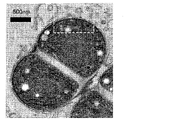
- 2 is a transmission electron microscope image of an ultra-thin section of the modified cyanobacteria of Example 1.
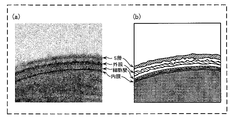
- FIG. 3 is an enlarged image of the dashed line area A in FIG. 4 is a transmission electron microscope image of an ultra-thin section of the modified cyanobacteria of Example 2.
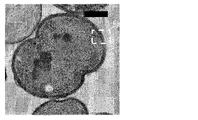
- FIG. 5 is an enlarged image of the dashed line area B in FIG. 6 is a transmission electron microscope image of an ultra-thin section of the modified cyanobacteria of Comparative Example 1.
- FIG. FIG. 7 is an enlarged view of the dashed line area C in FIG. FIG.
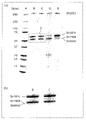
- FIG. FIG. 9 is an electropherogram showing the amounts of proteins involved in binding between the outer membrane and the cell wall in the modified cyanobacteria of Examples 1-2 and Comparative Examples 1-3.
- 10 is a transmission electron microscope image of an ultra-thin section of the modified cyanobacteria of Comparative Example 2.
- FIG. 13 is an enlarged view of the dashed line area E in FIG. 12.
- Non-Patent Document 1 examples of substance production using cyanobacteria include ethanol (Non-Patent Document 1), isobutanol (Non-Patent Document 2), alkanes (Patent Document 2), and fatty acids (Patent Document 1). fuel production has been reported.
- Non-Patent Document 3 describes a protein production method using the cyanobacterial Synechocystis sp. PCC6803 strain. This document discloses a promoter nucleotide sequence for activating transcription of the ethylene synthase gene with high efficiency and a ribosome binding sequence for enhancing translation.
- the present inventor diligently studied the optimal structural modification method of the cell membrane and cell wall to increase the protein secretion production ability while maintaining the growth ability of cyanobacterial cells.
- the total amount of proteins involved in binding between the outer membrane and the cell wall of cyanobacteria is suppressed to 30% or more and 70% or less of the total amount of the proteins in the parent strain, so that the proteins produced in the cells of the cyanobacteria was found to be easily secreted extracellularly.
- the extracellularly secreted protein can be efficiently recovered without disrupting the cyanobacterial cells.
- the cyanobacteria can be used continuously even after the protein is recovered, production efficiency is improved.
- a modified cyanobacterium with improved protein secretion productivity can be provided.
- proteins can be efficiently produced.
- the total amount of proteins involved in binding between the outer membrane and the cell wall in cyanobacteria is suppressed to 30% or more and 70% or less of the total amount of the proteins in the parent strain.
- the modified cyanobacteria As a result, in the modified cyanobacteria, the binding between the cell wall and the outer membrane (for example, the amount and strength of binding) is partially reduced, and the outer membrane partially detaches from the cell wall, without impairing the cell proliferation ability. easier to release. Therefore, proteins produced within the cells are likely to leak out of the outer membrane, that is, out of the cells. Therefore, according to the modified cyanobacteria according to an aspect of the present disclosure, it is possible to provide cyanobacteria with improved protein secretion productivity. In addition, according to the modified cyanobacteria according to one aspect of the present disclosure, it is not necessary to crush the cells to recover the protein. Therefore, even after the protein is recovered, the modified cyanobacterium is repeatedly used to produce the protein.
- the modified cyanobacterium is repeatedly used to produce the protein.
- the total amount of proteins involved in binding between the outer membrane and the cell wall is suppressed to less than 30% of the total amount of the proteins in the parent strain, the growth ability of the cells will be impaired, and if it exceeds 70%, it will be produced in the cells. protein cannot be leaked out of the cell.
- the proteins involved in binding between the outer membrane and the cell wall include SLH (Surface Layer Homology) domain-retaining outer membrane protein, and cell wall-pyruvate modifying enzyme It may be at least one.
- SLH Surface Layer Homology domain-retaining outer membrane protein
- cell wall-pyruvate modifying enzyme It may be at least one.
- modified cyanobacteria for example, (i) an enzyme that catalyzes pyruvate modification of SLH domain-retaining outer membrane proteins that bind to the cell wall and sugar chains bound to the surface of the cell wall (that is, cell wall-pyruvate modification or (ii) expression of at least one of an SLH domain-retaining outer membrane protein and a cell wall-pyruvate modifying enzyme is inhibited. Therefore, the binding (that is, binding amount and binding strength) between the SLH domain of the SLH domain-retaining outer membrane protein in the outer membrane and the covalent sugar chain on the surface of the cell wall is reduced.
- the modified cyanobacterium according to one aspect of the present disclosure, the binding between the outer membrane and the cell wall is reduced, making it easier for the outer membrane to partially detach from the cell wall. It becomes easy to leak out of the bacterial body.
- the SLH domain-retaining outer membrane protein includes Slr1841 consisting of the amino acid sequence shown in SEQ ID NO: 1, NIES970_09470 consisting of the amino acid sequence shown in SEQ ID NO: 2, and SEQ ID NO: Anacy — 3458 consisting of the amino acid sequence shown in 3, or a protein whose amino acid sequence is 50% or more identical to any of these SLH domain-retaining outer membrane proteins.
- the cell wall-pyruvate modifying enzyme includes Slr0688 consisting of the amino acid sequence shown in SEQ ID NO: 4, Synpcc7942_1529 consisting of the amino acid sequence shown in SEQ ID NO: 5, and SEQ ID NO: 6.
- Anacy — 1623 consisting of the amino acid sequence shown in or a protein whose amino acid sequence is 50% or more identical to any of these cell wall-pyruvate modifying enzymes.
- the modified cyanobacteria for example, (i) any of the cell wall-pyruvate modifying enzymes shown in SEQ ID NOS: 4 to 6 above, or any of these cell wall-pyruvate modifying enzymes and 50% of the amino acid sequence or (ii) any of the cell wall-pyruvate modifying enzymes shown in SEQ ID NOS: 4 to 6 above or any of these cell wall-pyruvate modifying enzymes
- the expression of proteins with 50% or more amino acid sequence identity is suppressed.
- the function of the cell wall-pyruvate modifying enzyme or a protein having a function equivalent to the enzyme is suppressed, or (ii) the function of the cell wall-pyruvate modifying enzyme or a protein equivalent to the enzyme is suppressed.
- Expression levels of functional proteins are reduced.
- the covalent sugar chains on the surface of the cell wall are less likely to be modified with pyruvic acid, so the binding amount and binding strength of the sugar chains on the cell wall to the SLH domain of the SLH domain-retaining outer membrane protein in the outer membrane is reduced.
- the modified cyanobacteria As a result, in the modified cyanobacteria, the expression of proteins involved in the binding between the cell wall and the outer membrane is suppressed, or the function of the protein is suppressed. volume and binding strength) are partially reduced. As a result, in modified cyanobacteria, the outer membrane tends to partially detach from the cell wall, so that proteins produced within the bacterium easily leak out of the outer membrane, that is, outside the bacterium. Therefore, the modified cyanobacterium according to one aspect of the present disclosure has improved protein secretion productivity. In addition, according to the modified cyanobacteria according to one aspect of the present disclosure, it is not necessary to crush the cells to recover the protein. Therefore, even after the protein is recovered, the modified cyanobacterium is repeatedly used to produce the protein. be able to.
- the gene that expresses a protein involved in binding between the outer membrane and the cell wall includes a gene encoding an SLH domain-retaining outer membrane protein, and cell wall-pyruvate It may be at least one gene encoding a modifying enzyme.
- the modified cyanobacteria at least one of the gene encoding the SLH domain-retaining outer membrane protein and the gene encoding the cell wall-pyruvate modifying enzyme is deleted or inactivated. Therefore, in the modified cyanobacterium, for example, (i) expression of at least one of SLH domain-retaining outer membrane protein and cell wall-pyruvate modifying enzyme is suppressed, or (ii) SLH domain-retaining outer membrane protein and cell wall - at least one function of the pyruvate modifying enzyme is inhibited.
- the binding that is, binding amount and binding strength
- the binding between the outer membrane and the cell wall is reduced, making it easier for the outer membrane to partially detach from the cell wall. It becomes easy to leak out of the bacterial body.
- the gene encoding the SLH domain-retaining outer membrane protein consists of slr1841 consisting of the nucleotide sequence shown in SEQ ID NO: 7 and the nucleotide sequence shown in SEQ ID NO: 8. nies970_09470, anacy_3458 consisting of the nucleotide sequence shown in SEQ ID NO: 9, or a gene whose nucleotide sequence is 50% or more identical to any of these genes.
- the modified cyanobacteria genes encoding any of the SLH domain-retaining outer membrane proteins shown in SEQ ID NOs: 7 to 9 above, or genes that are 50% or more identical to the nucleotide sequence of any of these genes is deleted or inactivated. Therefore, in the modified cyanobacteria, (i) the expression of any of the above SLH domain-retaining outer membrane proteins or proteins having functions equivalent to any of these proteins is suppressed, or (ii) the above The function of any SLH domain-retaining outer membrane protein or a protein having a function equivalent to any of these proteins is suppressed.
- the binding domain for example, the SLH domain
- the binding domain for binding the outer membrane to the cell wall reduces the amount and strength of binding to the cell wall, so that the outer membrane It becomes easier to partially detach from the cell wall.
- the gene encoding the cell wall-pyruvate modifying enzyme is slr0688 consisting of the nucleotide sequence shown in SEQ ID NO: 10, and synpcc7942_1529 consisting of the nucleotide sequence shown in SEQ ID NO: 11. , anacy — 1623 consisting of the nucleotide sequence shown in SEQ ID NO: 12, or a gene whose nucleotide sequence is 50% or more identical to any of these genes.
- the nucleotide sequence is 50% or more identical to the gene encoding any of the cell wall-pyruvate modifying enzymes shown in SEQ ID NOS: 10 to 12 above or the nucleotide sequence of the gene encoding any of these enzymes. is deleted or inactivated. Therefore, in the modified cyanobacterium, (i) the expression of any of the above cell wall-pyruvate modifying enzymes or proteins having functions equivalent to any of these enzymes is suppressed, or (ii) any of the above The function of any cell wall-pyruvate modifying enzyme or a protein having a function equivalent to any of these enzymes is inhibited.
- the covalent sugar chains on the surface of the cell wall are less likely to be modified with pyruvic acid, so the binding amount and binding strength of the sugar chains on the cell wall to the SLH domain of the SLH domain-retaining outer membrane protein in the outer membrane is reduced. Therefore, in the modified cyanobacterium according to one aspect of the present disclosure, the amount of pyruvic acid modification of the sugar chains for binding the cell wall 4 to the outer membrane is reduced, so that the binding force between the cell wall and the outer membrane is weakened. The outer membrane tends to partially detach from the cell wall.
- a method for producing a modified cyanobacterium according to one aspect of the present disclosure includes a step of suppressing the function of a protein involved in binding between the outer membrane and the cell wall in cyanobacteria.
- the binding between the cell wall and the outer membrane is partially reduced, making it easier for the outer membrane to partially detach from the cell wall. Therefore, in modified cyanobacteria, proteins produced within the cells tend to leak out of the outer membrane (that is, out of the cells). Therefore, according to the method for producing a modified cyanobacterium according to an aspect of the present disclosure, it is possible to provide a cyanobacterium with improved protein secretion productivity. In addition, in the modified cyanobacteria produced, proteins produced in the cells leak out of the cells, so it is not necessary to disrupt the cells to recover the proteins. Therefore, according to the method for producing a modified cyanobacterium according to an aspect of the present disclosure, it is possible to provide a modified cyanobacterium with high utilization efficiency that can be used repeatedly even after the protein is recovered.
- a method for producing a protein according to one aspect of the present disclosure includes the step of culturing any of the modified cyanobacteria described above.
- the numerical range does not represent only a strict meaning, but includes a substantially equivalent range, such as measuring the amount of protein (eg, number or concentration, etc.) or its range.
- both the fungal body and the cell represent a single cyanobacterial individual.
- nucleotide sequences and amino acid sequences are calculated by the BLAST (Basic Local Alignment Search Tool) algorithm. Specifically, it is calculated by performing pairwise analysis with the BLAST program available on the website of NCBI (National Center for Biotechnology Information) (https://blast.ncbi.nlm.nih.gov/Blast.cgi). be. Information on cyanobacterial genes and proteins encoded by the genes are published, for example, in the above-mentioned NCBI database and Cyanobase (http://genome.microbedb.jp/cyanobase/). From these databases, it is possible to obtain the amino acid sequences of the proteins of interest and the base sequences of the genes encoding those proteins.
- NCBI National Center for Biotechnology Information
- Cyanobacteria also called cyanobacteria or cyanobacteria, are a group of prokaryotic organisms that capture light energy with chlorophyll and use the energy obtained to electrolyze water to generate oxygen while performing photosynthesis. Cyanobacteria are highly diverse. For example, there are unicellular species such as Synechocystis sp. PCC 6803 and filamentous species such as Anabaena sp. As for the habitat, there are thermophilic species such as Thermosynechococcus elongatus, marine species such as Synechococcus elongatus, and freshwater species such as Synechocystis.
- Microcystis aeruginosa which have gas vesicles and produce toxins
- Gloeobacter violaceus which lack thylakoids but have proteins called phycobilisomes that are light-harvesting antennas in the plasma membrane, have unique characteristics. Many species are also included.
- Fig. 1 is a diagram schematically showing the cell surface layer of cyanobacteria.
- the cell surface layer of cyanobacteria is composed of, in order from the inside, a plasma membrane (also called inner membrane 1), peptidoglycan 2, and an outer membrane 5, which is a lipid membrane forming the outermost layer of the cell.
- a plasma membrane also called inner membrane 1
- peptidoglycan 2 and an outer membrane 5, which is a lipid membrane forming the outermost layer of the cell.
- Sugar chains 3 composed of glucosamine, mannosamine, etc. are covalently bound to peptidoglycan 2, and pyruvic acid is bound to these covalently bound sugar chains 3 (Non-Patent Document 7: Jurgens and Weckesser, 1986, J. Bacteriol., 168:568-573).
- the cell wall 4 including the peptidoglycan 2 and the covalent sugar chain 3 is referred to.
- the gap between the plasma membrane (that is, the inner membrane 1) and the outer membrane 5 is called a periplasm, and the decomposition of proteins or the formation of three-dimensional structures, the decomposition of lipids or nucleic acids, or the uptake of extracellular nutrients, etc.
- An SLH domain-retaining outer membrane protein (for example, Slr1841 in the figure) consists of a C-terminal region embedded in the lipid membrane (also called outer membrane 5) and an N-terminal SLH domain 7 protruding from the lipid membrane. , It is widely distributed in bacteria belonging to the Negativicutes class, a group of cyanobacteria and Gram-negative bacteria (Non-Patent Document 8: Kojima et al., 2016, Biosci. Biotech. Biochem., 10: 1954-1959).
- Non Patent Document 9 Kowata et al., 2017, J. Bacteriol., 199: e00371-17.
- covalent sugar chain 3 in peptidoglycan 2 must be modified with pyruvate (Non-Patent Document 10: Kojima et al., 2016, J. Biol. Chem., 291:20198-20209).
- Examples of genes encoding SLH domain-retaining outer membrane protein 6 include slr1841 or slr1908 retained by Synechocystis sp. PCC 6803, and oprB retained by Anabaena sp.
- cell wall-pyruvate modification enzyme 9 An enzyme that catalyzes the pyruvate modification reaction of the covalent sugar chain 3 in peptidoglycan 2 (hereinafter referred to as cell wall-pyruvate modification enzyme 9) was identified in the Gram-positive bacterium Bacillus anthracis and named CsaB.
- Non-Patent Document 11 Mesnage et al., 2000, EMBO J., 19:4473-4484.
- cyanobacteria whose genome nucleotide sequences have been published, many species possess genes encoding homologous proteins having an amino acid sequence identity of 30% or more with CsaB. Examples include slr0688 held by Synechocystis sp. PCC 6803 and synpcc7502_03092 held by Synechococcus sp.
- cyanobacteria CO2 fixed by photosynthesis is converted into various amino acids through multistep enzymatic reactions. Using them as raw materials, proteins are synthesized in the cytoplasm of cyanobacteria. Some of these proteins function within the cytoplasm, while others are transported from the cytoplasm to the periplasm and function within the periplasm. However, no cases of cyanobacteria that actively secrete proteins outside the cell have been reported to date.
- cyanobacteria Because cyanobacteria have high photosynthetic ability, they do not necessarily need to take in organic matter from the outside as nutrients. Therefore, cyanobacteria have very few channel proteins in the outer membrane 5 that allow permeation of organic matter, such as the organic matter channel protein 8 (eg, Slr1270) in FIG. For example, in Synechocystis sp. PCC 6803, organic matter channel protein 8, which allows organic matter to permeate, is present in only about 4% of the total protein content of outer membrane 5. On the other hand, cyanobacteria are permeable only to inorganic ions, such as SLH domain-retaining outer membrane protein 6 (e.g., Slr1841) in Fig.
- inorganic ions such as SLH domain-retaining outer membrane protein 6 (e.g., Slr1841) in Fig.
- the outer membrane 5 has many ion channel proteins that allow For example, in Synechocystis sp. PCC 6803, ion channel proteins permeable to inorganic ions account for approximately 80% of the total protein content of outer membrane 5 .
- Non-Patent Documents 5 and 6 disclose that deletion of the slr1841 gene or slr0688 gene, which is involved in the adhesion between the outer membrane and the cell wall and contributes to the structural stability of the cell surface layer, increases the ability of cells to proliferate. stated to be lost.
- the total amount of proteins involved in binding between the outer membrane 5 and the cell wall 4 in cyanobacteria is 30% or more of the total amount of the proteins in the parent strain. It is suppressed to 70% or less.
- “the total amount of the binding-related protein is suppressed to 30% of the total amount of the protein in the parent strain” means that 70% of the total amount of the protein in the parent strain is lost and 30% remains.
- the modified cyanobacteria has improved protein secretion productivity that secretes proteins produced in the cells to the outside of the cells.
- the modified cyanobacteria can be repeatedly used to produce the protein even after the protein has been recovered.
- production by a modified cyanobacterium means that the protein is produced inside the bacterium, and secretion of the produced protein out of the bacterium is called secretory production.
- the protein involved in binding between the outer membrane 5 and the cell wall 4 may be at least one of the SLH domain-retaining outer membrane protein 6 and the cell wall-pyruvate modifying enzyme 9, for example.
- the function of at least one of SLH domain-retaining outer membrane protein 6 and cell wall-pyruvate modifying enzyme 9 is suppressed.
- SLH domain-retaining outer membrane protein 6 and cell wall-pyruvate modifying enzyme 9 may be suppressed, and (ii) SLH domain-retaining protein that binds to cell wall 4
- At least one of the expression of the outer membrane protein 6 and the expression of the enzyme that catalyzes the pyruvate modification reaction of the sugar chain bound on the surface of the cell wall 4 that is, the cell wall-pyruvate modification enzyme 9) may be suppressed.
- cyanobacteria have high photosynthetic ability, so they do not necessarily need to take in organic matter from the outside as nutrients. Therefore, cyanobacteria need only be cultured with light, air, water, and a trace amount of inorganic substances, and cyanobacteria take in inorganic substances into the cells through ion channels in the outer membrane 5 and produce proteins within the cells. In particular, various proteins are present in the periplasm of the space between the outer membrane 5 and the cell wall 4 . In the modified cyanobacterium according to the present embodiment, the functions of proteins involved in binding between outer membrane 5 and cell wall 4 are suppressed. As a result, the outer membrane 5 becomes easier to partially peel off from the cell wall 4 . Proteins in the periplasm leak into the culture solution from the exfoliated portion of the outer membrane 5 . As a result, the modified cyanobacterium improves the protein secretion productivity of secreting proteins produced in the cells to the outside of the cells.
- the outer membrane 5 is partially detached from the cell wall 4 by suppressing the function of at least one binding-related protein of the SLH domain-retaining outer membrane protein 6 and the cell wall-pyruvate modifying enzyme 9.
- cyanobacteria will be described more specifically.
- the cyanobacterium before suppressing at least one of the expression of the SLH domain-retaining outer membrane protein 6 and the expression of the cell wall-pyruvate modifying enzyme 9, which is the parent microorganism of the modified cyanobacterium according to the present embodiment (this specification (referred to as "parent strain” or “parent cyanobacterium”) is not particularly limited, and may be any type of cyanobacterium.
- the parent cyanobacterium may be of the genera Synechocystis, Synechococcus, Anabaena, or Thermosynechococcus, among others Synechocystis sp. PCC 6803, Synechococcus sp.
- Thermosynechococcus elongatus BP-1 good too.
- the parent strain may be a wild cyanobacterium or a modified cyanobacterium that is equivalent to a wild cyanobacterium before suppressing the total amount of binding-related proteins to 30% or more and 70% or less. of binding-associated proteins.
- the amino acid sequences of the SLH domain-retaining outer membrane protein 6 and the enzyme that catalyzes the cell wall-pyruvate modification reaction (that is, the cell wall-pyruvate modification enzyme 9) in these parent cyanobacteria, and the genes encoding these binding-related proteins The base sequence and the position of the gene on the chromosomal DNA or plasmid can be confirmed with the above-mentioned NCBI database and Cyanobase.
- the SLH domain-retaining outer membrane protein 6 and the cell wall-pyruvate modifying enzyme 9 whose functions are suppressed in the modified cyanobacterium according to the present embodiment can be used in any parent cyanobacterium as long as they are possessed by the parent cyanobacterium. and are not limited by the locations of the genes encoding them (for example, on chromosomal DNA or on plasmids).
- the SLH domain-retaining outer membrane protein 6 may be Slr1841, Slr1908, or Slr0042 when the parent cyanobacterium belongs to the genus Synechocystis, or may be NIES970_09470 when the parent cyanobacterium belongs to the genus Synechococcus. If the parent cyanobacteria belong to the genus Anabaena, it may be Anacy_5815 or Anacy_3458. If the parent cyanobacterium belongs to the genus Leptolyngbya, it may be A0A1Q8ZE23_9CYAN.
- the parent cyanobacterium belongs to the genus Crocosphaera, it may be B1WRN6_CROS5 or the like, and if the parent cyanobacterium belongs to the genus Pleurocapsa, it may be K9TAE4_9CYAN or the like.
- SLH domain-retaining outer membrane protein 6 is, for example, Synechocystis sp. PCC 6803 Slr1841 (SEQ ID NO: 1), Synechococcus sp. NIES-970 NIES970_09470 (SEQ ID NO: 2), or Anabaena cylindrica PCC 7122 Anacy_3458 (SEQ ID NO: 3) or the like. Also, proteins having 50% or more of the same amino acid sequence as these SLH domain-retaining outer membrane proteins 6 may be used.
- modified cyanobacteria for example, (i) any SLH domain-retaining outer membrane protein 6 shown in SEQ ID NOs: 1 to 3 above, or any of these SLH domain-retaining outer membrane proteins 6 and amino acids The function of the protein whose sequence is 50% or more identical may be suppressed, and (ii) any SLH domain-retaining outer membrane protein 6 shown in SEQ ID NOs: 1 to 3 above or any of these SLHs The expression of a protein whose amino acid sequence is 50% or more identical to that of domain-retained outer membrane protein 6 may be suppressed.
- the function of the SLH domain-retaining outer membrane protein 6 in the outer membrane 5 or a protein having a function equivalent to the SLH domain-retaining outer membrane protein 6 is suppressed, or (ii) ) The expression level of the SLH domain-retaining outer membrane protein 6 in the outer membrane 5 or a protein having a function equivalent to that of the SLH domain-retaining outer membrane protein 6 is reduced. Therefore, in the modified cyanobacterium according to the present embodiment, the binding domain (for example, SLH domain 7) for binding the outer membrane 5 to the cell wall 4 has a reduced binding amount and binding strength with the cell wall 4. The membrane 5 becomes easier to partially detach from the cell wall 4 .
- the amino acid sequences of a protein are 30% or more identical, there is a high degree of homology in the three-dimensional structure of the protein, and there is a high possibility that it will have the same function as the protein in question. Therefore, as the SLH domain-retaining outer membrane protein 6 whose function is suppressed, for example, the amino acid sequence of any of the SLH domain-retaining outer membrane proteins 6 shown in the above SEQ ID NOs: 1 to 3, 40% or more, Consisting of an amino acid sequence having preferably 50% or more, more preferably 60% or more, still more preferably 70% or more, even more preferably 80% or more, still more preferably 90% or more identity, and sharing the cell wall 4 It may be a protein or polypeptide that has a function of binding to the conjugated sugar chain 3 .
- the cell wall-pyruvate modifying enzyme 9 may be Slr0688 or the like when the parent cyanobacterium belongs to the genus Synechocystis, or may be Syn7502_03092 or Synpcc7942_1529 or the like when the parent cyanobacterium belongs to the genus Synechococcus. If the cyanobacteria belong to the genus Anabaena, it may be ANA_C20348 or Anacy_1623. If the parent cyanobacteria belongs to the genus Microcystis, it may be CsaB (NCBI access ID: TRU80220).
- CsaB NCBI access ID: WP_107667006.1
- parent cyanobacteria if the parent cyanobacteria is of the genus Spirulina, it may be CsaB (NCBI access ID: WP_026079530.1) or the like, and the parent cyanobacteria CsaB (NCBI access ID: WP_096658142.1), etc., if the parent cyanobacterium belongs to the genus Calothrix, and CsaB (NCBI access ID: WP_099068528.1), etc.
- the cell wall-pyruvate modifying enzyme 9 is, for example, Slr0688 (SEQ ID NO: 4) of Synechocystis sp. PCC 6803, Synpcc7942_1529 (SEQ ID NO: 5) of Synechococcus sp. Anacy_1623 (sequence number 6) etc. may be sufficient.
- proteins having 50% or more of the same amino acid sequence as these cell wall-pyruvate modifying enzymes 9 may be used.
- any of the cell wall-pyruvate modifying enzymes 9 shown in SEQ ID NOs: 4 to 6 above, or any of these cell wall-pyruvate modifying enzymes 9 and amino acid sequences (ii) any cell wall-pyruvate modifying enzyme 9 shown in SEQ ID NOS: 4-6 above or any of these cell wall-pyruvate The expression of a protein whose amino acid sequence is 50% or more identical to that of modifying enzyme 9 is suppressed.
- the modified cyanobacteria (i) the function of the cell wall-pyruvate modifying enzyme 9 or a protein having a function equivalent to the enzyme is suppressed, or (ii) the cell wall-pyruvate modifying enzyme 9 or the enzyme Expression levels of proteins with equivalent functions are reduced.
- This makes it difficult for the covalent sugar chains 3 on the surface of the cell wall 4 to be modified with pyruvic acid, so that the sugar chains 3 on the cell wall 4 and the SLH domain 7 of the SLH domain-retaining outer membrane protein 6 in the outer membrane 5 The amount of binding and the strength of binding are reduced. Therefore, in the modified cyanobacterium according to the present embodiment, the covalent sugar chains 3 on the surface of the cell wall 4 are less likely to be modified with pyruvic acid. 5 becomes easier to partially detach from the cell wall 4.
- the amino acid sequences of proteins are 30% or more identical, they are likely to have functions equivalent to those of the protein. Therefore, as the cell wall-pyruvate modifying enzyme 9 whose function is suppressed, for example, the amino acid sequence of any of the cell wall-pyruvate modifying enzymes 9 shown in the above SEQ ID NOs: 4 to 6 and 40% or more, preferably 50% or more, more preferably 60% or more, still more preferably 70% or more, even more preferably 80% or more, and still more preferably 90% or more of amino acid sequence identity, and peptidoglycan 2 of cell wall 4 It may be a protein or polypeptide having a function of catalyzing the reaction of modifying the covalent sugar chain 3 with pyruvate.
- suppressing the function of the SLH domain-retaining outer membrane protein 6 means suppressing the binding ability of the protein to the cell wall 4, suppressing or losing the transport of the protein to the outer membrane 5 or inhibit the ability of the protein to function embedded in the outer membrane 5 .
- suppressing the function of the cell wall-pyruvate modifying enzyme 9 means suppressing the function of the protein to modify the covalently bound sugar chain 3 of the cell wall 4 with pyruvate.
- Means for suppressing the functions of these proteins are not particularly limited as long as they are means commonly used for suppressing protein functions.
- the means include, for example, deleting or inactivating the gene encoding SLH domain-retaining outer membrane protein 6 and the gene encoding cell wall-pyruvate modifying enzyme 9, inhibiting transcription of these genes, Inhibition of translation of transcription products of these genes, or administration of inhibitors that specifically inhibit these proteins may be used.
- the modified cyanobacterium may have deleted or inactivated genes that express proteins involved in binding between the outer membrane 5 and the cell wall 4 .
- the expression of a protein involved in the binding between the cell wall 4 and the outer membrane 5 is suppressed, or the function of the protein is suppressed, so that the binding between the cell wall 4 and the outer membrane 5 (so-called binding mass and binding strength) are partially reduced.
- the outer membrane 5 is likely to partially detach from the cell wall 4, so proteins produced within the cells are likely to leak out of the outer membrane 5, that is, outside the cells.
- the modified cyanobacterium according to the present embodiment has improved protein secretion productivity for secreting a protein produced inside the cells to the outside of the cells.
- the modified cyanobacteria can be repeatedly used to produce the protein even after the protein has been recovered.
- the gene that expresses the protein involved in binding between the outer membrane 5 and the cell wall 4 is, for example, at least one of the gene encoding the SLH domain-retaining outer membrane protein 6 and the gene encoding the cell wall-pyruvate modifying enzyme 9. There may be. In the modified cyanobacterium, at least one of the gene encoding SLH domain-retaining outer membrane protein 6 and the gene encoding cell wall-pyruvate modifying enzyme 9 is deleted or inactivated.
- modified cyanobacteria for example, (i) expression of at least one of SLH domain-retaining outer membrane protein 6 and cell wall-pyruvate modifying enzyme 9 is suppressed, or (ii) SLH domain-retaining outer membrane protein 6 and at least one function of cell wall-pyruvate modifying enzyme 9 are inhibited. Therefore, the binding (that is, binding amount and binding force) between the SLH domain 7 of the SLH domain-retaining outer membrane protein 6 in the outer membrane 5 and the covalently bound sugar chain 3 on the surface of the cell wall 4 is reduced. This makes it easier for the outer membrane 5 to detach from the cell wall 4 at the portion where the bond between the outer membrane 5 and the cell wall 4 is weakened.
- the modified cyanobacterium according to the present embodiment since the binding between the outer membrane 5 and the cell wall 4 is reduced, the outer membrane 5 becomes easier to partially detach from the cell wall 4. The proteins that have been added to the cells are more likely to leak out of the cells.
- a gene encoding SLH domain-retaining outer membrane protein 6 and at least one transcription of the gene encoding cell wall-pyruvate modifying enzyme 9 may be repressed.
- the gene encoding the SLH domain-retaining outer membrane protein 6 may be slr1841, slr1908, or slr0042 when the parent cyanobacterium belongs to the genus Synechocystis, or nies970_09470 when it belongs to the genus Synechococcus. If the parent cyanobacteria belong to the genus Anabaena, it may be anacy_5815 or anacy_3458.If the parent cyanobacteria belong to the genus Microcystis, it may be A0A0F6U6F8_MICAE.
- the parent cyanobacterium belongs to the genus Leptolyngbya, it may be A0A1Q8ZE23_9CYAN, etc. If the parent cyanobacteria belongs to the genus Calothrix, it may be A0A1Z4R6U0_9CYAN, etc. If the parent cyanobacteria belongs to the genus Nostoc, it may be A0A1C0VG86_9NOSO, etc.
- the parent cyanobacterium belongs to the genus Crocosphaera, it may be B1WRN6_CROS5 or the like, and if the parent cyanobacterium belongs to the genus Pleurocapsa, it may be K9TAE4_9CYAN or the like.
- the nucleotide sequences of these genes can be obtained from the NCBI database or Cyanobase mentioned above.
- the gene encoding SLH domain-retaining outer membrane protein 6 is Synechocystis sp. PCC 6803 slr1841 (SEQ ID NO: 7), Synechococcus sp. NIES-970 nies970_09470 (SEQ ID NO: 8), Anabaena cylindrica PCC 7122 anacy_3458 (SEQ ID NO: 9), or genes whose amino acid sequences are 50% or more identical to these genes.
- the nucleotide sequence is 50% or more identical to the gene encoding any of the SLH domain-retaining outer membrane proteins 6 shown in SEQ ID NOs: 7 to 9 above, or any of these genes. Genes are deleted or inactivated. Therefore, in the modified cyanobacteria, (i) the expression of any of the above SLH domain-retaining outer membrane protein 6 or a protein having a function equivalent to any of these proteins is suppressed, or (ii) the above The function of any SLH domain-retaining outer membrane protein 6 or a protein having a function equivalent to any of these proteins is suppressed.
- the binding domain for example, the SLH domain 7 for binding the outer membrane 5 to the cell wall 4 has a reduced binding amount and binding strength with the cell wall 4, so that the outer membrane 5 becomes easier to partially detach from the cell wall 4.
- any of the genes encoding the SLH domain-retaining outer membrane protein 6 shown in the above SEQ ID NOs: 7 to 9 A base sequence having 40% or more, preferably 50% or more, more preferably 60% or more, still more preferably 70% or more, even more preferably 80% or more, and still more preferably 90% or more identity with the base sequence It may be a gene that encodes a protein or polypeptide that has a function of binding to the covalently-linked sugar chain 3 on the cell wall 4 .
- the gene encoding cell wall-pyruvate modifying enzyme 9 may be slr0688 or the like when the parent cyanobacterium belongs to the genus Synechocystis, or syn7502_03092 or synpcc7942_1529 or the like when the parent cyanobacterium belongs to the genus Synechococcus. If the parent cyanobacteria is the genus Anabaena, it may be ana_C20348 or anacy_1623. If the parent cyanobacteria is the genus Microcystis, it may be csaB(NCBI access ID: TRU80220).
- the parent cyanobacterium belongs to the genus Cynahothese, it may be csaB (NCBI access ID: WP_107667006.1).
- the parent cyanobacteria is the genus Calothrix, it may be csaB (NCBI access ID: WP_096658142.1), etc.
- the parent cyanobacteria is the genus Nostoc, csaB (NCBI access ID: WP_099068528.1), etc.
- csaB NCBI access ID: WP_012361697.1
- csaB NCBI access ID: WP_036798735
- the parent cyanobacteria is the genus Pleurocapsa etc.
- the nucleotide sequences of these genes can be obtained from the NCBI database or Cyanobase mentioned above.
- the gene encoding cell wall-pyruvate modifying enzyme 9 is slr0688 (SEQ ID NO: 10) of Synechocystis sp. PCC 6803, synpcc7942_1529 (SEQ ID NO: 11) of Synechococcus sp. PCC 7942, or Anabaena cylindrica PCC 7122 anacy_1623 (SEQ ID NO: 12).
- genes whose base sequences are 50% or more identical to these genes may also be used.
- the modified cyanobacteria 50% or more of the base sequence of the gene encoding any of the cell wall-pyruvate modifying enzymes 9 shown in the above SEQ ID NOs: 10 to 12 or the genes encoding any of these enzymes Identical genes are deleted or inactivated. Therefore, in the modified cyanobacteria, (i) the expression of any of the above cell wall-pyruvate modifying enzymes 9 or proteins having functions equivalent to any of these enzymes is suppressed, or (ii) the above The function of any cell wall-pyruvate modifying enzyme 9 or a protein having a function equivalent to any of these enzymes is inhibited.
- the base sequences of genes encoding proteins are 30% or more identical, it is highly likely that a protein with a function equivalent to that of the protein will be expressed. Therefore, as a gene encoding cell wall-pyruvate modifying enzyme 9 whose function is suppressed, for example, the base sequence of any of the genes encoding cell wall-pyruvate modifying enzyme 9 shown in SEQ ID NOs: 10 to 12 above and 40% or more, preferably 50% or more, more preferably 60% or more, still more preferably 70% or more, even more preferably 80% or more, still more preferably 90% or more, consisting of a base sequence having an identity, Moreover, it may be a gene encoding a protein or polypeptide having a function of catalyzing a reaction in which the covalent sugar chain 3 of the peptidoglycan 2 on the cell wall 4 is modified with pyruvic acid.
- a method for producing a modified cyanobacterium includes a step of suppressing the function of a protein involved in binding between the outer membrane 5 and the cell wall 4 in cyanobacteria.
- the protein involved in binding between the outer membrane 5 and the cell wall 4 may be at least one of the SLH domain-retaining outer membrane protein 6 and the cell wall-pyruvate modifying enzyme 9, for example.
- the means for suppressing the function of the protein is not particularly limited, but for example, deletion or inactivation of the gene encoding the SLH domain-retaining outer membrane protein 6 and the gene encoding the cell wall-pyruvate modifying enzyme 9 inhibiting transcription of these genes, inhibiting translation of transcription products of these genes, or administering inhibitors that specifically inhibit these proteins.
- Means for deleting or inactivating the gene include, for example, introduction of mutations to one or more bases on the base sequence of the gene, substitution of the base sequence with other base sequences, or modification of other base sequences. It may be insertion or deletion of part or all of the nucleotide sequence of the gene.
- Means for inhibiting the transcription of the gene include, for example, mutagenesis of the promoter region of the gene, inactivation of the promoter by substitution with another base sequence or insertion of another base sequence, or CRISPR interference method (non- Patent Document 12: Yao et al., ACS Synth. Biol., 2016, 5:207-212).
- Specific techniques for the introduction of mutation or substitution or insertion of base sequences may be, for example, UV irradiation, site-directed mutagenesis, homologous recombination, or the like.
- the means for inhibiting translation of the transcription product of the gene may be, for example, an RNA (ribonucleic acid) interference method.
- a modified cyanobacterium may be produced by suppressing the function of a protein involved in binding between the outer membrane 5 and the cell wall 4 in cyanobacteria by using any of the above means.
- the binding that is, binding amount and binding force
- the binding that is, binding amount and binding force
- the proteins produced in the cells leak out of the cells, so it is not necessary to disrupt the cells to recover the proteins.
- the modified cyanobacterium is cultured under appropriate conditions, and then the protein secreted into the culture medium is collected. Therefore, it is possible to collect the protein in the culture medium while culturing the modified cyanobacterium. Therefore, by using the modified cyanobacteria obtained by this production method, efficient microbiological protein production can be carried out. Therefore, according to the method for producing a modified cyanobacterium according to the present embodiment, it is possible to provide a modified cyanobacterium with high utilization efficiency that can be used repeatedly even after the protein is recovered.
- the modified cyanobacteria produced by the method for producing modified cyanobacteria according to the present embodiment extracellularly secretes a group of proteins, such as peptidases or phosphatases, which are primarily present in the periplasm.
- proteins such as peptidases or phosphatases
- Modified cyanobacteria can be made to produce the desired protein. Therefore, according to the method for producing a modified cyanobacterium according to the present embodiment, it is also possible to provide a modified cyanobacterium capable of easily and efficiently producing a desired protein.
- a method for producing a protein according to this embodiment includes a step of culturing the above modified cyanobacteria.
- Cultivation of cyanobacteria can generally be carried out based on liquid culture using BG-11 medium (see Table 2) or a modified method thereof. Therefore, culture of modified cyanobacteria may be performed as well.
- the cyanobacteria culture period for protein production may be any period as long as the protein can be accumulated at a high concentration under conditions in which the cells are sufficiently grown, for example, 1 to 3 days. may be 4 to 7 days.
- the culture method may be, for example, aeration and stirring culture or shaking culture.
- the modified cyanobacteria By culturing under the above conditions, the modified cyanobacteria produce proteins within the cells and secrete the proteins into the culture medium.
- the culture solution When collecting the protein secreted into the culture solution, the culture solution is filtered or centrifuged to remove solids such as cells (so-called bacterial cells) from the culture solution, and the culture supernatant is recovered.
- the protein is extracellularly secreted from the modified cyanobacteria, so there is no need to disrupt the cells to recover the protein. Therefore, the modified cyanobacteria remaining after protein recovery can be repeatedly used for protein production.
- the method for recovering the protein secreted into the culture medium is not limited to the above example, and the protein in the culture medium may be recovered while culturing the modified cyanobacteria.
- the protein in the culture medium may be recovered while culturing the modified cyanobacteria.
- the protein that has permeated the permeable membrane may be recovered.
- useful microorganisms such as lactic acid bacteria may be cultured using the protein permeated through the permeable membrane as a nutrient source.
- the protein in the culture medium can be recovered while the modified cyanobacteria are being cultured, so that the process of removing the modified cyanobacteria from the culture medium is unnecessary. Therefore, proteins can be produced more simply and efficiently.
- the modified cyanobacteria it is possible to reduce the damage and stress received by the modified cyanobacteria by eliminating the need to collect the cells from the culture solution and crush the cells. Therefore, the protein secretion productivity of the modified cyanobacteria is less likely to decrease, and the modified cyanobacteria can be used for a longer period of time.
- enzymes for food ingredient raw materials or compound production, diagnostic enzymes or therapeutic enzymes in the medical field, or agricultural water It is possible to easily and efficiently obtain feed enzymes in the livestock industry.
- the modified cyanobacteria, the method for producing the modified cyanobacteria, and the method for producing the protein of the present disclosure will be specifically described below in Examples, but the present disclosure is not limited to the following Examples.
- cyanobacteria As a method for partially detaching the outer membrane of cyanobacteria from the cell wall, expression suppression of the slr1841 gene encoding an SLH domain-retaining outer membrane protein (Example 1) and cell wall-pyruvic acid modification Expression of the slr0688 gene encoding the enzyme was suppressed (Example 2) to produce two types of modified cyanobacteria. We then measured the protein secretion productivity of these modified cyanobacteria and identified the secreted proteins.
- the cyanobacterial species used in this example is Synechocystis sp. PCC 6803 (hereinafter simply referred to as "cyanobacteria").
- Example 1 a modified cyanobacterium was produced in which the expression of the slr1841 gene, which encodes an SLH domain-retaining outer membrane protein, was suppressed.
- the mechanism of gene expression suppression by this method is as follows.
- a complex is formed between the nuclease-deficient Cas9 protein (dCas9) and the sgRNA (slr1841_sgRNA) that complementarily binds to the base sequence of the slr1841 gene.
- dCas9 nuclease-deficient Cas9 protein
- slr1841_sgRNA sgRNA
- this complex recognizes the slr1841 gene on the cyanobacterial chromosomal DNA and binds specifically to the slr1841 gene.
- the steric hindrance of this binding inhibits transcription of the slr1841 gene.
- the expression of the cyanobacterial slr1841 gene is suppressed.
- the degree of suppression of the slr1841 gene can be controlled by controlling the transcriptional activity of slr1841_sgRNA.
- psbA1::dCas9 cassette The psbA1::dCas9 cassette was inserted into the pUC19 plasmid using the In-Fusion PCR Cloning Method®, resulting in the pUC19-dCas9 plasmid.
- sgRNA specifically binds to the target gene by introducing a sequence of about 20 bases complementary to the target sequence into the region called protospacer on the sgRNA gene. do.
- the protospacer sequences used in this example are shown in Table 3.
- the sgRNA gene (excluding the protospacer region) and the kanamycin resistance marker gene are linked and inserted into the slr2030-slr2031 gene on the chromosomal DNA (non-patent document 12). Therefore, the sgRNA (slr1841_sgRNA ) can be easily obtained. In addition, the degree of suppression of the slr1841 gene can be controlled by controlling the transcriptional activity of slr1841_sgRNA.
- the primers slr2030-Fw (SEQ ID NO: 15) and slr2031-Rv (SEQ ID NO: 18) listed in Table 1 were used for amplification by PCR, resulting in ( A DNA fragment (slr2030-2031::slr1841_sgRNA) was obtained in which i) the slr2030 gene fragment, (ii) slr1841_sgRNA, (iii) the kanamycin resistance marker gene, and (iv) the slr2031 gene fragment were linked in this order.
- the slr2030-2031::slr1841_sgRNA was inserted into the pUC19 plasmid using the In-Fusion PCR Cloning Method® to obtain the pUC19-slr1841_sgRNA plasmid.
- the pUC19-slr1841_sgRNA plasmid was introduced into the Synechocystis dCas9 strain in the same manner as in (1-1) above, and the transformed cells were selected on BG-11 agar medium containing 30 ⁇ g/mL kanamycin.
- a transformant Synechocystis dCas9 slr1841_sgRNA strain (hereinafter also referred to as slr1841 suppressor strain) in which slr1841_sgRNA was inserted into the slr2030-slr2031 gene on the chromosomal DNA was obtained.
- the promoter sequences of the dCas9 gene and slr1841_sgRNA gene are designed so that their expression is induced in the presence of anhydrotetracycline (aTc).
- aTc anhydrotetracycline
- the expression of the slr1841 gene was suppressed by adding a final concentration of 1 ⁇ g/mL aTc to the medium.
- Example 1 the total amount of proteins involved in the binding between the outer membrane and the cell wall in cyanobacteria was reduced from the parent strain (Synechocystis dCas9 strain, Comparative Example 1 described later) to ), a modified cyanobacterial Synechocystis dCas9 slr1841_sgRNA strain (so-called slr1841-suppressing strain) was obtained, which was suppressed by about 30% compared to the amount of the protein in ).
- the proteins involved in binding between the outer membrane and the cell wall are slr1841, slr1908 and slr0042. The results of measuring the amount of proteins involved in binding between the outer membrane and the cell wall will be described later in (6-1).
- Example 2 a modified cyanobacterium in which the expression of the slr0688 gene encoding a cell wall-pyruvate modifying enzyme was suppressed was obtained by the following procedure.
- the set of primers slr2030-Fw (SEQ ID NO: 15) and sgRNA_slr0688-Rv (SEQ ID NO: 19) and the set of sgRNA_slr0688-Fw (SEQ ID NO: 20) and slr2031-Rv (SEQ ID NO: 18) described in Table 1 were used.
- In-Fusion PCR was performed on a DNA fragment (slr2030-2031::slr0688_sgRNA) in which (i) the slr2030 gene fragment, (ii) slr0688_sgRNA, (iii) the kanamycin resistance marker gene, and (iv) the slr2031 gene fragment were linked in order.
- the procedure was performed under the same conditions as in (1-2) above, except that it was inserted into the pUC19 plasmid using the cloning method (registered trademark) to obtain the pUC19-slr0688_sgRNA plasmid.
- the degree of suppression of the slr0688 gene can be controlled by controlling the transcriptional activity of slr0688_sgRNA.
- Example 2 the amount of the protein involved in the binding of the outer membrane and the cell wall in cyanobacteria increased without impairing the growth ability of the parent strain (Synechocystis dCas9 strain, Comparative Example 1 described later). ), a modified cyanobacterial Synechocystis dCas9 slr0688_sgRNA strain (hereinafter also referred to as slr0688-suppressed strain) was obtained, which was suppressed to about 50%.
- the protein involved in binding between the outer membrane and the cell wall is slr0688.
- the measurement result of the amount of pyruvic acid which is related to the amount of protein involved in binding between the outer membrane and the cell wall, will be described in (6-4) below.
- Example 3-1) Strain culture
- the slr0688-suppressed strain of Example 2 and the control strain of Comparative Example 1 were also cultured under the same conditions as in Example 1.
- FIG. 3 is an enlarged image of the dashed line area A in FIG.
- FIG. 3(a) is an enlarged TEM image of the dashed line area A in FIG. 2
- FIG. 3(b) depicts the enlarged TEM image of FIG. 3(a).
- the outer membrane was partially detached from the cell wall (that is, the outer membrane was partially peeled off), and the outer membrane was partially flexed. board.
- FIG. 5 is an enlarged image of the dashed line area B in FIG.
- FIG. 5(a) is an enlarged TEM image of the dashed line area B in FIG. 4
- FIG. 5(b) depicts the enlarged TEM image of FIG. 5(a).
- FIG. 6 is a TEM image of the Control strain of Comparative Example 1.
- FIG. FIG. 7 is an enlarged image of the dashed line area C in FIG.
- FIG. 7(a) is an enlarged TEM image of the dashed line area C in FIG. 6
- FIG. 7(b) is a drawing depicting the enlarged TEM image of FIG. 7(a).
- the cell surface layer of the Control strain of Comparative Example 1 was well-ordered, and the inner membrane, cell wall, outer membrane, and S layer were stacked in order.
- the portion where the outer membrane detached from the cell wall as in Examples 1 and 2 the portion where the outer membrane detached from the cell wall (that is, peeled off), and the portion where the outer membrane flexed was not seen.
- the slr1841-suppressed strain of Example 1, the slr0688-suppressed strain of Example 2, and the Control strain of Comparative Example 1 were cultured, respectively, and the amount of extracellularly secreted protein (hereinafter referred to as secretion (also referred to as protein content) was measured.
- secretion also referred to as protein content
- the protein secretion productivity of each of the above strains was evaluated based on the amount of protein in the culture medium.
- the protein secretion productivity refers to the ability to produce a protein by secreting the protein produced in the cell to the outside of the cell. A specific method will be described below.
- Example 1 Culture of strain The slr1841-suppressed strain of Example 1 was cultured in the same manner as in (3-1) above. Culturing was performed three times independently. The strains of Example 2 and Comparative Example 1 were also cultured under the same conditions as the strain of Example 1.
- the culture medium obtained in (4-1) above was centrifuged at room temperature at 2,500 g for 10 minutes to obtain a culture supernatant.
- the resulting culture supernatant was filtered using a membrane filter with a pore size of 0.22 ⁇ m to completely remove the cells of the slr1841-suppressing strain of Example 1.
- the total amount of protein contained in the filtered culture supernatant was quantified by the BCA (Bicinchoninic acid) method. This series of operations was performed for each of the three independently cultured cultures, and the average value and standard deviation of extracellular secreted protein amounts of the slr1841-suppressing strain of Example 1 were obtained.
- the protein was quantified in three culture solutions under the same conditions, and the average value and standard deviation of the protein amounts in the three culture solutions were obtained.
- both the slr1841-suppressed strain of Example 1 and the slr0688-suppressed strain of Example 2 compared the amount of protein secreted into the culture supernatant (mg/ L) was about 25 times better.
- the absorbance (730 nm) of the culture solution was measured, and the amount of secreted protein per 1 g of the dry weight of the cells (mg protein/g cell dry weight) was calculated. and the slr0688-suppressed strain of Example 2, the amount of secreted protein per gram of dry cell weight (mg protein/g cell dry weight) was improved by about 36 times compared to the Control strain of Comparative Example 1. rice field.
- the gene encoding the cell wall-pyruvate modifying enzyme (slr1841) was expressed more than the slr1841-suppressed strain of Example 1, in which the expression of the gene encoding the SLH domain-retaining outer membrane protein (slr1841) was suppressed.
- slr0688 expression was suppressed, the slr0688-suppressed strain of Example 2 had a larger amount of protein secreted into the culture supernatant. This is thought to be related to the fact that the number of covalent sugar chains on the cell wall surface is greater than the number of SLH domain-retaining outer membrane protein (Slr1841) in the outer membrane.
- the slr0688-suppressed strain of Example 2 had a lower binding amount and binding force between the outer membrane and the cell wall than the slr1841-suppressed strain of Example 1, so the amount of secreted protein was reduced to that of the slr1841-suppressed strain of Example 1. Presumably more than stocks.
- IAA iodoacetamide
- cysteine was added at a final concentration of 60 mM, and the mixture was allowed to stand at room temperature for 10 minutes.
- 400 ng of trypsin was added and allowed to stand overnight at 37° C. to fragment the protein into peptides.
- TFA Trifluoroacetic Acid
- the sample was dried using a centrifugal evaporator. After that, 3% acetonitrile and 0.1% formic acid were added, and the sample was dissolved using a closed ultrasonic crusher. The peptide concentration was adjusted to 200 ng/ ⁇ L.
- Solvent A is 0.1% formic acid in water
- Solvent B is 0.1% formic acid + 80% acetonitrile
- Gradient program 4 min after sample injection, 8% B solvent, 27 min after sample injection, 44% B solvent, 28 min after 80% solvent B, 34 Measurement ends after minutes
- Table 4 shows the 10 proteins with the highest relative quantification values among the identified proteins.
- Comparative example 2 a modified cyanobacterium lacking slr1908 (hereinafter also referred to as slr1908-deficient strain) was obtained based on the description in Non-Patent Document 5.
- Comparative Example 3 a modified cyanobacterium lacking slr0042 (hereinafter also referred to as slr0042-deficient strain) was obtained based on the description in Non-Patent Document 6.
- FIG. 9 shows the results of electrophoresis showing the amount of each of the proteins involved in binding (slr1841, slr1908 and slr0042).
- FIG. 9(a) is an electropherogram showing the amounts of proteins involved in binding between the outer membrane and the cell wall in the modified cyanobacteria of Examples 1-2 and Comparative Examples 1-3. (b) of FIG.
- FIG. 9 is an enlarged view of the dashed line area Z.
- FIG. The band intensity (darkness and thickness) in the electrophoretic photographs shown in FIGS. 9(a) and 9(b) represents the amount of each protein.
- A is a molecular weight marker
- B is an electrophoretic image of Comparative Example 1
- C is Comparative Example 3
- D is Example 1
- E is an electrophoretic image of Comparative Example 2.
- Band intensities were quantified using ImageJ software.
- the slr1841-suppressed strain of Example 1 showed that the total amount of proteins involved in binding between the outer membrane and the cell wall (slr1841, slr1908, and slr0042) was lower than that of the parent strain due to suppression of slr1841 protein expression. It is reduced to about 30% compared to the Control strain of Comparative Example 1.
- the amount of slr1841 protein is increased.
- the total amount is increased by about 10% compared to the Control strain of Comparative Example 1, which is the parent strain.
- the phenomenon that loss of any one outer membrane protein results in an increase in another similar outer membrane protein is a common phenomenon in other bacteria.
- FIG. 10 is a transmission electron microscope image of an ultra-thin section of the modified cyanobacteria of Comparative Example 2.
- FIG. FIG. 11 is an enlarged view of the dashed line area D in FIG.
- the cell surface layer of the slr1908-deficient strain of Comparative Example 2 was well-ordered, and the inner membrane, cell wall, outer membrane, and S layer were laminated in order. That is, the outer membrane structure of the slr1908-deficient strain of Comparative Example 2 was almost the same as that of the Control strain of Comparative Example 1, which is the parent strain.
- FIG. 12 is a transmission electron microscope image of an ultra-thin section of the modified cyanobacteria of Comparative Example 3.
- FIG. 13 is an enlarged view of the dashed line area E in FIG. 12.
- FIG. 12 and 13 the cell surface layer of the slr0042-deficient strain of Comparative Example 3 was well-ordered, and the inner membrane, cell wall, outer membrane, and S layer were laminated in order. That is, the outer membrane structure of the slr0042-deficient strain of Comparative Example 3 was almost the same as that of the Control strain of Comparative Example 1, which is the parent strain.
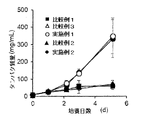
- FIG. 14 is a graph showing the amount of protein in the culture medium of the modified cyanobacteria of Examples 1-2 and Comparative Examples 1-3.
- the slr1841-suppressed strain of Example 1 and the slr0688-suppressed strain of Example 2 secrete and produce a large amount of protein in the culture medium.
- the slr0042-deficient strain of Comparative Example 3 hardly secreted and produced proteins in the culture medium.
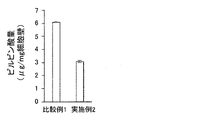
- 15 shows the quantitative results of the amount of pyruvic acid.
- 15 is a graph showing amounts of pyruvic acid covalently bound to cell wall-bound sugar chains of modified cyanobacteria of Example 2 and Comparative Example 1.
- FIG. 15 it was confirmed that the slr0688-suppressed strain of Example 2 had a reduced amount of pyruvic acid of about 50% compared to the control strain of Comparative Example 1, which is the parent strain. From this, it is considered that the amount of the cell wall-pyruvate modifying enzyme, which is a protein involved in binding between the outer membrane and the cell wall, is also suppressed to about 50% of that in the parent strain.
- the modified cyanobacteria of the present disclosure secrete proteins present inside the cells (inside the periplasm here) outside the cells. Since the modified cyanobacteria of the present disclosure can be genetically modified, for example, to produce other proteins in place of the proteins identified above (i.e., proteins originally produced within the bacterium), A desired protein can be produced efficiently.
- cyanobacteria have a high photosynthetic ability, they can easily obtain the necessary proteins when they are needed by culturing them by giving them light, water, air, and a trace amount of inorganic substances. There is no need to use complicated equipment for In addition, proteins tend to lose their functions during processing into supplements, for example. Therefore, according to the modified cyanobacteria of the present disclosure, it is possible to provide proteins while maintaining their functions. Due to the above advantages, the modified cyanobacteria of the present disclosure are expected to be applied in various fields.
- Table 3 lists only 10 types of proteins identified by LC-MS/MS analysis in descending order of relative quantification value. Then, in "(5-3) Data analysis", all 10 types of proteins listed in Table 3 were contained in the culture supernatants of the slr1841-suppressed strain of Example 1 and the slr0688 strain of Example 2. Although described, all other proteins identified by LC-MS/MS analysis were similarly confirmed to be contained in the culture supernatants of Examples 1 and 2, respectively. It was also confirmed that the secreted proteins include proteins originally present in the periplasm and proteins transported from the cytoplasm to the periplasm and functioning in the periplasm.
- the modified cyanobacteria, the method for producing the modified cyanobacteria, and the method for producing the protein according to the present disclosure have been described above based on the embodiments, but the present disclosure is not limited to these embodiments. As long as it does not deviate from the gist of the present disclosure, various modifications that a person skilled in the art can think of are applied to the embodiments, and other forms constructed by combining some of the constituent elements of the embodiments are also within the scope of the present disclosure. included.
- the total amount of proteins involved in binding between the outer membrane and the cell wall in cyanobacteria is suppressed to 30% or more and 70% or less of the total amount of the proteins in the parent strain, thereby
- the present invention is not limited to this.
- the bond between the outer membrane and the cell wall may be weakened, and the outer membrane may be weakened.
- Enzymes or agents may also be added to the cyanobacterial culture to weaken the outer membrane.
- the modified cyanobacteria According to the modified cyanobacteria, the method for producing the modified cyanobacteria, and the method for producing a protein using the modified cyanobacteria of the present disclosure, the modified cyanobacteria are cultured by providing them with water, light, air, and trace amounts of inorganic substances.
- protein can be obtained efficiently. For example, it is possible to obtain raw materials for food ingredients or enzymes for producing compounds, diagnostic enzymes or therapeutic enzymes in the medical field, or feed enzymes in the field of agriculture, fisheries and livestock.
Landscapes
- Health & Medical Sciences (AREA)
- Chemical & Material Sciences (AREA)
- Life Sciences & Earth Sciences (AREA)
- Genetics & Genomics (AREA)
- Engineering & Computer Science (AREA)
- Organic Chemistry (AREA)
- Zoology (AREA)
- Bioinformatics & Cheminformatics (AREA)
- Wood Science & Technology (AREA)
- Biotechnology (AREA)
- General Engineering & Computer Science (AREA)
- Biomedical Technology (AREA)
- Biochemistry (AREA)
- General Health & Medical Sciences (AREA)
- Microbiology (AREA)
- Molecular Biology (AREA)
- Medicinal Chemistry (AREA)
- Biophysics (AREA)
- Plant Pathology (AREA)
- Physics & Mathematics (AREA)
- Tropical Medicine & Parasitology (AREA)
- Proteomics, Peptides & Aminoacids (AREA)
- Gastroenterology & Hepatology (AREA)
- Virology (AREA)
- Preparation Of Compounds By Using Micro-Organisms (AREA)
- Micro-Organisms Or Cultivation Processes Thereof (AREA)
- Peptides Or Proteins (AREA)
Priority Applications (4)
| Application Number | Priority Date | Filing Date | Title |
|---|---|---|---|
| BR112023016953A BR112023016953A2 (pt) | 2021-03-04 | 2022-03-01 | Cianobactéria modificada, método de produção decianobactéria modificada, e método de produção de proteínas |
| MX2023010047A MX2023010047A (es) | 2021-03-04 | 2022-03-01 | Cianobacterias modificadas, metodo de produccion de cianobacterias modificadas y metodo de produccion de proteinas. |
| JP2023503872A JPWO2022186216A1 (https=) | 2021-03-04 | 2022-03-01 | |
| US18/456,037 US20240084245A1 (en) | 2021-03-04 | 2023-08-25 | Modified cyanobacterium, modified cyanobacterium production method, and protein production method |
Applications Claiming Priority (2)
| Application Number | Priority Date | Filing Date | Title |
|---|---|---|---|
| JP2021034071 | 2021-03-04 | ||
| JP2021-034071 | 2021-03-04 |
Related Child Applications (1)
| Application Number | Title | Priority Date | Filing Date |
|---|---|---|---|
| US18/456,037 Continuation US20240084245A1 (en) | 2021-03-04 | 2023-08-25 | Modified cyanobacterium, modified cyanobacterium production method, and protein production method |
Publications (1)
| Publication Number | Publication Date |
|---|---|
| WO2022186216A1 true WO2022186216A1 (ja) | 2022-09-09 |
Family
ID=83154393
Family Applications (1)
| Application Number | Title | Priority Date | Filing Date |
|---|---|---|---|
| PCT/JP2022/008657 Ceased WO2022186216A1 (ja) | 2021-03-04 | 2022-03-01 | 改変シアノバクテリア、改変シアノバクテリアの製造方法、及び、タンパク質の製造方法 |
Country Status (5)
| Country | Link |
|---|---|
| US (1) | US20240084245A1 (https=) |
| JP (1) | JPWO2022186216A1 (https=) |
| BR (1) | BR112023016953A2 (https=) |
| MX (1) | MX2023010047A (https=) |
| WO (1) | WO2022186216A1 (https=) |
Citations (1)
| Publication number | Priority date | Publication date | Assignee | Title |
|---|---|---|---|---|
| WO2021100640A1 (ja) * | 2019-11-21 | 2021-05-27 | パナソニックIpマネジメント株式会社 | 改変シアノバクテリア、改変シアノバクテリアの製造方法、及び、タンパク質の製造方法 |
-
2022
- 2022-03-01 MX MX2023010047A patent/MX2023010047A/es unknown
- 2022-03-01 JP JP2023503872A patent/JPWO2022186216A1/ja active Pending
- 2022-03-01 WO PCT/JP2022/008657 patent/WO2022186216A1/ja not_active Ceased
- 2022-03-01 BR BR112023016953A patent/BR112023016953A2/pt unknown
-
2023
- 2023-08-25 US US18/456,037 patent/US20240084245A1/en active Pending
Patent Citations (1)
| Publication number | Priority date | Publication date | Assignee | Title |
|---|---|---|---|---|
| WO2021100640A1 (ja) * | 2019-11-21 | 2021-05-27 | パナソニックIpマネジメント株式会社 | 改変シアノバクテリア、改変シアノバクテリアの製造方法、及び、タンパク質の製造方法 |
Non-Patent Citations (7)
| Title |
|---|
| DATABASE Uniprot Uniprot; . : "RecName: Full=PS_pyruv_trans domain-containing protein {ECO:0000259|Pfam:PF04230}", XP055965246 * |
| DATABASE Uniprot Uniprot; . : "RecName: Full=SLH domain-containing protein {ECO:0000259|PROSITE:PS51272}", XP055965238 * |
| DATABASE Uniprot Uniprot; . : "SubName: Full=Cyanobacterial porin {ECO:0000313|EMBL:AFZ58858.1", XP055965240 * |
| DATABASE Uniprot Uniprot; . : "SubName: Full=Polysaccharide pyruvyl transferase CsaB {ECO:0000313|EMBL:AFZ57125.1", XP055965549 * |
| KOJIMA SEIJI, OKUMURA YASUAKI: "Outer membrane-deprived cyanobacteria liberate periplasmic and thylakoid luminal components that support the growth of heterotrophs", BIORXIV, 25 March 2020 (2020-03-25), pages 1 - 31, XP055825843, Retrieved from the Internet <URL:https://www.biorxiv.org/content/10.1101/2020.03.24.006684v1.full.pdf> [retrieved on 20210720], DOI: 10.1101/2020.03.24.006684 * |
| KOJIMA, SEIJI: "4A11a07 Outer membrane detached cyanobacteria secrete periplasmic and thylakoid luminal components", ANNUAL MEETING OF THE JAPAN SOCIETY FOR BIOSCIENCE , BIOTECHNOLOGY AND AGROCHEMISTRY, JAPAN SOCIETY FOR BIOSCIENCE, BIOTECHNOLOGY, AND AGROCHEMISTRY, JP, 5 March 2020 (2020-03-05) - 28 March 2020 (2020-03-28), JP , pages 1416, XP009539442, ISSN: 2186-7976 * |
| KOWATA HIKARU: "Studies on molecular basis of cyanobacterial outer membrane function and its evolutionary relationship with primitive chloroplasts", THESIS, TOHOKU UNIVERSITY, 27 March 2018 (2018-03-27), Tohoku University , XP055825637, [retrieved on 20210719] * |
Also Published As
| Publication number | Publication date |
|---|---|
| US20240084245A1 (en) | 2024-03-14 |
| MX2023010047A (es) | 2023-09-05 |
| JPWO2022186216A1 (https=) | 2022-09-09 |
| BR112023016953A2 (pt) | 2023-10-31 |
Similar Documents
| Publication | Publication Date | Title |
|---|---|---|
| JP7766262B2 (ja) | 分泌されたタンパク質の製造方法 | |
| JP7801672B2 (ja) | 植物成長促進剤の製造方法、植物成長促進剤、及び、植物成長促進方法 | |
| JP7544351B2 (ja) | シュードザイマ・アンタクティカの新規菌株 | |
| CA2766574A1 (en) | Methods and compositions for affecting the differentiation of clostridia in culture | |
| US12528844B2 (en) | Modified cyanobacterium, modified cyanobacterium production method, and protein production method | |
| JP2022134906A (ja) | バイオフィルムの製造方法、バイオフィルム、及び有機物の製造方法 | |
| CN116926097B (zh) | 小分子热休克蛋白IbpA在提高宿主菌环境耐受性中的应用 | |
| CN107257851A (zh) | 正面影响天然或工程化的真核细胞的生理学的细菌伴侣蛋白的组合 | |
| JPWO2021100642A5 (https=) | ||
| WO2024024427A1 (ja) | シアノバクテリアの外膜剥離の判定方法、シアノバクテリアの外膜剥離の判定装置、及び、プログラム | |
| WO2022186216A1 (ja) | 改変シアノバクテリア、改変シアノバクテリアの製造方法、及び、タンパク質の製造方法 | |
| CN109706104B (zh) | sll0528基因在提高集胞藻PCC6803乙醇耐受性中的应用 | |
| Santos et al. | Comparing methods of genetic manipulation in Bacillus subtilis for expression of recombinant enzyme: Replicative or integrative (CRISPR-Cas9) plasmid? | |
| Li et al. | Efficient expressions of reporter genes in the industrial filamentous fungus Sclerotium rolfsii mediated by Agrobacterium tumefaciens | |
| JP2024045256A (ja) | 農作物の栽培方法 | |
| JP2022134907A (ja) | バイオフィルムの製造方法、バイオフィルム、及び有機物の製造方法 | |
| CN109929853B (zh) | 嗜热菌来源的热激蛋白基因的应用 | |
| US20250098687A1 (en) | Plant disease resistance inducing agent, plant disease resistance inducing method, and method for producing plant disease resistance inducing agent | |
| JP2022134729A (ja) | 植物高品質化剤の製造方法、植物高品質化剤、及び、植物高品質化方法 | |
| JP2024010288A (ja) | 乾燥菌体の製造方法、及び、乾燥菌体 | |
| CN104371964A (zh) | 有氧下可提升重组蛋白质表现的菌株 | |
| CN120098090B (zh) | 一种来源于沃氏葡萄球菌温和噬菌体的穿孔素及应用 | |
| WO2022186217A1 (ja) | 植物成長促進剤の製造方法、植物成長促進剤、及び、植物成長促進方法 | |
| WO2022186220A1 (ja) | 植物酸性インベルターゼ活性化剤、その製造方法、及び、植物酸性インベルターゼ活性化方法 | |
| JP2023182951A (ja) | トマト果実の高糖度化方法、トマト果実の高糖度化剤及びその製造方法 |
Legal Events
| Date | Code | Title | Description |
|---|---|---|---|
| 121 | Ep: the epo has been informed by wipo that ep was designated in this application |
Ref document number: 22763270 Country of ref document: EP Kind code of ref document: A1 |
|
| WWE | Wipo information: entry into national phase |
Ref document number: 2023503872 Country of ref document: JP |
|
| WWE | Wipo information: entry into national phase |
Ref document number: MX/A/2023/010047 Country of ref document: MX |
|
| WWE | Wipo information: entry into national phase |
Ref document number: 202347057779 Country of ref document: IN |
|
| REG | Reference to national code |
Ref country code: BR Ref legal event code: B01A Ref document number: 112023016953 Country of ref document: BR |
|
| NENP | Non-entry into the national phase |
Ref country code: DE |
|
| ENP | Entry into the national phase |
Ref document number: 112023016953 Country of ref document: BR Kind code of ref document: A2 Effective date: 20230823 |
|
| 122 | Ep: pct application non-entry in european phase |
Ref document number: 22763270 Country of ref document: EP Kind code of ref document: A1 |