WO2022185945A1 - リニア電源回路 - Google Patents
リニア電源回路 Download PDFInfo
- Publication number
- WO2022185945A1 WO2022185945A1 PCT/JP2022/006584 JP2022006584W WO2022185945A1 WO 2022185945 A1 WO2022185945 A1 WO 2022185945A1 JP 2022006584 W JP2022006584 W JP 2022006584W WO 2022185945 A1 WO2022185945 A1 WO 2022185945A1
- Authority
- WO
- WIPO (PCT)
- Prior art keywords
- output transistor
- voltage
- output
- power supply
- supply circuit
- Prior art date
- Legal status (The legal status is an assumption and is not a legal conclusion. Google has not performed a legal analysis and makes no representation as to the accuracy of the status listed.)
- Ceased
Links
Images




Classifications
-
- G—PHYSICS
- G05—CONTROLLING; REGULATING
- G05F—SYSTEMS FOR REGULATING ELECTRIC OR MAGNETIC VARIABLES
- G05F1/00—Automatic systems in which deviations of an electric quantity from one or more predetermined values are detected at the output of the system and fed back to a device within the system to restore the detected quantity to its predetermined value or values, i.e. retroactive systems
- G05F1/10—Regulating voltage or current
- G05F1/46—Regulating voltage or current wherein the variable actually regulated by the final control device is DC
- G05F1/56—Regulating voltage or current wherein the variable actually regulated by the final control device is DC using semiconductor devices in series with the load as final control devices
- G05F1/575—Regulating voltage or current wherein the variable actually regulated by the final control device is DC using semiconductor devices in series with the load as final control devices characterised by the feedback circuit
-
- G—PHYSICS
- G05—CONTROLLING; REGULATING
- G05F—SYSTEMS FOR REGULATING ELECTRIC OR MAGNETIC VARIABLES
- G05F1/00—Automatic systems in which deviations of an electric quantity from one or more predetermined values are detected at the output of the system and fed back to a device within the system to restore the detected quantity to its predetermined value or values, i.e. retroactive systems
- G05F1/10—Regulating voltage or current
- G05F1/46—Regulating voltage or current wherein the variable actually regulated by the final control device is DC
- G05F1/56—Regulating voltage or current wherein the variable actually regulated by the final control device is DC using semiconductor devices in series with the load as final control devices
- G05F1/563—Regulating voltage or current wherein the variable actually regulated by the final control device is DC using semiconductor devices in series with the load as final control devices including two stages of regulation at least one of which is output level responsive, e.g. coarse and fine regulation
-
- G—PHYSICS
- G05—CONTROLLING; REGULATING
- G05F—SYSTEMS FOR REGULATING ELECTRIC OR MAGNETIC VARIABLES
- G05F3/00—Non-retroactive systems for regulating electric variables by using an uncontrolled element, or an uncontrolled combination of elements, such element or such combination having self-regulating properties
- G05F3/02—Regulating voltage or current
- G05F3/08—Regulating voltage or current wherein the variable is DC
- G05F3/10—Regulating voltage or current wherein the variable is DC using uncontrolled devices with non-linear characteristics
- G05F3/16—Regulating voltage or current wherein the variable is DC using uncontrolled devices with non-linear characteristics being semiconductor devices
- G05F3/20—Regulating voltage or current wherein the variable is DC using uncontrolled devices with non-linear characteristics being semiconductor devices using diode- transistor combinations
- G05F3/26—Current mirrors
- G05F3/262—Current mirrors using field-effect transistors only
Definitions
- the invention disclosed in this specification relates to a linear power supply circuit.
- Linear power circuits such as LDO [low drop out] are used as power means for various devices.
- the linear power supply circuit be capable of phase compensation without significantly increasing the circuit area even if the capacitance value of the output capacitor is reduced.
- Patent Document 1 can be cited as an example of conventional technology related to the above.
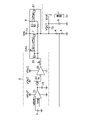
- FIG. 10 is a diagram showing a conventional linear power supply circuit according to Patent Document 1.
- FIG. 10 is a diagram showing a conventional linear power supply circuit according to Patent Document 1.
- a conventional linear power supply circuit includes an input terminal T1, an output terminal T2, a first output transistor 1, a driver 2, a reference voltage generator 3, and a phase compensation circuit 8. Further, an output capacitor 6 and a load 7 are externally attached to step down the input voltage VIN to generate an output voltage VOUT and supply the output voltage VOUT to the load 7 .
- the conductivity of the first output transistor 1 and the second output transistor 81 which will be described later, is controlled by the gate signal G1.
- PMOSFET P-channel type MOSFET
- the driver 2 includes a differential amplifier 21, a capacitor 22, a PMOSFET 23, a current amplifier 24, and a PMOSFET 25 forming a current mirror.
- the output of the differential amplifier 21 is applied to one end of the capacitor 22 and the ground potential is applied to the other end of the capacitor 22 . Therefore, the connection node between the differential amplifier 21 and the capacitor 22 is grounded in a high frequency band, so that the driver 2 can realize high-speed response.
- the phase compensation circuit 8 includes a second output transistor 81, a resistor 82, and a capacitor 83.
- One end of the resistor 82 is connected to the gates of the first output transistor 1 and the PMOSFET 25 forming the current mirror, and the other end of the resistor is connected to the gate of the second output transistor 81 .
- a capacitor 83 is provided between the gate and source of the second output transistor 81 .
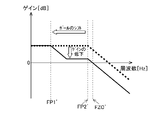
- FIG. 11 is a diagram showing gain characteristics of transfer functions of the first output transistor 1 and the phase compensation circuit 8.
- the first pole frequency FP1' is the frequency of the first pole caused by the parasitic capacitance CPD.
- the first pole of the transfer function of the first output transistor 1 is the pole to which the output capacitor 6 does not participate.
- the first output transistor 1 and the second output transistor 81 are connected in parallel, and the first output transistor 1 is not affected by the resistor 82. Therefore, the first pole frequency FP1' before shifting to the low frequency range is A pole exists at the original position, and the frequency of the pole becomes the second pole frequency FP2'. As the first pole frequency FP1' shifts to a lower frequency and the gain decreases, the zero-cross frequency FZC' shifts to a lower frequency.
- the first pole frequency FP1' and the second pole frequency FP2' are related to the second pole frequency of the transfer function of the linear power supply circuit and the output capacitor 6 shown in FIG. Therefore, the phase compensation circuit 8 can shift the second pole frequency of the transfer function of the linear power supply circuit and the output capacitor 6 shown in FIG. Due to this shift, the phase compensation circuit 8 causes the transfer function of the linear power supply circuit and the output capacitor 6 shown in FIG. can be reduced as compared with the case where the phase compensation circuit 8 is not provided. As a result, the zero-cross frequency of the transfer function of the linear power supply circuit and the output capacitor 6 shown in FIG. 10 shifts to a lower frequency. That is, the linear power supply circuit shown in FIG. 10 can perform phase compensation only by adding the phase compensation circuit 8 (without a large increase in circuit area) even when the capacitance of the output capacitor 6 is reduced.
- FIG. 12 is a diagram showing the relationship between the input voltage VIN, the gate voltages of the first output transistor 1 and the second output transistor 81, and the output voltage VOUT in the linear power supply circuit shown in FIG.
- the vertical axis of FIG. 12 is voltage, and the horizontal axis is time. That is, in FIG. 12, how the input voltage VIN, the output voltage VOUT, the gate voltage VPG (gate signal G1) driving the output transistor 1, and the gate voltage VPGF driving the second output transistor 81 change over time. indicates whether or not
- both the gate voltages VPG and VPGF start rising at time t1 when the input voltage VIN starts rising from 4.75V to 16V. While the level is rising, the gate voltage VPGF at that time is lower than the level of the gate voltage VPG, and there is a possibility that a delay time will occur compared to the rise of the gate voltage VPG. This is due to the CR circuit (resistor 82 and capacitor 83) included in the phase compensation circuit 8.
- a linear power supply circuit disclosed in this specification includes a first output transistor and a second output transistor which are provided between an input terminal to which an input voltage is applied and an output terminal to which an output voltage is applied and are connected in parallel with each other.
- a driver configured to drive the first output transistor and the second output transistor based on a difference between a voltage based on the output voltage and a reference voltage; and control of the first output transistor.
- a potential difference suppression unit that suppresses a potential difference between the terminal and the control terminal of the second output transistor.
- the vehicle disclosed in this specification includes the linear power supply circuit configured as described above.
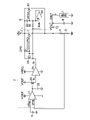
- FIG. 1 is a diagram showing a configuration example of a linear power supply circuit according to the first embodiment.
- FIG. 2 is a diagram showing a configuration example of an operational amplifier.
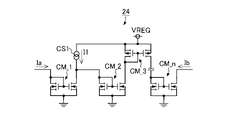
- FIG. 3 is a diagram showing a configuration example of a current amplifier.
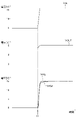
- FIG. 4 is a diagram showing the relationship between the gate voltage and the output voltage of each of the first output transistor and the second output transistor in the linear power supply circuit shown in FIG.
- FIG. 5 is a diagram showing a configuration example of a linear power supply circuit according to the second embodiment.
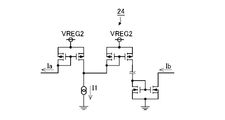
- FIG. 6 is a diagram showing another configuration example of the current amplifier.
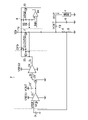
- FIG. 7 is a diagram showing a configuration example of a linear power supply circuit according to the third embodiment.
- FIG. 8 is an external view of a semiconductor integrated circuit device.
- FIG. 9 is an external view of the vehicle.
- FIG. 10 is a diagram showing a configuration example of a linear power supply circuit according to Patent Document 1.
- FIG. 11 is a diagram showing gain characteristics of transfer functions of the linear power supply circuit and the output capacitor shown in FIG. 12 is a diagram showing the relationship between the gate voltage and the output voltage of each of the first output transistor and the second output transistor in the linear power supply circuit shown in FIG. 10.
- FIG. 11 is a diagram showing gain characteristics of transfer functions of the linear power supply circuit and the output capacitor shown in FIG. 12 is a diagram showing the relationship between the gate voltage and the output voltage of each of the first output transistor and the second output transistor in the linear power supply circuit shown in FIG. 10.
- a constant voltage means a voltage that is constant in an ideal state, and is actually a voltage that can slightly fluctuate due to temperature changes and the like.
- the reference voltage means a voltage that is constant in an ideal state, and is actually a voltage that can slightly fluctuate due to temperature changes and the like.
- a constant current means a current that is constant in an ideal state, and is actually a current that can slightly fluctuate due to temperature changes and the like.
- MOSFET means that the gate structure is a layer made of a conductor or a semiconductor such as polysilicon with a small resistance value, an insulating layer, and a P-type, N-type, or intrinsic semiconductor layer. ” refers to a field effect transistor consisting of at least three layers. That is, the structure of the MOSFET gate is not limited to a three-layer structure of metal, oxide, and semiconductor.
- FIG. 1 is a diagram showing a configuration example of a linear power supply circuit according to the first embodiment.
- the linear power supply circuit shown in FIG. An output capacitor 6 and a load 7 are externally attached.
- the first output transistor 1 is provided between the input terminal T1 to which the input voltage VIN is applied and the output terminal T2 to which the output voltage VOUT is applied.
- the driver 2 drives the first output transistor 1 and a second output transistor which will be described later. Specifically, the driver 2 supplies the gate signal G1 to the gate of the first output transistor 1 and to the gate of the second output transistor 81 via the resistor 82, respectively. Drives transistor 81 .
- the conductivity of the first output transistor 1 and the second output transistor 81 (in other words, the ON resistance value) is controlled by the gate signal G1.
- PMOSFETs are used as the first output transistor 1 and the second output transistor 81 in the configuration shown in FIG. Therefore, the lower the voltage level of the gate signal G1, the higher the conductivity of the first output transistor 1 and the second output transistor 81, and the higher the output voltage VOUT.
- the first output transistor 1 and the second output transistor instead of the PMOSFET, an NMOSFET or a bipolar transistor may be used.
- the driver 2 includes a differential amplifier 21 , a capacitor 22 , a PMOSFET 23 , a current amplifier 24 and a PMOSFET 25 .
- a feedback voltage VFB is applied to the inverting input terminal (-) of the differential amplifier 21, and a reference voltage VREF is applied to the non-inverting input terminal (+).
- the driver 2 increases the voltage level of the gate signal G1 as the difference value ⁇ V increases, and conversely decreases the voltage level of the gate signal G1 as the difference value ⁇ V decreases.
- the output of the differential amplifier 21 is applied to one end of the capacitor 22 and the ground potential is applied to the other end of the capacitor 22 .
- the output voltage VOUT is applied to the source of the PMOSFET 23, and the voltage based on the output of the differential amplifier 21 (connection node voltage between the differential amplifier 21 and the capacitor 22) is applied to the gate of the PMOSFET 23.
- the PMOSFET 23 converts the voltage based on the output of the differential amplifier 21 into a current and outputs it from the drain. Since the connection node between the differential amplifier 21 and the capacitor 22 is grounded in the high frequency band, the high speed response of the driver 2 can be realized.
- the withstand voltages of the differential amplifier 21 and the PMOSFET 23 are lower than the withstand voltage of the current amplifier 24. Also, the gain of the differential amplifier 21 is smaller than the gain of the current amplifier 24 . Thereby, the size reduction of the differential amplifier 21 and the PMOSFET 23 can be achieved.
- the current amplifier 24 amplifies the current Ia output from the drain of the PMOSFET 23 .
- the power supply voltage of the current amplifier 24 is a constant voltage VREG. That is, the current amplifier 24 is driven with a voltage between the constant voltage VREG and the ground potential.
- the PMOSFET 25 forms a current mirror circuit together with the first output transistor 1.
- the PMOSFET 25 converts the current Ib output from the current amplifier 24 into a voltage and supplies it to the gate of the first output transistor 1 .
- the reference voltage generator 3 generates the reference voltage VREF.
- Resistors 4 and 5 produce a feedback voltage VFB which is a voltage division of the output voltage VOUT.
- the output voltage VOUT supplied from the output terminal T2 is applied to the output capacitor 6 and the load 7.
- the phase compensation circuit 8 includes a second output transistor 81, a resistor 82, a capacitor 83, and an operational amplifier 84. Note that in a configuration in which a delay can occur between the gate potential of the first output transistor 1 and the gate potential of the second output transistor 81, the resistor 82 and the capacitor 83 are provided unlike the configuration of this embodiment. It may be a configuration without
- the second output transistor 81 is connected in parallel with the first output transistor 1 . That is, the source of the second output transistor 81 is connected to the source of the first output transistor 1 and the drain of the second output transistor 81 is connected to the drain of the first output transistor 1 .
- the size of the second output transistor 81 is made larger than the size of the first output transistor 1 so that the current flowing through the second output transistor 81 is larger than the current flowing through the first output transistor 1 .
- size means area.
- One end of the resistor 82 is connected to each gate of the first output transistor 1 and the PMOSFET 25 , and the other end of the resistor 82 is connected to the gate of the second output transistor 81 .
- a capacitor 83 is provided between the gate and source of the second output transistor 81 .
- the parasitic capacitor of the second output transistor 81 is used as the capacitor 83 .
- a capacitor different from the parasitic capacitor of the second output transistor 81 may be used as the capacitor 83. good too.
- the capacitance value of the capacitor 83 can be easily adjusted. It is desirable that the capacitance value of the capacitor 83 is larger than the capacitance value of the parasitic capacitance CPD.
- the phase compensation circuit 8 may further include a capacitor provided between the gate and drain of the second output transistor 81 .
- the operational amplifier 84 is an example of a potential difference suppression unit that suppresses the potential difference between the gate of the first output transistor 1 and the gate of the second output transistor 81 .
- the potential difference suppressing unit monitors, for example, the voltage difference between the gate voltage of the first output transistor 1 and the gate voltage of the second output transistor 81, and if the voltage difference is equal to or greater than a certain value, the first output transistor 1 or the gate voltage of the second output transistor 81 so that the potential difference between the gate of the first output transistor 1 and the gate of the second output transistor 81 becomes small. It should be configured to In this embodiment, the operational amplifier 84 outputs the control signal.
- the operational amplifier 84 has an input offset voltage 84A.
- a non-inverting input terminal of the operational amplifier 84 is connected to the gate of the first output transistor 1 .
- the inverting input terminal and output terminal of the operational amplifier 84 are connected to the gate of the first output transistor 1 .
- FIG. 2 is a diagram showing a configuration example of the operational amplifier 84. As shown in FIG. The operational amplifier 84 of the configuration example shown in FIG. and an NMOSFET 845 that becomes
- the current mirror circuit supplies the NMOSFET 841 with a first current and the NMOSFET 842 with a second current that is a mirror current of the first current.
- the source of the NMOSFET 841 is the non-inverting input terminal of the operational amplifier 84
- the source of the NMOSFET 842 is the inverting input terminal of the operational amplifier 84
- the source of the NMOSFET 845 is the output terminal of the operational amplifier 84.
- a bias voltage Vb is applied to the gates of NMOSFET 841 and NMOSFET 842 .
- the drain of NMOSFET 841 is connected to the drain of PMOSFET 843 and the gate of NMOSFET 845 .
- the drain of NMOSFET 842 is connected to the drain and gate of PMOSFET 844 and the gate of PMOSFET 843 .
- An input voltage VIN is applied to the source of PMOSFET 843, the source of PMOSFET 844, and the drain of NMOSFET 845.
- the source of NMOSFET 845 is connected to the source of NMOSFET 842 .
- the ratio of the channel width to the channel length of the NMOSFETs 841 and 842 is set to be different from each other, or the first current and the second current are set to different values (the current
- An input offset voltage 84A is generated by at least one of setting the mirror ratio of the mirror circuit to a value other than 1. With such a configuration, it is easy to set the input offset voltage 84A to the designed value.
- FIG. 3 is a diagram showing a configuration example of the current amplifier 24 in the linear power supply circuit shown in FIG.
- the current amplifier 24 includes current sink type current mirror circuits CM_1, CM_2, . . . , and CM_n, and current source type current mirror circuits CM_3, . ) and Between the current sink type current mirror circuit CM_1, the constant current source CS1 that flows the constant current I1, and the current sink type current mirror circuit CM_n, the current sink type current mirror circuit and the current source type A current mirror circuit is alternately arranged to amplify the current. The amplified current becomes the current Ib that is converted into the voltage of the gate signal G1 at the final stage.
- FIG. 4 is a diagram showing the relationship between the input voltage VIN, the gate voltages of the first output transistor 1 and the second output transistor 81, and the output voltage VOUT in the linear power supply circuit shown in FIG.
- the vertical axis of FIG. 4 is voltage, and the horizontal axis is time.
- FIG. 4 how the input voltage VIN, the output voltage VOUT, the gate voltage (gate signal G1) VPG driving the first output transistor 1, and the gate voltage VPGF driving the second output transistor 81 change over time. shows that it is changing.
- both the gate voltages VPG and VPGF start to rise from time t1 when the input voltage VIN starts to rise from 4.75V to 16V, but the gate voltage VPGF rises without delaying the rise of the gate voltage VPG. That is, both the gate voltage VPG and the gate voltage VPGF increase. This is because the operational amplifier 84 suppresses the voltage difference between the gate voltage VPG and the gate voltage VPGF.
- FIG. 5 is a diagram showing the configuration of a linear power supply circuit according to the second embodiment.
- the same parts as in FIG. 1 are denoted by the same reference numerals, and detailed description thereof will be omitted.
- the driver 2 includes a differential amplifier 21', a capacitor 22', an NMOSFET 23', a current amplifier 24, and a PMOSFET 25.
- the differential amplifier 21' outputs a voltage corresponding to the difference between the feedback voltage VFB and the reference voltage VREF.
- the power supply voltage of the differential amplifier 21' is the first constant voltage VREG1. That is, the differential amplifier 21' is driven with a voltage between the first constant voltage VREG1 and the ground potential.
- the withstand voltages of the differential amplifier 21' and the NMOSFET 23' are lower than the withstand voltage of the current amplifier 24. Also, the gain of the differential amplifier 21 ′ is smaller than the gain of the current amplifier 24 . As a result, the size of the differential amplifier 21' and the NMOSFET 23' can be reduced.
- the output of the differential amplifier 21' is applied to one end of the capacitor 22', and the output voltage VOUT is applied to the other end of the capacitor 22'.
- a voltage dependent on the output voltage VOUT may be applied to the other end of the capacitor 22 instead of the output voltage VOUT.
- a ground potential is applied to the source of the NMOSFET 23', and a voltage (connection node voltage between the differential amplifier 21' and the capacitor 22') based on the output of the differential amplifier 21' is applied to the gate of the NMOSFET 23'.
- the NMOSFET 23' converts the voltage based on the output of the differential amplifier 21' into a current and outputs it from the drain. Since the connection node between the differential amplifier 21' and the capacitor 22' is grounded to the output voltage VOUT in the high frequency band, the driver 2 can realize high-speed response.
- the current amplifier 24 amplifies the current Ia output from the drain of the NMOSFET 23'.
- the power supply voltage of the current amplifier 24 is the second constant voltage VREG2. That is, the current amplifier 24 is driven with a voltage between the second constant voltage VREG2 and the ground potential.
- the first constant voltage VREG1 and the second constant voltage VREG2 may have the same value or different values. In this configuration example, since the current Ia flows from the current amplifier 24 toward the NMOSFET 23', the current amplifier 24 may be configured as shown in FIG.
- the phase compensation circuit in the linear power supply circuit according to this embodiment shown in FIG. 5 is the same as the linear power supply circuit according to the first embodiment shown in FIG. Therefore, the overshoot of the output voltage VOUT can be suppressed by the same effect. Further, the linear power supply circuit according to the present embodiment shown in FIG. 5 can ensure the operation of the differential amplifier 21' even when the set value of the output voltage VOUT is low.
- the input voltage VIN is used as the power supply voltage of the differential amplifier 21' instead of the first constant voltage VREG1
- the input voltage VIN is used instead of the second constant voltage VREG2 for the current amplifier. 24 may be used as the power supply voltage.
- FIG. 7 is a diagram showing the configuration of a linear power supply circuit according to the third embodiment.
- the linear power supply circuit shown in FIG. 7 applies a phase compensation circuit 8 to a general linear power supply circuit having a common source PMOS output stage.
- the linear power supply circuit including the PMOS source-grounded output stage shown in FIG. 7 is well known as a prior art, so a detailed description will be omitted.
- the linear power supply circuit shown in FIG. 7 by suppressing the difference in conductivity between the output transistor Q1 and the second output transistor 81, overshoot of the output voltage can be suppressed.
- phase compensation circuit according to the invention disclosed in this specification can be applied not only to the linear power supply circuits according to the first and second embodiments, but also to the case where there are a plurality of output transistors.
- FIG. 8 is an external view of a semiconductor integrated circuit device.
- the semiconductor integrated circuit device shown in FIG. 8 has external pins P1 to P14 and an internal power supply 9 therein.
- the internal power supply 9 is a linear power supply circuit according to any one of the first to third embodiments described above. When built-in, the presence or absence of an output capacitor does not matter.
- ⁇ Application example 2> 9 is an external view of the vehicle X.
- FIG. The vehicle X of this configuration example is equipped with various electronic devices X11 to X18 that operate by receiving voltage supplied from a battery (not shown). It should be noted that the mounting positions of the electronic devices X11 to X18 in this figure may differ from the actual ones for convenience of illustration.
- the electronic device X11 is an engine control unit that performs engine-related controls (injection control, electronic throttle control, idling control, oxygen sensor heater control, auto-cruise control, etc.).
- the electronic device X12 is a lamp control unit that controls lighting and extinguishing of HID [high intensity discharged lamp] and DRL [daytime running lamp].
- the electronic device X13 is a transmission control unit that performs controls related to the transmission.
- the electronic device X14 is a braking unit that performs control related to the movement of the vehicle X (ABS [anti-lock brake system] control, EPS [electric power steering] control, electronic suspension control, etc.).
- ABS anti-lock brake system
- EPS electric power steering
- electronic suspension control etc.
- the electronic device X15 is a security control unit that performs drive control such as door locks and security alarms.
- Electronic device X16 includes wipers, electric door mirrors, power windows, dampers (shock absorbers), electric sunroofs, electric seats, and other electronic devices built into vehicle X at the factory shipment stage as standard equipment or manufacturer options. is.
- the electronic device X17 is an electronic device that is arbitrarily attached to the vehicle X as a user option, such as an in-vehicle A/V [audio/visual] device, a car navigation system, and an ETC [electronic toll collection system].
- the electronic device X18 is an electronic device equipped with a high withstand voltage motor, such as an in-vehicle blower, oil pump, water pump, and battery cooling fan.
- a high withstand voltage motor such as an in-vehicle blower, oil pump, water pump, and battery cooling fan.
- linear power supply circuit described above can be incorporated into any of the electronic devices X11 to X18.
- phase compensation circuit is not limited to the specific circuit configuration of the phase compensation circuit 8, which is merely an example, as long as it can suppress the delay between the drive signals of the transistors connected in parallel.
- the linear power supply circuit described above includes a first output transistor (1) and a first output transistor (1) provided between an input terminal (T1) to which an input voltage is applied and an output terminal (T2) to which an output voltage is applied and connected in parallel.
- an output stage comprising a second output transistor (81); and a driver (2) configured to drive said first output transistor and said second output transistor based on a difference between a voltage based on said output voltage and a reference voltage.
- a potential difference suppressing section (84) for suppressing the potential difference between the control terminal of the first output transistor and the control terminal of the second output transistor (first configuration).
- the linear power supply circuit having the first configuration suppresses the potential difference between the control terminal of the first output transistor and the control terminal of the second output transistor, the output voltage is reduced due to the delay caused by the resistor and capacitor for phase compensation. Overshoot can be suppressed.
- the potential difference suppressing unit monitors the voltage difference between the voltage at the control terminal of the first output transistor and the voltage at the control terminal of the second output transistor, and If the voltage difference is equal to or greater than a certain value, at least one of the voltage at the control terminal of the first output transistor and the voltage at the control terminal of the second output transistor is applied to the control terminal of the first output transistor and the voltage at the control terminal of the second output transistor.
- a configuration (second configuration) configured to output a control signal for controlling such that the potential difference with the control terminal is small may be employed.
- the potential difference between the control terminal of the first output transistor and the control terminal of the second output transistor is suppressed from exceeding a certain value. overshoot of the output voltage due to the delay caused by
- the potential difference suppressing section may include an operational amplifier, and the operational amplifier may output the control signal (third configuration).
- the potential difference suppressing section can be realized with a simple configuration.
- the operational amplifier has an input offset voltage
- the non-inverting input terminal of the operational amplifier is connected to the control terminal of the first output transistor
- the inverting input of the operational amplifier is connected to the control terminal of the first output transistor.
- a configuration (fourth configuration) may be employed in which the terminal and the output terminal are connected to the control terminal of the first output transistor.
- the linear power supply circuit having the fourth configuration easily realizes the operation of suppressing the potential difference between the control terminal of the first output transistor and the control terminal of the second output transistor from exceeding a certain level by using the input offset voltage. be able to.
- the operational amplifier is connected to a first input differential pair transistor connected to the control terminal of the first output transistor and to the control terminal of the second output transistor. and a current that supplies a first current to the first input differential pair of transistors and a second current that is a mirror current of the first current to the second input differential pair of transistors.
- a mirror circuit wherein the first input differential pair of transistors and the second input differential pair of transistors are both MOS transistors and have different channel width to channel length ratios;
- the configuration (fifth configuration) may be such that the input offset voltage is generated by at least one of setting the current and the second current to different values.
- the linear power supply circuit of the sixth configuration can perform phase compensation without a large increase in circuit area.
- the capacitor may be a parasitic capacitor of the second output transistor (seventh configuration).
- the linear power supply circuit having the seventh configuration can further suppress an increase in circuit area.
- the capacitance value of the capacitor is controlled by a first terminal connected to the input terminal of the first output transistor and a control of the first output transistor.
- a configuration (eighth configuration) that is larger than the capacitance value of the capacitor (CPD) provided between the terminal and the terminal may be employed.
- the linear power supply circuit having the above eighth configuration facilitates phase compensation.
- the capacitor has a first terminal connected to the input terminal of the second output transistor and a control terminal of the second output transistor.
- a configuration (ninth configuration) including a capacitance different from the parasitic capacitance formed therebetween may be employed.
- the first output transistor and the second output transistor may have sizes different from each other (tenth configuration).
- the linear power supply circuit having the tenth configuration can make the magnitude of the current flowing through the first output transistor 1 and the magnitude of the current flowing through the second output transistor different.
- the size of the second output transistor may be larger than the size of the first output transistor (eleventh configuration).
- the linear power supply circuit having the eleventh configuration can make the current flowing through the second output transistor larger than the current flowing through the first output transistor.
- the output stage may be configured by a PMOS source-grounded circuit (twelfth configuration).
- the voltage gain of the output stage can be increased.
- the vehicle disclosed in this specification has a configuration (a thirteenth configuration) including the linear power supply circuit having any one of the first to twelfth configurations.
- the vehicle having the thirteenth configuration can suppress the overshoot of the output voltage of the linear power supply circuit.
Landscapes
- Engineering & Computer Science (AREA)
- Physics & Mathematics (AREA)
- Electromagnetism (AREA)
- General Physics & Mathematics (AREA)
- Radar, Positioning & Navigation (AREA)
- Automation & Control Theory (AREA)
- Microelectronics & Electronic Packaging (AREA)
- Nonlinear Science (AREA)
- Amplifiers (AREA)
- Continuous-Control Power Sources That Use Transistors (AREA)
Priority Applications (4)
| Application Number | Priority Date | Filing Date | Title |
|---|---|---|---|
| DE112022000613.7T DE112022000613T5 (de) | 2021-03-04 | 2022-02-18 | Lineare stromversorgungsschaltung |
| JP2023503708A JPWO2022185945A1 (https=) | 2021-03-04 | 2022-02-18 | |
| CN202280018546.2A CN116940913A (zh) | 2021-03-04 | 2022-02-18 | 线性电源电路 |
| US18/452,005 US12498748B2 (en) | 2021-03-04 | 2023-08-18 | Linear power supply circuit |
Applications Claiming Priority (2)
| Application Number | Priority Date | Filing Date | Title |
|---|---|---|---|
| JP2021-034178 | 2021-03-04 | ||
| JP2021034178 | 2021-03-04 |
Related Child Applications (1)
| Application Number | Title | Priority Date | Filing Date |
|---|---|---|---|
| US18/452,005 Continuation US12498748B2 (en) | 2021-03-04 | 2023-08-18 | Linear power supply circuit |
Publications (1)
| Publication Number | Publication Date |
|---|---|
| WO2022185945A1 true WO2022185945A1 (ja) | 2022-09-09 |
Family
ID=83154150
Family Applications (1)
| Application Number | Title | Priority Date | Filing Date |
|---|---|---|---|
| PCT/JP2022/006584 Ceased WO2022185945A1 (ja) | 2021-03-04 | 2022-02-18 | リニア電源回路 |
Country Status (5)
| Country | Link |
|---|---|
| US (1) | US12498748B2 (https=) |
| JP (1) | JPWO2022185945A1 (https=) |
| CN (1) | CN116940913A (https=) |
| DE (1) | DE112022000613T5 (https=) |
| WO (1) | WO2022185945A1 (https=) |
Citations (5)
| Publication number | Priority date | Publication date | Assignee | Title |
|---|---|---|---|---|
| JPH0317811U (https=) * | 1989-06-30 | 1991-02-21 | ||
| US20090121694A1 (en) * | 2007-11-12 | 2009-05-14 | Itt Manufacturing Enterprises, Inc. | Non-invasive load current sensing in low dropout (ldo) regulators |
| JP2015152997A (ja) * | 2014-02-12 | 2015-08-24 | セイコーエプソン株式会社 | 回路装置及び電子機器 |
| JP2020071681A (ja) * | 2018-10-31 | 2020-05-07 | ローム株式会社 | リニア電源回路 |
| WO2020209369A1 (ja) * | 2019-04-12 | 2020-10-15 | ローム株式会社 | リニア電源回路及びソースフォロワ回路 |
Family Cites Families (11)
| Publication number | Priority date | Publication date | Assignee | Title |
|---|---|---|---|---|
| CN100480944C (zh) * | 2007-05-15 | 2009-04-22 | 北京中星微电子有限公司 | 一种压控电流源及带有压控电流源的低压差稳压电源 |
| TWI413881B (zh) * | 2010-08-10 | 2013-11-01 | Novatek Microelectronics Corp | 線性穩壓器及其電流感測電路 |
| JP5516320B2 (ja) * | 2010-10-21 | 2014-06-11 | ミツミ電機株式会社 | レギュレータ用半導体集積回路 |
| JP6038516B2 (ja) * | 2011-09-15 | 2016-12-07 | エスアイアイ・セミコンダクタ株式会社 | ボルテージレギュレータ |
| JP5971720B2 (ja) * | 2012-11-01 | 2016-08-17 | 株式会社東芝 | 電圧レギュレータ |
| CN105446403A (zh) * | 2014-08-14 | 2016-03-30 | 登丰微电子股份有限公司 | 低压差线性稳压器 |
| WO2016190112A1 (ja) * | 2015-05-26 | 2016-12-01 | ソニー株式会社 | レギュレータ回路、制御方法 |
| CN106557106B (zh) * | 2015-09-30 | 2018-06-26 | 意法半导体(中国)投资有限公司 | 用于调节器电路的补偿网络 |
| JP7042117B2 (ja) * | 2018-03-08 | 2022-03-25 | ローム株式会社 | リニアレギュレータ |
| DE102019201195B3 (de) * | 2019-01-30 | 2020-01-30 | Dialog Semiconductor (Uk) Limited | Rückkopplungsschema für einen stabilen LDO-Reglerbetrieb |
| US10996699B2 (en) * | 2019-07-30 | 2021-05-04 | Stmicroelectronics Asia Pacific Pte Ltd | Low drop-out (LDO) voltage regulator circuit |
-
2022
- 2022-02-18 WO PCT/JP2022/006584 patent/WO2022185945A1/ja not_active Ceased
- 2022-02-18 CN CN202280018546.2A patent/CN116940913A/zh active Pending
- 2022-02-18 JP JP2023503708A patent/JPWO2022185945A1/ja active Pending
- 2022-02-18 DE DE112022000613.7T patent/DE112022000613T5/de active Pending
-
2023
- 2023-08-18 US US18/452,005 patent/US12498748B2/en active Active
Patent Citations (5)
| Publication number | Priority date | Publication date | Assignee | Title |
|---|---|---|---|---|
| JPH0317811U (https=) * | 1989-06-30 | 1991-02-21 | ||
| US20090121694A1 (en) * | 2007-11-12 | 2009-05-14 | Itt Manufacturing Enterprises, Inc. | Non-invasive load current sensing in low dropout (ldo) regulators |
| JP2015152997A (ja) * | 2014-02-12 | 2015-08-24 | セイコーエプソン株式会社 | 回路装置及び電子機器 |
| JP2020071681A (ja) * | 2018-10-31 | 2020-05-07 | ローム株式会社 | リニア電源回路 |
| WO2020209369A1 (ja) * | 2019-04-12 | 2020-10-15 | ローム株式会社 | リニア電源回路及びソースフォロワ回路 |
Also Published As
| Publication number | Publication date |
|---|---|
| DE112022000613T5 (de) | 2023-11-09 |
| US12498748B2 (en) | 2025-12-16 |
| US20230393600A1 (en) | 2023-12-07 |
| CN116940913A (zh) | 2023-10-24 |
| JPWO2022185945A1 (https=) | 2022-09-09 |
Similar Documents
| Publication | Publication Date | Title |
|---|---|---|
| JP7177661B2 (ja) | リニア電源回路 | |
| JP7198349B2 (ja) | リニア電源回路及びソースフォロワ回路 | |
| JP7489244B2 (ja) | リニア電源回路 | |
| CN112912814B (zh) | 线性电源电路 | |
| JP7230249B2 (ja) | リニア電源回路 | |
| JP7165562B2 (ja) | リニア電源回路 | |
| JP2020072399A (ja) | 差動増幅器 | |
| JP7420738B2 (ja) | リニア電源 | |
| WO2023132118A1 (ja) | リニア電源回路及び車両 | |
| WO2022185945A1 (ja) | リニア電源回路 | |
| JP7795343B2 (ja) | リニア電源回路及び車両 | |
| WO2024018815A1 (ja) | リニア電源回路及び車両 | |
| JP2022178825A (ja) | リニア電源、電子機器、及び車両 |
Legal Events
| Date | Code | Title | Description |
|---|---|---|---|
| 121 | Ep: the epo has been informed by wipo that ep was designated in this application |
Ref document number: 22763001 Country of ref document: EP Kind code of ref document: A1 |
|
| ENP | Entry into the national phase |
Ref document number: 2023503708 Country of ref document: JP Kind code of ref document: A |
|
| WWE | Wipo information: entry into national phase |
Ref document number: 202280018546.2 Country of ref document: CN |
|
| WWE | Wipo information: entry into national phase |
Ref document number: 112022000613 Country of ref document: DE |
|
| 122 | Ep: pct application non-entry in european phase |
Ref document number: 22763001 Country of ref document: EP Kind code of ref document: A1 |