WO2022185243A1 - Process for producing a liquid herbicidal composition - Google Patents

Process for producing a liquid herbicidal composition Download PDF

Info

Publication number
WO2022185243A1
WO2022185243A1 PCT/IB2022/051875 IB2022051875W WO2022185243A1 WO 2022185243 A1 WO2022185243 A1 WO 2022185243A1 IB 2022051875 W IB2022051875 W IB 2022051875W WO 2022185243 A1 WO2022185243 A1 WO 2022185243A1
Authority
WO
WIPO (PCT)
Prior art keywords
salt
glufosinate
dispersion
herbicidal composition
liquid
Prior art date
Legal status (The legal status is an assumption and is not a legal conclusion. Google has not performed a legal analysis and makes no representation as to the accuracy of the status listed.)
Ceased
Application number
PCT/IB2022/051875
Other languages
French (fr)
Inventor
Achintya MONDAL
Satish Ekanath Bhoge
Current Assignee (The listed assignees may be inaccurate. Google has not performed a legal analysis and makes no representation or warranty as to the accuracy of the list.)
UPL Ltd
Original Assignee
UPL Ltd
Priority date (The priority date is an assumption and is not a legal conclusion. Google has not performed a legal analysis and makes no representation as to the accuracy of the date listed.)
Filing date
Publication date
Application filed by UPL Ltd filed Critical UPL Ltd
Priority to CN202280030181.5A priority Critical patent/CN117222316A/en
Priority to BR112023017896A priority patent/BR112023017896A2/en
Priority to CA3211861A priority patent/CA3211861A1/en
Priority to AU2022228742A priority patent/AU2022228742A1/en
Publication of WO2022185243A1 publication Critical patent/WO2022185243A1/en
Anticipated expiration legal-status Critical
Ceased legal-status Critical Current

Links

Classifications

    • AHUMAN NECESSITIES
    • A01AGRICULTURE; FORESTRY; ANIMAL HUSBANDRY; HUNTING; TRAPPING; FISHING
    • A01NPRESERVATION OF BODIES OF HUMANS OR ANIMALS OR PLANTS OR PARTS THEREOF; BIOCIDES, e.g. AS DISINFECTANTS, AS PESTICIDES OR AS HERBICIDES; PEST REPELLANTS OR ATTRACTANTS; PLANT GROWTH REGULATORS
    • A01N25/00Biocides, pest repellants or attractants, or plant growth regulators, characterised by their forms, or by their non-active ingredients or by their methods of application, e.g. seed treatment or sequential application; Substances for reducing the noxious effect of the active ingredients to organisms other than pests
    • A01N25/02Biocides, pest repellants or attractants, or plant growth regulators, characterised by their forms, or by their non-active ingredients or by their methods of application, e.g. seed treatment or sequential application; Substances for reducing the noxious effect of the active ingredients to organisms other than pests containing liquids as carriers, diluents or solvents
    • A01N25/04Dispersions, emulsions, suspoemulsions, suspension concentrates or gels
    • AHUMAN NECESSITIES
    • A01AGRICULTURE; FORESTRY; ANIMAL HUSBANDRY; HUNTING; TRAPPING; FISHING
    • A01NPRESERVATION OF BODIES OF HUMANS OR ANIMALS OR PLANTS OR PARTS THEREOF; BIOCIDES, e.g. AS DISINFECTANTS, AS PESTICIDES OR AS HERBICIDES; PEST REPELLANTS OR ATTRACTANTS; PLANT GROWTH REGULATORS
    • A01N57/00Biocides, pest repellants or attractants, or plant growth regulators containing organic phosphorus compounds
    • A01N57/18Biocides, pest repellants or attractants, or plant growth regulators containing organic phosphorus compounds having phosphorus-to-carbon bonds
    • A01N57/20Biocides, pest repellants or attractants, or plant growth regulators containing organic phosphorus compounds having phosphorus-to-carbon bonds containing acyclic or cycloaliphatic radicals
    • AHUMAN NECESSITIES
    • A01AGRICULTURE; FORESTRY; ANIMAL HUSBANDRY; HUNTING; TRAPPING; FISHING
    • A01PBIOCIDAL, PEST REPELLANT, PEST ATTRACTANT OR PLANT GROWTH REGULATORY ACTIVITY OF CHEMICAL COMPOUNDS OR PREPARATIONS
    • A01P13/00Herbicides; Algicides
    • AHUMAN NECESSITIES
    • A01AGRICULTURE; FORESTRY; ANIMAL HUSBANDRY; HUNTING; TRAPPING; FISHING
    • A01NPRESERVATION OF BODIES OF HUMANS OR ANIMALS OR PLANTS OR PARTS THEREOF; BIOCIDES, e.g. AS DISINFECTANTS, AS PESTICIDES OR AS HERBICIDES; PEST REPELLANTS OR ATTRACTANTS; PLANT GROWTH REGULATORS
    • A01N25/00Biocides, pest repellants or attractants, or plant growth regulators, characterised by their forms, or by their non-active ingredients or by their methods of application, e.g. seed treatment or sequential application; Substances for reducing the noxious effect of the active ingredients to organisms other than pests
    • A01N25/30Biocides, pest repellants or attractants, or plant growth regulators, characterised by their forms, or by their non-active ingredients or by their methods of application, e.g. seed treatment or sequential application; Substances for reducing the noxious effect of the active ingredients to organisms other than pests characterised by the surfactants

Definitions

  • the present invention relates to a process for producing a liquid herbicidal composition of glufosinate isomer or its salt. More particularly, the present invention relates to an improved process for producing a liquid herbicidal composition of L-glufosinate and/or agronomically acceptable salts thereof.
  • Glufosinate is non-selective herbicide belonging to the group of organophosphate which has been widely used around the world. It is generally used in form of ammonium salt for total vegetation control and to control growth of weeds and grasses. Glufosinate is used as a racemic mixture of L- & D- glufosinate. However, it is well known that L-glufosinate i.e. (S)-2-amino-4- (hydroxy(methyl)phosphonoyl)butanoic acid) is much more potent than D- glufosinate.
  • compositions of L-glufosinate salt known in prior art, wherein a general process for preparation of composition comprising admixing the active ingredient with one or more adjuvants, such as diluents, extenders, carriers, surfactants, organic solvents, humectants, or conditioning agents, to provide a composition in the form of a finely-divided particulate solid, pellet, solution, dispersion, or emulsion are disclosed. Most of these formulations are in water. However, these prior arts are silent regarding stepwise procedure carried out for production of composition and the shortcomings faced during formulating the composition.
  • adjuvants such as diluents, extenders, carriers, surfactants, organic solvents, humectants, or conditioning agents
  • an improved process for producing a liquid herbicidal composition comprising: admixing water with a dispersion wherein the dispersion comprises single isomer of glufosinate salt and at least one organic solvent or a liquid surfactant.
  • an improved process for producing a liquid herbicidal composition of L-glufosinate salt comprising: forming a dispersion in the absence of water wherein the dispersion comprises L- glufosinate salt and at least one organic solvent or a liquid surfactant; and admixing the dispersion with water to obtain a liquid herbicidal composition which is free from rock-solid lumps.
  • an improved process for producing a liquid herbicidal composition of single isomer of glufosinate salt by avoiding the formation of rock-solid lump comprising: admixing water with a dispersion wherein the dispersion comprises single isomer glufosinate salt and at least one organic solvent or a liquid surfactant.
  • the dispersion does not contain water.
  • an improved process for producing a liquid herbicidal composition of L-glufosinate salt by avoiding the formation of rock-solid lump comprising: admixing water with a dispersion wherein the dispersion comprises L-glufosinate salt and at least one organic solvent or a liquid surfactant.
  • the dispersion does not contain water.
  • Figure 1 shows graphical presentation of the rock- solid lump formed when the conventional approach was used for producing a liquid herbicidal composition.
  • composition includes or comprises, or consists of, or consists essentially of, or consists substantially of the specific components recited therein, to the exclusion of other ingredients or excipients not specifically recited therein.
  • composition is used interchangeably with the term ‘formulation’.
  • room temperature unless stated otherwise, essentially means temperature in range of 20-35 °C
  • dispenser unless stated otherwise, essentially means system in which distributed particles of active ingredient are dispersed in a continuous phase of another material.
  • dispenser is used interchangeably with the term ‘slurry’.
  • processing time unless stated otherwise, essentially means the time required for completing a process of preparation of finished formulation from raw material.
  • Glufosinate has the chemical name 2-amino-4-
  • L-glufosinate also known commercially as glufosinate-P, is an isomer of glufosinate.
  • Inventors of present invention skilfully designed a process for producing a liquid herbicidal composition wherein the formation of rock-solid lump is avoided to a great extent, the processing is not only fast, but also reliable and inexpensive.
  • an improved process for producing a liquid herbicidal composition comprising: admixing water with a dispersion wherein the dispersion comprises single isomer of glufosinate salt and at least one organic solvent or a liquid surfactant.
  • the dispersion is substantially free of water, or does not contain water.
  • the process for producing a liquid herbicidal composition comprises forming a dispersion in the absence of water wherein the dispersion comprises single isomer of glufosinate salt and at least one organic solvent or a liquid surfactant.
  • the dispersion comprises of single isomer of glufosinate salt and at least one organic solvent.
  • the single isomer of glufosinate salt is L-glufosinate salt or D-glufosinate salt.
  • the salt such as monosodium salt, disodium salt, monopotassium salt, dipotassium salt, calcium salt, ammonium salt, -NH3(CH3) + salt, -NH2(CH3)2 + salt, NH(CH )3 + salt, -NH(CH3)2(C 2 H 4 OH) + salt, -NH 2 (CH 3)(C 2 H 4 OH) + salt and the like can be used.
  • ammonium salt of L-glufosinate salt is used.
  • the organic solvent used may be selected from but not limited to a water miscible polar/non-polar or a water immiscible polar/non-polar solvent, for example; alkyl esters of phthalic acid and trimellitic acid; aromatic hydrocarbons such as xylene, solvesso-100, solvesso-150, solvesso- 200, alkyl benzenes; methylnaphthalene; mixtures of aromatics aliphatic or cycloaliphatic hydrocarbon such as hexanes and heptanes; phthalates; ketones such as cyclohexanone, 2-octanone or acetophenone, methyl isobutyl ketone, saturated or unsaturated cyclic ketones such as isophorone; chlorinated hydrocarbons; vegetable oils and modified vegetable oils; glycols and their derivatives; aliphatic alcohols, alkoxy aliphatic alcohols or mixtures of such two or more solvents
  • solvents can be alkylene carbonates (like propylene carbonate), alkyl amides, and esters such as alkyl esters of monocarboxylic acids and dicarboxylic acid, esteramides, cyclic ethers such furan and its derivatives or mixtures thereof.
  • vegetable oils such as castor oil and modified vegetable oils, glycols and their derivatives such as glycerin, propylene glycol, dipropylene glycol, polypropylene glycol, monoethylene glycol, diethylene glycol, polyethlene glycol 400, polyethlene glycol 300, polyethlene glycol 200, alkoxy aliphatic alcohols such as l-methoxy-2-propanol, 2-butoxy ethanol, esters such as methyl ester of C8-C20 fatty acids or mixture thereof.
  • glycols and their derivatives such as glycerin, propylene glycol, dipropylene glycol, polypropylene glycol, monoethylene glycol, diethylene glycol, polyethlene glycol 400, polyethlene glycol 300, polyethlene glycol 200, alkoxy aliphatic alcohols such as l-methoxy-2-propanol, 2-butoxy ethanol, esters such as methyl ester of C8-C20 fatty acids or mixture thereof.
  • the organic solvent used is selected from group comprising of glycerine, propylene glycol, diethylene glycol, polyethlene glycol 400, polyethlene glycol 300, polyethlene glycol 200, l-methoxy-2-propanol, 2-butoxy ethanol or mixture thereof.
  • the organic solvent used is propylene glycol.
  • the organic solvent used is polyethlene glycol 300.
  • the organic solvent used is 2- butoxy ethanol.
  • an improved process for producing a liquid herbicidal composition comprising: admixing water with a dispersion wherein the dispersion comprises L-glufosinate ammonium salt and propylene glycol.
  • an improved process for producing a liquid herbicidal composition comprising: admixing water with a dispersion wherein the dispersion comprises L-glufosinate ammonium salt and 2-butoxy ethanol.
  • an improved process for producing a liquid herbicidal composition comprising: admixing water with a dispersion wherein the dispersion comprises L-glufosinate ammonium salt and PEG 300.
  • more than one organic solvent is used.
  • an improved process for producing a liquid herbicidal composition comprising: admixing water with a dispersion wherein the dispersion comprises L-glufosinate ammonium salt, propylene glycol and 2-butoxy ethanol.
  • an improved process for producing a liquid herbicidal composition comprising: admixing water with a dispersion wherein the dispersion comprises L-glufosinate ammonium salt, propylene glycol, 2-butoxy ethanol and PEG 300.
  • the dispersion comprises of a single isomer of glufosinate salt and a liquid surfactant.
  • the liquid surfactant is selected from anionic, cationic or zwitterionic and/or non-ionic surfactants
  • the liquid surfactant is selected from the group comprising of alcohol ethoxylate, alkyl ether phosphate, alkyl aryl ether phosphate, sulfo succinate and its derivatives, or mixtures thereof
  • an improved process for producing a liquid herbicidal composition comprising: admixing water with a dispersion wherein the dispersion comprises L-glufosinate ammonium salt and alkyl ether phosphate.
  • the process is carried out at temperature below 100°C, preferably at temperature of about 10°C to 50°C.
  • the processing time required for obtaining the liquid herbicidal composition is less than 2 hours, preferably less than 1.5 hours.
  • a liquid herbicidal composition comprising a) single isomer of glufosinate salt; b) at least one organic solvent; or a liquid surfactant; and c) water wherein the said liquid herbicidal composition is prepared through an improved process comprising admixing water with a dispersion; and wherein the dispersion comprises single isomer glufosinate salt; and at least one organic solvent or a liquid surfactant.
  • the liquid herbicidal composition comprises single isomer of glufosinate salt from about 1% to about 95% (by weight), preferably it is from about 5% to 50% (by weight) of the total weight of the liquid herbicidal composition.
  • the liquid herbicidal composition comprises organic solvent/s from about of 1% about 40% (by weight), preferably it is from about 1% to 30% (by weight) of the total weight of the liquid herbicidal composition.
  • liquid herbicidal composition comprises surfactant/s from about 1% to about 60% (by weight) preferably it is from about 10% to 50% (by weight) of the total weight of the liquid herbicidal composition.
  • a liquid herbicidal composition comprising a) L-glufosinate ammonium salt; b) at least one organic solvent; and c) water wherein the said liquid herbicidal composition is prepared through an improved process comprising admixing water with a dispersion; and wherein the dispersion comprises single isomer glufosinate salt and at least one organic solvent.
  • a liquid herbicidal composition comprising a) L-glufosinate ammonium salt; b) at least one organic solvent; and c) water wherein the said liquid herbicidal composition is prepared through an improved process comprising admixing water with a dispersion; and wherein the dispersion comprises single isomer glufosinate salt and at least one organic solvent selected from group comprising of glycerine, propylene glycol, diethylene glycol, polyethlene glycol 400, polyethlene glycol 300, polyethlene glycol 200, 1- methoxy-2-propanol, 2-butoxy ethanol.
  • a liquid herbicidal composition comprising a) L-glufosinate ammonium salt; b) a liquid surfactant; and c) water wherein the said liquid herbicidal composition is prepared through an improved process comprising admixing water with a dispersion; and wherein the dispersion comprises single isomer glufosinate salt and a liquid surfactant.
  • a liquid herbicidal composition comprising a) L-glufosinate ammonium salt; b) a liquid surfactant; c) water wherein the said liquid herbicidal composition is prepared through an improved process comprising admixing water with a dispersion; and wherein the dispersion comprises single isomer glufosinate salt and a liquid surfactant selected from the group comprising of alcohol ethoxylate, alkyl ether phosphate, alkyl aryl ether phosphate , sulfosuccinate and its derivatives, or mixtures thereof.
  • an improved process for producing a liquid herbicidal composition comprising of single isomer of glufosinate salt by avoiding the formation of rock-solid lump, said process comprising: admixing water with a dispersion wherein the dispersion comprises single isomer glufosinate salt and at least one organic solvent or a liquid surfactant.
  • the dispersion is substantially free of water, or does not contain water.
  • the single isomer of glufosinate salt is L-glufosinate salt or D-glufosinate salt.
  • an improved process for producing a liquid herbicidal composition of L-glufosinate salt by avoiding the formation of rock-solid lump comprising: admixing water with a dispersion wherein the dispersion comprises L-glufosinate salt and at least one organic solvent or a liquid surfactant.
  • the dispersion is substantially free of water, or does not contain water.
  • the L-glufosinate salt such as ammonium salt, monosodium salt, disodium salt, monopotassium salt, dipotassium salt, calcium salt or the likes are used.
  • the L-glufosinate salt used is L- glufosinate ammonium salt.
  • the L-glufosinate salt is mixed with at least one organic solvent to get a dispersion, said dispersion is either added to water or water is added to the dispersion to obtain the desired liquid herbicidal composition.
  • the L-glufosinate salt is mixed with at least one liquid surfactant in the absence of water to get a dispersion, said dispersion is either added to water or water is added to the dispersion to obtain the desired liquid herbicidal composition.
  • the dispersion is substantially free of water, or does not contain water.
  • the process of the present invention does not involve any direct contact of L- glufosinate salt with water and therefore the formation of rock-solid lump is avoided. This is done by preparing a dispersion of L-glufosinate salt with an organic solvent or liquid surfactant first in the absence of water and not contacting L- glufosinate salt with water in initial phase.
  • said dispersion is either added to water or water is added to the dispersion to obtain the desired liquid herbicidal composition.
  • an improved process for producing a liquid herbicidal composition comprising, admixing water with a dispersion wherein the dispersion comprises D-glufosinate salt and at least one organic solvent or a liquid surfactant.
  • the dispersion is substantially free of water, or does not contain water.
  • liquid herbicidal composition further comprises a other active ingredients selected from various classes of pesticides including fungicides, insecticides, herbicides, plant regulators, defoliants, desiccants, biostimulants and nitrogen stabilizers, preferably with herbicides or mixtures thereof.
  • the other active ingredient is herbicide.
  • the herbicide used is selected from but not limited to, diphenyl ether herbicides such as oxyfluorfen, acifluorfen and its salts, lactofen and its salts, fomesafen and its salts; Pyrimidinyloxybenzoic analogue herbicides such as pyrithiobac sodium, bispyribac sodium; Organophosphrous based herbicides such as glyphosate and its salts, bilanafos and its salts, bialaphos and its salts; Bipyridinium herbicides such as paraquat and diquat and salts thereof; aryloxyalkanoic acid herbicides such as 2, 4-D and its salts and esters, MCPA, MCPB and their salts; aryloxyphenoxypropionic herbicides such as haloxyfop, isomers and esters, clodinafop and its esters; Pyridine herbicides such as triclopyr, picloram, aminopyralid and
  • an improved process for producing a liquid herbicidal composition comprising: admixing water with a dispersion wherein said dispersion comprises single isomer of glufosinate salt; at least one organic solvent or a liquid surfactant; and another active ingredient selected from fungicides, insecticides, herbicides, plant regulators, defoliants, desiccants, biostimulants and nitrogen stabilizers, or mixtures thereof.
  • an improved process for producing a liquid herbicidal composition comprising: admixing water with a dispersion wherein said dispersion comprises single isomer of glufosinate salt; at least one organic solvent or a liquid surfactant; and another herbicide.
  • an improved process for producing a liquid herbicidal composition comprising: admixing water with a dispersion wherein said dispersion comprises single isomer of glufosinate salt; at least one organic solvent or a liquid surfactant; and another herbicide selected from the group comprising of, but not limited to aryloxyalkanoic acid herbicides such as 2, 4-D and its salts and esters, MCPA, MCPB and their salts; or an organophosphrous based herbicides such as glyphosate and its salts, bialaphos and its salts and the likes.
  • aryloxyalkanoic acid herbicides such as 2, 4-D and its salts and esters, MCPA, MCPB and their salts
  • organophosphrous based herbicides such as glyphosate and its salts, bialaphos and its salts and the likes.
  • the composition prepared by present process may further comprise other agronomically suitable excipients such as surfactants, solvent, fertilizer, pH modifiers, crystallization inhibitors, viscosity modifiers, suspending agents, spray droplet modifiers, pigments, antioxidants, foaming agents, light-blocking agents, compatibilizing agents, antifoam agents, sequestering agents, neutralizing agents, corrosion inhibitors, dyes, odorants, spreading agents, penetration aids, micronutrients, emollients, lubricants, sticking agents, dispersing agents, thickening agents, freezing point depressants, antimicrobial agents, and the like.
  • excipients such as surfactants, solvent, fertilizer, pH modifiers, crystallization inhibitors, viscosity modifiers, suspending agents, spray droplet modifiers, pigments, antioxidants, foaming agents, light-blocking agents, compatibilizing agents, antifoam agents, sequestering agents, neutralizing agents, corrosion inhibitors, dyes, odorants, spreading agents, penetration aids
  • the dispersion comprising single isomer of glufosinate salt and at least one organic solvent may further comprise a surfactant.
  • the surfactants used in the process may be selected from anionic, cationic or zwitterionic and/or non-ionic surface-active compounds (surfactants) or combinations thereof.
  • anionic surfactants include: anionic derivatives of fatty alcohols having 10-24 carbon atoms in the form of ether carboxylates, sulfonates, sulfates, and phosphates, and their inorganic salts (e.g., alkali metal and alkaline earth metal salts) and organic salts (e.g., salts based on amine or alkanolamine); anionic derivatives of copolymers consisting of EO(ethylene oxide), PO (propylene oxide) and/or BO (butylene oxide) units, in the form of ether carboxylates, sulfonates, sulfates, and phosphates, and their inorganic salts (e.g., alkali metal and alkaline earth metal salts) and organic salts (e.g., salts based on amine or alkanolamine); derivatives of alkylene oxide adducts of alcohols, in the form of ether carboxylates, sulfonates,
  • Examples of cationic or zwitterionic surfactants may be selected from alkylene oxide adducts of fatty amines, quaternary ammonium compounds having 8 to 22 carbon atoms (Cs-Cn), surface-active zwitterionic compounds such as taurides, betaines and sulfobetaines.
  • non-ionic surfactants are: alkylpolyglycosides, alkyl glucamide, alkyl amine oxides having Cs to C20 carbon atoms, alcohol ethoxylate, , fatty acid methyl ester, sorbitan ester and ethoxylated sorbitan ester, ethoxylated alkylphenol, ethoxylated tristyrylphenol and alkyl amide, fatty alcohols having 10-24 carbon atoms with 0-60 EO and/or 0-20 PO and/or 0-15 BO in any order; fatty acid alkoxylates and triglyceride alkoxylates; fatty acid amide alkoxylates; alkylene oxide adducts of alkynediols; sugar derivatives such as amino sugars and amido sugars; polyacrylic and polymethacrylic derivatives; polyamides such as modified gelatins or derivatized polyaspartic acid; surfactant polyvinyl
  • present invention provides use of present composition prepared according to the present invention as herbicide to control harmful/undesired plants.
  • the present invention provides use of liquid composition comprising L-glufosinate or its salts and/or other herbicide optionally with other auxiliary ingredients to control harmful/undesired plants.
  • compositions provide effective weed control to keep agricultural crops free from undesired competing plants and thus to safeguard and/or increase the yields from the qualitative and quantitative point of view.
  • compositions of the present invention maybe used to target weeds among the crops such corn, rice, wheat, barley, rye, oat, sorghum, cotton, soybean, peanut, buckwheat, beet, rapeseed, sunflower, sugar cane, tobacco, etc.; vegetables: solanaceous vegetables such as eggplant, tomato, pimento, pepper, potato, etc., cucurbit vegetables such as cucumber, pumpkin, zucchini, water melon, melon, squash, etc., cruciferous vegetables such as radish, white turnip, horseradish, kohlrabi, Chinese cabbage, cabbage, leaf mustard, broccoli, cauliflower, etc., asteraceous vegetables such as burdock, crown daisy, artichoke, lettuce, etc, liliaceous vegetables such as green onion, onion, garlic, and asparagus, ammiaceous vegetables such as carrot, parsley, celery, parsnip, etc., chenopodiaceous vegetables such as spinach, Swiss chard, etc., lamiaceous vegetables such
  • berries such as blueberry, cranberry, blackberry, raspberry, etc., grape, kaki fruit, olive, plum, banana, coffee, date palm, coconuts, etc.
  • tea, nut and vine crops crops such as coconut, coffee, cocoa trees other than fruit trees; tea, mulberry, flowering plant, trees such as ash, birch, dogwood, Eucalyptus, Ginkgo biloba, lilac, maple, Quercus, poplar, Judas tree, Liquidambar formosana, plane tree, zelkova, Japanese arborvitae, fir wood, hemlock, juniper, Pinus, Picea, and Taxus cuspidate, etc.
  • the target weeds may be selected from Alopecurus myosuroides Huds. (blackgrass, ALOMY), Amaranthus palmeri (Palmer amaranth, AMAPA) Amaranthus viridis (slender amaranth, AMAVI), Avena fatua (wild oat, AVEFA), Brachiaria decumbens Stapf. or Urochloa decumbens (Stapf), Brachiaria brizantha or Urochloa brizantha, Brachiaria platyphylla (Groseb.) Nash or Urochloa platyphylla (broadleaf signalgrass, BRAPP), Brachiaria plantaginea.
  • Urochloa plantaginea alexandergrass, BRAPL
  • Cenchrus echinatus sinouthern sandbur, CENEC
  • Digitaria horizontalis Willd. Jamaican crabgrass, DIGHO
  • Digitaria insularis sourgrass, TRCIN
  • Digitaria sanguinalis large crabgrass, DIGSA
  • Echinochloa crus-galli bamyardgrass, ECHCG
  • Echinochloa colonum junglerice, ECHCO
  • Eleusine indica Gaertn. goosegrass, ELEIN
  • Lolium multiflorum Lam. Italian ryegrass, LOLMU
  • Panicum dichotomiflorum Michx Panicum dichotomiflorum Michx.
  • the present invention provides a method of controlling undesired plants by applying the present compositions comprising L-glufosinate prepared according to the present invention.
  • the composition of the present invention may be applied to the locus either simultaneously or sequentially, such that the herbicide may be applied in a tank mix or as a pre-mixed composition.
  • the present invention may be applied either pre or post emergent.
  • the method of control of the present invention may be carried out by spraying the suggested tank mixes, or the individual herbicides may be formulated as a kit-of- parts containing various components that may be mixed as instructed prior to spraying.
  • kits comprising present liquid composition as an herbicide to control harmful plants.
  • Example 1 A liquid herbicidal composition in accordance with present invention was prepared:
  • Example 2 A liquid herbicidal composition in accordance with present invention was prepared:
  • L-glufosinate ammonium, propylene glycol and 2-butoxy ethanol were mixed under slow agitation at 20-35°C for 10-30 minutes in formulation vessel to get a dispersion.
  • alkyl polyglucoside and potassium chloride were then added to the resultant mixture.
  • water was added and the mixture is agitated for 90 minutes at 20-35°C to get clear homogenous liquid herbicidal composition.
  • Example 3 A liquid herbicidal composition in accordance with present invention was prepared:
  • composition was prepared according to process provided in Example 1 or 2.
  • Example 4 A liquid herbicidal composition in accordance with present invention was prepared:
  • a liquid herbicidal composition in accordance with present invention was prepared:
  • a liquid herbicidal composition in accordance with present invention was prepared:
  • a liquid herbicidal composition in accordance with present invention was prepared:
  • L-glufosinate ammonium and alkyl ether phosphate were mixed under slow agitation at 35°C for 10-30 minutes in formulation vessel to get a dispersion.
  • propylene glycol and potassium chloride were then added to the resultant mixture.
  • water was added and the mixture is agitated for 120 minutes at 35°C to get clear homogenous liquid herbicidal composition.
  • a liquid herbicidal composition in accordance with present invention was prepared:
  • L-glufosinate ammonium, polyethlene glycol 300, propylene glycol and 2-butoxy ethanol were mixed under slow agitation at 35°C for 10-30 minutes in formulation vessel to get a dispersion.
  • alkyl glucamide and potassium chloride were then added to the resultant mixture.
  • water was added and the mixture is agitated for 120 minutes at 35°C to get clear homogenous liquid herbicidal composition.
  • Example 9 A liquid herbicidal composition in accordance with present invention was prepared:
  • a liquid herbicidal composition in accordance with present invention was prepared:
  • Example 11 A liquid herbicidal composition in accordance with present invention was prepared:
  • L-glufosinate ammonium and propylene glycol were mixed under slow agitation at 35°C for 10-30 minutes in formulation vessel to get a dispersion.
  • To the dispersion was then added water and the mixture is agitated for 120 minutes at 35°C to get clear homogenous liquid herbicidal composition.
  • Example 12 A liquid herbicidal composition in accordance with present invention was prepared:
  • L-glufosinate ammonium and alkyl ether phosphate were mixed under slow agitation at 20-35°C for 10-30 minutes in formulation vessel to get a dispersion. To the dispersion was then added water and the mixture is agitated for 120 minutes at 35°C to get clear homogenous liquid herbicidal composition.
  • a liquid herbicidal composition in accordance with present invention was prepared:
  • L-glufosinate ammonium and alkyl ether phosphate were mixed under slow agitation in formulation vessel to get a dispersion.
  • alkyl polyglucoside alkyl amine oxide, propylene glycol, 2-butoxy ethanol and potassium chloride were added followed by addition of 2,4-D amine or Glyphosate IPA.
  • water was added and the mixture required agitation for 100 minutes at 20-35°C to get clear homogenous liquid herbicidal composition.
  • Comparative Example 1 In order to demonstrate the advantages of the inventive process, the formulation provided in Example 1 was prepared by using conventional process (US5491125). L-glufosinate ammonium was added to water under agitation in formulation vessel. At this stage, it was observed that rock-solid lump was formed and the solubility of L-glufosinate ammonium salt decreased drastically. To this mixture was then added propylene glycol, 2-butoxy ethanol, alkyl polyglucoside, alkyl ether phosphate, alkyl amine oxide and potassium chloride under agitation. The mixture required agitation for 200 minutes at 20-35°C to get clear homogenous liquid herbicidal composition. Ligure 1 depicts a photograph of the rock-solid lump obtained during the process.

Landscapes

  • Life Sciences & Earth Sciences (AREA)
  • Health & Medical Sciences (AREA)
  • General Health & Medical Sciences (AREA)
  • Wood Science & Technology (AREA)
  • Environmental Sciences (AREA)
  • Engineering & Computer Science (AREA)
  • Plant Pathology (AREA)
  • Pest Control & Pesticides (AREA)
  • Zoology (AREA)
  • Agronomy & Crop Science (AREA)
  • Dentistry (AREA)
  • Chemical & Material Sciences (AREA)
  • Toxicology (AREA)
  • Chemical Kinetics & Catalysis (AREA)
  • General Chemical & Material Sciences (AREA)
  • Dispersion Chemistry (AREA)
  • Agricultural Chemicals And Associated Chemicals (AREA)

Abstract

The present invention relates to an improved process for producing a liquid herbicidal composition of single isomer of glufosinate salt and/or agronomically acceptable salts thereof.

Description

PROCESS FOR PRODUCING A LIOUID HERBICIDAL COMPOSITION
TECHNICAL FIELD OF THE INVENTION
The present invention relates to a process for producing a liquid herbicidal composition of glufosinate isomer or its salt. More particularly, the present invention relates to an improved process for producing a liquid herbicidal composition of L-glufosinate and/or agronomically acceptable salts thereof.
BACKGROUND OF THE INVENTION Glufosinate is non-selective herbicide belonging to the group of organophosphate which has been widely used around the world. It is generally used in form of ammonium salt for total vegetation control and to control growth of weeds and grasses. Glufosinate is used as a racemic mixture of L- & D- glufosinate. However, it is well known that L-glufosinate i.e. (S)-2-amino-4- (hydroxy(methyl)phosphonoyl)butanoic acid) is much more potent than D- glufosinate.
Many patent and non-patent literature related to composition of L-glufosinate salt known in prior art, wherein a general process for preparation of composition comprising admixing the active ingredient with one or more adjuvants, such as diluents, extenders, carriers, surfactants, organic solvents, humectants, or conditioning agents, to provide a composition in the form of a finely-divided particulate solid, pellet, solution, dispersion, or emulsion are disclosed. Most of these formulations are in water. However, these prior arts are silent regarding stepwise procedure carried out for production of composition and the shortcomings faced during formulating the composition.
It is well known that glufosinate salt is readily soluble in water, however while producing liquid herbicide composition of L-glufosinate salt, the inventors of present invention noticed that L-glufosinate salt on contact with water forms a rock- solid lump which has low solubility. This rock-solid lump formation makes the process for producing homogenous composition difficult and cumbersome. The inventors of the present invention have discussed these shortcomings in detail and have skilfully overcome it with an improved process for producing a liquid herbicidal composition of L-glufosinate salt.
OBJECT OF THE INVENTION
Accordingly, it is an object of the present invention to provide a simple and improved process for producing a liquid herbicidal composition of glufosinate isomer or its salt.
It is an object of the present invention to provide a simple and improved process for producing a liquid herbicidal composition of L-glufosinate or its salt.
It is another object of present invention to provide a process for producing a liquid herbicidal composition of L-glufosinate salt wherein the formation of rock-solid lump is avoided.
It is yet another object of present invention to provide a simple, cost-effective and industrially viable process for producing a liquid herbicidal composition of L- glufosinate salt.
SUMMARY OF THE INVENTION
According to an aspect of the present invention, there is provided an improved process for producing a liquid herbicidal composition comprising: admixing water with a dispersion wherein the dispersion comprises single isomer of glufosinate salt and at least one organic solvent or a liquid surfactant. According to another aspect of present invention, there is provided an improved process for producing a liquid herbicidal composition of L-glufosinate salt comprising: forming a dispersion in the absence of water wherein the dispersion comprises L- glufosinate salt and at least one organic solvent or a liquid surfactant; and admixing the dispersion with water to obtain a liquid herbicidal composition which is free from rock-solid lumps.
According to another aspect of present invention, there is provided an improved process for producing a liquid herbicidal composition of single isomer of glufosinate salt by avoiding the formation of rock-solid lump comprising: admixing water with a dispersion wherein the dispersion comprises single isomer glufosinate salt and at least one organic solvent or a liquid surfactant.
In an embodiment, the dispersion does not contain water.
According to another aspect of present invention, there is provided an improved process for producing a liquid herbicidal composition of L-glufosinate salt by avoiding the formation of rock-solid lump, said process comprising: admixing water with a dispersion wherein the dispersion comprises L-glufosinate salt and at least one organic solvent or a liquid surfactant.
In an embodiment, the dispersion does not contain water. DESCRIPTION OF THE FIGURES
Figure 1 shows graphical presentation of the rock- solid lump formed when the conventional approach was used for producing a liquid herbicidal composition.
DESCRIPTION OF THE INVENTION
Those skilled in art will be aware that invention described herein is subject to variations and modifications other than those specifically described. It is to be understood that the invention described herein includes all such variations and modifications. The invention also includes all such steps, features, compositions and methods referred to or indicated in this specification, individually or collectively, and any and all combinations of any two or more said steps or features.
Definitions: For convenience, before further description of the present invention, certain terms employed in the specification, examples are described here. These definitions should be read in light of the remainder of the disclosure and understood as by a person of skill in the art. Unless defined otherwise, all technical and scientific terms used herein have the same meaning as commonly understood by a person of ordinary skill in the art. The terms used throughout this specification are defined as follows, unless otherwise limited in specific instances.
The terms used herein are defined as follows.
As used herein, “a,” “an,” “the,” and “at least one” do not denote a limitation of quantity and are intended to cover both the singular and plural, unless the context clearly indicates otherwise. For example, "an element" has the same meaning as “at least one element," unless the context clearly indicates otherwise. The terms first, second etc. as used herein are not meant to denote any particular ordering, but simply for convenience to denote a plurality of, for example, layers. As used herein, the terms “comprising” “including,” “having,” “containing,” “involving,” and the like are to be understood to be open-ended, i.e., to mean “including” but not limited to, unless otherwise noted. “About” or “approximately” as used herein is inclusive of the stated value and means within an acceptable range of deviation for the particular value as determined by one of ordinary skill in the art, considering the measurement in question and the error associated with measurement of the particular quantity (i.e., the limitations of the measurement system). For example, “about” can mean within one or more standard deviations, or within ± 10% or ± 5% of the stated value. The use of any and all examples, or exemplary language (e.g., “such as”), is intended merely to better illustrate the invention and does not pose a limitation on the scope of the invention unless otherwise claimed. No language in the specification should be construed as indicating any non-claimed element as essential to the practice of the invention as used herein.
In any aspect or embodiment described hereinbelow, the phrase comprising may be replaced by the phrases “consisting of’ or “consisting essentially of’ or “consisting substantially of’. In these aspects or embodiment, the composition described includes or comprises, or consists of, or consists essentially of, or consists substantially of the specific components recited therein, to the exclusion of other ingredients or excipients not specifically recited therein. As used herein the term ‘composition’ is used interchangeably with the term ‘formulation’.
The term ‘room temperature’ unless stated otherwise, essentially means temperature in range of 20-35 °C
The term ‘dispersion’ unless stated otherwise, essentially means system in which distributed particles of active ingredient are dispersed in a continuous phase of another material. The term ‘dispersion’ is used interchangeably with the term ‘slurry’.
The term ‘processing time’ unless stated otherwise, essentially means the time required for completing a process of preparation of finished formulation from raw material.
Glufosinate has the chemical name 2-amino-4-
[hydroxy(methyl)phosphoryl] butanoic acid. L-glufosinate, also known commercially as glufosinate-P, is an isomer of glufosinate.
Inventors of present invention found that even though racemic glufosinate salt is readily soluble in water, the same was not true for single isomer of glufosinate salt.
It was observed that while preparing soluble liquid formulation of L-glufosinate salt, when L-glufosinate salt is brought in contact with water the solubility of L- glufosinate drastically reduces due to formation of rock-solid lump. This unpredicted decrease in solubility and formation of rock- solid lump not only increases the processing time required to obtain final product but also can damage the equipment used for preparing said formulation. Thus, making the large-scale production time consuming, cumbersome and hence, high-priced.
On further investigating, it was found that the formulation prepared using this rock- solid lump may lead to uneven distribution on plant surfaces thereby adversely impacting the bioavailability and efficiency of the formulation prepared. Hence, it was desirable to develop a process wherein during processing of formulation the solubility of L-glufosinate is not affected and the soluble liquid composition is prepared in shorter duration.
Inventors of present invention skilfully designed a process for producing a liquid herbicidal composition wherein the formation of rock-solid lump is avoided to a great extent, the processing is not only fast, but also reliable and inexpensive.
According to an aspect of the present invention, there is provided an improved process for producing a liquid herbicidal composition comprising: admixing water with a dispersion wherein the dispersion comprises single isomer of glufosinate salt and at least one organic solvent or a liquid surfactant.
In an embodiment, the dispersion is substantially free of water, or does not contain water.
In an embodiment, the process for producing a liquid herbicidal composition comprises forming a dispersion in the absence of water wherein the dispersion comprises single isomer of glufosinate salt and at least one organic solvent or a liquid surfactant.
In an embodiment of present invention, the dispersion comprises of single isomer of glufosinate salt and at least one organic solvent. In an embodiment of the present invention, the single isomer of glufosinate salt is L-glufosinate salt or D-glufosinate salt.
The salt such as monosodium salt, disodium salt, monopotassium salt, dipotassium salt, calcium salt, ammonium salt, -NH3(CH3)+ salt, -NH2(CH3)2+ salt, NH(CH )3+salt, -NH(CH3)2(C2H4OH)+ salt, -NH2(CH 3)(C2H4OH)+ salt and the like can be used.
In an embodiment of the present invention, ammonium salt of L-glufosinate salt is used.
In an embodiment of present invention, the organic solvent used may be selected from but not limited to a water miscible polar/non-polar or a water immiscible polar/non-polar solvent, for example; alkyl esters of phthalic acid and trimellitic acid; aromatic hydrocarbons such as xylene, solvesso-100, solvesso-150, solvesso- 200, alkyl benzenes; methylnaphthalene; mixtures of aromatics aliphatic or cycloaliphatic hydrocarbon such as hexanes and heptanes; phthalates; ketones such as cyclohexanone, 2-octanone or acetophenone, methyl isobutyl ketone, saturated or unsaturated cyclic ketones such as isophorone; chlorinated hydrocarbons; vegetable oils and modified vegetable oils; glycols and their derivatives; aliphatic alcohols, alkoxy aliphatic alcohols or mixtures of such two or more solvents.
Other solvents can be alkylene carbonates (like propylene carbonate), alkyl amides, and esters such as alkyl esters of monocarboxylic acids and dicarboxylic acid, esteramides, cyclic ethers such furan and its derivatives or mixtures thereof.
Preferably, vegetable oils such as castor oil and modified vegetable oils, glycols and their derivatives such as glycerin, propylene glycol, dipropylene glycol, polypropylene glycol, monoethylene glycol, diethylene glycol, polyethlene glycol 400, polyethlene glycol 300, polyethlene glycol 200, alkoxy aliphatic alcohols such as l-methoxy-2-propanol, 2-butoxy ethanol, esters such as methyl ester of C8-C20 fatty acids or mixture thereof. More preferably, the organic solvent used is selected from group comprising of glycerine, propylene glycol, diethylene glycol, polyethlene glycol 400, polyethlene glycol 300, polyethlene glycol 200, l-methoxy-2-propanol, 2-butoxy ethanol or mixture thereof.
In an embodiment of present invention, the organic solvent used is propylene glycol.
In another embodiment of present invention, the organic solvent used is polyethlene glycol 300.
In yet another embodiment of present invention, the organic solvent used is 2- butoxy ethanol.
According to an embodiment of the present invention, there is provided an improved process for producing a liquid herbicidal composition comprising: admixing water with a dispersion wherein the dispersion comprises L-glufosinate ammonium salt and propylene glycol.
According to an embodiment of the present invention, there is provided an improved process for producing a liquid herbicidal composition comprising: admixing water with a dispersion wherein the dispersion comprises L-glufosinate ammonium salt and 2-butoxy ethanol.
According to an embodiment of the present invention, there is provided an improved process for producing a liquid herbicidal composition comprising: admixing water with a dispersion wherein the dispersion comprises L-glufosinate ammonium salt and PEG 300.
In another embodiment of present invention, more than one organic solvent is used. According to an embodiment of the present invention, there is provided an improved process for producing a liquid herbicidal composition comprising: admixing water with a dispersion wherein the dispersion comprises L-glufosinate ammonium salt, propylene glycol and 2-butoxy ethanol. According to an embodiment of the present invention, there is provided an improved process for producing a liquid herbicidal composition comprising: admixing water with a dispersion wherein the dispersion comprises L-glufosinate ammonium salt, propylene glycol, 2-butoxy ethanol and PEG 300. In another embodiment of present invention, the dispersion comprises of a single isomer of glufosinate salt and a liquid surfactant.
In another embodiment of present invention, the liquid surfactant is selected from anionic, cationic or zwitterionic and/or non-ionic surfactants
The liquid surfactant is selected from the group comprising of alcohol ethoxylate, alkyl ether phosphate, alkyl aryl ether phosphate, sulfo succinate and its derivatives, or mixtures thereof
According to an embodiment of the present invention, there is provided an improved process for producing a liquid herbicidal composition comprising: admixing water with a dispersion wherein the dispersion comprises L-glufosinate ammonium salt and alkyl ether phosphate.
According to yet another embodiment of present invention, the process is carried out at temperature below 100°C, preferably at temperature of about 10°C to 50°C.
According to yet another embodiment of present invention, the processing time required for obtaining the liquid herbicidal composition is less than 2 hours, preferably less than 1.5 hours. According to another embodiment of present invention, there is provided a liquid herbicidal composition comprising a) single isomer of glufosinate salt; b) at least one organic solvent; or a liquid surfactant; and c) water wherein the said liquid herbicidal composition is prepared through an improved process comprising admixing water with a dispersion; and wherein the dispersion comprises single isomer glufosinate salt; and at least one organic solvent or a liquid surfactant. According to an embodiment of present invention, the liquid herbicidal composition comprises single isomer of glufosinate salt from about 1% to about 95% (by weight), preferably it is from about 5% to 50% (by weight) of the total weight of the liquid herbicidal composition.
According to an embodiment of present invention, the liquid herbicidal composition comprises organic solvent/s from about of 1% about 40% (by weight), preferably it is from about 1% to 30% (by weight) of the total weight of the liquid herbicidal composition.
According to an embodiment of present invention, liquid herbicidal composition comprises surfactant/s from about 1% to about 60% (by weight) preferably it is from about 10% to 50% (by weight) of the total weight of the liquid herbicidal composition.
According to yet another embodiment of present invention, there is provided a liquid herbicidal composition comprising a) L-glufosinate ammonium salt; b) at least one organic solvent; and c) water wherein the said liquid herbicidal composition is prepared through an improved process comprising admixing water with a dispersion; and wherein the dispersion comprises single isomer glufosinate salt and at least one organic solvent.
According to yet another embodiment of present invention, there is provided a liquid herbicidal composition comprising a) L-glufosinate ammonium salt; b) at least one organic solvent; and c) water wherein the said liquid herbicidal composition is prepared through an improved process comprising admixing water with a dispersion; and wherein the dispersion comprises single isomer glufosinate salt and at least one organic solvent selected from group comprising of glycerine, propylene glycol, diethylene glycol, polyethlene glycol 400, polyethlene glycol 300, polyethlene glycol 200, 1- methoxy-2-propanol, 2-butoxy ethanol.
According to another embodiment of present invention, there is provided a liquid herbicidal composition comprising a) L-glufosinate ammonium salt; b) a liquid surfactant; and c) water wherein the said liquid herbicidal composition is prepared through an improved process comprising admixing water with a dispersion; and wherein the dispersion comprises single isomer glufosinate salt and a liquid surfactant.
According to another embodiment of present invention, there is provided a liquid herbicidal composition comprising a) L-glufosinate ammonium salt; b) a liquid surfactant; c) water wherein the said liquid herbicidal composition is prepared through an improved process comprising admixing water with a dispersion; and wherein the dispersion comprises single isomer glufosinate salt and a liquid surfactant selected from the group comprising of alcohol ethoxylate, alkyl ether phosphate, alkyl aryl ether phosphate , sulfosuccinate and its derivatives, or mixtures thereof.
According to another aspect of present invention, there is provided an improved process for producing a liquid herbicidal composition comprising of single isomer of glufosinate salt by avoiding the formation of rock-solid lump, said process comprising: admixing water with a dispersion wherein the dispersion comprises single isomer glufosinate salt and at least one organic solvent or a liquid surfactant.
In an embodiment, the dispersion is substantially free of water, or does not contain water.
In an embodiment of the present invention, the single isomer of glufosinate salt is L-glufosinate salt or D-glufosinate salt.
According to another aspect of the present invention, there is provided an improved process for producing a liquid herbicidal composition of L-glufosinate salt by avoiding the formation of rock-solid lump, said process comprising: admixing water with a dispersion wherein the dispersion comprises L-glufosinate salt and at least one organic solvent or a liquid surfactant.
In an embodiment, the dispersion is substantially free of water, or does not contain water.
According to an embodiment of present invention, the L-glufosinate salt such as ammonium salt, monosodium salt, disodium salt, monopotassium salt, dipotassium salt, calcium salt or the likes are used.
In yet another embodiment of present invention, the L-glufosinate salt used is L- glufosinate ammonium salt. According to an embodiment of present invention, the L-glufosinate salt is mixed with at least one organic solvent to get a dispersion, said dispersion is either added to water or water is added to the dispersion to obtain the desired liquid herbicidal composition. According to an embodiment of present invention, the L-glufosinate salt is mixed with at least one liquid surfactant in the absence of water to get a dispersion, said dispersion is either added to water or water is added to the dispersion to obtain the desired liquid herbicidal composition.
In an embodiment, the dispersion is substantially free of water, or does not contain water.
The process of the present invention does not involve any direct contact of L- glufosinate salt with water and therefore the formation of rock-solid lump is avoided. This is done by preparing a dispersion of L-glufosinate salt with an organic solvent or liquid surfactant first in the absence of water and not contacting L- glufosinate salt with water in initial phase.
Furthermore, said dispersion is either added to water or water is added to the dispersion to obtain the desired liquid herbicidal composition.
This change in sequence of addition reduced the investments in time and equipment thus the cost of production on large scale is also reduced. According to another aspect of the present invention, there is provided an improved process for producing a liquid herbicidal composition, said process comprising, admixing water with a dispersion wherein the dispersion comprises D-glufosinate salt and at least one organic solvent or a liquid surfactant.
In an embodiment, the dispersion is substantially free of water, or does not contain water.
According to an embodiment of present invention, the D-glufosinate salt used is ammonium, potassium, calcium or sodium salt. According to an embodiment of the present invention, liquid herbicidal composition further comprises a other active ingredients selected from various classes of pesticides including fungicides, insecticides, herbicides, plant regulators, defoliants, desiccants, biostimulants and nitrogen stabilizers, preferably with herbicides or mixtures thereof.
According to an embodiment of the present invention, the other active ingredient is herbicide.
The herbicide used, is selected from but not limited to, diphenyl ether herbicides such as oxyfluorfen, acifluorfen and its salts, lactofen and its salts, fomesafen and its salts; Pyrimidinyloxybenzoic analogue herbicides such as pyrithiobac sodium, bispyribac sodium; Organophosphrous based herbicides such as glyphosate and its salts, bilanafos and its salts, bialaphos and its salts; Bipyridinium herbicides such as paraquat and diquat and salts thereof; aryloxyalkanoic acid herbicides such as 2, 4-D and its salts and esters, MCPA, MCPB and their salts; aryloxyphenoxypropionic herbicides such as haloxyfop, isomers and esters, clodinafop and its esters; Pyridine herbicides such as triclopyr, picloram, aminopyralid and salts thereof,; Aromatic herbicides such as dicamba, 2,3,6-TBA, tricamba and their salts; Pyridinecarboxylic acid herbicides such as clopyralid; Imidazolinones selected from imazameth, imazamethabenz, imazamox, imazapic, imazapyr, imazaquin, imazethapyr; herbicides such as sulfonyl urea herbicides such as flazasulfuron, rimsulfuron, bensulfuron, ethoxysulfuron, mesosulfuron, oxasulfuron, pyrazosurfuron-ethyl and their salts; cyclohexanedioneoxime herbicides such as clethodim and its salts, chloroacetamide herbicide such as metolachlor and its salts and isomers, phenyl phthalimide herbicides such as flumioxazin and its salts, mesotrione, dinitroaniline herbicides such as oryzalin, pendimethalin, profluralin, trifluralin and its salts, bicyclic dicarboxylic acid herbicides such as endothal and its salts or mixtures of such herbicides. According to another embodiment of present invention, liquid herbicidal composition comprises other active ingredient from about 1% to about 60% (by weight) of the total weight of the liquid herbicidal composition.
According to an embodiment of the present invention, there is provided an improved process for producing a liquid herbicidal composition comprising: admixing water with a dispersion wherein said dispersion comprises single isomer of glufosinate salt; at least one organic solvent or a liquid surfactant; and another active ingredient selected from fungicides, insecticides, herbicides, plant regulators, defoliants, desiccants, biostimulants and nitrogen stabilizers, or mixtures thereof.
According to an embodiment of the present invention, there is provided an improved process for producing a liquid herbicidal composition comprising: admixing water with a dispersion wherein said dispersion comprises single isomer of glufosinate salt; at least one organic solvent or a liquid surfactant; and another herbicide.
According to another embodiment of the present invention, there is provided an improved process for producing a liquid herbicidal composition comprising: admixing water with a dispersion wherein said dispersion comprises single isomer of glufosinate salt; at least one organic solvent or a liquid surfactant; and another herbicide selected from the group comprising of, but not limited to aryloxyalkanoic acid herbicides such as 2, 4-D and its salts and esters, MCPA, MCPB and their salts; or an organophosphrous based herbicides such as glyphosate and its salts, bialaphos and its salts and the likes.
According to an embodiment of the present invention, the composition prepared by present process may further comprise other agronomically suitable excipients such as surfactants, solvent, fertilizer, pH modifiers, crystallization inhibitors, viscosity modifiers, suspending agents, spray droplet modifiers, pigments, antioxidants, foaming agents, light-blocking agents, compatibilizing agents, antifoam agents, sequestering agents, neutralizing agents, corrosion inhibitors, dyes, odorants, spreading agents, penetration aids, micronutrients, emollients, lubricants, sticking agents, dispersing agents, thickening agents, freezing point depressants, antimicrobial agents, and the like.
According to an embodiment of present invention, the dispersion comprising single isomer of glufosinate salt and at least one organic solvent may further comprise a surfactant.
The surfactants used in the process may be selected from anionic, cationic or zwitterionic and/or non-ionic surface-active compounds (surfactants) or combinations thereof.
Examples of anionic surfactants include: anionic derivatives of fatty alcohols having 10-24 carbon atoms in the form of ether carboxylates, sulfonates, sulfates, and phosphates, and their inorganic salts (e.g., alkali metal and alkaline earth metal salts) and organic salts (e.g., salts based on amine or alkanolamine); anionic derivatives of copolymers consisting of EO(ethylene oxide), PO (propylene oxide) and/or BO (butylene oxide) units, in the form of ether carboxylates, sulfonates, sulfates, and phosphates, and their inorganic salts (e.g., alkali metal and alkaline earth metal salts) and organic salts (e.g., salts based on amine or alkanolamine); derivatives of alkylene oxide adducts of alcohols, in the form of ether carboxylates, sulfonates, sulfates and phosphates, and their inorganic salts (e.g., alkali metal and alkaline earth metal salts) and organic salts (e.g., salts based on amine or alkanolamine); derivatives of fatty acid alkoxylates, in the form of ether carboxylates, sulfonates, sulfates and phosphates, and their inorganic salts (e.g., alkali metal and alkaline earth metal salts) and organic salts (e.g., salts based on amine or alkanolamine); alkyl ether phosphate, sulfosuccinate & its derivatives, sulfosuccinate half ester, alkyl sulfosuccinate mono ester and diester salts. Examples of cationic or zwitterionic surfactants may be selected from alkylene oxide adducts of fatty amines, quaternary ammonium compounds having 8 to 22 carbon atoms (Cs-Cn), surface-active zwitterionic compounds such as taurides, betaines and sulfobetaines. Examples of non-ionic surfactants are: alkylpolyglycosides, alkyl glucamide, alkyl amine oxides having Cs to C20 carbon atoms, alcohol ethoxylate, , fatty acid methyl ester, sorbitan ester and ethoxylated sorbitan ester, ethoxylated alkylphenol, ethoxylated tristyrylphenol and alkyl amide, fatty alcohols having 10-24 carbon atoms with 0-60 EO and/or 0-20 PO and/or 0-15 BO in any order; fatty acid alkoxylates and triglyceride alkoxylates; fatty acid amide alkoxylates; alkylene oxide adducts of alkynediols; sugar derivatives such as amino sugars and amido sugars; polyacrylic and polymethacrylic derivatives; polyamides such as modified gelatins or derivatized polyaspartic acid; surfactant polyvinyl compounds such as modified PVP; polyol-based alkylene oxide adducts; polyglycerides and derivatives thereof.
In an aspect the present invention provides use of present composition prepared according to the present invention as herbicide to control harmful/undesired plants.
In an embodiment the present invention provides use of liquid composition comprising L-glufosinate or its salts and/or other herbicide optionally with other auxiliary ingredients to control harmful/undesired plants.
The abovementioned compositions provide effective weed control to keep agricultural crops free from undesired competing plants and thus to safeguard and/or increase the yields from the qualitative and quantitative point of view.
The compositions of the present invention maybe used to target weeds among the crops such corn, rice, wheat, barley, rye, oat, sorghum, cotton, soybean, peanut, buckwheat, beet, rapeseed, sunflower, sugar cane, tobacco, etc.; vegetables: solanaceous vegetables such as eggplant, tomato, pimento, pepper, potato, etc., cucurbit vegetables such as cucumber, pumpkin, zucchini, water melon, melon, squash, etc., cruciferous vegetables such as radish, white turnip, horseradish, kohlrabi, Chinese cabbage, cabbage, leaf mustard, broccoli, cauliflower, etc., asteraceous vegetables such as burdock, crown daisy, artichoke, lettuce, etc, liliaceous vegetables such as green onion, onion, garlic, and asparagus, ammiaceous vegetables such as carrot, parsley, celery, parsnip, etc., chenopodiaceous vegetables such as spinach, Swiss chard, etc., lamiaceous vegetables such as Perilla frutescens, mint, basil, etc, strawberry, sweet potato, Dioscorea japonica, colocasia, etc., flowers, foliage plants, turf grasses, fruits: pome fruits such apple, pear, quince, etc, stone fleshy fruits such as peach, plum, nectarine, Prunus mume, cherry fruit, apricot, prune, etc., citrus fruits such as orange, lemon, rime, grapefruit, etc., nuts such as chestnuts, walnuts, hazelnuts, almond, pistachio, cashew nuts, macadamia nuts, etc. berries such as blueberry, cranberry, blackberry, raspberry, etc., grape, kaki fruit, olive, plum, banana, coffee, date palm, coconuts, etc. , tea, nut and vine crops, crops such as coconut, coffee, cocoa trees other than fruit trees; tea, mulberry, flowering plant, trees such as ash, birch, dogwood, Eucalyptus, Ginkgo biloba, lilac, maple, Quercus, poplar, Judas tree, Liquidambar formosana, plane tree, zelkova, Japanese arborvitae, fir wood, hemlock, juniper, Pinus, Picea, and Taxus cuspidate, etc.
The target weeds may be selected from Alopecurus myosuroides Huds. (blackgrass, ALOMY), Amaranthus palmeri (Palmer amaranth, AMAPA) Amaranthus viridis (slender amaranth, AMAVI), Avena fatua (wild oat, AVEFA), Brachiaria decumbens Stapf. or Urochloa decumbens (Stapf), Brachiaria brizantha or Urochloa brizantha, Brachiaria platyphylla (Groseb.) Nash or Urochloa platyphylla (broadleaf signalgrass, BRAPP), Brachiaria plantaginea. or Urochloa plantaginea (alexandergrass, BRAPL), Cenchrus echinatus (southern sandbur, CENEC), Digitaria horizontalis Willd. (Jamaican crabgrass, DIGHO), Digitaria insularis (sourgrass, TRCIN), Digitaria sanguinalis (large crabgrass, DIGSA), Echinochloa crus-galli (bamyardgrass, ECHCG), Echinochloa colonum (junglerice, ECHCO), Eleusine indica Gaertn. (goosegrass, ELEIN), Lolium multiflorum Lam. (Italian ryegrass, LOLMU), Panicum dichotomiflorum Michx. (fall panicum, PANDI), Panicum miliaceum L. (wild-proso millet, PANMI), Sesbania exaltata (hemp sesbania, SEBEX), Setaria faberi Herrm. (giant foxtail, SETFA), Setaria viridis (green foxtail, SETVI), Sorghum halepense (Johnsongrass, SORHA), Sorghum bicolor, Moench ssp., Arundinaceum (shattercane, SORVU), Cyperus esculentus (yellow nutsedge, CYPES), Cyperus rotundus (purple nutsedge, CYPRO), Abutilon theophrasti (velvetleaf, ABUTH), Amaranthus species (pigweeds and amaranths, AMASS), Ambrosia artemisiifolia L. (common ragweed, AMBEL), Ambrosia psilostachya DC. (western ragweed, AMBPS), Ambrosia trifida (giant ragweed, AMBTR), Anoda cristata (spurred anoda, ANVCR), Asclepias syriaca (common milkweed, ASCSY), Bidens pilosa (hairy beggarticks, BIDPI), Borreria species (BOISS), Borreria alata or Spermacoce alata Aubl. or Spermacoce latifolia (broadleaf buttonweed, BOILF), Chenopodium album L. (common lambsquarters, CHEAL), Cirsium arvense (Canada thistle, CIRAR), Commelina benghalensis (tropical spiderwort, COMBE), Datura stramonium (jimsonweed, DATST), Daucus carota (wild carrot, DAUCA), Euphorbia heterophylla (wild poinsettia, EPHHL), Euphorbia hirta or Chamaesyce hirta (garden spurge, EPHHI), Euphorbia dentata Michx. (toothed spurge, EPHDE), Erigeron bonariensis or Conyza bonariensis (hairy fleabane, ERIBO), Erigeron canadensis or Conyza canadensis (horseweed, ERICA), Conyza sumatrensis (tall fleabane, ERIFL), Helianthus annuus (common sunflower, HELAN), Jacquemontia tamnifolia (smallflower morningglory, IAQTA), Ipomoea hederacea (ivyleaf momingglory, IPOHE), Ipomoea lacunosa (white momingglory, IPOLA), Lactuca serriola (prickly lettuce, LACSE), Portulaca oleracea (common purslane, POROL), Richardia species (pusley, RCHSS), Salsola tragus (Russian thistle, SASKR), Sida species (sida, SIDSS), Sida spinosa (prickly sida, SIDSP), Sinapis arvensis (wild mustard, SINAR), Solanum ptychanthum (eastern black nightshade, SOLPT), Tridax procumbens (coat buttons, TRQPR), Rumex dentatus (RUMDE)or Xanthium stmmarium (common cocklebur, XANST).
In another embodiment the present invention provides a method of controlling undesired plants by applying the present compositions comprising L-glufosinate prepared according to the present invention. In an embodiment, the composition of the present invention may be applied to the locus either simultaneously or sequentially, such that the herbicide may be applied in a tank mix or as a pre-mixed composition.
In an embodiment, the present invention may be applied either pre or post emergent. The method of control of the present invention may be carried out by spraying the suggested tank mixes, or the individual herbicides may be formulated as a kit-of- parts containing various components that may be mixed as instructed prior to spraying.
According to an embodiment of the present invention, there is provided a kit comprising present liquid composition as an herbicide to control harmful plants.
The process for producing a liquid herbicidal composition according to the invention is ascertained by the experiments as exemplified below. These examples are merely illustrations and are not to be understood as limiting the scope and underlying principles of the invention in any way. Indeed, various modifications of the invention in addition to those shown and described herein will become apparent to those skilled in the art from the following examples and foregoing description.
Examples:
Example 1: A liquid herbicidal composition in accordance with present invention was prepared:
Figure imgf000021_0001
Figure imgf000022_0001
L-glufosinate ammonium, propylene glycol and 2-butoxy ethanol were mixed under slow agitation in formulation vessel to get a dispersion. To the dispersion was then added alkyl polyglucoside, alkyl ether phosphate, alkyl amine oxide and potassium chloride. To the resultant mixture water was added and the mixture is agitated for 90 minutes at 20-35°C to get clear homogenous liquid herbicidal composition.
Example 2: A liquid herbicidal composition in accordance with present invention was prepared:
Figure imgf000022_0002
L-glufosinate ammonium, propylene glycol and 2-butoxy ethanol were mixed under slow agitation at 20-35°C for 10-30 minutes in formulation vessel to get a dispersion. To the dispersion was then added alkyl polyglucoside and potassium chloride. To the resultant mixture water was added and the mixture is agitated for 90 minutes at 20-35°C to get clear homogenous liquid herbicidal composition.
Example 3: A liquid herbicidal composition in accordance with present invention was prepared:
Figure imgf000023_0001
The composition was prepared according to process provided in Example 1 or 2.
Example 4: A liquid herbicidal composition in accordance with present invention was prepared:
Figure imgf000023_0002
L-glufosinate ammonium and propylene glycol were mixed under slow agitation at 20-35°C for 10-30 minutes in formulation vessel to get a dispersion. To the dispersion was then added PEG 300, 2-butoxy ethanol , alkyl polyglucoside and potassium chloride. To the resultant mixture water was added and the mixture is agitated for 90 minutes at 20-35°C to get clear homogenous liquid herbicidal composition. Example 5:
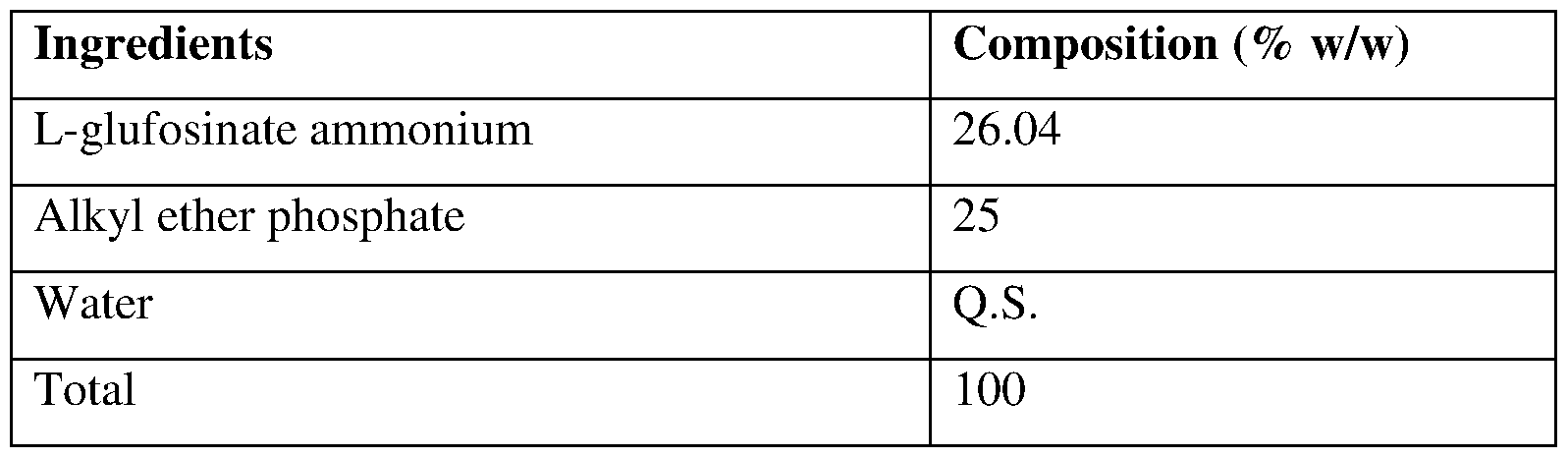
A liquid herbicidal composition in accordance with present invention was prepared:
Figure imgf000024_0001
L-glufosinate ammonium and alkyl ether phosphate were mixed under slow agitation at 20-35°C for 10-30 minutes in formulation vessel to get a dispersion. To the dispersion was then added propylene glycol, 2-butoxy ethanol and potassium chloride. To the resultant mixture water was added and the mixture is agitated for 90 minutes at 20-35°C to get clear homogenous liquid herbicidal composition. Example 6:
A liquid herbicidal composition in accordance with present invention was prepared:
Figure imgf000024_0002
L-glufosinate ammonium, propylene glycol and 2-butoxy ethanol were mixed under slow agitation at 20°C for 10-30 minutes in formulation vessel to get a dispersion. To the dispersion was then added alkyl polyglucoside and potassium chloride. To the resultant mixture water was added and the mixture is agitated for 120 minutes at 20°C to get clear homogenous liquid herbicidal composition Example 7:
A liquid herbicidal composition in accordance with present invention was prepared:
Figure imgf000025_0001
Method A:
L-glufosinate ammonium and propylene glycol were mixed under slow agitation at 35°C for 10-30 minutes in formulation vessel to get a dispersion. To the dispersion was then added alkyl ether phosphate and potassium chloride. To the resultant mixture water was added and the mixture is agitated for 120 minutes at 35°C to get clear homogenous liquid herbicidal composition. Method B:
L-glufosinate ammonium and alkyl ether phosphate were mixed under slow agitation at 35°C for 10-30 minutes in formulation vessel to get a dispersion. To the dispersion was then added propylene glycol and potassium chloride. To the resultant mixture water was added and the mixture is agitated for 120 minutes at 35°C to get clear homogenous liquid herbicidal composition.
Example 8:
A liquid herbicidal composition in accordance with present invention was prepared:
Figure imgf000026_0001
L-glufosinate ammonium, polyethlene glycol 300, propylene glycol and 2-butoxy ethanol were mixed under slow agitation at 35°C for 10-30 minutes in formulation vessel to get a dispersion. To the dispersion was then added alkyl glucamide and potassium chloride. To the resultant mixture water was added and the mixture is agitated for 120 minutes at 35°C to get clear homogenous liquid herbicidal composition.
Example 9: A liquid herbicidal composition in accordance with present invention was prepared:
Figure imgf000026_0002
L-glufosinate ammonium, propylene glycol and 2-butoxy ethanol were mixed under slow agitation at 40°C for 10-30 minutes in formulation vessel to get a dispersion. To the dispersion was then added alkyl polyglucoside and potassium chloride. To the resultant mixture water was added and the mixture is agitated for 60 minutes at 40°C to get clear homogenous liquid herbicidal composition Example 10:
A liquid herbicidal composition in accordance with present invention was prepared:
Figure imgf000027_0001
L-glufosinate ammonium, propylene glycol and 2-butoxy ethanol were mixed under slow agitation for 10-30 mins at 35°C to get a dispersion. To the dispersion was then added alkyl amine oxide and potassium chloride under agitation. To the resultant mixture water was added and the mixture is agitated for 120mins at 35°C to get clear homogenous liquid herbicidal composition
Example 11: A liquid herbicidal composition in accordance with present invention was prepared:
Figure imgf000027_0002
L-glufosinate ammonium and propylene glycol were mixed under slow agitation at 35°C for 10-30 minutes in formulation vessel to get a dispersion. To the dispersion was then added water and the mixture is agitated for 120 minutes at 35°C to get clear homogenous liquid herbicidal composition.
Example 12: A liquid herbicidal composition in accordance with present invention was prepared:
Figure imgf000028_0001
L-glufosinate ammonium and alkyl ether phosphate were mixed under slow agitation at 20-35°C for 10-30 minutes in formulation vessel to get a dispersion. To the dispersion was then added water and the mixture is agitated for 120 minutes at 35°C to get clear homogenous liquid herbicidal composition.
Example 13 & 14:
A liquid herbicidal composition in accordance with present invention was prepared:
Figure imgf000028_0002
Figure imgf000029_0001
L-glufosinate ammonium and alkyl ether phosphate were mixed under slow agitation in formulation vessel to get a dispersion. To the dispersion alkyl polyglucoside, alkyl amine oxide, propylene glycol, 2-butoxy ethanol and potassium chloride were added followed by addition of 2,4-D amine or Glyphosate IPA. To the resultant mixture water was added and the mixture required agitation for 100 minutes at 20-35°C to get clear homogenous liquid herbicidal composition.
Comparative Example 1: In order to demonstrate the advantages of the inventive process, the formulation provided in Example 1 was prepared by using conventional process (US5491125). L-glufosinate ammonium was added to water under agitation in formulation vessel. At this stage, it was observed that rock-solid lump was formed and the solubility of L-glufosinate ammonium salt decreased drastically. To this mixture was then added propylene glycol, 2-butoxy ethanol, alkyl polyglucoside, alkyl ether phosphate, alkyl amine oxide and potassium chloride under agitation. The mixture required agitation for 200 minutes at 20-35°C to get clear homogenous liquid herbicidal composition. Ligure 1 depicts a photograph of the rock-solid lump obtained during the process.
It was observed that the processing time for production of composition is dependent on solubility of L-glufosinate salt. Usually when conventional process is followed, L-glufosinate salt is first contacted with water and the processing time for production of formulation is increased from 90 minutes to 200 minutes. The present invention mainly provides solution to these three problems namely,
1. Lormation of rock-solid lump during formulating the finished product; Long processing time required due to reduced solubility of rock-solid lump formed; and Reduced bioavailability and efficiency of the formulation.

Claims

Claims:
1. A process for producing a liquid herbicidal composition comprising: admixing water with a dispersion wherein said dispersion comprises single isomer of glufosinate salt; and at least one organic solvent or a liquid surfactant.
2. The process as claimed in claim 1, wherein said dispersion is substantially free of water.
3. The process as claimed in claim 1, wherein said single isomer of glufosinate salt is L-glufosinate salt or D-glufosinate salt.
4. The process as claimed in claim 3, wherein said glufosinate salt used is selected from the group comprising of ammonium salt, monosodium salt, disodium salt, monopotassium salt, dipotassium salt or calcium salt.
5. The process as claimed in claim 1, wherein said dispersion comprises of single isomer of glufosinate salt and at least one organic solvent.
6. The process as claimed in claim 5, wherein said organic solvent is selected from a polar or a non-polar solvent.
7. The process as claimed in claim 5, wherein said organic solvent used is selected from the group comprising of glycerine, propylene glycol, diethylene glycol, polyethlene glycol 400, polyethlene glycol 300, polyethlene glycol 200, l-methoxy-2-propanol, 2-butoxy ethanol or mixture thereof.
8. The process as claimed in claim 1, wherein said dispersion comprises of single isomer of glufosinate salt and a liquid surfactant.
9. The process as claimed in claim 8, wherein said liquid surfactant is selected from anionic, cationic, zwitterionic and/or non-ionic surfactants.
10. The process as claimed in claim 8, wherein said liquid surfactant is selected from the group comprising of alcohol ethoxylate, alkyl ether phosphate, alkyl aryl ether phosphate, sulfo succinate and its derivatives, or mixtures thereof
11. The process as claimed in claim 1, wherein the process is carried out at temperature below 100°C.
12. The process as claimed in claim 1, wherein the processing time required for obtaining the liquid herbicidal composition is less than 2 hours.
13. The process as claimed in claim 1, wherein said composition further comprises another active ingredient/s selected from fungicides, insecticides, herbicides, plant regulators, defoliants, desiccants, biostimulants and nitrogen stabilizers, or mixtures thereof.
14. The process as claimed in claim 13, wherein said another active ingredient is a herbicide.
15. A process for producing a liquid herbicidal composition of L-glufosinate salt comprising: forming a dispersion in the absence of water wherein the dispersion comprises L-glufosinate salt and at least one organic solvent or a liquid surfactant; and admixing the dispersion with water to obtain a liquid herbicidal composition free from rock-solid lumps.
16. A liquid herbicidal composition comprising: a) single isomer of glufosinate salt; b) at least one organic solvent; or a liquid surfactant; and c) water wherein the said liquid herbicidal composition is prepared through the process as claimed in claim 1.
17. The composition as claimed in claim 16 wherein said single isomer of glufosinate salt is L-glufosinate salt or D-glufosinate salt.
PCT/IB2022/051875 2021-03-04 2022-03-03 Process for producing a liquid herbicidal composition Ceased WO2022185243A1 (en)

Priority Applications (4)

Application Number Priority Date Filing Date Title
CN202280030181.5A CN117222316A (en) 2021-03-04 2022-03-03 Method for producing liquid herbicidal compositions
BR112023017896A BR112023017896A2 (en) 2021-03-04 2022-03-03 PROCESS FOR PRODUCING A LIQUID HERBICIDAL COMPOSITION
CA3211861A CA3211861A1 (en) 2021-03-04 2022-03-03 Process for producing a liquid herbicidal composition
AU2022228742A AU2022228742A1 (en) 2021-03-04 2022-03-03 Process for producing a liquid herbicidal composition

Applications Claiming Priority (2)

Application Number Priority Date Filing Date Title
IN202121009174 2021-03-04

Publications (1)

Publication Number Publication Date
WO2022185243A1 true WO2022185243A1 (en) 2022-09-09

Family

ID=83115809

Family Applications (1)

Application Number Title Priority Date Filing Date
PCT/IB2022/051875 Ceased WO2022185243A1 (en) 2021-03-04 2022-03-03 Process for producing a liquid herbicidal composition

Country Status (10)

Country Link
US (1) US20220279781A1 (en)
JP (1) JP7590368B2 (en)
CN (1) CN117222316A (en)
AR (1) AR125023A1 (en)
AU (1) AU2022228742A1 (en)
BR (1) BR112023017896A2 (en)
CA (1) CA3211861A1 (en)
PY (1) PY2215074A (en)
UY (1) UY39656A (en)
WO (1) WO2022185243A1 (en)

Families Citing this family (1)

* Cited by examiner, † Cited by third party
Publication number Priority date Publication date Assignee Title
AU2023391427A1 (en) * 2022-12-09 2025-06-12 Upl Limited An agrochemical composition

Citations (7)

* Cited by examiner, † Cited by third party
Publication number Priority date Publication date Assignee Title
US5525578A (en) * 1989-11-21 1996-06-11 Hoechst Aktiengesellschaft Herbicidal agents containing imidazole herbicide and ether sulfate surfactants
WO2012086617A1 (en) * 2010-12-21 2012-06-28 Meiji Seikaファルマ株式会社 Stabilized liquid aqueous crop protection agent composition
CN103719077A (en) * 2014-01-02 2014-04-16 广西田园生化股份有限公司 Amino acid water-base herbicide for low-capacity spraying
US20160120177A1 (en) * 2013-06-12 2016-05-05 Upl Limited Agrochemical Formulations
CN107467061A (en) * 2017-09-26 2017-12-15 安徽国星生物化学有限公司 A kind of L glufosinate-ammoniumaqua aquas and preparation method thereof
CN111771877A (en) * 2020-07-16 2020-10-16 山西珍草康生物科技有限公司 Quick-acting and environmentally friendly agricultural insecticide and acaricide for killing highly resistant pests and its application
US20200359630A1 (en) * 2017-08-09 2020-11-19 Basf Se Herbicidal mixtures comprising l-glufosinate and their use in corn cultures

Family Cites Families (6)

* Cited by examiner, † Cited by third party
Publication number Priority date Publication date Assignee Title
US5308827A (en) * 1990-11-28 1994-05-03 Fumakilla Limited Herbicidal foam composition
US20100022392A1 (en) * 2008-07-22 2010-01-28 Long David A Stable, concentrated herbicidal compositions
EP3294064A1 (en) 2015-05-11 2018-03-21 Bayer CropScience AG Herbicide combinations comprising l-glufosinate and indaziflam
CN106359445B (en) * 2016-08-04 2018-07-24 四川利尔作物科学有限公司 Herbicidal combinations and its application
CN109380272A (en) 2018-12-07 2019-02-26 利尔化学股份有限公司 Herbicidal combinations and its application containing L-glufosinate-ammonium and flumioxazin
BR112022014950A2 (en) * 2020-01-31 2022-09-20 Basf Se COMBINATION OF HERBICIDES, COMPOSITION, METHODS OF PRODUCTION OF COMBINATION OF HERBICIDES, OF CONTROL OF UNWANTED PLANT GROWTH AND OF TREATMENT OR PROTECTION OF PLANTS AND USE OF COMBINATION OF HERBICIDES

Patent Citations (7)

* Cited by examiner, † Cited by third party
Publication number Priority date Publication date Assignee Title
US5525578A (en) * 1989-11-21 1996-06-11 Hoechst Aktiengesellschaft Herbicidal agents containing imidazole herbicide and ether sulfate surfactants
WO2012086617A1 (en) * 2010-12-21 2012-06-28 Meiji Seikaファルマ株式会社 Stabilized liquid aqueous crop protection agent composition
US20160120177A1 (en) * 2013-06-12 2016-05-05 Upl Limited Agrochemical Formulations
CN103719077A (en) * 2014-01-02 2014-04-16 广西田园生化股份有限公司 Amino acid water-base herbicide for low-capacity spraying
US20200359630A1 (en) * 2017-08-09 2020-11-19 Basf Se Herbicidal mixtures comprising l-glufosinate and their use in corn cultures
CN107467061A (en) * 2017-09-26 2017-12-15 安徽国星生物化学有限公司 A kind of L glufosinate-ammoniumaqua aquas and preparation method thereof
CN111771877A (en) * 2020-07-16 2020-10-16 山西珍草康生物科技有限公司 Quick-acting and environmentally friendly agricultural insecticide and acaricide for killing highly resistant pests and its application

Non-Patent Citations (4)

* Cited by examiner, † Cited by third party
Title
AGUIRRE JUAN LUIS, BAENA JUAN, MARTÍN MARÍA TERESA, GONZÁLEZ SERGIO, MANJÓN JOSÉ LUIS, PEINADO MANUEL: "Herbicidal effects of wood vinegar on nitrophilous plant communities", FOOD AND ENERGY SECURITY, vol. 9, no. 4, 1 November 2020 (2020-11-01), XP055967302, ISSN: 2048-3694, DOI: 10.1002/fes3.253 *
BLOEM TOM: "Glufosinate", OFFICE OF PREVENTION, PESTICIDES AND TOXIC SUBSTANCES, 9 July 1999 (1999-07-09), XP055967311, Retrieved from the Internet <URL:https://www3.epa.gov/pesticides/chem_search/cleared_reviews/csr_PC-128850_9-Jul-99_a.pdf> [retrieved on 20221003] *
MUNGKUNKAMCHAO TUNTIKA, KESMALA THAWAN, PIMRATCH SUMRAN, TOOMSAN BANYONG, JOTHITYANGKOON DARUNEE: "Wood vinegar and fermented bioextracts: Natural products to enhance growth and yield of tomato (Solanum lycopersicum L.)", SCIENTIA HORTICULTURAE, ELSEVIER, AMSTERDAM, NL, vol. 154, 1 May 2013 (2013-05-01), AMSTERDAM, NL , pages 66 - 72, XP055967305, ISSN: 0304-4238, DOI: 10.1016/j.scienta.2013.02.020 *
YUE SIQING, KONG YUAN, SHEN QIQI, CUI QINGMIAO, CHEN YUANCHEN, ZHAO MEIRONG: "Assessing the Efficacy-Risk of the Widely Used Chiral Glufosinate: Switch from the Racemate to the Single Enantiomer?", ENVIRONMENTAL SCIENCE & TECHNOLOGY LETTERS, AMERICAN CHEMICAL SOCIETY, US, vol. 7, no. 3, 10 March 2020 (2020-03-10), US , pages 143 - 148, XP055967313, ISSN: 2328-8930, DOI: 10.1021/acs.estlett.9b00789 *

Also Published As

Publication number Publication date
AU2022228742A1 (en) 2023-09-21
CN117222316A (en) 2023-12-12
AR125023A1 (en) 2023-05-31
JP7590368B2 (en) 2024-11-26
BR112023017896A2 (en) 2023-12-12
UY39656A (en) 2022-09-30
CA3211861A1 (en) 2022-09-09
PY2215074A (en) 2022-09-05
US20220279781A1 (en) 2022-09-08
JP2022136053A (en) 2022-09-15

Similar Documents

Publication Publication Date Title
AU2021200728B2 (en) Herbicidal composition comprising cinmethylin and pendimethalin
AU2021200737B2 (en) Method for controlling herbicide resistant or tolerant weeds
AU2016292561B2 (en) Herbicidal composition comprising cinmethylin and flufenacet
AU2016292677B2 (en) Herbicidal composition comprising cinmethylin and specific quinolinecarboxylic acids
AU2016292524B2 (en) Herbicidal composition comprising cinmethylin and saflufenacil
AU2016292399B2 (en) Herbicidal composition comprising cinmethylin and dimethenamid
AU2016292569B2 (en) Herbicidal composition comprising cinmethylin and specific pigment synthesis inhibitors
AU2016294369B2 (en) Herbicidal composition comprising cinmethylin and imazamox
AU2016294380B2 (en) Herbicidal composition comprising cinmethylin and pyroxasulfone
AU2016294365B2 (en) Herbicidal composition comprising cinmethylin and metazachlor
AU2016292676B2 (en) Herbicidal composition comprising cinmethylin and specific phytoene desaturase inhibitors
AU2016294453B2 (en) Herbicidal composition comprising cinmethylin and specific inhibitors of protoporphyrinogen oxidase
RU2672607C1 (en) Synergistic control of weeds using combinations of herbicides including 2,4-d-choline and glufosinate
AU2016294379A1 (en) Herbicidal composition comprising cinmethylin, pendimethalin and flufenacet
CA3235261A1 (en) An agrochemical combination
WO2020039366A1 (en) Herbicidal combination
EP4125382A1 (en) Herbicidal combination
US20220279781A1 (en) Process for producing a liquid herbicidal composition
OA21808A (en) An agrochemical combination.

Legal Events

Date Code Title Description
121 Ep: the epo has been informed by wipo that ep was designated in this application

Ref document number: 22762710

Country of ref document: EP

Kind code of ref document: A1

DPE1 Request for preliminary examination filed after expiration of 19th month from priority date (pct application filed from 20040101)
ENP Entry into the national phase

Ref document number: 3211861

Country of ref document: CA

WWE Wipo information: entry into national phase

Ref document number: 2022228742

Country of ref document: AU

Ref document number: AU2022228742

Country of ref document: AU

REG Reference to national code

Ref country code: BR

Ref legal event code: B01A

Ref document number: 112023017896

Country of ref document: BR

ENP Entry into the national phase

Ref document number: 2022228742

Country of ref document: AU

Date of ref document: 20220303

Kind code of ref document: A

NENP Non-entry into the national phase

Ref country code: DE

WWE Wipo information: entry into national phase

Ref document number: 202280030181.5

Country of ref document: CN

ENP Entry into the national phase

Ref document number: 112023017896

Country of ref document: BR

Kind code of ref document: A2

Effective date: 20230904

122 Ep: pct application non-entry in european phase

Ref document number: 22762710

Country of ref document: EP

Kind code of ref document: A1