WO2022180397A1 - Benzodiazepines for treating or preventing respiratory syncytial virus infection - Google Patents
Benzodiazepines for treating or preventing respiratory syncytial virus infection Download PDFInfo
- Publication number
- WO2022180397A1 WO2022180397A1 PCT/GB2022/050504 GB2022050504W WO2022180397A1 WO 2022180397 A1 WO2022180397 A1 WO 2022180397A1 GB 2022050504 W GB2022050504 W GB 2022050504W WO 2022180397 A1 WO2022180397 A1 WO 2022180397A1
- Authority
- WO
- WIPO (PCT)
- Prior art keywords
- phenyl
- fluoro
- pyrazolo
- benzodiazepin
- dihydro
- Prior art date
- Legal status (The legal status is an assumption and is not a legal conclusion. Google has not performed a legal analysis and makes no representation as to the accuracy of the status listed.)
- Ceased
Links
Classifications
-
- A—HUMAN NECESSITIES
- A61—MEDICAL OR VETERINARY SCIENCE; HYGIENE
- A61K—PREPARATIONS FOR MEDICAL, DENTAL OR TOILETRY PURPOSES
- A61K31/00—Medicinal preparations containing organic active ingredients
- A61K31/33—Heterocyclic compounds
- A61K31/395—Heterocyclic compounds having nitrogen as a ring hetero atom, e.g. guanethidine or rifamycins
- A61K31/55—Heterocyclic compounds having nitrogen as a ring hetero atom, e.g. guanethidine or rifamycins having seven-membered rings, e.g. azelastine, pentylenetetrazole
- A61K31/551—Heterocyclic compounds having nitrogen as a ring hetero atom, e.g. guanethidine or rifamycins having seven-membered rings, e.g. azelastine, pentylenetetrazole having two nitrogen atoms, e.g. dilazep
- A61K31/5513—1,4-Benzodiazepines, e.g. diazepam or clozapine
-
- C—CHEMISTRY; METALLURGY
- C07—ORGANIC CHEMISTRY
- C07D—HETEROCYCLIC COMPOUNDS
- C07D519/00—Heterocyclic compounds containing more than one system of two or more relevant hetero rings condensed among themselves or condensed with a common carbocyclic ring system not provided for in groups C07D453/00 or C07D455/00
-
- A—HUMAN NECESSITIES
- A61—MEDICAL OR VETERINARY SCIENCE; HYGIENE
- A61K—PREPARATIONS FOR MEDICAL, DENTAL OR TOILETRY PURPOSES
- A61K45/00—Medicinal preparations containing active ingredients not provided for in groups A61K31/00 - A61K41/00
- A61K45/06—Mixtures of active ingredients without chemical characterisation, e.g. antiphlogistics and cardiaca
-
- A—HUMAN NECESSITIES
- A61—MEDICAL OR VETERINARY SCIENCE; HYGIENE
- A61K—PREPARATIONS FOR MEDICAL, DENTAL OR TOILETRY PURPOSES
- A61K47/00—Medicinal preparations characterised by the non-active ingredients used, e.g. carriers or inert additives; Targeting or modifying agents chemically bound to the active ingredient
- A61K47/06—Organic compounds, e.g. natural or synthetic hydrocarbons, polyolefins, mineral oil, petrolatum or ozokerite
- A61K47/08—Organic compounds, e.g. natural or synthetic hydrocarbons, polyolefins, mineral oil, petrolatum or ozokerite containing oxygen, e.g. ethers, acetals, ketones, quinones, aldehydes, peroxides
- A61K47/10—Alcohols; Phenols; Salts thereof, e.g. glycerol; Polyethylene glycols [PEG]; Poloxamers; PEG/POE alkyl ethers
-
- A—HUMAN NECESSITIES
- A61—MEDICAL OR VETERINARY SCIENCE; HYGIENE
- A61K—PREPARATIONS FOR MEDICAL, DENTAL OR TOILETRY PURPOSES
- A61K47/00—Medicinal preparations characterised by the non-active ingredients used, e.g. carriers or inert additives; Targeting or modifying agents chemically bound to the active ingredient
- A61K47/06—Organic compounds, e.g. natural or synthetic hydrocarbons, polyolefins, mineral oil, petrolatum or ozokerite
- A61K47/08—Organic compounds, e.g. natural or synthetic hydrocarbons, polyolefins, mineral oil, petrolatum or ozokerite containing oxygen, e.g. ethers, acetals, ketones, quinones, aldehydes, peroxides
- A61K47/12—Carboxylic acids; Salts or anhydrides thereof
-
- A—HUMAN NECESSITIES
- A61—MEDICAL OR VETERINARY SCIENCE; HYGIENE
- A61K—PREPARATIONS FOR MEDICAL, DENTAL OR TOILETRY PURPOSES
- A61K47/00—Medicinal preparations characterised by the non-active ingredients used, e.g. carriers or inert additives; Targeting or modifying agents chemically bound to the active ingredient
- A61K47/06—Organic compounds, e.g. natural or synthetic hydrocarbons, polyolefins, mineral oil, petrolatum or ozokerite
- A61K47/22—Heterocyclic compounds, e.g. ascorbic acid, tocopherol or pyrrolidones
-
- A—HUMAN NECESSITIES
- A61—MEDICAL OR VETERINARY SCIENCE; HYGIENE
- A61K—PREPARATIONS FOR MEDICAL, DENTAL OR TOILETRY PURPOSES
- A61K47/00—Medicinal preparations characterised by the non-active ingredients used, e.g. carriers or inert additives; Targeting or modifying agents chemically bound to the active ingredient
- A61K47/06—Organic compounds, e.g. natural or synthetic hydrocarbons, polyolefins, mineral oil, petrolatum or ozokerite
- A61K47/26—Carbohydrates, e.g. sugar alcohols, amino sugars, nucleic acids, mono-, di- or oligo-saccharides; Derivatives thereof, e.g. polysorbates, sorbitan fatty acid esters or glycyrrhizin
-
- A—HUMAN NECESSITIES
- A61—MEDICAL OR VETERINARY SCIENCE; HYGIENE
- A61K—PREPARATIONS FOR MEDICAL, DENTAL OR TOILETRY PURPOSES
- A61K47/00—Medicinal preparations characterised by the non-active ingredients used, e.g. carriers or inert additives; Targeting or modifying agents chemically bound to the active ingredient
- A61K47/50—Medicinal preparations characterised by the non-active ingredients used, e.g. carriers or inert additives; Targeting or modifying agents chemically bound to the active ingredient the non-active ingredient being chemically bound to the active ingredient, e.g. polymer-drug conjugates
- A61K47/69—Medicinal preparations characterised by the non-active ingredients used, e.g. carriers or inert additives; Targeting or modifying agents chemically bound to the active ingredient the non-active ingredient being chemically bound to the active ingredient, e.g. polymer-drug conjugates the conjugate being characterised by physical or galenical forms, e.g. emulsion, particle, inclusion complex, stent or kit
- A61K47/6949—Medicinal preparations characterised by the non-active ingredients used, e.g. carriers or inert additives; Targeting or modifying agents chemically bound to the active ingredient the non-active ingredient being chemically bound to the active ingredient, e.g. polymer-drug conjugates the conjugate being characterised by physical or galenical forms, e.g. emulsion, particle, inclusion complex, stent or kit inclusion complexes, e.g. clathrates, cavitates or fullerenes
- A61K47/6951—Medicinal preparations characterised by the non-active ingredients used, e.g. carriers or inert additives; Targeting or modifying agents chemically bound to the active ingredient the non-active ingredient being chemically bound to the active ingredient, e.g. polymer-drug conjugates the conjugate being characterised by physical or galenical forms, e.g. emulsion, particle, inclusion complex, stent or kit inclusion complexes, e.g. clathrates, cavitates or fullerenes using cyclodextrin
-
- A—HUMAN NECESSITIES
- A61—MEDICAL OR VETERINARY SCIENCE; HYGIENE
- A61K—PREPARATIONS FOR MEDICAL, DENTAL OR TOILETRY PURPOSES
- A61K9/00—Medicinal preparations characterised by special physical form
- A61K9/0012—Galenical forms characterised by the site of application
- A61K9/0019—Injectable compositions; Intramuscular, intravenous, arterial, subcutaneous administration; Compositions to be administered through the skin in an invasive manner
-
- A—HUMAN NECESSITIES
- A61—MEDICAL OR VETERINARY SCIENCE; HYGIENE
- A61K—PREPARATIONS FOR MEDICAL, DENTAL OR TOILETRY PURPOSES
- A61K9/00—Medicinal preparations characterised by special physical form
- A61K9/08—Solutions
-
- A—HUMAN NECESSITIES
- A61—MEDICAL OR VETERINARY SCIENCE; HYGIENE
- A61K—PREPARATIONS FOR MEDICAL, DENTAL OR TOILETRY PURPOSES
- A61K9/00—Medicinal preparations characterised by special physical form
- A61K9/20—Pills, tablets, discs, rods
- A61K9/2004—Excipients; Inactive ingredients
- A61K9/2009—Inorganic compounds
-
- A—HUMAN NECESSITIES
- A61—MEDICAL OR VETERINARY SCIENCE; HYGIENE
- A61K—PREPARATIONS FOR MEDICAL, DENTAL OR TOILETRY PURPOSES
- A61K9/00—Medicinal preparations characterised by special physical form
- A61K9/20—Pills, tablets, discs, rods
- A61K9/2004—Excipients; Inactive ingredients
- A61K9/2013—Organic compounds, e.g. phospholipids, fats
- A61K9/2018—Sugars, or sugar alcohols, e.g. lactose, mannitol; Derivatives thereof, e.g. polysorbates
-
- A—HUMAN NECESSITIES
- A61—MEDICAL OR VETERINARY SCIENCE; HYGIENE
- A61K—PREPARATIONS FOR MEDICAL, DENTAL OR TOILETRY PURPOSES
- A61K9/00—Medicinal preparations characterised by special physical form
- A61K9/20—Pills, tablets, discs, rods
- A61K9/2004—Excipients; Inactive ingredients
- A61K9/2022—Organic macromolecular compounds
- A61K9/205—Polysaccharides, e.g. alginate, gums; Cyclodextrin
- A61K9/2059—Starch, including chemically or physically modified derivatives; Amylose; Amylopectin; Dextrin
-
- A—HUMAN NECESSITIES
- A61—MEDICAL OR VETERINARY SCIENCE; HYGIENE
- A61P—SPECIFIC THERAPEUTIC ACTIVITY OF CHEMICAL COMPOUNDS OR MEDICINAL PREPARATIONS
- A61P31/00—Antiinfectives, i.e. antibiotics, antiseptics, chemotherapeutics
- A61P31/12—Antivirals
- A61P31/14—Antivirals for RNA viruses
-
- C—CHEMISTRY; METALLURGY
- C07—ORGANIC CHEMISTRY
- C07D—HETEROCYCLIC COMPOUNDS
- C07D487/00—Heterocyclic compounds containing nitrogen atoms as the only ring hetero atoms in the condensed system, not provided for by groups C07D451/00 - C07D477/00
- C07D487/02—Heterocyclic compounds containing nitrogen atoms as the only ring hetero atoms in the condensed system, not provided for by groups C07D451/00 - C07D477/00 in which the condensed system contains two hetero rings
- C07D487/04—Ortho-condensed systems
-
- C—CHEMISTRY; METALLURGY
- C07—ORGANIC CHEMISTRY
- C07F—ACYCLIC, CARBOCYCLIC OR HETEROCYCLIC COMPOUNDS CONTAINING ELEMENTS OTHER THAN CARBON, HYDROGEN, HALOGEN, OXYGEN, NITROGEN, SULFUR, SELENIUM OR TELLURIUM
- C07F9/00—Compounds containing elements of Groups 5 or 15 of the Periodic Table
- C07F9/02—Phosphorus compounds
- C07F9/547—Heterocyclic compounds, e.g. containing phosphorus as a ring hetero atom
- C07F9/6558—Heterocyclic compounds, e.g. containing phosphorus as a ring hetero atom containing at least two different or differently substituted hetero rings neither condensed among themselves nor condensed with a common carbocyclic ring or ring system
- C07F9/65583—Heterocyclic compounds, e.g. containing phosphorus as a ring hetero atom containing at least two different or differently substituted hetero rings neither condensed among themselves nor condensed with a common carbocyclic ring or ring system each of the hetero rings containing nitrogen as ring hetero atom
Definitions
- the present invention relates to benzodiazepine derivatives and prodrugs thereof, and to their use in treating or preventing a respiratory syncytial virus (RSV) infection.
- RSV respiratory syncytial virus
- RSV is a negative-sense, single-stranded RNA virus of the Paramyxoviridae family.
- RSV is readily transmitted by secretions from an infected person via surfaces or hand-to-hand transfer. Unlike influenza, it is not transmitted by small-particle aerosols.
- the incubation period is between four and six days during which time the virus spreads from the nasopharynx to the lower respiratory tract by fusion of infected with uninfected cells and by sloughing of the necrotic epithelium. In infants, coupled with increased mucus secretion and oedema, this can lead to mucus plugging causing hyper-inflation and collapse of distal lung tissue indicative of bronchiolitis.
- RSV pneumonia inflammatory infiltration of the airways consists of mononuclear cells and is more generalised, with involvement of the bronchioles, bronchi and alveoli. The duration and degree of viral shedding has been found to correlate with the clinical signs and severity of disease.
- RSV is the leading cause of serious respiratory tract infections in infants and young children throughout the world. The highest morbidity and mortality occurs in those born prematurely and for those with chronic lung or heart disease, although many infants hospitalised for RSV infection are otherwise healthy. Severe RSV infection in infancy can lead to several years of recurrent wheezing and is linked to the later development of asthma.
- RSV is also a major cause of morbidity and mortality in the elderly and in immunocompromised children and adults as well as those with chronic obstructive pulmonary disease (COPD) and congestive heart failure (CHF).
- COPD chronic obstructive pulmonary disease
- CHF congestive heart failure
- RSV has a seasonal incidence; it is highly predictable and occurs in the winters of both hemispheres, from September to May in Europe and North America, peaking in December and January, and can occur throughout the year in tropical countries. It affects >90% of infants and young children by the age of two years and as natural immunity is short-lived; many will be re -infected each year. As with influenza, in elderly people, RSV causes around 10% of winter hospitalisations with an associated mortality of 10%.
- Current anti-RSV treatment involves the use of a monoclonal antibody to RSV, called palivizumab. Such use of palivizumab is a prophylactic, rather than therapeutic, treatment of RSV.
- Benzodiazepine inhibitors of RSV are also disclosed in publications including WO2004/026843 and WO2005/089770 (Arrow Therapeutics Limited); WO2016/166546 and WO2018/033714 (Durham University); and WO2017/015449, WO2018/129287 and WO2018/226801 (Enanta Pharmaceuticals, Inc.).
- a prodrug strategy may be used to improve the aqueous solubility, permeability and/or chemical stability of a pharmaceutically active compound such as an inhibitor of RSV.
- the pharmacokinectic profile may also be improved through chemical masking of vulnerable functionalities within the active pharmaceutical compound. This includes, but is not limited to, increasing exposure, prolonging exposure or enabling delivery options.
- Enabling delivery options includes, for instance, switching from oral to parenteral delivery (i.e. administration by injection, infusion or implantation).
- Summary of the Invention It has now been found that a novel series of benzodiazepine compounds have potent anti-RSV activity with favourable pharmacokinetics and physicochemical properties. Some of the compounds possess an OH functional group which can be derivatised to form a prodrug. Such prodrugs are part of the present invention.
- a C 1-6 alkyl group or moiety is linear or branched.
- a C 1-6 alkyl group is typically a C 1-4 alkyl group, or a C 4-6 alkyl group.
- C 1-6 alkyl groups and moieties examples include methyl, ethyl, n-propyl, i- propyl, n-butyl, i-butyl, t-butyl, n-pentyl, i-pentyl (i.e. 3-methylbut-1-yl), t-pentyl (i.e. 2-methylbut- 2-yl), neopentyl (i.e. 2,2-dimethylpropan-1-yl), n-hexyl, i-hexyl (i.e. 4-methylpentan-1-yl), t-hexyl (i.e.
- a C 1-6 alkyl group is unsubstituted or substituted , typically by one or more groups Q as defined below.
- a C 1-6 alkyl group is unsubstituted or substituted by 1, 2 or 3 groups Q as defined below.
- a C 1-6 alkylene group or moiety is a divalent, unsubstituted or substituted, linear or branched, saturated divalent aliphatic hydrocarbon group or moiety containing 1 to 6 carbon atoms.
- C 1-3 alkylene group or moiety examples include –CH 2 -, -CH 2 CH 2 -, -CH(CH 3 )-, -CH 2 CH(CH 3 )-, -CH 2 C(CH 3 ) 2 - and -C(CH 3 ) 2 -.
- C 1-6 alkylene is substituted by cycloalkyl, it is substituted on any constituent carbon atom by 1 or 2 cycloalkyl groups, typically one cycloalkyl group.
- a C 1-6 alkylene moiety is unsubstituted or substituted by one cyclopropyl group.
- a C 1-6 alkoxy group is linear or branched. It is typically a C 1-4 alkoxy group, for example a methoxy, ethoxy, propoxy, i-propoxy, n-propoxy, n-butoxy, sec-butoxy or tert-butoxy group.
- a C 1-6 alkoxy group is unsubstituted or substituted, typically by one or more groups Q as defined above.
- a C 1-6 alkylthio group is linear or branched.
- a C 1-4 alkylthio group for example a methylthio, ethylthio, propylthio, i-propylthio, n-propylthio, n-butylthio, sec-butylthio or tert- butylthio group.
- a C 1-6 alkylthio group is unsubstituted or substituted, typically by one or more groups Q as defined above.
- a halogen or halo group is F, Cl, Br or I. Typically it is F or Cl.
- C 1-6 alkyl group substituted by halogen may be denoted “C 1-6 haloalkyl”, which means a C 1-6 alkyl group as defined above in which one or more hydrogens is replaced by halo.
- C 1-6 alkoxy group substituted by halogen may be denoted “C 1-6 haloalkoxy”, which means a C 1-6 alkoxy group as defined above in which one or more hydrogens is replaced by halo.
- C 1-6 haloalkyl or C 1-6 haloalkoxy is substituted by 1, 2 or 3 said halogen atoms.
- Haloalkyl and haloalkoxy groups include perhaloalkyl and perhaloalkoxy groups such as -CZ 3 and -OCZ 3 wherein Z is a halogen, for example -CF 3 -CCl 3 - OCF 3 and -OCCl 3 .
- a C 1-6 hydroxyalkyl group is a C 1-6 alkyl group as defined above, substituted by one or more OH groups. Typically, it is substituted by one, two or three OH groups. Preferably, it is substituted by a single OH group.
- a C 1-6 alkoxyalkyl group is a C 1-6 alkyl group as defined above, substituted by a C 1-6 alkoxy group as defined above.
- a C 6 – C 10 aryl group is an aromatic carbocyclic group containing from 6 to 10 carbon atoms. It is monocyclic or a fused bicyclic ring system in which an aromatic ring is fused to another aromatic carbocyclic ring. Examples of a C 6 – C 10 aryl group include phenyl and naphthyl. When substituted, an aryl group is typically substituted by a group Q as defined above, for instance by 1, 2 or 3, groups selected from a a group Q as defined above.
- a substituted aryl group such as a substituted phenyl group is substituted by 1 or 2 groups selected from C 1 -C 6 alkyl, halo, -OR 8 and - N(R 8 ) 2 wherein R 8 is H or C 1 -C 6 alkyl, each R 8 being the same or different when two are present.
- a C 3-10 cycloalkyl group is a saturated hydrocarbon ring having from 3 to 10 carbon atoms.
- a C 3-10 cycloalkyl group may be, for instance, C 3 -C 7 cycloalkyl such as cyclopropyl, cyclobutyl, cyclopentyl, cyclohexyl, or cycloheptyl.
- a C 3-10 cycloalkyl group is unsubstituted or substituted, typically by one or more groups Q as defined above.
- a 4- to 10- membered heteroaryl group or moiety is a 4- to 10-membered aromatic heterocyclic group which contains 1, 2, 3, or 4 heteroatoms selected from O, N and S. It is monocyclic or bicyclic. Typically it contains one N atom and 0, 1, 2 or 3 additional heteroatoms selected from O, S and N.
- It may be, for example, a monocyclic 5- to 7-membered heteroaryl group, for instance a 5- or 6-membered N-containing heteroaryl group.
- Examples include pyridyl, pyrazinyl, pyrimidinyl, pyridazinyl, furanyl, thienyl, pyrazolidinyl, pyrrolyl, oxadiazolyl, oxazolyl, isoxazolyl, thiazolyl, thiadiazolyl, imidazolyl and pyrazolyl groups.
- Furanyl, thienyl, imidazolyl, pyridyl and pyrimidyl groups are preferred.
- bicyclic heteroaryl group for instance an 8- to 10- membered bicyclic heteroaryl group.
- examples include quinolyl, isoquinolyl, quinazolyl, quinoxalinyl, indolyl, isoindolyl, indazolyl, imidazopyridazinyl, pyrrolopyridinyl, pyrazolopyrimidinyl and pyrrolopyrimidinyl.
- a heteroaryl group (monocyclic or bicyclic) is typically substituted by one or more, e.g. 1, 2 or 3, groups selected from C 1-4 alkyl and a group Q as defined above.
- a 4- to 10-membered heterocyclyl group is a monocyclic or bicyclic non-aromatic, saturated or unsaturated ring system containing 5 to 10 carbon atoms and at least one atom or group selected from N, O, S, SO, SO 2 and CO, more typically N or O.
- the ring system is bicyclic, one ring may be saturated and one ring unsaturated.
- it is a C 4-10 ring system in which 1, 2 or 3 of the carbon atoms in the ring are replaced with an atom or group selected from O, S, SO 2 , CO and NH. More typically it is a monocyclic ring, preferably a monocyclic C 4 -C 6 ring.
- Examples of a 4- to 10-membered heterocyclyl group include azetidinyl, piperidyl, , piperazinyl, morpholinyl, thiomorpholinyl, S,S-dioxothiomorpholinyl, 1,3-dioxolanyl, pyrrolidinyl, imidazol-2-onyl, pyrrolidin-2-onyl, tetrahydrofuranyl and tetrahydropyranyl, piperidin-2,6-dionyl and piperidin-2- onyl moieties.
- a 4- to 10-membered heterocyclyl group may be azetidinyl, piperidyl, , piperazinyl, morpholinyl or thiomorpholinyl
- a monocyclic 4- to 6-membered heterocyclic group containing 1 or 2 heteroatoms selected from O, N and S is typically a C 4-6 ring system in which 1 or 2 of the carbon atoms in the ring are replaced with an atom or group selected from O, S, or NH.
- Examples of a 4- to 6-membered heterocyclyl group include azetidinyl, piperidyl, , piperazinyl, morpholinyl, thiomorpholinyl, S,S- dioxothiomorpholinyl, 1,3-dioxolanyl, pyrrolidinyl, imidazol-2-onyl, pyrrolidin-2-onyl, tetrahydrofuranyl and tetrahydropyranyl, piperidin-2,6-dionyl and piperidin-2-onyl moieties.
- a 4- to 6-membered heterocyclyl group is tetrahydropyranyl.
- a heterocyclic group When substituted, a heterocyclic group (monocyclic or bicyclic) is typically substituted by one or more, e.g. 1, 2 or 3, groups selected from unsubstituted C 1-4 alkyl and a group Q as defined above. It may also be substituted by a bridgehead atom which links two of the ring atoms, typically two ring carbon atoms. For instance, a piperazine group or a morpholine group may be substituted by a carbon bridgehead.
- the resulting bicyclic structure may be, respectively, a 2,5- diazabicyclo[2.2.1]heptane or 2-oxa-5-azabicyclo[2.2.1]heptane group.
- heteroaryl and heterocyclyl groups refer to an “N” atom which can be present in the ring, it will be evident to a skilled chemist that any such N atom will be protonated (or will carry a substituent as defined above) if it is attached to each of its adjacent ring atoms via a single bond. Such protonated forms are embraced within the present definitions of heteroaryl and heterocyclyl groups.
- Formula (I) as defined above encompasses prodrugs.
- suitable functional groups that allow an active inhibitor to serve as the anti-RSV moiety for a prodrug strategy include hydroxyl, amino and carboxylic acid groups.
- the functional group that is exploited in this context is a hydroxyl group (-OH).
- the hydroxyl group acts as a handle for the introduction of prodrug moieties (or “promoieties”), which derivatise the -OH function to form prodrug compounds within formula (I).
- prodrug moieties or “promoieties”
- Suitable prodrug strategies that allow attachment of prodrug components to a hydroxyl group include carboxylic acid esters, carbonates, carbamates, ethers and phosphates, for instance as described by Rautio et al (Nature Reviews Drug Discovery, 2008, 7, 255-270).
- the incorporation of a prodrug moiety can lead to recognition by endogenous transport systems, leading to active transport.
- a common strategy is to prodrug hydroxylic groups as ⁇ -amino carboxylic acid esters.
- the prodrugs within present formula (I) as defined above are the compounds in which X is defined as a derivative of an -OH group selected from ⁇ -amino carboxylic acid esters, carboxylic acid esters, carbonates, carbamates, ethers and phosphates.
- An ⁇ -amino carboxylic acid consists of an amino group (-NH 2 ) and a carboxyl group (-COOH) attached to a central C atom to which an organic side-chain (R) is also attached.
- the central C atom is also referred to as the ⁇ -C atom.
- the structure is: NH 2
- the side-chain R is characteristic of t he individual amino acid in question.
- R is the group attached to the NH 2 -bearing C atom.
- R is H.
- R is a 5-membered ring incorporating the N atom of the amino group.
- Table 1 Structures of common amino acids
- the carboxy function of an ⁇ -amino carboxylic acid may undergo esterification with an OH- containing compound to form an ⁇ -amino carboxylic acid ester.
- group X is an ⁇ -amino carboxylic acid ester derivative of –OH
- X may be a group –OC(O)-CHR-NH 2 in which R is the side chain of an ⁇ -amino carboxylic acid (typically a common amino acid, as shown in Table 1 above).
- the H attached to the ⁇ -C atom, and/or to one or both of the amino group H atoms may be replaced by methyl.
- group X in present formula (I) is an ⁇ -amino carboxylic acid ester derivative of -OH, it is therefore typically defined as a group -OC(O)-C(R 10 )(Y)-NR 11 2 in which R 10 is independently H or Me, each R 11 is independently H, Me or a group -C(O)-CHY-NR 10 2 and Y is the side-chain of an ⁇ -amino carboxylic acid (or common amino acid).
- R 10 is H
- each R 11 is H
- Y is selected from H, methyl, isopropyl and sec-butyl.
- Carboxylic acid ester derivatives of –OH are formed by esterification with the carboxy function of a carboxylic acid.
- the carboxylic acid may be of formula R 9 COOH, wherein R 9 is C 1 -C 6 alkyl which is unsubstituted or substituted.
- the resulting derivative group is then of formula –OC(O)R 9 .
- Carbonate derivatives of –OH are formed by esterification with the carboxy function of a carbonic acid
- the carbonic acid may be of formula R 9 OCOOH, wherein R 9 is as defined above.
- the resulting derivative group is then of formula –OC(O)OR 9 .
- Carbamate derivatives of –OH are formed by esterification with the carboxy function of carbamic acid or an N-substituted derivative thereof.
- the carbamic acid may be of formula NR 12 2COOH in which each R 12 is independently H or C 1 -C 6 alkyl which is unsubstituted or substituted.
- the resulting derivative group is then of formula –OCONR 12 2.
- Ether derivatives of –OH are formed by etherification using standard techniques, such as treatment of the deprotonated –OH group with an organic halide or reductive etherification.
- the resulting derivative group is of formula -OR 9 in which R 9 is as defined above.
- Phosphate derivatives of –OH are typically phosphate monoester derivatives, optionally including a methylene bridging group, formed by phosphorylation or other standard techniques.
- the resulting derivative group is of formula –OP(O)(OH) 2 or –OCH 2 -OP(O)(OH) 2 .
- the phosphate derivative group may be of formula –OP(O)(OH) 2 .
- X is –OH or a derivative of an OH group selected from ⁇ -amino carboxylic acid esters, carboxylic acid esters, carbonates, carbamates, ethers and phosphates, for instance a derivative of an –OH group selected from those described above.
- X is -OH.
- X is-OH or a derivative of -OH selected from phosphates and ⁇ -amino carboxylic acid esters.
- X is –OR 8 in which R 8 is H or a group selected from -C(O)-C(R 10 )(Y)-NR 11 2 , –C(O)R 9 , -C(O)OR 9 , -C(O)NR 12 2 , -R 9 , –CH 2 -OP(O)(OH) 2 and -P(O)(OH) 2 , wherein: each R 9 is independently C 1 -C 6 alkyl which is unsubstituted or substituted; each R 10 is independently H or Me; each R 11 is independently H, Me or a group -C(O)-CHY-NR 10 2 ; each R 12 is independently H or C 1 -C 6 alkyl which is unsubstituted or substituted; and Y is the side-chain of an -chain of an organic radicals and
- alk is C 1 -C 6 alkylene which is unsubstituted or substituted by C 3 -C 6 cycloalkyl.
- alk is selected from -CH 2 , -CH 2 CH 2 -, -CH(CH 3 )-, -C(CH 3 ) 2 -, -CH 2 CH(CH 3 )-, -CH 2 C(CH 3 ) 2 - and cyclopropyl-substituted alkylene groups of formulae:
- R 4 is H.
- R 3 is C 1 -C 6 alkyl which is unsubstituted or substituted by CF 3, or is a monocyclic 4- to 6-membered heterocyclic group containing 1 or 2 heteroatoms selected from O, N and S.
- R 3 is C 1 -C 6 alkyl which is unsubstituted or substituted by CF 3, or is a tetrayhdropyranyl group.
- R 3 is selected from isopropyl, -CH 2 CF 3 and tetrahydropyranyl.
- R 3 is selected from isopropyl, ethyl, -CH 2 CF 3 and tetrahydropyranyl.
- Specific compounds of the invention include the following: 2-[2-Fluoro-4-(hydroxymethyl)phenyl]-N-[(3S)-9-fluoro-2-oxo-5-phenyl-1,3-dihydro-1,4- benzodiazepin-3-yl]pyrazolo[1,5-a]pyrimidine-3-carboxamide; 2-[2-Fluoro-4-(hydroxymethyl)phenyl]-N-[(3S)-2-oxo-5-phenyl-1,3-dihydro-1,4-benzodiazepin-3- yl]pyrazolo[1,5-a]pyrimidine-3-carboxamide; N-[(3S)-9-fluoro-2-oxo-5-phenyl-1,3-dihydro-1,4-benzodiazepin-3-yl]-2-[1-(2,2,2- trifluoroethyl)pyrazol-4-yl]pyrazolo[1,5-a]pyrimidine-3-carbox
- the compounds of the invention may contain asymmetric or chiral centres, and therefore exist in different stereoisomeric forms. It is intended that all stereoisomeric forms of the compounds of the invention, including but not limited to, diastereomers, enantiomers and atropisomers, as well as mixtures thereof such as racemic mixtures, form part of the present invention.
- Compounds of Formula (I) containing one or more chiral centre may be used in enantiomerically or diastereoisomerically pure form, or in the form of a mixture of isomers.
- the present invention embraces all geometric and positional isomers of compounds of the invention as defined above.
- a compound of the invention incorporates a double bond or a fused ring
- the cis- and trans-forms, as well as mixtures thereof are embraced within the scope of the invention.
- Both the single positional isomers and mixture of positional isomers are also within the scope of the present invention.
- the compounds of the present invention may exist in unsolvated as well as solvated forms with pharmaceutically acceptable solvents such as water, ethanol, and the like, and it is intended that the invention embrace both solvated and unsolvated forms.
- the compounds of the present invention may exist in different tautomeric forms, and all such forms are embraced within the scope of the invention.
- tautomer or "tautomeric form” refers to structural isomers of different energies which are interconvertible via a low energy barrier.
- proton tautomers also known as prototropic tautomers
- Valence tautomers include interconversions by reorganization of some of the bonding electrons.
- Compounds of the invention can be prepared by the synthetic methods described in the Examples that follow, or by analogy with such methods using appropriate starting materials and methodologies familiar to the skilled chemist.
- Methods to perform this include esterification with N,N′- dicyclohexylcarbodiimide in combination with 4-dimethylaminopyridine, and subsequent removal of the N-Boc protecting group by acidic hydrolysis with a strong acid such as hydrochloric acid.
- Methods for preparing phosphate ester prodrugs include preparing phosphate monoester prodrugs from a hydroxyl containing parent compound, for instance as summarised by Domon et al., ACS Central Science. 2020, 6, 2, 283–292.
- the methods described include phosphorylation of a hydroxyl functional group with a pentavalent phosphoryl donor such as phosphoryl chloride, or use of a trivalent phosphoramidite reagent with subsequent oxidation to yield a protected phosphate triester.
- This may be deprotected to the phosphate monoester by removal of the protecting groups with suitable conditions dependent on the nature of the protecting group and the sensitivity of the molecule to acidic, basic or reductive deprotection conditions.
- a benzodiazepine derivative of formula (I) can be converted into a pharmaceutically acceptable salt thereof, and a salt can be converted into the free compound, by conventional methods.
- a benzodiazepine derivative of formula (I) can be contacted with a pharmaceutically acceptable acid to form a pharmaceutically acceptable salt.
- a pharmaceutically acceptable salt is a salt with a pharmaceutically acceptable acid or base.
- Pharmaceutically acceptable acids include both inorganic acids such as hydrochloric, sulphuric, phosphoric, diphosphoric, hydrobromic or nitric acid and organic acids such as citric, fumaric, maleic, malic, ascorbic, succinic, tartaric, benzoic, acetic, methanesulphonic, ethanesulphonic, benzenesulphonic or p-toluenesulphonic acid.
- Pharmaceutically acceptable bases include alkali metal (e.g.
- the present invention further provides a compound which is a benzodiazepine derivative of formula (I), as defined above, or a pharmaceutically acceptable salt thereof, for use in a method of treating the human or animal body by therapy.
- RSV respiratory syncytial virus
- the invention also provides a compound of the invention as defined above for use in a method treating or preventing an RSV infection. Still further, the present invention provides the use of a compound of the invention as defined above in the manufacture of a medicament for use in treating or preventing an RSV infection.
- a subject suffering from or susceptible to an RSV infection may thus be treated by a method comprising the administration thereto of a compound of the invention as defined above. The condition of the subject may thereby be improved or ameliorated.
- the RSV infection is typically a respiratory tract infection.
- the RSV infection may be an infection in a child, for instance a child under ten years of age or an infant under two years of age.
- the invention provides a compound as defined above for use in treating or preventing an RSV infection in paediatric patients.
- the infection may be an infection in a mature or elderly adult, for instance an adult over 60 years of age, an adult over 70 years of age, or an adult over 80 years of age.
- the invention further provides a compound for use in treating or preventing an RSV infection in geriatric patients.
- the RSV infection may be an infection in an immunocompromised individual or an individual suffering from COPD or CHF.
- the RSV infection is an infection in a non- compromised individual, for instance an individual who is otherwise healthy.
- a compound of the present invention can be administered in a variety of dosage forms, for example orally such as in the form of tablets, capsules, sugar- or film-coated tablets, liquid solutions or suspensions or parenterally, for example intramuscularly, intravenously or subcutaneously.
- the compound may therefore be given by injection, infusion, or by inhalation or nebulisation.
- the compound is preferably given by oral administration.
- the dosage depends on a variety of factors including the age, weight and condition of the patient and the route of administration. Daily dosages can vary within wide limits and will be adjusted to the individual requirements in each particular. Typically, however, the dosage adopted for each route of administration when a compound is administered alone to adult humans is 0.0001 to 650 mg/kg, most commonly in the range of 0.001 to 10 mg/kg, body weight, for instance 0.01 to 1 mg/kg. Such a dosage may be given, for example, from 1 to 5 times daily.
- a suitable daily dose is from 0.0001 to 1 mg/kg body weight, preferably from 0.0001 to 0.1 mg/kg body weight.
- a daily dosage can be administered as a single dosage or according to a divided dose schedule.
- a unit dose form such as a tablet or a capsule will usually contain 1-250 mg of active ingredient.
- a compound of formula (I) could be administered to a human patient at a dose of between 100-250 mg either once a day, twice or three times a day.
- a compound of formula (I) could be administered to a human patient at a dose of between 100-250 mg either once a day, twice or three times a day.
- the compounds of formula (I) and pharmaceutically acceptable salts thereof may be used on their own.
- the present invention therefore also provides a pharmaceutical composition comprising a compound of formula (I) or a pharmaceutically acceptable salt thereof as hereinbefore defined, in association with a pharmaceutically acceptable adjuvant, diluent or carrier.
- a pharmaceutically acceptable adjuvant diluent or carrier.
- Conventional procedures for the selection and preparation of suitable pharmaceutical formulations are described in, for example, "Pharmaceuticals - The Science of Dosage Form Designs", M. E. Aulton, Churchill Livingstone, 1988.
- the pharmaceutical composition will preferably comprise from 0.05 to 99 %w (percent by weight), more preferably from 0.05 to 80 %w, still more preferably from 0.10 to 70 %w, and even more preferably from 0.10 to 50 %w, of active ingredient, all percentages by weight being based on total composition.
- the invention further provides a process for the preparation of a pharmaceutical composition of the invention which comprises mixing a compound of formula (I) or a pharmaceutically acceptable salt thereof as hereinbefore defined with a pharmaceutically acceptable adjuvant, diluent or carrier.
- the compounds of the invention may be administered in a variety of dosage forms.
- compositions of the invention may contain, together with the active compound, diluents, e.g. lactose, dextrose, saccharose, cellulose, corn starch or potato starch; lubricants, e.g.
- binding agents e.g. starches, arabic gums, gelatin, methylcellulose, carboxymethylcellulose or polyvinyl pyrrolidone
- disaggregating agents e.g. starch, alginic acid, alginates or sodium starch glycolate
- dyestuffs effervescing mixtures
- sweeteners effer
- Such pharmaceutical preparations may be manufactured in known manner, for example, by means of mixing, granulating, tableting, sugar coating, or film coating processes.
- Liquid dispersions for oral administration may be syrups, emulsions and suspensions.
- the syrups may contain as carriers, for example, saccharose or saccharose with glycerine and/or mannitol and/or sorbitol.
- Suspensions and emulsions may contain as carrier, for example a natural gum, agar, sodium alginate, pectin, methylcellulose, carboxymethylcellulose, or polyvinyl alcohol.
- the suspension or solutions for intramuscular injections may contain, together with the active compound, a pharmaceutically acceptable carrier, e.g.
- sterile water olive oil, ethyl oleate, glycols, e.g. propylene glycol, and if desired, a suitable amount of lidocaine hydrochloride.
- suitable carriers for suspensions include sterile water, hydroxypropylmethyl cellulose (HPMC), polysorbate 80, polyvinylpyrrolidone (PVP), aerosol AOT (i.e. sodium 1,2-bis(2-ethylhexoxycarbonyl)ethanesulphonate), pluronic F127 and/or captisol (i.e. sulfobutylether-beta-cyclodextrin).
- HPMC hydroxypropylmethyl cellulose
- PVP polyvinylpyrrolidone
- aerosol AOT i.e. sodium 1,2-bis(2-ethylhexoxycarbonyl)ethanesulphonate
- pluronic F127 and/or captisol i.e. sulfobutylether
- the compounds of the invention may, for example, be formulated as aqueous suspensions in a carrier selected from: (i) 0.5% w/v hydroxypropylmethyl cellulose (HPMC)/0.1% w/v polysorbate 80; (ii) 0.67% w/v polyvinylpyrrolidone (PVP)/0.33% w/v aerosol AOT (sodium 1,2-bis(2- ethylhexoxycarbonyl)ethanesulphonate); (iii) 1 % w/v pluronic F 127; and (iv) 0.5% w/v polysorbate 80.
- the carriers may be prepared by standard procedures known to those of skill in the art.
- each of the carriers (i) to (iv) may be prepared by weighing the required amount of excipient into a suitable vessel, adding approximately 80% of the final volume of water and magnetically stirring until a solution is formed. The carrier is then made up to volume with water.
- the aqueous suspensions of compounds of formula I may be prepared by weighing the required amount of a compound of formula I into a suitable vessel, adding 100% of the required volume of carrier and magnetically stirring.
- Solutions for injection or infusion may contain as carrier, for example, sterile water or preferably they may be in the form of sterile, aqueous, isotonic saline solutions.
- the compounds of the invention may also be administered in conjunction with other compounds used for the treatment of viral infections.
- the invention further relates to combination therapies wherein a compound of the invention, or a pharmaceutically acceptable salt thereof, or a pharmaceutical composition or formulation comprising a compound of the invention, is administered concurrently or sequentially or as a combined preparation with another therapeutic agent or agents, for the treatment or prevention of a viral infection, particularly infection by RSV.
- a viral infection particularly infection by RSV.
- Suitable therapeutic agents for use in the combination therapies include (i) RSV fusion inhibitors (ii) other RSV nucleocapsid (N)-protein inhibitors (iii) other RSV protein inhibitors, such as those that inhibit the phosphoprotein (P) protein and large (L) protein; iv) nucleoside or polymerase inhibitors that inhibit the L Protein; (v) anti-RSV monoclonal antibodies, such as the F-protein antibodies; (vi) immunomodulating toll-like receptor compounds; (vii) other respiratory virus anti-virals, such as anti-influenza and anti-rhinovirus compounds; and/or (viii) anti-inflammatory compounds.
- the RSV nucleocapsid (N)-protein plays a pivotal role in viral transcription and replication, mediating the interaction between the genomic RNA and the virally encoded RNA-dependent RNA polymerase.
- the RSV P- and L-proteins are components of RSV’s virally encoded RNA-dependent RNA polymerase.
- Examples Reagents were obtained from commercial sources and were used without further purification.
- Anhydrous solvents were purchased from commercial suppliers, used as supplied and stored under N 2 . Reactions were performed with anhydrous solvents under an atmosphere of N 2 unless otherwise noted. All temperatures are in °C.
- TLC was performed on aluminium backed silica gel plates with fluorescence indicator at 254 nM (median pore size 60 ⁇ ). Flash column chromatography was performed using a Biotage Isolera One system using KP-Sil, Ultra, Sfär Duo or Sfär HC silica gel columns.
- LCMS Method A Acquity BEH C18 column (2.1 ⁇ 50 mm; 1.7 ⁇ m), column temperature 60 °C, flow rate 1.00 mL/min, photodiode array (PDA) detector wavelength 220-300 nm, with a linear gradient 0-100% over 2 minutes.
- Mobile phase A water (0.1% v/v TFA).
- Mobile phase B acetonitrile.
- LCMS Method B Acquity BEH C18 column (2.1 ⁇ 150 mm; 1.7 ⁇ m), column temperature 60 °C, flow rate 0.3 mL/min, PDA detector wavelength 220-300 nm, with a linear gradient 2-100% over 22.5 minutes.
- Mobile phase A water (0.1% v/v NH 3 ).
- HPLC Method 1 Luna P6 (21.2 mm ⁇ 150 mm, 5 ⁇ m), column temperature: ambient, flow rate 21 mL/min, PDA detector wavelength 210 nm.
- HPLC Method 2 Gemini NX C18 (30 mm ⁇ 150 mm, 5 ⁇ m), column temperature: ambient, flow rate 42 mL/min, PDA detector wavelength 240 nm.
- Preparative SFC was performed by the following methods.
- SFC Method 1 Lux C2 (21.2 mm ⁇ 250 mm, 5 ⁇ m), column temperature 40 °C, flow rate 50 mL/min, 100 BarG pressure, detector wavelength 229 nm.
- Analytical chiral SFC was performed by the following methods.
- SFC method 1A Lux C2 (4.6 mm ⁇ 250 mm, 5 ⁇ m), column temperature 40 °C, flow rate 4 mL/min, detector wavelength 210-400 nm, 125 barG back pressure.
- SFC method 2A Lux C4 (4.6 mm ⁇ 250 mm, 5 ⁇ m), column temperature 40 °C, flow rate 4 mL/min, detector wavelength 210-400 nm, 125 barG back pressure.
- intermediate compounds were prepared in an analogous manner to intermediate 4A from the corresponding boronic acid pinacol ester.
- Intermediates 4E and 4I were prepared from the corresponding boronic acid.
- Intermediate 4G was prepared with heating at 100 °C by MWI for 1 h.
- Intermediates 4J to 4M were prepared with conventional heating at 85 °C overnight.
- P E 4 4 4 c arboxylate 3H). (DMSO-d 6 ) ⁇ 9.31 (dd, J 4 4 4 4 4 Hz, 3H).
- Example 3 was subject to additional repeat purification by flash chromatography [15-22% (EtOH:CH 2 Cl 2 :NH 4 OH; 50:8:1) in CH 2 Cl 2 ] followed by preparative HPLC (Method 1: MeCN/water with 0.2% v/v formic acid, 25-75% for 16 min).
- Example compounds LRMS E 2 3 3 hydrochloride [3 ⁇ Fluoro ⁇ 4 ⁇ (3 ⁇ 1099 ( 1H) 960 (d J 79 benzodiazepin ⁇ 3 ⁇ 3H), 7.64 – 7.40 (m, 8H), yl]carbamoyl ⁇ pyrazo 7.37 – 7.28 (m, 3H), 7.18 – 37.
- Example 38 Efficacy in vitro Compounds were subjected to RSV plaque reduction assays according to the following protocol. Plaque EC 50 and cell toxicity CC 50 values are a mean of at least two experiments and figures are rounded to whole units. Plaque Reduction Assay. Hep-G2 cells (ECACC, 85011430) were passaged in flasks and seeded in 24-well plates in DMEM containing antibiotics and supplemented with 10% FBS. During inoculation and subsequent incubation, cells were cultured in DMEM containing 2% FBS. 100 plaque forming unit/well of RSV (RSV A2 ECACC, 0709161v) was mixed with eight serial dilutions of compound.
- RSV A2 ECACC Efficacy in vitro Compounds were subjected to RSV plaque reduction assays according to the following protocol. Plaque EC 50 and cell toxicity CC 50 values are a mean of at least two experiments and figures are rounded to whole units. Plaque Reduction As
- the virus/compound mixtures was added to confluent Hep-G2 cell monolayers.
- the cells and virus/compound mixtures were incubated at 37 °C in a humidified 5% CO 2 incubator for 2 h prior to removal of the inoculum and addition of 1 mL of overlay (DMEM containing 2% FBS and 0.8% CMC) containing compound dilutions.
- a pre-titrated amount of the primary antibody was added in 200 ⁇ L PBS/2% milk powder, and plates incubated for 90 min at 37 °C. The plates were washed 3 times with PBS/0.05% Tween20 before addition of rabbit anti-goat horse radish peroxidase in 200 ⁇ L PBS/2% milk powder, and incubated for 1 h at 37 °C. Following three wash steps with PBS/0.05% Tween20, 200 ⁇ L ready-to-use TrueBlue was added and plates were incubated at rt for 10-15 min before washing with water. After removal of water, plates were air-dried in the dark.
- Plaque counts were used to calculate % infection relative to the mean of the plaque count in the virus control wells for RSV.
- the EC 50 value was calculated as 50% reduction in signal, respectively, by interpolation of inhibition curves fitted with a 4-parameter nonlinear regression with a variable slope in Dotmatics. Plaque EC 50 and cell toxicity CC 50 values are a mean of at least two experiments and figures are rounded to whole units.
- Example 39 In vitro Pharmacokinetics Compounds were subjected to the following assays to investigate liver microsomal stability and hepatocyte stability.
- Microsomal incubation Experimental Procedure Pooled liver microsomes were purchased from a reputable commercial supplier and stored at -80 °C prior to use. Microsomes (final protein concentration 0.5 mg/mL), 0.1 M phosphate buffer pH 7.4 and test compound (final substrate concentration 1 ⁇ ; final DMSO concentration 0.25%) were pre- incubated at 37 °C prior to the addition of NADPH (final concentration 1 mM) to initiate the reaction. The final incubation volume was 50 ⁇ L.
- a control incubation was included for each compound tested where 0.1 M phosphate buffer pH 7.4 was added instead of NADPH (minus NADPH). Two control compounds were included with each species. All incubations were performed singularly for each test compound. Each compound was incubated for 0, 5, 15, 30 and 45 min. The control (minus NADPH) was incubated for 45 min only. The reactions were stopped by transferring incubate into acetonitrile at the appropriate time points, in a 1:3 ratio. The termination plates are centrifuged at 3,000 rpm for 20 min at 4 °C to precipitate the protein. Following protein precipitation, the sample supernatants were combined in cassettes of up to 4 compounds, internal standard added, and samples analysed by LC-MS/MS.
- Williams E media supplemented with 2 mM L-glutamine and 25 mM HEPES and test compound (final substrate concentration 3 ⁇ M; final DMSO concentration 0.25 %) are pre-incubated at 37 °C prior to the addition of a suspension of cryopreserved hepatocytes (final cell density 0.5 x 10 6 viable cells/mL in Williams E media supplemented with 2 mM L-glutamine and 25 mM HEPES) to initiate the reaction.
- the final incubation volume is 500 ⁇ L.
- Two control compounds were included with each species, alongside appropriate vehicle control. The reactions were stopped by transferring 50 ⁇ L of incubate to 100 ⁇ L acetonitrile containing internal standard at the appropriate time points.
- Example 41 Aqueous formulation The compound of Example 1 is formulated as a solution in 30% w/v captisol (i.e.
- sulfobutylether- beta-cyclodextrin at pH4 according to the following procedure.
- a carrier of 30% w/v captisol i.e. sulfobutylether-beta-cyclodextrin
- captisol i.e. sulfobutylether-beta-cyclodextrin
- An aqueous solution of a compound of Example 1 is prepared by weighing 175 mg of the compound into a suitable vessel and adding approximately 80% of the required volume of the carrier.
- Example 42 Tablet composition Tablets, each weighing 0.15 g and containing 25 mg of a compound of the invention are manufactured as follows: Composition for 10,000 tablets Compound of the invention (250 g) Lactose (800 g) Corn starch (415 g) Talc powder (30 g) Magnesium stearate (5 g) The compound of the invention, lactose and half of the corn starch are mixed. The mixture is then forced through a sieve 0.5 mm mesh size.
- Example 43 Injectable Formulation Compound of the invention 200 mg Hydrochloric Acid Solution 0.1 M or Sodium Hydroxide Solution 0.1 M q.s. to pH 4.0 to 7.0 Sterile water q.s. to 10 mL The compound of the invention is dissolved in most of the water (35 °C-40 °C) and the pH adjusted to between 4.0 and 7.0 with the hydrochloric acid or the sodium hydroxide as appropriate.
- Example 44 Intramuscular Injection Compound of the invention 200 mg Benzyl Alcohol 0.10 g Glycofurol 75 1.45 g Water for injection q.s to 3.00 mL The compound of the invention is dissolved in the glycofurol. The benzyl alcohol is then added and dissolved, and water added to 3 mL. The mixture is then filtered through a sterile micropore filter and sealed in sterile 3 mL glass vials (type 1).
- Example 45 Syrup Formulation Compound of invention 250 mg Sorbitol Solution 1.50 g Glycerol 2.00 g Sodium benzoate 0.005 g Flavour 0.0125 mL Purified Water q.s. to 5.00 mL
- the compound of the invention is dissolved in a mixture of the glycerol and most of the purified water.
- An aqueous solution of the sodium benzoate is then added to the solution, followed by addition of the sorbital solution and finally the flavour.
- the volume is made up with purified water and mixed well.
Landscapes
- Health & Medical Sciences (AREA)
- Chemical & Material Sciences (AREA)
- Life Sciences & Earth Sciences (AREA)
- General Health & Medical Sciences (AREA)
- Animal Behavior & Ethology (AREA)
- Veterinary Medicine (AREA)
- Public Health (AREA)
- Medicinal Chemistry (AREA)
- Pharmacology & Pharmacy (AREA)
- Epidemiology (AREA)
- Organic Chemistry (AREA)
- General Chemical & Material Sciences (AREA)
- Engineering & Computer Science (AREA)
- Chemical Kinetics & Catalysis (AREA)
- Molecular Biology (AREA)
- Oil, Petroleum & Natural Gas (AREA)
- Virology (AREA)
- Biophysics (AREA)
- Biochemistry (AREA)
- Oncology (AREA)
- Nuclear Medicine, Radiotherapy & Molecular Imaging (AREA)
- Dermatology (AREA)
- Inorganic Chemistry (AREA)
- Communicable Diseases (AREA)
- Bioinformatics & Cheminformatics (AREA)
- Pharmaceuticals Containing Other Organic And Inorganic Compounds (AREA)
Abstract
Pharmaceutical Compounds Benzodiazepine derivatives of formula (I): wherein: R1 is H or F; R2 is selected from formula (II) and formula (III) R3 is C1-C6 alkyl which is unsubstituted or substituted by CF3, or is a monocyclic 4- to 6-membered heterocyclic group containing 1 or 2 heteroatoms selected from O, N and S; R4 is H or a group selected from -X, -alk-X, -CONR6R7, C=NN R6R7, -SO2R6 and -SO2NR6R7; R4 is a group selected from -X, -alk-X, -CONR6R7, -C=NN R6R7, -SO2R6 and -SO2NR6R7; X is OH or a derivative of an OH group selected from α-amino carboxylic acid esters, carboxylic acid esters, carbonates, carbamates, ethers and phosphates: alk is C1-C6 alkylene which is unsubstituted or substituted by C3-C6 cycloalkyl; and R6 and R7 are each independently C1-C6 alkyl or C3-C6 cycloalkyl; and the pharmaceutically acceptable salts thereof are inhibitors of respiratory syncytial virus (RSV) and can therefore be used to treat or prevent an RSV infection.
Description
BENZODIAZEPINES FOR TREATING OR PREVENTING RESPIRATORY SYNCYTIAL VIRUS INFECTION
Field of the Invention
The present invention relates to benzodiazepine derivatives and prodrugs thereof, and to their use in treating or preventing a respiratory syncytial virus (RSV) infection.
Background to the Invention
RSV is a negative-sense, single-stranded RNA virus of the Paramyxoviridae family. RSV is readily transmitted by secretions from an infected person via surfaces or hand-to-hand transfer. Unlike influenza, it is not transmitted by small-particle aerosols. Following successful inoculation, the incubation period is between four and six days during which time the virus spreads from the nasopharynx to the lower respiratory tract by fusion of infected with uninfected cells and by sloughing of the necrotic epithelium. In infants, coupled with increased mucus secretion and oedema, this can lead to mucus plugging causing hyper-inflation and collapse of distal lung tissue indicative of bronchiolitis. Hypoxia is common and the ability to feed is often impaired because of respiratory distress. In RSV pneumonia, inflammatory infiltration of the airways consists of mononuclear cells and is more generalised, with involvement of the bronchioles, bronchi and alveoli. The duration and degree of viral shedding has been found to correlate with the clinical signs and severity of disease.
RSV is the leading cause of serious respiratory tract infections in infants and young children throughout the world. The highest morbidity and mortality occurs in those born prematurely and for those with chronic lung or heart disease, although many infants hospitalised for RSV infection are otherwise healthy. Severe RSV infection in infancy can lead to several years of recurrent wheezing and is linked to the later development of asthma.
RSV is also a major cause of morbidity and mortality in the elderly and in immunocompromised children and adults as well as those with chronic obstructive pulmonary disease (COPD) and congestive heart failure (CHF).
RSV has a seasonal incidence; it is highly predictable and occurs in the winters of both hemispheres, from September to May in Europe and North America, peaking in December and January, and can occur throughout the year in tropical countries. It affects >90% of infants and young children by the
age of two years and as natural immunity is short-lived; many will be re -infected each year. As with influenza, in elderly people, RSV causes around 10% of winter hospitalisations with an associated mortality of 10%. Current anti-RSV treatment involves the use of a monoclonal antibody to RSV, called palivizumab. Such use of palivizumab is a prophylactic, rather than therapeutic, treatment of RSV. Although this antibody is often effective, its use is restricted to preterm infants and infants at high risk. Indeed, its limited utility means that it is unavailable for many people in need of anti-RSV treatment. There is therefore an urgent need for effective alternatives to existing anti-RSV treatment. Small molecules have also been proposed as inhibitors of RSV. These include benzimidazoles and benzodiazepines. For instance, the discovery and initial development of RSV604, a benzodiazepine compound having sub-micromolar anti-RSV activity, is described in Antimicrobial Agents and Chemotherapy, Sept. 2007, 3346-3353 (Chapman et al). Benzodiazepine inhibitors of RSV are also disclosed in publications including WO2004/026843 and WO2005/089770 (Arrow Therapeutics Limited); WO2016/166546 and WO2018/033714 (Durham University); and WO2017/015449, WO2018/129287 and WO2018/226801 (Enanta Pharmaceuticals, Inc.). A prodrug strategy may be used to improve the aqueous solubility, permeability and/or chemical stability of a pharmaceutically active compound such as an inhibitor of RSV. The pharmacokinectic profile may also be improved through chemical masking of vulnerable functionalities within the active pharmaceutical compound. This includes, but is not limited to, increasing exposure, prolonging exposure or enabling delivery options. Enabling delivery options includes, for instance, switching from oral to parenteral delivery (i.e. administration by injection, infusion or implantation). Summary of the Invention It has now been found that a novel series of benzodiazepine compounds have potent anti-RSV activity with favourable pharmacokinetics and physicochemical properties. Some of the compounds possess an OH functional group which can be derivatised to form a prodrug. Such prodrugs are part of the present invention. Accordingly, the present invention provides a compound which is a benzodiazepine of formula (I):
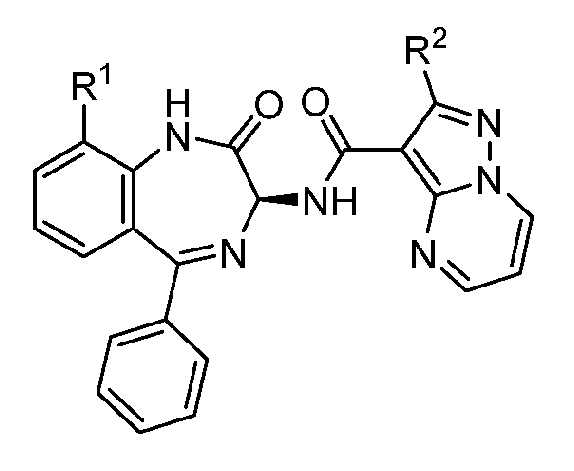
 wherein: R1 is H or F; R2 is selected from:
 R3 is C1-C6 alkyl which is unsubstituted or substituted by CF3, or is a monocyclic 4- to 6-membered heterocyclic group containing 1 or 2 heteroatoms selected from O, N and S; R4 is H or a group selected from -X, -alk-X, -CONR6R7, C=NN R6R7, -SO2R6 and -SO2NR6R7; R4′ is a group selected from -X, -alk-X, -CONR6R7, -C=NN R6R7, -SO2R6 and -SO2NR6R7; X is –OH or a derivative of an OH group selected from α-amino carboxylic acid esters, carboxylic acid esters, carbonates, carbamates, ethers and phosphates; alk is C1-C6 alkylene which is unsubstituted or substituted by C3-C6 cycloalkyl; and R6 and R7 are each independently C1-C6 alkyl or C3-C6 cycloalkyl; or a pharmaceutically acceptable salt thereof. Compounds of the invention possess two N atoms in the five-membered ring of the pyrazolopyrimidine ring that is linked via an amide group to the benzodiazepine ring system. This structural feature is thought to be important to the properties of the compounds discussed further below.
Detailed Description of the Invention When any group, ring, substituent or moiety defined herein is substituted, it is typically substituted by Q as defined below. A C1-6 alkyl group or moiety is linear or branched. A C1-6 alkyl group is typically a C1-4 alkyl group, or a C4-6 alkyl group. Examples of C1-6 alkyl groups and moieties include methyl, ethyl, n-propyl, i- propyl, n-butyl, i-butyl, t-butyl, n-pentyl, i-pentyl (i.e. 3-methylbut-1-yl), t-pentyl (i.e. 2-methylbut- 2-yl), neopentyl (i.e. 2,2-dimethylpropan-1-yl), n-hexyl, i-hexyl (i.e. 4-methylpentan-1-yl), t-hexyl (i.e. 3-methylpentan-3-yl) and neopentyl (i.e. 3,3-dimethylbutan-1-yl). For the avoidance of doubt, where two alkyl moieties are present in a group, the alkyl moieties may be the same or different. A C1-6 alkyl group is unsubstituted or substituted , typically by one or more groups Q as defined below. For example, a C1-6 alkyl group is unsubstituted or substituted by 1, 2 or 3 groups Q as defined below. A C1-6 alkylene group or moiety is a divalent, unsubstituted or substituted, linear or branched, saturated divalent aliphatic hydrocarbon group or moiety containing 1 to 6 carbon atoms. Typically it is a C1-3 alkylene group or moiety. Examples include –CH2-, -CH2CH2-, -CH(CH3)-, -CH2CH(CH3)-, -CH2C(CH3)2- and -C(CH3)2-. When C1-6 alkylene is substituted by cycloalkyl, it is substituted on any constituent carbon atom by 1 or 2 cycloalkyl groups, typically one cycloalkyl group. Typically a C1-6 alkylene moiety is unsubstituted or substituted by one cyclopropyl group. Q is halo, nitro, -CN, OH, C1-6 alkoxy, C1-6 hydroxyalkyl, C1-6 alkoxyalkyl, unsubstituted C1-6 alkyl, C1-6 alkylthio, C1-6 haloalkyl, C1-4 haloalkoxy, -CO2R''', -NR'2, -SR', -S(=O)R', -S(=O)2R', C3-C10 cycloalkyl, 4- to 10-membered heterocyclyl, C6 – C10 aryl or 4- to 10-membered heteroaryl, wherein each R' is independently selected from H, C1-6 alkyl, C3-10 cycloalkyl, 4 to 10-membered heterocyclyl, C6 – C10 aryl and 4- to 10-membered heteroaryl. A C1-6 alkoxy group is linear or branched. It is typically a C1-4 alkoxy group, for example a methoxy, ethoxy, propoxy, i-propoxy, n-propoxy, n-butoxy, sec-butoxy or tert-butoxy group. A C1-6 alkoxy group is unsubstituted or substituted, typically by one or more groups Q as defined above. A C1-6 alkylthio group is linear or branched. It is typically a C1-4 alkylthio group, for example a methylthio, ethylthio, propylthio, i-propylthio, n-propylthio, n-butylthio, sec-butylthio or tert-
butylthio group. A C1-6 alkylthio group is unsubstituted or substituted, typically by one or more groups Q as defined above. A halogen or halo group is F, Cl, Br or I. Typically it is F or Cl. A C1-6 alkyl group substituted by halogen may be denoted “C1-6 haloalkyl”, which means a C1-6 alkyl group as defined above in which one or more hydrogens is replaced by halo. Likewise a C1-6 alkoxy group substituted by halogen may be denoted “C1-6 haloalkoxy”, which means a C1-6 alkoxy group as defined above in which one or more hydrogens is replaced by halo. Typically, C1-6 haloalkyl or C1-6 haloalkoxy is substituted by 1, 2 or 3 said halogen atoms. Haloalkyl and haloalkoxy groups include perhaloalkyl and perhaloalkoxy groups such as -CZ3 and -OCZ3 wherein Z is a halogen, for example -CF3 -CCl3 - OCF3 and -OCCl3. A C1-6 hydroxyalkyl group is a C1-6 alkyl group as defined above, substituted by one or more OH groups. Typically, it is substituted by one, two or three OH groups. Preferably, it is substituted by a single OH group. A C1-6 alkoxyalkyl group is a C1-6 alkyl group as defined above, substituted by a C1-6 alkoxy group as defined above. It may, for instance, be methoxyalkyl or ethoxyalkyl, in which the alkyl moiety is a C1-6 alkyl group as defined above A C6 – C10 aryl group is an aromatic carbocyclic group containing from 6 to 10 carbon atoms. It is monocyclic or a fused bicyclic ring system in which an aromatic ring is fused to another aromatic carbocyclic ring. Examples of a C6 – C10 aryl group include phenyl and naphthyl. When substituted, an aryl group is typically substituted by a group Q as defined above, for instance by 1, 2 or 3, groups selected from a a group Q as defined above. More particularly, a substituted aryl group such as a substituted phenyl group is substituted by 1 or 2 groups selected from C1-C6 alkyl, halo, -OR8 and - N(R8)2 wherein R8 is H or C1-C6 alkyl, each R8 being the same or different when two are present. A C3-10 cycloalkyl group is a saturated hydrocarbon ring having from 3 to 10 carbon atoms. A C3-10 cycloalkyl group may be, for instance, C3-C7 cycloalkyl such as cyclopropyl, cyclobutyl, cyclopentyl, cyclohexyl, or cycloheptyl. Typically it is C3-C6 cycloalkyl, or C4-C6 cycloalkyl, for example cyclobutyl, cyclopentyl or cyclohexyl. In one embodiment it is cyclobutyl. A C3-10 cycloalkyl group is unsubstituted or substituted, typically by one or more groups Q as defined above.
A 4- to 10- membered heteroaryl group or moiety is a 4- to 10-membered aromatic heterocyclic group which contains 1, 2, 3, or 4 heteroatoms selected from O, N and S. It is monocyclic or bicyclic. Typically it contains one N atom and 0, 1, 2 or 3 additional heteroatoms selected from O, S and N. It may be, for example, a monocyclic 5- to 7-membered heteroaryl group, for instance a 5- or 6-membered N-containing heteroaryl group. Examples include pyridyl, pyrazinyl, pyrimidinyl, pyridazinyl, furanyl, thienyl, pyrazolidinyl, pyrrolyl, oxadiazolyl, oxazolyl, isoxazolyl, thiazolyl, thiadiazolyl, imidazolyl and pyrazolyl groups. Furanyl, thienyl, imidazolyl, pyridyl and pyrimidyl groups are preferred. It may alternatively be a bicyclic heteroaryl group, for instance an 8- to 10- membered bicyclic heteroaryl group. Examples include quinolyl, isoquinolyl, quinazolyl, quinoxalinyl, indolyl, isoindolyl, indazolyl, imidazopyridazinyl, pyrrolopyridinyl, pyrazolopyrimidinyl and pyrrolopyrimidinyl. When substituted, a heteroaryl group (monocyclic or bicyclic) is typically substituted by one or more, e.g. 1, 2 or 3, groups selected from C1-4 alkyl and a group Q as defined above. A 4- to 10-membered heterocyclyl group is a monocyclic or bicyclic non-aromatic, saturated or unsaturated ring system containing 5 to 10 carbon atoms and at least one atom or group selected from N, O, S, SO, SO2 and CO, more typically N or O. When the ring system is bicyclic, one ring may be saturated and one ring unsaturated. Typically, it is a C4-10 ring system in which 1, 2 or 3 of the carbon atoms in the ring are replaced with an atom or group selected from O, S, SO2, CO and NH. More typically it is a monocyclic ring, preferably a monocyclic C4-C6 ring. Examples of a 4- to 10-membered heterocyclyl group include azetidinyl, piperidyl, , piperazinyl, morpholinyl, thiomorpholinyl, S,S-dioxothiomorpholinyl, 1,3-dioxolanyl, pyrrolidinyl, imidazol-2-onyl, pyrrolidin-2-onyl, tetrahydrofuranyl and tetrahydropyranyl, piperidin-2,6-dionyl and piperidin-2- onyl moieties. In particular, a 4- to 10-membered heterocyclyl group may be azetidinyl, piperidyl, , piperazinyl, morpholinyl or thiomorpholinyl More particularly, a monocyclic 4- to 6-membered heterocyclic group containing 1 or 2 heteroatoms selected from O, N and S is typically a C4-6 ring system in which 1 or 2 of the carbon atoms in the ring are replaced with an atom or group selected from O, S, or NH.. Examples of a 4- to 6-membered heterocyclyl group include azetidinyl, piperidyl, , piperazinyl, morpholinyl, thiomorpholinyl, S,S- dioxothiomorpholinyl, 1,3-dioxolanyl, pyrrolidinyl, imidazol-2-onyl, pyrrolidin-2-onyl, tetrahydrofuranyl and tetrahydropyranyl, piperidin-2,6-dionyl and piperidin-2-onyl moieties. In particular, a 4- to 6-membered heterocyclyl group is tetrahydropyranyl.
When substituted, a heterocyclic group (monocyclic or bicyclic) is typically substituted by one or more, e.g. 1, 2 or 3, groups selected from unsubstituted C1-4 alkyl and a group Q as defined above. It may also be substituted by a bridgehead atom which links two of the ring atoms, typically two ring carbon atoms. For instance, a piperazine group or a morpholine group may be substituted by a carbon bridgehead. The resulting bicyclic structure may be, respectively, a 2,5- diazabicyclo[2.2.1]heptane or 2-oxa-5-azabicyclo[2.2.1]heptane group. For the avoidance of doubt, although the above definitions of heteroaryl and heterocyclyl groups refer to an “N” atom which can be present in the ring, it will be evident to a skilled chemist that any such N atom will be protonated (or will carry a substituent as defined above) if it is attached to each of its adjacent ring atoms via a single bond. Such protonated forms are embraced within the present definitions of heteroaryl and heterocyclyl groups. Formula (I) as defined above encompasses prodrugs. In general, suitable functional groups that allow an active inhibitor to serve as the anti-RSV moiety for a prodrug strategy include hydroxyl, amino and carboxylic acid groups. In compounds of present formula (I), the functional group that is exploited in this context is a hydroxyl group (-OH). The hydroxyl group acts as a handle for the introduction of prodrug moieties (or “promoieties”), which derivatise the -OH function to form prodrug compounds within formula (I). Suitable prodrug strategies that allow attachment of prodrug components to a hydroxyl group include carboxylic acid esters, carbonates, carbamates, ethers and phosphates, for instance as described by Rautio et al (Nature Reviews Drug Discovery, 2008, 7, 255-270). The incorporation of a prodrug moiety can lead to recognition by endogenous transport systems, leading to active transport. For example, a common strategy is to prodrug hydroxylic groups as α-amino carboxylic acid esters. The prodrugs within present formula (I) as defined above are the compounds in which X is defined as a derivative of an -OH group selected from α-amino carboxylic acid esters, carboxylic acid esters, carbonates, carbamates, ethers and phosphates. An α-amino carboxylic acid consists of an amino group (-NH2) and a carboxyl group (-COOH) attached to a central C atom to which an organic side-chain (R) is also attached. The central C atom is also referred to as the α-C atom. The structure is:
NH2 The side-chain R is characteristic of t
 he individual amino acid in question. In the 20 common amino acids shown in the table below, R is the group attached to the NH2-bearing C atom. In the case of glycine, R is H. In the case of proline, R is a 5-membered ring incorporating the N atom of the amino group. Table 1: Structures of common amino acids


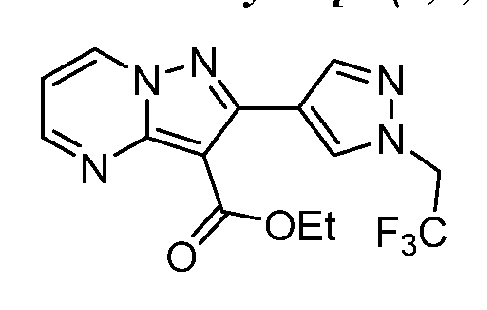


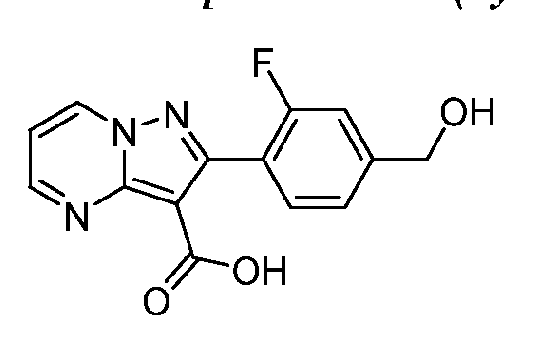


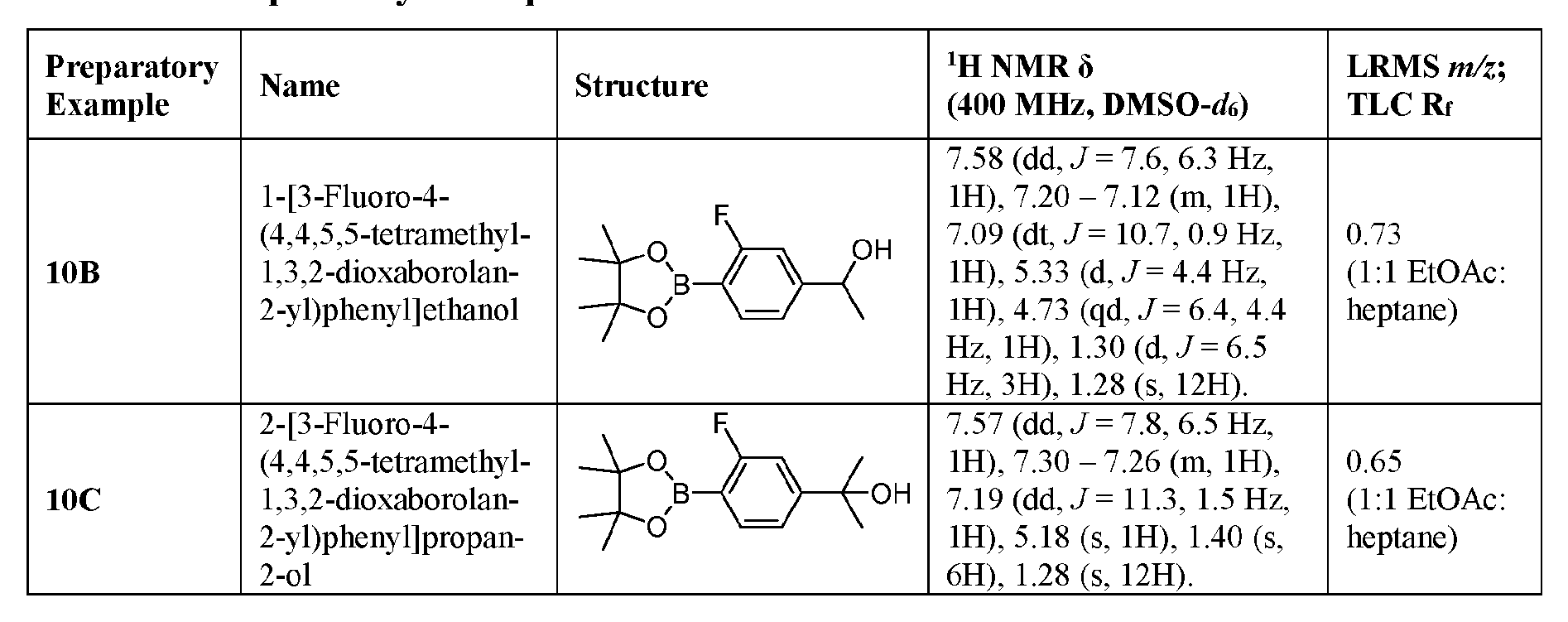


Examples 1. 2-[2-Fluoro-4-(hydroxymethyl)phenyl]-N-[(3S)-9-fluoro-2-oxo-5-phenyl-1,3-dihydro-1,4- benzodiazepin-3-yl]pyrazolo[1,5-a]pyrimidine-3-carboxamide HA
 TU (85 mg, 0.22 mmol) was added to a suspension of intermediate 5A (55 mg, 0.19 mmol) and DIPEA (65 µL, 0.37 mmol) in DMF (1.5 mL) and stirred at rt for 5 min. (3S)-3-amino-9- fluoro-5-phenyl-1,3-dihydro-1,4-benzodiazepin-2-one (50 mg, 0.19 mmol) was added and the reaction stirred overnight at rt. The reaction was quenched with water, and the resultant precipitate filtered, washing with water. The precipitate was dissolved in EtOAc, washed with 0.1 M HCl (2× 10 mL) and brine (10 mL), dried MgSO4, and the solvent removed under reduced pressure. Purification by flash chromatography [13-37% (EtOH:CH2Cl2:NH4OH; 50:8:1) in CH2Cl2] afforded a white solid (72 mg, 72%). 1H NMR (600 MHz, DMSO-d6) δ 10.95 (s, 1H), 9.59 (d, J = 7.9 Hz, 1H), 9.42 (dd, J = 7.0, 1.6 Hz, 1H), 8.99 (dd, J = 4.3, 1.7 Hz, 1H), 7.61 – 7.56 (m, 1H), 7.55 – 7.49 (m, 3H), 7.48 – 7.43 (m, 3H), 7.41 (dd, J = 7.0, 4.3 Hz, 1H), 7.33 – 7.28 (m, 1H), 7.21 – 7.18 (m, 1H), 7.17 – 7.13 (m, 2H), 5.52 (d, J = 7.9 Hz, 1H), 5.37 (t, J = 5.8 Hz, 1H), 4.56 (d, J = 5.7 Hz, 2H). LRMS (APCI+) m/z 539.2 [M+H]+. The following compounds of the invention were prepared with (3S)-3-amino-9-fluoro-5-phenyl-1,3- dihydro-1,4-benzodiazepin-2-one or (3S)-3-amino-5-phenyl-1,3-dihydro-1,4-benzodiazepin-2-one by the amide coupling procedure described for the compound of Example 1. Example 3 was subject to additional repeat purification by flash chromatography [15-22% (EtOH:CH2Cl2:NH4OH; 50:8:1) in CH2Cl2] followed by preparative HPLC (Method 1: MeCN/water with 0.2% v/v formic acid, 25-75% for 16 min).
Table 5 – Examples compounds prepared by amide coupling procedure A
 LRMS E 2 3 4 5
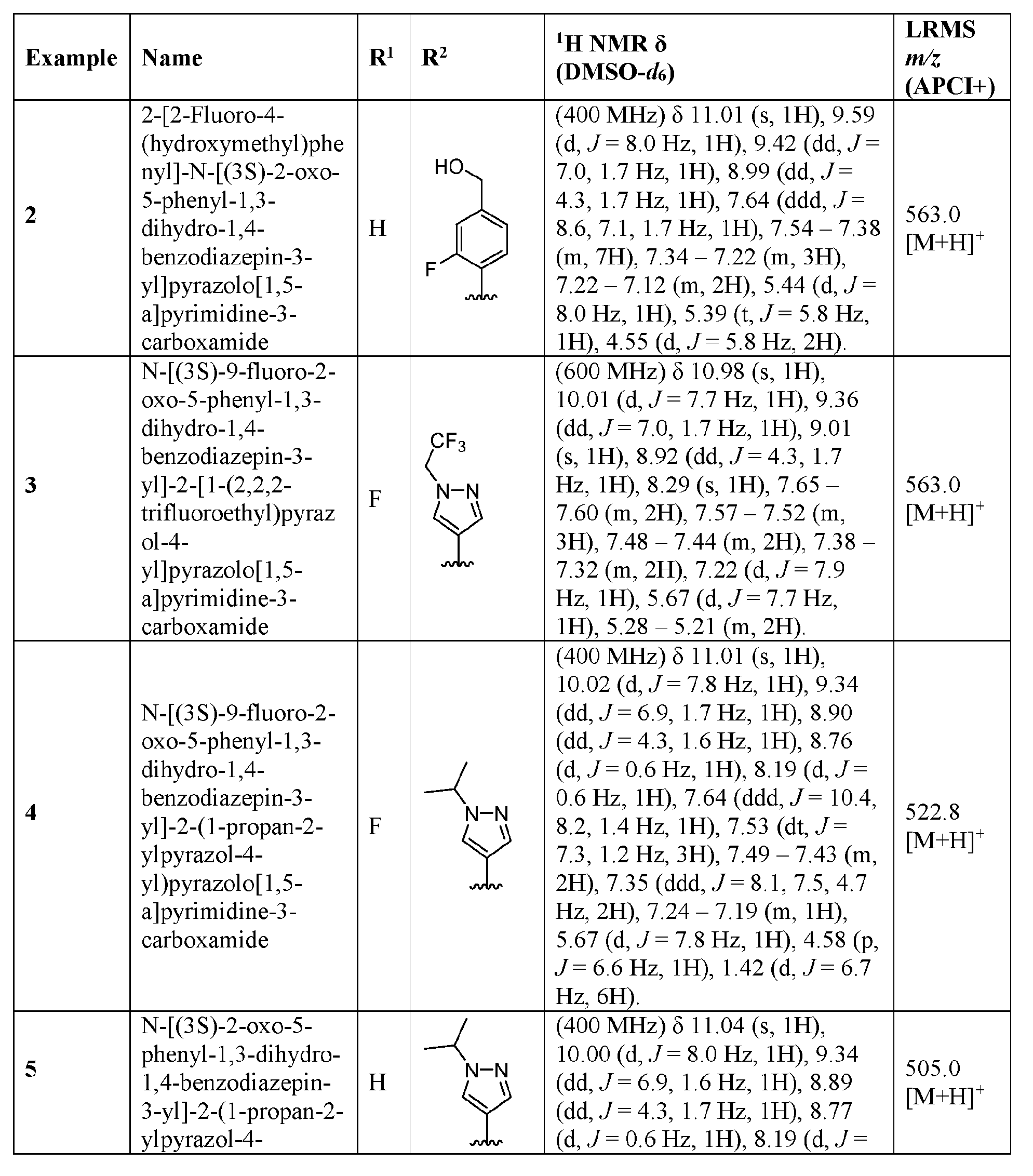 ylpyrazol-4- (d, J = 0.6 Hz, 1H), 8.19 (d, J =
 2-[2-Fluoro-5- (400 MHz) δ 10.98 (s, 1H), 9.60 1 1 1 1 1
 y]pyaoo[ ,5 2H), 5.55 (d, J = 8.0 Hz, 1H),
a]pyrimidine-3- 4.44 (s, 1H), 2.71 (s, 2H), 1.10
 1,4-benzodiazepin- (m, 1H), 7.49 – 7.43 (m, 5H),
3-yl]pyrazolo[1,5- 7.41 (dd, J = 7.0, 4.2 Hz, 1H), 2 2 2

23. 2-(4-Ethylsulfonyl-2-fluorophenyl)-N-[(3S)-9-fluoro-2-oxo-5-phenyl-1,3-dihydro-1,4- benzodiazepin-3-yl]pyrazolo[1,5-a]pyrimidine-3-carboxamide
 DIPEA (99 µL, 0.572 mmol) was added to a solution of intermediate 5I (100 mg, 0.286 mmol), (3S)- 3-amino-9-fluoro-5-phenyl-1,3-dihydro-1,4-benzodiazepin-2-one (81 mg, 0.300 mmol) in DMF (3 mL) and the reaction mixture was stirred at rt for 3 min. HATU (120 mg, 0.315 mmol) was added and the reaction mixture was stirred at rt overnight. The reaction mixture was quenched with H2O (15 mL), and the resultant precipitate collected by filtration, washing with water (3× 15 mL). The precipitate was dissolved in EtOAc and the solvent removed under reduced pressure. Purification by flash chromatography (60-100% EtOAc in heptane) afforded an off-white solid (122 mg, 71%). 1H NMR (400 MHz, DMSO-d6) δ 10.98 (s, 1H), 9.59 (d, J = 8.0 Hz, 1H), 9.46 (dd, J = 6.8, 1.6 Hz, 1H), 9.03 (dd, J = 4.0, 1.6 Hz, 1H), 7.86-7.79 (m, 3H), 7.61-7.56 (m, 1H), 7.55-7.43 (m, 6H), 7.34-7.28 (m, 1H), 7.16-7.14 (d, J = 8.0 Hz, 1H), 5.53 (d, J = 8.0 Hz, 1H), 3.41 (q, J = 7.2 Hz, 2H), 1.14 (t, J = 7.2 Hz, 3H). LRMS (ESI+) m/z 601.1 [M+H]+. The following compounds were prepared by an analogous procedure to that described for the compound of Example 23. Table 6 – Examples compounds
 1 1 2 H NMR δ LRMS m/z E 2 2 2
 27. 2-(4-Carbamoyl-2-fluorophenyl)-N-[(3S)-9-fluoro-2-oxo-5-phenyl-1,3-dihydro-1,4- benzodiazepin-3-yl]pyrazolo[1,5-a]pyrimidine-3-carboxamide
 A solution of intermediate 4I (110 mg, 0.34 mmol) and LiOH (1 M aq., 1.01 mL, 1.01 mmol) in THF/MeOH (3:1; 2 mL) was heated at 50 °C overnight. The solvents were removed under reduced pressure and the residue diluted with water (5 mL) and acidified with 1 M aq. HCl (1.34 mL). The
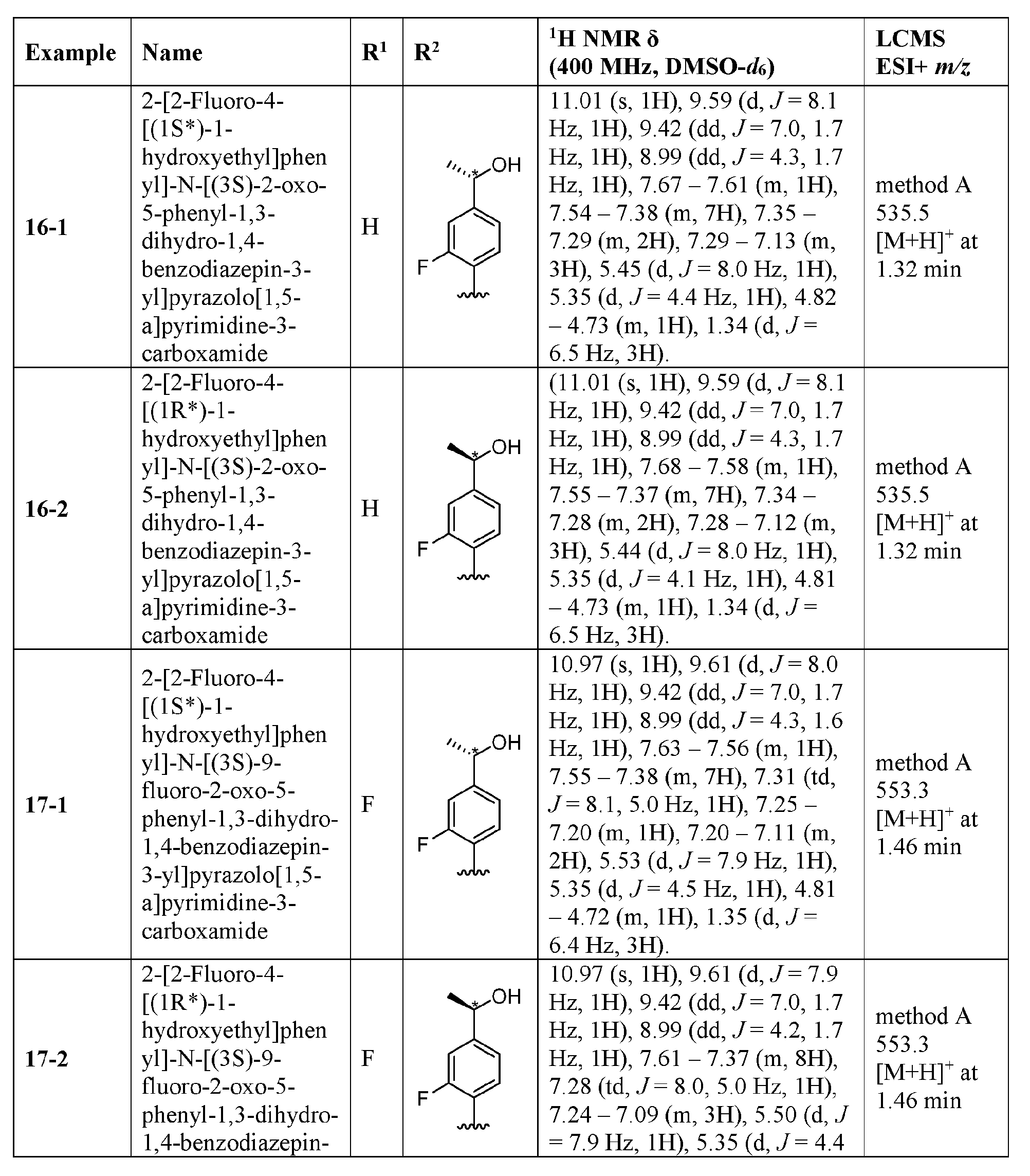
resultant precipitate was filtered, washed with water and dried under reduced pressure to afford an orange solid (87 mg) which used without further purification. A mixture of 2-(4-carbamoyl-2-fluorophenyl)pyrazolo[1,5-a]pyrimidine-3-carboxylic acid and 2-(4-carboxy-2- fluorophenyl)pyrazolo[1,5-a]pyrimidine-3-carboxylic acid was obtained. (3S)-3-Amino-9-fluoro-5-phenyl-1,3-dihydro-1,4-benzodiazepin-2-one (79 mg, 0.29 mmol) was added to a portion of the crude residue (80 mg), followed by DMF (3 mL) and DIPEA (93 µL, 0.53 mmol) and the reaction mixture was stirred at rt for 3 min. HATU (122 mg, 0.32 mmol) was added and the reaction mixture was stirred at rt for 20 h. The reaction was quenched with water, and the resultant precipitate filtered, washing with water, then dissolved in (EtOH:CH2Cl2:NH4OH; 50:8:1) and the volatiles removed under reduced pressure. Purification by flash chromatography [5- 25% (EtOH:CH2Cl2:NH4OH; 50:8:1) in CH2Cl2] afforded a white solid (20 mg). 1H NMR (400 MHz, DMSO-d6) δ 10.98 (s, 1H), 9.60 (d, J = 8.0 Hz, 1H), 9.45 (dd, J = 7.0, 1.7 Hz, 1H), 9.02 (dd, J = 4.3, 1.7 Hz, 1H), 8.13 (s, 1H), 7.78 (dd, J = 7.9, 1.6 Hz, 1H), 7.71 (dd, J = 10.7, 1.6 Hz, 1H), 7.66 – 7.56 (m, 3H), 7.55 – 7.40 (m, 6H), 7.32 (td, J = 8.1, 5.1 Hz, 1H), 7.15 (dt, J = 7.9, 1.1 Hz, 1H), 5.53 (d, J = 7.9 Hz, 1H). LRMS (APCI+) m/z 552.3 [M+H]+ The following compounds of the invention were prepared by chiral resolution from the denoted parent mixture of diastereomers by the method indicated and were isolated as a single stereoisomer of unknown absolute stereochemistry. The retention time for each resolved diastereomer under the indicated analytical conditions is denoted by tR. The stereochemical configuration of these compounds has been designated as R* or S*, with the arbitrarily defined stereocenter marked by an asterisk. Table 7 – Resolution of Diastereomers
 (0.2% v/v NH3) (0.2% v/v NH3)
Table 8 – Examples prepared as single diastereomers
 1 E H NMR δ LCMS 1 1 1 1
 1,4-benzodiazepin- = 7.9 Hz, 1H), 5.35 (d, J = 4.4
3-yl]pyrazolo[1,5- Hz, 1H), 4.83 – 4.71 (m, 1H),
 28. [3‐Fluoro‐4‐(3‐{[(3S)‐9‐fluoro‐2‐oxo‐5‐phenyl‐1,3‐dihydro‐1,4‐benzodiazepin‐3‐ yl]carbamoyl}pyrazolo[1,5‐a]pyrimidin‐2‐yl)phenyl]methyl aminoacetate hydrochloride
 4 M HCl in dioxane (1.82 mL, 7.29 mmol) was added to a solution of intermediate 13A (169 mg, 0.24 mmol) in 1,4-dioxane (1.5 mL) at rt and stirred for 24 h. The mixture was diluted with MeOH and solvent removed under reduced pressure. Purification by flash chromatography [5- 100% (EtOH:CH2Cl2:NH4OH; 50:8:1) in CH2Cl2] afforded a white solid (95 mg). The resulting solid was dissolved in CH2Cl2 (2 mL), HCl (2 M in Et2O; 1.8 mL, 3.64 mmol) added, and stirred at rt for 15 min. The mixture was evaporated under reduced pressure, the residual solid sonicated with acetone (5 mL), collected by filtration, washed with a small amount of acetone and dried at the pump to afford an off-white solid (103 mg, 67%). 1H NMR (400 MHz, DMSO-d6) δ 10.99 (s, 1H), 9.60 (d, J = 7.9 Hz, 1H), 9.43 (dd, J = 7.0, 1.7 Hz, 1H), 9.01 (dd, J = 4.3, 1.7 Hz, 1H), 8.37 (s, 3H), 7.64 – 7.40 (m, 9H), 7.37 – 7.26 (m, 3H), 7.15 (d, J = 8.0 Hz, 1H), 5.51 (d, J = 7.8 Hz, 1H), 5.31 (s, 2H), 3.93 (q, J = 5.6 Hz, 2H). LRMS (APCI+) m/z 596.2 [M+H]+. The following compounds of the invention were prepared by an analogous procedure to that described for the compound of Example 28.
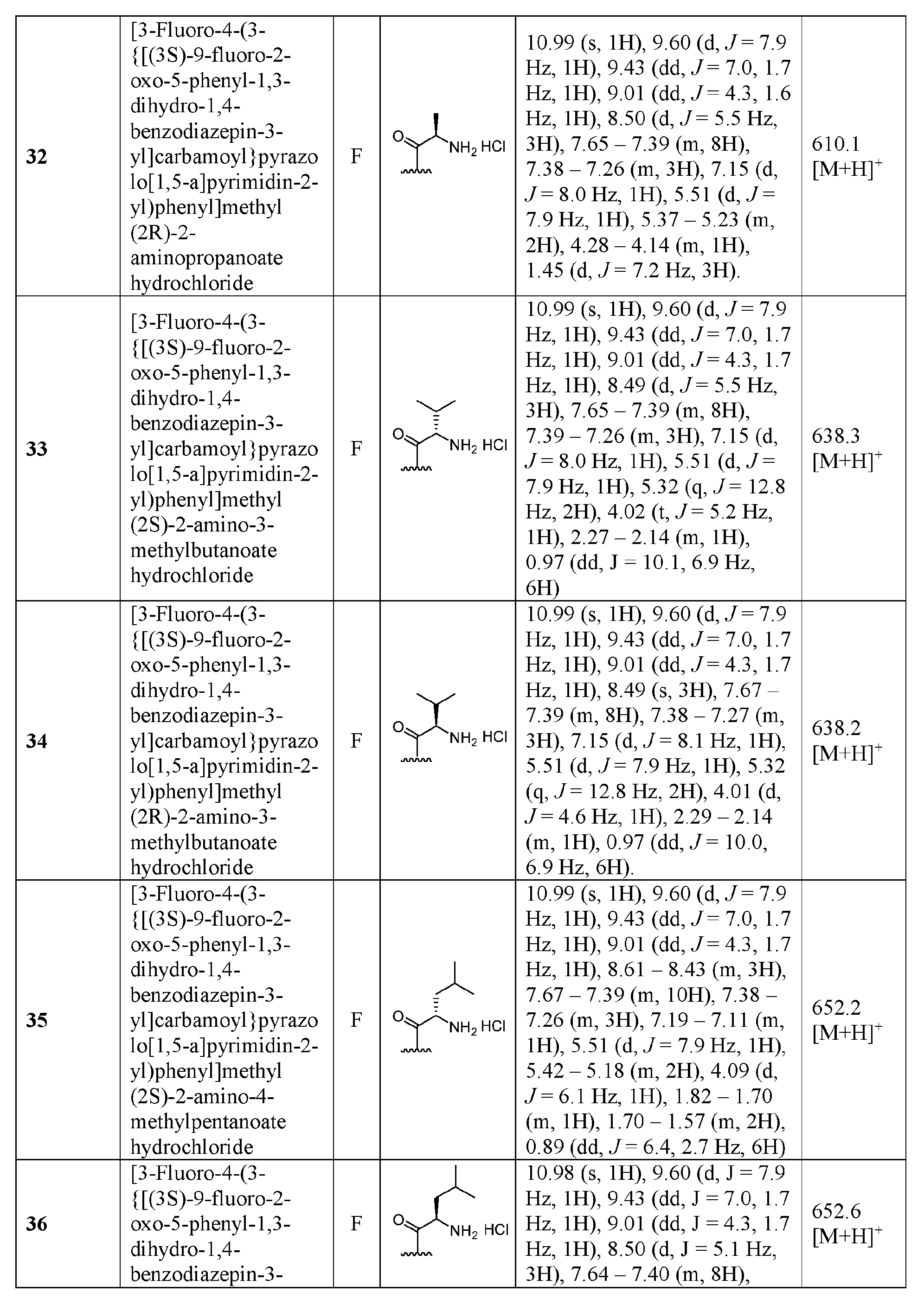
Table 9 – Example compounds
 LRMS E 2 3 3
 hydrochloride
[3‐Fluoro‐4‐(3‐ 1099 ( 1H) 960 (d J = 79
 benzodiazepin‐3‐ 3H), 7.64 – 7.40 (m, 8H),
yl]carbamoyl}pyrazo 7.37 – 7.28 (m, 3H), 7.18 –
 37. [3-Fluoro-4-[3-[[(3S)-9-fluoro-2-oxo-5-phenyl-1,3-dihydro-1,4-benzodiazepin-3- yl]carbamoyl]pyrazolo[1,5-a]pyrimidin-2-yl]phenyl]methyl dihydrogen phosphate
 A reaction vessel was charged with 2-[2-fluoro-4-(hydroxymethyl)phenyl]-N-[(3S)-9-fluoro-2-oxo- 5-phenyl-1,3-dihydro-1,4-benzodiazepin-3-yl]pyrazolo[1,5-a]pyrimidine-3-carboxamide (200 mg, 0.37 mmol), tetrabutylammonium hydrogensulfate (38 mg, 0.11 mmol) and phosphoenolpyruvate, monopotassium salt (345 mg, 1.67 mmol), diluted with DMF (2 mL) and heated at 100 °C for 124 h. The reaction was quenched with water, filtered, and the filtrate diluted with water (30 mL) and pH adjusted to ≈ 8 with sat. aq. NaHCO3 and washed with CH2Cl2 (2× 50 mL). The aqueous filtrate was evaporated to dryness under reduced pressure, the residue diluted with MeOH (50 mL), and filtered, washing with MeOH. The volatiles were removed under reduced pressure and the residue purified by preparative HPLC (method 2: MeCN/water with 0.2% v/v formic acid, 40-75% for 16 min) to afford a white solid (31 mg, 14%). 1H NMR (400 MHz, DMSO-d6) δ 10.96 (s, 1H), 9.64 (d, J = 7.9 Hz, 1H), 9.40 (d, J = 7.0 Hz, 1H), 8.96 (d, J = 4.2 Hz, 1H), 7.44 (d, J = 17.4 Hz, 7H), 7.31 – 6.79 (m, 5H), 5.33 (d, J = 4.9 Hz, 1H), 4.74 (d, J = 6.9 Hz, 2H). 31P NMR (162 MHz, DMSO-d6) δ 0.11. LCMS (method B) 619.5 [M+H]+ at 6.46 min. Example 38: Efficacy in vitro Compounds were subjected to RSV plaque reduction assays according to the following protocol. Plaque EC50 and cell toxicity CC50 values are a mean of at least two experiments and figures are rounded to whole units.
Plaque Reduction Assay. Hep-G2 cells (ECACC, 85011430) were passaged in flasks and seeded in 24-well plates in DMEM containing antibiotics and supplemented with 10% FBS. During inoculation and subsequent incubation, cells were cultured in DMEM containing 2% FBS. 100 plaque forming unit/well of RSV (RSV A2 ECACC, 0709161v) was mixed with eight serial dilutions of compound. Subsequently, 100 µL of the virus/compound mixtures was added to confluent Hep-G2 cell monolayers. The cells and virus/compound mixtures were incubated at 37 °C in a humidified 5% CO2 incubator for 2 h prior to removal of the inoculum and addition of 1 mL of overlay (DMEM containing 2% FBS and 0.8% CMC) containing compound dilutions. The cells and were incubated at 37 °C in a humidified 5% CO2 incubator for 2 days. Cells were washed with PBS before adding 75/25% v/v EtOH/MeOH, for 3 min. Fixative was removed and plates were washed with PBS. A pre-titrated amount of the primary antibody was added in 200 µL PBS/2% milk powder, and plates incubated for 90 min at 37 °C. The plates were washed 3 times with PBS/0.05% Tween20 before addition of rabbit anti-goat horse radish peroxidase in 200 µL PBS/2% milk powder, and incubated for 1 h at 37 °C. Following three wash steps with PBS/0.05% Tween20, 200 µL ready-to-use TrueBlue was added and plates were incubated at rt for 10-15 min before washing with water. After removal of water, plates were air-dried in the dark. Plates were scanned and analysed using the Immunospot S6 Macro analyser, which is equipped with BioSpot analysis software for counting immunostained plaques (virospots). Plaque counts were used to calculate % infection relative to the mean of the plaque count in the virus control wells for RSV. The EC50 value was calculated as 50% reduction in signal, respectively, by interpolation of inhibition curves fitted with a 4-parameter nonlinear regression with a variable slope in Dotmatics. Plaque EC50 and cell toxicity CC50 values are a mean of at least two experiments and figures are rounded to whole units. Re lt E 1 2
 3 66 >25,000
4 37 >25,000
 Example 39: In vitro Pharmacokinetics Compounds were subjected to the following assays to investigate liver microsomal stability and hepatocyte stability.
Microsomal incubation: Experimental Procedure Pooled liver microsomes were purchased from a reputable commercial supplier and stored at -80 °C prior to use. Microsomes (final protein concentration 0.5 mg/mL), 0.1 M phosphate buffer pH 7.4 and test compound (final substrate concentration 1 μΜ; final DMSO concentration 0.25%) were pre- incubated at 37 °C prior to the addition of NADPH (final concentration 1 mM) to initiate the reaction. The final incubation volume was 50 µL. A control incubation was included for each compound tested where 0.1 M phosphate buffer pH 7.4 was added instead of NADPH (minus NADPH). Two control compounds were included with each species. All incubations were performed singularly for each test compound. Each compound was incubated for 0, 5, 15, 30 and 45 min. The control (minus NADPH) was incubated for 45 min only. The reactions were stopped by transferring incubate into acetonitrile at the appropriate time points, in a 1:3 ratio. The termination plates are centrifuged at 3,000 rpm for 20 min at 4 °C to precipitate the protein. Following protein precipitation, the sample supernatants were combined in cassettes of up to 4 compounds, internal standard added, and samples analysed by LC-MS/MS. From a plot of ln peak area ratio (compound peak area/internal standard peak area) against time, the gradient of the line was determined. Subsequently, half-life (t½) and intrinsic clearance (CLint) were calculated. Compounds with low clearance (>80% remaining at 45 min) under the assay conditions are denoted as t½ >140 min. Results
 9 6 / 73.3 / 69 Hepatocyte incubation: Experimental Procedure Cryopreserved pooled hepatocytes were purchased from a reputable commercial supplier and stored in liquid nitrogen prior to use. Williams E media supplemented with 2 mM L-glutamine and 25 mM HEPES and test compound (final substrate concentration 3 µM; final DMSO concentration 0.25 %)
are pre-incubated at 37 °C prior to the addition of a suspension of cryopreserved hepatocytes (final cell density 0.5 x 10⁶ viable cells/mL in Williams E media supplemented with 2 mM L-glutamine and 25 mM HEPES) to initiate the reaction. The final incubation volume is 500 µL. Two control compounds were included with each species, alongside appropriate vehicle control. The reactions were stopped by transferring 50 µL of incubate to 100 µL acetonitrile containing internal standard at the appropriate time points. Samples were removed at 6 time points (0, 5, 15, 30, 45 and 60 min) over the course of a 60 min experiment. The termination plates were centrifuged at 2500 rpm at 4 °C for 30 min to precipitate the protein. Following protein precipitation, the sample supernatants were combined in cassettes of up to 4 compounds and analysed using generic LC-MS/MS conditions. From a plot of ln peak area ratio (compound peak area/internal standard peak area) against time, the gradient of the line was determined. Subsequently, half-life (t½) and intrinsic clearance (CLint) were calculated. Compounds with low clearance (>80% remaining at 60 min) under the assay conditions are denoted as t½ >180 min. Results E 1 4 7 1
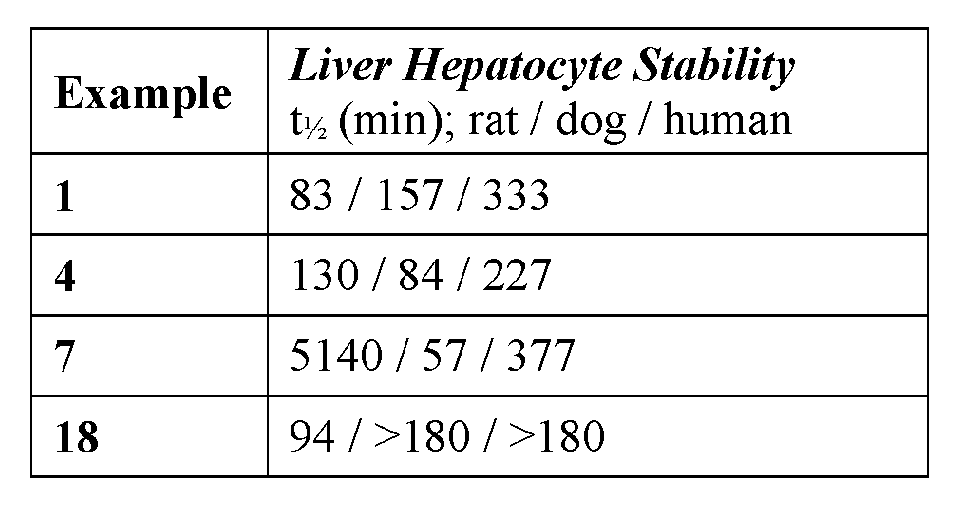 Example 40: in vivo Pharmacokinetics The pharmacokinetics of compounds were studied in vivo in rats at doses of 1 mg/kg (IV) and 10 mg/kg (PO). Methods Male rats [Sprague Dawley (SD)] surgically prepared with a jugular vein cannula were treated with experimental compounds via intravenous administration (IV; n=3; 1 mg/kg) or oral administration (PO; n=3; 10 mg/kg). Compounds were formulated as a solution in 40:60 dimethylacetamide:saline
(IV administration) and a solution of 10% DMSO, 10% cremaphor in water (80%) (PO administration). Animals were observed for any overt clinical signs or symptoms. Serial blood samples were collected via the cannula at 0.02, 0.08, 0.25, 0.5, 1, 2, 4, 6, 8 and 24 h post IV dosing of compound, and at 0.08, 0.25, 0.5, 1, 2, 4, 6, 8 and 24 h post oral dosing of compound, and plasma was prepared by centrifugation and stored immediately at -80 °C. Samples were subsequently thawed, prepared for analysis by protein precipitation with acetonitrile, and analysed by tandem LCMS using electrospray ionisation using a matrix-matched calibration curve. PK parameters were calculated from the resulting data. Results
 Example 41: Aqueous formulation The compound of Example 1 is formulated as a solution in 30% w/v captisol (i.e. sulfobutylether- beta-cyclodextrin) at pH4 according to the following procedure. A carrier of 30% w/v captisol (i.e. sulfobutylether-beta-cyclodextrin) is prepared by weighing the required amount of captisol into a suitable vessel, adding approximately 80% of the final volume of water and magnetically stirring until a solution is formed. The carrier is then made up to volume with water. An aqueous solution of a compound of Example 1 is prepared by weighing 175 mg of the compound into a suitable vessel and adding approximately 80% of the required volume of the carrier. Using an aqueous solution of hydrochloric acid, the pH is adjusted to pH2 and the resulting mixture is
magnetically stirred until a solution is formed. The formulation is then made up to volume with carrier and the pH is adjusted to pH4 using an aqueous solution of sodium hydroxide. Example 42: Tablet composition Tablets, each weighing 0.15 g and containing 25 mg of a compound of the invention are manufactured as follows: Composition for 10,000 tablets Compound of the invention (250 g) Lactose (800 g) Corn starch (415 g) Talc powder (30 g) Magnesium stearate (5 g) The compound of the invention, lactose and half of the corn starch are mixed. The mixture is then forced through a sieve 0.5 mm mesh size. Corn starch (10 g) is suspended in warm water (90 mL). The resulting paste is used to granulate the powder. The granulate is dried and broken up into small fragments on a sieve of 1.4 mm mesh size. The remaining quantity of starch, talc and magnesium is added, carefully mixed and processed into tablets. Example 43: Injectable Formulation Compound of the invention 200 mg Hydrochloric Acid Solution 0.1 M or Sodium Hydroxide Solution 0.1 M q.s. to pH 4.0 to 7.0 Sterile water q.s. to 10 mL The compound of the invention is dissolved in most of the water (35 °C-40 °C) and the pH adjusted to between 4.0 and 7.0 with the hydrochloric acid or the sodium hydroxide as appropriate. The batch is then made up to volume with water and filtered through a sterile micropore filter into a sterile 10 mL amber glass vial (type 1) and sealed with sterile closures and overseals.
Example 44: Intramuscular Injection Compound of the invention 200 mg Benzyl Alcohol 0.10 g Glycofurol 75 1.45 g Water for injection q.s to 3.00 mL The compound of the invention is dissolved in the glycofurol. The benzyl alcohol is then added and dissolved, and water added to 3 mL. The mixture is then filtered through a sterile micropore filter and sealed in sterile 3 mL glass vials (type 1). Example 45: Syrup Formulation Compound of invention 250 mg Sorbitol Solution 1.50 g Glycerol 2.00 g Sodium benzoate 0.005 g Flavour 0.0125 mL Purified Water q.s. to 5.00 mL The compound of the invention is dissolved in a mixture of the glycerol and most of the purified water. An aqueous solution of the sodium benzoate is then added to the solution, followed by addition of the sorbital solution and finally the flavour. The volume is made up with purified water and mixed well.
Claims
CLAIMS 1. A compound which is a benzodiazepine of formula (I): R2 wherein:
 R1 is H or F; R2 is selected from:
 R3 is C1-C6 alkyl which is unsubstituted or substituted by CF3, or is a monocyclic 4- to 6-membered heterocyclic group containing 1 or 2 heteroatoms selected from O, N and S; R4 is H or a group selected from -X, -alk-X, -CONR6R7, C=NN R6R7, -SO2R6 and -SO2NR6R7; R4′ is a group selected from -X, -alk-X, -CONR6R7, -C=NN R6R7, -SO2R6 and -SO2NR6R7; X is –OH or a derivative of an OH group selected from α-amino carboxylic acid esters, carboxylic acid esters, carbonates, carbamates, ethers and phosphates; alk is C1-C6 alkylene which is unsubstituted or substituted by C3-C6 cycloalkyl; and R6 and R7 are each independently C1-C6 alkyl or C3-C6 cycloalkyl; or a pharmaceutically acceptable salt thereof.
2. A compound according to claim 1 in which X is –OR8 in which R8 is H or a group selected from -C(O)-C(R10)(Y)-NR11 2, -C(O)R9, -C(O)OR9, -C(O)NR12 2, -R9 , –CH2-OP(O)(OH)2 and
-P(O)(OH)2, wherein: each R9 is independently C1-C6 alkyl which is unsubstituted or substituted; each R10 is independently H or Me; each R11 is independently H, Me or a group -C(O)-CHY-NR10 2 ; each R12 is independently H or C1-C6 alkyl which is unsubstituted or substituted; and Y is the side-chain of an α-amino carboxylic acid.
3. A compound according to claim 1 or 2 in which X is OH.
4. A compound according to any one of the preceding claims in which R4′ is a group selected from –X and -alk-X, wherein X is as defined in any one of claims 1 to 3.
5. A compound according to any one of the preceding claims in which R4′ is -CONR6R7, -C=NNR6R7, -SO2R6 or -SO2NR6R7, wherein R6 and R7 are as defined in claim 1.
6. A compound according to any one of the preceding claims in which R4 is H.
7. A compound according to any one of the preceding claims in which alk is selected from – CH2, -CH2CH2-, -CH(CH3)-, -C(CH3)2, -CH2CH(CH3)-, -CH2C(CH3)2- and cyclopropyl-substituted alkylene groups of formulae:

8. A compound which is selected from: 2-[2-Fluoro-4-(hydroxymethyl)phenyl]-N-[(3S)-9-fluoro-2-oxo-5-phenyl-1,3-dihydro-1,4- benzodiazepin-3-yl]pyrazolo[1,5-a]pyrimidine-3-carboxamide; 2-[2-Fluoro-4-(hydroxymethyl)phenyl]-N-[(3S)-2-oxo-5-phenyl-1,3-dihydro-1,4-benzodiazepin-3- yl]pyrazolo[1,5-a]pyrimidine-3-carboxamide; N-[(3S)-9-fluoro-2-oxo-5-phenyl-1,3-dihydro-1,4-benzodiazepin-3-yl]-2-[1-(2,2,2- trifluoroethyl)pyrazol-4-yl]pyrazolo[1,5-a]pyrimidine-3-carboxamide; N-[(3S)-9-fluoro-2-oxo-5-phenyl-1,3-dihydro-1,4-benzodiazepin-3-yl]-2-(1-propan-2-ylpyrazol-4- yl)pyrazolo[1,5-a]pyrimidine-3-carboxamide;
N-[(3S)-2-oxo-5-phenyl-1,3-dihydro-1,4-benzodiazepin-3-yl]-2-(1-propan-2-ylpyrazol-4- yl)pyrazolo[1,5-a]pyrimidine-3-carboxamide; N-[(3S)-9-fluoro-2-oxo-5-phenyl-1,3-dihydro-1,4-benzodiazepin-3-yl]-2-[1-(oxan-4-yl)pyrazol-4- yl]pyrazolo[1,5-a]pyrimidine-3-carboxamide; 2-(2-Fluoro-4-methylsulfonylphenyl)-N-[(3S)-9-fluoro-2-oxo-5-phenyl-1,3-dihydro-1,4- benzodiazepin-3-yl]pyrazolo[1,5-a]pyrimidine-3-carboxamide; 2-(2-Fluoro-4-methylsulfonylphenyl)-N-[(3S)-2-oxo-5-phenyl-1,3-dihydro-1,4-benzodiazepin-3- yl]pyrazolo[1,5-a]pyrimidine-3-carboxamide; 2-[2-Fluoro-5-(hydroxymethyl)phenyl]-N-[(3S)-2-oxo-5-phenyl-1,3-dihydro-1,4-benzodiazepin-3- yl]pyrazolo[1,5-a]pyrimidine-3-carboxamide; 2-[2-Fluoro-5-(hydroxymethyl)phenyl]-N-[(3S)-9-fluoro-2-oxo-5-phenyl-1,3-dihydro-1,4- benzodiazepin-3-yl]pyrazolo[1,5-a]pyrimidine-3-carboxamide; 2-(2-Fluoro-4-hydroxyphenyl)-N-[(3S)-2-oxo-5-phenyl-1,3-dihydro-1,4-benzodiazepin-3- yl]pyrazolo[1,5-a]pyrimidine-3-carboxamide; 2-(2-Fluoro-4-hydroxyphenyl)-N-[(3S)-9-fluoro-2-oxo-5-phenyl-1,3-dihydro-1,4-benzodiazepin-3- yl]pyrazolo[1,5-a]pyrimidine-3-carboxamide; 2-(1-Ethylpyrazol-4-yl)-N-[(3S)-9-fluoro-2-oxo-5-phenyl-1,3-dihydro-1,4-benzodiazepin-3- yl]pyrazolo[1,5-a]pyrimidine-3-carboxamide; 2-[2-Fluoro-4-(2-hydroxy-2-methylpropyl)phenyl]-N-[(3S)-9-fluoro-2-oxo-5-phenyl-1,3-dihydro- 1,4-benzodiazepin-3-yl]pyrazolo[1,5-a]pyrimidine-3-carboxamide; 2-[2-Fluoro-4-(2-hydroxy-2-methylpropyl)phenyl]-N-[(3S)-2-oxo-5-phenyl-1,3-dihydro-1,4- benzodiazepin-3-yl]pyrazolo[1,5-a]pyrimidine-3-carboxamide; 2-[2-Fluoro-4-(1-hydroxyethyl)phenyl]-N-[(3S)-2-oxo-5-phenyl-1,3-dihydro-1,4-benzodiazepin-3- yl]pyrazolo[1,5-a]pyrimidine-3-carboxamide; 2-[2-Fluoro-4-(1-hydroxyethyl)phenyl]-N-[(3S)-9-fluoro-2-oxo-5-phenyl-1,3-dihydro-1,4- benzodiazepin-3-yl]pyrazolo[1,5-a]pyrimidine-3-carboxamide; 2-[2-Fluoro-3-(hydroxymethyl)phenyl]-N-[(3S)-9-fluoro-2-oxo-5-phenyl-1,3-dihydro-1,4- benzodiazepin-3-yl]pyrazolo[1,5-a]pyrimidine-3-carboxamide; 2-[2-Fluoro-4-(2-hydroxypropan-2-yl)phenyl]-N-[(3S)-9-fluoro-2-oxo-5-phenyl-1,3-dihydro-1,4- benzodiazepin-3-yl]pyrazolo[1,5-a]pyrimidine-3-carboxamide; 2-[2-Fluoro-4-(2-hydroxypropan-2-yl)phenyl]-N-[(3S)-2-oxo-5-phenyl-1,3-dihydro-1,4- benzodiazepin-3-yl]pyrazolo[1,5-a]pyrimidine-3-carboxamide; 2-[2-Fluoro-4-(2-hydroxyethyl)phenyl]-N-[(3S)-2-oxo-5-phenyl-1,3-dihydro-1,4-benzodiazepin-3- yl]pyrazolo[1,5-a]pyrimidine-3-carboxamide;
2-[2-Fluoro-4-(2-hydroxyethyl)phenyl]-N-[(3S)-9-fluoro-2-oxo-5-phenyl-1,3-dihydro-1,4- benzodiazepin-3-yl]pyrazolo[1,5-a]pyrimidine-3-carboxamide; 2-(4-Ethylsulfonyl-2-fluorophenyl)-N-[(3S)-9-fluoro-2-oxo-5-phenyl-1,3-dihydro-1,4- benzodiazepin-3-yl]pyrazolo[1,5-a]pyrimidine-3-carboxamide; N-[(3S)-9-Fluoro-2-oxo-5-phenyl-1,3-dihydro-1,4-benzodiazepin-3-yl]-2-(2-fluoro-4- sulfamoylphenyl)pyrazolo[1,5-a]pyrimidine-3-carboxamide; 2-[4-(Dimethylsulfamoyl)-2-fluorophenyl]-N-[(3S)-9-fluoro-2-oxo-5-phenyl-1,3-dihydro-1,4- benzodiazepin-3-yl]pyrazolo[1,5-a]pyrimidine-3-carboxamide; 2-(2-Fluoro-5-methylsulfonylphenyl)-N-[(3S)-9-fluoro-2-oxo-5-phenyl-1,3-dihydro-1,4- benzodiazepin-3-yl]pyrazolo[1,5-a]pyrimidine-3-carboxamide; 2-(4-Carbamoyl-2-fluorophenyl)-N-[(3S)-9-fluoro-2-oxo-5-phenyl-1,3-dihydro-1,4-benzodiazepin-3- yl]pyrazolo[1,5-a]pyrimidine-3-carboxamide; 2-[2-Fluoro-4-[(1S*)-1-hydroxyethyl]phenyl]-N-[(3S)-2-oxo-5-phenyl-1,3-dihydro-1,4- benzodiazepin-3-yl]pyrazolo[1,5-a]pyrimidine-3-carboxamide; 2-[2-Fluoro-4-[(1R*)-1-hydroxyethyl]phenyl]-N-[(3S)-2-oxo-5-phenyl-1,3-dihydro-1,4- benzodiazepin-3-yl]pyrazolo[1,5-a]pyrimidine-3-carboxamide; 2-[2-Fluoro-4-[(1S*)-1-hydroxyethyl]phenyl]-N-[(3S)-9-fluoro-2-oxo-5-phenyl-1,3-dihydro-1,4- benzodiazepin-3-yl]pyrazolo[1,5-a]pyrimidine-3-carboxamide; 2-[2-Fluoro-4-[(1R*)-1-hydroxyethyl]phenyl]-N-[(3S)-9-fluoro-2-oxo-5-phenyl-1,3-dihydro-1,4- benzodiazepin-3-yl]pyrazolo[1,5-a]pyrimidine-3-carboxamide; [3‐Fluoro‐4‐(3‐{[(3S)‐9‐fluoro‐2‐oxo‐5‐phenyl‐1,3‐dihydro‐1,4‐benzodiazepin‐3‐ yl]carbamoyl}pyrazolo[1,5‐a]pyrimidin‐2‐yl)phenyl]methyl aminoacetate hydrochloride; 3‐Fluoro‐4‐(3‐{[(3S)‐2‐oxo‐5‐phenyl‐1,3‐dihydro‐1,4‐benzodiazepin‐3‐yl]carbamoyl}pyrazolo[1,5‐ a]pyrimidin‐2‐yl)phenyl]methyl aminoacetate hydrochloride; [3‐Fluoro‐4‐(3‐{[(3S)‐2‐oxo‐5‐phenyl‐1,3‐dihydro‐1,4‐benzodiazepin‐3‐yl]carbamoyl}pyrazolo[1,5‐ a]pyrimidin‐2‐yl)phenyl]methyl (2S)‐2‐amino‐3‐methylbutanoate hydrochloride; [3‐Fluoro‐4‐(3‐{[(3S)‐9‐fluoro‐2‐oxo‐5‐phenyl‐1,3‐dihydro‐1,4‐benzodiazepin‐3‐ yl]carbamoyl}pyrazolo[1,5‐a]pyrimidin‐2‐yl)phenyl]methyl (2S)‐2‐aminopropanoate hydrochloride; [3‐Fluoro‐4‐(3‐{[(3S)‐9‐fluoro‐2‐oxo‐5‐phenyl‐1,3‐dihydro‐1,4‐benzodiazepin‐3‐ yl]carbamoyl}pyrazolo[1,5‐a]pyrimidin‐2‐yl)phenyl]methyl (2R)‐2‐aminopropanoate hydrochloride; [3‐Fluoro‐4‐(3‐{[(3S)‐9‐fluoro‐2‐oxo‐5‐phenyl‐1,3‐dihydro‐1,4‐benzodiazepin‐3‐ yl]carbamoyl}pyrazolo[1,5‐a]pyrimidin‐2‐yl)phenyl]methyl (2S)‐2‐amino‐3‐methylbutanoate hydrochloride;
[3‐Fluoro‐4‐(3‐{[(3S)‐9‐fluoro‐2‐oxo‐5‐phenyl‐1,3‐dihydro‐1,4‐benzodiazepin‐3‐ yl]carbamoyl}pyrazolo[1,5‐a]pyrimidin‐2‐yl)phenyl]methyl (2R)‐2‐amino‐3‐methylbutanoate hydrochloride; [3‐Fluoro‐4‐(3‐{[(3S)‐9‐fluoro‐2‐oxo‐5‐phenyl‐1,3‐dihydro‐1,4‐benzodiazepin‐3‐ yl]carbamoyl}pyrazolo[1,5‐a]pyrimidin‐2‐yl)phenyl]methyl (2S)‐2‐amino‐4‐methylpentanoate hydrochloride; [3‐Fluoro‐4‐(3‐{[(3S)‐9‐fluoro‐2‐oxo‐5‐phenyl‐1,3‐dihydro‐1,4‐benzodiazepin‐3‐ yl]carbamoyl}pyrazolo[1,5‐a]pyrimidin‐2‐yl)phenyl]methyl (2R)‐2‐amino‐4‐methylpentanoate hydrochloride; [3-Fluoro-4-[3-[[(3S)-9-fluoro-2-oxo-5-phenyl-1,3-dihydro-1,4-benzodiazepin-3- yl]carbamoyl]pyrazolo[1,5-a]pyrimidin-2-yl]phenyl]methyl dihydrogen phosphate;and the pharmaceutically acceptable salts thereof.
9. A pharmaceutical composition which comprises a compound as defined in any one of claims 1 to 8, and a pharmaceutically acceptable carrier or diluent.
10. A compound as defined in any one of claims 1 to 8, for use in the treatment of the human or animal body by therapy.
11. A compound as defined in any one of claims 1 to 8 for use in the treatment or prevention of an RSV infection.
12. Use of a compound as defined in any one of claims 1 to 8, in the manufacture of a medicament for use in the treatment or prevention of an RSV infection
13. A method of treating a subject suffering from or susceptible to an RSV infection, which method comprises administering to said subject an effective amount of a compound as defined in any one of claims 1 to8.
14. A product containing: (a) a compound as defined in any one of claims 1 to 8; and (b) one or more further therapeutic agents; for simultaneous, separate or sequential use in the treatment of a subject suffering from or susceptible to an RSV infection.
15. A product according to claim 14, wherein the further therapeutic agent is: (i) a RSV nucleocapsid(N)-protein inhibitor; (ii) a protein inhibitor, such as one that inhibits the phosphoprotein (P) protein and/or large (L) protein; (iii) an anti-RSV monoclonal antibody, such as an F-protein antibody; (iv) an immunomodulating toll-like receptor compound; (v) a respiratory virus anti-viral, such as an anti-influenza and/or anti-rhinovirus compound; and/or (vi) an anti-inflammatory compound.
16. A pharmaceutical composition which comprises (a) a compound as defined in any one of claims 1 to 8, and (b) one or more therapeutic agents as defined in claim 15, together with a pharmaceutically acceptable carrier or diluent.
17. A process for producing a pharmaceutically acceptable salt as defined in claim 1, which process comprises treating a benzodiazepine derivative of formula (I) as defined in claim 1 with a suitable acid in a suitable solvent.
18. A process according to claim 17, wherein the acid is selected from hydrochloric acid, hydrobromic acid, hydroiodic acid, sulphuric acid, nitric acid, phosphoric acid, methanesulfonic acid, benzenesulphonic acid, formic acid, acetic acid, trifluoroacetic acid, propionic acid, oxalic acid, malonic acid, succinic acid, fumaric acid, maleic acid, lactic acid, malic acid, tartaric acid, citric acid, ethanesulfonic acid, aspartic acid and glutamic acid.
Priority Applications (1)
| Application Number | Priority Date | Filing Date | Title |
|---|---|---|---|
| US18/547,244 US20240173332A1 (en) | 2021-02-24 | 2022-02-24 | Benzodiazepines for treating or preventing respiratory syncytial virus infection |
Applications Claiming Priority (2)
| Application Number | Priority Date | Filing Date | Title |
|---|---|---|---|
| GBGB2102602.6A GB202102602D0 (en) | 2021-02-24 | 2021-02-24 | Pharmaceutical compounds |
| GB2102602.6 | 2021-02-24 |
Publications (1)
| Publication Number | Publication Date |
|---|---|
| WO2022180397A1 true WO2022180397A1 (en) | 2022-09-01 |
Family
ID=75339176
Family Applications (1)
| Application Number | Title | Priority Date | Filing Date |
|---|---|---|---|
| PCT/GB2022/050504 Ceased WO2022180397A1 (en) | 2021-02-24 | 2022-02-24 | Benzodiazepines for treating or preventing respiratory syncytial virus infection |
Country Status (3)
| Country | Link |
|---|---|
| US (1) | US20240173332A1 (en) |
| GB (1) | GB202102602D0 (en) |
| WO (1) | WO2022180397A1 (en) |
Cited By (1)
| Publication number | Priority date | Publication date | Assignee | Title |
|---|---|---|---|---|
| WO2025120500A1 (en) | 2023-12-06 | 2025-06-12 | Pfizer Inc. | Benzodiazepine compounds as n-protein inhibitors |
Citations (10)
| Publication number | Priority date | Publication date | Assignee | Title |
|---|---|---|---|---|
| WO2004026843A1 (en) | 2002-09-20 | 2004-04-01 | Arrow Therapeutics Limited | Benzodiazepine derivatives and pharmaceutical compositions containing them |
| WO2005089770A1 (en) | 2004-03-19 | 2005-09-29 | Arrow Therapeutics Limited | Benzodiazepines for treating or preventing or preventing rsv infection |
| WO2005090319A1 (en) | 2004-03-19 | 2005-09-29 | Arrow Therapeutics Limited | Process for preparing benzodiazepines |
| WO2016166546A1 (en) | 2015-04-16 | 2016-10-20 | The University Of Durham | An antimicrobial compound |
| WO2017015449A1 (en) | 2015-07-22 | 2017-01-26 | Enanta Pharmaceuticals, Inc. | Benzodiazepine derivatives as rsv inhibitors |
| WO2018033714A1 (en) | 2016-08-15 | 2018-02-22 | The University Of Durham | An antimicrobial compound |
| WO2018129287A1 (en) | 2017-01-06 | 2018-07-12 | Enanta Pharmaceuticals, Inc. | Heteroaryldiazepine derivatives as rsv inhibitors |
| WO2018226801A1 (en) | 2017-06-07 | 2018-12-13 | Enanta Pharmaceuticals, Inc. | Aryldiazepine derivatives as rsv inhibitors |
| WO2021032992A1 (en) * | 2019-08-20 | 2021-02-25 | ReViral Limited | Pharmaceutical compounds |
| WO2022008911A1 (en) | 2020-07-07 | 2022-01-13 | ReViral Limited | Benzodiazepine derivatives useful in treating a respiratory syncytial virus infection |
-
2021
- 2021-02-24 GB GBGB2102602.6A patent/GB202102602D0/en not_active Ceased
-
2022
- 2022-02-24 WO PCT/GB2022/050504 patent/WO2022180397A1/en not_active Ceased
- 2022-02-24 US US18/547,244 patent/US20240173332A1/en not_active Abandoned
Patent Citations (10)
| Publication number | Priority date | Publication date | Assignee | Title |
|---|---|---|---|---|
| WO2004026843A1 (en) | 2002-09-20 | 2004-04-01 | Arrow Therapeutics Limited | Benzodiazepine derivatives and pharmaceutical compositions containing them |
| WO2005089770A1 (en) | 2004-03-19 | 2005-09-29 | Arrow Therapeutics Limited | Benzodiazepines for treating or preventing or preventing rsv infection |
| WO2005090319A1 (en) | 2004-03-19 | 2005-09-29 | Arrow Therapeutics Limited | Process for preparing benzodiazepines |
| WO2016166546A1 (en) | 2015-04-16 | 2016-10-20 | The University Of Durham | An antimicrobial compound |
| WO2017015449A1 (en) | 2015-07-22 | 2017-01-26 | Enanta Pharmaceuticals, Inc. | Benzodiazepine derivatives as rsv inhibitors |
| WO2018033714A1 (en) | 2016-08-15 | 2018-02-22 | The University Of Durham | An antimicrobial compound |
| WO2018129287A1 (en) | 2017-01-06 | 2018-07-12 | Enanta Pharmaceuticals, Inc. | Heteroaryldiazepine derivatives as rsv inhibitors |
| WO2018226801A1 (en) | 2017-06-07 | 2018-12-13 | Enanta Pharmaceuticals, Inc. | Aryldiazepine derivatives as rsv inhibitors |
| WO2021032992A1 (en) * | 2019-08-20 | 2021-02-25 | ReViral Limited | Pharmaceutical compounds |
| WO2022008911A1 (en) | 2020-07-07 | 2022-01-13 | ReViral Limited | Benzodiazepine derivatives useful in treating a respiratory syncytial virus infection |
Non-Patent Citations (4)
| Title |
|---|
| DOMON ET AL., ACS CENTRAL SCIENCE, vol. 6, no. 2, 2020, pages 283 - 292 |
| M. E. AULTON: "Pharmaceuticals - The Science of Dosage Form Designs", 1988, CHURCHILL LIVINGSTONE |
| RAUTIO, NATURE REVIEWS DRUG DISCOVERY, vol. 7, 2008, pages 255 - 270 |
| SUBBAIAH ET AL., J. MED. CHEM., vol. 62, no. 7, 2019, pages 3553 - 3574 |
Cited By (2)
| Publication number | Priority date | Publication date | Assignee | Title |
|---|---|---|---|---|
| WO2025120500A1 (en) | 2023-12-06 | 2025-06-12 | Pfizer Inc. | Benzodiazepine compounds as n-protein inhibitors |
| TWI918287B (en) | 2023-12-06 | 2026-03-11 | 美商輝瑞大藥廠 | Benzodiazepine compounds as n-protein inhibitors |
Also Published As
| Publication number | Publication date |
|---|---|
| GB202102602D0 (en) | 2021-04-07 |
| US20240173332A1 (en) | 2024-05-30 |
Similar Documents
| Publication | Publication Date | Title |
|---|---|---|
| RU2612530C2 (en) | Benzimidazole derivatives effective in treating respiratory syncytial virus infection | |
| CN117083280A (en) | Fused ring derivatives of KRAS G12D inhibitors | |
| CN114761397B (en) | Benzodiazepine derivatives for the treatment of respiratory syncytial virus (RSV) infection | |
| JP7722981B2 (en) | Pharmaceutical Compounds | |
| JP2017019850A (en) | Pyrazolo[1,5-a]pyrimidines as antiviral agent | |
| CN114787155B (en) | Drug compounds | |
| WO2022008912A1 (en) | Benzodiazepine derivatives useful in treating a respiratory syncytial virus infection | |
| EP4178964A1 (en) | Benzodiazepine derivatives useful in treating a respiratory syncytial virus infection | |
| WO2022008383A1 (en) | Isoquinoline derivatives and pharmaceutical compositions thereof for the treatment of diseases | |
| CA3176140A1 (en) | Phd inhibitor compounds, compositions, and use | |
| US20240173332A1 (en) | Benzodiazepines for treating or preventing respiratory syncytial virus infection | |
| RU2840815C2 (en) | Pharmaceutical compounds | |
| WO2018025043A1 (en) | Pyrimidine derivatives and their use in treating or preventing a respiratory syncytial virus infection |
Legal Events
| Date | Code | Title | Description |
|---|---|---|---|
| 121 | Ep: the epo has been informed by wipo that ep was designated in this application |
Ref document number: 22707496 Country of ref document: EP Kind code of ref document: A1 |
|
| WWE | Wipo information: entry into national phase |
Ref document number: 18547244 Country of ref document: US |
|
| NENP | Non-entry into the national phase |
Ref country code: DE |
|
| 122 | Ep: pct application non-entry in european phase |
Ref document number: 22707496 Country of ref document: EP Kind code of ref document: A1 |