WO2022168248A1 - 空気調和機 - Google Patents
空気調和機 Download PDFInfo
- Publication number
- WO2022168248A1 WO2022168248A1 PCT/JP2021/004203 JP2021004203W WO2022168248A1 WO 2022168248 A1 WO2022168248 A1 WO 2022168248A1 JP 2021004203 W JP2021004203 W JP 2021004203W WO 2022168248 A1 WO2022168248 A1 WO 2022168248A1
- Authority
- WO
- WIPO (PCT)
- Prior art keywords
- heat exchanger
- indoor heat
- indoor
- air
- freezing
- Prior art date
- Legal status (The legal status is an assumption and is not a legal conclusion. Google has not performed a legal analysis and makes no representation as to the accuracy of the status listed.)
- Ceased
Links
Images








Classifications
-
- F—MECHANICAL ENGINEERING; LIGHTING; HEATING; WEAPONS; BLASTING
- F24—HEATING; RANGES; VENTILATING
- F24F—AIR-CONDITIONING; AIR-HUMIDIFICATION; VENTILATION; USE OF AIR CURRENTS FOR SCREENING
- F24F11/00—Control or safety arrangements
- F24F11/70—Control systems characterised by their outputs; Constructional details thereof
-
- F—MECHANICAL ENGINEERING; LIGHTING; HEATING; WEAPONS; BLASTING
- F24—HEATING; RANGES; VENTILATING
- F24F—AIR-CONDITIONING; AIR-HUMIDIFICATION; VENTILATION; USE OF AIR CURRENTS FOR SCREENING
- F24F11/00—Control or safety arrangements
- F24F11/30—Control or safety arrangements for purposes related to the operation of the system, e.g. for safety or monitoring
- F24F11/41—Defrosting; Preventing freezing
- F24F11/43—Defrosting; Preventing freezing of indoor units
-
- F—MECHANICAL ENGINEERING; LIGHTING; HEATING; WEAPONS; BLASTING
- F25—REFRIGERATION OR COOLING; COMBINED HEATING AND REFRIGERATION SYSTEMS; HEAT PUMP SYSTEMS; MANUFACTURE OR STORAGE OF ICE; LIQUEFACTION SOLIDIFICATION OF GASES
- F25B—REFRIGERATION MACHINES, PLANTS OR SYSTEMS; COMBINED HEATING AND REFRIGERATION SYSTEMS; HEAT PUMP SYSTEMS
- F25B47/00—Arrangements for preventing or removing deposits or corrosion, not provided for in another subclass
- F25B47/006—Arrangements for preventing or removing deposits or corrosion, not provided for in another subclass for preventing frost
-
- F—MECHANICAL ENGINEERING; LIGHTING; HEATING; WEAPONS; BLASTING
- F25—REFRIGERATION OR COOLING; COMBINED HEATING AND REFRIGERATION SYSTEMS; HEAT PUMP SYSTEMS; MANUFACTURE OR STORAGE OF ICE; LIQUEFACTION SOLIDIFICATION OF GASES
- F25B—REFRIGERATION MACHINES, PLANTS OR SYSTEMS; COMBINED HEATING AND REFRIGERATION SYSTEMS; HEAT PUMP SYSTEMS
- F25B49/00—Arrangement or mounting of control or safety devices
- F25B49/02—Arrangement or mounting of control or safety devices for compression type machines, plants or systems
- F25B49/022—Compressor control arrangements
-
- F—MECHANICAL ENGINEERING; LIGHTING; HEATING; WEAPONS; BLASTING
- F24—HEATING; RANGES; VENTILATING
- F24F—AIR-CONDITIONING; AIR-HUMIDIFICATION; VENTILATION; USE OF AIR CURRENTS FOR SCREENING
- F24F11/00—Control or safety arrangements
- F24F11/50—Control or safety arrangements characterised by user interfaces or communication
- F24F11/61—Control or safety arrangements characterised by user interfaces or communication using timers
-
- F—MECHANICAL ENGINEERING; LIGHTING; HEATING; WEAPONS; BLASTING
- F24—HEATING; RANGES; VENTILATING
- F24F—AIR-CONDITIONING; AIR-HUMIDIFICATION; VENTILATION; USE OF AIR CURRENTS FOR SCREENING
- F24F11/00—Control or safety arrangements
- F24F11/62—Control or safety arrangements characterised by the type of control or by internal processing, e.g. using fuzzy logic, adaptive control or estimation of values
- F24F11/63—Electronic processing
- F24F11/65—Electronic processing for selecting an operating mode
-
- F—MECHANICAL ENGINEERING; LIGHTING; HEATING; WEAPONS; BLASTING
- F24—HEATING; RANGES; VENTILATING
- F24F—AIR-CONDITIONING; AIR-HUMIDIFICATION; VENTILATION; USE OF AIR CURRENTS FOR SCREENING
- F24F11/00—Control or safety arrangements
- F24F11/70—Control systems characterised by their outputs; Constructional details thereof
- F24F11/72—Control systems characterised by their outputs; Constructional details thereof for controlling the supply of treated air, e.g. its pressure
- F24F11/74—Control systems characterised by their outputs; Constructional details thereof for controlling the supply of treated air, e.g. its pressure for controlling air flow rate or air velocity
- F24F11/77—Control systems characterised by their outputs; Constructional details thereof for controlling the supply of treated air, e.g. its pressure for controlling air flow rate or air velocity by controlling the speed of ventilators
-
- F—MECHANICAL ENGINEERING; LIGHTING; HEATING; WEAPONS; BLASTING
- F24—HEATING; RANGES; VENTILATING
- F24F—AIR-CONDITIONING; AIR-HUMIDIFICATION; VENTILATION; USE OF AIR CURRENTS FOR SCREENING
- F24F2140/00—Control inputs relating to system states
- F24F2140/20—Heat-exchange fluid temperature
-
- F—MECHANICAL ENGINEERING; LIGHTING; HEATING; WEAPONS; BLASTING
- F24—HEATING; RANGES; VENTILATING
- F24F—AIR-CONDITIONING; AIR-HUMIDIFICATION; VENTILATION; USE OF AIR CURRENTS FOR SCREENING
- F24F2221/00—Details or features not otherwise provided for
- F24F2221/22—Cleaning ducts or apparatus
-
- F—MECHANICAL ENGINEERING; LIGHTING; HEATING; WEAPONS; BLASTING
- F24—HEATING; RANGES; VENTILATING
- F24F—AIR-CONDITIONING; AIR-HUMIDIFICATION; VENTILATION; USE OF AIR CURRENTS FOR SCREENING
- F24F8/00—Treatment, e.g. purification, of air supplied to human living or working spaces otherwise than by heating, cooling, humidifying or drying
- F24F8/10—Treatment, e.g. purification, of air supplied to human living or working spaces otherwise than by heating, cooling, humidifying or drying by separation, e.g. by filtering
-
- F—MECHANICAL ENGINEERING; LIGHTING; HEATING; WEAPONS; BLASTING
- F25—REFRIGERATION OR COOLING; COMBINED HEATING AND REFRIGERATION SYSTEMS; HEAT PUMP SYSTEMS; MANUFACTURE OR STORAGE OF ICE; LIQUEFACTION SOLIDIFICATION OF GASES
- F25B—REFRIGERATION MACHINES, PLANTS OR SYSTEMS; COMBINED HEATING AND REFRIGERATION SYSTEMS; HEAT PUMP SYSTEMS
- F25B13/00—Compression machines, plants or systems, with reversible cycle
-
- F—MECHANICAL ENGINEERING; LIGHTING; HEATING; WEAPONS; BLASTING
- F25—REFRIGERATION OR COOLING; COMBINED HEATING AND REFRIGERATION SYSTEMS; HEAT PUMP SYSTEMS; MANUFACTURE OR STORAGE OF ICE; LIQUEFACTION SOLIDIFICATION OF GASES
- F25B—REFRIGERATION MACHINES, PLANTS OR SYSTEMS; COMBINED HEATING AND REFRIGERATION SYSTEMS; HEAT PUMP SYSTEMS
- F25B2600/00—Control issues
- F25B2600/01—Timing
-
- F—MECHANICAL ENGINEERING; LIGHTING; HEATING; WEAPONS; BLASTING
- F25—REFRIGERATION OR COOLING; COMBINED HEATING AND REFRIGERATION SYSTEMS; HEAT PUMP SYSTEMS; MANUFACTURE OR STORAGE OF ICE; LIQUEFACTION SOLIDIFICATION OF GASES
- F25B—REFRIGERATION MACHINES, PLANTS OR SYSTEMS; COMBINED HEATING AND REFRIGERATION SYSTEMS; HEAT PUMP SYSTEMS
- F25B2600/00—Control issues
- F25B2600/02—Compressor control
- F25B2600/025—Compressor control by controlling speed
- F25B2600/0251—Compressor control by controlling speed with on-off operation
-
- F—MECHANICAL ENGINEERING; LIGHTING; HEATING; WEAPONS; BLASTING
- F25—REFRIGERATION OR COOLING; COMBINED HEATING AND REFRIGERATION SYSTEMS; HEAT PUMP SYSTEMS; MANUFACTURE OR STORAGE OF ICE; LIQUEFACTION SOLIDIFICATION OF GASES
- F25B—REFRIGERATION MACHINES, PLANTS OR SYSTEMS; COMBINED HEATING AND REFRIGERATION SYSTEMS; HEAT PUMP SYSTEMS
- F25B2600/00—Control issues
- F25B2600/02—Compressor control
- F25B2600/025—Compressor control by controlling speed
- F25B2600/0253—Compressor control by controlling speed with variable speed
Definitions
- the present invention relates to air conditioners.
- Patent Literature 1 describes that the control unit performs an operation to lower the temperature of the heat exchanger and performs a freezing operation to deposit frost or ice on the surfaces of the fins.
- Patent Document 1 describes a technique for cleaning the indoor heat exchanger with frost or ice attached to the indoor heat exchanger, but does not describe a technique for cleaning the air in the air-conditioned room. .
- an object of the present invention is to provide an air conditioner that cleans the indoor heat exchanger and further purifies the air.
- an air conditioner includes a compressor, an outdoor heat exchanger, an expansion valve, an indoor heat exchanger, and an indoor fan, and the indoor heat exchange a control unit that functions as an evaporator and freezes the indoor heat exchanger, wherein the control unit drives the indoor fan during at least a part of the period during the processing, and the indoor heat exchange control is performed so that the temperature of the heat exchanger is below freezing and exceeds a predetermined value, and the predetermined value is a temperature below freezing at which the gap between the fins of the indoor heat exchanger is not completely blocked by frost.
- an air conditioner that cleans the indoor heat exchanger and further purifies the air.
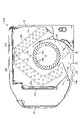
- FIG. 1 is a configuration diagram of an air conditioner according to a first embodiment
- FIG. Fig. 2 is a vertical cross-sectional view of an indoor unit included in the air conditioner according to the first embodiment
- Fig. 2 is a perspective view of the case of the outdoor unit of the air conditioner according to the first embodiment, with the side plate and the top plate removed
- 1 is a functional block diagram of an air conditioner according to a first embodiment
- FIG. 4 is a flow chart relating to the cleaning operation of the indoor heat exchanger in the air conditioner according to the first embodiment.
- FIG. 3 is an explanatory diagram showing a state during defrosting of an indoor heat exchanger included in the air conditioner according to the first embodiment
- 4 is a time chart showing the state of the compressor and the four-way valve, the degree of opening of the expansion valve, the rotation speed of the indoor fan and the outdoor fan, and the temperature change of the indoor heat exchanger in the air conditioner according to the first embodiment.
- FIG. 11 is a partially enlarged view showing a frozen state of an indoor heat exchanger of an air conditioner according to a comparative example
- Fig. 2 is a partially enlarged view showing a frozen state of the indoor heat exchanger of the air conditioner according to the first embodiment
- FIG. 11 is a partially enlarged view showing a frozen state of an indoor heat exchanger of an air conditioner according to a comparative example
- Fig. 2 is a partially enlarged view showing a frozen state of the indoor heat exchanger of the air conditioner according to the first embodiment
- FIG. 10 is a flow chart relating to a cleaning operation of an indoor heat exchanger in an air conditioner according to a second embodiment
- FIG. FIG. 11 is a flowchart relating to a cleaning operation of an indoor heat exchanger in an air conditioner according to a third embodiment
- FIG. FIG. 11 is a vertical cross-sectional view of an indoor unit included in an air conditioner according to a fourth embodiment
- FIG. 11 is a functional block diagram of an air conditioner according to a fourth embodiment
- FIG. 11 is a flow chart relating to a cleaning operation of an indoor heat exchanger in an air conditioner according to a fourth embodiment
- FIG. 11 is a configuration diagram of an air conditioner according to a fifth embodiment
- FIG. 1 is a configuration diagram of an air conditioner 100 according to the first embodiment.
- the solid arrows in FIG. 1 indicate the flow of refrigerant during heating operation.
- dashed arrows in FIG. 1 indicate the flow of the refrigerant during the cooling operation.
- the air conditioner 100 is a device that performs air conditioning such as cooling operation and heating operation. As shown in FIG. 1, the air conditioner 100 includes a compressor 11, an outdoor heat exchanger 12, an outdoor fan 13, and an expansion valve .
- the air conditioner 100 also includes an indoor heat exchanger 15, an indoor fan 16, and a four-way valve 17 in addition to the above-described configuration.
- the compressor 11 is a device that compresses a low-temperature, low-pressure gas refrigerant and discharges it as a high-temperature, high-pressure gas refrigerant, and includes a compressor motor 11a as a drive source.
- a compressor 11 a scroll compressor, a rotary compressor, or the like is used.
- an accumulator 9 is connected to the suction side of the compressor 11 for separating gas and liquid of the refrigerant.
- the outdoor heat exchanger 12 is a heat exchanger that exchanges heat between the refrigerant flowing through its heat transfer tubes 12 b (see FIG. 3 ) and the outside air sent by the outdoor fan 13 .
- the outdoor fan 13 is a fan that sends outside air to the outdoor heat exchanger 12 .
- the outdoor fan 13 is provided near the outdoor heat exchanger 12 and has an outdoor fan motor 13a as a drive source.
- the expansion valve 14 is a valve that reduces the pressure of the refrigerant condensed in the "condenser" (one of the outdoor heat exchanger 12 and the indoor heat exchanger 15). The refrigerant decompressed by the expansion valve 14 is guided to an "evaporator" (the other of the outdoor heat exchanger 12 and the indoor heat exchanger 15).
- the indoor heat exchanger 15 is a heat exchanger in which heat is exchanged between the refrigerant flowing through the heat transfer pipes 15b (see FIG. 2) and the indoor air (air-conditioned room air) sent by the indoor fan 16. is.
- the indoor fan 16 is a fan that sends indoor air to the indoor heat exchanger 15 .
- the indoor fan 16 includes an indoor fan motor 16 a (see FIG. 4 ) as a drive source, and is provided near the indoor heat exchanger 15 .
- the four-way valve 17 is a valve that switches the refrigerant flow path according to the operation mode of the air conditioner 100 .
- the air conditioner 100 includes a refrigerant circuit 10 in which a compressor 11, an outdoor heat exchanger 12, an expansion valve 14, and an indoor heat exchanger 15 are connected via a four-way valve 17. It has become.
- the compressor 11, the outdoor heat exchanger 12, the outdoor fan 13, the expansion valve 14, and the four-way valve 17 are installed in the outdoor unit 30.
- the indoor heat exchanger 15 and the indoor fan 16 are installed in the indoor unit 20 .
- FIG. 2 is a longitudinal sectional view of the indoor unit 20.
- the indoor unit 20 includes an indoor heat exchanger 15, an indoor fan 16, a drain pan 18, a housing 19, and filters 21a and 21b.
- the indoor unit 20 includes a front panel 22 , a left/right wind direction plate 23 and an up/down direction plate 24 .
- the indoor heat exchanger 15 includes a plurality of fins 15a and a plurality of heat transfer tubes 15b passing through these fins 15a. From another point of view, the indoor heat exchanger 15 includes a front indoor heat exchanger 15c arranged on the front side of the indoor fan 16, a rear indoor heat exchanger 15d arranged on the rear side of the indoor fan 16, It has In the example of FIG. 2, the upper end portion of the front indoor heat exchanger 15c and the upper end portion of the rear indoor heat exchanger 15d are connected in an inverted V shape when viewed in vertical cross section. Note that the configuration of the indoor heat exchanger 15 shown in FIG. 2 is an example, and the configuration is not limited to this.
- the indoor fan 16 is, for example, a cylindrical cross-flow fan, and is provided near the indoor heat exchanger 15 .
- the indoor fan 16 includes an indoor fan motor 16a (see FIG. 4), a plurality of fan blades 16b, and an annular partition plate 16c on which the fan blades 16b are installed.
- the drain pan 18 receives condensed water from the indoor heat exchanger 15 and is arranged below the indoor heat exchanger 15 .
- the housing 19 accommodates the indoor heat exchanger 15, the indoor fan 16, and the like.
- the filters 21 a and 21 b collect dust from the air heading for the indoor heat exchanger 15 and are provided near the indoor heat exchanger 15 .
- One filter 21 a is arranged in front of the indoor heat exchanger 15
- the other filter 21 b is arranged above the indoor heat exchanger 15 .
- the front panel 22 is a panel installed so as to cover the front filter 21a, and is rotatable forward about its lower end. In addition, the structure which the front panel 22 does not rotate may be sufficient.
- the left/right wind direction plate 23 is a plate-like member that adjusts the left/right direction of the air blown out from the indoor fan 16 .
- the left/right airflow direction plate 23 is arranged in the blowing air passage 26, and is rotated in the left/right direction by a left/right direction plate motor 34 (see FIG. 4).
- the vertical wind direction plate 24 is a plate-shaped member that adjusts the vertical direction of the air blown out from the indoor fan 16 .
- the vertical wind direction plate 24 is arranged at the air outlet 27 and is rotated vertically by a vertical wind direction plate motor 35 (see FIG. 4).
- the air sucked in through the air inlets 25 a and 25 b exchanges heat with the refrigerant flowing through the heat transfer tubes 15 b of the indoor heat exchanger 15 , and the heat-exchanged air is led to the blowout air passage 26 .
- the air flowing through the blowing air passage 26 is guided in a predetermined direction by the horizontal airflow direction plate 23 and the vertical airflow direction plate 24, and is further blown out through the air outlet 27 into the air conditioning room.
- the indoor heat exchanger 15 is washed with the frost that accompanies freezing of the indoor heat exchanger 15, and the frost cleans the air in the air conditioning room.
- the frost on the indoor heat exchanger 15 functions as if it were a filter for air cleaning, and dust in the air adheres to the frost and is washed away.
- a series of processes relating to cleaning of the indoor heat exchanger 15 is referred to as "cleaning operation".
- FIG. 3 is a perspective view of the housing 31 of the outdoor unit 30 with the side plates and top plate removed. 3, illustration of the expansion valve 14 (see FIG. 1) and the four-way valve 17 (see FIG. 1) is omitted.
- a housing 31 of the outdoor unit 30 is provided with a compressor 11 , an outdoor heat exchanger 12 , an outdoor fan 13 , and an electric component box 32 .
- the outdoor heat exchanger 12 having an L-shape in plan view is installed on the bottom plate 31 a of the housing 31 .
- the outdoor heat exchanger 12 includes a large number of fins 12a arranged at predetermined intervals and a plurality of heat transfer tubes 12b passing through the fins 12a.
- a propeller fan is used as the outdoor fan 13 .
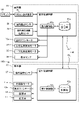
- FIG. 4 is a functional block diagram of the air conditioner 100.
- the indoor unit 20 shown in FIG. 4 includes a remote control transmitter/receiver 28, an indoor temperature sensor 29, an indoor heat exchanger temperature sensor 33, an indicator lamp 36, and an indoor control circuit 41 in addition to the components described above. I have.
- the remote controller transmitting/receiving unit 28 exchanges predetermined information with the remote controller 50 by infrared communication or the like.
- the indoor temperature sensor 29 is a sensor that detects the temperature of the air-conditioned room, and is installed, for example, on the air intake side of the indoor heat exchanger 15 .
- the indoor heat exchanger temperature sensor 33 is a sensor that detects the temperature of the indoor heat exchanger 15 (see FIG. 2).
- the indoor heat exchanger temperature sensor 33 may be installed in the indoor heat exchanger 15 or may be installed in a predetermined refrigerant pipe connected to the indoor heat exchanger 15 .
- the detected values of the indoor temperature sensor 29 and the indoor heat exchanger temperature sensor 33 are output to the indoor control circuit 41 .
- the display lamp 36 is a lamp that provides a predetermined display regarding air conditioning.
- the indoor control circuit 41 includes electronic circuits such as a CPU (Central Processing Unit), ROM (Read Only Memory), RAM (Random Access Memory), and various interfaces.
- the programs stored in the ROM are read out and developed in the RAM, and the CPU executes various processes.
- the indoor control circuit 41 includes a storage section 41a and an indoor control section 41b.
- the storage unit 41a stores data received via the remote control transmission/reception unit 28, detection values of each sensor, and the like.
- the indoor control unit 41b controls the indoor fan motor 16a, the left/right air deflector motor 34, the up/down air deflector motor 35, the display lamp 36, and the like based on the data in the storage unit 41a.
- the outdoor unit 30 includes an outdoor temperature sensor 37 and an outdoor control circuit 42 in addition to the above configuration.
- the outdoor temperature sensor 37 is a sensor that detects the temperature of outside air, and is installed at a predetermined location of the outdoor unit 30 .
- the outdoor unit 30 also includes a sensor for detecting the discharge temperature of the compressor 11 (see FIG. 1). Detected values of these sensors are output to the outdoor control circuit 42 .
- the outdoor control circuit 42 includes electronic circuits such as a CPU, ROM, RAM, and various interfaces, and is connected to the indoor control circuit 41 via a communication line. As shown in FIG. 4, the outdoor control circuit 42 includes a storage section 42a and an outdoor control section 42b.
- the storage unit 42a stores data received from the indoor control circuit 41 in addition to a predetermined program.
- the outdoor control unit 42b controls the compressor motor 11a, the outdoor fan motor 13a, the expansion valve 14, the four-way valve 17, etc. based on the data in the storage unit 42a.
- the indoor control circuit 41 and the outdoor control circuit 42 are collectively referred to as a control unit 40 .
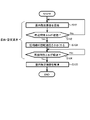
- FIG. 5 is a flowchart relating to the cleaning operation of the indoor heat exchanger (see FIGS. 1 and 4 as needed). Although omitted in FIG. 5, for example, when the value obtained by integrating the execution time of the air conditioning operation from the end of the previous cleaning operation (the sum) reaches a predetermined value, the series shown in FIG. may be started. Further, for example, when a user performs a predetermined operation on an operation terminal such as a remote control 50 (see FIG. 4), a smart phone, or a mobile phone, the series of processes shown in FIG. 5 may be started.
- a remote control 50 see FIG. 4
- a smart phone or a mobile phone
- step S101 of FIG. 5 the control unit 40 freezes the indoor heat exchanger 15. That is, the control unit 40 circulates the refrigerant in the cooling cycle in the refrigerant circuit 10 , causes the indoor heat exchanger 15 to function as an evaporator, and freezes the indoor heat exchanger 15 . As a result, moisture in the air frosts and freezes on the indoor heat exchanger 15 .
- steps S102 to S104 after step S101 the indoor heat exchanger 15 is maintained in a frozen state. Further, the indoor fan 16 is driven during the processing of steps S101 to S104.
- step S102 the control unit 40 determines whether or not a predetermined time ⁇ ta has passed since the start of the process of freezing the indoor heat exchanger 15.
- the predetermined time ⁇ ta is the time required for the temperature of the indoor heat exchanger 15 to drop below a predetermined value Th (see FIG. 7) below freezing, and is set in advance. Further, the predetermined value Th is a subzero temperature at which the gaps between the fins 15a (see FIG. 2) of the indoor heat exchanger 15 are not completely closed with frost (that state is maintained). If the predetermined time ⁇ ta has not elapsed in step S102 (S102: No), the process of the control unit 40 returns to step S101. On the other hand, when the predetermined time ⁇ ta has passed in step S102 (S102: Yes), the process of the control unit 40 proceeds to step S103.
- step S ⁇ b>103 the control unit 40 reduces the rotation speed of the compressor 11 .
- the control unit 40 drives the compressor 11 at a lower speed than the average rotation speed of the compressor 11 during the predetermined time ⁇ ta (S102).
- the frost on the indoor heat exchanger 15 functions as if it were an air cleaning filter, and dust in the air is collected by the frost on the indoor heat exchanger 15 .
- the controller 40 freezes the indoor heat exchanger 15 and cleans the air in the air-conditioned room at the same time. In the example of FIG.
- the temperature of the indoor heat exchanger 15 has decreased to a predetermined value Th at time t2 when the predetermined time ⁇ ta has elapsed since the start of freezing of the indoor heat exchanger 15, and the control is performed from this time t2.
- the unit 40 reduces the rotational speed of the compressor 11, the present invention is not limited to this.
- the control unit 40 continues to rotate the compressor 11 at a relatively high speed (for example, rotation speed n1: see FIG. 7),
- the predetermined time ⁇ ta may be appropriately set so that the rotation speed of the compressor 11 is reduced thereafter. Further, in the example of FIG.
- the reference time for measuring the predetermined time ⁇ ta is the time when the indoor heat exchanger 15 starts to freeze (time t1), but it is not limited to this. That is, the reference time for measuring the predetermined time ⁇ ta may be, for example, the time when the temperature of the indoor heat exchanger 15 becomes 0° C. or less, or the time when the temperature of the indoor heat exchanger 15 becomes the predetermined value Th or less. It can be at any time.
- step S ⁇ b>104 the control unit 40 determines whether or not a predetermined time ⁇ tb has passed since the rotational speed of the compressor 11 was decreased.
- the predetermined time ⁇ tb is the time during which the compressor 11 continues to be driven at a low speed, and is set in advance.
- the predetermined time ⁇ tb is a fixed value.
- the length of the predetermined time ⁇ tb is appropriately set (changed) by the user operating a remote controller 50 (see FIG.
- a smart phone a mobile phone, a tablet, or other operation terminal in a predetermined manner.
- the operation terminal such as the remote controller 50
- the cleaning operation accompanied by air cleaning (control to drive the compressor 11 at low speed from the middle of freezing of the indoor heat exchanger 15) is interrupted.
- step S104 If the predetermined time ⁇ tb has not elapsed in step S104 (S104: No), the control unit 40 repeats the process of step S104. On the other hand, when the predetermined time ⁇ tb has passed in step S104 (S104: Yes), the process of the control unit 40 proceeds to step S105.
- step S ⁇ b>105 the controller 40 defrosts the indoor heat exchanger 15 .
- the controller 40 stops the compressor 11 and increases the opening of the expansion valve 14 .
- the indoor heat exchanger 15 flows from the outdoor heat exchanger 12 on the high pressure side to the indoor heat exchanger 15 on the low pressure side via the expansion valve 14, so that the indoor heat exchanger 15 is thawed.
- the indoor heat exchanger 15 is thawed, it is not particularly necessary to increase the opening of the expansion valve 14 as long as the refrigerant flows through the expansion valve 14 .
- FIG. 6 is an explanatory diagram showing the state of the indoor heat exchanger 15 during thawing.
- the controller 40 thaws the indoor heat exchanger 15 (S105)
- high-temperature refrigerant flows through the heat transfer tubes 15b of the indoor heat exchanger 15.
- the frost 61 on the indoor heat exchanger 15 is melted, and a large amount of water 62 flows down the drain pan 18 along the fins 15a and is washed away together with the dust 63.
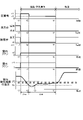
- FIG. 7 is a time chart showing the state of the compressor and the four-way valve, the degree of opening of the expansion valve, the rotation speed of the indoor fan and the outdoor fan, and the temperature change of the indoor heat exchanger (as appropriate, FIG. 1, FIG. 4).
- the horizontal axis in FIG. 7 is time.
- the vertical axis in FIG. 7 indicates the states of the compressor 11, the four-way valve 17, and the like.
- the air conditioner 100 is in a stopped state (a state in which the air conditioning operation is not performed) until time t1. Also, it is assumed that, for example, the heating operation was being performed immediately before the air conditioner 100 was stopped (see the state of "four-way valve" in FIG. 7).
- the controller 40 switches the four-way valve 17 to the cooling cycle at time t1, throttles the expansion valve 14 to a predetermined opening ⁇ 1, and rotates the compressor 11. Drive at speed n1. Further, the controller 40 drives the indoor fan 16 at a predetermined rotation speed n3 and drives the outdoor fan 13 at a rotation speed n4.
- the predetermined opening ⁇ 1 of the expansion valve 14 may be, for example, a smaller opening than during normal air conditioning operation.
- the outdoor heat exchanger 12 functions as a condenser
- the indoor heat exchanger 15 functions as an evaporator
- the temperature of the indoor heat exchanger 15 drops below freezing (see FIG. 7), and moisture in the air frosts and freezes the indoor heat exchanger 15 .
- the controller 40 drives the indoor fan 16 at a rotation speed n3 equal to or lower than a predetermined value.
- a predetermined value for example, a value obtained by dividing the sum of the upper limit value and the lower limit value of the rotation speed of the indoor fan 16 by 2 may be used. This is because if the rotation speed of the indoor fan 16 is too high, new air will enter before the moisture contained in the air around the indoor heat exchanger 15 is frosted, and the frosting will be difficult to proceed.
- the controller 40 preferably swings the vertical wind direction plate 24 (see FIG. 2) to a predetermined degree.
- the air cleaned by the frost in the indoor heat exchanger 15 air from which fine dust has been removed
- the swing width is preferably smaller than the full width of the vertical airflow direction plate 24 (the full width as the swing width).
- the controller 40 reduces the rotational speed of the compressor 11 (S103). As a result, the compressor 11 is driven at a low rotational speed n2, so that the temperature of the indoor heat exchanger 15 rises within a subzero range.
- the temperature of the indoor heat exchanger 15 has dropped to a predetermined value Th below freezing after a predetermined time ⁇ ta has elapsed since the freezing of the indoor heat exchanger 15 started. Further, the temperature of the indoor heat exchanger 15 exceeds the predetermined value Th from time t3 to time t4 thereafter.
- the control unit 40 drives the indoor fan 16 during the process of freezing the indoor heat exchanger 15, and controls the temperature of the indoor heat exchanger 15 to exceed the predetermined value Th below the freezing point (from time t2 to t4) is executed.
- the control unit 40 drives the indoor fan 16 during the process of freezing the indoor heat exchanger 15 and performs control of cleaning the air in the air-conditioned room with the frost caused by the freezing of the indoor heat exchanger 15 .
- the controller 40 reduces the rotational speed of the compressor 11 from the middle of the process of freezing the indoor heat exchanger 15 (time t2). This suppresses the growth of frost in the indoor heat exchanger 15 .
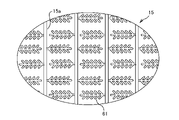
- FIG. 8A is a partially enlarged view showing a frozen state of the indoor heat exchanger 15 of the air conditioner according to the comparative example.
- the compressor 11 continues to be driven at a relatively high speed while the indoor heat exchanger 15 is frozen, the growth of the frost 61 on the indoor heat exchanger 15 progresses too much (the number of crystals of the frost 61 generated, too much), resulting in a dense frost 61 as shown in FIG. 8A.
- the gaps between the plurality of fins 15a are mostly blocked with frost 61, making it difficult for air to pass through.
- FIG. 8B is a partially enlarged view showing a frozen state of the indoor heat exchanger 15 of the air conditioner according to the first embodiment.
- the controller 40 reduces the rotation speed of the compressor 11 when the predetermined time ⁇ ta has passed since the freezing of the indoor heat exchanger 15 started (time t2 in FIG. 7). . Therefore, the number and amount of crystals of the frost 61 generated are reduced (the frost becomes sparse) compared to when the rotation speed of the compressor 11 is high (see FIG. 8A).
- the degree of frost 61 covering the gaps between the fins 15a of the indoor heat exchanger 15 is small, and the frost 61 is maintained in a state where it adheres appropriately.
- frost 61 grows slowly, there is also the advantage that the surface area of each frost 61 tends to increase. As a result, dust mixed in the air adheres to the frost 61 while the air passes through the gaps between the fins 15a, and clean air is blown out into the air-conditioned room.
- the temperature of the indoor heat exchanger 15 is lower than the predetermined value Th during the period from time t2 to t3. (undershoot). Also, during the period from time t3 to t4, the temperature of the indoor heat exchanger 15 is below freezing and within a range of a predetermined value Th (eg, -10° C.) or higher. Then, the control unit 40 maintains the frost amount of the indoor heat exchanger 15 at the start of the above-described control (control so that the temperature of the indoor heat exchanger 15 is below the freezing point and exceeds the predetermined value Th). Execute the control.
- Th eg, -10° C.
- the controller 40 controls the amount of frost on the indoor heat exchanger 15 (that is, the number and amount of frost crystals) when the predetermined time ⁇ ta has passed since the start of the process of freezing the indoor heat exchanger 15. ) is switched to control for maintaining the amount of frost in the indoor heat exchanger 15 .
- the indoor heat exchanger 15 appropriately frosted for a predetermined period of time (time t2 to t4 in FIG. 7) required for cleaning the air in the air-conditioned room.
- FIG. 7 is an example, and there is no particular need for the rotation speed of the compressor 11 and the opening degree of the expansion valve 14 between times t1 and t2 to be constant. The same can be said for times t2 to t4.
- the controller 40 may appropriately change the rotation speed of the compressor 11 and the opening degree of the expansion valve 14 based on the temperature of the air-conditioned room, the temperature of the indoor heat exchanger 15, and the like.
- the controller 40 defrosts the indoor heat exchanger 15 (S105 in FIG. 5).
- the controller 40 stops the compressor 11, the outdoor fan 13, and the indoor fan 16, and increases the degree of opening of the expansion valve 14 (eg, fully opens the expansion valve 14).
- high-temperature refrigerant flows from the outdoor heat exchanger 12 on the high pressure side into the indoor heat exchanger 15 on the low pressure side via the expansion valve 14 .
- frost and ice on the indoor heat exchanger 15 are melted, and dust is washed away from the indoor heat exchanger 15 (see FIG.
- the control unit 40 reduces the rotational speed of the compressor 11 ( S103), the temperature of the indoor heat exchanger 15 is maintained below the freezing point while exceeding a predetermined value Th.
- the growth of frost on the indoor heat exchanger 15 is suppressed (that is, the number and amount of frost are suppressed), and the amount of frost is maintained (see FIG. 8B).
- dust on the indoor heat exchanger 15 is washed away due to freezing of the indoor heat exchanger 15 or the like.
- FIG. 9 is a flowchart relating to the cleaning operation of the indoor heat exchanger in the air conditioner according to the second embodiment (see FIGS. 1 and 4 as appropriate).
- the processes of steps S103 to S105 are the same as those of the first embodiment (see FIG. 5), so detailed description thereof will be omitted.
- the controller 40 After freezing the indoor heat exchanger 15 in step S101, the controller 40 determines whether or not the temperature of the indoor heat exchanger 15 is equal to or lower than a predetermined value Th in step S202.
- This predetermined value Th is a subzero temperature at which the gaps between the fins 15a of the indoor heat exchanger 15 are not completely blocked by frost (that state is maintained). It is preset as a value lower than °C.
- the predetermined value Th is -10° C., for example.
- step S202 if the temperature of the indoor heat exchanger 15 is higher than the predetermined value Th (S202: No), the process of the control unit 40 returns to step S101.
- step S202 when the temperature of the indoor heat exchanger 15 is equal to or lower than the predetermined value Th (S202: Yes), the process of the control unit 40 proceeds to step S103. Then, in step S ⁇ b>103 , the control unit 40 reduces the rotation speed of the compressor 11 .
- the control unit 40 determines that the temperature of the indoor heat exchanger 15 Control is executed to exceed a predetermined value Th below freezing (S103). That is, the control unit 40 switches from control for increasing the amount of frost (the number and amount of frost crystals) of the indoor heat exchanger 15 to control for maintaining the amount of frost on the indoor heat exchanger 15 . As a result, the amount of frost suitable for air cleaning can be maintained while suppressing the growth of frost on the indoor heat exchanger 15 (see FIG. 8B).
- the controller 40 starts the process of driving the compressor 11 at a low speed.
- ending that is, ending the air cleaning process
- the present invention is not limited to this.
- the control unit 40 reduces the rotation speed of the compressor 11 (S103)
- the temperature of the indoor heat exchanger 15 is below freezing and within a predetermined range higher than the predetermined value Th for a predetermined time. If it continues, the indoor fan 16 may be stopped (that is, the air cleaning process may be terminated). This makes it easier to keep the indoor heat exchanger 15 appropriately frosted.
- control unit 40 freezes the indoor heat exchanger 15 while driving the indoor fan 16, cleans the air, and then increases the rotation speed of the compressor 11 while the indoor fan 16 is stopped. Freezing of the heat exchanger 15 may continue. As a result, it is possible to prevent cold air from being blown into the air-conditioned room for a long period of time. can be washed off with
- the control unit 40 Decrease the rotational speed (S103). As a result, the growth of frost on the indoor heat exchanger 15 is suppressed, so the air in the air-conditioned room can be cleaned.
- the controller 40 adjusts the rotational speed of the compressor 11 based on the magnitude of the input power of the indoor fan motor 16a (see FIG. 4).
- the point of lowering is different from the first embodiment.
- Other points such as the configuration of the air conditioner: see FIGS. 1 to 4) are the same as those of the first embodiment. Therefore, the portions different from the first embodiment will be described, and the description of the overlapping portions will be omitted.
- FIG. 10 is a flowchart relating to the cleaning operation of the indoor heat exchanger in the air conditioner according to the third embodiment (see FIGS. 1 and 4 as appropriate).
- the processes of steps S103 to S105 are the same as those of the first embodiment (see FIG. 5), so detailed description thereof will be omitted.
- the controller 40 After freezing the indoor heat exchanger 15 in step S101, the controller 40 determines whether the input power of the indoor fan motor 16a is equal to or less than a predetermined value in step S302.
- This predetermined value is a threshold that serves as a criterion for determining whether or not to reduce the rotation speed of the compressor 11 while the indoor heat exchanger 15 is frozen, and is set in advance.
- the input electric power of the indoor fan motor 16a may be calculated based on the voltage command value/current command value of the indoor fan motor 16a, or based on the voltage detection value/current detection value of the indoor fan motor 16a. may be calculated. Further, according to the results of experiments and simulations by the inventors, the input power of the indoor fan motor 16a tends to decrease as the amount of frost on the indoor heat exchanger 15 increases.
- step S302 if the input power of the indoor fan motor 16a is higher than the predetermined value (S302: No), the processing of the control unit 40 returns to step S101. On the other hand, in step S302, when the input electric power of the indoor fan motor 16a is equal to or less than the predetermined value (S302: Yes), the processing of the control unit 40 proceeds to step S103. Then, in step S ⁇ b>103 , the control unit 40 reduces the rotation speed of the compressor 11 .
- the control unit 40 When the input electric power of the indoor fan motor 16a, which is the drive source of the indoor fan 16, becomes equal to or less than a predetermined value during the process of freezing the indoor heat exchanger 15 (S302: Yes), the control unit 40 The control is executed so that the temperature of the indoor heat exchanger 15 is maintained below the freezing point and exceeds a predetermined value Th (S103). That is, the control unit 40 switches from control for increasing the amount of frost on the indoor heat exchanger 15 to control for maintaining the amount of frost on the indoor heat exchanger 15 . As a result, the growth of frost on the indoor heat exchanger 15 is suppressed, so that the amount of frost suitable for air cleaning can be maintained.
- the threshold value of the input power of the indoor fan motor 16a (“predetermined value” in S302), which serves as a criterion for determining whether or not to reduce the rotation speed of the compressor 11, is appropriately set according to the installation environment of the air conditioner 100.
- the control unit 40 changes the input power of the indoor fan motor 16a at the start of the process of freezing the indoor heat exchanger 15. Based on this, it is preferable to set the "predetermined value" which is the threshold value of the input electric power of the indoor fan motor 16a.
- control unit 40 sets a value obtained by multiplying the input electric power of the indoor fan motor 16a at the start of freezing of the indoor heat exchanger 15 by a predetermined coefficient smaller than 1 as the "predetermined value”. .
- the “predetermined value” that serves as a criterion for determining whether or not to reduce the rotation speed of the compressor 11 can be appropriately set according to the installation environment of the air conditioner 100 .
- the control unit 40 starts the process of driving the compressor 11 at a low speed.
- ending that is, ending the air cleaning process
- the present invention is not limited to this.
- the indoor fan 16 is stopped (that is, end the air cleaning process).
- the aforementioned predetermined range is a range suitable for maintaining the amount of frost in the indoor heat exchanger 15 in the input electric power of the indoor fan motor 16a, and is set in advance. This makes it easier to keep the indoor heat exchanger 15 appropriately frosted.
- the controller 40 causes the compressor 11 to rotate. Decrease the speed (S103). As a result, the air in the air-conditioned room can be cleaned while suppressing the growth of frost on the indoor heat exchanger 15 .
- the indoor unit 20A (see FIG. 11) is provided with a sterilizing substance generation unit 71, and during air cleaning using frost in the indoor heat exchanger 15, the sterilizing substance generation unit 71 performs predetermined sterilization.
- This differs from the first embodiment in that substances are generated. Other points are the same as in the first embodiment. Therefore, the portions different from the first embodiment will be described, and the description of the overlapping portions will be omitted.
- FIG. 11 is a vertical cross-sectional view of an indoor unit 20A included in an air conditioner according to the fourth embodiment.
- An indoor unit 20A shown in FIG. 11 includes a sterilization substance generator 71 in addition to the configuration described in the first embodiment (see FIG. 2).
- the sterilization substance generation unit 71 is an ionizer that generates predetermined ions (OH ⁇ , for example) that are sterilization substances, and is provided inside the indoor unit 20A.
- a sterilizing substance generator 71 is provided near the air outlet 27 of the indoor unit 20A. By driving the indoor fan 16 and energizing the sterilizing substance generator 71, the sterilizing substance is supplied to the air-conditioned room.
- the sterilizing substance generator 71 includes a needle-like discharge electrode and an induction electrode curved to surround the discharge electrode.
- the sterilizing substance generating unit 71 applies a high voltage between the discharge electrode and the dielectric electrode to generate corona discharge, thereby generating OH .sup.- or the like, which is a sterilizing substance.
- the sterilizing substance thus produced is led to the air outlet 27 through the slit 19a shown in FIG.
- a plurality of sterilization substance generation units 71 may be provided in the left-right direction.
- FIG. 12 is a functional block diagram of an air conditioner 100A according to the fourth embodiment.
- the sterilizing substance generator 71 is connected to the indoor control circuit 41 via wiring. Then, according to a command from the indoor controller 41b (that is, the controller 40), the sterilizing substance generator 71 is energized in a predetermined manner.
- FIG. 13 is a flow chart regarding the cleaning operation of the indoor heat exchanger. Note that the processing of steps S101 to S105 in FIG. 13 is the same as in the first embodiment (see FIG. 5), so detailed description will be omitted.
- the controller 40 After freezing the indoor heat exchanger 15 in step S101, when the predetermined time ⁇ ta has passed (S102: Yes), the controller 40 reduces the rotational speed of the compressor 11 (S103). It is assumed that the indoor fan 16 is driven while the indoor heat exchanger 15 is frozen.
- step S120 the controller 40 generates a sterilizing substance. That is, the control unit 40 generates a sterilization substance (eg, OH ⁇ ) by the sterilization substance generation unit 71 (see FIG. 11). As a result, the sterilizing substance is supplied to the air-conditioned room, and viruses and bacteria in the air are killed by the ions, thereby promoting the purification of the air.
- a sterilization substance eg, OH ⁇
- the controller 40 defrosts the indoor heat exchanger 15 in step S105. Dust adhering to the indoor heat exchanger 15 is thereby washed away.
- the control unit 40 stops the indoor fan 16 and stops the energization of the sterilization substance generation unit 71. In this state, freezing of the indoor heat exchanger 15 may be continued. After the indoor heat exchanger 15 is thawed in this way, the controller 40 defrosts the indoor heat exchanger 15 .
- FIG. 14 is a time chart showing the state of the compressor and the four-way valve, the degree of opening of the expansion valve, the rotation speed of the indoor fan and the outdoor fan, the state of the sterilizing substance generator, and the temperature change of the indoor heat exchanger. (See FIGS. 11 and 12 as appropriate).
- the control unit 40 controls the compressor 11 is driven at a low speed, and the sterilizing substance generator 71 generates a sterilizing substance.
- control unit 40 executes control (control to reduce the rotation speed of the compressor 11) so that the temperature of the indoor heat exchanger 15 is below freezing and exceeds a predetermined value Th, and the sterilization substance generating unit 71 Produces disinfectant.
- control control to reduce the rotation speed of the compressor 11
- the sterilization substance generating unit 71 Produces disinfectant.
- the air in the air-conditioned room can be cleaned with the disinfectant while cleaning the air with the frost of the indoor heat exchanger 15 .
- generation of the sterilizing substance is started at time t2 when the predetermined time ⁇ ta has elapsed from the start of freezing of the indoor heat exchanger 15 (time t1), but it is not limited to this.
- the generation of the sterilizing substance may be started at the start of freezing of the indoor heat exchanger 15 (time t1). Similar effects can be obtained with such control.
- the control unit 40 executes the control of cleaning the air in the air-conditioned room with the frost caused by the freezing of the indoor heat exchanger 15, and the sterilization substance generation unit 71 generates the sterilization substance. .
- the sterilization substance generation unit 71 generates the sterilization substance.
- an indoor heat exchanger 15B (see FIG. 15) includes a first heat exchange section 15e and a second heat exchange section 15f, and between the first heat exchange section 15e and the second heat exchange section 15f
- the difference from the first embodiment is that a two-way valve 38 is provided at the .
- the fifth embodiment differs from the first embodiment in that the control unit 40 (see FIG. 4) freezes the second heat exchange unit 15f as freezing of the indoor heat exchanger 15B.
- the portions different from the first embodiment will be described, and the description of the overlapping portions will be omitted.
- FIG. 15 is a configuration diagram of an air conditioner 100B according to the fifth embodiment.
- an indoor heat exchanger 15B and an indoor fan 16 are provided in an indoor unit 20B of an air conditioner 100B.
- the indoor heat exchanger 15B has a configuration in which a first heat exchange section 15e and a second heat exchange section 15f are connected via a two-way valve 38 (pressure reducing means).
- the two-way valve 38 is fully opened, while the expansion valve 14 is throttled appropriately. Further, when performing so-called reheat dehumidification, the expansion valve 14 is fully opened while the two-way valve 38 is controlled to a predetermined degree of opening.
- the two-way valve 38 may be configured to be switchable between, for example, a fully open state and a predetermined degree of opening state. Further, when performing reheat dehumidification, it is not particularly necessary to fully open the expansion valve 14 , and it is sufficient that the refrigerant flows through the expansion valve 14 .
- the control unit 40 performs reheat dehumidification, causes the outdoor heat exchanger 12 and the first heat exchange unit 15e to function as condensers, and the second heat The exchange part 15f is made to function as an evaporator. That is, in the process of freezing the indoor heat exchanger 15B, the control unit 40 controls the one of the first heat exchange unit 15e and the second heat exchange unit 15f located upstream in the refrigerant flow (the first heat exchange unit 15e) functions as a condenser, and the other (second heat exchange section 15f) positioned downstream in the refrigerant flow functions as an evaporator and is frozen. Note that while the indoor heat exchanger 15 is frozen, the expansion valve 14 is controlled to be substantially fully opened.
- the first heat exchange section 15e is located downstream of the second heat exchange section 16f. Then, the air cooled by radiating heat to the second heat exchange section 16f (evaporator) is warmed by the first heat exchange section 16e (condenser). As a result, cold air can be prevented from blowing into the air-conditioned room while the indoor heat exchanger 15 is frozen, and comfort for the user can be enhanced. Since the points other than the freezing of the indoor heat exchanger 15 (air cleaning and thawing) are the same as those of the first embodiment (see FIG. 5), the description is omitted.
- the controller 40 performs reheat dehumidification while the indoor heat exchanger 15B is frozen, thereby suppressing cold air from blowing out into the air-conditioned room. Therefore, comfort for the user can be enhanced.
- the air conditioner 100 and the like according to the present invention have been described in each embodiment, but the present invention is not limited to these descriptions, and various modifications can be made.
- the control unit 40 drives the indoor fan 16 while the indoor heat exchanger 15 is frozen (time t1 to t4 in FIG. 7) has been described, but the present invention is not limited to this. That is, the control unit 40 drives the indoor fan 16 during at least part of the period during the process of freezing the indoor heat exchanger 15 so that the temperature of the indoor heat exchanger 15 is below freezing and exceeds a predetermined value Th.
- the control unit 40 drives the indoor fan 16 while the indoor heat exchanger 15 is frozen coincides with the period during which the temperature of the indoor heat exchanger 15 is below freezing and above the predetermined value Th. Not really necessary.
- one of the two periods described above may include the other, or a portion of one may overlap with a portion of the other (the rest may not overlap).
- the control unit 40 drives the indoor fan 16 during at least part of the period after the indoor heat exchanger 15 is frozen and the rotation speed of the compressor 11 is reduced (time t2 to t4 in FIG. 7). You can let it run. The same can be said for the second to fifth embodiments.
- the control unit 40 controls the temperature of the indoor heat exchanger 15 to exceed the predetermined value Th below the freezing point, during the process of freezing the indoor heat exchanger 15.
- the control unit 40 may stop the compressor 11 in the middle of the process of freezing the indoor heat exchanger 15 as control to keep the temperature of the indoor heat exchanger 15 below freezing and above a predetermined value Th. In such a case, when the temperature of the indoor heat exchanger 15 reaches a predetermined value higher than 0° C., the controller 40 drives the compressor 11 again to continue freezing the indoor heat exchanger 15.
- control unit 40 sets the temperature of the indoor heat exchanger 15 to the predetermined value Th or less, and then increases the temperature to exceed the predetermined value Th while keeping the temperature below freezing. Not exclusively. For example, immediately after the control unit 40 starts the process of freezing the indoor heat exchanger 15 and the temperature of the indoor heat exchanger 15 becomes below freezing, the temperature of the indoor heat exchanger 15 is below freezing and exceeds the predetermined value Th. may be maintained.
- the control unit 40 when the temperature (or humidity) of the air-conditioned room is below a predetermined value, the control unit 40 preferably does not control the temperature of the indoor heat exchanger 15 to exceed a predetermined value Th below freezing. In other words, when the temperature of the air-conditioned room is equal to or lower than the predetermined value, it is preferable that the control unit 40 does not perform the control of cleaning the air in the air-conditioned room with the frost caused by the freezing of the indoor heat exchanger 15 . This is because if the temperature of the air-conditioned room is too low, the amount of moisture that can be contained in the air per unit volume is small, and the indoor heat exchanger 15 is less likely to frost.
- the above-described predetermined value is a threshold value that serves as a criterion for determining whether or not to clean the air with the frost of the indoor heat exchanger 15, and is set in advance.
- the control unit 40 may not perform the process of freezing the indoor heat exchanger 15 (including air cleaning using frost). .
- the control unit 40 drives the indoor fan 16 and energizes the sterilization substance generation unit 71 (see FIG. 11) to cool the air-conditioned room. Air cleaning may be performed.
- the expansion valve 14 is fully opened (after time t4 in FIG. 7), and the indoor heat exchanger 15 is thawed.
- the controller 40 may cause the indoor heat exchanger 15 to thaw by circulating the refrigerant in the heating cycle in the refrigerant circuit 10 and causing the indoor heat exchanger 15 to function as a condenser.
- the indoor heat exchanger 15 may be thawed by the controller 40 stopping the compressor 11 and appropriately driving the indoor fan 16 . The same can be said for the second to fifth embodiments.
- the control unit 40 controls to reduce the rotation speed of the compressor 11 from the middle of the process of freezing the indoor heat exchanger 15 (S103 in FIG. 5), but the control is limited to this. do not have.
- the controller 40 may increase the degree of opening of the expansion valve 14 as control to keep the temperature of the indoor heat exchanger 15 below freezing and above a predetermined value Th.
- the control unit 40 may increase the rotation speed of the indoor fan 16 or increase the rotation speed of the outdoor fan 13 as control for making the temperature of the indoor heat exchanger 15 exceed the predetermined value Th below the freezing point. The rotational speed may be reduced.
- the configuration in which the indoor unit 20B (see FIG. 15) includes the two-way valve 38 (see FIG. 15) has been described, but the configuration is not limited to this.
- an expansion valve (decompression means: not shown) may be provided between the first heat exchange section 15e and the second heat exchange section 15f.
- the control unit 40 may cause the second heat exchange unit 15f (see FIG. 15) on the downstream side of the expansion valve (not shown) to function as an evaporator. .
- the same effects as in the fifth embodiment can be obtained.
- the present invention is not limited to this.
- the flow rate of the refrigerant in the indoor heat exchanger 15 may be made smaller than during normal air conditioning operation by controlling the compressor motor 11a.
- the refrigerant evaporates in the middle of the flow path of the indoor heat exchanger 15, so that the upstream side freezes, while the downstream side becomes a superheated region (a state in which the moisture contained in the air does not freeze) due to the gasification of the refrigerant. .
- each embodiment can be appropriately combined.
- the controller 40 may reduce the rotational speed of the compressor 11 and energize the sterilizing substance generator 71 (fourth embodiment: see FIG. 13).
- the controller 40 may reduce the rotational speed of the compressor 11 .
- a predetermined control corresponding to the control of cleaning the air in the air-conditioned room with the frost caused by the freezing of the indoor heat exchanger 15 is performed on the "operation terminal" such as a smartphone, a mobile phone, a tablet, etc.
- the control unit 40 executes the control from the middle of the process of freezing the indoor heat exchanger 15 .
- the user can operate the remote controller 50 or the like to clean the indoor heat exchanger 15 by freezing the indoor heat exchanger 15 and clean the air by frosting the indoor heat exchanger 15 .
- the sterilization substance generator 71 may generate ions such as O 2 ⁇ as the sterilization substance.
- ions such as O 2 ⁇
- a glow discharge ionizer or a plasma ionizer may be used as the sterilizing substance generator 71 .
- the sterilization substance generation unit 71 may generate OH radicals as the sterilization substance.
- the sterilization substance generator 71 may generate ozone (O 3 ) as the sterilization substance.
- the sterilization substance generator 71 may generate a 'sterilization substance' which is at least one of predetermined ions, radicals, and ozone.
- each embodiment a configuration in which one indoor unit 20 (see FIG. 1) and one outdoor unit 30 (see FIG. 1) are provided has been described, but the configuration is not limited to this. That is, a plurality of indoor units connected in parallel may be provided, or a plurality of outdoor units connected in parallel may be provided.
- each embodiment can also be applied to various types of air conditioners such as package air conditioners and multi air conditioners for buildings.
- each embodiment is described in detail in order to explain the present invention in an easy-to-understand manner, and is not necessarily limited to those having all the described configurations. Moreover, it is possible to add, delete, or replace a part of the configuration of each embodiment with another configuration. Further, the mechanisms and configurations described above show those considered necessary for explanation, and do not necessarily show all the mechanisms and configurations on the product.
Landscapes
- Engineering & Computer Science (AREA)
- Mechanical Engineering (AREA)
- General Engineering & Computer Science (AREA)
- Chemical & Material Sciences (AREA)
- Combustion & Propulsion (AREA)
- Physics & Mathematics (AREA)
- Thermal Sciences (AREA)
- Air Conditioning Control Device (AREA)
Priority Applications (3)
| Application Number | Priority Date | Filing Date | Title |
|---|---|---|---|
| PCT/JP2021/004203 WO2022168248A1 (ja) | 2021-02-05 | 2021-02-05 | 空気調和機 |
| EP21924643.6A EP4290148A4 (en) | 2021-02-05 | 2021-02-05 | AIR CONDITIONER |
| JP2021574168A JP7245933B2 (ja) | 2021-02-05 | 2021-02-05 | 空気調和機 |
Applications Claiming Priority (1)
| Application Number | Priority Date | Filing Date | Title |
|---|---|---|---|
| PCT/JP2021/004203 WO2022168248A1 (ja) | 2021-02-05 | 2021-02-05 | 空気調和機 |
Publications (1)
| Publication Number | Publication Date |
|---|---|
| WO2022168248A1 true WO2022168248A1 (ja) | 2022-08-11 |
Family
ID=82740991
Family Applications (1)
| Application Number | Title | Priority Date | Filing Date |
|---|---|---|---|
| PCT/JP2021/004203 Ceased WO2022168248A1 (ja) | 2021-02-05 | 2021-02-05 | 空気調和機 |
Country Status (3)
| Country | Link |
|---|---|
| EP (1) | EP4290148A4 (https=) |
| JP (1) | JP7245933B2 (https=) |
| WO (1) | WO2022168248A1 (https=) |
Citations (3)
| Publication number | Priority date | Publication date | Assignee | Title |
|---|---|---|---|---|
| JP2018189270A (ja) | 2017-04-28 | 2018-11-29 | 日立ジョンソンコントロールズ空調株式会社 | 空気調和機 |
| JP2019039637A (ja) * | 2017-08-28 | 2019-03-14 | 日立ジョンソンコントロールズ空調株式会社 | 空気調和機 |
| WO2020148846A1 (ja) * | 2019-01-17 | 2020-07-23 | 日立ジョンソンコントロールズ空調株式会社 | 空気調和機 |
Family Cites Families (6)
| Publication number | Priority date | Publication date | Assignee | Title |
|---|---|---|---|---|
| CN106594976B (zh) * | 2016-11-11 | 2018-12-18 | 青岛海尔空调器有限总公司 | 空调内外机清洗方法 |
| JP6387197B1 (ja) * | 2017-04-28 | 2018-09-05 | 日立ジョンソンコントロールズ空調株式会社 | 空気調和機 |
| CN107655170A (zh) * | 2017-10-10 | 2018-02-02 | 广东美的制冷设备有限公司 | 空调器换热器的自清洁方法和空调器 |
| CN111043670B (zh) * | 2018-10-12 | 2022-03-29 | 青岛海尔空调器有限总公司 | 空调器及用于空调器的控制方法 |
| CN109916039B (zh) * | 2019-03-21 | 2021-01-29 | 青岛海尔空调器有限总公司 | 空调器自清洁加湿控制方法 |
| CN112128928A (zh) * | 2019-06-25 | 2020-12-25 | 青岛海尔空调器有限总公司 | 空调器及其清洁杀菌方法 |
-
2021
- 2021-02-05 EP EP21924643.6A patent/EP4290148A4/en active Pending
- 2021-02-05 JP JP2021574168A patent/JP7245933B2/ja active Active
- 2021-02-05 WO PCT/JP2021/004203 patent/WO2022168248A1/ja not_active Ceased
Patent Citations (3)
| Publication number | Priority date | Publication date | Assignee | Title |
|---|---|---|---|---|
| JP2018189270A (ja) | 2017-04-28 | 2018-11-29 | 日立ジョンソンコントロールズ空調株式会社 | 空気調和機 |
| JP2019039637A (ja) * | 2017-08-28 | 2019-03-14 | 日立ジョンソンコントロールズ空調株式会社 | 空気調和機 |
| WO2020148846A1 (ja) * | 2019-01-17 | 2020-07-23 | 日立ジョンソンコントロールズ空調株式会社 | 空気調和機 |
Non-Patent Citations (1)
| Title |
|---|
| See also references of EP4290148A4 |
Also Published As
| Publication number | Publication date |
|---|---|
| EP4290148A4 (en) | 2024-10-30 |
| JPWO2022168248A1 (https=) | 2022-08-11 |
| JP7245933B2 (ja) | 2023-03-24 |
| EP4290148A1 (en) | 2023-12-13 |
Similar Documents
| Publication | Publication Date | Title |
|---|---|---|
| JP6276450B1 (ja) | 空気調和機 | |
| JP6587777B1 (ja) | 空気調和機 | |
| TWI721754B (zh) | 空調機 | |
| TWI681150B (zh) | 空調機 | |
| JP2018189351A (ja) | 空気調和機 | |
| JP6354004B1 (ja) | 空気調和機 | |
| KR102450678B1 (ko) | 공기 조화기 | |
| JP6667232B2 (ja) | 空気調和機 | |
| WO2019220492A1 (ja) | 空気調和機 | |
| JP6945100B1 (ja) | 空気調和機 | |
| CN110785616B (zh) | 空调机 | |
| JP7245933B2 (ja) | 空気調和機 | |
| JP6552773B1 (ja) | 空気調和機 | |
| JP7198918B2 (ja) | 空気調和機 | |
| WO2020070890A1 (ja) | 空気調和機 | |
| TWI686542B (zh) | 空調機 | |
| JP7557506B2 (ja) | 空気調和機 | |
| JP6994599B1 (ja) | 空気調和機 |
Legal Events
| Date | Code | Title | Description |
|---|---|---|---|
| ENP | Entry into the national phase |
Ref document number: 2021574168 Country of ref document: JP Kind code of ref document: A |
|
| 121 | Ep: the epo has been informed by wipo that ep was designated in this application |
Ref document number: 21924643 Country of ref document: EP Kind code of ref document: A1 |
|
| NENP | Non-entry into the national phase |
Ref country code: DE |
|
| ENP | Entry into the national phase |
Ref document number: 2021924643 Country of ref document: EP Effective date: 20230905 |