WO2022149240A1 - 解析装置、解析方法及びプログラム - Google Patents
解析装置、解析方法及びプログラム Download PDFInfo
- Publication number
- WO2022149240A1 WO2022149240A1 PCT/JP2021/000358 JP2021000358W WO2022149240A1 WO 2022149240 A1 WO2022149240 A1 WO 2022149240A1 JP 2021000358 W JP2021000358 W JP 2021000358W WO 2022149240 A1 WO2022149240 A1 WO 2022149240A1
- Authority
- WO
- WIPO (PCT)
- Prior art keywords
- data
- analysis
- space
- function
- rkhm
- Prior art date
- Legal status (The legal status is an assumption and is not a legal conclusion. Google has not performed a legal analysis and makes no representation as to the accuracy of the status listed.)
- Ceased
Links
Images


Classifications
-
- G—PHYSICS
- G06—COMPUTING OR CALCULATING; COUNTING
- G06N—COMPUTING ARRANGEMENTS BASED ON SPECIFIC COMPUTATIONAL MODELS
- G06N99/00—Subject matter not provided for in other groups of this subclass
Definitions
- the present invention relates to an analysis device, an analysis method and a program.
- RKHS Since RKHS is higher in dimension than the space that expresses the original data, it has abundant expressive power. Therefore, by copying the original data to the RKHS, the data with complicated behavior is converted into the data with simple behavior, and more accurate analysis becomes possible.
- RKHS is a space called Hilbert space, which has standard properties in data analysis
- a standard algorithm such as the steepest descent method (Non-Patent Document 3), which is one of the gradient methods in Hilbert space, is applied. be able to.
- RKHM reproducing kernel Hilbert C * -module
- C * -algebra that has a value in the space.
- C * -algebra is a generalization of the set of all complex numbers and the set of all matrices, and is a space with the concept of conjugate and norm. Since C * -algebra has a more complex mathematical structure than complex numbers, it is expected to be useful for expressing complex data.
- RKHS is an infinite dimensional space, so if the original data has a simple structure (that is, if the data is represented in a low dimensional space), RKHS has more expressive power than the original space. have.
- the expressive power of RKHS is insufficient.
- the closeness (inner product) between data is one numerical value (scalar value), so if the inner product is calculated when the original data is high-dimensional, the information on the closeness between the elements that make up the data will be. Will be lost.
- RKHM is a generalized space of RKHS, it has abundant expressive power in a space larger than RKHS. Therefore, it is expected that more accurate analysis will be possible by expressing high-dimensional or infinite-dimensional data using RKHM.
- RKHM there have been few examples of applying RKHM to data analysis, and it is considered that a new framework for applying RKHM to data analysis is necessary.
- One embodiment of the present invention has been made in view of the above points, and an object thereof is to realize data analysis on RKHM.
- the analysis device uses an acquisition unit that acquires a set of data having a complicated structure as an analysis target and a RKHM (reproducing kernel Hilbert C * -module) for the set of data. It has an optimization calculation unit that calculates the solution of the optimization problem for a function that is defined on the copied space and takes a C * -algebra value by a method that extends the gradient method in the Hilbert space.
- RKHM producing kernel Hilbert C * -module
- an analysis device 10 capable of realizing data analysis on RKHM for data having a complicated structure (for example, multivariate data, function data, etc.) will be described.
- the analysis device 10 solves this optimization problem by extending the gradient method in the Hilbert space. The case of solving by is described.
- various data analyzes such as extracting necessary information (for example, extracting information showing relationships between data) and visualizing data while preserving the properties of data having a complicated structure. Can be realized.
- PCA principal component analysis
- C * -algebra is a definite value, and is a generalization of an Hermitian matrix (that is, a Hermitian definite value) in which all eigenvalues are 0 or more.
- This map ⁇ is also called a feature map.
- M k, 0 be the space composed of the whole.
- m, m' is a natural number, x 0 , x 1 , ..., x m-1 , y 0 , y 1 , ..., y m'-1 ⁇ X, c 0 , c 1 , ... ⁇ , C m-1 , d 0 , d 1 , ⁇ , d m'-1 ⁇ A, and M k, 0 defines the operation ⁇ , ⁇ > k defined below.
- the operation ⁇ , ⁇ > k defined in this way has the property of the A value inner product. That is, it has the following four properties for u, v, w ⁇ M k, 0 and c, d ⁇ A.
- M k can be uniquely configured.
- k is also included in M k .
- Procedure 1 Randomly select v 0 ⁇ M. Also, select the parameter ⁇ > 0.
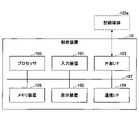
- FIG. 1 is a diagram showing an example of a hardware configuration of the analysis device 10 according to the present embodiment.
- the analysis device 10 is realized by a general computer or a computer system, and includes an input device 101, a display device 102, an external I / F 103, a communication I / F 104, and a processor. It has 105 and a memory device 106. Each of these hardware is connected so as to be communicable via the bus 107.
- the input device 101 is, for example, a keyboard, a mouse, a touch panel, or the like.
- the display device 102 is, for example, a display or the like.
- the analysis device 10 does not have to have at least one of the input device 101 and the display device 102.
- the external I / F 103 is an interface with an external device such as a recording medium 103a.
- Examples of the recording medium 103a include a CD (Compact Disc), a DVD (Digital Versatile Disk), an SD memory card (Secure Digital memory card), a USB (Universal Serial Bus) memory card, and the like.
- the communication I / F 104 is an interface for connecting the analysis device 10 to the communication network.
- the processor 105 is, for example, various arithmetic units such as a CPU (Central Processing Unit) and a GPU (Graphics Processing Unit).
- the memory device 106 is, for example, various storage devices such as an HDD (Hard Disk Drive), an SSD (Solid State Drive), a RAM (RandomAccessMemory), a ROM (ReadOnlyMemory), and a flash memory.
- the analysis device 10 By having the hardware configuration shown in FIG. 1, the analysis device 10 according to the present embodiment can realize the analysis process described later.
- the hardware configuration shown in FIG. 1 is an example, and the analysis device 10 may have another hardware configuration.
- the analysis device 10 may have a plurality of processors 105 or a plurality of memory devices 106.
- FIG. 2 is a diagram showing an example of the functional configuration of the analysis device 10 according to the present embodiment.
- the analysis device 10 has an acquisition unit 201 and an analysis unit 202. Each of these parts is realized, for example, by a process of causing the processor 105 to execute one or more programs installed in the analysis device 10.
- the analysis device 10 has a storage unit 203.
- the storage unit 203 is realized by, for example, a memory device 106.
- the storage unit 203 may be realized by, for example, a storage device (database server or the like) connected to the analysis device 10 via a communication network.
- the storage unit 203 stores a set of data having a complicated structure (for example, ⁇ x 0 , x 1 , ..., X m-1 ⁇ ⁇ X).
- the acquisition unit 201 acquires a set of data stored in the storage unit 203 as data to be analyzed.
- the analysis unit 202 performs various data analysis on RKHM with respect to the set of data acquired by the acquisition unit 201. That is, the analysis unit 202 copies the set of data acquired by the acquisition unit 201 onto the RKHM M k by the mapping ⁇ , and then performs various data analysis on the RKHM M k .
- the analysis unit 202 includes an optimization calculation unit 210, and solves an optimization problem (that is, an optimization problem related to a function having a value in C * -algebra) required for data analysis.
- the optimization calculation unit 210 calculates by executing the above procedures 1 and 2. The optimization problem is formulated according to the data analysis depending on what kind of data analysis is performed.
- the functional configuration of the analysis device 10 shown in FIG. 2 is an example, and may be another functional configuration.
- the optimization calculation unit 210 may not be included in the analysis unit 202 but may be outside the analysis unit 202.
- FIG. 3 is a flowchart showing an example of the flow of the analysis process according to the present embodiment.
- the acquisition unit 201 acquires a set of data stored in the storage unit 203 as data to be analyzed (step S101).
- the analysis unit 202 analyzes the data acquired in the above step S101 on the RKHM Mk (step S102). At this time, the analysis unit 202 calculates the solution of the optimization problem formulated according to the data analysis by the optimization calculation unit 210 by the above procedures 1 and 2. This makes it possible to analyze data with a complicated structure on RKHM.
- x 1 , ..., X n be the data acquired by the acquisition unit 201.
- the data x 1 , ..., X n are high-dimensional data or infinite-dimensional data having a value in a function.
- the axes p 1 , ..., Pr of the space that best represent the properties of the data and the coordinates ⁇ p of x i on the axis p j .
- ONS represents an orthonormal system.
- the data x i can be reduced to ⁇ p j , ⁇ (x i )> k ⁇ A.
- the multivariable function can be reduced to a one-variable function by selecting A in the space of the one-variable function.
- c j [c 1, j , ..., c n, j ] T ⁇ A n
- G n ⁇ n whose (i, j) component is k (x i , x j ) ⁇ A. It is a matrix.
- ⁇ > 0 is a parameter and I is an identity map.
- the solutions obtained up to r -1 are c 1 , ..., cr-1, and are orthogonal to ⁇ Gc 1 , ..., ⁇ Gc r-1 in An.
- the optimization calculation unit 210 solves the optimization problem shown in the above equation (3) by the above procedures 1 and 2 to calculate the solution cr .
- ⁇ Gcr means ( ⁇ G) ⁇ cr .
- the solution c 2 is calculated by solving the optimization problem by the optimization calculation unit 210.
- the optimization calculation unit 210 solves the optimization problem shown in the above equation (3) in the space orthogonal to ⁇ Gc 1 and ⁇ Gc 2 in An. Calculate solution c3 .
- the optimization calculation unit 210 may solve the above minimization problem by a known steepest descent method in Hilbert space.
- x 1 , ..., X n be the data defined on the interval [0, 1] and described by a continuous function of two variables taking a value in X. Examples of such data include data continuously distributed in space and data in which observation points change. Further, let the real number or complex numerical data be y 1 , ..., Y n . These data x 1 , ..., X n , y 1 , ..., Y n are acquired by the acquisition unit 201.
- x i and y i are due to a certain function f.
- A be a space consisting of all bounded linear operators for a function on [0,1]. Also, for x i ,
- Dot product defined by. 1 s is a function that takes 1 at the point s and 0 at other points. Also, for x ⁇ X, ⁇ x is a Dirac measure at x.
- ⁇ be a kernel mean embedding in which the A value measure is copied to RKHM M k .
- a value measure and kernel mean embedding for example, refer to the reference "Y. Hashimoto, I. Ishikawa, M. Ikeda, F. Komura, and Y. Kawahara," Kernel Mean Embeddings of Von Neumann-Algebra- See Valued Measures, "arXiv: 2007.14698.” Etc.
- the space is stretched by, and the A linear operator P f on V is defined by the following.
- the optimization calculation unit 210 calculates the solution by the above procedures 1 and 2 in the same manner as in the principal component analysis described above.
- Q [p 1 , ..., pr ] is set.
- An operator that projects P f into a space stretched by p 1 , ..., Pr can be expressed as P f QQ * .
- v also corresponds to the A value measure. That is, if x i is sampled with the A value measure corresponding to v, y i can be changed most. From this, it is possible to understand how to move x i to greatly affect y i .
- each sample set i consists of 20 samples in which the function y i is discretized at 11 points on [0, 1] and noise is added.
- the noise was a random number generated from a Gaussian distribution having an average of 0 and a standard deviation of 0.3.
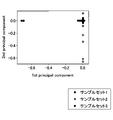
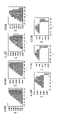
- FIG. 4A shows the results of the principal component analysis by the proposed method
- FIG. 4B shows the results of the principal component analysis by the existing method. Since each sample is expressed as a point in the existing method, the characteristics as a function cannot be captured, and the three types of sample sets cannot be separated well. On the other hand, in the proposed method, each sample is expressed as a function, so it can be seen that the three types of sample sets can be separated well.
- ⁇ Analysis of interactions between data components ⁇ x 1 , ..., X n is a function defined on the interval [0, 1].
- n 30, ⁇ 1 , 1, ..., ⁇ n, 1 , ⁇ 1, 2 , ..., ⁇ n, 2 are random numbers that follow a uniform distribution on [-1, 0]. ..
- Equation 21 was solved by the method described in "Analysis of interaction between data components” in the above application example. That is, the optimization problem shown in Equation 21 was solved by the method described in "When A is commutative" in "Principal component analysis” in the above application example.
- Analytical device 101 Input device 102 Display device 103 External I / F 103a Recording medium 104 Communication I / F 105 Processor 106 Memory device 107 Bus 201 Acquisition unit 202 Analysis unit 203 Storage unit 210 Optimization calculation unit
Landscapes
- Engineering & Computer Science (AREA)
- Theoretical Computer Science (AREA)
- Physics & Mathematics (AREA)
- Computing Systems (AREA)
- General Engineering & Computer Science (AREA)
- General Physics & Mathematics (AREA)
- Mathematical Physics (AREA)
- Software Systems (AREA)
- Complex Calculations (AREA)
Abstract
一実施形態に係る解析装置は、複雑な構造を持つデータの集合を解析対象として取得する取得部と、前記データの集合をRKHM(reproducing kernel Hilbert C*-module)に写した空間上で定義され、かつ、C*-algebra値をとる関数に関する最適化問題の解を、Hilbert空間における勾配法を拡張した手法により計算する最適化計算部と、を有する。
Description
本発明は、解析装置、解析方法及びプログラムに関する。
自然界や人間社会で現れるデータの多くは複雑な構造を持っている。例えば、時空間上の各点における気象データは連続的な関数から生成されているとみなすことができる。また、例えば、SNS(social networking service)におけるフォロー関係を表すデータは、複数の構成要素が相互に関係し合っている。このような複雑な構造を持つデータの解析は、統計学、機械学習、物理学、分子動力学等の分野における共通の課題である。これに対して、統計学や機械学習の分野では、元のデータを、RKHS(reproducing kernel Hilbert space)と呼ばれる無限次元の関数空間に写し、RKHS上で解析を行う技術が提案されている(非特許文献1及び2)。RKHSは元のデータを表現する空間よりも高次元であるため、豊富な表現力を持つ。このため、元のデータをRKHSに写すことで、複雑な振る舞いをするデータが単純な振る舞いをするデータに変換され、より高精度な解析が可能となる。また、RKHSはデータ解析における標準的な性質を持つHilbert空間と呼ばれる空間であるため、Hilbert空間における勾配法の1つである最急降下法(非特許文献3)等の標準的なアルゴリズムを適用することができる。
RKHSの一般化としてRKHM(reproducing kernel Hilbert C*-module)と呼ばれる空間も提案されており、物理学の分野においては、その理論的な解析が行われている(非特許文献4)。RKHMはC*-algebraと呼ばれる空間に値を持つ関数の空間である。C*-algebraとは複素数全体の集合や行列全体の集合等の一般化であり、共役とノルムの概念を持つ空間である。C*-algebraは複素数よりも複雑な数学的構造を持つため、複雑なデータを表現するために有用であると期待されている。
K. Muandet, K. Fukumizu, B. Sriperumbudur, and B. Scholkopf, Kernel Mean Embedding of Distributions: A Review and Beyond. Foundations and Trends in Machine Learning. 10 (1-2), 1-141, 2017.
Y. Hashimoto, I. Ishikawa, M. Ikeda, Y. Matsuo, and Y. Kawahara, "Krylov Subspace Method for Nonlinear Dynamical Systems with Random Noise,"JMLR, 21 (172), 1-29, 2020.
G. Smyrlis and V. Zisis, "Local convergence of the steepest descent method in Hilbert spaces,"Journal of Mathematical Analysis and Applications, 300(2):436-453, 2004.
Jaeseong Heo, "Reproducing kernel Hilbert C*-modules and kernels associated with cocycles," J. Math. Phys. 49, 103507, 2008.
ところで、RKHSは無限次元の空間であるため、元のデータが単純な構造であれば(つまり、低次元の空間で表現されるデータであれば)、RKHSは元の空間よりも豊富な表現力を持つ。しかしながら、元のデータが複雑な構造を持つ場合(つまり、高次元又は無限次元の空間で表現されるデータの場合)、RKHSの表現力では不十分である。実際、データ間の近さ(内積)は1つの数値(スカラー値)であるため、元のデータが高次元である場合に内積を計算すると、データを構成する各要素同士の近さの情報は失われてしまう。
そこで、高次元又は無限次元のデータを表現するために、RKHSよりも更に大きな空間が必要となる。RKHMはRKHSを一般化した空間であるため、RKHSよりも大きな空間で豊富な表現力を持つ。このため、高次元又は無限次元のデータはRKHMを用いて表現することで、より高精度な解析が可能になることが期待される。しかしながら、RKHMをデータ解析に応用した例はこれまでにほとんどなく、RKHMをデータ解析に応用する新たな枠組みが必要であると考えられる。
本発明の一実施形態は、上記の点に鑑みてなされたもので、RKHM上のデータ解析を実現することを目的とする。
上記目的を達成するため、一実施形態に係る解析装置は、複雑な構造を持つデータの集合を解析対象として取得する取得部と、前記データの集合をRKHM(reproducing kernel Hilbert C*-module)に写した空間上で定義され、かつ、C*-algebra値をとる関数に関する最適化問題の解を、Hilbert空間における勾配法を拡張した手法により計算する最適化計算部と、を有する。
RKHM上のデータ解析を実現することができる。
以下、本発明の一実施形態について説明する。本実施形態では、複雑な構造を持つデータ(例えば、多変量データや関数データ等)を対象として、RKHM上のデータ解析を実現することができる解析装置10について説明する。特に、本実施形態では、C*-algebraに値を持つ関数に関する最適化問題を解く必要があるデータ解析を想定し、Hilbert空間における勾配法を拡張することで、この最適化問題を解析装置10により解く場合について説明する。これにより、複雑な構造を持つデータの性質を保存しながら必要な情報を抽出(例えば、データ間の関係性を表す情報等を抽出)したり、データを可視化したりする等の様々なデータ解析の実現が可能となる。
また、本実施形態では、C*-algebraに値を持つ関数に関する最適化問題を解く必要があるデータ解析への応用例として、主成分分析(PCA:principal component analysis)とデータの構成要素間の相互作用の解析についても説明する。
<理論的構成>
まず、本実施形態の理論的構成について説明する。
まず、本実施形態の理論的構成について説明する。
≪準備≫
データが属する空間をXとして、{x0,x1,・・・}⊆Xを与えられたデータの集合とする。AをC*-algebraとして、A値positive definite kernel k:X×X→Aを考える。ただし、写像k:X×X→AがA値positive definite kernelであるとは、以下の条件1及び条件2を満たすことをいう。
データが属する空間をXとして、{x0,x1,・・・}⊆Xを与えられたデータの集合とする。AをC*-algebraとして、A値positive definite kernel k:X×X→Aを考える。ただし、写像k:X×X→AがA値positive definite kernelであるとは、以下の条件1及び条件2を満たすことをいう。
(条件1)任意のx,y∈Xに対して、k(x,y)=k(x,y)* (*は共役を表す)
(条件2)mを任意の自然数として、任意のx0,x1,・・・,xm-1∈Xと任意のc0,c1,・・・,cm-1∈Aに対して、
(条件2)mを任意の自然数として、任意のx0,x1,・・・,xm-1∈Xと任意のc0,c1,・・・,cm-1∈Aに対して、

ここで、positiveはC*-algebraで正定値であることを意味し、全ての固有値が0以上であるエルミート行列(つまり、エルミート正定値)等の一般化である。
A値positive definite kernel kが与えられたとき、XからA値関数への写像φを、φ(x)=k(・,x)により定義する。この写像φはfeature mapとも呼ばれる。
自然数mと、x0,x1,・・・,xm-1∈Xと、c0,c1,・・・,cm-1∈Aに対して、
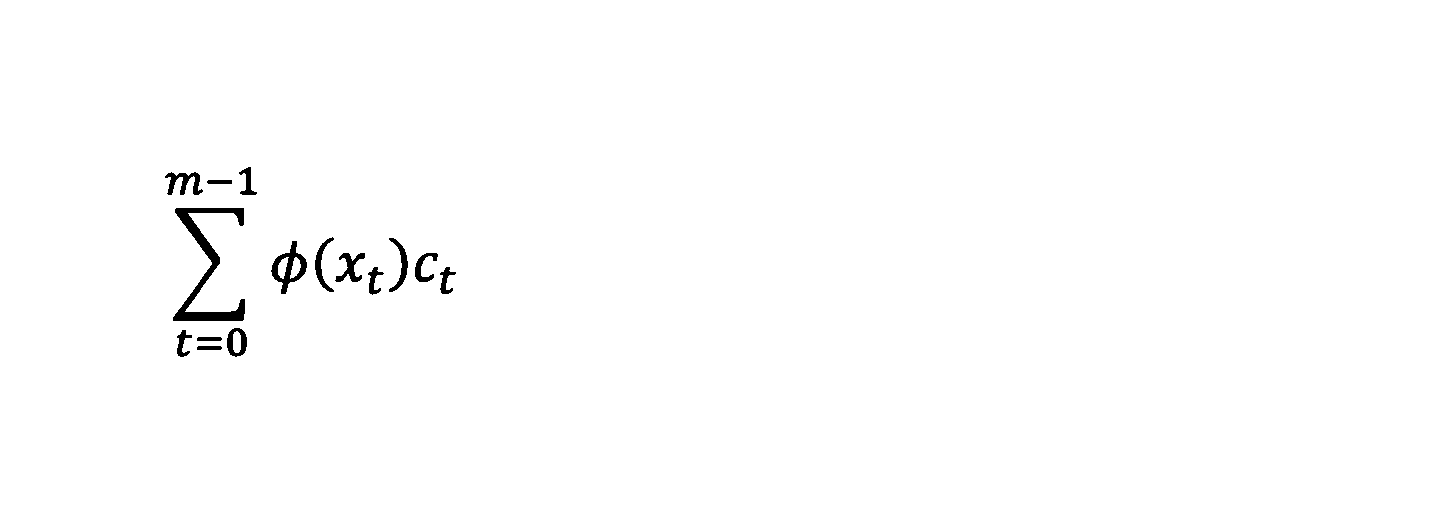
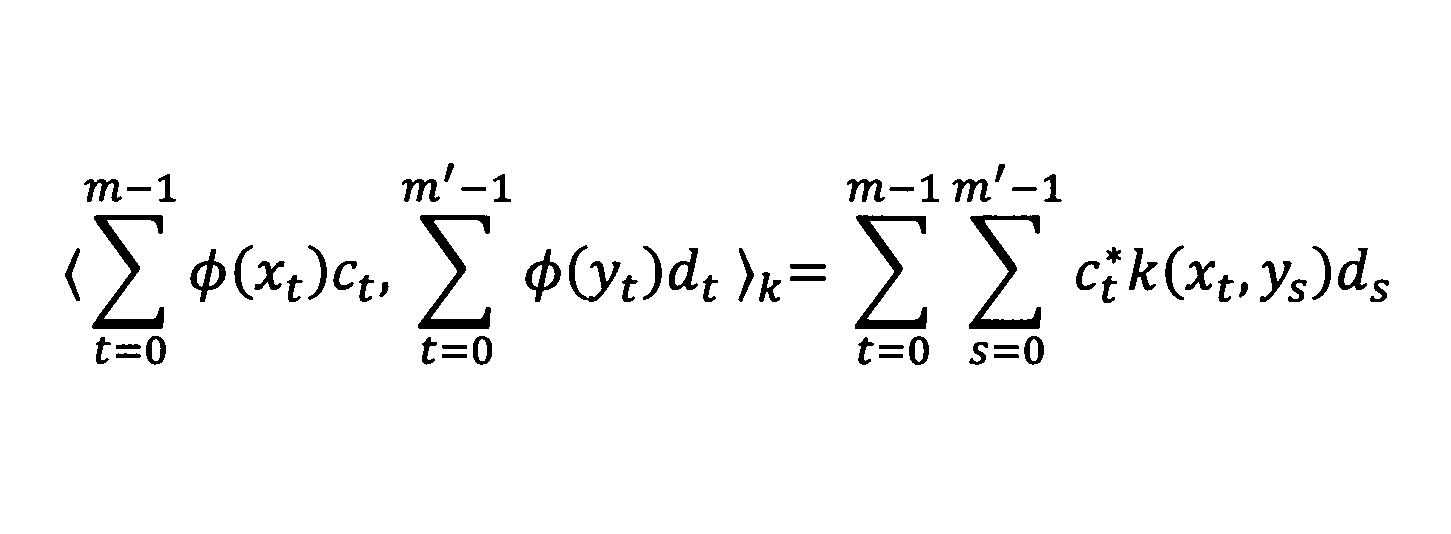
・〈u,v〉k=〈v,u〉k
*
・〈u,u〉kはpositive
・〈u,u〉k=0とu=0は同値
・〈u,vc+wd〉k=〈u,v〉kc+〈u,w〉kd
この内積〈・,・〉kを用いて、複素数値のノルム
・〈u,u〉kはpositive
・〈u,u〉k=0とu=0は同値
・〈u,vc+wd〉k=〈u,v〉kc+〈u,w〉kd
この内積〈・,・〉kを用いて、複素数値のノルム


≪A値関数に対する最急降下法≫
Aを可換なC*-algebraとする。このとき、f:M→ArをHilbert C*-module MからArへの写像(関数)とし、f(v)を最小にするv∈Mを求めることを考える。ただし、Ar={c-d|c,d∈A+},A+はpositiveな要素全体から成る集合である。
Aを可換なC*-algebraとする。このとき、f:M→ArをHilbert C*-module MからArへの写像(関数)とし、f(v)を最小にするv∈Mを求めることを考える。ただし、Ar={c-d|c,d∈A+},A+はpositiveな要素全体から成る集合である。
fのv∈Mにおけるu∈M方向の微分Dfv(u)は、
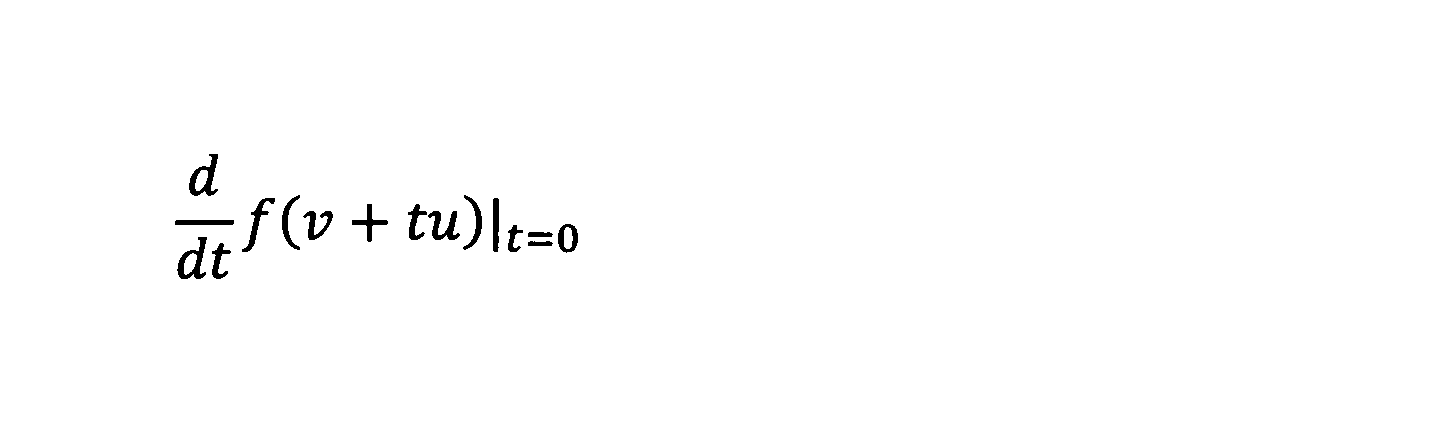
Hilbert C*-module Mから可換なC*-algebra Aへの関数fに対する最急降下法のアルゴリズムは以下の手続き1及び2で構成される。
手続き1:v0∈Mをランダムに選ぶ。また、パラメータε>0を選ぶ。
手続き2:t=0,1,・・・に対して、

εが十分に小さければ、上記の手続き2で求めたvt+1に対するf(vt+1)はf(vt)よりも小さくなることが示せる。これにより、f(v)を最小にするv∈Mが求まる。
ここで、上記のアルゴリズムに確率的な作用を追加して確率的勾配降下法に拡張する等、一般的な勾配法に関するテクニックは本実施形態でも同様に適用可能である。また、∇fvを低次元の空間に射影して近似的に計算する等の工夫を行えば、計算量を削減することも可能である。
なお、上記では、MはHilbert C*-moduleであるものとして関数fに対する最急降下法のアルゴリズムを説明したが、M=Mk、つまりMはRKHMとしても上記の最急降下法のアルゴリズムは当然に適用可能である。
<解析装置10のハードウェア構成>
次に、本実施形態に係る解析装置10のハードウェア構成について、図1を参照しながら説明する。図1は、本実施形態に係る解析装置10のハードウェア構成の一例を示す図である。
次に、本実施形態に係る解析装置10のハードウェア構成について、図1を参照しながら説明する。図1は、本実施形態に係る解析装置10のハードウェア構成の一例を示す図である。
図1に示すように、本実施形態に係る解析装置10は一般的なコンピュータ又はコンピュータシステムで実現され、入力装置101と、表示装置102と、外部I/F103と、通信I/F104と、プロセッサ105と、メモリ装置106とを有する。これらの各ハードウェアは、それぞれがバス107を介して通信可能に接続されている。
入力装置101は、例えば、キーボードやマウス、タッチパネル等である。表示装置102は、例えば、ディスプレイ等である。なお、解析装置10は、入力装置101及び表示装置102のうちの少なくとも一方を有していなくてもよい。
外部I/F103は、記録媒体103a等の外部装置とのインタフェースである。記録媒体103aとしては、例えば、CD(Compact Disc)、DVD(Digital Versatile Disk)、SDメモリカード(Secure Digital memory card)、USB(Universal Serial Bus)メモリカード等がある。
通信I/F104は、解析装置10を通信ネットワークに接続するためのインタフェースである。プロセッサ105は、例えば、CPU(Central Processing Unit)やGPU(Graphics Processing Unit)等の各種演算装置である。メモリ装置106は、例えば、HDD(Hard Disk Drive)やSSD(Solid State Drive)、RAM(Random Access Memory)、ROM(Read Only Memory)、フラッシュメモリ等の各種記憶装置である。
本実施形態に係る解析装置10は、図1に示すハードウェア構成を有することにより、後述する解析処理を実現することができる。なお、図1に示すハードウェア構成は一例であって、解析装置10は、他のハードウェア構成を有していてもよい。例えば、解析装置10は、複数のプロセッサ105を有していてもよいし、複数のメモリ装置106を有していてもよい。
<解析装置10の機能構成>
次に、本実施形態に係る解析装置10の機能構成について、図2を参照しながら説明する。図2は、本実施形態に係る解析装置10の機能構成の一例を示す図である。
次に、本実施形態に係る解析装置10の機能構成について、図2を参照しながら説明する。図2は、本実施形態に係る解析装置10の機能構成の一例を示す図である。
図2に示すように、本実施形態に係る解析装置10は、取得部201と、解析部202とを有する。これら各部は、例えば、解析装置10にインストールされた1以上のプログラムがプロセッサ105に実行させる処理により実現される。
また、本実施形態に係る解析装置10は、記憶部203を有する。記憶部203は、例えば、メモリ装置106により実現される。なお、記憶部203は、例えば、解析装置10と通信ネットワークを介して接続される記憶装置(データベースサーバ等)により実現されていてもよい。
記憶部203には、複雑な構造を持つデータの集合(例えば、{x0,x1,・・・,xm-1}⊆X)が記憶されている。
取得部201は、記憶部203に記憶されているデータの集合を解析対象のデータとして取得する。
解析部202は、取得部201により取得されたデータの集合に対してRKHM上で様々なデータ解析を行う。すなわち、解析部202は、取得部201により取得されたデータの集合を写像φによりRKHM Mk上に写した上で、RKHM Mk上で様々なデータ解析を行う。ここで、解析部202には最適化計算部210が含まれており、データ解析の際に必要となる最適化問題(つまり、C*-algebraに値を持つ関数に関する最適化問題)の解を、最適化計算部210が上記の手続き1及び2を実行することで計算する。なお、最適化問題はどのようなデータ解析を行うかによって、そのデータ解析に応じて定式化される。
なお、図2に示す解析装置10の機能構成は一例であって、他の機能構成であってもよい。例えば、最適化計算部210が解析部202に含まれるのではなく、解析部202の外にあってもよい。
<解析処理の流れ>
次に、本実施形態に係る解析処理の流れについて、図3を参照しながら説明する。図3は、本実施形態に係る解析処理の流れの一例を示すフローチャートである。
次に、本実施形態に係る解析処理の流れについて、図3を参照しながら説明する。図3は、本実施形態に係る解析処理の流れの一例を示すフローチャートである。
まず、取得部201は、記憶部203に記憶されているデータの集合を解析対象のデータとして取得する(ステップS101)。
次に、解析部202は、上記のステップS101で取得したデータをRKHM Mk上で解析する(ステップS102)。このとき、解析部202は、最適化計算部210により、当該データ解析に応じて定式化された最適化問題の解を上記の手続き1及び2によって計算する。これにより、複雑な構造を持つデータの解析をRKHM上で実現することができる。
<データ解析への応用例>
次に、C*-algebraに値を持つ関数に関する最適化問題を解く必要があるデータ解析への応用例として、主成分分析とデータの構成要素間の相互作用の解析について説明する。
次に、C*-algebraに値を持つ関数に関する最適化問題を解く必要があるデータ解析への応用例として、主成分分析とデータの構成要素間の相互作用の解析について説明する。
≪主成分分析≫
取得部201によって取得されたデータをx1,・・・,xnとする。ここでは特に、データx1,・・・,xnは高次元又は関数に値をとるような無限次元のデータであるとする。このとき、以下の式(1)に示す最適化問題を解くことにより、データの性質を最もよく表す空間の軸p1,・・・,prと、軸pjにおけるxiの座標〈pj,φ(xi)〉kとを求める。
取得部201によって取得されたデータをx1,・・・,xnとする。ここでは特に、データx1,・・・,xnは高次元又は関数に値をとるような無限次元のデータであるとする。このとき、以下の式(1)に示す最適化問題を解くことにより、データの性質を最もよく表す空間の軸p1,・・・,prと、軸pjにおけるxiの座標〈pj,φ(xi)〉kとを求める。
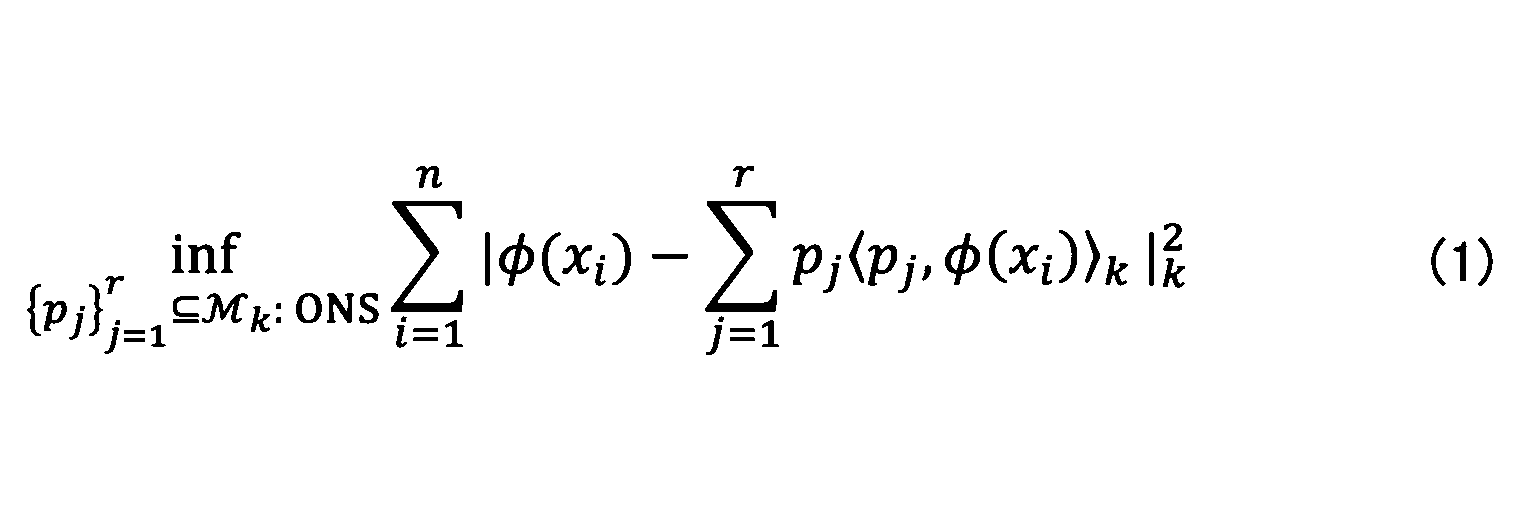
これにより、データxiを、〈pj,φ(xi)〉k∈Aに縮約できる。例えば、xiが多変数関数である場合、Aを1変数関数の空間に選べば、多変数関数を1変数関数に縮約できる。
上記の式(1)に示す最適化問題の解が存在するとすれば、その解は、あるci∈Aに対して
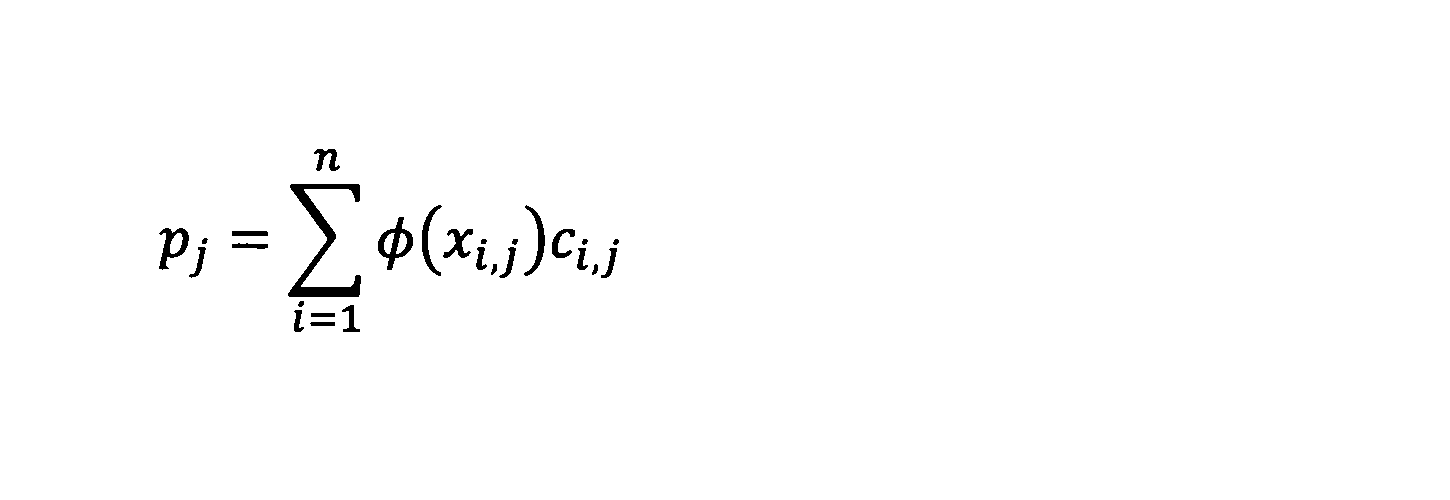
・Aが可換な場合
Aが可換な場合、上記の式(1)に示す最適化問題は、以下の式(2)のように変形できる。
Aが可換な場合、上記の式(1)に示す最適化問題は、以下の式(2)のように変形できる。

そして、r=1のとき、上記の式(2)に示す最適化問題を以下の式(3)に示す制約付き最適化問題に変換し、最適化計算部210が上記の手続き1及び2によって解を計算する。
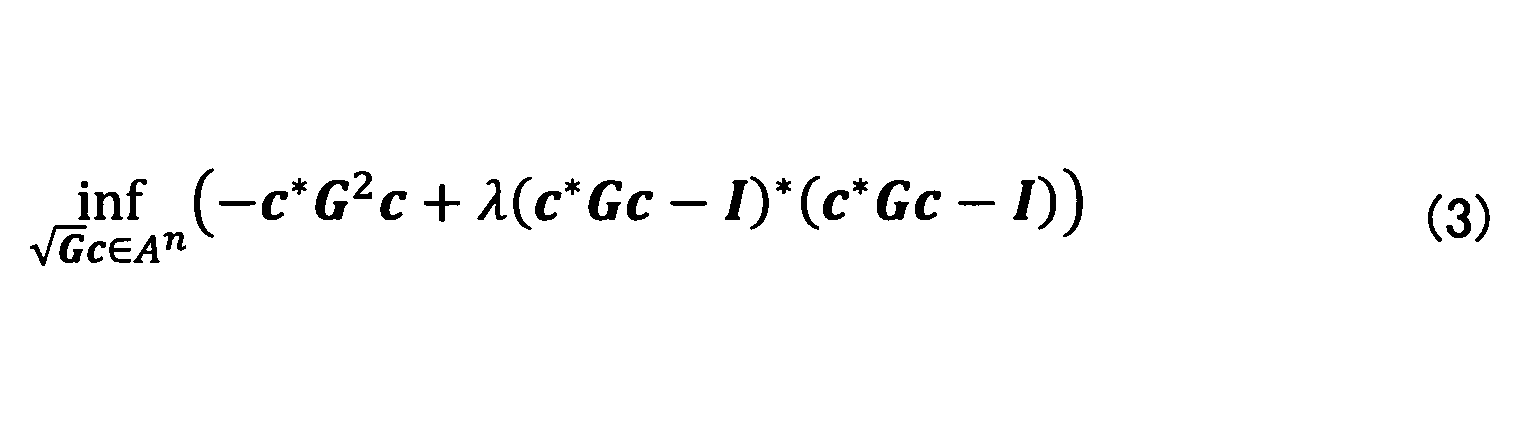
r>1のときは、r-1までに得られた解をc1,・・・,cr-1とし、Anの中で√Gc1,・・・,√Gcr-1と直交する空間上において、上記の式(3)に示す最適化問題を最適化計算部210が上記の手続き1及び2によって解くことで、解crを計算する。これをr=2,・・・に対して繰り返すことで、解c1,・・・,cs(ただし、s≦r)を得る。なお、各rに対して、√Gcrは、(√G)×crのことを意味する。
具体的には、r=2のときは、r=1のときに得られた解をc1とし、Anの中で√Gc1と直交する空間上において、上記の式(3)に示す最適化問題を最適化計算部210が解くことで解c2を計算する。次に、r=3のときは、Anの中で√Gc1,√Gc2と直交する空間上において、上記の式(3)に示す最適化問題を最適化計算部210が解くことで解c3を計算する。次に、r=4のときは、Anの中で√Gc1,√Gc2,√Gc3と直交する空間上において、上記の式(3)に示す最適化問題を最適化計算部210が解くことで解c4を計算する。以降も同様に、r=5,・・・,s-1に対して、これを繰り返す。
・Aが可換でない場合
Aが可換でない場合は、Aの要素は、あるHilbert空間W上の有界線形作用素と同一視できることが知られている。そこで、pj∈Mkは任意のx∈Xに対してpj(x)がランクtの線形作用素になると仮定し、上記の式(1)に示す最適化問題のトレースをとった以下の問題を考える。
Aが可換でない場合は、Aの要素は、あるHilbert空間W上の有界線形作用素と同一視できることが知られている。そこで、pj∈Mkは任意のx∈Xに対してpj(x)がランクtの線形作用素になると仮定し、上記の式(1)に示す最適化問題のトレースをとった以下の問題を考える。

≪データの構成要素間の相互作用の解析≫
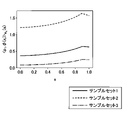
区間[0,1]上で定義され、かつ、Xに値を取る2変数の連続関数により記述されるデータをx1,・・・,xnとする。このようなデータとしては、例えば、空間上に連続的に分布したデータや観測点が変化するデータ等が挙げられる。また、実数又は複素数値のデータをy1,・・・,ynとする。これらのデータx1,・・・,xn,y1,・・・,ynは取得部201によって取得される。
区間[0,1]上で定義され、かつ、Xに値を取る2変数の連続関数により記述されるデータをx1,・・・,xnとする。このようなデータとしては、例えば、空間上に連続的に分布したデータや観測点が変化するデータ等が挙げられる。また、実数又は複素数値のデータをy1,・・・,ynとする。これらのデータx1,・・・,xn,y1,・・・,ynは取得部201によって取得される。
また、xiとyiはある関数fにより、
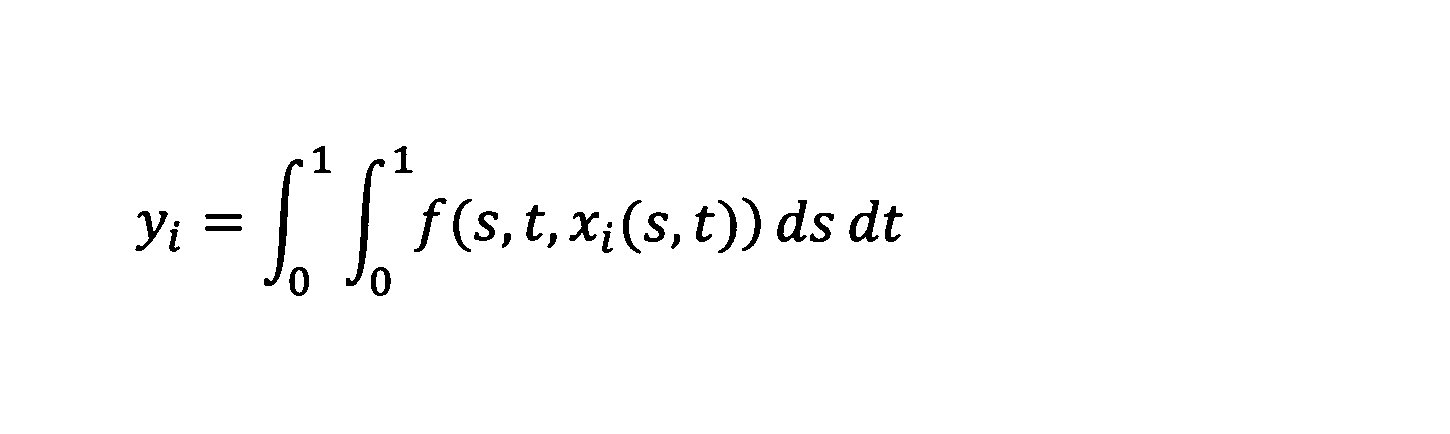
Aを、[0,1]上のある関数に対する有界線形作用素全体から成る空間とする。また、xiに対して、

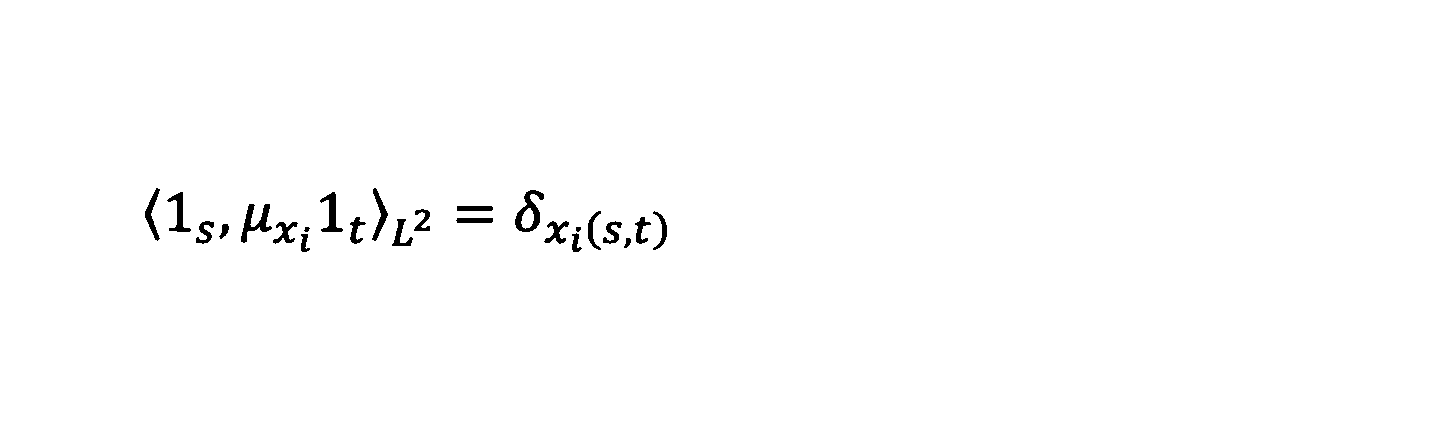
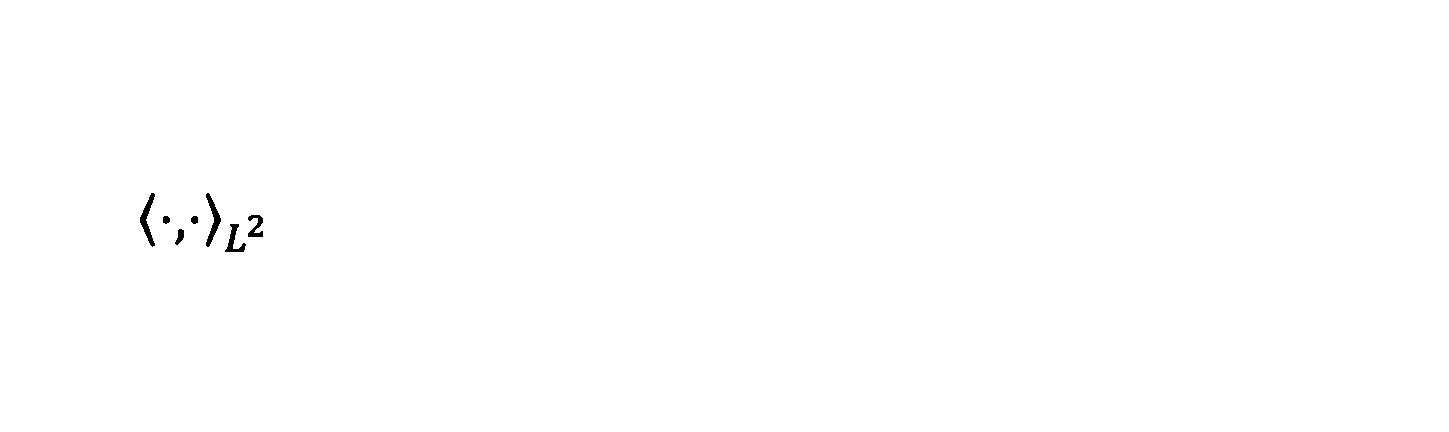

更に、Φを、A値測度をRKHM Mkに写すkernel mean embeddingとする。なお、A値測度とkernel mean embeddingに関する定義については、例えば、参考文献「Y. Hashimoto, I. Ishikawa, M. Ikeda, F. Komura, and Y. Kawahara, "Kernel Mean Embeddings of Von Neumann-Algebra-Valued Measures,"arXiv: 2007.14698.」等を参照されたい。
このとき、Vを、
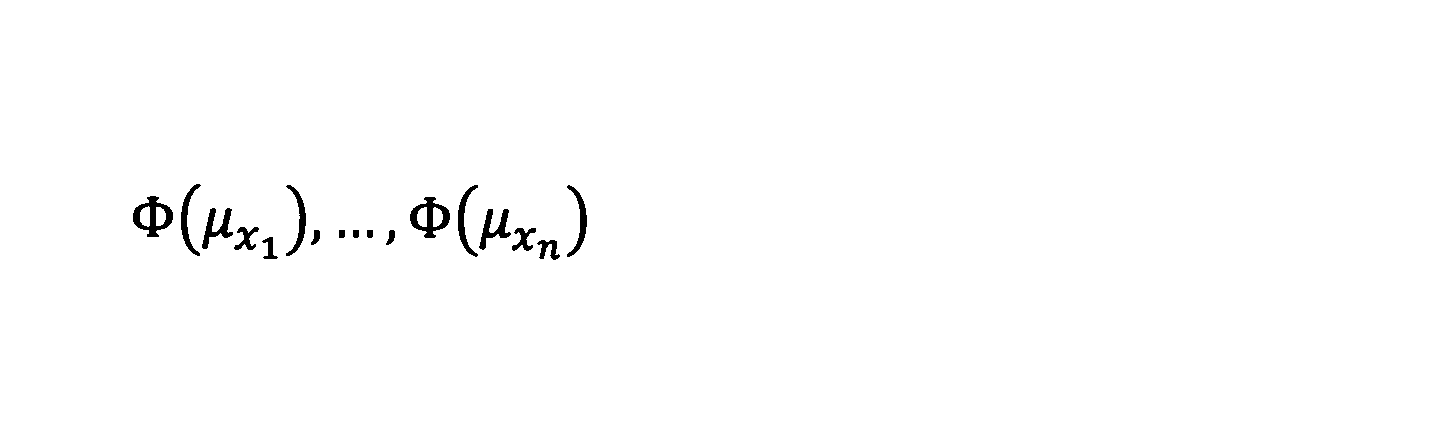

通常、与えられたデータx1,・・・,xnにはノイズが含まれていたり、類似したデータが含まれていたりするため、実際にはVの中の低次元の部分空間によってPfの振る舞いは決定すると考えられる。そこで、
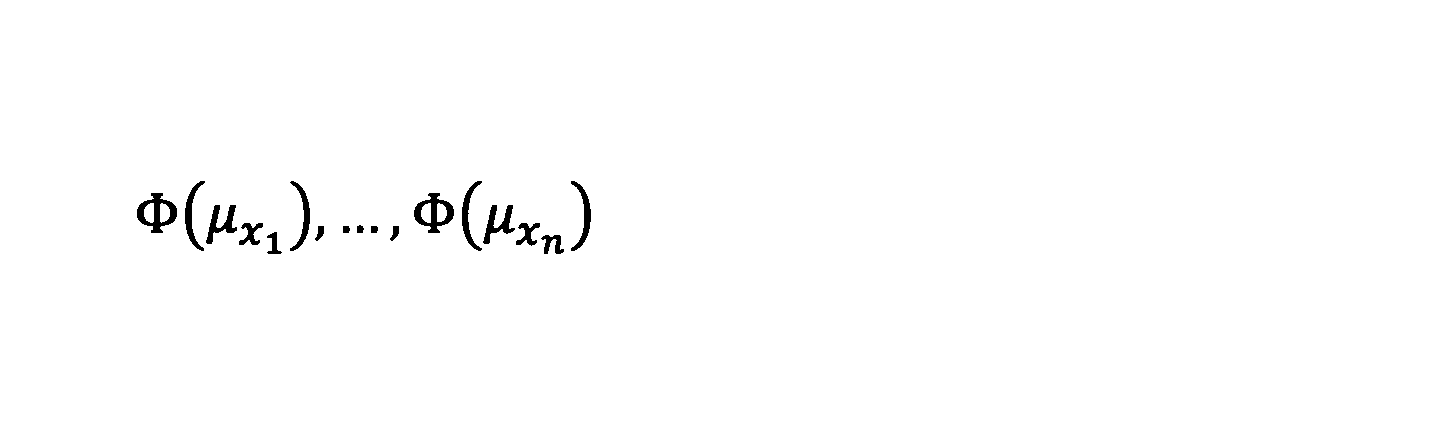

V上の作用素PfQQ*により最も大きく変化する方向は、
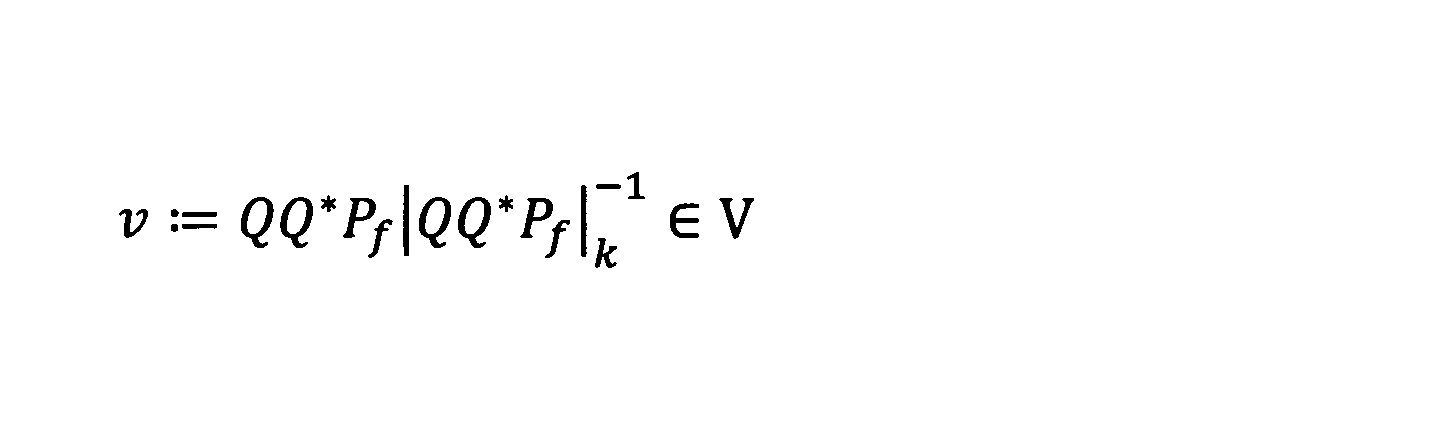
<実験>
次に、上記の応用例で説明した主成分分析とデータの構成要素間の相互作用の解析とを実験した結果について説明する。
次に、上記の応用例で説明した主成分分析とデータの構成要素間の相互作用の解析とを実験した結果について説明する。
≪主成分分析≫
以下の3種類の[0,1]上の2変数関数から、ランダムに3種類のサンプルセットを生成した。
以下の3種類の[0,1]上の2変数関数から、ランダムに3種類のサンプルセットを生成した。
y1(s,t)=e10(s-t)
y2(s,t)=10st
y3(s,t)=cos(10(s-t))
各サンプルセットiは関数yiを[0,1]上の11点で離散化してノイズを加えた20個のサンプルから成るものとする。ただし、ノイズは、平均0、標準偏差0.3のGaussian分布から生成される乱数とした。
y2(s,t)=10st
y3(s,t)=cos(10(s-t))
各サンプルセットiは関数yiを[0,1]上の11点で離散化してノイズを加えた20個のサンプルから成るものとする。ただし、ノイズは、平均0、標準偏差0.3のGaussian分布から生成される乱数とした。
このとき、これらのサンプルに対して、上記の応用例における「主成分分析」の「Aが可換な場合」で説明した手法(以下、「提案手法」ともいう。)により上記の(3)に示す最適化問題を解いた。ここで、パラメータはλ=0.1、ε=0.01とした。また、kは1変数関数に値を持つカーネル

また、提案手法との比較のため、上記の離散化した点をベクトル化したデータに対してRKHSを用いた既存手法により主成分分析も行った。
提案手法による主成分分析の結果を可視化したものを図4Aに、既存手法による主成分分析の結果を可視化したものを図4Bにそれぞれ示す。既存手法では各サンプルを点として表現するため、関数としての特徴を捉えられず、3種類のサンプルセットをうまく分離できていない。一方で、提案手法では各サンプルを関数として表現するため、3種類のサンプルセットをうまく分離できていることがわかる。
≪データの構成要素間の相互作用の解析≫
x1,・・・,xnを、区間[0,1]上で定義された関数
x1,・・・,xnを、区間[0,1]上で定義された関数

また、i=1,・・・,nに対して、
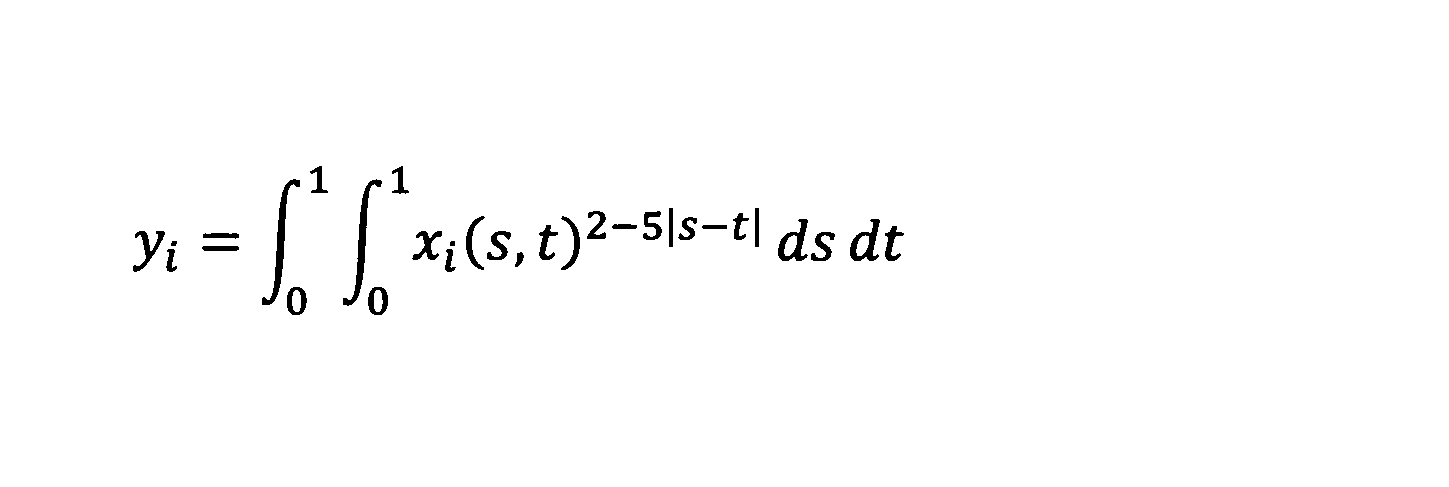
更に、kは有界線形作用素を値にとるカーネル
k(x1,x2)=(x1 3+x1 2+x1)(x2 3+x2 2+x2)I
と設定した。
k(x1,x2)=(x1 3+x1 2+x1)(x2 3+x2 2+x2)I
と設定した。
このとき、上記の応用例における「データの構成要素間の相互作用の解析」で説明した手法により上記の数21を解いた。すなわち、数21に示す最適化問題を、上記の応用例における「主成分分析」の「Aが可換な場合」で説明した手法により解いた。ここで、パラメータはλ=0.1、ε=0.01とした。
このとき、yiを最も大きく変化させるベクトルを求め、それに対応する測度λに対して
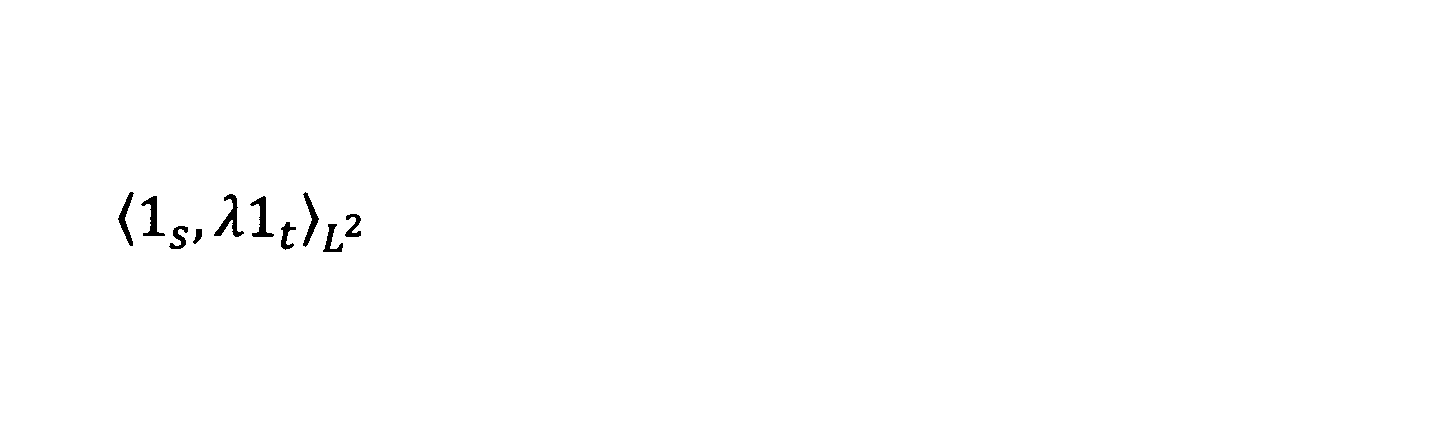

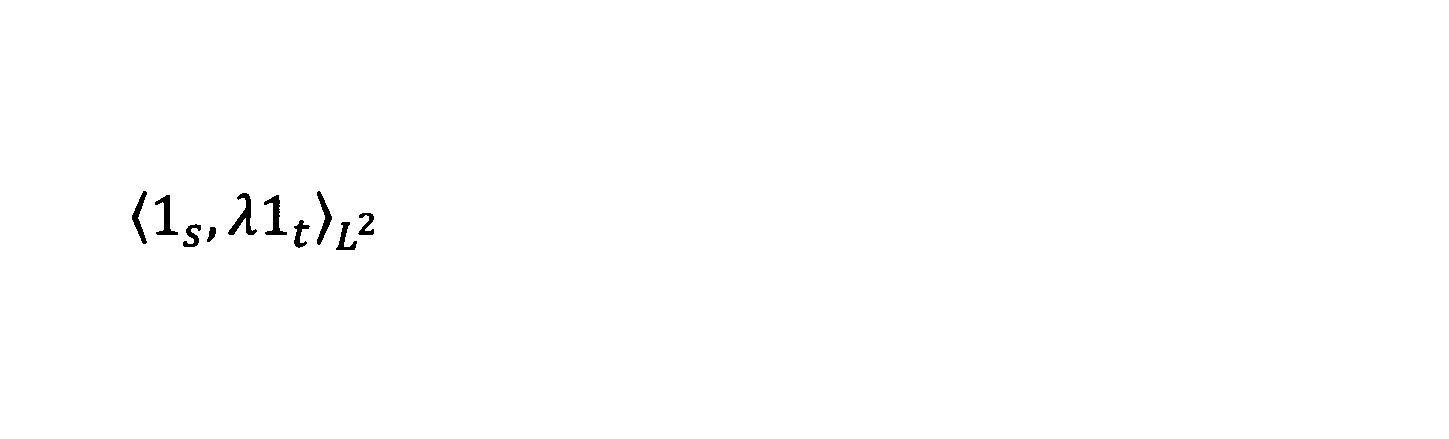

このように、xi(s,t)とyiの関係性が、xi及びyiの情報のみから抽出できている。
本発明は、具体的に開示された上記の実施形態に限定されるものではなく、請求の範囲の記載から逸脱することなく、種々の変形や変更、既知の技術との組み合わせ等が可能である。
10 解析装置
101 入力装置
102 表示装置
103 外部I/F
103a 記録媒体
104 通信I/F
105 プロセッサ
106 メモリ装置
107 バス
201 取得部
202 解析部
203 記憶部
210 最適化計算部
101 入力装置
102 表示装置
103 外部I/F
103a 記録媒体
104 通信I/F
105 プロセッサ
106 メモリ装置
107 バス
201 取得部
202 解析部
203 記憶部
210 最適化計算部
Claims (7)
- 複雑な構造を持つデータの集合を解析対象として取得する取得部と、
前記データの集合をRKHM(reproducing kernel Hilbert C*-module)に写した空間上で定義され、かつ、C*-algebra値をとる関数に関する最適化問題の解を、Hilbert空間における勾配法を拡張した手法により計算する最適化計算部と、
を有する解析装置。 - 前記データの集合をRKHMに写した空間をM、前記関数をf、前記関数fのvt∈Mにおける勾配を∇fv_tとして、
前記最適化計算部は、
前記Hilbert空間における勾配法を拡張した手法として、v0∈Mをランダムに選択すると共にε>0を予め決められた値に設定した上で、t=0,1,・・・に対して、vt+1-vtが予め決められた閾値未満となるまでvt+1=vt+ε∇fv_tによりvt∈Mを更新することで、前記最適化問題の解を計算する、請求項1に記載の解析装置。 - 前記C*-algebraをAとして、Aは可換であり、かつ、前記関数fのv∈Mにおけるu∈M方向の微分Dfv(u)がA線形である場合、前記勾配∇fvは、〈・,・〉を前記RKHM上の内積として、Dfv(u)=〈w,u〉を満たすw∈Mである、請求項2に記載の解析装置。
- 前記複雑な構造を持つデータは、高次元若しくは無限次元の空間で表現される多変量データ、又は、複数の変数をとる所定の連続関数により記述されるデータのいずれかである、請求項1乃至3の何れか一項に記載の解析装置。
- 前記最適化計算部により計算された解を用いて、前記データの集合に対する主成分分析、又は、前記データと所定の関係にある他のデータとの相互作用、を前記RKHM上で解析する解析部を有する、請求項1乃至4の何れか一項に記載の解析装置。
- 複雑な構造を持つデータの集合を解析対象として取得する取得手順と、
前記データの集合をRKHM(reproducing kernel Hilbert C*-module)に写した空間上で定義され、かつ、C*-algebra値をとる関数に関する最適化問題の解を、Hilbert空間における勾配法を拡張した手法により計算する最適化計算手順と、
を実行する解析方法。 - コンピュータを、請求項1乃至5の何れか一項に記載の解析装置として機能させるプログラム。
Priority Applications (2)
| Application Number | Priority Date | Filing Date | Title |
|---|---|---|---|
| JP2022573860A JP7529050B2 (ja) | 2021-01-07 | 2021-01-07 | 解析装置、解析方法及びプログラム |
| PCT/JP2021/000358 WO2022149240A1 (ja) | 2021-01-07 | 2021-01-07 | 解析装置、解析方法及びプログラム |
Applications Claiming Priority (1)
| Application Number | Priority Date | Filing Date | Title |
|---|---|---|---|
| PCT/JP2021/000358 WO2022149240A1 (ja) | 2021-01-07 | 2021-01-07 | 解析装置、解析方法及びプログラム |
Publications (1)
| Publication Number | Publication Date |
|---|---|
| WO2022149240A1 true WO2022149240A1 (ja) | 2022-07-14 |
Family
ID=82358133
Family Applications (1)
| Application Number | Title | Priority Date | Filing Date |
|---|---|---|---|
| PCT/JP2021/000358 Ceased WO2022149240A1 (ja) | 2021-01-07 | 2021-01-07 | 解析装置、解析方法及びプログラム |
Country Status (2)
| Country | Link |
|---|---|
| JP (1) | JP7529050B2 (ja) |
| WO (1) | WO2022149240A1 (ja) |
-
2021
- 2021-01-07 JP JP2022573860A patent/JP7529050B2/ja active Active
- 2021-01-07 WO PCT/JP2021/000358 patent/WO2022149240A1/ja not_active Ceased
Non-Patent Citations (1)
| Title |
|---|
| YUKA HASHIMOTO; ISAO ISHIKAWA; MASAHIRO IKEDA; FUYUTA KOMURA; TAKESHI KATSURA; YOSHINOBU KAWAHARA: "Analysis via Orthonormal Systems in Reproducing Kernel Hilbert C^*-Modules and Applications", ARXIV.ORG, CORNELL UNIVERSITY LIBRARY, 201 OLIN LIBRARY CORNELL UNIVERSITY ITHACA, NY 14853, 2 March 2020 (2020-03-02), 201 Olin Library Cornell University Ithaca, NY 14853 , XP081612255 * |
Also Published As
| Publication number | Publication date |
|---|---|
| JP7529050B2 (ja) | 2024-08-06 |
| JPWO2022149240A1 (ja) | 2022-07-14 |
Similar Documents
| Publication | Publication Date | Title |
|---|---|---|
| Wirtz et al. | Surrogate modeling of multiscale models using kernel methods | |
| Jiang et al. | HPC AI500: a benchmark suite for HPC AI systems | |
| CN107871166B (zh) | 针对机器学习的特征处理方法及特征处理系统 | |
| CN113435602A (zh) | 确定机器学习样本的特征重要性的方法及系统 | |
| CN116109121B (zh) | 基于大数据分析的用户需求挖掘方法及系统 | |
| Reddi et al. | Scale invariant conditional dependence measures | |
| Tirvaudey et al. | Non-invasive implementation of nonlinear isogeometric analysis in an industrial FE software | |
| Uribarri et al. | The structure of reconstructed flows in latent spaces | |
| Khine et al. | Predictive big data analytics using multiple linear regression model | |
| Li et al. | Latent neural PDE solver for time-dependent systems | |
| Li et al. | A subdomain synthesis method for global analysis of nonlinear dynamical systems based on cell mapping | |
| WO2023037417A1 (ja) | 推定装置、推定方法、及びプログラム | |
| JP7529050B2 (ja) | 解析装置、解析方法及びプログラム | |
| Salazar et al. | Spatial prediction for infinite-dimensional compositional data | |
| Rebala et al. | Principal component analysis | |
| Riaz et al. | On Approaching Normality Through Rectangular Distribution: Industrial Applications to Monitor Electron Gun and File Server Processes | |
| Lu et al. | Sparse convolution-based markov models for nonlinear fluid flows | |
| JP7505555B2 (ja) | 学習装置、学習方法及びプログラム | |
| Zhang et al. | Towards a statistical understanding of neural networks: Beyond the neural tangent kernel theories | |
| WO2022014657A1 (ja) | 解析装置、解析方法及びプログラム | |
| Li et al. | Multivariate chaotic time series prediction: Broad learning system based on sparse PCA | |
| Wang et al. | Physics-guided deep learning for spatiotemporal forecasting | |
| El Mhouti et al. | Using Cloud Services to Improve Weather Forecasting Based on Weather Big Data Scraped From Web Sources | |
| US20250004725A1 (en) | Improved transformers using faithful positional encoding | |
| US20230082140A1 (en) | Relationship extraction apparatus, relationship extraction method, and program |
Legal Events
| Date | Code | Title | Description |
|---|---|---|---|
| 121 | Ep: the epo has been informed by wipo that ep was designated in this application |
Ref document number: 21917467 Country of ref document: EP Kind code of ref document: A1 |
|
| ENP | Entry into the national phase |
Ref document number: 2022573860 Country of ref document: JP Kind code of ref document: A |
|
| NENP | Non-entry into the national phase |
Ref country code: DE |
|
| 122 | Ep: pct application non-entry in european phase |
Ref document number: 21917467 Country of ref document: EP Kind code of ref document: A1 |